




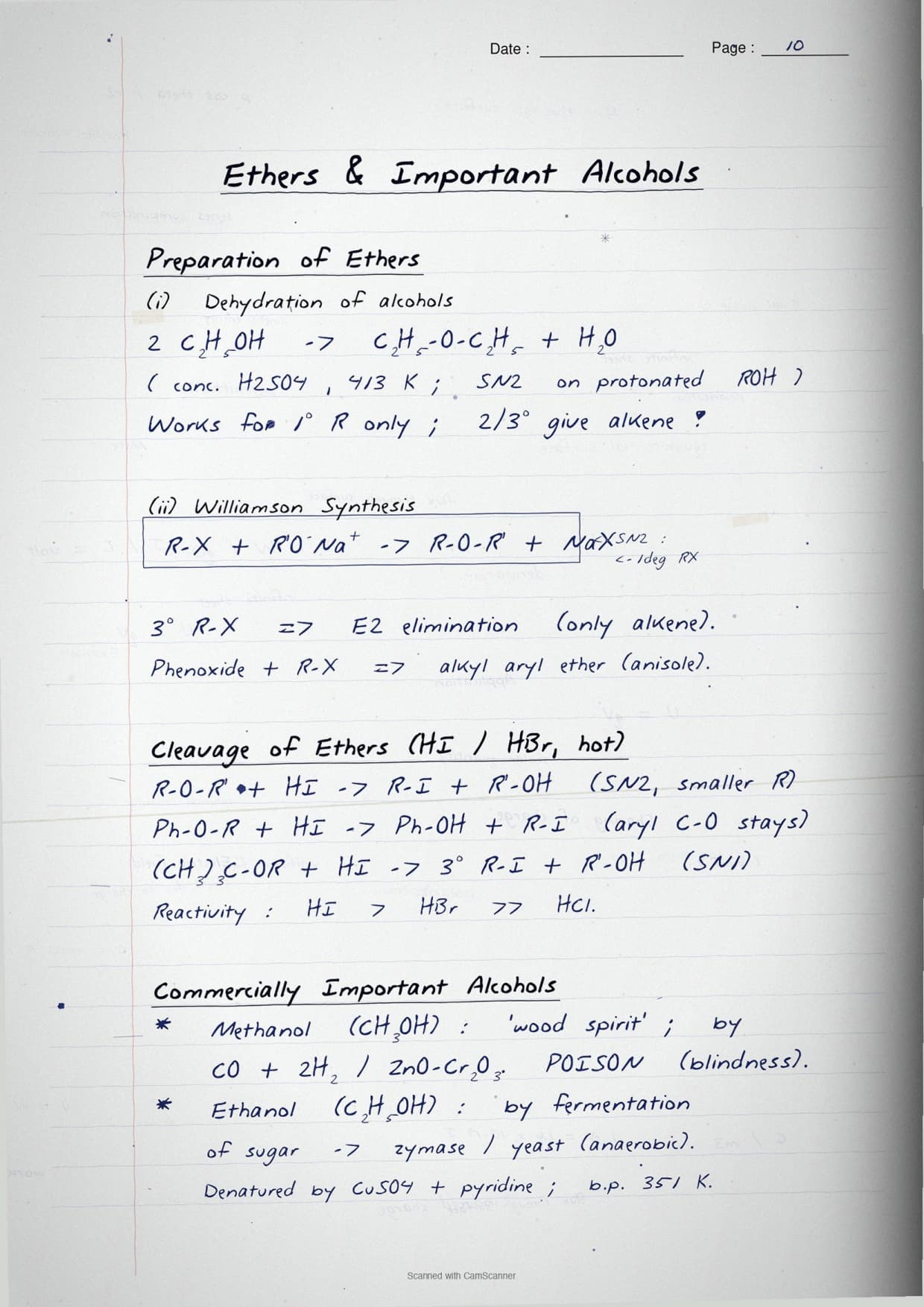
This Collegedunia scanned notebook turns the 22-page Class 12 NCERT chapter on Alcohols, Phenols and Ethers into hand-drawn mechanism arrows, Reimer-Tiemann and Kolbe reaction maps, and a last-night recall card aligned to the 2026-27 syllabus.
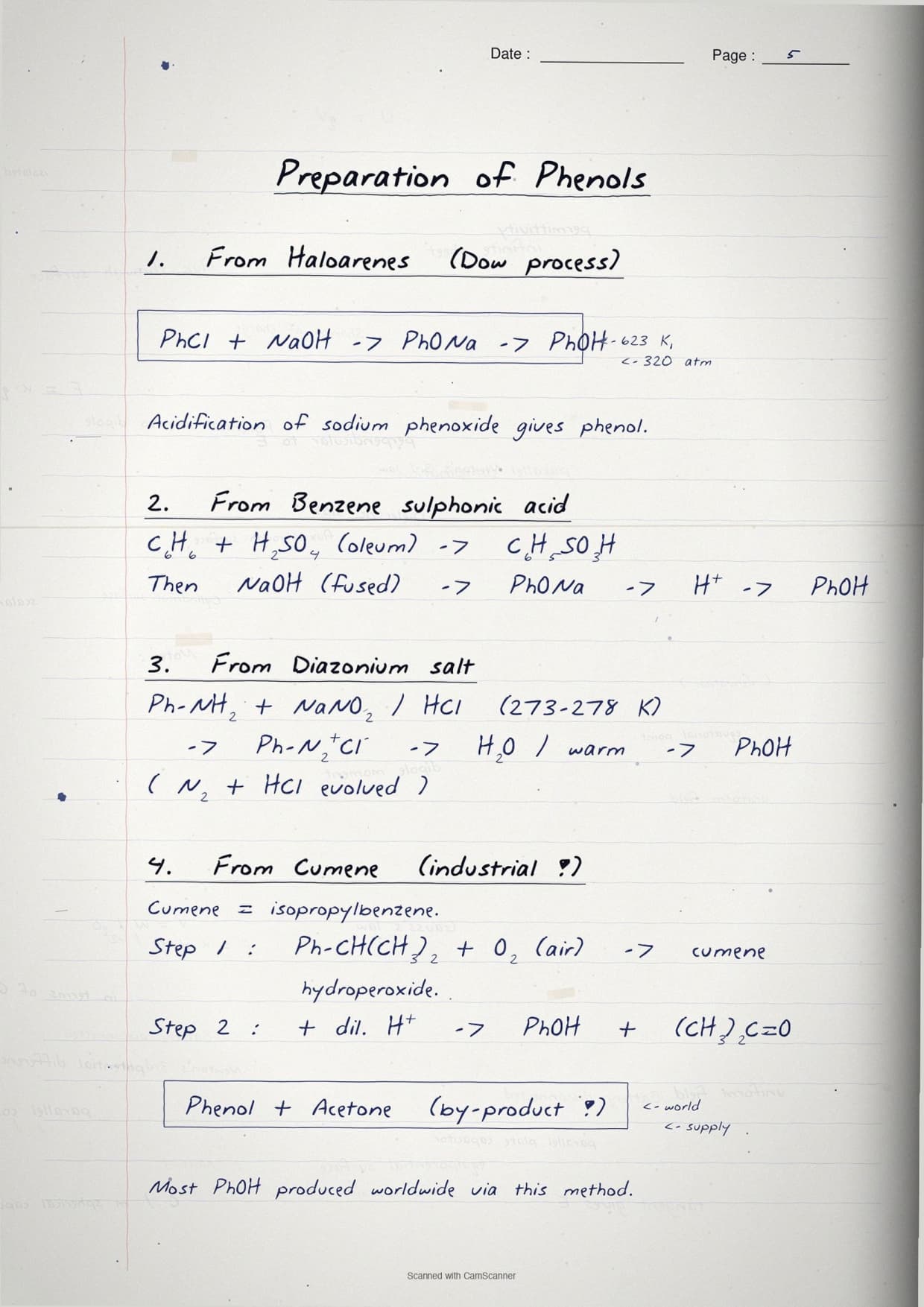
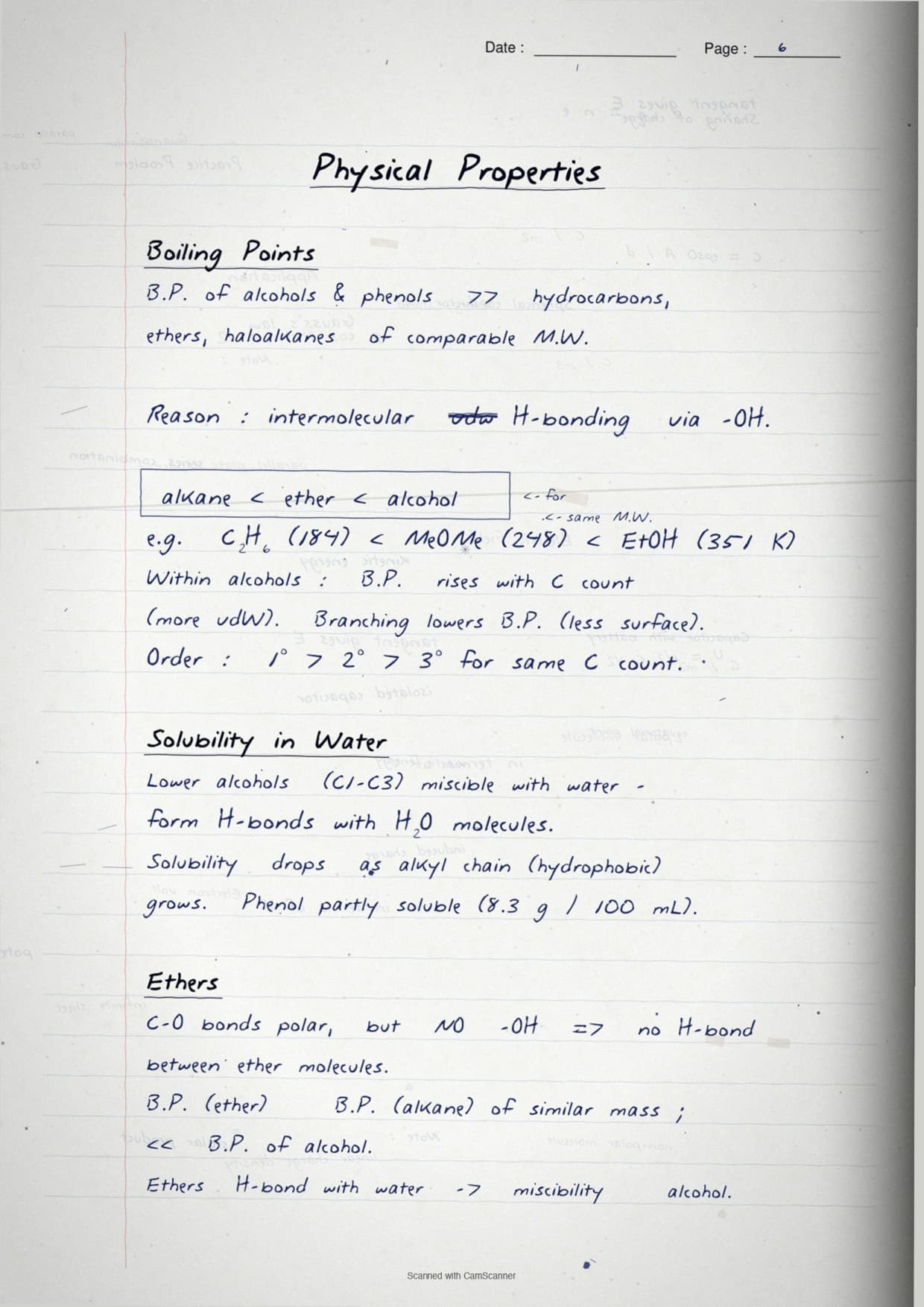
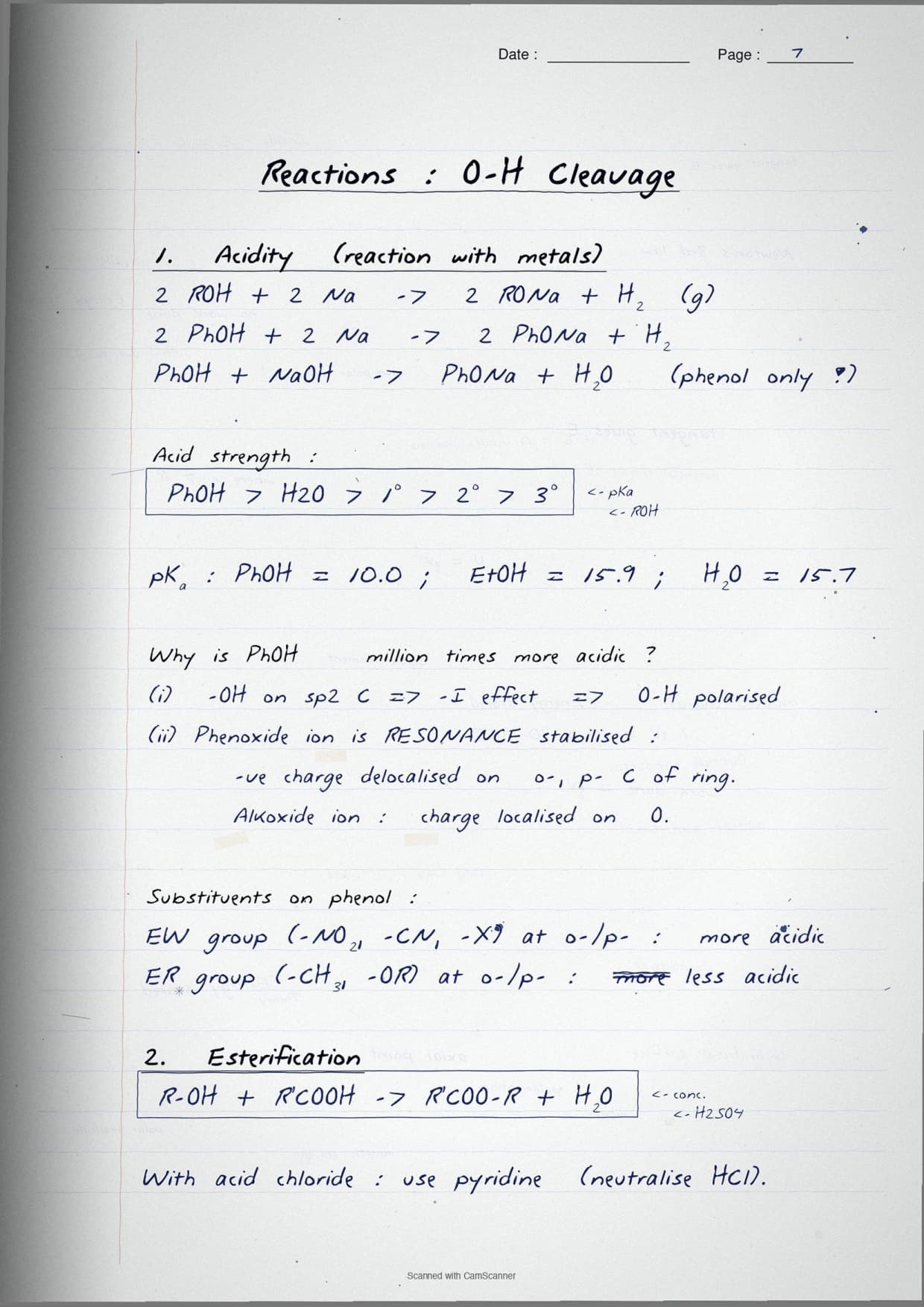
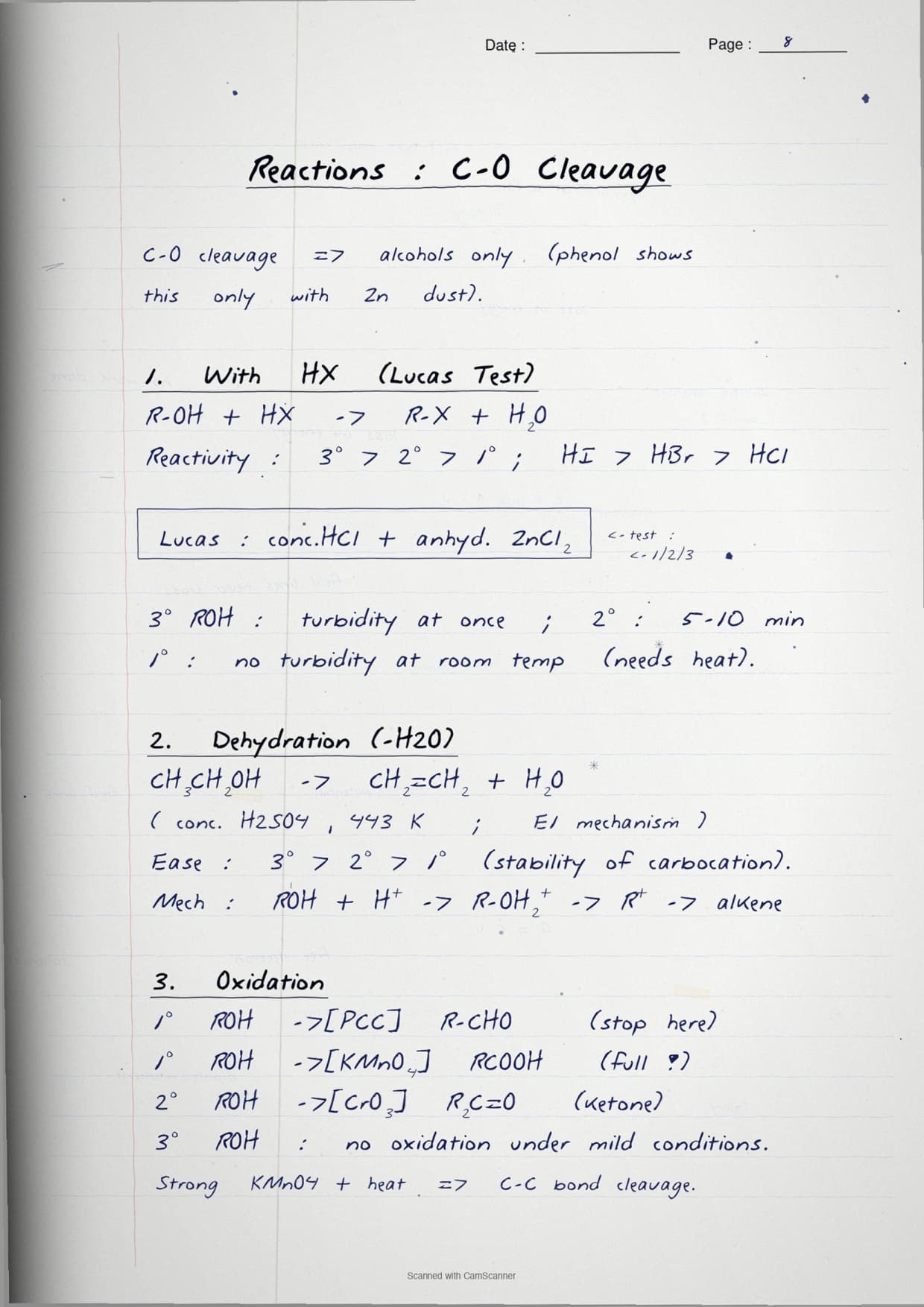
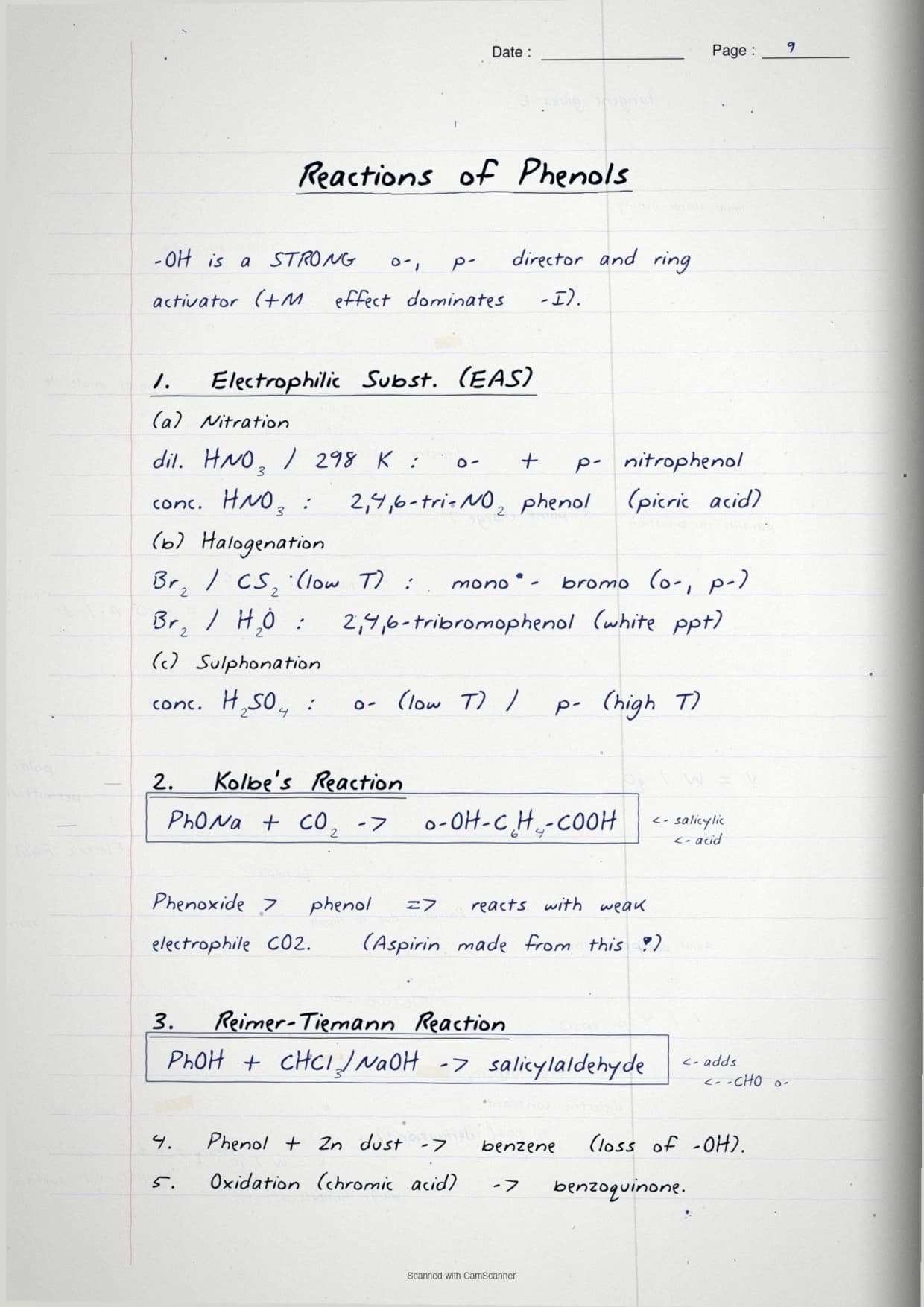
- CBSE Weightage: 4 to 6 marks (a 2-mark conversion or distinction plus a 3-mark mechanism or name-reaction question is the standard CBSE pattern)
- JEE Main Weightage: 3 to 4% (1 to 2 questions per shift on acidity order, name reactions, and Williamson synthesis)
- NEET Weightage: 2 to 3 questions per year on phenol acidity, dehydration of alcohols, and ether cleavage by HI
The scan moves from the classification card through preparation routes, then the acidity order (phenol vs alcohol vs water) and phenol's named reactions on one foldable page.
These Handwritten Notes are scanned from a topper's notebook, cross-checked against the 2026-27 NCERT Class 12 Chemistry textbook, and refined against the last five years of CBSE Board, JEE Main, and NEET papers.
Also Check:
- Alcohols, Phenols and Ethers Class 12 Chemistry Notes
- Alcohols, Phenols and Ethers Class 12 Chemistry NCERT Solutions
- Alcohols, Phenols and Ethers Class 12 Chemistry Formula Sheet
What the Alcohols, Phenols and Ethers Handwritten Notes Cover for Class 12 Chemistry
The 22-page scan walks the 2026-27 NCERT chapter in the exact order students will see it during last-week revision. Every topic that previously cost marks in CBSE Boards or JEE Main is flagged with a coloured-ink callout so the scan doubles as a self-corrected error log.
| Page Block | Topic | Why It Stays in This Notebook |
|---|---|---|
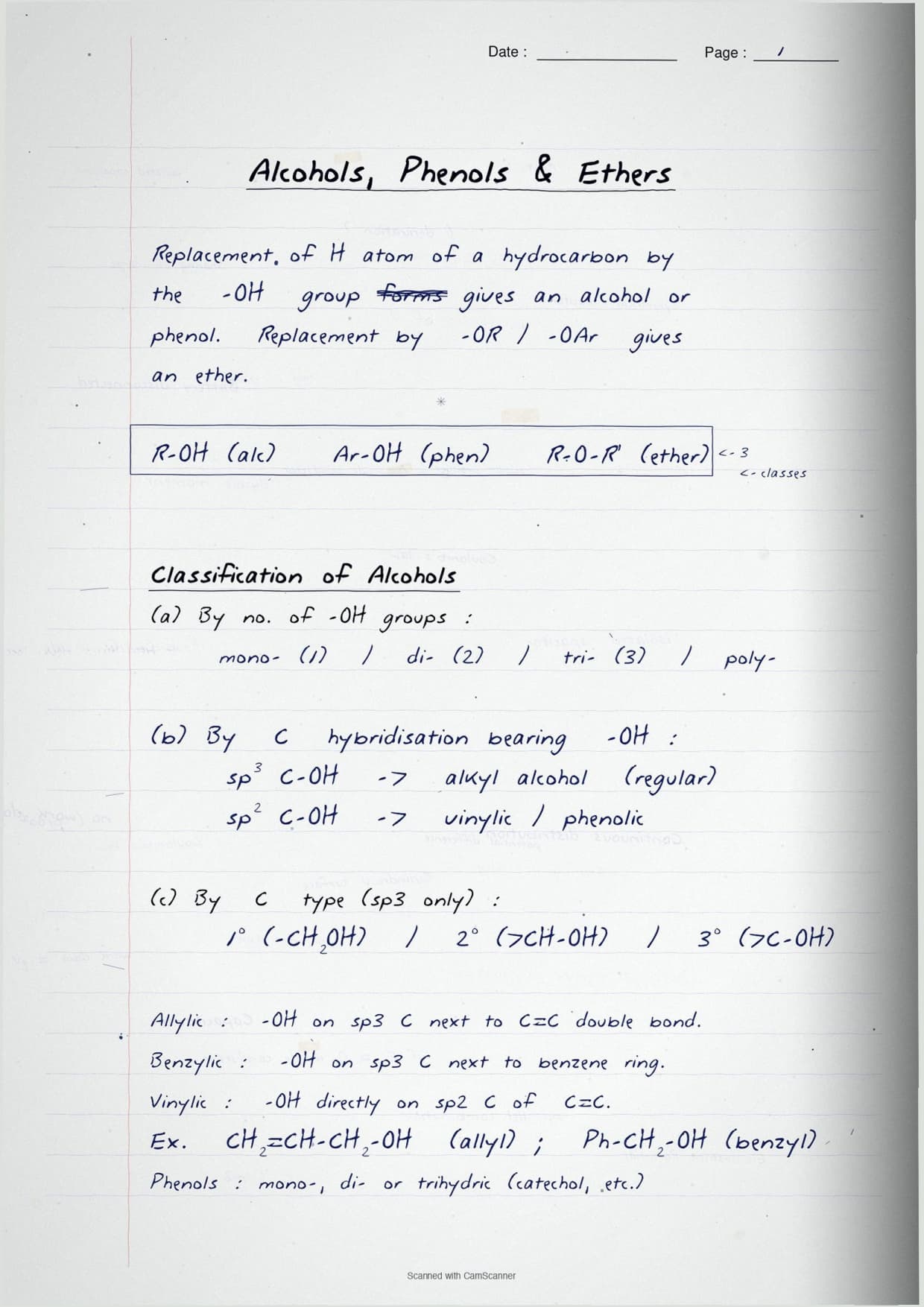
| p. 1-3 | Classification (mono / di / tri-hydric; 1deg / 2deg / 3deg alcohols; aryl vs alkyl ethers) | Hand-drawn flowchart beats a paragraph; one glance recalls every category |
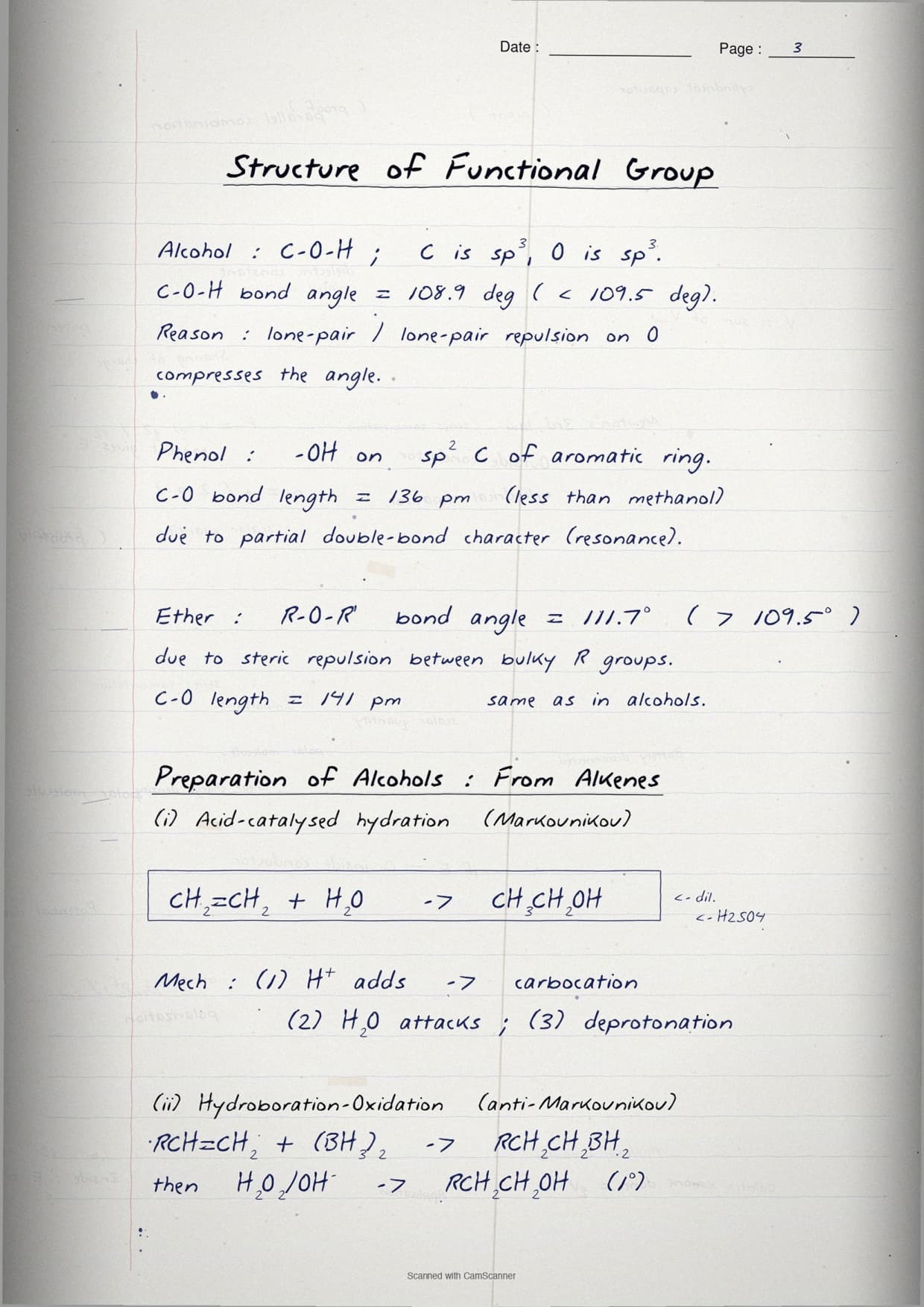
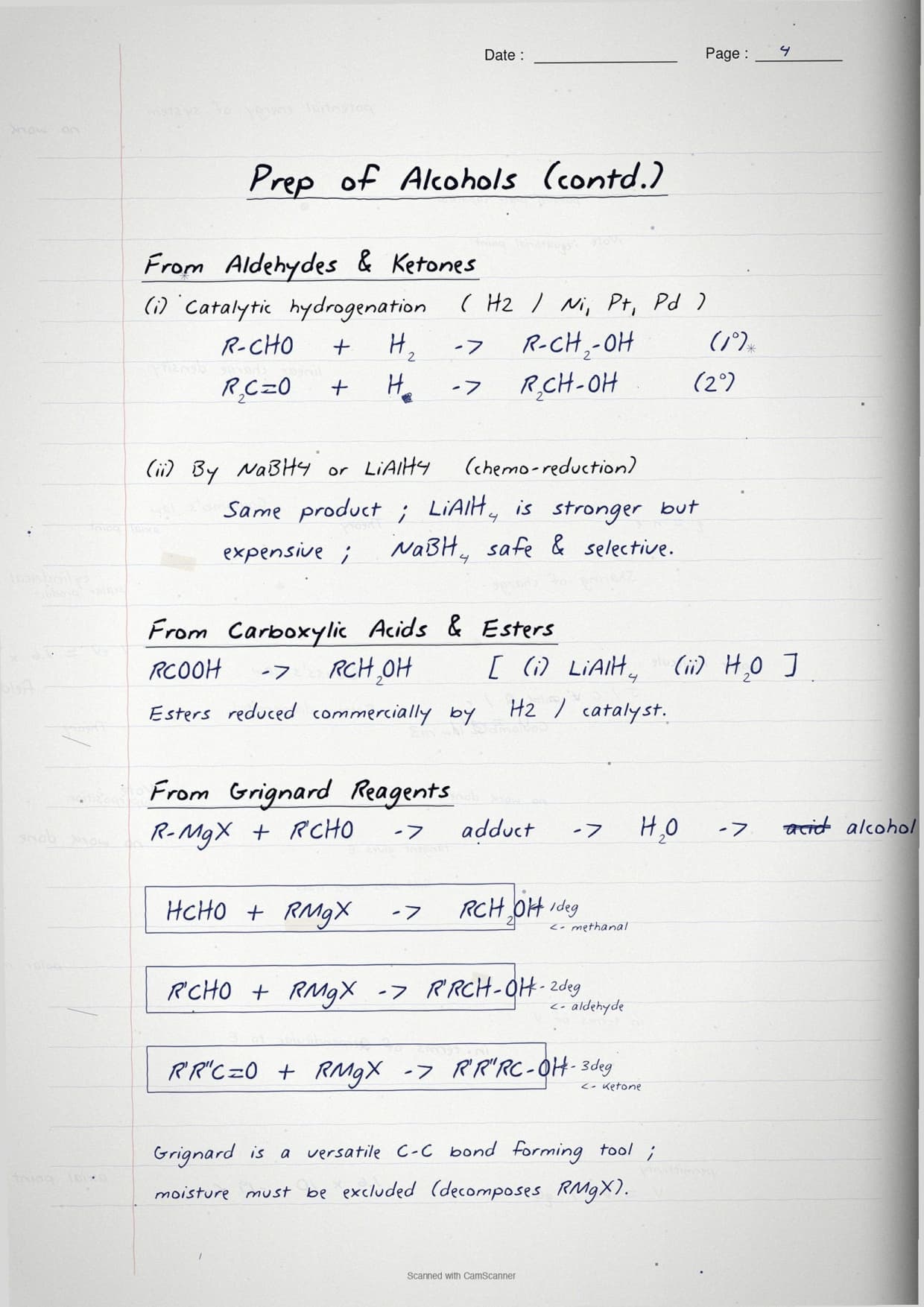
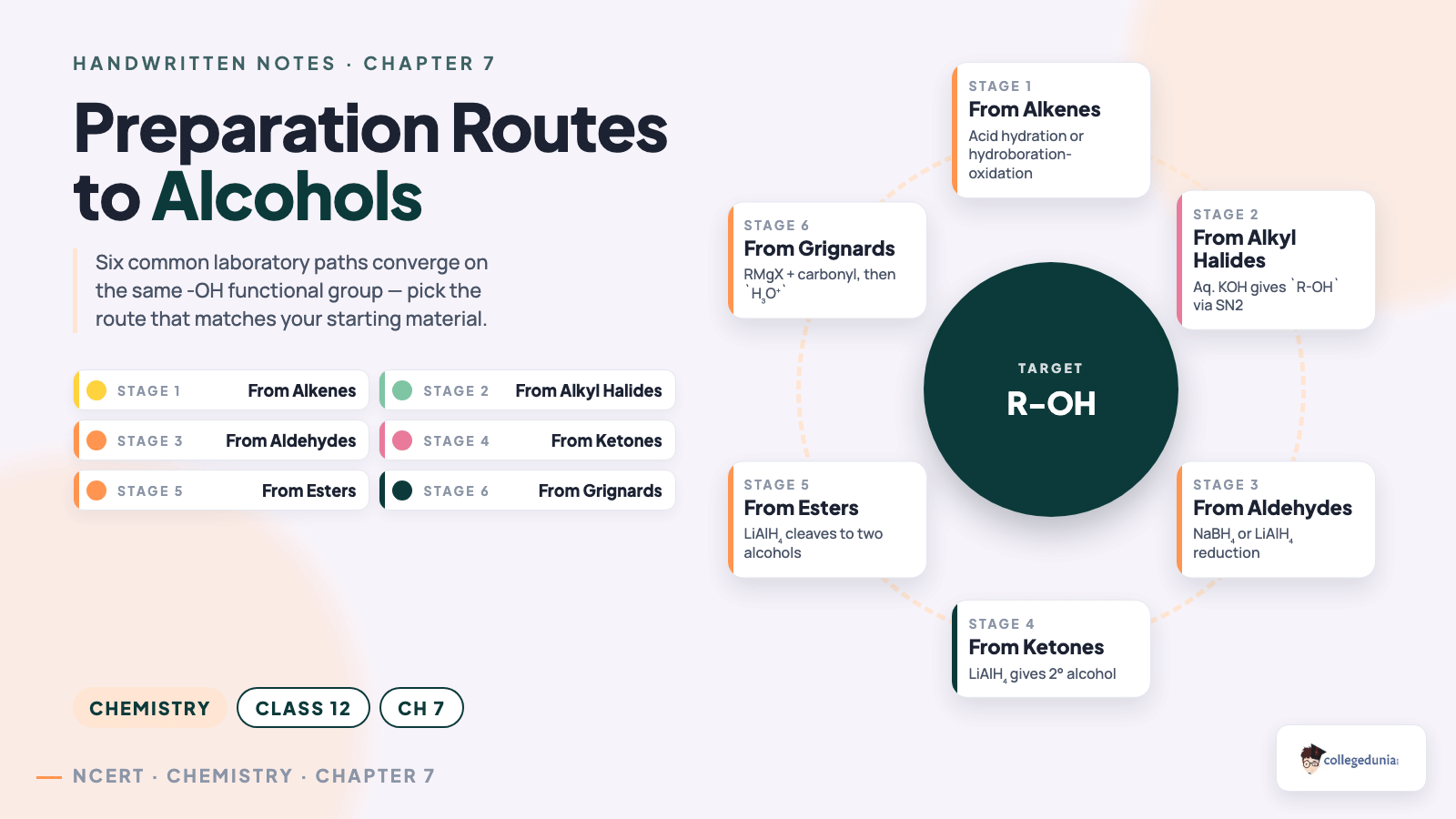
| p. 4-6 | Preparation of alcohols (hydration of alkenes, hydroboration-oxidation, Grignard route) | Markovnikov vs anti-Markovnikov sketches drawn with arrows in two colours |
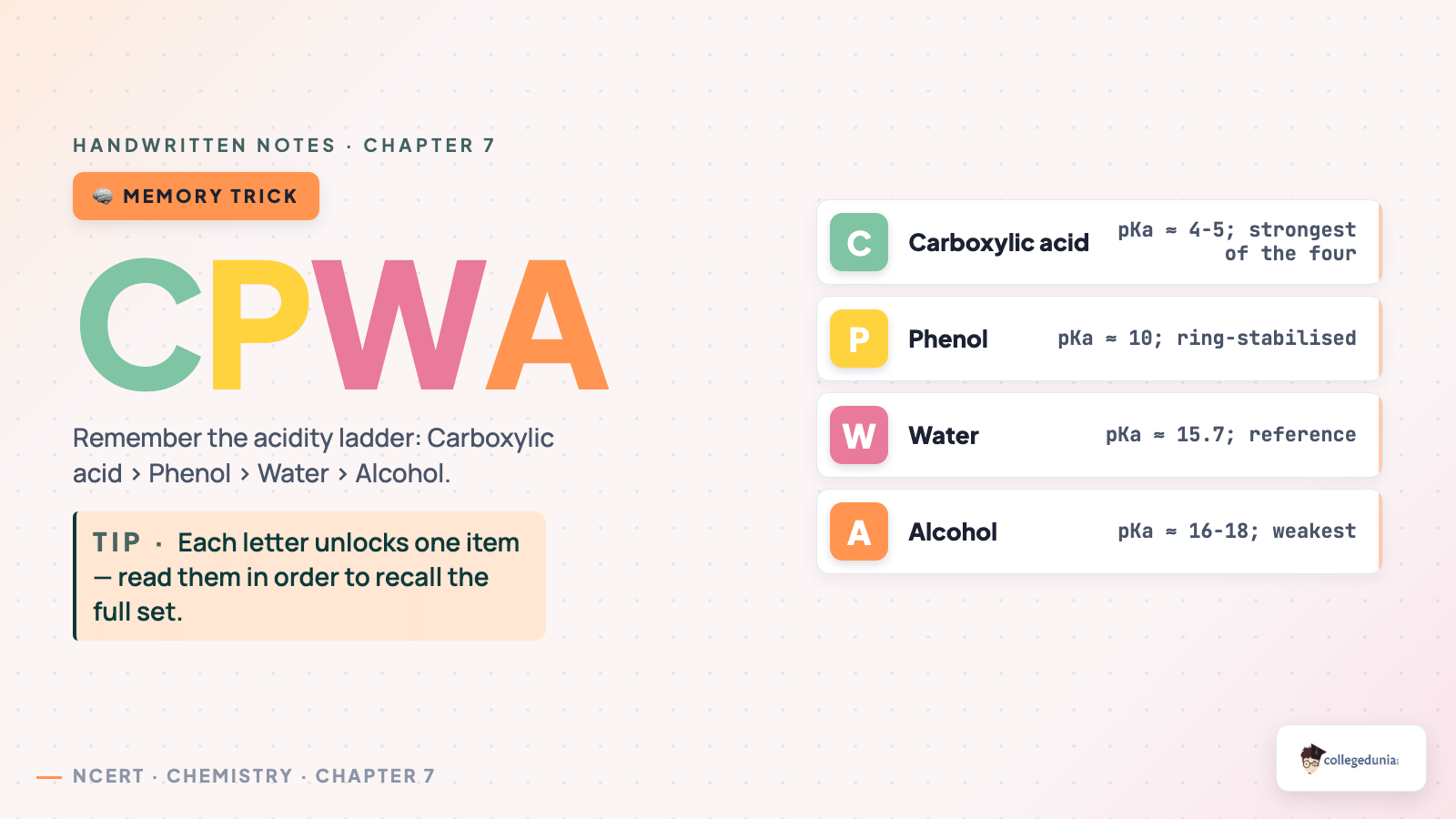
| p. 7-9 | Acidity order: water > alcohol; phenol > water > alcohol; substituent effects on phenol | The single most-asked CBSE 2-marker; resonance structures inked in red |
| p. 10-12 | Dehydration mechanism of alcohols (E1, carbocation rearrangement) | Curly-arrow electron flow and 1,2-hydride shift only click when hand-drawn |
| p. 13-15 | Reactions of phenol: Reimer-Tiemann, Kolbe, bromination, nitration | Reagent-and-product map fits one foldable page; perfect for last-night recall |
| p. 16-18 | Williamson ether synthesis, ether cleavage by HI / HBr | Primary vs tertiary product distinction in cleavage marked with red star |
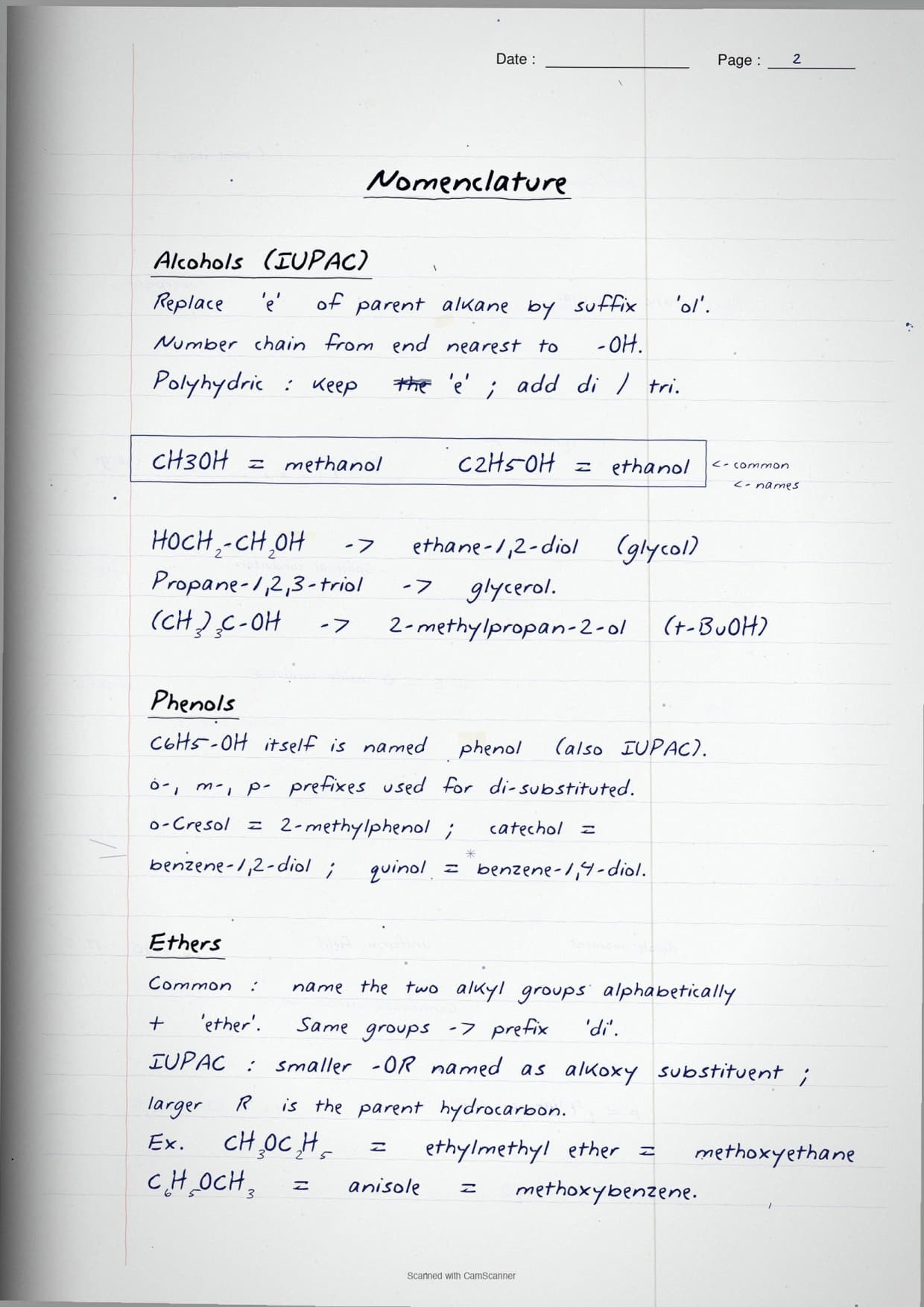
| p. 19-22 | IUPAC nomenclature drills, distinction tests, conversion practice | Distinction tests (Lucas, iodoform, ferric chloride) tabulated for 1-mark recall |
Alcohols, Phenols and Ethers Class 12 Chemistry Explained
Source: Magnet Brains on YouTube
How Will Collegedunia's Alcohols, Phenols and Ethers Handwritten Notes Help You?
A scanned topper notebook keeps the colour cues for reagents versus products and the margin mnemonics that a printed page flattens. From 2014 to 2025, NEET carried 24 questions from this chapter and JEE Main 38. It gives students four edges over flat PDFs.
- Colour-coded reagents: Oxidising agents in red, reducing agents in green, electrophiles in blue. Visual recall in the exam hall beats verbal recall.
- Mechanism arrows by hand: Curly arrows for E1 dehydration, SN2 Williamson, and EAS on phenol show electron flow direction in a way printed type cannot replicate.
- Margin mnemonics: "POBr3 burns OH bonds harder than SOCl2" and similar one-line memory hooks sit in the margins where students naturally re-read them.
- Two-pass strikethroughs: Earlier errors crossed out and corrected in red prove these are revision-tested notes, not first-draft scribbles.
Why Alcohols, Phenols and Ethers Matters for JEE Main and NEET 2026
This chapter feeds the functional-group conversions that run through Aldehydes and Ketones, Amines, and Biomolecules. Three angles attract the bulk of exam weight.
Top Three Exam Angles
- Acidity comparisons: Phenol vs alcohol vs water, plus substituent effects. The most-asked CBSE 2-marker and a regular JEE Main 1-marker.
- Name reactions of phenol: Reimer-Tiemann (CHCl3 + NaOH gives salicylaldehyde), Kolbe (CO2 gives salicylic acid). CBSE asks one of these almost every year.
- Williamson synthesis and ether cleavage: Primary haloalkane preferred (SN2), and HI cleaves unsymmetrical ethers to give the more substituted alkyl iodide. JEE Main 2024 carried this verbatim.
Hand-Drawn Figures Indexed in This Notebook
The 11 figures below carry the visual weight of the chapter, each redrawn with cleaner labels and a one-line caption.
| Fig No. | Figure | Notebook Page |
|---|---|---|
| Fig 7.1 | Classification tree: monohydric, dihydric, trihydric; 1deg / 2deg / 3deg | p. 2 |
| Fig 7.2 | Hydrogen-bonding ladder in alcohols (boiling-point trend) | p. 5 |
| Fig 7.3 | Markovnikov hydration vs anti-Markovnikov hydroboration mechanism | p. 6 |
| Fig 7.4 | Resonance structures of phenoxide ion (5 contributors) | p. 8 |
| Fig 7.5 | E1 dehydration mechanism with carbocation rearrangement | p. 11 |
| Fig 7.6 | Reimer-Tiemann reaction stepwise mechanism | p. 13 |
| Fig 7.7 | Kolbe-Schmidt synthesis pathway | p. 14 |
| Fig 7.8 | EAS on phenol: bromination, nitration, sulphonation product spread | p. 15 |
| Fig 7.9 | Williamson ether synthesis SN2 transition state | p. 16 |
| Fig 7.10 | Ether cleavage by HI: primary alkyl iodide product map | p. 17 |
| Fig 7.11 | Lucas test colour-change strip (1deg / 2deg / 3deg alcohols) | p. 20 |
Important Reactions in Alcohols, Phenols and Ethers Class 12
The notebook lists nine name reactions in the order CBSE has asked them since 2014. The condensed table below covers the five highest-yield ones; the scan carries the full nine with mechanisms.
| Reaction | Reagent | Product |
|---|---|---|
| Reimer-Tiemann | CHCl3 + NaOH | Salicylaldehyde (o-hydroxybenzaldehyde) |
| Kolbe-Schmidt | CO2 + NaOH (high P) | Salicylic acid |
| Williamson Synthesis | R-X + R'-O- Na+ | R-O-R' (ether) |
| Ether Cleavage | HI / HBr (hot) | Alkyl iodide + alcohol (primary preferred) |
| Lucas Test | ZnCl2 + conc HCl | Turbidity: 3deg immediate, 2deg in 5 min, 1deg none |
Full master table: Alcohols, Phenols and Ethers Class 12 Formula Sheet carries all nine name reactions with stoichiometry, mechanism notes, and the IUPAC rules condensed onto a one-page revision card.
Common Mistakes Students Make in Class 12th Chemistry Chapter 7
The handwritten notebook flags these in red ink in the page margins so revision pass three catches them. Roughly 35 per cent of dropped marks in this chapter trace back to four recurring errors.
- Confusing phenoxide resonance: Students draw three resonance contributors; the correct number is five (ortho, meta, para, and two ortho positions distinct). Costs 2 marks in mechanism questions.
- Wrong dehydration order: 3deg > 2deg > 1deg alcohol dehydration (carbocation stability). Reversing this on a JEE Main 1-marker costs 4 marks.
- Markovnikov misapplied: In hydroboration-oxidation the OH attaches to the less substituted carbon (anti-Markovnikov). The Markovnikov shortcut written from acid-catalysed hydration breaks here.
- Williamson with tertiary halide: Tertiary R-X gives elimination (E2), not ether. The reaction must use primary R-X.
CBSE Class 12 Chemistry Chapter-Wise Weightage Snapshot
Where Alcohols, Phenols and Ethers sits in the larger Class 12 CBSE Chemistry distribution, by typical board-marks contribution. Bar lengths are scaled to the upper-bound marks each chapter usually carries.
Student Feedback
In a Collegedunia poll of 900 Class 12 students, 78% said the hand-drawn phenoxide resonance and Williamson synthesis pages were their fastest last-night recall for this chapter.
Other Resources for Class 12 Chemistry Chapter 7
- Alcohols, Phenols and Ethers Class 12 Chemistry Handwritten Notes
- Alcohols, Phenols and Ethers Class 12 Chemistry Notes
- Alcohols, Phenols and Ethers Class 12 Chemistry NCERT Solutions
- Alcohols, Phenols and Ethers Class 12 Chemistry Formula Sheet
- Alcohols, Phenols and Ethers Class 12 Chemistry NCERT Book PDF
- Alcohols, Phenols and Ethers Class 12 Chemistry Exemplar Solutions
NCERT Handwritten Notes for Class 12 Chemistry: All Chapters
| Chapter | Handwritten Notes |
|---|---|
| Chapter 1 | Solutions Handwritten Notes |
| Chapter 2 | Electrochemistry Handwritten Notes |
| Chapter 3 | Chemical Kinetics Handwritten Notes |
| Chapter 4 | The d- and f-Block Elements Handwritten Notes |
| Chapter 5 | Coordination Compounds Handwritten Notes |
| Chapter 6 | Haloalkanes and Haloarenes Handwritten Notes |
FAQs on Alcohols, Phenols and Ethers Class 12 Handwritten Notes
Q. Are the Alcohols, Phenols and Ethers Class 12 handwritten notes aligned with the 2026-27 syllabus?
Yes. The scanned notebook covers every topic retained in the current 2026-27 NCERT print, including classification, preparation routes, acidity comparisons, name reactions of phenol, Williamson ether synthesis, and ether cleavage. Topics dropped from the rationalised edition (some industrial preparation routes) are not included.
Q. How many name reactions does the notebook cover for this chapter?
The scan maps nine name reactions in total, including Reimer-Tiemann, Kolbe-Schmidt, Williamson ether synthesis, ether cleavage by HI, Lucas test, esterification, Friedel-Crafts acylation of phenol, bromination of phenol, and acid-catalysed dehydration of alcohols. Each reaction has its mechanism arrows drawn in two-colour ink.
Q. Is phenol more acidic than ethanol, and why?
Yes. Phenol (pKa about 10) is more acidic than ethanol (pKa about 16) because the phenoxide ion delocalises its negative charge across five resonance structures into the benzene ring, while the ethoxide ion localises the charge on a single oxygen atom. The notebook shows all five phenoxide contributors on page 8.
Q. What is the expected CBSE Board weightage for Alcohols, Phenols and Ethers in 2026?
CBSE typically allocates 4 to 6 marks to this chapter, usually one 2-marker on conversions or distinctions and one 3-marker on a name reaction mechanism or acidity comparison. The 5-mark long-answer question occasionally pulls from this chapter when combined with another organic functional group.
Q. How is this Collegedunia handwritten notes scan different from printed notes?
Printed notes flatten the chapter into uniform paragraphs; the Collegedunia scan preserves colour-coded reagent labels, hand-drawn curly-arrow mechanisms, two-pass strikethrough corrections, and margin mnemonics. These visual cues survive in a student's memory longer than identical typed text.
Q. Can these handwritten notes alone prepare a student for the JEE Main and NEET 2026 questions on this chapter?
The notes give complete conceptual coverage and the highest-yield mechanisms, but JEE Main and NEET also need timed practice on previous-year questions. Pair the notes with NCERT Exemplar Solutions and the last five years of JEE Main and NEET PYQs to fully convert this chapter into 6 to 10 marks across both exams.
Q. What are the cumene process and Dow process for preparing phenol?
The cumene process (the major industrial route today) oxidises cumene with atmospheric O2 to cumene hydroperoxide, which on treatment with dilute H2SO4 gives phenol and acetone as the valuable co-product. The Dow process is the older route: chlorobenzene + NaOH at 623 K and 320 atm followed by acidification gives phenol. The notebook draws both routes on page 6 with the by-product bubbles in green.
Q. How does the Williamson ether synthesis work, and when does it fail?
Williamson ether synthesis is the SN2 reaction of a sodium alkoxide (R-O-Na+) with a primary alkyl halide (R'-X) to give the ether R-O-R'. It fails with tertiary alkyl halides because the strongly basic alkoxide pulls a beta-hydrogen and the reaction goes by E2 elimination, giving an alkene. For an unsymmetrical ether, always pair the bulkier group on the alkoxide and the 1° alkyl group on the halide.
Q. What is the Saytzeff rule for the acid-catalysed dehydration of alcohols?
Saytzeff's rule states that the more-substituted (more stable) alkene is the major product of an E1 dehydration. For 2-methylbutan-2-ol with conc. H2SO4 at 443 K, the major product is 2-methylbut-2-ene (trisubstituted), not 2-methylbut-1-ene. Alkene stability follows hyperconjugation.
Q. How is picric acid (2,4,6-trinitrophenol) prepared from phenol?
Picric acid is prepared by stepwise nitration of phenol: dilute HNO3 gives ortho/para-nitrophenol; more concentrated HNO3 gives 2,4-dinitrophenol; final nitration with conc. HNO3 + H2SO4 gives picric acid (pKa 0.4), stronger than acetic acid because three -NO2 groups stabilise the conjugate base by resonance and -I.



Comments