




These Coordination Compounds Handwritten Notes are a 22-page scanned notebook for Chapter 5 of Class 12 Chemistry, one of the top-scoring inorganic chapters. Download the free PDF below.
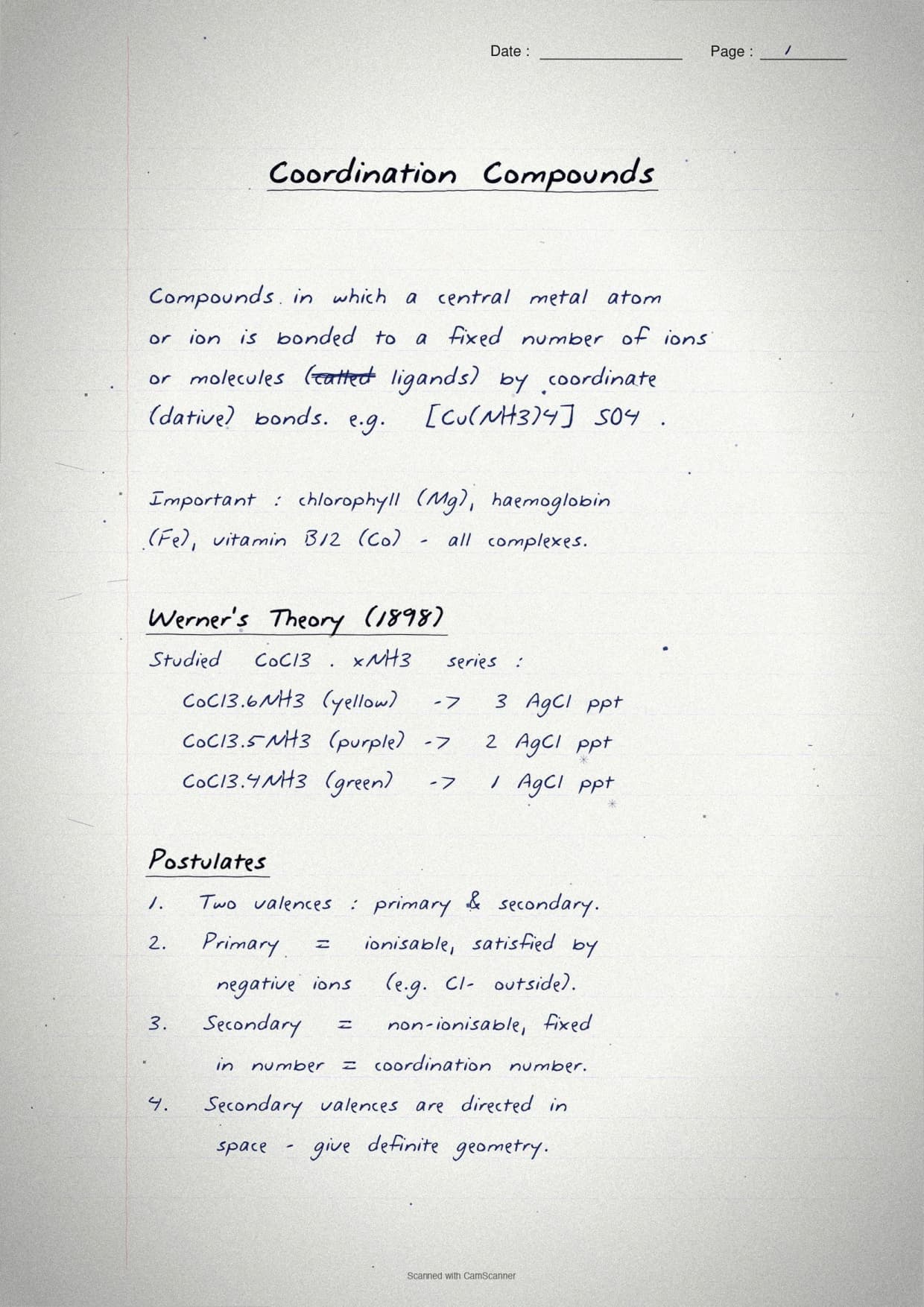
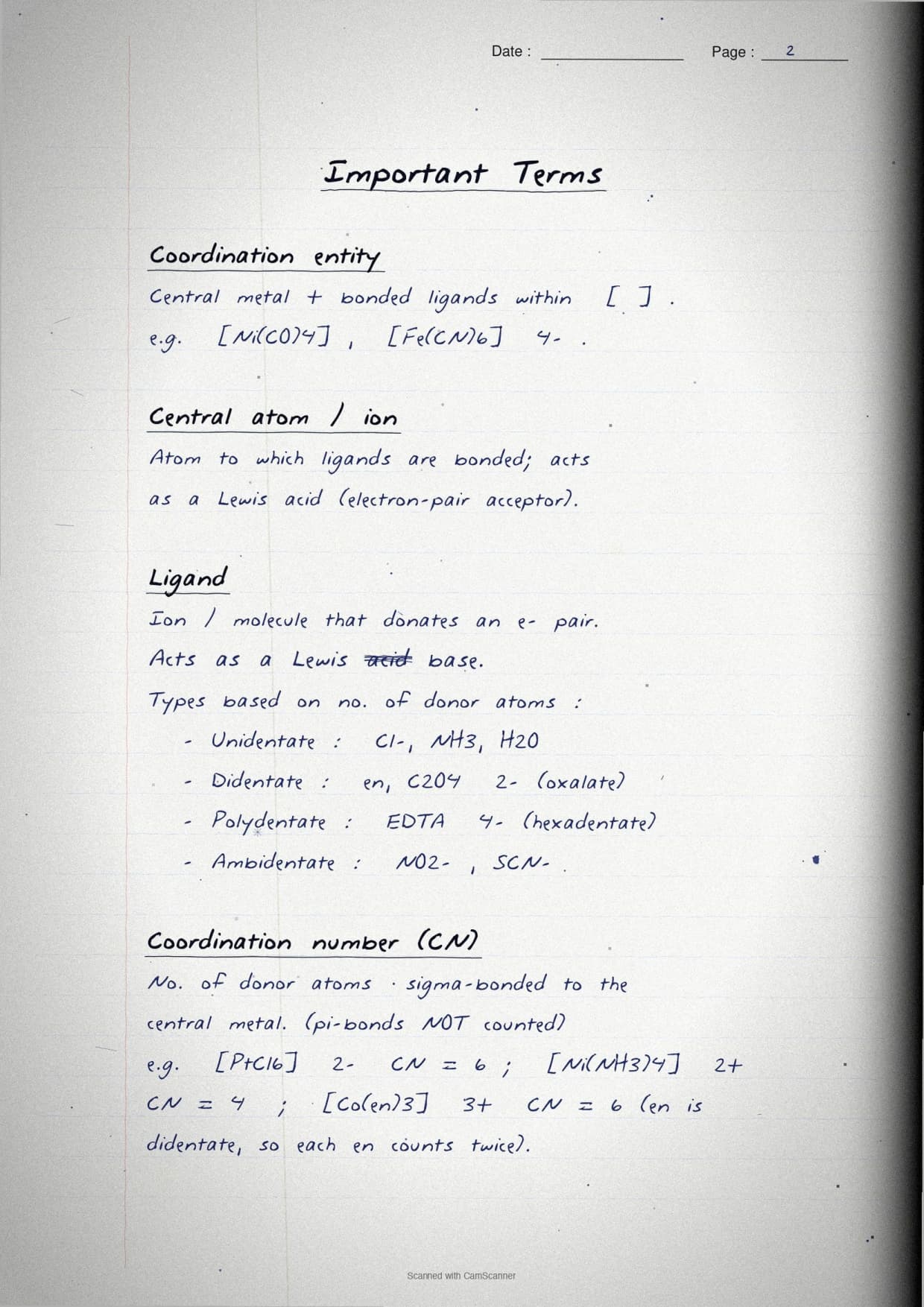
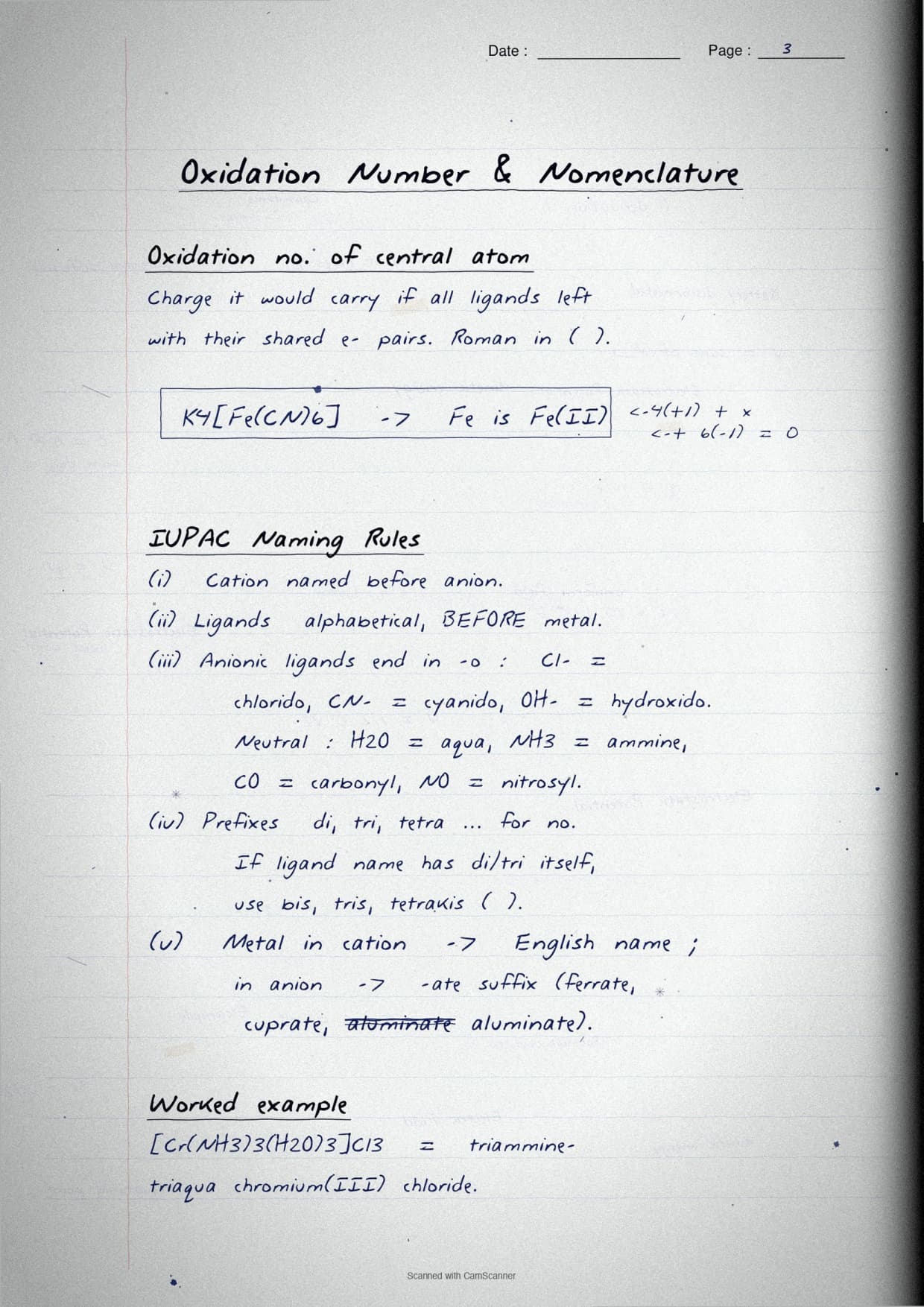
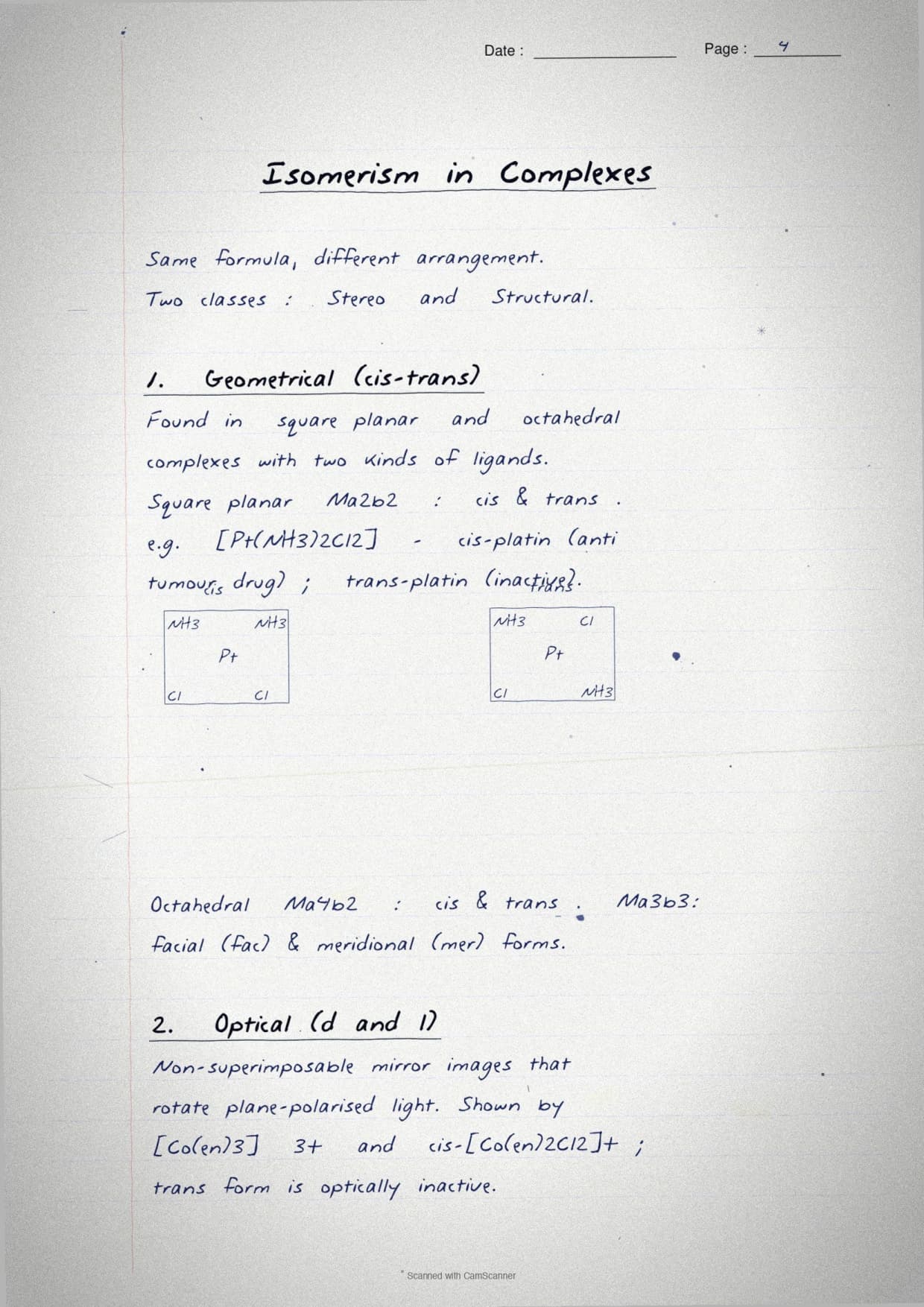
- CBSE Weightage: 6 to 8 marks (one 3-mark IUPAC question plus a 5-mark CFT or isomerism long answer is the standard pattern)
- JEE Main Weightage: 4 to 5% (2 to 3 questions per shift, mostly on hybridisation, magnetic moment, and CFSE)
- NEET Weightage: 3 to 4 questions per year on IUPAC nomenclature, isomerism, and bonding theories
Scanned from a topper's notebook and checked against the 2026-27 NCERT Class 12 Chemistry textbook.
Also Check:
- Coordination Compounds Class 12 Chemistry Notes
- Coordination Compounds Class 12 Chemistry NCERT Solutions
- Coordination Compounds Class 12 Chemistry Formula Sheet
Key Topics Covered in Coordination Compounds Handwritten Notes (Class 12)
The 22-page scan covers every sub-topic, from Werner's model to the bioinorganic complexes. Each chip maps to a labelled page.
Coordination Compounds Class 12 Chemistry Explained
Source: Magnet Brains on YouTube
What's Inside the Coordination Compounds Handwritten Notes PDF
The page map shows which sub-topic lives where, so you can jump straight to your weak block.
| Pages | Topic | Pen Colour |
|---|---|---|
| 1-2 | Werner's theory of coordination compounds, primary and secondary valencies | Blue + red |
| 3-5 | Definitions: coordination entity, ligand, coordination number, denticity, chelate, ambidentate | Blue + orange |
| 6-8 | IUPAC nomenclature rules with 12 worked examples | Blue + orange + yellow |
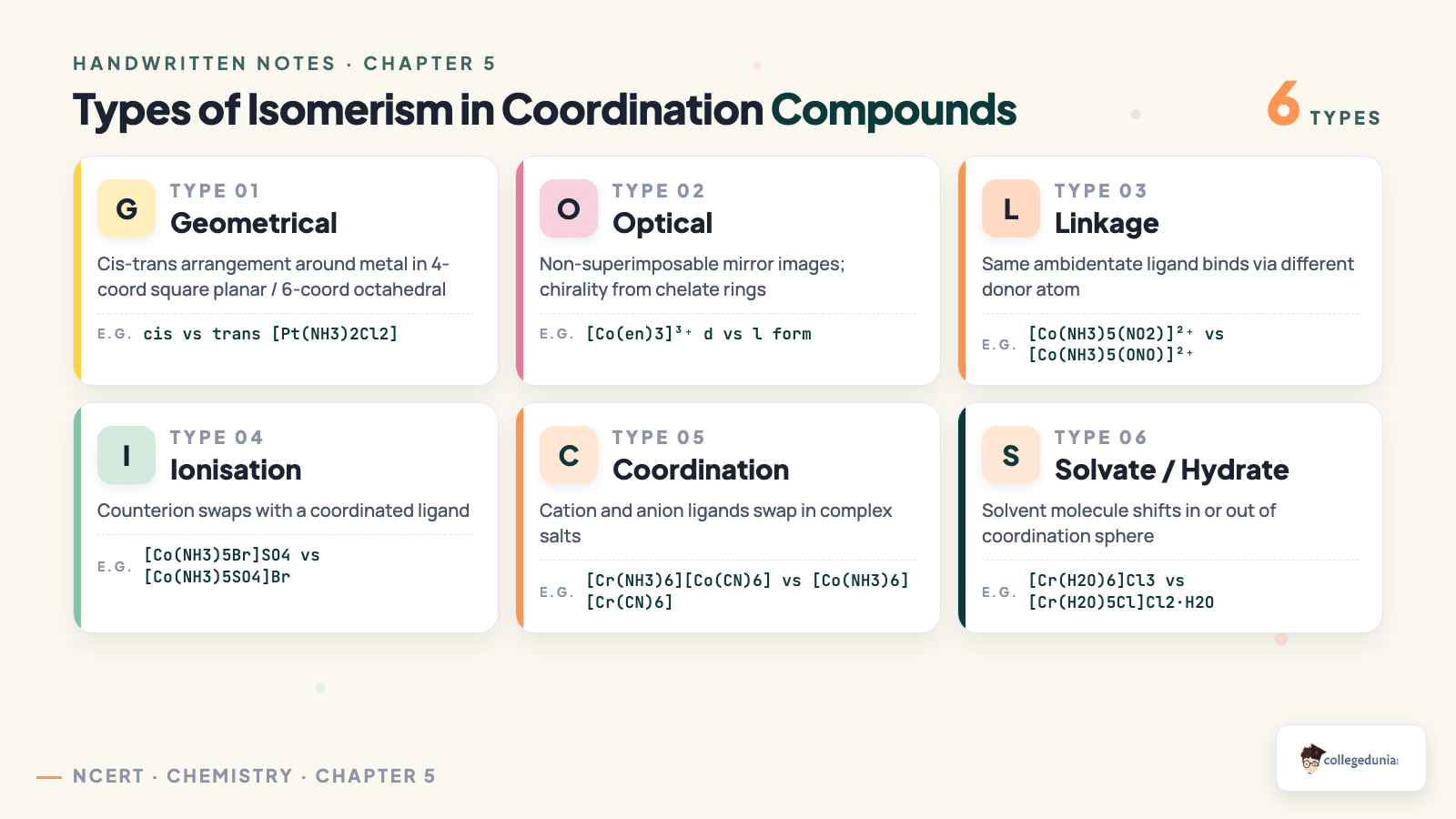
| 9-12 | Isomerism: structural (ionisation, linkage, coordination, hydrate) and stereo (geometrical, optical) | Blue + green |
| 13-15 | Valence Bond Theory: hybridisation table, inner vs outer orbital complexes | Blue + orange |
| 16-19 | Crystal Field Theory: octahedral, tetrahedral, square planar splitting diagrams | Blue + orange + red |
| 20-21 | Spectrochemical series, CFSE, colour and magnetic moment from CFT | Blue + yellow |
| 22 | Stability of complexes plus quick-revision summary strip | Mixed |
Coordination Compounds Diagram Index for Quick Revision
The notebook carries fifteen hand-drawn figures. Each is paired with the concept it makes memorable.
| Figure | What It Shows | Page |
|---|---|---|
| Fig 5.1 | Werner's primary and secondary valency diagram for [Co(NH3)6]Cl3 | p. 1 |
| Fig 5.2 | Mono-, bi-, tri-, hexa-dentate ligand structural sketches (en, ox, EDTA) | p. 4 |
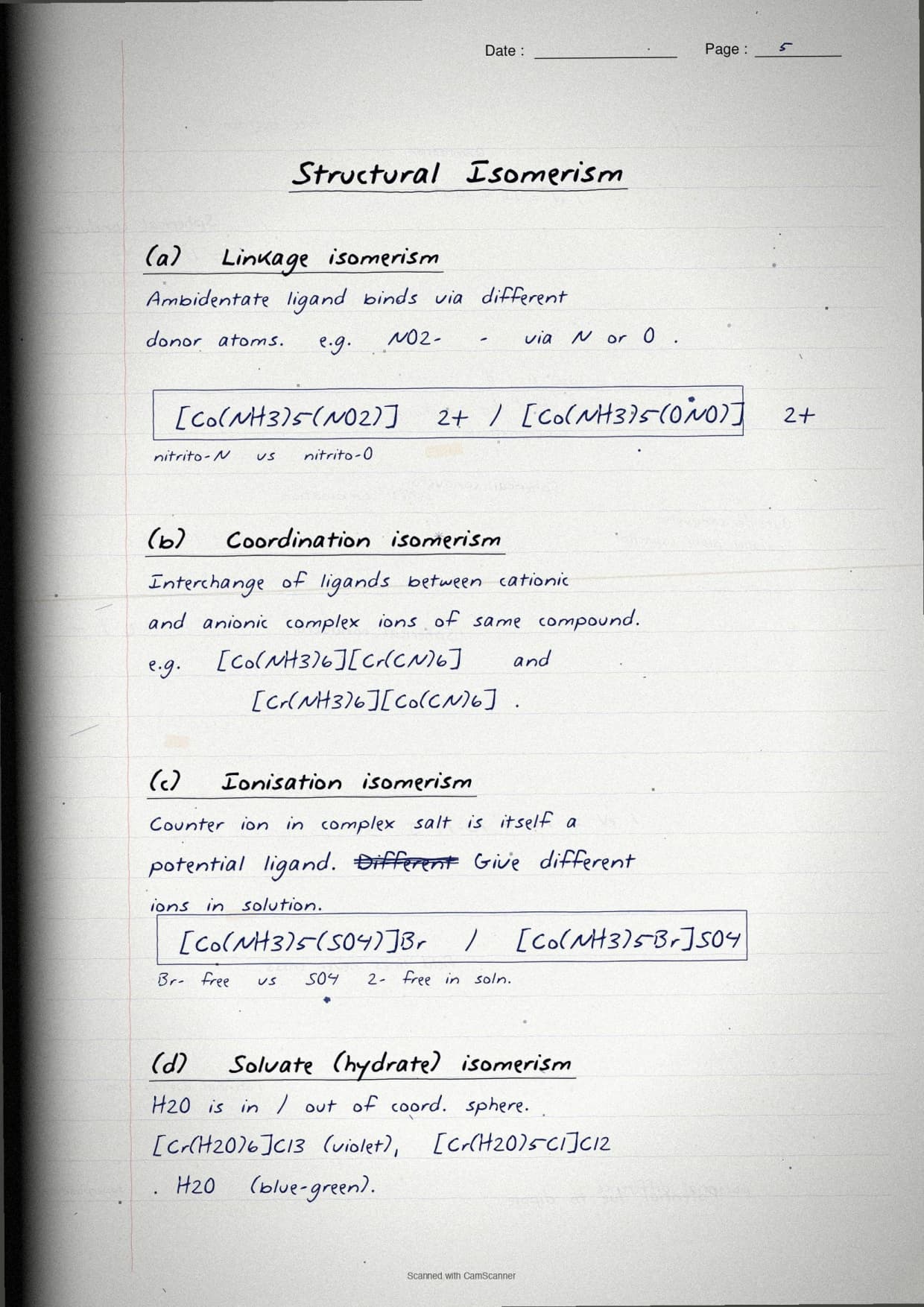
| Fig 5.3 | Ambidentate ligand pair: -NO2 (nitrito-N) vs -ONO (nitrito-O) | p. 5 |
| Fig 5.4 | IUPAC naming flowchart with anion / cation order | p. 7 |
| Fig 5.5 | Cis-trans isomers of [Pt(NH3)2 Cl2] (square planar) | p. 10 |
| Fig 5.6 | Fac-mer isomers of [Co(NH3)3 Cl3] (octahedral) | p. 11 |
| Fig 5.7 | Optical isomers of [Co(en)3]3+ (mirror-image enantiomers) | p. 12 |
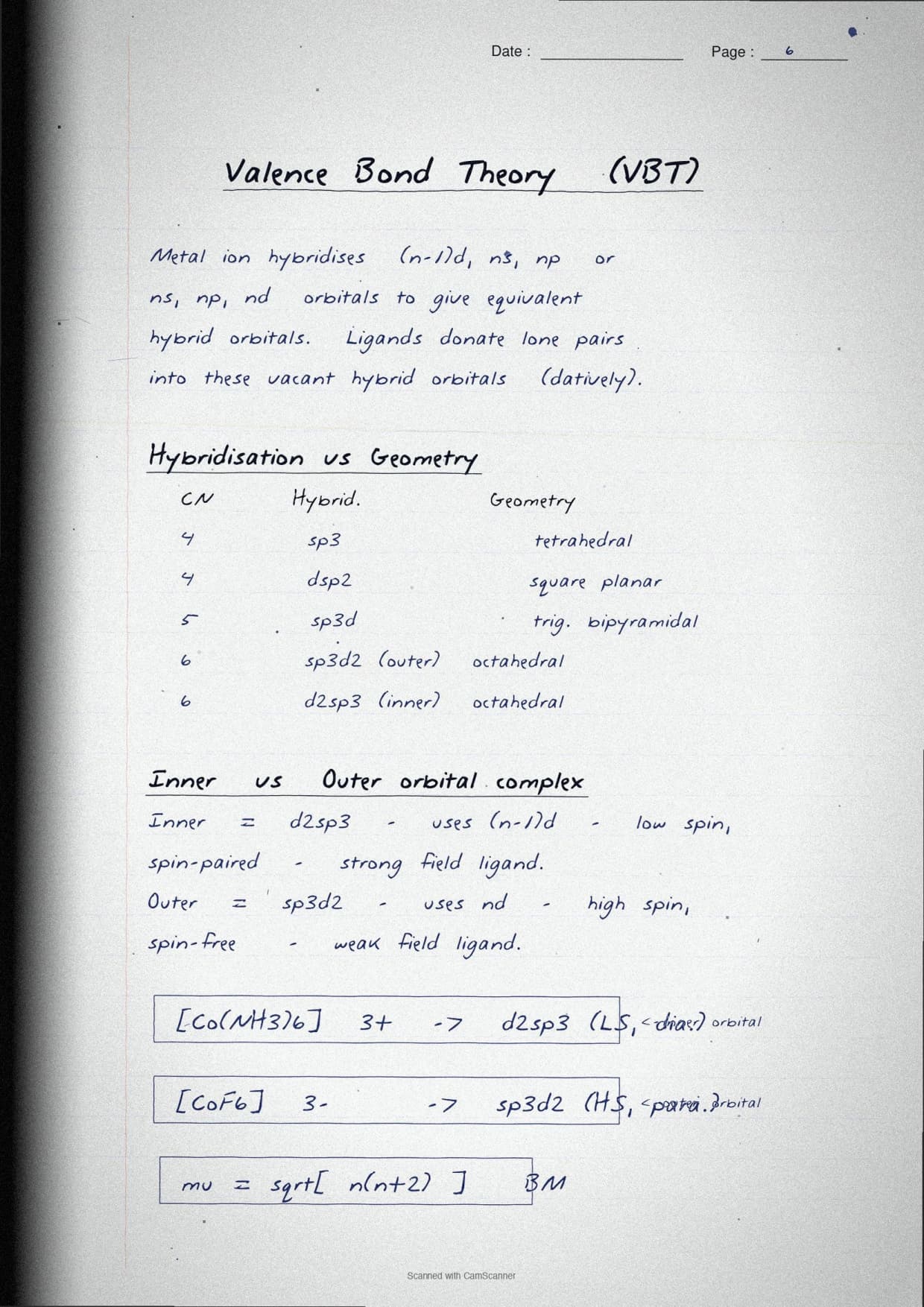
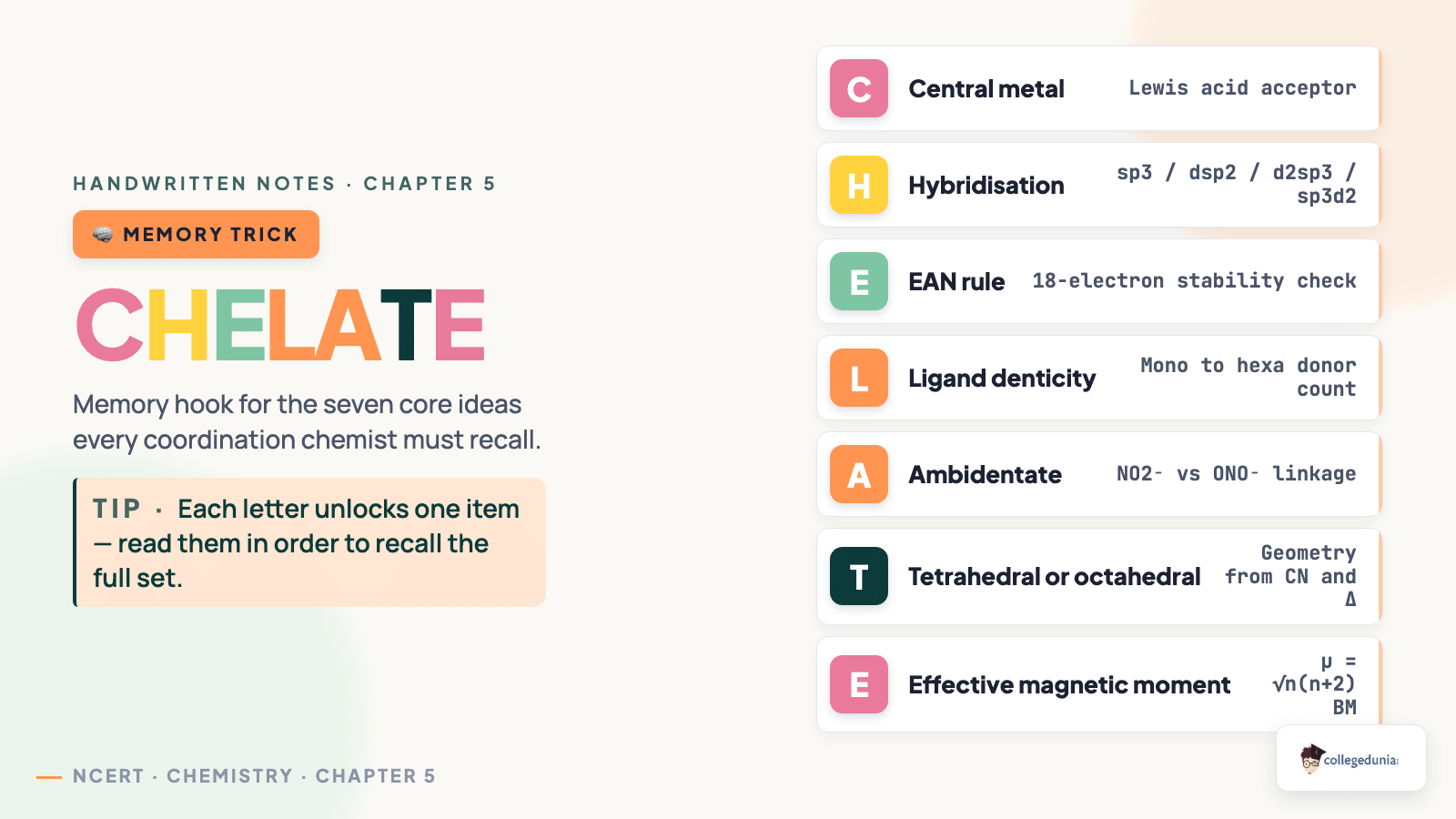
| Fig 5.8 | Hybridisation table: sp3, dsp2, sp3d2, d2sp3 | p. 13 |
| Fig 5.9 | Inner vs outer orbital complex orbital diagrams for [Fe(CN)6]4- and [FeF6]3- | p. 14 |
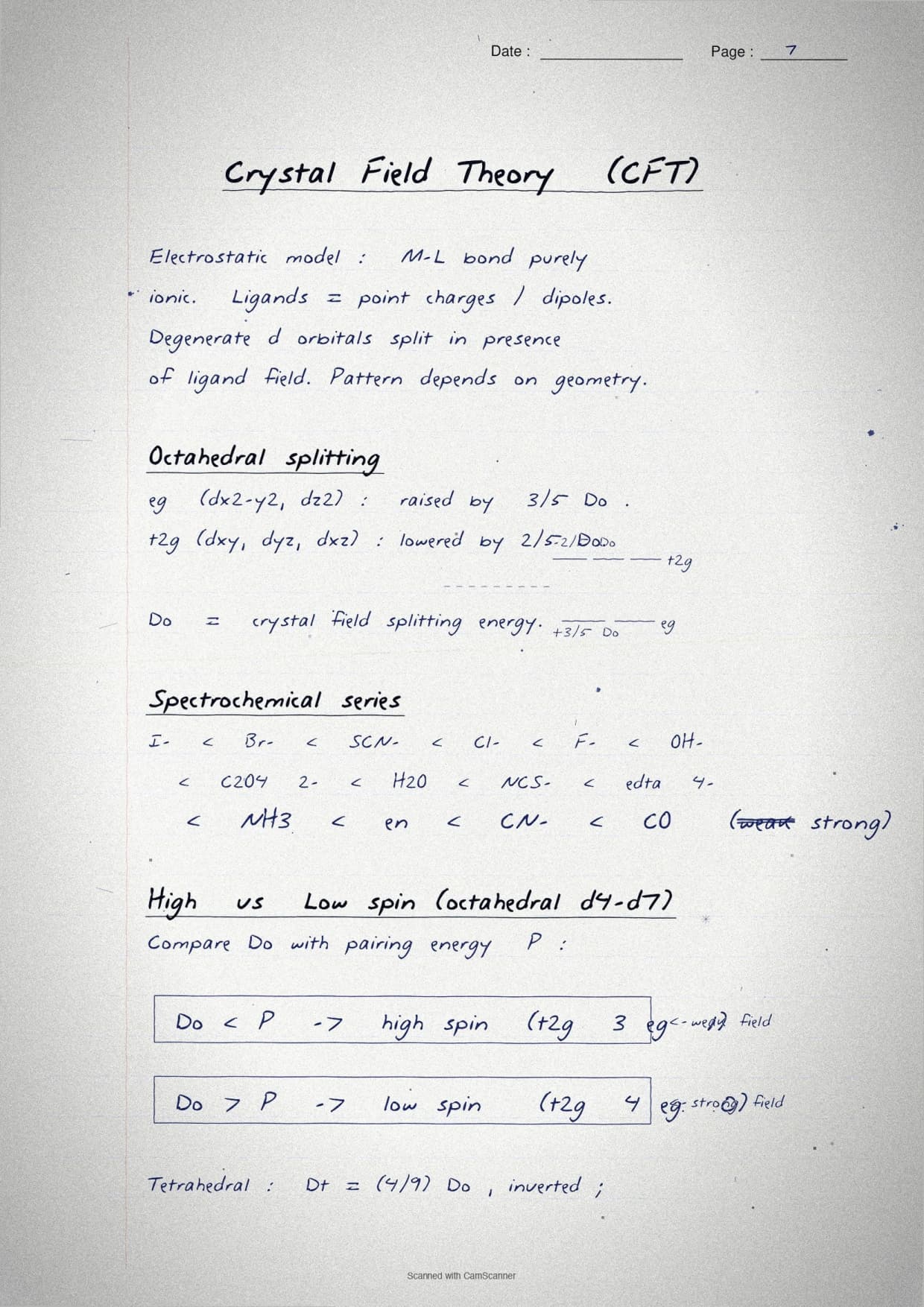
| Fig 5.10 | Octahedral CFT splitting: t2g and eg sets with o labelled | p. 16 |
| Fig 5.11 | Tetrahedral CFT splitting: e and t2 sets with t = 49o | p. 17 |
| Fig 5.12 | Square planar splitting diagram with dx2-y2 at the top | p. 18 |
| Fig 5.13 | High-spin vs low-spin d6 electron filling comparison | p. 19 |
| Fig 5.14 | Spectrochemical series strip from I- to CO with strong / weak field markers | p. 20 |
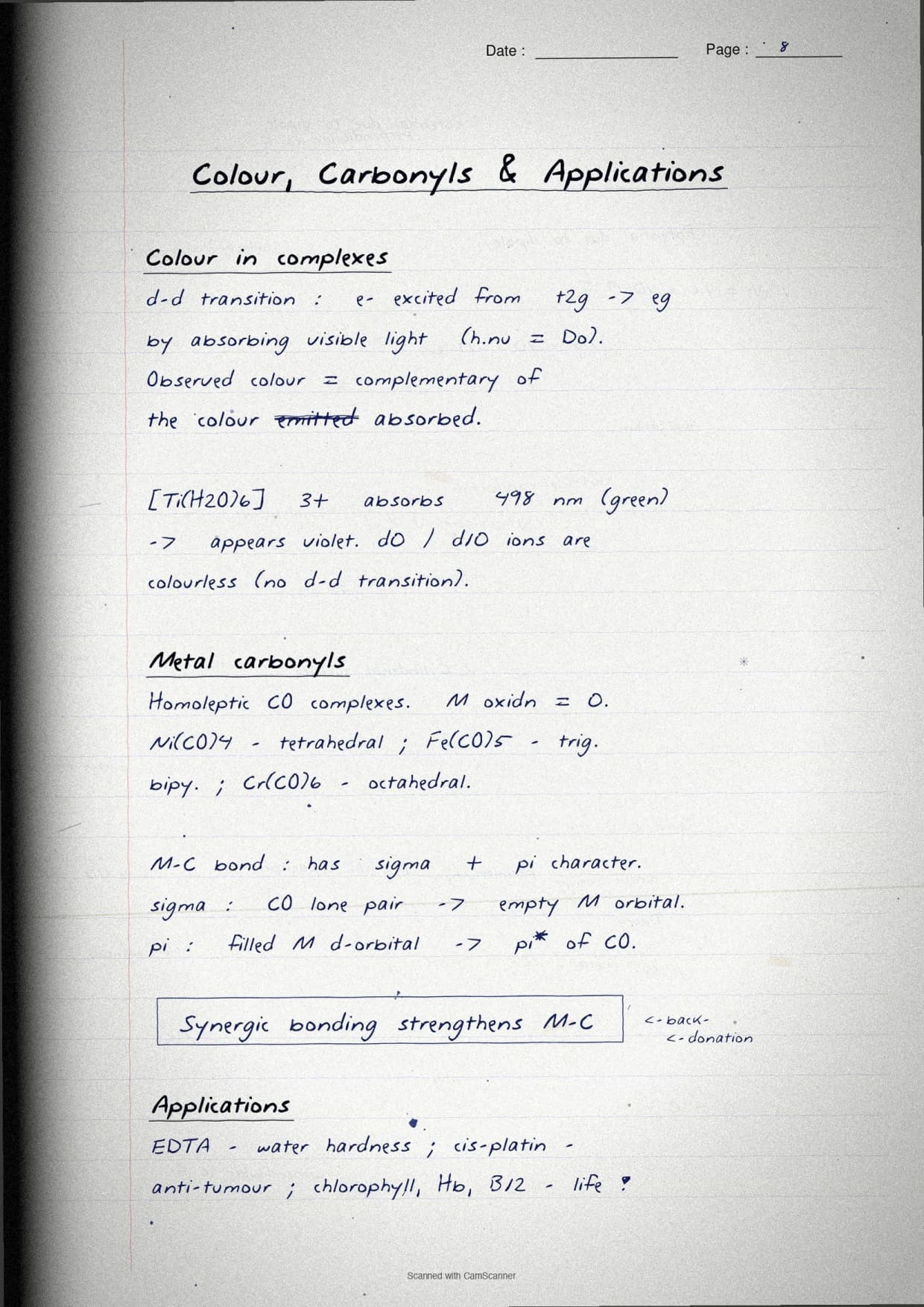
| Fig 5.15 | Colour origin: d-d transition energy gap with visible spectrum overlay | p. 21 |
Short on time? Lock Fig 5.5, 5.7, 5.10, and 5.14. These four cover every isomerism and CFT reasoning question CBSE has asked since 2021.
How These Coordination Compounds Handwritten Notes Help You
This is the densest chapter in Class 12 Chemistry Inorganic. Its sketches and splitting diagrams must be drawn, not read.
- IUPAC naming worked examples: Twelve complexes decomposed step by step, rules circled in orange ink.
- Isomerism sketches: Cis-trans, fac-mer, and optical pairs drawn side by side with the mirror plane shown.
- CFT splitting in colour: Octahedral, tetrahedral, and square planar splittings on one spread with the energy axis labelled.
- Red-ink trap warnings: Margin notes flag inner-vs-outer orbital confusion and EAN-rule edge cases.
How to Read These Coordination Compounds Handwritten Notes (Pen-Colour Convention)
Five ink colours run through the notebook. Learn the convention and you can skim all 22 pages in a final pass.
| Pen Colour | What It Codes | How to Use in Revision |
|---|---|---|
| Blue | Main body text, definitions, theory steps | Read in pass two; skip on the night-before-exam pass |
| Orange (highlighter) | IUPAC names, hybridisation labels, CFSE values | This is the only pass-one colour on a last-hour revision |
| Red (pen) | Common-mistake warnings, inner vs outer orbital traps | Scan on every pass; these pin the trap-question content |
| Yellow highlighter | Spectrochemical series order, board-examiner phrasings | Memorise verbatim for full marks on wording-sensitive 2-markers |
| Green | Worked isomerism counts and CFSE numericals | Skip unless you struggle with high-spin / low-spin calculations |
The convention is the same across every Class 12 Chemistry chapter, so the muscle memory carries straight over to Haloalkanes and Haloarenes.
Coordination Compounds: HW Notes vs Printed Notes Comparison
This chapter is the canonical case of when handwriting beats print and when it does not. The table splits the chapter by sub-topic so you know which resource to open for which goal.
| Sub-topic | Better Resource | Why |
|---|---|---|
| Werner's primary and secondary valency | Handwritten | Drawn molecule with valency arrows beats paragraph text |
| Isomerism (cis-trans, fac-mer, optical) | Handwritten | Mirror-image and 3D pairs only click when drawn |
| CFT splitting diagrams (octa, tetra, square) | Handwritten | Energy axis with t2g / eg labels is faster as a sketch |
| IUPAC naming rule list and examples | Printed Notes | Greek prefix table is cleaner in typeset form |
| Bonding theory comparison (VBT vs CFT) | Printed Notes | Side-by-side merits and limitations need paragraphs |
| Numerical calculations (CFSE, magnetic moment) | Printed Notes | Step-numbered arithmetic is crisper in print |
The pragmatic plan: scan the handwritten PDF for the visual sub-topics, then read the Coordination Compounds Class 12 Chemistry Notes for theory blocks.
Why Coordination Compounds Matters for JEE Main and NEET 2026
Coordination Compounds is the highest-weight inorganic chapter in JEE Main. Every JEE Main session since 2021 has carried at least two questions from it. The three highest-yield angles are IUPAC naming, CFT high-spin vs low-spin reasoning, and isomerism counting.
Student Feedback
In a Collegedunia poll of 900 Class 12 students, 78% said the hand-drawn CFT splitting diagrams made high-spin vs low-spin easier to recall than printed notes.
Other Resources for Coordination Compounds Class 12 Chemistry
- Coordination Compounds Class 12 Chemistry Handwritten Notes
- Coordination Compounds Class 12 Chemistry NCERT Solutions
- Coordination Compounds Class 12 Chemistry Notes
- Coordination Compounds Class 12 Chemistry Formula Sheet
- Coordination Compounds Class 12 Chemistry NCERT Book PDF
- Coordination Compounds Class 12 Chemistry NCERT Exemplar Book PDF
- Coordination Compounds Class 12 Chemistry NCERT Exemplar Solutions
NCERT Handwritten Notes for Class 12 Chemistry: All Chapters
Use the table to jump to the Collegedunia handwritten notes for any other Class 12 Chemistry chapter.
| Chapter | Resource |
|---|---|
| Chapter 1 | Solutions Handwritten Notes |
| Chapter 2 | Electrochemistry Handwritten Notes |
| Chapter 3 | Chemical Kinetics Handwritten Notes |
| Chapter 4 | d- and f-Block Elements Handwritten Notes |
| Chapter 6 | Haloalkanes and Haloarenes Handwritten Notes |
| Chapter 7 | Alcohols, Phenols and Ethers Handwritten Notes |
| Chapter 8 | Aldehydes, Ketones and Carboxylic Acids Handwritten Notes |
| Chapter 9 | Amines Handwritten Notes |
| Chapter 10 | Biomolecules Handwritten Notes |
Coordination Compounds Class 12 Chemistry Handwritten Notes FAQs
Ques. Where can I download the Coordination Compounds Class 12 Chemistry Handwritten Notes PDF?
Ans. You can download the Coordination Compounds Class 12 Chemistry Handwritten Notes PDF directly from this page. Both the Normal and HD versions are available, and both are free.
Ques. Are these Handwritten Notes aligned with the 2026-27 NCERT?
Ans. Yes. The notes follow the current 2026-27 syllabus for Class 12 Chemistry, where Coordination Compounds is Chapter 5. The chapter was kept intact in the new NCERT edition, so every Werner postulate, IUPAC naming rule, isomerism type, VBT hybridisation table, and CFT splitting diagram in the PDF matches the 2026-27 textbook.
Ques. How many pages is the Class 12th Chemistry Coordination Compounds Handwritten Notes PDF?
Ans. The Handwritten Notes PDF runs 22 pages and covers Werner's theory, definitions (ligand, denticity, chelate), IUPAC nomenclature with worked examples, structural and stereo isomerism, Valence Bond Theory, Crystal Field Theory for octahedral / tetrahedral / square planar geometries, the spectrochemical series, CFSE, colour, magnetic behaviour, and stability of complexes.
Ques. What is the difference between Valence Bond Theory and Crystal Field Theory for coordination compounds?
Ans. Valence Bond Theory treats metal-ligand bonding as a coordinate covalent bond formed by overlap of an empty hybridised metal orbital with a filled ligand lone-pair orbital; it predicts geometry and magnetic behaviour from hybridisation but cannot explain colour or the relative strength of ligands. Crystal Field Theory treats the metal-ligand interaction as purely electrostatic, splits the metal d-orbitals into sets of different energy, and explains colour (d-d transitions), magnetic moment, and the spectrochemical series. Most modern questions use the CFT framework.
Ques. What is the spectrochemical series and why does it matter?
Ans. The spectrochemical series is the order of ligands ranked by the magnitude of crystal-field splitting they produce. The standard NCERT order is I- < Br- < SCN- < Cl- < F- < OH- < ox2- < H2O < NH3 < en < NO2- < CN- < CO. It matters because it tells you whether a complex will be high-spin (weak-field ligand) or low-spin (strong-field ligand), which in turn fixes the magnetic moment, the colour, and the CFSE. Most CFT reasoning questions on CBSE, JEE, and NEET hinge on locating one ligand on this series.
Ques. Why are Coordination Compounds important for JEE Main and NEET 2026?
Ans. Coordination Compounds contributes 4 to 5 per cent of JEE Main Chemistry, the highest single-chapter slice in inorganic. Every JEE Main session since 2021 has carried at least two questions on hybridisation, CFSE, magnetic moment, or isomerism counting. NEET asks 3 to 4 questions per year, typically one on IUPAC naming, one on isomerism, and one on CFT high-spin / low-spin reasoning. Because the chapter shares definitions (oxidation state, magnetic moment, colour) with the d- and f-Block chapter, mastering it pays double dividends in inorganic.
Ques. How should I revise Coordination Compounds the night before the CBSE Board exam?
Ans. Use the 8-point Last 24-Hour Revision Card in the Handwritten Notes. Focus on the four highest-yield items: IUPAC naming order (cation, ligands alphabetical, metal with oxidation state), the isomerism map (structural plus stereo), VBT hybridisation table with inner vs outer orbital, and the spectrochemical series. The card takes 12 minutes end to end and covers everything CBSE has asked from this chapter since 2021.
Ques. What is Werner's theory and what is the difference between primary valence and secondary valence?
Ans. Werner's 1893 theory says every metal in a coordination compound has two valencies. Primary valence equals the oxidation state of the metal, is ionisable, and is satisfied by anions outside the coordination sphere. Secondary valence equals the coordination number, is non-ionisable, satisfied by ligands inside the sphere (square brackets), and is directional (fixes the geometry). In [Co(NH3)5Cl]Cl2, Co3+ has primary valence 3 and secondary valence 6.
Ques. How do I calculate the spin-only magnetic moment of a coordination compound?
Ans. Use μ = √n(n+2) BM where n is the number of unpaired d-electrons after considering the ligand field. Step 1: find the oxidation state and d-electron count. Step 2: classify the ligand using the spectrochemical series. Step 3: fill the t2g and eg sets (octahedral) and count unpaired electrons. Quick anchors: n = 1 gives 1.73 BM, n = 2 gives 2.83 BM, n = 3 gives 3.87 BM, n = 4 gives 4.90 BM, n = 5 gives 5.92 BM. For [Fe(CN)6]4-, d6 low-spin gives 0 BM (diamagnetic).
Ques. What is the EAN rule and how does it apply to Ni(CO)4?
Ans. Sidgwick's Effective Atomic Number rule: EAN = Z(M) - oxidation state + 2 × CN. Complexes with EAN equal to a noble-gas atomic number are extra-stable. For Ni(CO)4, Z(Ni) = 28, oxidation state = 0, CN = 4, so EAN = 28 - 0 + 8 = 36 (Kr). Ni(CO)4 uses sp3 hybridisation, is tetrahedral and diamagnetic. The same EAN = 36 is achieved by [Fe(CN)6]4-.
Ques. Why is the splitting in tetrahedral complexes smaller than in octahedral ( t vs o )?
Ans. In a tetrahedral field there are only 4 ligands and none aligns directly along the d-orbital lobes, so the geometric factor gives t = 49 o ≈ 0.45 o . Because t is almost always less than the pairing energy P, tetrahedral complexes are nearly always high-spin.
Ques. What are ambidentate ligands and which linkage isomers do they form?
Ans. An ambidentate ligand has two donor atoms but bonds through only one at a time, generating linkage isomers. NO2- bonded through N gives nitrito-N (-NO2), through O gives nitrito-O (-ONO). SCN- through S is thiocyanato-S (-SCN); through N is thiocyanato-N (-NCS). CN- through C is cyanido; through N is isocyanido. The two linkage isomers differ in colour, stability and field strength.
Ques. What is the chelate effect and why is EDTA a hexadentate ligand?
Ans. The chelate effect is the extra thermodynamic stability of complexes with polydentate (chelating) ligands compared to monodentate-only analogues; the driver is entropy gain when free water molecules are released. EDTA4- is hexadentate (4 carboxylate O + 2 amine N) and wraps around a single metal centre forming five fused chelate rings. EDTA sequesters Pb2+, Hg2+ and Ca2+ so strongly that it is used in heavy-metal poisoning therapy.
Ques. Why is cisplatin biologically active while the trans isomer is not?
Ans. Cisplatin is cis-[Pt(NH3)2Cl2], square planar Pt(II). Inside the cell the two cis Cl- ligands are replaced by adjacent purine N7 atoms on DNA, forming a 1,2-intrastrand cross-link that distorts DNA and triggers apoptosis. The trans isomer cannot form the same cis cross-link and is therapeutically inactive. The case is the textbook example of geometrical isomerism dictating pharmacology.
Ques. Which coordination compounds appear in biology - haemoglobin, chlorophyll, Vitamin B12?
Ans. Haemoglobin is an Fe2+-porphyrin complex inside the globin protein; the Fe centre binds O2 reversibly as its sixth ligand for oxygen transport. Chlorophyll is the Mg2+-porphyrin (chlorin) inside thylakoids that drives photosynthesis. Vitamin B12 (cyanocobalamin) is a Co3+-corrin complex with CN- as the sixth ligand; deficiency causes pernicious anaemia.
Ques. What is the synergic effect in metal carbonyls like Ni(CO)4?
Ans. Metal carbonyls have a two-way bond. The C lone pair of CO donates into an empty metal hybrid orbital ( σ donation); a filled metal d-orbital donates back into the empty π* anti-bonding orbital of CO ( π back-bond). Back-donation strengthens the M-C bond and weakens the C-O bond, dropping the C-O stretching frequency from 2143 cm-1 in free CO to roughly 2050 cm-1 in Ni(CO)4.



Comments