




The 2026-27 NCERT retains Class 12 Chemistry Chapter 4 The d- and f-Block Elements with the trends, oxidation-state tables, and KMnO4 / K2Cr2O7 preparations intact, while the Inner Transition section keeps lanthanoid contraction and actinoid comparisons. The chapter contributes 4 to 6 marks in CBSE Boards and 2 to 3 per cent in JEE Main. This page hosts the 2026-27 d and f block elements class 12 handwritten notes PDF, diagram index, and last-day revision card.

- CBSE Weightage: 4 to 6 marks (one short answer plus a trend-based reasoning question typical)
- JEE Main Weightage: 2 to 3% (1 to 2 questions per shift, mostly on colour, magnetic moment, and KMnO4 reactions)
- NEET Weightage: 2 to 3 questions per year on oxidation states, lanthanoid contraction, and properties of K2Cr2O7
Topics Covered in the d- and f-Block Elements Class 12 Handwritten Notes:
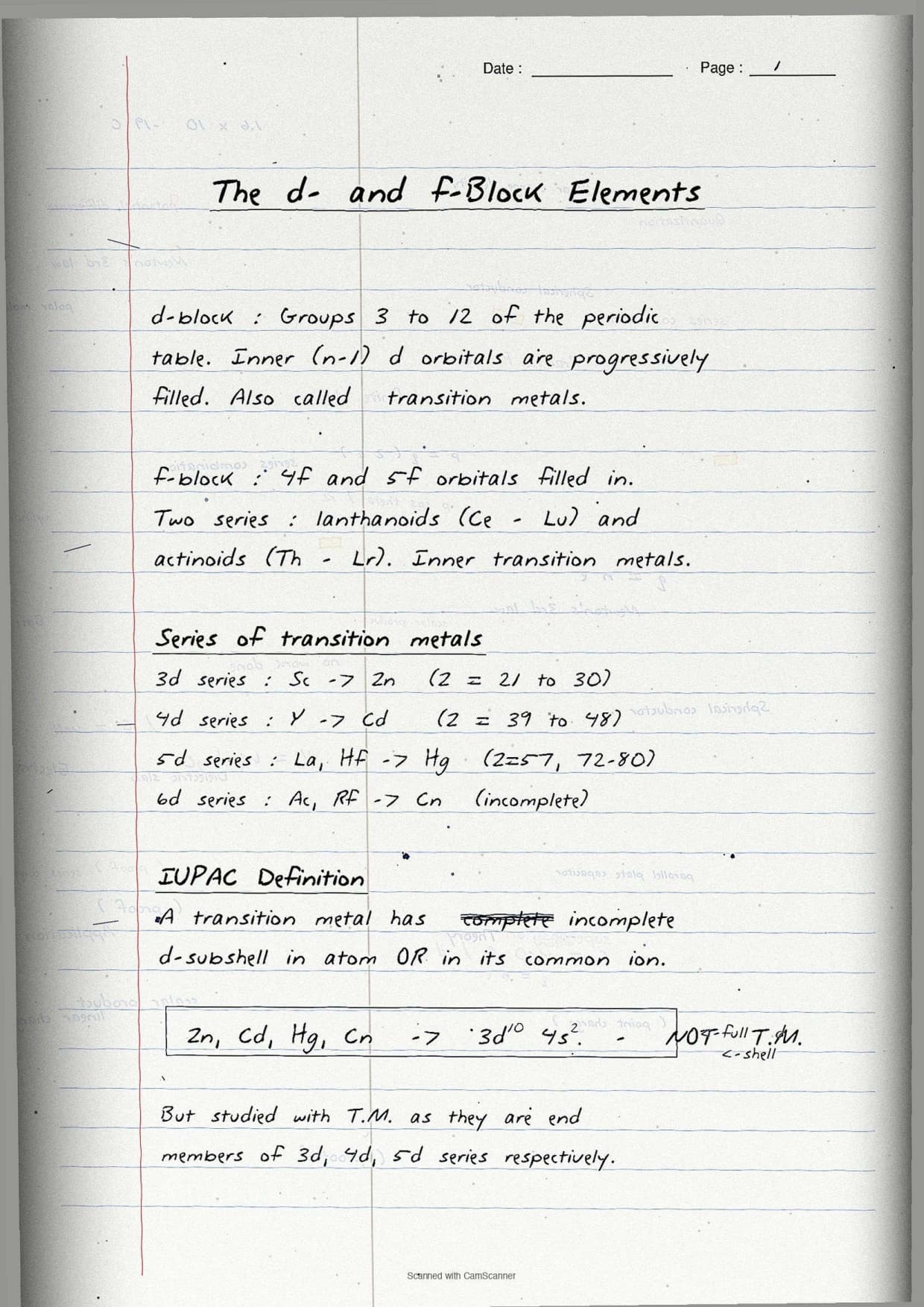
- D block elements class 12 layout: position in groups 3-12 and the four transition series.
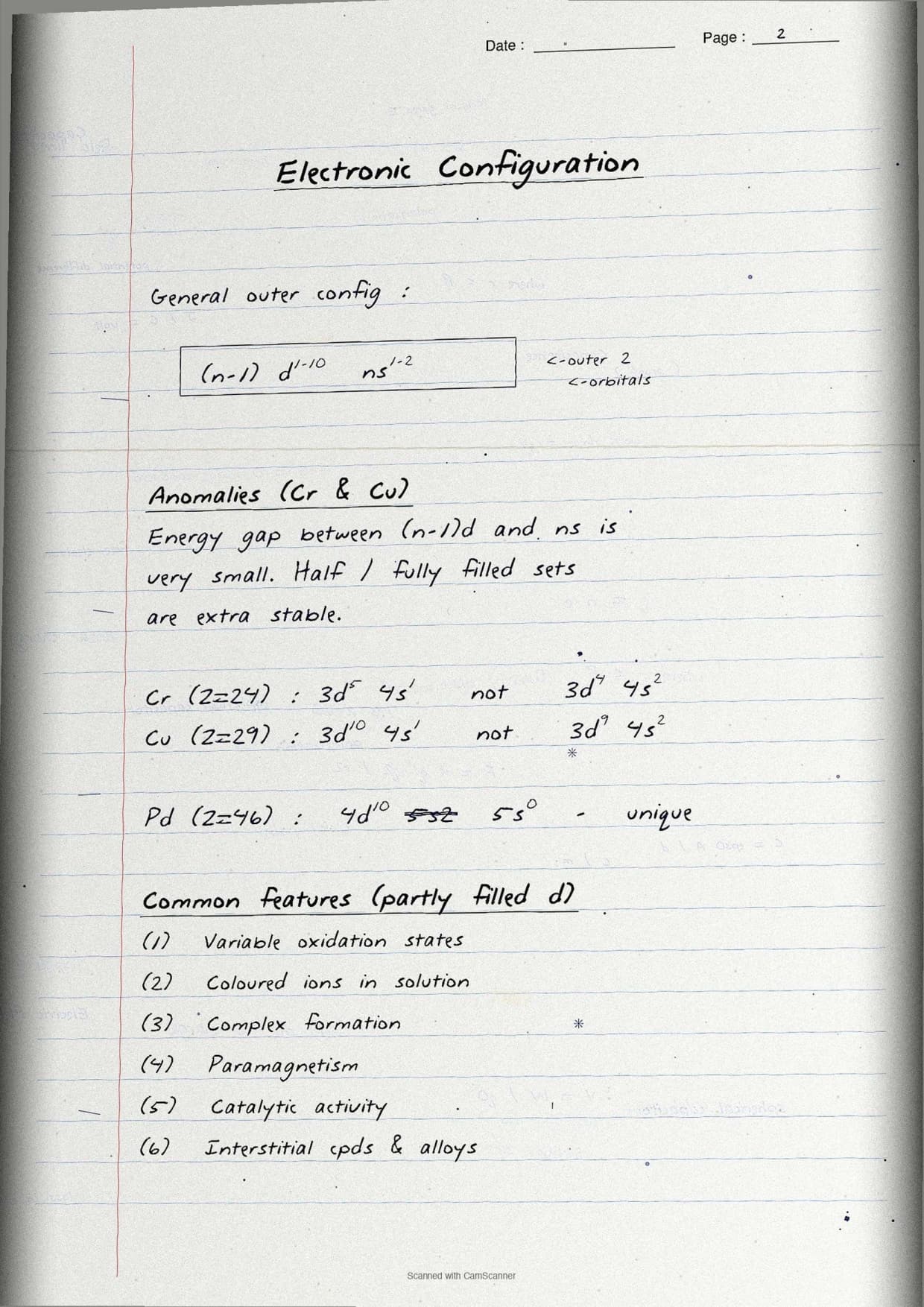
- Electronic configuration of d block: 3d series table Sc to Zn, Cr-Cu anomaly ringed in red.
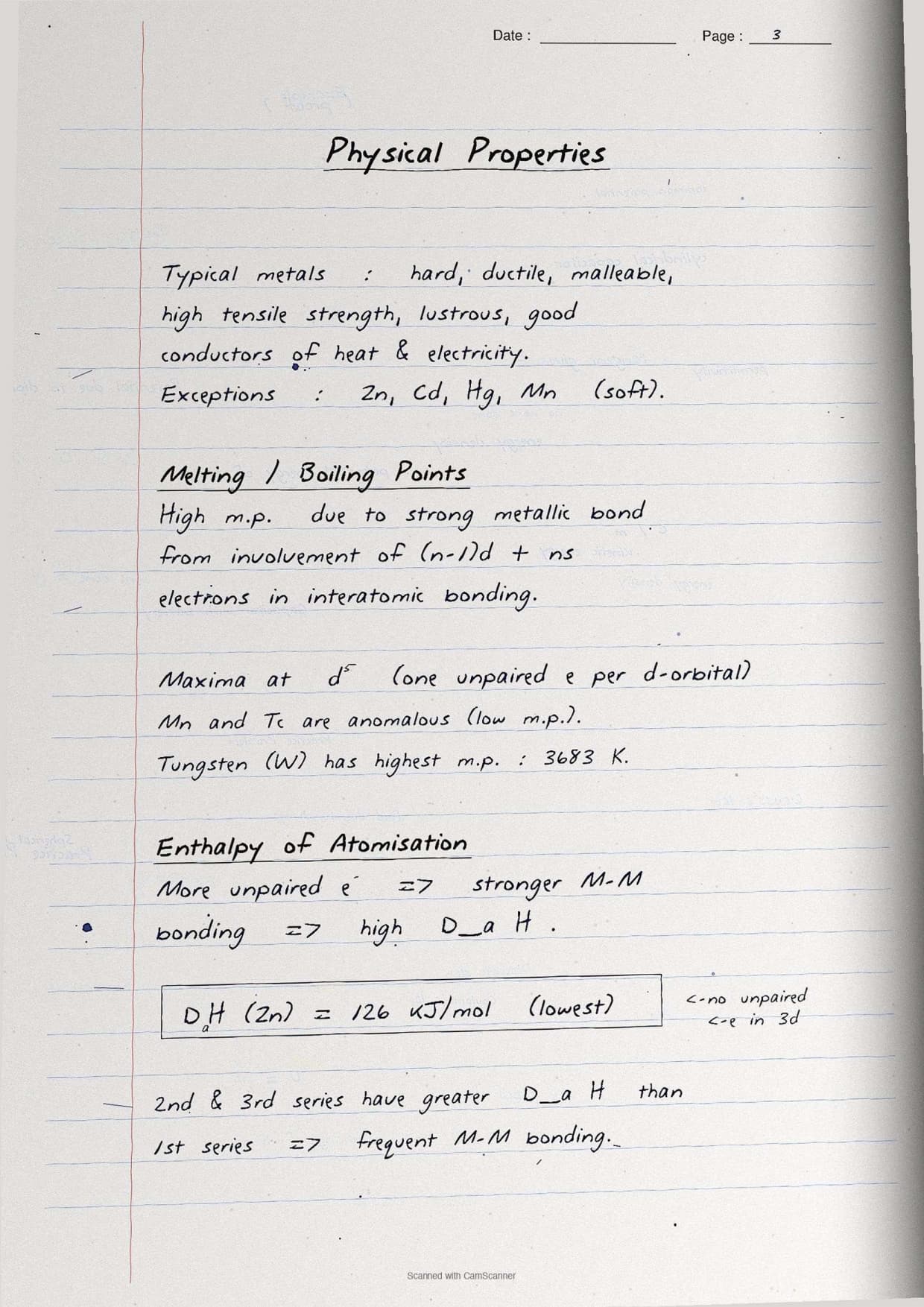
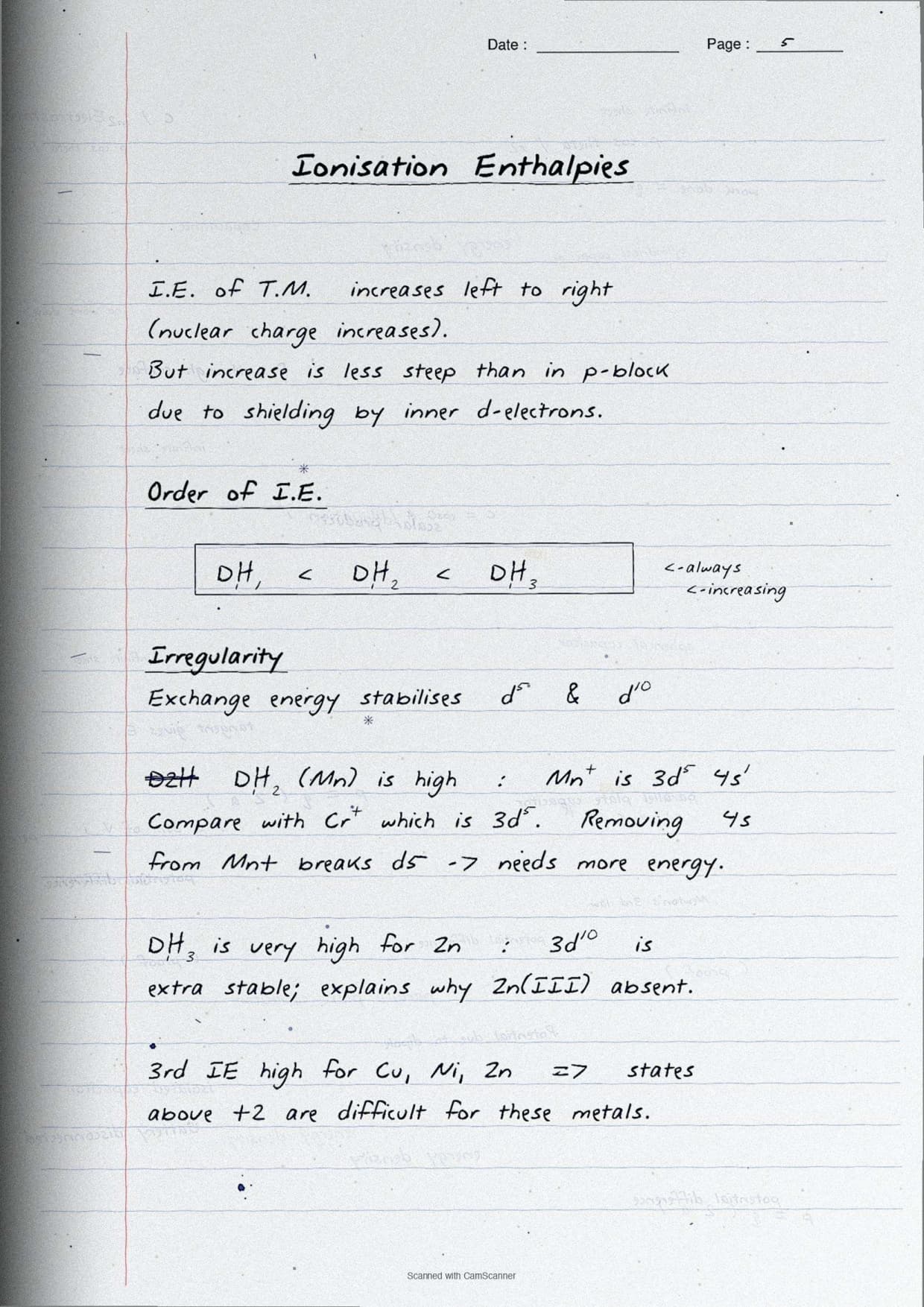
- Transition elements properties: atomic radii, ionisation enthalpy and melting-point trend strips.
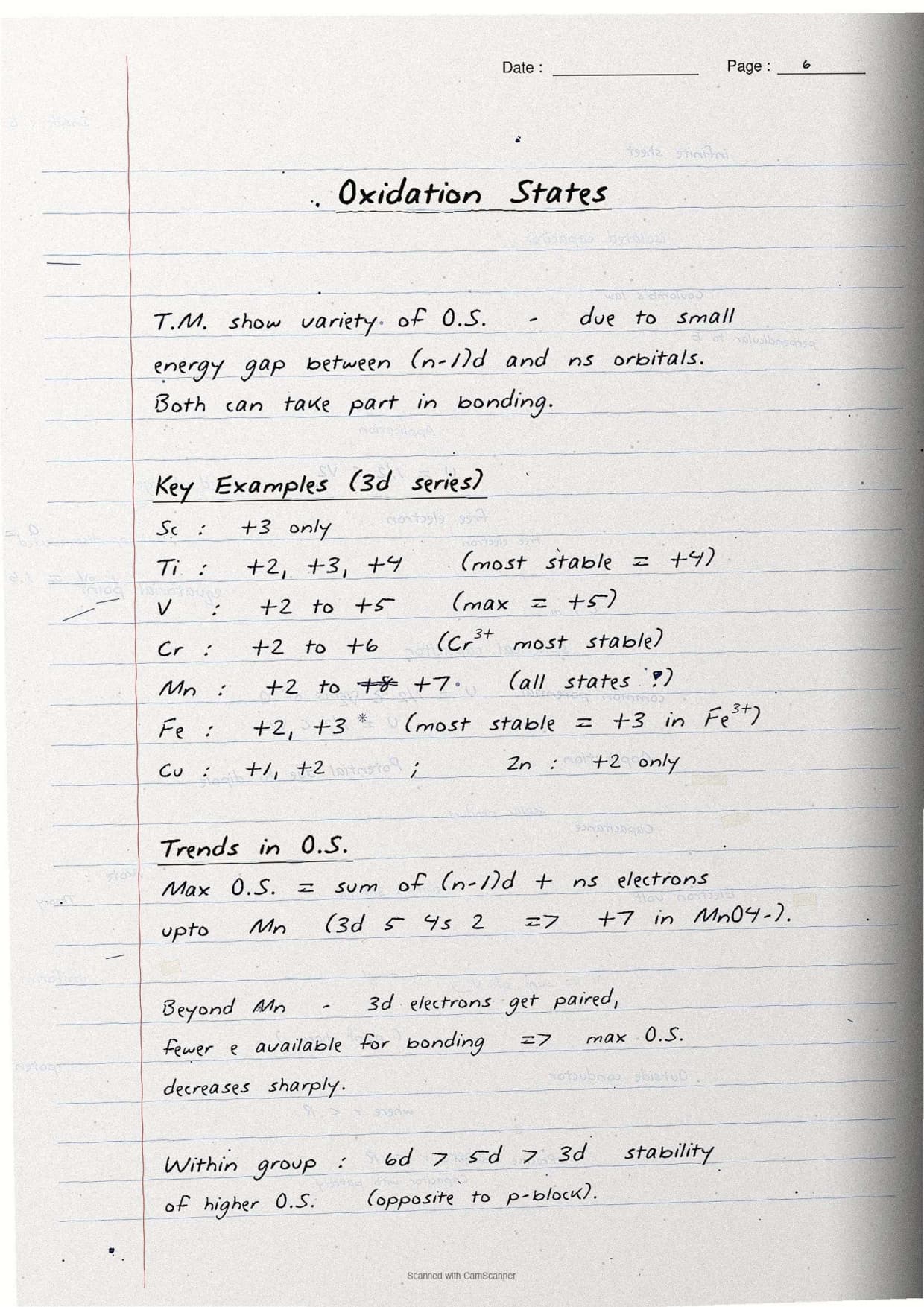
- Variable oxidation states: oxidation-state grid with Mn (+2 to +7) most-stable states circled.
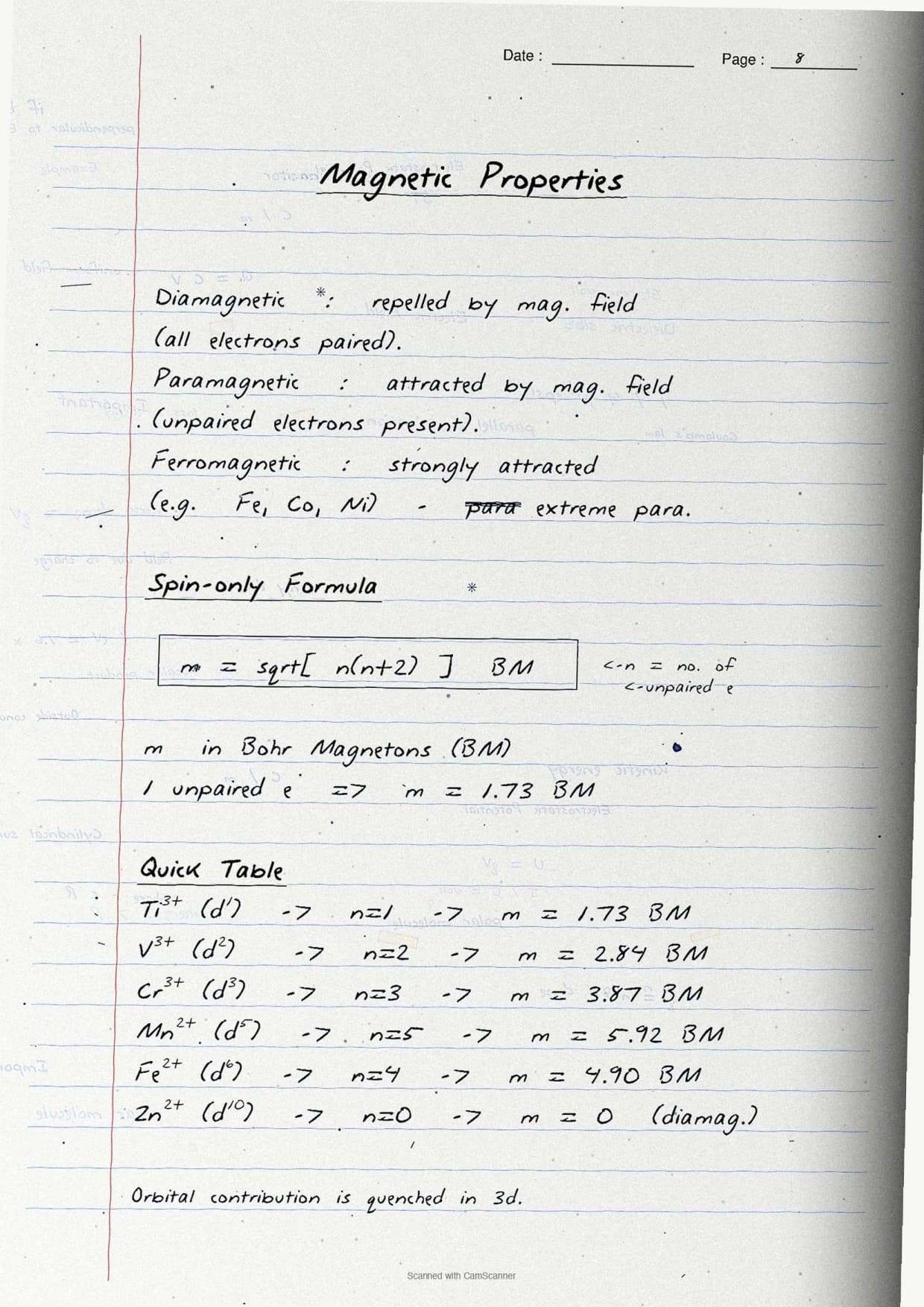
- Magnetic moment spin-only formula: μ = √n(n+2) BM card with a worked Fe3+ example.
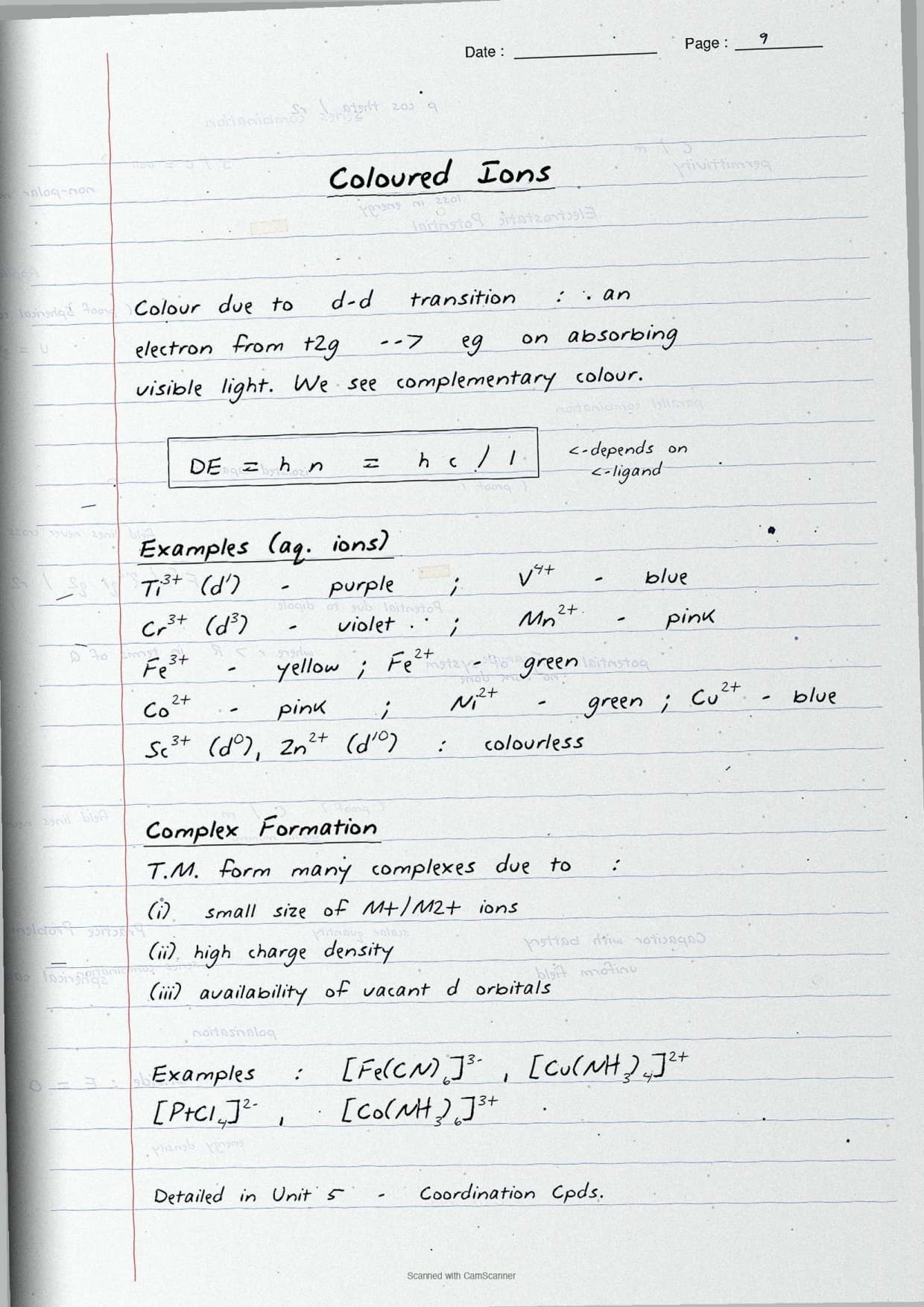
- Color of transition metal compounds: d-d transition energy-gap sketch.
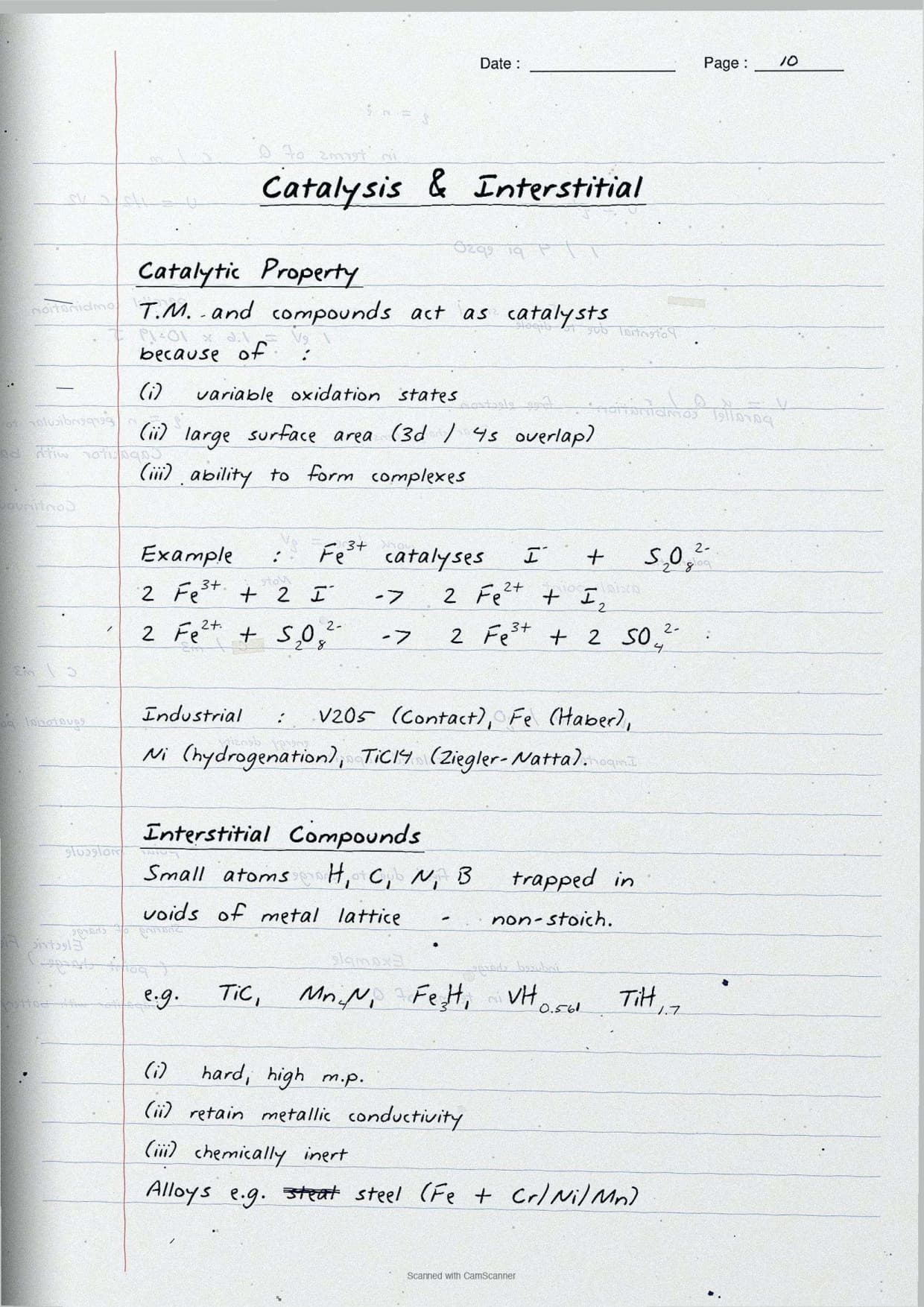
- Catalytic activity of transition metals: Fe, V2O5, Ni and Pt examples on one card.
- Interstitial compounds and alloy formation: TiC, Mn4N voids plus brass, bronze and steel.
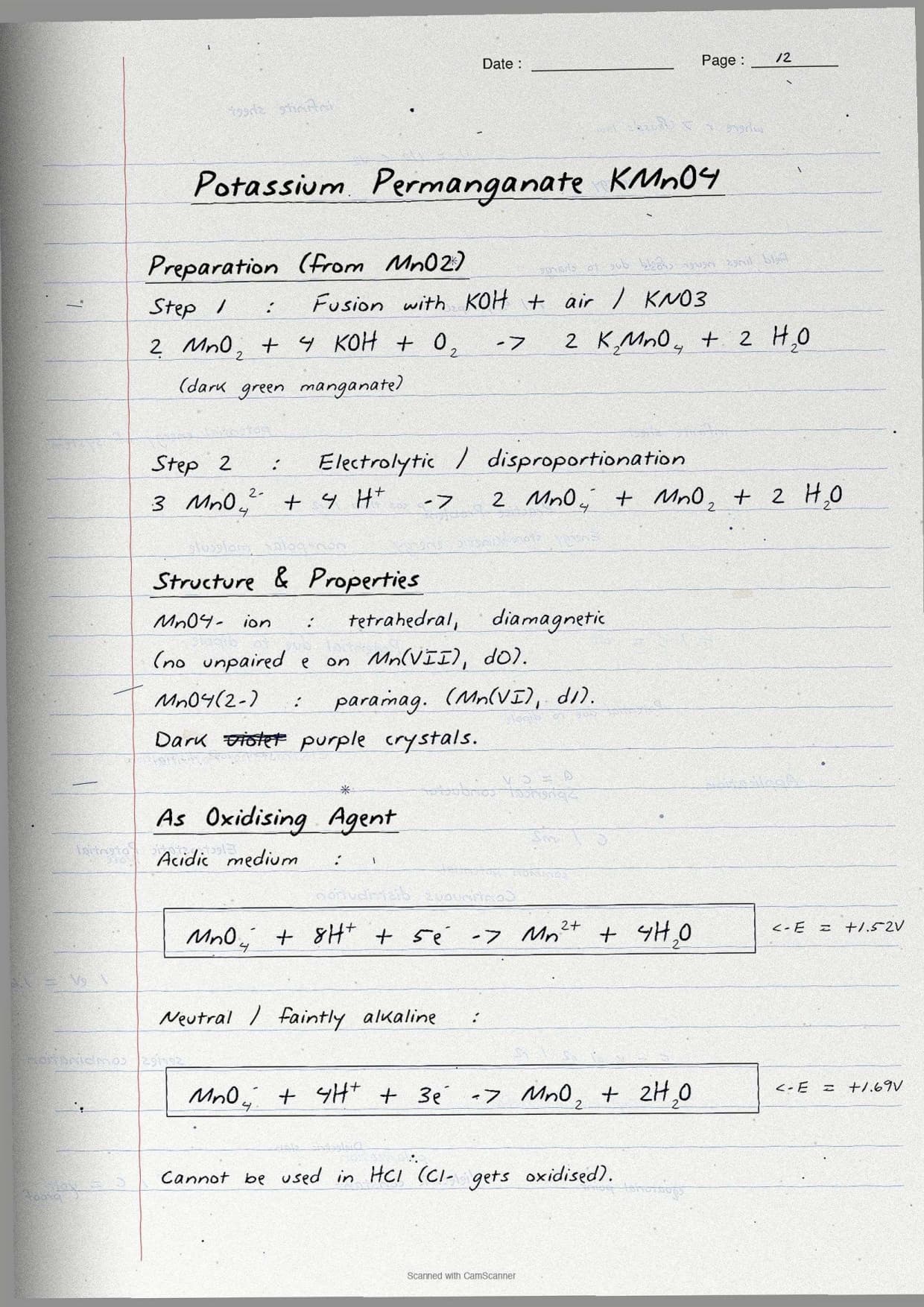
- KMnO4 preparation and properties: flowchart from pyrolusite (Fig 4.10).
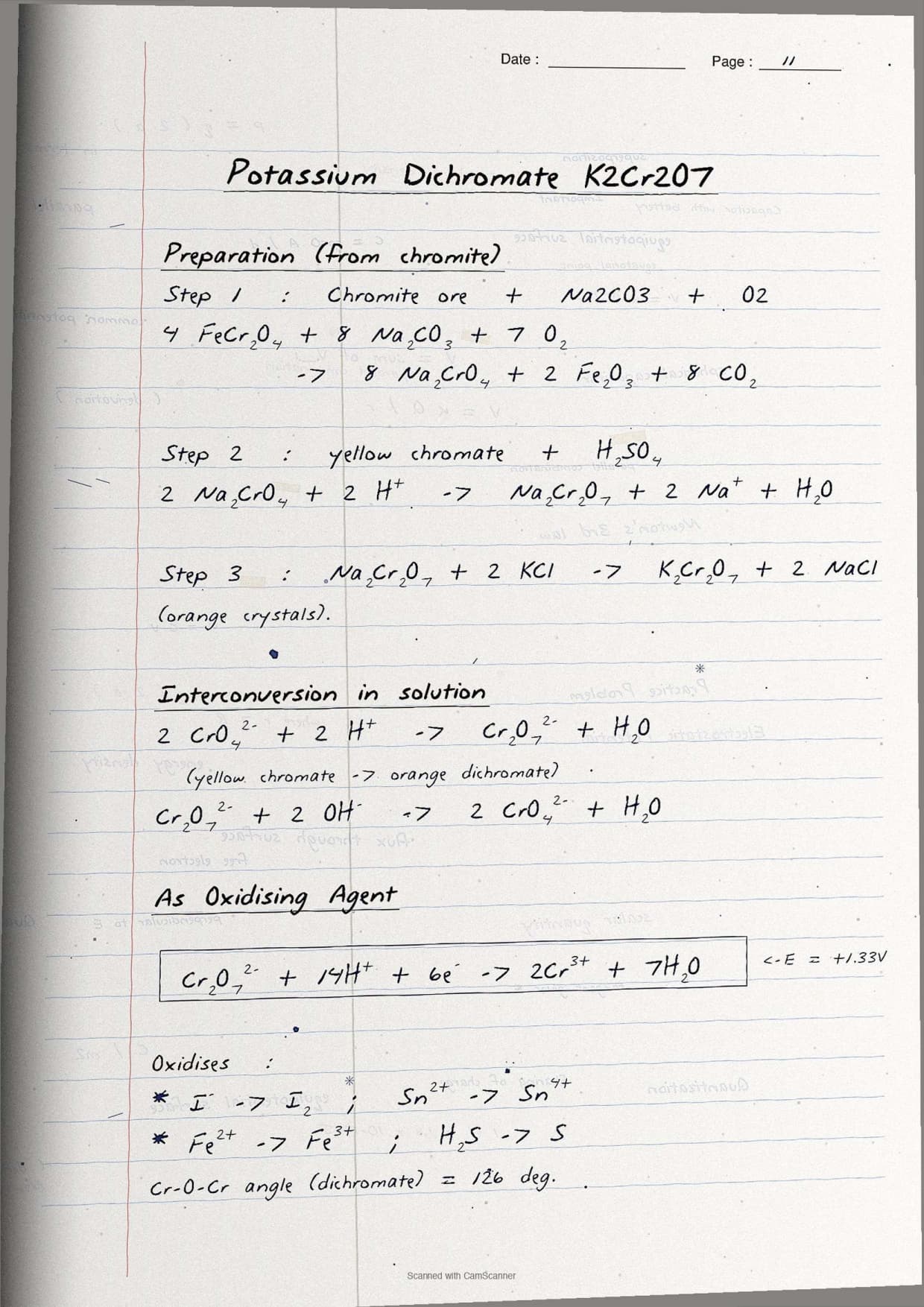
- K2Cr2O7 preparation: flowchart from chromite ore plus the chromate-dichromate colour change (Fig 4.9).
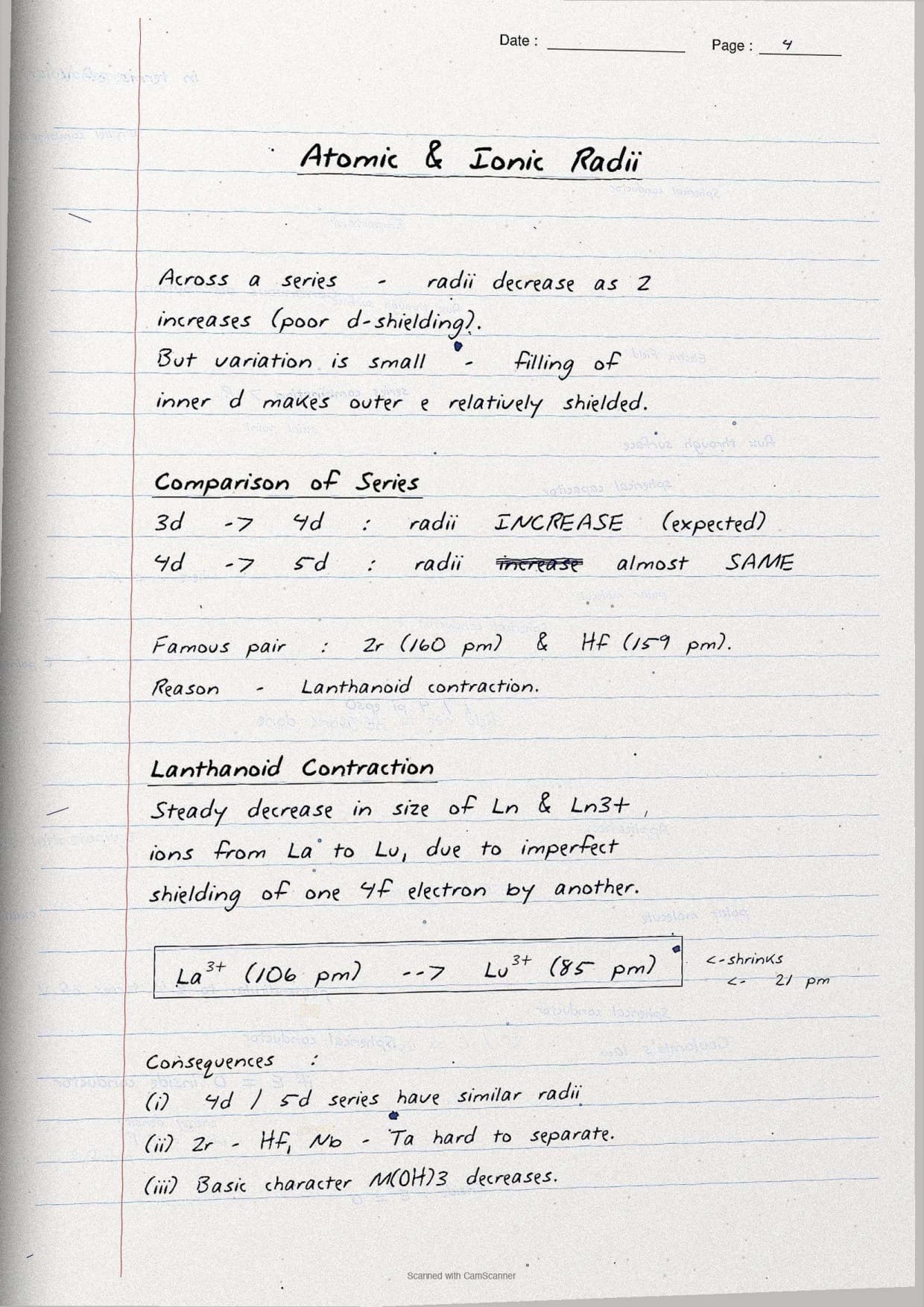
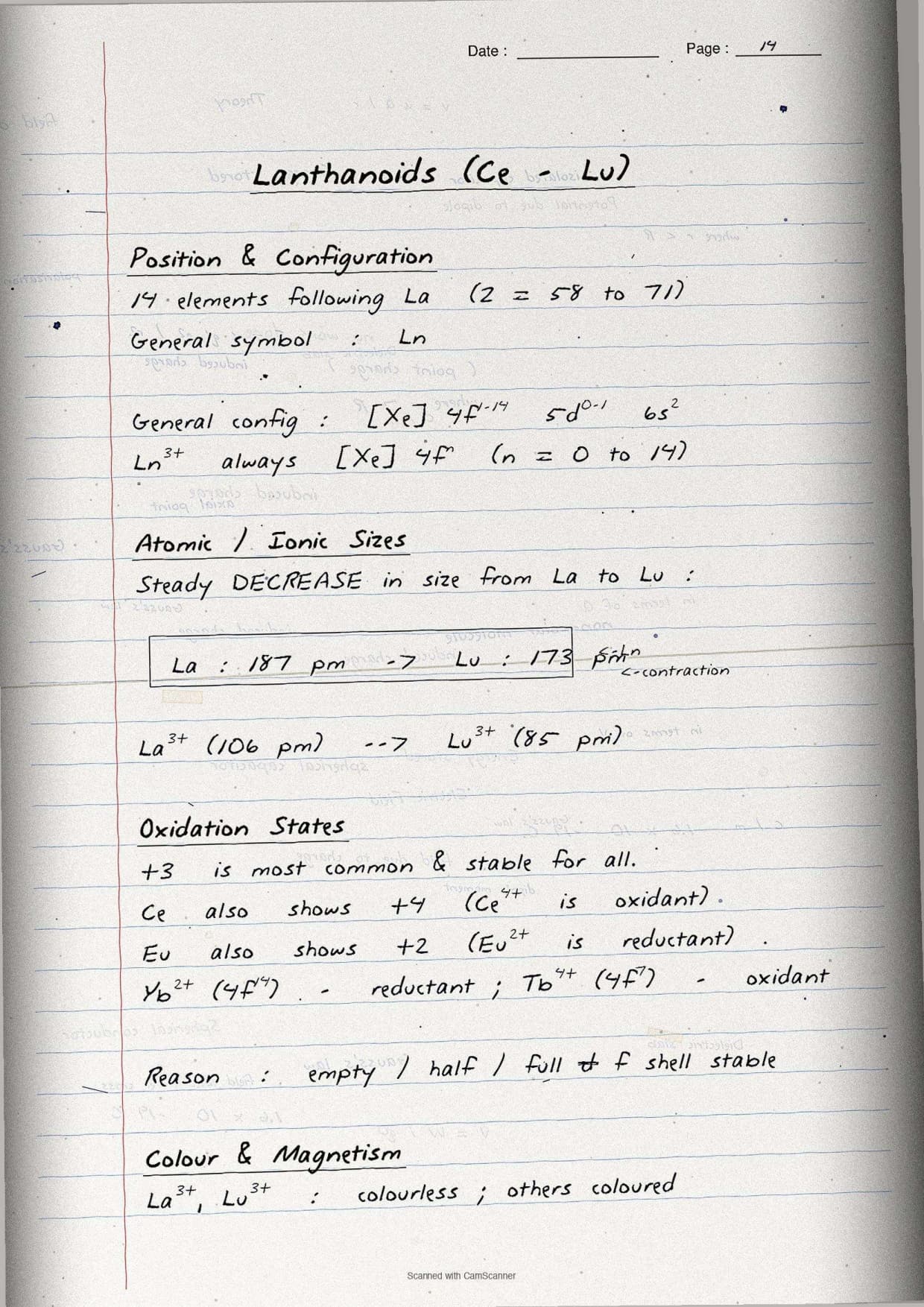
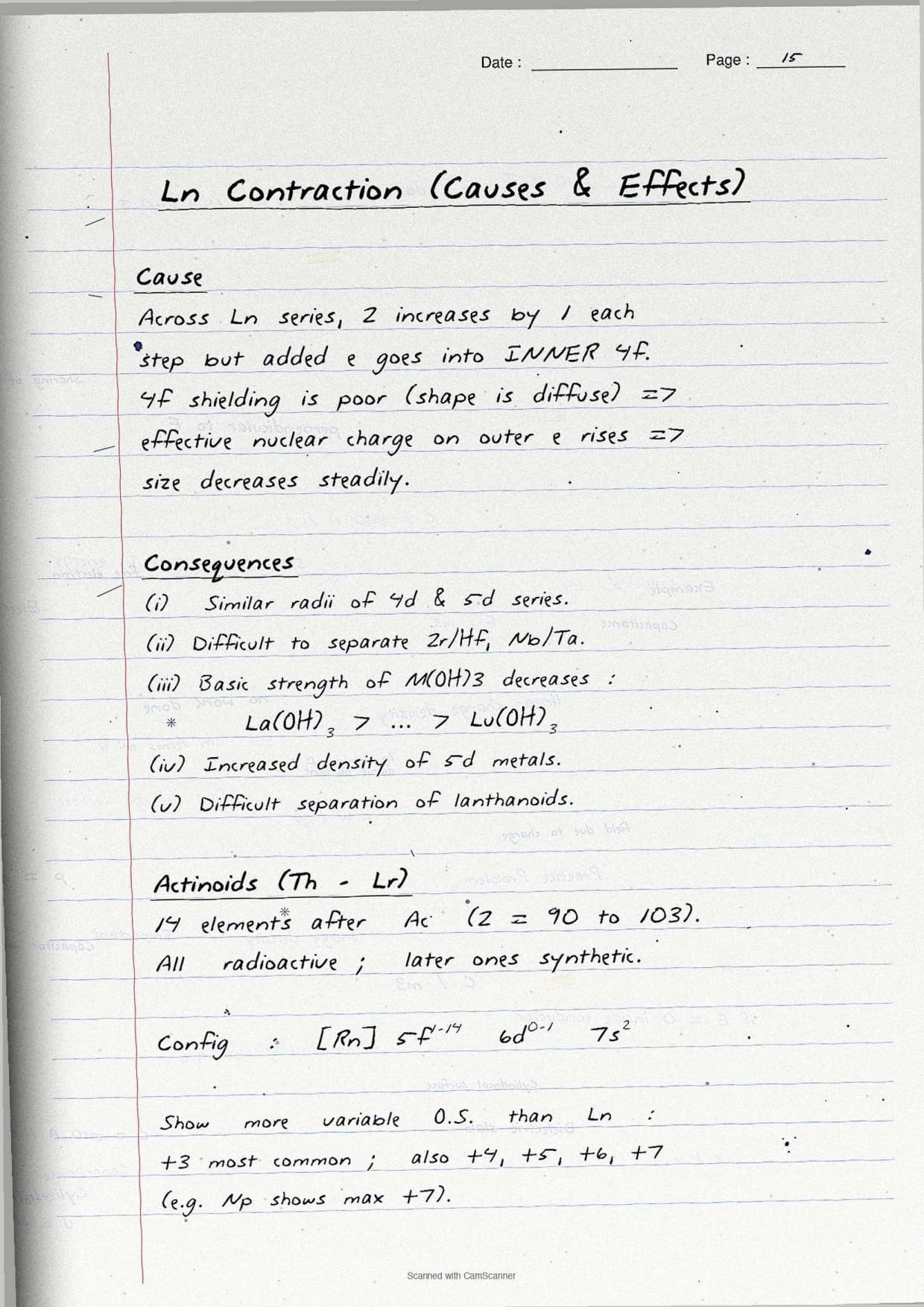
- Lanthanide contraction: radius-vs-Z curve with the 17 pm drop annotated (Fig 4.12).
- Lanthanoid contraction consequences: Zr/Hf identical radii and hard 4d-5d separation.
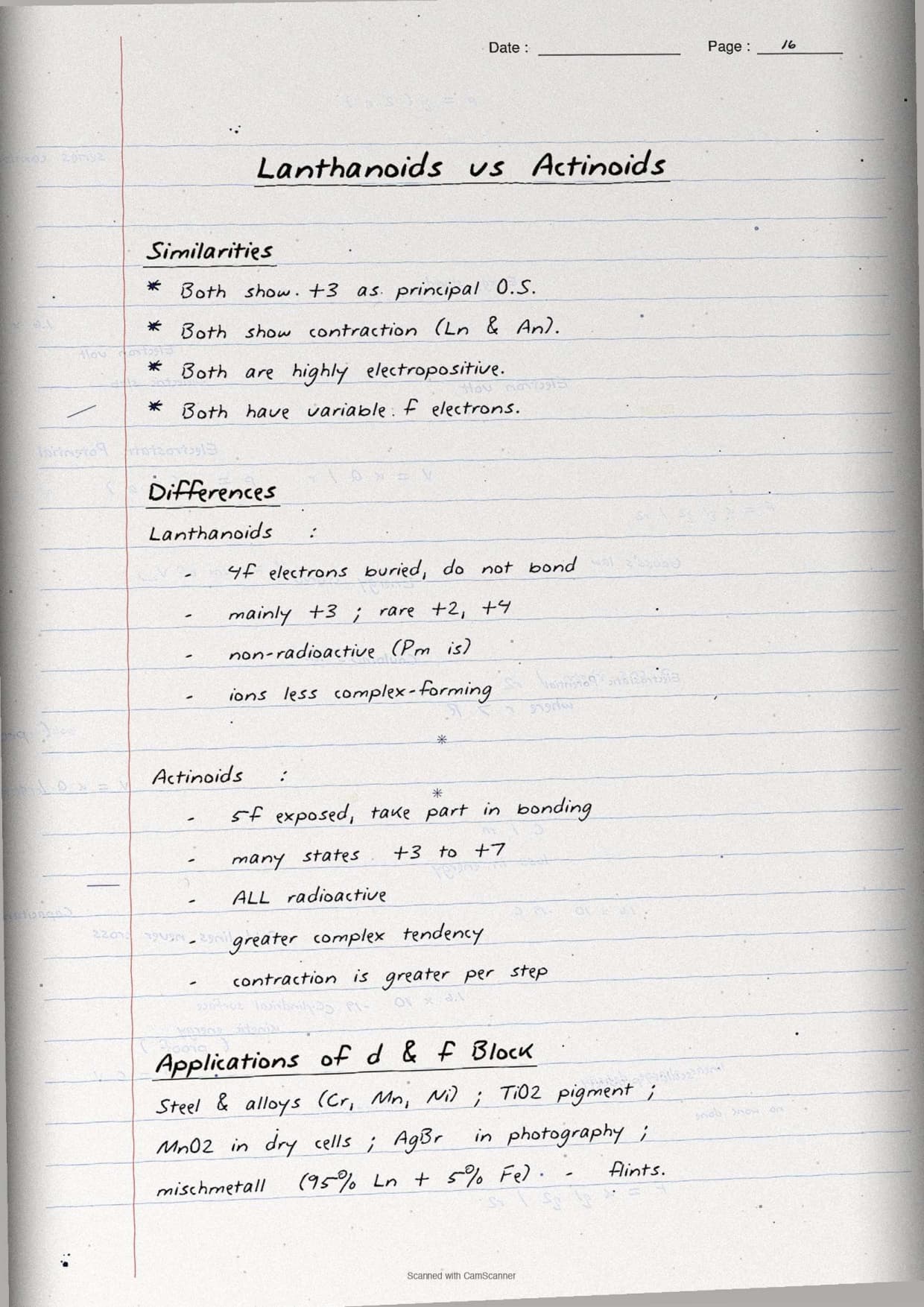
- Actinoids vs lanthanoids: quick-compare card on radioactivity and 5f shielding (Fig 4.13).
The notebook opens with the d-block trend chart and closes with the lanthanoid and actinoid summary card. Scan diagrams first, then the formulas and reasoning notes.
These Handwritten Notes are scanned from a topper's notebook, cross-checked against the 2026-27 NCERT Class 12 Chemistry textbook, and refined against the last five years of CBSE Board, JEE Main, and NEET papers.
Also Check:
- d- and f-Block Elements Class 12 Chemistry Notes
- d- and f-Block Elements Class 12 Chemistry NCERT Solutions
- d- and f-Block Elements Class 12 Chemistry Formula Sheet
The d- and f-Block Elements Class 12 Chemistry Explained
Source: Magnet Brains on YouTube
How will Collegedunia's Handwritten Notes Help You with the d- and f-Block Elements?
This is the most fact-dense unit in Class 12 Chemistry, and the trends read better as a visual flow.
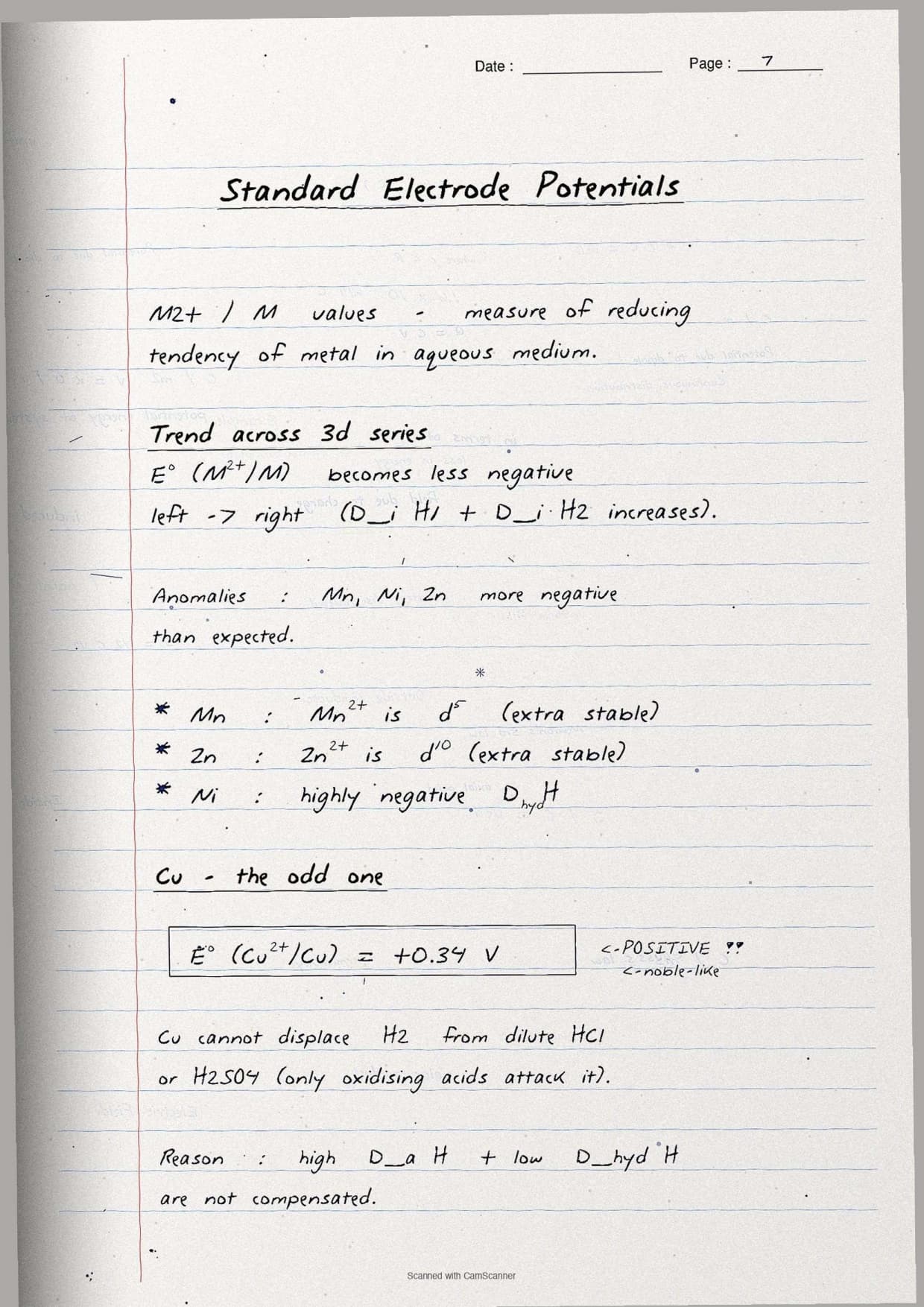
- Trend-first concept boxes: Atomic radii, ionisation enthalpy, melting points, and E∘ values are drawn as side-by-side trend strips so you spot the anomalies (Mn, Zn) in a single glance.
- Reagent preparation flowcharts: KMnO4 and K2Cr2O7 preparations are hand-drawn as arrow-mapped flowcharts in blue and orange ink, the format CBSE examiners want for the 3-mark Q.
- Lanthanoid contraction visual: A drawn radius-vs-atomic-number sketch sits alongside the textual reasoning, so the cause and the consequence are on one page spread.
- Red-ink trap warnings: Common mistake margin notes flag the Mn-vs-Cr stability twist, the Zn-not-a-transition-metal logic, and the actinoid contraction tie-break.
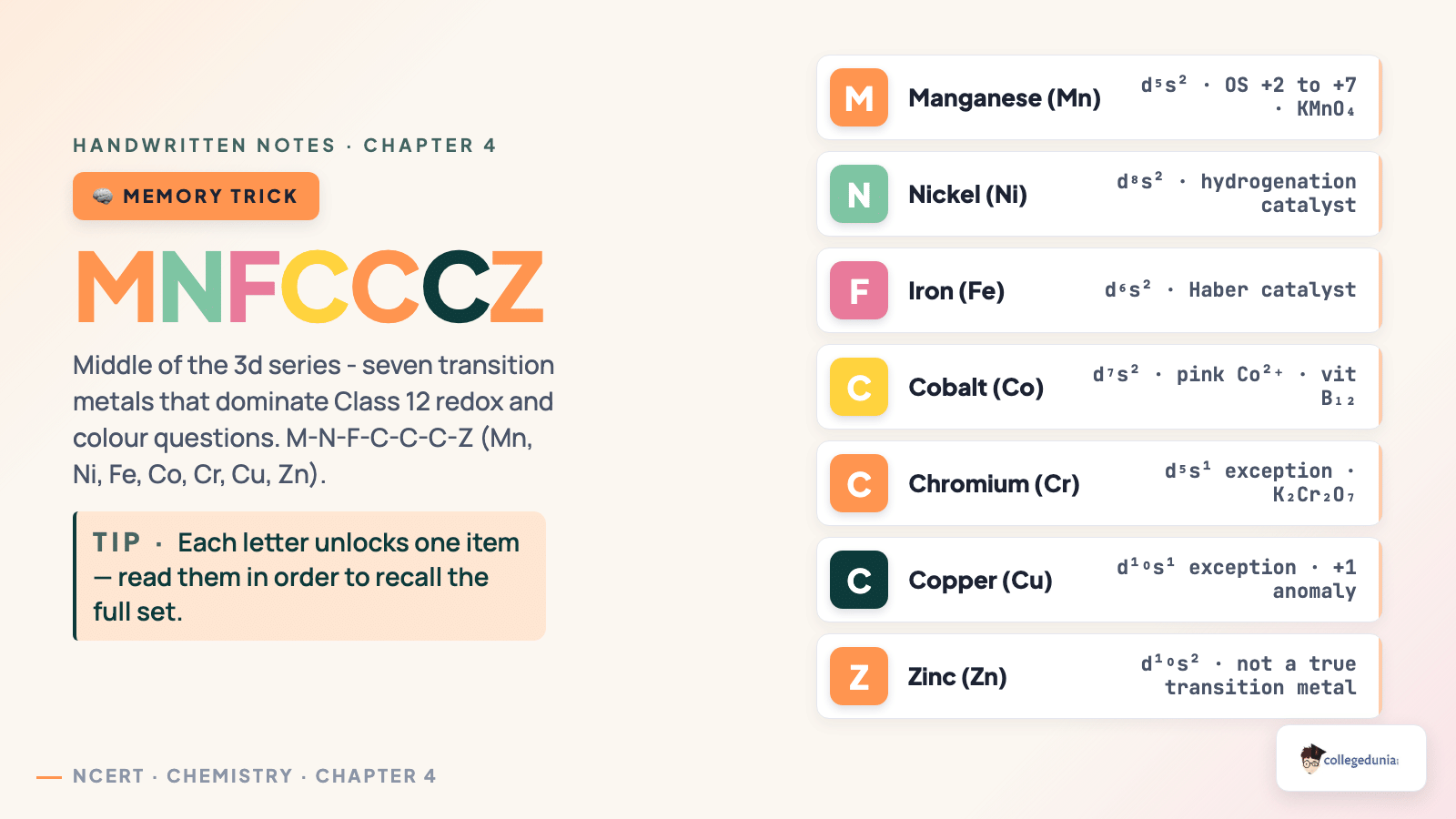
The d- and f-Block Elements Diagram Index for Quick Revision
The notebook contains thirteen hand-drawn figures across its 22 pages. Each diagram is paired with the property or reaction it makes memorable, so the visual cue triggers content recall.
| Figure | What It Shows | Page |
|---|---|---|
| Fig 4.1 | Position of d-block and f-block in the modern periodic table | p. 2 |
| Fig 4.2 | Atomic radius vs atomic number across 3d, 4d, and 5d series | p. 4 |
| Fig 4.3 | Melting-point trend with the Mn and Tc dips marked | p. 5 |
| Fig 4.4 | First ionisation enthalpy trend with the Cr and Cu anomaly callouts | p. 6 |
| Fig 4.5 | Oxidation-state grid for the 3d series (most stable highlighted) | p. 8 |
| Fig 4.6 | Standard electrode potential E∘(M2+/M) bar chart | p. 10 |
| Fig 4.7 | Colour origin: d-d transition energy gap diagram | p. 12 |
| Fig 4.8 | Spin-only magnetic moment formula card with worked Fe3+ example | p. 13 |
| Fig 4.9 | K2Cr2O7 preparation flowchart from chromite ore | p. 15 |
| Fig 4.10 | KMnO4 preparation flowchart from pyrolusite | p. 17 |
| Fig 4.11 | Cr2O72- and MnO4- structural sketches | p. 18 |
| Fig 4.12 | Lanthanoid contraction graph: atomic radius vs Z | p. 20 |
| Fig 4.13 | Lanthanoid vs Actinoid quick-compare card | p. 21 |
If you have only 25 minutes for last-day revision, Fig 4.5, 4.9, 4.10, and 4.12 are the four to lock in. Those four cover every "explain with reason" question CBSE has asked from this chapter since 2021.
What's Inside the d- and f-Block Elements Handwritten Notes PDF
A 22-page scan with a fixed colour code. The page map below shows what each block covers.
| Pages | Topic | Pen Colour |
|---|---|---|
| 1-3 | Position, general electronic configuration, and exceptions (Cr, Cu) | Blue + red |
| 4-7 | Atomic / ionic radii, ionisation enthalpy, melting-point trends | Blue + orange |
| 8-11 | Oxidation states and standard electrode potentials | Blue + green |
| 12-14 | Colour, magnetic moment, catalytic property, complex formation | Blue + orange + red |
| 15-18 | Preparation, properties, and oxidising action of K2Cr2O7 and KMnO4 | Blue + orange |
| 19-21 | Lanthanoids, lanthanoid contraction, actinoids comparison | Blue + yellow |
| 22 | Quick-revision summary strip | Mixed |
How to Read These d- and f-Block Elements Handwritten Notes (Pen-Colour Convention)
Four ink colours run through the notebook. Learning the code lets you skim 22 pages in a final pass.
| Pen Colour | What It Codes | How to Use in Revision |
|---|---|---|
| Blue | Main body text, definitions, derivation steps | Read in pass two; skip on the night-before-exam pass |
| Orange (highlighter) | Formulas, balanced equations, oxidation-state grids | This is the only pass-one colour on a last-hour revision |
| Red (pen) | Common-mistake warnings, trend anomalies (Cr, Cu, Mn) | Scan these on every pass; they pin the trap-question content |
| Yellow highlighter | Exam-trap phrases, mnemonics, board-examiner phrasings | Memorise verbatim for full marks on the wording-sensitive 2-markers |
| Green | Worked examples and example numerical answers | Skip unless you struggle with magnetic-moment numericals |
The same colour code runs across all Class 12 Chemistry Collegedunia notebooks.

Why the d- and f-Block Elements Matters for JEE Main and NEET 2026
Transition and inner-transition elements are the highest-yield inorganic sub-bucket in JEE Main. Every session since 2022 has carried at least one d-block colour, magnetic-moment, or oxidising-action question.
- The spin-only formula μ = √n(n+2) BM is a recurring 1-mark JEE question.
- The electrode potential trend E∘(M2+/M) explains why Cu2+/Cu is the only positive value, a 2-mark CBSE reasoning question.
- Lanthanoid contraction is the basis for Zr and Hf having near-identical radii, a NEET assertion-reason favourite.
Student Feedback
In a Collegedunia poll of 900 Class 12 students, 78% said the hand-drawn KMnO4 and K2Cr2O7 flowcharts made them recall the reagent preparations faster than printed text.
Other Resources for the d- and f-Block Elements Class 12 Chemistry
- d- and f-Block Elements Class 12 Chemistry Handwritten Notes
- d- and f-Block Elements Class 12 Chemistry NCERT Solutions
- d- and f-Block Elements Class 12 Chemistry Notes
- d- and f-Block Elements Class 12 Chemistry Formula Sheet
- d- and f-Block Elements Class 12 Chemistry NCERT Book PDF
- d- and f-Block Elements Class 12 Chemistry NCERT Exemplar Book PDF
- d- and f-Block Elements Class 12 Chemistry NCERT Exemplar Solutions
NCERT Handwritten Notes for Class 12 Chemistry: All Chapters
Use the table to jump to the Collegedunia handwritten notes for any other Class 12 Chemistry chapter.
| Chapter | Resource |
|---|---|
| Chapter 1 | Solutions Handwritten Notes |
| Chapter 2 | Electrochemistry Handwritten Notes |
| Chapter 3 | Chemical Kinetics Handwritten Notes |
| Chapter 5 | Coordination Compounds Handwritten Notes |
| Chapter 6 | Haloalkanes and Haloarenes Handwritten Notes |
| Chapter 7 | Alcohols, Phenols and Ethers Handwritten Notes |
| Chapter 8 | Aldehydes, Ketones and Carboxylic Acids Handwritten Notes |
| Chapter 9 | Amines Handwritten Notes |
| Chapter 10 | Biomolecules Handwritten Notes |
d- and f-Block Elements Class 12 Chemistry Handwritten Notes FAQs
Ques. Where can I download the d- and f-Block Elements Class 12 Chemistry Handwritten Notes PDF?
Ans. You can download the d- and f-Block Elements Class 12 Chemistry Handwritten Notes PDF directly from this page. Both the Normal and HD versions are available, and both are free.
Ques. Are these Handwritten Notes aligned with the 2026-27 NCERT?
Ans. Yes. The notes follow the current 2026-27 syllabus for Class 12 Chemistry, where The d- and f-Block Elements is Chapter 4. The chapter was kept intact in the new NCERT edition, so every trend, oxidation-state grid, reagent preparation, and lanthanoid-contraction explanation in the PDF matches the 2026-27 textbook.
Ques. How many pages is the Class 12th Chemistry d- and f-Block Elements Handwritten Notes PDF?
Ans. The Handwritten Notes PDF runs 22 pages and covers position and electronic configuration, atomic and ionic radii, ionisation enthalpy, oxidation states, standard electrode potentials, colour and magnetic moment, preparation and properties of K2Cr2O7 and KMnO4, lanthanoid contraction, and the lanthanoid versus actinoid comparison.
Ques. Why is Zn not considered a transition metal?
Ans. Zn has the electronic configuration [Ar] 3d10 4s2 in the atomic state and 3d10 in the Zn2+ ion state. Because its d-orbitals are completely filled in both the atomic and the common ion form, it does not show the typical transition-metal properties of variable oxidation state, colour from d-d transition, or paramagnetism, so it is excluded from the transition series. Cd and Hg are excluded for the same reason.
Ques. What is lanthanoid contraction and why does it matter?
Ans. Lanthanoid contraction is the steady decrease in atomic and ionic radius across the lanthanoid series from Ce to Lu, caused by the poor shielding of 4f electrons. Its main consequence is that the elements of the second (4d) and third (5d) transition series have nearly identical atomic radii. Zr and Hf are the textbook example: their atomic radii differ by less than 1 pm, which makes their separation chemically difficult.
Ques. Why is the d- and f-Block important for JEE Main and NEET?
Ans. The chapter contributes 2 to 3 per cent of JEE Main Chemistry, with at least one question on colour, magnetic moment, or oxidising action of KMnO4 in every shift. NEET asks two to three questions per year, typically one on lanthanoid contraction and one on oxidation states. The chapter is also a prerequisite for Coordination Compounds (Chapter 5), so locking it well saves study time on the next chapter.
Ques. How should I revise the d- and f-Block Elements on the night before the CBSE Board exam?
Ans. Use the 8-point Last 24-Hour Revision Card in the Collegedunia Handwritten Notes. Focus on the four highest-yield items: the spin-only magnetic-moment formula, the acidic-medium half-cell equations for K2Cr2O7 and KMnO4, the lanthanoid-contraction reasoning, and the actinoid versus lanthanoid comparison. The card takes 11 to 13 minutes end to end.
Ques. Why do Cr and Cu show anomalous electronic configuration?
Ans. Cr (Z = 24) is [Ar] 3d5 4s1 and Cu (Z = 29) is [Ar] 3d10 4s1. Half-filled (d5) and fully-filled (d10) d-subshells are extra-stable due to maximum exchange energy and symmetrical electron distribution, so the 4s electron promotes to 3d. The handwritten notes ring this Cr-Cu anomalous configuration in red ink on the 3d series electron config table.
Ques. How does the handwritten notebook explain KMnO4 preparation and properties?
Ans. KMnO4 preparation is drawn as an arrow flowchart on page 17 (Fig 4.10). The route starts from pyrolusite (MnO2), fuses with KOH and O2 to give green K2MnO4, then disproportionates in neutral/acidic medium to purple KMnO4. The properties card lists the n-factor in three media (5/3/1 in acidic/neutral/strongly alkaline) and the standard E°(MnO4-/Mn2+) = +1.51 V.
Ques. How is K2Cr2O7 preparation drawn in the handwritten notes?
Ans. K2Cr2O7 preparation is on page 15 (Fig 4.9). Chromite ore (FeCr2O4) is roasted with Na2CO3 in air, the resulting Na2CrO4 is acidified to dichromate, then treated with KCl to crystallise K2Cr2O7. The orange-to-yellow chromate-dichromate equilibrium colour shift is sketched alongside the acidic-medium half-cell.
Ques. What is the chromate-dichromate equilibrium colour shift?
Ans. The chromate-dichromate equilibrium is the pH-controlled 2CrO42- + 2H+ Cr2O72- + H2O . Adding acid pushes the equilibrium right, turning the solution orange. Adding base pushes it left, restoring the yellow colour. The handwritten notes mark this colour pair on the K2Cr2O7 page using orange and yellow highlighter strips.
Ques. What are the actinoids vs lanthanoids differences sketched in the comparison card?
Ans. Fig 4.13 on page 21 compares actinoids vs lanthanoids on four axes: oxidation-state range (+3 dominant for Ln vs up to +7 for An), radioactivity (none for Ln vs all radioactive for An), shielding (4f vs weaker 5f, so actinoid contraction is larger per element), and colour (Ln3+ mostly faintly coloured, An3+ more intensely coloured).
Ques. Why are transition metals good catalysts?
Ans. The catalytic activity of transition metals comes from variable oxidation states (electron exchange in a reaction cycle) and partially filled d-orbitals (adsorption sites for reactants on the catalyst surface). The handwritten notes summarise the textbook examples on a single card: Fe in Haber, V2O5 in Contact, Ni in hydrogenation, and Pt in catalytic converters.
Ques. What are interstitial compounds and how do transition metals form alloys?
Ans. Interstitial compounds are non-stoichiometric solids in which small atoms (H, C, N, B) occupy lattice voids of transition metals, giving hard, high-melting, chemically inert materials like TiC, Mn4N and VH. Alloy formation is favoured because transition metals have similar atomic radii. The handwritten notes list four key alloys: brass (Cu-Zn), bronze (Cu-Sn), stainless steel (Fe-Cr-Ni) and misch metal (95% Ln + 5% Fe).



Comments