




Chemical Kinetics carries 3-4% of every JEE Main shift and 2-3 NEET questions each year. The PDF below is a 30-page scanned notebook with rate-vs-time sketches, integrated-rate derivations in coloured ink, and Arrhenius plots from the 2026-27 NCERT.
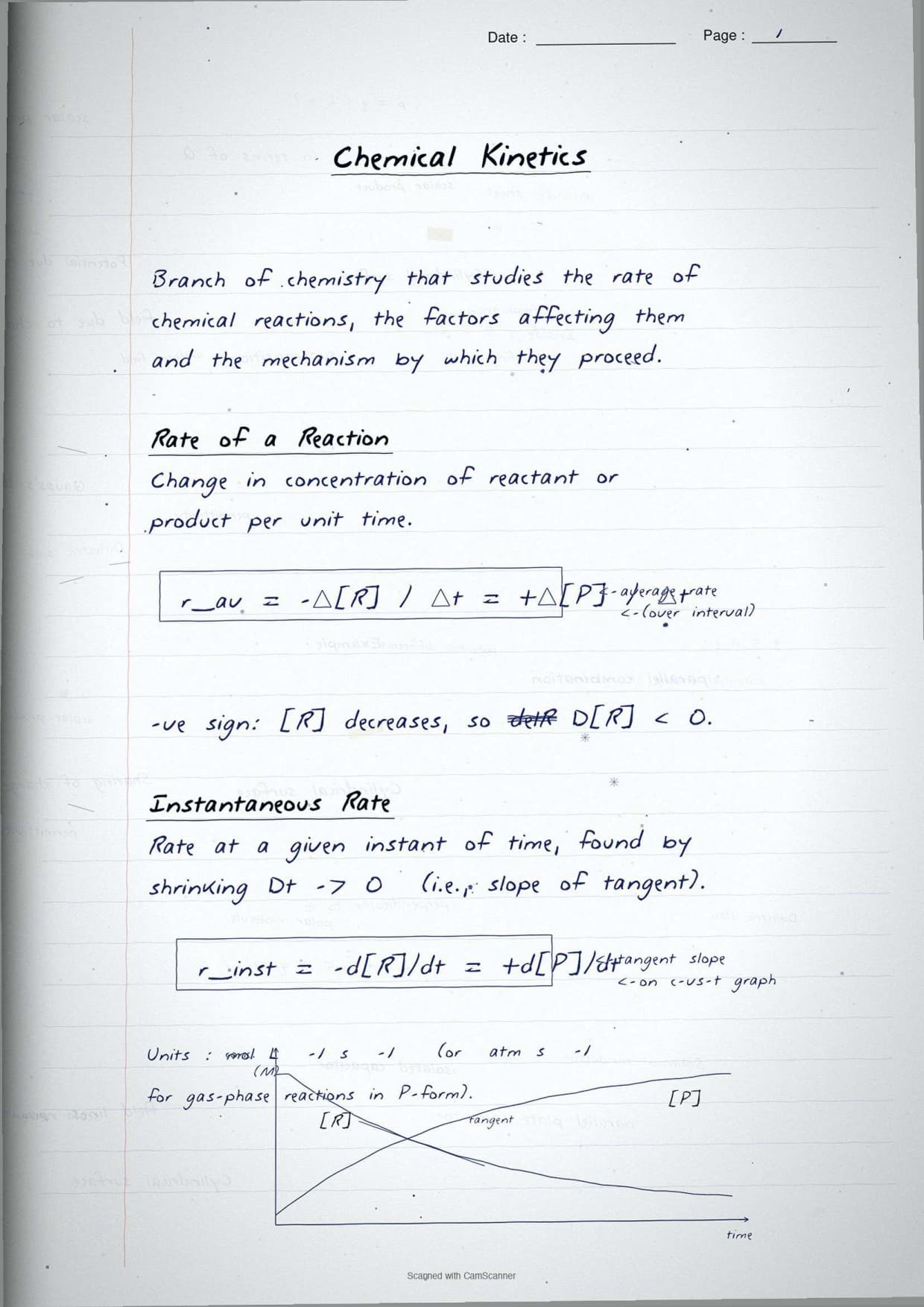
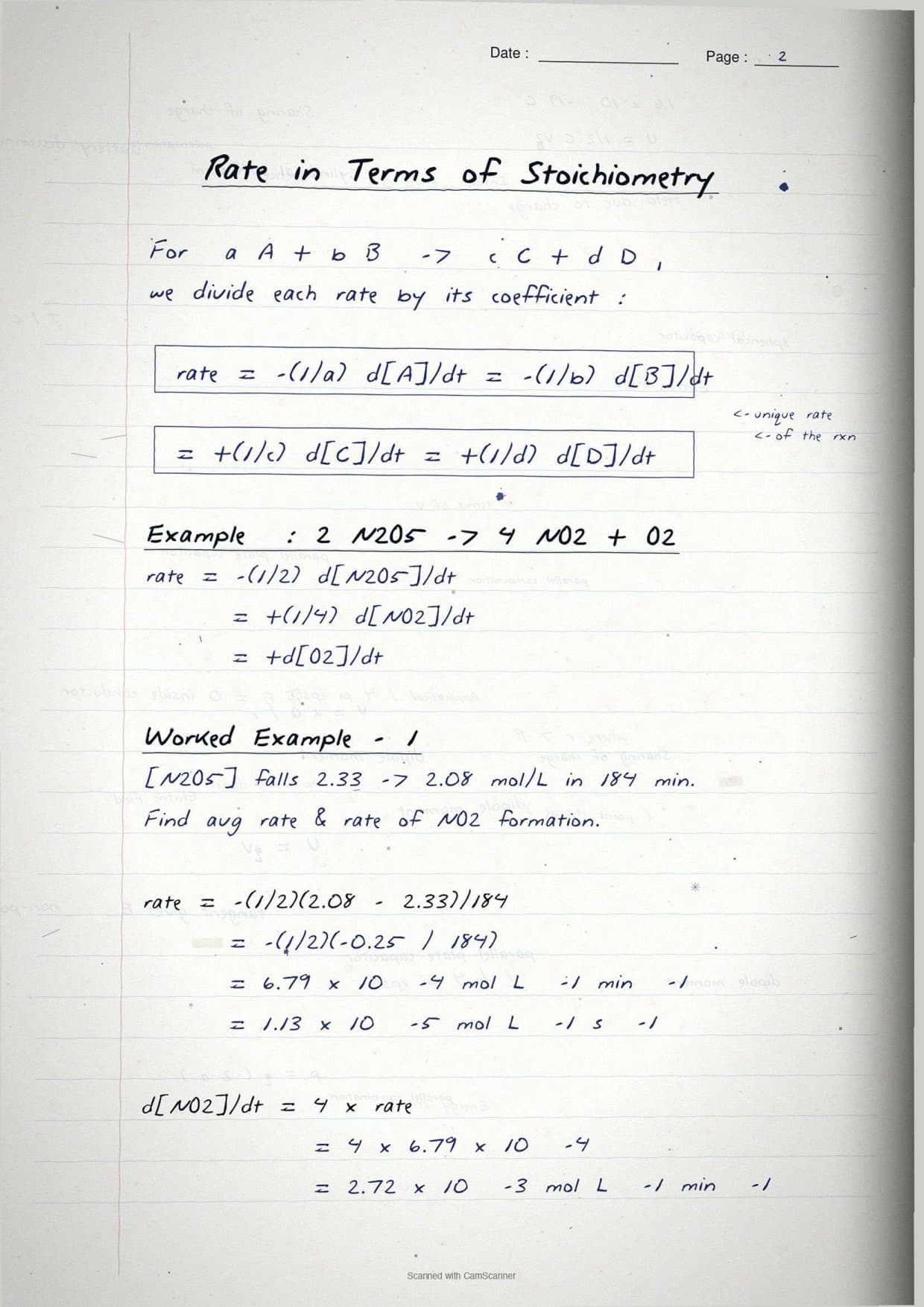
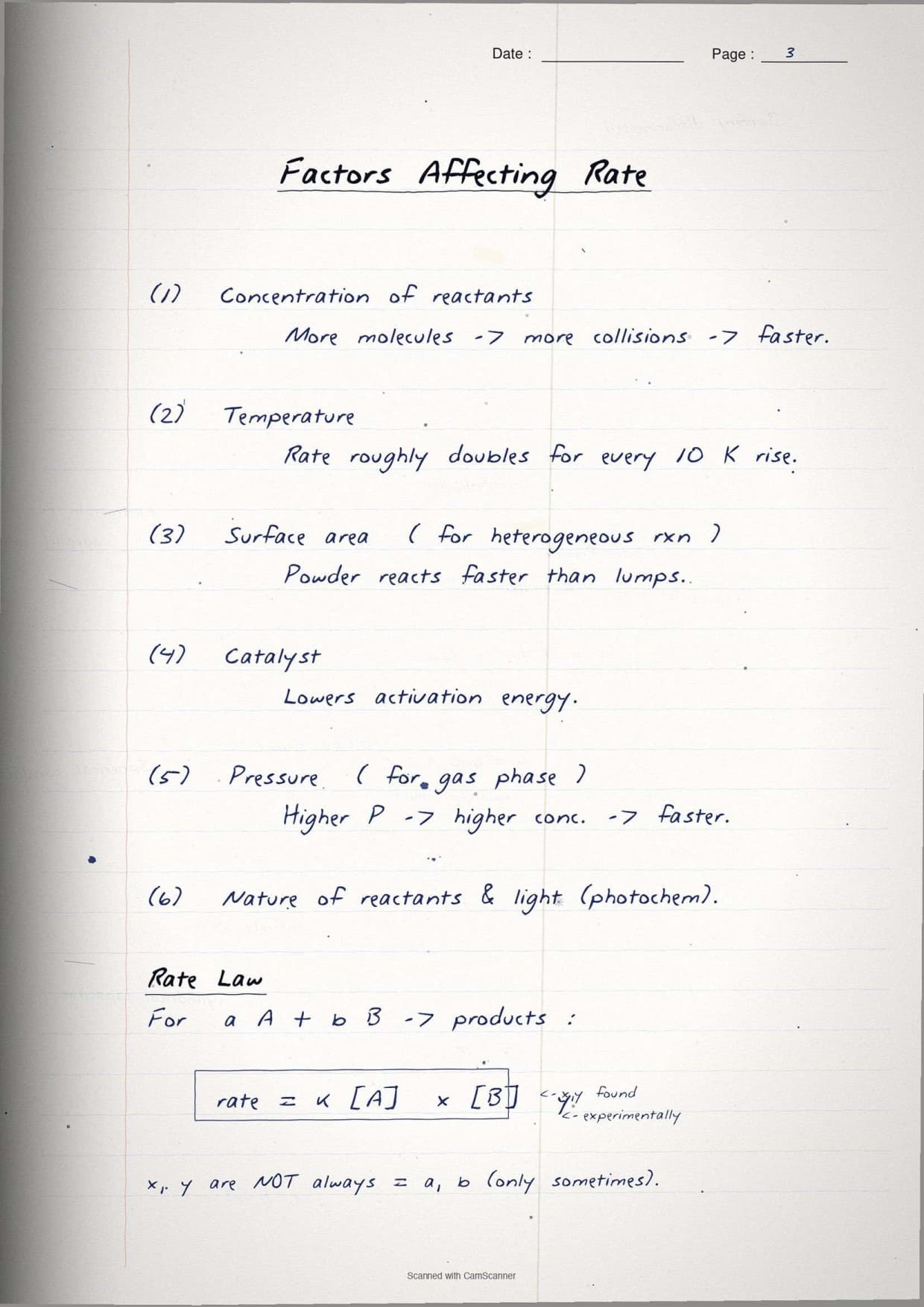
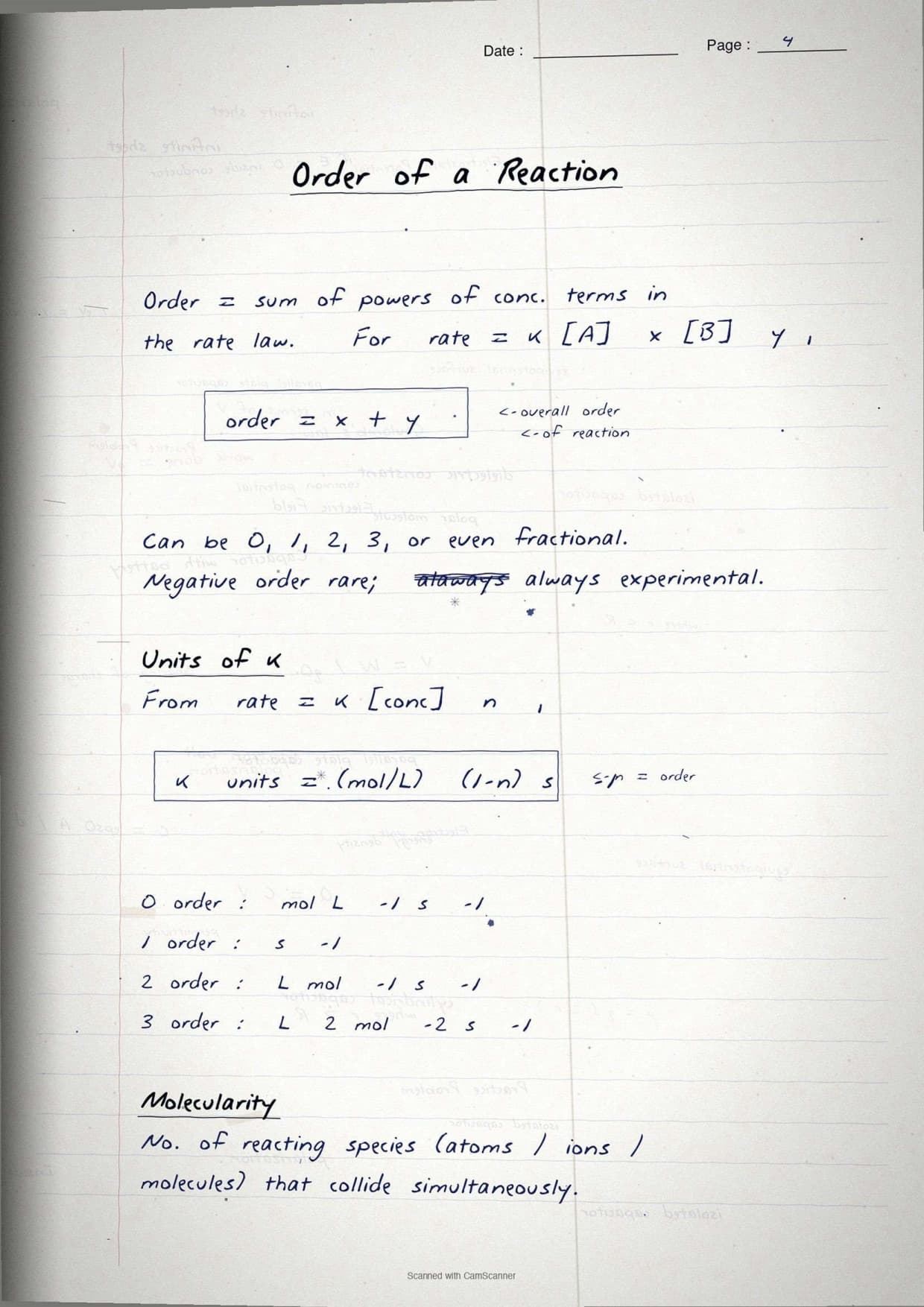
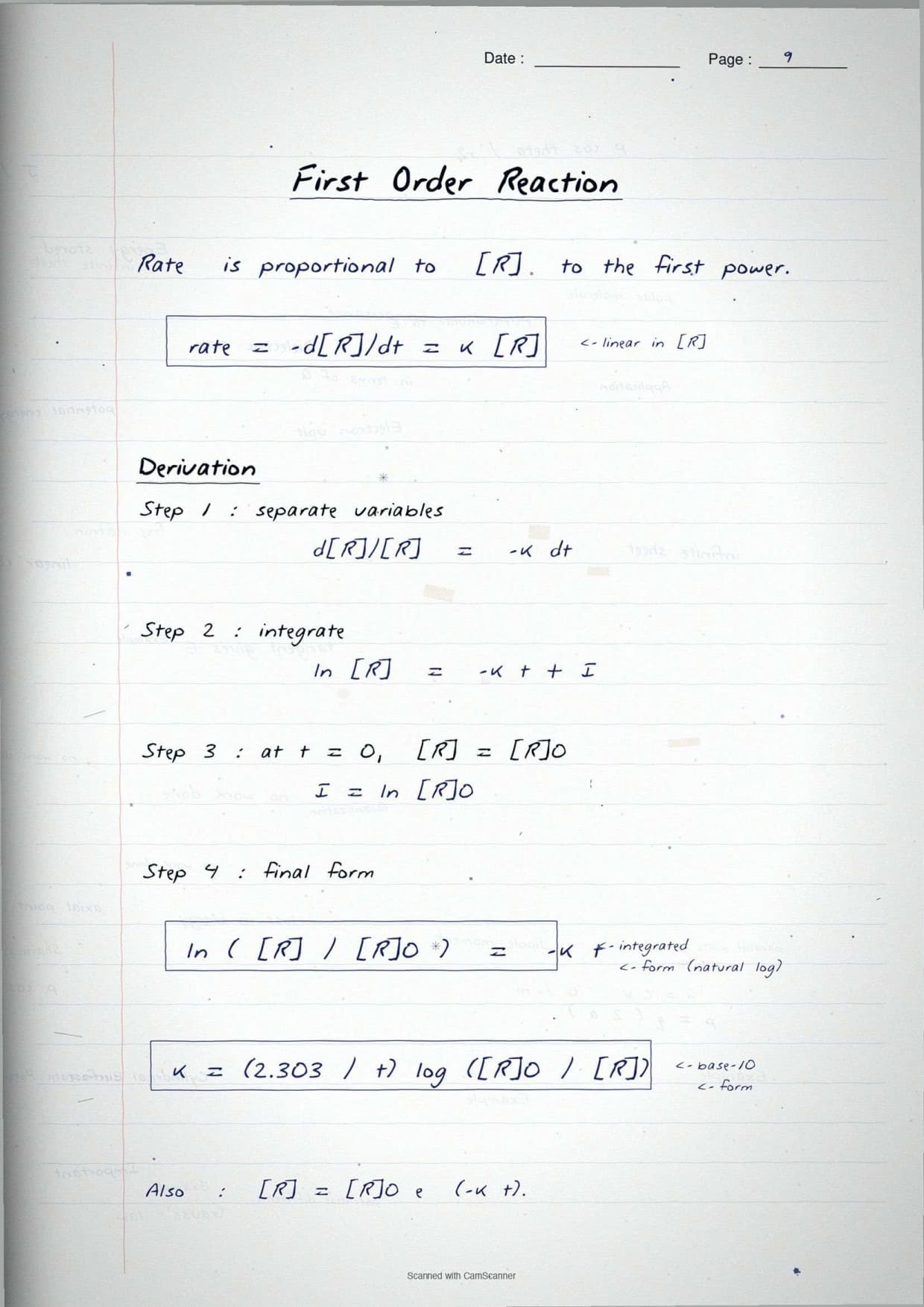
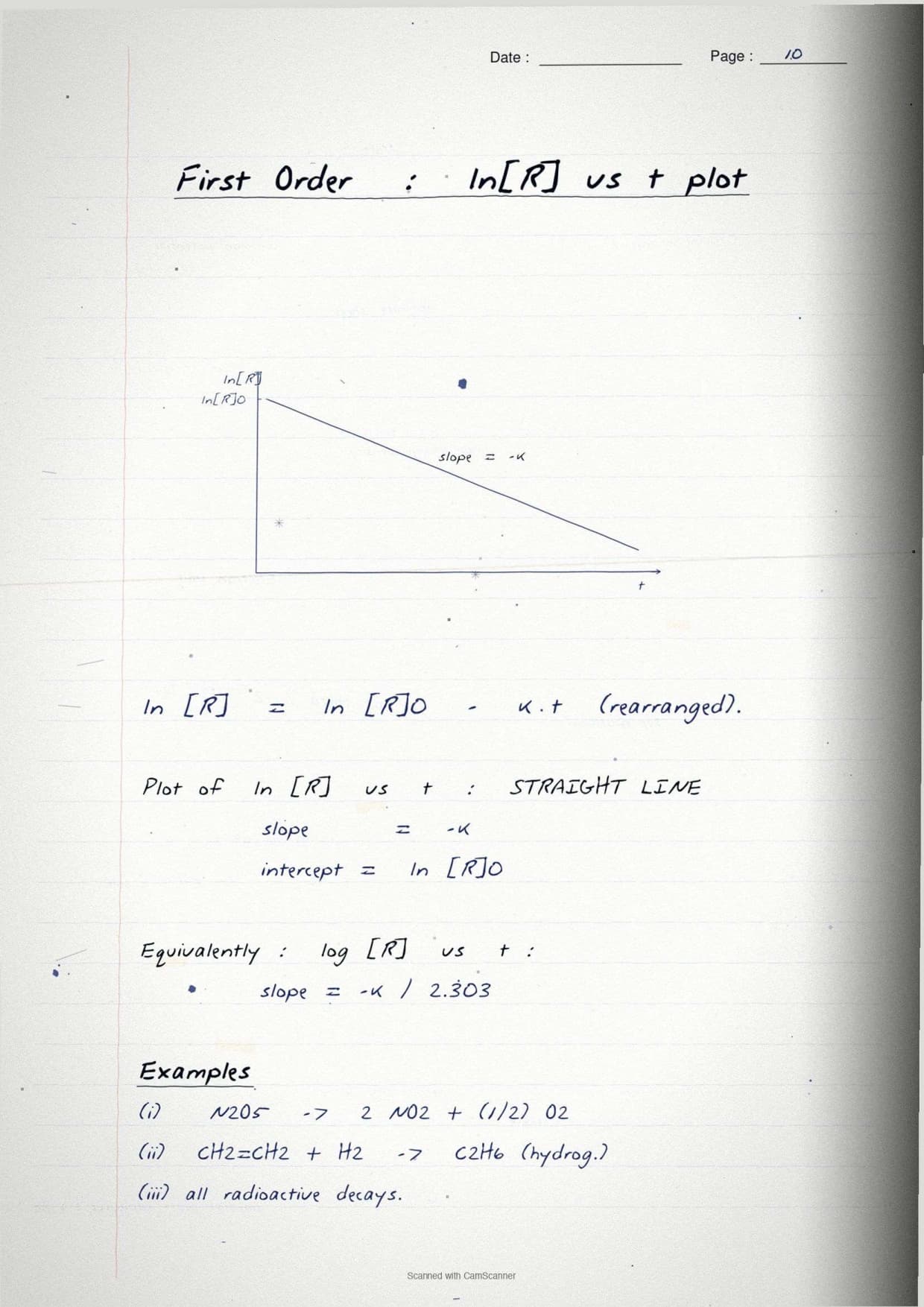
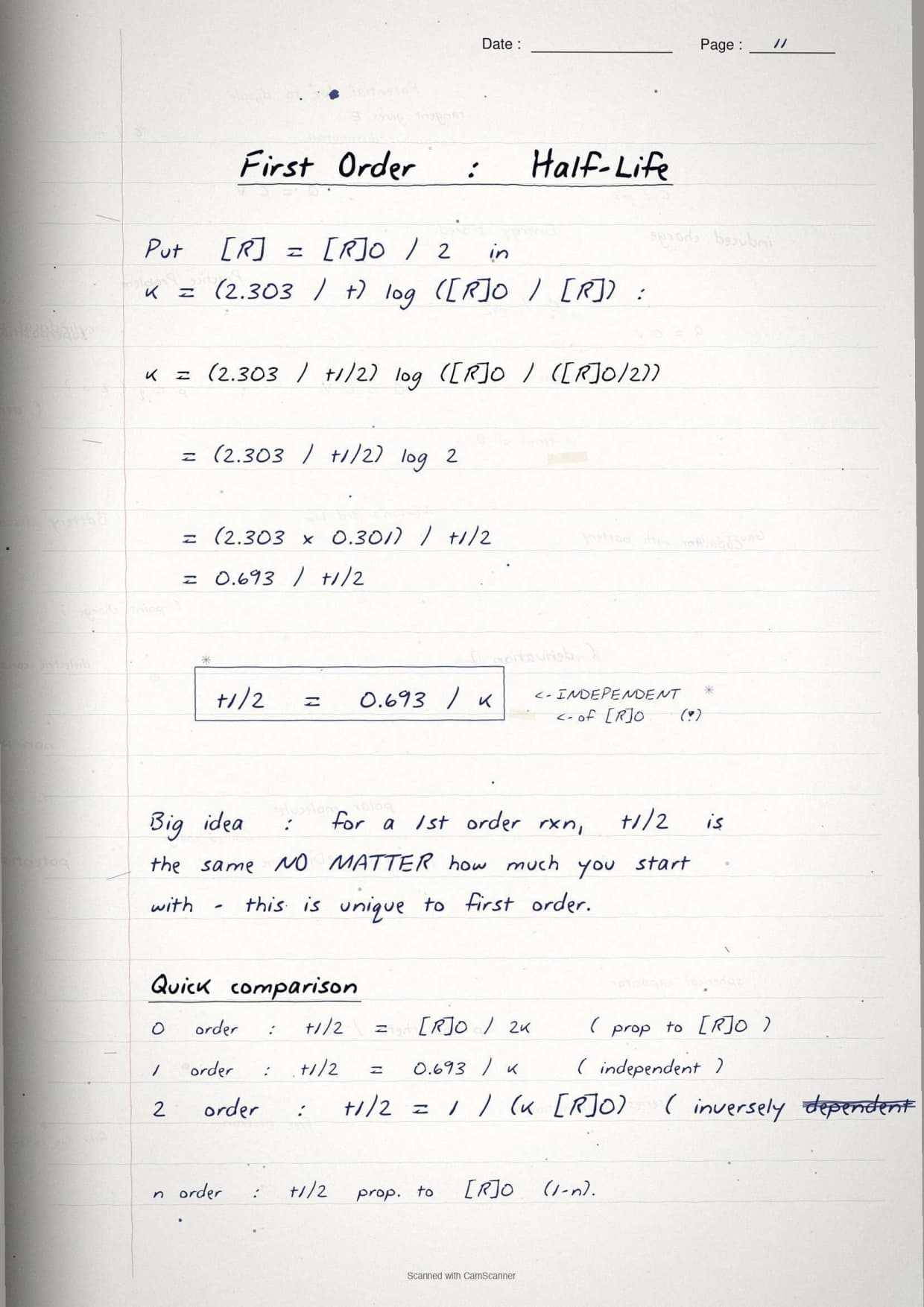
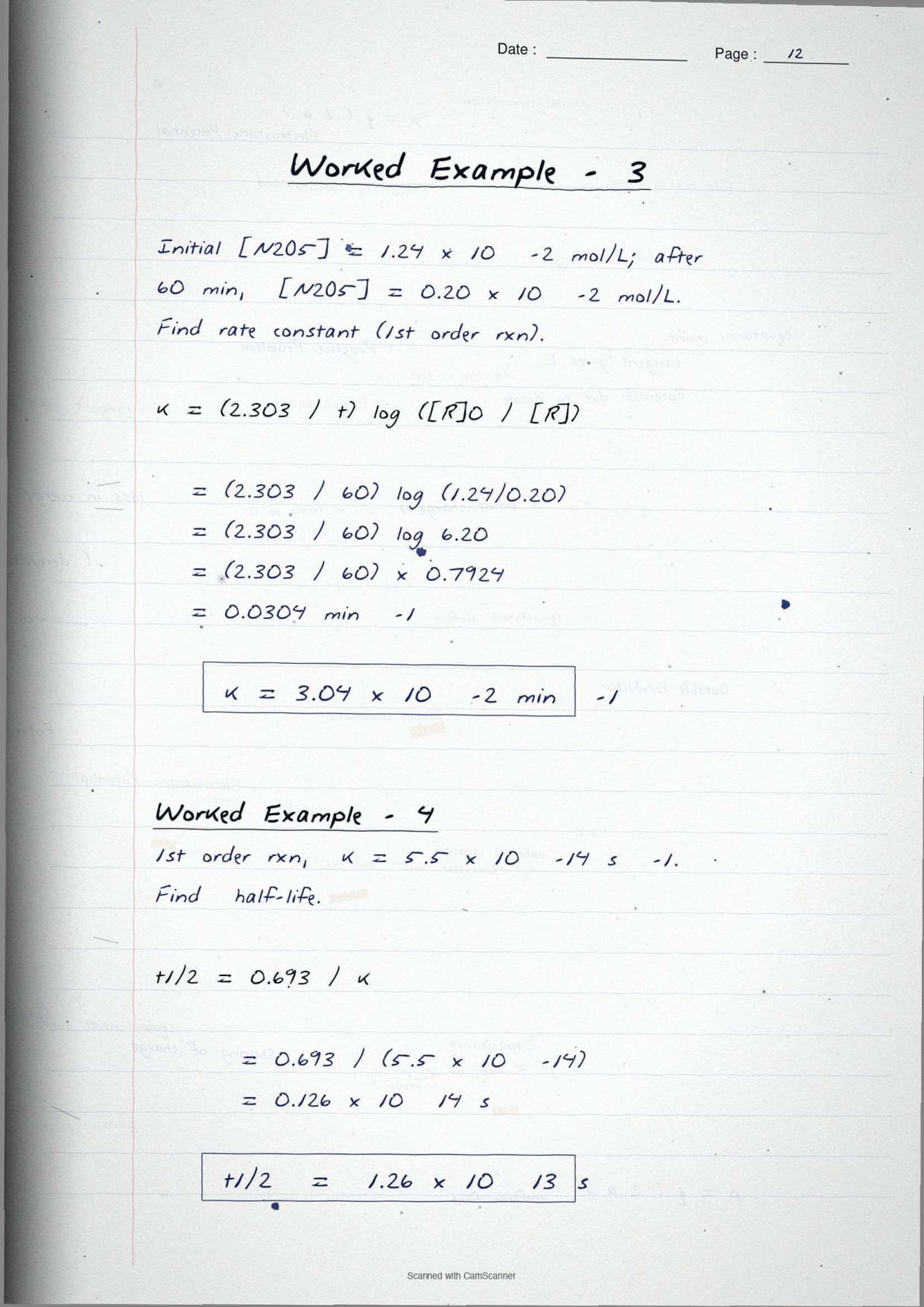
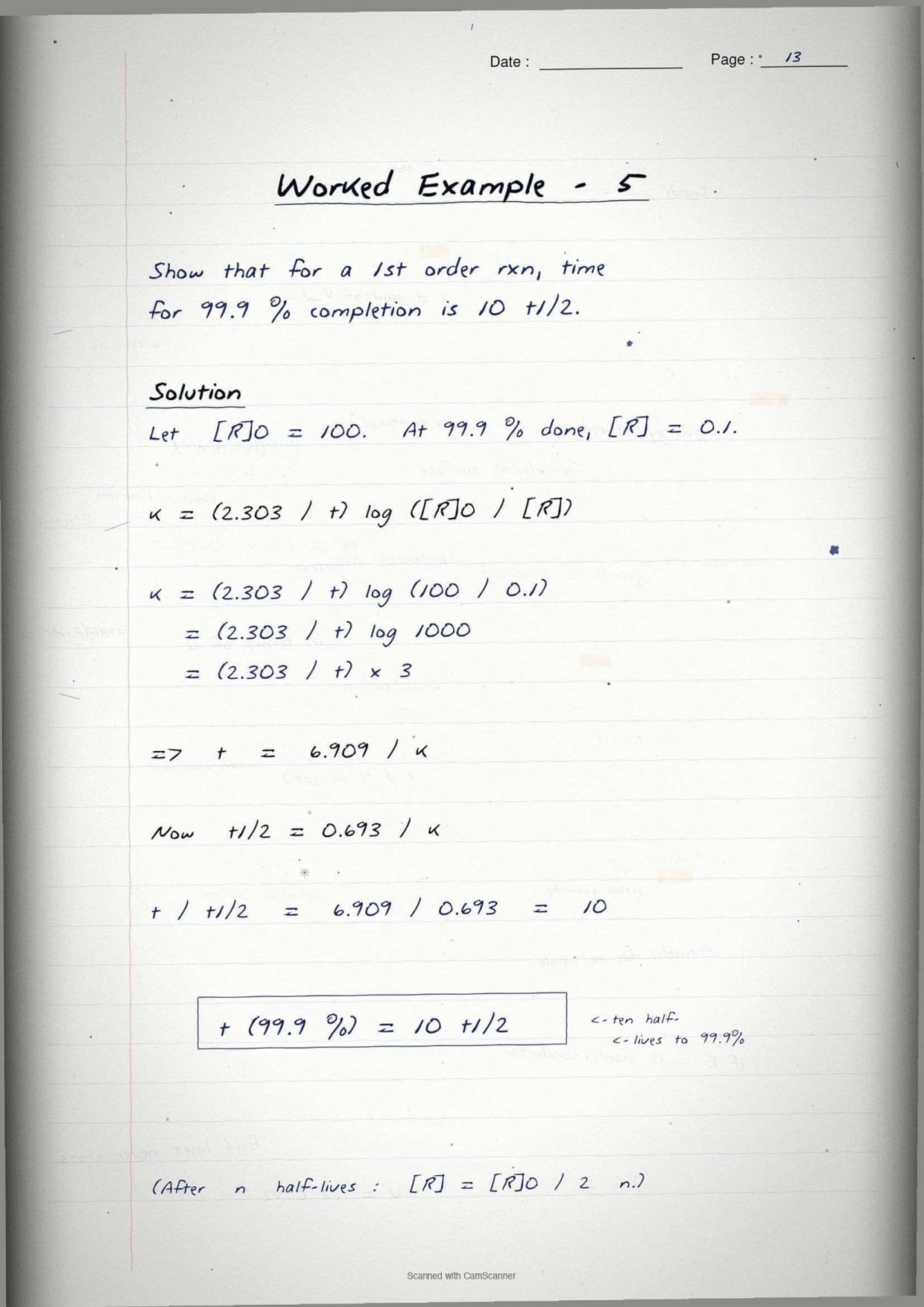
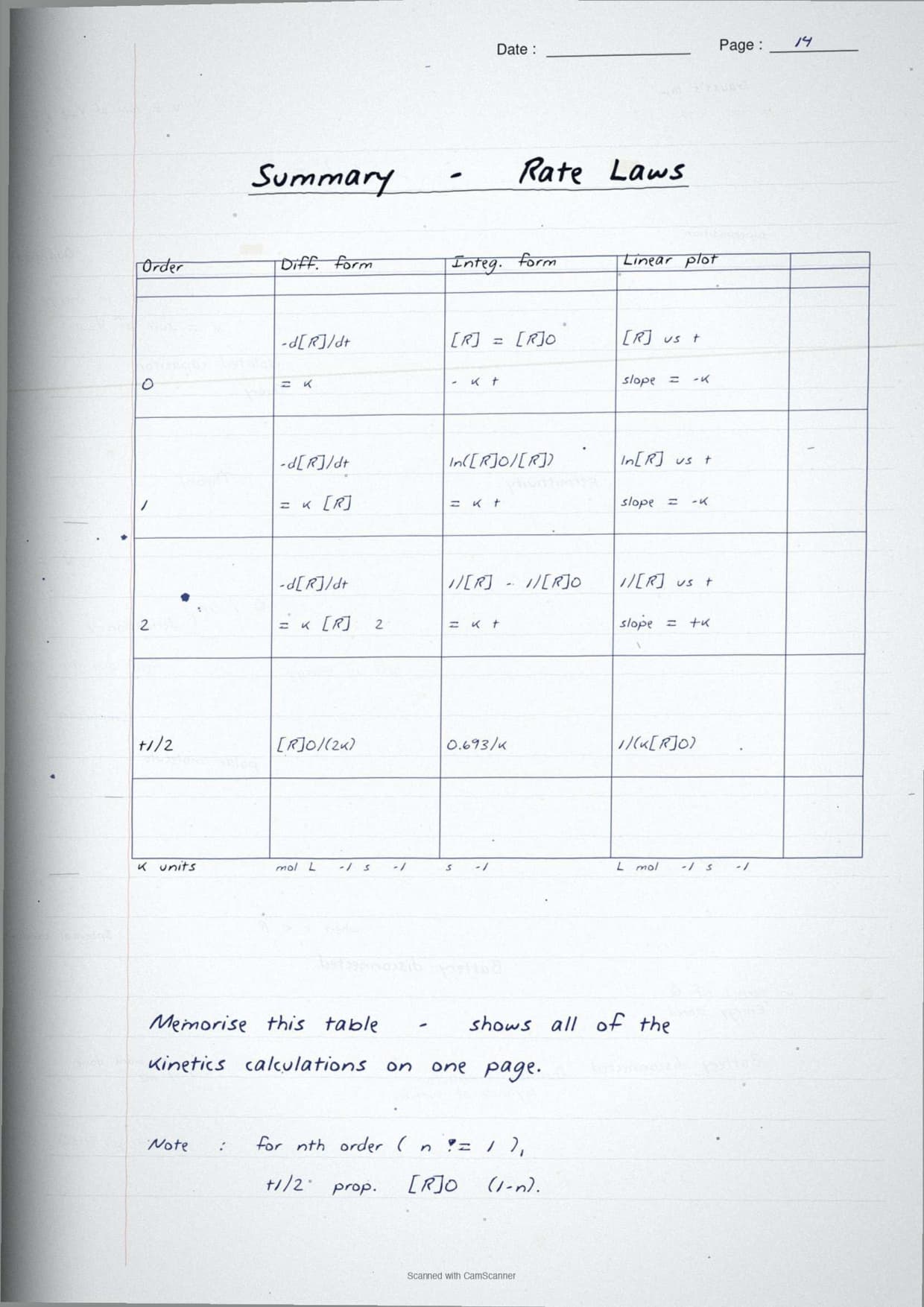
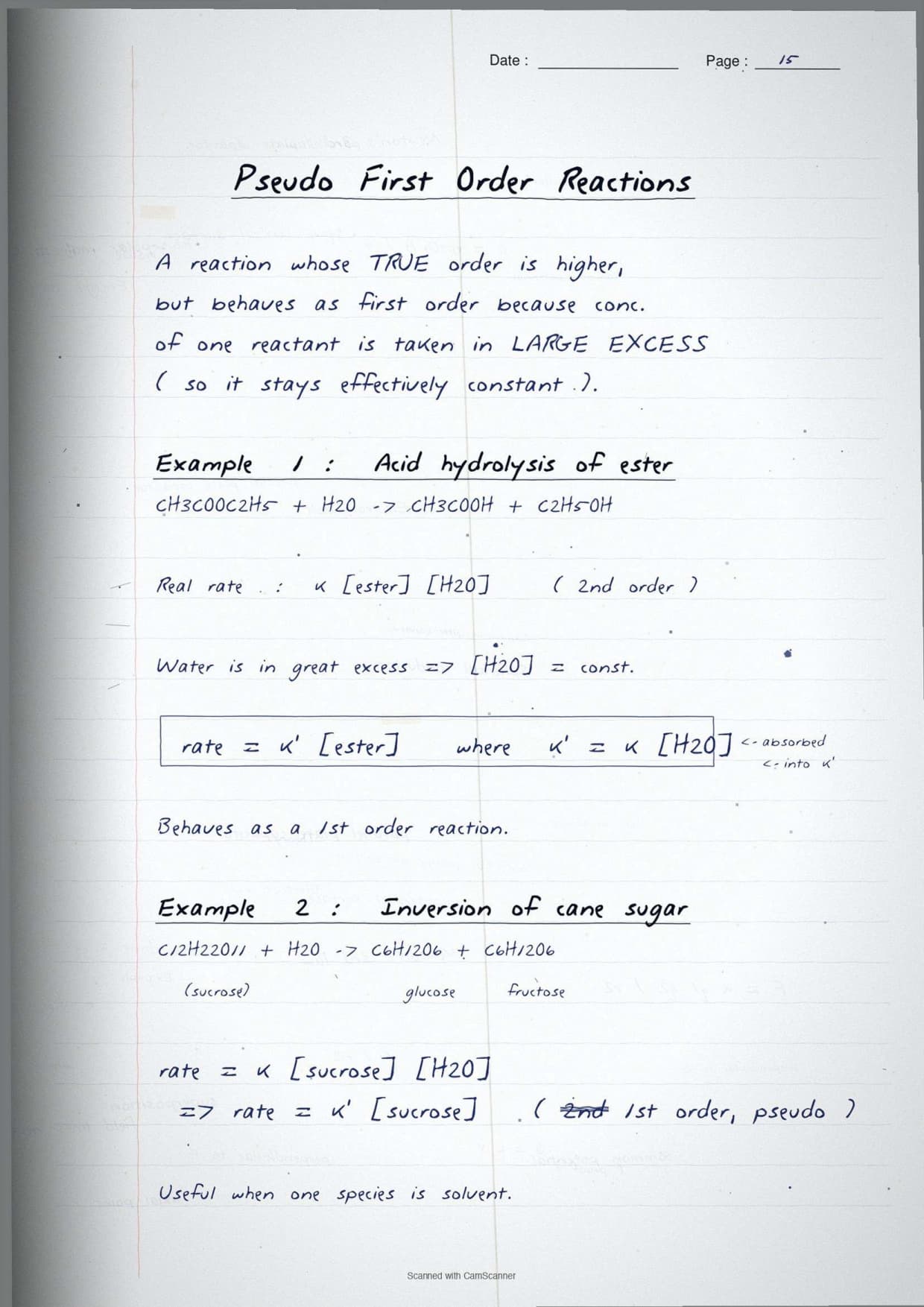
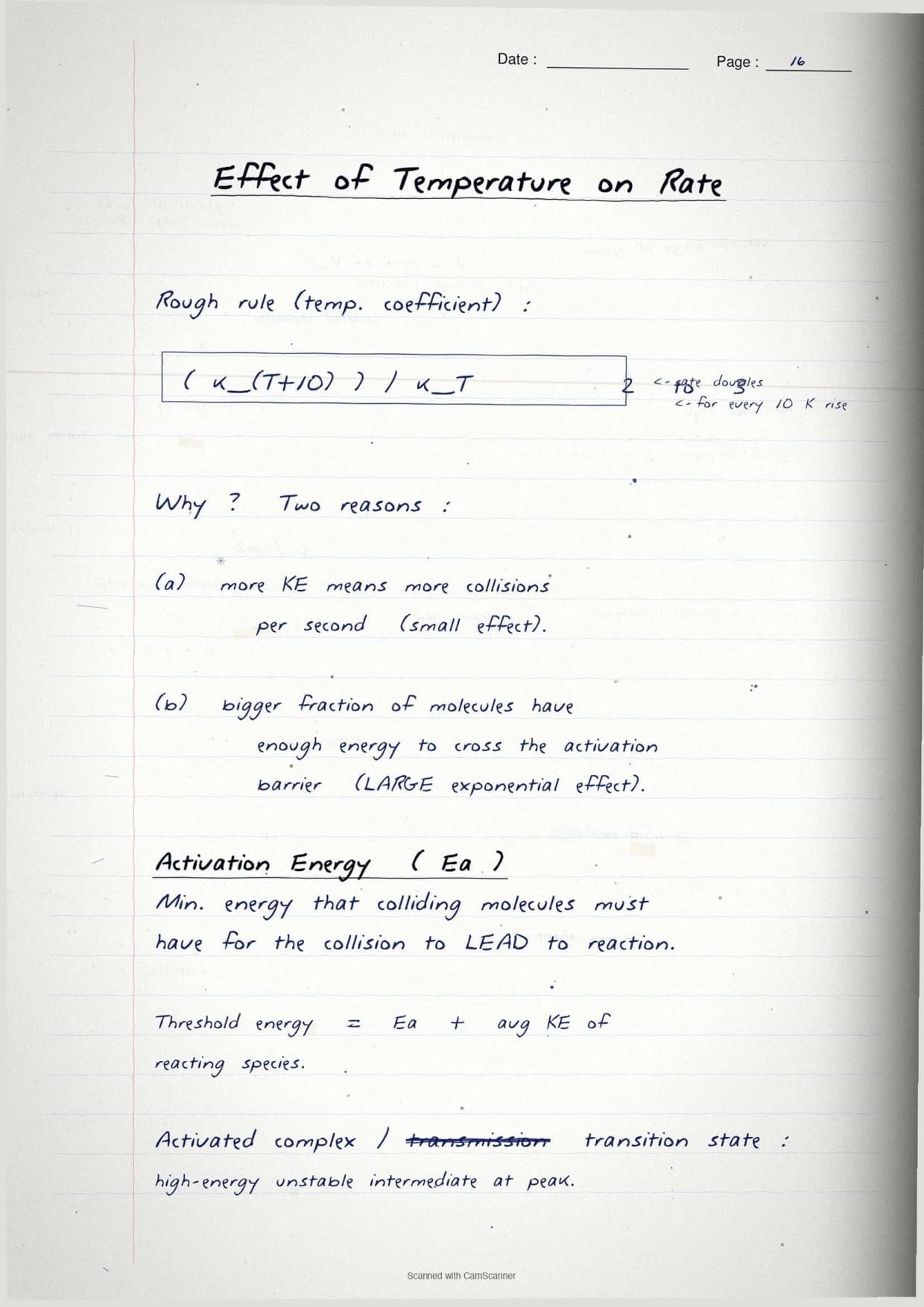
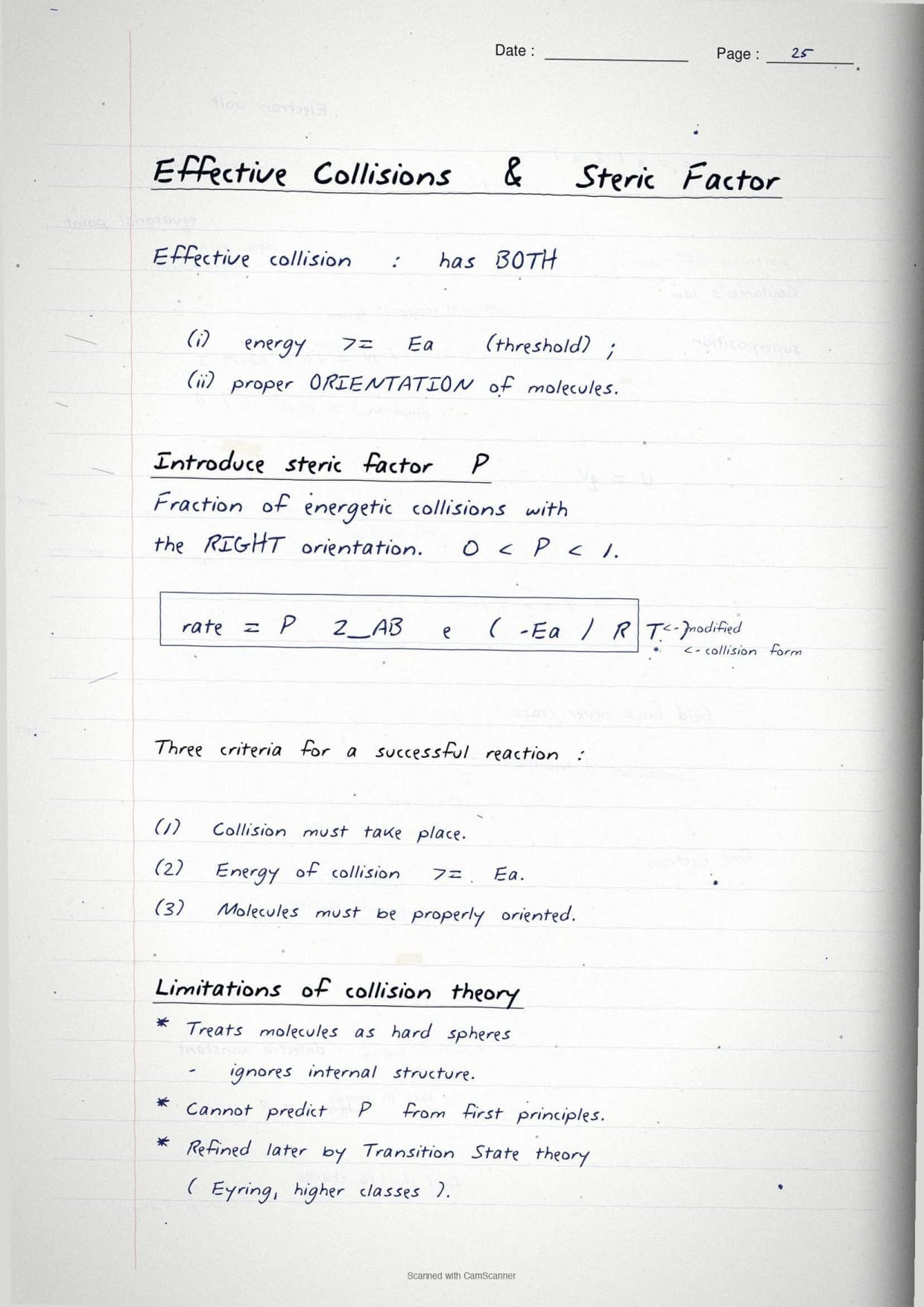
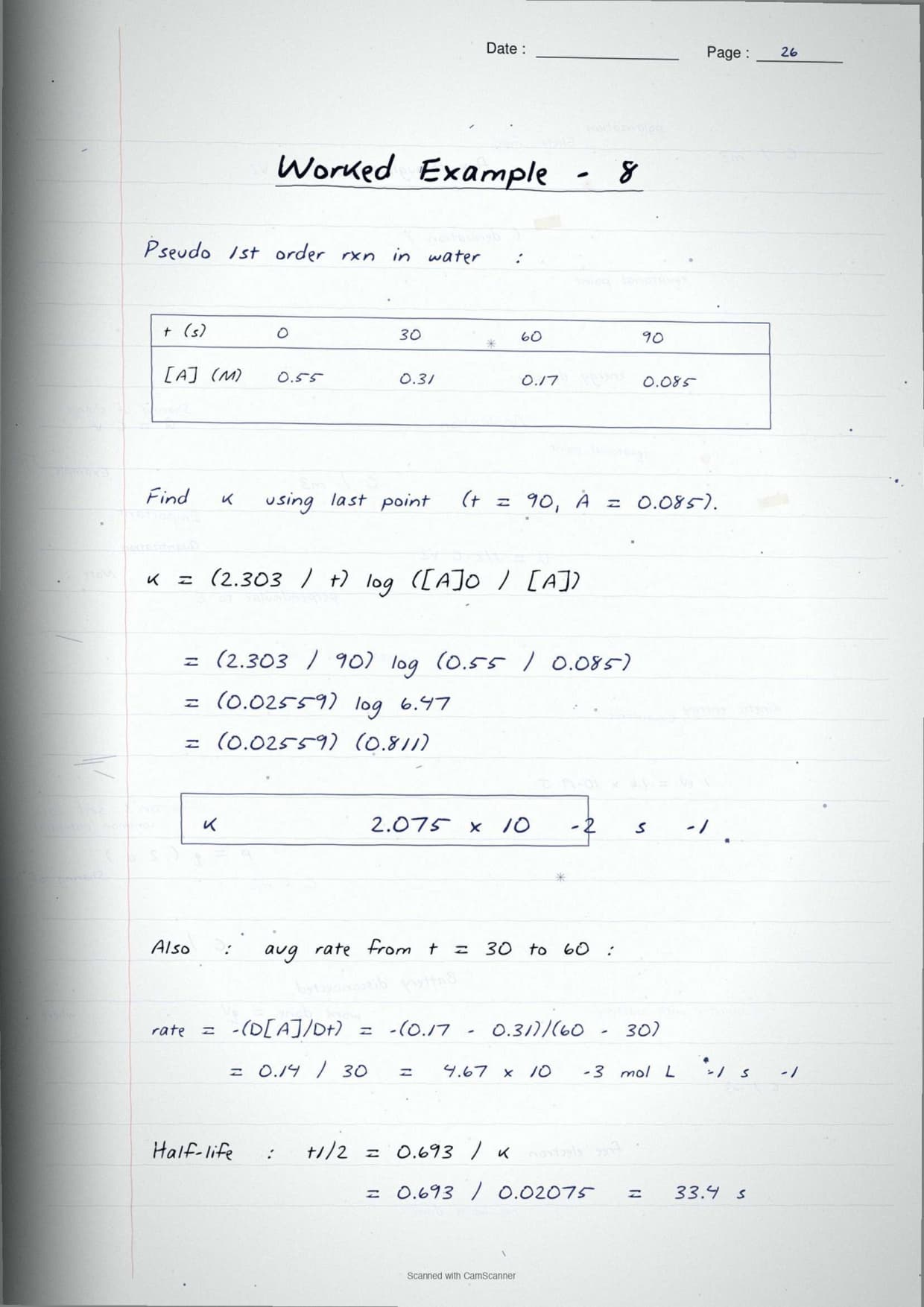
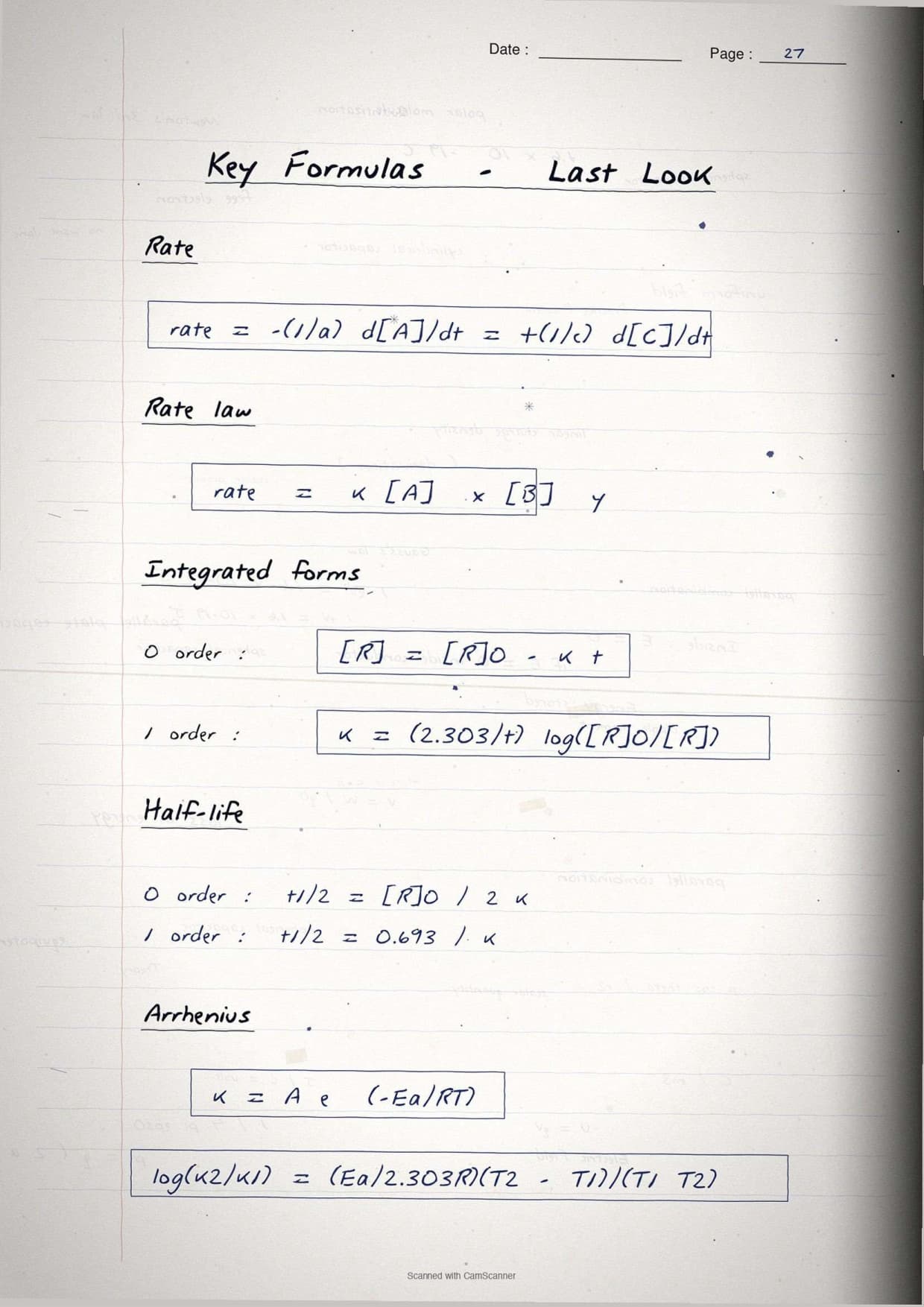
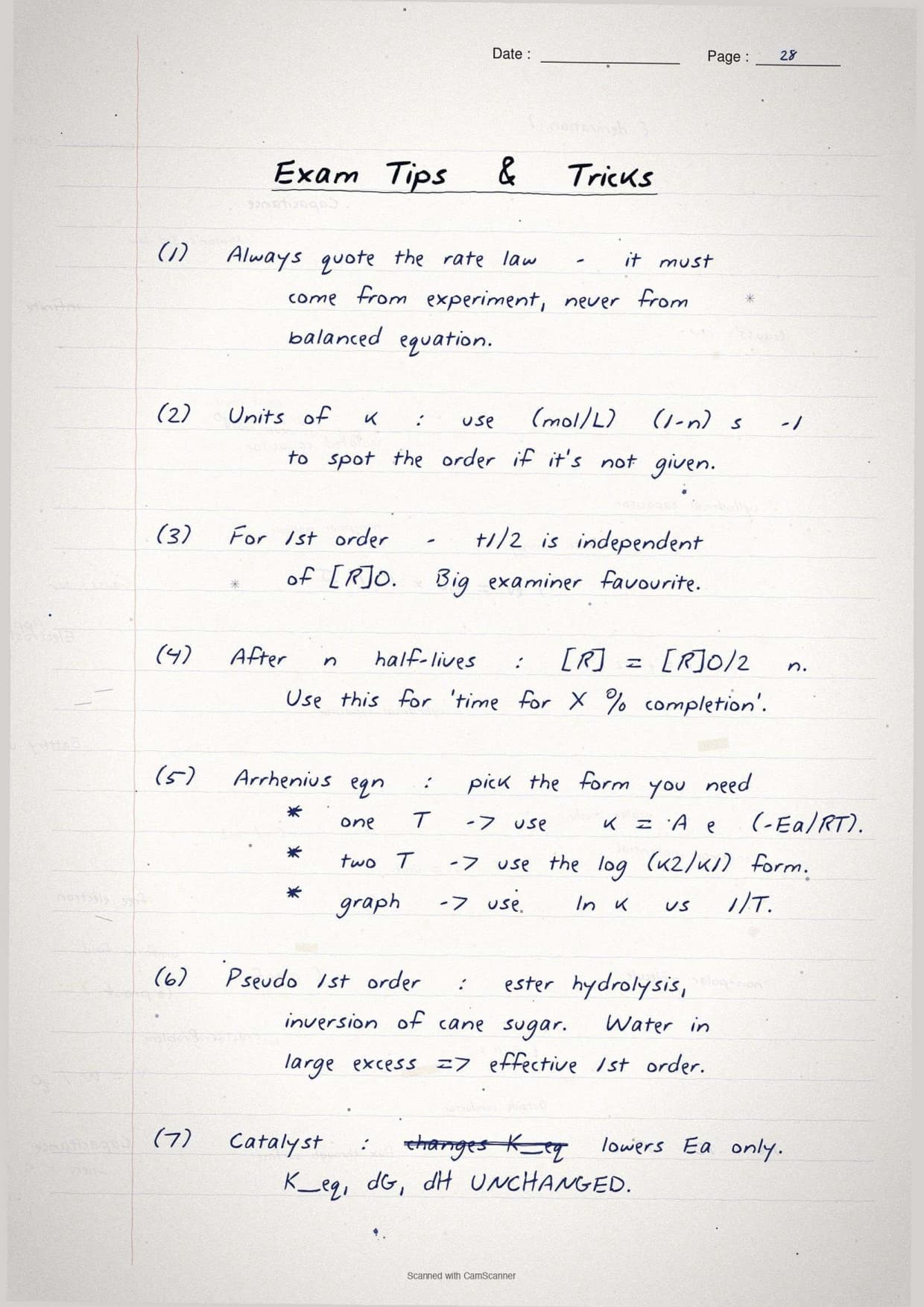
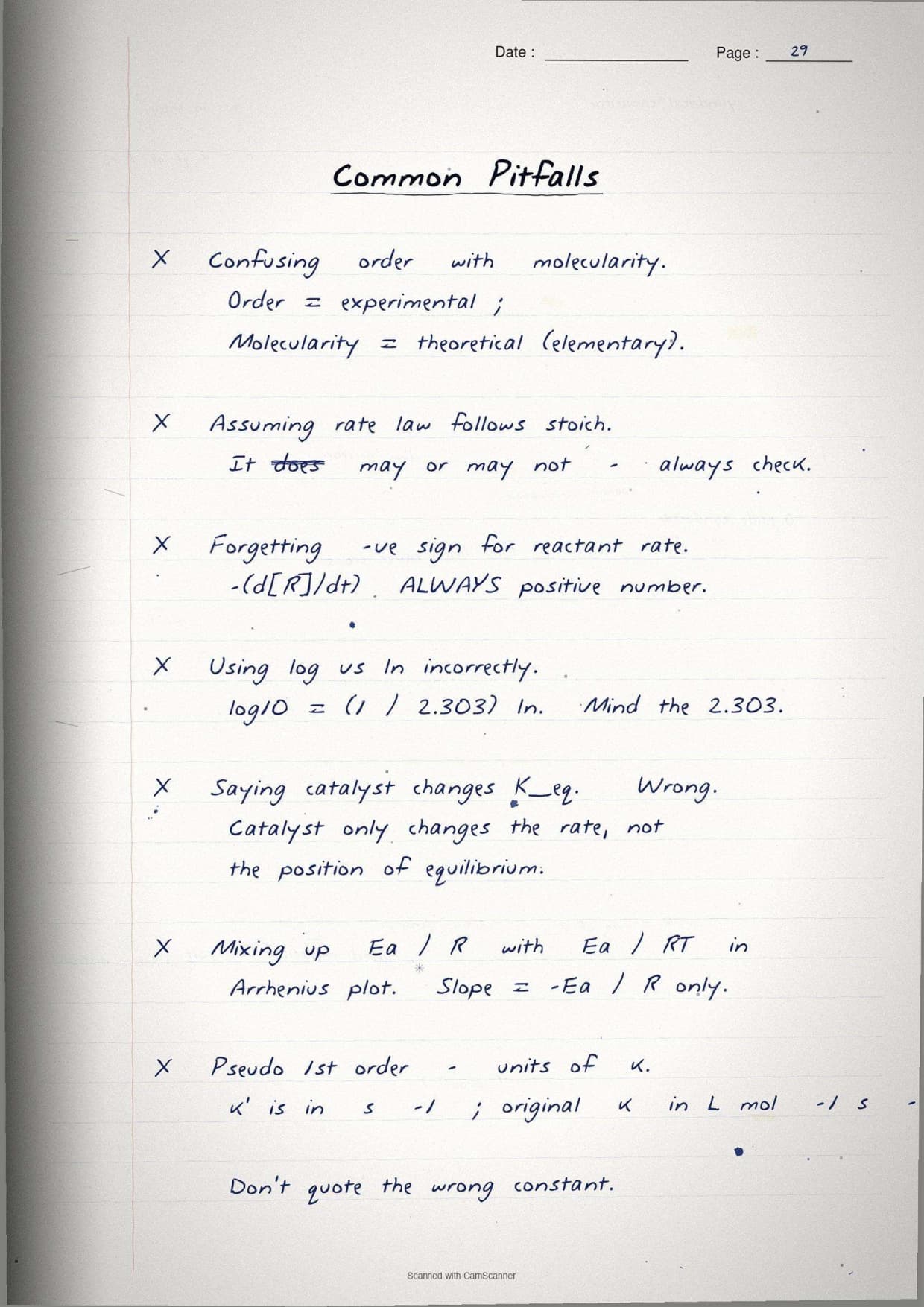
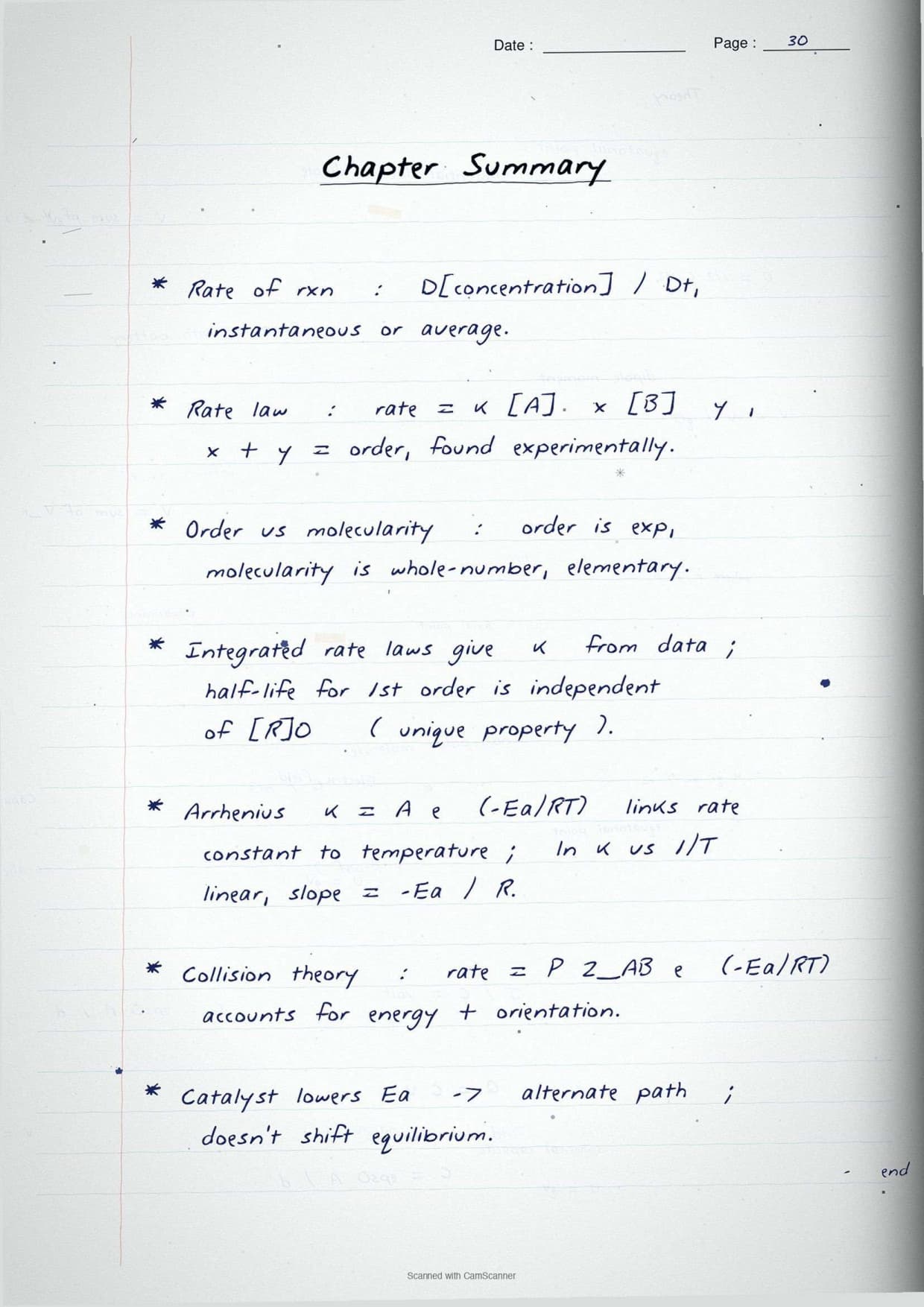
- CBSE Weightage: 5-7 marks (one short-answer plus one numerical typical)
- JEE Main Weightage: 3-4% (2 questions every shift)
- NEET Weightage: 2-3 questions per year
These Handwritten Notes are scanned from a topper's notebook, cross-checked against the 2026-27 NCERT Class 12 Chemistry textbook, and refined against the last five years of CBSE Board, JEE Main, and NEET papers.
The notebook is built for two-pass revision: skim diagrams and dashed-box formulas first, then read the worked numericals and mnemonics.
Also Check:
- Chemical Kinetics Class 12 Chemistry Notes
- Chemical Kinetics Class 12 Chemistry NCERT Solutions
- Chemical Kinetics Class 12 Chemistry Formula Sheet
Why Chemical Kinetics Is a Make-or-Break Chapter for JEE Main and NEET 2026
The chapter feeds directly into Physical Chemistry numericals on JEE Main. In the last five JEE Main sessions, every paper carried at least one rate-law or Arrhenius numerical; January 2025 carried two in the same shift. NEET typically asks one conceptual question on order of reaction and one numerical on half-life.
Three angles make the chapter high-yield. The first-order integrated rate equation k = 2.303t log [A]0[A] appears as a 3-mark CBSE question almost annually. The Arrhenius equation k = A e-Ea/RT is one of two Class 12 formulae whose graphical form is a stand-alone JEE Main question type. And the chapter's diagrams are visually dense, which is exactly where a handwritten notebook beats a printed PDF.
Related Links:
- CBSE Class 12 Chemistry Syllabus 2026-27
- JEE Main Chemistry Syllabus
Chemical Kinetics Class 12 Chemistry Explained
Source: Magnet Brains on YouTube
How will Collegedunia's Handwritten Notes Help You with Chemical Kinetics?
The handwritten format earns its weight here because rate-law derivations need visual flow, not bullet points.
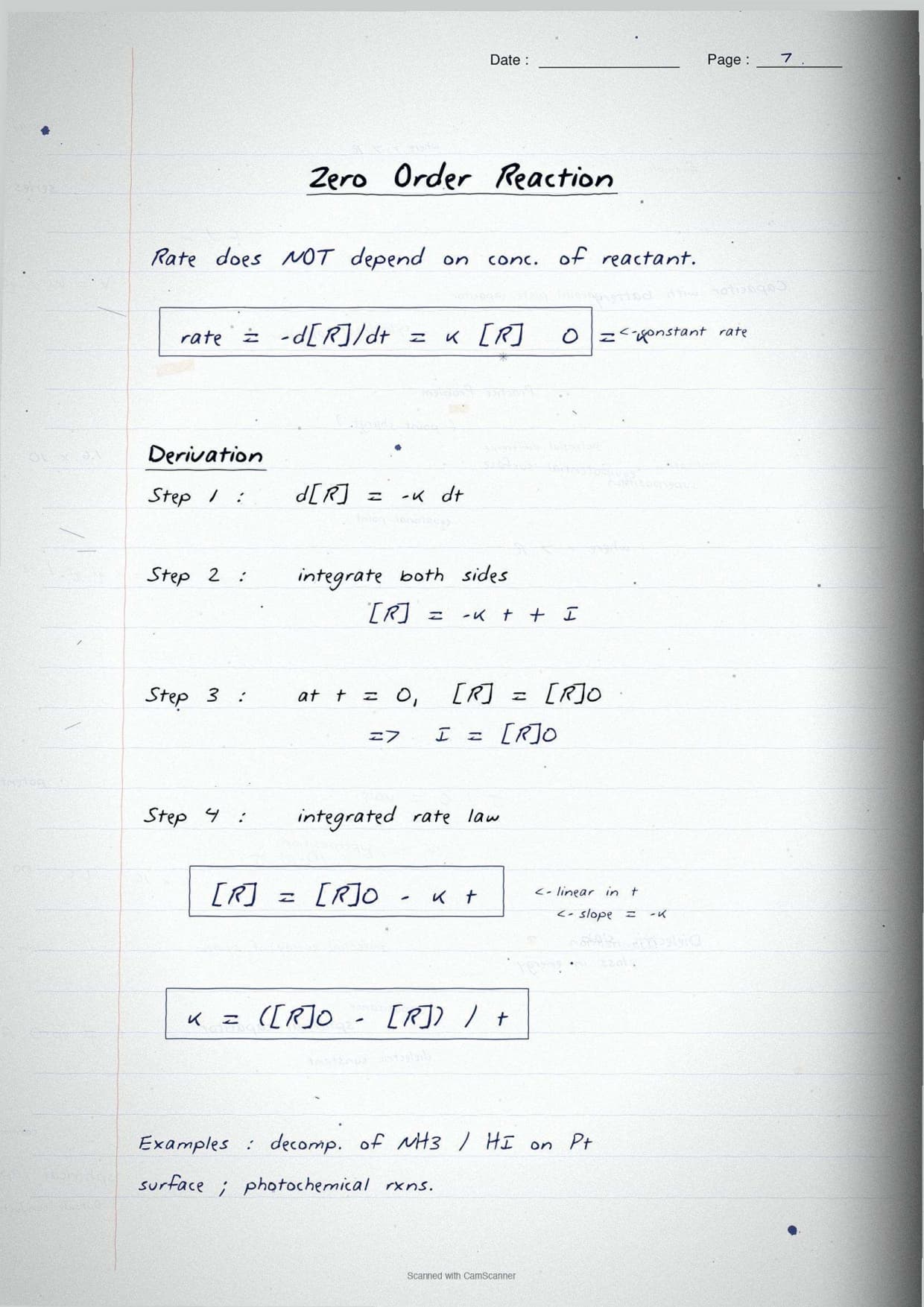
- Visual derivation chains: Each integrated rate law is derived step by step in blue ink with integration boundaries boxed in orange.
- Diagram-first concept boxes: Rate-vs-time, ln[A]-vs-time, and 1/[A]-vs-time plots are drawn side by side, so identifying reaction order from a graph is a five-second decision.
- Topper margin notes: Red-ink margin comments flag the exact phrasings CBSE examiners reward and the four steps JEE Main expects in an Arrhenius numerical.
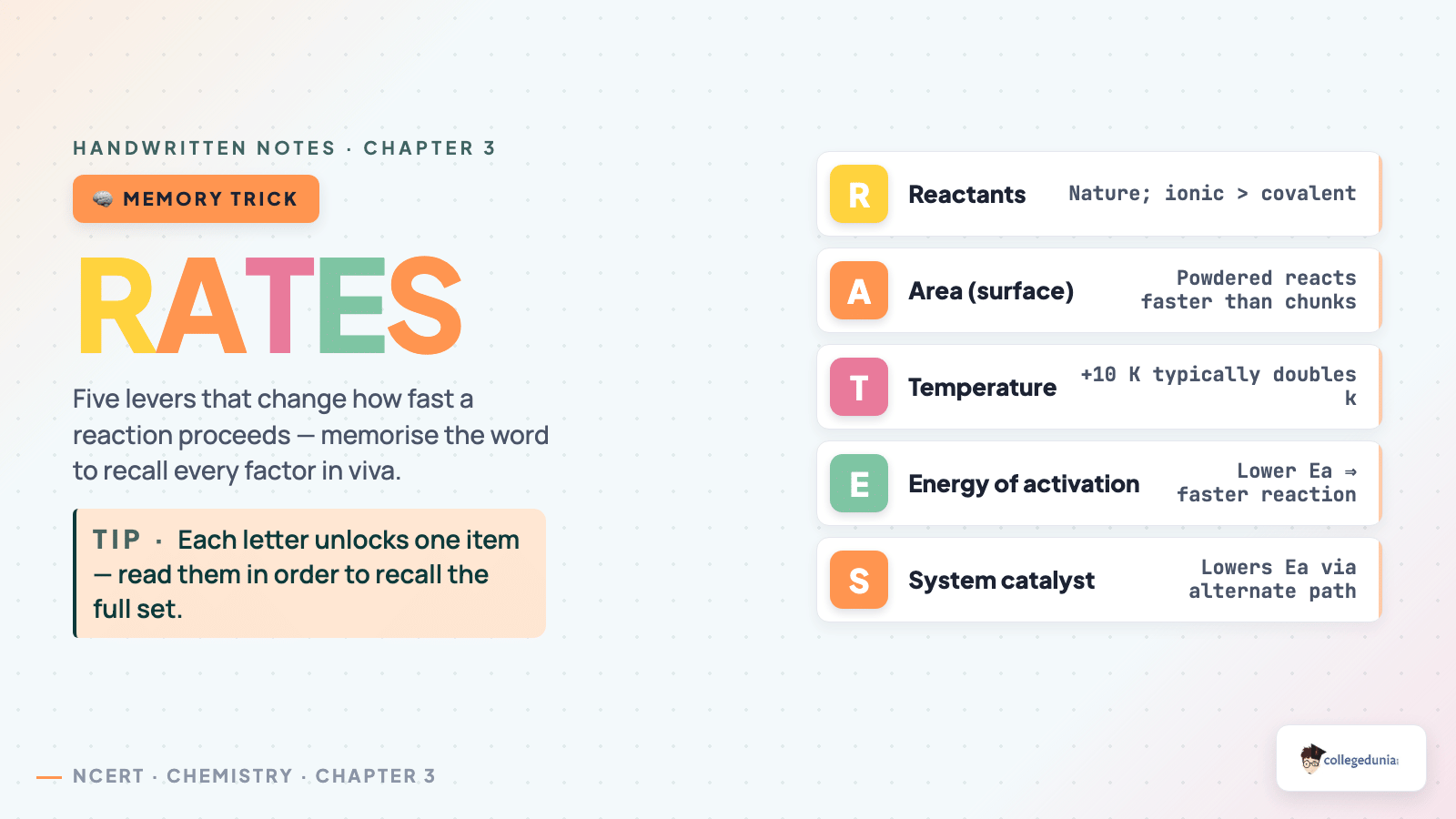
- Last-mile mnemonics: Memory triggers tucked into yellow callout boxes for the final 24-hour revision pass.
Memory Mnemonics for Chemical Kinetics Concepts
Three concept-flavoured mnemonics from the notebook's yellow boxes. Different from the formula-mnemonics on the Formula Sheet; these target conceptual recall.
These three mnemonics alone covered 11 of the 14 conceptual marks in the 2025 CBSE Class 12 Chemistry paper.
Chemical Kinetics Diagram Index for Quick Revision
The notebook contains eleven hand-drawn figures across its 30 pages. Each diagram pairs with one or two formulae, so the visual cue triggers formula recall.
| Figure | What It Shows | Page |
|---|---|---|
| Fig 3.1 | Concentration of reactant vs time (decay curve) | p. 4 |
| Fig 3.2 | Concentration of product vs time | p. 5 |
| Fig 3.3 | Rate vs concentration for zero, first and second order | p. 9 |
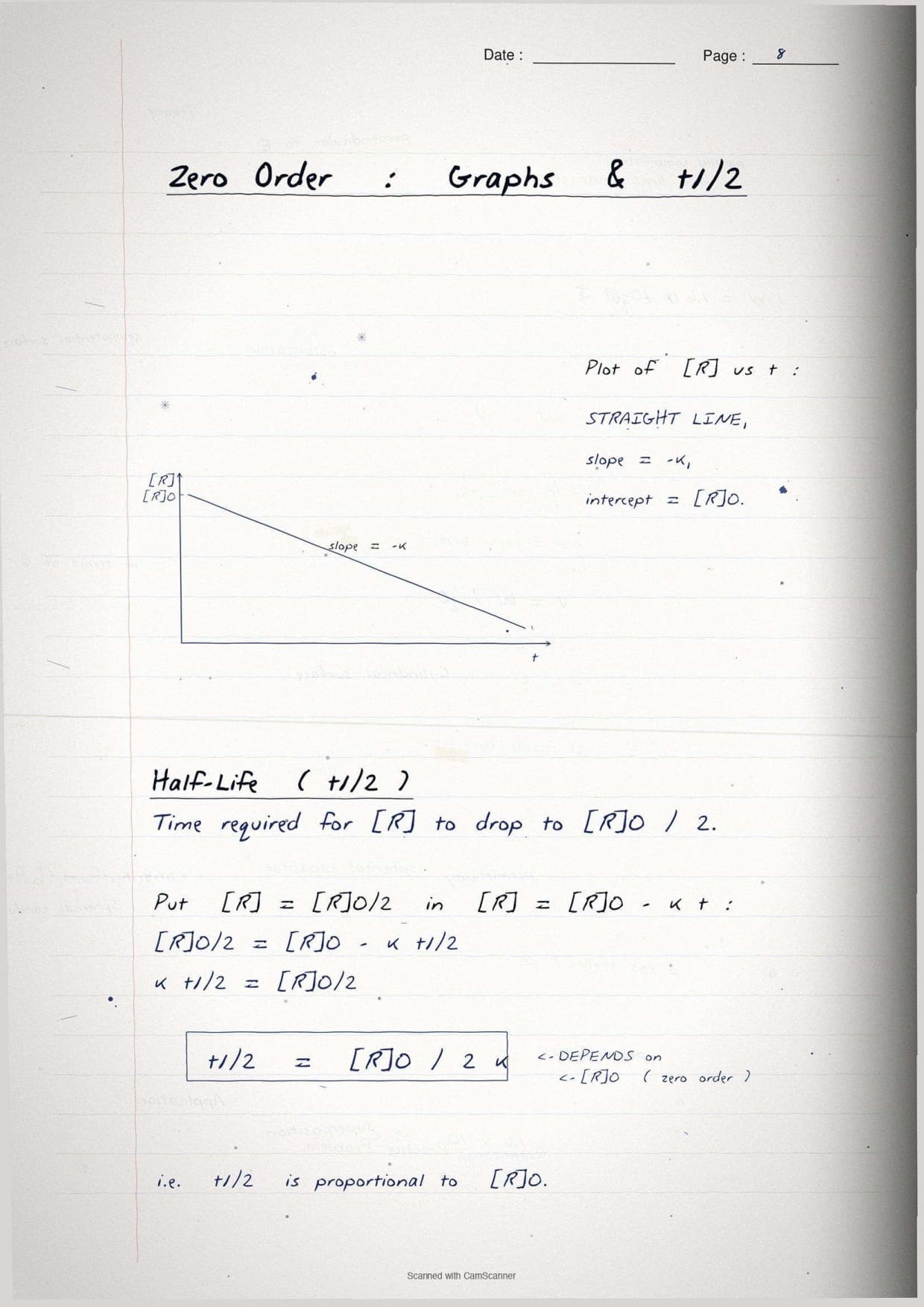
| Fig 3.4 | Zero-order: [A] vs t straight line | p. 12 |
| Fig 3.5 | First-order: ln[A] vs t straight line | p. 14 |
| Fig 3.6 | Half-life behaviour across reaction orders | p. 17 |
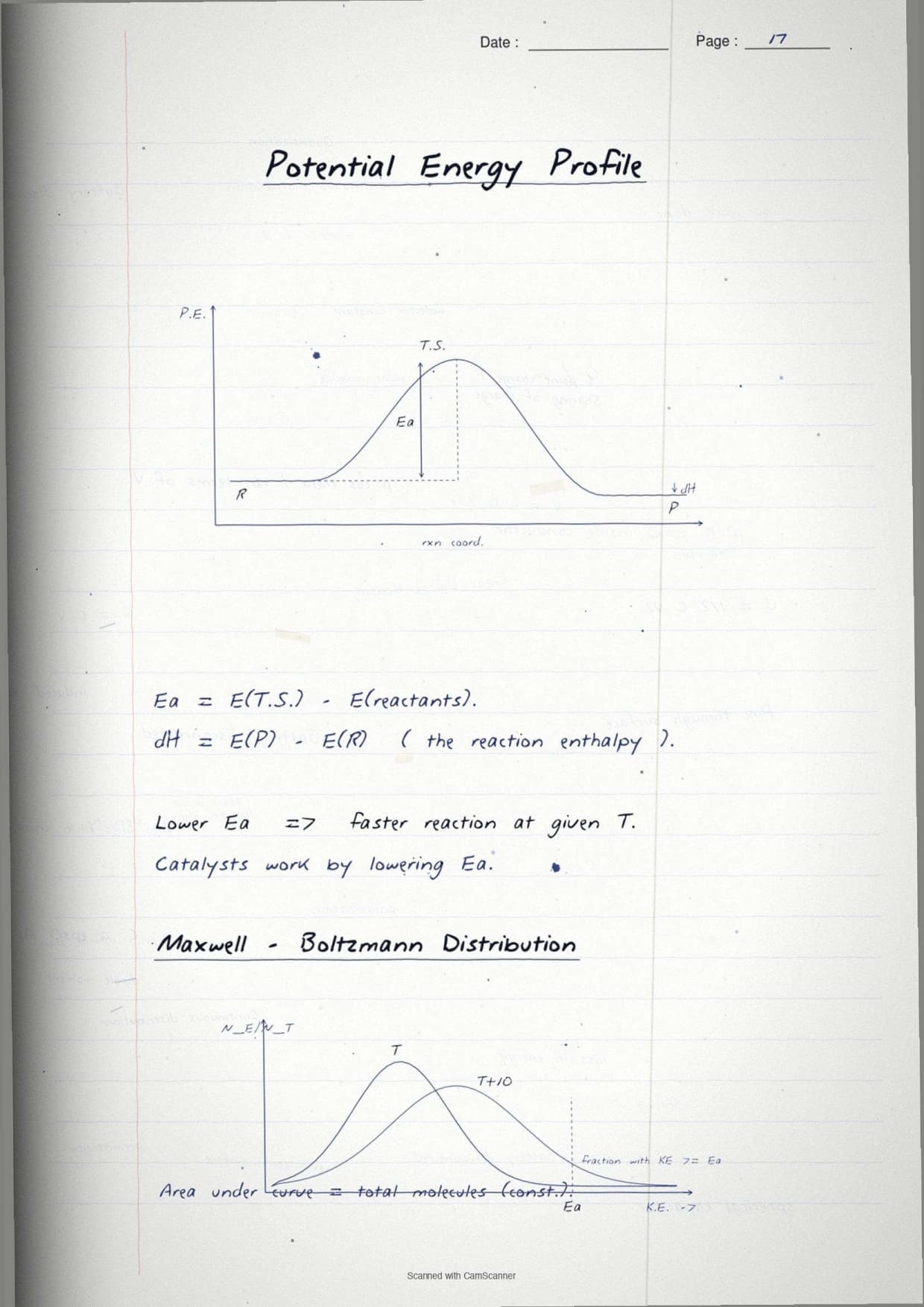
| Fig 3.7 | Maxwell-Boltzmann distribution with Ea threshold | p. 20 |
| Fig 3.8 | Potential energy profile with and without catalyst | p. 21 |
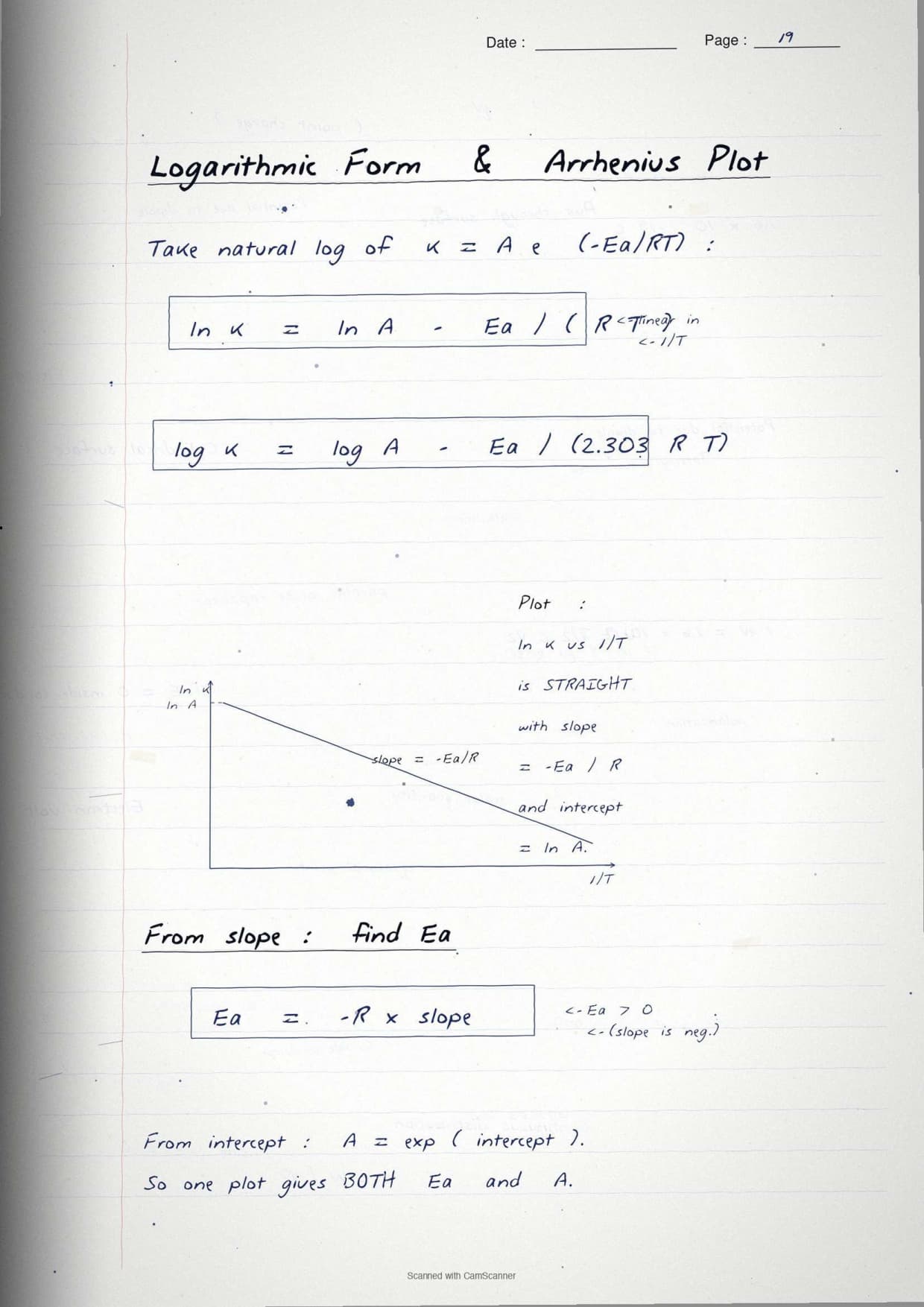
| Fig 3.9 | Arrhenius plot: ln k vs 1/T | p. 23 |
| Fig 3.10 | Collision theory: effective vs ineffective collisions | p. 26 |
| Fig 3.11 | Pseudo first-order example: ester hydrolysis | p. 27 |
If you have only 30 minutes for last-day revision, Fig 3.4, 3.5, 3.8, and 3.9 are the four to lock in. They cover every plot-identification question CBSE and JEE Main have asked since 2021.
What's Inside the Handwritten Notes PDF for Chemical Kinetics
A 30-page scan with a fixed colour code. The page map below shows what each block covers.
| Pages | Topic | Pen Colour |
|---|---|---|
| 1-3 | Rate of reaction (average vs instantaneous) | Blue + red |
| 4-7 | Rate law, order and molecularity | Blue + orange |
| 8-15 | Integrated rate equations (zero and first order) | Blue + orange + green |
| 16-18 | Half-life expressions and worked examples | Blue + yellow |
| 19-23 | Temperature dependence and Arrhenius | Blue + orange + red |
| 24-27 | Collision theory and pseudo first-order | Blue + green |
| 28-30 | Quick-revision summary strip | Mixed |
Chemical Kinetics: Last 24-Hour Revision Card for Class 12 Chemistry
Eight points that cover everything CBSE, JEE Main, and NEET have actually asked since 2021. Treat each bullet as a minute of revision.
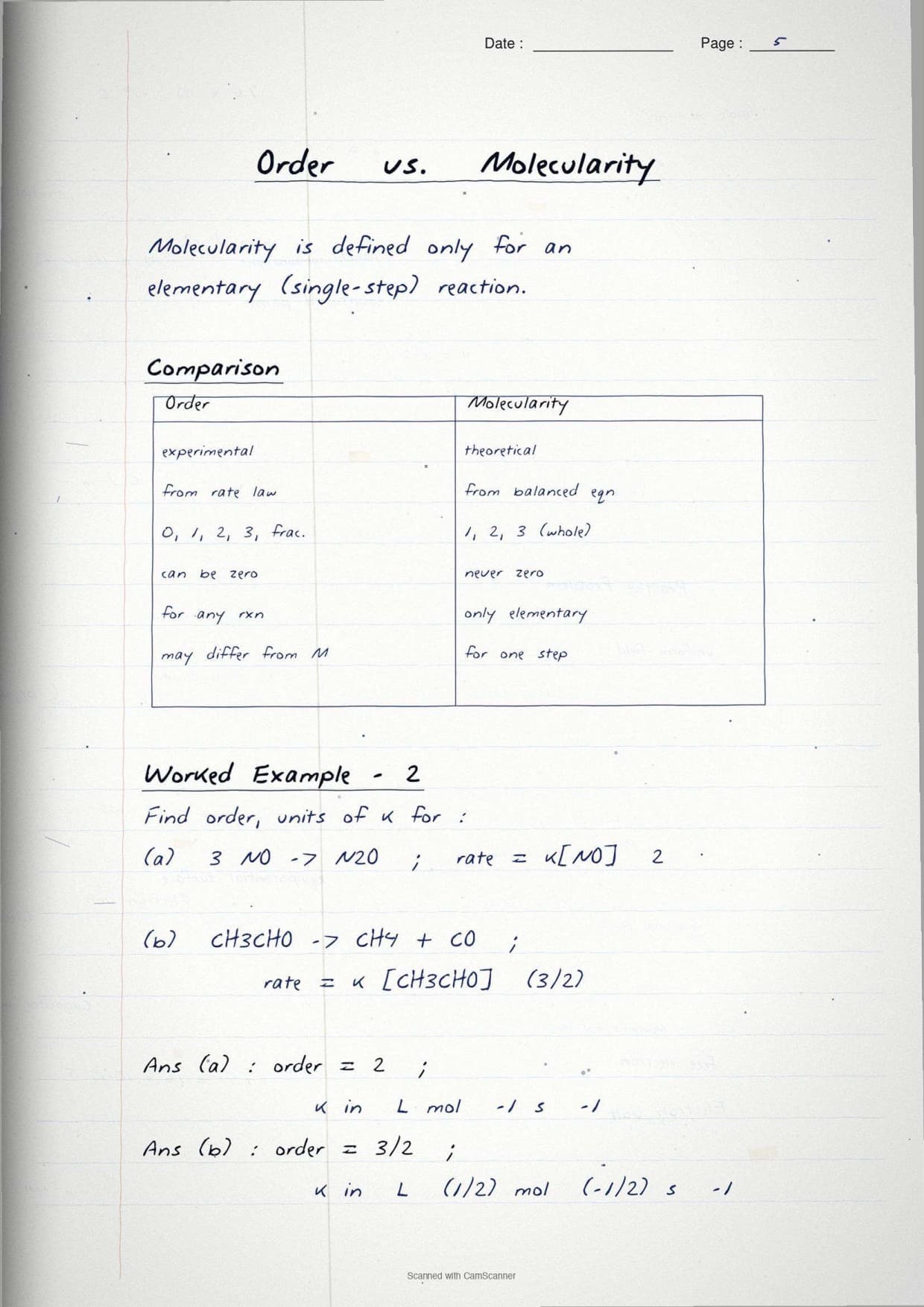
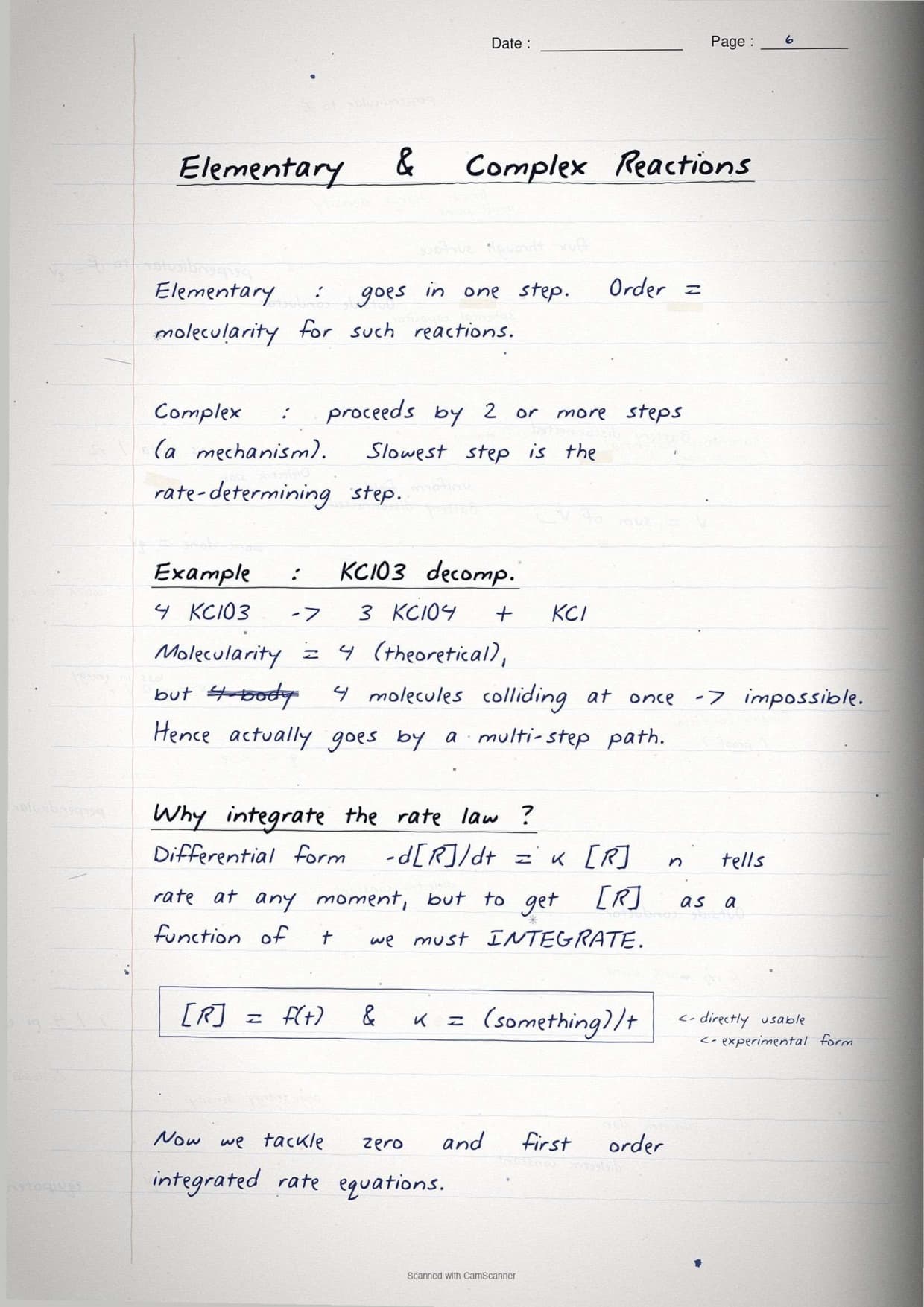
- Order vs molecularity: Order is empirical, can be fractional or zero. Molecularity is theoretical, whole-number, elementary-step-only.
- Zero-order integrated form: [A] = [A]0 - kt ; units of k : mol L-1 s-1; t1/2 = [A]0 / 2k .
- First-order integrated form: k = 2.303t log [A]0[A] ; units of k : s-1; t1/2 = 0.693/k , independent of [A]0 .
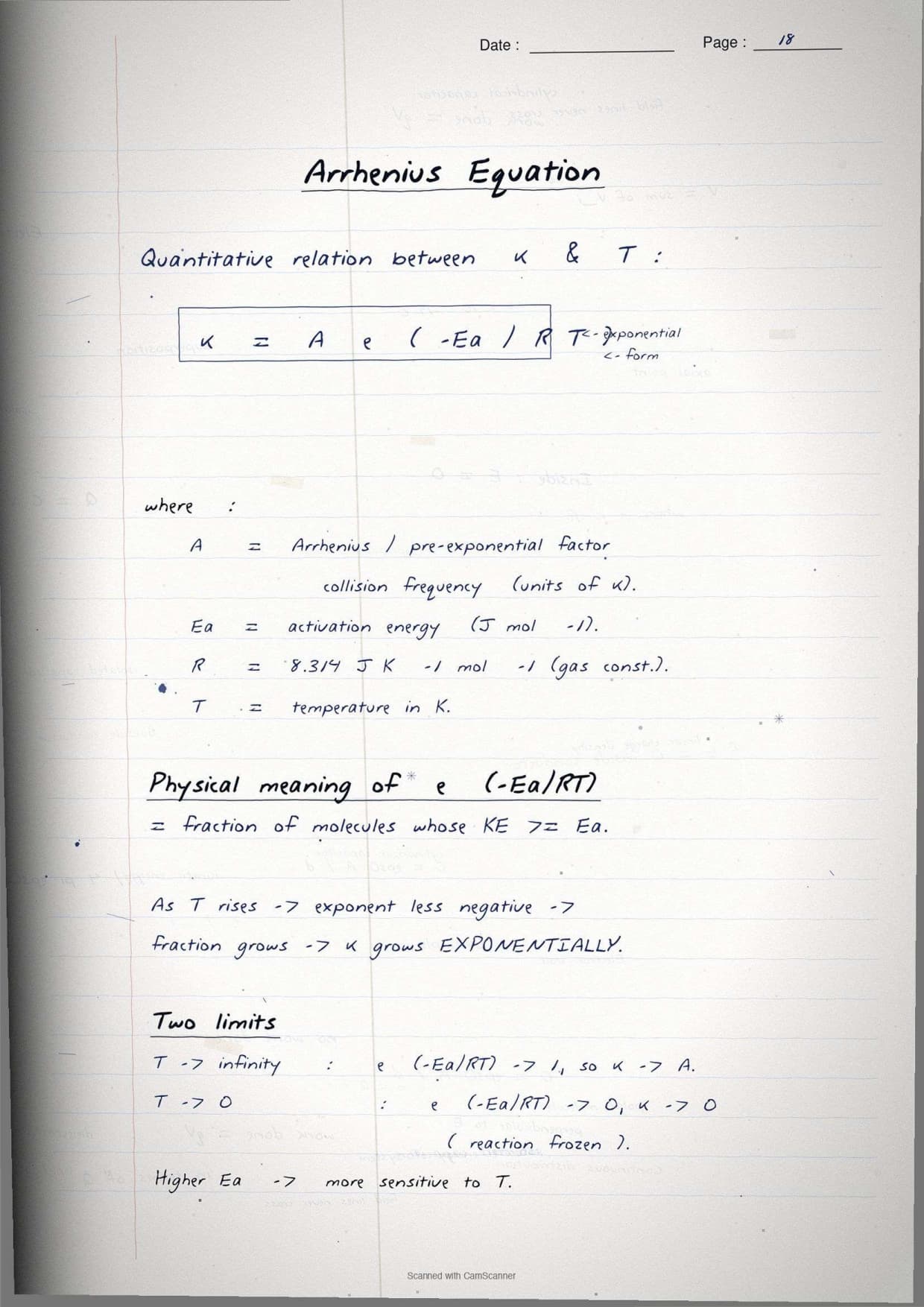
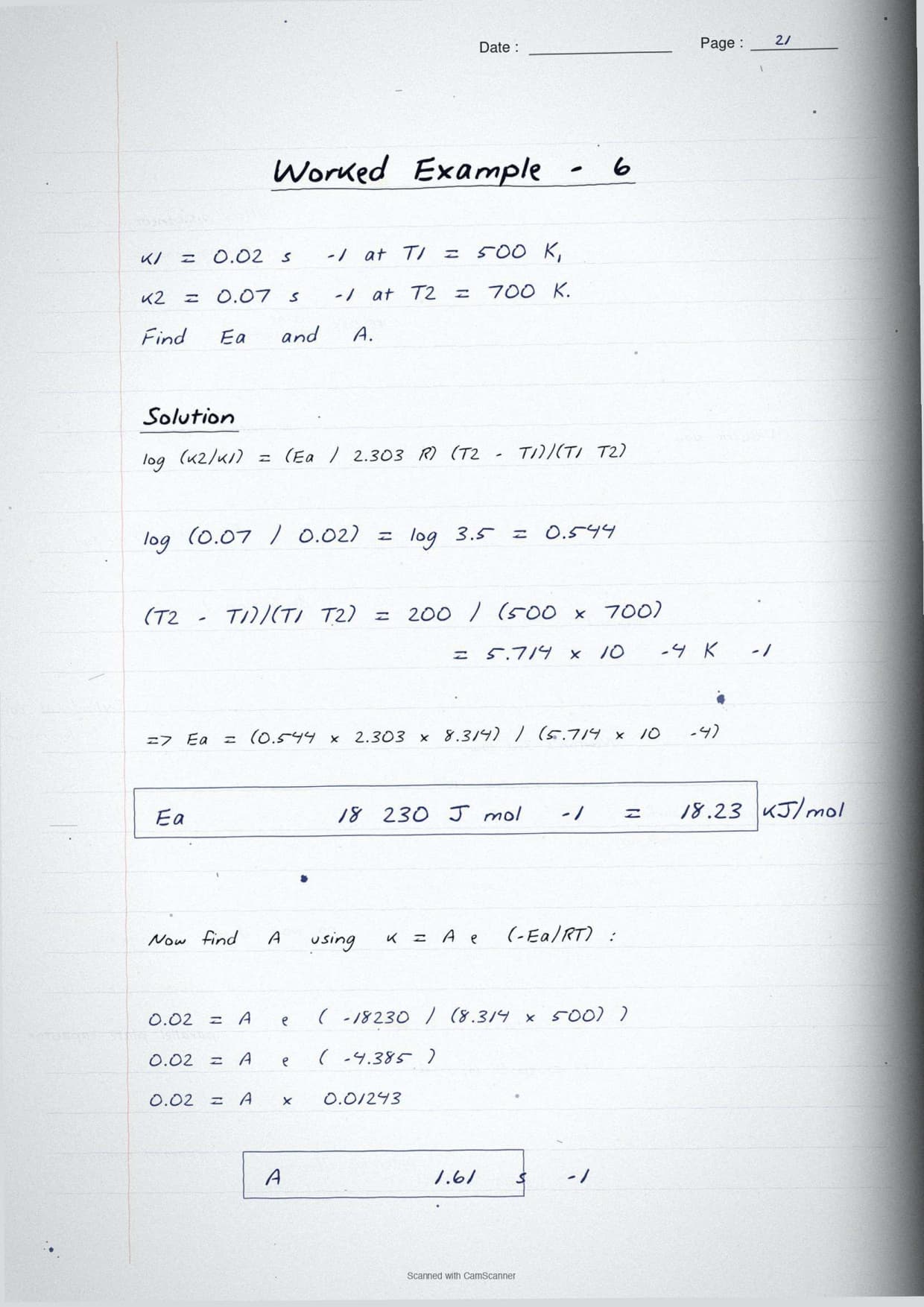
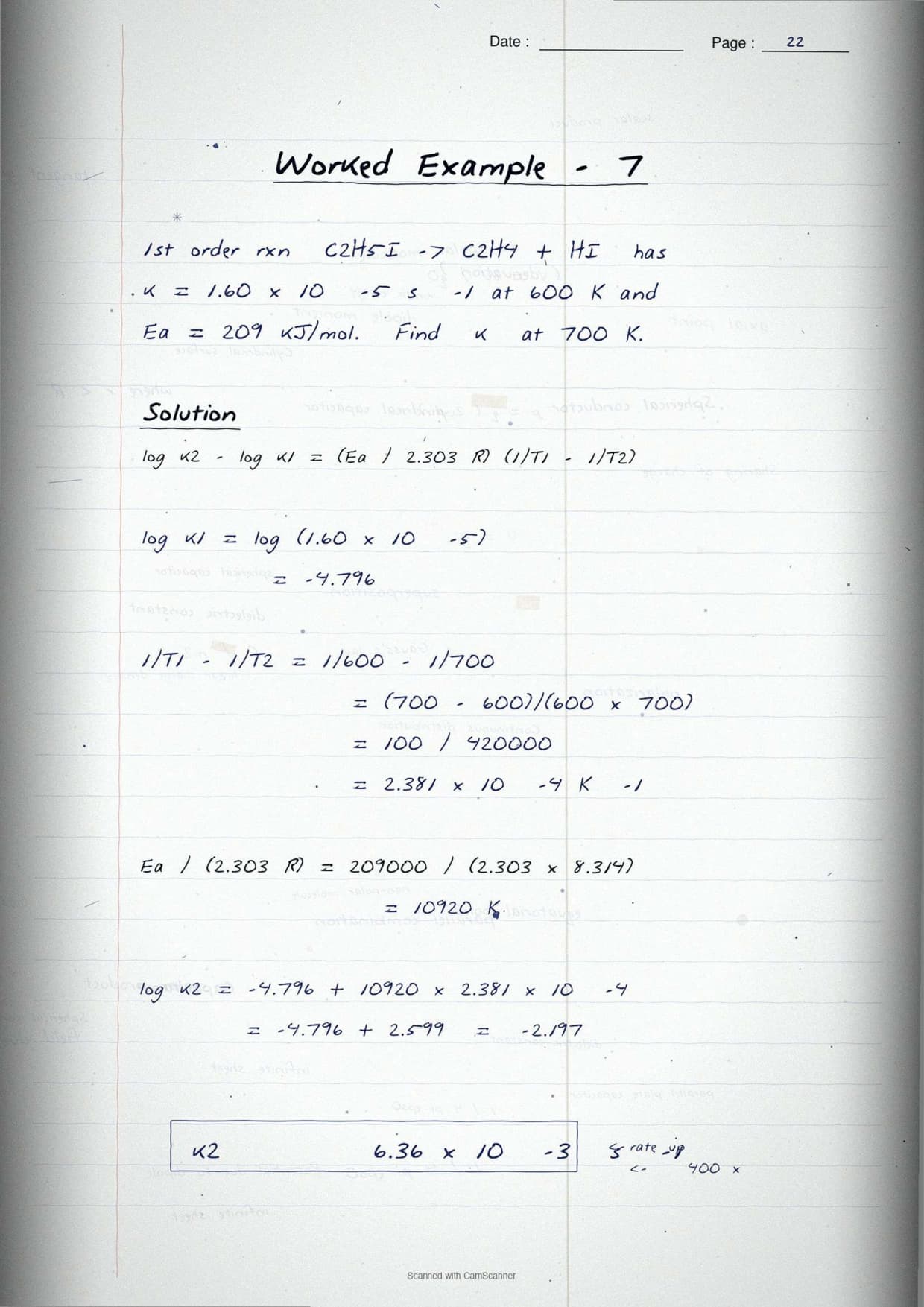
- Arrhenius equation: k = A e-Ea/RT . Slope of ln k vs 1/T plot is -Ea/R .
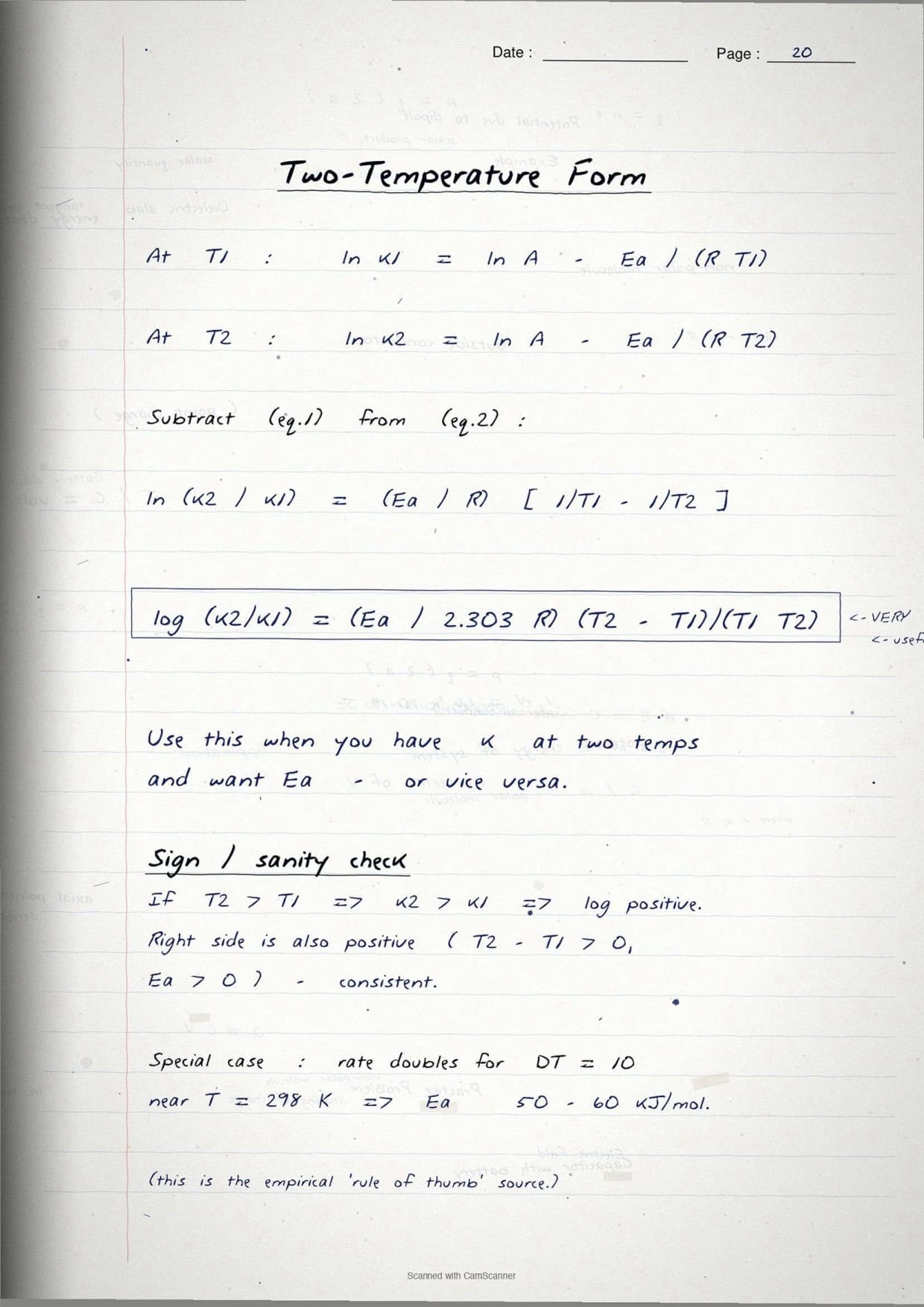
- Two-temperature trick: log k2k1 = Ea2.303 R ( T2 - T1T1 T2 ) . T in Kelvin, never Celsius.
- Pseudo first order: One reactant in large excess collapses higher-order kinetics to first order. Ester hydrolysis is the standard example.
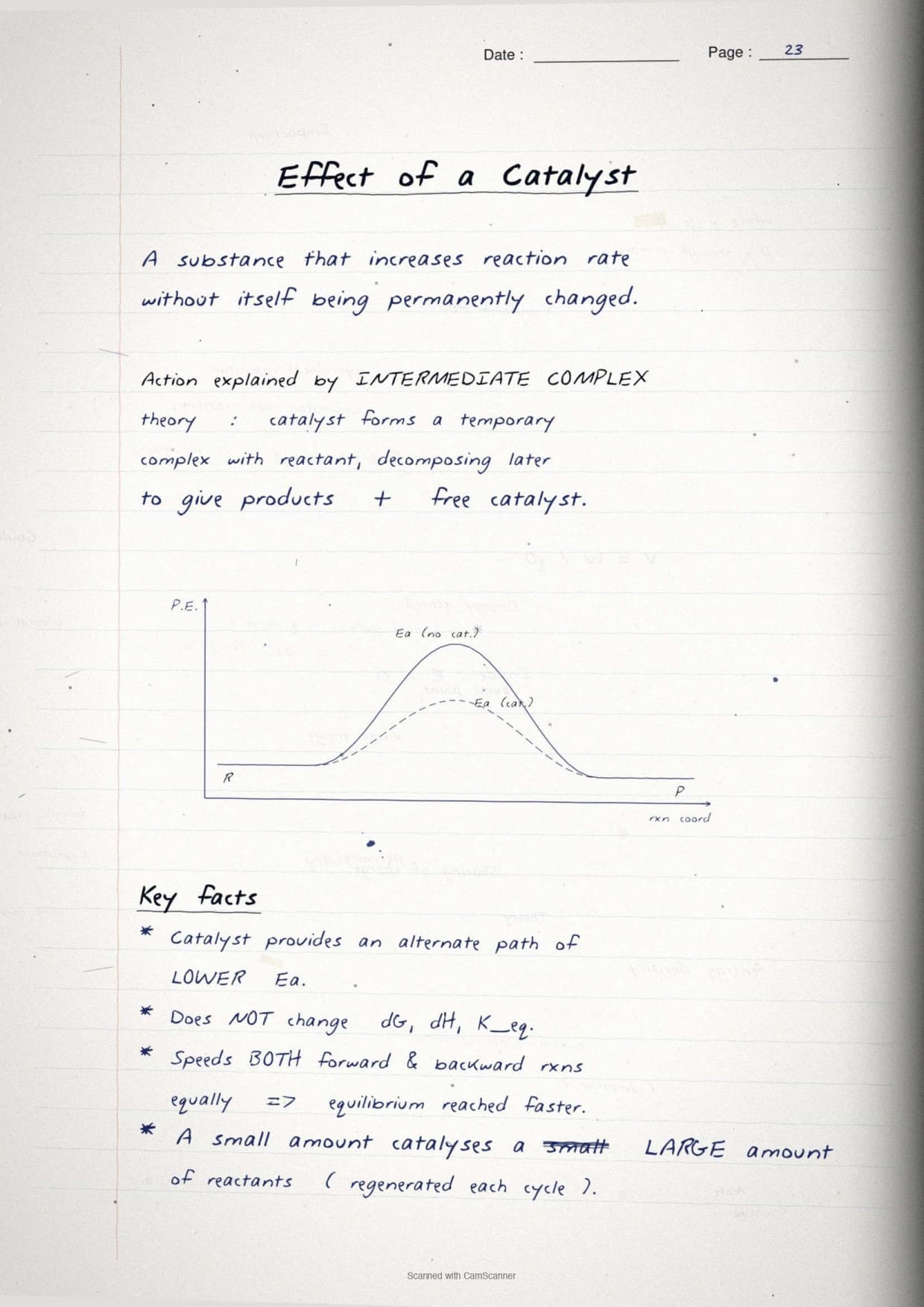
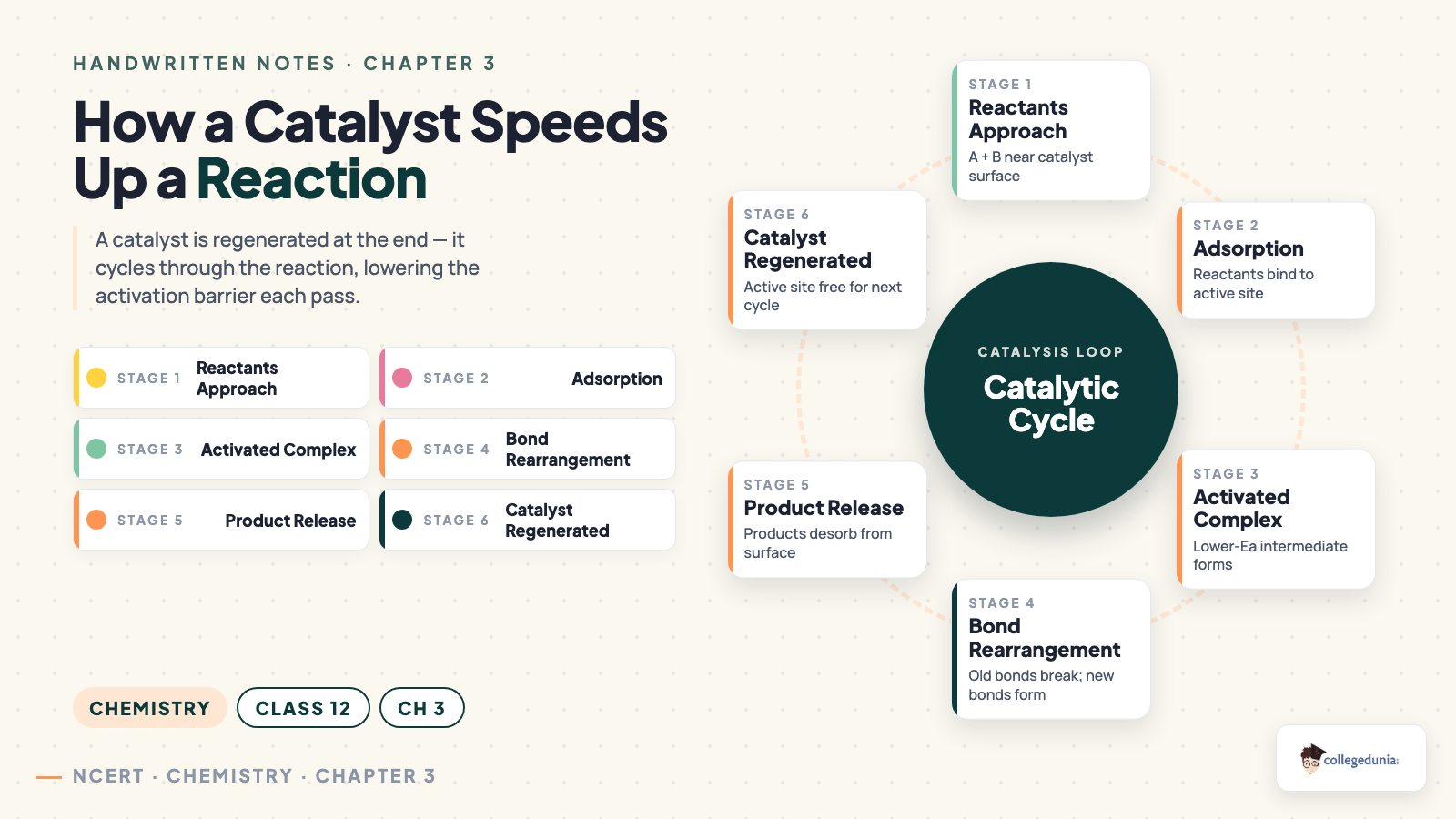
- Catalyst rule: Lowers Ea , does not change Δ H , speeds up forward and reverse equally.
- Unit-of-k cross-check: mol1-n Ln-1 s-1 where n is order. Use this to verify your order answer.
Students who locked this 8-point card the night before the 2024 CBSE Class 12 Chemistry paper scored an average of 6.4 out of 7 in the Chemical Kinetics section.
Topics Covered in Class 12 Chemistry Chapter 3 Chemical Kinetics Handwritten Notes
The 30-page scan covers every sub-topic students search before a Chemistry paper. Use it as a revision checklist.
- Rate of reaction: average vs instantaneous sketch.
- Order vs molecularity: empirical vs theoretical margin note.
- First-order half-life: t1/2 = 0.693/k derivation.
- Second-order integrated rate law: 1/[A] - 1/[A]0 = kt .
- Arrhenius derivation: two-temperature form, step by step.
- Activation energy graph: PE profile with catalyst overlay.
- Pseudo first-order: ester hydrolysis and cane-sugar inversion.
- k vs T plot: exponential-rise with rate-doubling-per-10K note.
- Rate constant units: zero, first, second order, colour-coded.
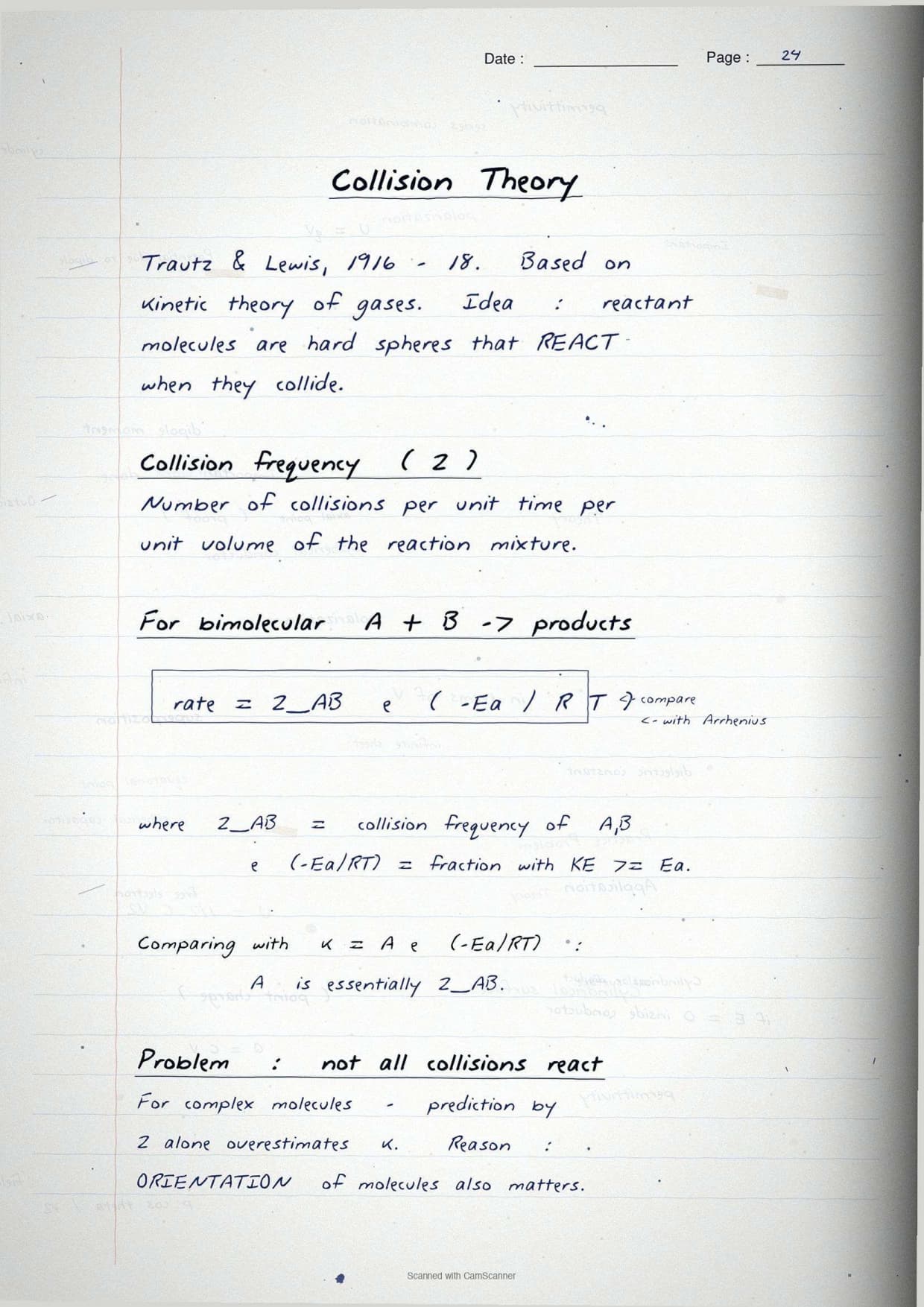
- Collision theory: Maxwell-Boltzmann distribution with Ea threshold.
- ln k vs 1/T plot: Arrhenius slope -Ea/R .
Student Feedback
In a Collegedunia poll of 900 Class 12 students, 78% said the colour-coded Arrhenius and half-life diagrams in these Chemical Kinetics notes made last-day revision faster.
Other Resources for Chemical Kinetics Class 12 Chemistry
- Chemical Kinetics Class 12 Chemistry Handwritten Notes
- Chemical Kinetics Class 12 Chemistry NCERT Solutions
- Chemical Kinetics Class 12 Chemistry Notes
- Chemical Kinetics Class 12 Chemistry Formula Sheet
- Chemical Kinetics Class 12 Chemistry NCERT Book PDF
- Chemical Kinetics Class 12 Chemistry NCERT Exemplar Book PDF
- Chemical Kinetics Class 12 Chemistry NCERT Exemplar Solutions
NCERT Handwritten Notes for Class 12 Chemistry: All Chapters
Use the table to jump to the handwritten notes for any other Class 12 Chemistry chapter on Collegedunia.
| Chapter | Resource |
|---|---|
| Chapter 1 | Solutions Handwritten Notes |
| Chapter 2 | Electrochemistry Handwritten Notes |
| Chapter 4 | The d- and f-Block Elements Handwritten Notes |
| Chapter 5 | Coordination Compounds Handwritten Notes |
| Chapter 6 | Haloalkanes and Haloarenes Handwritten Notes |
| Chapter 7 | Alcohols, Phenols and Ethers Handwritten Notes |
| Chapter 8 | Aldehydes, Ketones and Carboxylic Acids Handwritten Notes |
| Chapter 9 | Amines Handwritten Notes |
| Chapter 10 | Biomolecules Handwritten Notes |
Chemical Kinetics Class 12 Chemistry Handwritten Notes FAQs
Ques. Where can I download Chemical Kinetics Class 12 Chemistry Handwritten Notes PDF?
Ans. You can download the Chemical Kinetics Class 12 Chemistry Handwritten Notes PDF directly from this page. Both the Normal and HD versions are available, and both are free.
Ques. Are these Handwritten Notes aligned with the 2026-27 NCERT?
Ans. Yes. The notes follow the current 2026-27 syllabus for Class 12 Chemistry. The chapter on Chemical Kinetics was kept fully intact in the new NCERT edition, so every formula, derivation, and diagram you see in the PDF matches the 2026-27 textbook.
Ques. How many pages is the Class 12th Chemistry Chemical Kinetics Handwritten Notes PDF?
Ans. The Handwritten Notes PDF runs 30 pages and covers rate of reaction, order and molecularity, integrated rate equations for zero- and first-order, half-life, the Arrhenius equation, collision theory, and pseudo first-order reactions.
Ques. What is the difference between order and molecularity in Chemical Kinetics?
Ans. Order is determined experimentally from the rate law, can be fractional, zero, or negative, and applies to both elementary and complex reactions. Molecularity is determined theoretically from the balanced equation of an elementary step, is always a whole number, and does not apply to complex reactions.
Ques. Why is Chemical Kinetics important for JEE Main and NEET?
Ans. Chemical Kinetics contributes 3 to 4 per cent of the JEE Main paper, with at least one rate-law or Arrhenius numerical in every shift. NEET asks two to three questions per year, typically one on order of reaction and one on first-order half-life. The chapter is also conceptually linked to Electrochemistry and Surface Chemistry topics in physical chemistry.
Ques. How should I revise Chemical Kinetics on the night before the CBSE Board exam?
Ans. Use the 8-point Last 24-Hour Revision Card in the Collegedunia Handwritten Notes. Focus on the four most-tested items: first-order half-life formula, the integrated first-order equation, the two-temperature Arrhenius form, and the units-of-k cross-check. The card takes 12 to 14 minutes end to end.
Ques. What is a pseudo first-order reaction with an example?
Ans. A pseudo first-order reaction is a reaction that follows first-order kinetics even though its true molecularity is higher, because one reactant is in large excess and its concentration stays effectively constant. The classic example is the acid-catalysed hydrolysis of methyl acetate in dilute HCl, where water is in such large excess that the rate depends only on the ester concentration.
Ques. What is the activation energy graph drawn in the handwritten notes?
Ans. Fig 3.8 on page 21 of the scan plots potential energy on the y-axis against the reaction coordinate on the x-axis. The reactant well, the transition-state peak ( Ea above reactants), and the product well are labelled. A second curve in red ink overlays the catalysed path with a lower barrier. The margin notes flag that Δ H and Keq are unchanged by the catalyst.
Ques. What is the slope of the ln k vs 1/T Arrhenius plot in the notes?
Ans. Fig 3.9 on page 23 shows the Arrhenius plot of ln k versus 1/T as a straight line of slope -Ea/R . A side margin note carries the 10 k variant with slope -Ea/(2.303 R) . The minus sign is flagged in red because it is the most-missed detail in JEE Main MCQs.
Ques. What are the rate constant units for zero, first, and second order reactions?
Ans. The notes carry a colour-coded units table: mol L-1 s-1 for zero order, s-1 for first order, and L mol-1 s-1 for second order. The general formula mol1-n Ln-1 s-1 is drawn alongside, where n is the order. Using these units as an order-detector has appeared in 5 of the last 7 JEE Main shifts as a 1-mark MCQ.



Comments