




Controlling trips students up because it looks separate from planning when it is not. These handwritten Class 12 Controlling notes lay out the planning-controlling link and the full controlling process by hand, for quick 2026-27 revision.
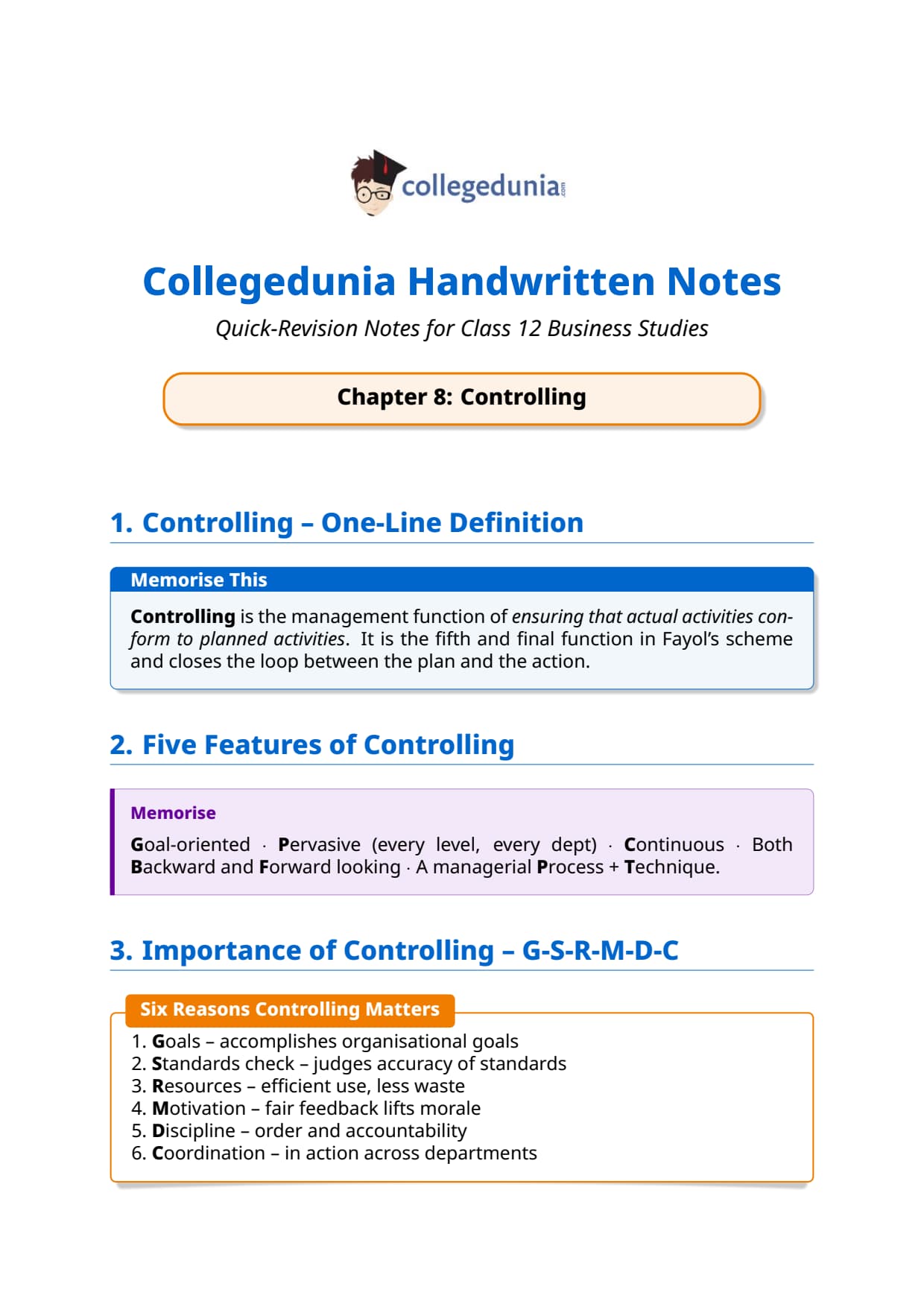
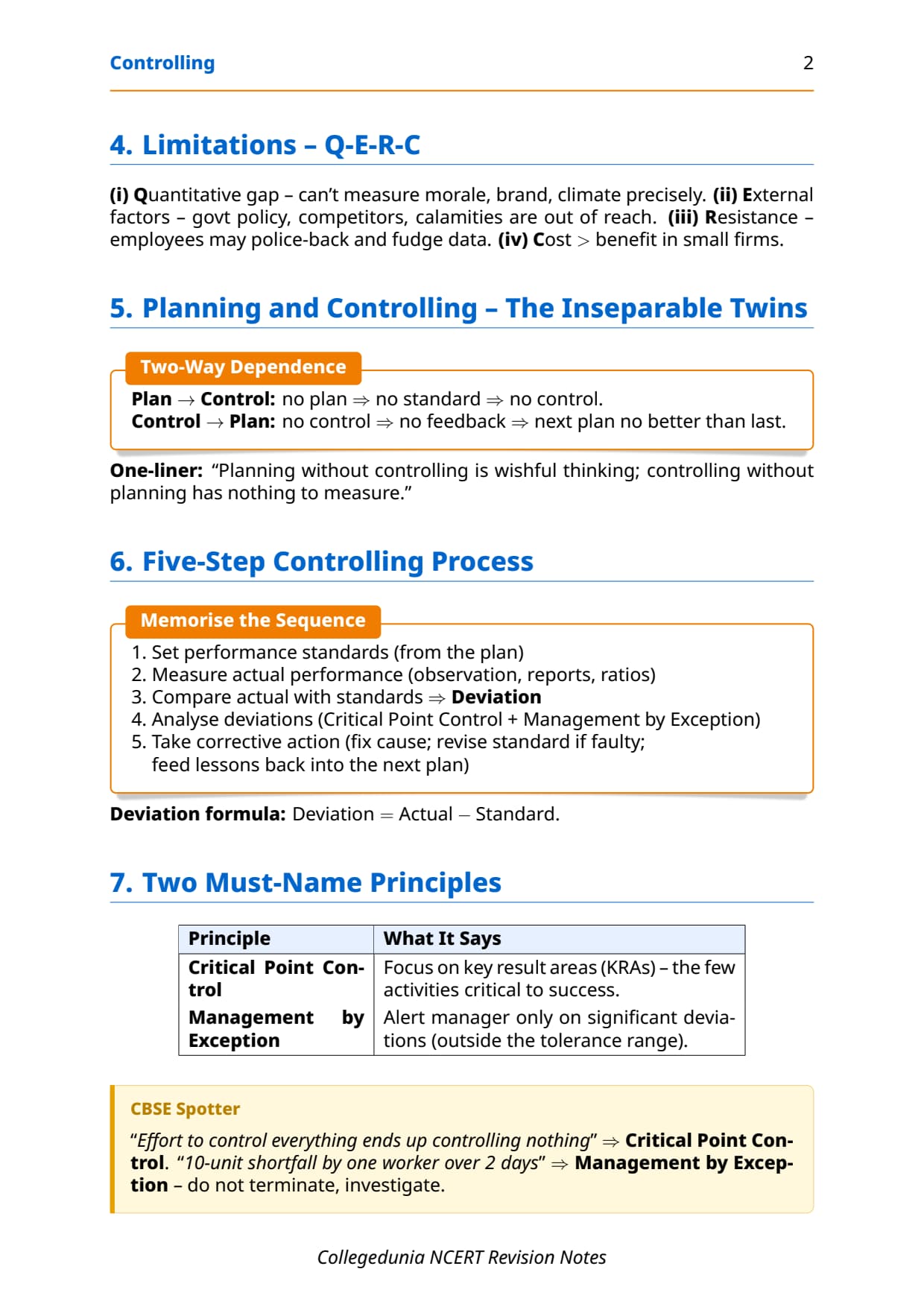
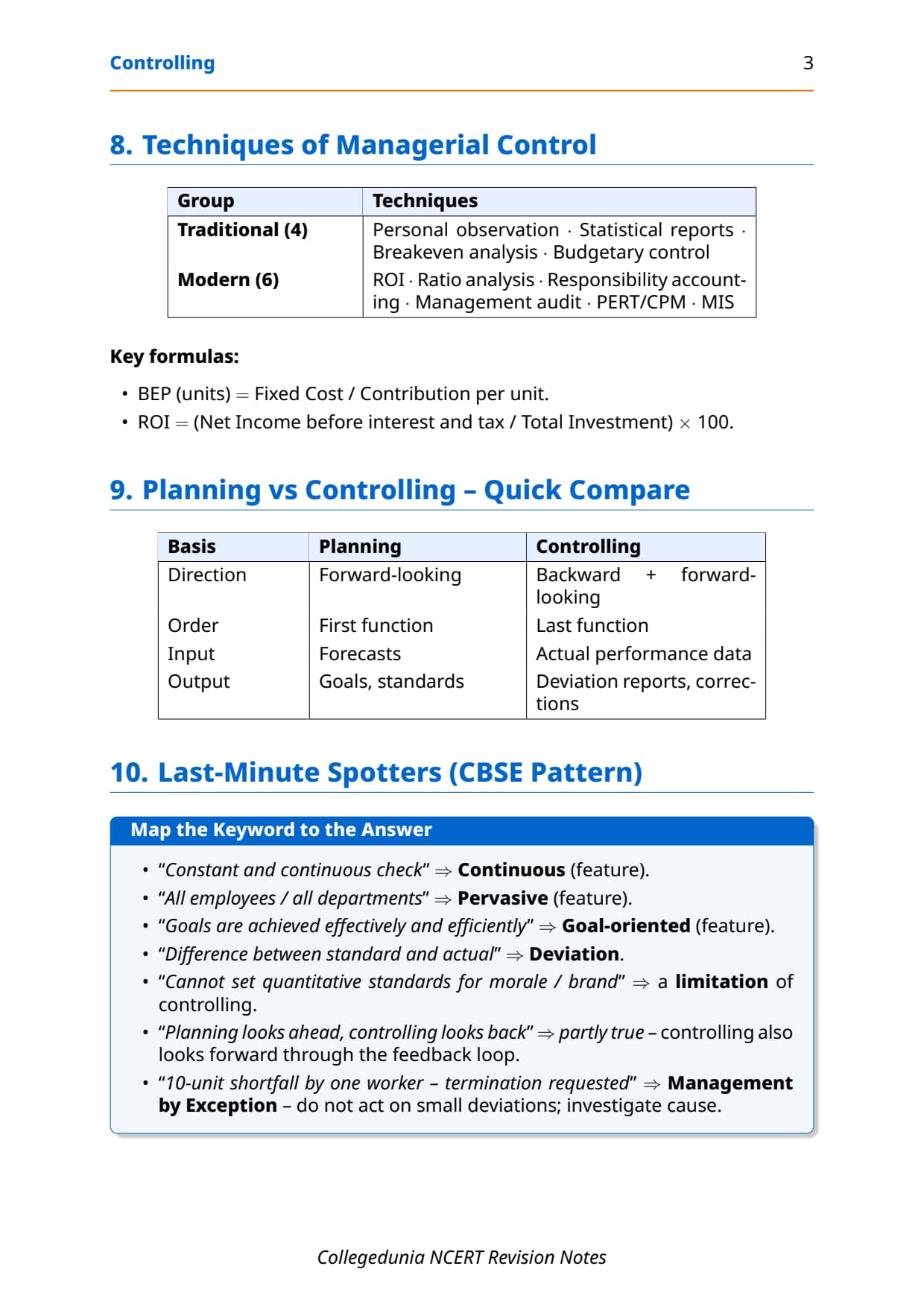

- CBSE Weightage: 6 to 8 marks (Unit 1, Principles and Functions of Management)
- Format: Compact mnemonic notes + spotter words for last-day revision
The handwritten notes are designed for board-exam candidates in the final 24-48 hours before the paper. Each section is short, mnemonic-led (G-S-R-M-D-C, Q-E-R-C) and ends with a CBSE spotter that maps case-study trigger words to the right NCERT answer.
Controlling Class 12 Handwritten Notes: Section Map
| Section | What is Covered | Why It Matters in the Exam |
|---|---|---|
| 1. Controlling Definition | One-line NCERT definition | 1-mark VSA |
| 2. Five Features | Goal-oriented, Pervasive, Continuous, Backward+Forward, Process+Technique | 3 to 4-mark case-study spotter |
| 3. Importance -- G-S-R-M-D-C | Six-letter mnemonic for the six benefits | 4 to 6-mark long answer |
| 4. Limitations -- Q-E-R-C | Four-letter mnemonic for the four limitations | 3 to 4-mark "name any one" |
| 5. Planning vs Controlling | Inseparable twins; planning prescriptive, controlling evaluative; two-way dependence | 5 to 6-mark long answer |
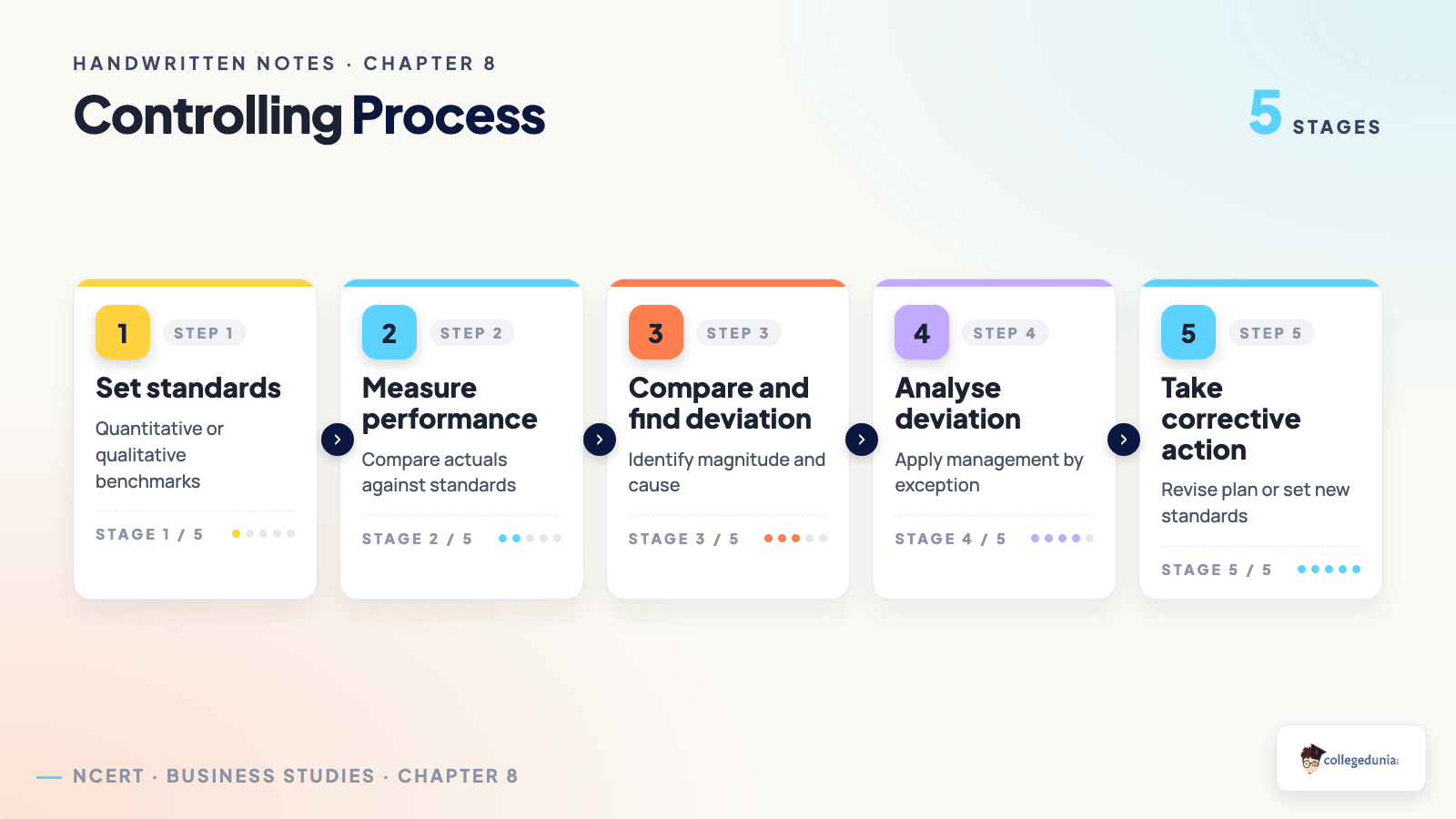
| 6. Five-Step Process | Set $\to$ Measure $\to$ Compare $\to$ Analyse $\to$ Correct | 6-mark process question |
| 7. Two Must-Name Principles (Step 4) | Critical Point Control (KRAs) + Peter Drucker's Management by Exception | 3-mark principle question |
| 8. Techniques (Traditional + Modern) | 4 traditional + 6 modern; BEP and ROI formulas | 5 to 6-mark long answer |
| 9. Planning vs Controlling Compare | 4-row comparison table | 5-mark distinguish |
| 10. Last-Minute Spotters | Trigger-word $\to$ answer map | Case-study + mini-cases |
Controlling Video Walkthrough
Source: Magnet Brains on YouTube
What the Class 12 Business Studies Chapter 8 Handwritten Notes PDF Contains
- Compact handwritten-style notes on 4 pages -- definition, features, importance, limitations, five-step process, two principles, techniques.
- Mnemonics: G-S-R-M-D-C (importance), Q-E-R-C (limitations), five-step memorisation chain.
- Deviation formula ($\text{Deviation} = \text{Actual} - \text{Standard}$) and BEP / ROI formulas in a single quick-reference block.
- Comparison tables -- Planning vs Controlling; Traditional vs Modern techniques.
- CBSE spotter mapping case-study trigger words (``constant and continuous'', ``10-unit shortfall'', ``all employees'') to the correct NCERT answer.
- Cross-links to Solutions, Revision Notes and the NCERT Book PDF for the same chapter.
Continue Learning: Class 12 Business Studies Chapter 8 and Nearby Chapters
- Ch 7: Directing Handwritten Notes
- Ch 9: Financial Management Handwritten Notes
- All Class 12 Business Studies Chapters
Student Feedback
In a Collegedunia poll of 340 Class 12 Commerce students, 79% said the G-S-R-M-D-C and Q-E-R-C mnemonics helped them recall Controlling faster than plain reading. 3 in 4 said the five-step process diagram made the last-day revision quicker before their board exam.
Other Resources for Class 12 Business Studies Chapter 8 Controlling
| Resource | Link |
|---|---|
| NCERT Solutions | Controlling NCERT Solutions |
| Revision Notes | Controlling Class 12 Notes |
| Handwritten Notes | Controlling Handwritten Notes |
| NCERT Book PDF | Controlling NCERT Book PDF |
Controlling Class 12 - Frequently Asked Questions
Controlling Class 12 - Frequently Asked Questions
What is controlling in Class 12 Business Studies Chapter 8?
Controlling is the management function of ensuring that actual activities conform to planned activities. It is the fifth and final function in Henri Fayol's classical scheme.
What does G-S-R-M-D-C stand for?
G-S-R-M-D-C is the mnemonic for the six points of importance of controlling: Goals, Standards-check, Resources, Motivation, Discipline, Coordination.
What is the deviation formula?
Deviation = Actual Performance - Standard Performance. Positive deviation means actual exceeds standard; negative deviation means actual falls short. Apply management by exception -- only deviations outside the permitted tolerance need attention.
What are the two principles for handling deviations?
Both principles are applied inside Step 4 (analysing deviations) of the controlling process. Critical Point Control says focus on key result areas (KRAs). Peter Drucker's Management by Exception says ignore small / routine deviations and alert the manager only on significant deviations outside the tolerance range. Together they let the manager actually control the few things that matter.
Where can I download the Class 12 Business Studies Chapter 8 Controlling Handwritten Notes PDF?
You can download the Collegedunia Class 12 Business Studies Chapter 8 Controlling Handwritten Notes PDF free of cost from this page. The PDF is aligned to the NCERT Reprint 2026-27 syllabus and is built for last-day revision.



Comments