




These handwritten Organising notes for Class 12 pack the whole chapter into scanned revision pages, the four-step process, functional vs divisional structures, formal vs informal organisation and delegation, in line with the 2026-27 CBSE syllabus.
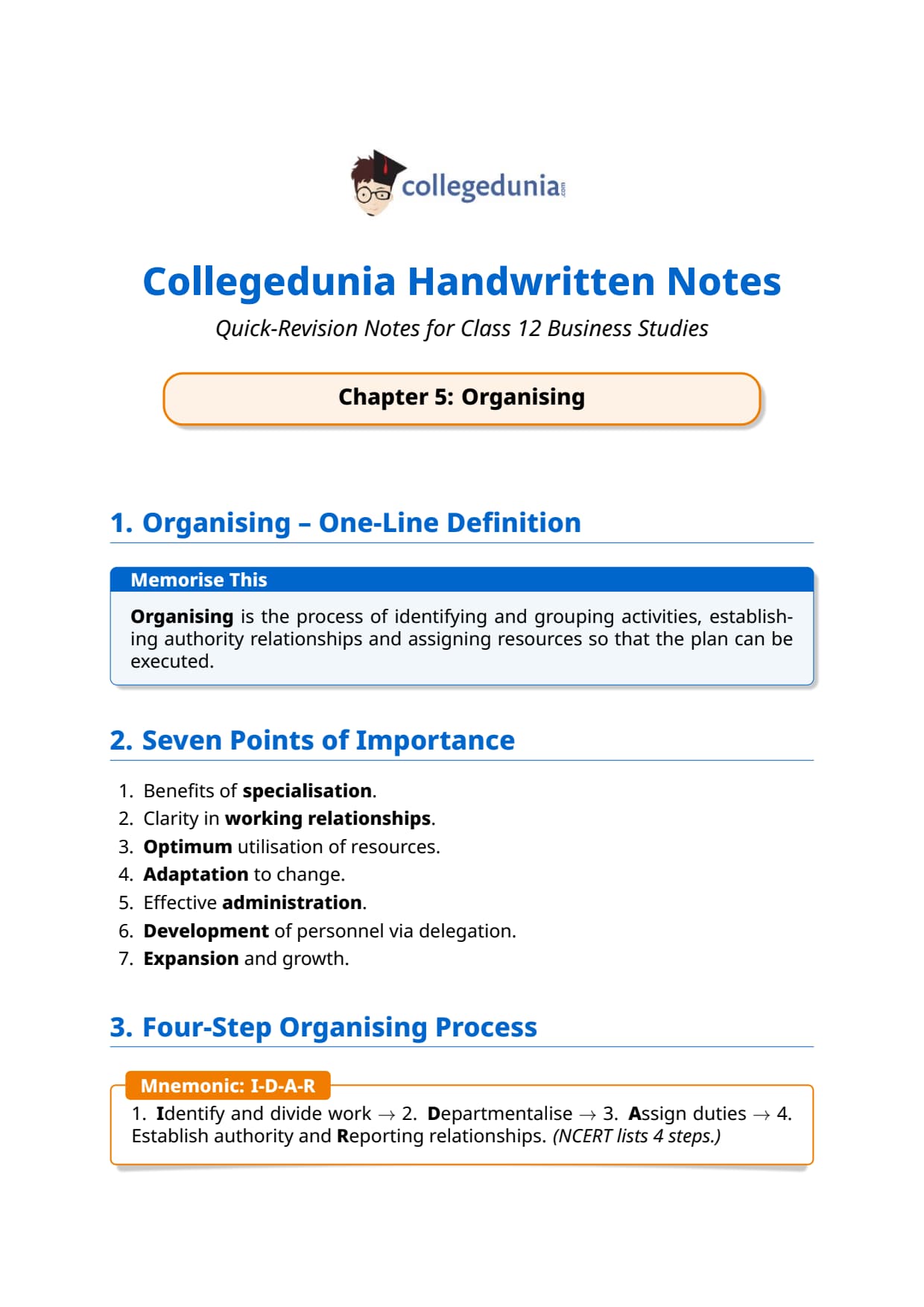
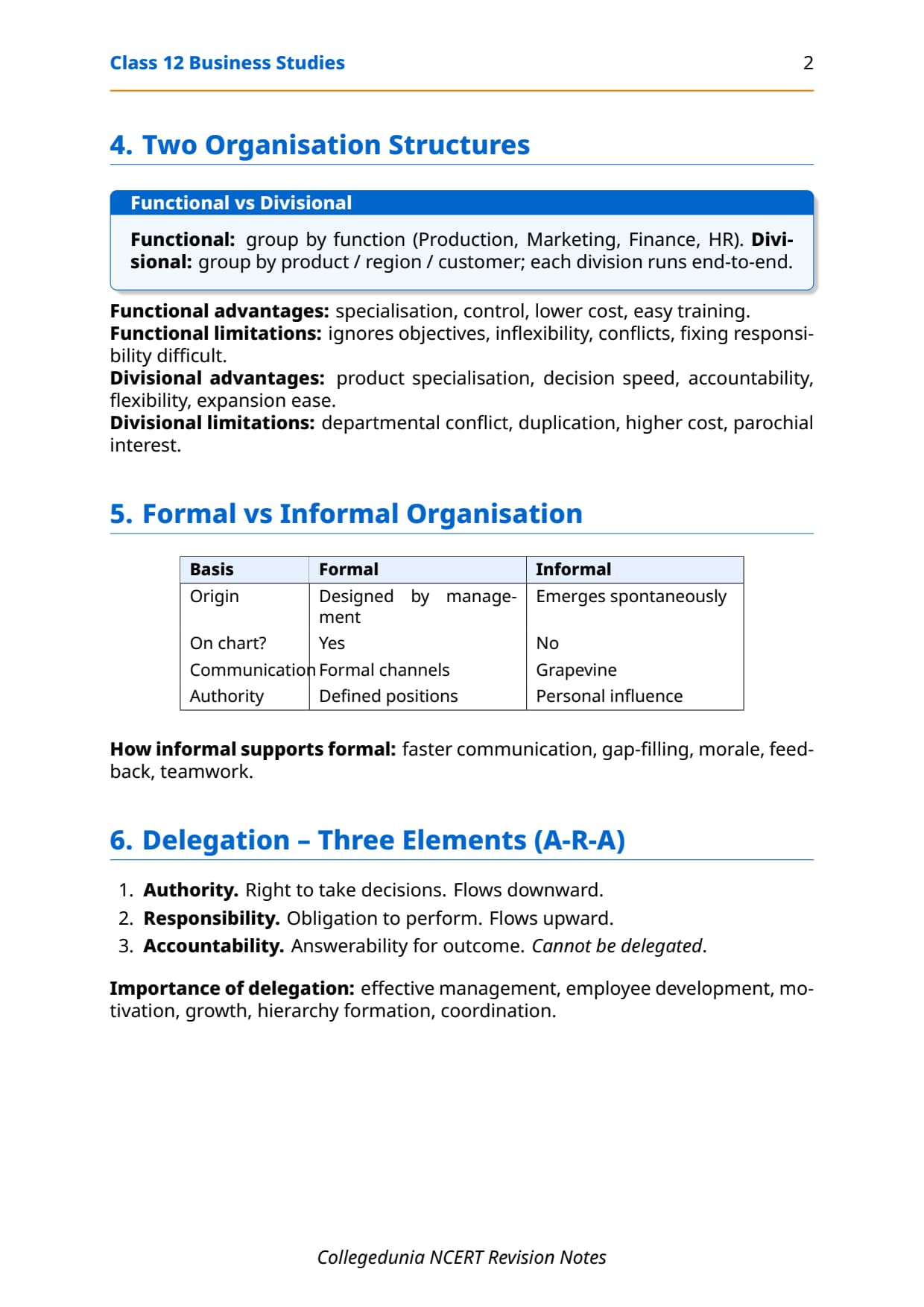
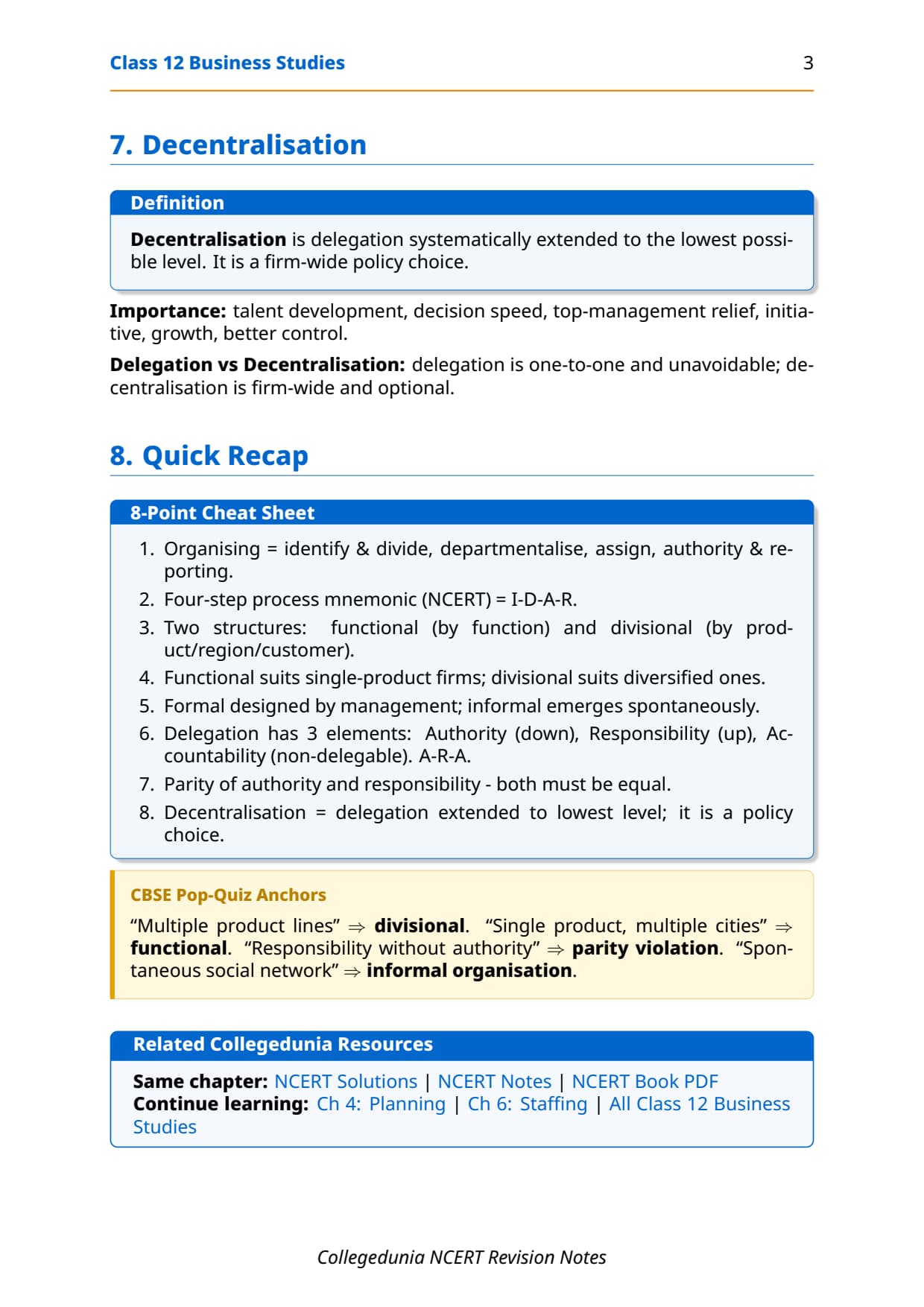
- CBSE Weightage: 6 to 10 marks (Unit 2, Principles and Functions of Management).
- Notes Coverage: 8 sections, 1 difference table, I-D-A-R mnemonic for the organising process, A-R-A mnemonic for delegation, and CBSE pop-quiz anchors for case-study triggers.
Organising Handwritten Notes Class 12: What is Inside the PDF
| Section | Concept | Memory Hook |
|---|---|---|
| 1 | One-line definition of organising | Identify, group, assign, authority |
| 2 | Six importance points | Specialisation to expansion |
| 3 | Four-step organising process | I-D-A-R |
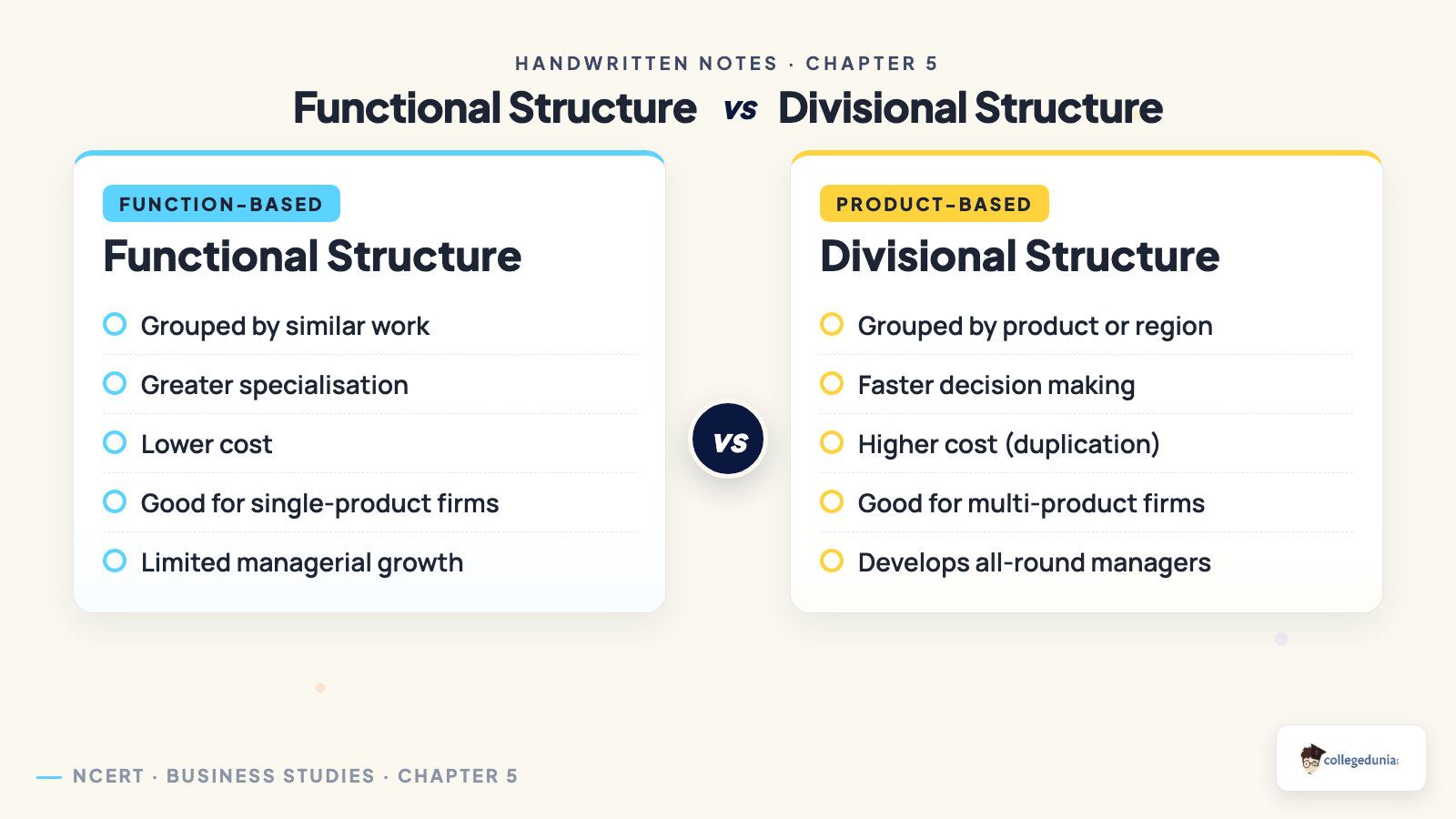
| 4 | Functional vs Divisional structure with advantages and limitations | Single vs multi-product trigger |
| 5 | Formal vs Informal organisation table | Designed vs spontaneous |
| 6 | Delegation - three elements | A-R-A (Authority, Responsibility, Accountability) |
| 7 | Decentralisation as a policy | Delegation extended to lowest level |
| 8 | 8-point cheat sheet + CBSE pop-quiz anchors | Last-minute scan |
Use these notes as a last-week revision aid. Open the PDF, scan the highlighted boxes, and you have every CBSE-tested concept of Organising in one place. The Section 6 Delegation block is the single most useful page for delegation and decentralisation questions.
Organising Video Walkthrough
Source: Magnet Brains on YouTube
How Organising Handwritten Notes Help You Score in Class 12
- Single-Page Section Layout: Each major concept fits on a single page so you can flip through the entire chapter in 10 minutes.
- Mnemonic-First Design: I-D-A-R for organising process and A-R-A for delegation - both unlock long-answer marks under exam pressure.
- Difference Table: Formal vs Informal organisation in compact side-by-side format.
- CBSE Pop-Quiz Anchors: Multi-product line $\Rightarrow$ divisional; single product, multiple cities $\Rightarrow$ functional; responsibility without authority $\Rightarrow$ parity violation.
- 2026-27 Alignment: Every concept matches the current NCERT chapter order and CBSE marking scheme.
Student Feedback
In a Collegedunia poll of 640 Class 12 Commerce students, 71% said the I-D-A-R and A-R-A mnemonics helped them recall the organising process faster in board exams. 3 in 4 said the formal vs informal difference table was the single most useful page for last-minute revision.
Other Resources for Class 12 Business Studies Chapter 5 Organising
| Resource | Link |
|---|---|
| NCERT Solutions | Organising NCERT Solutions |
| Revision Notes | Organising Class 12 Notes |
| Handwritten Notes | Organising Handwritten Notes |
| NCERT Book PDF | Organising NCERT Book PDF |
Frequently Asked Questions on Class 12 Business Studies Chapter 5 Handwritten Notes
Frequently Asked Questions on Class 12 Business Studies Chapter 5 Handwritten Notes
Q1. Are these Handwritten Notes free to download?
Yes. The Collegedunia Handwritten Notes PDF for Organising is free to download from this page, aligned to the 2026-27 CBSE syllabus.
Q2. What is the mnemonic for the organising process?
I-D-A-R. Identify and divide work, Departmentalise, Assign duties, establish authority and Reporting relationships (the four steps NCERT lists).
Q3. What is the difference between delegation and decentralisation?
Delegation is a one-to-one downward transfer of authority between a superior and one subordinate, and it is unavoidable in any firm. Decentralisation is a firm-wide policy of pushing authority down to the lowest possible level, and it is a deliberate choice.
Q4. When should a firm use a divisional structure?
When the firm has multiple unrelated product lines, each needing different technology and market expertise, with the need for end-to-end accountability per product line and ease of future expansion.
Q5. Are these notes aligned to the 2026-27 CBSE syllabus?
Yes. Every concept matches the 2026-27 NCERT Business Studies textbook and the latest CBSE marking scheme.



Comments