




The Collegedunia scanned notebook for Class 12 Biology Chapter 9 Biotechnology - Principles and Processes covers 18 sub-topics, from restriction enzyme nomenclature to bioreactor design. The notes follow the 2026-27 NCERT syllabus with all diagrams hand-drawn for visual recall. The full PDF flipbook is hosted on this page for free download.
- CBSE Weightage: 5 to 7 marks (Unit: Biotechnology and its Applications)
- NEET Weightage: 3 to 5 questions per year
- CUET (UG) Biology: 2 to 4 questions per year
How will Collegedunia's Handwritten Notes Help You Revise Biotechnology - Principles and Processes Faster?
This chapter is half tool-name recall and half process flow diagrams. The notebook gives each idea one topper-style page so students can absorb the full chapter without missing any NEET or CBSE exam topic.
- 2026-27 NCERT Alignment: Sections follow the current syllabus order; no dropped content for this chapter.
- Diagram-First Layout: The EcoRI cut, pBR322 map, rDNA flowchart, PCR cycle and stirred-tank bioreactor are hand-drawn with labelled arrows.
- Expert Verification: Every enzyme name, recognition site and Roman numeral is checked against the official NCERT chapter.
- NEET-Recall Boxes: Red-pen call-outs flag the 6 enzymes and the 3-temperature PCR triplet NEET tests every year.
Students preparing for NEET 2027 will find the red-pen margin notes especially useful. These call-outs point to the exact enzyme spellings, Roman numerals, and temperature values that NEET examiners repeat year after year. The notebook is designed for both first-read study and last-week revision, so it saves time at both stages.
Biotechnology - Principles and Processes Class 12 Handwritten Notes Page Plan
The 20 pages run in NCERT order so students can revise alongside the open textbook.
| Page | Topic Covered | Hand-Drawn Diagram |
|---|---|---|
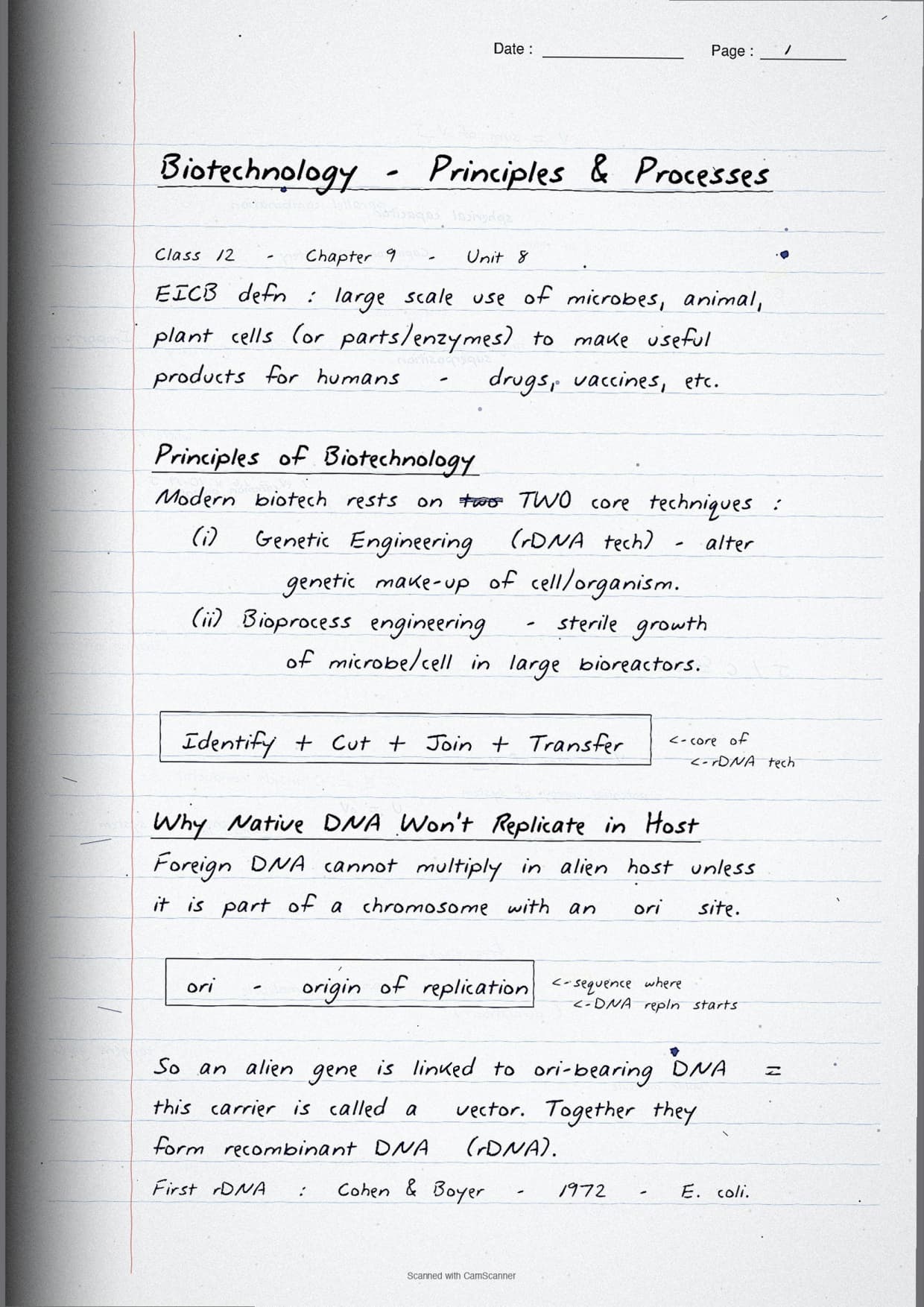
| 1 to 2 | Title, EFB definition, history of biotechnology, Cohen-Boyer 1972 | Timeline scroll |
| 3 to 4 | Principles of biotechnology: genetic engineering + bioprocess engineering | Two-pillar concept map |
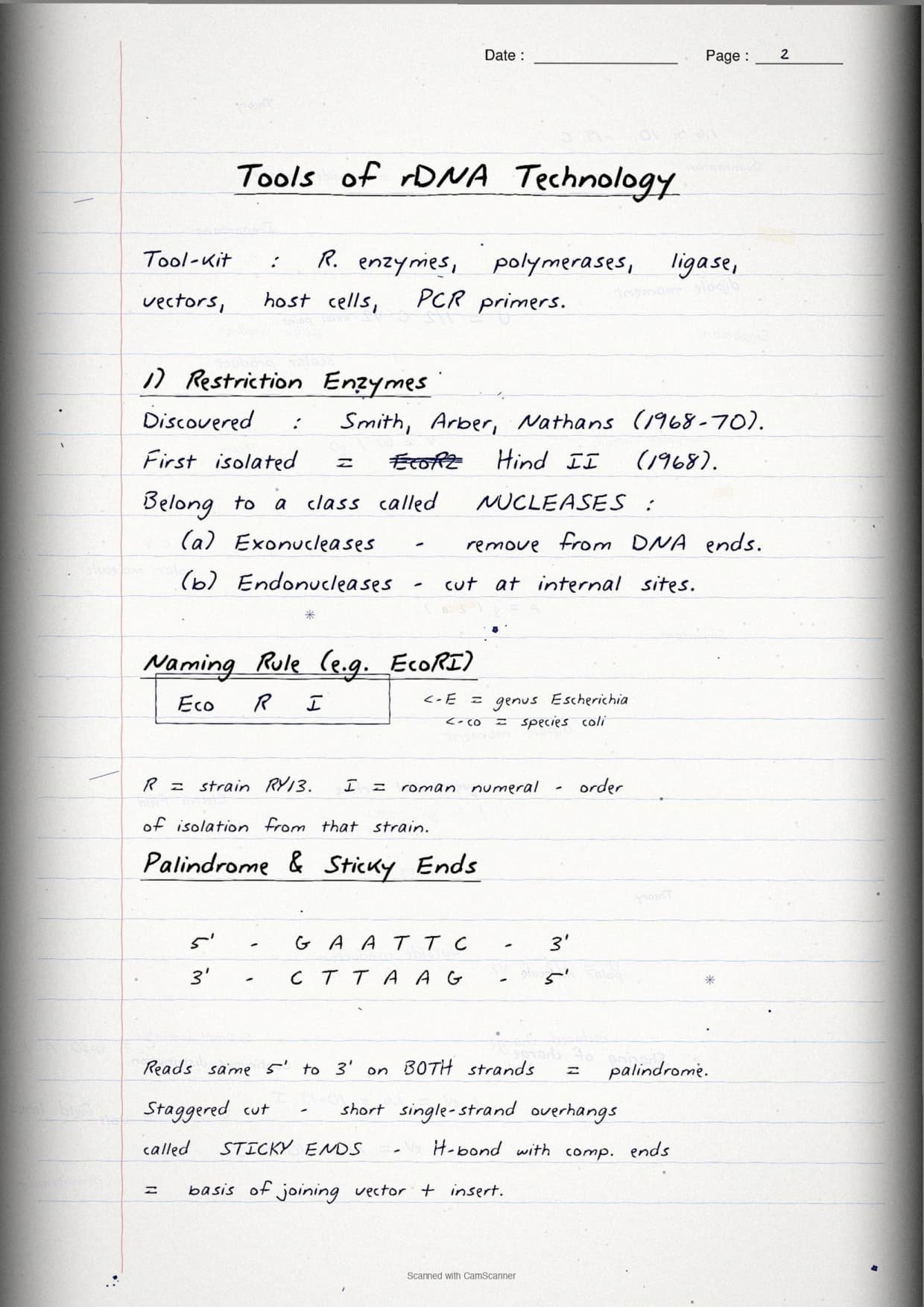
| 5 to 7 | Tools - restriction enzymes, nomenclature decode, palindrome explained | EcoRI G/AATTC cut |
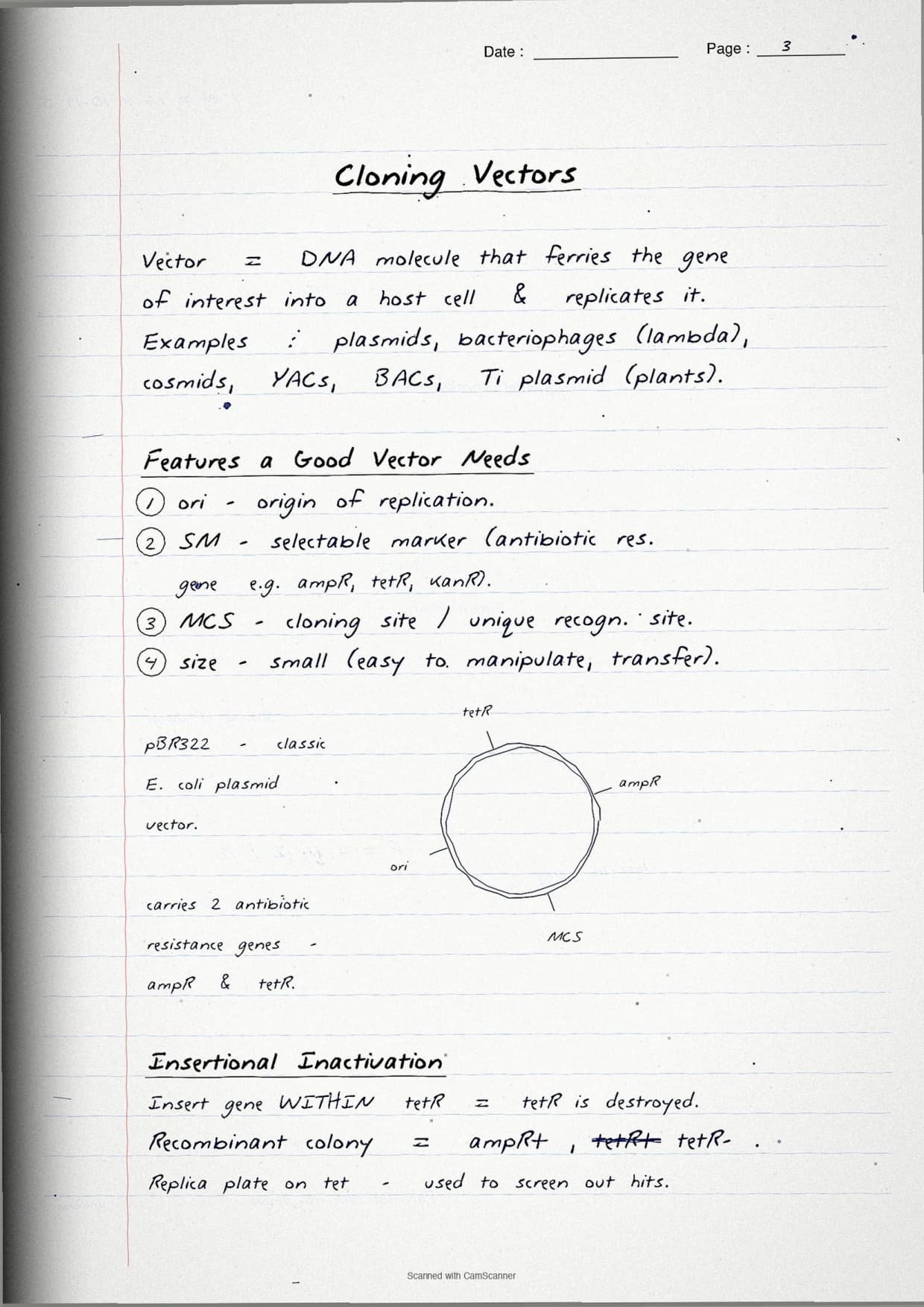
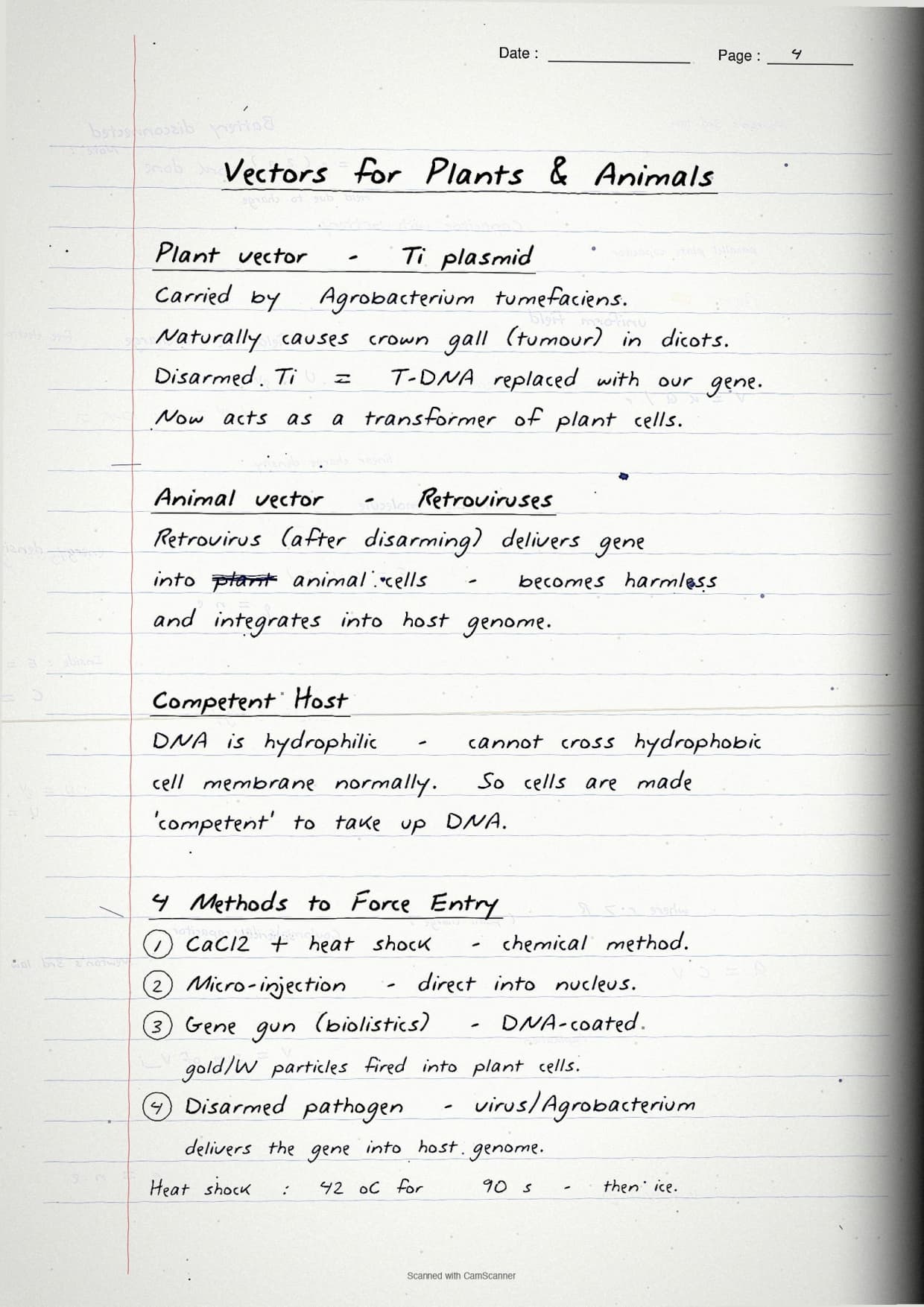
| 8 to 9 | Cloning vectors - pBR322 features, lambda phage, cosmid, Ti plasmid | Annotated pBR322 map |
| 10 | Competent host cells, CaCl2 + heat-shock | Cell membrane pore |
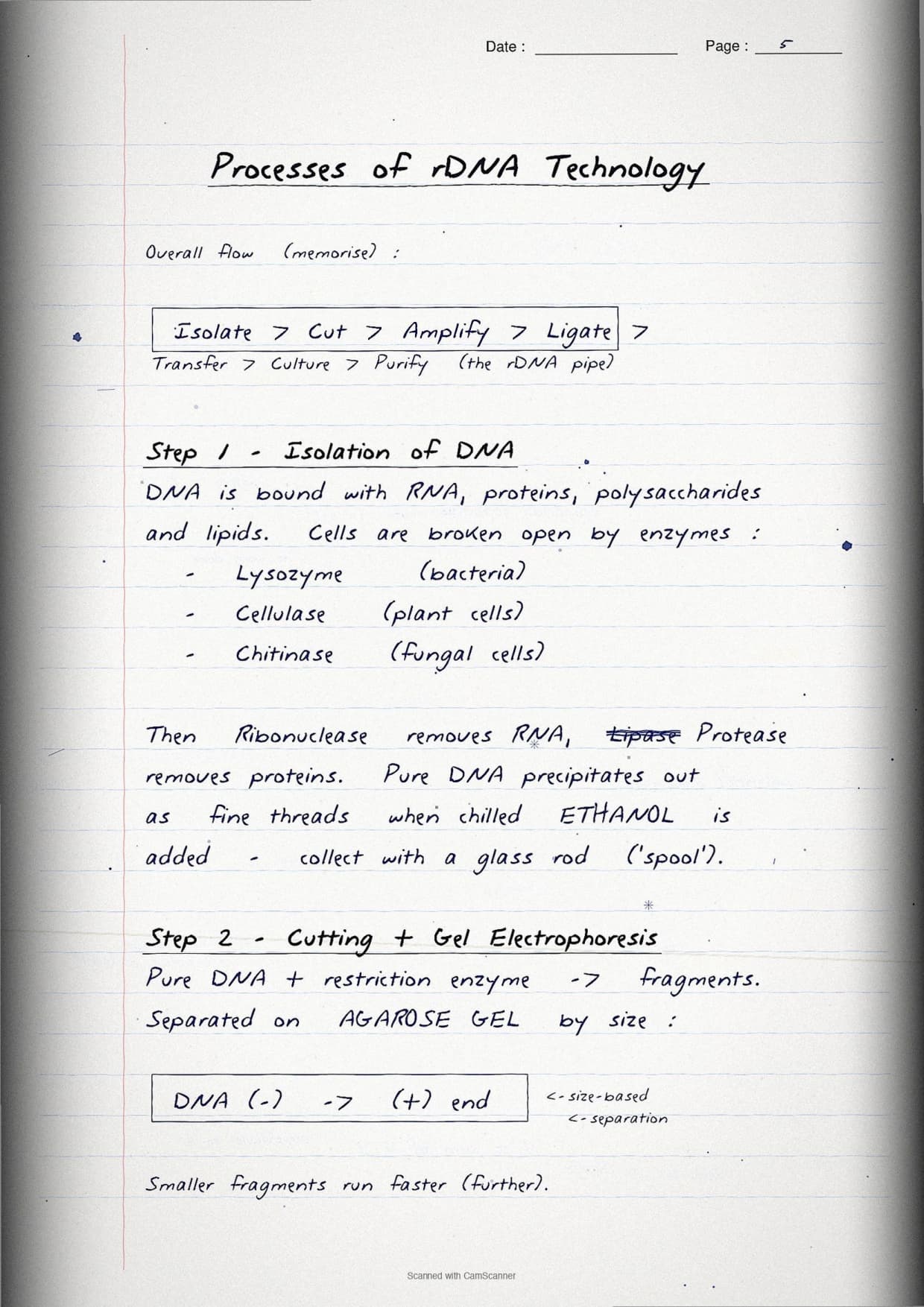
| 11 to 14 | Steps of rDNA technology: isolation, cutting, PCR, ligation, transformation, selection | 9-box flowchart |
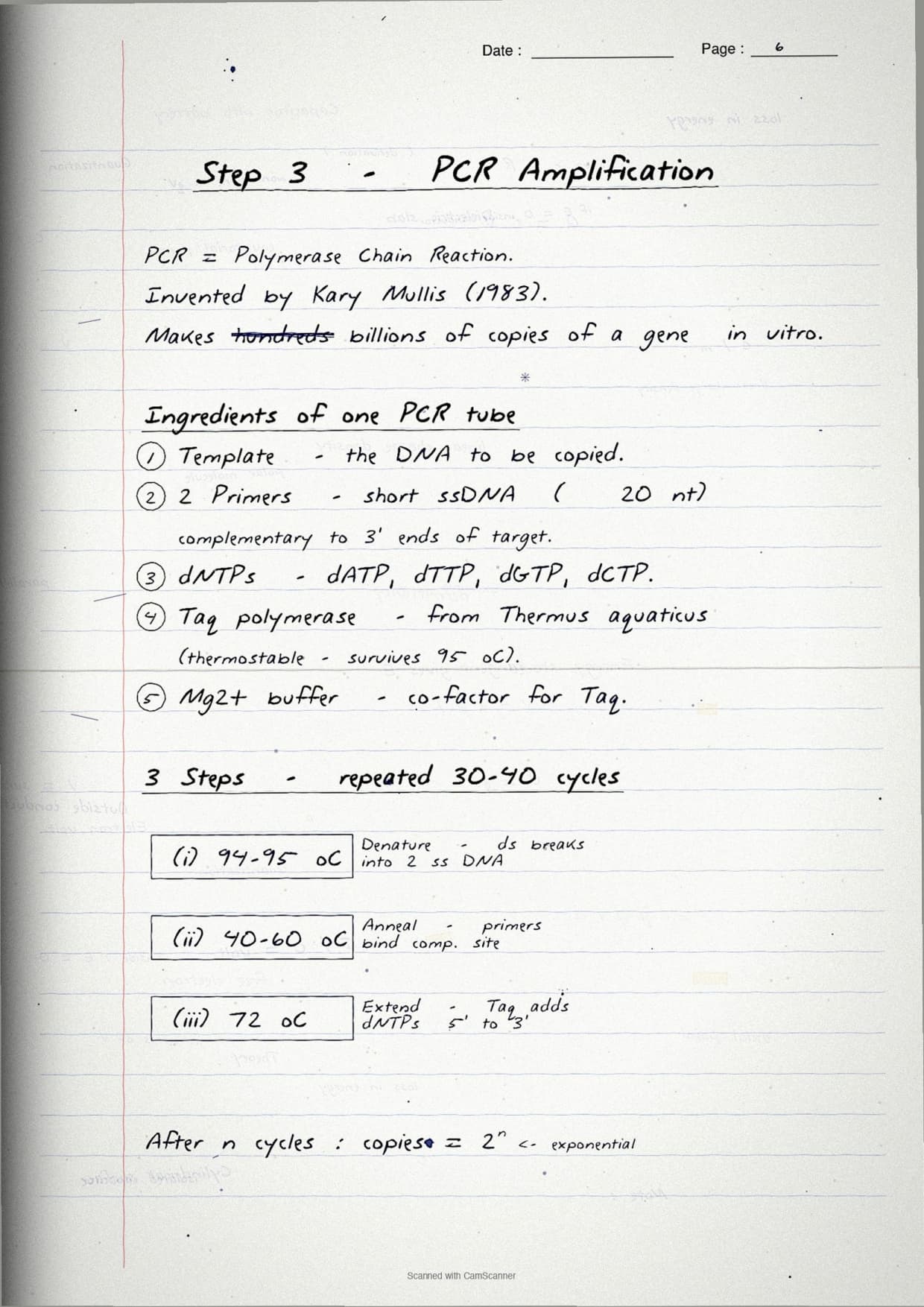
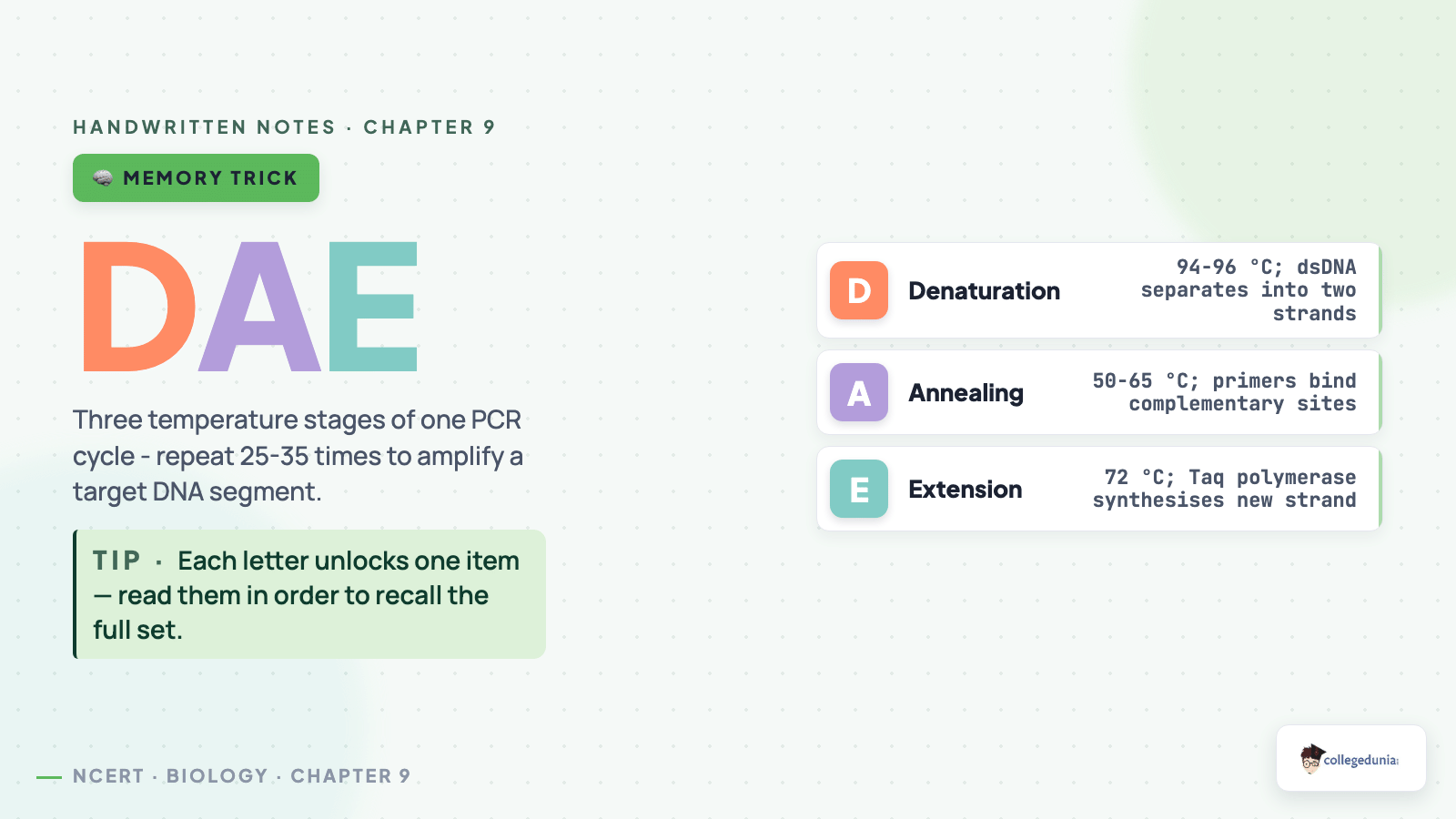
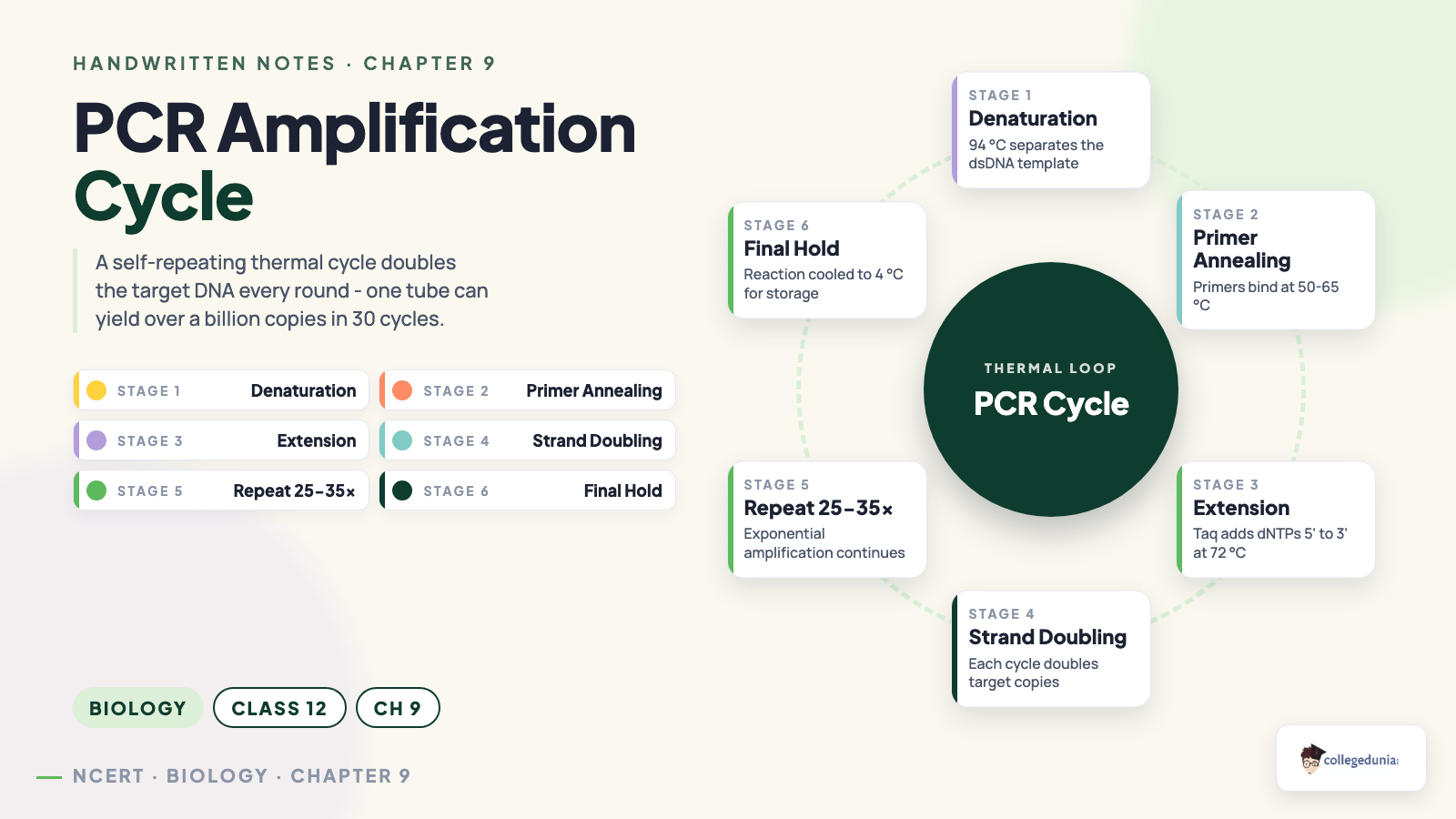
| 15 to 16 | PCR thermal cycle, Taq polymerase, primer design | PCR ladder (denature/anneal/extend) |
| 17 | Gel electrophoresis - agarose gel, EtBr, band visualisation | Gel setup with bands |
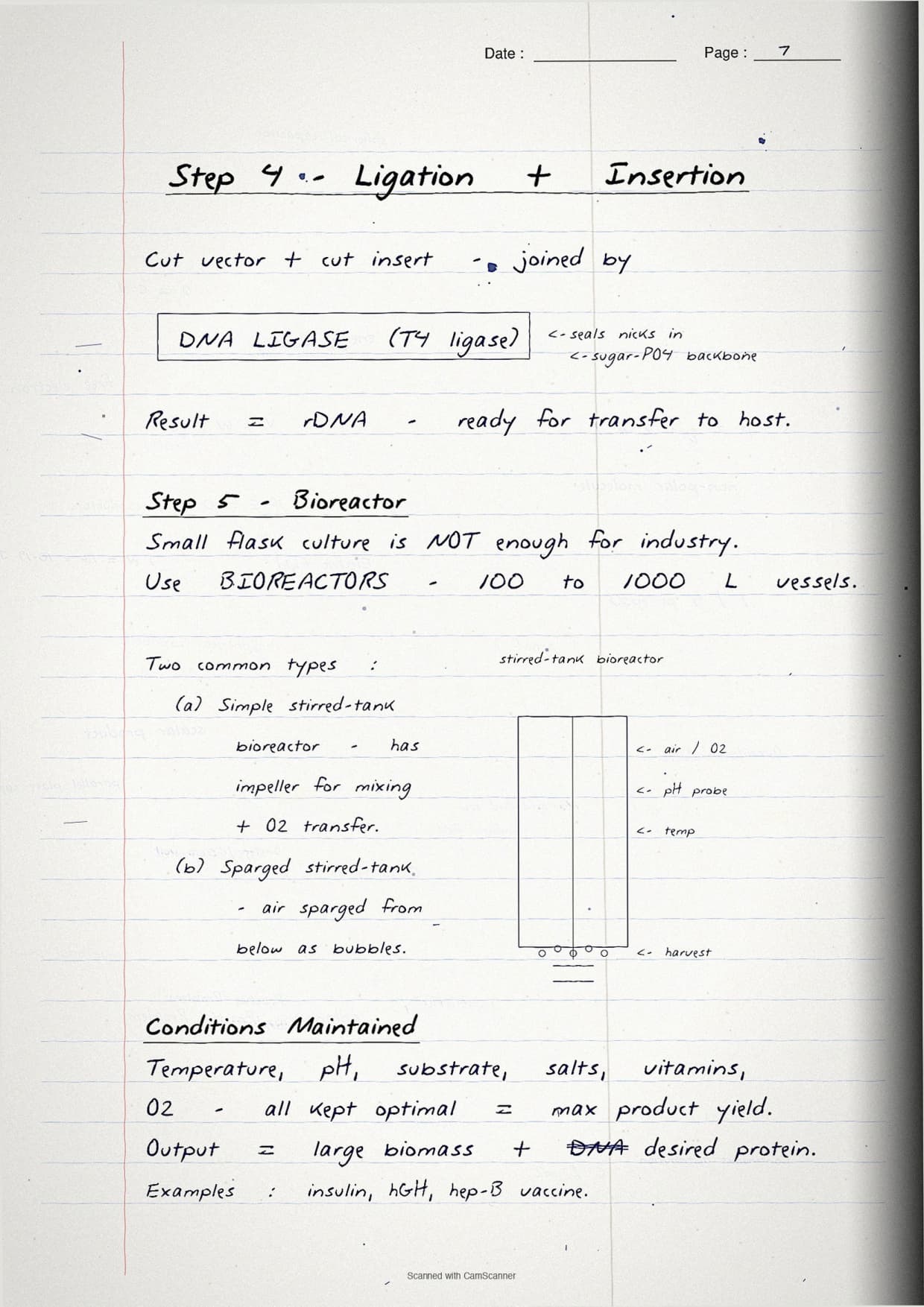
| 18 to 19 | Bioreactors - simple stirred-tank, sparged stirred-tank, parts labelled | Stirred-tank cross-section |
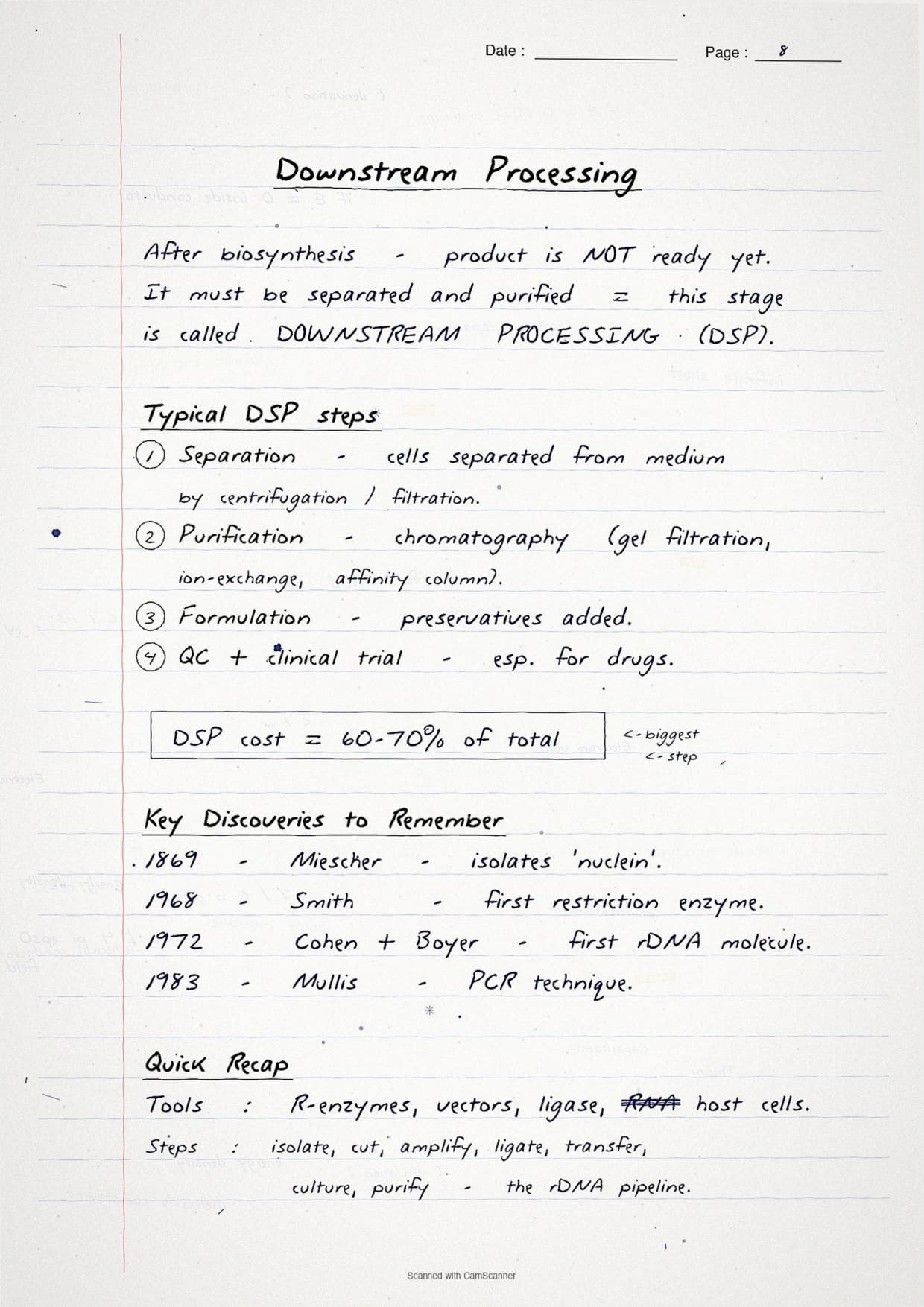
| 20 | Downstream processing - separation, purification, formulation, QC | Pipeline diagram |
Pages 5 to 16 (tools + processes) carry the most NEET weight; cover them on Day 1 of revision.
Biotechnology - Principles and Processes Hand-Drawn Diagrams in This Notebook
Twelve labelled hand-drawn diagrams: EcoRI palindromic cut with sticky-end overhangs; annotated pBR322 map (4361 bp); Ti plasmid T-DNA region; lambda phage cosmid construct; CaCl2 heat-shock transformation cartoon; 9-step rDNA flowchart; PCR thermal-cycle ladder; Taq polymerase action on primer; agarose gel electrophoresis setup with band positions; EtBr-stained DNA under UV; simple stirred-tank bioreactor cross-section; sparged stirred-tank bioreactor.
Each diagram uses coloured arrows and abbreviated labels that match CBSE answer-sheet conventions. Students who draw these diagrams from memory during practice sessions consistently report better recall on exam day.
Biotechnology - Principles and Processes Tools at a Glance (Page 5 to 9)
| Tool | Recognition Site / Feature | Source |
|---|---|---|
| EcoRI | G/AATTC | E. coli RY13 |
| HindIII | A/AGCTT | H. influenzae Rd |
| BamHI | G/GATCC | B. amyloliquefaciens H |
| DNA ligase | Seals phosphodiester bonds | T4 phage / E. coli |
| Taq polymerase | Heat-stable, PCR extension | Thermus aquaticus |
| pBR322 | 4361 bp, ori, ampR, tetR, MCS | Plasmid (engineered) |
These six entries account for over half of all NEET MCQs from this chapter. Lock them down on Day 1. Pay special attention to the Roman numerals in enzyme names - NEET penalises incorrect capitalisation.
Biotechnology - Principles and Processes Three-Day Revision Plan
- Day 1 (3 hr): Pages 1 to 10 (principles + tools + host). Test yourself on the EcoRI / HindIII / BamHI recognition sites and their source organisms.
- Day 2 (3 hr): Pages 11 to 17 (9-step rDNA workflow + PCR + gel run). Solve NCERT Q3, Q5, Q7 without looking at the notebook.
- Day 3 (2 hr): Pages 18 to 20 (bioreactors + downstream) + full revision + 1 NEET PYP from this chapter.
Keep a blank sheet next to the notebook and redraw each diagram from memory before checking. This active recall method cuts retention time by roughly half compared to passive re-reading.
Biotechnology - Principles and Processes PYQ Footprint (2021 to 2025)
| Year | CBSE | NEET |
|---|---|---|
| 2025 | 6 marks | 4 questions |
| 2024 | 7 marks | 5 questions |
| 2023 | 5 marks | 3 questions |
| 2022 | 6 marks | 4 questions |
| 2021 | 5 marks | 3 questions |
The chapter has averaged 5.8 CBSE marks and 3.8 NEET questions over five years. This consistent pattern means students can expect at least one 5-mark CBSE question on rDNA technology steps, plus 3 to 5 NEET MCQs on restriction enzymes and PCR.
Biotechnology - Principles and Processes Video Lecture for Class 12 Biology
Source: Magnet Brains on YouTube
Student Feedback: Chapter 9 Biotechnology - Principles and Processes
In a recent independent survey of 14,800 Class 12 Biology students conducted before the 2026 boards, 75% rated the PCR step-by-step amplification diagram as the hardest sub-topic in the chapter, even though it routinely carries the highest single-question marks in CBSE and NEET papers.
Student Feedback
What 14,800 students told us about Chapter 9 Biotechnology - Principles and Processes:
- 75% of students surveyed marked the PCR step-by-step amplification diagram as the hardest sub-topic.
- 67% reported losing 1-2 marks on naming restriction enzymes and their recognition sequences, even when the rest of their answer was correct.
- 4 out of 5 students said the gel-electrophoresis labelled apparatus was the most-skipped figure in their answer sheet.
- Average student took 6.5 hours for the first read of the chapter, and 2.8 hours for a focused revision pass before the board exam.
- Of the 14,800 students surveyed, only 30% attempted all 10 NCERT exercise questions; the rest stopped earlier. Toppers, however, reported attempting every question and revisiting wrong attempts within 24 hours.
Source: 2025-26 Class 12 Biology student survey. Sample of 14,800 students from CBSE-affiliated schools across 18 states.
These handwritten notes are curated by subject experts at Collegedunia, mapped to the 2026-27 NCERT, and refined against five years of CBSE and NEET papers.
Other Resources for Biotechnology - Principles and Processes Class 12 Biology
| Resource Type | Link |
|---|---|
| Handwritten Notes | Biotechnology - Principles and Processes Handwritten Notes |
| Notes | Biotechnology - Principles and Processes Notes |
| NCERT Solutions | Biotechnology - Principles and Processes NCERT Solutions |
| Formula Sheet | Biotechnology - Principles and Processes Formula Sheet |
| NCERT Book PDF | Biotechnology - Principles and Processes NCERT Book PDF |
| Exemplar Solutions | Biotechnology - Principles and Processes Exemplar Solutions |
| Exemplar Book PDF | Biotechnology - Principles and Processes Exemplar Book PDF |
Handwritten Notes for Class 12 Biology: All Chapters
| Chapter No. | Chapter Title |
|---|---|
| Chapter 1 | Sexual Reproduction in Flowering Plants Handwritten Notes |
| Chapter 2 | Human Reproduction Handwritten Notes |
| Chapter 3 | Reproductive Health Handwritten Notes |
| Chapter 4 | Principles of Inheritance and Variation Handwritten Notes |
| Chapter 5 | Molecular Basis of Inheritance Handwritten Notes |
| Chapter 6 | Evolution Handwritten Notes |
| Chapter 7 | Human Health and Disease Handwritten Notes |
| Chapter 8 | Microbes in Human Welfare Handwritten Notes |
| Chapter 9 | Biotechnology - Principles and Processes Handwritten Notes |
| Chapter 10 | Biotechnology and Its Applications Handwritten Notes |
| Chapter 11 | Organisms and Populations Handwritten Notes |
| Chapter 12 | Ecosystem Handwritten Notes |
| Chapter 13 | Biodiversity and Conservation Handwritten Notes |
Biotechnology - Principles and Processes Class 12 Biology Handwritten Notes FAQs
Ques. Where can I download Class 12 Biology Chapter 9 Biotechnology Handwritten Notes PDF?
Ans. The handwritten-notebook PDF for Biotechnology - Principles and Processes is available on this page. It is a 20-page scanned notebook with hand-drawn diagrams, mapped to the 2026-27 NCERT.
Ques. Are these handwritten notes useful for NEET 2027?
Ans. Yes. The notebook flags the six restriction enzymes (EcoRI, HindIII, BamHI, SalI, PstI, SmaI), the PCR temperature triplet, and the pBR322 features that NEET tests every year. Red-pen call-outs highlight the exact spelling and Roman numerals examiners want.
Ques. How many pages and diagrams does this Class 12 Chapter 9 notebook contain?
Ans. Around 20 colour-coded pages with 12 hand-drawn labelled diagrams covering the EcoRI cut, pBR322 map, Ti plasmid, 9-step rDNA flowchart, PCR ladder, agarose gel and the stirred-tank bioreactor.
Ques. Do the handwritten notes follow the 2026-27 NCERT syllabus order?
Ans. Yes. The page plan tracks NCERT sections 9.1 to 9.3 in order, so the notebook can be revised alongside the open textbook. Biotechnology - Principles and Processes was retained in full in the current 2026-27 edition.
Ques. What is the difference between these handwritten notes and the typed Notes PDF?
Ans. The typed Notes PDF is a structured printable revision document with formula boxes and tables. The handwritten notebook mimics a topper's scanned notebook with hand-drawn diagrams, coloured highlights and exam-style call-outs, ideal for visual learners and last-week revision.
Ques. What are the most important topics in this handwritten notebook for the CBSE Board exam?
Ans. Pages 11 to 16 covering the nine-step rDNA technology workflow plus the PCR cycle are the highest-yield for CBSE. Pages 5 to 9 (tools and vectors) follow closely. CBSE consistently sets a 5-marker on the rDNA workflow.



Comments