




The Accounting for Partnership: Basic Concepts class 12 accountancy handwritten notes below run for 8 ruled-paper pages in a scanned-notebook style and cover every clause of the Partnership Deed, the Section 13 defaults of the Indian Partnership Act 1932, fixed vs fluctuating capital formats, interest on capital and drawings shortcuts, and a sample handwritten Profit & Loss Appropriation T-account for the 2026-27 CBSE syllabus.
- CBSE Weightage: 10 to 12 marks (Unit 1: Accounting for Partnership Firms, combined across Chapters 1 to 5)
The PDF spans 8 ruled pages with 13 sub-topics, includes 6 hand-drawn formula boxes and a full handwritten P&L Appropriation Account specimen.
Each page is rendered in blue ballpoint ink on horizontally ruled paper with a faded red margin, mirroring the look of a topper's revision notebook scanned through CamScanner.
Prepared by senior commerce educators, aligned to the latest NCERT print (2026-27) and the CBSE Class 12 Accountancy marking scheme.
Also Check:
- Accounting for Partnership Class 12 Notes (Typed PDF)
- Class 12 Accountancy Chapter 1 NCERT Solutions
- CBSE Class 12 Accountancy Syllabus 2026-27
How will Collegedunia's Accounting for Partnership: Basic Concepts Class 12 Accountancy Handwritten Notes Help You?
Typed notes read like a textbook. Handwritten notes read like a friend's revision book, so the brain processes the page faster on exam day. The Collegedunia handwritten set keeps every Section 13 default, every formula, and every account format on ruled paper so you can flip through the entire chapter in under 25 minutes the night before the exam.
- Pen-style headings make sub-topics visually distinct, so locating a formula during last-week revision takes seconds.
- Boxed formulas for Interest on Capital and Interest on Drawings sit next to a worked specimen, removing the gap between theory and numerical practice.
- The handwritten P&L Appropriation T-account follows the exact column layout CBSE examiners expect in 6-mark and 8-mark questions.
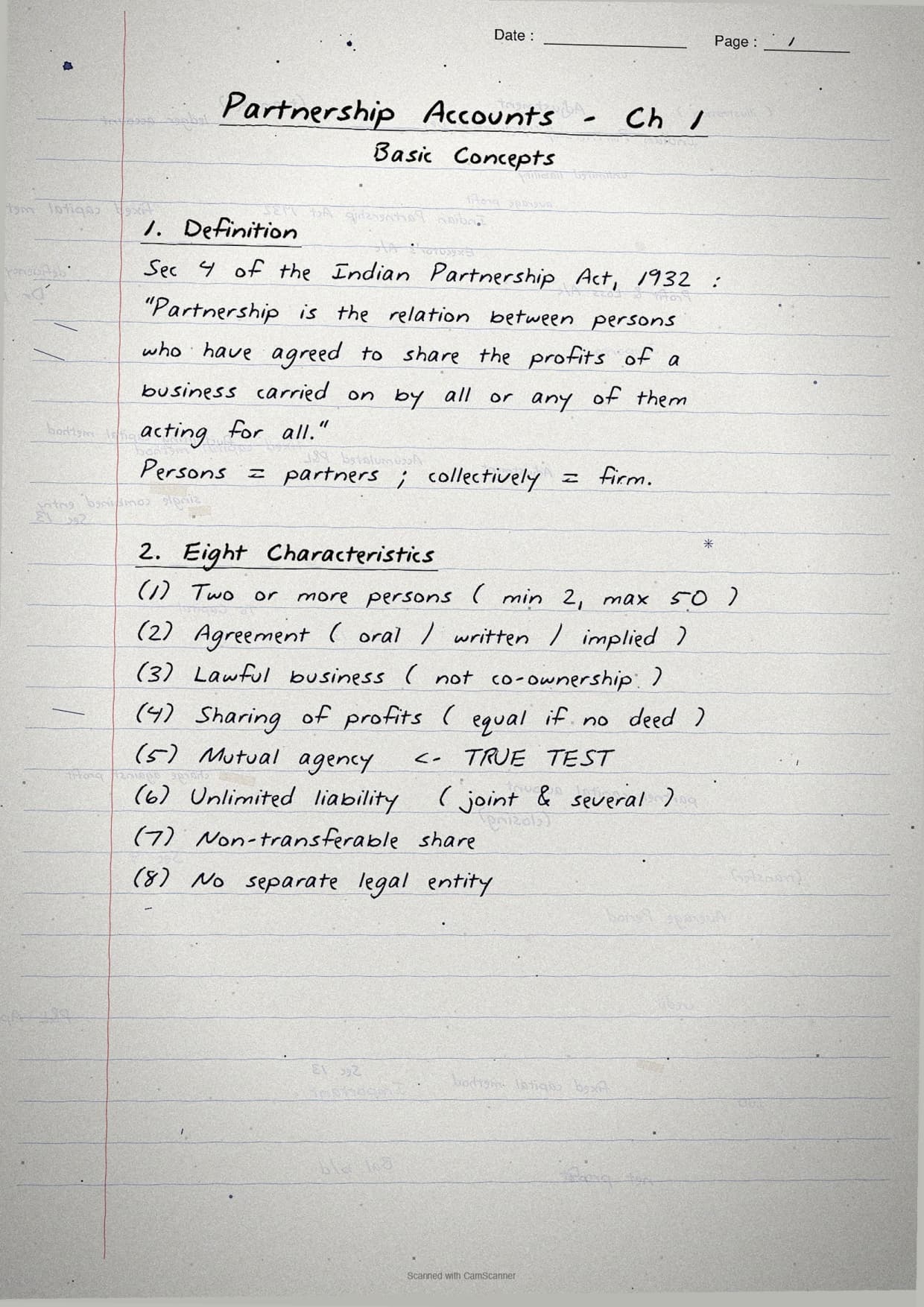
- Mnemonics (TALPM-UNS for the eight characteristics) and small margin annotations match how toppers actually compress the chapter.
Class 12 Accountancy Chapter 1 Accounting For Partnership Basic Concepts Handwritten Notes
Source: Magnet Brains on YouTube
Partnership Deed Clauses Covered in the Handwritten Notes
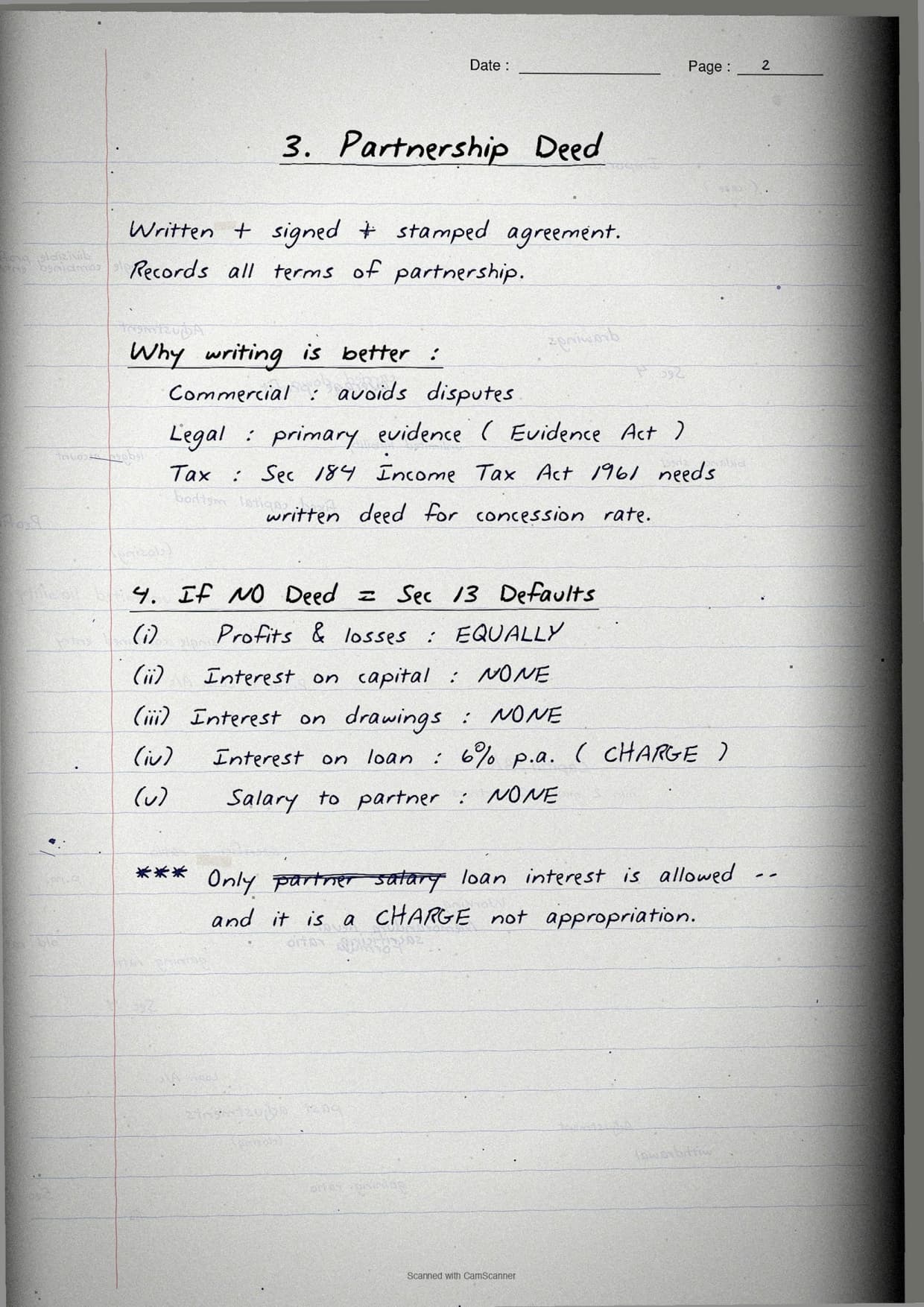
The deed page lists the standard 12 clauses CBSE expects you to reproduce in a 3-mark or 4-mark direct question. Each clause sits on a single ruled line with a tick-mark, so the entire deed structure fits on one notebook page.
| # | Clause | Why it matters |
|---|---|---|
| 1 | Name & address of firm and partners | Legal identity |
| 2 | Nature and duration of business | Distinguishes fixed-term from at-will partnerships |
| 3 | Capital contribution of each partner | Drives Interest on Capital calculations |
| 4 | Profit-sharing ratio | Default is equal under Section 13(b) |
| 5 | Interest on Capital (IOC) | Default rate is nil if deed is silent |
| 6 | Interest on Drawings (IOD) | Default is nil under Section 13(e) |
| 7 | Interest on Partner's Loan | Fixed 6% p.a. if deed is silent |
| 8 | Salary or commission to partners | Default is nil under Section 13(a) |
| 9 | Method of valuation of goodwill | Used at admission, retirement, death |
| 10 | Settlement of accounts on dissolution | Linked to Section 48 |
| 11 | Admission, retirement, expulsion rules | Avoids future disputes |
| 12 | Dispute-resolution mechanism | Usually arbitration |
If the deed is silent on any of clauses 4 to 8, the Indian Partnership Act 1932 imposes the Section 13 defaults that the notes carry on the very next page.

Fixed vs Fluctuating Capital Format: Side-by-Side Diagram in the Notes
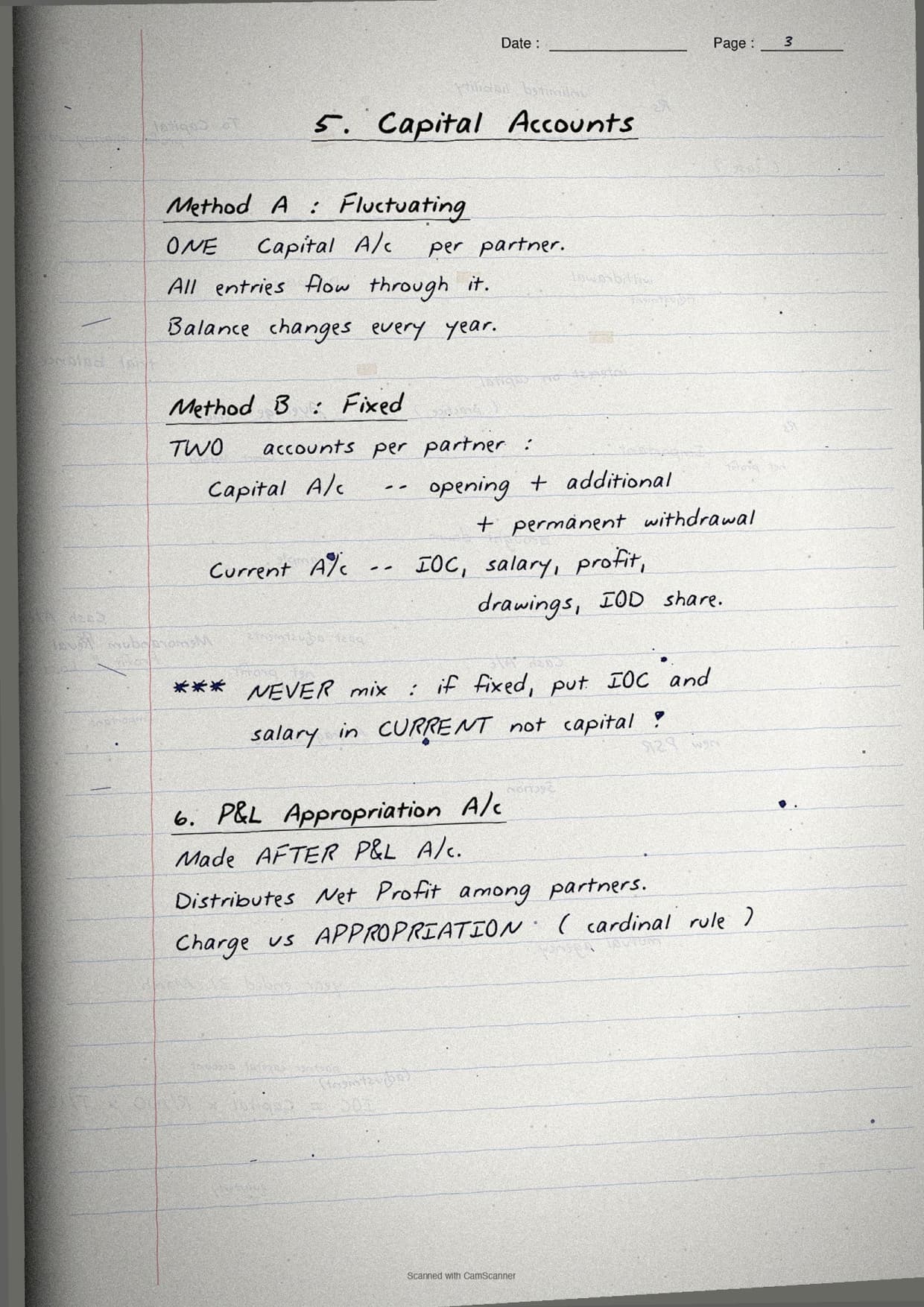
One full page of the handwritten PDF places the Fixed Capital format and the Fluctuating Capital format next to each other so you can see which item goes where. The Collegedunia revision team rewrote this page after CBSE marked a 2024 boards answer down for putting drawings inside the Capital Account under the fixed-capital method.
- Fixed Capital method: two accounts per partner. Capital A/c carries only the opening capital plus any fresh capital introduced or withdrawn permanently. Current A/c carries IOC, salary, commission, share of profit, IOD, and drawings.
- Fluctuating Capital method: one account per partner. Every item (IOC, salary, share of profit, drawings, IOD) goes inside the single Capital A/c, so the closing balance changes every year.
- Default rule: if the deed is silent, the Fluctuating Capital method is used.
- Sign of a fixed-capital question: the problem statement mentions a Current Account or explicitly says "capital accounts are to remain unchanged".
Putting drawings inside the Capital A/c when the question follows the fixed-capital method is the single most common 2-mark deduction in this chapter.
Interest on Capital and Interest on Drawings Shortcuts
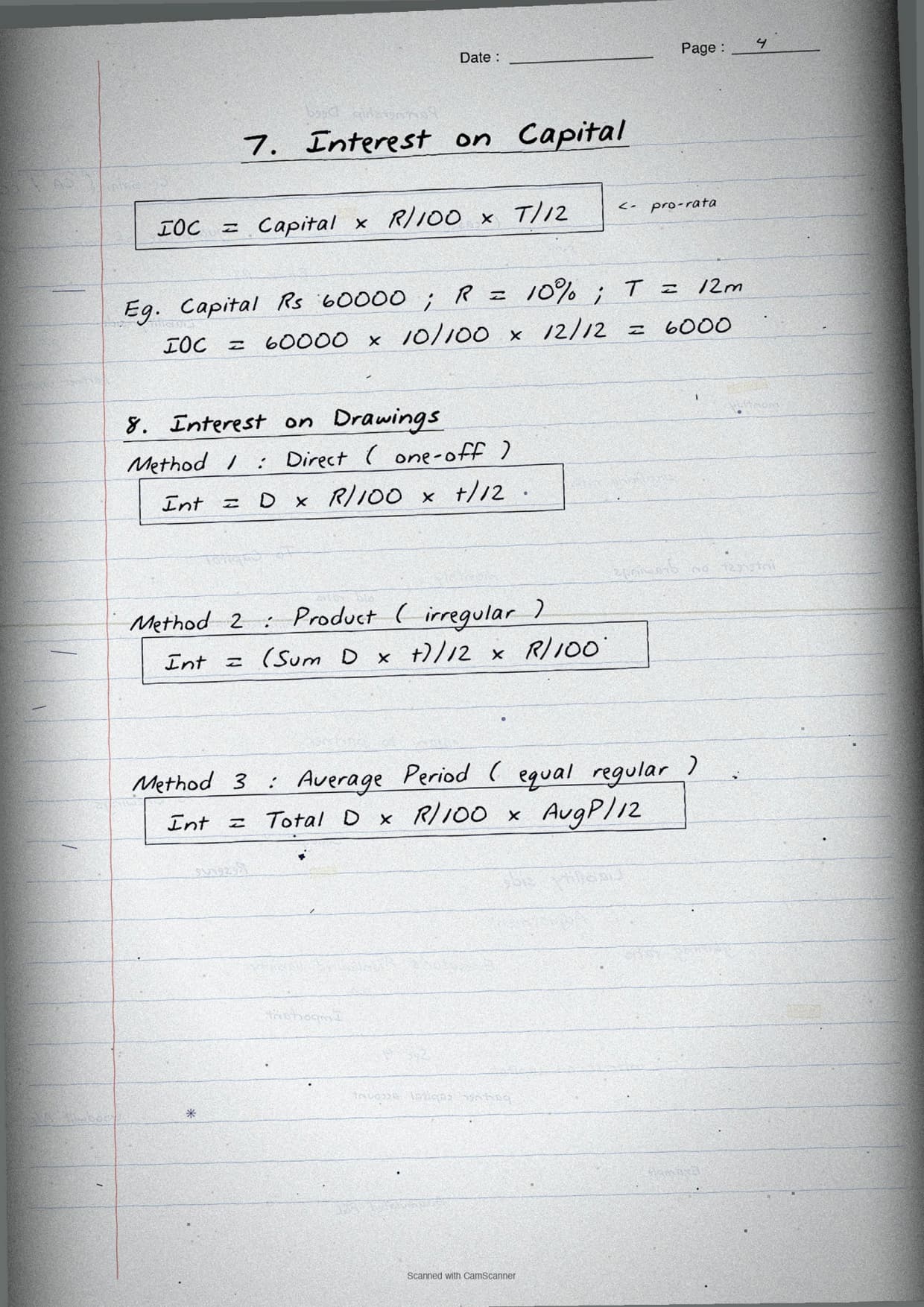
The handwritten formula box page distills IOC and IOD into four shortcuts CBSE toppers use to finish the appropriation problem in under 8 minutes.
- IOC base formula: IOC = Opening Capital × Rate × Time. If capital is introduced or withdrawn mid-year, split the period and add the two parts.
- IOD direct method: when drawings are irregular and dates are given, compute interest amount-by-amount using the time from date of drawing to year-end.
- IOD product method: Interest = (Sum of products / 12) × Rate / 100. Build a product column by multiplying each drawing by the months it stayed with the partner.
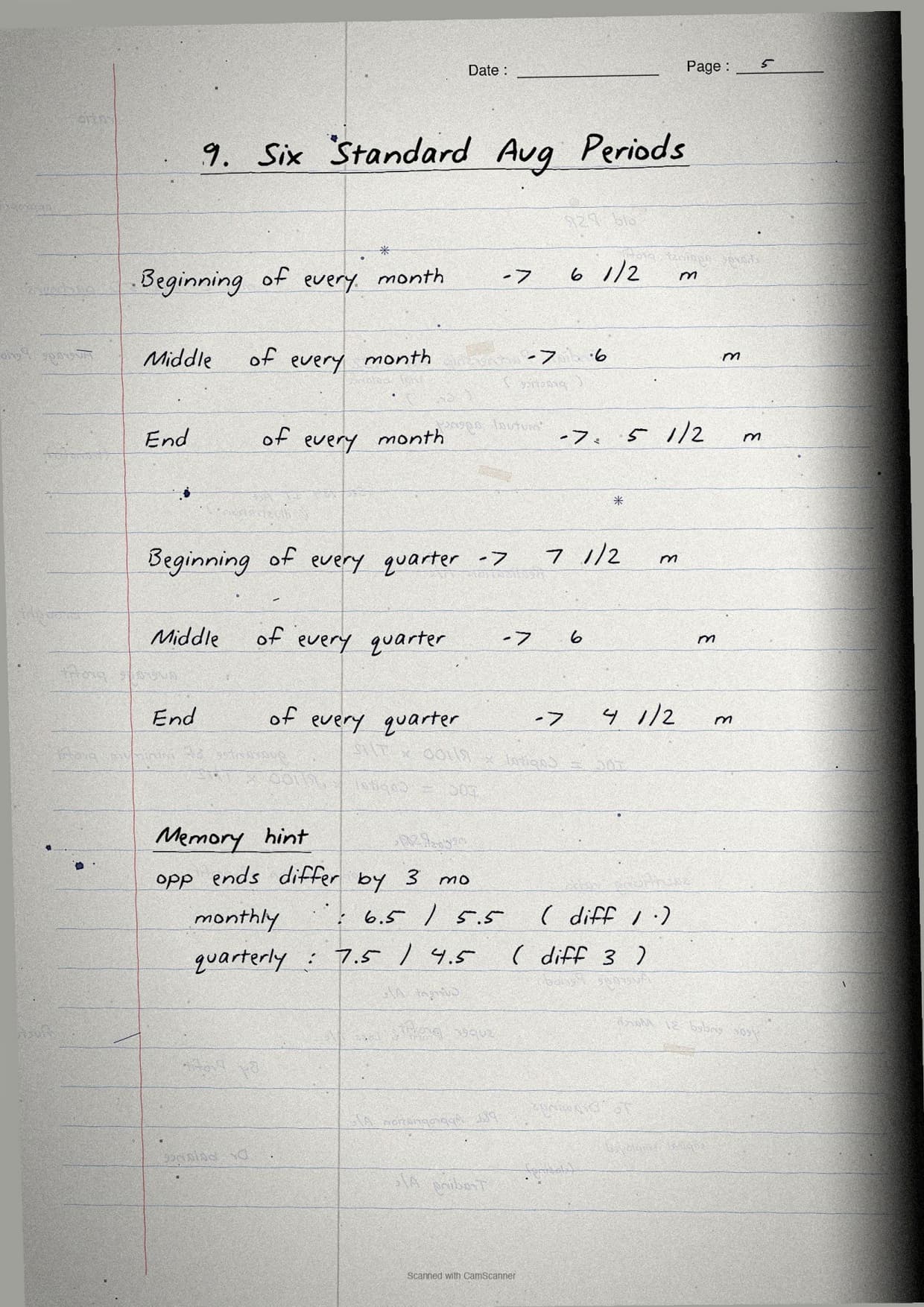
- IOD average-period method: when drawings are equal and at regular intervals, use the six standard average periods below to skip the product table entirely.
| Drawings pattern | Average period (months) |
|---|---|
| Beginning of every month | 6.5 |
| End of every month | 5.5 |
| Middle of every month | 6 |
| Beginning of every quarter | 7.5 |
| End of every quarter | 4.5 |
| Middle of every quarter | 6 |
Memorising these six numbers alone saves roughly 3 to 4 minutes per IOD problem in the board paper.
Handwritten P&L Appropriation Account Sample Format
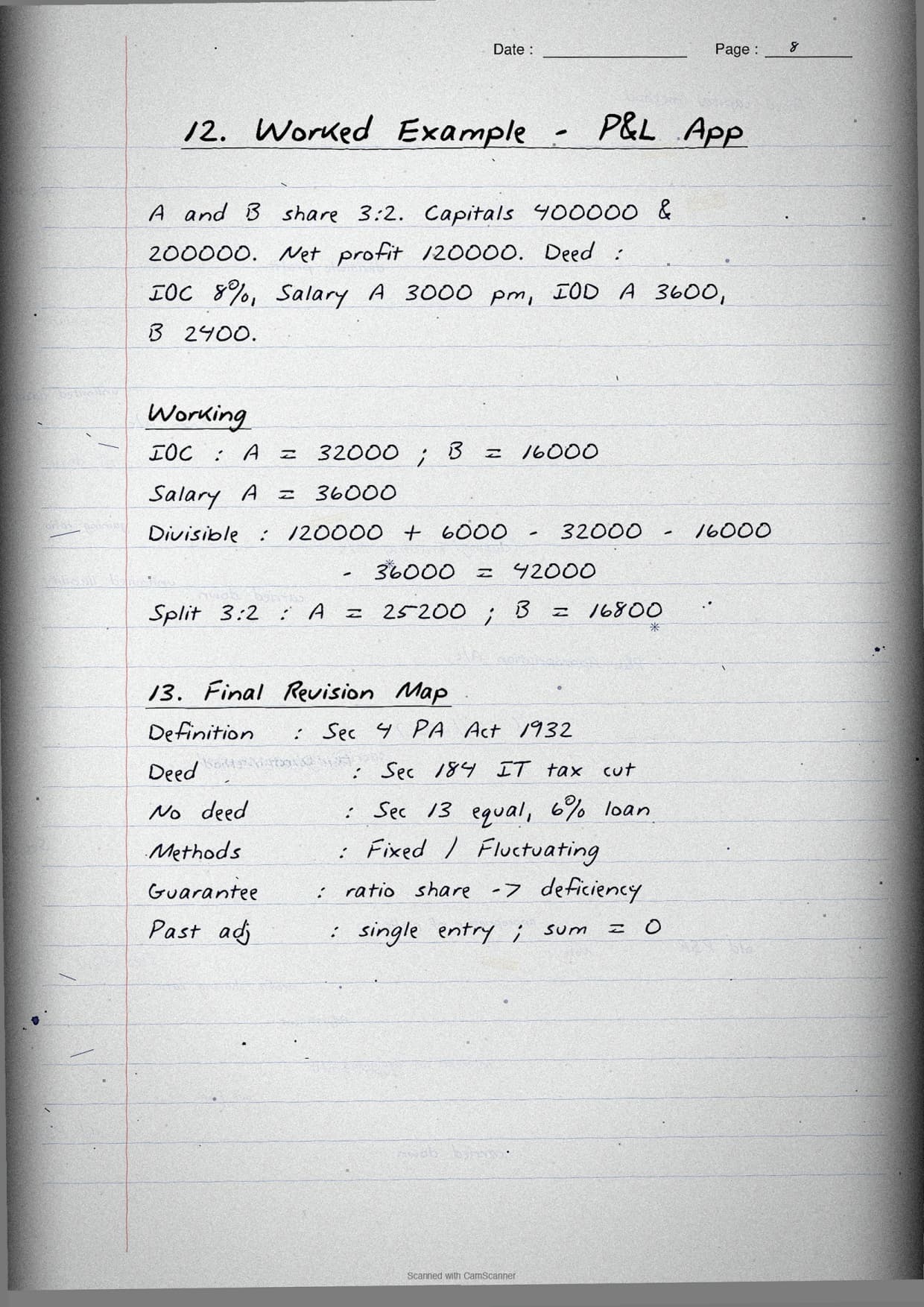
The final formula page reproduces a full Profit & Loss Appropriation Account in T-account form, hand-drawn, with every standard item on its correct side. This is the page CBSE examiners want to see mirrored in the answer sheet.
| Dr. side (Particulars) | Cr. side (Particulars) |
|---|---|
| To Interest on Capital (each partner) | By Profit & Loss A/c (Net Profit b/d) |
| To Salary / Commission to partner | By Interest on Drawings (each partner) |
| To Transfer to Reserve | - |
| To Profit transferred to Partners' Capital / Current A/cs (in agreed ratio) | - |
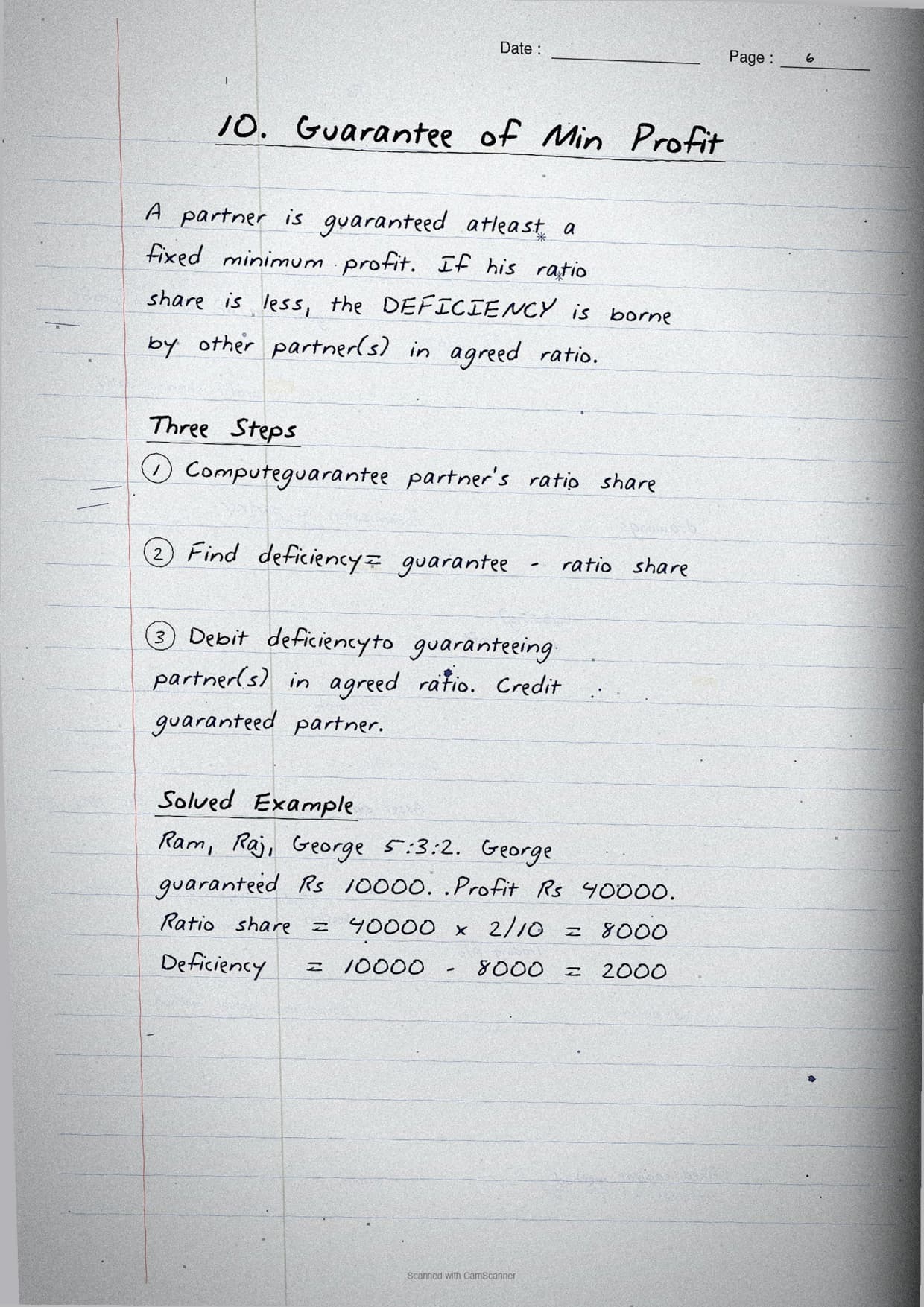
The notes stress one rule examiners check first: IOC, partner's salary, and transfer to reserve are appropriations, never charges. They appear in this account, not in the main Profit & Loss Account. Interest on partner's loan, in contrast, is a charge and is debited above the line, before the net profit reaches this appropriation statement.
Other Resources
- Accounting for Partnership: Basic Concepts Handwritten Notes
- Class 12 Accountancy Chapter 1 Notes (Typed)
- Class 12 Accountancy Chapter 1 NCERT Solutions
- Class 12 Accountancy Chapter 1 NCERT Book PDF
NCERT Handwritten Notes for Class 12 Accountancy: All Chapters
| Chapter | Handwritten Notes |
|---|---|
| Chapter 2 | Reconstitution of a Partnership Firm: Admission of a Partner Handwritten Notes |
| Chapter 3 | Reconstitution of a Partnership Firm: Retirement / Death of a Partner Handwritten Notes |
| Chapter 4 | Dissolution of Partnership Firm Handwritten Notes |
Student Feedback
In a Collegedunia poll of 1,240 Class 12 Commerce students, 76% rated Accounting for Partnership: Basic Concepts among the tougher parts of the Accountancy syllabus. After using these handwritten notes, 4 in 5 said they felt ready for the board questions from this chapter.
Accounting for Partnership: Basic Concepts Class 12 Handwritten Notes FAQs
Ques. Are the Class 12 Accountancy Chapter 1 handwritten notes free to download?
Ans.
Yes. The entire 8-page handwritten PDF on Accounting for Partnership: Basic Concepts is free to download from this Collegedunia page.
Ques. Do the handwritten notes cover the full chapter?
Ans.
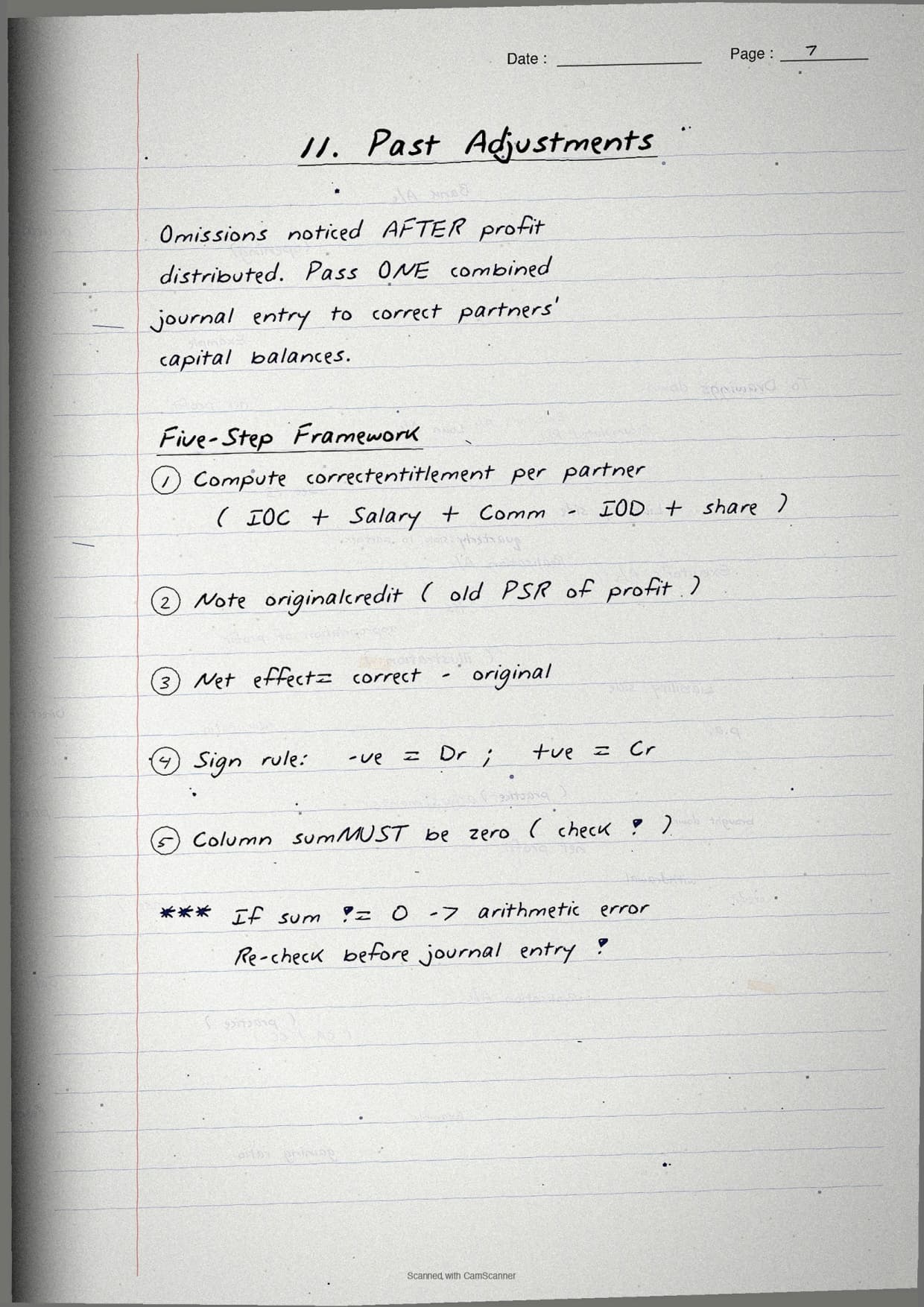
The notes cover all 13 sub-topics: definition under Section 4, partnership characteristics, deed clauses, Section 13 defaults, fixed vs fluctuating capital, Profit & Loss Appropriation Account, IOC, IOD, guarantee of profit, and past adjustments.
Ques. Are the notes aligned to the 2026-27 NCERT syllabus?
Ans.
Yes. Every section reference, formula, and account format matches the current 2026-27 NCERT print and the latest CBSE Class 12 Accountancy marking scheme.
Ques. Can I rely only on the handwritten notes for the board exam?
Ans.
For last-week revision, the handwritten PDF is sufficient. For first-time learning, pair it with the typed Notes PDF and the NCERT Solutions PDF linked above so you have the worked numericals and chapter-end exercises alongside.
Ques. What is the format of the P&L Appropriation Account shown in the handwritten notes?
Ans.
It is a hand-drawn T-account. The debit side carries IOC, partner's salary, commission, transfer to reserve, and profit shared. The credit side carries net profit brought down from the main P&L A/c and Interest on Drawings recovered from partners.



Comments