



These Motivation and Emotion handwritten notes turn the whole of Chapter 8 into clean, handwritten pages for fast last-minute revision. They follow the 2026-27 NCERT syllabus and Chapter 8 of Class 11 Psychology. Students get the nature of motivation, the motivational cycle, biological and psychosocial motives, Maslow's hierarchy of needs, and the nature and expression of emotions in a pen-on-paper format that is easy to skim before a test.
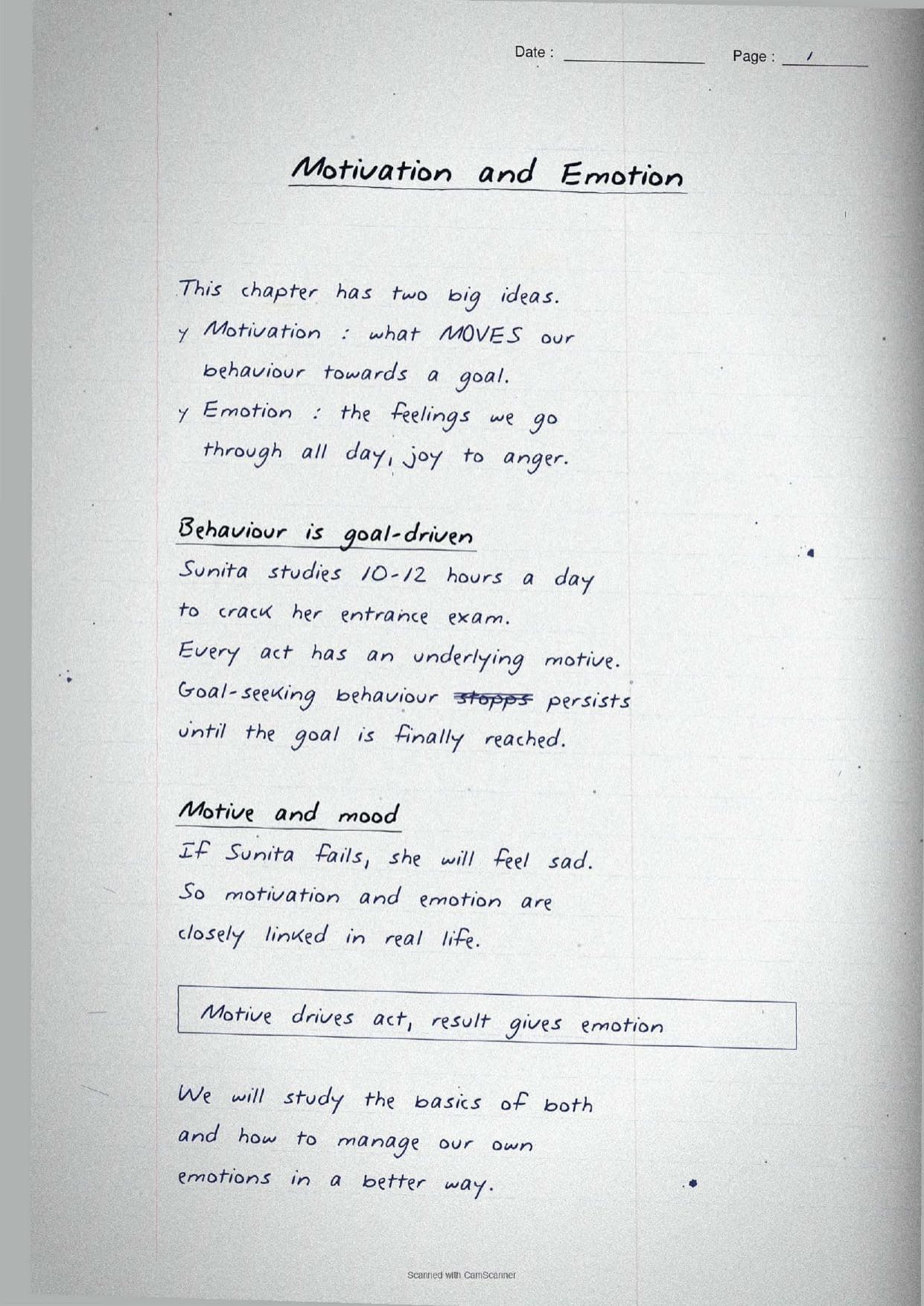
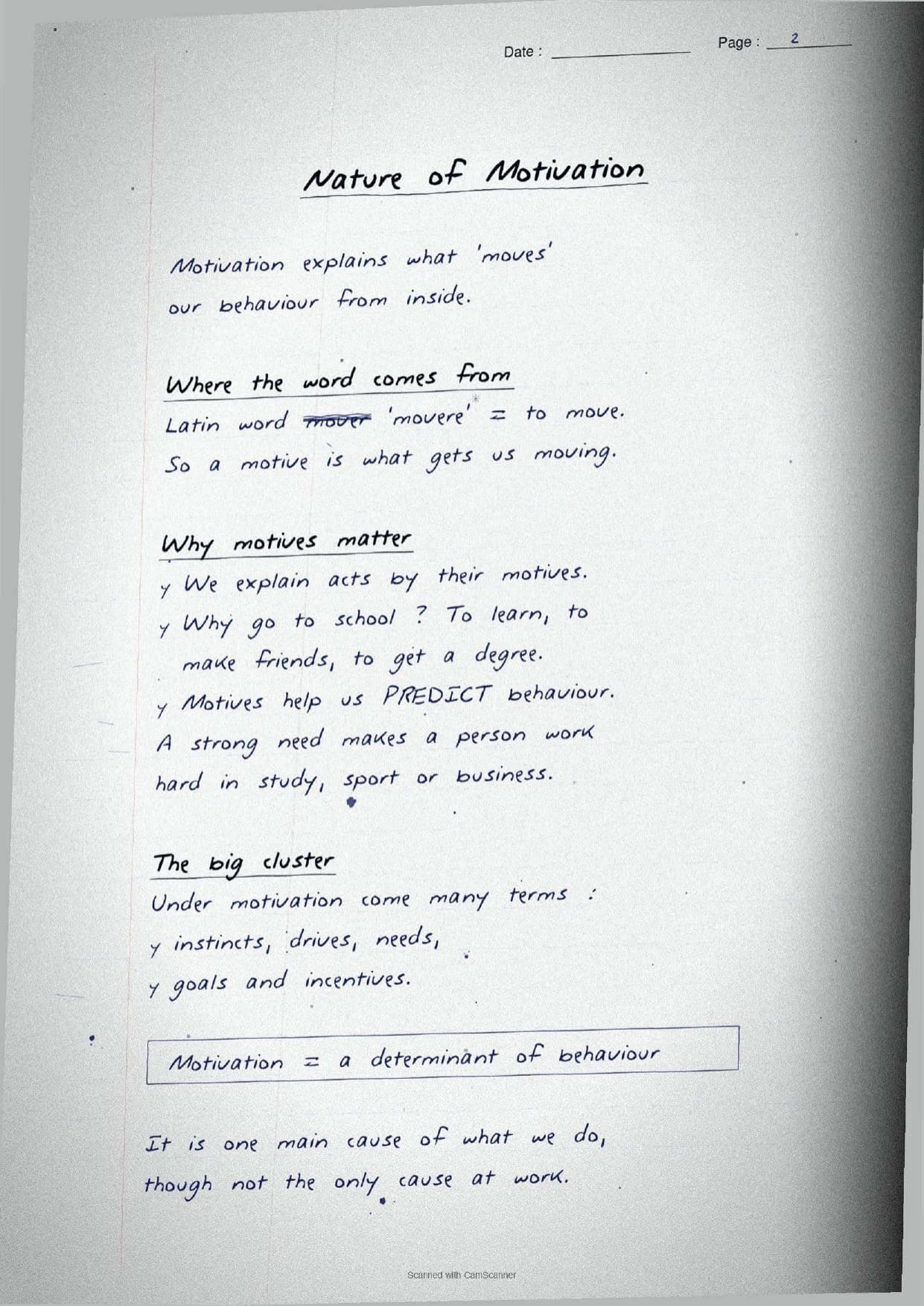
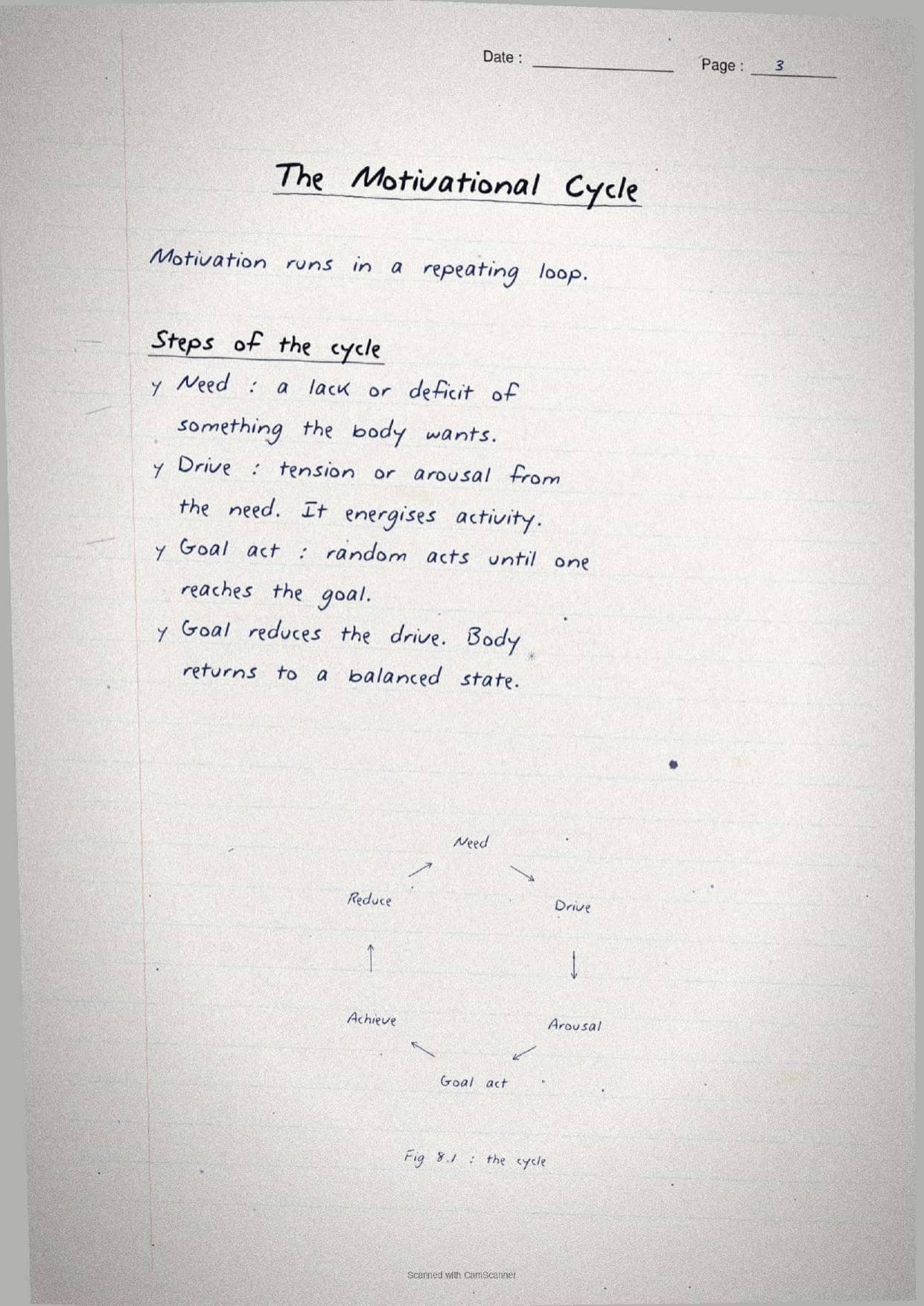
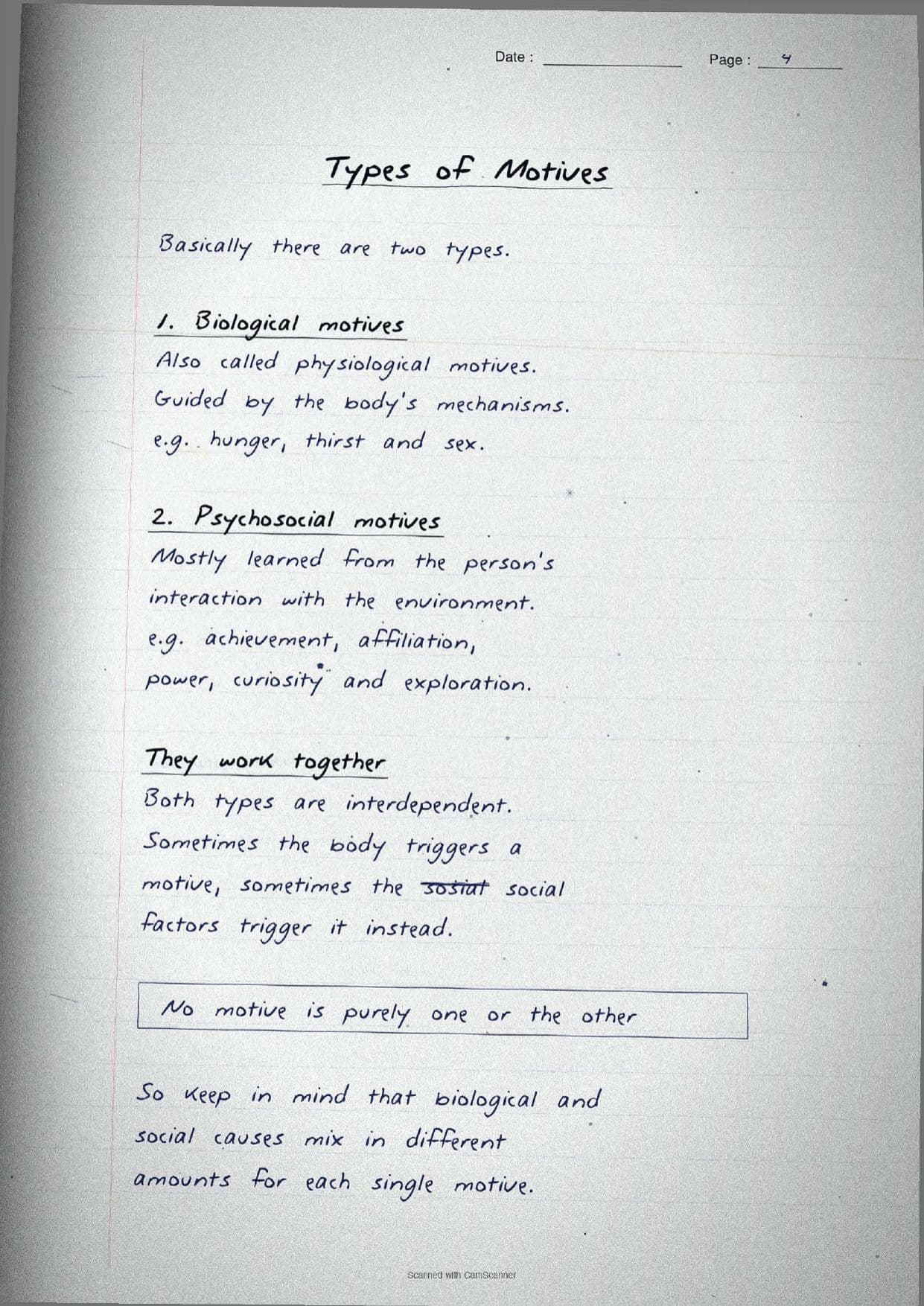
- Handwritten pages with boxed key terms and a labelled motivational-cycle diagram.
- Covers both halves of the chapter, motivation and emotion, so nothing gets missed in Class 11 revision.
- Pairs with the NCERT Solutions, Notes and Book PDF linked lower on this page.
These Motivation and Emotion handwritten notes are prepared from the official NCERT Psychology textbook and checked against recent CBSE Class 11 question papers.
Student Feedback: In a Collegedunia poll of 5,180 Class 11 Psychology students, 72% of students said the handwritten pages helped them recall the motivational cycle and the six basic emotions faster than printed text, because the boxed diagrams and arrows made the sequence stick.
Source: 2026-27 Class 11 Psychology student poll. Sample of 5,180 students from CBSE schools across 11 states.
What These Motivation and Emotion Handwritten Notes Contain
Motivation and Emotion is Chapter 8 of Class 11 Psychology. It studies what moves our behaviour and how we feel, with the spotlight on motives, needs and emotions. These handwritten notes condense the chapter into handwritten pages that read like a topper's own notebook.
The notes are organised under two clear threads, each on its own set of pages:
- Motivation: the nature of motivation, the motivational cycle, biological and psychosocial motives, and Maslow's hierarchy of needs.
- Emotion: the nature of emotion, its components, basic emotions, expression through verbal and non-verbal channels, and managing emotions.
Because the pages are handwritten, the key terms sit in boxes and arrows rather than long paragraphs. A student can flip through the Motivation and Emotion Class 11 pages in a few minutes and still pick up the motive types, the Maslow pyramid and the six basic emotions before walking into the exam.
Motivation and the Motivational Cycle in the Handwritten Pages
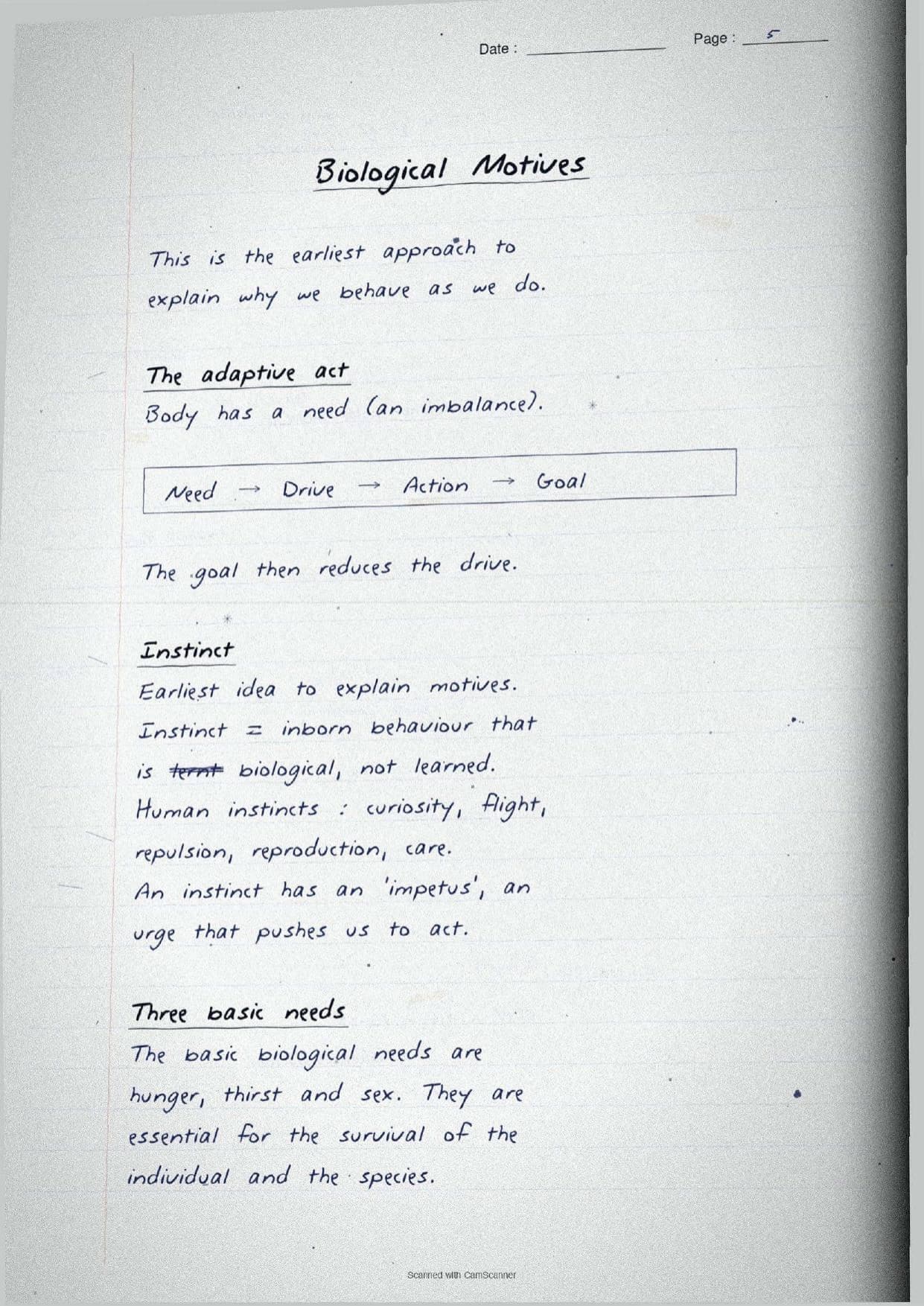
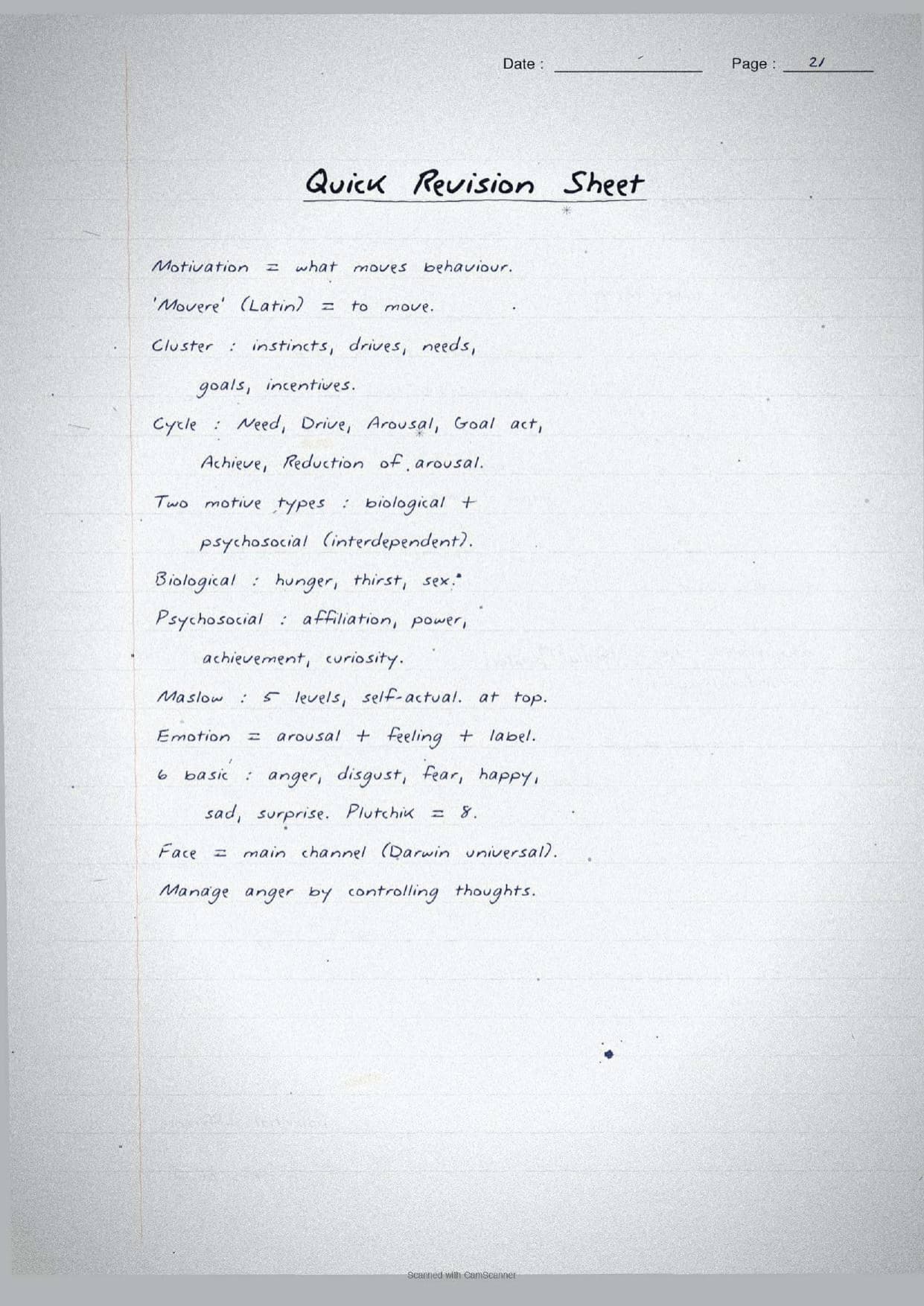
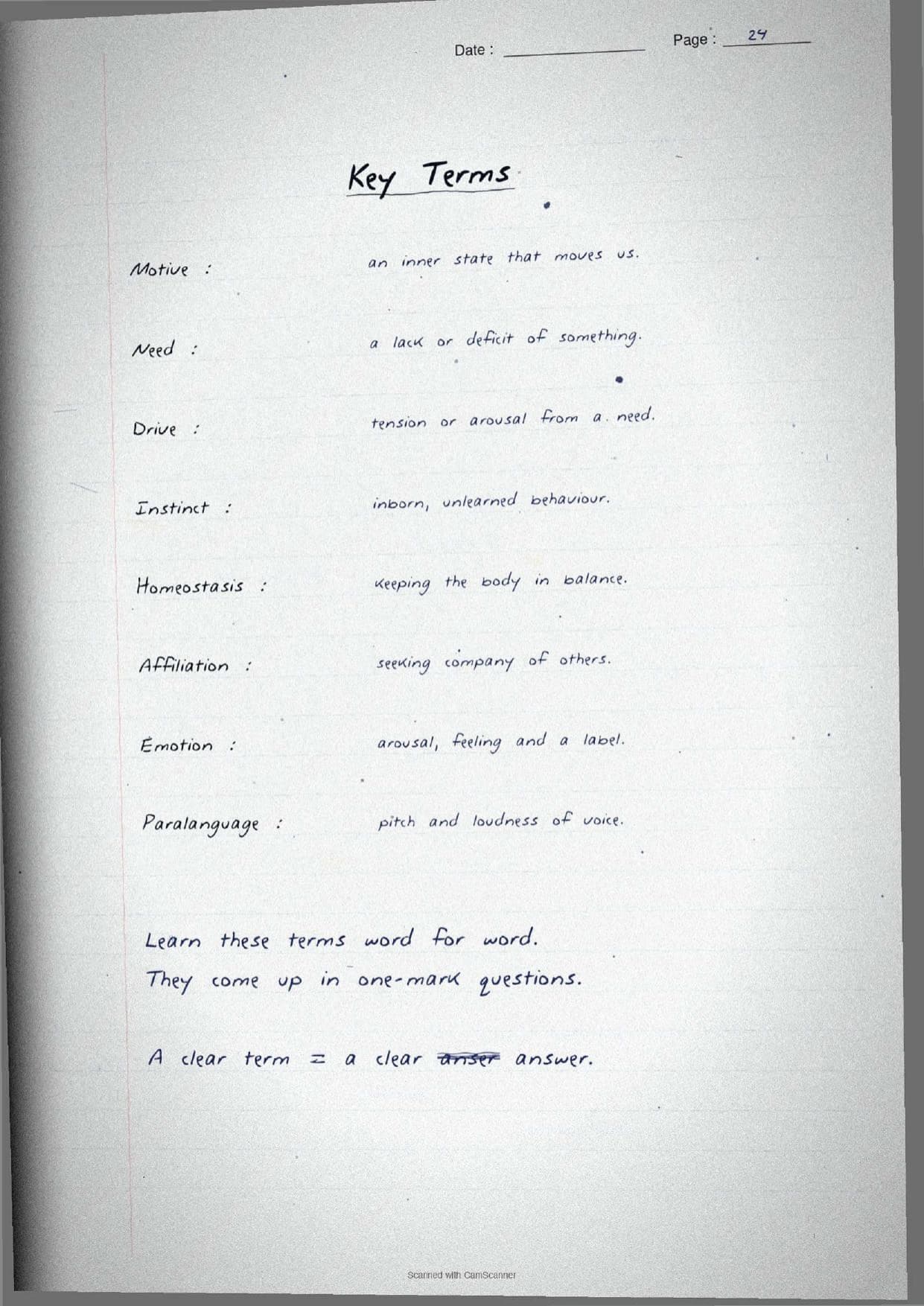
The first half of the notes builds motivation from the ground up. The word motivation comes from the Latin movere, meaning to move, and the pages draw the motivational cycle as a loop so the order is easy to remember: a need (a lack or deficit) leads to a drive (a state of tension or arousal), which pushes goal-directed behaviour, and reaching the goal reduces the arousal and returns the body to balance. The table below shows what the handwritten notes cover for each type of motive.
| Motive type | What the page shows |
|---|---|
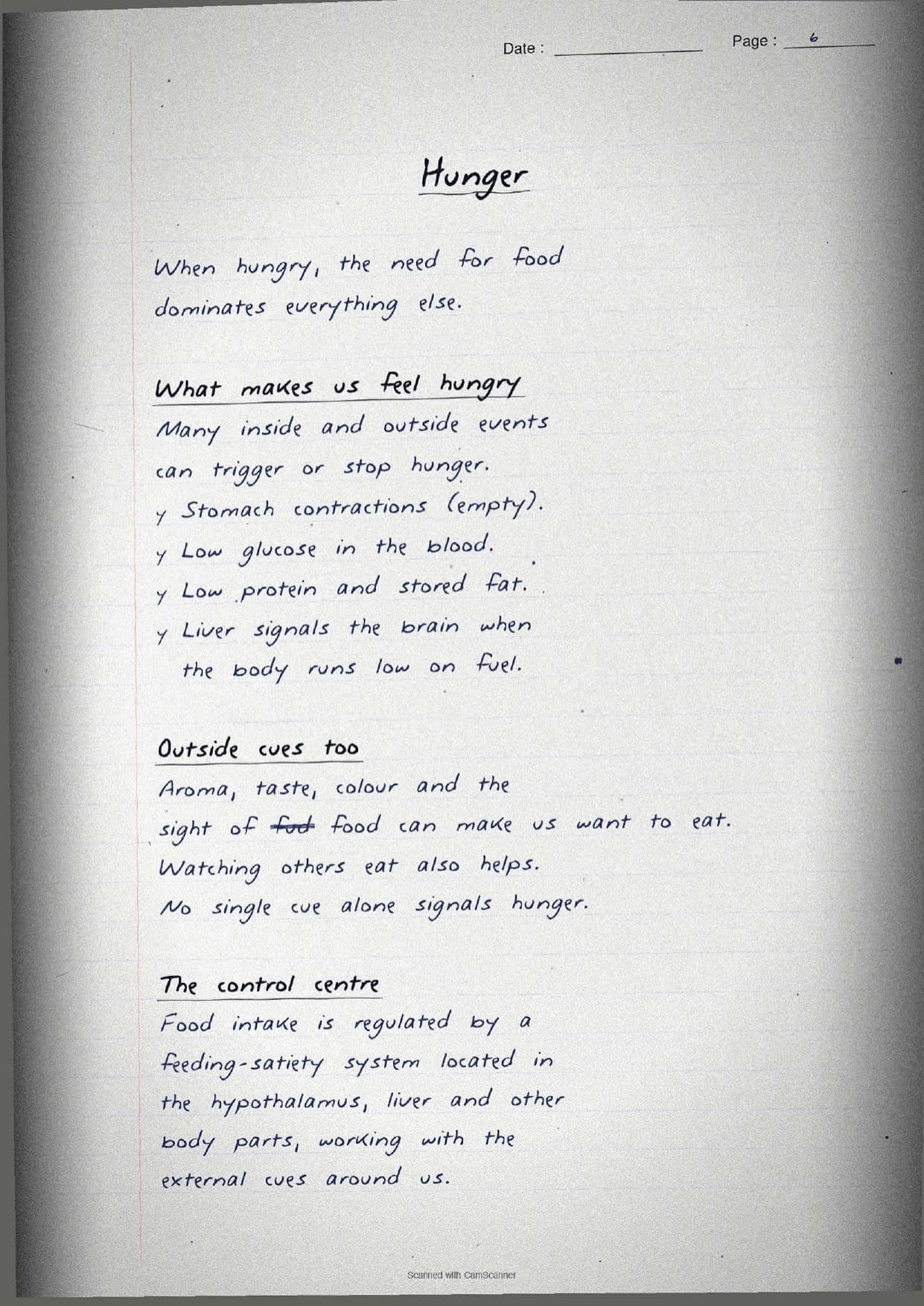
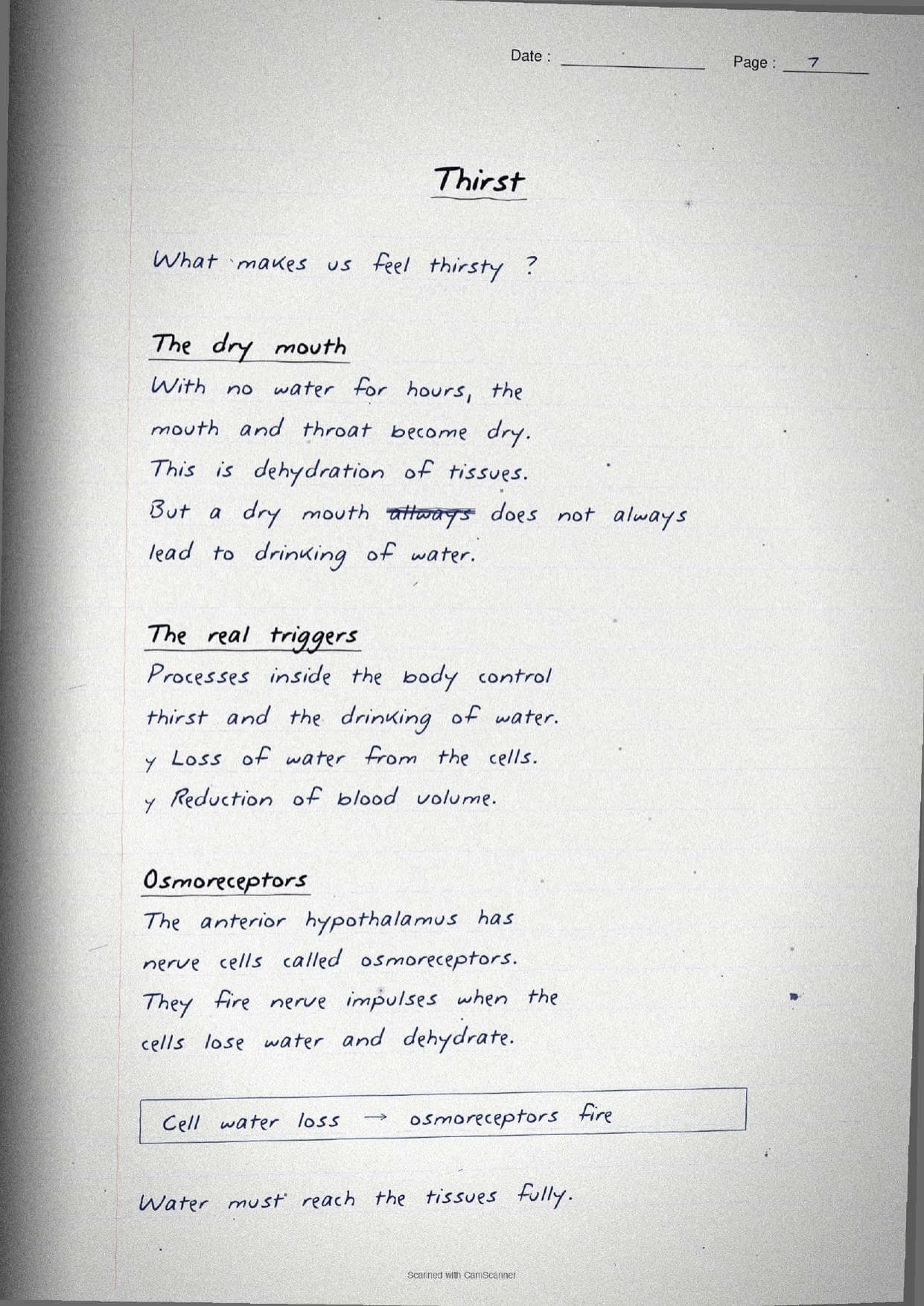
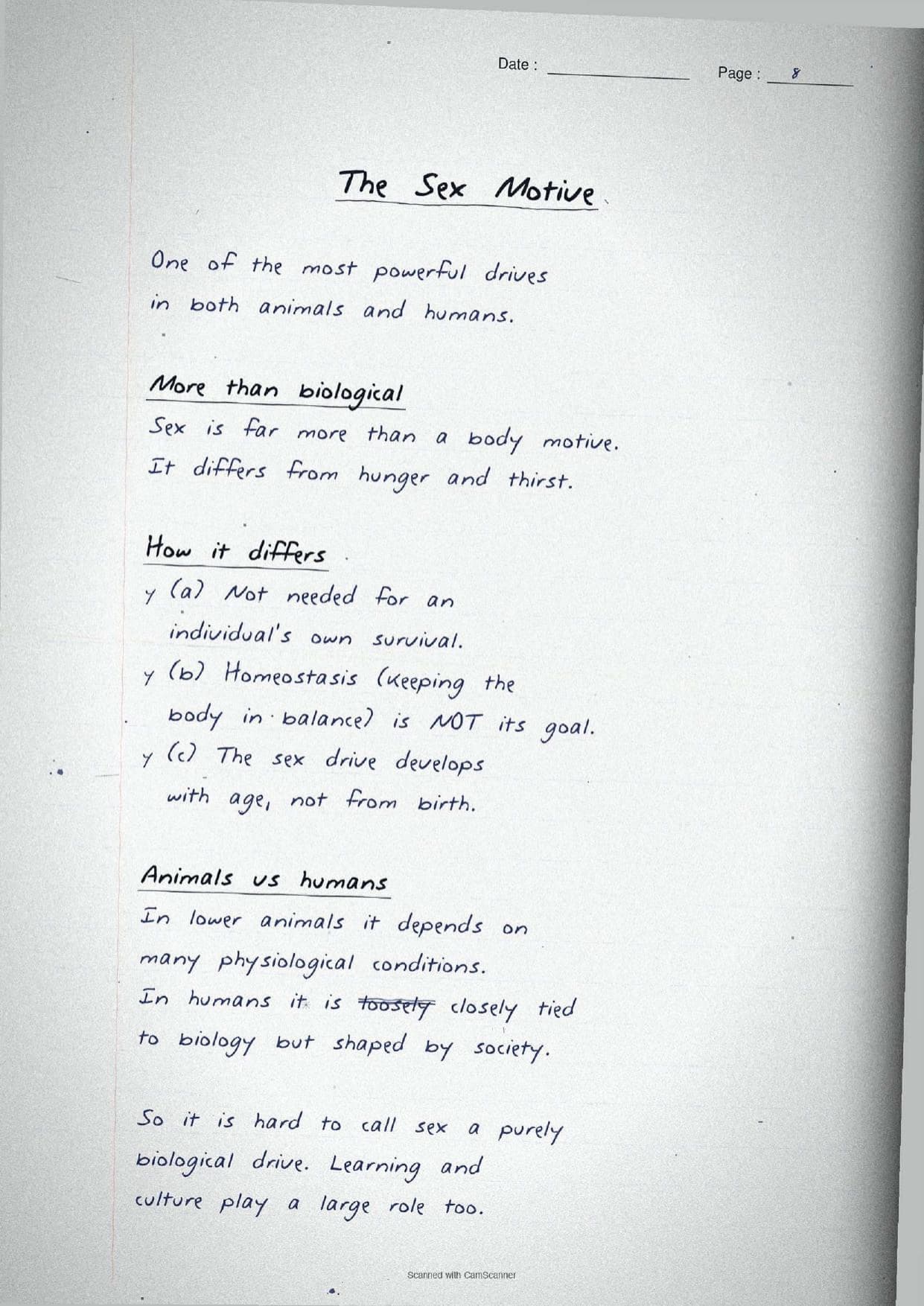
| Biological (physiological) | Hunger, thirst and sex; the role of the hypothalamus, glucose, osmoreceptors and instincts. |
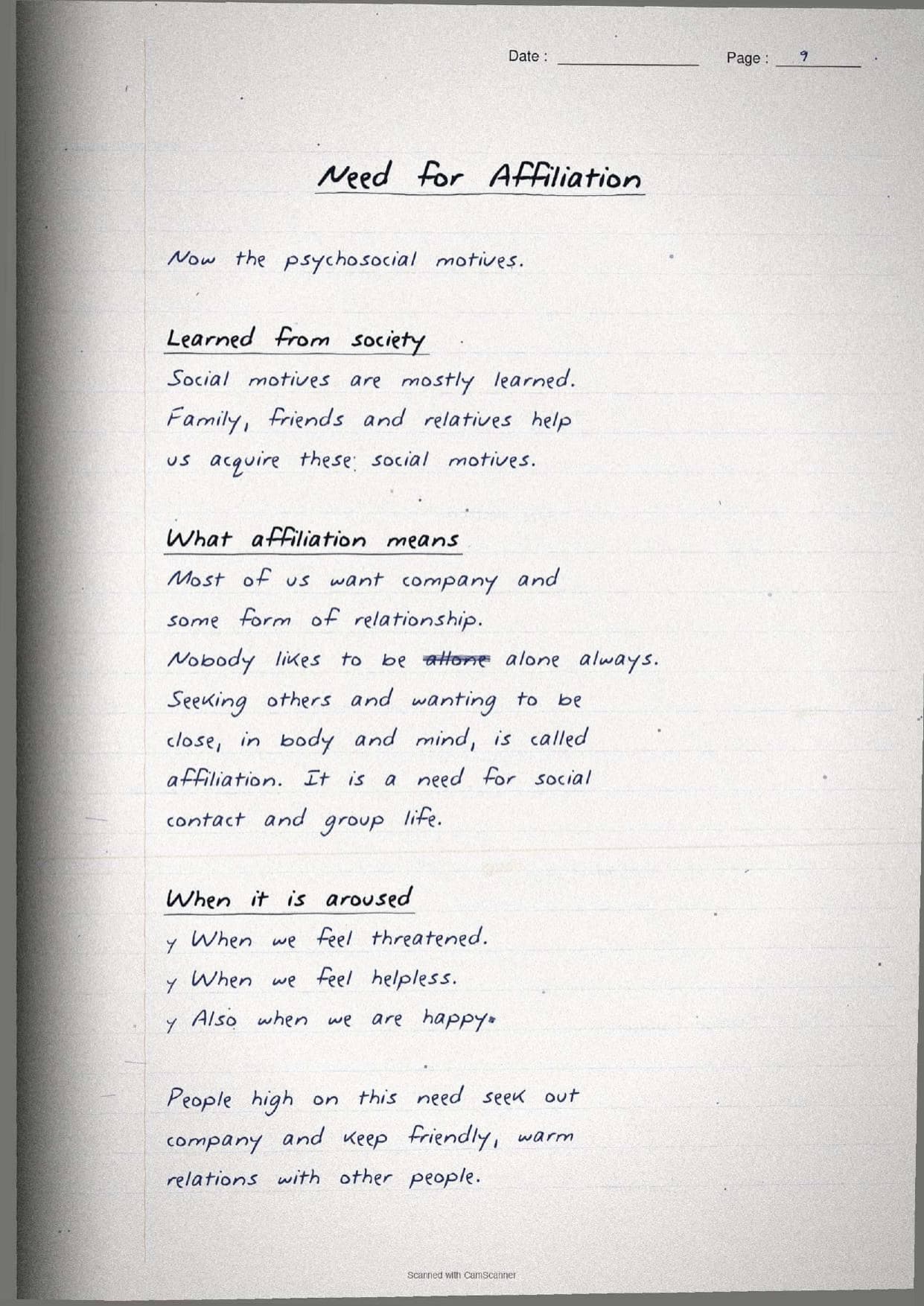
| Need for affiliation | The wish to seek company and keep friendly relationships with others. |
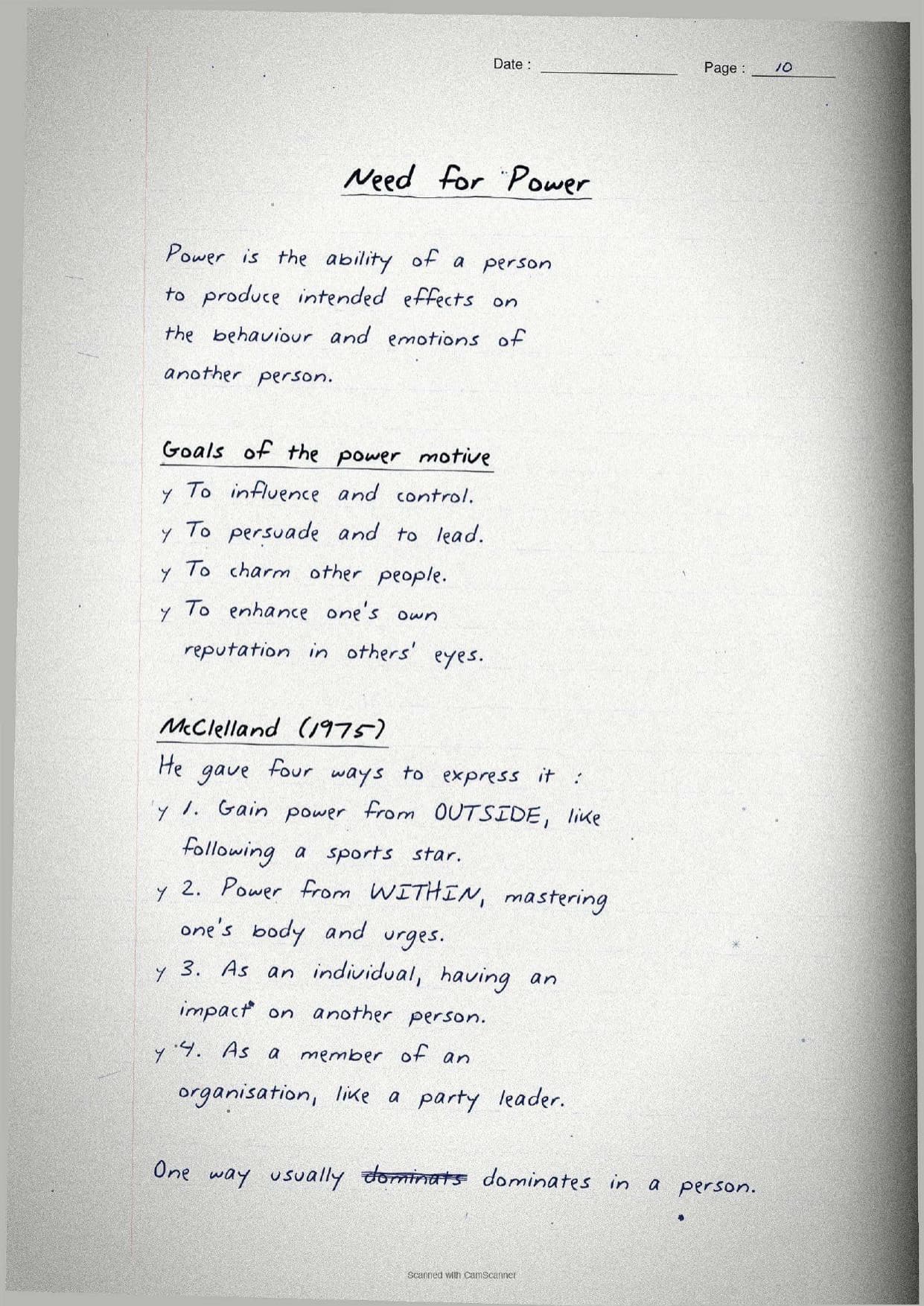
| Need for power | Producing intended effects on others; McClelland's four ways of expressing power. |
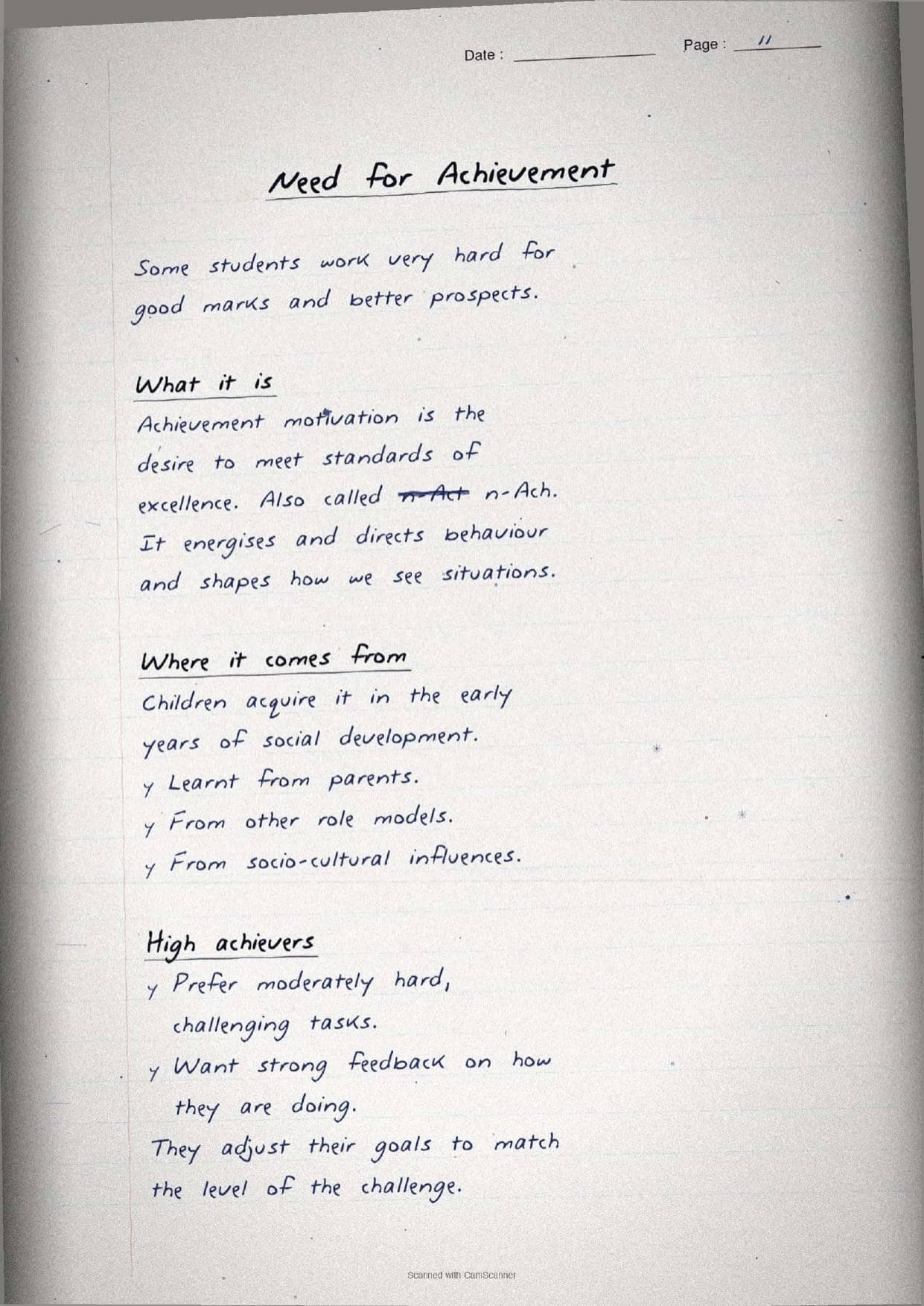
| Need for achievement (n-Ach) | The desire to meet standards of excellence; preference for moderately hard tasks. |
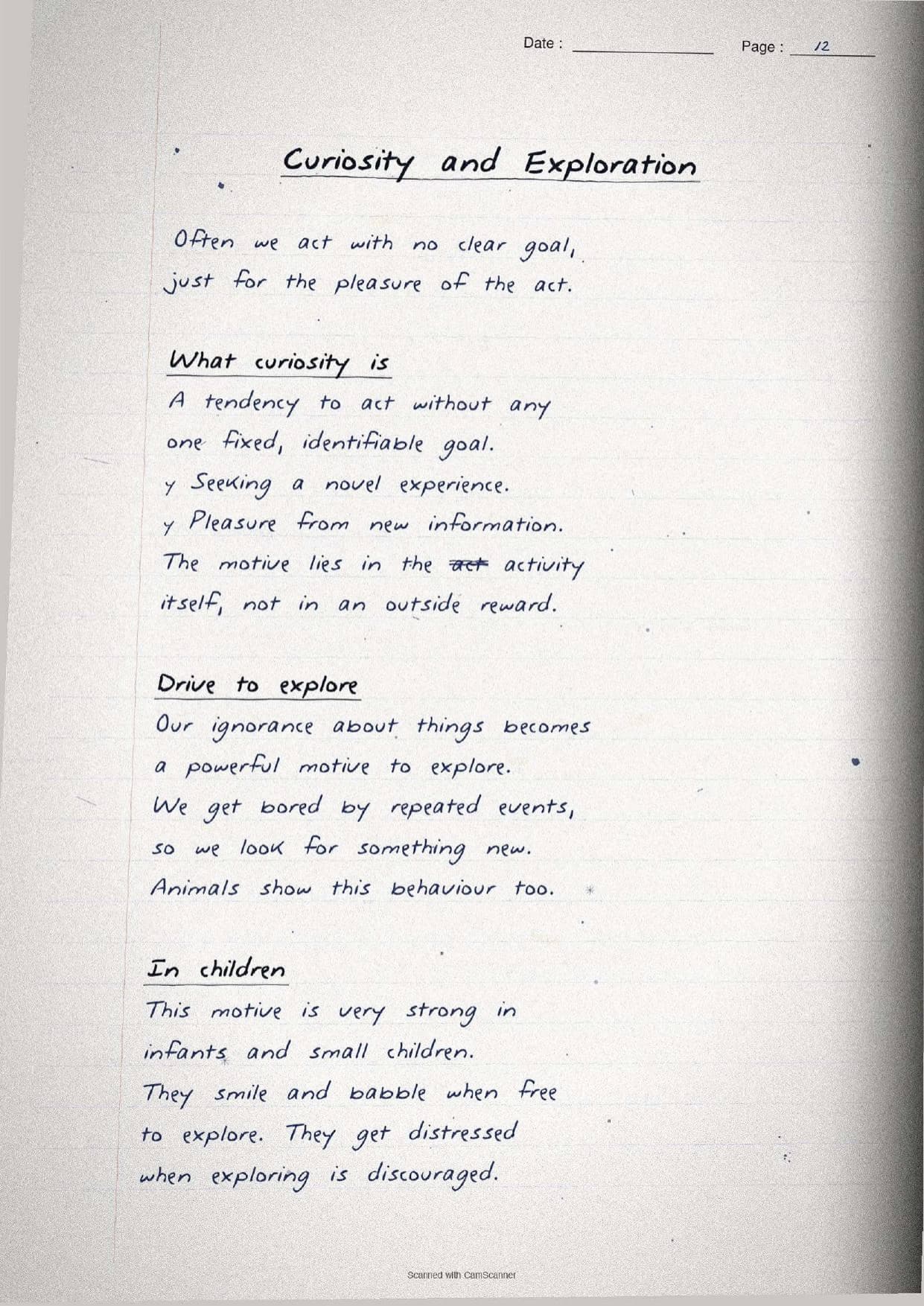
| Curiosity and exploration | Acting without a clear goal for the pleasure of novelty and sensory stimulation. |
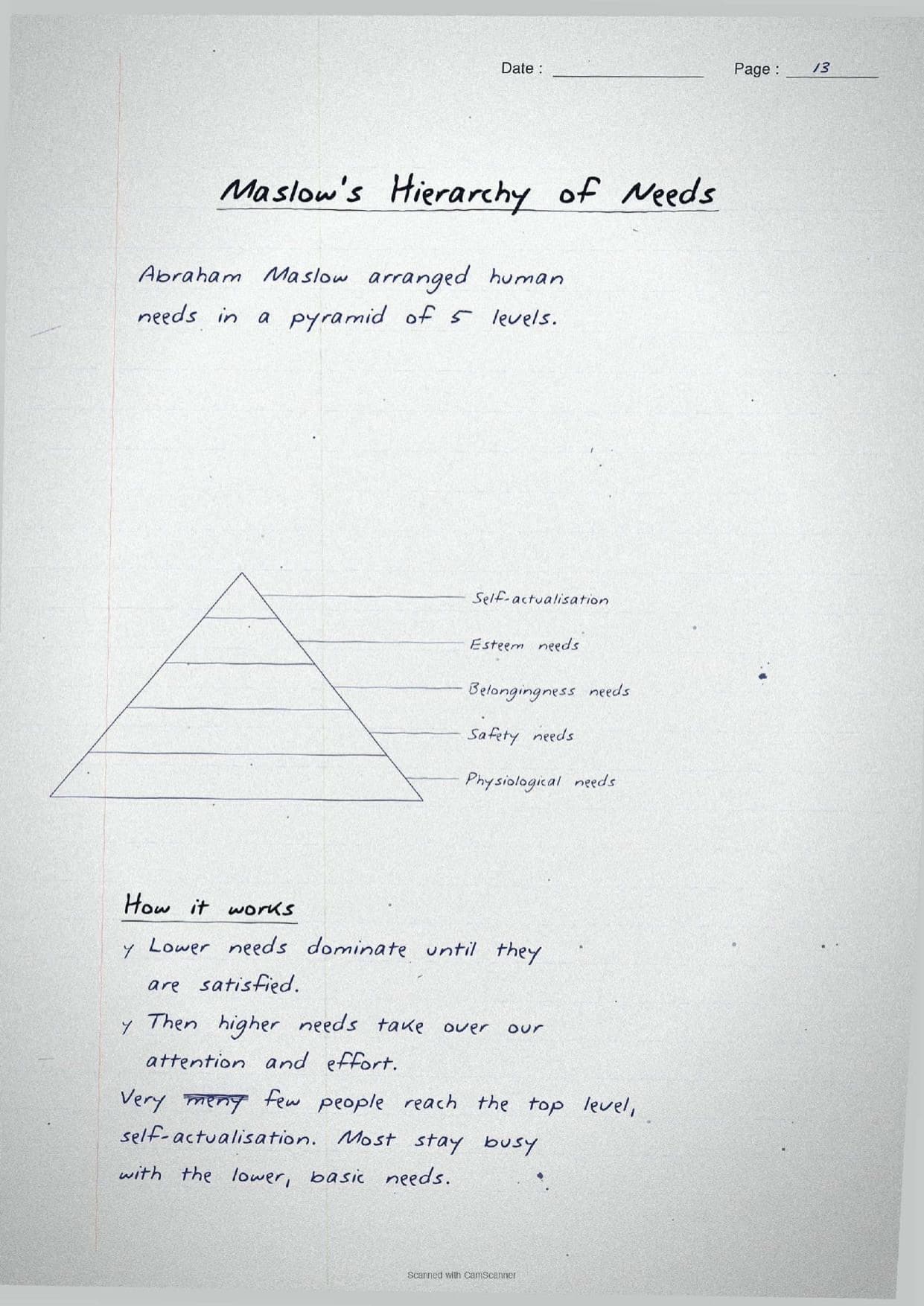
The pages then draw Maslow's hierarchy of needs as a pyramid: physiological needs at the base, then safety, belongingness, esteem, and self-actualisation at the top. The handwritten map makes the key point easy to see: lower needs dominate while unsatisfied, and only when they are met do higher needs take over. Keep this order in mind, because the pyramid is a favourite short-answer question.
Emotions and Their Expression in the Notes
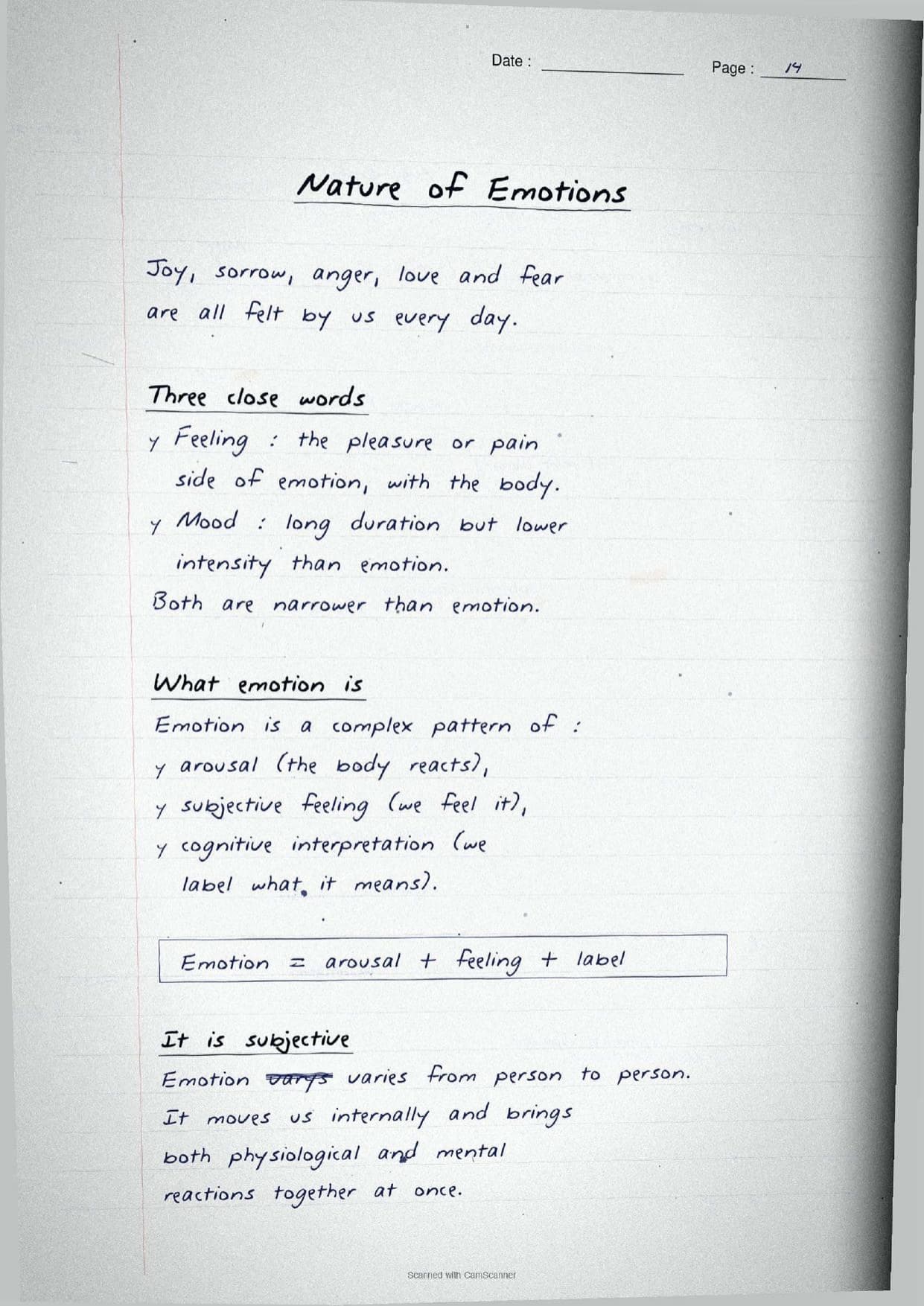
The later pages cover the second half of the chapter, emotion. An emotion is a complex pattern of arousal, subjective feeling and cognitive interpretation, so it has physiological, cognitive and behavioural components. These topics feed the short and long answers, so the handwritten notes keep them as boxed lists. The lists below show what each page covers.
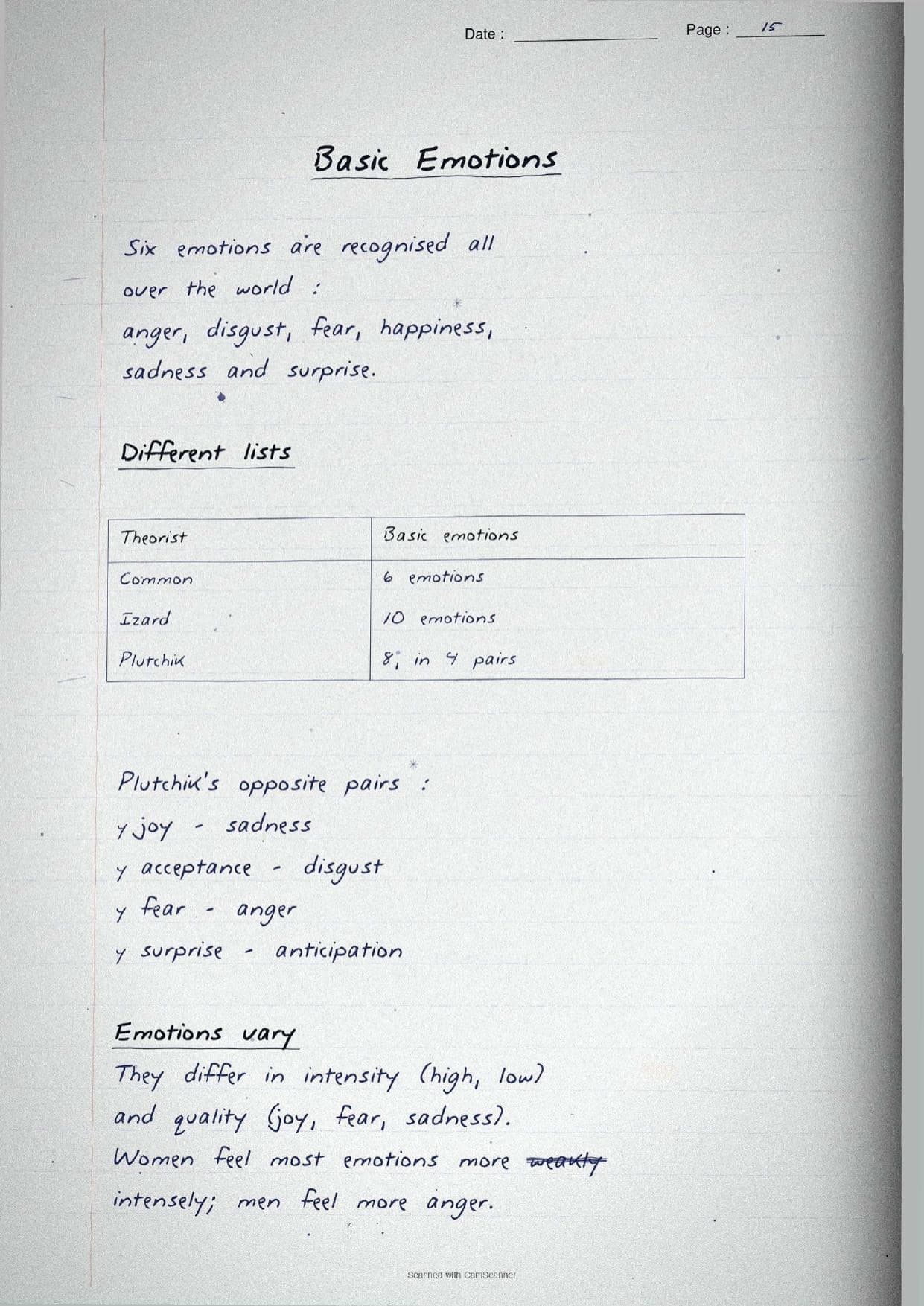
- Basic emotions: the six recognised everywhere, that is anger, disgust, fear, happiness, sadness and surprise, plus the Izard and Plutchik sets.
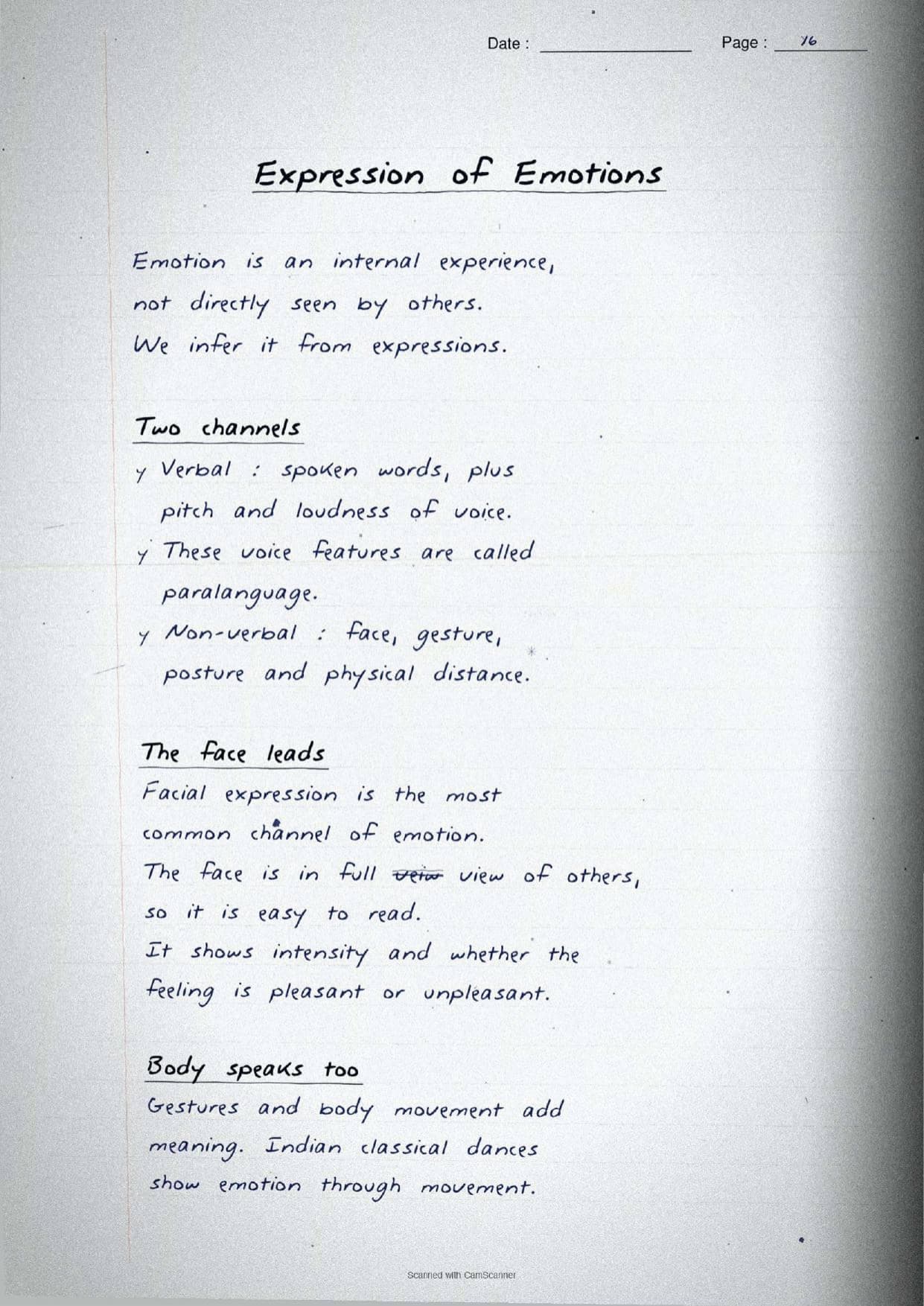
- Expression: verbal and non-verbal channels, paralanguage, gestures, posture and facial expression as the most common channel.
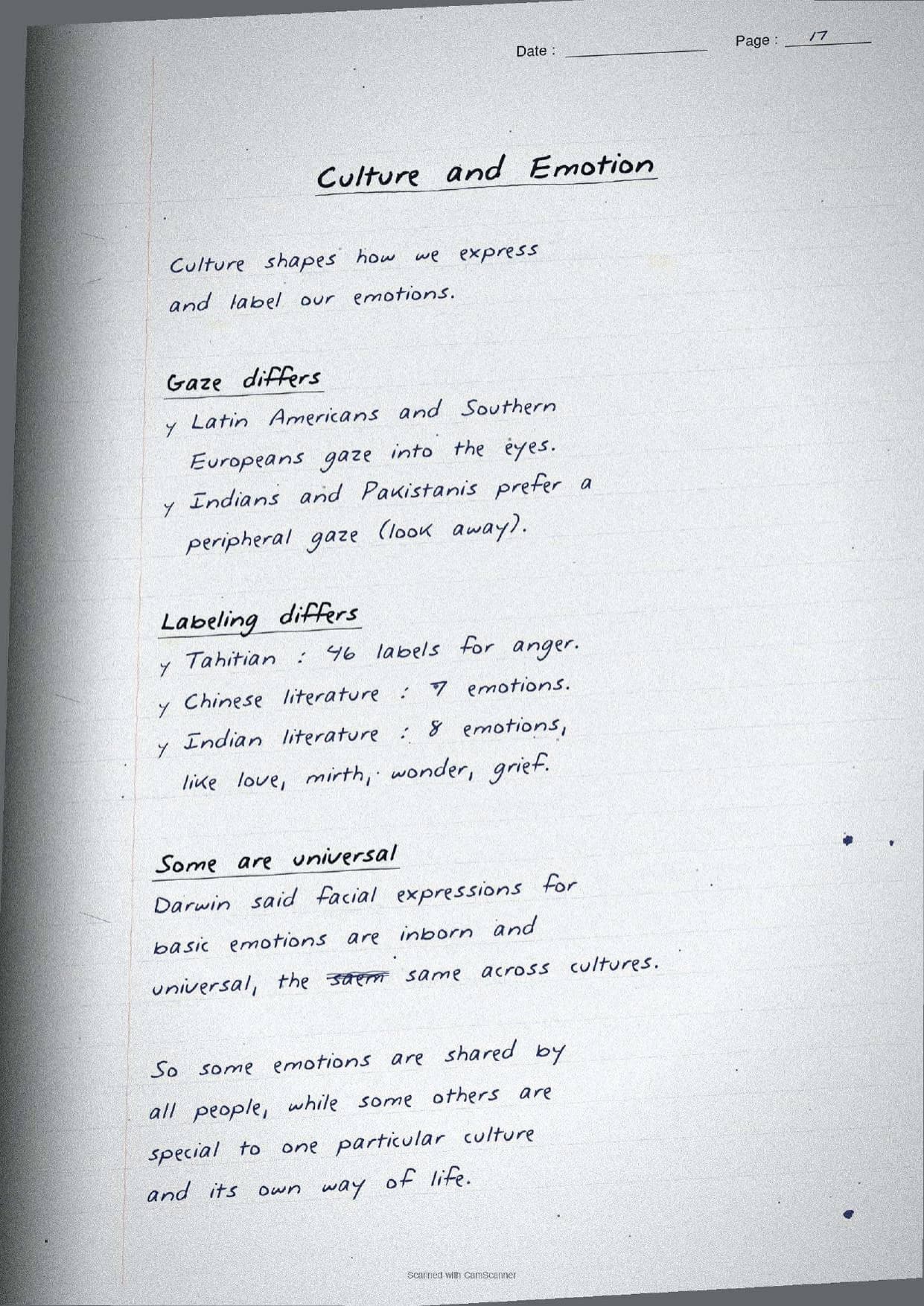
- Culture and emotion: Darwin's view that basic facial expressions are universal, alongside cultural differences in gaze and emotional labels.
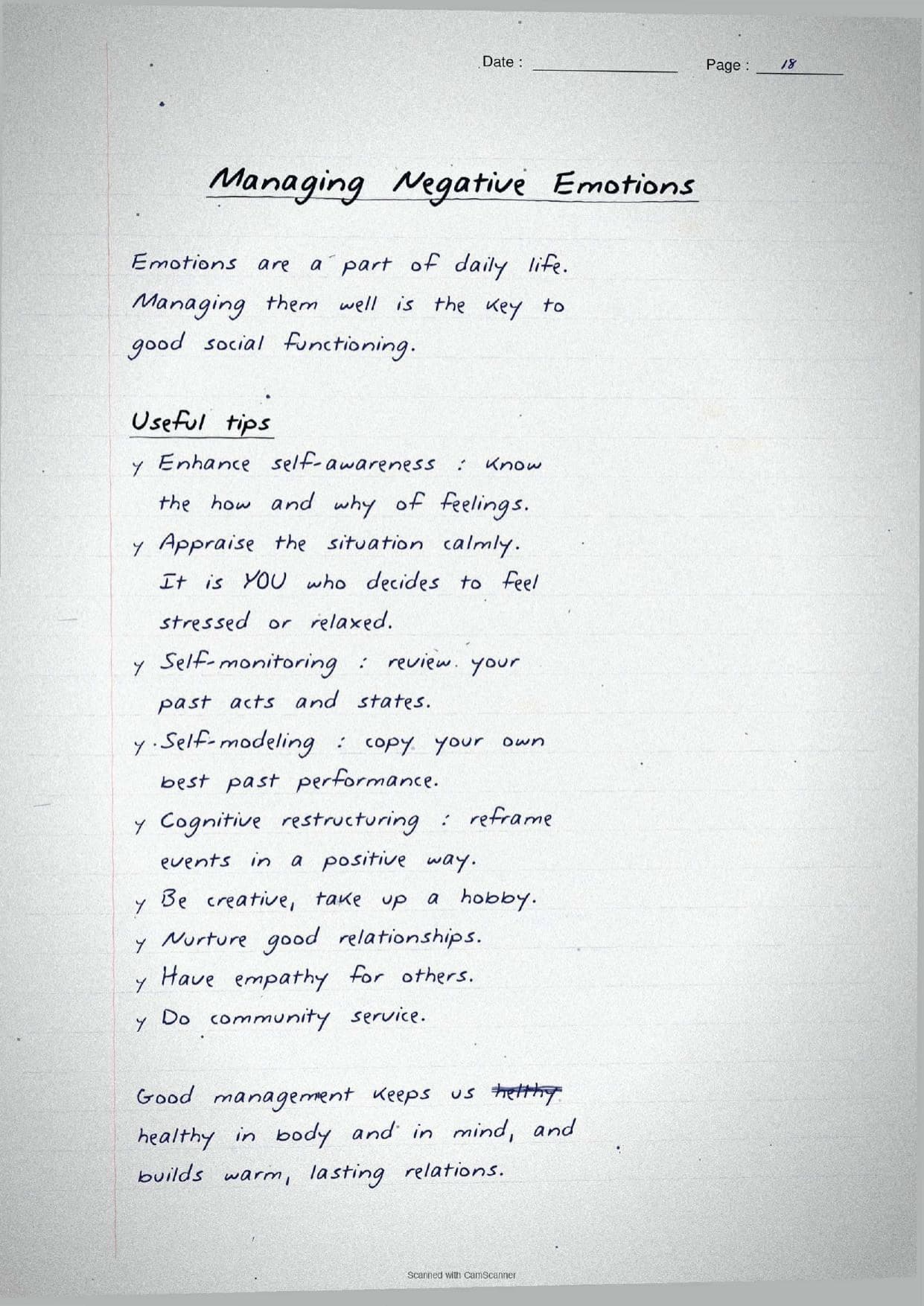
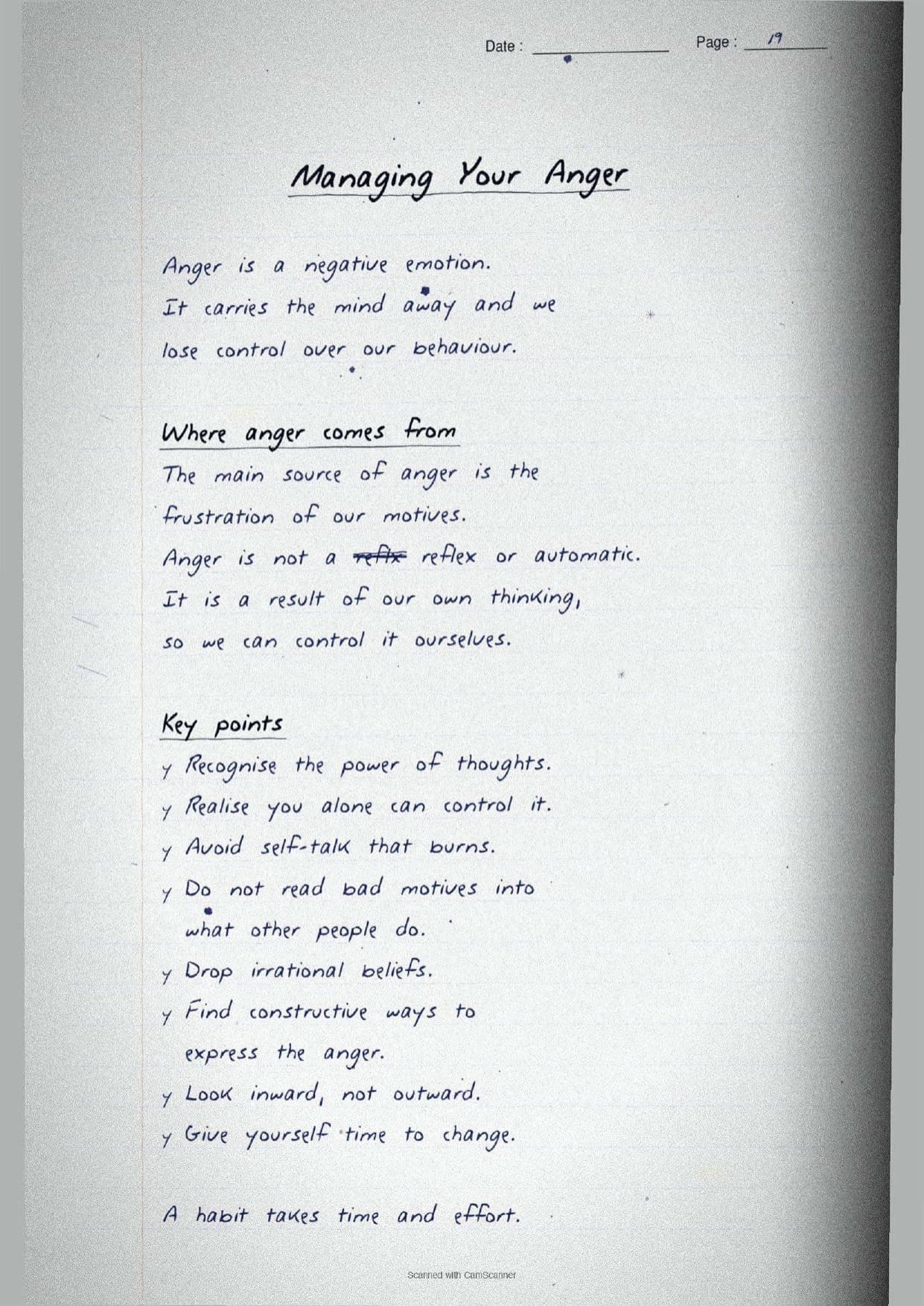
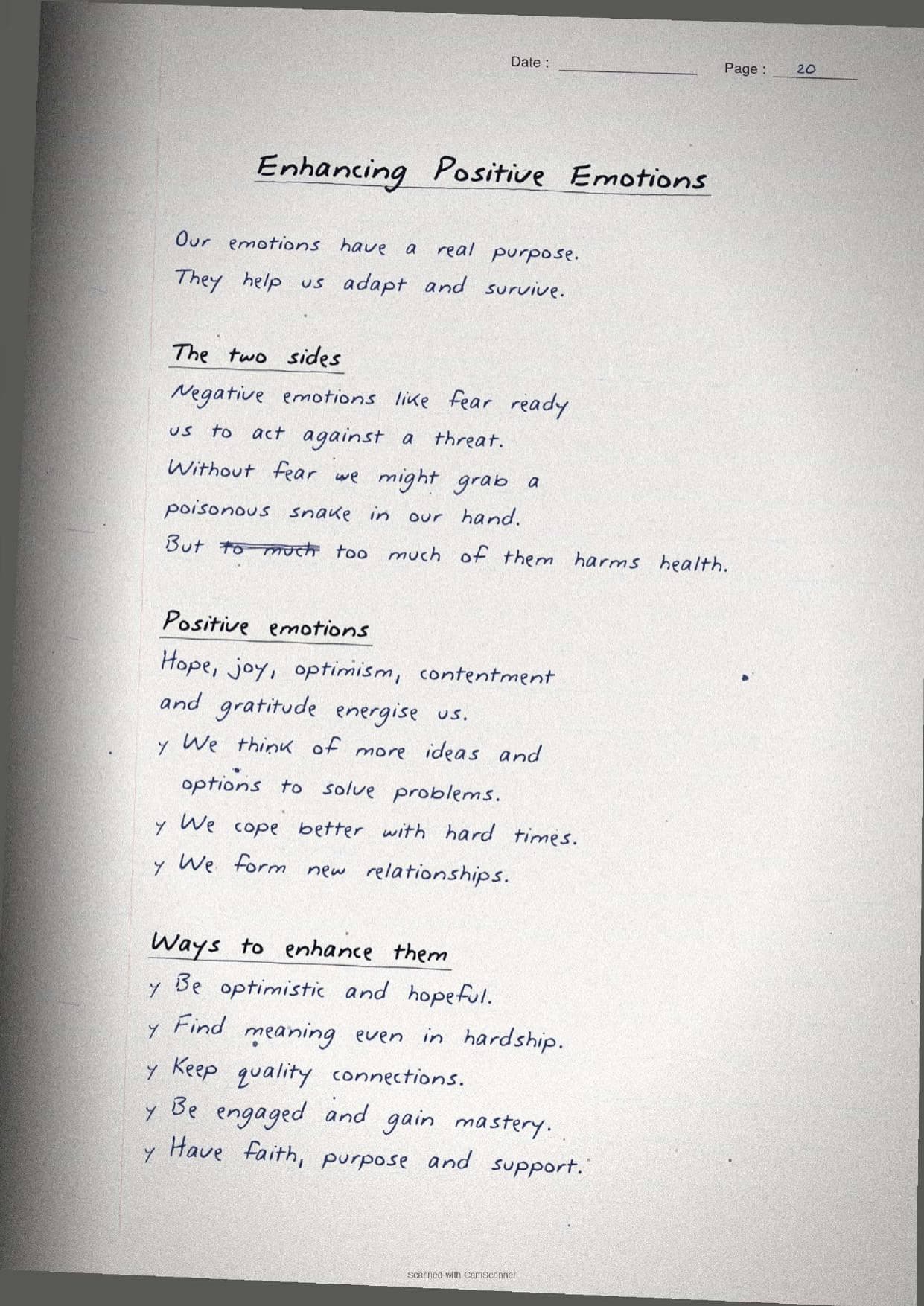
- Managing and enhancing emotions: self-awareness, objective appraisal, anger control, and ways to build positive emotions like hope and gratitude.
The notes underline one judgement that scores well: certain basic emotions are expressed and understood by everyone, while others are specific to a culture. The handwritten pages box this line so it stands out. Pair the six basic emotions with the culture points and the emotion-management tips, and you have the whole back half of the chapter on a few pages.
How to Use These Handwritten Notes
Handwritten notes work best as a final-revision tool, not a first read. The steps below show how to get the most out of the Motivation and Emotion handwritten notes in the last days before a test.
- Download: tap the download card above to save the handwritten pages to your device.
- First read: read the printed Notes once so the handwritten pages act as a refresher, not a first source.
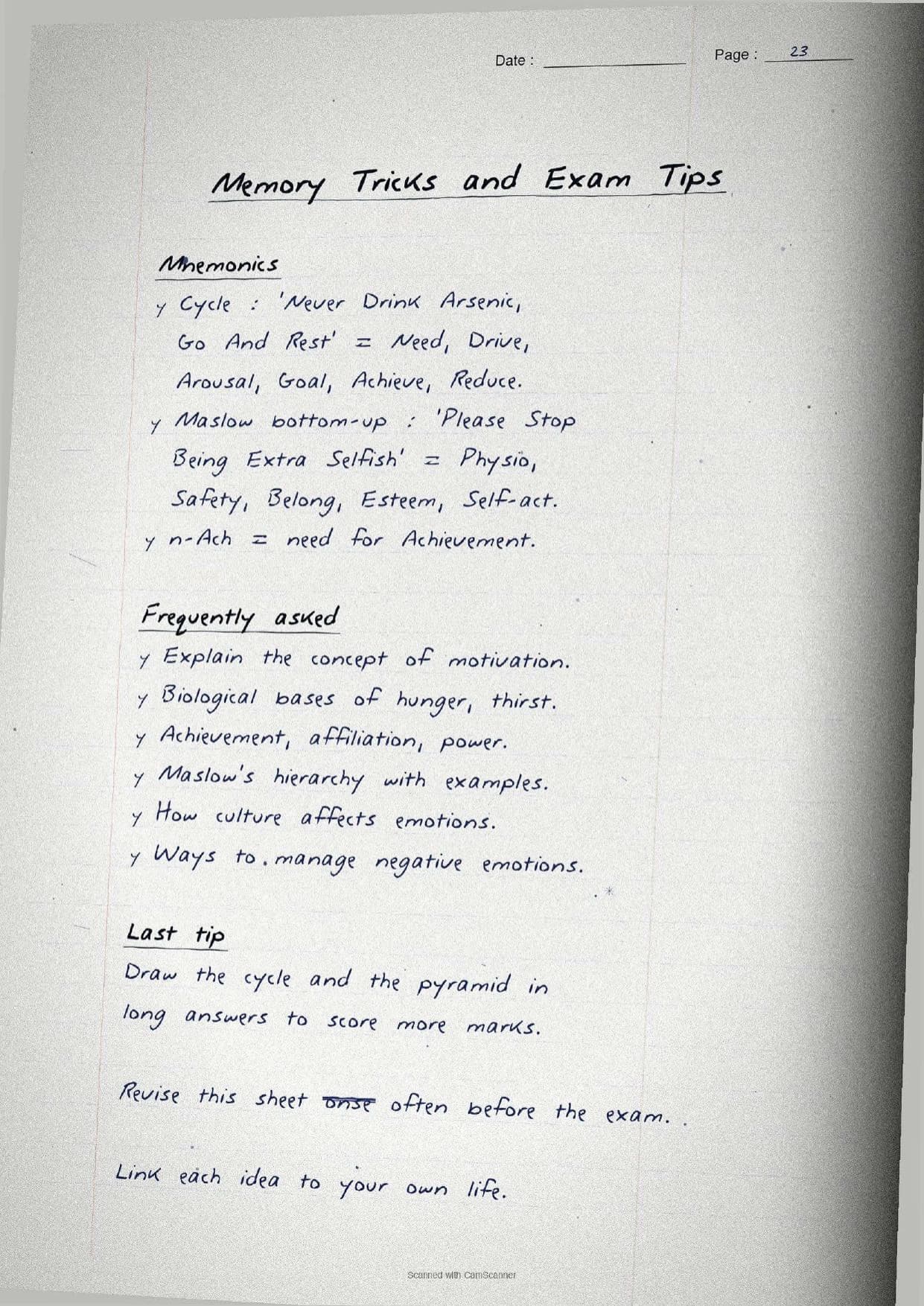
- Recall drill: cover the page and try to write the motivational cycle and the six basic emotions from memory.
- Night before: flip through the boxed pages for a quick last-minute recall of the motive types and the Maslow pyramid.
Many students search for Class 11 Psychology Chapter 8 notes on their phone the night before a test, so a saved set of handwritten pages means you can revise offline. Use the handwritten notes for speed, then check the solutions to confirm you have the answer points right. Students heading towards CUET can use the same pages for a quick concept refresh.
Common Mistakes These Notes Help You Avoid
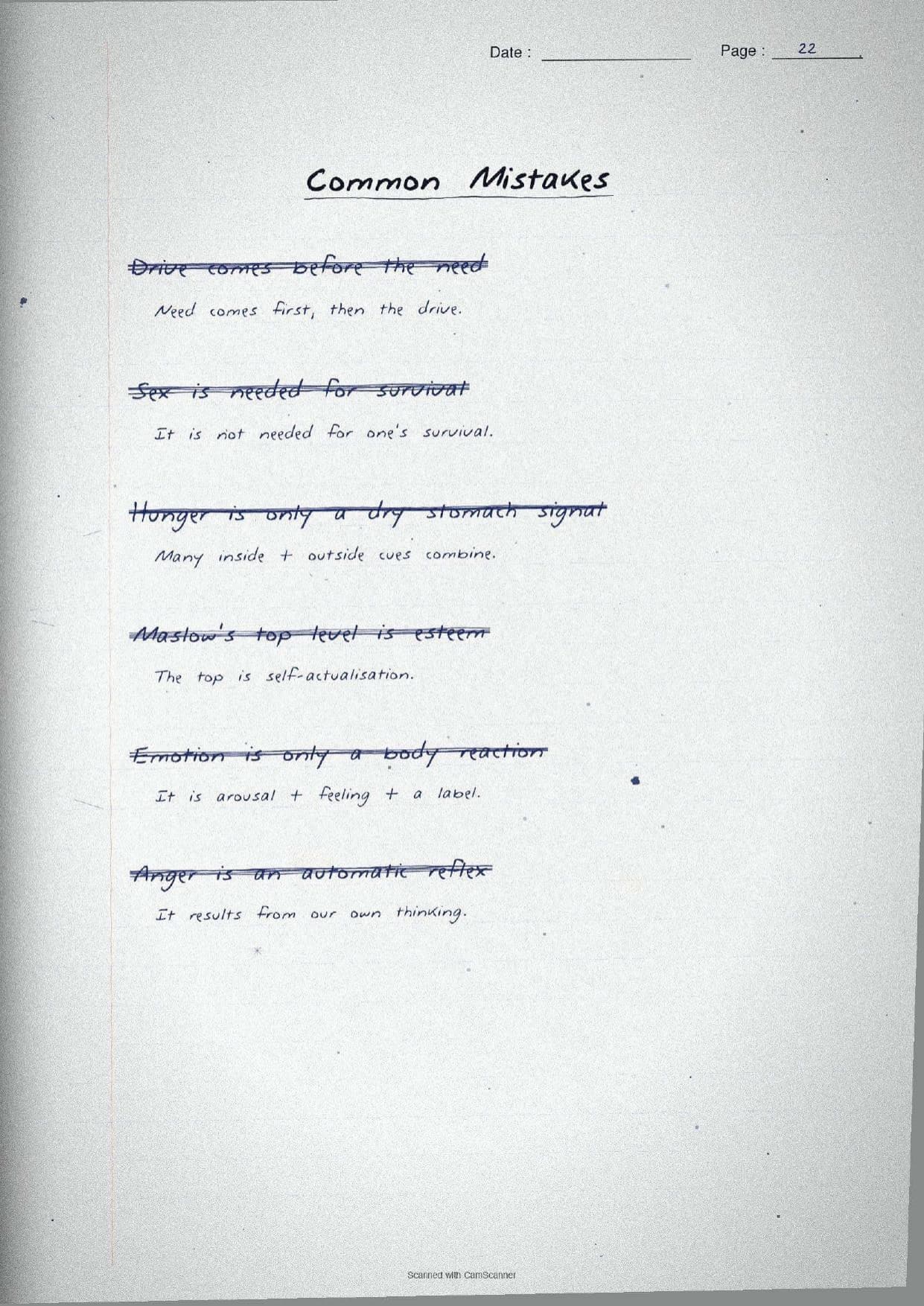
A few errors cost marks every year. The handwritten notes flag each one in the margin so you can fix it before the exam. These five are the most common.
- Mixing up the motivational cycle order. It is always need, drive, arousal, goal-directed behaviour, then reduction of arousal.
- Calling every motive biological. Motives are biological and psychosocial, and the two are interdependent.
- Naming only some of Maslow's levels. The exam needs all five in the right order, base to top.
- Listing fewer than six basic emotions. The set is anger, disgust, fear, happiness, sadness and surprise.
- Saying anger is a reflex. Anger is a self-induced choice that comes from our thinking, so it is controllable.
Students who fix these five points usually move from average to high marks. The handwritten notes box the motivational cycle and list all six basic emotions in full, so the soft points are hard to miss when you revise.
How These Handwritten Notes Pair with the Solutions and Book PDF
These handwritten notes are a fast revision tool. To prepare fully, students should use them alongside the other resources for the same chapter, all linked in the table below. Read the printed Notes, test yourself with the solutions, then use these pages for a final recall.
| Resource | Best used for |
|---|---|
| Motivation and Emotion NCERT Solutions | Step-by-step answers to all the review questions |
| Motivation and Emotion Class 11 Notes | Quick chapter summary with all motives, the Maslow pyramid and emotion points in one place |
| Motivation and Emotion NCERT Book PDF | Reading the original NCERT chapter text and figures |
Tip: read the printed Notes first, then attempt the solutions, and keep these handwritten pages for the final night-before flip. Using them for recall, not for the first read, builds memory faster.
All Class 11 Psychology Handwritten Notes by Chapter
The table links the handwritten notes for every chapter in Class 11 Psychology, so students can move across the course in one click. Motivation and Emotion is highlighted.
| Chapter | Handwritten Notes |
|---|---|
| Chapter 8 | Motivation and Emotion |
| Chapter 1 | What is Psychology? |
| Chapter 2 | Methods of Enquiry in Psychology |
| Chapter 3 | Human Development |
| Chapter 4 | Sensory, Attentional and Perceptual Processes |
| Chapter 5 | Learning |
| Chapter 6 | Human Memory |
| Chapter 7 | Thinking |
FAQs on Motivation and Emotion Handwritten Notes
Motivation and Emotion Class 11 Psychology Handwritten Notes Common Questions
Ques. Where can I download the Motivation and Emotion handwritten notes PDF?
Ans. You can download the Motivation and Emotion Class 11 Psychology handwritten notes PDF directly from this page. It is free, follows the 2026-27 NCERT, and presents motivation, the motivational cycle, the types of motives, Maslow's hierarchy and emotions as handwritten pages.
Ques. Are handwritten notes good for revising Class 11 Psychology Chapter 8?
Ans. Yes. Handwritten notes are best for fast, last-minute revision because the boxed key terms and arrows make the motivational cycle, the Maslow pyramid and the basic emotions easy to skim. Use them after a first read of the printed Notes, not as your only source.
Ques. What topics do these handwritten notes cover?
Ans. They cover the nature of motivation and the motivational cycle, biological motives (hunger, thirst, sex), psychosocial motives (affiliation, power, achievement, curiosity), Maslow's hierarchy of needs, the nature and components of emotion, the expression of emotions, the role of culture, and managing and enhancing emotions.
Ques. Who prepared these handwritten notes?
Ans. They are written and proofread by hand by a subject expert with a PhD in Psychology and years of CBSE Class 11 teaching experience, using the official NCERT textbook and recent Class 11 question papers.
Ques. How should I use these notes with the other resources?
Ans. Read the printed Notes first, test yourself with the NCERT Solutions, then keep these handwritten pages for the final night-before flip. Using them for recall rather than the first read builds memory faster.



Comments