



These Adventure Sports handwritten notes turn the whole chapter into clean, handwritten pages for fast last-minute revision. They follow the 2026-27 NCERT "Health and Physical Education" Class 11 Chapter 11 and cover the meaning of adventure sports, the water, land and air classification, paragliding, surfing, and the safety measures and equipment. Students get the definitions, the examples for each category and the key safety points in a pen-on-paper format that is easy to skim before the Class 11 final exam.
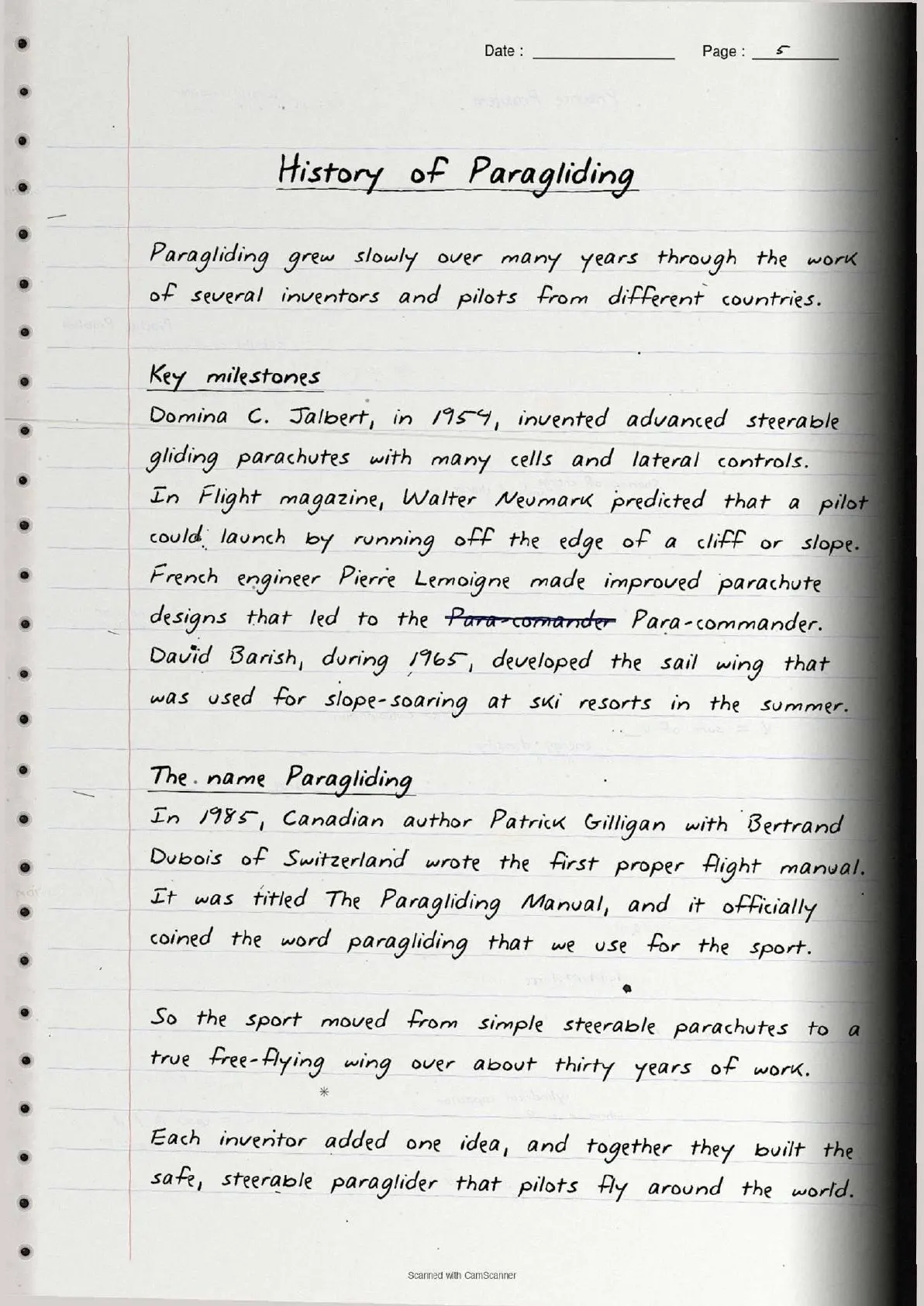
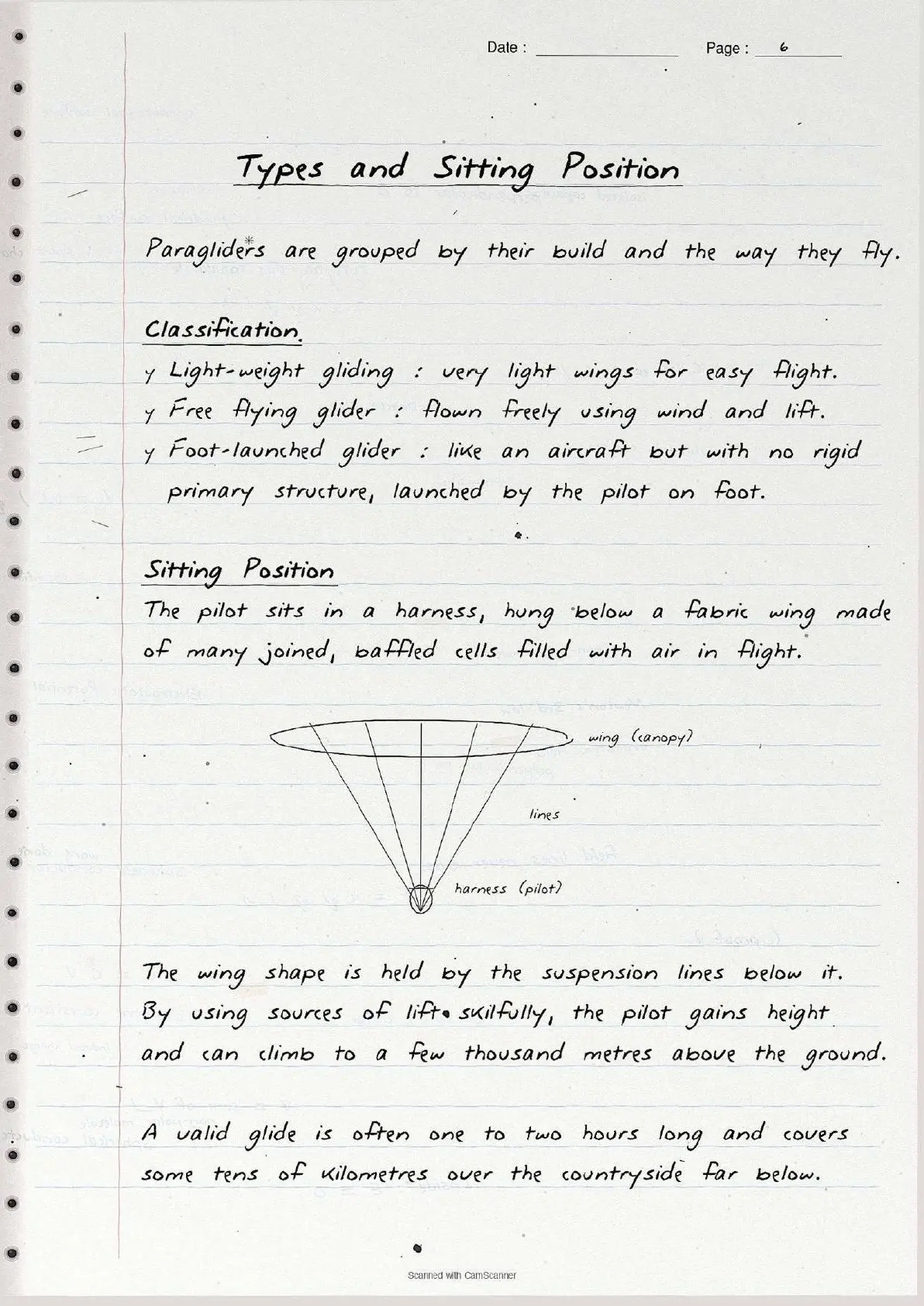
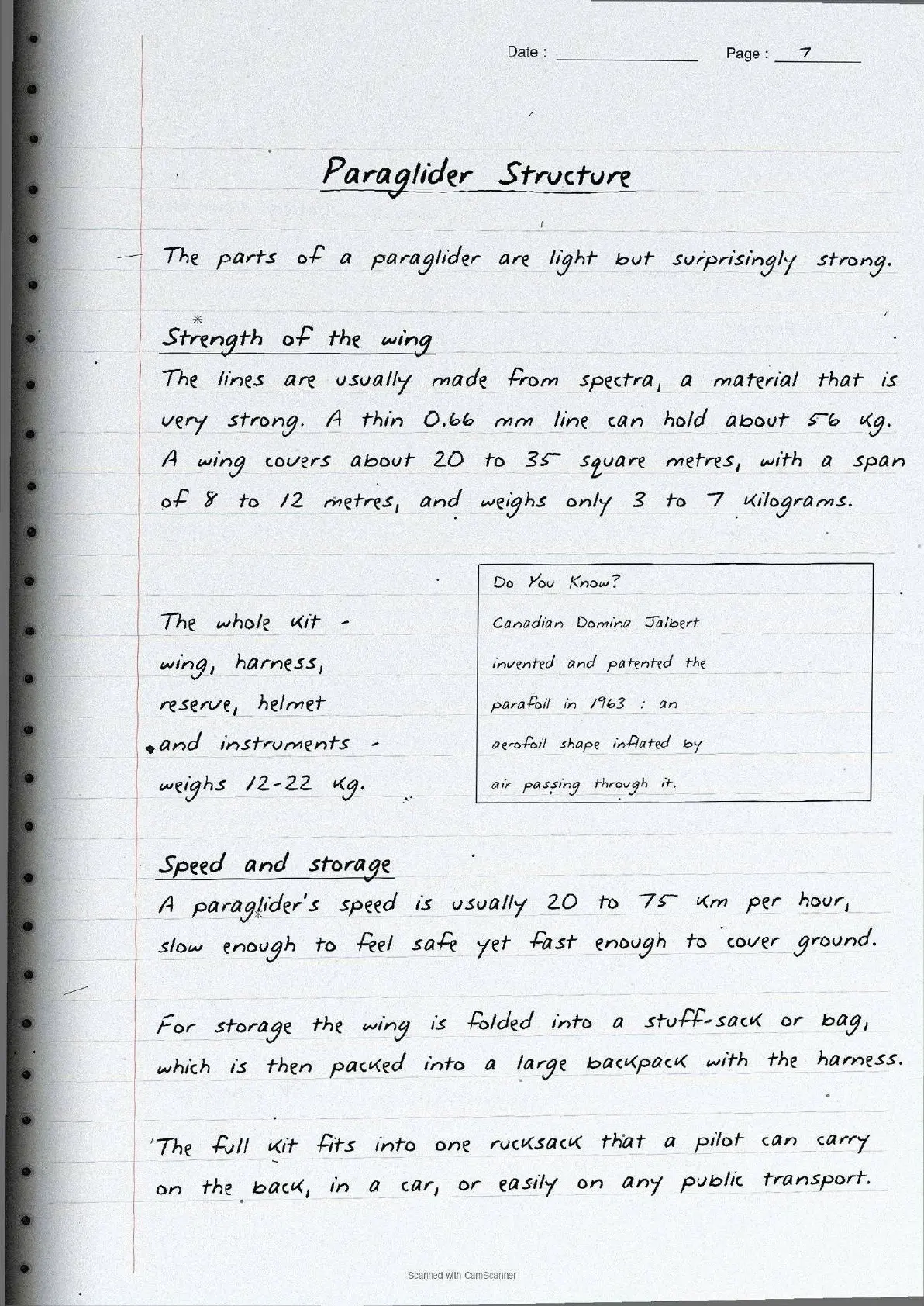
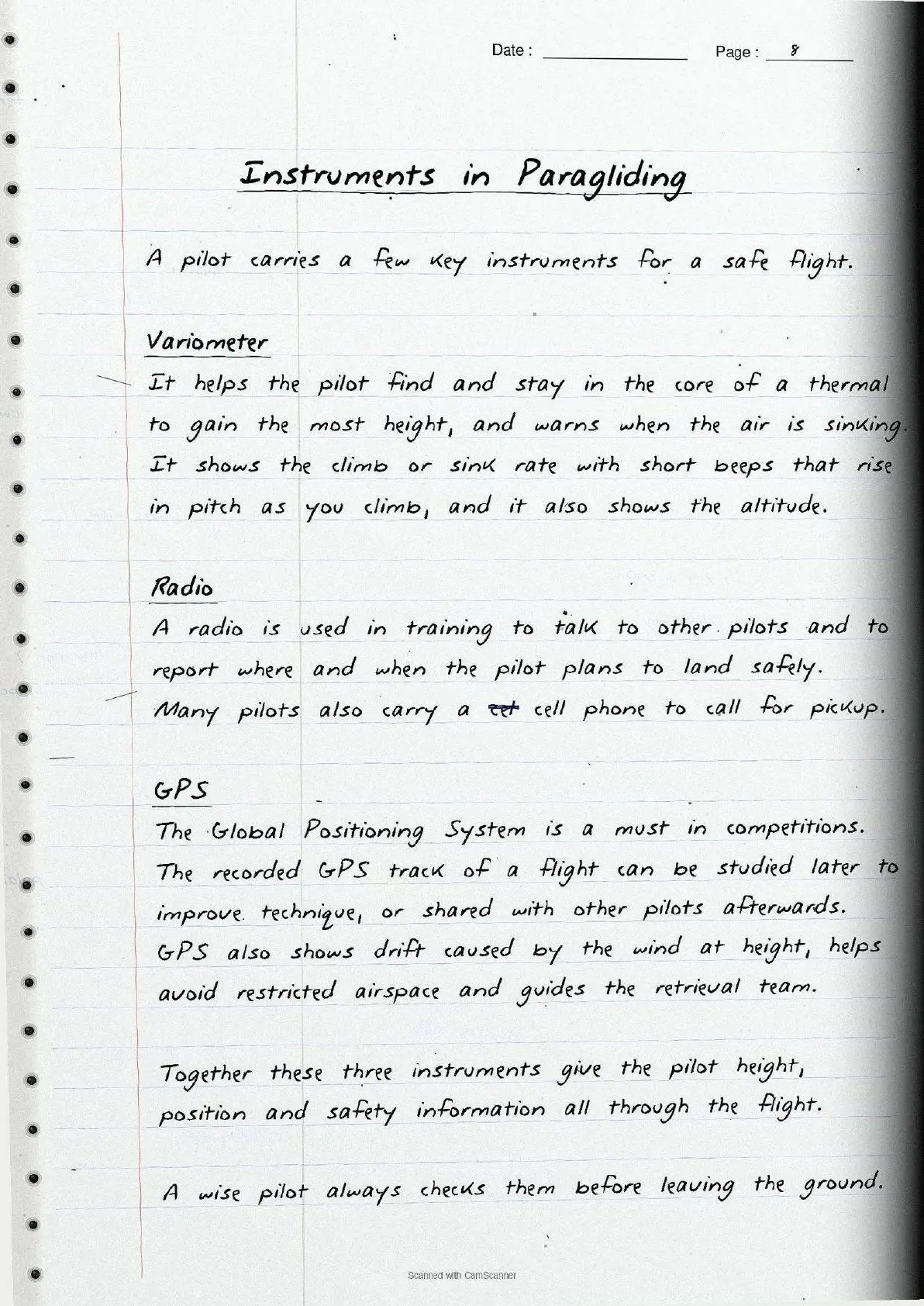
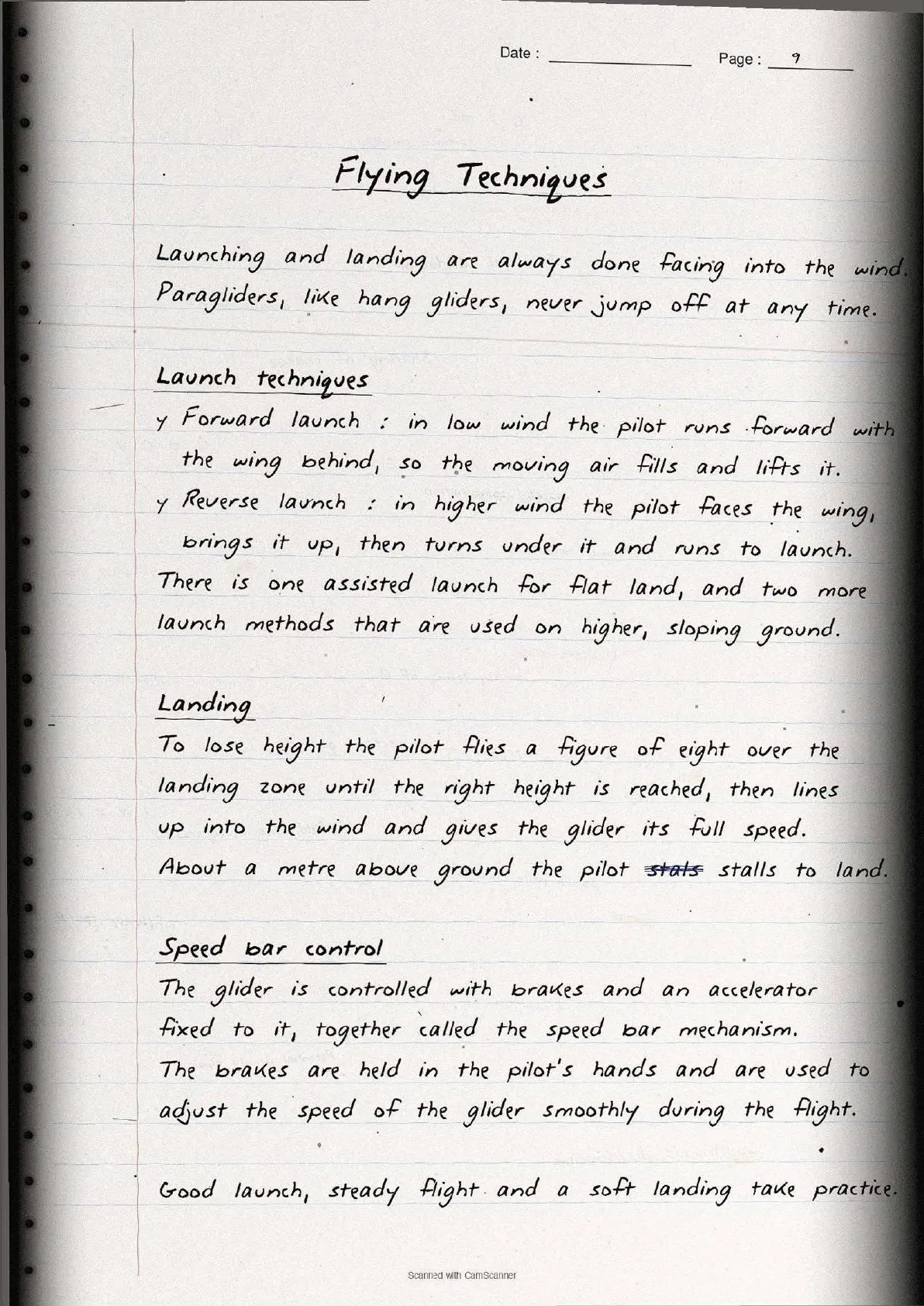
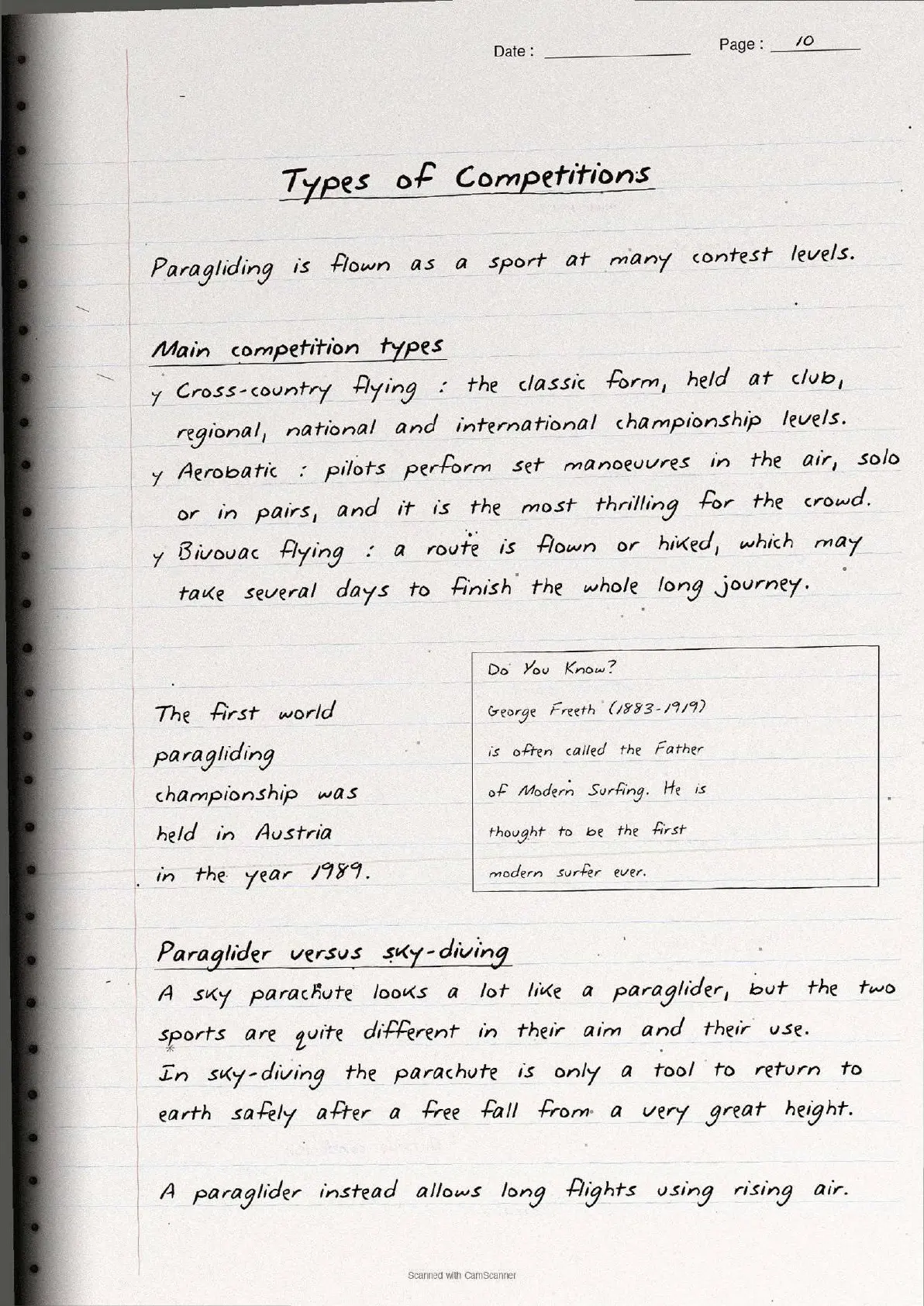
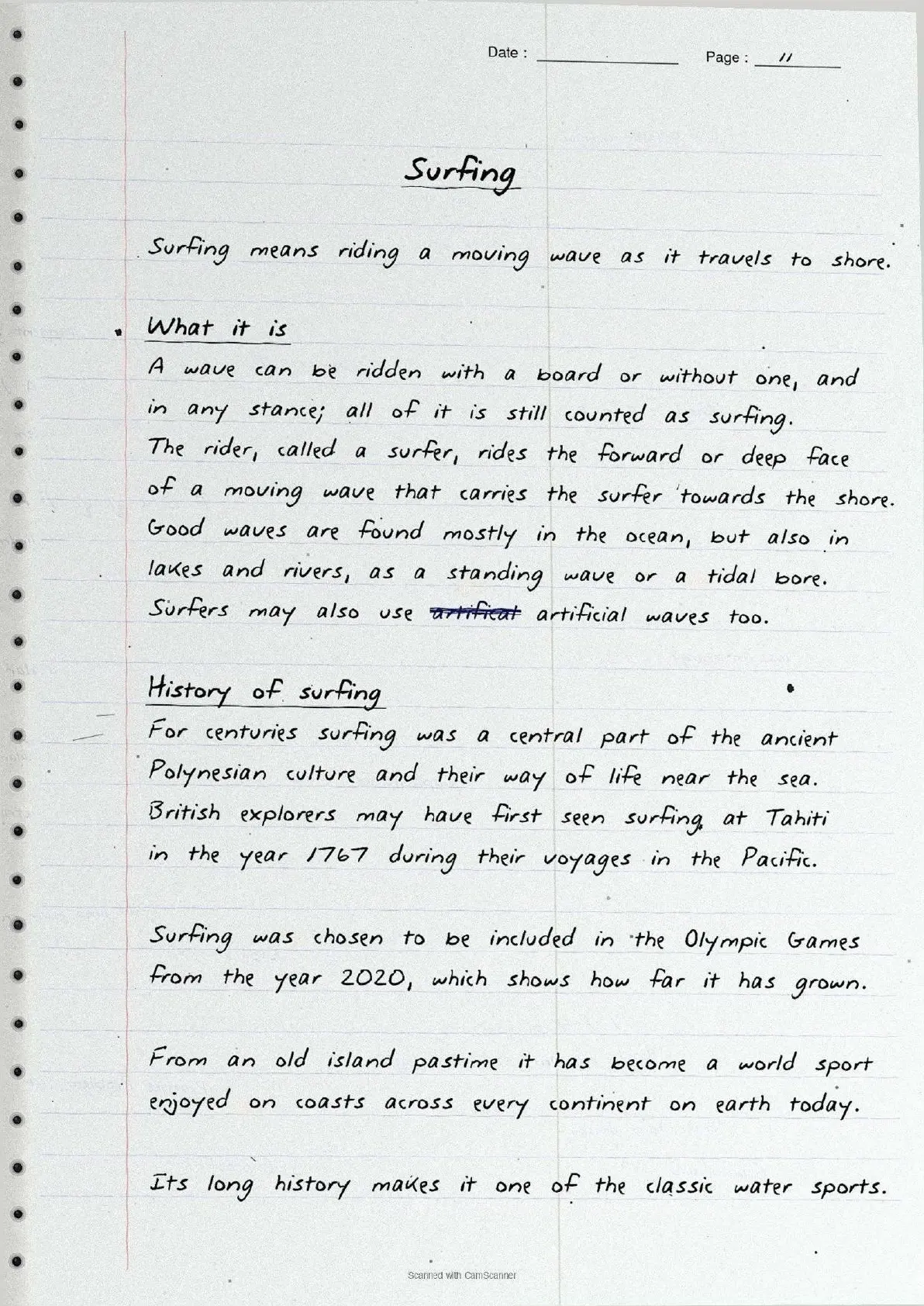
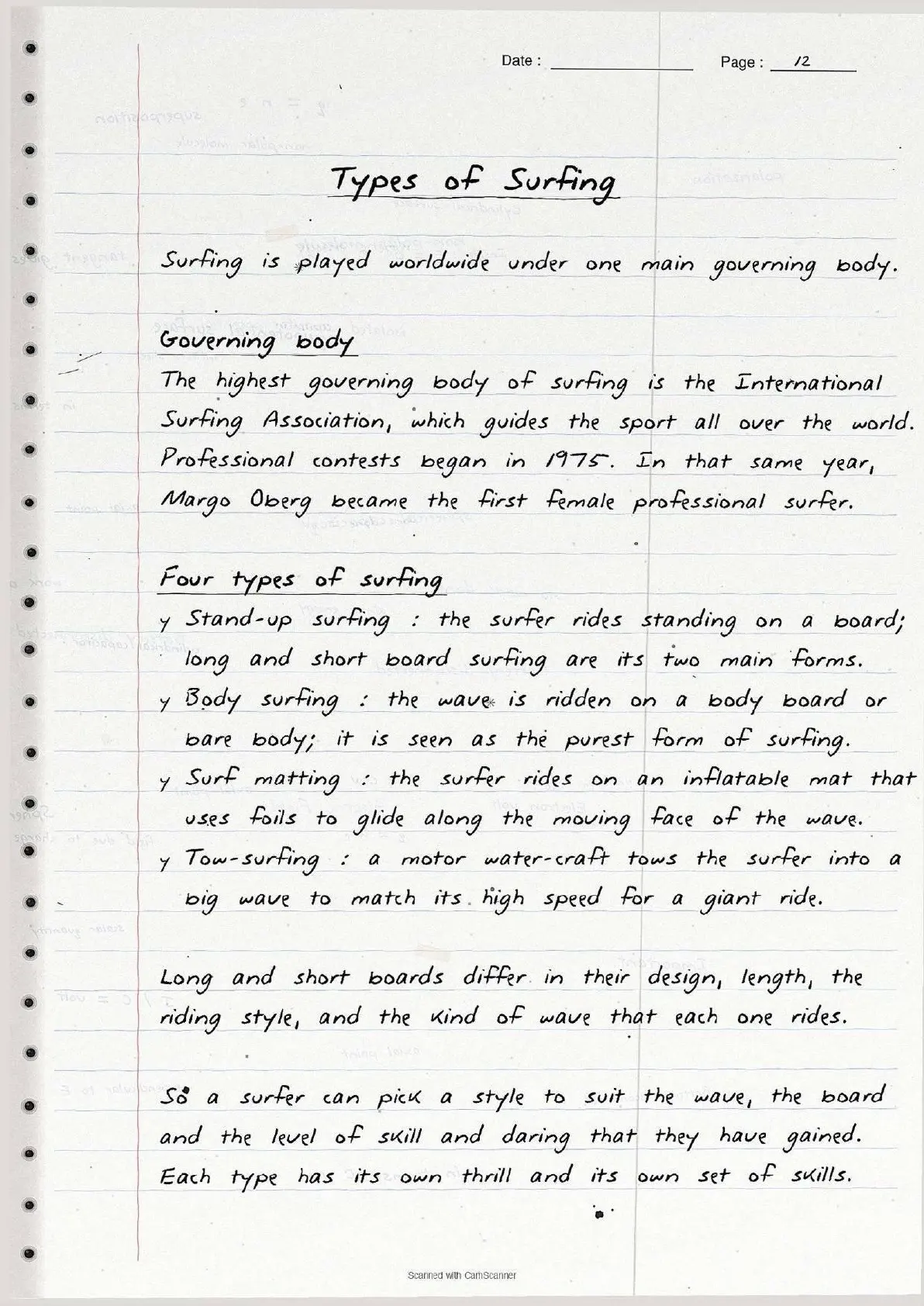
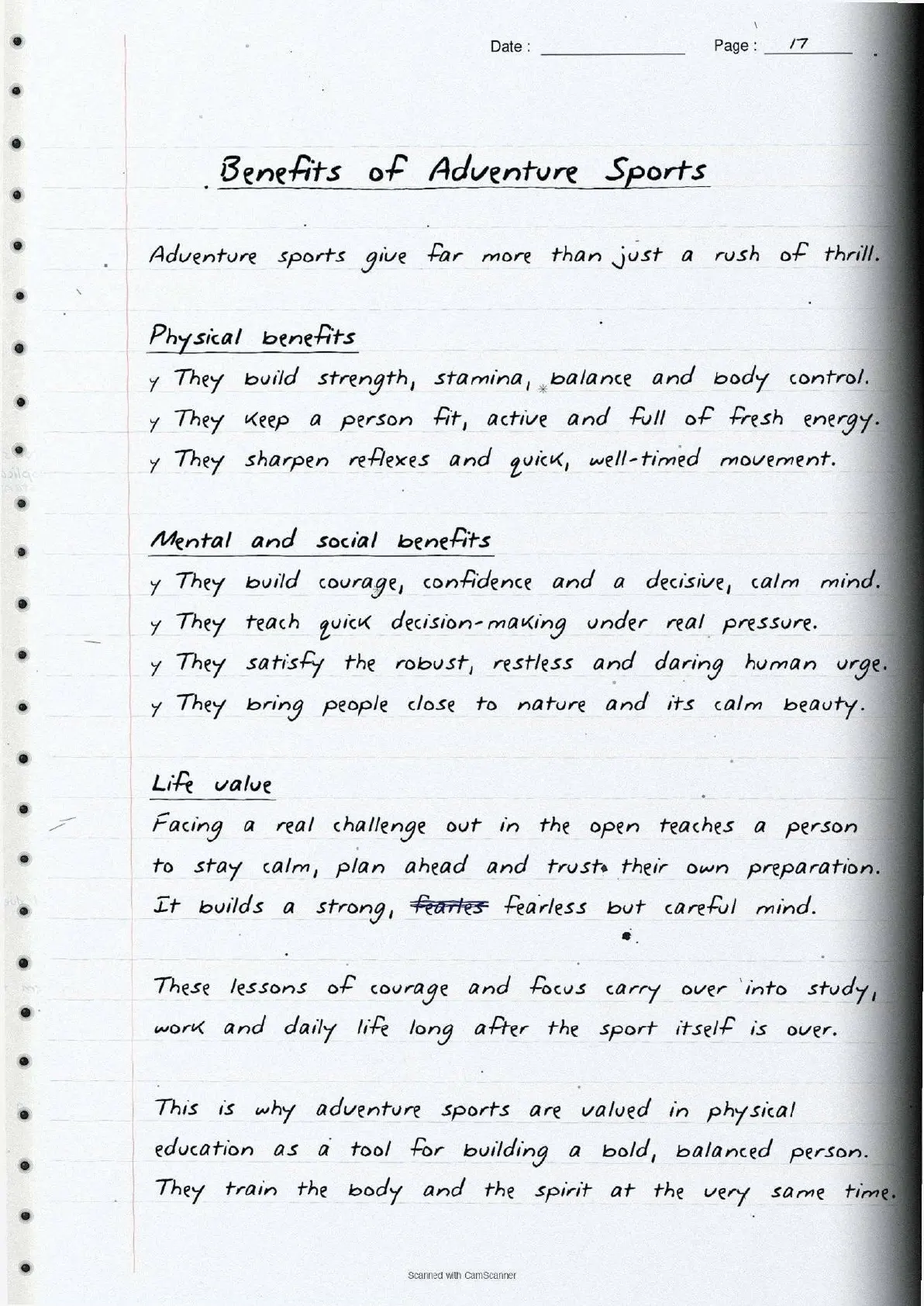
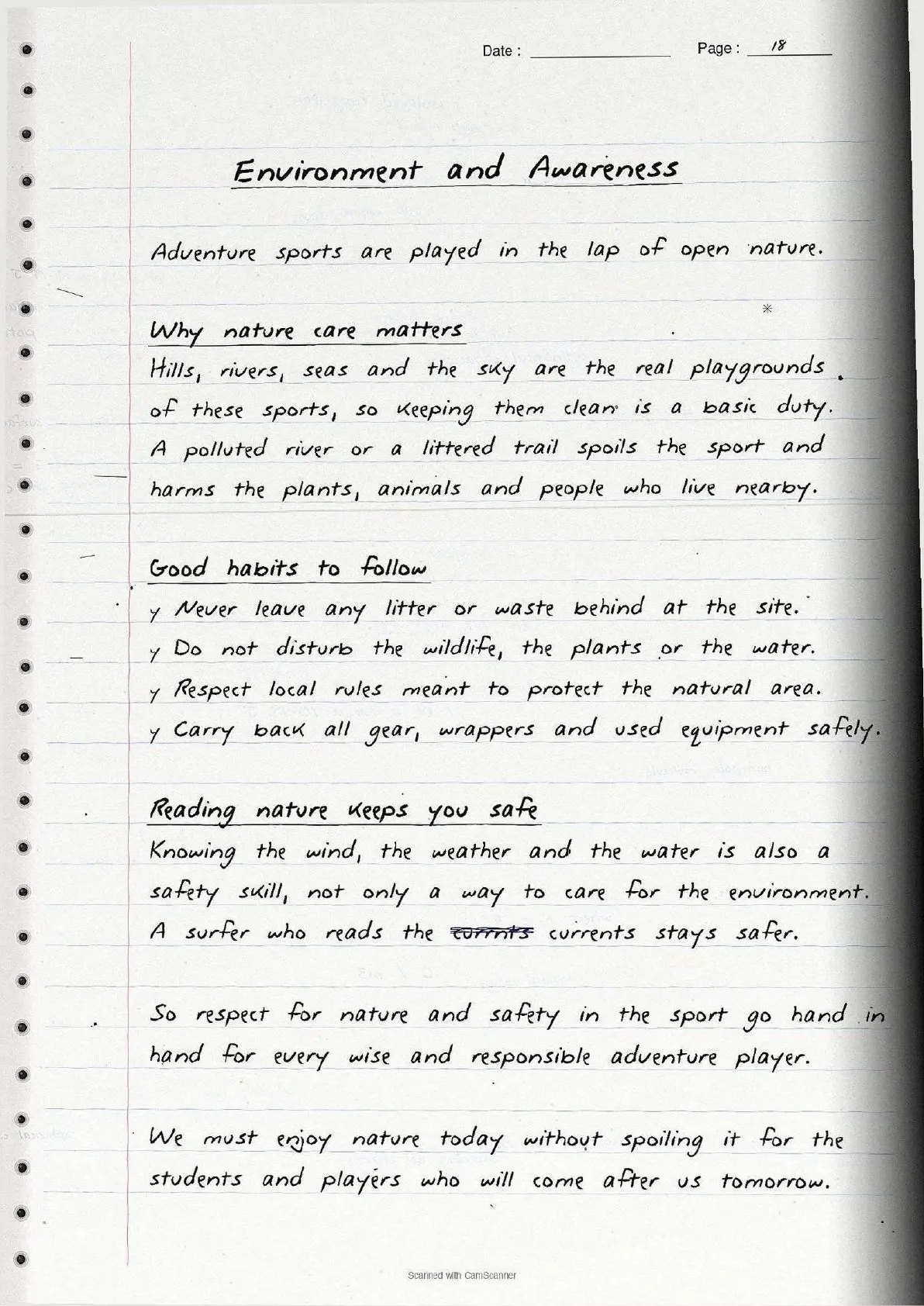
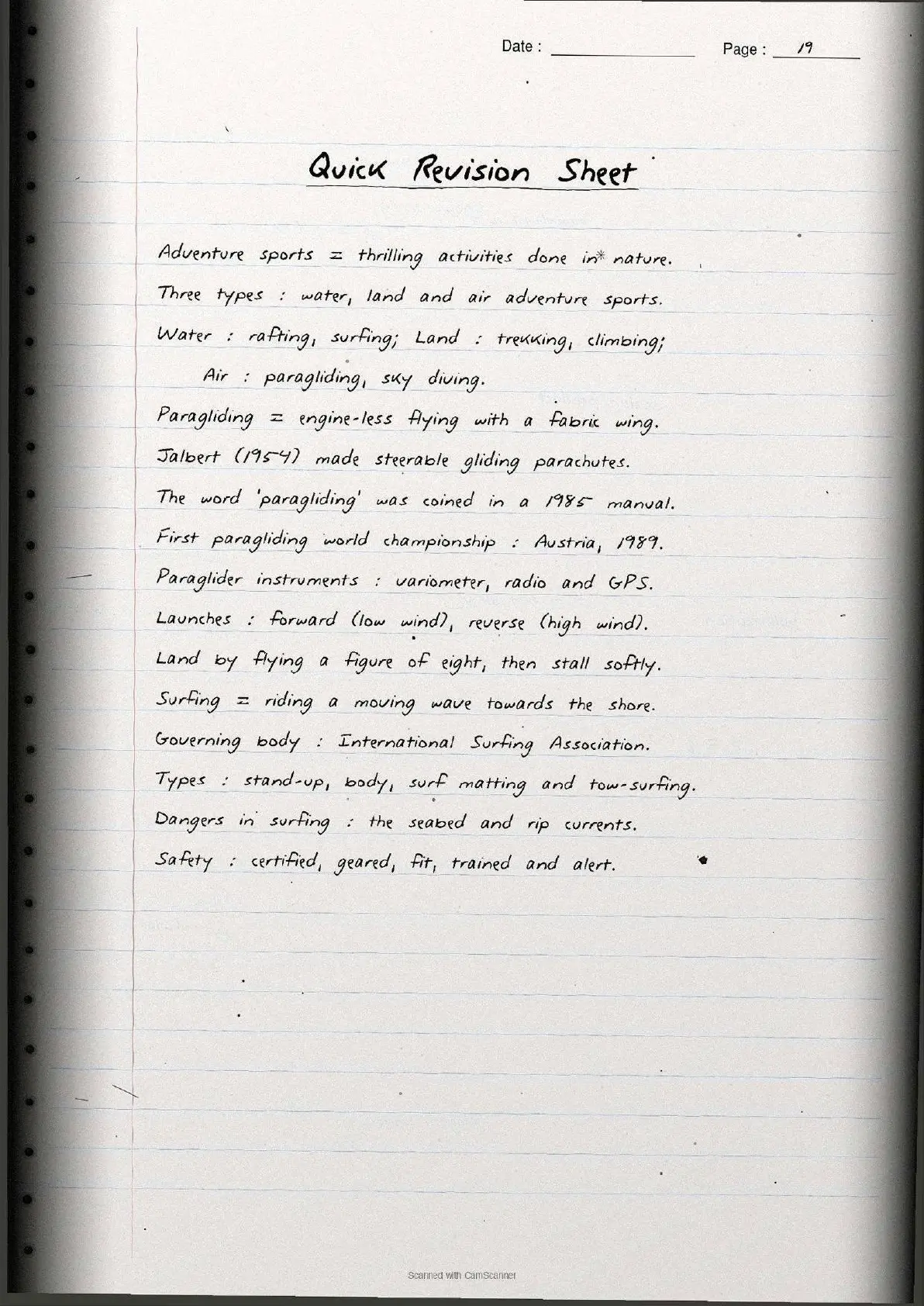
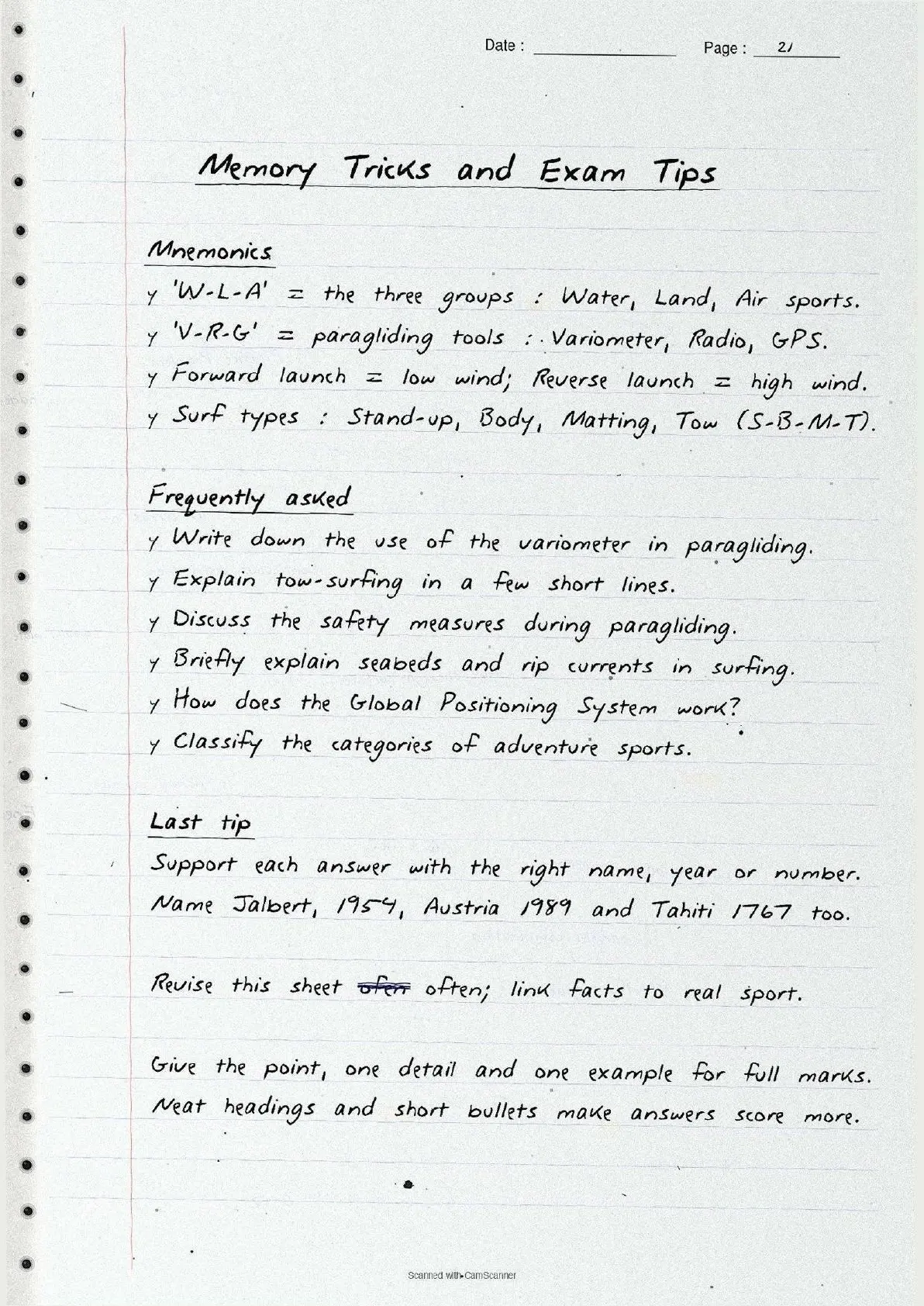
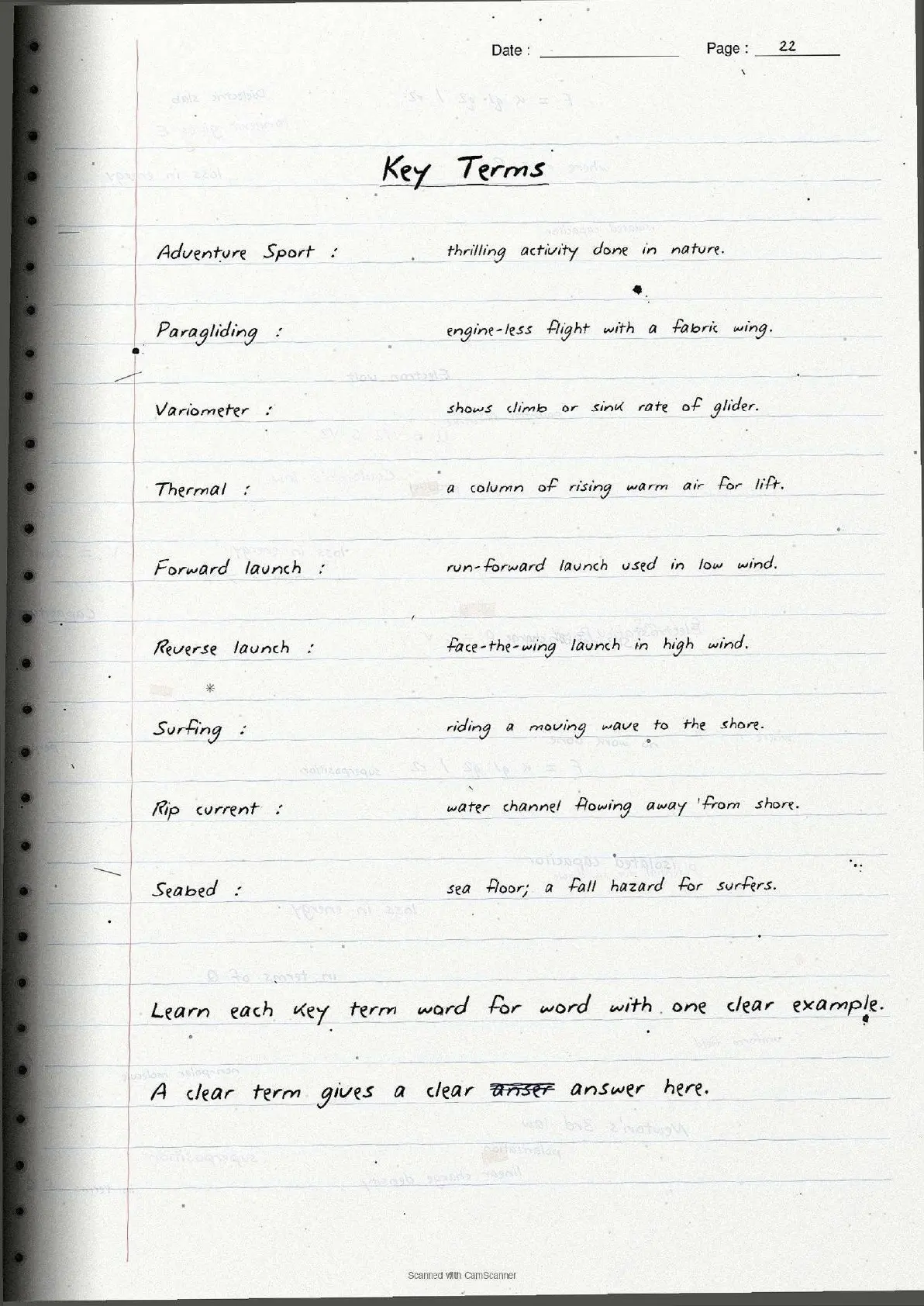
- Handwritten pages with boxed key terms and a labelled water, land and air adventure sports map.
- This Class 11 Physical Education chapter is a favourite for short and long answer questions on paragliding, surfing and safety.
- Pairs with the NCERT Notes and Book PDF for the same chapter, linked lower on this page.
These Adventure Sports handwritten notes are prepared from the official NCERT Health and Physical Education textbook and checked against recent CBSE Class 11 Physical Education question papers.
Student Feedback: In a Collegedunia poll of 4,180 Class 11 Physical Education students before the 2026 final exams, 72% of students said handwritten pages helped them recall the three categories of adventure sports and the paragliding instruments faster than printed text, because the boxed lists and arrows made the classification stick.
Source: 2026-27 Class 11 Physical Education student poll. Sample of 4,180 students from CBSE schools across 11 states.
What These Adventure Sports Handwritten Notes Contain
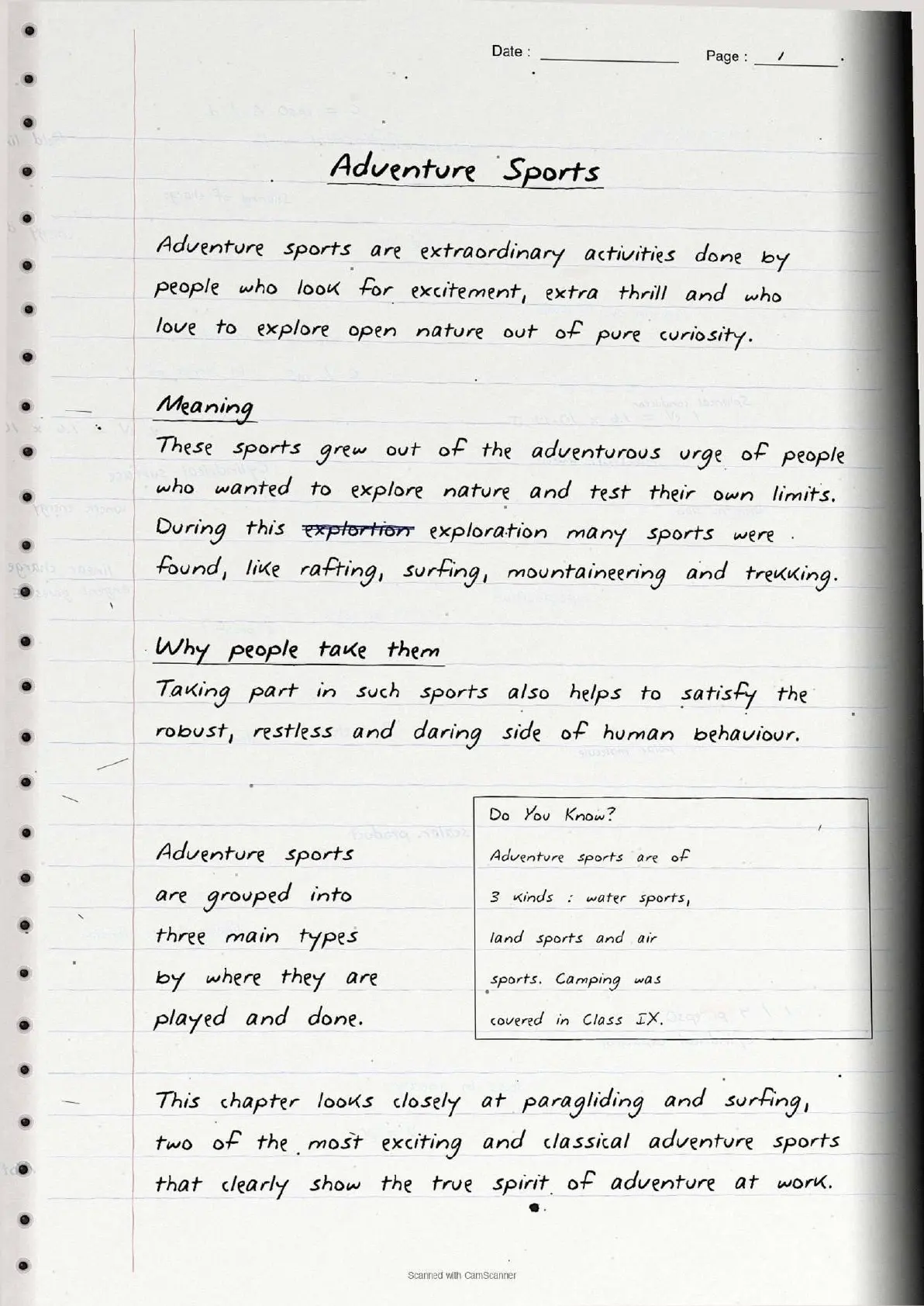
Adventure Sports is the last chapter of Class 11 Physical Education. It explains what adventure sports are, how they are grouped, and looks closely at two classic examples, paragliding and surfing. Adventure sports are extraordinary activities performed by people who look for excitement, extra enthusiasm and the desire to explore nature. These handwritten notes condense the chapter into pages that read like a topper's own notebook.
The notes are organised under three threads, each on its own set of pages:
- The basics: the meaning of adventure sports and why people take them up.
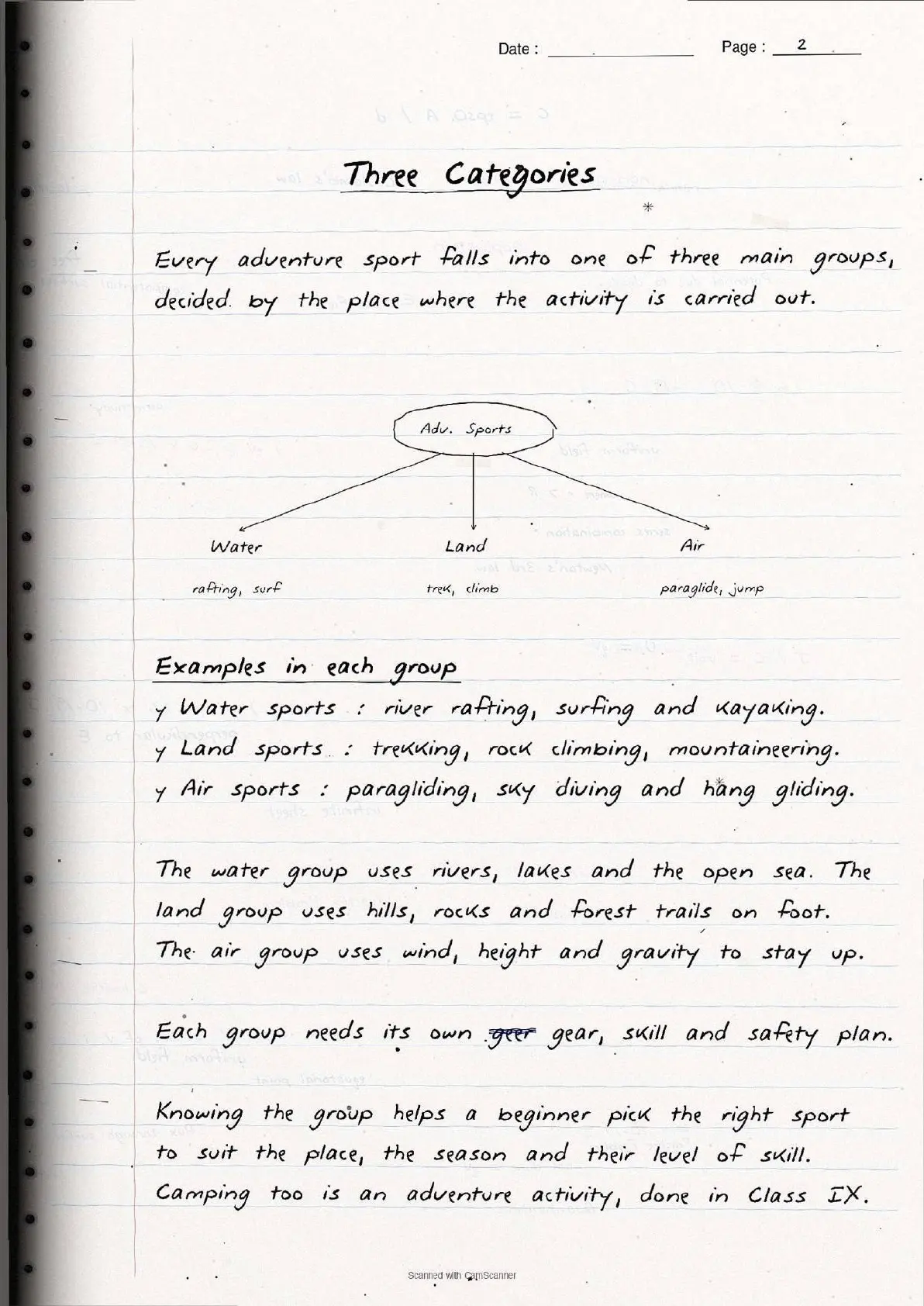
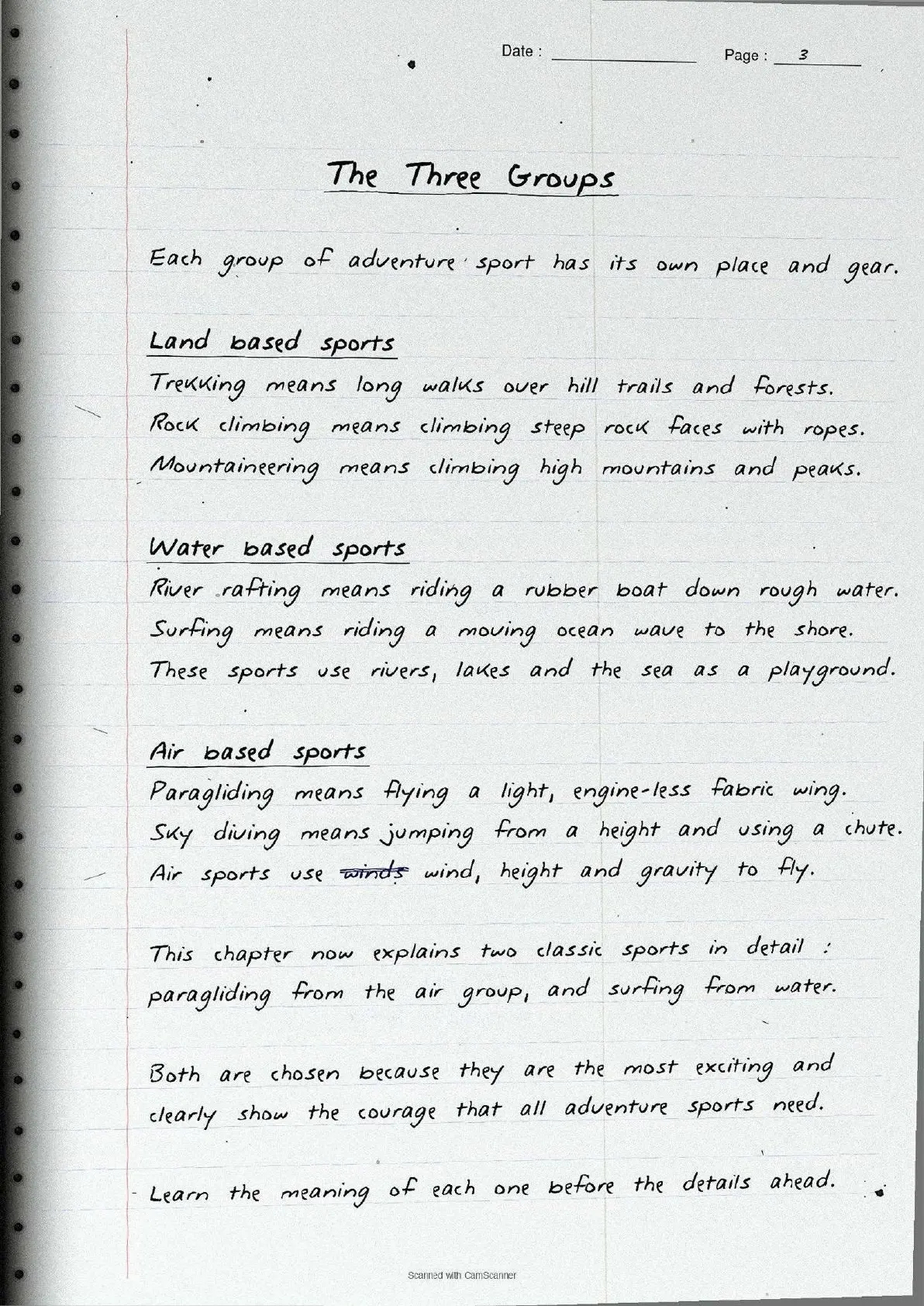
- The classification: water, land and air adventure sports with examples for each.
- The two case studies: paragliding and surfing, plus the safety measures for both.
Because the pages are handwritten, the key terms sit in boxes and arrows rather than long paragraphs. A student can flip through the adventure sports class 11 pages in a few minutes and still pick up the three categories, the paragliding launch types and the safety list before walking into the exam.
Types of Adventure Sports in the Handwritten Pages
The classification fills the opening pages, drawn as a clear map so the three families stand apart. Adventure sports were discovered while people explored nature out of curiosity, and the chapter divides them into three groups. The table below shows what the handwritten notes cover for each type.
| Category | What the page shows |
|---|---|
| Water adventure sports | Activities on water such as river rafting and surfing, drawn with a simple wave icon. |
| Land adventure sports | Activities on land such as trekking, rock climbing and mountaineering. |
| Air adventure sports | Activities in the air such as paragliding and sky diving or jumping. |
The handwritten map makes the key point easy to see: every adventure sport fits into water, land or air, and each name should be placed under the right head. The notes also flag that camping was already covered in the Class 9 book, while this chapter picks paragliding and surfing as the two most exciting classical examples to explain in detail. Keep this classification in mind for the short-answer question that asks you to group the categories of adventure sports.
Paragliding and Surfing in the Notes
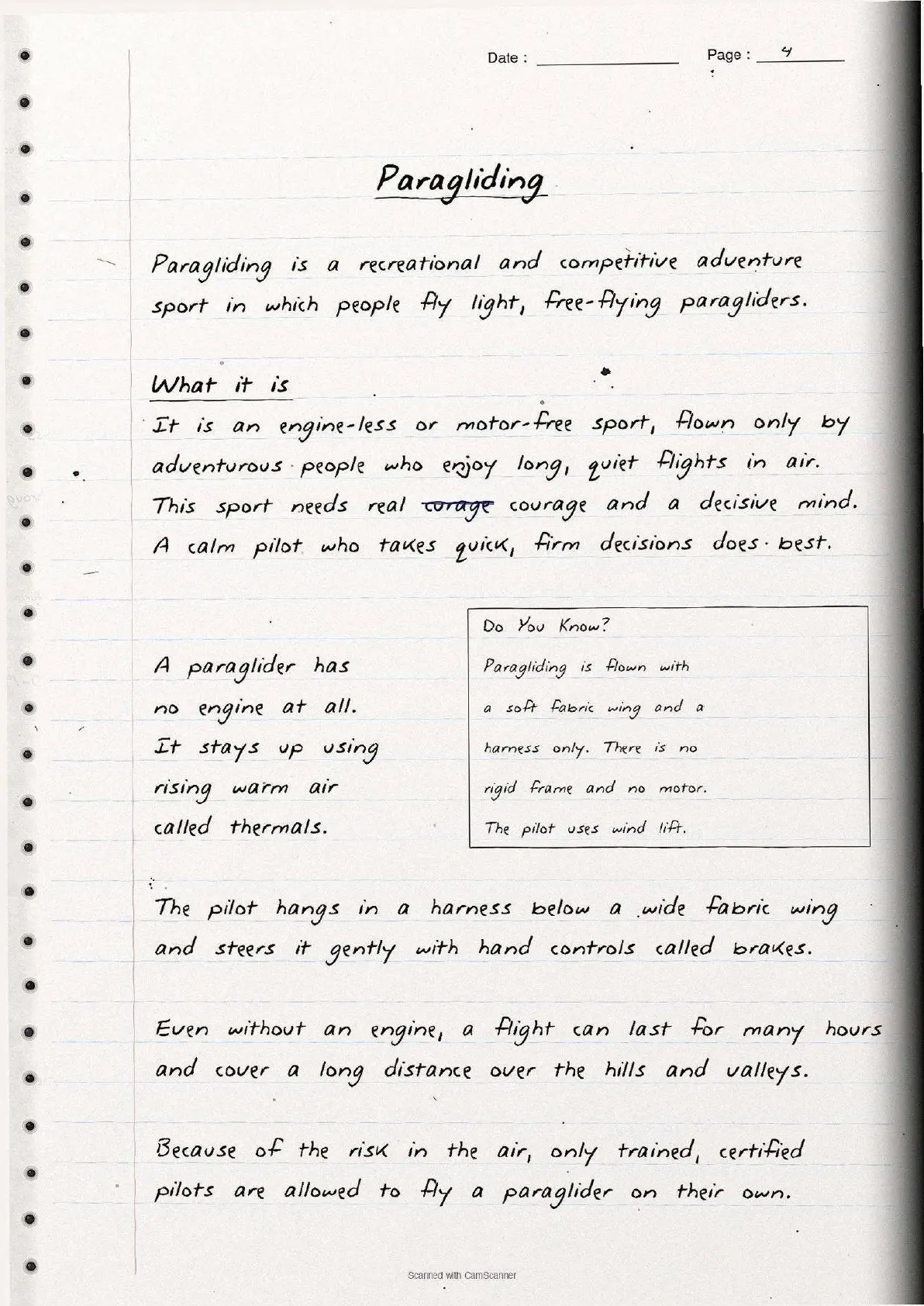
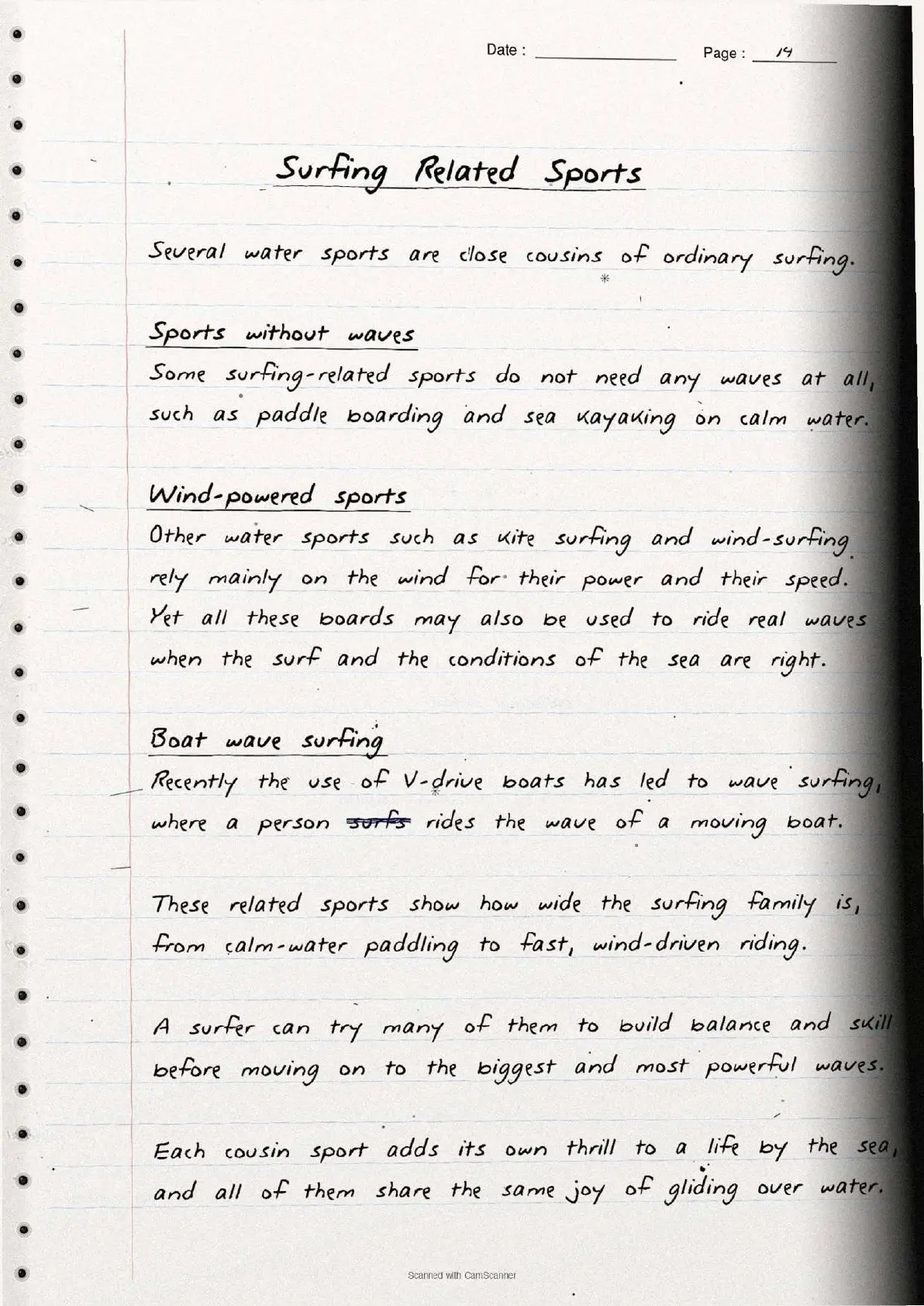
The middle pages cover the two case studies in full. Paragliding is a recreational and competitive air sport for flying paragliders, and it is engine less or motor free, so it needs courage and quick decisions. Surfing is a surface water sport where the wave rider, called a surfer, rides the forward or deep face of a moving wave that carries them towards the shore. The lists below show what each page covers.
- Paragliding history: Domina C. Jalbert built governable gliding parachutes in 1954, and the word "paragliding" was coined in the 1985 flight manual.
- Paragliding launch and landing: forward launch in low winds, reverse launch in higher winds, and losing height by flying a figure of 8 before a stall to land.
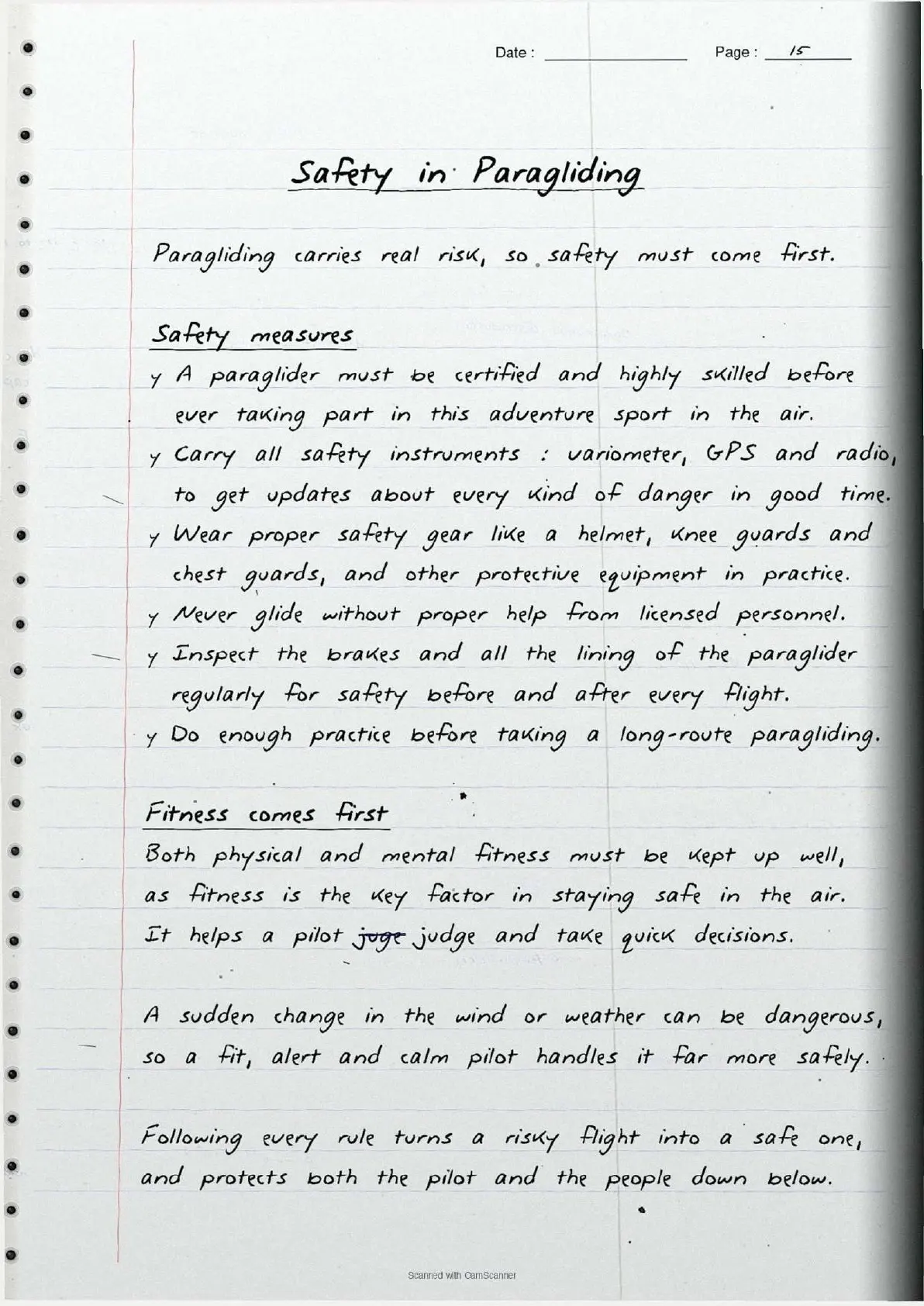
- Paragliding instruments: the variometer for climb and sink rate, the radio for communication, and GPS for tracking and drift.
- Surfing types: stand-up surfing, body surfing or body boarding, surf matting, and tow-surfing.
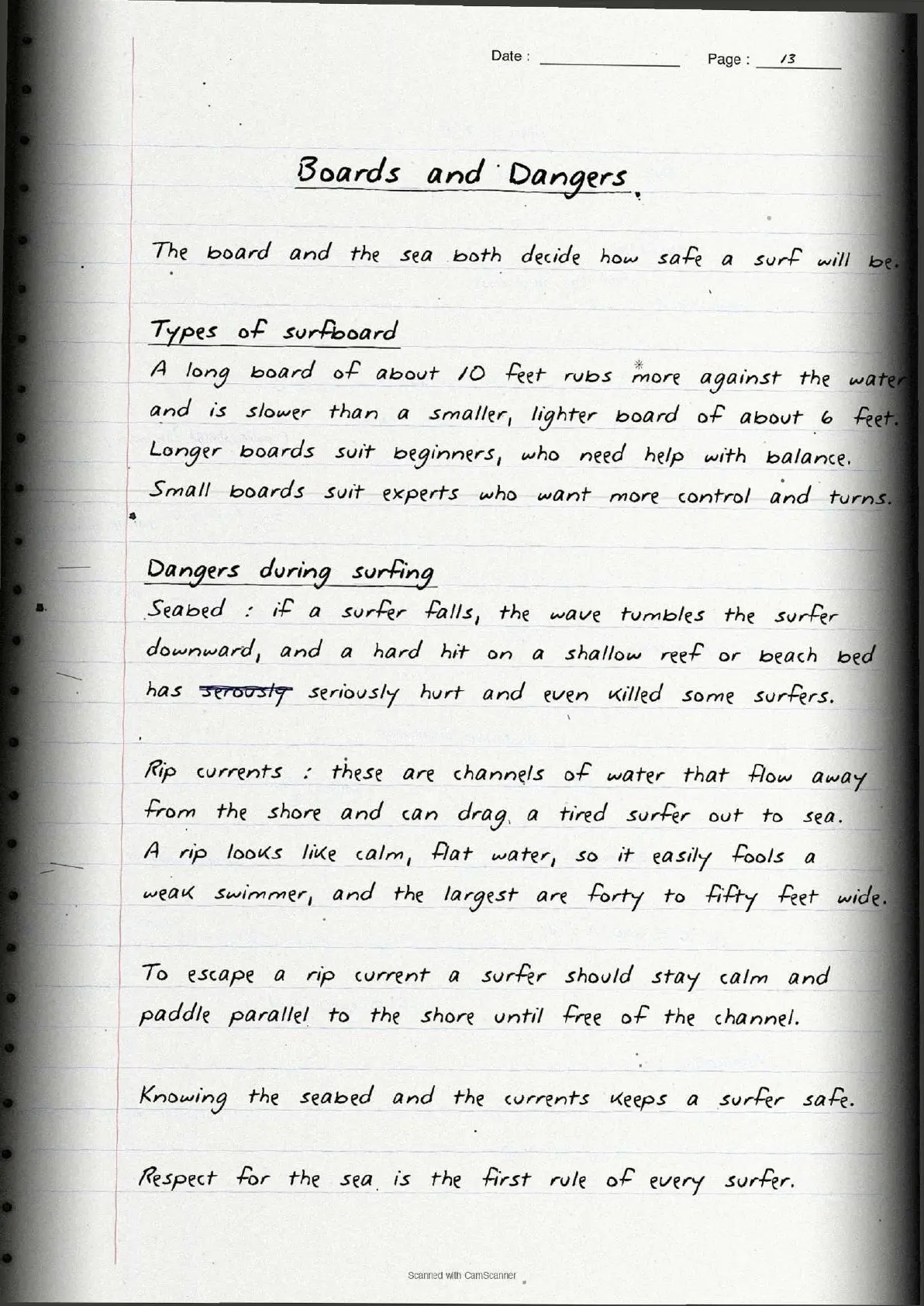
- Surfboards: a long board (about 10 feet) is slower and better for beginners, a smaller board (about 6 feet) gives more control for experts.
The notes box one contrast that scores well: a paraglider uses thermals for long flights, while a sky-diving parachute is only a tool to return safely to earth after free fall. The first surfing world professional contests started in 1975, when Margo Oberg became the first female professional surfer, and the highest governing body is the International Surfing Association. Pair the paragliding launch types with the surfing types and you have the core of the chapter on a few pages.
Safety Measures and Equipment in the Notes
The safety pages are the highest-scoring part of the chapter, so the handwritten notes keep them as a clear checklist. Both paragliding and surfing carry high risk, so the notes list the measures a participant must follow. The bullets below cover the main points from the chapter.
- Certification and skill: a paraglider must be certified and highly skilful before taking up the sport, and gliding is not allowed without licensed assistance.
- Safety instruments: carry the variometer, GPS and radio to get updates about every kind of danger.
- Protective equipment: wear a helmet, knee guards, chest guards and other protective gear during practice.
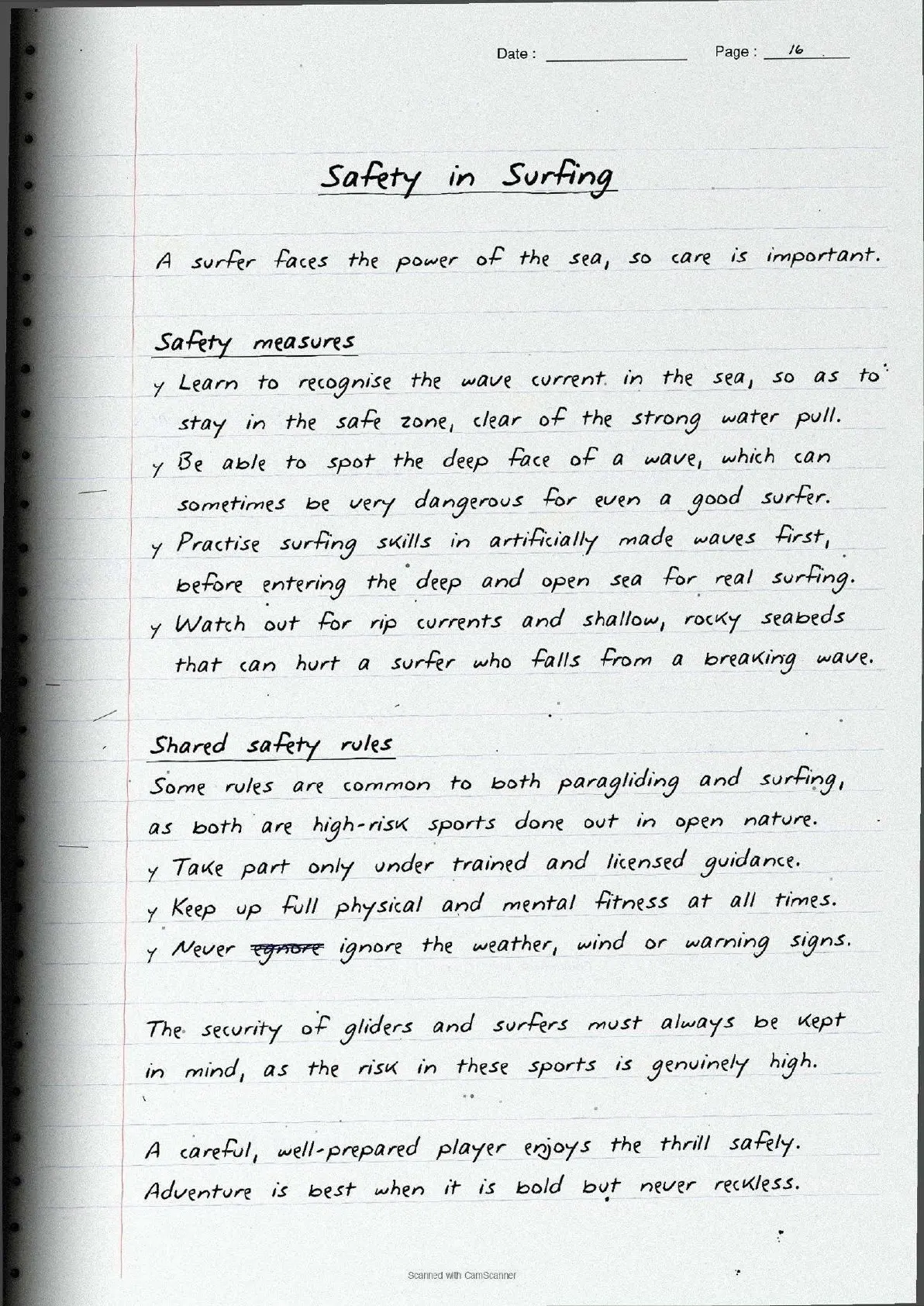
- Surfing awareness: a surfer must recognise the wave current and the deep face of a moving wave, and should practise in artificial waves before the deep sea.
- Regular checks and fitness: inspect the paraglider breaks and lines often, practise enough before long routes, and keep both physical and mental fitness for quick decisions.
The notes also box the two main dangers in surfing: the seabed, which can injure a surfer during a violent collision in shallow water, and rip currents, water channels that flow away from the shore. The chapter gives one escape rule that the notes highlight in the margin: to exit a rip current, paddle parallel to the shore rather than against the current. This safety list feeds the long-answer question on measures to keep in mind during paragliding.
How to Use These Handwritten Notes
Handwritten notes work best as a final-revision tool, not a first read. The steps below show how to get the most out of the adventure sports handwritten notes in the last days before a test.
- Download: tap the download card above to save the handwritten pages to your device.
- First read: read the printed Notes once so the handwritten pages act as a refresher, not a first source.
- Recall drill: cover the page and try to write the three categories, the two paragliding launches and the surfing types from memory.
- Night before: flip through the boxed pages for a quick last-minute recall of the safety list and the instruments.
Many students search for class 11 physical education chapter 11 notes on their phone the night before a test, so a saved set of handwritten pages means you can revise offline. Use the handwritten notes for speed, then check the printed Notes to confirm you have the answer points right.
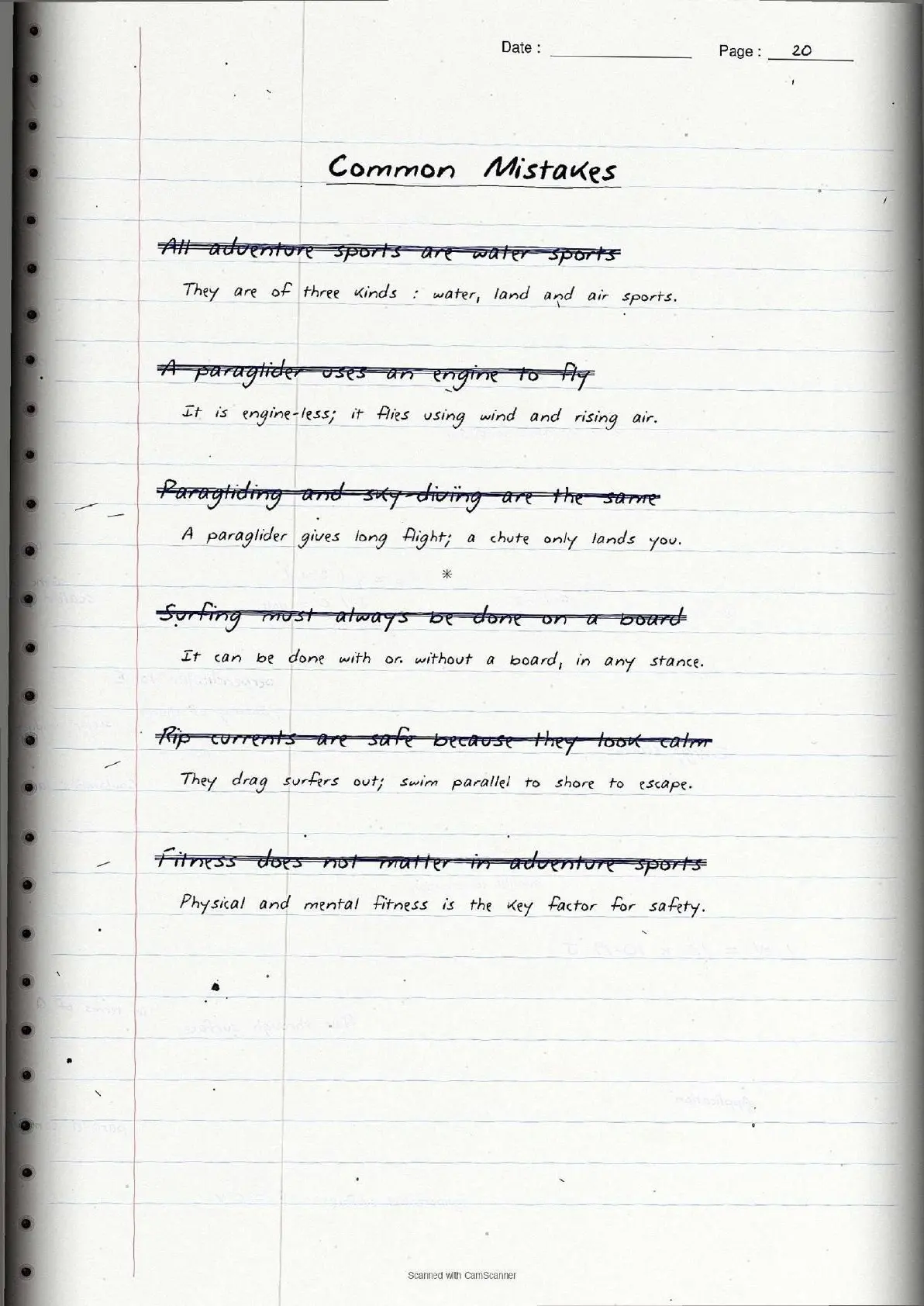
Common Mistakes These Notes Help You Avoid
A few errors cost marks every year. The handwritten notes flag each one in the margin so you can fix it before the exam. These five are the most common.
- Mixing up the categories. Surfing and rafting are water sports, trekking and mountaineering are land sports, paragliding is an air sport.
- Confusing the two paragliding launches. Forward launch is for low winds, reverse launch is for higher winds.
- Naming only one or two surfing types. The exam wants all four: stand-up, body surfing, surf matting and tow-surfing.
- Getting the rip current escape wrong. You paddle parallel to the shore, never straight against the current.
- Skipping the instruments. Remember the variometer, GPS and radio as the three safety instruments in paragliding.
Students who fix these five points usually move from average to high marks. The handwritten notes box the three categories and list all four surfing types in full, so the soft points are hard to miss when you revise.
How These Handwritten Notes Pair with the Notes and Book PDF
These handwritten notes are a fast revision tool. To prepare fully, students should use them alongside the other resources for the same chapter, both linked in the table below. Read the printed Notes, then use these pages for a final recall.
| Resource | Best used for |
|---|---|
| Adventure Sports Class 11 Notes | Quick chapter summary with the classification, paragliding, surfing and safety in one place |
| Adventure Sports NCERT Book PDF | Reading the original NCERT chapter text and figures |
Tip: read the printed Notes first, then keep these handwritten pages for the final night-before flip. Using them for recall, not for the first read, builds memory faster.
All Class 11 Physical Education Handwritten Notes by Chapter
The table links the handwritten notes for every chapter in Class 11 Physical Education, so students can move across the course in one click. Adventure Sports is highlighted.
| Chapter | Handwritten Notes |
|---|---|
| Chapter 1 | Physical Education |
| Chapter 2 | Understanding Health |
| Chapter 3 | Physical and Physiological Aspects of Physical Education and Sports |
| Chapter 4 | Individual Games |
| Chapter 5 | Team Games |
| Chapter 6 | Yoga and its Relevance in the Modern Times |
| Chapter 7 | Safety and Security |
| Chapter 8 | Health Related Physical Fitness |
| Chapter 9 | Measurement and Evaluation |
| Chapter 10 | Tournaments and Competitions |
| Chapter 11 | Adventure Sports |
FAQs on Adventure Sports Handwritten Notes
Adventure Sports Class 11 Physical Education Handwritten Notes Common Questions
Ques. Where can I download the Adventure Sports handwritten notes PDF?
Ans. You can download the Adventure Sports Class 11 Physical Education handwritten notes PDF directly from this page. It is free, follows the 2026-27 NCERT Health and Physical Education textbook, and presents the classification, paragliding, surfing and safety measures as handwritten pages.
Ques. What are the three types of adventure sports in Class 11 Chapter 11?
Ans. Adventure sports are classified as water adventure sports such as rafting and surfing, land adventure sports such as trekking and mountaineering, and air adventure sports such as paragliding and jumping. The handwritten notes draw all three as one clear map.
Ques. Are handwritten notes good for revising Class 11 Physical Education Chapter 11?
Ans. Yes. Handwritten notes are best for fast, last-minute revision because the boxed key terms and arrows make the classification, the paragliding instruments and the safety list easy to skim. Use them after a first read of the printed Notes, not as your only source.
Ques. What topics do these handwritten notes cover?
Ans. They cover the meaning of adventure sports, the water, land and air classification, paragliding with its history, launch types, landing and instruments, surfing with its types, surfboards and dangers, and the safety measures and equipment for both sports.
Ques. How should I use these notes with the other resources?
Ans. Read the printed Notes first, then keep these handwritten pages for the final night-before flip. Using them for recall rather than the first read builds memory faster. The NCERT Book PDF is linked on this page for the original chapter text.



Comments