



These Tournaments and Competitions handwritten notes turn the whole chapter on tournaments into clean, handwritten pages for fast revision. They follow the 2026-27 NCERT "Health and Physical Education" Class 11 Chapter 10. Students get the meaning of a tournament, the types (knock-out, league and combination), the method of drawing fixtures, byes and seeding, plus the merits and demerits of each type, all in a pen-on-paper format that is easy to skim before the Class 11 final exam.
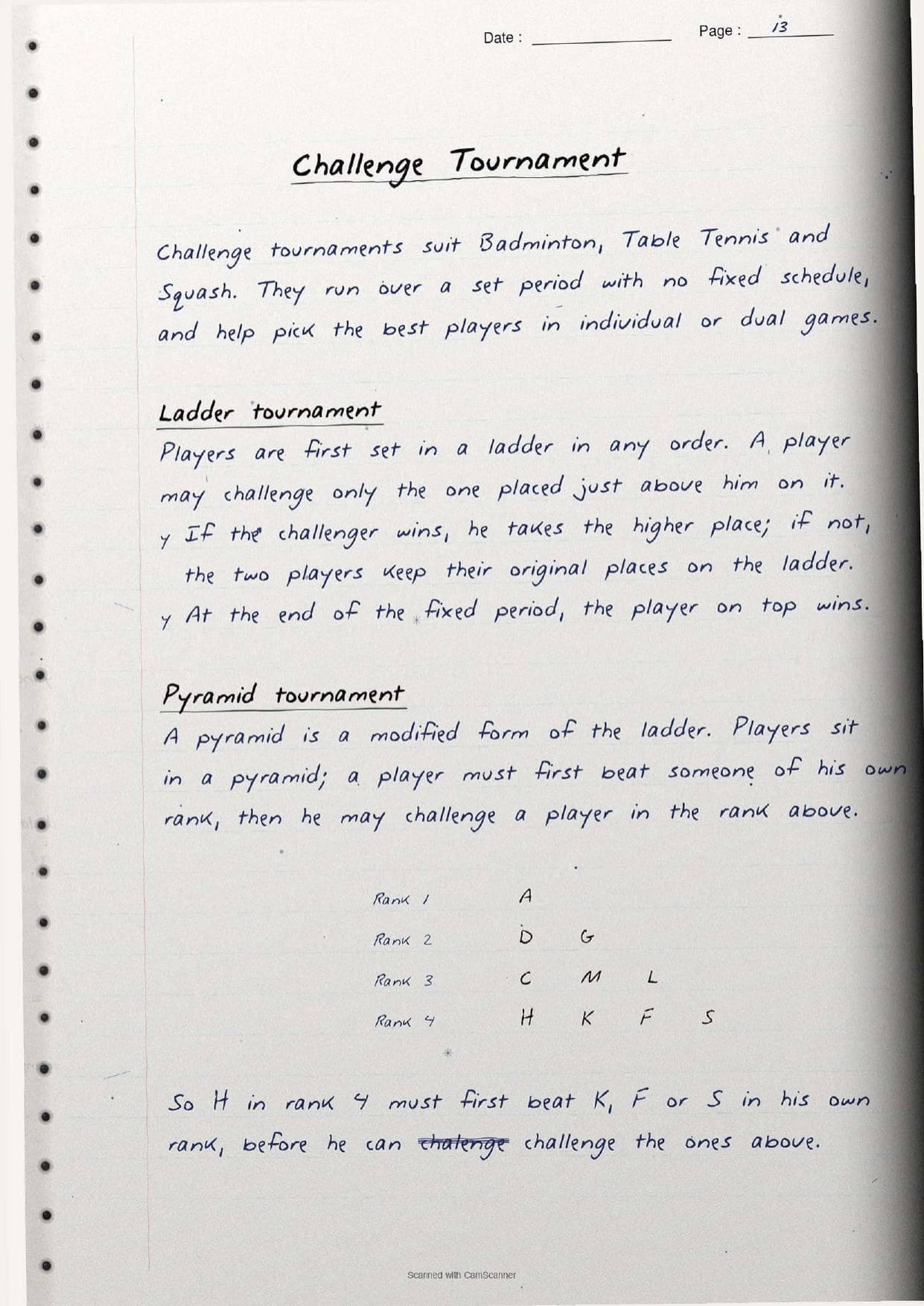
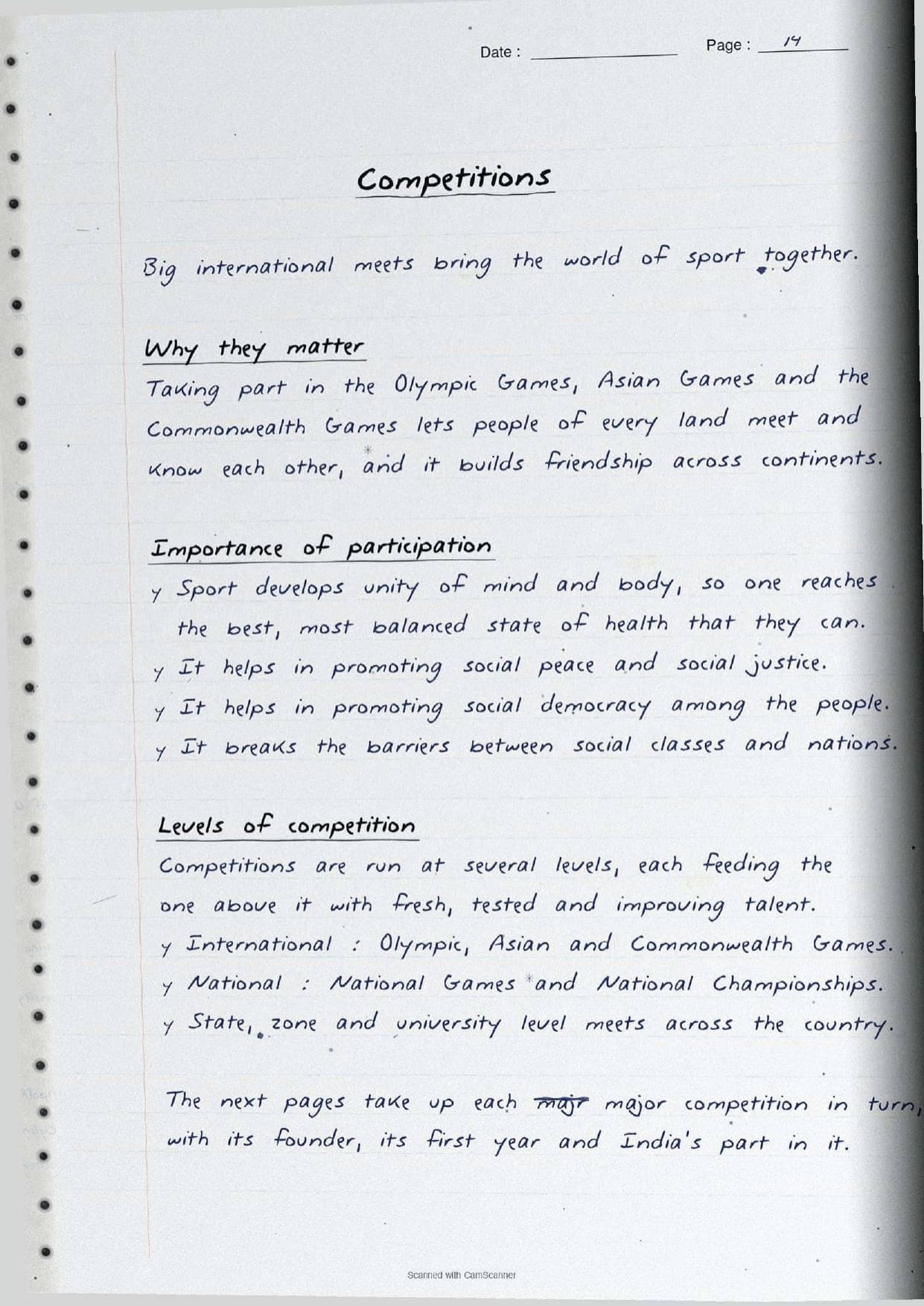
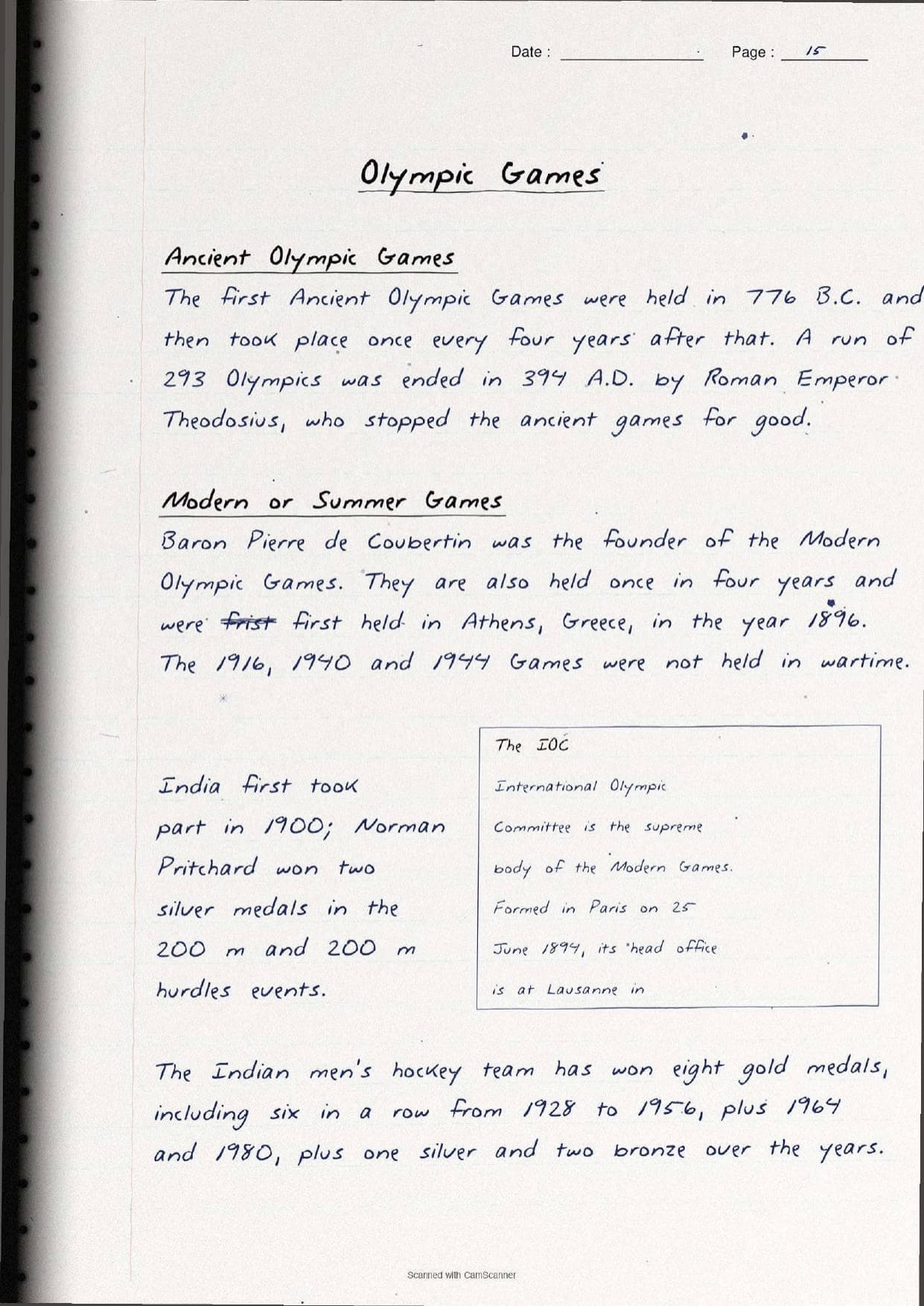
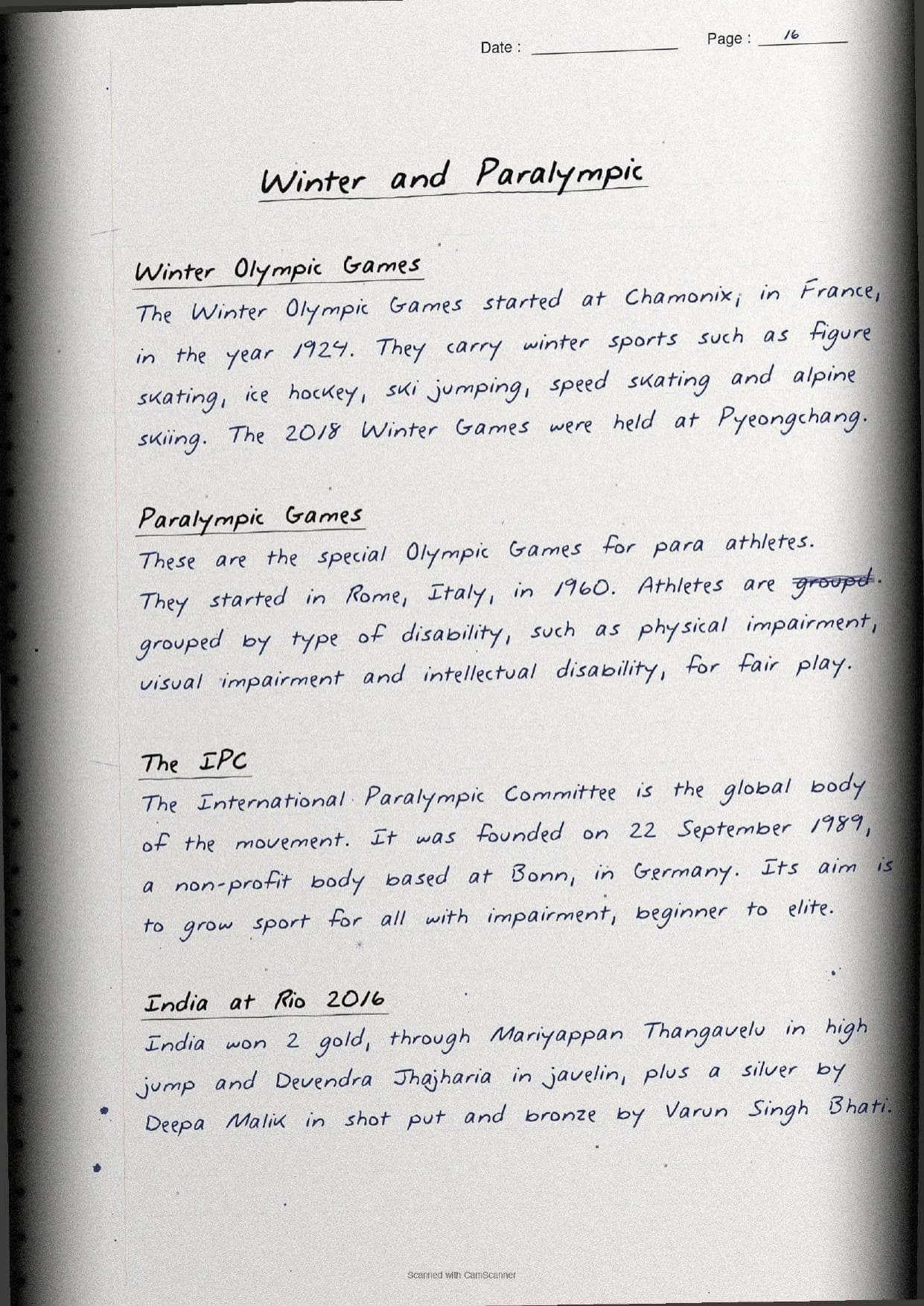
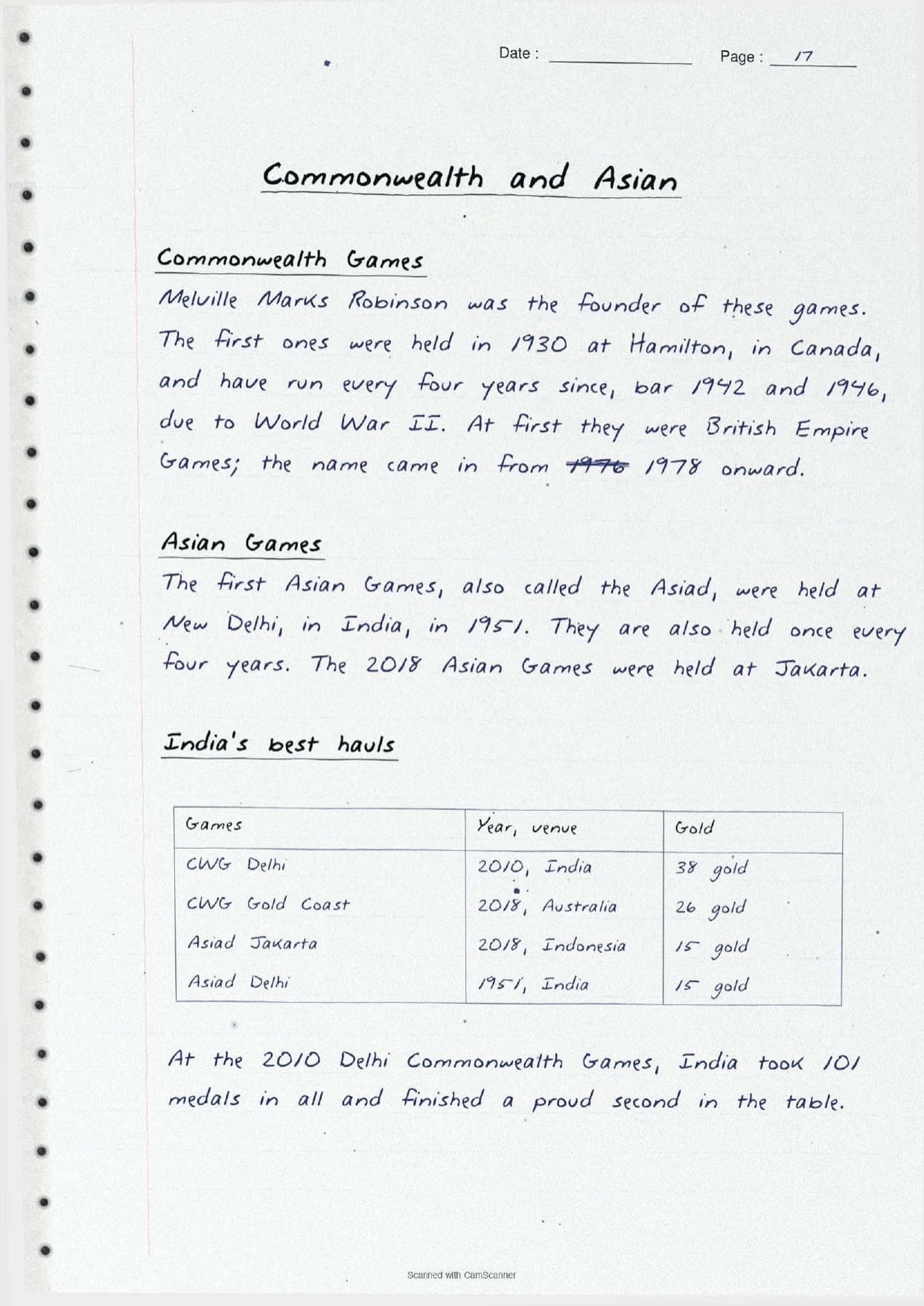
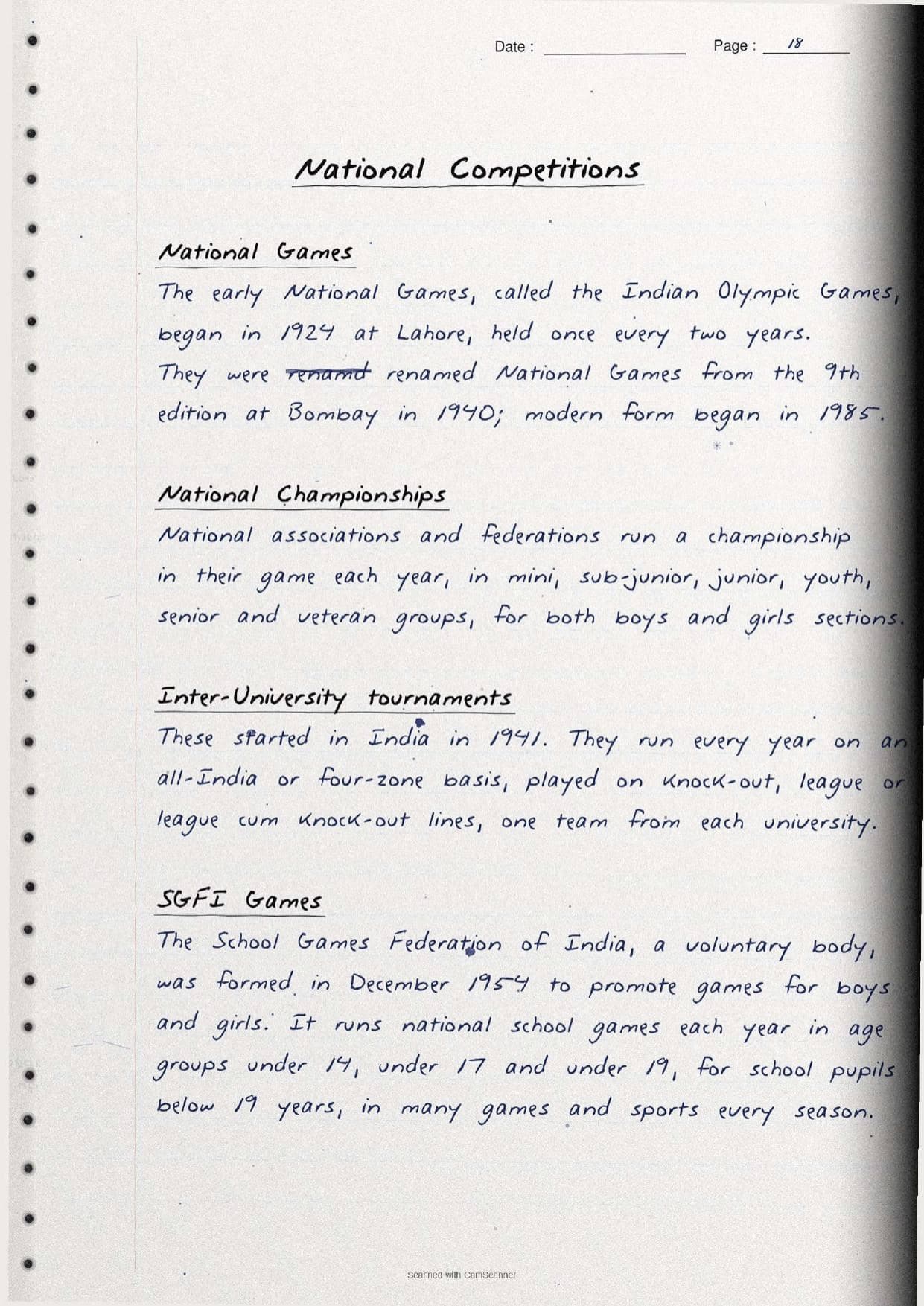
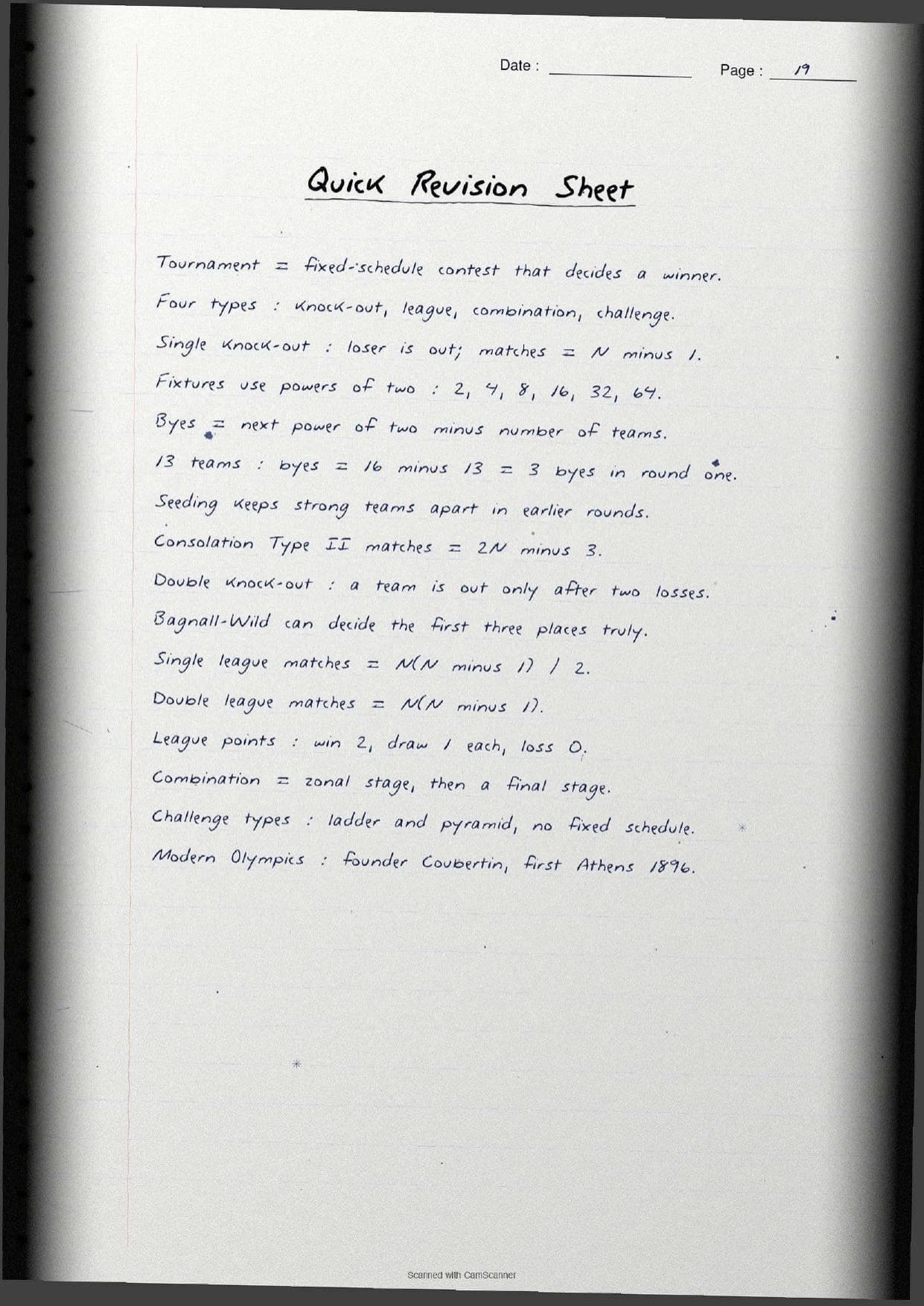
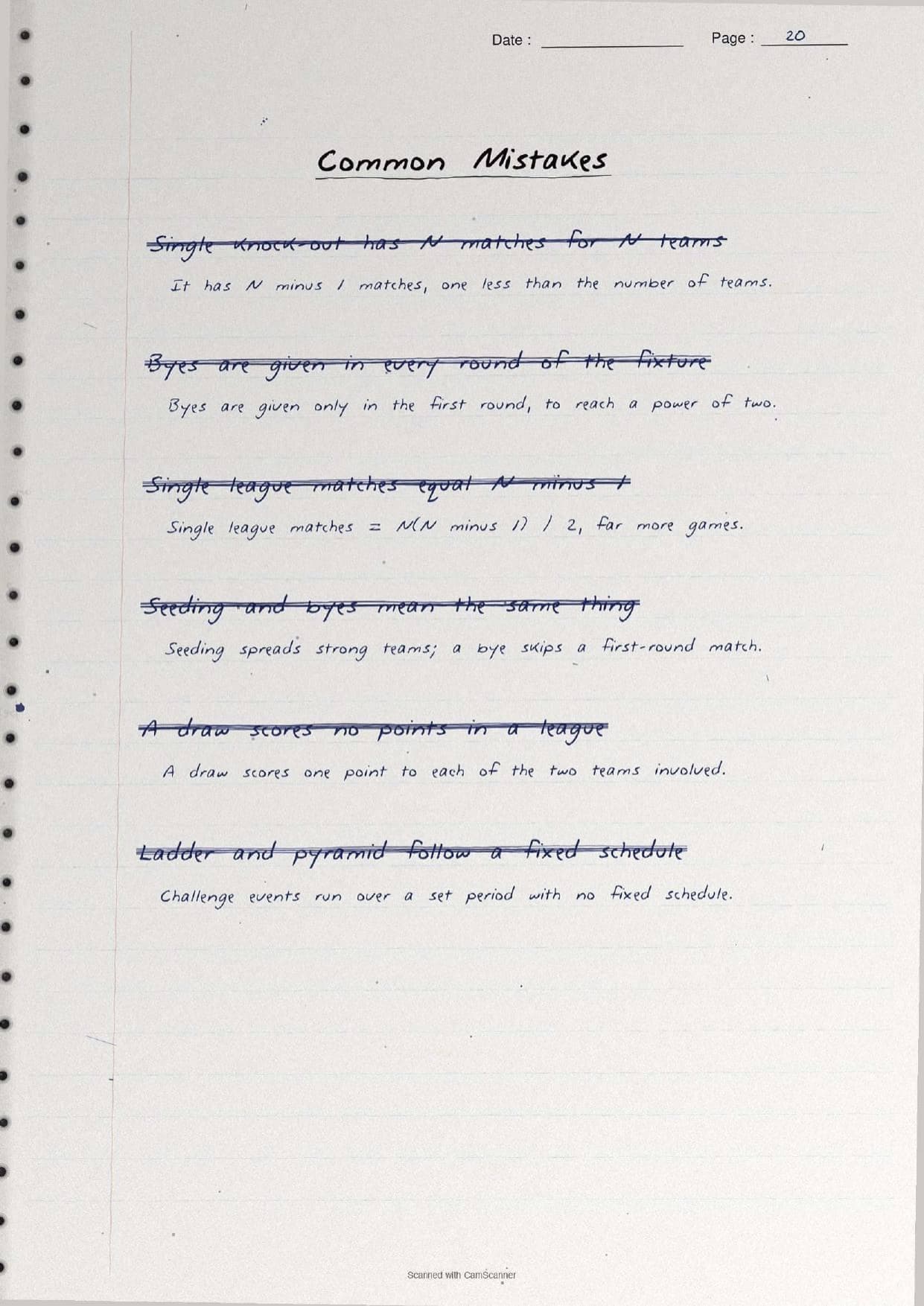
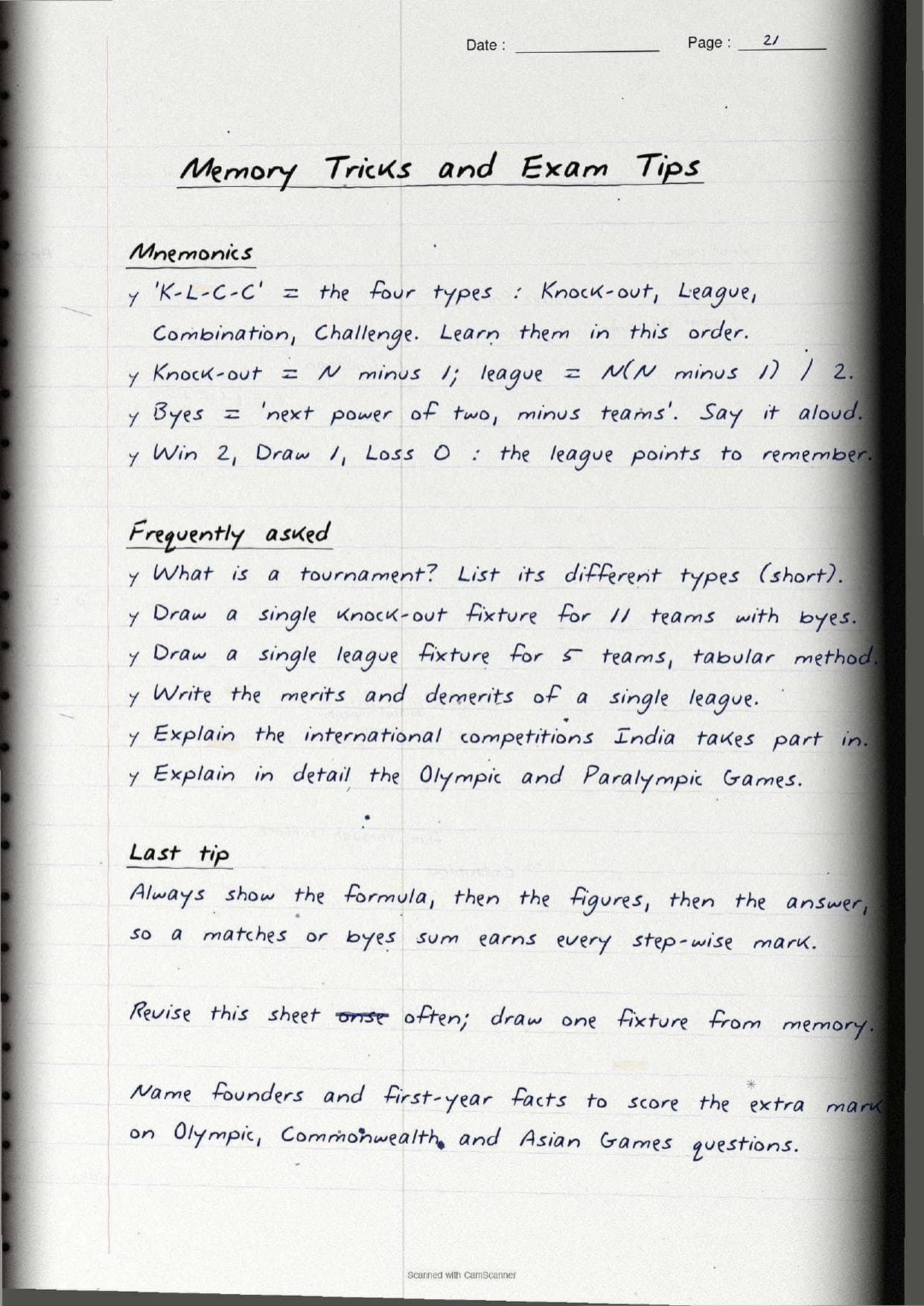
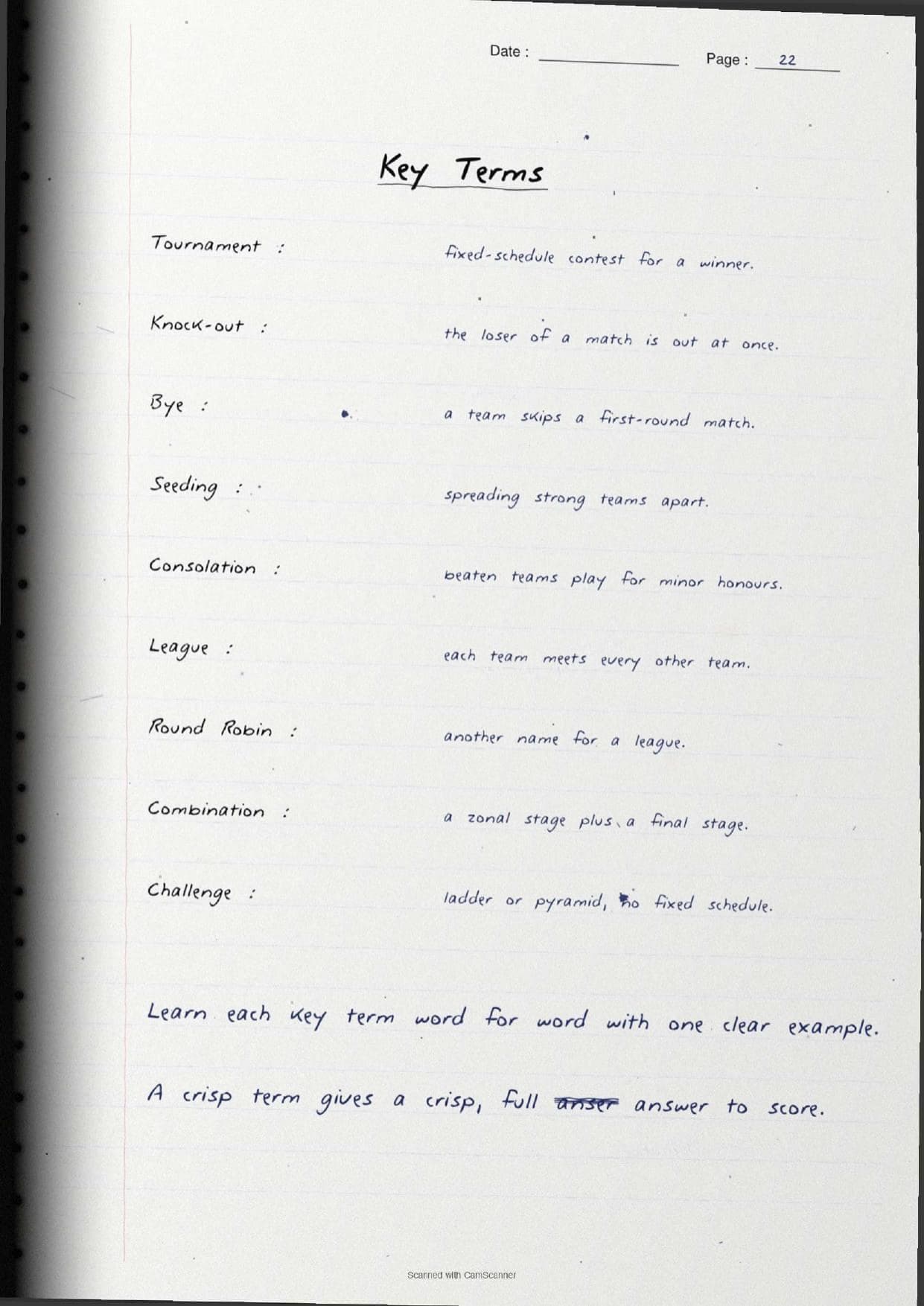
- Handwritten pages with boxed formulas for matches and byes, and a labelled fixture drawn by hand.
- This is one of the most scoring chapters in the Class 11 Physical Education paper because fixtures carry easy full marks.
- Pairs with the Notes and NCERT Book PDF linked lower on this page.
These Tournaments and Competitions handwritten notes are prepared from the official NCERT Health and Physical Education textbook and checked against recent CBSE Class 11 Physical Education question papers.
Student Feedback: In a Collegedunia poll of 5,180 Class 11 Physical Education students, 74% of students said the hand-drawn fixtures and boxed formulas helped them draw a knock-out fixture and count byes far faster than the printed diagrams, because the arrows and half-labels made the layout stick.
Source: 2026-27 Class 11 Physical Education student poll. Sample of 5,180 students from CBSE schools across 11 states.
What These Tournaments and Competitions Handwritten Notes Contain
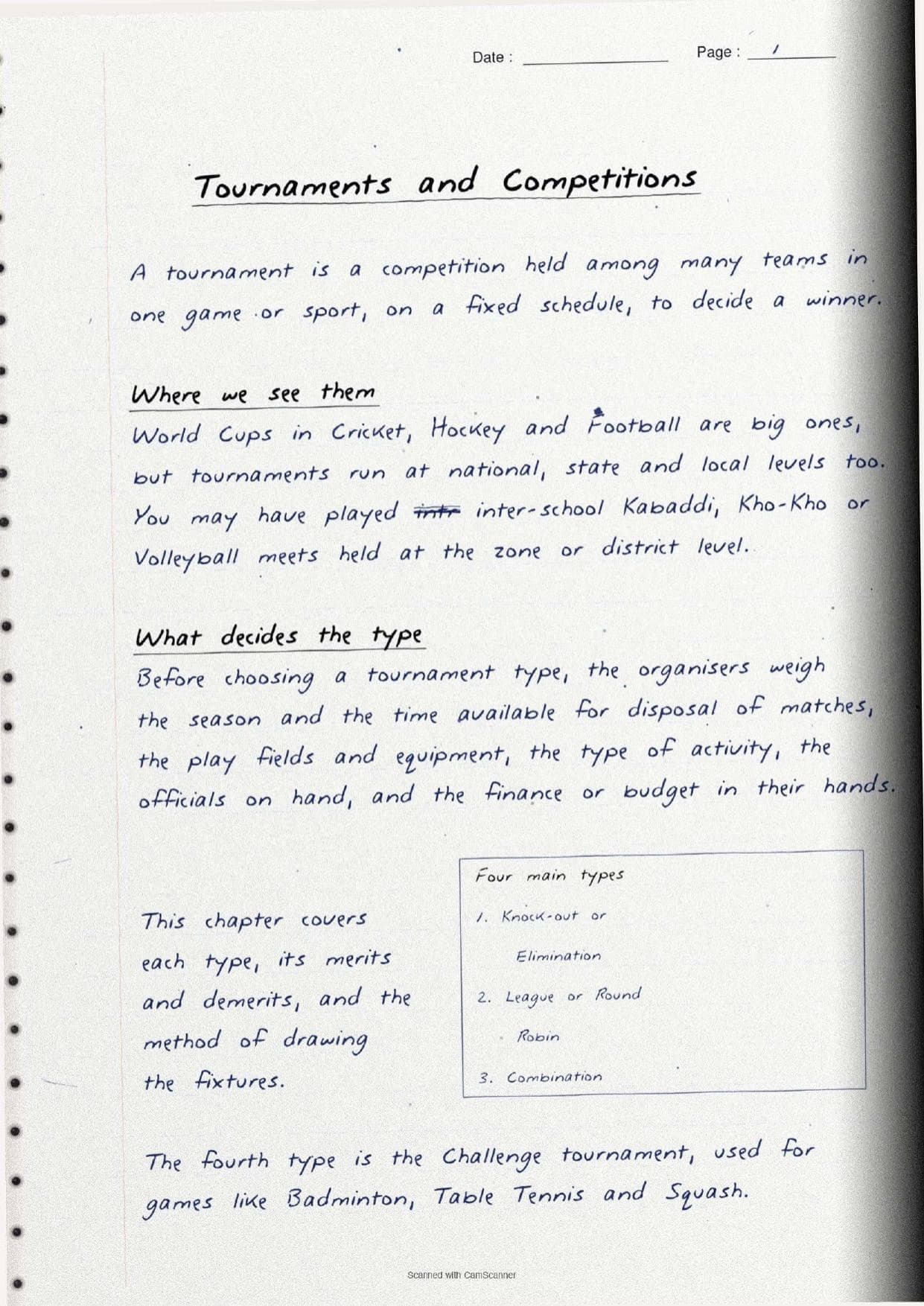
Tournaments and Competitions is Chapter 10 of Class 11 Physical Education. It explains what a tournament is, the main types, and the exact steps to draw a fixture. A tournament is a competition held among different teams in a game or sport according to a fixed schedule where a winner is decided. These handwritten notes condense the chapter into pages that read like a topper's own notebook.
The notes are organised under three threads, each on its own set of pages:
- The types: knock-out, league or round robin, combination and challenge tournaments.
- The fixtures: the formulas for number of matches, byes and rounds, drawn out step by step.
- The judgement points: the merits and demerits of each type, and when to choose which.
Because the pages are handwritten, the formulas and half-labels sit in boxes and arrows rather than long paragraphs. A student can flip through the Tournaments and Competitions class 11 pages in a few minutes and still recall the match formula, the bye rule and the seeding idea before walking into the exam.
Types of Tournaments in the Handwritten Pages
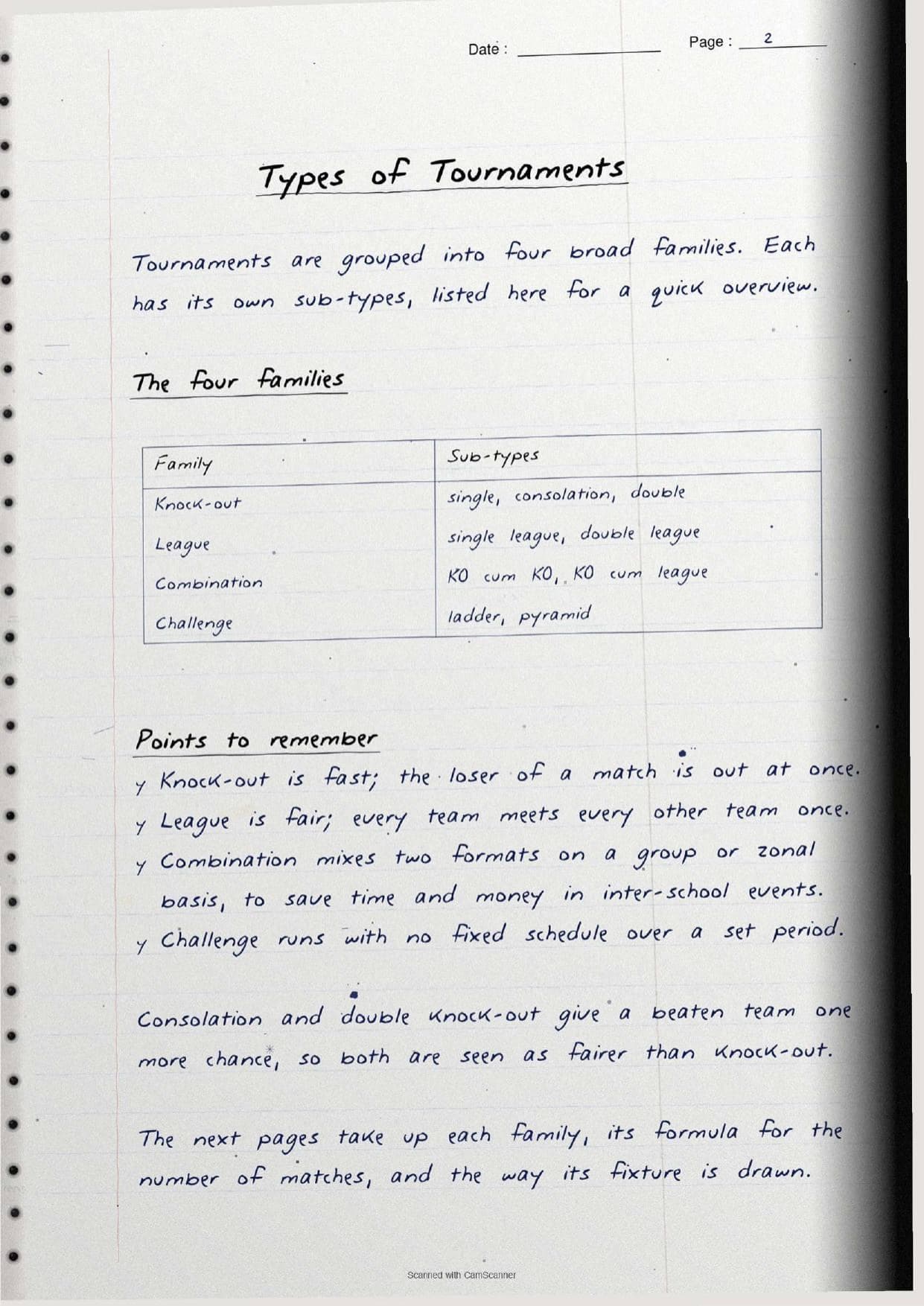
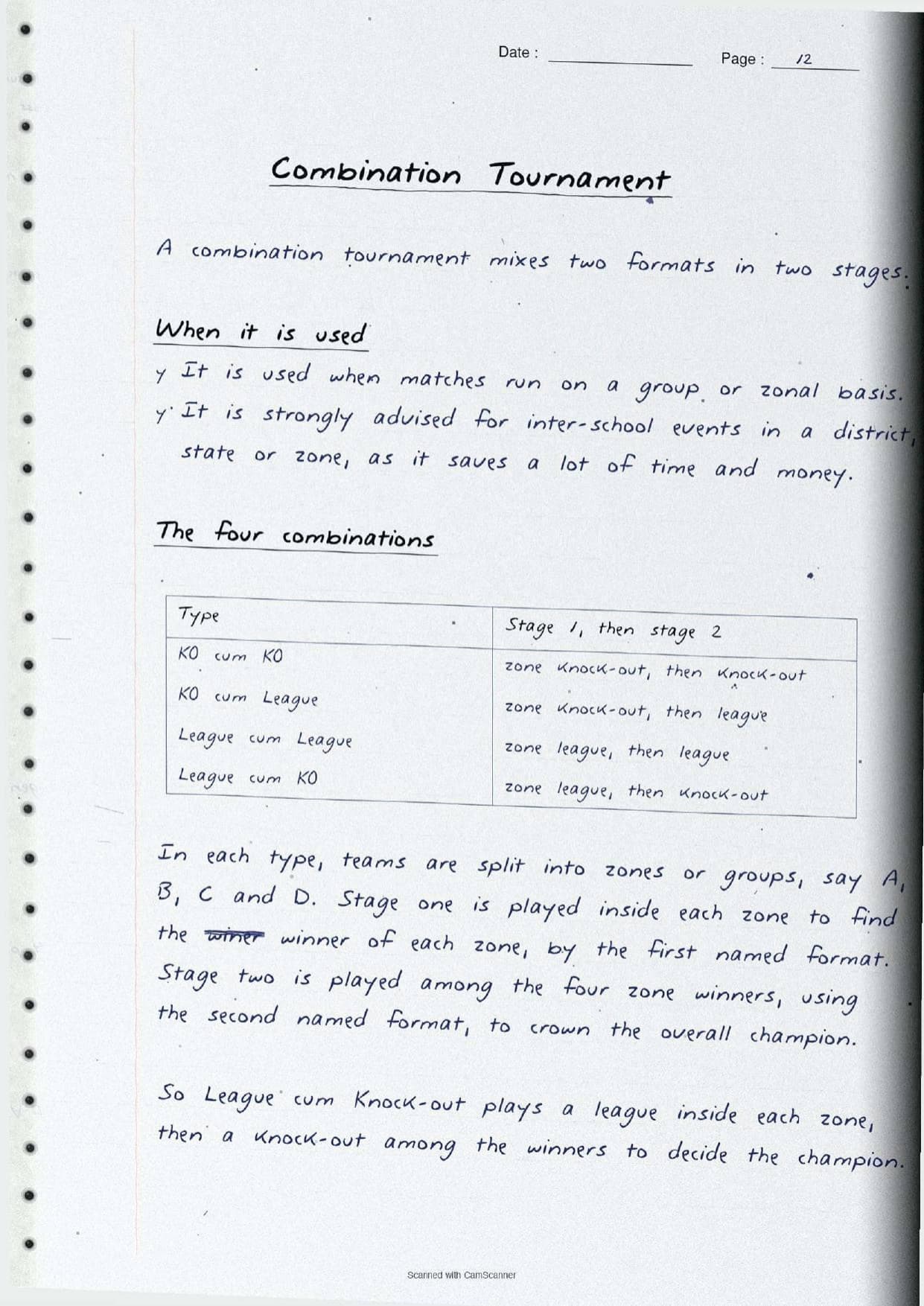
The types of tournaments fill the central pages, drawn as a clear map so each family stands apart. A knock-out tournament eliminates a team once it is defeated, a league tournament lets each team play every other team, a combination tournament mixes the two on a group or zonal basis, and a challenge tournament runs without a fixed schedule. The table below shows what the handwritten notes cover for each type.
| Tournament type | Key idea on the page | Total number of matches |
|---|---|---|
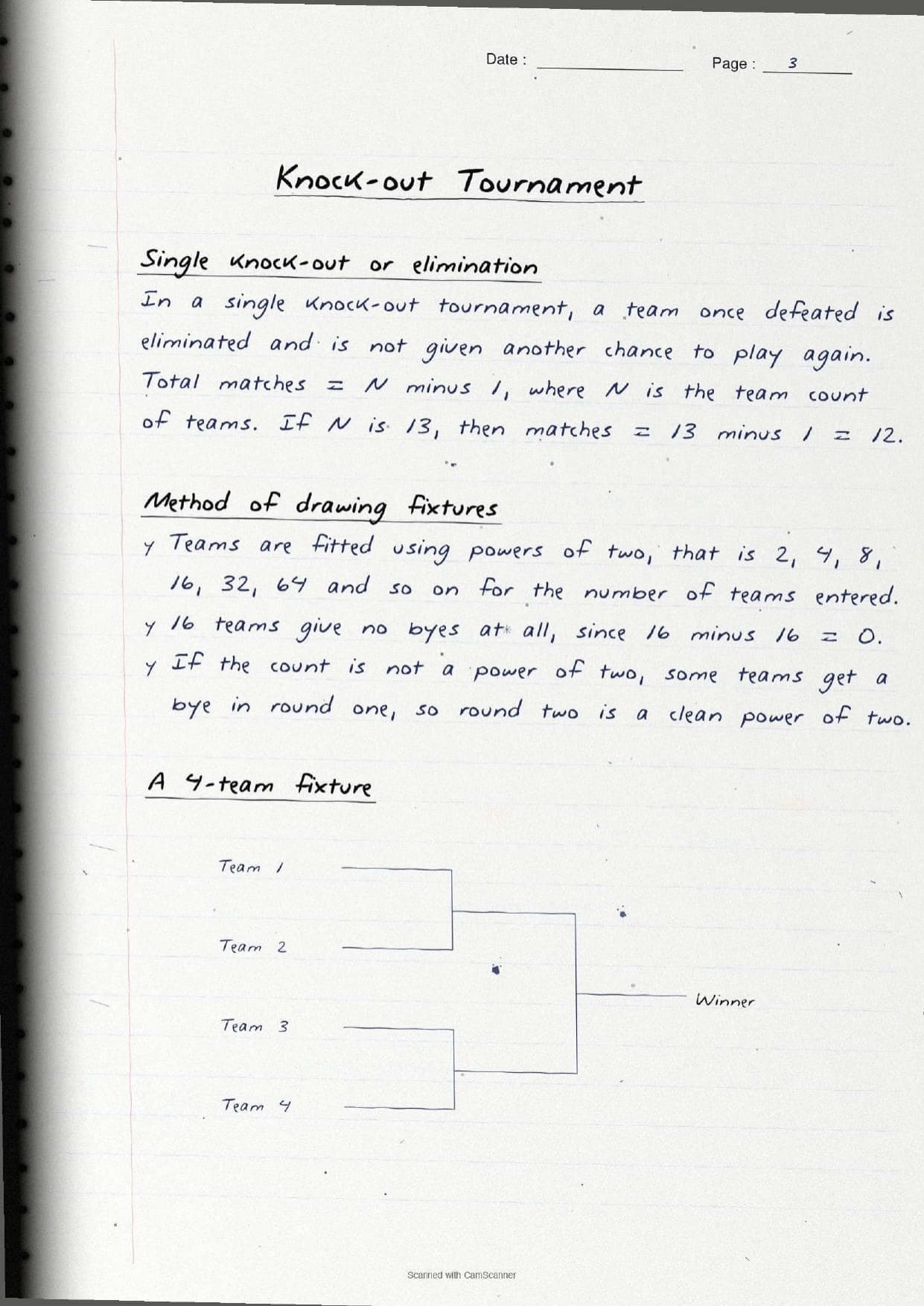
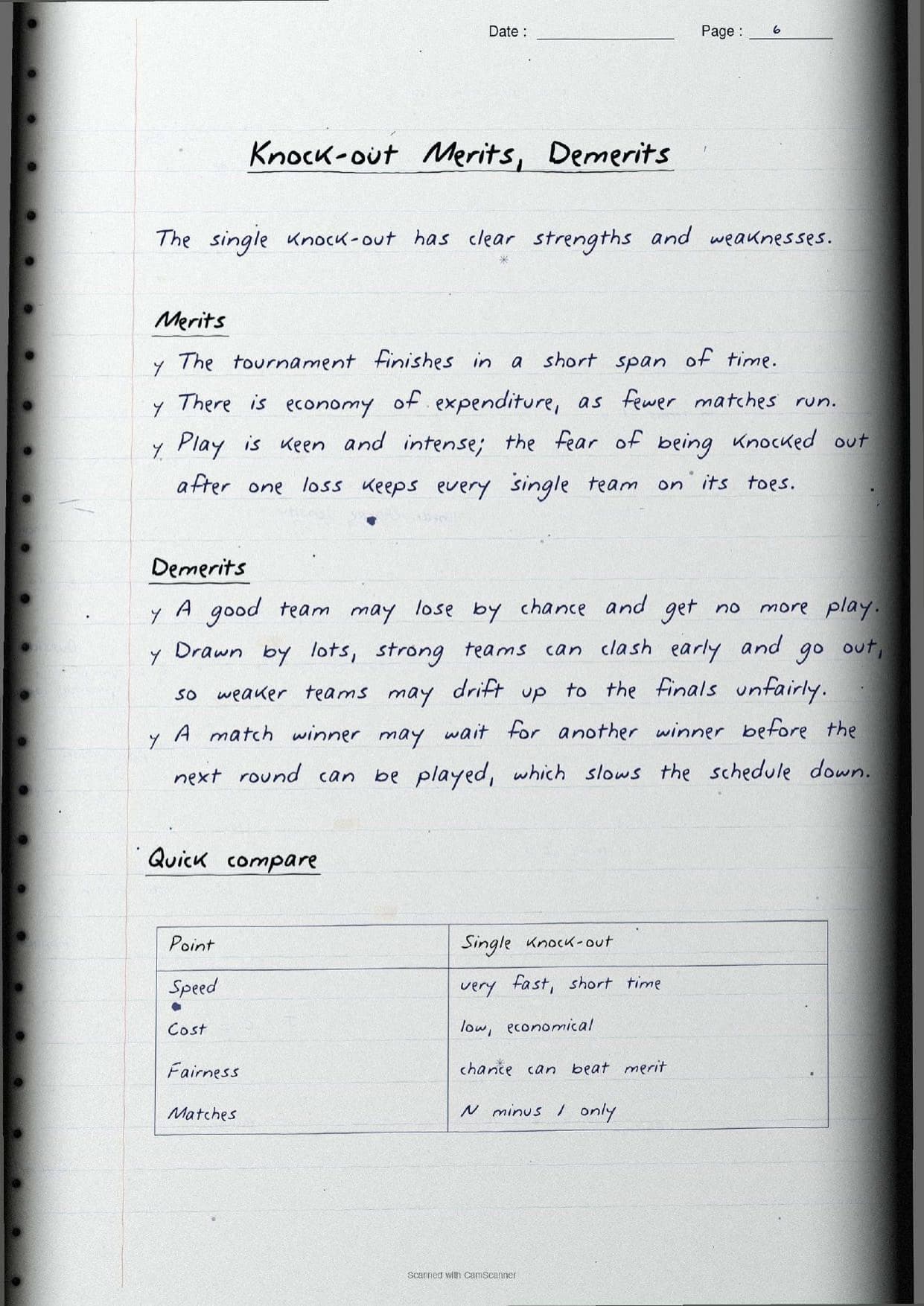
| Single Knock-out | A team once defeated is eliminated and gets no second chance. | N − 1 |
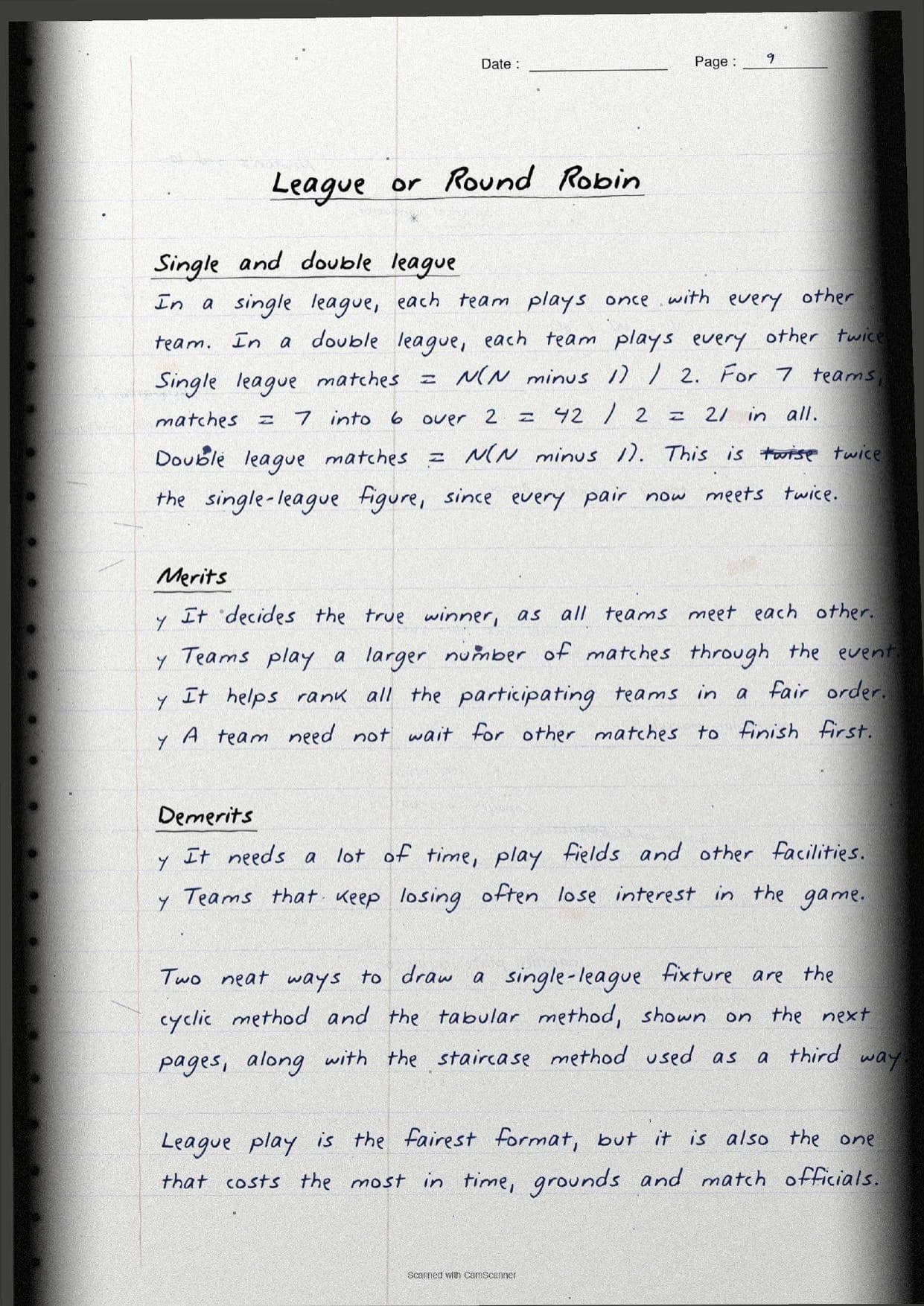
| Single League (Round Robin) | Each team plays once with every other team; decides the true winner. | N(N − 1) / 2 |
| Double League | Every team plays twice with every other team. | N(N − 1) |
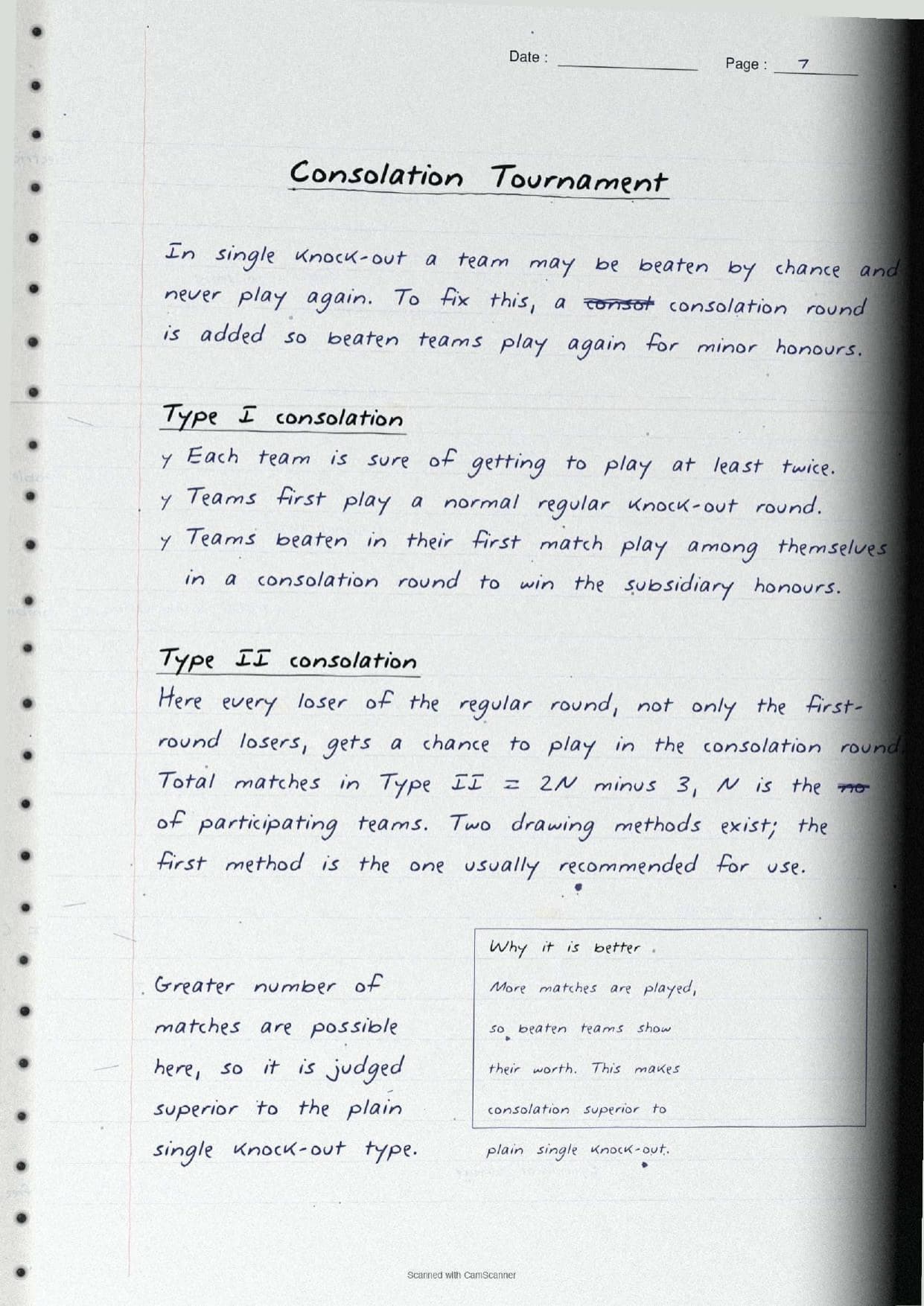
| Consolation Type II | Every loser of the regular round plays again for subsidiary honours. | 2N − 3 |
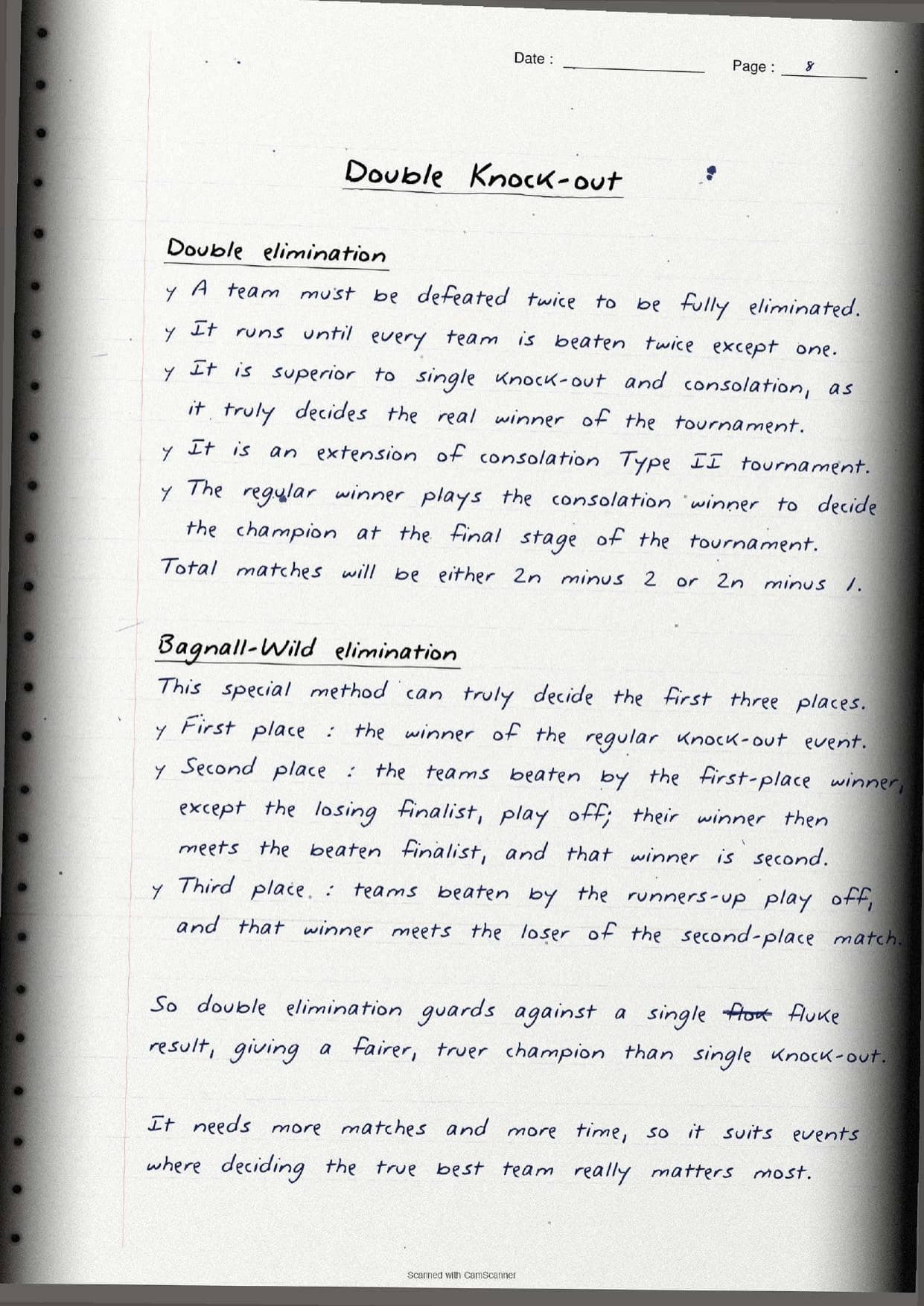
| Double Knock-out | A team must be defeated twice to be eliminated; decides the true winner. | (2n − 2) or (2n − 1) |
The handwritten map makes the main contrast easy to see: knock-out is fast and cheap but a strong team can be knocked out by chance, while a league is fair and ranks every team but needs more time and facilities. Combination tournaments are recommended for inter-school events across a district, state or zone to save time and money, and challenge tournaments (Ladder and Pyramid) suit individual games like badminton, table tennis and squash. Seeing the types side by side on one page is the fastest way to remember which formula sits where.
Drawing Fixtures, Byes and Seeding in the Notes
The later pages cover the actual method of drawing a fixture, which is where most marks are won. These steps feed the long-answer questions, so the handwritten notes keep them as boxed rules with a worked example beside each. The list below shows what each page covers.
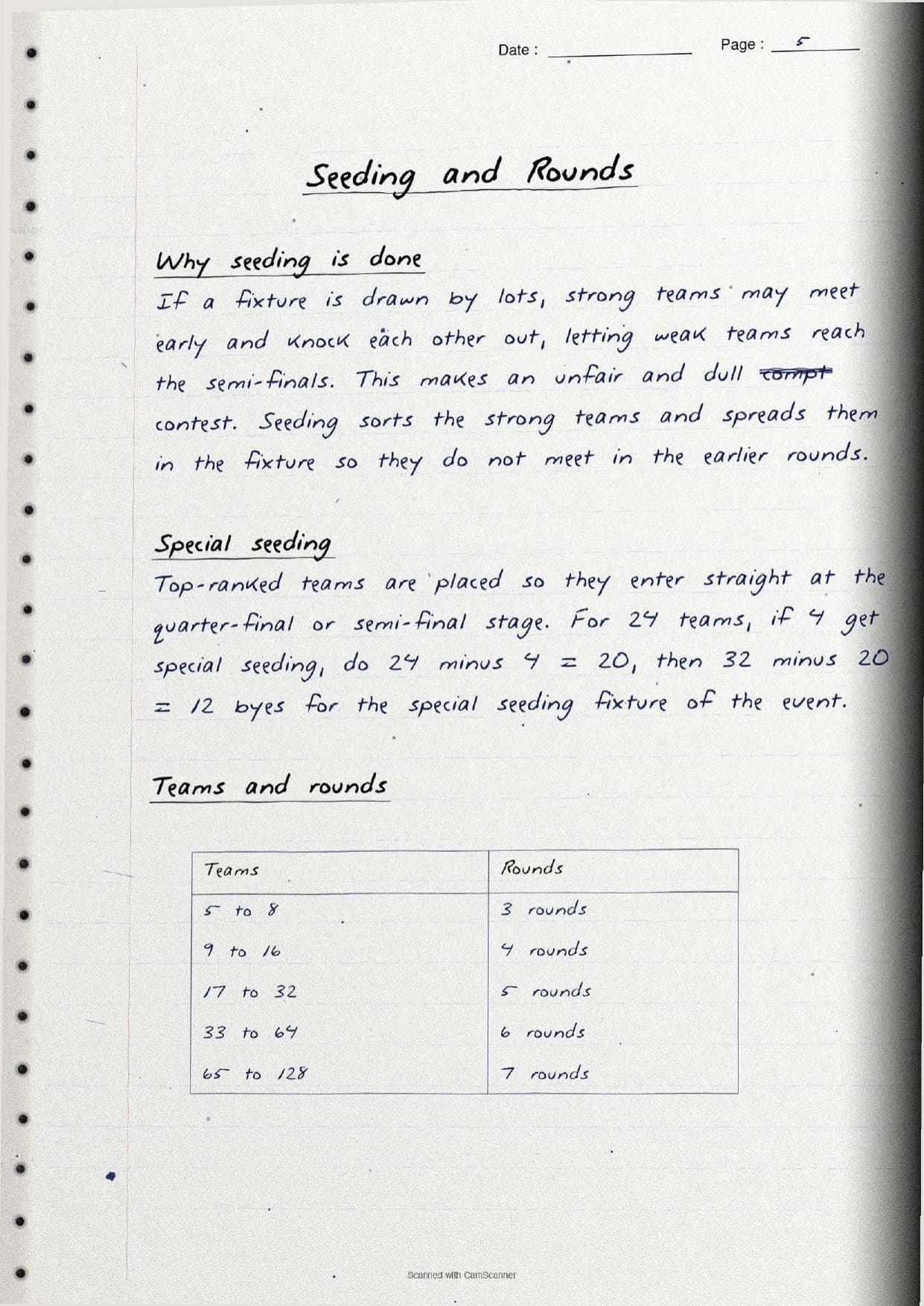
- Matches: in single knock-out, total matches = N − 1. For 13 teams, matches = 13 − 1 = 12.
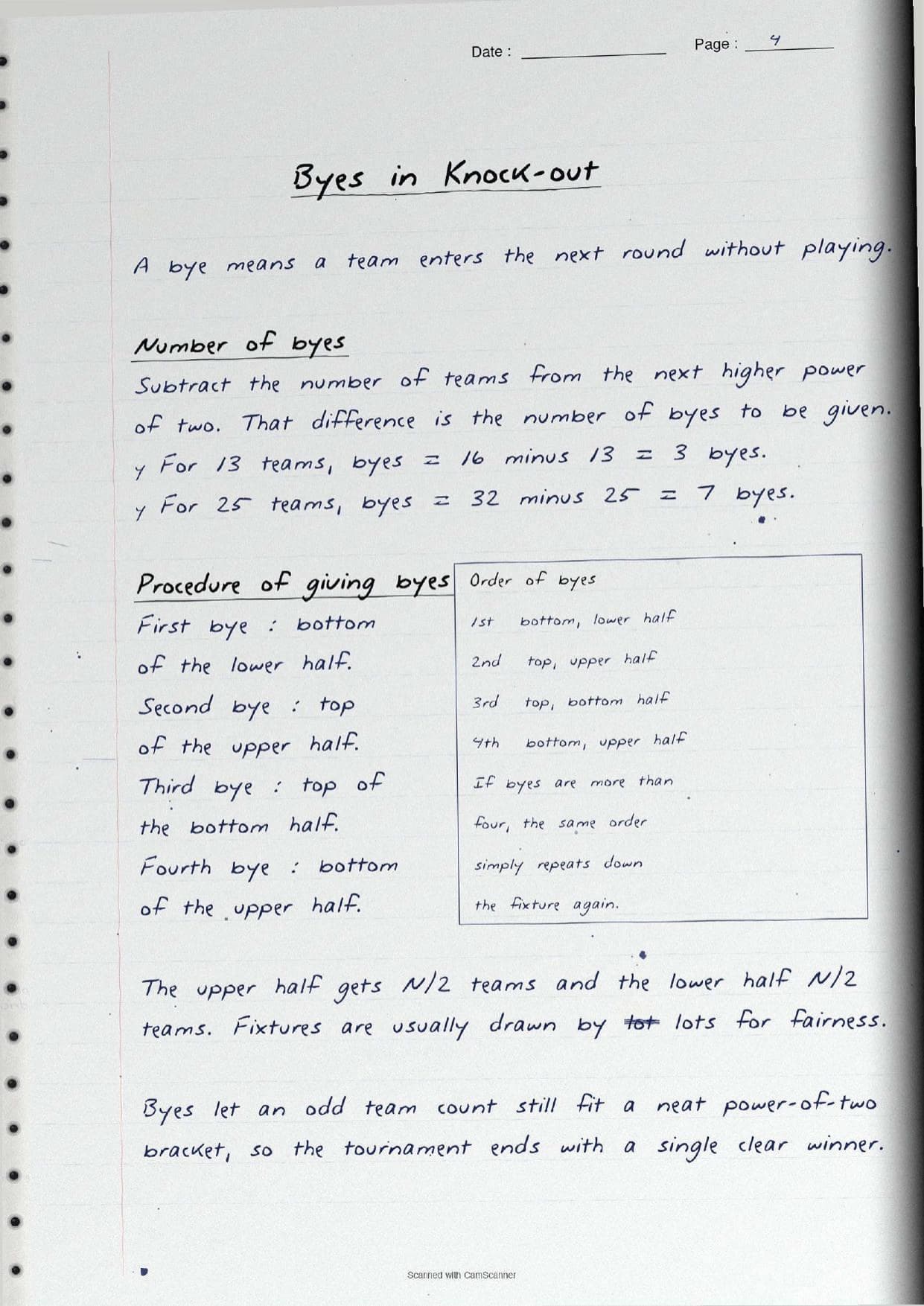
- Byes: byes are given when the number of teams is not a power of two. Number of byes = next higher power of two − number of teams. For 13 teams, byes = 16 − 13 = 3.
- Order of byes: 1st bye to the bottom of the lower half, 2nd bye to the top of the upper half, 3rd bye to the top of the bottom half, 4th bye to the bottom of the upper half.
- Seeding: sorting strong teams and placing them so they do not meet in the early rounds, which keeps the competition fair.
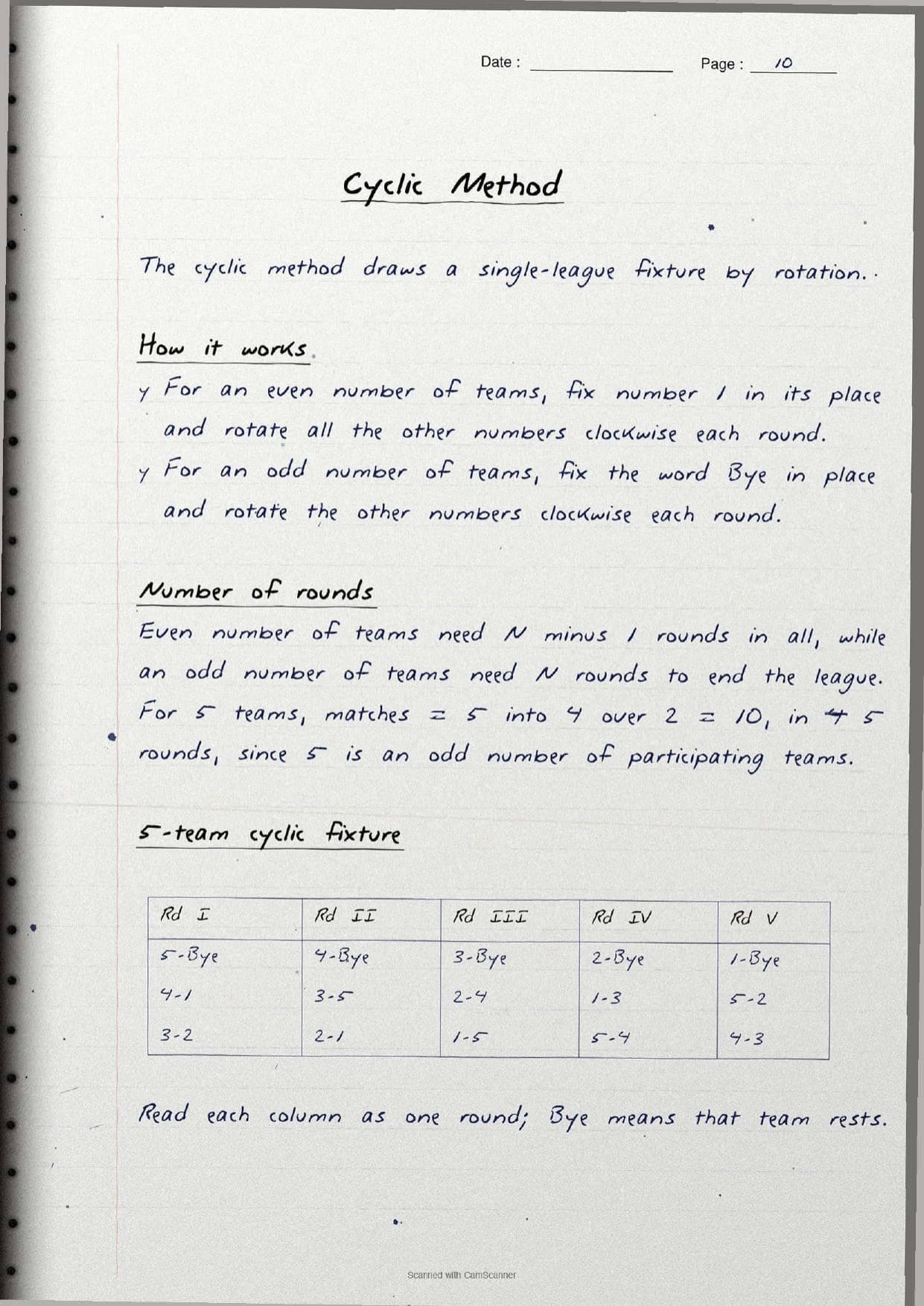
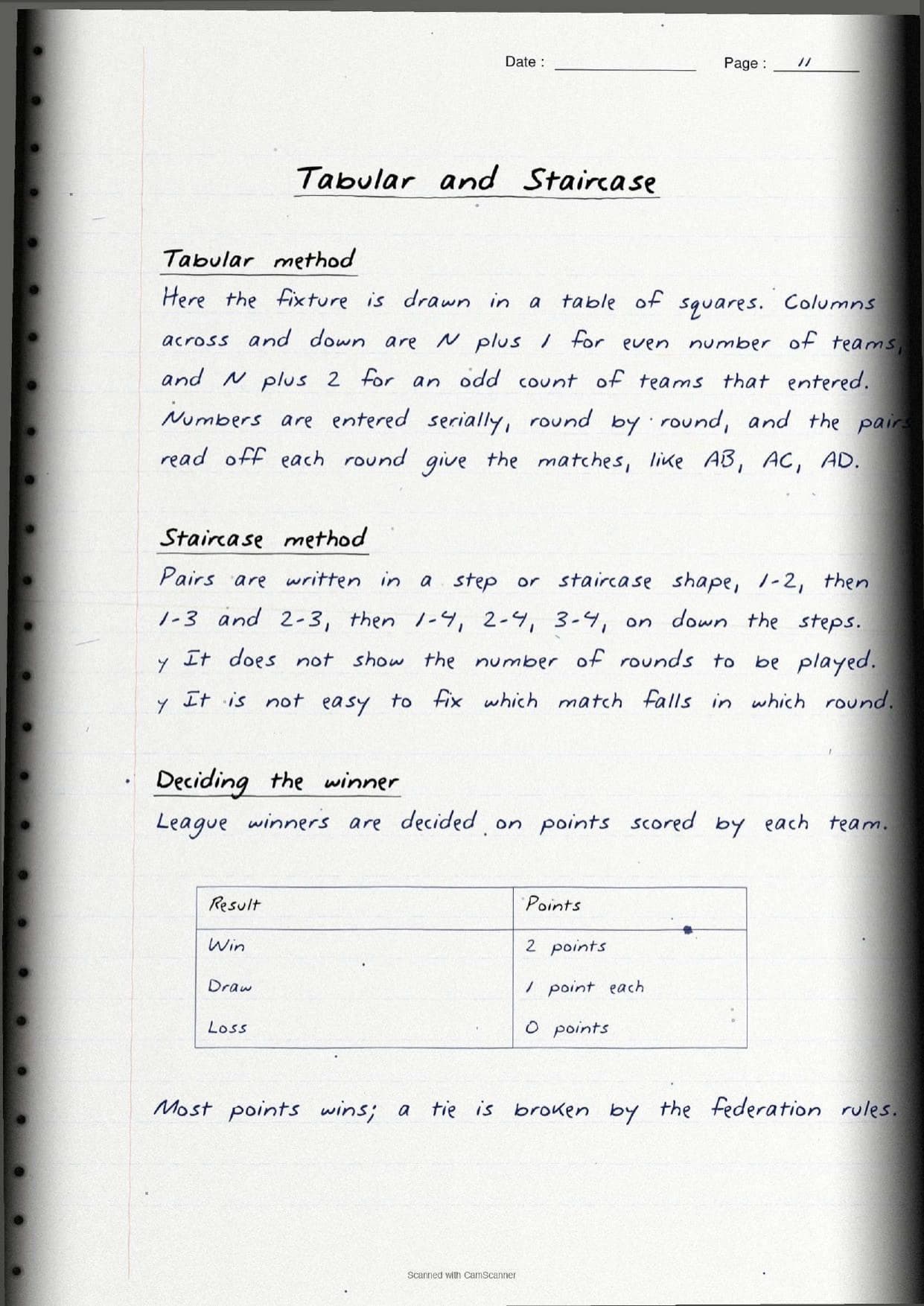
- League fixtures: drawn by the cyclic, tabular or staircase method; rounds are N − 1 for even teams and N for odd teams.
The notes also box the league scoring rule that examiners like to test: a win gives 2 points, a draw gives 1 point to each team, and a loss gives 0 points, with the highest total declared the winner. Pair the match and bye formulas with the half-order for byes and you can draw a full knock-out fixture for any odd number of teams without hesitation.
How to Use These Handwritten Notes
Handwritten notes work best as a final-revision tool, not a first read. The steps below show how to get the most out of the Tournaments and Competitions handwritten notes in the last days before a test.
- Download: tap the download card above to save the handwritten pages to your device.
- First read: read the printed Notes once so the handwritten pages act as a refresher, not a first source.
- Practice drill: pick an odd number of teams, then draw the fixture and count the byes from memory.
- Night before: flip through the boxed formulas for a quick last-minute recall of matches, byes and rounds.
Many students search for class 11 physical education chapter 10 notes on their phone the night before a test, so a saved set of handwritten pages means you can revise offline. Use the handwritten notes for speed on the formulas, then draw one full fixture by hand to confirm you have the half-order and byes right.
Common Mistakes These Notes Help You Avoid
A few errors cost marks every year. The handwritten notes flag each one in the margin so you can fix it before the exam. These five are the most common.
- Mixing up the match formulas. Knock-out is N − 1, single league is N(N − 1) / 2, and double league is N(N − 1).
- Giving byes when teams are already a power of two. With 16 or 32 teams there are zero byes.
- Placing byes in the wrong order. The first bye goes to the bottom of the lower half, not the top.
- Confusing seeding with lots. Seeding deliberately keeps strong teams apart in early rounds.
- Wrong number of rounds in a league. It is N − 1 for even teams but N for odd teams.
Students who fix these five points usually move from average to high marks. The handwritten notes box every formula and write the bye order in full, so the soft points are hard to miss when you revise.
How These Handwritten Notes Pair with the Notes and Book PDF
These handwritten notes are a fast revision tool. To prepare fully, students should use them alongside the other resources for the same chapter, both linked in the table below. Read the printed Notes, check the original text in the Book PDF, then use these pages for a final recall.
| Resource | Best used for |
|---|---|
| Tournaments and Competitions Class 11 Notes | Quick chapter summary with all types, formulas and fixture methods in one place |
| Tournaments and Competitions NCERT Book PDF | Reading the original NCERT chapter text and the sample fixture diagrams |
Tip: read the printed Notes first, then check the Book PDF diagrams, and keep these handwritten pages for the final night-before flip. Using them for recall, not for the first read, builds memory faster.
All Class 11 Physical Education Handwritten Notes by Chapter
The table links the handwritten notes for every chapter in Class 11 Physical Education, so students can move across the course in one click. Tournaments and Competitions is highlighted.
| Chapter | Handwritten Notes |
|---|---|
| Chapter 1 | Physical Education |
| Chapter 2 | Understanding Health |
| Chapter 3 | Physical and Physiological Aspects of Physical Education and Sports |
| Chapter 4 | Individual Games |
| Chapter 5 | Team Games |
| Chapter 6 | Yoga and its Relevance in the Modern Times |
| Chapter 7 | Safety and Security |
| Chapter 8 | Health Related Physical Fitness |
| Chapter 9 | Measurement and Evaluation |
| Chapter 10 | Tournaments and Competitions |
| Chapter 11 | Adventure Sports |
FAQs on Tournaments and Competitions Handwritten Notes
Tournaments and Competitions Class 11 Physical Education Handwritten Notes Common Questions
Ques. Where can I download the Tournaments and Competitions handwritten notes PDF?
Ans. You can download the Tournaments and Competitions Class 11 Physical Education handwritten notes PDF directly from this page. It is free, follows the 2026-27 NCERT, and presents the types of tournaments, the fixture formulas, byes and seeding as handwritten pages.
Ques. What is the formula for the number of matches in a knock-out tournament?
Ans. In a single knock-out tournament the total number of matches is N − 1, where N is the number of teams. For example, with 13 teams the number of matches is 13 − 1 = 12. The handwritten notes box this formula with a worked example.
Ques. How do these handwritten notes explain byes and seeding?
Ans. Byes are given when the number of teams is not a power of two, and the number of byes equals the next higher power of two minus the number of teams. Seeding places strong teams so they do not meet in the early rounds. Both are drawn out step by step with the correct half-order.
Ques. Who prepared these handwritten notes?
Ans. They are written and proofread by hand by a subject expert with an MPEd and NIS coaching certification, using the official NCERT Health and Physical Education textbook and recent CBSE Class 11 question papers.
Ques. How should I use these notes with the other resources?
Ans. Read the printed Notes first, check the fixture diagrams in the NCERT Book PDF, then keep these handwritten pages for the final night-before flip. Using them for recall rather than the first read builds memory faster.



Comments