



These class 11 maths handwritten notes chapter 6 permutations and combinations have been prepared for quick, one-shot revision before your CBSE Boards, JEE Main, JEE Advanced and CUET exams. Every page is written by hand with boxed formulas and solved counting steps, according to the latest 2026-27 CBSE syllabus.
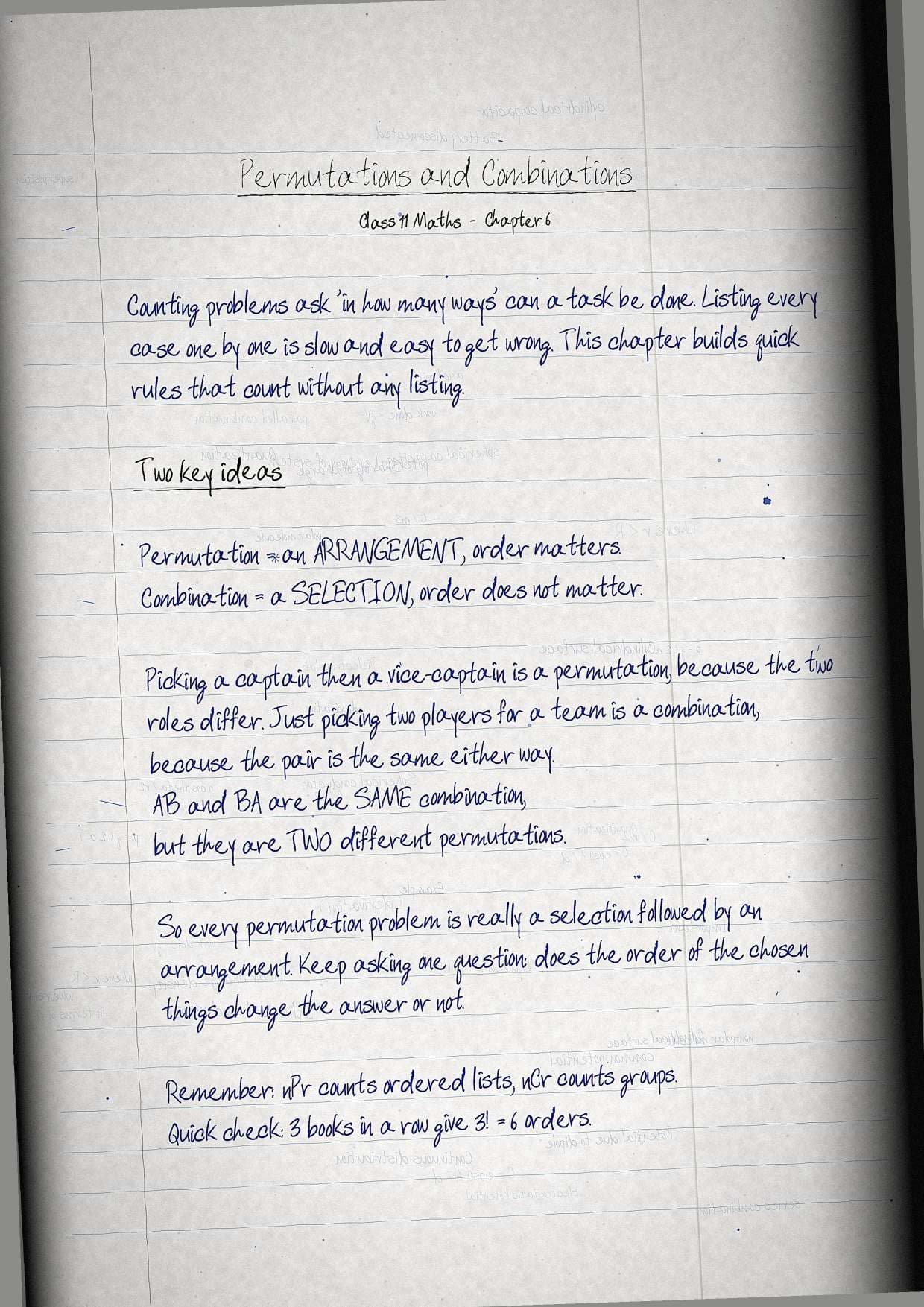
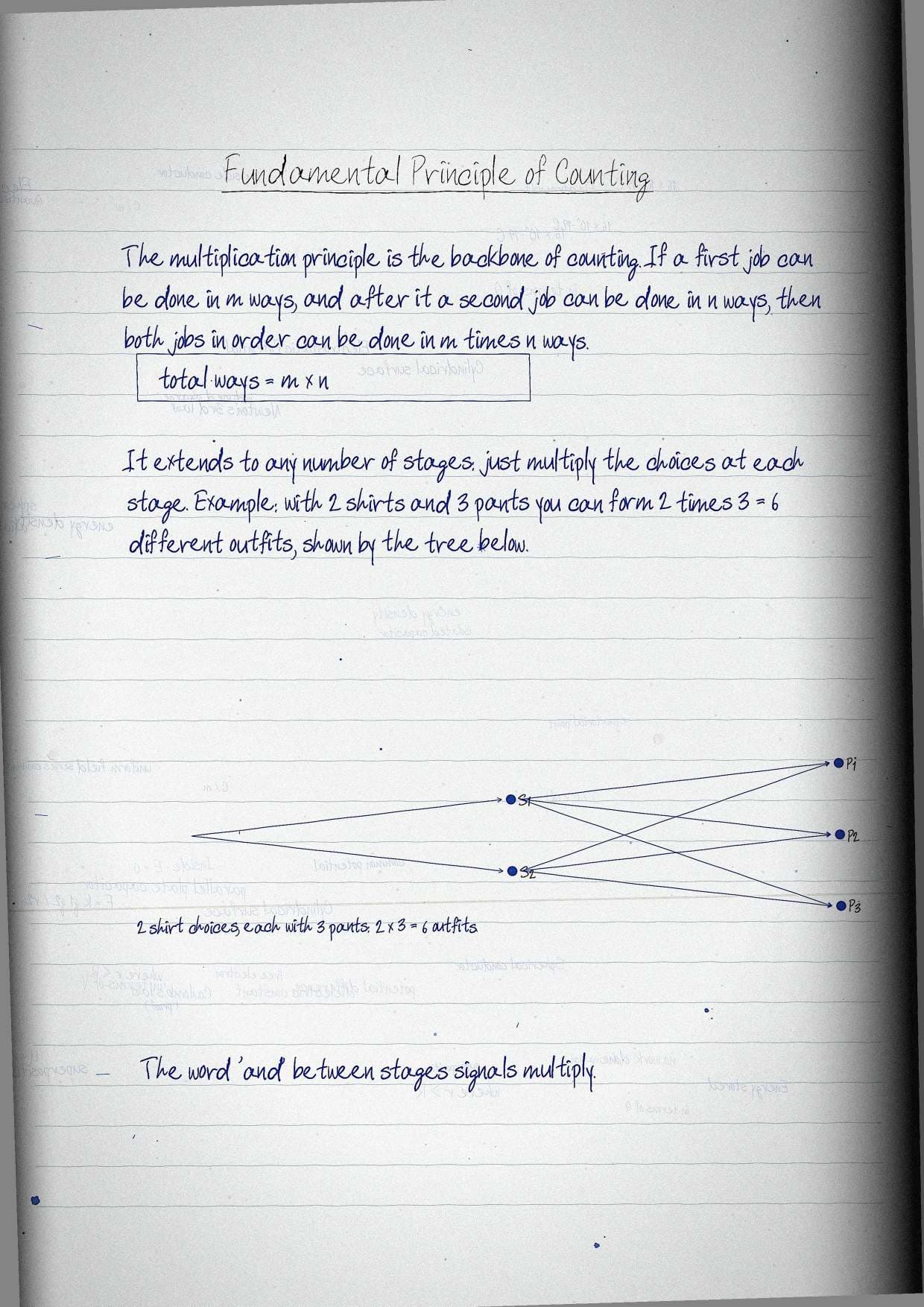
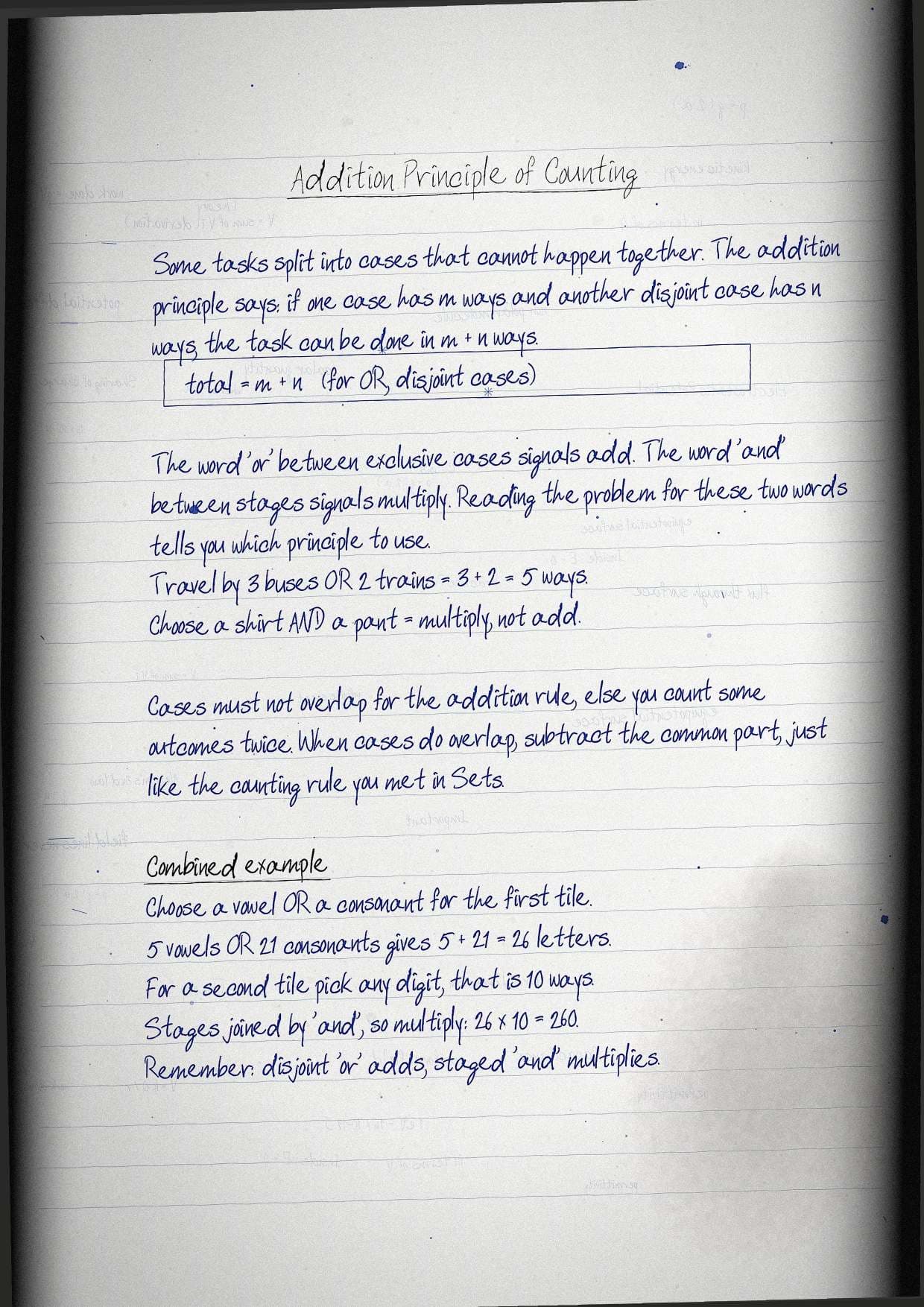
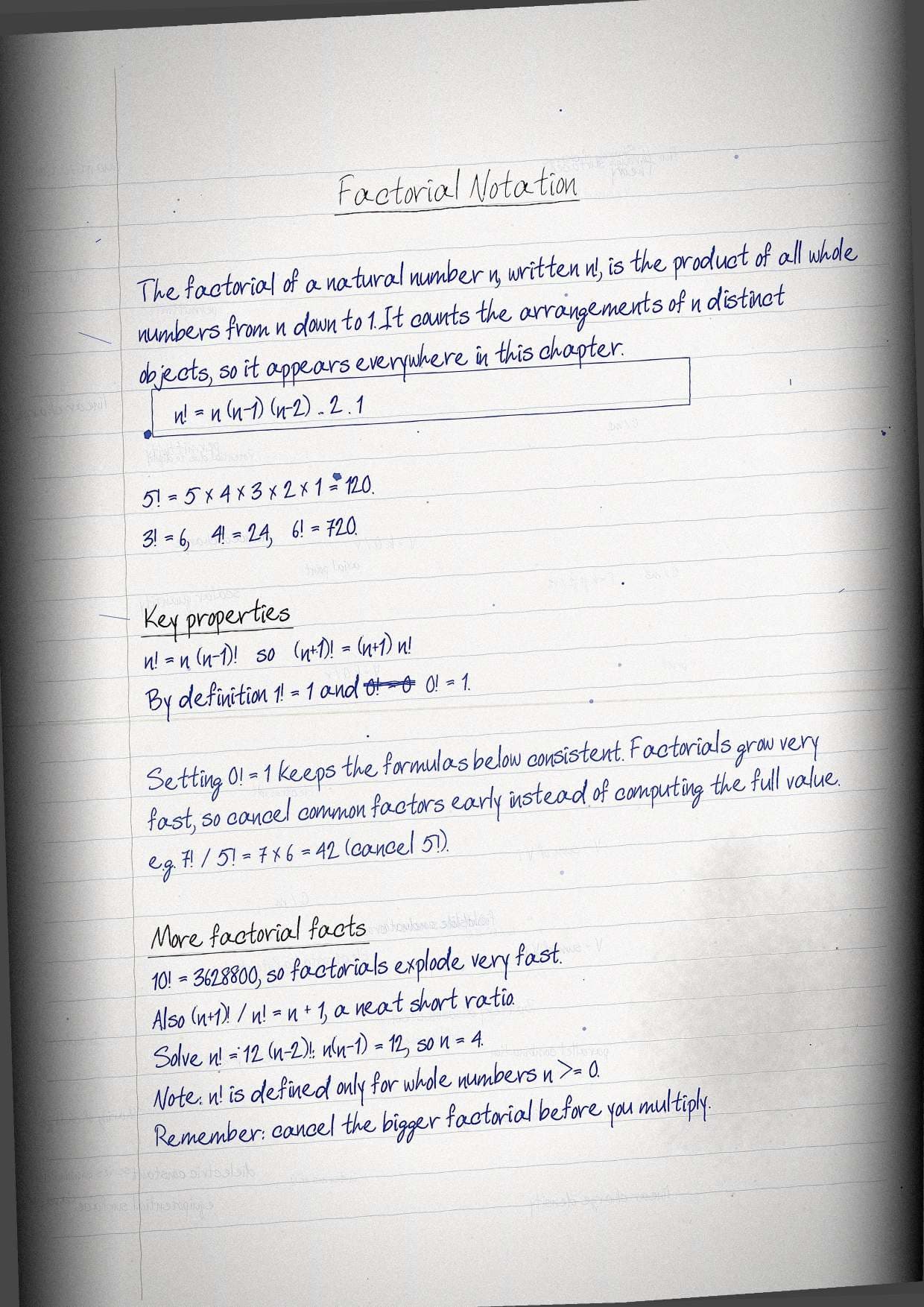
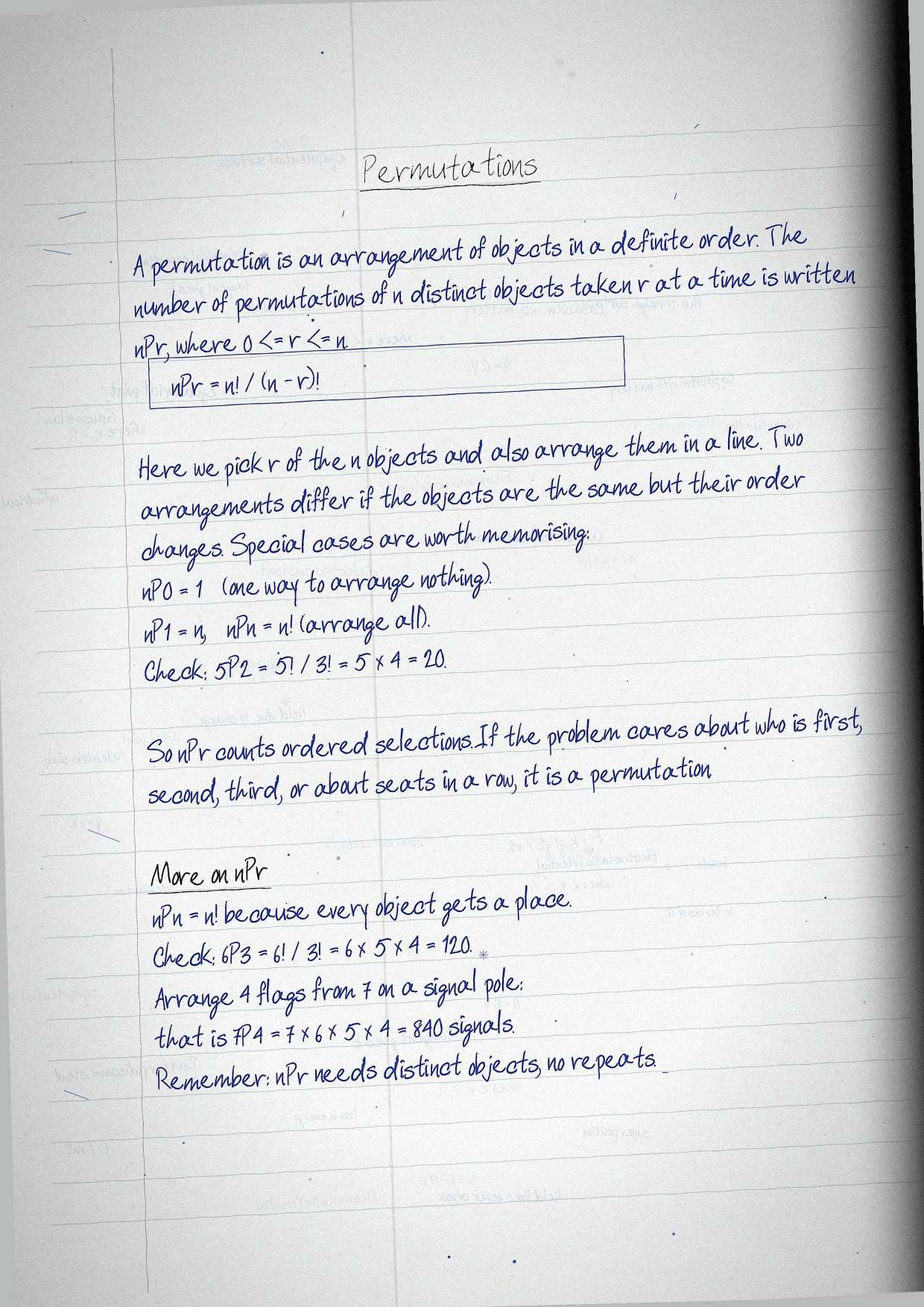
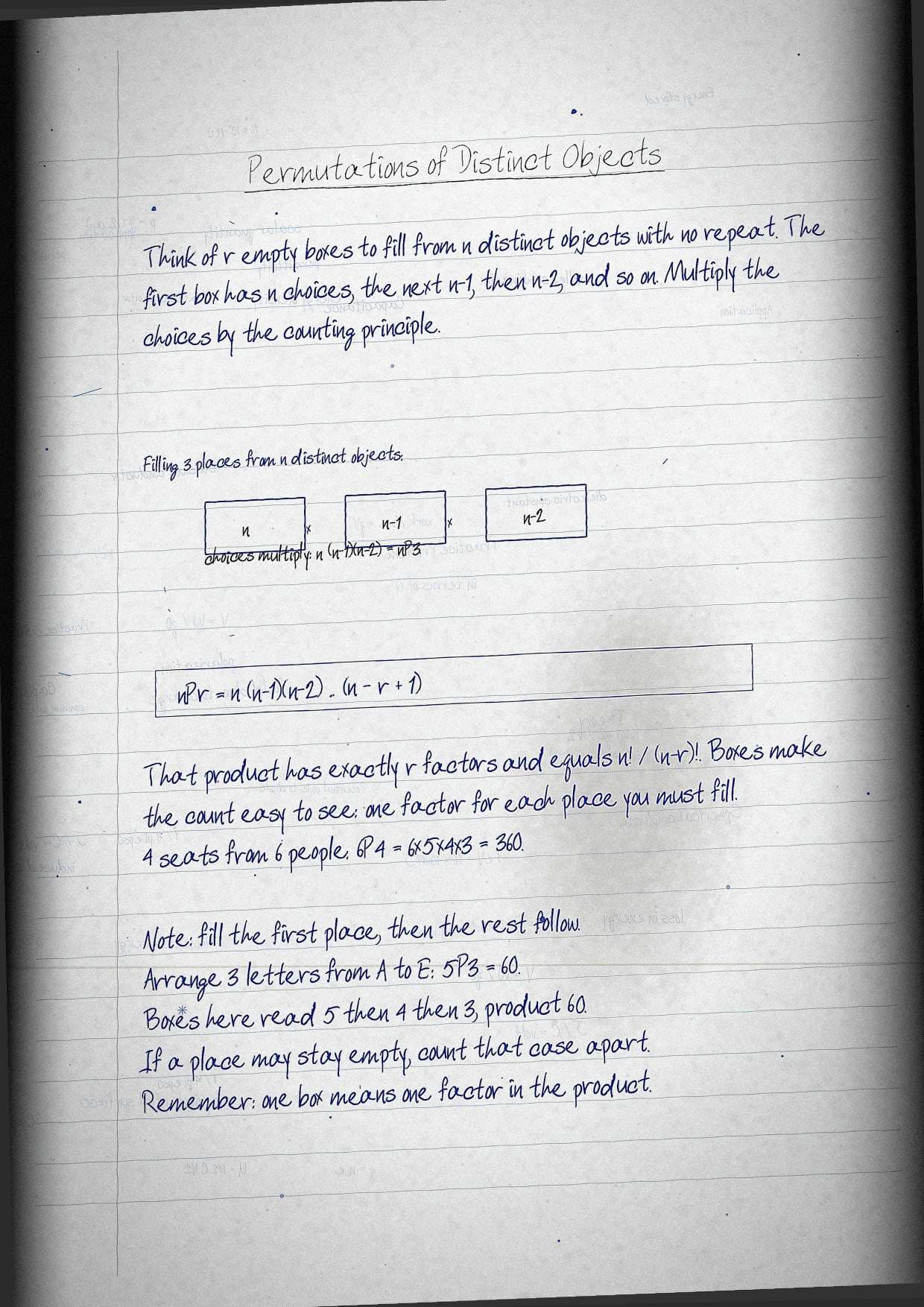
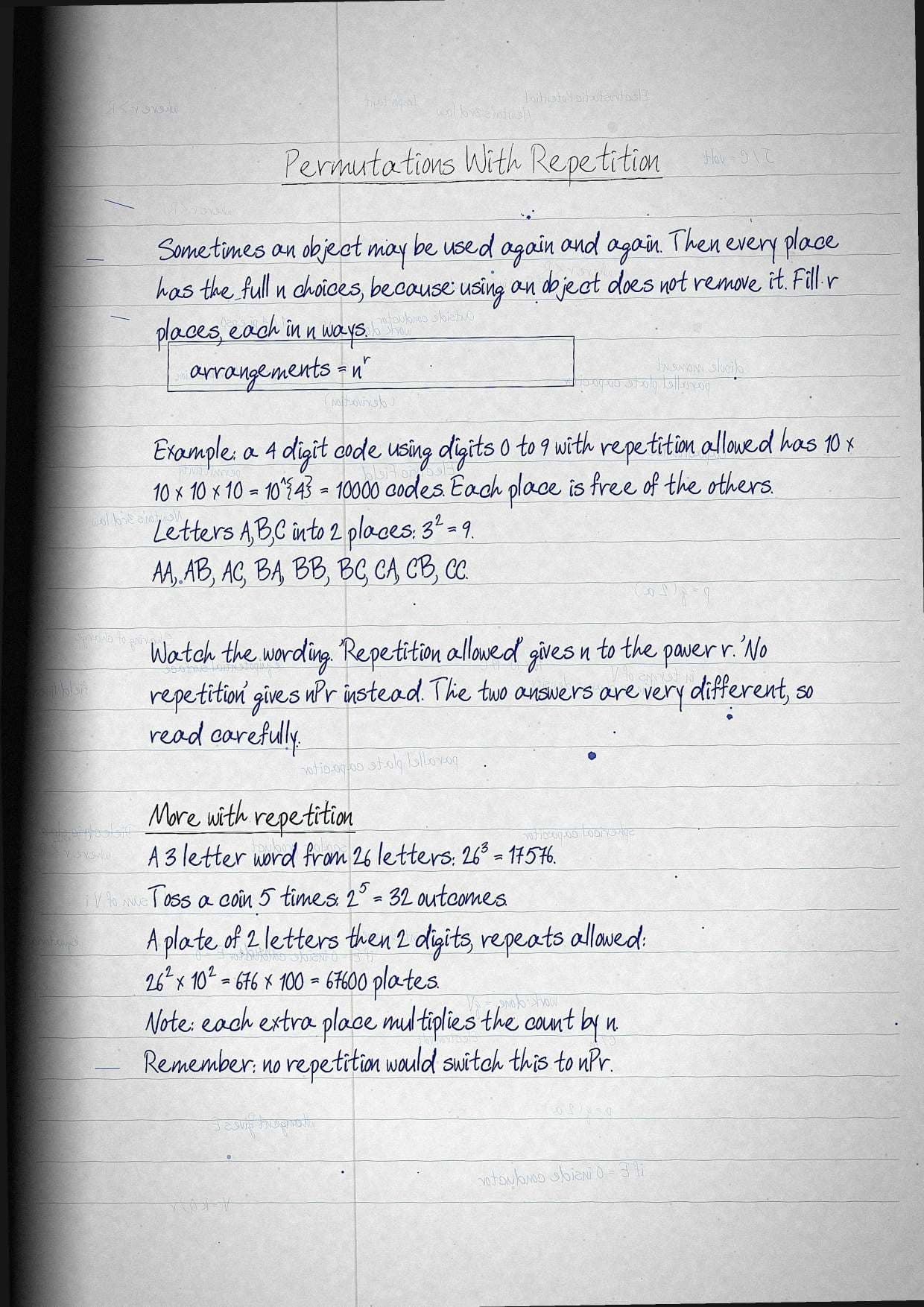
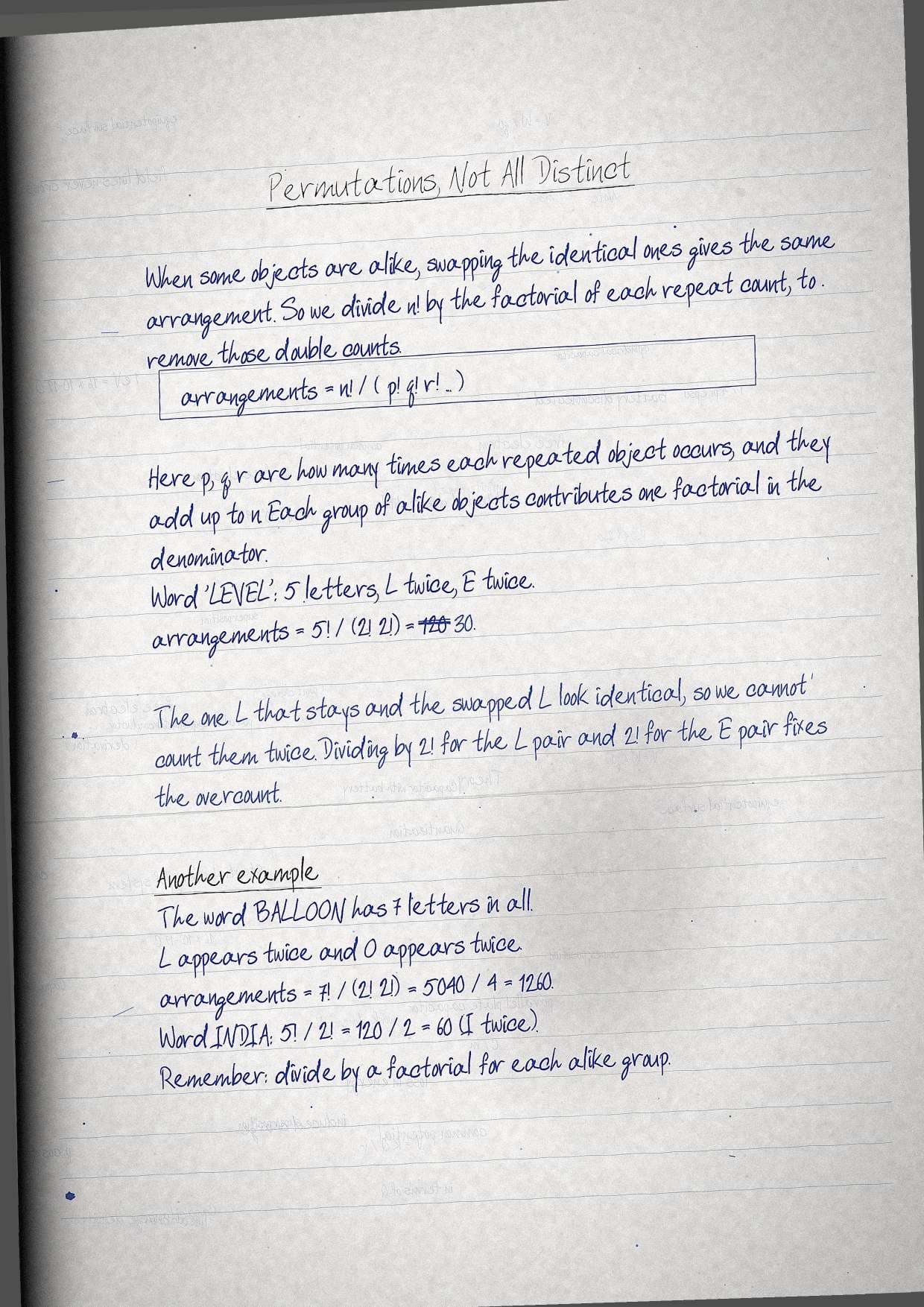
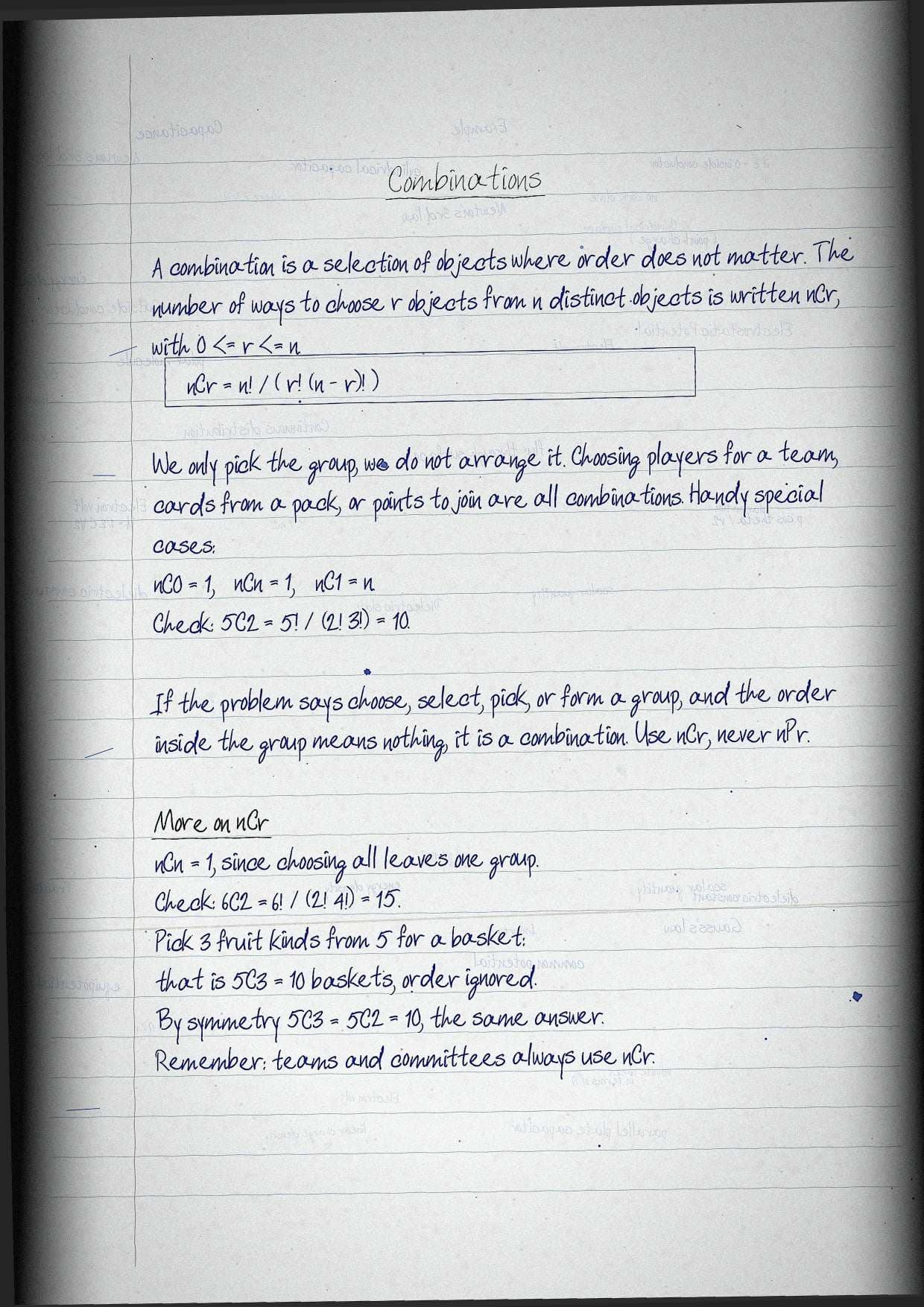
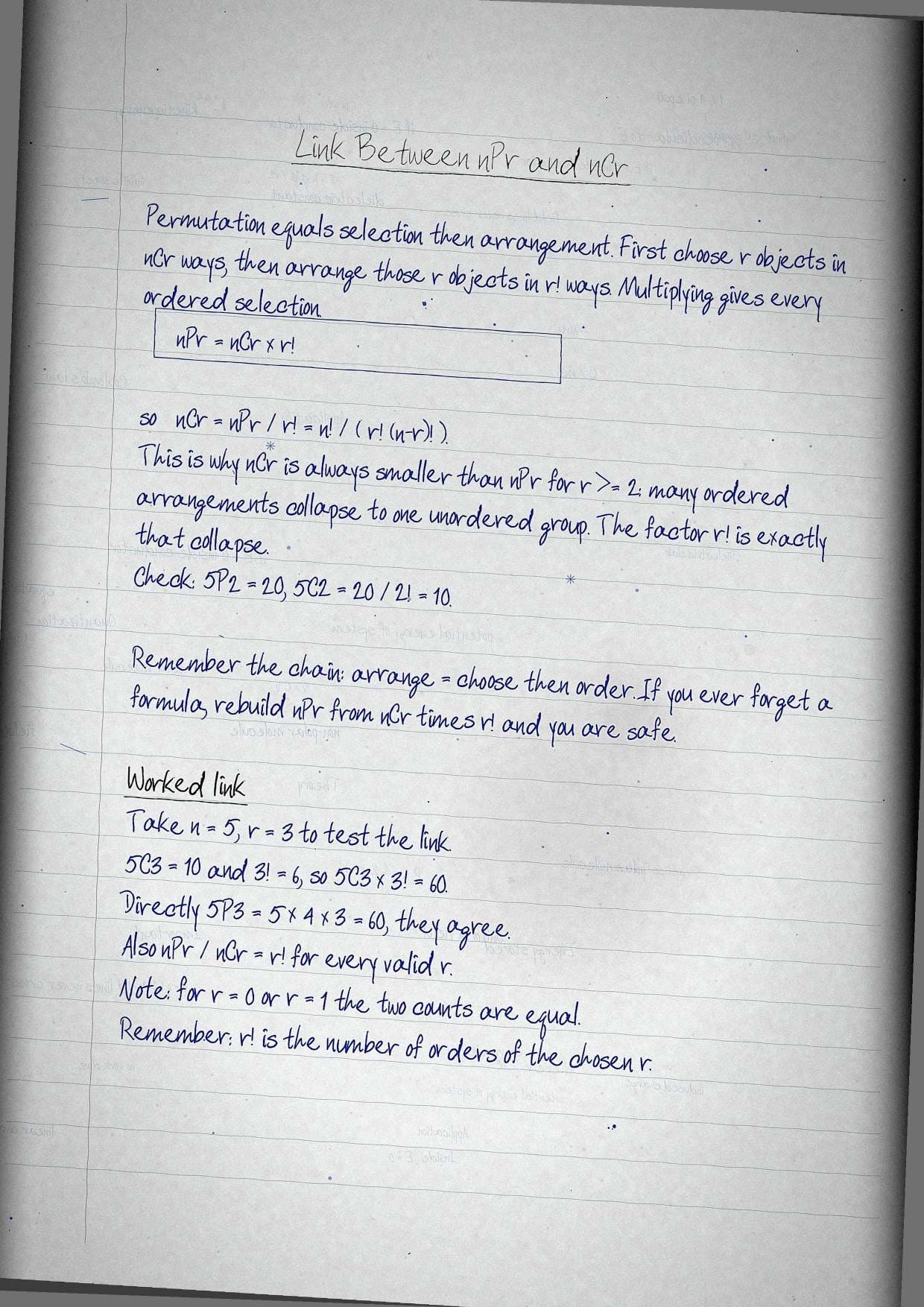
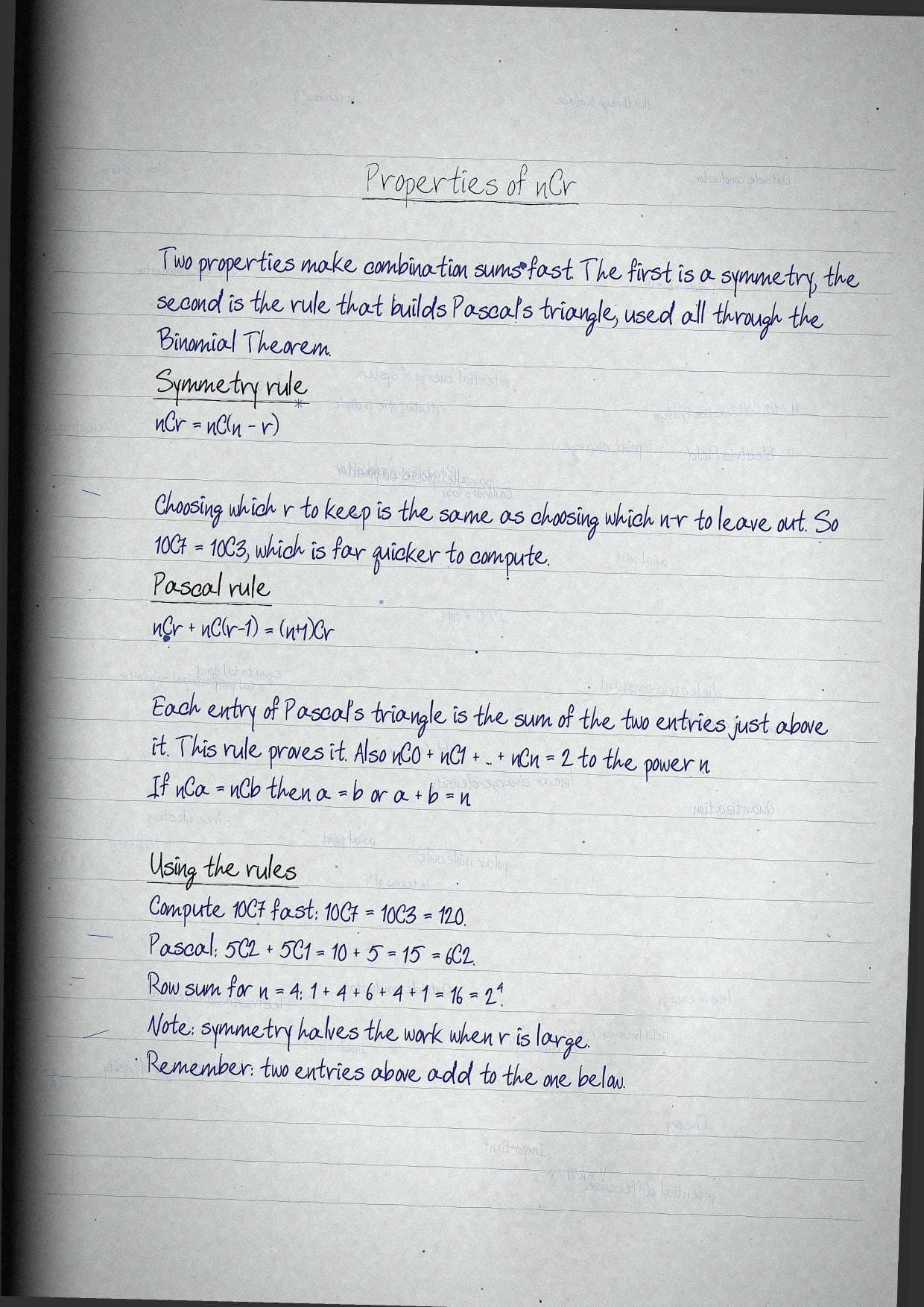
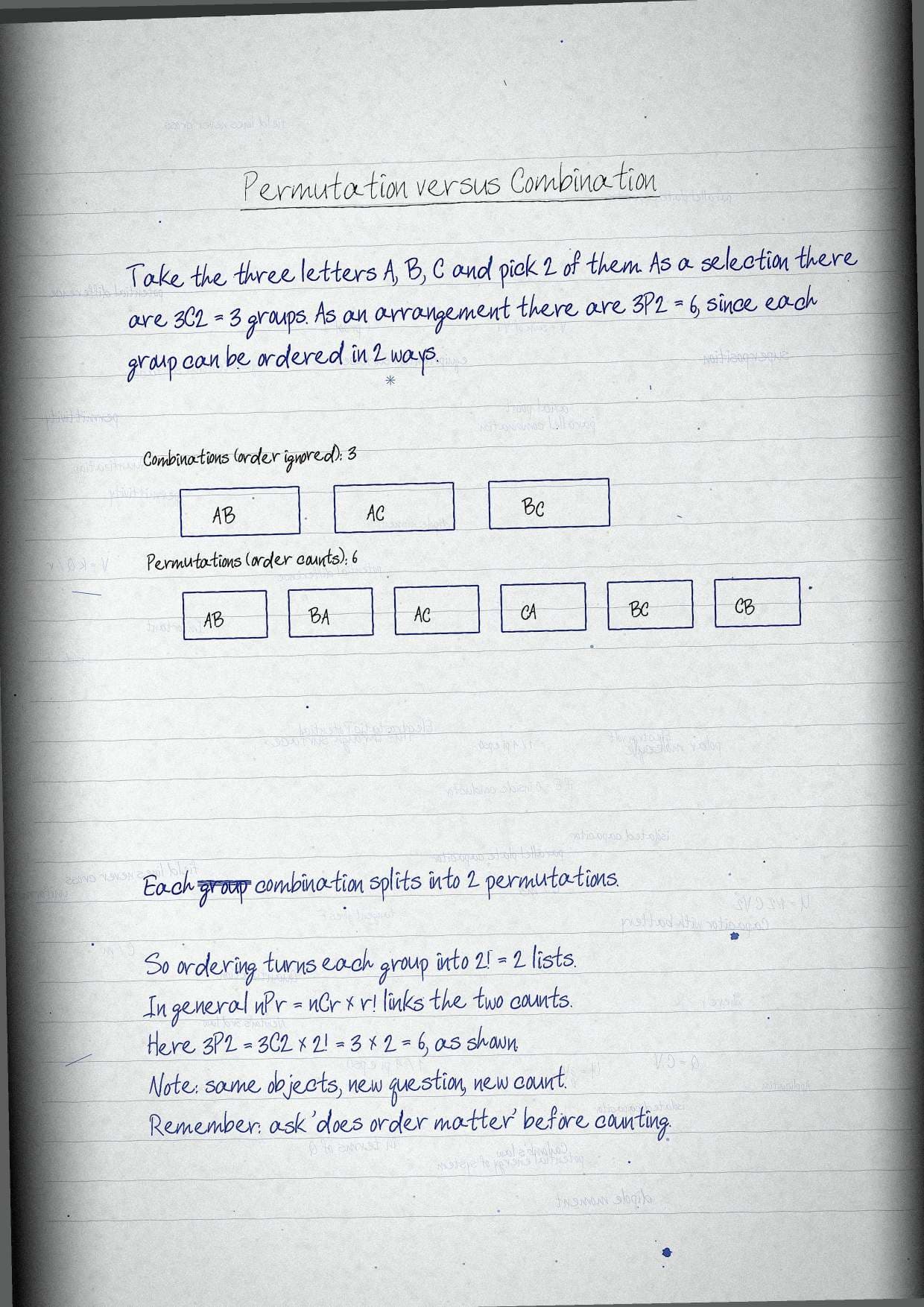
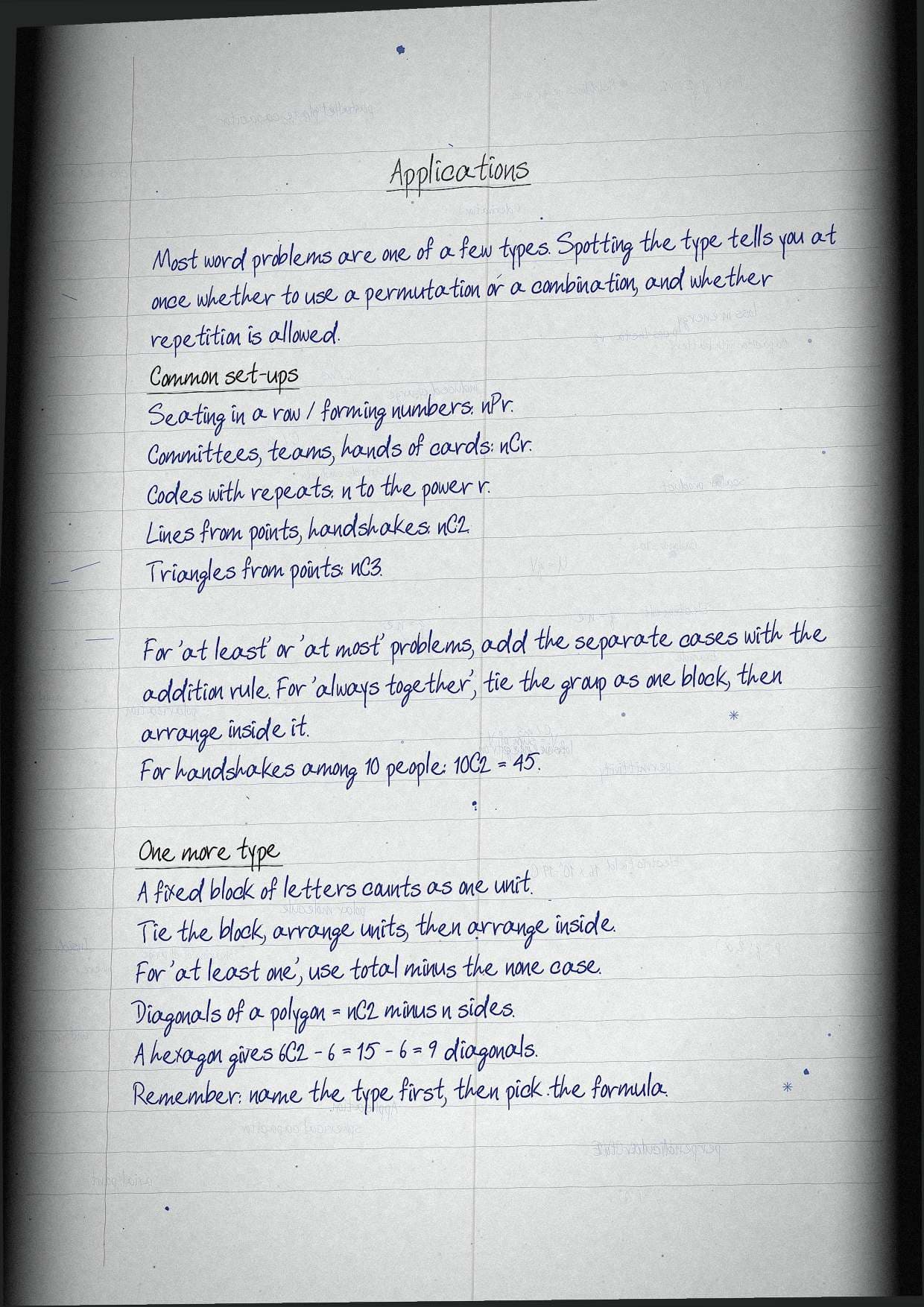
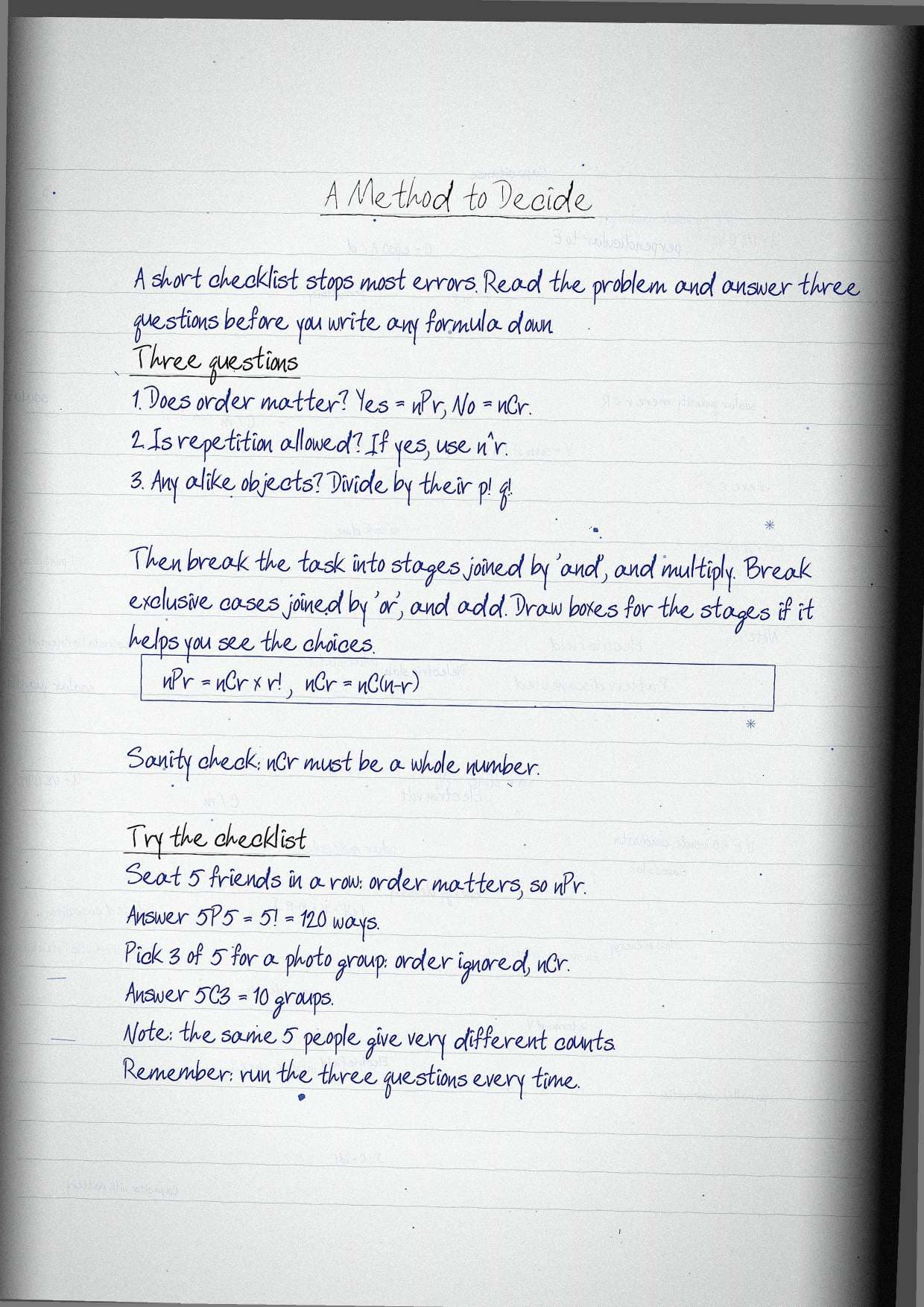
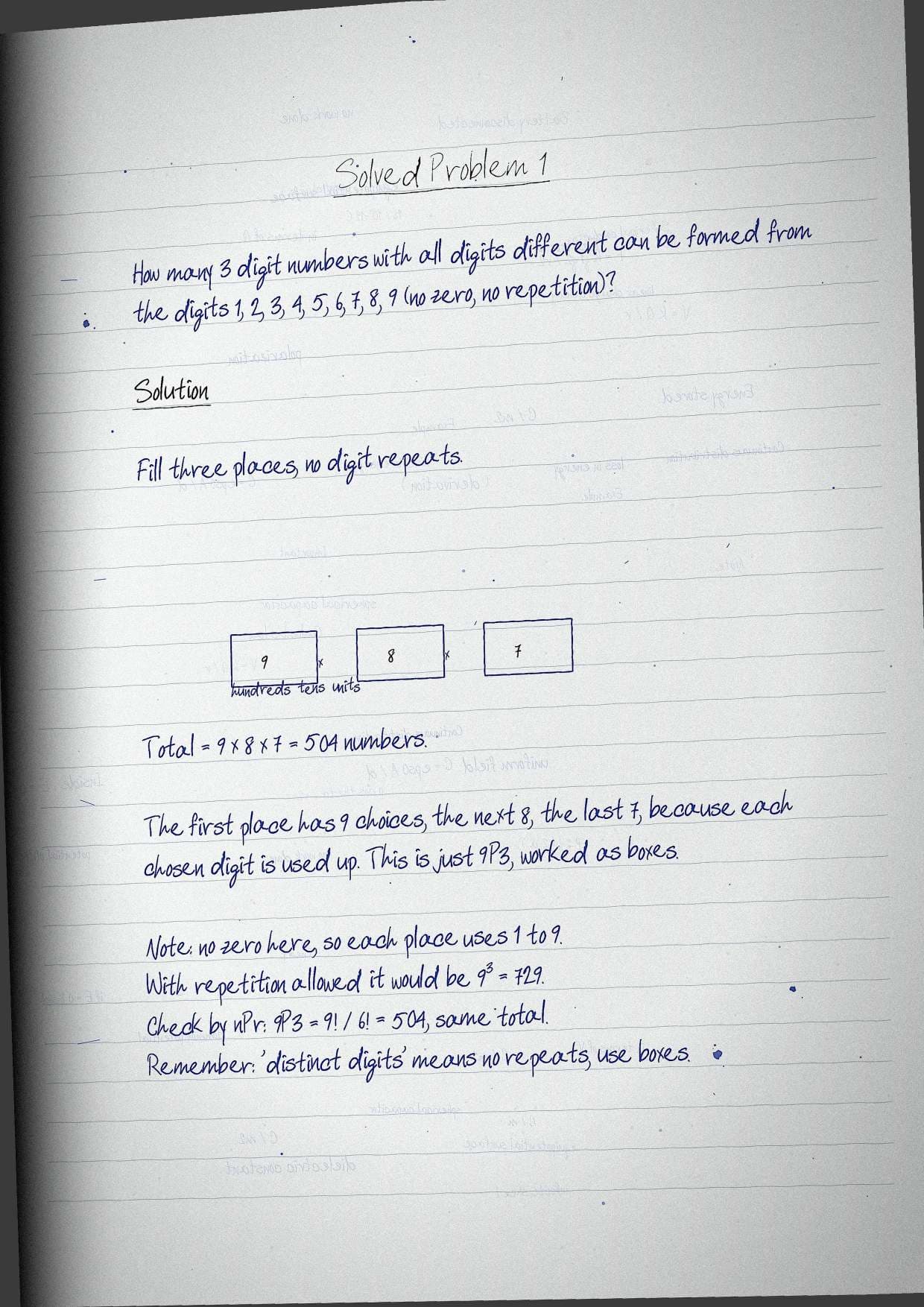
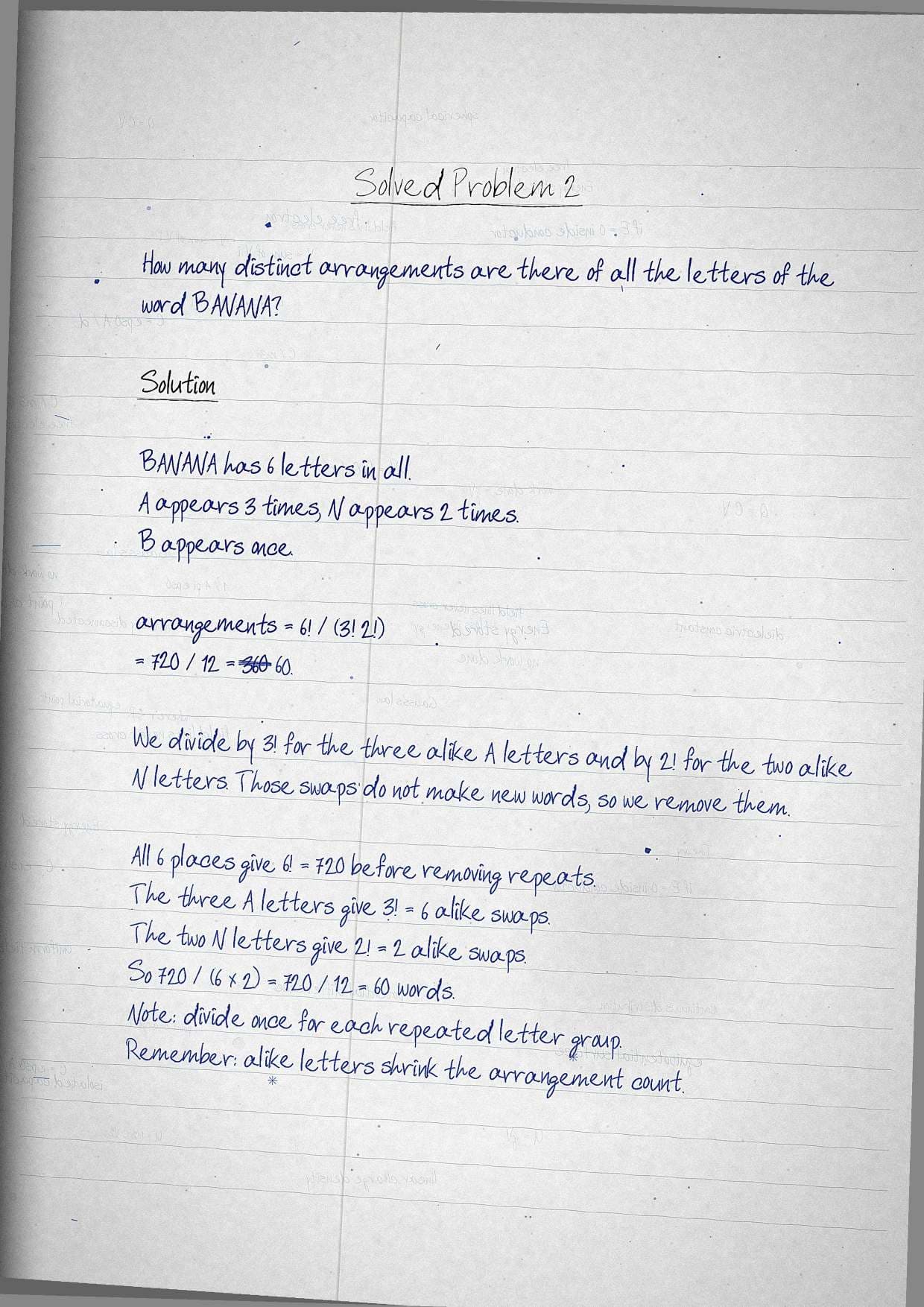
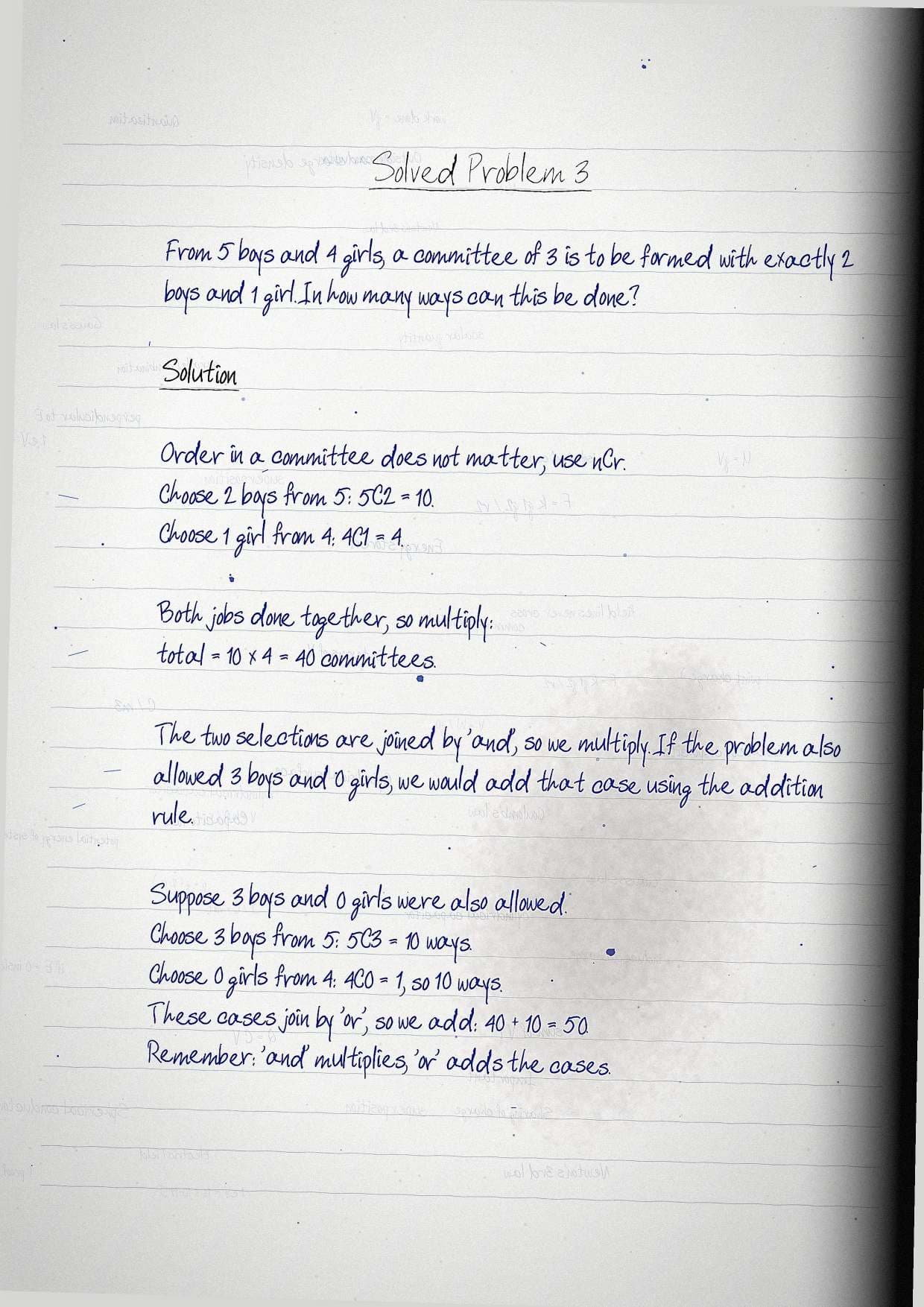
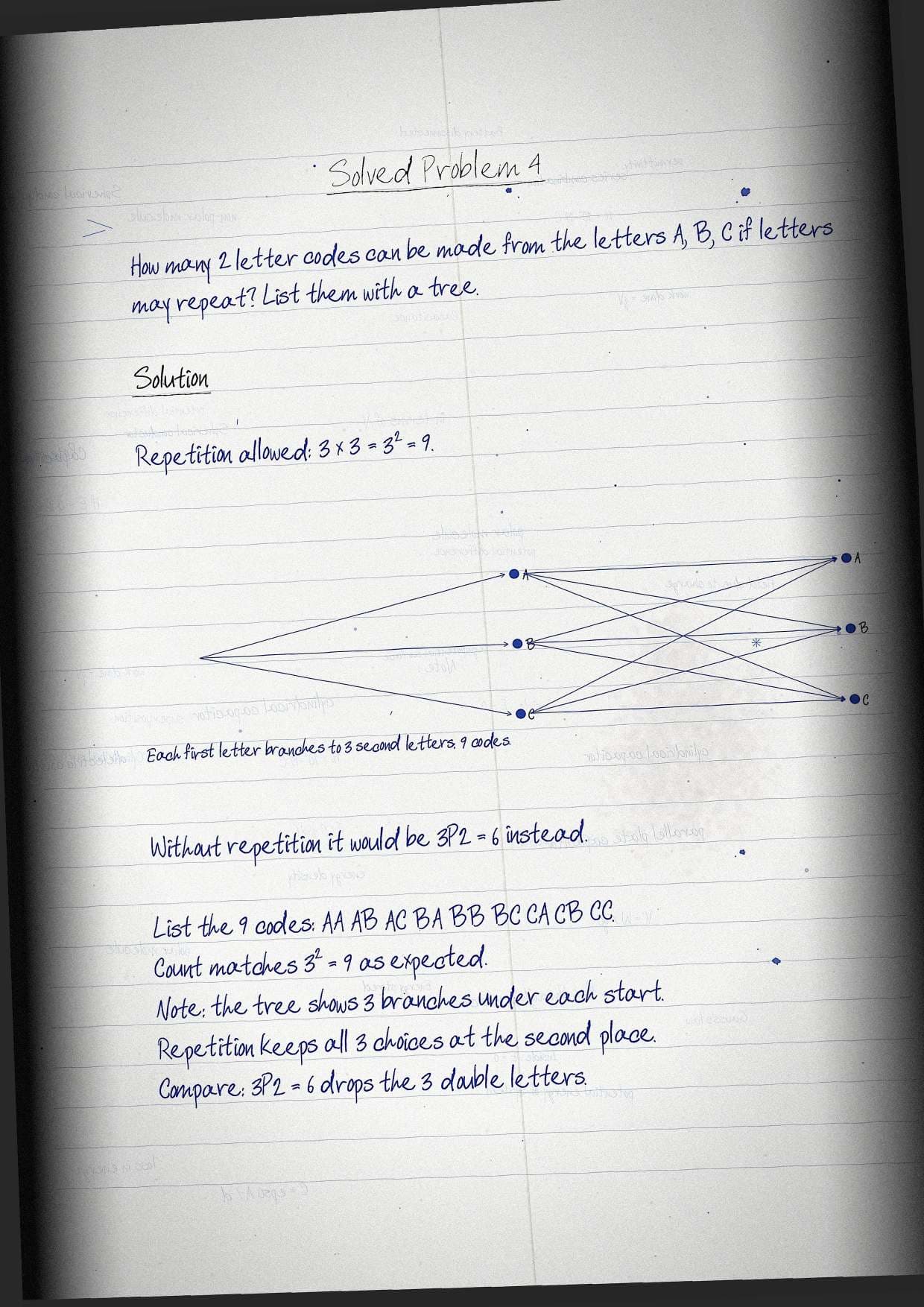
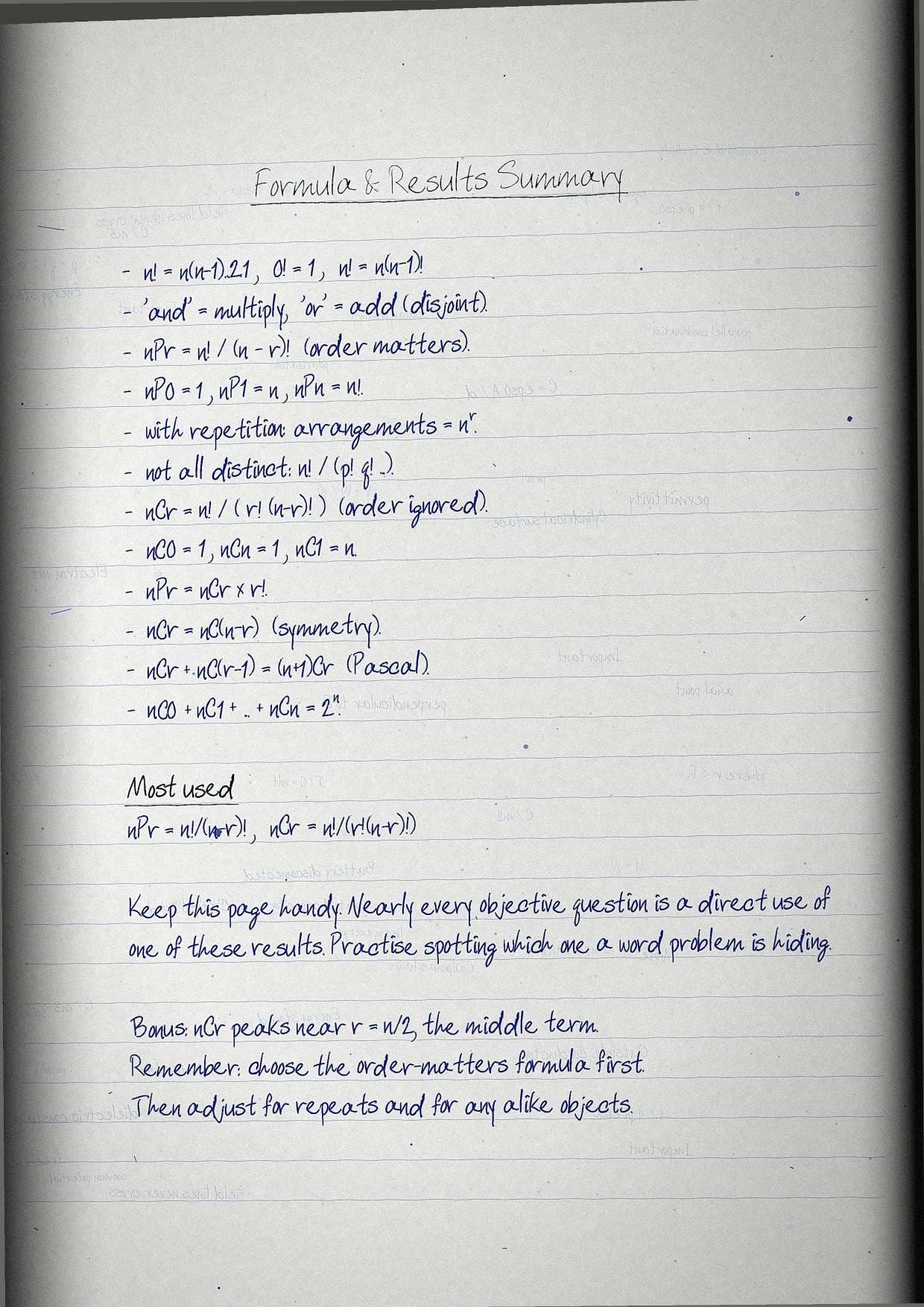
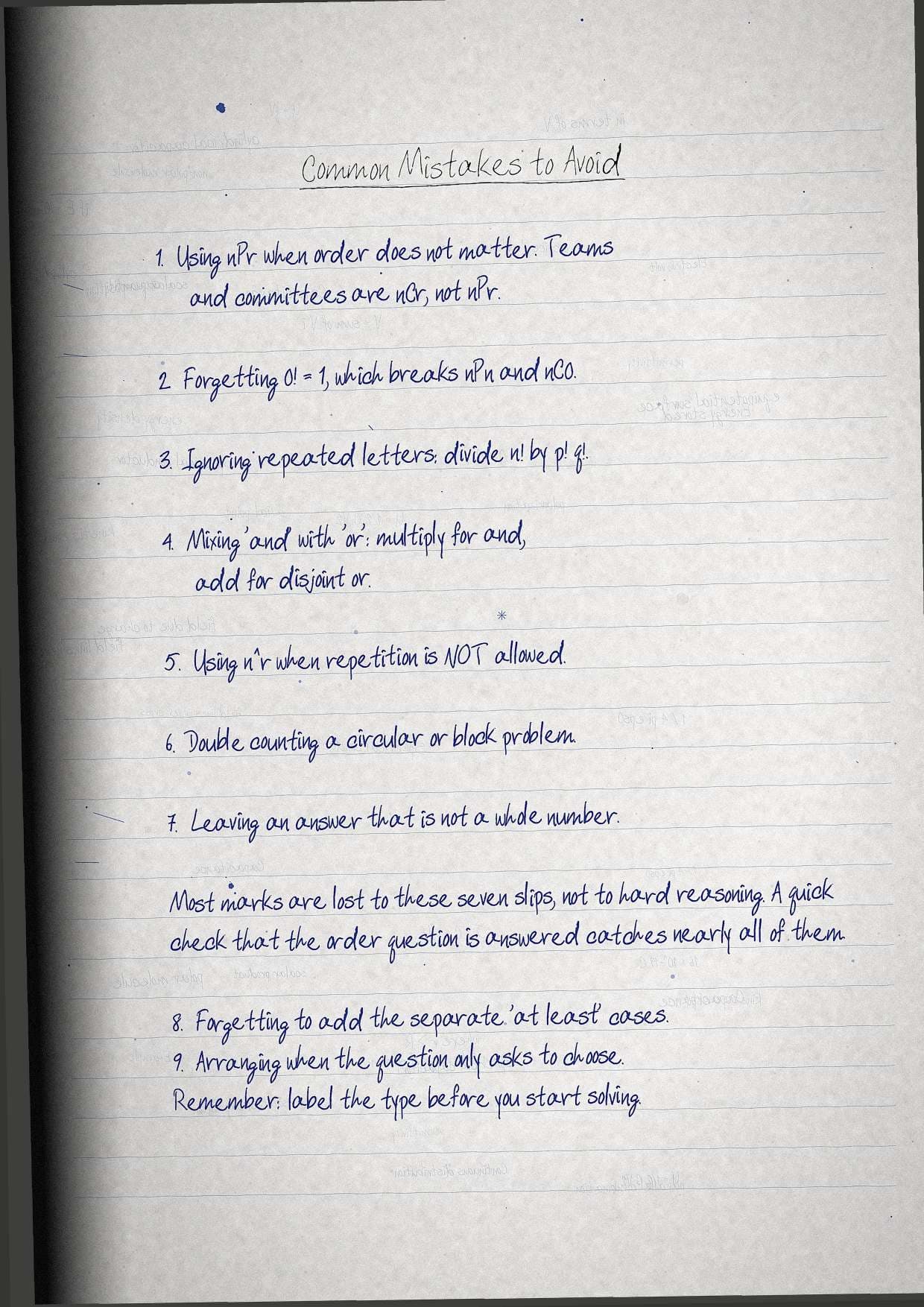
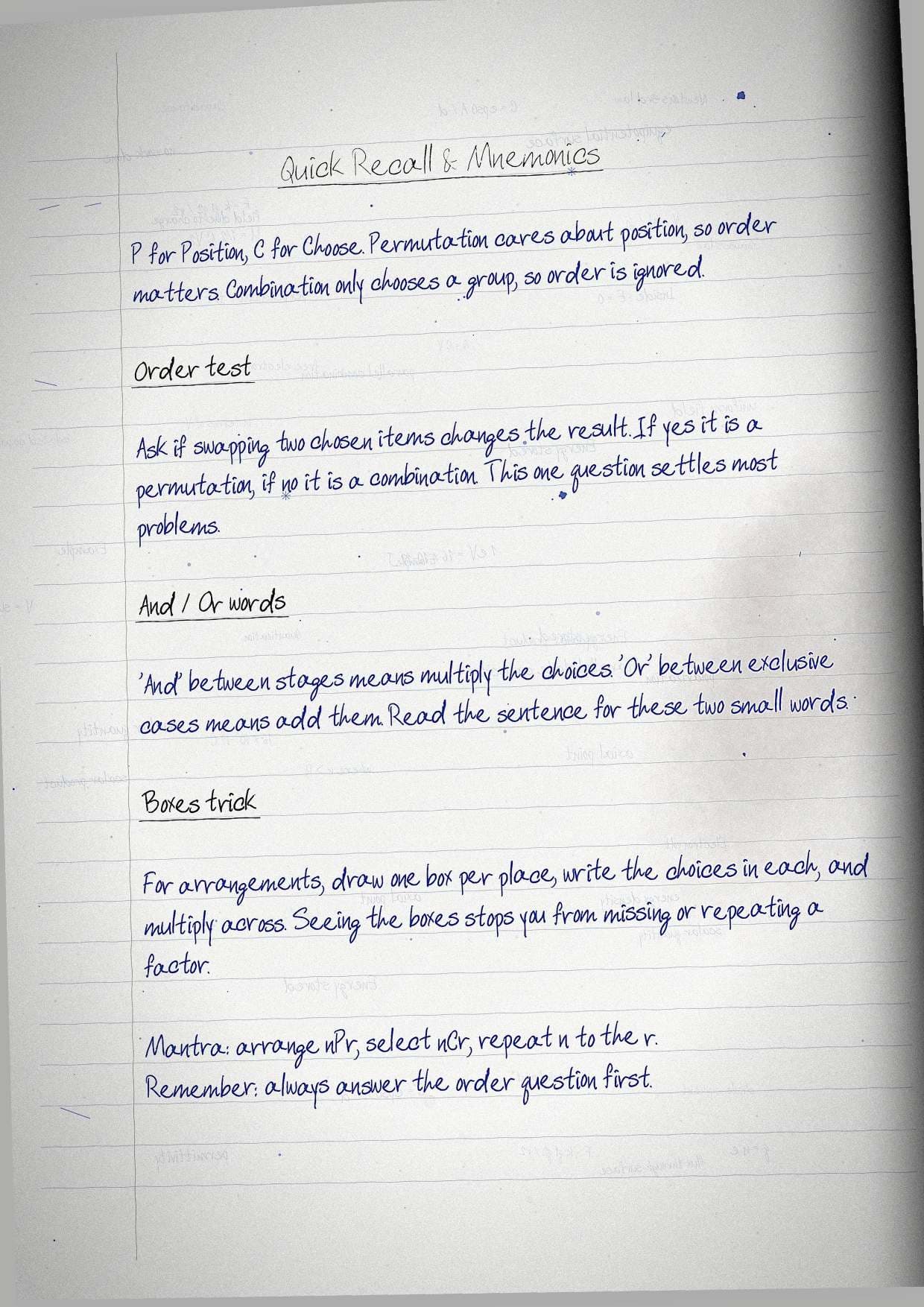
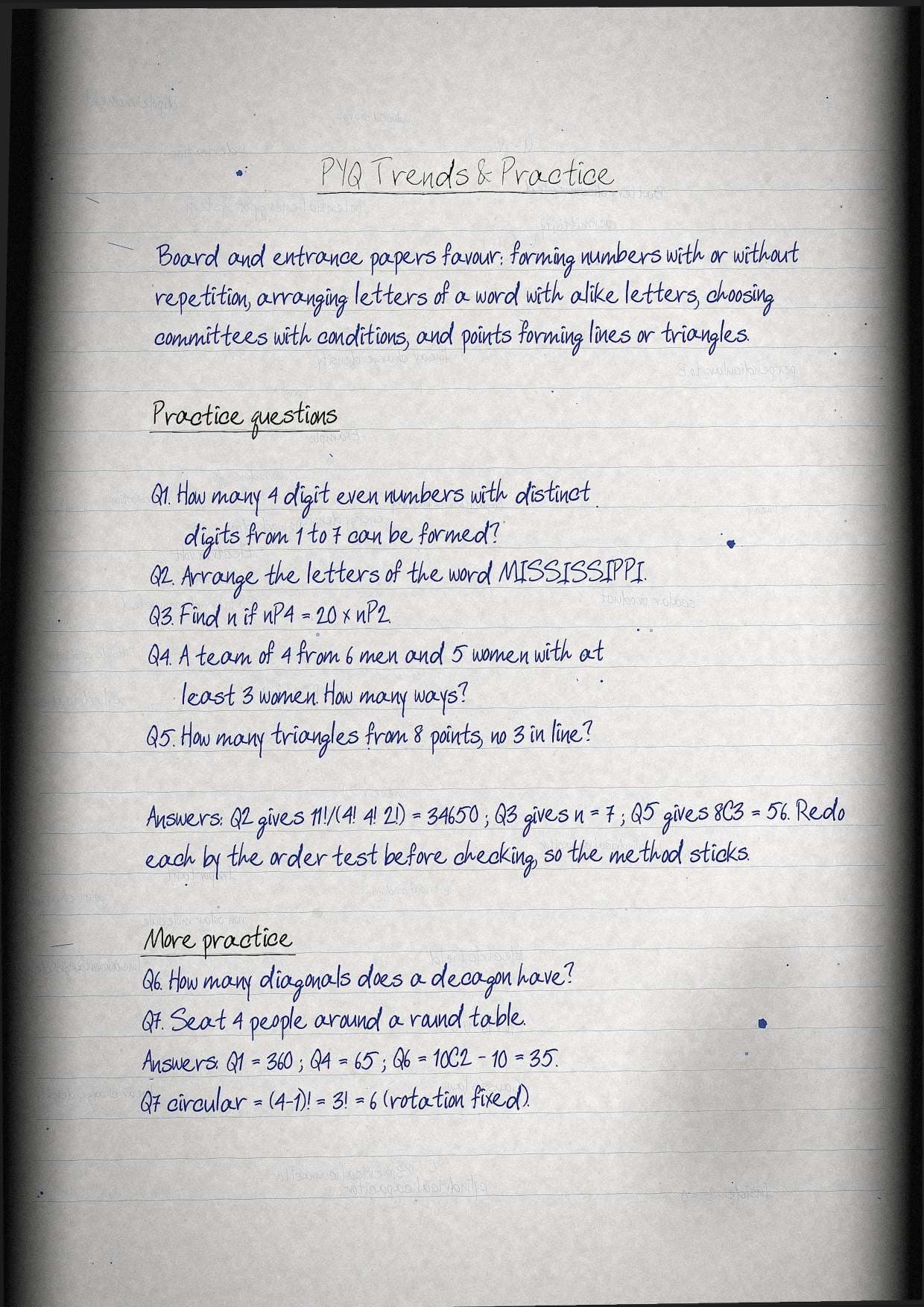
Permutations and Combinations is the counting chapter of Class 11 Maths and the base for the binomial theorem and probability. These handwritten pages turn the chapter into neat, colour-coded notes you can revise in one sitting.
- Boxed formulas for factorial, nPr and nCr, ready to copy onto the answer sheet.
- Hand-solved examples showing when to arrange and when to select.
- Pairs with the NCERT Solutions, Notes and Book PDF linked lower on this page.
What the Permutations and Combinations Handwritten Notes Cover
The notes open with the fundamental principle of counting: if one event happens in m ways and another in n ways, both happen in m × n ways. They then move through the full chapter in NCERT order, so nothing is missed. Each new sub-topic is written in red ink so students can find it fast.
- Fundamental principle of counting: the multiplication and addition rules with solved examples.
- Factorial: the meaning of n! and the convention that 0! = 1.
- Permutations: arrangements where order matters, including repeated objects.
- Combinations: selections where order does not matter.
Because these class 11 maths handwritten notes chapter 6 permutations and combinations keep every formula inside a box, the eye jumps straight to the point, ideal for a fast recap the night before a test.
Key Formulas and Diagrams in the Notes
The core of the chapter is a small set of formulas. The notes keep these together on one page so students can revise them at once. The table below lists the formulas the pages box in colour.
| Idea | Formula |
|---|---|
| Factorial of n | n! = n × (n − 1) × … × 2 × 1, with 0! = 1 |
| Permutations of n things taken r at a time | nPr = n! / (n − r)! |
| Combinations of n things taken r at a time | nCr = n! / [ r! (n − r)! ] |
| Link between the two | nPr = r! × nCr |
| Symmetry and Pascal rule | nCr = nCn−r and nCr + nCr−1 = n+1Cr |
Each formula sits beside a worked sum in the margin. Permutation means arrange, combination means select, and the notes flag this on every page. Spotting whether order matters is what makes the right formula easy to choose.
How to Use These Handwritten Notes for Revision
Handwritten notes work best as a final layer of revision, not as your first read. The plan below helps students get the most out of the Permutations and Combinations handwritten notes before the exam. Follow it once a week and again the day before the test.
- First pass: read the pages once, following the counting-to-selection order.
- Active recall: cover each boxed formula and write nPr and nCr from memory.
- Decide fast: for each solved sum, first ask whether order matters before you pick a formula.
- Self-test: solve two arrangement sums and two selection sums to lock the difference in.
Because the class 11 maths handwritten notes chapter 6 permutations and combinations come as a downloadable PDF, students can save them on a phone and revise offline on the way to the exam centre. Pair these pages with the NCERT Solutions to check your answers against model steps.
Student Feedback on the Permutations and Combinations Handwritten Notes
Student Feedback: In a Collegedunia poll of 10,980 Class 11 Maths students before the 2026 boards, 76% of students said the side-by-side permutation and combination examples made it easier to choose the right formula. Most marked the nPr and nCr link as the point they revised last.
Source: 2026-27 Class 11 Mathematics student poll. Sample of 10,980 students from CBSE schools across 14 states.
Other Permutations and Combinations Class 11 Maths Resources
These handwritten notes are a revision layer. To prepare fully, use them with the other resources for the same chapter, linked below. Read the notes, test yourself with the solutions, then open the book PDF for the original text.
| Resource | Best used for |
|---|---|
| Permutations and Combinations Class 11 NCERT Solutions | Step-by-step answers to every back-exercise question |
| Permutations and Combinations Class 11 Notes | Full chapter summary with all definitions and formulas in one place |
| Permutations and Combinations NCERT Book PDF | Reading the original NCERT chapter text and examples |
Tip: revise the nPr = r! × nCr link first, then solve one selection sum from memory. That link fixes most counting questions.
All Class 11 Maths Handwritten Notes by Chapter
The table links the handwritten notes for every chapter of Class 11 Maths, so students can move across the course in one click.
| Chapter | Handwritten Notes |
|---|---|
| Chapter 1 | Sets |
| Chapter 2 | Relations and Functions |
| Chapter 3 | Trigonometric Functions |
| Chapter 4 | Complex Numbers and Quadratic Equations |
| Chapter 5 | Linear Inequalities |
| Chapter 6 | Permutations and Combinations |
| Chapter 7 | Binomial Theorem |
| Chapter 8 | Sequences and Series |
| Chapter 9 | Straight Lines |
| Chapter 10 | Conic Sections |
| Chapter 11 | Introduction to Three Dimensional Geometry |
| Chapter 12 | Limits and Derivatives |
| Chapter 13 | Statistics |
| Chapter 14 | Probability |
FAQs on Permutations and Combinations Handwritten Notes
Permutations and Combinations Handwritten Notes - Frequently Asked Questions
Ques. Are these class 11 maths handwritten notes chapter 6 permutations and combinations free to download?
Ans. Yes. The Permutations and Combinations handwritten notes are free to download as a PDF from this page. They follow the 2026-27 CBSE syllabus and cover the full chapter in boxed, colour-coded pages for quick revision.
Ques. What topics do the Permutations and Combinations handwritten notes cover?
Ans. They cover the fundamental principle of counting, factorial notation, permutations of objects taken some at a time including repeated objects, combinations, and the key properties linking nPr and nCr, all with solved examples.
Ques. What is the difference between a permutation and a combination?
Ans. A permutation counts arrangements, so order matters, and uses nPr = n! / (n minus r)!. A combination counts selections, so order does not matter, and uses nCr = n! / [ r! (n minus r)! ]. The notes flag this difference on every page.
Ques. Are these notes enough for the Class 11 Permutations and Combinations exam?
Ans. They are a strong final revision layer. For full preparation, pair them with the NCERT Solutions linked on this page so you can write out complete answers and practise the arrangement and selection sums step by step.



Comments