



These Our Apparel handwritten notes turn the whole chapter into clean, handwritten pages for fast last-minute revision. They follow the 2026-27 NCERT syllabus and Chapter 9 of Class 11 Home Science. Students get the meaning of apparel, the six functions of clothing, the factors that guide selection of clothes, the general clothing needs of children, the clothing features for each age group from infancy to the teens, and the special points for children with special needs, all in a pen-on-paper format that is easy to skim before a test.
- Handwritten pages with boxed key terms, a functions mind-map, and an age-versus-features table for children's clothing.
- This chapter of Class 11 Home Science links clothing to comfort, safety and child development, so it carries weight in the final exam.
- Pairs with the NCERT Solutions, Notes and Book PDF linked lower on this page.
These Our Apparel handwritten notes are prepared from the official NCERT Home Science (Human Ecology and Family Sciences) textbook and checked against recent CBSE Class 11 question papers.
Student Feedback: In a Collegedunia poll of 4,640 Class 11 Home Science students, 76% of students said the handwritten pages helped them recall the six functions of clothing and the age-wise clothing features faster than printed text, because the mind-map and the age table made the points stick.
Source: 2026-27 Class 11 Home Science student poll. Sample of 4,640 students from CBSE schools across 9 states.
What These Our Apparel Handwritten Notes Contain
Our Apparel is Chapter 9 of Class 11 Home Science. It explains why we wear clothes, what guides the clothes we pick, and how children's clothing changes as they grow. These handwritten notes condense the chapter into handwritten pages that read like a topper's own notebook, with colour-coded sub-headings and hand-drawn boxes.
The pages are organised under three threads, each on its own set of sheets:
- The functions: the six reasons we wear clothing, drawn as a mind-map so the physical, social and personal jobs stand apart.
- The factors: everything that shapes the choice of clothes, from age and climate to fashion and income.
- Children's clothing: the general needs of children and the clothing features for each age group, plus children with special needs.
Because the pages are handwritten, the key terms sit in boxes and arrows rather than long paragraphs. A student can flip through the Our Apparel class 11 pages in a few minutes and still pick up the functions, the selection factors and the age-wise features before walking into the exam.
Functions of Clothing in the Handwritten Pages
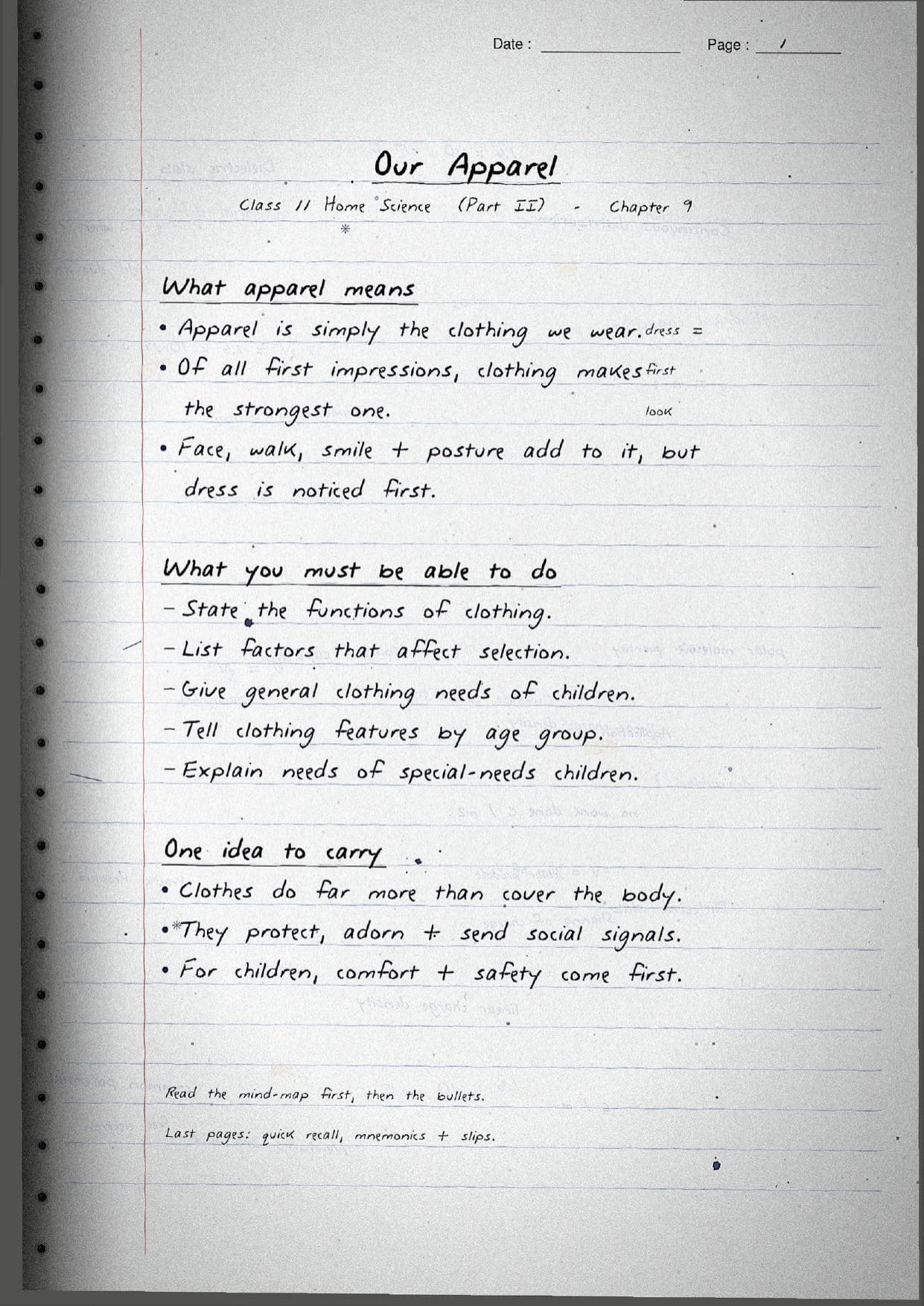
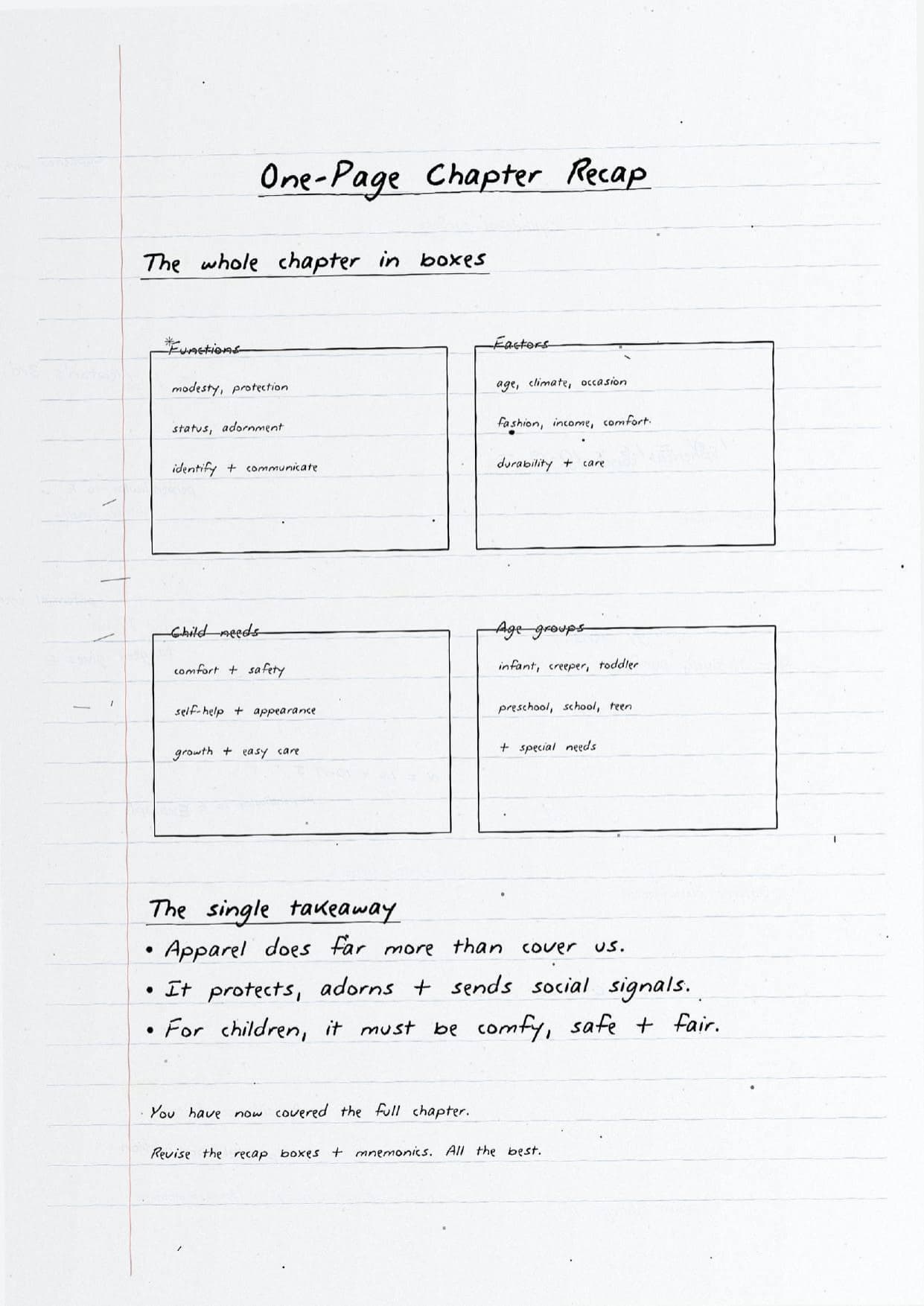
The opening pages settle what apparel means and why we wear it. Apparel is simply the clothing we wear, and of all first impressions, clothing makes the strongest one. The notes then box the six functions of clothing, because this is the most commonly asked idea from the chapter. The table below shows what each function page covers.
| Function | What the page shows |
|---|---|
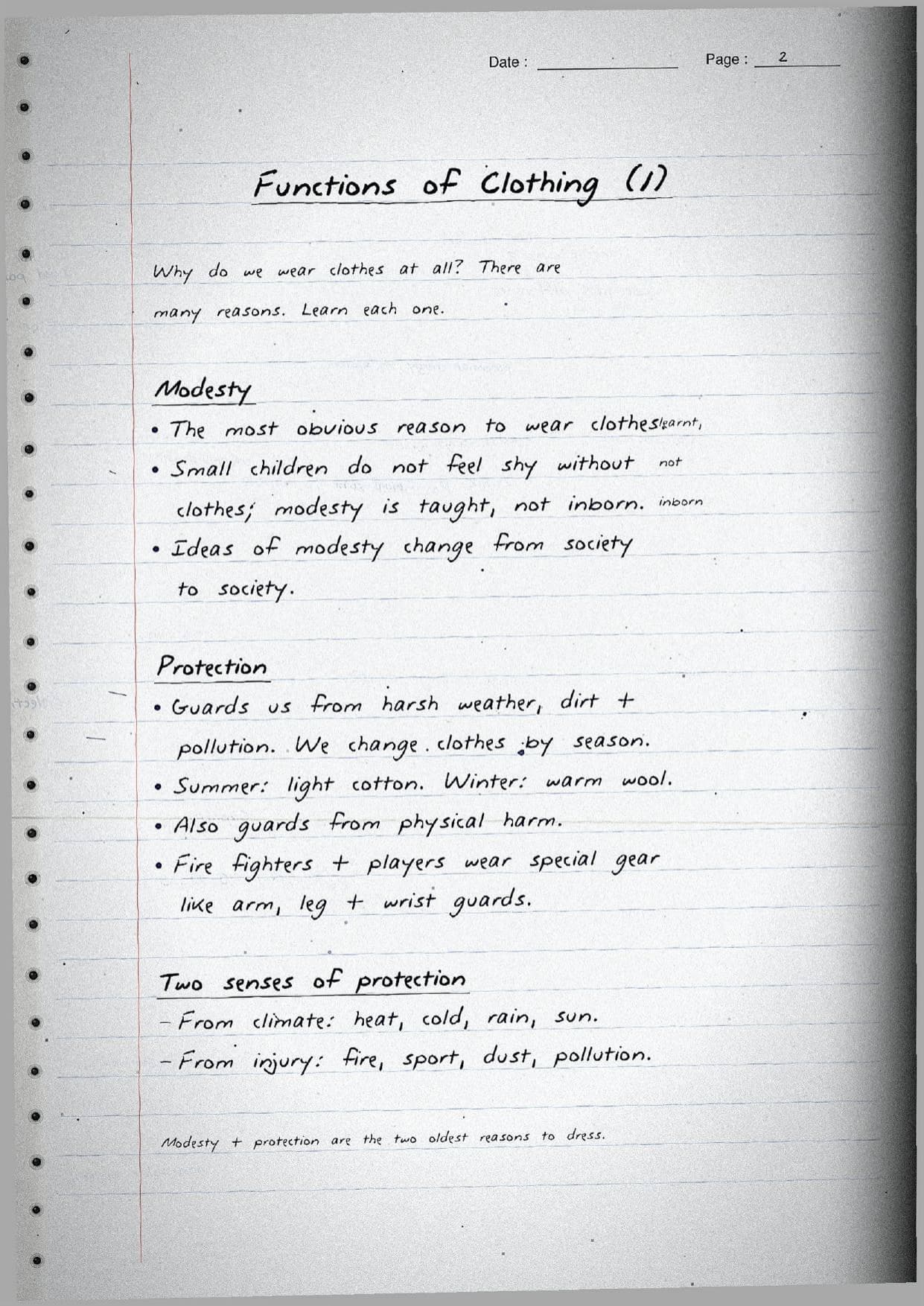
| Modesty | The most obvious reason to dress; the notes stress that modesty is taught by society, not inborn, and its idea changes from one society to another. |
| Protection | Guards the body two ways: from climate (heat, cold, rain, sun) and from injury (fire, sport, dust, pollution). |
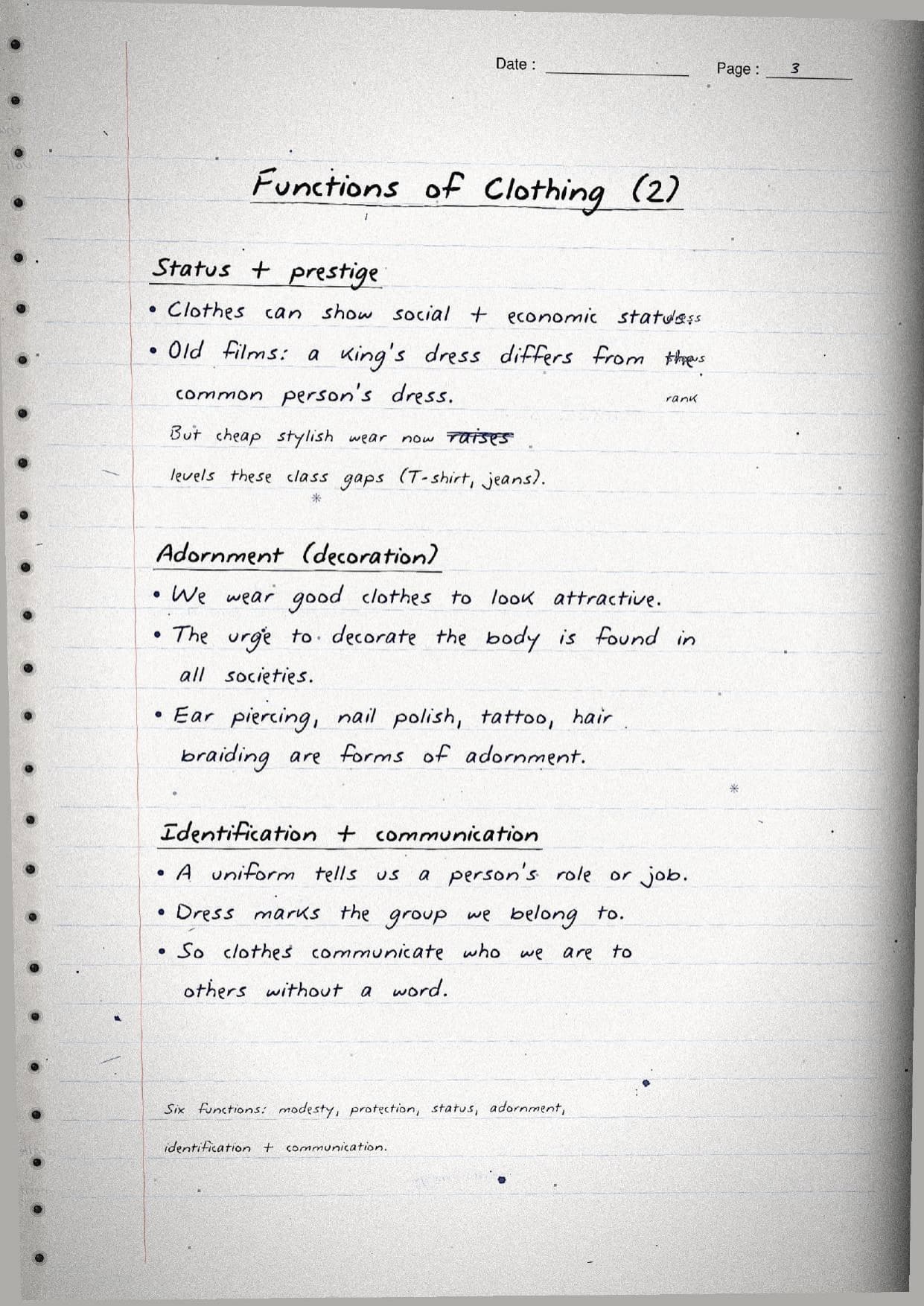
| Status and prestige | Clothes can show social and economic rank, though cheap stylish wear like T-shirts and jeans now levels these gaps. |
| Adornment | The urge to decorate the body, seen in every society, through ear piercing, nail polish, tattoos and hair braiding. |
| Identification | A uniform tells a person's role or job and marks the group they belong to. |
| Communication | Dress signals who we are to others without a word. |
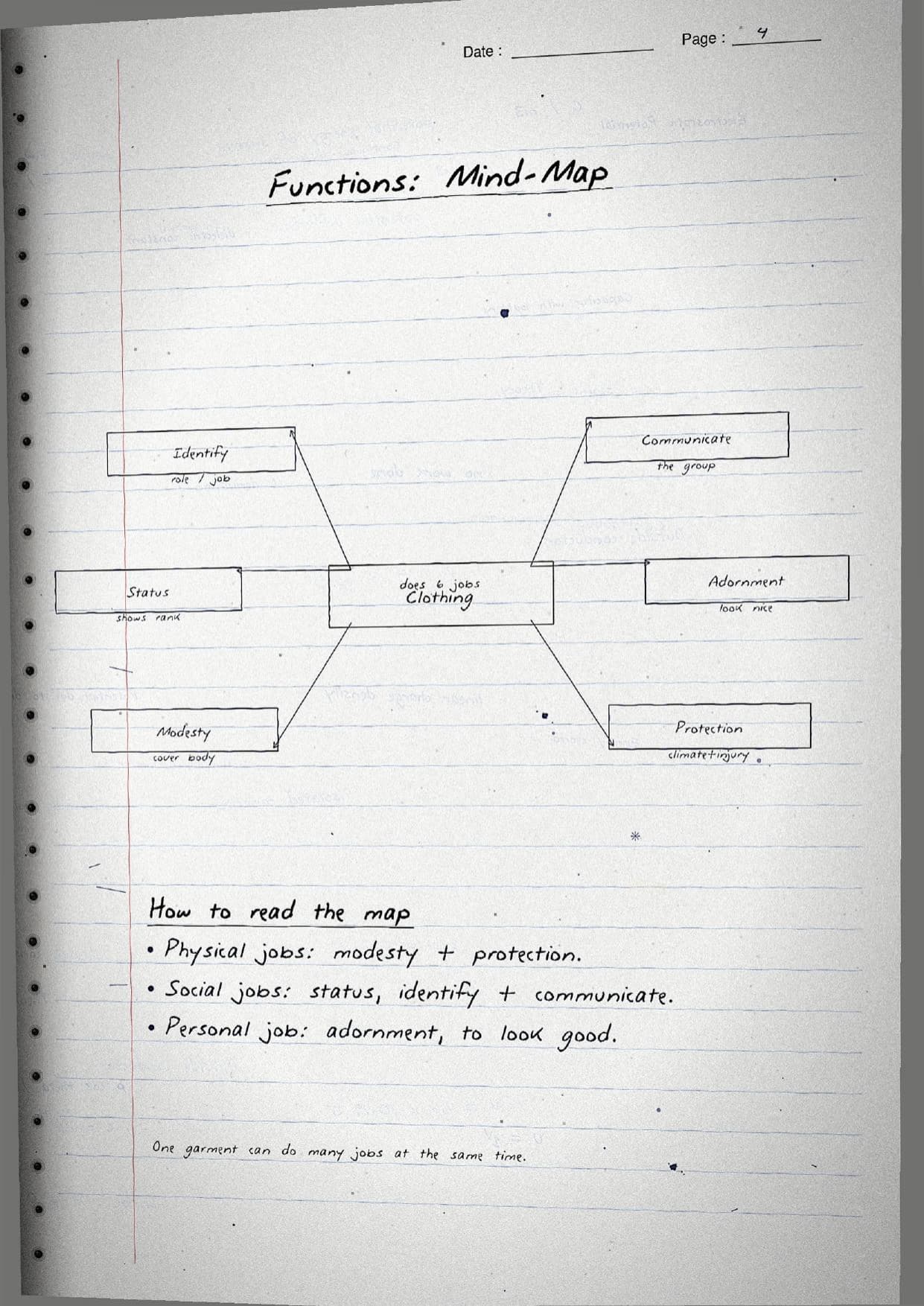
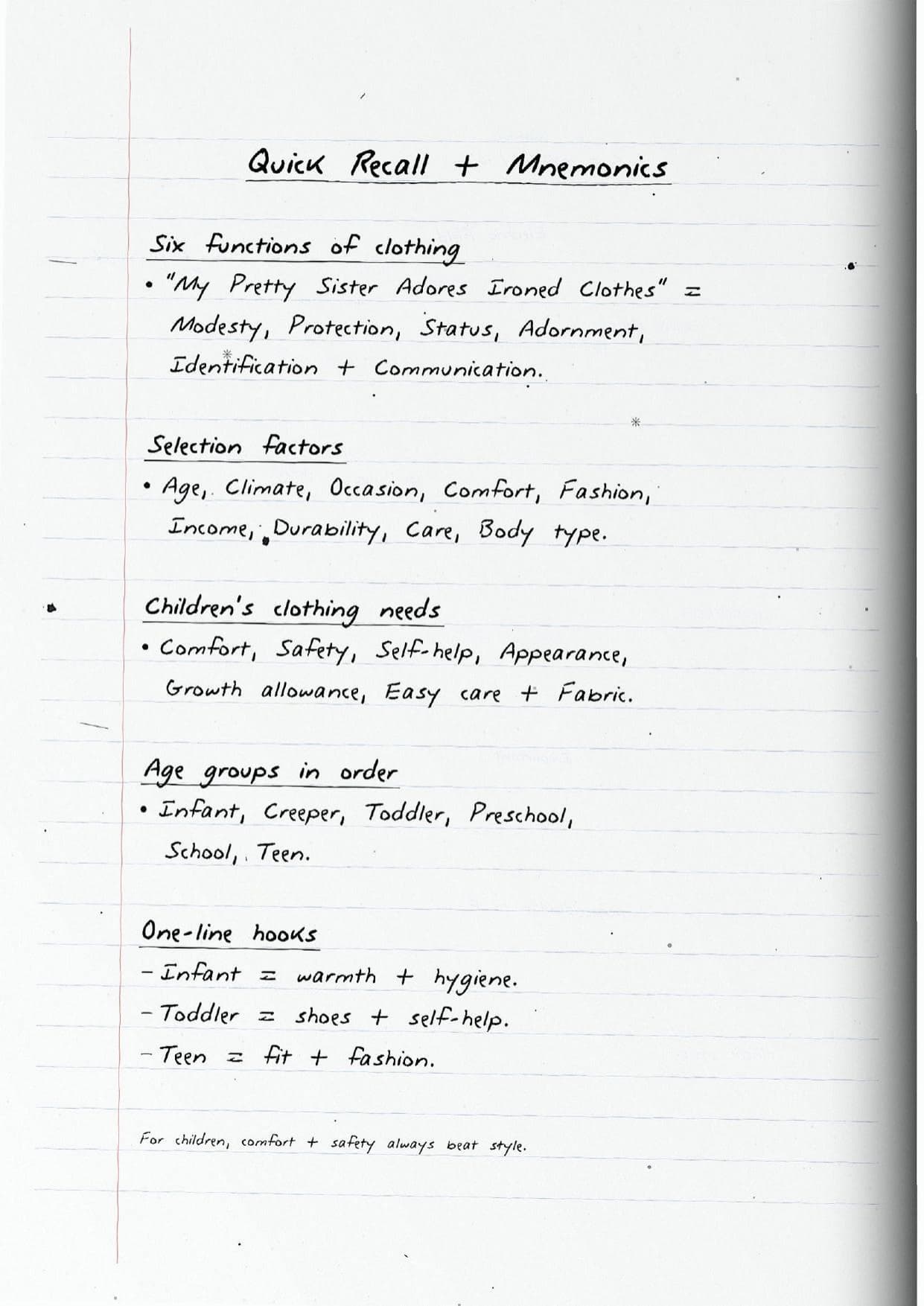
A separate page draws all six as a mind-map around a central "Clothing" node. The notes group them into physical jobs (modesty and protection), social jobs (status, identification and communication) and a personal job (adornment). The reminder on the page is that one garment can do many of these jobs at the same time.
Selecting Clothes and Children's Clothing Needs
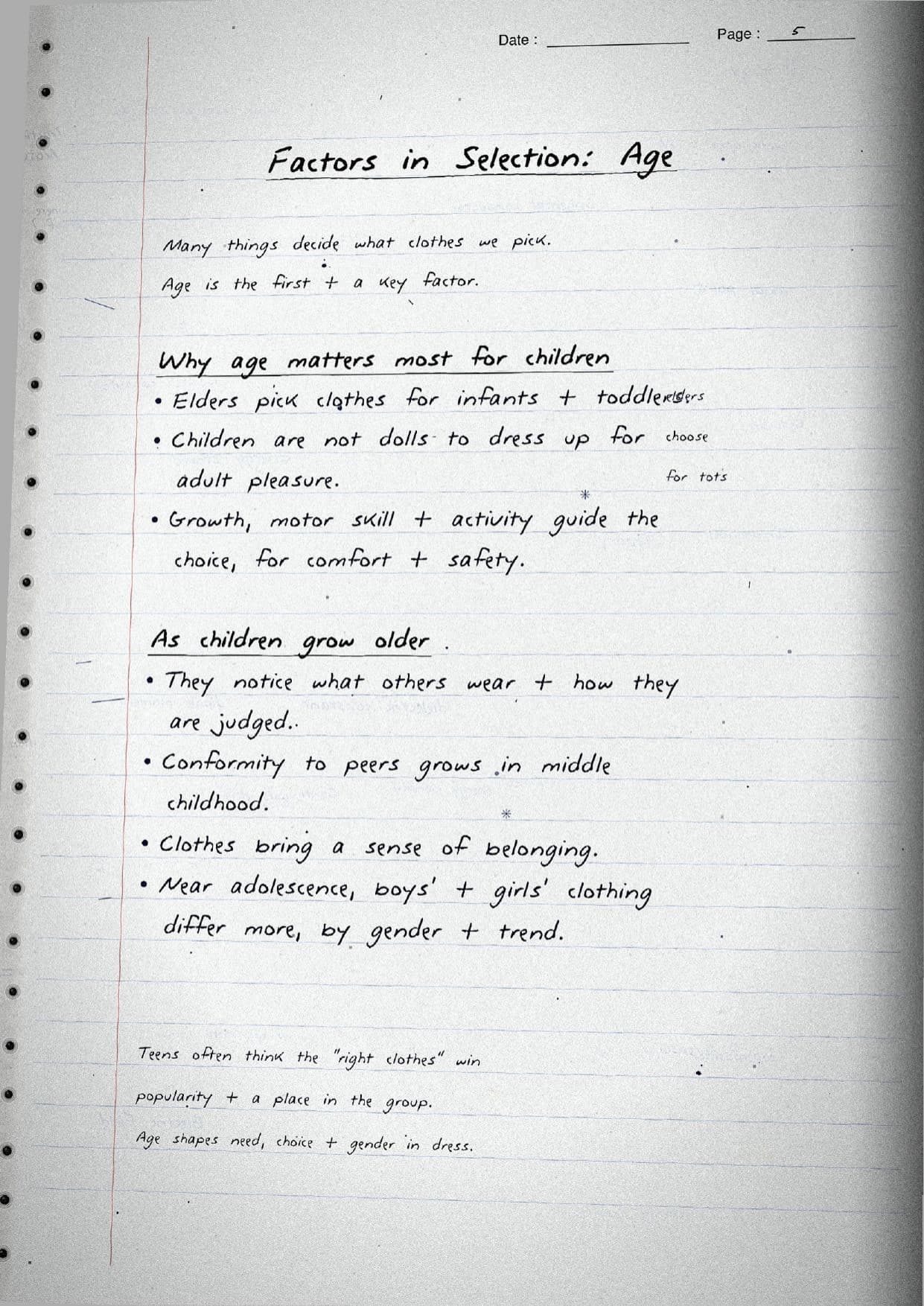
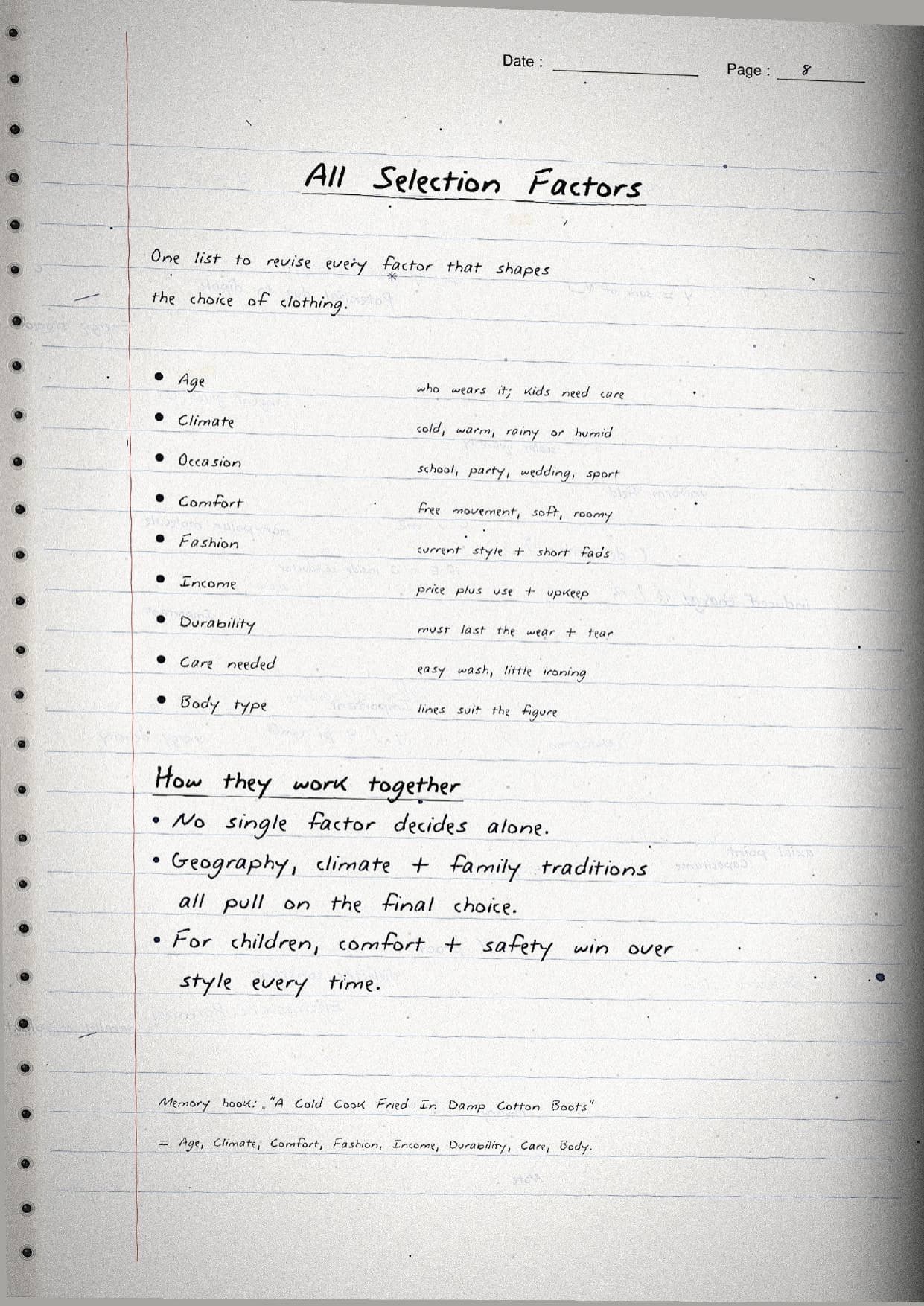
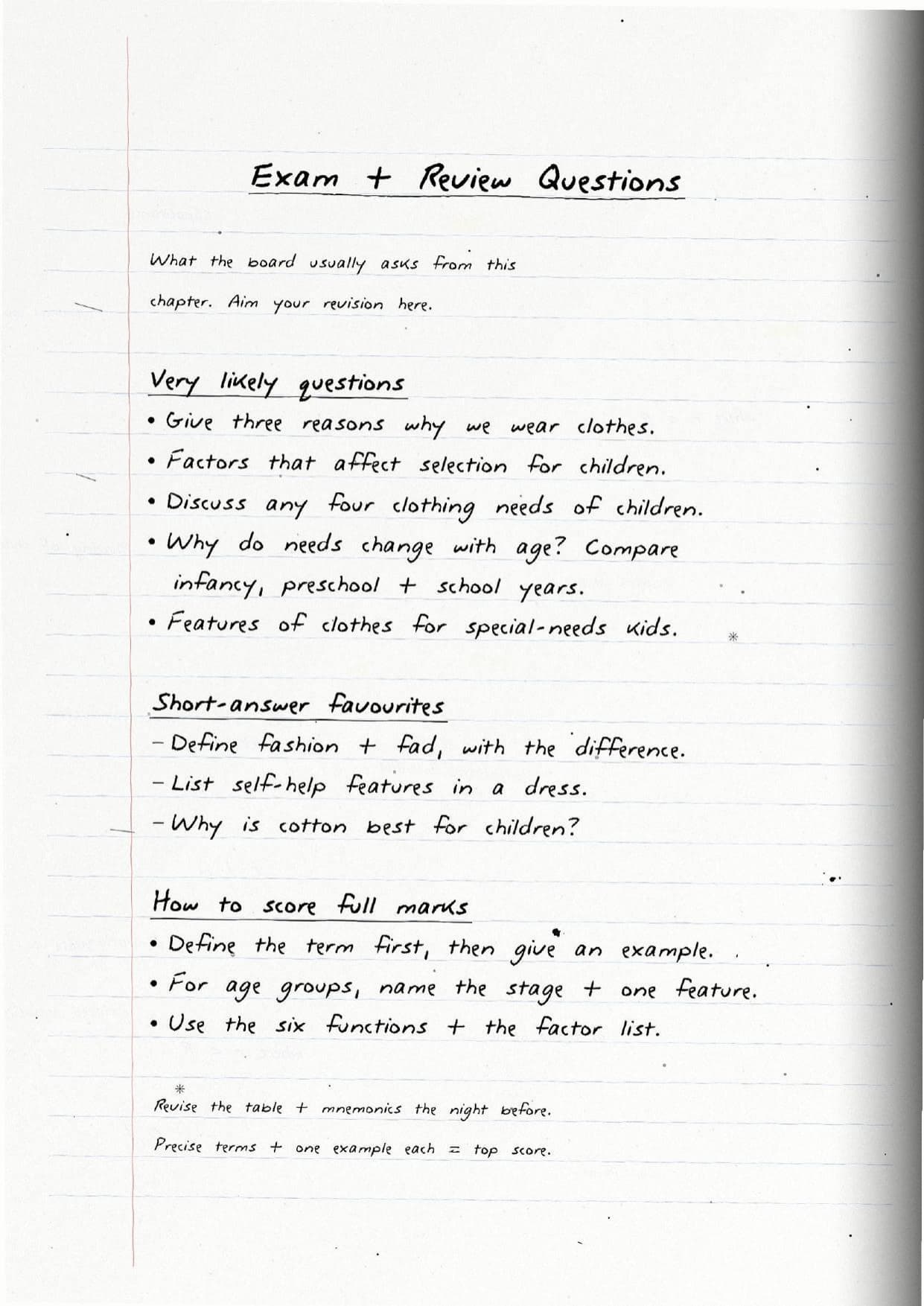
The middle and later pages cover the two big application topics. First come the factors that affect the selection of clothes. Age comes first, since elders choose for infants and toddlers while older children start to follow peers. The other factors are set out in one revision list.
- Age: who wears it; children need extra care for comfort and safety.
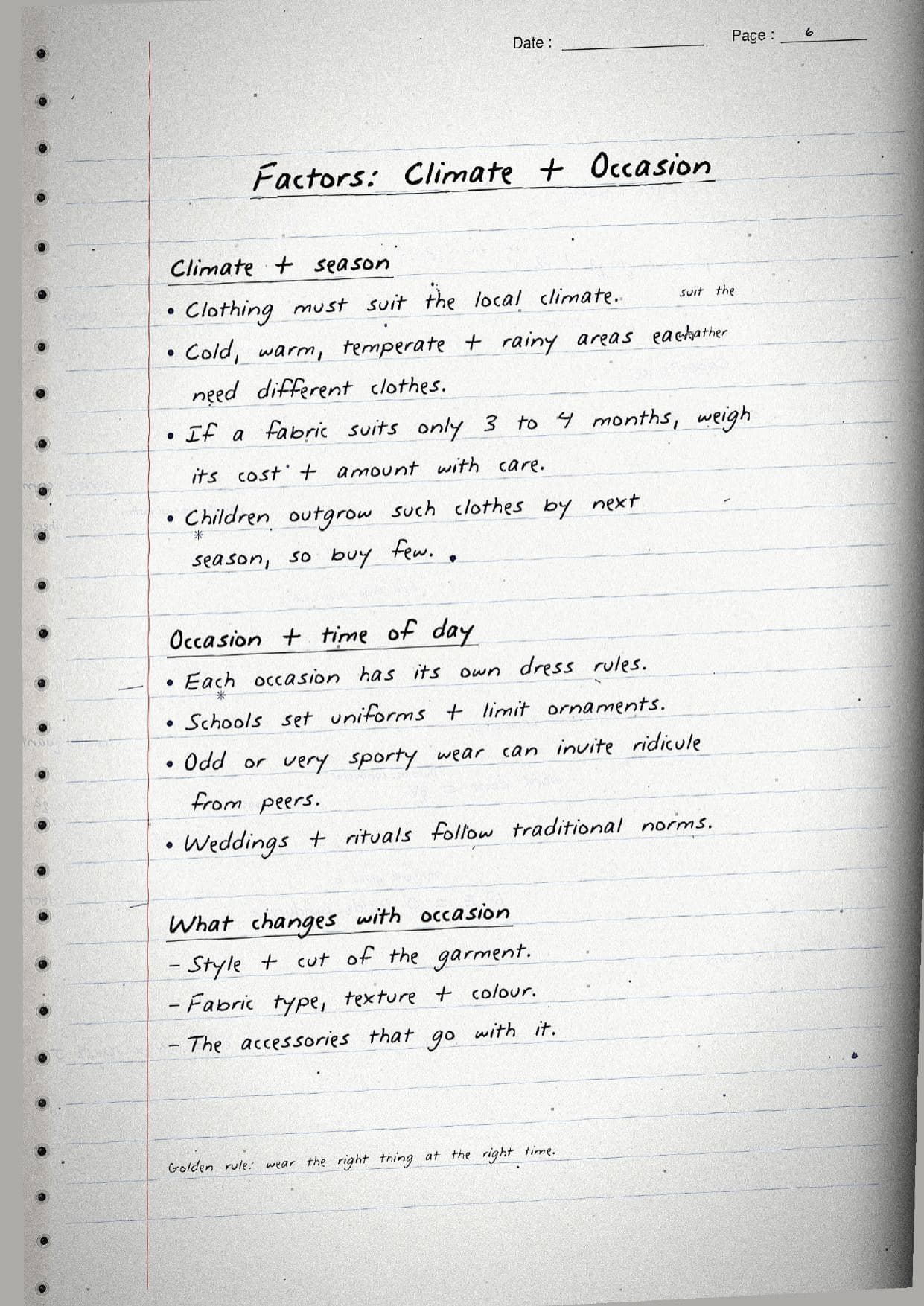
- Climate and season: cold, warm, temperate and rainy areas each need different clothes.
- Occasion: school uniforms, parties, weddings and sport each carry their own dress rules.
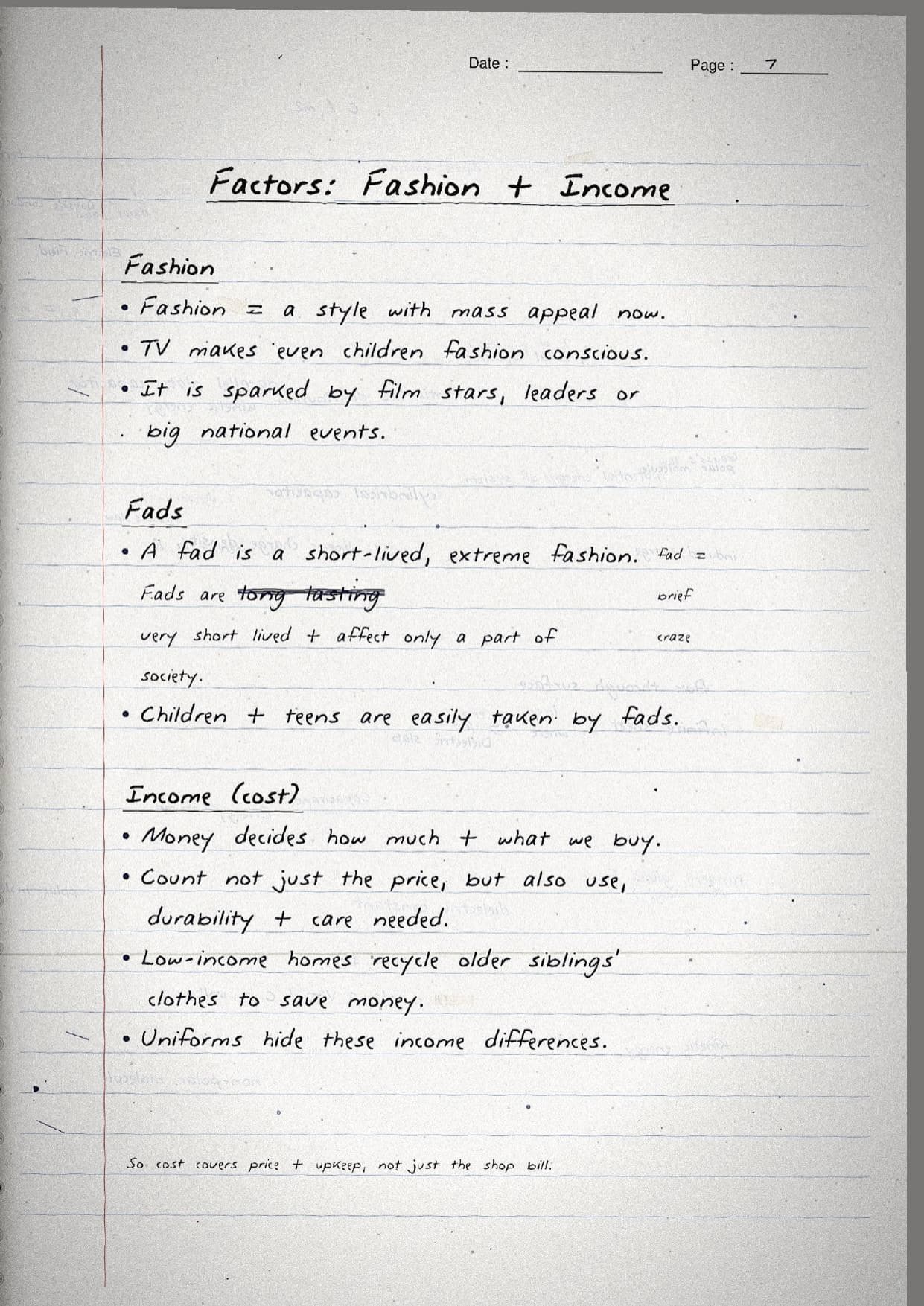
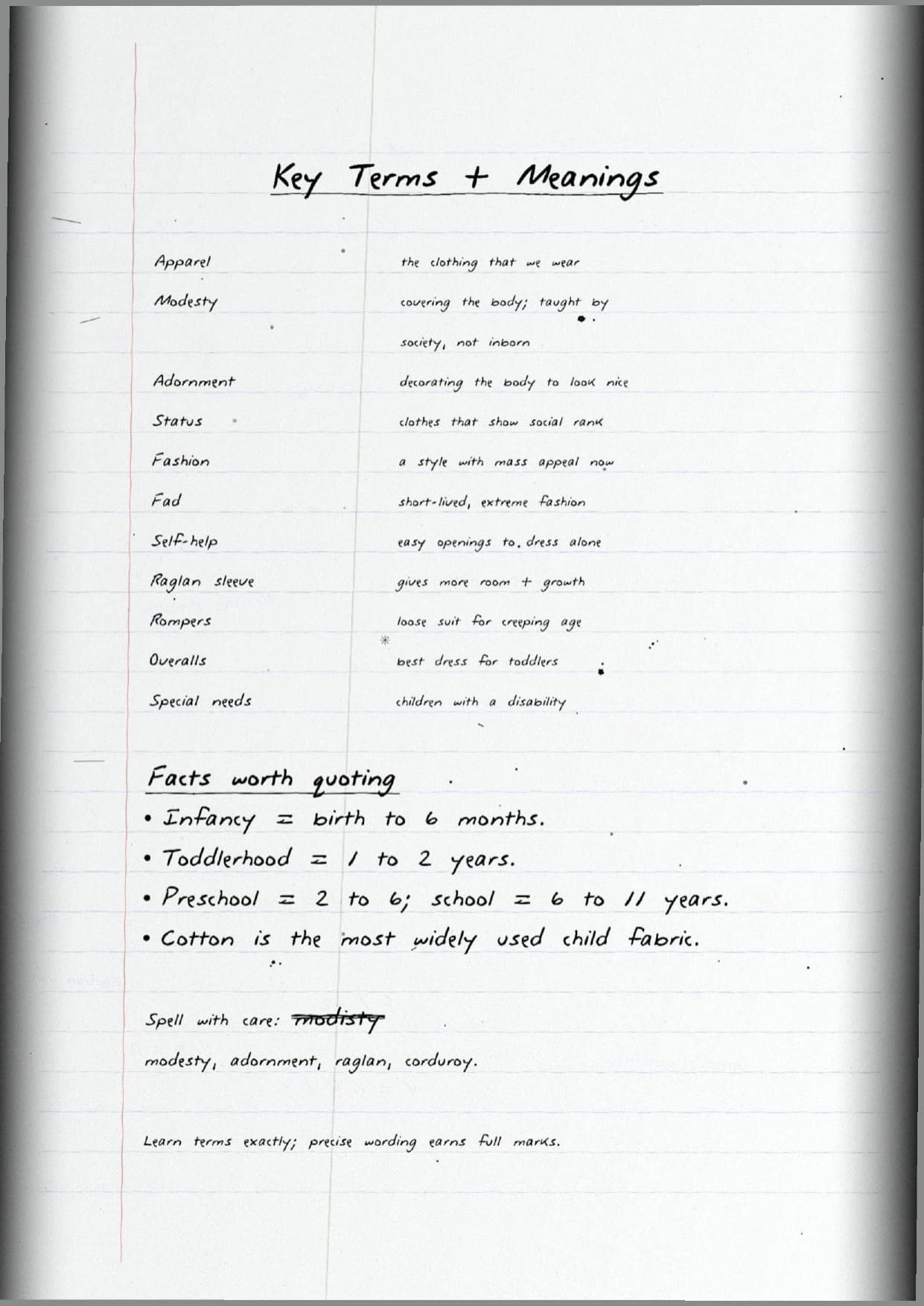
- Fashion and fads: fashion is a style with mass appeal now, while a fad is short-lived and extreme.
- Income: cost means the price plus use, durability and care, not just the shop bill.
- Comfort, durability and care: free movement, long wear, and easy washing all matter.
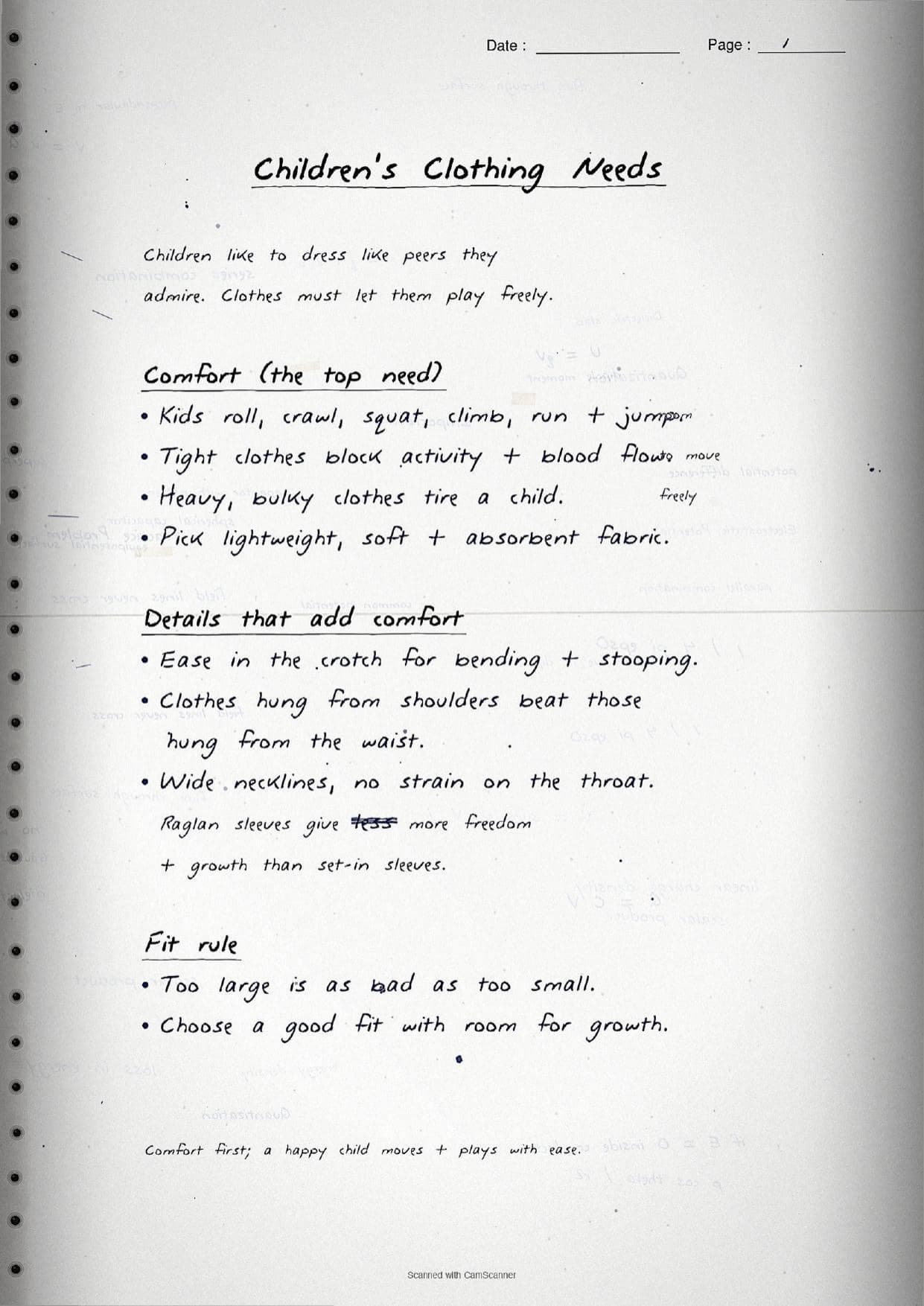
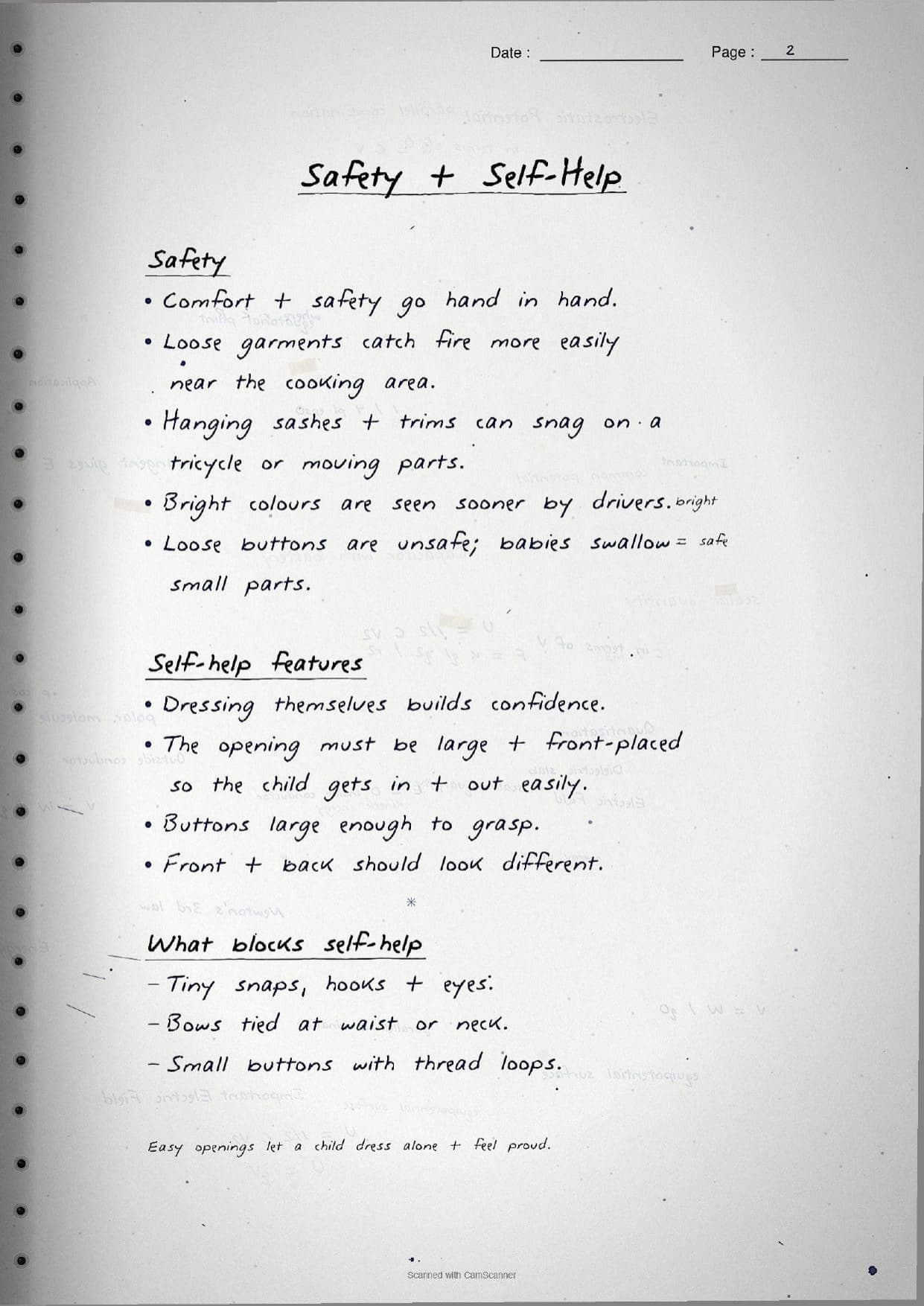
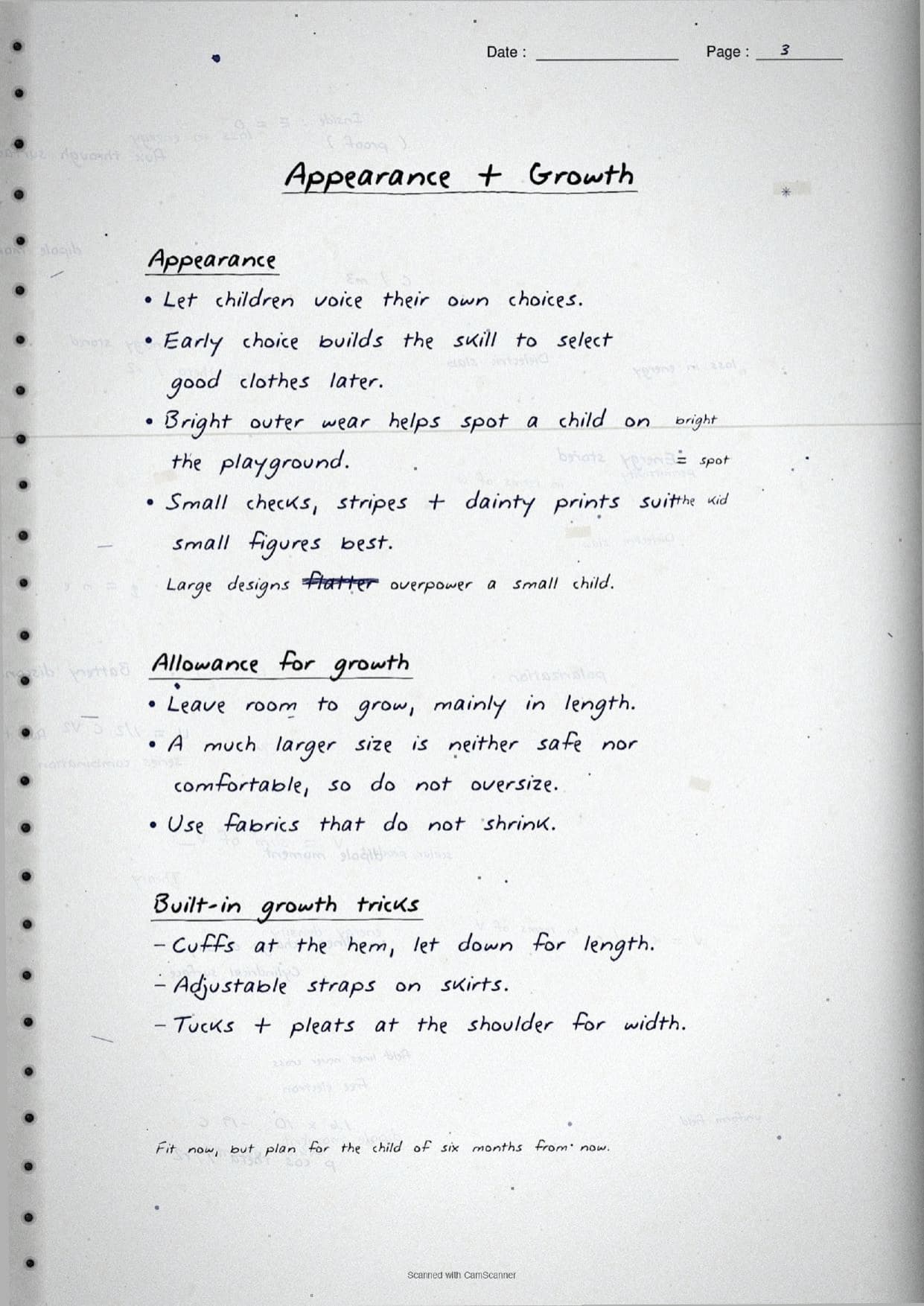
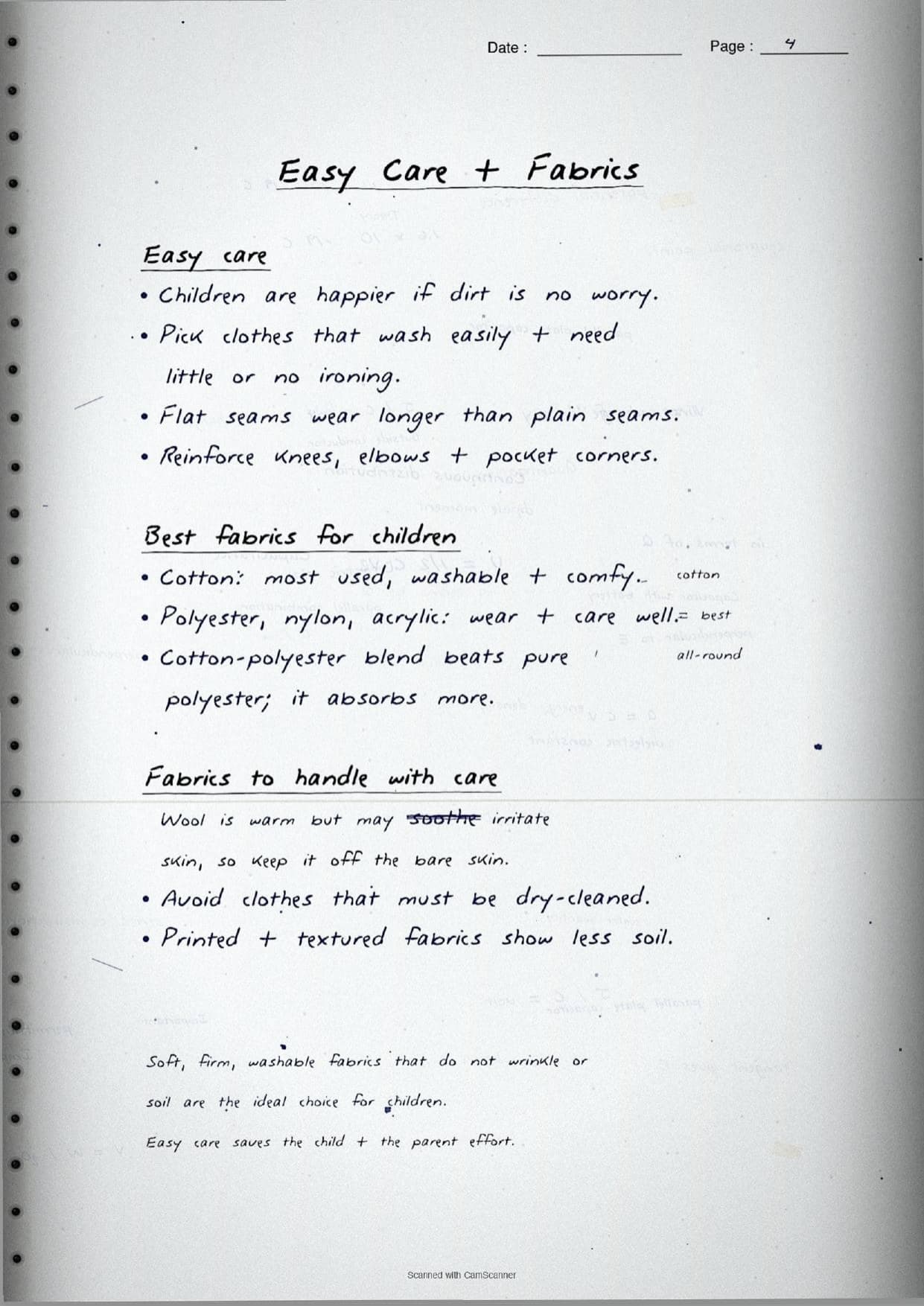
The notes then turn to the general clothing needs of children: comfort, safety, self-help features, appearance, allowance for growth, and easy care with the right fabrics. Comfort is the top need, so clothes must be light, soft and roomy. Bright colours and no loose buttons keep clothing safe, while large front openings and big buttons let a child dress alone.
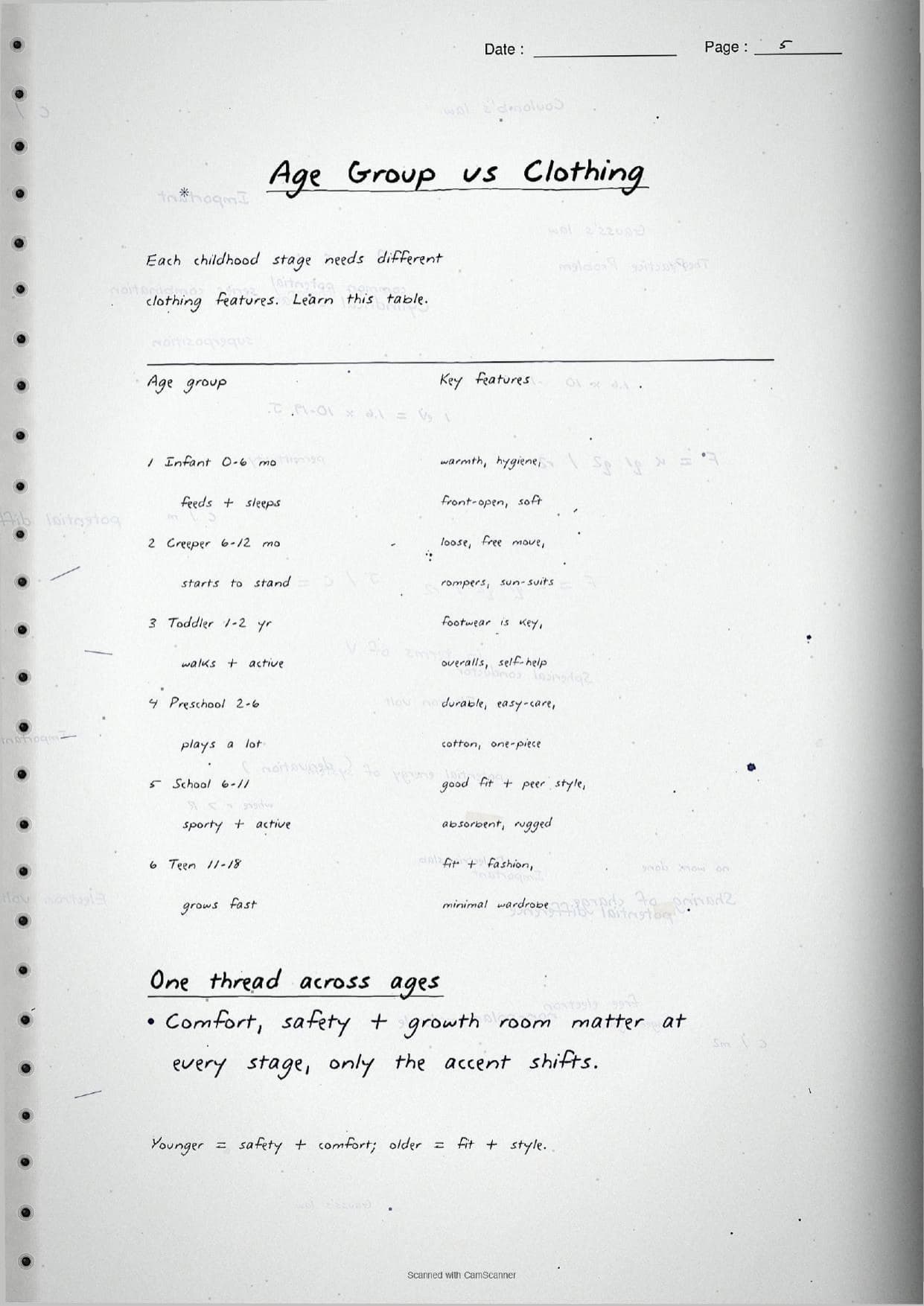
An age-versus-features table ties it together, one of the most useful pages for the exam.
| Age group | Key clothing features |
|---|---|
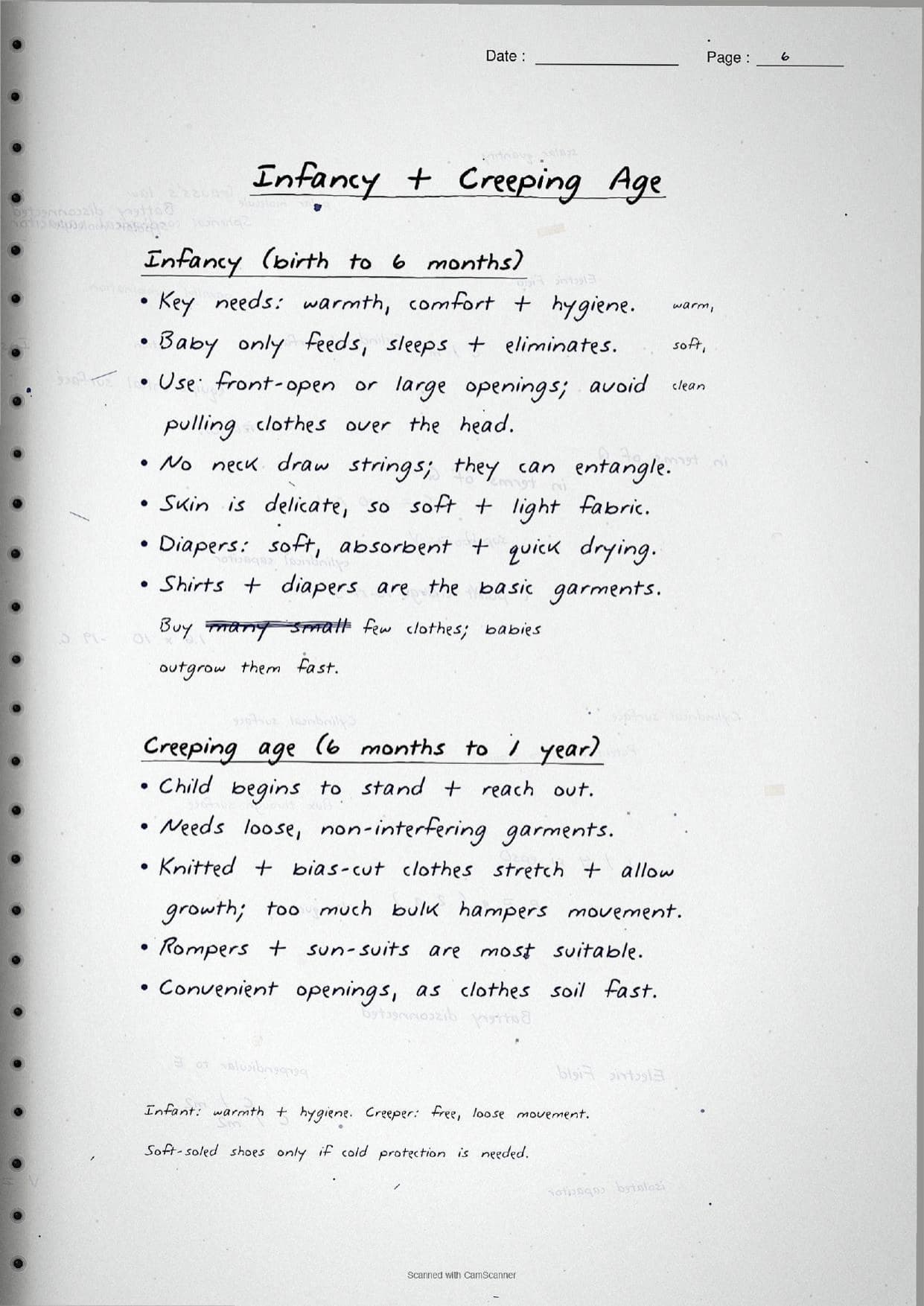
| Infancy (birth to 6 months) | Warmth, comfort and hygiene; soft front-open garments; no neck draw strings. |
| Creeping age (6 to 12 months) | Loose, free-movement clothes; rompers and sun-suits with convenient openings. |
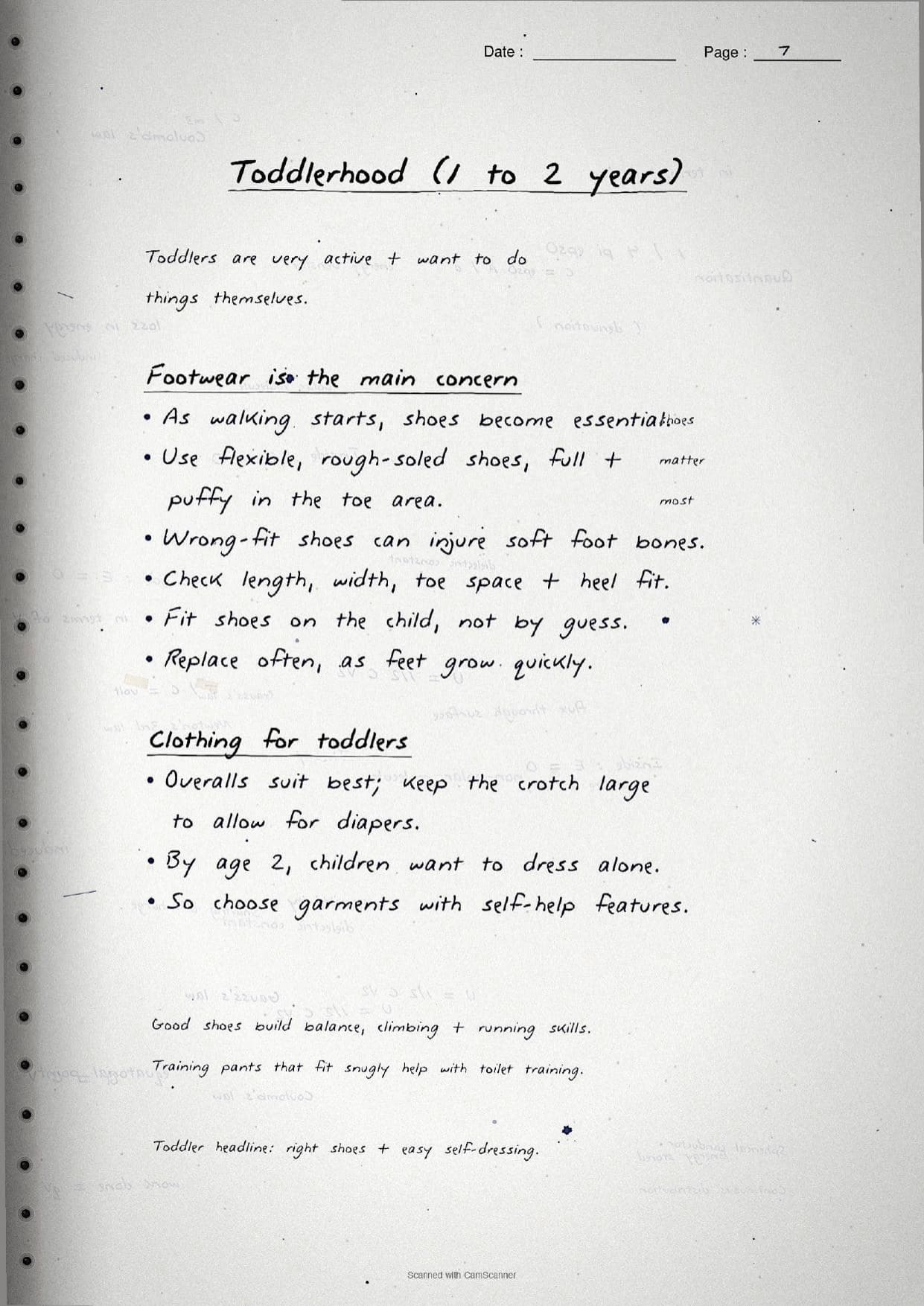
| Toddlerhood (1 to 2 years) | Correct-fit footwear is the main concern; overalls with self-help features. |
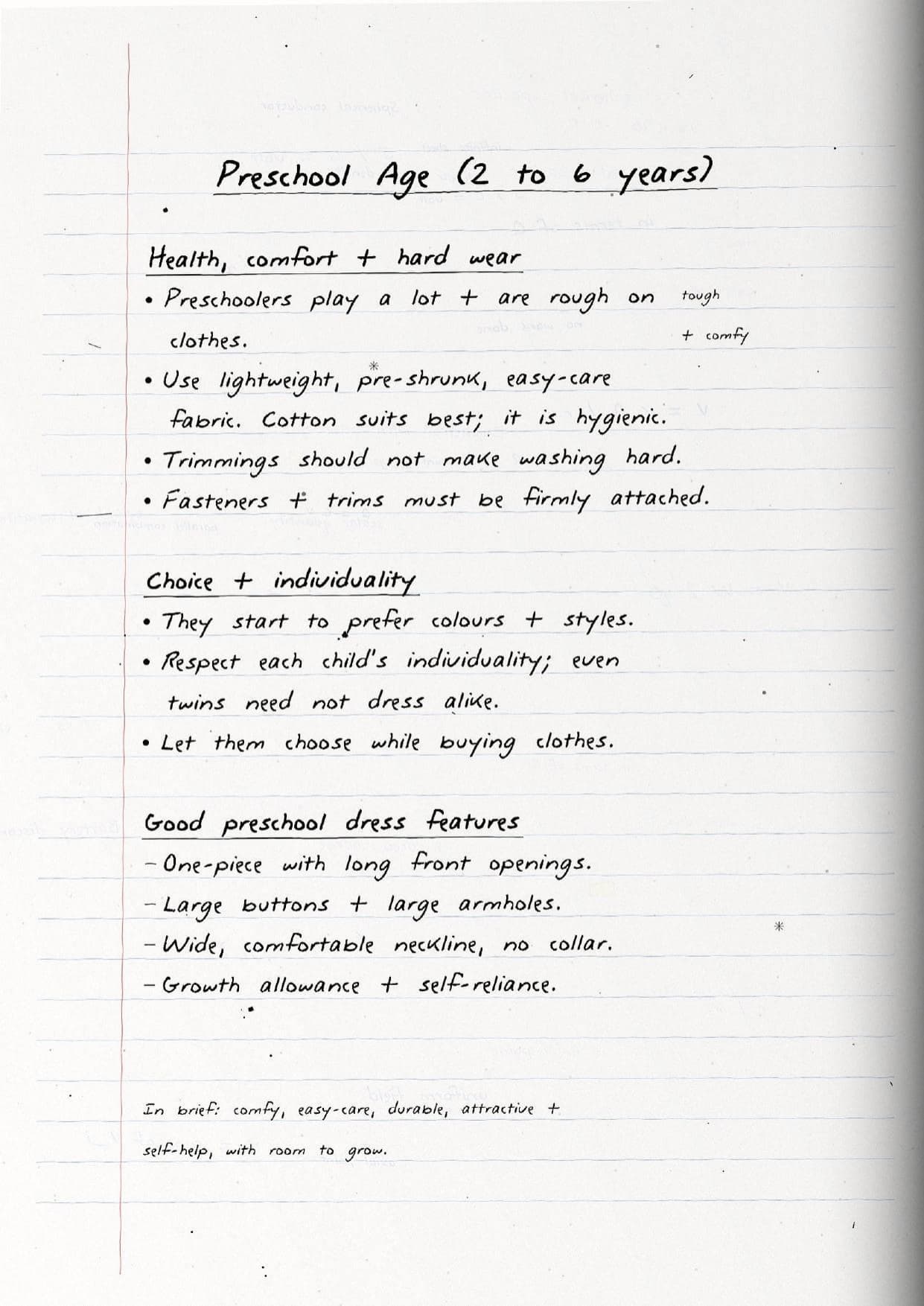
| Preschool (2 to 6 years) | Durable, easy-care cotton; one-piece dress with growth allowance and self-reliance. |
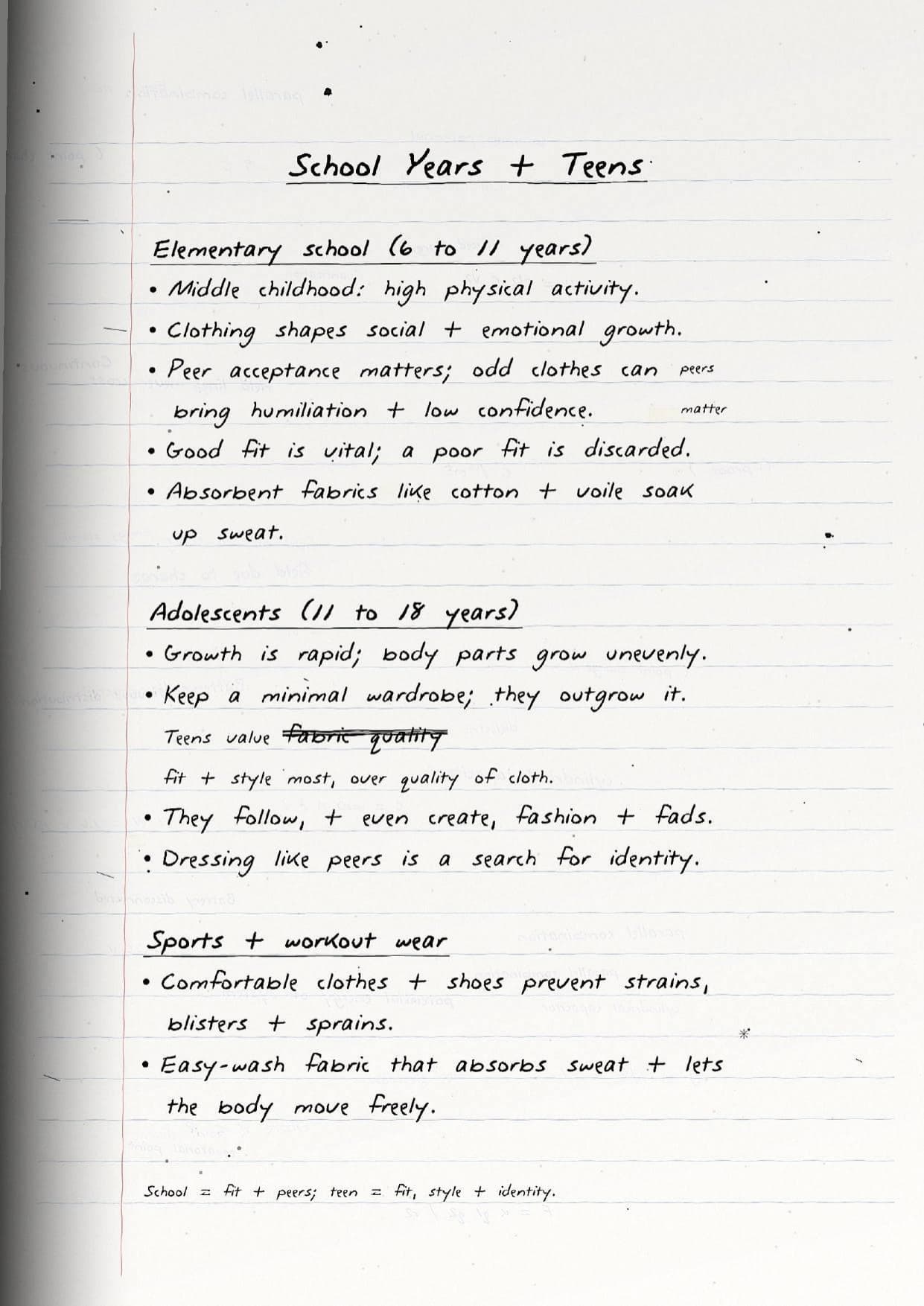
| School age (6 to 11 years) | Good fit and peer-approved style; absorbent, rugged fabrics for high activity. |
| Teens (11 to 18 years) | Fit and fashion matter most; a minimal wardrobe, as they outgrow clothes fast. |
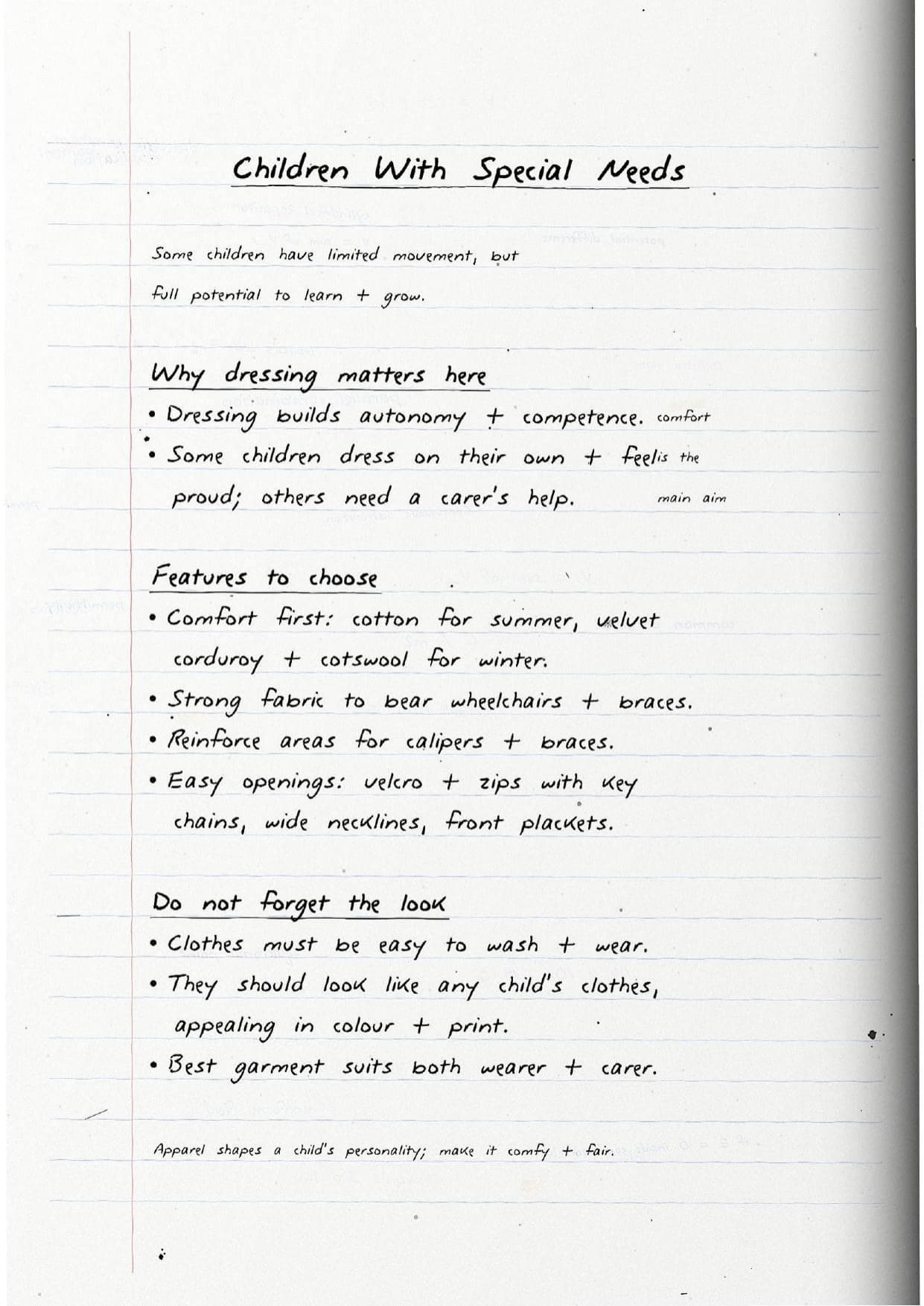
A final page covers children with special needs. Here comfort is the main aim, with strong fabrics to bear wheelchairs and braces, reinforced areas for calipers, and easy openings like velcro, zips and wide necklines. The notes add that these clothes should still look appealing, so the child feels like any other child.
How to Use These Handwritten Notes
Handwritten notes work best as a final-revision tool, not a first read. The steps below show how to get the most out of the Our Apparel handwritten notes in the last days before a test.
- Download: tap the download card above to save the handwritten pages to your device.
- First read: read the printed Notes once so the handwritten pages act as a refresher, not a first source.
- Recall drill: cover the page and try to write the six functions and the age-wise features from memory.
- Night before: flip through the mind-map and the age table for a quick last-minute recall.
Many students search for class 11 home science chapter 9 notes on their phone the night before a test, so a saved set of handwritten pages means you can revise offline. Use the handwritten notes for speed, then check the solutions to confirm you have the answer points right.
Common Mistakes These Notes Help You Avoid
A few errors cost marks every year. The handwritten notes flag each one in the margin so you can fix it before the exam. These five are the most common.
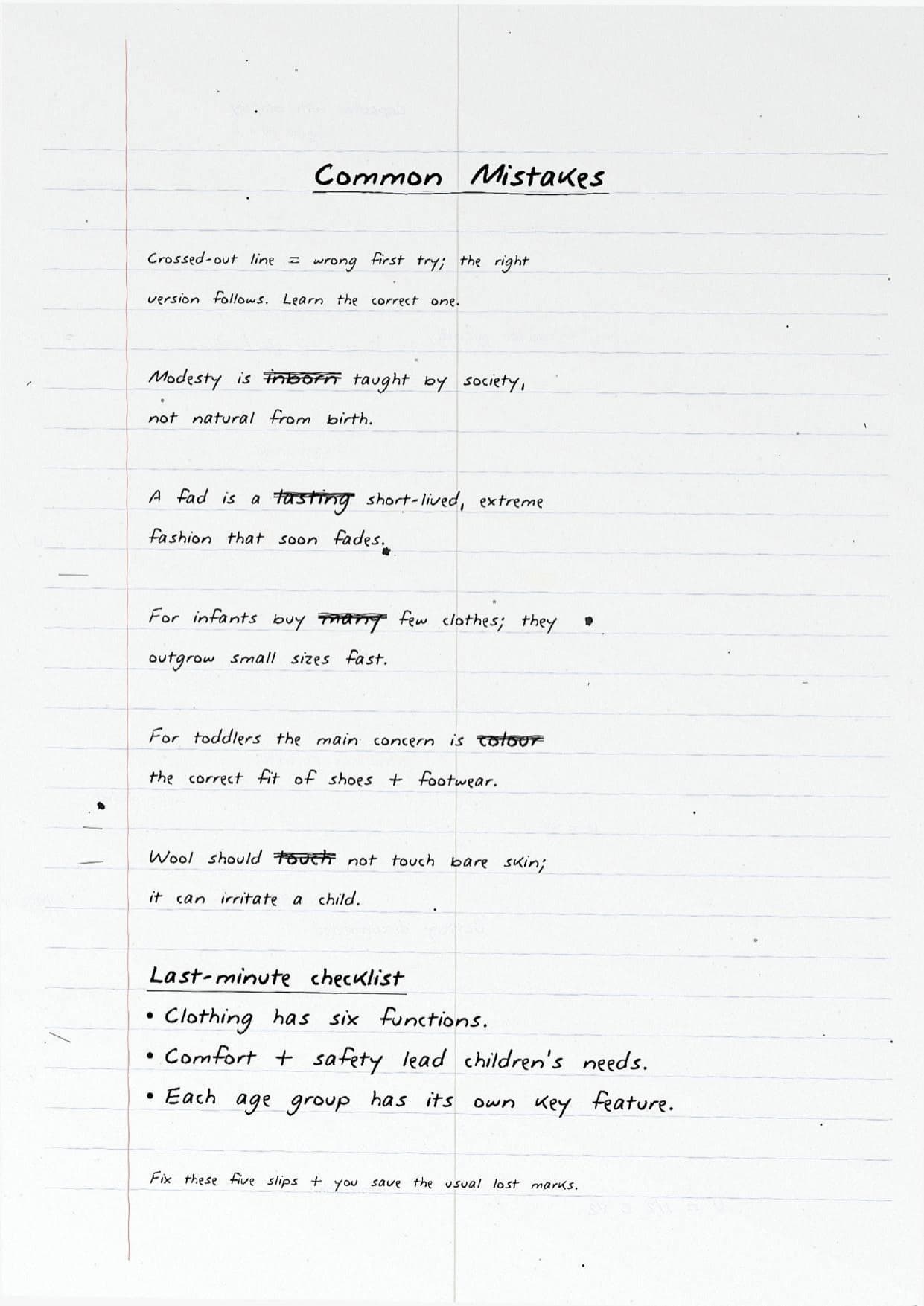
- Calling modesty inborn. It is taught by society, not natural from birth.
- Confusing fashion and a fad. A fad is short-lived and extreme, while fashion has broad, current appeal.
- Buying many clothes for infants. Babies outgrow sizes fast, so buy few garments.
- Missing the toddler point. For toddlers the main concern is the correct fit of footwear, not colour.
- Putting wool on bare skin. Wool can irritate a child, so keep it off the skin.
Students who fix these five points usually move from average to high marks. The handwritten notes box each function and list every clothing need in full, so the soft points are hard to miss when you revise.
How These Handwritten Notes Pair with the Solutions and Book PDF
These handwritten notes are a fast revision tool. To prepare fully, students should use them alongside the other resources for the same chapter, all linked in the table below. Read the printed Notes, test yourself with the solutions, then use these pages for a final recall.
| Resource | Best used for |
|---|---|
| Our Apparel NCERT Solutions | Step-by-step answers to all the chapter review questions |
| Our Apparel Class 11 Notes | Quick chapter summary with all functions, factors and age groups in one place |
| Our Apparel NCERT Book PDF | Reading the original NCERT chapter text and figures |
Tip: read the printed Notes first, then attempt the solutions, and keep these handwritten pages for the final night-before flip. Using them for recall, not for the first read, builds memory faster.
All Class 11 Home Science Handwritten Notes by Chapter
The table links the handwritten notes for every chapter in Class 11 Home Science, so students can move across the course in one click. Our Apparel is highlighted.
| Chapter | Handwritten Notes |
|---|---|
| Chapter 1 | Human Ecology and Family Sciences |
| Chapter 2 | Understanding the Self |
| Chapter 3 | Food, Nutrition, Health and Fitness |
| Chapter 4 | Management of Resources |
| Chapter 5 | Fabrics Around Us |
| Chapter 6 | Media and Communication Technology |
| Chapter 7 | Concerns and Needs in Diverse Contexts |
| Chapter 8 | Nutrition, Health and Well-being |
| Chapter 9 | Our Apparel |
| Chapter 10 | Financial Management and Planning |
| Chapter 11 | Care and Maintenance of Fabrics |
FAQs on Our Apparel Handwritten Notes
Our Apparel Class 11 Home Science Handwritten Notes Common Questions
Ques. Where can I download the Our Apparel handwritten notes PDF?
Ans. You can download the Our Apparel Class 11 Home Science handwritten notes PDF directly from this page. It is free, follows the 2026-27 NCERT syllabus, and presents the functions of clothing, the selection factors, the children's clothing needs and the age-wise features as handwritten pages.
Ques. What are the functions of clothing in Class 11 Chapter 9?
Ans. The chapter gives six functions of clothing: modesty, protection, status and prestige, adornment, identification and communication. The handwritten notes draw these as a mind-map and group them into physical, social and personal jobs so they are easy to recall.
Ques. What topics do these handwritten notes cover?
Ans. They cover the meaning of apparel, the six functions of clothing, the factors that affect the selection of clothes such as age, climate, occasion, fashion, income and comfort, the general clothing needs of children, the clothing features for each age group from infancy to the teens, and clothing for children with special needs.
Ques. What are the main clothing needs of children in this chapter?
Ans. The general clothing needs of children are comfort, safety, self-help features, appearance, allowance for growth, and easy care with suitable fabrics. Comfort and safety always come before style, and cotton is the most widely used fabric because it is soft, washable and hygienic.
Ques. Are handwritten notes good for revising Class 11 Home Science Chapter 9?
Ans. Yes. Handwritten notes are best for fast, last-minute revision because the boxed key terms, the functions mind-map and the age-versus-features table make the ideas easy to skim. Use them after a first read of the printed Notes, not as your only source.



Comments