



These Concerns and Needs in Diverse Contexts handwritten notes turn the whole of this big integrative chapter into clean, handwritten pages for fast revision. They follow the 2026-27 NCERT syllabus and Chapter 7 of Class 11 Home Science (Human Ecology and Family Sciences, Part I). Students get the three real sub-sections in one place: Nutrition, Health and Hygiene, Resource Availability and Management, and the Textile Traditions of India. The pages boil the chapter down to boxed key terms, mind-maps and simple tables so the whole unit reads like a topper's own notebook before the Class 11 final exam.
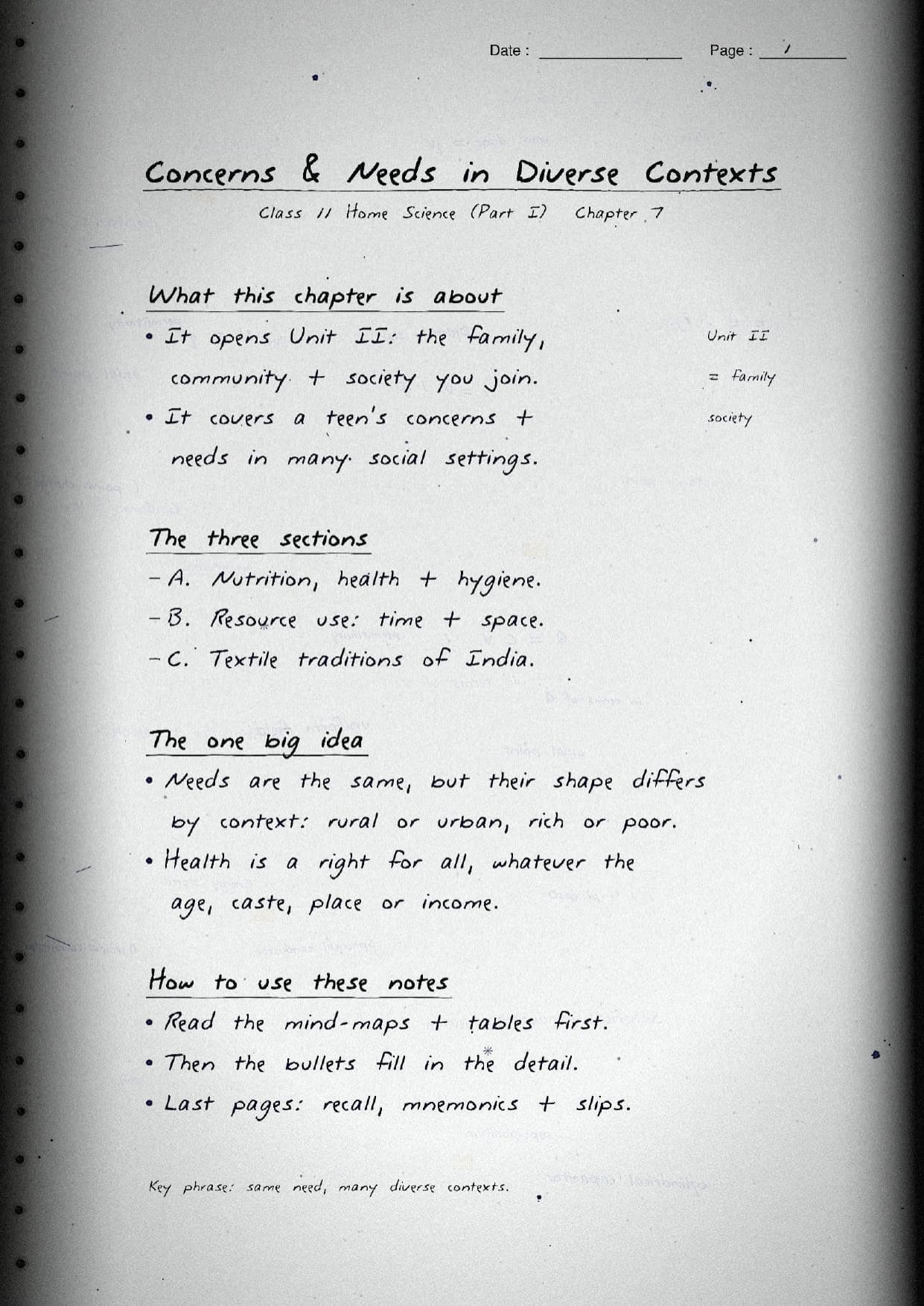
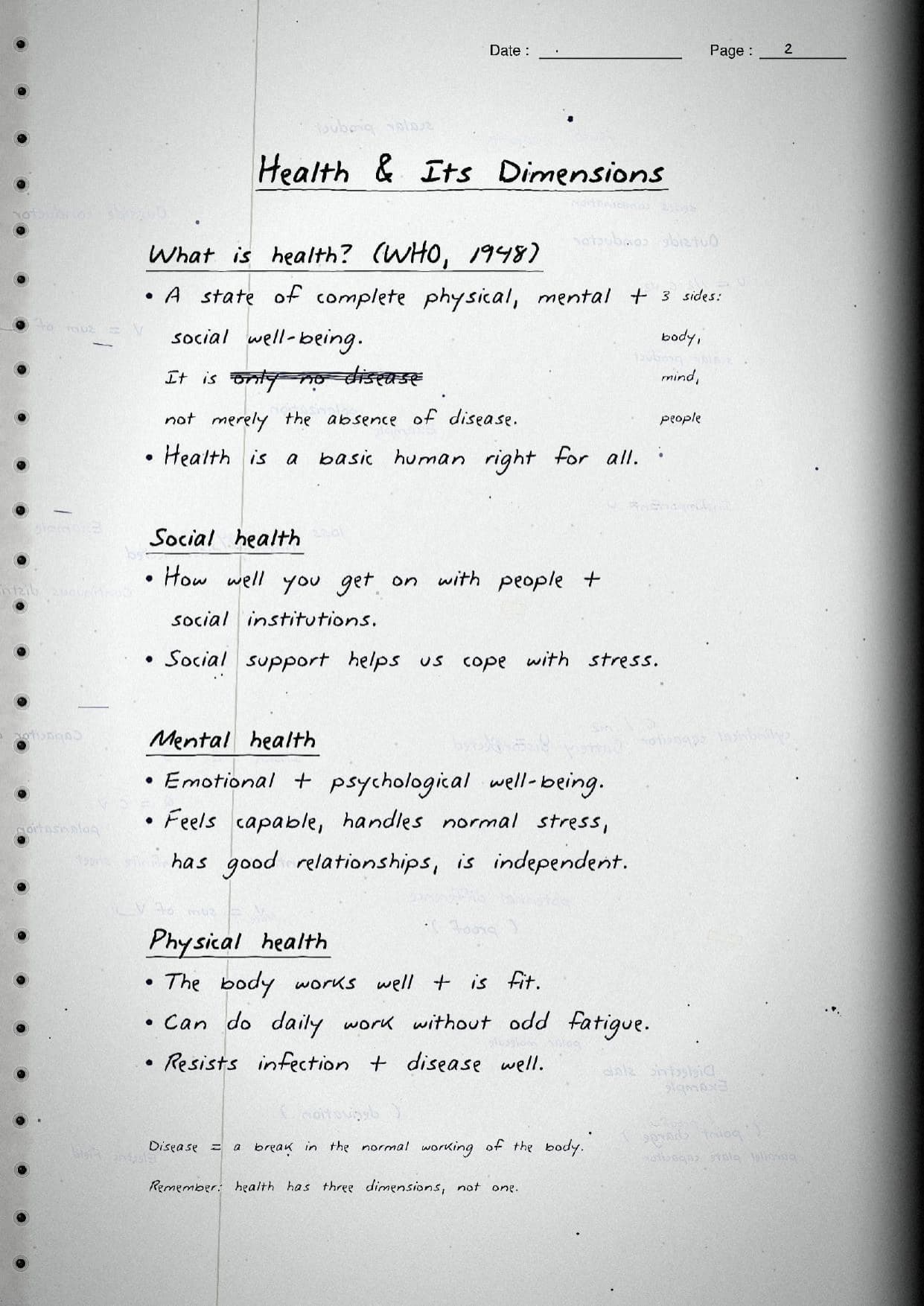
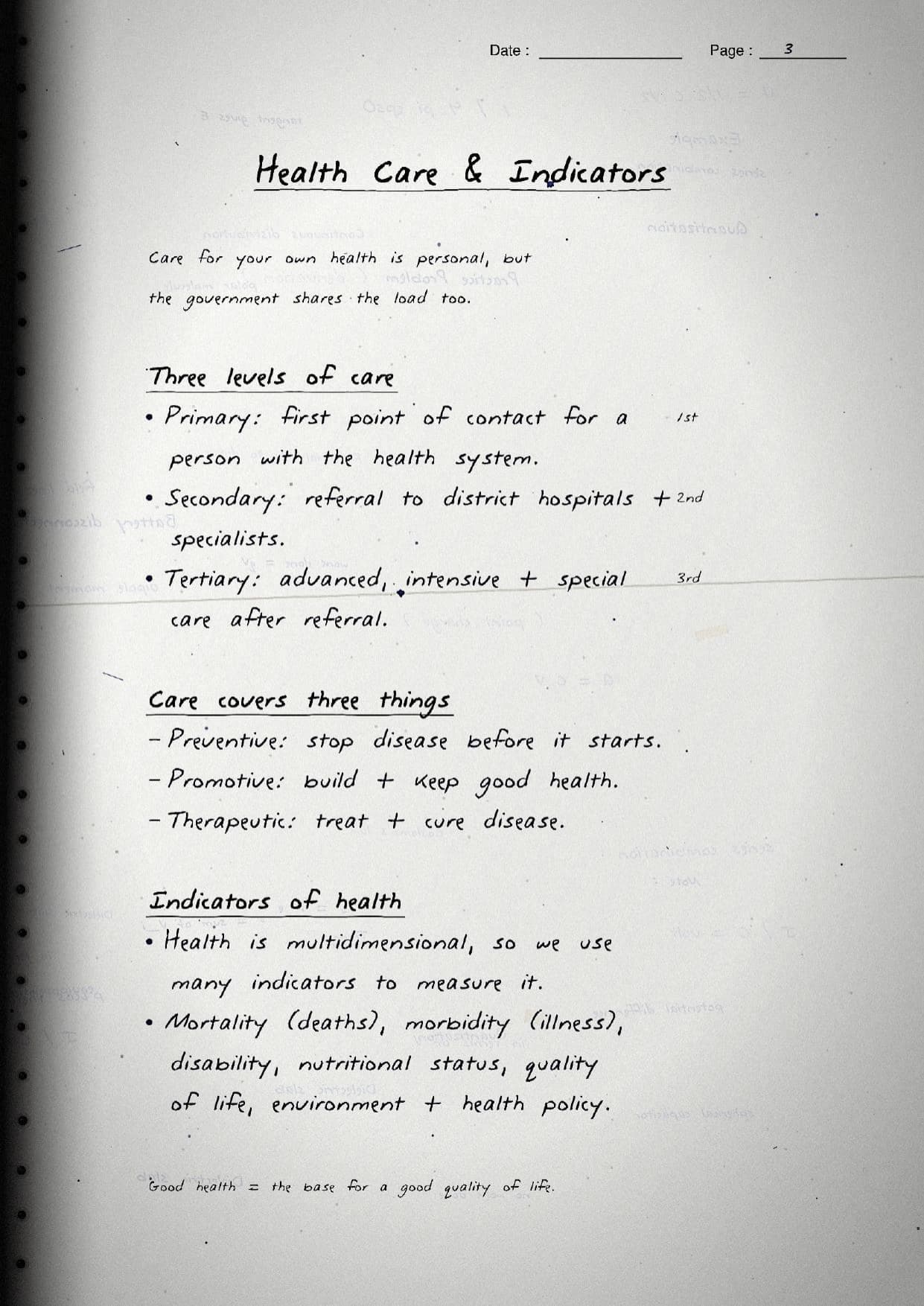
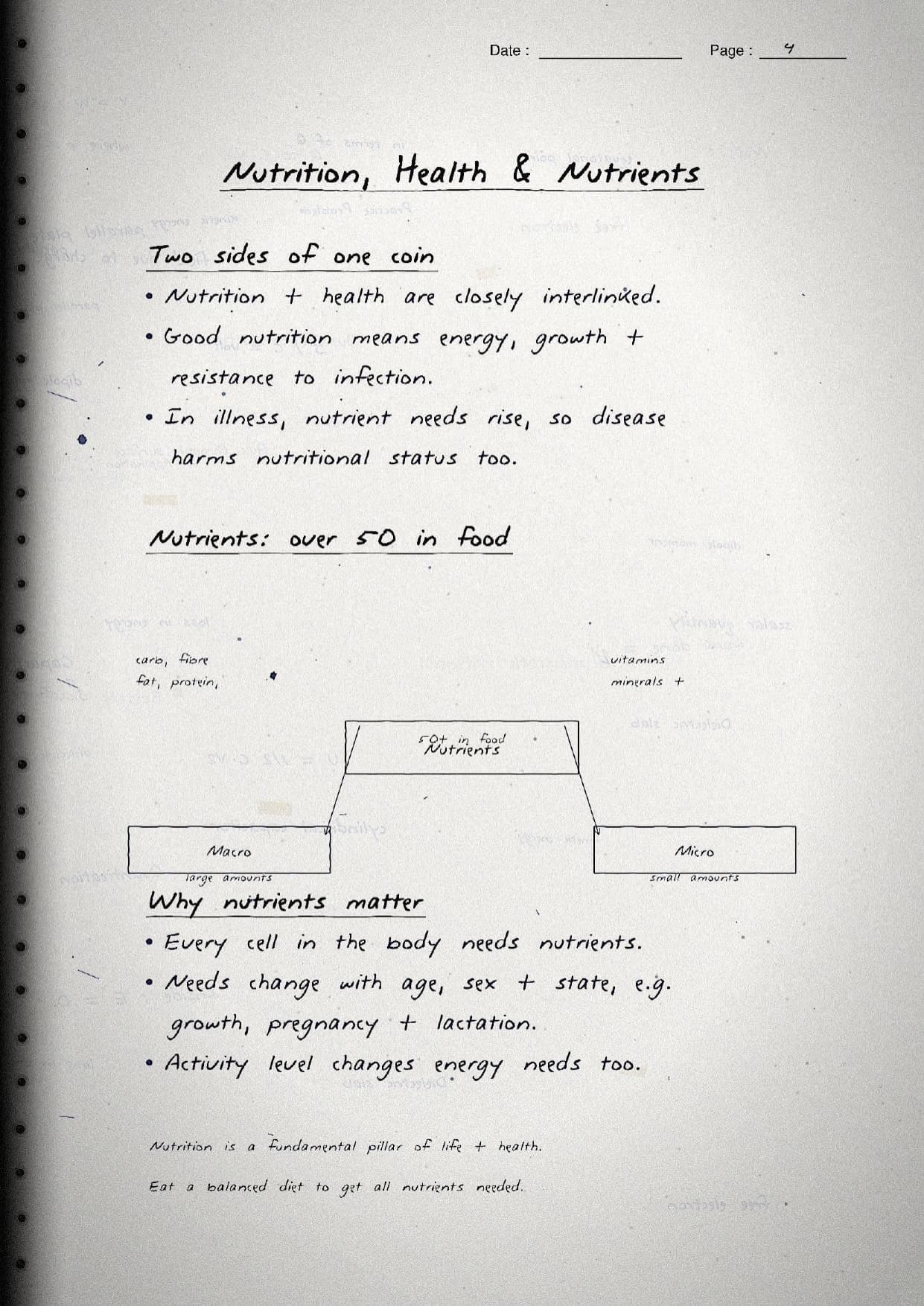
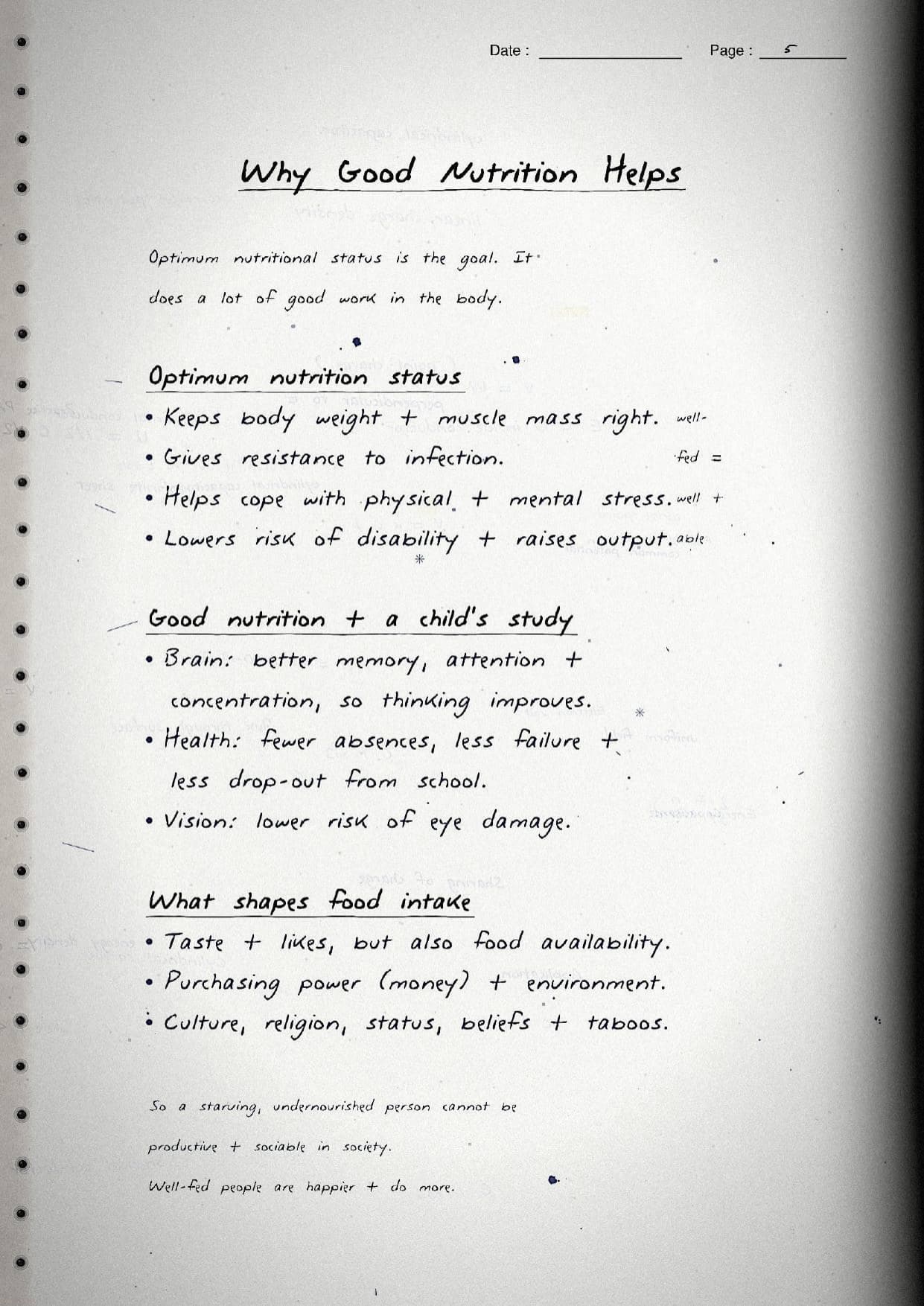
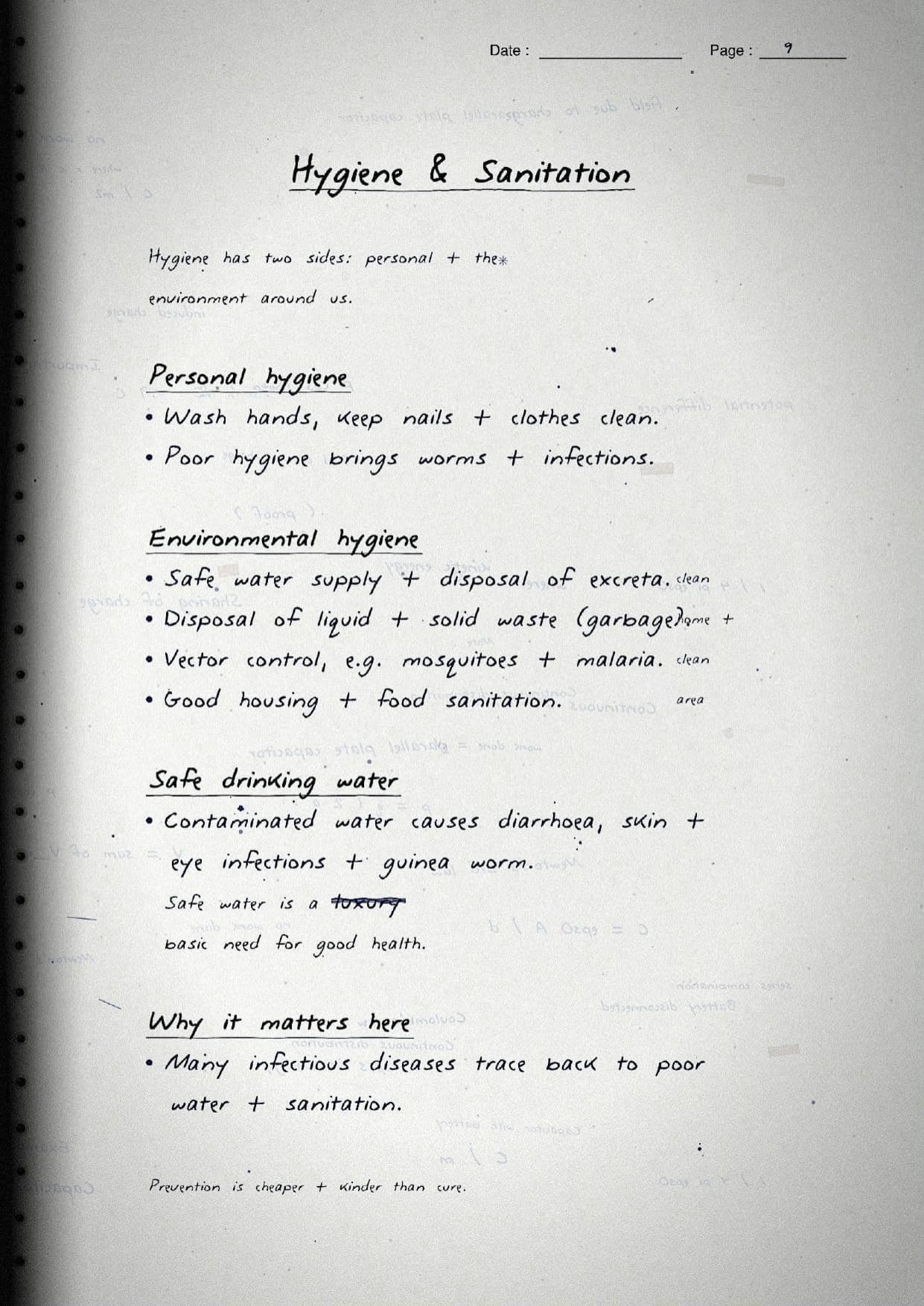
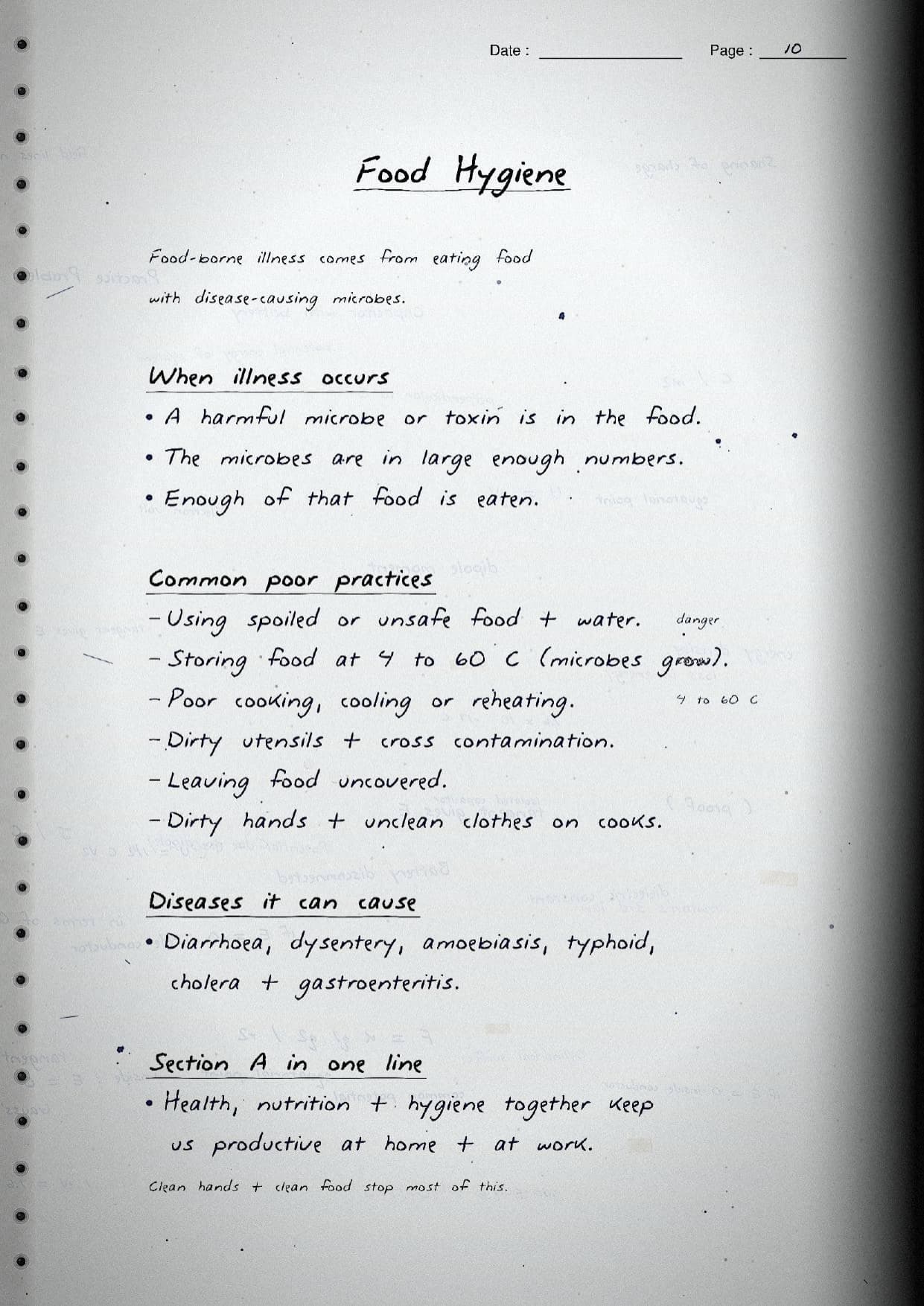
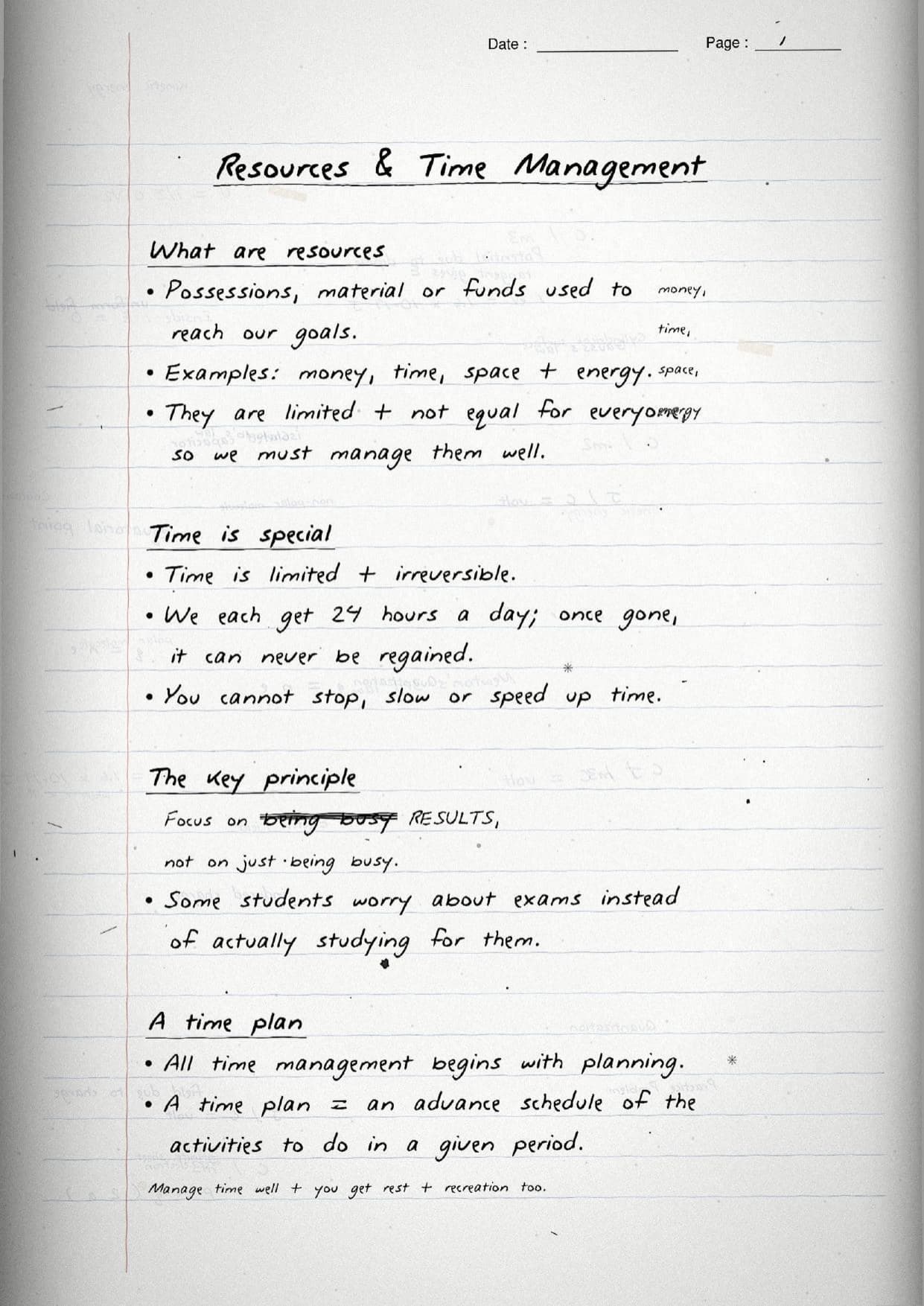
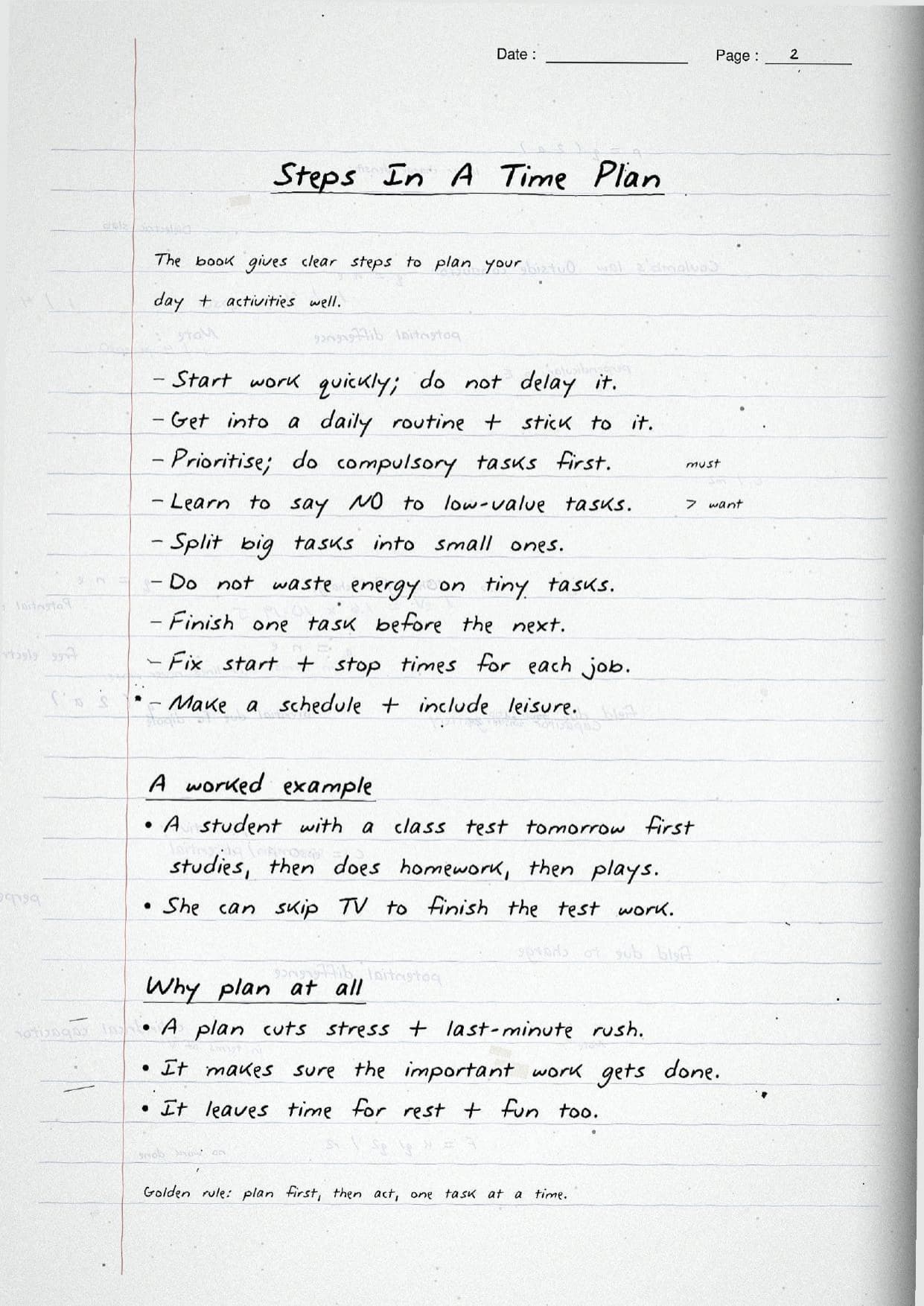
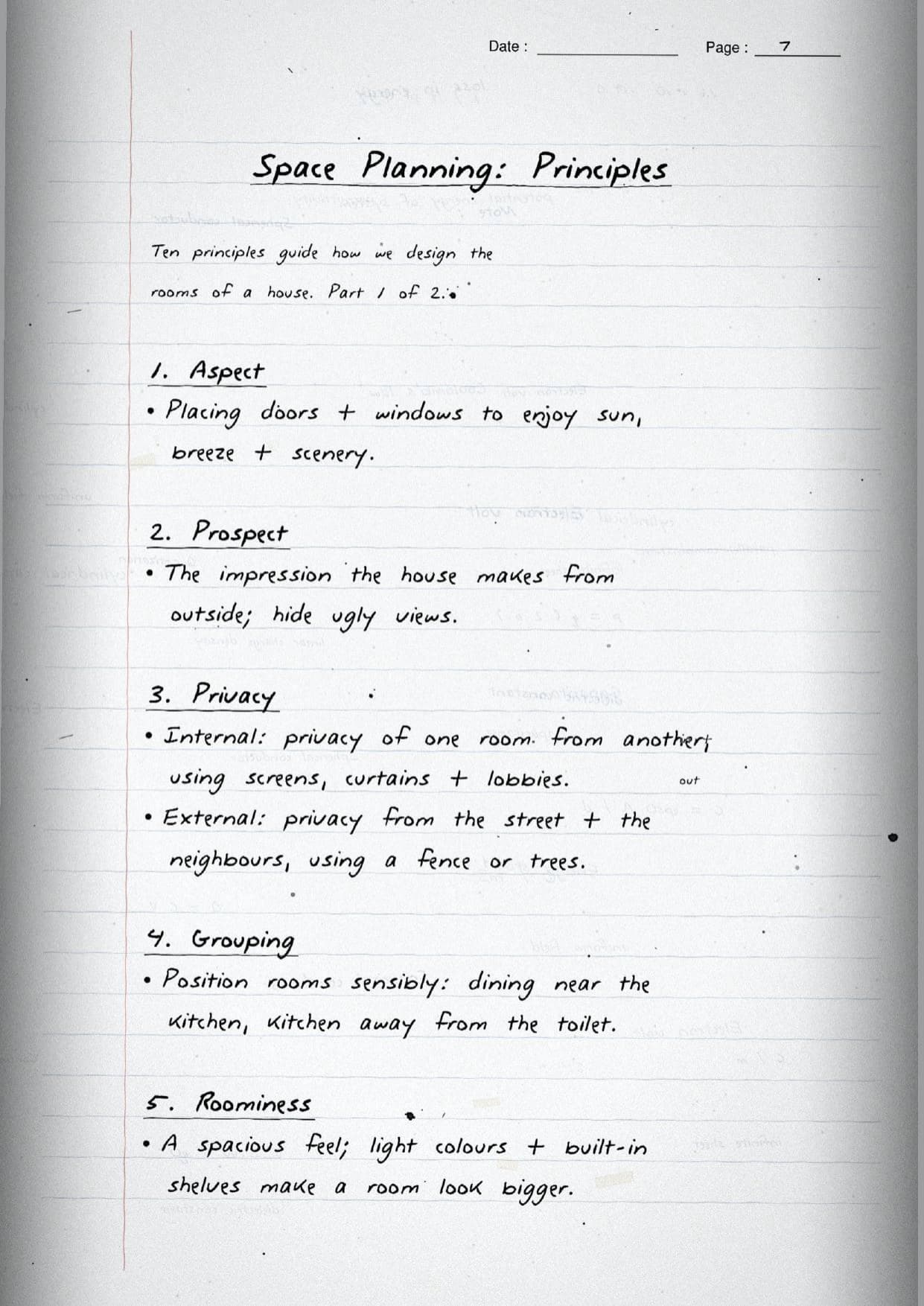
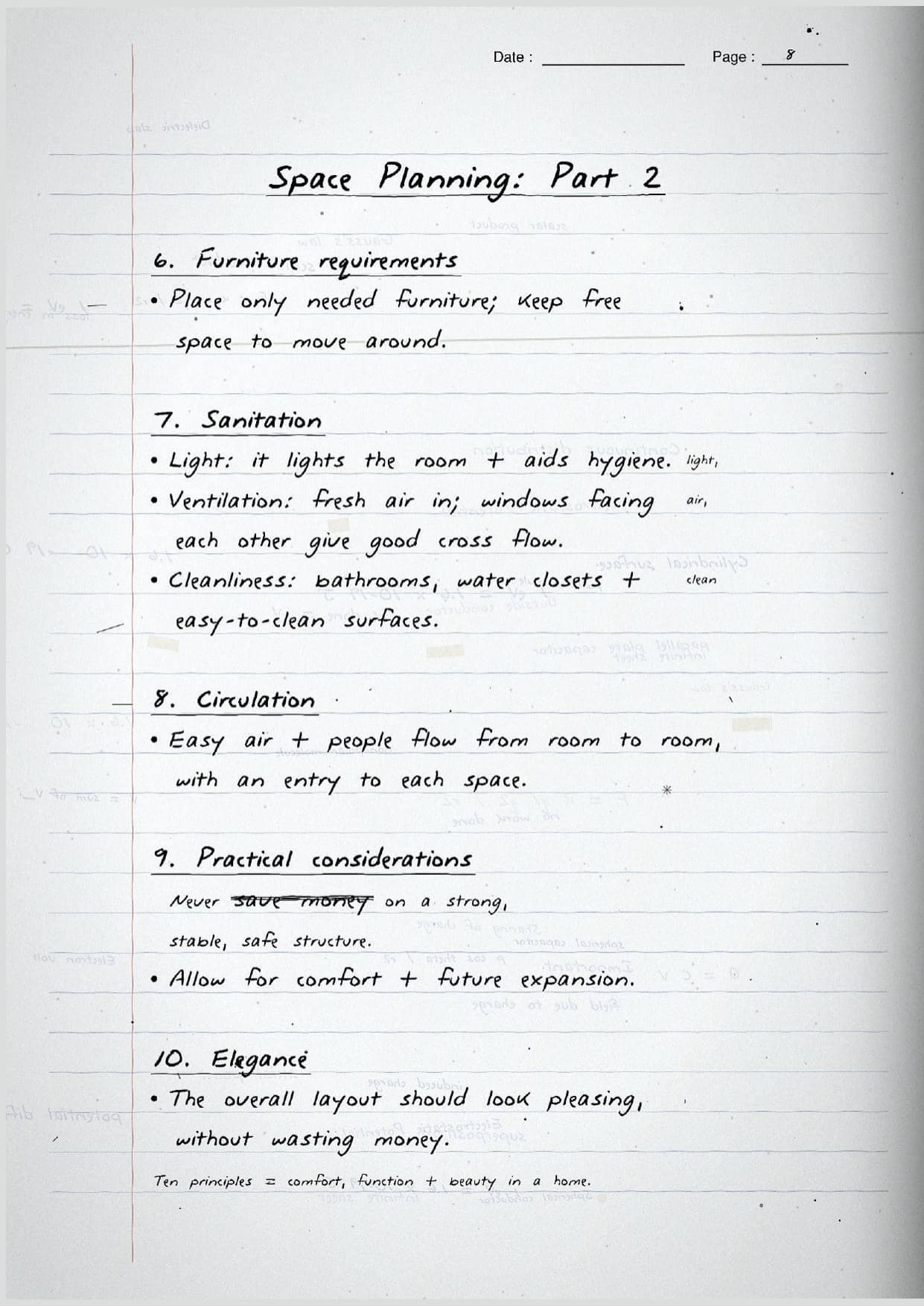
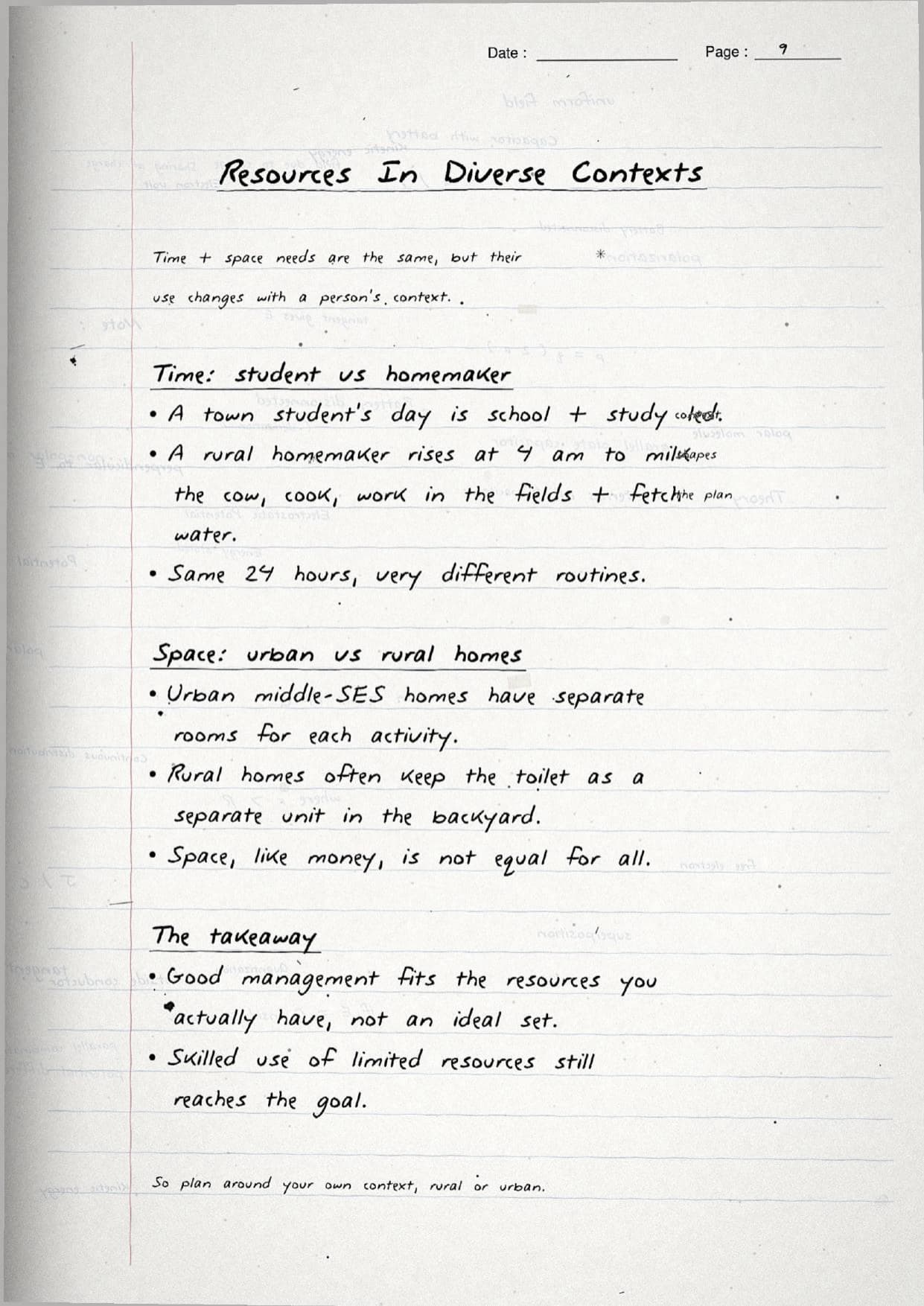
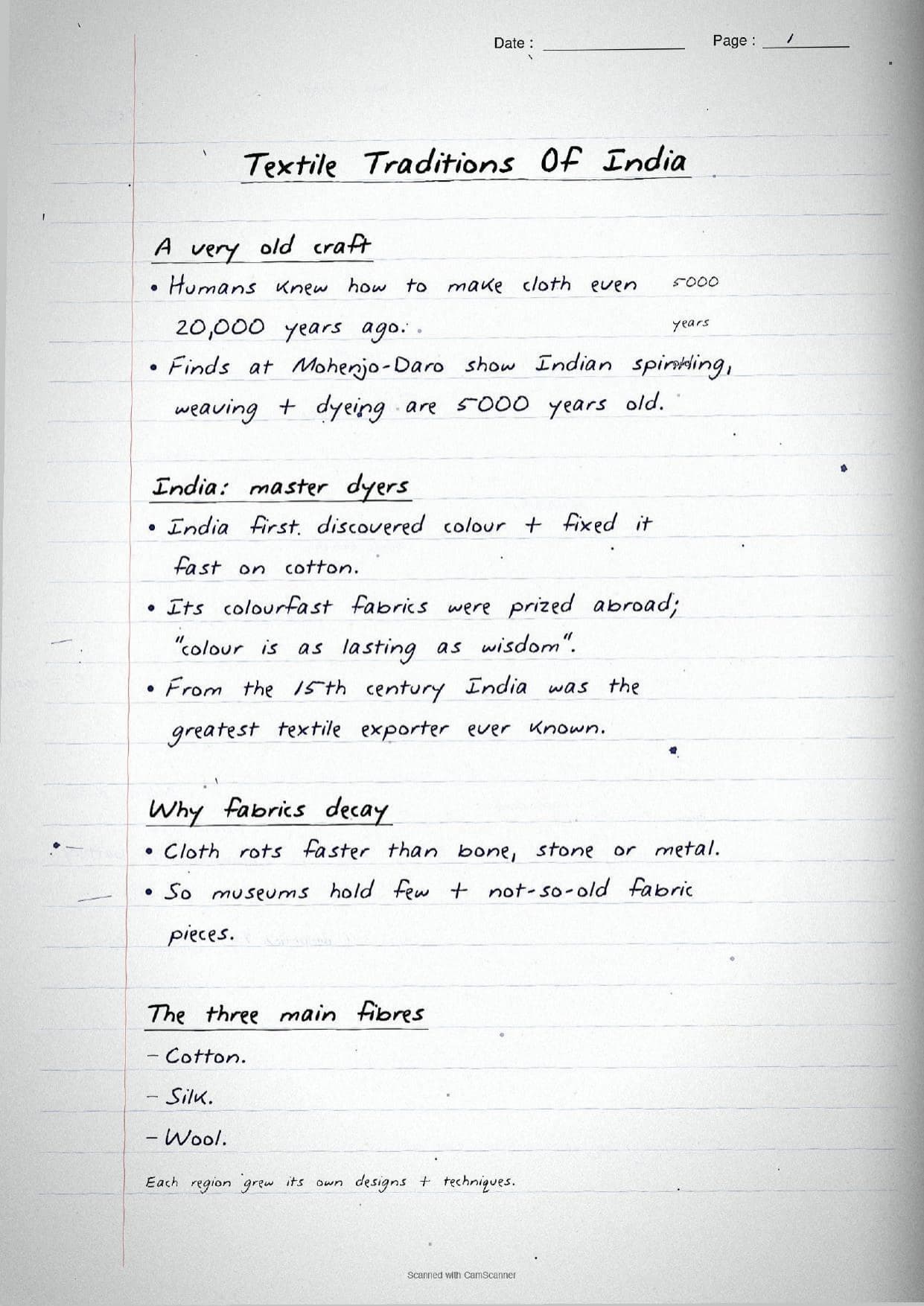
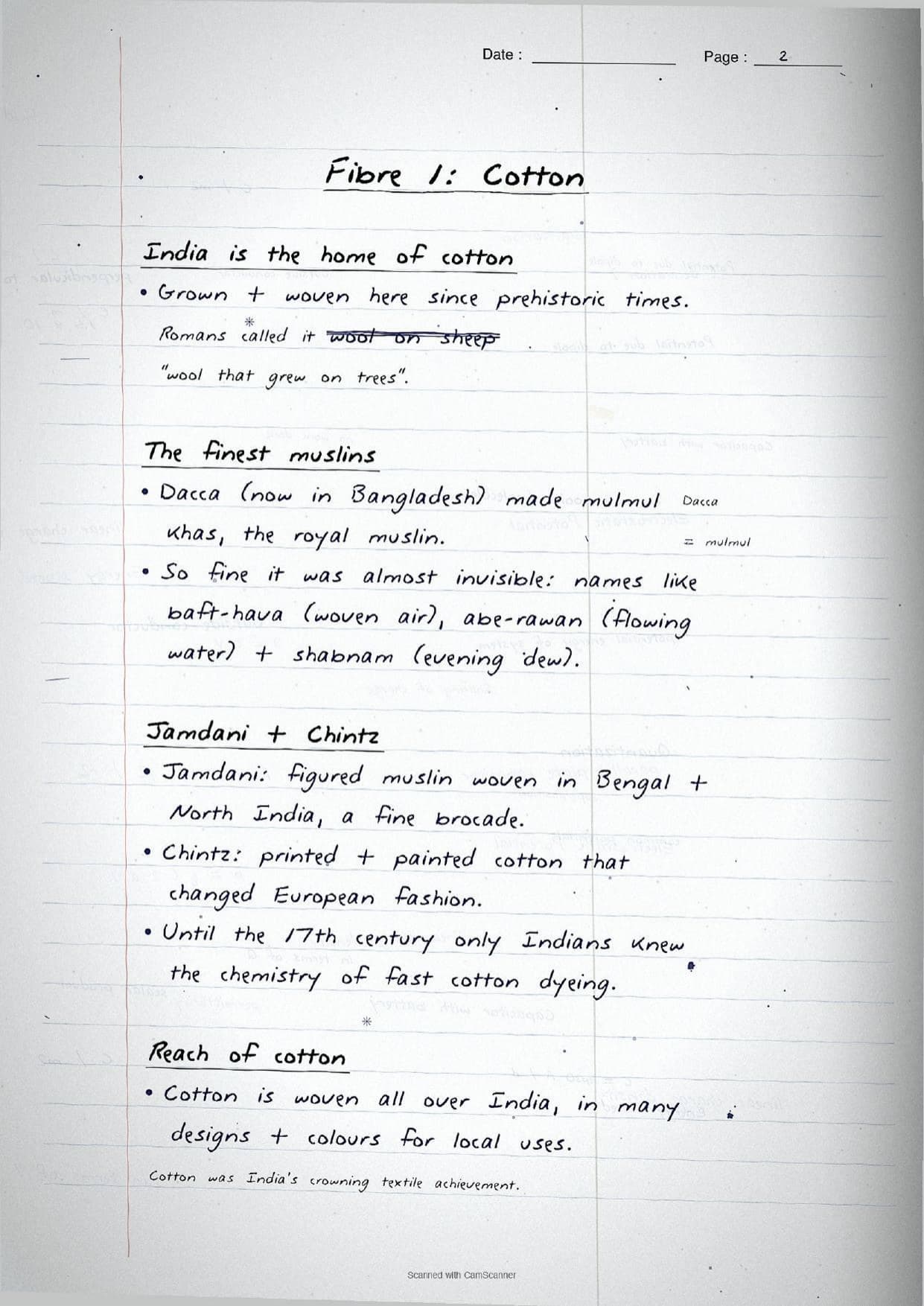
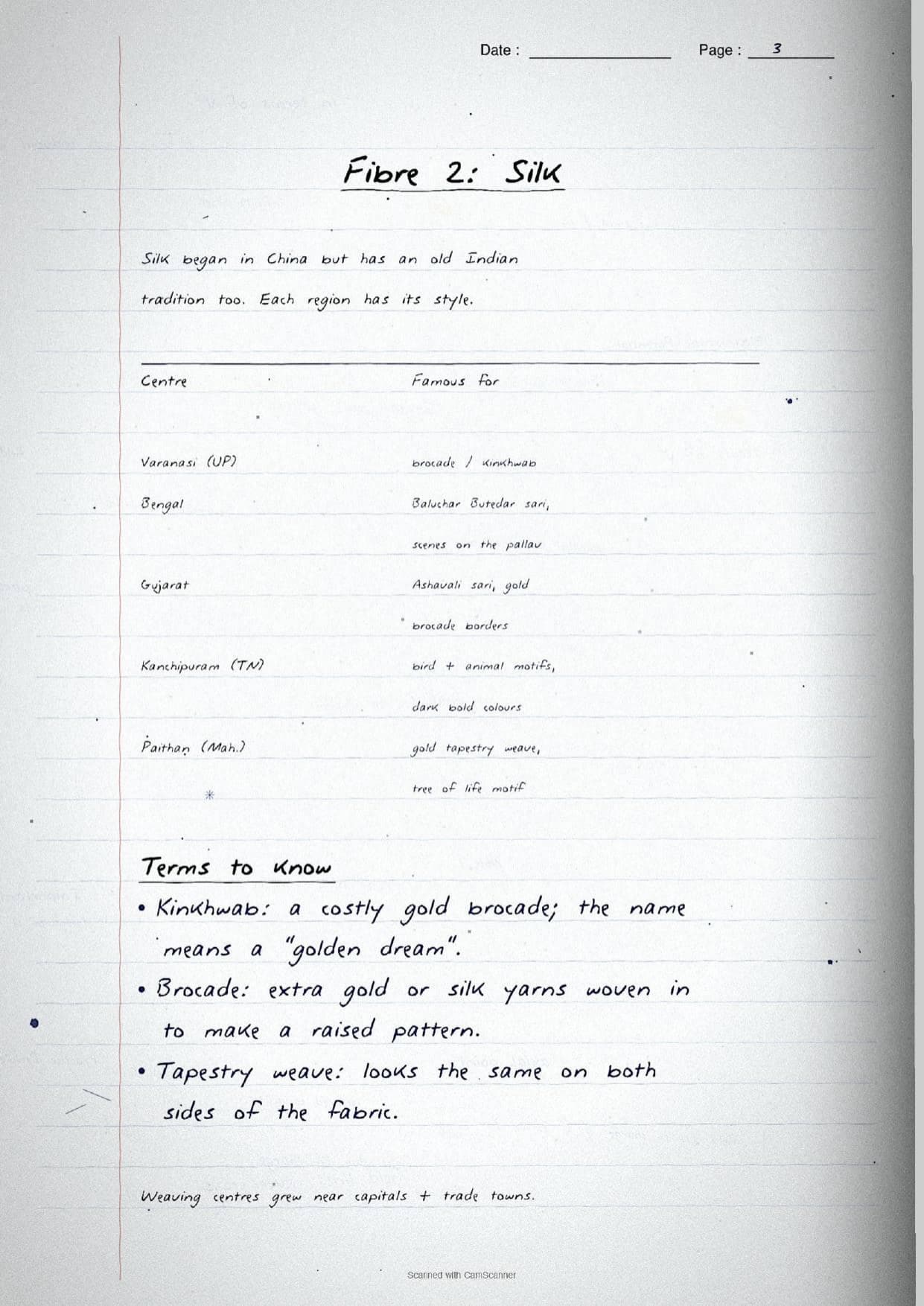
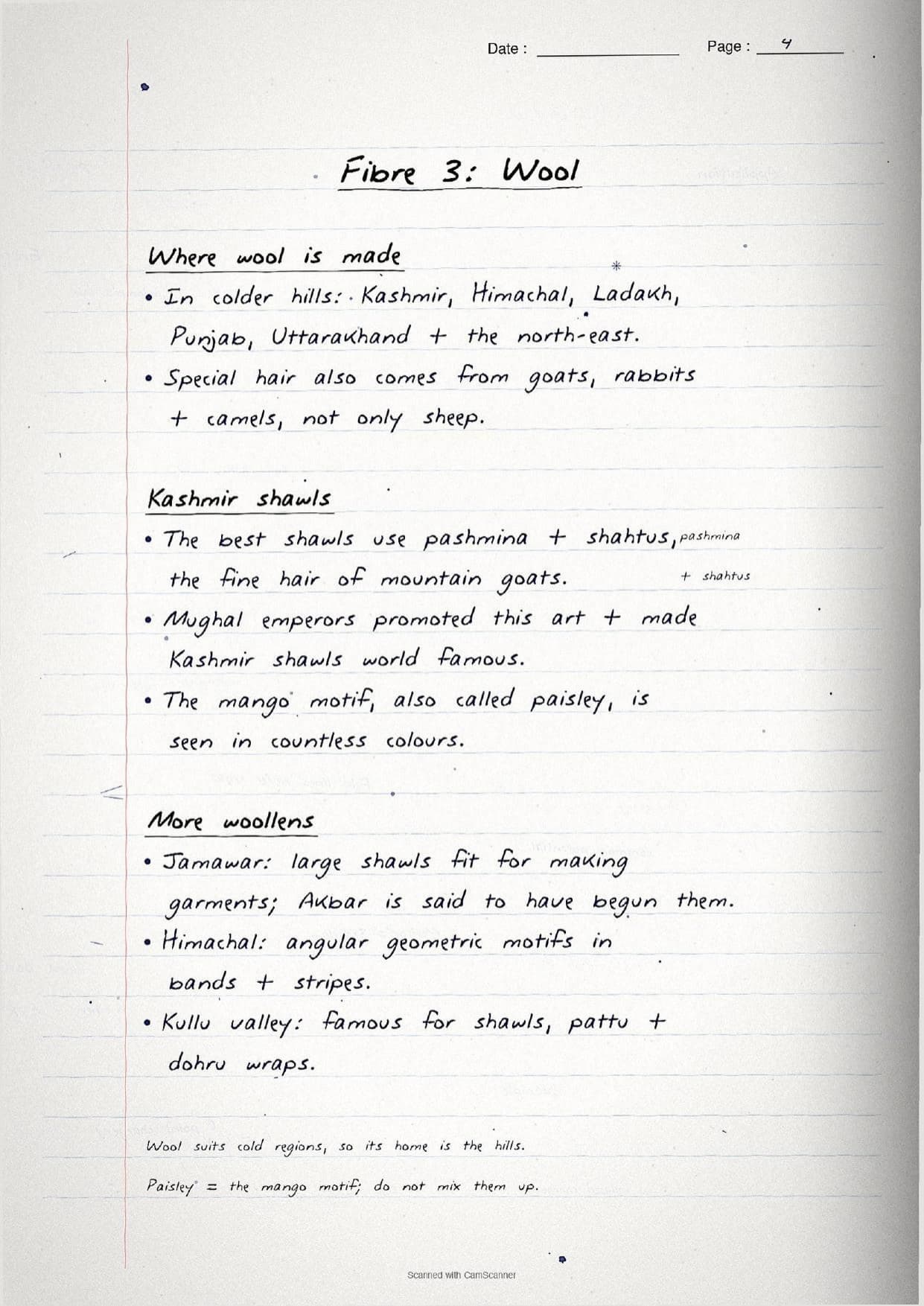
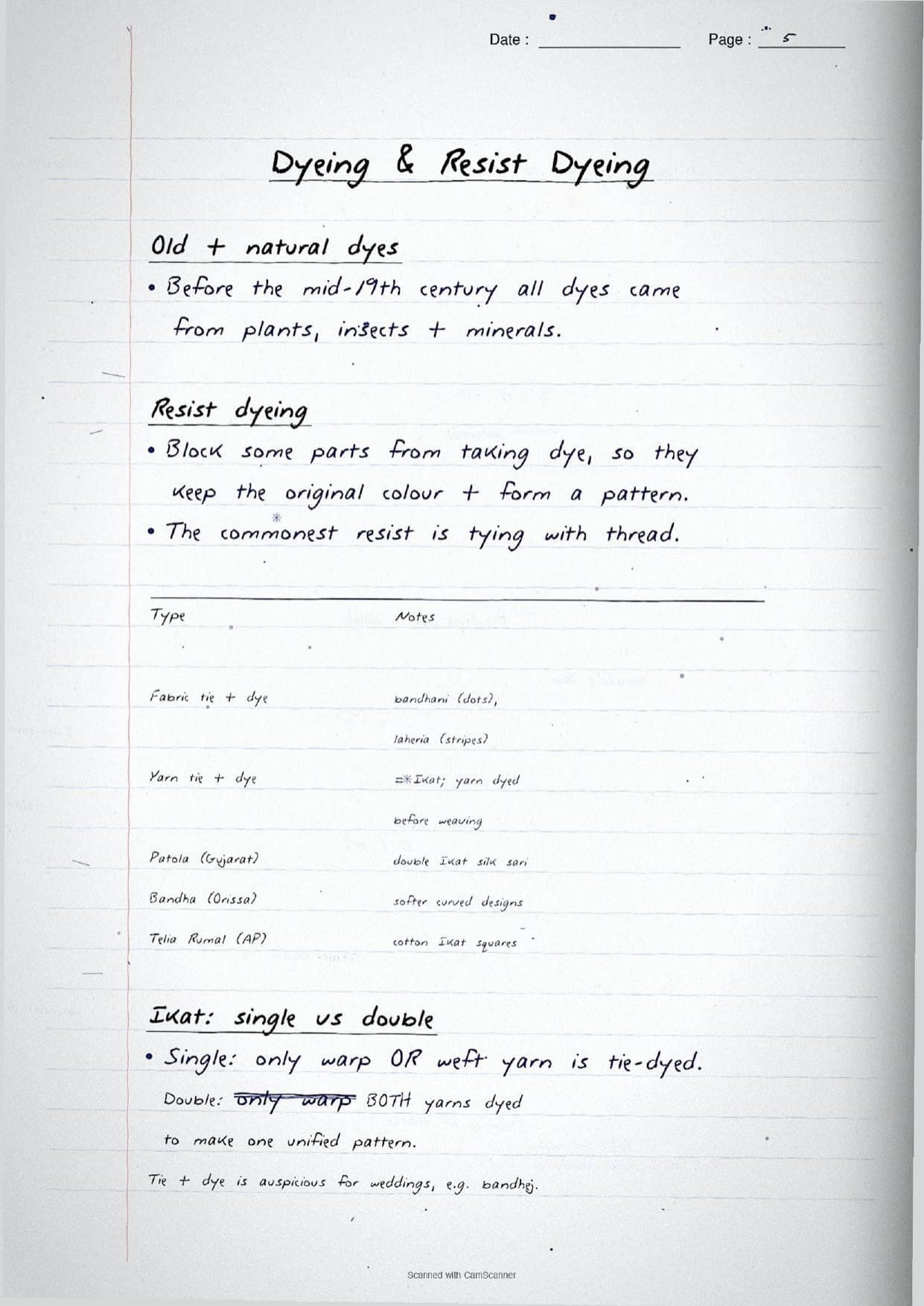
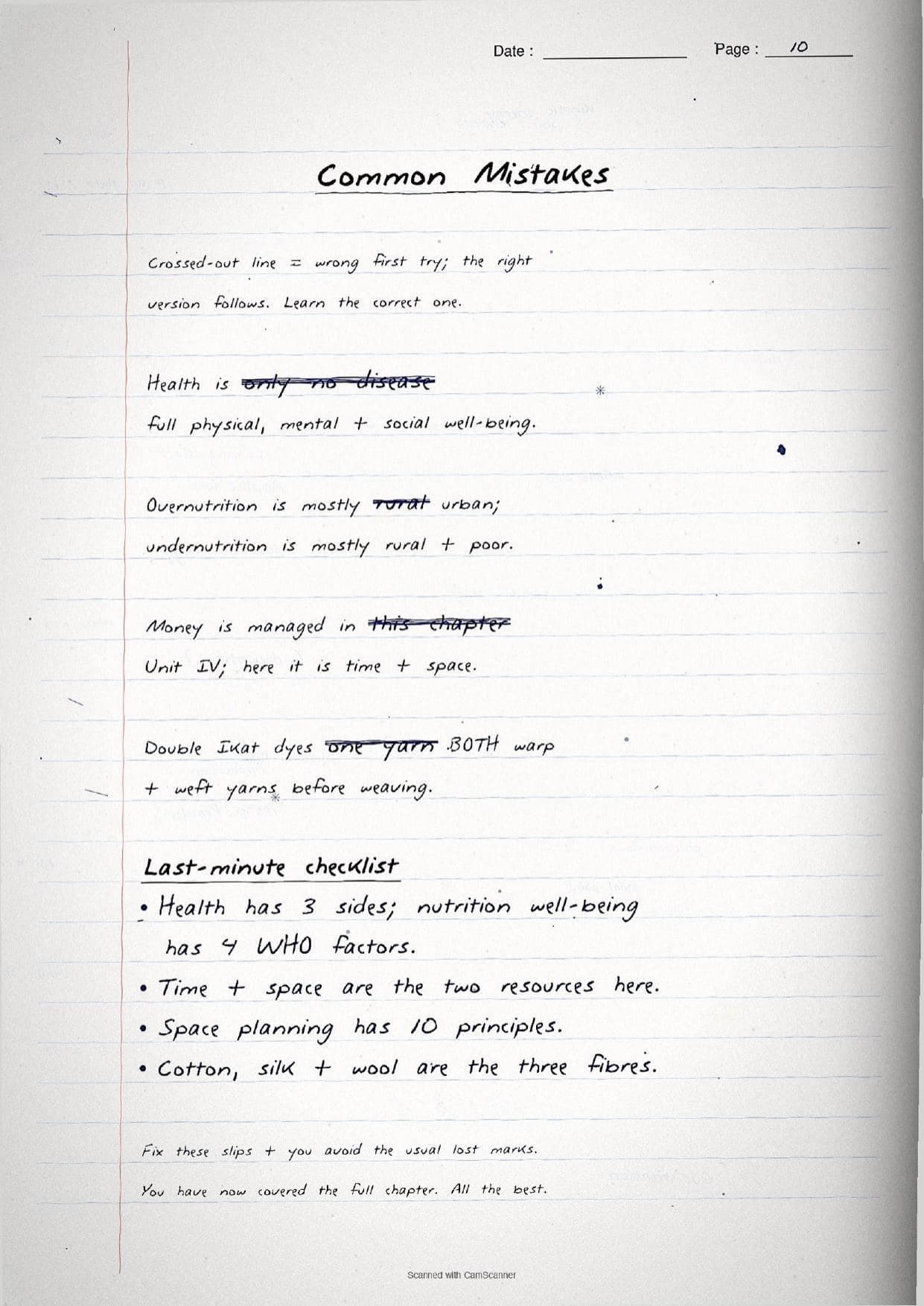
- Handwritten pages with mind-maps, compare tables and boxed key terms across all three sections of the chapter.
- This is a large Unit II chapter in Class 11 Home Science, so it links nutrition, resource use and textiles under one theme.
- Pairs with the NCERT Solutions, Notes and Book PDF linked lower on this page.
These Concerns and Needs in Diverse Contexts handwritten notes are prepared from the official NCERT Home Science (Human Ecology and Family Sciences) textbook and checked against recent CBSE Class 11 question papers.
Student Feedback: In a Collegedunia poll of 4,360 Class 11 Home Science students, 78% of students said the handwritten mind-maps helped them recall the three dimensions of health, the double burden of malnutrition and the regional textile centres far faster than plain textbook paragraphs.
Source: 2026-27 Class 11 Home Science student poll. Sample of 4,360 students from CBSE schools across 9 states.
What These Concerns and Needs in Diverse Contexts Handwritten Notes Contain
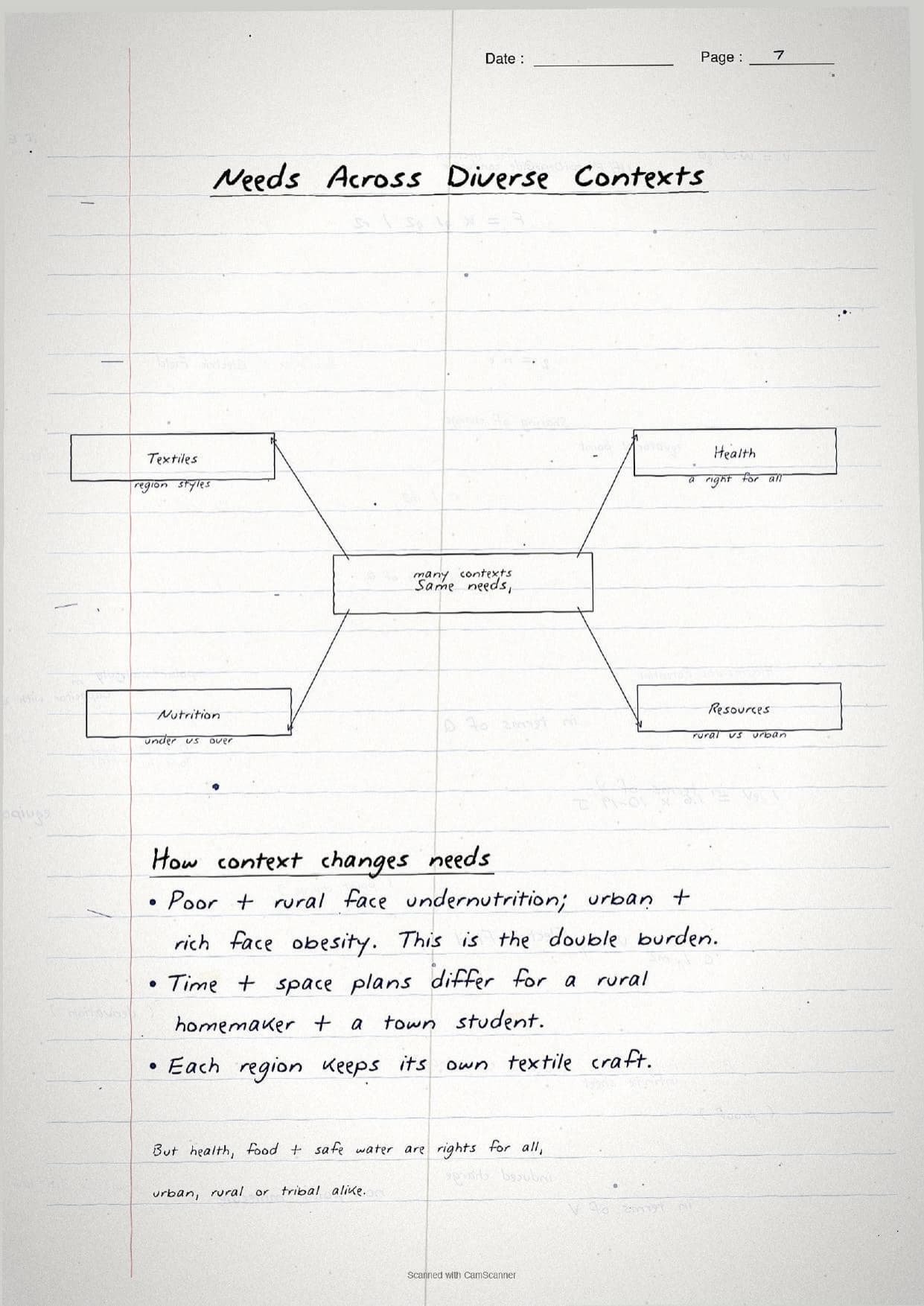
Concerns and Needs in Diverse Contexts is a large chapter that opens Unit II of Class 11 Home Science. Its one big idea is simple: a person's basic needs stay the same, but their shape changes with the context, whether rural or urban, rich or poor, tribal or town. These handwritten notes carry that theme across every section so the whole unit hangs together.
The pages are split into three threads, each with its own set of handwritten sheets:
- Section A, Nutrition, Health and Hygiene: the dimensions of health, malnutrition, food choices, the nutrition and infection link, and safe water.
- Section B, Resource Availability and Management: time management, work simplification and space management.
- Section C, Textile Traditions of India: cotton, silk and wool centres, resist dyeing and the embroideries of India.
Because the pages are handwritten, the key terms sit in boxes, arrows and mind-maps rather than long paragraphs. A student can flip through the Class 11 Home Science Chapter 7 pages in a few minutes and still recall the three sections and their main points before an exam.
Nutrition, Health and Hygiene in the Handwritten Pages
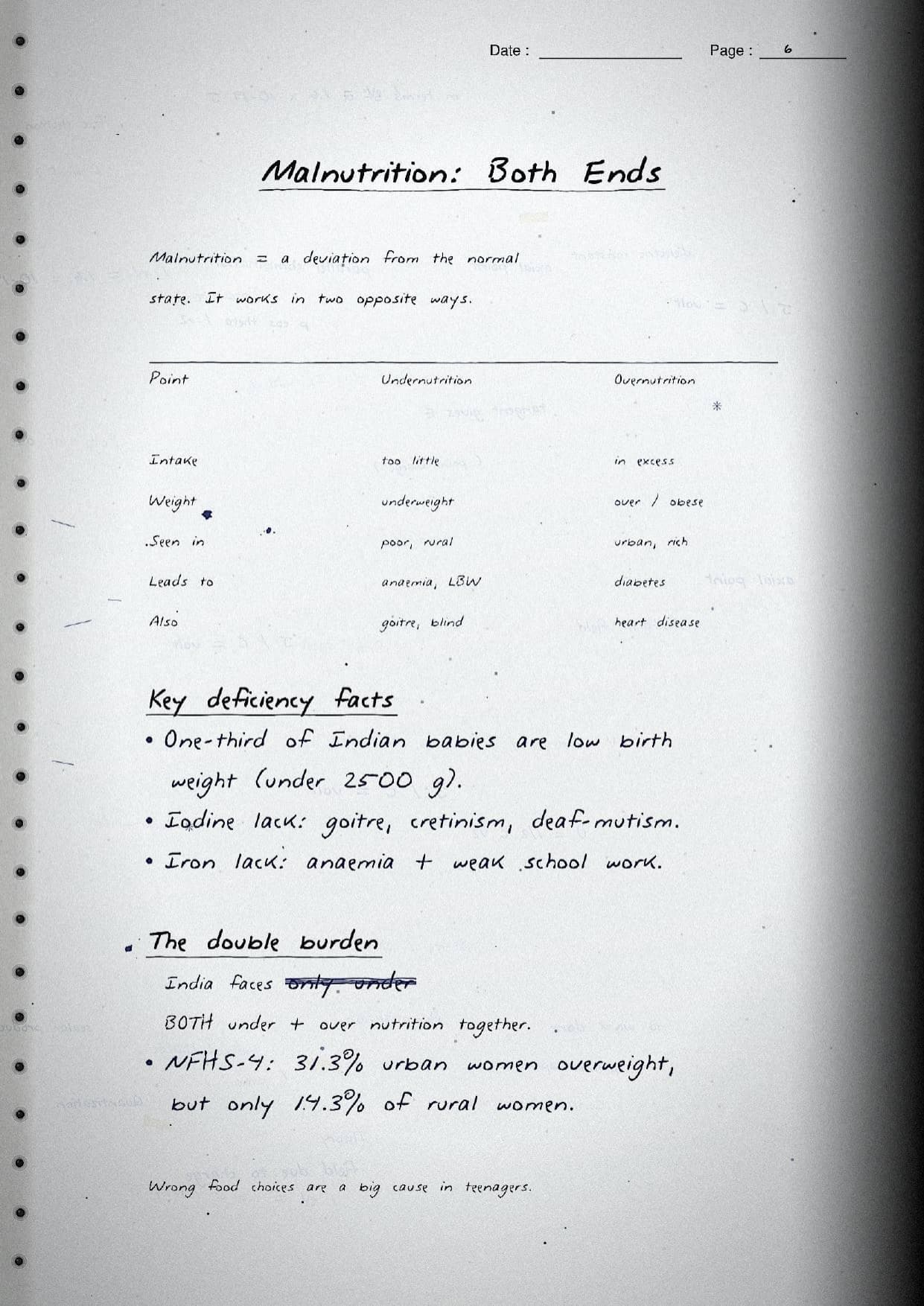
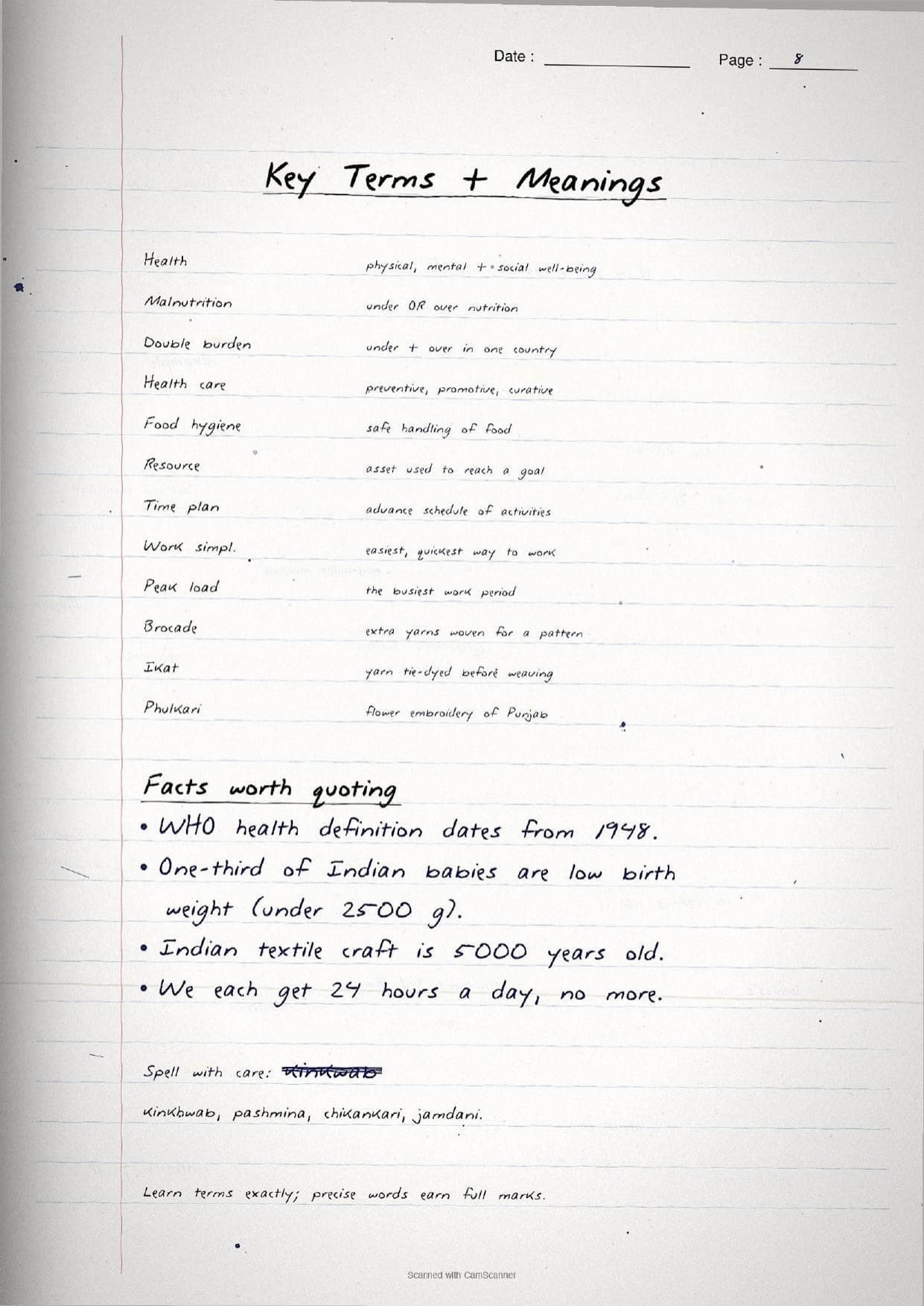
The first block of pages covers Section A. It starts with the WHO 1948 definition of health as a state of complete physical, mental and social well-being, not merely the absence of disease. The notes box all three dimensions, then move to health care levels, indicators and the link between nutrition and health. A compare table sums up malnutrition, which the chapter treats as a deviation from the normal state that works in two opposite ways.
| Point | Undernutrition | Overnutrition |
|---|---|---|
| Intake | Too little food and nutrients | Food eaten in excess |
| Seen more in | Poor and rural groups | Urban and richer groups |
| Leads to | Anaemia, goitre, low birth weight | Obesity, diabetes, heart disease |
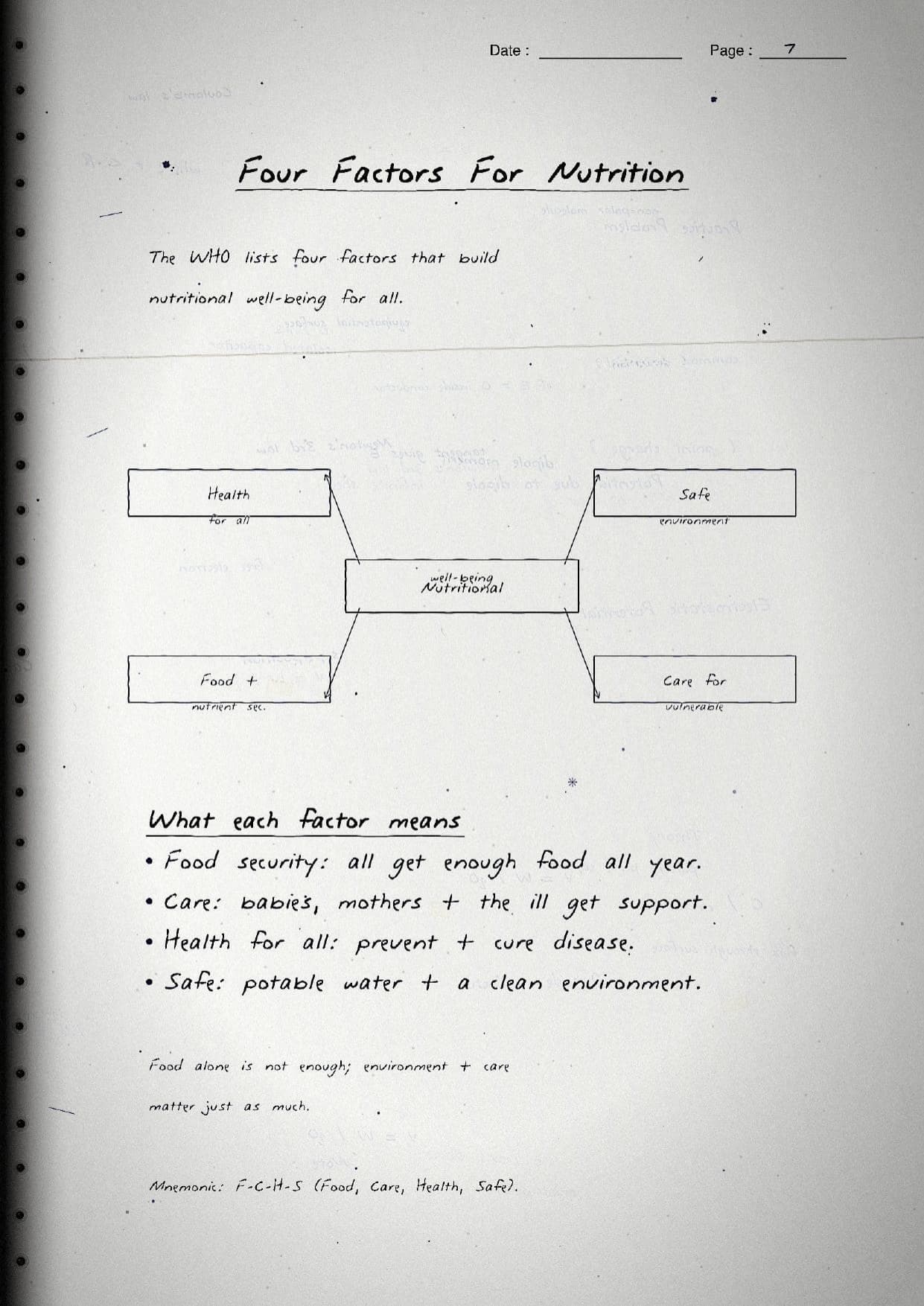
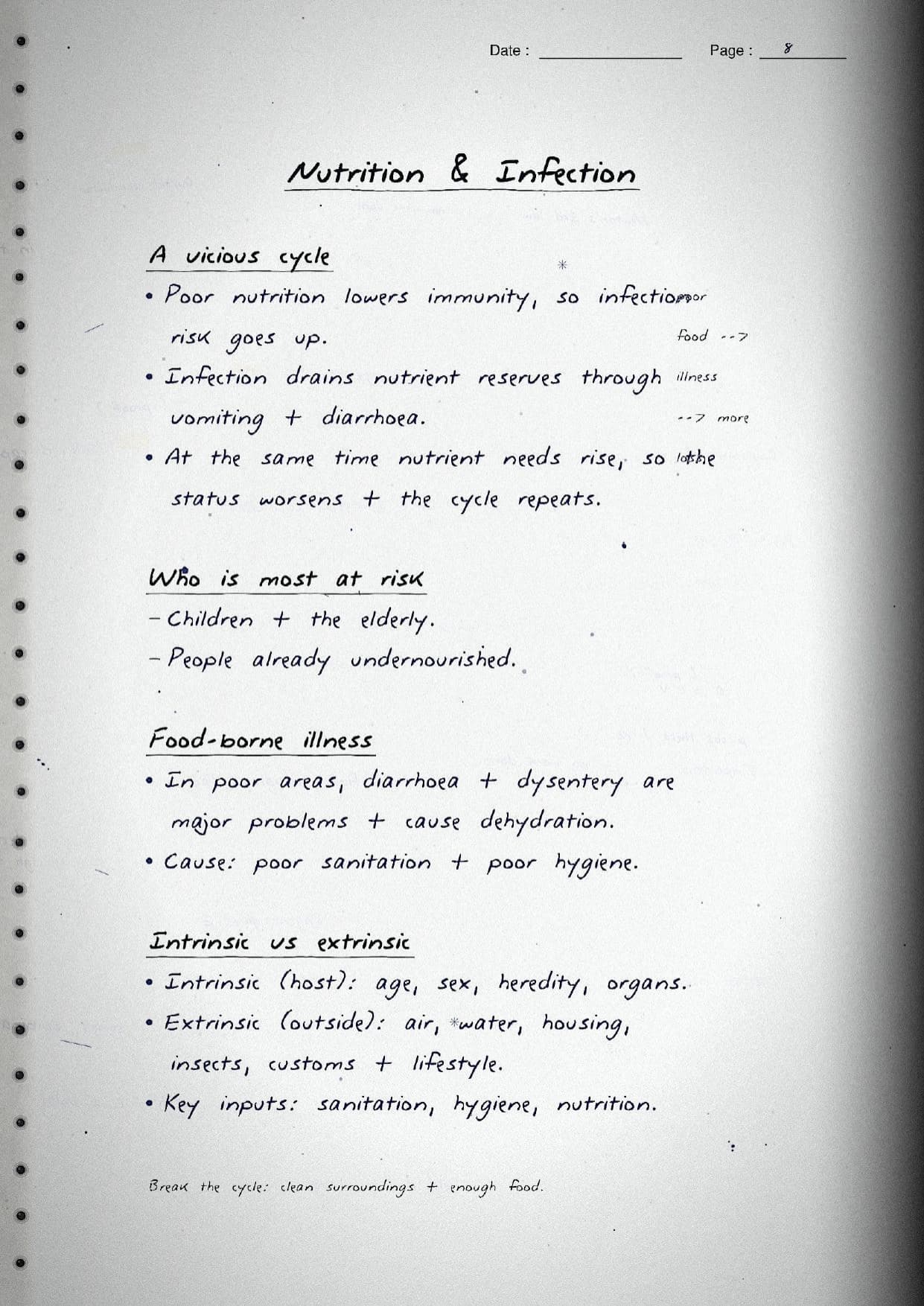
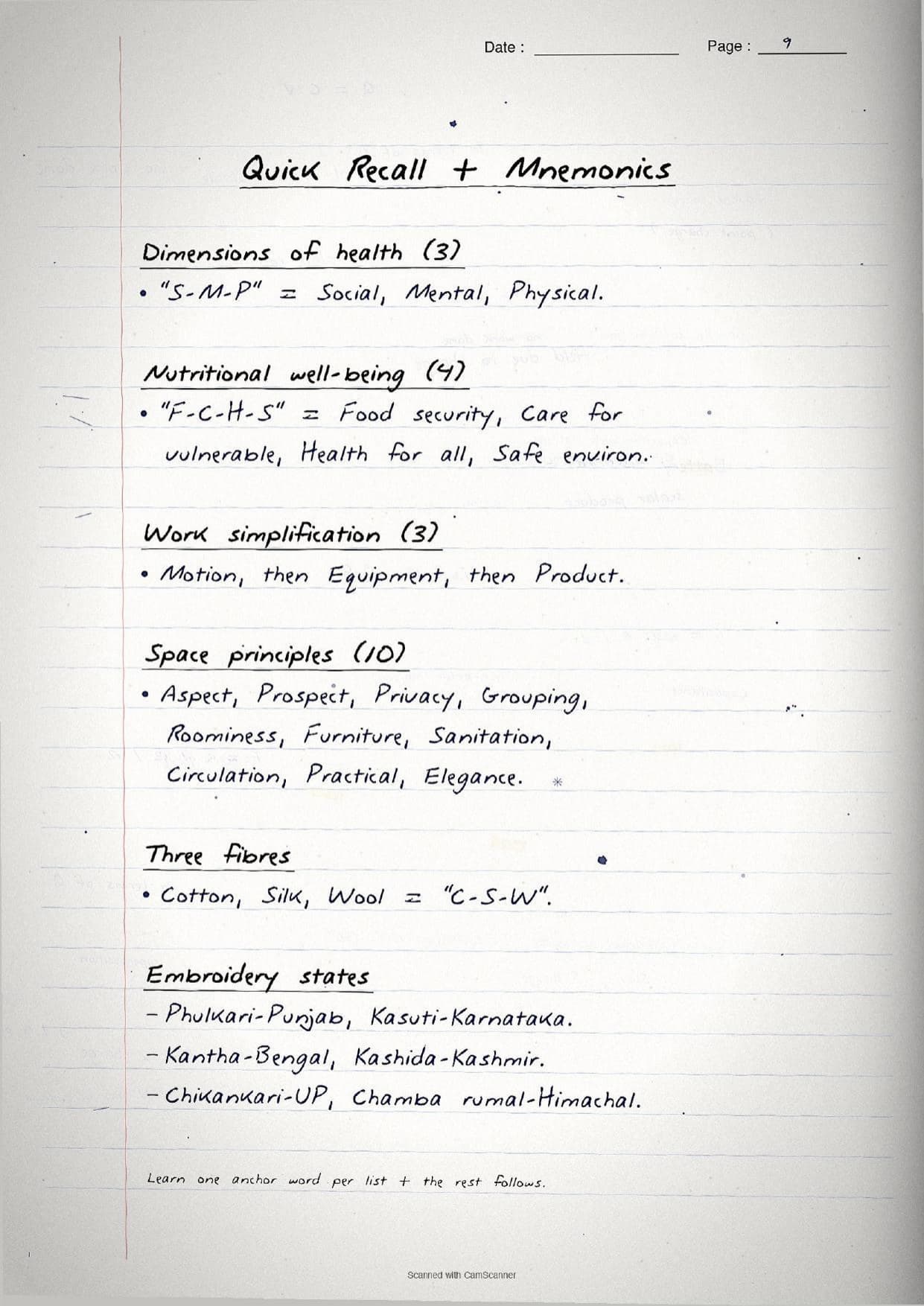
The notes stress that India faces the double burden, with undernutrition and overnutrition together in one country. They list the WHO four factors for nutritional well-being with the mnemonic F-C-H-S: Food security, Care for the vulnerable, Health for all, and a Safe environment. A cycle diagram shows how poor nutrition lowers immunity and infection then drains reserves.
The hygiene pages tie it together. They separate personal hygiene from environmental hygiene, explain food hygiene and the 4 to 60 degree danger zone where microbes grow, and mark safe drinking water as a basic need, since contaminated water causes diarrhoea, typhoid and cholera.
Resource Management and Textile Traditions of India
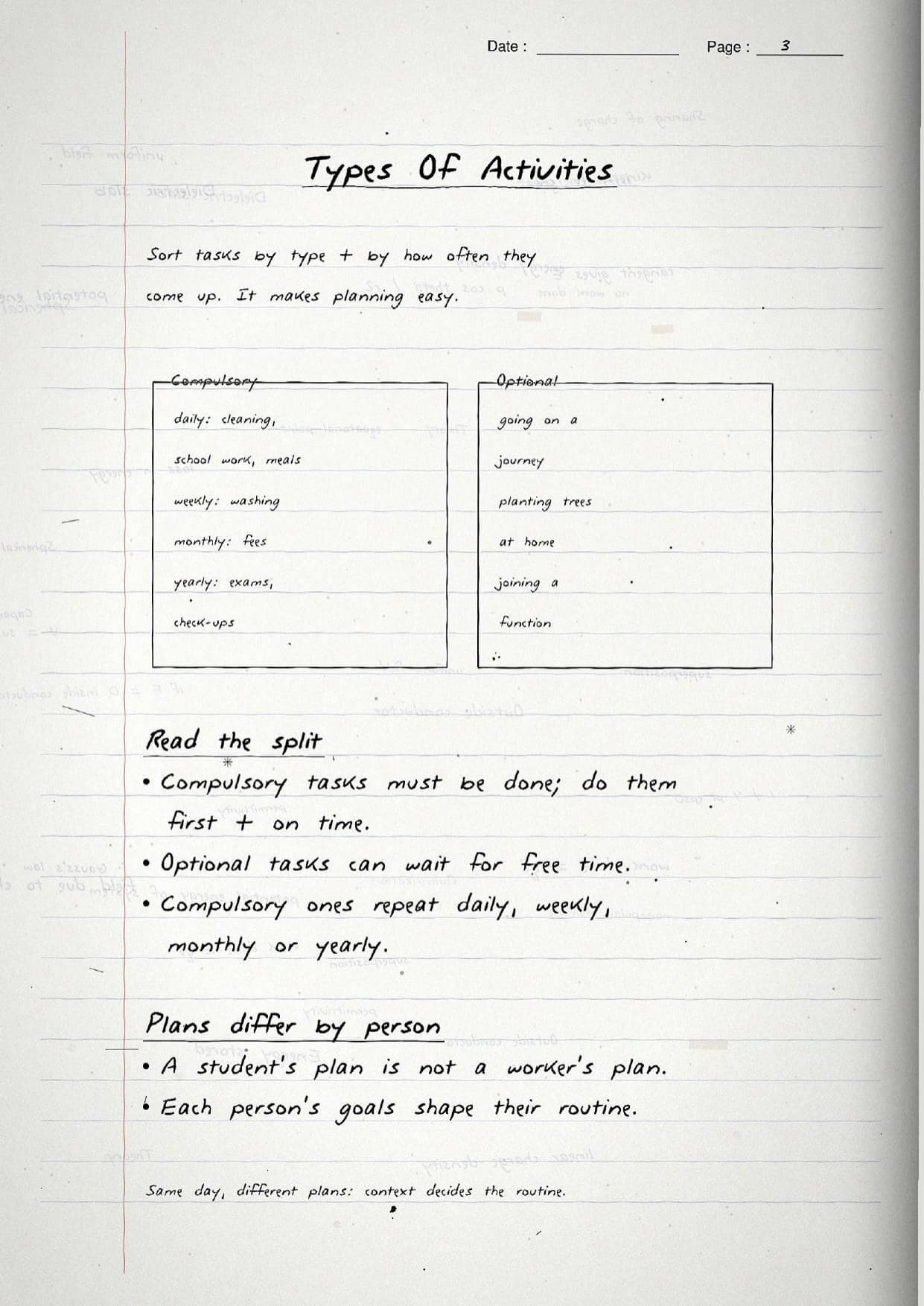
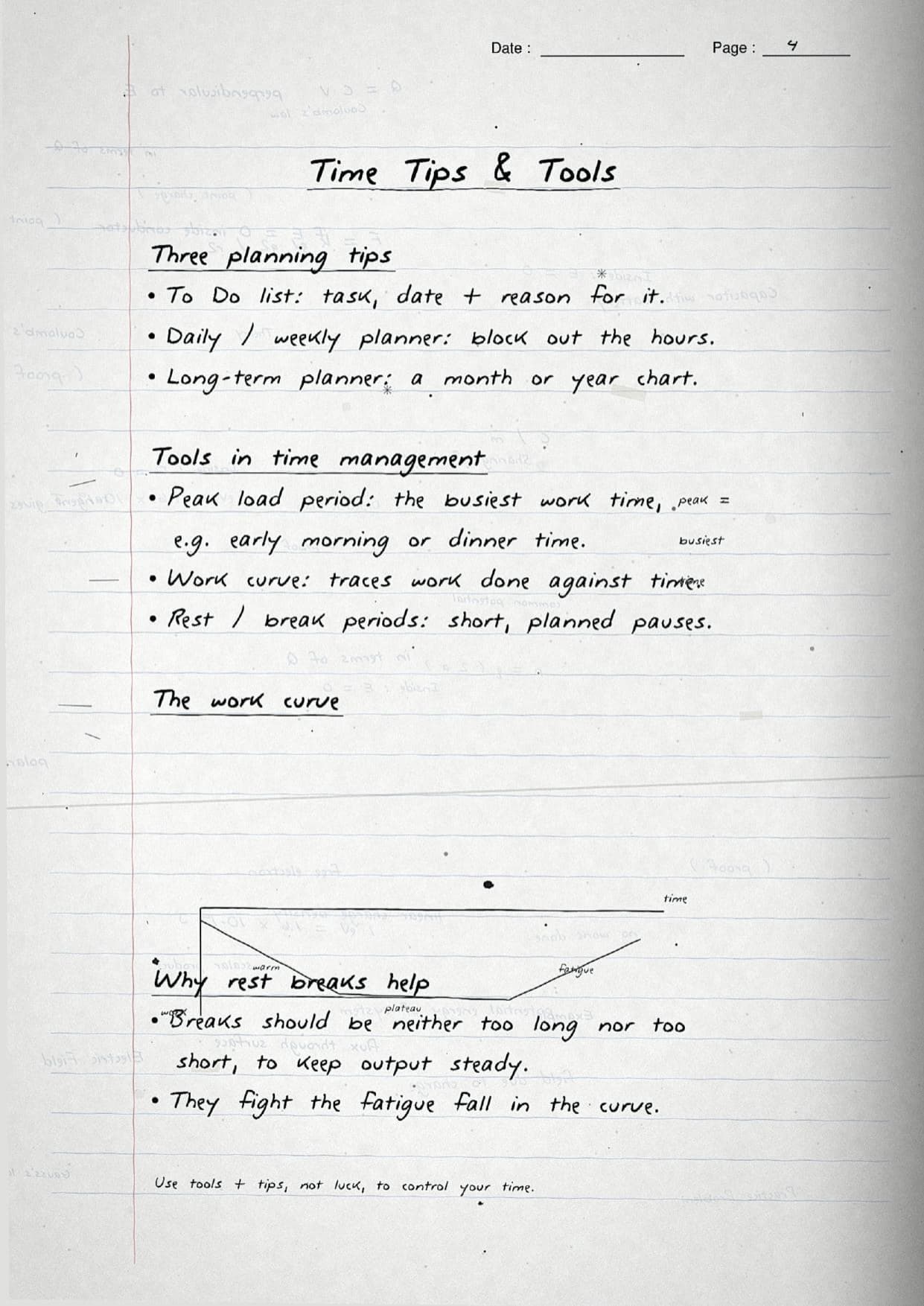
The middle pages cover Section B on resources. A resource is any possession, material or fund used to reach a goal, such as money, time, space and energy. The notes highlight that time is special because it is limited and irreversible: everyone gets 24 hours, and once gone it can never be regained. The steps in a time plan, the types of activities (compulsory versus optional), and tools like the peak load period and the work curve all get their own boxes.
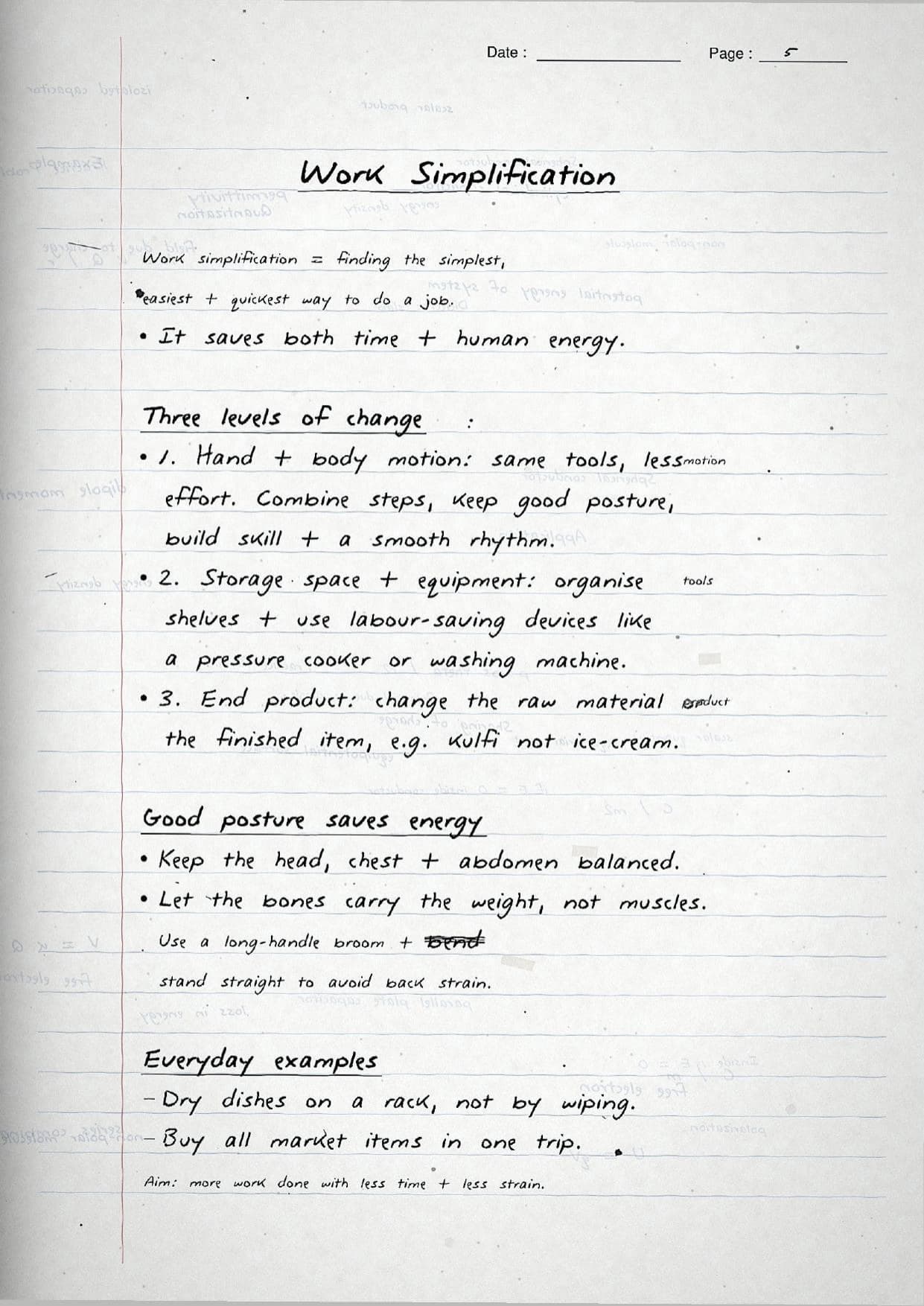
- Work simplification: finding the simplest, easiest and quickest way to do a job, changing hand and body motion, storage and equipment, or the end product.
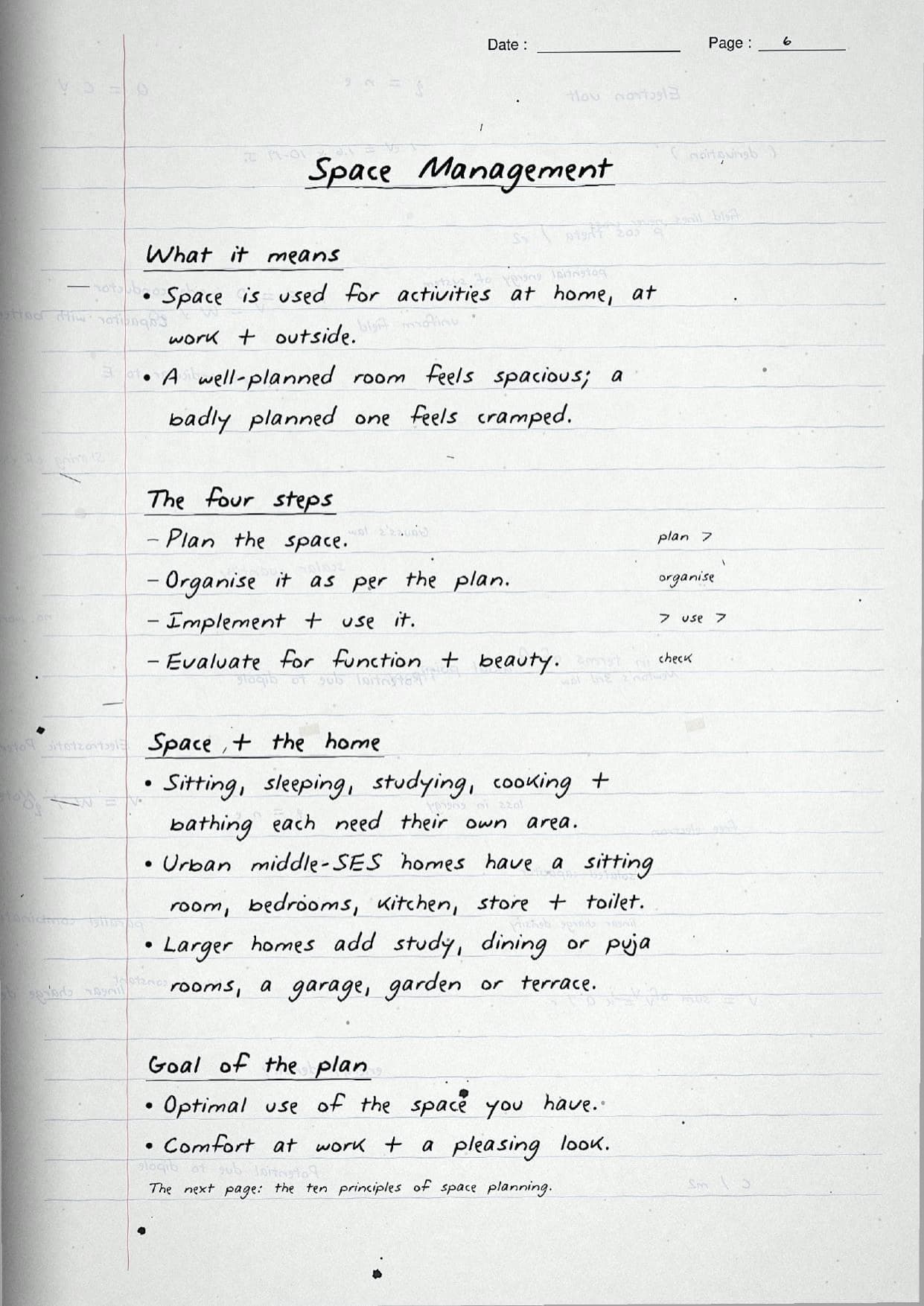
- Space management: plan, organise, use and evaluate, guided by the ten principles of space planning from aspect and prospect to sanitation and elegance.
Section C brings in the Textile Traditions of India, a craft over 5000 years old with roots at Mohenjo-Daro. India was famed for colourfast fabrics and led the world as a textile exporter. The notes group the material around the three main fibres.
| Fibre | Famous centres and terms on the page |
|---|---|
| Cotton | Dacca muslin (mulmul khas), Jamdani, Chintz; India knew fast cotton dyeing first |
| Silk | Varanasi brocade (kinkhwab), Baluchar of Bengal, Kanchipuram, Paithan |
| Wool | Kashmir pashmina and shahtus shawls, the paisley or mango motif, Kullu wraps |
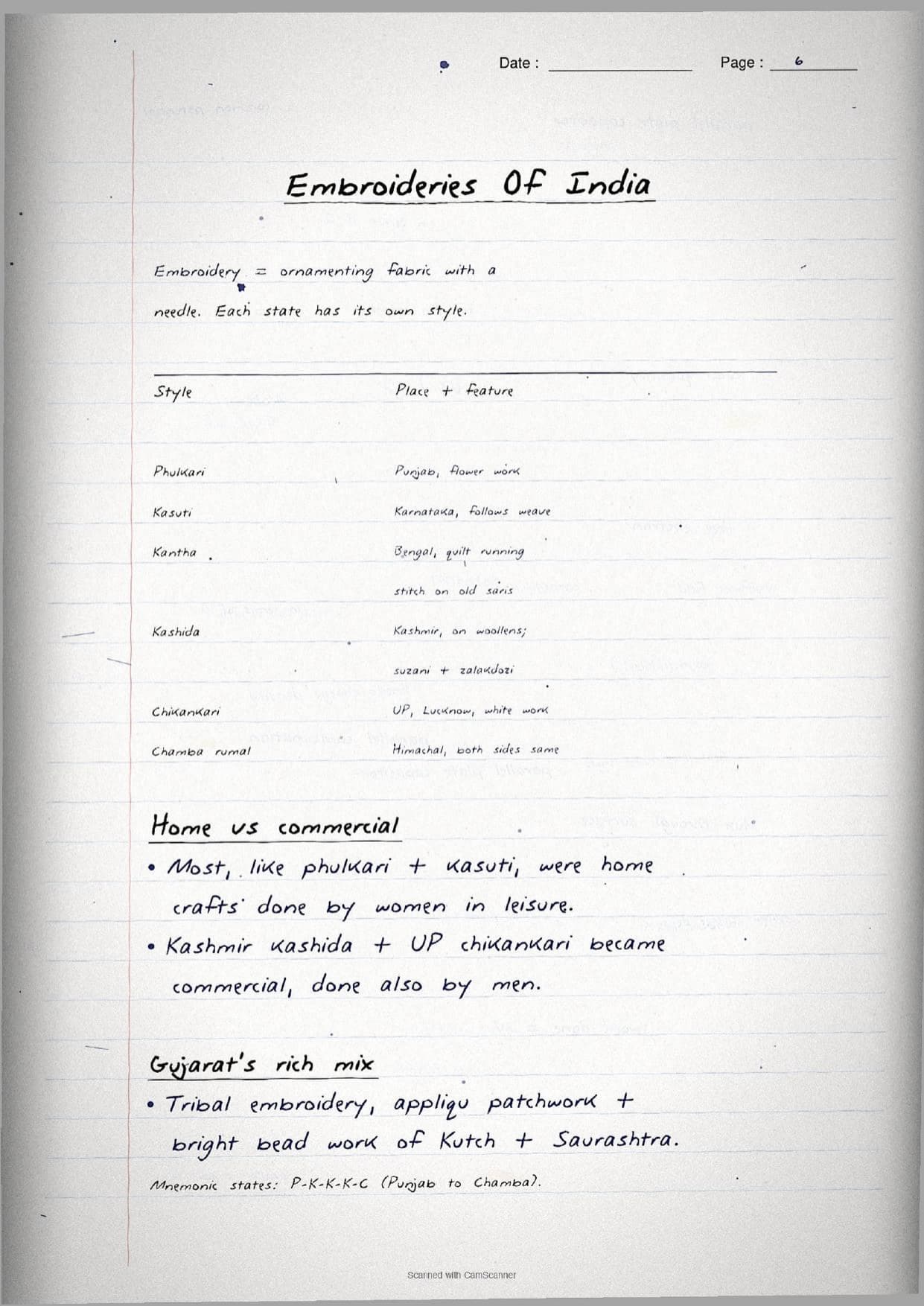
The dyeing pages explain resist dyeing, where parts are blocked from taking colour to form a pattern. Fabric tie and dye gives bandhani and laheria, while yarn tie and dye gives Ikat, including the double Ikat Patola of Gujarat. A final table lists the embroideries of India: Phulkari of Punjab, Kasuti of Karnataka, Kantha of Bengal, Kashida of Kashmir and Chikankari of Lucknow.
How to Use These Handwritten Notes
Handwritten notes work best as a final-revision tool, not a first read. The steps below show how to get the most out of the Concerns and Needs in Diverse Contexts handwritten notes in the last days before a test.
- Download: tap the download card above to save the handwritten pages to your device.
- First read: read the printed Notes once so the handwritten pages act as a refresher, not a first source.
- Recall drill: cover the page and try to write the three dimensions of health, the F-C-H-S factors and the three fibres from memory.
- Night before: flip through the mind-maps and compare tables for a quick last-minute recall of each section.
Because this chapter is long, many students search for Class 11 Home Science Chapter 7 notes the night before a test. A saved set of handwritten pages lets you revise all three sections offline. Use them for speed, then check the solutions to confirm your answer points.
Common Mistakes These Notes Help You Avoid
A few errors cost marks every year in this chapter. The handwritten notes flag each one in the margin so students can fix it before the exam. These five are the most common.
- Defining health as only the absence of disease. It is physical, mental and social well-being together.
- Thinking malnutrition means only undernutrition. It covers both under and over nutrition, which is the double burden.
- Forgetting a WHO factor. The exam expects all four: Food, Care, Health, Safe environment.
- Mixing up Ikat. It is yarn tie and dye done before weaving, not fabric tie and dye like bandhani.
- Swapping textile regions. Keep Phulkari with Punjab, Kasuti with Karnataka and Chikankari with Lucknow.
Students who fix these five points usually move from average to high marks. The handwritten notes box each definition and list the centres in full, so the soft points are hard to miss when you revise.
How These Handwritten Notes Pair with the Solutions and Book PDF
These handwritten notes are a fast revision tool. To prepare fully, students should use them alongside the other resources for the same chapter, all linked in the table below. Read the printed Notes, test yourself with the solutions, then use these pages for a final recall.
| Resource | Best used for |
|---|---|
| Concerns and Needs in Diverse Contexts NCERT Solutions | Step-by-step answers to all the chapter review questions |
| Concerns and Needs in Diverse Contexts Class 11 Notes | Quick chapter summary with all three sections and key terms in one place |
| Concerns and Needs in Diverse Contexts NCERT Book PDF | Reading the original NCERT chapter text and figures |
Tip: read the printed Notes first, then attempt the solutions, and keep these handwritten pages for the final night-before flip. Using them for recall, not for the first read, builds memory faster.
All Class 11 Home Science Handwritten Notes by Chapter
The table links the handwritten notes for every chapter in Class 11 Home Science, so students can move across the course in one click. Concerns and Needs in Diverse Contexts is highlighted.
| Chapter | Handwritten Notes |
|---|---|
| Chapter 1 | Human Ecology and Family Sciences |
| Chapter 2 | Understanding the Self |
| Chapter 3 | Food, Nutrition, Health and Fitness |
| Chapter 4 | Management of Resources |
| Chapter 5 | Fabrics Around Us |
| Chapter 6 | Media and Communication Technology |
| Chapter 7 | Concerns and Needs in Diverse Contexts |
| Chapter 8 | Nutrition, Health and Well-being |
| Chapter 9 | Our Apparel |
| Chapter 10 | Financial Management and Planning |
| Chapter 11 | Care and Maintenance of Fabrics |
FAQs on Concerns and Needs in Diverse Contexts Handwritten Notes
Concerns and Needs in Diverse Contexts Class 11 Home Science Handwritten Notes Common Questions
Ques. Where can I download the Concerns and Needs in Diverse Contexts handwritten notes PDF?
Ans. You can download the Concerns and Needs in Diverse Contexts Class 11 Home Science handwritten notes PDF directly from this page. It is free, follows the 2026-27 NCERT syllabus, and presents nutrition and health, resource management and the textile traditions of India as handwritten pages.
Ques. What are the three sections of Class 11 Home Science Chapter 7?
Ans. The chapter has three sections: Nutrition, Health and Hygiene; Resource Availability and Management, which covers time, work simplification and space; and the Textile Traditions of India, which covers cotton, silk, wool, dyeing and embroidery. The handwritten notes give each section its own set of pages.
Ques. What is the double burden of malnutrition in this chapter?
Ans. The double burden means undernutrition and overnutrition exist together in the same country. Poor and rural groups often face undernutrition such as anaemia and low birth weight, while urban and richer groups face overnutrition such as obesity and diabetes. The notes box this as a compare table.
Ques. Are handwritten notes good for revising this large chapter?
Ans. Yes. This is a long integrative chapter, so the boxed key terms, mind-maps and compare tables make it easy to skim all three sections quickly. Use the handwritten notes for fast, last-minute revision after a first read of the printed Notes, not as your only source.
Ques. How should I use these notes with the other resources?
Ans. Read the printed Notes first, test yourself with the NCERT Solutions, then keep these handwritten pages for the final night-before flip. Using them for recall rather than the first read builds memory faster before the Class 11 final exam.



Comments