



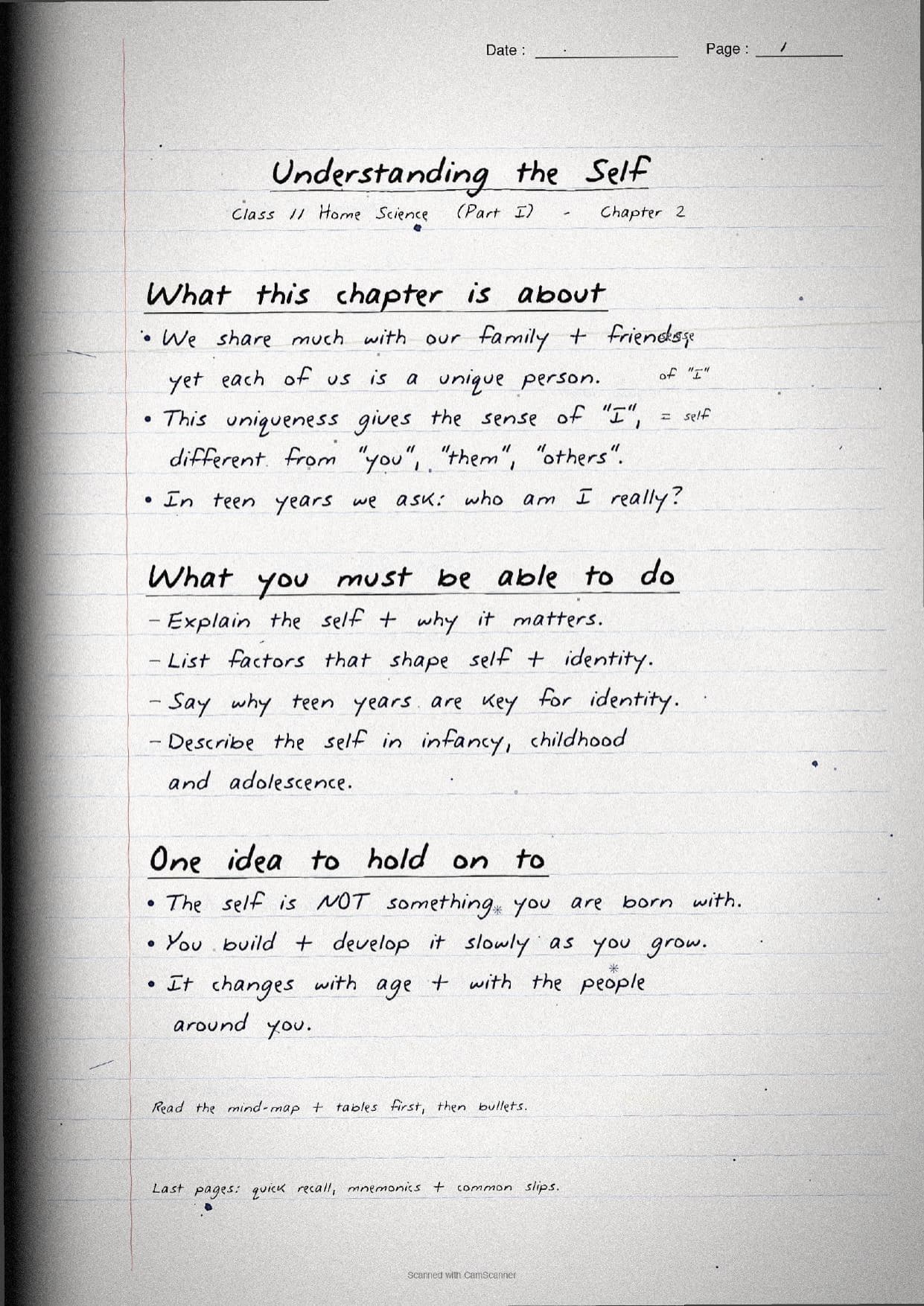
These Understanding the Self handwritten notes turn the whole second chapter into clean, handwritten pages for fast last-minute revision. They follow the 2026-27 NCERT syllabus and Chapter 2 of Class 11 Home Science (Human Ecology and Family Sciences, Part I). Students get the meaning of the self, self-concept, self-esteem and identity, the split between personal and social identity, the self across infancy, childhood and adolescence, why the teen years are critical for identity, and the factors that shape selfhood, all in a pen-on-paper format that is easy to skim before the Class 11 final exam.
- Handwritten pages with boxed key terms, mind-maps of the dimensions of the self, and a stage-by-stage comparison table.
- This chapter builds the human-development base of Class 11 Home Science, so its terms carry into later units and CUET preparation.
- Pairs with the NCERT Solutions, Notes and Book PDF linked lower on this page.
These Understanding the Self handwritten notes are prepared from the official NCERT Home Science (Human Ecology and Family Sciences) textbook and checked against recent CBSE Class 11 question papers.
Student Feedback: In a Collegedunia poll of 4,360 Class 11 Home Science students, 78% of students said the handwritten pages helped them tell self-concept from self-esteem and recall the four factors that shape identity faster than printed text, because the boxed terms and the stage table made the differences obvious.
Source: 2026-27 Class 11 Home Science student poll. Sample of 4,360 students from CBSE schools across 9 states.
What These Understanding the Self Handwritten Notes Contain
Understanding the Self is the second chapter of Class 11 Home Science. It explains what the self is, how it grows from infancy through adolescence, and the factors that shape a person's identity. These handwritten notes condense the chapter into pen-on-paper pages that read like a topper's own notebook, with the key terms boxed and the life stages drawn as a clear comparison.
The notes are organised under three threads, each on its own set of pages:
- The core terms: the self, self-concept, self-esteem and identity, plus the split between personal and social identity.
- The stages: how the self develops across infancy, early childhood, middle childhood and adolescence.
- The influences: the biological, socio-cultural, emotional and cognitive factors that shape selfhood, ending with how to build a positive sense of self.
Because the pages are handwritten, the key terms sit in boxes and mind-maps rather than long paragraphs. A student can flip through the Understanding the Self Class 11 pages in a few minutes and still pick up the definitions, the stages and the factors before walking into the exam.
Self, Self-concept, Self-esteem and Identity
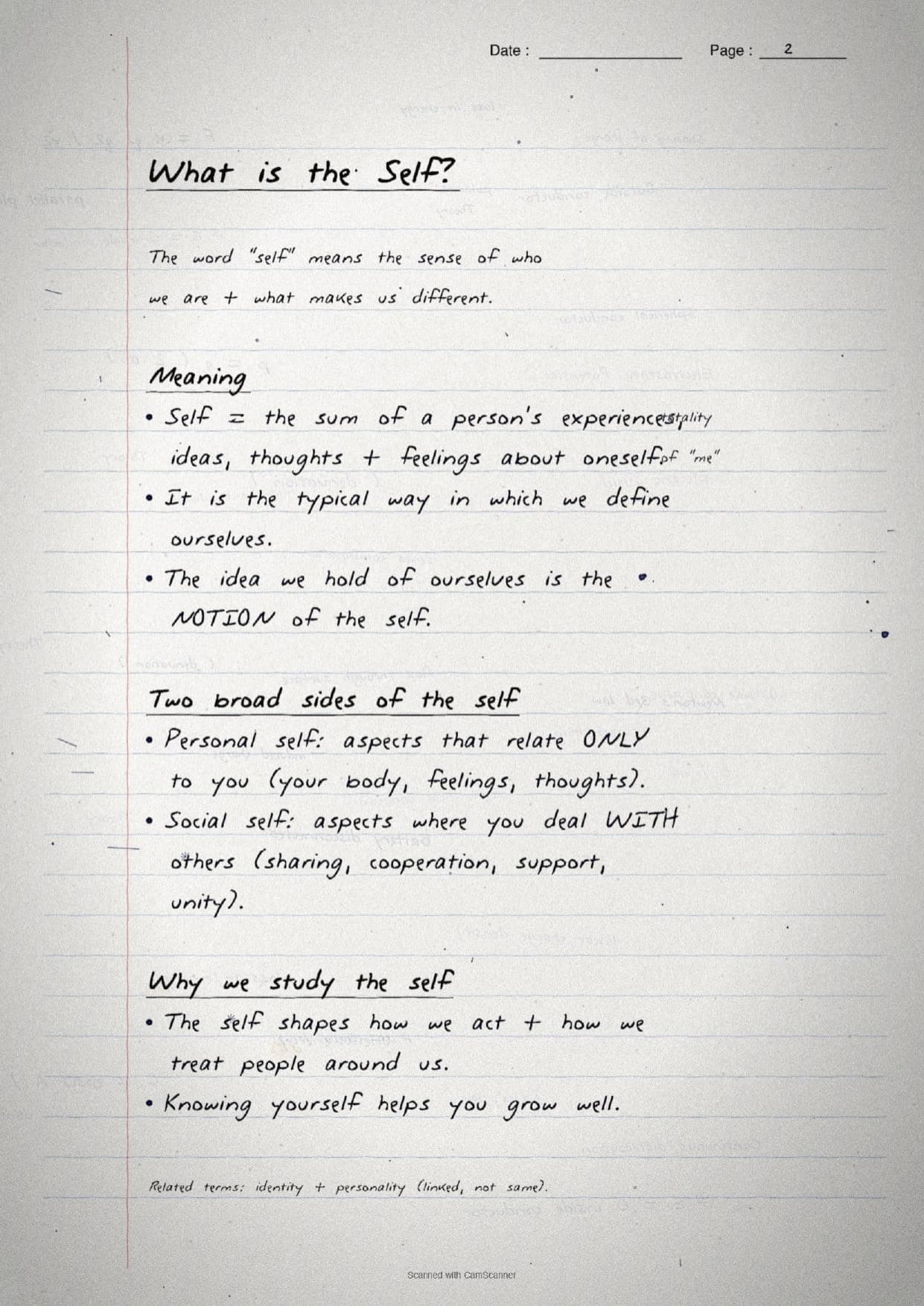
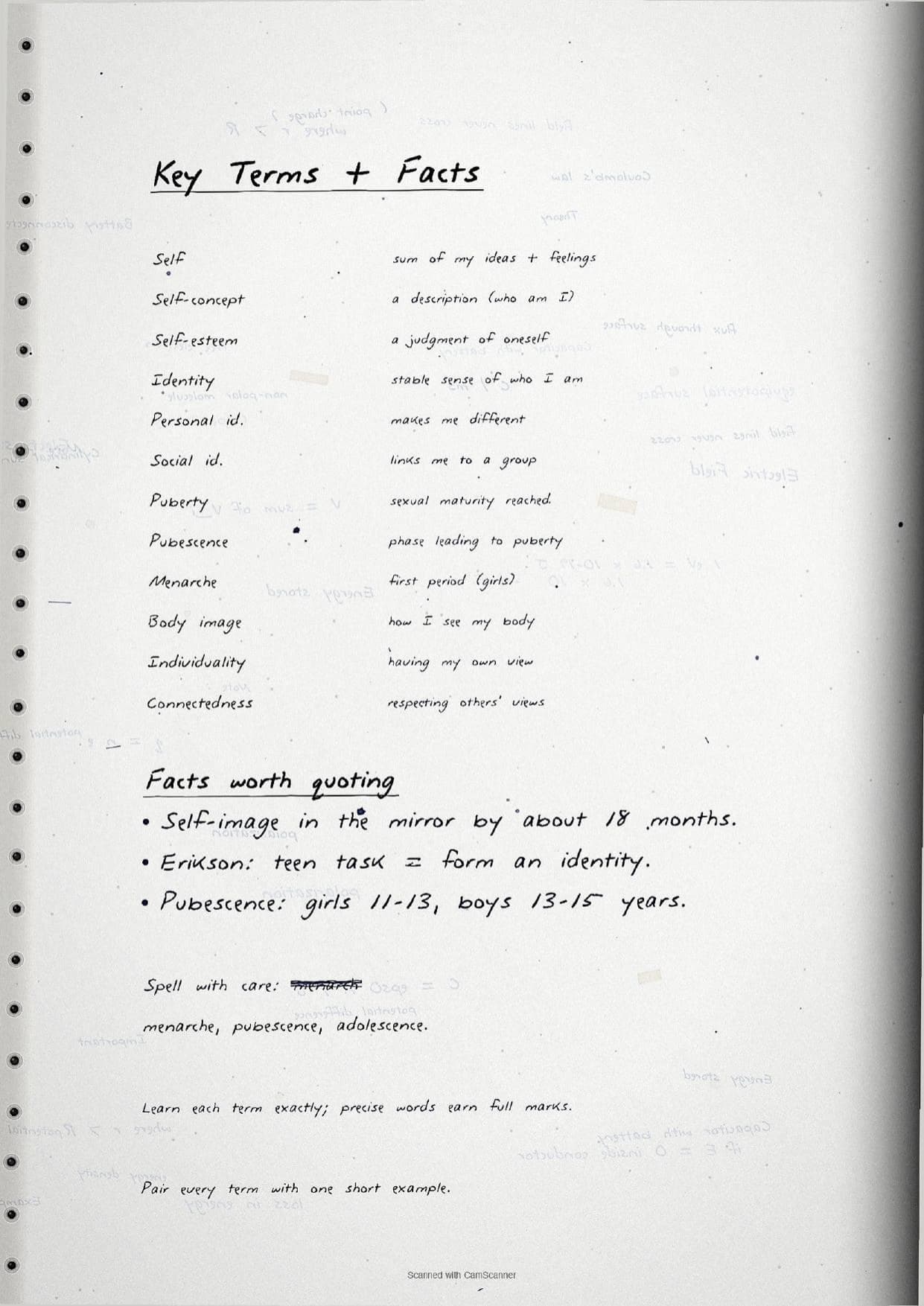
The opening pages settle the four terms that the whole chapter rests on. The self is the sum of a person's experiences, ideas, thoughts and feelings about oneself. It is the typical way in which we define ourselves. The notes then split the self into a personal self, the parts that relate only to you, and a social self, the parts where you deal with others through sharing, cooperation and support. A boxed reminder marks that the self is built, not born, and that it keeps changing with age and with the people around you.
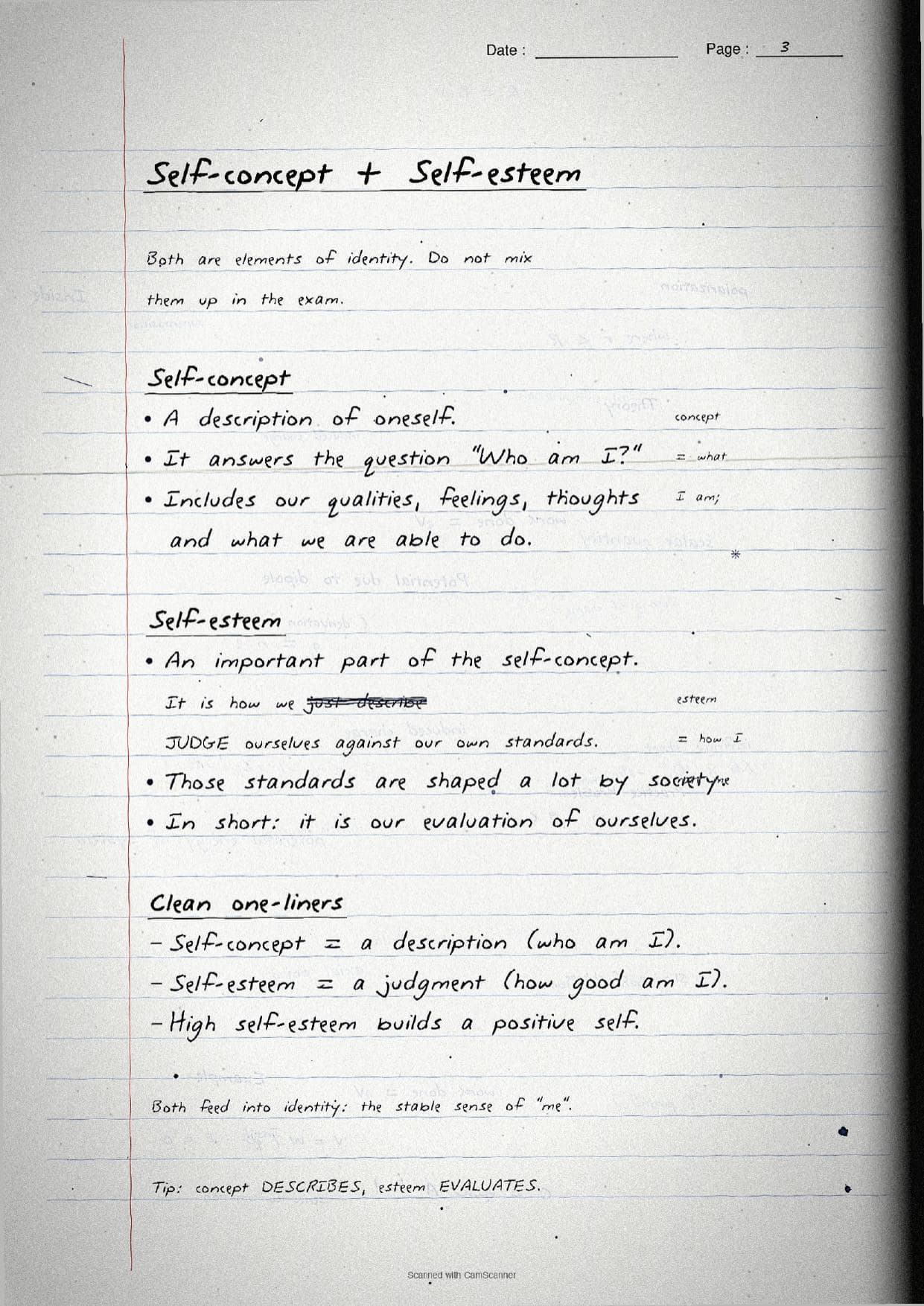
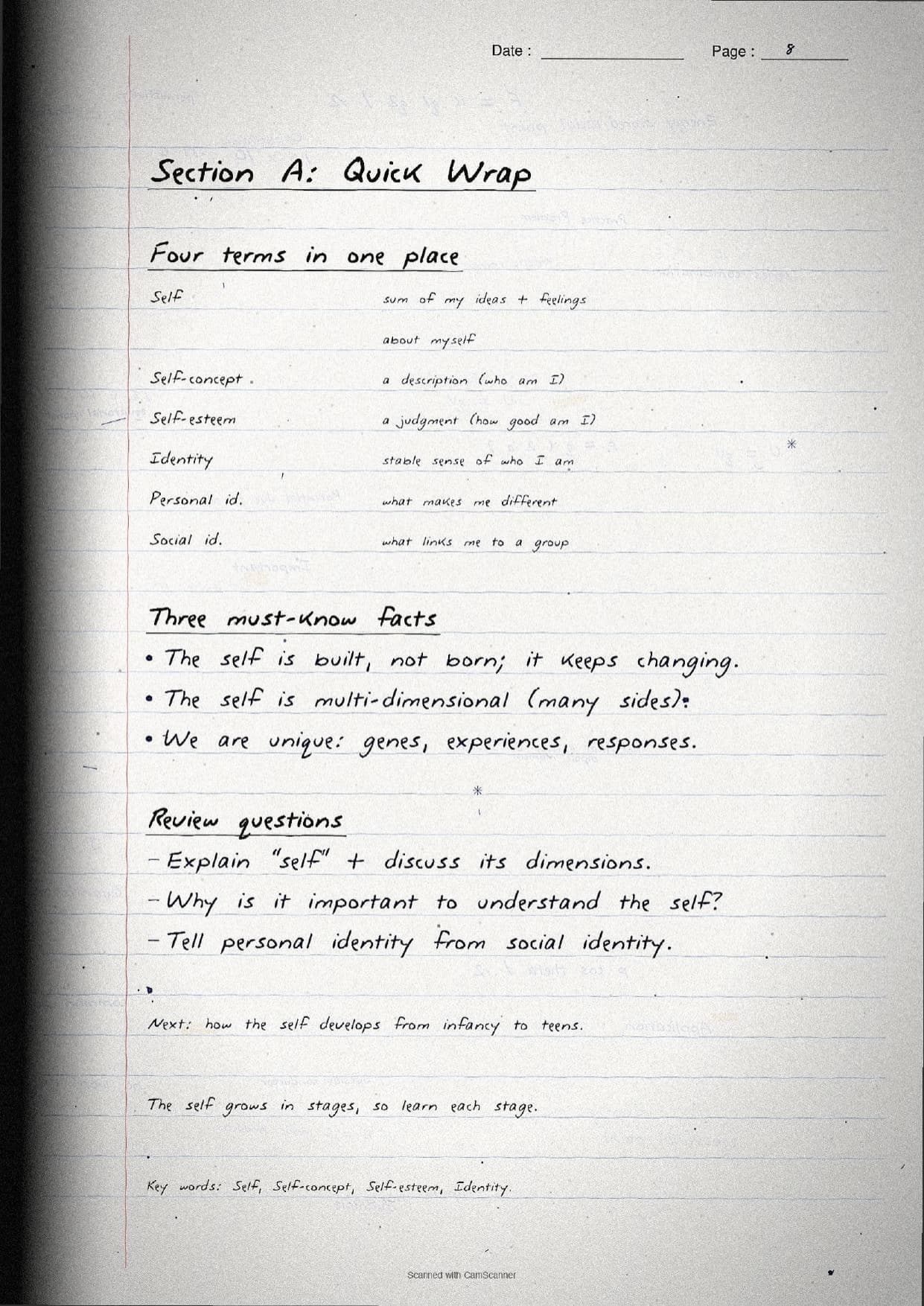
The next box separates two terms that students often confuse in the exam. The table below shows how the handwritten pages set them apart.
| Term | What the page shows |
|---|---|
| Self-concept | A description of oneself; it answers the question "Who am I?" and includes your qualities, feelings and what you can do. |
| Self-esteem | A judgment; how you rate yourself against your own standards, which society shapes a lot. In short, your evaluation of yourself. |
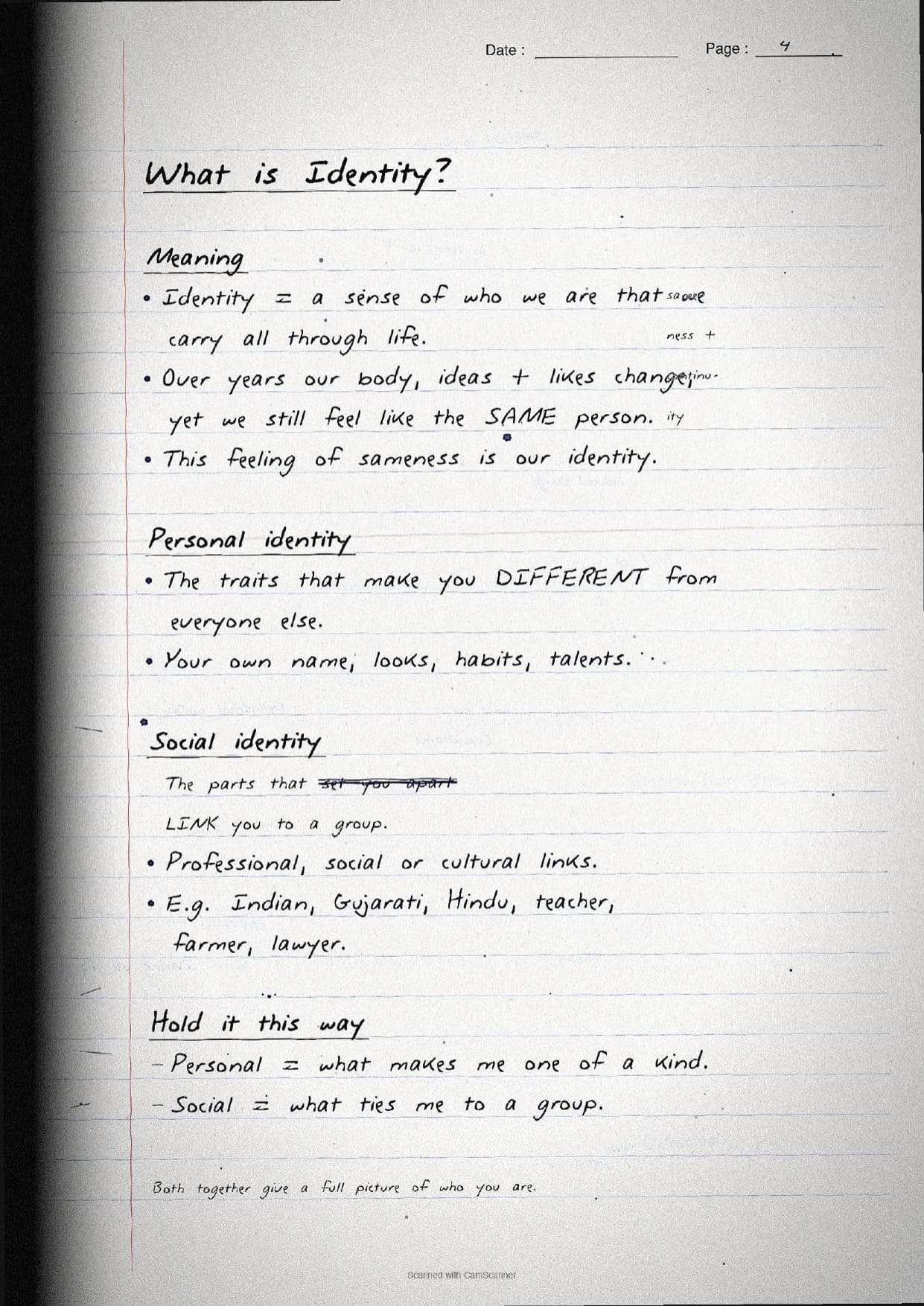
| Identity | The stable sense of who you are that you carry all through life, felt as sameness even as your body and likes change. |
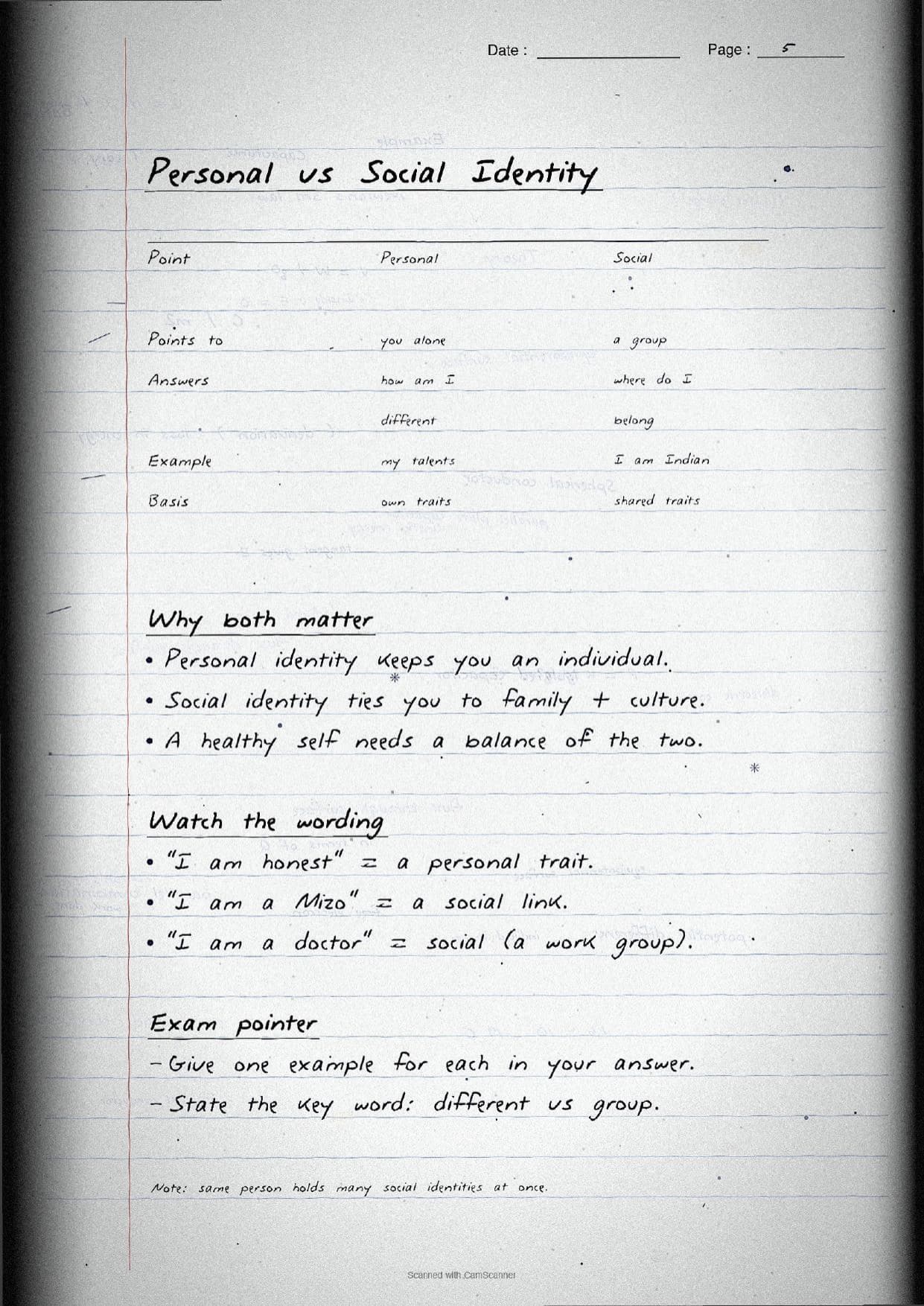
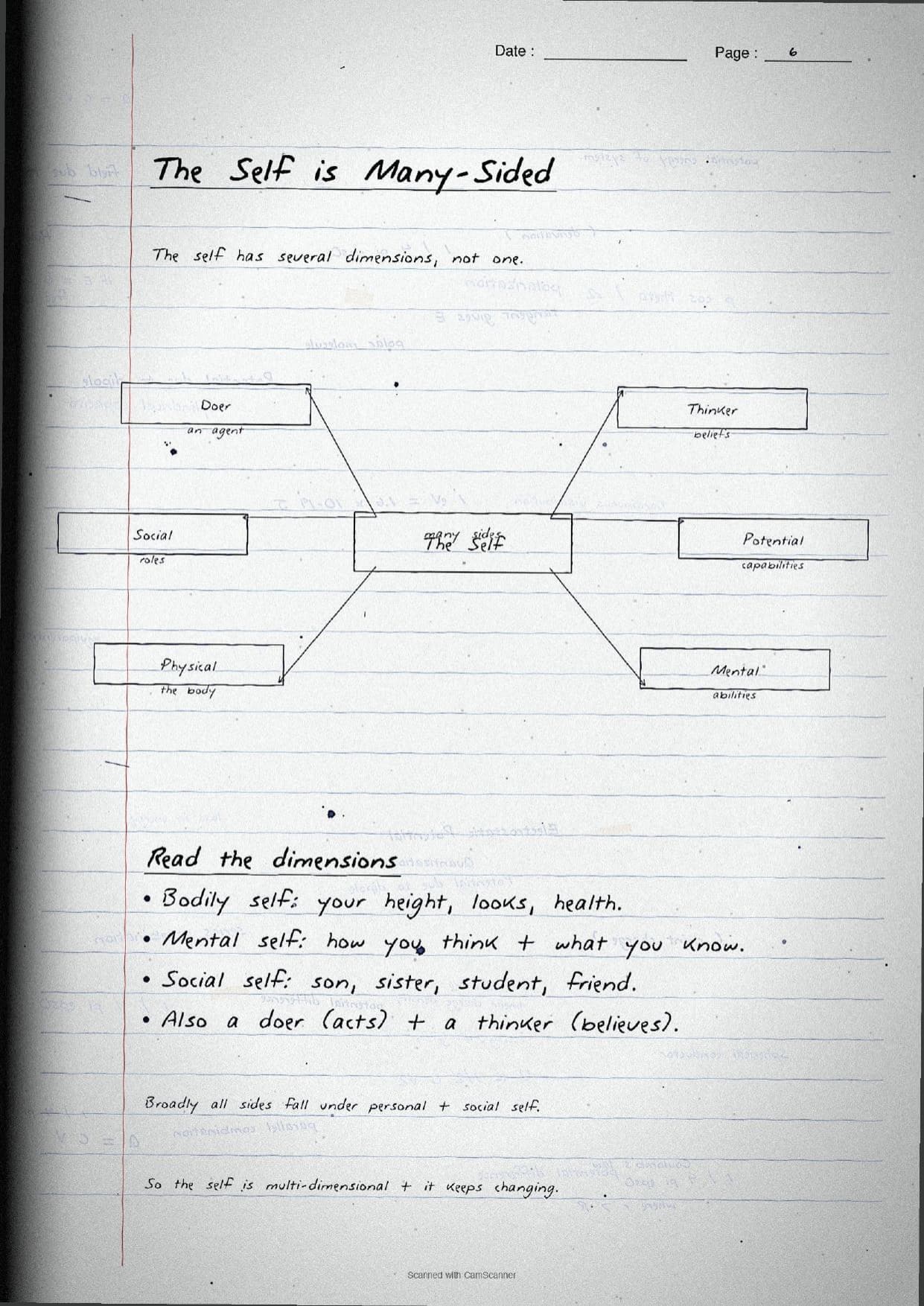
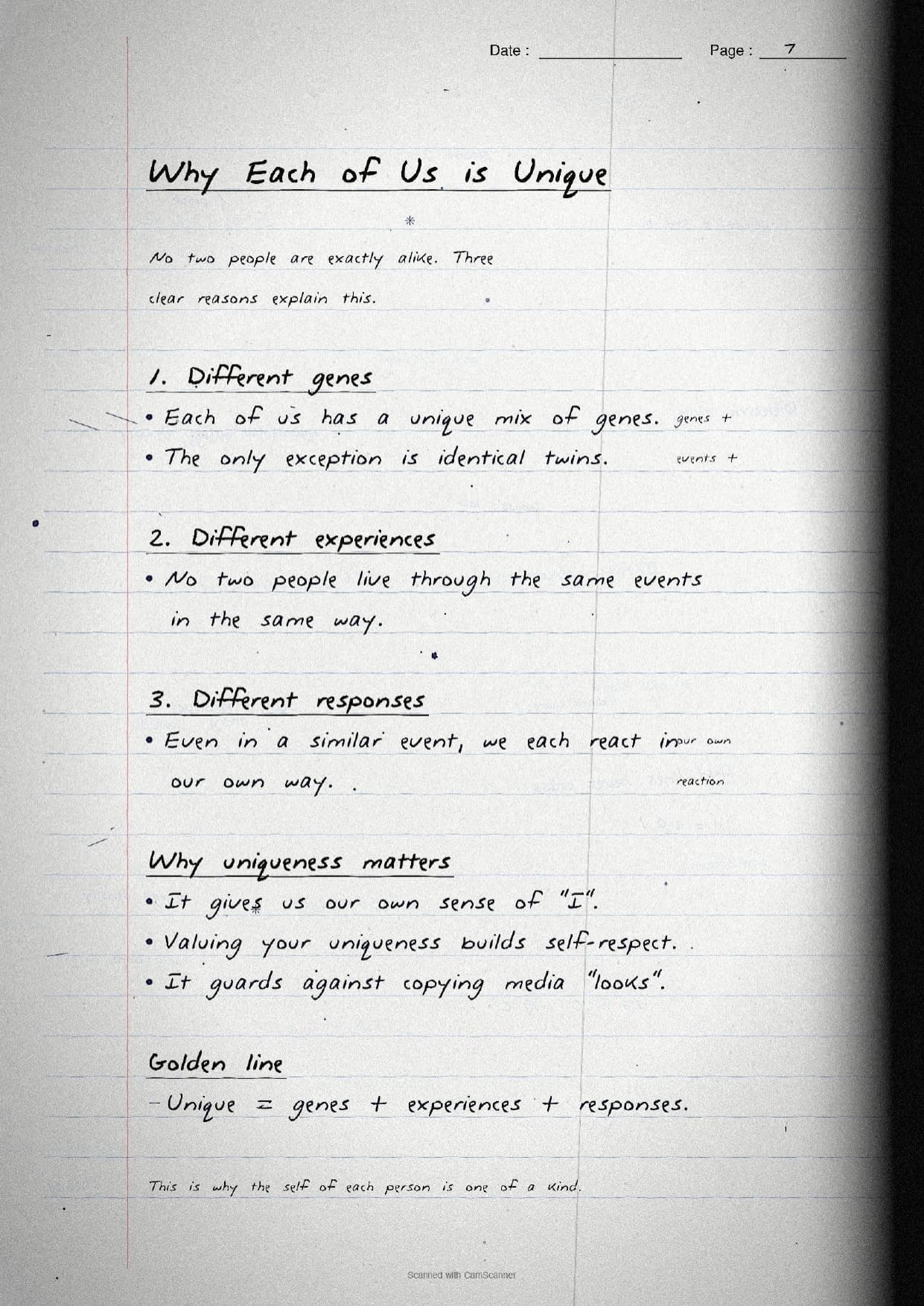
The pages also draw personal identity and social identity as two arms of the same person. Personal identity is the set of traits that make you different from everyone else, such as your name, looks, habits and talents. Social identity is what links you to a group, such as being Indian, Gujarati, a teacher or a farmer. A final box shows the self is multi-dimensional, with physical, mental, social and potential sides, and notes that each person is unique because of a different mix of genes, experiences and responses.
The Self Across Life Stages and What Shapes It
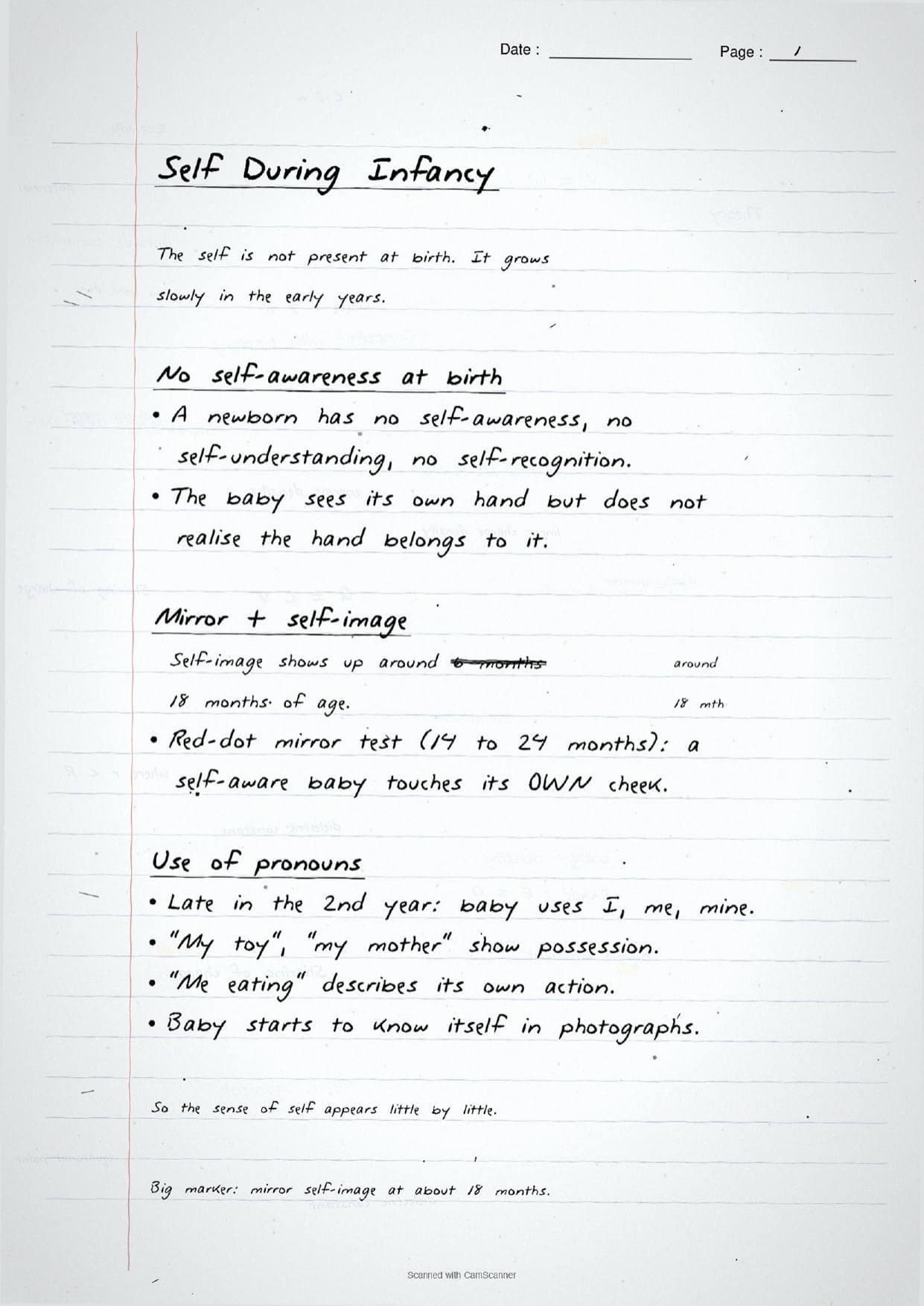
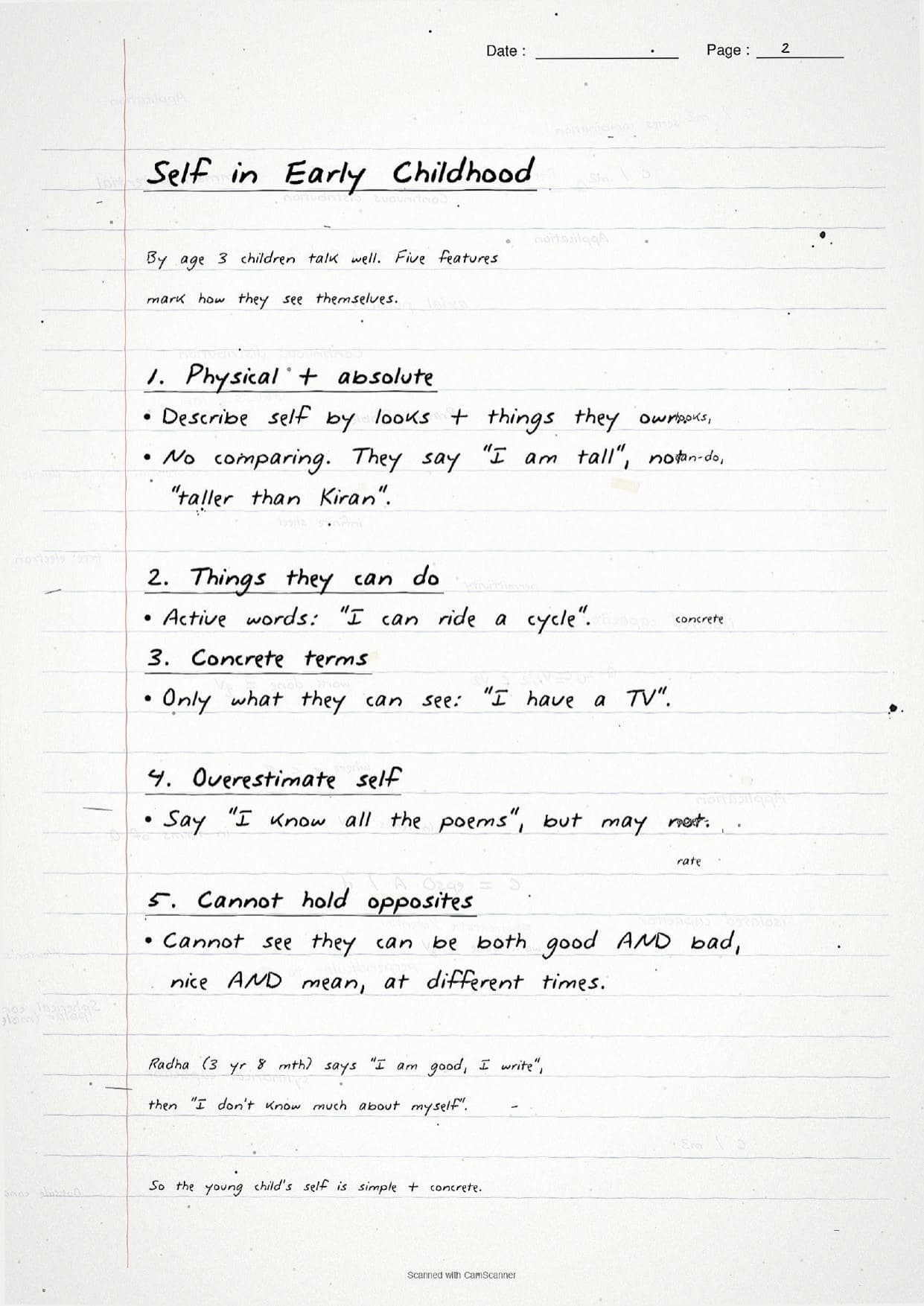
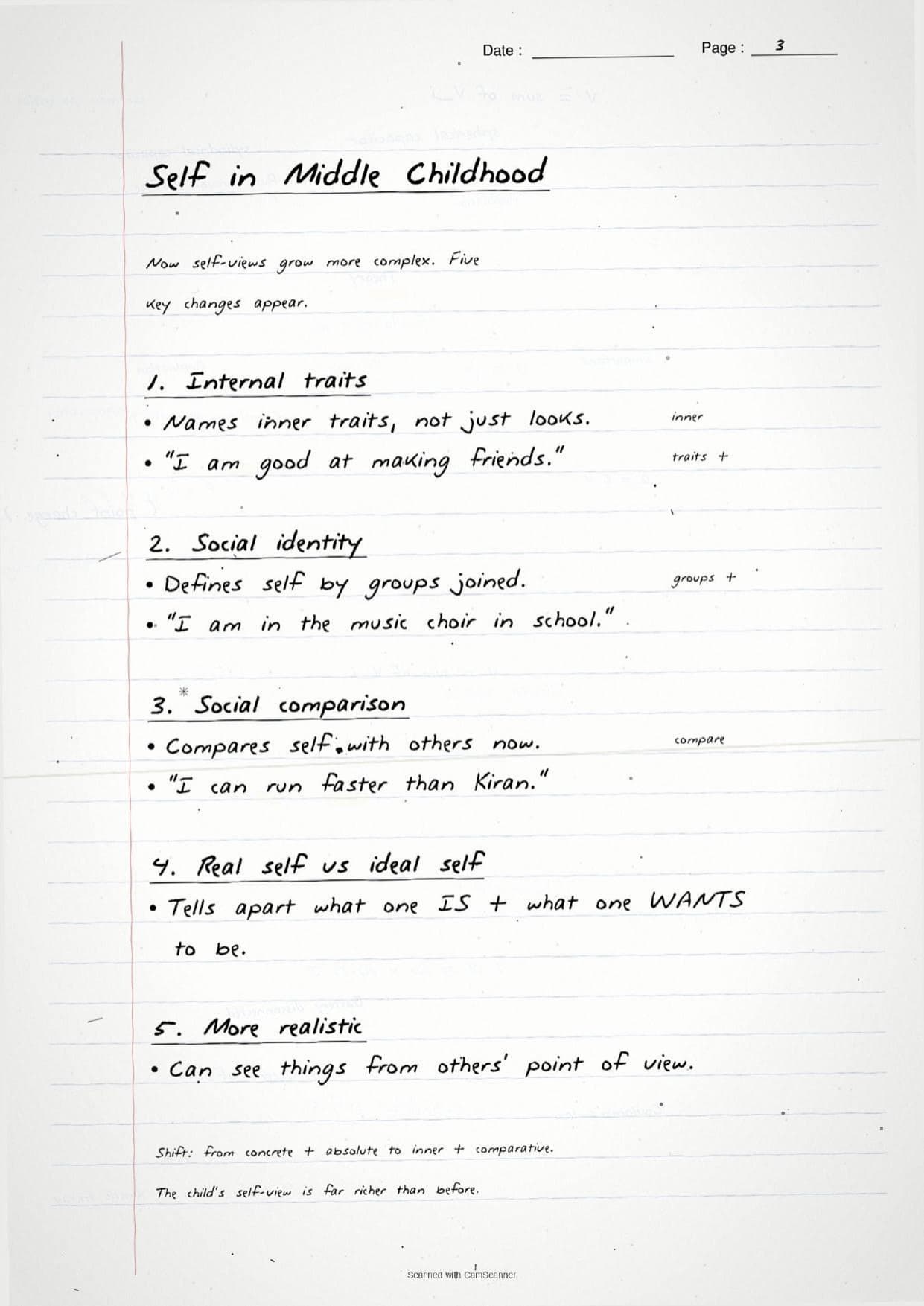
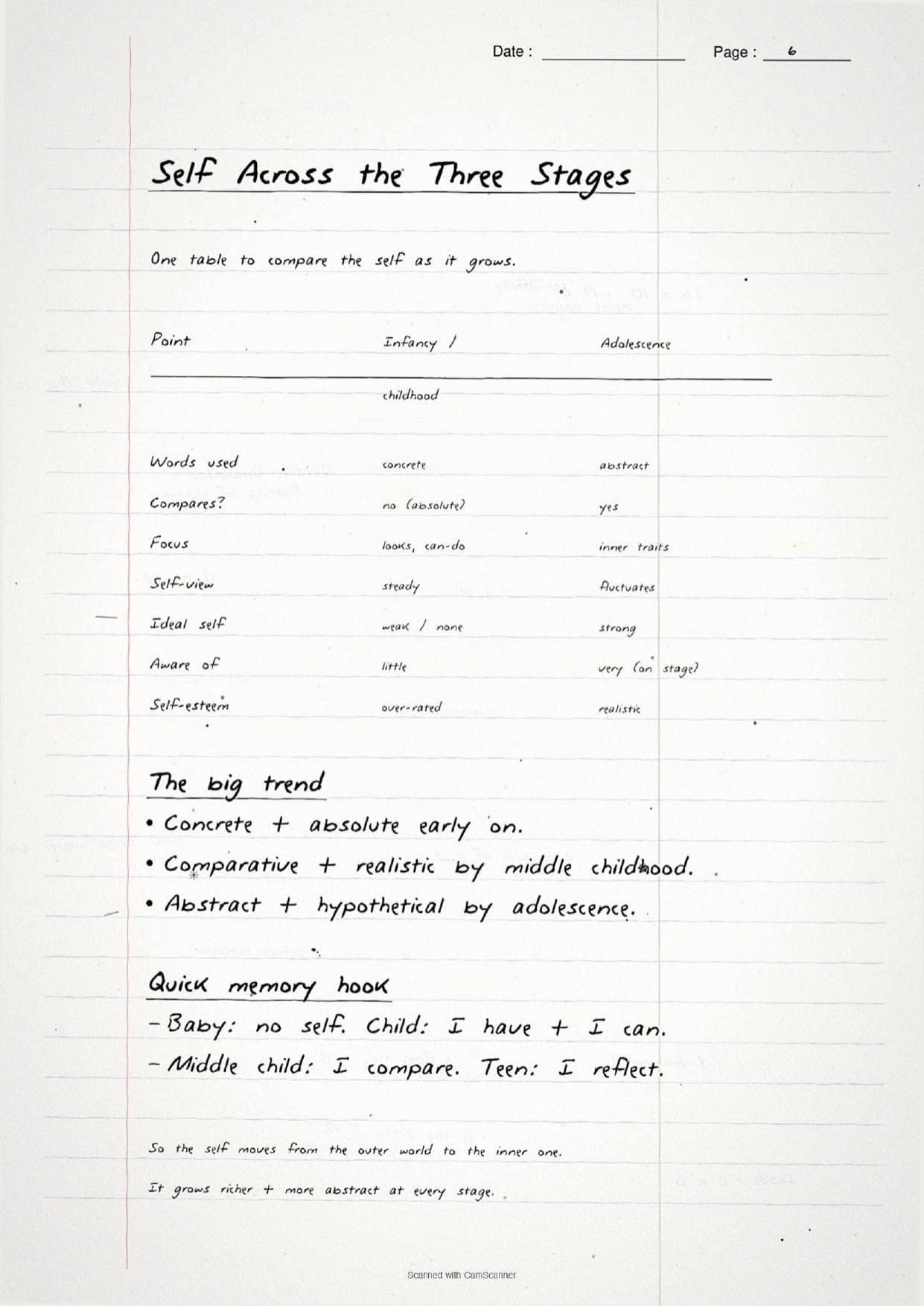
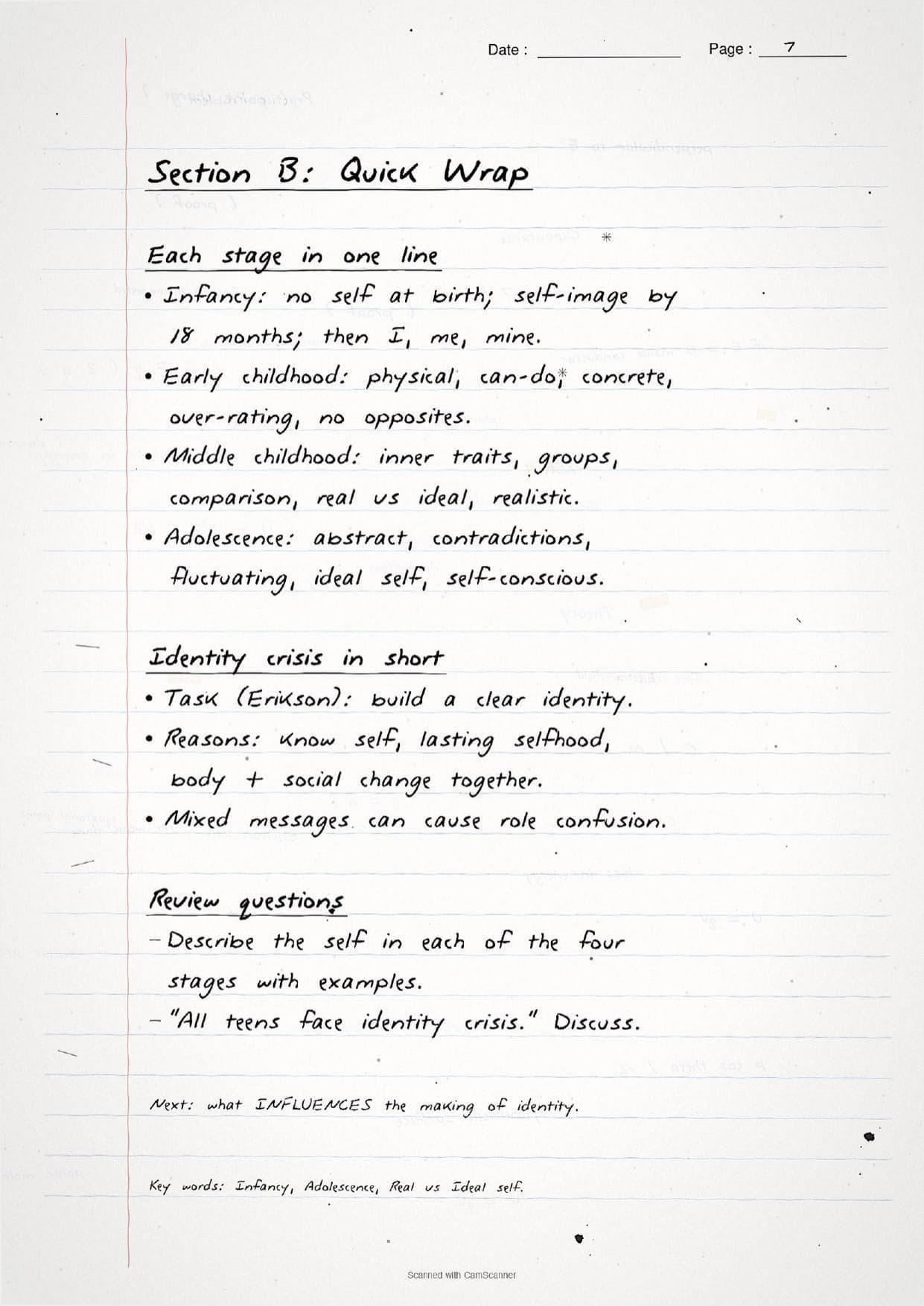
The middle pages trace how the self grows, drawn as a stage-by-stage table so the changes stand apart. The self is not present at birth. A newborn has no self-awareness, and the first self-image in the mirror appears at about 18 months, tested by the red-dot mirror test. By early childhood the child describes itself in physical, concrete and absolute terms and tends to over-rate its skills. In middle childhood the child names inner traits, joins groups and starts to compare itself with others.
| Point | Infancy and childhood | Adolescence |
|---|---|---|
| Words used | Concrete | Abstract |
| Compares self? | No, absolute at first | Yes |
| Focus | Looks and what I can do | Inner traits |
| Self-view | Steady | Fluctuates |
| Ideal self | Weak or none | Strong |
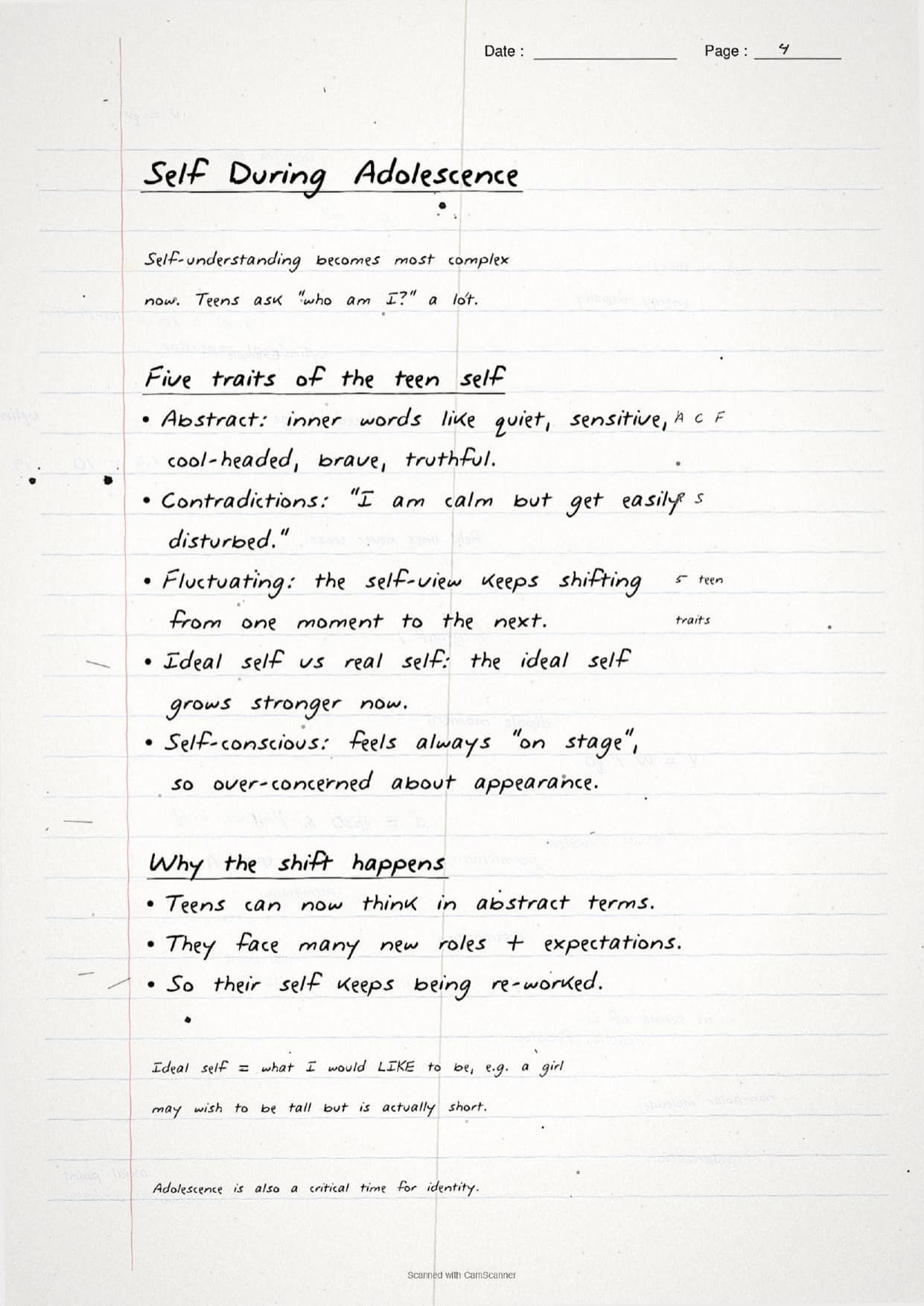
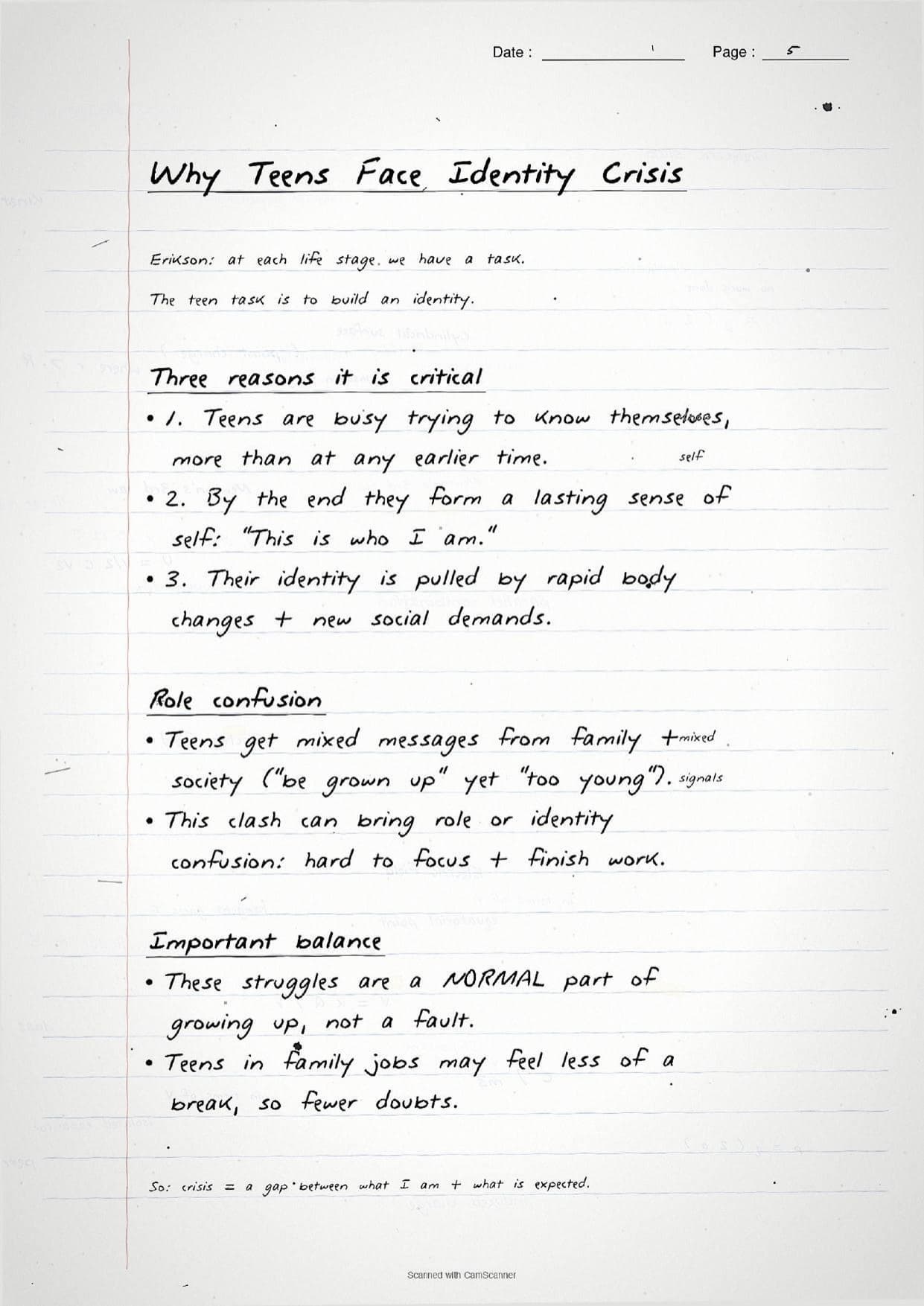
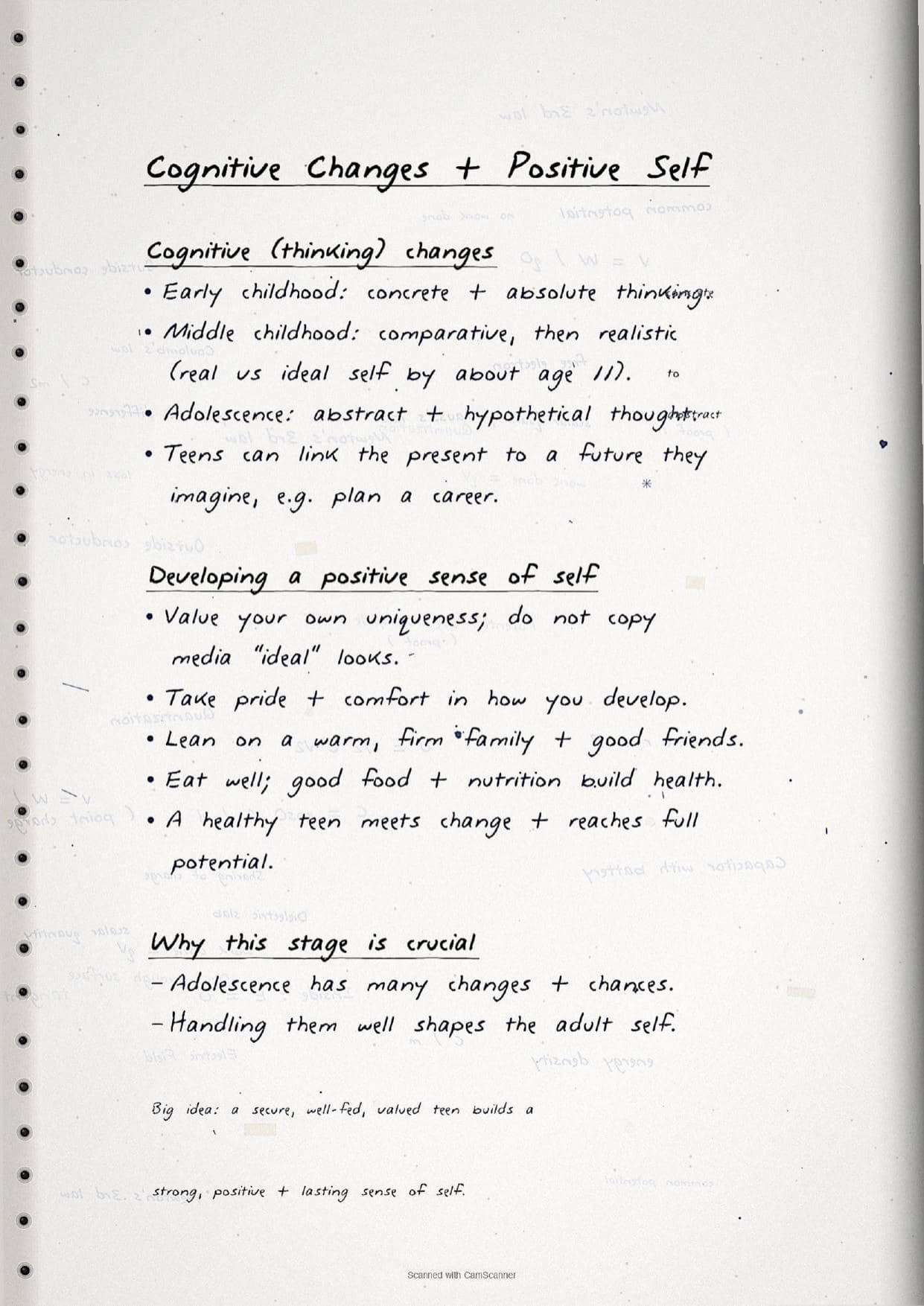
In adolescence the self becomes most complex. Teens use abstract words, hold contradictions ("calm but easily disturbed"), swing in mood, and feel self-conscious, as if always "on stage". Following Erikson, the teen task is to build an identity, and this stage is critical because teens work hard to know themselves, form a lasting sense of "this is who I am", and face rapid body change and new social demands at once. Mixed messages from family and society can cause role or identity confusion.
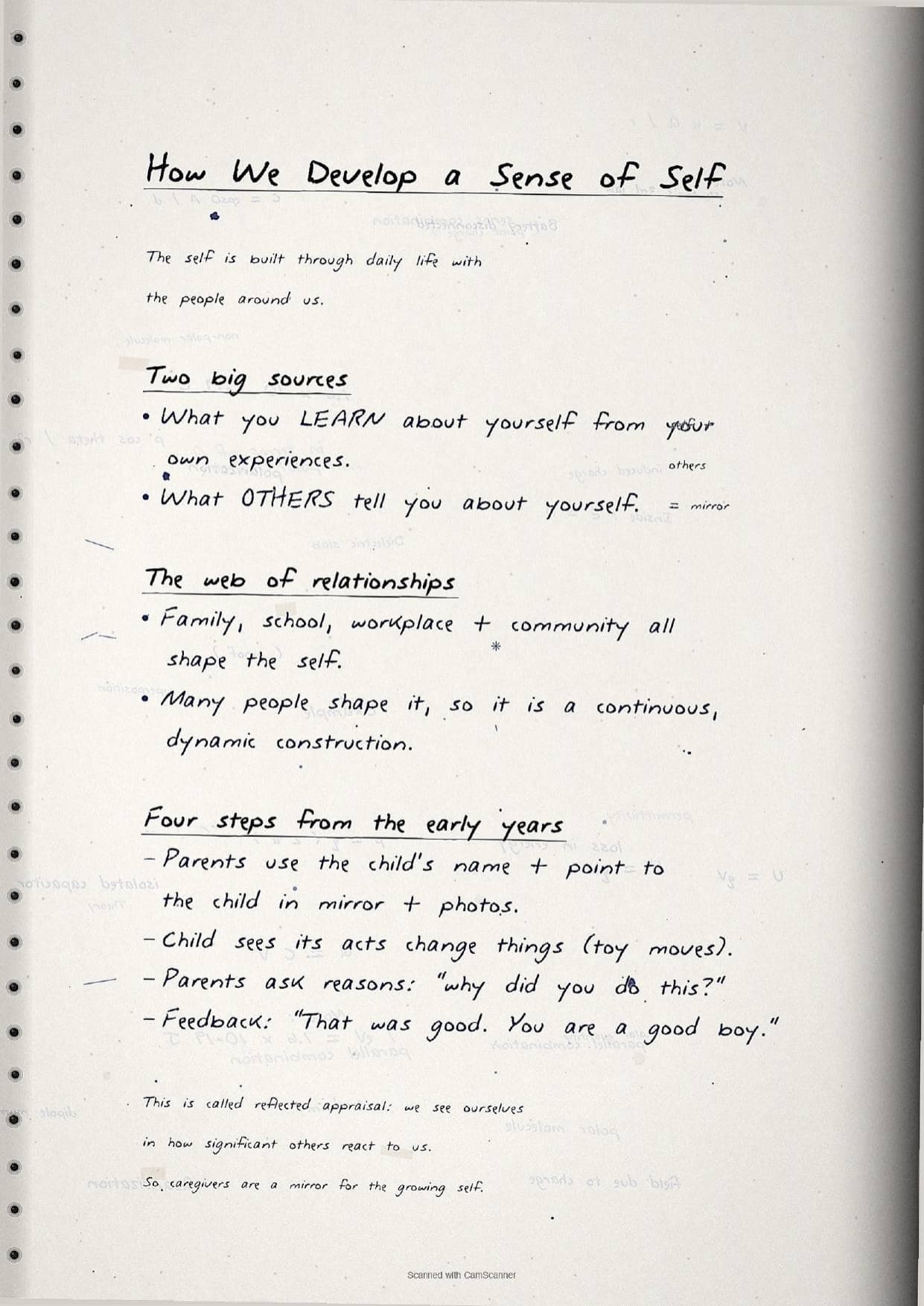
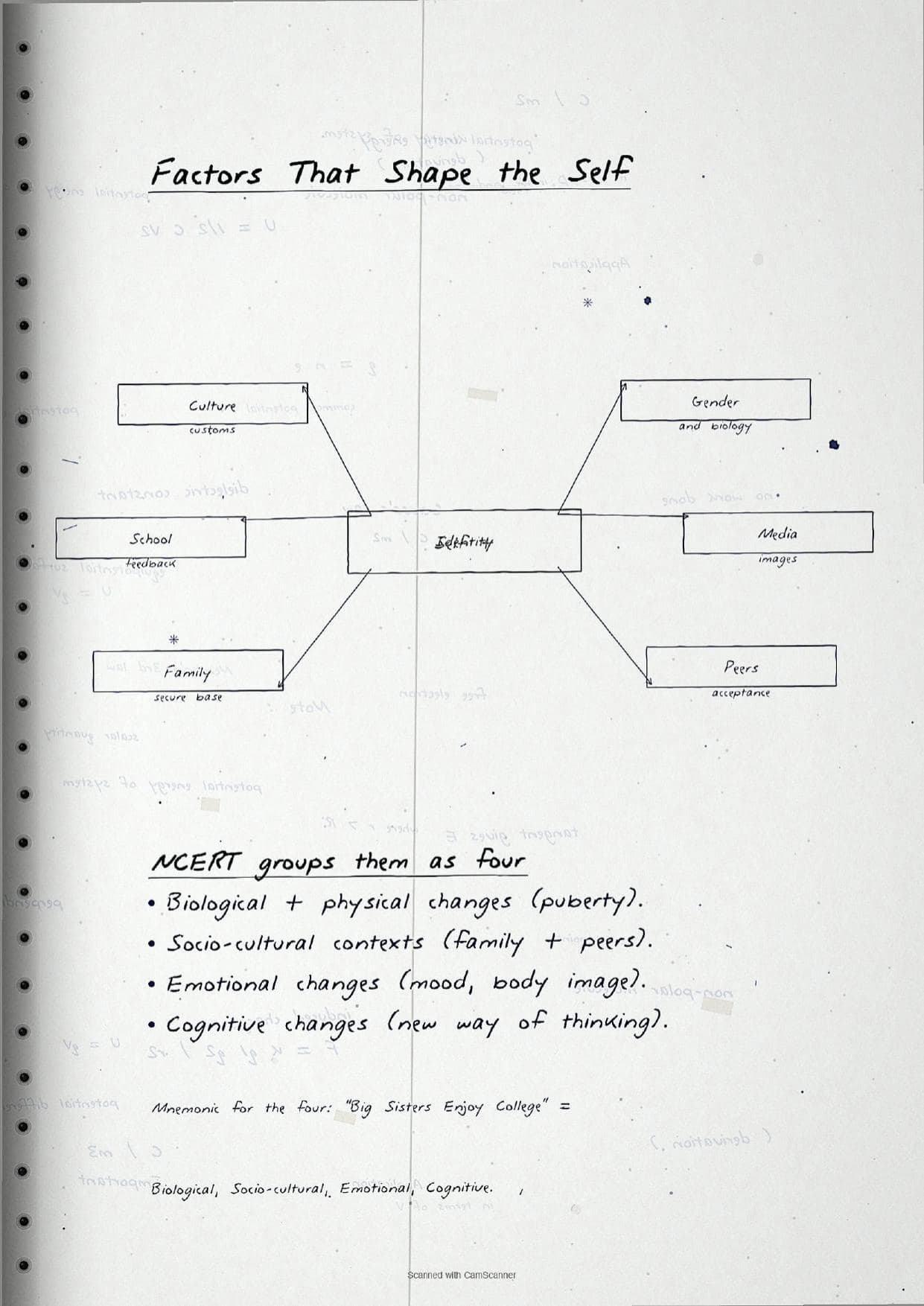
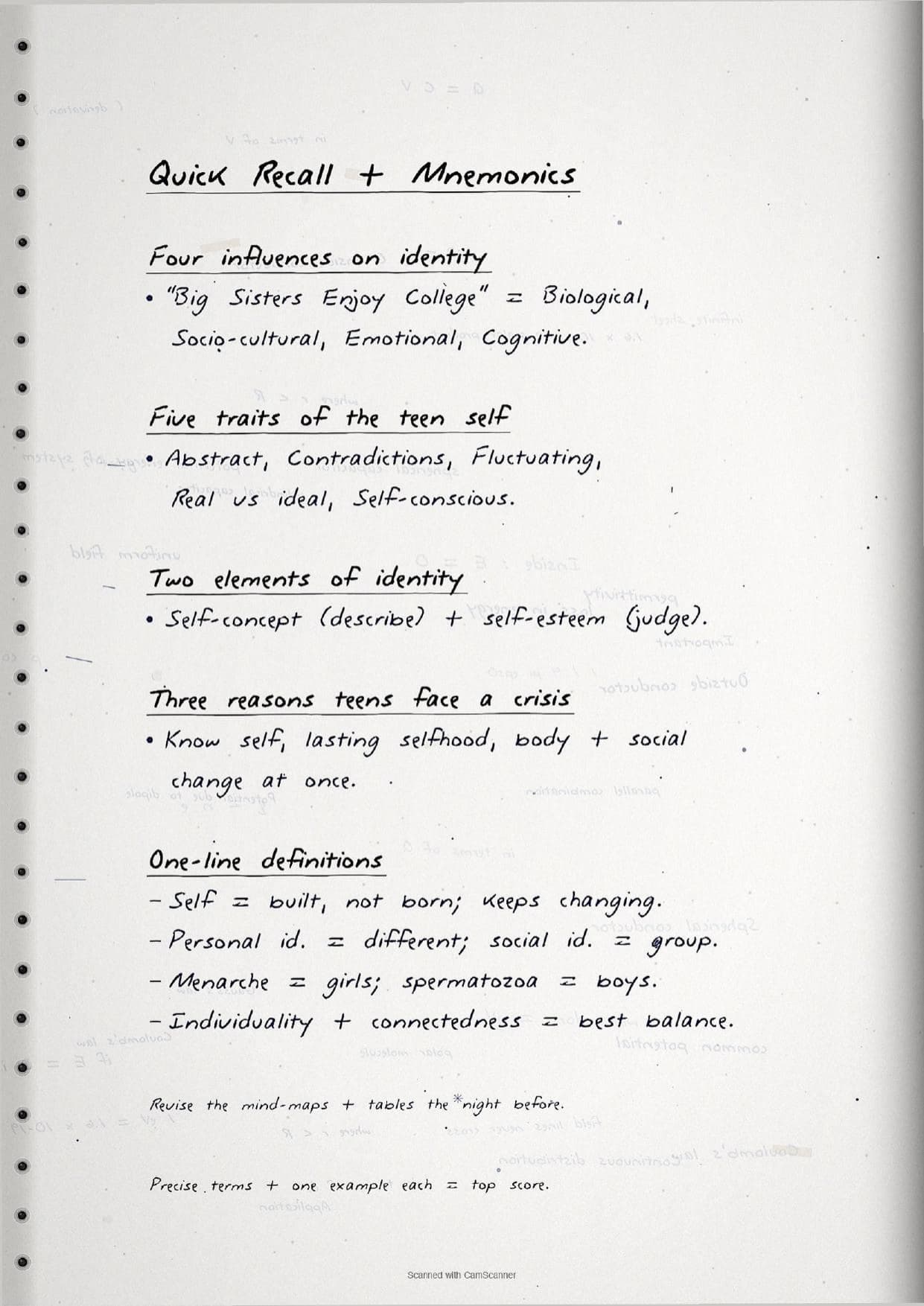
The self develops through reflected appraisal, meaning we see ourselves in how significant others react to us, so caregivers act as a mirror for the growing self. The final pages group the influences on identity into four, easy to recall with the mnemonic "Big Sisters Enjoy College":
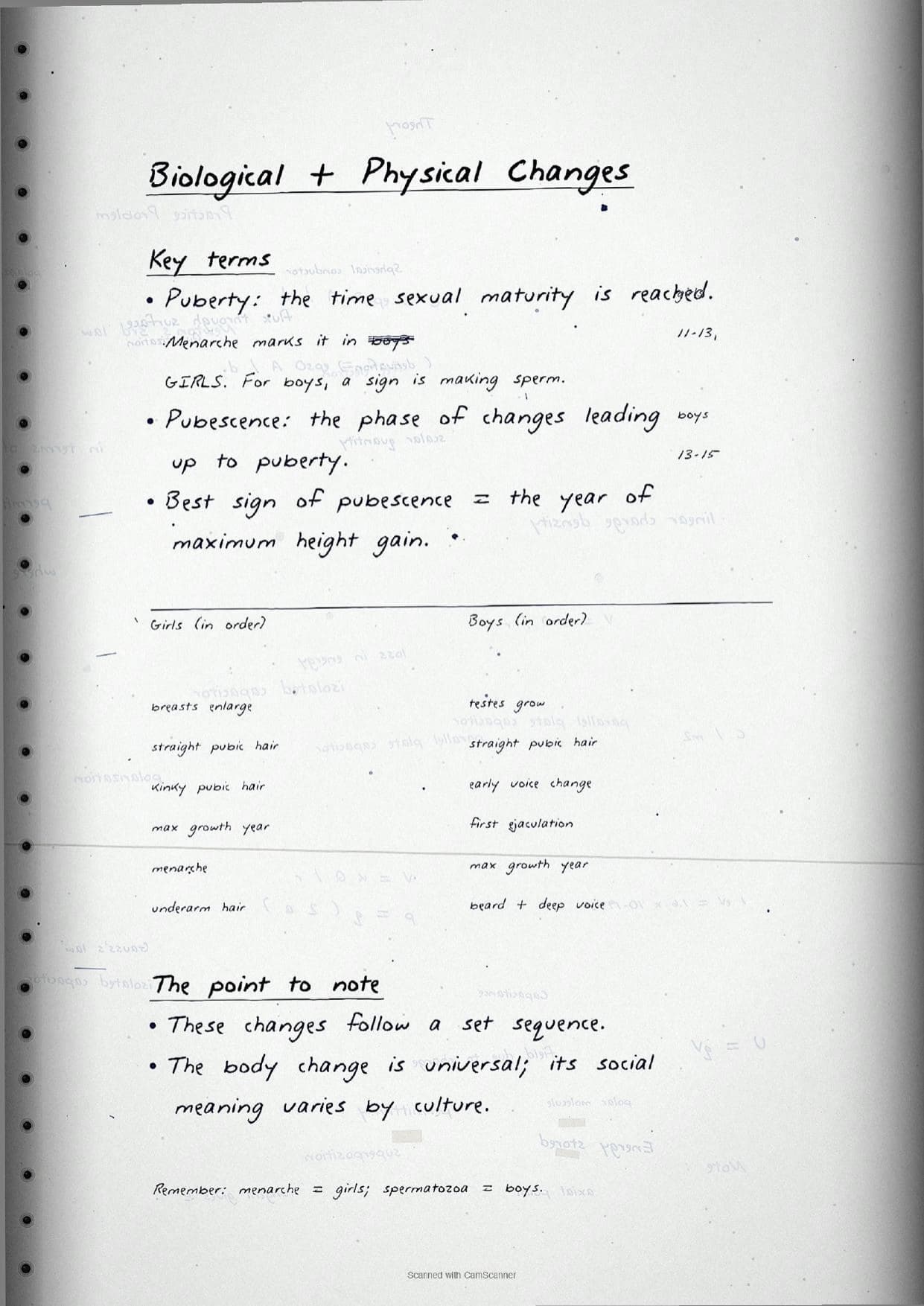
- Biological and physical: puberty and pubescence; menarche marks it in girls (roughly 11 to 13 years), and making sperm marks it in boys (roughly 13 to 15 years).
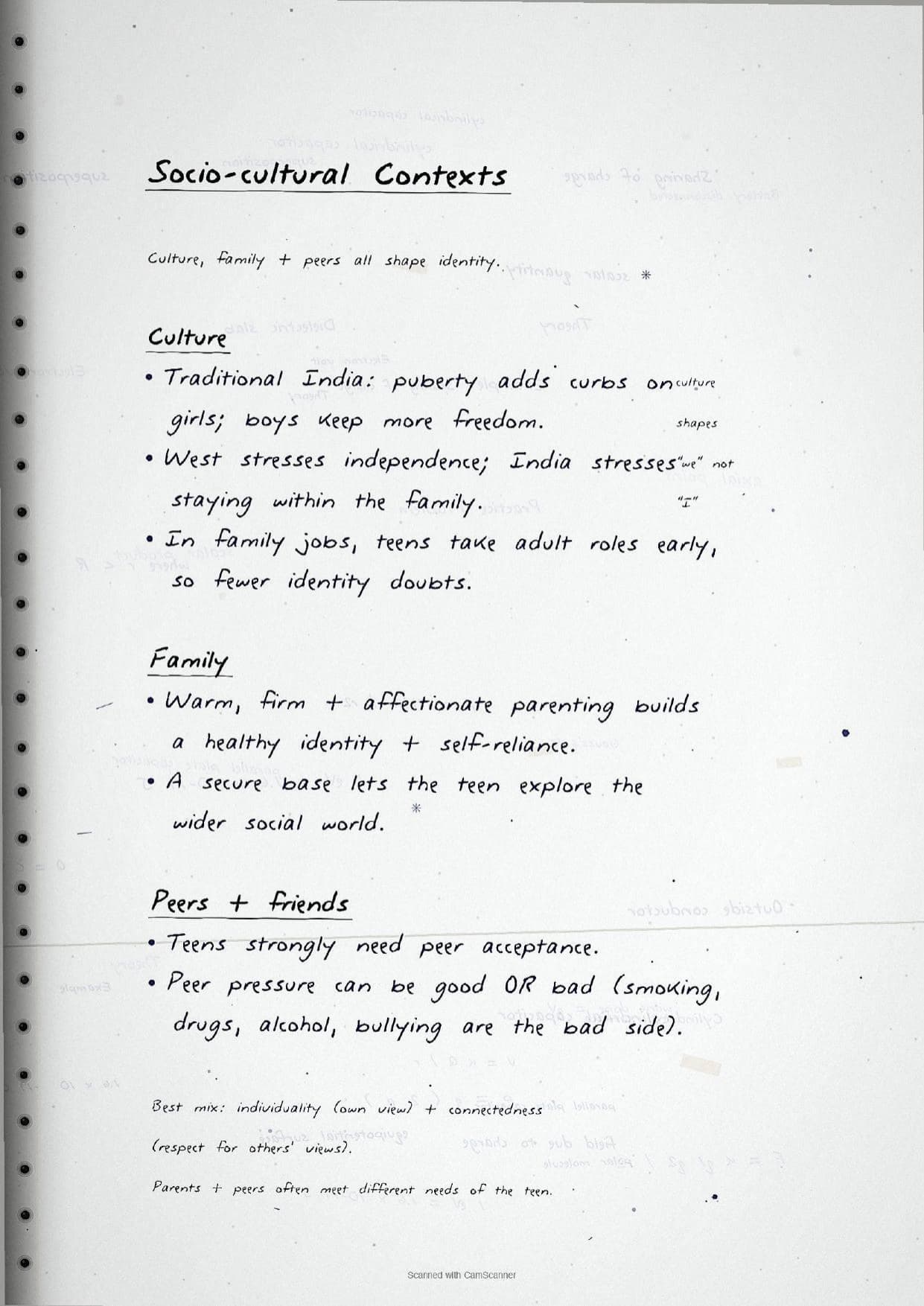
- Socio-cultural: culture, a warm and firm family that gives a secure base, and peers whose acceptance teens strongly need.
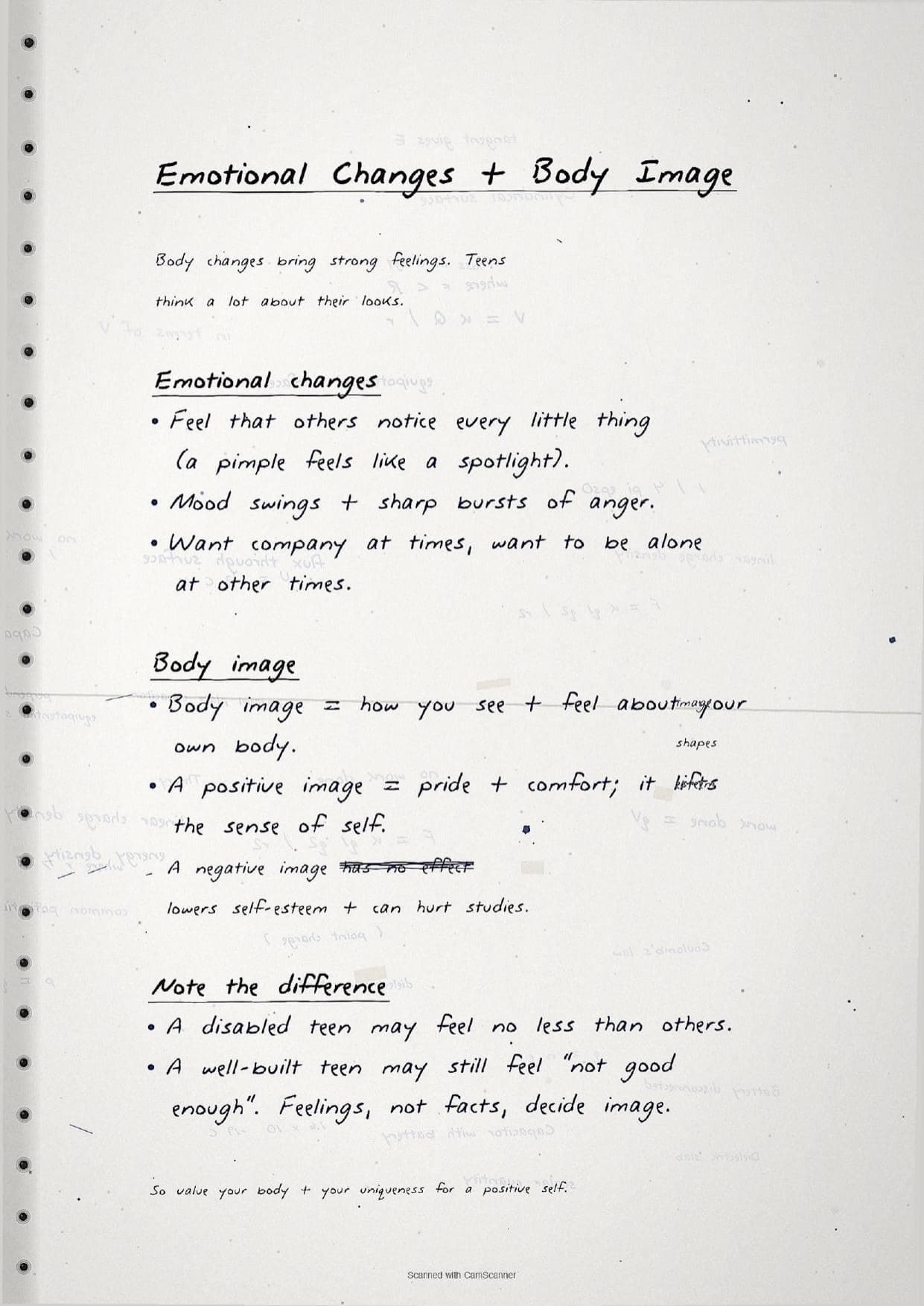
- Emotional and body image: mood swings, and how a positive or negative body image lifts or lowers self-esteem.
- Cognitive: the shift to abstract and hypothetical thinking, which lets teens plan a future such as a career.
The pages close on developing a positive sense of self: value your own uniqueness, do not copy media "ideal" looks, lean on a warm family and good friends, eat well, and balance individuality with connectedness.
How to Use These Handwritten Notes
Handwritten notes work best as a final-revision tool, not a first read. The steps below show how to get the most out of the Understanding the Self handwritten notes in the last days before a test.
- Download: tap the download card above to save the handwritten pages to your device.
- First read: read the printed Notes once so the handwritten pages act as a refresher, not a first source.
- Recall drill: cover the page and try to write the four core terms and the four factors that shape identity from memory.
- Night before: flip through the stage table and the factors mind-map for a quick last-minute recall.
Many students search for class 11 home science chapter 2 notes on their phone the night before a test, so a saved set of handwritten pages means you can revise offline. Use the handwritten notes for speed, then check the solutions to confirm you have the answer points right.
Common Mistakes These Notes Help You Avoid
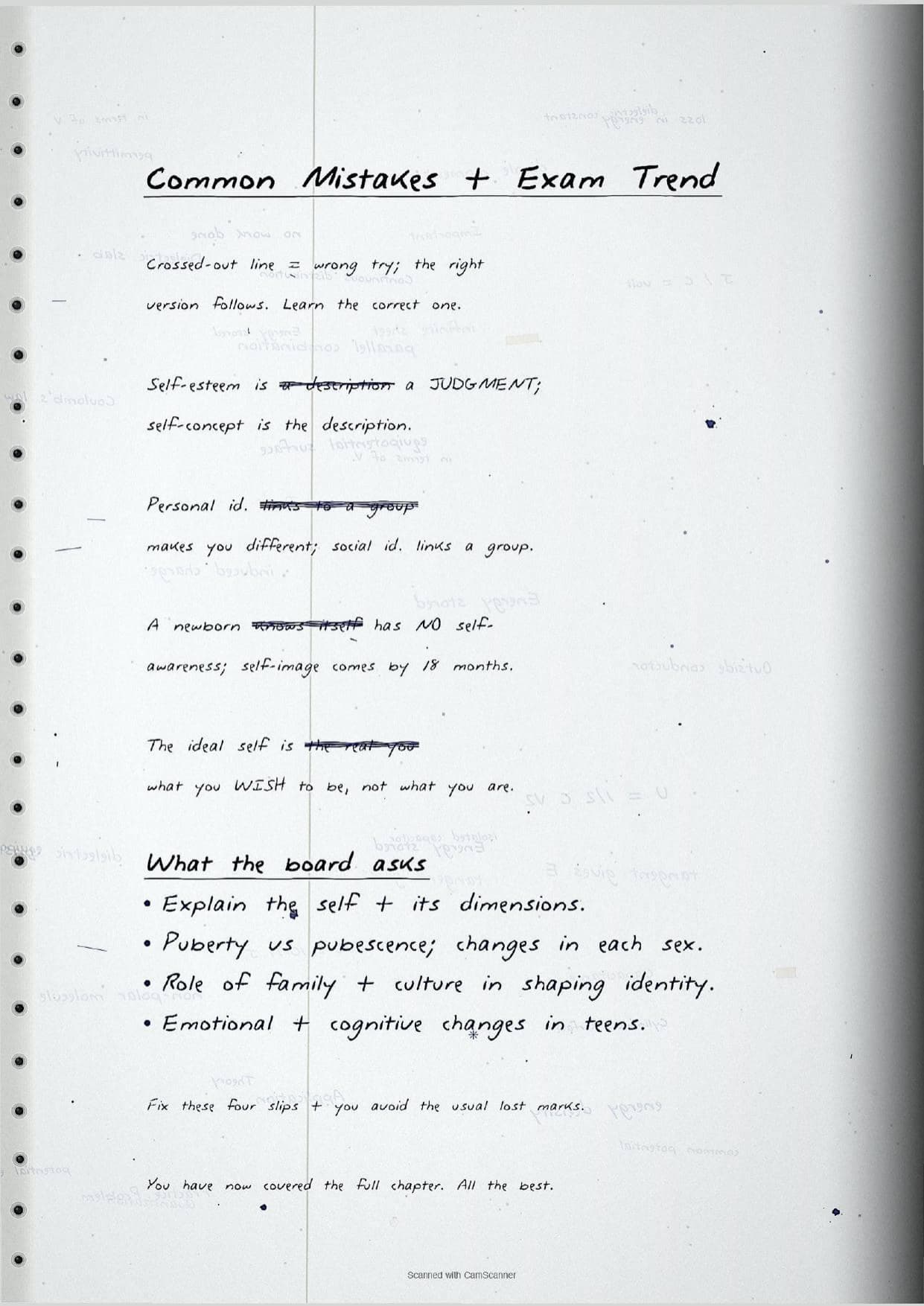
A few errors cost marks every year. The handwritten notes flag each one in the margin so you can fix it before the exam. These five are the most common.
- Swapping the two terms. Self-concept describes ("who am I"), while self-esteem evaluates ("how good am I").
- Mixing up identity types. Personal identity makes you different; social identity links you to a group.
- Saying a newborn knows itself. A newborn has no self-awareness; self-image comes by about 18 months.
- Confusing the ideal self with the real self. The ideal self is what you wish to be, not what you are.
- Wrong puberty marker. Menarche is the sign in girls; producing sperm is the sign in boys.
Students who fix these five points usually move from average to high marks. The handwritten notes box each definition and draw the stages in full, so the soft points are hard to miss when you revise.
How These Handwritten Notes Pair with the Solutions and Book PDF
These handwritten notes are a fast revision tool. To prepare fully, students should use them alongside the other resources for the same chapter, all linked in the table below. Read the printed Notes, test yourself with the solutions, then use these pages for a final recall.
| Resource | Best used for |
|---|---|
| Understanding the Self NCERT Solutions | Step-by-step answers to all the chapter review questions |
| Understanding the Self Class 11 Notes | Quick chapter summary with all terms, stages and factors in one place |
| Understanding the Self NCERT Book PDF | Reading the original NCERT chapter text and examples |
Tip: read the printed Notes first, then attempt the solutions, and keep these handwritten pages for the final night-before flip. Using them for recall, not for the first read, builds memory faster.
All Class 11 Home Science Handwritten Notes by Chapter
The table links the handwritten notes for every chapter in Class 11 Home Science, so students can move across the course in one click. Understanding the Self is highlighted.
| Chapter | Handwritten Notes |
|---|---|
| Chapter 1 | Human Ecology and Family Sciences |
| Chapter 2 | Understanding the Self |
| Chapter 3 | Food, Nutrition, Health and Fitness |
| Chapter 4 | Management of Resources |
| Chapter 5 | Fabrics Around Us |
| Chapter 6 | Media and Communication Technology |
| Chapter 7 | Concerns and Needs in Diverse Contexts |
| Chapter 8 | Nutrition, Health and Well-being |
| Chapter 9 | Our Apparel |
| Chapter 10 | Financial Management and Planning |
| Chapter 11 | Care and Maintenance of Fabrics |
FAQs on Understanding the Self Handwritten Notes
Understanding the Self Class 11 Home Science Handwritten Notes Common Questions
Ques. Where can I download the Understanding the Self handwritten notes PDF?
Ans. You can download the Understanding the Self Class 11 Home Science handwritten notes PDF directly from this page. It is free, follows the 2026-27 NCERT syllabus, and presents the self, self-concept, self-esteem, identity, the life stages and the factors that shape selfhood as handwritten pages.
Ques. What is the difference between self-concept and self-esteem in Class 11 Chapter 2?
Ans. Self-concept is a description of yourself that answers "Who am I", including your qualities and what you can do. Self-esteem is a judgment, how you rate yourself against your own standards. The handwritten notes box both terms side by side so students do not mix them up.
Ques. What topics do these handwritten notes cover?
Ans. They cover the self, self-concept, self-esteem and identity, personal versus social identity, the self across infancy, early childhood, middle childhood and adolescence, why adolescence is critical for identity, and the biological, socio-cultural, emotional and cognitive factors that shape a positive sense of self.
Ques. Why is adolescence a critical stage for identity?
Ans. Following Erikson, the teen task is to build an identity. The stage is critical because teens work hard to know themselves, they form a lasting sense of "this is who I am", and their identity is pulled by rapid body change and new social demands at the same time. Mixed messages can cause role confusion.
Ques. How should I use these notes with the other resources?
Ans. Read the printed Notes first, test yourself with the NCERT Solutions, then keep these handwritten pages for the final night-before flip. Using them for recall rather than the first read builds memory faster.



Comments