




The Metals and Non-metals Class 10 Science handwritten notes are scanned, boxed and built for fast last-minute revision, fully matched to the 2026-27 CBSE syllabus. They cover the physical and chemical properties of metals and non-metals, the reactivity series, ionic bonds, the extraction of metals (metallurgy) and corrosion, all in clear ruled-page form.
- CBSE Weightage: 5 to 8 marks from the Chemical Substances unit, often as 1-mark property questions and 3-mark reactivity-series and metallurgy questions.
- Boxed reactions and an underlined keyword for every metal, non-metal, ore and reaction the board paper asks about.
- Pairs with the NCERT Solutions, Notes and Book PDF linked lower on this page.
These Metals and Non-metals handwritten notes are prepared from the official NCERT Science textbook and matched to the 2026-27 CBSE syllabus.
Student Feedback: In a Collegedunia poll of 10,800 Class 10 Science students before the 2026 boards, 76% of students said the boxed reactivity-series ladder was the fastest way to revise this chapter. Most students copied the hand-drawn metal-versus-non-metal property chart straight onto practice answer sheets.
Source: 2026-27 Class 10 Science student poll. Sample of 10,800 students from CBSE schools across 15 states.
Solved by Collegedunia: Every reaction and ore name in these Metals and Non-metals handwritten notes is checked by Collegedunia's Class 10 Science team against the latest 2026-27 NCERT textbook, so what you revise matches exactly what the CBSE board paper expects.
What These Metals and Non-metals Handwritten Notes Include
These Metals and Non-metals handwritten notes condense the chapter into 21 scanned pages of ruled paper, every reaction boxed and every key term underlined, so the eye finds the keyword fast on exam day.
The pages are built around the three threads the CBSE board paper tests:
- Properties: the physical and chemical properties that tell a metal apart from a non-metal.
- Reactivity series: the ladder of metals from most reactive to least, and how it decides displacement reactions.
- Metallurgy: the occurrence of metals as ores, the steps of extraction, and how corrosion is prevented.
Metals and Non-metals Class 10 Science Video Lecture
Source: Magnet Brains on YouTube
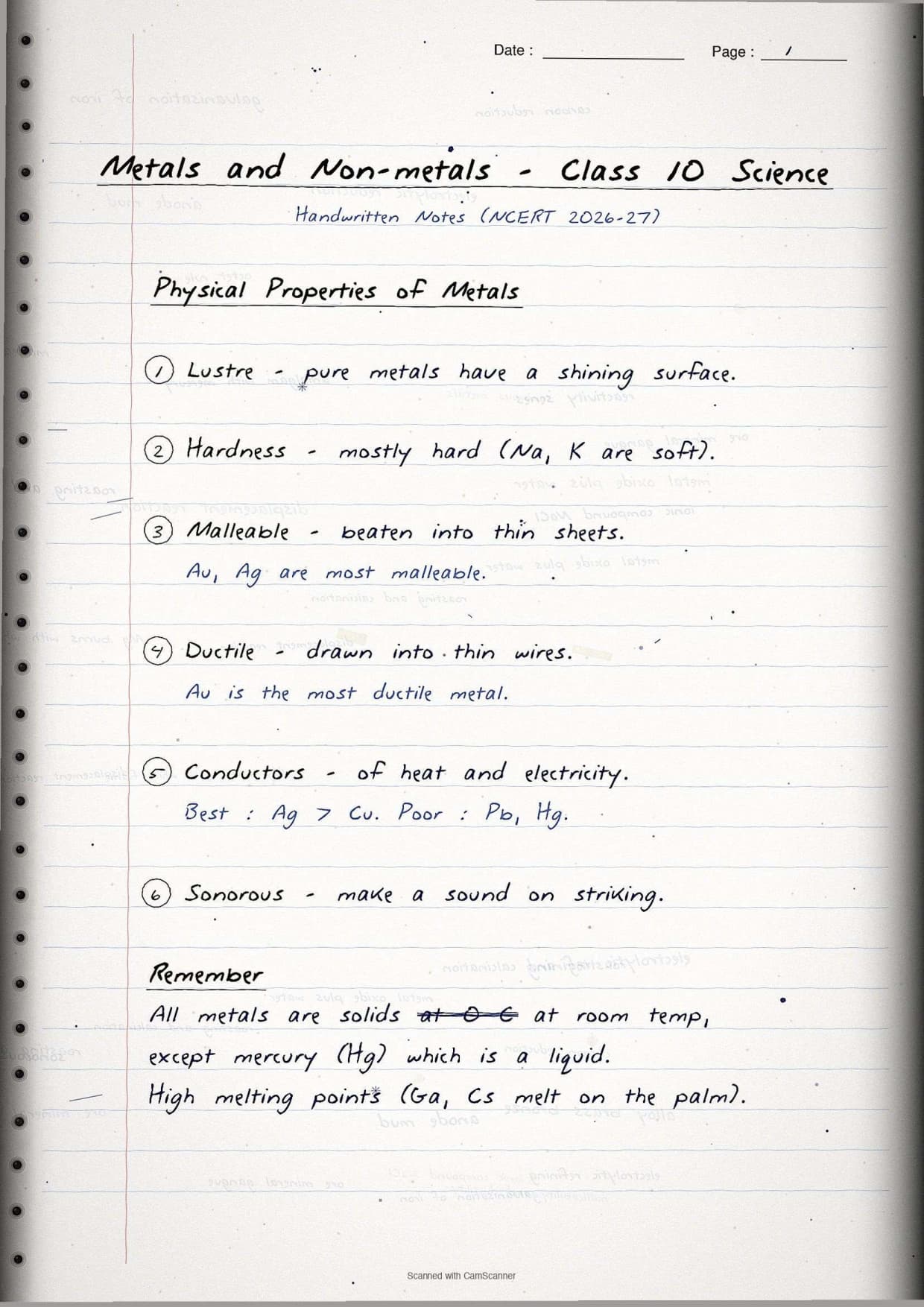
Physical Properties of Metals and Non-metals: The First Pages
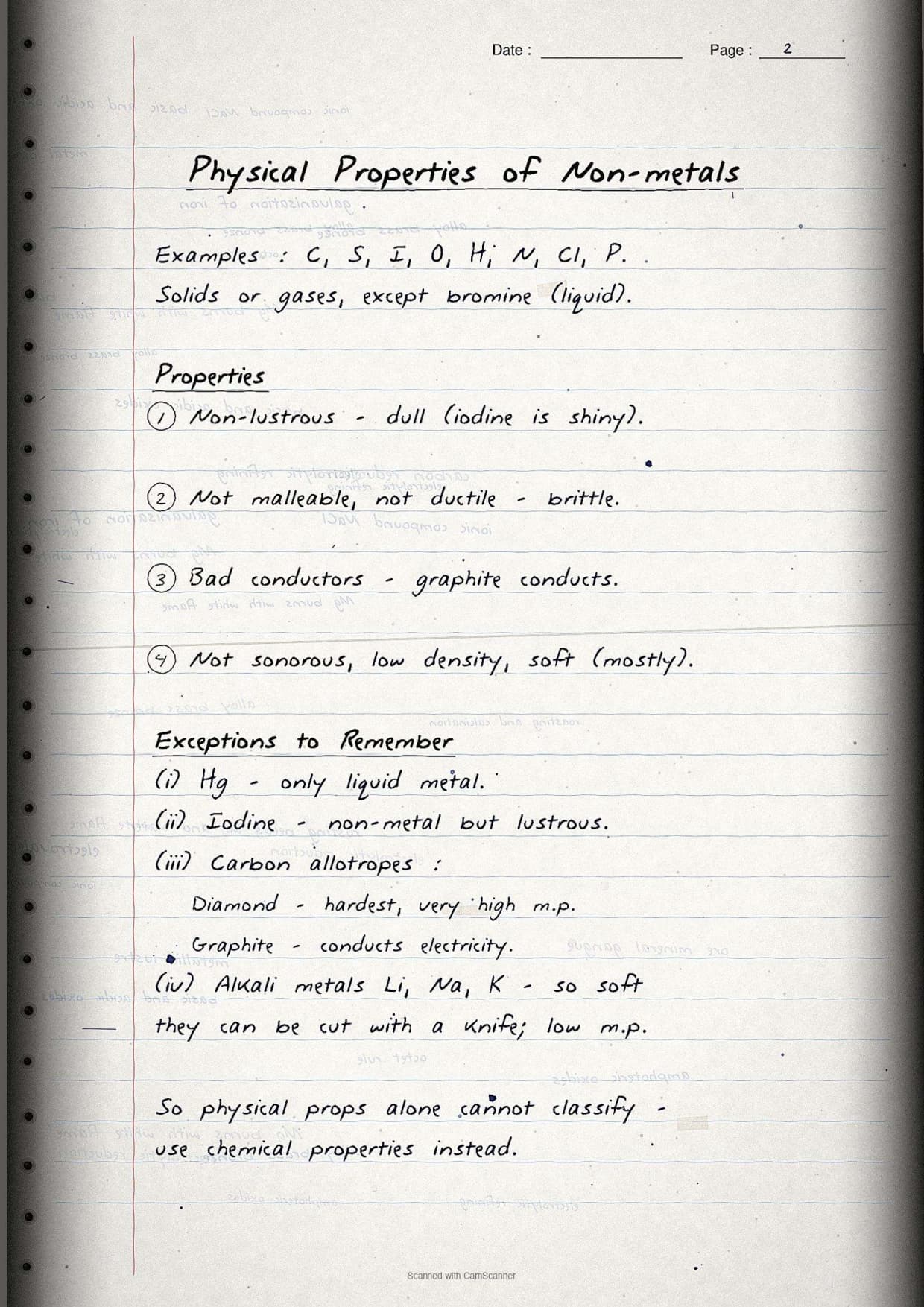
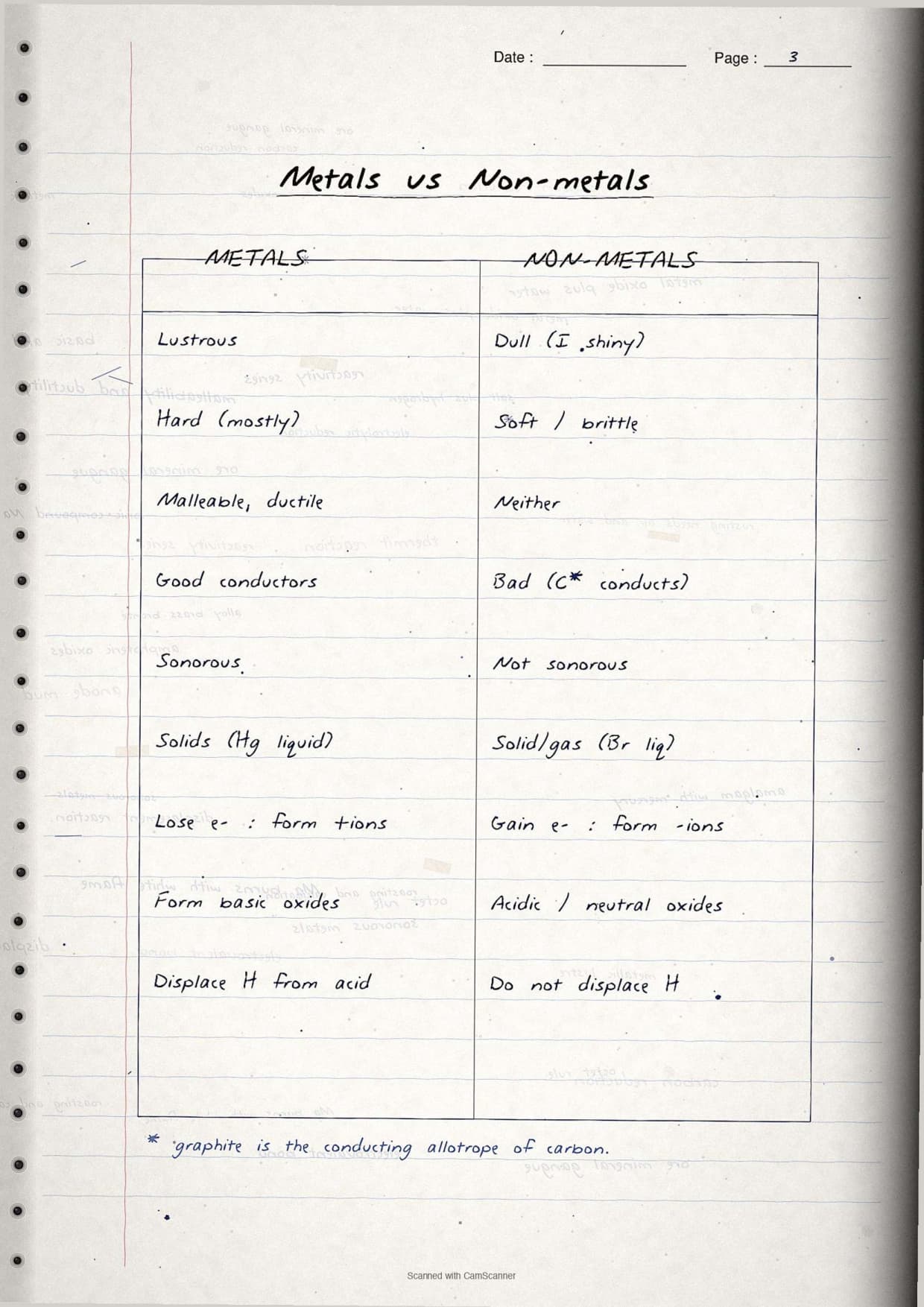
The opening pages settle how metals and non-metals differ physically. Metals are shiny, hard and good conductors; non-metals are mostly dull, brittle and poor conductors.
| Property | Metals | Non-metals |
|---|---|---|
| Lustre | Shiny (metallic lustre) | Usually dull (iodine is an exception) |
| State | Solid (mercury is liquid) | Solid, liquid or gas (bromine is liquid) |
| Malleability | Malleable and ductile | Brittle (break on hammering) |
| Conduction | Good conductors of heat and electricity | Poor conductors (graphite is an exception) |
| Sonority | Sonorous (ring when struck) | Not sonorous |
The exceptions students lose marks on: mercury is the only liquid metal, while sodium and potassium are soft enough to cut with a knife. Among non-metals, graphite conducts electricity and iodine is lustrous. Two terms the paper asks to define:
- Malleable: can be beaten into thin sheets, like foil.
- Ductile: can be drawn into thin wires, like copper.
Chemical Properties Every Class 10 Student Must Know
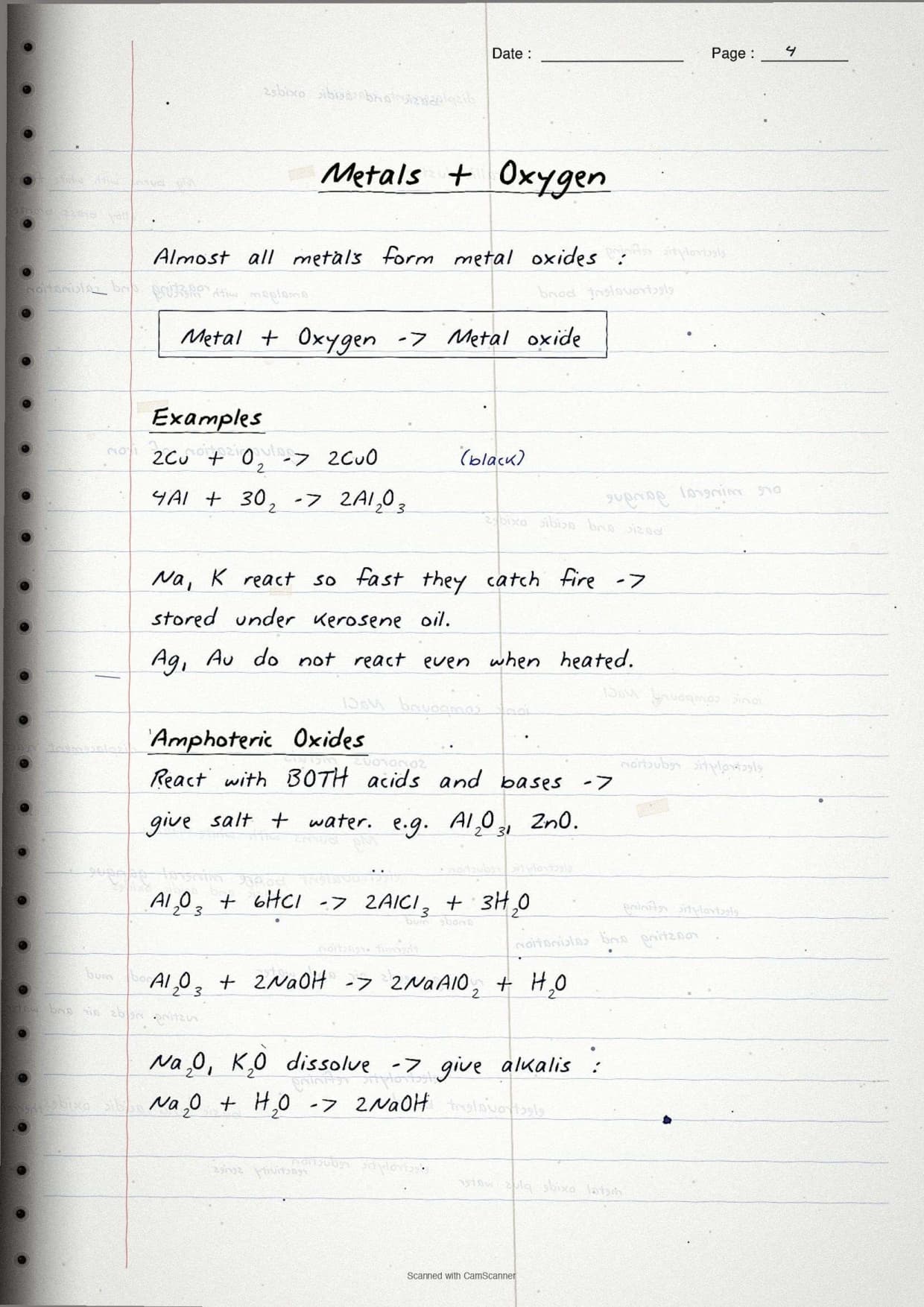
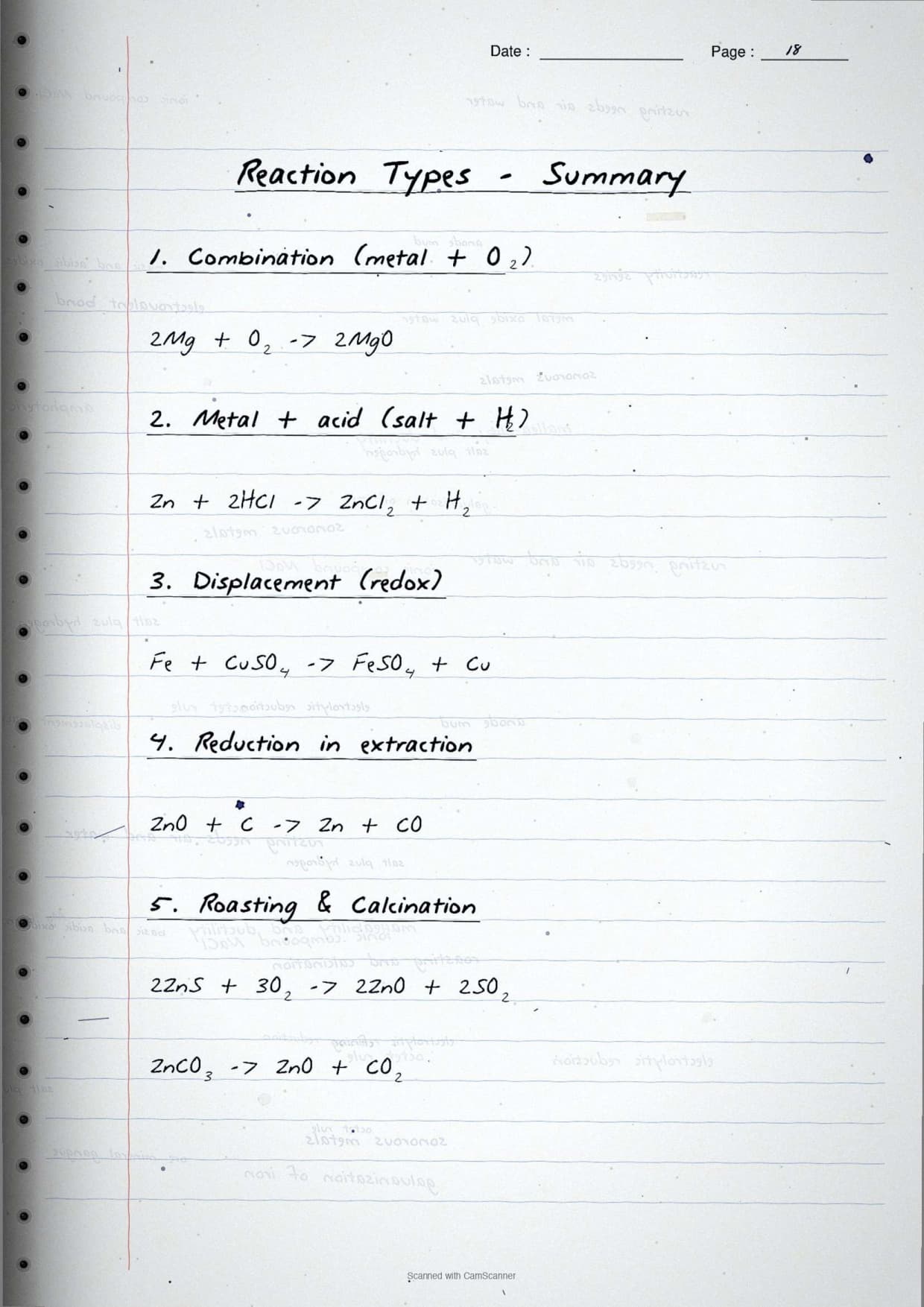
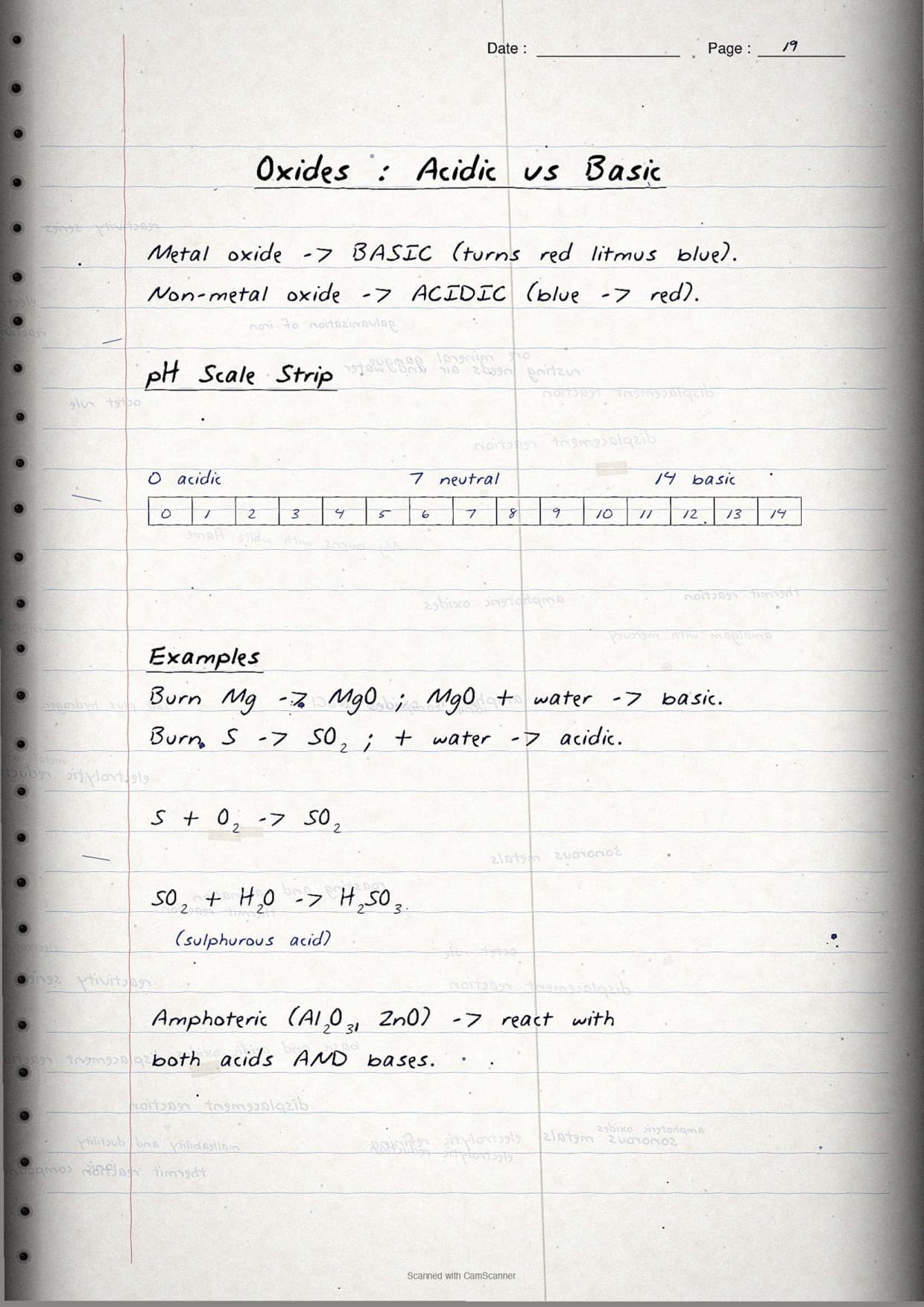
One spread covers how metals react with oxygen, water and acids. The rule: metals form basic oxides, non-metals acidic oxides. A burning metal forms a basic metal oxide; magnesium burns with a bright white flame:
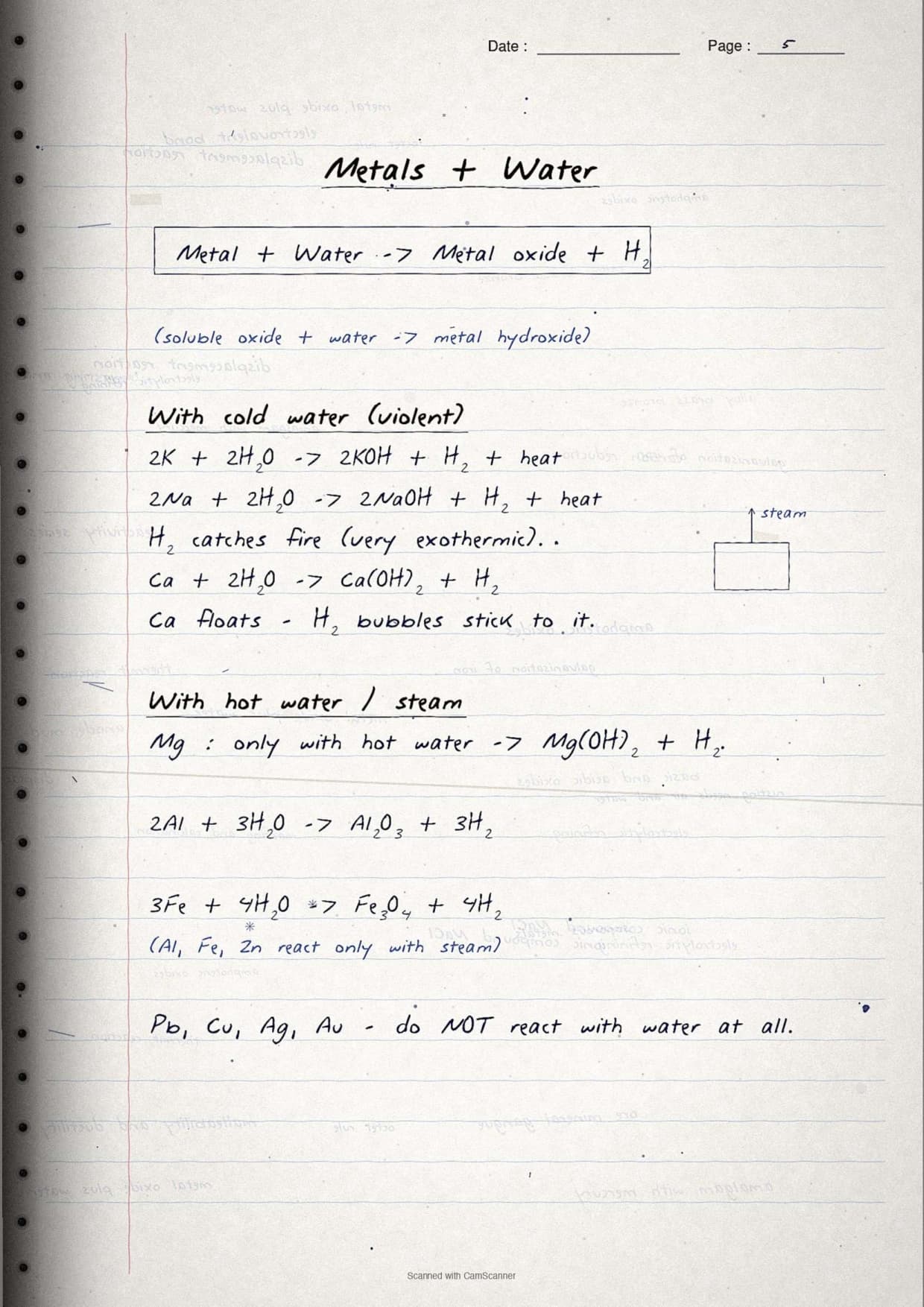
A reactive metal reacts with water to give a hydroxide and hydrogen. Sodium reacts so violently it catches fire on water:
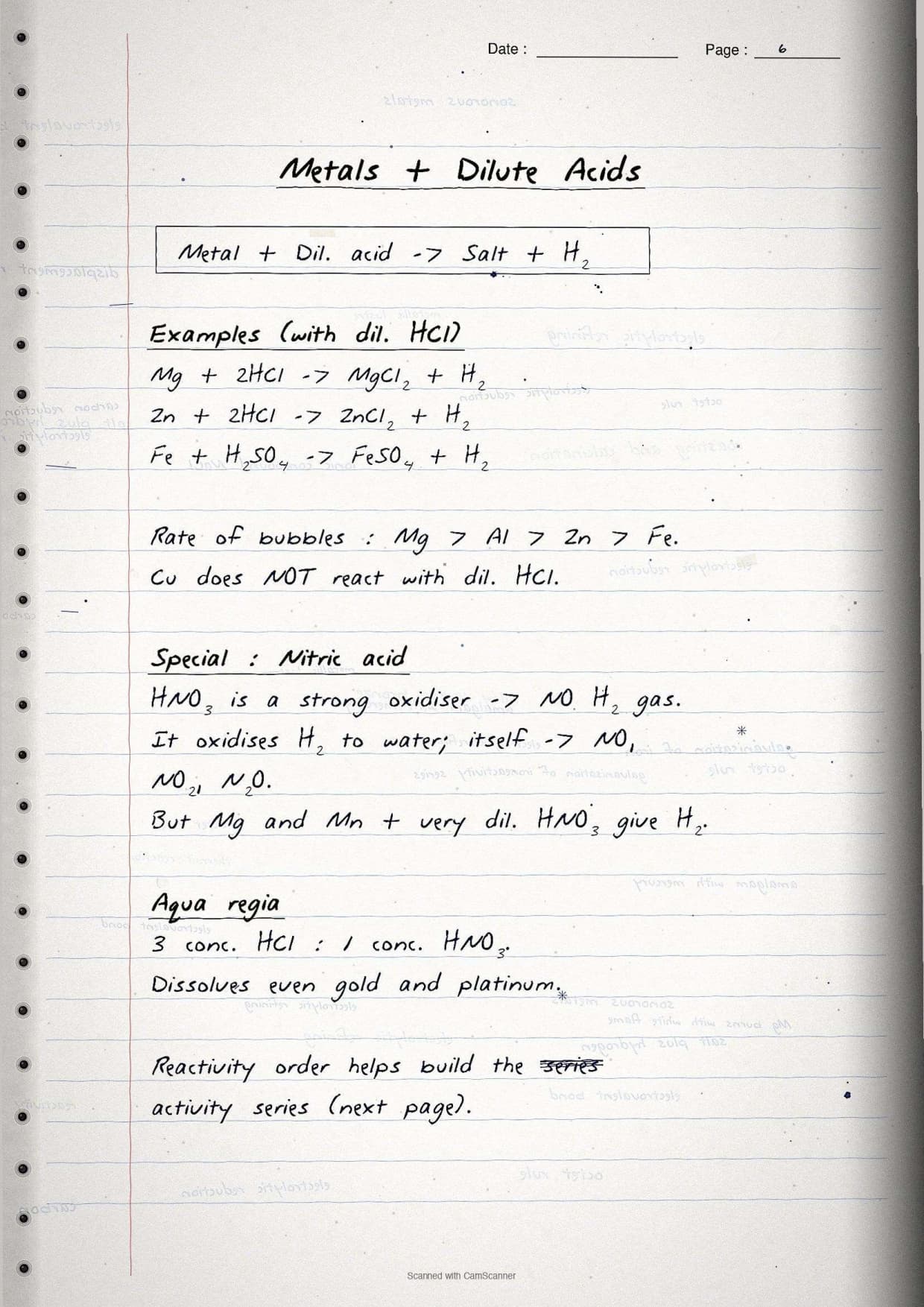
A metal with a dilute acid gives a salt and hydrogen, a favourite 2-mark question:
A special case examiners check: most metals give hydrogen with dilute acids, but copper does not because it is below hydrogen. The amphoteric oxides, aluminium oxide and zinc oxide, react with both acids and bases.
The Reactivity Series in the Notes
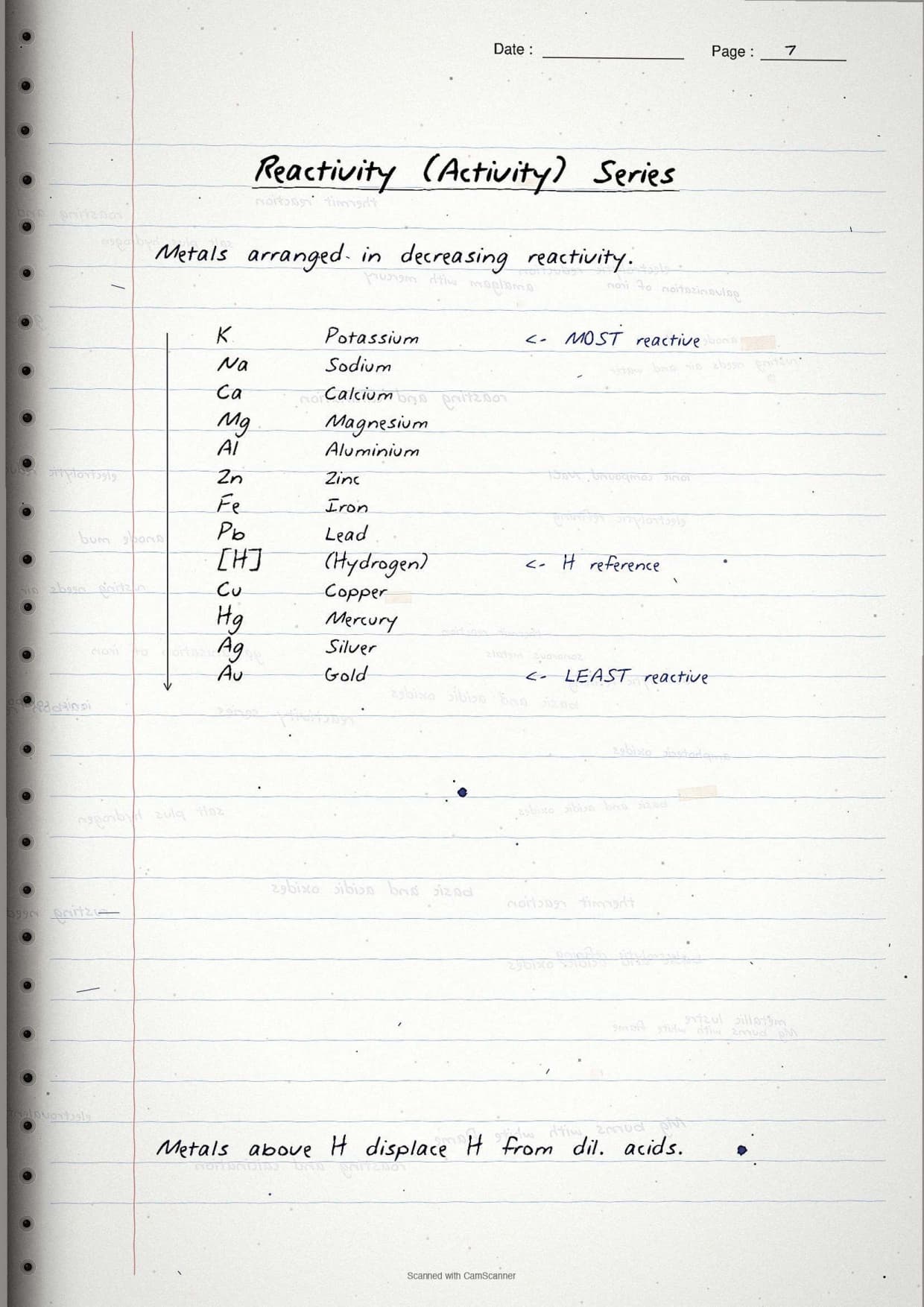
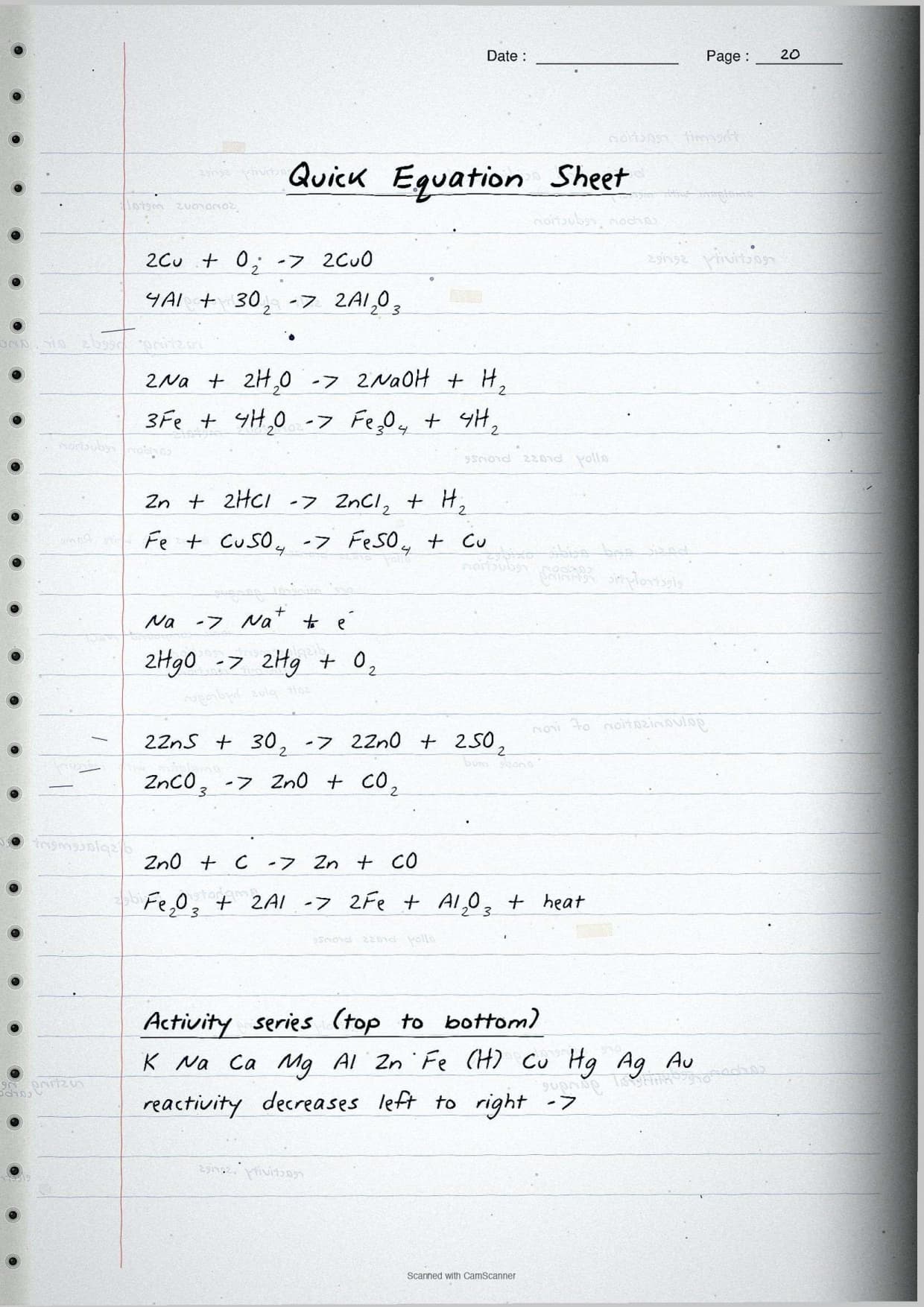
This is the page students revise most for 3-mark questions. The reactivity series is a top-to-bottom ladder: a metal higher up displaces one lower down from its salt solution. The boxed ladder runs from most reactive to least:
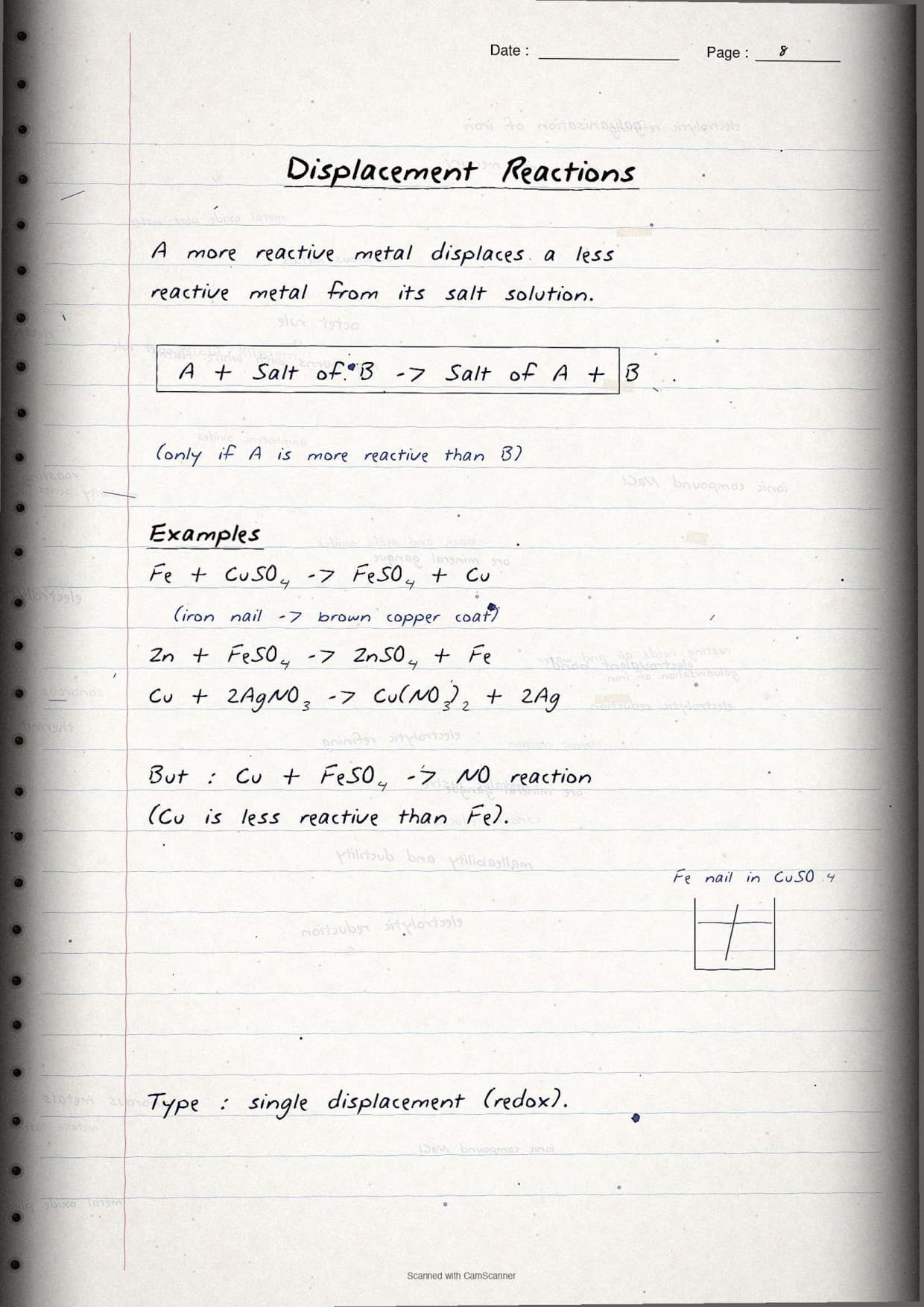
- Higher displaces lower: a more reactive metal pushes a less reactive one out of its salt; iron displaces copper.
- Worked line: Fe (s) + CuSO4 (aq) → FeSO4 (aq) + Cu (s); the blue solution fades and a reddish-brown copper layer forms.
- Hydrogen marker: metals above hydrogen give H2 with acids; those below, like copper and silver, do not.
Memory hook: the top metals (potassium, sodium, calcium) react even with cold water, while gold and silver occur free in nature.
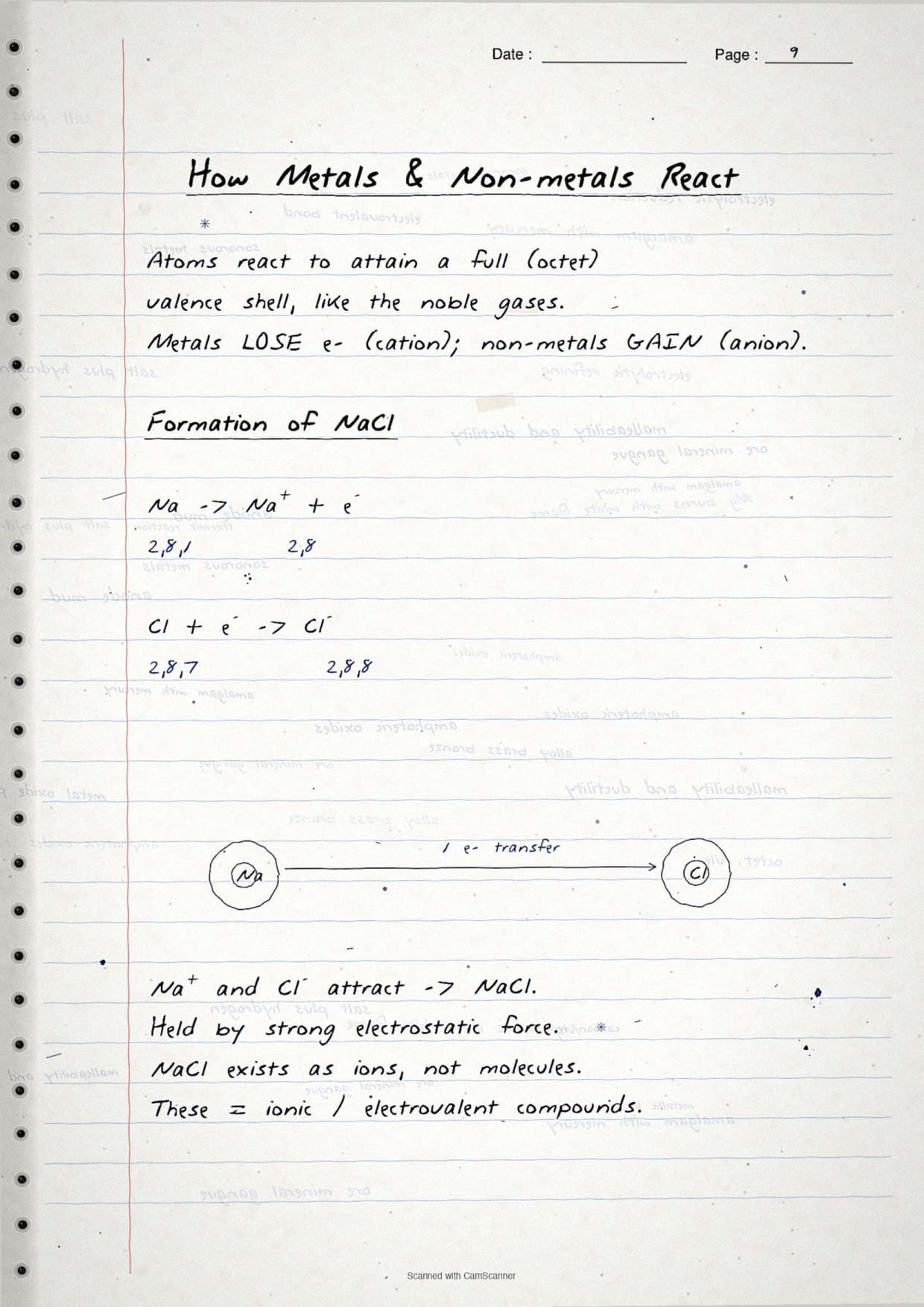
How Metals and Non-metals React: Ionic Bonds
This page explains why metals and non-metals join: a metal gives electrons and a non-metal takes them, forming an ionic bond. The metal becomes a positive ion and the non-metal a negative ion. The boxed example is sodium chloride:
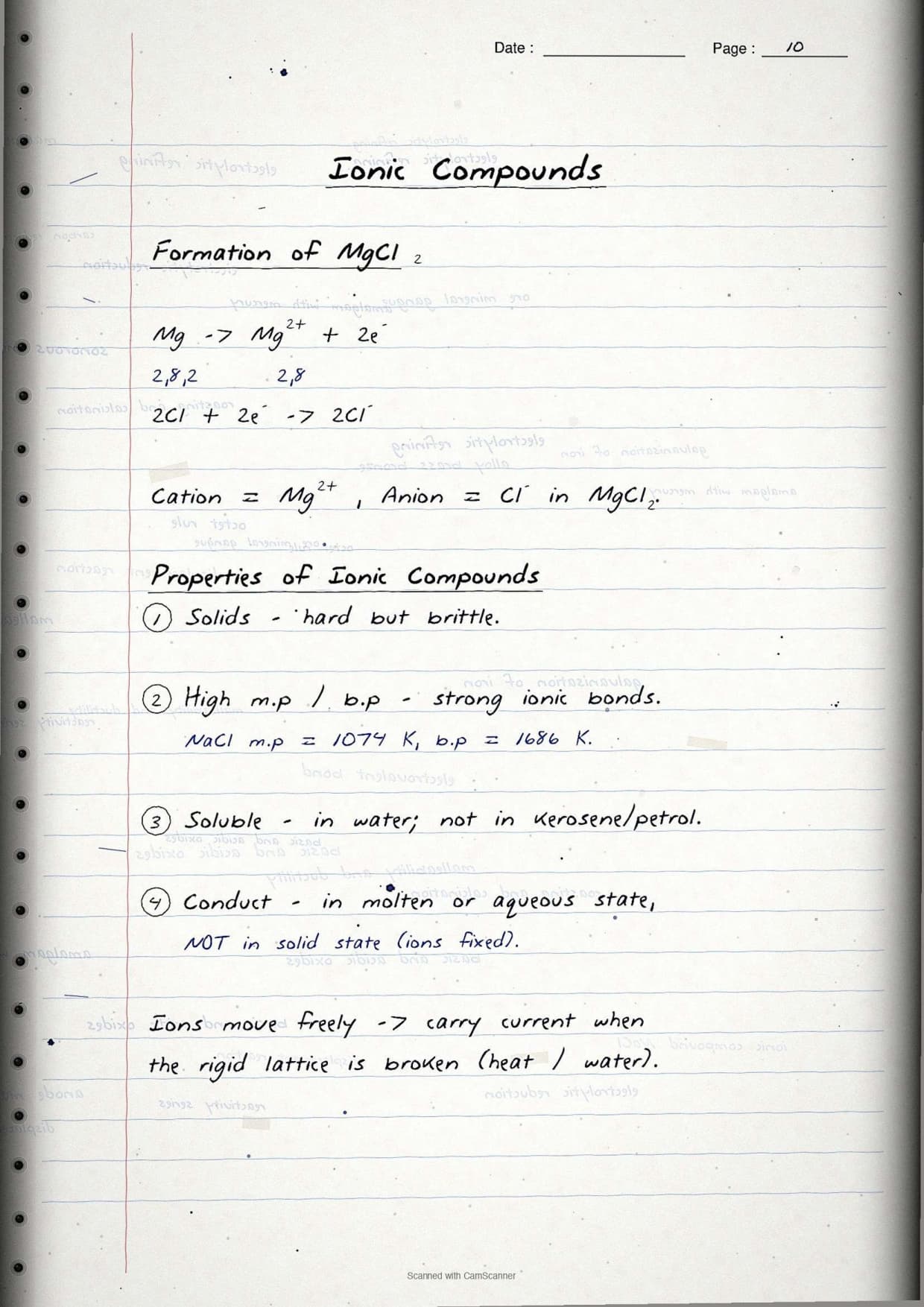
Properties of ionic compounds the paper asks to list:
- High melting points: strong forces between the ions need much heat to break.
- Solubility: most dissolve in water but not in petrol.
- Conduction: they conduct when molten or in solution, as the ions are then free to move.
Ionic compounds conduct only when molten or dissolved, never solid, because the ions are locked in place in a solid. The strong ionic bonds also make them hard and brittle.
Occurrence, Extraction of Metals and Corrosion
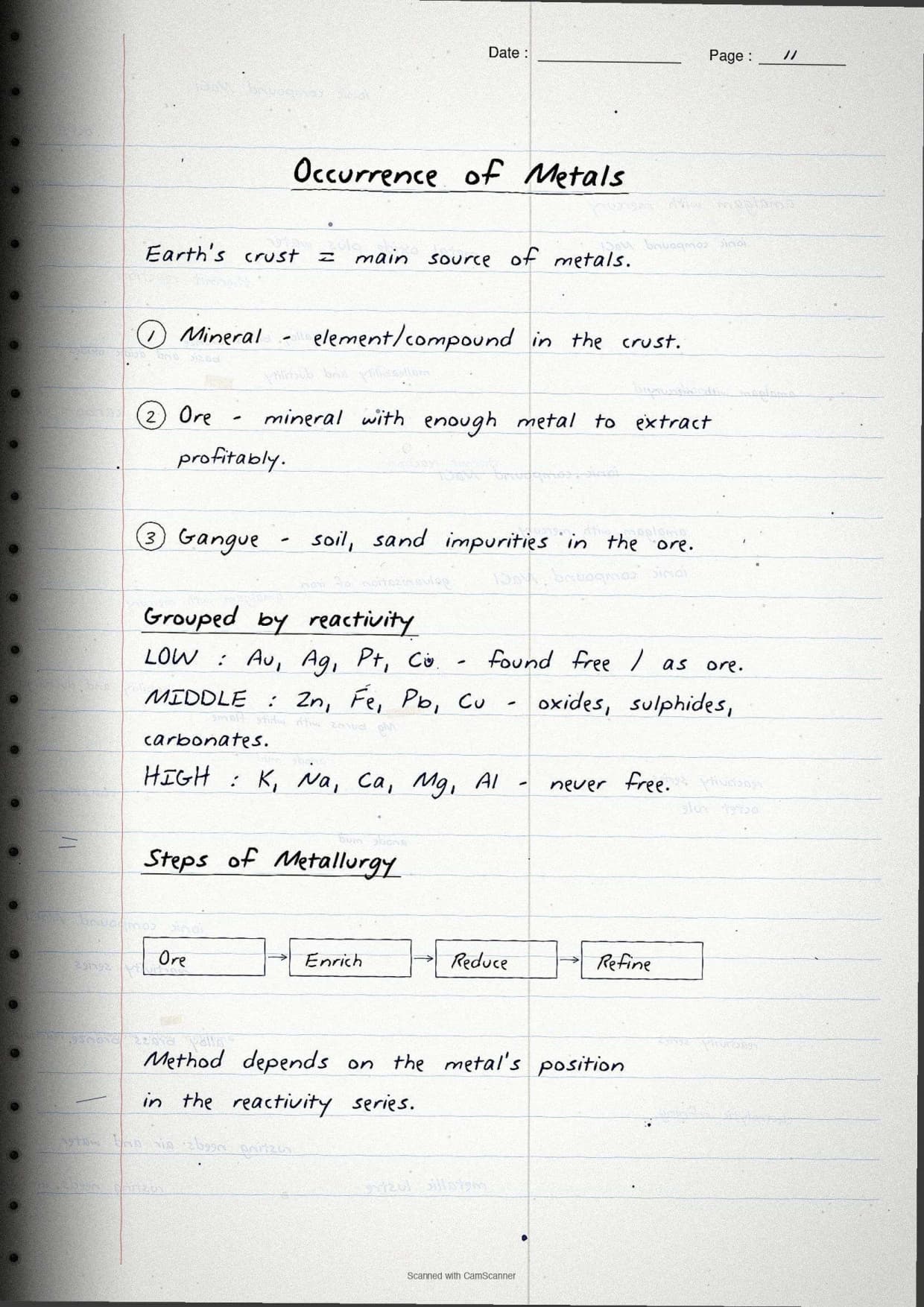
The last spread covers metallurgy: extracting a metal from its ore, and stopping corrosion. Metals occur as minerals and ores. The key terms:
- Mineral: a natural element or compound containing a metal.
- Ore: a mineral from which a metal can be extracted profitably.
- Gangue: the unwanted sand and rock mixed with the ore.
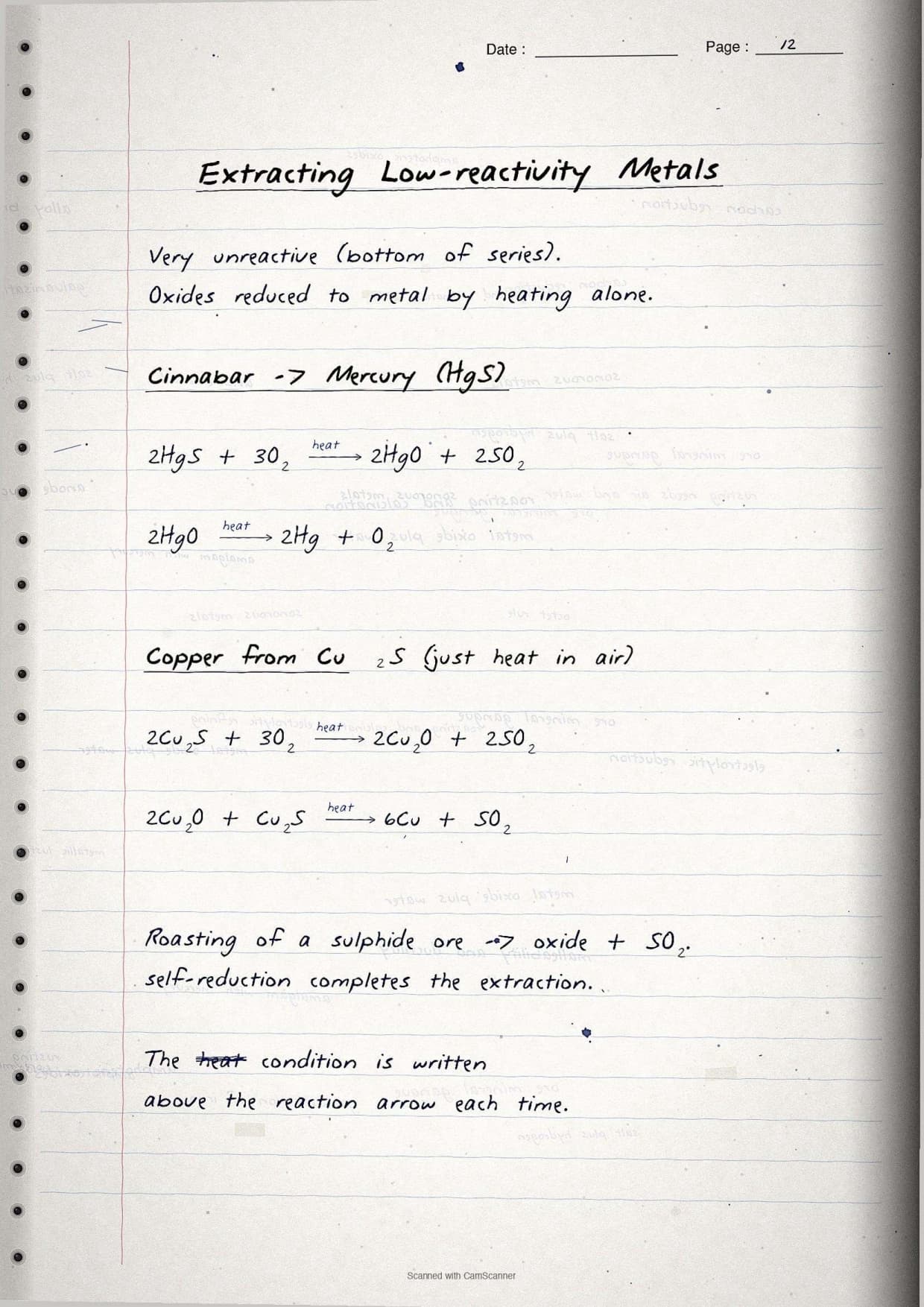
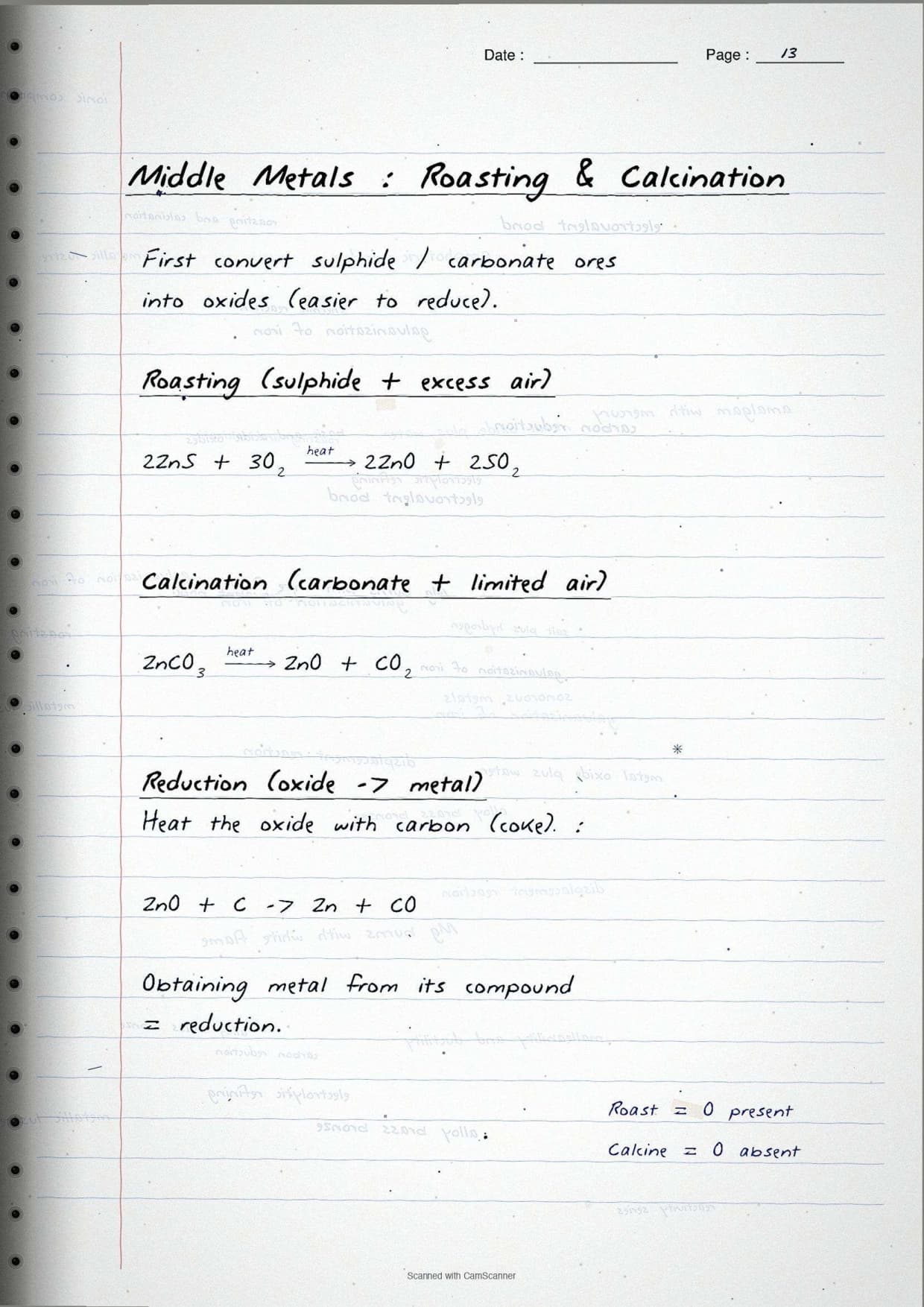
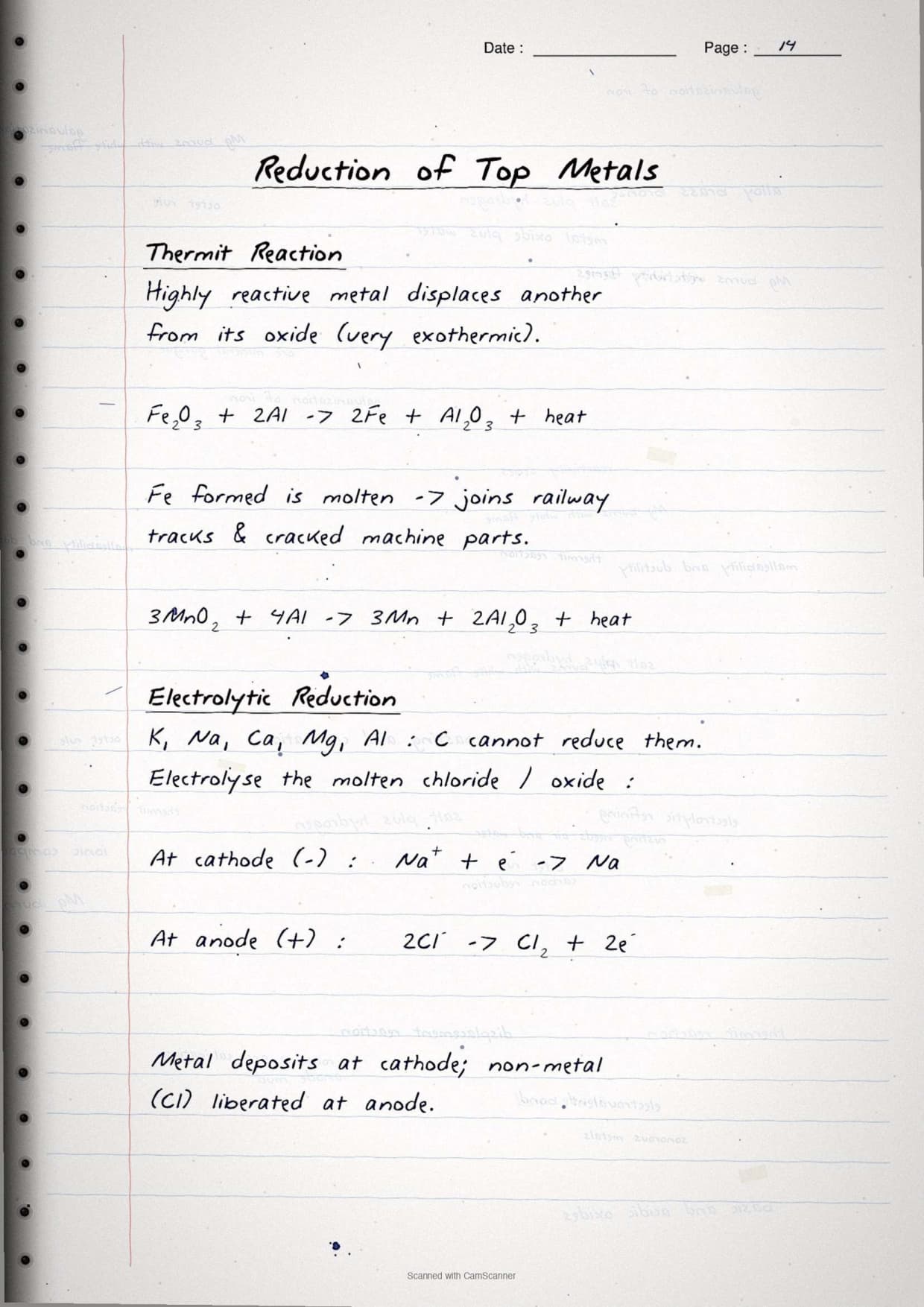
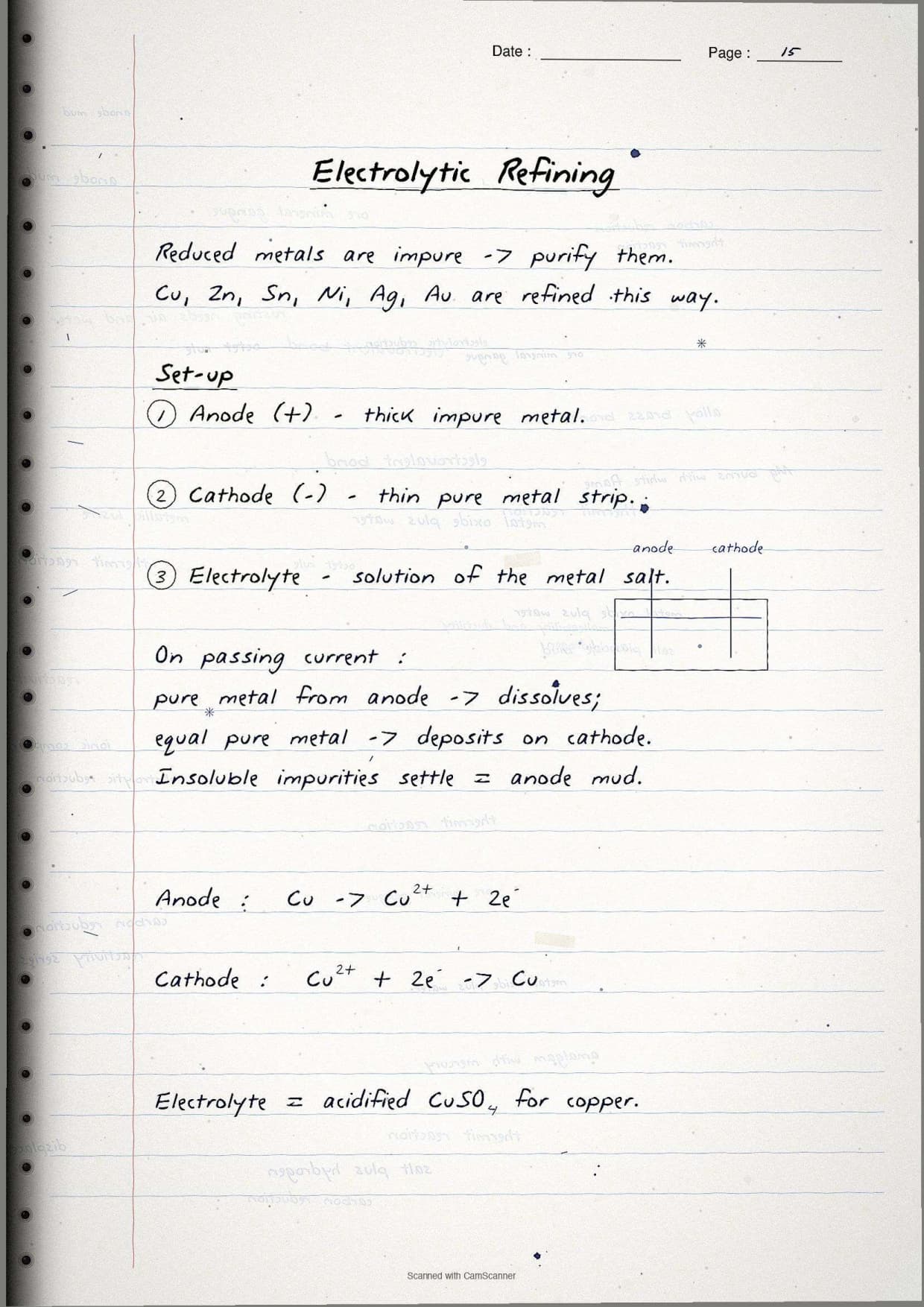
The steps of extraction are set by reactivity. A medium-reactive metal like zinc is roasted, then reduced with carbon, a favourite question:
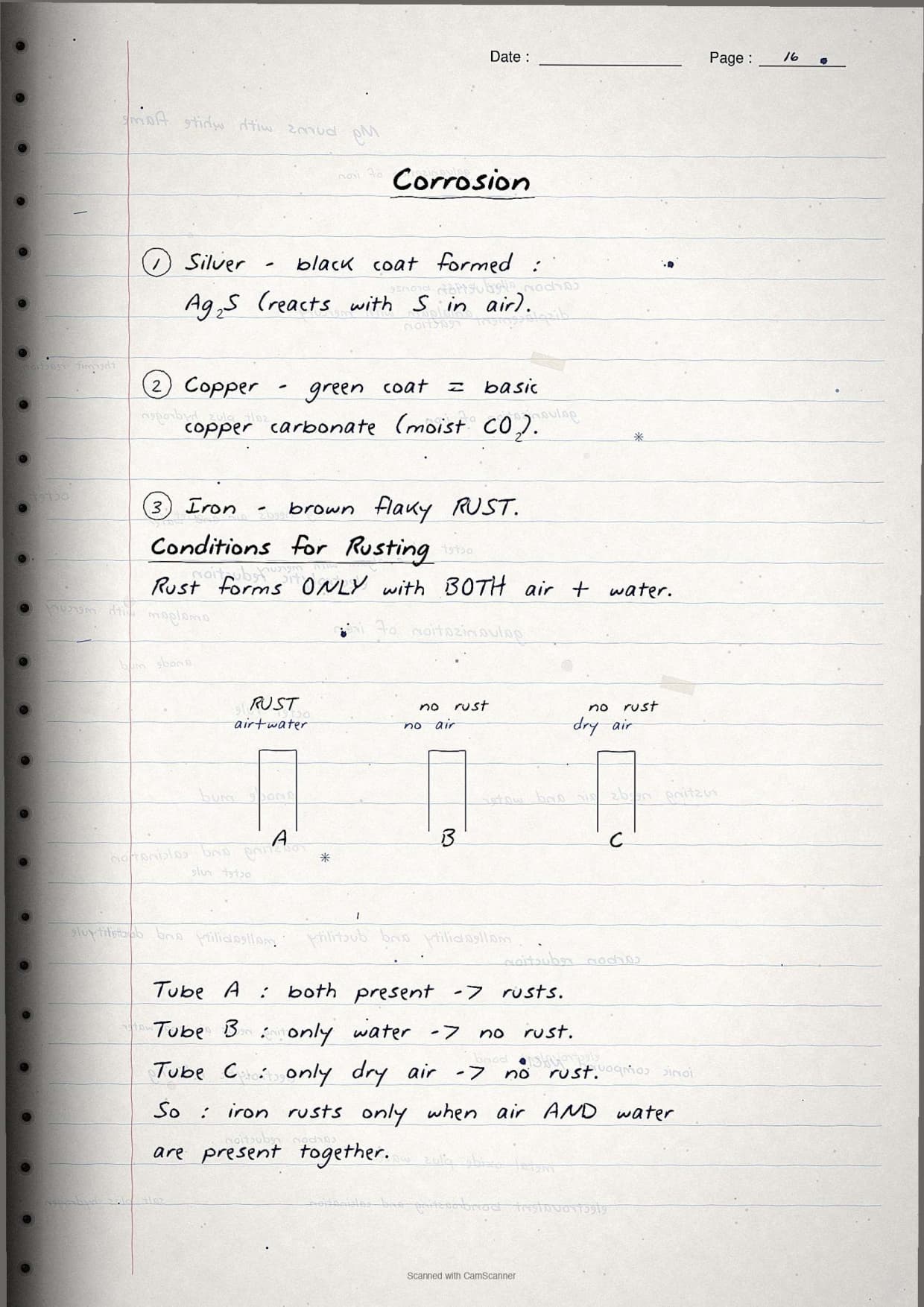
The page closes with corrosion and its prevention:
- Rusting: iron forms a reddish-brown coat of hydrated iron oxide given both air and moisture.
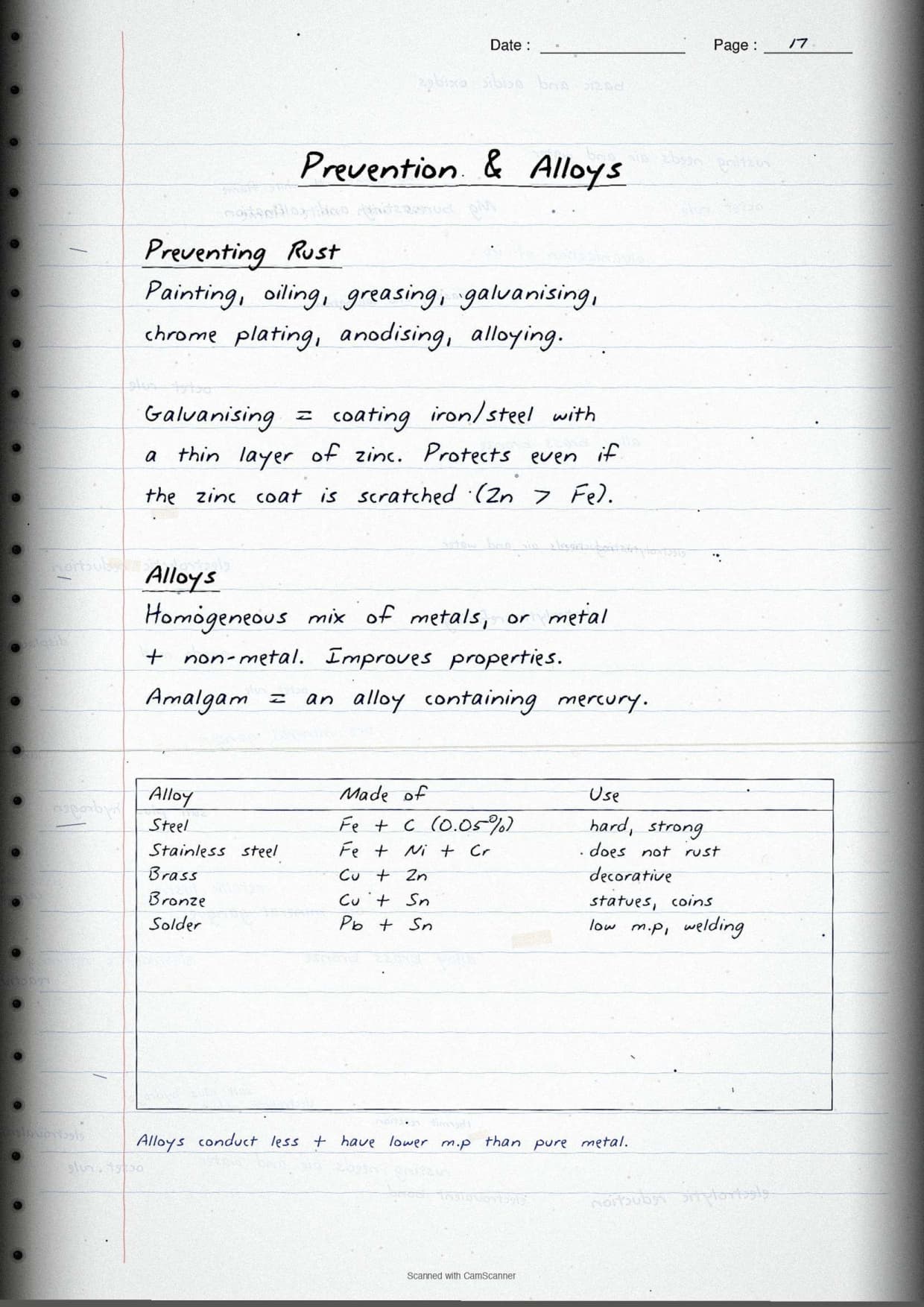
- Prevention: painting, oiling, galvanisation (a zinc coat) and alloying keep air and water off.
- Alloy: a mix of a metal with other metals or a non-metal, like steel (iron + carbon) and brass (copper + zinc).
Galvanisation coats iron with zinc, which protects the iron even if scratched, because zinc is more reactive than iron.
How to Use These Handwritten Notes Effectively
Handwritten notes work best as a final revision layer, not your first read. Use the Metals and Non-metals handwritten notes like this before the board exam:
- First pass: read in order, properties first, then the reactivity series, then ionic bonds and metallurgy.
- Active recall: cover the boxed reactions and write each salt and gas product from memory.
- Ladder drill: redraw the reactivity series, since the paper often gives 1 mark for the correct order.
The scanned pages save on a phone for offline revision; check your reactions against the full solutions.
Common Mistakes These Notes Help You Avoid
A few errors cost marks every year, mostly from the reactivity order or the ore and mineral terms:
- Saying a less reactive metal displaces a more reactive one. The higher metal always displaces the lower.
- Claiming all metals react with dilute acids. Copper, silver and gold do not.
- Confusing a mineral with an ore. Every ore is a mineral, but only one that pays to mine is an ore.
- Saying ionic compounds conduct when solid. They conduct only when molten or in solution.
- Calling galvanisation a tin coat. It is a coat of zinc, not tin.
How These Notes Pair with the Solutions and Book PDF
Use these notes with the other resources for the same chapter, linked below.
| Resource | Best used for |
|---|---|
| Metals and Non-metals NCERT Solutions | Step-by-step balanced answers for every in-text and back-exercise question |
| Metals and Non-metals Class 10 Notes | Quick typed summary with every reaction, property and ore in one place |
| Metals and Non-metals Formula Sheet | One-page list of the key reactions, the reactivity series and ore formulae |
| Metals and Non-metals NCERT Book PDF | Reading the original NCERT chapter text from the textbook |
All Class 10 Science Handwritten Notes by Chapter
The table links the handwritten notes for every Class 10 Science chapter. Metals and Non-metals is highlighted.
| Chapter | Handwritten Notes |
|---|---|
| Chapter 1 | Chemical Reactions and Equations |
| Chapter 2 | Acids, Bases and Salts |
| Chapter 3 | Metals and Non-metals |
| Chapter 4 | Carbon and its Compounds |
| Chapter 5 | Life Processes |
| Chapter 6 | Control and Coordination |
| Chapter 7 | How do Organisms Reproduce? |
| Chapter 8 | Heredity |
| Chapter 9 | Light - Reflection and Refraction |
| Chapter 10 | The Human Eye and the Colourful World |
| Chapter 11 | Electricity |
| Chapter 12 | Magnetic Effects of Electric Current |
| Chapter 13 | Our Environment |
FAQs on Metals and Non-metals Handwritten Notes
Metals and Non-metals Class 10 Science Handwritten Notes Common Questions
Ques. Are these class 10 science chapter 3 Metals and Non-metals handwritten notes free to download?
Ans. Yes. The Metals and Non-metals handwritten notes are free to download as a PDF from this page. They follow the 2026-27 NCERT syllabus and cover the full chapter across 21 scanned, boxed-reaction pages for quick revision.
Ques. What does Chapter 3 Metals and Non-metals cover in Class 10 Science?
Ans. The notes cover the physical and chemical properties of metals and non-metals, the reactivity series, the formation of ionic bonds, the occurrence and extraction of metals, and corrosion with its prevention, all of which the CBSE board paper tests directly.
Ques. What is the reactivity series in Class 10 Science?
Ans. The reactivity series is a ladder of metals arranged from the most reactive at the top to the least reactive at the bottom, such as K, Na, Ca, Mg, Al, Zn, Fe, Pb, then hydrogen, Cu, Hg, Ag and Au. A metal higher in the series can displace a metal below it from its salt solution.
Ques. Why do ionic compounds conduct electricity only when molten or in solution?
Ans. In the solid state the ions are locked in fixed positions, so they cannot move and carry charge. When the compound is melted or dissolved in water, the ions become free to move, so the molten salt or its solution conducts electricity.
Ques. Are these notes enough for the class 10 science chapter 3 board exam?
Ans. They are a strong final revision layer. For full preparation, pair them with the NCERT Solutions linked on this page so you can write out complete balanced answers to every in-text and back-exercise question and check them against model answers.



Comments