




Water Resources is the chapter where students lose marks by mixing up project names and harvesting terms.
Chapter3WaterResourcesHandwrittenNotes.pdf?page=1&dpi=150)
Chapter3WaterResourcesHandwrittenNotes.pdf?page=2&dpi=150)
Chapter3WaterResourcesHandwrittenNotes.pdf?page=3&dpi=150)
Chapter3WaterResourcesHandwrittenNotes.pdf?page=4&dpi=150)
Chapter3WaterResourcesHandwrittenNotes.pdf?page=5&dpi=150)
Chapter3WaterResourcesHandwrittenNotes.pdf?page=6&dpi=150)
Chapter3WaterResourcesHandwrittenNotes.pdf?page=7&dpi=150)
Chapter3WaterResourcesHandwrittenNotes.pdf?page=8&dpi=150)
Chapter3WaterResourcesHandwrittenNotes.pdf?page=9&dpi=150)
Chapter3WaterResourcesHandwrittenNotes.pdf?page=10&dpi=150)
Chapter3WaterResourcesHandwrittenNotes.pdf?page=11&dpi=150)
Chapter3WaterResourcesHandwrittenNotes.pdf?page=12&dpi=150)
Chapter3WaterResourcesHandwrittenNotes.pdf?page=13&dpi=150)
Chapter3WaterResourcesHandwrittenNotes.pdf?page=14&dpi=150)
Chapter3WaterResourcesHandwrittenNotes.pdf?page=15&dpi=150)
Chapter3WaterResourcesHandwrittenNotes.pdf?page=16&dpi=150)
Chapter3WaterResourcesHandwrittenNotes.pdf?page=17&dpi=150)
Chapter3WaterResourcesHandwrittenNotes.pdf?page=18&dpi=150)
Chapter3WaterResourcesHandwrittenNotes.pdf?page=19&dpi=150)
Chapter3WaterResourcesHandwrittenNotes.pdf?page=20&dpi=150)
The class 10 geography handwritten notes chapter 3 Water Resources turn the chapter into clean, scanned notebook pages for 2026-27. They follow Chapter 3 of Contemporary India II and box every key term, year and scheme so revision takes minutes.
- Handwritten, scanned-style pages with boxed key terms and a labelled hydrological cycle diagram.
- This Class 10 Geography chapter usually carries 5 to 6 marks in the board paper.
- Pairs with the NCERT Solutions, Notes and Book PDF linked lower on this page.
These Water Resources handwritten notes are prepared from the official NCERT Contemporary India II textbook and checked against the last five years of CBSE board papers.
What These Handwritten Notes Include
Water Resources is the third chapter of Contemporary India II. It studies why water is scarce even though it is renewable, how dams and multipurpose projects work, and how rainwater harvesting saves water locally. These notes condense it into pages a student can read in one sitting.
Every page is built around four threads:
- Scarcity pages cover why water runs short and the five human causes behind it.
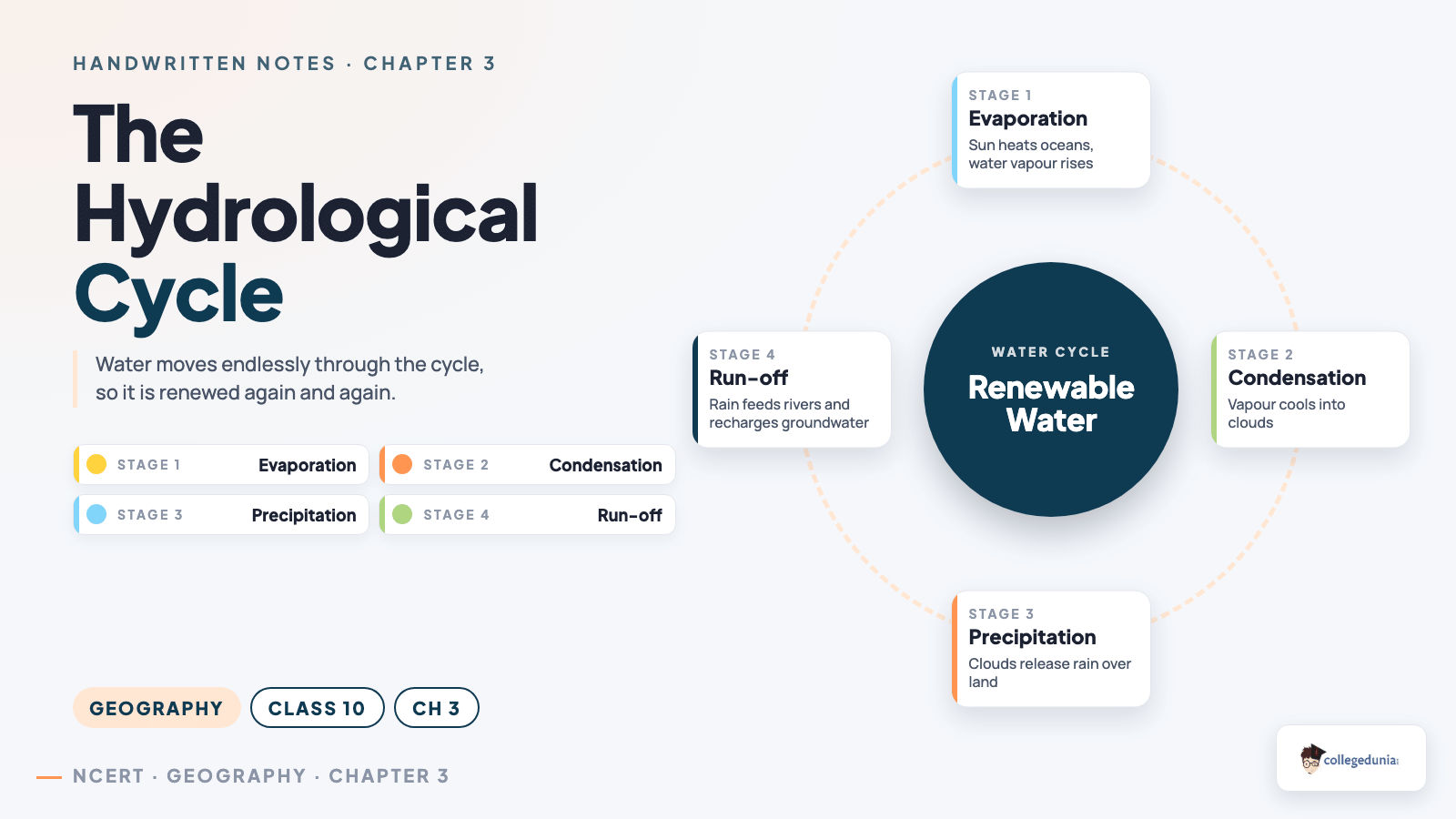
- Hydrological cycle pages box why water is a renewable resource with a labelled diagram.
- Multipurpose projects pages list the uses, famous dams, and the criticism against them.
- Rainwater harvesting pages cover guls, khadins, johads and the tankas of Rajasthan.
Key terms sit in boxes and important years are underlined, so the notes are ideal for a last revision when there is no time to read full paragraphs.
Water Resources Explained in Simple Language
Source: Magnet Brains on YouTube
Why Water is Scarce Even Though it is Renewable
The first pages clear up the biggest confusion in this chapter. Water moves through the hydrological cycle, so it is renewed again and again. Yet clean freshwater at one place and time is limited, which is why scarcity is real.
- Renewable resource: all water moves in the water cycle, so it is recharged endlessly.
- Water scarcity: a shortage of water relative to its demand, not just low rainfall.
- The myth: scarcity is not limited to dry regions like Rajasthan with enough rainfall.
- The real cause: over-use, over-exploitation and unequal access among social groups.
The notes box the most-tested point: scarcity means demand is greater than supply. Getting this renewable-yet-scarce idea right turns an average answer into a full-marks one.
The Five Causes of Water Scarcity Pages
These pages list why India faces water scarcity. The notes give one numbered line for each cause so students can write the long answer without missing a point.
| Cause | One-line cue to recall |
|---|---|
| Growing population | More people need more water for homes and to grow more food. |
| Irrigated agriculture | The largest water consumer; wells and tube-wells drop groundwater levels. |
| Industrialisation | Industries consume heavy water and also need hydroelectric power. |
| Urbanisation | Dense cities over-pump groundwater with their own devices. |
| Bad water quality | Pollution by waste, chemicals and pesticides makes water unfit for use. |
The pages box a sharp warning: water can exist and still be useless if it is polluted. Irrigated agriculture and falling groundwater is the most-asked cause here.
Multipurpose River Projects and Temples of Modern India
These pages explain how India conserves and manages water through dams. The notes box what a dam is, list the uses of a multipurpose project, and name the famous projects students must remember.
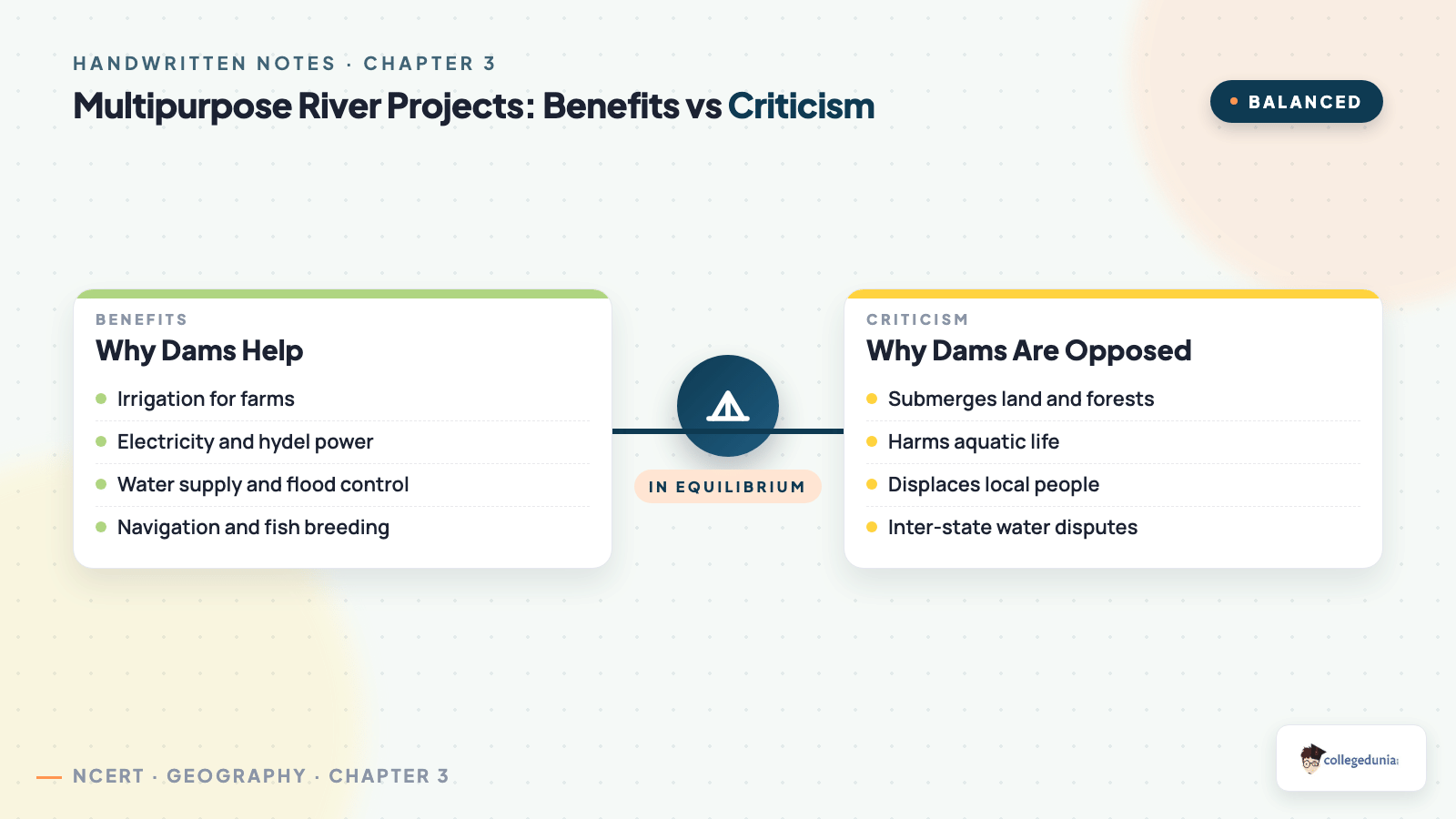
- What a dam is: a barrier across flowing water that creates a reservoir or lake.
- Many uses together: irrigation, electricity, water supply, flood control, navigation, fish breeding.
- Bhakra-Nangal: on the Sutlej-Beas for irrigation plus hydel power.
- Hirakud: on the Mahanadi basin for water conservation with flood control.
The notes box the most-quoted line: Nehru called dams the "temples of modern India". Naming Bhakra-Nangal and Hirakud with their rivers is the part students forget first.
Criticism of Multipurpose Projects and the Narmada Bachao Andolan
These pages give the other side of the dam debate, which the five-mark question always wants. The notes list the criticisms one by one and box the famous movement that protested against a large dam.
- Affects natural flow: damming causes poor sediment flow and heavy silting in the reservoir.
- Harms aquatic life: dams fragment rivers, making it hard for fish to migrate and spawn.
- Submerges land: reservoirs drown existing vegetation and soil, which then decomposes.
- Induced problems: projects have triggered earthquakes, water-borne diseases and pollution.
- Displacement: the Narmada Bachao Andolan rose against the Sardar Sarovar Dam over land loss.
The pages box the honest takeaway: many people lost land without gaining the benefits of the project. Showing both the use and the harm of dams is what the balanced five-mark answer needs.
Rainwater Harvesting and the Tankas of Rajasthan Pages
The last pages cover the local, low-cost way to save water that the exam loves. The notes keep the region-wise techniques side by side and box the famous tankas of Rajasthan with a clear "how it works" note.
- Guls and kuls: diversion channels in the Western Himalayas used for farming.
- Khadins and johads: structures in Jaisalmer and the rest of Rajasthan that store rain.
- Tankas: underground tanks inside houses in Bikaner, Phalodi and Barmer for drinking water.
- Palar pani: rainwater, seen as the purest water, collected after the first cleaning spell.
The notes box the smart detail: the first spell of rain is not collected, as it cleans the roofs and pipes first.
How to Use These Handwritten Notes
Handwritten notes work best as a final layer of revision, not as your first read. The plan below helps students get the most out of them before the board exam.
- First pass: read the notes once, following the scarcity, water cycle, projects and harvesting order.
- Active recall: cover the boxed five causes and try to write all of them from memory.
- Diagram practice: redraw the hydrological cycle and the rooftop tanka without looking.
- Self-test: attempt a short class 10 geography chapter 3 mcq drill to check the small facts.
Because the pages are scanned, students can save them on a phone and revise offline on the way to the exam centre, so revision is always at hand.
Common Mistakes These Notes Help You Avoid
A few errors cost marks every year. Most come from confusing project names or forgetting that water scarcity has human causes, not just low rain. The notes flag each soft point in the margin.
- Saying water scarcity only means low rainfall - over-use and unequal access matter more.
- Mixing up Bhakra-Nangal (Sutlej-Beas) with Hirakud (Mahanadi).
- Listing only the uses of dams and forgetting the five criticisms against them.
- Forgetting that the Narmada Bachao Andolan protested the Sardar Sarovar Dam.
- Skipping the region-wise harvesting terms like guls, khadins, johads and tankas.
Students who fix these five points usually move from average to high marks. The exam rewards a balanced view of the benefits and costs of dams.
Other Resources for Water Resources Class 10 Geography
These handwritten notes are a revision layer. Pair them with the other resources for this chapter, all linked below.
| Resource | Best used for |
|---|---|
| Water Resources NCERT Solutions | Step-by-step answers to all the back-exercise questions |
| Water Resources Class 10 Notes | Quick chapter summary with all schemes and key terms in one place |
| Water Resources NCERT Book PDF | Reading the original NCERT chapter text and figures |
Tip: use the handwritten causes list to memorise the five reasons for scarcity, then write the answer in your own words.
Student Feedback
In a Collegedunia poll of 12,840 Class 10 Geography students before the 2026 boards, 76% of students said handwritten, scanned-style notes felt faster to revise from than printed text for this chapter. Most used the boxed water-scarcity causes list to recall all five points in the exam.
Source: 2026-27 Class 10 Geography student poll. Sample of 12,840 students from CBSE schools across 15 states.
All Class 10 Geography Handwritten Notes by Chapter
The table links the handwritten notes for every Class 10 Geography chapter, so students can move across the course in one click.
| Chapter | Handwritten Notes |
|---|---|
| Contemporary India II | |
| Chapter 1 | Resources and Development |
| Chapter 2 | Forest and Wildlife Resources |
| Chapter 3 | Water Resources |
| Chapter 4 | Agriculture |
| Chapter 5 | Minerals and Energy Resources |
| Chapter 6 | Manufacturing Industries |
| Chapter 7 | Lifelines of National Economy |
Water Resources Class 10 Handwritten Notes Common Questions
Ques. Where can I download the class 10 geography handwritten notes chapter 3 Water Resources PDF?
Ans. You can download the Water Resources handwritten notes PDF directly from this page. It is free, follows the 2026-27 NCERT, and gives the chapter as clean scanned notebook pages with boxed terms and a labelled hydrological cycle diagram.
Ques. Are handwritten notes good enough for the class 10 geography board exam?
Ans. Yes, for revision. Handwritten notes are best used as a final layer after you have read the chapter and practised the solutions. They make the water-scarcity causes, the multipurpose projects and the harvesting terms quick to recall in the exam.
Ques. What does the Water Resources chapter cover?
Ans. It covers why water is scarce yet renewable, the hydrological cycle, the five causes of water scarcity, multipurpose river projects like Bhakra-Nangal and Hirakud, the criticism of dams and the Narmada Bachao Andolan, and rainwater harvesting methods such as guls, khadins, johads and the tankas of Rajasthan.
Ques. Why are dams called the temples of modern India?
Ans. Jawaharlal Nehru called dams the temples of modern India because multipurpose projects were meant to join farm and village growth with rapid industrialisation. The notes box this line and explain the many uses of a dam, from irrigation and power to flood control and fish breeding.
Ques. How should I use these notes for quick revision?
Ans. Read the pages once in the scarcity, water cycle, projects and harvesting order, cover the boxed five causes and write them from memory, redraw the hydrological cycle and the rooftop tanka, then attempt a short class 10 geography chapter 3 mcq drill to test the small facts.



Comments