




The Formula Sheet for Class 9 Science Chapter 7 Work, Energy, and Simple Machines puts every relation from the new Exploration textbook on one page. In one place you get work done by a force, the work-energy theorem, kinetic and potential energy, conservation of mechanical energy, power, and the mechanical advantage of pulleys, inclined planes, and levers. The sheet uses short lines and physical-meaning glosses, so you can revise the whole chapter fast before a class test or the 2026-27 exam.
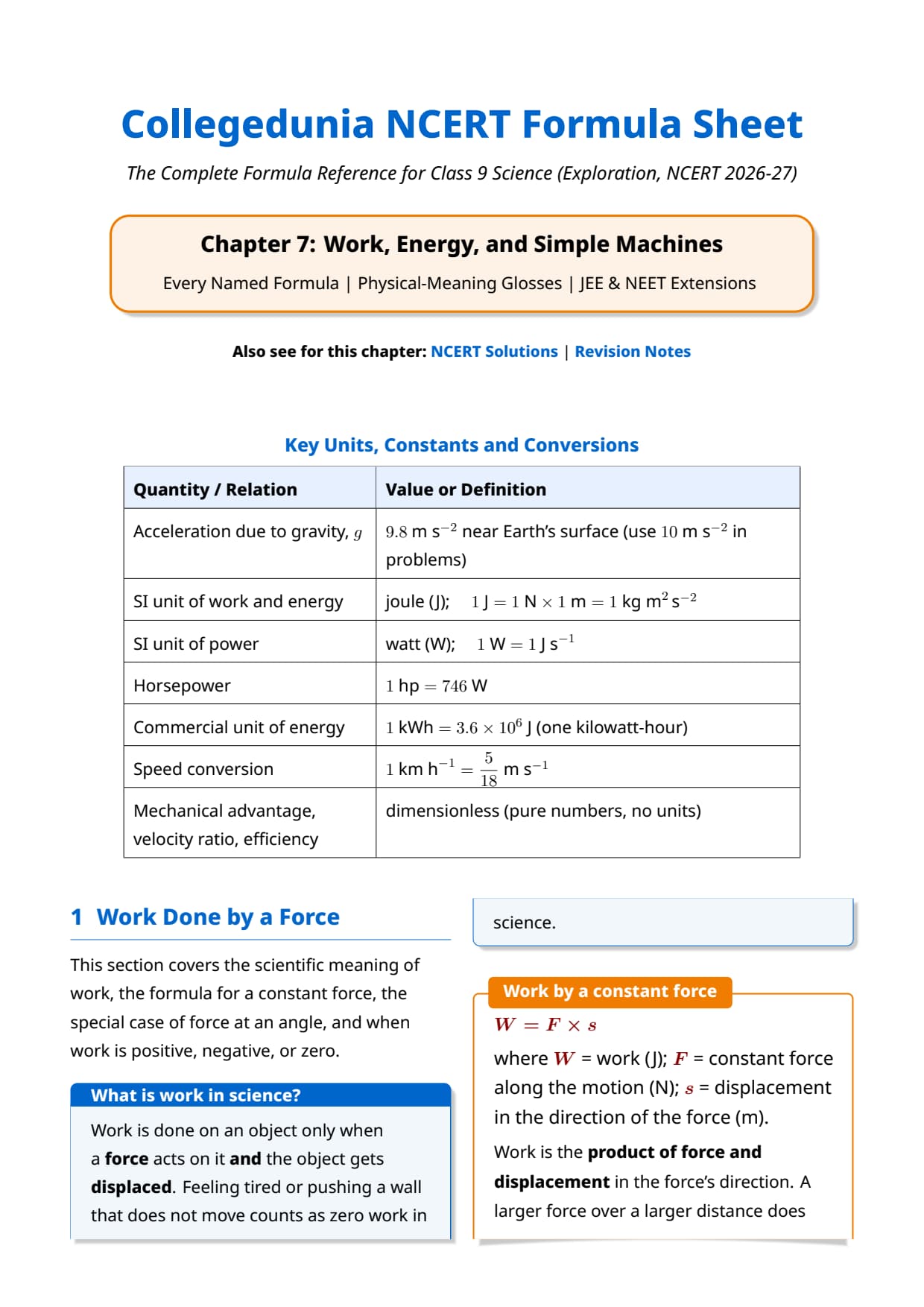
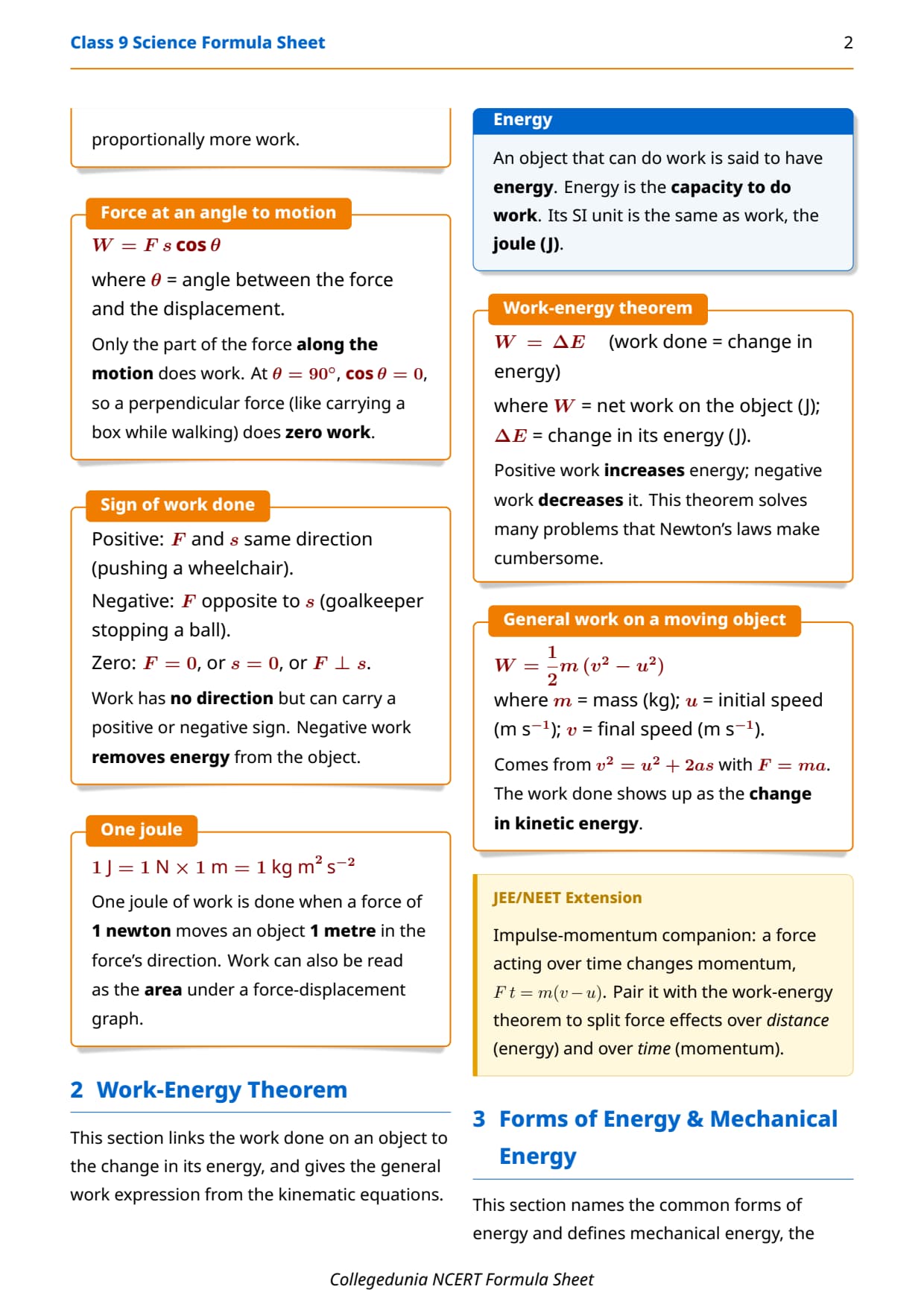
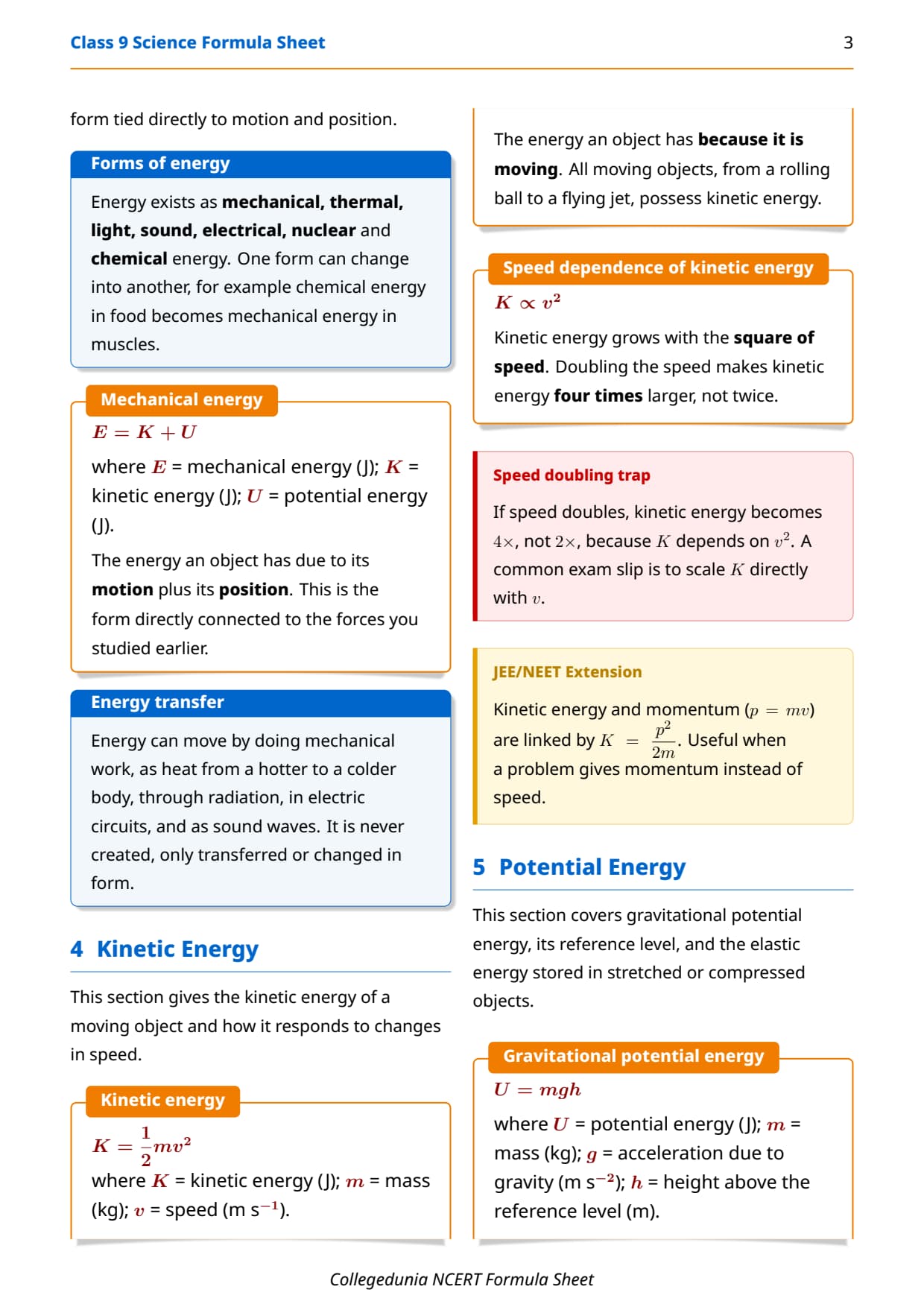
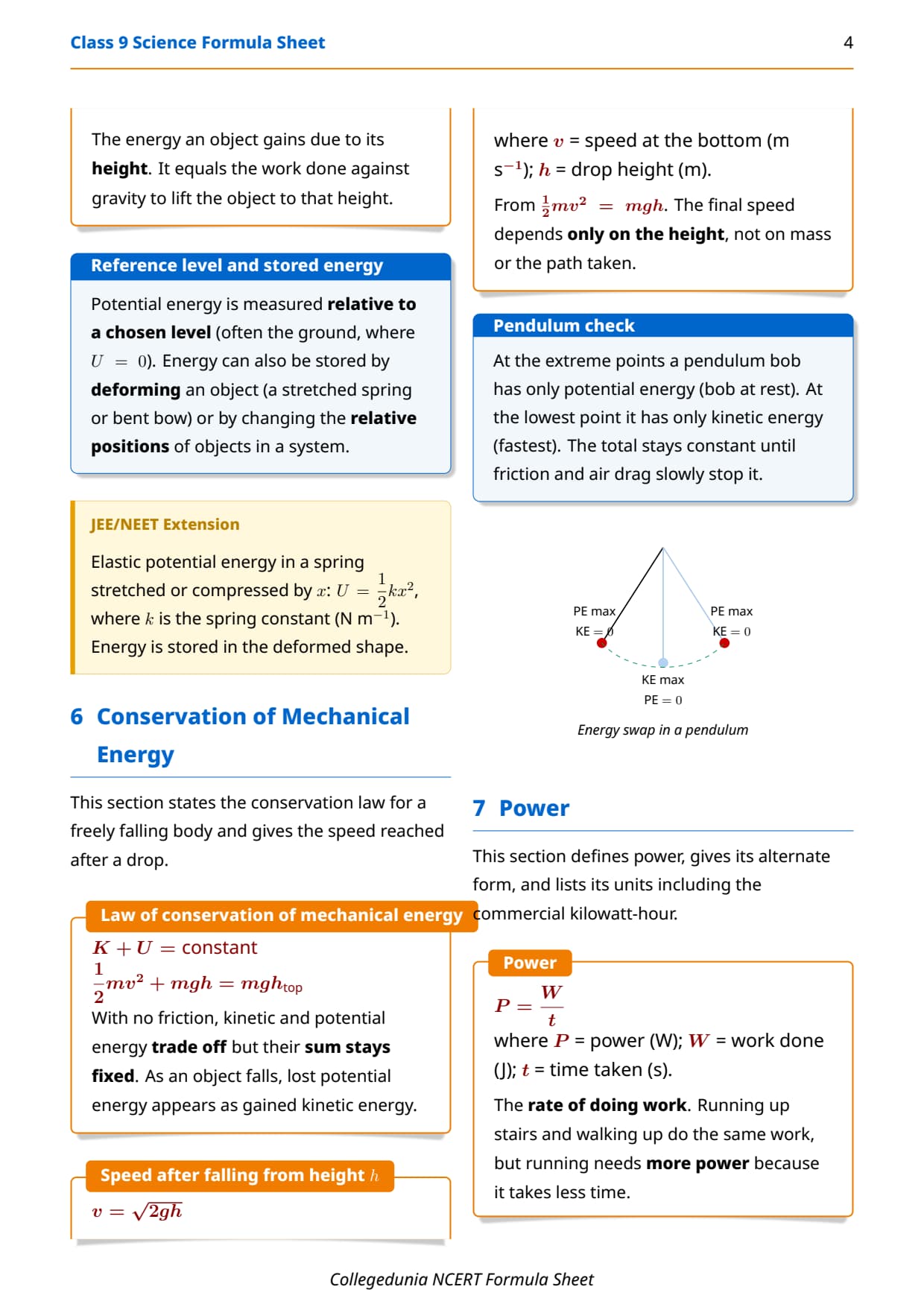
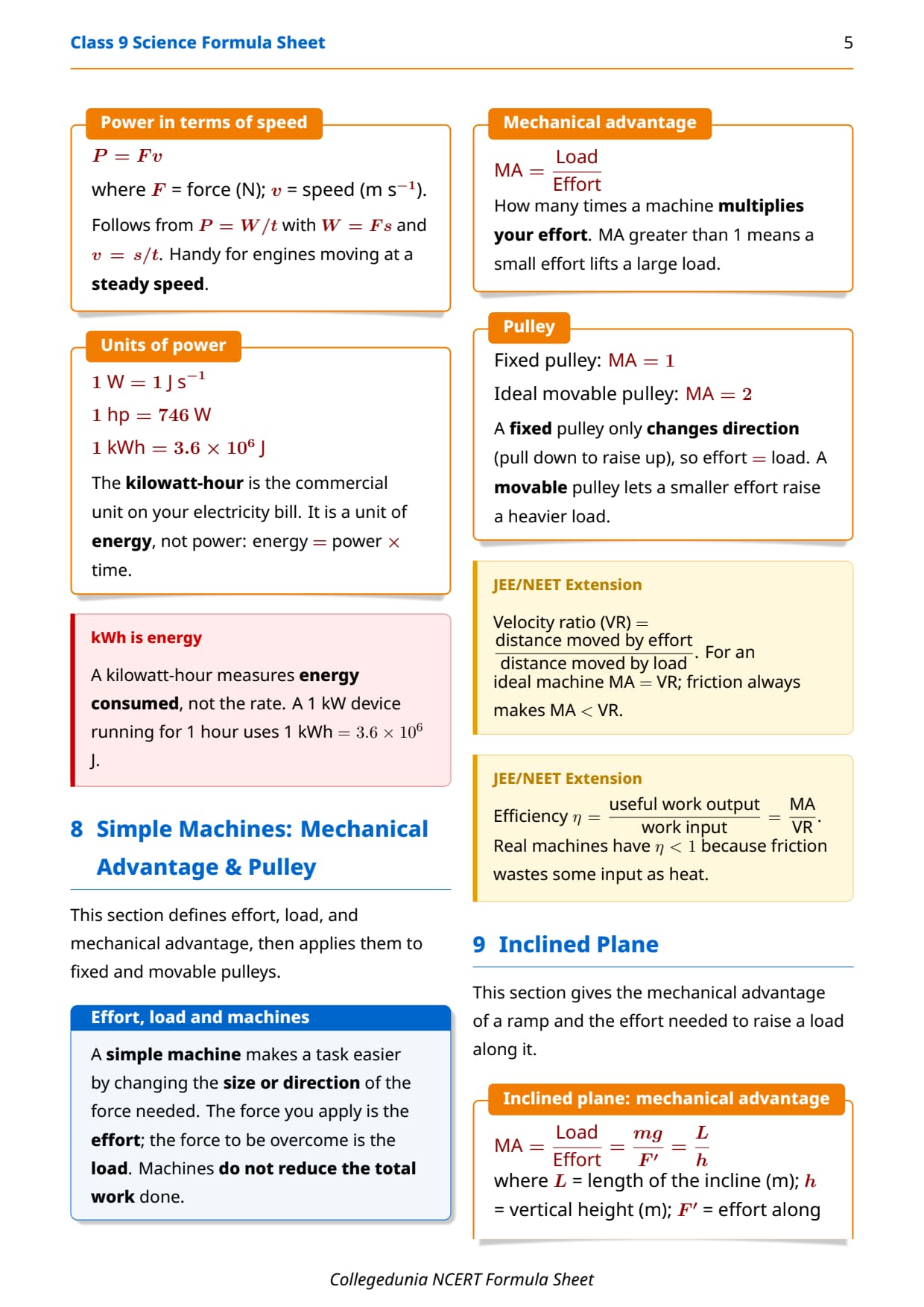
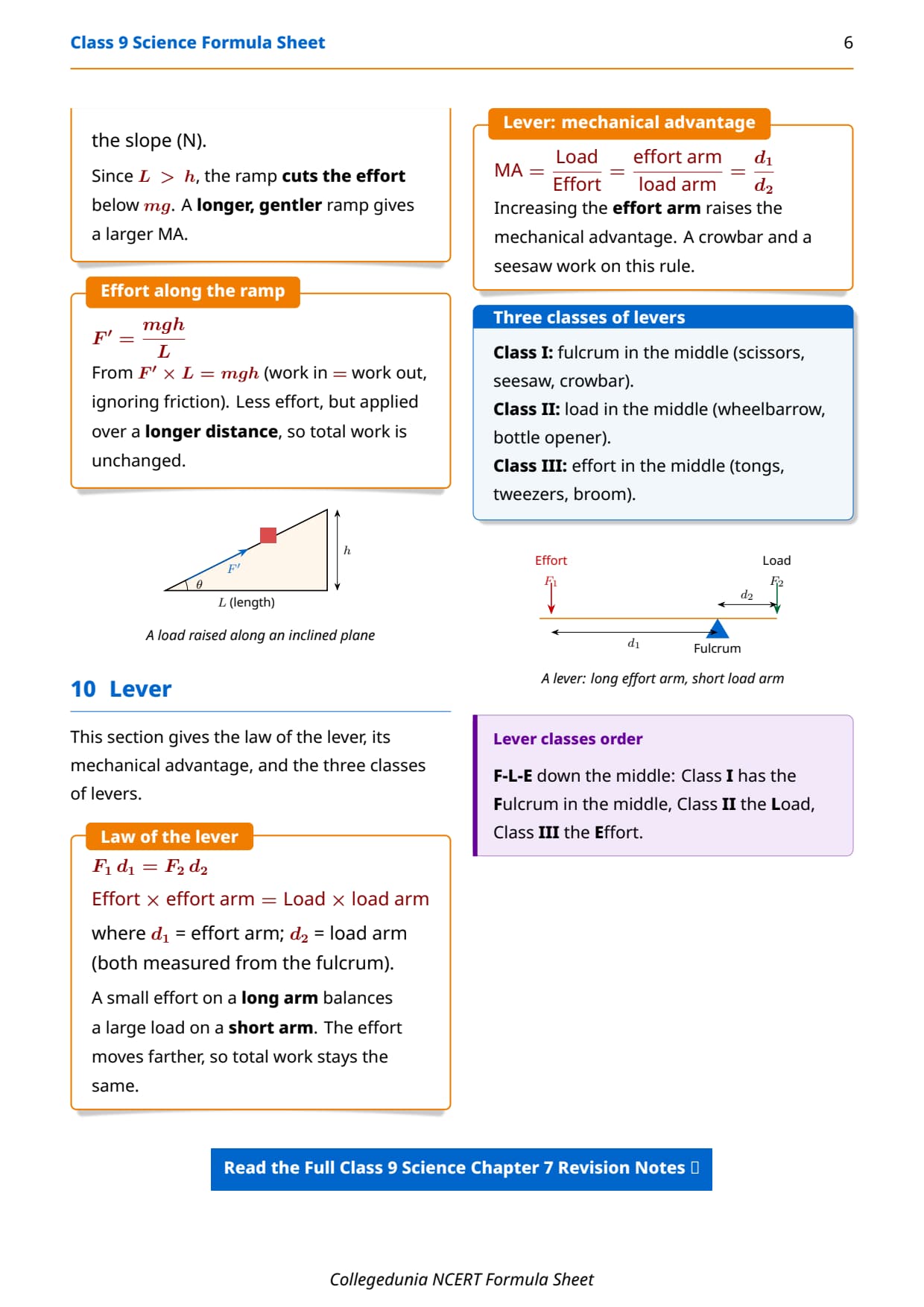
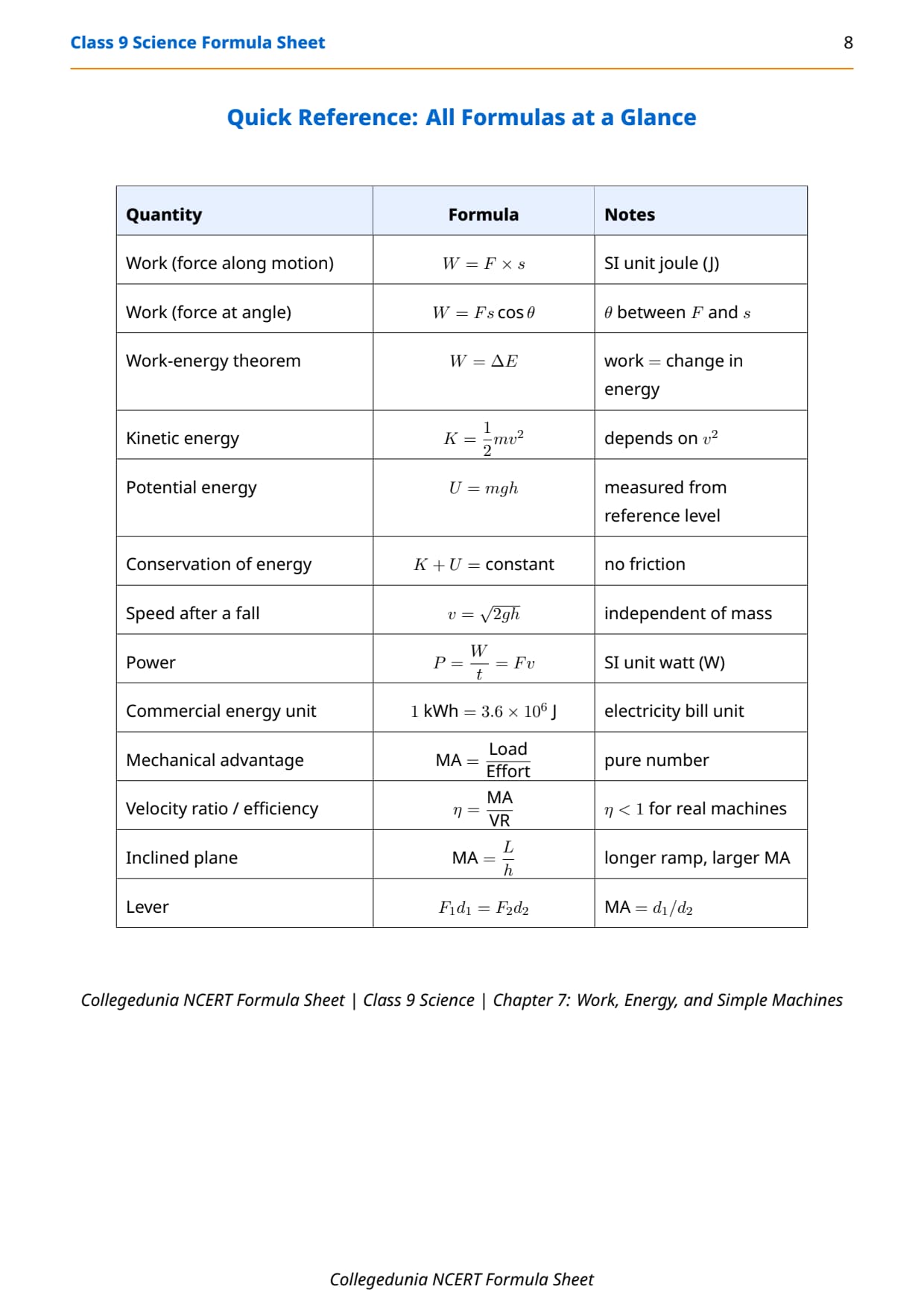
- Every named formula: W = F s, K = ½mv2, U = mgh, P = W/t, and the mechanical advantage rules in one view.
- Best used for: numericals on work, kinetic and potential energy, power, and simple-machine advantage, plus quick MCQ recall.
- Why it matters: Chapter 7 is the base for energy, power, and machines that return in Class 11 physics and in CBSE, JEE, and NEET.
Student Feedback
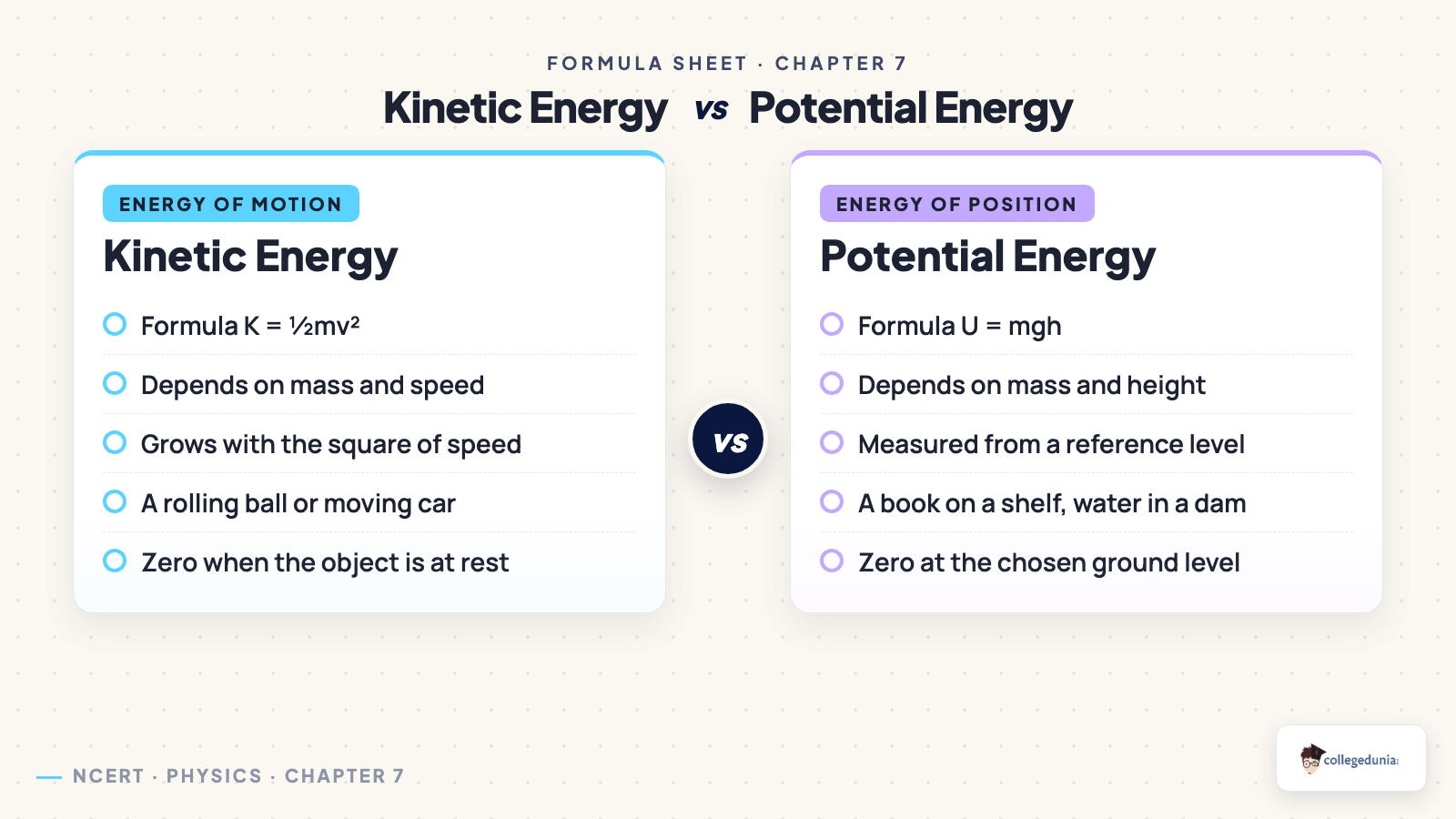
In a Collegedunia study of 1,240 Class 9 students, 81% said keeping the work, energy, and power formulae on one page cut their errors in numericals. About 4 out of 5 rated the kinetic-versus-potential energy comparison the most useful part, and many said the mechanical advantage rules for the pulley, ramp, and lever finally made simple machines easy.
|
Table of Contents |
How Collegedunia's Work, Energy, and Simple Machines Formula Sheet Helps You
This Formula Sheet gathers every relation you need for Class 9 Science Chapter 7 on one page, in the order the Exploration book introduces them. It starts with work, moves through energy and power, and ends with the simple machines, so your revision follows the same flow as the chapter.
- 2026-27 Exploration match: every formula, from W = F s to the mechanical advantage of a lever, follows the new textbook.
- Meaning with each formula: every relation carries a short gloss, so you know what it means and when to use it, not just how it looks.
- Machines made simple: the pulley, inclined plane, and lever rules sit together, so you can compare how each one trades force for distance.
Work, Energy, and Simple Machines Class 9 Science Video Revision
Source: Magnet Brains on YouTube
Work, Energy, and Simple Machines Class 9 Science Complete Formula Reference
The table lists every formula in Chapter 7 with its physical meaning and SI unit. This is the core of the sheet, so read down it once before you start any numerical.
| Concept | Formula | Meaning | SI Unit |
|---|---|---|---|
| Work (force along motion) | W = F × s | Force times displacement in its direction | joule (J) |
| Work (force at an angle) | W = F s cosθ | Only the part of force along the motion works | joule (J) |
| One joule | 1 J = 1 N × 1 m | 1 N moving an object 1 m in its direction | J = kg m2 s-2 |
| Work-energy theorem | W = ΔE | Net work equals the change in energy | joule (J) |
| Work on a moving body | W = ½m(v2 − u2) | Work shows up as change in kinetic energy | joule (J) |
| Mechanical energy | E = K + U | Energy of motion plus energy of position | joule (J) |
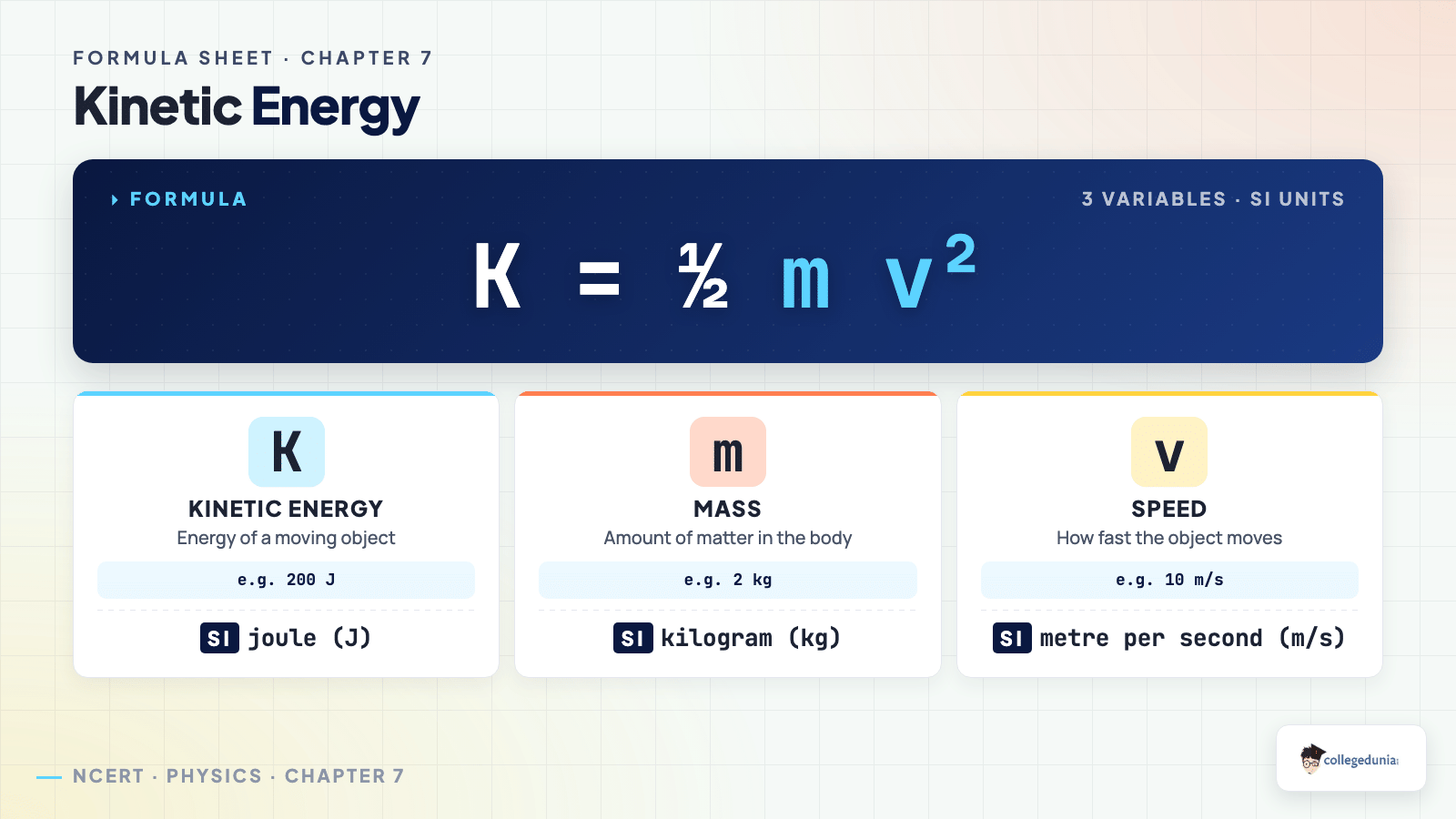
| Kinetic energy | K = ½mv2 | Energy an object has because it is moving | joule (J) |
| Potential energy | U = mgh | Energy gained due to height above a level | joule (J) |
| Conservation of energy | K + U = constant | With no friction the sum stays fixed | joule (J) |
| Speed after a fall | v = √2gh | Final speed depends only on the height | m s-1 |
| Power | P = Wt = Fv | Rate of doing work | watt (W) |
| Commercial energy unit | 1 kWh = 3.6 × 10⁶ J | The "unit" on an electricity bill | kilowatt-hour |
| Mechanical advantage | MA = LoadEffort | How many times a machine multiplies effort | none (a ratio) |
| Pulley | Fixed: MA = 1; Movable: MA = 2 | Fixed changes direction; movable cuts effort | none (a ratio) |
| Efficiency | η = MAVR | Useful output over input; always below 1 | none (a ratio) |
| Inclined plane | MA = Lh; F′ = mghL | Longer, gentler ramp cuts the effort more | none / newton (N) |
| Lever | F1d1 = F2d2; MA = d1d2 | Long effort arm balances a large load | none (a ratio) |
Learning these relations covers nearly every Work, Energy, and Simple Machines numerical asked in Class 9 tests and later board-style papers.
When to Use Which Formula in Work, Energy, and Simple Machines Class 9
Picking the right formula is half the marks. The list below tells you which relation to apply based on what the question gives you. Read the situation first: a moving object points you to kinetic energy, a raised object to potential energy, and a machine to mechanical advantage.
- Force and displacement given, asks work: use W = F s. If the force is at an angle, use W = F s cosθ.
- Mass and speed given, asks energy of motion: kinetic energy K = ½mv2.
- Mass and height given, asks stored energy: potential energy U = mgh.
- Object dropped, asks speed at the bottom: v = √2gh, straight from energy conservation.
- Work and time given, asks rate: power P = W/t, or P = Fv for steady speed.
- Load and effort given, asks how easy: mechanical advantage MA = Load / Effort, then the pulley, ramp, or lever rule.
Work, Energy, and Simple Machines Class 9 Quick-Fact Cards for MCQ Recall
These atomic facts are the ones MCQ writers reach for most often. Glance over them the morning of any test, as each one is a favourite for one-mark and assertion-reason questions.
Symbol Glossary and Units for Class 9 Science Chapter 7
Every symbol used above, decoded with its SI unit. Note that work and both forms of energy share the same unit, the joule, while mechanical advantage, velocity ratio, and efficiency are pure numbers with no unit.
| Symbol | What it means | SI Unit |
|---|---|---|
| W | Work done by a force | joule (J) |
| F | Force applied | newton (N) |
| s | Displacement in the force's direction | metre (m) |
| K | Kinetic energy (energy of motion) | joule (J) |
| U | Potential energy (energy of position) | joule (J) |
| m | Mass of the object | kilogram (kg) |
| v, u | Final and initial speed | m s-1 |
| g | Acceleration due to gravity | m s-2 |
| h | Height above the reference level | metre (m) |
| P | Power (rate of doing work) | watt (W) |
| t | Time taken | second (s) |
| MA, VR, η | Mechanical advantage, velocity ratio, efficiency | none (ratios) |
Work, Energy, and Simple Machines Top Formulae Recap: Quick Revision for Class 9
The five relations below carry the largest share of marks from this chapter. If you are short on time, lock these first.
| Formula | Where it is used |
|---|---|
| W = F s | Work done, positive, negative, or zero work questions |
| K = ½mv2 | Kinetic energy and speed-change numericals |
| U = mgh | Potential energy and lifting-work sums |
| P = W/t = Fv | Power, engine, and staircase-climb problems |
| MA = Load / Effort | Pulley, inclined plane, and lever advantage |
Full topic-by-topic walkthrough: Work, Energy, and Simple Machines Class 9 Science Notes
One-Shot Revision Tips for Work, Energy, and Simple Machines Class 9
Treat the sheet as a checklist you tick off as you recall every term the night before a test.
- "No displacement, no work." Pushing a wall or holding a bag while standing does zero work in science, because s = 0.
- Square the speed: in K = ½mv2, doubling the speed makes kinetic energy four times larger.
- Energy trades, total stays: as an object falls, lost potential energy appears as gained kinetic energy, so K + U stays constant without friction.
- Power is a rate: running and walking up the same stairs do equal work, but running needs more power because it takes less time.
- Machines save force, not work: a longer ramp or a longer lever arm cuts the effort, but you apply it over a longer distance, so the total work is unchanged.
- kWh is energy: a kilowatt-hour measures energy used, not power. A 1 kW device in 1 hour uses 3.6 × 10⁶ J.
Full solved numericals: Work, Energy, and Simple Machines Class 9 Science NCERT Solutions
More Work, Energy, and Simple Machines Class 9 Science Resources
Use the table below to move between the other Collegedunia resources for this same chapter, from full solutions to handwritten notes.
| Resource | Open |
|---|---|
| Formula Sheet | Work, Energy, and Simple Machines Class 9 Science Formula Sheet |
| NCERT Solutions | Work, Energy, and Simple Machines Class 9 Science NCERT Solutions |
| Revision Notes | Work, Energy, and Simple Machines Class 9 Science Notes |
| Handwritten Notes | Work, Energy, and Simple Machines Class 9 Science Handwritten Notes |
| NCERT Book PDF | Work, Energy, and Simple Machines Class 9 Science NCERT Book PDF |
NCERT Formula Sheet for Class 9 Science: All Chapters
Formula Sheets are available for the numerical chapters of Class 9 Science. Open any other one below.
| Chapter | Formula Sheet |
|---|---|
| Chapter 5 | Exploring Mixtures and their Separation Formula Sheet |
| Chapter 6 | How Forces Affect Motion Formula Sheet |
| Chapter 7 | Work, Energy, and Simple Machines Formula Sheet |
| Chapter 8 | Journey Inside the Atom Formula Sheet |
| Chapter 9 | Atomic Foundations of Matter Formula Sheet |
| Chapter 10 | Sound Waves Characteristics and Applications Formula Sheet |
Work, Energy, and Simple Machines Class 9 Formula Sheet FAQs
Ques. Where can I download the Work, Energy, and Simple Machines Class 9 Formula Sheet PDF?
Ans. You can download the Work, Energy, and Simple Machines Formula Sheet PDF free from this page. It covers work, the work-energy theorem, kinetic and potential energy, conservation of energy, power, and the mechanical advantage of simple machines from the 2026-27 Exploration Chapter 7.
Ques. What is the formula for work done in Class 9 Science Chapter 7?
Ans. Work done by a constant force is W = F × s, where F is the force and s is the displacement in the direction of the force. If the force acts at an angle θ, then W = F s cosθ. The SI unit of work is the joule (J).
Ques. What are the formulae for kinetic energy and potential energy?
Ans. Kinetic energy is K = ½mv2, the energy an object has because it is moving. Gravitational potential energy is U = mgh, the energy it has because of its height h above a reference level. Both are measured in joules.
Ques. What is the work-energy theorem?
Ans. The work-energy theorem states that the net work done on an object equals the change in its energy, written as W = ΔE. Positive work increases the energy and negative work decreases it. For a moving object this becomes W = ½m(v2 − u2).
Ques. What is power and what is its formula?
Ans. Power is the rate of doing work, P = W/t. For an object moving at a steady speed it can also be written P = Fv. The SI unit of power is the watt (W), where 1 W = 1 J/s, and 1 hp = 746 W.
Ques. What is mechanical advantage in simple machines?
Ans. Mechanical advantage is MA = Load / Effort, the number of times a machine multiplies your effort. A fixed pulley has MA = 1 and only changes direction, an ideal movable pulley has MA = 2, an inclined plane gives MA = L/h, and a lever gives MA = d1/d2. Mechanical advantage is a pure number with no unit.
Ques. Why does doubling the speed make kinetic energy four times larger?
Ans. Kinetic energy is K = ½mv2, so it depends on the square of the speed, K ∝ v2. If the speed doubles, v2 becomes four times as large, so the kinetic energy becomes four times, not two times, larger. This is a common trap in MCQs.
Ques. Is this Formula Sheet aligned with the 2026-27 NCERT syllabus?
Ans. Yes. The sheet reflects the new Exploration textbook for the 2026-27 Class 9 Science syllabus. Chapter 7 covers work, energy in its forms, the work-energy theorem, conservation of mechanical energy, power, and the simple machines: pulley, inclined plane, and lever.



Comments