




The Formula Sheet for Class 9 Science Chapter 5 Exploring Mixtures and their Separation puts every concentration relation and separation rule from the new Exploration textbook on one page. This is a chemistry chapter, so most of the sheet is concept and relation cards, not heavy equations. In one place you get the three concentration percentages (% m/m, % m/v, % v/v), the parts-per-million form, solubility, the particle-size scale for solutions, colloids and suspensions, the boiling-point rule for distillation, the retention factor, and alloy mass shares. Use it for quick recall before a class test or the 2026-27 exam.
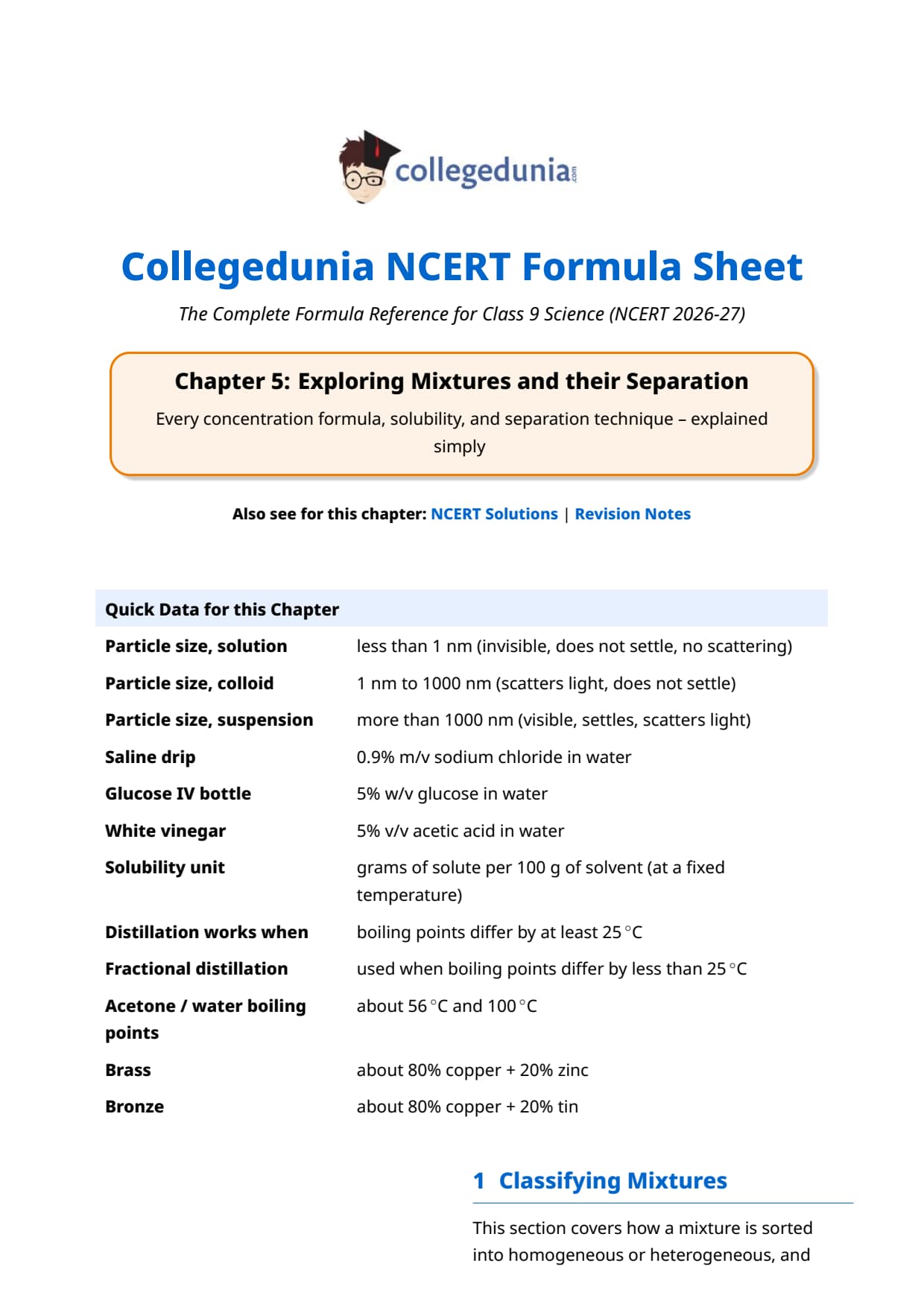
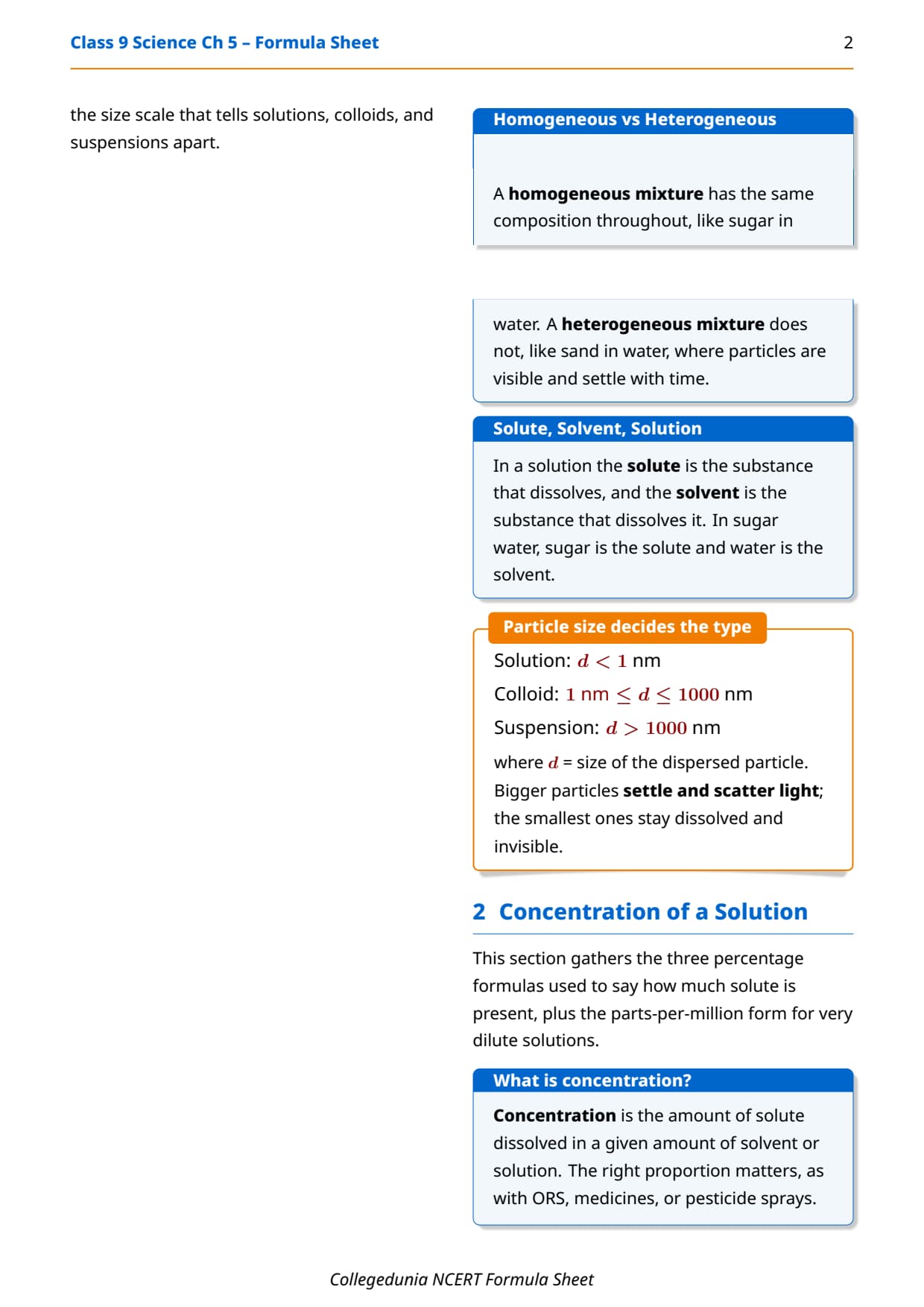
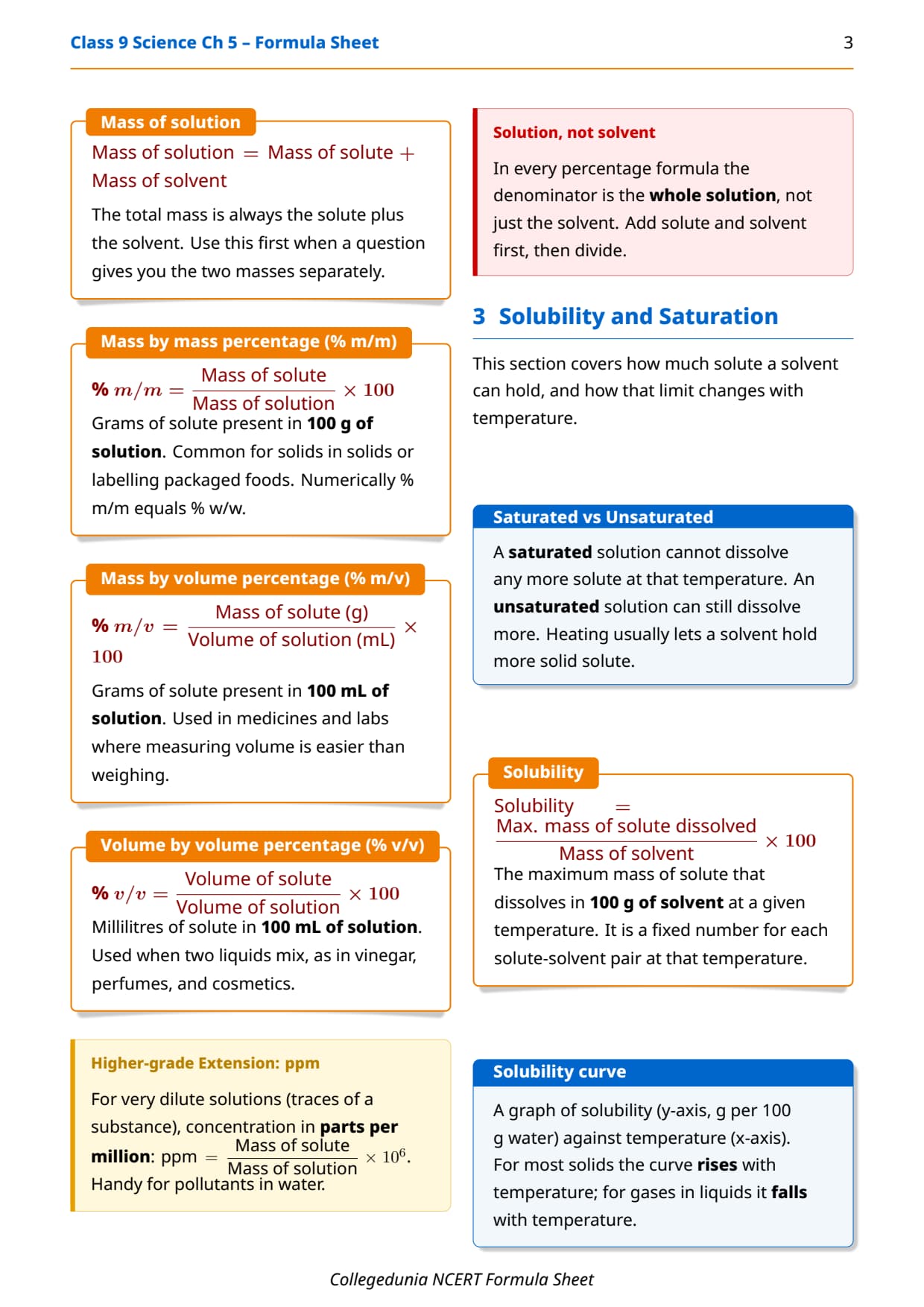
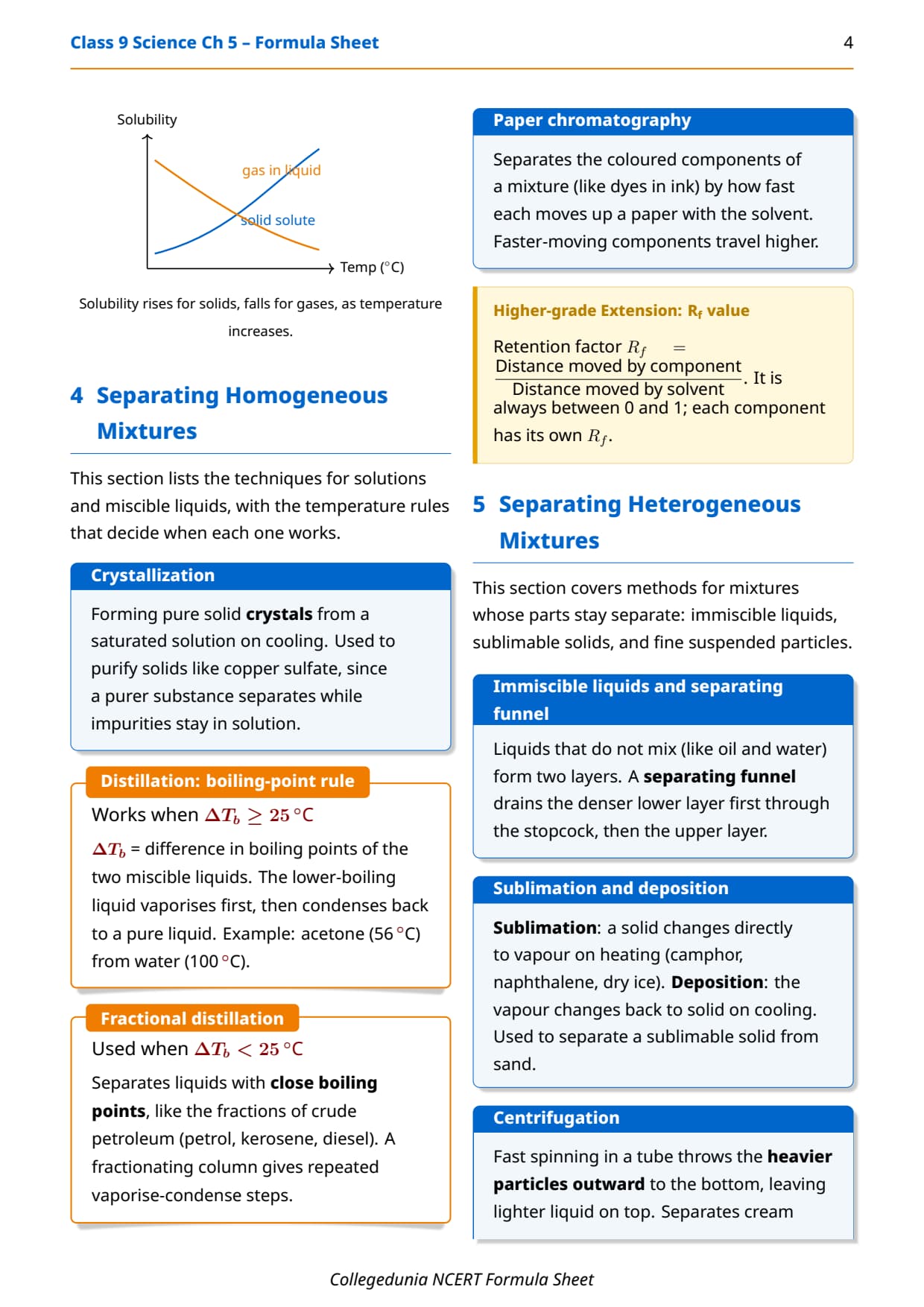
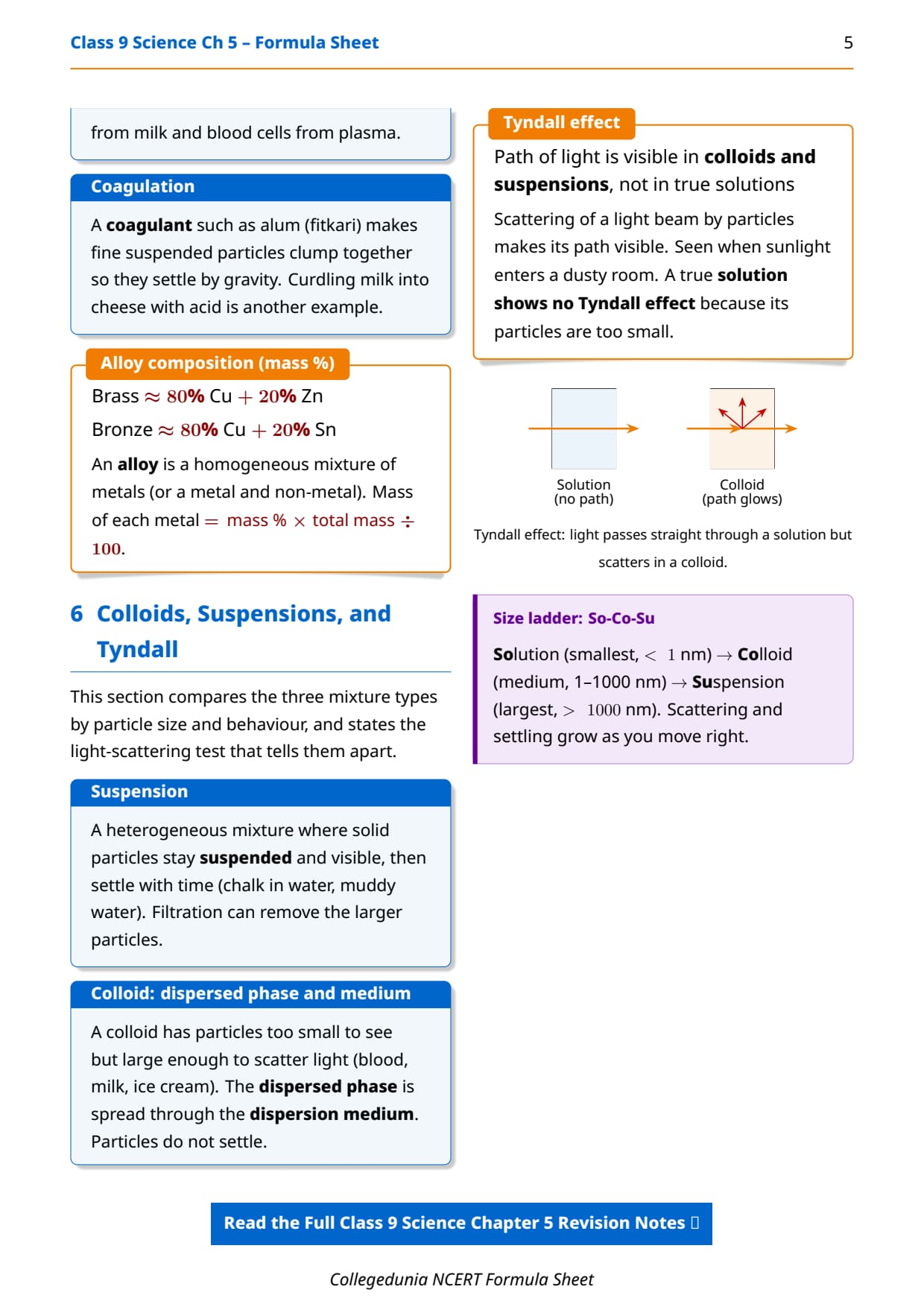
- All concentration relations: mass of solution, % m/m, % m/v, % v/v, ppm, and solubility gathered in one place with each meaning explained.
- Separation rules ready: the particle-size scale, the Tyndall test, the distillation boiling-point rule, and the retention factor for chromatography.
- Why it matters: Chapter 5 builds the base for concentration, solutions, and separation methods used later in CBSE, JEE, and NEET chemistry.
Student Feedback
In a Collegedunia study of 1,150 Class 9 students, 81% said keeping the three concentration percentages and the particle-size scale on one page cut their errors in this chapter. About 4 out of 5 rated the solution versus colloid versus suspension comparison the single most useful card, and many said the "denominator is the whole solution" reminder stopped a common slip.
Also Check:
- Exploring Mixtures and their Separation Class 9 Science NCERT Solutions
- Exploring Mixtures and their Separation Class 9 Science Notes
|
Table of Contents |
How Collegedunia's Exploring Mixtures Class 9 Science Formula Sheet Helps You
This Formula Sheet gathers every relation you need for Class 9 Science Chapter 5 on one page, in the order the Exploration book introduces them. Because this is a chemistry chapter, most entries are concentration relations, size ranges, and separation rules rather than long equations.
- 2026-27 NCERT alignment: every relation, from the three concentration percentages and solubility to the distillation boiling-point rule and the retention factor, matches the current syllabus.
- Concentration forms side by side: % m/m, % m/v, and % v/v sit next to each other, so you pick the right one before starting a sum.
- Quick-fact cards for MCQs: key numbers like the particle-size ranges, the 25 °C distillation rule, and 0.9% m/v saline sit in a colour-coded card row.
Exploring Mixtures and their Separation Class 9 Science One Shot
Source: Rakshak Sir Science on YouTube
Exploring Mixtures Class 9 Science Complete Formula and Relation Reference
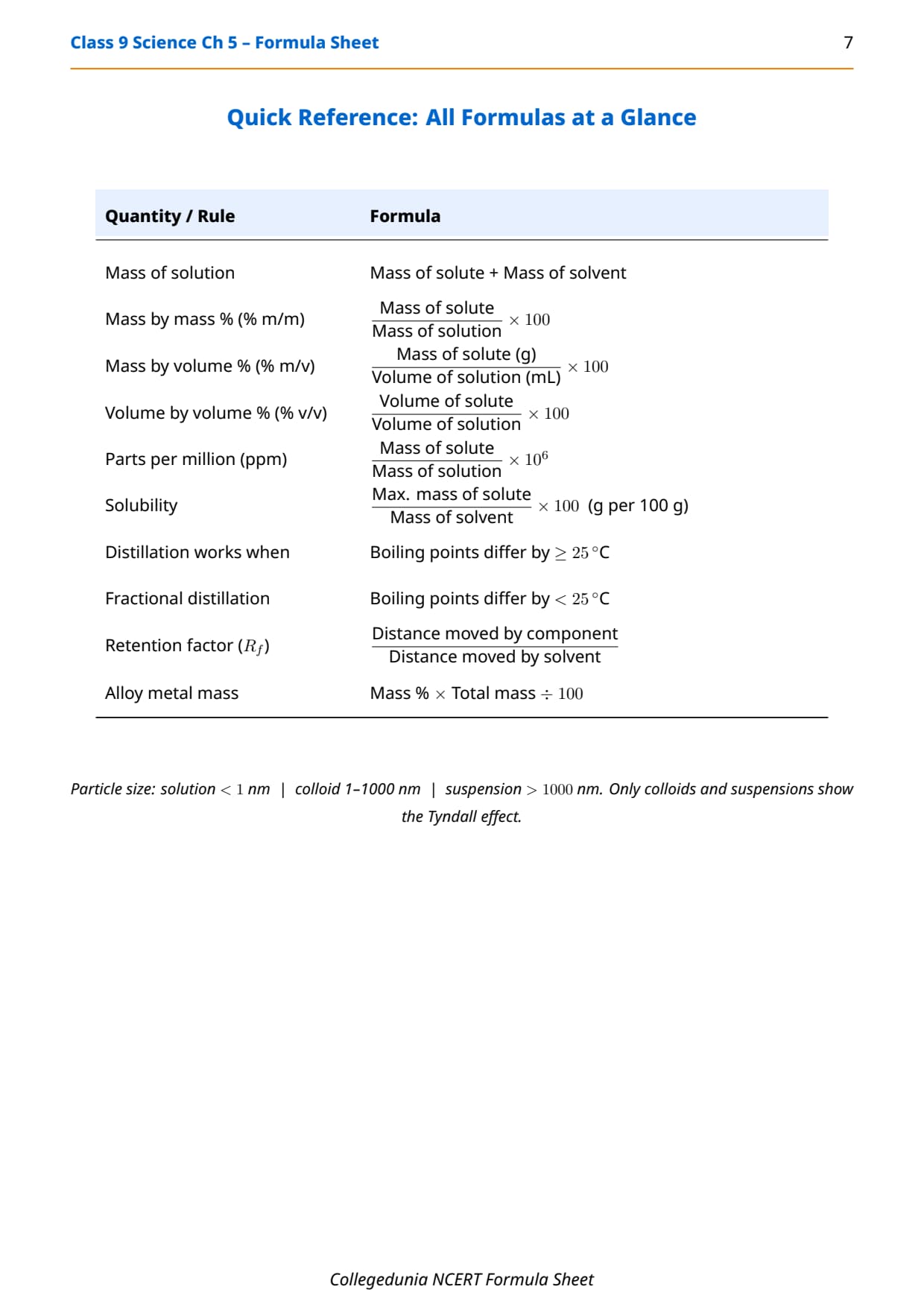
The table lists every formula and relation in Chapter 5, mapped to its meaning and unit. Keep the concentration percentages and the separation rules in view together, as most questions mix the two.
| Concept | Formula or Relation | Unit | Meaning / Typical Use |
|---|---|---|---|
| Mass of solution | Mass of solution = Mass of solute + Mass of solvent | g | Find the total mass before any percentage |
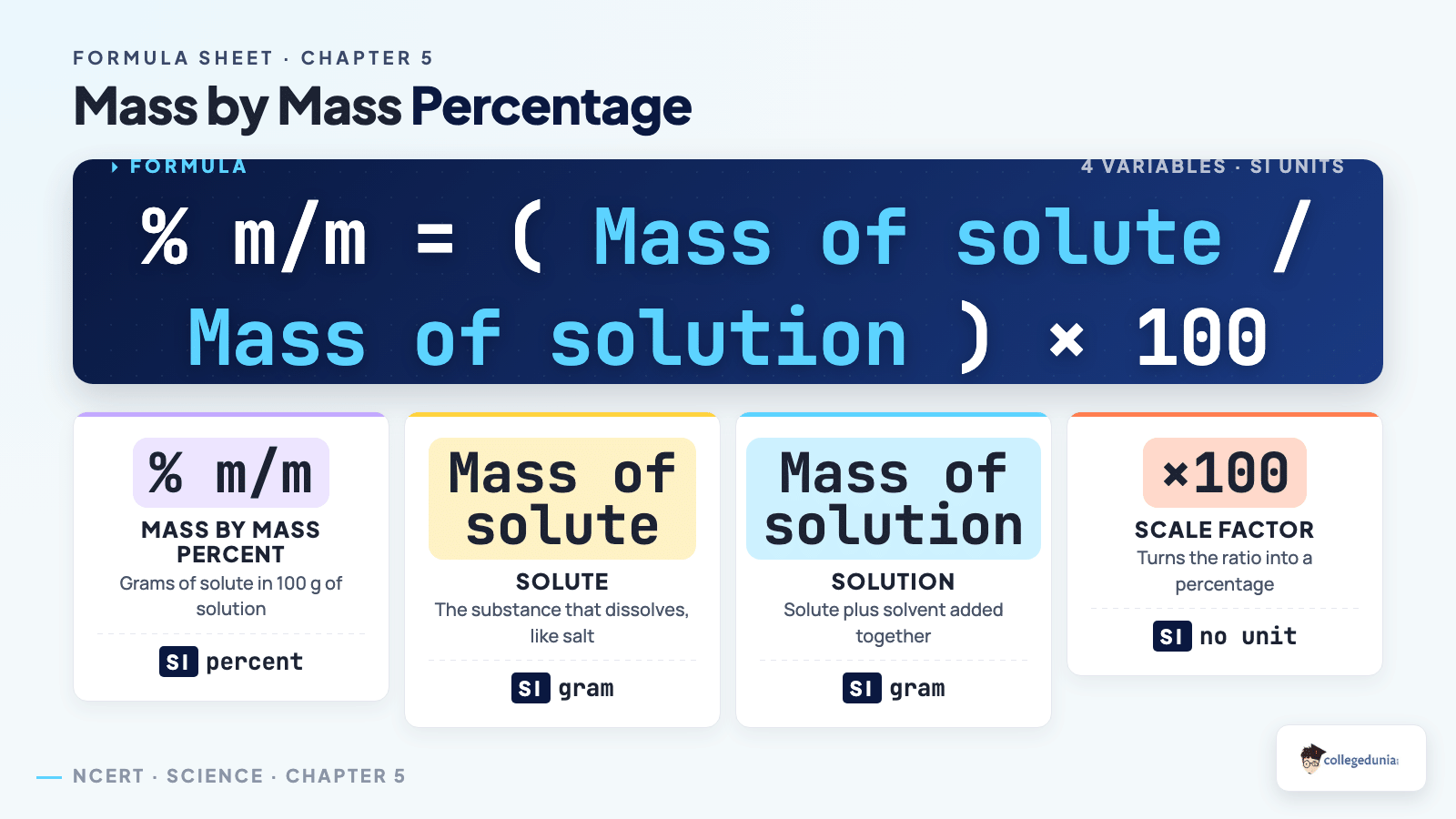
| Mass by mass % (% m/m) | Mass of soluteMass of solution × 100 | % | Grams of solute in 100 g of solution |
| Mass by volume % (% m/v) | Mass of solute (g)Volume of solution (mL) × 100 | % | Grams of solute in 100 mL of solution |
| Volume by volume % (% v/v) | Volume of soluteVolume of solution × 100 | % | mL of solute in 100 mL of solution |
| Parts per million (ppm) | Mass of soluteMass of solution × 106 | ppm | Very dilute solutions, like traces in water |
| Solubility | Max. mass of solute dissolvedMass of solvent × 100 | g per 100 g | Most solute a solvent holds at a fixed temperature |
| Distillation works when | ΔTb ≥ 25 °C | °C | Boiling points far apart, one liquid vaporises first |
| Fractional distillation | ΔTb < 25 °C | °C | Boiling points close, needs a fractionating column |
| Retention factor (Rf) | Distance moved by componentDistance moved by solvent | no unit (0 to 1) | Chromatography; each component has its own value |
| Alloy metal mass | Mass % × Total mass ÷ 100 | g | Mass of one metal in an alloy like brass |
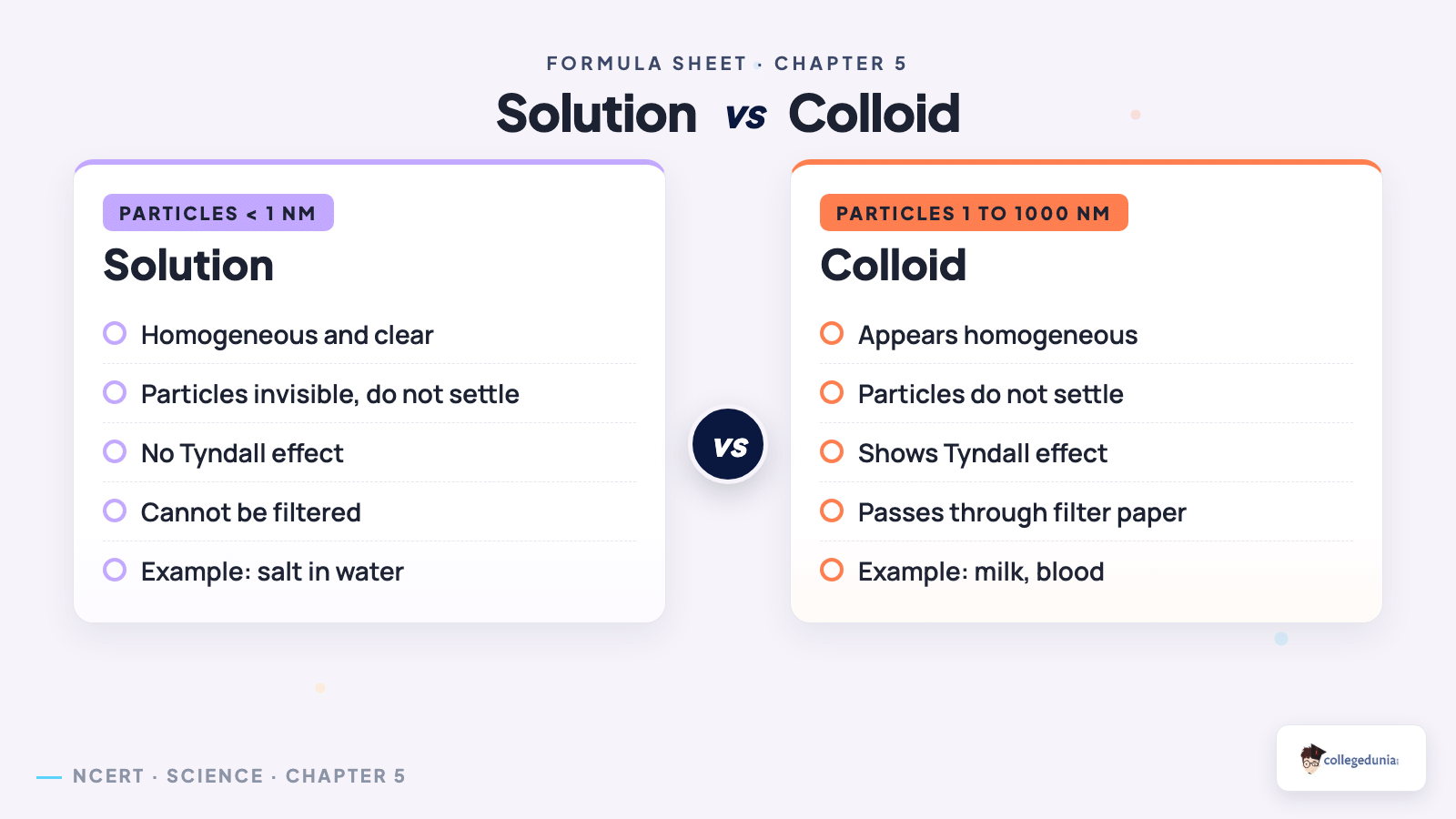
| Particle size scale | solution < 1 nm < colloid < 1000 nm < suspension | nm | Decides solution, colloid, or suspension |
Learning these ten relations covers almost every numerical and reasoning question asked from Exploring Mixtures and their Separation.
When to Use Which Formula or Method in Exploring Mixtures Class 9
Picking the right relation is the difference between a full-mark answer and a slip. The list below tells you which one to apply based on what the question gives you. Read the mixture first: same throughout means homogeneous (a solution), while visible parts that settle mean heterogeneous (a suspension).
- Mass of solute and mass of solvent given: first add them for the mass of solution, then use % m/m.
- Solute in grams, solution in mL: use % m/v, as with a 0.9% m/v saline drip.
- Two liquids mixed: use % v/v, as with 5% v/v vinegar.
- Maximum solute a solvent can hold: use solubility, in grams per 100 g of solvent at that temperature.
- Two miscible liquids to separate: compare boiling points. Gap of 25 °C or more, use simple distillation; a smaller gap needs fractional distillation.
- Coloured components to separate: use paper chromatography and find each Rf.
- Metal share in an alloy: use mass % × total mass ÷ 100.
Exploring Mixtures Class 9 Quick-Fact Cards for MCQ Recall
These atomic facts are the ones MCQ writers reach for most often. Glance over them the morning of any test; every entry comes straight from the 2026-27 NCERT Chapter 5.
Two more facts worth memorising: white vinegar is 5% v/v acetic acid in water, and only colloids and suspensions show the Tyndall effect, never a true solution.
Symbol Glossary and Units for Class 9 Science Chapter 5
Every term used above, decoded with its unit. Note: solubility and the concentration percentages are always taken at a fixed temperature, since heating usually lets a solvent hold more solid solute.
| Term / Symbol | What it means | Unit |
|---|---|---|
| Solute | The substance that dissolves (like sugar) | g or mL |
| Solvent | The substance that dissolves the solute (like water) | g or mL |
| Solution | Solute plus solvent, a homogeneous mixture | g or mL |
| % m/m | Mass by mass percentage | % |
| % m/v | Mass by volume percentage | % |
| % v/v | Volume by volume percentage | % |
| Solubility | Most solute dissolved per 100 g of solvent | g per 100 g |
| ΔTb | Difference in boiling points of two liquids | °C |
| Rf | Retention factor in chromatography | no unit (0 to 1) |
| d | Size of a dispersed particle | nm |
Exploring Mixtures Top Formulae Recap: Quick Revision for Class 9
The relations below carry the largest share of marks from this chapter. Revise them last before you walk into the exam.
| Relation | Where it is used |
|---|---|
| % m/m = Mass of soluteMass of solution × 100 | Concentration numericals, packaged-food labels |
| % m/v = Mass of solute (g)Volume of solution (mL) × 100 | Medicines and lab solutions, like saline |
| Solubility = Max. mass of soluteMass of solvent × 100 | Saturation and solubility-curve questions |
| ΔTb ≥ 25 °C for distillation | Choosing simple versus fractional distillation |
| Rf = Distance by componentDistance by solvent | Paper chromatography of dyes and inks |
Full step-by-step solutions: Exploring Mixtures and their Separation Class 9 Science NCERT Solutions
One-Shot Revision Tips for Exploring Mixtures Class 9
Treat the sheet as a checklist you tick off as you recall every term the night before a test.
- "Denominator is the solution." In % m/m, % m/v, and % v/v the bottom is always the whole solution, not the solvent alone.
- Size ladder So-Co-Su: Solution (smallest, < 1 nm), Colloid (medium, 1 to 1000 nm), Suspension (largest, > 1000 nm). Scattering and settling grow as you move right.
- Tyndall test: light path shows in colloids and suspensions, not in a true solution. This tells the three types apart in one look.
- Boiling-point rule: gap of 25 °C or more, use simple distillation; a smaller gap, use fractional distillation with a column.
- Solubility depends on temperature: for most solids it rises with temperature; for gases in a liquid it falls.
Full topic-by-topic revision: Exploring Mixtures and their Separation Class 9 Science Notes
More Exploring Mixtures Class 9 Science Resources
Use the table below to move between the other Collegedunia resources for this same chapter, from full solutions to handwritten notes.
| Resource | Link |
|---|---|
| Formula Sheet | Exploring Mixtures and their Separation Formula Sheet |
| NCERT Solutions | Exploring Mixtures and their Separation NCERT Solutions |
| Revision Notes | Exploring Mixtures and their Separation Notes |
| Handwritten Notes | Exploring Mixtures and their Separation Handwritten Notes |
| NCERT Book PDF | Exploring Mixtures and their Separation NCERT Book PDF |
NCERT Formula Sheet for Class 9 Science: All Chapters
Formula Sheets are available for the numerical chapters of Class 9 Science. Open any other one below.
| Chapter | Formula Sheet |
|---|---|
| Chapter 5 | Exploring Mixtures and their Separation Formula Sheet |
| Chapter 6 | How Forces Affect Motion Formula Sheet |
| Chapter 7 | Work, Energy, and Simple Machines Formula Sheet |
| Chapter 8 | Journey Inside the Atom Formula Sheet |
| Chapter 9 | Atomic Foundations of Matter Formula Sheet |
| Chapter 10 | Sound Waves: Characteristics and Applications Formula Sheet |
Exploring Mixtures and their Separation Class 9 Formula Sheet FAQs
Ques. Where can I download the Exploring Mixtures and their Separation Class 9 Formula Sheet PDF?
Ans. You can download the Class 9 Science Chapter 5 Exploring Mixtures and their Separation Formula Sheet PDF directly from this page. It is free and covers the three concentration percentages, ppm, solubility, the particle-size scale, the distillation boiling-point rule, and the retention factor from the 2026-27 NCERT.
Ques. Is this Formula Sheet aligned with the 2026-27 NCERT?
Ans. Yes. The sheet reflects the current 2026-27 syllabus for Class 9 Science from the new Exploration textbook. Chapter 5 covers classifying mixtures, concentration of a solution, solubility, and the methods used to separate homogeneous and heterogeneous mixtures.
Ques. What are the three concentration formulae in Class 9 Science Chapter 5?
Ans. The three are mass by mass percentage, % m/m = Mass of soluteMass of solution × 100; mass by volume percentage, % m/v = Mass of solute (g)Volume of solution (mL) × 100; and volume by volume percentage, % v/v = Volume of soluteVolume of solution × 100. In each one the denominator is the whole solution.
Ques. How do you tell a solution, a colloid, and a suspension apart?
Ans. Use particle size. A true solution has particles smaller than 1 nm and is clear. A colloid has particles from 1 to 1000 nm that scatter light but do not settle. A suspension has particles larger than 1000 nm that are visible and settle with time. Only colloids and suspensions show the Tyndall effect.
Ques. What is the Tyndall effect?
Ans. The Tyndall effect is the scattering of a beam of light by particles, which makes the path of the light visible. It is seen in colloids and suspensions, such as when sunlight enters a dusty room, but not in a true solution because its particles are too small to scatter light.
Ques. What is solubility and how is it measured?
Ans. Solubility is the maximum mass of a solute that dissolves in 100 g of a solvent at a given temperature, calculated as Max. mass of solute dissolvedMass of solvent × 100. It is a fixed number for each solute-solvent pair at that temperature. For most solids it rises with temperature, while for gases in a liquid it falls.
Ques. When do you use distillation and when fractional distillation?
Ans. Use simple distillation when the two miscible liquids have boiling points that differ by 25 °C or more, as with acetone (about 56 °C) and water (about 100 °C). Use fractional distillation when the boiling points differ by less than 25 °C, as with the fractions of crude petroleum, because a fractionating column gives repeated vaporise-condense steps.
Ques. What is the retention factor in paper chromatography?
Ans. The retention factor is Rf = Distance moved by componentDistance moved by solvent. It is always between 0 and 1, and each component of a mixture has its own value. A component that moves faster and travels higher up the paper has a larger retention factor.
Ques. How do you find the mass of a metal in an alloy like brass?
Ans. An alloy is a homogeneous mixture of metals, so use the mass percentage. The mass of a metal is Mass % × Total mass ÷ 100. Brass is about 80% copper and 20% zinc, so 200 g of brass has 160 g of copper and 40 g of zinc. Bronze is about 80% copper and 20% tin.
Ques. What is parts per million (ppm) used for?
Ans. Parts per million measures very dilute solutions, where only traces of a substance are present, using ppm = Mass of soluteMass of solution × 106. It is handy for expressing the amount of a pollutant in water, where a percentage would be a very small fraction.
Ques. What is the difference between a saturated and an unsaturated solution?
Ans. A saturated solution cannot dissolve any more solute at that temperature, while an unsaturated solution can still dissolve more. Heating usually lets the solvent hold more solid solute, so a solution that is saturated at room temperature may become unsaturated when warmed.
Ques. Which relations are most important in Exploring Mixtures Class 9?
Ans. The three concentration percentages (% m/m, % m/v, % v/v), the solubility relation, the particle-size scale for solutions, colloids and suspensions, and the distillation boiling-point rule are the highest-yield items. Together they cover most of the numerical and reasoning questions asked from Chapter 5.



Comments