



The Sound Waves Class 9 Science Formula Sheet puts every relation from Chapter 10 of the new Exploration textbook on one page. In one view you get the wave relation v = λ × ν, the link between frequency and time period, the echo and SONAR distance formula, and the key speed and hearing values you need for the 2026-27 exam. Every formula uses simple symbols with its SI unit, so you can revise the full chapter fast before a class test.
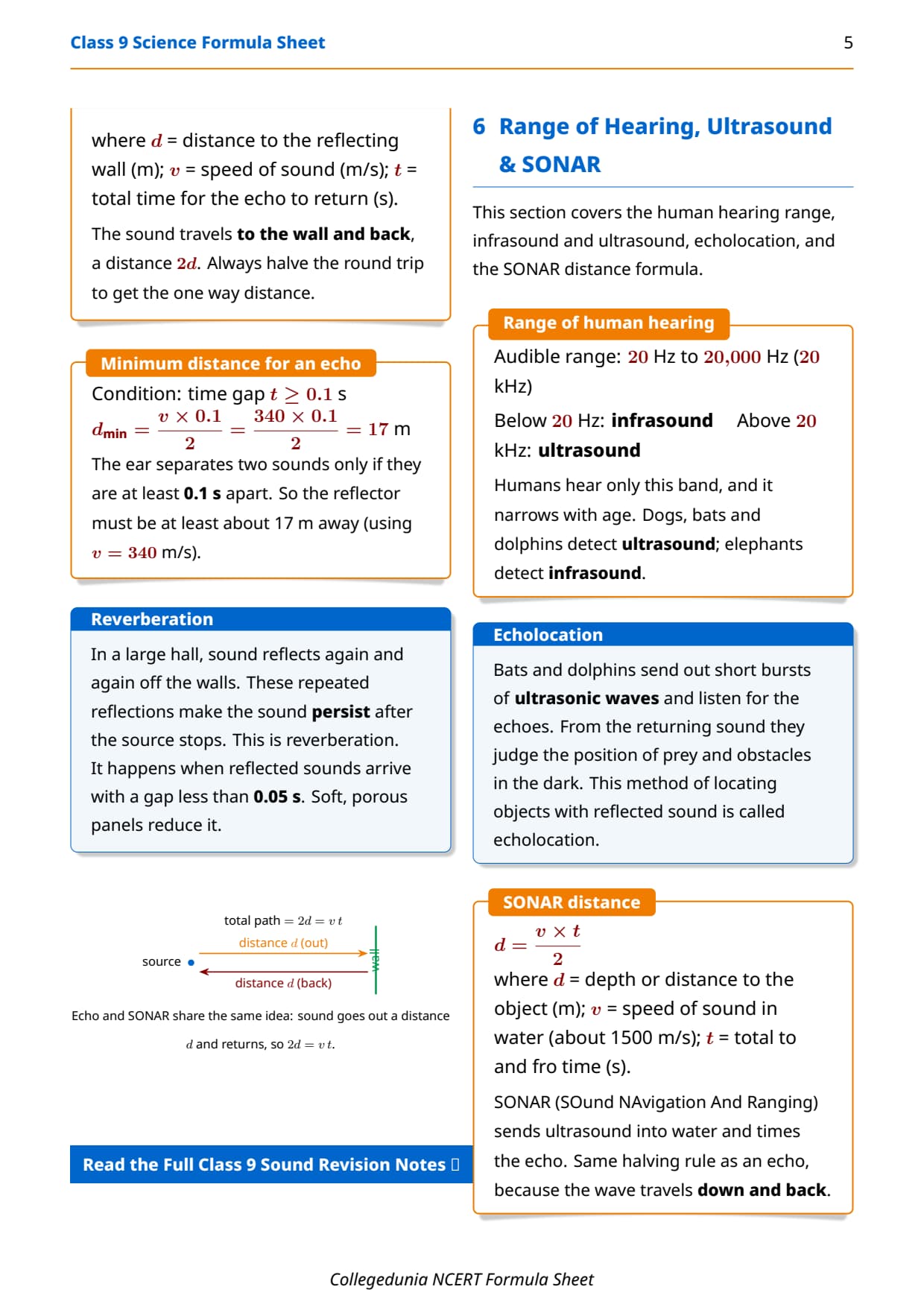
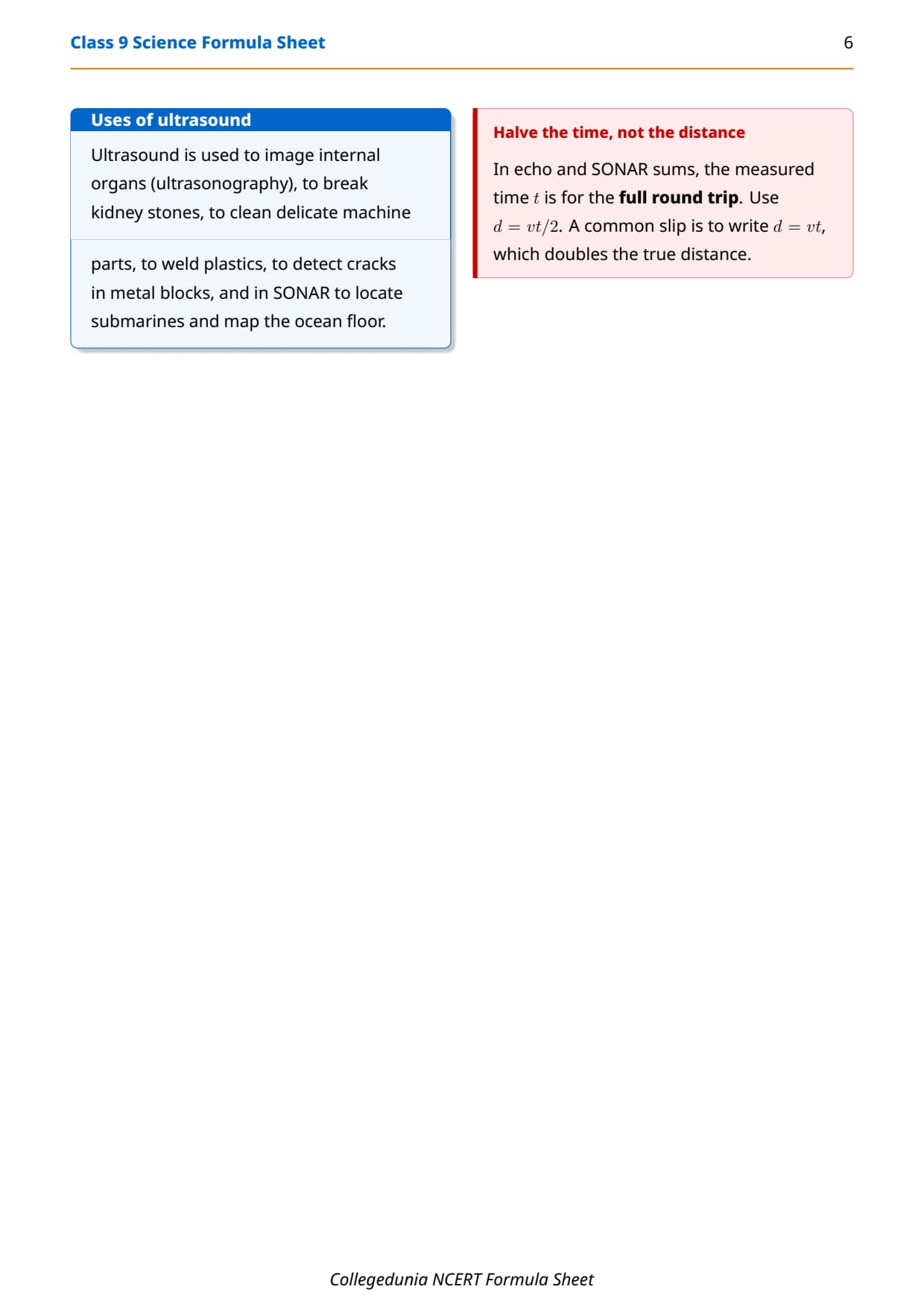
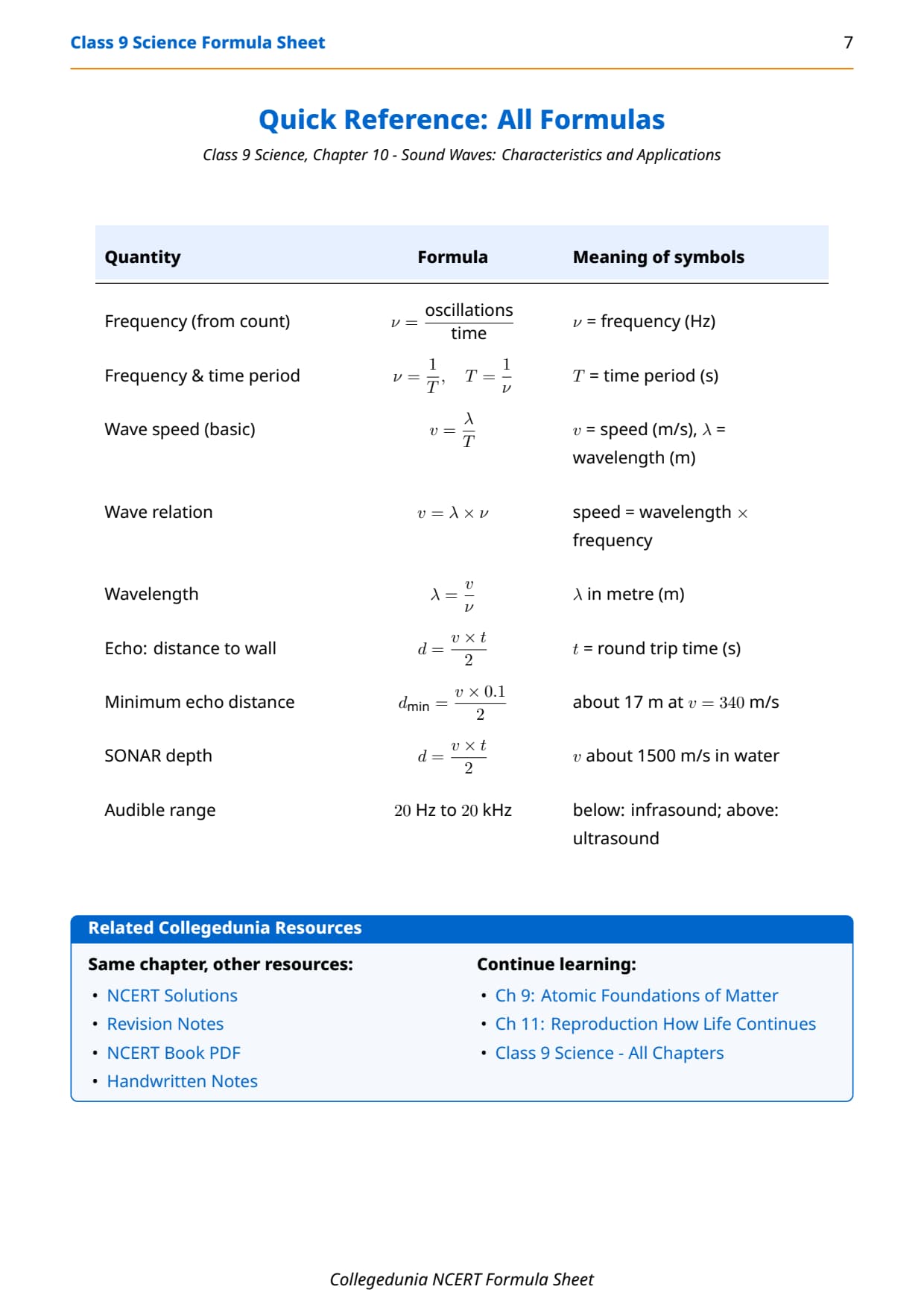
- Every formula in one place: the wave relation, frequency and time period, the echo distance formula, and the minimum echo condition, all mapped to Chapter 10.
- Best used for: speed of sound sums, wavelength and frequency numericals, echo and SONAR distance problems, and last-minute MCQ recall.
- Why it matters: Sound is the main numerical chapter of Class 9 physics, and the same relations return in Class 11 waves and later CBSE and JEE study.
Student Feedback
In a Collegedunia study of 1,240 Class 9 students, 81% said keeping the wave relation and the echo distance formula on one page cut their errors in sound numericals. About 4 out of 5 rated the "halve the round-trip time" rule the most useful tip in this chapter, and many said the single-page speed values made the sums feel quick.
How Collegedunia's Sound Waves Class 9 Science Formula Sheet Helps You
This Formula Sheet gathers every relation you need for Class 9 Science Chapter 10 numericals on one page, in the order the Exploration textbook introduces them. Sound is the most numerical topic in Class 9 physics, so a single-page reference saves real time before a test.
- 2026-27 NCERT match: every formula, from the wave relation v = λ × ν to the echo distance d = v t / 2, follows the current syllabus.
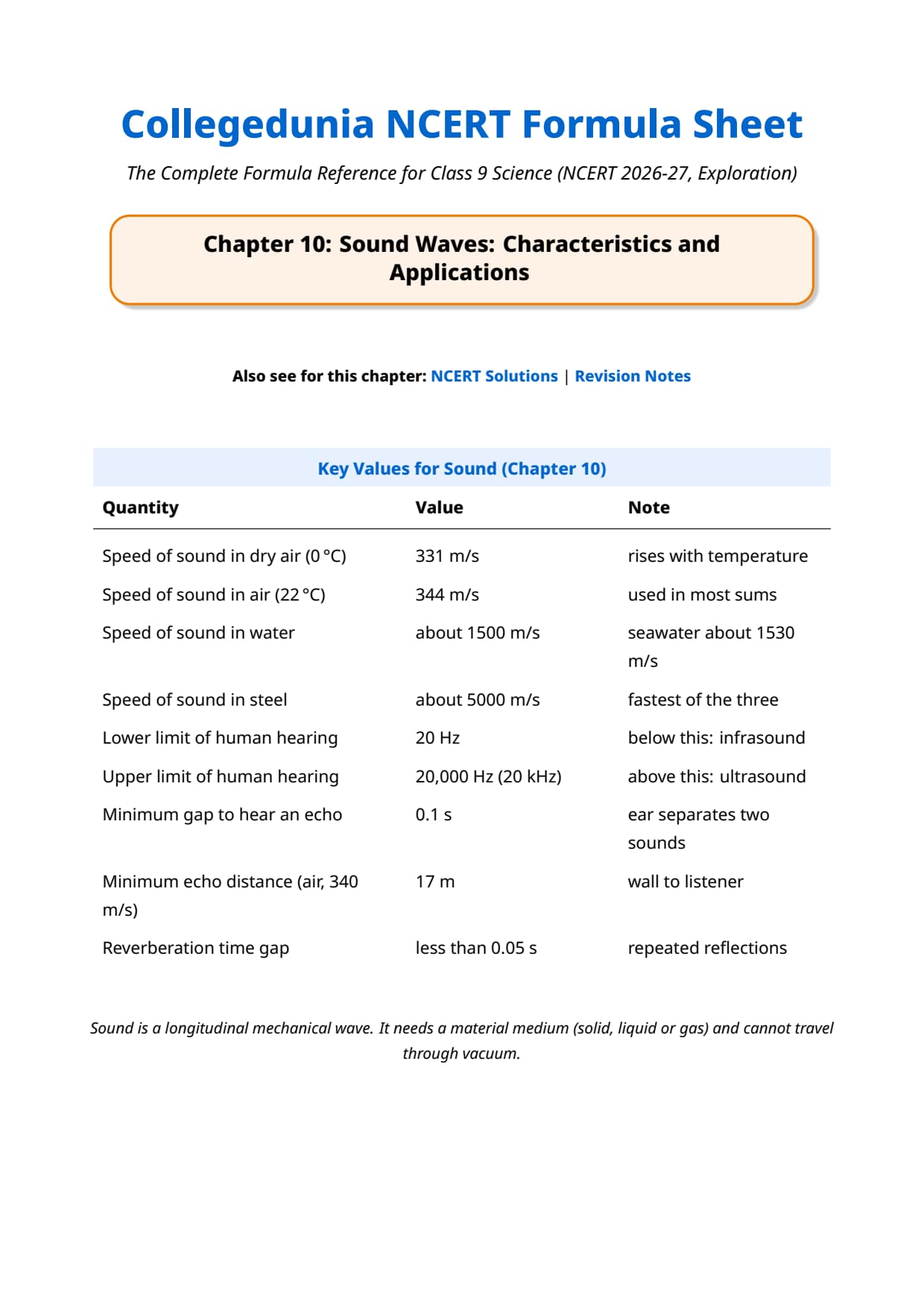
- Key values ready: the speed of sound in air, water and steel, the human hearing range, and the minimum echo gap sit together, so you plug in the right number at once.
- Built for recall: the quick-fact cards and the top-formulae recap are made for last-minute MCQ and one-mark revision.
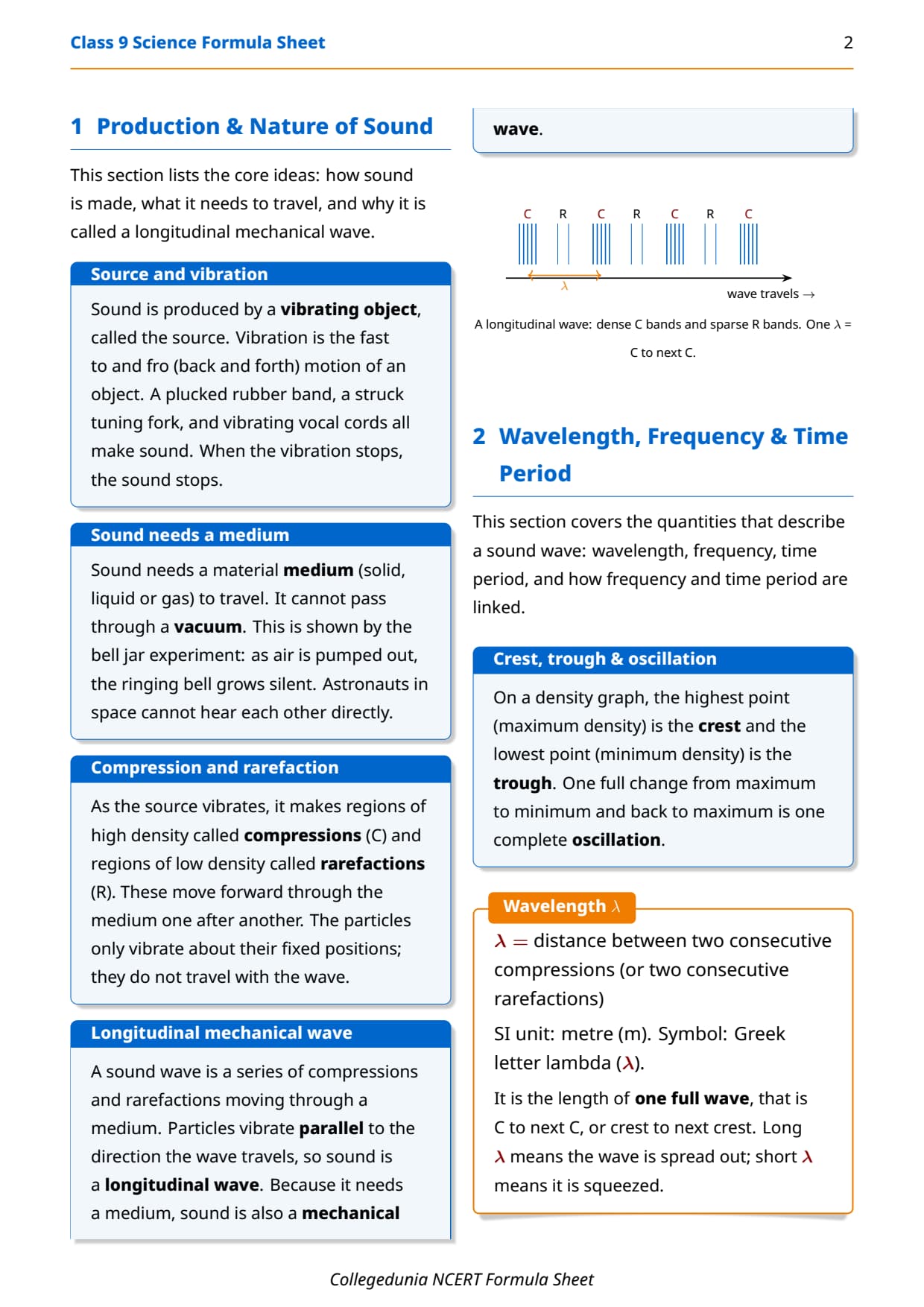
Sound is a longitudinal mechanical wave. It travels as compressions and rarefactions through a medium and cannot pass through a vacuum, so a material medium (solid, liquid or gas) is always needed. Keep that idea in mind, because it explains why the speed changes with the medium in almost every sum below.
Sound Waves Class 9 Science in One Shot
Source: Alakh Pandey - Class 9th & 10th on YouTube
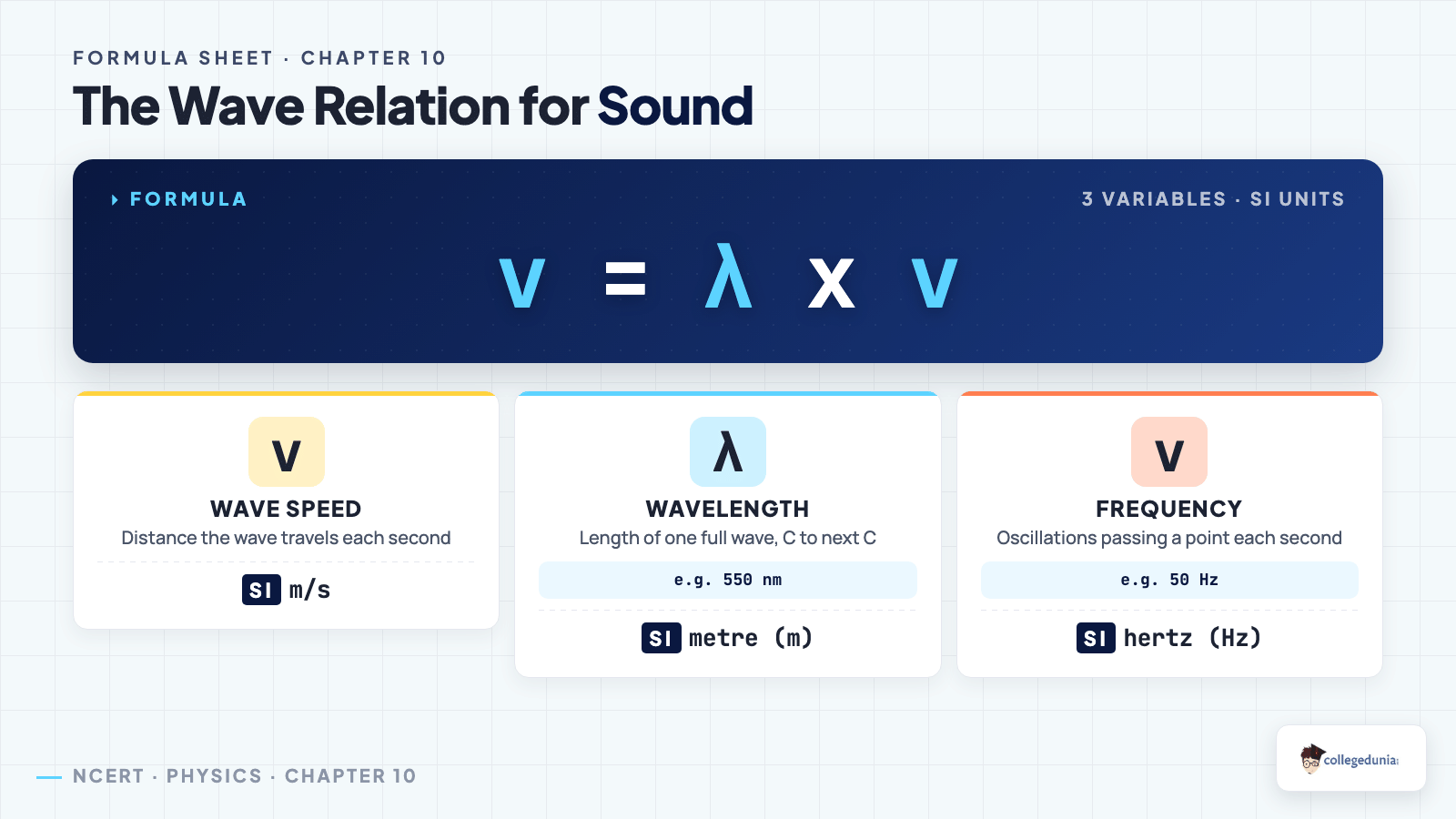
Sound Waves Class 9 Science Complete Formula Reference
The table lists every formula in Chapter 10, with its meaning and SI unit. The wave relation is the one you will use most, so learn it first.
| Quantity | Formula | SI Unit | Meaning |
|---|---|---|---|
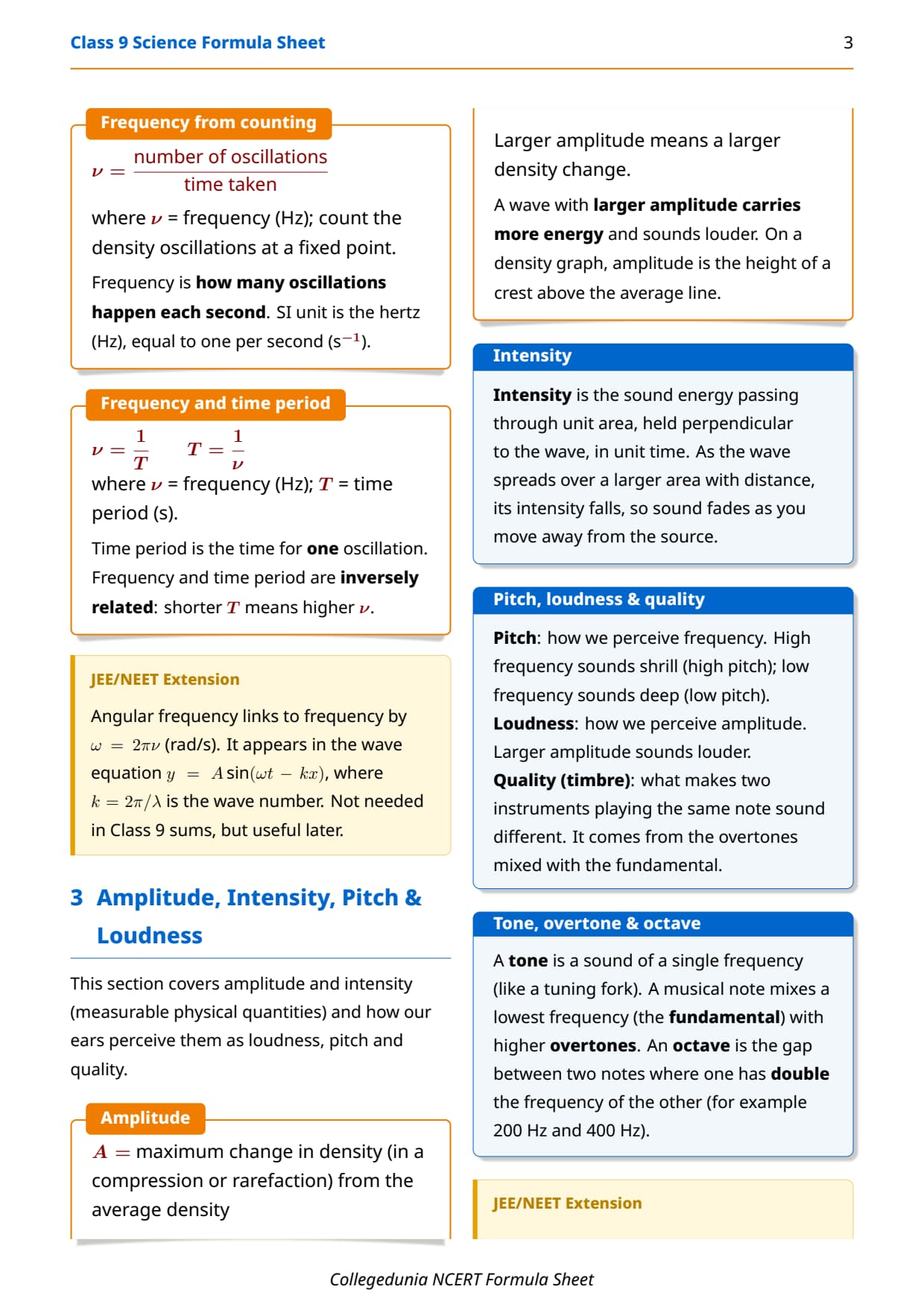
| Frequency (from count) | ν = oscillationstime | hertz (Hz) | How many oscillations pass a point each second |
| Frequency and time period | ν = 1T, T = 1ν | Hz, s | Frequency and time period are inversely related |
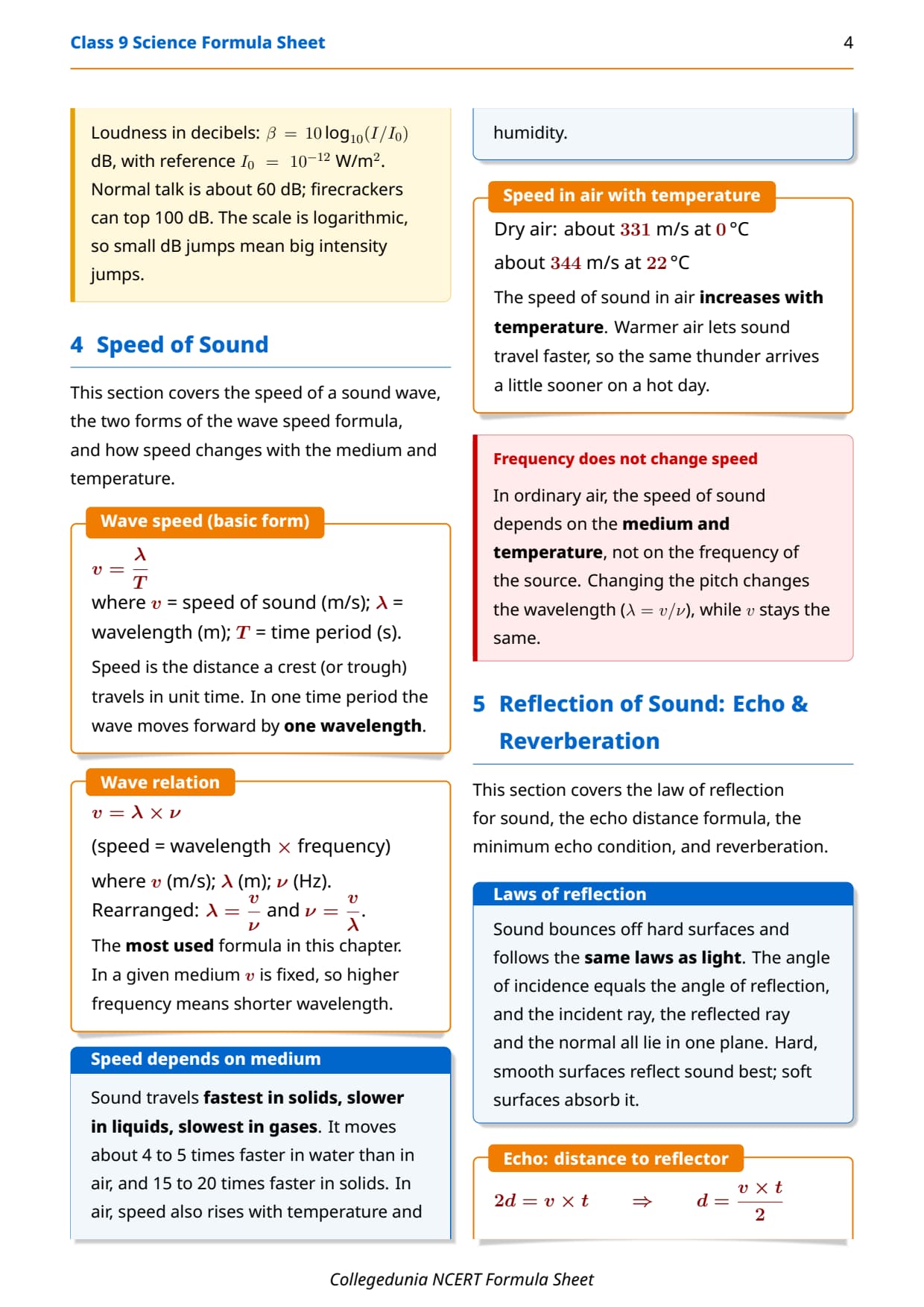
| Wave speed (basic form) | v = λT | m/s | In one time period the wave moves one wavelength |
| Wave relation | v = λ × ν | m/s | Speed = wavelength × frequency (most used) |
| Wavelength | λ = vν | metre (m) | Length of one full wave, C to next C |
| Frequency from speed | ν = vλ | Hz | Rearranged wave relation |
| Echo: distance to wall | d = v × t2 | metre (m) | Sound goes to the wall and back, a path of 2d |
| Minimum echo distance | dmin = v × 0.12 | metre (m) | About 17 m at v = 340 m/s |
| SONAR depth | d = v × t2 | metre (m) | Same halving rule; v about 1500 m/s in water |
| Audible range | 20 Hz to 20{,}000 Hz | Hz | Below: infrasound; above: ultrasound |
Learning these relations alone covers nearly every Sound numerical asked in Class 9 exams and school tests.
When to Use Which Formula in Sound Waves Class 9
Picking the right formula is the difference between a quick answer and a stuck one. Read what the question gives you, then choose from the list below. In a given medium the speed v is fixed, so higher frequency always means shorter wavelength.
- Wavelength and frequency given, asks speed: use the wave relation v = λ × ν.
- Speed and frequency given, asks wavelength: rearrange to λ = v / ν.
- Speed and wavelength given, asks frequency: use ν = v / λ.
- Frequency given, asks time period (or the reverse): use T = 1 / ν.
- Echo time given, asks distance to a wall: use d = v t / 2, because the sound travels to the wall and back.
- Depth of sea or distance in water: use the SONAR form d = v t / 2 with v about 1500 m/s.
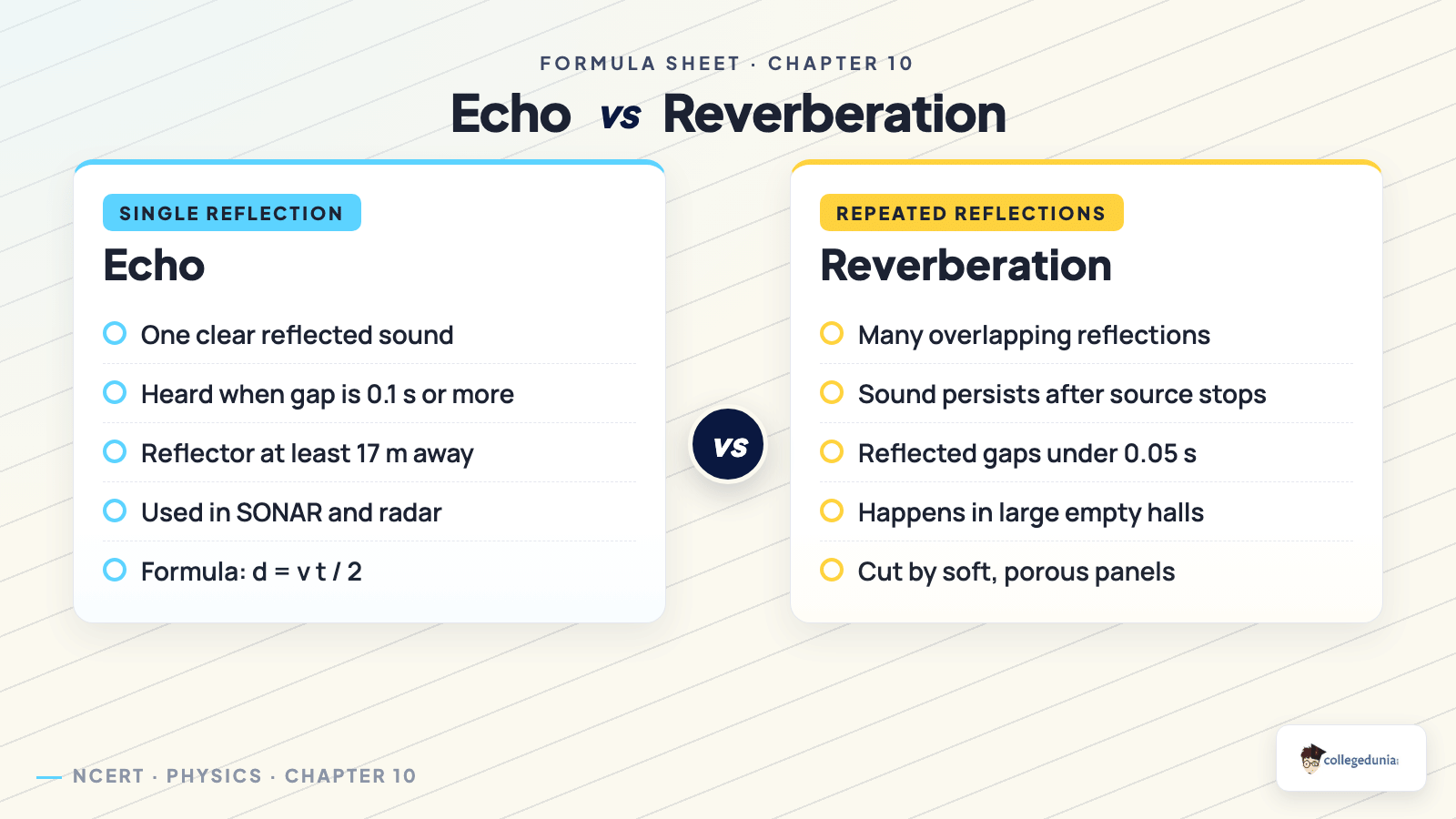
Echo and Reverberation Formulae in Sound Waves Class 9
Both echo and reverberation come from sound reflecting off hard surfaces, and sound follows the same laws of reflection as light. The two ideas look similar, so keep this short comparison ready for reasoning questions.
- Echo: a single, clear reflected sound. Your ear separates two sounds only if they are at least 0.1 s apart, so the reflector must be far enough away.
- Echo distance: d = v t / 2, where t is the total round-trip time. The minimum distance for an echo in air is dmin = (340 × 0.1) / 2 = 17 m.
- Reverberation: many reflections overlap in a large hall, so the sound persists after the source stops. It happens when reflected sounds arrive with a gap under 0.05 s.
- Reducing it: soft, porous panels on walls and ceilings absorb sound and cut reverberation in big halls.
Sound Waves Class 9 Quick-Fact Cards for MCQ Recall
These atomic facts are the ones MCQ writers reach for most often. Glance over them the morning of any test, and keep the units in mind, since a wrong unit is the easiest mark to lose.
Sound travels fastest in solids, slower in liquids, and slowest in gases. In dry air it is about 331 m/s at 0°C, rising to about 344 m/s at 22°C, roughly 1500 m/s in water, and about 5000 m/s in steel.
Symbol Glossary and Units for Class 9 Science Chapter 10
Every symbol used above, decoded with its SI unit. Note that frequency ν is the Greek letter nu, and wavelength λ is lambda.
| Symbol | What it means | SI Unit |
|---|---|---|
| λ | Wavelength (C to next C, or crest to next crest) | metre (m) |
| ν | Frequency (oscillations per second) | hertz (Hz) |
| T | Time period (time for one oscillation) | second (s) |
| v | Speed of the sound wave | metre/second (m/s) |
| A | Amplitude (maximum change in density) | density units |
| d | Distance to the reflector or object | metre (m) |
| t | Total to-and-fro time for an echo | second (s) |
Sound Waves Top Formulae Recap: Quick Revision for Class 9
These are the highest-yield relations from Chapter 10. If you revise nothing else the night before a test, revise these.
| Formula | Where it is used |
|---|---|
| v = λ × ν | Speed, wavelength, or frequency sums (the core relation) |
| λ = v / ν | Finding wavelength from speed and frequency |
| T = 1 / ν | Switching between frequency and time period |
| d = v t / 2 | Echo and SONAR distance (halve the round trip) |
| dmin = (340 × 0.1) / 2 | Minimum echo distance of 17 m in air |
Full topic-by-topic walkthrough: Sound Waves Class 9 Science Notes
One-Shot Revision Tips for Sound Waves Class 9
Treat the sheet as a checklist you tick off as you recall every term the night before a test.
- "Speed = wavelength times frequency." The relation v = λ × ν settles most sums. Rearrange it for whichever quantity is missing.
- Halve the time, not the distance: for echo and SONAR, d = v t / 2 because the sound travels down and back.
- Medium matters: sound is fastest in solids, slowest in gases, and needs a medium, so it cannot travel through a vacuum.
- Temperature raises speed: in air the speed rises from about 331 m/s at 0°C to about 344 m/s at 22°C, but frequency does not change it.
- Hearing range: humans hear 20 Hz to 20 kHz. Below is infrasound, above is ultrasound, which is used in SONAR, medical imaging, and cleaning.
- Amplitude and frequency: amplitude sets loudness, frequency sets pitch, and an octave doubles the frequency.
Full solved numericals: Sound Waves Class 9 Science NCERT Solutions
More Sound Waves Class 9 Science Resources
Use the table below to move between the other Collegedunia resources for this same chapter, from full solutions to handwritten notes.
| Resource | Open |
|---|---|
| Formula Sheet | Sound Waves Class 9 Science Formula Sheet |
| NCERT Solutions | Sound Waves Class 9 Science NCERT Solutions |
| Revision Notes | Sound Waves Class 9 Science Notes |
| Handwritten Notes | Sound Waves Class 9 Science Handwritten Notes |
| NCERT Book PDF | Sound Waves Class 9 Science NCERT Book PDF |
NCERT Formula Sheet for Class 9 Science: All Chapters
Formula Sheets are available for the numerical chapters of Class 9 Science. Open any other one below.
| Chapter | Formula Sheet |
|---|---|
| Chapter 5 | Exploring Mixtures and their Separation |
| Chapter 6 | How Forces Affect Motion |
| Chapter 7 | Work, Energy, and Simple Machines |
| Chapter 8 | Journey Inside the Atom |
| Chapter 9 | Atomic Foundations of Matter |
| Chapter 10 | Sound Waves Characteristics and Applications |
Sound Waves Class 9 Science Formula Sheet FAQs
Ques. Where can I download the Sound Waves Class 9 Science Formula Sheet PDF?
Ans. You can download the Sound Waves Class 9 Science Formula Sheet PDF free from this page. It covers the wave relation, frequency and time period, the echo and SONAR distance formula, and the key speed and hearing values from Chapter 10 of the 2026-27 Exploration book.
Ques. What is the most important formula in Sound Waves Class 9?
Ans. The wave relation v = λ × ν (speed = wavelength × frequency) is the most used formula. It rearranges to λ = v / ν and ν = v / λ, so it handles nearly every wavelength, frequency, or speed sum in the chapter.
Ques. What is the formula for the distance of an echo?
Ans. The echo distance is d = v t / 2, where v is the speed of sound and t is the total time for the echo to return. You divide by 2 because the sound travels to the wall and back, a path of 2d. The same formula gives the depth in a SONAR problem.
Ques. What is the minimum distance to hear an echo?
Ans. The ear separates two sounds only if they are at least 0.1 s apart. Using v = 340 m/s, the minimum echo distance is dmin = (340 × 0.1) / 2 = 17 m, so the reflecting wall must be at least about 17 m away.
Ques. What is the range of hearing for humans in Class 9 Science?
Ans. Humans hear frequencies from 20 Hz to 20{,}000 Hz (20 kHz). Sound below 20 Hz is infrasound and sound above 20 kHz is ultrasound. The range narrows with age, and ultrasound is used in SONAR, medical imaging, and cleaning.
Ques. Does the speed of sound depend on its frequency?
Ans. No. In a given medium the speed of sound depends on the medium and its temperature, not on the frequency. Changing the pitch changes the wavelength through λ = v / ν, while the speed v stays the same. In air the speed rises with temperature, from about 331 m/s at 0°C to about 344 m/s at 22°C.
Ques. Is this Formula Sheet aligned with the 2026-27 NCERT syllabus?
Ans. Yes. The sheet reflects Chapter 10 of the new Class 9 Science Exploration textbook for the 2026-27 session. It keeps sound as a longitudinal mechanical wave and covers wavelength, frequency, time period, wave speed, echo, reverberation, the hearing range, and SONAR.



Comments