




This Collegedunia d and f block elements class 12 formula sheet hosts every transition-metal expression you need for Class 12 boards, JEE Main, and NEET, mapped to the 2026-27 NCERT.
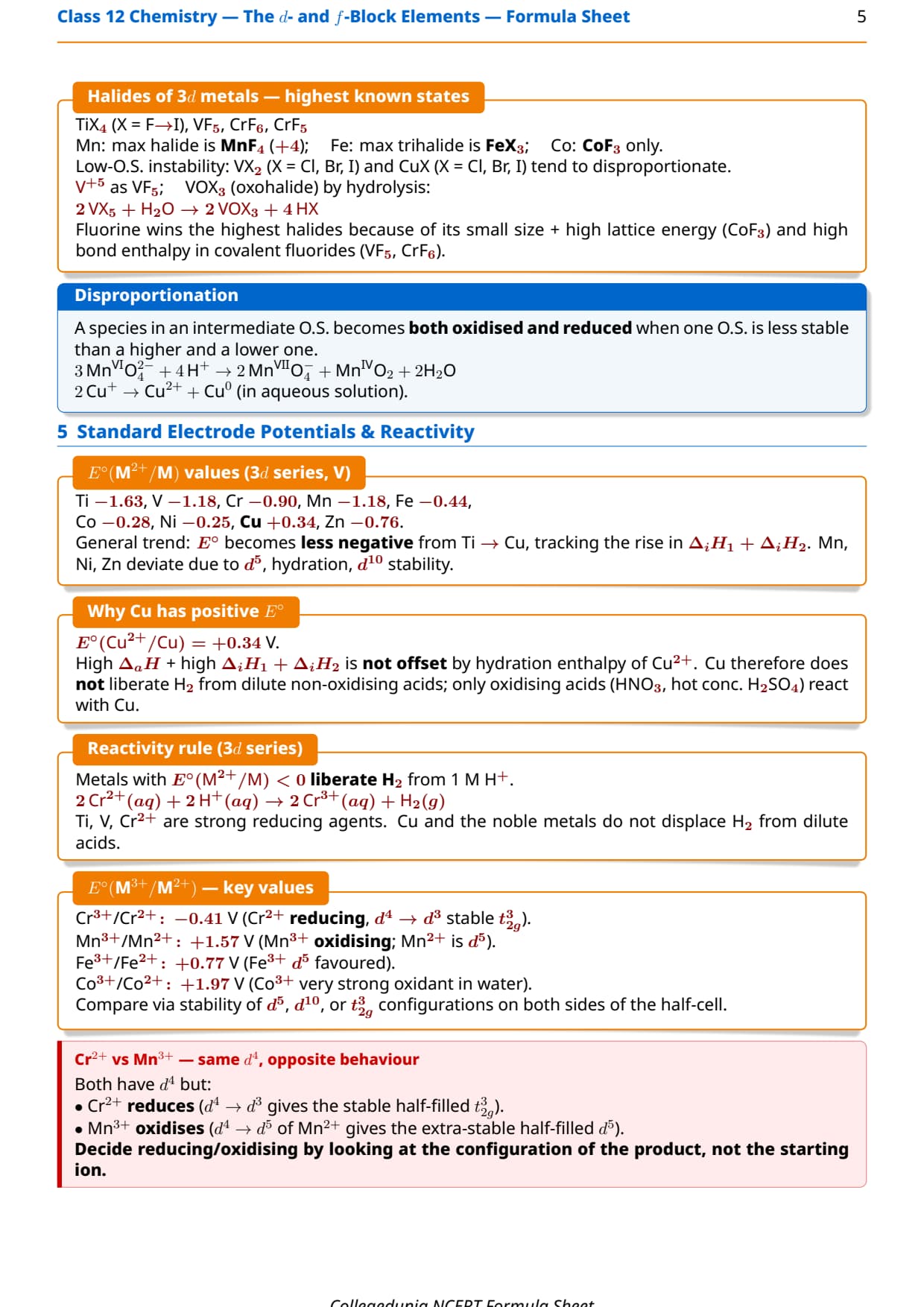
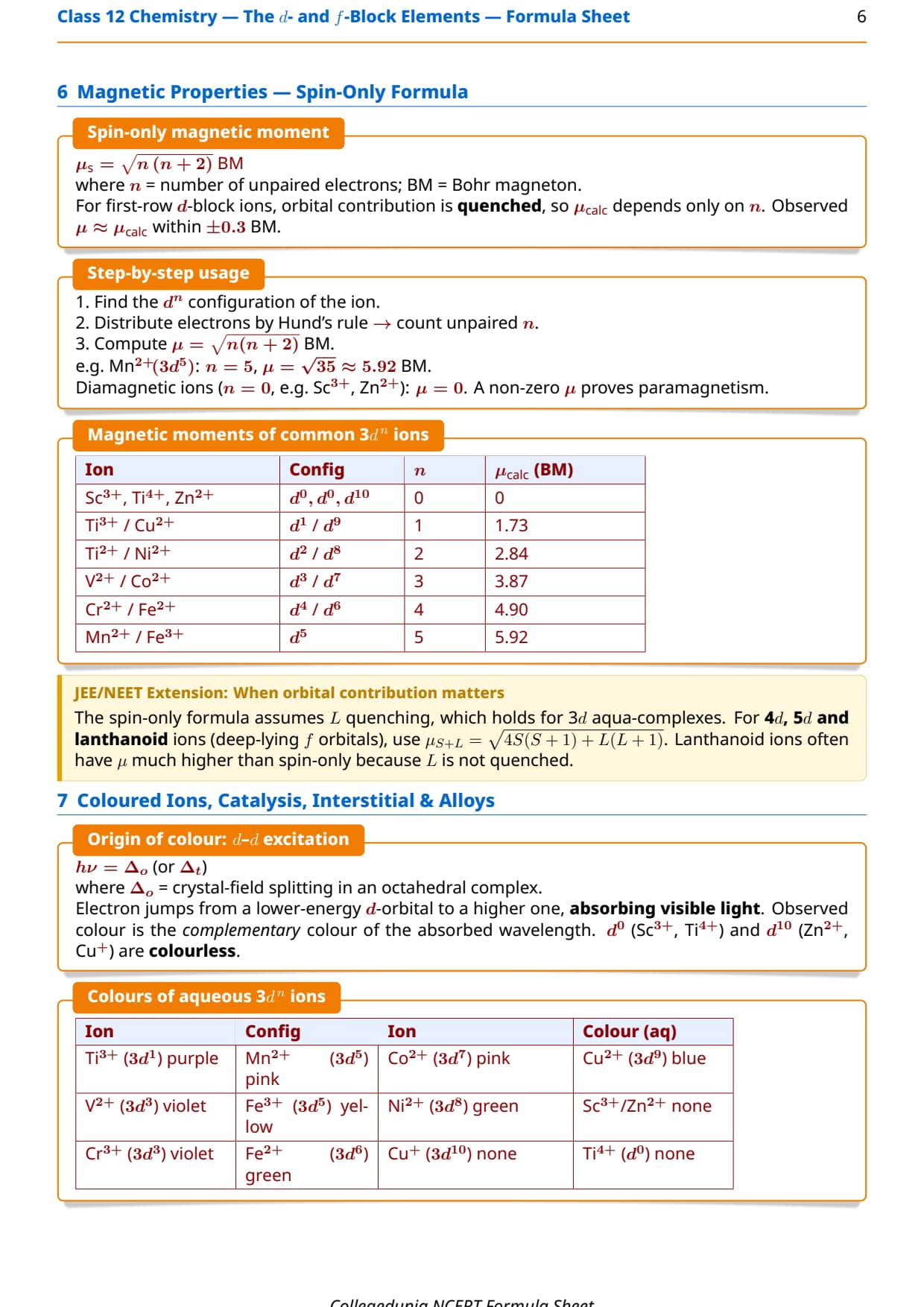
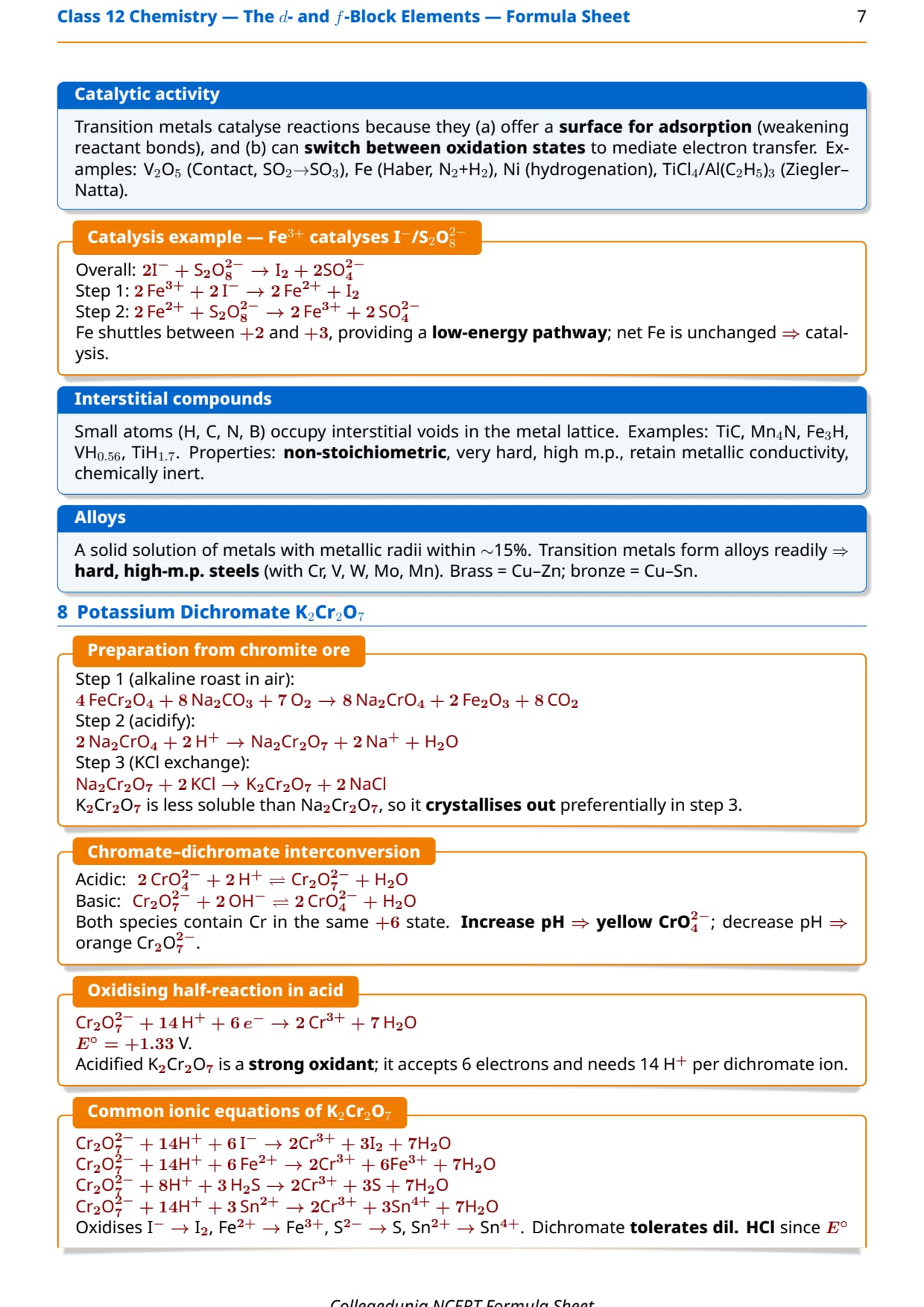
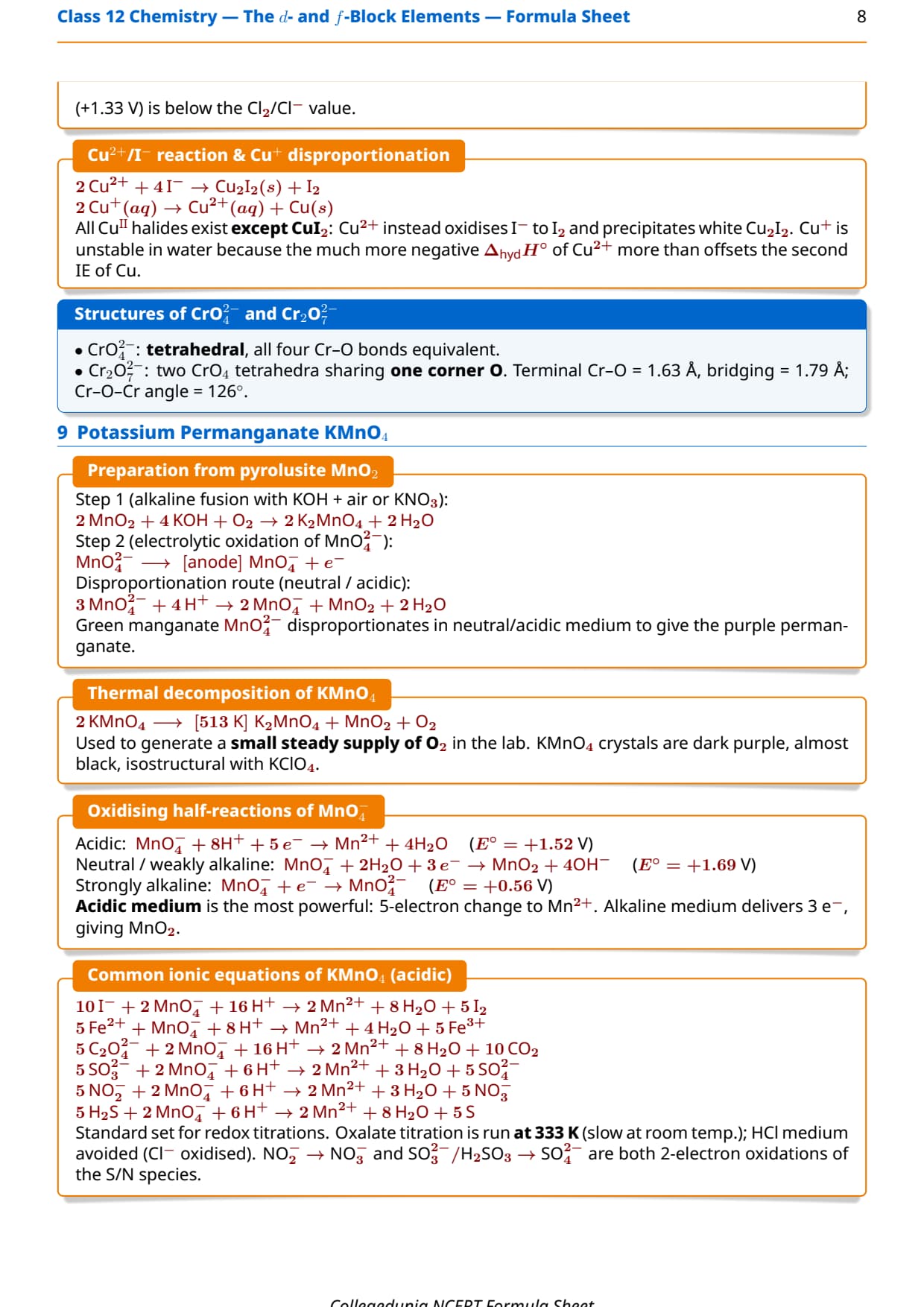
- CBSE Weightage: 4 to 6 marks
- JEE Main Weightage: 3 to 4 percent (2 to 3 questions per paper)
- NEET Weightage: 2 to 3 questions per year
Curated by subject experts and refined against recent CBSE, JEE Main, and NEET papers.
Also Check:
- d- and f-Block Elements Class 12 Chemistry Notes
- d- and f-Block Elements Class 12 Chemistry NCERT Solutions
- CBSE Class 12 Chemistry Syllabus 2026-27
Why the d- and f-Block Formula Sheet is a High-Yield Asset for Class 12th Boards and Entrances
The d-block is the most fact-dense unit in Class 12 Inorganic Chemistry. Keeping magnetic moment, oxidation states, and lanthanoid contraction on one page saves time per question.
The D and F Block Elements Video Walkthrough
Source: Magnet Brains on YouTube
How will Collegedunia's d- and f-Block Elements Formula Sheet Help You?
Built for a 30-minute revision before any Chemistry paper.
- 2026-27 NCERT Alignment: matches the current syllabus print.
- One-Page Printability: master tables fit one A4 landscape sheet.
- Trend Tagging: every property tagged increases / decreases / irregular.
- Expert Verification: checked against NCERT 4.1 to 4.8 and recent JEE and NEET papers.
d- and f-Block Symbol Glossary for Class 12 Chemistry
Mixing up Mn+ with the neutral-atom configuration is the most common magnetic-moment slip.
| Symbol | Meaning | Typical Unit / Value |
|---|---|---|
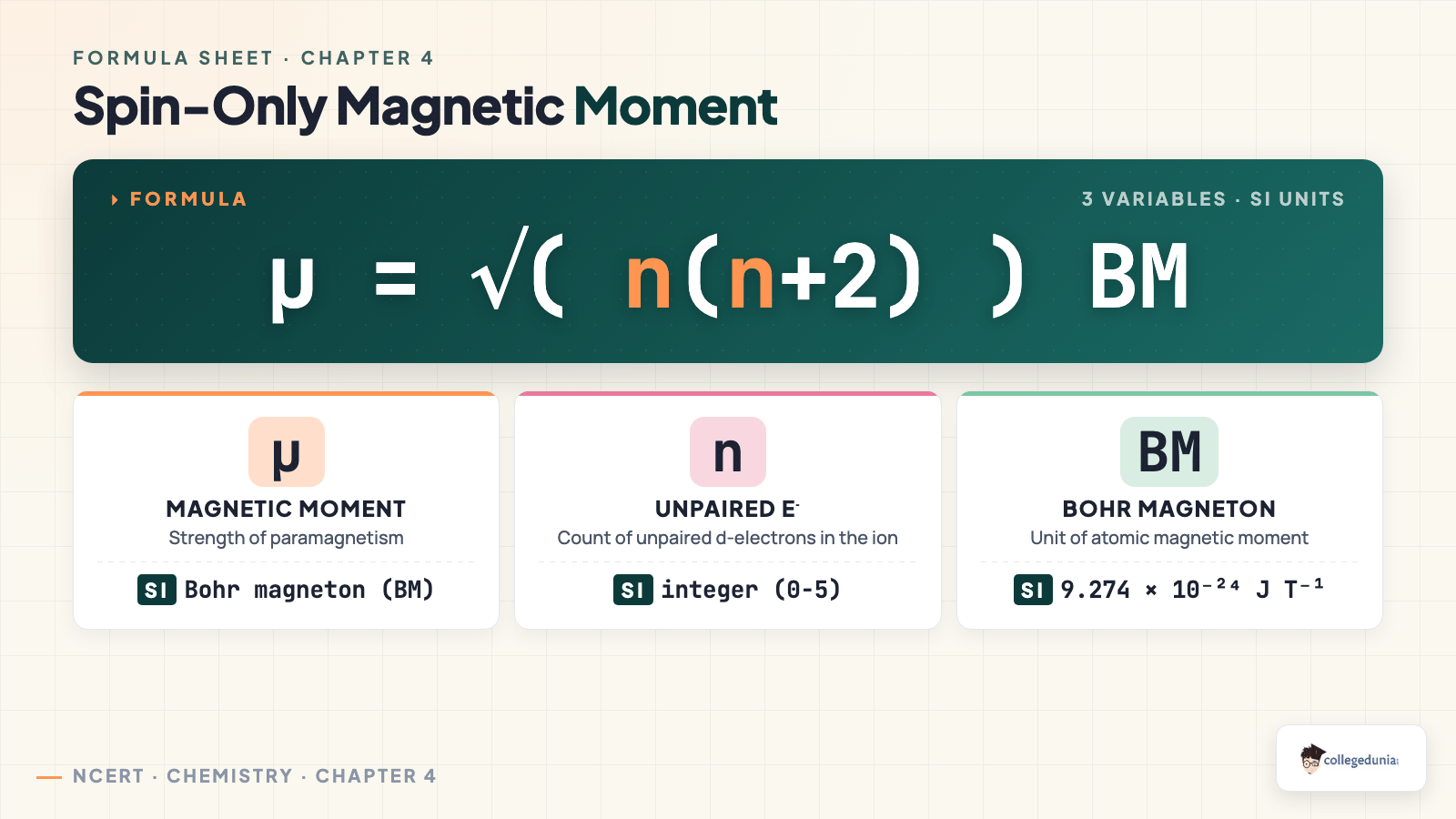
| n | Number of unpaired electrons in d-orbital of Mn+ | dimensionless |
| μ | Spin-only magnetic moment | Bohr Magneton (BM) |
| μB | One Bohr Magneton | 9.274 x 10⁻²⁴ J T-1 |
| (n-1)d, ns | Outer electron shells of a d-block element | - |
| 4f, 5f | Filling orbitals of lanthanoids and actinoids | - |
| Ln, An | Generic lanthanoid / actinoid | - |
| E° | Standard electrode potential | Volt |
| Zeff | Effective nuclear charge | dimensionless |
| ri | Ionic radius | pm |
d- and f-Block Elements All Important Formulae for Class 12 Chemistry
The master table below lists every formula in NCERT Chapter 4 with units, section reference, and exam-use cue. All entries are retained in the 2026-27 syllabus.
| Concept | Formula / Relation | Value or Unit | NCERT Ref | Common Use |
|---|---|---|---|---|
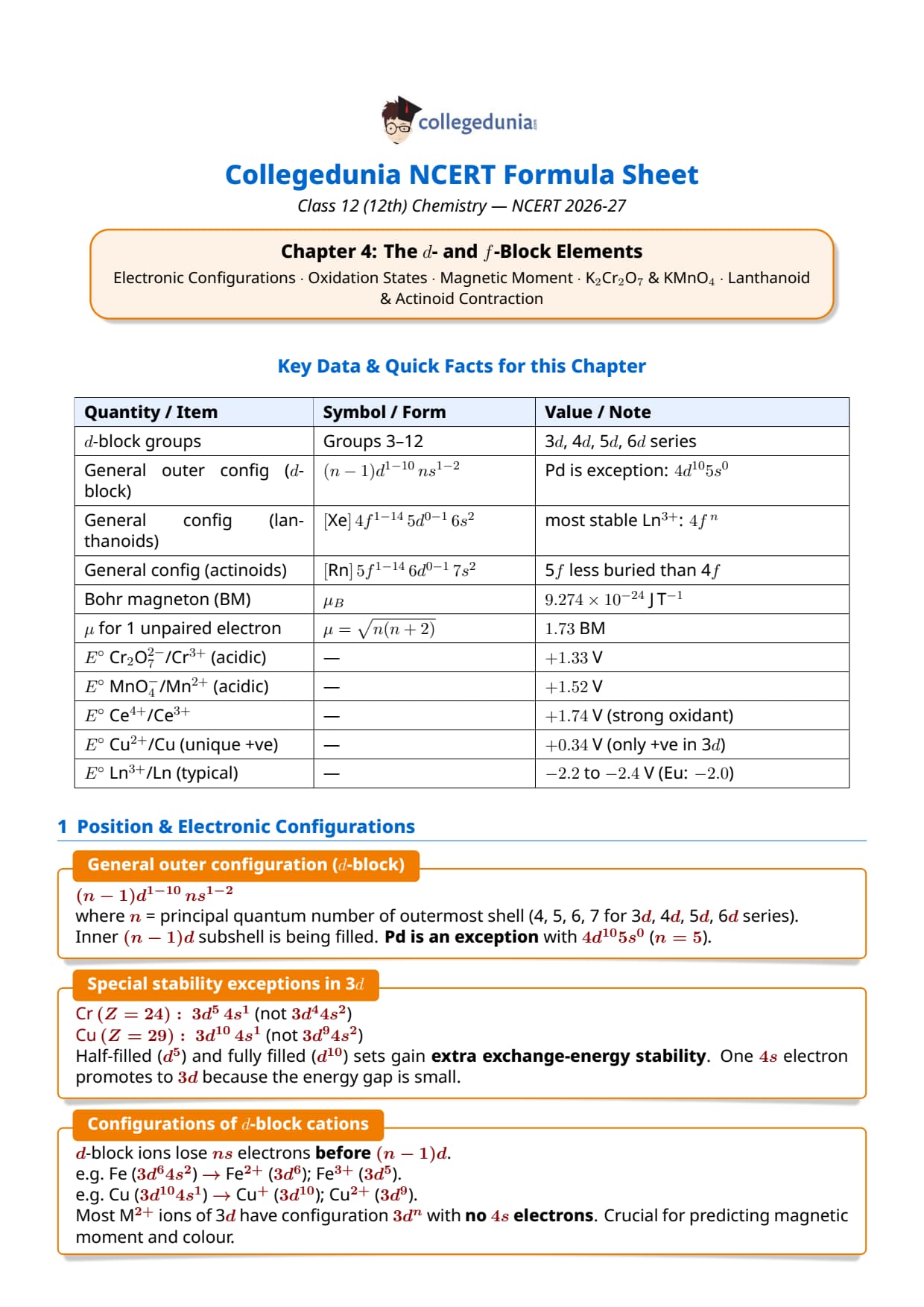
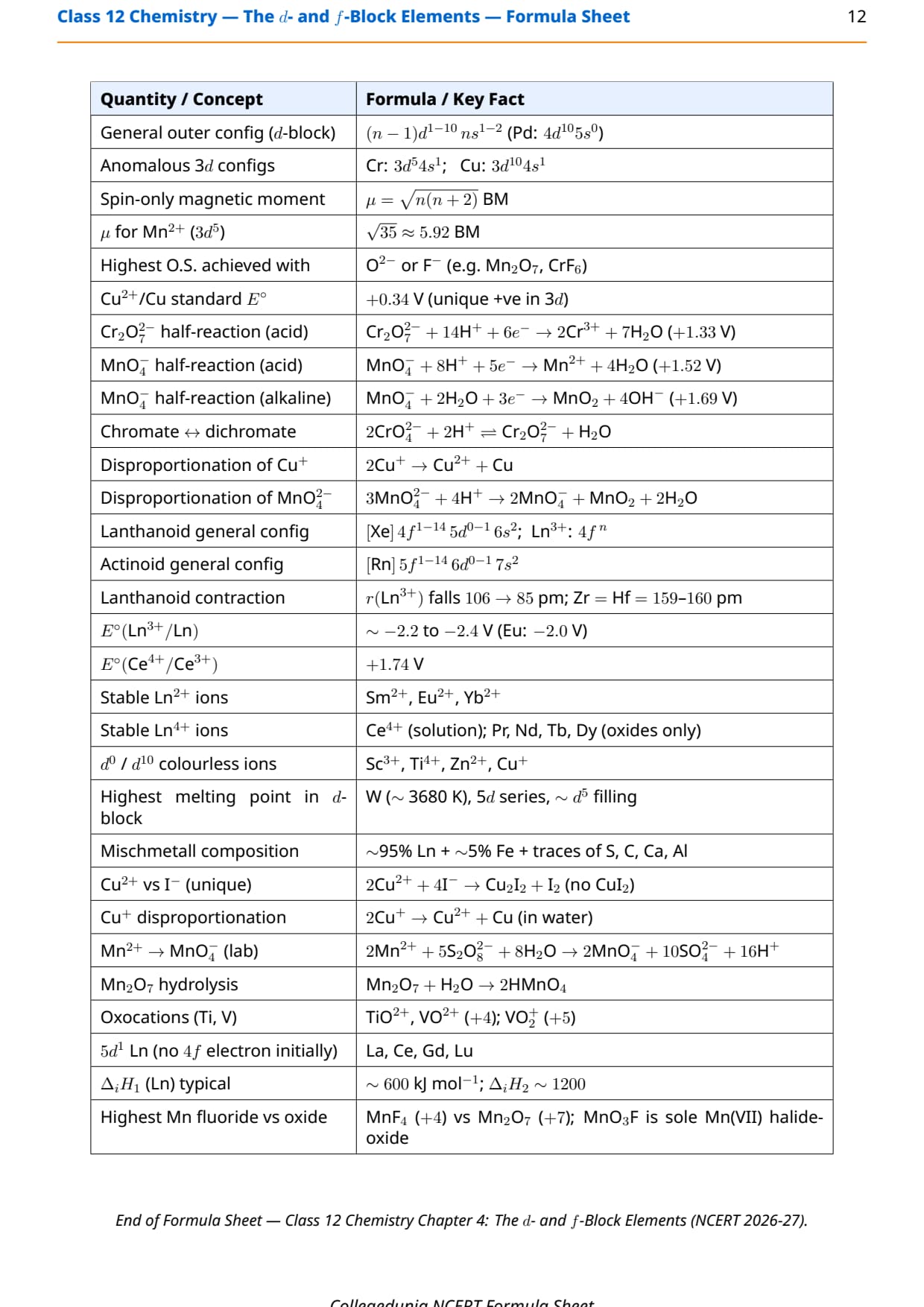
| General d-block configuration | (n-1)d1-10 ns1-2 | - | 4.1 | Identify block |
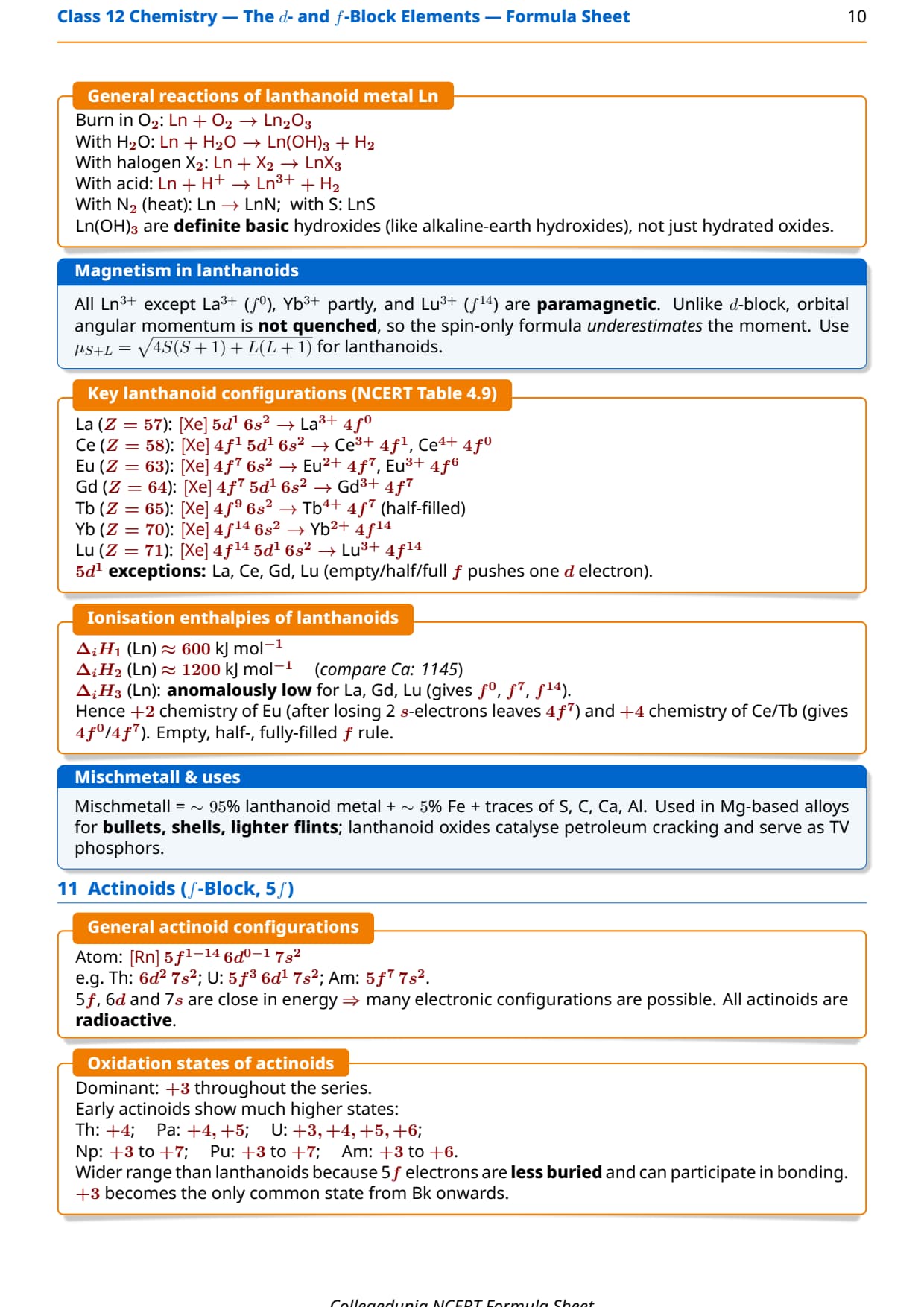
| Lanthanoid configuration | [Xe] 4f1-14 5d0-1 6s2 | - | 4.5 | Z = 58 to 71 |
| Actinoid configuration | [Rn] 5f1-14 6d0-1 7s2 | - | 4.7 | Z = 90 to 103 |
| Cr exception | [Ar] 3d5 4s1 | - | 4.1 | Half-filled stability |
| Cu exception | [Ar] 3d10 4s1 | - | 4.1 | Fully-filled stability |
| Spin-only magnetic moment | μ = √n(n+2) | BM | 4.2 | From n unpaired e- |
| Magnetic moment for n = 1 | μ = 1.73 | BM | 4.2 | Ti3+, V4+, Cu2+ |
| Magnetic moment for n = 2 | μ = 2.83 | BM | 4.2 | V3+, Ni2+ |
| Magnetic moment for n = 3 | μ = 3.87 | BM | 4.2 | Cr3+, Co2+ |
| Magnetic moment for n = 4 | μ = 4.90 | BM | 4.2 | Fe2+, Co3+ |
| Magnetic moment for n = 5 | μ = 5.92 | BM | 4.2 | Mn2+, Fe3+ |
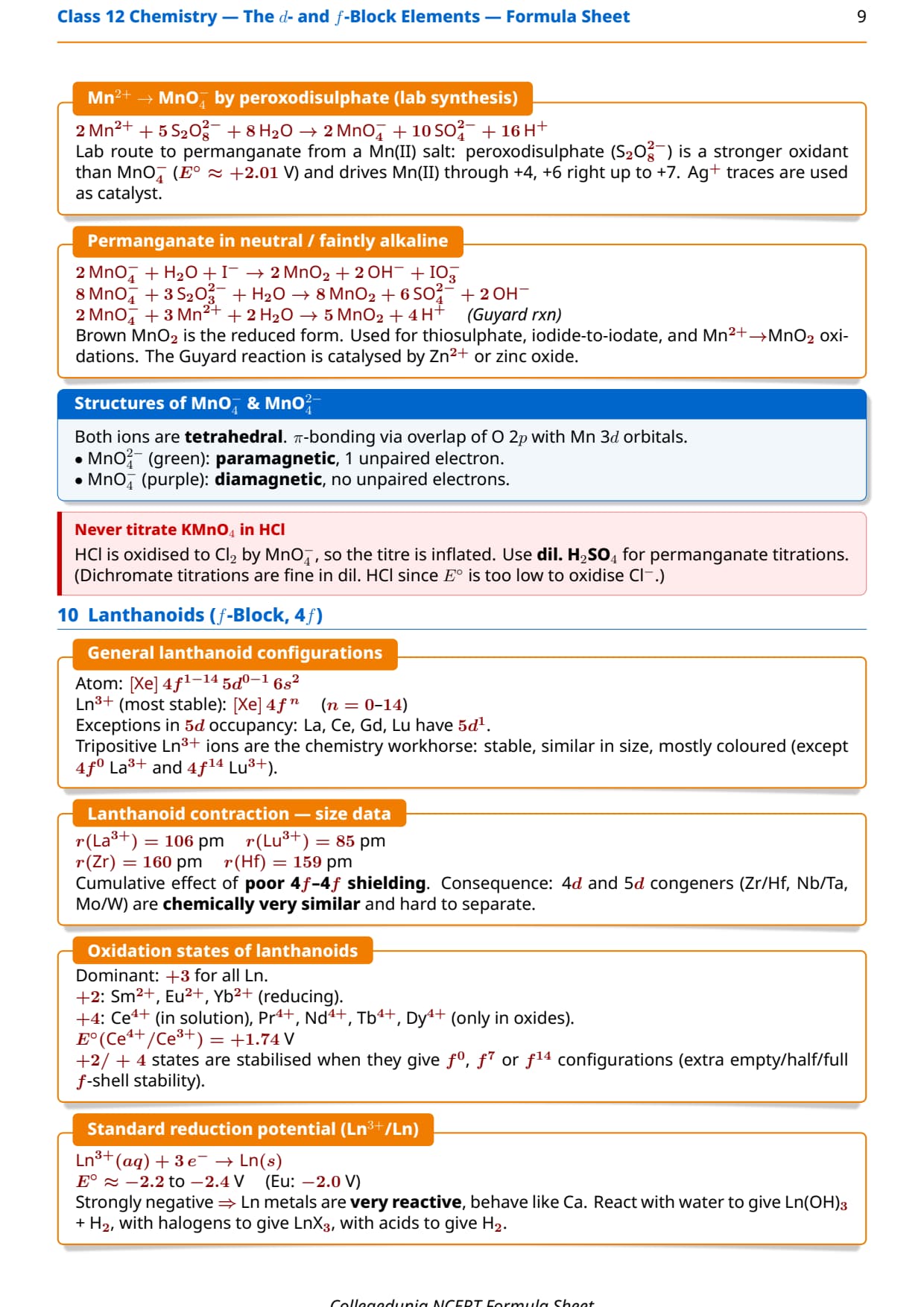
| Lanthanoid contraction | r(La3+) = 103 pm → r(Lu3+) = 86 pm | pm | 4.5 | Steady decrease across Ln |
| K2Cr2O7 preparation | 4FeCr2O4 + 8Na2CO3 + 7O2 → 8Na2CrO4 + 2Fe2O3 + 8CO2 | - | 4.3 | From chromite ore |
| Cr orange to yellow | Cr2O72- + 2OH- 2CrO42- + H2O | - | 4.3 | pH-dependent eq. |
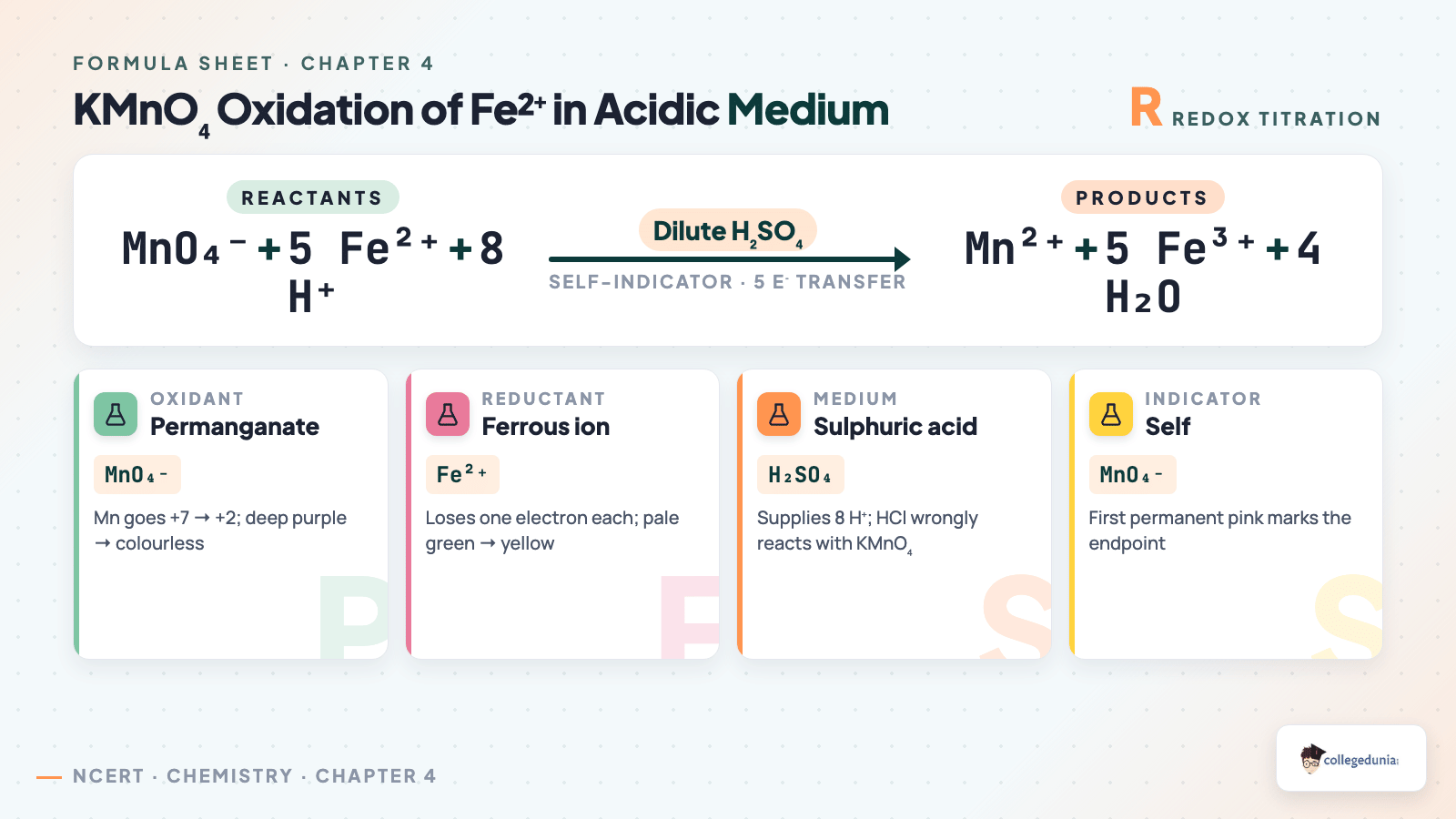
| KMnO4 oxidation (acidic) | MnO4- + 8H+ + 5e- → Mn2+ + 4H2O | n-factor = 5 | 4.3 | Acidic titrations |
| KMnO4 (neutral / faintly alkaline) | MnO4- + 2H2O + 3e- → MnO2 + 4OH- | n-factor = 3 | 4.3 | Baeyer's reagent |
| KMnO4 (strongly alkaline) | MnO4- + e- → MnO42- | n-factor = 1 | 4.3 | Manganate green |
| Standard reduction potential (acid) | E∘(MnO4-/Mn2+) = +1.51 V | V | 4.3 | Strong oxidiser |
Reverse shortcut: square the BM value and solve n(n+2) for n. For μ = 5.92 BM, n = 5.
d- and f-Block Quick-Fact Cards for MCQ Recall
The five facts below are the ones JEE Main and NEET rotate as 1-mark MCQs.
Class 12th d- and f-Block Property Trend Table
The five trends below are frequent CBSE one-mark VSAQs. Memorise the direction.
| Property | Trend Across 3d Series | Reason | NCERT Ref |
|---|---|---|---|
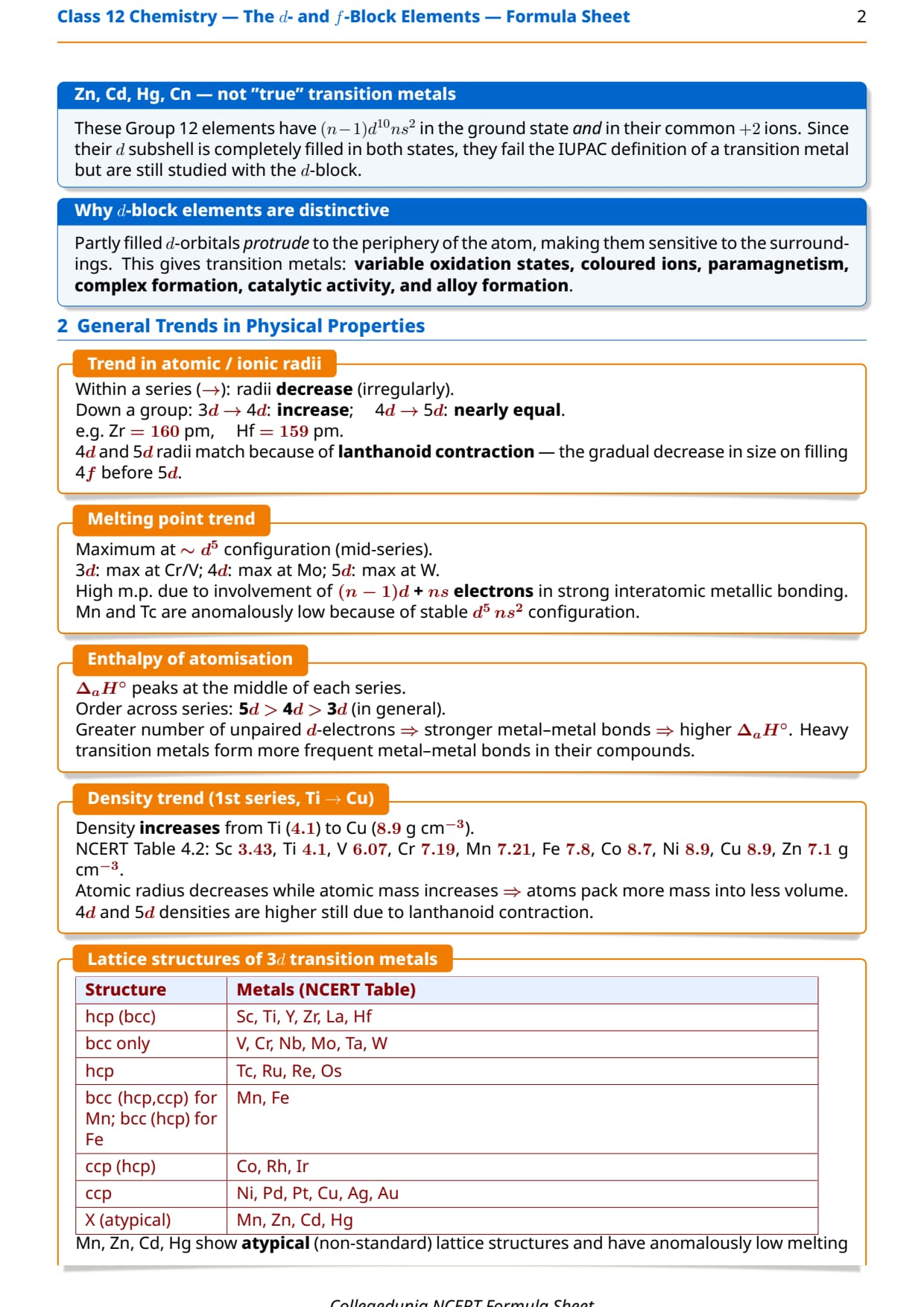
| Atomic radius | Decreases then nearly constant (Mn to Cu) | Zeff rise balanced by d-d repulsion | 4.2 |
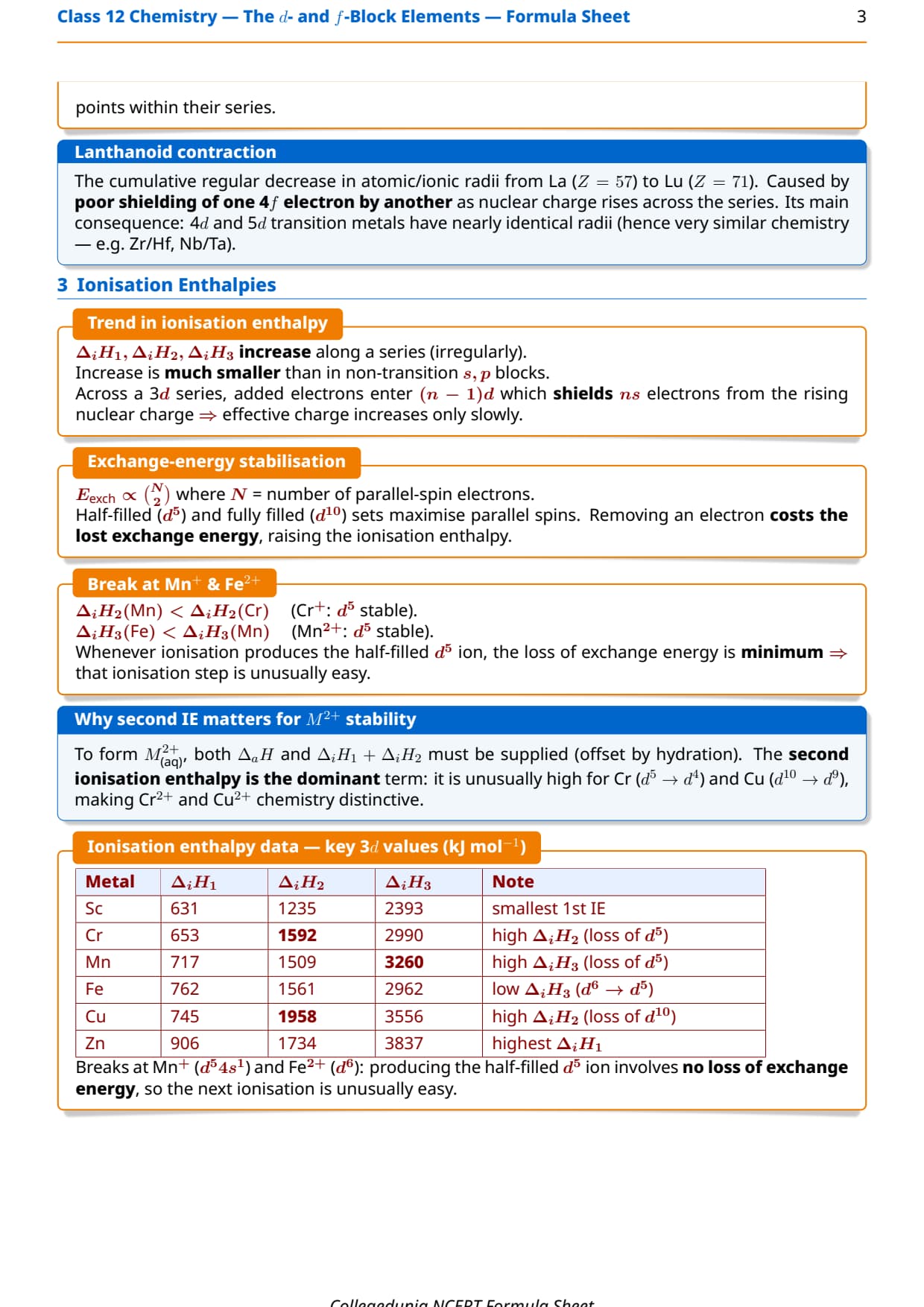
| Ionisation enthalpy | Irregular rise overall | Half- / fully-filled stability of Mn, Zn | 4.2 |
| Melting point | Peaks at Cr (3d54s1), low at Zn | Number of unpaired d electrons | 4.2 |
| Density | Increases steadily across the period | Mass rise outweighs radius decrease | 4.2 |
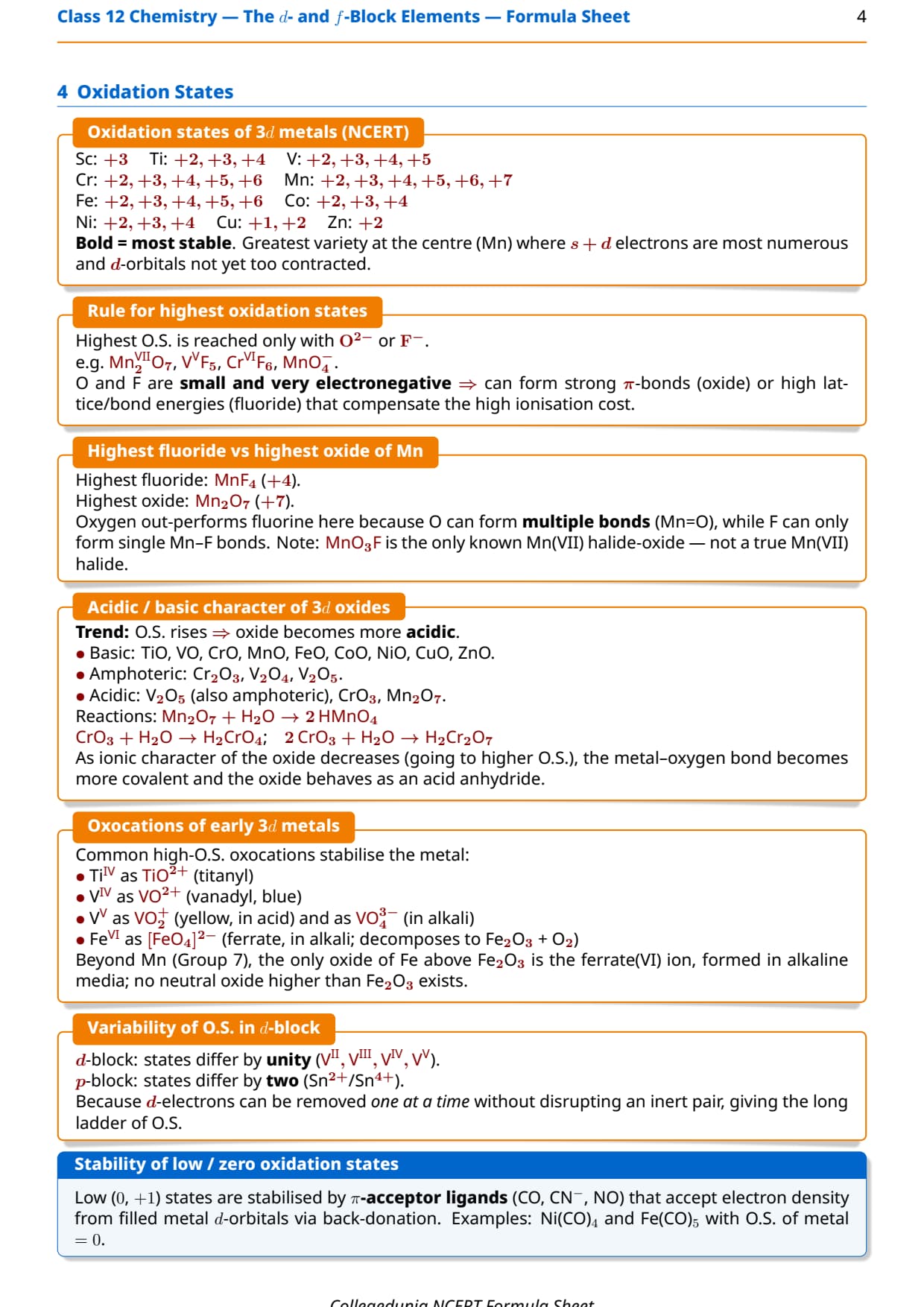
| Oxidation state range | Maximum at Mn (+2 to +7), drops after | Pairing of d-electrons after Mn | 4.2 |
When to Use Which Formula in d- and f-Block Elements
- "Magnetic moment of Mn+": count unpaired d-electrons, apply μ = √n(n+2) BM.
- "Why +3 stable for lanthanoids": ionisation plus hydration enthalpy favours Ln3+.
- "KMnO4 n-factor": acidic / neutral / alkaline gives n = 5 / 3 / 1.
- "Why Zr similar to Hf": lanthanoid contraction gives near-identical radii.
- "Cr and Cu exceptions": half / full d-subshell stability beats Aufbau order.
d- and f-Block Common-Numerical Pattern Templates
The four setups below dominate CBSE, JEE Main, and NEET papers.
| Pattern | What the question gives | Formula to apply | Common trap |
|---|---|---|---|
| μ from ion | Identity of Mn+ | Count unpaired d-electrons, μ = √n(n+2) | Using neutral-atom configuration |
| n from μ | μ in BM | Solve n(n+2) = μ2 | Forgetting to take +ve root |
| n-factor of KMnO4 | Medium (acidic / neutral / alkaline) | 5 / 3 / 1 respectively | Defaulting to 5 in every medium |
| Identify exception | Element symbol (Cr, Cu, Mo, Ag, Au) | Half / full d-subshell rule | Listing Mn or Fe as exception |
Student Feedback
In a Collegedunia poll of 900 Class 12 students, 78% said the spin-only magnetic moment and n-factor cards on this d- and f-Block sheet were the fastest to revise the night before the exam.
Related Links:
- Chemical Kinetics Class 12 Chemistry Formula Sheet (Previous Chapter)
- Coordination Compounds Class 12 Chemistry Formula Sheet (Next Chapter)
Other Resources for The d- and f-Block Elements Class 12 Chemistry
- d- and f-Block Elements Class 12 Chemistry Formula Sheet
- d- and f-Block Elements Class 12 Chemistry NCERT Solutions
- d- and f-Block Elements Class 12 Chemistry Notes
- d- and f-Block Elements Class 12 Chemistry NCERT Book PDF
- d- and f-Block Elements Class 12 Chemistry NCERT Exemplar Book PDF
- d- and f-Block Elements Class 12 Chemistry NCERT Exemplar Solutions
- d- and f-Block Elements Class 12 Chemistry Handwritten Notes
NCERT Formula Sheet for Class 12 Chemistry: All Chapters
Jump to the formula sheet for any other chapter of Class 12 Chemistry below.
| Chapter | Resource |
|---|---|
| Chapter 1 | Solutions Formula Sheet |
| Chapter 2 | Electrochemistry Formula Sheet |
| Chapter 3 | Chemical Kinetics Formula Sheet |
| Chapter 5 | Coordination Compounds Formula Sheet |
| Chapter 6 | Haloalkanes and Haloarenes Formula Sheet |
| Chapter 7 | Alcohols, Phenols and Ethers Formula Sheet |
| Chapter 8 | Aldehydes, Ketones and Carboxylic Acids Formula Sheet |
| Chapter 9 | Amines Formula Sheet |
| Chapter 10 | Biomolecules Formula Sheet |
d- and f-Block Elements Class 12 Chemistry Formula Sheet FAQs
Ques. Where can I download the d- and f-Block Elements Class 12 Chemistry Formula Sheet PDF?
Ans. You can download the d- and f-Block Elements Class 12 Chemistry Formula Sheet PDF directly from this Collegedunia page. Both the Normal and HD versions are available and free.
Ques. Is this Formula Sheet aligned with the 2026-27 NCERT?
Ans. Yes. This page reflects the current 2026-27 syllabus for Class 12 Chemistry. The d- and f-Block Elements chapter is fully retained in the new edition with no formula cuts; every relation in Sections 4.1 to 4.8 of the NCERT remains examinable.
Ques. How many pages is the Class 12th Chemistry d- and f-Block Elements Formula Sheet PDF?
Ans. The Formula Sheet PDF runs approximately 8 pages and covers the master formula table, symbol glossary, magnetic-moment quick cards, trend table, when-to-use decision tree, and four common numerical pattern templates.
Ques. What is the formula for spin-only magnetic moment in d- and f-Block Elements?
Ans. The spin-only magnetic moment is given by μ = √n(n+2) Bohr Magneton, where n is the number of unpaired electrons in the d-orbital of the metal ion Mn+. For example, Fe3+ (3d5) has n = 5, so μ = √35 = 5.92 BM.
Ques. What is lanthanoid contraction and why does it matter?
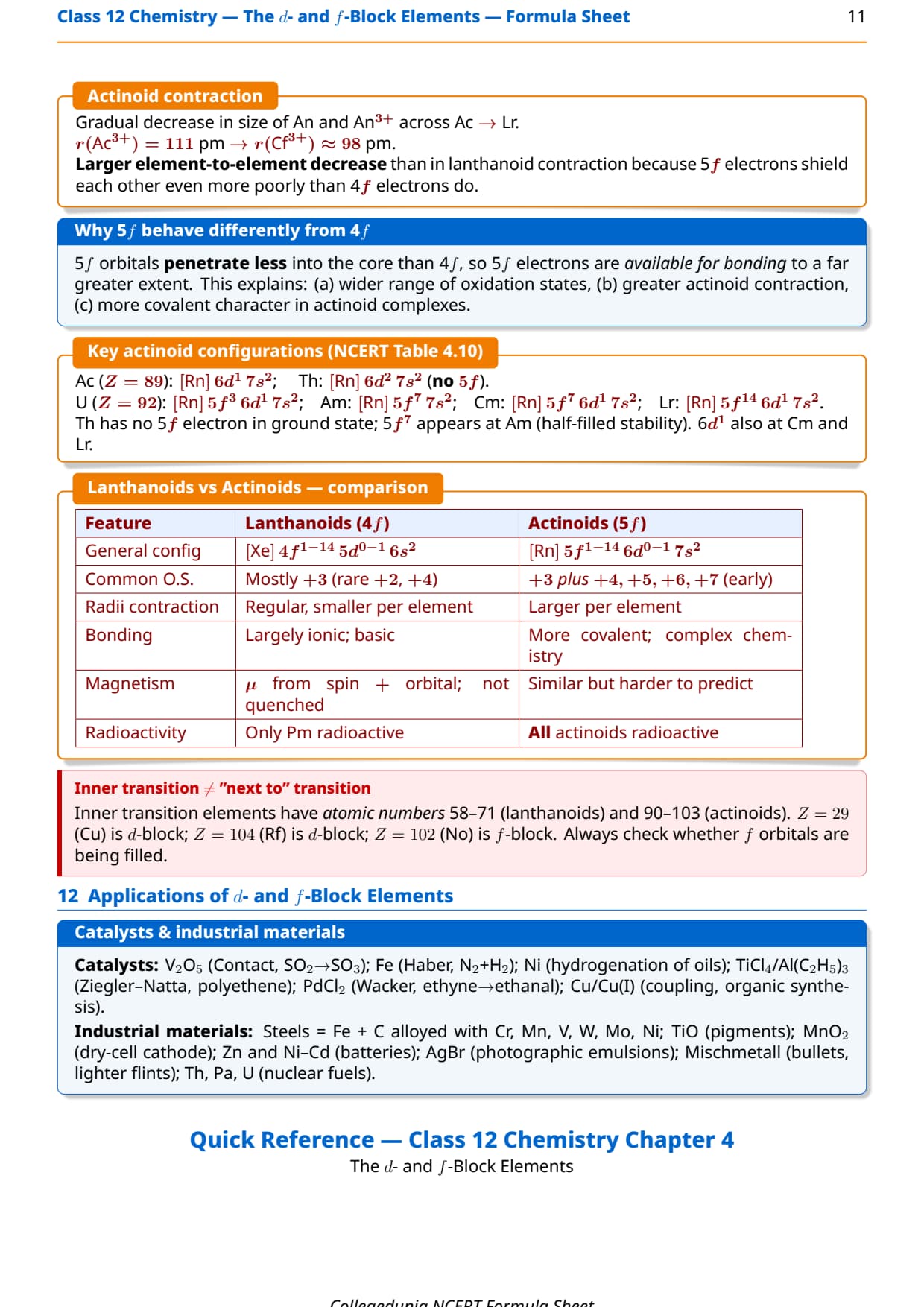
Ans. Lanthanoid contraction is the steady decrease in atomic and ionic radii of the 4f-block elements from La to Lu (a total drop of about 17 pm). It arises because 4f electrons shield the nuclear charge poorly. The consequence is that 4d and 5d transition elements of the same group (e.g. Zr and Hf, Nb and Ta) have nearly identical sizes and similar chemistry.
Ques. Why are Cr and Cu electronic configurations exceptions in the 3d series?
Ans. Cr is [Ar]3d54s1 and Cu is [Ar]3d104s1. A half-filled (d5) or fully filled (d10) d-subshell is extra-stable due to exchange energy and symmetric distribution of electrons. The 4s electron promotes to 3d to achieve this stable configuration.
Ques. What is the n-factor of KMnO4 in different media?
Ans. KMnO4 changes its n-factor with the medium: 5 in acidic solution (Mn7+ to Mn2+), 3 in neutral or faintly alkaline solution (Mn7+ to Mn4+, forming MnO2), and 1 in strongly alkaline solution (Mn7+ to Mn6+, forming MnO42-). Always check the medium before solving a redox titration.
Ques. Why do transition metals show variable oxidation states?
Ans. Transition metals have (n-1)d and ns electrons of comparable energy, so both shells can lose electrons. Mn shows the widest range (+2 to +7) because its 3d54s2 configuration provides seven outer electrons that can all participate in bonding.
Ques. What are the Mn oxidation states and which one is most stable?
Ans. Mn shows oxidation states +2, +3, +4, +6 and +7 in standard compounds. Mn(+2) is the most stable in aqueous solution because losing the two 4s electrons gives 3d5 high-spin half-filled configuration with maximum exchange energy. Mn(+7) is the highest oxidation state in the 3d series and is realised in KMnO4.
Ques. What are the consequences of lanthanide contraction?
Ans. The lanthanoid contraction consequences are: (i) nearly identical sizes of 4d and 5d transition metals of the same group, so Zr/Hf and Nb/Ta are chemically inseparable; (ii) decreasing basicity of trivalent hydroxides from La(OH)3 to Lu(OH)3; (iii) closely spaced ionisation enthalpies that make individual lanthanoid separation industrially difficult.
Ques. How does the chromate-dichromate equilibrium shift with pH?
Ans. The equilibrium 2CrO42- + 2H+ Cr2O72- + H2O is pH-controlled. Adding acid shifts it right, giving the orange Cr2O72- ion in dichromate solutions. Adding base shifts it left, giving the yellow CrO42- ion in chromate solutions.
Ques. What is the color of transition metal compounds and which ions are colourless?
Ans. Most transition metal compounds are coloured because of d-d electronic transitions in the crystal field, where an electron absorbs a part of the visible spectrum and jumps from one d-orbital to another of higher energy. Sc3+, Ti4+ (d0) and Cu+, Zn2+ (d10) lack a possible d-d transition and are colourless.
Ques. What is the catalytic activity of transition metals?
Ans. Transition metals are good catalysts because they have variable oxidation states (allowing electron exchange in a reaction cycle) and partially filled d-orbitals (providing adsorption sites). V2O5 catalyses the Contact process, Fe catalyses the Haber process, Ni catalyses hydrogenation, and Pt catalyses catalytic converters.
Ques. What are interstitial compounds and alloys of transition metals?
Ans. Interstitial compounds are non-stoichiometric solids formed when small atoms (H, C, N, B) occupy lattice voids of transition metals, giving hard, high-melting, chemically inert materials like TiC and Mn4N. Alloy formation is favoured by the similar atomic radii of transition metals. Brass (Cu-Zn), bronze (Cu-Sn), stainless steel (Fe-Cr-Ni) and misch metal (95% Ln + 5% Fe) are textbook alloys.
Ques. What are the actinoids vs lanthanoids differences for formula recall?
Ans. Lanthanoids have the configuration [Xe] 4f1-14 5d0-1 6s2 and are predominantly +3 with a few +2/+4 exceptions. Actinoids have [Rn] 5f1-14 6d0-1 7s2 and show oxidation states up to +7 (Np, Pu). All actinoids are radioactive; actinoid contraction is larger per element than lanthanoid contraction because 5f electrons shield even less effectively than 4f.



Comments