




Class 12 Chemistry Chapter 3 Chemical Kinetics stays fully retained in the 2026-27 NCERT. This Collegedunia formula sheet hosts every rate-law, half-life, and Arrhenius expression you need for CBSE Boards, JEE Main, and NEET.
- CBSE Weightage: 6 to 8 marks
- JEE Main Weightage: 3 to 4 percent (2 to 3 questions per paper)
- NEET Weightage: 2 to 3 questions per year
Curated by subject experts, mapped to the 2026-27 NCERT edition.
Also Check:
Why a Chemical Kinetics Formula Sheet Matters for Class 12th Boards and Entrance Exams
Chemical Kinetics is the most numerical-heavy unit in Class 12 Chemistry. CBSE asks a 3-marker on integrated rate laws almost every year, and JEE Main tests Arrhenius in most shifts. All 14 formulae on one page save recall time.
Chemical Kinetics Class 12 Chemistry Explained
Source: Magnet Brains on YouTube
How will Collegedunia's Chemical Kinetics Formula Sheet Help You?
Built for a 30-minute last-pass revision before any Chemistry paper.
- 2026-27 NCERT alignment: every formula matches the current syllabus.
- One-page printability: the master table fits one A4 sheet.
- When-to-use cues: each formula is tagged with its trigger phrasing.
- Expert-verified: checked against NCERT and recent JEE Main papers.
Chemical Kinetics Symbol Glossary for Class 12 Chemistry
Confusing [A] with [A]₀ is the most common 1-mark slip in CBSE booklets.
| Symbol | Meaning | Typical Unit |
|---|---|---|
| r | Instantaneous rate | mol L-1 s-1 |
| k | Rate constant | varies with order |
| [A], [B] | Concentrations at time t | mol L-1 |
| [A]₀ | Initial concentration at t = 0 | mol L-1 |
| t1/2 | Half-life | s |
| Ea | Activation energy | kJ mol-1 |
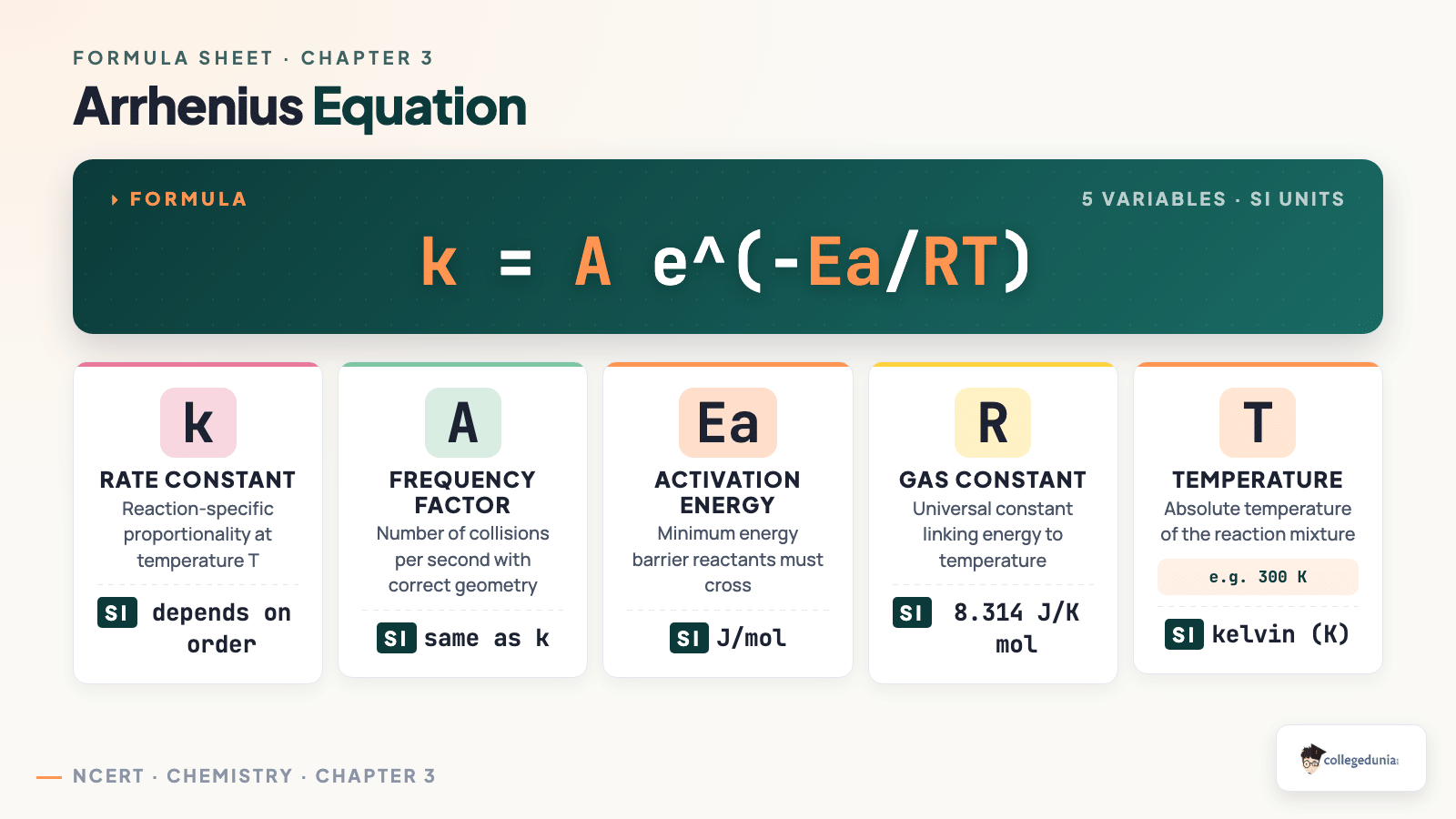
| A | Arrhenius pre-exponential factor | same as k |
| R | Gas constant | 8.314 J K-1 mol-1 |
| T | Absolute temperature | K |
| α, β | Order w.r.t. each reactant | dimensionless |
Chemical Kinetics All Important Formulae for Class 12 Chemistry
Every formula in NCERT Chapter 3, with units, section reference, and exam-use cue. All 14 are retained in the 2026-27 syllabus.
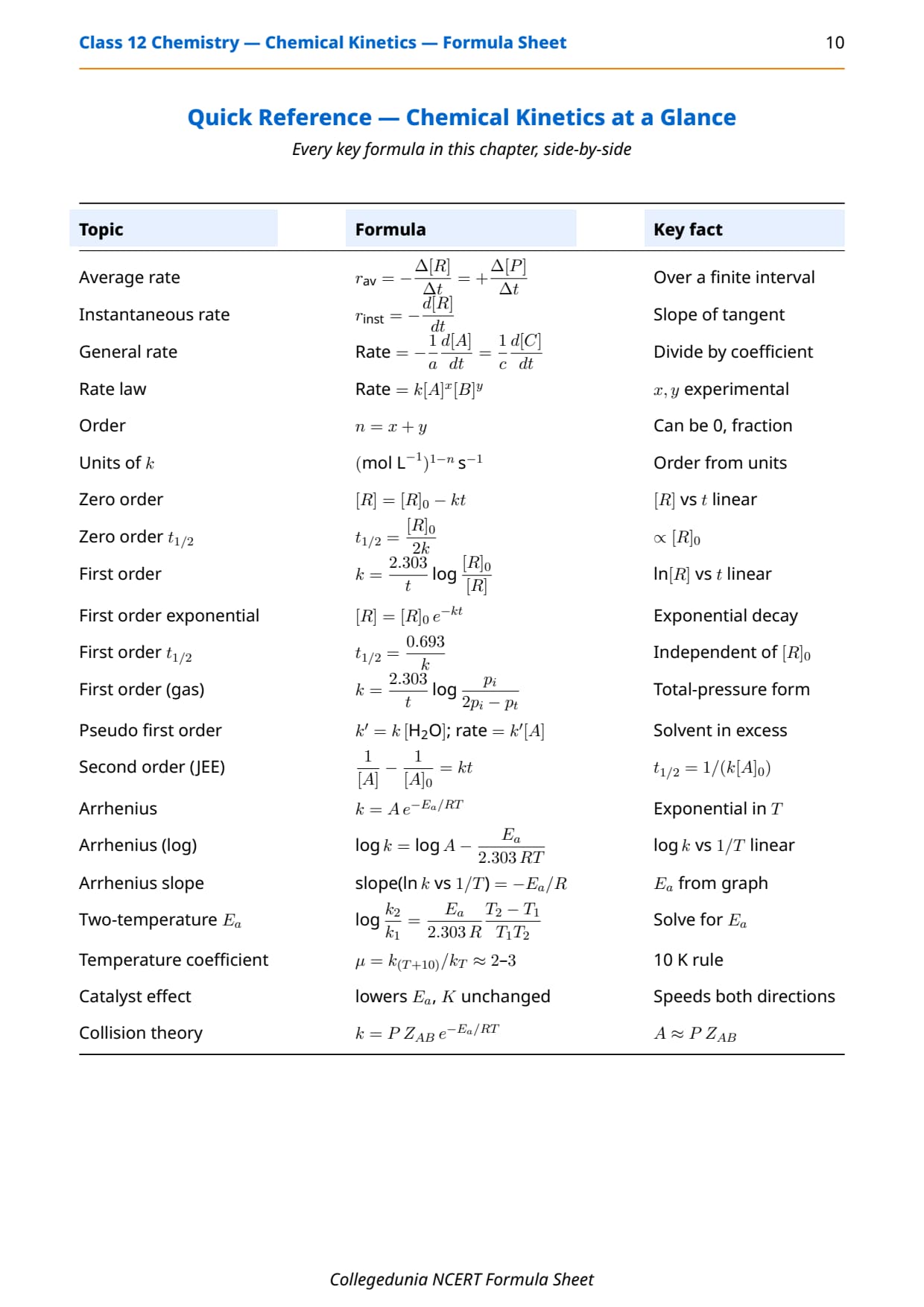
| Concept | Formula | Units of k | NCERT Ref | Common Use |
|---|---|---|---|---|
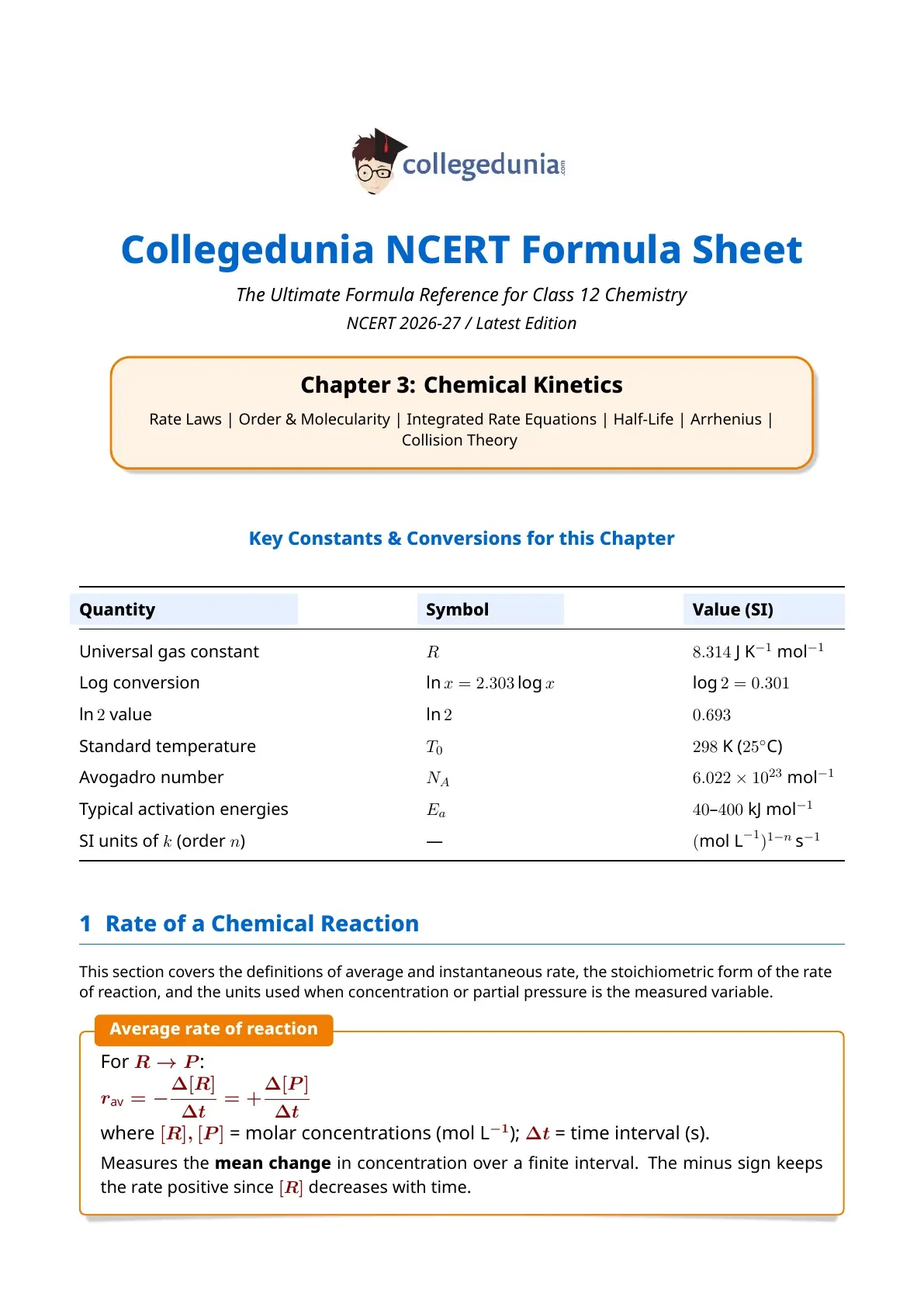
| Average rate | ravg = -Δ [R]Δ t = +Δ [P]Δ t | mol L-1 s-1 | 3.1 | Interval data |
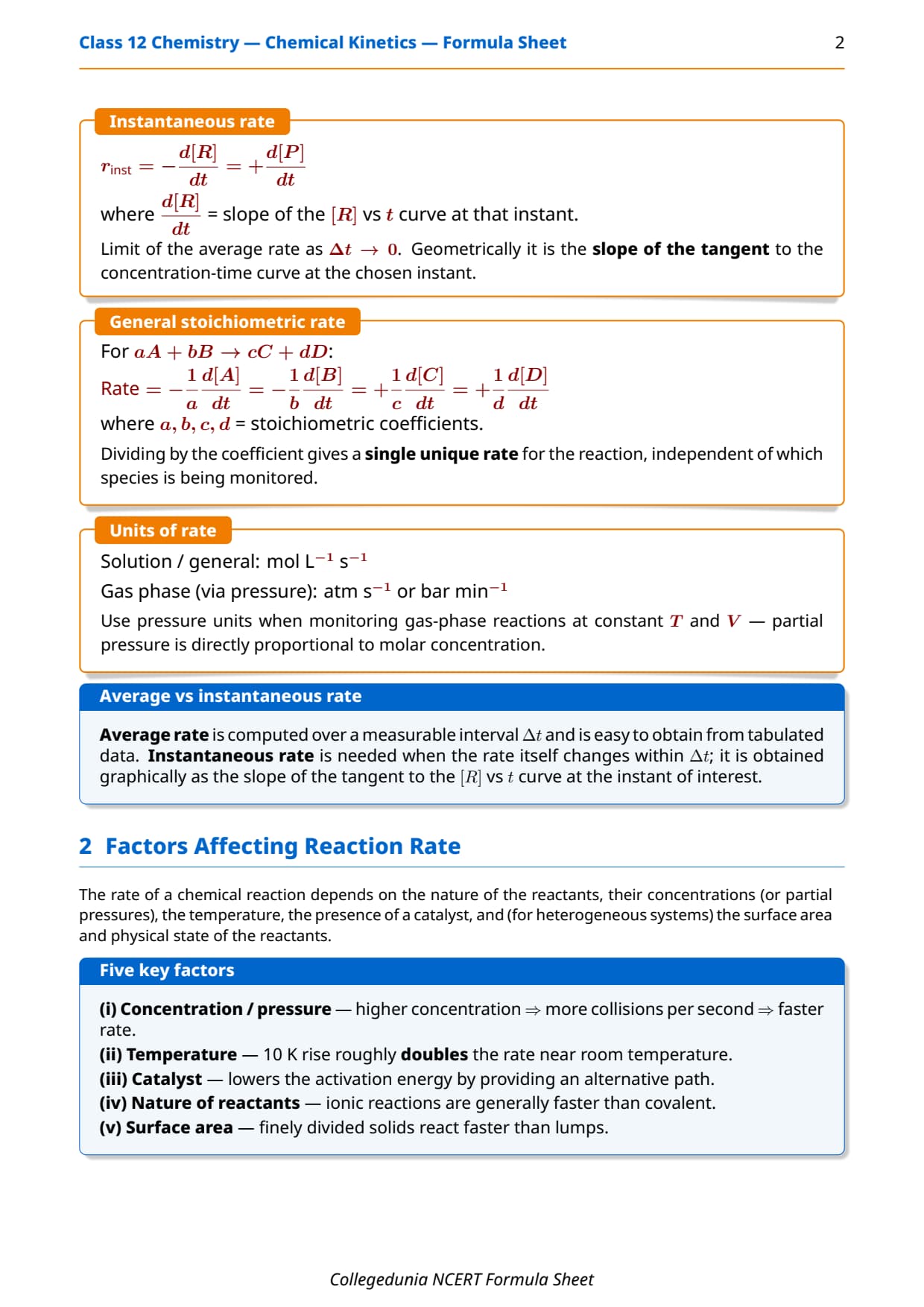
| Instantaneous rate | r = -d[R]dt = +d[P]dt | mol L-1 s-1 | 3.1 | Slope of curve |
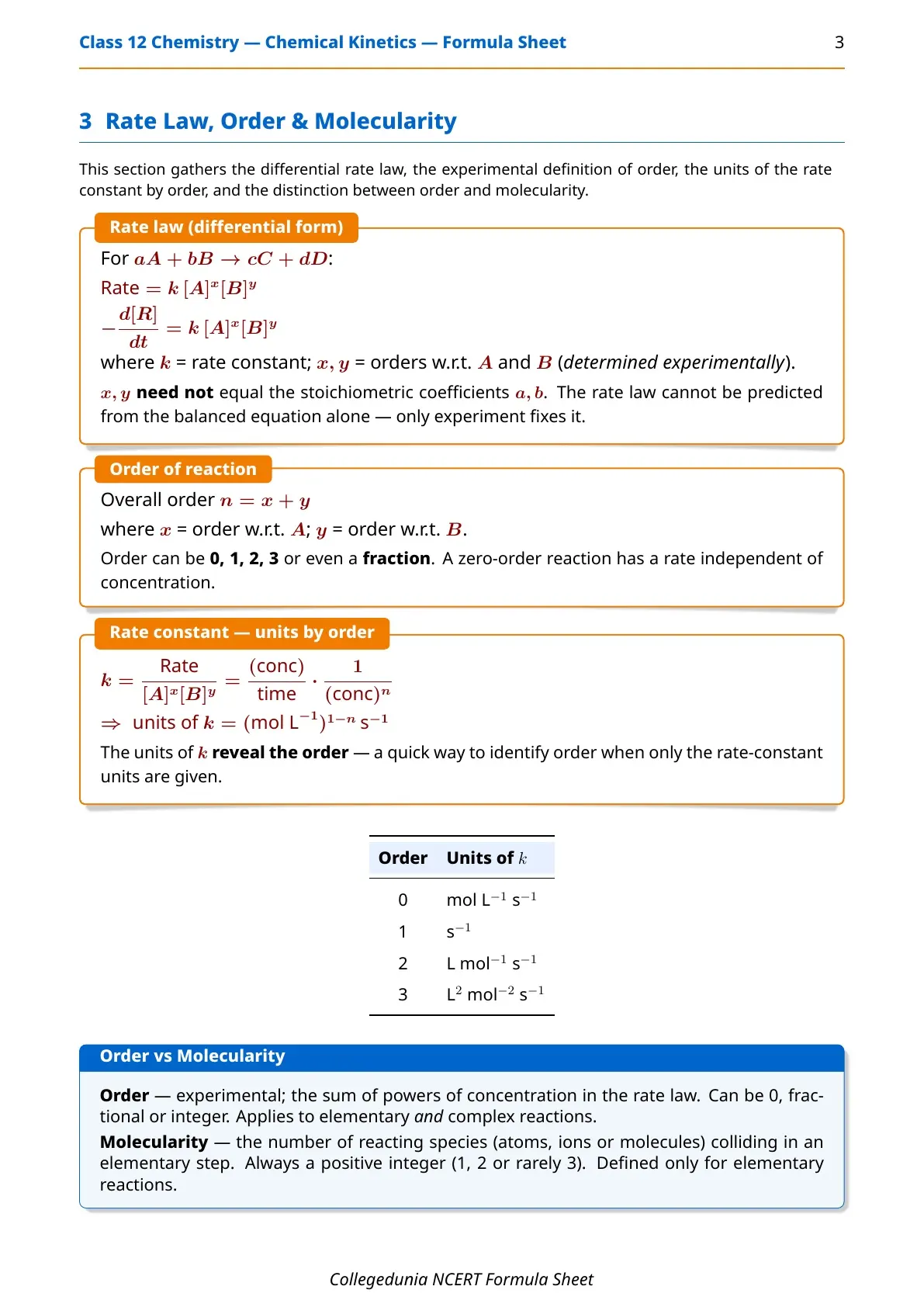
| Rate law (general) | r = k [A]α[B]β | varies | 3.3 | Initial-rates method |
| Units of k | mol(1-n) L(n-1) s-1 | n = order | 3.3 | Order from units |
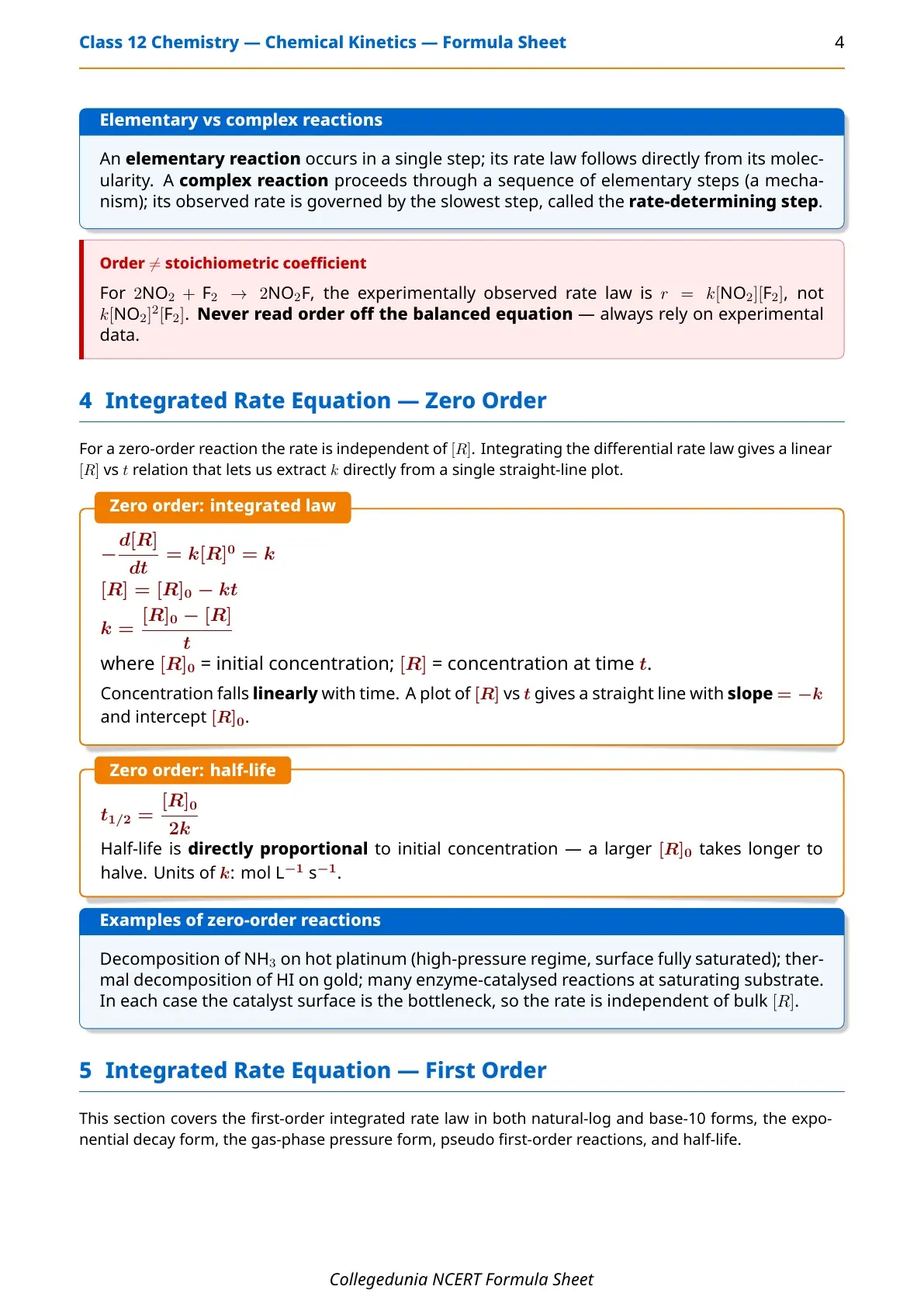
| Zero-order integrated | [A] = [A]0 - kt | mol L-1 s-1 | 3.4 | Linear [A] vs t |
| Zero-order half-life | t1/2 = [A]02k | - | 3.4 | Depends on [A]0 |
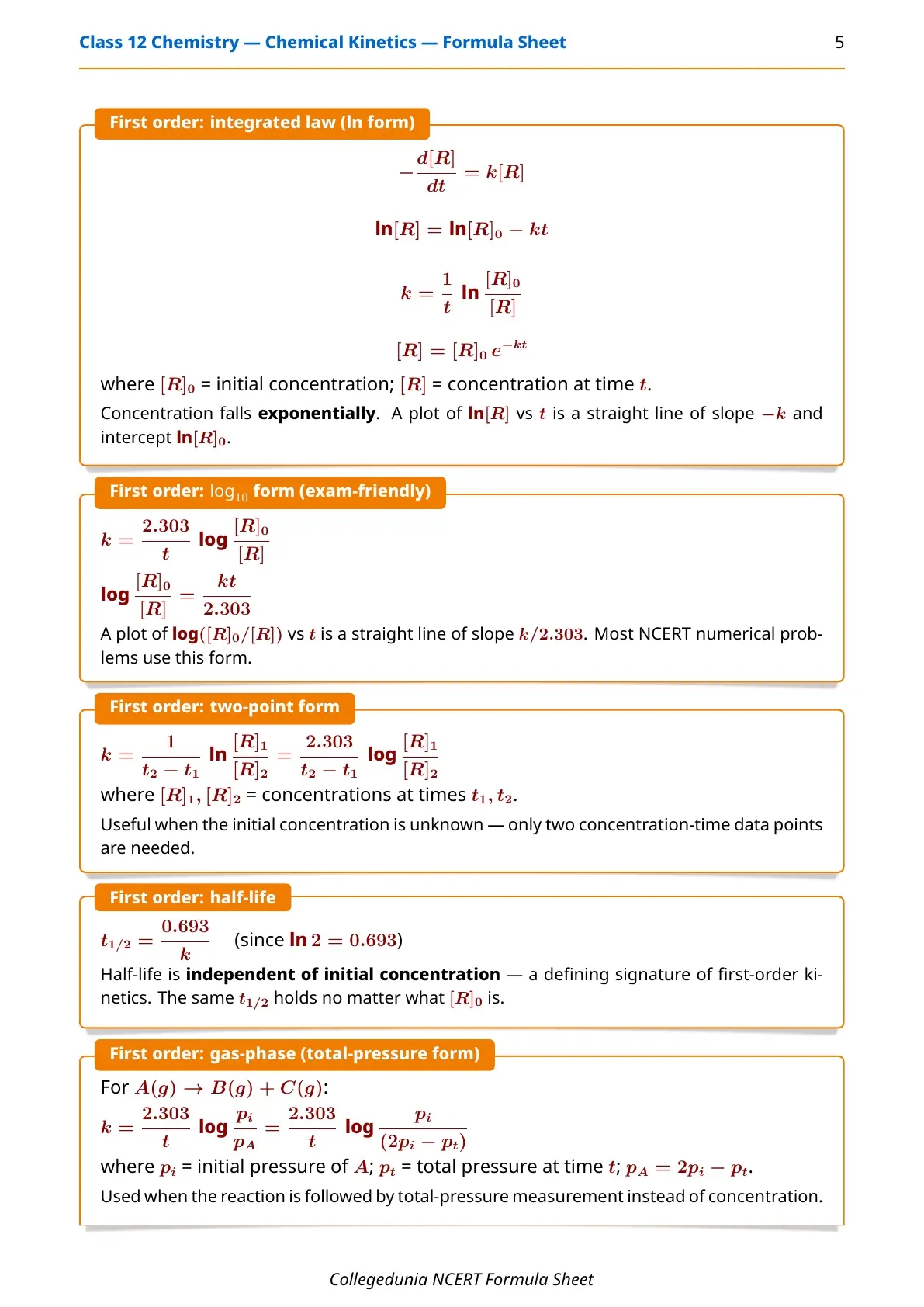
| First-order integrated | k = 2.303tlog[A]0[A] | s-1 | 3.4 | CBSE 3-marker |
| First-order half-life | t1/2 = 0.693k | - | 3.4 | Independent of [A]0 |
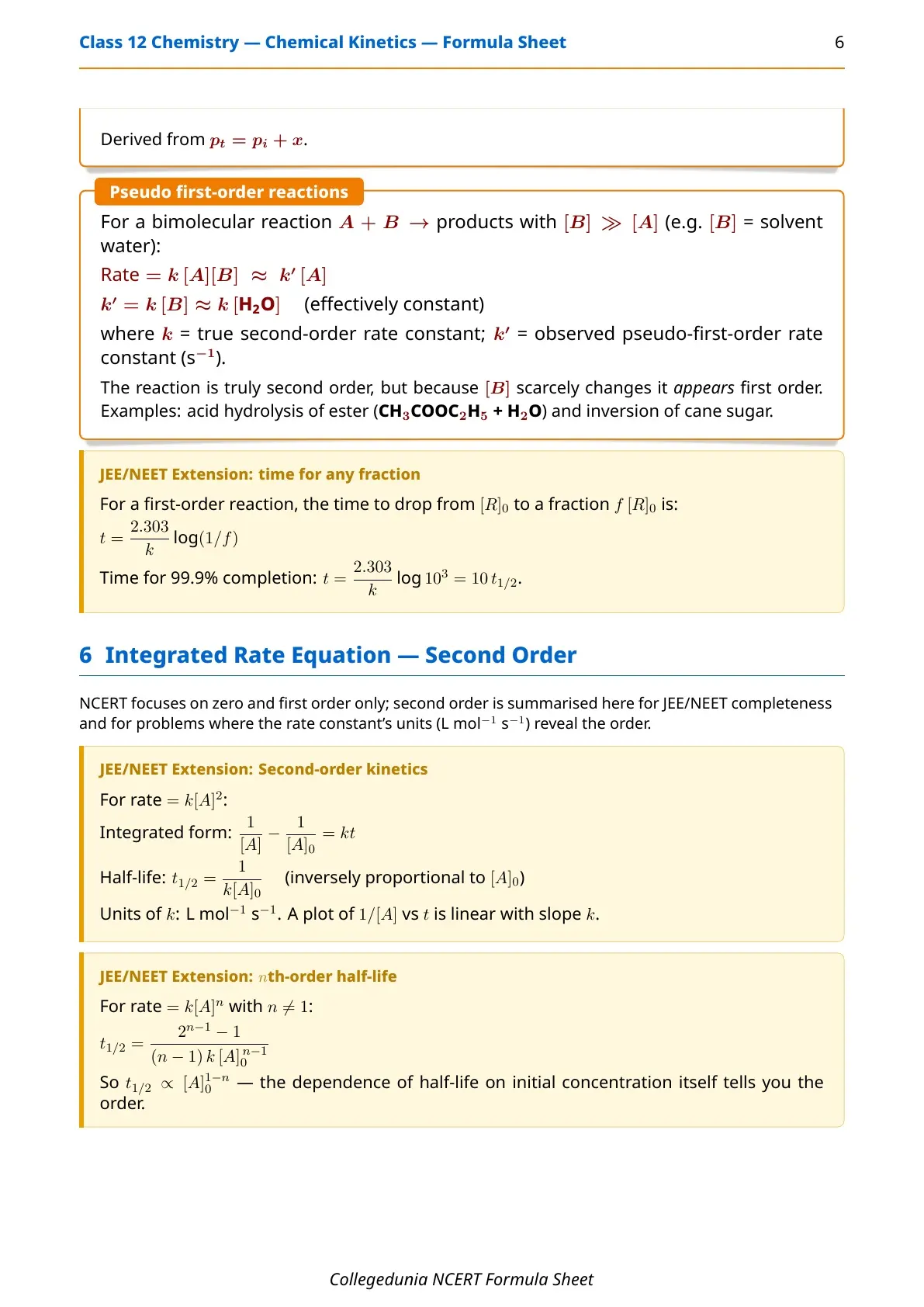
| Pseudo-first-order | r = k'[A], k' = k[B]excess | s-1 | 3.4 | Ester hydrolysis |
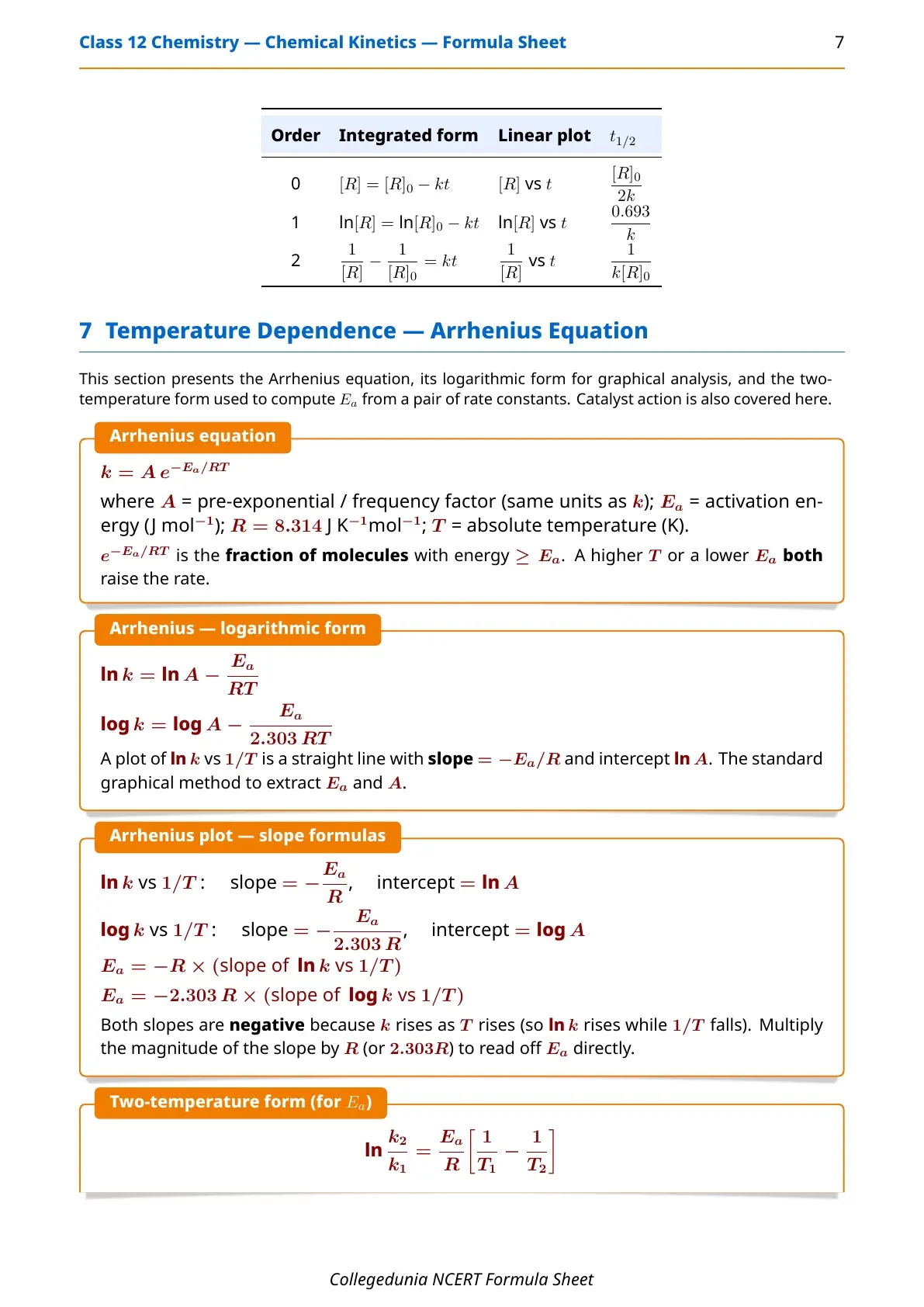
| Arrhenius equation | k = A e-Ea/RT | same as k | 3.5 | T-dependence of k |
| Arrhenius (log form) | log k = log A - Ea2.303 RT | - | 3.5 | log k vs 1/T plot |
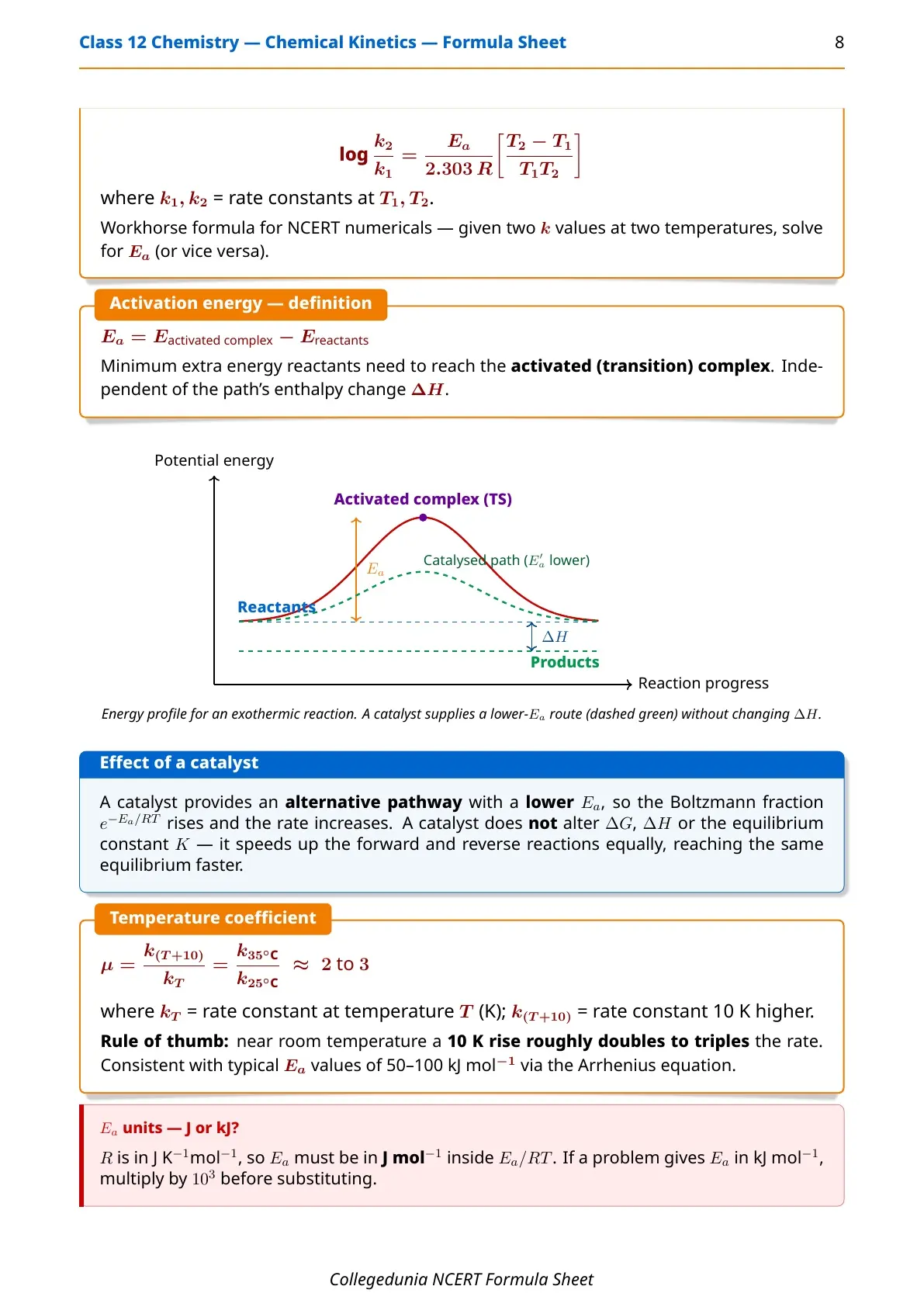
| Two-temperature form | logk2k1 = Ea2.303 R·T2 - T1T1 T2 | - | 3.5 | Find Ea |
| Temperature coefficient | μ = kT+10/kT ≈ 2 to 3 | - | 3.5 | Rate doubling rule |
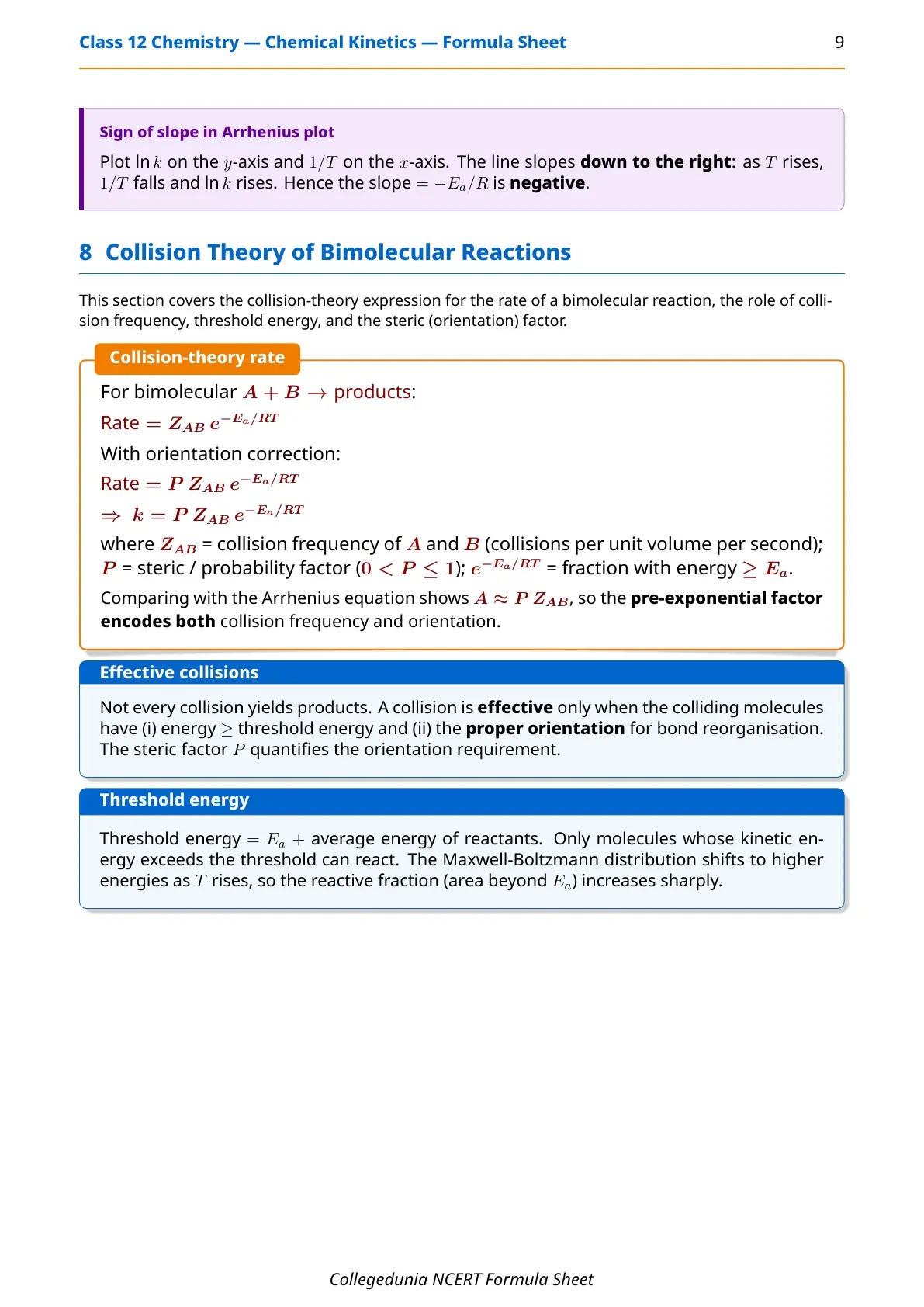
| Collision theory rate | Rate = P ZAB e-Ea/RT | - | 3.6 | Steric factor P |
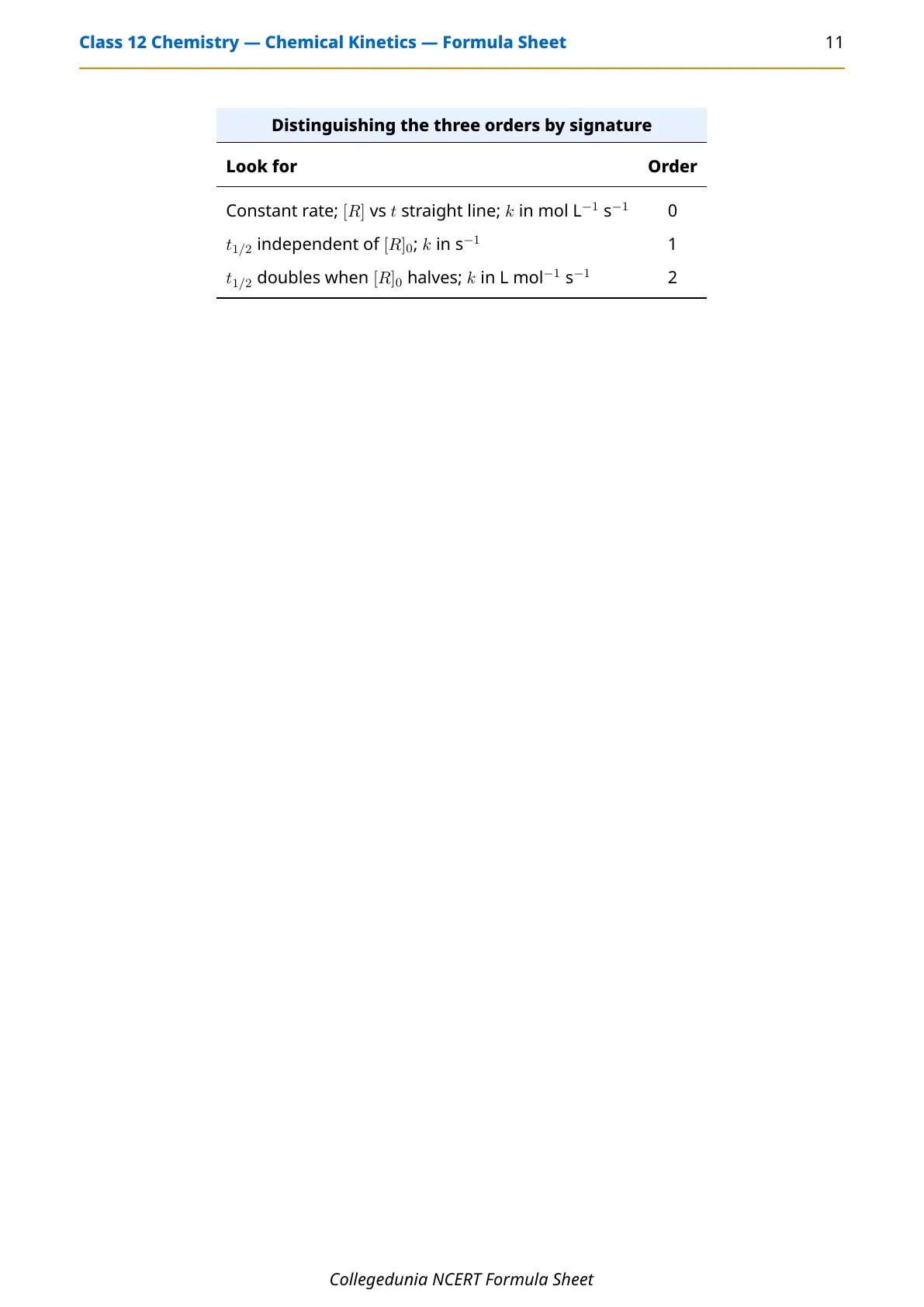
Use the units column as the order detector: mol L-1 s-1 is zero-order, s-1 is first-order, M-1s-1 is second-order.
![First-order integrated rate law ln([A]0/[A]) = kt with variable breakdown](https://image-static.collegedunia.com/public/image/chem-ch3-frm-first-order-integrated-1779647366.png)
Chemical Kinetics Quick-Fact Cards for MCQ Recall
Five facts JEE Main and NEET rotate as 1-mark MCQs:
When to Use Which Formula in Chemical Kinetics
Match the question stem to the right formula.
- Concentration-time table: -Δ[R]/Δ t .
- Initial-rates table: divide row pairs for α, β, then r = k[A]α[B]β .
- First-order: k = (2.303/t)log([A]0/[A]) .
- Half-life to k: first-order k = 0.693/t1/2 ; zero-order k = [A]0/(2t1/2) .
- Two temperatures: two-temperature Arrhenius form for Ea.
- Reactant in large excess: treat as pseudo-first-order.
Chemical Kinetics Common-Numerical Pattern Templates
The four setups below dominate CBSE, JEE Main, and NEET papers.
| Pattern | What the question gives | Formula to apply | Common trap |
|---|---|---|---|
| k for first-order | [A]0, [A], t | k = (2.303/t)log([A]0/[A]) | Mixing log and ln |
| Find t1/2 | k for first-order | t1/2 = 0.693/k | Picking zero-order formula |
| Find Ea | k1, T1, k2, T2 | Two-temperature Arrhenius | Leaving T in Celsius |
| Find order | Initial-rates table | Ratio method | Changing both [A], [B] in row pair |
Topics Covered in Class 12 Chemistry Chapter 3 Chemical Kinetics Formula Sheet
Quick index of what the master table covers:
- Rates: average and instantaneous rate.
- Rate law: order, molecularity, units of k.
- Integrated laws: zero, first, second order, plus half-lives.
- Arrhenius: exponential, log, and two-temperature forms.
- Special cases: pseudo-first-order and ester hydrolysis.
- Theory: collision theory, temperature coefficient, catalyst effect on Ea.
One-Shot Revision Tips for 12th Chemistry Chemical Kinetics
- Order vs molecularity: molecularity is a whole number; order is experimental and can be fractional.
- Plot recognition: [A] vs t is zero-order; log[A] vs t is first-order; 1/[A] vs t is second-order.
- Arrhenius slope: log k vs 1/T has slope -Ea/(2.303R); watch the negative sign.
- Catalysts lower Ea without changing ΔH or Keq.
Top 3 Most-Asked Chemical Kinetics PYQ Topics in CBSE, JEE and NEET
The three patterns below repeat most often since 2021.
| Topic | Frequency (CBSE + JEE + NEET, 2021-2025) | Typical mark band |
|---|---|---|
| First-order integrated rate law numerical | 9 times | 3 marks |
| Arrhenius equation, find Ea from two temperatures | 7 times | 3 marks |
| Half-life for first-order (qualitative or numerical) | 6 times | 1 to 2 marks |
Chemical Kinetics Weightage Compared Across Class 12 Chemistry Chapters
Typical CBSE marks across the 10 chapters of the 2026-27 NCERT. Chemical Kinetics sits in the top tier.
Student Feedback
In a Collegedunia poll of 900 Class 12 students, 78% said the one-page Chemical Kinetics formula table cut their revision time before the Chemistry exam.
Other Resources for Chemical Kinetics Class 12 Chemistry
- Chemical Kinetics Class 12 Chemistry Formula Sheet
- Chemical Kinetics Class 12 Chemistry NCERT Solutions
- Chemical Kinetics Class 12 Chemistry Notes
- Chemical Kinetics Class 12 Chemistry NCERT Book PDF
- Chemical Kinetics Class 12 Chemistry NCERT Exemplar Book PDF
- Chemical Kinetics Class 12 Chemistry NCERT Exemplar Solutions
- Chemical Kinetics Class 12 Chemistry Handwritten Notes
NCERT Formula Sheet for Class 12 Chemistry: All Chapters
Jump to the formula sheet for any other chapter of Class 12 Chemistry below.
| Chapter | Resource |
|---|---|
| Chapter 1 | Solutions Formula Sheet |
| Chapter 2 | Electrochemistry Formula Sheet |
| Chapter 4 | The d- and f-Block Elements Formula Sheet |
| Chapter 5 | Coordination Compounds Formula Sheet |
| Chapter 6 | Haloalkanes and Haloarenes Formula Sheet |
| Chapter 7 | Alcohols, Phenols and Ethers Formula Sheet |
| Chapter 8 | Aldehydes, Ketones and Carboxylic Acids Formula Sheet |
| Chapter 9 | Amines Formula Sheet |
| Chapter 10 | Biomolecules Formula Sheet |
Chemical Kinetics Class 12 Chemistry Formula Sheet FAQs
Ques. Where can I download the Chemical Kinetics Class 12 Chemistry Formula Sheet PDF?
Ans. You can download the Chemical Kinetics Class 12 Chemistry Formula Sheet PDF directly from this Collegedunia page. Both the Normal and HD versions are available and free.
Ques. Is this Formula Sheet aligned with the 2026-27 NCERT?
Ans. Yes. This page reflects the current 2026-27 syllabus for Class 12 Chemistry. Chemical Kinetics is fully retained in the new edition with no formula cuts; all 14 working formulae in Sections 3.1 to 3.6 of the NCERT remain examinable.
Ques. How many pages is the Class 12th Chemistry Chemical Kinetics Formula Sheet PDF?
Ans. The Formula Sheet PDF runs approximately 7 pages and covers the master formula table, symbol glossary, quick-fact cards, when-to-use decision tree, and four common numerical pattern templates.
Ques. Which formula is most asked from Chemical Kinetics in CBSE Boards?
Ans. The first-order integrated rate law, k = (2.303/t) log([A]0/[A]), has appeared in CBSE Board papers in 2024, 2023, and 2022. Pair it with the half-life formula t1/2 = 0.693/k for full coverage of the 3-marker.
Ques. How is the Arrhenius equation tested in JEE Main and NEET?
Ans. JEE Main typically gives k at two temperatures and asks for activation energy Ea, applying the two-temperature form log(k2/k1) = (Ea/2.303R)(T2-T1)/(T1T2). NEET tends to test the linear-plot form, where slope of log k versus 1/T equals -Ea/(2.303R).
Ques. What is the difference between order and molecularity of a reaction?
Ans. Molecularity is the number of reactant species in an elementary step and is always a positive whole number. Order is the experimental sum of exponents in the rate law and can be zero, fractional, or negative. For a complex reaction, only order is meaningful.
Ques. Are pseudo-first-order reactions still in the Class 12 Chemistry syllabus?
Ans. Yes. Pseudo-first-order reactions (e.g. ester hydrolysis, inversion of cane sugar) appear in NCERT Section 3.4 of the 2026-27 edition and are testable in CBSE Boards, JEE Main, and NEET.
Ques. Should I memorise the temperature coefficient value for Chemical Kinetics?
Ans. Yes. The temperature coefficient is approximately 2 to 3, meaning the rate roughly doubles for every 10 K rise in temperature. This is a frequent 1-mark MCQ trigger in JEE Main and NEET.
Ques. What is the second order reaction integrated rate law?
Ans. For a second order reaction A → products with rate = k[A]2 , integration gives 1[A] - 1[A]0 = kt . A plot of 1/[A] versus t is a straight line with slope k . The unit of the rate constant is L mol-1 s-1 and the half-life t1/2 = 1/(k[A]0) depends on the initial concentration.
Ques. What is the activation energy from the Arrhenius plot of ln k vs 1/T?
Ans. The Arrhenius plot of ln k versus 1/T is a straight line of slope -Ea/R . Multiplying the slope by -R = -8.314 J K-1 mol-1 gives Ea directly in J mol-1; divide by 1000 to get kJ mol-1. The 10 k variant has slope -Ea/(2.303 R) .
Ques. How does a catalyst affect activation energy and the rate constant?
Ans. A catalyst lowers the activation energy by offering an alternative reaction path. In Arrhenius terms, the new rate constant is kcat = A e-Ea,cat/RT with Ea,cat Ea . The pre-exponential factor and Δ H of the reaction are unchanged. A 10 kJ mol-1 drop in Ea at 300 K speeds the reaction by a factor of about 55.



Comments