



Class 12 Chemistry Chapter 1 Solutions packs over 25 numerical formulae, the densest formula load in the 2026-27 NCERT Physical Chemistry block. They drive nearly every concentration, colligative-property, and van't Hoff numerical in CBSE, JEE Main, and NEET. This page hosts the full formula sheet PDF, quick-fact cards, and a when-to-use decision tree.
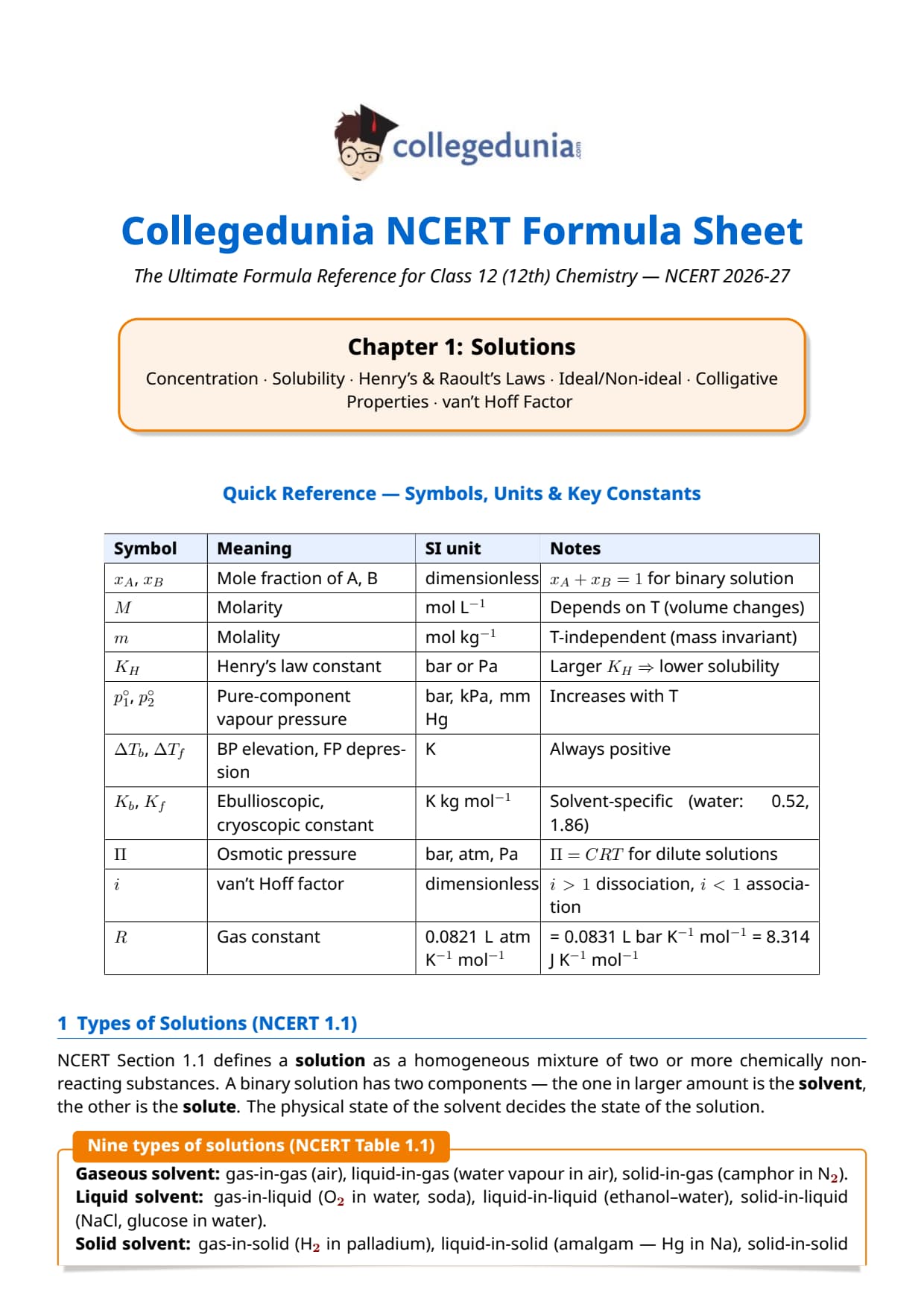
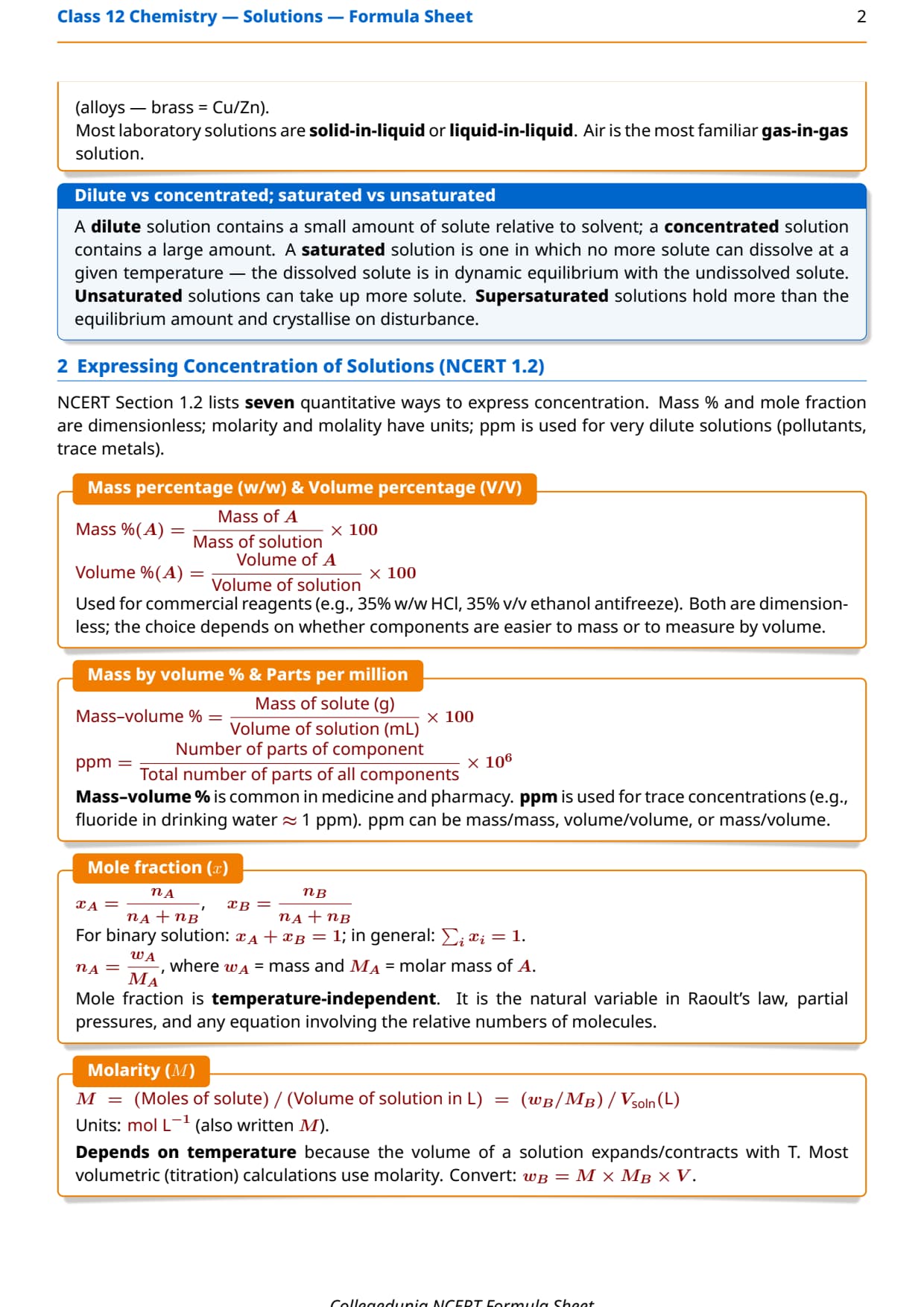
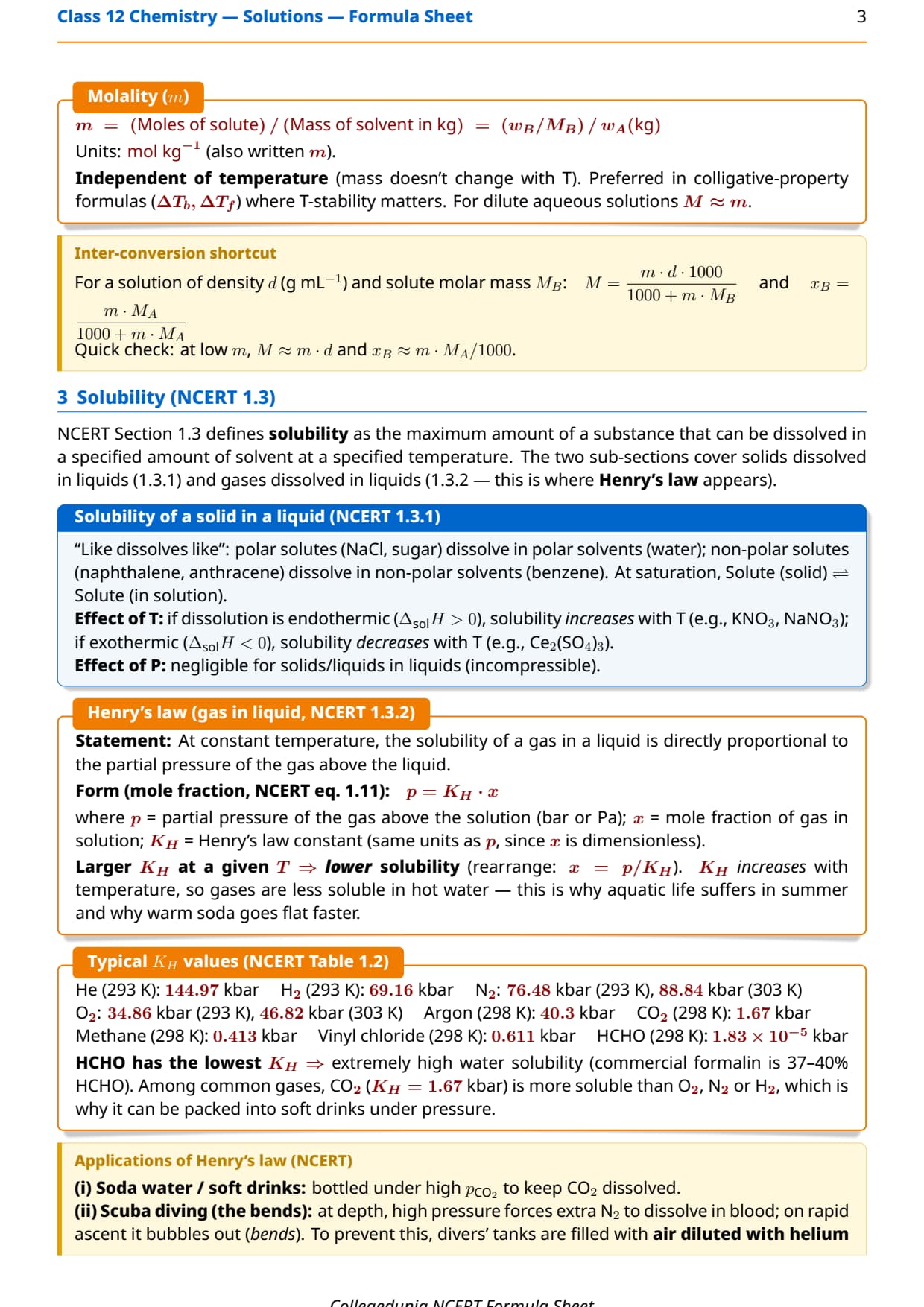
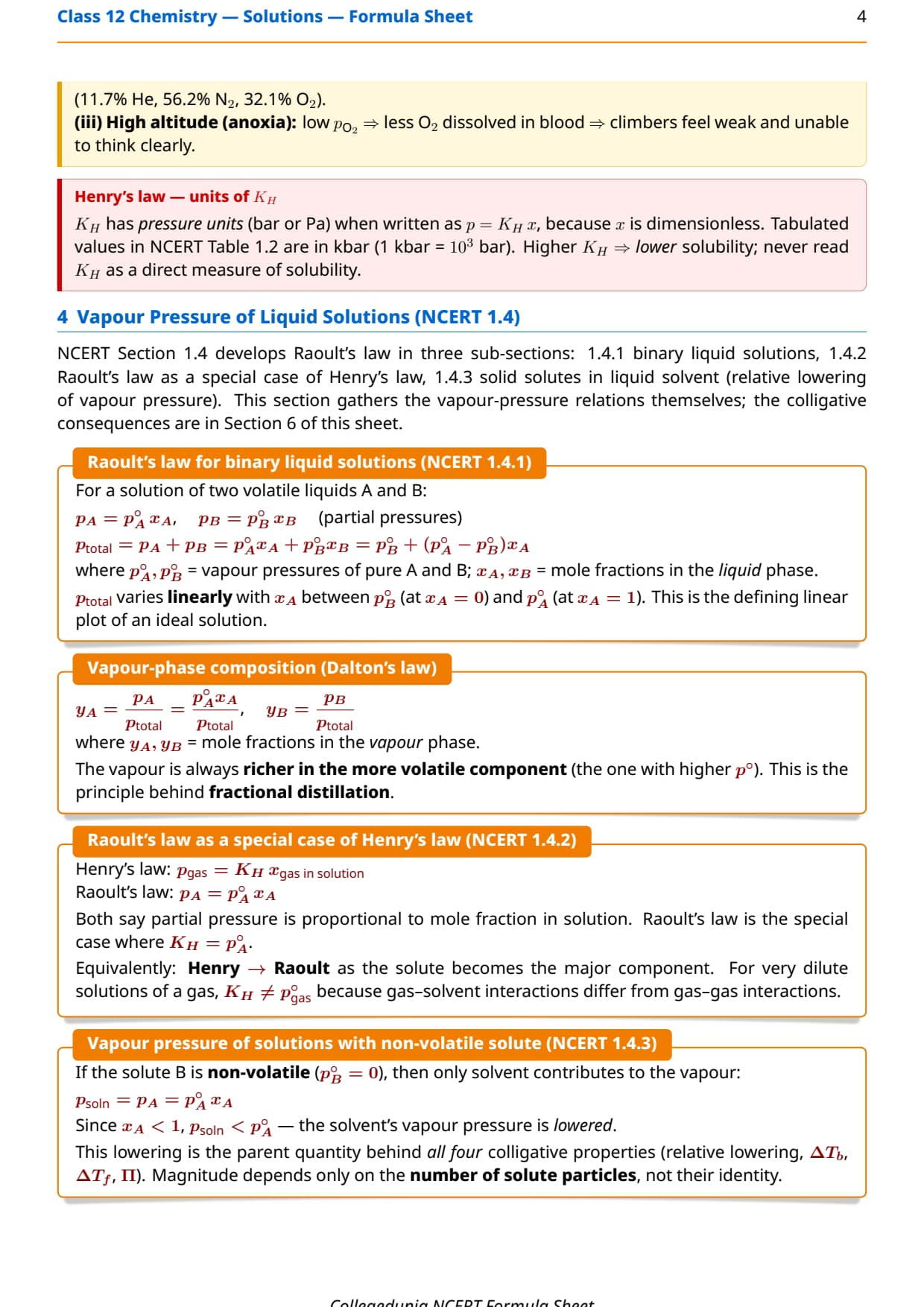
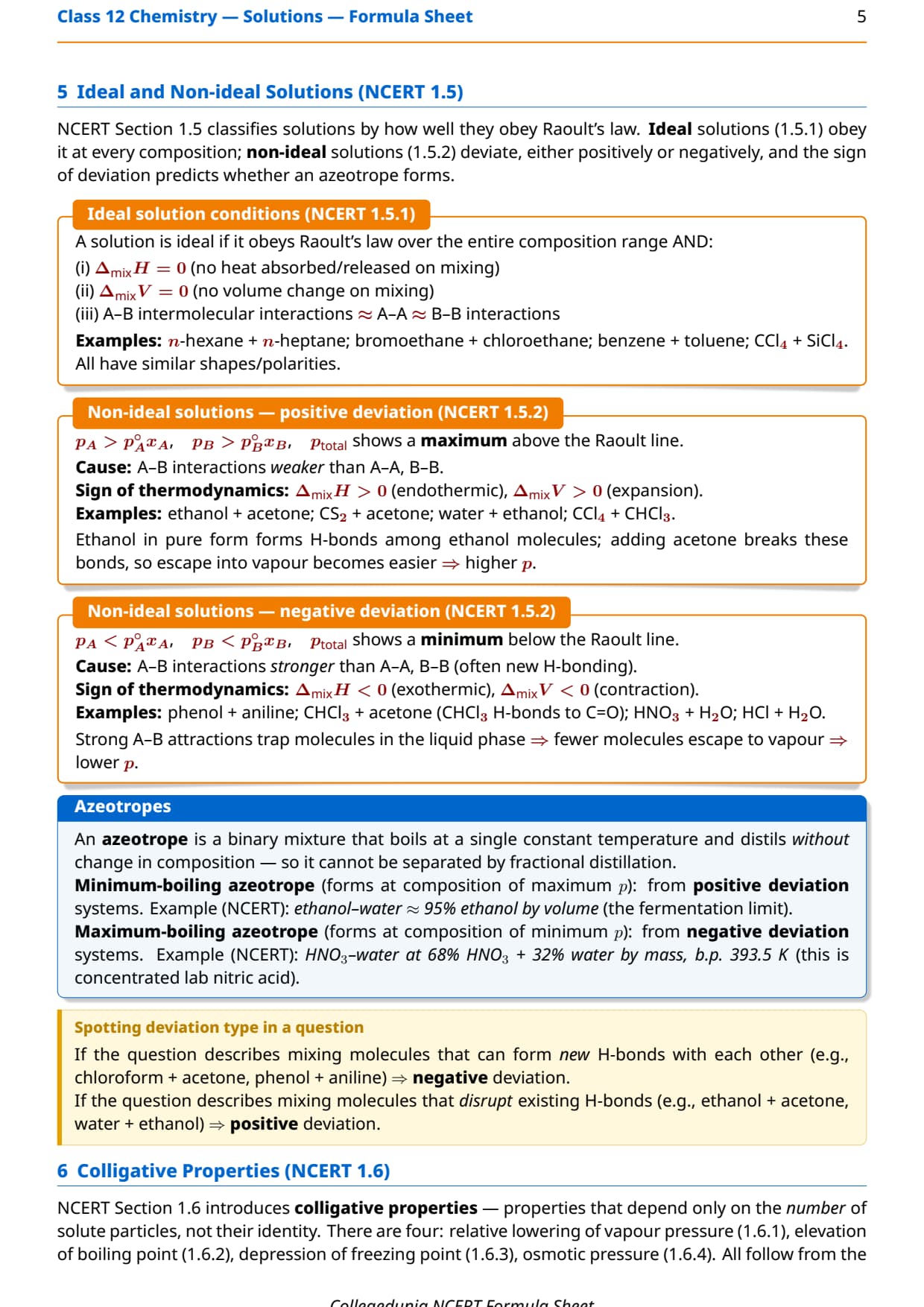
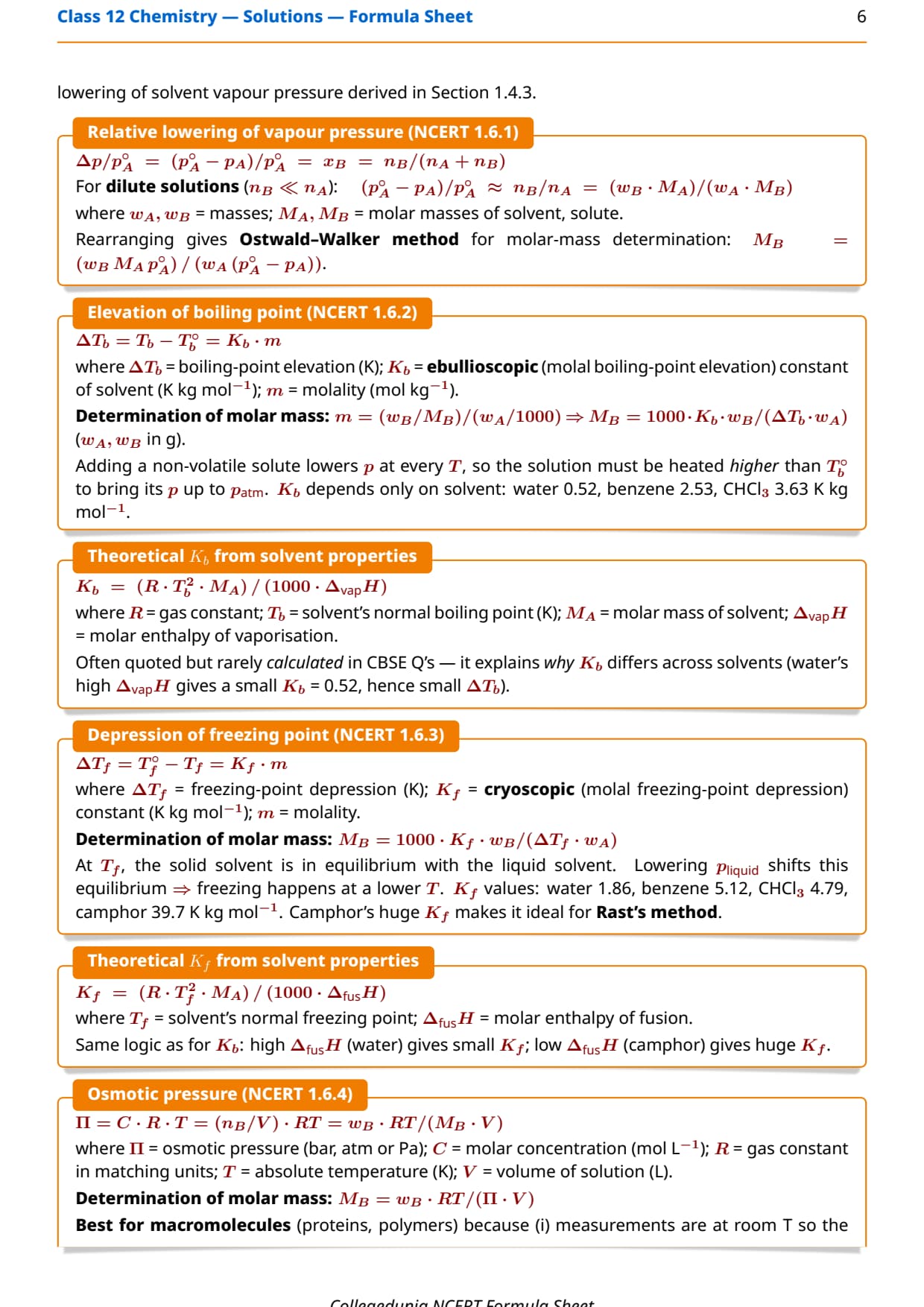
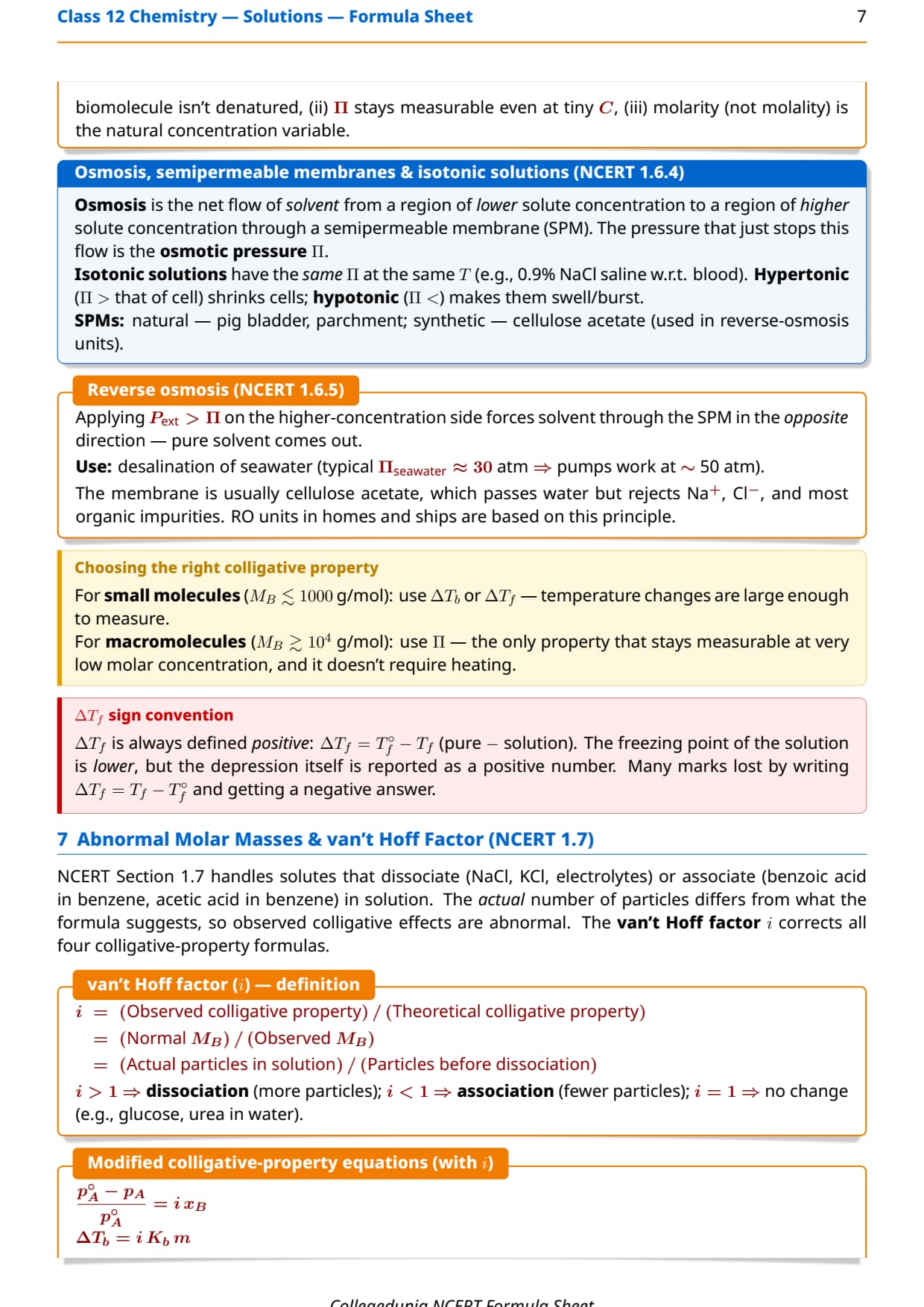
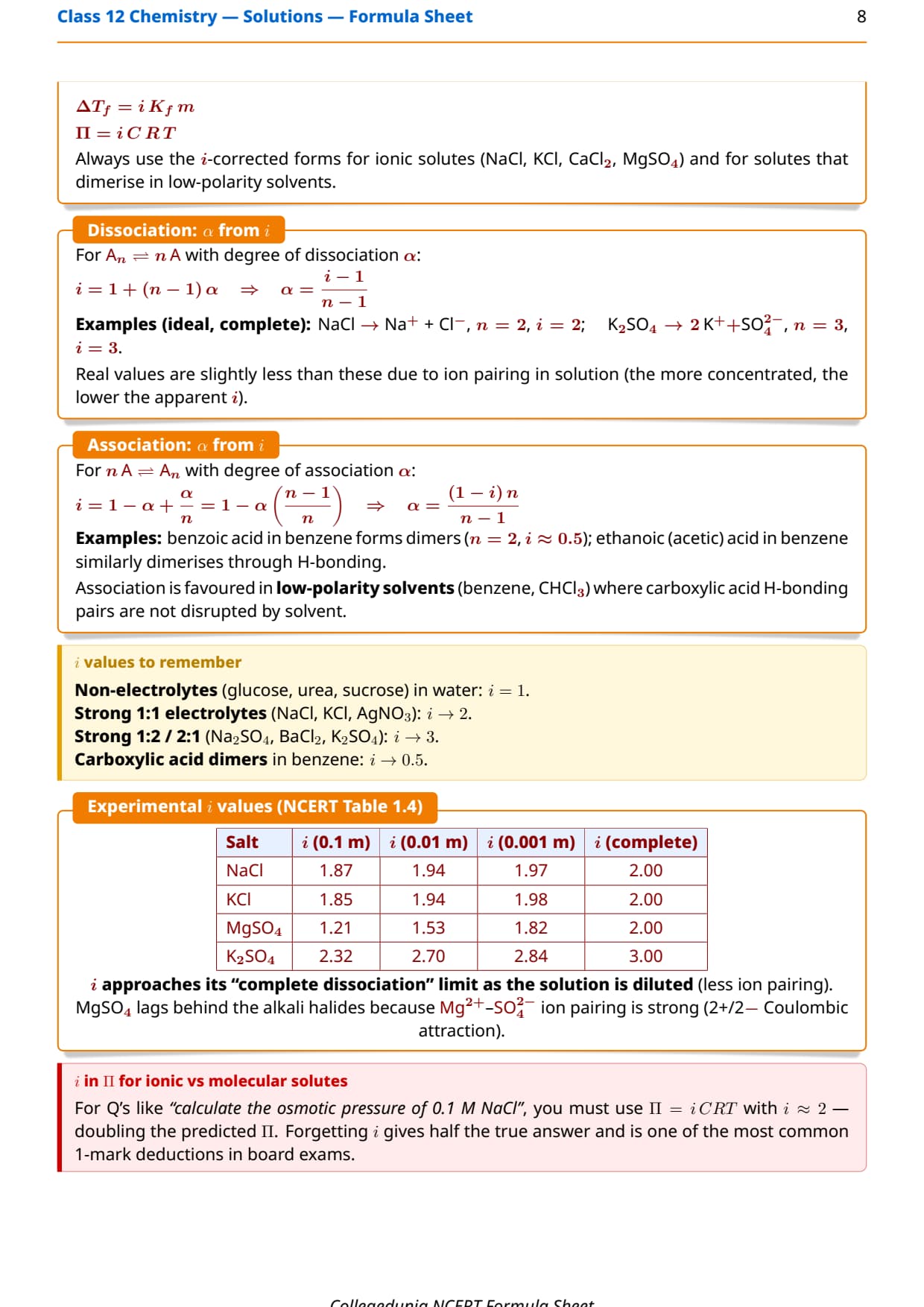
- CBSE Weightage: 5-7 marks (usually one short answer plus one numerical)
- JEE Main Weightage: 3-4% (2-3 questions per paper)
- NEET Weightage: 2-3 questions per year
This Formula Sheet is curated by Chemistry subject experts, mapped to the 2026-27 NCERT, and refined against the last five years of CBSE Board, JEE Main, and NEET papers.
Also Check:
How will Collegedunia's Formula Sheet Help You with Solutions Class 12 Chemistry?
This sheet gathers every relation for any Solutions numerical, in NCERT order.
- 2026-27 NCERT aligned: every concentration term, Raoult's law, and colligative-property formula.
- SI unit beside each formula to sanity-check a numerical fast.
- Decision tree for molality vs molarity and when to add the van't Hoff factor.
- Quick-fact cards with the high-frequency numbers (Kb, Kf, R).

Solutions Class 12 Chemistry Formulae Explained
Source: Magnet Brains on YouTube
Solutions Class 12 Chemistry Complete Formula Reference
Every formula in Chapter 1 of the 2026-27 NCERT, mapped to its NCERT section and the typical question where it appears.
| Concept | Formula | SI Unit | NCERT Section | Typical Use |
|---|---|---|---|---|
| Mass percent | %(w/w) = msolutemsolution × 100 | % | 1.2.1 | Alloy and aqueous mixture |
| Parts per million | ppm = msolutemsolution × 106 | - | 1.2.1 | Trace pollutants, hard water |
| Mole fraction | xA = nAnA + nB | - | 1.2.2 | Raoult's law substitutions |
| Molarity | M = nsoluteVsolution (L) | mol/L | 1.2.3 | Titrations, stoichiometry |
| Molality | m = nsolutemsolvent (kg) | mol/kg | 1.2.4 | Colligative-property numericals |
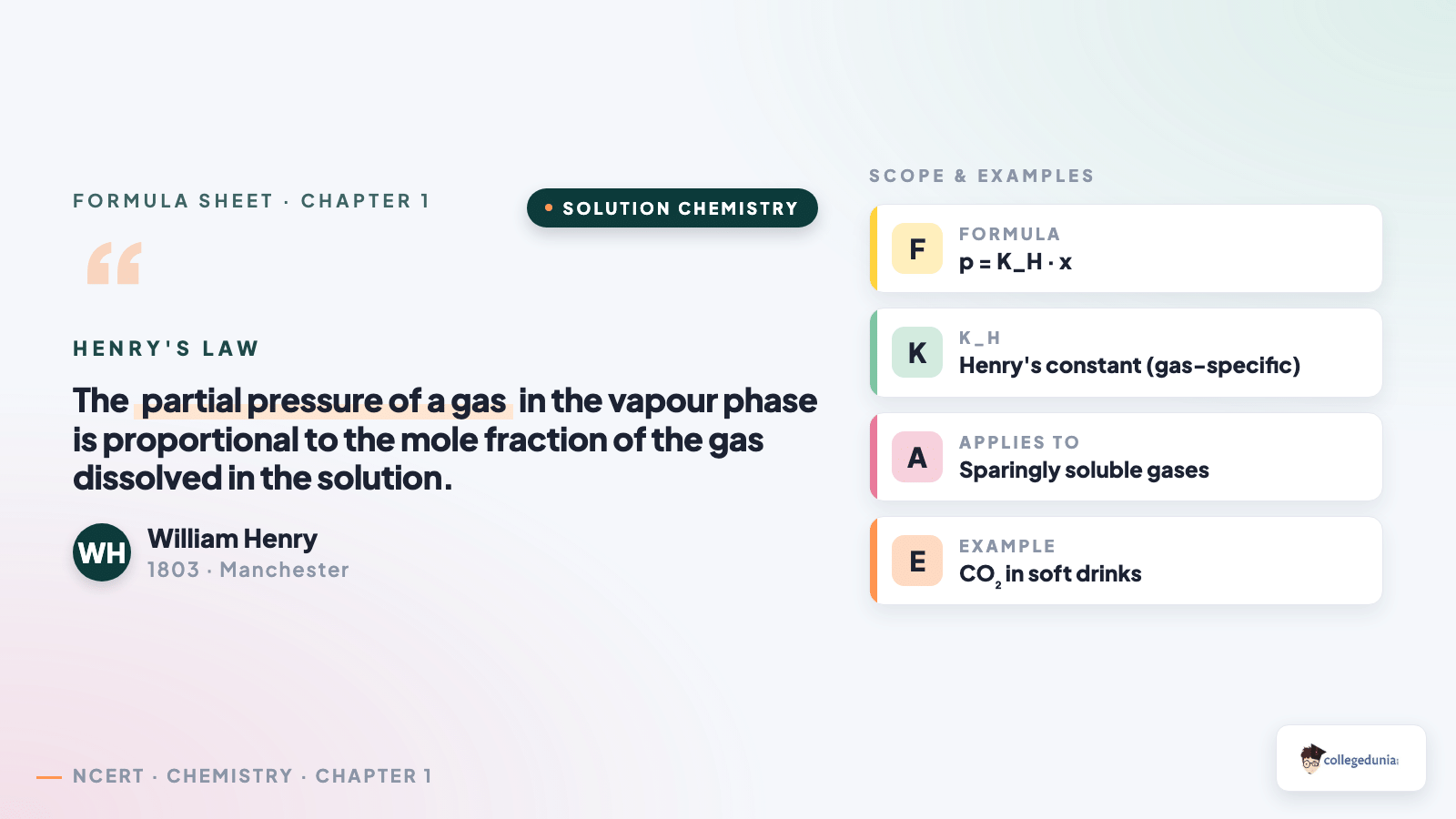
| Henry's law | p = KH · x | bar (Kh) | 1.4 | Gas-in-liquid solubility |
| Raoult's law (volatile solute) | ptotal = pA0 xA + pB0 xB | bar | 1.5.1 | Two-volatile-liquid mixtures |
| Raoult's law (non-volatile solute) | psolution = pA0 · xA | bar | 1.5.2 | Sugar / urea in water |
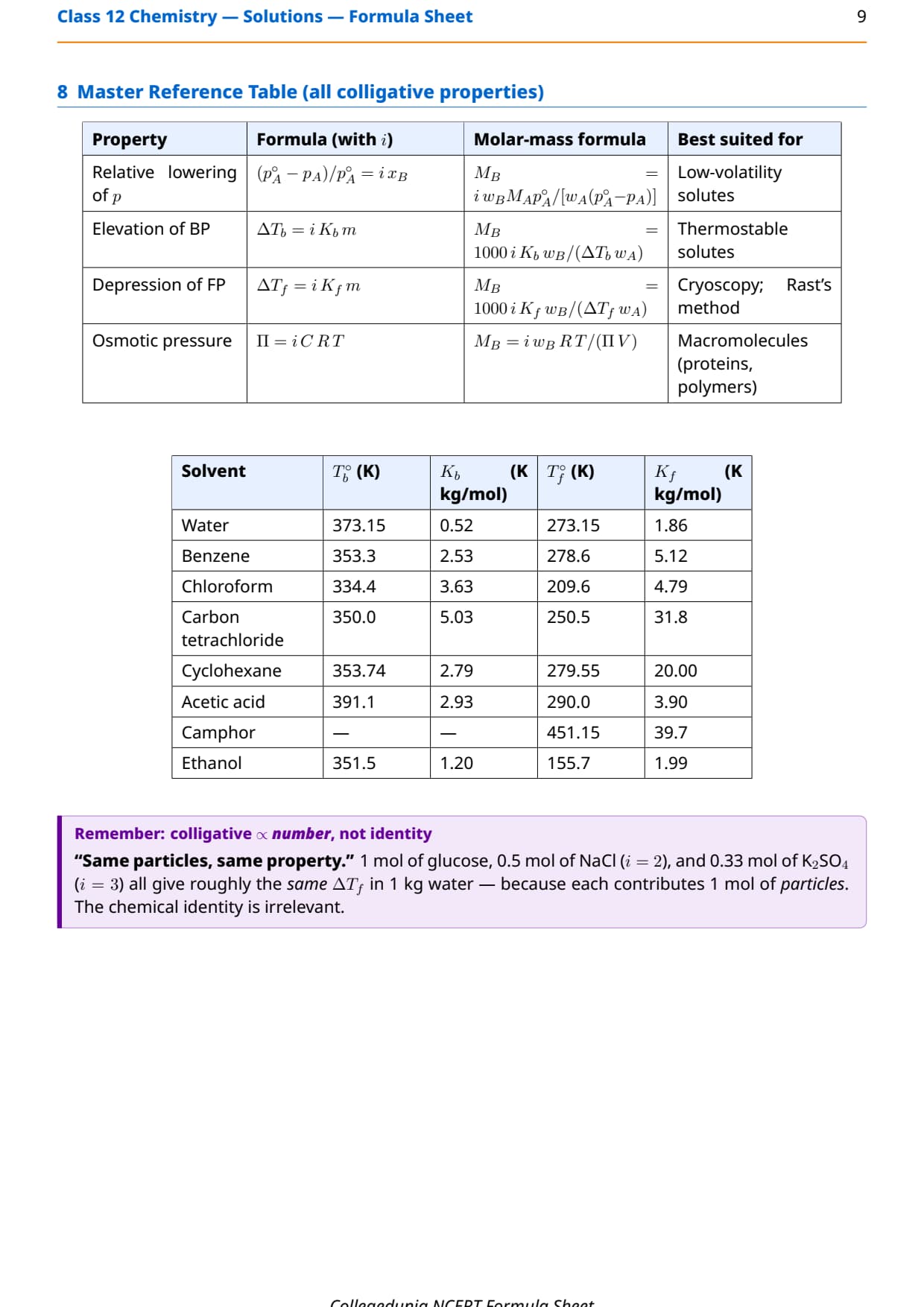
| Relative lowering of vapour pressure | pA0 - pApA0 = xB | - | 1.6.1 | Molar-mass determination by VP |
| Elevation of boiling point | Δ Tb = Kb · m | K | 1.6.2 | Solvent boiling-point shift |
| Depression of freezing point | Δ Tf = Kf · m | K | 1.6.3 | Antifreeze, salt-on-ice numericals |
| Osmotic pressure | π = C R T | bar | 1.6.4 | Biological and dilute solutions |
| Osmotic pressure (mass form) | π = w2 R TM2 V | bar | 1.6.4 | Molar mass of macromolecule |
| van't Hoff factor | i = observed colligative propertycalculated colligative property | - | 1.7 | Electrolyte / associating solute |
| Modified ΔTb | Δ Tb = i · Kb · m | K | 1.7 | NaCl, CaCl₂ in water |
| Modified ΔTf | Δ Tf = i · Kf · m | K | 1.7 | Ionic salts depressing FP |
| Modified osmotic pressure | π = i C R T | bar | 1.7 | Strong electrolyte solutions |
| Degree of dissociation | α = i - 1n - 1 | - | 1.7 | NaCl, K₂SO₄ ionisation extent |
| Degree of association | α = 1 - i1 - 1n | - | 1.7 | Benzoic acid in benzene |
| Abnormal molar mass | Mobserved = Mnormali | g/mol | 1.7 | Dimerisation / dissociation cases |
| Molarity-density link | m = 1000 · M1000 · d - M · M2 | mol/kg | 1.2 | Convert M to m given density |
| Dilution equation | M1 V1 = M2 V2 | - | 1.2.3 | Volumetric dilution problems |
These formulae cover nearly every Solutions numerical asked in CBSE, JEE Main, and NEET.
When to Use Which Formula in Solutions Class 12 Chemistry
Picking the right formula is the difference between full marks and a slip.
- Mass of solute and solvent given, asks concentration: use molality m if temperature can change; molarity M only if volume is fixed.
- Vapour pressures given: use relative lowering p0 - pp0 = xB to find mole fraction or molar mass.
- Boiling-point or freezing-point shift given: use Δ T = K · m ; multiply by i for any salt that ionises.
- Polymer, protein, or large molecule: default to osmotic pressure π = CRT , since ΔTb and ΔTf are too small to measure.
- "Abnormal" molar mass asked: divide calculated M by i . If i > 1 it dissociates, if i < 1 it associates.
Solutions Class 12 Chemistry Quick-Fact Cards for MCQ Recall
These five facts are the ones MCQ writers reach for most. Glance over them before any test.
Solutions Top 5 Formulae Recap: Quick PYQ Map for Class 12th Chemistry
The five formulae below carry the largest share of marks from 2021 to 2025.
| Formula | Most-recent exam appearance |
|---|---|
| Δ Tf = i Kf m | CBSE 2025 (3 marks), NEET 2024 (1 Q) |
| π = CRT | JEE Main 2025 (Session 1), NEET 2025 |
| p = KH x | CBSE 2024 (2 marks), JEE Main 2024 |
| i = (iobs) / (icalc) | CBSE 2023 (5 marks), NEET 2023 |
| p0 - pp0 = xB | CBSE 2025 (3 marks), JEE Main 2024 |
Full year-wise PYQ map: Solutions Class 12 Chemistry NCERT Solutions
One-Shot Revision Tips for Solutions Class 12th Chemistry
The night before, revise the sheet against a few reference numericals, not the full textbook.
- Lock the four colligative properties as one block. Relative VP lowering, ΔTb, ΔTf, and osmotic pressure all track molality.
- Memorise the two water constants. Kb = 0.512 and Kf = 1.86 appear in about 70% of CBSE numericals.
- Practise molarity-to-molality conversion. It uses solution density; CBSE 2025 set 55/1/1 asked it as a 2-mark sub-question.
- Treat the van't Hoff factor as the universal multiplier. Ionic or associating solutes add a factor of i to every colligative formula.
Solutions Weightage Compared Across Class 12 Chemistry Chapters
Typical CBSE marks across all 10 chapters of the 2026-27 NCERT, averaged over the last five board papers.
Student Feedback
In a Collegedunia poll of 900 Class 12 students, 78% said one-sheet colligative formulae cut their revision time, and most flagged the van't Hoff factor as the step they forgot most.
Related Links:
- Solutions Class 12 Chemistry Handwritten Notes
- Solutions Class 12 Chemistry NCERT Exemplar Solutions
Other Resources for Solutions Class 12 Chemistry
- Solutions Class 12 Chemistry Formula Sheet
- Solutions Class 12 Chemistry NCERT Solutions
- Solutions Class 12 Chemistry Notes
- Solutions Class 12 Chemistry NCERT Book PDF
- Solutions Class 12 Chemistry NCERT Exemplar Book PDF
- Solutions Class 12 Chemistry NCERT Exemplar Solutions
- Solutions Class 12 Chemistry Handwritten Notes
NCERT Formula Sheet for Class 12 Chemistry: All Chapters
Use the table below to jump to the Formula Sheet for any other chapter in the Class 12 Chemistry NCERT.
| Chapter | Resource |
|---|---|
| Chapter 2 | Electrochemistry Formula Sheet |
| Chapter 3 | Chemical Kinetics Formula Sheet |
| Chapter 4 | The d- and f-Block Elements Formula Sheet |
| Chapter 5 | Coordination Compounds Formula Sheet |
| Chapter 6 | Haloalkanes and Haloarenes Formula Sheet |
| Chapter 7 | Alcohols, Phenols and Ethers Formula Sheet |
| Chapter 8 | Aldehydes, Ketones and Carboxylic Acids Formula Sheet |
| Chapter 9 | Amines Formula Sheet |
| Chapter 10 | Biomolecules Formula Sheet |
Solutions Class 12 Chemistry Formula Sheet FAQs
Ques. Where can I download the Solutions Class 12 Chemistry Formula Sheet PDF?
Ans. You can download the Solutions Class 12 Chemistry Formula Sheet PDF directly from this page. Both Normal and HD versions are free and cover every formula introduced in the 2026-27 NCERT chapter.
Ques. Is this Formula Sheet aligned with the 2026-27 NCERT?
Ans. Yes. The sheet reflects the current 2026-27 syllabus for Class 12 Chemistry. The Solutions chapter retains every concentration term, Raoult's law statement, colligative property, and van't Hoff correction from the previous edition.
Ques. How many pages is the Class 12th Chemistry Solutions Formula Sheet PDF?
Ans. The Formula Sheet PDF runs approximately 8 pages and covers 25-plus formulae, the four colligative properties, Henry's and Raoult's laws, the van't Hoff factor, and a one-shot revision strip.
Ques. How many formulae are in the Solutions chapter of Class 12 Chemistry?
Ans. The chapter introduces 25-plus formulae, grouped into concentration terms (7), Henry's and Raoult's laws (4), colligative properties (8), van't Hoff and abnormal molar mass (4), and unit-conversion shortcuts (2).
Ques. Which is the most important formula in Solutions Class 12?
Ans. The depression of freezing point Δ Tf = i Kf m and the osmotic pressure π = i C R T are the two highest-yield formulae. Together they account for over 40% of the numericals asked in CBSE Boards, JEE Main, and NEET between 2021 and 2025.
Ques. What is the CBSE weightage of Chapter 1 Solutions in Class 12 Chemistry?
Ans. Solutions carries 5 to 7 marks in the CBSE Class 12 Chemistry Board exam, usually split as one short-answer question and one numerical. The chapter also draws 3-4% in JEE Main and 2-3 questions per NEET paper.
Ques. How is molarity different from molality, and which one do colligative-property numericals need?
Ans. Molarity is moles per litre of solution and changes with temperature; molality is moles per kilogram of solvent and is temperature-independent. Every colligative-property numerical (ΔTb, ΔTf, relative VP lowering) uses molality. Only the dilution equation and osmotic pressure π = CRT use molarity.
Ques. Why does NaCl have a van't Hoff factor of 2?
Ans. NaCl dissociates completely in water into one Na⁺ and one Cl⁻, producing two particles per formula unit. Since i measures the observed number of particles relative to the formula-unit count, NaCl gives i = 2 for full dissociation. Real solutions show i slightly below 2 because of ion pairing.
Ques. What is the formula for the relative lowering of vapour pressure?
Ans. For a non-volatile solute, the relative lowering of vapour pressure equals the mole fraction of solute: (p1∘ - p1)/p1∘ = x2 . This is the direct consequence of Raoult's law and is the canonical CBSE 3-mark numerical for finding the molar mass of an unknown non-volatile solute (sugar, urea, glycerol).
Ques. What is the formula for osmotic pressure and when do I include the van't Hoff factor?
Ans. Osmotic pressure for a non-electrolyte is π = CRT where C is the molar concentration in mol L-1 and R = 0.0821 L atm K-1 mol-1 (or 0.0831 L bar K-1 mol-1). For an electrolyte like NaCl or K2SO4, multiply by the van't Hoff factor: π = i C R T . Macromolecules (proteins, polymers) default to osmotic pressure because Δ Tb and Δ Tf are too small to measure.
Ques. What are the Kb and Kf values for water?
Ans. For water, the molal boiling-point elevation constant Kb = 0.512 K kg mol-1 and the molal freezing-point depression constant Kf = 1.86 K kg mol-1. Both carry the same unit, K kg mol-1. Memorise these two values, since roughly 70% of CBSE colligative-property numericals from Chapter 1 use water as the solvent.
Ques. How do I compute the degree of dissociation from the van't Hoff factor?
Ans. If a solute dissociates into n particles with degree of dissociation α , then i = 1 + (n-1)α , so α = (i-1)/(n-1) . For example, for K2SO4 (n = 3) with an observed i = 2.4 , α = (2.4-1)/(3-1) = 0.7 , meaning 70% dissociation. For association (e.g. benzoic acid dimer in benzene), α = (1 - i) / (1 - 1/n) .



Comments