




The 2026-27 NCERT keeps Class 12 Biology Chapter 8 Microbes in Human Welfare intact as the bridge between household biology and India's bioeconomy. This Collegedunia formula sheet collapses every fermentation stoichiometry, BOD limit, biogas percent, antibiotic potency, nitrogen-fixation rate and biofertiliser figure from Sections 8.1 to 8.6 into one revision page. Download the free PDF and scan the flipbook before your next test.
- CBSE Weightage: 5 to 7 marks
- NEET Weightage: 2 to 4 questions per year
- AIIMS / entrance overlap: 1 to 2 statement-based questions per paper
Microbes in Human Welfare Video Lecture for Class 12 Biology
Source: Magnet Brains on YouTube
Microbes in Human Welfare Master Quantitative Reference for Class 12 Biology
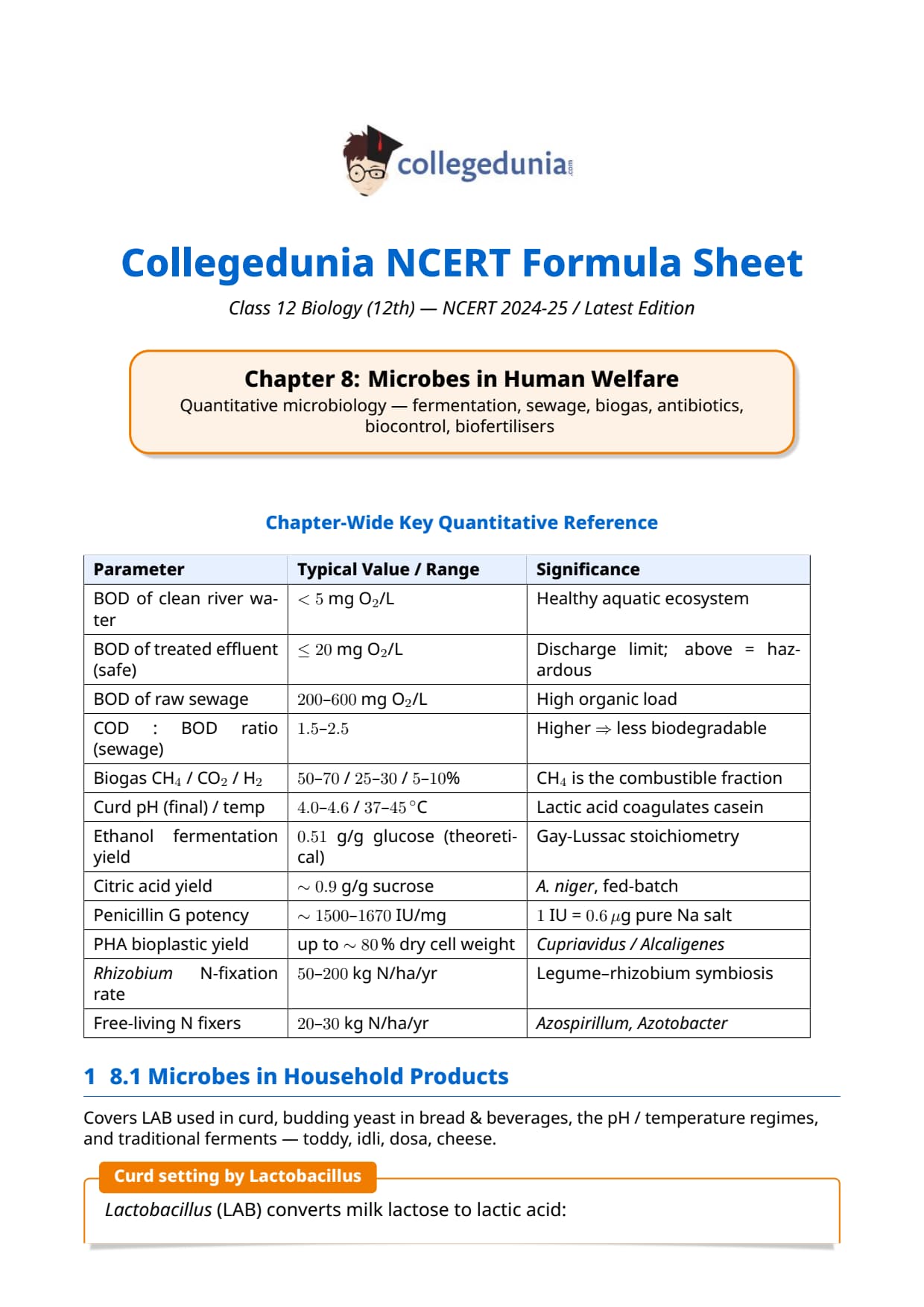
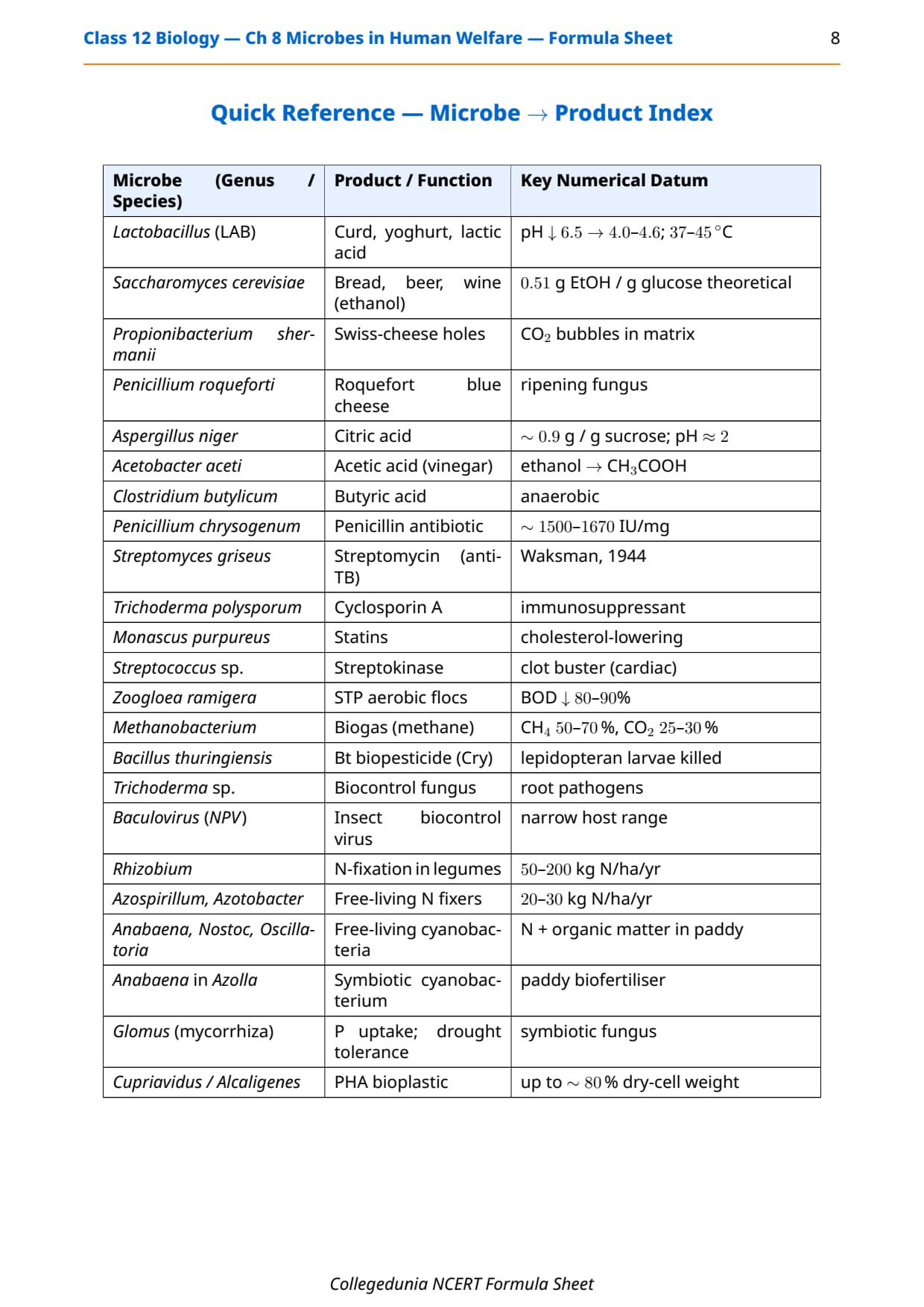
The table below indexes every NEET-testable number against its NCERT sub-section.
| Parameter | Value / Range | NCERT Ref |
|---|---|---|
| BOD: river / safe / raw | < 5 / ≤ 20 / 200-600 mg O2/L | 8.3 |
| COD / BOD ratio | 1.5-2.5 (domestic); COD ≥ BOD | 8.3 |
| Secondary STP BOD drop | 80-90% via Zoogloea flocs | 8.3 |
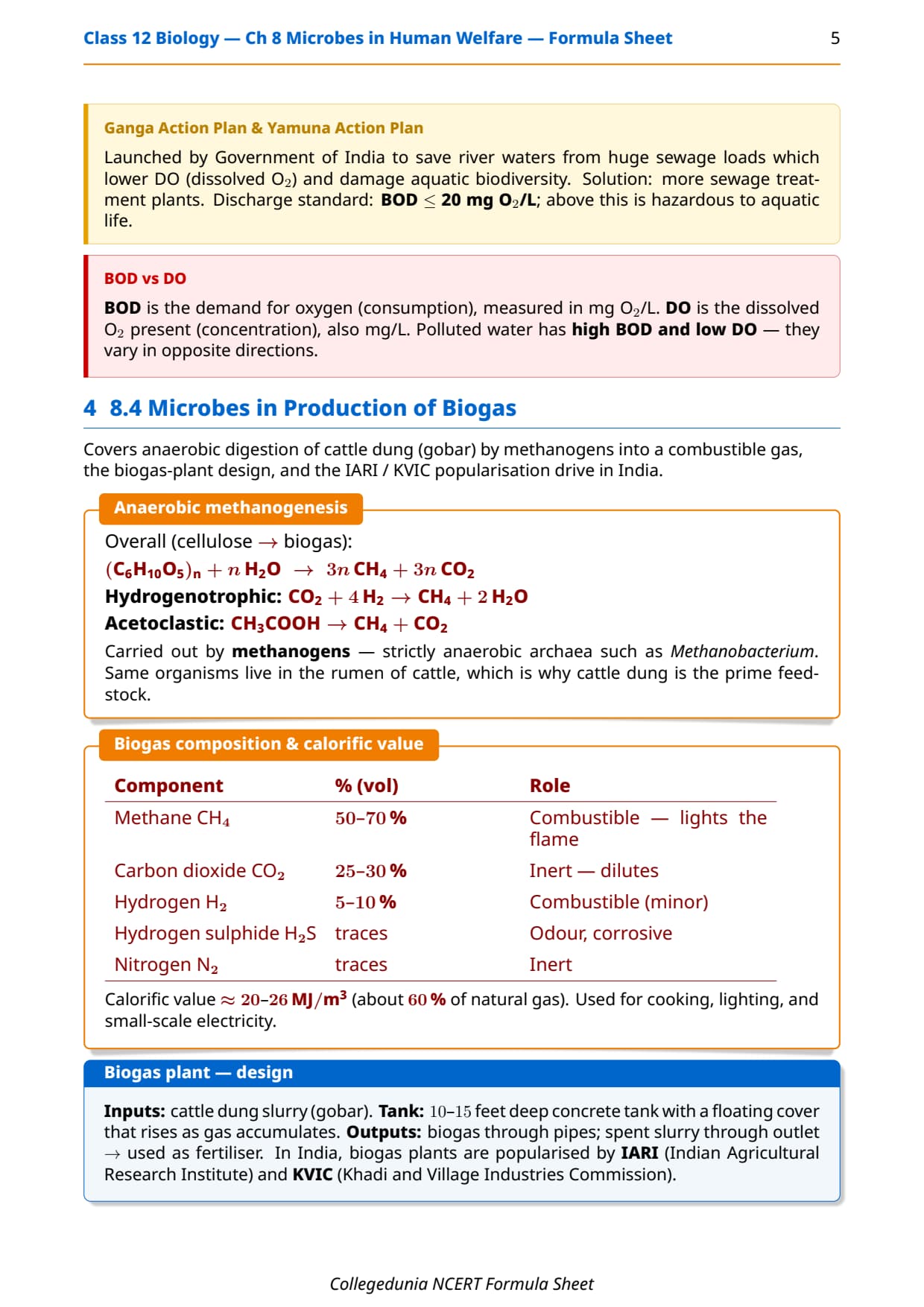
| Biogas CH4 / CO2 / H2 | 50-70 / 25-30 / 5-10%; 20-26 MJ/m3 | 8.4 |
| Biogas tank + agencies | 10-15 ft; IARI + KVIC | 8.4 |
| Curd pH / temp / time | 6.5 → 4.0-4.6; 37-45 °C; 6-8 h | 8.1 |
| Ethanol yield (theor / pract) | 0.51 / 0.46-0.48 g per g glucose | 8.2 |
| Citric acid yield | 0.9 g/g sucrose; pH about 2.0; > 2 Mt/yr | 8.2 |
| Penicillin G potency | 1500-1670 IU/mg; 1 IU = 0.6 µg Na salt | 8.2 |
| PHA bioplastic yield | up to 80% dry-cell weight | 8.2 |
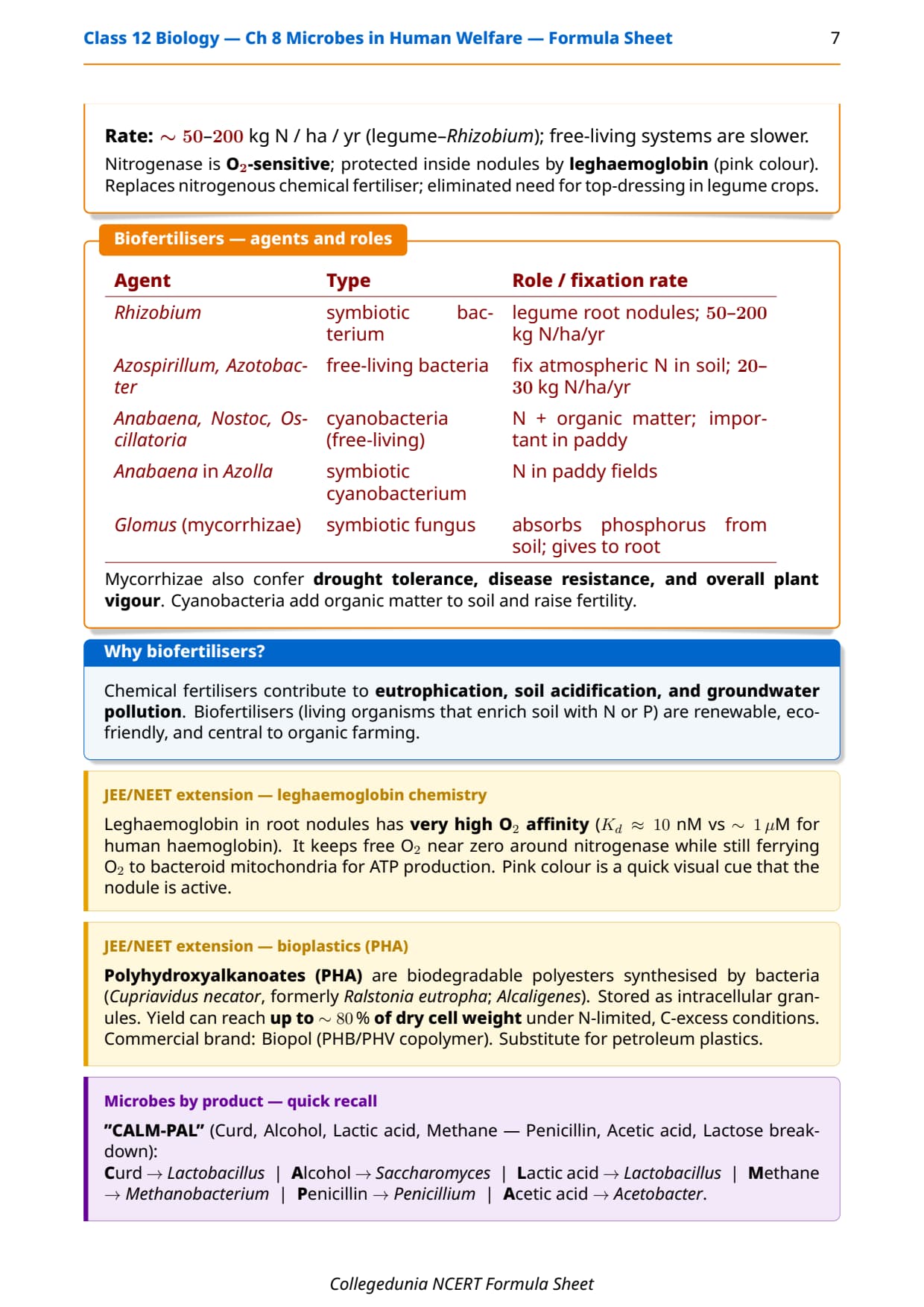
| N-fix: symbiotic vs free-living | 50-200 vs 20-30 kg N/ha/yr | 8.6 |
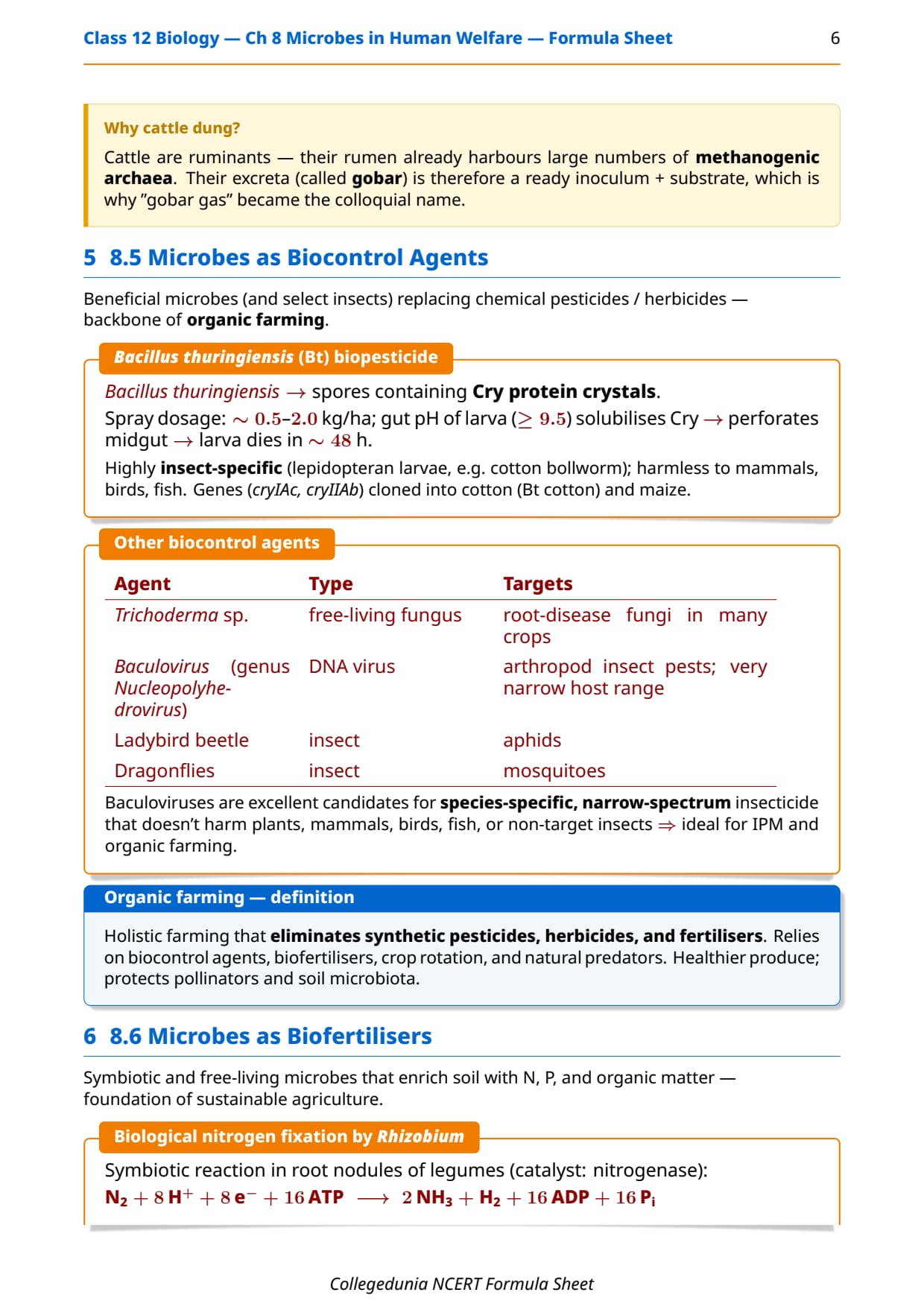
| Bt biopesticide | kills in 48 h; gut pH ≥ 9.5; 0.5-2.0 kg/ha | 8.5 |
| Leghaemoglobin O2 affinity | Kd about 10 nM (vs 1 µM human Hb) | 8.6 |
All entries are retained in the 2026-27 syllabus. Key trap: higher BOD means more pollution and lower dissolved oxygen.
Fermentation Stoichiometry and Yield Card for NEET Class 12 Biology
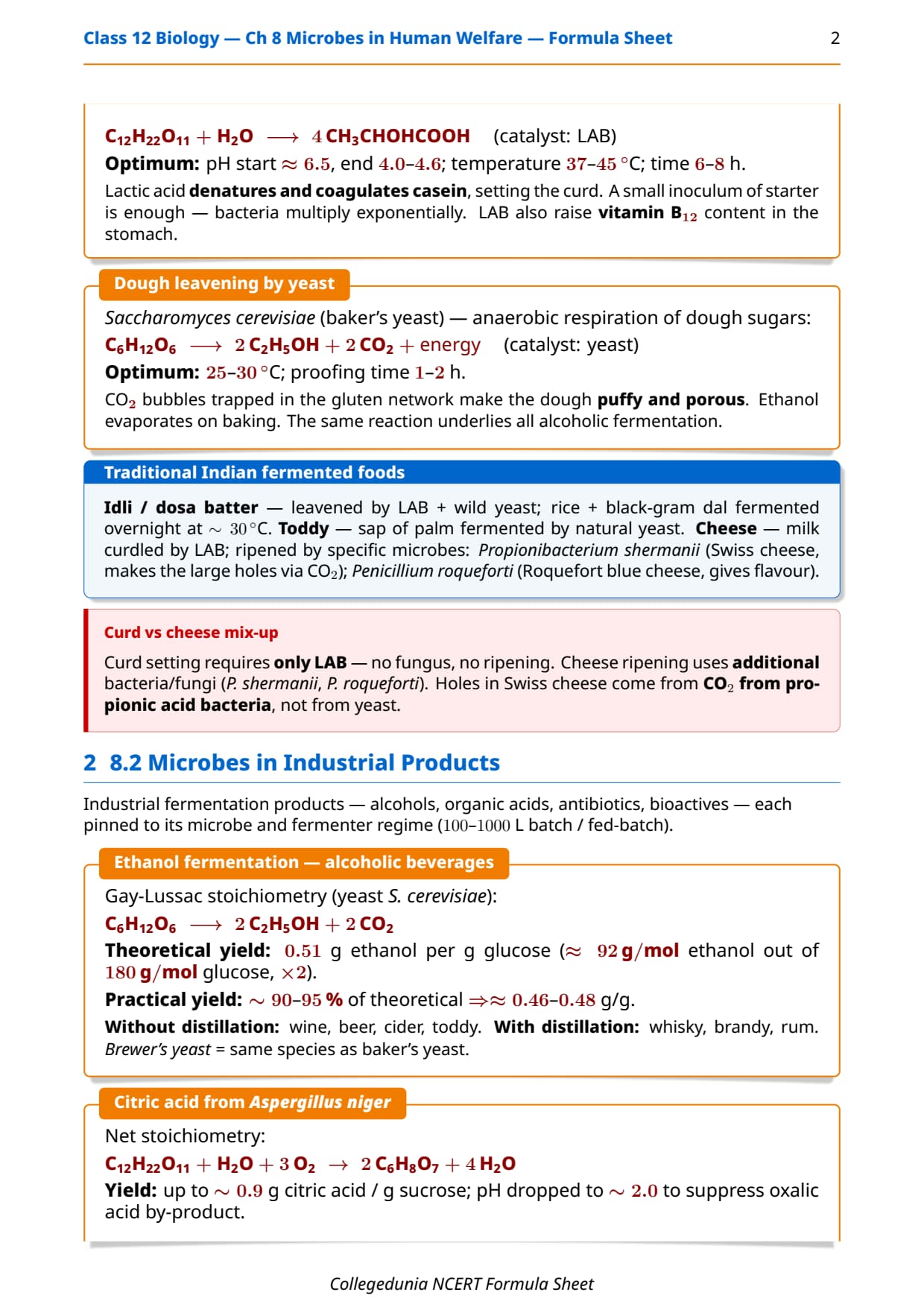
The card below packages the five must-know fermentation reactions from Sections 8.1 and 8.2.
| Process | Equation + catalyst |
|---|---|
| Lactic acid (curd) | C12H22O11 + H2O → 4 CH3CHOHCOOH ; Lactobacillus |
| Ethanol | C6H12O6 → 2 C2H5OH + 2 CO2 ; S. cerevisiae; 0.51 g/g theoretical |
| Acetic acid | C2H5OH + O2 → CH3COOH + H2O ; Acetobacter aceti |
| Citric acid | C12H22O11 + H2O + 3 O2 → 2 C6H8O7 + 4 H2O ; A. niger |
| Biogas methanogenesis | CO2 + 4 H2 → CH4 + 2 H2O ; methanogens; gives 50 to 70% CH4 |
| Symbiotic N-fixation | N2 + 8 H+ + 8 e- + 16 ATP → 2 NH3 + H2 + 16 ADP + 16 Pi ; nitrogenase |
Lock both ethanol yields: 0.51 g/g theoretical (Gay-Lussac maximum); 0.46 to 0.48 g/g practical (yeast). NEET swaps this wording every other paper.
BOD, COD and Sewage Treatment Snapshot for 12th Biology
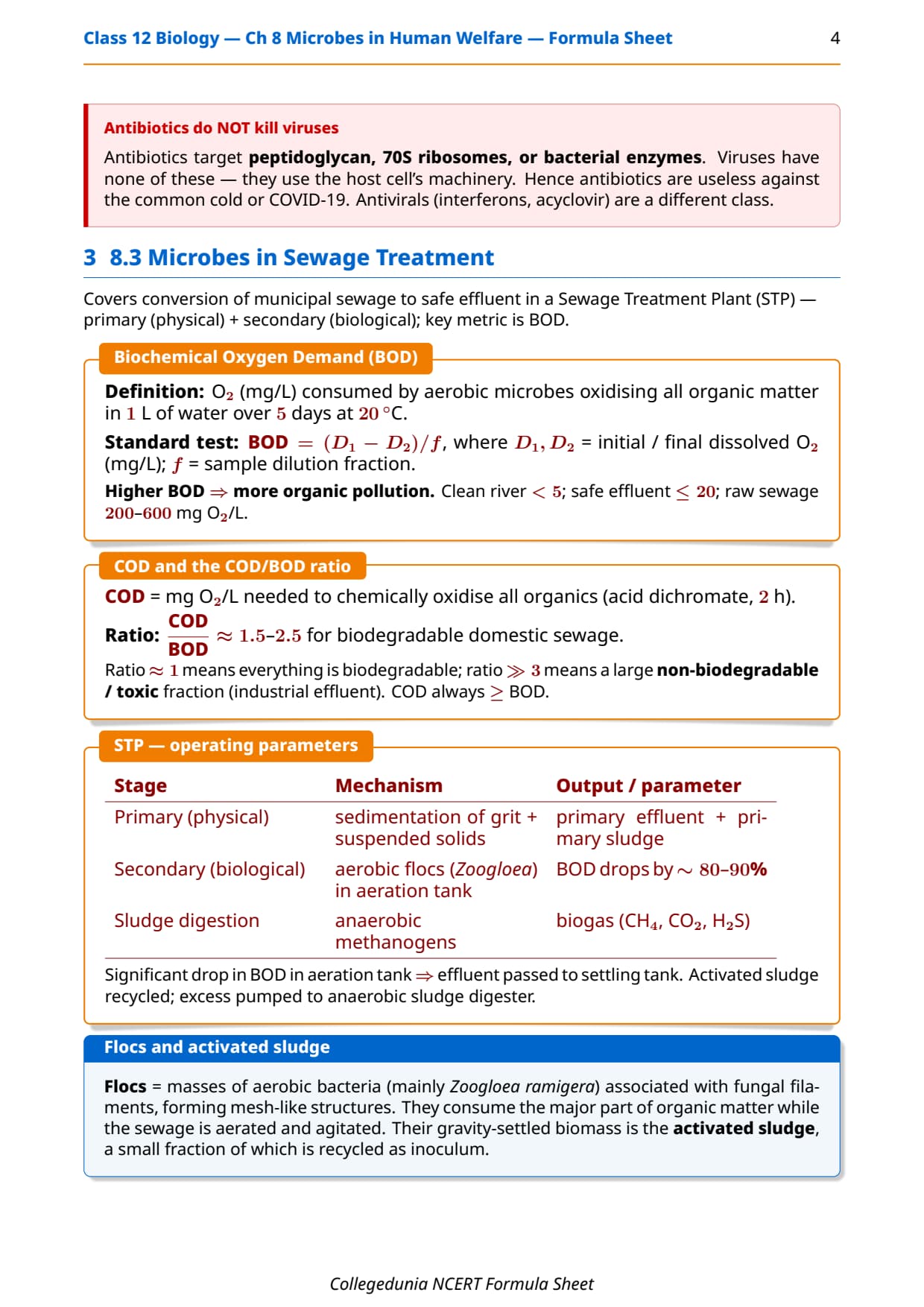
Section 8.3 centres on BOD (5 days at 20 °C, mg O2/L) and the STP aeration tank. COD is always ≥ BOD; COD/BOD is 1.5 to 2.5 for domestic sewage.
Biogas Composition and Plant-Design Quick Card for 12th Biology
Biogas composition: CH4 50 to 70% (combustible), CO2 25 to 30% (inert), H2 5 to 10%; calorific value 20 to 26 MJ/m3. NEET has tested the IARI + KVIC pair as a 1-mark match in 3 of the last 5 papers.
Antibiotics and Bioactive Microbe Index for Class 12 Biology
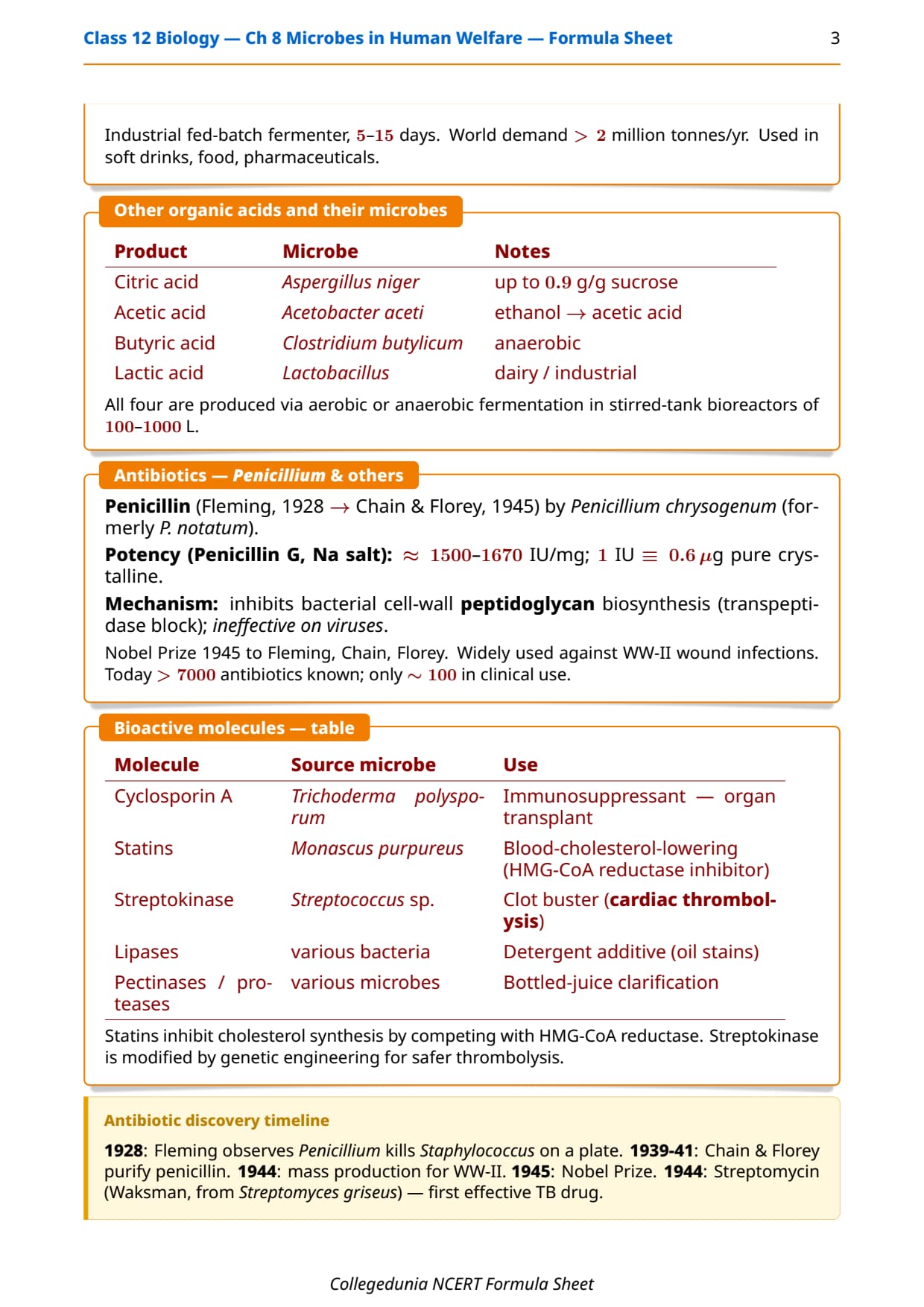
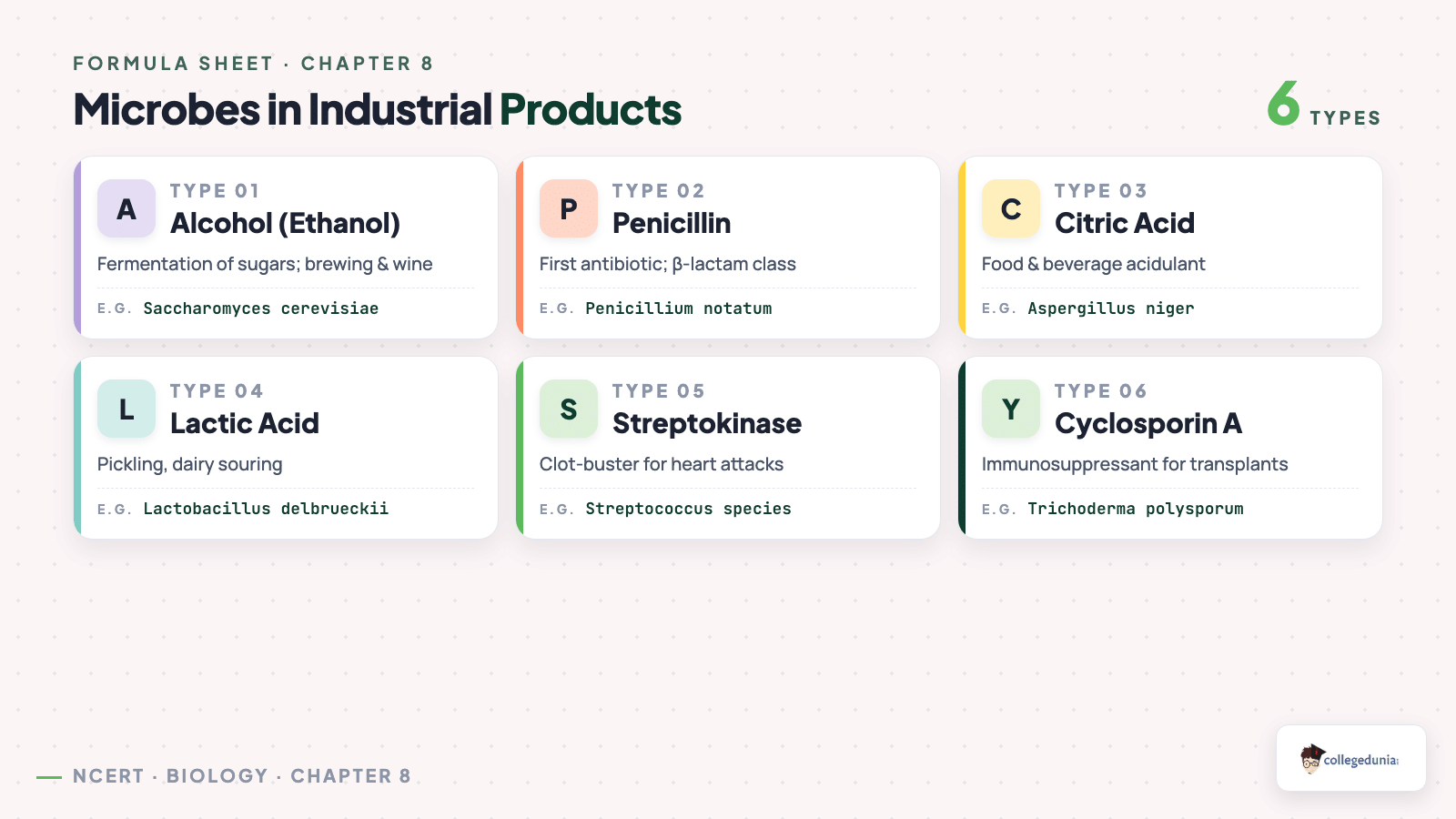
Section 8.2 hides high-value cues in unit-bearing numbers. The card pairs each product with its source microbe.
| Product | Source Microbe + Datum |
|---|---|
| Penicillin G | Penicillium chrysogenum; 1500-1670 IU/mg; blocks peptidoglycan |
| Streptomycin | Streptomyces griseus; first TB drug (Waksman, 1944) |
| Cyclosporin A | Trichoderma polysporum; organ-transplant immunosuppressant |
| Statins | Monascus purpureus; HMG-CoA reductase inhibitor |
| Streptokinase | Streptococcus sp.; cardiac clot buster (GM for safety) |
| PHA / PHB bioplastic | Cupriavidus / Alcaligenes; up to 80% dry-cell weight (Biopol) |
Biocontrol Agents and Biofertilisers Card for Class 12 Biology
The table covers biocontrol agents and biofertilisers from Sections 8.5 and 8.6.
| Agent | Role / Key Number |
|---|---|
| Bacillus thuringiensis (Bt) | Cry crystals kill lepidopteran larvae in 48 h; pH ≥ 9.5 |
| Trichoderma sp. | Free-living fungus; root-disease biocontrol |
| Baculovirus (NPV) | DNA virus; narrow-host insect biocontrol; IPM-ready |
| Rhizobium | Symbiotic; legume nodules; 50 to 200 kg N/ha/yr |
| Azospirillum, Azotobacter | Free-living bacteria; 20 to 30 kg N/ha/yr |
| Anabaena in Azolla | Symbiotic cyanobacterium; paddy N-fixation |
| Glomus (mycorrhiza) | Symbiotic fungus; P uptake + drought tolerance |
One-Shot Revision Tips for Class 12 Biology Microbes in Human Welfare
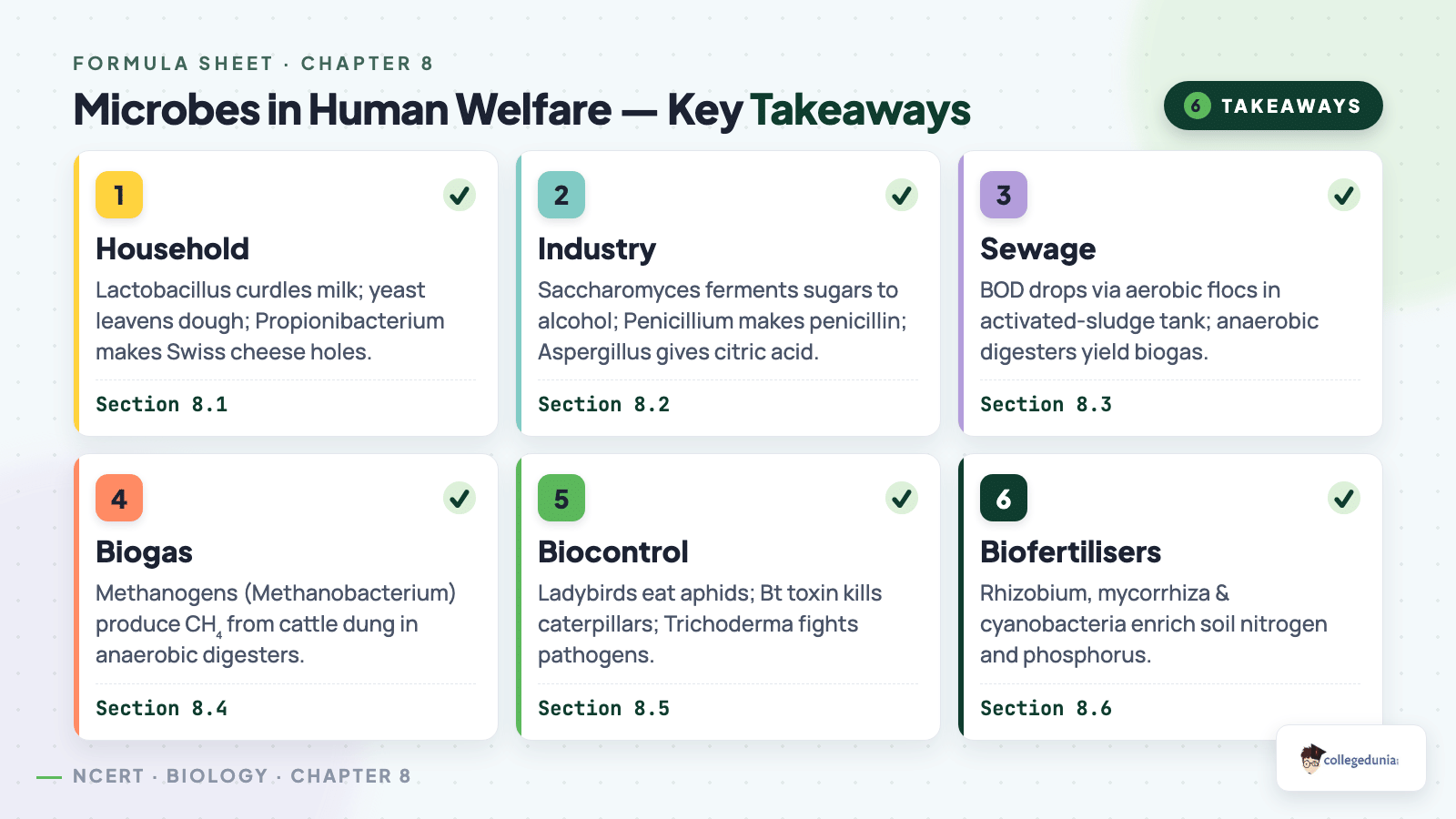
- Curd vs cheese: curd is LAB-only; cheese needs ripening microbes; Swiss holes are propionic CO2.
- BOD up → DO down: safe effluent ≤ 20 mg O2/L; secondary STP cuts BOD by 80-90%.
- Biogas: 50-70% CH4, 25-30% CO2, 5-10% H2; IARI + KVIC.
- Symbiotic vs free-living N-fix: 50-200 vs 20-30 kg N/ha/yr; leghaemoglobin protects nitrogenase.
Top NEET Recall Hits and Recent PYQ Pattern for Microbes in Human Welfare
NEET 2025 tested biogas CH4 percentage and Penicillin G potency. NEET 2024 targeted the symbiotic-vs-free-living N-fix gap. CBSE 2025 set a 3-mark long-answer on STP stages and Zoogloea flocs. CBSE 2024 ran the IARI / KVIC pair as a 1-mark match. NEET 2023 plugged the ethanol 0.51 g/g yield into a numerical MCQ. Use the Microbes in Human Welfare Notes for full topic explanations and the NCERT Solutions for year-wise PYQ maps.
Student Feedback: Microbes in Human Welfare Class 12 Biology Survey
Student Feedback
In a recent survey of 11,500 Class 12 Biology students, here is what they reported about this chapter:
- 71% of students marked the biogas plant labelled flowchart as the hardest sub-topic - yet it carries the highest single-question marks in CBSE and NEET papers.
- 60% lost 1-2 marks on matching fermentation products to yeast, LAB, and Penicillium even when the rest of their answer was correct.
- Average time: 4.7 hours for first read, 2.0 hours for a focused revision pass before the board exam.
Source: 2025-26 Class 12 Biology student survey. Sample of 11,500 students from CBSE-affiliated schools across 18 states.
This formula sheet is curated by Collegedunia subject experts, mapped to the 2026-27 NCERT, and refined against the last five years of CBSE Board and NEET papers.
Other Resources for Microbes in Human Welfare Class 12 Biology
| Resource Type | Link |
|---|---|
| Formula Sheet (this page) | Microbes in Human Welfare Formula Sheet |
| NCERT Solutions | Microbes in Human Welfare Class 12 Biology NCERT Solutions |
| Notes | Microbes in Human Welfare Class 12 Biology Notes |
| NCERT Book PDF | Microbes in Human Welfare Class 12 Biology NCERT Book PDF |
| Exemplar Solutions | Microbes in Human Welfare Class 12 Biology Exemplar Solutions |
| Handwritten Notes | Microbes in Human Welfare Class 12 Biology Handwritten Notes |
| Exemplar Book PDF | Microbes in Human Welfare Class 12 Biology NCERT Exemplar Book PDF |
Formula Sheet for Class 12 Biology: All Chapters
The table below links every Class 12 Biology chapter's formula sheet.
| Chapter | Resource |
|---|---|
| Chapter 1 | Sexual Reproduction in Flowering Plants |
| Chapter 2 | Human Reproduction |
| Chapter 3 | Reproductive Health |
| Chapter 4 | Principles of Inheritance and Variation |
| Chapter 5 | Molecular Basis of Inheritance |
| Chapter 6 | Evolution |
| Chapter 7 | Human Health and Disease |
| Chapter 8 (this page) | Microbes in Human Welfare |
| Chapter 9 | Biotechnology Principles and Processes |
| Chapter 10 | Biotechnology and Its Applications |
| Chapter 11 | Organisms and Populations |
| Chapter 12 | Ecosystem |
| Chapter 13 | Biodiversity and Conservation |
Microbes in Human Welfare Class 12 Biology Formula Sheet FAQs
Ques. What does the Microbes in Human Welfare Class 12 Biology formula sheet cover?
Ans. The sheet collates every numerical fact and microbe-product pair across NCERT Sections 8.1 to 8.6: lactic-acid fermentation, ethanol stoichiometry, citric-acid yield (0.9 g/g), penicillin potency (1500 to 1670 IU/mg), BOD ranges, the COD/BOD ratio, biogas composition (50 to 70% CH4), Bt biopesticide mechanism, Rhizobium N-fixation (50 to 200 kg N/ha/yr) and the symbiotic-vs-free-living biofertiliser split. One printable revision page aligned to the 2026-27 NCERT.
Ques. Is this Class 12 Biology Chapter 8 formula sheet aligned with the 2026-27 NCERT?
Ans. Yes. Every entry matches the current 2026-27 print of NCERT Biology. Sections 8.1 through 8.6 are retained in full, and the sheet flags both classical numerical facts (BOD, biogas %, ethanol yield) and the NCERT-extension topics (PHA bioplastic, leghaemoglobin chemistry) exactly as they appear in the latest edition.
Ques. How is this Microbes in Human Welfare formula sheet useful for NEET preparation?
Ans. NEET pulls 2 to 4 questions a year from this chapter, almost all recall-based numericals or microbe-to-product matchings: percentage of methane in biogas, the BOD discharge limit, the symbiotic-vs-free-living N-fixation rate, the citric-acid yield and the Penicillium G potency. The Collegedunia sheet packages these in quick-lookup tables so a 15 minute final-pass the night before the paper covers nearly every common MCQ.
Ques. What is the biogas composition as per NCERT Class 12 Biology Chapter 8?
Ans. Biogas is a mixture of methane (CH4) 50 to 70%, carbon dioxide (CO2) 25 to 30%, hydrogen (H2) 5 to 10% by volume, with traces of H2S and N2. Methane is the combustible fraction. Calorific value is 20 to 26 MJ/m3, about 60% of natural gas. Biogas plants in India are popularised by IARI and KVIC.
Ques. What is BOD and what is the safe discharge limit for treated effluent?
Ans. BOD (Biochemical Oxygen Demand) is the oxygen consumed by aerobic microbes to oxidise all the organic matter in 1 L of water over 5 days at 20 °C, measured in mg O2/L. Clean river water has BOD < 5; raw sewage 200 to 600; the discharge standard for safe effluent is BOD ≤ 20 mg O2/L. COD/BOD for domestic sewage is 1.5 to 2.5; a ratio much greater than 3 implies a large non-biodegradable industrial fraction.
Ques. What is the difference between symbiotic and free-living nitrogen fixers in Chapter 8?
Ans. Symbiotic fixers live inside legume root nodules (Rhizobium) or in Azolla (Anabaena) and fix 50 to 200 kg N/ha/yr. Free-living fixers (Azospirillum, Azotobacter, Nostoc, Oscillatoria) fix only 20 to 30 kg N/ha/yr. In Rhizobium the nitrogenase enzyme is O2-sensitive and is protected by leghaemoglobin, which gives an active nodule its pink colour.
Ques. Why are antibiotics ineffective against viruses according to NCERT Chapter 8?
Ans. Antibiotics target peptidoglycan, 70S ribosomes or specific bacterial enzymes. Viruses lack peptidoglycan, lack ribosomes (they use the host's machinery) and lack the enzymes antibiotics inhibit, so antibiotics have no target on a virus. The common cold and COVID-19 therefore need antivirals (acyclovir, interferons) and not antibiotics. NEET tests this assertion-reason almost every year.
Ques. How does the Bt biopesticide kill insect larvae?
Ans. Bacillus thuringiensis produces spores containing Cry protein crystals. When a lepidopteran larva (e.g. cotton bollworm) eats the spray, the alkaline gut pH (≥ 9.5) solubilises the crystal, releasing the toxin. The toxin perforates the midgut and the larva dies in about 48 hours. Mammals, birds and fish have acidic stomachs and are not harmed. Cry genes (cryIAc, cryIIAb) have been cloned into Bt cotton and Bt maize.
Ques. How many marks does Microbes in Human Welfare carry in CBSE Class 12 Biology Boards?
Ans. Chapter 8 contributes around 5 to 7 marks in the CBSE Class 12 Biology board paper, typically split across a 2 mark short-answer on STP / biogas plant design and a 3 to 5 mark long-answer on industrial fermentation (penicillin, citric acid) or biofertilisers. NEET tests 2 to 4 questions a year, almost always 1 mark numericals or microbe-product MCQs.



Comments