




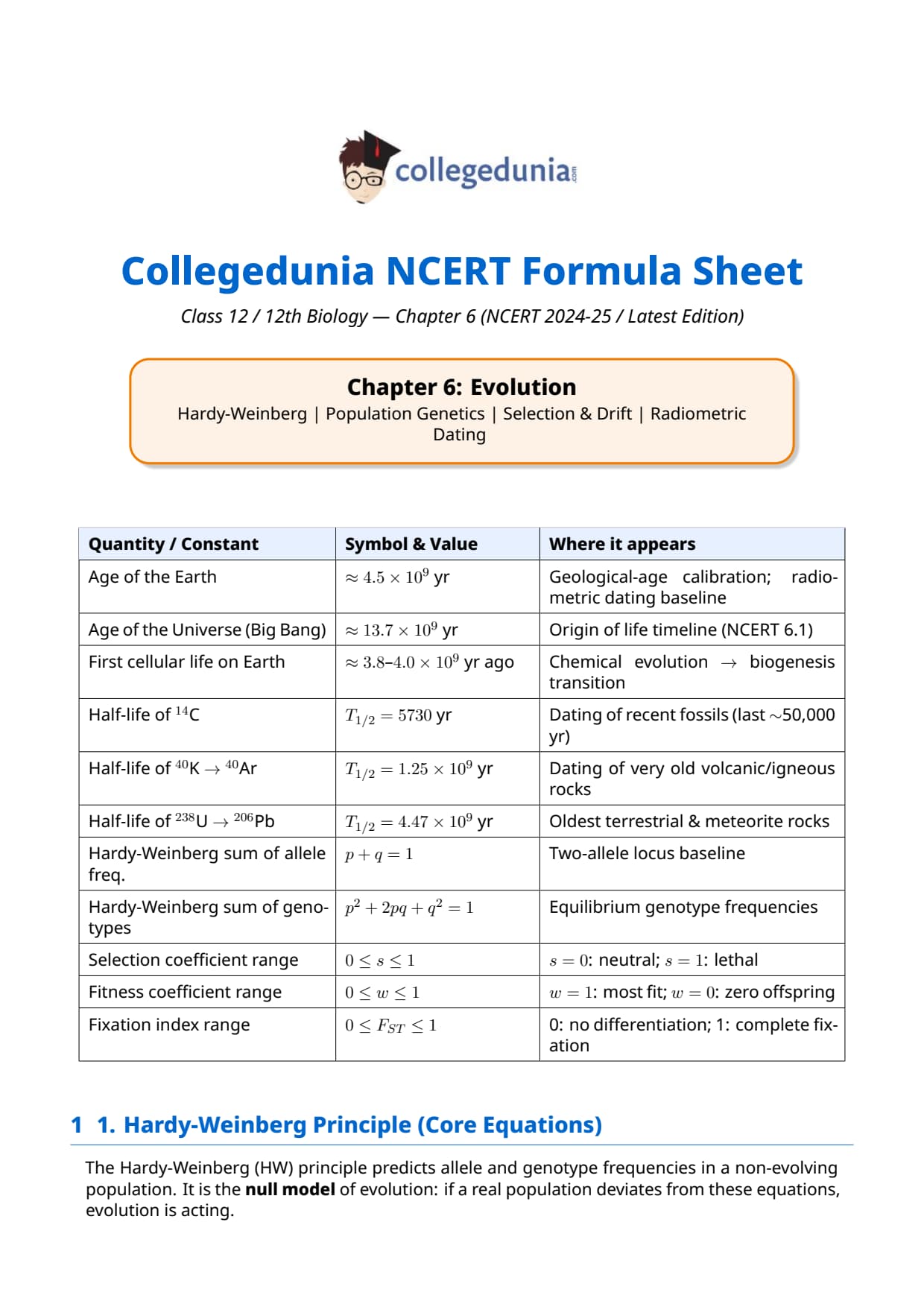
NEET 2025 carried 4 questions directly from population-genetics formulas, almost all from Hardy-Weinberg. Class 12 Biology Chapter 6 Evolution packs 17 numerical formulas across allele frequency, gene flow, drift, selection, and radiometric dating into one 9-page sheet for 2026-27 NEET prep.
- CBSE Weightage: 5 to 7 marks
- NEET Weightage: 4 to 6 questions per paper (around 6% of Biology)
- CUET Weightage: High overlap with NEET-pattern MCQs on Hardy-Weinberg and dating
Evolution Chapter 6 Video Lecture for Class 12 Biology
Source: Magnet Brains on YouTube
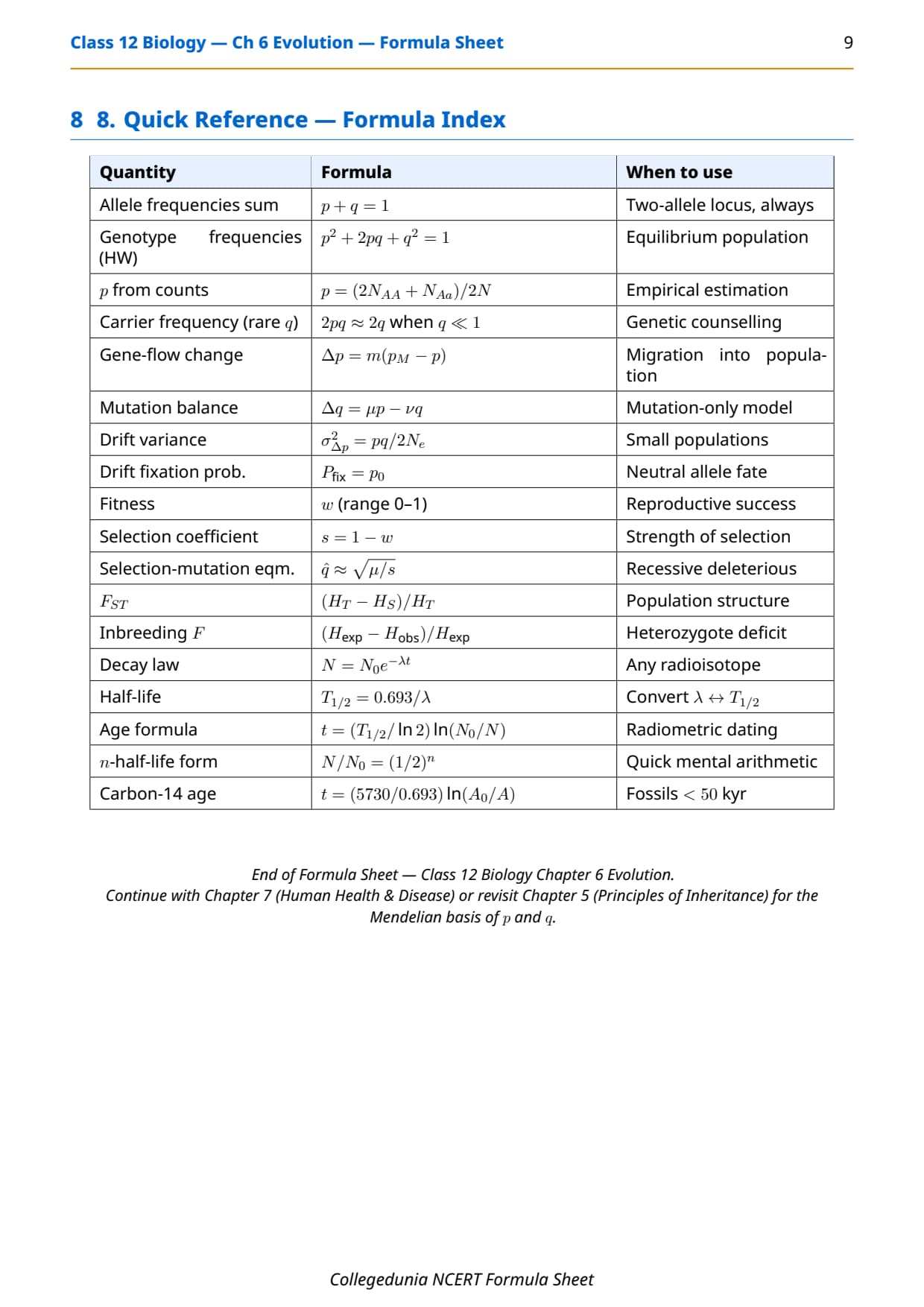
All Formulas of Evolution at a Glance for NEET and CBSE Class 12
Every formula indexed against its NCERT sub-topic and exam use.
| Concept | Formula | Section | Typical use |
|---|---|---|---|
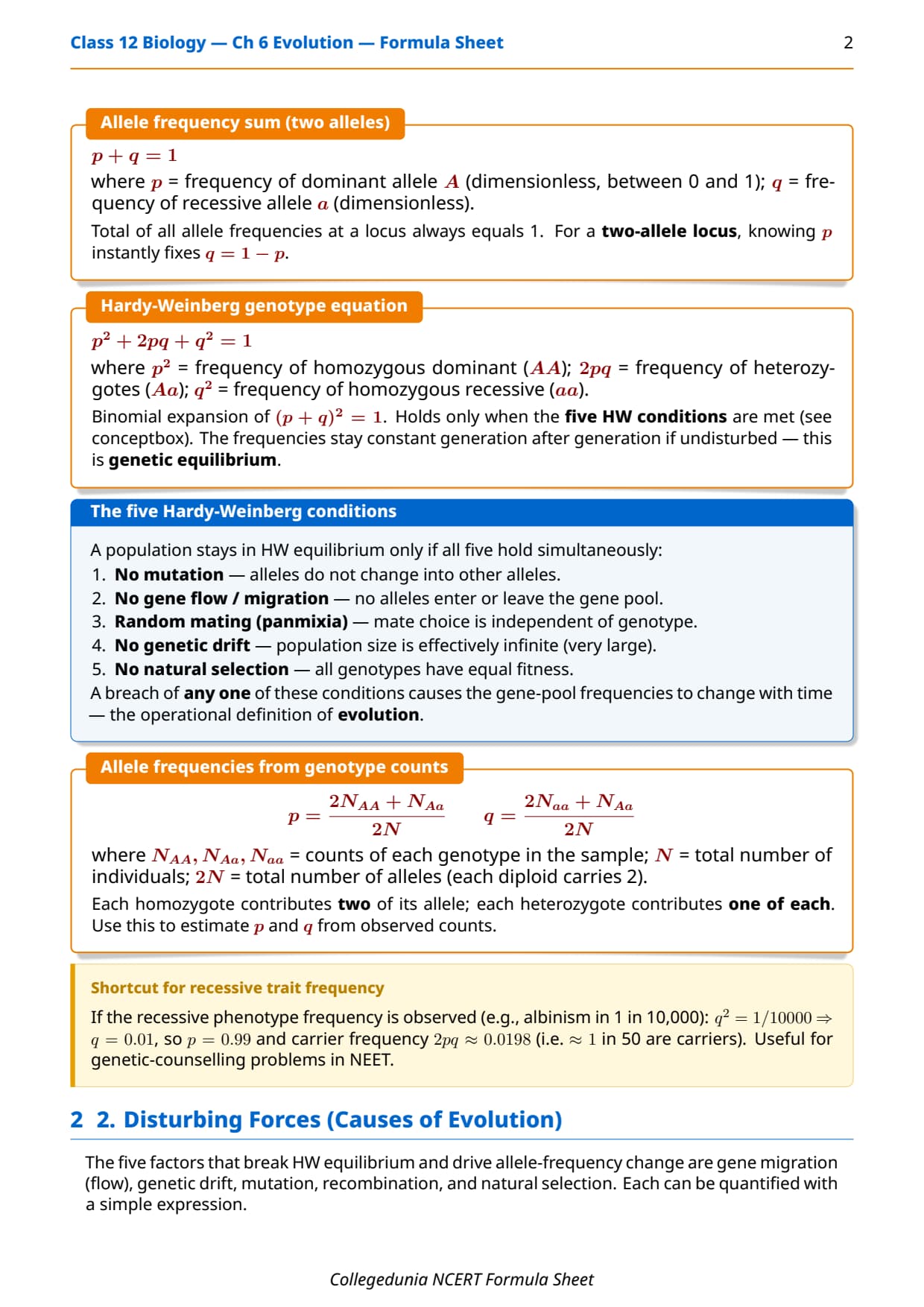
| Allele frequency sum | p + q = 1 | 6.7 | NEET MCQ on dominant frequency |
| Hardy-Weinberg expansion | p2 + 2pq + q2 = 1 | 6.7 | Genotype from allele frequency |
| Homozygous recessive | q2 = aa fraction | 6.7 | Carrier estimation |
| Heterozygote carrier | 2pq | 6.7 | Sickle-cell, PKU MCQ |
| Allele from genotype counts | p = 2NAA + NAa2N | 6.7 | Reverse calculation |
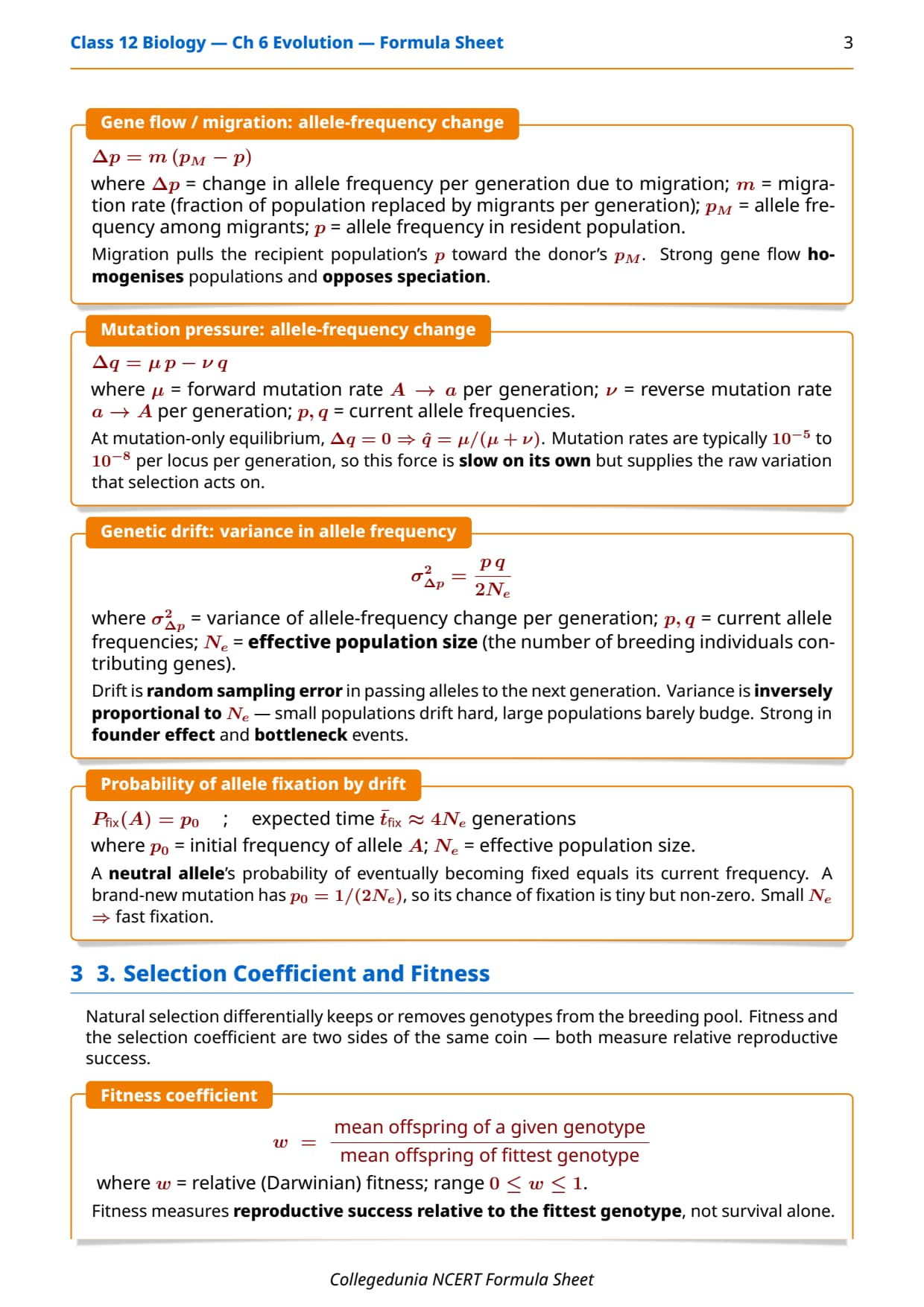
| Mutation rate | μ = new mutantstotal alleles | 6.7 | HWE disturbance MCQ |
| Migration rate | m = migrantstotal alleles | 6.7 | Founder-effect numericals |
| Allele change via migration | Δ p = m (pm - p) | 6.7 | One-island models |
| Genetic drift variance | σ2 = pq2N | 6.7 | Small-population MCQ |
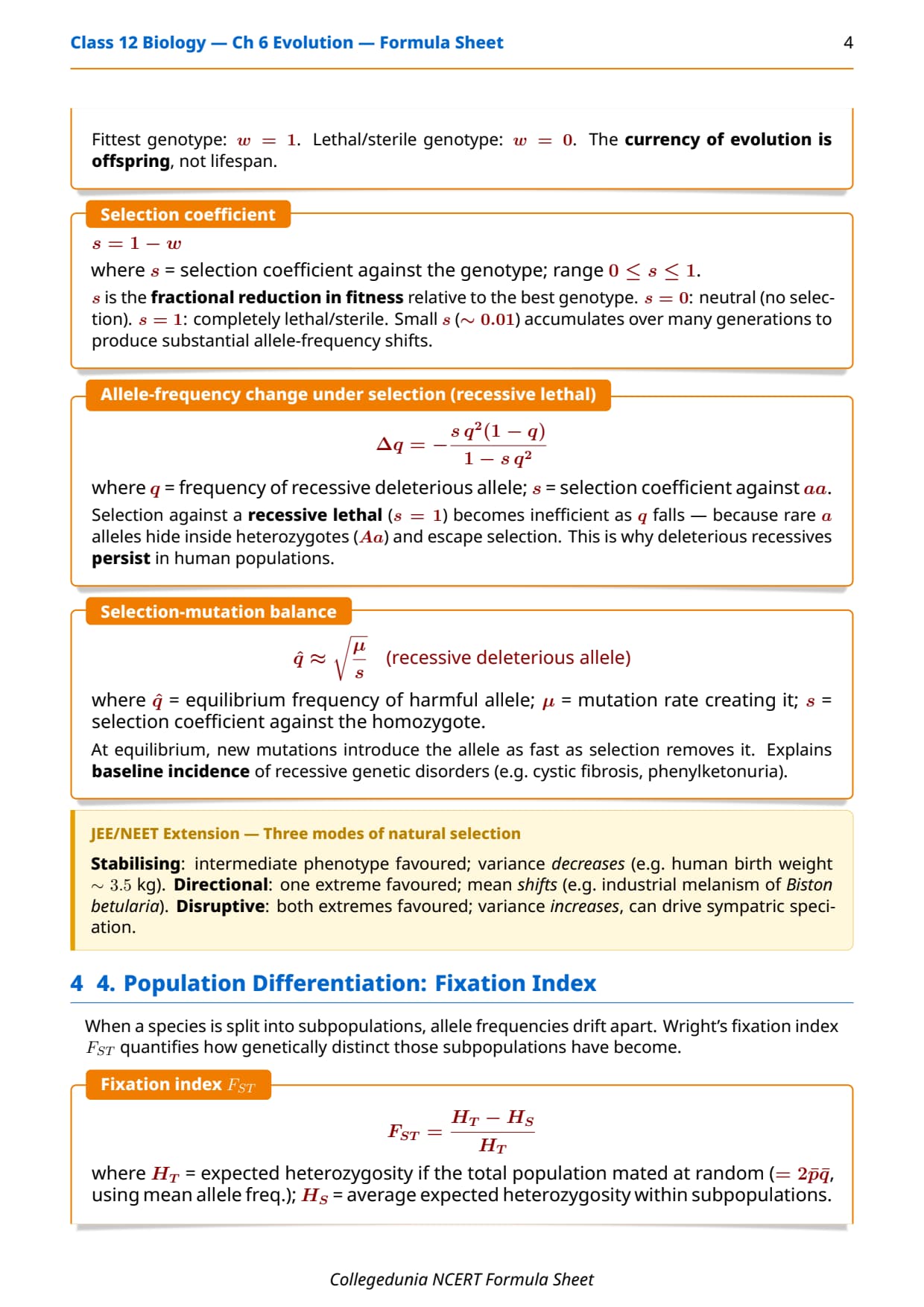
| Selection coefficient | s = 1 - W | 6.7 | Fitness MCQ |
| Relative fitness | W = survival of genotypesurvival of best | 6.7 | Industrial melanism |
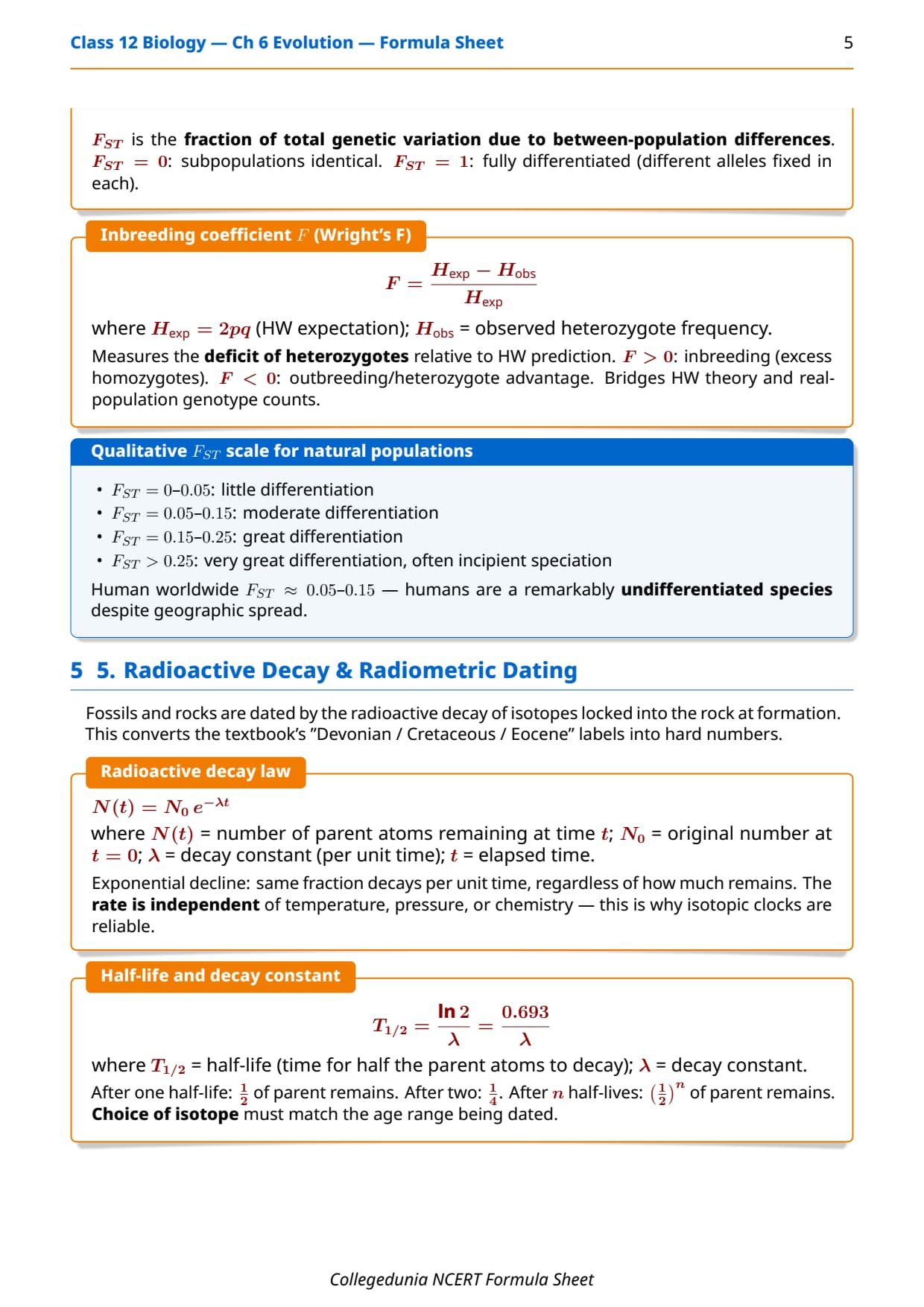
| Fixation index | FST = HT - HSHT | 6.7 | Population differentiation |
| Radioactive decay law | N = N0 e-λ t | 6.4 | Radiometric dating MCQ |
| Half-life relation | t1/2 = 0.693/λ | 6.4 | Carbon-14 numerical |
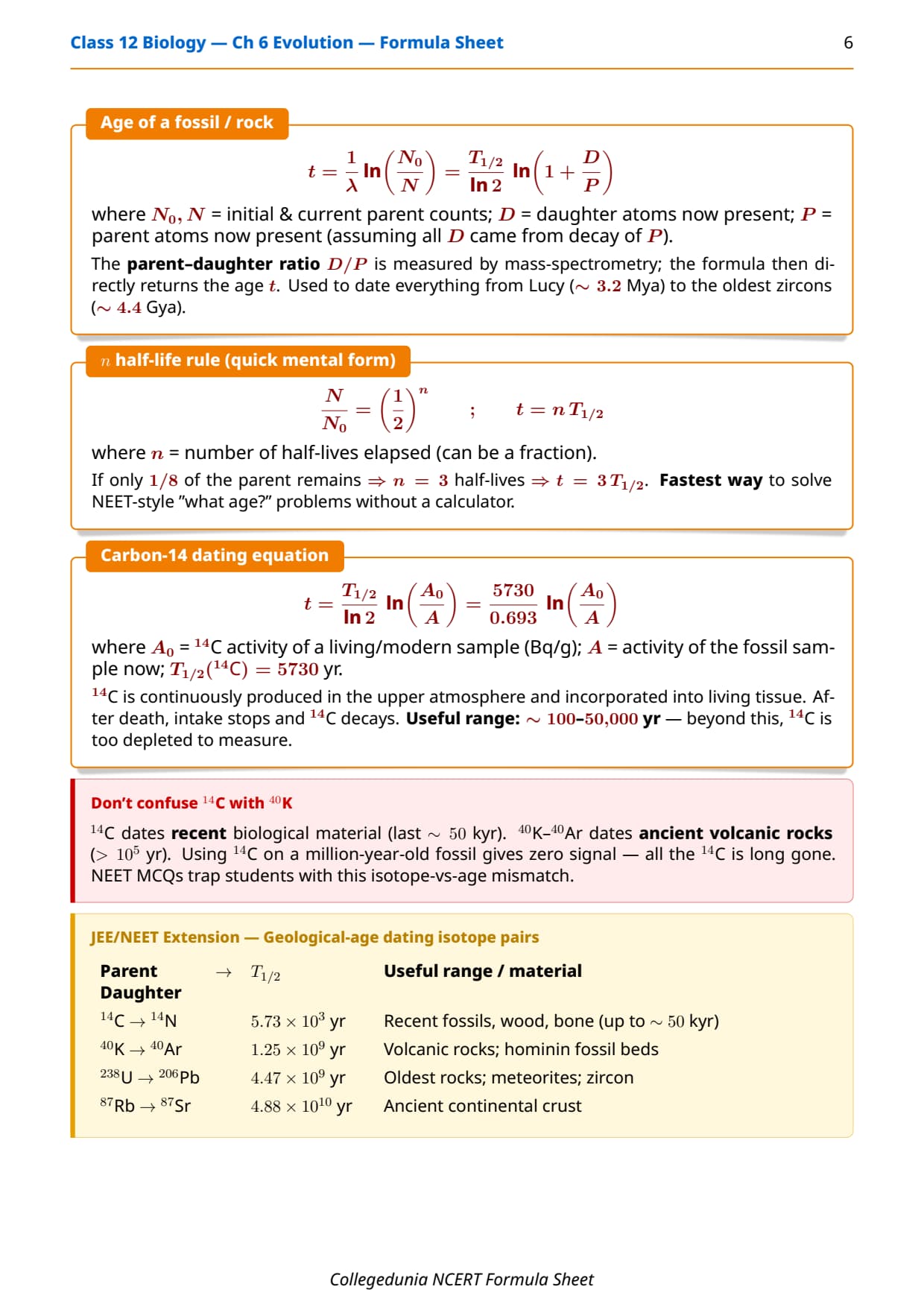
| Age from decay ratio | t = (t1/2/ln 2)ln(N0/N) | 6.4 | Fossil-age determination |
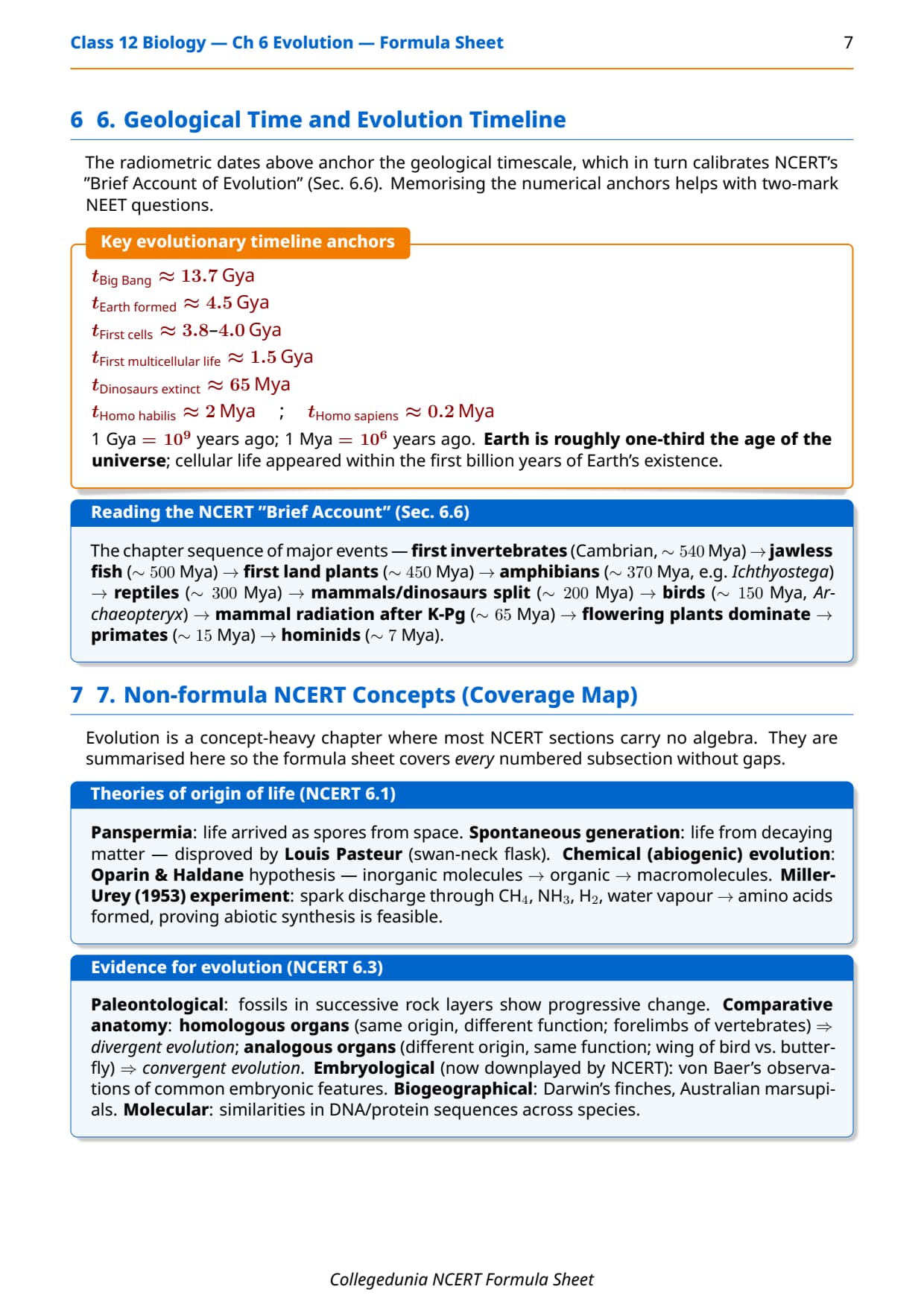
| Cambrian anchor | T ≈ 541 Ma | 6.4 | Era-matching MCQ |
| Origin-of-life timeline | ≈ 3.5-4.0 Ga | 6.2 | Chronology assertion-reason |

How will Collegedunia's Evolution Formula Sheet Help You with NEET 2027?
Engineered for last-mile NEET and CBSE revision. Every formula sits one tap away with units, exam tag, and a worked pattern.
- NEET-First Design: Every formula carries the NEET-question pattern it appears in.
- 2026-27 NCERT Alignment: Every box mirrors the current syllabus.
- Decay-and-Dating Cards: C-14, K-40, and U-238 half-lives in one card row.
- Hardy-Weinberg Templates: Three worked patterns cover 80% of NEET variants.
When to Use Which Evolution Formula in NEET Numericals
Read the prompt, match a row, plug numbers.
- "Frequency of recessive individuals" / % affected: use q2 , then q = √q2 , then p = 1 - q .
- "Carrier frequency" / "heterozygous frequency": use 2pq .
- "Small population" / "founder effect": use σ2 = pq/(2N) .
- "Fitness" / "selection against a genotype": use s = 1 - W .
- "Subdivided population" / two-population differentiation: use FST .
- "Age of a fossil" / Carbon-14: use t = (t1/2/ln 2) ln(N0/N) with t1/2 = 5730 yr.
- "Migration" / gene flow: use Δ p = m(pm - p) .
Quick-Fact Cards for Evolution NEET Revision
5730 yr (fossils < 50,000 yr)
1.25 Ga (hominid dating)
4.5 Ga (Earth-age anchor)
4.5 Ga (Hadean to present)
3.8-4.0 Ga (prokaryotes)
~0.2 Ma
Symbol Glossary for Evolution Class 12 Formulas
Every variable in the master formula table decodes here.
| Symbol | Meaning | Range |
|---|---|---|
| p, q | Dominant, recessive allele frequencies | 0-1, p + q = 1 |
| p2, 2pq, q2 | AA, Aa, aa genotype frequencies | 0-1 |
| N | Population size OR remaining atoms | context-dependent |
| N0 | Initial radioactive atoms (t = 0) | - |
| λ | Decay constant | 0.693 / t1/2 |
| t1/2 | Half-life | 5730 yr C-14; 4.5 Ga U-238 |
| s, W | Selection coefficient, relative fitness | 0-1 |
| m | Migration rate | 0-1 |
| FST | Fixation index between sub-populations | 0-1 |
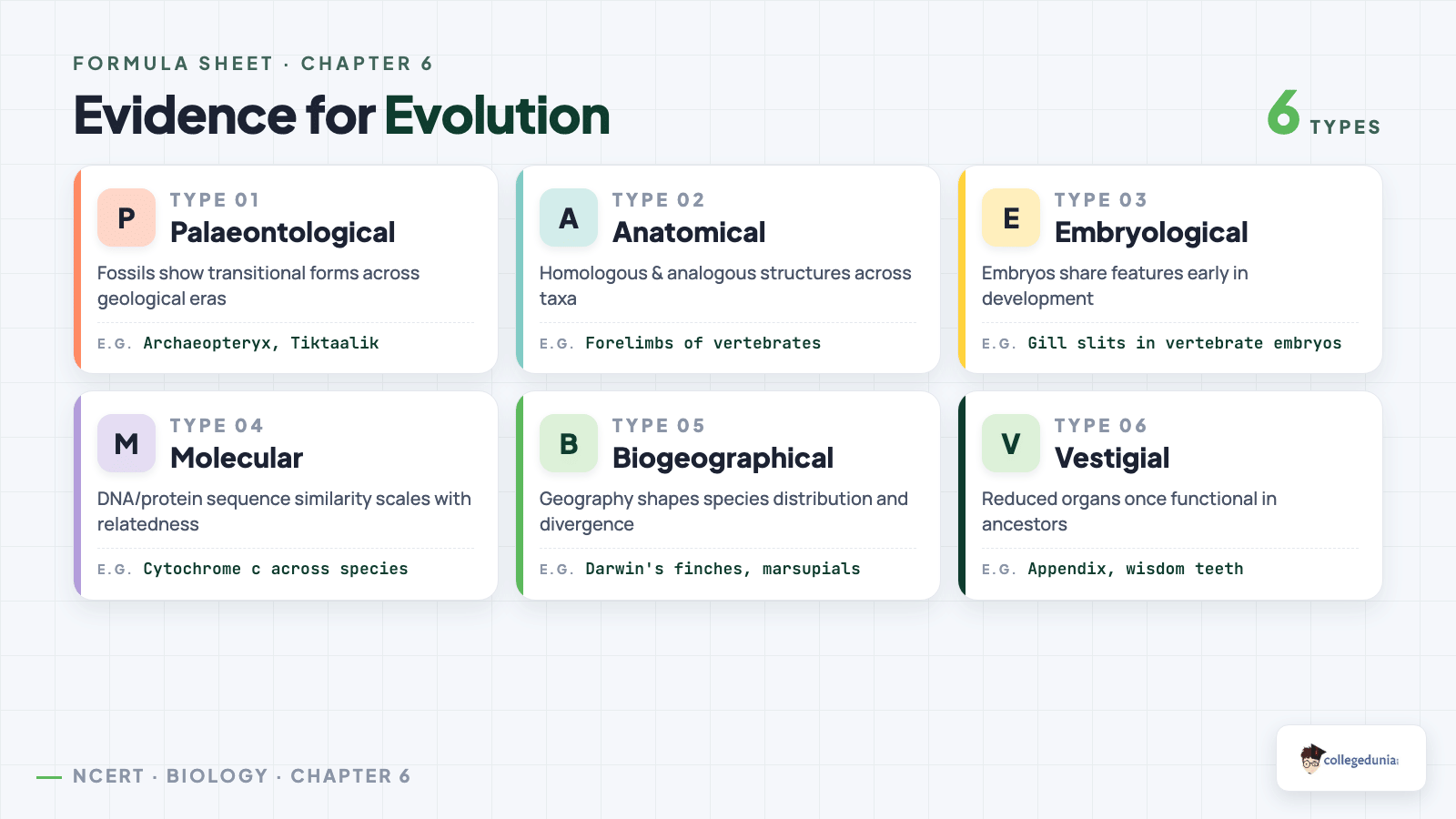
Hardy-Weinberg Numerical Templates Worked for NEET Class 12
These three templates cover nearly every Hardy-Weinberg NEET numerical.
Template 1, disease to carrier frequency. 1 in 10,000 affected: q2 = 0.0001 , q = 0.01 , p = 0.99 , 2pq = 0.0198 , so 1 in 50 is a carrier.
Template 2, allele from genotype counts. 360 AA, 480 Aa, 160 aa in 1000 people: p = (720 + 480)/2000 = 0.6 , q = 0.4 . Check q2 = 0.16 matches 160/1000.
Template 3, C-14 fossil dating. Fossil retains 25% C-14, so two half-lives have passed: age = 2 × 5730 = 11,460 years.
Evolution Topic Summary Mapped to NEET High-Yield Sub-Topics
| Sub-topic | NEET Frequency | Key formula |
|---|---|---|
| Hardy-Weinberg principle | High | p2 + 2pq + q2 = 1 |
| Genetic drift, founder effect | High | σ2 = pq/(2N) |
| Natural selection, fitness | Medium | s = 1 - W |
| Origin-of-life timeline | Medium | N = N0 e-λ t |
| Human evolution | Low | Ma anchors |
One-Shot Revision Tips for Evolution Class 12 Biology
- Min 1-4: Recite p2 + 2pq + q2 = 1 and the five HWE conditions.
- Min 5-9: Walk Template 1 with q2 = 1/10000 , then 1/2500.
- Min 10-13: Recite half-lives: C-14 = 5730 yr, K-40 = 1.25 Ga, U-238 = 4.5 Ga.
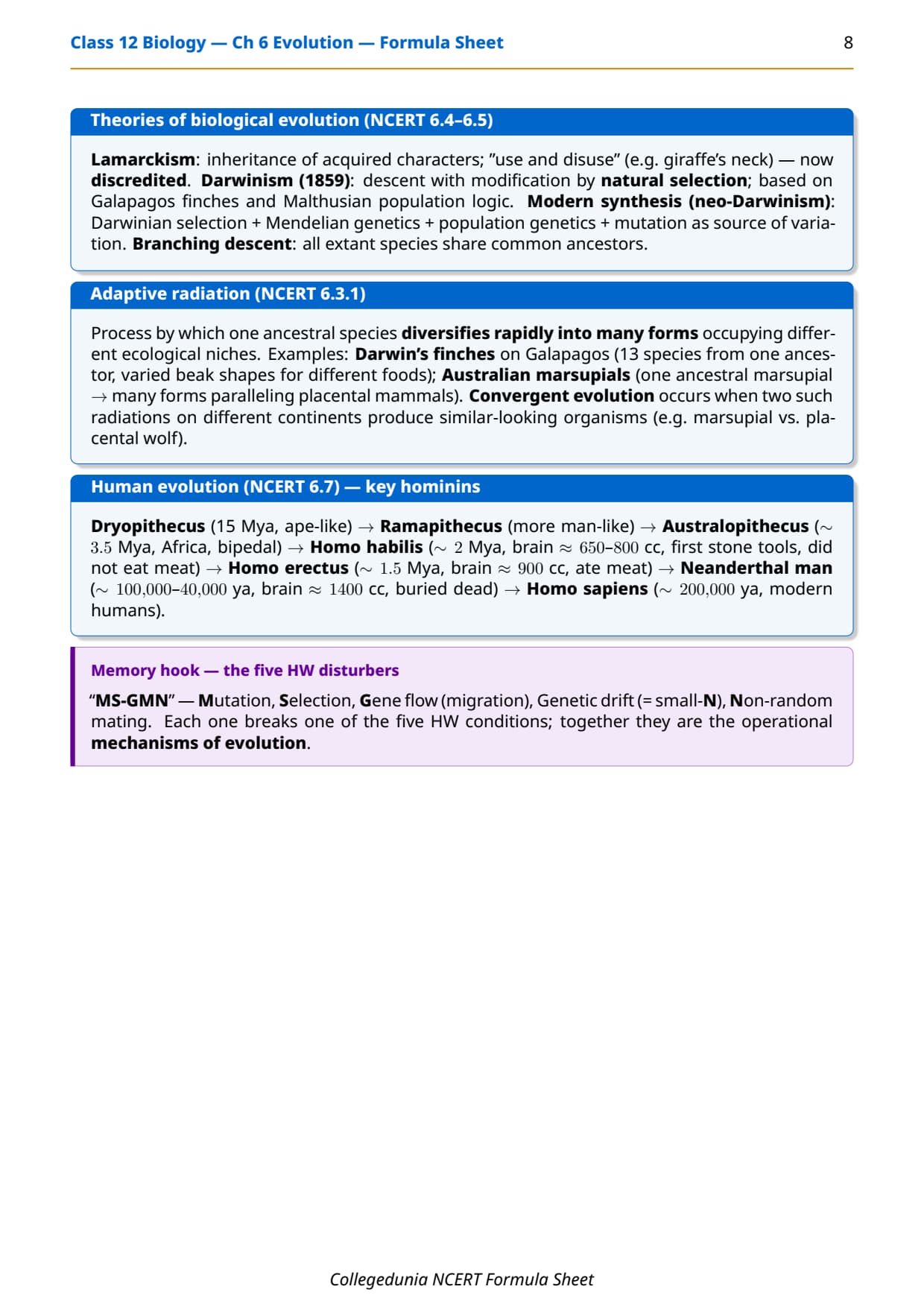
- Min 14-17: Match five forces (mutation, migration, drift, non-random mating, selection) to μ, m, σ2, FST, s .
- Min 18-20: Walk Cambrian (541 Ma) to Homo sapiens (0.2 Ma).
Evolution Class 12 PYQ Numerical Patterns Quick Recall
| Pattern | Years asked (NEET) | Formula to deploy |
|---|---|---|
| Disease frequency to carrier frequency | 2025, 2024, 2022, 2019 | q2 → q → 2pq |
| Allele frequency from genotype counts | 2023, 2021, 2018 | p = (2NAA + NAa)/2N |
| Fossil age from remaining isotope fraction | 2024, 2022, 2020 | t = (t1/2/ln 2) ln(N0/N) |
Student Feedback on Chapter 6 Evolution Class 12 Biology
Student Feedback
What 10,900 students told us about the Chapter 6 Evolution Formula Sheet:
- 72% of students marked the Hardy-Weinberg equation derivation as the hardest sub-topic in Chapter 6.
- Average student took 5.4 hours for the first read, and 2.3 hours for a focused revision pass before boards.
- Of 10,900 students, only 36% attempted all 12 NCERT exercise questions. Toppers attempted every question and revisited wrong attempts within 24 hours.
Source: 2025-26 Class 12 Biology student survey. Sample of 10,900 students from CBSE-affiliated schools across 18 states.
Other Resources for Evolution Class 12 Biology
| Resource | Link |
|---|---|
| Formula Sheet | Evolution Class 12 Biology Formula Sheet |
| NCERT Book PDF | Evolution Class 12 Biology NCERT Book PDF |
| NCERT Solutions | Evolution Class 12 Biology NCERT Solutions |
| Notes | Class 12 Biology Chapter 6 Evolution Notes |
| Exemplar Book PDF | Class 12 Biology Chapter 6 Evolution Exemplar Book PDF |
| Exemplar Solutions | Class 12 Biology Chapter 6 Evolution Exemplar Solutions |
| Handwritten Notes | Class 12 Biology Chapter 6 Evolution Handwritten Notes |
NCERT Formula Sheet for Class 12 Biology: All Chapters
Browse the formula sheets for every Class 12 Biology chapter in the 2026-27 NCERT.
| Chapter | Resource |
|---|---|
| Chapter 1 | Sexual Reproduction Formula Sheet |
| Chapter 2 | Human Reproduction Formula Sheet |
| Chapter 3 | Reproductive Health Formula Sheet |
| Chapter 4 | Inheritance and Variation Formula Sheet |
| Chapter 5 | Molecular Basis of Inheritance |
| Chapter 6 | Evolution Formula Sheet |
| Chapter 7 | Human Health and Disease |
| Chapter 8 | Microbes in Human Welfare |
| Chapter 9 | Biotechnology Principles |
| Chapter 10 | Biotechnology Applications |
| Chapter 11 | Organisms and Populations |
| Chapter 12 | Ecosystem |
| Chapter 13 | Biodiversity and Conservation |
Evolution Class 12 Biology Formula Sheet FAQs
What is the Hardy-Weinberg formula in Class 12 Biology Chapter 6 Evolution?
The Hardy-Weinberg formula expands the binomial (p + q)2 into p2 + 2pq + q2 = 1 , where p is the dominant allele frequency, q is the recessive allele frequency, p2 is the homozygous dominant genotype frequency, 2pq is the heterozygous (carrier) frequency, and q2 is the homozygous recessive frequency. It holds in a stable, non-evolving population.
How many formulas are there in Evolution Class 12 Biology?
Class 12 Biology Chapter 6 Evolution contains 17 key formulas as listed in this sheet. These cover Hardy-Weinberg equilibrium (allele and genotype frequencies), population genetics (mutation rate, migration rate, genetic drift variance, selection coefficient, relative fitness, fixation index), and radiometric dating (radioactive decay law, half-life relation, age from decay ratio). Hardy-Weinberg formulas are the most tested in NEET.
What are the five conditions of Hardy-Weinberg equilibrium for NEET?
The five conditions are: a large population (no genetic drift), no mutation, no migration (no gene flow), random mating (no assortative or inbreeding effects), and no natural selection. If any one of these is violated, the genotype frequencies drift away from p2 : 2pq : q2 , which is the textbook definition of evolution at the population level.
How do you solve Hardy-Weinberg numericals in NEET Class 12 Biology?
Read the prompt for the affected fraction and set it equal to q2 . Take the square root for q . Compute p = 1 - q . Plug into 2pq for the carrier frequency or p2 for the homozygous dominant frequency. This four-step workflow handles roughly three out of four NEET Hardy-Weinberg questions.
What is the half-life of Carbon-14 used in fossil dating?
Carbon-14 has a half-life of 5730 years and is used to date organic fossils up to about 50,000 years old. For older fossils, NEET expects you to switch to Potassium-40 (half-life 1.25 billion years) or Uranium-238 (half-life 4.5 billion years). The decay law N = N0 e-λ t gives the remaining atoms after time t .
What is the formula for genetic drift in Class 12 Biology?
Genetic drift variance per generation is σ2 = pq / (2N) , where p and q are the current allele frequencies and N is the effective population size. As N decreases, drift increases, which is why small populations evolve faster by chance. The founder effect and the bottleneck effect are two famous Class 12 examples of drift in action.
What is the selection coefficient and how is it used in Evolution?
The selection coefficient s = 1 - W , where W is the relative fitness of a genotype (best genotype takes W = 1 ). A larger s means stronger selection against that genotype. Industrial melanism in Biston betularia and sickle-cell heterozygote advantage in malaria-endemic regions are the standard CBSE and NEET examples.
Is the Evolution formula sheet enough for NEET 2027 Biology?
The formula sheet covers every numerical the chapter can ask, but it does not replace the conceptual Notes for theory MCQs on Darwin, Lamarck, fossil chronology, and human evolution. Pair this Collegedunia formula sheet with the chapter Notes and the NCERT Exemplar Solutions for full NEET 2027 readiness.



Comments