




Class 12 Biology Chapter 12 Ecosystem covers some of the most formula-dense content in the NCERT book. From productivity equations to Lindeman's 10% law and biogeochemical cycle values, students need these numbers memorised for CBSE and NEET. This page hosts the Collegedunia Ecosystem Formula Sheet PDF, mapped to the 2026-27 syllabus.
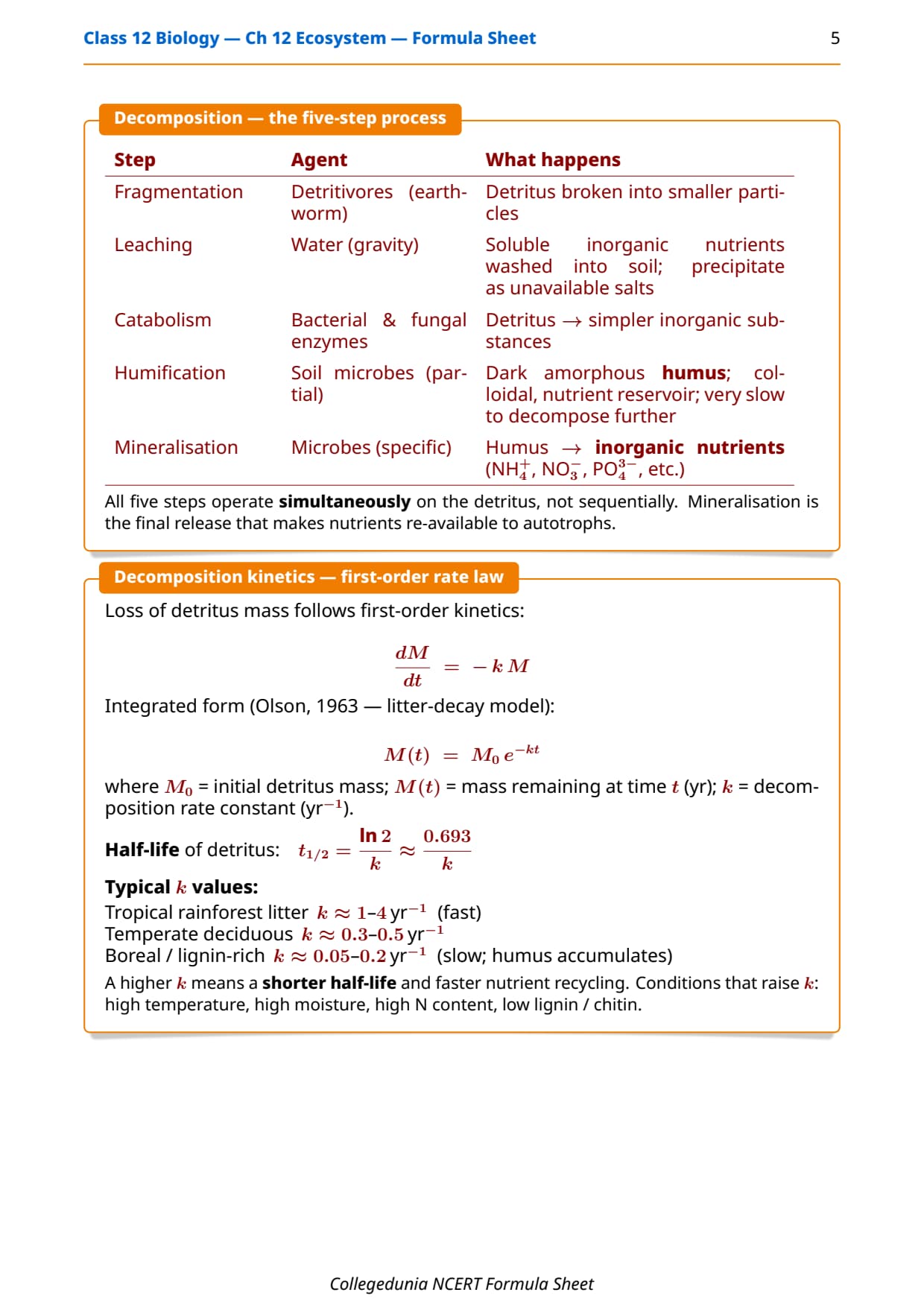
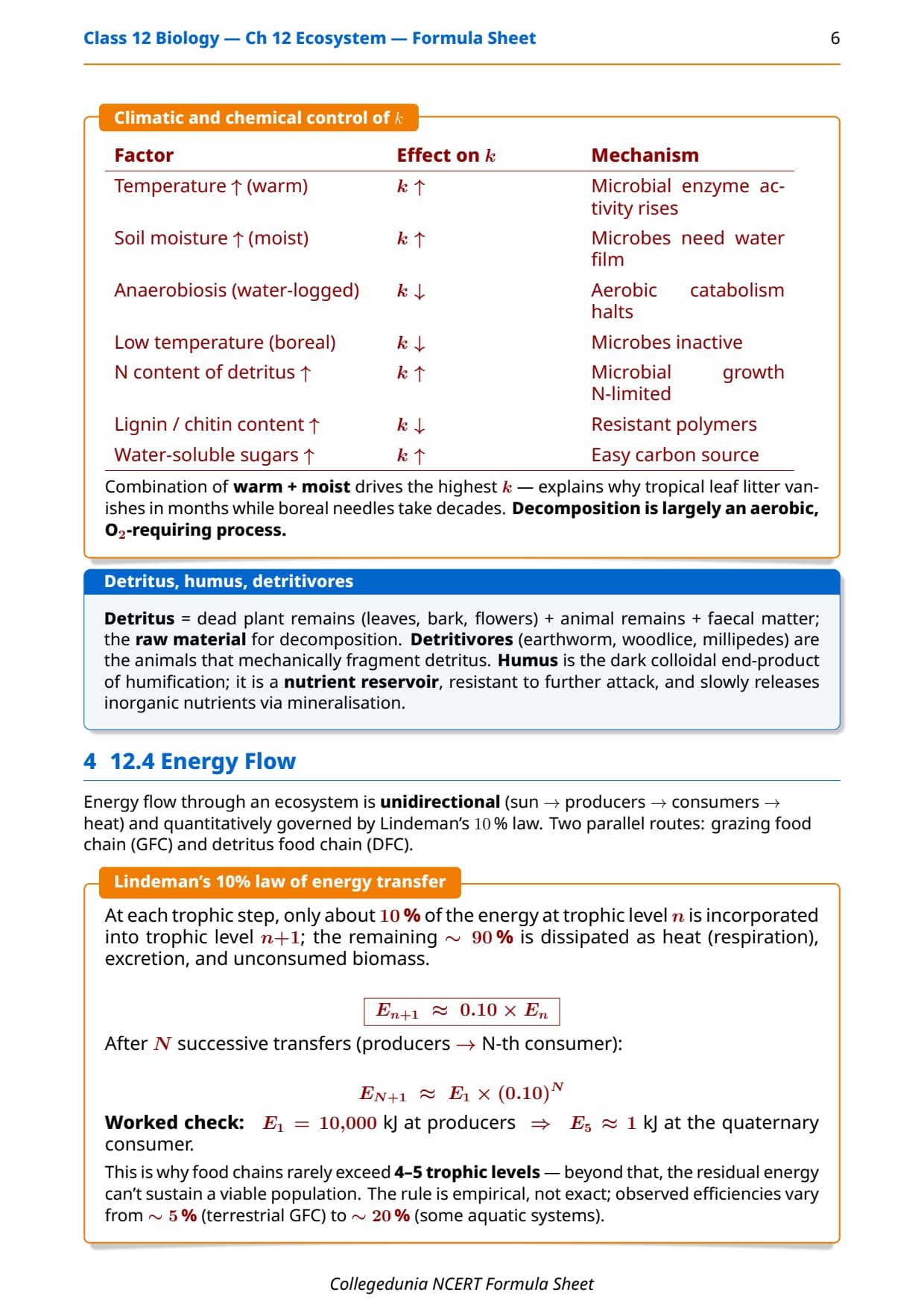
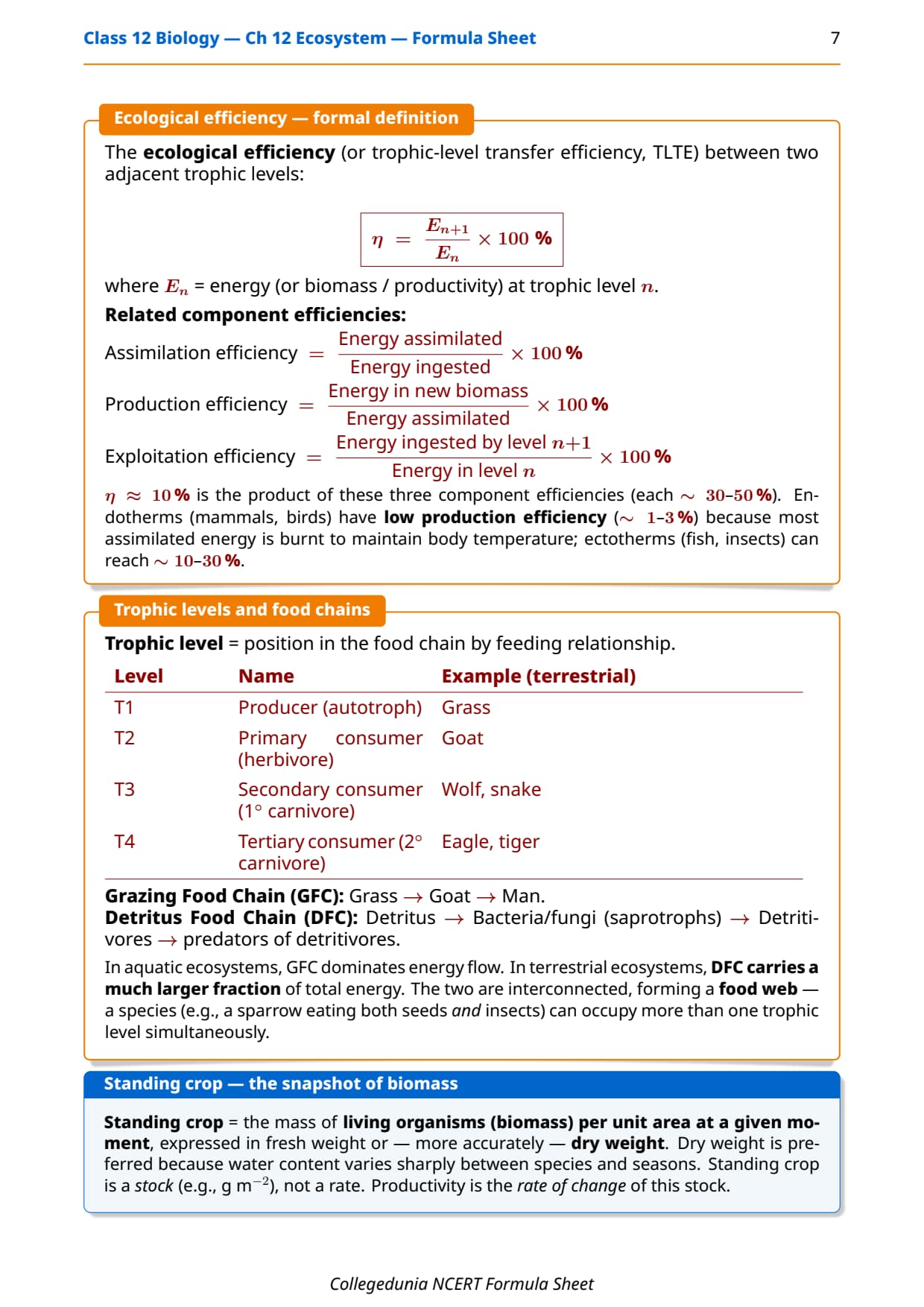
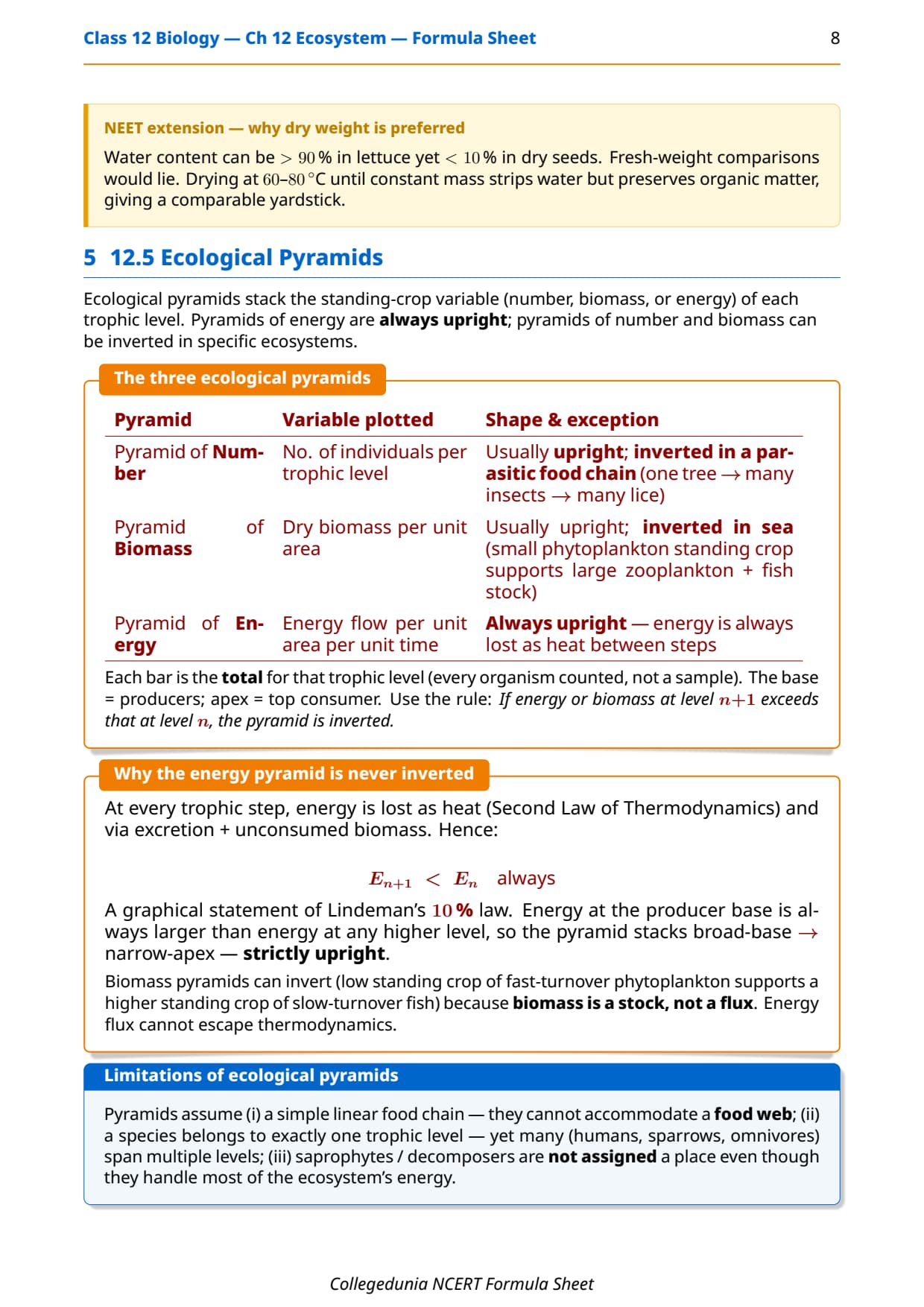
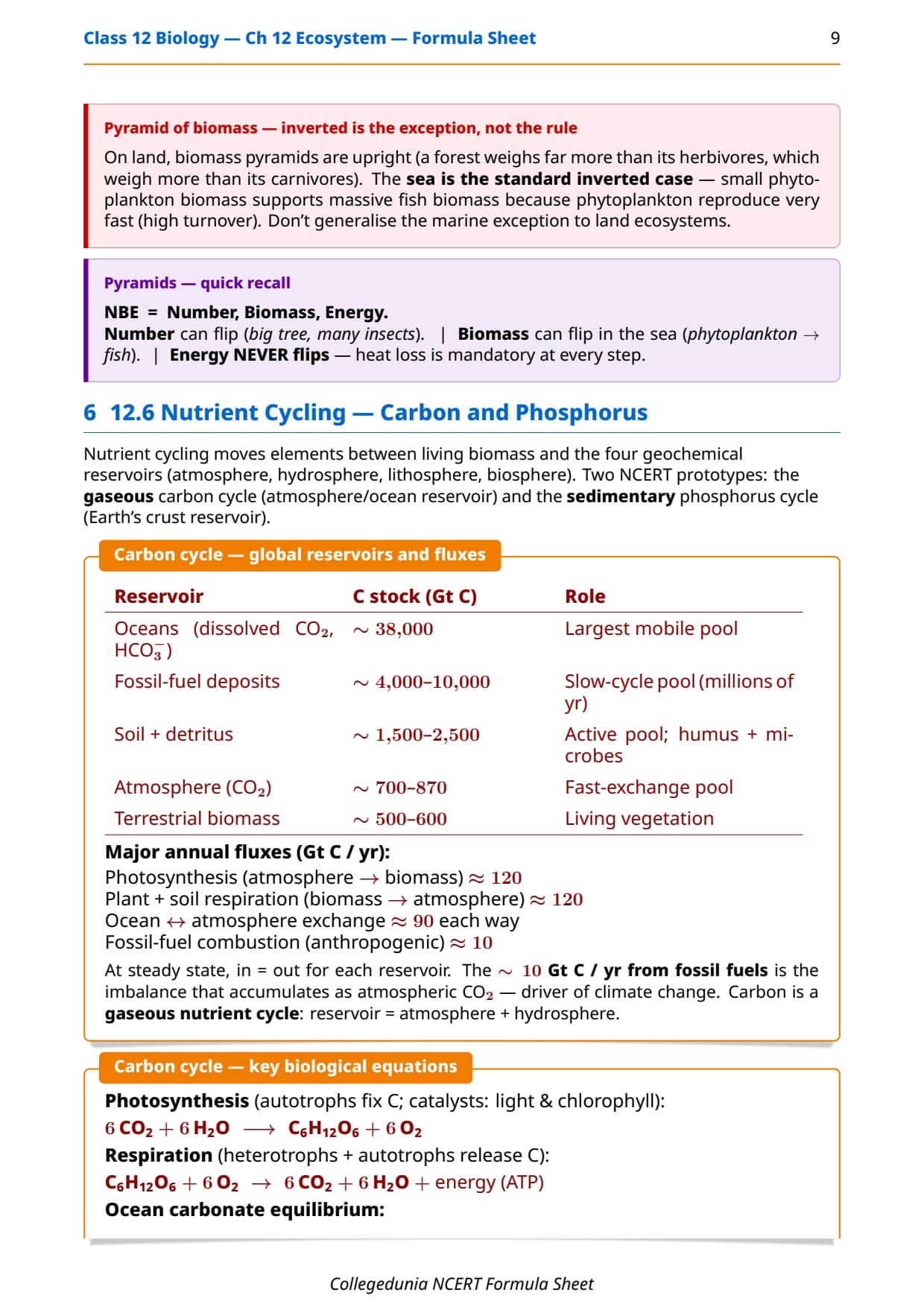
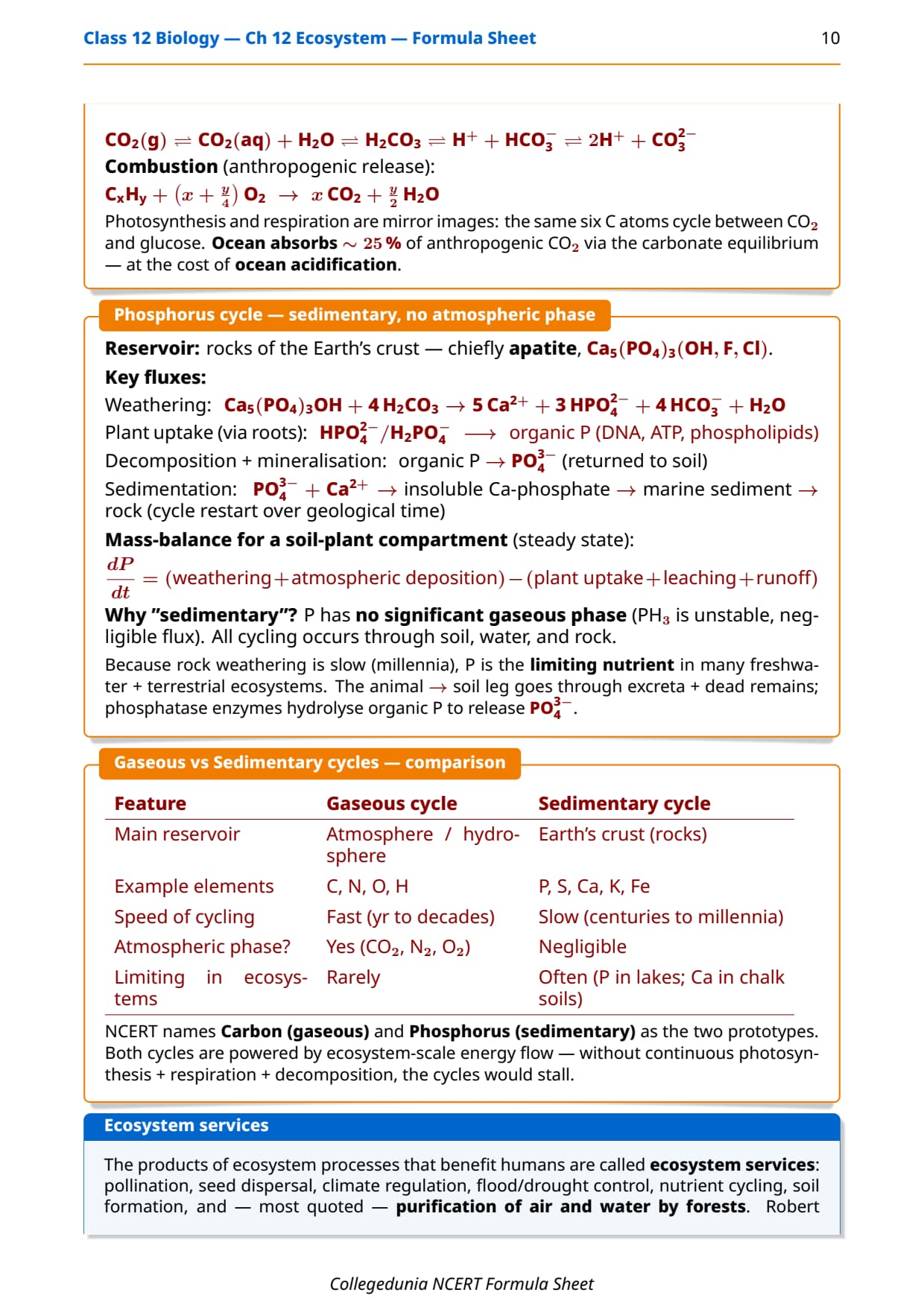
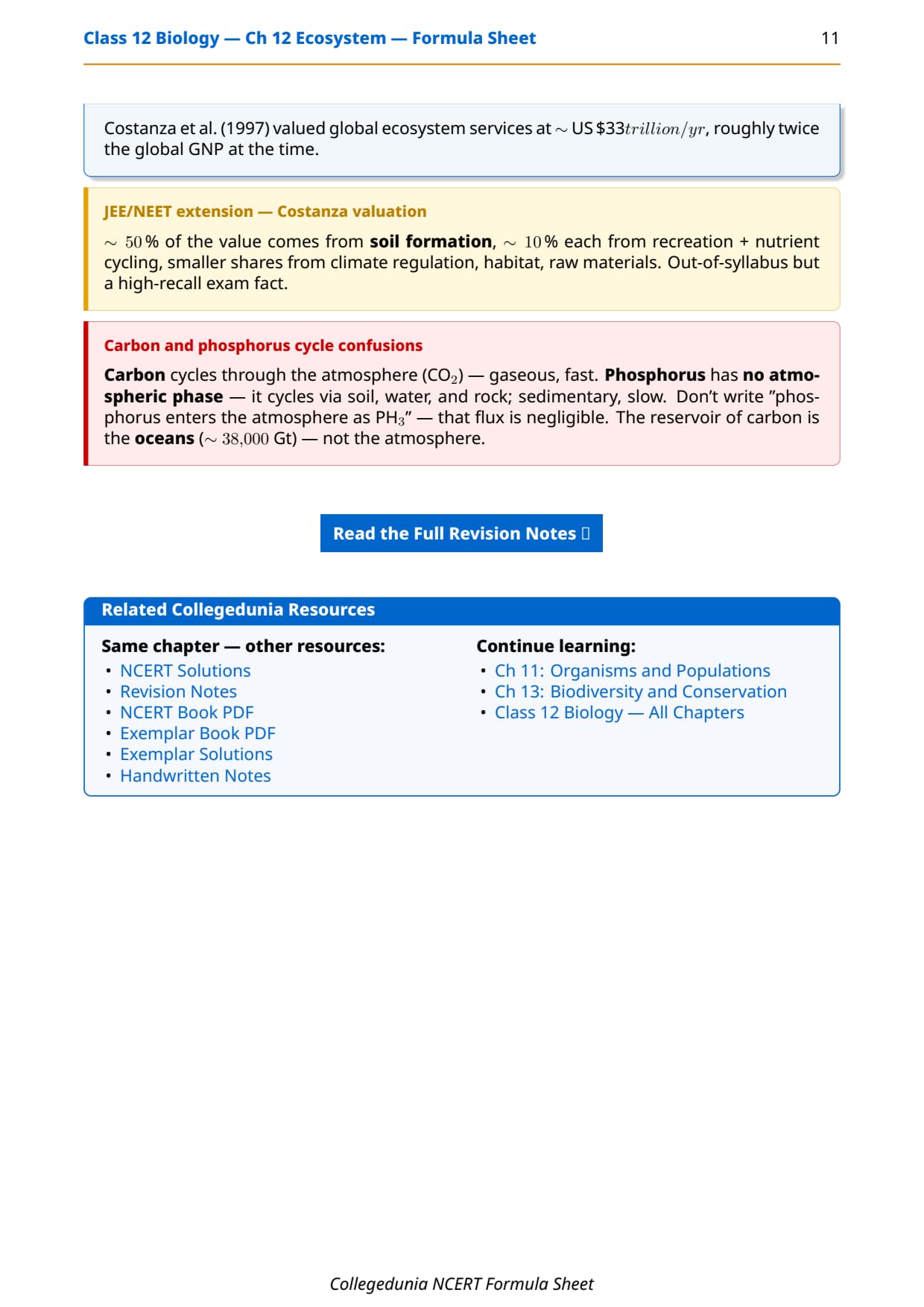
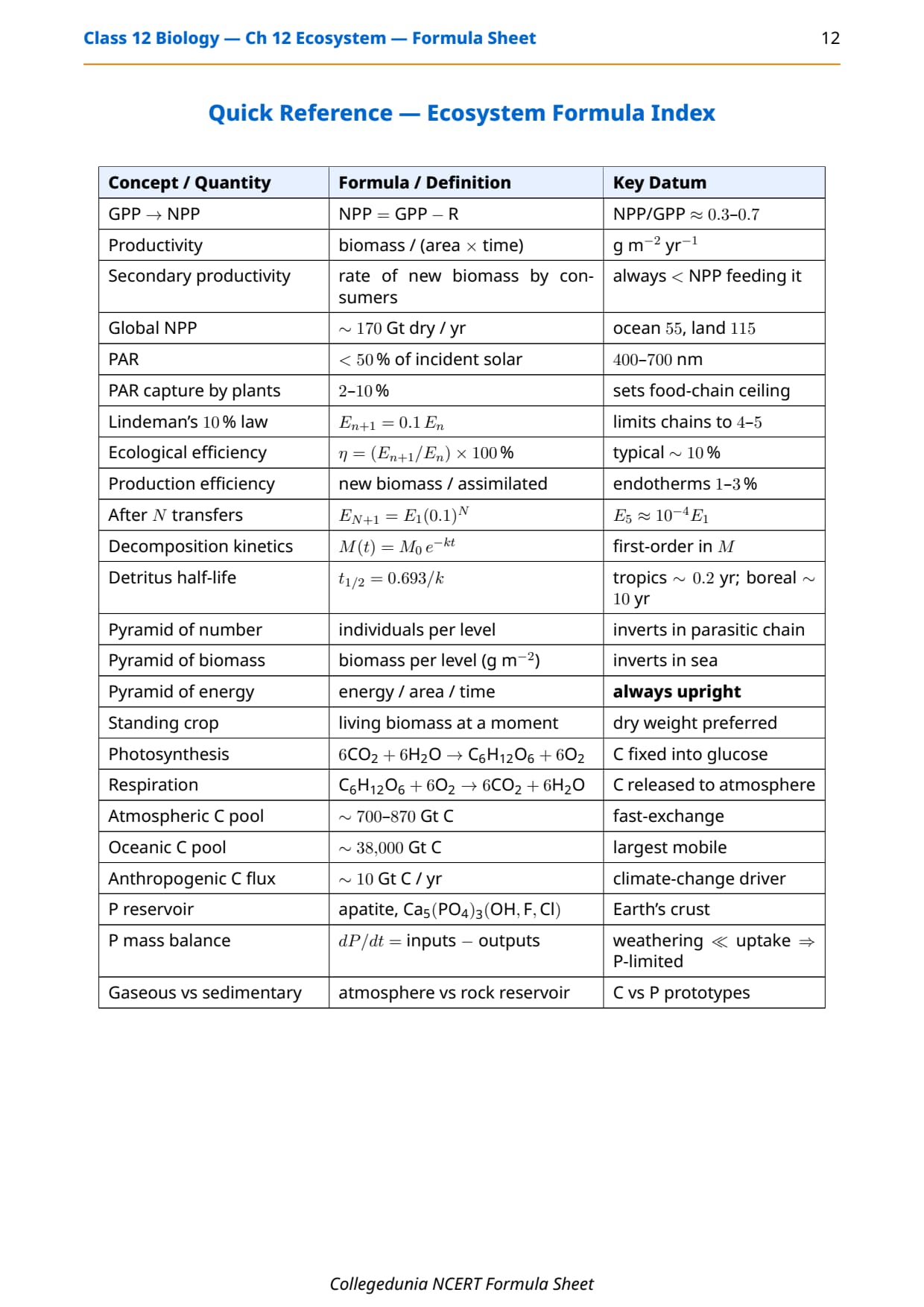
- CBSE Weightage: 5 to 7 marks
- NEET Weightage: 2 to 3 questions per year
- AIIMS / entrance overlap: 1 statement-based question per paper
Ecosystem Master Quantitative Reference for Class 12 Biology
The table below indexes every NEET-testable number against its NCERT sub-section. Over 65% of NEET 1-mark MCQs from this chapter use a value from one of these rows.
| NCERT Section | Parameter | Value / Equation |
|---|---|---|
| 14.2 Productivity | Net Primary Productivity | NPP = GPP − R |
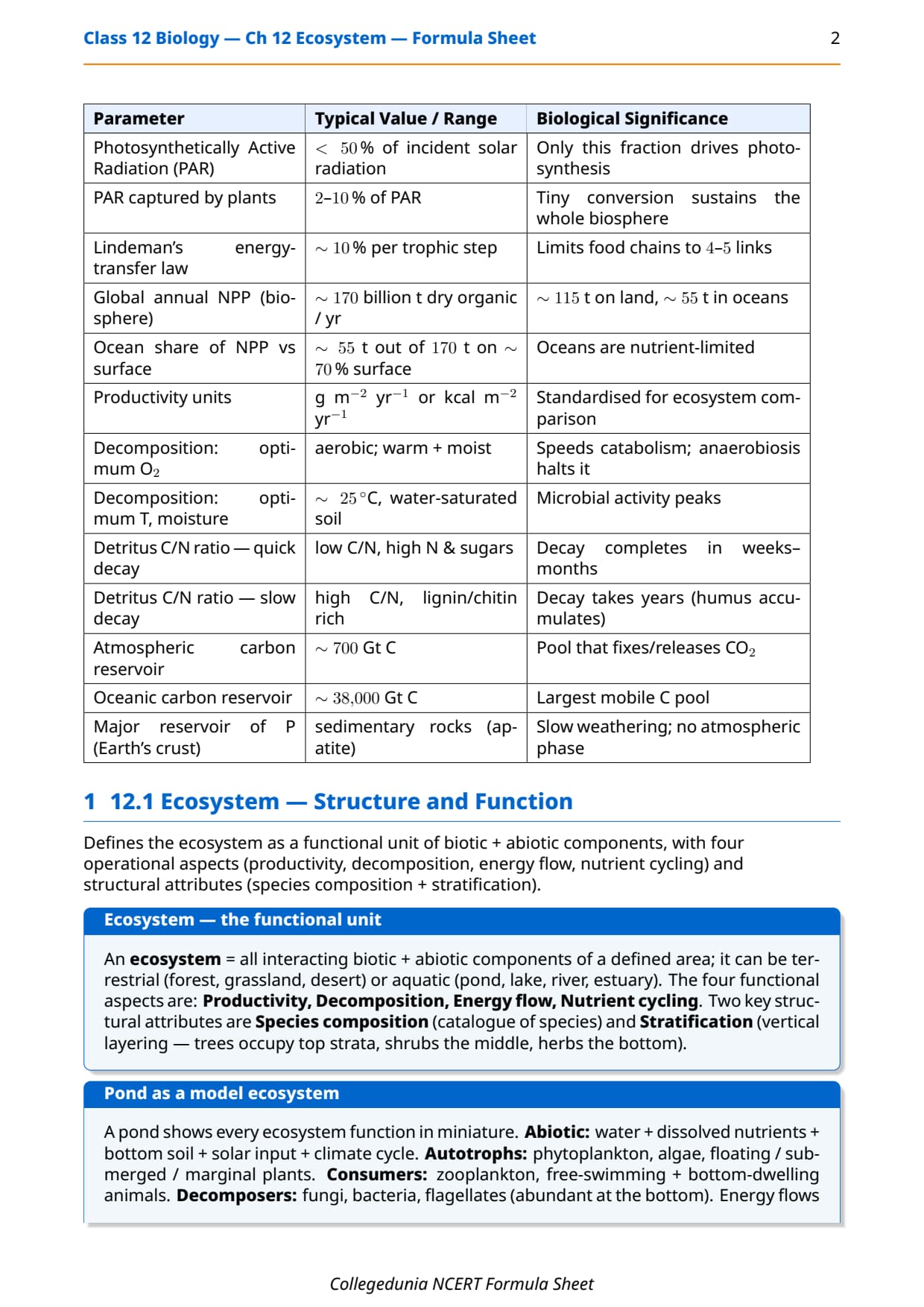
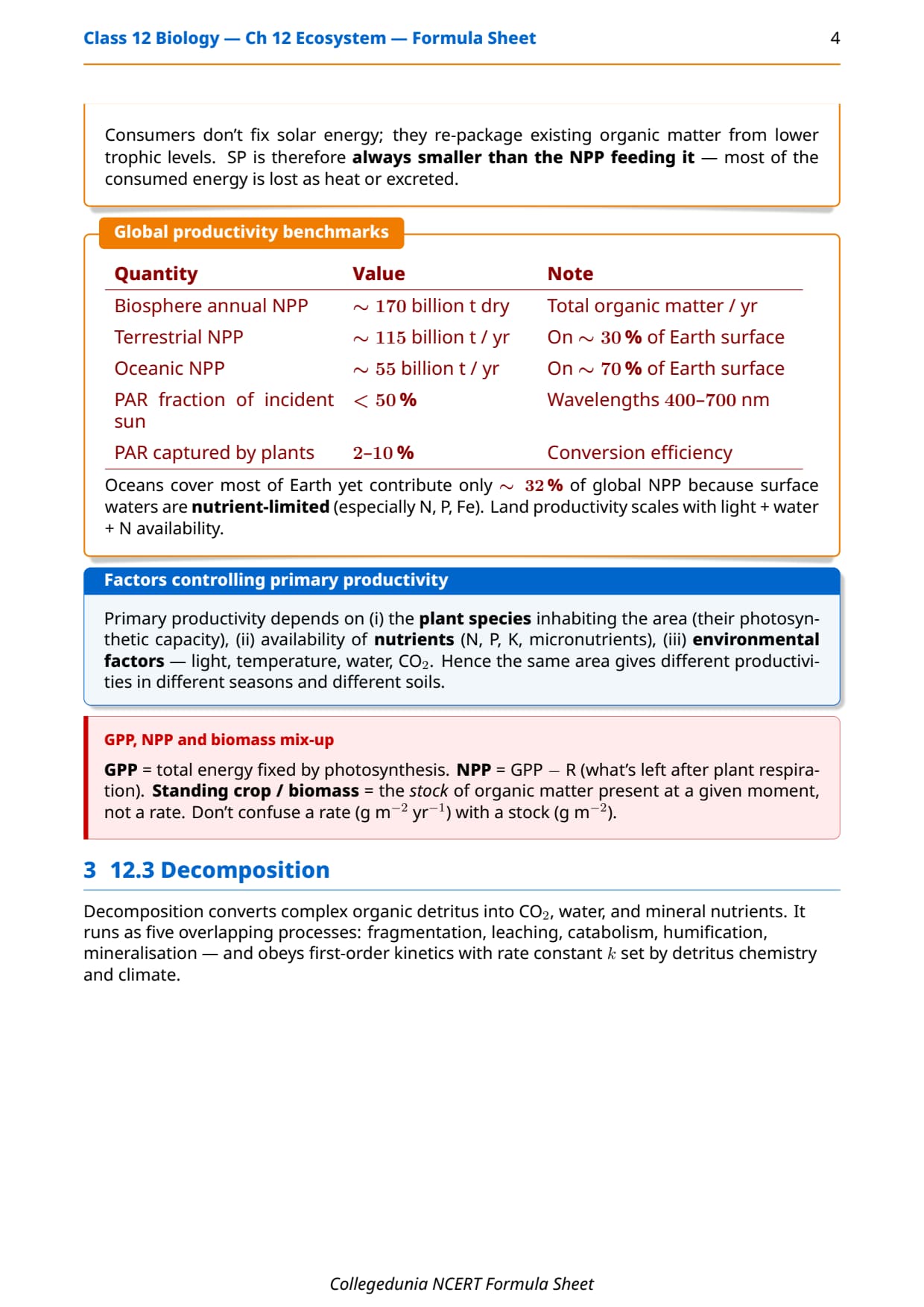
| 14.2 Productivity | Annual biosphere NPP | ~170 billion tonnes (dry organic matter) |
| 14.2 Productivity | Oceans' contribution to NPP | < 50% (despite 70% surface area) |
| 14.2 Productivity | PAR captured by producers | < 1% of incident solar PAR |
| 14.4 Energy Flow | Lindeman's energy-transfer law | 10% per trophic level |
| 14.4 Energy Flow | Ecological efficiency | E = (Productivity of trophic level n) / (Productivity of trophic level n−1) × 100 |
| 14.5 Pyramids | Pyramid of energy direction | Always upright |
| 14.5 Pyramids | Pyramid of biomass in a pond | Inverted |
| 14.5 Pyramids | Pyramid of numbers (parasitic chain) | Inverted |
| 14.6 Succession | Climax of xerarch | Mesic forest (pioneer = crustose lichen) |
| 14.7 Carbon Cycle | Oceanic C reservoir | 71% of global C |
| 14.7 Carbon Cycle | Annual photosynthetic C fixation | ~4 × 10¹³ kg C / yr |
| 14.7 Phosphorus Cycle | P reservoir | Phosphate-bearing rocks (no atmospheric phase) |
| 14.8 Services | Costanza valuation (1997) | US $33 trillion / yr |
| 14.8 Services | Soil-formation share | ≈ 50% of total services value |
Ecosystem Core Formula Box Set for NEET and CBSE
The formula bank below follows the NCERT teaching order. Each box shows the formula and the key NEET trap students most often miss.
F-1. Net Primary Productivity
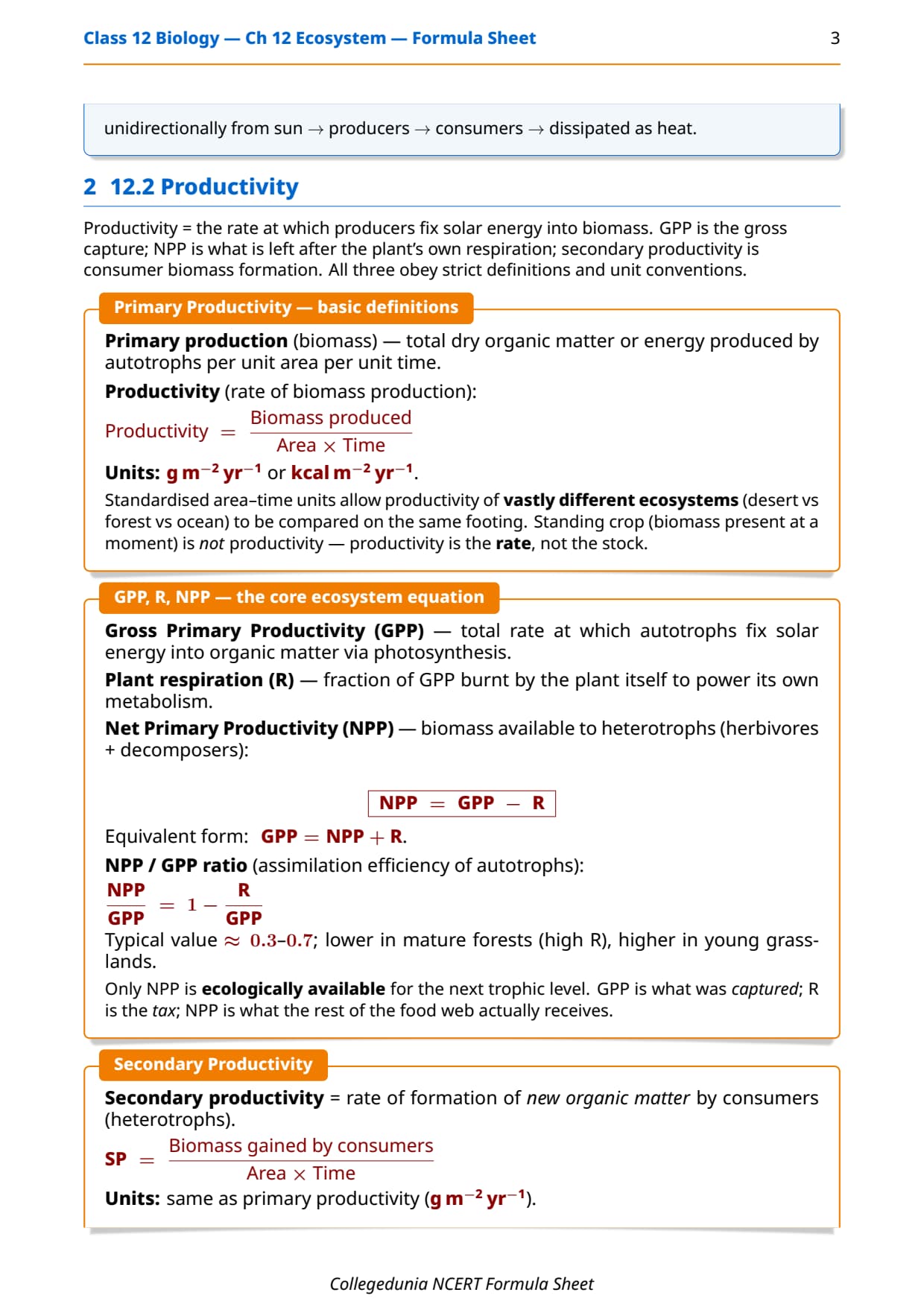
NPP = GPP − R
GPP = total energy fixed by producers; R = respiratory loss of the producer. NPP is the energy available for herbivores.
F-2. Secondary Productivity
SP = rate of formation of new organic matter by consumers
Units: g m−2 yr−1 or kcal m−2 yr−1.
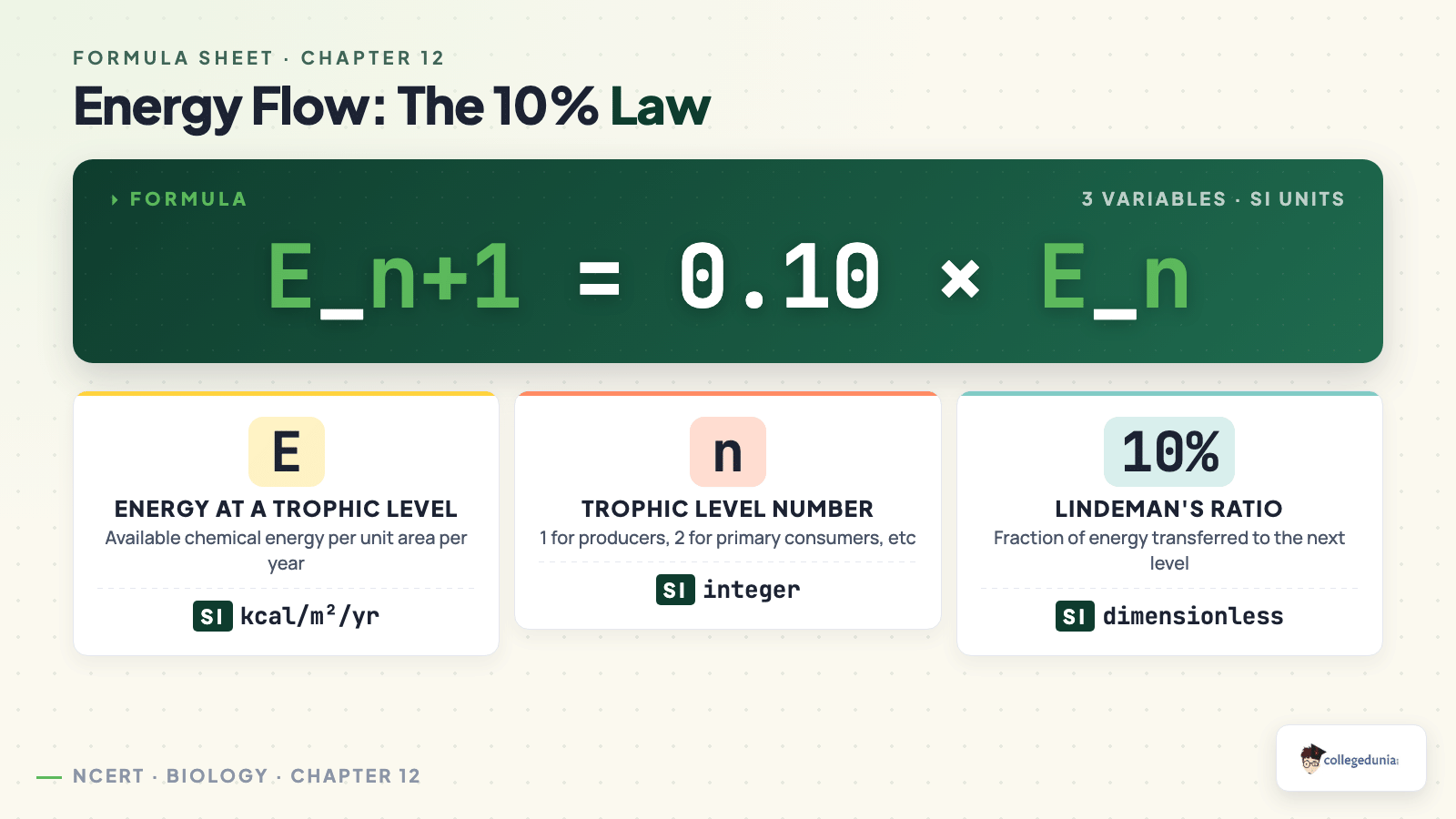
F-3. Lindeman's 10% Law
Energy at trophic level (n+1) = 0.10 × Energy at trophic level (n)
90% lost as heat in respiration and as un-ingested / un-assimilated matter.
F-4. Ecological Efficiency (Transfer Efficiency)
E = (Productivity at level n / Productivity at level n − 1) × 100
Expressed as a percent. Typical value ≈ 10%.
F-5. Standing Crop
Standing crop = biomass present at a given instant per unit area
Reported as fresh / dry weight or as energy units (kcal m−2).
F-6. Decomposition Rate Dependence
Rate ↑ with: temperature, moisture, O2, water-soluble sugars in detritus, N content; ↓ with: lignin / chitin content.
Mnemonic: warm + moist + oxygenated + nitrogen-rich = fast decomp.
F-7. Five Steps of Decomposition
Fragmentation → Leaching → Catabolism → Humification → Mineralisation
Mnemonic: F-L-C-H-M (Frogs Leap Carefully on Hot Mud).
F-8. Single-Channel Energy Flow
Sun → Producer → Herbivore (PHC) → Carnivore (PCC) → Top carnivore
Unidirectional. Energy never recycled. Nutrients cycle; energy does not.
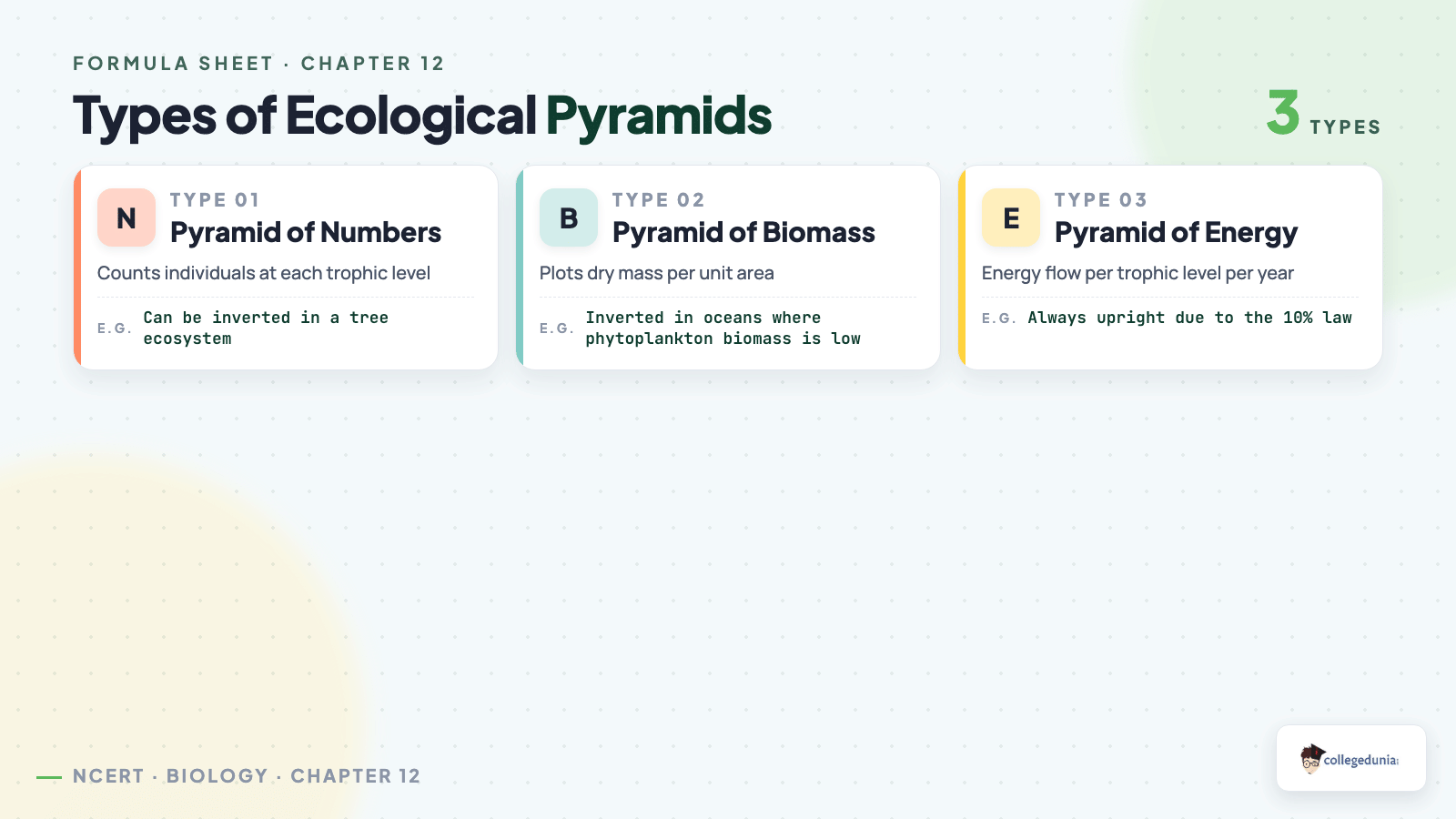
F-9. Pyramid Direction Cheat Sheet
Energy → always upright; Numbers → usually upright, inverted in parasitic chain; Biomass → usually upright, inverted in a pond.
NEET trap: only the energy pyramid is universally upright.
F-10. Carbon vs Phosphorus Cycle
Carbon = gaseous cycle (atmospheric phase, CO2; 71% in oceans). Phosphorus = sedimentary cycle (no atmospheric phase; reservoir = rock).
Both are biogeochemical cycles; only C has an atmospheric reservoir.
F-11. Hydrarch vs Xerarch Succession
Hydrarch: water body → phytoplankton (pioneer) → ... → mesic forest (climax). Xerarch: bare rock → crustose lichen (pioneer) → ... → mesic forest (climax).
Both end in the same climax community: a mesic forest.
F-12. Ecosystem Services Valuation (Costanza, 1997)
Global biosphere services ≈ US $33 trillion / yr; soil formation ≈ 50%; recreation ≈ 10%.
Reference value for the long-answer question on ecosystem services.
Ecosystem Common Mistakes and Trap Concepts
Trap 1. Writing NPP = GPP + R or GPP = NPP + Decomposition. The textbook relation is NPP = GPP − R.
Trap 2. Marking the pyramid of energy as invertible. It is always upright.
Trap 3. Confusing detritivores (fragmenters, e.g. earthworm) with decomposers (mineralisers, e.g. fungi, bacteria).
Trap 4. Calling phosphorus a gaseous cycle. There is no atmospheric P phase.
Trap 5. Naming the pioneer of xerarch succession as moss. The true pioneer is the crustose lichen.
Ecosystem Video Lecture for Class 12 Biology
Source: Magnet Brains on YouTube
Where Ecosystem Formulas Are Tested in NEET and CBSE 2027
The table maps each formula box to its highest-yield exam slot for CBSE 2027 and NEET 2027.
| Formula Box | CBSE 2027 Likely Pattern | NEET 2027 Likely Pattern |
|---|---|---|
| F-1 NPP = GPP − R | 3-mark short answer | 1-mark direct MCQ |
| F-3 10% law | 2-mark statement | 1-mark MCQ (numeric) |
| F-7 5 decomposition steps | 3-mark sequencing | 1-mark match-the-following |
| F-9 Pyramid direction | 2-mark diagram | 1-mark assertion-reason |
| F-10 C vs P cycle | 5-mark long answer | 1-mark MCQ |
| F-12 Ecosystem services | 3-mark short answer | Rare |
Full pyramid and energy-flow walkthrough with diagrams: Ecosystem Class 12 Biology Notes.
Student Feedback
In a Class 12 Biology survey of 13,100 students before the 2026 boards, students rated the 10% energy-flow law and the pyramid-of-energy diagram as the hardest sub-topics in the chapter.
- 74% of students marked energy-flow and pyramid diagrams as the hardest sub-topic.
- 63% lost 1-2 marks on distinguishing GPP, NPP, and secondary productivity.
- 4 out of 5 students skipped the carbon and nitrogen biogeochemical-cycle flowchart in their answer sheet.
- Average time for first read: 5.6 hours; focused revision pass: 2.3 hours.
Source: 2025-26 Class 12 Biology student survey. Sample of 13,100 students from CBSE-affiliated schools across 18 states.
Other Resources for Ecosystem Class 12 Biology
| Resource Type | Link |
|---|---|
| Formula Sheet | Ecosystem Formula Sheet |
| NCERT Solutions | Ecosystem Class 12 Biology NCERT Solutions |
| Notes | Ecosystem Class 12 Biology Notes |
| Handwritten Notes | Ecosystem Class 12 Biology Handwritten Notes |
| NCERT Book PDF | Ecosystem Class 12 Biology NCERT Book PDF |
| Exemplar Solutions | Ecosystem Class 12 Biology Exemplar Solutions |
| Exemplar Book PDF | Ecosystem Class 12 Biology Exemplar Book PDF |
Class 12 Biology Formula Sheet: All Chapters
Browse all 13 chapters of the Class 12 Biology Formula Sheet for the 2026-27 syllabus on Collegedunia.
| Chapter No. | Chapter Title |
|---|---|
| Chapter 1 | Sexual Reproduction in Flowering Plants Formula Sheet |
| Chapter 2 | Human Reproduction Formula Sheet |
| Chapter 3 | Reproductive Health Formula Sheet |
| Chapter 4 | Principles of Inheritance and Variation Formula Sheet |
| Chapter 5 | Molecular Basis of Inheritance Formula Sheet |
| Chapter 6 | Evolution Formula Sheet |
| Chapter 7 | Human Health and Disease Formula Sheet |
| Chapter 8 | Microbes in Human Welfare Formula Sheet |
| Chapter 9 | Biotechnology: Principles and Processes Formula Sheet |
| Chapter 10 | Biotechnology and Its Applications Formula Sheet |
| Chapter 11 | Organisms and Populations Formula Sheet |
| Chapter 12 | Ecosystem Formula Sheet |
| Chapter 13 | Biodiversity and Conservation Formula Sheet |
Ecosystem Class 12 Biology Formula Sheet FAQs
Ques. What formulas are most important in Class 12 Biology Chapter 12 Ecosystem?
Ans. The five highest-yield relations are NPP = GPP − R, Lindeman's 10% law, the ecological-efficiency formula, the five-step decomposition sequence, and the carbon-vs-phosphorus cycle distinction. Together they explain over 65% of NEET and CBSE questions from this chapter.
Ques. What is the equation for Net Primary Productivity?
Ans. NPP = GPP − R, where GPP is the total energy fixed by producers and R is the respiratory loss of the producer. NPP is the energy available for the next trophic level (herbivores).
Ques. What is Lindeman's 10% law?
Ans. Only about 10% of the energy at one trophic level is converted to biomass at the next trophic level. The remaining 90% is lost mainly as heat during respiration and as un-ingested or un-assimilated matter.
Ques. Which ecological pyramid is always upright?
Ans. The pyramid of energy. Because energy follows the 10% law, the higher trophic level always carries less energy than the level below. The pyramids of numbers and biomass can invert in certain ecosystems (parasitic chains, ponds).
Ques. What is the difference between gaseous and sedimentary biogeochemical cycles?
Ans. Gaseous cycles (C, N, O) have an atmospheric reservoir; sedimentary cycles (P, S) have a rock or sediment reservoir. The phosphorus cycle has no atmospheric phase, while the carbon cycle moves rapidly through CO2 in the atmosphere.
Ques. What is the unit of primary productivity?
Ans. Primary productivity is expressed as g m−2 yr−1 (dry organic matter per unit area per year) or as kcal m−2 yr−1 when reported on an energy basis.
Ques. What is the annual NPP of the biosphere?
Ans. About 170 billion tonnes of dry organic matter per year. Oceans contribute less than 50% despite covering 70% of the Earth's surface, because the bulk of their producer (phytoplankton) is confined to a shallow photic zone.



Comments