




The 2026-27 NCERT keeps Class 12 Biology Chapter 11 Organisms and Populations as the gateway to Unit 10 Ecology. This Collegedunia formula sheet packs every population-growth equation, interaction sign-pair and adaptation parameter from Sections 11.1 to 11.2 into one revision page for NEET and the CBSE Board.
- CBSE Weightage: 5 to 7 marks
- NEET Weightage: 3 to 5 questions per year
- AIIMS / entrance overlap: 1 to 2 statement-based questions per paper
Organisms and Populations Master Quantitative Reference for Class 12 Biology
Every NEET-testable number is indexed by NCERT sub-section below. Over 70% of 1-mark MCQs from this chapter plug a value from this table.
| Parameter | Value / Range | NCERT Ref |
|---|---|---|
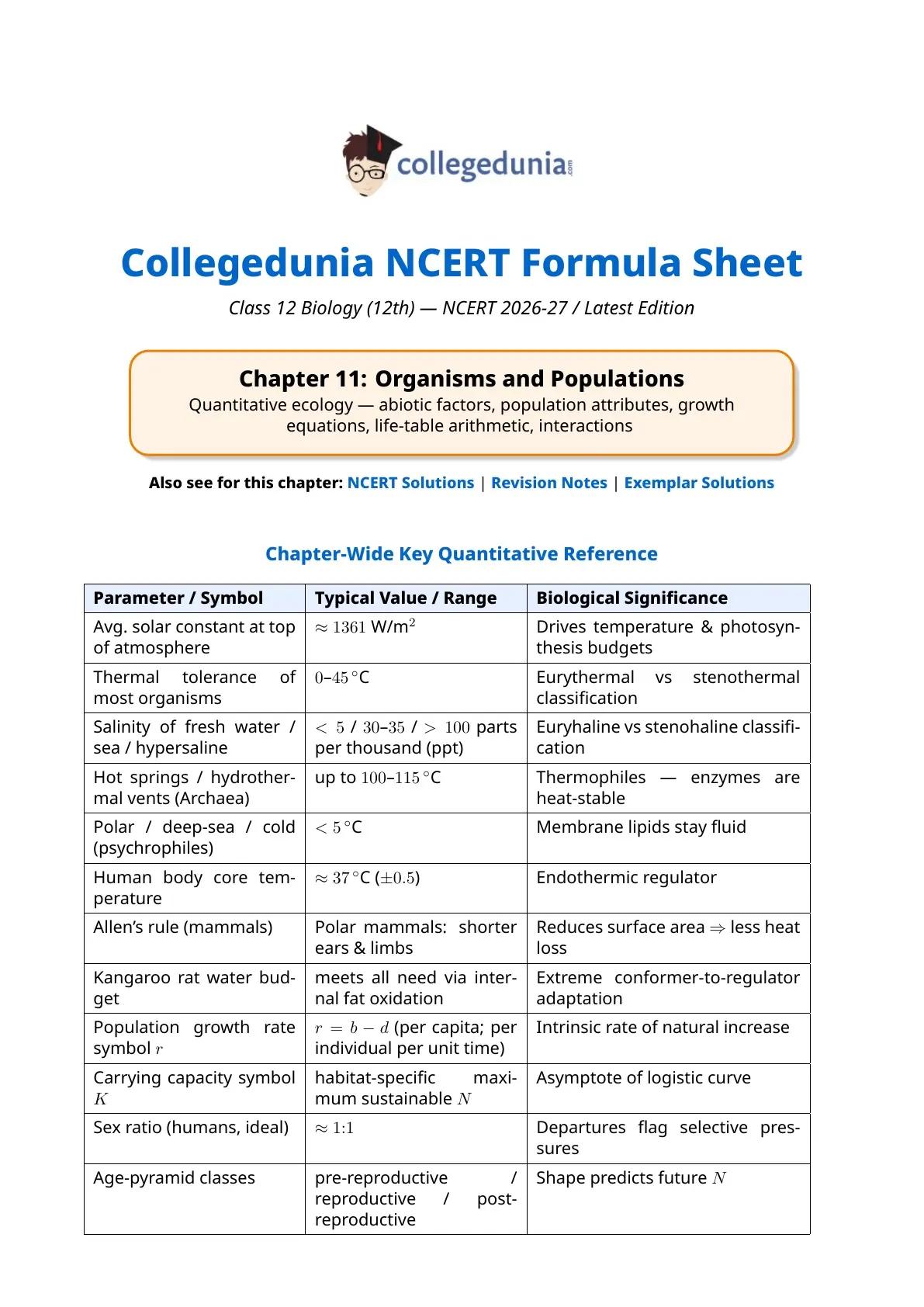
| Intrinsic rate r (Indian human, 1981) | 0.0205 per capita per year | 11.2.5 |
| Carrying capacity K | Habitat-specific asymptote of logistic curve | 11.2.5 |
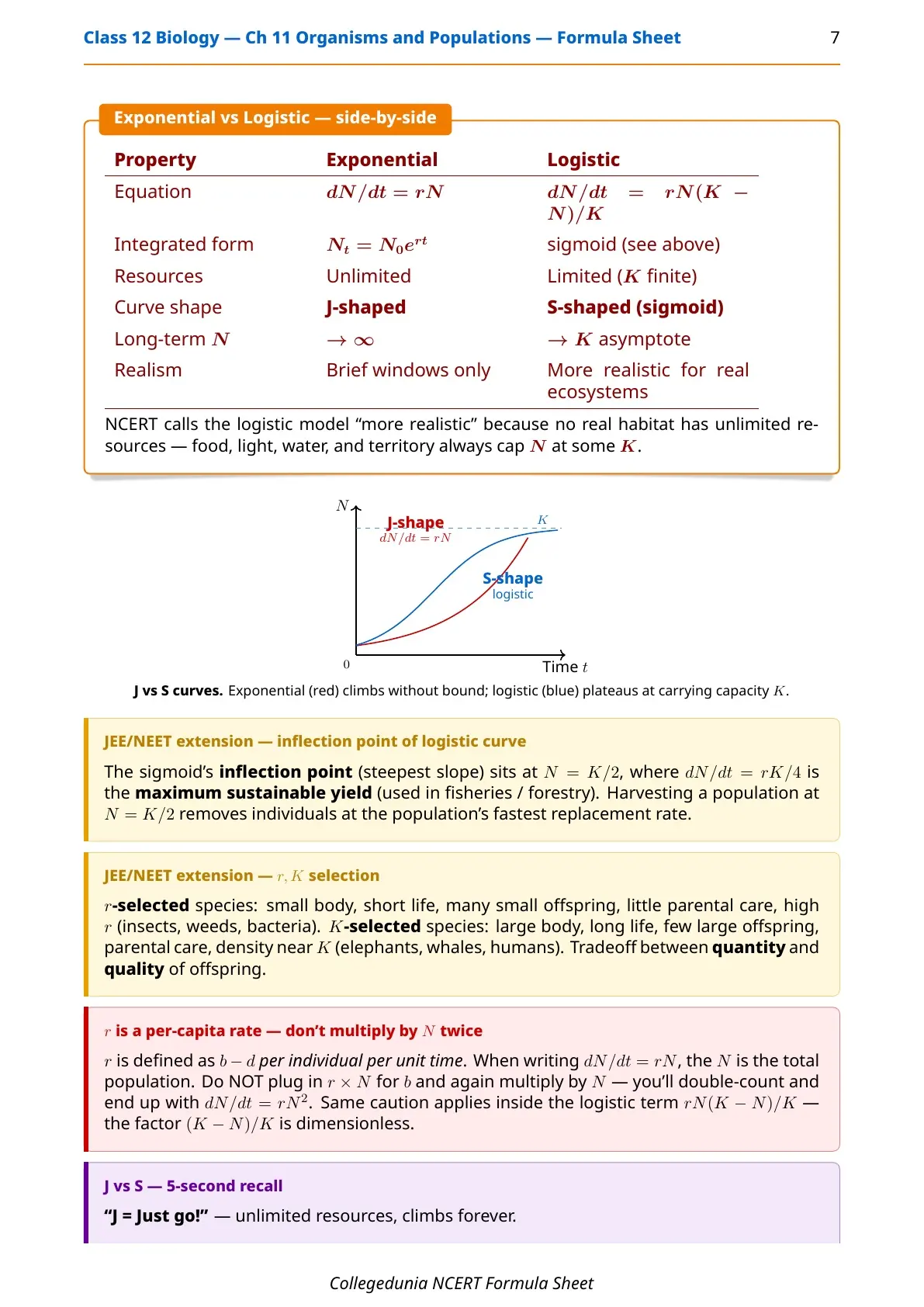
| Sigmoid inflexion at | N = K/2 (maximum dN/dt) | 11.2.5 |
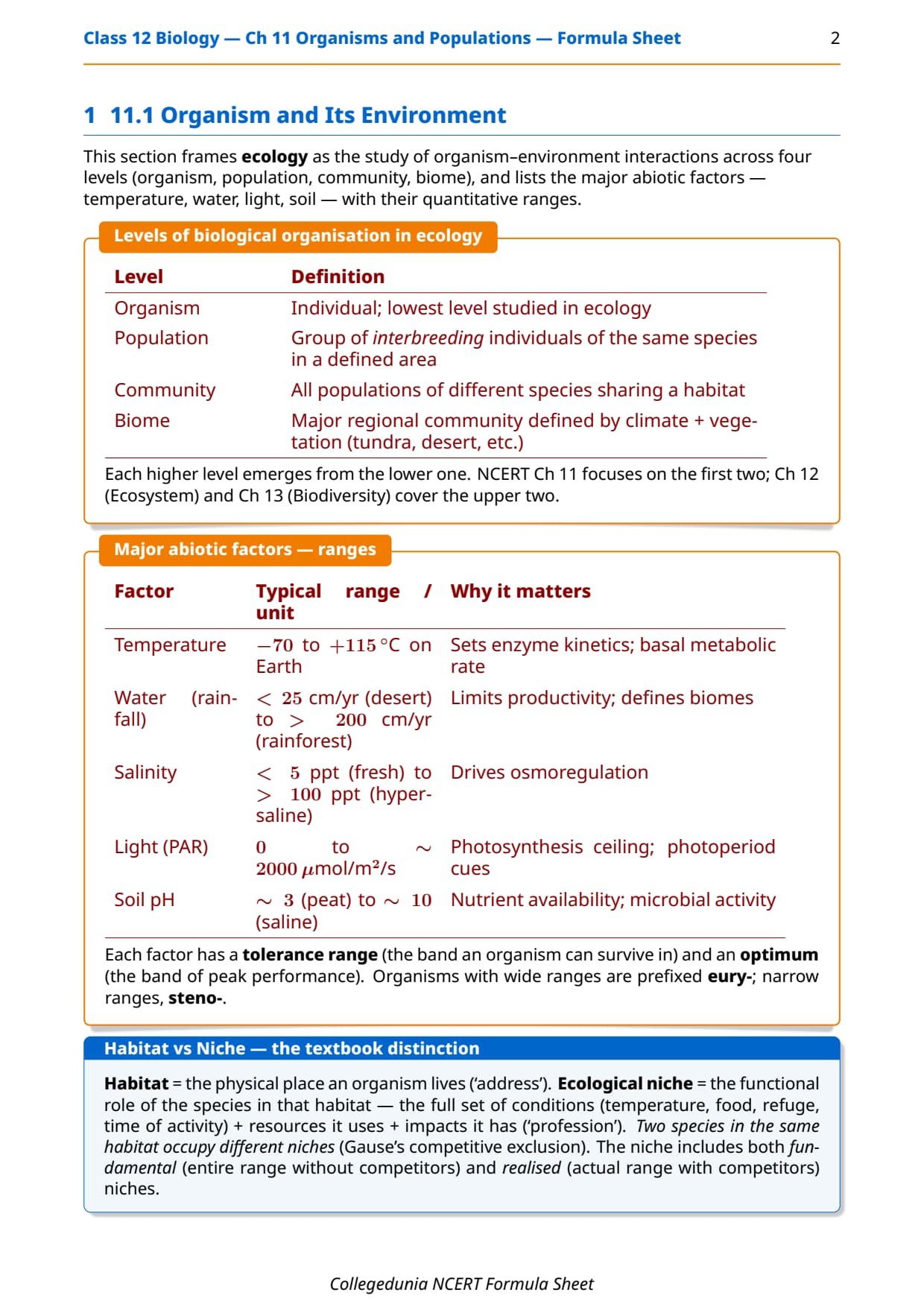
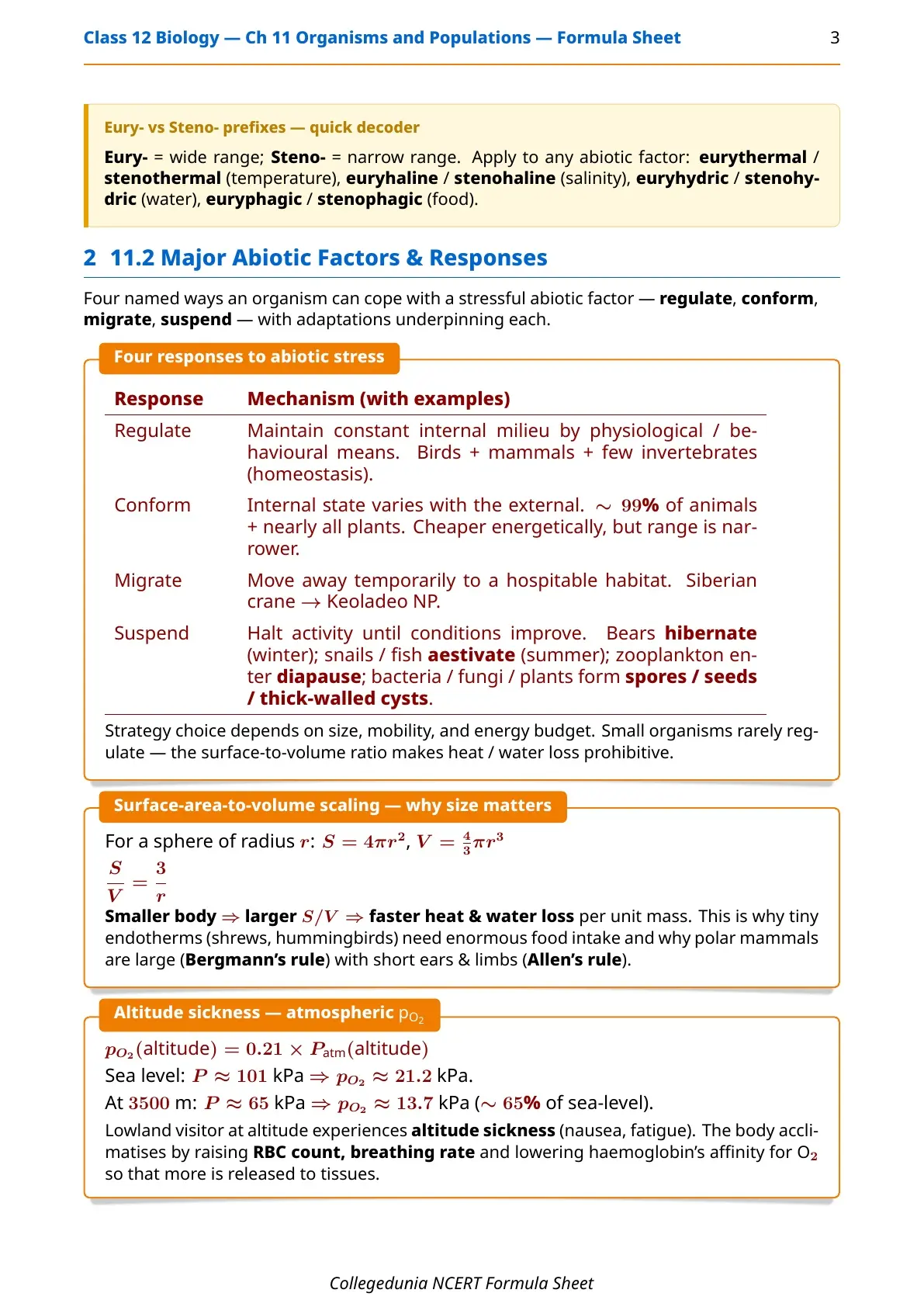
| Conformers vs regulators | ~99% animals are conformers; mammals + birds regulate | 11.1.2 |
| Allen's rule | Cold-climate mammals: shorter ears + limbs | 11.1.3 |
| Bergmann's rule (NEET extension) | Cold-climate mammals: larger body size | NEET only |
| BMR drop in hibernation | Down to 1-5% of normal | 11.1.2 |
| Light regulation: photoperiod | Day length triggers flowering / breeding | 11.1.1 |
| Soil pH for most plants | 6.0 to 7.5 | 11.1.1 |
| Optimal temperature, mesophiles | 20-45 °C | 11.1.1 |
| Thermophiles upper limit | Up to 100 °C (archaea, hot springs) | 11.1.1 |
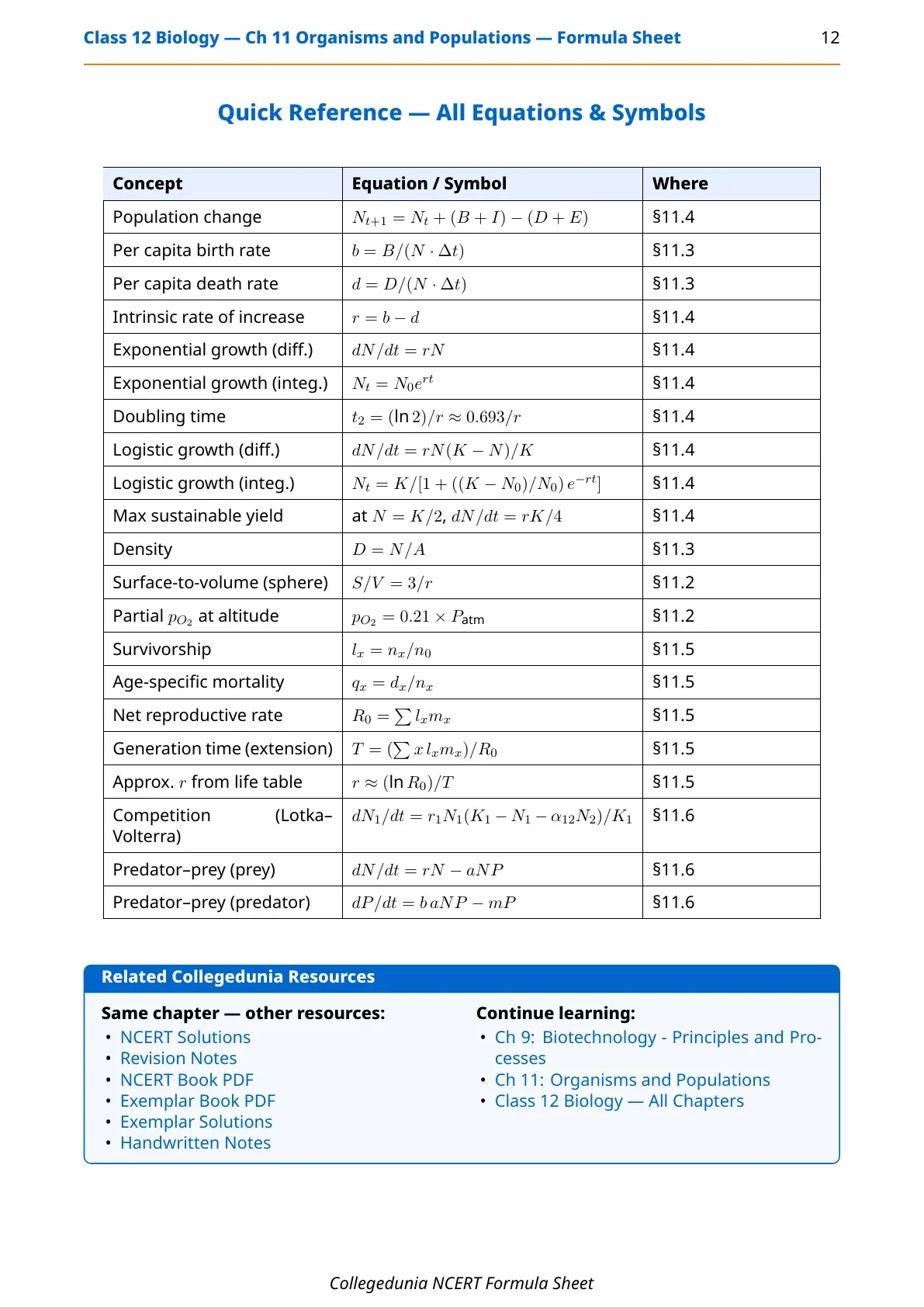
| Population balance equation | Nt+1 = Nt + (B + I) - (D + E) | 11.2.1 |
| Pisaster removal experiment (Paine) | Loss of 10 of 15 invertebrate species | 11.2.6 |
All entries above are retained in the 2026-27 syllabus. Biggest 1-mark trap: commensalism is +/0, not +/+; mutualism is +/+. NEET swaps the two every cycle.
How will Collegedunia's Organisms and Populations Formula Sheet Help You?
- 2026-27 NCERT alignment: Every equation and sign-pair matches Sections 11.1 to 11.2.
- Quantitative slant: Logistic and exponential equations, intrinsic-rate numericals, sigmoid inflexion - the recall-based NEET facts.
- Quick-lookup format: Growth equations, interaction matrix, adaptation parameters and ecology constants each get a colour-coded box.
Organisms and Populations Video Lecture for Class 12 Biology
Source: Magnet Brains on YouTube
Population Growth Equations and Yield Card for NEET Class 12 Biology
Section 11.2.5 holds all the chapter's algebra. The five equations below cover every NEET and CBSE question type.
| Process | Equation + remark |
|---|---|
| Population balance | Nt+1 = Nt + (B + I) - (D + E) ; B=natality, D=mortality, I=immigration, E=emigration |
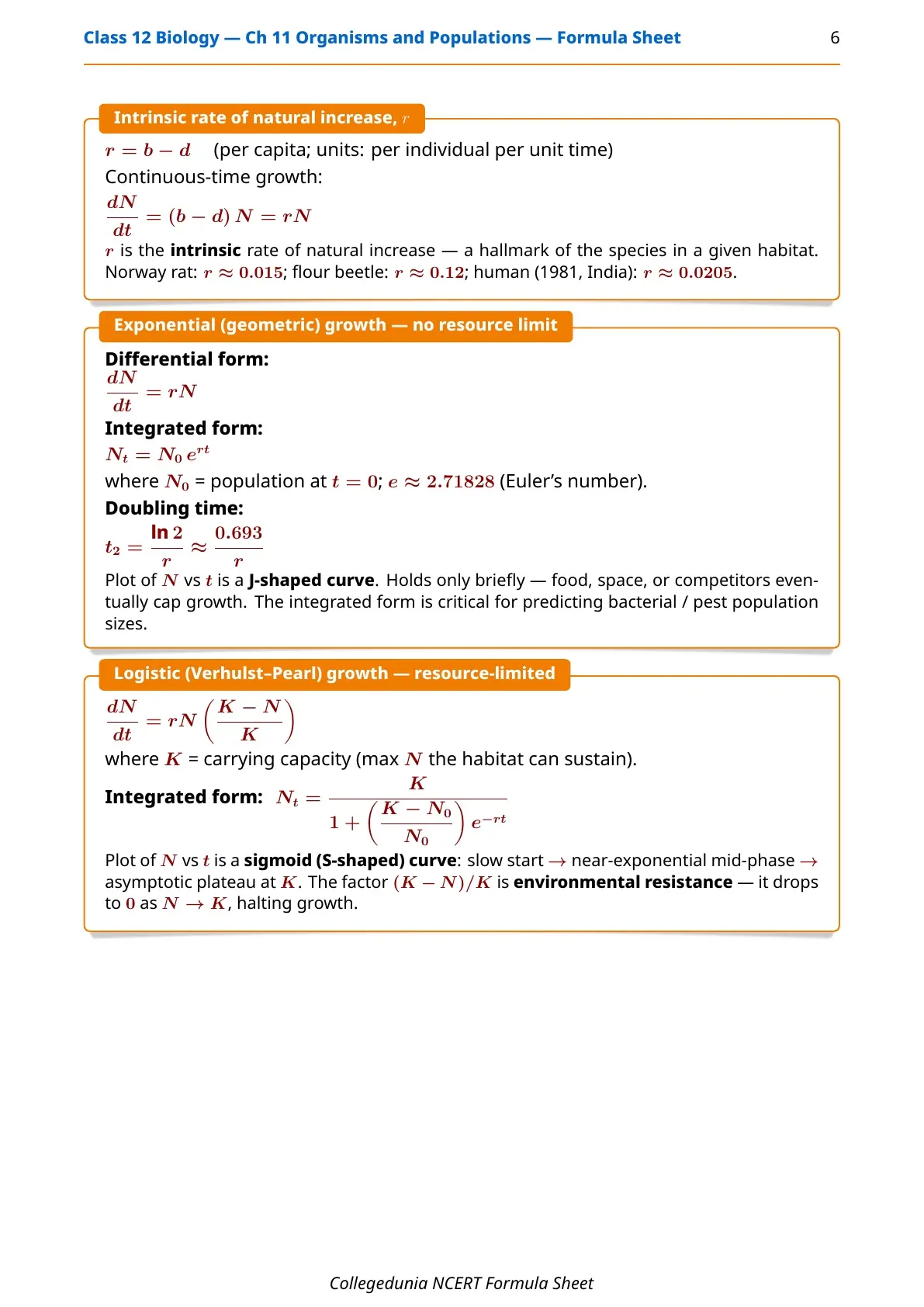
| Exponential growth (differential) | dNdt = rN ; unlimited resources; J-curve |
| Exponential growth (integrated) | Nt = N0 ert ; used for doubling-time calculations |
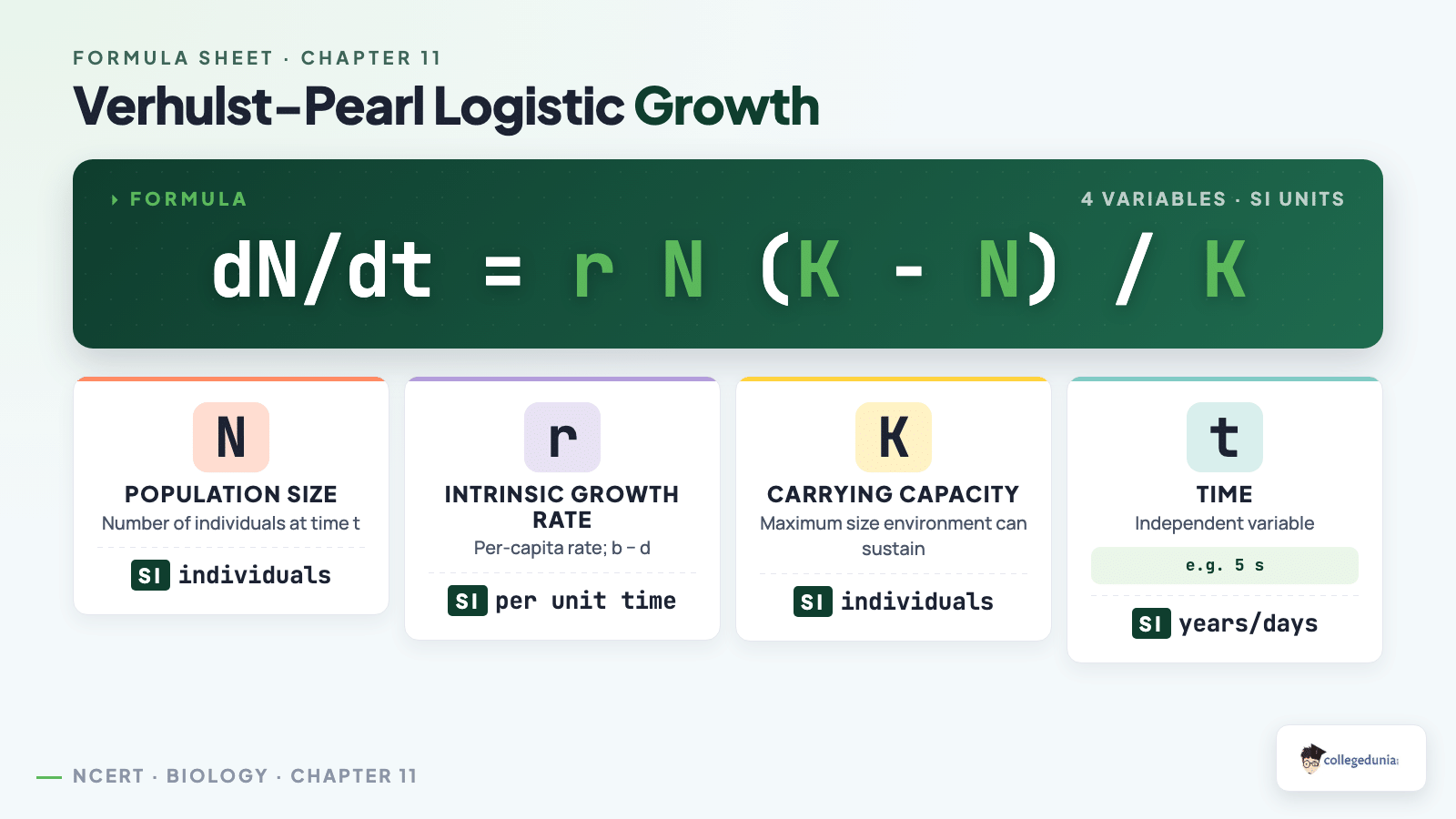
| Logistic growth (Verhulst-Pearl) | dNdt = rN(K-NK) ; finite resources; sigmoid S-curve, asymptote at K |
| Doubling time | td = ln 2r = 0.693r ; independent of N0 |
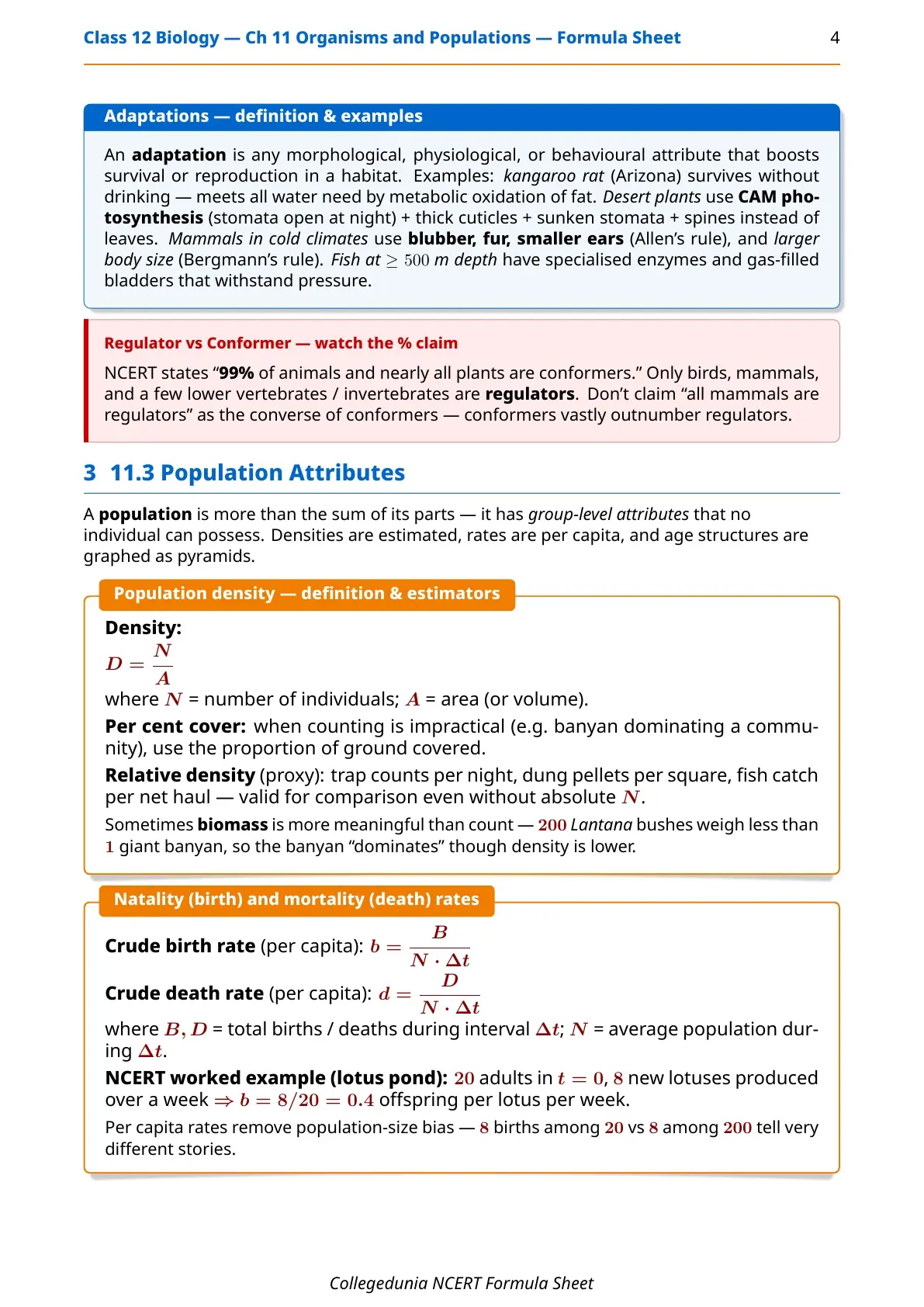
| Per-capita growth rate | r = b - d ; b = birth rate, d = death rate |
NEET swaps "exponential" and "logistic" wording on the differential numerical every other paper. Lock both: the bracket (K-N)/K distinguishes logistic from exponential.
Interspecific Interactions Sign-Pair Matrix for 12th Biology
Section 11.2.6 is one 6-cell sign-pair matrix. The sign-pair is what CBSE awards.
| Interaction | Sign (Sp A / Sp B) | NCERT Example |
|---|---|---|
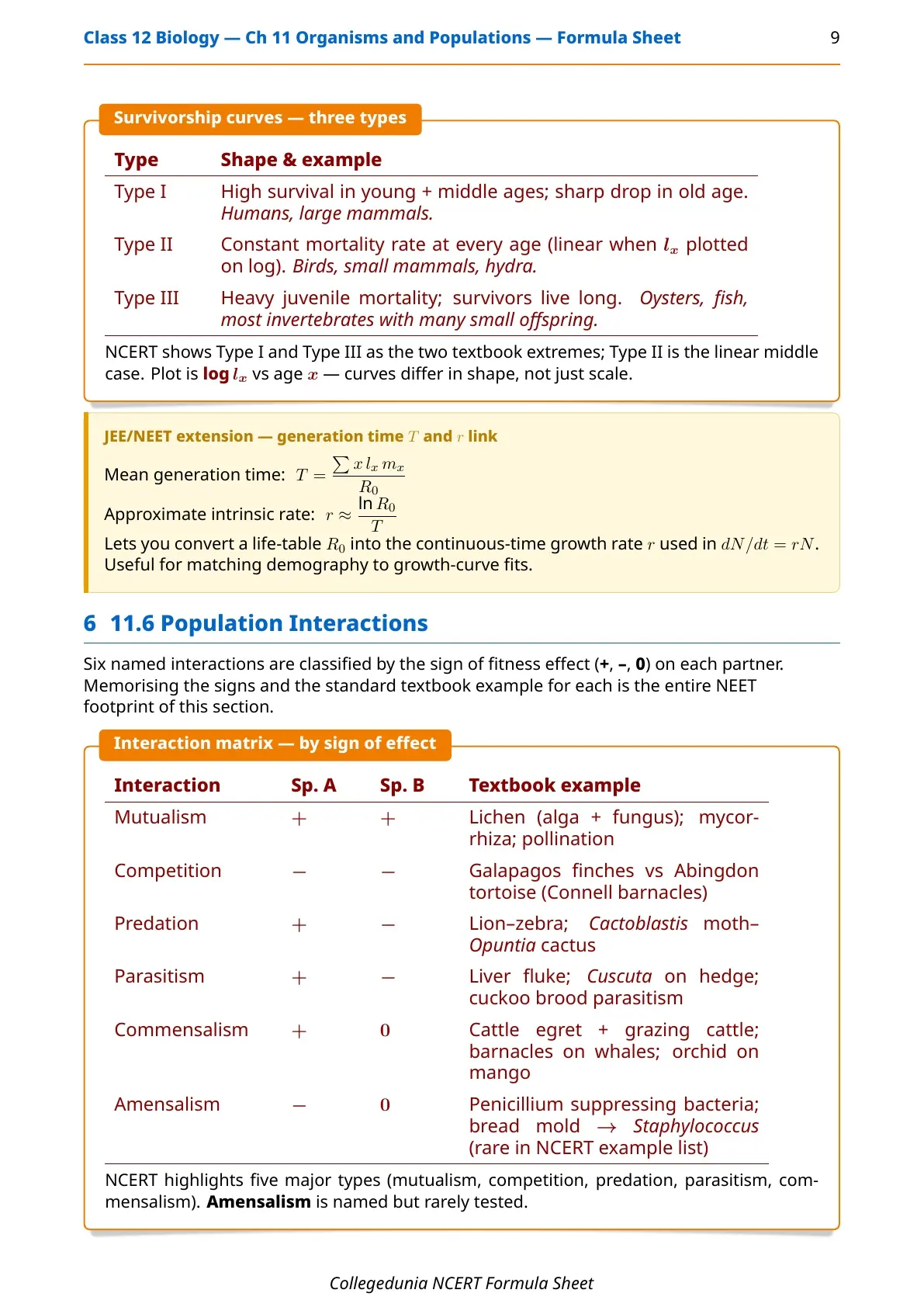
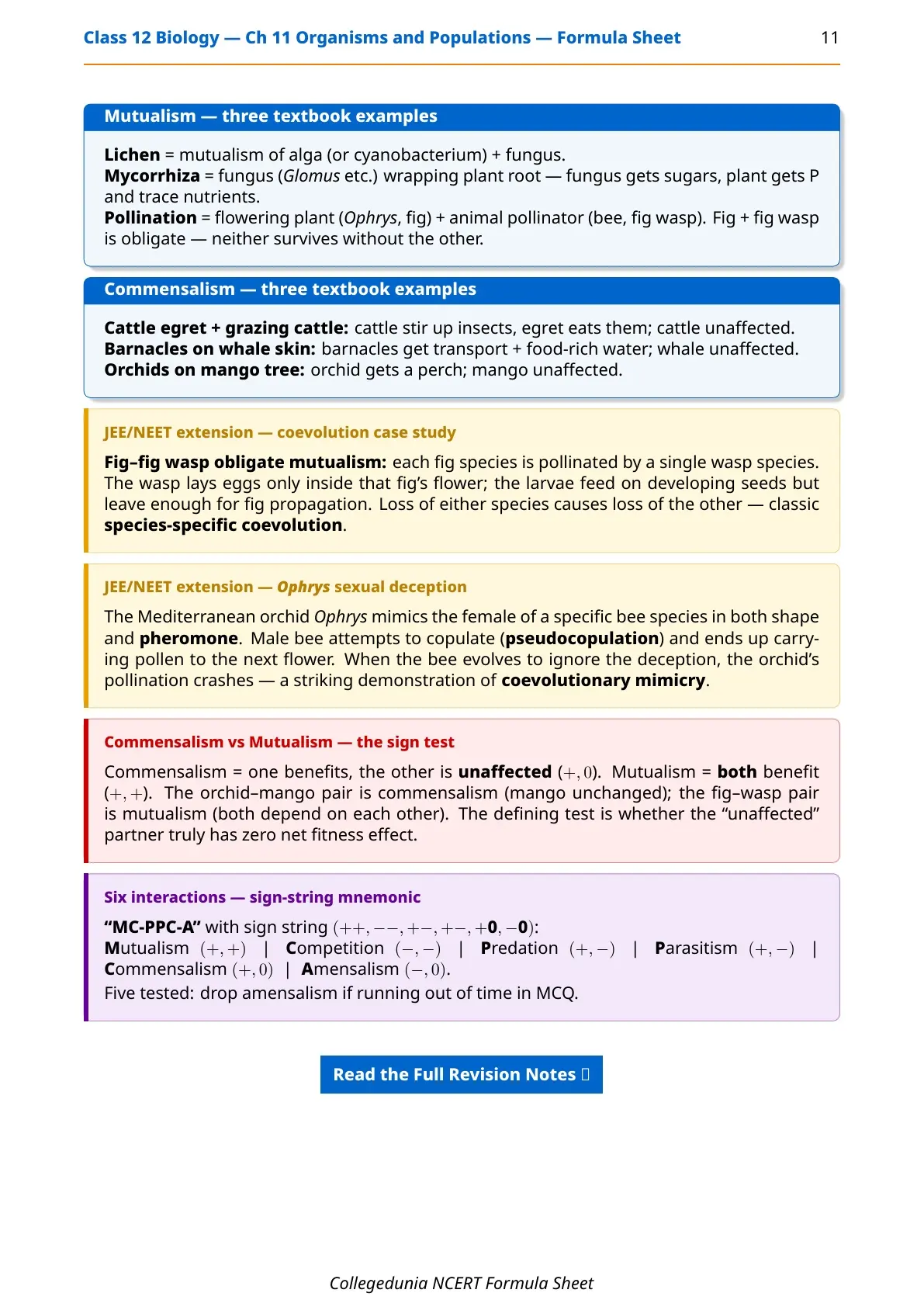
| Mutualism | + / + | Lichen (alga + fungus); Ficus-fig wasp; mycorrhiza |
| Competition | - / - | Paramecium aurelia vs P. caudatum; flamingo vs fish |
| Predation | + / - | Pisaster sea star; lion vs deer |
| Parasitism | + / - | Plasmodium in human; cuckoo brood parasitism |
| Commensalism | + / 0 | Cattle egret + cattle; orchid on mango; barnacle on whale |
| Amensalism | - / 0 | Penicillium → Staphylococcus; trampling of grass |
Adaptations Quick Card for 12th Biology Chapter 11
Adaptations are the second-most-tested NEET theme after population growth. Key examples by stress type:
- Desert plants (xerophytes): thick waxy cuticle, sunken stomata, CAM photosynthesis; Opuntia leaves reduced to spines.
- Desert animals: kangaroo rat oxidises internal fat for metabolic water and never drinks.
- High-altitude adaptation: RBC count rises, breathing rate increases, Hb-O2 affinity shifts.
- Cold-climate mammals (Allen's rule): shorter ears and limbs reduce surface area and conserve heat.
Survivorship Curves and Age Pyramid Index for Class 12 Biology
Section 11.2.4 covers three survivorship-curve archetypes, each hiding high-value 1-mark cues. Each is paired with its NCERT example below.
| Diagram | Shape + Example |
|---|---|
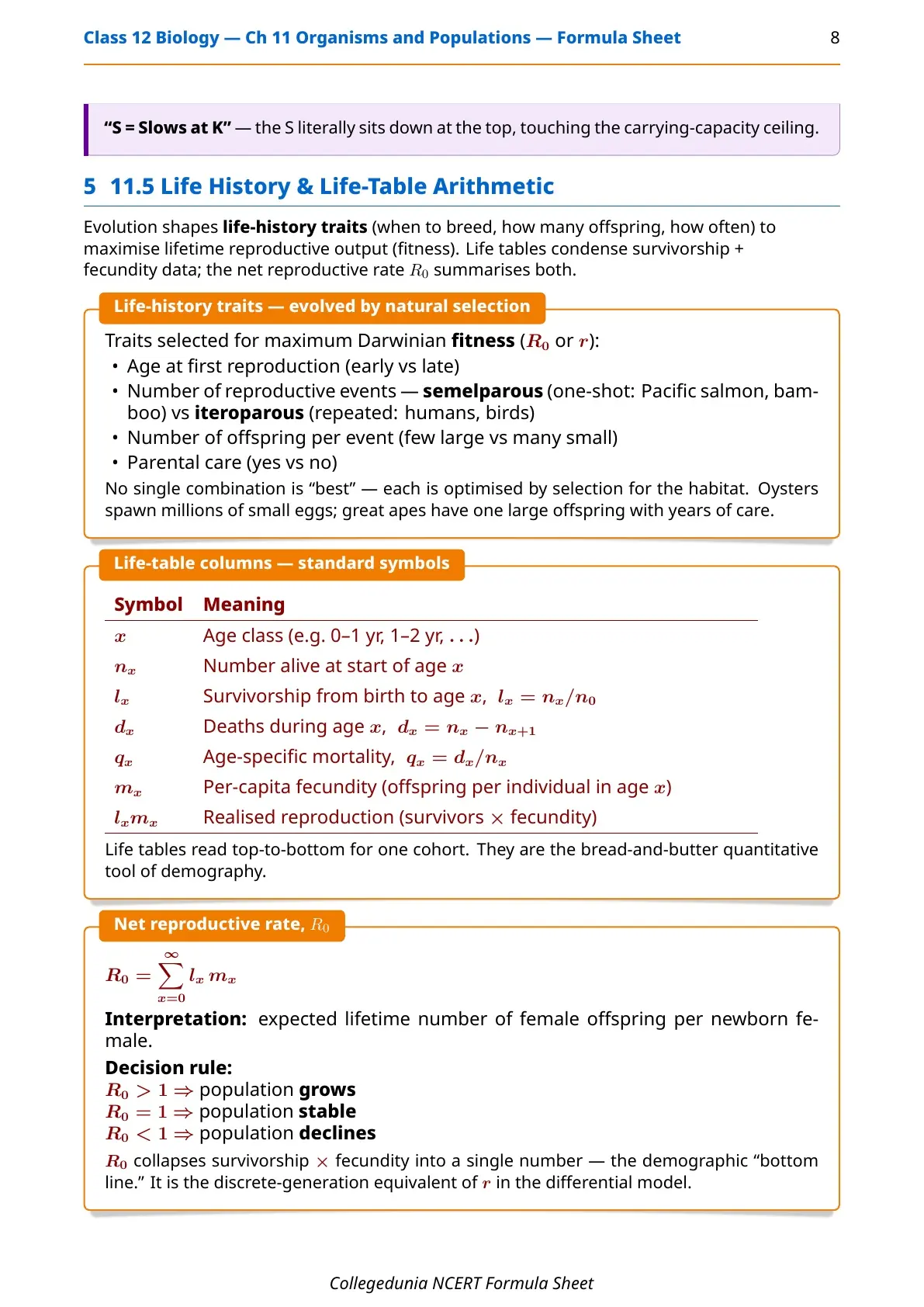
| Survivorship Type I | Convex; high survival until old age (large mammals, humans) |
| Survivorship Type II | Diagonal; constant mortality (hydra, birds) |
| Survivorship Type III | Concave; high juvenile mortality (oyster, salmon, plants) |
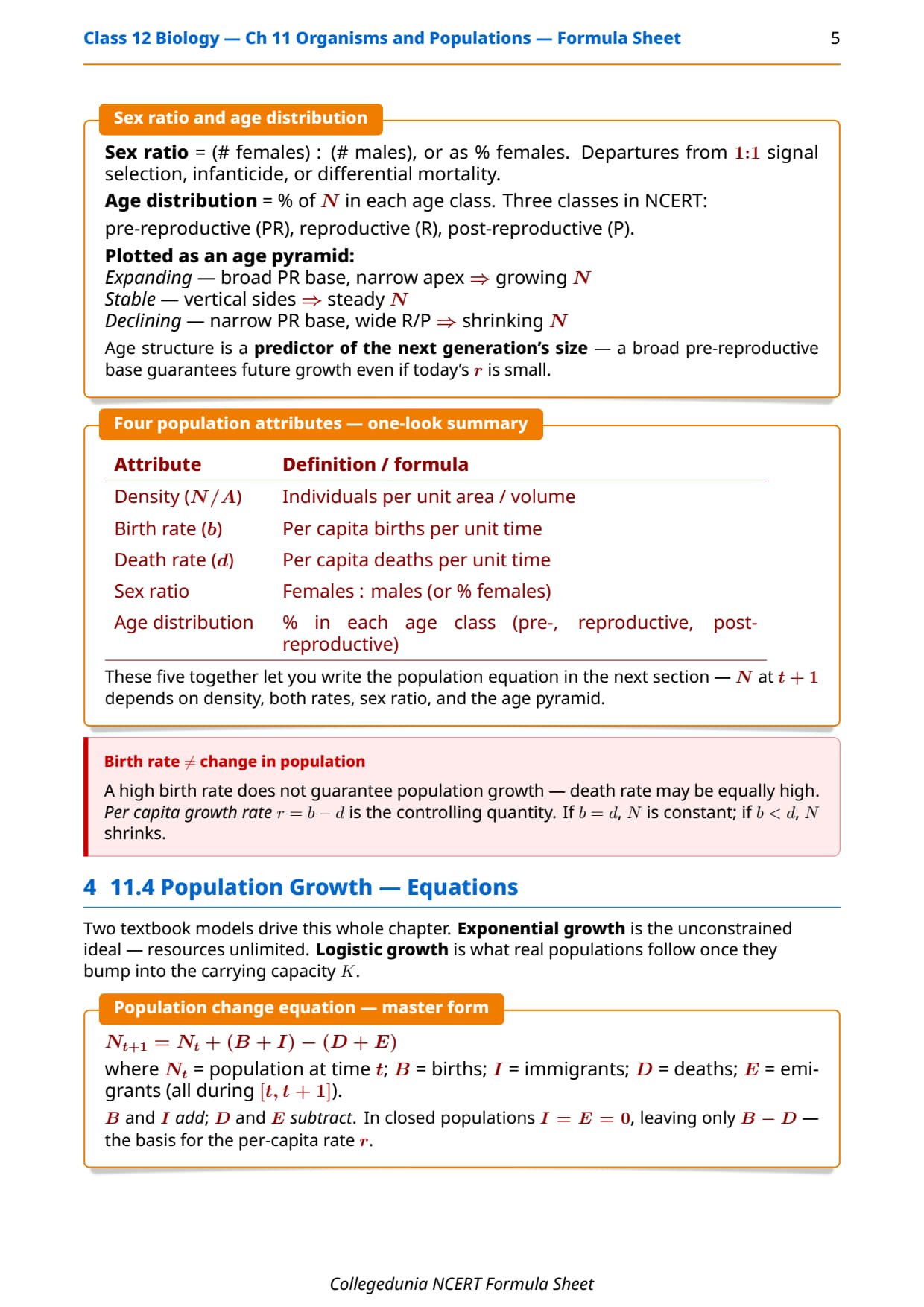
| Age Pyramid: Expanding | Triangular base; high natality (India circa 1980) |
| Age Pyramid: Stable | Bell shape; replacement-level fertility (developed nations) |
| Age Pyramid: Declining | Inverted urn; below-replacement fertility (Japan) |
Population Attributes and Density Card for Class 12 Biology
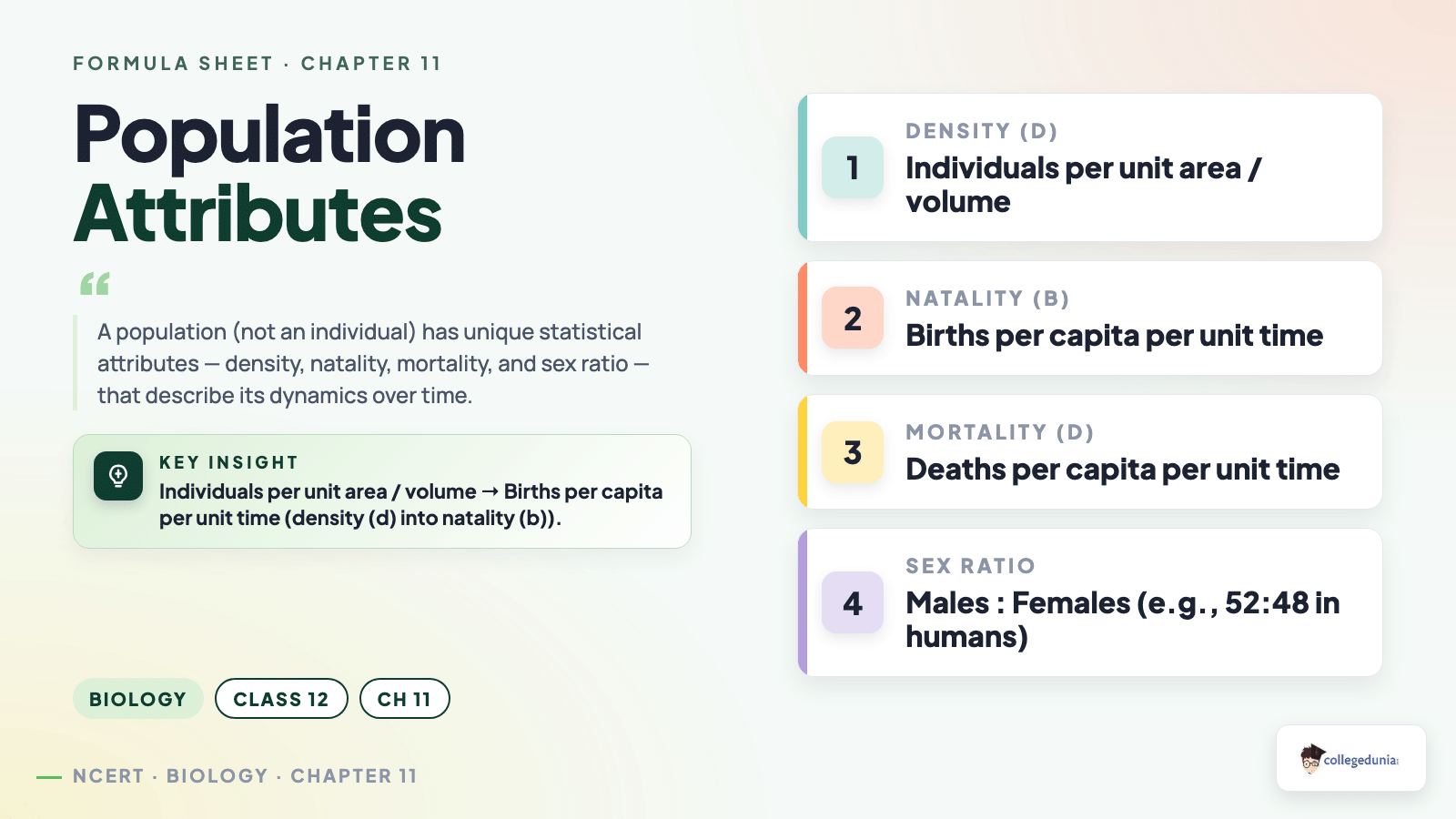
Section 11.2.2 anchors the population structure block. Each attribute is paired with its typical measurement method.
| Attribute | Symbol / Measure |
|---|---|
| Density (absolute) | N per unit area / volume; head count |
| Density (relative) | Pugmarks (tiger), fish catch per net, droppings |
| Density (biomass) | Total mass per area; used when individuals are too small or too many |
| Natality (B) | Births per unit time per individual |
| Mortality (D) | Deaths per unit time per individual |
| Sex ratio | Males : females in the population |
| Age distribution | Pre-reproductive : reproductive : post-reproductive |
One-Shot Revision Tips for Class 12 Biology Organisms and Populations
- Exponential vs Logistic: rN is exponential J-curve; rN(K-N)/K is logistic sigmoid.
- Sign-pair recall: commensalism +/0, mutualism +/+, amensalism -/0.
- Allen's rule: cold-climate mammals have SHORTER ears and limbs (lower surface area).
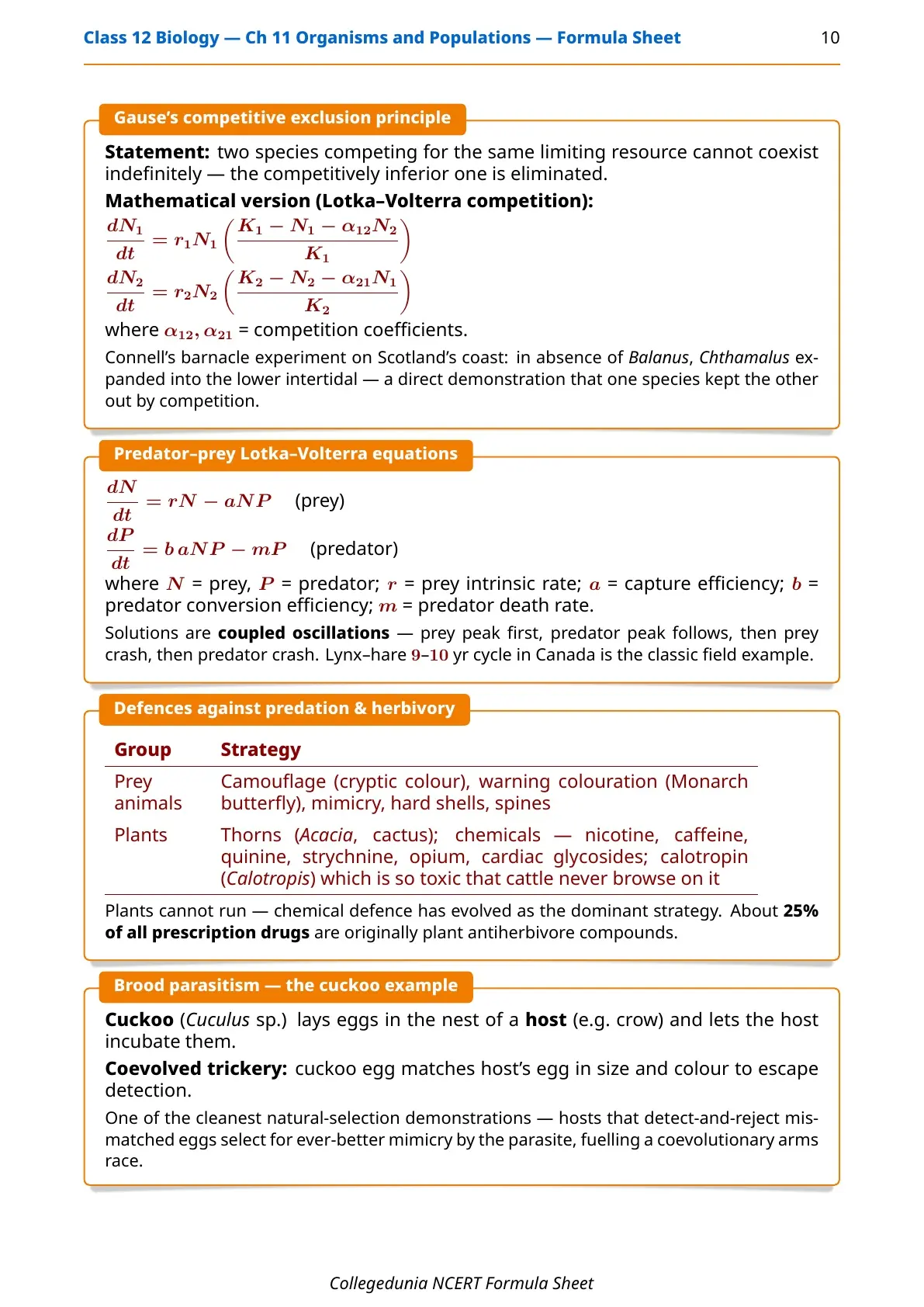
- Gause's principle: two species on the same niche cannot coexist; one excludes the other.
- Carrying capacity K: upper asymptote of the sigmoid; populations may overshoot briefly, then crash.
Top NEET Recall Hits and Recent PYQ Pattern for Organisms and Populations
NEET 2025 tested the commensalism vs mutualism sign-pair and Gause's exclusion principle. NEET 2024 went after Allen's rule and lichen mutualism. CBSE 2025 set a 3-mark long-answer on logistic equation derivation. CBSE 2024 ran Opuntia adaptations as a 5-marker. See the cross-resource table below for full Notes and Solutions links.
Other Resources for Organisms and Populations Class 12 Biology
| Resource | Link |
|---|---|
| Formula Sheet | Organisms and Populations Formula Sheet |
| NCERT Solutions | Organisms and Populations NCERT Solutions |
| Notes | Organisms and Populations Class 12 Biology Notes |
| NCERT Book PDF | Organisms and Populations NCERT Book PDF |
| Exemplar Solutions | Organisms and Populations Exemplar Solutions |
| Handwritten Notes | Organisms and Populations Handwritten Notes |
| Exemplar Book PDF | Organisms and Populations Exemplar Book PDF |
Formula Sheet for Class 12 Biology: All Chapters
The table below links every Class 12 Biology chapter's formula sheet.
| Chapter | Resource |
|---|---|
| Chapter 1 | Sexual Reproduction in Flowering Plants |
| Chapter 2 | Human Reproduction |
| Chapter 3 | Reproductive Health |
| Chapter 4 | Principles of Inheritance and Variation |
| Chapter 5 | Molecular Basis of Inheritance |
| Chapter 6 | Evolution |
| Chapter 7 | Human Health and Disease |
| Chapter 8 | Microbes in Human Welfare |
| Chapter 9 | Biotechnology Principles and Processes |
| Chapter 10 | Biotechnology and Its Applications |
| Chapter 11 | Organisms and Populations |
| Chapter 12 | Ecosystem |
| Chapter 13 | Biodiversity and Conservation |
Student Feedback: Chapter 11 Organisms and Populations Class 12 Biology Survey
Student Feedback
What 11,300 students told us about the Chapter 11 Organisms and Populations Formula Sheet journey:
- 70% of students surveyed marked the logistic-growth equation derivation as the hardest sub-topic.
- 59% reported losing 1-2 marks on classifying mutualism, commensalism, predation and parasitism examples.
- 4 out of 5 students said the age-pyramid figure was the most-skipped figure in their answer sheet.
- Average student took 5.2 hours for the first read, and 2.1 hours for a focused revision pass before the board exam.
Source: 2025-26 Class 12 Biology student survey. Sample of 11,300 students from CBSE-affiliated schools across 18 states.
Organisms and Populations Class 12 Biology Formula Sheet FAQs
Ques. What does the Organisms and Populations Class 12 Biology formula sheet cover?
Ans. The sheet collates every equation and recall fact across NCERT Sections 11.1 to 11.2: exponential and logistic growth equations, population-balance equation, intrinsic rate r, carrying capacity K, doubling-time formula, six interspecific interaction sign-pairs with NCERT examples, three survivorship-curve archetypes, three age-pyramid shapes, and the adaptation parameters for xerophytes, kangaroo rat and high-altitude humans. One printable revision page aligned to the 2026-27 NCERT.
Ques. Is this Class 12 Biology Chapter 11 formula sheet aligned with the 2026-27 NCERT?
Ans. Yes. Every entry matches the current 2026-27 print of NCERT Biology. Sections 11.1 (Organism and Environment) and 11.2 (Populations) are retained in full, and the sheet flags both classical equations (logistic, exponential) and NEET-extension topics (Lotka-Volterra, r/K selection theory) exactly as they appear in the latest edition.
Ques. How is this Organisms and Populations formula sheet useful for NEET preparation?
Ans. NEET pulls 3 to 5 questions a year from this chapter, almost all recall-based numericals or sign-pair MCQs: the logistic differential, doubling time from r, intrinsic-rate calculation, commensalism vs mutualism sign pair, and Gause's competitive exclusion. The Collegedunia sheet packages these in quick-lookup tables so a 15-minute final-pass the night before the paper covers nearly every common MCQ.
Ques. What is the logistic growth equation as per NCERT Class 12 Biology Chapter 11?
Ans. The Verhulst-Pearl logistic equation is dNdt = rN(K-NK) , where N is population size at time t, r is the intrinsic rate of natural increase, and K is the carrying capacity. The bracketed term (K-N)/K is the unutilised resource fraction; growth halts when N = K. The curve is sigmoid (S-shaped) with an inflexion at N = K/2.
Ques. What is the difference between exponential and logistic growth in Class 12 Biology?
Ans. Exponential growth (dN/dt = rN; Nt = N0ert) assumes unlimited resources and gives a J-shaped curve. Logistic growth (dN/dt = rN(K-N)/K) accounts for a finite carrying capacity K and gives an S-shaped sigmoid curve that asymptotes at K. Real populations always follow logistic growth in the long run because no habitat has infinite resources.
Ques. What are the six interspecific interactions in NCERT Chapter 11?
Ans. Mutualism (+/+, lichen, mycorrhiza, Ficus-fig wasp); Competition (-/-, Paramecium aurelia vs P. caudatum); Predation (+/-, Pisaster sea star); Parasitism (+/-, Plasmodium in human, cuckoo brood parasitism); Commensalism (+/0, cattle egret + cattle, orchid on mango); Amensalism (-/0, Penicillium on bacteria). The sign-pair is what CBSE awards.
Ques. What is Allen's rule and why does NEET test it every year?
Ans. Allen's rule states that mammals from colder climates have shorter ears, limbs and appendages than mammals from warmer climates. The shorter appendages reduce surface area, which lowers heat loss and conserves body temperature. Arctic foxes (short ears) vs fennec foxes (long ears) is the textbook contrast. NEET tests it as a 1-mark recall MCQ almost every year.
Ques. How does Gause's competitive exclusion principle work?
Ans. Gause's principle states that two species competing for exactly the same limited resource cannot coexist indefinitely; the more efficient competitor will eliminate the other. The classic demonstration used two Paramecium species (P. aurelia and P. caudatum) in shared culture - only P. aurelia survived. In nature the weaker competitor escapes exclusion by niche differentiation.
Ques. How many marks does Organisms and Populations carry in CBSE Class 12 Biology Boards?
Ans. Chapter 11 contributes around 5 to 7 marks in the CBSE Class 12 Biology board paper, typically split across a 2 mark short-answer on age pyramids / interactions and a 3 to 5 mark long-answer on logistic growth derivation or adaptations of Opuntia. NEET tests 3 to 5 questions a year, usually 1-mark sign-pair MCQs or growth-equation numericals.



Comments