



The class 11 physics formula sheet chapter 9 mechanical properties of fluids gathers every pressure, flow, viscosity and surface-tension formula tested in the Boards, JEE Main, JEE Advanced, NEET, CUET and NDA exams. It lists each formula, constant and SI unit for fast revision.
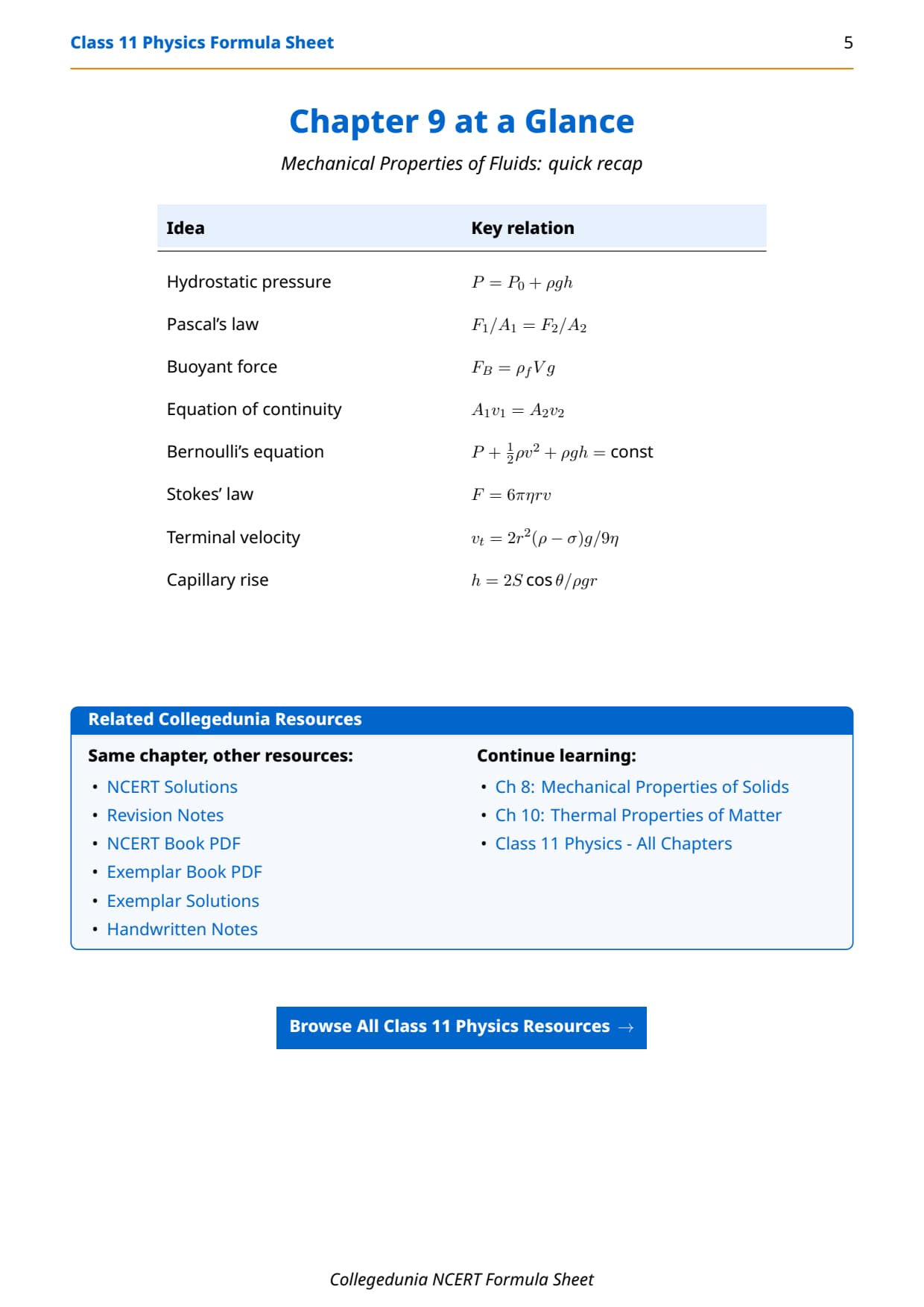
Mechanical Properties of Fluids ties hydrostatics, fluid flow and surface effects together, so its formulas return in floating, flow-rate and capillary numericals.
- Covers pressure, Pascal's law, buoyancy, continuity and Bernoulli's equation in one place.
- Lists Stokes' law, terminal velocity, surface tension and capillary rise with SI units.
- Helps students pick the right formula for floating, flow-rate and excess-pressure problems.
This class 11 physics formula sheet chapter 9 mechanical properties of fluids is curated by subject experts and checked against the 2026-27 NCERT and recent CBSE, JEE and NEET papers.
All Mechanical Properties of Fluids Formulas at a Glance
Every fluid formula sits in one table below, with its meaning and SI unit. Learn Bernoulli's equation and the continuity equation first, since most flow numericals use them together.
| Formula | What it means | SI unit |
|---|---|---|
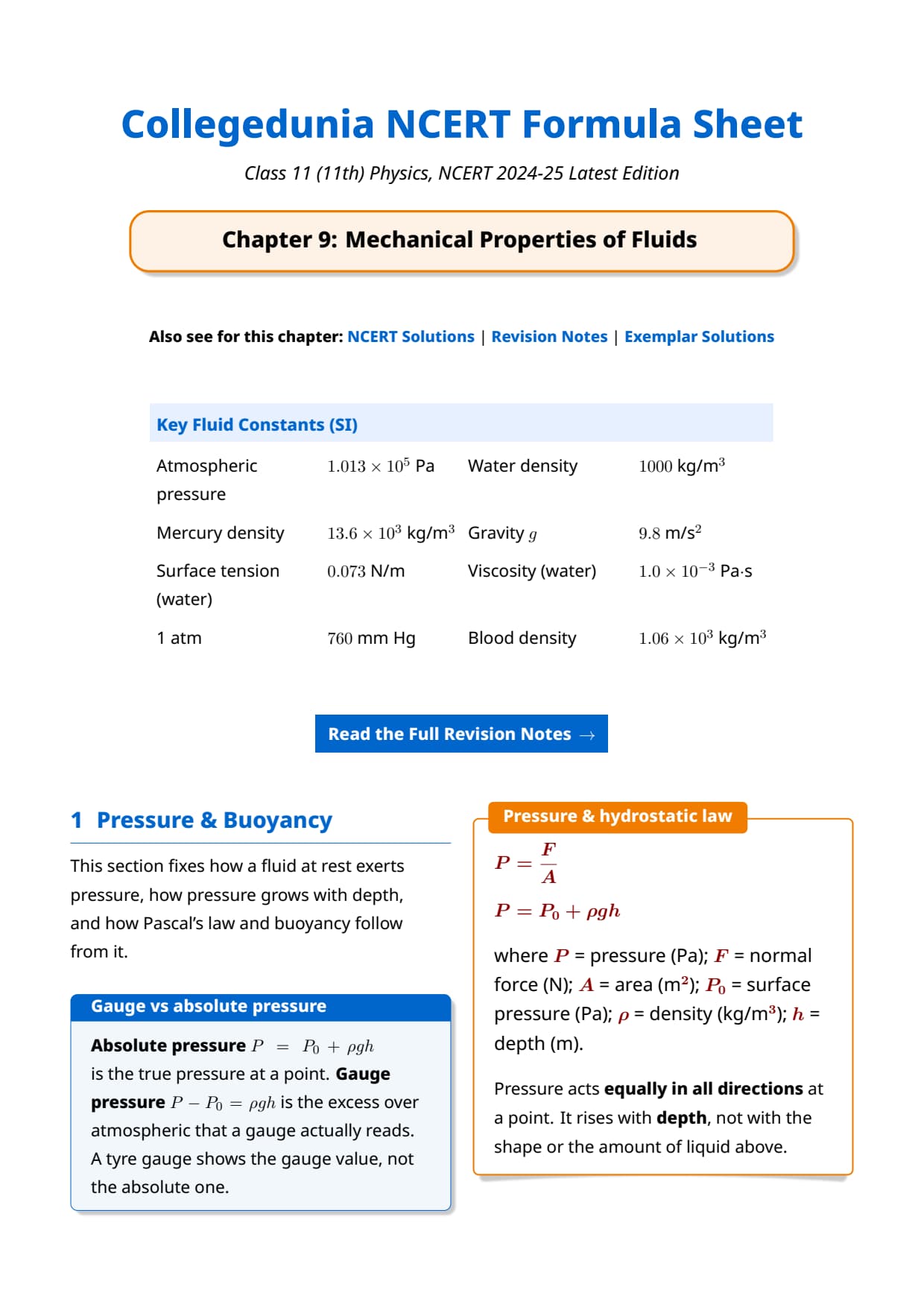
| P = ρgh | Gauge pressure of a fluid column of height h | pascal (Pa) |
| P = P0 + ρgh | Absolute pressure at depth h | pascal (Pa) |
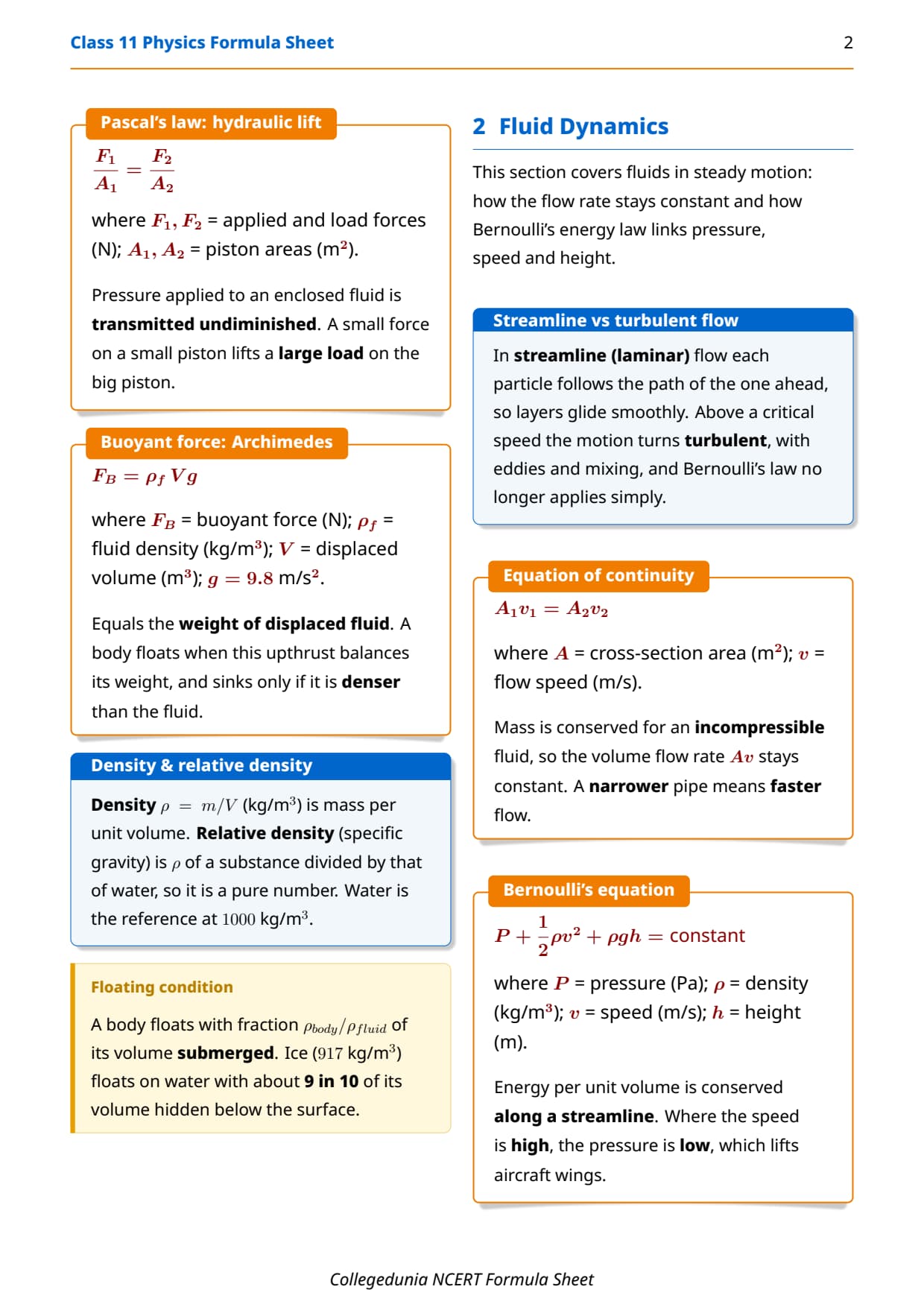
| F1/A1 = F2/A2 | Pascal's law: pressure passes on equally | pascal (Pa) |
| FB = ρfluid Vg | Buoyant force (Archimedes' principle) | newton (N) |
| A1v1 = A2v2 | Continuity: volume flow rate stays constant | m3 s-1 |
| P + ½ρv2 + ρgh = constant | Bernoulli's equation: energy per unit volume conserved | pascal (Pa) |
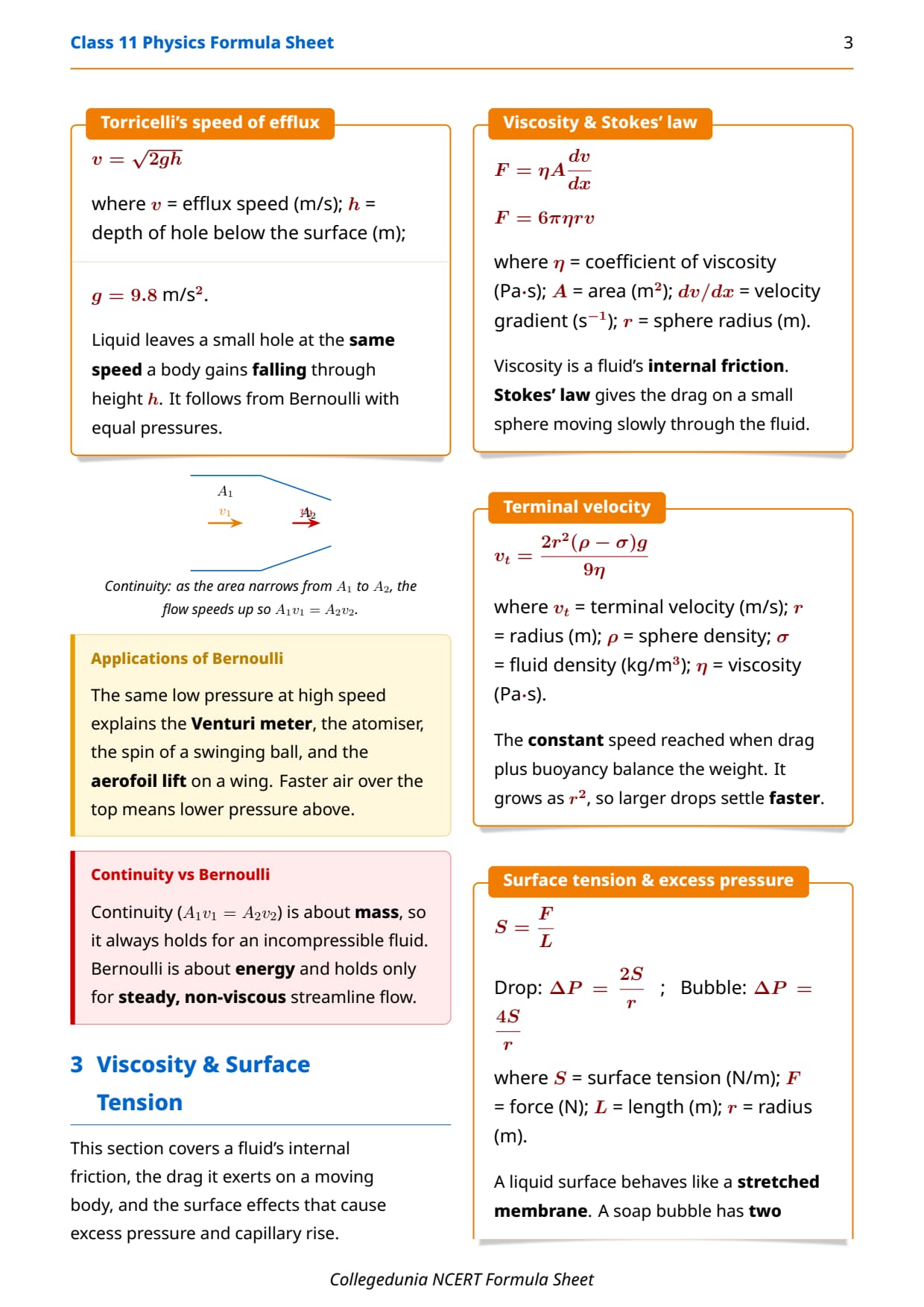
| F = ηA(dv/dx) | Viscous force; η is the coefficient of viscosity | newton (N) |
| F = 6πηrv | Stokes' law: viscous drag on a small sphere | newton (N) |
| vt = 2r2(ρ − σ)g/9η | Terminal velocity in a viscous fluid | m s-1 |
| S = F/L | Surface tension: force per unit length | N m-1 |
| P = 2S/R | Excess pressure inside a liquid drop (one surface) | pascal (Pa) |
| P = 4S/R | Excess pressure inside a soap bubble (two surfaces) | pascal (Pa) |
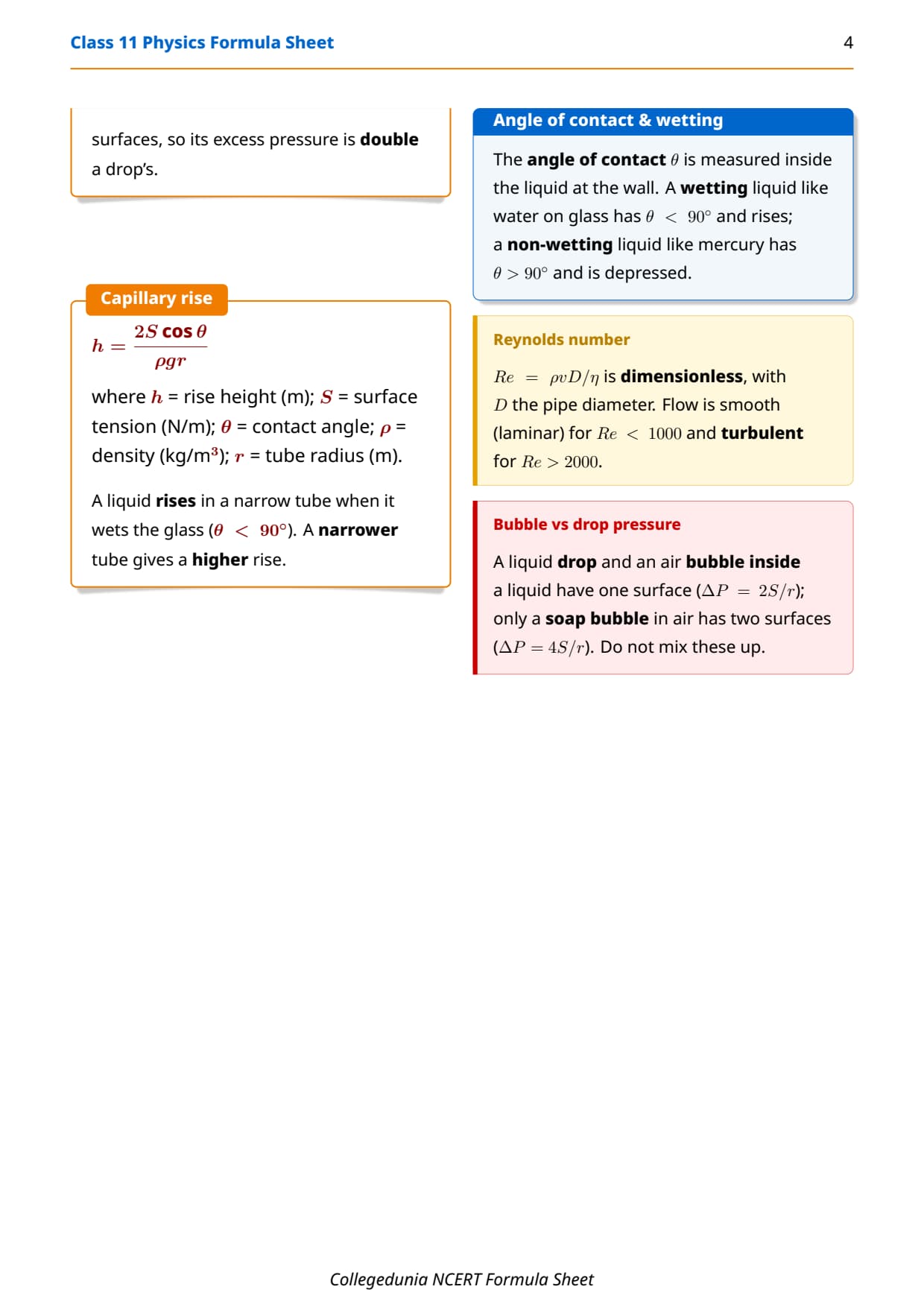
| h = 2S cosθ/rρg | Capillary rise of a liquid in a thin tube | metre (m) |
A soap bubble has two surfaces, so its excess pressure 4S/R is double that of a liquid drop, 2S/R.
Key Constants and Definitions for Mechanical Properties of Fluids
Boards and entrance papers often ask for one constant or a short definition. The list below has the key values and terms from this class 11 physics formula sheet chapter 9 mechanical properties of fluids.
- Density of water: ρ = 1000 kg m-3; density of mercury = 13600 kg m-3.
- Atmospheric pressure: P0 = 1.013 × 10⁵ Pa = 76 cm of mercury.
- Coefficient of viscosity η: SI unit Pa s (poiseiulle).
- Surface tension S: SI unit N m-1.
- Reynolds number: Re = ρvD/η, dimensionless; flow turns turbulent above about 2000.
How to Revise Mechanical Properties of Fluids Formulas Before the Exam
Use this class 11 physics formula sheet chapter 9 mechanical properties of fluids for a quick recap the night before a test, in about 20 minutes.
- First 7 minutes: write pressure P = ρgh, Pascal's law and the buoyant force from memory.
- Next 7 minutes: write the continuity equation and Bernoulli's equation, then check units.
- Last 6 minutes: recall Stokes' law, terminal velocity, excess pressure and capillary rise.
Finish by solving one Bernoulli numerical and one terminal-velocity numerical.
Student Feedback on the Mechanical Properties of Fluids Formula Sheet
What 11,540 students told us about their Mechanical Properties of Fluids revision:
- 71% of students rated Bernoulli's equation as the hardest part of the chapter.
- Most-skipped step: using the density difference (ρ − σ) in terminal velocity.
- Students who learned the drop-versus-bubble pressure rule first found surface-tension sums easier.
Source: 2026-27 Class 11 Physics student poll. Sample of 11,540 students from CBSE schools across 14 states, conducted before the 2026 boards.
Other Mechanical Properties of Fluids Class 11 Physics Resources
Pair this formula sheet with the solved answers, notes and textbook PDF.
| Resource | Link |
|---|---|
| NCERT Solutions | Mechanical Properties of Fluids Class 11 NCERT Solutions |
| Revision Notes | Mechanical Properties of Fluids Class 11 Notes |
| Handwritten Notes | Mechanical Properties of Fluids Class 11 Handwritten Notes |
| NCERT Book PDF | Mechanical Properties of Fluids Class 11 Book PDF |
NCERT Formula Sheet for Class 11 Physics: All Chapters
Jump to any other Class 11 Physics formula sheet below.
| Chapter | Formula Sheet |
|---|---|
| Chapter 1 | Units and Measurements |
| Chapter 2 | Motion in a Straight Line |
| Chapter 3 | Motion in a Plane |
| Chapter 4 | Laws of Motion |
| Chapter 5 | Work, Energy and Power |
| Chapter 6 | System of Particles and Rotational Motion |
| Chapter 7 | Gravitation |
| Chapter 8 | Mechanical Properties of Solids |
| Chapter 9 | Mechanical Properties of Fluids |
| Chapter 10 | Thermal Properties of Matter |
| Chapter 11 | Thermodynamics |
| Chapter 12 | Kinetic Theory |
| Chapter 13 | Oscillations |
| Chapter 14 | Waves |
FAQs on Mechanical Properties of Fluids Class 11 Physics Formula Sheet
Mechanical Properties of Fluids Formula Sheet - Frequently Asked Questions
Ques. What formulas does the class 11 physics formula sheet chapter 9 mechanical properties of fluids cover?
Ans. This class 11 physics formula sheet chapter 9 mechanical properties of fluids covers hydrostatic pressure P = ρgh, Pascal's law and buoyant force. It also lists the equation of continuity, Bernoulli's equation, Stokes' law, terminal velocity, surface tension, excess pressure in drops and bubbles, and capillary rise.
Ques. What is Bernoulli's equation for fluid flow?
Ans. Bernoulli's equation is P + ½ρv2 + ρgh = constant. It says the total energy per unit volume of a flowing ideal fluid stays the same, so where speed rises, pressure falls.
Ques. Why is the excess pressure in a bubble double that in a drop?
Ans. A liquid drop has one surface, so its excess pressure is 2S/R. A soap bubble has an inner and an outer surface, so the excess pressure doubles to 4S/R.
Ques. What is terminal velocity?
Ans. Terminal velocity is the constant speed a small sphere reaches when the viscous drag balances its weight. It is given by vt = 2r2(ρ − σ)g/9η, where ρ and σ are the densities of the sphere and the fluid.



Comments