




The class 11 maths formula sheet chapter 2 relations and functions gathers every definition, counting rule and standard function tested in the Boards, JEE Main, JEE Advanced and CUET exams. This relation and function class 11 formula list sets out the cartesian product, ordered-pair rule, relation and function definitions and the algebra of real functions so students revise the whole chapter fast.
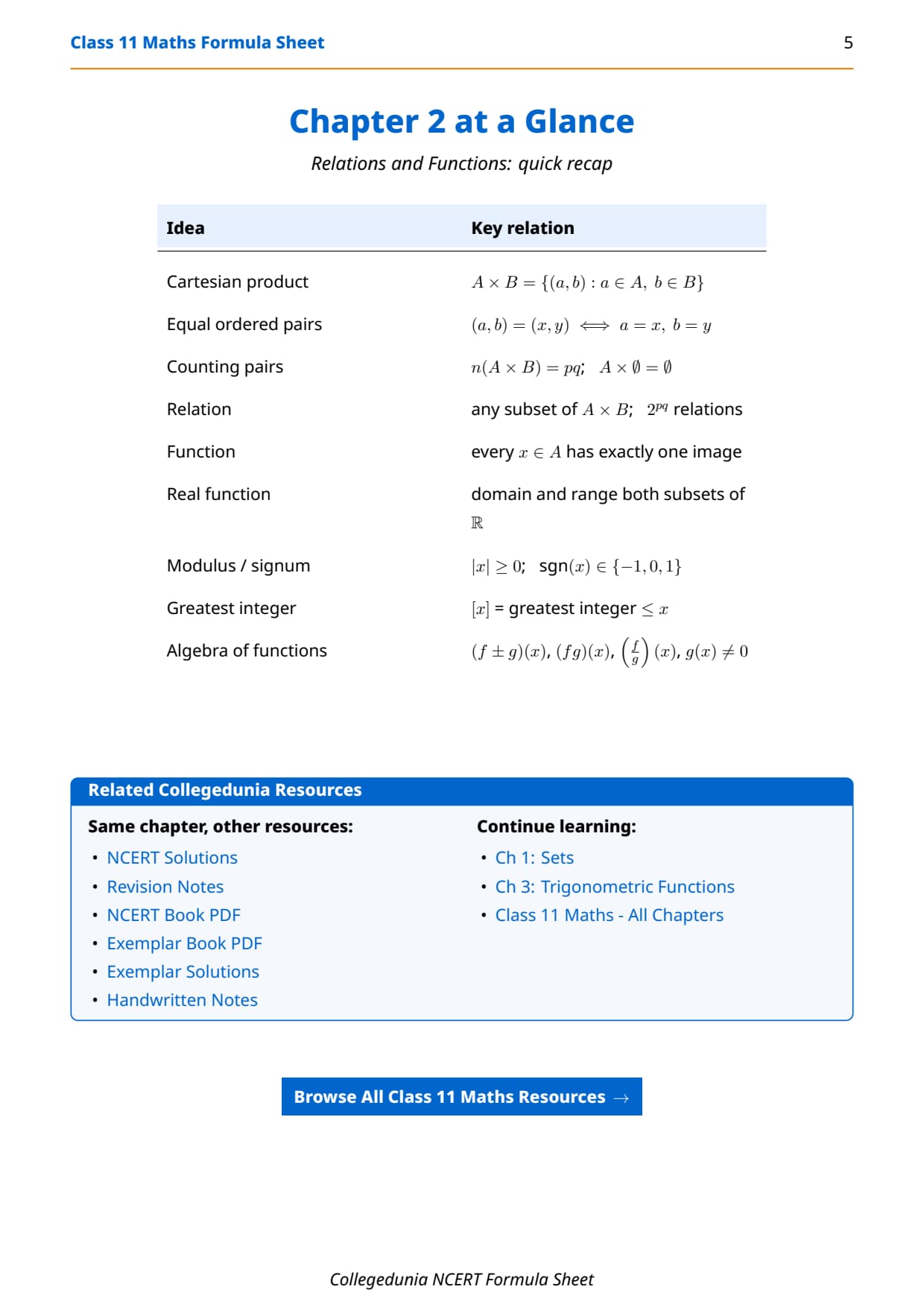
Relations and Functions builds directly on Sets, and its ordered pairs and function rules return in trigonometry, limits and probability later in the year.
- Covers the cartesian product and ordered-pair equality, plus the pair-count and relation-count formulas.
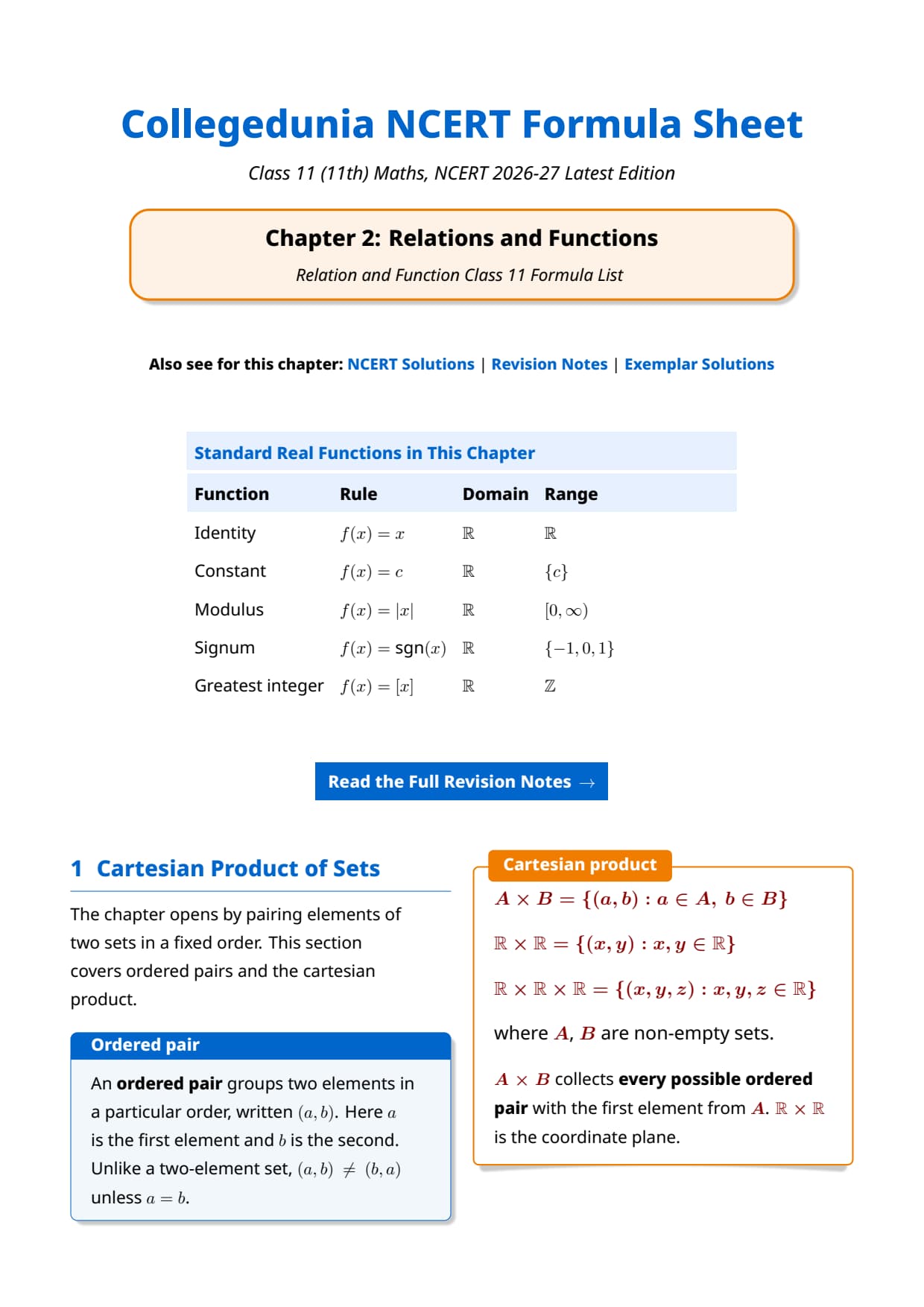
- Lists the standard real functions, identity, constant, modulus, signum and greatest integer, with their domains and ranges.
- Helps students apply the algebra of real functions, sum, difference, product and quotient, with the correct domain conditions.
This class 11 maths formula sheet chapter 2 relations and functions is curated by subject experts and checked against the 2026-27 NCERT and recent CBSE and JEE papers.
All Relations and Functions Formulas at a Glance
Every cartesian-product and counting rule sits in one table below, with its meaning. Learn the pair-count and relation-count rows first, since almost every objective question uses them.
| Formula | What it means | Condition |
|---|---|---|
| A × B = {(a, b) : a ∈ A, b ∈ B} | Cartesian product: every ordered pair, first from A, second from B | A, B non-empty |
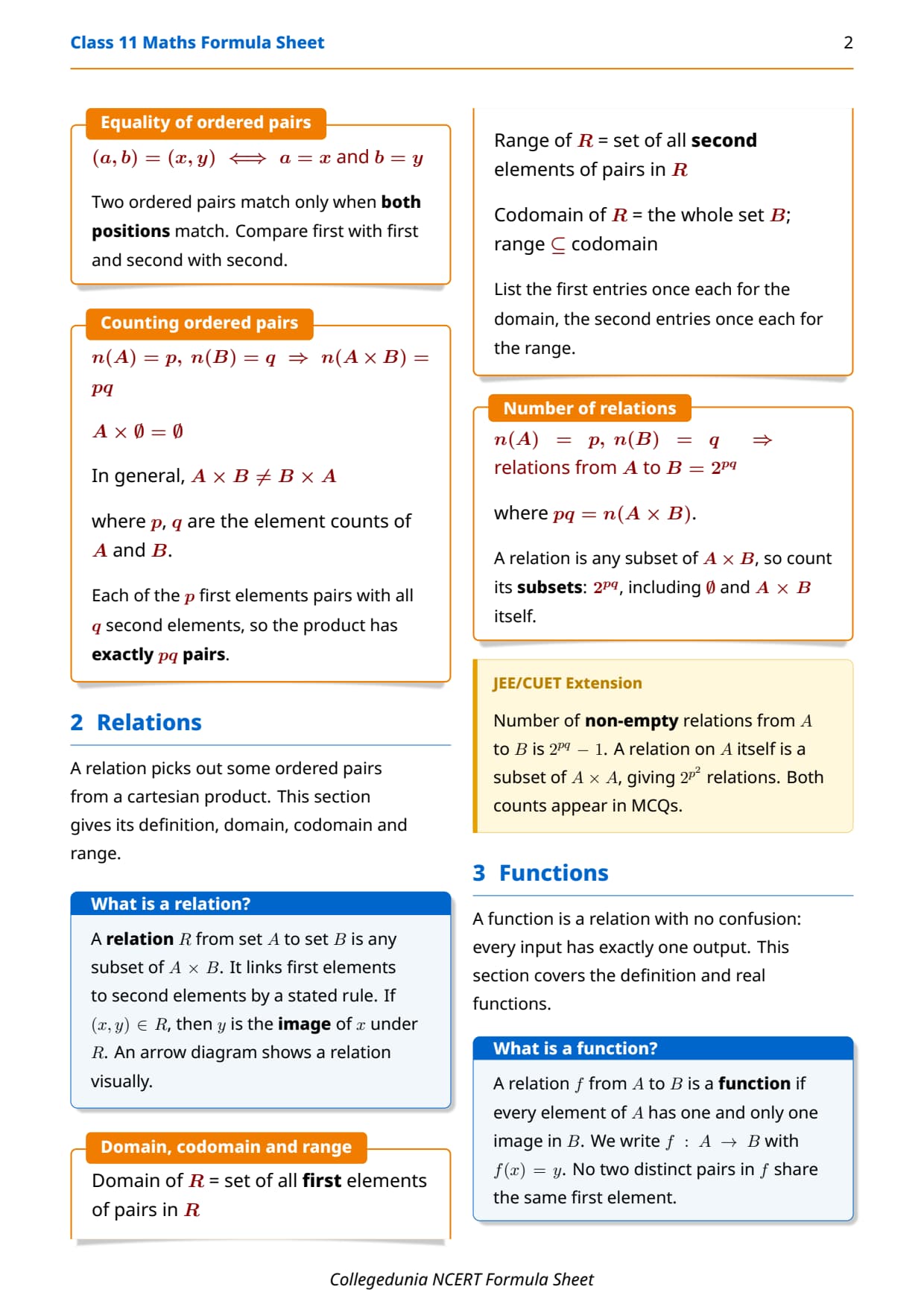
| (a, b) = (x, y) ⇔ a = x and b = y | Two ordered pairs are equal only when both positions match | Order matters |
| n(A × B) = pq | Number of ordered pairs when n(A) = p, n(B) = q | A × ∅ = ∅ |
| Relation R ⊆ A × B | A relation is any subset of the cartesian product | Any two sets |
| Number of relations = 2pq | Count of all relations from A to B | Each subset of A × B is one relation |
| Domain = first elements; Range = second elements | Domain and range of R read off its ordered pairs | Range ⊆ codomain (= B) |
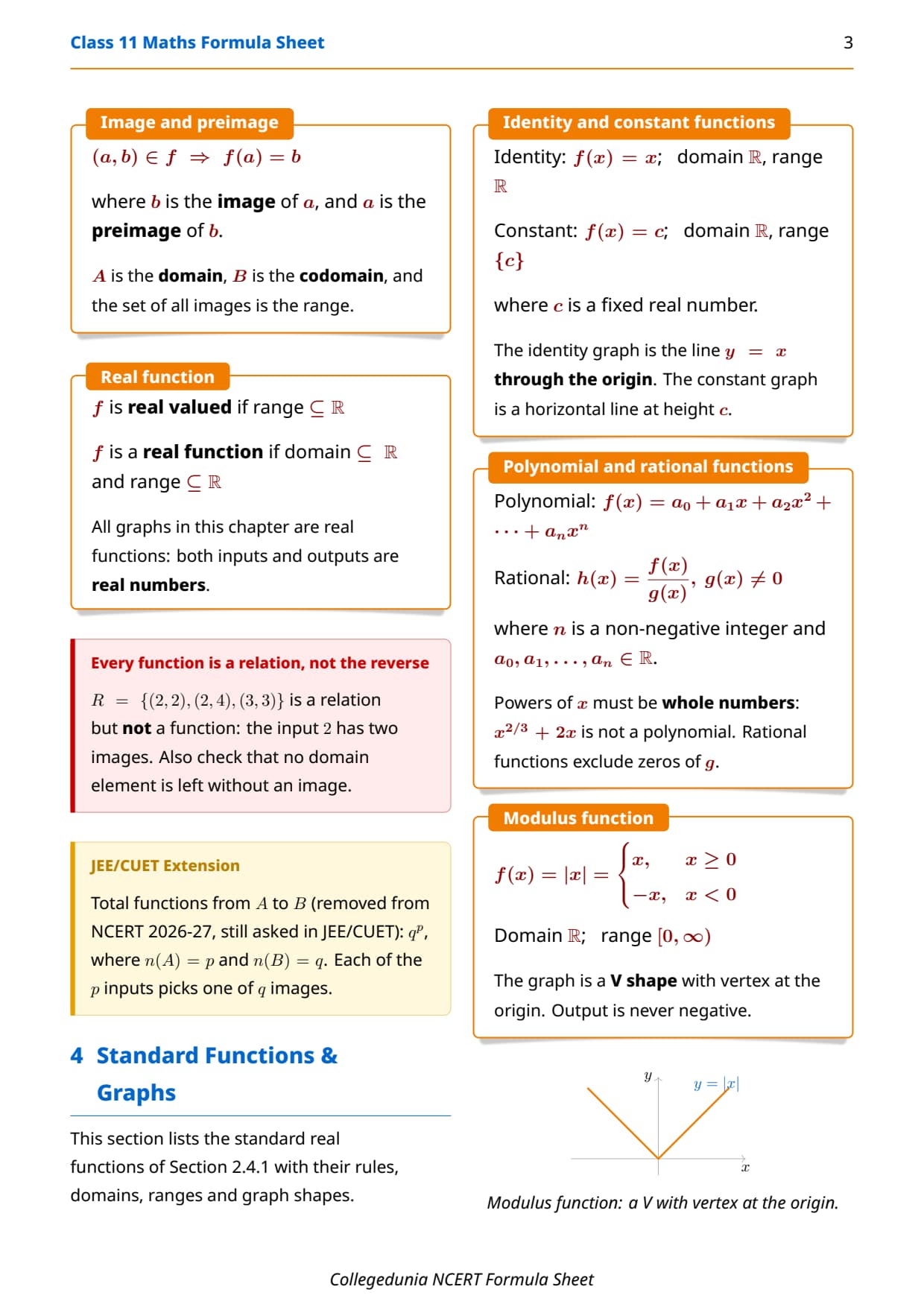
| Function f : A → B | Every element of A has exactly one image in B | No input repeats with two images |
A relation is any subset of A × B, so there are 2pq relations, while a function adds one rule: each input has exactly one output.
Standard Real Functions and Their Domains
NCERT lists five standard real functions in Section 2.4.1. Memorise each rule with its domain and range, since the greatest integer and signum functions are the most misread in the exam.
| Function | Rule | Domain | Range |
|---|---|---|---|
| Identity | f(x) = x | ℝ | ℝ |
| Constant | f(x) = c | ℝ | {c} |
| Modulus | f(x) = |x| | ℝ | [0, ∞) |
| Signum | f(x) = sgn(x), i.e. |x|/x for x ≠ 0, else 0 | ℝ | {−1, 0, 1} |
| Greatest integer | f(x) = [x], the greatest integer ≤ x | ℝ | ℤ |
Two quick reminders keep the tricky rows straight:
- Modulus is a V: the graph of f(x) = |x| has its vertex at the origin and never dips below the x-axis.
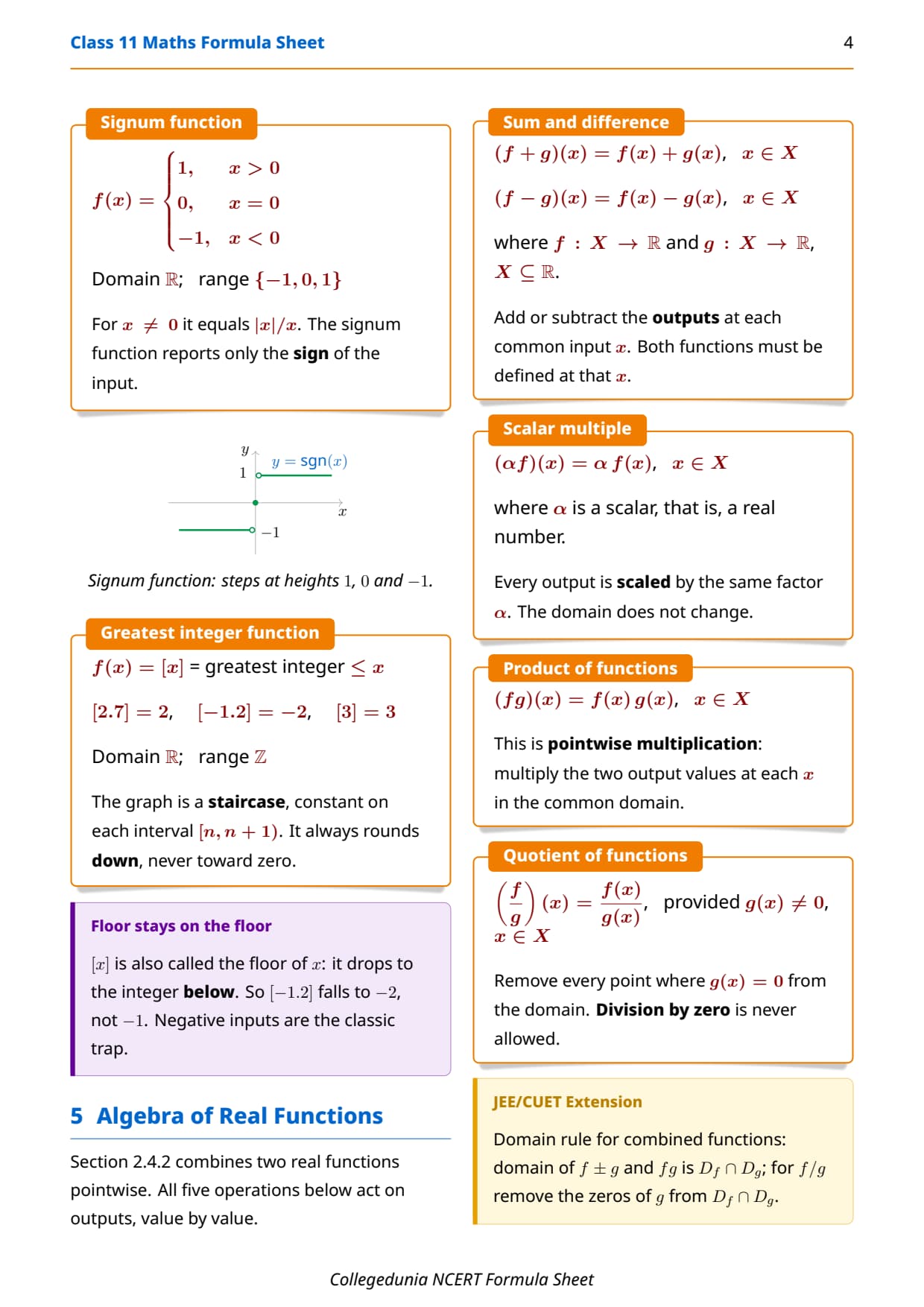
- Greatest integer rounds down: [2.7] = 2 but [−1.2] = −2, so negative inputs fall to the integer below, not toward zero.
Algebra of Real Functions
Section 2.4.2 combines two real functions value by value. The quotient rule is the one to watch, because it drops every point where the denominator is zero from the domain.
| Operation | Rule | Domain condition |
|---|---|---|
| Sum | (f + g)(x) = f(x) + g(x) | Df ∩ Dg |
| Difference | (f − g)(x) = f(x) − g(x) | Df ∩ Dg |
| Scalar multiple | (αf)(x) = α f(x) | same as Df (α real) |
| Product | (fg)(x) = f(x) g(x) | Df ∩ Dg |
| Quotient | (f/g)(x) = f(x)/g(x) | Df ∩ Dg, and g(x) ≠ 0 |
For entrance practice beyond the current NCERT syllabus, the number of functions from A to B is qp (with n(A) = p, n(B) = q). This count was removed from NCERT 2026-27 but still appears in JEE and CUET MCQs, so treat it as an extension rather than a Board formula.
How to Revise Relations and Functions Formulas Before the Exam
This chapter rewards clean definitions over heavy calculation. A short, ordered pass keeps relations, functions and their standard graphs from blurring together.
- Start with the pair-count n(A × B) = pq and the relation-count 2pq, since these are direct one-mark questions.
- Write the five standard functions with their domain and range, then sketch the modulus V and the greatest-integer staircase from memory.
- Practise the algebra of real functions, and always remove the zeros of g before writing the domain of f/g.
- Finish by checking one relation for the function test: every input must map to exactly one output.
Student Feedback on the Relations and Functions Formula Sheet
In a survey of 1,240 Class 11 students who used this sheet during revision, 76% said the single-page function table cut their revision time before unit tests, and 68% flagged the greatest integer function as the concept they most often misread. Toppers reported that writing the relation-count 2pq alongside a two-set example made it automatic by the Boards.
Other Relations and Functions Class 11 Maths Resources
Pair this formula sheet with the solved answers, notes and textbook PDF.
| Resource | Link |
|---|---|
| NCERT Solutions | Relations and Functions Class 11 NCERT Solutions |
| Revision Notes | Relations and Functions Class 11 Notes |
| Handwritten Notes | Relations and Functions Class 11 Handwritten Notes |
| NCERT Book PDF | Relations and Functions Class 11 Book PDF |
NCERT Formula Sheet for Class 11 Maths: All Chapters
Revise every chapter from one place. Each link opens the formula sheet for that chapter.
| Chapter | Formula Sheet |
|---|---|
| Chapter 1 | Sets |
| Chapter 2 | Relations and Functions |
| Chapter 3 | Trigonometric Functions |
| Chapter 4 | Complex Numbers and Quadratic Equations |
| Chapter 5 | Linear Inequalities |
| Chapter 6 | Permutations and Combinations |
| Chapter 7 | Binomial Theorem |
| Chapter 8 | Sequences and Series |
| Chapter 9 | Straight Lines |
| Chapter 10 | Conic Sections |
| Chapter 11 | Introduction to Three Dimensional Geometry |
| Chapter 12 | Limits and Derivatives |
| Chapter 13 | Statistics |
| Chapter 14 | Probability |
FAQs on Relations and Functions Class 11 Maths Formula Sheet
Relations and Functions Formula Sheet - Frequently Asked Questions
Ques. What formulas does the class 11 maths formula sheet chapter 2 relations and functions cover?
Ans. This class 11 maths formula sheet chapter 2 relations and functions covers the cartesian product A × B, ordered-pair equality, the pair-count n(A × B) = pq and relation-count 2pq, the five standard real functions with their domains and ranges, and the sum, difference, product and quotient rules for real functions.
Ques. How many relations are there from set A to set B?
Ans. A relation is any subset of A × B, and A × B has pq ordered pairs, so the number of relations is 2pq. This count includes the empty relation and the full set A × B itself.
Ques. What is the difference between a relation and a function?
Ans. A relation from A to B is any subset of A × B. A function f : A → B is a special relation in which every element of A has one and only one image in B. So {(2,2), (2,4), (3,3)} is a relation but not a function, since the input 2 has two images.
Ques. What is the domain of the quotient function f divided by g?
Ans. The quotient (f/g)(x) = f(x)/g(x) is defined on Df ∩ Dg, but you must remove every value of x for which g(x) = 0. Division by zero is never allowed, so those points are excluded from the domain.



Comments