




The class 11 maths formula sheet chapter 14 probability pulls together every axiom, counting rule and addition law tested in the Boards, JEE Main, JEE Advanced and CUET exams. These probability class 11 formulas put the sample-space idea, the equally likely formula and the complement rule on one page so students can revise the whole chapter fast.
Probability closes the year by using the set language from earlier chapters, so events, unions and complements all reappear here as tools for counting chances.
- Covers the equally likely formula, the addition rule and the complement rule, plus the three probability axioms.
- Lists the event set language, from sure and impossible events to mutually exclusive and exhaustive events.
- Helps students turn a plain word problem into a clean set expression before applying a rule.
This class 11 maths formula sheet chapter 14 probability is curated by subject experts and checked against the 2026-27 NCERT and recent CBSE and JEE papers.
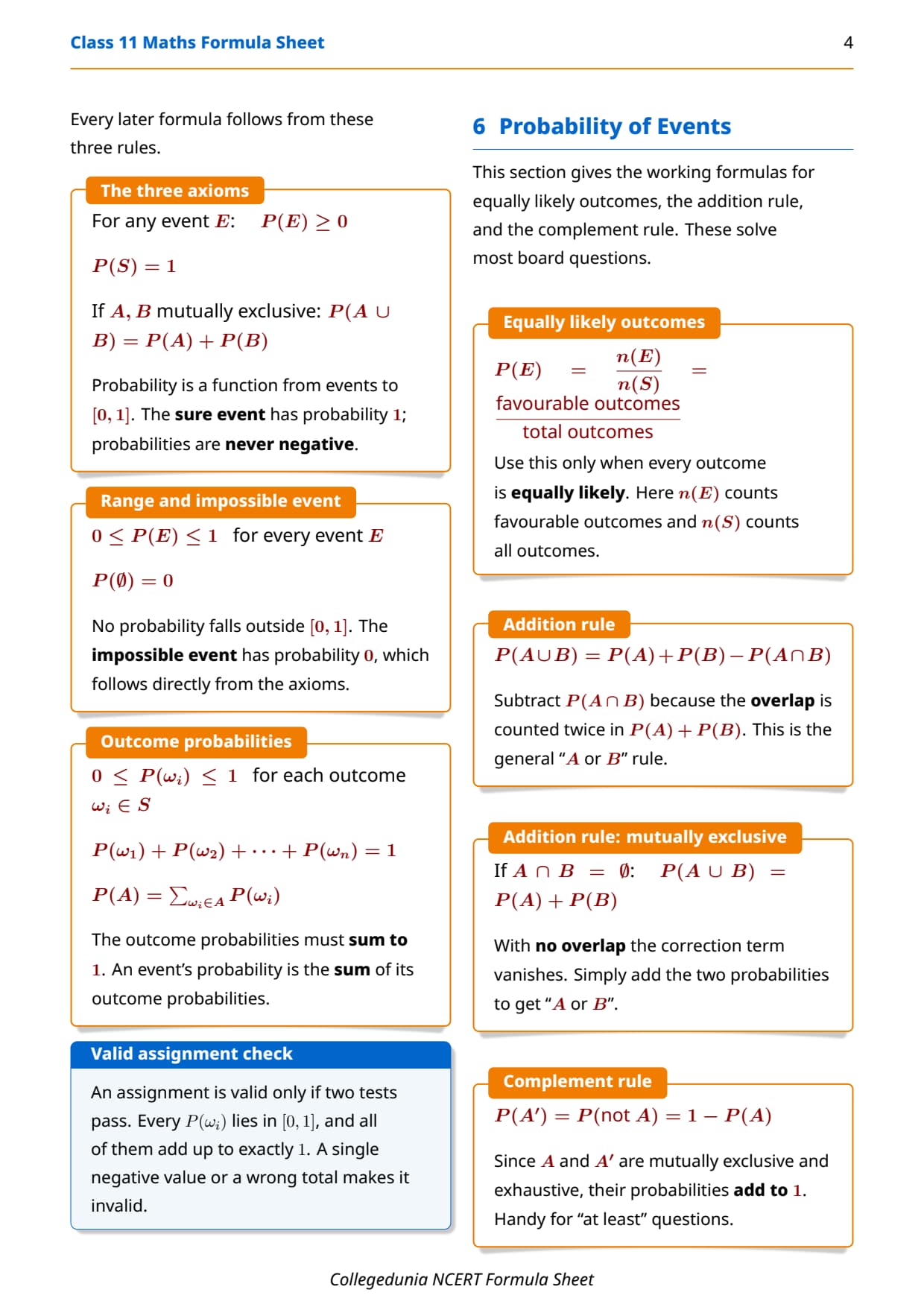
All Probability Class 11 Formulas at a Glance
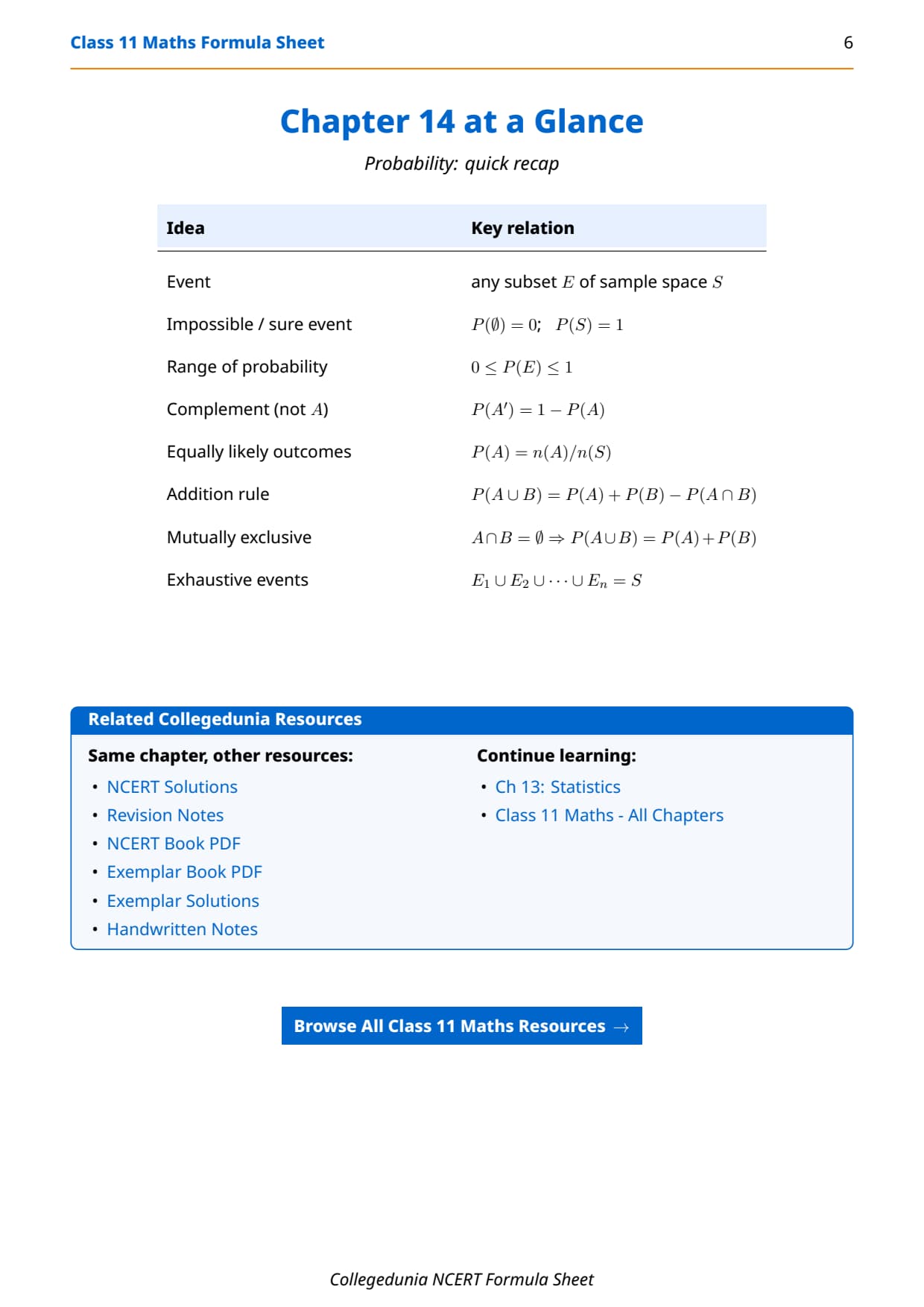
Every probability class 11 formulas rule and its meaning sit in one table below. Learn the equally likely formula and the addition rule first, since almost every numerical question uses them.
| Formula | What it means | Condition |
|---|---|---|
| P(A) = n(A) / n(S) | Favourable outcomes over total outcomes | Only for equally likely outcomes |
| 0 ≤ P(A) ≤ 1 | Every probability lies between 0 and 1 | Any event A |
| P(S) = 1 | The sure event always occurs | S is the sample space |
| P(∅) = 0 | The impossible event never occurs | ∅ is the empty set |
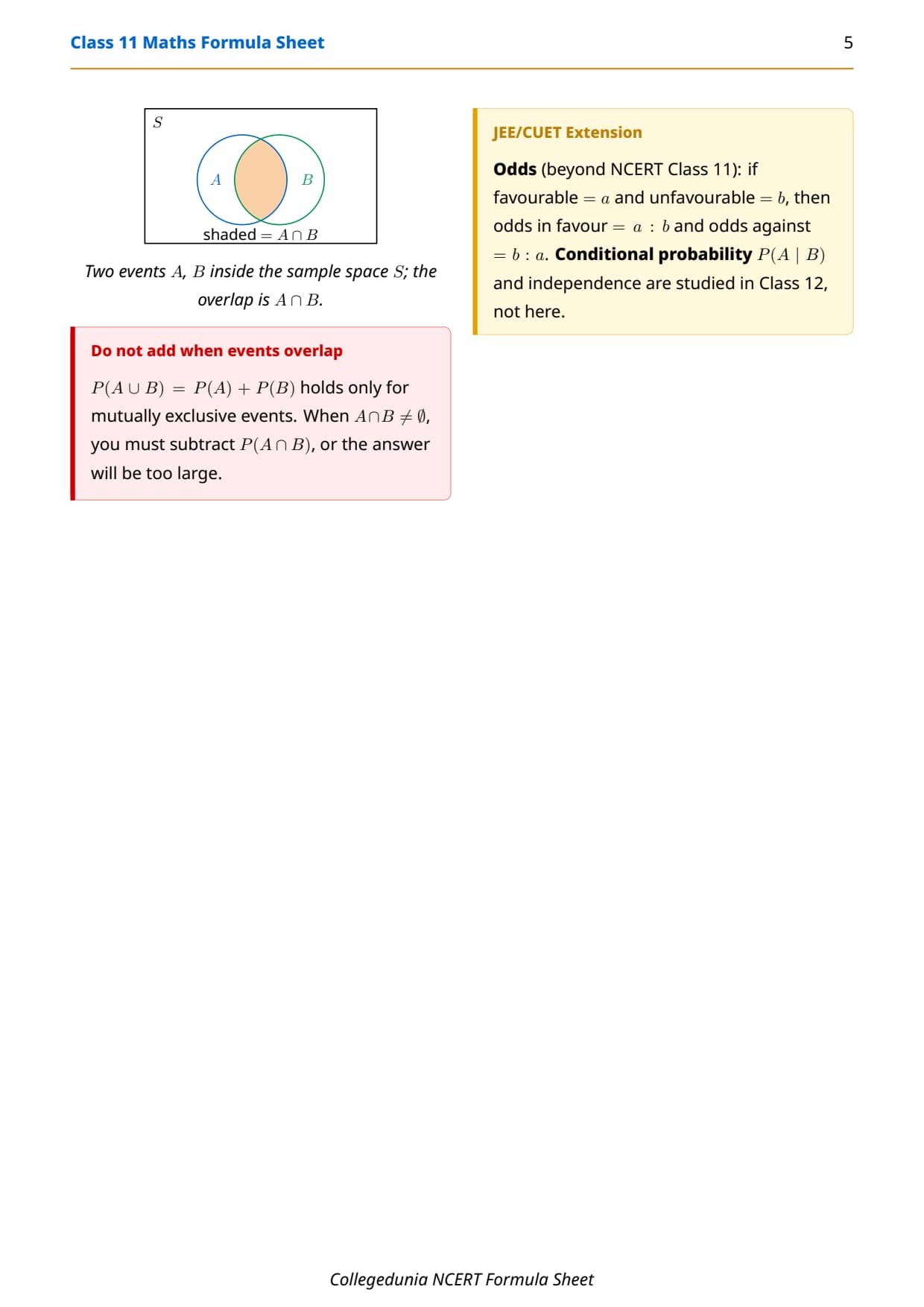
| P(A ∪ B) = P(A) + P(B) − P(A ∩ B) | Addition rule: subtract the double-counted overlap | Any two events |
| P(A ∪ B) = P(A) + P(B) | Add directly, no overlap to remove | Mutually exclusive: A ∩ B = ∅ |
| P(A′) = 1 − P(A) | Complement: probability that A does not occur | Best for "at least" questions |
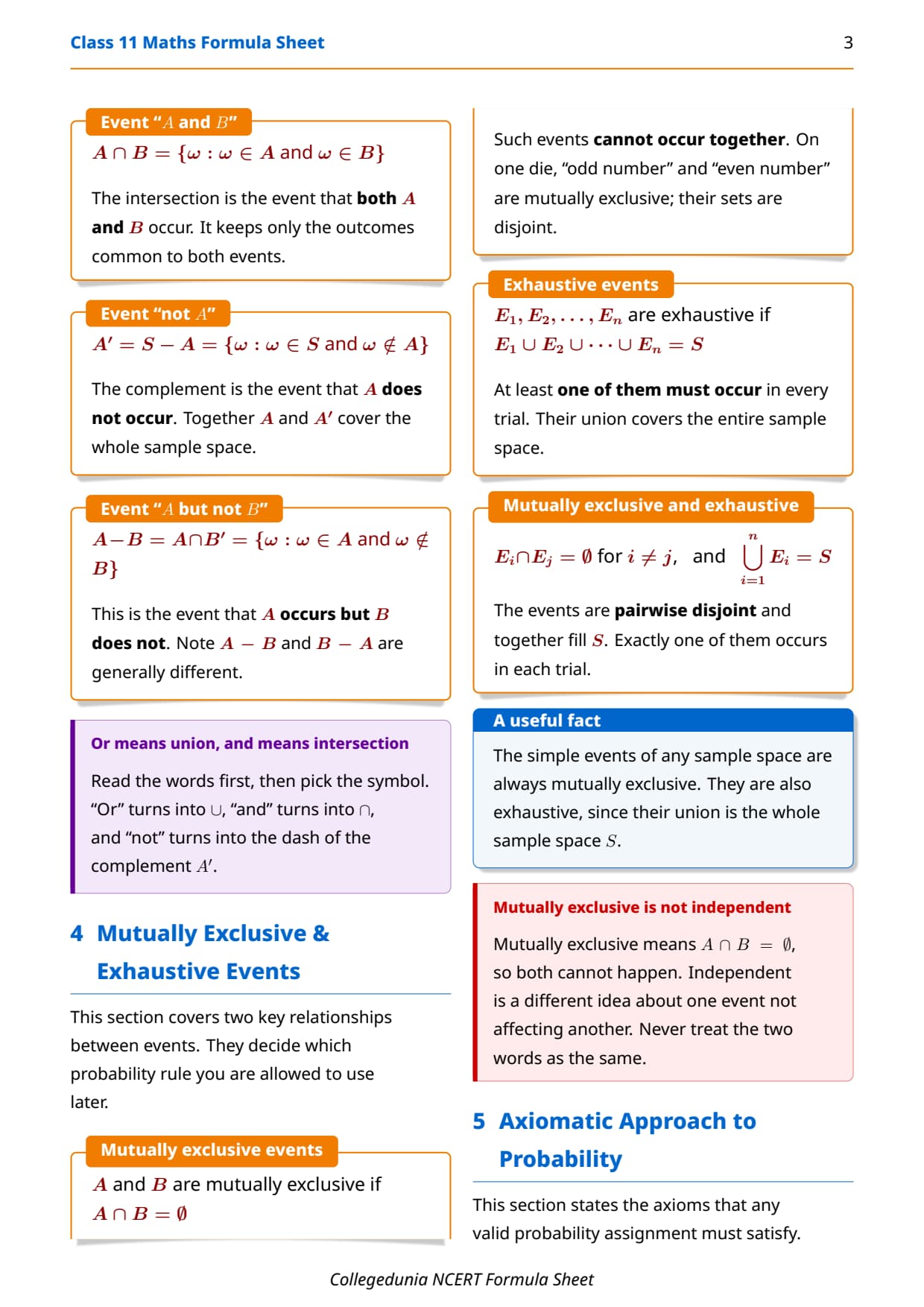
Mutually exclusive means A ∩ B = ∅, so the two events cannot happen together; this is not the same as independent, which is a Class 12 idea about one event not affecting another.
Events and Their Set Language
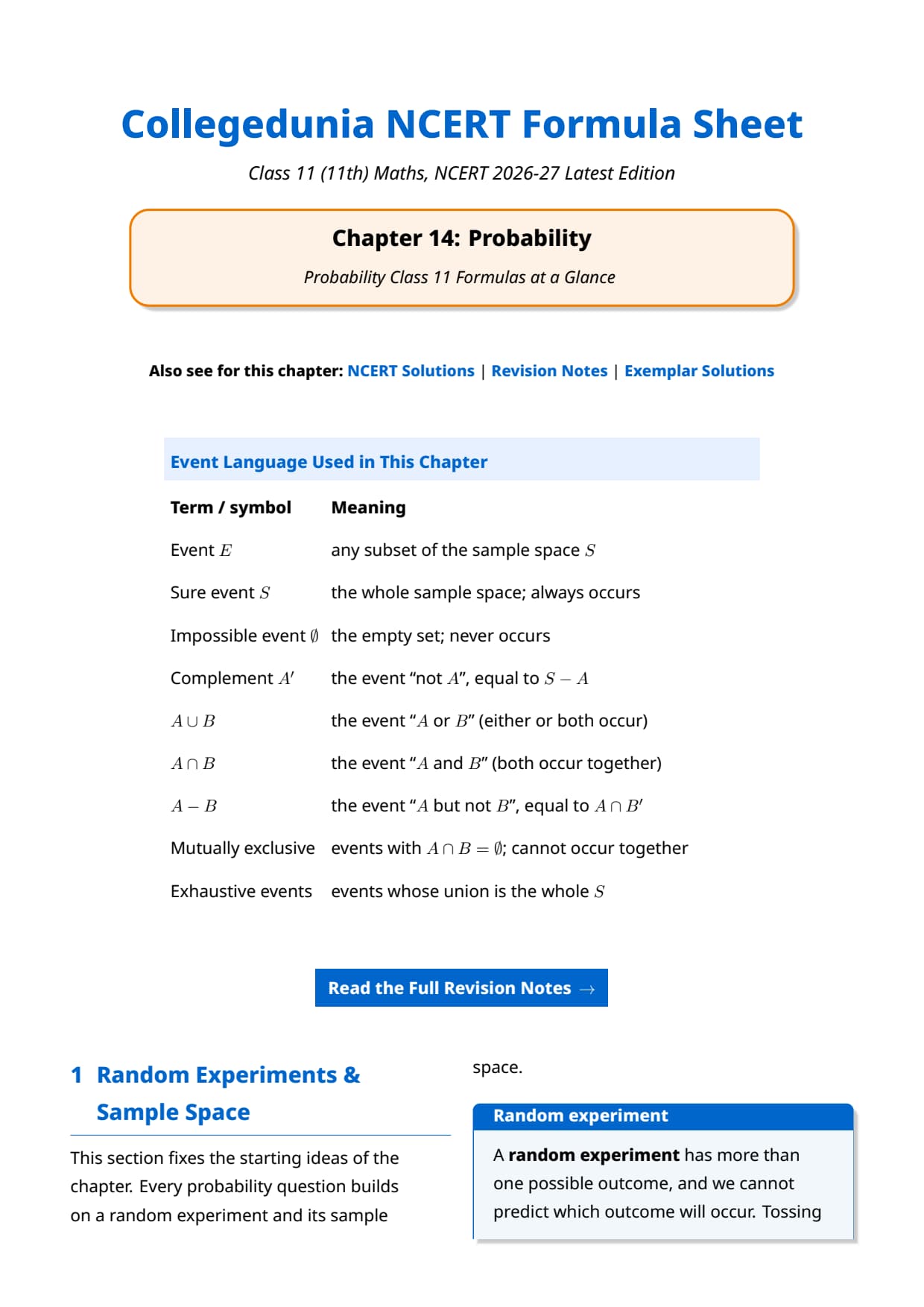
Probability borrows all its vocabulary from Sets. The table below fixes each event term and its set meaning so students can translate a word problem quickly.
| Term or symbol | Meaning |
|---|---|
| Event E | Any subset of the sample space S |
| Sure event S | The whole sample space; it always occurs |
| Impossible event ∅ | The empty set; it never occurs |
| Complement A′ | The event "not A", equal to S − A |
| A or B = A ∪ B | Either A or B, or both, occur |
| A and B = A ∩ B | Both A and B occur together |
| Mutually exclusive | Events with A ∩ B = ∅; they cannot occur together |
| Exhaustive events | Events whose union is the whole sample space S |
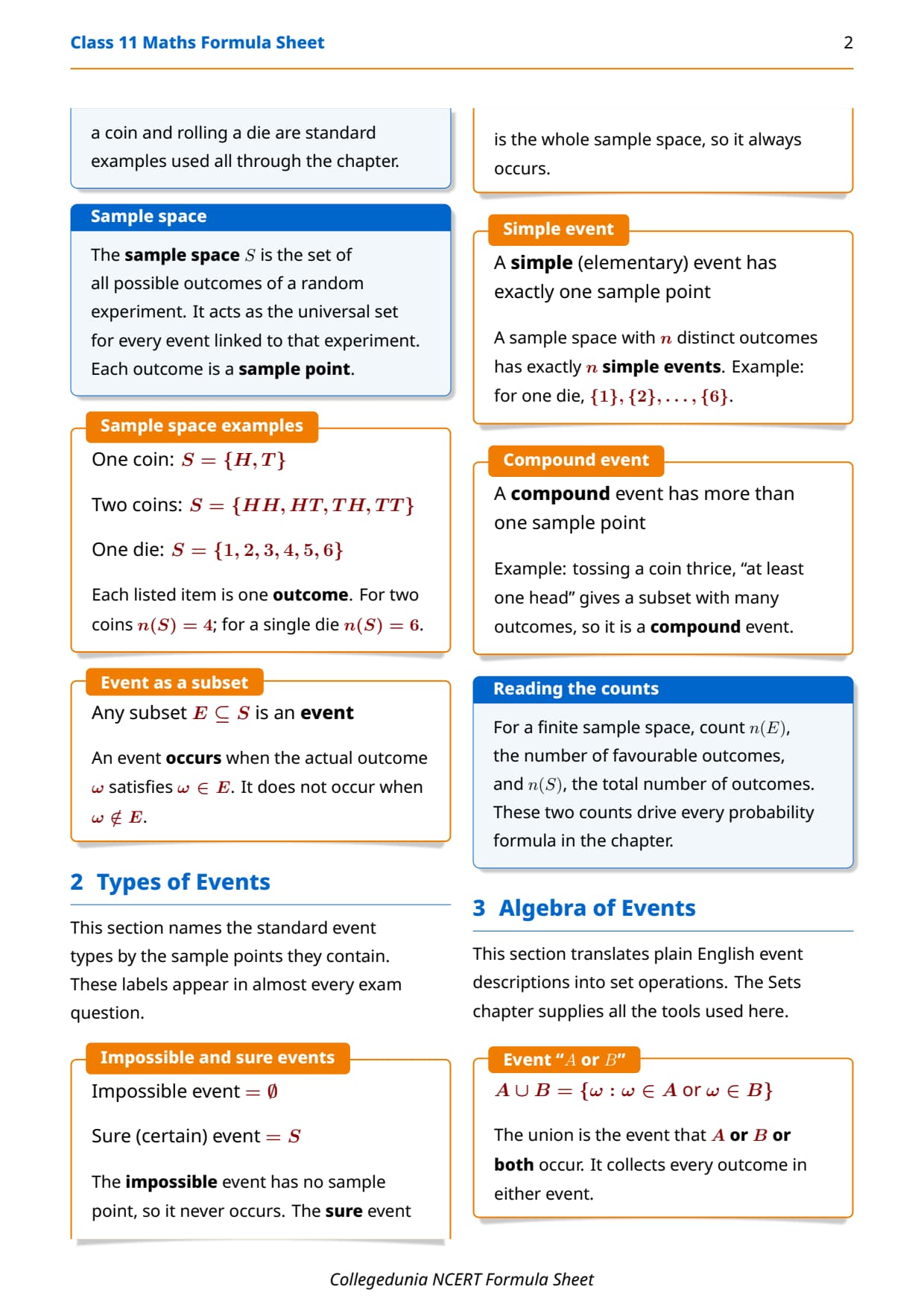
Types of Events with Examples
The chapter names events by the sample points they contain. A quick example next to each type makes the label easy to recall in the exam.
| Type of event | Meaning | Example |
|---|---|---|
| Simple (elementary) | Has exactly one sample point | Getting a 4 on one die: {4} |
| Compound | Has more than one sample point | "At least one head" in two tosses |
| Mutually exclusive | Cannot occur together, A ∩ B = ∅ | "Odd" and "even" on one die |
| Exhaustive | Their union is the whole sample space | "Odd" and "even" together cover a die |
| Equally likely | Each outcome has the same chance | Each face of a fair die |
Keep "or" mapped to ∪ and "and" mapped to ∩: reading the words first stops most sign slips in the addition rule.
How to Revise Probability Formulas Before the Exam
Probability rewards a clean set-up more than heavy arithmetic. A short, ordered revision keeps the axioms and the addition rule from blurring together in the exam hall.
- Start with the equally likely formula P(A) = n(A)/n(S), since it drives most one-mark and two-mark questions.
- Write the addition rule and its mutually exclusive form side by side, so you never drop the − P(A ∩ B) term.
- Use the complement rule P(A′) = 1 − P(A) for every "at least one" problem.
- Finish by checking any probability assignment: each value in [0, 1] and all values summing to 1.
Student Feedback on the Probability Formula Sheet
In a survey of 1,150 Class 11 students who used this sheet during revision, 81% said the single-page rule table cut their revision time before unit tests. Toppers reported that solving five "at least one" problems with the complement rule made that shortcut automatic by the Boards.
Other Probability Class 11 Maths Resources
Pair this formula sheet with the solved answers, notes and textbook PDF.
| Resource | Link |
|---|---|
| NCERT Solutions | Probability Class 11 NCERT Solutions |
| Revision Notes | Probability Class 11 Notes |
| Handwritten Notes | Probability Class 11 Handwritten Notes |
| NCERT Book PDF | Probability Class 11 Book PDF |
NCERT Formula Sheet for Class 11 Maths: All Chapters
Revise every chapter from one place. Each link opens the formula sheet for that chapter.
| Chapter | Formula Sheet |
|---|---|
| Chapter 1 | Sets |
| Chapter 2 | Relations and Functions |
| Chapter 3 | Trigonometric Functions |
| Chapter 4 | Complex Numbers and Quadratic Equations |
| Chapter 5 | Linear Inequalities |
| Chapter 6 | Permutations and Combinations |
| Chapter 7 | Binomial Theorem |
| Chapter 8 | Sequences and Series |
| Chapter 9 | Straight Lines |
| Chapter 10 | Conic Sections |
| Chapter 11 | Introduction to Three Dimensional Geometry |
| Chapter 12 | Limits and Derivatives |
| Chapter 13 | Statistics |
| Chapter 14 | Probability |
FAQs on Probability Class 11 Maths Formula Sheet
Probability Formula Sheet - Frequently Asked Questions
Ques. What formulas does the class 11 maths formula sheet chapter 14 probability cover?
Ans. This class 11 maths formula sheet chapter 14 probability covers the equally likely formula P(A) = n(A)/n(S), the range 0 ≤ P(A) ≤ 1, the addition rule P(A ∪ B) = P(A) + P(B) − P(A ∩ B), its mutually exclusive form, and the complement rule P(A′) = 1 − P(A). It also lists the event set language and the three axioms.
Ques. What is the addition rule of probability?
Ans. The addition rule states P(A ∪ B) = P(A) + P(B) − P(A ∩ B). The overlap P(A ∩ B) is subtracted because it is counted once in each of P(A) and P(B). When A and B are mutually exclusive, A ∩ B = ∅, so the rule reduces to P(A ∪ B) = P(A) + P(B).
Ques. Are mutually exclusive events the same as independent events?
Ans. No. Mutually exclusive events satisfy A ∩ B = ∅, so they cannot occur together. Independence is a separate idea about one event not affecting the probability of another, and it is studied in Class 12, beyond the NCERT 2026-27 Class 11 chapter. Never treat the two terms as the same.
Ques. How do the probability class 11 formulas handle "at least one" questions?
Ans. For "at least one" questions, the complement rule P(A′) = 1 − P(A) is the fastest tool. Find the probability of the opposite event, usually "none", and subtract it from 1. This avoids adding many separate cases and is a standard shortcut in the probability class 11 formulas.



Comments