




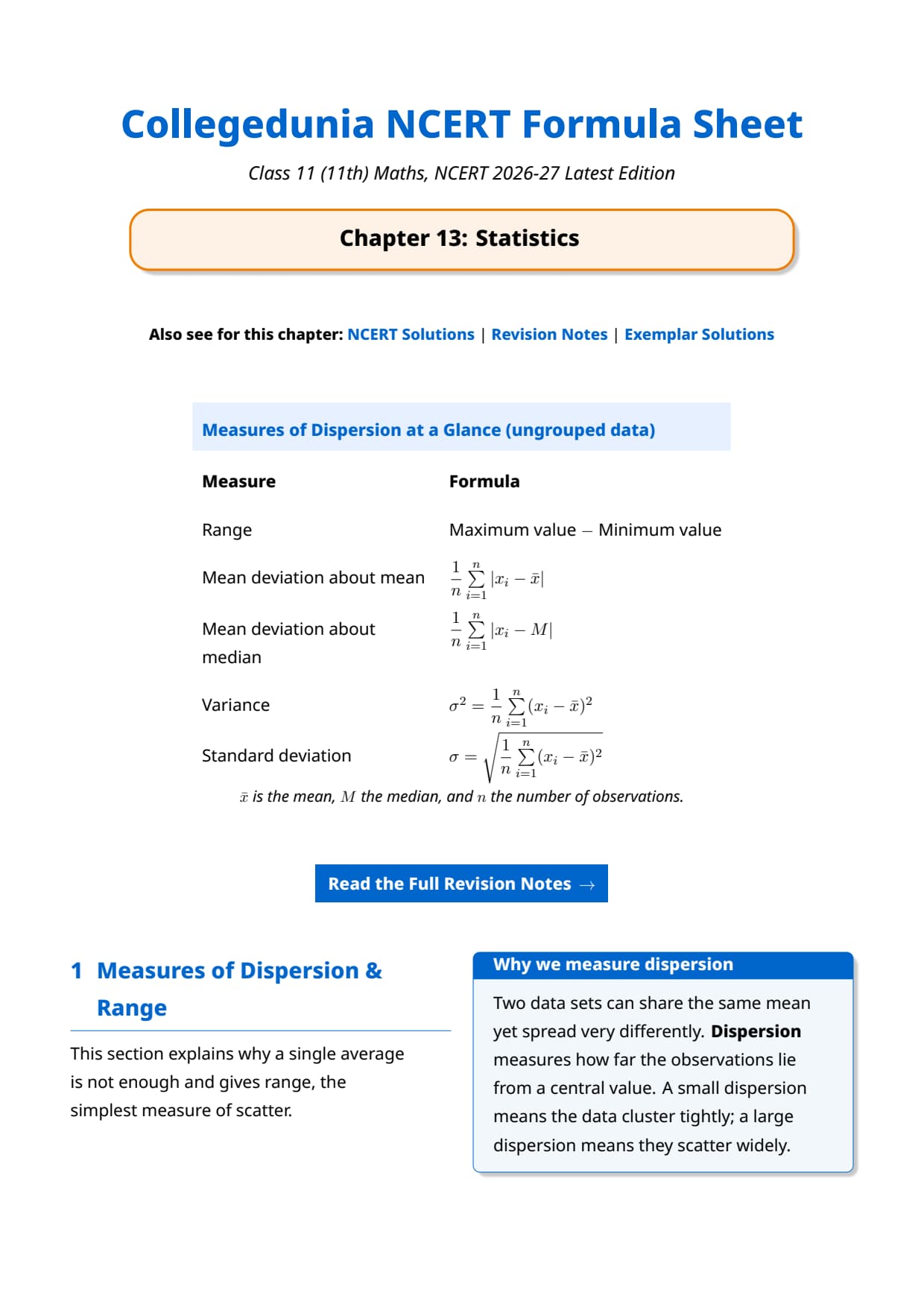
The class 11 maths formula sheet chapter 13 statistics gathers every measure of dispersion tested in the Boards, JEE Main, JEE Advanced and CUET exams. It lists range, mean deviation, variance and standard deviation so students can revise the whole chapter fast.
Statistics closes the Class 11 course, and these dispersion measures carry straight into probability and higher-level data analysis, so keeping the statistics class 11 formulas in one place saves real revision time.
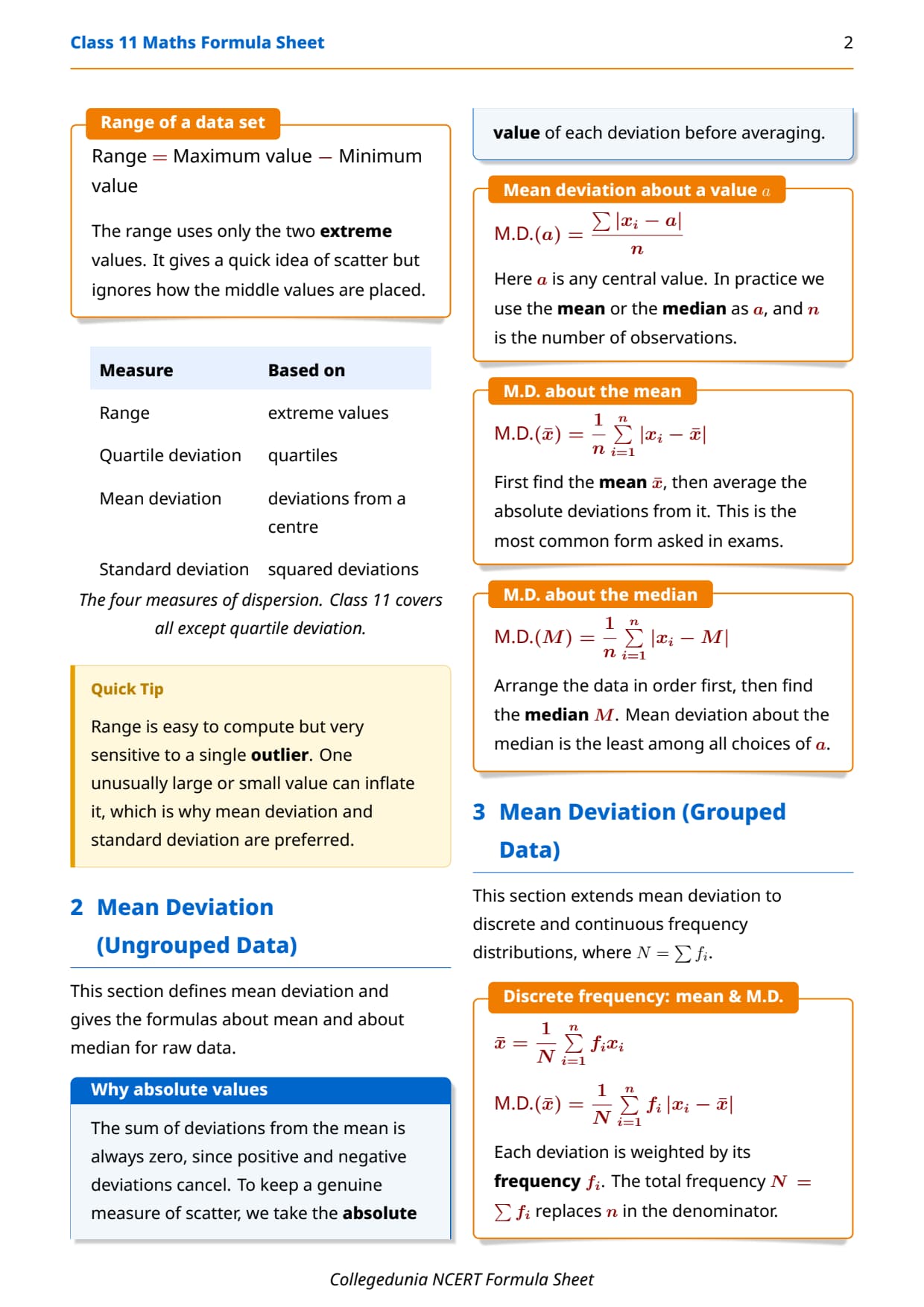
- Covers range, mean deviation about mean and median, for both raw and grouped data.
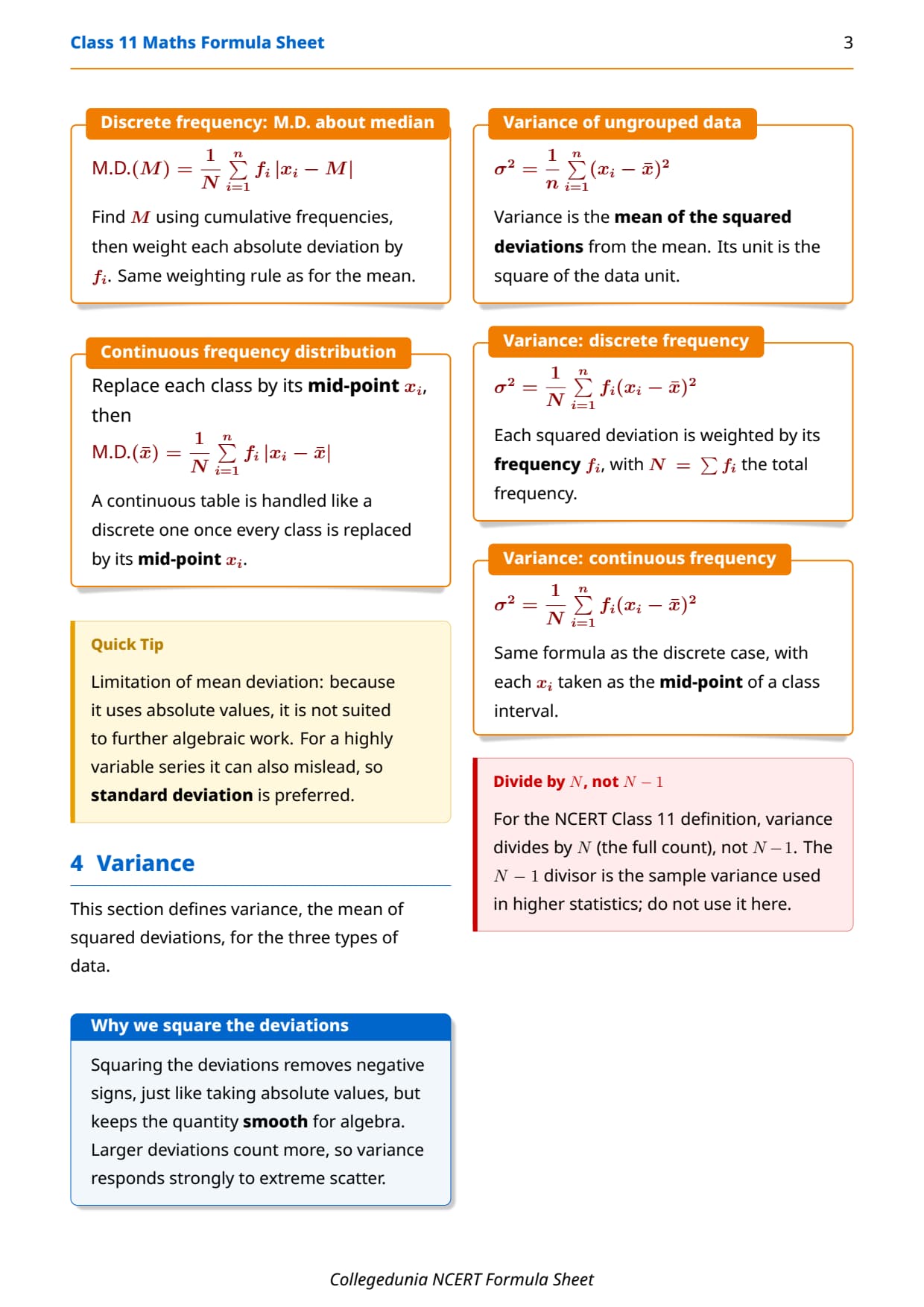
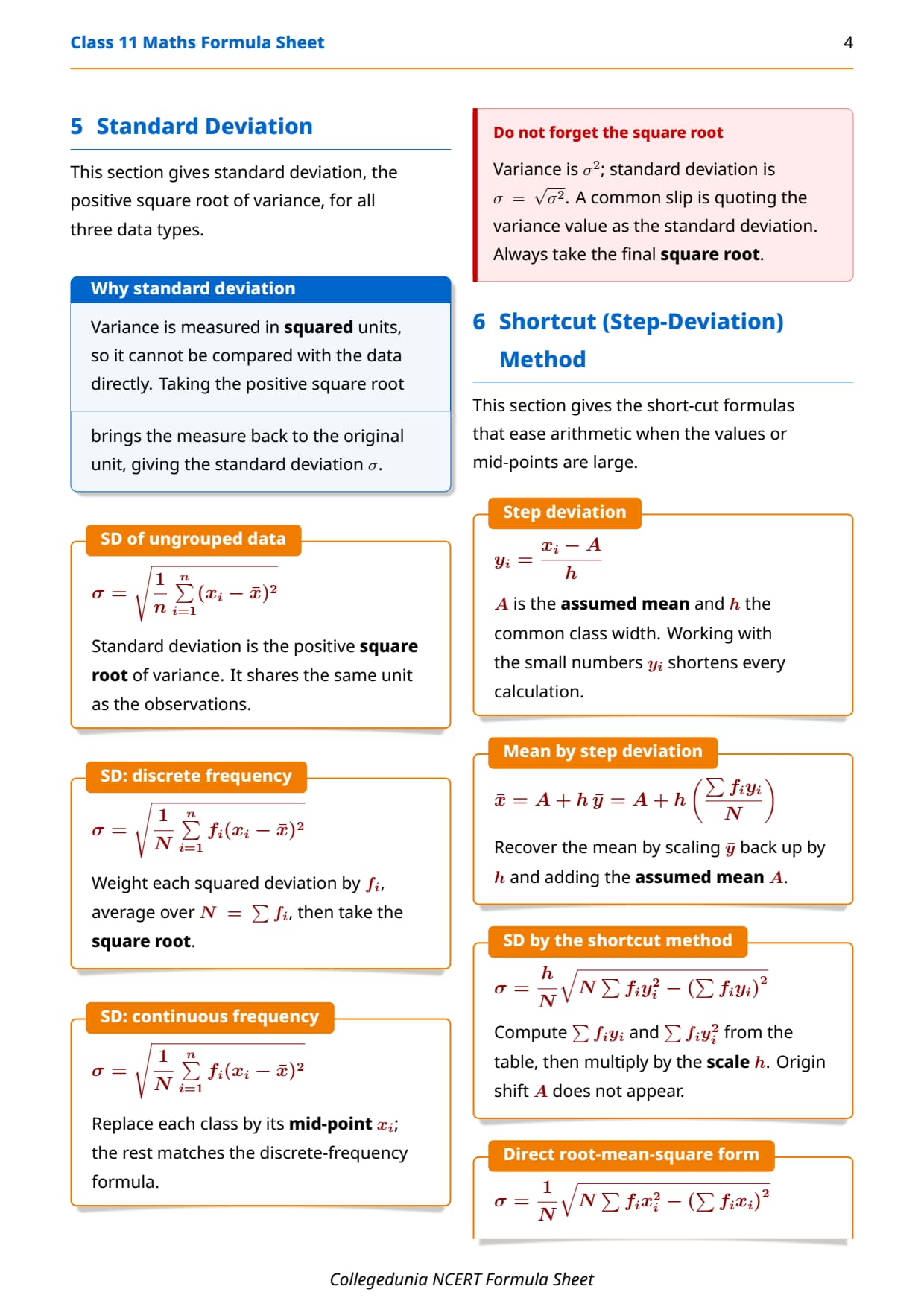
- Lists the variance and standard deviation formulas, plus the quick step-deviation shortcut.
- Helps students separate variance from standard deviation without mixing the two up.
This class 11 maths formula sheet chapter 13 statistics is curated by subject experts and checked against the 2026-27 NCERT and recent CBSE and JEE papers.
All Statistics Formulas at a Glance
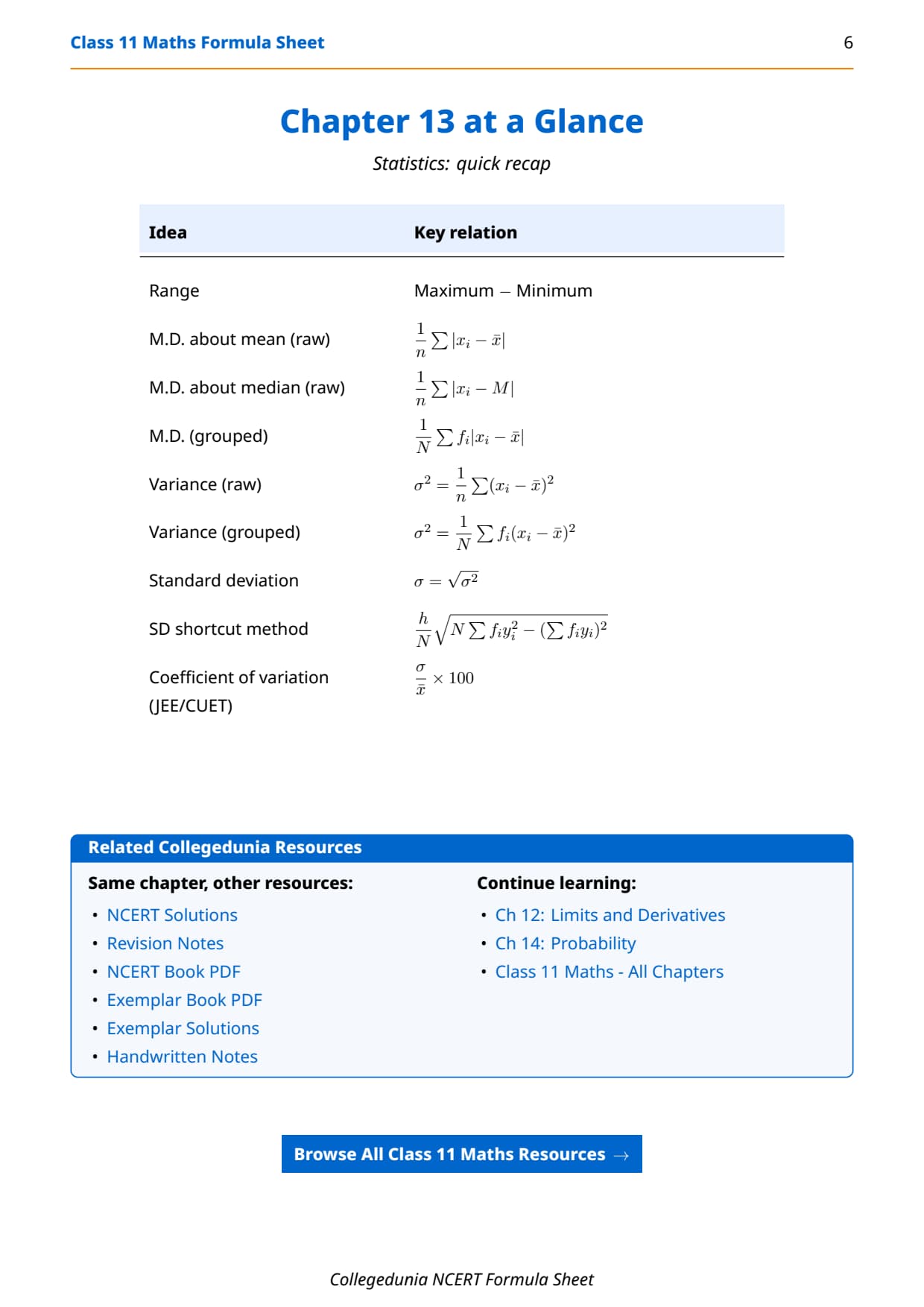
Every measure of dispersion and its meaning sits in one table below. Learn the variance and standard deviation rows first, since almost every objective question builds on them.
| Formula | What it means | Condition |
|---|---|---|
| Range = Maximum − Minimum | Spread between the two extreme values | Uses only the largest and smallest value |
| M.D.(x̄) = 1⁄N Σ f|x − x̄| | Mean deviation about the mean | x̄ is the mean, N = Σf |
| M.D.(M) = 1⁄N Σ f|x − M| | Mean deviation about the median | M is the median; least among all centres |
| σ2 = variance | Mean of the squared deviations from the mean | Unit is the square of the data unit |
| σ = √variance | Standard deviation, back in the data unit | Always the positive square root |
Range uses only the extreme values, so a single outlier can inflate it, which is why standard deviation is the preferred measure.
Variance and Standard Deviation Formulas
These are the core formulas of the chapter. Variance is the mean of squared deviations, and standard deviation is its positive square root, for raw and grouped data alike.
| Case | Formula |
|---|---|
| Variance (ungrouped) | σ2 = 1⁄n Σ(x − x̄)2 |
| Variance (discrete / continuous) | σ2 = 1⁄N Σ f(x − x̄)2, N = Σf |
| Standard deviation | σ = √variance (positive root) |
| Step-deviation SD | σ = h⁄N √(N Σf y2 − (Σf y)2) |
| Step deviation | y = (x − a) ⁄ h, with a the assumed mean, h the class width |
Coefficient of Variation (JEE and CUET)
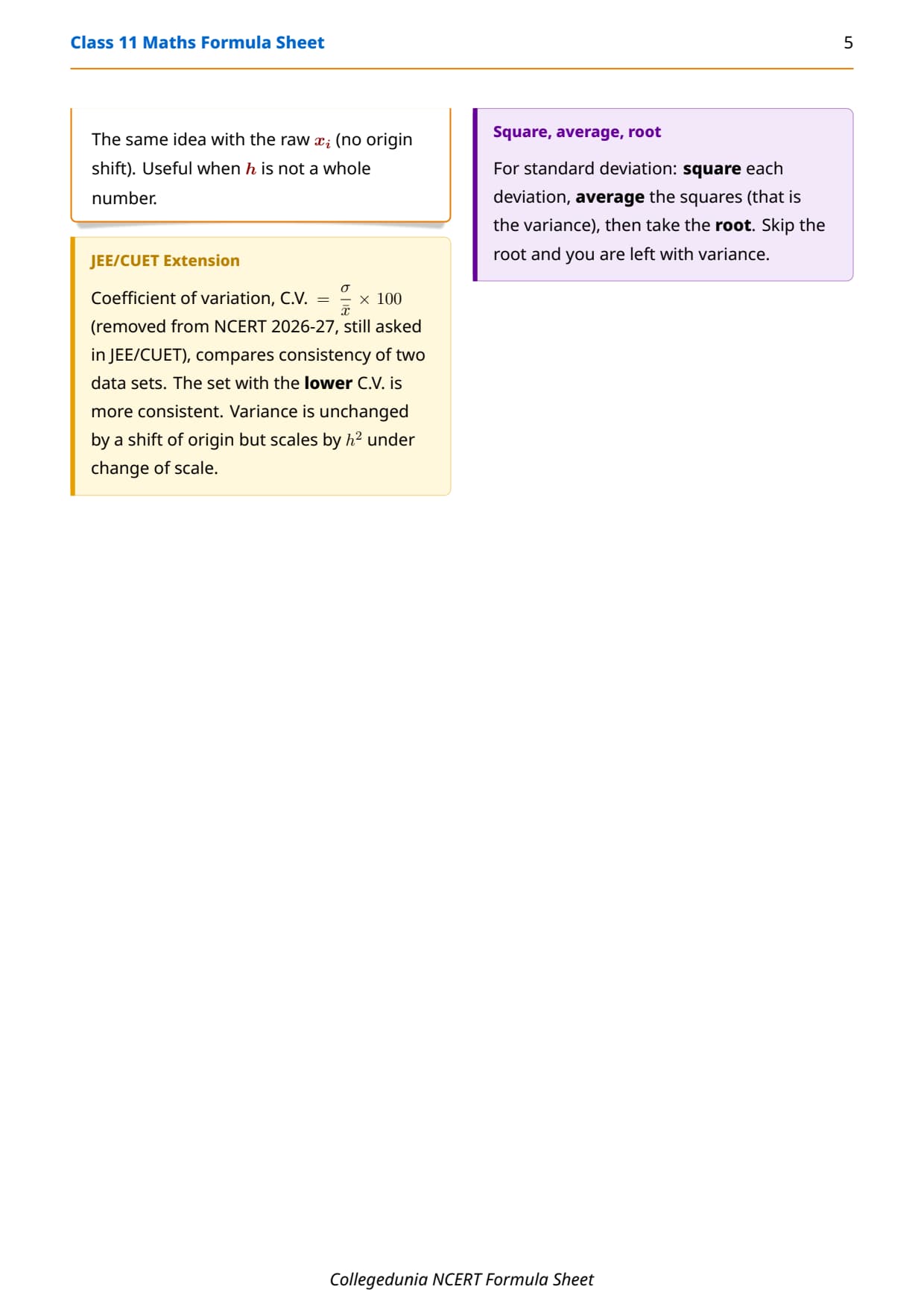
The coefficient of variation compares the spread of two data sets on a common scale. The set with the smaller CV is more consistent, so it is a favourite tool for comparison questions.
| Quantity | Formula / Rule |
|---|---|
| Coefficient of variation | C.V. = (σ ⁄ x̄) × 100 |
| More consistent series | The data set with the smaller CV |
| Effect of change of scale | Variance scales by h2; a shift of origin leaves it unchanged |
The coefficient of variation and the comparing-distributions topic were trimmed from the NCERT 2026-27 syllabus, but they stay relevant for JEE and CUET, so students aiming at those exams should still keep this formula ready.
Standard deviation is the square root of variance, so σ = √σ2; never quote the variance value as the standard deviation.
How to Revise Statistics Formulas Before the Exam
Statistics rewards clean bookkeeping more than clever tricks. A short, ordered revision keeps the dispersion measures from blurring together in the exam hall.
- Start with range and mean deviation, since they are quick one or two-mark questions.
- Write the variance and standard deviation formulas for raw and grouped data from memory.
- Practise the step-deviation shortcut once, so large mid-points no longer slow you down.
- Finish with the coefficient of variation for JEE and CUET, remembering that a lower CV means more consistency.
Student Feedback on the Statistics Formula Sheet
In a survey of 1,050 Class 11 students who used this sheet during revision, 81% said the single-page dispersion table cut their revision time before unit tests. Toppers reported that writing the variance and standard deviation formulas twice a week made them automatic by the Boards.
Other Statistics Class 11 Maths Resources
Pair this formula sheet with the solved answers, notes and textbook PDF.
| Resource | Link |
|---|---|
| NCERT Solutions | Statistics Class 11 NCERT Solutions |
| Revision Notes | Statistics Class 11 Notes |
| Handwritten Notes | Statistics Class 11 Handwritten Notes |
| NCERT Book PDF | Statistics Class 11 Book PDF |
NCERT Formula Sheet for Class 11 Maths: All Chapters
Revise every chapter from one place. Each link opens the formula sheet for that chapter.
| Chapter | Formula Sheet |
|---|---|
| Chapter 1 | Sets |
| Chapter 2 | Relations and Functions |
| Chapter 3 | Trigonometric Functions |
| Chapter 4 | Complex Numbers and Quadratic Equations |
| Chapter 5 | Linear Inequalities |
| Chapter 6 | Permutations and Combinations |
| Chapter 7 | Binomial Theorem |
| Chapter 8 | Sequences and Series |
| Chapter 9 | Straight Lines |
| Chapter 10 | Conic Sections |
| Chapter 11 | Introduction to Three Dimensional Geometry |
| Chapter 12 | Limits and Derivatives |
| Chapter 13 | Statistics |
| Chapter 14 | Probability |
FAQs on Statistics Class 11 Maths Formula Sheet
Statistics Formula Sheet - Frequently Asked Questions
Ques. What formulas does the class 11 maths formula sheet chapter 13 statistics cover?
Ans. This class 11 maths formula sheet chapter 13 statistics covers range, mean deviation about the mean and median, variance and standard deviation for raw and grouped data, the step-deviation shortcut and the coefficient of variation for JEE and CUET.
Ques. What is the difference between variance and standard deviation?
Ans. Variance σ2 is the mean of the squared deviations from the mean, so its unit is the square of the data unit. Standard deviation σ = √σ2 is the positive square root, which brings the measure back to the original unit.
Ques. How is mean deviation about the mean calculated for grouped data?
Ans. For grouped data, mean deviation about the mean is M.D.(x̄) = 1⁄N Σ f|x − x̄|, where N = Σf is the total frequency. For a continuous table, each class is first replaced by its mid-point x.
Ques. Is the coefficient of variation still in the Class 11 syllabus?
Ans. The coefficient of variation C.V. = (σ ⁄ x̄) × 100 was removed from the NCERT 2026-27 syllabus, yet it stays relevant for JEE and CUET. A smaller CV means a more consistent data set, so it remains useful for comparing distributions.



Comments