




The class 11 maths formula sheet chapter 11 introduction to three dimensional geometry gathers every coordinate rule, octant sign pattern and distance formula tested in the Boards, JEE Main, JEE Advanced and CUET exams. It lays out the three dimensional geometry class 11 formulas so students can locate a point, read its octant and measure any distance in space at a glance.
This chapter extends plane coordinates to space, so its axes, planes and distance rule feed straight into vectors and 3D geometry in Class 12.
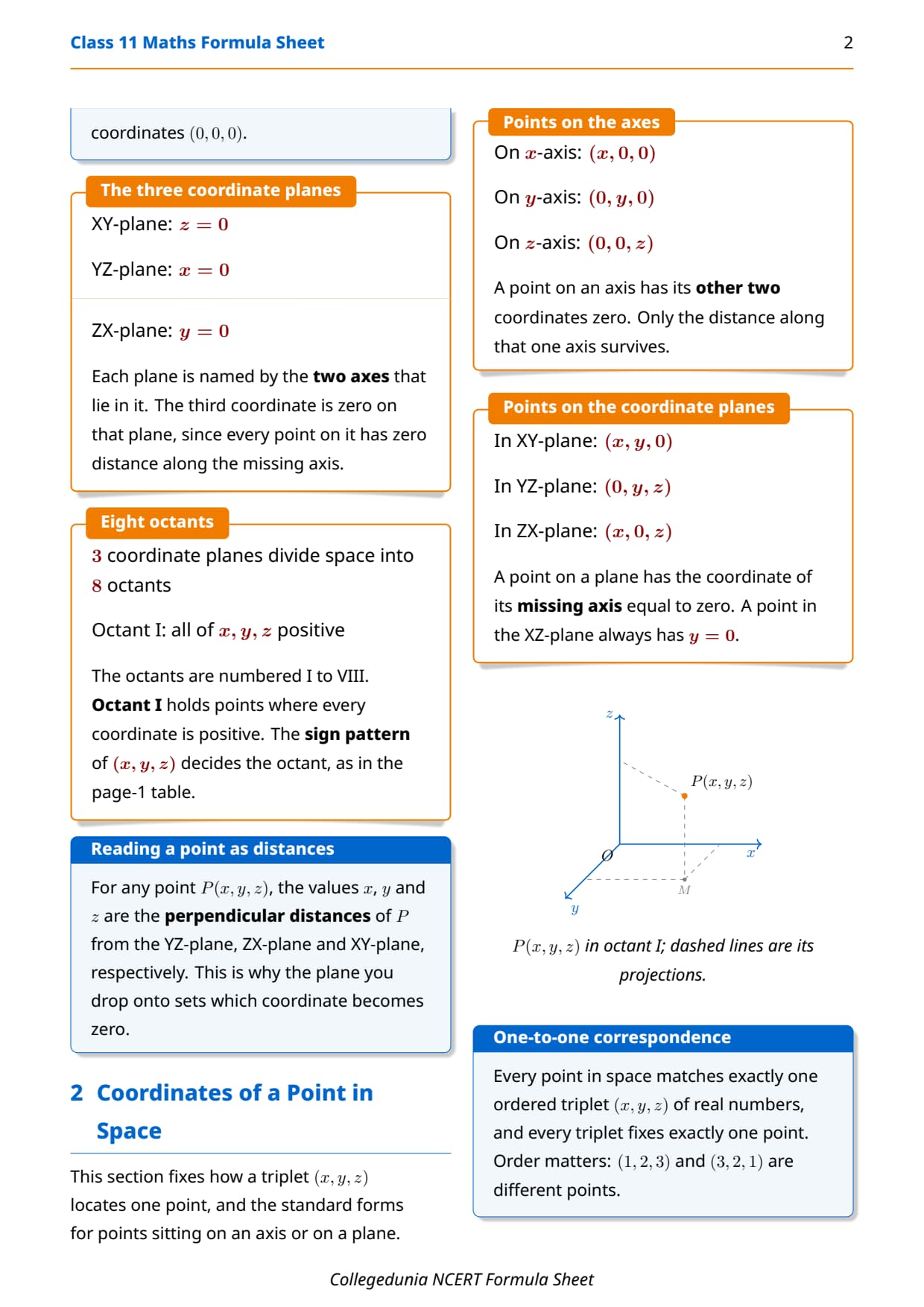
- Covers the three coordinate planes, the eight octants and their sign patterns, plus how a triplet locates one point.
- Lists the distance formula and distance from the origin, the core results of the chapter.
- Adds the section formula, midpoint and centroid that JEE and CUET still ask, even after the NCERT trim.
This class 11 maths formula sheet chapter 11 introduction to three dimensional geometry is curated by subject experts and checked against the 2026-27 NCERT and recent CBSE and JEE papers.
All Three Dimensional Geometry Formulas at a Glance
Every coordinate rule and distance result sits in one table below, with its meaning. Learn the distance-formula row first, since almost every objective question in this chapter uses it.
| Formula | What it means | Condition |
|---|---|---|
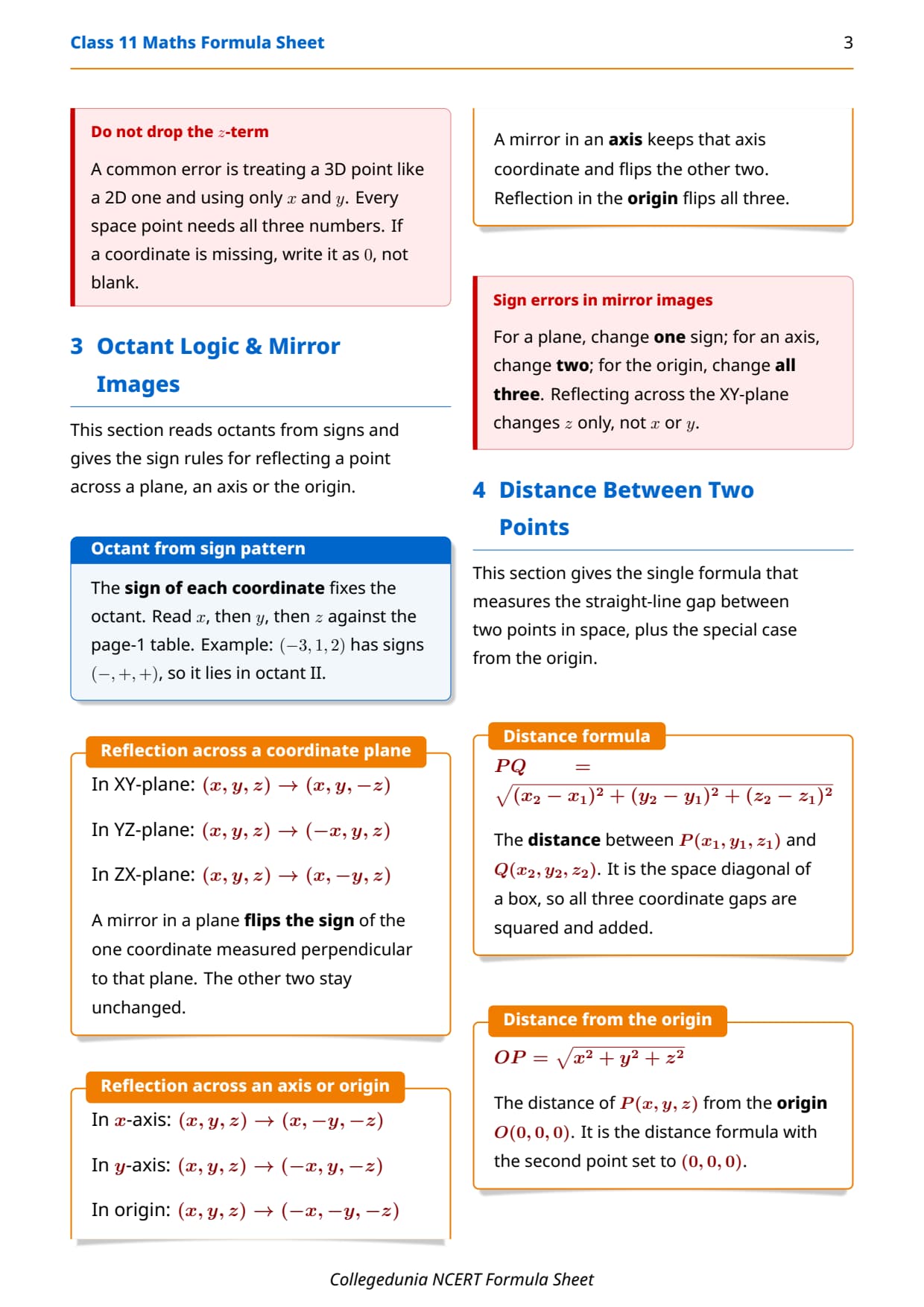
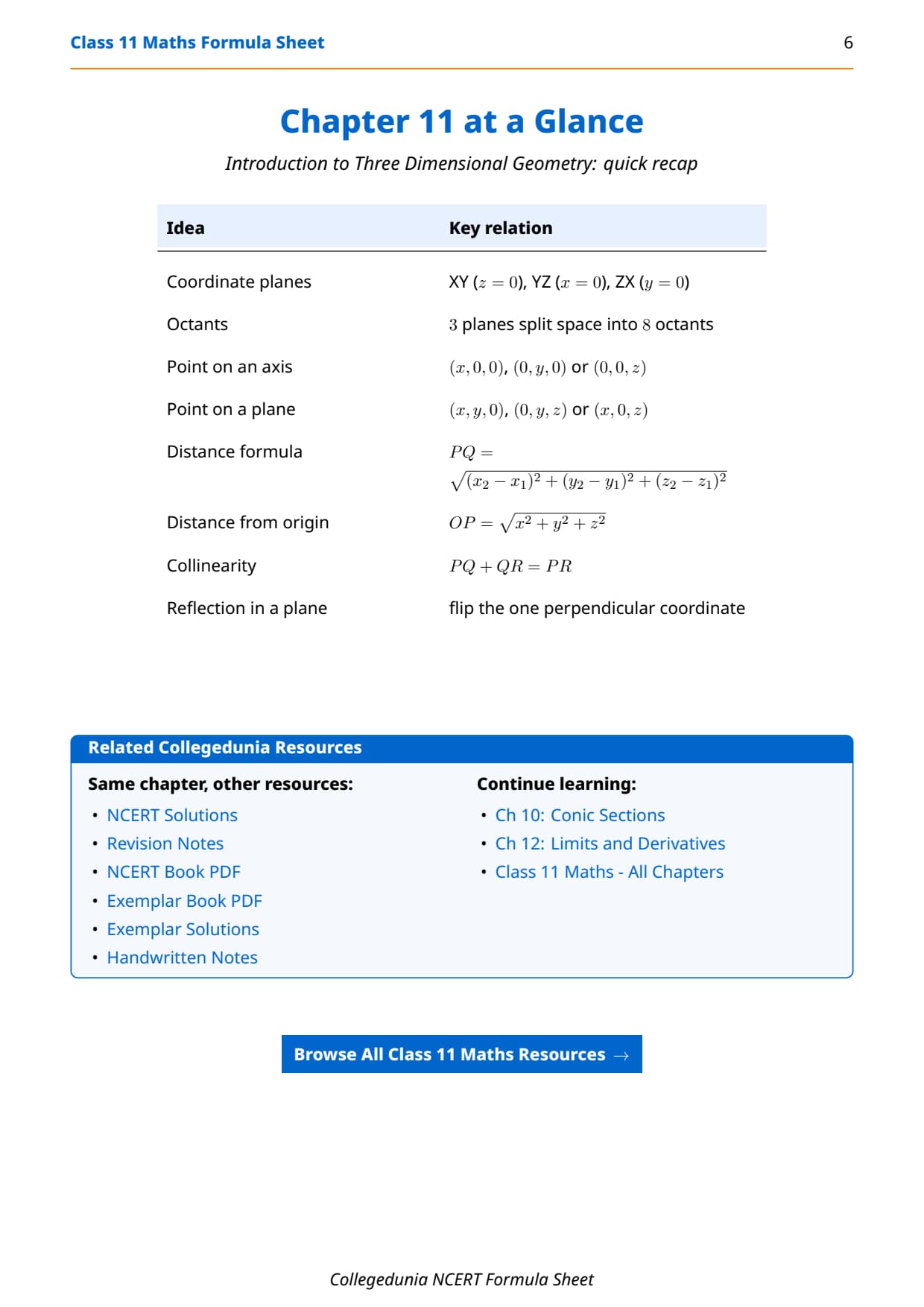
| PQ = √((x2−x1)2 + (y2−y1)2 + (z2−z1)2) | Distance between two points in space | P(x1,y1,z1), Q(x2,y2,z2) |
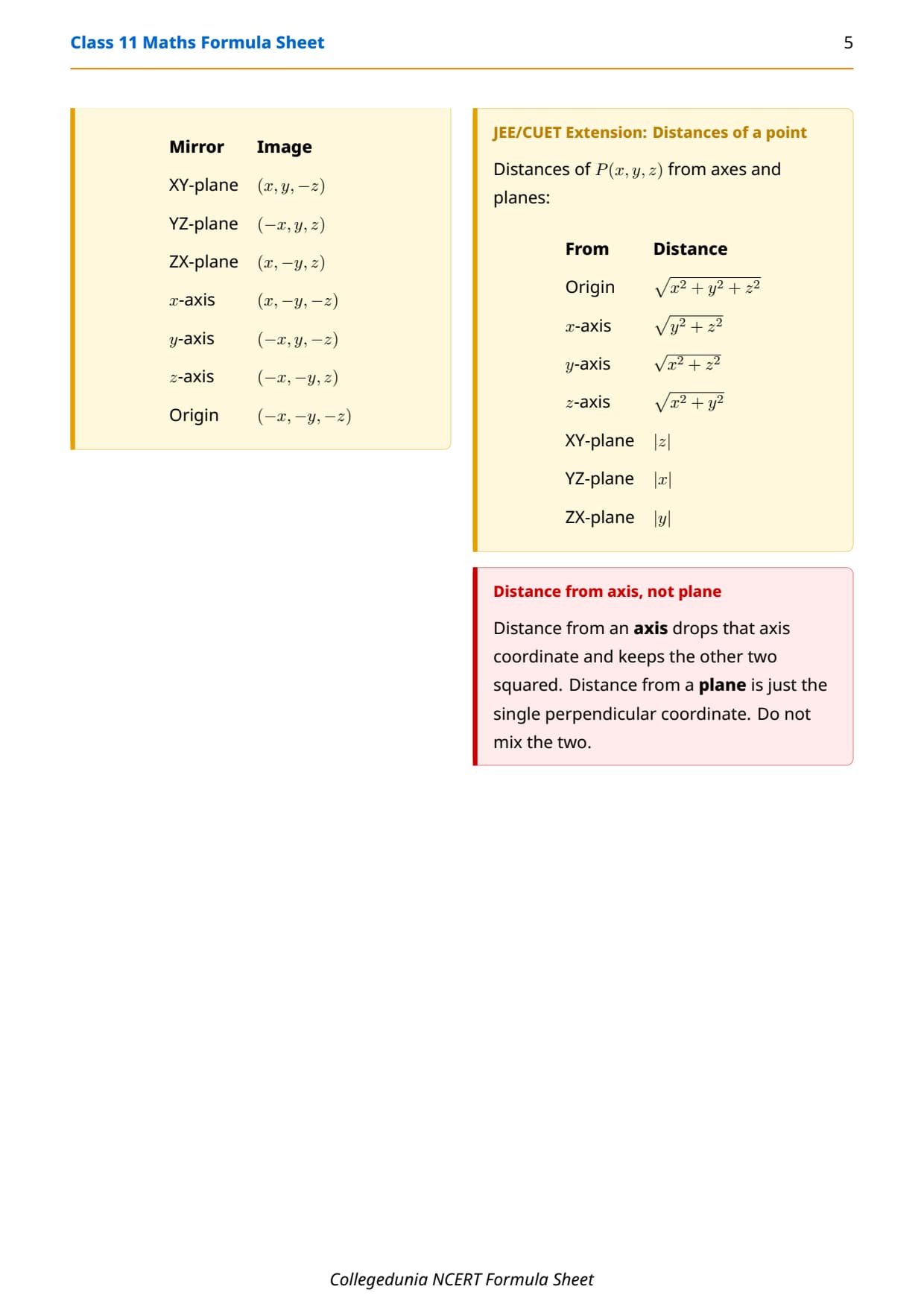
| OP = √(x2 + y2 + z2) | Distance of a point from the origin | O(0,0,0), P(x,y,z) |
| (x, 0, 0) | A point lying on the x-axis | Other two coordinates zero |
| (x, y, 0) | A point lying in the XY-plane | z = 0 on the XY-plane |
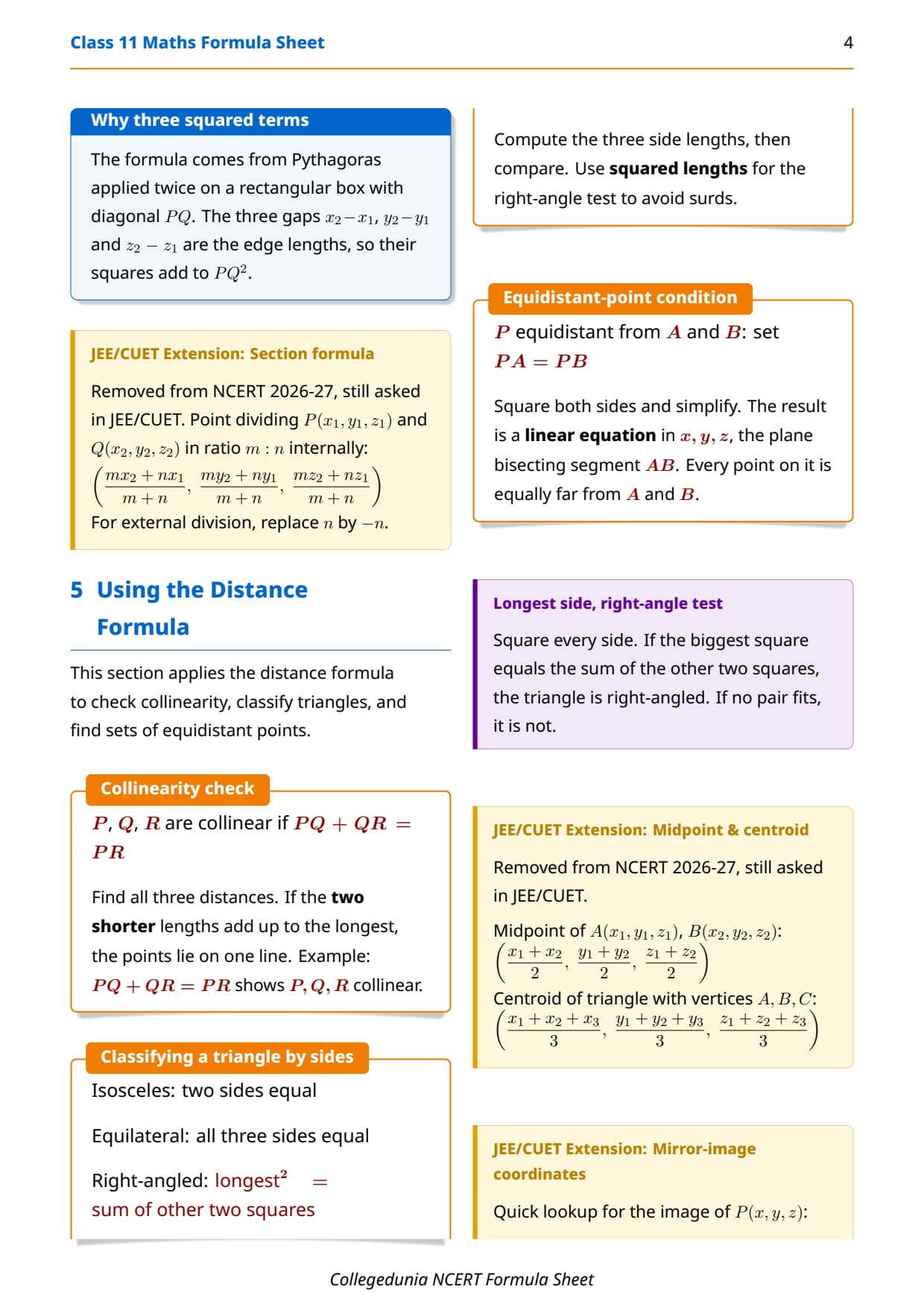
| P, Q, R collinear if PQ + QR = PR | Collinearity test using distances | Two shorter add to the longest |
The 3D distance formula just adds the z-term to the 2D formula, so √((x2−x1)2 + (y2−y1)2) becomes √((x2−x1)2 + (y2−y1)2 + (z2−z1)2).
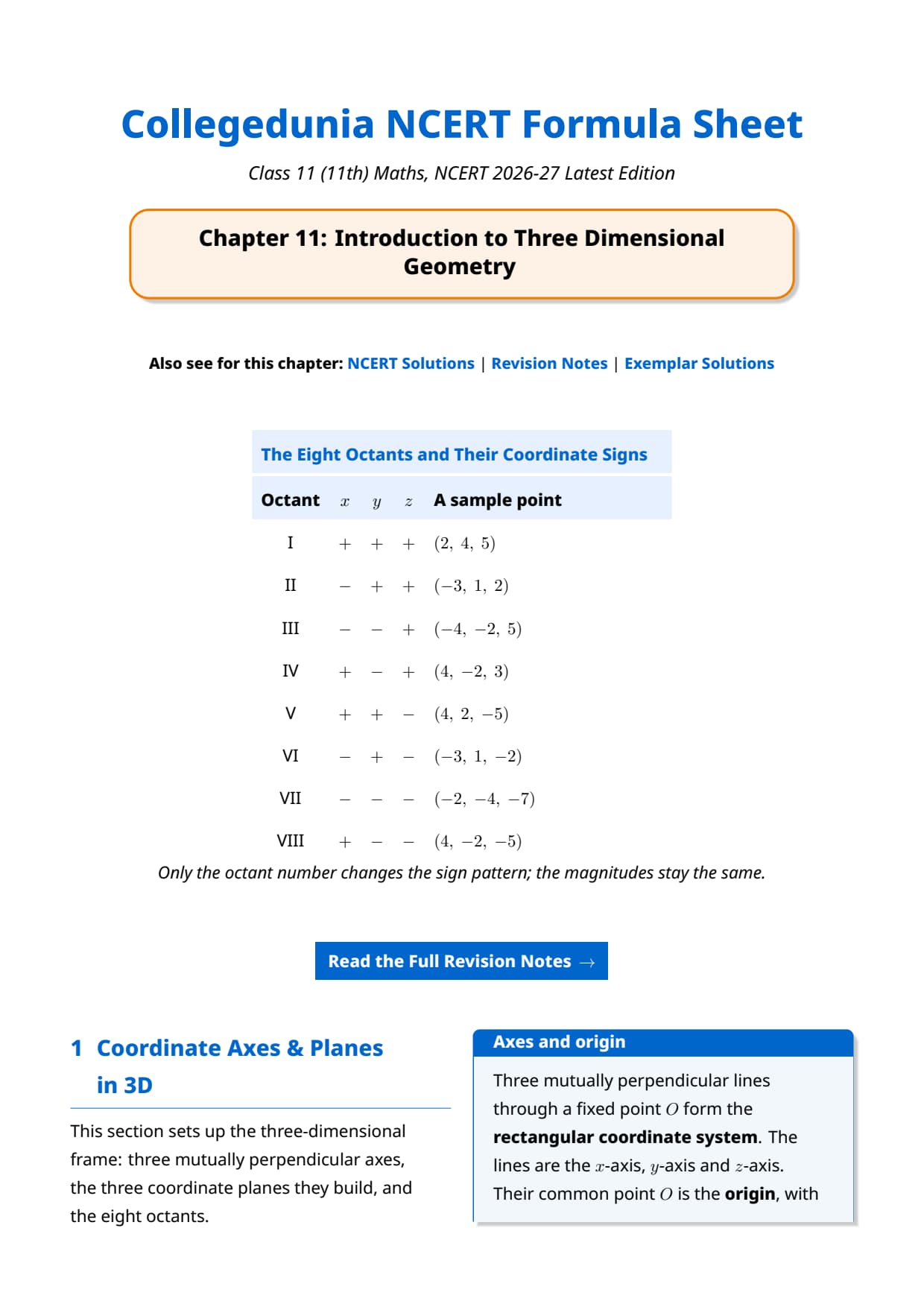
Octants and Coordinate Signs
The three coordinate planes cut space into eight octants. Read the sign of x, then y, then z to place any point, since the sign pattern alone fixes the octant.
| Octant | x | y | z | Sample point |
|---|---|---|---|---|
| I | + | + | + | (2, 4, 5) |
| II | − | + | + | (−3, 1, 2) |
| III | − | − | + | (−4, −2, 5) |
| IV | + | − | + | (4, −2, 3) |
| V | + | + | − | (4, 2, −5) |
| VI | − | + | − | (−3, 1, −2) |
| VII | − | − | − | (−2, −4, −7) |
| VIII | + | − | − | (4, −2, −5) |
Section Formula, Midpoint and Centroid (JEE and CUET)
These three results locate points built from other points. They reward clean substitution, so students should match each coordinate carefully before simplifying.
| Formula | What it gives |
|---|---|
| ((mx2+nx1)/(m+n), (my2+ny1)/(m+n), (mz2+nz1)/(m+n)) | Internal division of PQ in ratio m:n |
| ((x1+x2)/2, (y1+y2)/2, (z1+z2)/2) | Midpoint of segment PQ |
| ((x1+x2+x3)/3, (y1+y2+y3)/3, (z1+z2+z3)/3) | Centroid of a triangle with three vertices |
The section formula was removed from NCERT 2026-27 but stays useful for JEE and CUET, so students preparing for those exams should still keep it ready. For external division in ratio m:n, replace n by −n in the internal-division formula.
How to Revise Three Dimensional Geometry Formulas Before the Exam
This chapter rewards clear coordinate reading more than heavy calculation. A short, ordered revision keeps the axis, plane and distance rules from blurring together in the exam hall.
- Start with the distance formula and its origin case, since these are the most direct scoring questions.
- Write the eight octant sign patterns from memory, checking each against a sample point.
- Practise placing points on an axis and in a plane, remembering which coordinates drop to zero.
- Finish with the section formula, midpoint and centroid for JEE and CUET, and confirm that a coordinate midpoint is just the average of the two ends.
Student Feedback on the Three Dimensional Geometry Formula Sheet
In a survey of 1,050 Class 11 students who used this sheet during revision, 76% said the single-page octant and distance table cut their revision time before unit tests. Toppers reported that rewriting the distance formula alongside its 2D version made the extra z-term automatic by the Boards.
Other Three Dimensional Geometry Class 11 Maths Resources
Pair this formula sheet with the solved answers, notes and textbook PDF.
| Resource | Link |
|---|---|
| NCERT Solutions | Three Dimensional Geometry Class 11 NCERT Solutions |
| Revision Notes | Three Dimensional Geometry Class 11 Notes |
| Handwritten Notes | Three Dimensional Geometry Class 11 Handwritten Notes |
| NCERT Book PDF | Three Dimensional Geometry Class 11 Book PDF |
NCERT Formula Sheet for Class 11 Maths: All Chapters
Revise every chapter from one place. Each link opens the formula sheet for that chapter.
| Chapter | Formula Sheet |
|---|---|
| Chapter 1 | Sets |
| Chapter 2 | Relations and Functions |
| Chapter 3 | Trigonometric Functions |
| Chapter 4 | Complex Numbers and Quadratic Equations |
| Chapter 5 | Linear Inequalities |
| Chapter 6 | Permutations and Combinations |
| Chapter 7 | Binomial Theorem |
| Chapter 8 | Sequences and Series |
| Chapter 9 | Straight Lines |
| Chapter 10 | Conic Sections |
| Chapter 11 | Introduction to Three Dimensional Geometry |
| Chapter 12 | Limits and Derivatives |
| Chapter 13 | Statistics |
| Chapter 14 | Probability |
FAQs on Three Dimensional Geometry Class 11 Maths Formula Sheet
Introduction to Three Dimensional Geometry Formula Sheet - Frequently Asked Questions
Ques. What formulas does the class 11 maths formula sheet chapter 11 introduction to three dimensional geometry cover?
Ans. This class 11 maths formula sheet chapter 11 introduction to three dimensional geometry covers the three coordinate planes, the eight octants and their sign patterns, the distance between two points, the distance from the origin, and the section formula, midpoint and centroid kept for JEE and CUET. It also shows how a triplet locates one point in space.
Ques. What is the distance formula in three dimensional geometry?
Ans. The distance between P(x1,y1,z1) and Q(x2,y2,z2) is √((x2−x1)2 + (y2−y1)2 + (z2−z1)2). It follows from Pythagoras on a rectangular box, so all three coordinate gaps are squared and added.
Ques. How many octants are there and how do you find one?
Ans. The three coordinate planes divide space into eight octants. Read the sign of x, then y, then z to place a point. For example (−3, 1, 2) has signs (−,+,+), so it lies in octant II.
Ques. Is the section formula still in the NCERT 2026-27 syllabus?
Ans. The section formula, along with the midpoint and centroid results, was removed from the NCERT 2026-27 chapter. JEE and CUET still ask these, so students targeting those exams should keep the internal-division formula ((mx2+nx1)/(m+n), ...) ready and use −n for external division.



Comments