




The class 11 maths formula sheet chapter 1 sets gathers every definition, identity and law tested in the Boards, JEE Main, JEE Advanced and CUET exams. It lists each set operation, subset-count formula and De Morgan law so students can revise the whole chapter fast.
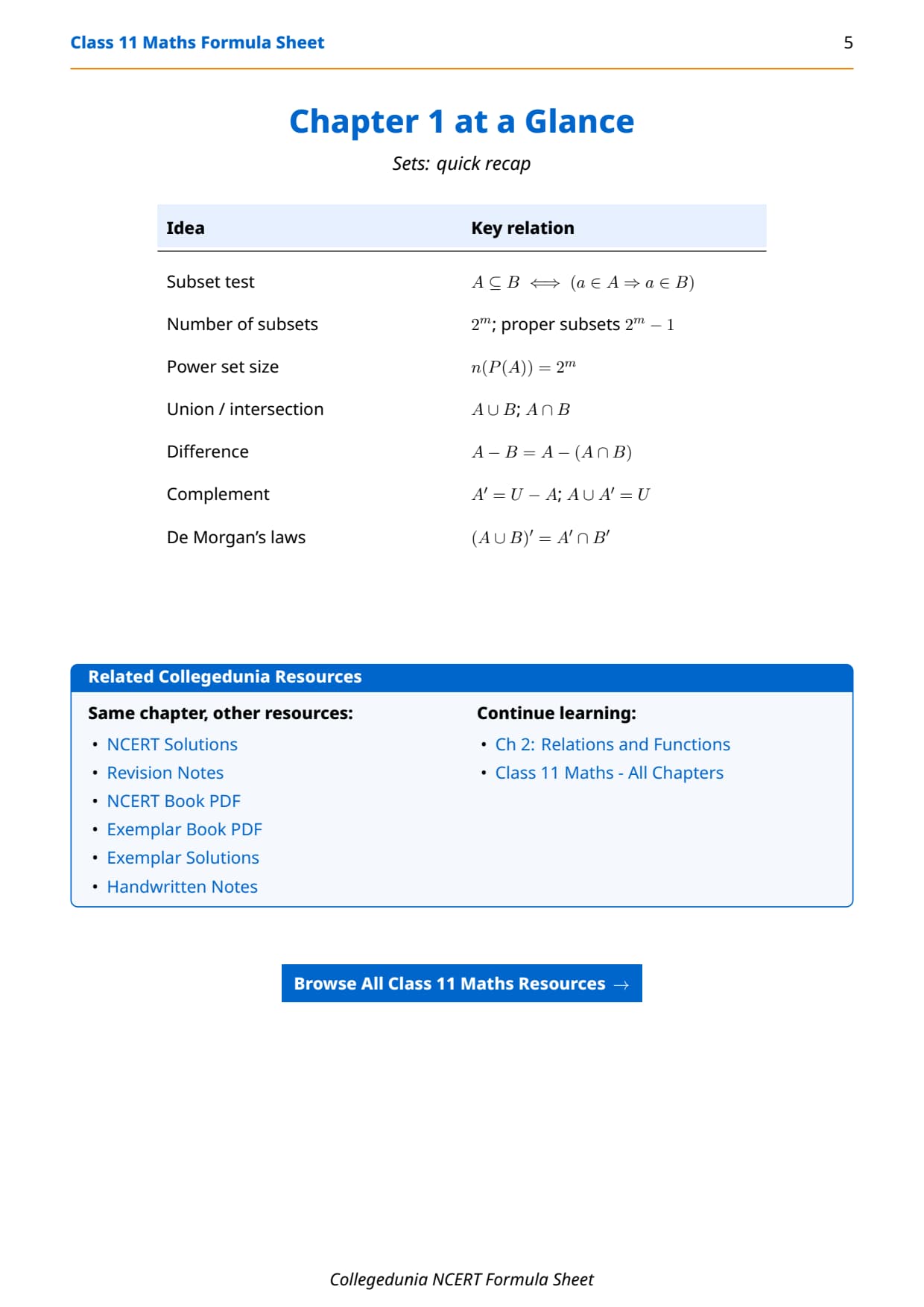
Sets is the foundation chapter, so its notation and operations return in relations, functions and probability later in the year.
- Covers union, intersection, difference and complement, plus the commutative, associative and distributive laws.
- Lists the subset and power-set counts and the two De Morgan laws.
- Helps students read and write set-builder notation with confidence.
This class 11 maths formula sheet chapter 1 sets is curated by subject experts and checked against the 2026-27 NCERT and recent CBSE and JEE papers.
All Sets Formulas at a Glance
Every set operation and counting rule sits in one table below, with its meaning. Learn the subset-count and De Morgan rows first, since almost every objective question uses them.
| Formula | What it means | Condition |
|---|---|---|
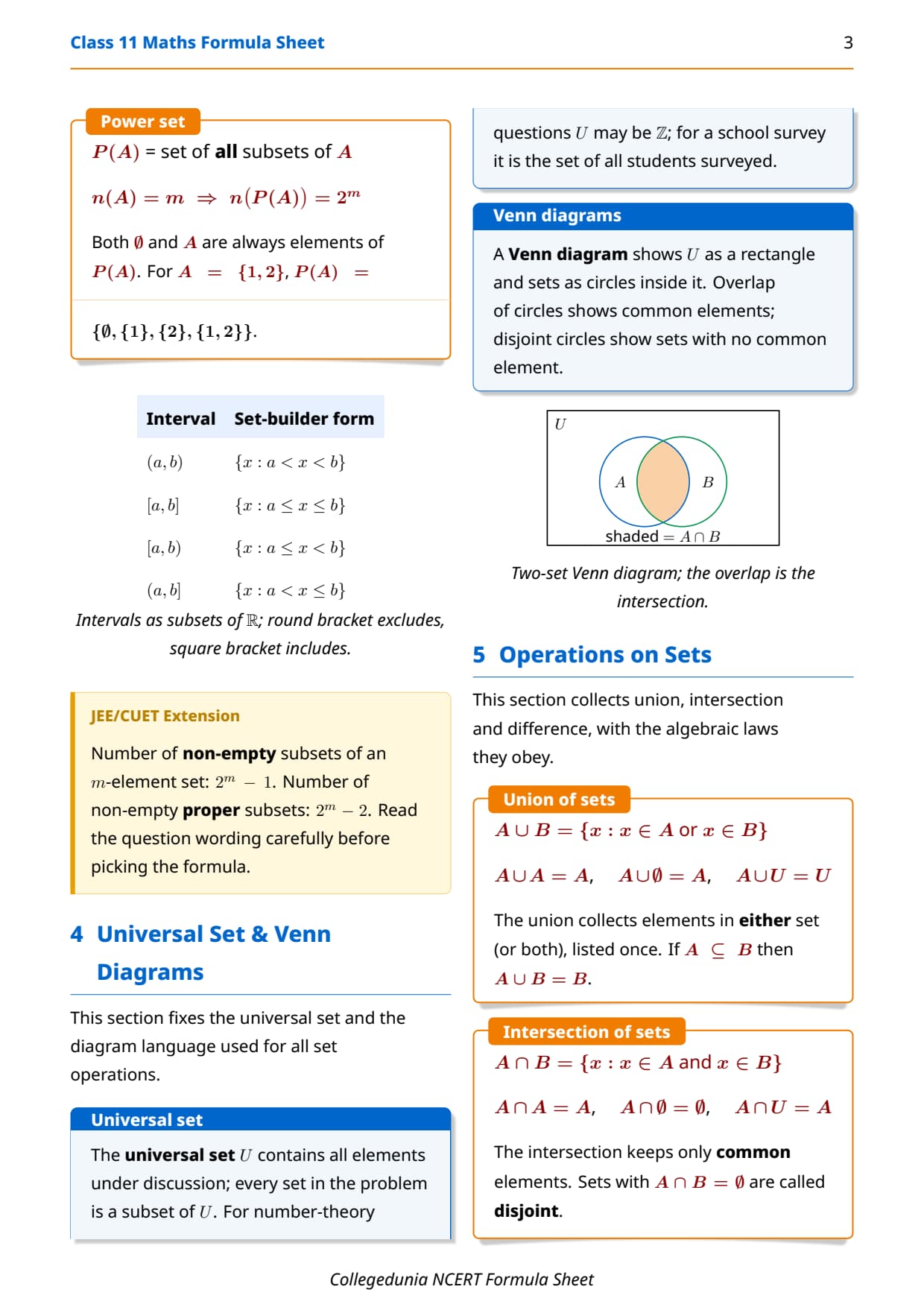
| A ∪ B = {x : x ∈ A or x ∈ B} | Union: elements in either set, listed once | Any two sets |
| A ∩ B = {x : x ∈ A and x ∈ B} | Intersection: elements common to both | Any two sets |
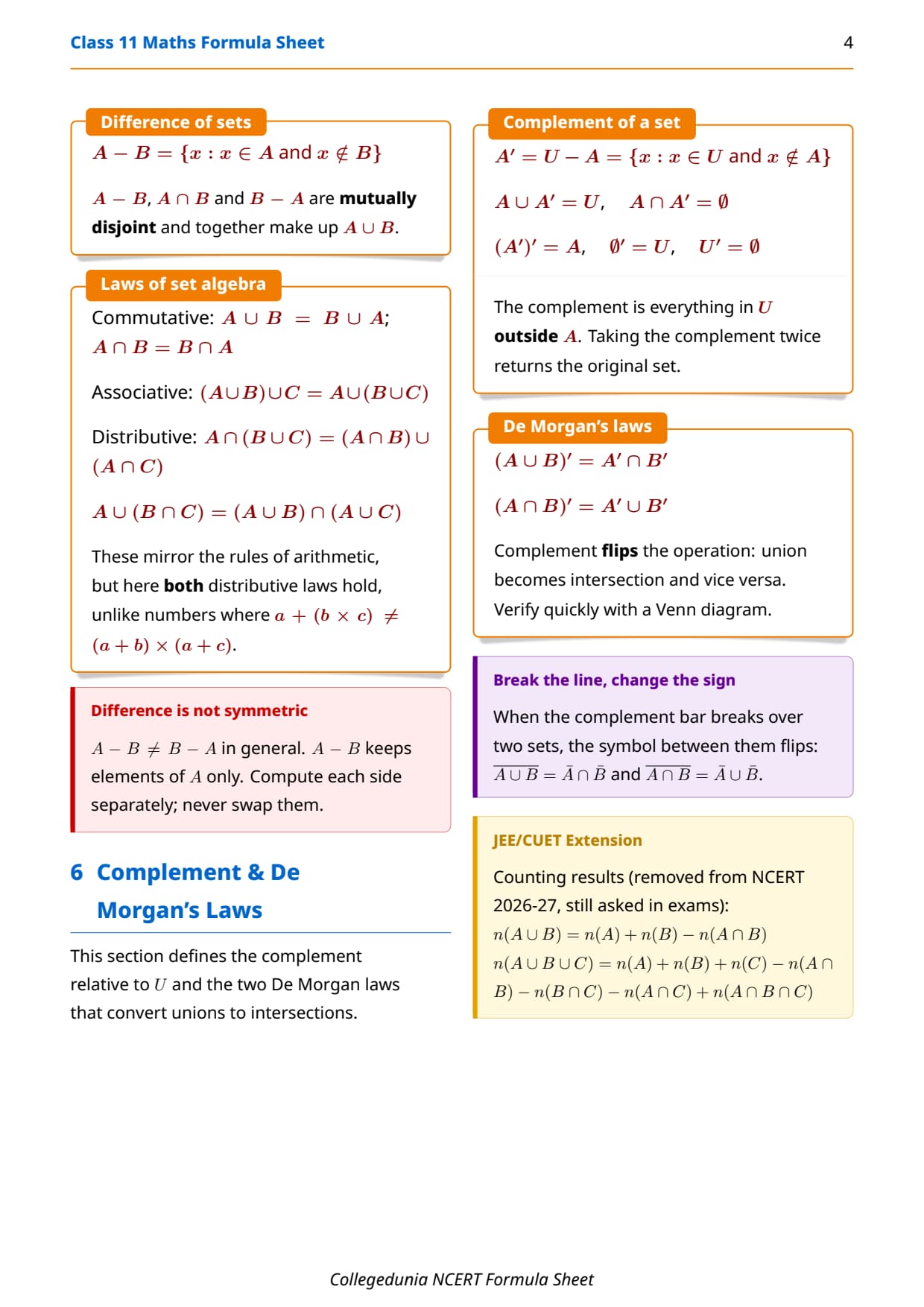
| A − B = {x : x ∈ A, x ∉ B} | Difference: in A but not in B | Not symmetric, A − B ≠ B − A |
| A′ = U − A | Complement: everything in U outside A | Needs a universal set U |
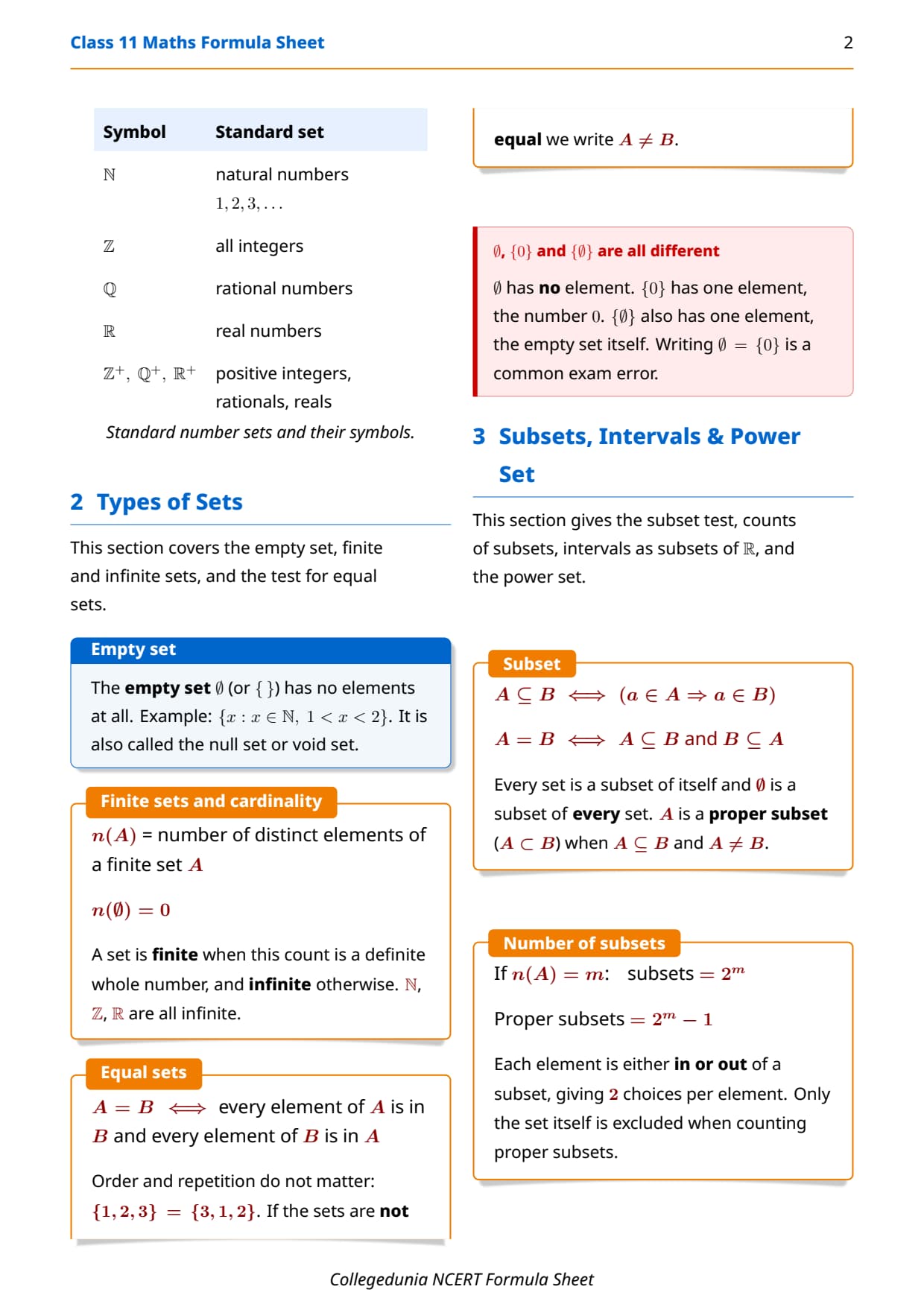
| Subsets of A = 2m | Number of subsets when n(A) = m | Includes ∅ and A itself |
| Proper subsets = 2m − 1 | All subsets except A itself | n(A) = m |
| n(P(A)) = 2m | Size of the power set of A | n(A) = m |
Each element is either in or out of a subset, which is why an m-element set has exactly 2m subsets.
Set Laws and De Morgan's Rules
These identities let students simplify any set expression. De Morgan's laws are the most tested, since they convert a complement of a union into an intersection.
| Law | Statement |
|---|---|
| Commutative | A ∪ B = B ∪ A; A ∩ B = B ∩ A |
| Associative | (A ∪ B) ∪ C = A ∪ (B ∪ C) |
| Distributive | A ∩ (B ∪ C) = (A ∩ B) ∪ (A ∩ C) |
| Identity | A ∪ ∅ = A; A ∩ U = A |
| Complement | A ∪ A′ = U; A ∩ A′ = ∅ |
| De Morgan 1 | (A ∪ B)′ = A′ ∩ B′ |
| De Morgan 2 | (A ∩ B)′ = A′ ∪ B′ |
Set Symbols and Standard Number Sets
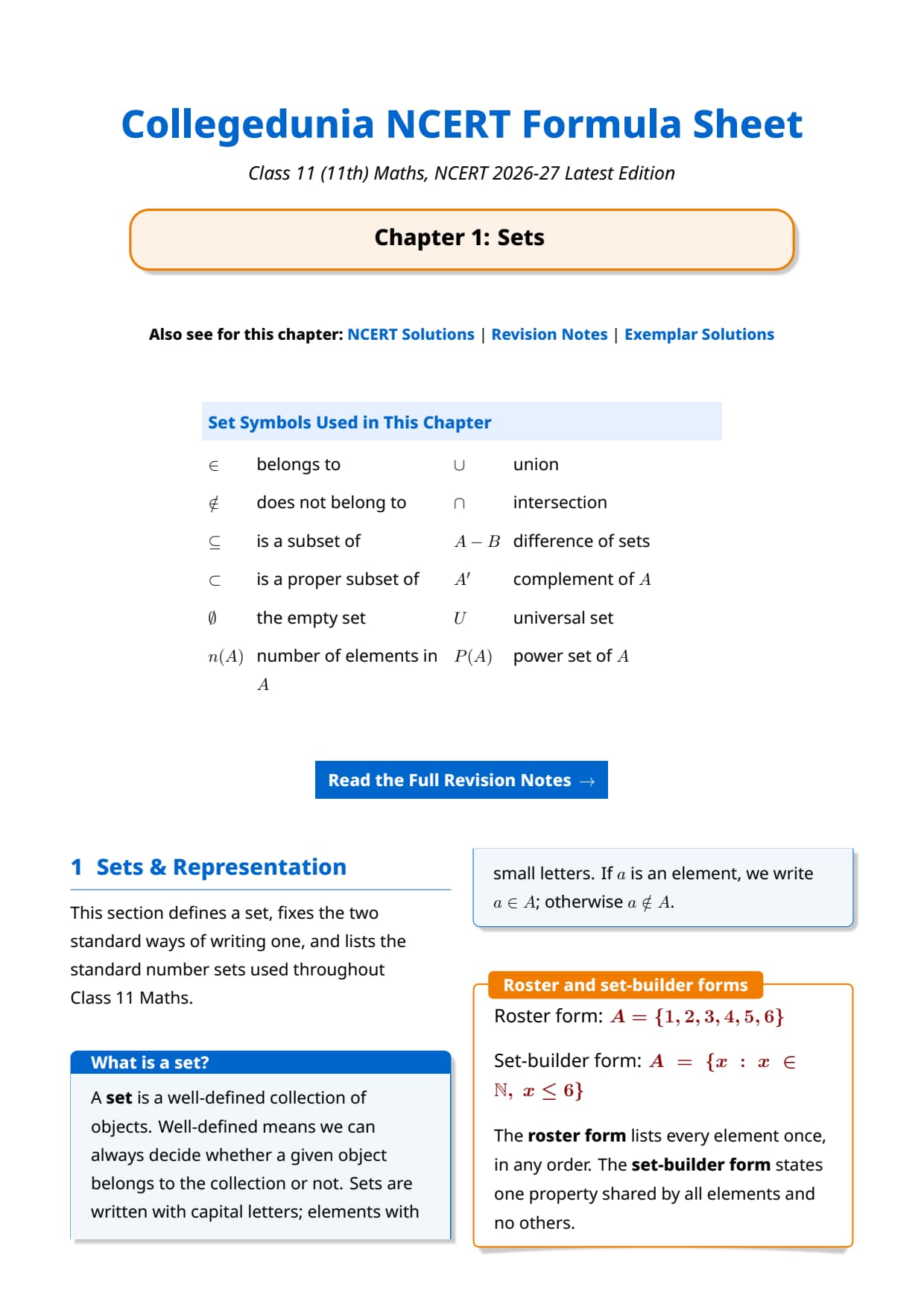
You must also read set-builder notation quickly. The symbols below and the standard number sets appear in almost every question.
| Symbol | Meaning |
|---|---|
| ∈ / ∉ | Belongs to / does not belong to |
| ⊆ / ⊂ | Subset of / proper subset of |
| ∅ | Empty set, the set with no element |
| ℕ, ℤ, ℚ, ℝ | Natural numbers, integers, rationals, reals |
| (a, b) / [a, b] | Open interval (excludes ends) / closed interval (includes ends) |
How to Revise Sets Formulas Before the Exam
Sets rewards clean notation more than heavy calculation. A short, ordered revision keeps the identities from blurring together in the exam hall.
- Start with the subset count 2m and power-set size, since these are direct one-mark questions.
- Write both De Morgan laws from memory, then check each with a quick two-set Venn diagram.
- Practise converting between roster and set-builder form for the standard number sets.
- Finish with the difference rule, and remember that A − B is never the same as B − A.
Student Feedback on the Sets Formula Sheet
In a survey of 1,100 Class 11 students who used this sheet during revision, 78% said the single-page identity table cut their revision time before unit tests. Toppers reported that writing the De Morgan laws twice a week made them automatic by the Boards.
Other Sets Class 11 Maths Resources
Pair this formula sheet with the solved answers, notes and textbook PDF.
| Resource | Link |
|---|---|
| NCERT Solutions | Sets Class 11 NCERT Solutions |
| Revision Notes | Sets Class 11 Notes |
| Handwritten Notes | Sets Class 11 Handwritten Notes |
| NCERT Book PDF | Sets Class 11 Book PDF |
NCERT Formula Sheet for Class 11 Maths: All Chapters
Revise every chapter from one place. Each link opens the formula sheet for that chapter.
| Chapter | Formula Sheet |
|---|---|
| Chapter 1 | Sets |
| Chapter 2 | Relations and Functions |
| Chapter 3 | Trigonometric Functions |
| Chapter 4 | Complex Numbers and Quadratic Equations |
| Chapter 5 | Linear Inequalities |
| Chapter 6 | Permutations and Combinations |
| Chapter 7 | Binomial Theorem |
| Chapter 8 | Sequences and Series |
| Chapter 9 | Straight Lines |
| Chapter 10 | Conic Sections |
| Chapter 11 | Introduction to Three Dimensional Geometry |
| Chapter 12 | Limits and Derivatives |
| Chapter 13 | Statistics |
| Chapter 14 | Probability |
FAQs on Sets Class 11 Maths Formula Sheet
Sets Formula Sheet - Frequently Asked Questions
Ques. What formulas does the class 11 maths formula sheet chapter 1 sets cover?
Ans. This class 11 maths formula sheet chapter 1 sets covers the union, intersection, difference and complement operations, the commutative, associative and distributive laws, the subset count 2m and power-set size, and the two De Morgan laws. It also lists the standard set symbols and number sets.
Ques. How many subsets does a set with n elements have?
Ans. A set with n elements has 2n subsets, because each element is either included or excluded. Of these, 2n − 1 are proper subsets, since the set itself is left out.
Ques. What are De Morgan's laws for sets?
Ans. De Morgan's laws state that (A ∪ B)′ = A′ ∩ B′ and (A ∩ B)′ = A′ ∪ B′. Taking a complement flips a union into an intersection and an intersection into a union.
Ques. Is the set difference A minus B the same as B minus A?
Ans. No. A − B keeps the elements of A that are not in B, while B − A keeps the elements of B that are not in A. The two are equal only when A and B are the same set.



Comments