




The class 11 chemistry formula sheet chapter 9 hydrocarbons gathers every general formula, named reaction and mechanism rule tested in the Boards, JEE Main, JEE Advanced, NEET, CUET and NDA exams. It lists each formula, reaction condition and reactivity trend so students can revise alkanes, alkenes, alkynes and aromatic compounds fast.
Hydrocarbons ties together the whole organic unit, so its naming rules, addition reactions and aromaticity ideas return in every later organic chapter.
- Covers the general formulas for alkanes, alkenes and alkynes, plus the degree of unsaturation shortcut.
- Lists the named reactions Wurtz, Kolbe, decarboxylation, ozonolysis and Friedel-Crafts side by side.
- Helps students apply Markovnikov, the peroxide effect, Huckel's rule and the directing effects in aromatic substitution.
This class 11 chemistry formula sheet chapter 9 hydrocarbons is curated by subject experts and checked against the 2026-27 NCERT and recent CBSE, JEE and NEET papers.
All Hydrocarbons Formulas at a Glance
Every general formula and key reaction sits in one table below, with its meaning and condition. Learn the general formulas and Markovnikov rule first, since almost every question uses them.
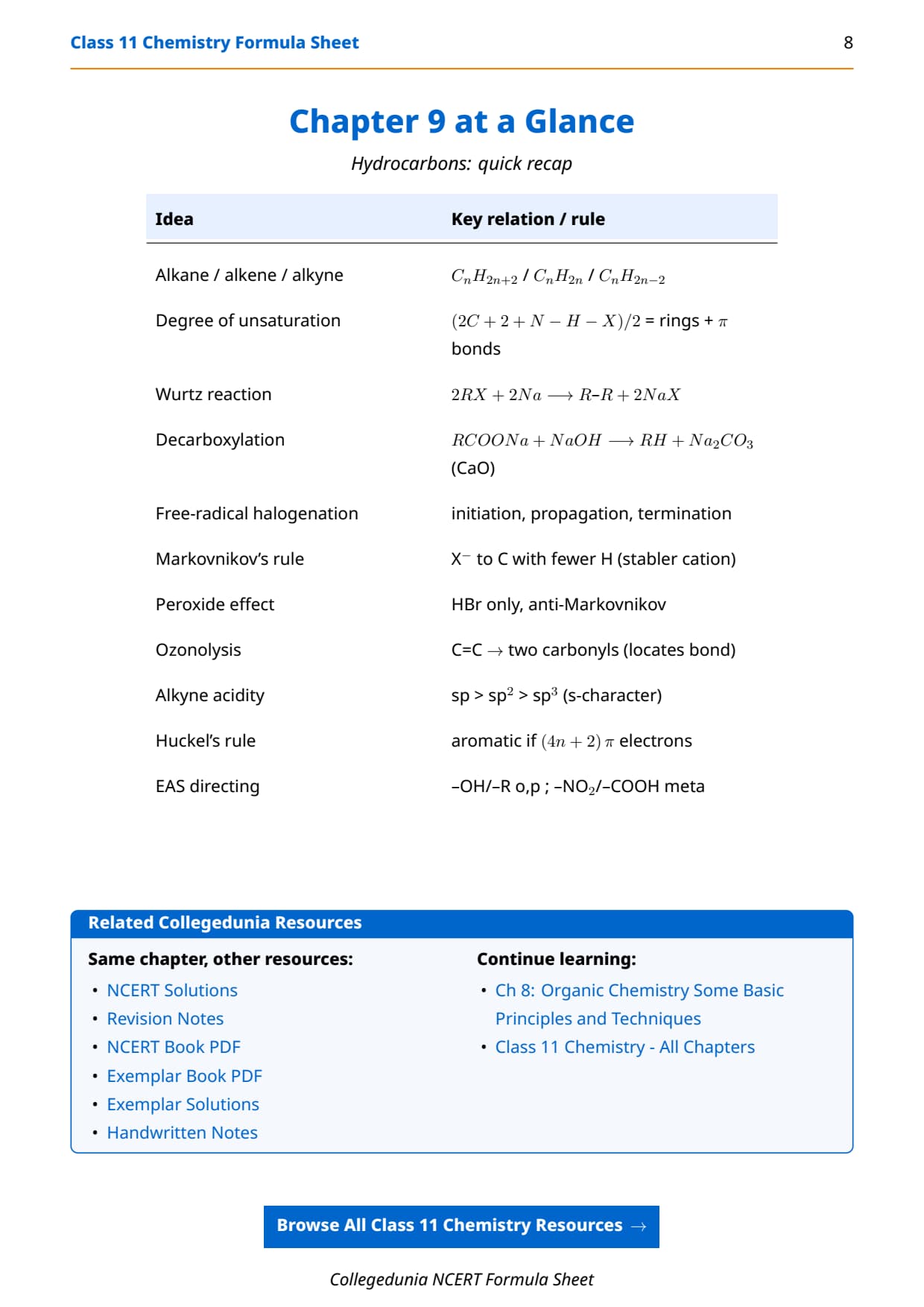
| Formula / Rule | What it means | Key condition |
|---|---|---|
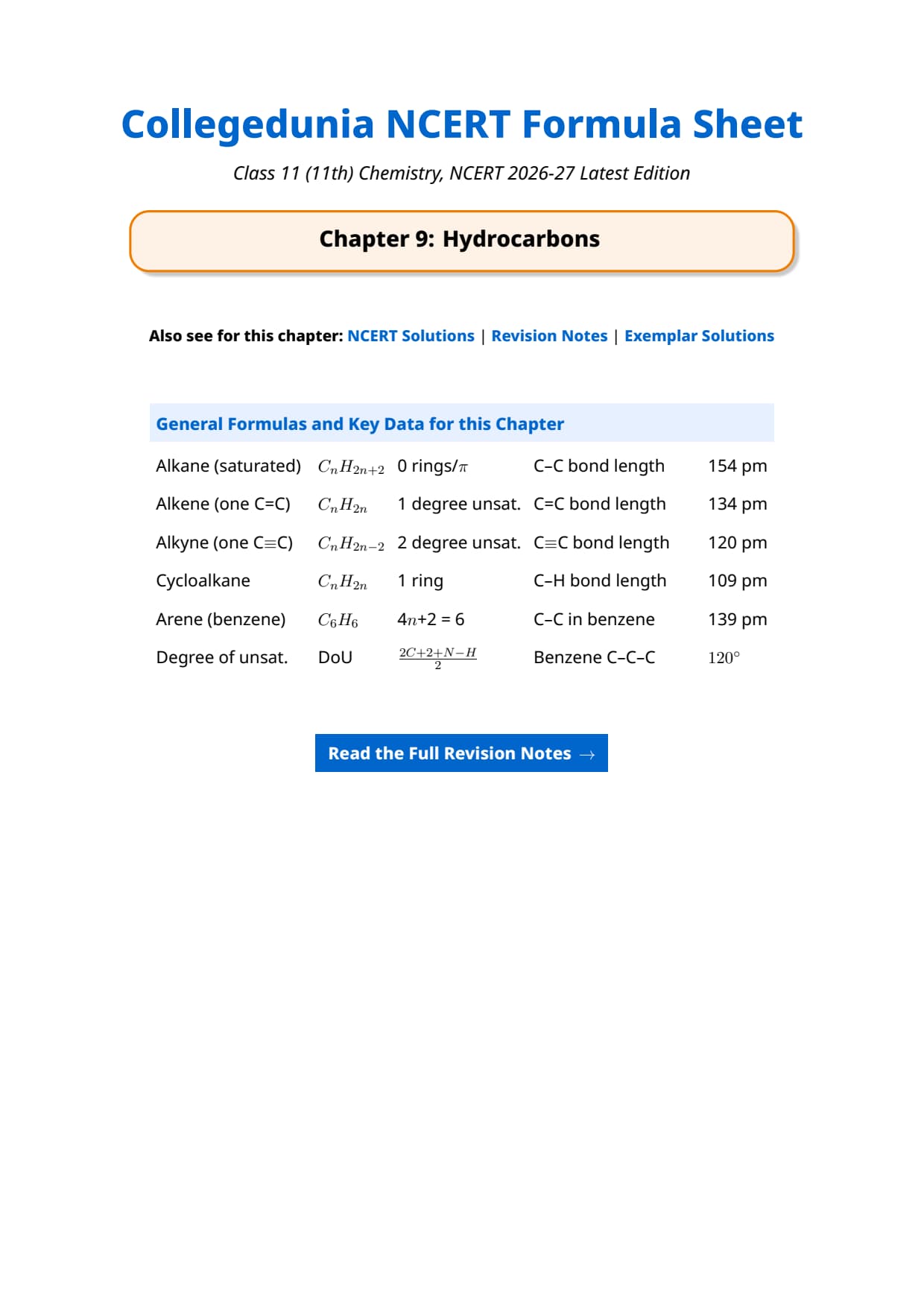
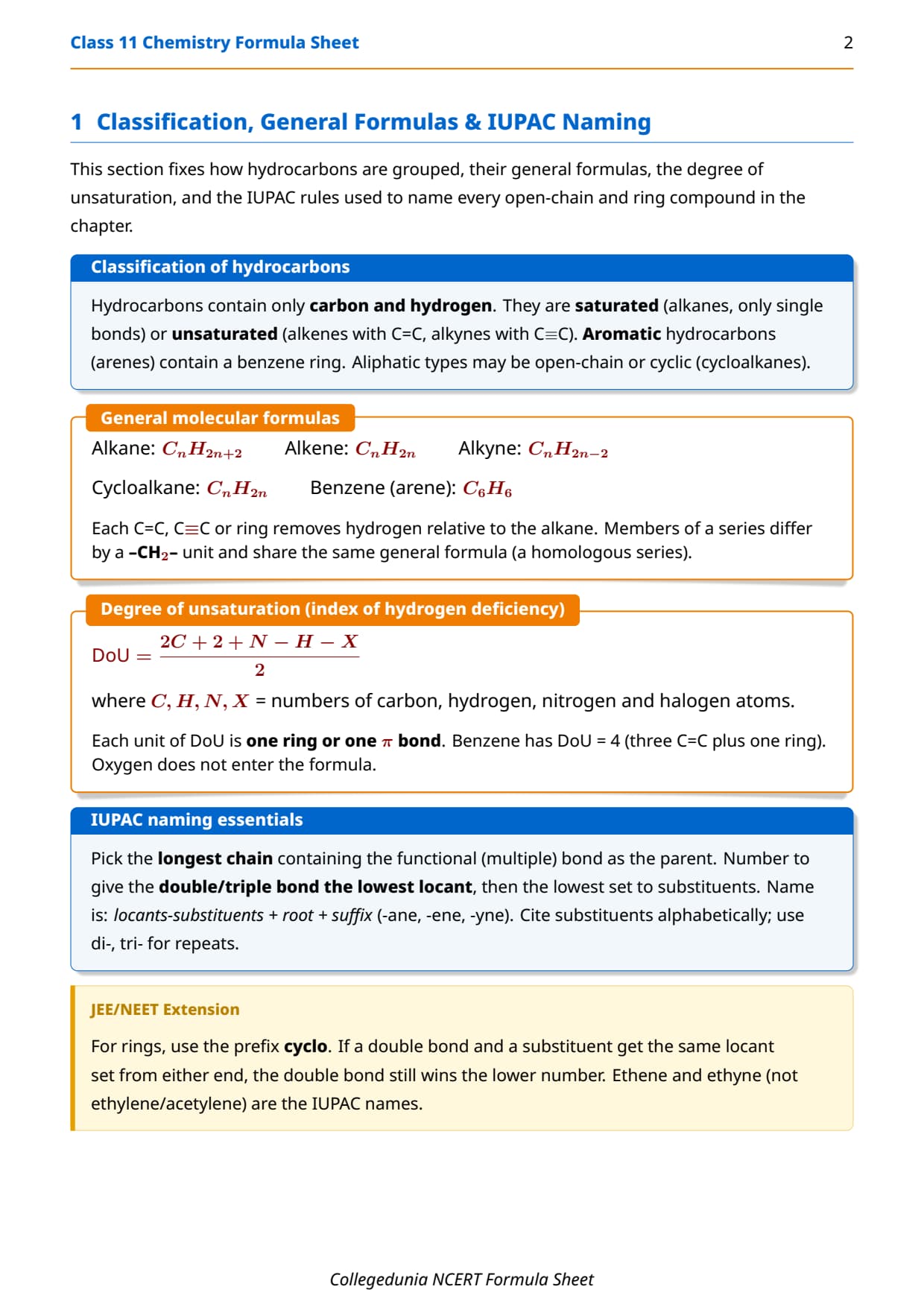
| Alkane = CnH2n+2 | Saturated, only single bonds | 0 rings or pi bonds |
| Alkene = CnH2n | One C=C double bond | 1 degree of unsaturation |
| Alkyne = CnH2n-2 | One C≡C triple bond | 2 degrees of unsaturation |
| DoU = (2C + 2 + N - H - X)/2 | Rings plus pi bonds | Index of hydrogen deficiency |
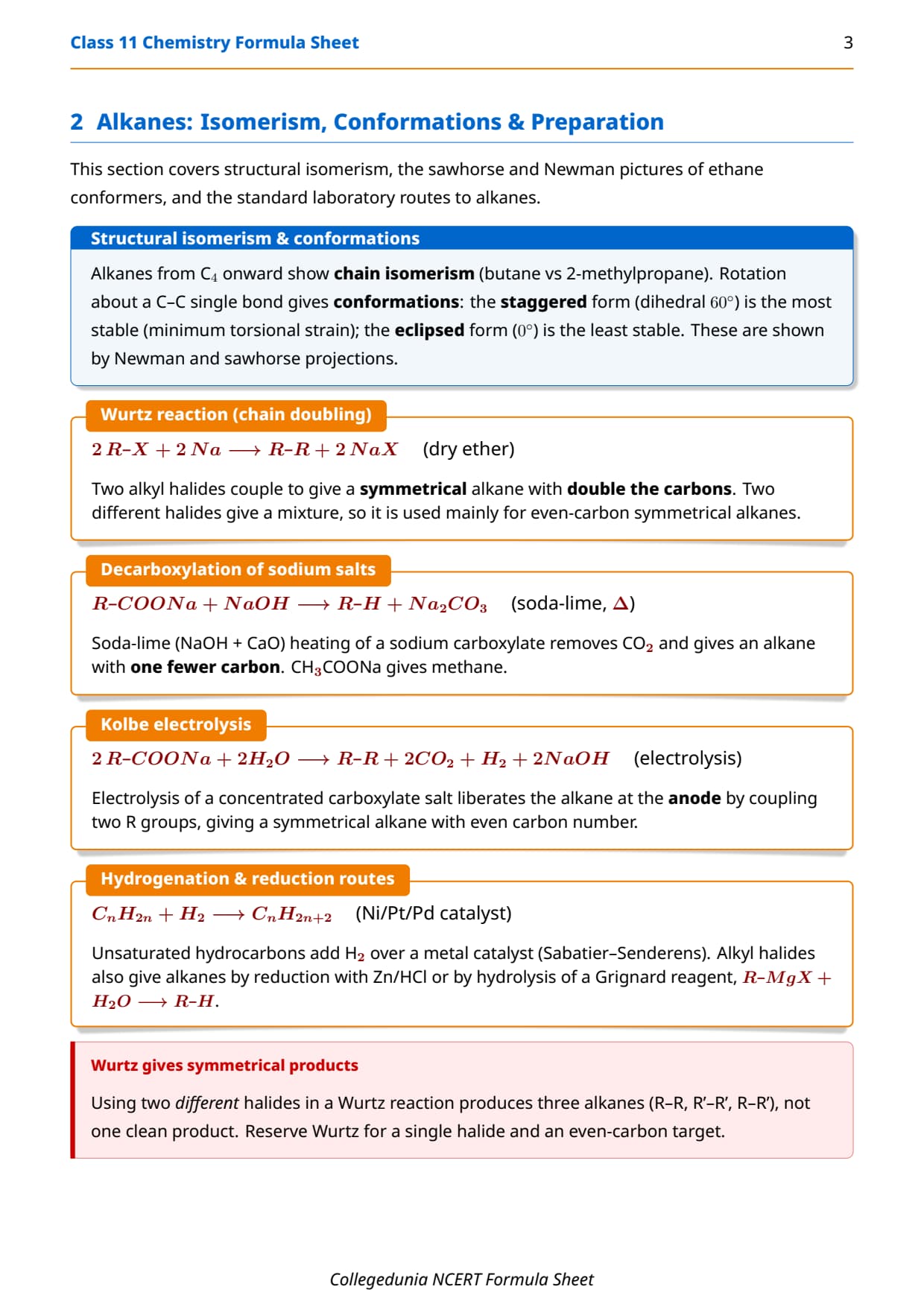
| Wurtz reaction | 2RX + 2Na → R-R + 2NaX | Dry ether |
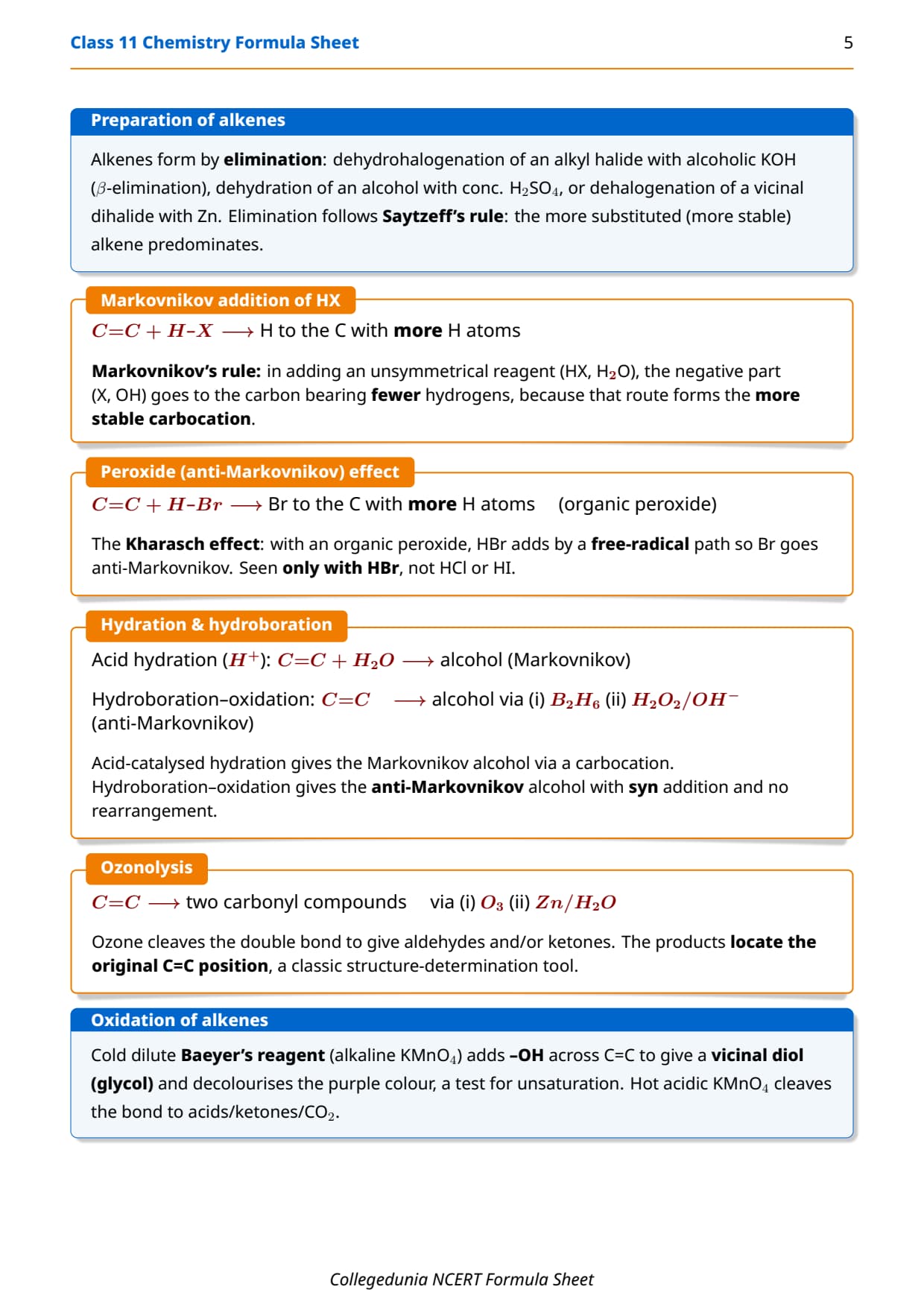
| Markovnikov's rule | X goes to C with fewer H atoms | Via more stable carbocation |
| Peroxide (Kharasch) effect | Anti-Markovnikov addition | HBr with peroxide only |
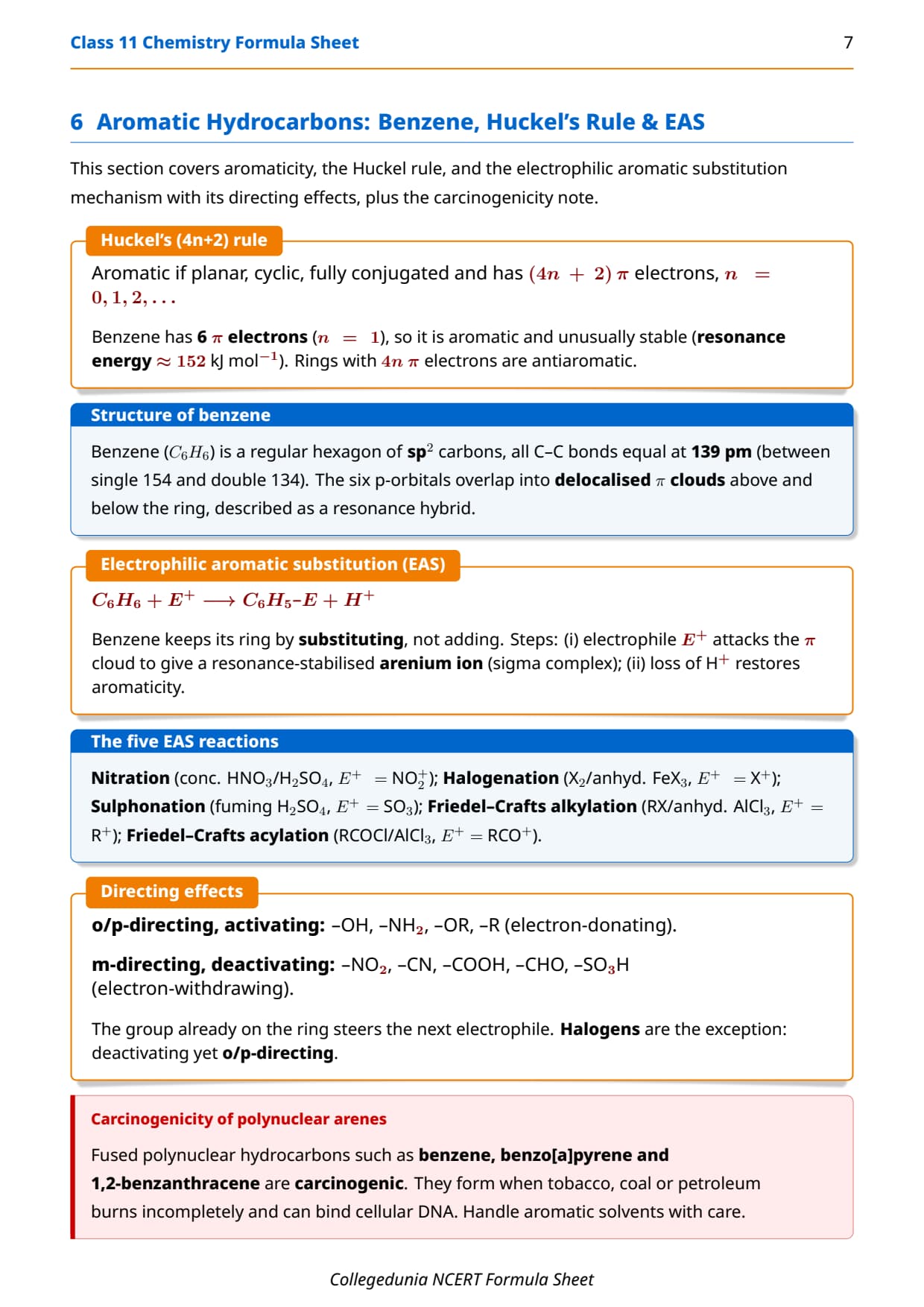
| Huckel's rule | Aromatic if (4n+2) pi electrons | Planar, cyclic, conjugated |
The peroxide effect works only with HBr, not with HCl or HI.
General Formulas and Reaction Relations
You must also connect the number of carbons, the degree of unsaturation and each named reaction. These relations solve most Chapter 9 conversions and structure problems.
| Quantity / Reaction | Relation | Note |
|---|---|---|
| Cycloalkane / benzene | CnH2n / C6H6 | Ring counts as 1 degree of unsaturation |
| Decarboxylation | RCOONa + NaOH → RH + Na2CO3 | Soda-lime, heat; one fewer carbon |
| Kolbe electrolysis | 2RCOONa → R-R + 2CO2 | At the anode, even carbon count |
| Ozonolysis | C=C → two carbonyls | O3 then Zn/H2O; locates the double bond |
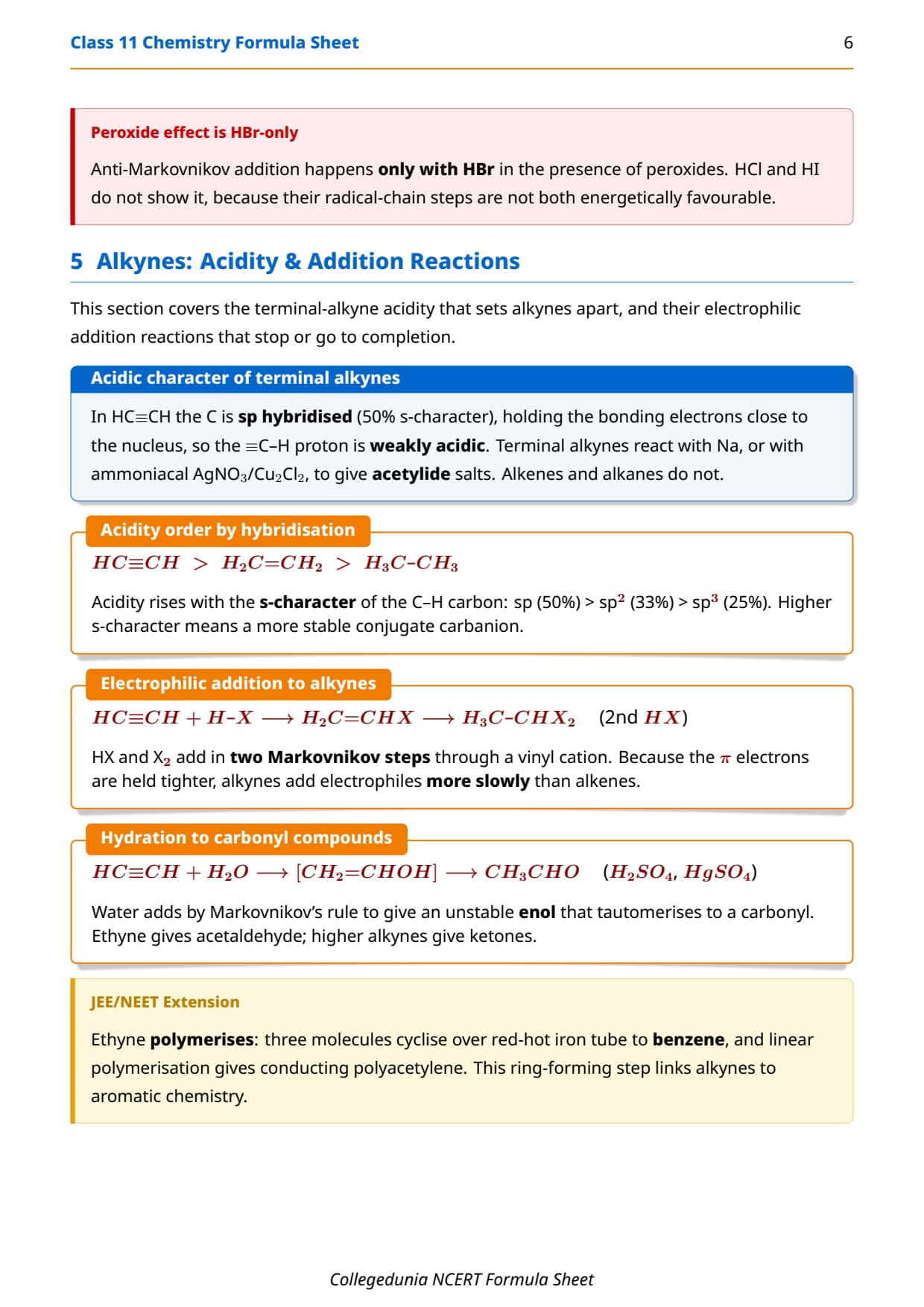
| Alkyne acidity order | sp > sp2 > sp3 | Rises with s-character |
| Benzene C-C bond length | 139 pm | Between single 154 and double 134 pm |
By Saytzeff's rule, elimination gives mainly the more substituted, more stable alkene. This decides the major product in every dehydrohalogenation.
Key Constants and Data for Hydrocarbons
Boards and entrance papers often ask for a bond length, an angle or a reactivity order. The list below has the key data used in this chapter.
- Bond lengths: C-C 154 pm, C=C 134 pm, C≡C 120 pm, C-H 109 pm, benzene C-C 139 pm.
- Benzene: regular hexagon of sp2 carbons, all angles 120 degrees, 6 delocalised pi electrons, resonance energy about 152 kJ mol-1.
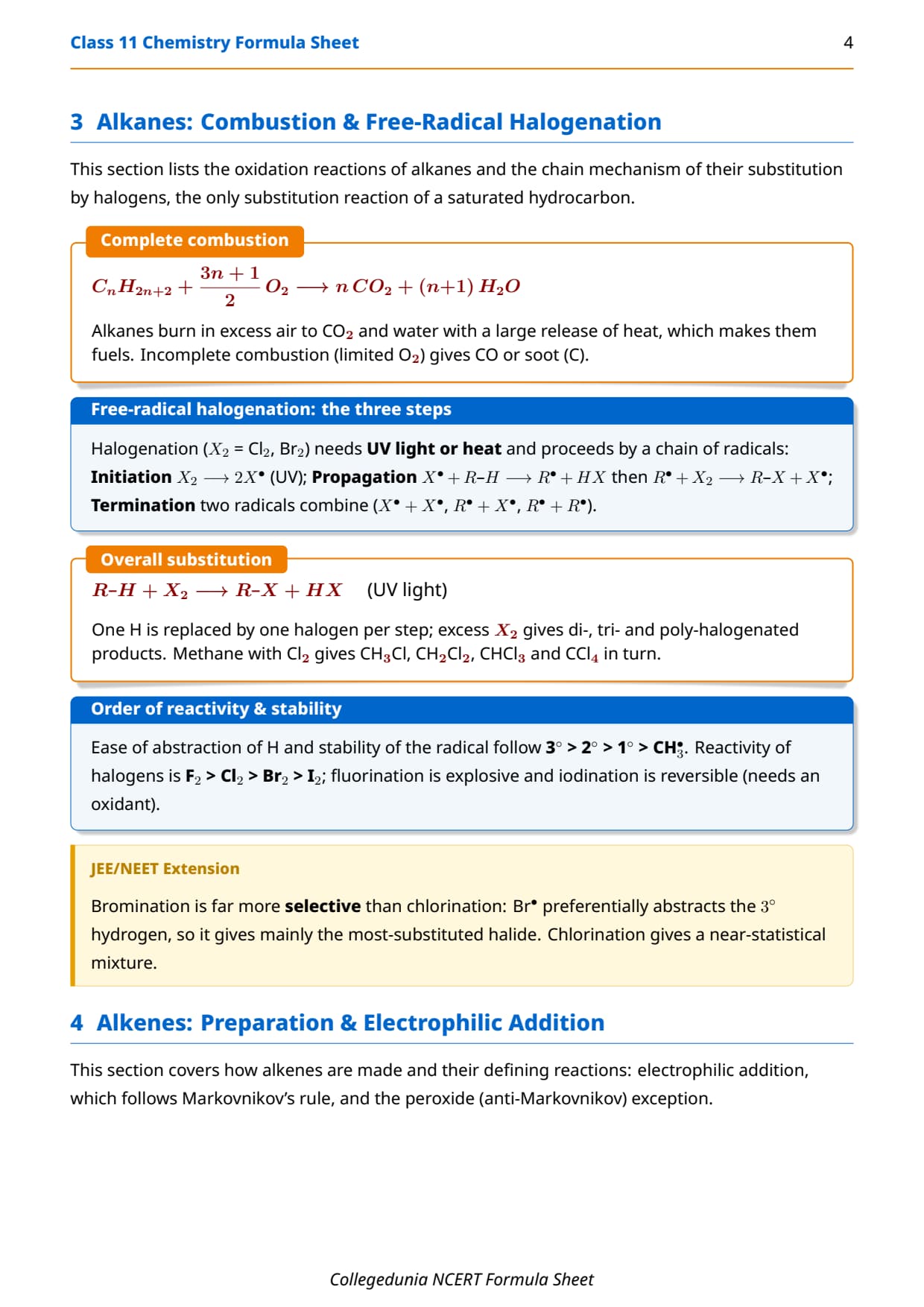
- Radical stability: 3° > 2° > 1° > CH3; halogen reactivity F2 > Cl2 > Br2 > I2.
- Directing effects: -OH, -NH2, -R are ortho/para directing and activating; -NO2, -COOH, -CN are meta directing and deactivating.
- Carcinogens: fused polynuclear arenes such as benzene, benzo[a]pyrene and 1,2-benzanthracene are carcinogenic.
How to Revise Hydrocarbons Formulas Before the Exam
Use this class 11 chemistry formula sheet chapter 9 hydrocarbons for a fast recap the night before a test, in about 20 minutes.
- First 7 minutes: write the three general formulas and the preparation routes Wurtz, Kolbe and decarboxylation.
- Next 7 minutes: practise Markovnikov, the peroxide effect and ozonolysis on one alkene each.
- Last 6 minutes: recall Huckel's rule and the ortho/para versus meta directing groups.
Finish by predicting the major product of one electrophilic aromatic substitution and one anti-Markovnikov addition.
Student Feedback on the Hydrocarbons Formula Sheet
What 12,860 students told us about their Hydrocarbons revision:
- 68% of students rated the directing effects in aromatic substitution as the hardest part.
- Most-confused point: when HBr adds anti-Markovnikov versus Markovnikov.
- Students who learned the named reactions as a table found preparation questions much easier.
Source: 2026-27 Class 11 Chemistry student poll. Sample of 12,860 students from CBSE schools across 14 states, conducted before the 2026 boards.
Other Hydrocarbons Class 11 Chemistry Resources
Pair this formula sheet with the solved answers, notes and textbook PDF.
| Resource | Link |
|---|---|
| NCERT Solutions | Hydrocarbons Class 11 NCERT Solutions |
| Revision Notes | Hydrocarbons Class 11 Notes |
| Handwritten Notes | Hydrocarbons Class 11 Handwritten Notes |
| NCERT Book PDF | Hydrocarbons Class 11 Book PDF |
NCERT Formula Sheet for Class 11 Chemistry: All Chapters
Jump to any other Class 11 Chemistry formula sheet below.
| Chapter | Formula Sheet |
|---|---|
| Chapter 1 | Some Basic Concepts of Chemistry |
| Chapter 2 | Structure of Atom |
| Chapter 3 | Classification of Elements and Periodicity in Properties |
| Chapter 4 | Chemical Bonding and Molecular Structure |
| Chapter 5 | Thermodynamics |
| Chapter 6 | Equilibrium |
| Chapter 7 | Redox Reactions |
| Chapter 8 | Organic Chemistry: Some Basic Principles and Techniques |
| Chapter 9 | Hydrocarbons |
FAQs on Hydrocarbons Class 11 Chemistry Formula Sheet
Hydrocarbons Formula Sheet - Frequently Asked Questions
Ques. What formulas does the class 11 chemistry formula sheet chapter 9 hydrocarbons cover?
Ans. This class 11 chemistry formula sheet chapter 9 hydrocarbons covers the general formulas CnH2n+2, CnH2n and CnH2n-2, the degree of unsaturation, the Wurtz, Kolbe and decarboxylation preparations, Markovnikov and the peroxide effect, ozonolysis, alkyne acidity, Huckel's rule and the electrophilic aromatic substitution directing effects.
Ques. What is Markovnikov's rule and the peroxide effect?
Ans. By Markovnikov's rule, when HX or water adds to an alkene the negative part (X or OH) goes to the carbon bearing fewer hydrogens, because that path forms the more stable carbocation. The peroxide (Kharasch) effect makes HBr add anti-Markovnikov by a free-radical route, and it works only with HBr, not with HCl or HI.
Ques. Why are terminal alkynes acidic?
Ans. In a terminal alkyne the carbon is sp hybridised with 50% s-character, so it holds the C-H bonding electrons tightly and the proton is weakly acidic. Acidity therefore follows sp > sp2 > sp3. Terminal alkynes react with sodium or with ammoniacal silver nitrate to form acetylide salts, while alkenes and alkanes do not.
Ques. What is Huckel's rule for aromaticity?
Ans. Huckel's rule states that a compound is aromatic if it is planar, cyclic and fully conjugated and contains (4n+2) pi electrons, where n = 0, 1, 2, .... Benzene has 6 pi electrons (n = 1), so it is aromatic and unusually stable, with a resonance energy of about 152 kJ mol-1. Rings with 4n pi electrons are antiaromatic.



Comments