




The class 11 chemistry formula sheet chapter 7 redox reactions gathers every oxidation-number rule, balancing method and electrode-potential relation tested in the Boards, JEE Main, JEE Advanced, NEET, CUET and NDA exams. It lists each rule, formula and key redox agent so students can revise the whole chapter fast.
Redox Reactions is the bridge chapter to electrochemistry, so its oxidation-number and electron-transfer ideas return in every later chapter on cells, metallurgy and inorganic reactions.
- Covers the oxidation-number rules, electron-transfer view and OIL RIG, plus how to spot oxidising and reducing agents.
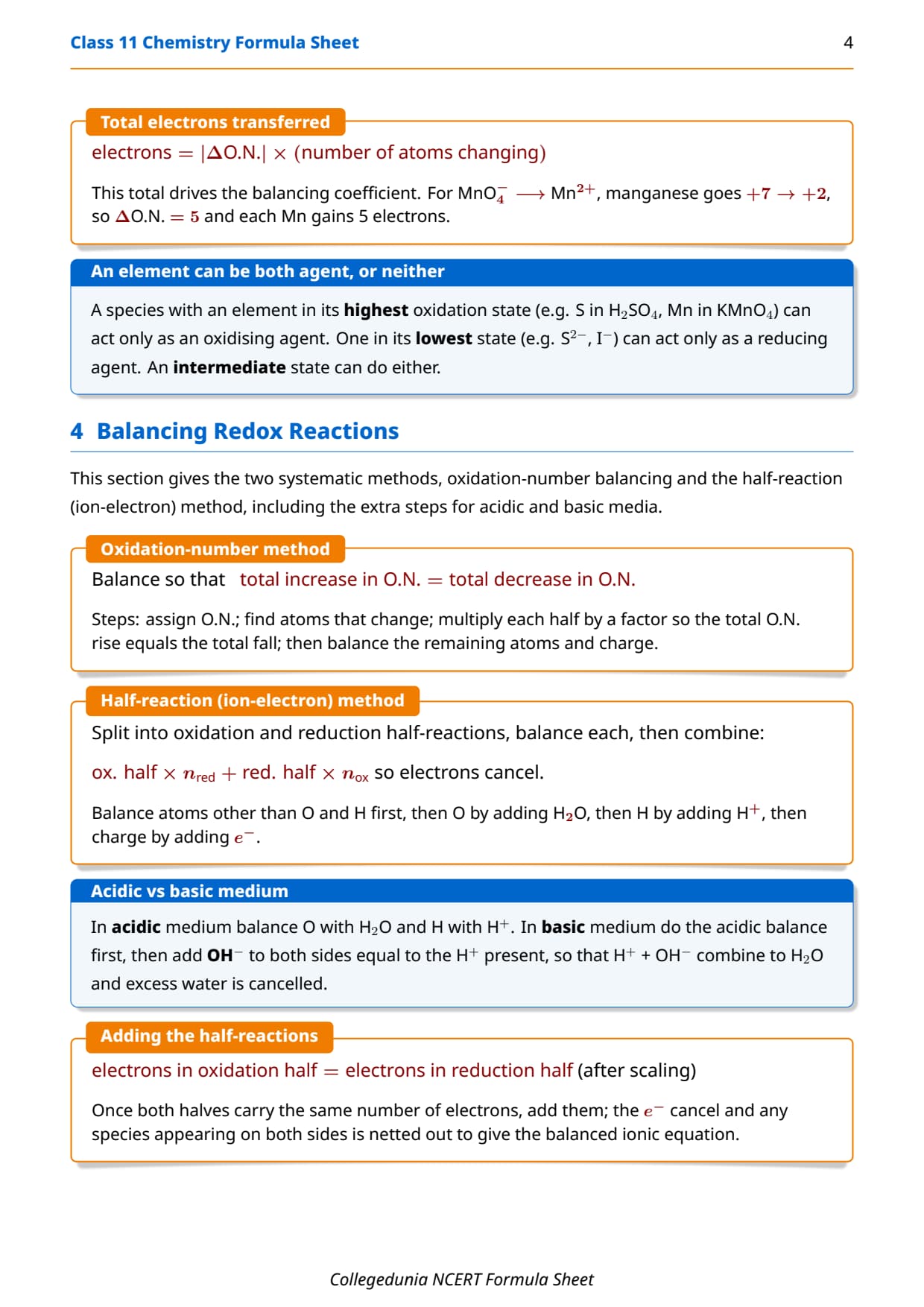
- Lists both balancing methods, the oxidation-number method and the half-reaction (ion-electron) method in acidic and basic media.
- Helps students classify redox types and solve redox titration, equivalent-mass and standard electrode potential numericals.
This class 11 chemistry formula sheet chapter 7 redox reactions is curated by subject experts and checked against the 2026-27 NCERT and recent CBSE, JEE and NEET papers.
All Redox Reactions Formulas at a Glance
Every key redox rule and relation sits in one table below, with its meaning and unit. Learn the oxidation-number sum rule first, since it drives balancing and agent identification.
| Formula | What it means | Unit |
|---|---|---|
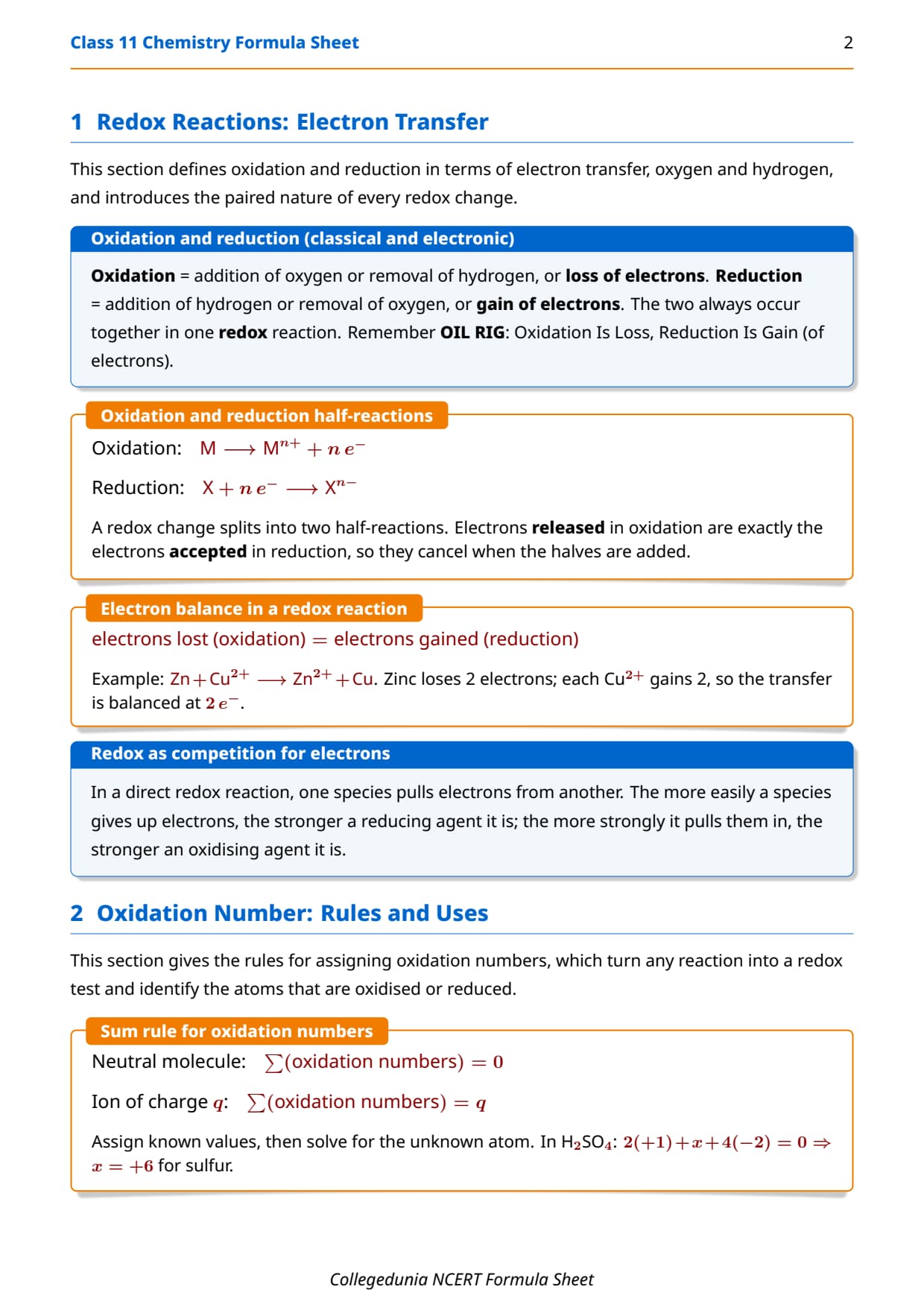
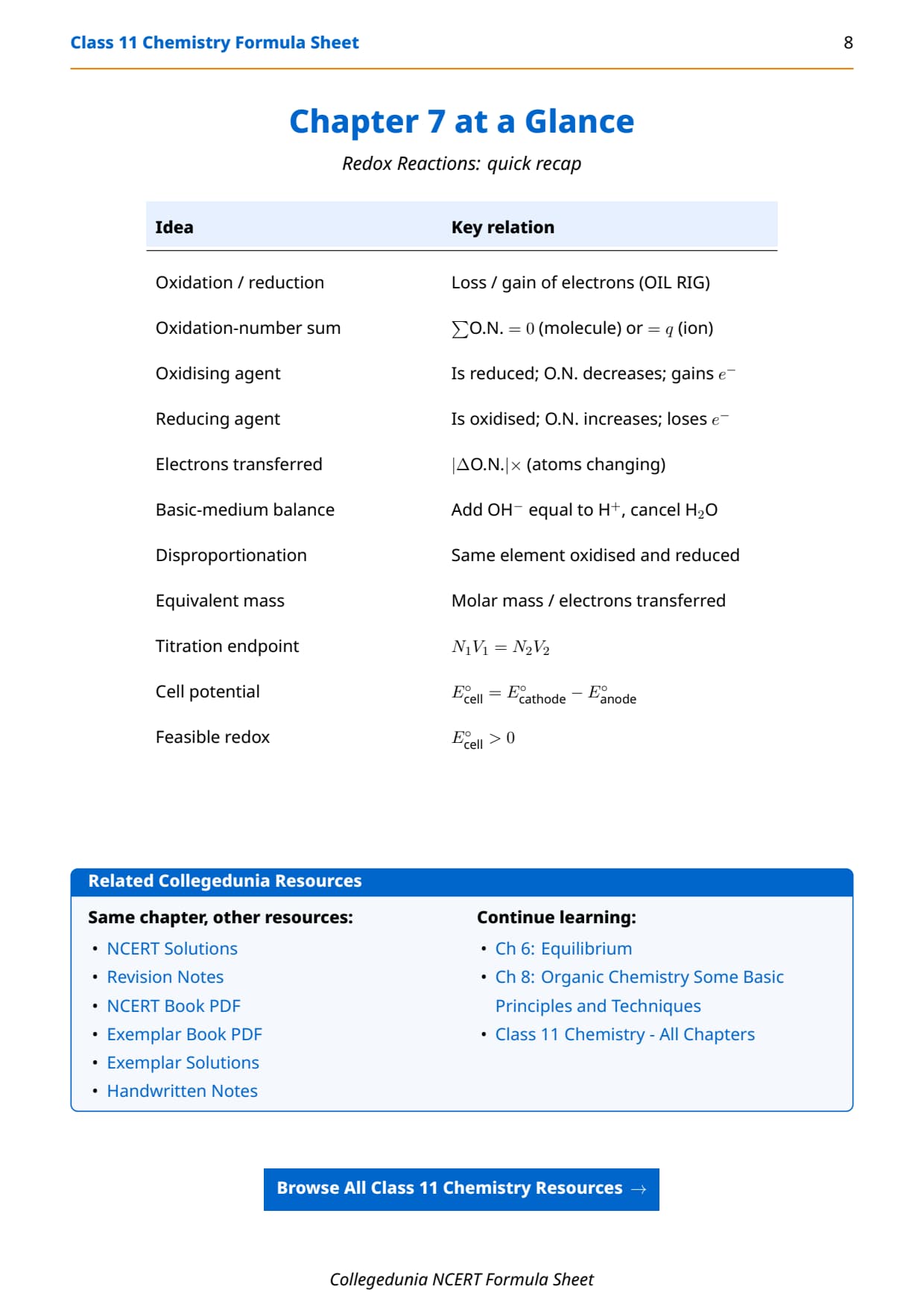
| Σ O.N. = 0 (molecule), = q (ion) | Oxidation numbers sum to charge | Dimensionless |
| electrons = |ΔO.N.| × atoms changing | Electrons transferred in a redox change | Count |
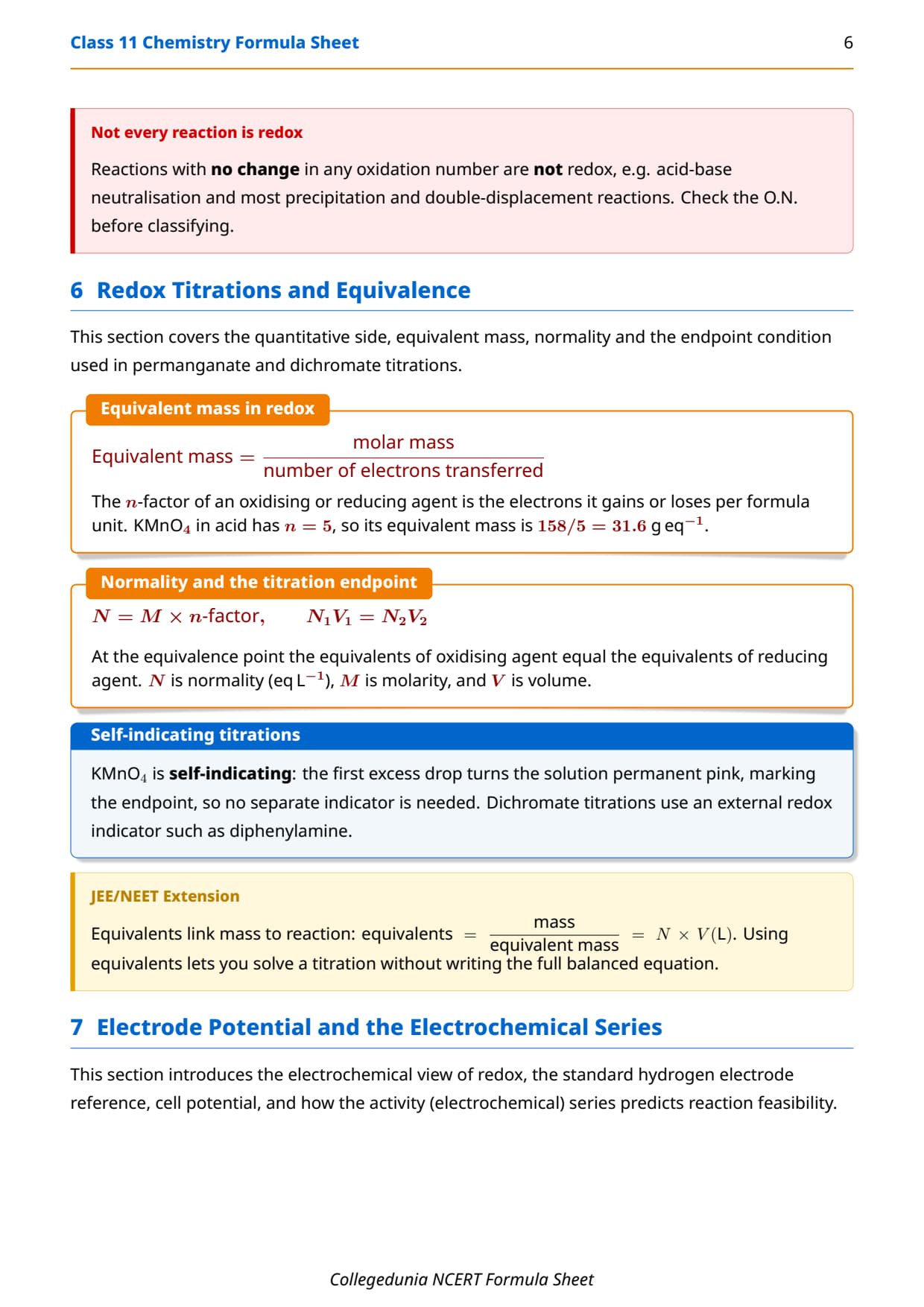
| Equiv. mass = M / n | Equivalent mass from electrons transferred | g eq-1 |
| N = M × n-factor | Normality of a redox reagent | eq L-1 |
| N1V1 = N2V2 | Redox titration equivalence | Balanced equivalents |
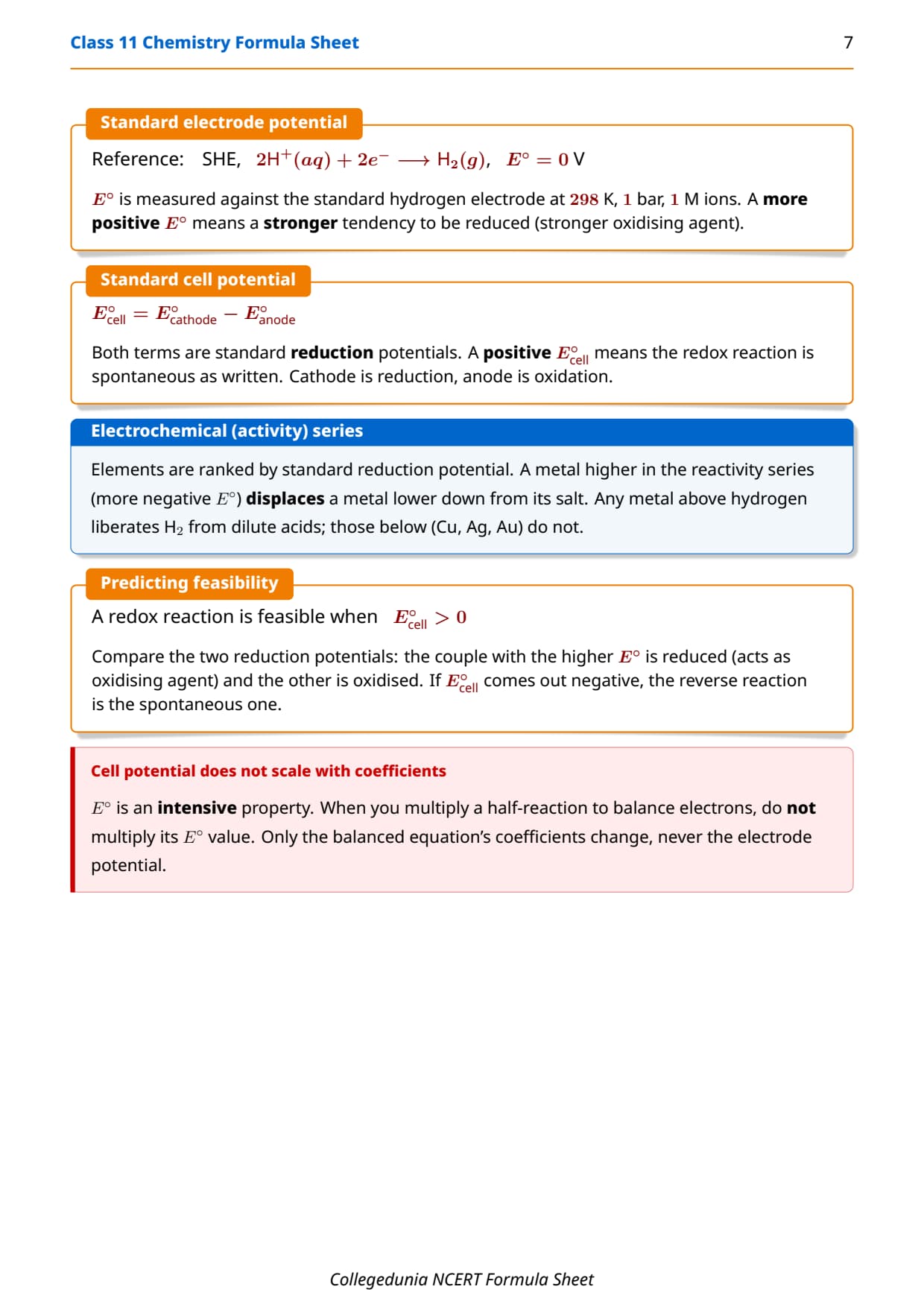
| E°cell = E°cathode − E°anode | Standard cell potential | V (volt) |
| E°cell > 0 | Condition for a feasible redox reaction | V (volt) |
| E° (SHE) = 0 | Standard hydrogen electrode reference | V (volt) |
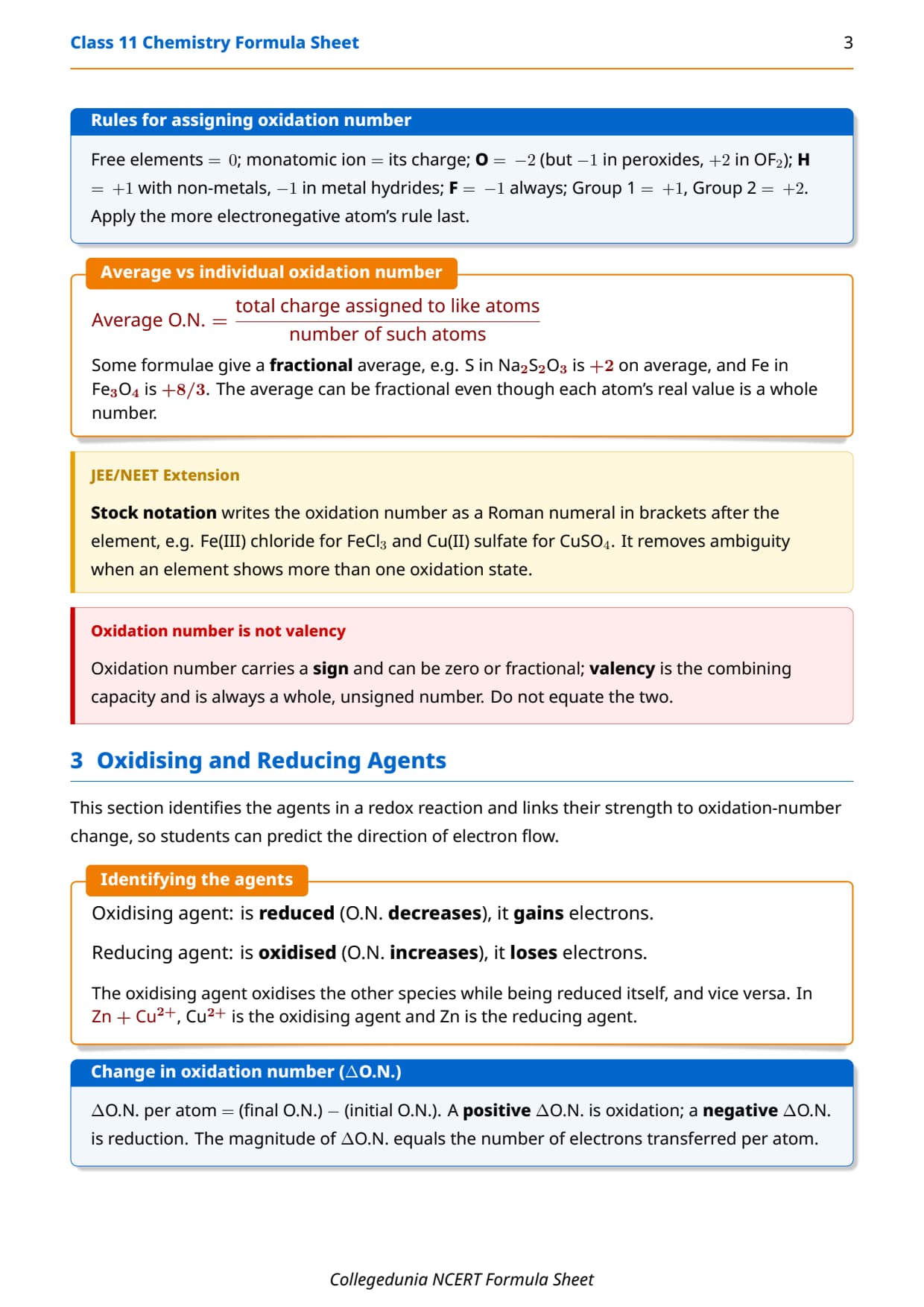
The oxidising agent is reduced and gains electrons, while the reducing agent is oxidised and loses electrons.
Oxidation Number Rules and Electron Transfer
You must also assign oxidation numbers correctly, since every redox test and balancing step depends on them. These rules solve most Chapter 7 questions.
| Species | Oxidation number rule | Example |
|---|---|---|
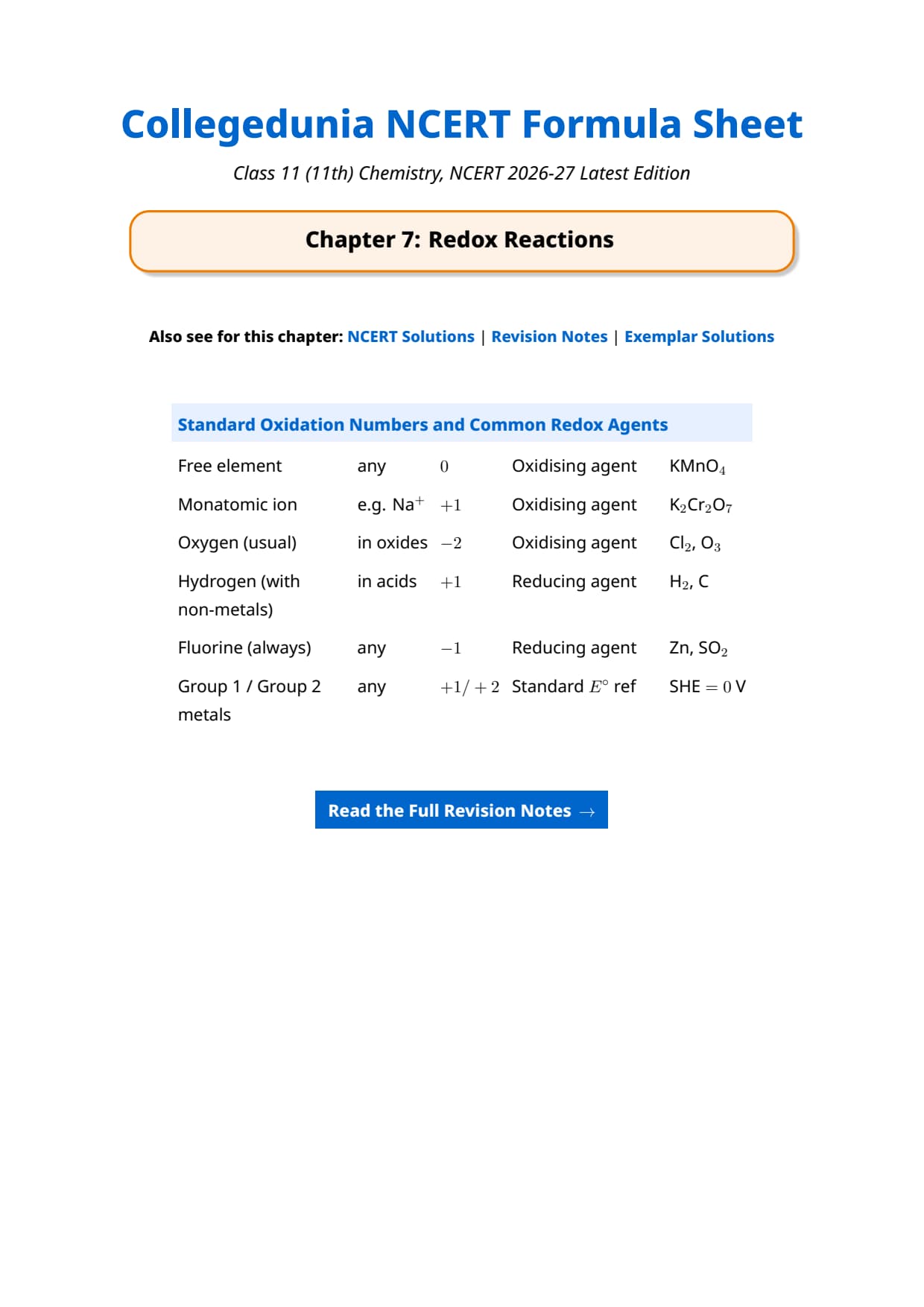
| Free element | Always 0 | O2, Zn, Cl2 |
| Monatomic ion | Equal to its charge | Na+ = +1, S2- = -2 |
| Oxygen (usual) | -2; -1 in peroxides, +2 in OF2 | H2O, H2O2 |
| Hydrogen | +1 with non-metals; -1 in metal hydrides | HCl, NaH |
| Fluorine | Always -1 | HF, CaF2 |
| Group 1 / Group 2 | +1 / +2 in all compounds | K+, Mg2+ |
By the OIL RIG rule, oxidation is loss and reduction is gain of electrons. Every redox reaction pairs one oxidation half with one reduction half.
Key Constants and Reference Values for Redox Reactions
Boards and entrance papers often ask for an agent, an n-factor or a reference value. The list below has the values used in this chapter.
- Standard hydrogen electrode: E° = 0 V at 298 K, 1 bar and 1 M ion concentration.
- Common oxidising agents: KMnO4, K2Cr2O7, Cl2, O3, concentrated HNO3.
- Common reducing agents: H2, C, Zn, SO2, H2S, oxalic acid.
- n-factor of KMnO4: 5 in acidic medium, 3 in neutral, 1 in strongly basic medium; equivalent mass in acid = 158/5 = 31.6 g eq-1.
- Above hydrogen in the series: metals such as Zn, Fe and Mg liberate H2 from dilute acids; Cu, Ag and Au (below H) do not.
How to Revise Redox Reactions Formulas Before the Exam
Use this class 11 chemistry formula sheet chapter 7 redox reactions for a fast recap the night before a test, in about 20 minutes.
- First 7 minutes: write the oxidation-number rules and the sum condition Σ O.N. = 0 or = q.
- Next 7 minutes: practise balancing one equation by the half-reaction method in acidic and then basic medium.
- Last 6 minutes: recall the five redox types and the cell relation E°cell = E°cathode − E°anode.
Finish by solving one KMnO4 titration numerical and one disproportionation example.
Student Feedback on the Redox Reactions Formula Sheet
What 12,740 students told us about their Redox Reactions revision:
- 68% of students rated balancing in basic medium as the hardest part.
- Most-skipped step: adding OH- to convert an acidic-medium balance to a basic one.
- Students who learned the oxidation-number rules first found redox typing and titrations much easier.
Source: 2026-27 Class 11 Chemistry student poll. Sample of 12,740 students from CBSE schools across 14 states, conducted before the 2026 boards.
Other Redox Reactions Class 11 Chemistry Resources
Pair this formula sheet with the solved answers, notes and textbook PDF.
| Resource | Link |
|---|---|
| NCERT Solutions | Redox Reactions Class 11 NCERT Solutions |
| Revision Notes | Redox Reactions Class 11 Notes |
| Handwritten Notes | Redox Reactions Class 11 Handwritten Notes |
| NCERT Book PDF | Redox Reactions Class 11 Book PDF |
NCERT Formula Sheet for Class 11 Chemistry: All Chapters
Jump to any other Class 11 Chemistry formula sheet below.
| Chapter | Formula Sheet |
|---|---|
| Chapter 1 | Some Basic Concepts of Chemistry |
| Chapter 2 | Structure of Atom |
| Chapter 3 | Classification of Elements and Periodicity in Properties |
| Chapter 4 | Chemical Bonding and Molecular Structure |
| Chapter 5 | Thermodynamics |
| Chapter 6 | Equilibrium |
| Chapter 7 | Redox Reactions |
| Chapter 8 | Organic Chemistry: Some Basic Principles and Techniques |
| Chapter 9 | Hydrocarbons |
FAQs on Redox Reactions Class 11 Chemistry Formula Sheet
Redox Reactions Formula Sheet - Frequently Asked Questions
Ques. What formulas does the class 11 chemistry formula sheet chapter 7 redox reactions cover?
Ans. This class 11 chemistry formula sheet chapter 7 redox reactions covers the oxidation-number sum rule Σ O.N. = 0 or = q, the electron-transfer (OIL RIG) view, both balancing methods, redox types, equivalent mass and normality N1V1 = N2V2, and the cell relation E°cell = E°cathode − E°anode.
Ques. How do you identify the oxidising and reducing agent?
Ans. The oxidising agent is the species whose oxidation number decreases because it gains electrons, so it oxidises the other reactant. The reducing agent is the species whose oxidation number increases because it loses electrons. In Zn + Cu2+ → Zn2+ + Cu, Cu2+ is the oxidising agent and Zn is the reducing agent.
Ques. How do you balance a redox reaction in basic medium?
Ans. Split the reaction into half-reactions, balance atoms other than O and H, add H2O for oxygen and H+ for hydrogen, then balance charge with electrons. For a basic medium, add OH- to both sides equal to the number of H+, combine H+ and OH- into H2O, and cancel any excess water.
Ques. What is disproportionation in redox reactions?
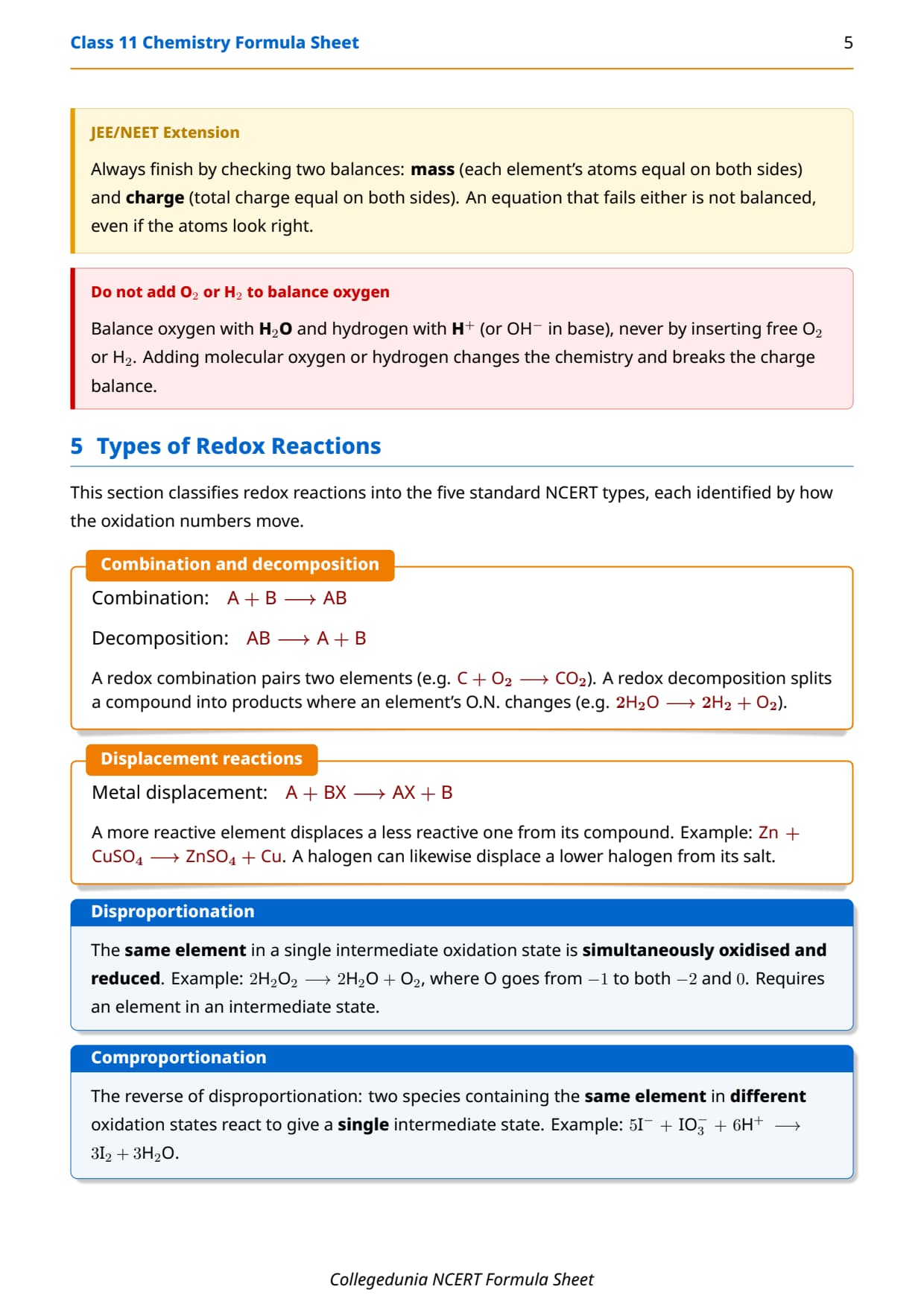
Ans. In disproportionation, an element in an intermediate oxidation state is simultaneously oxidised and reduced in the same reaction. For example, in 2H2O2 → 2H2O + O2, oxygen goes from -1 to both -2 and 0. The reverse process, where two different states give one intermediate state, is called comproportionation.



Comments