




The class 11 chemistry formula sheet chapter 1 some basic concepts of chemistry gathers every mole, concentration and composition formula tested in the Boards, JEE Main, JEE Advanced, NEET, CUET and NDA exams. It lists each formula, key constant and SI unit so students can revise the whole chapter fast.
Some Basic Concepts of Chemistry is the foundation chapter, so its mole and stoichiometry rules return in every numerical chapter that follows.
- Covers the mole concept, molar mass and Avogadro number, plus the link between mass, moles and particles.
- Lists the concentration terms molarity, molality, mole fraction and mass percent side by side.
- Helps students find empirical and molecular formulae and solve limiting-reagent numericals.
This class 11 chemistry formula sheet chapter 1 some basic concepts of chemistry is curated by subject experts and checked against the 2026-27 NCERT and recent CBSE, JEE and NEET papers.
All Some Basic Concepts of Chemistry Formulas at a Glance
Every mole and concentration formula sits in one table below, with its meaning and SI unit. Learn the mole triangle rows first, since almost every numerical uses them.
| Formula | What it means | SI unit |
|---|---|---|
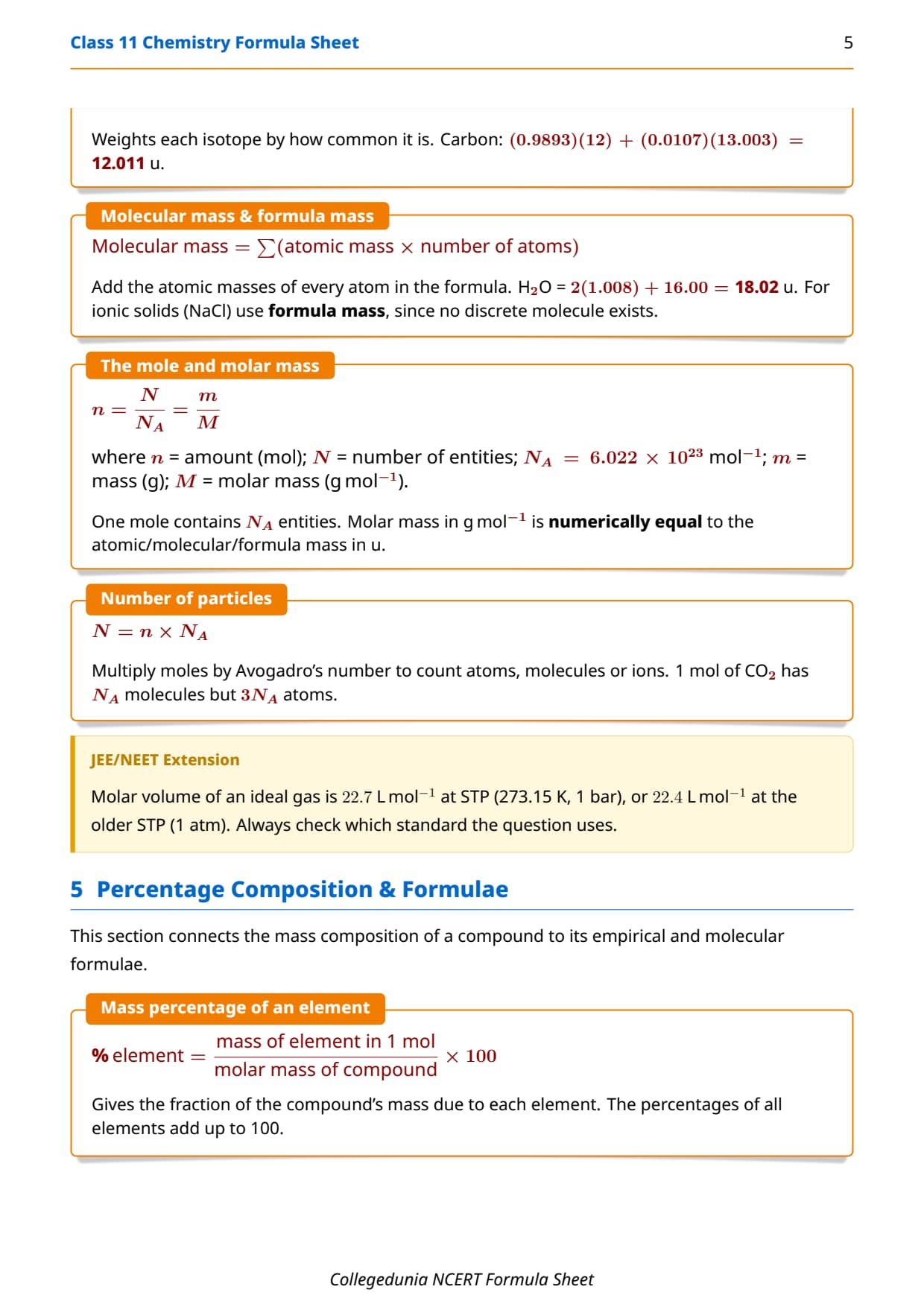
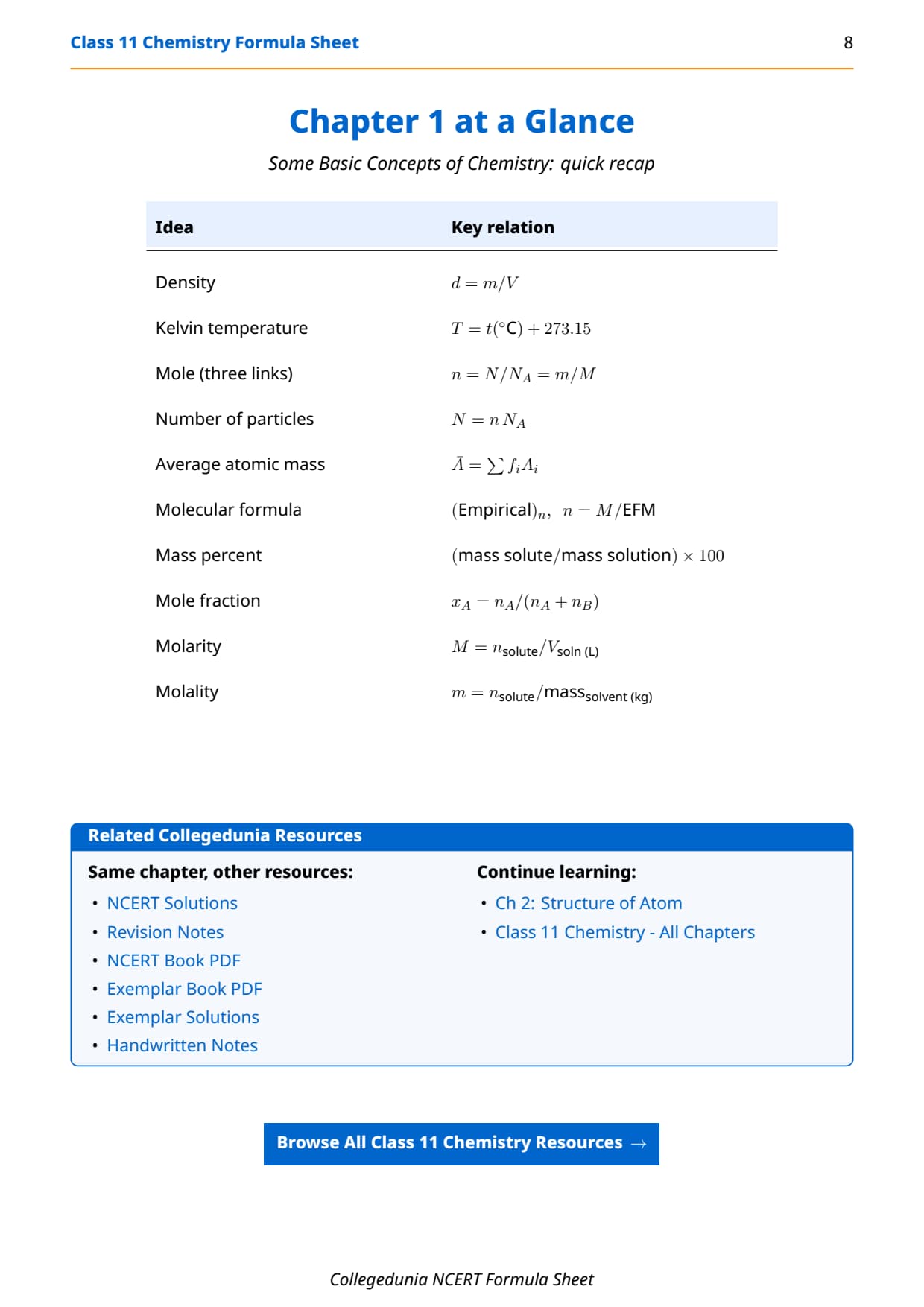
| n = m/M | Moles from mass and molar mass | mol |
| N = n × NA | Number of particles from moles | Dimensionless (count) |
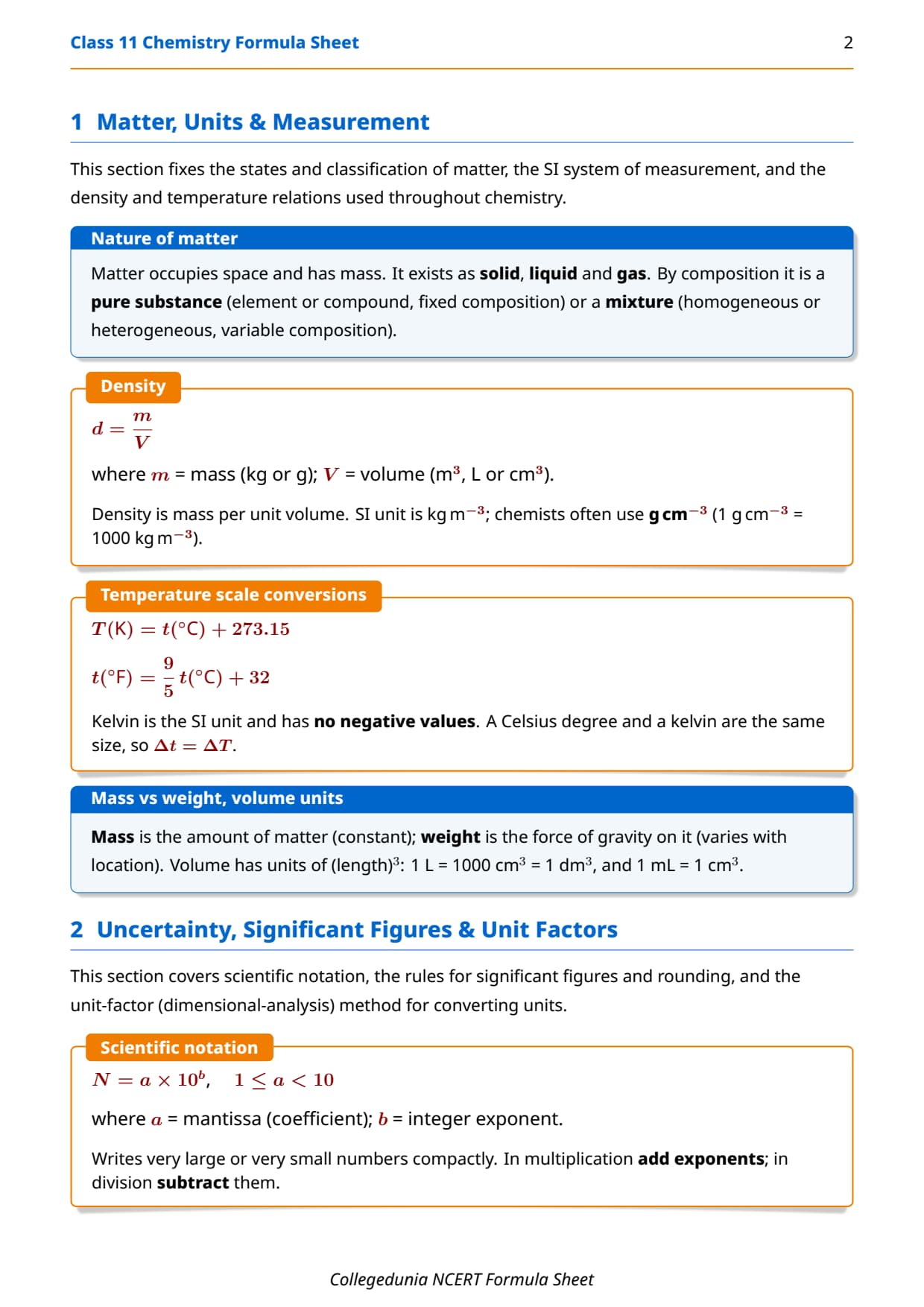
| d = m/V | Density, mass per unit volume | kg m-3 |
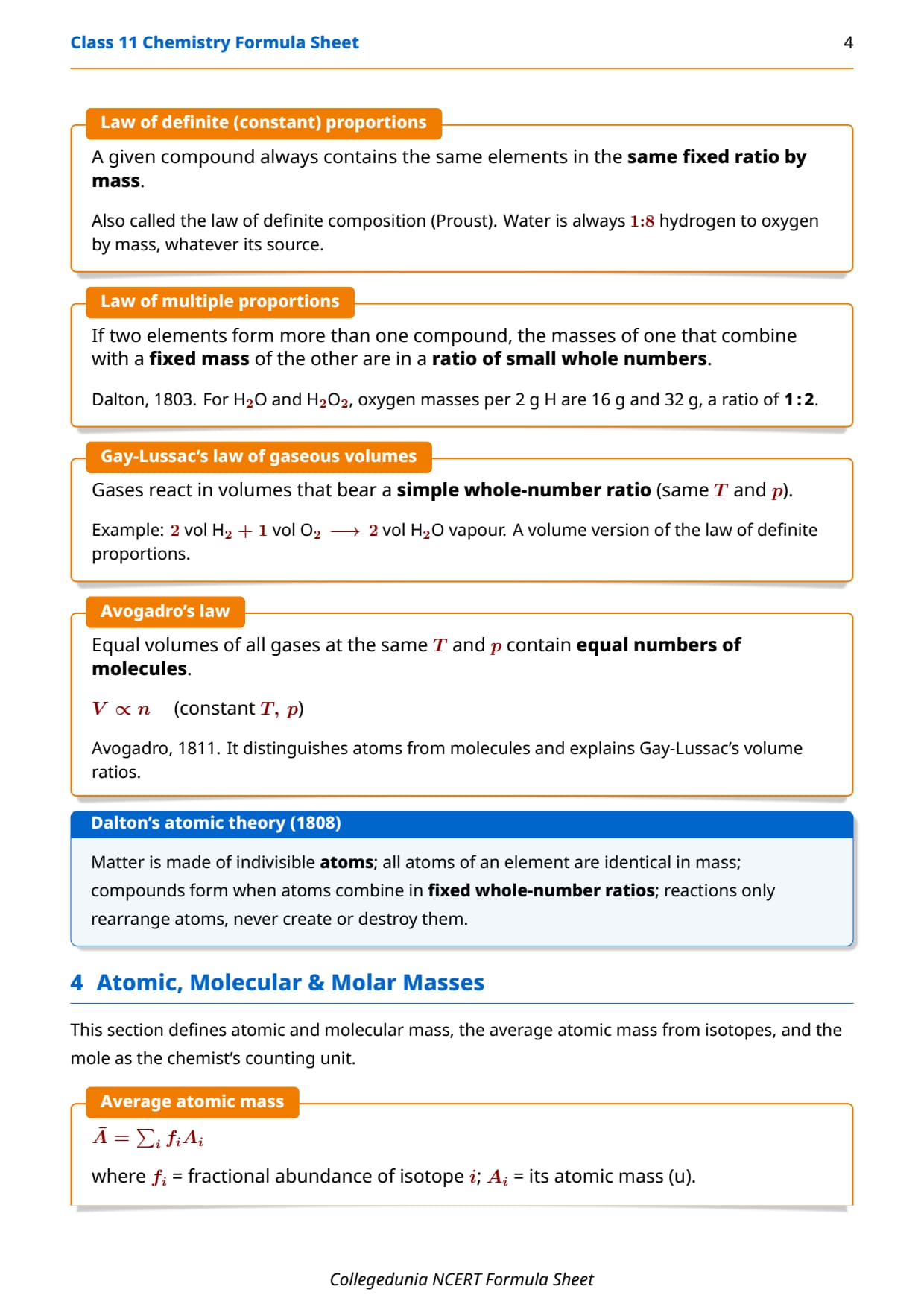
| Ā = Σ fiAi | Average atomic mass from isotopes | u (unified mass) |
| % element = (mass of element / molar mass) × 100 | Mass percentage of an element | Percent (%) |
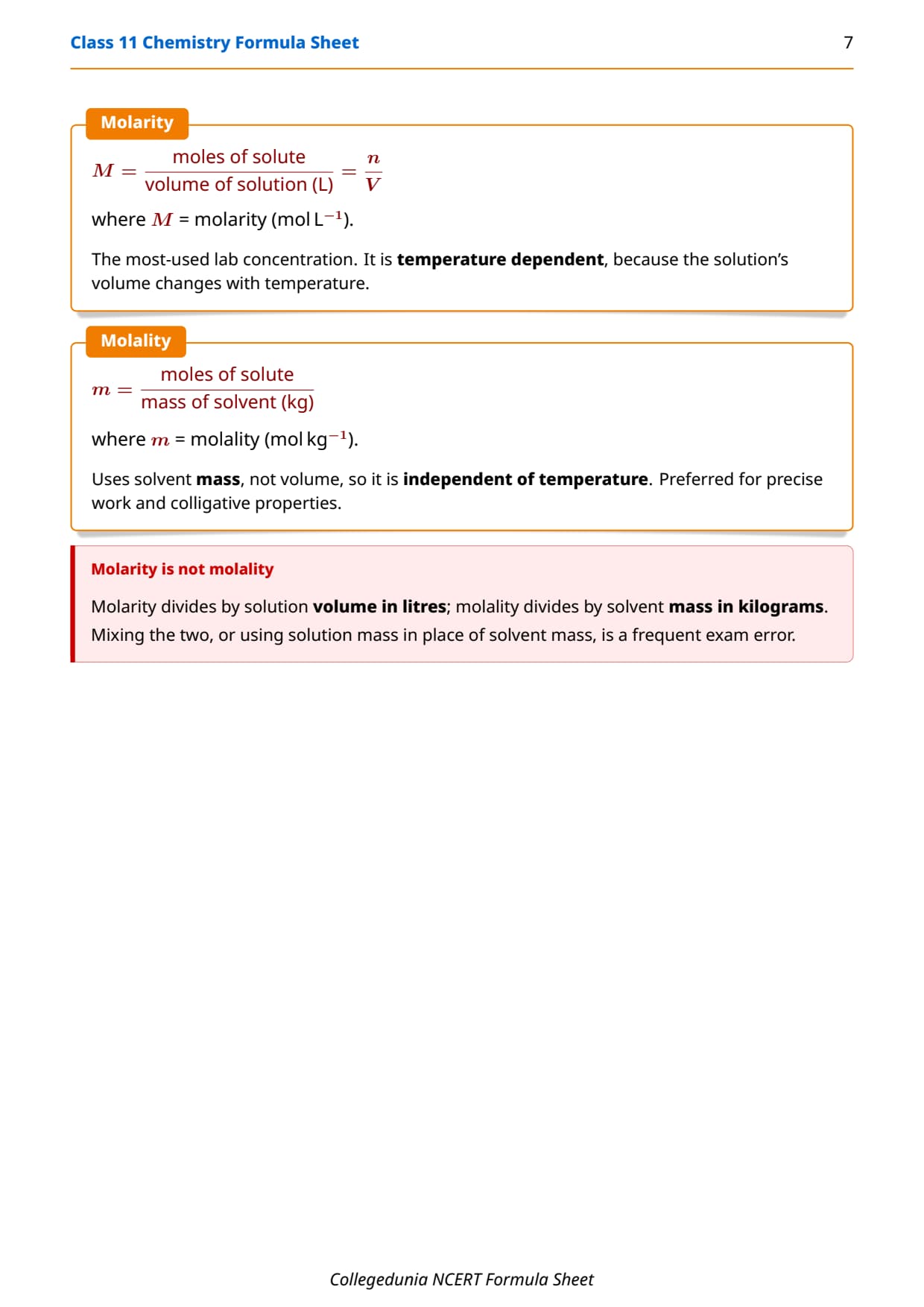
| M = nsolute/Vsolution | Molarity of a solution | mol L-1 |
| m = nsolute/masssolvent | Molality of a solution | mol kg-1 |
| xA = nA/(nA + nB) | Mole fraction of a component | Dimensionless |
Molarity divides by solution volume in litres, but molality divides by solvent mass in kilograms.
Mole Concept and Molar Mass Relations
You must also connect mass, moles and number of particles through the NA bridge. These three links solve most Chapter 1 numericals.
| Quantity | Relation | SI unit |
|---|---|---|
| Amount of substance | n = N/NA = m/M | mol |
| Avogadro constant | NA = 6.022 × 10²³ | mol-1 |
| Molar mass | Numerically equal to molecular mass in u | g mol-1 |
| Molar volume of gas (STP) | Vm = 22.7 at 273.15 K, 1 bar | L mol-1 |
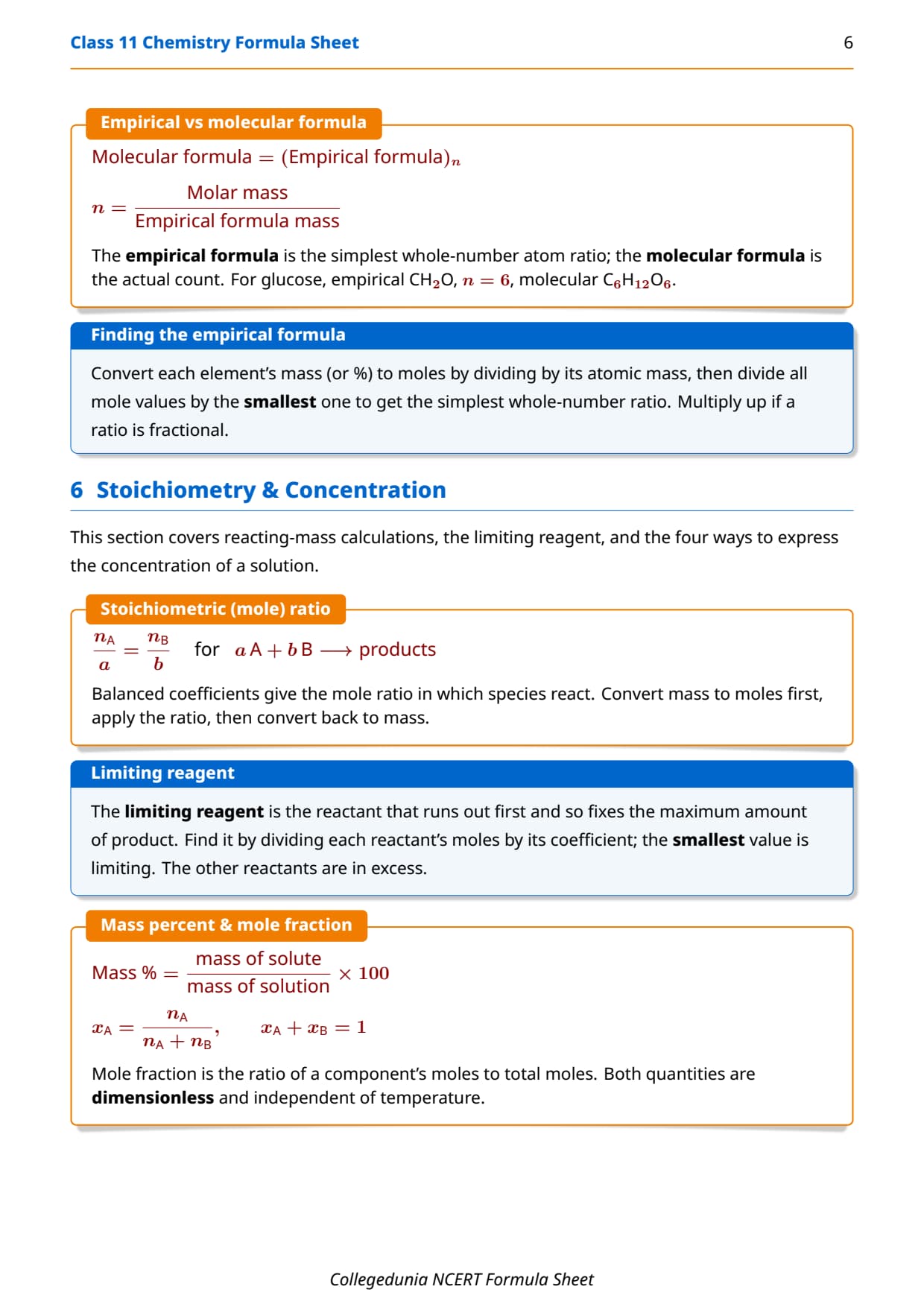
| Molecular formula | (Empirical)n, n = M/EFM | Dimensionless |
| Molecular mass of water | 2(1.008) + 16.00 = 18.02 | u |
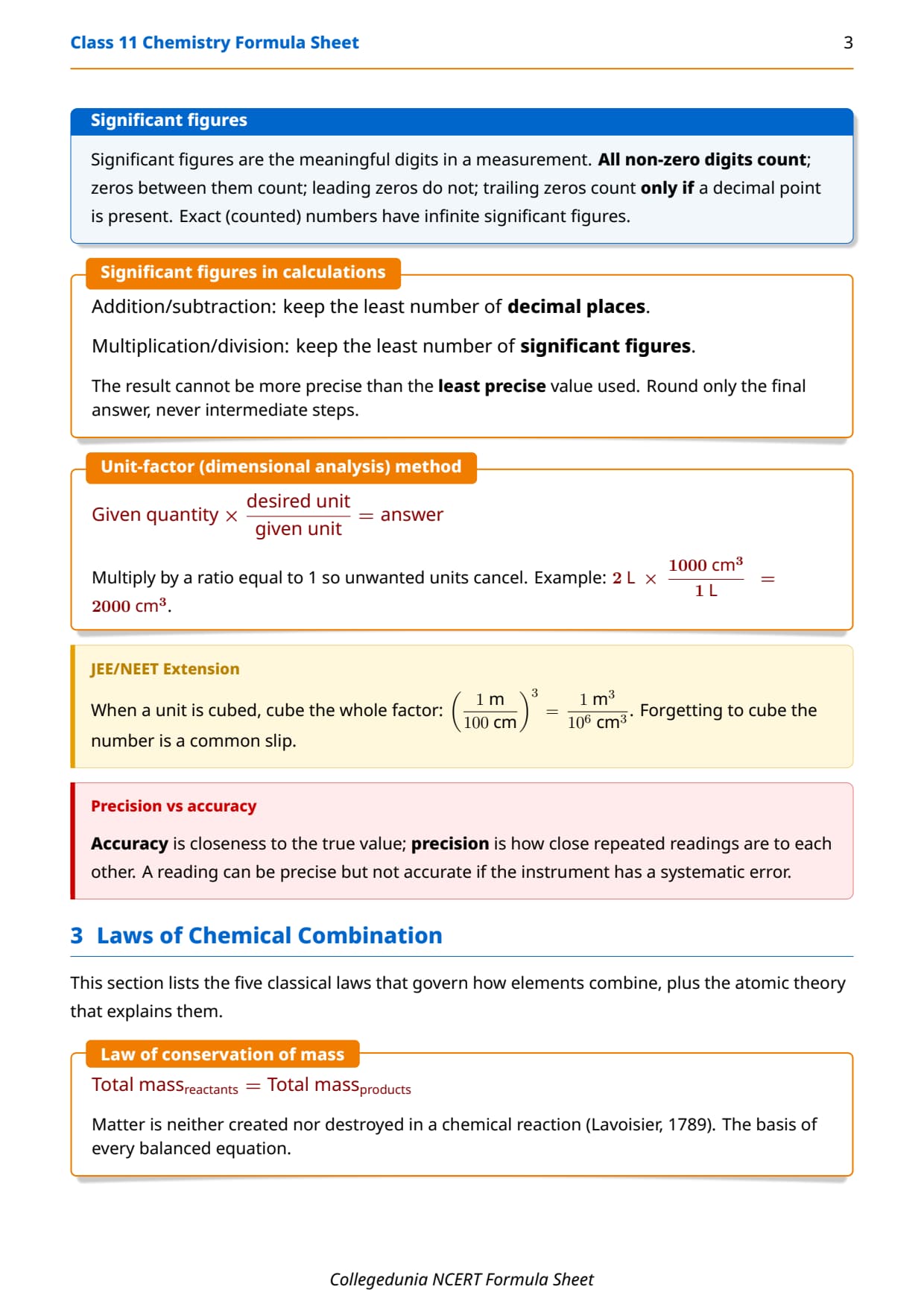
By the law of conservation of mass, total mass of reactants equals total mass of products. Every equation you balance depends on this rule.
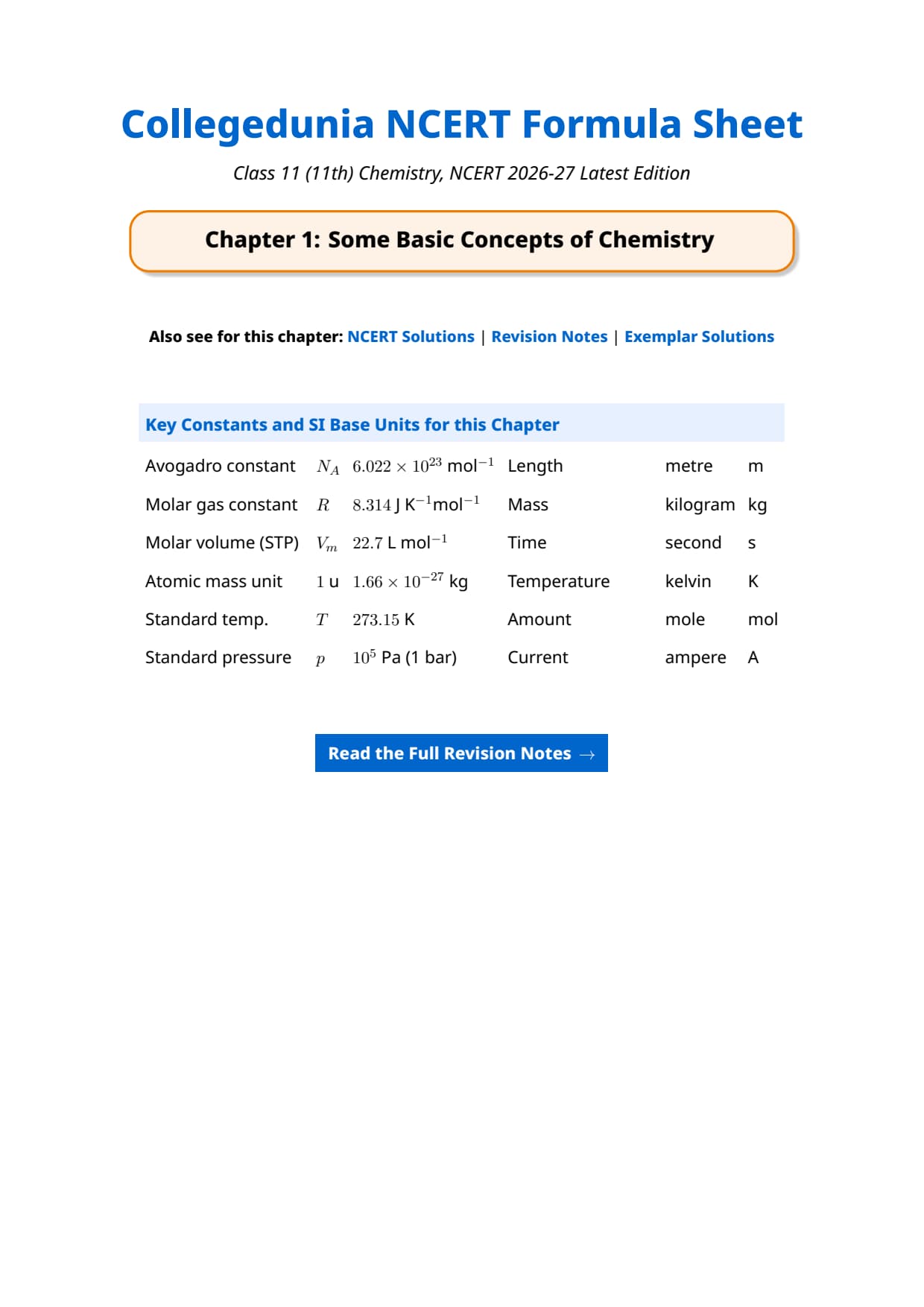
Key Constants and SI Base Units for Some Basic Concepts of Chemistry
Boards and entrance papers often ask for a constant or unit definition. The list below has the key values and the SI base units used in this chapter.
- SI base units: metre (length), kilogram (mass), second (time), ampere (current), kelvin (temperature), mole (amount of substance), candela (luminous intensity).
- Avogadro constant: NA = 6.022 × 10²³ mol-1.
- Molar gas constant: R = 8.314 J K-1 mol-1; 1 atomic mass unit = 1.66 × 10⁻²⁷ kg.
- Standard conditions (STP): 273.15 K and 105 Pa (1 bar), giving a molar volume of 22.7 L mol-1.
- Common atomic masses (u): H = 1.008, C = 12.011, N = 14.007, O = 15.999, Na = 22.99, Cl = 35.45.
How to Revise Some Basic Concepts of Chemistry Formulas Before the Exam
Use this class 11 chemistry formula sheet chapter 1 some basic concepts of chemistry for a fast recap the night before a test, in about 20 minutes.
- First 7 minutes: write the mole links n = m/M = N/NA and the four concentration terms.
- Next 7 minutes: practise finding an empirical formula from percentage composition.
- Last 6 minutes: recall the five laws of chemical combination and the limiting-reagent method.
Finish by solving one limiting-reagent numerical and one molarity-to-molality conversion.
Student Feedback on the Some Basic Concepts of Chemistry Formula Sheet
What 13,120 students told us about their Some Basic Concepts of Chemistry revision:
- 71% of students rated the limiting-reagent and mole calculations as the hardest part.
- Most-skipped step: converting molarity to molality using solution density.
- Students who learned the mole triangle first found stoichiometry much easier.
Source: 2026-27 Class 11 Chemistry student poll. Sample of 13,120 students from CBSE schools across 14 states, conducted before the 2026 boards.
Other Some Basic Concepts of Chemistry Class 11 Chemistry Resources
Pair this formula sheet with the solved answers, notes and textbook PDF.
| Resource | Link |
|---|---|
| NCERT Solutions | Some Basic Concepts of Chemistry Class 11 NCERT Solutions |
| Revision Notes | Some Basic Concepts of Chemistry Class 11 Notes |
| Handwritten Notes | Some Basic Concepts of Chemistry Class 11 Handwritten Notes |
| NCERT Book PDF | Some Basic Concepts of Chemistry Class 11 Book PDF |
NCERT Formula Sheet for Class 11 Chemistry: All Chapters
Jump to any other Class 11 Chemistry formula sheet below.
| Chapter | Formula Sheet |
|---|---|
| Chapter 1 | Some Basic Concepts of Chemistry |
| Chapter 2 | Structure of Atom |
| Chapter 3 | Classification of Elements and Periodicity in Properties |
| Chapter 4 | Chemical Bonding and Molecular Structure |
| Chapter 5 | Thermodynamics |
| Chapter 6 | Equilibrium |
| Chapter 7 | Redox Reactions |
| Chapter 8 | Organic Chemistry: Some Basic Principles and Techniques |
| Chapter 9 | Hydrocarbons |
FAQs on Some Basic Concepts of Chemistry Class 11 Chemistry Formula Sheet
Some Basic Concepts of Chemistry Formula Sheet - Frequently Asked Questions
Ques. What formulas does the class 11 chemistry formula sheet chapter 1 some basic concepts of chemistry cover?
Ans. This class 11 chemistry formula sheet chapter 1 some basic concepts of chemistry covers the mole relations n = m/M = N/NA, average atomic mass, percentage composition, empirical and molecular formulae, and the four concentration terms molarity, molality, mole fraction and mass percent.
Ques. What is the difference between molarity and molality?
Ans. Molarity is M = nsolute/Vsolution (L) and changes with temperature. Molality is m = nsolute/masssolvent (kg) and stays constant with temperature because it uses mass, not volume.
Ques. How do you find the limiting reagent?
Ans. Convert each reactant's mass to moles, then divide by its balanced coefficient. The reactant giving the smallest value runs out first, so it is the limiting reagent and fixes the amount of product formed. The others are in excess.
Ques. What is the value of Avogadro's number?
Ans. The Avogadro constant is NA = 6.022 × 10²³ mol-1. It is the number of atoms, molecules or ions in one mole of any substance, and it links the number of particles to the amount in moles through N = n × NA.



Comments