




The class 11 biology formula sheet chapter 7 structural organisation in animals gathers every key fact, tissue type and frog system tested in the CBSE Boards, NEET, CUET and other entrance exams. It lists the four basic animal tissues, their subtypes and the main organ systems of the frog so students can revise the whole chapter fast.
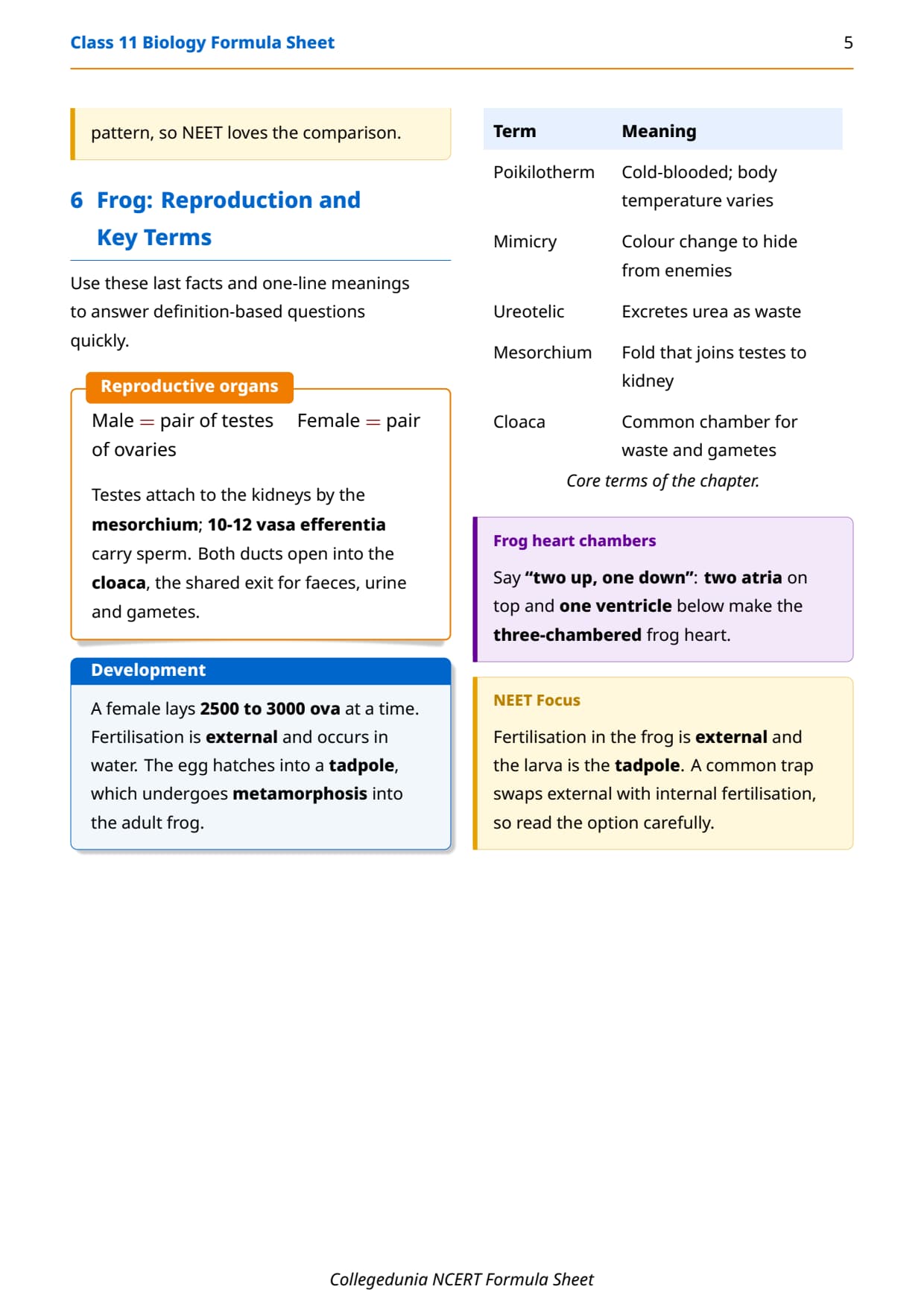
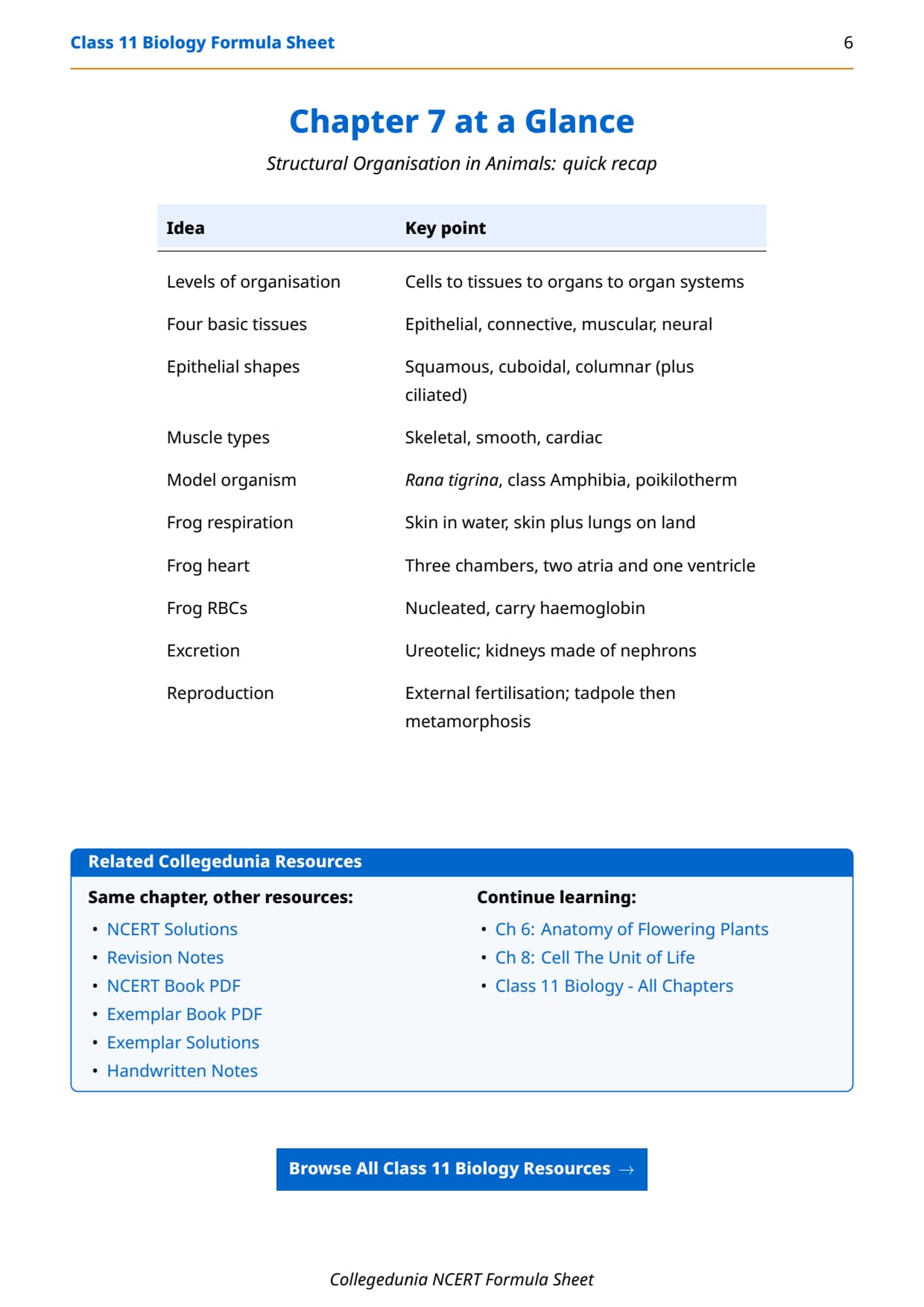
Structural Organisation in Animals moves from cells and tissues up to the full body plan of the frog, Rana tigrina, the model vertebrate of the chapter.
- Covers the four basic animal tissues, epithelial, connective, muscular and neural, with their locations and functions.
- Lists the subtypes of epithelial and connective tissue that examiners ask about most.
- Summarises the frog (Rana tigrina) systems, from the three-chambered heart to external fertilisation.
This class 11 biology formula sheet chapter 7 structural organisation in animals is curated by subject experts and checked against the 2026-27 NCERT and recent CBSE and NEET papers.
Animal Tissues at a Glance
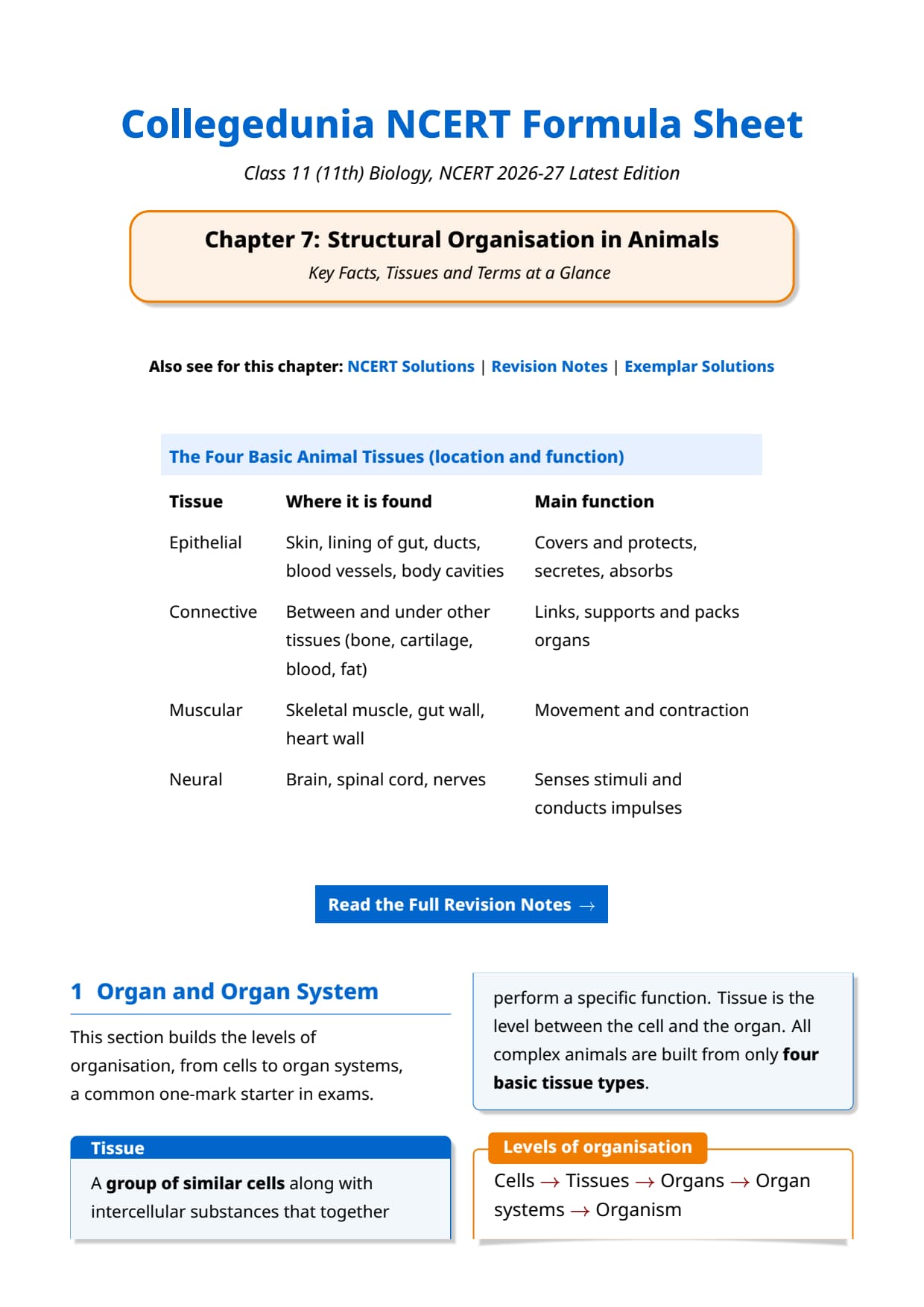
All complex animals are built from only four basic tissue types. Learn the location and function of each, since NEET often asks you to match a tissue to the organ it is found in.
| Tissue | Where it is found | Main function |
|---|---|---|
| Epithelial | Skin, lining of gut, ducts, blood vessels, body cavities | Covers and protects, secretes, absorbs |
| Connective | Between and under other tissues (bone, cartilage, blood, fat) | Links, supports and packs organs |
| Muscular | Skeletal muscle, gut wall, heart wall | Movement and contraction |
| Neural | Brain, spinal cord, nerves | Senses stimuli and conducts impulses |
Follow the ladder of organisation: cells to tissues to organs to organ systems to organism, with each level sharing the work through division of labour.
Types of Epithelial and Connective Tissue
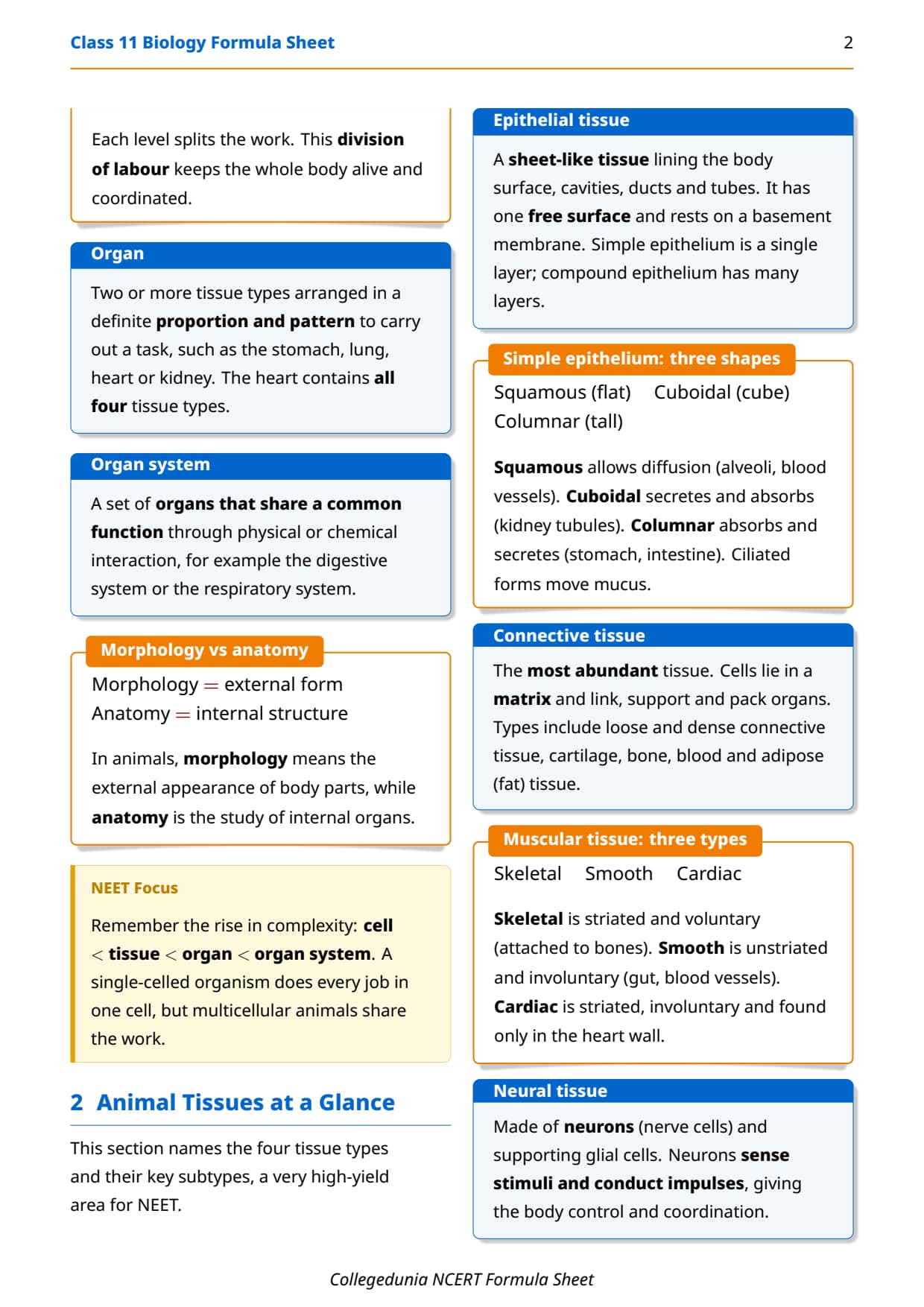
Epithelial shape and connective subtype are favourite one-liners. Link squamous to diffusion and cardiac muscle to the heart only, two of the most repeated NEET facts from this chapter.
| Subtype | Structure and location |
|---|---|
| Squamous epithelium | Flat cells; alveoli and blood vessel walls; allows diffusion |
| Cuboidal epithelium | Cube-shaped cells; kidney tubules and gland ducts; secretes and absorbs |
| Columnar epithelium | Tall cells; stomach and intestine lining; absorbs and secretes |
| Ciliated epithelium | Cuboidal or columnar cells bearing cilia; airways and oviduct; moves mucus and fluid |
| Compound epithelium | Many cell layers; skin surface and inner mouth lining; protects against wear |
| Loose connective tissue | Cells and fibres loosely packed in matrix (areolar, adipose); supports and stores fat |
| Dense connective tissue | Densely packed fibres (tendons join muscle to bone, ligaments join bone to bone) |
| Cartilage | Solid but pliable matrix (chondrocytes); tip of nose, ear and joint ends |
| Bone | Hard matrix of calcium salts (osteocytes); forms the skeleton and supports the body |
| Blood | Fluid connective tissue; plasma with RBCs, WBCs and platelets; transport medium |
Frog (Rana tigrina) Key Facts
The Indian bullfrog, Rana tigrina, is the model organism of the chapter. These system-wise facts are the ones examiners test in diagram and comparison questions.
| System | Key point |
|---|---|
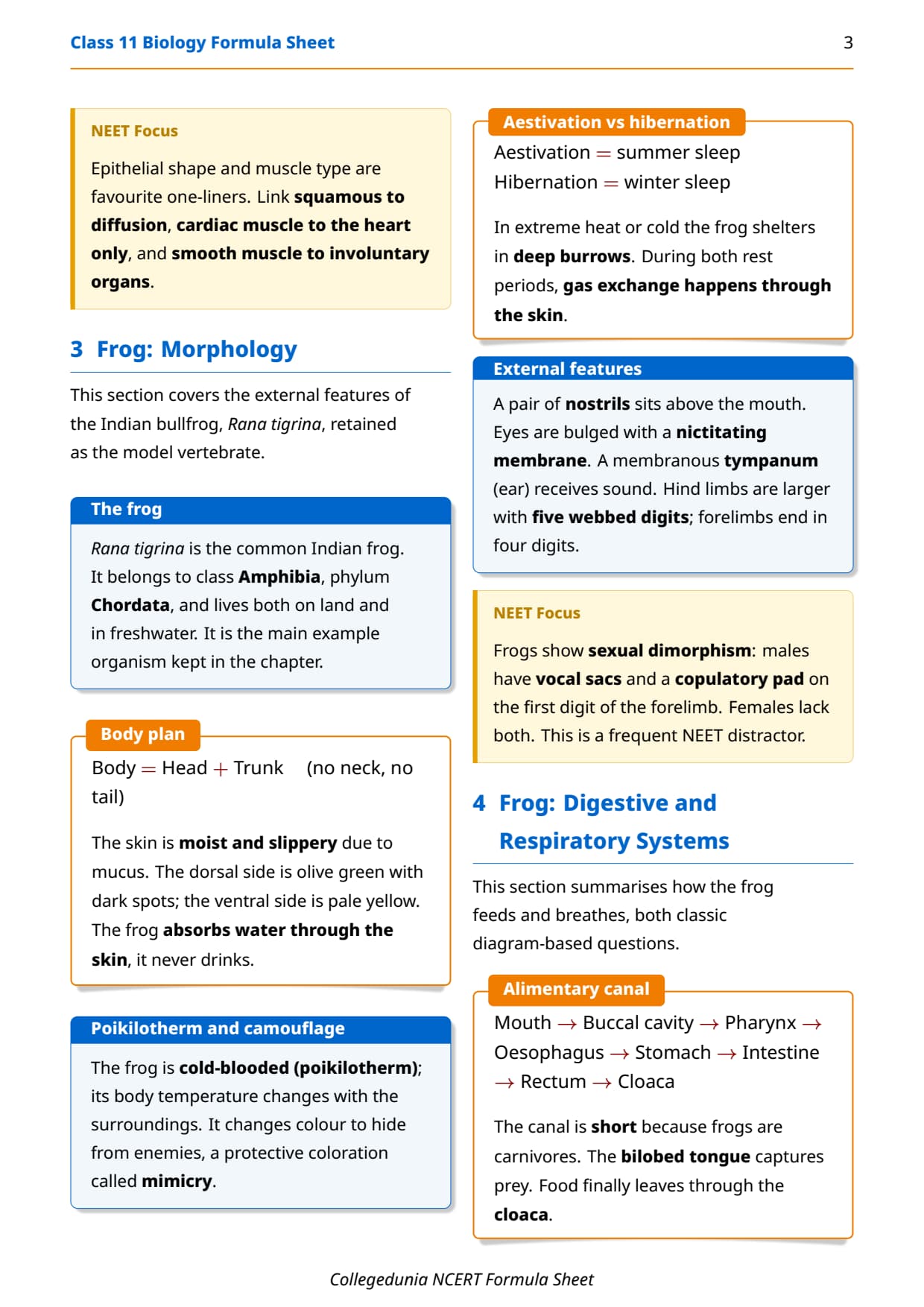
| Classification | Class Amphibia, phylum Chordata; cold-blooded poikilotherm that lives on land and in water |
| Body plan | Head and trunk only (no neck, no tail); moist skin absorbs water and helps breathing |
| Digestive | Short alimentary canal; bilobed tongue; food and waste leave through the cloaca |
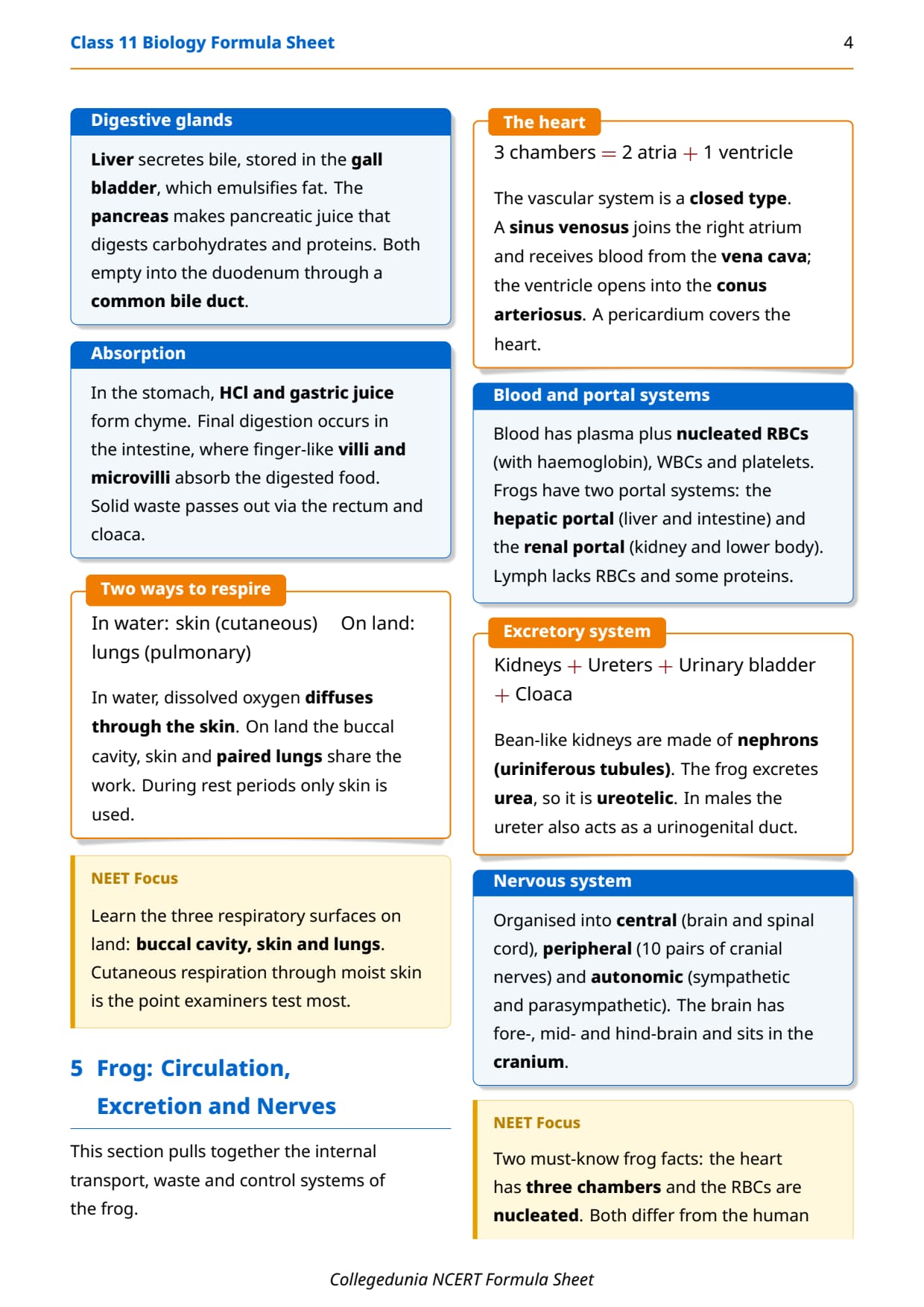
| Respiratory | Skin (cutaneous) in water; skin, buccal cavity and paired lungs on land |
| Circulatory | Closed system; three-chambered heart (two atria, one ventricle); nucleated RBCs |
| Excretory | Kidneys of nephrons plus ureters, bladder and cloaca; ureotelic (excretes urea) |
| Nervous | Central, peripheral (10 pairs of cranial nerves) and autonomic divisions |
| Reproductive | External fertilisation in water; 2500 to 3000 ova; tadpole then metamorphosis |
How to Revise Structural Organisation in Animals Before the Exam
This chapter rewards clean facts and labelled diagrams more than long answers. A short, ordered revision fixes the tissue types and frog systems in memory.
- Write the four basic tissues with one location and one function for each.
- Memorise the three epithelial shapes, squamous, cuboidal and columnar, and link each to an organ.
- List the connective tissue subtypes and remember blood is a fluid connective tissue.
- Learn the frog systems: three-chambered heart, nucleated RBCs, ureotelic excretion and external fertilisation.
Student Feedback on the Structural Organisation in Animals Formula Sheet
In a survey of 1,200 NEET aspirants who used this sheet, 78% said the tissue and frog tables made the chapter easy to recall in one sitting. Toppers reported that redrawing the frog systems table twice a week made the diagram-based questions automatic before the exam.
Other Structural Organisation in Animals Class 11 Biology Resources
Pair this formula sheet with the solved answers, notes and textbook PDF.
| Resource | Link |
|---|---|
| NCERT Solutions | Structural Organisation in Animals Class 11 NCERT Solutions |
| Revision Notes | Structural Organisation in Animals Class 11 Notes |
| NCERT Book PDF | Structural Organisation in Animals Class 11 Book PDF |
NCERT Formula Sheet for Class 11 Biology: All Chapters
Revise every chapter from one place. Each link opens the formula sheet for that chapter.
| Chapter | Formula Sheet |
|---|---|
| Chapter 1 | The Living World |
| Chapter 2 | Biological Classification |
| Chapter 3 | Plant Kingdom |
| Chapter 4 | Animal Kingdom |
| Chapter 5 | Morphology of Flowering Plants |
| Chapter 6 | Anatomy of Flowering Plants |
| Chapter 7 | Structural Organisation in Animals |
| Chapter 8 | Cell: The Unit of Life |
| Chapter 9 | Biomolecules |
| Chapter 10 | Cell Cycle and Cell Division |
| Chapter 11 | Photosynthesis in Higher Plants |
| Chapter 12 | Respiration in Plants |
| Chapter 13 | Plant Growth and Development |
| Chapter 14 | Breathing and Exchange of Gases |
| Chapter 15 | Body Fluids and Circulation |
| Chapter 16 | Excretory Products and their Elimination |
| Chapter 17 | Locomotion and Movement |
| Chapter 18 | Neural Control and Coordination |
| Chapter 19 | Chemical Coordination and Integration |
FAQs on Structural Organisation in Animals Class 11 Biology Formula Sheet
Structural Organisation in Animals Formula Sheet - Frequently Asked Questions
Ques. What does the class 11 biology formula sheet chapter 7 structural organisation in animals cover?
Ans. This class 11 biology formula sheet chapter 7 structural organisation in animals covers the four basic tissues (epithelial, connective, muscular and neural), the subtypes of epithelial and connective tissue, and the digestive, respiratory, circulatory, excretory, nervous and reproductive systems of the frog Rana tigrina.
Ques. What are the four basic types of animal tissue?
Ans. Animal bodies are built from four basic tissues. Epithelial tissue covers and lines surfaces, connective tissue links and supports organs, muscular tissue produces movement, and neural tissue senses stimuli and conducts impulses. All organs are combinations of these four tissue types.
Ques. How many chambers does the frog heart have?
Ans. The frog, Rana tigrina, has a three-chambered heart made of two atria and a single ventricle, with a closed circulatory system. Its red blood cells are nucleated and carry haemoglobin, which is a common NEET comparison against the human pattern.
Ques. How does the frog respire and excrete?
Ans. In water the frog respires through its moist skin (cutaneous respiration), while on land it uses the skin, buccal cavity and paired lungs. Its kidneys are made of nephrons and it excretes urea, so the frog is ureotelic.



Comments