




The class 11 biology formula sheet chapter 13 plant growth and development pulls together every growth formula, hormone function and flowering rule tested in the CBSE Boards, NEET, CUET and other entrance exams. It sets out the two growth equations, the five plant growth regulators and the photoperiodism and vernalisation facts so students can revise the whole chapter fast.
Plant Growth and Development ties together growth, hormones and flowering, and it is one of the most reliably scoring plant-physiology chapters in NEET.
- Carries the two growth equations, arithmetic and geometric (exponential) growth, with the sigmoid curve.
- Summarises the five plant growth regulators, their key function and one farm application each.
- Covers photoperiodism and vernalisation, the two extrinsic controls of flowering.
This class 11 biology formula sheet chapter 13 plant growth and development is curated by subject experts and checked against the 2026-27 NCERT and recent CBSE and NEET papers.
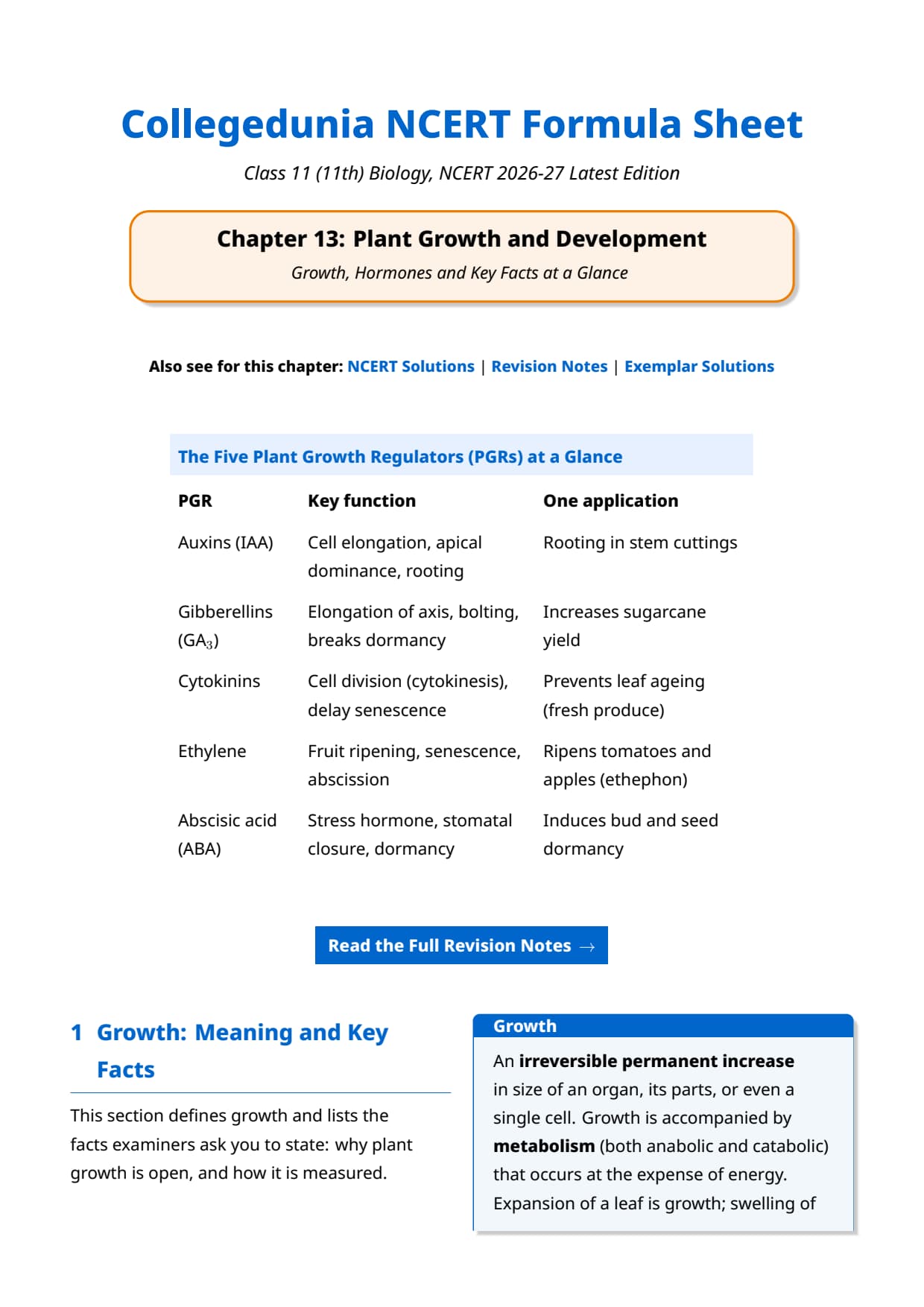
The Five Plant Growth Regulators at a Glance
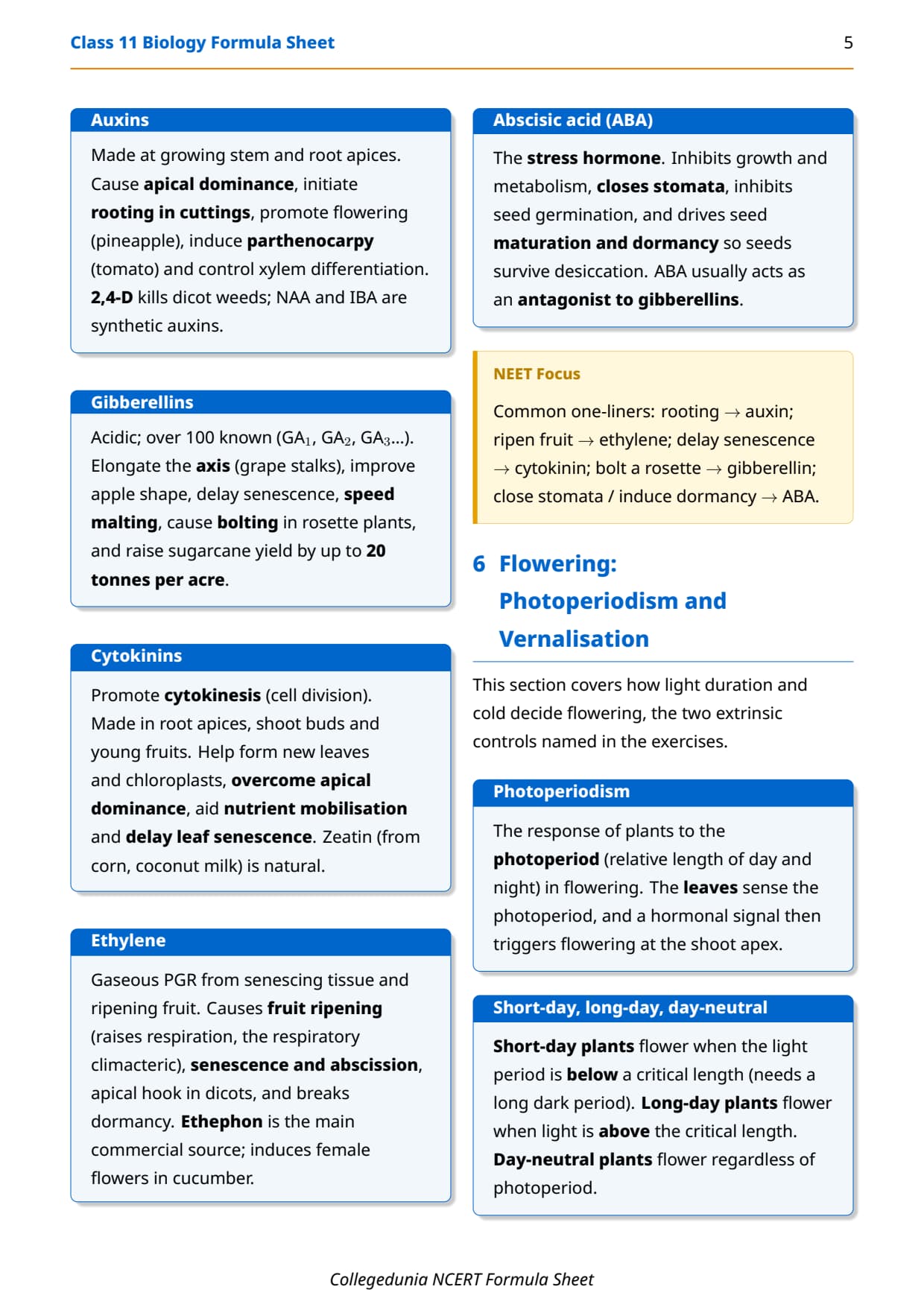
All five plant growth regulators (PGRs) sit in the table below, with the key function and one application of each. Learn the function and use columns together, since NEET turns them into one-mark match questions.
| PGR | Key function | One application |
|---|---|---|
| Auxins (IAA) | Cell elongation, apical dominance, rooting | Rooting in stem cuttings |
| Gibberellins (GA3) | Elongation of axis, bolting, breaks dormancy | Increases sugarcane yield |
| Cytokinins | Cell division (cytokinesis), delay senescence | Prevents leaf ageing in fresh produce |
| Ethylene | Fruit ripening, senescence, abscission | Ripens tomatoes and apples (ethephon) |
| Abscisic acid (ABA) | Stress hormone, stomatal closure, dormancy | Induces bud and seed dormancy |
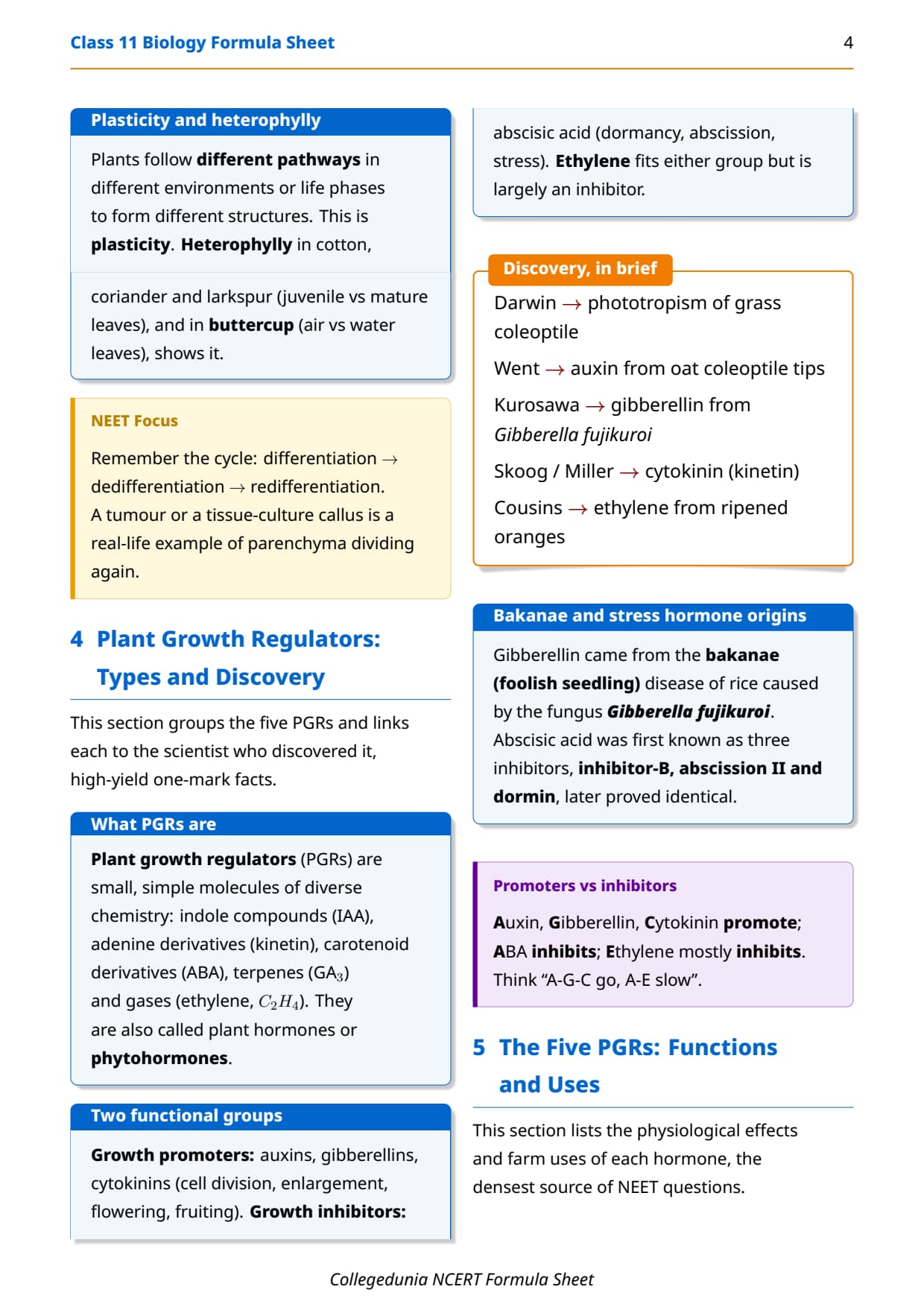
Auxins, gibberellins and cytokinins are growth promoters, while abscisic acid is the growth inhibitor and ethylene mostly inhibits.
Growth Rates and Growth Curves
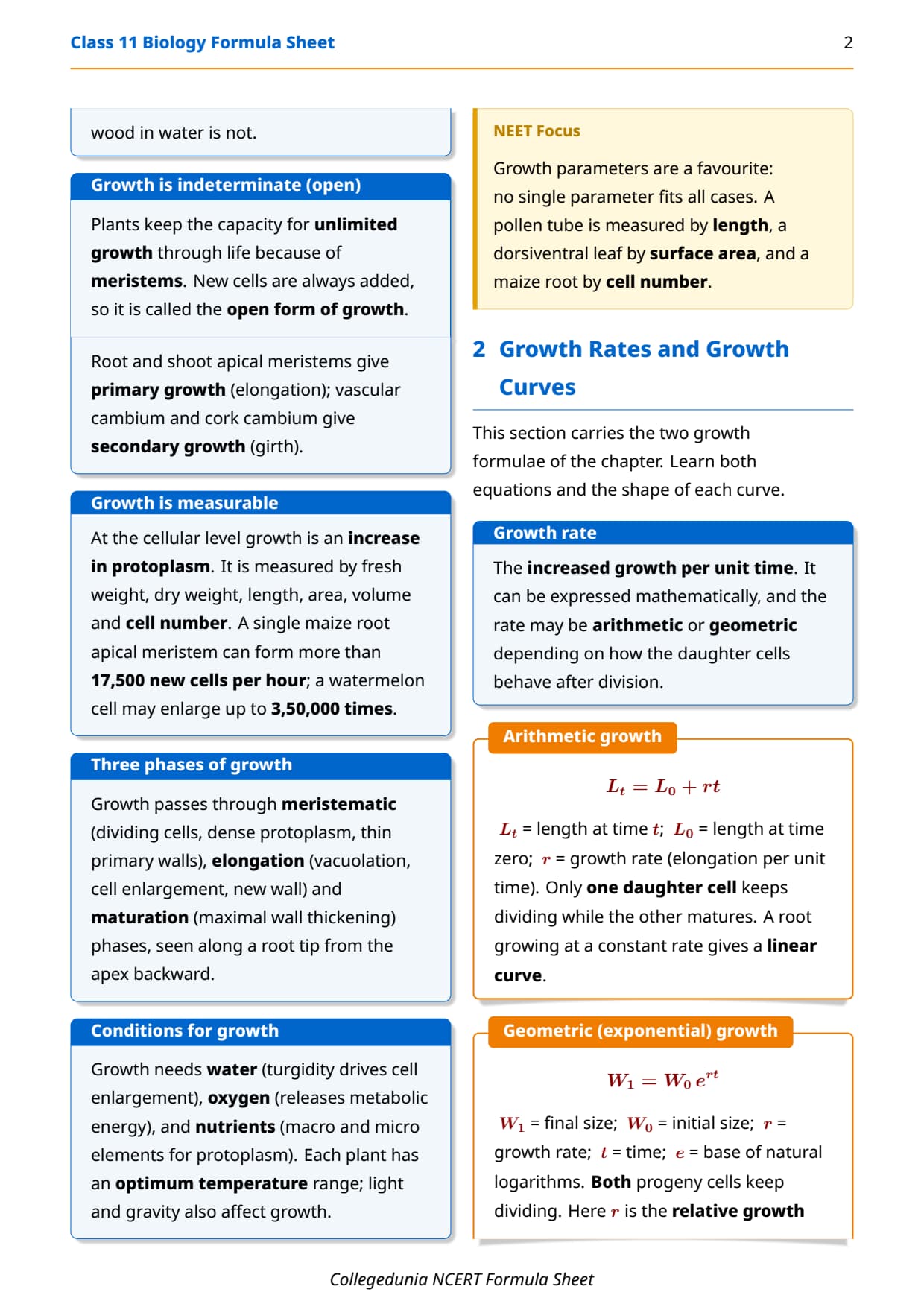
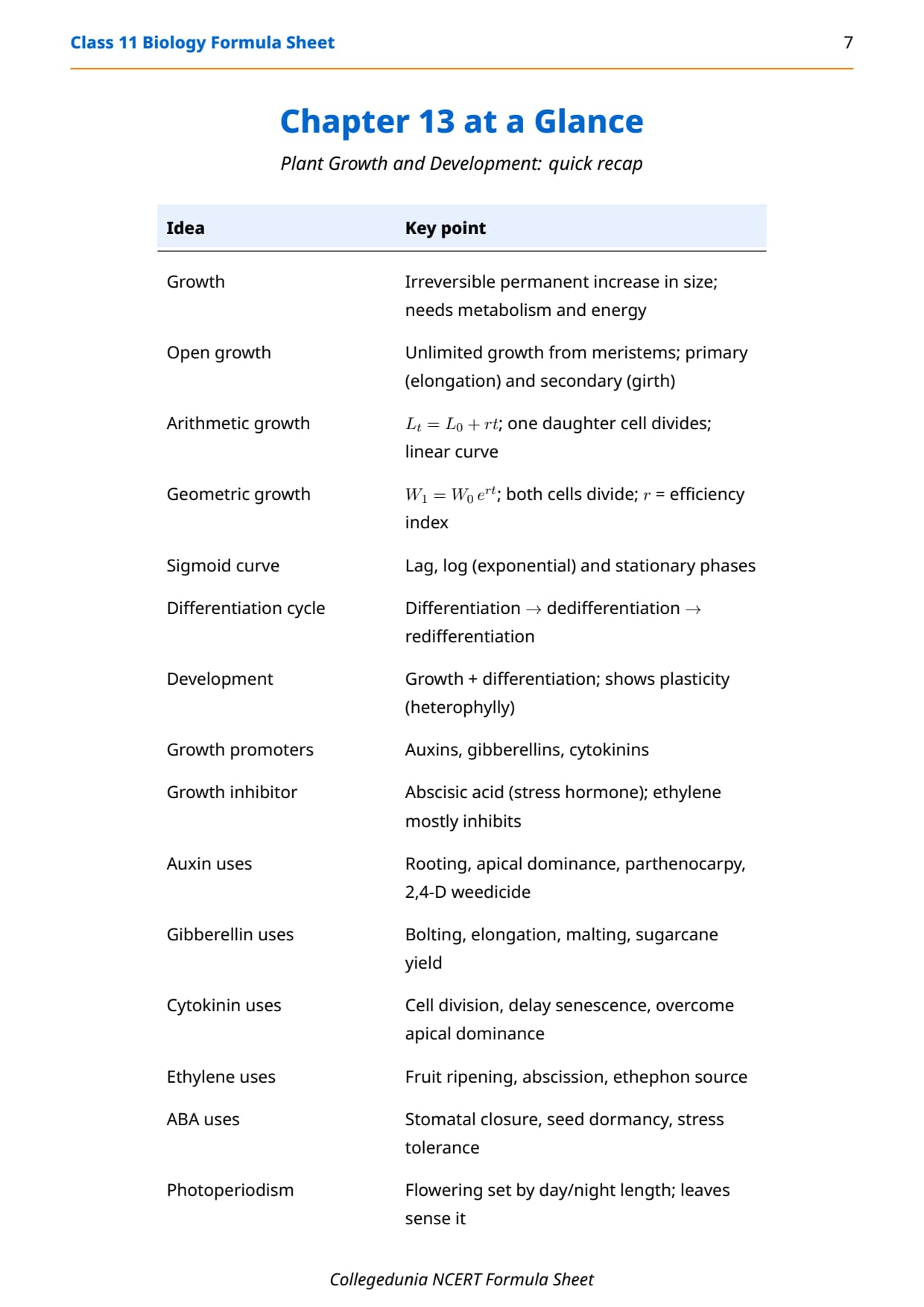
This is the only section with real formulae, so it is high-value for both Boards and NEET. Growth rate is the increased growth per unit time, and it can be arithmetic or geometric depending on how the daughter cells behave after each division.
| Type | Formula and shape | What it means |
|---|---|---|
| Arithmetic growth | Lt = L0 + rt; linear curve | Only one daughter cell keeps dividing while the other matures; a root at a constant rate gives a straight line |
| Geometric (exponential) growth | W1 = W0ert; exponential rise | Both progeny cells keep dividing; here r is the relative growth rate, also called the efficiency index |
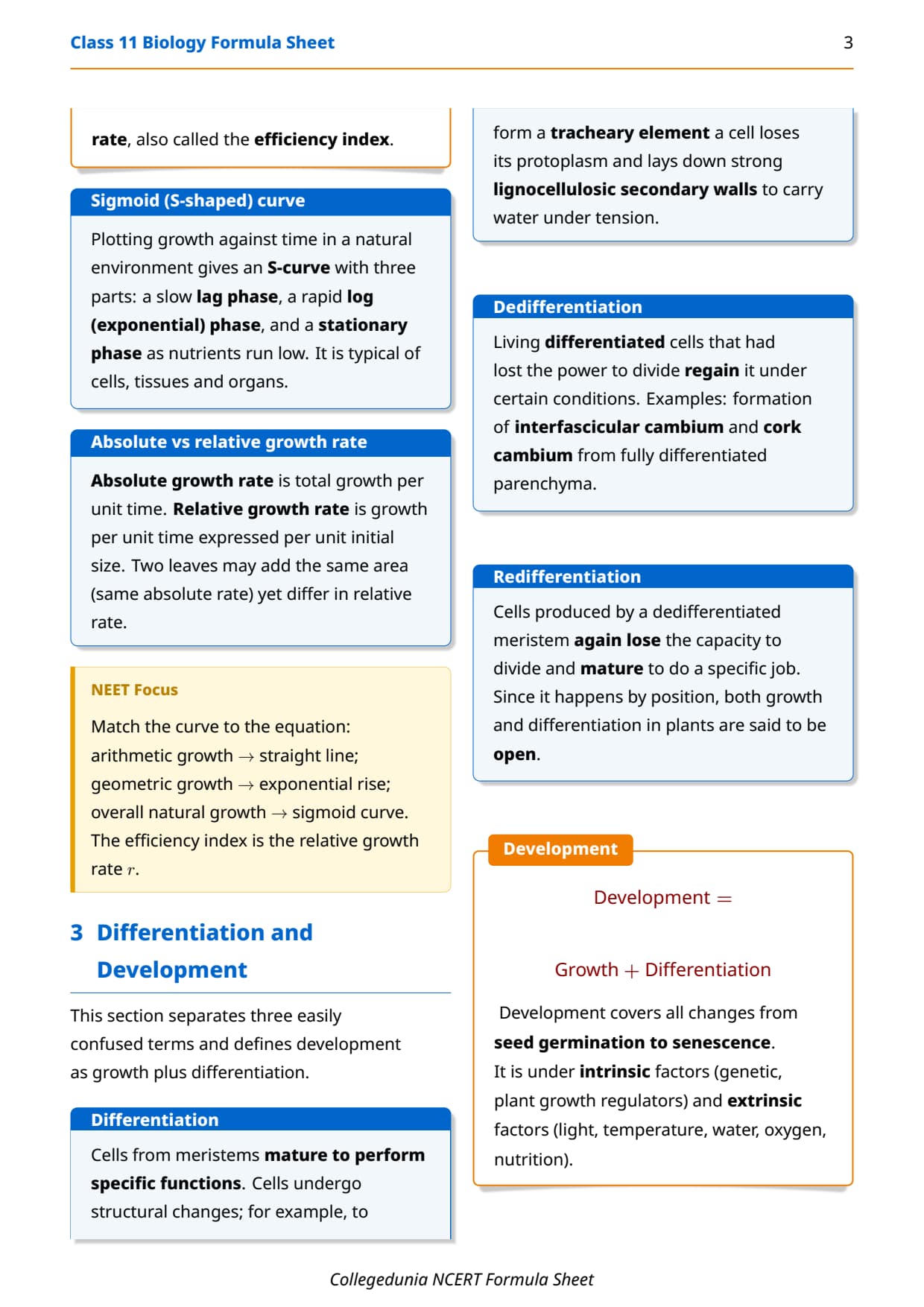
| Sigmoid (S-shaped) curve | Overall natural growth | Three phases: a slow lag phase, a rapid log (exponential) phase, and a stationary phase as nutrients run low |
In the formulae, Lt is length at time t, L0 is length at time zero, W1 is final size, W0 is initial size, r is the growth rate and e is the base of natural logarithms.
Match the curve to the equation: arithmetic growth gives a straight line, geometric growth gives an exponential rise, and overall growth in nature gives a sigmoid curve.
Photoperiodism and Vernalisation
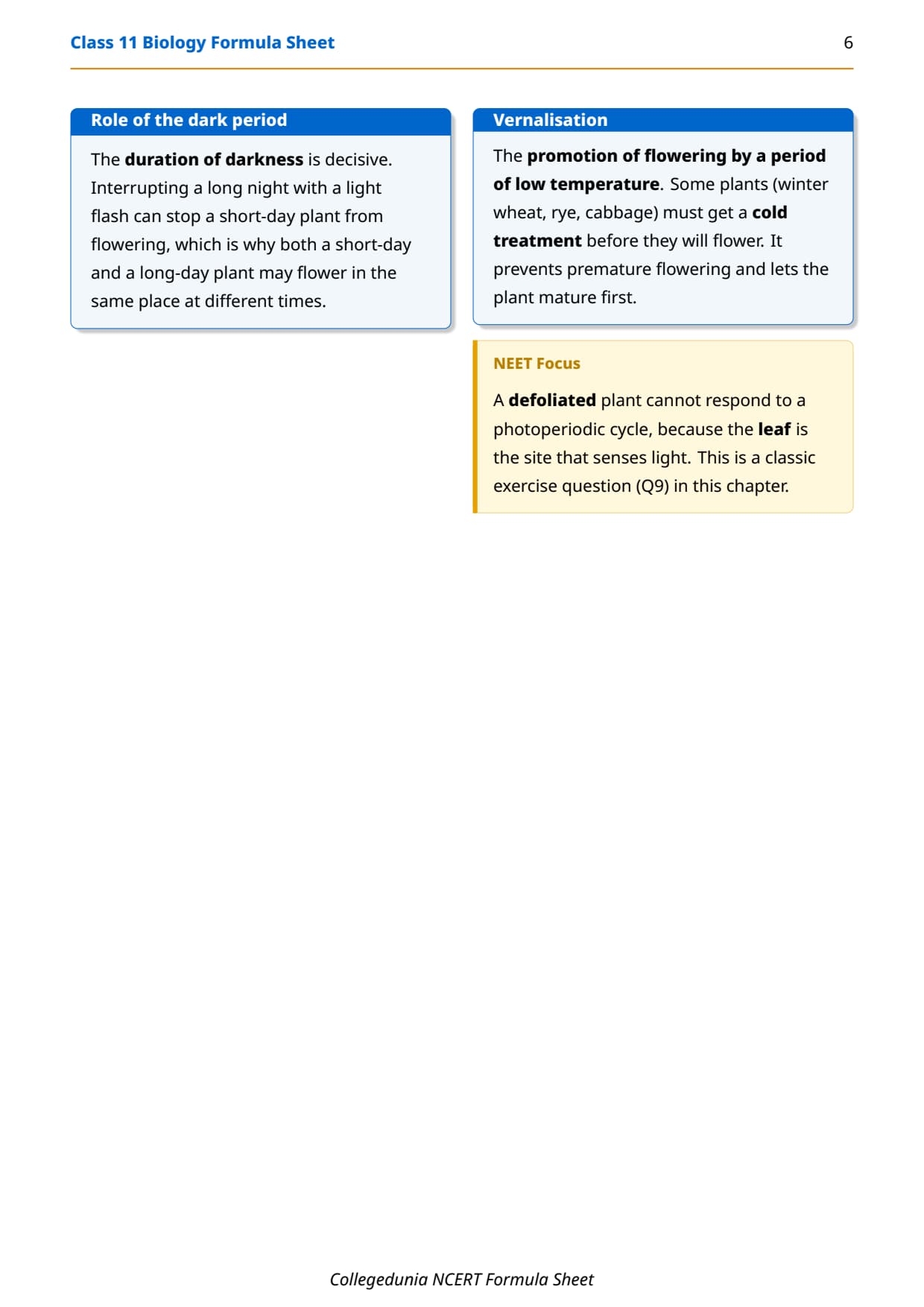
Flowering is set by two extrinsic factors, light duration and cold. The leaves sense the photoperiod, and a hormonal signal then triggers flowering at the shoot apex, so a defoliated plant cannot respond, a classic exercise question.
| Category | Flowering requirement |
|---|---|
| Short-day plants | Flower when the light period is below a critical length; they need a long uninterrupted dark period |
| Long-day plants | Flower when the light period is above the critical length |
| Day-neutral plants | Flower regardless of the photoperiod |
| Vernalisation | Promotion of flowering by a period of low temperature; winter wheat, rye and cabbage need cold before they flower |
The duration of darkness is decisive for short-day plants, and vernalisation prevents premature flowering so the plant matures first.
How to Revise Plant Growth and Development Before the Exam
This chapter rewards clean facts and two formulae more than long answers. A short, ordered revision fixes the equations and hormone uses in memory.
- Write the arithmetic and geometric growth equations, then sketch the linear, exponential and sigmoid curves.
- Learn the five PGRs with one function and one use each, and note which are promoters and which inhibit.
- Fix the differentiation cycle: differentiation, dedifferentiation and redifferentiation.
- Memorise photoperiodism and vernalisation, and that the leaf senses light while cold promotes flowering in winter crops.
Student Feedback on the Plant Growth and Development Formula Sheet
In a survey of 1,200 NEET aspirants who used this sheet, 78% said the single PGR table made the hormone functions and uses easy to recall under time pressure. Toppers reported that writing the two growth equations and the three curve shapes twice a week made them automatic before the exam.
Other Plant Growth and Development Class 11 Biology Resources
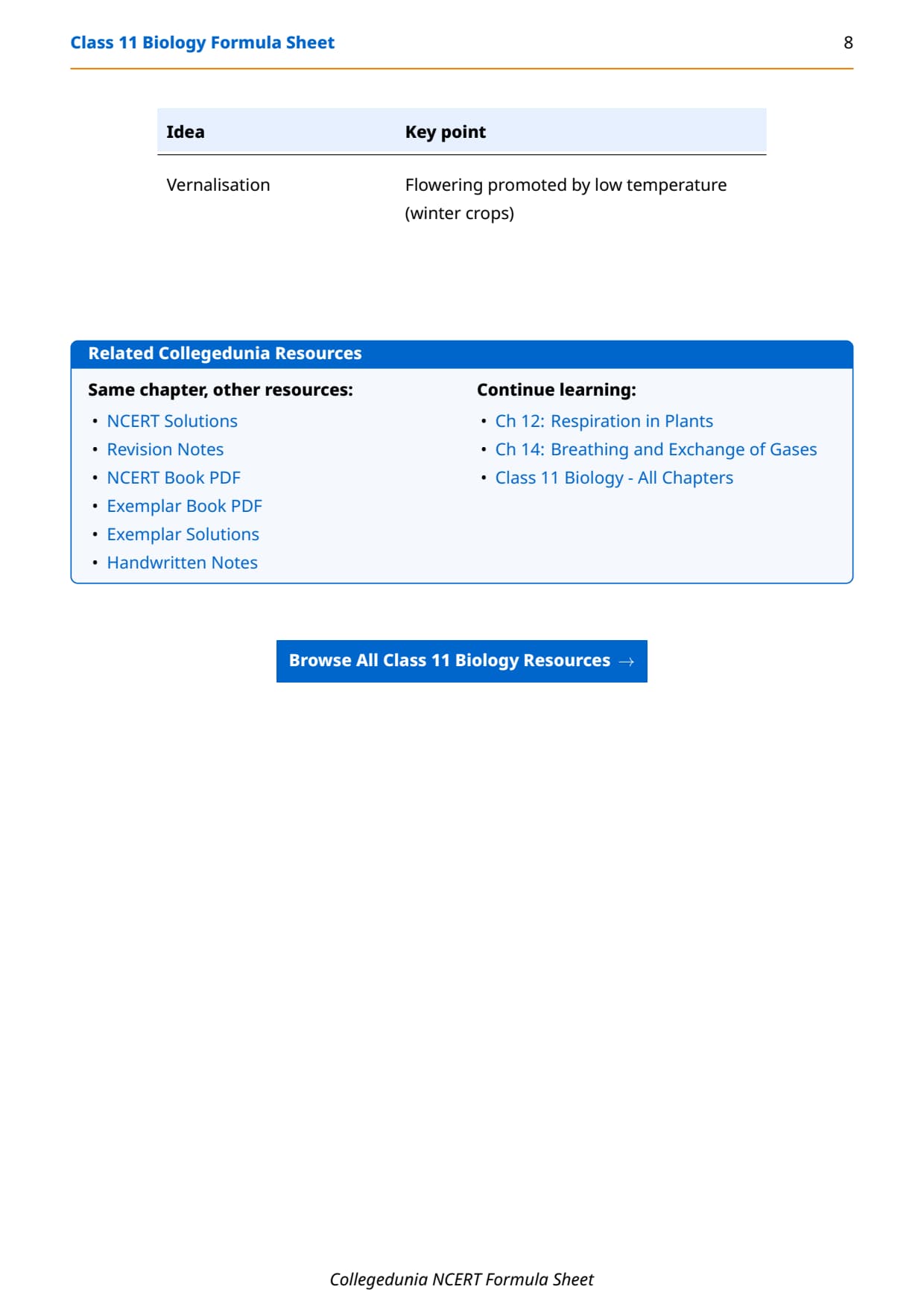
Pair this formula sheet with the solved answers, notes and textbook PDF.
| Resource | Link |
|---|---|
| NCERT Solutions | Plant Growth and Development Class 11 NCERT Solutions |
| Revision Notes | Plant Growth and Development Class 11 Notes |
| NCERT Book PDF | Plant Growth and Development Class 11 Book PDF |
NCERT Formula Sheet for Class 11 Biology: All Chapters
Revise every chapter from one place. Each link opens the formula sheet for that chapter.
| Chapter | Formula Sheet |
|---|---|
| Chapter 1 | The Living World |
| Chapter 2 | Biological Classification |
| Chapter 3 | Plant Kingdom |
| Chapter 4 | Animal Kingdom |
| Chapter 5 | Morphology of Flowering Plants |
| Chapter 6 | Anatomy of Flowering Plants |
| Chapter 7 | Structural Organisation in Animals |
| Chapter 8 | Cell: The Unit of Life |
| Chapter 9 | Biomolecules |
| Chapter 10 | Cell Cycle and Cell Division |
| Chapter 11 | Photosynthesis in Higher Plants |
| Chapter 12 | Respiration in Plants |
| Chapter 13 | Plant Growth and Development |
| Chapter 14 | Breathing and Exchange of Gases |
| Chapter 15 | Body Fluids and Circulation |
| Chapter 16 | Excretory Products and their Elimination |
| Chapter 17 | Locomotion and Movement |
| Chapter 18 | Neural Control and Coordination |
| Chapter 19 | Chemical Coordination and Integration |
FAQs on Plant Growth and Development Class 11 Biology Formula Sheet
Plant Growth and Development Formula Sheet - Frequently Asked Questions
Ques. What does the class 11 biology formula sheet chapter 13 plant growth and development cover?
Ans. This class 11 biology formula sheet chapter 13 plant growth and development covers the arithmetic and geometric growth equations, the sigmoid curve, the five plant growth regulators with their functions and uses, the differentiation cycle, and the two flowering controls, photoperiodism and vernalisation.
Ques. What are the two growth formulae in this chapter?
Ans. Arithmetic growth follows Lt = L0 + rt, where only one daughter cell keeps dividing, giving a linear curve. Geometric or exponential growth follows W1 = W0ert, where both cells divide and r is the relative growth rate or efficiency index.
Ques. What are the five plant growth regulators?
Ans. The five plant growth regulators are auxins, gibberellins and cytokinins, which promote growth, plus abscisic acid, the growth inhibitor and stress hormone, and ethylene, a gaseous regulator that mostly inhibits and drives fruit ripening. This grouping is a frequent NEET question.
Ques. What is the difference between photoperiodism and vernalisation?
Ans. Photoperiodism is the flowering response to the relative length of day and night, sensed by the leaves, and it divides plants into short-day, long-day and day-neutral types. Vernalisation is the promotion of flowering by a period of low temperature, needed by winter crops such as wheat, rye and cabbage.



Comments