




Class 10 Science Chapter 5 Life Processes is the first biology chapter of the 2026-27 NCERT, and a single page of key facts covers almost every board question. This Life Processes formula sheet puts the four life processes, the photosynthesis equation, the respiration equations, the heart and blood facts, the xylem-and-phloem comparison, and the key numbers like blood pressure and ATP energy on one page. Use it as a quick reference before any CBSE Class 10 board test.
- CBSE Weightage: part of the World of Living unit, worth 6 to 8 marks across one or two questions.
- Best used for: the key equations, the comparison tables, the must-know numbers, and last-minute board revision.
You can find the complete Formula Sheet for Life Processes, with the four life processes, the photosynthesis and respiration equations, the human digestion path, the heart and blood facts, and the xylem-and-phloem comparison mapped to the 2026-27 NCERT, in the article below.
This Formula Sheet is curated by Science subject experts, mapped to the 2026-27 NCERT, and refined against the last five years of CBSE Class 10 board papers.
Also Check:
How Collegedunia's Life Processes Formula Sheet Helps You
This sheet gathers the four life processes, the photosynthesis and respiration equations, the digestion path, the heart and blood facts, and the xylem-phloem comparison on one page, in NCERT order.
- 2026-27 NCERT aligned: every term, equation, and number matches the current syllabus.
- One-page recall: tables and equations side by side for a single-glance refresh.
- Board-exam focus: must-know values like BP 120/80 mm Hg and ATP 30.5 kJ/mol in quick cards.
Life Processes Class 10 Science Video Revision
Source: Magnet Brains on YouTube
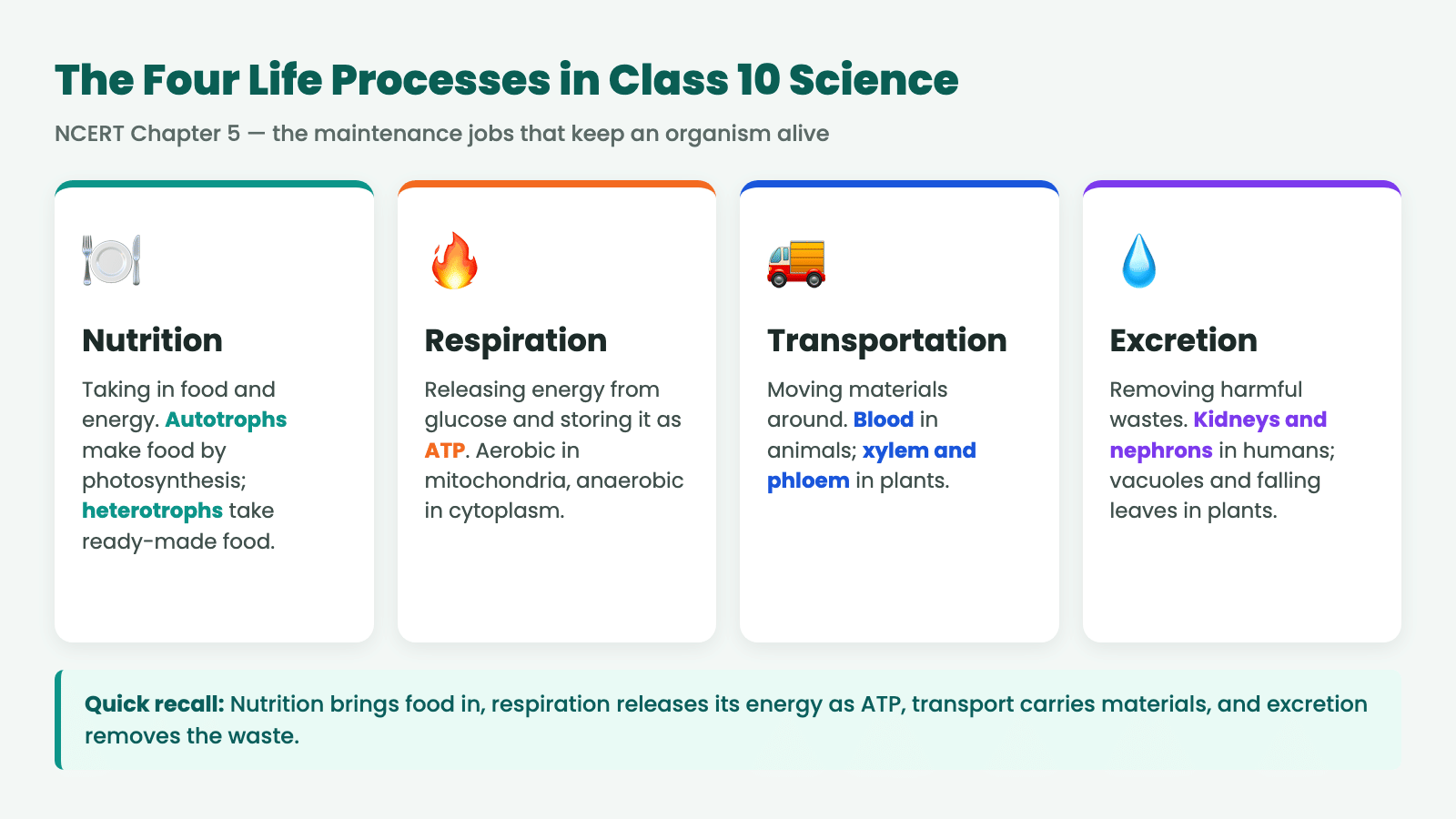
The Four Life Processes at a Glance in Class 10 Science
Living things run these processes all the time, even at rest: nutrition, respiration, transportation, and excretion.
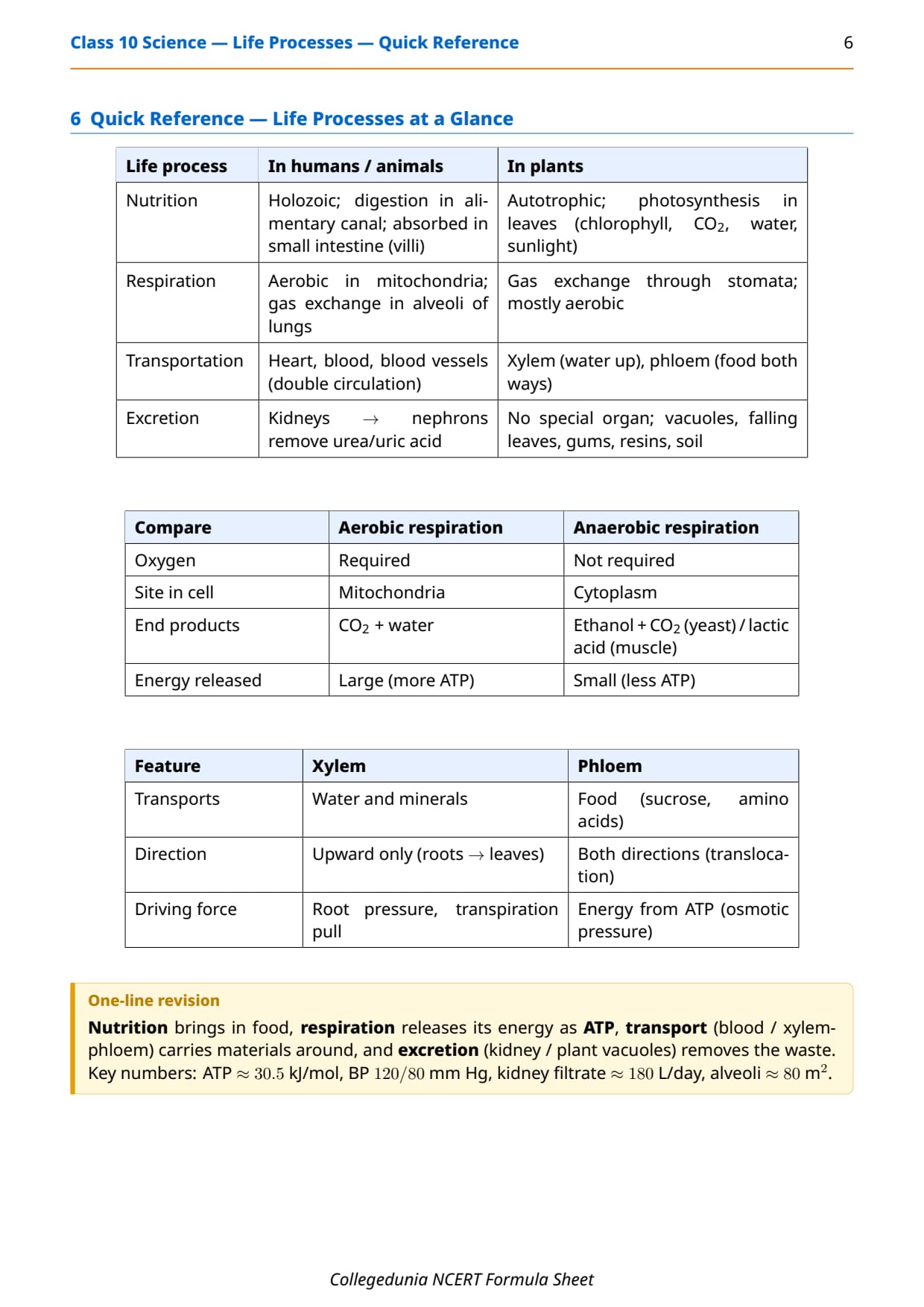
| Life process | What it does | In humans / animals | In plants |
|---|---|---|---|
| Nutrition | Taking in food and energy | Holozoic; digestion in the alimentary canal | Autotrophic; photosynthesis in leaves |
| Respiration | Releasing energy from food | Aerobic, in mitochondria; alveoli | Gas exchange via stomata |
| Transportation | Moving materials around the body | Heart, blood and blood vessels (double circulation) | Xylem (water up), phloem (food both ways) |
| Excretion | Removing wastes | Kidneys remove urea and uric acid | No special organ; vacuoles, falling leaves |
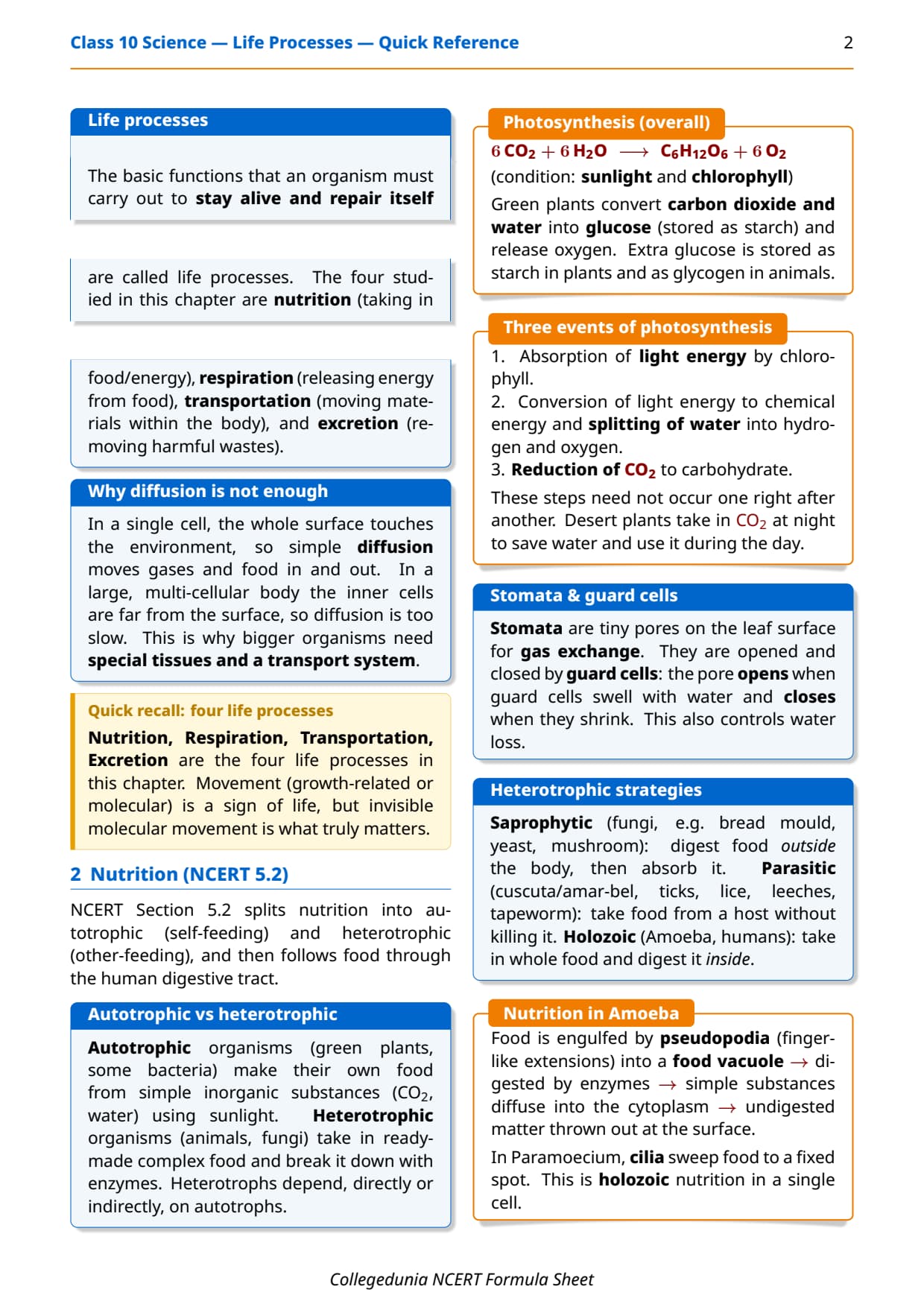
In a single cell, diffusion moves gases and food. In a large body the inner cells are far from the surface, so diffusion is too slow, which is why large organisms need a transport system.
Nutrition and Photosynthesis Key Facts in Class 10 Science Chapter 5
Nutrition is autotrophic (green plants make food from CO2 and water using sunlight) or heterotrophic (animals and fungi take in ready-made food). The most-tested equation is photosynthesis.
- Three events of photosynthesis: chlorophyll absorbs light, water splits into hydrogen and oxygen, and CO2 is reduced to carbohydrate.
- Stomata and guard cells: tiny leaf pores for gas exchange; they open when guard cells swell with water and close when they shrink.
- Heterotrophic strategies: saprophytic (bread mould), parasitic (cuscuta, ticks), and holozoic (Amoeba, humans).
- Nutrition in Amoeba: food is engulfed by pseudopodia into a food vacuole, digested, then thrown out at the surface.
- Storage: extra glucose is stored as starch in plants, glycogen in animals.
Human Digestion: Path and Enzymes in Class 10 Science
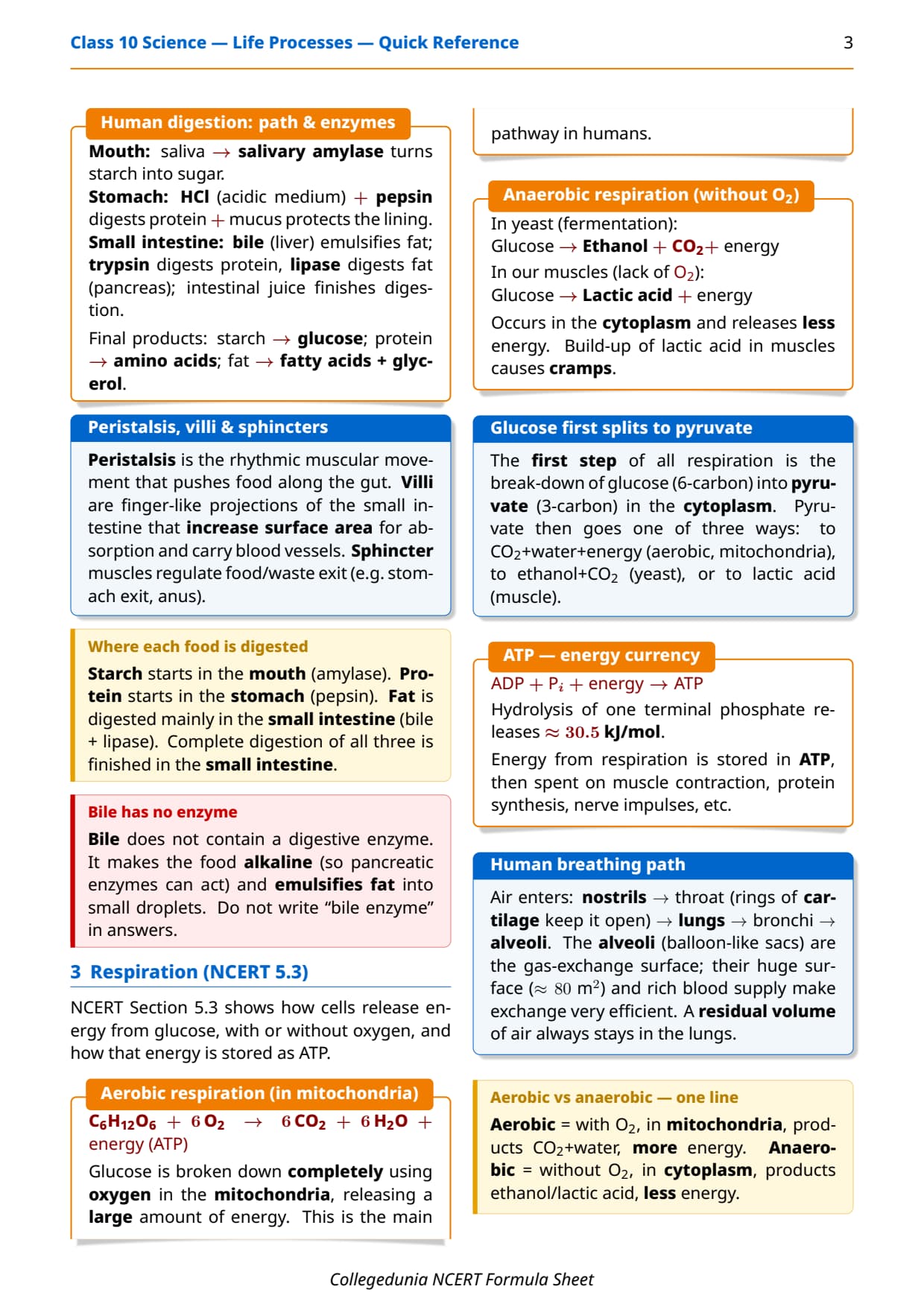
Each region of the gut adds its own enzymes; most digestion finishes in the small intestine. Peristalsis pushes food along the gut, and villi are finger-like projections that increase absorption surface.
| Region | Enzyme / secretion | Action |
|---|---|---|
| Mouth | Saliva (salivary amylase) | Turns starch into sugar |
| Stomach | HCl + pepsin + mucus | Acidic medium; pepsin digests protein; mucus protects the lining |
| Small intestine | Bile (liver), trypsin and lipase (pancreas) | Bile emulsifies fat; trypsin digests protein; lipase digests fat |
Final products: starch → glucose, protein → amino acids, fat → fatty acids + glycerol, all fully digested in the small intestine.
Respiration Equations: Aerobic vs Anaerobic in Class 10 Science Chapter 5
Cells release energy from glucose and store it as ATP. The first step breaks glucose (6C) into pyruvate (3C) in the cytoplasm; pyruvate then goes one of three ways.
| Type | Equation / pathway | Site and energy |
|---|---|---|
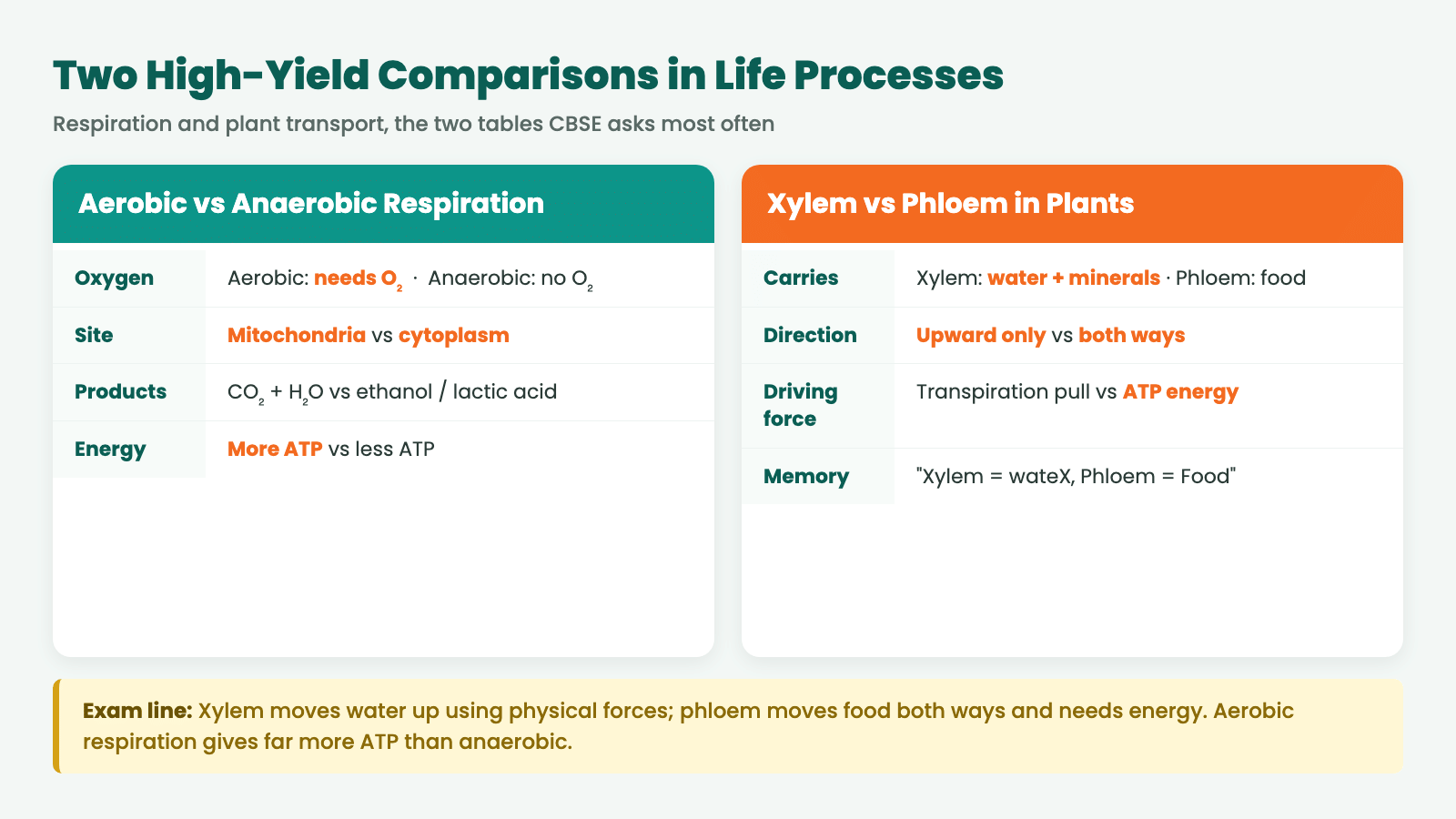
| Aerobic | C6H12O6 + 6 O2 → 6 CO2 + 6 H2O + energy | In mitochondria; large amount of energy |
| Anaerobic (yeast) | Glucose → ethanol + CO2 + energy | In cytoplasm; less energy (fermentation) |
| Anaerobic (muscle) | Glucose → lactic acid + energy | In cytoplasm; less energy (causes cramps) |
ATP hydrolysis releases about 30.5 kJ/mol. Gas exchange happens at the alveoli (huge surface area, about 80 m²). Aerobic respiration uses oxygen in mitochondria and releases more energy; anaerobic needs none, happens in the cytoplasm, releases less. Lactic acid in muscles causes cramps.
Transportation: Heart, Blood, Xylem and Phloem in Class 10 Science
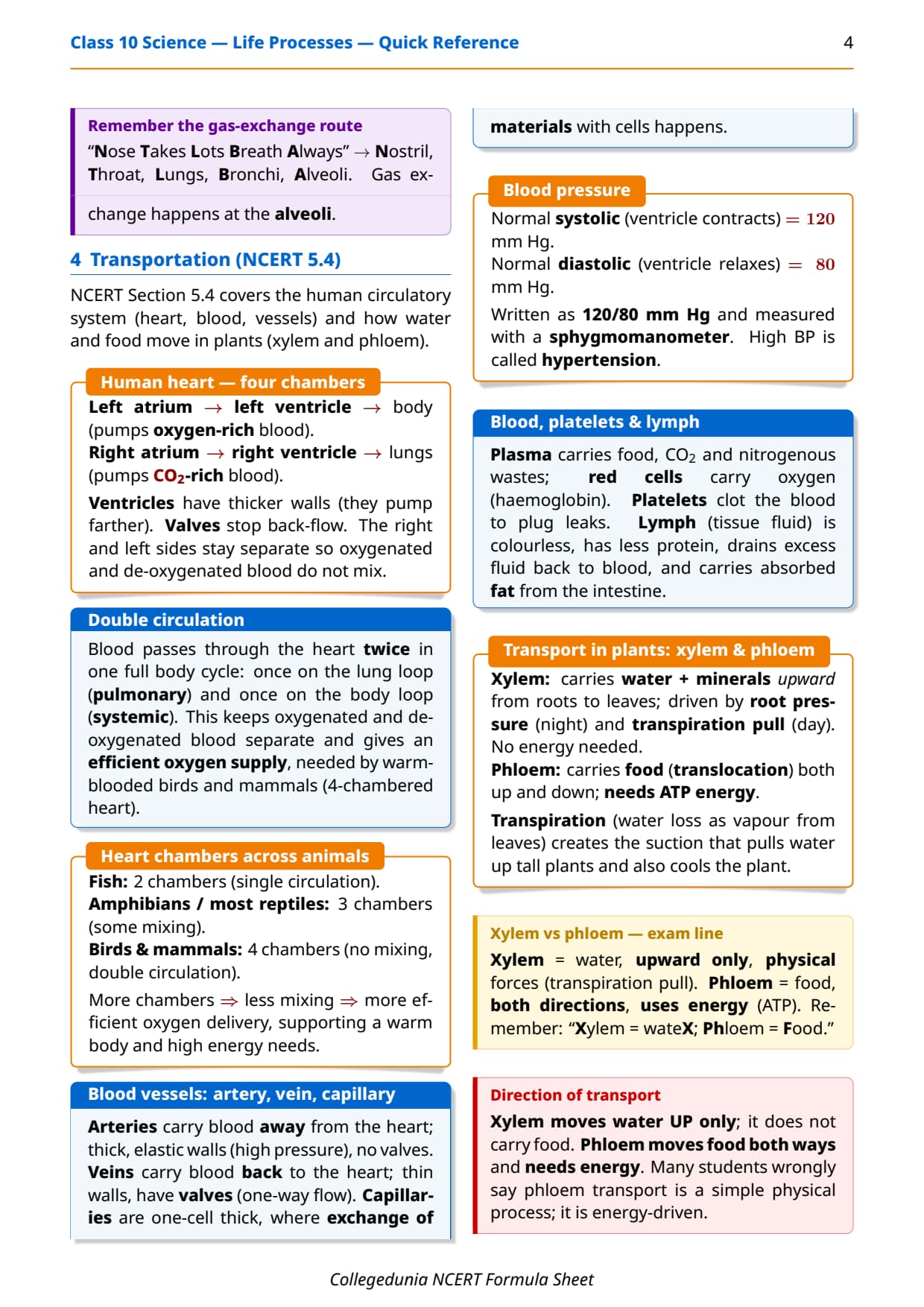
The human heart has four chambers: the left side pumps oxygen-rich blood to the body; the right side pumps CO2-rich blood to the lungs.
- Double circulation: blood passes through the heart twice per cycle, once on the lung (pulmonary) loop and once on the body (systemic) loop, keeping oxygenated and deoxygenated blood separate.
- Blood vessels: arteries carry blood away (thick walls, high pressure); veins carry it back (thin walls, valves); capillaries are one-cell thick, where exchange happens.
- Blood pressure: normal is 120/80 mm Hg; persistently high BP is hypertension.
- Heart chambers: fish 2, amphibians and most reptiles 3, birds and mammals 4 (no mixing).
| Feature | Xylem | Phloem |
|---|---|---|
| Transports | Water and minerals | Food (sucrose, amino acids) |
| Direction | Upward only (roots → leaves) | Both directions (translocation) |
| Driving force | Transpiration pull | ATP energy |
Excretion and the Nephron in Class 10 Science Chapter 5
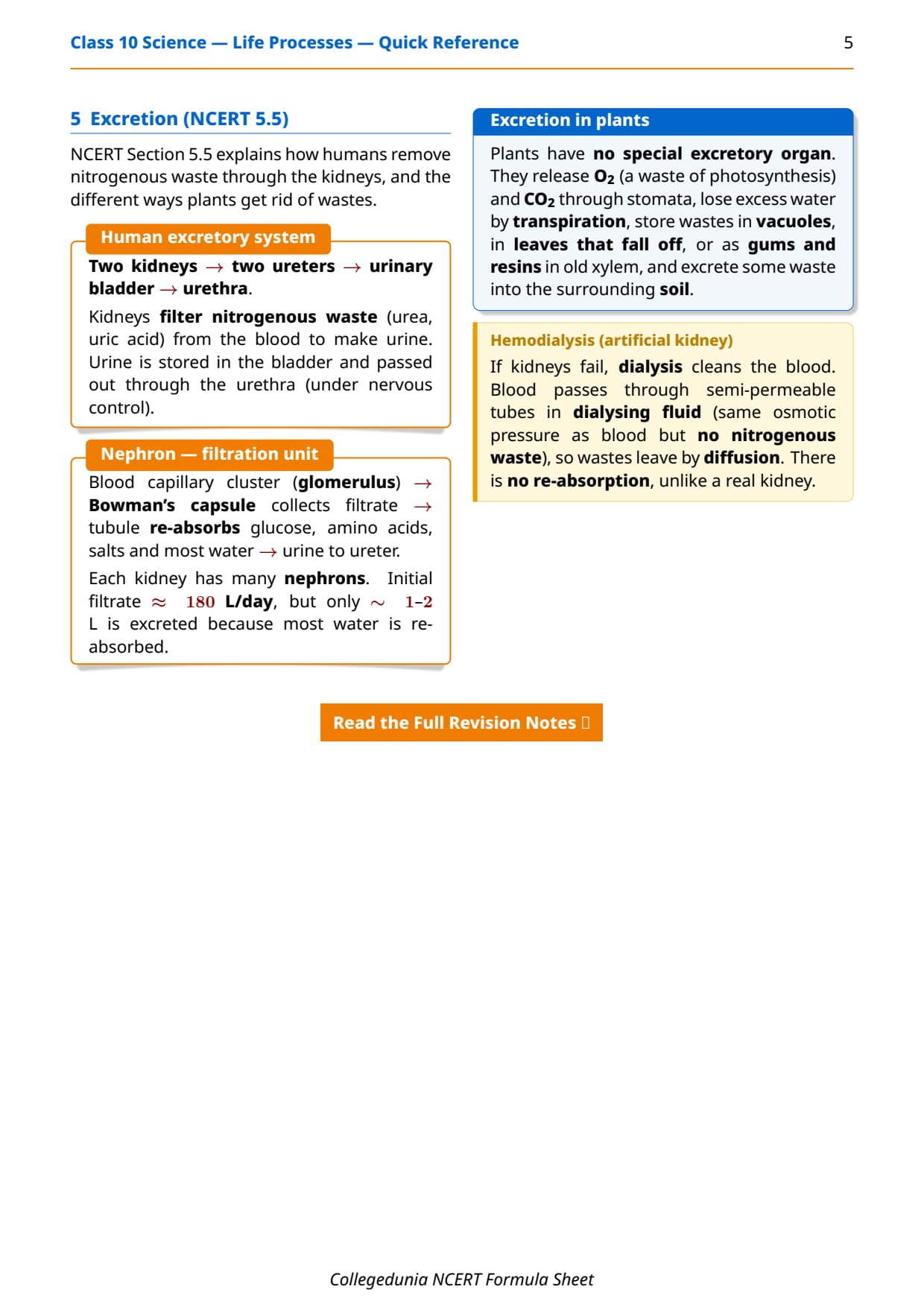
The human excretory path is two kidneys → two ureters → urinary bladder → urethra. The kidneys filter nitrogenous waste (urea and uric acid) from the blood to make urine.
- Nephron, the filtration unit: glomerulus → Bowman's capsule collects filtrate → tubule reabsorbs glucose, amino acids, salts and most water → urine to the ureter.
- Filtrate numbers: initial filtrate about 180 L/day, but only 1 to 2 L is excreted, as most water is reabsorbed.
- Excretion in plants: no special organ; wastes leave via stomata, transpiration, vacuoles, falling leaves, and gums and resins.
- Hemodialysis: when kidneys fail, dialysis cleans the blood through semi-permeable tubes in waste-free fluid; wastes leave by diffusion, with no reabsorption.
One-Shot Revision Tips for Life Processes Class 10
Treat this Formula Sheet as a night-before checklist. Recall each block out loud, then check it against the sheet.
- Two big equations: photosynthesis (6 CO2 + 6 H2O → C6H12O6 + 6 O2) and aerobic respiration (the reverse).
- Four life processes: nutrition, respiration, transportation, excretion, each in animals and plants.
- Digestion enzymes: mouth (amylase), stomach (pepsin), small intestine (trypsin, lipase); bile only emulsifies.
- Two comparison tables: xylem-phloem and aerobic-anaerobic carry the most predictable marks.
- Must-know numbers: BP 120/80 mm Hg, ATP about 30.5 kJ/mol, filtrate about 180 L/day, alveolar surface about 80 m².
Must-Know Numbers at a Glance in Class 10 Science
This single table is the fastest revision strip for the whole chapter, ideal as a five-minute one-shot before any test.
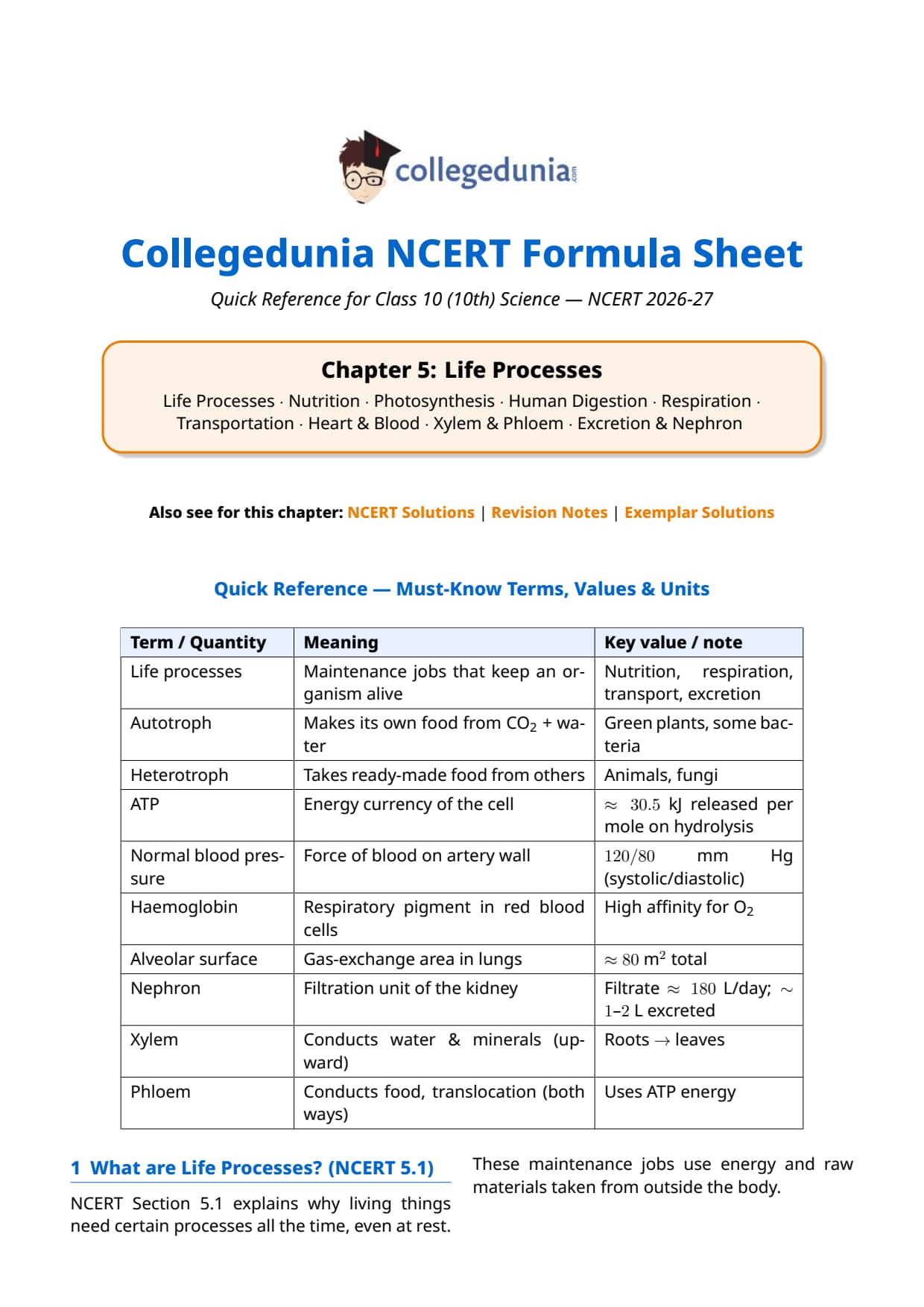
| Term / quantity | Meaning | Key value / note |
|---|---|---|
| ATP | Energy currency of the cell | About 30.5 kJ released per mole on hydrolysis |
| Normal blood pressure | Force of blood on artery wall | 120/80 mm Hg (systolic / diastolic) |
| Alveolar surface | Gas-exchange area in lungs | About 80 m² total |
| Nephron filtrate | Filtration unit of the kidney | Filtrate about 180 L/day; 1 to 2 L excreted |
| Haemoglobin | Respiratory pigment in red blood cells | High affinity for O2 |
Full topic-by-topic walkthrough: Life Processes Class 10 Science Notes
More Life Processes Class 10 Science Resources
Use the table below to move between the other resources for this chapter.
| Resource | Link |
|---|---|
| NCERT Solutions | Life Processes NCERT Solutions |
| Revision Notes | Life Processes Notes |
| Handwritten Notes | Life Processes Handwritten Notes |
| Exemplar Solutions | Life Processes Exemplar Solutions |
| NCERT Book PDF | Life Processes NCERT Book PDF |
NCERT Formula Sheet for Class 10 Science: All Chapters
Use the table below to jump to the Formula Sheet for any other chapter in the Class 10 Science NCERT.
| Chapter | Resource |
|---|---|
| Chapter 1 | Chemical Reactions and Equations Formula Sheet |
| Chapter 2 | Acids, Bases and Salts Formula Sheet |
| Chapter 3 | Metals and Non-metals Formula Sheet |
| Chapter 4 | Carbon and its Compounds Formula Sheet |
| Chapter 6 | Control and Coordination Formula Sheet |
| Chapter 7 | How do Organisms Reproduce? Formula Sheet |
| Chapter 8 | Heredity Formula Sheet |
| Chapter 9 | Light - Reflection and Refraction Formula Sheet |
| Chapter 10 | The Human Eye and the Colourful World Formula Sheet |
| Chapter 11 | Electricity Formula Sheet |
| Chapter 12 | Magnetic Effects of Electric Current Formula Sheet |
| Chapter 13 | Our Environment Formula Sheet |
Life Processes Class 10 Formula Sheet FAQs
Ques. Where can I download the Life Processes Class 10 Formula Sheet PDF?
Ans. You can download the Life Processes Class 10 Science Formula Sheet PDF directly from this page. It is free and covers the four life processes, the photosynthesis and respiration equations, the human digestion path, the heart and blood facts, the xylem-and-phloem comparison, and excretion in the 2026-27 NCERT Chapter 5.
Ques. Is this Formula Sheet aligned with the 2026-27 NCERT?
Ans. Yes. The sheet reflects the current 2026-27 syllabus for Class 10 Science. Chapter 5 retains the four life processes, autotrophic and heterotrophic nutrition, photosynthesis, human digestion, aerobic and anaerobic respiration, the circulatory system, transport in plants, and excretion.
Ques. What are the four life processes in Class 10 Science?
Ans. The four life processes are nutrition (taking in food and energy), respiration (releasing energy from food), transportation (moving materials around the body), and excretion (removing harmful wastes). These four maintenance jobs keep an organism alive even when it is at rest.
Ques. What is the equation for photosynthesis in Class 10 Science?
Ans. The overall photosynthesis equation is 6 CO2 + 6 H2O → C6H12O6 + 6 O2, which takes place in the presence of sunlight and chlorophyll. Green plants convert carbon dioxide and water into glucose (stored as starch) and release oxygen.
Ques. What is the difference between aerobic and anaerobic respiration?
Ans. Aerobic respiration uses oxygen, happens in the mitochondria, gives CO2 and water as products, and releases a large amount of energy. Anaerobic respiration needs no oxygen, happens in the cytoplasm, gives ethanol and CO2 (in yeast) or lactic acid (in our muscles), and releases far less energy.
Ques. Why does bile have no enzyme in Class 10 Science?
Ans. Bile, made by the liver, does not contain a digestive enzyme. It does two jobs: it makes the food alkaline so the pancreatic enzymes can work, and it emulsifies fat into small droplets so lipase can act faster. You should not write "bile enzyme" in answers, because the fat-digesting enzyme is lipase, not bile.
Ques. What is the difference between xylem and phloem in Class 10 Science?
Ans. Xylem carries water and minerals upward only, from roots to leaves, driven by root pressure and the transpiration pull, and it needs no energy. Phloem carries food (translocation) in both directions and needs ATP energy. The memory line "Xylem = wateX, Phloem = Food" helps tell the two apart.
Ques. Why is diffusion not enough for large organisms?
Ans. In a single cell the whole surface touches the environment, so diffusion moves gases and food fast enough. In a large, multicellular body the inner cells are far from the surface, so diffusion is too slow to supply them. This is why large organisms need special tissues and a transport system such as blood or xylem and phloem.
Ques. What is a nephron and how much filtrate does the kidney make?
Ans. A nephron is the filtration unit of the kidney. Blood enters a capillary cluster called the glomerulus, the filtrate is collected by Bowman's capsule, and the tubule reabsorbs glucose, amino acids, salts and most water before urine flows to the ureter. The initial filtrate is about 180 L/day, but only roughly 1 to 2 L leaves as urine because most water is reabsorbed.
Ques. What is the normal blood pressure value to remember for Class 10?
Ans. Normal blood pressure is 120/80 mm Hg, where 120 is the systolic pressure (when the ventricle contracts) and 80 is the diastolic pressure (when the ventricle relaxes). It is measured with a sphygmomanometer, and persistently high blood pressure is called hypertension.
Ques. What is double circulation in Class 10 Science?
Ans. Double circulation means blood passes through the heart twice in one full body cycle: once on the lung loop (pulmonary circulation) and once on the body loop (systemic circulation). This keeps oxygenated and deoxygenated blood separate, giving an efficient oxygen supply needed by warm-blooded birds and mammals with a four-chambered heart.
Ques. What is the CBSE weightage of Chapter 5 Life Processes in Class 10 Science?
Ans. Life Processes sits in the World of Living unit and usually carries 6 to 8 marks in the CBSE Class 10 Science board exam, asked across one or two questions on the four life processes, photosynthesis, human digestion, respiration, the circulatory system, transport in plants, or excretion and the nephron.



Comments