




Class 10 Science Chapter 4 Carbon and its Compounds is the chapter where a single page of rules unlocks almost every question. This Carbon and its Compounds formula sheet puts the general formulae of alkanes, alkenes and alkynes, the functional groups, the homologous series, the IUPAC naming rules, every key reaction, and the soap micelle on one page.
- CBSE Weightage: part of the Chemical Substances unit, worth 6 to 8 marks across one or two questions.
- Best used for: the general formulae, functional groups, naming rules, key reactions, and last-minute board revision.
You can find the complete Formula Sheet for Carbon and its Compounds, with every general formula, functional group, the homologous series, the naming rules, and every key reaction mapped to the 2026-27 NCERT, in the article below.
This Formula Sheet is curated by Science subject experts, mapped to the 2026-27 NCERT, and refined against the last five years of CBSE Class 10 board papers.
Also Check:
- Carbon and its Compounds Class 10 Science NCERT Solutions
- Carbon and its Compounds Class 10 Science Notes
How Collegedunia's Carbon and its Compounds Formula Sheet Helps You
This Formula Sheet gathers every general formula, functional group, the homologous series, the naming rules, and every key reaction from Class 10 Science Chapter 4 on one page, in the order the NCERT introduces it.
- 2026-27 NCERT Alignment: general formulae, functional groups, the homologous series, naming rules, the four key reactions, and the soap micelle all match the current Class 10 syllabus.
- One-page recall: the formulae, the functional-group table, and the master reaction summary sit side by side for a quick refresh before a board test.
- Board-exam focus: the most-asked facts, like the bromine-water test, the soap micelle, and esterification, are pulled into quick cards.
Carbon and its Compounds Class 10 Science Video Revision
Source: Magnet Brains on YouTube
General Formulae of Carbon Compounds in Class 10 Science
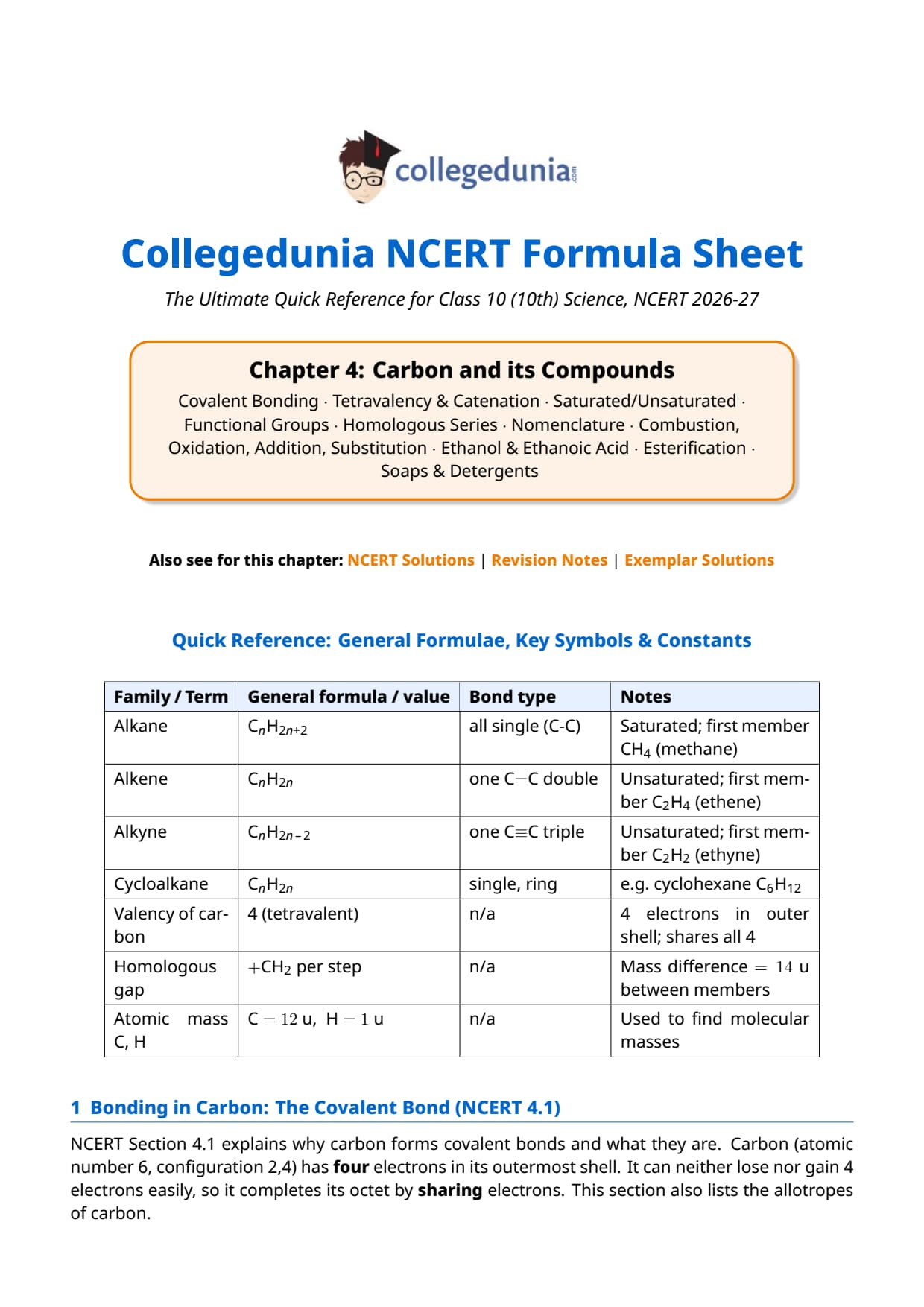
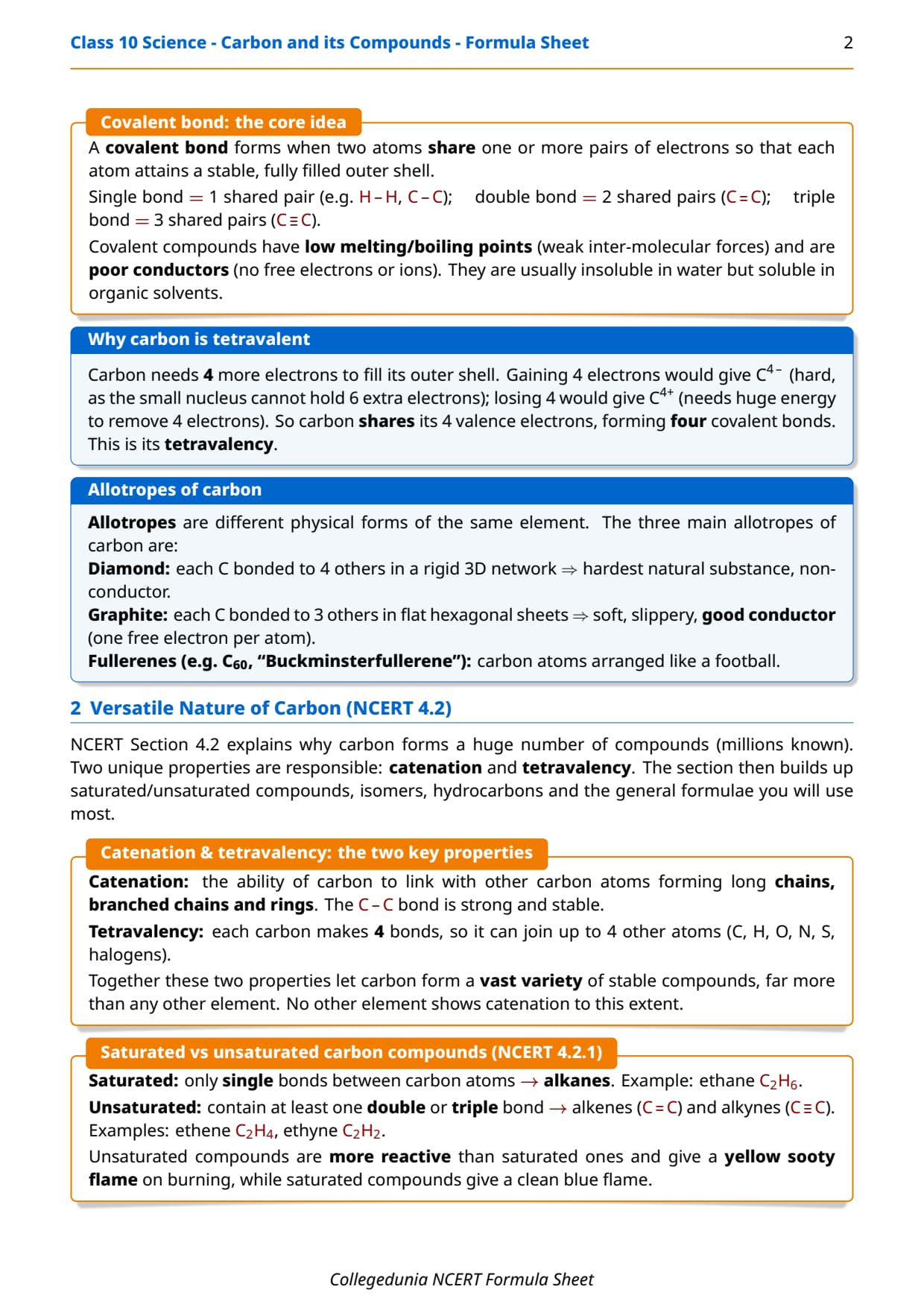
Carbon forms millions of compounds due to catenation (carbon-carbon chains and rings) and tetravalency (four bonds per carbon). Each hydrocarbon family has one general formula.
| Family | General formula | Bond type | First member |
|---|---|---|---|
| Alkane | CnH2n+2 | All single (C−C) | Methane CH4 |
| Alkene | CnH2n | One C=C double | Ethene C2H4 |
| Alkyne | CnH2n−2 | One C≡C triple | Ethyne C2H2 |
| Alcohol | CnH2n+1OH | −OH group | Methanol CH3OH |
Carbon (configuration 2,4) completes its octet by sharing electrons, forming four covalent bonds. Saturated compounds (alkanes) have only single bonds and burn with a blue flame; unsaturated compounds (alkenes, alkynes) have a double or triple bond and burn with a yellow sooty flame. For alkenes and alkynes, n starts at 2.
Functional Groups in Carbon Compounds in Class 10 Science Chapter 4
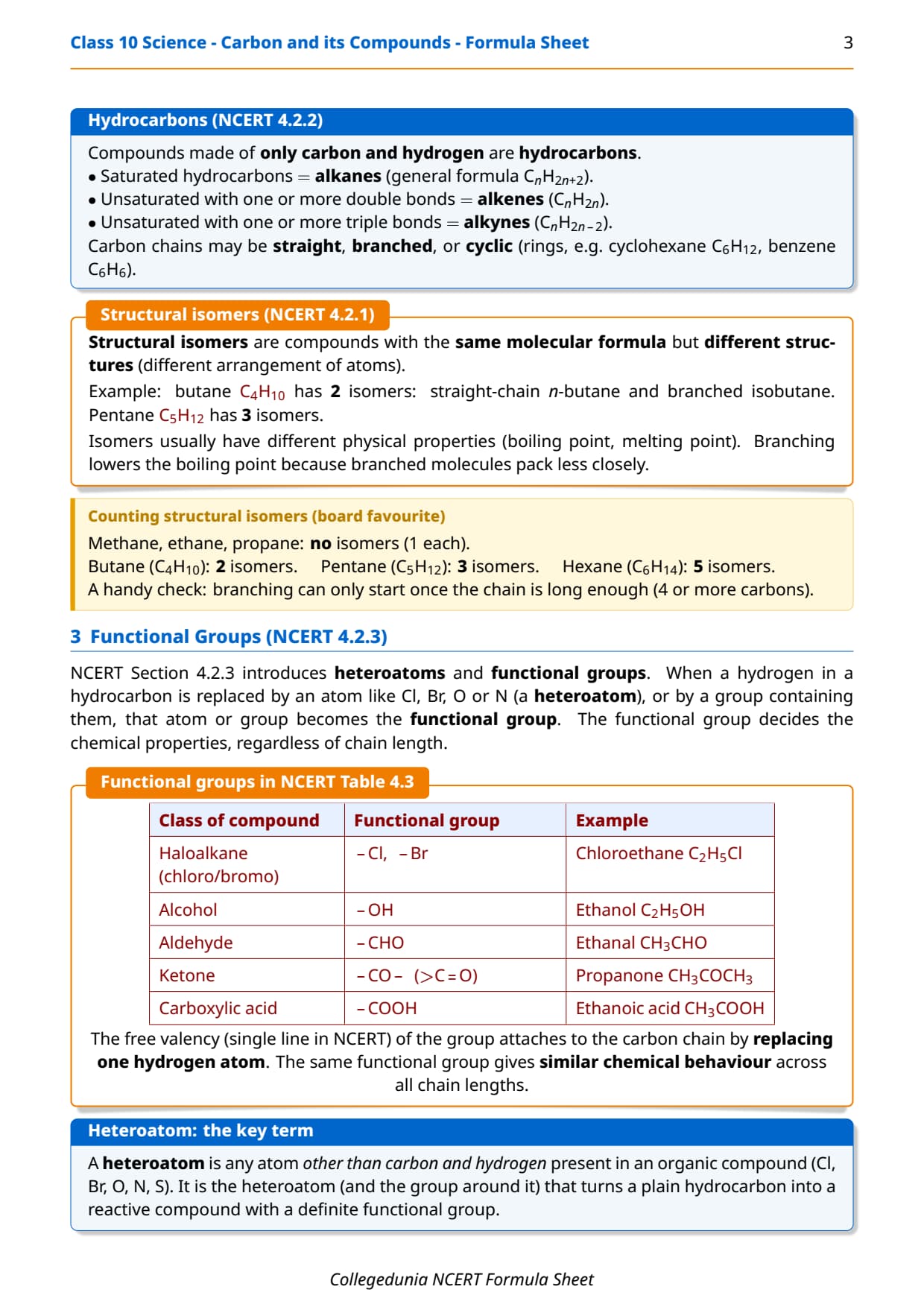
A heteroatom is any atom other than carbon and hydrogen (Cl, Br, O, N, S). When it replaces a hydrogen in a hydrocarbon, that group becomes the functional group, and it decides the chemical properties regardless of chain length.
| Class of compound | Functional group | NCERT example |
|---|---|---|
| Haloalkane | −Cl, −Br | Chloroethane C2H5Cl |
| Alcohol | −OH | Ethanol C2H5OH |
| Aldehyde | −CHO | Ethanal CH3CHO |
| Ketone | −CO− (>C=O) | Propanone CH3COCH3 |
| Carboxylic acid | −COOH | Ethanoic acid CH3COOH |
The functional group replaces one hydrogen on the chain and gives similar chemical behaviour across all chain lengths. Watch out: an aldehyde (−CHO) has the C=O carbon at the end of the chain; a ketone (>C=O) has it in the middle, bonded to two carbons.
Homologous Series and the CH2 Rule in Class 10 Science
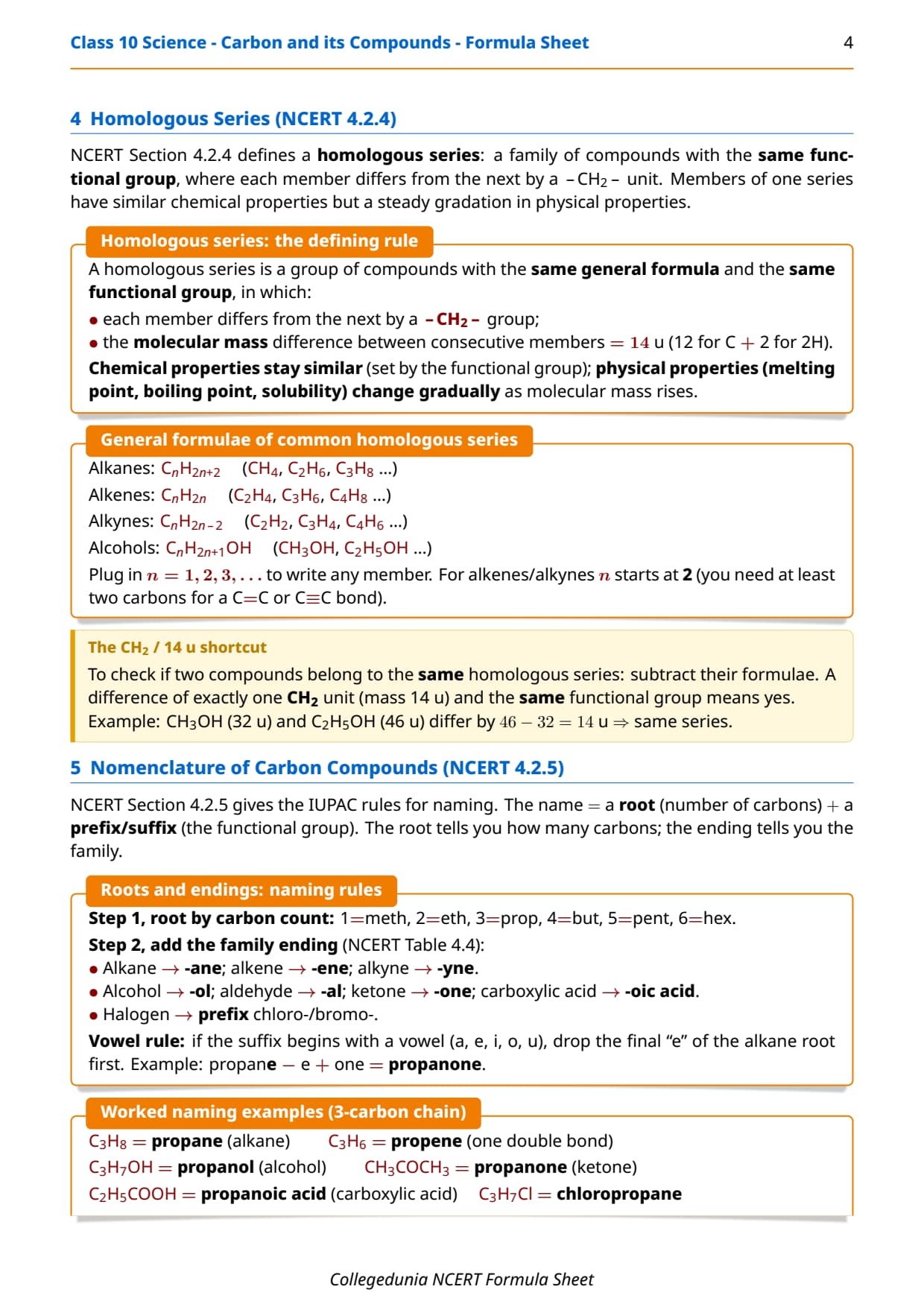
A homologous series is a family of compounds with the same general formula and functional group, where each member differs from the next by a −CH2− unit.
- Same general formula: all alkanes fit CnH2n+2.
- Constant CH2 gap: molecular mass rises by 14 u at each step.
- Properties: chemical properties stay similar; physical properties change gradually as mass rises.
| Series | General formula | First members |
|---|---|---|
| Alkanes | CnH2n+2 | CH4, C2H6, C3H8 |
| Alkenes | CnH2n | C2H4, C3H6 |
| Alkynes | CnH2n−2 | C2H2, C3H4 |
| Alcohols | CnH2n+1OH | CH3OH, C2H5OH |
Nomenclature: IUPAC Naming Rules in Class 10 Science Chapter 4
An IUPAC name is a root (the number of carbons) plus a suffix (the functional group). The root tells you how many carbons; the ending tells you the family.
| Carbons | Root | Family | Ending |
|---|---|---|---|
| 1 | meth- | Alkane | -ane |
| 2 | eth- | Alkene | -ene |
| 3 | prop- | Alkyne | -yne |
| 4 | but- | Alcohol | -ol |
| 5 | pent- | Aldehyde | -al |
| 6 | hex- | Ketone / Carboxylic acid | -one / -oic acid |
For a 3-carbon chain: C3H8 is propane, C3H6 is propene, C3H7OH is propanol. Vowel rule: if the suffix begins with a vowel, drop the final "e" of the root, so "propane + ol" is propanol, not "propaneol".
Key Reactions of Carbon Compounds in Class 10 Science
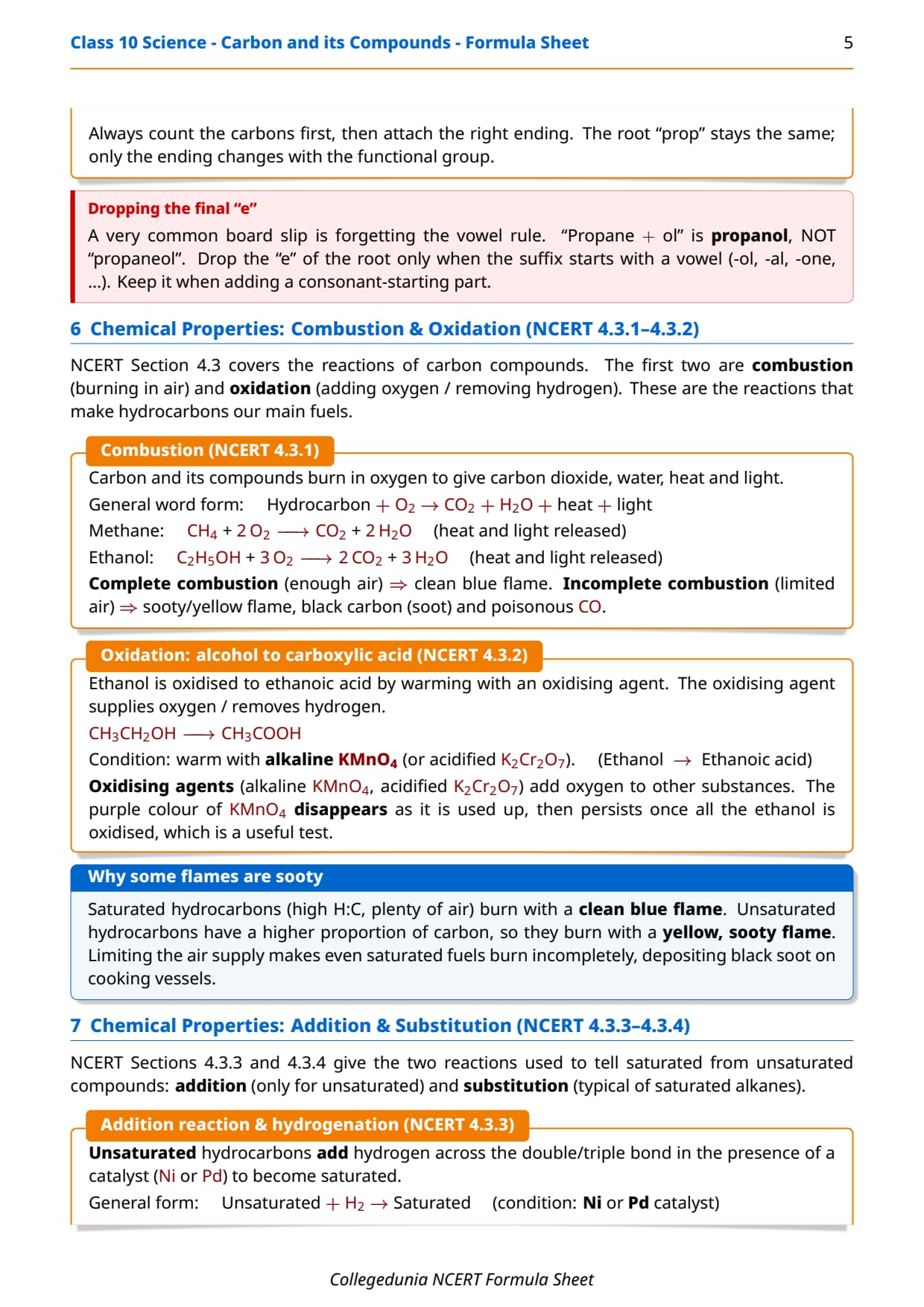
Four reactions every Class 10 student must know: combustion, oxidation, addition, and substitution. Knowing which family undergoes which is the fastest way to predict the product.
| Reaction | Balanced example (condition as text) | Key point |
|---|---|---|
| Combustion | CH4 + 2 O2 → CO2 + 2 H2O | Releases heat and light (fuel) |
| Oxidation | CH3CH2OH → CH3COOH (alkaline KMnO4) | Alcohol to carboxylic acid |
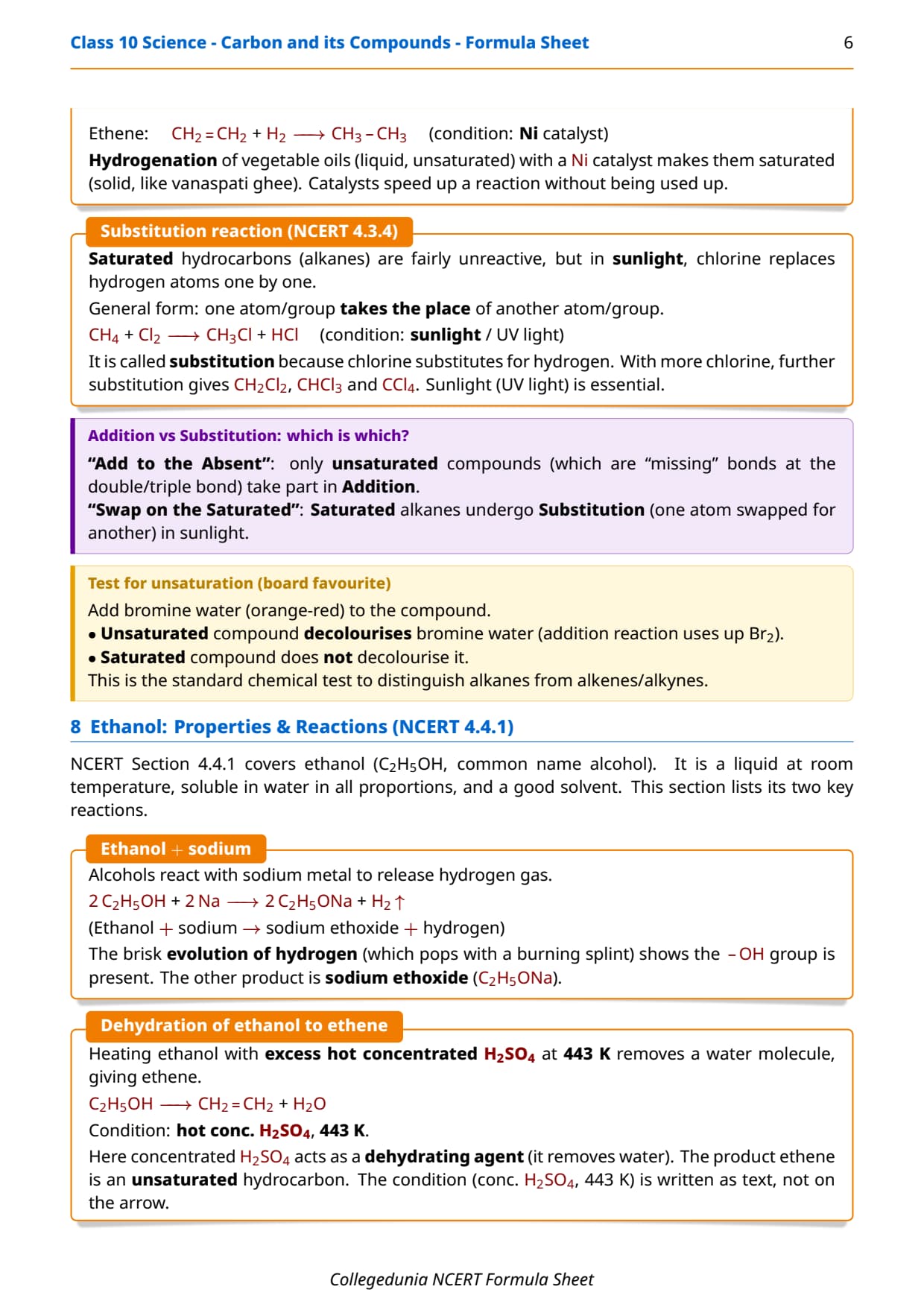
| Addition | CH2=CH2 + H2 → CH3−CH3 (Ni catalyst) | Only for unsaturated; hydrogenation |
| Substitution | CH4 + Cl2 → CH3Cl + HCl (sunlight) | Typical of saturated alkanes |
Complete combustion gives a blue flame; incomplete combustion gives a sooty yellow flame and poisonous CO. Addition happens only with unsaturated compounds; substitution needs sunlight. To test for unsaturation, add bromine water: an unsaturated compound decolourises it, a saturated one does not.
Ethanol and Ethanoic Acid Reactions in Class 10 Science Chapter 4
The two most-tested compounds: ethanol (C2H5OH) and ethanoic acid (CH3COOH, acetic acid). A 5 to 8 percent solution of ethanoic acid in water is vinegar, a weak acid.
| Reaction | Balanced example | Use / test |
|---|---|---|
| Ethanol + sodium | 2 C2H5OH + 2 Na → 2 C2H5ONa + H2 ↑ | Tests for the −OH group |
| Dehydration of ethanol | C2H5OH → CH2=CH2 + H2O (hot conc. H2SO4, 443 K) | Gives ethene |
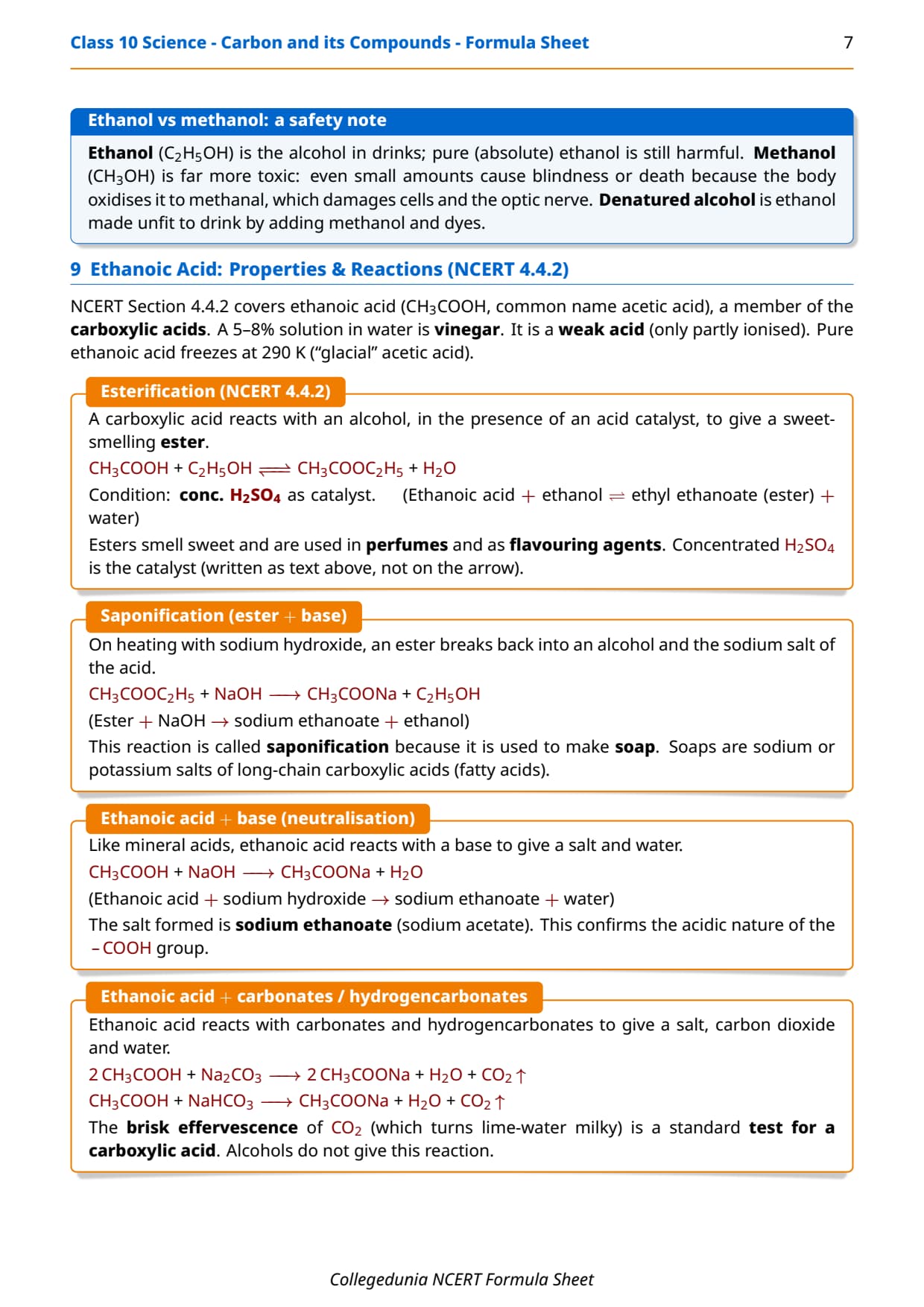
| Esterification | CH3COOH + C2H5OH ⇋ CH3COOC2H5 + H2O (conc. H2SO4) | Sweet-smelling ester |
| With carbonate | CH3COOH + NaHCO3 → CH3COONa + H2O + CO2 ↑ | Brisk CO2: test for acid |
Ethanoic acid with NaHCO3 gives brisk CO2 that turns lime-water milky, the most reliable test for a carboxylic acid; alcohols do not react.
One-Shot Revision Tips for Carbon and its Compounds Class 10
Treat this Formula Sheet as a checklist for the night before a test. Recall each block out loud, then check it against the sheet.
- Lock the three general formulae. Alkane CnH2n+2, alkene CnH2n, alkyne CnH2n−2.
- Memorise the five functional groups with their group and one example each.
- Pair each family with its reaction: unsaturated undergo addition, saturated alkanes undergo substitution; bromine water tells them apart.
- Know the ethanoic acid tests: litmus turns red, NaHCO3 gives brisk CO2.
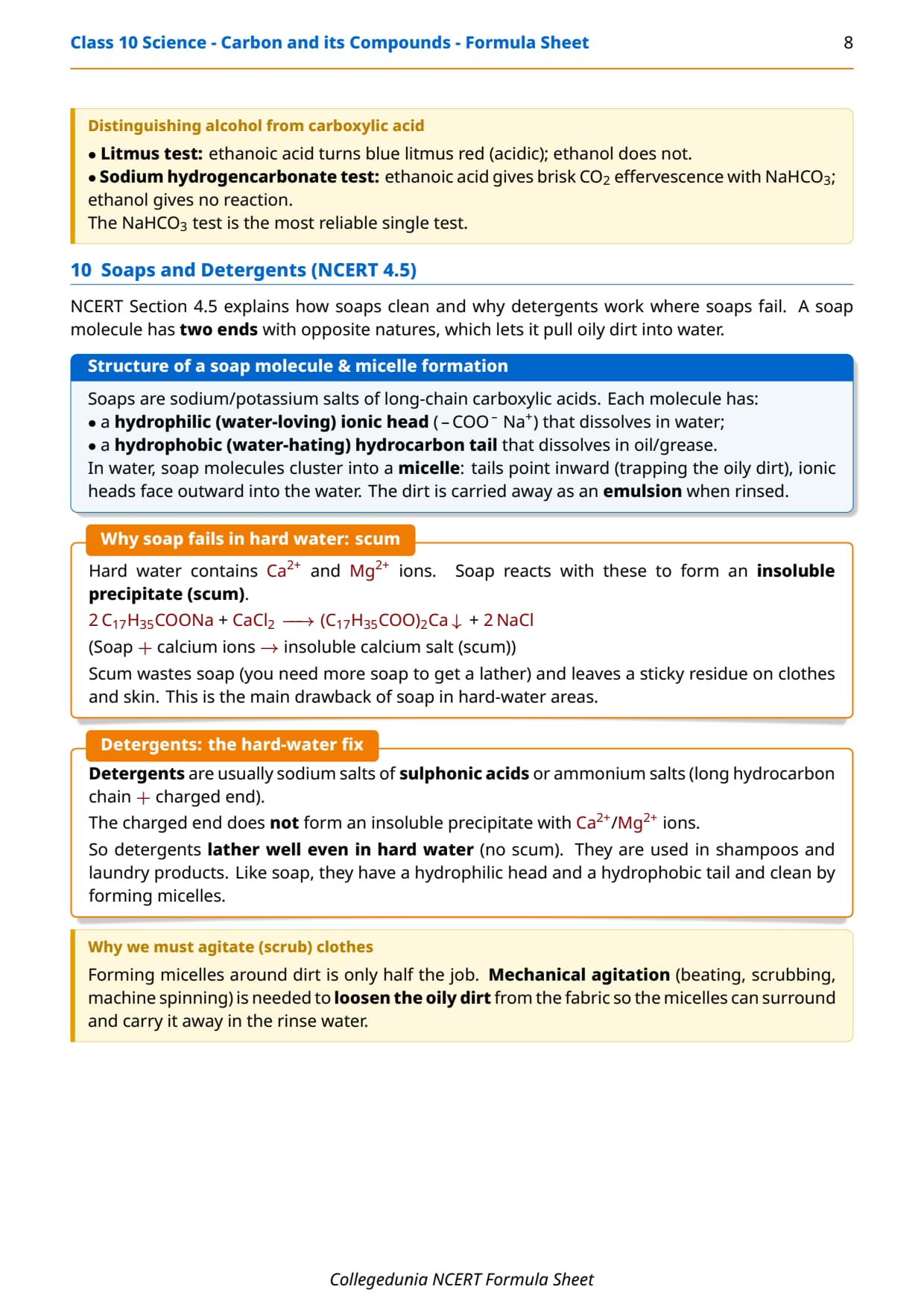
- Remember the soap micelle: hydrophilic head + hydrophobic tail trap oily dirt; soap fails in hard water (scum), detergents work.
Full topic-by-topic walkthrough: Carbon and its Compounds Class 10 Science Notes
More Carbon and its Compounds Class 10 Science Resources
Use the table below to move between the other Collegedunia resources for this same chapter, from full solutions to handwritten notes.
| Resource | Link |
|---|---|
| NCERT Solutions | Carbon and its Compounds NCERT Solutions |
| Revision Notes | Carbon and its Compounds Notes |
| Handwritten Notes | Carbon and its Compounds Handwritten Notes |
| Exemplar Solutions | Carbon and its Compounds Exemplar Solutions |
| NCERT Book PDF | Carbon and its Compounds NCERT Book PDF |
NCERT Formula Sheet for Class 10 Science: All Chapters
Use the table below to jump to the Formula Sheet for any other chapter in the Class 10 Science NCERT.
| Chapter | Resource |
|---|---|
| Chapter 1 | Chemical Reactions and Equations Formula Sheet |
| Chapter 2 | Acids, Bases and Salts Formula Sheet |
| Chapter 3 | Metals and Non-metals Formula Sheet |
| Chapter 5 | Life Processes Formula Sheet |
| Chapter 6 | Control and Coordination Formula Sheet |
| Chapter 7 | How do Organisms Reproduce? Formula Sheet |
| Chapter 8 | Heredity Formula Sheet |
| Chapter 9 | Light - Reflection and Refraction Formula Sheet |
| Chapter 10 | The Human Eye and the Colourful World Formula Sheet |
| Chapter 11 | Electricity Formula Sheet |
| Chapter 12 | Magnetic Effects of Electric Current Formula Sheet |
| Chapter 13 | Our Environment Formula Sheet |
Carbon and its Compounds Class 10 Formula Sheet FAQs
Ques. Where can I download the Carbon and its Compounds Class 10 Formula Sheet PDF?
Ans. You can download the Carbon and its Compounds Class 10 Science Formula Sheet PDF directly from this page. It is free and covers every general formula, functional group, the homologous series, the naming rules, every key reaction, and soaps and detergents in the 2026-27 NCERT Chapter 4.
Ques. Is this Formula Sheet aligned with the 2026-27 NCERT?
Ans. Yes. The sheet reflects the current 2026-27 syllabus for Class 10 Science. Chapter 4 retains covalent bonding, the versatile nature of carbon, functional groups, the homologous series, nomenclature, the key reactions, ethanol and ethanoic acid, and soaps and detergents.
Ques. What are the general formulae of alkanes, alkenes and alkynes in Class 10 Science?
Ans. Alkanes have the general formula CnH2n+2 (all single bonds), alkenes have CnH2n (one C=C double bond), and alkynes have CnH2n−2 (one C≡C triple bond). For alkenes and alkynes, n starts at 2 because you need at least two carbons for a double or triple bond.
Ques. Why is carbon tetravalent?
Ans. Carbon has 4 electrons in its outermost shell (configuration 2,4). Gaining 4 electrons would need the small nucleus to hold 6 extra electrons, and losing 4 would need huge energy, so neither is easy. Instead carbon shares its 4 valence electrons, forming four covalent bonds. This sharing of four bonds is its tetravalency.
Ques. What is a homologous series in Class 10 Science?
Ans. A homologous series is a family of compounds with the same general formula and the same functional group, where each member differs from the next by a −CH2− unit. The molecular mass rises by 14 u at each step. Members share similar chemical properties but show a steady gradation in physical properties such as boiling point.
Ques. What are functional groups, and what are the main ones in Class 10?
Ans. A functional group is an atom or group of atoms that replaces a hydrogen in a hydrocarbon and decides its chemical properties. The five main groups in Class 10 are haloalkane (−Cl, −Br), alcohol (−OH), aldehyde (−CHO), ketone (>C=O), and carboxylic acid (−COOH). The same group gives similar behaviour across all chain lengths.
Ques. What is the test for unsaturation in a carbon compound?
Ans. Add bromine water (orange-red) to the compound. An unsaturated compound (alkene or alkyne) decolourises bromine water because the addition reaction uses up the Br2. A saturated compound (alkane) does not decolourise it. This is the standard chemical test to tell alkanes apart from alkenes and alkynes.
Ques. What is the difference between addition and substitution reactions?
Ans. Addition happens only with unsaturated compounds, where hydrogen (or another molecule) adds across the double or triple bond, for example CH2=CH2 + H2 → CH3CH3 with a Ni catalyst. Substitution is typical of saturated alkanes, where in sunlight chlorine replaces hydrogen one atom at a time, for example CH4 + Cl2 → CH3Cl + HCl.
Ques. What is esterification and where is it used?
Ans. Esterification is the reaction of a carboxylic acid with an alcohol, in the presence of an acid catalyst, to give a sweet-smelling ester and water: CH3COOH + C2H5OH ⇋ CH3COOC2H5 + H2O, with conc. H2SO4 as the catalyst. Esters smell sweet and are used in perfumes and as flavouring agents.
Ques. How do you distinguish ethanol from ethanoic acid?
Ans. Ethanoic acid turns blue litmus red and gives brisk CO2 effervescence with sodium hydrogencarbonate (NaHCO3); ethanol does neither. The CO2 turns lime-water milky, so the sodium hydrogencarbonate test is the most reliable single test to tell a carboxylic acid from an alcohol.
Ques. Why does soap fail in hard water, and how do detergents fix this?
Ans. Hard water contains Ca2+ and Mg2+ ions. Soap reacts with these to form an insoluble precipitate called scum, which wastes soap and leaves a sticky residue. Detergents are sodium salts of sulphonic acids whose charged end does not form an insoluble precipitate with Ca2+ or Mg2+, so they lather well even in hard water.
Ques. What is the CBSE weightage of Chapter 4 in Class 10 Science?
Ans. Carbon and its Compounds sits in the Chemical Substances unit and usually carries 6 to 8 marks in the CBSE Class 10 Science board exam, asked across one or two questions on general formulae, functional groups, nomenclature, the key reactions, ethanol and ethanoic acid, or soaps and detergents.



Comments