




This Metals and Non-metals formula sheet for Class 10 Science Chapter 3 (2026-27 NCERT) puts the physical and chemical properties, the reactivity series, ionic compound rules, the metallurgy steps, corrosion, and the main alloys on one page. Use it as a quick reference before any board test.
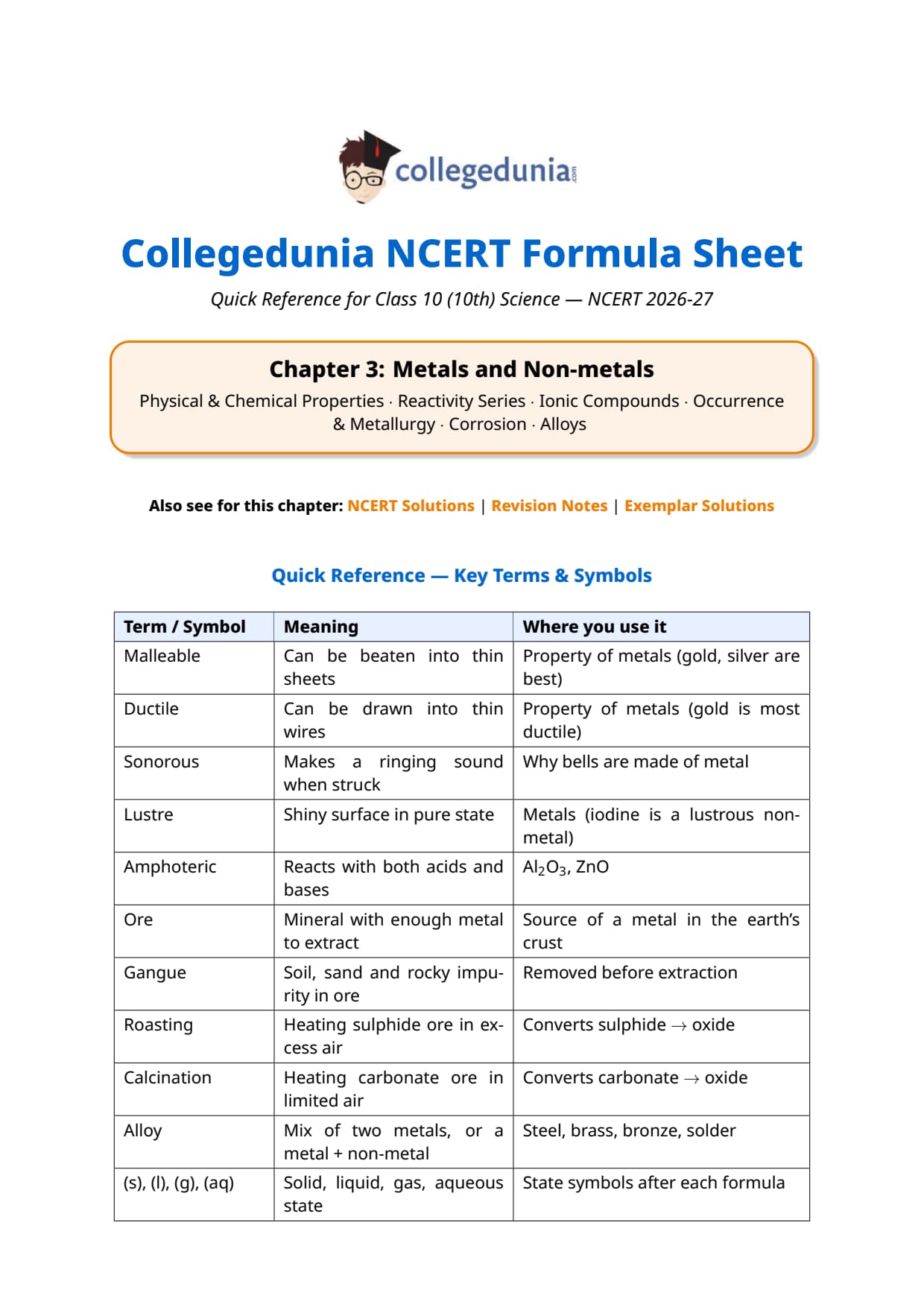
- CBSE Weightage: part of the Chemical Substances unit, worth 5 to 7 marks across one or two questions.
- Best used for: the reactivity series, metal reactions, extraction methods, and last-minute board revision.
You can find the complete Formula Sheet for Metals and Non-metals, with every property, reaction, the reactivity series, and the extraction steps mapped to the 2026-27 NCERT, in the article below.
This Formula Sheet is curated by Science subject experts, mapped to the 2026-27 NCERT, and refined against the last five years of CBSE Class 10 board papers.
Also Check:
How Collegedunia's Metals and Non-metals Formula Sheet Helps You
This Formula Sheet gathers every property, reaction, the reactivity series, and the extraction steps from Chapter 3 in the order the 2026-27 NCERT introduces them.
- One-page recall: reactivity series, reaction types, and the extraction table side by side.
- Balanced equations: each reaction type carries a balanced NCERT example.
- Board-exam focus: high-yield facts like the reactivity series order, amphoteric oxides, and the thermit reaction.
Metals and Non-metals Class 10 Science Video Revision
Source: Magnet Brains on YouTube
Physical Properties of Metals and Non-metals in Class 10 Science
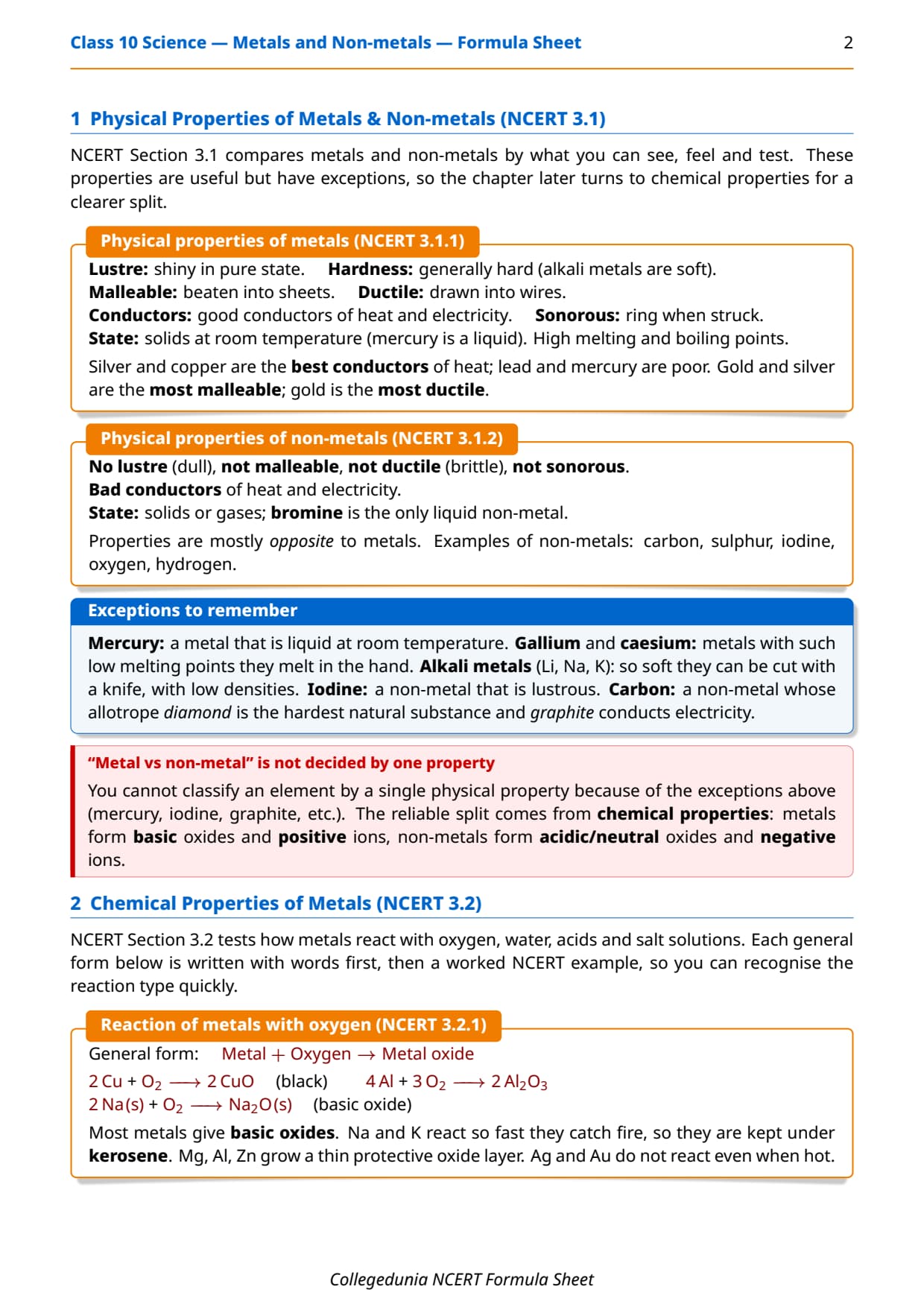
NCERT Section 3.1 compares metals and non-metals by what you can see, feel, and test. These physical properties have exceptions, so the chapter later turns to chemical properties for a cleaner split.
| Property | Metals | Non-metals |
|---|---|---|
| Lustre | Shiny | Dull (except iodine) |
| Malleability | Beaten into sheets | Brittle |
| Ductility | Drawn into wires (gold most ductile) | Not ductile |
| Conduction | Good conductors | Poor (except graphite) |
| Sonority | Sonorous, ring when struck | Not sonorous |
| State | Solids (mercury liquid) | Solids or gases (bromine liquid) |
Silver and copper are the best conductors; gold is the most ductile. Alkali metals (lithium, sodium, potassium) are so soft they can be cut with a knife. Mercury is a liquid metal; iodine is a lustrous non-metal and graphite conducts electricity, so never classify an element from one physical property alone.
Chemical Properties of Metals in Class 10 Science Chapter 3
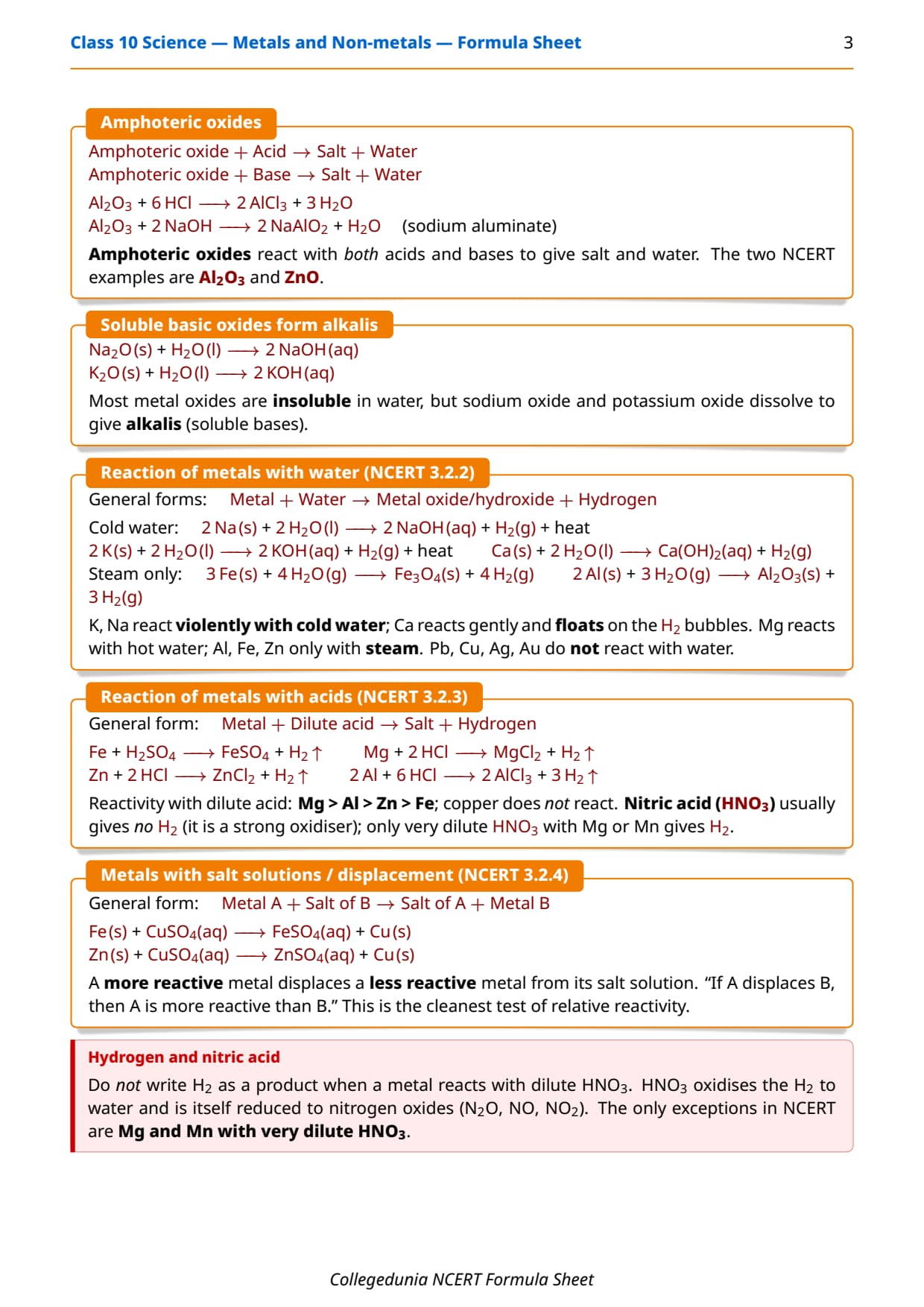
NCERT Section 3.2 tests how metals react with oxygen, water, acids, and salt solutions. Learning the general form of each type lets you predict products fast.
| Reaction type | General form | Balanced example |
|---|---|---|
| Metal + Oxygen | → Metal oxide | 2 Cu + O2 → 2 CuO (black) |
| Metal + Water | → Hydroxide/oxide + H2 | 2 Na + 2 H2O → 2 NaOH + H2 ↑ |
| Metal + Acid | → Salt + H2 | Zn + 2 HCl → ZnCl2 + H2 ↑ |
| Displacement | A + salt of B → salt of A + B | Fe + CuSO4 → FeSO4 + Cu |
| Amphoteric oxide + Acid | → Salt + Water | Al2O3 + 6 HCl → 2 AlCl3 + 3 H2O |
| Amphoteric oxide + Base | → Salt + Water | Al2O3 + 2 NaOH → 2 NaAlO2 + H2O |
Most metals form basic oxides. Sodium and potassium catch fire in air, so they are stored under kerosene. Amphoteric oxides (Al2O3, ZnO) react with both acids and bases. Reactivity with dilute acid runs Mg > Al > Zn > Fe; copper does not react.
Reactivity Series of Metals in Class 10 Science
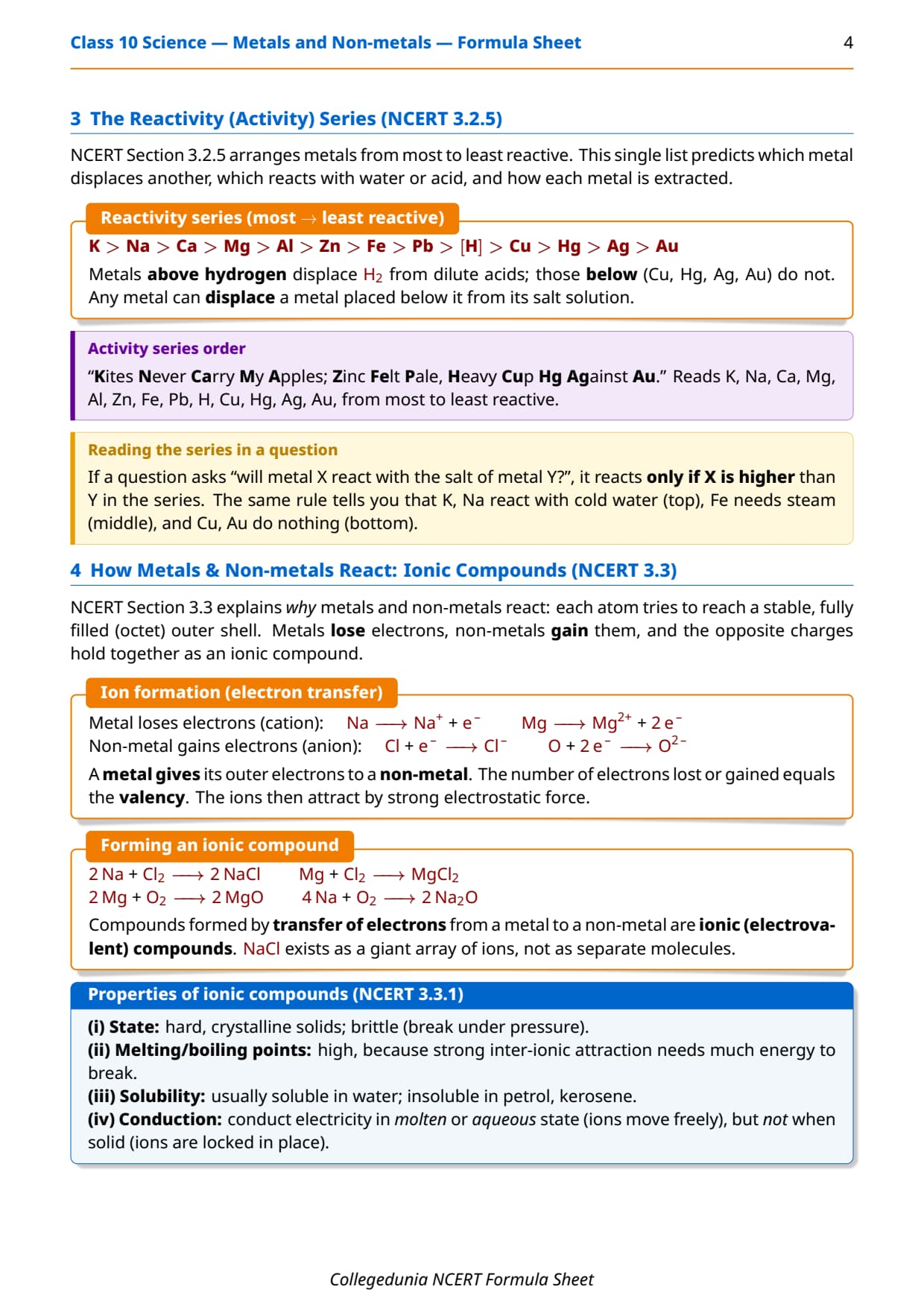
NCERT Section 3.2.5 arranges metals from most to least reactive. This list predicts which metal displaces another, which reacts with water or acid, and how each is extracted, one of the highest-yield tools in the chapter.
- Above hydrogen: K, Na, Ca, Mg, Al, Zn, Fe, Pb displace H2 from dilute acids; K and Na react violently even with cold water.
- Below hydrogen: Cu, Hg, Ag, Au do not displace hydrogen and do not react with water.
- Displacement rule: any metal displaces a metal below it from its salt solution.
Ionic Compounds and Their Properties in Class 10 Science
NCERT Section 3.3 explains why metals and non-metals react: each atom tries to reach a stable outer shell. Metals lose electrons to form positive ions, non-metals gain them to form negative ions, and the opposite charges hold together as an ionic compound.
- Cation (metal): loses electrons, e.g. Na → Na+ + e−, Mg → Mg2+ + 2e−.
- Anion (non-metal): gains electrons, e.g. Cl + e− → Cl−, O + 2e− → O2−.
- Ionic compound: electron transfer from metal to non-metal gives an electrovalent compound, e.g. 2 Na + Cl2 → 2 NaCl.
| Property | What it means for ionic compounds |
|---|---|
| Physical state | Hard, brittle crystalline solids |
| Melting / boiling point | High, due to strong inter-ionic attraction |
| Solubility | Soluble in water; insoluble in petrol and kerosene |
| Conduction | Conduct when molten or aqueous; not when solid |
The electrons a metal loses, or a non-metal gains, equals its valency, so magnesium (valency 2) pairs with two chlorines to form MgCl2.
Occurrence and Extraction of Metals in Class 10 Science Chapter 3
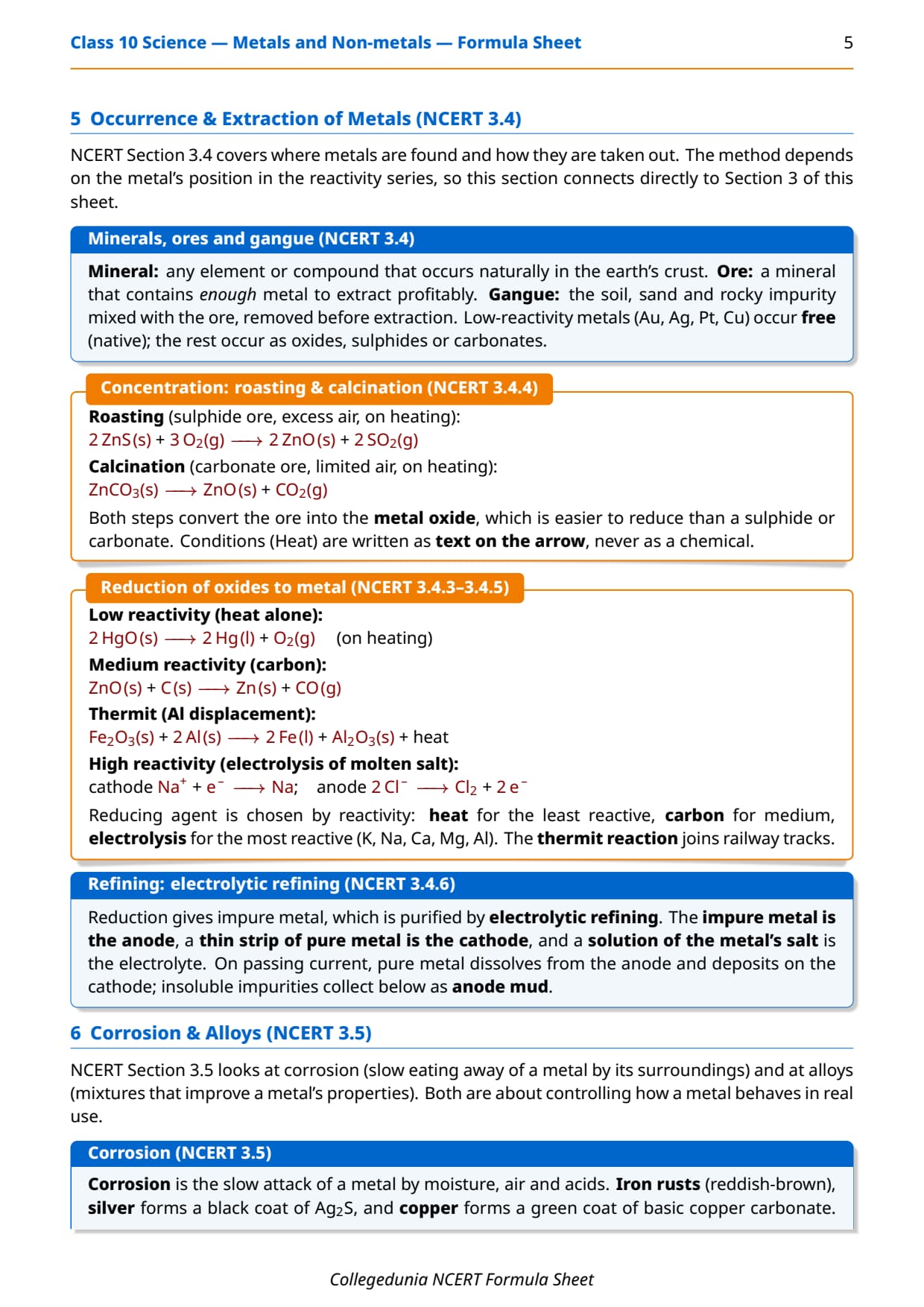
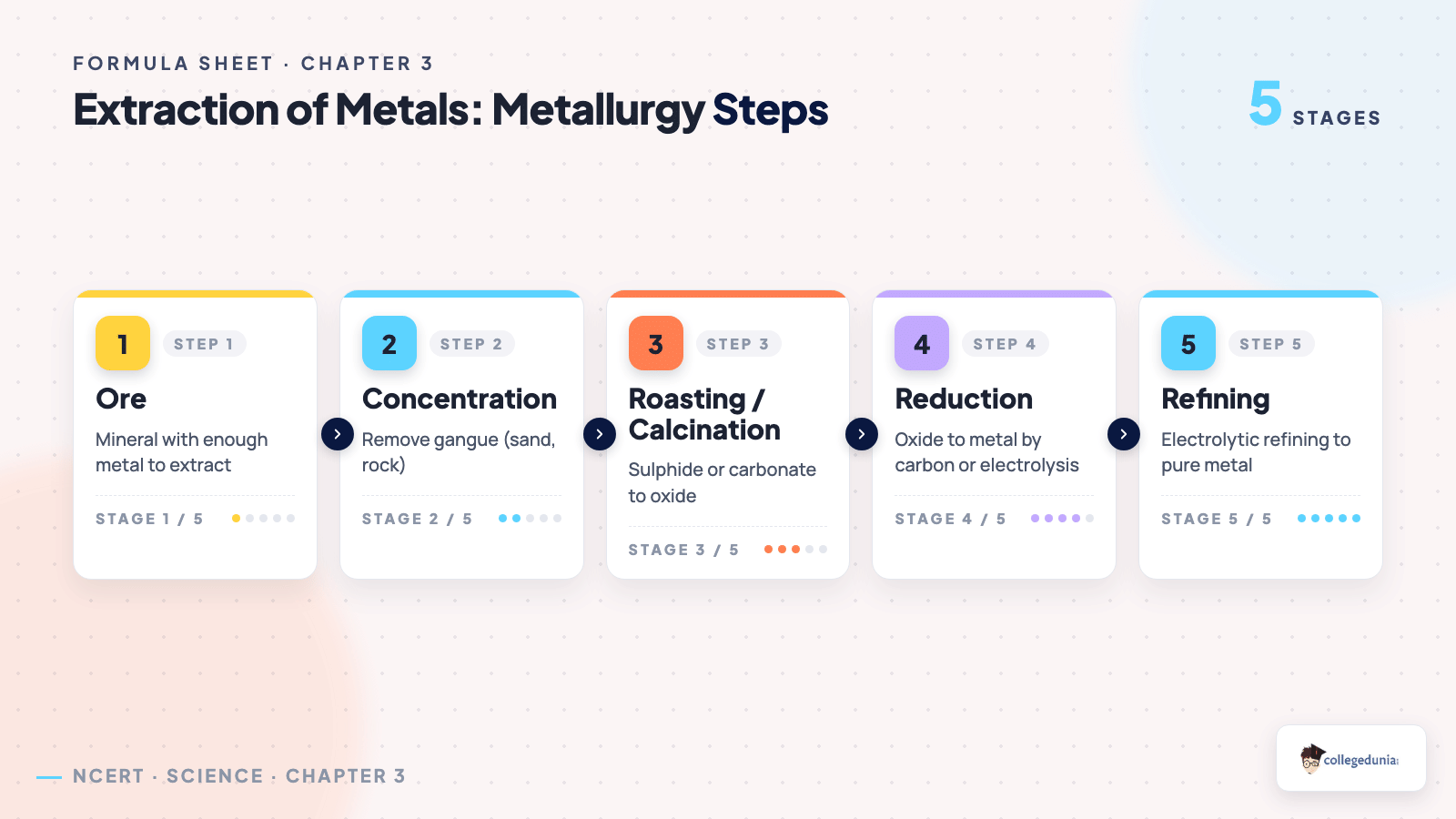
NCERT Section 3.4 covers where metals are found and how they are taken out. The extraction method depends on the metal's position in the reactivity series. Low-reactivity metals like gold and silver occur free; the rest occur as oxides, sulphides, or carbonates.
| Term | Meaning |
|---|---|
| Mineral | An element or compound found naturally in the crust |
| Ore | A mineral with enough metal to extract profitably |
| Gangue | Soil, sand and rocky impurity mixed with the ore |
| Roasting | Heating a sulphide ore in excess air to give the oxide |
| Calcination | Heating a carbonate ore in limited air to give the oxide |
Both give the metal oxide, easier to reduce. The reducing agent depends on reactivity: heat alone for the least reactive, carbon for the medium group, electrolysis for the most reactive.
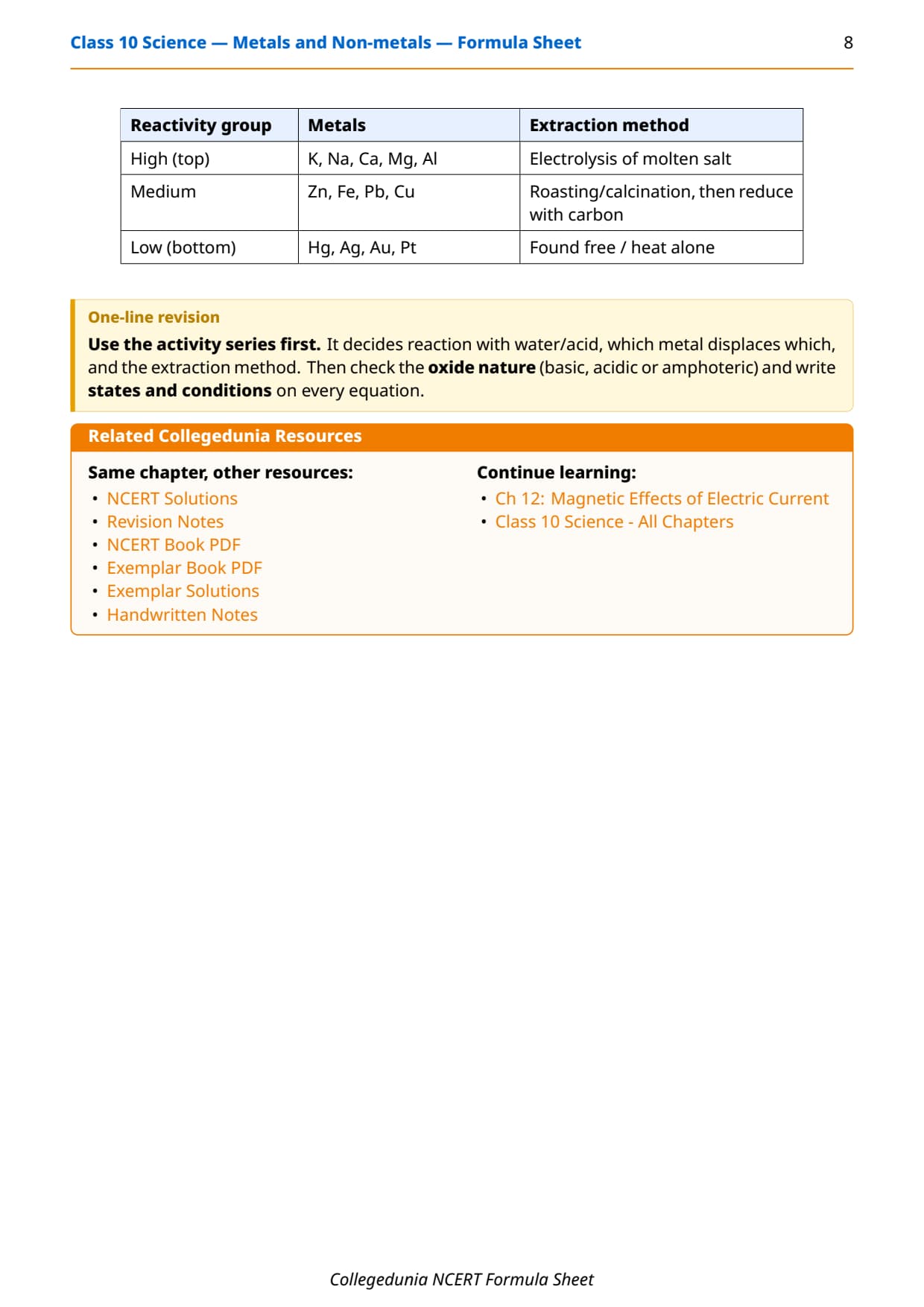
| Reactivity group | Metals | Extraction method |
|---|---|---|
| High (top) | K, Na, Ca, Mg, Al | Electrolysis of molten salt |
| Medium | Zn, Fe, Pb, Cu | Roast/calcine, then reduce with carbon |
| Low (bottom) | Hg, Ag, Au, Pt | Found free, or heat alone |
The thermit reaction, Fe2O3 + 2 Al → 2 Fe + Al2O3, releases so much heat that molten iron forms, used to join broken railway tracks. Reduction gives impure metal, purified by electrolytic refining.
Corrosion and Alloys in Class 10 Science Chapter 3
NCERT Section 3.5 looks at corrosion (the slow eating away of a metal) and alloys (mixtures that improve a metal's properties). Both are common board-exam questions.
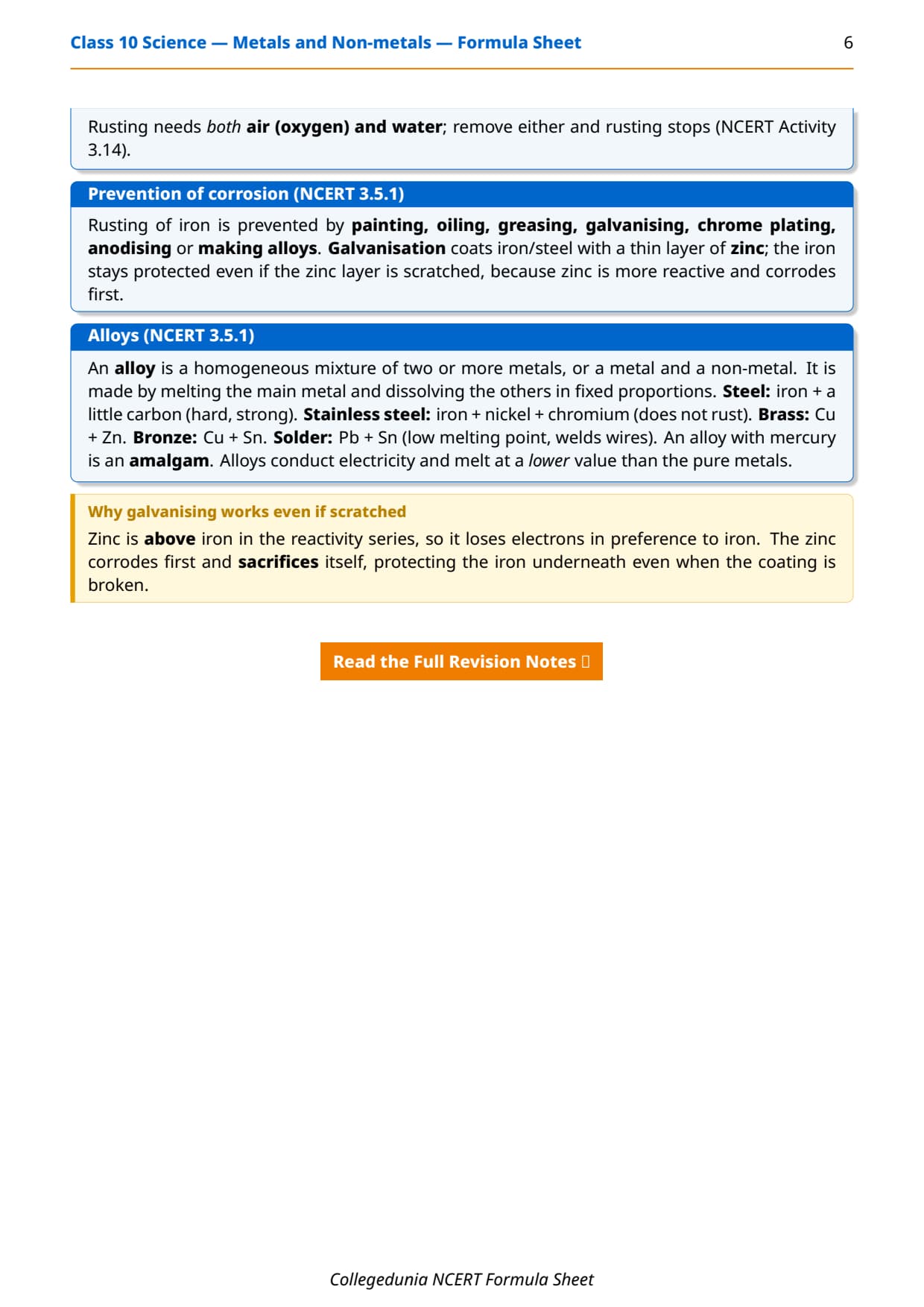
- Corrosion: slow attack by moisture, air, and acids. Iron rusts (reddish-brown), silver forms black Ag2S, copper forms a green coat of basic copper carbonate.
- Rusting condition: needs both air (oxygen) and water; remove either and rusting stops.
- Prevention: painting, oiling, greasing, galvanising, chrome plating, anodising, or alloying.
- Galvanisation: coating iron with a thin layer of zinc; the iron stays protected even if scratched, because the more reactive zinc corrodes first.
| Alloy | Composition | Key property / use |
|---|---|---|
| Steel | Iron + a little carbon | Hard and strong |
| Stainless steel | Iron + nickel + chromium | Does not rust |
| Brass | Copper + zinc | Fittings |
| Bronze | Copper + tin | Statues and medals |
| Solder | Lead + tin | Low melting point, welds wires |
| Amalgam | Any metal + mercury | Mercury-based alloy |
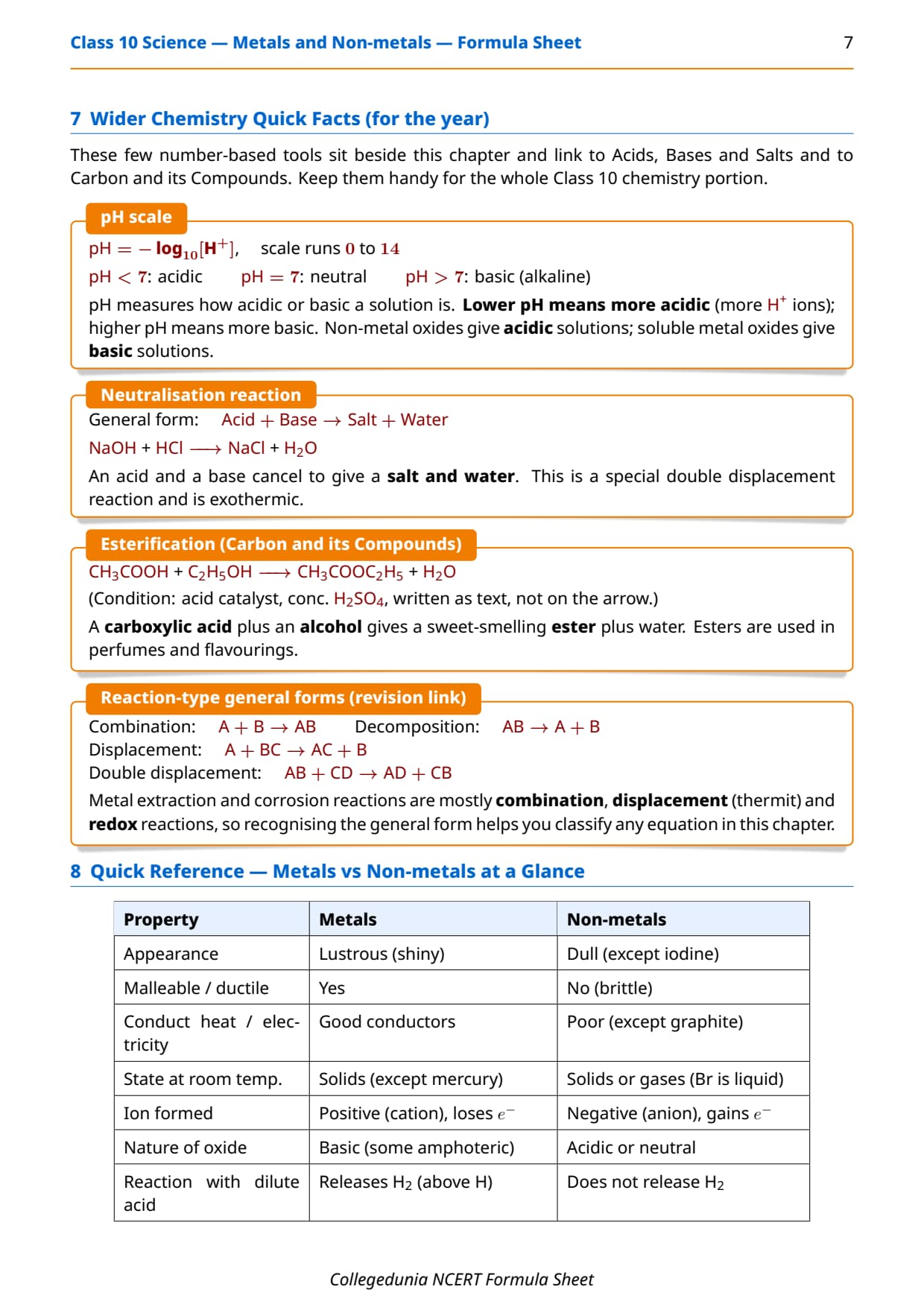
Metals vs Non-metals at a Glance in Class 10 Science
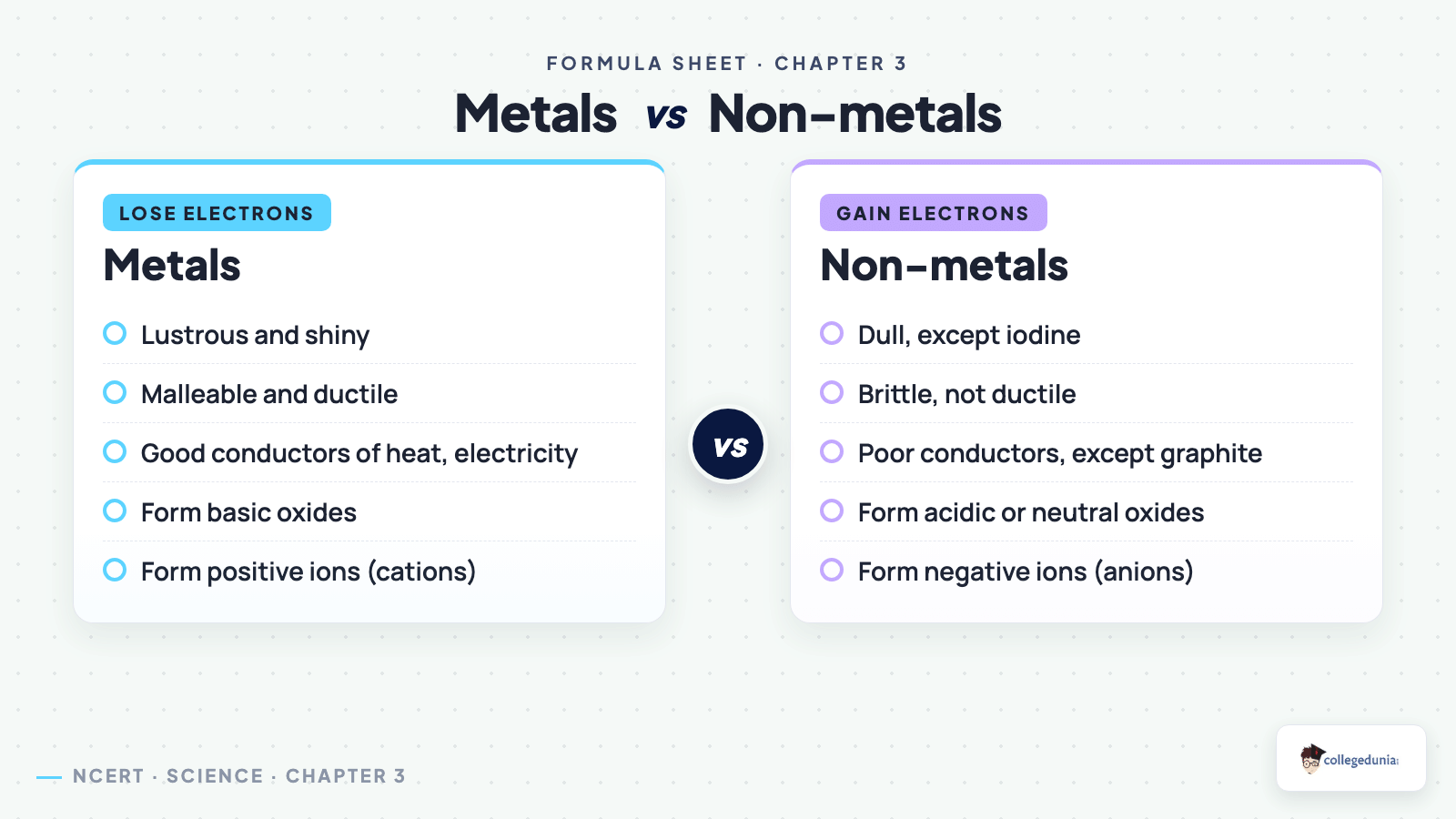
Quick split: metals form basic oxides and positive ions; non-metals form acidic or neutral oxides and negative ions.
Full topic-by-topic walkthrough: Metals and Non-metals Class 10 Science Notes
More Metals and Non-metals Class 10 Science Resources
Use the table below to move between the other Collegedunia resources for this chapter.
| Resource | Link |
|---|---|
| NCERT Solutions | Metals and Non-metals NCERT Solutions |
| Revision Notes | Metals and Non-metals Notes |
| Handwritten Notes | Metals and Non-metals Handwritten Notes |
| Exemplar Solutions | Metals and Non-metals Exemplar Solutions |
| NCERT Book PDF | Metals and Non-metals NCERT Book PDF |
NCERT Formula Sheet for Class 10 Science: All Chapters
Jump to the Formula Sheet for any other Class 10 Science chapter below.
| Chapter | Resource |
|---|---|
| Chapter 1 | Chemical Reactions and Equations Formula Sheet |
| Chapter 2 | Acids, Bases and Salts Formula Sheet |
| Chapter 4 | Carbon and its Compounds Formula Sheet |
| Chapter 5 | Life Processes Formula Sheet |
| Chapter 6 | Control and Coordination Formula Sheet |
| Chapter 7 | How do Organisms Reproduce? Formula Sheet |
| Chapter 8 | Heredity Formula Sheet |
| Chapter 9 | Light - Reflection and Refraction Formula Sheet |
| Chapter 10 | The Human Eye and the Colourful World Formula Sheet |
| Chapter 11 | Electricity Formula Sheet |
| Chapter 12 | Magnetic Effects of Electric Current Formula Sheet |
| Chapter 13 | Our Environment Formula Sheet |
Metals and Non-metals Class 10 Formula Sheet FAQs
Ques. Where can I download the Metals and Non-metals Class 10 Formula Sheet PDF?
Ans. You can download the Metals and Non-metals Class 10 Science Formula Sheet PDF directly from this page. It is free and covers every property, reaction, the reactivity series, the extraction steps, corrosion, and alloys in the 2026-27 NCERT Chapter 3.
Ques. Is this Formula Sheet aligned with the 2026-27 NCERT?
Ans. Yes. The sheet reflects the current 2026-27 syllabus for Class 10 Science. Chapter 3 retains the physical and chemical properties, the reactivity series, ionic compounds, the occurrence and extraction of metals, corrosion, and alloys.
Ques. What is the reactivity series of metals in Class 10 Science?
Ans. The reactivity series arranges metals from most to least reactive: K > Na > Ca > Mg > Al > Zn > Fe > Pb > [H] > Cu > Hg > Ag > Au. Metals above hydrogen displace H2 from dilute acids; metals below it (Cu, Hg, Ag, Au) do not. A more reactive metal displaces a less reactive metal from its salt solution.
Ques. What is the difference between metals and non-metals in Class 10?
Ans. Metals are lustrous, malleable, ductile, sonorous, good conductors, form basic oxides, and form positive ions by losing electrons. Non-metals are dull, brittle, poor conductors, form acidic or neutral oxides, and form negative ions by gaining electrons. The reliable test is chemical: metals form positive ions, non-metals form negative ions.
Ques. What is an amphoteric oxide? Give two examples.
Ans. An amphoteric oxide reacts with both acids and bases to give a salt and water. The two NCERT examples are aluminium oxide (Al2O3) and zinc oxide (ZnO). For example, Al2O3 + 6 HCl → 2 AlCl3 + 3 H2O, and Al2O3 + 2 NaOH → 2 NaAlO2 + H2O.
Ques. What is the difference between roasting and calcination?
Ans. Roasting is heating a sulphide ore strongly in excess air to convert it to the oxide, for example 2 ZnS + 3 O2 → 2 ZnO + 2 SO2. Calcination is heating a carbonate ore in limited air to convert it to the oxide, for example ZnCO3 → ZnO + CO2. Both give the metal oxide, which is easier to reduce.
Ques. How are metals extracted based on their reactivity?
Ans. Highly reactive metals (K, Na, Ca, Mg, Al) are obtained by electrolysis of their molten salts. Medium-reactivity metals (Zn, Fe, Pb, Cu) are roasted or calcined, then reduced with carbon. Low-reactivity metals (Hg, Ag, Au, Pt) occur free or are obtained by heating their oxide alone, for example 2 HgO → 2 Hg + O2.
Ques. What is the thermit reaction and where is it used?
Ans. The thermit reaction is the reduction of iron(III) oxide by aluminium: Fe2O3 + 2 Al → 2 Fe + Al2O3. It releases so much heat that the iron forms in the molten state, so the reaction is used to join broken railway tracks and machine parts.
Ques. What are the conditions needed for rusting of iron?
Ans. Rusting of iron needs both air (oxygen) and moisture (water) together. If either one is removed, rusting stops. Iron is protected from rusting by painting, oiling, greasing, galvanising with zinc, chrome plating, anodising, or by making alloys such as stainless steel.
Ques. Why is zinc used for galvanising iron, and how does it protect it?
Ans. Galvanisation coats iron or steel with a thin layer of zinc. Zinc is more reactive than iron, so it loses electrons in preference to iron and corrodes first. This means the iron stays protected even if the zinc coating is scratched, because the zinc sacrifices itself.
Ques. What is the CBSE weightage of Chapter 3 in Class 10 Science?
Ans. Metals and Non-metals sits in the Chemical Substances unit and usually carries 5 to 7 marks in the CBSE Class 10 Science board exam, asked across one or two questions on properties, the reactivity series, displacement reactions, the extraction of metals, corrosion, or alloys.



Comments