




Class 10 Science Chapter 2 Acids, Bases and Salts is the second chemistry chapter of the 2026-27 NCERT, and it builds directly on the reactions you learned in Chapter 1. This Acids, Bases and Salts formula sheet puts the indicators, the H+ and OH− ion rules, the pH scale, every acid-base reaction type, and the common salt names on one page. Use it as a quick reference before any CBSE Class 10 board test.
- CBSE Weightage: part of the Chemical Substances unit, worth 5 to 7 marks across one or two questions.
- Best used for: indicator colours, the pH scale, salt formulae, and last-minute board revision.
You can find the complete Formula Sheet for Acids, Bases and Salts, with every indicator colour, ion rule, pH fact, reaction type, and salt formula mapped to the 2026-27 NCERT, in the article below.
This Formula Sheet is curated by Science subject experts, mapped to the 2026-27 NCERT, and refined against the last five years of CBSE Class 10 board papers.
Also Check:
- Acids, Bases and Salts Class 10 Science NCERT Solutions
- Acids, Bases and Salts Class 10 Science Notes
How Collegedunia's Acids, Bases and Salts Formula Sheet Helps You
This Formula Sheet gathers every indicator, ion rule, pH fact, reaction, and salt name from Chapter 2 in NCERT order.
- 2026-27 NCERT aligned: indicator colours, the H+ and OH− ion rule, the pH scale, and salt formulae.
- One-page recall: indicator table, pH ladder, and common salt names side by side for a quick glance.
- Board-exam focus: each reaction carries a balanced example, plus the pH-of-salt rule and Plaster of Paris.
Acids, Bases and Salts Class 10 Science Video Revision
Source: Magnet Brains on YouTube
Acid-Base Indicators in Acids, Bases and Salts Class 10
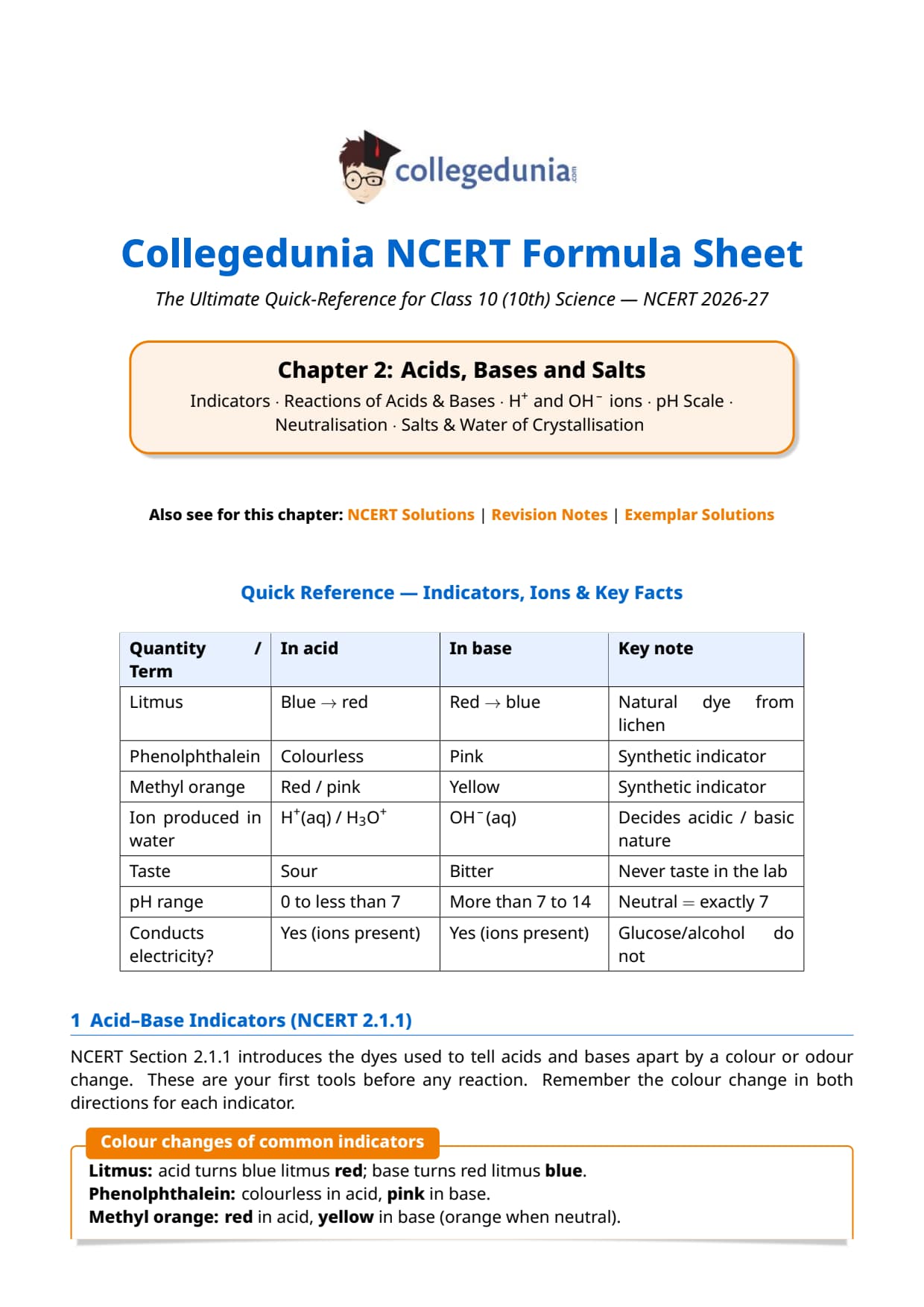
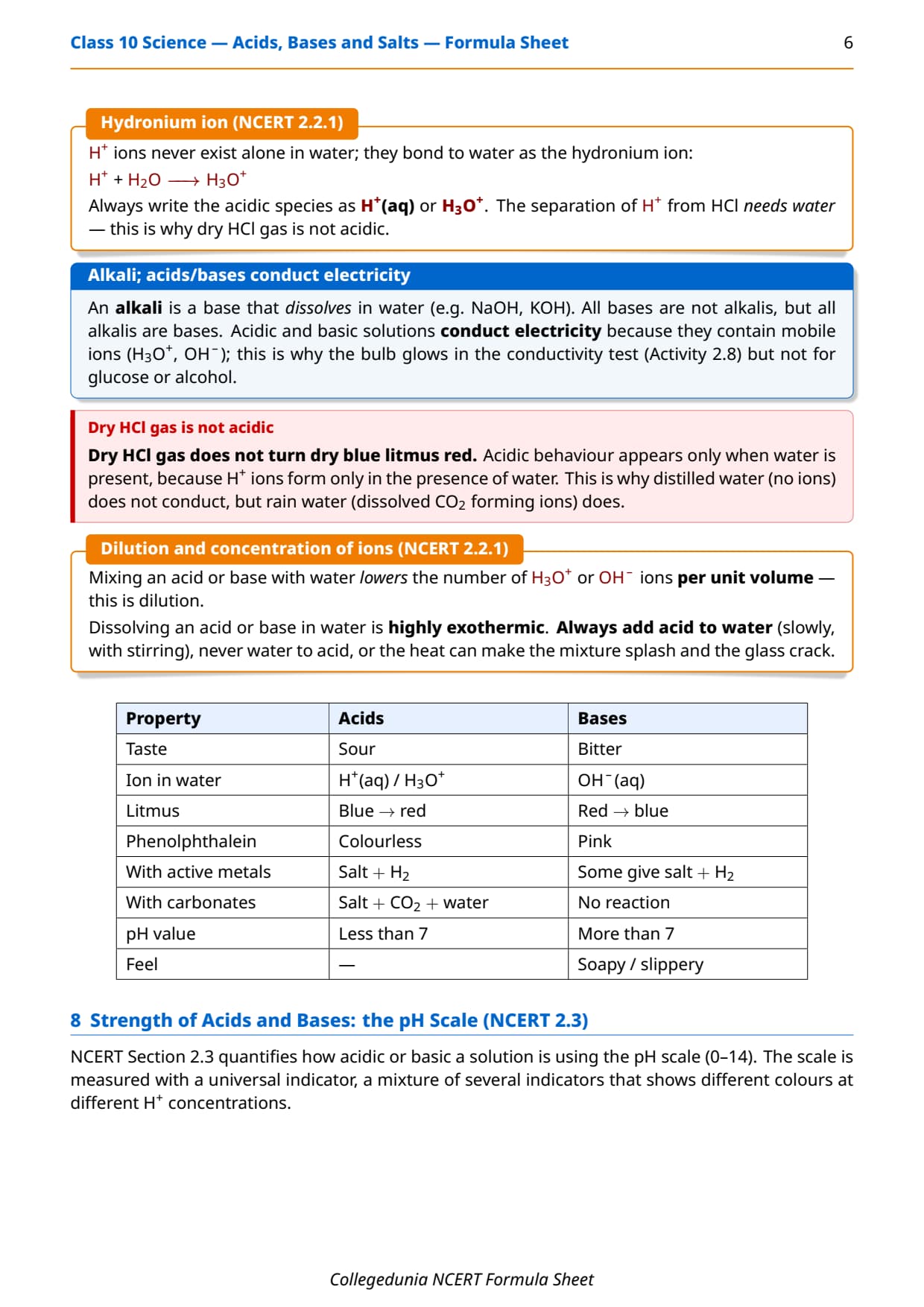
NCERT Section 2.1.1 introduces indicators, dyes that change colour or smell in acidic or basic media. Learn the colour change in both directions.
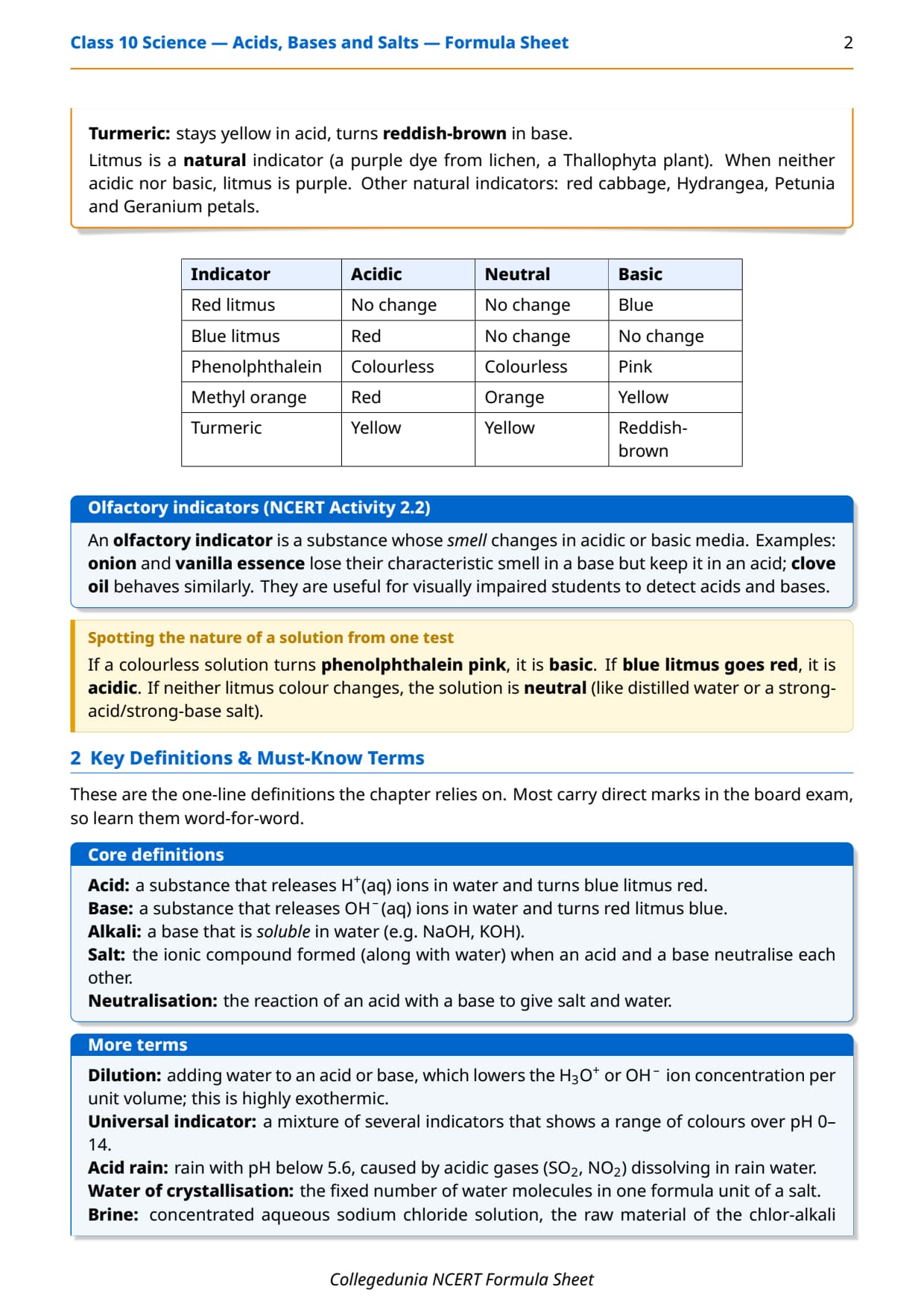
| Indicator | In acid | Neutral | In base |
|---|---|---|---|
| Blue litmus | Turns red | No change | No change |
| Red litmus | No change | No change | Turns blue |
| Phenolphthalein | Colourless | Colourless | Pink |
| Methyl orange | Red / pink | Orange | Yellow |
| Turmeric | Yellow | Yellow | Reddish-brown |
Litmus is a natural indicator, a purple dye from lichen; it is purple in a neutral solution. Other natural indicators are red cabbage and the petals of Hydrangea and Geranium.
Key Definitions for Acids, Bases and Salts Class 10 Science Chapter 2
These one-line definitions carry direct marks, so learn them word for word.
- Acid: releases H+ (aq) ions in water and turns blue litmus red (HCl, H2SO4, HNO3).
- Base: releases OH− (aq) ions in water and turns red litmus blue (NaOH, KOH).
- Alkali: a water-soluble base. All alkalis are bases, but not all bases are alkalis.
- Salt: the ionic compound formed, with water, when an acid and a base neutralise.
- Water of crystallisation: the fixed number of water molecules in one formula unit of a salt, such as the 5 in CuSO4·5H2O.
Reactions of Acids and Bases in Class 10 Science With Examples
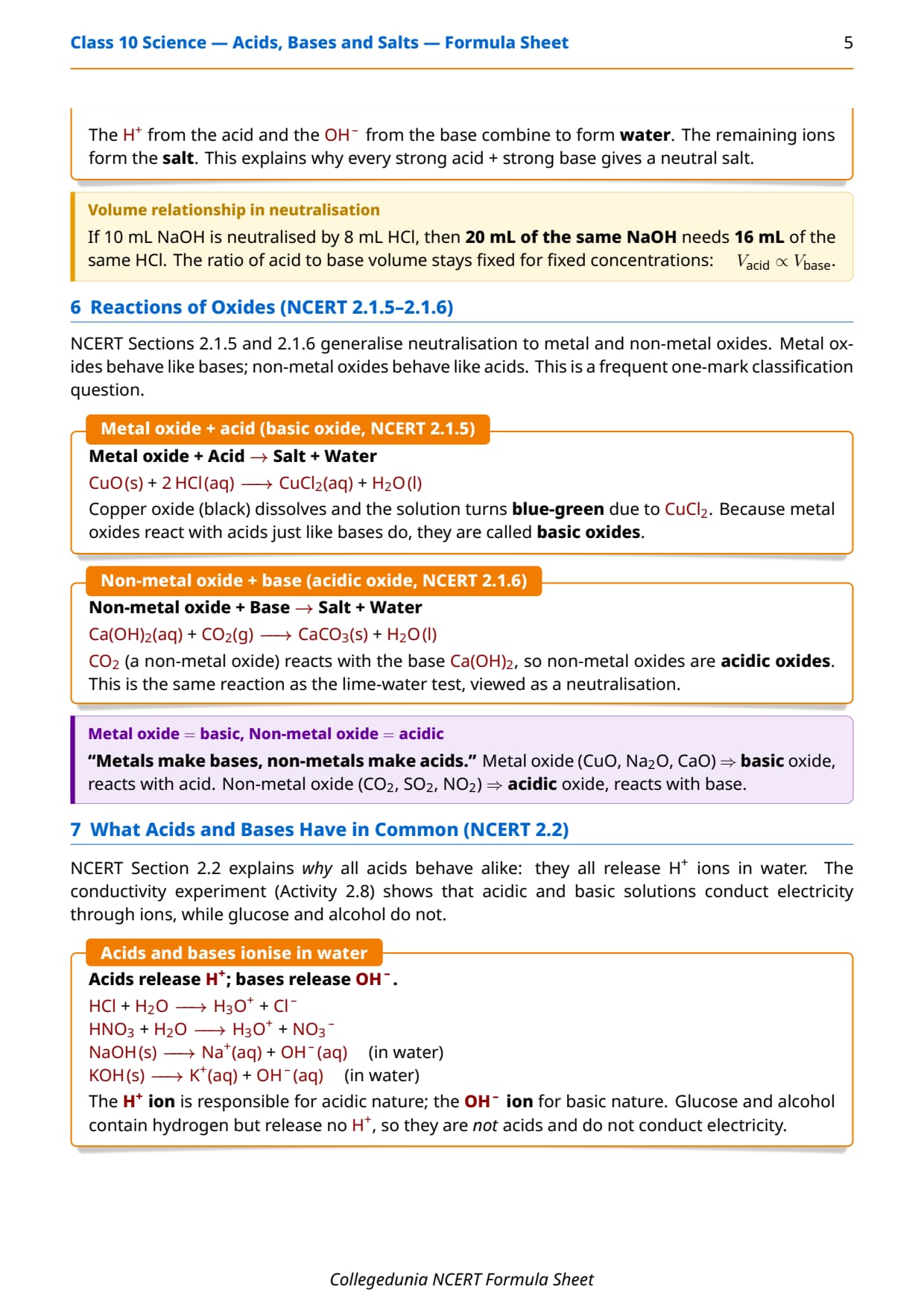
NCERT Sections 2.1.2 to 2.1.6 sort acid-base chemistry into a short list of reaction types. Learn each general form to predict products fast.
| Reaction type | General form | Balanced example |
|---|---|---|
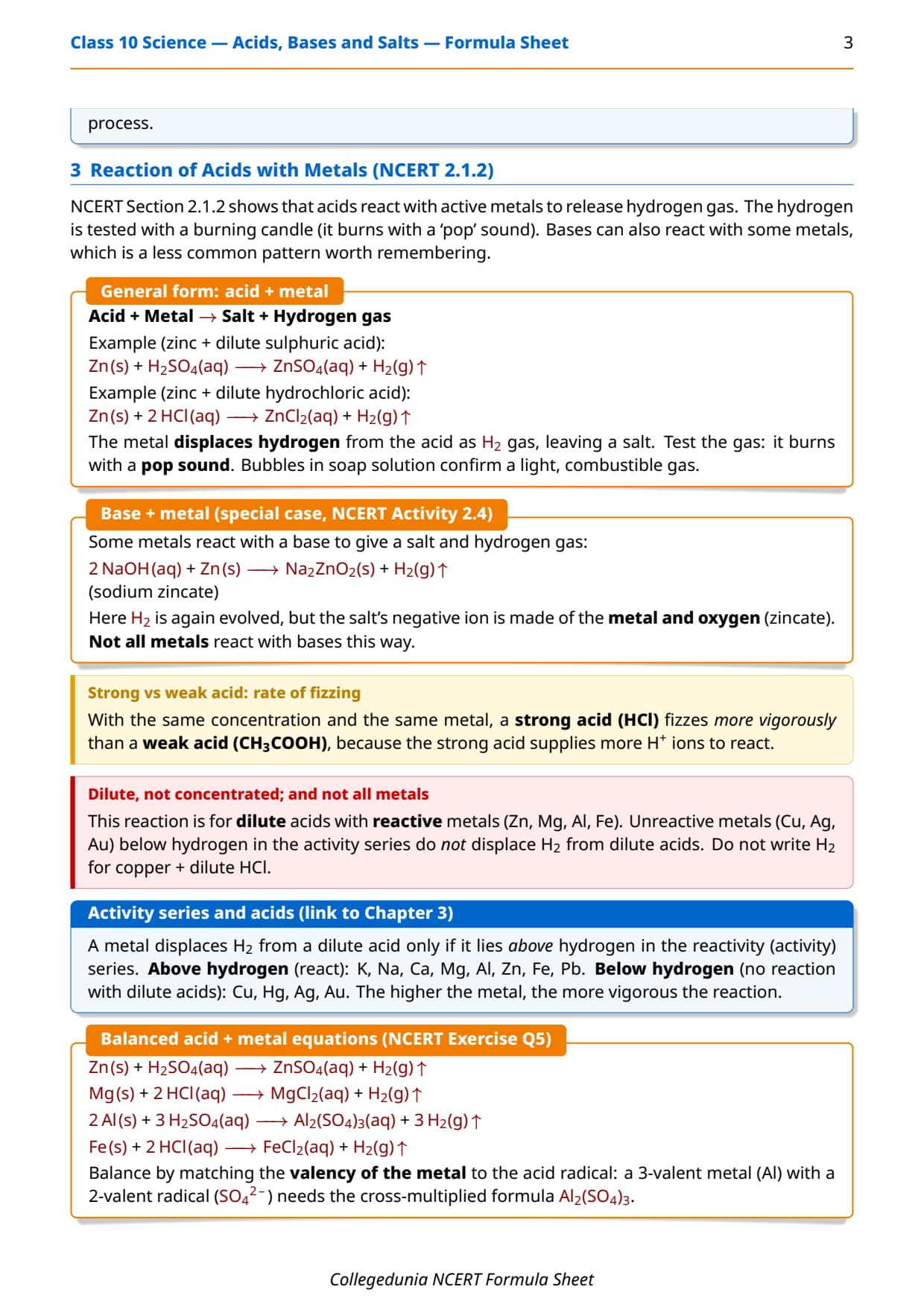
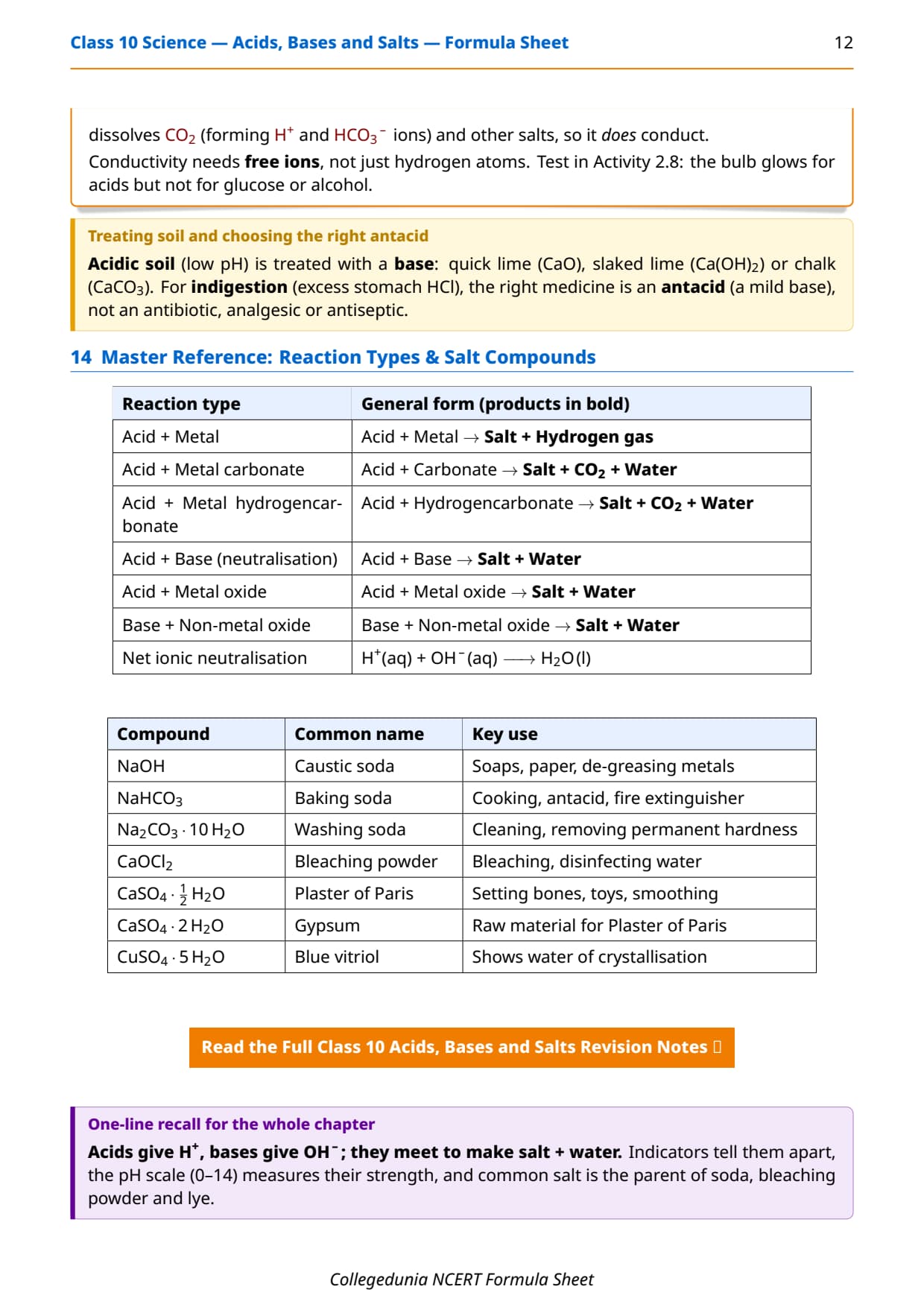
| Acid + Metal | Acid + Metal → Salt + H2 | Zn (s) + 2 HCl (aq) → ZnCl2 (aq) + H2 (g) ↑ |
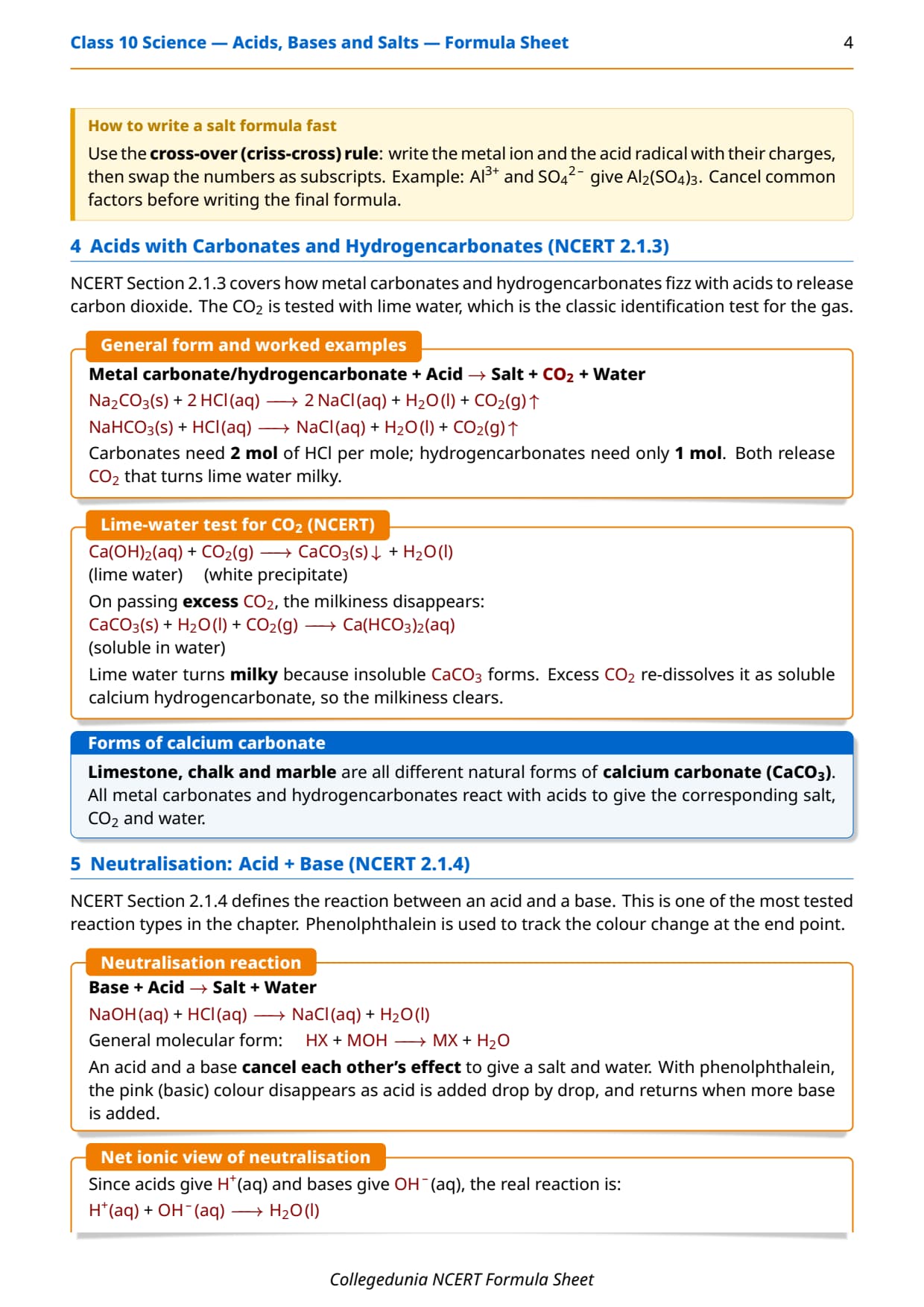
| Acid + Carbonate / Hydrogencarbonate | → Salt + CO2 + Water | Na2CO3 (s) + 2 HCl (aq) → 2 NaCl (aq) + H2O (l) + CO2 (g) ↑ |
| Acid + Base (neutralisation) | Acid + Base → Salt + Water | NaOH (aq) + HCl (aq) → NaCl (aq) + H2O (l) |
| Acid + Metal oxide | Metal oxide + Acid → Salt + Water | CuO (s) + 2 HCl (aq) → CuCl2 (aq) + H2O (l) |
| Base + Non-metal oxide | Non-metal oxide + Base → Salt + Water | Ca(OH)2 (aq) + CO2 (g) → CaCO3 (s) + H2O (l) |
Two tests recur: hydrogen from acid plus metal burns with a pop sound; carbon dioxide from acid plus carbonate turns lime water milky. Metal oxides are basic, non-metal oxides acidic. Every neutralisation reduces to H+ (aq) + OH− (aq) → H2O (l).
pH Scale and Strength of Acids and Bases in Class 10 Science
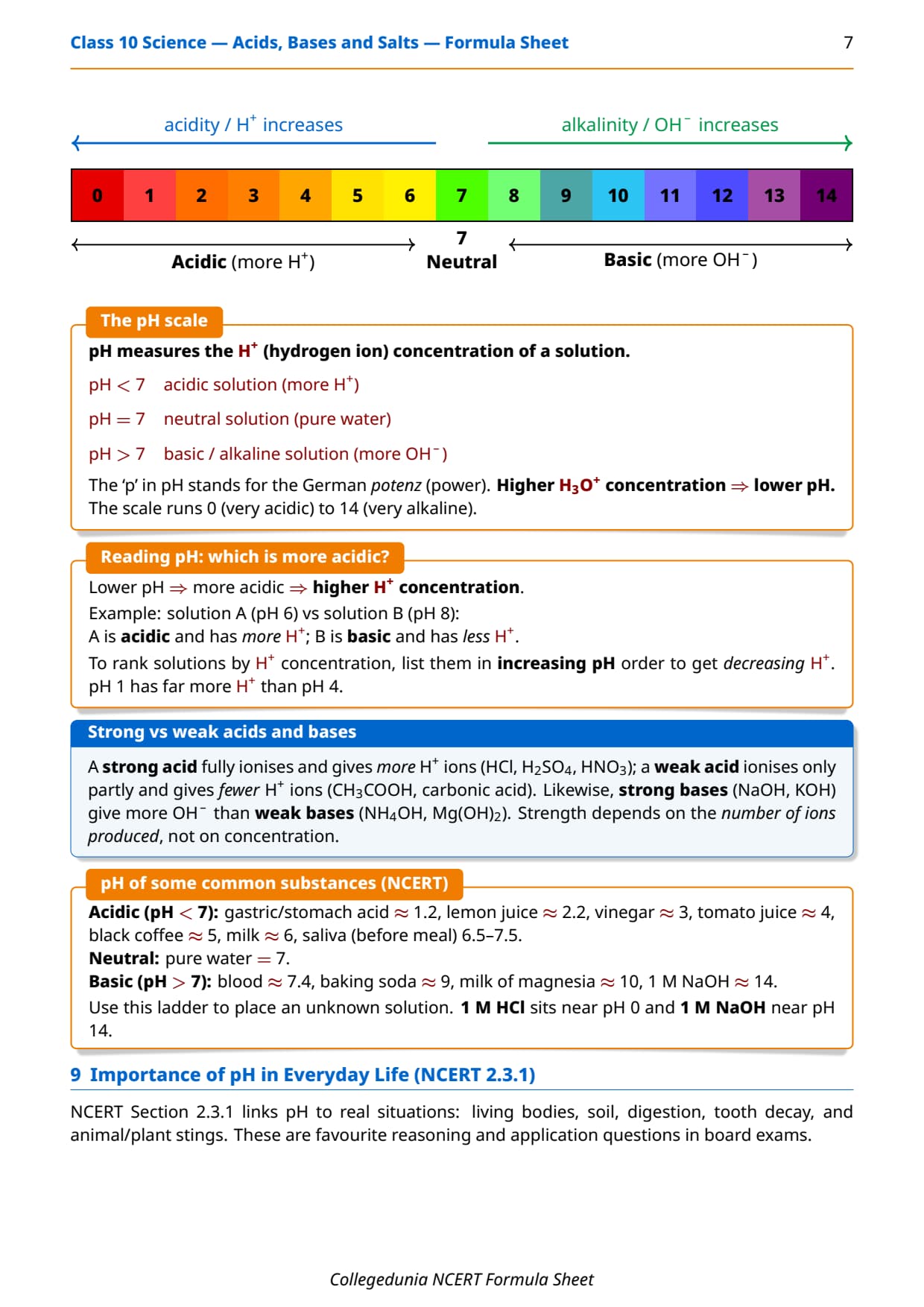
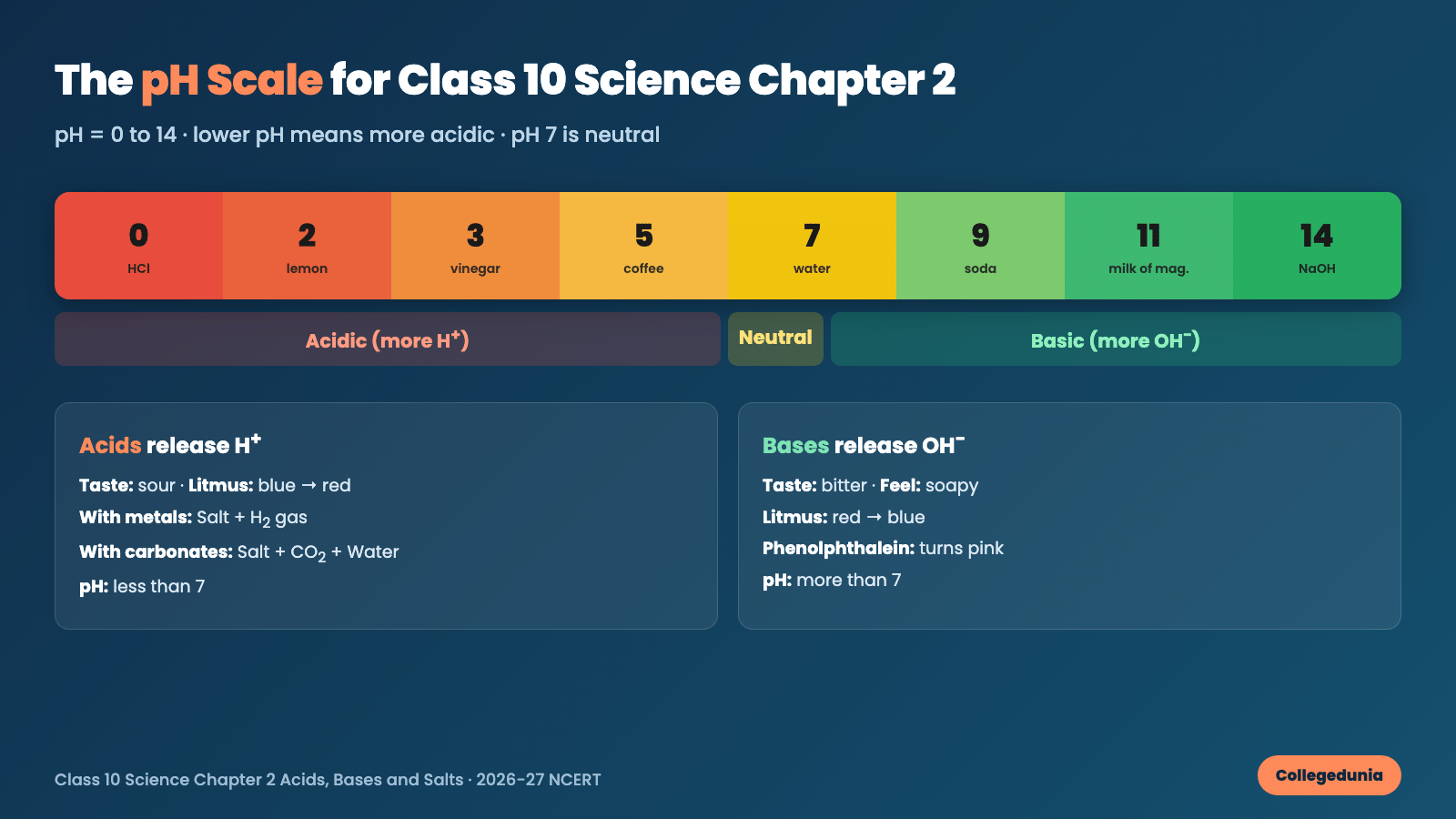
The pH scale (0 to 14) measures how acidic or basic a solution is, read with a universal indicator that shows a range of colours.
- pH < 7: acidic, with more H+ ions; lower pH means more acidic.
- pH = 7: neutral, such as pure water.
- pH > 7: basic, with more OH− ions.
A strong acid ionises fully (HCl, H2SO4, HNO3); a weak acid ionises partly (CH3COOH). The same sorts strong bases (NaOH, KOH) from weak bases (NH4OH). Strength depends on ions produced, not concentration.
| Substance | Approx. pH | Nature |
|---|---|---|
| Gastric (stomach) acid | 1.2 | Strongly acidic |
| Lemon juice | 2.2 | Acidic |
| Pure water | 7 | Neutral |
| Blood | 7.4 | Weakly basic |
| 1 M NaOH | 14 | Strongly basic |
Importance of pH in Everyday Life: Class 10 Science Chapter 2
NCERT Section 2.3.1 links pH to real situations, a favourite source of reasoning questions.
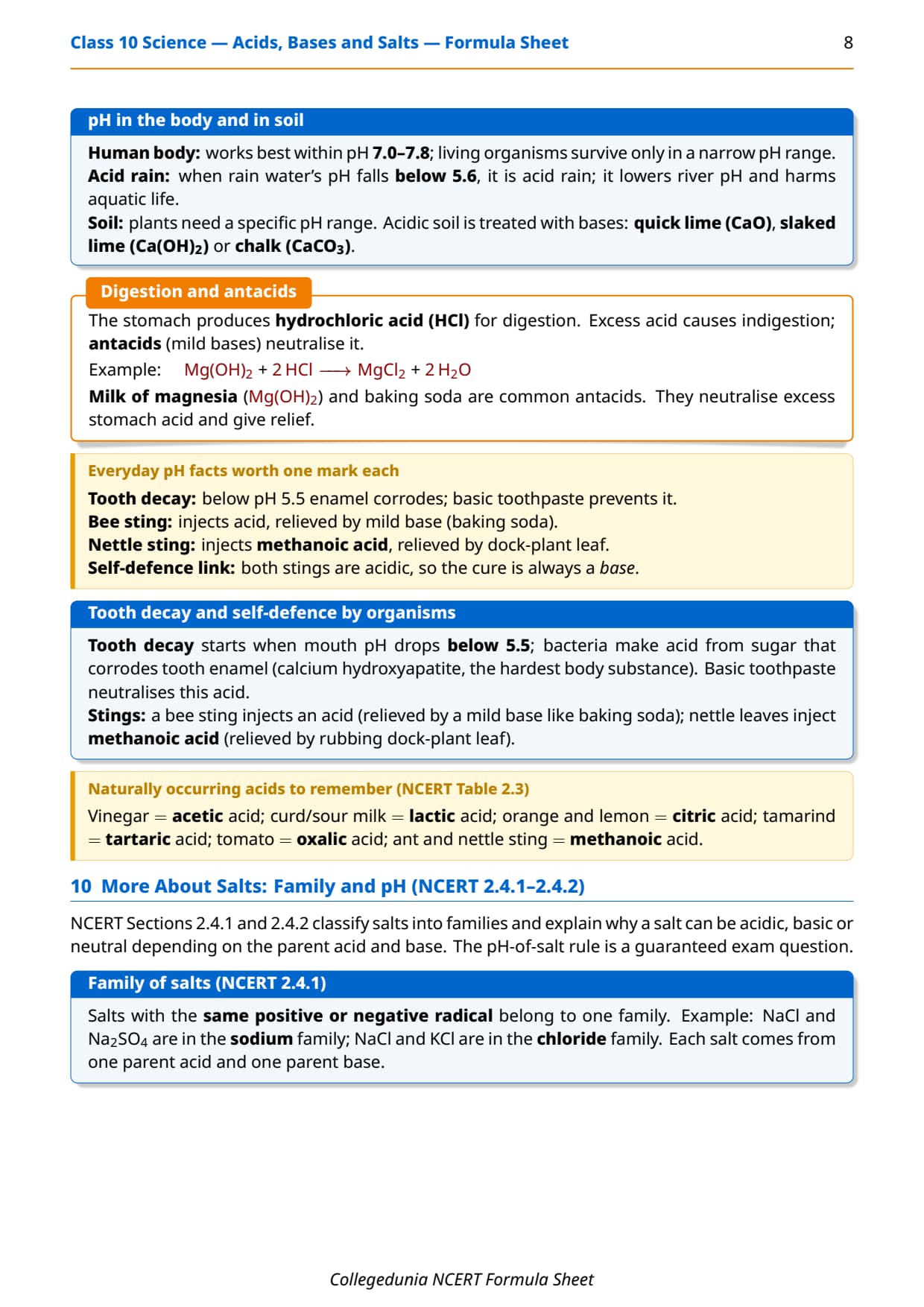
- Body and soil: the body works best at pH 7.0 to 7.8. Acidic soil is treated with quick lime (CaO), slaked lime (Ca(OH)2), or chalk.
- Acid rain: rain below pH 5.6, caused by SO2 and NO2; it lowers river pH and harms aquatic life.
- Digestion: the stomach makes HCl; excess acid is relieved by an antacid such as milk of magnesia.
- Tooth decay: below pH 5.5 enamel corrodes, so basic toothpaste neutralises the mouth acid from bacteria.
- Stings: a bee sting injects acid (soothe with baking soda); a nettle sting injects methanoic acid.
Salts, pH of Salts and Common Names in Class 10 Science Chapter 2
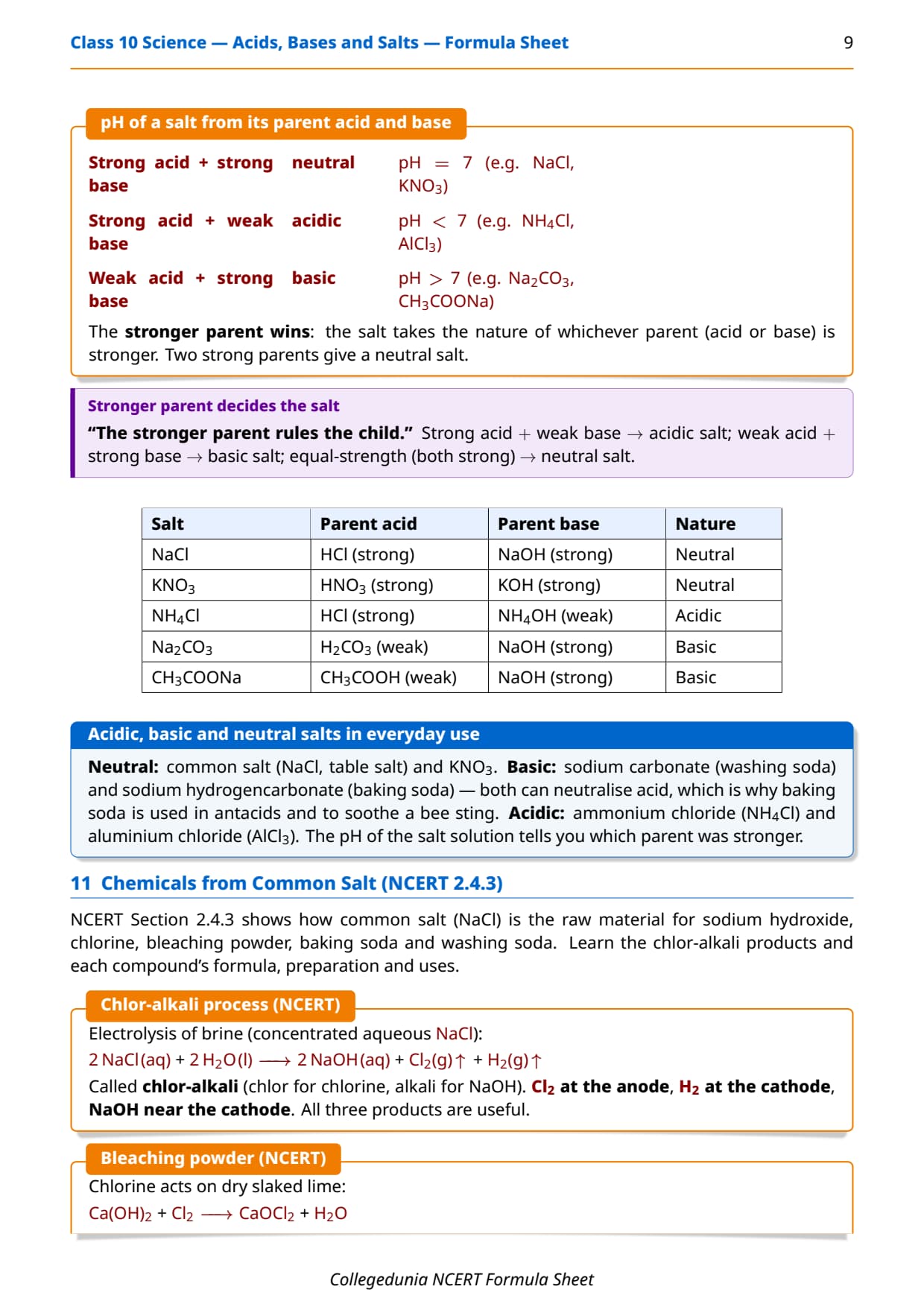
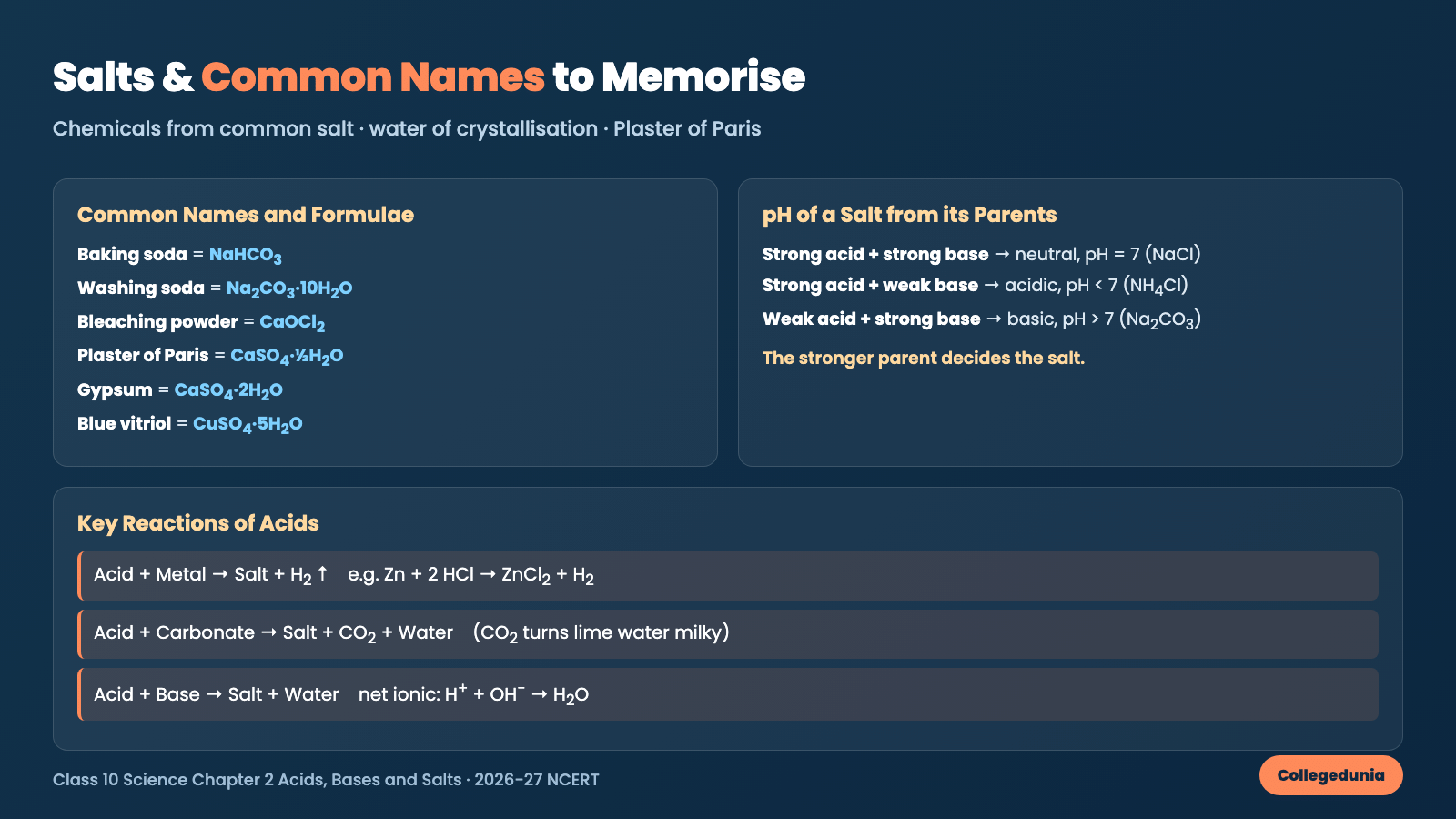
A salt comes from one parent acid and one parent base. The pH-of-salt rule, explaining why a salt is acidic, basic, or neutral, is a near-guaranteed exam question.
| Salt | Parent acid | Parent base | Nature (pH) |
|---|---|---|---|
| NaCl | HCl (strong) | NaOH (strong) | Neutral (pH = 7) |
| NH4Cl | HCl (strong) | NH4OH (weak) | Acidic (pH < 7) |
| Na2CO3 | H2CO3 (weak) | NaOH (strong) | Basic (pH > 7) |
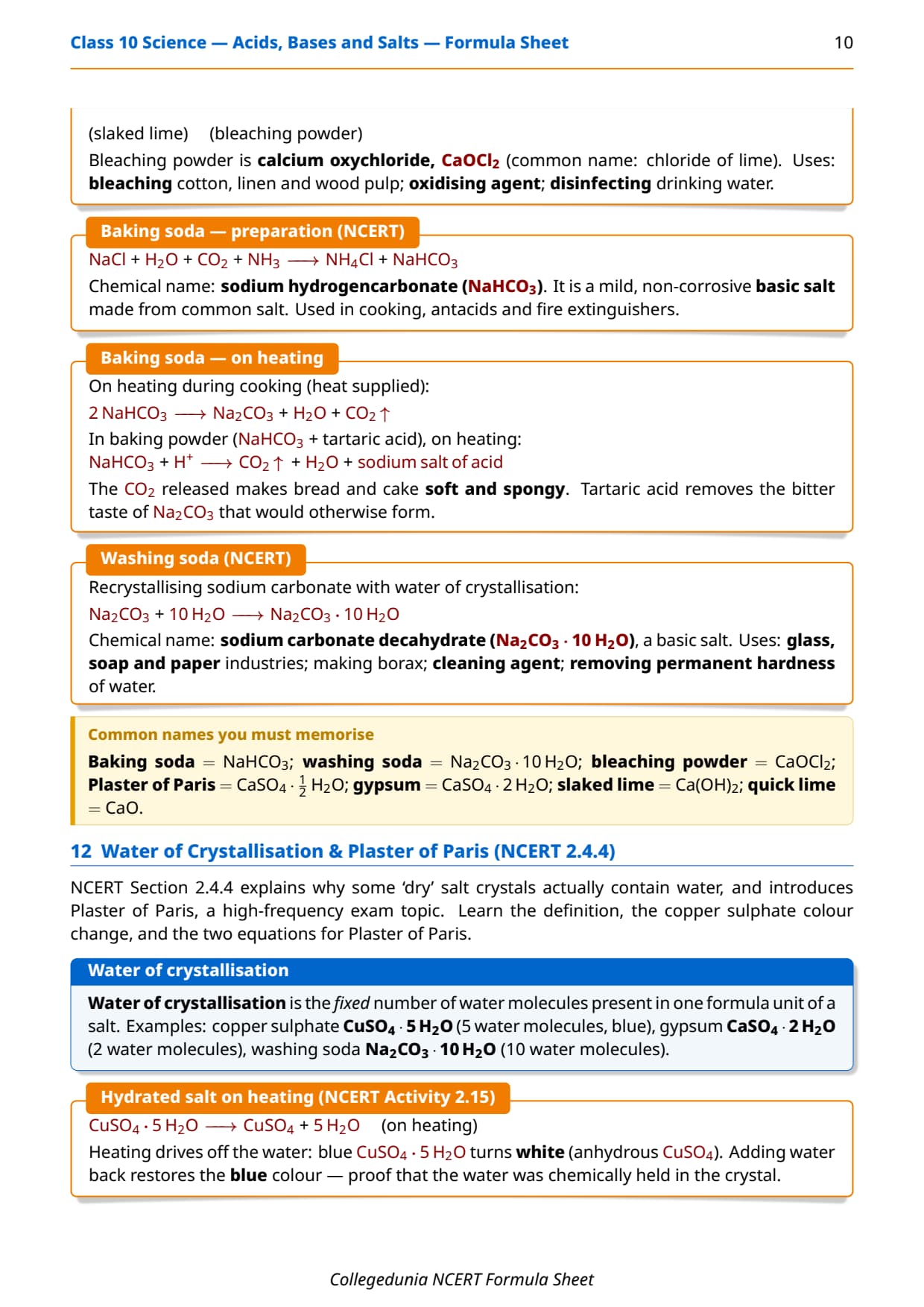
Common salt (NaCl) feeds the chlor-alkali process, the electrolysis of brine: 2 NaCl (aq) + 2 H2O (l) → 2 NaOH (aq) + Cl2 (g) ↑ + H2 (g) ↑. It also gives bleaching powder, baking soda, and washing soda.
| Compound | Common name | Formula | Key use |
|---|---|---|---|
| Sodium hydroxide | Caustic soda | NaOH | Soaps, paper |
| Sodium hydrogencarbonate | Baking soda | NaHCO3 | Cooking, antacid |
| Sodium carbonate decahydrate | Washing soda | Na2CO3·10H2O | Cleaning, softening water |
| Calcium oxychloride | Bleaching powder | CaOCl2 | Bleaching, disinfecting |
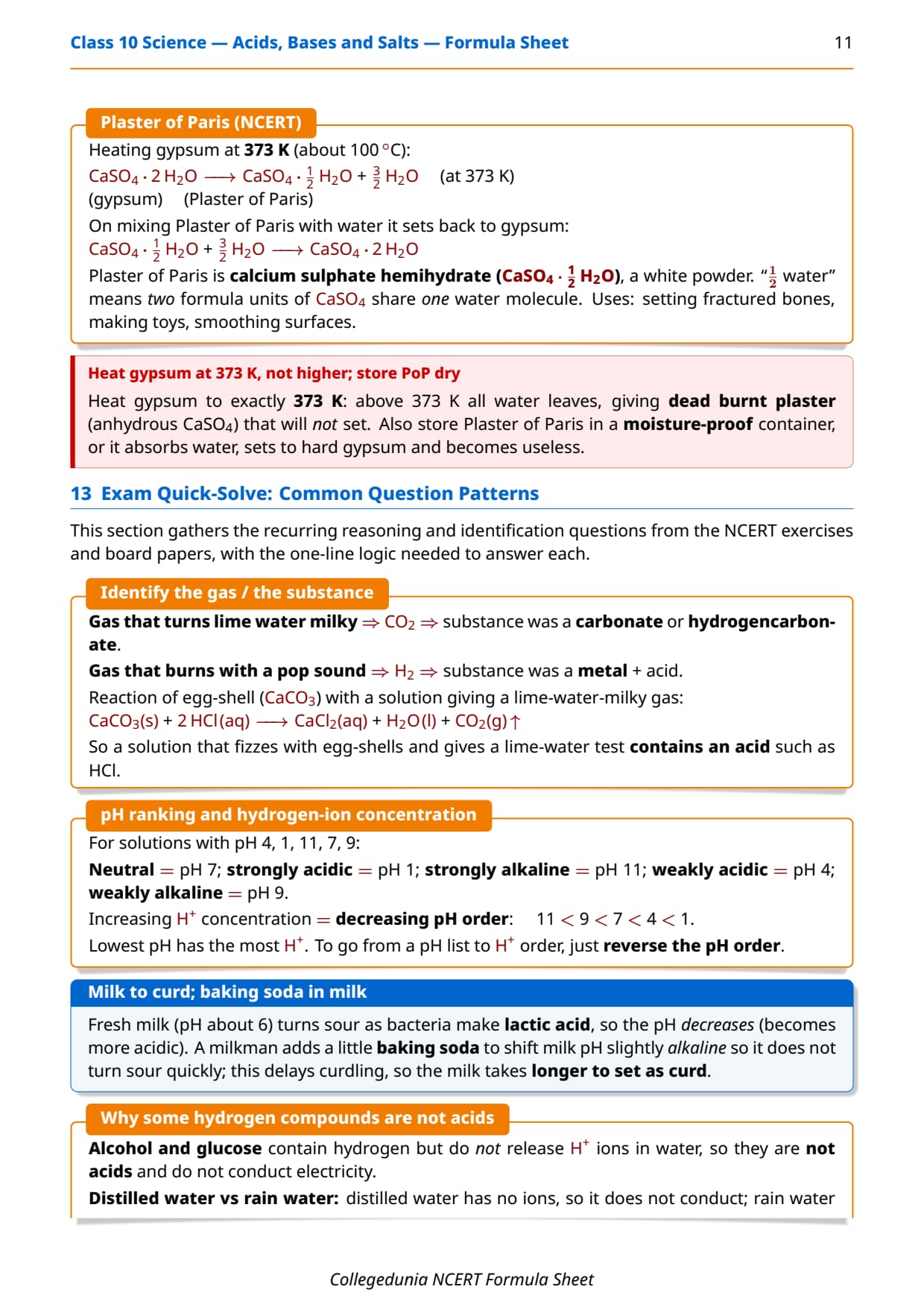
| Calcium sulphate hemihydrate | Plaster of Paris | CaSO4·½H2O | Setting bones (from gypsum, CaSO4·2H2O) |
One-Shot Revision Tips for Acids, Bases and Salts Class 10
Treat this Formula Sheet as a night-before checklist. Recall each block out loud, then check it against the sheet.
- Lock the indicator table: blue litmus to red, phenolphthalein pink in base, methyl orange red in acid.
- Ion rule: acids give H+, bases give OH−; the two meet to form salt and water.
- pH ladder: lower pH means more acidic and more H+; pH 7 is neutral; higher pH is more basic.
- Common names: baking soda, washing soda, bleaching powder, Plaster of Paris with formulae are one-mark questions.
- Stronger-parent rule: strong acid + weak base is acidic salt; weak acid + strong base is basic; two strong parents is neutral.
Full topic-by-topic walkthrough: Acids, Bases and Salts Class 10 Science Notes
More Acids, Bases and Salts Class 10 Science Resources
Use the table below to move between the other resources for this chapter.
| Resource | Link |
|---|---|
| NCERT Solutions | Acids, Bases and Salts NCERT Solutions |
| Revision Notes | Acids, Bases and Salts Notes |
| Handwritten Notes | Acids, Bases and Salts Handwritten Notes |
| Exemplar Solutions | Acids, Bases and Salts Exemplar Solutions |
| NCERT Book PDF | Acids, Bases and Salts NCERT Book PDF |
NCERT Formula Sheet for Class 10 Science: All Chapters
Use the table below to jump to the Formula Sheet for any other chapter in the Class 10 Science NCERT.
| Chapter | Resource |
|---|---|
| Chapter 1 | Chemical Reactions and Equations Formula Sheet |
| Chapter 3 | Metals and Non-metals Formula Sheet |
| Chapter 4 | Carbon and its Compounds Formula Sheet |
| Chapter 5 | Life Processes Formula Sheet |
| Chapter 6 | Control and Coordination Formula Sheet |
| Chapter 7 | How do Organisms Reproduce? Formula Sheet |
| Chapter 8 | Heredity Formula Sheet |
| Chapter 9 | Light - Reflection and Refraction Formula Sheet |
| Chapter 10 | The Human Eye and the Colourful World Formula Sheet |
| Chapter 11 | Electricity Formula Sheet |
| Chapter 12 | Magnetic Effects of Electric Current Formula Sheet |
| Chapter 13 | Our Environment Formula Sheet |
Acids, Bases and Salts Class 10 Formula Sheet FAQs
Ques. Where can I download the Acids, Bases and Salts Class 10 Formula Sheet PDF?
Ans. You can download the Acids, Bases and Salts Class 10 Science Formula Sheet PDF directly from this page. It is free and covers every indicator, ion rule, pH fact, reaction type, and salt formula in the 2026-27 NCERT Chapter 2.
Ques. Is this Formula Sheet aligned with the 2026-27 NCERT?
Ans. Yes. The sheet reflects the current 2026-27 syllabus for Class 10 Science. Chapter 2 retains the indicators, the pH scale, the reactions of acids and bases, the chlor-alkali products, and the water-of-crystallisation content.
Ques. What is the difference between an acid and a base in Class 10 Science?
Ans. An acid releases H+ (aq) ions in water, turns blue litmus red, and tastes sour. A base releases OH− (aq) ions in water, turns red litmus blue, and tastes bitter and feels soapy. A base that dissolves in water is called an alkali.
Ques. What is the pH scale and what do its values mean?
Ans. The pH scale runs from 0 to 14 and measures the H+ ion concentration of a solution. A pH below 7 is acidic, a pH of exactly 7 is neutral (like pure water), and a pH above 7 is basic. Lower pH means more H+ ions and a more acidic solution.
Ques. What gas is released when an acid reacts with a metal, and how is it tested?
Ans. An acid reacts with an active metal to give a salt and hydrogen gas, for example Zn + 2 HCl → ZnCl2 + H2. The hydrogen is tested by bringing a burning candle near it: it burns with a characteristic pop sound.
Ques. How do you tell whether a salt is acidic, basic, or neutral?
Ans. Look at the parent acid and parent base. A strong acid with a strong base gives a neutral salt (NaCl, pH 7), a strong acid with a weak base gives an acidic salt (NH4Cl, pH below 7), and a weak acid with a strong base gives a basic salt (Na2CO3, pH above 7). The stronger parent decides the nature of the salt.
Ques. What are the common names and formulae of the key salts in Chapter 2?
Ans. Baking soda is NaHCO3, washing soda is Na2CO3·10H2O, bleaching powder is CaOCl2, Plaster of Paris is CaSO4·½H2O, gypsum is CaSO4·2H2O, and blue vitriol is CuSO4·5H2O. All are products or examples linked to common salt.
Ques. What is water of crystallisation?
Ans. Water of crystallisation is the fixed number of water molecules present in one formula unit of a salt. For example, copper sulphate is CuSO4·5H2O with 5 water molecules. On heating, the blue crystals turn white as the water leaves, and adding water back restores the blue colour.
Ques. Why is Plaster of Paris stored in a moisture-proof container?
Ans. Plaster of Paris (CaSO4·½H2O) is made by heating gypsum at 373 K. If it absorbs moisture, it sets back to hard gypsum and becomes useless. So it must be kept dry. Heating gypsum above 373 K gives dead burnt plaster, which also will not set.
Ques. What is the CBSE weightage of Chapter 2 in Class 10 Science?
Ans. Acids, Bases and Salts sits in the Chemical Substances unit and usually carries 5 to 7 marks in the CBSE Class 10 Science board exam, asked across one or two questions on indicators, the pH scale, reactions of acids and bases, or salts and their common names.



Comments