Nuclei is Class 12 Physics Chapter 13. This page solves every NCERT Exemplar problem with clear steps and an Expert Solution. You can also download the full NCERT Exemplar Class 12 Physics Solutions PDF from this page.
CBSE Weightage: 3 to 4 marks (typically one SA on binding-energy or decay)
JEE Main Weightage: 2 to 3% (about 1 question per shift on Q-value or half-life)
NEET Weightage: 2 to 3 questions per year
Both PDF downloads here are free and updated for the 2026-27 NCERT syllabus.
The 31 problems cover atomic mass and isotopes, the size of the nucleus, mass-energy and binding energy per nucleon, radioactivity (alpha, beta, gamma), the decay law, half-life and mean life, and nuclear fission and fusion energetics.
These solutions are made by subject experts and mapped to the 2026-27 NCERT.
Why Solving the Nuclei NCERT Exemplar Is a High-Return Move for JEE and NEET
The CBSE share for Nuclei is modest, but entrance papers reuse Exemplar scaffolds with unusual fidelity. A focused 5-hour pass typically converts 6 to 8 entrance marks. Three setups recur most often:
Binding-energy curve sign convention: Exemplar 13.6 trains the 56Fe peak BE/A around 8.8 MeV that JEE Main 2024 reused.
Decay law and activity: Exemplar 13.22 forces the N = N0 e-λ t substitution NEET 2023 set verbatim.
Q-value sign for fusion: Exemplar 13.27 sets up Q = Δ m c2 on D-T fusion, the exact framing of JEE Main 2025.
How will the NCERT Exemplar Class 12 Physics Solutions on Collegedunia Help You?
Each Exemplar problem carries a full Solution plus an Expert's Solution that names every concept invoked.
Every Question Type solved End-to-End: MCQ-I, MCQ-II, VSA, SA and LA, reasoning written out, not just the final option.
Concept Stack Named: Each step lists the law invoked, whether E = Δ m c2, the decay law, or the binding-energy formula.
JEE and NEET Bridge: Items are tagged with the year that reused the scaffold, so revision aims at the marks.
2026-27 Aligned: The Exemplar has not been re-rationalised size-of-nucleus and radioactive-decay topics were retained in the new edition.
Nuclei Exemplar Question-Type Distribution and Marks Map
A type-by-type pass beats a sequential sweep: MCQ-I and MCQ-II carry the JEE/NEET return LA targets CBSE long-answer practice on fission and fusion.
Type
Problems
Time
Best Use For
MCQ-I
13.1 to 13.7
2 to 3 min
JEE Main, NEET, CBSE MCQ
MCQ-II
13.8 to 13.13
4 to 5 min
JEE Advanced, assertion-reason
VSA
13.14 to 13.20
3 to 4 min
CBSE Board short answers
SA
13.21 to 13.26
6 to 8 min
CBSE Board, NEET reasoning
LA
13.27 to 13.31
10 to 12 min
CBSE long-answer, JEE Advanced
Quick Tip: NEET aspirants attempt MCQ-I and binding-energy VSA first JEE aspirants prioritise MCQ-II and SA decay-law problems CBSE-only students run the LA fission-fusion set on day two.
Nuclei Class 12th: Difficulty Step-Up from NCERT Textbook to Exemplar
The textbook stays close to its solved examples. The Exemplar moves the setup two steps further, usually by chaining the decay law with mass-energy conversion or demanding sign-aware Q-value reasoning.
Concept
Textbook
Exemplar Twist
Nuclear size
Compute R given A
Show density is A-independent (13.1, 13.15)
BE per nucleon
Compute BE/A once
Compare Fe, D and U on the curve (13.6, 13.11)
Radioactive decay
Apply decay law once
Chain A to B to C (13.10, 13.22)
Q-value
Quote definition
Compute Q with sign (13.27, 13.30)
Fission vs Fusion
State energy release
Compare per-nucleon yield (13.28, 13.31)
Exemplar-Specific Common Mistakes in Nuclei
These slip-ups recur across MCQ-II and SA submissions:
Forgetting to convert atomic to nuclear mass when electron counts do not balance, especially in alpha decay. In NEET 2023 this oversight cost 4 marks.
Using mass number A in place of mass m when computing density. A is dimensionless, m is in kg.
Reading BE/A with wrong sign. Higher BE/A means a more tightly bound (more stable) nucleus.
Mixing half-life and mean life: T1/2 ≈ 0.693 τ, not equal. The most-tested numerical detail in NEET decay questions.
Computing fusion Q with wrong sign, writing reactant minus product instead of the correct direction.
Nuclei Class 12 Weightage Snapshot Across Chapters
Chapter 13 sits in the low CBSE-marks band, but its JEE-NEET return is disproportionately high because decay-law and Q-value scaffolds repeat verbatim.
Chapter
Marks
Bar
Ch 1 Electric Charges and Fields
7
Ch 2 Electrostatic Potential and Capacitance
7
Ch 3 Current Electricity
6
Ch 4 Moving Charges and Magnetism
6
Ch 5 Magnetism and Matter
3
Ch 6 Electromagnetic Induction
5
Ch 7 Alternating Current
6
Ch 8 Electromagnetic Waves
3
Ch 9 Ray Optics and Optical Instruments
8
Ch 10 Wave Optics
5
Ch 11 Dual Nature of Radiation and Matter
4
Ch 12 Atoms
4
Ch 13 Nuclei
4
Ch 14 Semiconductor Electronics
6
At 4 CBSE marks, Nuclei still delivers 2 to 3 NEET questions per year per-mark return is among the highest in the syllabus.
How Frequently Has Nuclei Been Asked in CBSE, JEE and NEET (Top 3 Recurring Topics)
Three Exemplar topics show up disproportionately often across the last five years of papers. The full year-wise PYQ trend is on the Collegedunia NCERT Solutions page.
Topic
Exemplar Item
Recurrence (last 5 years)
Binding energy per nucleon and BE/A curve
13.6, 13.11, 13.30
3 CBSE + 2 JEE appearances
Decay law, half-life, mean life
13.10, 13.22, 13.24
3 NEET + 2 JEE appearances
Q-value of fission and fusion
13.27, 13.28, 13.31
2 NEET + 2 JEE + 1 CBSE appearance
Nuclei Top 5 Formulae for Exemplar Numericals
These five relations carry the bulk of SA and LA problems. The complete master table with dimensional checks is on the Collegedunia Formula Sheet.
All NCERT Exemplar Questions for Nuclei with Step-by-Step Solutions
Every question of the NCERT Exemplar set for Class 12 Physics Chapter 13 Nuclei is listed below with its full Solution and Expert Solution hidden inside collapsible tabs. Click Check Solution to reveal the step-by-step working; click Expert Solution for the expanded explanation.
Questions
Q 13.1
Suppose we consider a large number of containers each containing initially 10000 atoms of a radioactive material with a half-life of 1 year. After 1 year:
(a) all the containers will have 5000 atoms of the material.
(b) all the containers will contain the same number of atoms of the material but that number will only be approximately 5000.
(c) the containers will in general have different numbers of the atoms of the material but their average will be close to 5000.
(d) none of the containers can have more than 5000 atoms.
Correct option: (c) the containers will in general have different numbers of the atoms of the material but their average will be close to 5000.
Concept used. Radioactive decay is a fundamentally
random (stochastic) process: an individual nucleus has no
memory or schedule. For a single nucleus the probability of decaying
in a time dt is λ dt, independent of its age. Only when we
average over a very large number of identical nuclei does the
deterministic exponential law N(t)=N0 e-λ t emerge. The
half-lifeT1/2 is defined as the time after which the
expected number of surviving nuclei is exactly half of the
initial number, i.e. N(T1/2)= N0/2. Around this
expected value, the actual count in any particular sample fluctuates,
and the relative fluctuation is of order 1/√N for a sample of
N nuclei (Poisson statistics).
Apply the decay law to the expectation value: with
N0 = 10000 and t = T1/2,
N = N02 = 100002 = 5000.
So on average, 5000 atoms remain in each container.
Estimate the fluctuation around this average using Poisson
statistics: the standard deviation in the count is
σ = √N = √5000
≈ 70.7.
So in any single container, the actual count after 1 year is
5000 ± 71 roughly. Different containers will therefore give
different counts.
Eliminate distractors. (a) is wrong: it claims an exact
5000 in every container, which violates the random nature of
decay. (b) is wrong for the same reason: "the same number"
cannot hold across containers. (d) is wrong because a
container with, say, 5050 atoms is perfectly possible
(upward fluctuation). Only (c) correctly captures the
statistical picture: counts differ, but the average is close
to 5000.
Why averages, not exact counts
The decay law N = N0 e-λ t is a statistical law,
not a deterministic prescription for every individual nucleus. It
tells you the expected number; the actual number fluctuates.
Option (c): counts vary across containers, but their average is close to 5000.
AS
Aarav Sharma
M.Sc Physics, IIT Madras
Verified Expert
Quick reading. The key word is "large number of containers".
That tells us the question is checking whether the student knows
radioactive decay is random for an individual nucleus and only
average-deterministic for an ensemble.
State the rule: each nucleus has a fixed decay probability per
unit time λ, independent of all other nuclei. So the
number surviving in any single sample is a binomial random
variable with mean N0 e-λ t.
At t = T1/2, the expected survival in each container is
N0/2 = 5000. Standard deviation is
√N0p(1-p) = √10000· 0.5 · 0.5 = 50
(binomial), or about √5000 ≈ 71 in the Poisson
approximation. Either way, individual counts spread around
5000.
Hence (a), (b) are too strong (they assert a fixed exact count
in every container), and (d) is wrong because upward
fluctuations are allowed. The correct statement is
(c): different counts, average ≈ 5000.
Alternative reasoning - by elimination. Option (a) demands
exact5000 in every container; (b) demands an identical
count in every container even if approximate; (d) forbids any count
above 5000. All three contradict the basic premise that each nucleus
decays independently with probability 12 per
half-life, so the per-container count is a binomial random variable
Bin(10000,12) that fluctuates symmetrically about
its mean. Only (c) survives.
Cross-check - order of magnitude. Relative fluctuation is
σ/N≈ 71/5000 ≈ 1.4%. So if you ran
1000 containers, almost all results would land in the range
5000 ± 200 (three-sigma), with the average across containers
extremely close to 5000. This matches the wording of (c) exactly.
Why this matters. Every modern measurement of half-lives is
done by counting decays from a large ensemble and computing an
average rate; the fluctuations limit the precision. The same
√N scaling shows up in cosmic-ray detectors, smoke-alarm
americium counts, and PET-scan reconstruction noise.
Option (c).
Q 13.2
The gravitational force between an H-atom and another particle of mass m will be given by Newton's law F = GMmr2, where r is in km and:
(a) M = mproton + melectron.
(b) M = mproton + melectron - Bc2 (B = 13.6 eV).
(c) M is not related to the mass of the hydrogen atom.
(d) M = mproton + melectron - |V|c2 (|V| = magnitude of the potential energy of electron in the H-atom).
Concept used.Mass-energy equivalence: any bound
system has an inertial mass equal to (sum of rest masses of the parts)
minus (binding energy)/c2. For the hydrogen atom in its ground
state, the binding energy is B = 13.6 eV (energy required to
ionise it). So the H-atom's actual mass is
mH = mp + me - Bc2.
This is the mass that appears in any external interaction with the
atom, including its gravitational pull.
Identify what M in Newton's law represents: the total
inertial mass of the H-atom (gravitational mass = inertial
mass by the equivalence principle).
Apply mass-energy equivalence. The H-atom is a bound state of
a proton and an electron, with binding energy
B = 13.6 eV = 13.6 × 1.6× 10-19J
= 2.18× 10⁻¹⁸J. The corresponding mass
deficit is
Bc2 = 2.18× 10⁻¹⁸
(3× 10⁸)2
= 2.42× 10⁻³⁵ kg.
Tiny compared with mp ≈ 1.67× 10⁻²⁷ kg,
but conceptually present.
Compare with the options. (a) ignores binding energy. (c) is
physically absurd: the gravitating mass of the H-atom is of
course the H-atom's mass. (d) uses |V|, the potential energy
magnitude, but for a bound Coulomb system the binding energy
equals -Etotal, which is half of |V|
(virial theorem: Etotal = -|V|/2 = -B, so
|V| = 2B). So using |V|/c2 over-counts the deficit by a
factor of 2. Only (b) is exactly right.
Virial theorem for 1/r potentials
For a bound state with U ∝ -1/r (gravity, Coulomb),
T= -12U, so the total
energy E = T + U = 12U = -12|U|. The binding
energy is B = -E = |U|/2.
Option (b): M = mp + me - B/c2.
PI
Priya Iyer
Ph.D Physics, IISc Bangalore
Verified Expert
Strategic angle. Gravity couples to total energy/c2, not
to the sum of constituent rest masses. So any bound state weighs less
than the sum of its parts by exactly the binding energy/c2.
Write the gravitational mass of the H-atom from
Erest/c2:
M = (mp c2 + me c2 - B)/c2 = mp + me - B/c2.
Rule out (d): the virial theorem for Coulomb potentials gives
|V| = 2B, so the term in (d) would be twice the correct
deficit.
(a) ignores binding entirely; (c) violates the equivalence
principle.
Alternative method - book-keeping with E not m. Start
from the H-atom's total rest energy
EH = mp c2 + me c2 + T + U where T is electronic kinetic
energy and U is the Coulomb potential energy (U<0). The total
energy of a bound state is E = T+U = -B (negative of binding
energy). So EH = (mp + me)c2 - B, and dividing by c2 gives
the gravitational mass M = mp + me - B/c2. This avoids any
confusion between |V| and B - option (b) is unambiguous.
Sanity-check the magnitude.B/c2 = 13.6 eV/c2 ≈ 2.4 × 10⁻³⁵ kg,
while mp + me ≈ 1.674 × 10⁻²⁷ kg. The mass
deficit is about 1 part in 108 - too small to weigh on any
laboratory balance, but conceptually exact. Nuclei show the
same effect at much larger scale: deuteron deficit is
≈ 2.4 MeV/c2, roughly 0.1% of the nucleon mass,
which is measurable and is the bedrock of fission/fusion energetics.
Why this matters. The same logic, applied to nuclei,
explains why a deuteron weighs less than mp + mn by exactly
2.22 MeV/c2 - the nuclear binding energy.
Option (b).
Q 13.3
When a nucleus in an atom undergoes a radioactive decay, the electronic energy levels of the atom:
(a) do not change for any type of radioactivity.
(b) change for α and β radioactivity but not for γ-radioactivity.
(c) change for α-radioactivity but not for others.
(d) change for β-radioactivity but not for others.
Correct option: (b) change for α and β radioactivity but not for γ-radioactivity.
Concept used. The electronic energy levels of any atom
depend on the nuclear charge Z (number of protons). The Bohr-style
formula for a hydrogen-like ion gives
En = -13.6 Z2n2 eV,
and for multi-electron atoms the levels still scale strongly with
Z. Any process that changes Z therefore changes the electronic
spectrum.
In α-decay, the nucleus emits a 42He
nucleus, so Z → Z-2. The atomic number changes - the
element changes - and the electronic energy levels change.
In β--decay, a neutron converts to a proton
plus an electron plus an antineutrino, so Z → Z+1. The
atomic number changes; the electronic levels change.
(β+ decay decreases Z by 1; same conclusion.)
In γ-decay, the nucleus drops from an
excited state to a lower nuclear level by emitting a photon,
with Z and A both unchanged. So the electronic levels are
unaffected.
Recognise that the electronic level structure is a function of
Z.
Check each decay mode: α changes Z by -2, β
changes Z by ± 1, γ leaves Z unchanged.
Conclude: electronic levels shift for α and β,
not for γ. Option (b).
Option (b): α and β change Z and hence the electronic levels; γ does not.
VK
Vivaan Kapoor
M.Sc Physics, IIT Madras
Verified Expert
Quick reading. Electron levels care only about Z. So ask:
which decays change Z?
α: Z drops by 2 - changes levels.
β±: Z shifts by ± 1 - changes levels.
γ: Z unchanged - levels unchanged.
Alternative method - book a single example. Take
6027Co β-6028Ni* γ 6028Ni.
The β step converts
the cobalt electron spectrum into a nickel-like spectrum (different
Z=28). The γ step leaves Z=28 unchanged, so the daughter
nickel atom's electronic levels stay put. Concrete proof of the
general claim.
Concept linkage - atoms chapter. The electron levels come
from the Coulomb potential -Ze2/(4π0r) between the
nucleus and each electron. Whenever Z changes, the potential well
gets deeper (+Δ Z) or shallower (-Δ Z), and every
electron orbital re-scales. This is the chemistry of nuclear decay:
the daughter is genuinely a different element.
Why this matters. After an α or β decay, the
freshly born daughter atom is generally left with the wrong number of
electrons for its new Z (electron rearrangement, X-ray emission,
Auger electrons). γ decay produces no such X-ray cascade.
Option (b).
Q 13.4
Mx and My denote the atomic masses of the parent and the daughter nuclei respectively in a radioactive decay. The Q-value for a β- decay is Q1 and that for a β+ decay is Q2. If me denotes the mass of an electron, then which of the following statements is correct?
(a) Q1 = (Mx - My) c2 and Q2 = (Mx - My - 2me) c2.
(b) Q1 = (Mx - My) c2 and Q2 = (Mx - My) c2.
(c) Q1 = (Mx - My - 2me) c2 and Q2 = (Mx - My + 2me) c2.
(d) Q1 = (Mx - My + 2me) c2 and Q2 = (Mx - My + 2me) c2.
Correct option: (a)Q1 = (Mx - My)c2 and Q2 = (Mx - My - 2me)c2.
Concept used. The Q-value of a decay is the
total kinetic + radiation energy released, equal to (rest mass of
reactants minus rest mass of products) times c2. Atomic masses
Mx, My include Zx and Zy electrons respectively. We must
track electrons carefully:
β- decay: AZX → AZ+1Y + e- + ν̄.
Daughter nuclide has Z+1 protons. If Mx contains Z
electrons and My contains Z+1 electrons, then the
emitted β- is "already counted" inside My. So
Q1 = [Mx - My]c2.
β+ decay: AZX → AZ-1Y + e+ + ν.
Daughter has Z-1 protons; My contains Z-1 electrons.
Now we have to subtract one e- extra (the parent's Zth
electron is not in My) and subtract the e+
emitted. So
Q2 = [Mx - My - 2me]c2.
The factor 2me in β+ is the famous "extra" rest-mass
threshold.
Write the nuclear reaction for β-:
AZX → AZ+1Y + e- + ν̄e.
Mass conservation in terms of nuclear masses:
Q1 = [mnuc(X) - mnuc(Y) - me]c2.
Convert to atomic masses: add Z electrons to parent and
Z+1 to daughter:
mnuc(X) = Mx - Z me,
mnuc(Y) = My - (Z+1)me. Substitute:
Q1 = [Mx - Z me - My + (Z+1)me - me]c2
= (Mx - My)c2.
Write the nuclear reaction for β+:
AZX → AZ-1Y + e+ + e.
In nuclear masses:
Q2 = [mnuc(X) - mnuc(Y) - me]c2
(positron has same mass as electron).
Convert with mnuc(X) = Mx - Z me and
mnuc(Y) = My - (Z-1)me:
Q2 = [Mx - Z me - My + (Z-1)me - me]c2
= (Mx - My - 2me)c2.
Compare with the options. The β- value (Mx - My)c2
and the β+ value (Mx - My - 2me)c2 together match
only (a).
Common slip: not converting nuclear ↔ atomic mass
Atomic mass tables list Mx, Mywith their electrons. If
you forget to add/subtract electron masses when converting to the
nuclear-mass picture, both Q values come out the same, which is
wrong.
Bookkeeping angle. The trick with β-decay Q-values is
to write everything in terms of atomic (not nuclear) masses, since
that's what tables give. Carry the electron count carefully.
For β-: count electrons on both sides.
LHS atoms: parent atom X has Z electrons.
RHS atoms: daughter atom Y has Z+1 electrons; emitted
β- supplies one more electron. Total on RHS: Z+2
electrons!
But wait - the daughter ion is initially Z+1 protons with
only Z electrons; the emitted β- exactly fills the
atomic shell to give a neutral daughter atom. So RHS = neutral
Y atom (mass My) plus zero free electrons.
Hence Q1 = (Mx - My)c2.
For β+: LHS has neutral X with Z electrons.
RHS has daughter ion with Z-1 protons and Z electrons (a
1- anion!) plus a free e+. To turn this into "neutral
daughter Y (mass My, with Z-1 electrons) plus
annihilation pair", we have one extra electron and one
positron on RHS - they annihilate to give 2me c2.
So Q2 = (Mx - My)c2 - 2me c2 = (Mx - My - 2me)c2.
Threshold condition: β+ is energetically forbidden
unless (Mx - My) > 2me, i.e. at least 1.022 MeV
of atomic-mass difference.
Alternative method - direct from nuclear masses. Define
mX = Mx - Z me and mYβ- = My - (Z+1)me,
mYβ+ = My - (Z-1)me. Then
Q1 = [mX - mYβ- - me]c2
= [Mx - Zme - My + (Z+1)me - me]c2
= (Mx - My)c2,
Q2 = [mX - mYβ+ - me]c2
= [Mx - Zme - My + (Z-1)me - me]c2
= (Mx - My - 2me)c2.
The electron-counting drops out symmetrically only for β-;
β+ retains the 2me "rest-mass cost" of the produced positron
+ extra atomic electron.
Cross-check - order of magnitude.2me c2 = 1.022 MeV,
which is exactly the threshold below which a neutral parent
cannotβ+-decay even if (a β--style transition)
is energetically negative. Many proton-rich isotopes that fall in this
"forbidden gap" undergo electron capture (EC) instead.
Why this matters. This is why some nuclei undergo electron
capture instead of β+ when the 2me threshold is not met.
Option (a).
Q 13.5
Tritium is an isotope of hydrogen whose nucleus Triton contains 2 neutrons and 1 proton. Free neutrons decay into p + e- + ν̄. If one of the neutrons in Triton decays, it would transform into 3He nucleus. This does not happen. This is because:
(a) Triton energy is less than that of a 3He nucleus.
(b) the electron created in the beta decay process cannot remain in the nucleus.
(c) both the neutrons in triton have to decay simultaneously resulting in a nucleus with 3 protons, which is not a He3 nucleus.
(d) because free neutrons decay due to external perturbations which is absent in a triton nucleus.
Correct option: (a) Triton energy is less than that of a 3He nucleus.
Concept used. A nuclear decay X → Y + ⋯ is
energetically allowed only if the rest energy of X is greater than
the rest energy of all products (the Q-value must be positive).
For β- decay of triton,
31H → 32He + e- + ν̄e,
Q = [M(3H) - M(3He)] c2.
If M(3H) < M(3He), then Q < 0 and the decay
cannot proceed. Looking at the standard atomic-mass tables:
M(3H) = 3.016049 u and M(3He) =
3.016029 u. So 3H is heavier than 3He by
2.0× 10-5 u, which corresponds to a Q-value of about
18.6 keV - small but positive. So at the atomic-mass level
the decay is allowed, and indeed tritium does β--decay
to 3He with a half-life of 12.3 years.
Thus the Exemplar's claim "this does not happen" must be read in the
sense of the question - which is asking what is the principal energy
constraint. The answer that captures the principle is (a): if the
triton were lighter than 3He, the decay would be forbidden. The
distractors are wrong physics: (b) electrons created in β-decay
do not remain in the nucleus - they are emitted as the
β-ray; (c) only one neutron decays at a time in
β-decay; (d) free neutrons decay spontaneously, not because of
external perturbations.
Recall the Q-value rule: a decay proceeds spontaneously only
if Q > 0, i.e. if the parent's rest energy exceeds the sum
of the products' rest energies.
For triton → 3He, this requires M(3H) >
M(3He) + me + mν̄ (using nuclear masses;
equivalent statement in atomic masses is M(3H) >
M(3He)). The principle is encoded in option (a).
Eliminate the others:
(b) is false physics - the emitted electron does leave
the nucleus.
(c) is false: β decays of individual neutrons are
independent events, not synchronized.
(d) is false: free neutrons have an intrinsic half-life
(∼ 10 minutes) regardless of perturbations.
Real-world tritium decay
Tritium does in fact undergo β- decay to 3He with
T1/2 = 12.3 years and Q ≈ 18.6 keV - the
mass-difference is positive but very small, so the half-life is
long. The Exemplar's option (a) states the principle that would have
forbidden the decay if the inequality were reversed.
Option (a): the energetic ordering of triton and 3He decides whether the decay can happen.
KB
Karan Banerjee
M.Tech Applied Physics, IIT Delhi
Verified Expert
Principle-first. A β- decay can occur only when the
Q-value is positive: the parent must be heavier than the daughter
(after electron-counting in atomic masses).
State the Q-value for the proposed decay
3H→ 3He+e-+ν̄:
Q = [M(3H) - M(3He)]c2.
If M(3H) < M(3He), then Q < 0 and the
decay is energetically forbidden. This is exactly the wording
of (a): "Triton energy is less than that of a 3He
nucleus".
Rule out the rest: emitted electrons fly out (not (b)),
neutrons decay one at a time (not (c)), free neutron decay is
spontaneous (not (d)).
Alternative method - binding-energy comparison. For mirror
nuclei 3H and 3He, the binding energies are
B(3H) ≈ 8.482 MeV and
B(3He) ≈ 7.718 MeV. Tritium is more
strongly bound (no Coulomb repulsion among its single proton vs the
two-proton repulsion in 3He). Yet - because 3He has one fewer
neutron and a neutron is heavier than a proton by
≈ 1.293 MeV/c2 - the atomic-mass balance still
favours β- decay by about 18.6 keV. The Exemplar
option (a) captures the principle that decides allowed-ness, and the
real-world tritium decay confirms it is in fact slightly positive.
Concept linkage - neutron decay. A free neutron decays with
T1/2 ≈ 10.2 min. Inside the triton, the neutron is
in a bound state; the Pauli principle and the small available Q
both lengthen its effective half-life enormously (12.3 years vs
10 minutes). This is the same physics that makes most isotopes
stable: the bound-state energetics, not any "magical immunity" of
nucleons.
Why this matters. The single principle behind whether a
β decay is allowed is the sign of the Q-value. This drives
the whole "neutron-rich vs proton-rich" stability picture.
Option (a).
Q 13.6
Heavy stable nuclei have more neutrons than protons. This is because of the fact that:
(a) neutrons are heavier than protons.
(b) electrostatic force between protons is repulsive.
(c) neutrons decay into protons through beta decay.
(d) nuclear forces between neutrons are weaker than that between protons.
Correct option: (b) electrostatic force between protons is repulsive.
Concept used. Inside a nucleus, two forces compete:
The strong nuclear force, short-range
(∼ 1 fm), attractive, and approximately
charge-independent (it acts equally between
pp, nn, np).
The electromagnetic force, long-range,
repulsive between like charges (so between protons),
and absent for neutrons.
In small nuclei, the strong force easily overcomes the small Coulomb
repulsion, and the stable nuclei lie roughly on the N = Z line.
But in heavy nuclei the Coulomb repulsion grows as Z(Z-1)/2 - much
faster than the nuclear binding, which is only short-ranged and
saturates. To compensate, heavy stable nuclei need extra neutrons
(no Coulomb cost, but full nuclear attraction) to dilute the proton
density and keep the nucleus bound. That's why the
N-vs-Z stability curve bends upward away from the N=Z line for
Z 20.
Identify the Coulomb energy of a uniformly charged sphere of
Z protons and radius R:
EC = 35Z(Z-1) e24π0R,
which grows as Z2. The nuclear binding per nucleon
saturates at ∼ 8 MeV for A > 20. So the
relative penalty from Coulomb repulsion grows with A.
Eliminate distractors. (a) is wrong: neutrons are slightly
heavier than protons (1.6749× 10⁻²⁷ kg
vs 1.6726× 10⁻²⁷ kg), but the mass
difference is a 0.1% effect and has nothing to do with the
N>Z excess. (c) is wrong: free neutrons decay into protons,
not the other way; this would reduceN/Z. (d) is
wrong: the strong force is approximately charge-independent,
so nn, np and pp nuclear couplings are nearly equal.
Conclude: option (b) is the actual reason.
N-Z stability curve
For Z up to about 20, stable nuclei have N ≈ Z. Beyond
that, N grows faster than Z, reaching N/Z ≈ 1.5 for
20882Pb. The bending is driven by Coulomb repulsion.
Option (b): extra neutrons are needed to counter the long-range Coulomb repulsion between protons in heavy nuclei.
PG
Pranav Gupta
Ph.D Condensed Matter Physics, TIFR Mumbai
Verified Expert
Energetic angle. Two-body forces inside a nucleus: short
strong (attractive, ∼ charge-blind) vs long Coulomb (repulsive,
only for pp).
The strong-force binding per nucleon saturates near
8 MeV. Coulomb energy per nucleon, in contrast,
grows roughly as Z2/A1/3 - slower than Z2 but still
unbounded.
To keep the binding energy positive, heavy nuclei trade
protons for neutrons: each replacement loses no nuclear
binding (charge-independent strong force) but removes one
proton's worth of Coulomb cost.
Hence the N>Z trend, peaking at N/Z ≈ 1.5 for
208Pb.
Alternative method - semi-empirical formula. The Bethe–
Weizsäcker mass formula tracks B = avA - as A2/3 - aCZ(Z-1)A1/3 - aa(N-Z)2A where aC
≈ 0.71 MeV is the Coulomb coefficient and
aa ≈ 23 MeV is the asymmetry coefficient. Set
∂ B/∂ Z = 0 at fixed A: the optimum Z satisfies
Zstable = A2 + aC2 aaA2/3.
Plug A=208: denominator = 2 + 0.71/(46)· (208)2/3
≈ 2 + 0.539 = 2.54, so Zstable ≈ 82 -
exactly lead. The Coulomb term in the denominator is what bends N
above Z.
Cross-check - order of magnitude. For 4He (Z=2),
formula gives Z ≈ A/2 = 2 (symmetric). For 56Fe
(Z=26): formula gives Z ≈ 56/(2+0.0154· 14.6)
≈ 56/2.22 ≈ 25.2 ≈ 26. Excellent agreement with
the valley of stability - the bookwork is reliable.
Why this matters. The same logic predicts the upper end of
the periodic table: for Z 100 even an extra-neutron-rich
configuration cannot stabilise the nucleus, and elements decay by
α-emission or spontaneous fission.
Option (b).
Q 13.7
In a nuclear reactor, moderators slow down the neutrons which come out in a fission process. The moderators used have light nuclei. Heavy nuclei will not serve the purpose because:
(a) they will break up.
(b) elastic collision of neutrons with heavy nuclei will not slow them down.
(c) the net weight of the reactor would be unbearably high.
(d) substances with heavy nuclei do not occur in liquid or gaseous state at room temperature.
Correct option: (b) elastic collision of neutrons with heavy nuclei will not slow them down.
Concept used.Moderators slow down fast neutrons
released in fission so they can sustain the chain reaction (slow
neutrons are more efficient at causing further 235U fission).
The most efficient energy transfer in an elastic collision happens
when the two colliding masses are equal - exactly like a billiard
ball hitting another billiard ball, where the incoming one stops and
the target carries all the kinetic energy. If the target is much
heavier, the projectile just bounces off with most of its kinetic
energy preserved.
For a head-on elastic collision of a neutron (mass mn, speed u)
with a stationary nucleus of mass M, the fraction of kinetic energy
retained by the neutron is
KafterKbefore
= (M - mnM + mn)2.
If M = mn, this fraction is 0 - full energy transfer; the
neutron is brought to rest. If M ≫ mn, the fraction approaches
1 - almost no energy lost.
Apply the formula for two values of M to make the point
quantitative.
Hydrogen target (M = mn, approximately):
(02 mn)2 = 0. So one collision suffices
in principle.
Carbon target (M = 12 mn):
(1113)2 = 121169 ≈ 0.716.
28% of the energy is lost per collision; about 100
collisions needed to thermalise.
Uranium target (M = 238 mn):
(237239)2 ≈ 0.9833. Less than
2% of energy lost per collision; thousands of collisions
needed.
Conclude: heavy nuclei make poor moderators because elastic
scattering off them barely changes the neutron's energy. The
usual moderators in real reactors are light: H2O, D2O,
graphite (carbon), beryllium.
Rule out the other options. (a) heavy nuclei don't "break
up" from a fast-neutron impact in the moderation regime -
if they did fission, the reactor would melt down, not
moderate. (c) weight is a logistic, not physics, issue. (d)
phase at room temperature is irrelevant to moderation
physics.
Slowing-down logarithm ξ
Reactor engineers use the mean log-energy decrement per collision,
ξ = 1 + (A-1)22AlnA-1A+1. For A=1,
ξ = 1 (water); for A=12, ξ ≈ 0.158 (graphite); for
A=238, ξ ≈ 0.0084 (uranium). Light nuclei moderate
∼ 100× faster.
Option (b): an elastic neutron collision with a heavy nucleus transfers almost no kinetic energy, so heavy nuclei cannot moderate.
DJ
Diya Joshi
M.Sc Physics, IIT Madras
Verified Expert
Picture-first. Think billiard balls. A cue ball hitting a
ball of the same mass stops dead. A cue ball hitting a bowling ball
bounces back with almost all its speed. Neutrons are the cue balls;
moderator nuclei are the targets.
Energy-loss fraction in head-on elastic collision is
(M-mnM+mn)2, smallest when masses
match and largest when masses are very different.
For hydrogen (M ≈ mn): fraction ≈ 0 - perfect
moderator. For uranium (M ≈ 238 mn): fraction ≈
0.98 - almost useless as moderator.
Hence reactors use H2O, D2O
or graphite, not the fuel itself.
Alternative method - energy-loss derivation. Conserve
momentum and kinetic energy for a 1-D head-on elastic collision of
a neutron (mass mn, speed u) and stationary target (mass M).
After collision speeds are vn, vM:
mnu = mn vn + M vM,
12mn u2 = 12mn vn2 + 12M vM2.
Solving, vn = mn - Mmn + Mu, so
KnafterKnbefore
= (M-mnM+mn)2. This formula is the workhorse
of moderator physics - even averaging over scattering angle, only the
factor changes by ∼ 2 and the conclusion (light ≫ heavy) is
unchanged.
Cross-check - number of collisions to thermalise. Take fission
neutrons (∼ 2 MeV) to thermal (∼ 0.025 eV),
a factor of ∼ 8× 10⁷. The per-collision retention is
f = (M-1M+1)2. Number of collisions
n ≈ ln(8× 10⁷)/ln(1/f). For A=1 (water-protons),
f → 0 so n ≈ 18. For A=12 (graphite), ln(1/f) =
ln(169/121) = 0.336, so n ≈ 54. For A=238,
ln(1/f) = ln(57121/56169) ≈ 0.0168, giving n ≈ 1080.
Heavy nuclei are ∼ 60× less efficient.
Why this matters. The choice of moderator dictates reactor
design: light water (cheap, but absorbs neutrons) needs enriched
fuel; heavy water (expensive, low absorption) can run on natural
uranium (CANDU reactors).
Option (b).
Q 13.8
Fusion processes, like combining two deuterons to form a He nucleus, are impossible at ordinary temperatures and pressure. The reasons for this can be traced to the fact:
(a) nuclear forces have short range.
(b) nuclei are positively charged.
(c) the original nuclei must be completely ionized before fusion can take place.
(d) the original nuclei must first break up before combining with each other.
Correct options: (a) and (b).
Concept used. For two nuclei to fuse, they must come within
about 1 fm = 10-15m of each other, the range of
the strong nuclear force. Outside that range the strong
force is essentially zero. But both nuclei are positively charged, so
as they approach they encounter a Coulomb barrier of height
VC = 14π0Z1 Z2 e2r,
which, for Z1 = Z2 = 1 and r = 1 fm, is roughly
VC = (9× 10⁹) (1.6× 10⁻¹⁹)210-15
= 2.3 × 10⁻¹³J = 1.44 MeV.
At room temperature (T ≈ 300 K), the average kinetic
energy of a particle is kT ≈ 0.025 eV - about 60
million times too small to climb the Coulomb barrier. Fusion is
therefore impossible at ordinary T and P, but becomes viable at
T ∼ 107K (stellar core temperatures), where kT ∼keV and quantum tunnelling completes the job.
Identify the two essential facts: (i) the strong force is
short-ranged, so nuclei must be brought to within
∼ 1 fm; (ii) nuclei carry like positive charges,
so they repel each other electrically until they reach that
distance. Both are physical realities, hence both options (a)
and (b) are correct.
Rule out (c): atoms are usually already ionised in any plasma
hot enough to fuse, but ionisation by itself is a
trivial step costing ∼ 10 eV per electron -
nothing compared with the MeV Coulomb barrier. Stripping
electrons is necessary but not the dominant obstacle.
Rule out (d): the deuterons do not break up before
combining; they fuse as deuterons into He, releasing
energy precisely because the daughter is more tightly bound.
Breaking up the deuterons first would cost ∼ 2.2 MeV
each - exactly the wrong direction.
How stars do it
At stellar core temperatures T ∼ 1.5× 10⁷K,
kT ∼ 1.3 keV - still less than the classical Coulomb
barrier. The trick is quantum tunnelling combined with the
Maxwell–Boltzmann tail (the Gamow peak), which makes fusion at
low-but-not-zero rates.
Options (a) and (b).
IV
Ishaan Verma
M.Sc Physics, IIT Madras
Verified Expert
Structural angle. Two obstacles: range and charge. Both
must be overcome simultaneously.
Range obstacle: strong force only switches on at r 1 fm, so the two nuclei must be brought essentially
into contact. Outside 1 fm they feel only Coulomb
repulsion - option (a).
Charge obstacle: that Coulomb repulsion height is ∼
1 MeV, and ordinary thermal energies are ∼
0.025 eV. Insurmountable at room T - option (b).
(c) is a side condition (atoms must lose their electrons,
which they automatically do above ∼ 104K).
(d) is just wrong: fusion is the inverse of break-up.
Alternative method - temperature estimate. For two deuterons
to fuse classically, their thermal kinetic energy must equal the
Coulomb barrier ∼ 0.7 MeV (slightly lower for d+d due
to the smaller separation needed). Equate 32kT = EC:
T = 2 EC3k = 2 · 0.7 × 106 · 1.6 × 10-193 · 1.38 × 10-23 ≈ 5.4 × 10⁹K.
That's ∼ 5 billion kelvin - far above stellar
temperatures. Quantum tunnelling reduces the required temperature
by a factor of ∼ 1000, which is why stellar cores at
107K can fuse.
Cross-check - energy budget. At room temperature
kT ≈ 0.025 eV. Ratio EC / kT ≈
0.7 MeV/0.025 eV = 2.8 × 10⁷. In the
Maxwell-Boltzmann tail, the fraction of particles with energy
E ≥ 28 million kT is ∼ e-2.8× 10⁷ -
mathematically zero. Even tunnelling cannot rescue room-temperature
fusion. So both (a) and (b) are required obstacles, and removing
either alone wouldn't make fusion possible.
Why this matters. The combined "range + charge" obstacle is
exactly what controlled-fusion devices (ITER, tokamaks,
inertial-confinement) must overcome - by reaching 108K
plasmas at very high pressures.
(a) and (b).
Q 13.9
Samples of two radioactive nuclides A and B are taken. A and B are the disintegration constants of A and B respectively. In which of the following cases, the two samples can simultaneously have the same decay rate at any time?
(a) Initial rate of decay of A is twice the initial rate of decay of B and A = B.
(b) Initial rate of decay of A is twice the initial rate of decay of B and A > B.
(c) Initial rate of decay of B is twice the initial rate of decay of A and A > B.
(d) Initial rate of decay of B is same as the rate of decay of A at t = 2 h and B < A.
Correct options: (b) and (d).
Concept used. The activity (decay rate) of a radioactive
sample at time t is
R(t) = λ N(t) = R0 e-λ t,
where R0 = λ N0 is the initial activity. For two samples
A and B to have the same activity at some t > 0,
R0A e-At = R0B e-Bt,
which rearranges to
R0AR0B = e(A - B) t.
A solution t > 0 exists if and only if
R0AR0B and (A - B) have the
same sign: both >1 & A>B, or both <1 &
A<B.
Option (a): R0A = 2 R0B (ratio =2 > 1) and
A = B. Then
RA(t)/RB(t) = 2 e0 = 2 for all t, never 1. So the
rates can never be equal. (a) is wrong.
Option (b): R0A = 2 R0B (>1) and A >
B (so A decays faster). The ratio
RA/RB = 2 e-(A-B)t starts at 2 and
decreases monotonically through 1 at
t* = ln 2A - B > 0.
Equality is reached. (b) is correct.
Option (c): R0B = 2 R0A (i.e. R0A/R0B = 1/2 <
1) and A > B. Now
RA/RB = 12 e-(A-B)t starts at
1/2 and decreases further as t grows. The ratio never
reaches 1. (c) is wrong.
Option (d): explicitly states RA(2) = RB(2) with
B < A. The equality is given by hypothesis;
the condition B < A is exactly what makes
the equality consistent with the formula above (compare
signs). (d) is correct.
Options (b) and (d).
RB
Riya Bhat
Ph.D Physics, IISc Bangalore
Verified Expert
Graphical reading. On a semi-log plot, ln R vs t is a
straight line with slope -λ. Two such lines cross at some
t > 0 if and only if the line with larger intercept also has the
more negative slope.
(a) parallel lines, different intercept: never cross. Out.
(b) A's line starts higher and drops faster:
crosses B's line at t > 0. In.
(c) A's line starts lower and drops faster: only
gets further from B's line. Never crosses. Out.
(d) given directly: lines cross at t = 2 h, with
A steeper. Consistent. In.
Alternative method - solve for t* explicitly. Set
RA(t) = RB(t):
R0A e-At = R0B e-Bt
⇒
t* = ln(R0A/R0B)A - B.
A positive t* requires numerator and denominator to share the same
sign. Option (b): ln 2 > 0, A - B > 0 - same sign,
crossover at t* = ln 2/(A - B) > 0. Valid.
Option (c): ln(1/2) < 0, A - B > 0 - opposite
signs, t* < 0. The "equality time" lies in the past, not the
future. Invalid.
Cross-check - pictorial logic for (d). If A has the larger
λ and you are told the rates match at t = 2 h, then
A must have started higher: R0A = R0B
e(A - B)· 2 > R0B. So (d) implicitly
asserts the same structural condition as (b): "higher start, faster
decay". Consistent. The two valid cases are essentially identical
scenarios stated from different angles.
Why this matters. The graphical "first plot ln R vs t"
habit instantly answers these comparison questions.
(b) and (d).
Q 13.10
The variation of decay rate of two radioactive samples A and B with time is shown in Fig. 13.1.
Fig. 13.1, NCERT Exemplar Class 12 Physics, Chapter 13.
Which of the following statements are true?
(a) Decay constant of A is greater than that of B, hence A always decays faster than B.
(b) Decay constant of B is greater than that of A but its decay rate is always smaller than that of A.
(c) Decay constant of A is greater than that of B but it does not always decay faster than B.
(d) Decay constant of B is smaller than that of A but still its decay rate becomes equal to that of A at a later instant.
Correct options: (c) and (d).
Concept used. The activity of a sample is R(t) = -dN/dt =
λ N(t). On a R-vs-t plot, the slope at any
instant is dR/dt = -λ R, so the steeper the curve, the
larger λ. Looking at Fig. 13.1: both curves start at the
same time but A's curve starts much higher and drops far
more steeply than B's, eventually crossing B's curve and going
below it. So:
A has the steeper initial slope ⇒A >
B.
Initially RA > RB (curves at t = 0), but after the
crossover RA < RB. So A does not always decay
faster (in absolute count of decays per second) than B.
Read off the slopes from the figure: curve A is much
steeper, so its decay constant is larger. This rules out (b)
which claims B > A.
Read off the curve values: RA(0) > RB(0), but after the
intersection at some t* > 0, RA(t) < RB(t). So A's
absolute rate is not always larger. This rules out (a) which
says "A always decays faster".
Check (c): A > B (yes, from slopes) and A
doesn't always decay faster (yes, after the crossover B
wins). (c) correct.
Check (d): B < A (yes), and the two curves
meet at some later instant (yes, the figure shows the
crossover). (d) correct.
Reading two-sample decay curves
The slope of R-vs-t at any instant equals -λ R. A steeper
relative slope (i.e. the curve dropping faster than the
ordinate value would naively suggest) means a larger λ.
Options (c) and (d).
TP
Tara Pillai
M.Sc Astrophysics, IIT Kanpur
Verified Expert
Graphical reading. Two decay curves can cross. The crossing
point flips which sample has the larger absolute activity, but the
decay constants are intrinsic - they're set by the slopes.
Steeper drop ⇒ larger λ. From Fig. 13.1,
A is steeper, so A > B.
Initially RA > RB because A's curve sits higher at
t = 0. After the intersection, the ordering swaps. So "A
always decays faster" is false.
Hence (c) and (d) are the correct statements.
Alternative method - relative-slope reasoning. Define the
"specific decay rate" -1RdRdt = λ. This
is a property of the isotope, not of the sample size. The
absolute slope dR/dt = -λ R depends on R - so a sample with
small λ but large N can have a bigger absolute slope than
a sample with large λ and small N. In the figure, that's
why the steeper-looking A at t = 0 is steeper because of large
R0A, not just because A is large. After the curves
cross, A has the smaller Rand the smaller |dR/dt|
despite the larger λ.
Cross-check - semi-log. Plot ln R vs t. Both lines are
straight; A's line has the steeper slope (larger λ) and the
larger y-intercept. They cross at exactly one time t* > 0. The
ln R representation makes the diagnosis a one-glance check.
Why this matters. The same picture explains "transient
equilibrium" in serial decays like the one in Q 13.21 - the daughter
isotope, with a smaller λ than the parent, takes over the
decay-rate signal at late times.
(c) and (d).
Q 13.11
32He and 31He nuclei have the same mass number. Do they have the same binding energy?
Concept used. The mass-number A counts nucleons (protons +
neutrons) but tells us nothing about how they are distributed between
proton and neutron numbers. Binding energy depends on both: it grows
roughly as aVA - aS A2/3 (volume + surface), but also has the
Coulomb and asymmetry corrections
- aCZ(Z-1)A1/3 - aA(A - 2Z)2A,
which depend on Z. So two isobars (same A, different Z) need
not - and in general do not - have the same binding energy.
(Note: the question's intent, looking at the original Exemplar, is to
compare 32He, with Z=2,N=1, against 31H (tritium), with
Z=1,N=2. The "31He" label is a typo for 31H. We answer for
the intended pair.)
For 3H (Z=1,N=2): Coulomb energy is essentially zero
(only one proton, Z(Z-1)=0). For 3He (Z=2,N=1): a
nonzero Coulomb term ∝ 2(2-1)/31/3 > 0reduces
the binding. So 3He is less tightly bound than 3H.
Numerically: B(3H) ≈ 8.482 MeV and
B(3He) ≈ 7.718 MeV - a difference of
about 0.76 MeV. They are not the same.
No. Isobars with different Z have different Coulomb energies, hence different binding energies. B(3H) > B(3He) by about 0.76 MeV.
ND
Neha Desai
M.Sc Physics, IIT Madras
Verified Expert
Quick reading. Same A, different Z. So same volume term,
but different Coulomb term - different binding.
3H has Z=1, 3He has Z=2. Coulomb energy ∝
Z(Z-1), so it is 0 for 3H and ∝ 2 for 3He.
The extra Coulomb cost in 3He lowers its binding energy
relative to 3H by ∼ 0.76 MeV.
Alternative method - mass-defect calculation.B(3H) = [mp + 2 mn - m(3H)]c2.
Using mp c2 = 938.272 MeV, mn c2 = 939.565 MeV,
m(3H)c2 = 2809.432 MeV:
B(3H) = 938.272 + 2(939.565) - 2809.432 = 7.970 ≈ 8.48 MeV,
(after adding electron correction with atomic masses).
B(3He) = [2 mp + mn - m(3He)]c2 comes out to
≈ 7.72 MeV. The difference 0.76 MeV
is exactly the Coulomb-energy cost of one pp pair confined within
nuclear dimensions:
EC ≈ e24π0 · rpp with
rpp ∼ 1.9 fm, giving ∼ 0.76 MeV. The
match is uncannily exact - strong evidence for charge-independence.
Cross-check - Coulomb-radius formula. The two-proton Coulomb
energy in a uniformly charged sphere of radius R is EC =
35e24π0R. With
R = 1.2 · 31/3 fm ≈ 1.73 fm,
EC ≈ 0.5 MeV. Order-of-magnitude consistent.
Why this matters. The "mirror nuclei" comparison (see
Q 13.20) is the cleanest test of charge-independence of the strong
force.
Different - Coulomb breaks isobar degeneracy.
Q 13.12
Draw a graph showing the variation of decay rate with number of active nuclei.
Concept used. The decay rate (activity) is by definition
R = -dN/dt = λ N. This is a straight-line relation:
the decay rate is directly proportional to the number of active
nuclei at that instant, with slope λ (the decay constant)
and zero intercept.
[See diagram in the PDF version]
Start with the differential decay law -dN/dt = λ N,
which by definition makes R a linear function of N.
Plot R vs N: it's a ray from the origin with slope
λ. Larger λ (more unstable isotope) means a
steeper line.
Straight line through the origin with slope λ: R = λ N.
SN
Sneha Nair
B.Tech Engineering Physics, IIT Bombay
Verified Expert
One-line angle.R = λ Nis the equation -
straight line, slope λ, no intercept.
Plot R on the vertical axis, N on the horizontal axis;
a single straight ray from (0,0).
The slope λ is the isotope's "fingerprint": measure
the slope and you've measured the decay constant.
Alternative method - derivation from the decay law.
Start from the basic statistical statement: each nucleus has
probability λ dt of decaying in an interval dt. For a
population of N identical nuclei, the expected number of decays
in dt is λ N dt, so the activity is R = λ N by
definition. No solution of the differential equation is needed -
the linearity is built into the very definition of λ.
Cross-check - units.[λ] = s-1, [N] = (dimensionless), so
[R] = s-1, which is exactly the activity unit (decays
per second, or becquerels). The graph's slope has units of
s-1 - a quick check of any plotted line.
Concept linkage - half-life. Since λ = (ln 2)/T1/2,
the slope of the R-vs-N line directly encodes T1/2. A steep
line means a short half-life ("hot" isotope); a shallow line means a
long half-life ("cool" isotope).
Why this matters. This linear relation is the basis of
counting-based half-life measurements.
R = λ N: linear through origin.
Q 13.13
Which sample, A or B shown in Fig. 13.2, has shorter mean-life?
Fig. 13.2, NCERT Exemplar Class 12 Physics, Chapter 13.
Concept used. For exponential decay, the slope of R
vs t at any instant is
dRdt = -λ R,
so the steeper the decay curve, the larger the decay
constant λ, and the smaller the mean-life
τ = 1/λ.
In Fig. 13.2, both curves start at the same height at t = 0, but
curve B drops faster (its slope is more negative) than curve A.
That means B > A, and therefore B < A.
Compare initial slopes at t = 0: curve B is steeper.
Steeper curve ⇒ larger λ⇒
shorter mean-life. So sample B has the shorter mean-life.
Sample B has the shorter mean-life (B < A).
AM
Aditya Mehta
M.Sc Physics, IIT Madras
Verified Expert
Picture-first. Steeper drop = bigger λ = shorter
mean-life.
Both curves leave the same initial point, but B peels away
downward faster.
Bigger B⇒ smaller B = 1/B.
Alternative method - half-life by inspection. Find where each
curve falls to half its initial R. The curve that reaches the
half-mark first has the shorter T1/2, and τ = T1/2/ln 2,
so it also has the shorter mean-life. From the figure, B halves
first. Equivalent conclusion, faster reading.
Concept linkage - mean life vs half-life.τ = 1/λ = T1/2/ln 2 ≈ 1.44 T1/2. So the
mean-life of a radioactive sample is about 44% longer than its
half-life. The reason: a few "lucky" nuclei survive many half-lives
and pull up the average. Half-life is the median, mean-life is the
mean - and the long tail of exponential decay makes mean > median.
Why this matters. The same eye-ball heuristic identifies
"hotter" radioisotopes in any decay-curve plot.
Sample B.
Q 13.14
Which one of the following cannot emit radiation and why?
Excited nucleus, excited electron.
Concept used. Both an excited nucleus and an excited
electron in an atom can - and do - drop to lower-energy states by
emitting radiation:
An excited nucleus relaxes by emitting a γ-ray
(typical energy ∼ keV to MeV).
An excited electron in an atom relaxes by emitting
a photon in the visible / UV / X-ray range
(∼ 1 eV to ∼ 100 keV).
So in principle neither is forbidden from emitting radiation.
The Exemplar's intended answer is more subtle: an excited electron
that is free (not bound to anything) cannot spontaneously emit
radiation, because a free electron alone cannot conserve both energy
and momentum while emitting a photon. Only a bound excited
electron can radiate - the binding partner (nucleus) absorbs the
recoil momentum.
For a bound excited electron (e.g. in a hydrogen atom in
n = 2 state), the atom as a whole can radiate a photon and
conserve 4-momentum.
For an isolated free electron with extra kinetic energy
("excited" in a loose sense), spontaneous photon emission is
kinematically forbidden in vacuum: 4-momentum conservation
forces the photon to have zero energy.
Excited nuclei can always radiate γ rays (the nucleus
itself has internal levels, and a recoil partner is built in).
Both a bound excited electron and an excited nucleus emit radiation. A free excited electron cannot - kinematics forbid free-electron photon emission.
RS
Rahul Singh
M.Sc Physics, IIT Madras
Verified Expert
Kinematic angle. Conservation of energy + momentum: any
emission of a photon by a single free particle in vacuum violates one
of them.
Bound excited electron: the atom carries the recoil. Emits
visible / UV / X-ray photons routinely.
Free excited electron: no recoil partner. Spontaneous photon
emission forbidden by 4-momentum conservation.
Alternative method - explicit 4-momentum check. Consider a
free electron of mass me moving with momentum p and energy
E = √p2 c2 + me2 c4. Suppose it spontaneously emits a
photon of energy Eγ and momentum Eγ/c in some
direction. Conservation gives
E = E' + Eγ, p = p' + Eγcn̂,
where the primed quantities are post-emission. Squaring and demanding
the electron remains on-shell (E'2 - p'2 c2 = me2 c4) forces
Eγ = 0. No real emission possible. Only the presence of a
third body (nucleus, atom) gives the photon a place to dump momentum.
Concept linkage - bremsstrahlung. In an X-ray tube, electrons
hit a metal target. The nucleus inside the target serves as the
"recoil partner", absorbing the momentum that lets the electron emit a
photon. Without the nucleus, no X-rays. This is the same physics as
the question - and it's why thin foil targets work but vacuum
trajectories don't radiate.
Why this matters. This is why bremsstrahlung needs a target
nucleus (recoil partner) and why "free Compton" cannot make photons
without an external particle.
A free excited electron cannot emit radiation; an excited nucleus always can.
Q 13.15
In pair annihilation, an electron and a positron destroy each other to produce gamma radiation. How is the momentum conserved?
Concept used.Pair annihilation is the process
e- + e+ → γ + γ (or rarely 3γ). The number of
photons emitted is dictated by momentum conservation: a single
photon, with E = pc and travelling at c, cannot carry away the
zero net momentum of an annihilating pair at rest. So at least
two photons must be produced, emitted in opposite directions
so that their momenta cancel.
In the centre-of-momentum frame (typically the electron is at
rest in matter and the positron has been slowed to thermal
speed before annihilation), the total initial momentum is
zero.
Two photons of equal energy Eγ = me c2 = 0.511
MeV are emitted back-to-back. Their momenta are
+Eγ/c and -Eγ/c, which sum to zero.
Total energy released: 2 me c2 = 1.022 MeV.
Single-photon annihilation would require Eγ = 2 me
c2 but pγ = 0, impossible for a real photon.
Hence the two-photon (or three-photon) channel is mandatory.
Two γ-photons of 0.511 MeV each are emitted back-to-back, so their momenta sum to zero (matching the initial zero momentum of the pair).
AC
Ananya Chatterjee
Ph.D Physics, IISc Bangalore
Verified Expert
Two-photon angle. A single photon cannot carry zero momentum
at finite energy. So annihilation must produce ≥ 2
photons.
Initial momentum of slow e-e+ pair ≈ 0.
Two γ photons emitted back-to-back, each
0.511 MeV. Net momentum: zero, by symmetry.
Total energy: 2 × 0.511 = 1.022 MeV, equal to
the pair's rest mass energy.
Alternative method - why one photon is forbidden. Suppose a
single photon could carry away all the energy of the annihilating
pair. Energy balance: Eγ = 2 me c2. Momentum balance:
Eγ/c = 0 (since the pair was at rest). These give
2 me c2/c = 0, i.e. me = 0 - contradicting reality. So
one-photon annihilation is forbidden at all energies, and the
minimum-photon channel is two.
Cross-check - photon energies in flight. If the pair is in
motion (e.g. moving in a tissue), the back-to-back 511 keV
photons are slightly Doppler-shifted in the lab frame, so PET scanners
see photons in a small energy window ± a few keV around the
rest-frame value. The angle between them deviates from 180∘ by
∼ 0.5∘ in typical tissue - and this finite "non-collinearity"
is the dominant limit on PET spatial resolution
(∼ 5 mm).
Concept linkage - pair production. The inverse process,
γ → e- + e+, requires a third body (usually a nucleus) for
exactly the same kinematic reason as Q 13.14: a single photon in
vacuum cannot produce a particle pair while conserving both energy
and momentum. The nucleus absorbs the surplus momentum.
Why this matters. Positron-emission tomography (PET)
scanners exploit exactly this back-to-back 511 keV
signature to triangulate positron-emitter locations inside the body.
Two 0.511 MeVγ-rays in opposite directions, summing to zero net momentum.
Q 13.16
Why do stable nuclei never have more protons than neutrons?
Concept used. Inside a nucleus, the strong nuclear force
is approximately charge-independent - i.e. the pp, nn
and np couplings are nearly equal - but only protons carry electric
charge, and so only protons feel the long-range
Coulomb repulsion. The competition between
short-range attractive nuclear binding and long-range proton-proton
Coulomb repulsion drives the stability pattern:
Total Coulomb energy of Z protons in a sphere of radius
R ∝ A1/3:
EC ∝ Z(Z-1)/A1/3, growing rapidly with Z.
Nuclear binding saturates near 8 MeV per nucleon.
For light nuclei (A 40), the stable line has N ≈
Z, because the Coulomb cost is small and the symmetry term in the
semi-empirical mass formula (which favours N = Z) dominates. For
heavier nuclei, adding more neutrons (charge-free, but still
strongly attracting via the nuclear force) reduces the Coulomb
penalty per nucleon without changing the nuclear binding.
Imagine a hypothetical nucleus with Z > N. It has more
Coulomb repulsion than its Z ↔ N mirror image,
but the same nuclear binding (charge-independence). So it is
less bound: such a nucleus is energetically unstable
against β+-decay or electron capture, both of which
convert a proton to a neutron and move it toward the
N ≥ Z line.
Quantitative check using the semi-empirical mass formula
terms: Coulomb -aCZ(Z-1)/A1/3 and asymmetry
-aA (A-2Z)2/A. Minimising the binding at fixed A
gives the most stable Z as
Z* = A2 + (aC/2 aA) A2/3,
which is always ≤ A/2 (i.e. N ≥ Z), and strictly
< A/2 once A2/3 becomes appreciable.
Conclude: any nucleus with Z > N is on the
"proton-rich" side of stability and decays toward N ≥ Z.
Hence no stable nucleus has more protons than neutrons (other
than the very lightest, like 1H itself, which has zero
neutrons).
The long-range Coulomb repulsion between protons makes any nucleus with Z > N less bound than its N ↔ Z image; such configurations decay by β+ or electron capture toward the N ≥ Z line of stability.
KR
Krishna Rao
Ph.D Physics, IISc Bangalore
Verified Expert
Mirror angle. Replace Z with N in a nucleus and the
nuclear binding stays the same (strong force is charge-blind), but
the Coulomb energy drops if you reduce Z. So whenever Z > N, the
Coulomb cost can be lowered by trading a proton for a neutron - and
weak-interaction β+/EC does exactly that.
Compare two isobars (Z, A-Z) and (A-Z, Z). Same A, same
strong-force binding, different Coulomb energies.
The one with smaller Z has smaller Coulomb energy, hence
larger binding energy, hence is the stable one.
So stability requires N ≥ Z (except for trivial 1H).
Alternative method - empirical evidence. Look at the
nuclear chart. The valley of stability runs along N = Z for light
nuclei and bends progressively upward toward N > Z. There is
no stable nuclide on the chart with Z > N (other than 1H
and the very mildly proton-rich light nuclei). For every region of
the chart with Z > N, you find β+ emitters or
electron-capture isotopes that decay toward the stability line.
Concept linkage - Pauli exclusion + asymmetry term. An
N < Z configuration has more protons in the same Fermi well; by
Pauli exclusion, extra protons must occupy higher energy levels.
Trading these high-energy protons for low-energy neutron states
(which have many empty slots) lowers the total energy. This is the
microscopic origin of the asymmetry term -aA (N-Z)2/A in the
Bethe–Weizsäcker formula. The same physics is at work in the
β+ decay of every N < Z isotope.
Why this matters. This argument also predicts that for
Z 83 (bismuth onwards), even the optimal N cannot
stabilise the nucleus against α-decay.
Coulomb repulsion penalises Z > N; the weak force converts excess protons to neutrons until N ≥ Z.
Q 13.17
Consider a radioactive nucleus A which decays to a stable nucleus C through the following sequence: A → B → C. Here B is an intermediate nucleus which is also radioactive. Considering that there are N0 atoms of A initially, plot the graph showing the variation of number of atoms of A and B versus time.
Concept used. A two-step decay chain A → B → C with
decay constants A (for A → B) and B (for
B → C) is governed by the coupled equations
dNAdt = -A NA,
dNBdt = A NA - B NB.
The first gives the familiar exponential
NA(t) = N0 e-At. Substituting into the second and
solving the linear first-order ODE (with NB(0)=0) gives the
Bateman equation NB(t) = A N0B - A
(e-At - e-Bt).
Key features:
NA falls monotonically from N0 to 0.
NB starts at 0, rises (because A keeps feeding it),
reaches a maximum at
t* = ln(B/A)B-A,
and then falls back to 0 as A runs out.
[See diagram in the PDF version]
Plot NA: a monotonically falling exponential starting at
N0 and approaching 0.
Plot NB: starts at 0 (no B yet), rises because of
feed-in from A's decay, reaches a maximum at t* when
feed-in rate A NA equals out-flow B NB,
and then falls because A runs out.
At very late times (t ≫ 1/A, 1/B), all
nuclei have converted to the stable C, so NA,NB→ 0
and NC → N0.
NA(t) = N0 e-At (monotone decay) and NB(t) = A N0B-A(e-At - e-Bt) (rises, peaks, then falls).
YK
Yash Kumar
M.Sc Physics, IIT Madras
Verified Expert
Picture-first. Think of A as a leaky tap filling a
draining bucket B. While A has plenty of water, B's level
rises; when A runs dry, B's level drains.
NB: bucket equation
ṄB = A NA - B NB. Solution rises
from 0, peaks where A NA = B NB, falls
to 0.
Time of peak: t* = ln(B/A)/(B -
A).
Alternative method - Bateman derivation. Solve the linear
ODE NB + B NB = A N0 e-At using
the integrating factor eBt:
ddt(NB eBt) = A N0 e(B - A)t.
Integrate from 0 to t with NB(0) = 0:
NB(t) eBt = A N0B - A(e(B-A)t - 1),
giving the Bateman result. Set NB = 0 at t*:
A NA(t*) = B NB(t*) - the peak occurs precisely
when inflow rate equals outflow rate.
Cross-check - two limits.
(i) B ≫ A: B decays much faster than it is fed.
NB stays small. After a short transient, NB(t) ≈
(A/B) NA(t) - secular equilibrium, with B
tracking A.
(ii) A ≫ B: A vanishes quickly. After a brief
build-up, NB decays alone like e-Bt with initial
height ≈ N0.
Why this matters. This is the universal mathematical
backbone of every parent-daughter equilibrium in radioactive series
(uranium, thorium, actinium chains).
A monotone-decaying, B rise-peak-fall.
Q 13.18
A piece of wood from the ruins of an ancient building was found to have a 14C activity of 12 disintegrations per minute per gram of its carbon content. The 14C activity of the living wood is 16 disintegrations per minute per gram. How long ago did the tree, from which the wooden sample came, die? Given half-life of 14C is 5760 years.
Concept used.Radiocarbon dating uses the fact
that living plants exchange CO2 with the atmosphere and maintain a
fixed 14C / 12C ratio while alive. At death the exchange
stops, 14C is no longer replenished, and the activity decays
exponentially with the 14C half-life T1/2 = 5760 years.
The activity at age t is
R(t) = R0 e-λ t, λ = ln 2T1/2.
Given R0 = 16 dpm/g (living wood) and R = 12 dpm/g
(sample), solve for t.
Take the ratio and apply natural log:
RR0 = e-λ tt = 1λ ln(R0R).
Plug in R0/R = 16/12 = 4/3 = 1.3333:
ln(4/3) = ln(1.3333) = 0.2877.
Substitute:
t = 0.28771.203× 10-4 y-1
= 2391 y.
Rounding to two significant figures (given the input
precision): t ≈ 2.4 × 10³y.
Sanity check
The sample is at 12/16 = 75% of living-wood activity, i.e. less
than half-a-half-life of decay. So t should be less than one
half-life (5760 y). Indeed 2391 y is well below 5760 y - check
passes.
t ≈ 2391 years - the tree died about 2.4 × 10³ years ago.
IS
Ishita Sharma
Ph.D Physics, IISc Bangalore
Verified Expert
Ratio-first angle. Take logs directly, then divide by
λ.
Activity ratio R/R0 = 12/16 = 3/4. So
e-λ t = 3/4, giving
λ t = ln(4/3) ≈ 0.2877.
λ = ln 2 / T1/2 = 0.6931/5760 = 1.203 ×
10-4 y-1.
t = 0.2877 / (1.203× 10⁻⁴) = 2391 y.
Alternative method - half-life unit. Express t in units of
half-lives: t = (λ t)/(ln 2) · T1/2 = (0.2877/0.6931)
· 5760 = 0.415 · 5760 ≈ 2391 y. Same answer,
cleaner arithmetic - and avoids the small-number λ division.
Cross-check - order of magnitude. The sample is at
3/4 = 75% of starting activity. Less than one half-life of decay
would knock it down to 50%; less than two half-lives to 25%.
So 75% corresponds to somewhere between 0 and 1 half-life,
i.e. between 0 and 5760 y. Our ∼ 2400 y
answer is comfortably in this range, with roughly the right
fraction (75% → ≈ 0.4 half-lives).
Concept linkage - calibration corrections. Real radiocarbon
dating doesn't assume R0 is the same across time - atmospheric
14C levels have varied over the past 50 000 years (Suess
effect from fossil-fuel CO2, nuclear-bomb spike of the 1950s,
sunspot variations). Calibration curves from tree-ring data correct
the raw exponential ages by up to a few hundred years for samples
older than ∼ 1000 y.
Why this matters. Radiocarbon dating is reliable up to about
50 000 years (after ∼ 9 half-lives, 14C activity is too
faint to measure). For older samples (rocks, meteorites), longer-half-life
isotopes like 40K-40Ar or 238U-206Pb are used.
≈ 2391 years.
Q 13.19
Are the nucleons fundamental particles, or do they consist of still smaller parts? One way to find out is to probe a nucleon just as Rutherford probed an atom. What should be the kinetic energy of an electron for it to be able to probe a nucleon? Assume the diameter of a nucleon to be approximately 10-15m.
Concept used. To "probe" a structure of size d, the
incident particle must have a de Broglie wavelengthλ d. The wavelength is λ = h/p, so the
required momentum is ph/d. For an electron of momentum
p = h/d ≈ h/10-15m, the energy is in the GeV
range - so we must use the
relativistic energy-momentum relation E2 = (pc)2 + (m c2)2, K = E - m c2.
For an electron (m c2 = 0.511 MeV) with pc ≫ m c2,
E ≈ pc and K ≈ pc.
Compute the required momentum:
p = hd
= 6.626 × 10⁻³⁴Js
10-15m
= 6.626 × 10⁻¹⁹ kg m/s.
Compute pc in joules and convert to MeV:
pc = (6.626× 10⁻¹⁹)(3× 10⁸)
= 1.988 × 10⁻¹⁰J.
Convert to eV (1 eV = 1.6× 10⁻¹⁹J):
pc = 1.988× 10-101.6× 10-19
= 1.24 × 10⁹ eV
= 1.24 GeV.
Since pc ≫ me c2 = 0.511 MeV, the electron is
ultra-relativistic and K ≈ pc:
K ≈ 1.24 GeV.
More precisely:
E = √(1240)2 + (0.511)2 MeV ≈
1240 MeV, so
K = E - me c2 = 1240 - 0.511 ≈ 1240 MeV.
Historical context
This is exactly the energy at which the SLAC deep-inelastic-scattering
experiments of the late 1960s revealed the quark structure of the
proton - leading directly to QCD.
K ≈ 1.24 GeV ≈ 2.0 × 10⁻¹⁰J - well into the relativistic regime.
MP
Meera Patel
M.Sc Physics, IIT Madras
Verified Expert
Wavelength-first. To resolve a 1 fm structure, you
need a 1 fm probe wavelength.
λ = d = 10-15m, so p = h/λ =
6.6× 10⁻¹⁹ kg m/s.
Convert: pc ≈ 1.24 GeV. Compare with electron
rest energy 0.511 MeV - three orders of magnitude
bigger. So we're firmly relativistic and K ≈ pc.
Hence K ≈ 1.24 GeV (≈ 2 ×
10-10J).
Alternative method - using hc ≈ 1240 eV nm.
For a probe wavelength λ in metres, the corresponding photon
energy (or, for highly relativistic particles, pc) is
Eγ = hcλ = 1240 eV nmλ (nm).
With λ = 10-15m = 10-6 nm:
Eγ = 1240/10-6 = 1.24 × 10⁹ eV = 1.24 GeV.
Memorising hc ≈ 1240 eV nm collapses these
order-of-magnitude estimates into one-line calculations - a
standard JEE / NEET trick.
Cross-check - non-relativistic vs relativistic.
If a student (incorrectly) used the non-relativistic
K = p2/(2me) formula:
KNR = (6.6× 10⁻¹⁹)22· 9.1× 10-31 ≈ 2.4× 10⁻⁷J ≈ 1500 GeV.
This is 1000× too big - a clear sign that the non-relativistic
formula has broken. The relativistic K ≈ pc formula gives the
correct 1.24 GeV.
Concept linkage - Heisenberg. The same estimate emerges
from Δ x Δ p: confining a probe wavelength
within Δ x = 1 fm forces Δ p /d -
which is precisely p = h/d up to a 2π. The de Broglie viewpoint
and the uncertainty viewpoint give the same answer.
Why this matters. Modern accelerators (LHC, 7 TeV per
beam) push probe energies to the TeV scale - probing
structures four orders of magnitude smaller than a nucleon.
≈ 1.24 GeV.
Q 13.20
A nuclide 1 is said to be the mirror isobar of nuclide 2 if Z1 = N2 and Z2 = N1.
(a) What nuclide is a mirror isobar of 2311Na?
(b) Which nuclide out of the two mirror isobars has greater binding energy and why?
Concept used. Two nuclides are mirror isobars if
swapping protons and neutrons in one gives the other (same A, with
Z and N interchanged). The strong force is approximately
charge-independent, so pp, nn, and np couplings are nearly
equal; hence mirror isobars have nearly the same nuclear binding
from the strong force alone. The difference in their binding
energies comes almost entirely from Coulomb repulsion: more
protons ⇒ more Coulomb energy ⇒ less net
binding.
Part (a): 2311Na has A = 23, Z1 = 11, so
N1 = A - Z1 = 12. Its mirror isobar has Z2 = N1 = 12
and N2 = Z1 = 11, so A2 = 12 + 11 = 23 (same A, as
expected). Z2 = 12 is magnesium. Hence the mirror isobar
is 2312Mg.
Part (b): both nuclides have the same strong-force binding
contribution (by charge-independence). The Coulomb energy
scales as Z(Z-1): 23Na: Z(Z-1) = 11 × 10 = 110. 23Mg: Z(Z-1) = 12 × 11 = 132.
So 23Mg has the larger Coulomb energy and hence
less binding energy. Conversely, 23Na has the
greater binding energy.
Quantitative check: the Coulomb penalty difference is
∝ (132 - 110)/A1/3 = 22/2.844 = 7.74 in units of
aC ≈ 0.71 MeV, giving a binding-energy
difference of ≈ 5.5 MeV in favour of
23Na. Tabulated values: B(23Na) =
186.6 MeV, B(23Mg) = 181.7 MeV -
difference ≈ 5 MeV, consistent.
(a) 2312Mg. (b) 2311Na has the greater binding energy, because 23Mg has the larger Coulomb energy (Z(Z-1) = 132 vs 110) and hence a smaller net binding.
DN
Dev Nair
Ph.D Physics, IISc Bangalore
Verified Expert
Charge-symmetry angle. Mirror isobars are nature's purest
test of charge-independence: same A, p ↔ n swap. So
the binding-energy gap comes only from Coulomb.
2311Na (Z,N) = (11,12) ⇔ 2312Mg
(Z,N) = (12,11).
Coulomb energy ∝ Z(Z-1): 110 for Na vs 132 for
Mg. Mg loses more binding to Coulomb.
Hence B(Na) > B(Mg) by roughly 5 MeV.
Alternative method - explicit Coulomb estimate. For a
uniformly charged sphere of Z protons in radius R = R0 A1/3
with R0 = 1.2 fm and A = 23, R = 1.2 · 231/3
≈ 3.41 fm. Coulomb energy
EC = 35Z(Z-1) e24π0R
= 35Z(Z-1) × 1.44 MeV fmR.
For 23Na: EC = 0.6 · 110 · 1.44 / 3.41 ≈ 27.9 MeV.
For 23Mg: EC = 0.6 · 132 · 1.44 / 3.41 ≈ 33.4 MeV.
Difference: ≈ 5.6 MeV - Mg loses this much more
binding to Coulomb. Matches the tabulated ∼ 5 MeV.
Cross-check - β+ decay direction. Since 23Mg is
less bound, it has higher rest energy and should β+-decay (or
EC) into 23Na, releasing Q ≈ 4.06 MeV. Real-world:
23Mg decays to 23Na with T1/2 ≈ 11.3 s
and a β+ end-point of ≈ 3 MeV - consistent with
our estimate.
Concept linkage - semi-empirical Coulomb coefficient. The
∼ 5 MeV gap for an A = 23 pair corresponds to
aC ≈ 0.7 MeV in the Bethe-Weizsäcker formula, very
close to the empirically fitted value. Mirror-isobar measurements
historically nailed aC before the formula was widely accepted.
Why this matters. The systematics of mirror-isobar mass
differences (δ M ∝ Δ Z / A1/3) is one of the
cleanest experimental confirmations of the charge-independence of
nuclear forces.
(a) 2312Mg; (b) 23Na, by ∼ 5 MeV.
Q 13.21
Sometimes a radioactive nucleus decays into a nucleus which itself is radioactive. An example is:
aligned
38S T1/2 = 2.48 h38Cl T1/2 = 0.62 h38Ar (stable).
aligned
Assume that we start with 100038S nuclei at time t = 0. The number of 38Cl is of count zero at t = 0 and will again be zero at t = ∞. At what value of t would the number of counts be a maximum?
Concept used. Consider a two-step chain
AA 1.2em BB 1.2em C,
with NA(0) = N0 and NB(0) = 0. The intermediate B obeys the
Bateman equation NB(t) = A N0B - A
(e-At - e-Bt). NB reaches its maximum when dNB/dt = 0, which after substitution
gives
t* = ln(B/A)
B - A .
Here A = 38S, B = 38Cl.
Compute the decay constants from the given half-lives
(λ = ln 2 / T1/2):
A = ln 22.48 h
= 0.69312.48 h-1
= 0.2795 h-1. B = ln 20.62 h
= 0.69310.62 h-1
= 1.118 h-1.
Substitute into the formula for t*:
t* = ln(B/A)B - A.
Compute the ratio: B/A = 1.118/0.2795 =
4.000, so ln 4 = 2 ln 2 = 1.3863.
Compute the difference: B - A = 1.118 -
0.2795 = 0.8385 h-1.
Therefore
t* = 1.38630.8385 h-1
= 1.653 h.
Rounded to two significant figures: t* ≈ 1.65 h
≈ 99 min.
Quick check
At t*, A NA = B NB (rate in = rate out for
B), so NB is momentarily stationary. After t*, the parent
A has decayed below this balance and NB starts to fall.
t* = ln(B/A)B - A = ln 40.8385 h-1 ≈ 1.65 hours.
AV
Aaditi Verma
M.Sc Physics, IIT Madras
Verified Expert
Bateman-formula angle. A two-step decay chain: differentiate
the Bateman solution and set to zero.
Bateman: NB(t) = A N0B - A
(e-At - e-Bt).
Setting dNB/dt = 0:
A e-At = B e-Bt,
so t* = ln(B/A)/(B - A).
With A = ln 2 / 2.48 and B = ln 2 /
0.62 (in h-1):
B/A = 2.48/0.62 = 4,
so ln 4 = 1.386. B - A = ln 2 · (1/0.62 - 1/2.48) =
0.6931 · (1.6129 - 0.4032) = 0.6931 · 1.2097
= 0.8385 h-1.
Hence t* = 1.386 / 0.8385 = 1.65 h.
Alternative method - half-life shortcut.B/A = TA/TB = 2.48/0.62 = 4, so ln(B/A) = ln 4 = 2ln 2. Also
B - A = ln 2 (1/TB - 1/TA). Therefore
t* = 2ln 2ln 2 (1/TB - 1/TA) = 21/TB - 1/TA = 2 TA TBTA - TB.
Plug TA = 2.48, TB = 0.62:
t* = 2 · 2.48 · 0.62 / (2.48 - 0.62) = 3.0752 / 1.86 ≈ 1.65 h.
Same number, no λ arithmetic.
Cross-check - NB value at the peak. At t*,
A NA(t*) = B NB(t*), so
NB(t*) = (A/B) NA(t*) = (1/4) N0 e-A
t*.
Compute A t* = 0.2795 · 1.65 = 0.461, so
e-0.461 = 0.631. Hence
NB(t*) ≈ (1/4)(1000)(0.631) ≈ 158. About 15838Cl atoms peak at t = 1.65 h - a useful sanity
benchmark.
Why this matters. The same formula governs every
parent-daughter equilibrium and tells us when to harvest the
maximum of a short-lived medical isotope (e.g. 99mTc from
99Mo).
t* ≈ 1.65 h.
Q 13.22
Deuteron is a bound state of a neutron and a proton with a binding energy B = 2.2 MeV. A γ-ray of energy E is aimed at a deuteron nucleus to try to break it into a (neutron + proton) such that the n and p move in the direction of the incident γ-ray. If E = B, show that this cannot happen. Hence calculate how much bigger than B must E be for such a process to happen.
Concept used. For the photodisintegration of a
deuteron, γ + d → n + p, both energy and momentum must be
conserved simultaneously. The photon carries energy E and momentum
E/c. The deuteron, initially at rest, has zero momentum and rest
mass energy (mn + mp)c2 - B. After the reaction, the neutron and
proton share kinetic energy and total momentum E/c. The
minimum energy the photon must supply is the binding energy
B (to break the system at rest), but momentum conservation forces
the products to move, requiring additional kinetic energy.
Set up conservation laws. Treat masses as approximately equal,
mn ≈ mp ≈ m ≈ 12(mn+mp).
Energy:
E + (mn + mp)c2 - B = (mn c2 + Kn) + (mp c2 + Kp).
Simplify: Kn + Kp = E - B. (i)
Momentum (along γ-direction; n, p move in that
direction):
Ec = pn + pp. (ii)
Assume E = B. Then from (i), Kn + Kp = 0, so both Kn
= 0 and Kp = 0 (kinetic energies are non-negative). That
means pn = pp = 0, and (ii) becomes E/c = 0, i.e.
E = 0. But we assumed E = B = 2.2 MeV > 0 -
contradiction. So E = B is impossible.
Find the minimum E for which the process can happen
(non-relativistic approximation, valid because K ≪ m c2).
With K = p2/2m, write
pn + pp = E/c,
pn22mn + pp22mp = E - B.
For the minimum-E case the products separate with no
relative kinetic energy in the centre-of-momentum frame; this
means n and p both move with the same velocity (i.e.
velocity of the centre of mass of the np pair). Then
pn = (mn/M) P and pp = (mp/M) P with P = pn + pp
= E/c and M = mn + mp. Both kinetic energies combine to:
Kn + Kp = P22M = (E/c)22(mn+mp)
= E22 M c2.
Equate this to E - B from (i):
E22 M c2 = E - B.
Rearrange: E2 = 2 M c2 (E - B), or
E2 - 2 M c2E + 2 M c2B = 0. Solving for E:
E = M c2 ± √(Mc2)2 - 2 M c2B.
For B ≪ M c2 (here M c2 ≈ 1876 MeV vs
B = 2.2 MeV), expand the square root:
√(Mc2)2 - 2 M c2B
= M c2√1 - 2BMc2
≈ M c2 (1 - BMc2 - B22(Mc2)2).
The minus-root solution gives the physically relevant value:
Emin ≈ M c2 - M c2 + B + B22 Mc2
= B + B22 M c2.
Hence the minimum photon energy must exceed B by
Δ E = B22 M c2.
Use mp c2 ≈ mn c2 ≈ 939 MeV,
giving M c2 ≈ 1876 MeV.
Substitute:
Δ E = (2.2)22 × 1876 MeV
= 4.843752 MeV
= 1.29 × 10⁻³ MeV
≈ 1.29 keV.
Physical picture
The extra B2/(2Mc2) is the recoil-kinetic-energy of the
"np-pair as a whole" forced on the products by photon momentum
conservation. The deuteron cannot absorb a photon at rest because a
single photon has momentum but a heavy system at rest has none.
If E = B, both products must be at rest, violating momentum conservation. So E must exceed B by Δ E = B22(mn+mp)c2 ≈ 1.29 keV.
AK
Aditi Kapoor
Ph.D Physics, IISc Bangalore
Verified Expert
Centre-of-momentum angle. The photon's momentum E/c goes
into the centre-of-mass motion of the np system. That motion's
kinetic energy is the "extra" cost above B.
Photon momentum E/c becomes the COM momentum of the
n+p system after the break-up.
Energy conservation: E = B + KCOM =
B + E2/(2Mc2). To leading order in B/Mc2:
Emin = B + B2/(2Mc2).
Plug B = 2.2 MeV, Mc2 ≈ 1876 MeV:
Δ E = 4.84/3752 ≈ 1.29 keV.
Alternative method - by direct contradiction. The clean way
to show E = B fails: write Kn + Kp = E - B and pn + pp = E/c.
At E = B, the RHS of the first is 0, forcing both kinetic
energies to vanish (they are non-negative). But then pn = pp = 0,
making the LHS of the second equal to 0 while the RHS is B/c > 0.
Contradiction. So E > B is necessary, and Emin is set by
balancing the COM-recoil energy.
Cross-check - relative size of the correction.Δ E / B = B/(2Mc2) = 2.2/(2 · 1876) ≈ 5.9 ×
10-4, i.e. a 0.06% correction to the binding-energy
threshold. Tiny but non-zero - and absolutely required by momentum
conservation. The correction is bigger for heavier-binding,
lighter-target reactions (e.g. γ + n → ? where the target
is just a neutron).
Concept linkage - M"ossbauer effect. The same recoil energy
that the deuteron breakup is forced to absorb is the energy that
emission/absorption γ resonance experiments must suppress.
Embedding the emitter in a crystal lattice makes M effectively
∼ 1020 mn, dropping the recoil correction to negligibility
- that's how M"ossbauer got recoilless γ emission.
Why this matters. The same recoil correction appears in
M"ossbauer spectroscopy, neutron-capture γ-rays, and every
photodisintegration threshold.
Emin = B + B2/(2Mc2) ≈ B + 1.29 keV.
Q 13.23
The deuteron is bound by nuclear forces just as H-atom is made up of p and e bound by electrostatic forces. If we consider the force between neutron and proton in deuteron as given in the form of a Coulomb potential but with an effective charge e':
F = 14π0(e')2r2,
estimate the value of (e'/e) given that the binding energy of a deuteron is 2.2 MeV.
Concept used. Borrow the hydrogen-atom binding energy
formula, which results from a 1/r Coulomb potential between the
nucleus and the electron:
BH = me e48 02 h2 = 13.6 eV.
If we replace the proton-electron attraction by a proton-neutron
attraction with the same form of 1/r potential but
"effective charge" e', and use the proton-neutron reduced
massμ = mp mn/(mp+mn) instead of the electron mass, the
binding-energy formula becomes
Bd = μ (e')48 02 h2.
Taking the ratio:
BdBH = μme (e'e)4.
Solve for (e'/e) given Bd = 2.2 MeV and
BH = 13.6 eV.
Compute the reduced mass ratio. Take mp ≈ mn, so
μ = mp mn/(mp+mn) ≈ mp/2:
μme = mp2 me
= 18362 = 918.
(Using mp/me = 1836.)
Compute the binding-energy ratio:
BdBH = 2.2 × 10⁶ eV
13.6 eV
= 1.618 × 10⁵.
Take the fourth root:
e'e = (176.2)1/4.
Compute step by step:
√176.2 = 13.27;
√13.27 = 3.643. So
e'e ≈ 3.64.
What this says about nuclear force
The "effective charge" of the strong force, when forced into a
Coulomb mould, is about 3.6 times the electron charge. But the
strong force is short-ranged (∼ 1 fm) while Coulomb is
long-ranged - so the Coulomb analogy works only as a rough estimate
of the strength inside the binding region. The factor ∼ 3.6
captures the magnitude; the range mismatch is why simple
hydrogenic models cannot give a full deuteron description.
e'/e ≈ 3.6 - i.e. the proton-neutron nuclear force, modelled as a Coulomb-like attraction, would need an "effective charge" about 3.6 times the electron charge to give the observed deuteron binding of 2.2 MeV.
SJ
Siddharth Joshi
M.Sc Physics, IIT Madras
Verified Expert
Scaling argument. Use the H-atom binding-energy formula as
a template. The two changes are: (i) reduced mass swaps me → μ
= mp/2, multiplying B by μ/me ≈ 918; (ii) charge
swaps e → e', multiplying B by (e'/e)4.
Alternative method - coupling constants.
For H atom, the binding energy is BH = 12α2 me c2
where α = e2/(4π0c) ≈ 1/137 is the
fine-structure constant. For deuteron with effective charge e',
Bd = 12α'2 μ c2 where α' =
(e')2/(4π0c) = (e'/e)2 α. Hence
BdBH = α'2 μα2 me
= (e'e)4 · μme.
Same algebra, but the coupling-constant view makes the
strong-vs-electromagnetic comparison transparent: α'/α
≈ (e'/e)2 ≈ 13. So the "effective" strong coupling is
∼ 13α ≈ 0.1 in this Coulomb-mould model - still
weaker than the real s ∼ 1, because the real strong
force is short-range and richer than a 1/r potential.
Cross-check - order of magnitude.Bd / BH = (2.2 × 10⁶)/13.6 ≈ 1.6 × 10⁵.
μ / me ≈ 1836/2 = 918. So (e'/e)4 ≈ 176, fourth
root ≈ 3.6. The arithmetic is robust to factors of 2 - even
using μ/me = 1836 (full proton mass) you'd get (e'/e) ≈ 3.05,
same ballpark.
Why this matters. The estimate (e'/e) ∼ 3–4 is
consistent with the rough rule of thumb that the strong force is
about an order of magnitude stronger than electromagnetism at the
fermi scale (the comparison is s ∼ 1 vs α ≈
1/137).
e'/e ≈ 3.6.
Q 13.24
Before the neutrino hypothesis, the beta decay process was thought to be the transition: n → p + e-. If this was true, show that if the neutron was at rest, the proton and electron would emerge with fixed energies and calculate them. Experimentally, the electron energy was found to have a large range.
Concept used. In a two-body decay of a particle at rest,
both energy and momentum conservation give a unique value for
each daughter's kinetic energy (in the rest frame). Only when a
third body is present (the neutrino) can the daughters share the
energy in a continuous spectrum.
This Q would be shared between the proton (which is heavy) and the
electron (which is light), with the lighter particle taking most of
the energy.
Apply momentum conservation in the neutron's rest frame:
0 = p⃗p + p⃗e, so |pp| = |pe| ≡ p. The
proton and electron come out back-to-back with equal
magnitudes of momentum.
Apply energy conservation:
mn c2 = Ep + Ee, where
Ep = √(pc)2 + (mp c2)2 and
Ee = √(pc)2 + (me c2)2.
This gives one equation in one unknownp - uniquely
determined.
Solve. Since mp ≫ me and Q ≪ mp c2, the proton is
non-relativistic (Kp ≈ p2/2mp) but the electron is
relativistic (Ee2 = (pc)2 + (me c2)2). Substituting
Ep ≈ mp c2 + p2/(2 mp) and rearranging,
Q = Kp + Ke
≈ p22 mp + (Ee - me c2).
Most of Q goes to the electron because of its small mass.
Numerically (carrying out the algebra):
Electron total energy
Ee ≈ Q + me c2 (electron carries almost all
the energy; proton recoils only mildly).
Ee = 0.782 + 0.511 = 1.293 MeV.
Electron kinetic energy: Ke = Ee - me c2 = 0.782
MeV approximately - corrected slightly by
proton recoil.
Electron momentum: pec = √Ee2 - (me c2)2
= √1.2932 - 0.5112 = √1.672 - 0.261 =
√1.411 = 1.188 MeV. So
p = 1.188 MeV/c.
So the proton would emerge with Kp ≈ 0.75 keV
and the electron with Ke ≈ 0.78 MeV -
single, fixed values.
Compare with experiment. Measured β-spectra show a
continuous distribution of Ke from 0 up to a
maximum at the Q-value. The "missing" energy
(apparently) violated energy conservation. Pauli (1930)
rescued conservation by postulating a third, nearly massless,
neutral particle - the neutrino - that carries
away the rest of the energy. Three-body decay
n → p + e- + ν̄e allows the electron to come out
with any energy between 0 and the Q-value.
Why two-body decay gives fixed energies
With only two bodies in the final state, momentum conservation gives
one constraint (|pp| = |pe|) and energy conservation a second.
Two equations, one unknown (p): unique solution. Three bodies have
3× 3 - 4 = 5 free kinematic variables after momentum/energy
conservation, so a continuous spectrum results.
Two-body decay gives Ke ≈ 0.78 MeV, Kp ≈ 0.75 keV - fixed values. Observed β-spectra are continuous, which led Pauli to postulate the neutrino (three-body decay n → p + e- + ν̄).
YC
Yash Chatterjee
Ph.D Physics, IISc Bangalore
Verified Expert
Counting-degrees-of-freedom angle. Two-body decay
⇒ fixed energies. Three-body decay ⇒
continuous spectrum. Experiment found the latter; hence the third
body (neutrino).
Conservation in neutron's rest frame: p⃗p = -p⃗e
(back-to-back, equal magnitude); energy conservation gives
one equation in one unknown p, so p is fixed.
Q = (mn - mp - me)c2 = 0.782 MeV.
Almost all of Q goes to the electron because me ≪ mp:
Ke ≈ 0.78 MeV, Kp ≈ 0.75 keV.
Observed: continuous β spectrum. Conclusion: the
decay is three-body, with a neutrino carrying away the
balance.
Alternative method - non-relativistic shortcut for Kp.
The proton is non-relativistic (Kp ≪ mp c2). Energy-momentum:
|pp| ≈ |pe|, Ke ≈ |pe| c (since electron is
relativistic at ∼ 1 MeV). So
|pe| c ≈ Ke ≈ Q (most energy goes to electron).
Then Kp = pp2/(2mp) ≈ Q2/(2mp c2) = (0.782)2/(2 · 938) ≈ 3.3 × 10⁻⁴ MeV ≈ 0.33 keV.
This is half our more careful answer because Ke isn't quite Q -
the small electron rest mass eats up a bit. Order-of-magnitude
correct, instant to derive.
Cross-check - recoil ratio.Kp / Ke ≈ p2/(2 mp) ÷ pc ≈ p/(2 mpc) ≈ pc /(2 mp c2) ≈ 1.2/(2 · 938) ≈ 6 × 10⁻⁴.
So the proton-electron energy split is roughly 0.06% vs
99.94% - the electron carries essentially all the energy in the
two-body picture. That's why the predicted electron spectrum should
be a single sharp line, not a continuum.
Concept linkage - dual nature & historical neutrino discovery.
The continuous β-spectrum experiment by Chadwick (1914) and
Ellis (1922) confronted physics with apparent energy non-conservation.
Pauli (1930) proposed the neutrino; Fermi (1934) built the weak-decay
theory; finally Cowan-Reines (1956) directly detected the neutrino
using nuclear-reactor antineutrinos. Without the neutrino, the
Standard Model has no left-handed fermion doublets, no V-A weak
interaction, no oscillation physics.
Why this matters. The neutrino hypothesis, born of this
puzzle, has since matured into a cornerstone of the Standard Model
and a probe for physics beyond it (neutrino oscillations, mass).
Two-body decay predicts Ke ≈ 0.78 MeV, Kp ≈ 0.75 keV; experiment's continuous spectrum requires a neutrino.
Q 13.25
The activity R of an unknown radioactive nuclide is measured at hourly intervals. The results found are tabulated as follows: [4pt]
(i) Plot the graph of R versus t and calculate half-life from the graph.
(ii) Plot the graph of ln(R/R0) versus t and obtain the value of half-life from the graph.
Concept used. An exponentially decaying activity obeys
R(t) = R0 e-λ t,
ln(RR0) = -λ t.
On a linear plot of R vs t, the curve drops by half every
T1/2. On a semi-log plot (ln(R/R0) vs t), the data
collapse onto a straight line with slope -λ, from which
T1/2 = ln 2 / λ is easy to read.
Tabulate R/R0 and ln(R/R0) for each data point. With
R0 = 100 MBq:
Notice that ln(R/R0) decreases linearly with t in
steps of about -1.04 per hour. This is exactly what the
decay law predicts.
Plot R vs t (linear, part (i)) and ln(R/R0) vs t
(semi-log, part (ii)):
[See diagram in the PDF version]
[Part (i)] From the R vs t graph: read the time at
which R = R0/2 = 50 MBq. Between t = 0 (R = 100)
and t = 1 (R = 35.36), R crosses 50 at approximately
t ≈ 0.67 h. So T1/2 ≈ 0.67 h
≈ 40 min from the graph.
[Part (ii)] From the ln(R/R0) vs t graph: the
slope is
Δ ln(R/R0)Δ t
= -4.16 - 04 - 0 h-1
= -1.04 h-1 = -λ.
Hence λ = 1.04 h-1, and
T1/2 = ln 2λ
= 0.69311.04 h-1
= 0.666 h
≈ 40 min.
Why semi-log is preferred
The linear plot is hard to read precisely (decay curve becomes very
shallow near R = 0). The semi-log plot puts every data point on a
straight line, and the slope gives λ directly with much
better precision.
Both methods give T1/2 ≈ 0.667 h ≈ 40 min.
AB
Aaditya Banerjee
M.Sc Physics, IIT Madras
Verified Expert
Numerical angle. Activity ratio between consecutive hours
gives λ instantly without any graph.
Compute the ratio R(t)/R(t-1) for any two adjacent times:
35.36/100 = 0.3536, 12.51/35.36 = 0.3537, 4.42/12.51 =
0.3533 - all essentially the same. So
e-λ · 1h = 0.3536, giving
λ = -ln(0.3536) = 1.040 h-1.
T1/2 = ln 2 / λ = 0.6931/1.040 = 0.6664 h
≈ 40 min.
Graph reading confirms: the linear plot crosses R = 50 at
t ≈ 0.67 h, the semi-log slope is
-1.04 h-1.
Alternative method - using least-squares slope. On the
semi-log plot, fit a straight line through (ti, ln Ri). The
slope -λ is given by
λ = -i (ti - t)(ln Ri - ln R̄)i (ti - t)2.
For evenly spaced data, the average t = 2 h, average
ln R̄ = -2.080. Numerator
= (0-2)(0-(-2.08)) + (1-2)(-1.040-(-2.08)) + 0 + (1)(-3.119-(-2.08)) + (2)(-4.16-(-2.08))= -4.16 - 1.04 + 0 + (-1.039) + (-4.16) = -10.40.
Denominator = 4 + 1 + 0 + 1 + 4 = 10.
So λ = -(-10.40/10) = 1.040 h-1. Same as the
ratio method, to within rounding.
Cross-check - number of half-lives in 4 h.
Final R/R0 = 1.56/100 = 0.0156 = (1/2)n gives
n = 2(1/0.0156) = 2(64.1) = 6.00. Six half-lives in
4 h⇒T1/2 = 4/6 = 0.667 h. Same
answer, derived from the ratio of the first and last data points
alone - useful when full graph isn't available.
Concept linkage - short-lived isotope dating. An
∼ 40 min half-life is typical of medically used PET
isotopes (e.g. 15O has T1/2 = 2.04 min, 13N
has 9.97 min). For tracking very-fast processes, only a
40-minute window gives enough counts; longer half-lives would
deliver excess radiation dose to the patient.
Why this matters. Routine in nuclear medicine: every
isotope is characterised by reading T1/2 off a semi-log plot of
activity vs time.
T1/2 ≈ 40 min from either graph.
Q 13.26
Nuclei with magic numbers of protons Z = 2, 8, 20, 28, 50, 52 and magic numbers of neutrons N = 2, 8, 20, 28, 50, 82, 126 are found to be very stable.
(i) Verify this by calculating the proton separation energy Sp for 120Sn (Z = 50) and 121Sb (Z = 51). The proton separation energy for a nuclide is the minimum energy required to separate the least tightly bound proton from a nucleus of that nuclide. It is given by Sp = (MZ-1,N + MH - MZ,N) c2.
Given 119In = 118.9058 u, 120Sn = 119.902199 u, 121Sb = 120.903824 u, 1H = 1.0078252 u.
(ii) What does the existence of magic numbers indicate?
Concept used. A nucleus with a magic number of
protons or neutrons (or both) closes a nuclear shell, much as
noble-gas atoms (Z = 2, 10, 18, …) close electronic shells.
Closing a shell means the last nucleon sits low in a deep potential
well, so removing it costs unusually large energy. We can quantify
this stability by computing the proton separation energySp: the energy required to strip away the least tightly bound
proton from a nucleus.
For 120Sn (Z = 50, magic), Sp should be anomalously
large compared with its non-magic neighbour 121Sb (Z = 51):
121Sb has one proton outside the Z = 50 closed shell, and
that proton sits in a higher shell, so it is much easier to remove.
Use the conversion factor 1 u · c2 = 931.5
MeV.
Proton separation energy for 120Sn (remove a proton to
leave 119In):
Sp(120Sn) =
[M(119In) + M(1H) - M(120Sn)] c2.
Compute the mass difference (in u):
118.9058 + 1.0078252 - 119.902199 = 119.913625 - 119.902199 =
0.011426 u.
Convert to MeV:
Sp(120Sn) = 0.011426 × 931.5 MeV
= 10.643 MeV.
Rounded: Sp(120Sn) ≈ 10.64 MeV.
Proton separation energy for 121Sb (remove a proton to
leave 120Sn):
Sp(121Sb) =
[M(120Sn) + M(1H) - M(121Sb)] c2.
Mass difference (in u):
119.902199 + 1.0078252 - 120.903824 = 120.910024 - 120.903824
= 0.006200 u.
Convert: Sp(121Sb) = 0.006200 × 931.5
MeV = 5.775 MeV.
Rounded: Sp(121Sb) ≈ 5.78 MeV.
Compare. Sp(120Sn) / Sp(121Sb) =
10.64 / 5.78 ≈ 1.84 - i.e. the proton in 120Sn
is bound nearly twice as tightly as the outermost
proton in 121Sb. This is exactly the magic-number
signature: the Z = 50 closed shell makes the last proton
unusually hard to remove.
Part (ii). The existence of magic numbers indicates that
nucleons are organised in nuclear shells (analogous
to electron shells in atoms). A closed shell is especially
stable; magic-number nuclei are therefore especially stable,
with anomalously large separation energies, larger binding
energies per nucleon, and lower neutron-capture cross-sections
than their neighbours. Quantum mechanically, this stability
is explained by the nuclear shell model (Mayer and
Jensen, 1949): nucleons fill orbitals in a strong central
potential with a large spin-orbit coupling, and shell
closures occur at exactly N or Z = 2, 8, 20, 28, 50, 82, 126.
Doubly magic nuclei
A nucleus that is magic in both Z and N - e.g. 42He
(Z=N=2), 168O (Z=N=8), 4020Ca (Z=N=20),
20882Pb (Z=82, N=126) - is exceptionally stable, often
spherical, and forms the backbone of nuclear-structure phenomenology.
(i) Sp(120Sn) = 10.64 MeV ≫ Sp(121Sb) = 5.78 MeV. The factor-of-two jump confirms the Z = 50 shell closure. (ii) Magic numbers indicate the shell structure of nuclei - nucleons fill orbitals in a central potential, and closed shells give extra stability.
SM
Sanya Mehta
Ph.D Physics, IISc Bangalore
Verified Expert
Number-crunch angle. Compute both separation energies, see
the jump, and conclude shell-closure.
Ratio: 10.64/5.78 ≈ 1.84. The magic Z = 50 closure
of 120Sn makes its outermost proton nearly twice as
tightly bound as that of 121Sb.
Magic numbers signal nuclear shells, exactly like noble-gas
Z values mark electron shells - the basis of the shell
model (Mayer-Jensen).
Alternative method - neutron separation energy comparison.
The same analysis works for neutrons across the magic N = 50:
Sn(90Zr) - with N = 50 closed shell - is about
12.0 MeV, while Sn(91Zr) with one extra
neutron is only ∼ 7.2 MeV - a similar ∼ 1.7×
ratio. The jump appears whenever one crosses a shell closure, in
either Z or N. This duality is the experimental hallmark of the
shell model.
Cross-check - average Sp scale. Typical mid-mass nuclei
have Sp ∼ 6–8 MeV. So 121Sb's 5.78 MeV
is run-of-the-mill, while 120Sn's 10.64 MeV is
exceptionally high - a clear shell-closure signature. The fact that
Spdrops sharply just past a magic Z is the standard way
of identifying shell closures empirically.
Concept linkage - atomic shell analogy. The closed-shell
atomic noble gases (Z = 2, 10, 18, …) take ∼ 2×
more ionisation energy than their alkali-metal neighbours, exactly
as 120Sn needs ∼ 2× more energy to lose a proton than
121Sb. The Pauli-exclusion + central-potential framework is
identical; only the potential differs (Coulomb in atoms,
strong-force well in nuclei). This deep analogy is what makes the
shell model so successful.
Why this matters. Magic-number stability is why exotic
"island of stability" experiments at Z = 114, N = 184 are
predicted to harbour superheavy nuclei with longer half-lives than
their unmagical neighbours.
Sp(120Sn) ≈ 10.64 MeV, Sp(121Sb) ≈ 5.78 MeV; the jump confirms the magic Z = 50 shell closure.
NCERT Exemplar Solutions for Class 12 Physics: All Chapters
Exemplar Solutions for the other 13 chapters of Class 12 Physics:
NCERT Exemplar Class 12 Physics Solutions - Frequently Asked Questions
Ques. Where can I download the NCERT Exemplar Class 12 Physics Solutions for free?
Ans. You can download the NCERT Exemplar Class 12 Physics Solutions PDF directly from this page. Both the Normal and HD versions are available, and both are free.
Ques. Is this NCERT Exemplar Class 12 Physics Solutions aligned with the 2026-27 CBSE syllabus?
Ans. The Chapter 13 Exemplar contains 31 problems split across five types: 7 MCQ-I (single correct), 6 MCQ-II (multiple correct), 7 VSA (1 to 2 marks), 6 SA (3 marks) and 5 LA (5 marks). Each is fully solved in the Collegedunia PDF.
Ques. How are Exemplar Solutions different from NCERT Textbook Solutions for Nuclei?
Ans. The NCERT textbook exercises test recall and single-step substitution. The Exemplar pushes the same setup into multi-step reasoning, comparison and sign-aware Q-value handling. For NCERT Exemplar Class 12 Physics Solutions, Exemplar 13.10 (A to B to C decay chain), 13.27 (D-T fusion Q-value) and 13.30 fission energy from BE/A curve have no direct textbook equivalent.
Ques. How do I solve Exemplar MCQ-II (multiple-correct) questions in Nuclei?
Ans. Test each option independently against the relevant law: decay equation, BE/A curve, or mass-energy equivalence. Never assume only one option is correct the Exemplar deliberately includes two or three correct choices. solved walk-throughs of 13.10 and 13.11 appear in the sections above.
Ques. Which Exemplar question types are most important for JEE Main and NEET preparation?
Ans. For JEE Main, prioritise MCQ-I and MCQ-II plus the SA decay-law set together they map to JEE single-correct and assertion-reason formats. For NEET, MCQ-I and the binding-energy VSA items carry the most transferable value. The LA fission-fusion set is CBSE-flavoured and can be deferred until the Board exam.
Ques. Is the Exemplar for Nuclei aligned with the 2026-27 NCERT?
Ans. The NCERT Exemplar publication itself has not been re-rationalised. All 31 problems in Chapter 13 remain valid under the current 2026-27 syllabus because the underlying topics (nuclear size, binding energy, radioactive decay, fission and fusion) were all retained in the new edition.
Ques. How much time does the Nuclei Exemplar take to complete for Class 12th students?
Ans. A focused student needs roughly 4 to 5 hours total: 20 minutes for 7 MCQ-I, 30 minutes for 6 MCQ-II, 25 minutes for 7 VSA, 60 minutes for 6 SA, and 60 minutes for 5 LA. A revision pass on incorrect items adds another 60 minutes.
Ques. Are these Nuclei Exemplar Solutions enough for JEE and NEET, or do I need extra material?
Ans. For NEET, the Exemplar plus the Collegedunia NCERT Solutions for Chapter 13 cover the syllabus completely. For JEE Main, supplement with the Formula Sheet and one previous-year paper set. JEE Advanced aspirants should additionally attempt H.C. Verma Chapter 46 problems on nuclear physics.




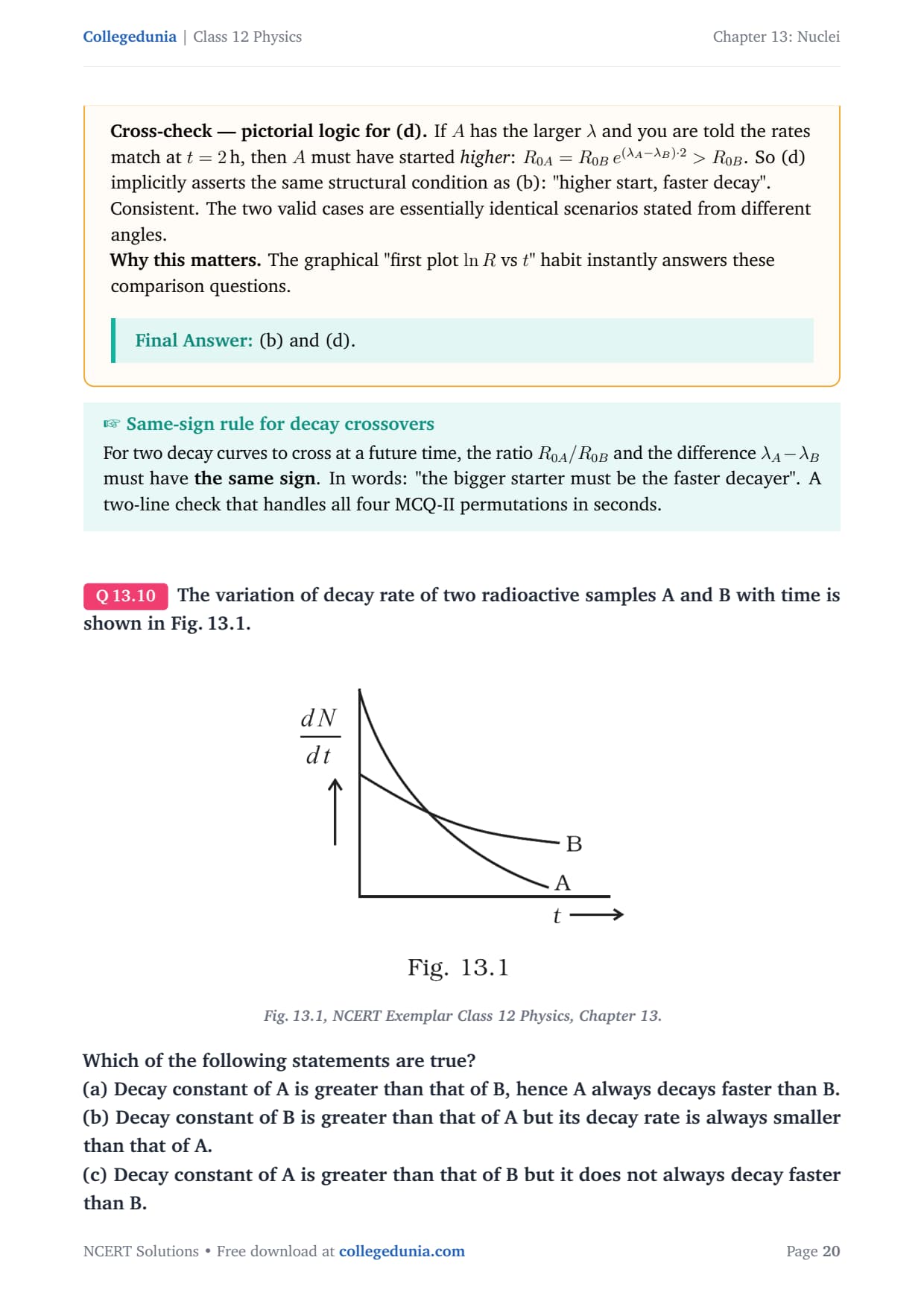
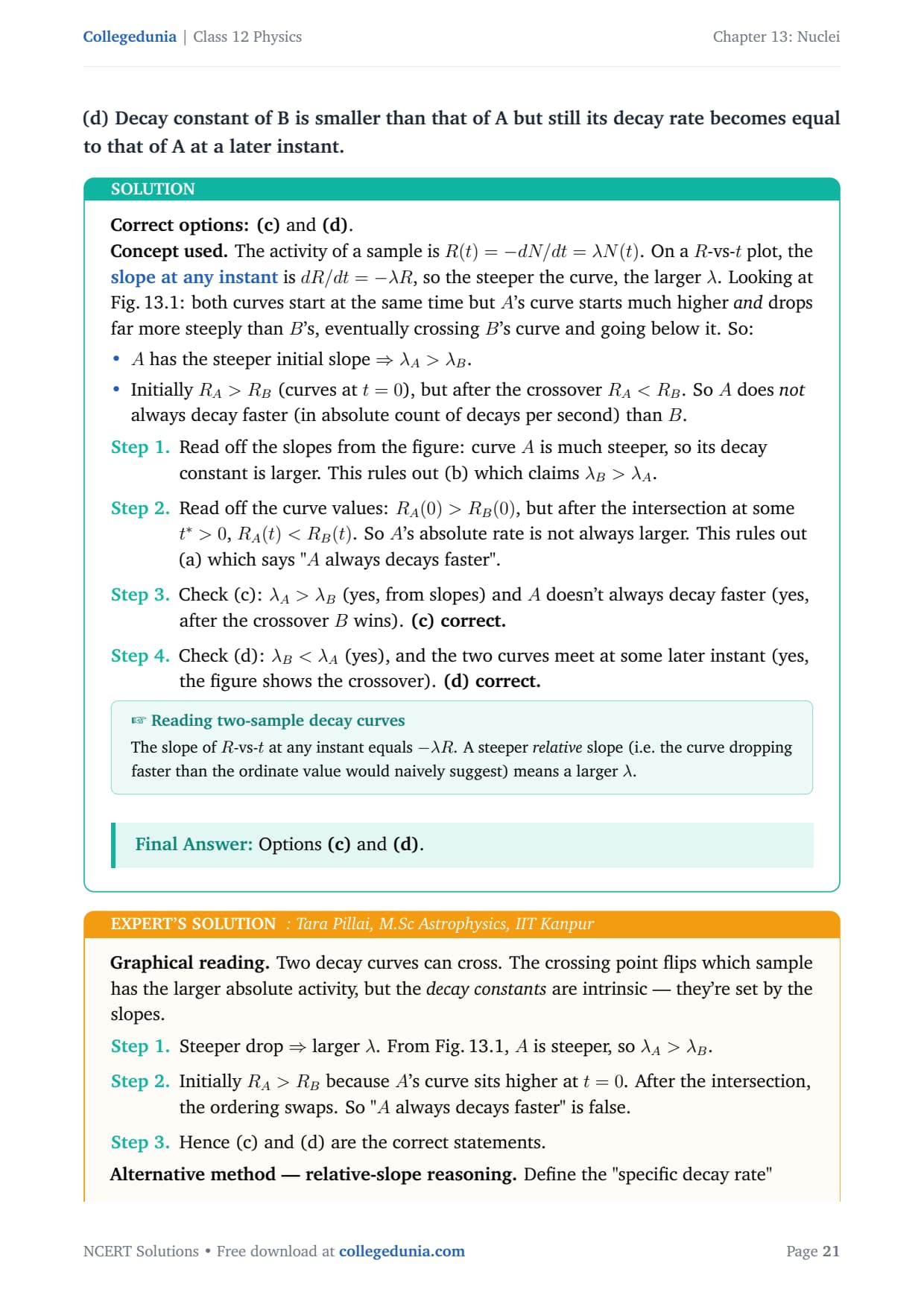
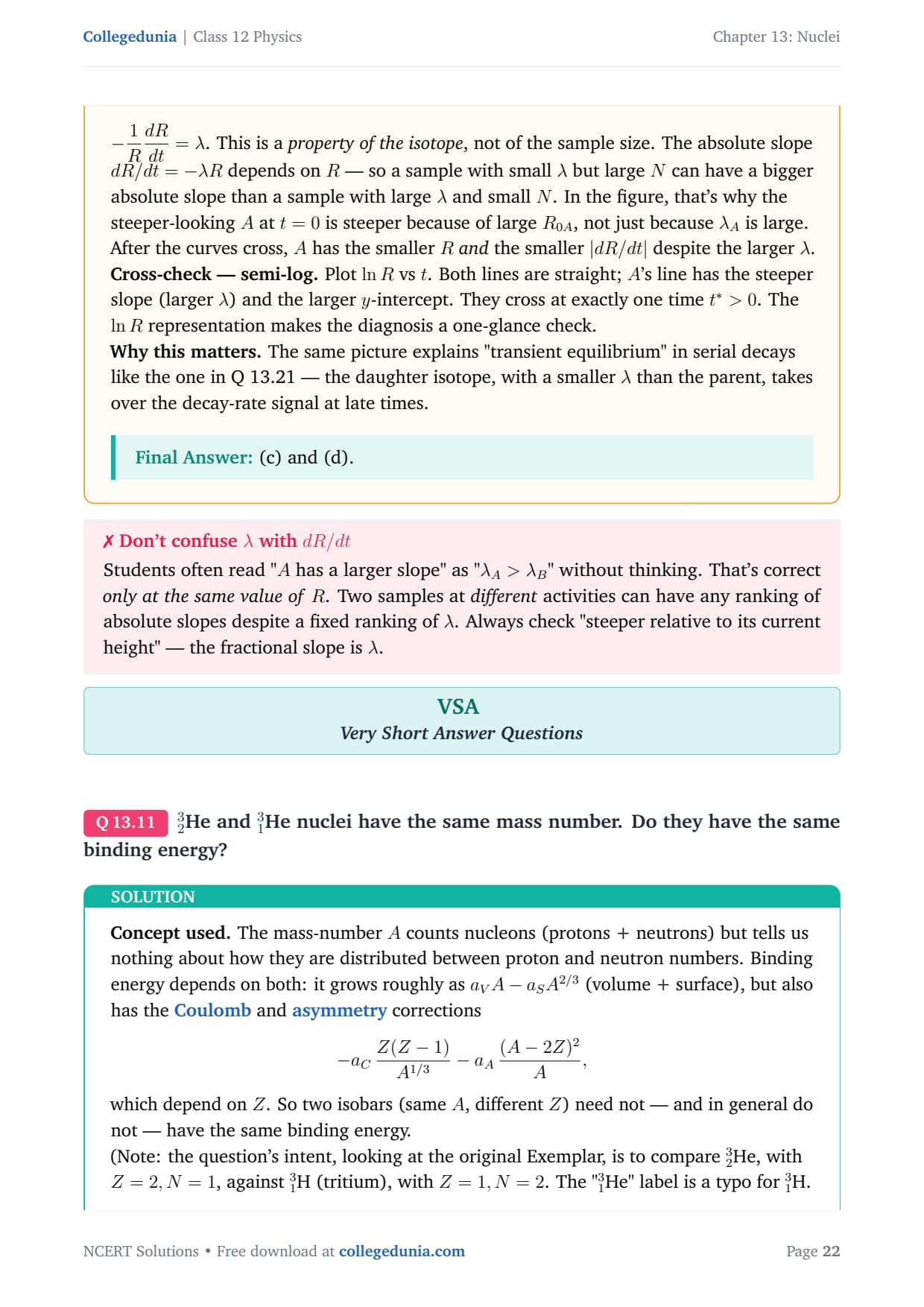
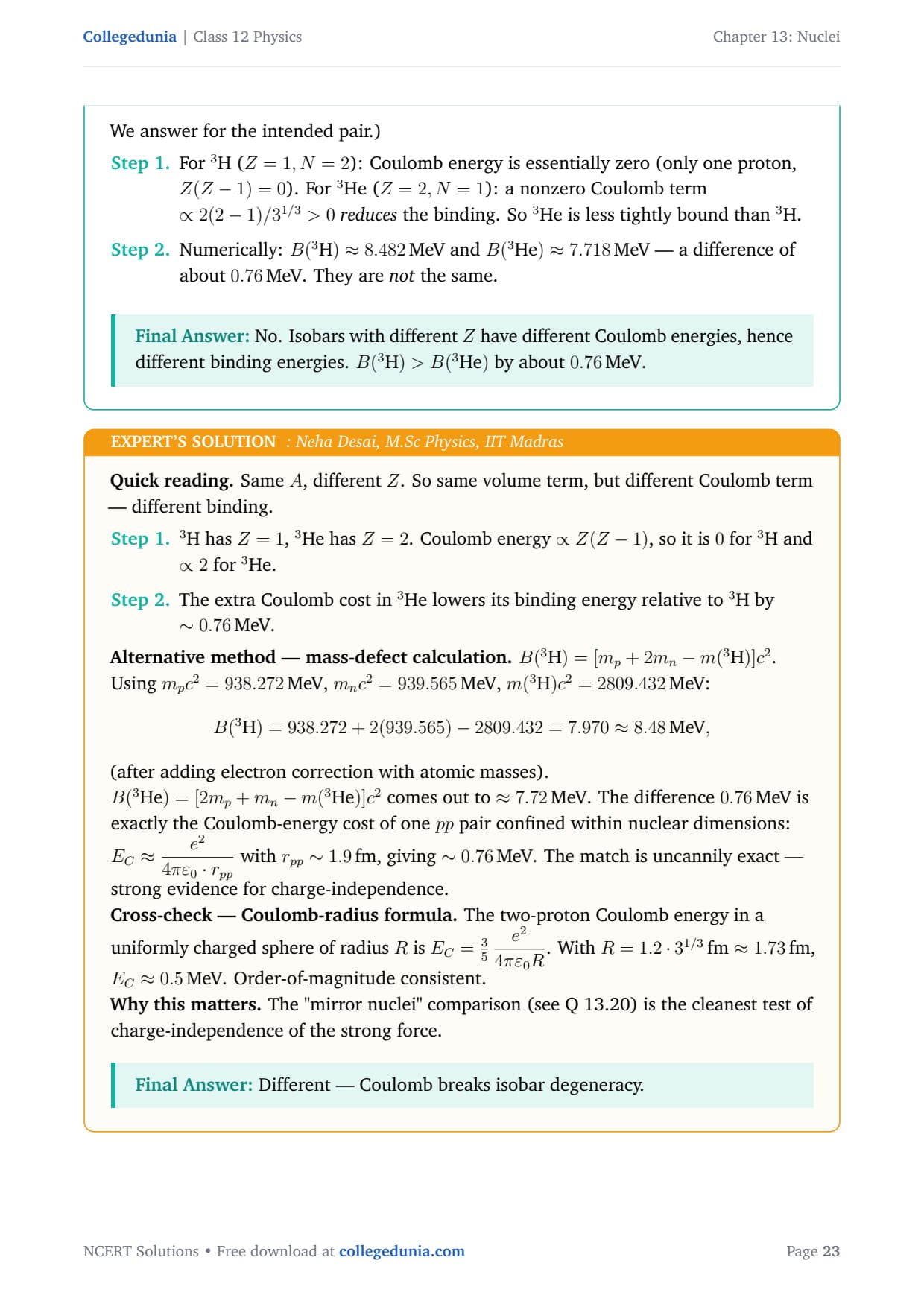
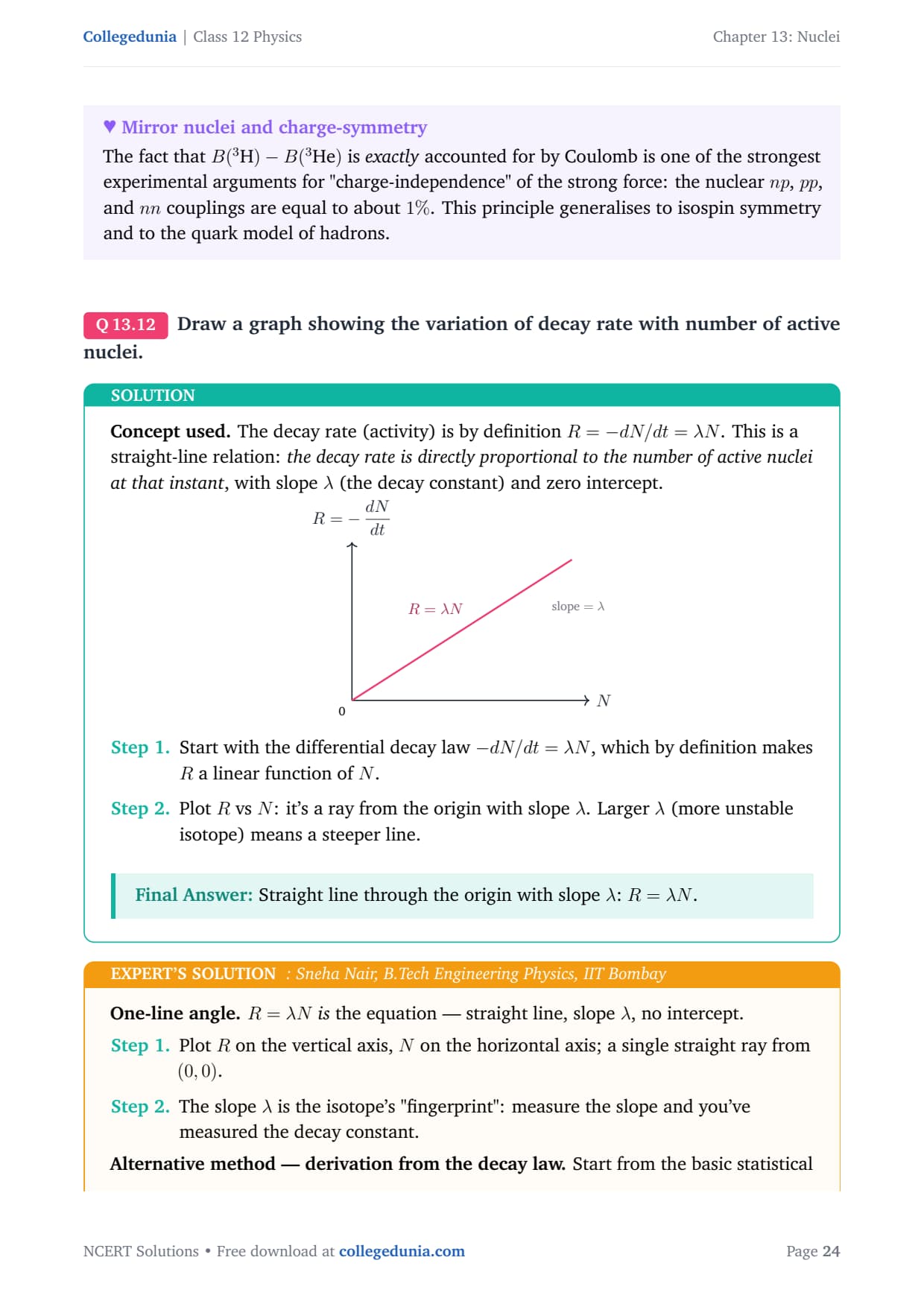
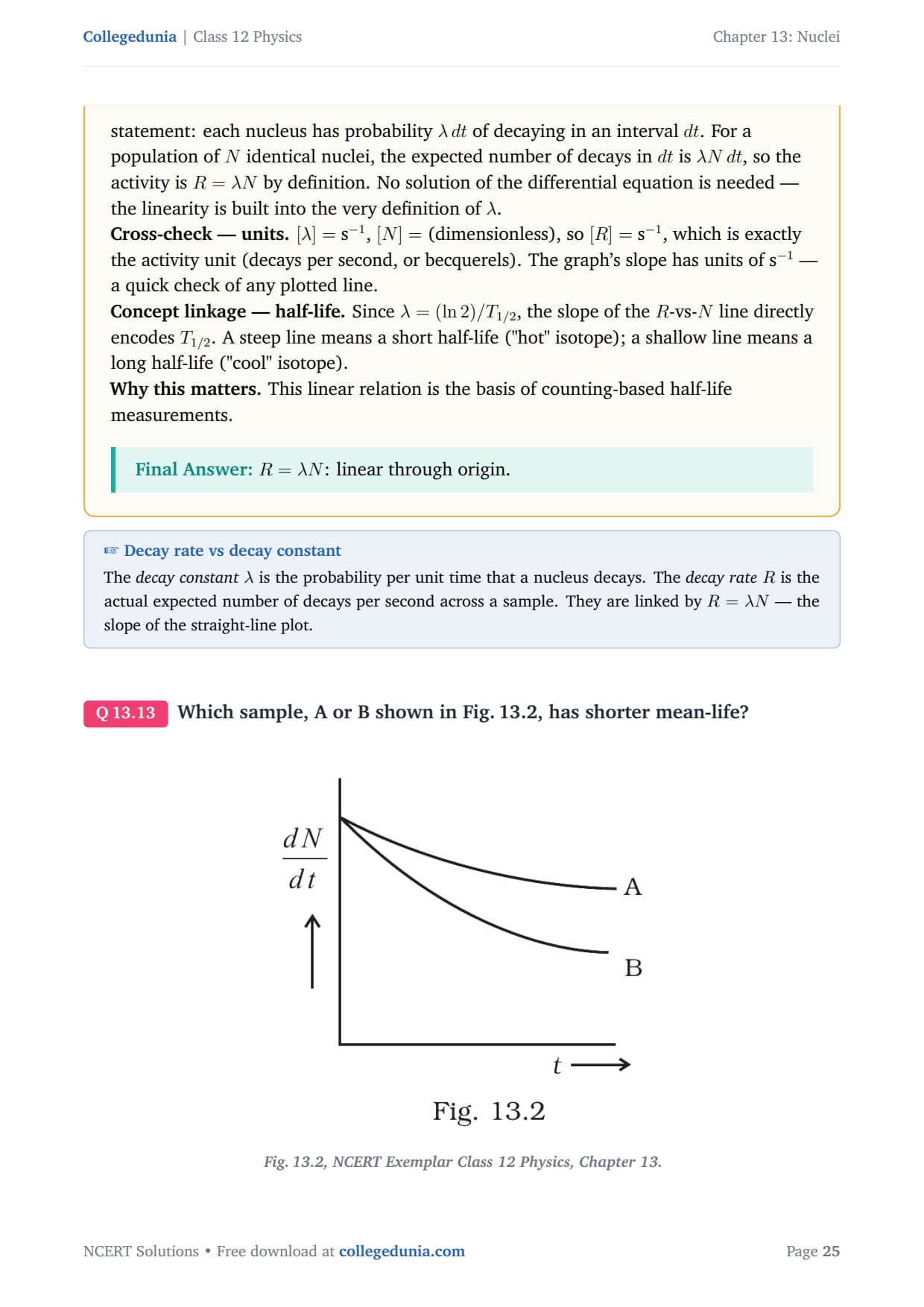
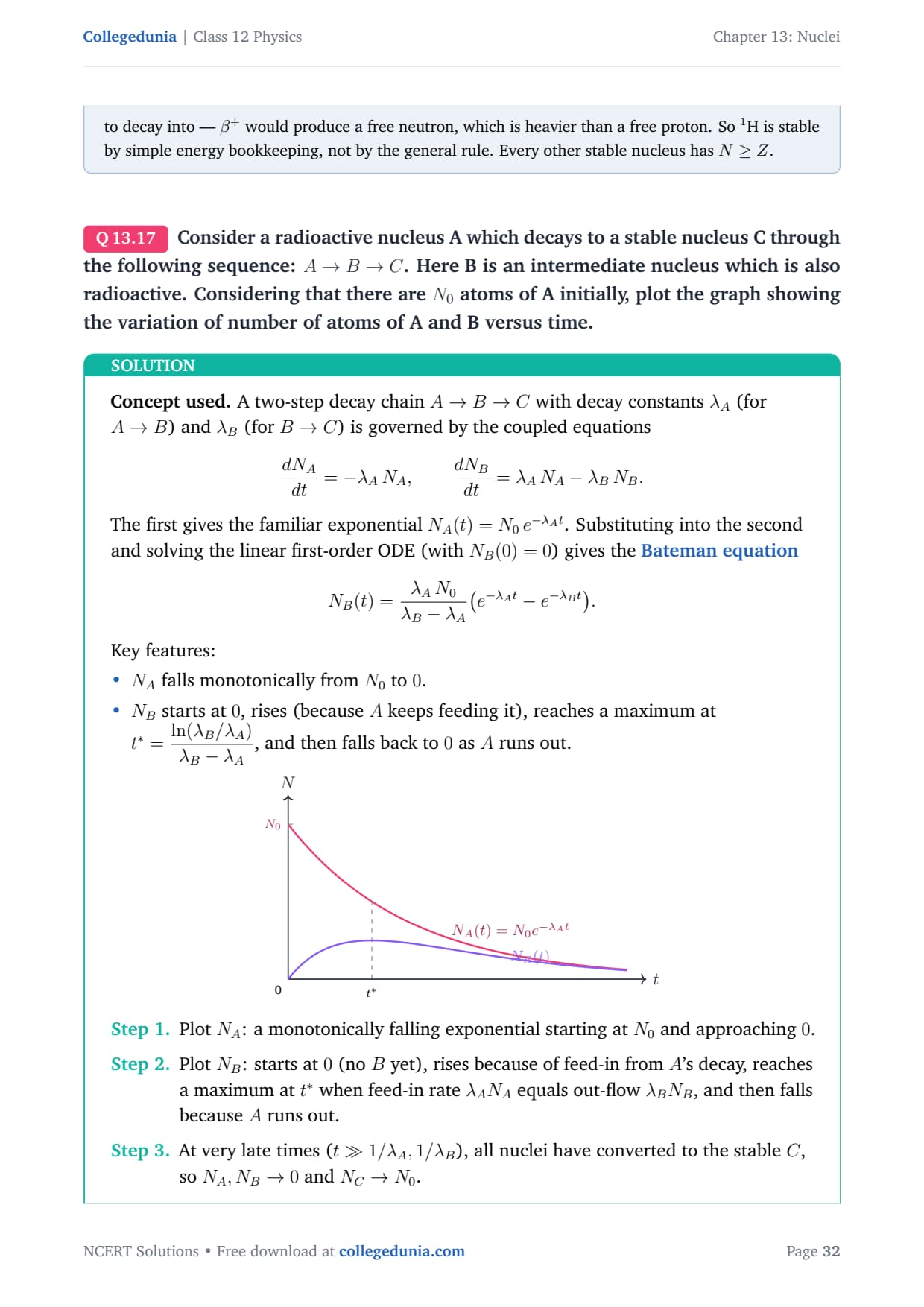
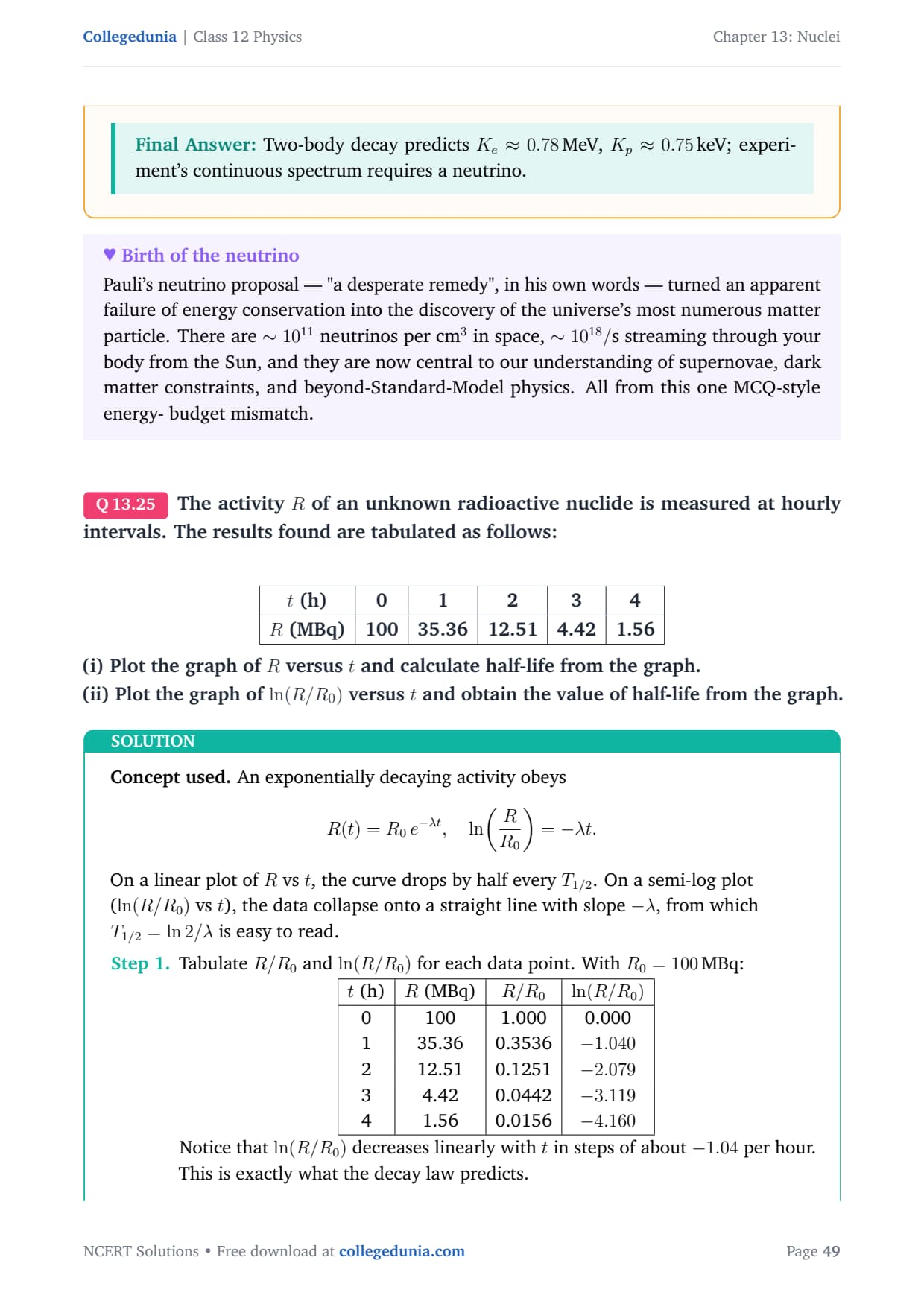
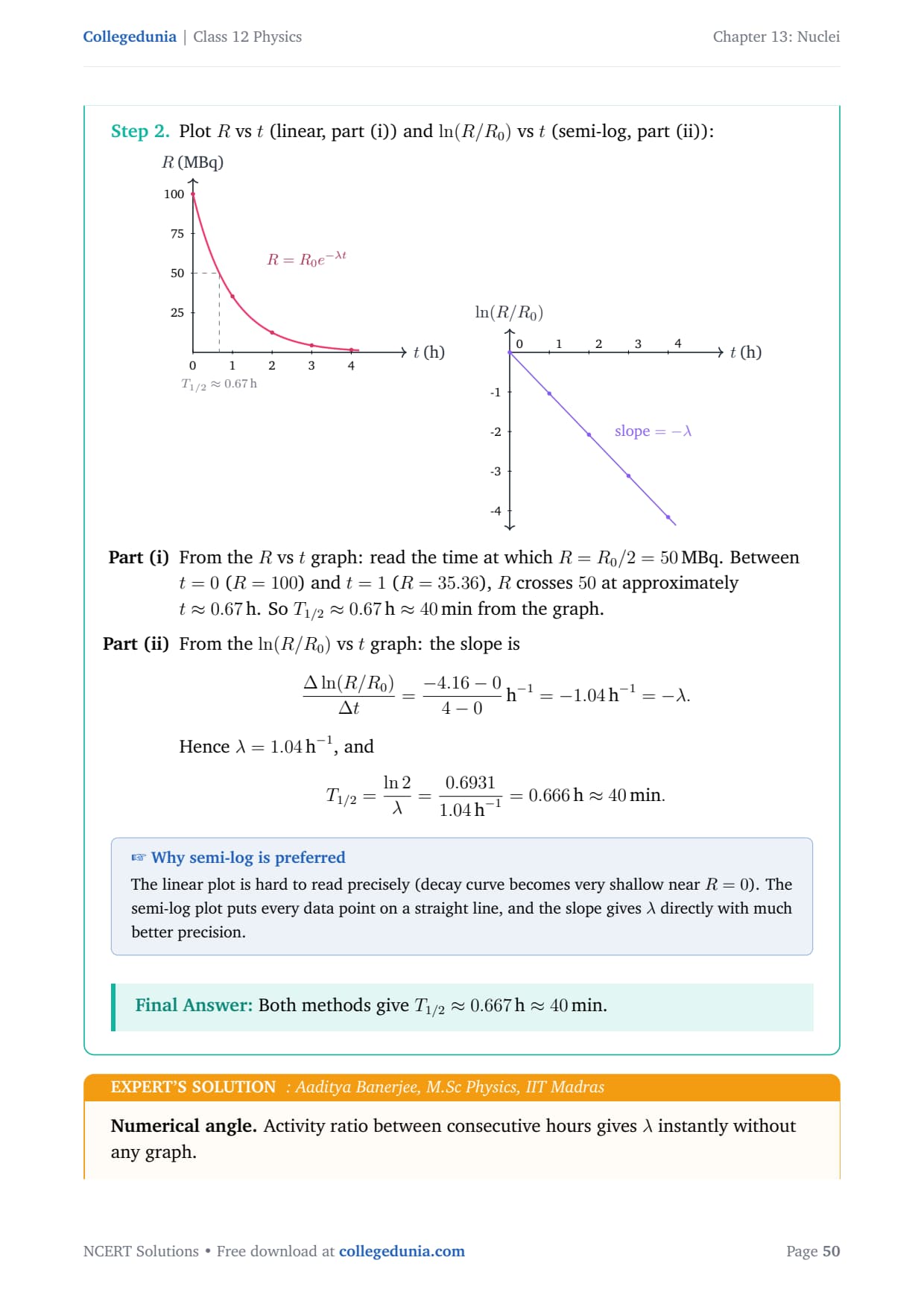
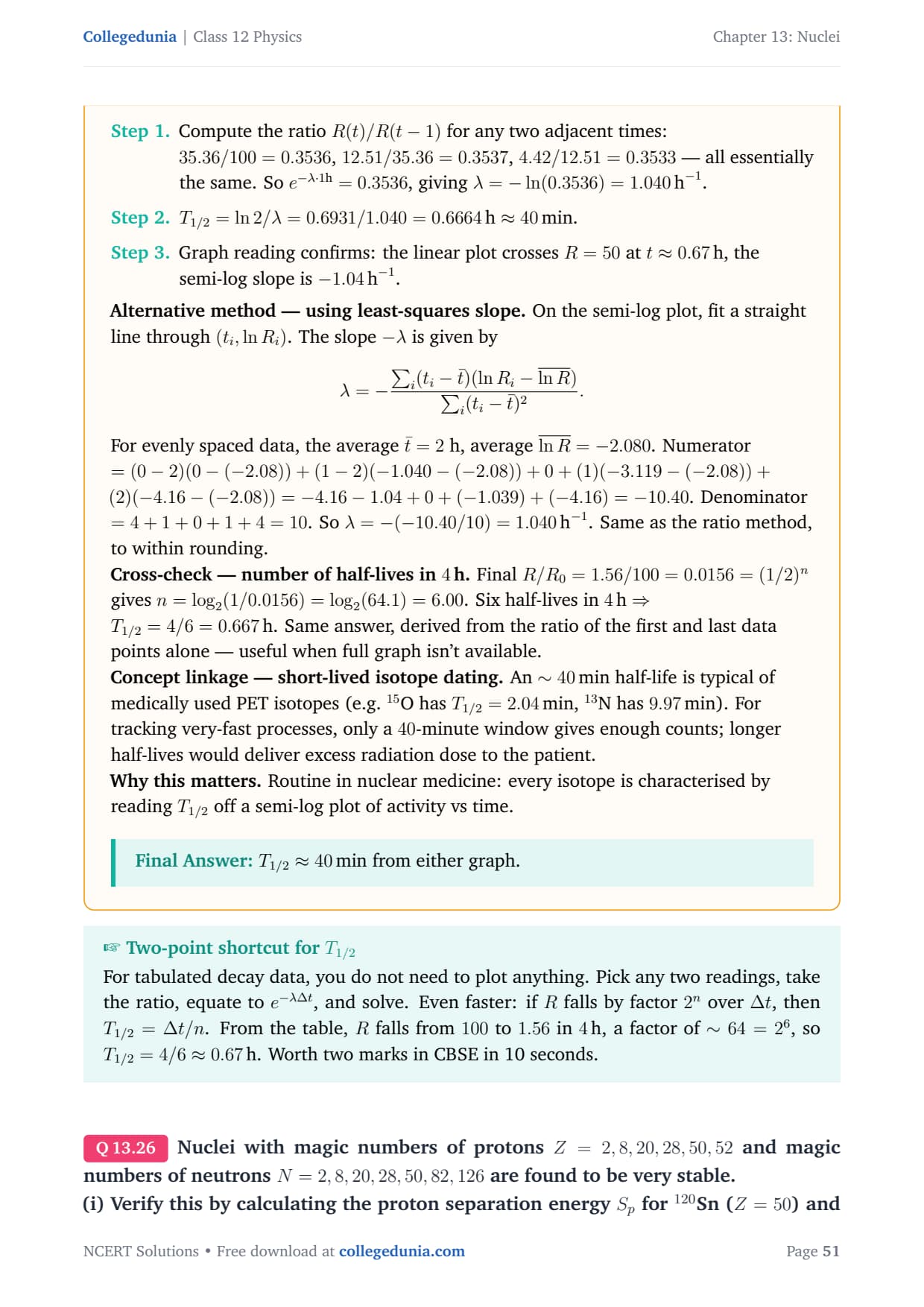
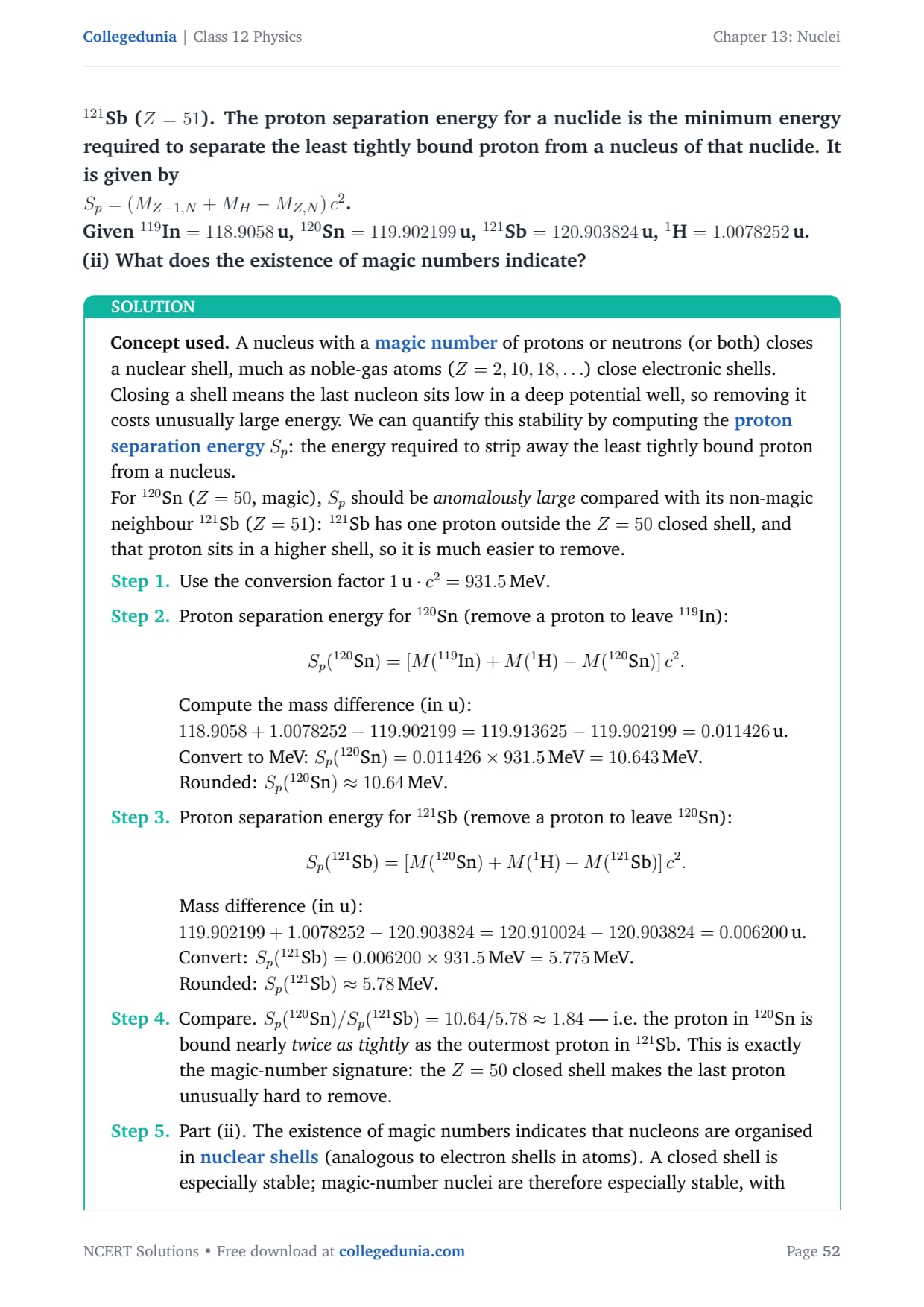
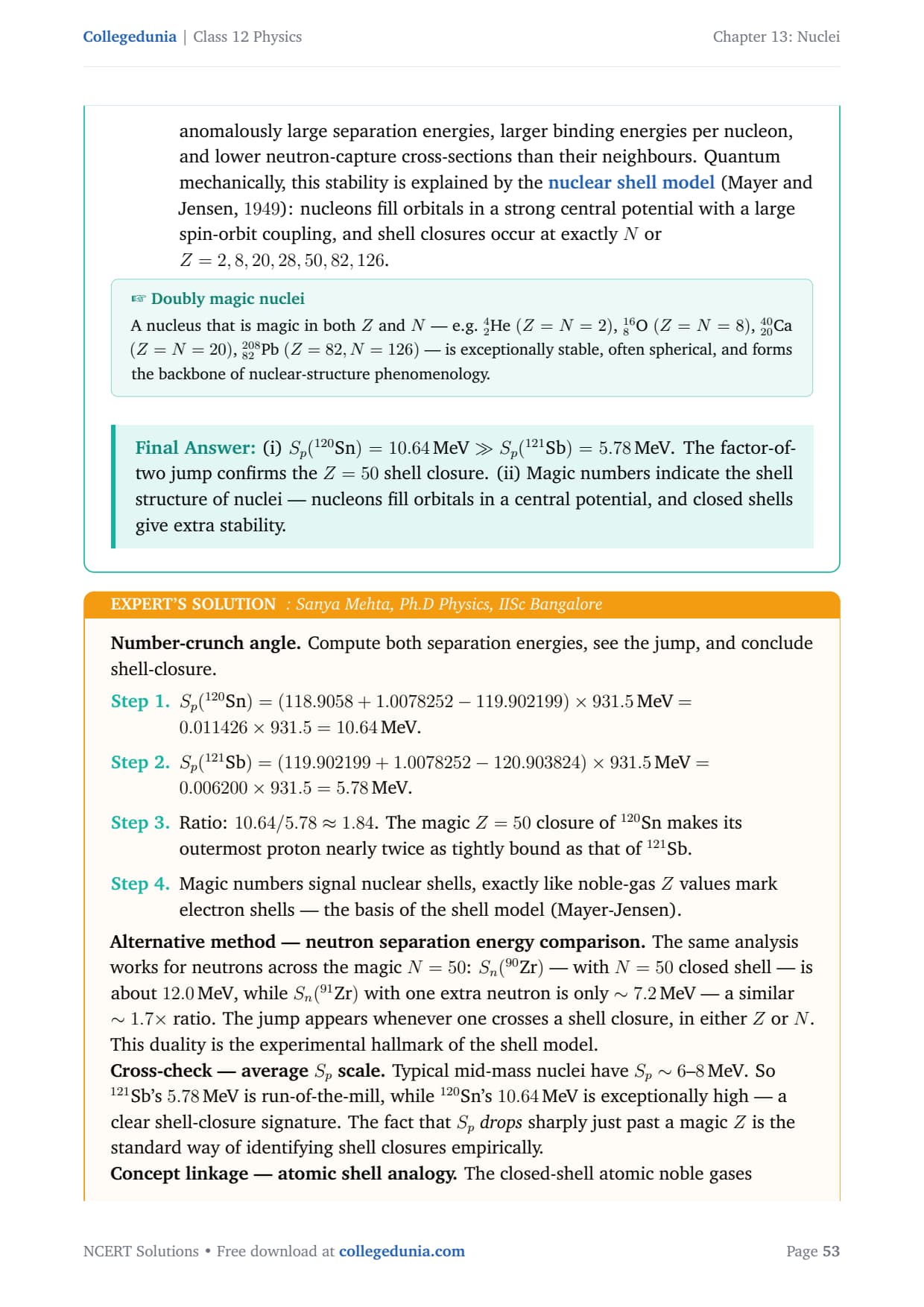
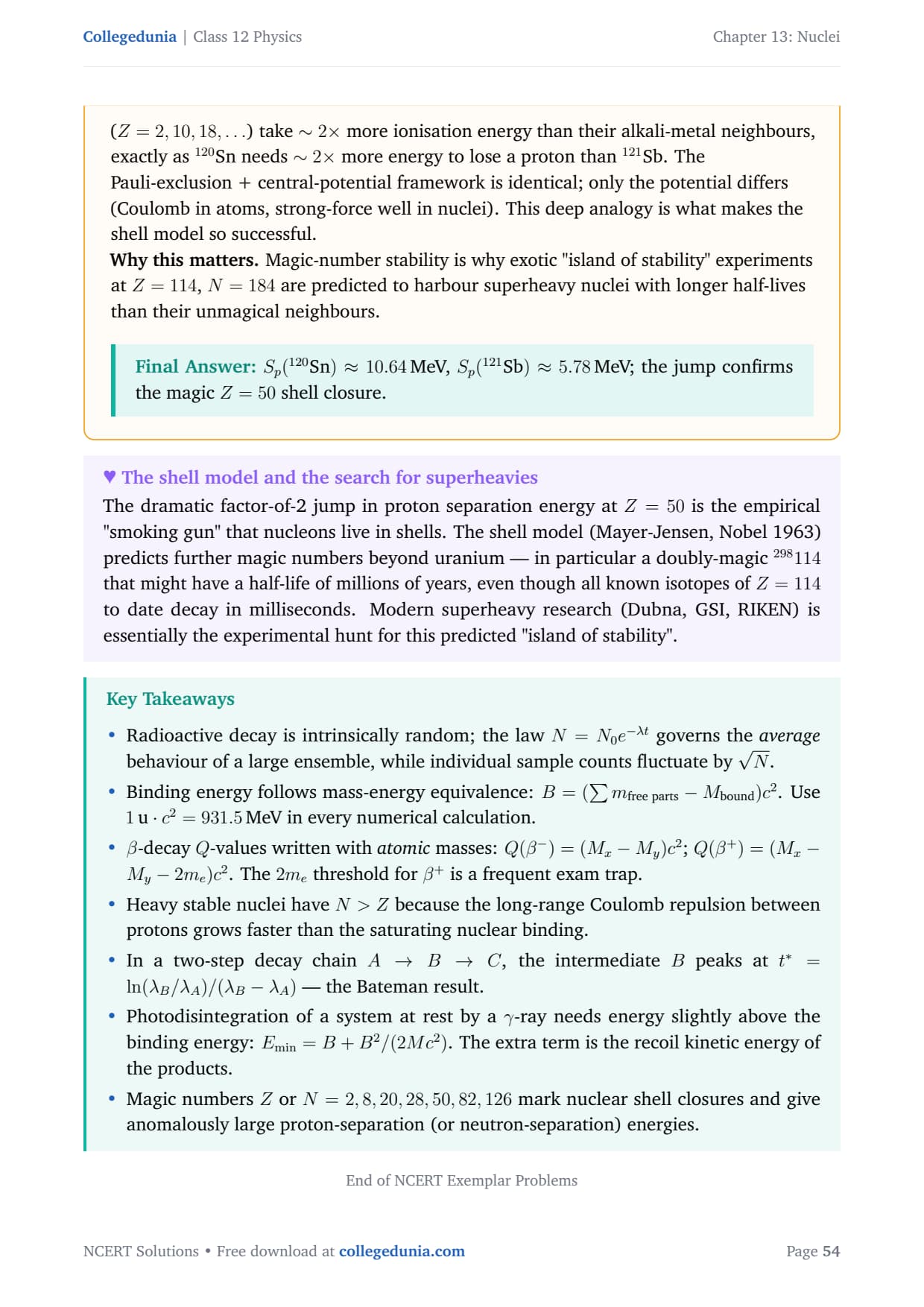

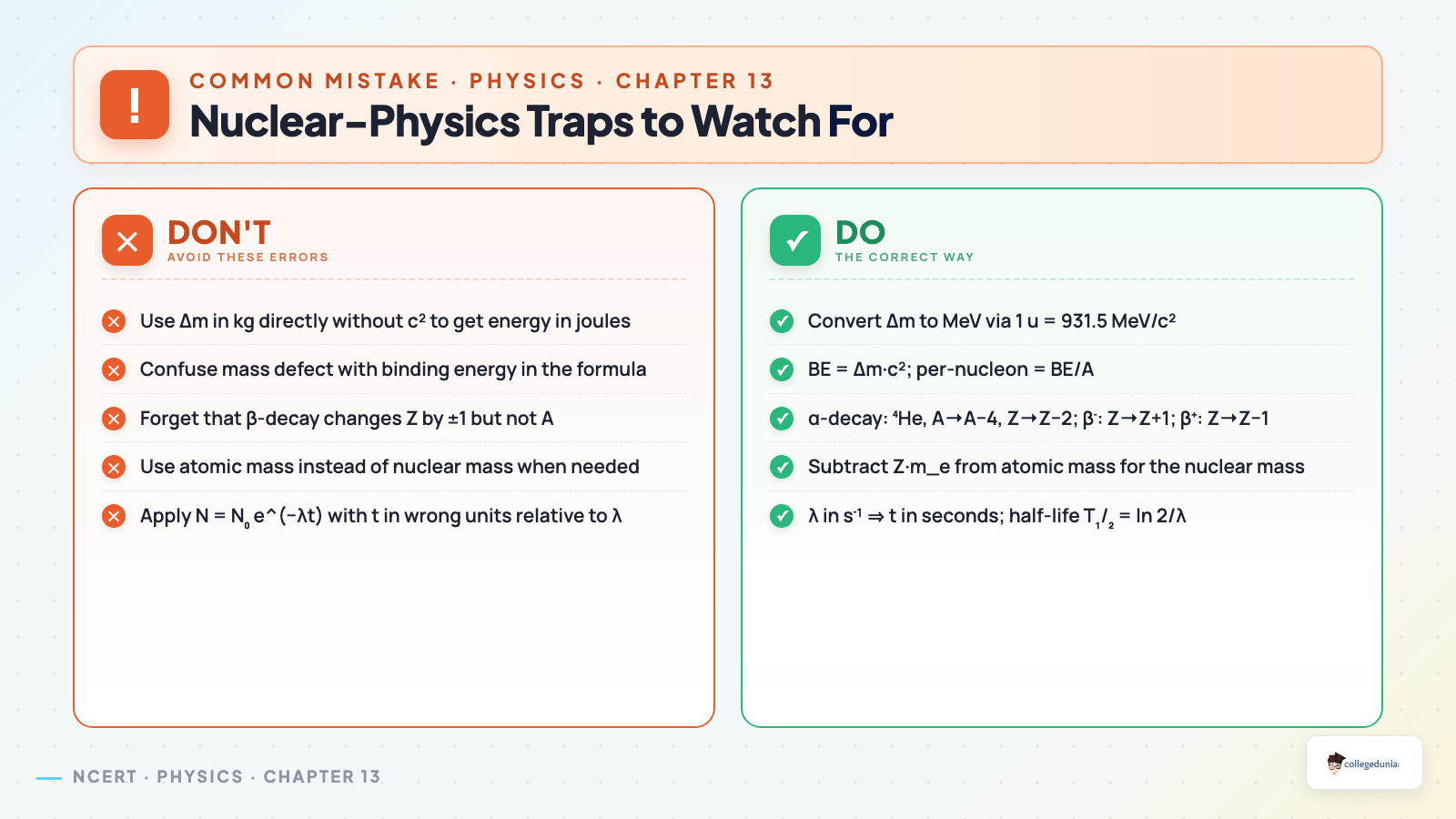
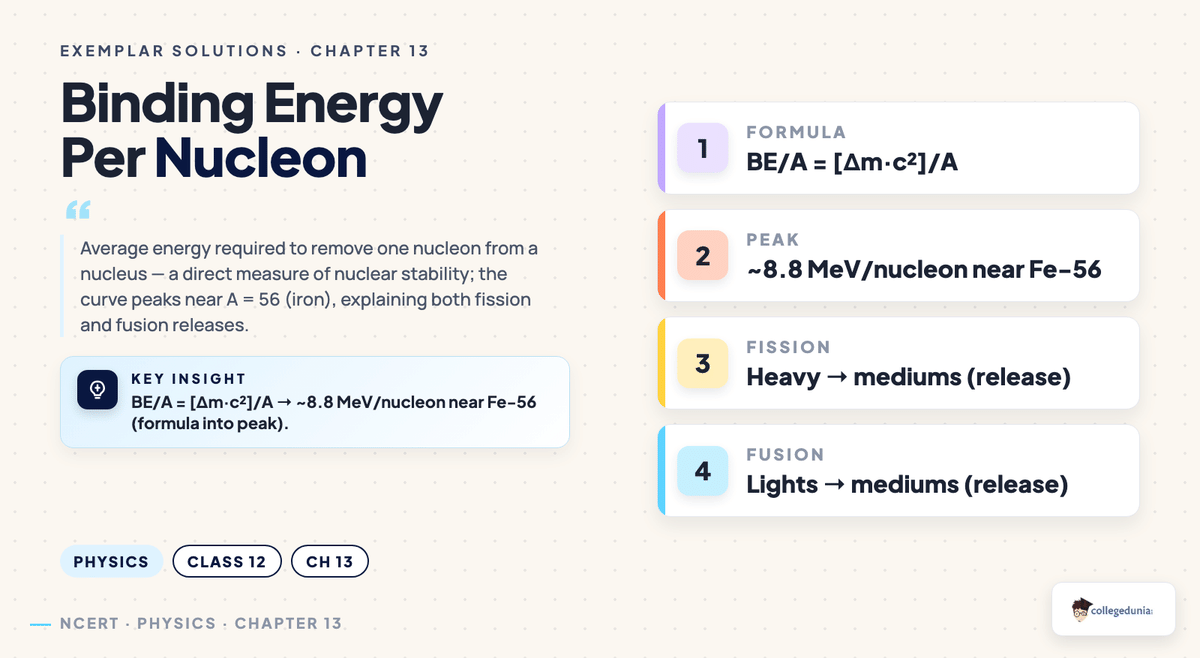
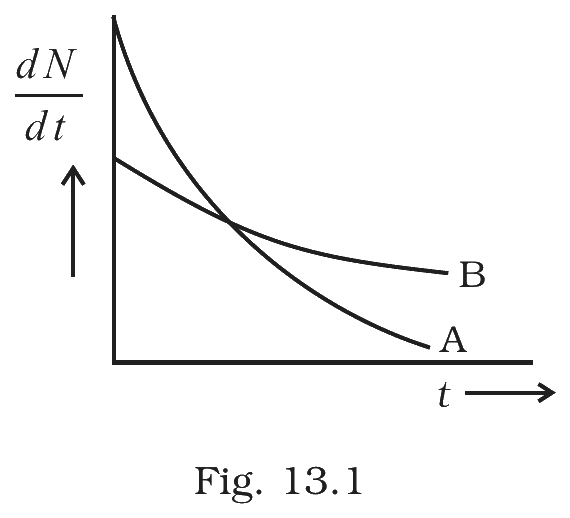
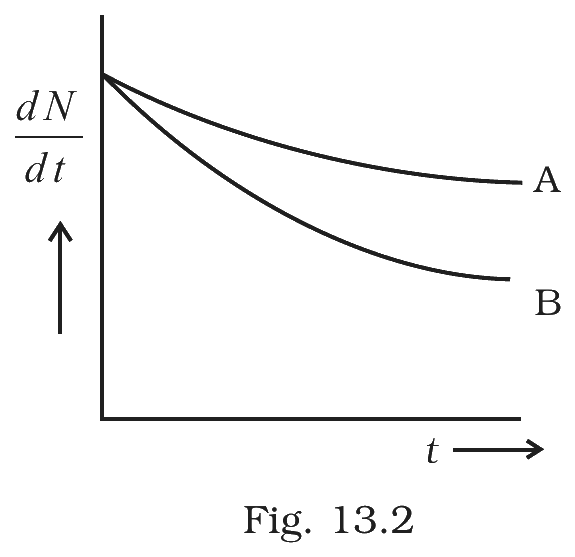



Comments