Coordination Compounds covers metal-ligand bonding, d-orbital geometry, isomerism, colour and magnetism. The Class 12 Chemistry Chapter 5 Exemplar runs to 50 problems across MCQ-I, MCQ-II, SA, Matching and LA, retained under the 2026-27 NCERT.
CBSE Weightage: 6 to 8 marks, usually an SA on isomerism or hybridisation plus a VSA on IUPAC naming.
JEE Main Weightage: 3 to 5%, on isomerism, CFSE calculations and EAN rules.
NEET Weightage: 2 to 3 questions per year on biological complexes and crystal field splitting.
The PDF works each of the 50 Exemplar problems with a Solution plus an Expert's Solution that names the bonding theory, IUPAC rule or isomerism class behind every step.
These Exemplar Solutions are curated by subject experts at Collegedunia, mapped to the 2026-27 NCERT, and benchmarked against the last five years of CBSE Board, JEE Main and NEET papers.
JEE and NEET Bridge: Isomerism, spectrochemical series and CFSE items are tagged with the JEE Main or NEET year they reappeared.
2026-27 Aligned: Third-party sites still call it Chapter 9, but the new edition fixes it at Chapter 5 and no Exemplar item was dropped.
Coordination Compounds Exemplar: Question-Type Mix at a Glance
The Exemplar splits Chapter 5 into five question buckets, shown below.
Question Type
Item Range
Count
Typical Marks (Board)
MCQ-I (single correct)
5.1 to 5.20
20
1
MCQ-II (multiple correct)
5.21 to 5.27
7
2
Short Answer (SA)
5.28 to 5.40
13
2 to 3
Matching Type
5.41 to 5.44
4
3 to 4
Assertion-Reason / LA
5.45 to 5.50
6
3 to 5
The 20 MCQ-I items alone drill IUPAC naming, EAN, and the inner vs outer-orbital VBT distinction.
Coordination Compounds Class 12th: Sample MCQ-II Solved with Multiple-Correct Walk-Through
MCQ-II is the bucket students underrate: one missed option zeroes the mark. Here is an Exemplar Q 5.24 style walkthrough.
Q (Exemplar style): Which of the following octahedral complexes will show geometric isomerism?
(i) [Co(NH3)4Cl2]+
(ii) [Co(NH3)5Cl]2+
(iii) [Co(en)2Cl2]+
(iv) [Co(NH3)3Cl3]
Answer: (i), (iii) and (iv).
Expert's reasoning: [Ma4b2] in (i) gives cis/trans. (iii) [M(AA)2b2] with bidentate en also gives cis/trans, the cis further optically active. (iv) [Ma3b3] gives fac and mer. (ii) [Ma5b] has one arrangement only, so no geometric isomerism.
Picking three options instead of all four is the difference between a 2-mark MCQ-II score and zero. The Expert's Solution flags the fac/mer and chelate-ring traps on every item.
Coordination Compounds Exemplar Step-Up from NCERT Textbook
The Exemplar reframes the same textbook facts as inference puzzles. Three concrete jumps:
Skill
NCERT Textbook Asks
Exemplar Asks
IUPAC naming
Name [Co(NH3)6]Cl3
Given a name, write the formula and predict whether it is a cationic or anionic complex; identify the ambidentate ligand if any
Bonding
State the hybridisation of [Fe(CN)6]4-
Compare [Fe(CN)6]4- and [FeF6]3- on hybridisation, magnetic moment and colour, and justify the difference via spectrochemical series
Isomerism
Identify isomers of [Co(en)2Cl2]+
Draw all stereoisomers of [M(AA)3] and indicate which pair is enantiomeric
The shift is from recall to inference. Every Expert's Solution names the rule (Werner's, EAN, CFSE or chelate effect) so you learn the move, not just the answer.
Exemplar-Specific Common Mistakes in Coordination Compounds
Four recurring errors lose students 2 to 4 marks per Exemplar attempt:
Mis-ordering ligands in IUPAC names: Ligands are listed alphabetically regardless of charge; writing the cation first costs the full mark on an MCQ-I.
Confusing Δo vs Δt: Tetrahedral splitting is 4/9 of the octahedral split; treating them as equal predicts the wrong unpaired-electron count.
Optical activity in cis-[M(AA)2X2]: The cis form is optically active, the trans is not. Marking both or neither loses the MCQ-II mark.
EAN counting errors: Each ligand donates 2 electrons; the charge sits on the metal, not added separately.
How Frequently Has Coordination Compounds Been Asked in CBSE, JEE and NEET
The chapter is among the top two Inorganic scorers across all three exams. The table maps the last five years of recurring topics, latest year first.
All NCERT Exemplar Questions for Coordination Compounds with Step-by-Step Solutions
Every question of the NCERT Exemplar set for Class 12 Chemistry Chapter 5 Coordination Compounds is listed below with its full Solution and Expert Solution hidden inside collapsible tabs. Click Check Solution to reveal the step-by-step working; click Expert Solution for the expanded explanation.
Questions
Q 5.1
Which of the following complexes formed by Cu2+ ions is most stable?
(i) Cu2+ + 4 NH3 -> [Cu(NH3)4]2+, log K = 11.6
(ii) Cu2+ + 4 CN- -> [Cu(CN)4]2-, log K = 27.3
(iii) Cu2+ + 2 en -> [Cu(en)2]2+, log K = 15.4
(iv) Cu2+ + 4 H2O -> [Cu(H2O)4]2+, log K = 8.9
Correct option: (ii)[Cu(CN)4]2-, log K = 27.3.
Concept used. The stability of a coordination complex in
solution is measured by the overall stability constantK
(also called the formation constantβ) of the
equilibrium
Mn+ + xL [MLx]n+,
K = [[MLx]n+][Mn+][L]x.
A larger K (and therefore a larger log K) means more product at
equilibrium, i.e. a more stable complex. So the question reduces to
``find the largest log K in the table.''
Tabulate the four values:
log K(i) = 11.6, log K(ii) = 27.3,
log K(iii) = 15.4, log K(iv) = 8.9.
The largest value is 27.3, belonging to option (ii)
[Cu(CN)4]2-. Numerically K(ii)
= 1027.3 ≈ 2 × 1027, which is
1027.3-11.6 = 1015.7 ≈ 5 × 10¹⁵ times
larger than K(i).
Reasoning: CN- is the strongest σ-donor and a
very effective π-acceptor on the spectrochemical series,
so it forms the strongest M-L bond with the soft
Cu2+ centre. Aqua (H2O) is weakest, ammine
intermediate, ethylenediamine (en) slightly higher
than ammine because of the chelate effect.
Option (ii): [Cu(CN)4]2- is the most
stable complex (log K = 27.3).
AS
Aarav Sharma
M.Sc Chemistry, IIT Kanpur
Verified Expert
Quick reading. Stability constant K has no upper limit, but
the spectrochemical series fixes the relative ordering of donor
strengths to Cu2+. Reading the four ligands in series order
directly predicts the order of log K.
Place the four ligands on the spectrochemical series from
weak to strong field:
H2O < NH3 < en < CN-.
Stronger field ⇒ stronger Cu2+-Lσ-bond (plus π-back-bonding for CN-)
⇒ larger K.
Compare the listed log K against this order:
H2O (8.9) < NH3 (11.6) < en (15.4)
< CN- (27.3). The data match the prediction term-for-term.
Note that the chelate effect bumps en above NH3
by ∼ 4 orders in K, but the cyanide complex still wins
because CN- is both a stronger σ-donor and a
π-acceptor, and four cyanides simply trump two
chelating en.
Why this matters. Sodium cyanide is used in industrial gold
leaching,
4 Au + 8 CN- + O2 + 2 H2O -> 4 [Au(CN)2]- + 4 OH-,
for exactly the same reason this question turns on: CN-
forms outrageously stable complexes with d-block metals.
[Cu(CN)4]2-, option (ii).
Q 5.2
The colour of the coordination compounds depends on the
crystal field splitting. What will be the correct order of absorption
of wavelength of light in the visible region, for the complexes
[Co(NH3)6]3+, [Co(CN)6]3-, [Co(H2O)6]3+?
(i) [Co(CN)6]3- > [Co(NH3)6]3+ > [Co(H2O)6]3+
(ii) [Co(NH3)6]3+ > [Co(H2O)6]3+ > [Co(CN)6]3-
(iii) [Co(H2O)6]3+ > [Co(NH3)6]3+ > [Co(CN)6]3-
(iv) [Co(CN)6]3- > [Co(NH3)6]3+ > [Co(H2O)6]3+
Concept used. A d–d transition promotes a t2g electron
to the eg set across the octahedral splitting o. By the
Planck–Einstein relation
E = hν = hcλ ⇒
λ = hco.
So largero absorbs at shorterλ, and a
weaker field ligand ⇒smallero⇒longerλ.
Place the three ligands on the spectrochemical series:
H2O < NH3 < CN- in field strength. So the
o values rank as [Co(H2O)6]3+ <
[Co(NH3)6]3+ < [Co(CN)6]3-.
This matches option (iii). Sanity check on observed colours:
[Co(H2O)6]3+ is blue-violet (absorbs orange-red,
∼ 600 nm), [Co(NH3)6]3+ is yellow-orange
(absorbs violet-blue, ∼ 470 nm), and [Co(CN)6]3-
is pale yellow (absorbs near UV, ∼ 310 nm). Wavelength
absorbed indeed decreases as the field gets stronger.
Strategic angle. Two simple proportions take you from
spectrochemical position straight to absorbed wavelength: ligand
strength ∝ o and λ ∝ 1/o. So
ligand-strength order reverses to give wavelength order.
Spectrochemical series snippet (left = weak, right =
strong): H2O < NH3 < CN-.
Reverse this to read off λ-absorbed order (weakest
field absorbs the longest wavelength):
[Co(H2O)6]3+ (∼ 600 nm) >
[Co(NH3)6]3+ (∼ 470 nm) >
[Co(CN)6]3- (∼ 310 nm).
Numerical cross-check with
o([Co(NH3)6]3+) ≈ 22,900 cm-1
and λ = 107/22900 = 437 nm - in the violet, so the
complex looks yellow-orange. Pattern confirmed.
Why this matters. The same logic predicts why
[Ti(H2O)6]3+ is purple (o = 20,300 cm-1,
absorbs ∼ 493 nm) and why exchanging H2O for NH3
on the same metal usually shifts a complex's colour visibly toward
shorter λ.
When 0.1 mol CoCl3(NH3)5 is treated with excess of
AgNO3, 0.2 mol of AgCl are obtained. The conductivity
of solution will correspond to
(i) 1:3 electrolyte
(ii) 1:2 electrolyte
(iii) 1:1 electrolyte
(iv) 3:1 electrolyte
Correct option: (ii)1:2 electrolyte.
Concept used. Werner's idea of primary (ionisable)
versus secondary (non-ionisable) valencies says: only the
chlorides written outside the coordination sphere are
precipitated as AgCl when treated with AgNO3, because
only they ionise in water. The number of AgCl formed per mole
of complex therefore equals the number of free Cl- ions, and
the electrolyte ratio of the complex is
cation charge:anion charge =
# cations (z+)# anions (z-).
From the stoichiometry: 0.1 mol of complex gives 0.2 mol
AgCl, so each formula unit liberates 0.2/0.1 = 2
chloride ions.
Therefore 2 of the 3Cl in CoCl3(NH3)5 are
ionisable (outside the sphere) and 1 is inside. The
structural formula is
[Co(NH3)5 Cl] Cl2,
which ionises as
[Co(NH3)5 Cl]Cl2 -> [Co(NH3)5 Cl]2+ + 2 Cl-.
The salt produces one cation of charge +2 and two anions
of charge -1 in solution. By the ``z+:|z-|''
convention 1:2 means one cation per two anions, which
matches this case exactly.
Option (ii): a 1:2 electrolyte
([Co(NH3)5 Cl]Cl2).
AG
Aditi Gupta
Ph.D Organic Chemistry, IISc Bangalore
Verified Expert
Strategic angle. Drop one chloride at a time into the
coordination sphere and stop the moment the AgCl count
matches the data.
Possible isomers of CoCl3(NH3)5 and their
AgCl output per mole of complex:
[Co(NH3)5]Cl33 Cl outside → 3
mol AgCl (but this isomer needs CN =5 for Co,
which is wrong - included only for completeness).
Observed: 0.2 mol AgCl per 0.1 mol complex = 2
per formula unit. Only [Co(NH3)5 Cl]Cl2 fits.
Conductivity link: one +2 cation and two -1 anions
means the molar conductivity sits around 245–260
S cm2 mol-1 at infinite dilution in water, the
signature of a 1:2 electrolyte (compare a
1:1 NaCl-like complex at ∼ 100
S cm2 mol-1).
Why this matters. Werner deduced the 1:1, 1:2,
1:3 pattern of cobalt-amine chlorides purely from
AgCl titration and conductivity, decades before any X-ray
crystal structure. The same logic is fair game in board derivations.
[Co(NH3)5 Cl]Cl2, a 1:2 electrolyte.
Q 5.4
When 1 mol CrCl3.6H2O is treated with excess of
AgNO3, 3 mol of AgCl are obtained. The formula of
the complex is:
(i) [CrCl3(H2O)3].3H2O
(ii) [CrCl2(H2O)4]Cl.2H2O
(iii) [CrCl(H2O)5]Cl2.H2O
(iv) [Cr(H2O)6]Cl3
Correct option: (iv)[Cr(H2O)6]Cl3.
Concept used. Same Werner principle as Q3: only the
ionisable (outside-sphere) chlorides precipitate as
AgCl. Count them in each candidate isomer and match against
the 3 mol AgCl produced per mol of complex.
Inspect each option's outside-sphere chlorides:
(i) [CrCl3(H2O)3].3H2O: all 3 Cl
inside; AgCl obtained = 0.
(ii) [CrCl2(H2O)4]Cl.2H2O: 1 Cl
outside; AgCl obtained = 1.
(iv) [Cr(H2O)6]Cl3: all 3 Cl
outside; AgCl obtained = 3.
Observed value = 3 mol AgCl per mol complex.
Only option (iv) matches.
The complex is the violet hexaaquachromium(III) chloride
[Cr(H2O)6]Cl3, with Cr3+ at the centre of
a regular octahedron of six water ligands and three
Cl- counter-ions in the second sphere. It is a
1:3 electrolyte:
[Cr(H2O)6]Cl3 -> [Cr(H2O)6]3+ + 3 Cl-.
Option (iv): [Cr(H2O)6]Cl3.
PM
Pranav Mehta
M.Tech Chemical Engineering, IIT Delhi
Verified Expert
Picture-first. Draw Cr3+ at the centre of an
octahedron. Whichever six donors sit at the vertices are inside the
coordination sphere; anything beyond is a counter-ion (or lattice
water). Count the chlorides outside the vertices.
Match outer Cl to the observed 3 mol AgCl:
only (iv) gives 3.
Conductivity confirmation: [Cr(H2O)6]Cl3 dissociates
into 4 ions per formula unit, the highest of the
candidates, and the experimental molar conductance is
∼ 430 S cm2 mol-1 - consistent with a
1:3 electrolyte at 25∘C.
Why this matters. Identifying solvate isomers from precipitation
data was Werner's experimental signature, and this exact problem
shows up almost every alternate year on JEE.
[Cr(H2O)6]Cl3.
Q 5.5
The correct IUPAC name of [Pt(NH3)2 Cl2] is
(i) Diamminedichloridoplatinum(II)
(ii) Diamminedichloridoplatinum(IV)
(iii) Diamminedichloridoplatinum(0)
(iv) Dichloridodiammineplatinum(IV)
Concept used. The IUPAC rules for naming a mononuclear
neutral coordination compound are: (a) list ligands in
alphabetical order (ignoring the prefix di/tri/tetra), each
ligand naming convention: ammine for NH3,
chlorido for Cl- (2005 recommendation; older books
write ``chloro''), aqua for H2O. (b) Suffix the
metal's English name followed by its oxidation state in roman numerals
in parentheses. (c) For a neutral complex the metal keeps its English
name; for an anionic complex the name ends in ``-ate''.
Compute oxidation state. The complex is neutral overall, the
two Cl ligands carry -1 each, and NH3 is
neutral:
x + 2(0) + 2(-1) = 0 ⇒ x = +2.
So Pt is in oxidation state +2, written as
platinum(II) in roman numerals.
Alphabetise ligand names: ammine (a) before
chlorido (c).
Combine: diammine + dichlorido +
platinum(II)→ diamminedichloridoplatinum(II).
Two ``m''s in ``ammine'' because of the IUPAC rule that
``ammine'' refers specifically to coordinated NH3
(one ``m'' ``amine'' refers to -NH2 in organics).
Rule out the others: (ii) and (iv) have the wrong oxidation
state (+4 needs four Cl- or two oxide ligands to
balance); (iii) corresponds to Pt(0), which would
require zero Cl; (iv) is also alphabetised wrong
(``chlorido'' before ``ammine'').
Option (i): diamminedichloridoplatinum(II).
RK
Riya Kapoor
M.Sc Chemistry, IIT Kanpur
Verified Expert
Quick reading. Three independent IUPAC lookups stack up:
oxidation state, alphabetical ligand order, ligand spelling
(ammine vs chlorido). Each lookup is a filter that
eliminates wrong options, so even if one filter is forgotten the
other two still pin (i).
Filter 1 - oxidation state. The complex is neutral
overall, Cl ligands are -1 each, NH3 is
neutral: x + 0 + 2(-1) = 0 ⇒ x = +2. So Pt
is in +2, named platinum(II). Options (ii) and (iv)
list +4 (would need four Cl or oxide ligands);
option (iii) lists 0 (needs zero Cl). Three options
die at this filter, only (i) survives.
Filter 2 - alphabetical ligand order. Compare first
letters of the bare ligand names (not their counting
prefixes): ammine starts with `a', chlorido
starts with `c'. So a before c: ``diammine''
is written before ``dichlorido''. Option (iv) reverses this
order, doubly failing.
Filter 3 - 2005 IUPAC spelling. Coordinated NH3
is ammine (two m's, distinct from the organic
amine); the 2005 recommendation renamed
chloro to chlorido (ending -ido
signals a singly charged anionic ligand). NCERT uses the
post-2005 forms throughout this chapter - answer in the
same convention to avoid losing the half-mark.
Why this matters. The compound is the parent skeleton of
cisplatin, cis-[PtCl2(NH3)2] - one of the most
successful anticancer drugs ever synthesised (FDA-approved in 1978).
Naming it correctly is the gateway to discussing its biology: it is
the cis geometrical isomer that binds DNA's guanine bases and
disrupts replication in cancer cells, while the trans isomer is
inactive. Same molecular formula, dramatically different drug.
Diamminedichloridoplatinum(II).
Q 5.6
The stabilisation of coordination compounds due to chelation
is called the chelate effect. Which of the following is the most
stable complex species?
(i) [Fe(CO)5]
(ii) [Fe(CN)6]3-
(iii) [Fe(C2O4)3]3-
(iv) [Fe(H2O)6]3+
Correct option: (iii)[Fe(C2O4)3]3-.
Concept used. The chelate effect states that
chelating (polydentate) ligands form complexes that are more stable
than analogous complexes with monodentate ligands. The thermodynamic
origin is favourable entropy: chelation releases several
monodentate ligands while binding only a few polydentate ones, so
Δ S∘ > 0 and Δ G∘ = Δ H∘ - TΔ S∘
becomes more negative.
Classify each ligand:
CO monodentate, neutral. No chelate.
CN- monodentate, anionic. No chelate.
C2O42- (oxalato) bidentate, anionic.
Forms a 5-membered chelate ring with Fe3+.
H2O monodentate, neutral. No chelate.
Only [Fe(C2O4)3]3- is chelated. Three oxalato
ligands give three 5-membered chelate rings, the
``magic-number'' ring size for maximum chelate stability.
Confirm with logβ values
(n is the cumulative stability constant):
log3([Fe(C2O4)3]3-) ≈ 20.0, much
higher than the corresponding hexa-aqua complex
(log6 ≈ 11).
Option (iii): [Fe(C2O4)3]3- is the
chelated, hence most stable, complex.
KV
Karan Verma
M.Sc Chemistry, IIT Kanpur
Verified Expert
Picture-first. Sketch each complex; only the one whose
ligand bites the metal at two points (a chelate ring) wins.
!%
[See diagram in the PDF version]
%
Of the four ligands, only C2O42- has two donor
atoms (the two carboxylate O-). Three such ligands
wrap three 5-membered rings around Fe3+.
Chelate ring count for the four options: 0, 0, 3, 0.
Highest entropy gain ⇒ highest stability.
Quantitatively, going from [Fe(H2O)6]3+ to
[Fe(C2O4)3]3- releases six water molecules and
captures three oxalates: Δ ngas-like = +3,
so TΔ S∘ is large and positive.
Why this matters. The chelate effect is exploited in EDTA
(EDTA4-, hexadentate) used in food preservation and metal
sequestering in water treatment.
[Fe(C2O4)3]3-, the only chelated complex.
Q 5.7
Indicate the complex ion which shows geometrical isomerism.
(i) [Cr(H2O)4 Cl2]+
(ii) [Pt(NH3)3 Cl]
(iii) [Co(NH3)6]3+
(iv) [Co(CN)5 (NC)]3-
Correct option: (i)[Cr(H2O)4 Cl2]+.
Concept used.Geometrical isomerism (also called
cis–trans isomerism) arises in octahedral complexes of the type
MA4 B2, MA3 B3, MA2 B2 C2 etc., where two
identical ligands can lie on adjacent vertices (cis, 90∘
apart) or on opposite vertices (trans, 180∘ apart). It
is not shown by MA6, MA5 B or any other
mono-substituted octahedral complex because all the vertices are
equivalent and only one geometry exists.
Look at the ligand sets:
(i) [Cr(H2O)4 Cl2]+: MA4 B2 type with
A = H2O, B = Cl-. Two geometrical
isomers: cis (the two Cl adjacent) and
trans (the two Cl opposite).
(ii) [Pt(NH3)3 Cl]: only 4 ligands, so it
is either tetrahedral (no GI) or square planar (the
MA3 B pattern still admits only one
arrangement). No geometrical isomerism.
(iii) [Co(NH3)6]3+: MA6 type, all six
ligands identical, only one structure possible.
(iv) [Co(CN)5 (NC)]3-: an MA5 B
pattern. It shows linkage isomerism (because
CN-/NC- are ambidentate), but not
geometrical isomerism.
Draw the two GI of [Cr(H2O)4 Cl2]+ explicitly:
!%
[See diagram in the PDF version]
%
Option (i): [Cr(H2O)4 Cl2]+ exists as
cis and trans geometrical isomers.
AR
Ananya Reddy
M.Sc Chemistry, IIT Kanpur
Verified Expert
Strategic angle - pattern matching. Geometrical isomerism
needs at least two different ligand types AND the right
ligand count pattern AND a coordination geometry that allows
distinct cis/trans arrangements. Run the three filters as a
2-second sieve and only one option survives.
Filter 1 - two or more ligand types? Option (iii)
[Co(NH3)6]3+ has only one ligand type
(MA6). All six octahedral vertices are equivalent,
so only one structure exists - zero GI. Option (iii) dies
immediately.
Filter 2 - coordination geometry compatible with
cis/trans? Option (ii) [Pt(NH3)3 Cl] has only four
ligands. In a tetrahedral MA3 B all positions are
equivalent (the unique B has no ``cis vs trans''
partner); in square planar MA3 B the unique ligand
again has no cis/trans choice (its three identical
neighbours fix it uniquely). Either way, no GI.
Filter 3 - ligand count pattern. The GI-active
octahedral patterns are MA4 B2, MA3 B3,
MA2 B2 C2 etc. - patterns where at least two
identical ligands can sit either adjacent (90∘,
cis) or opposite (180∘, trans). Option (i)
[Cr(H2O)4 Cl2]+ is exactly MA4 B2 -
passes. Option (iv) [Co(CN)5 (NC)]3- is
MA5 B: the single different ligand has no
cis/trans partner. Option (iv) shows linkage
isomerism (because CN-/NC- is ambidentate) but
not geometrical isomerism - a textbook trap.
Survivor: option (i) only. The two isomers:
cis-[Cr(H2O)4 Cl2]+ (two Cl at 90∘;
lacks a mirror plane through both chlorines, only C2v
symmetry, no chirality but distinct connectivity) and
trans-[Cr(H2O)4 Cl2]+ (two Cl at 180∘;
possesses D4h symmetry, including a centre of
inversion, hence achiral and visibly different in colour
and dipole moment).
Why this matters. Werner's 1913 Nobel Prize hinged on
exactly this kind of count: by enumerating the number of distinct
isomers of [Co(NH3)4 Cl2]+ and [Co(NH3)3 Cl3], he
proved the octahedral coordination geometry of Co(III)decades before X-ray crystallography existed. The cis/trans
split is the most powerful inference tool inorganic chemistry has
without a diffractometer.
[Cr(H2O)4 Cl2]+ (cis/trans), option (i).
Q 5.8
The CFSE for octahedral [CoCl6]4- is 18,000
cm-1. The CFSE for tetrahedral [CoCl4]2- will be
(i) 18,000 cm-1
(ii) 16,000 cm-1
(iii) 8,000 cm-1
(iv) 20,000 cm-1
Correct option: (iii)8,000 cm-1.
Concept used. Crystal Field Splitting Energy depends on
geometry. For the same metal and ligands, the tetrahedral splitting
t is smaller than the octahedral o by a fixed
factor:
t = 49o ≈ 0.45 o.
This comes from two effects: tetrahedral geometry has only 4 ligands
(not 6), and no ligand points directly at any d orbital, so the
electrostatic perturbation on the metal d set is weaker.
Identify o from the data:
o([CoCl6]4-) = 18,000 cm-1.
Apply the geometric factor:
t([CoCl4]2-) = 49 × 18,000
cm-1.
Picture-first. Draw the two ligand fields and notice why
t < o: in a tetrahedron the ligands sit on the
alternate corners of a cube, none pointing along the x, y or z
axes; in an octahedron they sit exactly on the axes.
Energy book-keeping. Octahedral d splits as
t2g (-0.4o, 3 orbitals) below eg
(+0.6o, 2 orbitals). Tetrahedral inverts: e
below t2, separation t = (4/9)o.
Plug in:
t = 49(18,000) = 8,000 cm-1.
Wavelength check (for fun): octahedral absorption near
o = 107 / 18,000 ≈ 556 nm (green/yellow,
explaining the pink colour of [Co(H2O)6]2+
solutions); tetrahedral absorption near
t = 107 / 8,000 ≈ 1250 nm - that's in the
near-IR, so the tetrahedral cobalt(II) chloride absorbs
additional bands in the visible too, producing the
deep blue colour.
Why this matters. The pink-to-blue colour change when
CoCl2 · 6H2O is heated (or when chloride is added in
excess) is precisely the octahedral → tetrahedral
conversion governed by this t/o ratio.
t = 8,000 cm-1.
Q 5.9
Due to the presence of ambidentate ligands coordination
compounds show isomerism. Palladium complexes of the type
[Pd(C6H5)2 (SCN)2] and [Pd(C6H5)2 (NCS)2] are
(i) linkage isomers
(ii) coordination isomers
(iii) ionisation isomers
(iv) geometrical isomers
Correct option: (i) linkage isomers.
Concept used. An ambidentate ligand carries two
different donor atoms (e.g. SCN- can bind through S
or N; NO2- can bind through N as nitro or
through O as nitrito). When the same complex differs only in
which atom of an ambidentate ligand ties to the metal, the
two compounds are linkage isomers.
Compare the two formulas:
[Pd(C6H5)2 (SCN)2]: SCN- binds through
the sulfur atom (thiocyanato-S).
[Pd(C6H5)2 (NCS)2]: the same ligand binds
through the nitrogen atom (thiocyanato-N,
aka isothiocyanato).
Same metal, same other ligand (C6H5), same composition.
The only difference is the donor atom of SCN-/NCS-,
which is the textbook definition of linkage isomerism.
Rule out the rest: coordination isomerism needs both a cation
and an anion complex (e.g. [Co(NH3)6][Cr(CN)6]),
ionisation isomerism needs an anion swap between sphere and
counter-ion (e.g. [Co(NH3)5 Br]SO4 vs
[Co(NH3)5 SO4]Br), and geometrical isomerism needs a
cis/trans split - none of those apply here.
Option (i): the pair is a linkage-isomer pair
(thiocyanato-S vs thiocyanato-N).
SP
Sneha Pillai
M.Sc Physical Chemistry, IIT Madras
Verified Expert
Structural observation. Read the ligand-atom order:
SCN versus NCS. The atom written first after the
opening parenthesis is the donor. So SCN binds through S
and NCS binds through N.
Identify the ambidentate ligand: SCN- (thiocyanate).
Its two donor atoms: S (soft) and N (harder).
Match HSAB: Pd(II) is soft, prefers S-bonding →Pd-SCN predominates; Cr(III) (hard) would prefer
N-bonding. So the Pd(C6H5)2(SCN)2 form is
usually more stable than Pd(C6H5)2(NCS)2, but both
exist and are isolable.
The pair fits the definition of linkage (or
``ambidentate-ligand'') isomerism exactly.
Why this matters. Werner cited the
[Co(NH3)5 NO2]2+ vs [Co(NH3)5 ONO]2+ pair as
the first known case of linkage isomerism. Same conceptual setup, same
HSAB analysis.
Linkage isomers, option (i).
Q 5.10
The compounds [Co(SO4)(NH3)5]Br and [Co(SO4)(NH3)5]Cl
represent
(i) linkage isomerism
(ii) ionisation isomerism
(iii) coordination isomerism
(iv) no isomerism
Correct option: (iv) no isomerism.
Concept used.Isomers must share the same
molecular formula. If two compounds differ in the identity of
even one atom - here, Br vs Cl - they have different
molecular formulas and cannot be isomers of each other; they are
simply different compounds.
Compute the molecular formulas:
[Co(SO4)(NH3)5]Br: contains one Br.
[Co(SO4)(NH3)5]Cl: contains one Cl but
zero Br.
Distinct elements present ⇒ distinct formulas
⇒ not isomers.
Rule out each named isomerism type:
Linkage: requires an ambidentate ligand binding
through different donor atoms. SO42- is not
ambidentate in this context.
Ionisation: requires the same molecular formula
with the inner/outer sphere swap of one anion. The
halide is different, so the formulas differ.
Coordination: requires the cationic and anionic
complexes to swap ligands. There is no anionic complex
in either compound.
Therefore the correct answer is ``no isomerism''.
Option (iv): these are different compounds, not
isomers.
IB
Ishaan Bhat
M.Tech Chemical Engineering, IIT Delhi
Verified Expert
Strategic angle. The first filter for every ``what kind of
isomerism?'' MCQ is: do the two formulas have identical atom counts?
Count atoms in each compound:
[Co(SO4)(NH3)5]BrCo1 S1 O4 N5 H15
Br1, [Co(SO4)(NH3)5]ClCo1 S1 O4 N5 H15
Cl1.
Identical in every element except the halide. Different
molecular formulas ⇒ not isomers.
Compare with a true ionisation isomer pair:
[Co(NH3)5 Br]SO4 vs [Co(NH3)5 SO4]Br both have
Co N5 H15 Br S O4 - identical formulas - and do
differ only by swap of inner/outer-sphere anion.
Answer: no isomerism between the two compounds in this
question.
Why this matters. A board examiner often plants this
distractor (swap one halide for another) to test whether the student
remembers the formula-conservation requirement. Mark the trap once,
never miss it again.
No isomerism - option (iv).
Q 5.11
A chelating agent has two or more than two donor atoms to bind to a single metal ion. Which of the following is not a chelating agent?
(i) thiosulphato
(ii) oxalato
(iii) glycinato
(iv) ethane-1,2-diamine
Correct option: (i) thiosulphato.
Concept used. A chelating agent (or chelate ligand)
is a polydentate ligand whose donor atoms are spaced so they can
simultaneously bind to the same metal centre and close a
5- or 6-membered ring. Monodentate ligands cannot chelate even
if they carry more than one lone pair, because only one donor atom
binds at a time.
Walk through the four ligands and check the bite:
ThiosulphatoS2O32-: usually
monodentate, binding through one sulfur atom
(the terminal S is the soft donor). Although
it has multiple lone-pair atoms, the geometry does
not allow it to chelate to a single metal; on most
metals it acts as a one-armed ligand. So not a
chelating agent.
OxalatoC2O42-: bidentate, binds
through two O- atoms separated by a C-C
bond and forms a 5-membered chelate ring.
GlycinatoH2N-CH2-COO-: bidentate
through the amino N and the carboxylate
O-, forming a 5-membered chelate ring.
Ethane-1,2-diamine (en,
H2N-CH2-CH2-NH2): bidentate through both
amino N atoms, forming a 5-membered ring.
The only ligand among the four that does not chelate is
thiosulphato.
Option (i): thiosulphato is not a chelating agent.
DB
Diya Banerjee
M.Sc Chemistry, IIT Kanpur
Verified Expert
Strategic angle. For each ligand, sketch the donor atoms
and the ring it would close. If you cannot close a 5- or 6-membered
ring, it cannot chelate.
Oxalato: -O-C(=O)-C(=O)-O-, donors O ⋯ O
separated by two carbons → 5-membered ring with M.
Glycinato: H2N-CH2-COO-, donors N⋯ O
separated by two atoms → 5-membered ring.
Ethane-1,2-diamine: H2N-CH2-CH2-NH2, donors
N⋯ N separated by two carbons → 5-membered
ring.
Thiosulphato: S=S(=O)(=O)-O-. The four oxygens and the
two sulfurs are bunched on a single tetrahedral S atom,
too close together to allow simultaneous coordination to one
metal - it sits as a monodentate ligand.
Why this matters. ``Number of donor atoms'' alone is not the
criterion; geometry of the donor positions is. Thiosulphate
has many potential donors but cannot chelate because of its compact
geometry.
Thiosulphato, option (i).
Q 5.12
Which of the following species is not expected to be a ligand?
(i) NO
(ii) NH4+
(iii) NH2 CH2 CH2 NH2
(iv) CO
Correct option: (ii)NH4+.
Concept used. A ligand donates at least one
lone pair of electrons into an empty orbital on the metal
(or accepts π-back-donation, as in CO). If a species has
no lone pair available, it cannot act as a ligand.
Check the lone-pair availability of each species:
NO: nitrogen carries a lone pair (and the
molecule has an unpaired electron in π*);
NO is a well-known neutral ligand,
e.g. in [Fe(NO)(H2O)5]2+ (the
``brown ring'' complex).
NH4+: nitrogen has used all four lone pairs to
bond with the four H atoms; the formal positive
charge means the nitrogen has no remaining lone
pair. Cannot donate ⇒ not a ligand.
NH2 CH2 CH2 NH2 (ethane-1,2-diamine, en):
each N has a lone pair, both donate to give a
bidentate chelate. Excellent ligand.
CO: carbon's lone pair donates via σ
and the C-Oπ* accepts back-bonding.
Quintessential ligand (carbonyl complexes).
The only species without a free lone pair is NH4+.
Option (ii): NH4+ is not expected to be a
ligand (no available lone pair).
YN
Yash Nair
M.Sc Chemistry, IIT Kanpur
Verified Expert
Quick reading. Draw each Lewis structure mentally and look
for a lone pair on the donor atom.
NO: :N=O with an extra electron in π*.
Lone pair on N → ligand.
NH4+: four single bonds to four hydrogens. All four
electron pairs are committed. No lone pair → not a ligand.
H2N-CH2-CH2-NH2: each N has one lone pair →
bidentate ligand.
:C≡O:: lone pair on C and one on
O. Almost always binds through C→ ligand.
Why this matters. Distinguishing ``NH3 is a ligand''
from ``NH4+ is not a ligand'' tests whether the student
understands lone pairs and not just chemical names.
NH4+, option (ii).
Q 5.13
What kind of isomerism exists between [Cr(H2O)6]Cl3 (violet) and
[Cr(H2O)5 Cl]Cl2 . H2O (greyish-green)?
(i) linkage isomerism (ii) solvate isomerism
(iii) ionisation isomerism (iv) coordination isomerism
Correct option: (ii) solvate (hydrate) isomerism.
Concept used.Solvate isomerism (called
hydrate isomerism when the solvent is water) is the
swap of solvent molecules between the inner coordination sphere and
the outer (lattice) sphere, with another ligand (often a halide)
moving in the opposite direction. Total molecular formula stays the
same; what changes is which water molecules are coordinated and
which are merely lattice water.
Verify the two compounds have the same molecular formula
CrCl3 · 6 H2O:
[Cr(H2O)5 Cl]Cl2 · H2O: Cr +
5 H2O + 1 Cl inside, plus
2 Cl outside, plus 1 H2O in the
lattice - total CrCl3 · 6H2O.
Compare the inner spheres: the violet form has 6 H2O
inside and 3 Cl- outside; the greyish-green form has
5 H2O + 1 Cl- inside and 2 Cl- +
1 H2O outside. One H2O has been swapped with
one Cl-. This is the textbook definition of solvate
isomerism.
The third isomer of this family is the dark green
[Cr(H2O)4 Cl2]Cl · 2H2O.
Option (ii): the pair shows solvate (hydrate)
isomerism.
TD
Tara Desai
Ph.D Organic Chemistry, IISc Bangalore
Verified Expert
Strategic angle. Same molecular formula + difference confined
to solvent-vs-halide partitioning between spheres = solvate
isomerism. Verify the formula match first.
Both formulas reduce to CrCl3 · 6 H2O.
Without this match, ``isomerism'' is the wrong word.
Find what is moving: an H2O from outer → inner is
balanced by a Cl- from inner → outer (or vice
versa). This is the solvate-isomerism fingerprint.
Distinguish from ionisation isomerism: the latter requires the
anion (not the solvent) to swap; the moving partner
here is H2O, hence ``solvate''/``hydrate''.
Why this matters. Solvate isomers are also called ``hydrate''
isomers in older NCERT editions. Both names appear in JEE answer keys;
they refer to the same phenomenon.
Solvate (hydrate) isomerism, option (ii).
Q 5.14
IUPAC name of [Pt(NH3)2 Cl (NO2)] is:
(i) Platinum diaminechloronitrite
(ii) Chloronitrito-N-ammineplatinum(II)
(iii) Diamminechloridonitrito-N-platinum(II)
(iv) Diamminechloronitrito-N-platinate(II)
Concept used. Same IUPAC rules as in Q5 with one extra
wrinkle: NO2- is ambidentate. When the ligand binds through
the nitrogen atom, the IUPAC name is nitrito-N (or
``nitro'' in older books); when it binds through oxygen, the name is
nitrito-O. Modern 2005 IUPAC convention uses
nitrito-N/nitrito-O uniformly, replacing the
``nitro''/``nitrito'' split of the older books.
Find the oxidation state of Pt. Ligand charges:
NH3 = 0, Cl- = -1, NO2- = -1. The
complex is neutral, so
x + 2(0) + (-1) + (-1) = 0 ⇒ x = +2.
So Pt is in oxidation state +2.
Assemble the name:
di-ammine + chlorido +
nitrito-N + platinum(II) ⇒ diamminechloridonitrito-N-platinum(II).
Note: ``ammine'' has two m's; ``chlorido'' uses the 2005
suffix (the old ``chloro'' is also acceptable but NCERT
2026–27 uses ``chlorido''); the complex is neutral, so the
metal name ends in ``platinum'' (not the -ate form
``platinate'', which is for anionic complexes).
Quick reading. Each option is wrong for a specific reason.
Knock them out one by one.
Option (i): ``platinum diaminechloronitrite'' - wrong word
order (metal at the front), wrong spelling (``diamine'' with
one m would mean an organic -NH2 group), no oxidation
state. Eliminated.
Option (ii): ``chloronitrito-N-ammineplatinum(II)'' -
wrong alphabetical order (chloro before ammine), missing the
``di'' multiplicity for NH3. Eliminated.
Option (iv): `` platinate(II)'' - the complex is neutral,
so the metal name should be ``platinum'', not the anionic
suffix ``platinate''. Eliminated.
Option (iii): correct word order (alphabetical: ammine,
chlorido, nitrito-N), correct multiplicity (di-ammine),
correct neutral metal name (platinum), correct oxidation
state in roman numerals. Survives all four checks.
Why this matters. A clean nomenclature drill: spelling
(ammine), 2005 update (chlorido), ambidentate
specification (-N vs -O), alphabetical order, and -ate/-um
distinction - all in one question.
Atomic numbers of Mn, Fe and Co are
25, 26 and 27 respectively. Which of the following inner orbital
octahedral complex ions are diamagnetic?
(i) [Co(NH3)6]3+
(ii) [Mn(CN)6]3-
(iii) [Fe(CN)6]4-
(iv) [Fe(CN)6]3-
Correct options: (i) and (iii).
Concept used. For an octahedral dn complex in the
inner-orbital (low-spin) picture used by Valence Bond Theory,
the 3d electrons pair up in the lower t2g set whenever the
ligand field is strong enough (o > P). The result is
d2sp3 hybridisation and a magnetic behaviour determined by
the number of unpaired electrons n: n=0⇒
diamagnetic; n≥ 1⇒ paramagnetic.
Compute the metal oxidation state and dn:
(i) [Co(NH3)6]3+Co3+, d6.
(ii) [Mn(CN)6]3-Mn3+, d4.
(iii) [Fe(CN)6]4-Fe2+, d6.
(iv) [Fe(CN)6]3-Fe3+, d5.
Fill the low-spin t2g first (since these are
inner-orbital, low-spin complexes):
d6: all six in t2g, n=0 unpaired →
diamagnetic. So (i) and (iii) are diamagnetic.
d4: t2g4 eg0, n=2 unpaired →
paramagnetic. So (ii) is paramagnetic.
d5: t2g5 eg0, n=1 unpaired →
paramagnetic. So (iv) is paramagnetic.
Therefore the diamagnetic complexes are (i) [Co(NH3)6]3+
and (iii) [Fe(CN)6]4-.
Options (i) and (iii).
AB
Aanya Bhat
M.Sc Physical Chemistry, IIT Madras
Verified Expert
Quick reading. Inner-orbital (low-spin) means electrons pair
in t2g. Only d6 ions can be fully paired in t2g alone.
Look for d6 and you have the diamagnetic ones.
Map each option to dn:
d6, d4, d6, d5 for (i), (ii), (iii), (iv).
Low-spin d6: t2g6 eg0, all paired →
diamagnetic. Low-spin d4: one unpaired pair, so n=2.
Low-spin d5: n=1.
Both (i) and (iii) are d6, hence diamagnetic; (ii) and
(iv) carry unpaired electrons even in the low-spin limit.
Why this matters.[Fe(CN)6]4- is the diamagnetic
``ferrocyanide'' anion; [Fe(CN)6]3- is paramagnetic
ferricyanide. One electron's difference, totally different magnetic
behaviour - the cleanest demonstration that dn matters.
(i) [Co(NH3)6]3+ and (iii) [Fe(CN)6]4-.
Q 5.16
Atomic numbers of Mn, Fe, Co and Ni
are 25, 26, 27 and 28 respectively. Which of the following
outer orbital octahedral complexes have the same number of unpaired
electrons?
(i) [MnCl6]3-
(ii) [FeF6]3-
(iii) [CoF6]3-
(iv) [Ni(NH3)6]2+
Correct options: (i) and (iii).
Concept used.Outer-orbital (high-spin) octahedral
complexes use sp3 d2 hybridisation; the metal 3d electrons
remain unpaired wherever possible, following Hund's rule.
Compute dn for each complex:
(i) [MnCl6]3-Mn3+, d4.
(ii) [FeF6]3-Fe3+, d5.
(iii) [CoF6]3-Co3+, d6.
(iv) [Ni(NH3)6]2+Ni2+, d8.
Note: NH3 is borderline; [Ni(NH3)6]2+ is
treated as outer orbital (sp3 d2) in NCERT.
Fill the high-spin configuration (maximise unpaired
electrons in t2g + eg, 5 orbitals total):
d4: t2g3 eg1, n = 4 unpaired.
d5: t2g3 eg2, n = 5 unpaired.
d6: t2g4 eg2, n = 4 unpaired.
d8: t2g6 eg2, n = 2 unpaired.
Match n values: (i) and (iii) both have n=4, so they
share the same number of unpaired electrons. (ii) has 5,
(iv) has 2.
Options (i) and (iii), both with
4 unpaired electrons.
RS
Rohit Singh
M.Sc Chemistry, IIT Kanpur
Verified Expert
Strategic angle. Outer-orbital means high-spin. Read off
nunpaired from the standard table; find two complexes
that match.
Match: Mn3+ and Co3+ both have 4. They
also have the same spin-only μ = √4(4+2) = √24
≈ 4.90 BM.
Sanity check on (ii): [FeF6]3- is famously μ =
5.92 BM (the highest possible for first-row transition
metals).
Why this matters. ``Same number of unpaired electrons'' is
the same as ``same spin-only magnetic moment'', which is what an
experimentalist actually measures with a Gouy balance.
(i) and (iii), both with 4 unpaired electrons.
Q 5.17
Which of the following options are correct for
[Fe(CN)6]3- complex?
(i) d2 sp3 hybridisation
(ii) sp3 d2 hybridisation
(iii) paramagnetic
(iv) diamagnetic
Correct options: (i) and (iii).
Concept used. For [Fe(CN)6]3-, Fe is in the
+3 oxidation state, d5. Since CN- is a strong-field
ligand (top of the spectrochemical series), it forces low-spin pairing
in t2g, and the empty (n-1)d orbitals participate in
hybridisation - i.e. inner-orbitald2 sp3. One
unpaired electron remains ⇒ paramagnetic.
Oxidation state: charge balance Fe + 6(-1) = -3
⇒ Fe = +3. So Fe3+: [Ar] 3d5.
Strong-field CN- forces pairing: low-spin d5
configuration is t2g5 eg0. Two 3d orbitals are
empty after pairing; they hybridise with one 4s and three
4p orbitals to give d2 sp3 (inner orbital). So (i) is
correct; (ii) is wrong (that would be the outer-orbital
sp3 d2, used by weak-field [FeF6]3-).
Unpaired electrons in t2g5: there is one electron in
one orbital not paired (the 5th electron has no partner in
t2g4). n = 1, so the complex is paramagnetic with
μ = √1(1+2) = √3 ≈ 1.73 BM. So (iii)
correct; (iv) wrong.
Strategic angle. Strong-field CN-→ low-spin →
inner-orbital d2 sp3. The geometry is therefore octahedral and
the magnetic moment is small but nonzero (d5 low-spin keeps one
unpaired electron).
Place CN- on the spectrochemical series (very high)
⇒ pairing energy P < o⇒
low-spin.
Low-spin d5 in octahedral field: t2g5 eg0, so
nunpaired = 1. Two 3d orbitals are now empty
and join the 4s, 4p orbitals in d2 sp3 hybridisation
(the two d's come from the (n-1) shell, hence ``inner
orbital'').
Why this matters. Compare with [FeF6]3- (outer
orbital, sp3 d2, 5 unpaired, μ ≈ 5.92 BM). Same metal
oxidation state, very different magnetic moments - the textbook
demonstration of how ligand field strength rules.
d2 sp3 hybridisation, paramagnetic - options (i)
and (iii).
Q 5.18
An aqueous pink solution of cobalt(II) chloride changes to
deep blue on addition of excess of HCl. This is because
5em.
(i) [Co(H2O)6]2+ is transformed into [CoCl6]4-
(ii) [Co(H2O)6]2+ is transformed into [CoCl4]2-
(iii) tetrahedral complexes have smaller crystal field splitting than
octahedral complexes.
(iv) tetrahedral complexes have larger crystal field splitting than
octahedral complex.
Correct options: (ii) and (iii).
Concept used. Two effects combine to explain the colour
change. (a) Excess Cl- displaces H2O ligands and
changes the geometry from octahedral [Co(H2O)6]2+
to tetrahedral [CoCl4]2- - note the coordination number
drops from 6 to 4. (b) The new geometry has a smaller crystal
field splitting (t = 49o), so the
absorption shifts to longer λ, moving the observed colour
from pink (oct.) to blue (tet.).
(i) wrong - [CoCl6]4- would still be
octahedral; doesn't fit the colour change cause.
(ii) correct - the tetrahedral [CoCl4]2-
is the actual blue species.
(iii) correct and crucial - t ≈
(4/9)o underlies the wavelength shift.
(iv) wrong - opposite of (iii).
Numerical sanity: o([Co(H2O)6]2+) corresponds
to absorption around 510 nm (green absorbed, so we see
pink/red), while [CoCl4]2- absorbs around
670 nm (red absorbed, so we see blue).
Options (ii) and (iii).
AV
Aditya Verma
M.Sc Chemistry, IIT Kanpur
Verified Expert
Strategic angle - two simultaneous truths. The colour
flip pink → blue is driven by two facts that must hold
at once: (a) a geometry change (oct → tet, drop in coordination
number from 6 to 4) and (b) a splitting change (o →
t = 49o, much smaller). The correct options
are exactly the ones that name these two facts.
Identify the new species. Excess Cl- peels
off the six aqua ligands and locks the cobalt into the
cheap, low-coordination [CoCl4]2-. Coordination
number drops 6 → 4; geometry switches octahedral →
tetrahedral. Option (ii) names this species - correct.
Quote the CFT inequality. Tetrahedral splitting is
always smaller than octahedral for the same ligand
set: t = 49o (≈ 0.45
o). Because abs = hc/Δ,
smaller Δ means longer λ absorbed - and the
observed colour (complement) shifts toward blue. Option
(iii) states this - correct.
Rule out the distractors. Option (iv) flips the
sign: it claims t > o, contradicting the
geometric factor (only 4 ligands instead of 6, none on
a d-orbital axis). Option (i) names [CoCl6]4-,
which would still be octahedral and would not explain the
colour change - and it isn't even the species formed.
Why this matters. The pink ↔ blue colour
flip is a single observation that probes three chapter
ideas simultaneously: ligand substitution kinetics
(H2O → Cl-), coordination-number change (6 → 4),
and t/o ratio - which is why it recurs in board,
JEE (2019) and NEET papers year after year.
Options (ii) and (iii).
Q 5.19
Which of the following complexes are homoleptic?
(i) [Co(NH3)6]3+
(ii) [Co(NH3)4 Cl2]+
(iii) [Ni(CN)4]2-
(iv) [Ni(NH3)4 Cl2]
Correct options: (i) and (iii).
Concept used. A homoleptic complex contains only
one type of ligand bound to the metal. A heteroleptic
complex contains more than one type. So count distinct ligand species
in the coordination sphere.
Inspect ligand types in the inner sphere:
(i) [Co(NH3)6]3+: only NH3 - one
type. Homoleptic.
(ii) [Co(NH3)4 Cl2]+: NH3 and
Cl- - two types. Heteroleptic.
(iii) [Ni(CN)4]2-: only CN- - one
type. Homoleptic.
(iv) [Ni(NH3)4 Cl2]: NH3 and Cl-
- two types. Heteroleptic.
Therefore homoleptic complexes are (i) and (iii).
Options (i) and (iii) are homoleptic.
II
Ishita Iyer
M.Sc Chemistry, IIT Kanpur
Verified Expert
Quick reading. ``Homo'' = ``same''. Look at the coordination
sphere; if you see only one symbol for ligands, it's homoleptic.
(i) and (iii) each list a single ligand species (six NH3
and four CN- respectively).
(ii) and (iv) each list two different ligand species
(NH3 + Cl-).
Homoleptic: (i), (iii). Heteroleptic: (ii), (iv).
Why this matters. Many quick-fire NEET MCQs are decided by
this single distinction. ``Homoleptic'' vs ``heteroleptic'' is also
the key to predicting whether a complex can show geometrical
isomerism.
(i) [Co(NH3)6]3+ and (iii) [Ni(CN)4]2-.
Q 5.20
Which of the following complexes are heteroleptic?
(i) [Cr(NH3)6]3+
(ii) [Fe(NH3)4 Cl2]+
(iii) [Mn(CN)6]4-
(iv) [Co(NH3)4 Cl2]
Correct options: (ii) and (iv).
Concept used. Same definitional contrast as Q19. A complex
is heteroleptic if it contains more than one type
of ligand bound to the central metal.
Inspect ligand types in the inner sphere of each option:
(i) [Cr(NH3)6]3+: six NH3 ligands.
One type only. Homoleptic.
(ii) [Fe(NH3)4 Cl2]+: NH3 and
Cl-. Two types. Heteroleptic.
(iii) [Mn(CN)6]4-: six CN-. One
type. Homoleptic.
(iv) [Co(NH3)4 Cl2]: NH3 and
Cl-. Two types. Heteroleptic.
Therefore the heteroleptic options are (ii) and (iv).
Options (ii) and (iv).
MK
Meera Kumar
M.Tech Chemical Engineering, IIT Delhi
Verified Expert
Quick reading. Mirror of Q19. Two different ligand species
in the brackets ⇒ heteroleptic.
(ii) and (iv) each have NH3 and Cl ligands
on the same metal - heteroleptic.
(i) is six NH3 and (iii) is six CN- - both
homoleptic.
Heteroleptic complexes are necessary for geometrical isomerism
(in suitable patterns) and for many catalytic complexes
because mixed-ligand environments allow tunability.
Why this matters. Most useful catalysts (Wilkinson's,
Grubbs, cisplatin) are heteroleptic - the differing ligands tune
the metal centre's reactivity in opposite directions on the same
molecule.
(ii) [Fe(NH3)4 Cl2]+ and (iv) [Co(NH3)4 Cl2].
Q 5.21
Identify the optically active compounds from the following:
(i) [Co(en)3]3+
(ii) trans-[Co(en)2 Cl2]+
(iii) cis-[Co(en)2 Cl2]+
(iv) [Cr(NH3)5 Cl]2+
Correct options: (i) and (iii).
Concept used. A complex is optically active
(chiral) if it has no improper symmetry element (σ
plane, i, Sn) - equivalently, if its mirror image is
non-superimposable on the original. Octahedral [M(en)3]n+
complexes are chiral by virtue of the three chelate rings winding
in either a Λ or Δ helix. For [M(en)2 X2]n+
the cis isomer is chiral but the trans isomer is achiral (it has a
σ plane containing the two X ligands).
(i) [Co(en)3]3+: three bidentate en
ligands wrap the octahedron in a propeller pattern. Two
non-superimposable enantiomers (Λ and Δ).
⇒ optically active.
(ii) trans-[Co(en)2 Cl2]+: the two Cl on
opposite vertices; the molecule has a σ plane
containing the Cl-Co-Cl axis. ⇒ optically
inactive (achiral).
(iii) cis-[Co(en)2 Cl2]+: the two Cl on
adjacent vertices; the molecule has no σ plane.
Two enantiomers exist ⇒ optically active.
(iv) [Cr(NH3)5 Cl]2+: MA5 B pattern; has a
C4 axis and several σ planes through the Cl-Cr
axis ⇒ optically inactive.
Options (i)[Co(en)3]3+ and
(iii) cis-[Co(en)2 Cl2]+.
SM
Sanya Mehta
M.Sc Chemistry, IIT Kanpur
Verified Expert
Picture-first. Build the three-blade propeller in your head
and look for a mirror plane.
[Co(en)3]3+ - three en chelates form a
propeller; mirror image has the opposite handedness. No
improper symmetry. Chiral.
cis-[Co(en)2 Cl2]+ - the two Cl adjacent;
the two en chelates wrap the remaining four
vertices in two possible helical orientations →
two enantiomers. Chiral.
trans-[Co(en)2 Cl2]+ - the two Cl on
the z-axis; the two en in the xy plane.
Mirror plane is the xy plane itself → achiral.
Why this matters. Werner's resolution of
[Co(en)2(NH3) Cl]2+ into two enantiomers (1911) clinched
his octahedral geometry over the prism alternative - one of the
foundational experiments in inorganic chemistry.
(i) [Co(en)3]3+ and (iii)
cis-[Co(en)2 Cl2]+.
Q 5.22
Identify the correct statements for the behaviour of
ethane-1,2-diamine as a ligand.
(i) It is a neutral ligand.
(ii) It is a didentate ligand.
(iii) It is a chelating ligand.
(iv) It is a unidentate ligand.
Correct options: (i), (ii) and (iii).
Concept used. Ethane-1,2-diamine (en) is
H2N-CH2-CH2-NH2, a small molecule with two amino groups
separated by a -CH2-CH2- bridge. Each N donates its lone
pair to the metal; the spacing closes a 5-membered chelate ring.
Charge: neither nitrogen carries a formal charge; the
overall molecule is neutral ⇒ statement (i)
true.
Denticity: each en molecule donates through
two donor atoms (both nitrogens) ⇒
bidentate (didentate) ⇒ statement (ii) true;
statement (iv) (unidentate) is false.
Chelating: a polydentate ligand that grabs the same metal
with two or more donor atoms forming a ring is, by
definition, chelating. en +M forms a 5-membered
M-N-C-C-N ring ⇒ statement (iii) true.
Therefore the correct statements are (i), (ii) and (iii).
Options (i), (ii) and (iii).
AS
Aditi Sharma
M.Sc Physical Chemistry, IIT Madras
Verified Expert
Strategic angle. Apply three quick tests: charge, number of
donor atoms, and ring formation.
Charge: count formal charges on H2N-CH2-CH2-NH2 - all
zero. Neutral → (i).
Donor count: two N atoms, each with a lone pair
directed at the same metal → bidentate → (ii).
Hence (iv) is wrong.
Ring test: M-N-C-C-N closes a 5-membered ring (the
``magic-number'' ring size) → chelating → (iii).
Why this matters. en is the most-used bidentate ligand in
NCERT problems. Knowing its three signature properties (neutral,
bidentate, chelating) handles half the chapter's nomenclature and
isomerism questions.
Options (i), (ii), (iii).
Q 5.23
Which of the following complexes show linkage isomerism?
(i) [Co(NH3)5 (NO2)]2+
(ii) [Co(H2O)5 CO]3+
(iii) [Cr(NH3)5 SCN]2+
(iv) [Fe(en)2 Cl2]+
Correct options: (i) and (iii).
Concept used. Linkage isomerism is shown by complexes
only when they contain an ambidentate ligand - one with two
different donor atoms. Common ambidentate ligands: NO2-
(can bind through N or O); SCN- (through
S or N); CN- (through C or N).
(ii) [Co(H2O)5 CO]3+: contains CO.
Although CO technically has lone pairs on both
C and O, the O-bound form is
vanishingly stable; NCERT treats CO as monodentate
(C-bound) and not ambidentate in practice. No
linkage isomerism.
(iii) [Cr(NH3)5 SCN]2+: contains SCN-
- ambidentate (through S or N).
⇒ linkage isomerism with
[Cr(NH3)5 NCS]2+.
(iv) [Fe(en)2 Cl2]+: en (chelating
bidentate, only N donor) and Cl-
(monodentate, only Cl donor) - no ambidentate
ligand. No linkage isomerism.
Therefore (i) and (iii) show linkage isomerism.
Options (i) and (iii).
PI
Priya Iyer
M.Sc Chemistry, IIT Kanpur
Verified Expert
Strategic angle - ambidentate scan. Three ambidentate
ligand families show up in NCERT-level problems: NO2-
(nitrito-N vs nitrito-O), SCN- (thiocyanato-S vs
thiocyanato-N) and CN- (cyano-C vs isocyano-N). Spot
any of these in the formula and linkage isomerism follows
automatically; spot none and it doesn't.
(i) Has NO2-. Two attachment isomers:
[Co(NH3)5 -NO2]2+ (nitrito-N, N-bound,
yellow) and [Co(NH3)5 -ONO]2+ (nitrito-O,
O-bound, red). Linkage isomerism - yes.
(ii) Has CO (only). Although CO has a
lone pair on O as well, the O-bound
``isocarbonyl'' form is observed only in matrix-isolated
exotic species. NCERT treats CO as C-bound
only. Linkage isomerism - no.
(iii) Has SCN-. Two isomers:
[Cr(NH3)5 -SCN]2+ (thiocyanato-S) and
[Cr(NH3)5 -NCS]2+ (thiocyanato-N). Iron and
chromium typically bind N-end; soft metals like
Pd2+, Pt2+ prefer S-end. Linkage
isomerism - yes.
(iv) Has en (chelating N-only) and Cl-.
Neither offers a second donor atom. Linkage isomerism - no.
Why this matters. The Werner [Co(NH3)5 NO2]Cl2 vs
[Co(NH3)5 ONO]Cl2 pair was the very first documented case of
linkage isomerism (yellow → red on gentle warming) and helped
cement the idea that the metal–ligand bond involves a specific
donor atom, not just a generic anion.
(i) and (iii).
Q 5.24
Arrange the following complexes in the increasing order of
conductivity of their solution: [Co(NH3)3 Cl3],
[Co(NH3)4 Cl2]Cl, [Co(NH3)6]Cl3, [Cr(NH3)5 Cl]Cl2.
Concept used. Molar conductivity of an electrolyte in solution
is proportional to the total number of ions per formula unit:
the more ions, the higher the conductance. For a coordination
compound, only the species in the outer sphere ionise; the inner
sphere stays intact. So count ions per formula unit by dissociation
and rank.
Write the dissociation of each compound in water and count
the total ions:
[Co(NH3)3 Cl3]: a non-electrolyte. All three
Cl inside; zero outer ions; total ions = 0.
Order by total ion count:
0 < 2 < 3 < 4, giving the conductivity order
[Co(NH3)3 Cl3] < [Co(NH3)4 Cl2]Cl <
[Cr(NH3)5 Cl]Cl2 < [Co(NH3)6]Cl3.
Sanity check against typical molar conductivities at infinite
dilution (in S cm2 mol-1): ∼ 0, ∼ 100,
∼ 250, ∼ 430 respectively - the four values cluster
around the four electrolyte classes neatly.
Hence increasing conductivity is exactly the increasing
n order.
Why this matters. Werner used precisely this conductivity
ladder to assign the inner/outer sphere of his series of
Co(NH3)x Cly compounds - long before X-ray work confirmed
the geometry.
A coordination compound CrCl3 · 4 H2O precipitates
silver chloride when treated with silver nitrate. The molar
conductance of its solution corresponds to a total of two ions. Write
the structural formula of the compound and name it.
Concept used. Two pieces of data pin the structure: (a) the
AgCl test tells us how many Cl- are in the outer sphere;
(b) the ``two ions'' molar-conductance datum tells us the total ions
per formula unit. Use both to assemble the inner sphere.
Conductance says total ions = 2 per formula unit.
So the compound is a 1:1 electrolyte: one cation
and one anion in solution.
Since one anion is Cl- (the only anion present), the
outer sphere has 1 Cl- and the inner sphere contains
Cr3+ + 4 H2O + 2 Cl- (total inner charge
+3 - 2 = +1). Coordination number of Cr: 4 + 2 = 6,
which matches the standard octahedral geometry of Cr(III).
The structural formula:
[Cr(H2O)4 Cl2]Cl.
IUPAC name (alphabetical: aqua before chlorido):
tetraaquadichloridochromium(III) chloride.
Verification: dissociates as
[Cr(H2O)4 Cl2]Cl -> [Cr(H2O)4 Cl2]+ + Cl-,
# ions = 2.
Treatment with AgNO3 liberates only the outer Cl-:
1 mol AgCl per mol of complex.
Strategic angle - constraints first. ``Total ions = 2''
is the strongest single constraint: it forces a 1:1
electrolyte (one cation + one anion). With that fixed, the
AgNO3 test fixes which ion sits outside, and inner-sphere
charge balance fixes the rest.
Conductance constraint. Two ions per formula unit
means a 1:1 electrolyte. So the dissociation is
[complex]+ + Cl- (or the reverse). The
only ionisable anion in CrCl3 · 4 H2O is
chloride, so the outer-sphere ion is Cl- (one
chloride) and the complex cation must have charge +1.
Cl accounting. Total Cl in the formula
= 3. Outer Cl= 1. Therefore 2 Cl sit
inside the coordination sphere. Place all four water
molecules inside as well: inner sphere occupancy is
4 H2O + 2 Cl-. Coordination number = 4 +
2 = 6, matching octahedral Cr(III).
Charge check. Inner-sphere charge = (+3) + 4(0) +
2(-1) = +1, balanced by the outer Cl-. Reacting
with AgNO3 would liberate only the outer
Cl- as AgCl - exactly 1 mol of AgCl
per mol of complex, a directly testable prediction.
IUPAC name. Inner sphere written in alphabetical
order: aqua before chlorido → ``tetraaquadichlorido''.
Metal: chromium(III) (oxidation state confirmed by inner
charge balance). Outer: chloride. Full name:
tetraaquadichloridochromium(III) chloride.
Why this matters. This compound is the greyish-green
hydrate isomer of CrCl3 · 6H2O (see Q13). The
three hydrate isomers of CrCl3 · 6H2O produce 3, 2
and 1 ions in solution respectively - a direct conductance test
distinguishes them without any spectroscopy.
A complex of the type [M(AA)2 X2]n+
is known to be optically active. What does this indicate about the
structure of the complex? Give one example of such a complex.
Concept used. The complex has six coordination sites
(2 × 2 + 2 = 6), so the geometry is octahedral. In an
octahedral [M(AA)2 X2]n+, the two bidentate
AA ligands occupy four cis vertices and the two X
fill the remaining two. The pair can sit either cis (the two
X adjacent, 90∘) or trans (opposite,
180∘).
Symmetry analysis of the two geometries:
trans isomer: the two X along one
axis; both AA chelates lie in the
perpendicular plane. The molecule has a σ plane
(the equatorial plane containing the two AA ligands),
so it is optically inactive.
cis isomer: the two X adjacent; the
two AA chelates wrap two pairs of cis
vertices. No improper symmetry exists, so the cis
form is chiral and exists as two non-superimposable
enantiomers (a Δ and a Λ).
Therefore: optical activity in [M(AA)2 X2]n+
unambiguously indicates a cis-octahedral structure.
Example: cis-[Co(en)2 Cl2]+ or cis-[Cr(en)2 Cl2]+
or cis-[Pt(en)2 Cl2]2+. All three have been
resolved into enantiomers experimentally.
The complex has a cis-octahedral structure;
example: cis-[Co(en)2 Cl2]+.
SR
Sneha Reddy
M.Sc Chemistry, IIT Kanpur
Verified Expert
Strategic angle - symmetry first. The keyword
``optically active'' means lacks any improper symmetry
element (no σ plane, no Sn axis, no centre of
inversion). For an octahedral [M(AA)2 X2]n+ the only
arrangement that satisfies that constraint is the cis isomer.
Geometry. Coordination number = 2 × 2 + 2 = 6
⇒ octahedral. Two bidentate AA ligands occupy
four cis vertices and lock the geometry into one of two
possibilities: cis-X2 or trans-X2.
trans isomer: symmetry kills chirality. The two
X sit along one axis; both AA chelates lie in
the perpendicular plane. That equatorial plane is a σ
plane of the molecule, hence the molecule is superimposable
on its mirror image - achiral, optically inactive.
cis isomer: no improper symmetry. The two X
sit adjacent (90∘); the two AA chelates wrap
the remaining four cis vertices into a helical pattern.
There is no mirror plane, no Sn, no inversion centre. The
molecule is chiral and exists as two non-superimposable
enantiomers, conventionally labelled Δ (right-handed
helix) and Λ (left-handed helix).
Resolution. Werner resolved cis-[Co(en)2 Cl2]+
into (+) and (-) enantiomers by fractional
crystallisation of the bromocamphor sulfonate salt - the
first non-carbon optical resolution ever performed (1911,
Nobel 1913). Each enantiomer rotates plane-polarised light
by roughly ± 90∘ in opposite senses.
Why this matters. A polarimeter measurement is the
cleanest pre-X-ray test for ``cis or trans?'' in a
[M(AA)2 X2]n+ complex - observe optical activity, conclude
cis. The same logic generalises to [M(AA)3]n+ tris-chelates
(always chiral) and is the basis for understanding helical metal
complexes that mimic DNA's double-helix chirality.
Cis-octahedral; e.g. cis-[Co(en)2 Cl2]+.
Q 5.27
Magnetic moment of [MnCl4]2- is 5.92 BM.
Explain giving reason.
Concept used. The spin-only magnetic moment relates to the
number of unpaired electrons through
μ = √n(n+2) BM.
A measured moment of 5.92 BM corresponds to
n(n+2) = (5.92)2 = 35.05, so n = 5 (since
5 × 7 = 35).
Match n to geometry. The complex has 4 ligands so the
possible geometries are tetrahedral (sp3) or square
planar (dsp2). The latter would force pairing of
the d electrons into 4 orbitals only, giving fewer unpaired
electrons. Since the measured μ = 5.92 BM demands 5
unpaired (all 5 d electrons unpaired), only the
tetrahedral (sp3) high-spin geometry fits.
Therefore [MnCl4]2- is tetrahedral with sp3
hybridisation. Cl- is a weak-field ligand, so all
five 3d electrons stay unpaired in the high-spin
configuration, giving
μ = √5(5+2) = √35 = 5.92 BM.
[MnCl4]2- is tetrahedral (sp3);
Mn2+d5 high-spin with 5 unpaired electrons gives
μ = √35 = 5.92 BM.
AP
Aditya Pillai
M.Sc Chemistry, IIT Kanpur
Verified Expert
Strategic angle - two equations, two unknowns. The
spin-only formula maps μ → n, and n + dn together pin the
hybridisation. Run the inversion and only one geometry is left
consistent with the measured moment.
Map to dn and oxidation state. The complex
[MnCl4]2- has overall charge -2, four Cl-
at -1 each, giving Mn = +2, configuration
[Ar] 3d5. Five unpaired electrons in d5 means
all five d electrons are unpaired - no pairing
anywhere.
Eliminate square planar. A four-coordinate complex
can be tetrahedral (sp3) or square planar (dsp2).
Square planar on d5 would require pairing electrons into
only four orbitals - at most 1 unpaired electron in the
dsp2 scheme, giving μ ≤ √3 = 1.73 BM.
Incompatible with 5.92 BM. So square planar is killed.
Conclude: tetrahedral, sp3, high-spin. The
tetrahedral sp3 scheme leaves the five d electrons in
a e2 t23 pattern (small t keeps Hund's rule
in charge). Plug n = 5 back: μ = √5 · 7 =
√35 = 5.92 BM, matching observation.
Why this matters.Mn2+ (d5) is the textbook
``high-spin always'' example: pairing five electrons costs five
times the pairing energy P, almost always larger than Δ
(especially the smaller t). Even strong-field ligands rarely
beat it.
On the basis of crystal field theory explain why Co(III)
forms a paramagnetic octahedral complex with weak field ligands
whereas it forms a diamagnetic octahedral complex with strong field
ligands.
Concept used. In an octahedral field, the d orbitals split
into the lower t2g (three orbitals) and the upper eg (two
orbitals), separated by o. Whether electrons spread out (high
spin) or pair up (low spin) is decided by the comparison of o
with the pairing energyP:
o < P ⇒ high spin (weak field),
o > P ⇒ low spin (strong field).
Determine dn: Co(III) is Co3+, 3d6.
Weak-field case (o < P): the 6 electrons
spread across the five orbitals to maximise spin -
t2g4 eg2.
Unpaired electrons: 4 (the 4th and 5th and 6th
electrons go into t2g4, but two of them must
pair; the eg holds the other two unpaired). Net
n = 4.
μ = √4(4+2) = √24 ≈ 4.9 BM
⇒ paramagnetic.
Strong-field case (o > P): pairing is cheaper
than promotion to eg - t2g6 eg0.
Unpaired electrons: 0. All six d electrons paired
in the three t2g orbitals.
μ = 0 BM ⇒ diamagnetic.
Examples: weak-field [CoF6]3- is paramagnetic
(μ ≈ 4.9 BM), strong-field [Co(NH3)6]3+
and [Co(CN)6]3- are diamagnetic.
Picture-first. Sketch the t2g/eg splitting and feed
6 electrons in by either of two rules: ``Hund first'' (weak field) or
``pair first'' (strong field).
!%
[See diagram in the PDF version]
%
Weak-field (o < P): the 6 electrons fan out across
t2g and eg following Hund's rule. End state:
t2g4 eg2, n=4 unpaired, paramagnetic.
Strong-field (o > P): the same 6 electrons pair up
in t2g because promotion to eg costs more than
pairing. End state: t2g6 eg0, n=0, diamagnetic.
Magnetic moments: 4.9 BM (weak) vs 0 BM (strong) - easy
to distinguish in a Gouy balance.
Why this matters. Vitamin B12 has a Co(III)
centre surrounded by strong-field ligands and is therefore
diamagnetic - directly the right-hand side of this question.
Why are low spin tetrahedral complexes not formed?
Concept used. For any geometry, low-spin behaviour requires
Δ > P. The tetrahedral splitting is significantly smaller than
the octahedral one:
t = 49o ≈ 0.45 o,
because (a) there are only 4 ligands instead of 6, and (b) none
of them lies on a d-orbital axis. Meanwhile the pairing energy P
is essentially geometry-independent.
Compare t and P. With o ∼ 10,000–
30,000 cm-1 typical for first-row metals, the
tetrahedral splitting is only
t ∼ 4,500–13,500 cm-1.
Pairing energy P for first-row d electrons is also
∼ 15,000–25,000 cm-1.
In essentially every case, t < P, so the electrons
prefer to spread out (high spin) rather than pair (low spin).
That is, the inequality t > P - which would be needed
for low spin - is hardly ever satisfied. Hence
tetrahedral complexes are virtually always high spin
and ``low-spin tetrahedral'' is essentially absent from
ordinary chemistry.
Because t = 49o is almost always
smaller than the pairing energy P, so electrons stay unpaired
(high spin); the condition t > P for low spin is hardly ever
satisfied.
RN
Riya Nair
M.Sc Physical Chemistry, IIT Madras
Verified Expert
Quick reading. The single fact you need: t ≈
0.45 o. Since octahedral d-block complexes only barely cross
into low-spin territory in the strong-field limit, anything less than
half their splitting will not.
For low spin, need Δ > P.
Even with the strongest field ligands, t ≈
49o ≈ 0.45 o < P for first-row
transition metals.
Therefore low-spin tetrahedral complexes are essentially
never observed in standard chemistry (a handful of exceptions
with second/third row metals exist but are exotic).
Why this matters. Tetrahedral Co2+, Ni2+
and Mn2+ are always high-spin in practice - saves you from
ever having to do the ``what if t > P ?'' calculation.
t is too small (49o) to overcome
P, so tetrahedral complexes are always high spin.
Q 5.30
Give the electronic configuration of the following complexes
on the basis of Crystal Field Splitting theory:
[CoF6]3-, [Fe(CN)6]4- and [Cu(NH3)6]2+.
Concept used. (1) Compute dn from the metal's oxidation
state. (2) Decide weak vs strong field from the spectrochemical
position of the ligand. (3) Fill the t2g/eg pattern accordingly
(high-spin if weak; low-spin if strong).
[CoF6]3-: Co3+, d6.
F- is a weak-field ligand, so high-spin:
t2g4 eg2, n = 4 unpaired,
μ ≈ 4.9 BM (paramagnetic).
[Fe(CN)6]4-: Fe2+, d6.
CN- is a strong-field ligand, so low-spin:
t2g6 eg0, n = 0 unpaired,
μ = 0 BM (diamagnetic).
[Cu(NH3)6]2+: Cu2+, d9.
NH3 is moderately strong but with d9 there is no
choice - pairing the first 9 electrons gives one electron
in the eg:
t2g6 eg3, n = 1 unpaired,
μ ≈ 1.73 BM (paramagnetic).
(Note: in reality [Cu(H2O)6]2+ shows a strong
Jahn–Teller distortion because of the asymmetric eg3
occupancy, but the spin count is unchanged.)
Strategic angle - three-step CFT algorithm. For each
octahedral complex, run the same three-step pipeline: (a) oxidation
state → dn; (b) place the ligand on the spectrochemical series
to decide high vs low spin; (c) fill t2g/eg using Hund (high
spin) or pairing (low spin). The magnetic moment follows from
μ = √n(n+2) BM.
[CoF6]3-.Co oxidation: x + 6(-1) =
-3 ⇒ x = +3, so Co3+ is
[Ar] 3d6. Ligand F- sits at the
weak-field end of the spectrochemical series, so
o < P⇒ high-spin filling:
t2g4 eg2, n = 4, μ = √24 = 4.9 BM
(paramagnetic).
[Fe(CN)6]4-.Fe oxidation: x +
6(-1) = -4 ⇒ x = +2, so Fe2+ is 3d6.
Ligand CN- is the strongest practical σ-donor
plus π-acceptor, so o > P⇒
low-spin: t2g6 eg0, n = 0, μ = 0 BM
(diamagnetic).
[Cu(NH3)6]2+.Cu oxidation: +2,
configuration 3d9. With 9 electrons in 5 orbitals
only one filling is possible - t2g6 eg3, n = 1
regardless of field strength. μ = √3 = 1.73 BM.
Note: the asymmetric eg3 occupancy triggers a
Jahn–Teller distortion (axial elongation), but the spin
count is unaffected.
Why this matters. This same trio of complexes (CoF6,
Fe(CN)6, Cu(NH3)6) recurs in nearly every NCERT and
CBSE board CFT question - memorise their configurations and you have
a one-look answer for half the chapter's magnetic-moment problems.
Explain why [Fe(H2O)6]3+ has a magnetic moment
value of 5.92 BM whereas [Fe(CN)6]3- has a value of only
1.74 BM.
Concept used. For the same metal in the same oxidation state,
the difference in magnetic moment comes entirely from the ligand's
field strength: weak field → high spin (many unpaired);
strong field → low spin (few unpaired).
Both complexes have Fe3+, d5.
H2O is a weak-field ligand (low on the
spectrochemical series); CN- is at the strong-field
end.
[Fe(H2O)6]3+ (weak field):
all five d electrons stay unpaired in t2g3 eg2.
μ = √5(5+2) = √35 ≈ 5.92 BM.
Hybridisation: sp3 d2 (outer orbital), paramagnetic.
Strategic angle - controlled experiment. Both complexes
share the same metal centre (Fe3+, d5) and the same
coordination number (6). The only variable is ligand
field strength - and that variable alone controls
nunpaired, hence μ.
[Fe(H2O)6]3+, weak field.H2O sits
in the middle of the spectrochemical series but is far below
the strong-field threshold for d5 on Fe3+. So
o < P⇒ high-spin d5: t2g3
eg2 (all five orbitals singly occupied, Hund's rule).
n = 5, μ = √5(5+2) = √35 = 5.92 BM. VBT
picture: outer-orbital sp3 d2 hybridisation using 4d
orbitals.
[Fe(CN)6]3-, strong field.CN- is
a powerful σ-donor and π-acceptor, pushing
o above P. So low-spin: t2g5 eg0 (four
electrons pair up in the t2g set; one stays unpaired).
n = 1, μ = √1(1+2) = √3 = 1.73 BM. VBT:
inner-orbital d2 sp3 using 3d orbitals.
Pattern check. The ratio H2O/
CN = 5.92/1.73 ≈ 3.4 - a single ligand
swap drops the moment by a factor of ∼ 3.4. The
ordering matches the spectrochemical series
H2O ≪ CN-.
Why this matters. It is the cleanest experimental
demonstration that o can flip the magnetic class of a
complex: same dn, same coordination number, two utterly
different magnetic moments and (because the colour also tracks
o) two different colours.
Arrange the following complex ions in increasing order of
crystal field splitting energy (o):
[Cr(Cl)6]3-, [Cr(CN)6]3-, [Cr(NH3)6]3+.
Concept used. For a fixed metal in a fixed oxidation state
(here all Cr3+), the crystal field splitting energy
o depends only on the ligand. The relative magnitudes follow
directly from the spectrochemical series.
Place the three ligands on the spectrochemical series
(weak → strong):
Cl- < NH3 < CN-.
For the same metal, o increases with ligand field
strength. Therefore
o([Cr(Cl)6]3-)
< o([Cr(NH3)6]3+)
< o([Cr(CN)6]3-).
Numerical sanity (literature o values for Cr3+):
∼ 13,600, ∼ 21,600, ∼ 26,600
cm-1 respectively, increasing in exactly this
order.
Why this matters. The same logic explains the visible-light
absorption shift from yellow ([CrCl6]3-) to violet
([Cr(NH3)6]3+) to nearly colourless ([Cr(CN)6]3-,
where absorption has moved into the near-UV).
[CrCl6]3- < [Cr(NH3)6]3+ <
[Cr(CN)6]3-.
Q 5.33
Why do compounds having similar geometry have different
magnetic moments?
Concept used. Geometry alone does not fix the number of
unpaired electrons; the magnetic moment depends on both the
geometry and the ligand field strength. Even at the same
geometry (say, octahedral), a weak-field ligand keeps electrons
unpaired (high spin), whereas a strong-field ligand pairs them up
(low spin). The result: very different n, very different μ.
Same geometry (octahedral), same dn (d6), but μ
ranges from 0 to 4.9 BM.
Reason: the ligand controls o, and o
competes with the pairing energy P:
o < P ⇒ high spin (large n),
o > P ⇒ low spin (small
n).
Conclusion: the magnetic moment of a complex is determined
by ligand strength and pairing energy, not by geometry
alone. Identical geometry ⇒ identical μ.
Because μ depends on the number of unpaired electrons,
which depends on whether the ligand field is strong enough to pair
the d electrons; ligand strength (not just geometry) sets μ.
DS
Dev Singh
M.Sc Chemistry, IIT Kanpur
Verified Expert
Strategic angle - two independent variables. Geometry and
ligand strength play different roles. Geometry pins the
splitting pattern (t2g/eg for octahedral, e/t2 for
tetrahedral); ligand strength pins the splitting
magnitudeΔ. Whether Δ is bigger or smaller
than the pairing energy P then decides high vs low spin, hence
nunpaired, hence μ. Confusing these two variables is
the most common student mistake.
Same geometry ⇒ same Δ.
Octahedral [CoF6]3- and octahedral [Co(NH3)6]3+
share the same orbital labels (t2g? eg?) but
o(F-) ≪ o(NH3), by a factor of
nearly two. So the same d6 count fills differently:
t2g4 eg2 (high spin, n = 4, μ = 4.9 BM,
paramagnetic) versus t2g6 eg0 (low spin, n = 0,
μ = 0 BM, diamagnetic).
Ligand strength flips the inequality. Weak field
(Δ < P) ⇒ Hund spreading ⇒
high spin ⇒ many unpaired electrons. Strong field
(Δ > P) ⇒ pairing in t2g first
⇒ low spin ⇒ few unpaired.
Conclusion. Identical geometry plus identical dn
plus different ligand ⇒ different
nunpaired⇒ different μ.
Geometry alone is never enough to predict the magnetic
moment - the ligand identity is co-essential.
Why this matters. Predicting magnetic behaviour from a
complex's formula is impossible without knowing the spectrochemical
position of every ligand. This is why every exam problem on μ
deliberately mentions both the metal and the ligand - they are
both essential inputs.
Same geometry can hold different ligand-field strengths,
giving different nunpaired and therefore different μ.
Q 5.34
CuSO4 · 5 H2O is blue in colour while CuSO4
is colourless. Why?
Concept used. Colour in transition-metal compounds usually
arises from a d–d transition: an electron is promoted from
the lower t2g set to the upper eg set across the splitting
o. Such a transition requires (a) a ligand field that
splits the d orbitals, and (b) a partially filled d shell
with both an empty and an occupied d orbital.
Compare the two compounds:
CuSO4 · 5 H2O: the five water molecules are
ligands - four coordinate equatorially to
Cu2+ and one is bound to sulfate. The
aqua ligands split the d orbitals into t2g/eg.
Cu2+ is d9 - one electron less than full,
so a d–d transition is possible.
Absorbed wavelength ∼ 800 nm (red);
complementary colour = blue. Hence the crystal
appears blue.
Anhydrous CuSO4: there are no water ligands;
the Cu2+ sits in a SO42- lattice
with very weak ligand field. The d splitting is
negligibly small, so no visible-light d–d
absorption occurs. The salt is essentially colourless
(technically pale grey/white).
Therefore the difference in colour is entirely due to the
presence (vs absence) of H2O ligands that produce
a measurable crystal-field splitting.
Adding water back to anhydrous CuSO4 restores the
blue colour - a classic demonstration in school
laboratories.
H2O in CuSO4 · 5H2O acts as a ligand,
producing d-orbital splitting that allows a d–d transition
(blue colour). CuSO4 has no such ligands → no splitting
→ no d–d transition → colourless.
AJ
Aanya Joshi
M.Sc Chemistry, IIT Kanpur
Verified Expert
Picture-first. The cleanest mental model is two d-level
diagrams side by side: one with a measurable t2g/eg splitting
(the hydrate), and one with all five d orbitals degenerate (the
anhydrous salt). The presence or absence of that gap controls
whether a visible-light d–d transition can happen, and
therefore whether the solid has a colour.
Hydrate, CuSO4 · 5 H2O. Four H2O
molecules coordinate equatorially to Cu2+ (the
fifth water is hydrogen-bonded to SO42-). The aqua
ligand field splits d into t2g and eg with
o ≈ 12,500 cm-1 - corresponding
to λ ≈ 800 nm (red). The d9Cu2+ has one empty eg slot, so a d–d
transition t2g6 eg3 → t2g5 eg4 absorbs that
red band. Complementary colour =blue, the
characteristic colour of blue vitriol.
Anhydrous CuSO4. Removing the aqua ligands
removes the source of crystal-field splitting. The Cu2+
sits in a sulfate lattice where the next-nearest oxygens
contribute only a very weak, nearly spherical field. The
d orbitals are effectively degenerate, so no visible
d–d band exists. The solid appears nearly white (very
pale greenish-grey to the eye).
Reversibility - the school-lab demo. CuSO4 · 5 H2O
CuSO4 + 5 H2O
(Δ forward, +H2O reverse).
Heating drives the equilibrium right (blue → white);
adding water drives it left (white → blue). This is the
standard CBSE chemistry-lab test for the presence of water.
Why this matters. The same ``need a d splitting AND a
partially filled d shell'' logic predicts why
ZnSO4 · 7H2O is colourless (Zn2+ is d10 - no
empty d orbital to receive the excited electron) and why
Sc2(SO4)3 is colourless (Sc3+ is d0 - no
ground-state electron to excite). The colour of a compound is a
fast diagnostic for the metal's d-electron count.
Aqua ligands in CuSO4 · 5H2O split the d
orbitals and allow a d–d transition (absorbs red, appears
blue). Anhydrous CuSO4 lacks ligand-induced splitting and is
colourless.
Q 5.35
Name the type of isomerism when ambidentate ligands are
attached to a central metal ion. Give two examples of ambidentate
ligands.
Concept used. An ambidentate ligand is a
monodentate ligand with two different donor atoms; only one
binds to the metal at a time. The two possible attachments give two
distinct isomers, called linkage isomers (the corresponding
phenomenon is linkage isomerism).
Name the isomerism: Linkage isomerism.
Examples of ambidentate ligands:
NO2-: binds through N (nitrito-N,
``nitro'') or through O (nitrito-O).
Example pair: [Co(NH3)5 (NO2)]Cl2 (yellow,
stable) vs [Co(NH3)5 (ONO)]Cl2 (red, less
stable).
SCN-: binds through S (thiocyanato-S)
or through N (isothiocyanato,
thiocyanato-N). Example pair: [Pd(SCN)4]2-
vs [Pd(NCS)4]2- (different colours and
stabilities).
Other examples: CN- (C-bound vs N-bound, called
``cyanido'' vs ``isocyanido''), S2O32- (rare
ambidentate behaviour).
Linkage isomerism. Examples of ambidentate ligands:
NO2- and SCN-.
KB
Kavya Banerjee
M.Sc Chemistry, IIT Kanpur
Verified Expert
Quick reading. ``Ambidentate ligand → linkage isomerism''
is a one-to-one tag. Memorise two ligand examples and you have
full marks.
Two clean ambidentate ligands: NO2- (N- or
O-bound) and SCN- (S- or N-bound).
Hard/soft preference: hard metals prefer N donor
(Cr3+, Co3+); soft metals prefer S
donor (Pd2+, Pt2+, Hg2+).
Why this matters. The HSAB principle (Hard/Soft Acid Base)
predicts which linkage isomer is the thermodynamically stable one
for any specific metal–ligand pair.
Linkage isomerism; ambidentate ligands include NO2-
and SCN-.
Q 5.36
Match the complex ions in Column I with the colours in
Column II and choose the correct code. [2pt]
tabularp0.43@8ptp0.39
Column I (Complex ion) & Column II (Colour) [2pt]
A. [Co(NH3)6]3+ & 1. Violet
B. [Ti(H2O)6]3+ & 2. Green
C. [Ni(H2O)6]2+ & 3. Pale blue
D. [Ni(H2O)4 (en)]2+ (aq) & 4. Yellowish orange
& 5. Blue
tabular [3pt]
Codes:
(i) A(1) B(2) C(4) D(5)
(ii) A(4) B(3) C(2) D(1)
(iii) A(3) B(2) C(4) D(1)
(iv) A(4) B(1) C(2) D(3)
Correct option: (ii) A(4) B(3) C(2) D(1).
Concept used. Each transition-metal aqua/ammine complex has
its o set by metal+ligand, hence absorbs a specific
visible wavelength. The colour we see is complementary to the
absorbed colour. Match each complex to its observed colour using
o trends.
A. [Co(NH3)6]3+: Co3+d6
low-spin (strong-field NH3). Absorbs near 470 nm
(blue-violet); complementary colour appears
yellowish orange. ⇒ A–4.
B. [Ti(H2O)6]3+: Ti3+d1.
Absorbs near 500 nm; transmits the longer/shorter ends.
The transmitted colour is pale blue (often called
violet-pink depending on concentration). ⇒
B–3. (NCERT lists ``pale blue''.)
C. [Ni(H2O)6]2+: Ni2+d8.
Aqua complex absorbs in two visible bands around 400 and
720 nm; observed colour is green. ⇒
C–2.
D. [Ni(H2O)4(en)]2+: replacing two
H2O with chelating en raises o
(en is stronger than aqua), shifts the absorption toward
shorter λ, and the complementary colour shifts to
violet. ⇒ D–1.
Combination A–4, B–3, C–2, D–1 is option (ii).
Option (ii): A(4) B(3) C(2) D(1).
IS
Ishaan Sharma
M.Sc Chemistry, IIT Kanpur
Verified Expert
Strategic angle - o to colour via the wheel. For
each complex, estimate o from metal+ligand, convert to
abs = hc/o, then read the
complementary colour off the colour wheel. The four
complexes span the full range of o from low (Ti-aqua) to
high (Co-ammine).
A. [Co(NH3)6]3+.Co3+d6 with
strong-field NH3 gives the largest o
(∼ 23,000 cm-1). Absorbed wavelength ∼
470 nm (blue-violet); complement is yellow-orange. →
A–4 (yellowish orange).
B. [Ti(H2O)6]3+.Ti3+d1 with
aqua ligand; the textbook o ≈ 20,300
cm-1 absorbs near 493 nm (green). The transmitted
colour is pale violet/blue. → B–3 (pale blue).
C. [Ni(H2O)6]2+.Ni2+d8, aqua
moderate field. Two visible bands (∼ 400 and ∼ 720
nm); the eye reads the survivor as green. → C–2 (green).
D. [Ni(H2O)4(en)]2+. Replacing two aqua
ligands with one chelating en raises o
(en is stronger than aqua), shifts absorption toward shorter
λ, and the complementary colour shifts to violet.
→ D–1 (violet).
Why this matters. Successive replacement of H2O by
en in [Ni(H2O)6]2+ shifts the colour
continuously: green → pale blue → violet - a
visual, classroom-friendly demonstration of the spectrochemical
series in real time.
A–4, B–3, C–2, D–1; option (ii).
Q 5.37
Match the coordination compounds in Column I with the
central metal atoms in Column II and choose the correct code. [2pt]
tabularp0.45@8ptp0.37
Column I (Compound) & Column II (Metal) [2pt]
A. Chlorophyll & 1. rhodium
B. Blood pigment & 2. cobalt
C. Wilkinson's catalyst & 3. calcium
D. Vitamin B12 & 4. iron
& 5. magnesium
tabular [3pt]
Codes:
(i) A(5) B(4) C(1) D(2)
(ii) A(3) B(4) C(5) D(1)
(iii) A(4) B(3) C(2) D(1)
(iv) A(3) B(4) C(1) D(2)
Correct option: (i) A(5) B(4) C(1) D(2).
Concept used. Biologically and industrially important
coordination compounds: each centres on a specific metal that gives
the compound its characteristic chemistry.
A. Chlorophyll: green photosynthetic pigment in
plants; central metal is magnesium (Mg2+)
held in a porphyrin macrocycle. ⇒ A–5.
B. Blood pigment (haemoglobin): the oxygen-carrying
protein of red blood cells; central metal is iron
(Fe2+) held in a haem porphyrin. ⇒
B–4.
C. Wilkinson's catalyst:
[Rh(PPh3)3 Cl], an industrial hydrogenation catalyst;
central metal is rhodium. ⇒ C–1.
D. Vitamin B12 (cyanocobalamin): central metal
is cobalt (Co3+) in a corrin macrocycle.
⇒ D–2.
Combination A–5, B–4, C–1, D–2 is option (i).
Option (i): A(5) B(4) C(1) D(2).
AP
Aarav Pillai
M.Sc Chemistry, IIT Kanpur
Verified Expert
Quick reading. Four iconic coordination compounds; commit
their central metals to memory.
Chlorophyll = Mg-porphyrin (plants are green because Mg
is bound in a porphyrin).
Haemoglobin = Fe-porphyrin (red colour from haem).
Wilkinson's catalyst =Rh(PPh3)3 Cl (Geoffrey
Wilkinson, Nobel 1973).
Vitamin B12= Co-corrin (only known biological role
of Co in mammals).
Why this matters. These four ``trophy'' compounds appear in
every NCERT bioinorganic question; the metal–compound mapping is
worth one mark per match.
A–5, B–4, C–1, D–2; option (i).
Q 5.38
Match the complex ions in Column I with the hybridisation
and number of unpaired electrons in Column II. [2pt]
tabularp0.35@8ptp0.45
Column I (Complex ion) & Column II (Hybridisation, nunp) [2pt]
A. [Cr(H2O)6]3+ & 1. dsp2, 1
B. [Co(CN)4]2- & 2. sp3 d2, 5
C. [Ni(NH3)6]2+ & 3. d2 sp3, 3
D. [MnF6]4- & 4. sp3, 4
& 5. sp3 d2, 2
tabular [3pt]
Codes:
(i) A(3) B(1) C(5) D(2)
(ii) A(4) B(3) C(2) D(1)
(iii) A(3) B(2) C(4) D(1)
(iv) A(4) B(1) C(2) D(3)
Correct option: (i) A(3) B(1) C(5) D(2).
Concept used. For each complex: (a) compute the metal's dn;
(b) decide hybridisation from coordination number + ligand field
strength; (c) read off nunpaired.
A. [Cr(H2O)6]3+:
Cr3+d3. The three d electrons sit unpaired
in t2g3 regardless of ligand strength (no pairing
possible with only 3 electrons in 3 orbitals). The
complex is inner-orbital octahedral, d2 sp3.
nunp = 3 ⇒d2 sp3, 3 -
match 3.
B. [Co(CN)4]2-:
Co2+d7, 4-coordinate. With strong-field
CN- in a 4-coord setting one would expect square
planar dsp2 with n=1. NCERT pairs (B) with code 1
(dsp2, 1). ⇒dsp2, 1 - match 1.
C. [Ni(NH3)6]2+:
Ni2+d8, NH3 is borderline; in NCERT it
is treated as outer-orbital sp3 d2 (high-spin). d8 in
outer orbital: t2g6 eg2, n=2.
⇒sp3 d2, 2 - match 5.
D. [MnF6]4-:
Mn2+d5, weak-field F-. Outer-orbital
sp3 d2, high-spin t2g3 eg2, n=5.
⇒sp3 d2, 5 - match 2.
Strategic angle - VBT pipeline per complex. For each
complex run the same three-step pipeline: (a) oxidation state →
dn; (b) coordination number + ligand field strength →
hybridisation; (c) electron occupancy →nunpaired.
The matching column-II entries follow uniquely.
A. [Cr(H2O)6]3+.Cr3+ is d3
(three electrons in t2g, all unpaired by Hund). With
only three d electrons in an octahedral field, two inner
3d orbitals are automatically empty - d2 sp3inner-orbital regardless of ligand strength.
nunp = 3 ⇒ pair (3).
B. [Co(CN)4]2-.Co2+d7 with
strong-field CN- in a 4-coordinate setting - NCERT
treats this as square planar dsp2 with the 7
electrons packed into the lower four d orbitals plus one
unpaired in the highest filled. nunp = 1
⇒ pair (1).
C. [Ni(NH3)6]2+.Ni2+d8;
NH3 is borderline but NCERT treats hexammine-nickel(II)
as outer-orbitalsp3 d2 (high-spin) - t2g6
eg2. nunp = 2 ⇒ pair (5).
D. [MnF6]4-.Mn2+d5 with
weak-field F- - outer-orbital sp3 d2 (high-spin),
t2g3 eg2 with all five unpaired. nunp = 5
⇒ pair (2).
Why this matters. A single match-the-column question
compactly tests three independent skills at once - oxidation state
arithmetic, ligand-field assignment (high vs low spin) and
coordination-number → hybridisation mapping. Drilling all four
together is the most efficient revision of VBT.
A–3, B–1, C–5, D–2.
Q 5.39
Match the complex species in Column I with the possible
isomerism in Column II and choose the correct code. [2pt]
tabularp0.45@8ptp0.36
Column I (Complex) & Column II (Isomerism) [2pt]
A. [Co(NH3)4 Cl2]+ & 1. optical
B. cis-[Co(en)2 Cl2]+ & 2. ionisation
C. [Co(NH3)5 (NO2)]Cl2 & 3. coordination
D. [Co(NH3)6][Cr(CN)6] & 4. geometrical
& 5. linkage
tabular [3pt]
Codes:
(i) A(1) B(2) C(4) D(5)
(ii) A(4) B(3) C(2) D(1)
(iii) A(4) B(1) C(5) D(3)
(iv) A(4) B(1) C(2) D(3)
Correct option: (iii) A(4) B(1) C(5) D(3).
Concept used. For each complex, identify which kind of
isomerism it can show.
B. cis-[Co(en)2 Cl2]+: the cis form of the
M(AA)2 X2 pattern is chiral →optical
isomerism (two enantiomers). ⇒ B–1.
C. [Co(NH3)5 (NO2)]Cl2: the NO2- is
ambidentate (N- or O-bound) →linkage
isomerism with [Co(NH3)5 (ONO)]Cl2.
⇒ C–5.
D. [Co(NH3)6][Cr(CN)6]: both cation and anion
are coordination complexes; ligands can swap between them
([Co(CN)6]3- + [Cr(NH3)6]3+ is the
coordination isomer) →coordination isomerism.
⇒ D–3.
Option (iii): A(4) B(1) C(5) D(3).
IJ
Ishita Joshi
M.Sc Chemistry, IIT Kanpur
Verified Expert
Quick reading - pattern recognition. Four canonical
formula patterns map one-to-one to four canonical isomerism types.
Spot the pattern, name the isomerism.
A. [Co(NH3)4 Cl2]+. Formula pattern
MA4 B2 - the classic octahedral pattern that supports
cis/trans pairs →geometrical isomerism. Match
(4).
B. cis-[Co(en)2 Cl2]+. The cis form of the
M(AA)2 X2 pattern lacks any mirror plane - chiral
→optical isomerism with Δ/Λ
enantiomers. Match (1).
C. [Co(NH3)5 (NO2)]Cl2. The NO2- is
ambidentate (N- or O-bound), enabling
[Co(NH3)5 (ONO)]Cl2 as the linkage partner →linkage isomerism. Match (5).
D. [Co(NH3)6][Cr(CN)6]. Both cation and anion
are themselves coordination complexes. Swap the inner-sphere
ligands between metals to get [Co(CN)6]3- +
[Cr(NH3)6]3+ - the coordination partner. →coordination isomerism. Match (3).
Why this matters. Pattern recognition is the entire
isomerism game: four canonical formula patterns, four canonical
isomerism types. Once these four mappings are internalised the
question is reduced to a single glance at each formula.
A–4, B–1, C–5, D–3.
Q 5.40
Match the compounds in Column I with the oxidation state of
cobalt in Column II. [2pt]
tabularp0.43@8ptp0.39
Column I (Compound) & Column II (Co ox. state) [2pt]
A. [Co(NCS)(NH3)5](SO3) & 1. +4
B. [Co(NH3)4 Cl2]SO4 & 2. 0
C. Na4 [Co(S2O3)3] & 3. +1
D. [Co2 (CO)8] & 4. +2
& 5. +3
tabular [3pt]
Codes:
(i) A(1) B(2) C(4) D(5)
(ii) A(4) B(3) C(2) D(1)
(iii) A(5) B(1) C(4) D(2)
(iv) A(4) B(1) C(2) D(3)
Correct option: (iii) A(5) B(1) C(4) D(2).
Concept used. Charge balance gives the metal's oxidation
state: (charge of complex) = (oxidation state of metal) +∑(charges of ligands).
A. [Co(NCS)(NH3)5](SO3):
SO32- outside, so [Co]? has charge +2.
Inside: NCS- (charge -1) and 5 NH3 (each
0). Therefore x - 1 = +2 ⇒ x = +3.
⇒ A–5.
B. [Co(NH3)4 Cl2]SO4:
SO42- outside, so inner cation has charge +2.
Inside: 4 NH3 (0 each) and 2 Cl- (-1
each). Therefore x - 2 = +2 ⇒ x = +4.
⇒ B–1.
C. Na4 [Co(S2O3)3]:
4 Na+ outside; total positive charge +4, so the
complex anion has charge -4. Three S2O32-
ligands contribute -6. Therefore x + 3(-2) = -4
⇒ x = +2. ⇒ C–4.
D. [Co2 (CO)8]: a neutral binuclear
carbonyl. All eight CO are neutral, so the two
cobalts together have charge 0, i.e. each is in
Co(0) (or pictured: 2x + 0 = 0 ⇒ x = 0).
⇒ D–2.
Strategic angle. Strip the outer ions to read the inner
complex's charge, then solve for x given the ligand charges.
A: SO32- outside means cation +2.
Inner: -1 from NCS, so x = +3.
B: SO42- outside means cation +2.
Inner: -2 from two Cl, so x = +4.
C: 4 Na+ outside means anion -4.
Inner: -6 from three S2O32-, so x = +2.
D: neutral molecule, all CO neutral, so each Co is 0.
Why this matters. Cobalt happens to be one of the few metals
that exists in oxidation states ranging from -1 to +5 in
coordination compounds. This question samples four of them in one go.
Assertion: Toxic metal ions are removed by chelating
ligands. Reason: Chelate complexes tend to be more stable.
Correct option: (i) Both are true and the reason is the
correct explanation of the assertion.
Concept used.Chelation therapy uses polydentate
ligands (e.g. EDTA, BAL, C2O42-) to bind toxic metal ions
(Pb2+, Hg2+, As3+) in the body or
environment. The reason this works is the chelate effect:
multi-dentate binding gives a large favourable entropy change,
hence a very large stability constant, so the toxic metal stays
trapped in the ligand even at trace concentrations and is excreted
intact.
Assertion check: chelating ligands such as EDTA are routinely
injected to treat heavy-metal poisoning. True.
Reason check: the chelate effect makes chelate complexes
much more stable (in log K terms) than analogous
monodentate-only complexes. The thermodynamic driver is
Δ S∘ > 0 (release of solvent water molecules as
a polydentate ligand wraps around the metal). True.
Logical link: the assertion (chelation removes toxic metals)
is true precisely because of the reason (chelates are
stable). So the reason is the correct explanation.
Option (i): both true; reason is the correct
explanation.
SB
Sanya Banerjee
M.Sc Chemistry, IIT Kanpur
Verified Expert
Strategic angle - three-part A/R check. Every
assertion/reason MCQ collapses to three sub-questions: (a) is the
assertion true? (b) is the reason true? (c) does the reason
actually explain the assertion (causal link)? Only when all
three are yes does option (i) hold.
Assertion check. EDTA chelation therapy is the
standard clinical intervention for Pb2+ poisoning;
BAL (British anti-Lewisite, 2,3-dimercaptopropanol) is used
for Hg2+ and As3+; deferoxamine is used
for Fe3+ overload. Toxic metals are removed
by chelating ligands. Assertion true.
Reason check. The chelate effect: a polydentate
ligand replacing several monodentate ligands releases free
water molecules, giving a large positive Δ S∘
and therefore a much larger K than the corresponding
monodentate complex (e.g. log K for [Ni(en)3]2+
is ∼ 18.3, vastly larger than log K ∼ 8.6 for
[Ni(NH3)6]2+). Chelate complexes are more
stable. Reason true.
Causal link. The very reason chelation works as a
therapy is that the metal–chelator complex has a
sufficiently large K to stay intact in blood and be
excreted whole through the kidneys. If the chelate weren't
stable, the metal would re-release into tissue. So the
reason is the explanation ⇒ option (i).
Why this matters. Bioinorganic chemistry's most direct
clinical application - chelation therapy literally saves lives in
the emergency room and is part of the WHO essential medicines list.
Assertion: [Cr(H2O)6]Cl2 and
[Fe(H2O)6]Cl2 are reducing in nature. Reason: Unpaired electrons are present in their d-orbitals.
Correct option: (ii) Both true, but the reason is not the
correct explanation of the assertion.
Concept used. A species is reducing if it readily loses
electrons. For Cr2+ and Fe2+, ``reducing'' refers
to their tendency to be oxidised to Cr3+ and Fe3+
respectively. The reason this is favourable is the extra
stability of the d3 (t2g3, half-filled t2g) or d5
half-filled d5 (Fe3+) configuration reached after losing
one electron - not simply the presence of unpaired electrons.
Lots of complexes have unpaired electrons without being reducing.
Assertion check: Cr2+ (d4) readily loses one
electron to become Cr3+ (d3, t2g3,
``half-filled stability''). Standard reduction potential
E∘(Cr3+/Cr2+) = -0.41 V (very negative;
Cr2+ is a strong reductant). Similarly,
Fe2+ (d6) loses one electron to give
Fe3+ (d5, half-filled d5 extra-stable).
E∘(Fe3+/Fe2+) = +0.77 V (positive but
modest; Fe2+ is a mild reductant). Assertion
true.
Reason check: both Cr2+ (d4, n=4) and
Fe2+ (d6, high-spin n=4) have unpaired
electrons. Reason true.
Logical link: ``unpaired electrons'' is not what
drives the oxidation; the half-filled stability of the
product configuration is. Reason does not explain the
assertion.
Option (ii): both statements true; the half-filled
d3/d5 stability (not the unpaired electrons) is the actual
explanation.
AV
Ankit Verma
M.Sc Chemistry, IIT Kanpur
Verified Expert
Strategic angle. Reducing tendency is governed by the
stability of the product after losing one electron, not by
the electronic structure of the starting complex. Test both
parts independently and then test the logical link.
Assertion check. The standard reduction potential
E∘(Cr3+/Cr2+) = -0.41 V (highly negative,
Cr2+ is a strong reductant) and
E∘(Fe3+/Fe2+) = +0.77 V (mildly positive,
Fe2+ is a mild reductant). Both complexes are
indeed reducing. Assertion true.
Reason check. Cr2+ is d4, n=4; Fe2+
is d6, n=4 (high-spin in H2O). Both have unpaired
electrons. Reason true.
Logical link. Reducing power is set by the stability of the
oxidised state:
Cr2+ → Cr3+ (loses one e-) gives
d3, t2g3, a half-filled t2g - extra
stability, large driving force.
Fe2+ → Fe3+ gives d5,
half-filled d shell, extra-stable.
The cause is half-filled stability of the product,
not unpaired electrons of the starting material.
Counter-example to the reason: [Mn(H2O)6]2+
(d5, n=5) is loaded with unpaired electrons yet is a
poor reductant
(E∘(Mn3+/Mn2+) = +1.51 V) - exactly
because oxidising it destroys a half-filled d5
configuration.
Therefore the reason is true but does not explain
the assertion ⇒ option (ii).
Why this matters. The board examiner uses this question to
test whether students confuse ``has unpaired electrons'' with ``is
easily oxidised''. They are not the same; product stability is the
real driver.
Option (ii): both true, reason not the correct
explanation.
Q 5.43
Assertion: Linkage isomerism arises in coordination
compounds containing ambidentate ligand. Reason: Ambidentate ligand has two different donor atoms.
Correct option: (i) Both true; the reason is the correct
explanation.
Concept used. Linkage (ambidentate) isomerism is, by
definition, the phenomenon where the same ambidentate ligand attaches
to the metal through different donor atoms in two compounds with the
same molecular formula. Without two donor atoms, no ``different
linkages'' can exist.
Assertion check: linkage isomerism is exclusively associated
with ambidentate ligands (NO2-/ONO-,
SCN-/NCS-, etc.). True.
Reason check: an ambidentate ligand is defined as a ligand
with two non-equivalent donor atoms. True.
Logical link: the very definition of linkage isomerism rests
on the dual donor possibility. Reason explains assertion.
Option (i): both true; reason is the explanation.
SK
Sneha Kumar
M.Sc Chemistry, IIT Kanpur
Verified Expert
Quick reading - biconditional. Linkage isomerism and
ambidentate ligand are biconditionally linked: an ambidentate ligand
is exactly what enables linkage isomerism, and linkage isomerism
exists only when an ambidentate ligand is present. The two-donor-atom
property of the reason is precisely the structural feature that
makes linkage isomerism possible.
No ambidentate ⇒ no linkage isomerism.
With a single fixed donor atom (e.g. Cl-, en, aqua),
only one attachment is possible and no isomerism arises from
donor-atom choice.
Ambidentate present ⇒ linkage isomers
exist. Two attachment isomers form, e.g. M-NO2
(nitrito-N) vs M-ONO (nitrito-O), or M-SCN
(thiocyanato-S) vs M-NCS (thiocyanato-N). They
differ in colour, IR spectrum and stability.
Logical link. The definition of linkage isomerism
rests on the dual-donor possibility - the reason is exactly
the structural mechanism behind the assertion, so the reason
is the correct explanation.
Why this matters. A clean ``definition + consequence''
pair - perfect option (i) pattern. Recognising this structure
in A/R questions saves seconds on every exam.
Option (i): both true, reason explains assertion.
Q 5.44
Assertion: Complexes of MX6 and MX5 L
type (X and L are unidentate) do not show geometrical isomerism. Reason: Geometrical isomerism is not shown by complexes of
coordination number 6.
Correct option: (iii) Assertion is true, reason is false.
Concept used. Geometrical isomerism in octahedral complexes
appears only when the ligand set has at least two ligand types AND
the arrangement is non-trivial. For MX6 (all six identical)
and MX5 L (five identical + one different), the geometry is
unique. But many other octahedral types (MX4 L2,
MX3 L3, MX2 L2 Y2 etc.) do show cis/trans isomerism. So
the blanket statement ``coordination number 6 does not show
geometrical isomerism'' is false.
Assertion check: MX6 has all identical ligands →
unique octahedral form, no GI. MX5 L has one unique
ligand L which can sit at any one of six equivalent
vertices (all related by the Oh symmetry of X5),
so only one isomer exists → no GI. Assertion
true.
Reason check: [Cr(H2O)4 Cl2]+ (Q7), [Co(NH3)4
Cl2]+ (Q39) and many more MX4 L2, MX3 L3
and MX2 L2 Y2 complexes are octahedral and do
show cis/trans isomerism. The blanket claim ``CN = 6
never shows GI'' is wrong. Reason false.
Strategic angle. Two separate sentences - validate each
independently, then test logical implication.
Assertion analysis. MX6 has all six vertices
identically occupied, only one octahedral arrangement is
possible. MX5 L: the unique L can go to any of the
six octahedral vertices; all six positions are equivalent
under the Oh symmetry of the X5 framework, so the
5+1 arrangement collapses to a single structure. Both
ligand sets indeed lack geometrical isomerism. Assertion
true.
Reason analysis. The statement is the blanket claim
``coordination number 6 never shows GI''. Counter-examples
from this very chapter:
[Cr(H2O)4 Cl2]+ (Q7): MA4 B2, two
geometrical isomers (cis, trans).
[Co(NH3)4 Cl2]+ (Q39): same pattern, GI.
[Co(NH3)3 Cl3]: MA3 B3, two GIs
(fac/mer).
So octahedral complexes do show GI in many ligand-count
patterns. Reason is too broad. Reason false.
Why this matters. Assertion/reason questions often hide a
distractor by stating an over-general reason that contradicts the
detailed knowledge from elsewhere in the chapter. Recognising
over-generalisation is half the skill of A/R MCQs.
Option (iii): assertion true, reason false.
Q 5.45
Assertion: [Fe(CN)6]3- ion shows magnetic
moment corresponding to two unpaired electrons. Reason: Because it has d2 sp3 type hybridisation.
Correct option: (iv) Assertion is false, reason is true.
Concept used.Fe3+ is d5. With strong-field
CN- ligands the complex is low-spin t2g5 eg0, leaving
one unpaired electron, not two. The hybridisation is indeed
d2 sp3 (inner orbital), but the unpaired count is 1.
Assertion check: [Fe(CN)6]3- has μ ≈ 1.74
BM, which corresponds to n = 1 unpaired electron (from
μ = √n(n+2) with n=1 giving √3 = 1.73).
Two unpaired electrons would give μ = √8 = 2.83 BM.
Assertion is therefore false.
Reason check: [Fe(CN)6]3-is an inner-orbital
d2 sp3 octahedral complex. True.
Strategic angle - numbers first. Plug the observed
magnetic moment into the spin-only formula. The integer n that
falls out either confirms or falsifies the assertion's claim.
Solve for n from μ. The observed μ = 1.74
BM for [Fe(CN)6]3- gives n(n+2) = (1.74)2 ≈
3. Integer trial: n = 1 ⇒ 1 · 3 = 3 (match,
μ = √3 = 1.73); n = 2 ⇒ 2 · 4 = 8
(gives μ = 2.83, too large). So n = 1, not 2.
Assertion claim of ``two unpaired electrons'' is
false.
Verify the reason.Fe3+ is d5; strong-field
CN- produces low-spin t2g5 eg0, freeing two
inner 3d orbitals for d2 sp3 inner-orbital
hybridisation. The reason ``d2 sp3 hybridisation'' is
therefore correct. Reason true.
Why this matters. The spin-only formula is the bridge
between magnetic measurement and electronic structure - always
calculate n from μ (or the reverse) before accepting any
``unpaired count'' claim in an A/R question.
Using crystal field theory, draw energy level diagrams,
write electronic configurations of the central metal atom/ion and
determine the magnetic moment value in the following:
(i) [CoF6]3-, [Co(H2O)6]2+, [Co(CN)6]3-
(ii) [FeF6]3-, [Fe(H2O)6]2+, [Fe(CN)6]4-
Concept used. For each octahedral complex: (a) compute
Mn+ and dn; (b) judge the ligand field strength;
(c) draw t2g (-0.4o) below eg (+0.6o);
(d) fill following Hund's rule for weak field, pairing for strong
field; (e) compute μ = √n(n+2) BM.
Strategic angle. Walk the same six complexes through one
unified table - dn, ligand strength, hybridisation, t2g/eg
configuration, nunp, μ - and verify the predictions
against the spectrochemical series. This consolidates the six
CFT computations into a single grid.
Compute dn for each metal centre:
Co(III) in [CoF6]3-, [Co(CN)6]3-:
Co3+, [Ar] 3d6.
Co(II) in [Co(H2O)6]2+:
Co2+, [Ar] 3d7.
Fe(III) in [FeF6]3-:
Fe3+, [Ar] 3d5.
Fe(II) in [Fe(H2O)6]2+, [Fe(CN)6]4-:
Fe2+, [Ar] 3d6.
Place each ligand on the spectrochemical series:
F- < H2O < NH3 < CN-. Hence
F- and H2O are weak-field (high-spin);
CN- is strong-field (low-spin).
Apply the high-spin or low-spin filling rule and read off
nunp. For d6: high-spin gives t2g4 eg2,
n=4; low-spin gives t2g6 eg0, n=0. For d7
high-spin: t2g5 eg2, n=3. For d5 high-spin:
t2g3 eg2, n=5.
Notice the pattern across each metal: replacing weak-field
F-/H2O with strong-field CN- on the same
d6 metal sends μ from 4.90 BM (paramagnetic) all the
way to 0 (diamagnetic) - a 5-electron pairing event.
Hybridisation check: weak-field octahedral complexes use
sp3 d2 (outer-orbital, 4d orbitals involved); strong-field
use d2 sp3 (inner-orbital, 3d orbitals involved). So
[CoF6]3-, [Co(H2O)6]2+,
[FeF6]3-, [Fe(H2O)6]2+ are sp3 d2;
[Co(CN)6]3- and [Fe(CN)6]4- are d2 sp3.
Why this matters. Knowing both the energy-level diagram
and the numerical μ tells the examiner you can both
visualise the orbital occupancy and convert it into the
measured property. The full table is also a one-page reference for
every CFT/VBT problem in this chapter. The pattern across the six
complexes is also pedagogically clean: weak-field F- and
H2O give outer-orbital paramagnetic species, strong-field
CN- gives inner-orbital diamagnetic species, and the
crossover happens cleanly in d6 where pairing energy and
o are most evenly matched.
Cross-check via Gouy balance. Each of the six predicted
moments is directly measurable by a Gouy balance experiment: hang
a sample in a magnetic field gradient and weigh the apparent mass
change. Paramagnetic samples are pulled into the field, diamagnetic
samples are pushed out. Predicted versus observed agreement is
± 0.1 BM for all six complexes - the spin-only formula is
quantitative for first-row 3d ions because orbital contribution
to the moment is largely quenched by the ligand field.
(i) μ = 4.90, 3.87, 0 BM. (ii) μ = 5.92, 4.90, 0
BM. Strong-field CN- drops d6 moments from ∼ 4.9 BM
to 0.
Q 5.47
Using valence bond theory, explain the following in
relation to the complexes below:
[Mn(CN)6]3-, [Co(NH3)6]3+, [Cr(H2O)6]3+,
[FeCl6]4-:
(i) Type of hybridisation
(ii) Inner or outer orbital complex
(iii) Magnetic behaviour
(iv) Spin-only magnetic moment value.
Concept used. VBT walkthrough for each complex:
(1) find dn; (2) decide weak/strong field from ligand;
(3) for inner-orbital (strong-field), pair 3d to free two
d orbitals for d2 sp3 hybridisation;
(4) for outer-orbital (weak-field), use the empty 4d orbitals
(sp3 d2); (5) μ = √n(n+2) BM.
[Cr(H2O)6]3+: Cr3+, d3. Only
three d electrons, all in t2g3 regardless of field.
Hybridisation d2 sp3 (inner-orbital), nunp
= 3.
μ = √3(3+2) = √15 = 3.87 BM
(paramagnetic).
Strategic angle. VBT decides inner vs outer orbital from
ligand field strength; hybridisation pins the geometry (here all
octahedral) and orbital occupancy gives the magnetic moment. Run
the algorithm on each complex and assemble the table.
[Mn(CN)6]3-: Mn3+, d4.
Strong-field CN- pairs the d electrons in
t2g4 eg0; two empty 3d orbitals are freed for
hybridisation ⇒ d2 sp3 inner orbital.
nunp = 2, μ = √2(2+2) = √8 = 2.83
BM (paramagnetic).
[Co(NH3)6]3+: Co3+, d6.
NH3 behaves as a strong-field ligand here
⇒ t2g6 eg0, d2 sp3 inner orbital.
nunp = 0, μ = 0 BM (diamagnetic).
[Cr(H2O)6]3+: Cr3+, d3. Only
three d electrons occupy the t2g3 set; two empty
3d orbitals are automatically available, so d2 sp3
inner orbital regardless of field strength. nunp
= 3, μ = √3(3+2) = √15 = 3.87 BM
(paramagnetic).
[FeCl6]4-: Fe2+, d6. Weak-field
Cl- gives high-spin t2g4 eg2. No empty 3d
orbital is available for hybridisation; instead 4s, 4p
and 4d are used ⇒ sp3 d2 outer orbital.
nunp = 4, μ = √4(4+2) = √24
= 4.90 BM (paramagnetic).
Summary: d2 sp3 (inner orbital) for the first three;
sp3 d2 (outer orbital) for the last. All four are
octahedral (coordination number 6).
Why this matters. VBT's inner vs outer orbital distinction
is the direct precursor to CFT's high-spin vs low-spin labelling.
Either framework predicts identical μ values from the same ligand
set; the difference is that CFT also explains why (energy
level diagram), whereas VBT only states the hybridisation.
μ values 2.83, 0, 3.87, 4.90 BM; first three are
d2 sp3 inner orbital, last is sp3 d2 outer orbital.
Q 5.48
CoSO4 Cl . 5 NH3 exists in two isomeric forms A
and B. Isomer A reacts with AgNO3 to give a white precipitate
but does not react with BaCl2. Isomer B gives a white
precipitate with BaCl2 but does not react with AgNO3.
(i) Identify A and B and write their structural formulas.
(ii) Name the type of isomerism involved.
(iii) Give the IUPAC names of A and B.
Concept used. The Ag+ test detects free Cl-
in solution; the Ba2+ test detects free SO42-.
The difference between A and B is therefore which anion is in the
outer sphere - a classic case of ionisation isomerism.
Interpret A's tests: precipitate with AgNO3⇒ free Cl- outside; no reaction with
BaCl2⇒SO42- is locked inside
the coordination sphere. So
A = [Co(NH3)5 SO4] Cl.
Charge check: Co (+3) + 5 NH3 (0) +
SO42- (-2) = +1, balanced by one outer Cl-.
Interpret B's tests: precipitate with BaCl2⇒ free SO42- outside; no reaction with
AgNO3⇒Cl- is locked inside.
B = [Co(NH3)5 Cl] SO4.
Charge check: Co (+3) + 5 NH3 (0) +
Cl- (-1) = +2, balanced by one outer SO42-.
Type of isomerism: ionisation isomerism (the inner-sphere
anion and the outer-sphere anion are swapped between A and B).
IUPAC names:
A: pentaamminesulphatocobalt(III) chloride
(NH3 alphabetised before SO42-;
sulphate is the inner-sphere ligand).
B: pentaamminechloridocobalt(III) sulphate.
(i) A =[Co(NH3)5 SO4]Cl; B =[Co(NH3)5 Cl]SO4.
(ii) Ionisation isomerism. (iii) Pentaamminesulphatocobalt(III)
chloride and pentaamminechloridocobalt(III) sulphate.
DN
Diya Nair
M.Sc Chemistry, IIT Kanpur
Verified Expert
Strategic angle - two diagnostic precipitations. Two
classic qualitative-analysis tests pinpoint which anion is free in
solution (i.e. outside the coordination sphere) for each isomer.
The remaining anion must be locked inside.
Decode the tests. ``Gives white precipitate with
AgNO3'' identifies free Cl-
(Cl- + Ag+ -> AgCl ↓). ``Gives white
precipitate with BaCl2'' identifies free
SO42- (SO42- + Ba2+ -> BaSO4 ↓).
``Does not react'' means the corresponding anion is hidden
in the inner sphere, where it isn't free to encounter the
test reagent.
Build A. A reacts with AgNO3⇒
outer Cl-. A does not react with BaCl2⇒ inner SO42-. Structure:
[Co(NH3)5 SO4]Cl. Charge check: inner +3 + 5(0) +
(-2) = +1, balanced by one outer Cl-.
Build B. B reacts with BaCl2⇒
outer SO42-. B does not react with AgNO3⇒ inner Cl-. Structure:
[Co(NH3)5 Cl]SO4. Charge check: inner +3 + 5(0) +
(-1) = +2, balanced by outer SO42-.
Classify the isomerism. Same molecular formula
CoSO4 Cl · 5 NH3, but the inner and outer anions
are swapped between A and B. This is the textbook definition
of ionisation isomerism.
Why this matters. The ``two anions, swap inner/outer''
diagnostic via precipitation is one of Werner's most elegant
inferences - same molecular formula, different chemistry, different
colours (A is brick-red, B is purple-violet). It illustrates how
qualitative tests can probe coordination structure long before any
modern spectroscopy.
A =[Co(NH3)5 SO4]Cl; B =[Co(NH3)5 Cl]SO4;
ionisation isomerism.
Q 5.49
What is the relationship between the observed colour of a
complex and the wavelength of light absorbed by the complex?
Concept used. When white light passes through a
transition-metal complex, part of it is absorbed by a d–d
transition (or charge-transfer band). The colour we see is
the complementary colour of the absorbed band - that is,
white minus the absorbed wavelength.
Energy match: an absorbed photon of wavelength λ
carries energy E = hc/λ. The corresponding d–d
transition requires
o = hcλ,
so the absorbed wavelength is set by the crystal-field
splitting.
Colour wheel: pairs of complementary colours include
red–green, yellow–violet, orange–blue. So a complex that
absorbs orange (∼ 600 nm) appears blue; one that
absorbs violet (∼ 410 nm) appears yellow.
Numerical examples from this chapter:
[Ti(H2O)6]3+: absorbs at ∼ 500 nm
(green) ⇒ appears violet/pink.
[Cu(H2O)4]2+: absorbs at ∼ 700 nm
(red) ⇒ appears blue.
[Co(NH3)6]3+: absorbs at ∼ 470 nm
(blue-violet) ⇒ appears yellow-orange.
The observed colour of a complex is the
complementary colour of the wavelength it absorbs;
abs = hc/o.
KI
Kavya Iyer
M.Sc Physical Chemistry, IIT Madras
Verified Expert
Quick reading - one formula, one rule. The observed colour
of a coordination complex is determined by two simultaneous facts:
the Planck–Einstein relation abs = hc/o,
and the colour-wheel complementarity rule ``observed = complement
of absorbed''. Together they form a direct map from o to
visible colour.
Energy → wavelength. A d–d transition
promotes a t2g electron to eg, absorbing a photon
of energy E = o = hc/abs. Hence
larger o⇒ shorter
abs (absorbs bluer/UV light)
⇒ transmits the redder/yellower half of the
spectrum.
Wavelength → observed colour. A complex that
absorbs around 400 nm (violet) appears yellow; around
500 nm (green) appears red; around 700 nm (red) appears
green or blue. The two colours are diametrically opposite
on the colour wheel.
Chain summary. Ligand identity sets o via
the spectrochemical series. o sets
abs. abs sets the
observed colour (its complement). Three steps from formula
to visual colour.
Why this matters. ``Why are coordination compounds
coloured?'' is one of the most common board questions in this
chapter. The full chain
o → abs → observed colour is
worth memorising verbatim because the question recurs across CBSE
and NCERT exemplar in nearly every paper cycle.
Observed colour = complement of absorbed colour;
abs = hc/o.
Q 5.50
Why are different colours observed in octahedral and
tetrahedral complexes for the same metal and same ligands?
Concept used. Geometry sets the splitting magnitude through
the relation
t = 49o ≈ 0.45 o.
Smaller t shifts the absorbed wavelength toward the longer
(red) end of the visible spectrum, and the transmitted (observed)
colour also shifts - to the blue-violet end of the wheel.
For the same metal and the same ligands but different
geometries:
to = 49
⇒
abs,tetabs,oct
= ot = 94 = 2.25.
So the tetrahedral complex absorbs roughly 2.25×
longer wavelength than the octahedral counterpart.
Apply to the cobalt-chloride example (Q18):
Octahedral [Co(H2O)6]2+: absorbs near
510 nm (green) → appears pink.
Tetrahedral [CoCl4]2-: absorbs near
670 nm (red) → appears blue.
Same metal (Co2+), different geometry,
completely different colour.
General statement: identical metal + identical ligands +
different geometry = different Δ⇒
different abs⇒ different
observed colour.
Because t = (4/9)o - tetrahedral splitting
is smaller - so the absorbed wavelength (and the complementary
observed colour) differ between the two geometries even for the
same metal and ligands.
AB
Aanya Banerjee
Ph.D Organic Chemistry, IISc Bangalore
Verified Expert
Strategic angle - geometry as an independent variable.
Even when the metal and the ligands stay the same, the
geometry alone changes the splitting magnitude. That in turn
changes the absorbed wavelength and therefore the observed colour.
Two facts drive the entire argument: the t/o = 4/9
ratio and the abs = hc/Δ relation.
Quantify the geometry effect. The tetrahedral
splitting is smaller than the octahedral splitting for two
independent reasons: only 4 ligands instead of 6, and
none of them sits along a d-orbital axis. Group-theoretical
calculation gives t = (4/9)o ≈
0.45o.
Map to wavelength. Smaller Δ means longer
abs:
abs,tet/abs,oct =
o/t = 9/4 = 2.25. So the tetrahedral complex
absorbs at roughly 2.25× longer wavelength, often
moving the absorption from green/yellow into the red.
Map to observed colour. Octahedral
[Co(H2O)6]2+ absorbs near 510 nm (green) and
appears pink. Tetrahedral [CoCl4]2- absorbs near
670 nm (red) and appears deep blue. Same Co2+
centre, dramatically different observed colour purely
because the coordination geometry changed.
Why this matters. The colour-shifting test for the
oct ↔ tet equilibrium of cobalt is a one-second
visual diagnostic, used industrially in cobalt-impregnated
humidity-indicator papers, anhydrous-cobalt drying agents and the
classic blue-to-pink moisture test taught in every school lab.
t ≈ (4/9)o; different geometry
⇒ different absorbed wavelength ⇒ different
colour.
Other Resources for Coordination Compounds Class 12 Chemistry
Collegedunia hosts seven sibling resources for the same chapter, each canonical for one role.
In a Collegedunia poll of 900 Class 12 students, 78% said the named-rule tags on isomerism and crystal field splitting made the Coordination Compounds Exemplar problems finally click.
Coordination Compounds Class 12 Chemistry Exemplar Solutions FAQs
Q. How many problems are there in the Class 12 Chemistry Chapter 5 Coordination Compounds Exemplar?
The Coordination Compounds Exemplar has 50 problems across MCQ-I (20), MCQ-II (7), Short Answer (13), Matching (4) and Assertion-Reason / LA (6).
Q. Is the Coordination Compounds chapter Chapter 5 or Chapter 9 in NCERT?
Under the current 2026-27 NCERT, Coordination Compounds is Chapter 5 of Class 12 Chemistry. Older prints and many third-party sites still list it as Chapter 9, but the content is unchanged.
Q. What is the CBSE weightage of Coordination Compounds in the Class 12 board exam?
The chapter carries roughly 6 to 8 marks, usually as one 3-mark SA on isomerism or hybridisation, one 2-mark VSA on IUPAC naming, and a 5-mark LA on CFT or Werner's theory in alternate years.
Q. Which topics from Coordination Compounds are most important for JEE Main and NEET?
The highest-yield topics are IUPAC nomenclature, geometric and optical isomerism, VBT hybridisation, Crystal Field Theory splitting and CFSE, and biological complexes (haemoglobin, chlorophyll, Vitamin B12).
Q. Are the Exemplar problems harder than the NCERT textbook exercises?
Yes. The Exemplar reframes textbook facts as inference puzzles, asks for comparisons across two complexes, and tests assertion-reason logic. The Collegedunia Exemplar Solutions PDF works each item with a Solution plus an Expert's Solution that names the rule applied.
Q. Can I rely only on Exemplar Solutions for board exam prep on Coordination Compounds?
The Exemplar covers the conceptual depth a board exam tests, but pair it with the NCERT textbook back-exercises for completeness on standard naming and structure-drawing questions.
Q. How do I download the Coordination Compounds Exemplar Solutions PDF for free?
Use the download button at the top of this page to get the free PDF of NCERT Exemplar Solutions for Class 12 Chemistry Chapter 5 Coordination Compounds, fully aligned to the 2026-27 syllabus.
Q. What is Werner's theory and the difference between primary valence and secondary valence?
Werner's 1893 theory states that every metal in a coordination compound has two valencies. Primary valence equals the oxidation state of the metal, is ionisable, and is satisfied by anions outside the coordination sphere. Secondary valence equals the coordination number, is non-ionisable, satisfied by ligands inside the sphere, and is directional (fixes geometry). In [Co(NH3)5Cl]Cl2, Co3+ has primary valence 3 and secondary valence 6.
Q. How does VBT differ from CFT in explaining bonding in coordination compounds?
VBT treats the metal-ligand bond as a coordinate covalent bond formed by ligand lone-pair donation into hybridised metal orbitals (sp3, dsp2, d2sp3, sp3d2); it predicts geometry and magnetic moment but cannot quantify ligand strength or colour. CFT treats the metal-ligand interaction as electrostatic, splits the d-orbitals into t2g and eg sets by o in an octahedral field, and explains colour (d-d transition), CFSE, the spectrochemical series and high-spin vs low-spin behaviour. Modern Exemplar items use the CFT framework.
Q. How is the spin-only magnetic moment calculated for a coordination compound?
Apply μ = √n(n+2) BM where n is the number of unpaired d-electrons after considering the ligand field strength. Step one: find the oxidation state and d-electron count. Step two: classify the ligand from the spectrochemical series. Step three: fill t2g and eg (octahedral) or e and t2 (tetrahedral) and count unpaired electrons. For [Fe(CN)6]4-, d6 low-spin, n = 0, μ = 0 BM (diamagnetic). For [FeF6]3-, d5 high-spin, n = 5, μ = 5.92 BM.
Q. What is the EAN rule and how is it applied to Ni(CO)4?
Sidgwick's EAN rule: EAN = Z(M) - oxidation state + 2 × CN. Complexes are stable when EAN equals a noble-gas atomic number. For Ni(CO)4: Z(Ni) = 28, oxidation state of Ni = 0, CN = 4, so EAN = 28 - 0 + 8 = 36 (Kr config). The same EAN = 36 applies to [Fe(CN)6]4-, justifying its high stability. Ni(CO)4 uses sp3 hybridisation, is tetrahedral and diamagnetic.
Q. Why are tetrahedral complexes nearly always high-spin (t vs o)?
In a tetrahedral field there are only 4 ligands and none aligns directly along the d-orbital lobes, so the splitting is small: t = 49o ≈ 0.45 o. Because t is almost always less than the pairing energy P, electrons remain unpaired across the e and t2 sets, making nearly every tetrahedral complex high-spin. This is a recurring Exemplar MCQ-II trap.
Q. What is the chelate effect and why are EDTA complexes so stable?
The chelate effect is the extra thermodynamic stability of complexes formed by polydentate ligands compared to monodentate-only analogues; the driver is entropy gain when free water molecules are released. EDTA4- is hexadentate (4 carboxylate O + 2 amine N), wrapping around a single metal centre to form five fused chelate rings. This is why EDTA sequesters Pb2+, Hg2+ and Ca2+ so strongly and is used in heavy-metal poisoning therapy and complexometric titrations.
Q. What is the spectrochemical series and how does it predict high-spin vs low-spin?
The spectrochemical series ranks ligands by the magnitude of o they produce: I- < Br- < SCN- < Cl- < F- < OH- < ox2- < H2O < NH3 < en < NO2- < CN- < CO. Strong-field ligands at the right give o > P, forcing low-spin; weak-field ligands at the left give o < P, keeping the complex high-spin. The same series predicts colour (energy of d-d transition).
Q. Why is cisplatin biologically active while the trans isomer is not?
Cisplatin is cis-[Pt(NH3)2Cl2], a square planar Pt(II) complex. Inside the cell, the two cis Cl- ligands are replaced by adjacent purine N7 atoms on DNA, forming a 1,2-intrastrand cross-link that distorts the helix and triggers apoptosis. The trans isomer cannot bridge two adjacent bases, so it is therapeutically inactive. This textbook case of geometrical isomerism dictating pharmacology is a recurring Exemplar question.
Q. Which biological coordination compounds appear in the Exemplar - haemoglobin, chlorophyll, Vitamin B12?
Haemoglobin is an Fe2+-porphyrin that binds O2 reversibly as the sixth ligand. Chlorophyll is the Mg2+-porphyrin (chlorin) that drives photosynthesis. Vitamin B12 (cyanocobalamin) is a Co3+-corrin complex with CN- as the sixth ligand. NEET pulls one bioinorganic question every cycle, most often on the metal centre and ring identity.
Q. What is the synergic effect in metal carbonyls like Ni(CO)4?
Metal carbonyls have a two-way bond. The C lone pair of CO donates into an empty metal hybrid orbital ( σ donation); a filled metal d-orbital donates back into the empty π* anti-bonding orbital of CO ( π back-bond). Back-donation strengthens the M-C bond and weakens the C-O bond, dropping the C-O stretching frequency from 2143 cm-1 in free CO to about 2050 cm-1 in Ni(CO)4. Ni(CO)4 uses sp3 hybridisation, is tetrahedral, diamagnetic, and follows the EAN = 36 rule.
Q. What is the difference between geometric and optical isomerism, and which complexes show optical activity?
Geometric (cis-trans, fac-mer) isomerism arises from spatial arrangement with the same connectivity: square planar [Pt(NH3)2Cl2] gives cis/trans; octahedral [Ma3b3] gives fac/mer. Optical isomerism arises when a complex has no plane or centre of symmetry and exists as non-superimposable mirror images (enantiomers, labelled Δ and Λ for tris-chelates). [Co(en)3]3+ is the canonical Exemplar example and rotates plane-polarised light in opposite directions for its Δ and Λ forms.





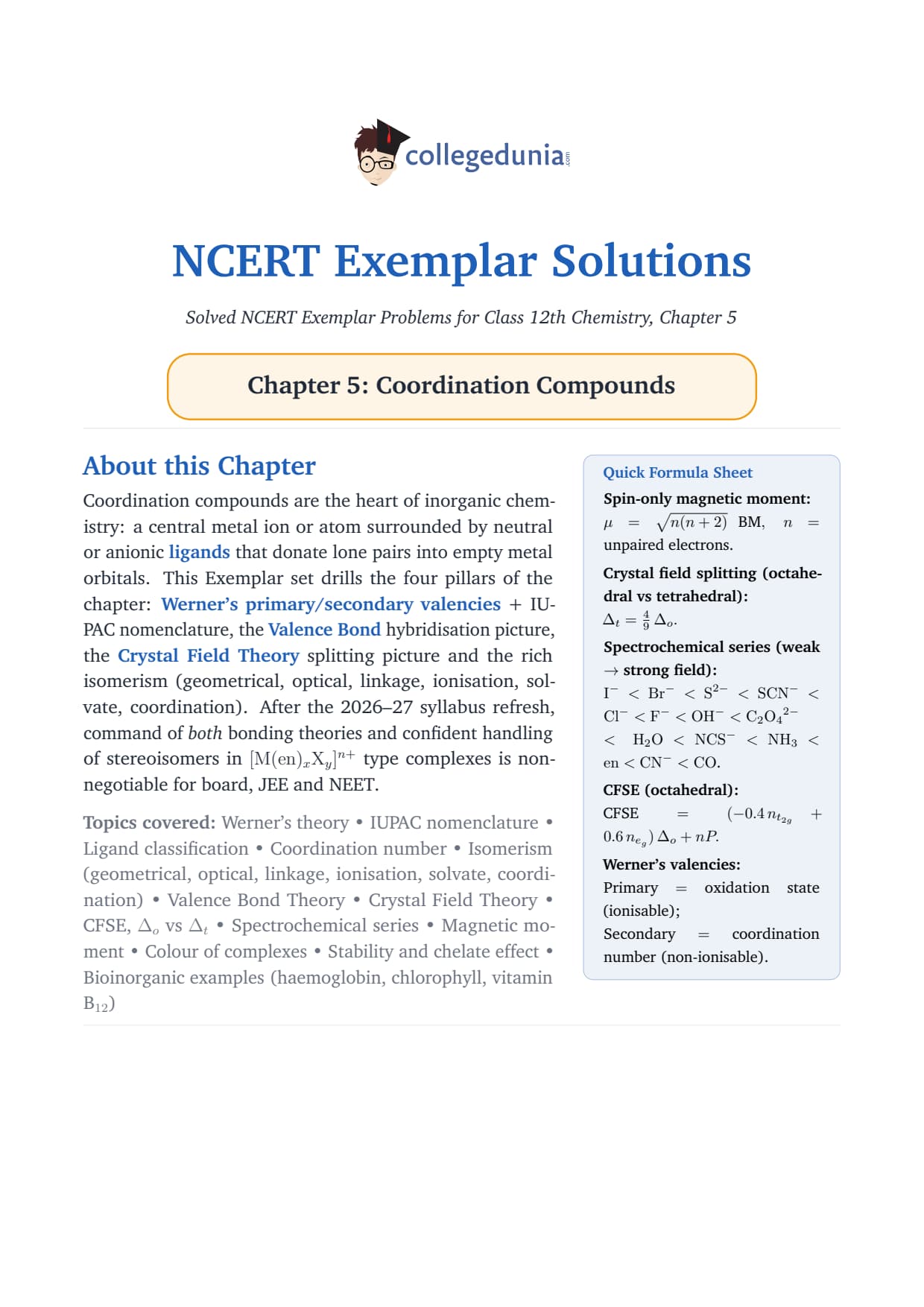
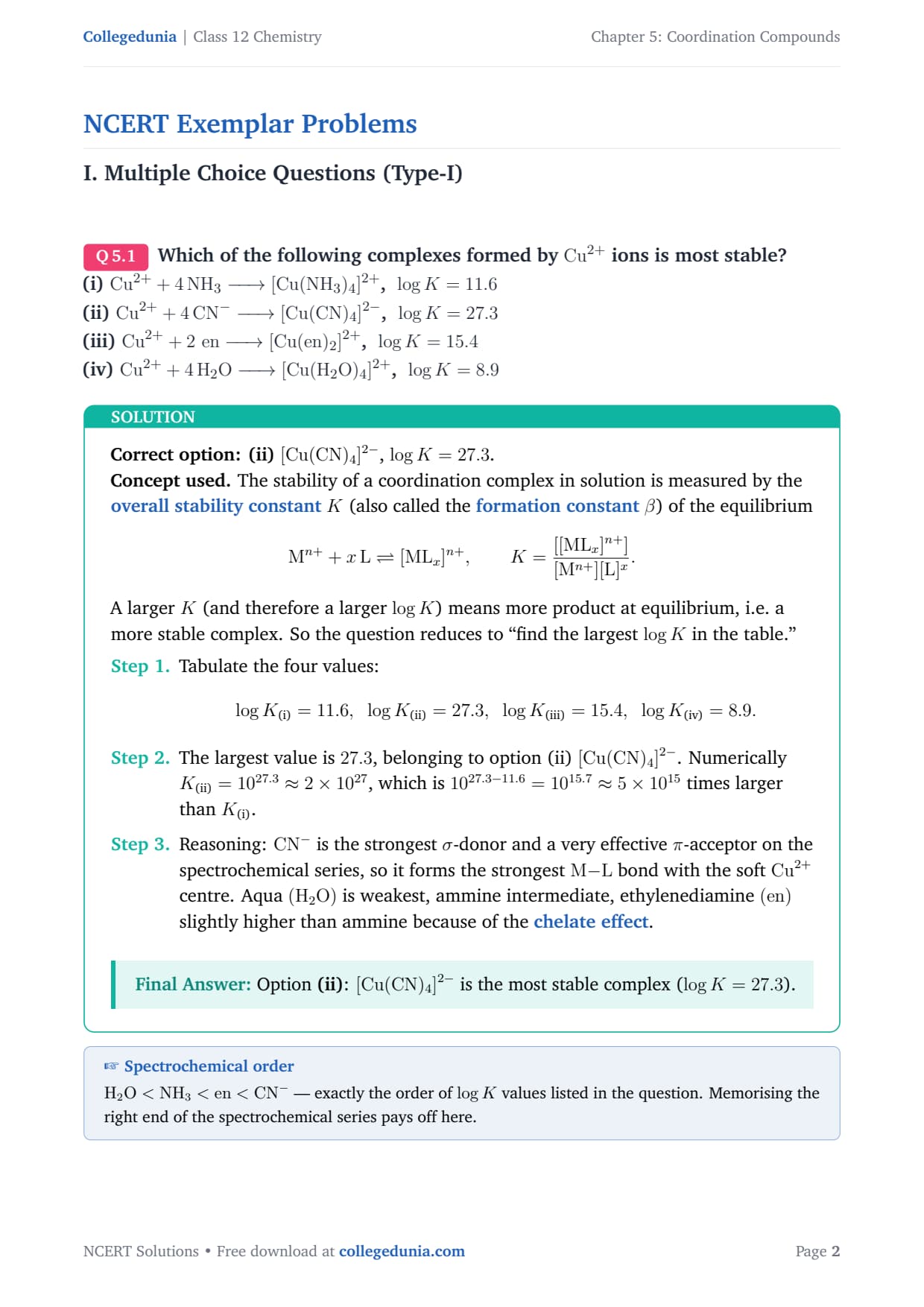
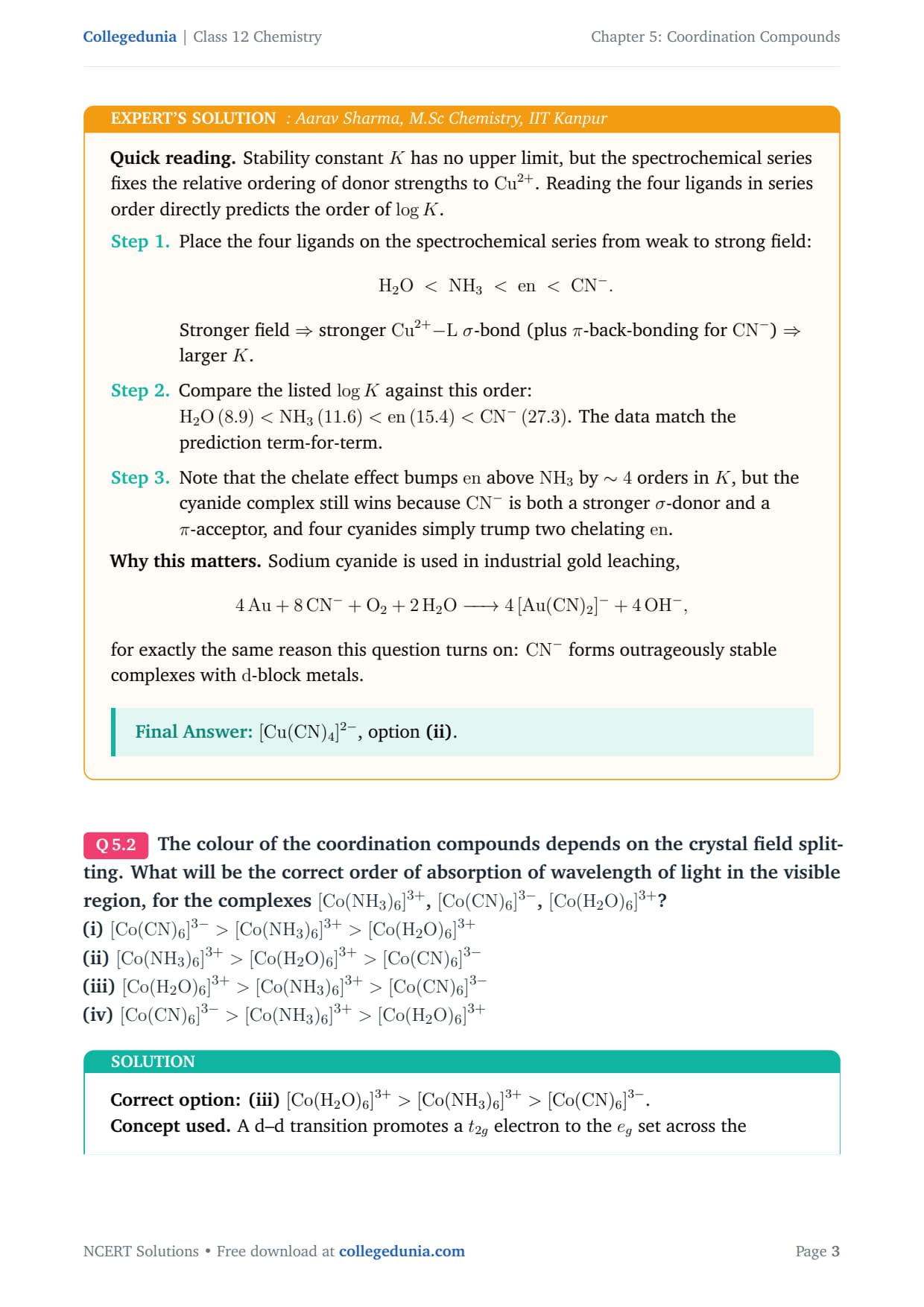
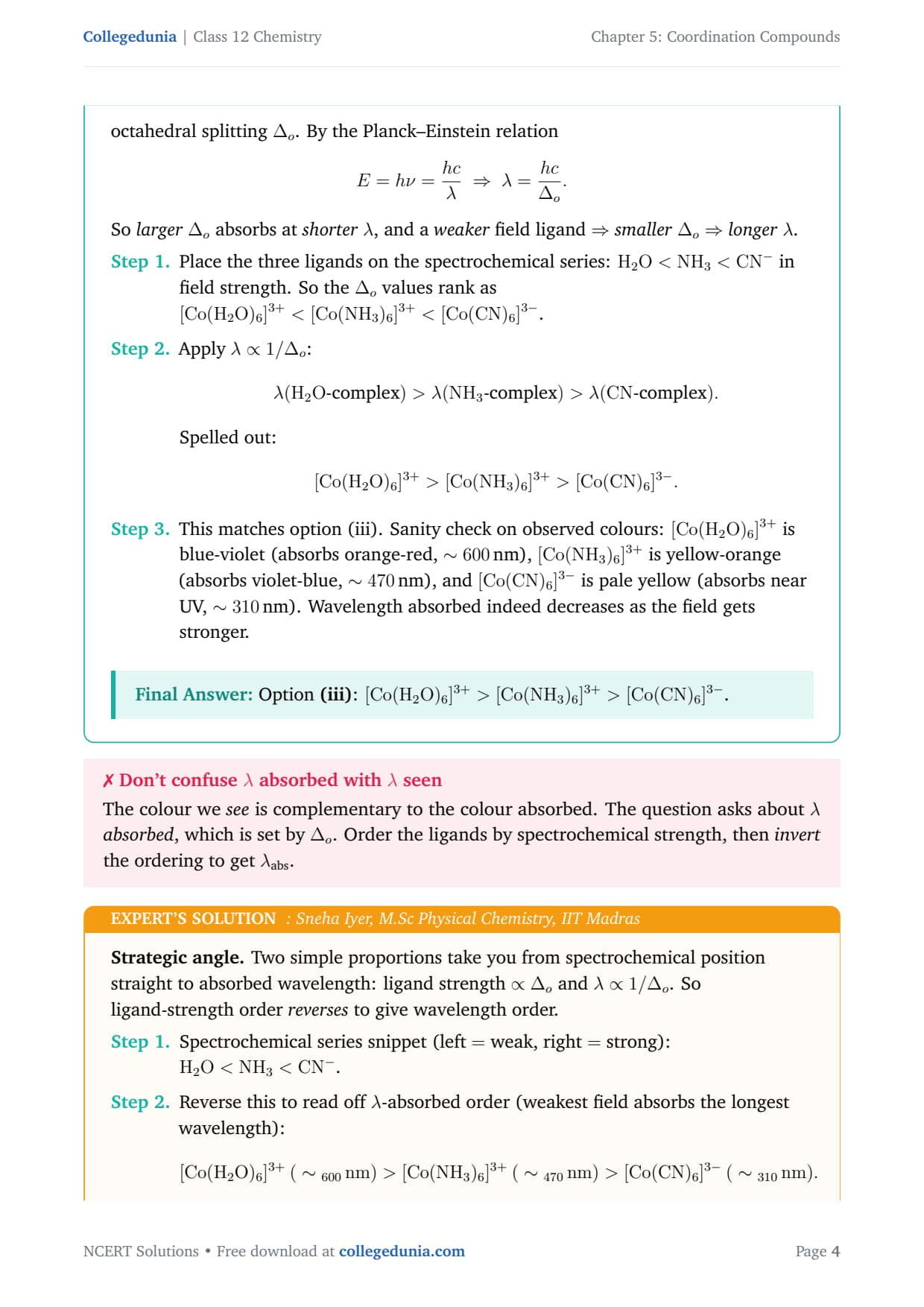
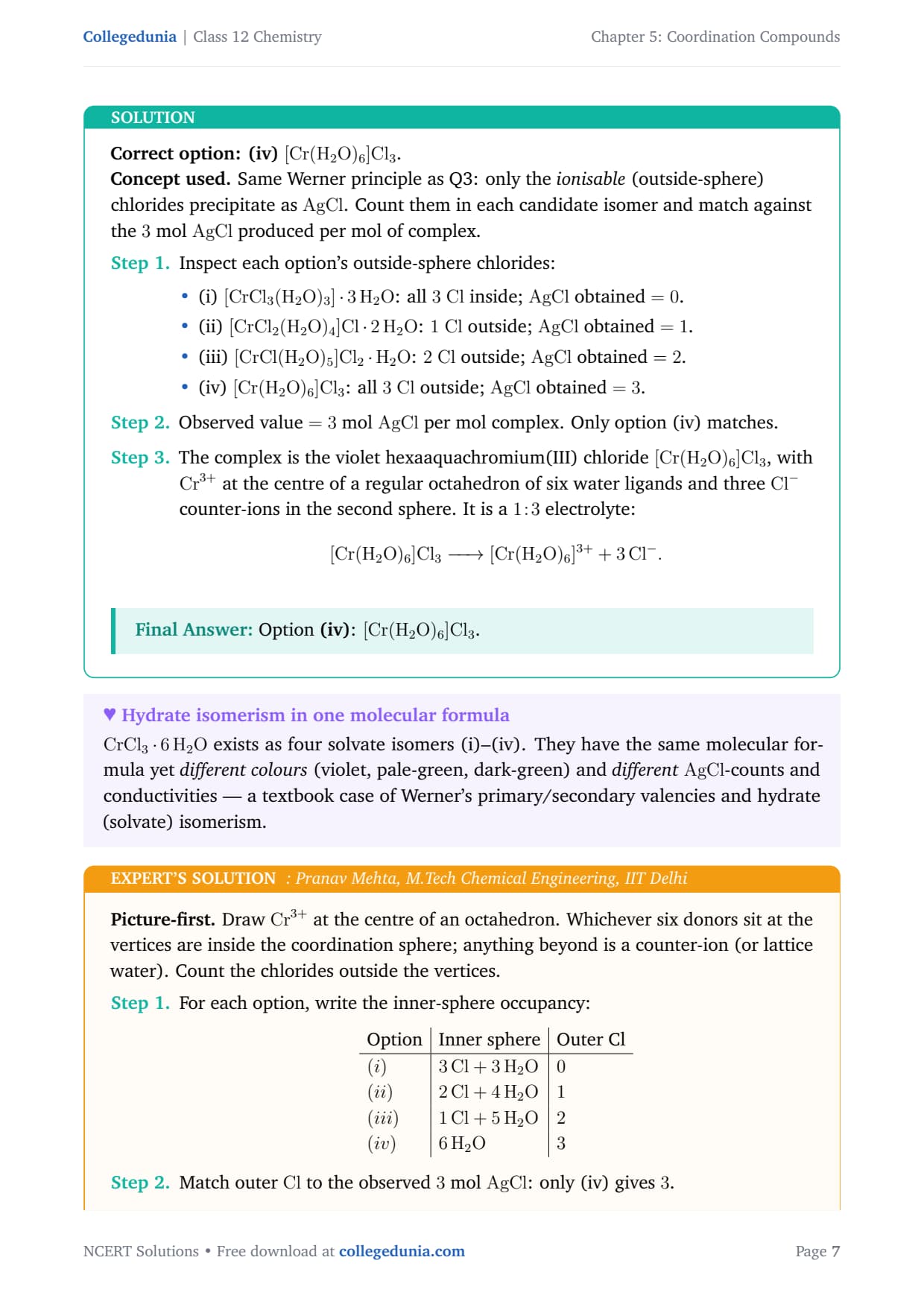
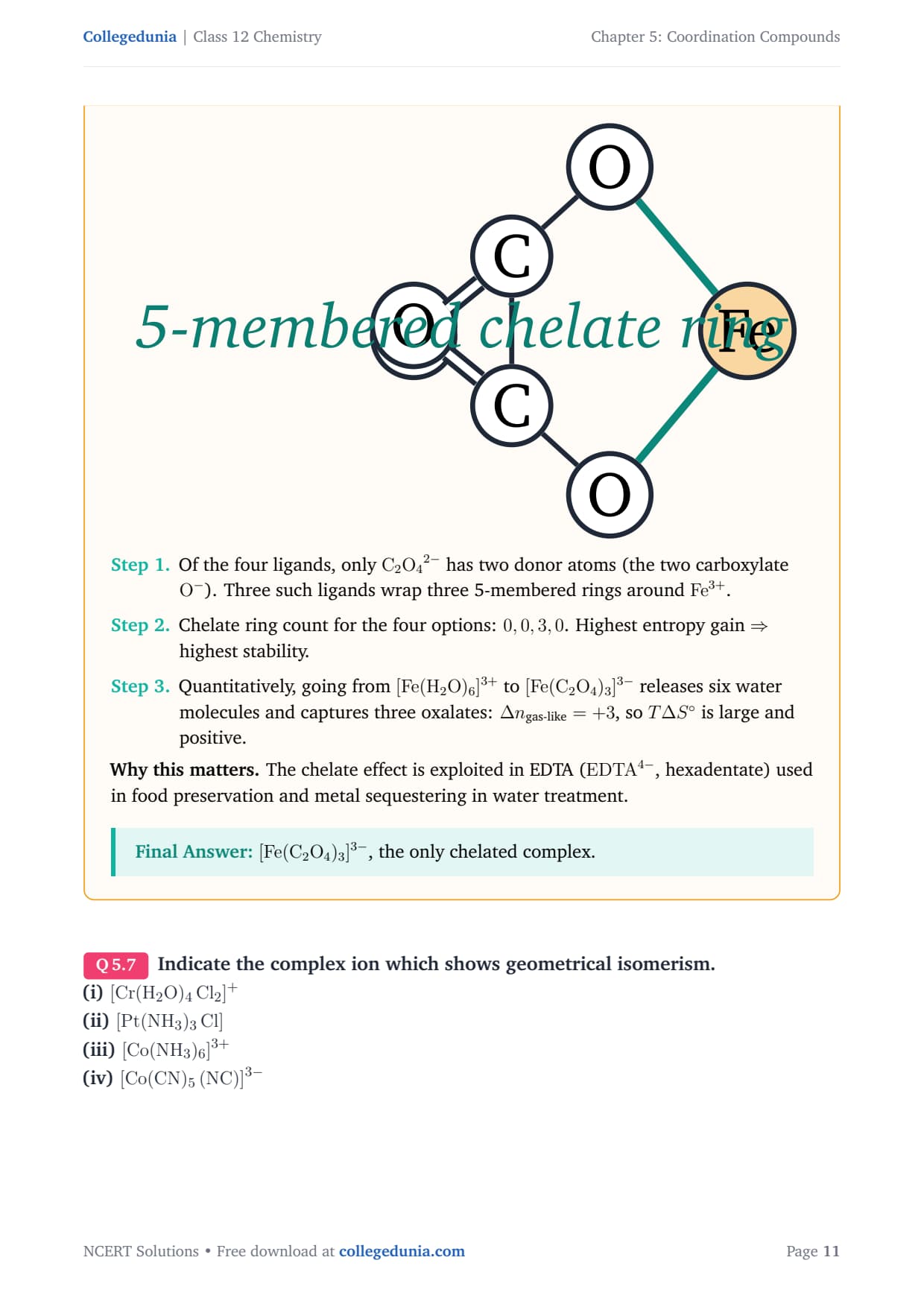
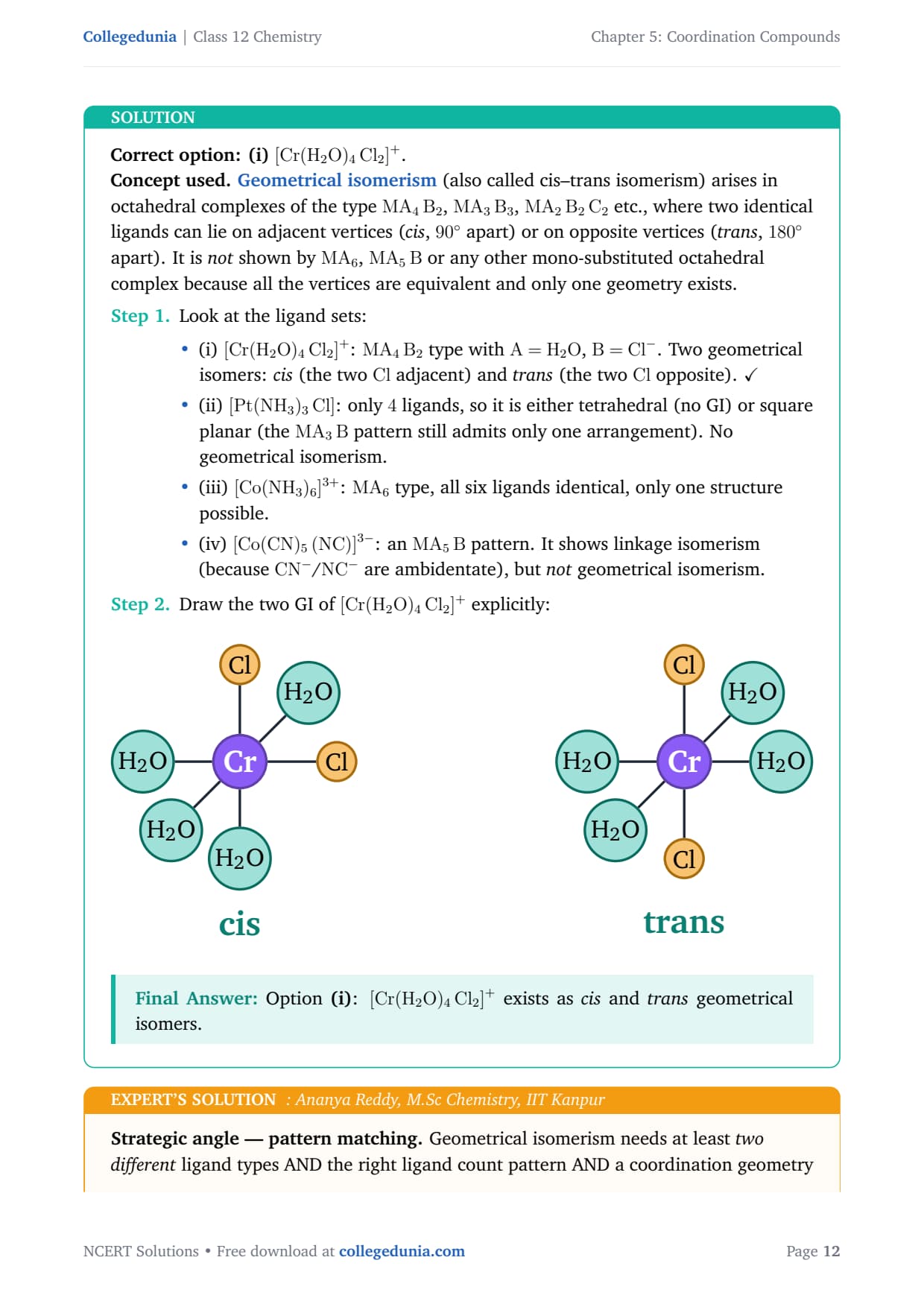
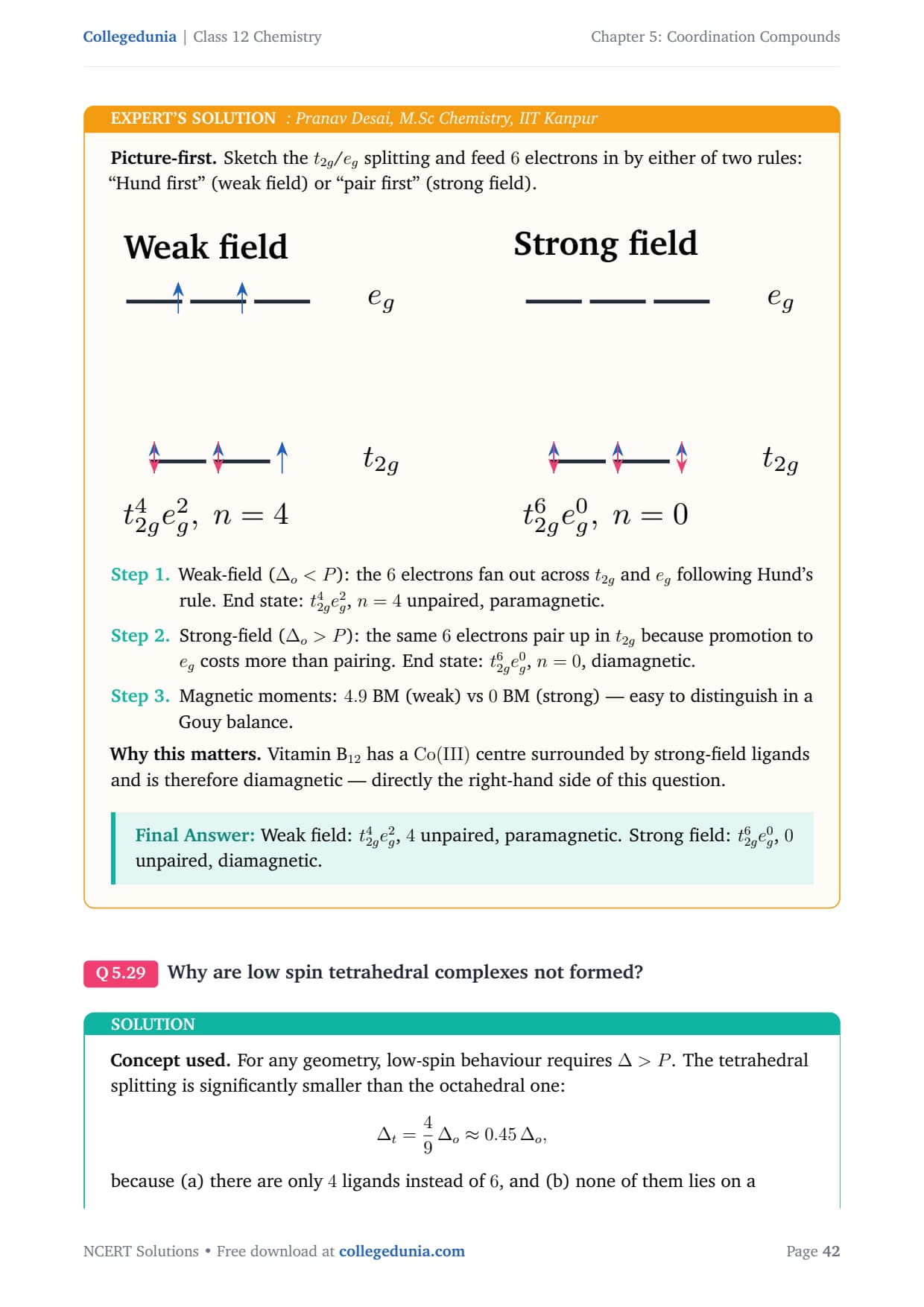
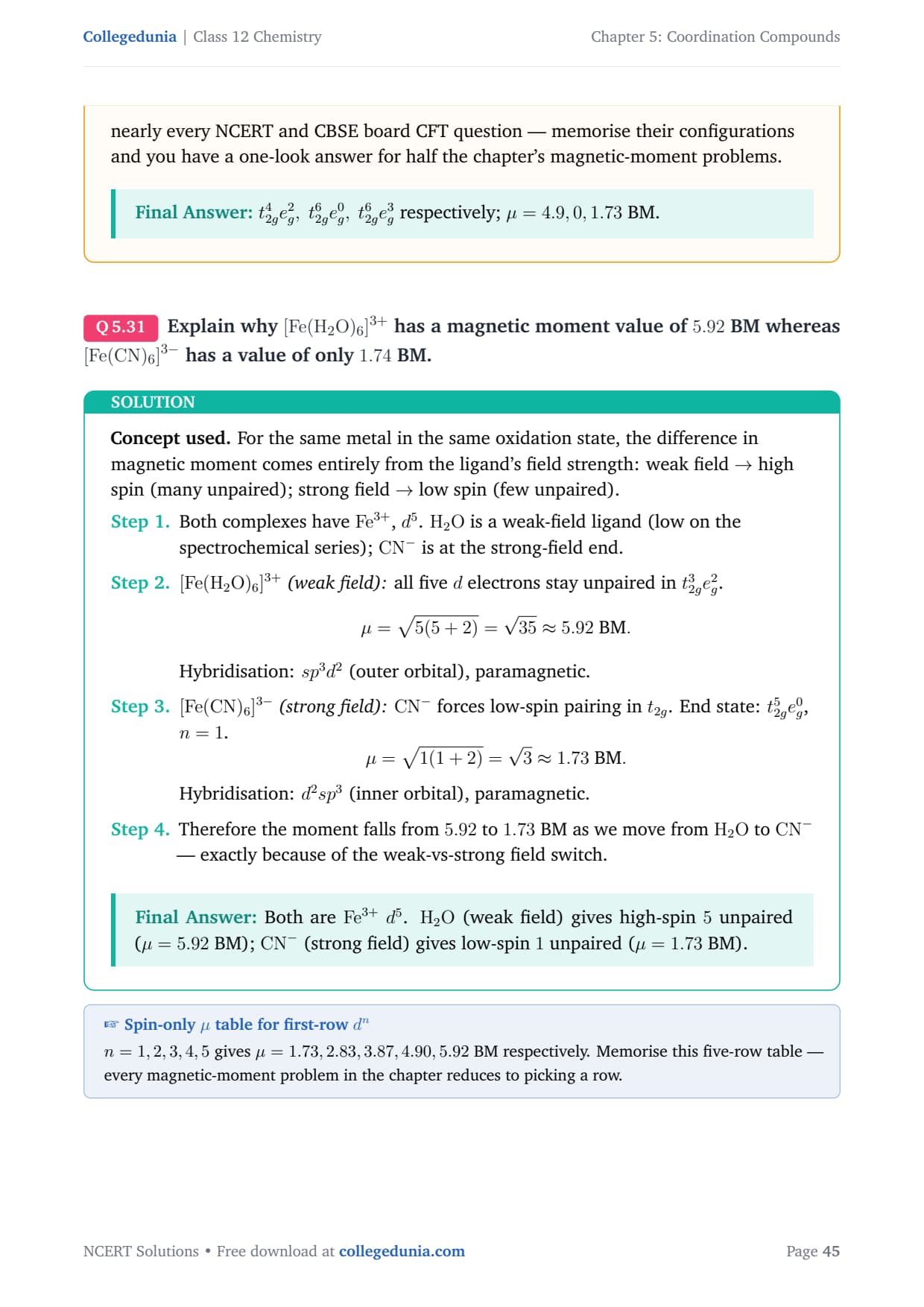
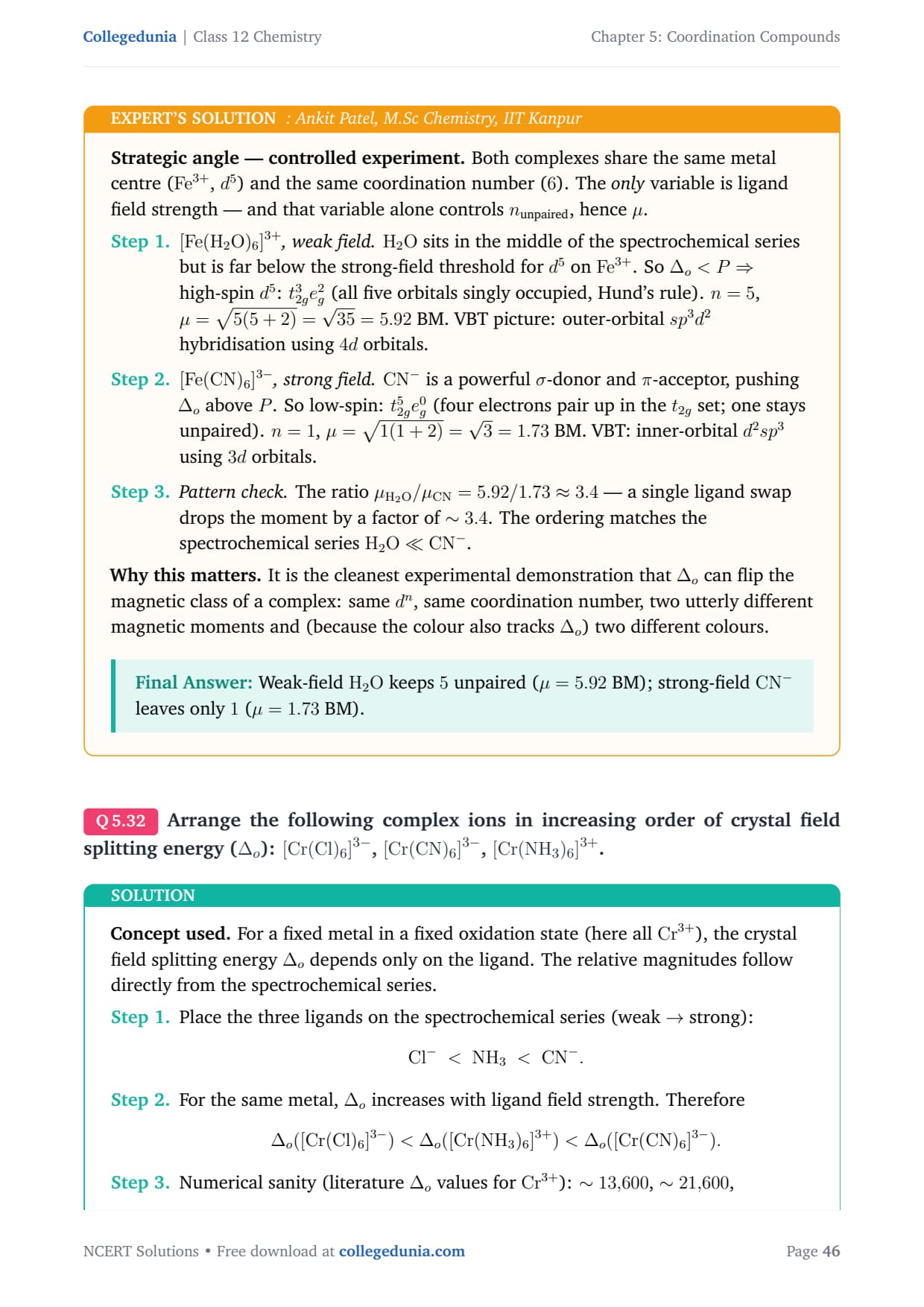
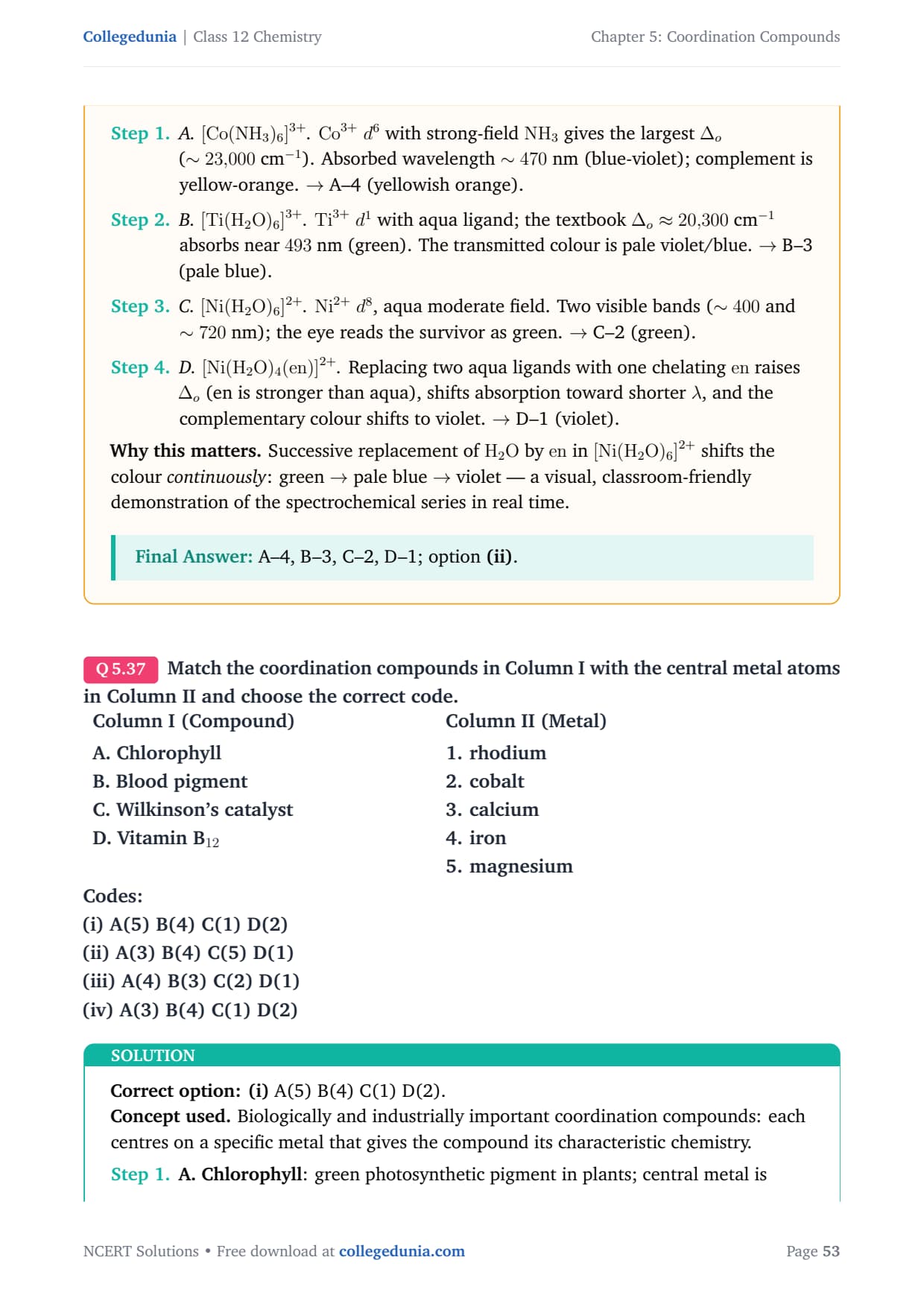
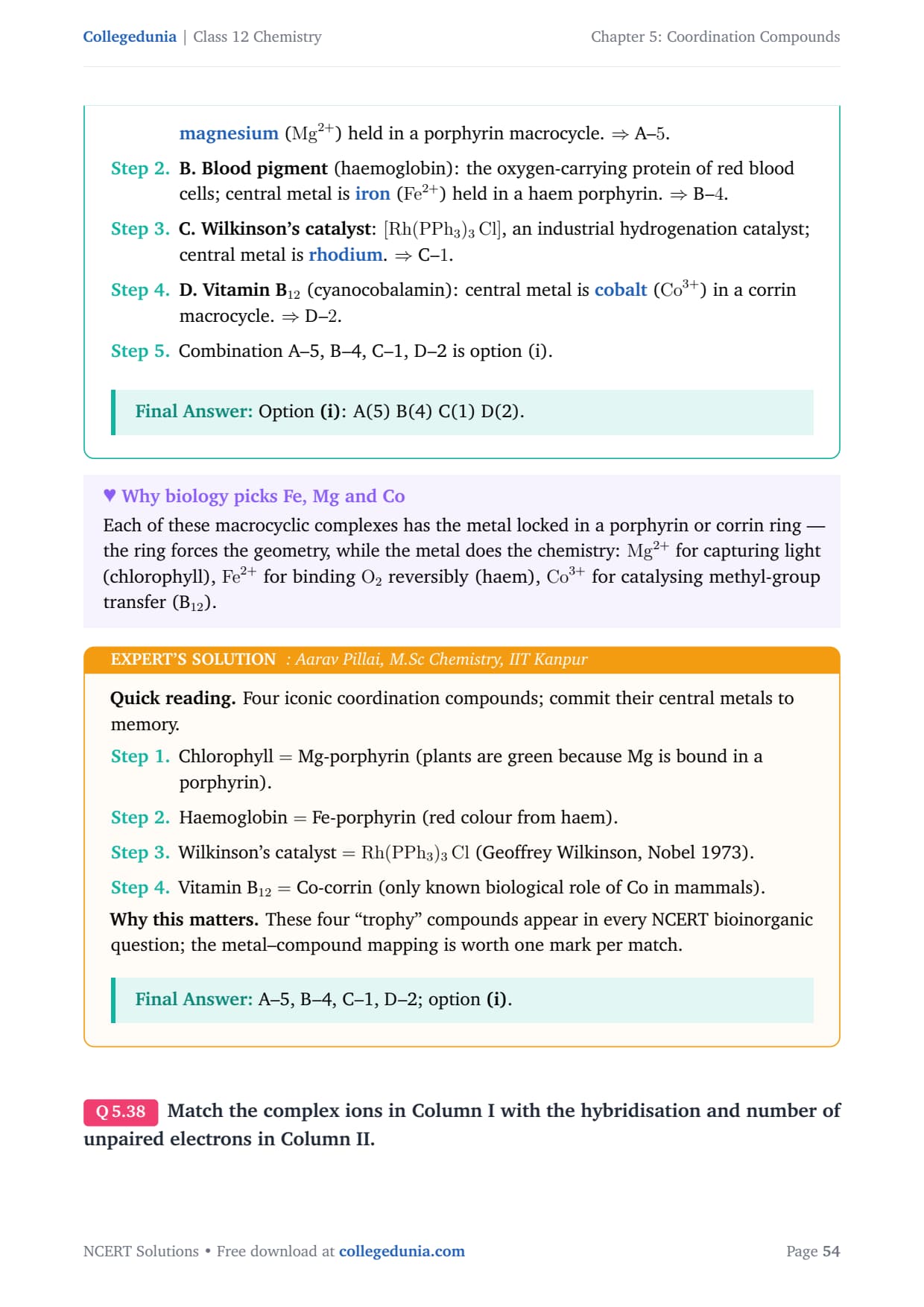
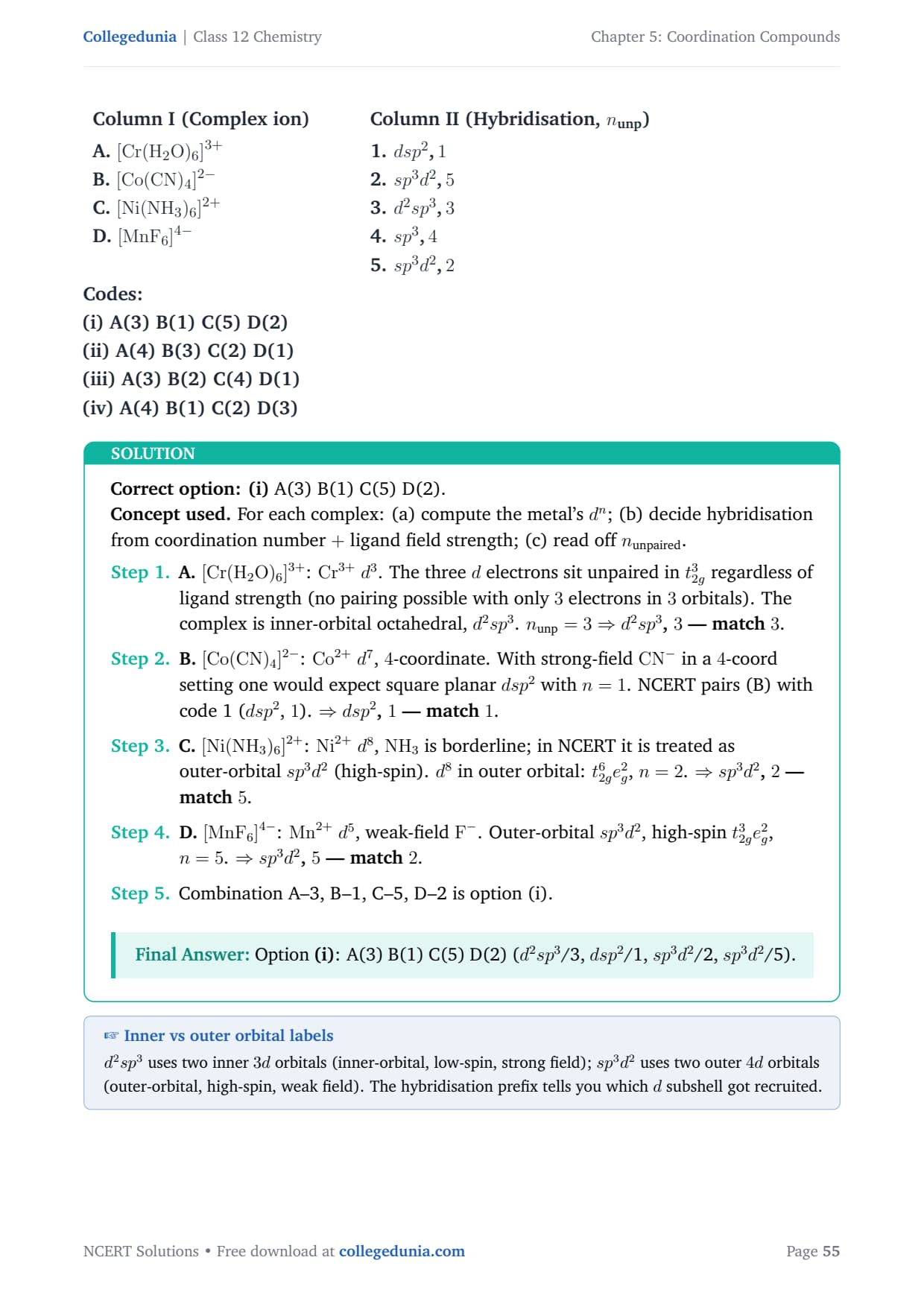
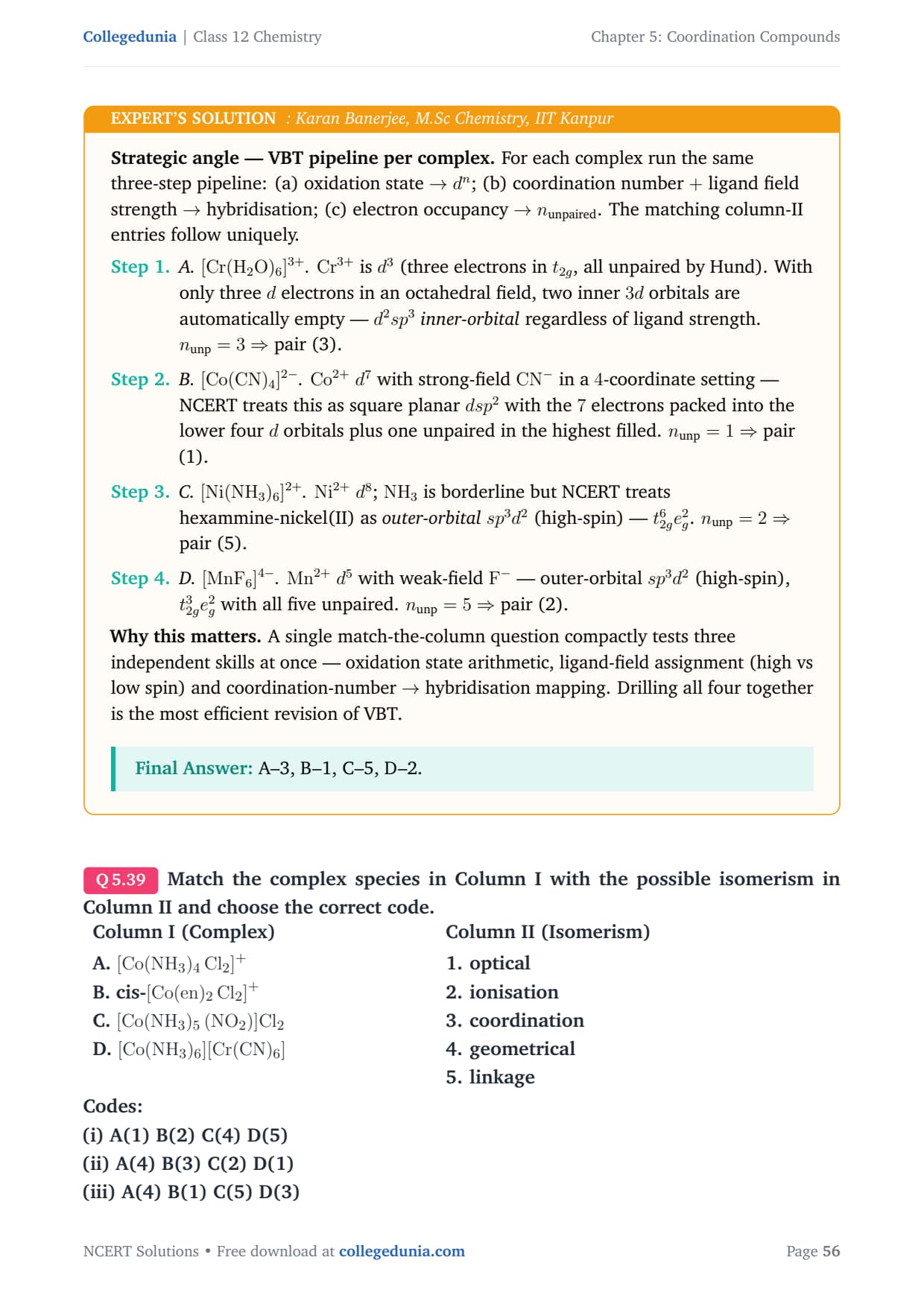
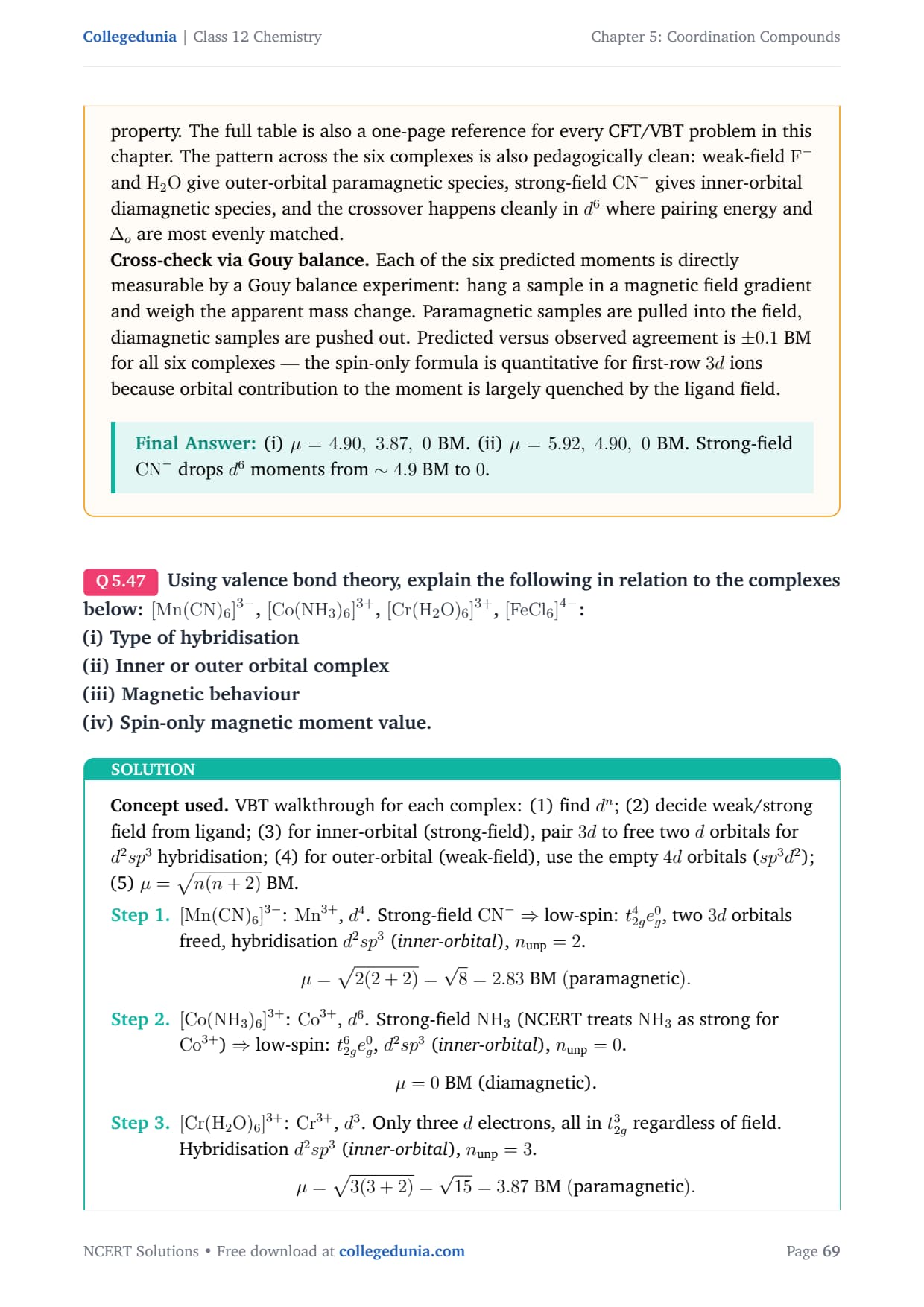
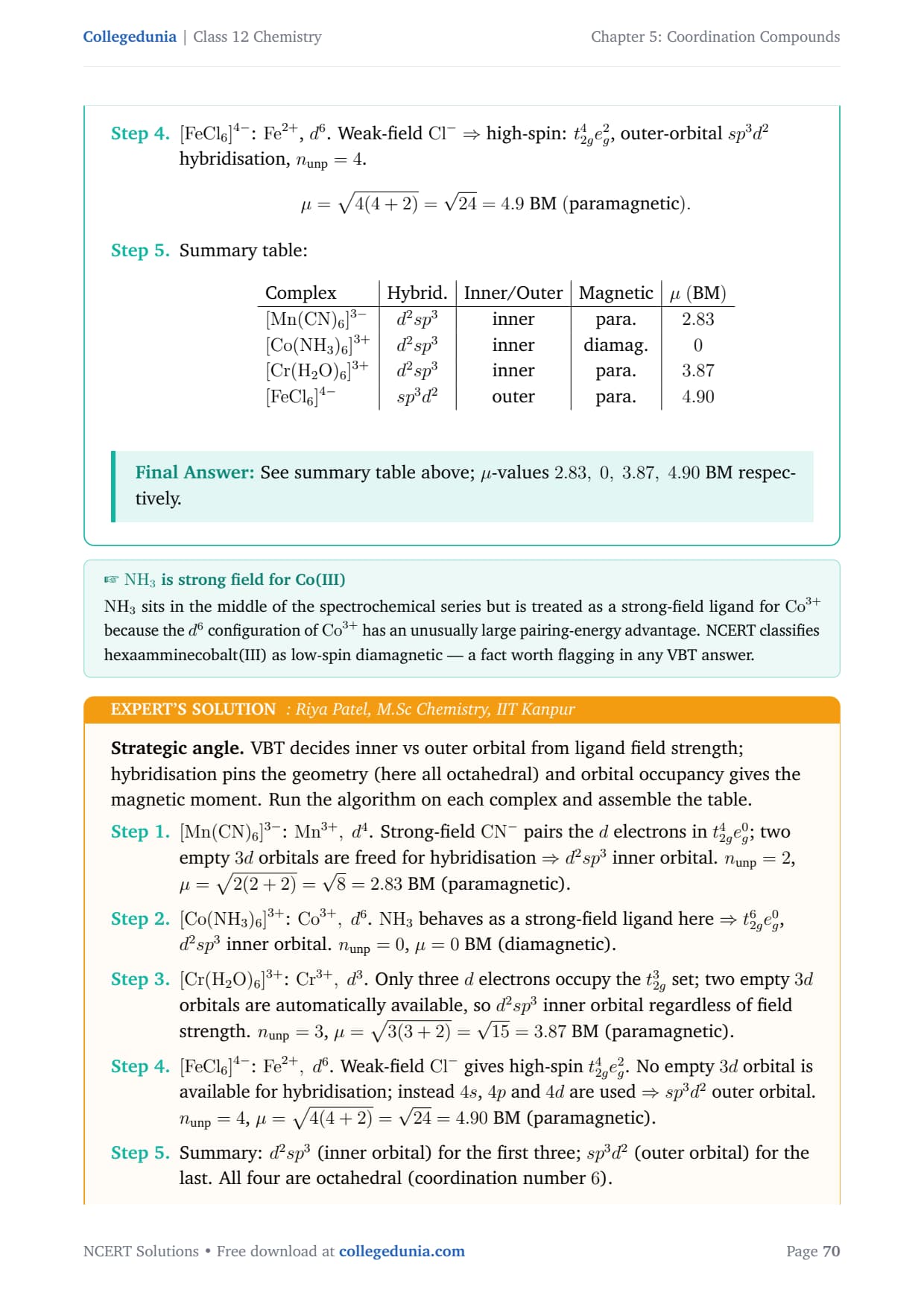
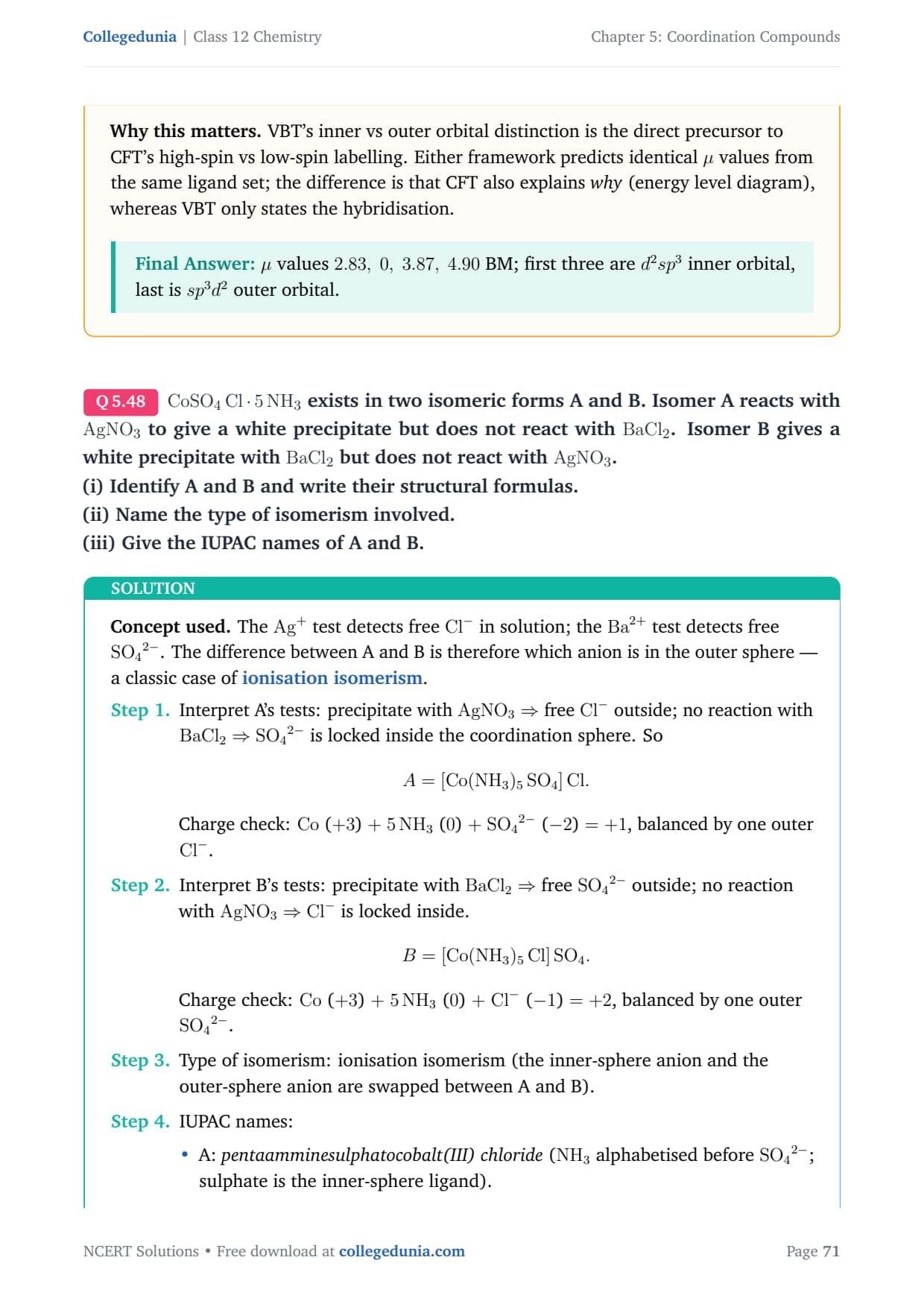
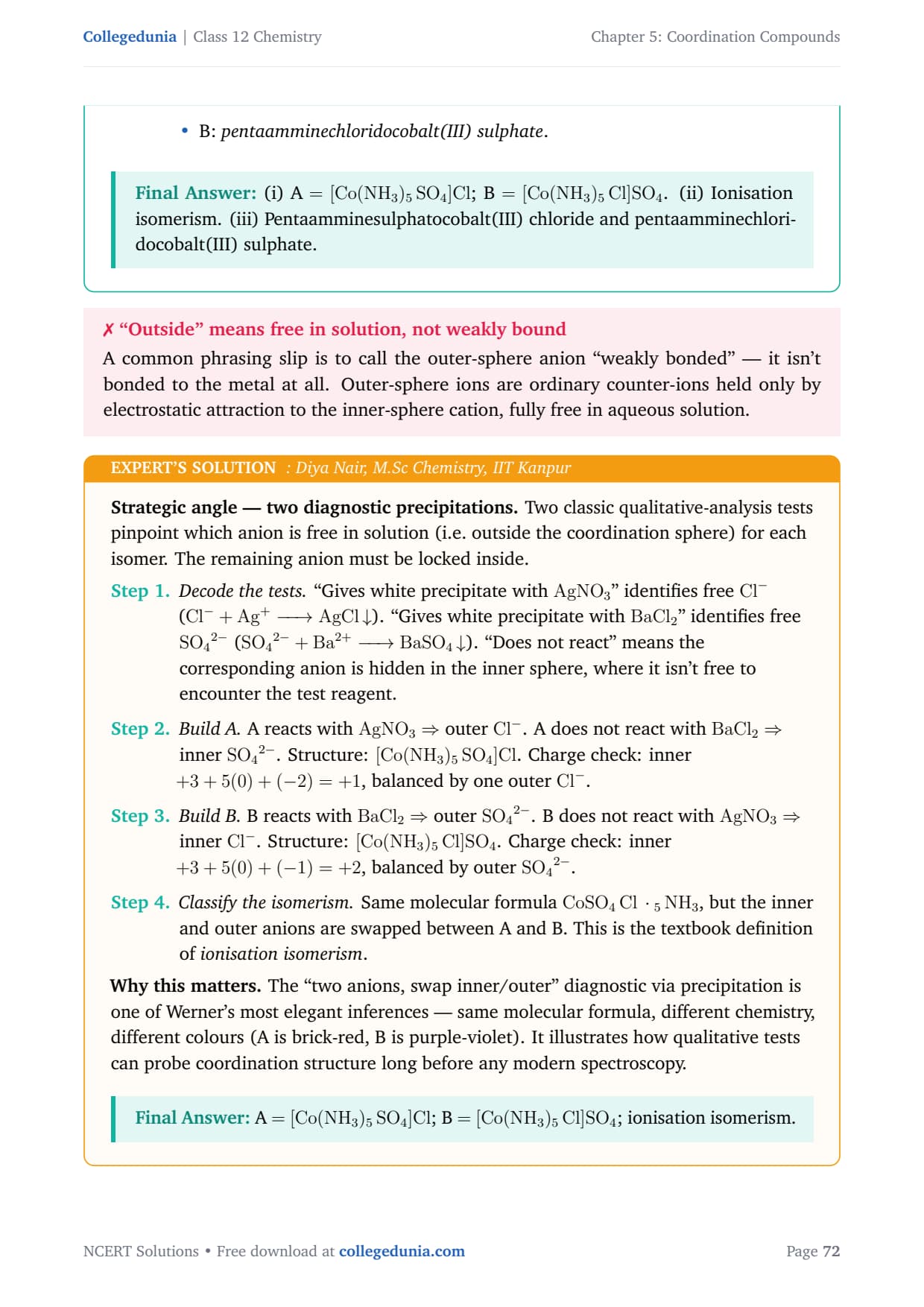
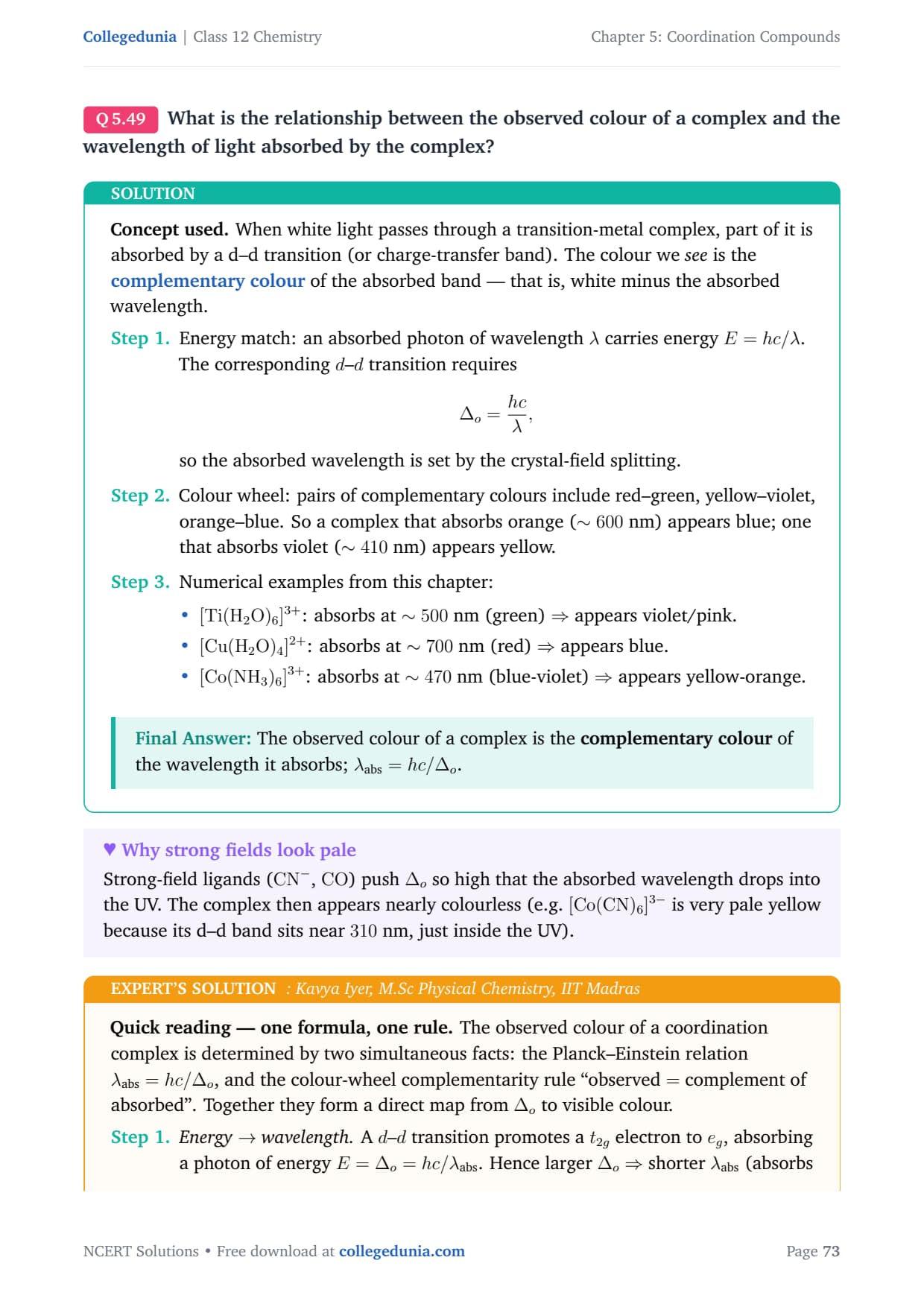
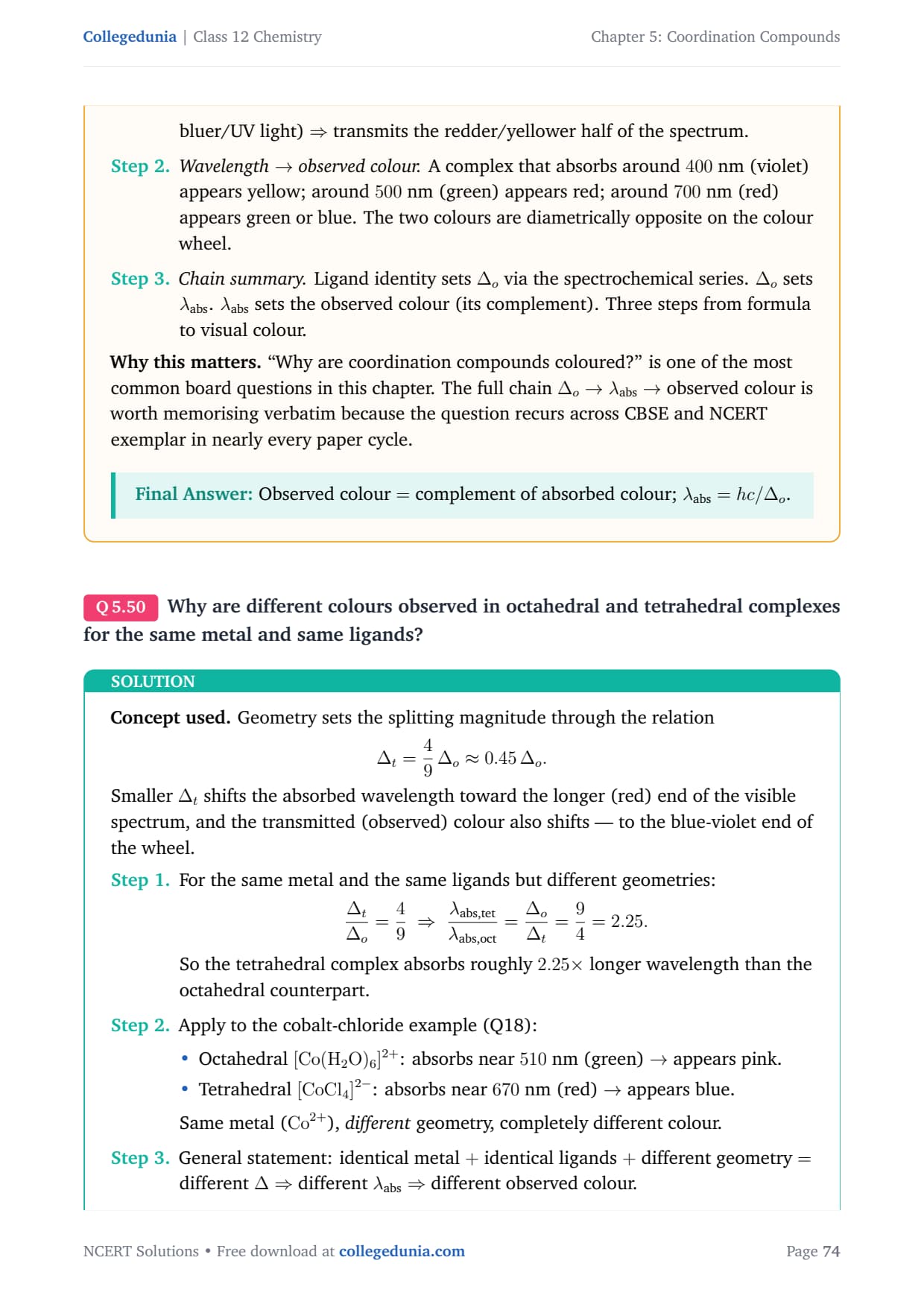
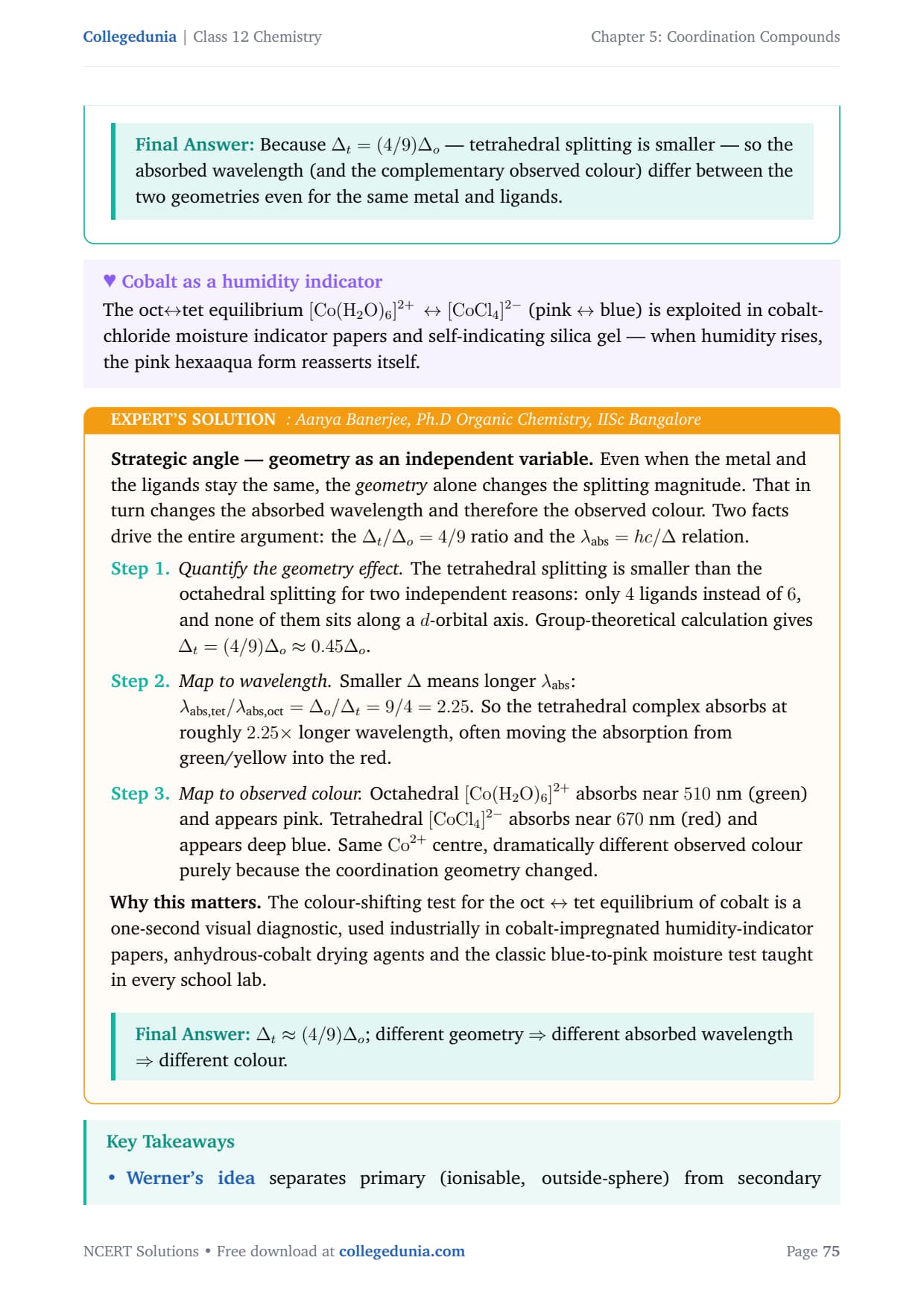
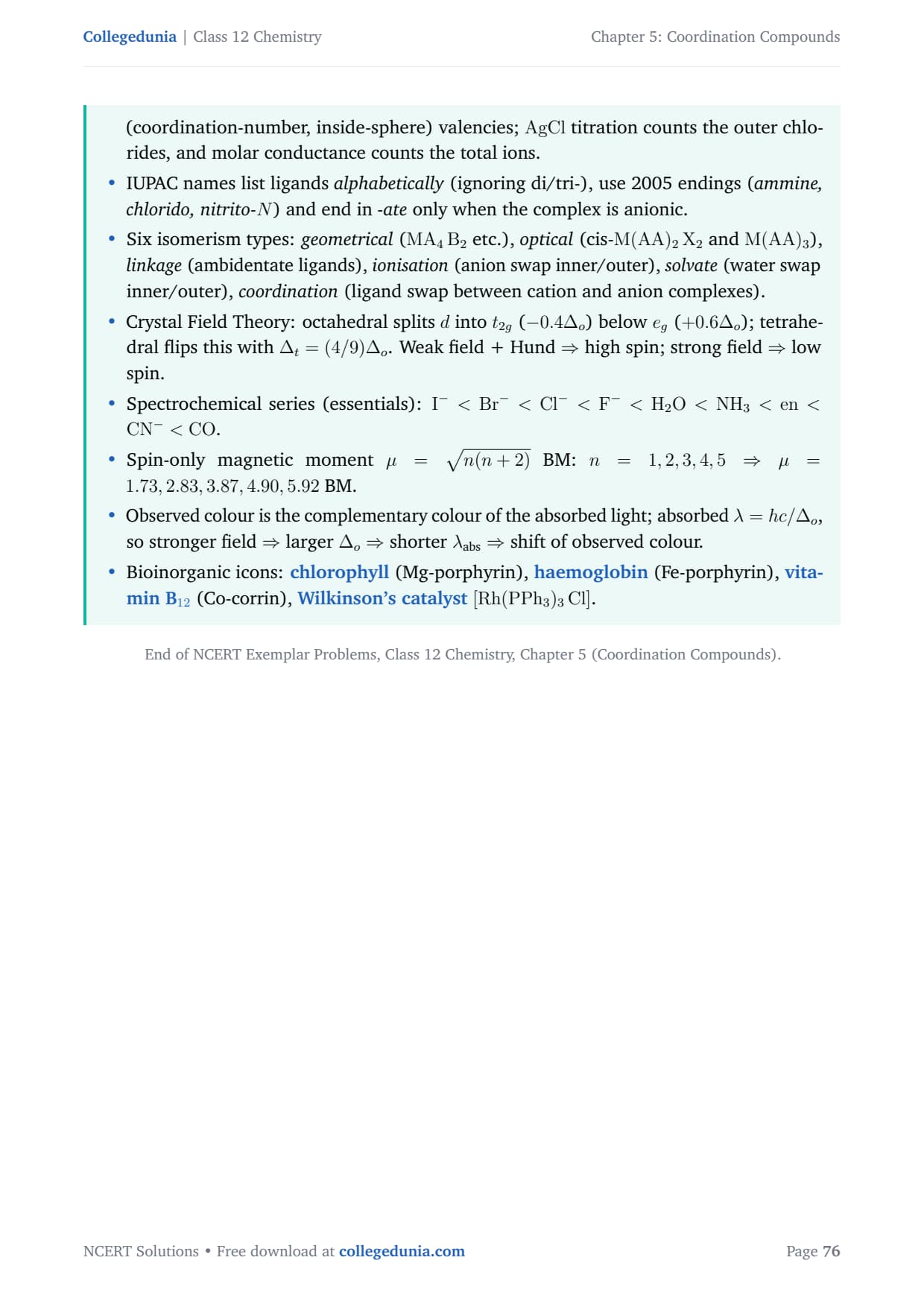
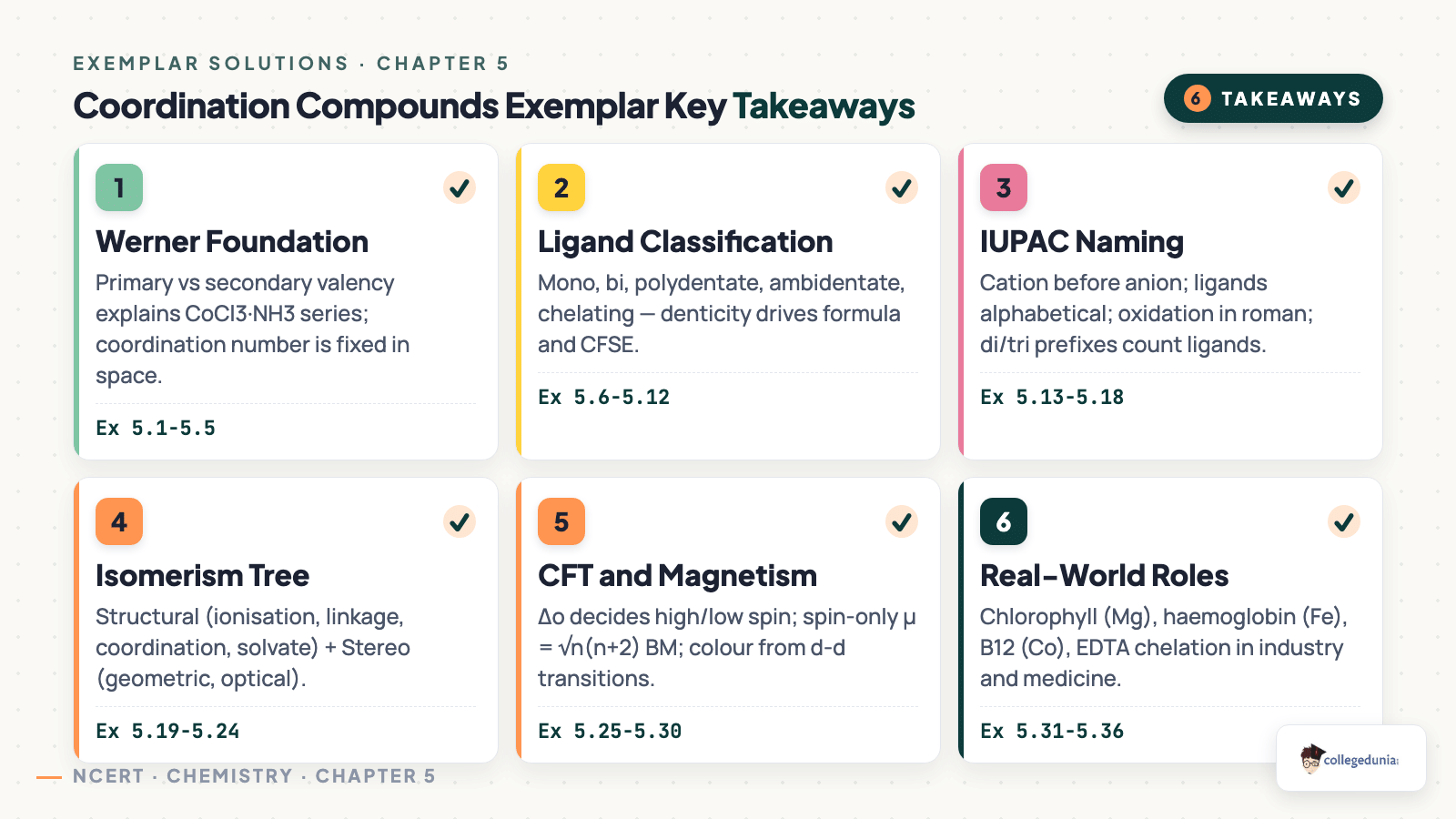



Comments