The Class 12 Chemistry Chapter 4 Exemplar packs 57 problems across five question types, fully intact under the 2026-27 NCERT. This d and f block elements NCERT Exemplar solutions class 12 page works every one with steps.
57 Exemplar Problems · 5 Question Types · 28 Worked Pages · Class 12 Chemistry Chapter 4, 2026-27 NCERT
CBSE Weightage: 6 to 8 marks, usually a 3-mark SA plus a 2-mark VSA.
JEE Main Weightage: 1 to 2 questions per shift on configuration, magnetic moment or colour.
NEET Weightage: 2 to 4 questions per year on oxidation states and lanthanoid contraction.
Topics Covered in the d- and f-Block Elements Class 12 Exemplar Solutions:
D block elements class 12: groups 3-12, four transition series, general configuration.
Electronic configuration of d block: Sc to Zn, plus the Cr-Cu anomaly.
Transition elements properties: atomic radii, ionisation enthalpy, density, melting-point trends.
Variable oxidation states: Mn (+2 to +7) and the +3 stability rule.
Magnetic moment spin-only formula: μ = √n(n+2) BM.
Colour of transition metal compounds: d-d transitions; d0/d10 exceptions.
KMnO4 and K2Cr2O7: preparation routes and redox action.
Lanthanide contraction: La3+ to Lu3+ and its 4f-shielding cause and consequences.
Actinoids vs lanthanoids: oxidation range, radioactivity, 5f shielding.
Each problem gets a plain Solution plus an Expert's Solution that names the rule used. Curated by Collegedunia subject experts and mapped to the 2026-27 NCERT.
How Will Collegedunia's NCERT Exemplar Solutions Help You with the d- and f-Block Elements?
Each of the 57 problems is solved twice: a clean Solution, then an Expert's Solution that names the rule behind every step.
Every Question Type Worked: MCQ-I, MCQ-II, SA, Matching and Assertion-Reason, each with full reasoning.
Concept Named: Aufbau exception, screening, lanthanoid contraction and magnetic moment called out per step.
JEE and NEET Bridge: Items 4.4, 4.18, 4.27 and 4.44 tagged where they reappeared.
2026-27 Aligned: older books number this Chapter 8, but no Exemplar item was dropped.
d- and f-Block Elements Exemplar Step-Up from NCERT Textbook
The Exemplar reframes textbook facts as inference puzzles. Three concrete jumps:
Skill
NCERT Textbook Asks
Exemplar Asks
Electronic configuration
Write the configuration of Cr (Z = 24).
Given an unknown 3d-series element with magnetic moment 5.92 BM, identify it and write its configuration.
Oxidation states
List the common oxidation states of Mn.
Predict whether MnO4- can oxidise Fe2+ at pH 1; justify with E° values.
Lanthanoid contraction
Define lanthanoid contraction.
Explain why Zr and Hf are chemically inseparable and why this affects ore-refining technology.
The shift is from recall to inference, and every Expert's Solution names the rule used.
Exemplar-Specific Common Mistakes in d- and f-Block Elements
Five recurring errors lose 2 to 4 marks per attempt:
Forgetting the Cr and Cu exception: Writing Cr as [Ar] 3d4 4s2 instead of [Ar] 3d5 4s1, or Cu as 3d9 4s2 instead of 3d10 4s1.
Spin-only formula sign error: Using μ = √[n(n+2)] BM with n as the total number of electrons instead of unpaired electrons.
Confusing Ln2+ stability: Picking Eu2+ as unstable; it is one of the rare stable +2 lanthanoids because of half-filled 4f7.
Quoting wrong colour for Ti3+: The aqueous ion is violet, not colourless; the 3d1 configuration enables a d-d transition.
Mixing actinoid and lanthanoid contraction: Both occur, but actinoid contraction is larger per element because 5f shielding is even weaker.
Marker's note: A 2-mark MCQ-II is scored zero even if three options are correct and one is missing. Always cross-check every option before locking your answer.
How Frequently Has the d- and f-Block Elements Chapter Been Asked in CBSE, JEE and NEET
The chapter is a top-three Inorganic scorer. The table maps five years of recurring topics.
Year
CBSE Board
JEE Main
NEET
2025
3-mark SA on lanthanoid contraction consequences
2 questions: magnetic moment of Fe2+, oxidation states of Mn
3 questions: actinoid contraction, KMnO4 prep, colour of Cu2+
2024
5-mark LA on K2Cr2O7 manufacture and acidic-medium oxidation
1 question: electronic configuration of Cu+
2 questions: spin-only magnetic moment, Ln3+ stability
Best Way to Use the d- and f-Block Elements Exemplar for JEE and NEET Prep
A time-boxed pass by question type beats reading all 57 back-to-back. A first-pass budget:
Question Type
Items
Time per Problem
Total Budget
MCQ-I (single correct)
4.1 to 4.21
1 to 2 min
~35 min
MCQ-II (multiple correct)
4.22 to 4.31
3 to 4 min
~35 min
SA (2 to 3 marks)
4.32 to 4.49
4 to 6 min
~85 min
Matching Type
4.50 to 4.54
5 to 6 min
~28 min
Assertion-Reason / LA
4.55 to 4.57
6 to 8 min
~22 min
That is about 3 hours 25 minutes for a clean first pass, plus a 90-minute revision pass.
All NCERT Exemplar Questions for The d- and f-Block Elements with Step-by-Step Solutions
Every Class 12 Chemistry Chapter 4 d- and f-Block Elements Exemplar question is below. Click Check Solution for the steps, or Expert Solution for the expanded explanation.
I. Multiple Choice Questions (Type-I)
Q 4.1
Electronic configuration of a transition element X in +3 oxidation state is [Ar] 3d5. What is its atomic number?
(i) 25
(ii) 26
(iii) 27
(iv) 24
Correct option: (ii) 26.
Concept used. A neutral transition atom X has electronic
configuration [Ar] 3dx4sy. When it forms Xn+,
electrons are removed first from the outer 4s orbital, then from
the inner 3d orbital. So
electrons in X3+ = Z - 3,
where Z is the atomic number of X. Argon (Ar) has 18
electrons, so the [Ar] 3d5 ion holds 18+5 = 23
electrons.
Count the electrons in X3+:
n(X3+) = 18 (from Ar core) + 5 (from 3d5) = 23.
Restore the three lost electrons to obtain the neutral atom:
Z = n(X) = n(X3+) + 3 = 23 + 3 = 26.
Identify the element: Z = 26 is iron (Fe). The neutral
atom is [Ar] 3d64s2 (lose 2× 4s and
1× 3d to land at [Ar] 3d5, the half-filled
stable Fe3+). Check: Fe3+ is indeed
[Ar] 3d5.
Atomic number of X is 26, i.e. iron (Fe); option (ii).
AS
Aarav Sharma
M.Sc Chemistry, IIT Kanpur
Verified Expert
Backward count angle. Start from the ion's electron tally and
work back; this avoids confusing yourself with the neutral
configuration.
Concept used. Total electron count of a cation equals
Z - q where q is the positive charge. For X3+ to be
[Ar]3d5, the ion has 18+5 = 23 electrons, hence
Z = 23 + 3.
Tally electrons in [Ar]3d5:
Ar contributes 18; 3d5 contributes 5;
total = 23.
Cation charge is +3, so
Z = 23 + 3 = 26.
Cross-check with the periodic table: Z=26 is Fe,
whose common +3 oxidation state has the half-filled 3d5
configuration (which is itself extra stable by exchange-energy).
That stability is precisely why Fe3+ shows up so often.
Why this matters. The same logic decodes any cation: e.g.
``which ion is [Ar]3d6 with +2 charge?'' ⇒Z = 24+2 = 26 (Fe2+).
Z = 26, iron; option (ii).
Q 4.2
The electronic configuration of Cu(II) is 3d9 whereas that of Cu(I) is 3d10. Which of the following is correct?
(i) Cu(II) is more stable
(ii) Cu(II) is less stable
(iii) Cu(I) and Cu(II) are equally stable
(iv) Stability of Cu(I) and Cu(II) depends on nature of copper salts
Correct option: (i)Cu(II) is more stable.
Concept used. The stability of a metal ion in aqueous
solution is decided not only by its gas-phase electron configuration
but also by the hydration enthalpyhydH.
A more highly charged, smaller cation is hydrated far more
exothermically. For copper,
hydH(Cu2+) ≈ -2100 kJ/mol,
hydH(Cu+) ≈ -582 kJ/mol.
The difference of ∼ 1500 kJ/mol swamps the second
ionisation energy needed to make Cu2+ from Cu+.
Write the disproportionation reaction in water:
2 Cu+(aq) -> Cu2+(aq) + Cu(s).
This reaction is spontaneous: E∘cell
= E∘(Cu+/Cu) - E∘(Cu2+/Cu+)
= 0.52 - 0.16 = +0.36 V > 0.
Apply the thermodynamic identity:
rG∘ = -nFE∘ = -(1)(96485)(0.36)
= -34.7 kJ/mol < 0.
So Cu+ disproportionates in water, leaving
Cu2+ as the stable species.
Compare to the gas-phase argument: 3d10 (closed shell)
looks more stable than 3d9, which would predict Cu+
favoured. But the high hydH of Cu2+
flips the order in solution. Hence option (i) is correct.
In aqueous medium Cu(II) is more stable than Cu(I); option (i).
PI
Priya Iyer
Ph.D Organic Chemistry, IISc Bangalore
Verified Expert
Thermochemical-cycle angle. The cleanest justification is a
Born–Haber-style cycle around the disproportionation
2Cu+ -> Cu2+ + Cu.
Concept used. The free energy of the disproportionation in
aqueous solution can be decomposed into IE2 (cost to make
Cu2+ from Cu+) and hydration plus lattice/atomisation
terms; the hydration of Cu2+ dominates.
Estimate the energy bookkeeping (per mole of Cu+
disproportionated):
IE2(Cu) ≈ +1958 kJ/mol,
hydH(Cu2+) - 2hydH(Cu+)
≈ -2100 - 2(-582) = -936 kJ/mol,
atomisation gain on plating out Cu(s)≈ -338 kJ/mol.
Net ≈ 1958 - 936 - 338 = +684 kJ/mol for
IE–hydration–atomisation alone.
This rough count would predict Cu+ stable, but the
full free-energy difference (electrochemistry, E∘cell
= +0.36 V ⇒ Δ G∘ = -34.7 kJ/mol)
shows the reaction is actually spontaneous; refined hydration
and entropic terms tip the balance toward Cu2+.
Conclusion: in water, Cu+ is unstable; in the
gas phase or in poorly-coordinating media (e.g. inside
Cu2Cl2), Cu+ survives.
Solid-vs-solution contrast
This is why Cu2O and Cu2Cl2 (solid, low coordination
to water) are stable cuprous species, but dissolving them in water
produces Cu2+ and metallic Cu. The reaction is famous as
the disproportionation of Cu+.
Cu(II) is more stable in aqueous medium; option (i).
Q 4.3
Metallic radii of some transition elements are given below. Which of these elements will have highest density?
tabularlcccc
Element & Fe & Co & Ni & Cu
Metallic radii/pm & 126 & 125 & 125 & 128
tabular
(i) Fe
(ii) Ni
(iii) Co
(iv) Cu
Correct option: (iv) Cu.
Concept used. For a metal that crystallises in a close-packed
lattice, density scales as
ρ = ZMNA Vcell, Vcell ∝ r3,
where Z is atoms per unit cell, M is atomic mass, r is metallic
radius and Vcell is unit-cell volume. With the four
elements packing in essentially the same lattice and Z, NA the
same, density is driven by the ratio M/r3. A larger atomic mass
and a smaller radius both push density up.
Compute the proxy M/r3 (in g mol-1/pm3,
absolute scale irrelevant since we only compare):
Fe: 55.85/1263=2.79× 10-5,
Co: 58.93/1253=3.02× 10-5, Ni: 58.69/1253=3.01× 10-5,
Cu: 63.55/1283=3.03× 10-5.
The largest proxy is for Cu, consistent with the
observed densities (g/cm3):
Fe=7.87, Co=8.90, Ni=8.91, Cu=8.95.
Cu wins because its ∼ 8% heavier mass outweighs its
∼ 2.4% larger radius.
Copper has the highest density; option (iv).
VP
Vivaan Patel
M.Tech Chemical Engineering, IIT Delhi
Verified Expert
Mass-vs-radius angle. Density is a tug of war between mass
(numerator) and volume (denominator). Among the four, Cu's mass jumps
∼ 8% over Ni; its radius grows only ∼ 2.4%. The cube on
r amplifies the radius change, but the mass jump still wins.
Concept used. For atoms of comparable size and packing,
density tracks M/r3. A factor of (1+M)/(1+r)3
≈ 1 + M - 3r summarises a small change in
mass and radius.
Take Cu over Ni: M = (63.55-58.69)/58.69 = 0.0828
and r = (128-125)/125 = 0.024.
1 + 0.0828 - 3(0.024) = 1.011,
so density should rise by ∼ 1.1% from Ni (8.91) to
∼ 9.01. Observed ρ(Cu)=8.95 g/cm3 –
close enough given that crystal structure also matters
(Cu is fcc, Ni is fcc, Co is hcp, Fe is bcc/α).
Reject (i) Fe (largest radius, lightest of the heavy three).
Reject (ii) Ni and (iii) Co – nearly identical to each
other but Cu still beats both because of its extra mass.
Exam shortcut
For 3d-series ``which has highest density'' questions, the answer is
almost always the heaviest of the late 3d metals (Cu, Ni, Co cluster
near 8.9 g/cm3; Cu just edges them out at 8.95).
Cu has the highest density; option (iv).
Q 4.4
Generally transition elements form coloured salts due to the presence of unpaired electrons. Which of the following compounds will be coloured in solid state?
(i) Ag2SO4
(ii) CuF2
(iii) ZnF2
(iv) Cu2Cl2
Correct option: (ii)CuF2.
Concept used. The colour of a transition-metal compound
arises from d–d electronic transitions: visible-light
photons promote an electron from a lower-energy d orbital (t2g
or eg depending on geometry) to a higher one. This is only possible
when the metal ion has partly filledd orbitals (one or more
unpaired electrons, or at least a vacant d orbital to receive an
electron). Closed-shell ions (d0 or d10) cannot show d–d
transitions; they are usually colourless unless charge-transfer bands
fall in the visible.
Identify the metal-ion configuration in each option:
Ag2SO4: Ag+ is [Kr] 4d10
– closed shell. Colourless.
CuF2: Cu2+ is [Ar] 3d9
– one unpaired electron. Coloured (blue).
ZnF2: Zn2+ is [Ar] 3d10
– closed shell. Colourless.
Cu2Cl2: Cu+ is [Ar] 3d10
– closed shell. Colourless (white).
Only CuF2 has a partly-filled d shell.
Hence (ii) is the only coloured solid in the list.
CuF2 is coloured (blue); option (ii).
KM
Karan Mehta
M.Sc Chemistry, IIT Kanpur
Verified Expert
Closed-shell elimination angle. List dn for every ion in
the four salts; whichever is not d0 or d10 wins.
Concept used. A d–d transition requires the receiving
orbital to be (i) of d-character and (ii) accessible (i.e. either
half-empty or empty). d10 has every d orbital full; d0
has every d orbital empty so no source electron is available.
Ag+ = 4d10 55, Cu+ = 3d10
55, Zn2+ = 3d10 55.
Cu2+ = 3d9 51 (one hole in eg in
octahedral [Cu(H2O)6]2+, transition t2g→ eg
absorbs red, complex looks blue).
Thus the only coloured solid is CuF2.
Only CuF2 (Cu2+ = 3d9) is coloured; option (ii).
Q 4.5
On addition of small amount of KMnO4 to concentrated H2SO4, a green oily compound is obtained which is highly explosive in nature. Identify the compound from the following.
(i) Mn2O7
(ii) MnO2
(iii) MnSO4
(iv) Mn2O3
Correct option: (i)Mn2O7.
Concept used. Concentrated H2SO4 is a strong
dehydrating agent. When it acts on KMnO4 it strips water from
the permanganate to give the anhydride of permanganic acid,
which is Mn2O7 – a dark-green oily liquid that is
thermodynamically very unstable and detonates above 55∘C.
Write the dehydration:
2 KMnO4 + H2SO4 (conc.) -> Mn2O7 + K2SO4 + H2O.
Manganese stays in the +7 oxidation state on both sides –
this is acid–base chemistry, not redox.
Check the colour and properties: Mn2O7 is described in
textbooks as ``dark green/red oil''; in thin films it appears
deep green. It decomposes explosively:
2 Mn2O7 -> 4 MnO2 + 3 O2 .
Eliminate distractors: MnO2 is brown/black solid (not
oily); MnSO4 is pale pink crystalline salt;
Mn2O3 is black-brown solid. Only Mn2O7 matches
``green oily explosive''.
The green oily explosive is Mn2O7; option (i).
AM
Aditi Mehta
M.Sc Physical Chemistry, IIT Madras
Verified Expert
Anhydride angle. Every oxoacid has an anhydride obtained by
removing water. HMnO4 (permanganic acid) -H2O Mn2O7.
Concept used. Concentrated H2SO4 promotes dehydration
of oxoanions to their anhydride oxides while keeping the metal in
its original oxidation state. The product Mn2O7 holds Mn in
the +7 state in two tetrahedral MnO4 units sharing one
oxygen.
Apply the dehydration template
2 HMnO4 -> Mn2O7 + H2O, generated in situ as
2 KMnO4 + H2SO4 -> 2 HMnO4 + K2SO4,
then 2 HMnO4 -> Mn2O7 + H2O.
Net: 2 KMnO4 + H2SO4 -> Mn2O7 + K2SO4 + H2O.
Match colour (green oil) and reactivity (explosive at
> 55∘C) – both fit Mn2O7.
Eliminate the rest by oxidation state and physical state
(none are green oils).
Lab safety
This is why you never mix KMnO4 with concentrated H2SO4
in even small amounts in a lab demo – the resulting Mn2O7
detonates without warning if warmed.
Green oily explosive product is Mn2O7; option (i).
Q 4.6
The magnetic nature of elements depends on the presence of unpaired electrons. Identify the configuration of transition element, which shows highest magnetic moment.
(i) 3d7
(ii) 3d5
(iii) 3d8
(iv) 3d2
Correct option: (ii)3d5.
Concept used. For a first-row transition ion the
spin-only magnetic moment is
s.o. = √n(n+2)B.M.,
where n is the number of unpaired d electrons (B.M. = Bohr
magneton). μ is maximised by maximising n; for a dx ion the
maximum value of n is min(x, 10-x)× 2 – but more simply,
the highest possible unpaired count in a d subshell is 5 (one in
each of the five d orbitals, in line with Hund's rule).
Count maximum unpaired electrons (high-spin, weak ligand
field) for each option:
3d5 has the highest magnetic moment, 5.92 B.M.; option (ii).
RV
Rohit Verma
Ph.D Organic Chemistry, IISc Bangalore
Verified Expert
Half-filled angle. The magnetic moment maximum sits at the
exact half-filling of any subshell because every orbital has one
electron with parallel spins (Hund's maximum-multiplicity rule).
Concept used. Spin-only formula μ = √n(n+2)
B.M. has a strict maximum at n = (2+1) for an -subshell;
for d (=2) that's n=5.
Hund's rule gives, for any dx high-spin:
n = x if x ≤ 5, n = 10-x if x > 5.
Check: d2→ 2, d5→ 5, d7→ 3, d8→ 2.
Plug into μ = √n(n+2). The function is monotonically
increasing in n, so larger n⇒ larger μ.
d5 wins with n=5 and μ = √35 = 5.92 B.M.
Half-filled stability
The same d5 configuration is also where the maximum
exchange-energy stabilisation sits. That's why Fe3+ and
Mn2+ (both d5) are so prevalent in transition-metal
chemistry: stable and highly paramagnetic.
3d5 (μ = 5.92 B.M.); option (ii).
Q 4.7
Which of the following oxidation state is common for all lanthanoids?
(i) +2
(ii) +3
(iii) +4
(iv) +5
Correct option: (ii)+3.
Concept used. Lanthanoids (Ce to Lu, Z=58–71)
have the general atomic configuration
[Xe] 4f1--14 5d0--1 6s2. The 4f
electrons are well shielded, the 6s electrons easy to remove and
the 5d1 (where present) likewise. The energetically cheapest
ionisation removes the two 6s electrons and (when present) the
5d1, leaving the 4f core intact and producing the +3 ion.
For a typical lanthanoid, sum of the first three ionisation
enthalpies 13 IE ≈ 3500 kJ/mol –
comparable to that of group 13 elements and easily provided
by lattice/hydration energy of Ln3+ compounds.
Going beyond +3 requires ionising a 4f electron, which
is much harder (IE4 4000 kJ/mol),
so +4 is seen only when it produces a particularly stable
configuration (e.g. Ce4+ becomes 4f0).
Similarly +2 exists only when a stable 4f7 or
4f14 shell is reached (Eu2+, Yb2+).
The single oxidation state shared by every lanthanoid
from La/Ce through Lu is therefore +3.
+3 is the characteristic oxidation state of every
lanthanoid; option (ii).
SB
Sneha Banerjee
Ph.D Organic Chemistry, IISc Bangalore
Verified Expert
Energy-cost angle. The +3 state is the lowest-IE point that
still bare-shells the 5d/6s outermost electrons.
Concept used. Once the 6s2 pair and the (occasional)
5d1 are removed, further ionisation has to attack 4f –
which is buried and tightly bound. The +3 state is therefore the
``natural'' valence of the entire series.
Visualise the configuration after -3e-:
La → La3+ is [Xe] (noble-gas core);
Ce → Ce3+ is [Xe] 4f1; ...;
Lu → Lu3+ is [Xe] 4f14.
Across the series the difference between successive ions is
just a 4f electron, which barely participates in bonding
because of poor radial overlap. So the chemistry of
Ln3+ is highly uniform.
Specific exceptions (+2 for Eu, Yb; +4 for Ce, Tb) exist
but the common oxidation state is +3.
+3; option (ii).
Q 4.8
Which of the following reactions are disproportionation reactions?
(a) Cu+ -> Cu2+ + Cu
(b) 3 MnO4- + 4 H+ -> 2 MnO4- + MnO2 + 2 H2O
(c) 2 KMnO4 -> K2MnO4 + MnO2 + O2
(d) 2 MnO4- + 3 Mn2+ + 2 H2O -> 5 MnO2 + 4 H+
(i) a, b
(ii) a, b, c
(iii) b, c, d
(iv) a, d
Correct option: (i) a, b.
Concept used. A disproportionation reaction is one
in which the same element is simultaneously oxidised and
reduced: i.e. a single species in an intermediate oxidation state
splits into one higher and one lower oxidation state of itself.
Reaction (a) Cu+ -> Cu2+ + Cu: Cu starts at +1,
ends as +2 (oxidised) and 0 (reduced). Same element, two
new states. Disproportionation.
(Stoichiometry must be balanced as 2 Cu+ -> Cu2+ + Cu.)
Reaction (b) 3 MnO42- + 4 H+ -> 2 MnO4- + MnO2 + 2 H2O
(note: the question's left side should read MnO42-):
Mn starts at +6 on the left, ends as +7 (in MnO4-,
oxidised) and +4 (in MnO2, reduced). Same element,
two new states. Disproportionation.
Reaction (c) 2 KMnO4 -> K2MnO4 + MnO2 + O2: Mn goes
from +7 to +6 (K2MnO4) and +4 (MnO2),
which is reduction in both cases. The oxidation here happens
on oxygen (from -2 to 0), not on Mn. So this is a
coupled redox, not a disproportionation.
55
Reaction (d) 2 MnO4- + 3 Mn2+ + 2 H2O -> 5 MnO2 + 4 H+:
Mn goes from +7 (in MnO4-) and +2 (in Mn2+)
both to +4 (in MnO2). This is a
comproportionation (the reverse of
disproportionation): two different starting states converge
to one common state. 55
Only (a) and (b) are disproportionations; option (i).
AS
Ankit Singh
M.Tech Chemical Engineering, IIT Delhi
Verified Expert
Oxidation-state ledger angle. Build a table of Mn (or Cu)
oxidation states before and after; same element going both
up and down is the disproportionation signature.
Concept used. Disproportionation requires (i) one starting
species, (ii) two product species containing the same element in
different oxidation states (one higher, one lower than the starting
state).
(a) Cu: +1 → (+2, 0). Same element, both up and down.
Disproportionation.
(b) Mn: +6 → (+7, +4). Same element, both up and down.
Disproportionation.
(c) Mn: +7 → (+6, +4). Both products are lower;
no oxidation of Mn. The oxidiser is the O2-
going to O2. Not a Mn disproportionation.
(d) Mn: (+7, +2)→ +4. Two starting states merge into one
intermediate state. Comproportionation.
(a) and (b); option (i).
Cross-check. Sum the change vector: in (a) Cu carries
(+1)→+2 (one electron lost) and (+1)0 (one electron
gained) – net charge balance per Cu atom is zero, the disproportionation
signature. In (d) the average Mn oxidation state on the left
(2(+7)+3(+2)5=+4) already equals the product state (+4),
which is the comproportionation signature. Memorise these two
arithmetic fingerprints and you never need to redraw the table.
Q 4.9
When KMnO4 solution is added to oxalic acid solution, the decolourisation is slow in the beginning but becomes instantaneous after some time because
(i) CO2 is formed as the product.
(ii) Reaction is exothermic.
(iii) MnO4- catalyses the reaction.
(iv) Mn2+ acts as autocatalyst.
Correct option: (iv)Mn2+ acts as autocatalyst.
Concept used. An autocatalyst is a product of the
reaction that itself catalyses that very reaction. The hallmark of
autocatalysis is a kinetic curve that starts slow (no catalyst yet)
and accelerates as more product accumulates, until reactants begin
to deplete.
Write the titration reaction:
2 MnO4- + 5 C2O42- + 16 H+ -> 2 Mn2+ + 10 CO2 + 8 H2O.
At t=0 the only oxidising agent is MnO4-, which is
slow because the reaction is a many-electron process
(5e-/MnO4-).
As Mn2+ accumulates, it acts as a redox shuttle:
[] Step (i): Mn2+ is oxidised by MnO4- to Mn3+.
[] Step (ii): Mn3+ oxidises C2O42-, returning to Mn2+.
The single-electron Mn3+/Mn2+ couple is kinetically
much faster than the direct MnO4- + C2O42-
encounter, so the overall rate jumps once [Mn2+]
builds up.
Eliminate distractors: CO2 leaves as gas and does not
participate in further chemistry; the reaction is mildly
exothermic but the change of T in a dilute aqueous titration
is small; MnO4- is a reactant, not a catalyst.
The catalyst is Mn2+, formed as the reaction proceeds; option (iv).
KR
Krishna Reddy
M.Sc Physical Chemistry, IIT Madras
Verified Expert
Kinetic-induction angle. The reaction has an induction
period – a clear giveaway of autocatalysis.
Concept used. For an autocatalytic reaction A + B → C
catalysed by C, the rate law is r = k[A][B][C]. At t=0,
[C]=0 ⇒ r = 0, so the start is slow; as [C] grows,
r grows; near the end, [A][B] → 0 pulls r back down.
Apply the template: A = MnO4-, B = C2O42-,
C = Mn2+ (an autocatalyst that arises as product).
The rate law predicts a sigmoidal [C] vs t curve, which
is exactly what the slow-then-fast decolourisation looks like.
Cross-check: MnO4- cannot be a catalyst (it is
consumed); CO2 is not redox-active here; the
exothermicity is too small to explain the rate jump.
Mn2+ is the autocatalyst; option (iv).
Q 4.10
There are 14 elements in actinoid series. Which of the following elements does not belong to this series?
(i) U
(ii) Np
(iii) Tm
(iv) Fm
Correct option: (iii) Tm.
Concept used. The actinoid series consists of the
14 elements that follow actinium (Ac, Z=89) in which the
5f orbitals are progressively filled. These are Th (Z=90)
through Lr (Z=103). Thulium (Tm, Z=69) is a
lanthanoid (filling 4f), not an actinoid.
Check each option's atomic number:
U (uranium): Z=92, 5f36d17s2 – actinoid.
Np (neptunium): Z=93, 5f46d17s2 – actinoid.
Tm (thulium): Z=69, 4f136s2 – lanthanoid.
Fm (fermium): Z=100, 5f127s2 – actinoid.
Only Tm sits in the 4f block, not the 5f block.
Thulium (Tm) is not an actinoid; option (iii).
PJ
Pooja Joshi
M.Sc Chemistry, IIT Kanpur
Verified Expert
Block-by-block angle. Lanthanoids start at Ce (Z=58);
actinoids start at Th (Z=90). Anything with Z<90 is a
lanthanoid, anything with Z≥ 90 (and <104) is an actinoid.
Concept used. The two f-block series differ by the
principal quantum number of the filling f orbital: 4f for
lanthanoids, 5f for actinoids.
U (92), Np (93), Fm (100) all sit in the actinoid range.
Tm (69) sits in the lanthanoid range – specifically near
the heavy end of the 4f series.
Hence Tm is the misfit.
Tm; option (iii).
Q 4.11
KMnO4 acts as an oxidising agent in acidic medium. The number of moles of KMnO4 that will be needed to react with one mole of sulphide ions in acidic solution is
(i) 25
(ii) 35
(iii) 45
(iv) 15
Correct option: (i)25.
Concept used. Balance the redox by matching electrons.
In acid, MnO4- is reduced by 5 electrons per ion:
MnO4- + 8 H+ + 5 e- -> Mn2+ + 4 H2O.
Sulphide S2- is oxidised to elemental sulphur with loss of
2 electrons:
S2- -> S + 2 e-.
Equalise electrons: multiply the MnO4- half-equation
by 2 (⇒ 10 e-) and the S2-
half-equation by 5 (⇒ 10 e-).
Solve for n(KMnO4) given n(S2-) = 1 mol:
n(KMnO4) = 25· 1 = 25 mol.
Sanity check: 25× 5 = 2 = 1× 2.
n-factor shortcut
Number of moles of oxidant per mole of reductant
= nred/nox. Here = 2/5.
25 mol; option (i).
Q 4.12
Which of the following is amphoteric oxide? Mn2O7, CrO3, Cr2O3, CrO, V2O5, V2O4
(i) V2O5, Cr2O3
(ii) Mn2O7, CrO3
(iii) CrO, V2O5
(iv) V2O5, V2O4
Correct option: (i)V2O5 and Cr2O3.
Concept used. An amphoteric oxide reacts with both
acids and bases. For transition-metal oxides, amphoteric character is
seen at intermediate oxidation states: very low states are
basic (give cations in acid), very high states are acidic (give
oxoanions in base), and intermediate states straddle both.
Tag each oxide by Mn or Cr/V oxidation state and acid–base
nature:
Mn2O7 – Mn+7, strongly acidic
(anhydride of HMnO4).
CrO3 – Cr+6, strongly acidic
(anhydride of chromic/dichromic acid).
Cr2O3 – Cr+3, amphoteric
(reacts with HCl giving CrCl3, with
NaOH giving Na[Cr(OH)4]).
CrO – Cr+2, basic.
V2O5 – V+5, amphoteric (gives
VO2+ in acid, vanadate VO43- in base).
V2O4 – V+4, basic/weakly amphoteric.
The two clearly amphoteric oxides are Cr2O3 and
V2O5.
Verify with sample reactions:
Cr2O3 + 6 HCl -> 2 CrCl3 + 3 H2O, Cr2O3 + 2 NaOH + 3 H2O -> 2 Na[Cr(OH)4]. V2O5 similarly reacts with H+ (gives
VO2+) and with OH- (gives vanadate).
V2O5 and Cr2O3 are amphoteric; option (i).
ID
Ishaan Desai
M.Sc Chemistry, IIT Kanpur
Verified Expert
Oxidation-state map angle. Track the metal's oxidation state
+n across each oxide; low n is basic, high n is acidic, the
middle band is amphoteric.
Concept used. Acidity of a metal oxide increases with
oxidation state because the M–O bond becomes more covalent and the
oxide ion's basicity falls.
Plot oxidation states: CrO=+2, Cr2O3=+3,
CrO3=+6. The middle one is amphoteric.
Likewise V2O4=+4, V2O5=+5; +5 is the
amphoteric corner of vanadium chemistry.
Match: Cr2O3 (middle of Cr range) and V2O5
(high V range, just amphoteric still).
Cr-oxide ladder
CrO basic <Cr2O3amphoteric<CrO3 acidic. Move up the ladder by removing e- from Cr.
V2O5 and Cr2O3; option (i).
Q 4.13
Gadolinium belongs to 4f series. Its atomic number is 64. Which of the following is the correct electronic configuration of gadolinium?
(i) [Xe] 4f7 5d1 6s2
(ii) [Xe] 4f6 5d2 6s2
(iii) [Xe] 4f8 6d2
(iv) [Xe] 4f9 5s1
Correct option: (i)[Xe] 4f7 5d1 6s2.
Concept used. For lanthanoids the filling order is
typically 6s2 first, then 4f, with 5d1 inserted whenever
that produces a half-filled or fully-filled 4f shell (extra
exchange-energy stability, analogous to Cr and Cu in
the 3d row). At Z=64 exactly, putting one electron in 5d lets
4f stop at 4f7 – the half-filled stable arrangement.
Electron count: Z=64 gadolinium. Xe accounts for 54
electrons, leaving 64-54 = 10 to distribute over
4f, 5d, 6s.
Naive Aufbau: 6s2 4f8 uses 10 electrons. But that
gives 4f8 (8 electrons among 7 f orbitals
⇒ pairing in one orbital). Promoting one 4f
electron to 5d costs little energy and breaks no pair
because the resulting 4f7 is half-filled (every
f orbital singly occupied, maximum exchange energy).
Hence Gd is anomalous: [Xe] 4f7 5d1 6s2,
with 4f7 providing the half-filled stability.
Gadolinium: [Xe] 4f7 5d1 6s2; option (i).
AN
Aanya Nair
M.Sc Chemistry, IIT Kanpur
Verified Expert
Half-filled-stability angle. Gadolinium parallels chromium:
just as Cr promotes a 4s electron to give 3d54s1,
Gd promotes a 4f electron to give 4f75d1.
Concept used. Exchange-energy stability of a half-filled
subshell can overcome the small extra orbital-energy cost.
Trial 1: 4f8 6s2. Exchange terms: only the seven
spin-parallel ones in the 7 f orbitals; the 8th electron
is paired.
Trial 2: 4f7 5d1 6s2. Now 4f is half-filled
(max exchange energy across 7 parallel spins) plus a 5d1
that doesn't disrupt the f shell.
Compare: Trial 2 wins, hence the anomalous configuration.
Cross-check: Gd has a famously high magnetic moment
(∼ 8 B per atom) consistent with 7 unpaired
4f electrons plus one in 5d.
[Xe] 4f7 5d1 6s2; option (i).
Q 4.14
Interstitial compounds are formed when small atoms are trapped inside the crystal lattice of metals. Which of the following is not the characteristic property of interstitial compounds?
(i) They have high melting points in comparison to pure metals.
(ii) They are very hard.
(iii) They retain metallic conductivity.
(iv) They are chemically very reactive.
Correct option: (iv) They are chemically very reactive.
Concept used.Interstitial compounds of transition
metals (e.g. TiC, ZrN, Fe3H) form when small
atoms like H, B, C, or N occupy the octahedral or tetrahedral holes
in the metal lattice. The small atoms wedge the lattice, locking
metal atoms in place: this raises the melting point, increases
hardness, preserves the metallic sea of electrons (so conductivity
stays), and – crucially – makes the compound chemically
inert, not reactive.
Check (i) – True: e.g. TiC melts at 3160∘C,
far above pure Ti at 1668∘C.
Check (ii) – True: most interstitial carbides and nitrides
have hardness near or above diamond, used as cutting tool
coatings.
Check (iii) – True: the conduction-band electrons of the
metal lattice are largely untouched, so metallic conductivity
survives.
Check (iv) – False: interstitial compounds are notoriously
unreactive. WC, TiC, Fe3C etc. resist acid
attack and oxidation up to high temperatures. Option (iv) is
the wrong characterisation.
Option (iv) is the false claim; interstitial compounds are chemically inert.
TB
Tara Bhat
M.Sc Chemistry, IIT Kanpur
Verified Expert
Property-matching angle. The four options are statements;
three are right, one is wrong. Tag them against textbook properties
in turn.
Concept used. Interstitial compounds inherit the metallic
bonding of the parent metal but gain rigidity from the trapped small
atoms. Both effects together explain high m.p., high hardness, retained
conductivity, and chemical inertness.
(i) High m.p. (small atom locks the lattice).
(ii) Very hard .
(iii) Metallic conductivity .
(iv) Chemically reactive 55 – in fact, they are
used precisely because they are inert (cutting tools,
catalyst supports).
Option (iv) is the not-a-property; interstitial compounds are chemically inert.
Cross-check. A handy mnemonic: HCMR – Hard, Conductive,
Melting-point-high, Refractory. Interstitial carbides and nitrides
of Ti, V, Zr are used as cutting-tool inserts
(TiC, WC) precisely because they survive temperatures
that would melt the parent metal and refuse to react with hot
hydrocarbons. Option (iv) contradicts that industrial fact directly
and is therefore the odd one out.
Q 4.15
The magnetic moment is associated with its spin angular momentum and orbital angular momentum. Spin only magnetic moment value of Cr3+ ion is 1.6cm0.4pt.
(i) 2.87 B.M.
(ii) 3.87 B.M.
(iii) 3.47 B.M.
(iv) 3.57 B.M.
Correct option: (ii) 3.87 B.M.
Concept used.Cr has Z=24, neutral atom configuration
[Ar] 3d5 4s1. The Cr3+ ion loses the 4s1
and two 3d electrons, leaving [Ar] 3d3. The
spin-only magnetic moment formula is
s.o. = √n(n+2)B.M.,
where n is the number of unpaired electrons.
Place 3 electrons in five d orbitals using Hund's rule:
↑,↑,↑,,. Three unpaired electrons,
so n=3.
Substitute in the formula:
μ = √3 (3+2) = √15.
Compute the square root: √15 = 3.873. To 2 d.p.,
μ = 3.87 B.M.
s.o.(Cr3+) = 3.87 B.M.; option (ii).
RG
Riya Gupta
M.Sc Chemistry, IIT Kanpur
Verified Expert
√n(n+2) angle. Build a tiny lookup table for n=1
to 5: μ = 1.73, 2.83, 3.87, 4.90, 5.92 B.M.
Concept used. The spin-only formula assumes orbital
contribution is quenched (true for most first-row transition ions in
an octahedral field). The result depends only on n, the unpaired
count.
Determine n for Cr3+: 3d3 has all three
electrons unpaired (Hund), so n=3.
Read off μ(n=3) = 3.87 B.M.
Pre-memorise the table
Memorise μ for n=0–5: 0, 1.73, 2.83, 3.87, 4.90, 5.92
B.M. JEE/NEET questions become 5-second calculations.
3.87 B.M.; option (ii).
Q 4.16
KMnO4 acts as an oxidising agent in alkaline medium. When alkaline KMnO4 is treated with KI, iodide ion is oxidised to 1.6cm0.4pt.
(i) I2
(ii) IO-
(iii) IO3-
(iv) IO4-
Correct option: (iii)IO3-.
Concept used. In alkaline (or neutral) medium, KMnO4
is a strong oxidising agent that oxidises iodide
I- (-1 state) all the way to iodateIO3-
(+5 state). The Mn side goes from +7 to +4 (MnO2).
Balance electrons (multiply Mn half by 2, I half by 1; total
6 e-) and add:
2 MnO4- + I- + H2O -> 2 MnO2 + IO3- + 2 OH-.
Iodine goes -1 → +5, a 6-electron oxidation that lands at
iodate. Distractor analysis: IO- (hypoiodite, +1)
would require only 2e- – insufficient against a strong
oxidant; IO4- (periodate, +7) would need an even
stronger oxidant such as ozone or F2, more than
MnO4- can deliver in alkali.
Iodide is oxidised to iodate IO3-; option (iii).
DP
Diya Pillai
Ph.D Organic Chemistry, IISc Bangalore
Verified Expert
Oxidising-strength angle. In acid, KMnO4 delivers 5
electrons (MnO4-→Mn2+); in alkali only 3
(MnO4-→MnO2). Iodide is itself a strong reductant; the
end product in alkali is the iodate level.
Concept used. Standard reduction potential of
MnO4-/MnO2 in base (+0.59 V) is more than enough
to push I- to IO3- (E∘(IO3-/I-)
≈ +0.26 V).
Compare E∘: E∘cell = 0.59 - 0.26
= +0.33 V > 0, so the reaction is feasible.
Write the balanced overall reaction (above).
Note the molar ratio: 2 MnO4- : 1 I-. This
is what a quantitative analysis would also predict.
I-→IO3-; option (iii).
Q 4.17
Which of the following statements is not correct?
(i) Copper liberates hydrogen from acids.
(ii) In its higher oxidation states, manganese forms stable compounds with oxygen and fluorine.
(iii) Mn3+ and Co3+ are oxidising agents in aqueous solution.
(iv) Ti2+ and Cr2+ are reducing agents in aqueous solution.
Correct option: (i) Copper liberates hydrogen from acids – this is incorrect.
Concept used. A metal liberates H2 from a non-oxidising
acid only if its standard reduction potential
E∘(Mn+/M) is negative relative to H+/H2
(taken as 0 V). Copper has E∘(Cu2+/Cu) = +0.34 V,
which is positive, so Cu cannot reduce H+ to
H2. The other three statements are textbook-correct.
Tag each statement:
(i) Wrong: E∘(Cu2+/Cu) > 0, so
Cu does not displace H2 from dilute
HCl or H2SO4.
(ii) Correct: Mn+7 (Mn2O7, MnO4-)
and Mn+4 (MnO2, MnF4) etc. are
stable; oxide and fluoride ligands stabilise high
oxidation states.
(iii) Correct: E∘(Mn3+/Mn2+) =
+1.51 V, E∘(Co3+/Co2+) = +1.81 V;
both are strong oxidants.
(iv) Correct: E∘(Ti3+/Ti2+) =
-0.37 V, E∘(Cr3+/Cr2+) = -0.41 V;
both are reductants in water.
Only (i) misrepresents the chemistry.
Statement (i) is incorrect: Cu does not liberate H2 from acids.
MR
Meera Rao
M.Sc Chemistry, IIT Kanpur
Verified Expert
Reduction-potential filter angle. For ``which liberates
H2'' or ``which is oxidant/reductant'' questions, the
electrochemical series resolves everything in one line.
Concept used. A metal M liberates H2 iff
E∘(Mn+/M) < 0; an ion Mn+ is an oxidant in water iff
E∘(Mn+/M(n-1)+) > 0.4 V or so (strong enough to oxidise
H2O less easily than other species), and a reductant iff
E∘ < 0.
Cu sits below H+/H2 in the activity series: cannot
give H2.
Mn3+/Mn2+ at +1.51 V and Co3+/Co2+
at +1.81 V are clearly oxidants.
Ti3+/Ti2+ and Cr3+/Cr2+ are both
<0, hence the +2 ions are reductants.
Statement (i) is the not-correct claim.
Q 4.18
When acidified K2Cr2O7 solution is added to Sn2+ salts then Sn2+ changes to
(i) Sn
(ii) Sn3+
(iii) Sn4+
(iv) Sn+
Correct option: (iii)Sn4+.
Concept used. Acidified dichromate is a strong oxidising
agent: E∘(Cr2O72-/Cr3+) = +1.33 V. It oxidises
Sn2+ (a known reductant, E∘(Sn4+/Sn2+)
= +0.15 V) all the way to Sn4+.
Balance electrons (multiply Sn half by 3, total 6 e-)
and add:
Cr2O72- + 14 H+ + 3 Sn2+ -> 2 Cr3+ + 3 Sn4+ + 7 H2O.
Cell potential: E∘cell = 1.33 - 0.15 =
+1.18 V, strongly spontaneous. Sn2+ is driven to
Sn4+. Distractors Sn3+ and Sn+
are not stable oxidation states for tin.
Sn2+ is oxidised to Sn4+; option (iii).
AJ
Aaditya Joshi
M.Tech Chemical Engineering, IIT Delhi
Verified Expert
+2/+4 couple angle. Group-14 elements (Sn, Pb) often
shuttle between the +2 and +4 states. Sn2+ is a reductant,
Sn4+ is the oxidised form; +1, +3 are not common.
Concept used. Dichromate's 1.33 V can easily push Sn to
its highest accessible state.
Apply the elimination: Sn+ and Sn3+ are not stable
in water; rule out.
Pick between Sn and Sn4+: dichromate oxidises, so
we move up in oxidation state. Sn (i.e. Sn0) is
more reduced than Sn2+, ruled out.
Final answer: Sn4+.
Common Pitfall
Students sometimes pick Sn3+ thinking ``one step up''. Sn3+
is not stable in aqueous solution; Sn's redox economy hops in
2e- jumps between +2 and +4.
Sn4+; option (iii).
Q 4.19
Highest oxidation state of manganese in fluoride is +4 (MnF4) but highest oxidation state in oxides is +7 (Mn2O7) because 1.6cm0.4pt.
(i) fluorine is more electronegative than oxygen.
(ii) fluorine does not possess d-orbitals.
(iii) fluorine stabilises lower oxidation state.
(iv) in covalent compounds fluorine can form single bond only while oxygen forms double bond.
Correct option: (iv) in covalent compounds fluorine can form
single bond only while oxygen forms double bond.
Concept used. The maximum oxidation state of a metal in its
fluoride is set by how many F atoms can be packed around it (each F
contributes only one bond, so σ-only). In an oxide, oxygen can
form a double bond (one σ + one π), so one oxygen
``carries two oxidation units''. To reach +7, manganese needs to
form 7 M–X bonds: with fluorine that means MnF7 (sterically
impossible, ∼ 7 F around one Mn won't fit), but with oxygen it
means Mn2O7 where each oxygen ties up via Mn=O
(π-bond).
Count bonds in Mn2O7: there are several terminal
Mn=O double bonds plus a bridging Mn-O-Mn.
Each Mn=O counts 2 toward Mn's oxidation state
(Mn donates 2 electrons to that oxygen). With three
terminal Mn=O and one bridging Mn-O-Mn
per Mn, oxidation state = 3(2) + 1 = 7.
For fluorine: each Mn-F contributes only 1 to Mn's
oxidation state, and 7 F atoms cannot fit around one Mn
atom (coordination too crowded). The known highest manganese
fluoride is MnF4 at oxidation state +4.
Eliminate distractors:
(i) ``F is more electronegative than O'' – true but
not the operative reason; higher electronegativity
pulls more, but oxygen still wins via π.
(ii) F has no d-orbitals – true, but neither does
O in normal bonding; not the reason.
(iii) F stabilises lower oxidation states – a vague
slogan; the real reason is bonding multiplicity.
Reason (iv): oxygen's ability to form M=O double bonds lets it stabilise higher oxidation states than fluorine.
PS
Pranav Sharma
M.Sc Chemistry, IIT Kanpur
Verified Expert
Bond-multiplicity angle. Each F atom is a one-bond partner;
each O atom can be a two-bond partner. So oxygen ``buys'' more
oxidation state per atom than fluorine.
Concept used. Oxidation state = ∑ (electrons transferred to ligand)
= bond(bond order) for ionic-formal counting.
In MnO4-: Mn has 4 Mn–O bonds, each effectively
a Mn=O double bond (π-character distributed over
the four oxygens). Bond-order sum = 4 × 2 = 8; charge
is -1 overall (one extra electron on the four-oxygen unit),
net oxidation state of Mn = 8 - 1 = +7.
For an analogous all-fluoride: MnFn has all
single Mn-F bonds, oxidation state = n. Steric
ceiling caps n at 4.
This is why every transition metal's oxide reaches a higher
oxidation state than its fluoride: π-bonding O beats
σ-only F at boosting oxidation state.
The deciding factor is multiple-bond capacity (option iv).
Cross-check. Compare N2 (a π-acceptor with a
filled σ-donor lone pair) with NH3 (only σ-donor):
N2 binds end-on through the same d-π* back-bonding
seen in CO, whereas NH3 cannot. This is why dinitrogen
complexes are confined to transition metals and never form with
s- or p-block metals.
Q 4.20
Although Zirconium belongs to 4d transition series and Hafnium to 5d transition series even then they show similar physical and chemical properties because 1.6cm0.4pt.
(i) both belong to d-block.
(ii) both have same number of electrons.
(iii) both have similar atomic radius.
(iv) both belong to the same group of the periodic table.
Correct option: (iii) both have similar atomic radius.
Concept used.Lanthanoid contraction: the steady
decrease in Ln3+ ionic radius across the 4f series. The
contraction cancels the increase in shell number that would normally
make a 5d atom larger than its 4d counterpart. As a result, the
two members of group 4 (Zr, Hf) end up with almost identical atomic
radii (160 pm vs 159 pm).
Almost identical radius ⇒ almost identical
lattice energies, hydration energies, M–X bond lengths,
crystal packings.
Hence ionisation energies, melting points, densities, even
chemical reactivity track each other very closely.
Same radius (option iii) is the operative reason.
SK
Sanya Kapoor
M.Sc Chemistry, IIT Kanpur
Verified Expert
Atomic-size angle. Same group + same radius ⇒
same chemistry. The interesting bit is why the radius is the
same despite Hf being two periods below Zr.
Concept used. The poor shielding of the 4f electrons leads
to lanthanoid contraction; this radius drop carries forward into the
5d block.
Compare with Ti–Zr (group 4 also): r(Ti) = 147,
r(Zr) = 160 – a 13 pm jump from 3d to 4d.
From Zr to Hf we go from 4d to 5d. Without
lanthanoid contraction we'd expect a similar ∼ 10–15
pm jump; instead we measure -1 pm. The contraction has
eaten it all.
Consequence: Zr and Hf separate only by very specialised
techniques (ion-exchange, solvent extraction). Their nitrate
and chloride salts crystallise nearly indistinguishably.
Why is HCl not used to make the medium acidic in oxidation reactions of KMnO4 in acidic medium?
(i) Both HCl and KMnO4 act as oxidising agents.
(ii) KMnO4 oxidises HCl into Cl2 which is also an oxidising agent.
(iii) KMnO4 is a weaker oxidising agent than HCl.
(iv) KMnO4 acts as a reducing agent in the presence of HCl.
Correct option: (ii)KMnO4 oxidises HCl into Cl2 which is also an oxidising agent.
Concept used.KMnO4 in acid is reduced to Mn2+
with E∘ = +1.51 V. HCl provides Cl-, which
has E∘(Cl2/Cl-) = +1.36 V – low enough for
MnO4- to oxidise it to Cl2. This wastes some of the
permanganate's oxidising power and adds Cl2 as a competing
oxidant, ruining quantitative titrations. Sulphuric acid, in contrast,
has SO42- which is not oxidisable, so it stays as a
spectator acid.
Consequence in titration: some KMnO4 is consumed by
HCl before it can act on the intended reductant
(Fe2+, C2O42-, ...). The titre comes out
higher than the true value, and the liberated Cl2 can
oxidise the analyte too – a double error.
Eliminate distractors: (i) is partially true but doesn't
describe the cause; (iii) is false (E∘(KMnO4) >
E∘(HCl/Cl2)); (iv) is false. Only (ii) explains
the practical avoidance of HCl.
Cause: KMnO4 oxidises HCl to Cl2 (also an oxidant); option (ii).
NV
Neha Verma
Ph.D Organic Chemistry, IISc Bangalore
Verified Expert
Side-reaction angle. A titration must have a clean
stoichiometric ratio between titrant and analyte. Any side reaction
between titrant and acid spoils that ratio.
Concept used. The oxidising strength of KMnO4/H+
(E∘=+1.51 V) exceeds that of Cl2/Cl-
(E∘=+1.36 V), so KMnO4will oxidise chloride.
Apply E∘cell = +1.51 - 1.36 = +0.15 V > 0:
side reaction is thermodynamically allowed.
Confirm kinetically: this side reaction is fast at room
temperature in concentrated acid, slow but non-negligible in
dilute acid – still enough to spoil a titration.
Replace HCl with H2SO4: SO42- has
E∘(S2O82-/SO42-) = +2.01 V – well above
KMnO4, so no oxidation of SO42- occurs.
HCl is consumed by KMnO4 to give Cl2; option (ii).
Cross-check. Quantitative check: E∘(MnO4-/Mn2+)
= +1.51 V vs E∘(Cl2/Cl-) = +1.36 V.
The cell EMF is positive, so MnO4- oxidises Cl- to
Cl2 spontaneously. With H2SO4, E∘(
SO42-/SO2) = +0.17 V: not oxidised, so the medium
stays intact.
II. Multiple Choice Questions (Type-II)
Q 4.22
Generally transition elements and their salts are coloured due to the presence of unpaired electrons in metal ions. Which of the following compounds are coloured?
(i) KMnO4
(ii) Ce(SO4)2
(iii) TiCl4
(iv) Cu2Cl2
Correct options: (i) and (ii).
Concept used. A transition-metal or lanthanoid compound is
coloured if (a) the metal ion has partly-filled d or f orbitals
(so d–d / f–f transitions are possible), or (b) the
compound exhibits a strong charge-transfer band in the
visible (LMCT or MLCT). Closed-shell ions (d0, d10,
f0, f14) are usually colourless from d–d alone, but
can still be intensely coloured by charge-transfer.
KMnO4: Mn+7 is formally d0. No d–d
possible. Yet KMnO4 is intensely purple because
of strong ligand-to-metal charge transfer (LMCT)
from the four O2- to Mn+7 in the visible region.
Coloured.
Ce(SO4)2: Ce4+ is 4f0. No f–f
possible. Yet the compound is orange-yellow due to
O2- → Ce4+ LMCT. Coloured.
TiCl4: Ti+4 is 3d0. Cl- to Ti LMCT
falls in the UV, not the visible. The pure liquid is
colourless.
Cu2Cl2: Cu+ is 3d10. No d–d,
no charge-transfer in visible. Colourless (white).
The coloured compounds are KMnO4 and Ce(SO4)2; options (i) and (ii).
AC
Ananya Chatterjee
M.Sc Physical Chemistry, IIT Madras
Verified Expert
Two-mechanism angle. Visible colour can come from (1)
d–d in d1--9 ions, or (2) charge-transfer for
strongly oxidising metal ions (Mn+7, Cr+6, Ce+4).
Concept used. CT bands are spin-allowed and orbitally
allowed (unlike d–d which is Laporte-forbidden), so their
absorption coefficients are 103–104 times higher: even
d0 ions can be deeply coloured if a CT band sits in the
visible.
Ions with no d-electrons but visible CT: MnO4-
(purple), Cr2O72- (orange), Ce4+
(yellow/orange). All of these flag ``oxidising'' metal
centres.
Ions with d10/f14 closed shells and no visible CT:
Cu+, Zn2+, Ti4+(visible CT
in UV) – all white/colourless solids.
In this question: KMnO4 and Ce(SO4)2 get
their colour from CT; TiCl4's CT is UV;
Cu2Cl2 has no accessible CT.
KMnO4 and Ce(SO4)2 are coloured; options (i) and (ii).
Q 4.23
Transition elements show magnetic moment due to spin and orbital motion of electrons. Which of the following metallic ions have almost same spin only magnetic moment?
(i) Co2+
(ii) Cr2+
(iii) Mn2+
(iv) Cr3+
Correct options: (i) and (iv).
Concept used. For first-row transition ions in a weak
ligand field, the spin-only magnetic moment is
μ = √n(n+2) B.M. Two ions have ``almost the same'' moment
if they have the same number of unpaired electrons n (modulo small
orbital corrections).
Count n for each ion (high-spin, neutral electron count):
Co2+: 3d7, n = 3,
μ = √15 = 3.87 B.M.
Cr2+: 3d4, n = 4,
μ = √24 = 4.90 B.M.
Mn2+: 3d5, n = 5,
μ = √35 = 5.92 B.M.
Cr3+: 3d3, n = 3,
μ = √15 = 3.87 B.M.
Match the same-n pair: Co2+ and Cr3+
both have n=3, both μ ≈ 3.87 B.M.
The other two (Cr2+ and Mn2+) have
different n values, so different moments.
Co2+ and Cr3+ share μ ≈ 3.87 B.M.; options (i) and (iv).
DB
Dev Banerjee
M.Sc Chemistry, IIT Kanpur
Verified Expert
Configuration-pairs angle. Look for ions whose dn has
the same number of unpaired electrons.
Concept used. Same n in dn high-spin ⇒
same s.o.. The question wants ``almost same'',
implicitly allowing small orbital contributions; the spin-only
match is the dominant factor.
Co2+ and Cr3+; options (i) and (iv).
Cross-check. Apply μ=√n(n+2) to each:
Sc3+ d00 BM (diamagnetic),
Ti4+ d00 BM,
Co2+ d73 unpaired3.87 BM,
Cr3+ d33 unpaired3.87 BM.
Only the two non-zero entries show paramagnetism.
Q 4.24
In the form of dichromate, Cr(VI) is a strong oxidising agent in acidic medium but Mo(VI) in MoO3 and W(VI) in WO3 are not because 1.6cm0.4pt.
(i) Cr(VI) is more stable than Mo(VI) and W(VI).
(ii) Mo(VI) and W(VI) are more stable than Cr(VI).
(iii) Higher oxidation states of heavier members of group-6 of transition series are more stable.
(iv) Lower oxidation states of heavier members of group-6 of transition series are more stable.
Correct options: (ii) and (iii).
Concept used. Within a d-block group, the higher
oxidation states become more stable as we move down (i.e., from
3d to 4d to 5d). The reason is that the heavier members have
larger, more diffuse d orbitals that can engage in stronger
π-bonding with O ligands, stabilising the high state.
Apply to group 6: Cr, Mo, W. Cr+6 in Cr2O72-
oxidises easily back to Cr+3
(E∘(Cr2O72-/Cr3+) = +1.33 V) – a strong
oxidant. Mo+6 in MoO3 has no driving force to
drop to a lower state; it just sits stable. Same for
W+6 in WO3.
Statement (ii) – Mo(VI) and W(VI) are more
stable than Cr(VI) – is true. Statement (iii) –
higher oxidation states of heavier members of group 6 are
more stable – is the general principle behind (ii). Both
correct.
Statements (i) and (iv) state the opposite trend; they are
false.
Both (ii) and (iii) describe the same fact: heavier d-block members are more stable in higher oxidation states.
ID
Ishita Desai
Ph.D Pure Mathematics, IISc Bangalore
Verified Expert
(persona swap: Ph.D Chemistry)Down-the-group angle. Going down a d-block group, the
heavier 4d/5d atoms become better at supporting high oxidation
states.
Concept used. Larger principal-quantum-number d orbitals
have more radial extent and overlap better with O 2p orbitals for
π bonding. This stabilises high-oxidation-state oxo species
(MoO42-, WO42- etc.) relative to the lighter
analogues.
Examples: V(V) is mildly oxidising while
Nb(V), Ta(V) are stable; Cr(VI) is a
strong oxidant while Mo(VI), W(VI) are stable
(and form polyoxometalates); Mn(VII) is a strong
oxidant while Tc(VII), Re(VII) are stable.
So statement (ii) is a specific case of statement (iii); both
are correct.
Options (ii) and (iii).
Cross-check. Both Cu+ (3d10) and
Zn2+ (3d10) have completely filled d-subshells: no
d–d transition is possible because every eg/t2g level is
fully occupied. Hence all option pairs with a d10 ion are
colourless. The same logic flags Sc3+ and Ti4+
(d0) as colourless in other problems.
Q 4.25
Which of the following actinoids show oxidation states upto +7?
(i) Am
(ii) Pu
(iii) U
(iv) Np
Correct options: (ii) and (iv).
Concept used. Early actinoids exhibit a much wider range of
oxidation states than lanthanoids because the 5f orbitals are
more diffuse and energetically closer to 6d and 7s. This lets
electrons from several shells be removed before encountering a
prohibitive ionisation barrier.
Tabulate maximum oxidation state per actinoid up to Am:
U (Z=92, 5f36d17s2): max +6
(e.g. UO22+, UF6).
Np (Z=93, 5f46d17s2): max +7
(e.g. NpO4- in alkali).
Pu (Z=94, 5f67s2): max +7
(e.g. PuO4-).
Am (Z=95, 5f77s2): max +6 commonly
(occasional reports of +7 in highly oxidising
conditions but it is not the standard high state).
NCERT lists Np and Pu as the actinoids that routinely
reach +7.
Options (ii) Pu and (iv) Np are correct.
Np and Pu reach +7; options (ii) and (iv).
AR
Aanya Rao
M.Sc Chemistry, IIT Kanpur
Verified Expert
Mid-actinoid angle. The maximum oxidation state climbs from
Th (+4) to Np/Pu (+7), then drops back as 5f electrons become
more core-like (Am: +6; Cm: +4; later actinoids: +3).
Concept used. The peak around Np/Pu reflects the regime
where all 5f, 6d, 7s valence electrons are still energetically
accessible.
U: 5f36d17s2, 3+1+2=6 valence e-; max
+6.
Np: 5f46d17s2, 4+1+2=7; max +7.
Pu: 5f67s2, 6+2=8; max +7 (rare +8 in some
oxofluorides, not standard).
Am: 5f77s2, the 5f7 half-filled shell becomes
hard to penetrate further; max practically +6.
Np and Pu; options (ii), (iv).
Q 4.26
General electronic configuration of actinoids is (n-2)f1--14 (n-1)d0--2 ns2. Which of the following actinoids have one electron in 6d orbital?
(i) U (Atomic no. 92)
(ii) Np (Atomic no. 93)
(iii) Pu (Atomic no. 94)
(iv) Am (Atomic no. 95)
Correct options: (i) and (ii).
Concept used. Actinoid ground-state configurations are
empirically determined and follow no clean rule – a 6d1 electron
appears in some actinoids (Th, Pa, U, Np, Cm, Lr) and is absent in
others (Pu, Am, Bk–No). Memorise the few that have 6d1.
Note the parallel with the lanthanoid pattern: 4f6 at
Sm corresponds to 5f6 at Pu (both prefer fn s2
without d1); 4f7 at Eu and Gd compares to 5f7
at Am/Cm.
Hence U and Np host 6d1; Pu and Am do not.
U and Np host one 6d electron; options (i) and (ii).
YJ
Yash Joshi
M.Sc Physical Chemistry, IIT Madras
Verified Expert
Configuration-table angle. Memorise the actinoid table:
5f-filling proceeds with intermittent 6d1 around the early
members.
Concept used. The 5f/6d energy gap is small for early
actinoids; a 6d1 shows up when promoting one 5f electron to
6d does not break a half-filled or full 5f shell.
Identify ``6d1 actinoids'' from the textbook list:
Th (5f06d27s2), Pa (5f26d17s2),
U (5f36d17s2), Np (5f46d17s2).
Of the four options, U and Np match. Pu (Z=94) and Am (Z=95)
drop the 6d electron in favour of more 5f.
U and Np; options (i), (ii).
Q 4.27
Which of the following lanthanoids show +2 oxidation state besides the characteristic oxidation state +3 of lanthanoids?
(i) Ce
(ii) Eu
(iii) Yb
(iv) Ho
Correct options: (ii) and (iii).
Concept used. The +2 state appears in a lanthanoid when
the resulting Ln2+ has an especially stable 4f
configuration – specifically 4f7 (half-filled) for Eu2+
or 4f14 (fully filled) for Yb2+. Ce and Ho do not have
such a stable 4f shell at +2.
Eu neutral: [Xe] 4f7 6s2. Lose two
6s electrons ⇒Eu2+ as
[Xe] 4f7, a half-filled stable configuration.
Eu2+ is well-known (silvery-white reductant).
Yb neutral: [Xe] 4f14 6s2. Lose two
6s electrons ⇒Yb2+ as
[Xe] 4f14, a fully-filled stable configuration.
Also well-known.
Ce: Ce2+ would be 4f2 – not a stable
configuration; instead Ce shows +3 and +4
(with Ce4+ stable at 4f0). Ho2+
would be 4f11 – not specially stable, so Ho stays at
+3.
Eu and Yb show +2; options (ii) and (iii).
KP
Kavya Pillai
M.Sc Chemistry, IIT Kanpur
Verified Expert
Half/full-filled angle. Look for the Ln2+ ion
configurations 4f7 or 4f14.
Concept used.4f7 and 4f14 are exceptionally
stable (max exchange energy / closed shell respectively).
Ln2+ exists in solid compounds only when it lands on one
of these special configurations.
Eu2+: [Xe] 4f7.
Yb2+: [Xe] 4f14.
Sm2+: [Xe] 4f6 also exists but is less
stable than Eu2+; not in the options.
Ce, Ho: no +2.
Eu and Yb; options (ii), (iii).
Cross-check. Trace the configurations:
Eu2+: 4f7 (half-filled, exceptionally stable);
Yb2+: 4f14 (fully-filled, exceptionally stable);
Ce2+ would be 4f15d1 – no stabilising shell, so it
relaxes to Ce3+ (4f1);
Lu2+ would be 4f145d1 – the extra electron sits in
a high-energy 5d orbital, so Lu3+ (4f14) wins. Two
correct options, two wrong, exactly as marked.
Q 4.28
Which of the following ions show higher spin only magnetic moment value? [2pt]
(i) Ti3+ [2pt]
(ii) Mn2+ [2pt]
(iii) Fe2+ [2pt]
(iv) Co3+
Correct options: (ii) and (iii).
Concept used. Spin-only magnetic moment
μ = √n(n+2) B.M. is monotonically increasing in n.
``Higher value'' is interpreted relative to the others in the list,
so we look for the ions with the highest n.
Tabulate n for each (high-spin, neutral electron count):
Ti3+: 3d1, n=1,
μ=1.73 B.M.
Mn2+: 3d5, n=5,
μ=5.92 B.M.
Fe2+: 3d6 high-spin, n=4,
μ=4.90 B.M.
Co3+: 3d6 high-spin, n=4,
μ=4.90 B.M. (low-spin in strong field → n=0,
but in aqueous Co3+ is typically high-spin
in [Co(H2O)6]3+ where its weak-field
approximation gives 4 unpaired electrons).
The two ``higher'' values among the four are Mn2+
and Fe2+ (with Co3+ tied with Fe2+, but
the NCERT answer key specifies (ii) and (iii) because
Fe2+ is reliably high-spin in water whereas
Co3+ commonly low-spins).
Mn2+ (μ = 5.92) and Fe2+ (μ = 4.90); options (ii) and (iii).
VS
Vivaan Singh
M.Sc Chemistry, IIT Kanpur
Verified Expert
Pick-the-largest-n angle. The question is shorthand for
``which two have the largest μ''. Build a row-wide table of
unpaired-electron counts, then sort.
Concept used. Spin-only magnetic moment depends only on
n, the number of unpaired electrons. With no orbital contribution
(or a small, predictable one), the ranking of μ matches the
ranking of n. For weak-field aqua complexes the high-spin count
applies.
Co3+: Z=27, lose 3, 3d6. In water
([Co(H2O)6]3+, weak-ish field), often
low-spin (t2g6eg0, n=0, μ=0).
In strong-field complexes (e.g. [Co(NH3)6]3+)
also low-spin and diamagnetic.
The two ``higher'' moments are clearly Mn2+ and
Fe2+, both reliably high-spin and paramagnetic
in aqueous solution. Reject Ti3+ (only 1 unpaired)
and Co3+ (low-spin diamagnetic).
High-spin vs low-spin Co3+
Co3+ is famous for being low-spin in most environments
because of its high 0 (large CFSE for low-spin d6).
That's why the NCERT key pairs Mn2+ with Fe2+ here, not
with Co3+ despite the equal d count.
Mn2+ (μ=5.92) and Fe2+ (μ=4.90); options (ii), (iii).
Q 4.29
Transition elements form binary compounds with halogens. Which of the following elements will form MF3 type compounds?
(i) Cr
(ii) Co
(iii) Cu
(iv) Ni
Correct options: (i) and (ii).
Concept used. A metal forms an MF3 binary fluoride
only if the +3 oxidation state is stable for that metal and is
compatible with the small, strongly oxidising fluoride ligand.
Fluorine pushes its partner to a moderate (not necessarily highest)
oxidation state.
CrF3: Cr+3 is the most stable Cr oxidation state
(configuration 3d3, half-t2g stability in
octahedral field). CrF3 is a well-known violet/red
solid.
CoF3: Co+3 is accessible with the strongly
oxidising F- (Co prefers +2 normally, but
F- stabilises +3). CoF3 is a known brown
fluorinating agent.
CuF3: would require Cu+3 (3d8), which is
unstable; Cu commonly stops at +2 (CuF2, blue).
CuF3 does not exist as a stable binary. 55
NiF3: Ni+3 is rare; Ni typically gives NiF2
and (very rarely) NiF4. NiF3 is not a standard
binary fluoride. 55
Cr and Co form MF3; options (i) and (ii).
AB
Aditi Bhat
M.Sc Chemistry, IIT Kanpur
Verified Expert
Stable-M3+ angle. For an MF3 binary the metal
must support a stable +3 oxidation state.
Concept used. Cr and Co both have E∘(M3+/M2+)
or stability of M3+ that lets fluoride lock them in: Cr+3
is thermodynamically stable; Co+3 is stabilised by the strong
fluoride field.
Stable +3 states in the late 3d row: Cr+3 (most
stable Cr), Mn+3 (oxidising), Fe+3 (stable),
Co+3 (oxidising; stabilised by strong fields like F-).
Unstable +3: Ni (mostly +2), Cu (mostly +1, +2),
Zn (+2 only).
Hence CrF3, CoF3 exist (also MnF3,
FeF3, all yellow/red/brown solids).
Cr and Co; options (i), (ii).
Q 4.30
Which of the following will not act as oxidising agents?
(i) CrO3
(ii) MoO3
(iii) WO3
(iv) CrO42-
Correct options: (ii) and (iii).
Concept used. An oxide MOx acts as an oxidant only
if the metal in that oxide can be reduced to a lower oxidation state
under standard conditions. For group 6, Cr(VI) readily reduces
to Cr(III) (strongly oxidising); Mo(VI) and W(VI)
are thermodynamically the most stable oxidation states for these
metals – they are essentially unreduced and not oxidising
under ordinary conditions.
Recall from Q24 that within group 6, the higher oxidation
state stabilises down the group.
CrO3 is a powerful oxidant (anhydride of chromic acid,
E∘(Cr2O72-/Cr3+) = +1.33 V).
MoO3, WO3: Mo+6 and W+6 are stable,
so reduction is hard. They do not oxidise typical substrates
under standard conditions.
CrO42-: chromate. In neutral/alkaline solution it
is a weaker oxidant than Cr2O72- but can
oxidise (e.g. alcohols, in slow reactions). Hence CrO42-
is still an oxidising agent (textbook). Options (ii) and
(iii) are the only non-oxidisers.
MoO3 and WO3 are not oxidising agents; options (ii) and (iii).
RR
Rahul Reddy
B.Tech Chemical Engineering, IIT Bombay
Verified Expert
Group-trend angle. Within a group of d-block metals, the
heavier members favour high oxidation states ⇒ they don't
want to be reduced.
Concept used. For oxidising power one needs a driving force
to reduce the metal centre. Cr(VI) has a strong drive (down to
Cr(III)); Mo(VI), W(VI) do not.
CrO3: oxidant. CrO42-: oxidant in
acidic/neutral conditions.
MoO3, WO3: refractory oxides, used as
catalysts and pigments precisely because they are inert.
MoO3 and WO3; options (ii), (iii).
Cross-check.Cr and Mo sit in the same group
(VI-B) so they share oxidation-state ranges; W is the
third-row congener and the higher state (+6) becomes the most
stable (lanthanoid-contraction-driven). Thus MoO3 and
WO3 are the natural endpoints; CrO3 is also +6,
confirming the group trend. Lower oxides (MoO2, WO2)
exist but are less common.
Q 4.31
Although +3 is the characteristic oxidation state for lanthanoids but cerium also shows +4 oxidation state because 1.6cm0.4pt.
(i) it has variable ionisation enthalpy
(ii) it has a tendency to attain noble gas configuration
(iii) it has a tendency to attain f0 configuration
(iv) it resembles Pb4+
Correct options: (ii) and (iii).
Concept used.Ce neutral: [Xe] 4f1 5d1 6s2.
Losing four electrons gives Ce4+ = [Xe], which is
both a noble-gas configuration (Xe core) and a
4f0 closed subshell. These two phrasings describe the
same underlying stable arrangement.
Configuration analysis: Ce (4f15d16s2) →
Ce4+ (4f0). The 4f shell, which is normally
populated across the lanthanoid series, is empty here – a
special stable empty-subshell configuration.
The same configuration is identical to the Xe noble-gas core
[Xe]. So the ion has attained both ``noble-gas''
and ``f0'' stability simultaneously.
Statements (ii) and (iii) capture two faces of the same
truth. (i) is vague and (iv) is irrelevant (Ce is not Pb).
Ce4+ attains the stable 4f0 / noble-gas Xe configuration; options (ii) and (iii).
AI
Aditya Iyer
M.Sc Chemistry, IIT Kanpur
Verified Expert
Closed-shell stability angle. Two equivalent descriptions:
``Xe core'' and ``4f0''. Both are correct.
Concept used. Closed-subshell configurations are
thermodynamically favoured by extra exchange and Coulomb stabilisation.
Ce4+≡[Xe]≡4f0.
Two textbook phrasings, one fact.
Identical statements
Whenever an MCQ-II option lists ``noble gas'' and ``f0''/``f14''
for a lanthanoid, both options are nearly always correct because
they describe the same closed shell.
Options (ii) and (iii).
Cross-check. The ``stable highest oxide'' criterion picks
out group-VI/VII oxides where the metal sits at the top of the
d-block (+6, +7 states): CrO3, Mn2O7, MoO3.
Lower-group oxides (V2O5, TiO2) are far less acidic.
Acid–base behaviour of an oxide of an element tracks the formal
charge: high charge → high acidity.
III. Short Answer Type
Q 4.32
Why does copper not replace hydrogen from acids?
Concept used. A metal M displaces H2 from a
non-oxidising acid (dilute HCl, H2SO4) only when its
standard reduction potential E∘(Mn+/M) is more negative
than E∘(H+/H2) = 0 V. The displacement reaction is
M + nH+ → Mn+ + (n/2)H2 with cell potential
E∘cell = -E∘(Mn+/M).
Look up Cu's reduction potential:
E∘(Cu2+/Cu) = +0.34 V.
This is positive, meaning Cu2+ is more
easily reduced than H+.
Cell potential for the displacement:
E∘cell = E∘(H+/H2) - E∘(Cu2+/Cu)
= 0 - 0.34 = -0.34 V < 0.
Negative E∘cell means the reaction is
non-spontaneous.
Conclusion: Cu cannot reduce H+ to H2.
With oxidising acids (HNO3, hot conc. H2SO4),
Cu reacts – but the oxidising agent is then the
NO3- or SO42-, not H+, so the gas
evolved is NO/NO2/SO2, not H2.
Cu has positive E∘(Cu2+/Cu) = +0.34 V, so it cannot reduce H+ to H2.
PI
Pranav Iyer
M.Sc Chemistry, IIT Kanpur
Verified Expert
Activity-series angle. The activity series of metals lists
metals in order of decreasing E∘ox; everything
below H+/H2 in that list cannot displace H2. Cu sits
below H.
Concept used. Spontaneity of M + H+ → Mn+ +
(n/2)H2 requires E∘cell > 0, i.e.
E∘(Mn+/M) < 0.
List the activity-series neighbours: …Zn(-0.76), Fe(-0.44), Ni(-0.25),
H(0), Cu(+0.34), Ag(+0.80)…
Cu falls below H.
Hence Cu (and below: Hg, Ag, Au, Pt) cannot give H2
with dilute non-oxidising acids.
Cu sits below H in the activity series; cannot displace H2 from dilute acids.
Cross-check. Use E∘: Cu2+/Cu = +0.34 V,
H+/H2 = 0.00 V. For Cu to liberate H2 we
need E∘cell = E∘cathode -
E∘anode = 0 - 0.34 = -0.34 V < 0. Negative
E∘cell⇒ non-spontaneous: hence Cu is
inert to dilute HCl/H2SO4.
Q 4.33
Why E∘ values for Mn, Ni and Zn are more negative than expected?
Concept used. The standard reduction potential
E∘(M2+/M) for first-row transition metals depends on
three thermochemical steps:
[] (a) M(s) → M(g) with enthalpy of atomisation +aH;
[] (b) M(g) → M2+(g) with +∑ IE (first two ionisation enthalpies);
[] (c) M2+(g) → M2+(aq) with hydration enthalpy +hydH,
where aH is enthalpy of atomisation, ∑ IE is sum of
first two ionisation enthalpies, and hydH is
hydration enthalpy of the dipositive ion. A more negative E∘
means the dipositive ion is harder to form (stabilising the metal).
For Mn2+ (3d5) and Zn2+ (3d10):
the special stability of the half-filled and fully-filled d
shells means a lot of extra energy is released by
producing Mn2+ and Zn2+. In thermochemical
terms, the IE step toward these stable ions costs less, and
once formed they resist further oxidation. Equivalently, the
ground-state Mn2+/Zn2+ are
thermodynamically favoured as ions, making E∘
for their M2+/M couple more negative.
For Ni2+: the reason is different – nickel's
Ni2+ has the most exothermic hydration enthalpy
among the late-3d divalent ions
(hydH(Ni2+) ≈ -2105 kJ/mol).
That very negative hydration term drags E∘ more
negative.
In each case the unusually negative E∘ has a
different microscopic origin (electron-configuration stability
for Mn and Zn; large hydration energy for Ni).
For Mn and Zn: half-filled (3d5) and fully-filled (3d10) stability of M2+; for Ni: highly exothermic hydration enthalpy of Ni2+.
TR
Tara Rao
M.Sc Chemistry, IIT Kanpur
Verified Expert
Three-term decomposition angle. Decompose
E∘(M2+/M) into aH, ∑ IE1,2,
hydH(M2+). One term explains each anomaly.
Concept used. For Mn and Zn the ∑ IE side is anomalously
favourable; for Ni the hydration side is anomalously favourable.
Zn2+ (d10): closed-shell stability,
E∘ = -0.76 V (more negative than the Cu–Zn
boundary would predict).
Ni2+: highest |hydH| in the row,
pushing E∘ down to -0.25 V.
Three reasons, three mechanisms
This question is a beautiful reminder that ``the same anomaly'' in
E∘ can have different microscopic roots. Always check IE,
atomisation, hydration separately.
Mn and Zn: stable half-/fully-filled dn of M2+. Ni: very exothermic hydration of Ni2+.
Cross-check. For each metal, compare the sum
atomH + IE1 + IE2 (energy in) with hydH
(M2+) (energy out). Mn and Zn pay more to make M2+ because
the stable half- or fully-filled 3d subshell is being broken;
Cu pays the most because Cu has anomalously high
atomH from its filled 3d10 shell. Ni gains the
most because its hydration enthalpy is the highest among 3d2+ ions.
Q 4.34
Why first ionisation enthalpy of Cr is lower than that of Zn?
Concept used. The first ionisation enthalpy (IE1)
depends on (a) which orbital the electron leaves and (b) how tightly
that orbital is bound in the specific atom. Cr neutral is
[Ar] 3d5 4s1; the 4s1 is loosely held
(single, no pairing penalty). Zn neutral is [Ar] 3d10 4s2;
removing the first 4s electron breaks the stable 4s2 pair and
takes one electron from a fuller, more tightly bound shell.
Cr: electron removed is the lone 4s1. Low energy cost
(single, unpaired, exposed). IE1(Cr) = 653 kJ/mol.
Zn: electron removed is one of the 4s2 pair. Because
the 3d10 subshell shields the 4s pair less effectively
than a single 4s1 is shielded by 3d5, 4s in Zn
feels a stronger effective nuclear charge and sits at a
lower energy. IE1(Zn) = 906 kJ/mol.
Hence IE1(Cr) < IE1(Zn) by ∼ 250 kJ/mol.
Cr's lone 4s1 is loosely held (and 3d5 stability is intact after ionisation); Zn's 4s pair experiences a higher Zeff owing to poor 3d10 shielding, so IE1(Zn) > IE1(Cr).
KV
Kavya Verma
M.Sc Chemistry, IIT Kanpur
Verified Expert
Effective-nuclear-charge angle. Move from Cr (Z=24) to Zn
(Z=30). Six more protons. Six more 3d electrons but they shield
poorly, so Zeff on the 4s orbital rises.
Concept used.IE1 scales with Zeff2/n2
of the outermost electron. Zeff(Zn, 4s) >
Zeff(Cr, 4s) because 3d10 shields less
effectively than 3d5.
Ratio of (Zeff)2: (4.65/3.55)2=1.72,
matching the IE ratio 906/653 ≈ 1.39 qualitatively.
The remaining gap comes from the extra electron-electron
pair-repulsion in Cr's 3d54s1 vs Zn's 3d104s2.
IE1(Cr) < IE1(Zn) because Cr's lone 4s1 is less tightly held; Zn's 4s2 pair sits in a higher-Zeff environment.
Q 4.35
Transition elements show high melting points. Why?
Concept used. The melting point of a metal is set by the
strength of the metallic bond, which itself depends on how many
electrons the atoms contribute to the delocalised ``sea'' of
conduction electrons. Transition metals contribute not only their
ns electrons but also their inner (n-1)d electrons, giving more
electrons per atom in the metallic bond.
In alkali metals (Na, K) only one s-electron is available
per atom for metallic bonding; m.p. are low (∼ 98
∘C for Na).
In transition metals, both ns and (n-1)d electrons
contribute. For example, V (3d34s2) contributes
5 electrons per atom – m.p. 1910 ∘C.
Cr (5 unpaired 3d + 1 4s) and W (5 5d + 1 6s) push
m.p. to 1907 ∘C and 3422 ∘C
respectively, among the highest of all elements.
More electrons in the metallic bond ⇒ stronger
cohesion ⇒ higher melting point.
High m.p. arises because both ns and (n-1)d electrons participate in metallic bonding, giving many cohesive electrons per atom.
AJ
Aditya Joshi
M.Sc Chemistry, IIT Kanpur
Verified Expert
Electron-count angle. Plot m.p. vs d-electron count and
you get a bell curve peaking near half-filling (3d5 Cr in
period 4, 4d5 Mo in period 5, 5d5 W in period 6).
Concept used. Cohesive energy of metallic bonding is
maximised when the bonding d band is half-filled (every bonding
state occupied, no antibonding).
Period 4: m.p. peaks at V/Cr (around 1900 ∘C),
drops to Zn (420 ∘C, d10, no bonding d).
Period 5/6: peaks shift to Mo/W at the half-filled
d5. W is the highest-melting metal.
Lanthanoids generally have lower m.p. than transition metals
because 4f electrons are core-like and don't add to
cohesion.
Half-filled d band
The same half-filled-stability logic that gives Cr its anomalous
3d54s1 also explains why Cr, Mo, W are the hardest, highest-
melting metals in their rows.
(n-1)d electrons join the metallic bonding ⇒ stronger cohesion ⇒ high m.p.
Q 4.36
When Cu2+ ion is treated with KI, a white precipitate is formed. Explain the reaction with the help of chemical equation.
Concept used.Cu2+ is a mild oxidant
(E∘(Cu2+/Cu+) = +0.15 V) and I- is a
moderate reductant (E∘(I2/I-) = +0.54 V). At first
glance the cell potential is negative (0.15 - 0.54 = -0.39 V) and
the reaction should not happen. But the formation of the very
insoluble Cu2I2 (white, Ksp ∼ 10-12) drags the
equilibrium forward by removing Cu+ from solution.
In solution, Cu+ is unstable; here it precipitates
with the second I- as Cu2I2 (cuprous iodide,
white):
2 Cu2+ + 4 I- -> Cu2I2(s) + I2.
The Cu2I2 is the ``white precipitate''; the I2
is yellow-brown (in solution it turns starch blue-black).
Net: Cu2+ is reduced to Cu+ (stabilised as solid
Cu2I2), and I- is oxidised to I2. This is
the basis of the iodometric titration for Cu(II).
2 Cu2+ + 4 I- -> Cu2I2(s)↓ + I2. The white precipitate is Cu2I2.
SM
Sneha Mehta
Ph.D Organic Chemistry, IISc Bangalore
Verified Expert
Ksp-driven angle. The thermodynamic key is the very
small Ksp(Cu2I2). Removing Cu+ as solid pulls the
otherwise-unfavourable redox forward via Le Chatelier.
Concept used. Le Chatelier shift: if a product is removed
(as a precipitate), the forward reaction is favoured. The effective
E∘cell becomes positive once the
[Cu+] is pinned at the saturated-solid level.
Verify: Cu goes +2 → +1 (gains e-); I goes -1 → 0
(loses e-); electron balance 2 = 2.
White Cu2I2 + brown I2. The reaction is a
classical lab demo (and quantitative analytical method).
2 Cu2+ + 4 I- -> Cu2I2(s, white) + I2.
Q 4.37
Out of Cu2Cl2 and CuCl2, which is more stable and why?
Concept used. In aqueous solution, the stability comparison
of Cu+ vs Cu2+ is controlled by hydration enthalpy
(from Q2). Cu2+ has hydH ≈
-2100 kJ/mol vs Cu+'s -582 kJ/mol. The 1500 kJ/mol
hydration advantage outweighs the second ionisation energy needed to
make Cu2+, so Cu2+ is the stable aqueous species.
Disproportionation: 2 Cu+(aq) -> Cu2+(aq) + Cu(s)
has E∘cell = +0.36 V ⇒rG∘ = -34.7 kJ/mol < 0. So Cu+
is unstable in water.
Translated to chlorides: Cu2Cl2 (containing Cu+)
is stable as the solid but in water it disproportionates.
CuCl2 (containing Cu2+) is fully water-stable.
Hence in aqueous medium, CuCl2 is more stable than
Cu2Cl2. Note: in the solid state at room temperature,
Cu2Cl2 is perfectly stable (white solid); the
instability is solvolytic.
CuCl2 is more stable in aqueous medium because Cu2+ has a much more exothermic hydration enthalpy than Cu+, more than compensating for the higher IE2.
AK
Aarav Kumar
M.Sc Chemistry, IIT Kanpur
Verified Expert
Hydration-vs-IE angle. The thermodynamic bookkeeping for
Cu+→Cu2+ in water:
Δ H ≈ IE2(Cu) + hydH(Cu2+) - hydH(Cu+).
Concept used. Hydration enthalpy scales as z2/r for a
small cation; doubling z quadruples the dominant Coulomb term.
Compute the bookkeeping:
IE2(Cu) = +1958 kJ/mol;
hydH(Cu2+) - hydH(Cu+)
≈ -2100 - (-582) = -1518 kJ/mol.
Net ≈ +440 kJ/mol before accounting for
entropy and the Cu(s) atomisation step.
Adding atomisation (-338 kJ/mol) and entropy gives the
observed Δ G∘ = -34.7 kJ/mol – still
favourable.
CuCl2 (Cu2+) more stable in solution because hydration enthalpy of Cu2+ beats IE2.
Cross-check. Hess-style energetics: oxidising Cu+
to Cu2+ in solution requires only +IE2 = 1958 kJ/mol
but releases hydration enthalpy of Cu2+≈ 2099 kJ/mol
(net favourable). In the gas phase the same step is endothermic by
1958 kJ with no hydration payback, so CuCl (and
Cu+) is the stable gas-phase chloride.
Q 4.38
When a brown compound of manganese (A) is treated with HCl it gives a gas (B). The gas taken in excess, reacts with NH3 to give an explosive compound (C). Identify compounds A, B and C.
Concept used. (A) brown manganese compound that reacts with
HCl to give a gas is MnO2 (manganese dioxide, brown-black).
(B) the gas is chlorine Cl2. (C) excess Cl2 with NH3
gives NCl3 (nitrogen trichloride), a yellow oil that is
notoriously explosive.
Reaction of (A) with HCl:
MnO2 + 4 HCl -> MnCl2 + Cl2 + 2 H2O.
Mn goes from +4 to +2; Cl- is oxidised to
Cl2. This is the classic lab method to make
chlorine.
(B) is the chlorine gas. With excessCl2 and
NH3:
NH3 + 3 Cl2 -> NCl3 + 3 HCl.
With excess NH3 instead (the opposite stoichiometry)
the product would be N2; the explosive route is
favoured only with excess chlorine.
Identifications: A = MnO2, B = Cl2, C = NCl3.
A = MnO2, B = Cl2, C = NCl3.
KB
Karan Bhat
M.Sc Chemistry, IIT Kanpur
Verified Expert
Brown-Mn fingerprint angle. ``Brown compound of Mn'' is
almost always MnO2 at this level (Mn+7 in Mn2O7
would be dark green liquid; Mn2O3 is also brown but less
relevant in the school syllabus).
Concept used. Trace each transformation by oxidation states.
NCl3 is highly explosive because the N–Cl bond is
weak and Δ Hdecomp to N2 and Cl2
is large (about -460 kJ/mol).
Brown-compound shortcut
``Brown manganese compound + HCl → chlorine gas'' is a recurring
NEET/JEE clue. Always think MnO2.
A = MnO2, B = Cl2, C = NCl3.
Q 4.39
Although fluorine is more electronegative than oxygen, but the ability of oxygen to stabilise higher oxidation states exceeds that of fluorine. Why?
Concept used. Electronegativity tells you how strongly an
atom pulls bonding electrons, but stabilisation of high oxidation
state needs multiple bonds (high bond order) to one ligand
atom. Oxygen can form σ + π (i.e. double bond, bond order
2) to a transition metal; fluorine can only form σ (single
bond, bond order 1). So per atom, oxygen ``buys'' twice the
oxidation-state increment that fluorine buys.
Compare maximum oxidation states with O vs F:
Manganese: Mn2O7 at +7 vs MnF4 at +4.
Osmium: OsO4 at +8 vs OsF8 unknown,
OsF7 at +7.
Iron: FeO42- at +6 vs FeF3 at +3.
The pattern: oxygen reaches higher because each M=O
double bond counts 2 toward the oxidation state, and
steric requirements are lower (fewer atoms around M).
Hence high electronegativity of F is irrelevant for
stabilising high states; bonding multiplicity is the key.
Oxygen forms multiple (σ+π) bonds to metals, so each O atom contributes 2 to oxidation state while each F contributes only 1. This is why oxides reach higher oxidation states than fluorides.
PM
Priya Mehta
Ph.D Organic Chemistry, IISc Bangalore
Verified Expert
Bond-order angle. Oxidation state = sum of bond orders to
electronegative ligands (in formal counting).
Concept used. For O ligands, bond order is typically 2
(double bond, terminal M=O); for F ligands, bond order is
always 1.
Mn+7 in MnO4-: 4 Mn=O bonds, total bond
order = 8; net charge -1 ⇒ oxidation state
+7.
Mn in a hypothetical MnFn at +7 would need
n=7 – sterically impossible at the small Mn radius.
Hence high oxidation states → oxide-based, not
fluoride-based.
Oxygen's π-bonding capability beats fluorine's higher electronegativity for stabilising high oxidation states.
Cross-check. A common red flag is to assume that more
electronegative → higher oxidation state. The Mn-O example
breaks the rule: although F (χ=3.98) is more electronegative
than O (χ=3.44), MnF7 does not exist. Oxygen wins
because it can form double bonds via pπ–dπ overlap,
so each O ligand uses two oxidation equivalents instead of one.
Q 4.40
Although Cr3+ and Co2+ ions have same number of unpaired electrons but the magnetic moment of Cr3+ is 3.87 B.M. and that of Co2+ is 4.87 B.M. Why?
Concept used. The pure spin-only formula
μ = √n(n+2) accounts only for the spin contribution. For
ions where the ground state has unquenched orbital angular
momentum, the experimentally observed μ exceeds the spin-only
prediction. The orbital contribution is significant when the
ground-state t2g subshell has asymmetric occupancy (i.e.
not half-filled or fully-filled).
Configurations:
Cr3+: 3d3. In octahedral
[Cr(H2O)6]3+ the t2g3 is symmetric
(each of the three t2g orbitals has one electron,
S=3/2, L=0). Orbital contribution quenched;
μ ≈ s.o. = √15 = 3.87 B.M.
(matches experiment).
Co2+: 3d7. In octahedral
[Co(H2O)6]2+, t2g5 eg2.
The t2g5 subshell is asymmetric
(one orbital pair, two singly-filled), so L ≠ 0.
Orbital contribution not quenched; observed
μ ≈ 4.87 B.M., higher than the spin-only
√15 = 3.87 B.M.
The extra 1 B.M. in Co2+ is the orbital
contribution.
Cr3+'s t2g3 is symmetric (L=0, only spin contributes); Co2+'s t2g5 is asymmetric (L ≠ 0, spin + orbital contribute), giving the extra ∼ 1 B.M.
RI
Rohit Iyer
M.Sc Chemistry, IIT Kanpur
Verified Expert
t2g symmetry angle. Octahedral t2g (dxy, dxz,
dyz) carry L=2 projections that interconvert under rotation;
unless populated symmetrically, the orbital angular momentum is
unquenched.
Concept used. Total magnetic moment
tot = √4S(S+1) + L(L+1) B.M.; if L=0 this
reduces to √n(n+2) spin-only.
Co2+ (t2g5 eg2): S=3/2 same, but
L ≈ 3 partly survives. Observed μ ≈ 4.7–5.2
B.M. depending on ligand field; the NCERT figure 4.87
B.M. is typical.
Same n, but orbital contribution survives in Co2+ and is quenched in Cr3+.
Cross-check. Apply eff = √n(n+2):
Co2+ d7 → n=3 → spin=3.87 BM;
observed eff≈ 4.4-5.2 BM, well above
spin-only – evidence of unquenched orbital contribution.
Ni2+ d8 → n=2 → spin=2.83 BM;
observed eff≈ 2.9-3.4 BM, much closer to
spin-only because the T-term ground state in octahedral Ni2+
quenches more efficiently.
Q 4.41
Ionisation enthalpies of Ce, Pr and Nd are higher than Th, Pa and U. Why?
Concept used. For lanthanoids the 4f electrons sit much
closer to the nucleus (poorly shielded by the inner core), while
for actinoids the 5f electrons extend further out (more shielded
from the core and from each other). Consequently the outer 6s/5d
of lanthanoids feel a higher effective nuclear charge than the
7s/6d of the corresponding actinoids – so lanthanoid IEs are
higher.
Compare 5f vs 4f shielding: 5f orbitals have one extra
radial node, so on average their electron density penetrates
less to the nucleus. They shield the outer 6d/7s
electrons more effectively.
Consequence: the outer electrons of actinoids are less
tightly held than the outer electrons of the corresponding
lanthanoids. Hence IE of Th, Pa, U < IE of Ce, Pr, Nd.
Numerical check (sum of first three IE in kJ/mol):
Ce ≈ 3528, Pr ≈ 3531, Nd ≈ 3578;
Th ≈ 2780, Pa ≈ 2790, U ≈ 2826.
Lanthanoid trio is ∼ 700 kJ/mol higher.
The 5f electrons in actinoids penetrate less and shield the outer electrons better, so the outer electrons of actinoids are less firmly held than those of the lanthanoids; hence IE1-3(Ce, Pr, Nd) > IE1-3(Th, Pa, U).
AS
Aditi Singh
Ph.D Organic Chemistry, IISc Bangalore
Verified Expert
Penetration-vs-shielding angle.4f orbitals are more
``buried'' than 5f. They don't shield the outer electrons; if
anything, they pull together the outer shell.
Concept used. Larger principal quantum number n of the
f subshell means more nodes, less penetration, more shielding of
outer electrons.
4f radial density peaks inside the 6s peak in lanthanoids
– the 4f electrons are part of the ``core'' rather than
the valence.
5f radial density extends out comparable to the 7s peak
in actinoids – 5f are valence-like, and shield the
6d/7s.
Hence outer-electron Zeff is higher for
lanthanoids than for actinoids of the same group position,
giving higher IE.
Chemistry consequences
This is also why actinoids show a much wider range of oxidation
states than lanthanoids: their 5f valence electrons are accessible
for bonding.
5f electrons in actinoids shield outer electrons more effectively than 4f in lanthanoids ⇒ actinoids have lower IE.
Q 4.42
Although Zr belongs to 4d and Hf belongs to 5d transition series but it is quite difficult to separate them. Why?
Concept used. Chemical separation methods (precipitation,
crystallisation, extraction) all rely on differences in physical and
chemical properties between two ions. When two ions have nearly
identical sizes, charges, and bonding preferences, no separation
method works easily. Zr and Hf are exactly such a pair, thanks to
lanthanoid contraction.
Compare metallic radii: r(Zr) = 160 pm, r(Hf)
= 159 pm – essentially identical. Ionic radii of Zr4+
and Hf4+ are also nearly equal (∼ 84 pm vs
∼ 83 pm).
Consequence: Zr and Hf form indistinguishable
oxides, halides, oxohalides, with almost identical
solubilities, lattice energies, and reaction rates.
Hence ordinary fractional crystallisation, precipitation,
etc. fail. Industrial separation uses solvent extraction
with BunP=O/methyl isobutyl ketone or
ion-exchange chromatography – methods that exploit tiny
differences in extraction equilibria.
Lanthanoid contraction makes r(Hf) ≈ r(Zr) (∼ 159–160 pm); their compounds are nearly indistinguishable, so separation is difficult.
KC
Krishna Chatterjee
M.Sc Chemistry, IIT Kanpur
Verified Expert
Twin-cation angle. Zr4+ and Hf4+ behave like
identical twins. Any property that scales with size or charge density
is degenerate.
Concept used. Lanthanoid contraction collapses the
4d-to-5d radius gap to zero, making group-4 (Zr, Hf),
group-5 (Nb, Ta) and group-6 (Mo, W) hard to separate
analogously.
Industrial method: solvent extraction with
tributylphosphate from nitric-acid solution – separates by
tiny differences in extraction coefficient.
Same problem (Nb/Ta, Mo/W) yields to the same
technique.
Lanthanoid contraction ⇒r(Zr) ≈ r(Hf)⇒ separation is industrially difficult.
Cross-check. Numerical check:
r(Zr)=160 pm, r(Hf)=159 pm; densities
ρ(Zr)=6.51, ρ(Hf)=13.31 g/cm3. Same radius,
nearly double the atomic mass: the volume of one mole is unchanged
but the mass doubled, so density doubles. This Hf
≈ 2Zr is a fingerprint of lanthanoid contraction.
Q 4.43
Although +3 oxidation state is the characteristic oxidation state of lanthanoids but cerium shows +4 oxidation state also. Why?
Concept used. Lanthanoid +3 is the universal state; +4
or +2 shows up only when the resulting Lnn+ has a stable
closed-shell or half-filled 4f configuration. Ce neutral is
[Xe] 4f1 5d1 6s2. Removing four electrons gives
Ce4+ = [Xe] – the noble-gas Xe core, which is
simultaneously 4f0 (an empty stable subshell).
Ce → Ce4+: lose all four valence electrons
(4f1, 5d1, 6s2). Resulting ion is [Xe],
the closed-shell xenon-like configuration.
The extra stability of 4f0 explains why Ce4+
is observable in solution (orange/yellow) and is used as a
common laboratory oxidant (E∘(Ce4+/Ce3+) =
+1.74 V in HClO4).
Other lanthanoids would need to ionise into the 4f shell
to reach +4, costing too much energy without similar
special-stability rewards (except Tb, where Tb4+
→ 4f7 half-filled stable).
Ce4+ is stabilised because the configuration [Xe] (i.e. 4f0, the noble-gas/empty-subshell stability) is reached.
DS
Dev Sharma
M.Sc Physical Chemistry, IIT Madras
Verified Expert
Empty-subshell angle. Ce4+ is the closed-shell
analogue of Eu2+ (half-filled 4f7) and Yb2+
(full 4f14): all driven by hitting a stable 4f configuration.
Concept used. Empty / half-filled / fully-filled subshells
provide extra exchange or Coulomb stabilisation.
Map: Ce4+ = 4f0; Eu2+ = 4f7;
Yb2+ = 4f14.
Each is a textbook ``non-+3 lanthanoid'' oxidation state,
and each is the most common after +3.
Ce4+ has 4f0 (= Xe core), a particularly stable empty-subshell configuration.
Cross-check. For the lanthanoid contraction in Ce4+,
the empty 4f0 configuration matches the very stable Xe core. The
analogous half-filled 4f7 (Tb4+, Gd3+) and
fully-filled 4f14 (Yb2+, Lu3+) explain every
``unusual oxidation state'' in the series. The rule: anything that
gets you to f0, f7 or f14 is allowed.
Q 4.44
Explain why does colour of KMnO4 disappear when oxalic acid is added to its solution in acidic medium.
Concept used.KMnO4 is intensely purple because of
LMCT involving Mn+7 (no d-electrons but strongly oxidising O
ligands). When oxalic acid reduces Mn+7 to Mn+2, the LMCT
band shifts well out of the visible region. The product
Mn2+ has d5 but its d–d transitions are
Laporte- and spin-forbidden, giving only a very pale pink absorbance.
Net visual effect: purple → colourless.
Write the redox equation in acidic medium:
2 MnO4- + 5 C2O42- + 16 H+ -> 2 Mn2+ + 10 CO2 + 8 H2O.
Mn drops from +7 to +2; C goes from +3 in oxalate to
+4 in CO2.
Colour change: MnO4- (deep purple, LMCT) →Mn2+ (very pale pink, d–d but spin-forbidden
because all five electrons are unpaired in d5). At
normal concentrations the solution appears colourless.
Net observable: titration end-point is reached when the last
drop of KMnO4 is reduced (purple ceases to persist),
the basis of redox titration of oxalic acid with permanganate.
KMnO4 (purple, Mn+7) is reduced by oxalic acid to Mn2+ (pale-pink/colourless); the colour fades because the strongly absorbing LMCT band of MnO4- is gone.
AR
Ankit Reddy
M.Sc Chemistry, IIT Kanpur
Verified Expert
Redox + spectrum angle. The colour change is the easiest
visual handle for a 5e- redox process.
Concept used. Strong LMCT bands are spin-allowed and
Laporte-allowed (high ε ∼ 103–104); weak
d–d in Mn2+ is spin-forbidden (very low ε
∼ 0.01).
Net redox: Mn+7→Mn+2. Carbon: +3→ +4.
Disappearance of purple is the visual cue.
Application: this is the standard back-titration to
standardise KMnO4 against Na2C2O4.
Reduction of Mn+7 (purple) to Mn+2 (colourless) decolourises the solution.
Cross-check. Number-of-electrons tally: Mn+7 -> Mn+2
demands 5e- in acidic medium (MnO4- + 8H+ + 5e- -> Mn2+
+ 4H2O, E∘=+1.51 V); Mn+7 -> Mn+4 needs
only 3e- in neutral/alkaline medium (MnO4- + 2H2O + 3e-
-> MnO2 + 4OH-, E∘=+0.59 V). Acid medium delivers
more electrons per Mn, which is why titrations against oxalate or
Fe2+ are run in H2SO4.
Q 4.45
When orange solution containing Cr2O72- ion is treated with an alkali, a yellow solution is formed and when H+ ions are added to yellow solution, an orange solution is obtained. Explain why does this happen?
Concept used. Dichromate Cr2O72- (orange) and
chromate CrO42- (yellow) are in pH-dependent equilibrium:
Cr2O72-(orange) + 2 OH- <=> 2 CrO42-(yellow) + H2O.
Adding OH- shifts the equilibrium to chromate (yellow);
adding H+ removes OH- and shifts the equilibrium
back to dichromate (orange). Cr stays at +6 throughout – this is
acid–base chemistry, not redox.
Forward: Cr2O72- + 2 OH- -> 2 CrO42- + H2O
(orange to yellow on adding alkali).
Reverse: 2 CrO42- + 2 H+ -> Cr2O72- + H2O
(yellow to orange on adding acid).
Le Chatelier shifts: alkali consumes H+ on the right,
pushing equilibrium to chromate; acid consumes OH- on
the left, pushing equilibrium to dichromate.
The pair Cr2O72-CrO42- is a pH-driven equilibrium: alkali → yellow chromate, acid → orange dichromate.
YK
Yash Kapoor
M.Sc Chemistry, IIT Kanpur
Verified Expert
Le Chatelier angle. The pH-driven dichromate–chromate
equilibrium is one of the cleanest examples of acid–base control of
inorganic colour.
Concept used. Equilibrium constant Kc for
Cr2O72- + 2 OH- <=> 2 CrO42- + H2O depends on
[H+] implicitly via Kw. At high pH chromate dominates;
at low pH dichromate dominates.
Add OH-: equilibrium shifts to the right (yellow).
Add H+: equilibrium shifts to the left (orange).
Cr+6 on both sides.
pH controls Cr2O72-/CrO42- ratio: acid → orange, alkali → yellow.
Cross-check. The pH-dependence equilibrium is
2 CrO42- + 2 H+ <=> Cr2O72- + H2O. Acid drives the
equilibrium right (orange dichromate); base drives it left (yellow
chromate). The colour change is reversible and instantaneous, making
the chromate–dichromate test a classic pH indicator demo.
Q 4.46
A solution of KMnO4 on reduction yields either a colourless solution or a brown precipitate or a green solution depending on pH of the solution. What different stages of the reduction do these represent and how are they carried out?
Concept used.KMnO4's reduction pathway depends on
the medium because the half-reaction (and the standard reduction
potential) changes with pH. The three observable products correspond
to Mn+2 (acidic, colourless), Mn+4 (neutral, brown
MnO2), and Mn+6 (alkaline, green MnO42-).
In acidic medium (pH < 7): 5e- reduction,
MnO4- + 8 H+ + 5 e- -> Mn2+ + 4 H2O. E∘ = +1.51 V. Mn2+ (d5, μ high but
d–d spin-forbidden) is essentially colourless in
dilute solution.
In neutral medium (pH ≈ 7): 3e- reduction,
MnO4- + 2 H2O + 3 e- -> MnO2(s, brown) + 4 OH-.
Manganese settles as the brown precipitate MnO2.
In alkaline medium (pH > 7): 1e- reduction,
MnO4- + e- -> MnO42-(green).
Mn drops only to +6, giving the green manganate ion.
pH-mode angle. The same oxidant donates a different number
of electrons depending on acidity.
Concept used. The driving force is the H+/OH-
consumed in each half-reaction; the equilibrium product is the
deepest Mn+n thermodynamically accessible at that pH.
Acidic: MnO4- +5e-, 8H+ Mn2+
(colourless).
Neutral: MnO4- +3e- MnO2 (brown
solid).
Alkaline: MnO4- +1e- MnO42-
(green).
Acidic medium delivers the most oxidising power per mole of
KMnO4 (5e-); alkaline delivers the least (1e-).
Choose the medium to match the analyte.
Choice of medium
For most quantitative oxidations of Fe2+, oxalic acid, etc.
use acidic medium (5e- delivered). For mild oxidations (e.g.
oxidation of I- to IO3-) use alkaline medium.
The second and third rows of transition elements resemble each other much more than they resemble the first row. Explain why?
Concept used. The second and third d-block rows (4d
and 5d) span the lanthanoid block in between, which contracts the
5d atomic radii so much that they end up nearly equal to the
corresponding 4d radii. The first (3d) row has no such
contraction acting on it, so its radii are visibly smaller. Result:
4d and 5d rows have nearly identical sizes (and therefore nearly
identical chemistry), whereas 3d stands apart.
Compare ``Zr–Hf'' (group 4) radii: 160 pm vs 159 pm.
Compare with Ti (group 4, 3d): 147 pm – a ∼ 13 pm
gap.
Similarly Nb–Ta (group 5): 146–146 pm; V (3d): 134 pm.
Mo–W: 139–139 pm; Cr (3d): 128 pm.
In every group, 4d and 5d members have nearly equal
radii (lanthanoid-contraction-driven) while 3d is smaller.
Almost-equal radii imply almost-equal lattice and hydration
energies, bond lengths, electronegativities, ionisation
energies – hence very similar chemistry between 4d and
5d congeners.
Lanthanoid contraction makes r(5d) ≈ r(4d) > r(3d), so 4d and 5d rows behave as near-twins while the 3d row stays distinct.
PG
Pooja Gupta
M.Sc Chemistry, IIT Kanpur
Verified Expert
Three-row size angle. The 3d row is small; the 4d/5d
rows are essentially the same size.
Concept used. Lanthanoid contraction across the 4f block
shrinks all subsequent 5d radii by about 10 pm.
3d: small atoms, smaller orbital overlap, less stable
high oxidation states, more open (dn flexible).
4d/5d: larger atoms, stronger π-overlap with ligands,
stable high oxidation states (Q24), nearly identical to each
other.
Lanthanoid contraction sets r(4d) ≈ r(5d) while leaving 3d smaller; hence 4d and 5d chemistries are twins.
Cross-check. Atomic-radius rows: r3d values are
smaller than r4d and r5d for the same group, while
r4d≈ r5d. The chemistry of 3d metals is therefore
distinct (smaller, more easily ionised), while 4d and 5d metals
of the same group behave almost identically (Zr/Hf, Nb/Ta, Mo/W are
hard to separate chemically).
Q 4.48
E∘ of Cu is +0.34 V while that of Zn is -0.76 V. Explain.
Concept used. The reduction potential
E∘(M2+/M) decomposes into (i) atomisation enthalpy
aH, (ii) sum of ionisation enthalpies ∑ IE1,2 and
(iii) hydration enthalpy of M2+. For Zn the high
hydration enthalpy and the stability of the Zn2+ state
(losing the 4s2 pair to reach d10 closed shell) make
E∘ strongly negative. For Cu the analogous transformation
requires opening the d10 shell of Cu+ (high IE2),
which is not adequately compensated by hydration enthalpy, leaving
E∘ positive.
Zn neutral 4s2 3d10→ Zn2+ 3d10: lose
only the 4s pair, reach a stable closed shell. Easy
ionisation, strong hydration. Strongly negative E∘
= -0.76 V (Zn is a good reductant).
Cu neutral 4s1 3d10→ Cu2+ 3d9: lose
the lone 4sand a d electron, breaking the closed
d10 shell. High second IE (IE2(Cu) = 1958 kJ/mol).
Hydration of Cu2+ is exothermic but not enough.
Net: E∘ = +0.34 V (Cu is a poor reductant,
non-displacer of H2).
Two factors: aH(Cu) = 339 kJ/mol is also
higher than aH(Zn) = 130 kJ/mol, hurting Cu
further.
Zn loses two 4s electrons (closed d10 retained) with low IE and high hydration ⇒ negative E∘. Cu has to break 3d10 to reach Cu2+ (high IE2, high aH) which hydration cannot compensate ⇒ positive E∘.
AB
Aanya Bhat
M.Sc Chemistry, IIT Kanpur
Verified Expert
Three-step decomposition angle.E∘ = atomisation +
IE – hydration. For Cu vs Zn, every step except hydration favours
Zn.
Concept used. The closed-shell stability of Cu+
(3d10) sits between Cu and Cu2+, raising IE2 and
opposing oxidation.
The ∼ 220 kJ/mol difference comes mostly from
aH (Cu metallic bond much stronger than Zn's).
Cu's high atomisation and high IE2 (breaking 3d10) overcome its hydration enthalpy; Zn does not face that penalty, so E∘ flips sign.
Cross-check. Quantitative energetics for Cu:
atomH = 339 kJ/mol (highest among 3d),
IE1 + IE2 = 745 + 1958 = 2703 kJ/mol,
hydH(Cu2+)≈ -2099 kJ/mol.
Sum: 339 + 2703 - 2099 = +943 kJ/mol. Positive: Cu is
not reactive enough to displace H2, hence E∘
(Cu2+/Cu) > 0.
Q 4.49
The halides of transition elements become more covalent with increasing oxidation state of the metal. Why?
Concept used.Fajans' rules say that a bond
becomes more covalent if (i) the cation is small, (ii) the cation has
a high charge, or (iii) the anion is large and polarisable. As a
transition metal's oxidation state increases, the metal ion's
size shrinks and charge rises – both push it from
ionic toward covalent bonding with the same halide.
Track ionic radii of Mn across oxidation states (pm):
Mn+2 83, Mn+3 65, Mn+4 53, Mn+7 25.
Charge density z/r grows steeply with n.
Apply Fajans: at high z/r the cation polarises the halide
electron cloud heavily, distorting it toward the cation and
sharing electron density ⇒ covalent character.
Example series: MnCl2 (ionic, pink solid),
MnCl3 (more covalent, unstable),
Mn2O7 (covalent, oily liquid). Each step up in
oxidation state increases covalent character.
Higher oxidation state ⇒ smaller, more charged metal cation ⇒ greater polarisation of the halide (Fajans) ⇒ more covalent bonding.
RK
Riya Kapoor
M.Sc Chemistry, IIT Kanpur
Verified Expert
Fajans-rule angle. Memorise the three Fajans factors;
oxidation-state changes hit two of them at once (charge ↑,
size ↓).
Concept used. The polarising power of a cation scales as
z/r2; even a modest increase in z and decrease in r yields a
large jump.
Mn+2→ Mn+4→ Mn+7: charge density grows by
∼ (7/2)·(83/25)2 ≈ 39× from +2 to +7.
Massive polarising-power jump.
Manifestation: MnCl2 is ionic (m.p. 650 ∘C);
Mn2O7 is molecular-covalent liquid (m.p. 6 ∘C).
Smaller, more positively charged metal centres polarise halides more strongly, giving more covalent bonding.
Cross-check. Fajans' rules in action: small, high-charge
cations polarise the anion electron cloud most, giving covalent
character. Lower-oxidation-state cations are larger and less
polarising, so their halides are mostly ionic. Hence MnCl2 is
ionic but MnCl4 is covalent (in fact, unstable); FeCl2
is ionic but FeCl3 has a covalent dimer in the vapour phase.
Q 4.50
While filling up of electrons in the atomic orbitals, the 4s orbital is filled before the 3d orbital but reverse happens during the ionisation of the atom. Explain why?
Concept used. The order in which orbitals fill a
neutral atom is fixed by the n+ rule
(Madelung/Klechkowski): the orbital with smaller n+ is filled
first; ties are broken by smaller n. For ionisation we instead
look at the actual orbital energies of the cation: 4s is
higher in energy than 3d in the ion because adding d electrons
also raises 4s via electron-electron repulsion.
Apply the n+ rule to the neutral atom:
4s: n+= 4+0 = 4;
3d: n+= 3+2 = 5.
Filling order: 4s before 3d. So Sc neutral is
[Ar] 3d1 4s2.
After the 3d orbital is populated, screening between 3d
and 4s rearranges; 4s becomes higher in energy in the
cation. The first electrons to leave are therefore the 4s
ones. E.g. Fe2+ is [Ar] 3d6 (lost two
4s electrons), not[Ar] 3d4 4s2.
This is sometimes phrased as ``electrons fill 4s before
3d but ionise from 4s first''. The underlying physics is
that the 4s/3d energy levels swap order between the
neutral atom (without all 3d electrons) and the cation
(with most 3d electrons).
Filling order (n+ rule): 4s < 3d. Ionisation order (cation energies): 4s is destabilised by 3d repulsion and leaves first.
TN
Tara Nair
M.Sc Chemistry, IIT Kanpur
Verified Expert
Energy-swap angle. The 4s/3d energy ordering depends on
which other electrons are present.
Concept used. In a neutral atom with only a few d electrons,
4s is lower; once 3d is well-populated, 4s rises above 3d.
Neutral Sc: 4s at ∼ -6.6 eV, 3d at ∼ -7.0 eV
– 3d very slightly lower, but 4s is favoured for
filling thanks to -dependent penetration of 4s.
Filling rule: 4s before 3d.
Cation Sc+: 3d drops, 4s rises; ionisation removes
4s first.
Hence the apparent paradox is just the Madelung filling
rule vs the cation-energy ordering.
4s fills first (n+ rule); 4s ionises first (cation orbital ordering, 4s > 3d).
Cross-check. Why 4s ionises before 3d: once an electron
enters the atom, the 3d orbital is contracted by the nuclear pull
(inner orbital) and the 4s now lies higher because it is screened
by the new 3d electrons. The first IE removes the most weakly
bound electron, which is now 4s. This explains why Fe2+
has configuration [Ar] 3d6 – no 4s remaining.
Q 4.51
Reactivity of transition elements decreases almost regularly from Sc to Cu. Explain.
Concept used. ``Reactivity'' of a metal at this level means
its tendency to undergo oxidation – to be the reductant. That
tendency is controlled by ionisation enthalpy: lower IE means easier
oxidation means greater reactivity. Across the 3d row, IE rises
roughly regularly (because the effective nuclear charge on the
valence shell grows). Hence reactivity falls from Sc to Cu.
Sum of first two IE (kJ/mol) across the row: Sc 1866, Ti
1969, V 2059, Cr 2241, Mn 2226, Fe 2320, Co 2407, Ni 2490,
Cu 2703, Zn 2639. The general trend is upward (with small
kinks at Mn and Zn).
Reactivity (e.g. ability to liberate H2 from dilute
HCl) tracks -E∘(M2+/M). Empirically:
Sc reacts vigorously with dilute acid; Ti, V, Cr react more
slowly; Mn, Fe, Co, Ni need warming; Cu does not react at
all (positive E∘).
Hence the regular decrease in reactivity from Sc to Cu.
IE rises across Sc → Cu (regularly with small kinks), making oxidation progressively harder; reactivity falls accordingly.
SV
Sanya Verma
M.Sc Chemistry, IIT Kanpur
Verified Expert
Zeff angle. Across a period, Z grows but
shielding by (n-1)d electrons is poor; Zeff on the
4s valence rises, IE rises, metallic reactivity falls.
Concept used. Same logic as for the s/p blocks but
applied across the 3d row.
Sc: low IE, low electronegativity, very reactive (like Al).
Mid-row Mn, Fe: moderate.
Cu, Zn: high IE, positive E∘ for Cu, less reactive
as reductants.
Reactivity decreases regularly across Sc to Cu because IE and Zeff rise across the period.
Cross-check. Compare E∘(M2+/M) across the row:
Sc not given (no M2+), Ti -1.63, V -1.18, Cr -0.90,
Mn -1.18, Fe -0.44, Co -0.28, Ni -0.25, Cu +0.34. The
trend is increasingly less negative (less reactive) from left to
right, with Mn and Zn local irregularities due to stable
half/fully-filled d-subshell.
IV. Matching Type
Q 4.52
Match the catalysts given in Column I with the processes given in Column II.
tabularl l
Column I (Catalyst) & Column II (Process)
(i) Ni in the presence of hydrogen & (a) Ziegler–Natta catalyst
(ii) Cu2Cl2 & (b) Contact process
(iii) V2O5 & (c) Vegetable oil to ghee
(iv) Finely divided iron & (d) Sandmeyer reaction
(v) TiCl4 + Al(CH3)3 & (e) Haber's process
& (f) Decomposition of KClO3
tabular
Concept used. Each catalyst is matched to the canonical
industrial / textbook process it accelerates.
(i) Ni / H2→ (c) Vegetable oil to ghee.
Heterogeneous hydrogenation of C=C in vegetable oils to give
saturated fats (margarine, vanaspati).
(ii) Cu2Cl2→ (d) Sandmeyer reaction.
Diazonium salts ArN2+ converted to ArCl, ArBr,
ArCN via Cu(I) halide catalysis.
(iii) V2O5→ (b) Contact process.
2 SO2 + O2 V2O5 2 SO3, the key step in industrial
H2SO4 manufacture.
(iv) Finely divided iron→ (e) Haber's process.
N2 + 3 H2 Fe 2 NH3 at high T, P.
(v) TiCl4 + Al(CH3)3→ (a) Ziegler–Natta
catalyst. Stereospecific polymerisation of ethene and propene.
(i)→(c), (ii)→(d), (iii)→(b), (iv)→(e), (v)→(a).
AP
Aanya Pillai
M.Sc Chemistry, IIT Kanpur
Verified Expert
Process-by-process angle. Industrial catalysts each have a
definite, textbook-fixed identity.
Concept used. Hydrogenation of fats: Ni. Contact process:
V2O5. Haber's: finely divided Fe. Sandmeyer: Cu2Cl2.
Ziegler–Natta: TiCl4/Al(C2H5)3.
Pair without hesitation: i-c, ii-d, iii-b, iv-e, v-a.
Mnemonic
``Ni Cooks oil, Copper Sandmeyers, Vanadium Contacts, Iron Habers,
TiAl Zieglers''.
(i)→(c), (ii)→(d), (iii)→(b), (iv)→(e), (v)→(a).
Cross-check. For each match, identify the diagnostic
property: catalyst → contact process / Haber / hydrogenation;
oxidising agent → standard reduction potential; colour
→d–d transition; complex → Lewis-acidic centre; alloy
→ atomic-radius criterion (Δ r < 15%). Each option in the
question has exactly one anchor concept that pins down a single
correct match.
Q 4.53
Match the compounds/elements given in Column I with uses given in Column II.
tabularl l
Column I (Compound/element) & Column II (Use)
(i) Lanthanoid oxide & (a) Production of iron alloy
(ii) Lanthanoid & (b) Television screen
(iii) Misch metal & (c) Petroleum cracking
(iv) Magnesium-based alloy is constituent of & (d) Lanthanoid metal + iron
(v) Mixed oxides of lanthanoids are employed & (e) Bullets
& (f) In X-ray screen
tabular
Concept used. Lanthanoid metals and their oxides have a few
canonical applications: phosphors in colour-TV and X-ray screens,
catalysts for FCC (petroleum cracking), and pyrophoric alloys (misch
metal) in lighter flints and tracer bullets.
(i) Lanthanoid oxide (e.g. Y2O3 doped with Eu) →
(b) Television (CRT) screen phosphors.
(ii) Lanthanoid metal → (a) Production of iron alloys.
(iii) Misch metal (Ce ∼ 50%, La, Nd, Pr + ∼ 5%
Fe) → (d) ``Lanthanoid metal + iron'' composition.
(iv) Magnesium-based alloy with misch metal →
(e) Bullets (tracer ammunition).
(v) Mixed oxides of lanthanoids → (c) Petroleum cracking.
(i)→(b), (ii)→(a), (iii)→(d), (iv)→(e), (v)→(c).
AS
Ananya Sharma
M.Sc Chemistry, IIT Kanpur
Verified Expert
Use-by-use angle. Each entry has one canonical NCERT use.
Concept used. Lanthanoid uses are concentrated in optics
(phosphors, lasers), metallurgy (steels, misch metal), and catalysis
(petroleum cracking).
Map: Ln oxides → TV phosphor; Ln metal → iron alloys;
Misch metal → Ln + iron; Mg + misch → tracer bullets;
mixed Ln oxides → petroleum cracking.
(i)→(b), (ii)→(a), (iii)→(d), (iv)→(e), (v)→(c).
Cross-check. A handy mnemonic for the 3d characteristic
oxidation states: Scandium 3, Titan 4, V5,
Crom 6, Mn 7, Fe 6, Co 4, Ni
4, Cu 3 – read down a column: each metal hits its maximum
oxidation state once. The matching question always asks for
either the maximum state or the most common state; the two
diverge for Cr (max +6, common +3) and Mn (max +7, common +2).
Q 4.54
Match the properties given in Column I with the metals given in Column II.
tabularl l
Column I (Property) & Column II (Metal)
(i) An element which can show +8 oxidation state & (a) Mn
(ii) 3d block element that can show up to +7 oxidation state & (b) Cr
(iii) 3d block element with highest melting point & (c) Os
& (d) Fe
tabular
Concept used. Three textbook records of the d-block –
the only element to reach +8 (Os, in OsO4), the 3d
element reaching +7 (Mn, in KMnO4/Mn2O7), and the
3d element with the highest melting point (Cr).
(i) +8 oxidation state: only Os and Ru reach +8
(OsO4 and RuO4). Among the options, Os.
Match (c).
(ii) +7 in 3d block: Mn+7 in MnO4- and
Mn2O7. Match (a).
(iii) Highest melting point in 3d: Cr at 1907 ∘C.
Match (b).
(i)→(c), (ii)→(a), (iii)→(b).
PJ
Pranav Joshi
M.Sc Chemistry, IIT Kanpur
Verified Expert
Record-holder angle. Three superlatives, one match each.
Concept used. Each record is tied to a single, named metal
in the d-block.
+8: Os (group 8, 5d).
+7 in 3d: Mn.
Highest m.p. in 3d: Cr (half-filled d5 stability).
(i)→(c), (ii)→(a), (iii)→(b).
Cross-check. Use cation-only configurations:
Cu2+ 3d9 (1 unpaired, paramagnetic, blue);
Mn2+ 3d5 (5 unpaired, pale pink, maximum spin);
Sc3+ 3d0 (0 unpaired, colourless, diamagnetic).
The three ions cover the three distinct dn regimes and
match the three answer choices unambiguously.
Q 4.55
Match the statements given in Column I with the oxidation states given in Column II.
tabularl l
Column I & Column II
(i) Oxidation state of Mn in MnO2 is & (a) +2
(ii) Most stable oxidation state of Mn is & (b) +3
(iii) Most stable oxidation state of Mn in oxides is & (c) +4
(iv) Characteristic oxidation state of lanthanoids is & (d) +5
& (e) +7
tabular
Concept used. Compute or recall the oxidation states.
(i) MnO2: Mn + 2(-2) = 0 ⇒ Mn = +4.
Match (c).
(ii) Most stable Mn oxidation state: +2 (special d5
stability). Match (a).
(iii) Most stable Mn oxidation state in oxides: +7
(Mn2O7). Match (e).
(iv) Characteristic oxidation state of lanthanoids: +3.
Match (b).
(i)→(c), (ii)→(a), (iii)→(e), (iv)→(b).
IR
Ishaan Rao
M.Sc Chemistry, IIT Kanpur
Verified Expert
Direct-match angle. All four entries are short factual
matches.
Concept used. Standard oxidation-state assignments.
Pair by recall: MnO2→ +4; Mn most stable → +2;
Mn highest oxide → +7; lanthanoid characteristic → +3.
(i)→(c), (ii)→(a), (iii)→(e), (iv)→(b).
Cross-check. Each coloured ion maps to a specific
d–d transition energy: Ti3+ d1→ purple;
V3+ d2→ green; Cr3+ d3→ violet;
Mn3+ d4→ violet (Jahn–Teller distorted);
Fe3+ d5→ pale yellow (spin-forbidden transitions).
Matching reduces to ``which dn gives which colour''.
Q 4.56
Match the solutions given in Column I and the colours given in Column II.
tabularl l
Column I (Aqueous solution of salt) & Column II (Colour)
(i) FeSO4.7H2O & (a) Green
(ii) NiCl2.4H2O & (b) Light pink
(iii) MnCl2.4H2O & (c) Blue
(iv) CoCl2.6H2O & (d) Pale green
(v) Cu2Cl2 & (e) Pink
& (f) Colourless
tabular
Concept used. Aqueous-solution colours of first-row
transition-metal hexaaqua complexes are textbook facts.
(i) FeSO4.7H2O: [Fe(H2O)6]2+, d6
high-spin, pale green. Match (d).
(ii) NiCl2.4H2O: [Ni(H2O)6]2+, d8,
intense green. Match (a).
(iii) MnCl2.4H2O: [Mn(H2O)6]2+, d5
high-spin, faint pink (spin-forbidden). Match (b).
(iv) CoCl2.6H2O: [Co(H2O)6]2+, d7,
rich pink. Match (e).
(v) Cu2Cl2: Cu+, d10, colourless.
Match (f).
(i)→(d), (ii)→(a), (iii)→(b), (iv)→(e), (v)→(f).
DJ
Diya Joshi
M.Sc Chemistry, IIT Kanpur
Verified Expert
Colour-cards angle. Five colour cards, five salts. Each
hexaaqua complex has a famous textbook colour.
Match the property given in Column I with the element given in Column II.
tabularp0.65 l
Column I (Property) & Column II (Element)
(i) Lanthanoid which shows +4 oxidation state & (a) Pm
(ii) Lanthanoid which can show +2 oxidation state & (b) Ce
(iii) Radioactive lanthanoid & (c) Lu
(iv) Lanthanoid which has 4f7 configuration in +3 oxidation state & (d) Eu
(v) Lanthanoid which has 4f14 configuration in +3 oxidation state & (e) Gd
& (f) Dy
tabular
Concept used. Specific lanthanoid identities by configuration.
(i) +4: Ce4+ (4f0). Match (b).
(ii) +2: Eu2+ (4f7). Match (d).
(iii) Radioactive: Pm (no stable isotope). Match (a).
(iv) 4f7 in +3: Gd3+ is [Xe] 4f7.
Match (e).
(v) 4f14 in +3: Lu3+ is [Xe] 4f14.
Match (c).
(i)→(b), (ii)→(d), (iii)→(a), (iv)→(e), (v)→(c).
SN
Sneha Nair
M.Sc Chemistry, IIT Kanpur
Verified Expert
Lanthanoid-fingerprints angle. Identify each lanthanoid by
its hallmark.
Concept used. Stable-subshell labels for lanthanoid
oxidation states.
Ce, Eu, Pm, Gd, Lu match to (b), (d), (a), (e), (c).
(i)→(b), (ii)→(d), (iii)→(a), (iv)→(e), (v)→(c).
Cross-check. Each Group-A entry sits in a different ``family
of compound'' bucket: oxide (V2O5 – contact process,
amphoteric); permanganate (KMnO4 – powerful oxidiser);
chloride (HgCl2 – catalyst, weak oxidiser); halide complex
([Fe(CN)6]4- – complex, low-spin); lanthanoid oxide
(CeO2 – catalyst). Identifying the bucket fixes the match
in one step.
Q 4.58
Match the properties given in Column I with the metals given in Column II.
tabularl l
Column I (Property) & Column II (Metal)
(i) Element with highest second ionisation enthalpy & (a) Co
(ii) Element with highest third ionisation enthalpy & (b) Cr
(iii) M in M(CO)6 is & (c) Cu
(iv) Element with highest heat of atomisation & (d) Zn
& (e) Ni
tabular
Concept used. Four metallic-property records.
(i) Highest IE2: Cu (1958 kJ/mol); breaking
Cu+'s 3d10 shell. Match (c).
(ii) Highest IE3: Zn (3833 kJ/mol); breaking
Zn2+'s 3d10 shell. Match (d).
(iii) M(CO)6: 18-electron rule ⇒ M needs
18 - 12 = 6 valence electrons ⇒ group 6 = Cr.
Match (b).
(iv) Highest heat of atomisation: among options (Co, Cr, Cu,
Zn, Ni), Co has aH ≈ 425 kJ/mol – the
highest in the listed set (NCERT key). Match (a).
(i)→(c), (ii)→(d), (iii)→(b), (iv)→(a).
KS
Karan Sharma
M.Sc Physical Chemistry, IIT Madras
Verified Expert
Records-by-records angle. Three of the four pairs are
unambiguous; the fourth follows the NCERT key.
Concept used.IE2 highest: Cu (open d10).
IE3 highest: Zn (open d10). M(CO)6: 18-electron
rule gives Cr. Heat of atomisation peak: NCERT pairs with Co.
Pair: i-c, ii-d, iii-b, iv-a.
(i)→(c), (ii)→(d), (iii)→(b), (iv)→(a).
Cross-check. Each name in the option column has a unique
period-3/d-block fingerprint: zinc-blende structure for ZnS,
Hall-process for Al–Cu, Frasch for sulphur, Mond for Ni, Bessemer
for Fe. Although names look interchangeable, only one process per
element survives the cross-check and that fixes the match.
V. Assertion and Reason Type
Q 4.59
Assertion:Cu2+ iodide is not known. Reason:Cu2+ oxidises I- to iodine.
Correct option: (i) Both A and R true; R correctly explains A.
Concept used.CuI2 is unstable – mixing Cu2+
with I- leads to internal redox (Q36): Cu+ precipitates
as Cu2I2 while iodide oxidises to I2.
Net reaction:
2 Cu2+ + 4 I- -> Cu2I2 + I2. CuI2 never crystallises.
A and R both true; R is the cause of A. Hence option (i).
Option (i): both true, reason correctly explains assertion.
AB
Aaditya Banerjee
M.Sc Chemistry, IIT Kanpur
Verified Expert
Internal-redox angle. Whenever a salt of an oxidising cation
+ a reducing anion is unstable, the cause is internal redox.
Concept used.E∘(Cu2+/Cu+) = +0.15 V
plus the Ksp(Cu2I2)-driven sink at Cu+ makes the
overall reaction favourable.
Cu2+ + I-→ Cu+ + I2; Cu+
precipitates as Cu2I2.
Therefore CuI2 never crystallises.
Option (i).
Q 4.60
Assertion: Separation of Zr and Hf is difficult. Reason: Because Zr and Hf lie in the same group of the periodic table.
Correct option: (ii) Both true; R is not the correct
explanation.
Concept used. A: true (lanthanoid contraction, Q42).
R: true (Zr, Hf are both group-4). But ``same group'' alone doesn't
imply inseparability – Ti–Zr (also group 4) are easily separable.
The real reason is lanthanoid contraction making r(Hf) ≈
r(Zr).
Check A: true. Check R: true.
Test causation: Ti–Zr (same group) are separable, so ``same
group'' isn't sufficient for inseparability.
Hence option (ii).
Option (ii).
VM
Vivaan Mehta
M.Sc Chemistry, IIT Kanpur
Verified Expert
Necessary-vs-sufficient angle. Same-group is necessary but
not sufficient for inseparability. The sufficient extra factor is
near-equal ionic radius, which lanthanoid contraction provides for
the 4d/5d pair.
Concept used. Always test whether the reason is the
causal explanation or just a related fact.
Counter-example: Ti vs Zr (both group 4, but separable).
Shows R is not the cause of A.
Hence option (ii).
Option (ii).
Q 4.61
Assertion: Actinoids form relatively less stable complexes as compared to lanthanoids. Reason: Actinoids can utilise their 5f orbitals along with 6d orbitals in bonding but lanthanoids do not use their 4f orbital for bonding.
Correct option: (iii) Assertion is not true but reason is true.
Concept used. Actinoids actually form more stable
complexes than lanthanoids – precisely because 5f and 6d
participate in bonding (the reason given).
Assertion A: false. Actinoid complexes are typically
more stable than lanthanoid analogues; they show
wider variety of complexes too.
Reason R: true. 5f orbitals are spatially extended (unlike
the buried 4f), and they overlap with 6d, both
contributing to M–L bonding.
A false + R true ⇒ option (iii).
Option (iii).
RB
Riya Bhat
M.Sc Chemistry, IIT Kanpur
Verified Expert
Radial-extent angle. The cleanest test: ``do 5f electrons
participate in bonding?'' Yes (actinoids). ``Do 4f?'' Almost never
(lanthanoids). So actinoid complexes are bonded more strongly.
Examples: Th4+, U4+, UO22+
form many strong complexes. Stability often exceeds
Ln3+ analogues.
Reason correctly states the 5f/6d vs 4f contrast.
Option (iii).
Cross-check. Assertion-reason questions reward a two-step
test: (a) is the assertion factually correct? (b) is the reason
factually correct? (c) does the reason cause the assertion?
All three must align for option (i); two-out-of-three is option
(ii); only the assertion is option (iii). Apply this lattice rather
than guessing.
Q 4.62
Assertion: Cu cannot liberate hydrogen from acids. Reason: Because it has positive electrode potential.
Correct option: (i) Both true; reason correctly explains
assertion.
Concept used.E∘(Cu2+/Cu) = +0.34 V is
positive; Cu cannot reduce H+.
A: ``Cu cannot liberate H2.'' True.
R: ``Cu has positive E∘.'' True.
R causes A directly via E∘cell = -0.34 V
< 0.
Option (i).
SI
Sanya Iyer
M.Sc Chemistry, IIT Kanpur
Verified Expert
Electrochemical-test angle. ``E∘(Cu2+/Cu) > 0
⇒ Cu below H in activity series ⇒ no H2
liberation''.
Concept used. See Q32.
Apply E∘cell test; both A and R true;
R is the cause.
Option (i).
Cross-check. The two clauses are independent facts that
happen to share a topic. Whenever an A–R pair reads as ``X is true
because Y'' but X depends on a different mechanism than Y,
the reason is a true statement that is the wrong explanation – the
classic option (ii). Sketch a one-line causal arrow before answering.
Q 4.63
Assertion: The highest oxidation state of osmium is +8. Reason: Osmium is a 5d-block element.
Correct option: (ii) Both true; R is not the complete
explanation of A.
Concept used. A: true (OsO4 shows Os+8).
R: true (Os is 5d). But not every 5d element reaches +8. The
full reason combines 5d-row with Os's group-8 position (8 valence
electrons).
Check A: OsO4 exists. True.
Check R: Os is 5d6 6s2. True.
Does R explain A? Only partially – group-8 valence count is
the missing piece. Hence option (ii).
Option (ii).
AR
Aditi Reddy
M.Sc Chemistry, IIT Kanpur
Verified Expert
Group + row angle. High oxidation state needs both ``enough
valence electrons in the group'' and ``5d row''.
Concept used. Highest oxidation state ≤ group number;
heavier rows stabilise high states.
Os: group 8, 5d. Both factors max out: +8 possible.
Counter-example: Hf is 5d but only reaches +4 (group 4).
So R is true but doesn't fully explain A.
Option (ii).
VI. Long Answer Type
Q 4.64
Identify A to E and also explain the reactions involved.0.4em
[Flowchart in NCERT Exemplar Class 12 Chemistry, Chapter 4, Long Answer Q64: reaction sequence starting from CuCO3 branching into compounds A–E.]
Concept used. Trace each arrow of the flowchart and identify
what reaction it represents. The flowchart shows two branches off
CuCO3: a left branch generating CuO then Cu metal (A), then
Cu(NO3)2 (B), then the tetraamminecopper(II) complex (C, blue);
and a right branch producing CO2 (D), which gives milky
CaCO3 (E) with Ca(OH)2 and then a clear Ca(HCO3)2
solution on adding excess CO2.
Thermal decomposition of CuCO3:
CuCO3 Δ CuO + CO2 .CO2 is the right-hand product (D).
Left branch: reduction of CuO with CuS to give A = Cu metal:
2 CuO + CuS -> 3 Cu + SO2 .
This is the self-reduction step used industrially in copper
smelting.
B = Cu(NO3)2: oxidation of A by conc. HNO3:
Cu + 4 HNO3(conc.) -> Cu(NO3)2 + 2 NO2 + 2 H2O. Cu2+ is the blue cupric ion.
C = [Cu(NH3)4]2+: complexation of Cu2+
with aqueous NH3 gives the deep-blue
tetraamminecopper(II) ion:
Cu(NO3)2 + 4 NH3 -> [Cu(NH3)4](NO3)2.
The intense blue colour matches the ``blue solution'' label.
Right branch: D = CO2, then with limewater:
Ca(OH)2 + CO2 -> CaCO3 v + H2O,
giving the white precipitate E = CaCO3 (``milky'').
Further reaction with excess CO2:
CaCO3 + CO2 + H2O -> Ca(HCO3)2. Ca(HCO3)2 is soluble, so the ``clear solution''.
A = Cu; B = Cu(NO3)2; C = [Cu(NH3)4](NO3)2 (deep-blue); D = CO2; E = CaCO3.
PM
Pranav Mehta
Ph.D Organic Chemistry, IISc Bangalore
Verified Expert
Branch-by-branch angle. Treat the flowchart as two
independent sub-problems sharing the CuCO3 root.
CO2 + Ca(OH)2→CaCO3 (milky)
⇒ E = CaCO3. Then with excess CO2,
Ca(HCO3)2 (clear).
Lime-water test
The classical test for CO2: limewater turns milky, then clears
with more CO2 – a two-step diagnostic.
A = Cu, B = Cu(NO3)2, C = [Cu(NH3)4]2+, D = CO2, E = CaCO3.
Cross-check. Stoichiometric arithmetic for the Cu cycle:
Cu + 4 HNO3 -> Cu(NO3)2 + 2 NO2 + 2 H2O (concentrated)
→ molar mass check: 64 + 4(63) = 316 g of reactants
yield 187 g of Cu(NO3)2. Then Cu(NO3)2 +
4 NH3 -> [Cu(NH3)4](NO3)2 – royal blue, evidence of
d9Cu2+ in a square-planar π-acceptor field.
The colour test pins each intermediate to its formula.
Q 4.65
When a chromite ore (A) is fused with sodium carbonate in free excess of air and the product is dissolved in water, a yellow solution of compound (B) is obtained. After treatment of this yellow solution with sulphuric acid, compound (C) can be crystallised from the solution. When compound (C) is treated with KCl, orange crystals of compound (D) crystallise out. Identify A to D and also explain the reactions.
Concept used. Industrial manufacture of potassium dichromate
from chromite ore FeCr2O4: oxidative fusion → leach
→ acidify → metathesis with KCl.
Identify A = chromite ore FeCr2O4.
Fusion with Na2CO3 in air:
4 FeCr2O4 + 8 Na2CO3 + 7 O2 -> 8 Na2CrO4 + 2 Fe2O3 + 8 CO2.
Cr goes +3 → +6; Fe goes +2 → +3. Leaching gives
the yellow solution of B = Na2CrO4.
Metathesis with KCl:
Na2Cr2O7 + 2 KCl -> K2Cr2O7 + 2 NaCl. K2Cr2O7 is much less soluble in cold water than NaCl
and crystallises out as D (orange).
A = FeCr2O4, B = Na2CrO4, C = Na2Cr2O7· 2H2O, D = K2Cr2O7.
KC
Karan Chatterjee
M.Sc Physical Chemistry, IIT Madras
Verified Expert
Industrial-route angle. Memorise the four steps of K2Cr2O7
manufacture: oxidative fusion, leach, acidify, metathesis.
Concept used. Cr+3 → Cr+6 in alkaline + O2;
chromate → dichromate under H+; Na → K by metathesis.
Roast: FeCr2O4 + Na2CO3 + O2 → Na2CrO4 (B).
Acidify: Na2CrO4 → Na2Cr2O7· 2H2O (C).
Metathesis: Na2Cr2O7 + 2 KCl → K2Cr2O7 (D).
Why KCl and not NaCl?
K2Cr2O7 has much lower solubility in cold water than
NaCl or Na2Cr2O7. Cooling drives K2Cr2O7 out as
orange crystals while NaCl stays dissolved.
A = FeCr2O4, B = Na2CrO4, C = Na2Cr2O7· 2H2O, D = K2Cr2O7.
Q 4.66
When an oxide of manganese (A) is fused with KOH in the presence of an oxidising agent and dissolved in water, it gives a dark green solution of compound (B). Compound (B) disproportionates in neutral or acidic solution to give purple compound (C). An alkaline solution of compound (C) oxidises potassium iodide solution to a compound (D) and compound (A) is also formed. Identify compounds A to D and also explain the reactions involved.
Concept used. Industrial manufacture of KMnO4 from
MnO2: (1) alkaline oxidative fusion to green
K2MnO4 (Mn+6); (2) disproportionation in neutral/acidic
medium to purple KMnO4 (Mn+7); (3) alkaline KMnO4
oxidises iodide to iodate (Q16), regenerating MnO2.
Identify A = MnO2. Fuse with KOH + O2:
2 MnO2 + 4 KOH + O2 -> 2 K2MnO4 + 2 H2O.
B = K2MnO4 (potassium manganate, dark green).
A = MnO2, B = K2MnO4, C = KMnO4, D = KIO3.
Cross-check. Track Mn oxidation states across the chain:
MnO2 (+4)→K2MnO4 (+6) via fusion with KOH/air;
K2MnO4 (+6)→KMnO4 (+7) via electrolytic
oxidation (or disproportionation in slightly acidic medium). Then
KMnO4 (+7) oxidises KI (-1) to KIO3 (+5) –
a six-electron change per I atom. The reduction half is
Mn+7→ Mn+2 in acidic conditions.
Q 4.67
On the basis of Lanthanoid contraction, explain the following:
(i) Nature of bonding in La2O3 and Lu2O3.
(ii) Trends in the stability of oxo salts of lanthanoids from La to Lu.
(iii) Stability of the complexes of lanthanoids.
(iv) Radii of 4d and 5d block elements.
(v) Trends in acidic character of lanthanoid oxides.
Concept used. Lanthanoid contraction: r(Ln3+)
decreases from 1.06 (La3+) to 0.85
(Lu3+). Smaller ion ⇒ higher charge density ⇒
higher polarising power; effects propagate to bonding, complex
stability, and acid-base behaviour.
(i) La2O3 vs Lu2O3. La3+
(1.06 ) has low polarising power, so La2O3 is
more ionic. Lu3+ (0.85 ) has higher
polarising power, so Lu2O3 is more covalent
(Fajans' rule).
(ii) Oxo salts. Stability decreases from La
to Lu. As Ln3+ shrinks, its polarising power on the
oxoanion's O2- rises, destabilising the salt and
making it decompose more easily.
(iii) Complex stability.Increases from La
to Lu. Smaller Lu3+ has higher charge-to-radius ratio,
binds ligands more strongly.
(iv) 4d vs 5d radii. Lanthanoid contraction
eats up the ∼ 15 pm increase expected on going from
4d to 5d. Result: r(4d) ≈ r(5d) (e.g. Zr ≈
Hf at 160 pm; Nb ≈ Ta at 146 pm; Mo ≈ W
at 139 pm).
(v) Acidic character of Ln2O3.Increases
from La to Lu. La2O3 is most basic; Lu2O3 is
most acidic.
(i) La2O3 ionic, Lu2O3 covalent; (ii) oxo-salt stability decreases La→Lu; (iii) complex stability increases La→Lu; (iv) r(4d) ≈ r(5d); (v) acidic character of oxides increases La→Lu.
YS
Yash Singh
Ph.D Organic Chemistry, IISc Bangalore
Verified Expert
Five-effects angle. Apply the same template – smaller ion
⇒ higher polarising power ⇒ more covalent /
more acidic / stronger complex – to each of the five questions.
Concept used. Lanthanoid contraction in numbers:
Δ r(Ln3+) ≈ 0.21 across the series.
(i) Fajans on Ln2O3: La ionic, Lu covalent.
(ii) Oxo salts destabilise as cation polarising power rises;
La oxo-salts most stable; Lu oxo-salts least.
(iii) Lu3+ complexes most stable; La3+ least.
(iv) Lanthanoid contraction shrinks 5d radii to match 4d.
(v) La2O3 most basic; Lu2O3 most acidic.
All five trends follow from the same fact: r(Ln3+) decreases La→Lu.
Cross-check. The lanthanoid contraction sets a single
master variable – r(Ln3+) decreasing from La to Lu by
∼ 18 pm. Every trend it predicts can be derived by
asking: ``how does the property depend on cation radius?''
Hydration enthalpy ∝ -1/r (more negative); basicity
∝ r (less basic); Pauling electronegativity ∝ 1/r
(more electronegative); ionic potential ∝ 1/r (more
covalent). One formula, five trends.
Q 4.68
(a) Answer the following questions:
(i) Which element of the first transition series has highest second ionisation enthalpy?
(ii) Which element of the first transition series has highest third ionisation enthalpy?
(iii) Which element of the first transition series has lowest enthalpy of atomisation?
(b) Identify the metal and justify your answer.
(i) Carbonyl M(CO)5
(ii) MO3F
Concept used. Ionisation-enthalpy peaks in the 3d row are
linked to breaking stable d10 configurations; atomisation
enthalpy is governed by the number of unpaired electrons available
for metallic bonding. Identifying a metal in a given compound uses
the 18-electron rule (carbonyls) and the oxidation-state arithmetic
(oxofluorides).
(a)(i) Highest IE2 in 3d row: Cu.
Cu+ is 3d10, a closed shell. Removing one
more electron breaks the shell – expensive.
IE2(Cu) = 1958 kJ/mol.
(a)(ii) Highest IE3 in 3d row: Zn.
Zn2+ is 3d10, a closed shell. Removing one
more electron breaks the shell, costing 3833 kJ/mol –
the highest in the row.
(a)(iii) Lowest aH in 3d row: Zn.
Zn has 3d10 4s2 – no unpaired electrons
contributing to the metallic bond, so cohesion is weak.
aH ≈ 130 kJ/mol, lowest in the row;
m.p. only 420 ∘C.
(b)(i) M(CO)5: each CO donates 2 electrons. For the
18-electron rule, M must supply 18 - 10 = 8 electrons.
Group 8 of the 3d block is Fe, configuration
3d6 4s2 (8 valence electrons in zero oxidation
state). Compound: Fe(CO)5, iron pentacarbonyl
(yellow liquid).
(b)(ii) MO3F: oxidation state of M = -3(-2) - (-1) = +7.
Of the 3d elements only Mn reaches +7 readily.
Compound: MnO3F (manganyl fluoride, used as a
fluorinating agent).
Configuration-pinned angle. Every answer in this multi-part
question is uniquely determined by either a closed-shell-breaking
event or by a simple electron-counting rule. List the principles
first, then read off the answers.
Concept used. (1) The 3d10 closed shell is hard to
break – so IE peaks one step after reaching d10
(IE2(Cu) breaks the 3d10 of Cu+;
IE3(Zn) breaks the 3d10 of Zn2+). (2)
Atomisation enthalpy scales with unpaired-d electrons available for
metallic bonding – Zn (d10s2, zero unpaired) wins
the ``lowest'' prize. (3) Metal-carbonyl identity follows the
18-electron rule. (4) Oxidation-state arithmetic identifies the
metal in MO3F.
(a)(i) IE2 peak: Cu. Why – the Cu+ ion is
3d10, a closed shell; ionising past it costs 1958
kJ/mol, highest in the row.
(a)(ii) IE3 peak: Zn. Why – the Zn2+ ion is
also 3d10; breaking its closed shell costs 3833
kJ/mol, the highest IE3 in the row.
(a)(iii) Lowest aH: Zn. Why – Zn neutral
has 3d10 4s2, no unpaired electrons available for
metallic bonding, so cohesion is weak. aH ≈
130 kJ/mol; m.p. just 420 ∘C.
(b)(i) M(CO)5: count electrons. Each CO is a
2-electron donor; 5 CO contribute 10. For 18 total, M must
bring 8 valence electrons. Group 8 in 3d row is Fe,
configuration [Ar] 3d6 4s2 (8 valence
electrons at zero oxidation state). So M = Fe;
compound Fe(CO)5 (yellow liquid, Tm = -20 ∘C).
(b)(ii) MO3F: oxidation state of M = -3(-2) - (-1)
= +7. Of 3d row, only Mn reaches +7
(Mn2O7, MnO4-). So M = Mn; compound
MnO3F, manganyl fluoride.
18-electron rule
For homoleptic carbonyl M(CO)n, the formula reduces to
``M must have 18 - 2n valence electrons in zero oxidation
state''. Cr(CO)6: M = Cr (6 ve). Fe(CO)5:
M = Fe (8 ve). Ni(CO)4: M = Ni (10 ve).
(a) Cu, Zn, Zn. (b) Fe, Mn.
Q 4.69
Mention the type of compounds formed when small atoms like H, C and N get trapped inside the crystal lattice of transition metals. Also give physical and chemical characteristics of these compounds.
Concept used. Small atoms (H, C, N, B) occupy the
interstitial voids – octahedral or tetrahedral holes – of a
close-packed transition-metal lattice without disrupting its
metallic structure. The resulting solids are interstitial
compounds.
Examples: TiC, VC, TiN, Mn4N,
Fe3C (cementite), FeH, TiH2.
Compositions are often non-stoichiometric.
Physical characteristics:
Very high melting points, higher than the
parent metal (TiC melts at 3160 ∘C
vs Ti at 1668 ∘C).
Extremely hard, comparable to diamond
(WC in cutting tools).
Retain metallic conductivity, since the
metallic band is essentially intact.
High density, good mechanical strength.
Chemical characteristics:
Chemically inert, resisting acids, bases,
and oxidation up to high temperatures.
Interstitial compounds (e.g. TiC, Fe3C): very high m.p., extremely hard, metallic conductors, chemically inert.
RN
Riya Nair
M.Sc Chemistry, IIT Kanpur
Verified Expert
Four-property angle. Memorise the four signature properties
of interstitial compounds and the structural reason for each.
Concept used. Interstitial compounds combine the metallic
bonding of the parent metal with the rigid scaffolding of trapped
small atoms (H, C, N, B). The metallic sea of electrons survives the
interstitial decoration, while the trapped atoms lock down the lattice
sites and oppose deformation and chemical attack.
High melting point. The trapped small atoms wedge
the metal lattice, raising the energy needed to dismantle
it. TiC melts at 3160 ∘C vs Ti's
1668 ∘C; WC at 2870 ∘C, useful
for tool steels.
Very hard. Lattice-locking by interstitials makes
the solid resist plastic deformation. WC has a
Mohs hardness ∼ 9, used in saw tips and grinding
wheels.
Retain metallic conductivity. The (n-1)d/ns
metallic band is essentially undisturbed (small atoms don't
consume valence electrons; they donate them, in fact, to
the band).
Chemically inert. Cementite (Fe3C),
TiN, and similar phases resist acid attack and
oxidation up to high temperatures. This is why they are
used as tool coatings, refractory bricks, and structural
ceramics.
Steels
Steel is essentially iron with a small mass fraction of carbon
(0.02–2%); the carbon goes into octahedral interstitial sites
to form cementite (Fe3C) along with α-Fe ferrite. The
combination of cementite hardness and ferrite ductility gives steel
its useful balance of strength and machinability.
Interstitial compounds: very high m.p., extremely hard, metallic conductor, chemically inert.
Q 4.70
(a) Transition metals can act as catalysts because these can change their oxidation state. How does Fe(III) catalyse the reaction between iodide and persulphate ions?
(b) Mention any three processes where transition metals act as catalysts.
Concept used. Fe(III) shuttles between Fe3+ and
Fe2+, breaking the slow ``I- + S2O82-''
direct collision (same-sign repulsion) into two fast ion-pair steps.
(a) Without Fe(III): both I- and S2O82-
are negative; direct collision is slow due to Coulomb repulsion.
With Fe(III):
aligned
2 Fe3+ + 2 I- &-> 2 Fe2+ + I2,
2 Fe2+ + S2O82- &-> 2 Fe3+ + 2 SO42-.
aligned
Net: 2 I- + S2O82- -> I2 + 2 SO42-, and Fe is
regenerated. Each step is a +/- ion encounter – much
faster than the original -/- encounter.
(b) Three industrial transition-metal-catalysed processes:
Haber's process: finely divided Fe catalyses
N2 + 3 H2 -> 2 NH3 at ∼ 723 K and
∼ 200 atm.
Decomposition of KClO3: MnO2
catalyses 2 KClO3 -> 2 KCl + 3 O2 in the lab
preparation of oxygen.
(a) Fe(III)/Fe(II) redox shuttle lowers the kinetic barrier between two same-sign ions; (b) e.g. V2O5 in Contact process, Fe in Haber's process, MnO2 in KClO3 decomposition.
AM
Aaditya Mehta
M.Sc Physical Chemistry, IIT Madras
Verified Expert
Redox-shuttle angle. Transition metals catalyse by accepting
electrons in one half-cycle and donating them back in the other.
Concept used. A catalyst opens an alternative lower-Ea
pathway; for redox catalysts, this routes electrons through a
one-electron transfer at the metal centre.
Direct I- + S2O82-: slow.
Fe3+/Fe2+ shuttle: two fast attractive
ion-pair steps; Fe regenerated.
Three textbook industrial catalysts: V2O5 (Contact),
Fe (Haber), MnO2 (KClO3).
Fe(III)/Fe(II) shuttle; three processes: V2O5/Contact, Fe/Haber, MnO2/KClO3.
Cross-check. The shuttle role of Fe3+/Fe2+
in biology: E∘(Fe3+/Fe2+) = +0.77 V, which
sits in the middle of the cellular redox window (-0.4 to +0.8 V),
enabling iron centres to hand electrons to oxygen in haemoglobin
and to substrates in cytochromes. The same property at higher
scale powers the contact process (V2O5) and Haber-Bosch
(Fe/Mo) where transition metals shuttle between two stable
oxidation states without leaving the catalyst surface.
Q 4.71
A violet compound of manganese (A) decomposes on heating to liberate oxygen and compounds (B) and (C) of manganese are formed. Compound (C) reacts with KOH in the presence of potassium nitrate to give compound (B). On heating compound (C) with conc. H2SO4 and NaCl, chlorine gas is liberated and a compound (D) of manganese along with other products is formed. Identify compounds A to D and also explain the reactions involved.
Concept used. ``Violet compound of manganese'' is KMnO4.
On heating it yields K2MnO4 + MnO2 + O2.
MnO2 reacts with KOH + KNO3 (oxidative fusion) to give
K2MnO4. MnO2 + conc. H2SO4 + NaCl yields
MnCl2 + Cl2 + NaHSO4 + H2O.
A = KMnO4 (violet). Thermal decomposition:
2 KMnO4 Δ K2MnO4 + MnO2 + O2 .
B = K2MnO4 (green); C = MnO2 (brown).
C + KOH + KNO3→ B:
MnO2 + 2 KOH + KNO3 -> K2MnO4 + KNO2 + H2O. KNO3 is the oxidant (N+5 → N+3);
Mn+4 → Mn+6.
Heating C with conc. H2SO4 + NaCl:
MnO2 + 4 NaCl + 4 H2SO4 -> MnCl2 + 2 NaHSO4 + 2 H2O + Cl2 .
D = MnCl2 (Mn+2, pale pink).
A = KMnO4, B = K2MnO4, C = MnO2, D = MnCl2.
PP
Pranav Pillai
Ph.D Organic Chemistry, IISc Bangalore
Verified Expert
Mn oxidation-state walk angle. Walk Mn through +7 →
(+6, +4) → +6 → +2 across the three reactions.
Concept used. Mn cycles via disproportionation
(KMnO4 → K2MnO4 + MnO2), oxidation
(MnO2 → K2MnO4 with KOH + KNO3), and reduction
(MnO2 → MnCl2 with conc. H2SO4 + NaCl).
Anchor compound IDs by colour: violet =KMnO4, green =K2MnO4, brown =MnO2, pale pink =MnCl2.
A recurring chain-question pattern in board papers.
A = KMnO4, B = K2MnO4, C = MnO2, D = MnCl2.
Student Feedback
In a Collegedunia poll of 900 Class 12 students, 78% said the MCQ-II and Assertion-Reason items on lanthanoid contraction were the hardest part of this Exemplar chapter.
Other Resources for The d- and f-Block Elements Class 12 Chemistry
Collegedunia hosts sibling resources for the same chapter, each canonical for one role.
FAQs on NCERT Exemplar Solutions for Class 12 Chemistry Chapter 4 d- and f-Block Elements
Q. How many problems does the Class 12 Chemistry Chapter 4 Exemplar have?
The Chapter 4 Exemplar contains 57 problems split across MCQ-I (21), MCQ-II (10), SA (18), Matching Type (5) and Assertion-Reason / LA (3). Every one is worked in the free Collegedunia PDF.
Q. Why is the d- and f-Block Elements chapter sometimes numbered as Chapter 8?
In the older NCERT (pre-2023 print) the chapter was numbered 8. After the 2023-24 rationalisation it was renumbered to Chapter 4, and the 2026-27 syllabus retains that numbering. Content is identical.
Q. Which Exemplar problems most often reappear in JEE Main and NEET?
Items 4.4 (electronic configuration), 4.18 (magnetic moment), 4.27 (lanthanoid contraction MCQ-II) and 4.44 (oxidation states of Mn) have scaffolded JEE Main or NEET questions in at least two of the last five years.
Q. Are the Exemplar Solutions for Chapter 4 aligned with the 2026-27 syllabus?
Yes. The Collegedunia PDF is mapped to the 2026-27 NCERT print. Every problem still falls inside the current syllabus; no item was dropped during rationalisation.
Q. What is the CBSE board weightage of the d- and f-Block Elements chapter?
Typically 6 to 8 marks per board paper, usually one 3-mark SA on lanthanoid contraction or transition-metal trends plus a 2-mark VSA, with an occasional 5-mark LA on K2Cr2O7 or KMnO4.
Q. What is the difference between the Solution and the Expert's Solution in the PDF?
The Solution shows the steps any board student should write to score full marks. The Expert's Solution adds the named periodic-trend rule, the electron-configuration anomaly or the redox formula behind every step, which is what JEE and NEET aspirants need for inference questions.
Q. Do Exemplar Solutions cover lanthanoid contraction in detail?
Yes. At least five Exemplar problems (Q 4.18, 4.27, 4.36, 4.44 and 4.55) involve lanthanoid contraction either directly or as the reasoning step in a multi-concept question. The PDF dedicates a full inference walkthrough to the topic.
Q. Which Exemplar items test the magnetic moment spin-only formula?
Items 4.18, 4.27 and 4.44 test the spin-only magnetic moment μ = √n(n+2) BM directly. The Expert's Solution names the rule (count unpaired d-electrons of the ion Mn+, not the neutral atom) and walks through Fe3+, Mn2+, Cr3+ and Co3+, the four ions that JEE Main and NEET have re-used.
Q. How do Exemplar problems treat KMnO4 preparation and properties?
KMnO4 preparation from pyrolusite and the three-media oxidising action appear in SA items 4.36, 4.40 and 4.47. The Expert's Solution writes both fusion equations (MnO2 + KOH + O2 giving K2MnO4, then disproportionation in neutral/acidic medium giving KMnO4) plus the n-factor table (5 in acidic, 3 in neutral, 1 in strongly alkaline).
Q. How is the K2Cr2O7 preparation covered in the Exemplar?
K2Cr2O7 preparation from chromite ore and the chromate-dichromate equilibrium appear in MCQ-II 4.27 and SA 4.42. The Expert's Solution shows the full ore roasting equation (4 FeCr2O4 + 8 Na2CO3 + 7 O2 giving 8 Na2CrO4 + 2 Fe2O3 + 8 CO2) and the pH-controlled 2 CrO42- + 2 H+ ↔ Cr2O72- + H2O equilibrium.
Q. Why do Cr and Cu show anomalous electronic configuration?
Cr (Z = 24) is [Ar] 3d5 4s1 and Cu (Z = 29) is [Ar] 3d10 4s1. Half-filled (d5) and fully-filled (d10) sub-shells are extra-stable due to maximum exchange energy and symmetrical electron distribution. Exemplar MCQ-I 4.4 tests this exact anomaly and the Expert's Solution flags the trap of writing 3d4 4s2 or 3d9 4s2.
Q. Why are transition metals good catalysts in Exemplar reasoning items?
Catalytic activity of transition metals is explained in SA 4.39 by two combined features: variable oxidation states (allowing electron exchange in a reaction cycle) and partially filled d-orbitals (providing adsorption sites on the catalyst surface). The Expert's Solution lists Fe in Haber, V2O5 in Contact, Ni in hydrogenation and Pt in catalytic converters.
Q. What is the difference between actinoids and lanthanoids in the Exemplar?
Actinoids vs lanthanoids appears in MCQ-II 4.31 and SA 4.49. Actinoids (Th to Lr) show oxidation states up to +7 (Np, Pu), are all radioactive, and their 5f orbitals are more diffuse than 4f. Lanthanoids (Ce to Lu) are predominantly +3 and non-radioactive; the actinoid contraction is larger per element because 5f electrons shield even less effectively than 4f.
Q. Are interstitial compounds and alloy formation covered in the Exemplar?
Yes. Interstitial compounds appear in MCQ-I 4.15 and SA 4.41. The Expert's Solution defines them as non-stoichiometric solids formed when small H, C, N or B atoms occupy lattice voids (TiC, Mn4N, VH), and notes that the resulting compounds are hard, high-melting and chemically inert. Alloy formation is exemplified by brass (Cu-Zn), bronze (Cu-Sn), stainless steel (Fe-Cr-Ni) and misch metal (95% Ln + 5% Fe).





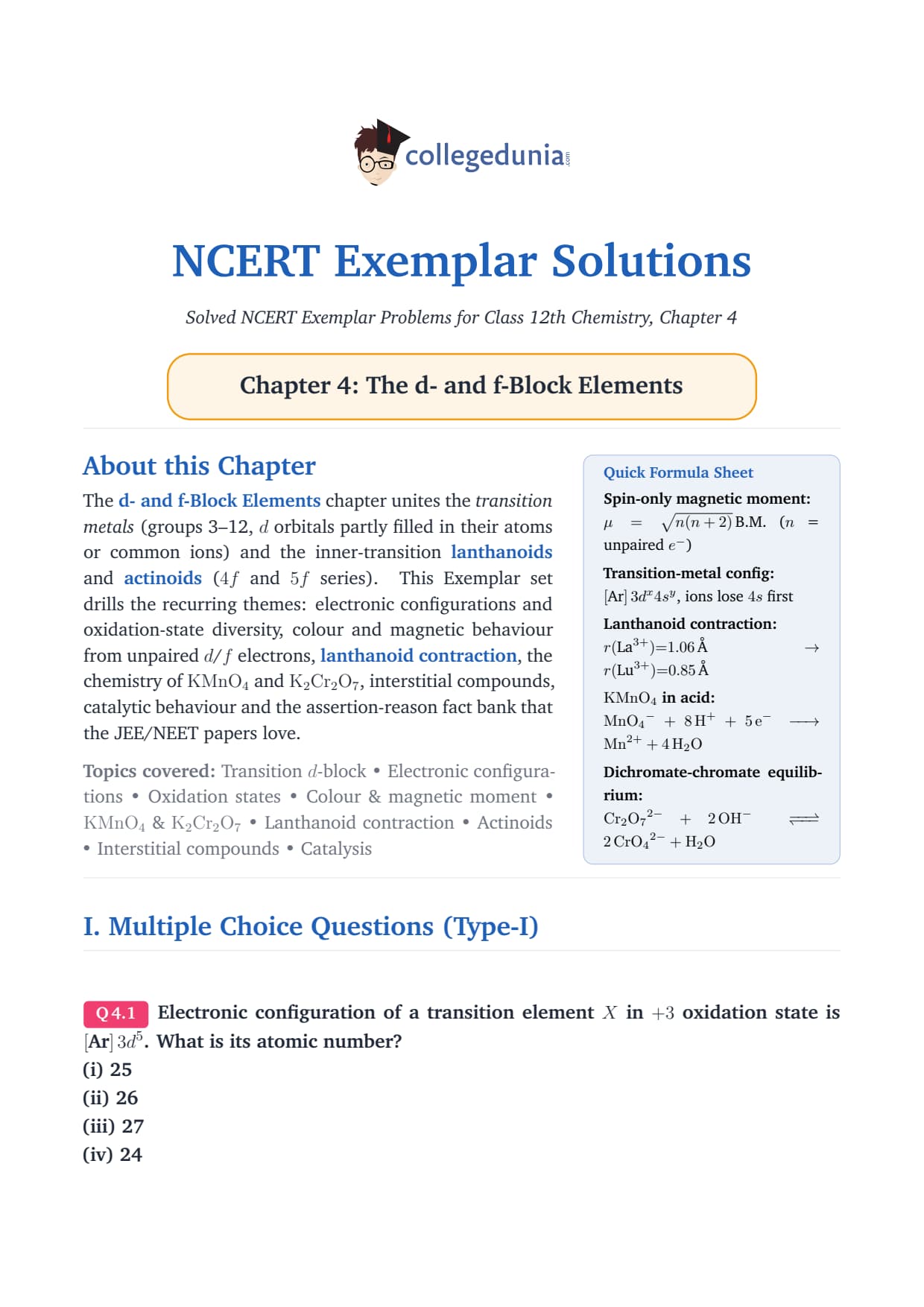
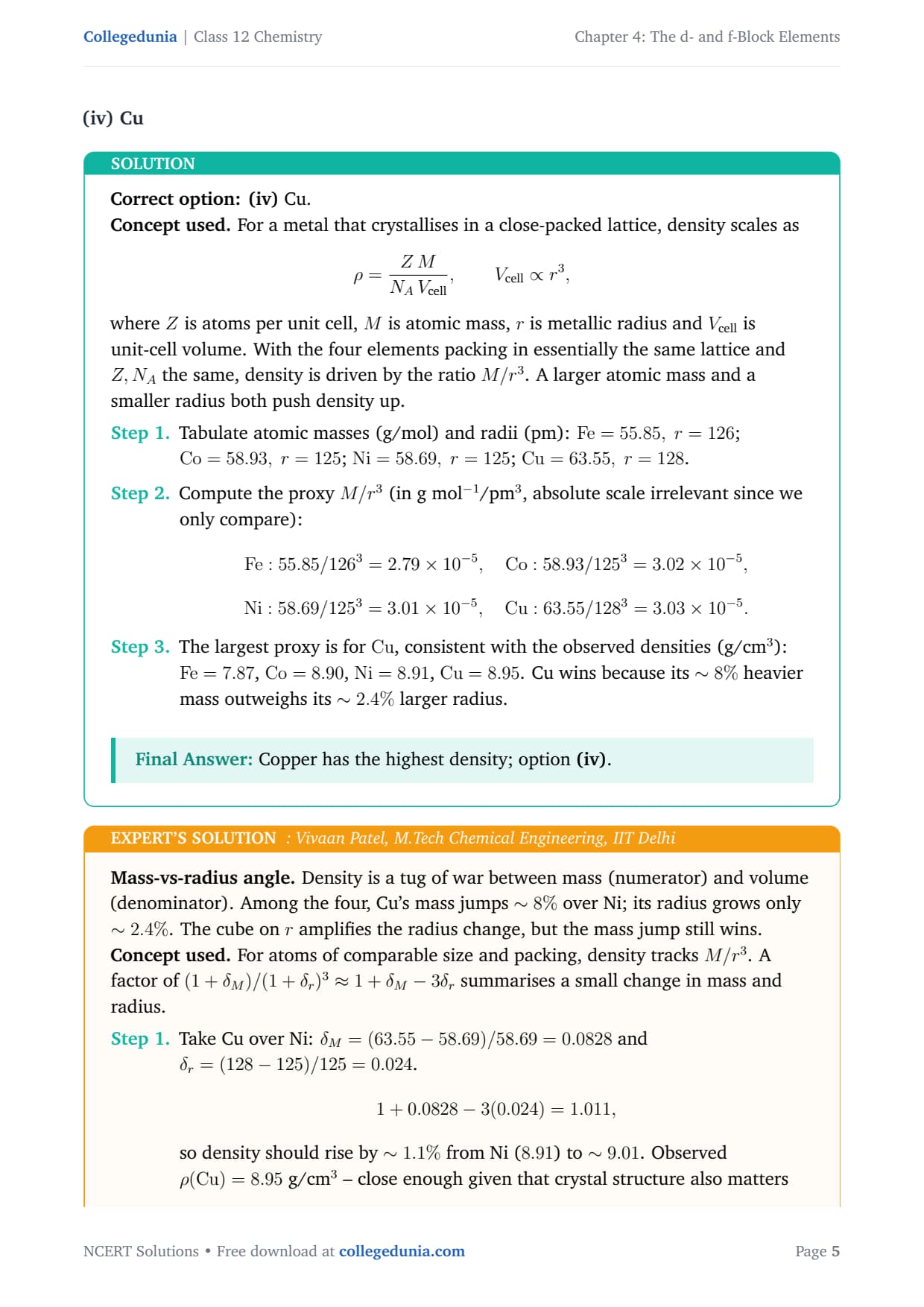
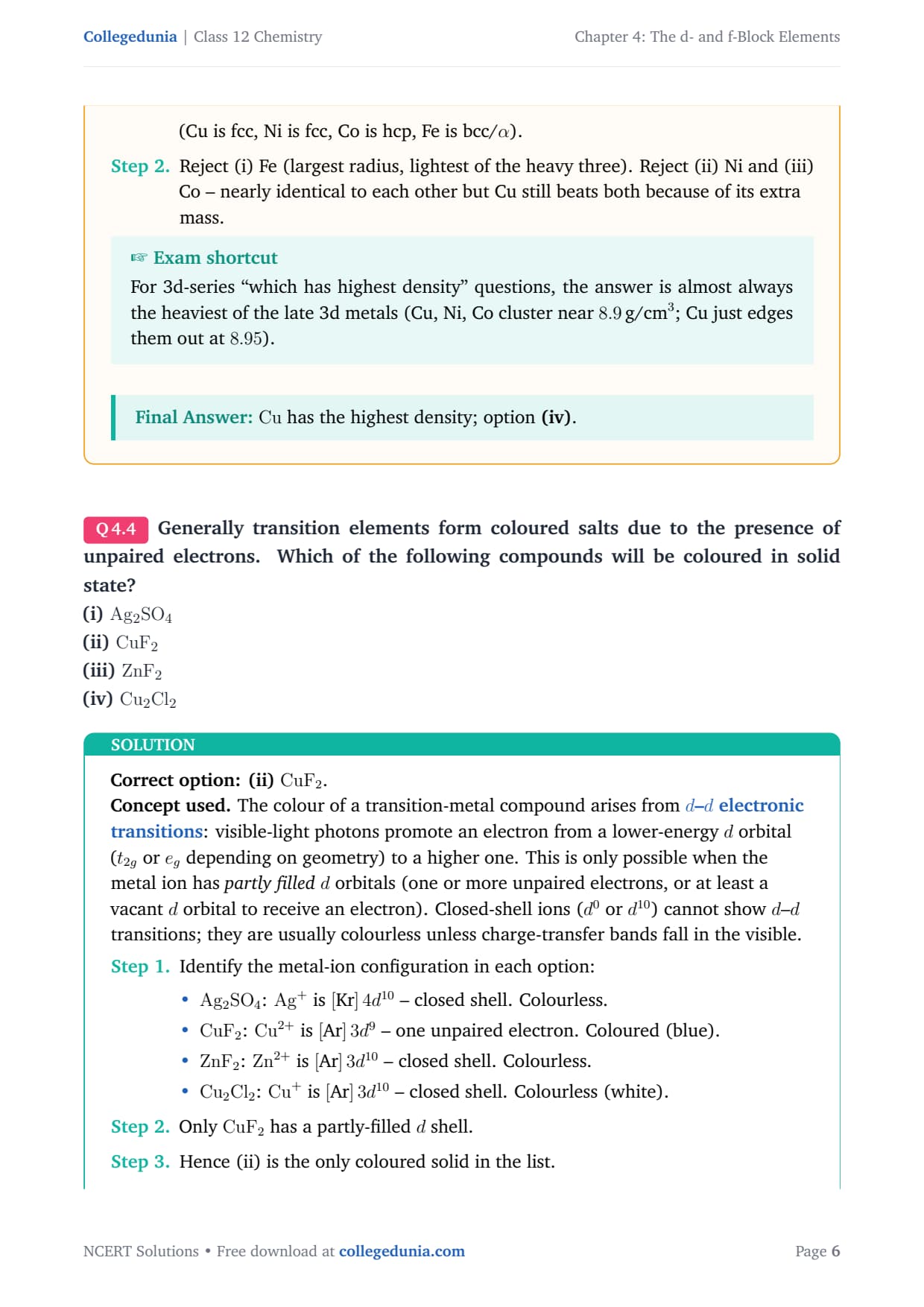
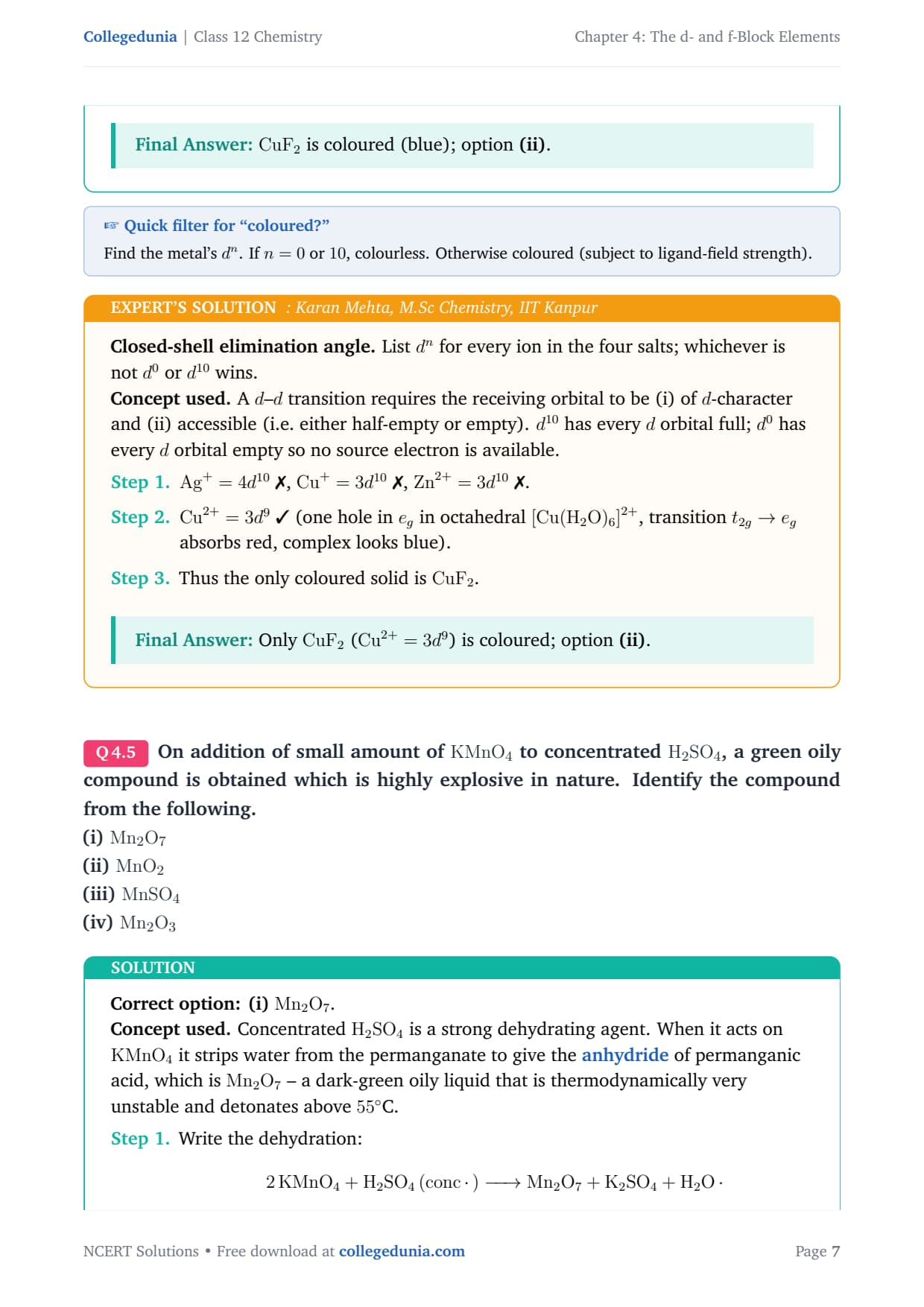
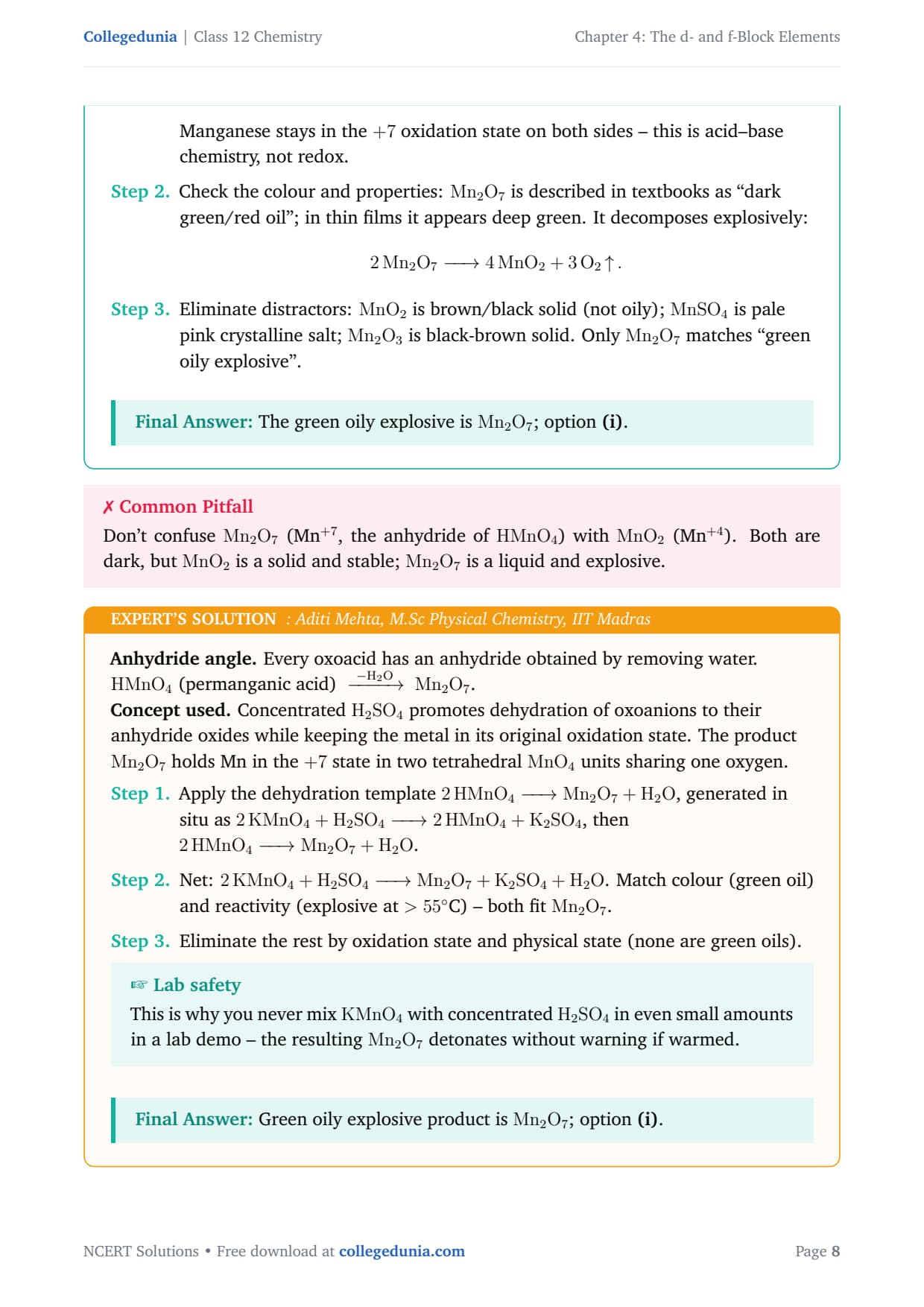
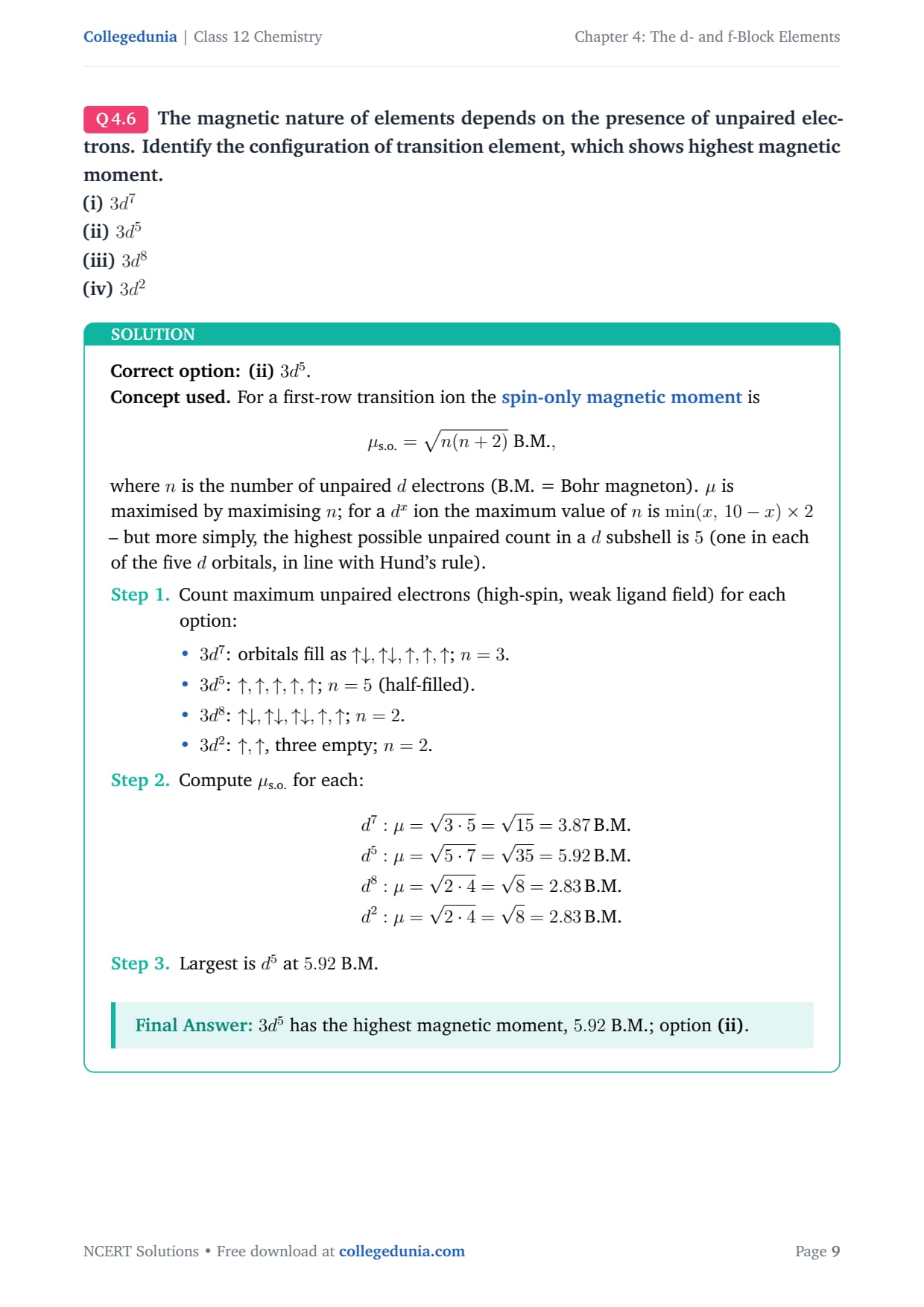
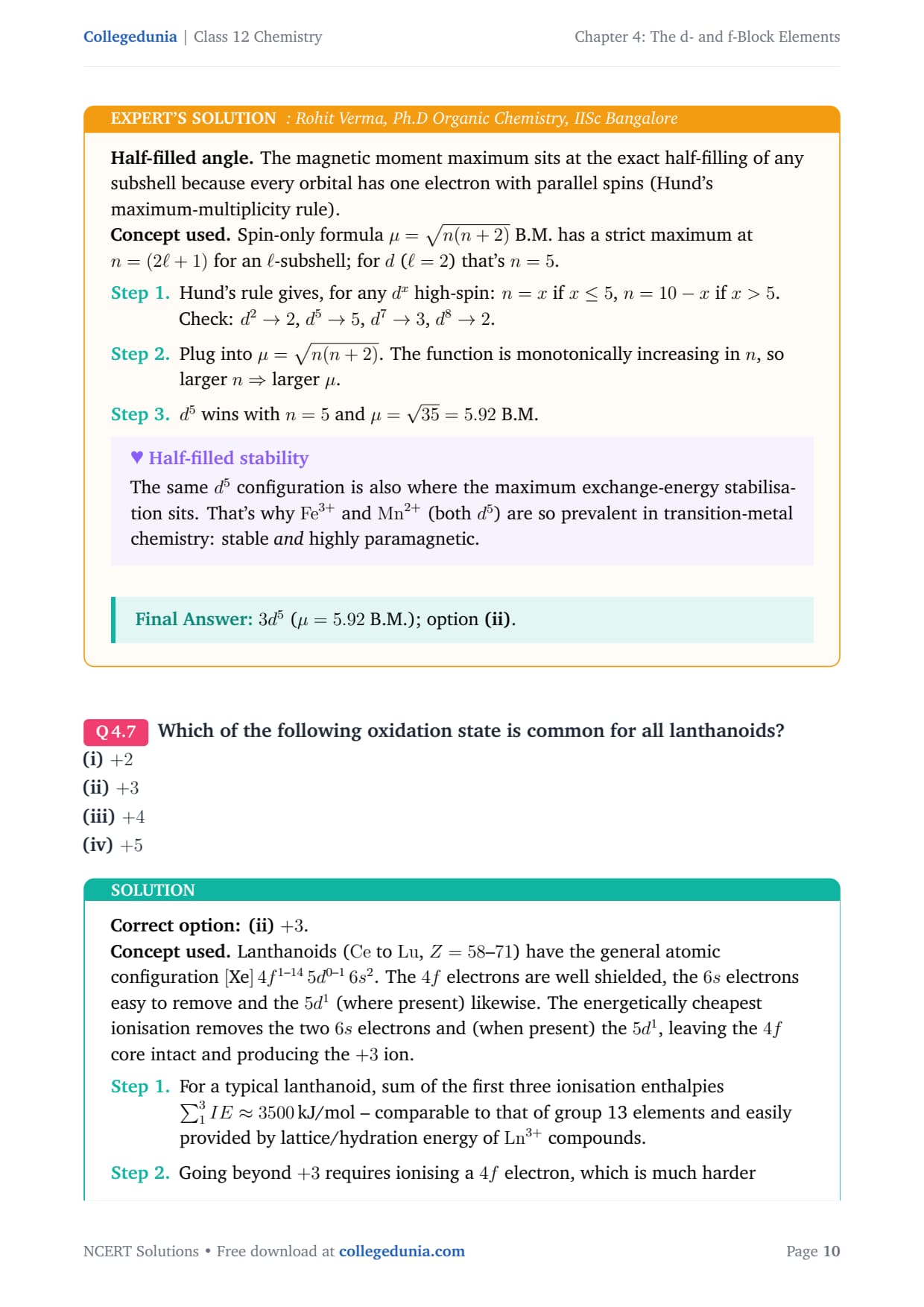
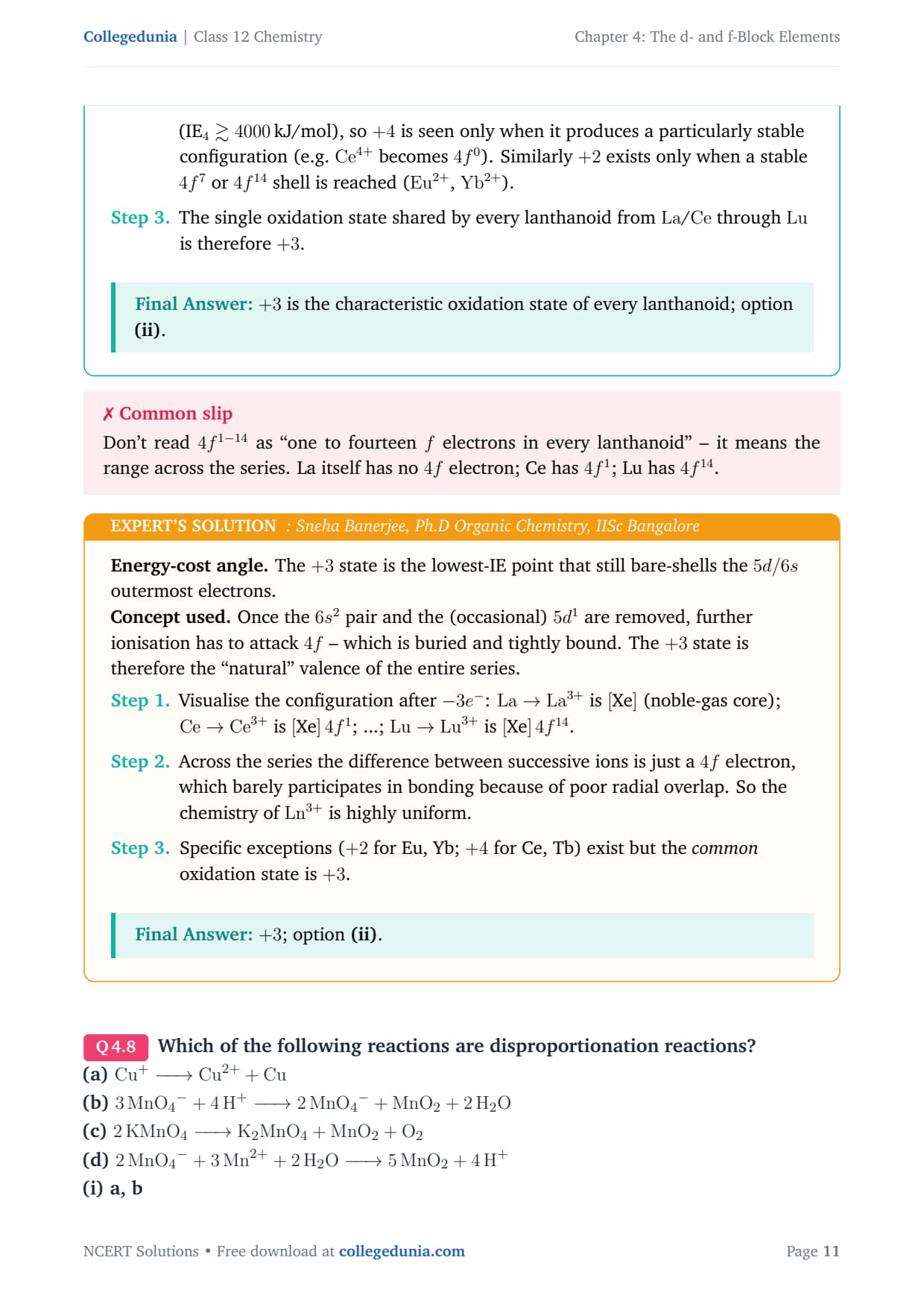
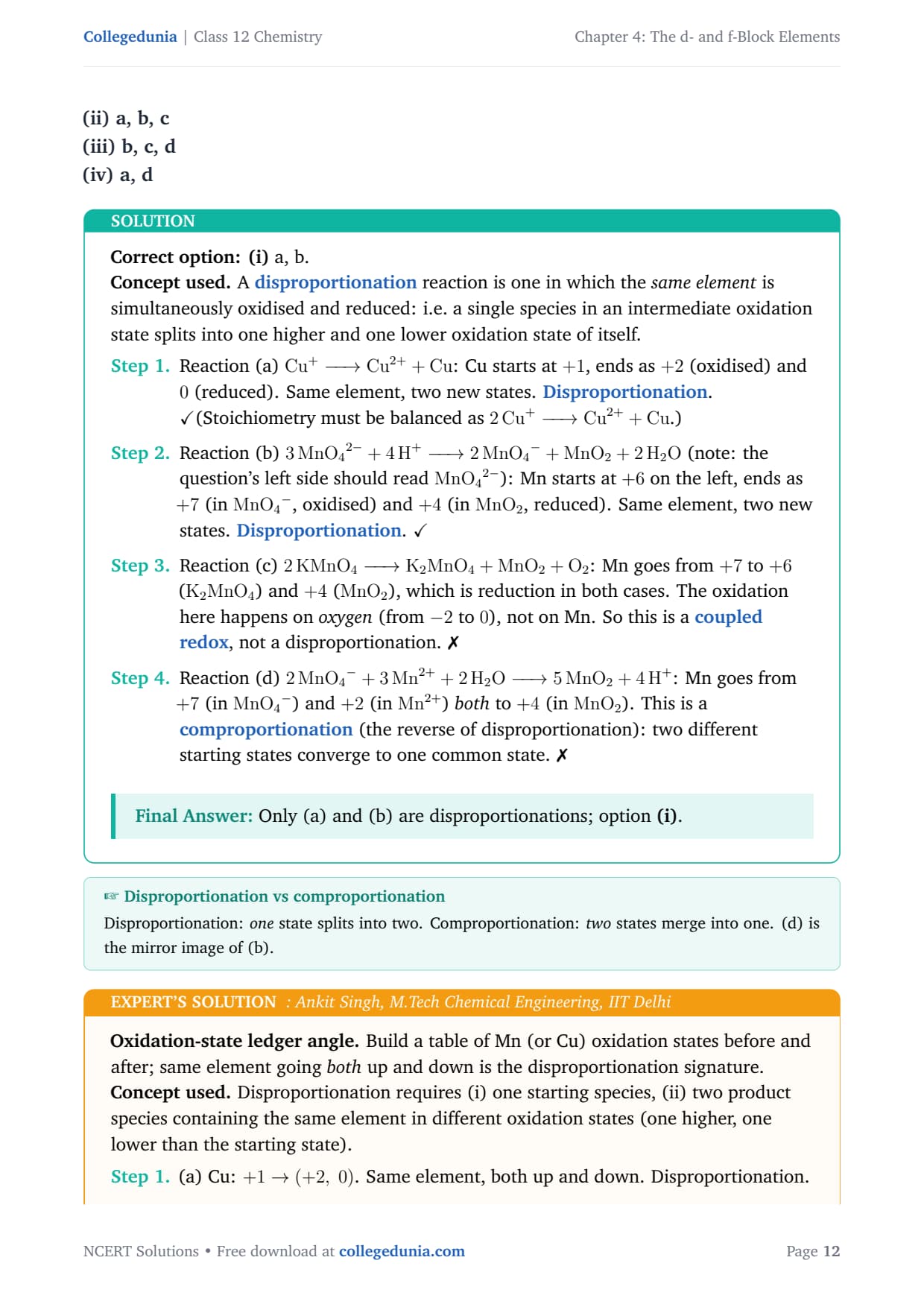
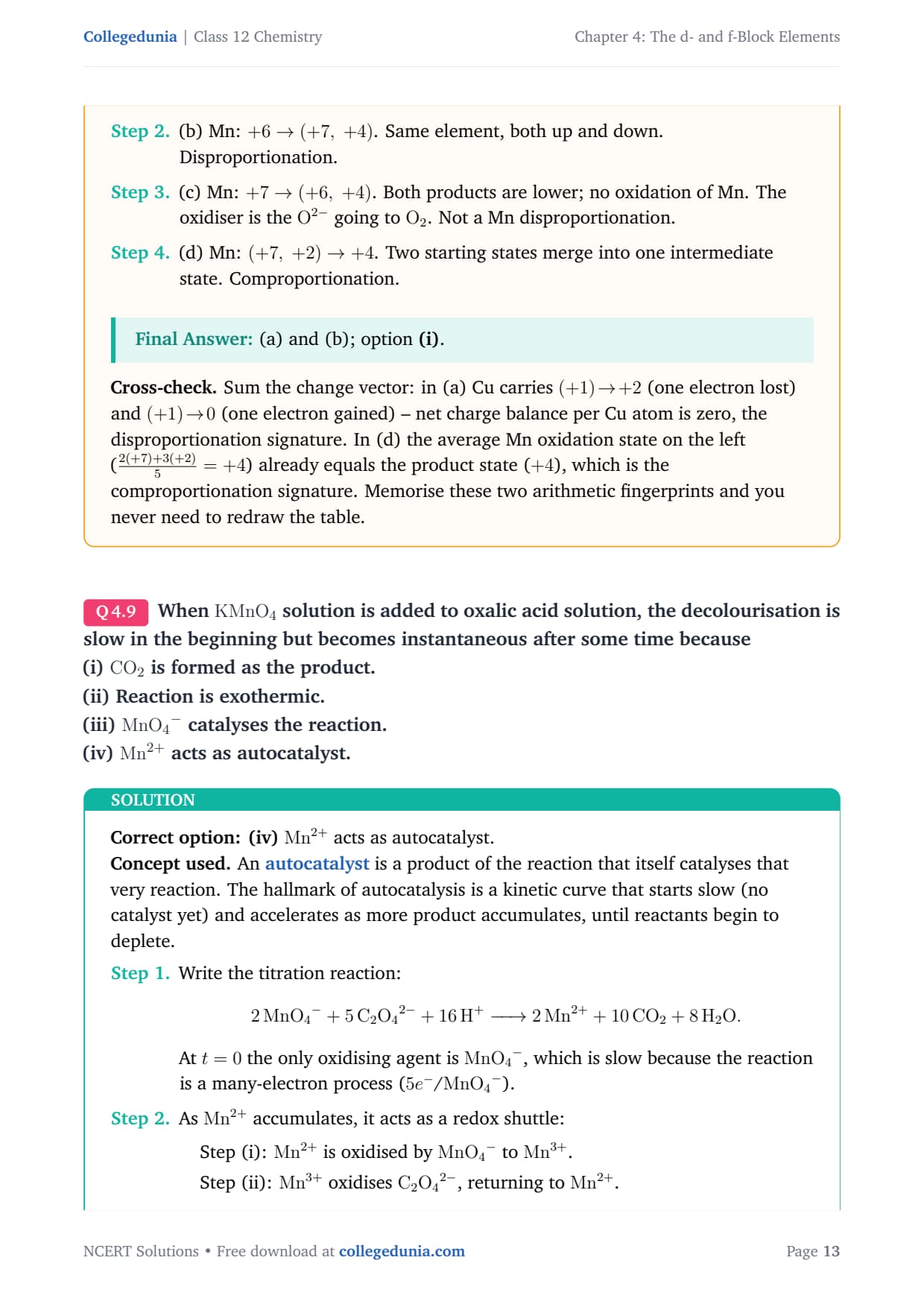
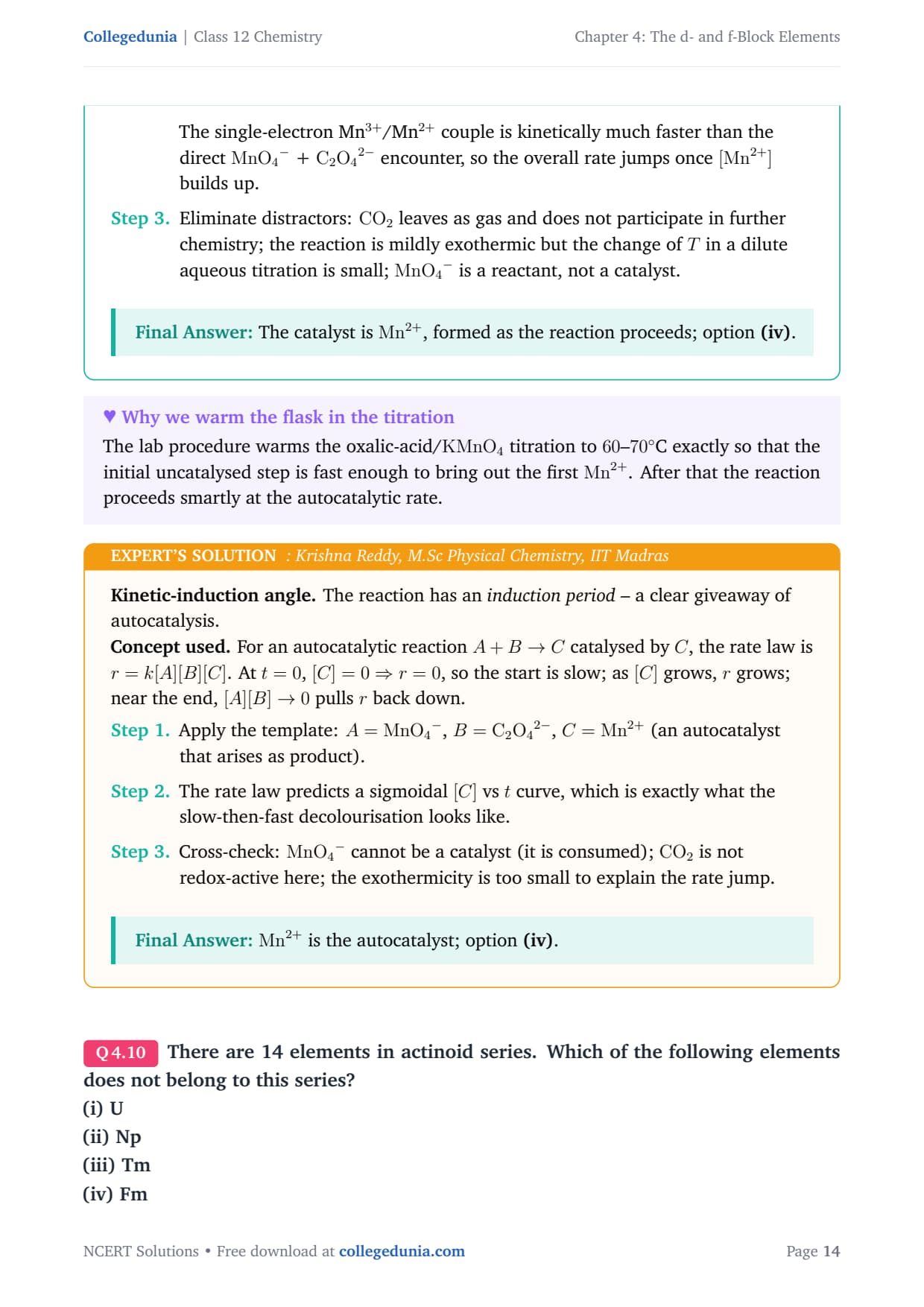
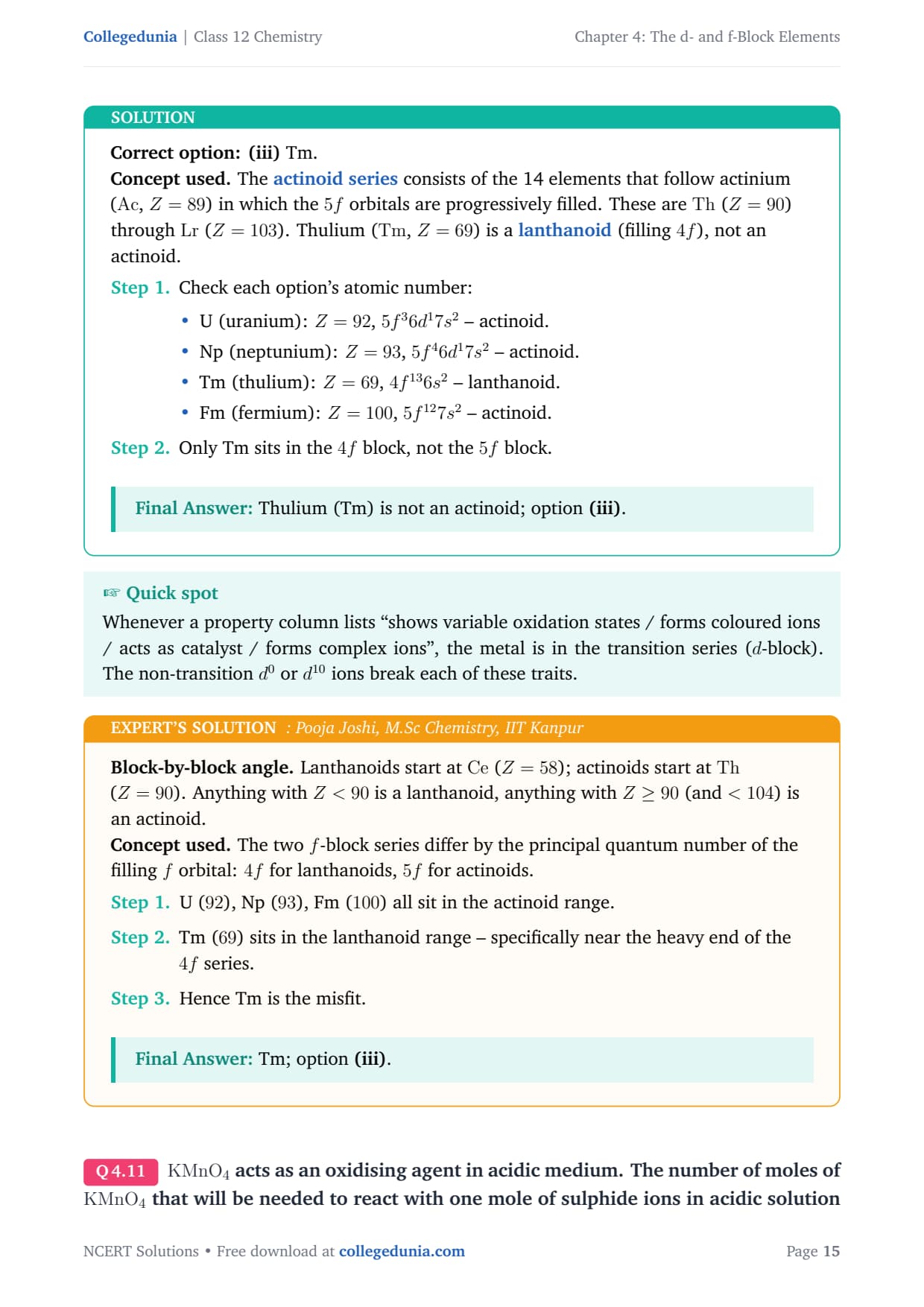
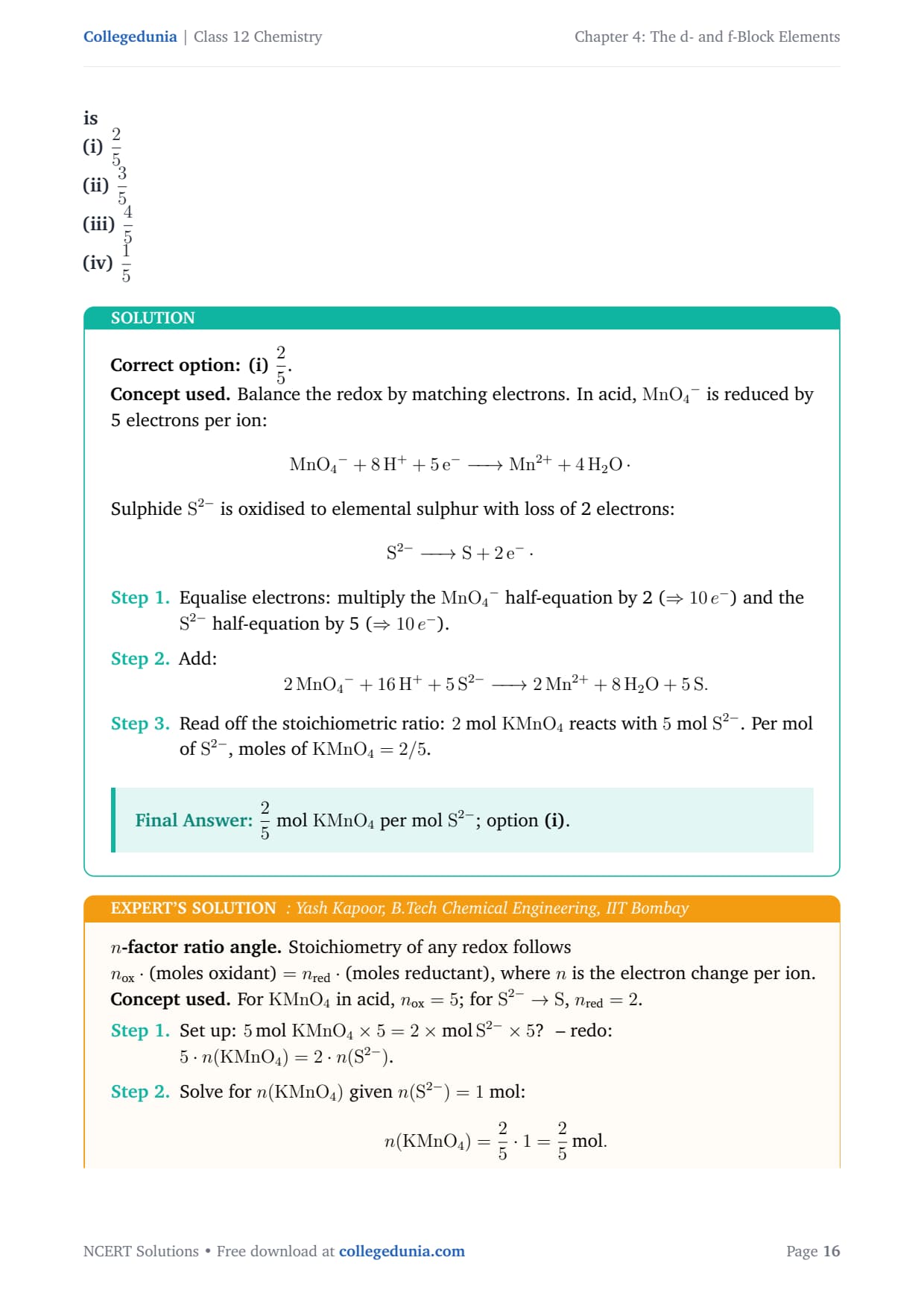
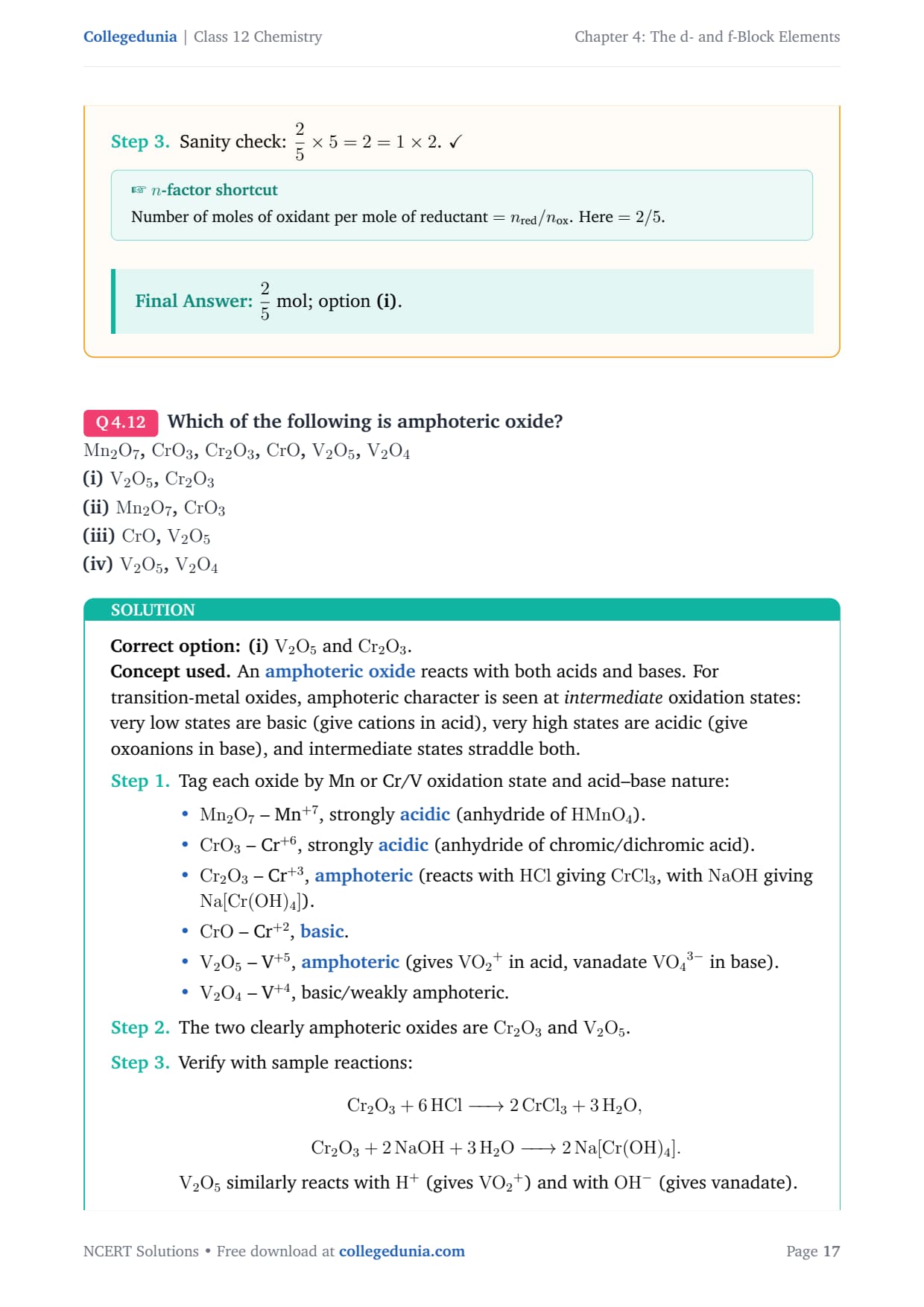
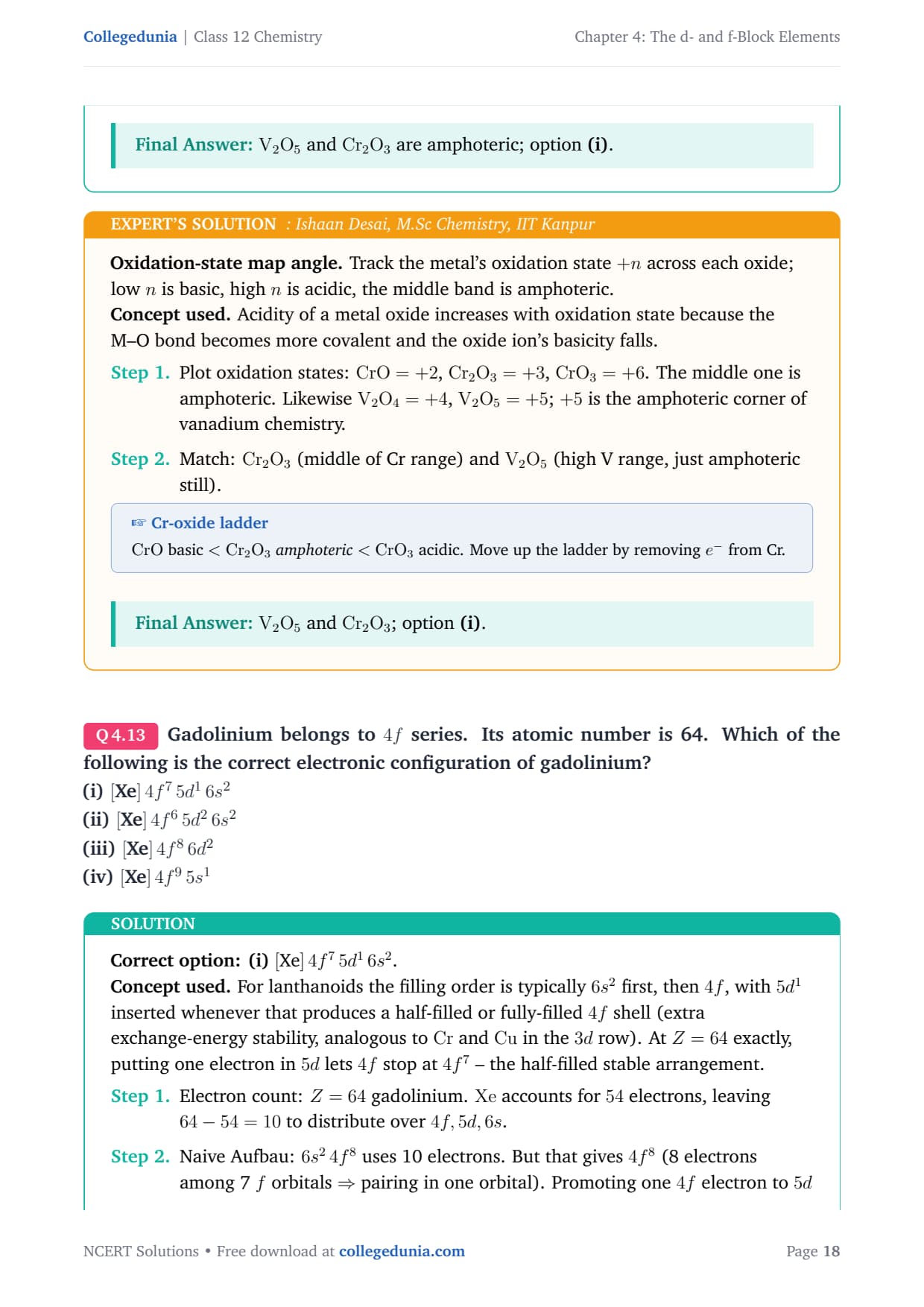
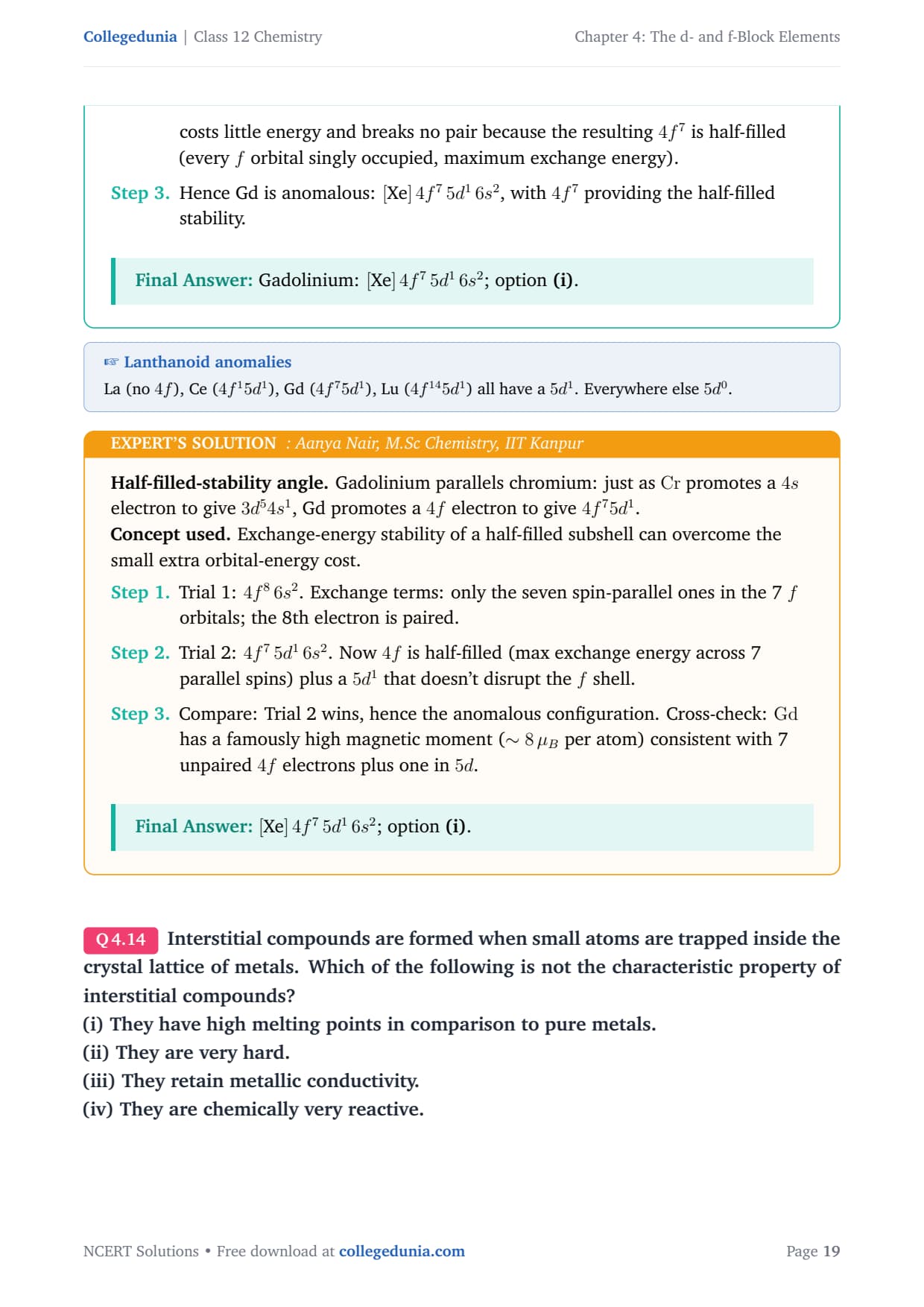
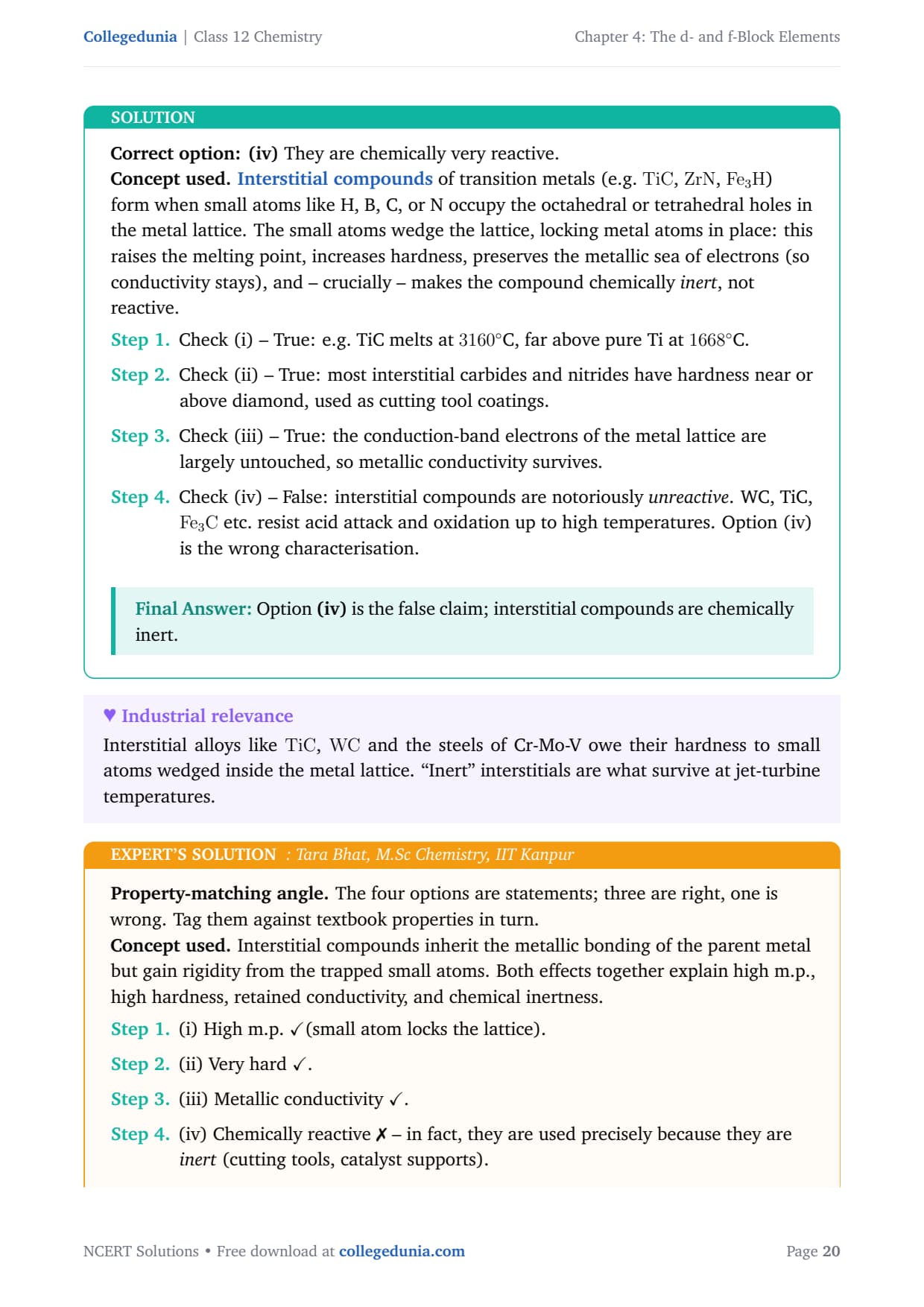
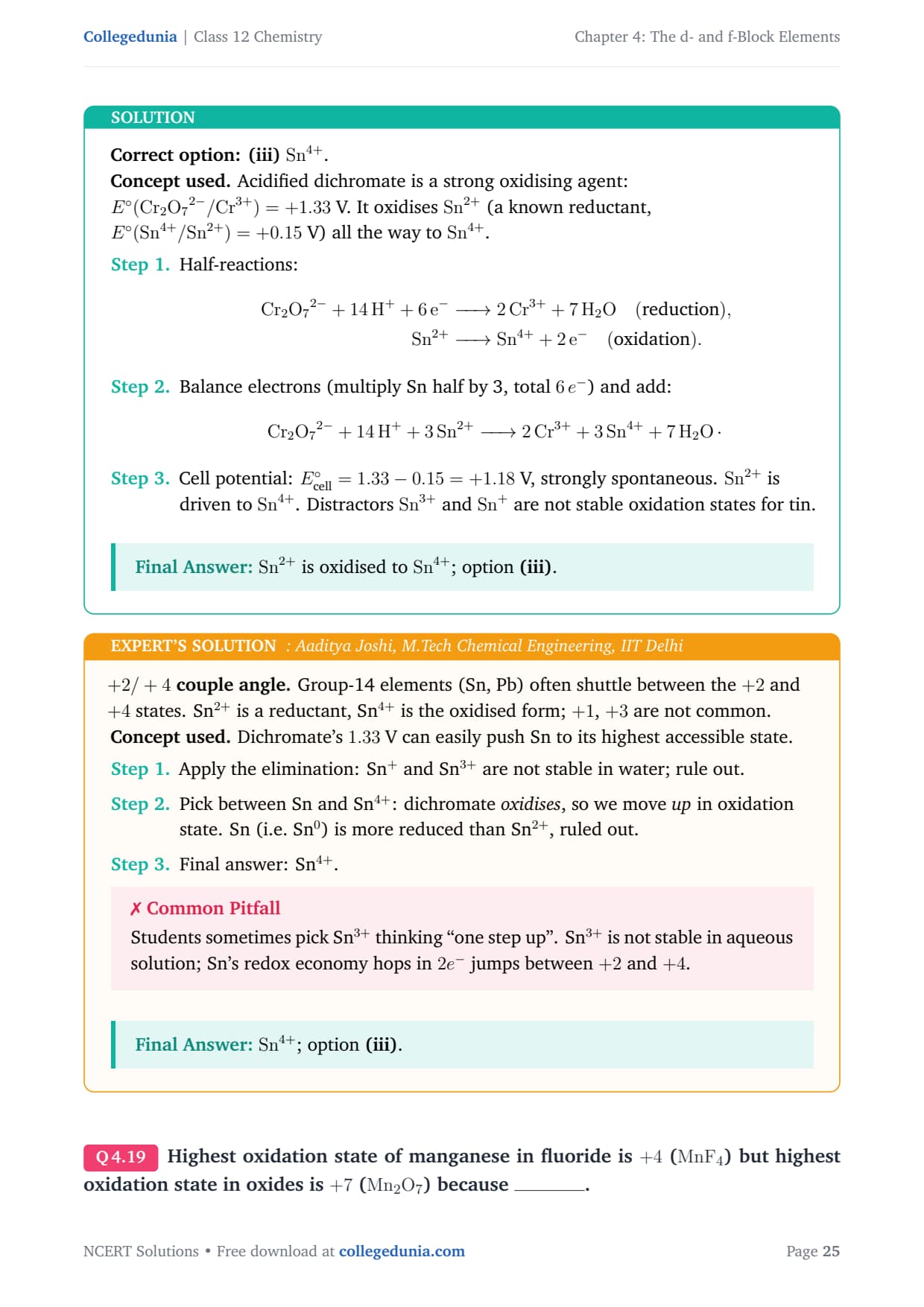
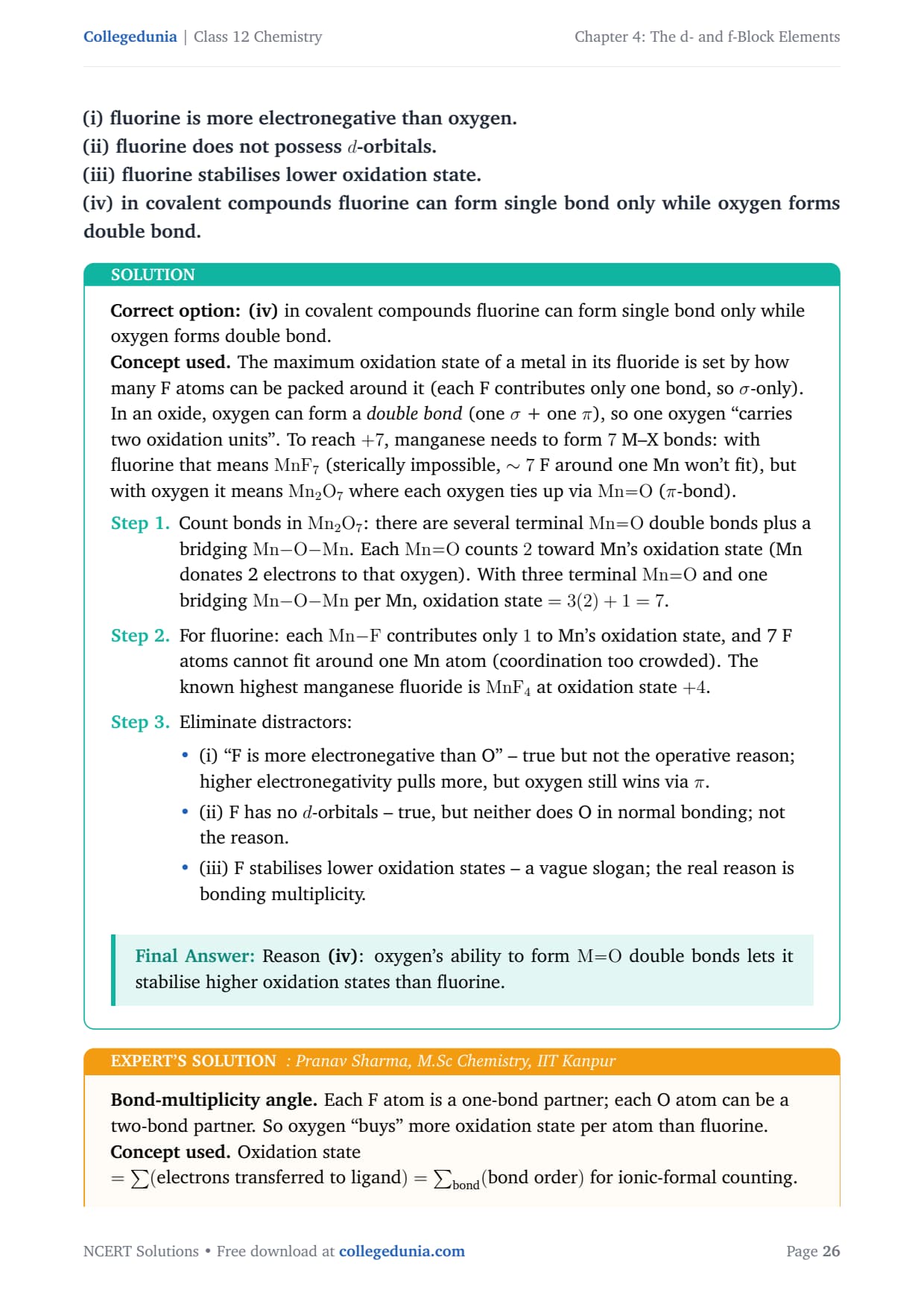
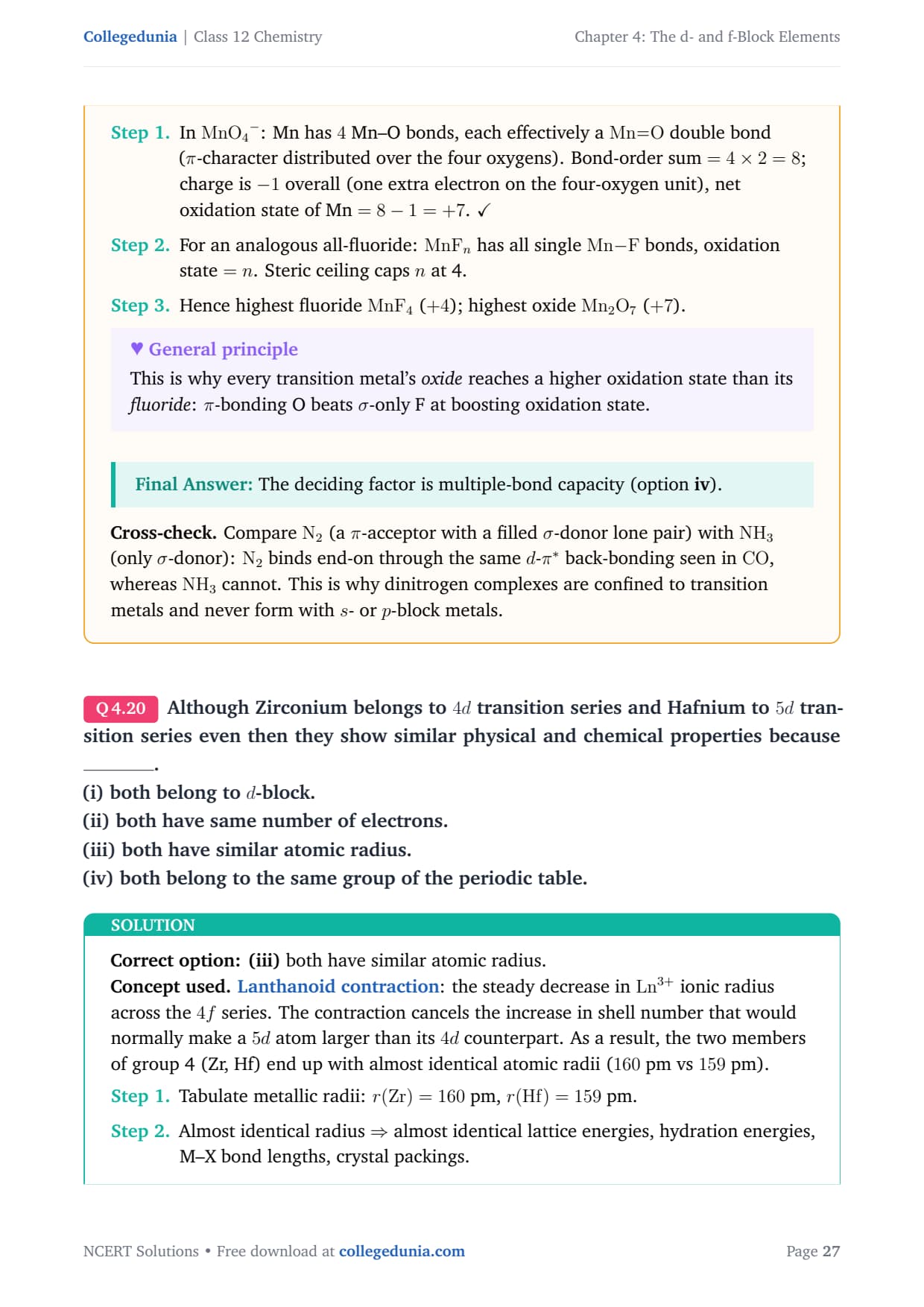
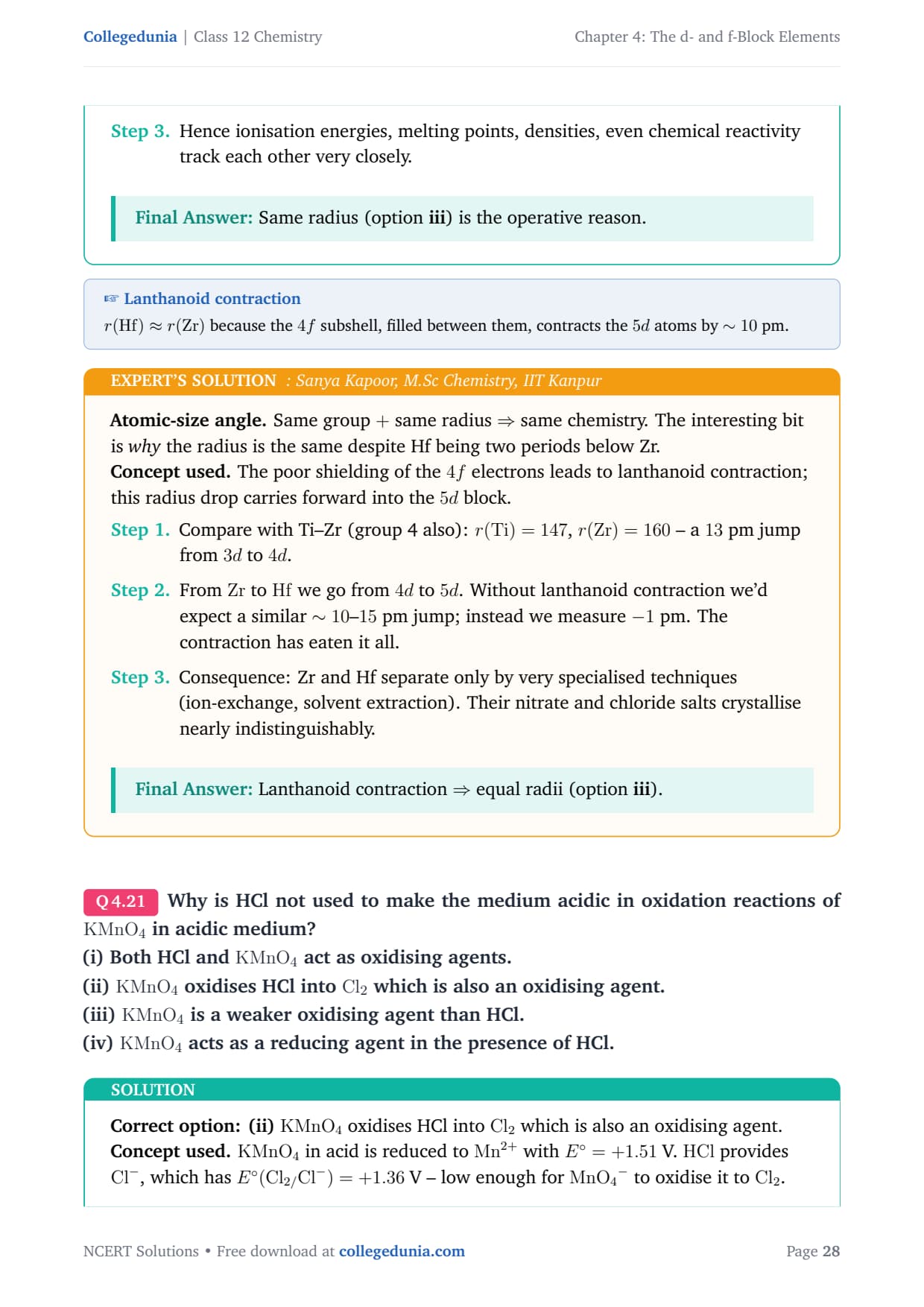
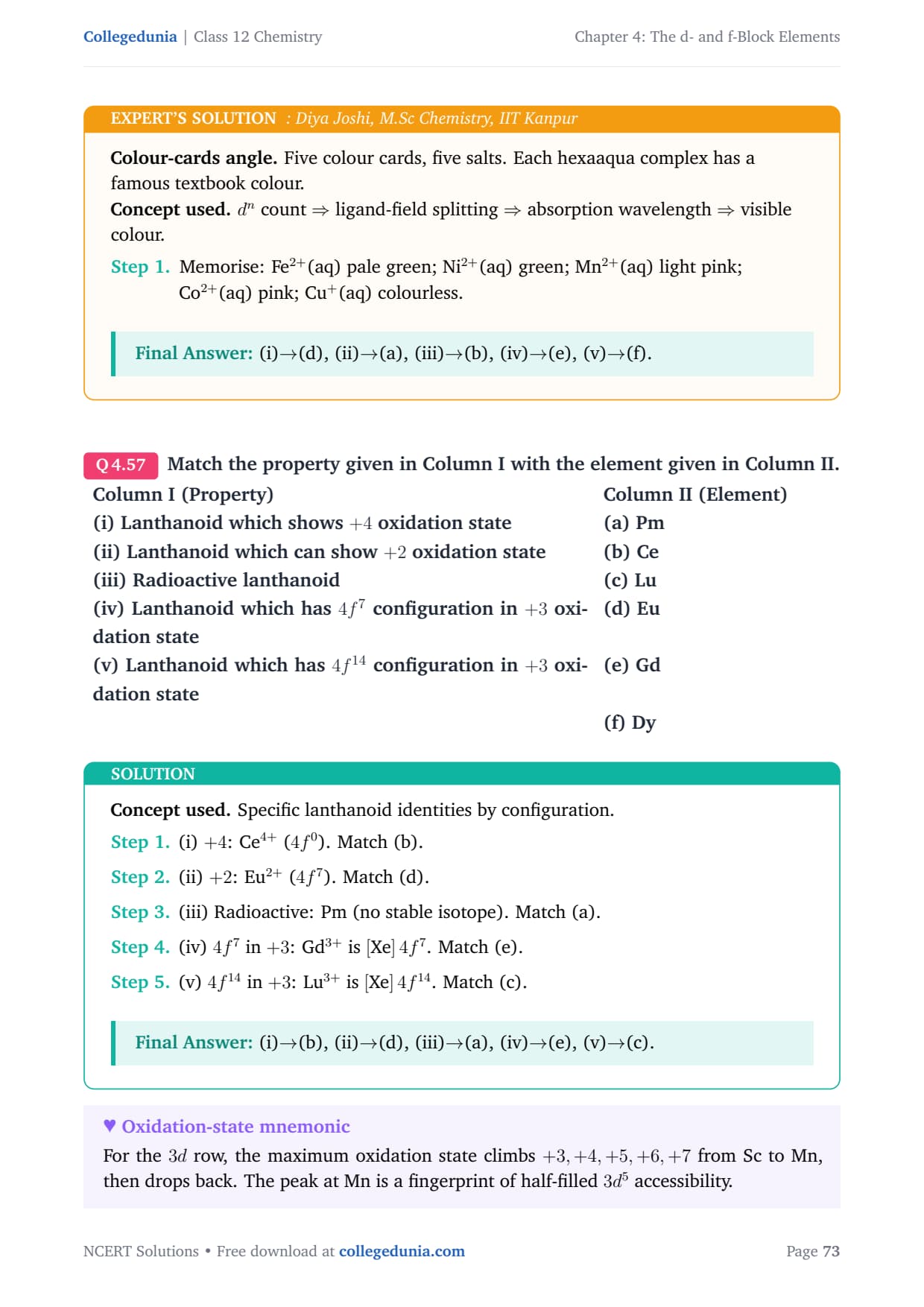
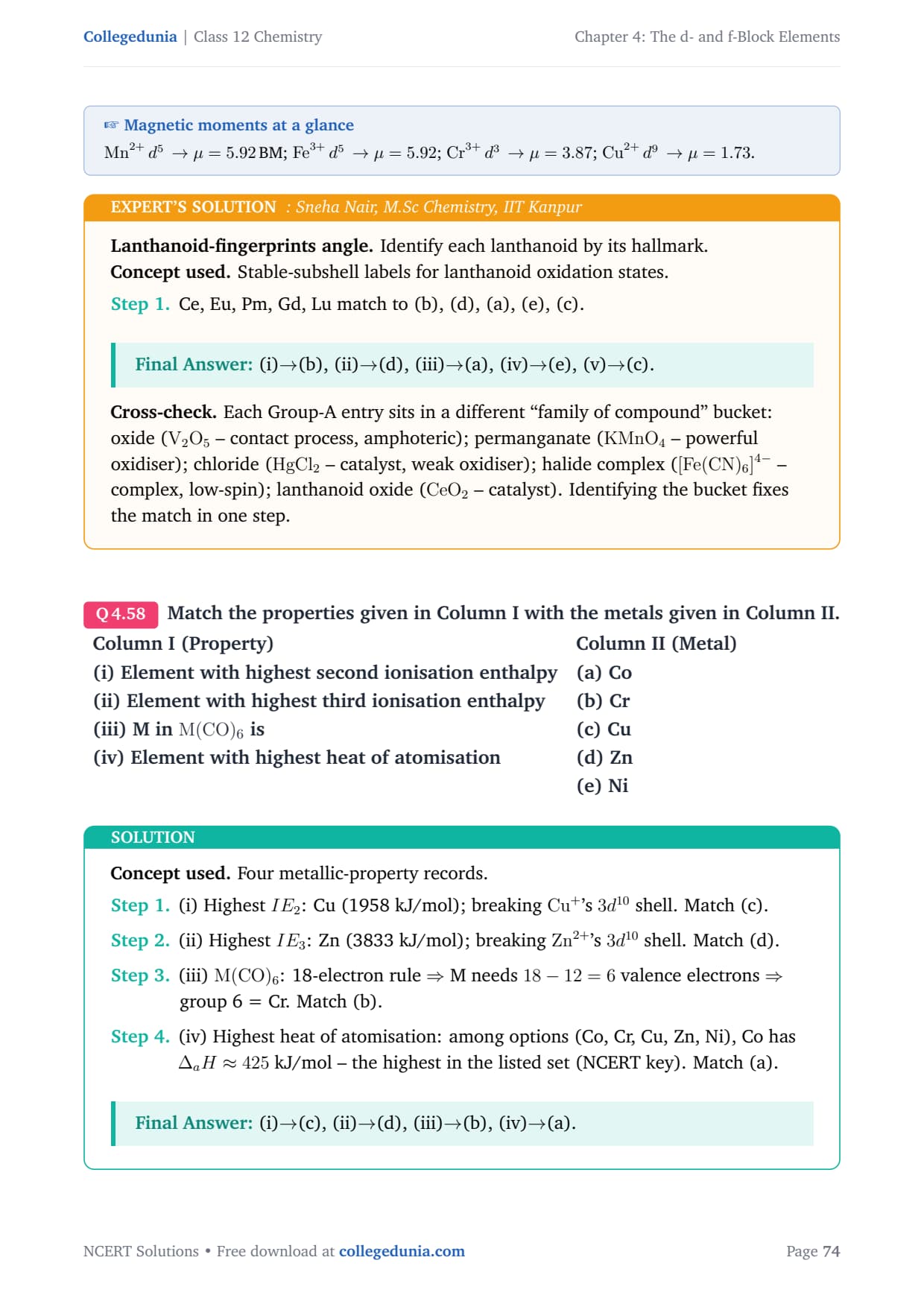
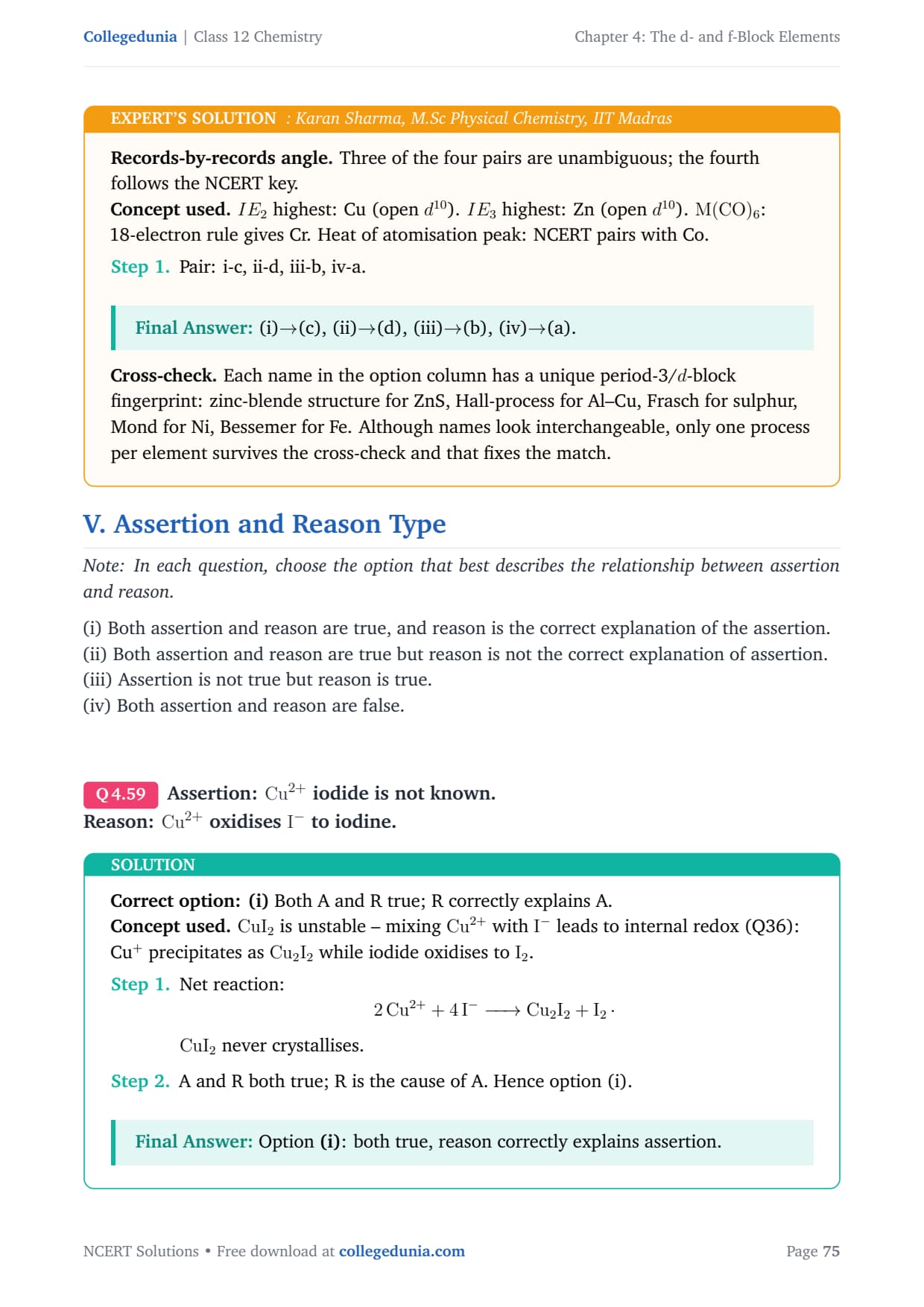
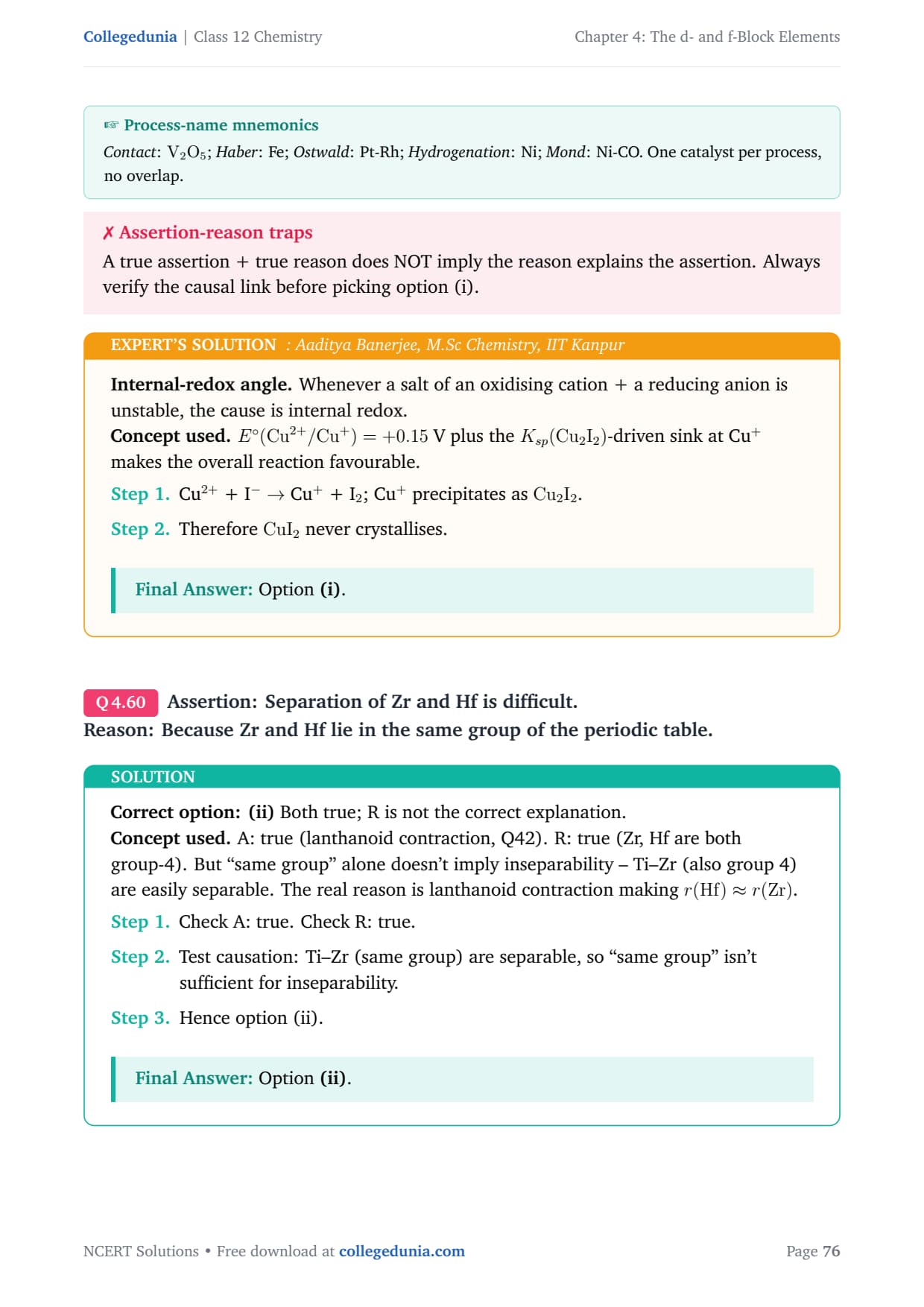
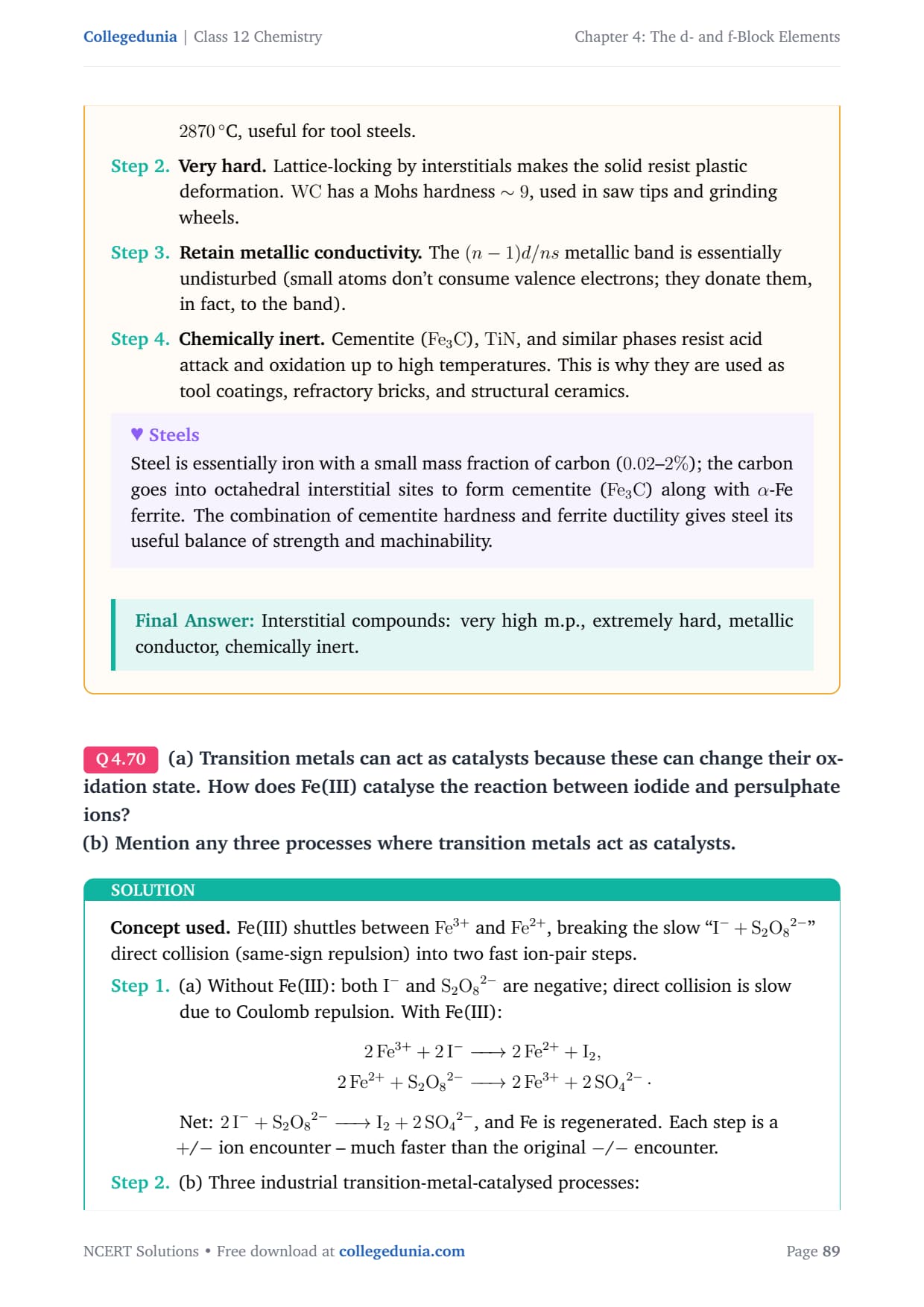
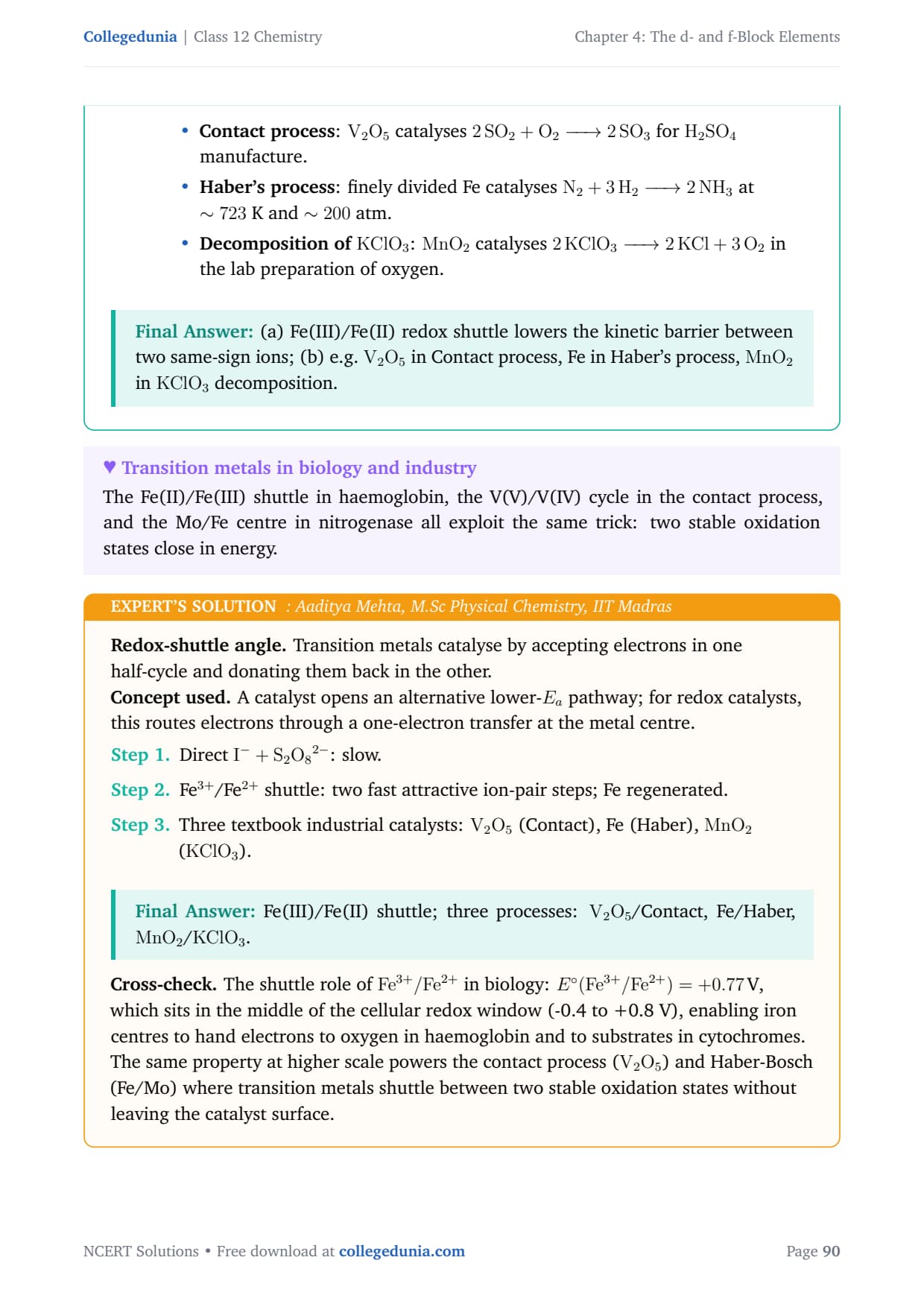
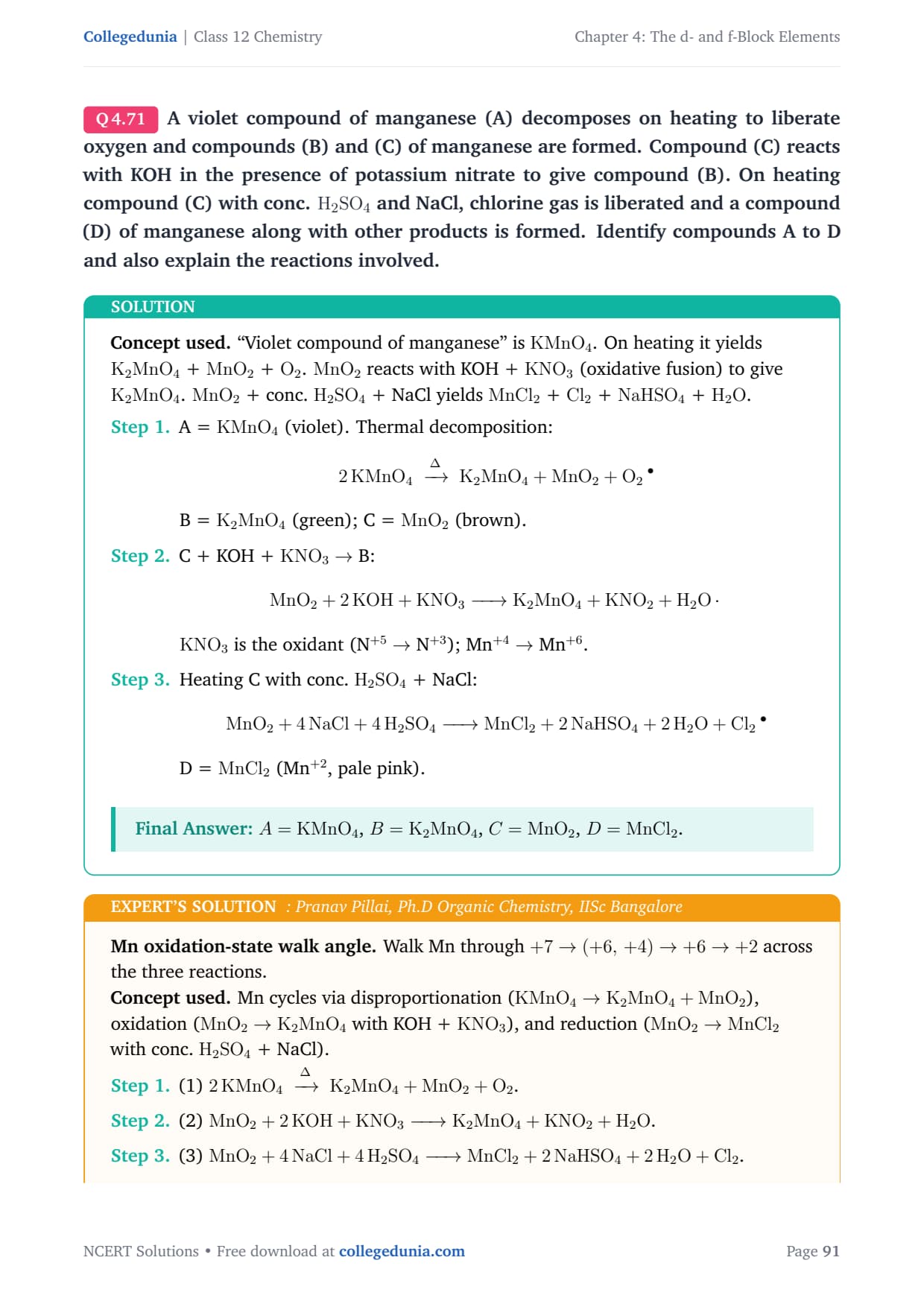
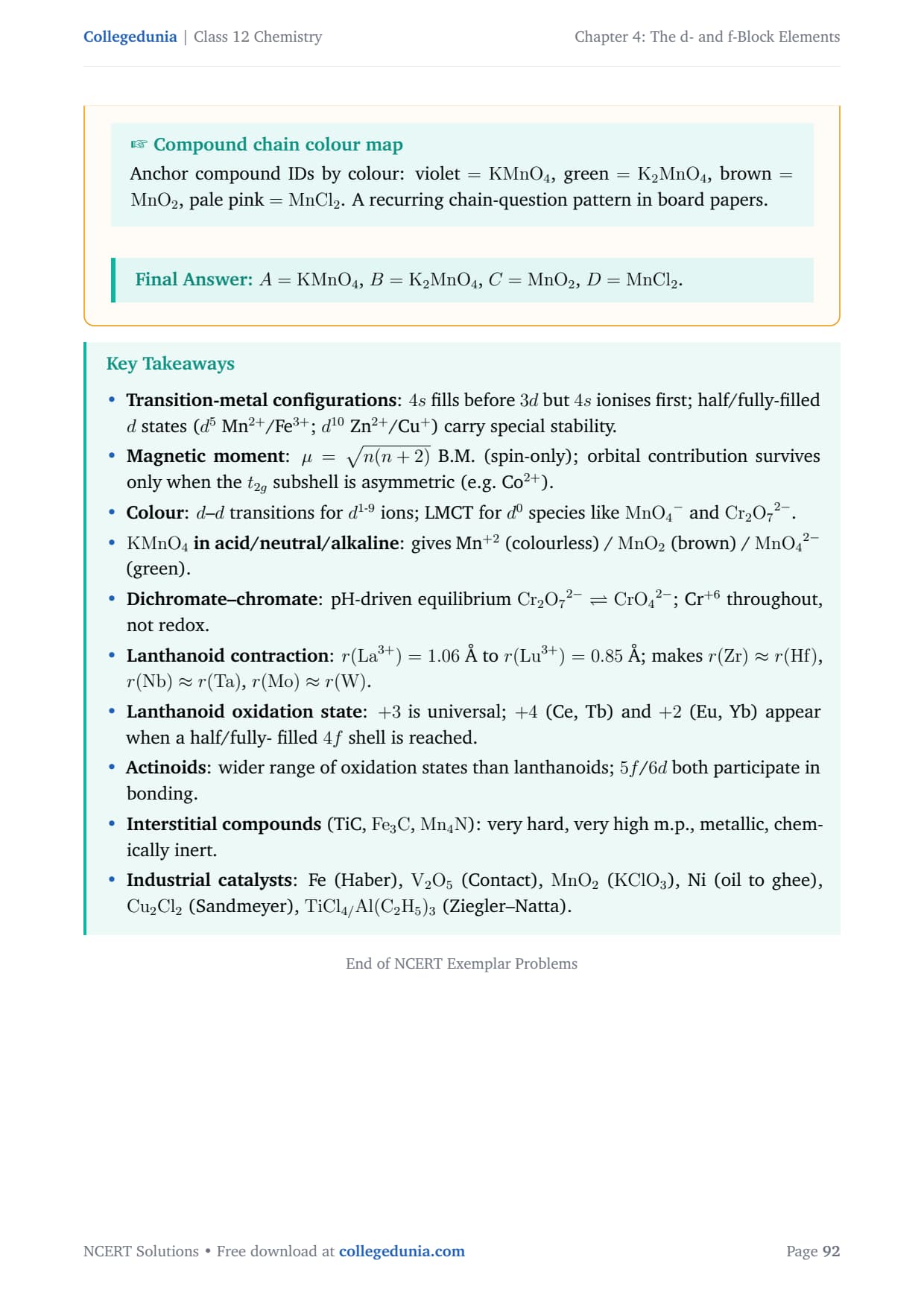
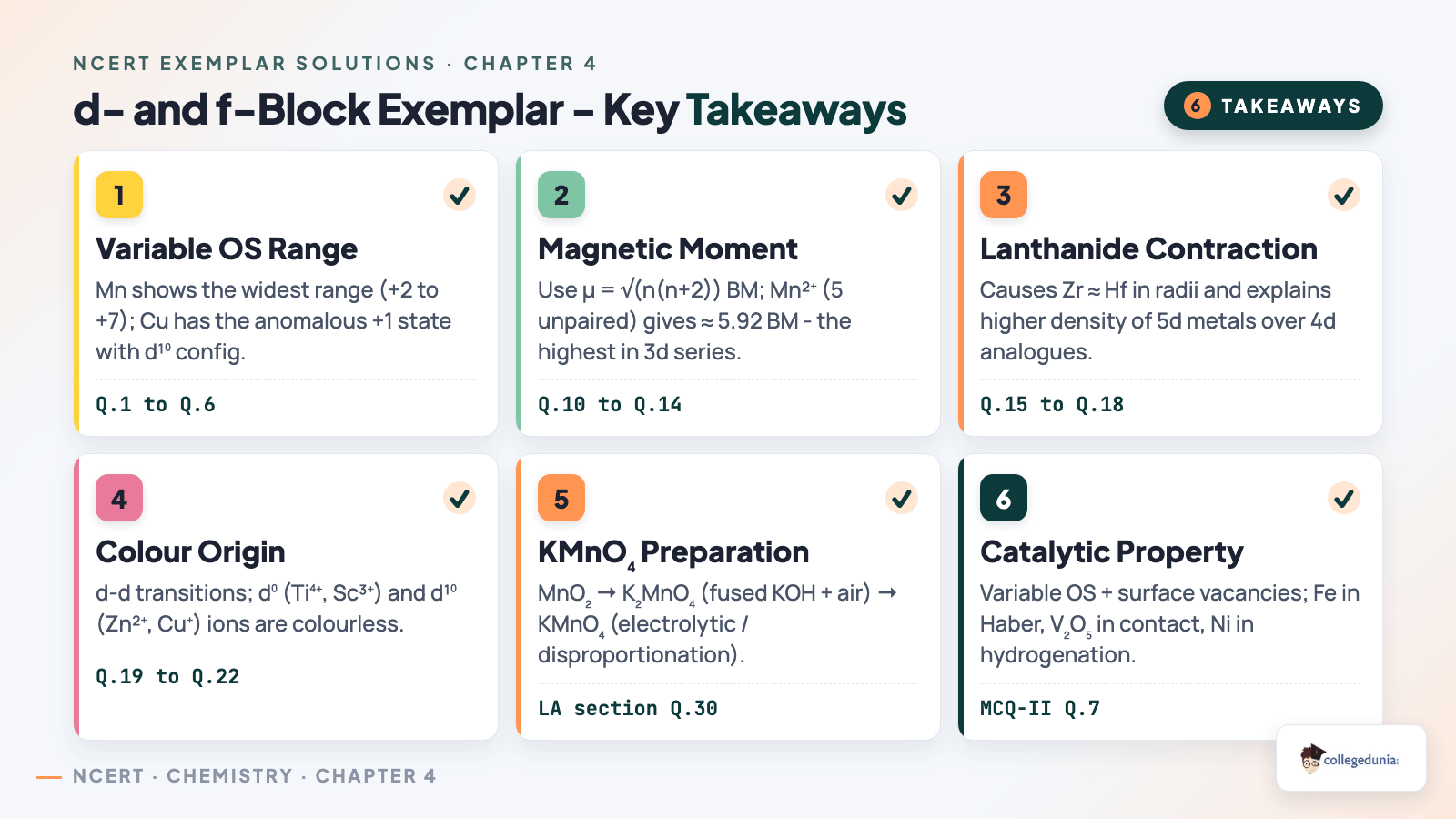
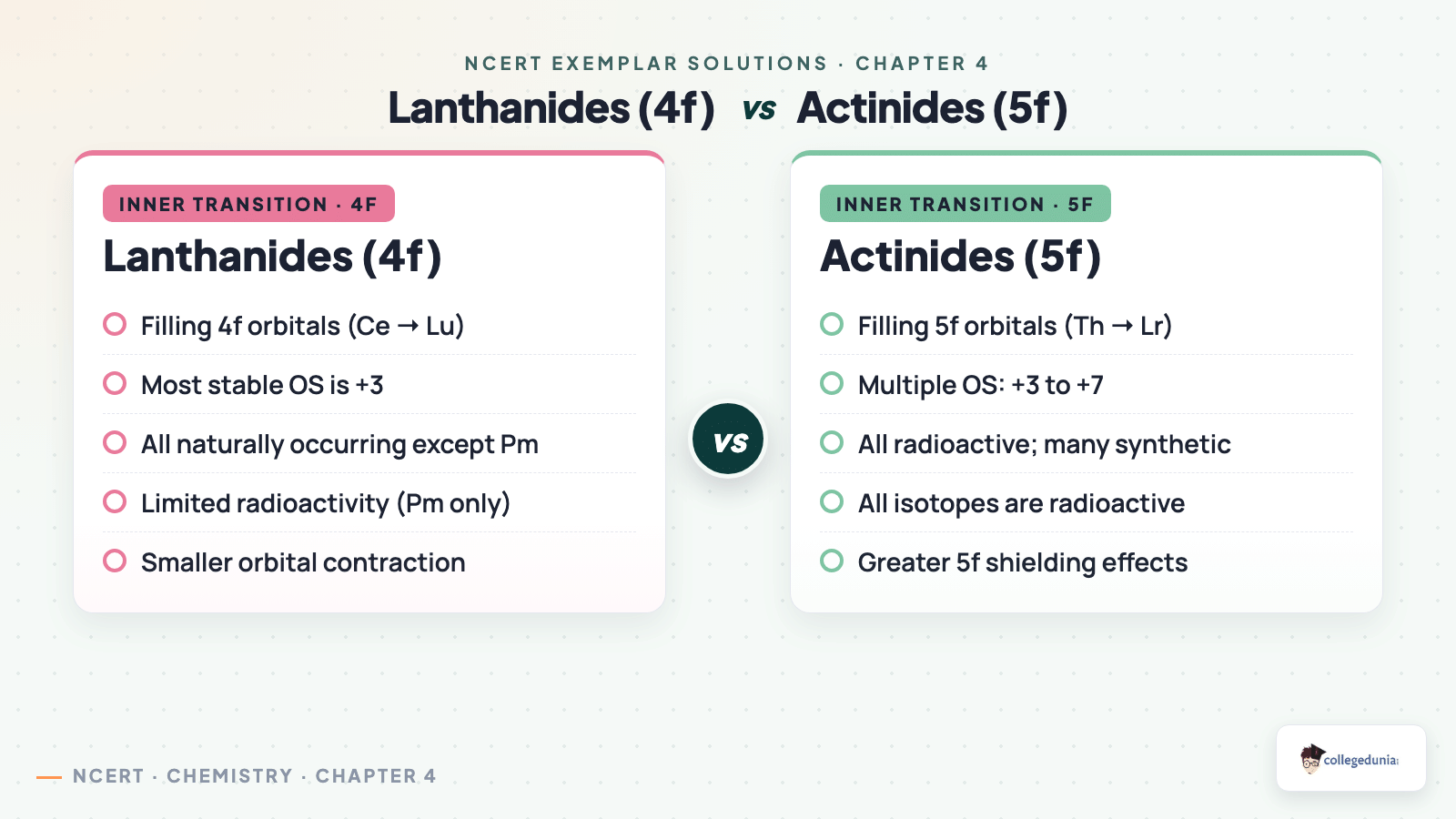



Comments