The Electrochemistry Exemplar bundles 68 problems across conductivity, the Nernst equation, galvanic cells, Kohlrausch's law and electrolysis. This page hosts the complete Class 12 Chemistry Chapter 2 Exemplar Solutions PDF, with every problem solved.
68 Exemplar problems · 17 MCQ-I + 10 MCQ-II + 22 SA + 6 Matching + 10 Assertion-Reason + 3 LA · Class 12 Chemistry Chapter 2, 2026-27 NCERT
CBSE Weightage: 5 to 7 marks (typically one Nernst-equation numerical plus one short-answer on conductivity or batteries)
JEE Main Weightage: 3 to 4% (1 to 2 questions per shift, mostly Nernst, electrolysis stoichiometry and molar conductivity)
NEET Weightage: 2 to 3 questions per year
These Exemplar Solutions are curated by subject experts, mapped to the 2026-27 NCERT, and benchmarked against the last five years of CBSE Board, JEE Main and NEET papers.
Electrochemistry Exemplar: MCQ, SA, Matching, Assertion-Reason and LA Counts at a Glance
Chapter 2 is the most question-dense Exemplar in Class 12 Chemistry.
Question Type
Item Range
Count
Marks per Item
Best Use For
MCQ-I (single-correct)
1 to 17
17
1
JEE Main, NEET, CBSE MCQ
MCQ-II (multiple-correct)
18 to 27
10
2
JEE Advanced, assertion-reason
Short Answer (SA)
28 to 49
22
2 to 3
CBSE Board, NEET reasoning
Matching Type
50 to 55
6
2 to 4
CBSE source-based, competency
Assertion and Reason
56 to 65
10
1
NEET, CBSE competency block
Long Answer (LA)
66 to 68
3
5
CBSE 5-marker, JEE Advanced
Quick Tip: The 6 Matching grids (50 to 55) and 10 Assertion-Reason pairs (56 to 65) are exactly the question types CBSE has scaled up in the 2026-27 competency paper. Treat this 16-question block as your primary CBSE Board competency-section drill.
Electrochemistry Exemplar Question-Type Breakdown with Worked Samples
Each of the six question types is fully worked in the cards below and in the PDF. The 22 Short Answer items dominate the chapter, while the 10 MCQ-II problems carry the multi-correct traps JEE Main reuses.
MCQ-I (Q1): pick the cell that meets all three standard conditions (1 bar H2, 1 M H+, 1 M Cu2+).
SA (Q41): a 25-fold rise in molar conductivity on dilution flags a weak electrolyte; a 1.5-fold rise flags a strong one.
LA (Q67): the six-part Zn|Zn2+||Ag+|Ag cell covers electron flow, cathode identity, salt-bridge removal and equilibrium.
How Will Collegedunia's NCERT Exemplar Solutions Help You with Electrochemistry?
Each problem carries a clean Solution plus an Expert's Solution naming every concept invoked.
Every Type Worked End-to-End: All 17 MCQ-I, 10 MCQ-II, 22 SA, 6 Matching, 10 Assertion-Reason and 3 LA are solved with full reasoning.
Concept Stack Named: Each step labels the principle invoked: Nernst equation, Kohlrausch's law of independent migration, Faraday's two laws of electrolysis, or activity-series ordering.
JEE and NEET Bridge: Items 1, 8, 18, 32 and 67 are tagged with the entrance year that reused their scaffold (JEE Main 2024 for Q1; NEET 2024 for Q41).
2026-27 Aligned: All 68 problems remain valid under the current 2026-27 syllabus.
Electrochemistry Exemplar Step-Up from NCERT Textbook to the Exemplar Twist
The textbook tests definitions and direct substitution. The Exemplar chains two or three ideas per problem and surfaces traps the textbook never sets up.
Concept
NCERT Textbook Setup
Exemplar Twist
Standard electrode potential
Look up Cu2+/Cu = +0.34 V
Q1: spot the cell that meets ALL standard conditions (1 bar, 1 M, 1 M)
Activity-series ordering
Rank three metals
Q8 to 12: rank four redox couples by reducing and oxidising power, identify most-stable reduced AND oxidised species
Electrolysis at electrodes
NaCl(aq) gives Cl2 and H2
Q34: explain WHY Cl- beats water at the anode despite water's lower E∘ (overpotential)
Conductivity behaviour
Strong electrolytes obey Debye-Huckel
Q41: deduce strong vs weak from the dilution-factor ratio (1.5 vs 25)
Galvanic cell with no current
Direct Nernst substitution
Q38: apply an opposing 1.1 V and predict that current and reaction both stop
Kohlrausch decomposition
Direct addition of ionic conductivities
Q16 and Q22: write Λ0NH4OH using only NH4Cl, NaOH and NaCl
Exemplar-Specific Common Mistakes in Electrochemistry
These slips surface only when the Exemplar's chained logic kicks in.
Confusing κ with m on dilution (58 vs 59): κ falls, m rises.
Writing Ecell as a sum (38, 66): correct form is E∘cell = E∘cathode - E∘anode.
Best Way to Use the Electrochemistry Exemplar for JEE and NEET Prep
A time-boxed pass keyed to question type beats running all 68 back-to-back.
Question Type
Problems
Time per Problem
Total Time
Best Use For
MCQ-I
1 to 17
2 to 3 min
40 min
JEE Main, NEET, CBSE MCQ
MCQ-II
18 to 27
4 to 5 min
45 min
JEE Advanced, multi-correct reasoning
Short Answer
28 to 49
4 to 6 min
110 min
CBSE Board, NEET reasoning
Matching
50 to 55
4 to 5 min
30 min
CBSE competency block
Assertion and Reason
56 to 65
2 to 3 min
25 min
NEET, CBSE competency
Long Answer
66 to 68
12 to 15 min
45 min
CBSE 5-marker
NEET aspirants prioritise MCQ-I, MCQ-II and Assertion-Reason; the 3 LA items are CBSE-flavoured. JEE Advanced candidates should attempt Q19, Q41 and Q67 first.
Electrochemistry Top 5 Formulae for Exemplar Numericals
These five formulae carry the bulk of the SA and LA load.
All NCERT Exemplar Questions for Electrochemistry with Step-by-Step Solutions
Every question of the NCERT Exemplar set for Class 12 Chemistry Chapter 2 Electrochemistry is listed below with its full Solution and Expert Solution hidden inside collapsible tabs. Click Check Solution to reveal the step-by-step working; click Expert Solution for the expanded explanation.
I. Multiple Choice Questions (Type-I)
Q 2.1
Which cell will measure standard electrode potential of copper electrode?
(i) Pt(s) | H2(g,0.1 bar) | H+(aq.,1 M) || Cu2+(aq.,1 M) | Cu
(ii) Pt(s) | H2(g,1 bar) | H+(aq.,1 M) || Cu2+(aq.,2 M) | Cu
(iii) Pt(s) | H2(g,1 bar) | H+(aq.,1 M) || Cu2+(aq.,1 M) | Cu
(iv) Pt(s) | H2(g,1 bar) | H+(aq.,0.1 M) || Cu2+(aq.,1 M) | Cu
Correct option: (iii).
Concept used. A standard electrode potentialE∘ is the potential of an electrode measured against the
Standard Hydrogen Electrode (SHE) under standard
conditions: all gases at 1 bar, all solutes at 1 M activity, and
temperature 298 K. Any departure (gas at 0.1 bar, H+ at
0.1 M, Cu2+ at 2 M) makes the measured cell emf
non-standard and the Nernst correction must be applied. So the
``standard E∘Cu2+/Cu'' is recorded only when
every ion/gas in the cell is at unit activity.
Recall the cell notation rule: anode (oxidation) on the left,
cathode (reduction) on the right, salt bridge (||) in the
middle. For measuring E∘Cu2+/Cu, SHE
is the reference (left) and the copper half-cell is on the
right.
Standard conditions demand: pH2=1 bar (rules out
(i)), [H+]=1 M (rules out (iv)), and [Cu2+]=1 M
(rules out (ii) which has 2 M).
Only option (iii) keeps every species at standard activity.
With SHE giving E∘=0 V by definition, the voltmeter
reads
E∘cell = E∘cathode - E∘anode = E∘Cu2+/Cu - 0 = +0.34 V.
Option (iii): Pt(s) | H2(1 bar) | H+(1 M) || Cu2+(1 M) | Cu.
AS
Aarav Sharma
M.Sc Chemistry, IIT Kanpur
Verified Expert
Strategic angle: rule-out by Nernst correction. Take the
Nernst equation as a diagnostic. For the cell shown,
Ecell = E∘cell - 0.059nlog Q.
If any concentration ≠ 1 M or any gas pressure ≠ 1 bar,
Q ≠ 1 and log Q ≠ 0, so Ecell ≠ E∘cell.
The only option that gives log Q = 0 wins.
Cell reaction overall:
H2(g) + Cu2+(aq) -> 2H+(aq) + Cu(s) with n=2.
The reaction quotient is
Q = [H+]2pH2 [Cu2+].
Test option (i): pH2=0.1, [H+]=[Cu2+]=1.
Q = 1/(0.1· 1) = 10, log Q = 1, so a
-0.030 V correction appears. Not standard.
Test option (ii): pH2=1, [H+]=1,
[Cu2+]=2. Q = 1/(1· 2) = 0.5, log Q = -0.301,
gives a +0.009 V correction. Not standard.
Test option (iv): pH2=1, [H+]=0.1,
[Cu2+]=1. Q = (0.1)2/(1· 1) = 0.01,
log Q = -2, gives a +0.059 V shift. Not standard.
Only option (iii) gives Q=1, log Q=0, hence
Ecell = E∘cell. This is the
textbook setup.
Common Pitfall
Common pitfall. Students sometimes pick (ii) thinking
``higher [Cu2+] makes Cu more eager to deposit''. True,
but that gives a higher measured emf than E∘, not
E∘ itself. The question asks for E∘, not max emf.
Exam tip. JEE Main has asked SHE-coupling questions in
2019 (Jan shift), 2021 (March) and 2022 (July). Always look for
the option that keeps every activity at 1 M and gas at 1 bar.
Concept Linkage
Concept linkage.E∘ values feed directly into the
electrochemical series used to predict displacement
reactions and corrosion tendency, and into r G∘ =
-nFE∘cell.
Option (iii) is the only setup with all activities at unity, hence it measures E∘Cu2+/Cu.
Q 2.2
Electrode potential for Mg electrode varies according to the equation EMg2+|Mg = E∘Mg2+|Mg - 0.0592log1[Mg2+].
The graph of EMg2+|Mg vs log[Mg2+] is:
(i), (ii), (iii) or (iv) as shown.
Fig. for Q2, NCERT Exemplar Class 12 Chemistry, Chapter 3.
Correct option: (ii).
Concept used. The Nernst equation for a metal
electrode Mn+|M relates the electrode potential to the
ion concentration:
E = E∘ - 0.059nlog1[Mn+] = E∘ + 0.059nlog[Mn+].
This is a straight-line equation in log[Mn+] of the form
y = mx + c, where the slope m = +0.059/n is positive and the
y-intercept c = E∘Mn+|M.
Start from the given form: E = E∘ - 0.0592log1[Mg2+].
Use the log identity log(1/x) = -log x:
E = E∘ + 0.0592log[Mg2+].
Identify slope and intercept:
slope = +0.0592 = +0.0295 > 0,
intercept = E∘Mg2+|Mg = -2.37 V (negative).
The graph is a straight line with positive slope (rising
left to right) and a negative y-intercept (below the
log[Mg2+] axis). Among the four sketches, only
(ii) shows a straight line cutting the y-axis below
the origin and rising.
Option (ii): straight line with positive slope and negative y-intercept.
PI
Priya Iyer
Ph.D Physical Chemistry, IIT Madras
Verified Expert
Strategic angle: shape-by-derivative. Recognise the equation
as a linear function of log[Mg2+], then check both the
sign of the slope and the sign of the intercept against each sketch.
Rewrite cleanly. With n=2 for Mg2+:
E = E∘ - 0.0295log1[Mg2+]
= E∘ + 0.0295log[Mg2+].
Compute the slope:
dEd(log[Mg2+]) = +0.0295.
Positive means E rises as log[Mg2+] increases.
Rules out (iv) (decreasing line) and (iii) (curved line,
not linear).
Compute the intercept: at log[Mg2+] = 0 (i.e.
[Mg2+] = 1 M), E = E∘Mg2+|Mg = -2.37 V.
Negative intercept rules out (i) (passes through origin).
Only (ii) shows a straight line with positive slope cutting
the y-axis at a negative value, matching all three
constraints.
Common Pitfall
Common pitfall. Many students confuse E = E∘ - 0.059nlog Q where Q = 1/[Mn+] for a reduction, and write the slope as negative. The minus sign in front of
the log flips when the argument is inverted (log(1/x) = -log x).
Track the sign carefully.
Cross-Check
Numerical cross-check. At [Mg2+] = 0.01 M
(log = -2): E = -2.37 - 0.059 = -2.429 V. Below the intercept,
to the left of origin. Consistent with (ii).
Graph (ii), linear, positive slope +0.0295 V per decade, intercept -2.37 V.
Q 2.3
Which of the following statement is correct?
(i) Ecell and rG of cell reaction both are extensive properties.
(ii) Ecell and rG of cell reaction both are intensive properties.
(iii) Ecell is an intensive property while rG of cell reaction is an extensive property.
(iv) Ecell is an extensive property while rG of cell reaction is an intensive property.
Correct option: (iii).
Concept used. An intensive property does not
depend on the amount of substance (examples: temperature,
density, electrode potential, molar volume). An extensive
property scales with the amount of substance (examples: mass,
volume, energy, Gibbs free energy, enthalpy). The cell emf
Ecell is a potential difference per unit charge,
so it stays the same whether the cell delivers 1 mole or 100
moles of electrons. In contrast, rG = -nFEcell
scales linearly with n, the moles of electrons transferred.
Test Ecell. Define it as the potential
per unit charge: E = Welectrical/Q.
Doubling the cell size doubles both W and Q, so E
stays the same. Ecell is intensive.
Test rG. By definition, rG = -nFEcell.
Doubling n (i.e. doubling the moles of electrons in the
balanced equation) doubles rG. Hence rG
is extensive.
Combining: Ecell intensive, rG
extensive. Only option (iii) matches.
Option (iii): Ecell is intensive, rG is extensive.
VG
Vivaan Gupta
M.Tech Chemical Engineering, IIT Delhi
Verified Expert
Strategic angle: definition-first. Memorise that
anything per unit charge or per mole is intensive, while
total energy or total mass is extensive. The cell emf is a
per-charge quantity; rG is the total energy released for
the balanced reaction.
Write the connecting equation: rG = -nFEcell
where n = moles of electrons in the balanced reaction,
F = 96,500 C/mol, and Ecell in V.
Imagine running the same Daniel cell two ways: write
(a) Zn + Cu2+ -> Zn2+ + Cu, n=2,
r G∘ = -2(96500)(1.10) = -212,300 J/mol.
Then multiply the equation by 2:
(b) 2Zn + 2Cu2+ -> 2Zn2+ + 2Cu, n=4,
r G∘ = -4(96500)(1.10) = -424,600 J.
Ecell stays at 1.10 V in both. So E does
not depend on how the equation is balanced, while
rG doubles. Intensive vs extensive.
Exam tip. NEET 2017 and JEE Main 2020 (Sept) both tested
this exact distinction. Quick rule: if the symbol has a
r in front (like rG, rH, rS),
think extensive.
Concept Linkage
Concept linkage. Same rule applies to enthalpy of
neutralisation (extensive) vs molar enthalpy (intensive), and to
boiling point (intensive) vs total heat needed to vaporise
(extensive).
Ecell, intensive (per unit charge); rG = -nFEcell, extensive (scales with n).
Q 2.4
The difference between the electrode potentials of two electrodes when no current is drawn through the cell is called 1.5cm0.4pt.
(i) Cell potential
(ii) Cell emf
(iii) Potential difference
(iv) Cell voltage
Correct option: (ii).
Concept used. The electromotive force (emf) of a
cell is precisely the potential difference between the two
terminals measured when no current is drawn (i.e. on open
circuit, with an ideal high-resistance voltmeter or a
potentiometer). The cell potential (or terminal voltage)
is the potential difference under operating conditions and is
less than the emf by the IR drop across the internal
resistance: Vcell = cell - Ir.
Define each term carefully. The emf ε is the
maximum potential the cell can deliver, achieved only when
I → 0 (no current). The cell potential V is what a
real voltmeter reads while current flows, and includes
the drop Ir across the internal resistance.
The phrase ``when no current is drawn'' is the defining
feature of emf. So the answer is (ii) Cell emf.
``Cell potential'', ``Potential difference'', and ``Cell
voltage'' are loose synonyms for the operating terminal
voltage and don't carry the ``zero-current'' restriction.
Option (ii): Cell emf.
SM
Sneha Mehta
M.Sc Chemistry, IIT Kanpur
Verified Expert
Strategic angle: distinguish emf from terminal voltage.
The whole question rests on the fine distinction between emf and
cell potential. A working cell has an internal resistance r;
when current I flows, the terminal voltage drops by Ir. Only
at I=0 does the terminal voltage equal the emf.
Write the relation: Vterminal = ε - Ir
(during discharge). Setting I=0 gives
Vterminal = ε. This is exactly the
``no current is drawn'' condition.
For a Daniel cell, ε = 1.10 V (emf). If the
external resistance is small and a current of 0.1 A
flows through an internal resistance of 0.5 Ω:
V = 1.10 - (0.1)(0.5) = 1.05 V. The voltmeter reads
1.05 V, not 1.10 V.
Hence terms (i), (iii), (iv) refer to that lower reading;
only (ii) ``Cell emf'' refers to the open-circuit value.
Common Pitfall
Common pitfall. Treating ``cell potential'' and ``emf''
as synonyms. They coincide only at I=0.
Exam tip. CBSE board (2018 and 2022) and JEE Advanced
(2019 P-II) include this distinction in two-mark short-answer
questions. Mention ``no current drawn'' or ``open circuit'' for full
credit.
Option (ii), emf is the open-circuit (I=0) potential difference.
Q 2.5
Which of the following statement is not correct about an inert electrode in a cell?
(i) It does not participate in the cell reaction.
(ii) It provides surface either for oxidation or for reduction reaction.
(iii) It provides surface for conduction of electrons.
(iv) It provides surface for redox reaction.
Correct option: (iv).
Concept used. An inert electrode (typically
platinum, graphite, or gold) is one that does not take part
in the chemical reaction. Its job is purely to:
(a) provide a conducting surface where electrons can be exchanged
with the solution, and (b) host either an oxidation half-reaction
or a reduction half-reaction, but not both on the same surface.
A single electrode is always associated with one half-reaction (oxidation
or reduction); a redox (full) reaction needs two electrodes.
Read each statement carefully.
(i) ``Does not participate'' –- correct, this is the
definition of inert.
(ii) ``Provides surface for oxidation OR reduction'' –-
correct, it hosts exactly one half-cell reaction.
(iii) ``Provides surface for conduction of electrons'' –-
correct, inert electrodes are good conductors.
(iv) ``Provides surface for redox reaction'' –-
incorrect, because a redox (both halves) reaction
occurs in the whole cell across two electrodes, not at
one inert electrode.
Hence statement (iv) is not correct.
Example: in Pt(s)|H2(g)|H+(aq), the Pt only hosts the
H2 <=> 2H+ + 2e- half-reaction; the matching reduction
(or oxidation) happens at the OTHER electrode.
Option (iv): it provides surface for redox reaction –- INCORRECT (an electrode hosts only one half-cell reaction).
AR
Arjun Reddy
M.Sc Chemistry, IIT Madras
Verified Expert
Strategic angle: half-cell vs full-cell scope. The trick
in this question is the difference between a half-cell
reaction (oxidation OR reduction, at one electrode) and the
redox reaction (both halves combined, across two
electrodes). An inert electrode operates at the half-cell level.
Recall: at each electrode in a galvanic cell, only one of
the two half-reactions occurs. The two halves together
form the redox process, but the redox process is not
confined to one electrode.
Apply to (iv): ``surface for redox reaction'' would mean
both oxidation and reduction happen on the same Pt strip.
This is not true; one strip is the anode (oxidation only),
the other strip is the cathode (reduction only).
Statements (i)–(iii) are textbook-correct.
Exam tip. CBSE board 2020 had a fill-in-the-blank on
``Pt is used as an 6mm0.4pt electrode in SHE''. Answer:
inert. Always link Pt or graphite to ``inert'' in your mental map.
Concept Linkage
Concept linkage. Inert electrodes are central to
fuel cells (Pt-loaded electrodes), to SHE (Pt black), and to
electrolysis of brine (graphite cathode, Pt or graphite anode).
Option (iv) is the wrong statement; an inert electrode hosts one half-reaction, not the full redox.
Q 2.6
An electrochemical cell can behave like an electrolytic cell when 1.5cm0.4pt.
(i) Ecell = 0
(ii) Ecell > Eext
(iii) Eext > Ecell
(iv) Ecell = Eext
Correct option: (iii).
Concept used. A galvanic cell converts chemical
energy into electrical energy spontaneously; an
electrolytic cell consumes external electrical energy to
drive a non-spontaneous reaction. A galvanic cell can be forced
to behave electrolytically by applying an external EMF
Eextgreater than its own cell emf Ecell
and in the opposite direction. The applied voltage then dominates,
reverses the current, and pushes the cell reaction backwards
(non-spontaneous direction).
Test each condition.
(i) Ecell = 0: cell is at equilibrium; no
current flows; not electrolytic, but ``dead''.
(ii) Ecell > Eext: the cell still
drives current outward, behaves as a galvanic cell.
(iii) Eext > Ecell: external voltage
dominates; the cell reaction is reversed; electrolytic
behaviour.
(iv) Ecell = Eext: exact balance;
no current flows in either direction (this is how a
potentiometer measures emf).
Hence (iii) is the only condition causing electrolytic
behaviour.
Option (iii): Eext > Ecell.
KP
Karan Patel
B.Tech Chemical Engineering, IIT Bombay
Verified Expert
Strategic angle: think battery being charged. The cleanest
mental picture is a lead-acid car battery on a charger. When the
charger's voltage exceeds the battery's emf, current is pushed
back into the battery, reversing the spontaneous discharge
reaction. The battery is now an electrolytic cell.
Daniel cell as an example: emf = 1.10 V. Spontaneous
reaction: Zn + Cu2+ -> Zn2+ + Cu.
Apply Eext = 1.5 V in the opposite direction
(positive terminal to Zn, negative to Cu).
Since 1.5 > 1.10, current reverses. Now
Cu -> Cu2+ + 2e- at the Cu electrode (now anode)
and Zn2+ + 2e- -> Zn at the Zn electrode (now
cathode). Electrolytic behaviour.
Apply Eext = 0.5 V (case (ii) reversed): cell's
1.10 V wins, spontaneous discharge continues. Galvanic.
Apply Eext = 1.10 V (case (iv)): exact balance,
I = 0, no chemistry happens. This is the potentiometer
balance point.
Exam tip. NEET 2019 and JEE Main 2021 (Feb shift) both had
this as a one-mark MCQ. Always associate ``electrolytic'' with
``external V wins''.
Concept Linkage
Concept linkage. This is exactly how rechargeable
batteries work (Q15 lead-storage, Q54 Ni–Cd) –- they oscillate
between galvanic and electrolytic modes depending on whether the
external source is on.
Option (iii): when Eext > Ecell, current reverses and the cell becomes electrolytic.
Q 2.7
Which of the statements about solutions of electrolytes is not correct?
(i) Conductivity of solution depends upon size of ions.
(ii) Conductivity depends upon viscosity of solution.
(iii) Conductivity does not depend upon solvation of ions present in solution.
(iv) Conductivity of solution increases with temperature.
Correct option: (iii).
Concept used. The conductivityκ of an
electrolyte solution measures how easily ions move through it
under an applied field. Three things slow the ions down: their
size (bigger ions experience more drag), the solvent's
viscosity, and the solvation sheath (a tightly bound
shell of solvent molecules around each ion, which effectively
enlarges the moving species). Temperature increases ionic
mobility (less viscosity, more thermal energy), so
κ rises with T.
Check (i). Larger ions move slower (more frictional drag),
so κ depends on ionic size. Statement correct.
Check (ii). κ ∝ 1/η approximately
(Walden's rule: Λ∘η = const).
So κ depends on viscosity. Statement correct.
Check (iii). Solvation increases the effective
radius of an ion. For example, Li+ has a smaller
crystal radius than Cs+ but larger hydrated
radius (because Li+ is more polarising and binds
more water molecules). Result: Cs+ moves faster
through water. So conductivity does depend on
solvation. Statement (iii) is INCORRECT.
Check (iv). At higher T, ion mobility rises and
viscosity drops, so κ rises by ∼ 2% per ∘C.
Statement correct.
Option (iii) is incorrect –- conductivity does depend on ion solvation.
AR
Aanya Rao
Ph.D Organic Chemistry, IISc Bangalore
Verified Expert
Strategic angle: hydrated radius rules. The defining trap
in this question is statement (iii). The cation series
Li+, Na+, K+, Rb+, Cs+ (in increasing crystal radius)
reverses when you measure ionic mobility in water because
Li+ ends up as the bulkiest hydrated species. This
is the cleanest demonstration that solvation matters.
Crystal radii (pm): Li+ 76, Na+ 102,
K+ 138, Cs+ 167. Naively, Li+ should be
fastest.
Hydrated radii (pm): Li+ 340, Na+ 276,
K+ 232, Cs+ 228. Now Cs+ is smallest
and moves fastest.
Hence solvation governs the trend; statement (iii) is
wrong; the wrong statement is (iii).
Exam tip. JEE Main 2019 (Apr shift) asked exactly this
ranking. NEET 2022 had ``order of λ∘ for alkali
cations''. Remember: λ∘Cs+ > λ∘K+ > λ∘Na+ > λ∘Li+.
Concept Linkage
Concept linkage. Ion solvation also controls
Λ∘ values used in Kohlrausch's law (Q16, Q22) and
explains why molar conductivity of weak electrolytes is much
lower than that of strong ones at low concentration.
Option (iii) is wrong –- solvation increases hydrated radius and lowers conductivity.
Q 2.8
Using the data given below find out the strongest reducing agent. E∘Cr2O72-/Cr3+ = 1.33 V;
E∘Cl2/Cl- = 1.36 V; E∘MnO4-/Mn2+ = 1.51 V;
E∘Cr3+/Cr = -0.74 V.
(i) Cl- (ii) Cr (iii) Cr3+ (iv) Mn2+
Correct option: (ii)Cr.
Concept used. The reducing strength of a species
is its tendency to lose electrons (i.e. get oxidised). A species
is a strong reducing agent when its oxidised form has a
very negative reduction potential, because the species is then
eager to give up electrons. Equivalently, the oxidation
potential -E∘red must be large and positive.
The most negative E∘red in the list belongs to
the strongest reducing agent.
Pair each candidate with the reduction half-reaction in
the table: Cl- comes from Cl2 + 2e- -> 2Cl-, E∘ = +1.36 V. Cr comes from Cr3+ + 3e- -> Cr, E∘ = -0.74 V. Cr3+ comes from Cr2O72-/Cr3+, E∘ = +1.33 V. Mn2+ comes from MnO4-/Mn2+, E∘ = +1.51 V.
For each, write the oxidation potential
E∘ox = -E∘red: Cl-: -1.36 V;
Cr: +0.74 V;
Cr3+: -1.33 V;
Mn2+: -1.51 V.
The largest positive oxidation potential is for Cr
(+0.74 V), so Cr is most ready to be oxidised
Cr -> Cr3+ + 3e-, and is therefore the strongest
reducing agent in the set.
Option (ii)Cr is the strongest reducing agent.
KB
Krishna Banerjee
M.Sc Chemistry, IIT Kanpur
Verified Expert
Strategic angle: most-negative-E∘-wins rule. The
quickest route is to remember: strongest reducing agent⇔ most negative standard reduction potential of the
oxidised form. Just scan the four E∘ values and pick the
most negative.
Tabulate: E∘Cr3+/Cr = -0.74 V is the
only negative value; all others are positive
(+1.33, +1.36, +1.51).
The most negative E∘red identifies the
reduced form as the best reducing agent. Reduced
form of the Cr3+/Cr couple is Cr.
Cross-check: Mn2+, Cr3+ and Cl-
belong to couples with very positive E∘, so
their oxidised partners are strong oxidising
agents, not strong reducers.
Exam tip. JEE Main 2020 (Sept) and NEET 2018 both asked
``strongest reducing agent from given E∘ values''. Always
pick the species at the most negativeE∘red.
Concept Linkage
Concept linkage. This question feeds directly into Q9
(strongest oxidising agent –- the partner question), Q10 (ordering
of reducing power), Q11 (most stable reduced ion), and Q12 (most
stable oxidised species). Build a single ranked list once.
Cr, most negative E∘red = -0.74 V, strongest reducer.
Q 2.9
Use the data given in Q.8 and find out which of the following is the strongest oxidising agent.
(i) Cl- (ii) Mn2+ (iii) MnO4- (iv) Cr3+
Correct option: (iii)MnO4-.
Concept used. The strongest oxidising agent has
the most positive standard reduction potential, because a
high positive E∘ means the oxidised form is very eager to
accept electrons (get reduced). So we identify the candidate with
the largest E∘red.
Pair each candidate with its couple from the Q.8 data: Cl- is the reduced form of Cl2, so for
oxidising power look at Cl2/Cl-: E∘ = +1.36 V. Mn2+ is the reduced form of MnO4-, but
Mn2+itself as oxidising agent corresponds to
Mn2+ + 2e- -> Mn, which is not given. MnO4- is the oxidising form, couple MnO4-/Mn2+
with E∘ = +1.51 V. Cr3+ as oxidising form belongs to Cr2O72-/Cr3+reduced form; as oxidiser look at Cr3+/Cr
with E∘ = -0.74 V (negative, poor oxidiser).
The four oxidising couples give +1.36, –- (not given),
+1.51, and -0.74 V. The largest positive value is
+1.51 V for MnO4-/Mn2+.
Therefore MnO4- is the strongest oxidising agent
among the four.
Option (iii)MnO4-, largest E∘red = +1.51 V.
RV
Rohit Verma
M.Tech Chemical Engineering, IIT Delhi
Verified Expert
Strategic angle: highest-E∘-wins rule. Mirror image
of Q8. Where reducing power follows the most-negative
E∘red, oxidising power follows the most-positive.
Scan the four available E∘ values: +1.33, +1.36,
+1.51, -0.74 V.
Highest is +1.51 V for MnO4-/Mn2+. So the
oxidised form of that couple, MnO4-, is the
strongest oxidiser.
Cross-check by considering which option could act
as oxidiser: Cl- (already reduced, cannot oxidise
easily); Mn2+ (can be reduced further to Mn
with E∘ ≈ -1.18 V, bad oxidiser);
Cr3+ (reducing Cr3+ -> Cr, E∘ = -0.74 V
, also bad oxidiser).
Common Pitfall
Common pitfall. Choosing Cl-, but Cl- is the
reduced side of the chlorine couple, so it cannot oxidise.
Cl2 (not Cl-) is the strong oxidiser at +1.36 V.
Exam tip. NEET 2017 phrased this as ``which oxidises
Fe2+ to Fe3+ most readily''. Same logic, pick
the highest E∘red.
Concept Linkage
Concept linkage. Forms the ``most stable oxidised species''
answer for Q12 (look for the lowestE∘, i.e.
oxidised form that does NOT want to get further oxidised).
MnO4-, strongest oxidiser, E∘ = +1.51 V.
Q 2.10
Using the data given in Q.8 find out in which option the order of reducing power is correct.
(i) Cr3+ < Cl- < Mn2+ < Cr
(ii) Mn2+ < Cl- < Cr3+ < Cr
(iii) Cr3+ < Cl- < Cr2O72- < MnO4-
(iv) Mn2+ < Cr3+ < Cl- < Cr
Correct option: (ii).
Concept used. To rank reducing power, list the
oxidation potentialsE∘ox = -E∘red
of each species. The species with the LARGEST positive
E∘ox is the strongest reducing agent; the SMALLEST
(most negative) is the weakest. Order from weakest to strongest by
listing E∘ox in increasing order.
Compute E∘ox for each species (using its
relevant couple): Mn2+ → MnO4-: E∘ox = -(+1.51) = -1.51 V. Cl- → Cl2: E∘ox = -(+1.36) = -1.36 V. Cr3+ → Cr2O72-: E∘ox = -(+1.33) = -1.33 V. Cr → Cr3+: E∘ox = -(-0.74) = +0.74 V.
Order from least to most reducing power (least to greatest
E∘ox):
Mn2+ (-1.51) < Cl- (-1.36) < Cr3+ (-1.33) < Cr (+0.74).
This matches option (ii) exactly.
Option (ii): Mn2+ < Cl- < Cr3+ < Cr.
AJ
Aditya Joshi
B.Tech Chemical Engineering, IIT Bombay
Verified Expert
Strategic angle: ranked-by-E∘red table. The
trick is to keep the signs straight. ``Most negative
E∘red'' = strongest reducing agent = LAST in the
ascending-power list. Walk through the list from
most positiveE∘red (weakest reducer) to
most negativeE∘red (strongest reducer).
Sort the relevant E∘red from highest to
lowest (most positive first = weakest reducer): MnO4-/Mn2+: +1.51 (so Mn2+ is weakest
reducer) Cl2/Cl-: +1.36 (so Cl-) Cr2O72-/Cr3+: +1.33 (so Cr3+) Cr3+/Cr: -0.74 (so Cr, strongest reducer).
Cross-check against (i): Cr3+ < Cl-? Compare
E∘red: Cr3+ couple has
E∘ = +1.33 < +1.36 of Cl-, so Cr3+
is a stronger reducer than Cl-. So (i) is wrong.
(iii) and (iv) include Cr2O72-, MnO4- which
are oxidising species, not reducing, wrong.
Exam tip. JEE Advanced 2018 P-II asked an analogous
``order of reducing power for Mg, Al, Zn, Fe''. Same algorithm.
Concept Linkage
Concept linkage. This is the electrochemical
series in miniature. Memorising the alkali–alkaline-earth–transition
metal hierarchy lets you answer most of these in <10 s.
Order: Mn2+ < Cl- < Cr3+ < Cr, option (ii).
Q 2.11
Use the data given in Q.8 and find out the most stable ion in its reduced form.
(i) Cl- (ii) Cr3+ (iii) Cr (iv) Mn2+
Correct option: (iv)Mn2+.
Concept used. The ``most stable reduced form'' is the
species that is hardest to oxidise back. Equivalently, its
oxidised partner has the highest reduction potential ,
because if the forward (reduction) reaction is highly favourable
(E∘red very positive), then the reverse
(oxidation) reaction is very unfavourable, leaving the reduced
form locked in.
Identify the couple each candidate sits on the reduced side of: Cl-: Cl2/Cl-, E∘red = +1.36 V. Cr3+: as reduced form, Cr2O72-/Cr3+, E∘red = +1.33 V. Cr: Cr3+/Cr, E∘red = -0.74 V. Mn2+: MnO4-/Mn2+, E∘red = +1.51 V.
The HIGHEST E∘red is +1.51 V for
Mn2+. This means MnO4- very strongly
wants to become Mn2+, hence Mn2+ is
the hardest to oxidise back, most stable in its reduced
form.
Option (iv)Mn2+, most stable reduced form.
SP
Sanya Pillai
M.Sc Chemistry, IIT Kanpur
Verified Expert
Strategic angle: ``hardest to oxidise back''. Re-frame the
question. ``Most stable reduced form'' = ``hardest to go back to
oxidised form'' = ``largest reverse barrier'' = ``largest forward
driving force'' = ``largest E∘red''.
Largest E∘red in the list: +1.51 V
(MnO4-/Mn2+).
So Mn2+, the reduced partner of the most
oxidising couple, is the most stable in its reduced form.
Cross-check: Cr has the most NEGATIVE
E∘red (-0.74 V), which means Cr
is the LEAST stable reduced form (easiest to oxidise back
to Cr3+). So (iii) is the wrong answer to a
common student trap.
Exam tip. CBSE 2019 had ``why is Mn2+ a stable
d5 ion?''. Half-filled 3d5 is electronically stable
(symmetric, exchange energy maximum), chemistry rationale for
the high E∘.
Concept Linkage
Concept linkage. The high E∘ of permanganate
explains why KMnO4 titrations work in acidic medium and why
MnO2 acts as an oxidising agent in dry cells.
Mn2+, paired with the highest E∘red = +1.51 V, most stable reduced form.
Q 2.12
Use the data of Q.8 and find out the most stable oxidised species.
(i) Cr3+ (ii) MnO4- (iii) Cr2O72- (iv) Mn2+
Correct option: (i)Cr3+.
Concept used. The ``most stable oxidised species'' is the
oxidised form that is hardest to reduce further. Its
E∘red as the oxidised partner of a deeper
reduction must be the LOWEST (least positive or most negative),
because a low E∘red means there is little
driving force to take it further down.
Identify each candidate's role: Cr3+, sits as oxidised form of the couple
Cr3+/Cr, E∘red = -0.74 V. MnO4-, oxidised form of MnO4-/Mn2+,
E∘red = +1.51 V. Cr2O72-, oxidised form of Cr2O72-/Cr3+,
E∘red = +1.33 V. Mn2+, sits as oxidised form of Mn2+/Mn
(data NOT given; the Mn2+ here only appears as
reduced form of MnO4-/Mn2+).
The LOWEST E∘red as oxidised partner is
-0.74 V for Cr3+/Cr, with Cr3+ on the
oxidised side. So Cr3+ has the smallest tendency
to accept further electrons.
Therefore Cr3+ is the most stable oxidised
species.
Option (i)Cr3+, lowest E∘red as oxidised partner = most stable.
RD
Rahul Desai
Ph.D Organic Chemistry, IISc Bangalore
Verified Expert
Strategic angle: ``hardest to reduce further''. Just as
Q11 looked for ``hardest to oxidise back'', Q12 looks for ``hardest
to reduce further''. Smaller E∘red = less
driving force for reduction = oxidised form is locked in.
Rank by E∘red as oxidised partner:
MnO4- (+1.51) > Cr2O72- (+1.33) >
Cr3+ (-0.74).
Lowest is Cr3+ at -0.74 V. So Cr3+
is the most stable oxidised form.
Mn2+ option is misleading, its data as oxidised
partner of Mn2+/Mn is not provided; treat it as
already-reduced (Q11 answer).
Exam tip. Inorganic chemistry chapter (transition
elements) repeatedly asks about stable oxidation states (e.g. JEE
Main 2021, NEET 2020). Cr3+, Fe3+, Mn2+
are the textbook ``stable in aqueous'' set.
Concept Linkage
Concept linkage. Connects to crystal-field stabilisation
in d-block (Class 12 Ch. Coordination), and to why
Cr2O3 is a passivating layer.
Cr3+, most stable oxidised form (lowest E∘red = -0.74 V as oxidised partner).
Q 2.13
The quantity of charge required to obtain one mole of aluminium from Al2O3 is 1.5cm0.4pt.
(i) 1F (ii) 6F (iii) 3F (iv) 2F
Correct option: (iii)3F.
Concept used.Faraday's first law of electrolysis:
the mass deposited at an electrode is proportional to the charge
passed, w = (M/nF) Q. Equivalently, to deposit 1 mole of a
metal Mn+, you need n moles of electrons = nF coulombs,
where F = 96,500 C/mol is the Faraday constant (the
charge on 1 mole of electrons).
Identify the oxidation state of aluminium in Al2O3.
Oxygen is -2, the compound is neutral, so two Al atoms
contribute +6 between them; each Al is Al3+.
Write the cathode half-reaction during electrolysis:
Al3+ + 3e- -> Al.
To produce 1 mole of Al requires 3 moles of
electrons.
Convert to charge: 3 moles of electrons = 3 F = 3 × 96,500 = 289,500 C.
Option (iii): 3F = 289,500 C of charge is needed per mole of Al.
DC
Dev Chatterjee
B.Tech Engineering Physics, IIT Bombay
Verified Expert
Strategic angle: count electrons in the half-reaction.
Faraday's law is just bookkeeping. The oxidation state of Al in
Al2O3 is +3, so each Al ion needs 3 electrons to
become Al metal. That's 3F per mole of Al, full stop.
Hall–H'eroult process: molten Al2O3 in
Na3AlF6 is electrolysed. Cathode:
Al3+ + 3e- -> Al. Anode:
2O2- -> O2 + 4e-.
Charge per mole of Al = 3 × NA × e = 3 × 96,500 C = 3F.
Express simply as 3F.
Quick sanity check: aluminium production is famously
electricity-intensive precisely because each Al atom
needs 3 electrons, three times more than Cu or Zn (each
2e-).
Common Pitfall
Common pitfall. Confusing 1 mole of Al with 1 mole
of electrons. 1 mole of Al = 3 moles of e- = 3F. The factor
of 3 comes from the +3 charge on Al.
Exam tip. NEET 2018, NEET 2022, and JEE Main 2020 all
asked Faraday-per-mole calculations for Cu (2F), Ag (1F), Al
(3F), Na (1F). Drill this table.
Concept Linkage
Concept linkage. Faraday's law is also the basis for
electroplating (Q23, Q24), electrorefining, and stoichiometric
measurement of current.
3F, three electrons per Al3+, so 3 × 96500 = 289,500 C per mole of Al.
Q 2.14
The cell constant of a conductivity cell 1.5cm0.4pt.
(i) changes with change of electrolyte.
(ii) changes with change of concentration of electrolyte.
(iii) changes with temperature of electrolyte.
(iv) remains constant for a cell.
Correct option: (iv).
Concept used. The cell constant of a
conductivity cell is a purely geometric quantity:
G* = lA,
where l is the distance between the two parallel electrodes
and A is the cross-sectional area of each electrode. Because
l and A are fixed by the construction of the cell, G* is
independent of the electrolyte, its concentration, and the
temperature. The only way to change G* is to physically
modify the cell (move the plates or change their size).
Recall the relation
κ = G*R, where κ is conductivity (S cm-1),
R is measured resistance (Ω), and G* is cell
constant (cm-1).
Examine each option.
(i) Change electrolyte: κ changes, R changes, but
G* = l/A stays the same, geometry unchanged. False.
(ii) Change concentration: κ and R change, but
l, A don't change. False.
(iii) Temperature: κ and R change, l and A change
only by tiny thermal expansion (negligible). False to
good approximation.
(iv) Remains constant, TRUE.
Hence (iv) is correct.
Option (iv): cell constant is a geometric property and stays constant.
YB
Yash Bhat
M.Sc Chemistry, IIT Kanpur
Verified Expert
Strategic angle: geometry vs chemistry. Separate what
depends on the cell hardware (geometry) from what depends on the
solution chemistry. The cell constant is pure geometry; everything
else in R = κ-1 G* is chemistry.
Definition: G* = l/A in cm-1. l and A are
manufacturing parameters of the cell, set when the
platinum (or graphite) electrodes are sealed in.
Calibration: measure R of a standard KCl solution of
known κ, then G* = κ R. Once G* is
known, you use it for any other electrolyte without
recalibration –- because G* is fixed for that cell.
Typical values: G* ≈ 0.1 to 1 cm-1 for
common cells; doesn't change with what you fill it with.
Exam tip. CBSE board 2019 had a one-mark MCQ
``G* = ?''. Always answer: l/A or ``κ × R''.
Concept Linkage
Concept linkage. Underlies the formula m = κ × 1000/c (Q49) and the calibration of any conductometer.
Cell constant G* = l/A is a geometric property; remains constant.
Q 2.15
While charging the lead storage battery 1.5cm0.4pt.
(i) PbSO4 anode is reduced to Pb.
(ii) PbSO4 cathode is reduced to Pb.
(iii) PbSO4 cathode is oxidised to Pb.
(iv) PbSO4 anode is oxidised to PbO2.
Correct option: (i).
Concept used. A lead storage battery consists of
a Pb electrode (anode) and a PbO2 electrode (cathode)
dipped in ∼ 38%H2SO4. During discharge both
electrodes are coated with PbSO4, and the overall reaction
is Pb + PbO2 + 2H2SO4 -> 2PbSO4 + 2H2O. During
charging, an external EMF reverses every step:
At what was the anode during discharge (Pb side),
PbSO4 is reduced back to Pb:
PbSO4 + 2e- -> Pb + SO42-.
At what was the cathode during discharge (PbO2 side),
PbSO4 is oxidised back to PbO2:
PbSO4 + 2H2O -> PbO2 + SO42- + 4H+ + 2e-.
Note: in electrolysis nomenclature, the side connected to the
+ terminal of the external source is the new anode (oxidation),
and the side connected to the - terminal is the new cathode
(reduction). But the question sticks with the discharge-time
labels ``anode'' and ``cathode'' for the Pb and PbO2 plates
respectively.
During discharge, Pb plate (anode) becomes PbSO4 by
oxidation, and PbO2 plate (cathode) becomes
PbSO4 by reduction.
During charging, the directions reverse. On the Pb-plate
side (still called ``anode'' by the question), PbSO4 is
REDUCED back to Pb. This matches statement (i).
Statements (ii), (iii) refer to the cathode side and claim
it forms Pb. Wrong, the cathode side reforms
PbO2, not Pb.
Statement (iv) gets the cathode side reaction right
(PbSO4 → PbO2) but mislabels it as ``anode''. Wrong.
Option (i): during charging, PbSO4 at the anode (Pb plate) is reduced back to Pb.
IN
Ishaan Nair
M.Tech Chemical Engineering, IIT Delhi
Verified Expert
Strategic angle: reverse the discharge equations. Start
from the spontaneous discharge reaction and run every half-step
backwards.
Charging reactions are the reverse:
Pb-plate side: PbSO4 + 2e- -> Pb + SO42-, REDUCTION
of PbSO4 to Pb. PbO2-plate side: PbSO4 + 2H2O -> PbO2 + 4H+ + SO42- + 2e-, OXIDATION of PbSO4 to PbO2.
The question uses the labels ``anode'' for the Pb plate
(its discharge role) and ``cathode'' for the PbO2
plate. So ``anode is reduced'' (i) matches the Pb-plate
side charging, correct.
Common Pitfall
Common pitfall. Mixing up the two sides. Mnemonic: ``LAP
gets Pb back''. ``L'' for Lead-plate, ``A'' for anode during
discharge (terminology kept), ``P'' for Pb metal reformed by
reduction. The other plate goes back to PbO2.
Exam tip. Lead storage battery is a perennial NEET (2019,
2021) and CBSE (2017, 2020, 2023) topic. Memorise the full
discharge/charge cycle and the role of H2SO4 density (drops
during discharge, see Q48).
Option (i): PbSO4 on the anode plate is reduced to Pb during charging.
Q 2.16
Λ0m(NH4OH) is equal to 1.5cm0.4pt.
(i) Λ0m(NH4OH) + Λ0m(NH4Cl) - Λ0(HCl)
(ii) Λ0m(NH4Cl) + Λ0m(NaOH) - Λ0(NaCl)
(iii) Λ0m(NH4Cl) + Λ0m(NaCl) - Λ0(NaOH)
(iv) Λ0m(NaOH) + Λ0m(NaCl) - Λ0(NH4Cl)
Correct option: (ii).
Concept used.Kohlrausch's law of independent
migration of ions: at infinite dilution, the limiting molar
conductivity Λ0m of any electrolyte equals the sum of
the limiting ionic conductivities of its constituent ions:
Λ0m(AB) = λ0+(A) + λ0-(B).
This lets us compute Λ0m of a weak electrolyte (like
NH4OH) by combining Λ0m values of strong
electrolytes that share the same ions.
Write the ionic contributions for NH4OH:
Λ0m(NH4OH) = λ0NH4+ + λ0OH-.
Strategic angle: ion bookkeeping. Kohlrausch construction
is just adding and subtracting ions. Write each electrolyte as a
sum of ions, then verify the cancellation gives exactly what you
want.
Target species: NH4+ and OH- (the ions of
NH4OH).
Three strong electrolytes contain these ions or their
spectators: NH4Cl (gives NH4+ with spectator
Cl-); NaOH (gives OH- with spectator
Na+); NaCl (the spectator pair).
Add the first two: get NH4+ + Cl- + Na+ + OH-. Subtract NaCl = Na+ + Cl-. Left
with NH4+ + OH-.
This is exactly Λ0m(NH4OH). Done.
Exam tip. JEE Main 2019 (Apr), CBSE 2018 and 2022 both
ran this exact construction for CH3COOH, NH4OH and
HF. Pattern is always: target weak electrolyte = strong
salt of cation + strong base/acid + (-) strong salt of spectators.
Concept Linkage
Concept linkage. The same trick is used in Q22 for
Λ0m(H2O) and underlies the calculation of
dissociation constants of weak electrolytes (Q49).
In the electrolysis of aqueous sodium chloride solution which of the half cell reaction will occur at anode?
(i) Na+(aq) + e- -> Na(s); E∘cell = -2.71 V
(ii) 2H2O(l) -> O2(g) + 4H+(aq) + 4e-; E∘cell = 1.23 V
(iii) H+(aq) + e- -> 12H2(g); E∘cell = 0.00 V
(iv) Cl-(aq) -> 12Cl2(g) + e-; E∘cell = 1.36 V
Correct option: (ii).
Concept used. At the anode of an electrolytic cell,
oxidation occurs. For aqueous NaCl, the two species
competing to be oxidised are Cl- (giving Cl2, E∘ox = -1.36 V) and water (giving O2,
E∘ox = -1.23 V). On E∘ alone, water
should be oxidised first because its oxidation potential
(-1.23) is less negative than that of Cl- (-1.36).
However, the kinetic phenomenon of overpotential for
O2 evolution at electrodes (a substantial activation
barrier) reduces the rate of water oxidation, so Cl- ends
up being oxidised preferentially in practice. The question asks
which half-reaction occurs (in the thermodynamic sense the
NCERT answer expects), so the textbook answer keys to the
water-oxidation half-reaction (ii) as the half-reaction that
would occur at the anode purely on the basis of E∘.
(The textbook answer is (ii). The reason Cl- wins in
practice is the overpotential issue addressed in Q34.)
At the anode, oxidation happens. Reduction half-reactions
(i) and (iii) immediately rule themselves out as anode
candidates.
Between water oxidation (ii) and Cl- oxidation
(iv):
E∘ox(H2O) = -1.23 V; E∘ox(Cl-) = -1.36 V.
Water oxidation is thermodynamically easier (less
negative oxidation potential).
Hence on a purely thermodynamic basis, the half-reaction
that ``should'' occur at the anode is (ii)
2H2O -> O2 + 4H+ + 4e-.
Option (ii) (textbook answer based on E∘, ignoring kinetic overpotential).
MS
Meera Singh
M.Sc Chemistry, IIT Kanpur
Verified Expert
Strategic angle: thermodynamic vs kinetic. The NCERT
Exemplar's answer key gives (ii). The actual experimental
behaviour is that Cl2 comes off the anode (Q34, Q39
confirm). The discrepancy is the famous ``overvoltage'' or
``overpotential'' issue, water needs an extra ∼ 0.4 V to
evolve O2 at most electrodes. So thermodynamics says (ii);
kinetics says (iv). Stick with the textbook answer (ii) for this
MCQ.
Recall: at any electrode, the half-reaction with the most
positive E∘ox (equivalently, the most
negative E∘red) is favoured a
priori.
Compute oxidation potentials: H2O -> O2: E∘ox = -1.23 V. Cl- -> Cl2: E∘ox = -1.36 V. -1.23 > -1.36, so water oxidation is thermodynamically
favoured.
The textbook accepts (ii) as the half-reaction occurring
at the anode under standard conditions; the actual
product is Cl2 due to overpotential, as the same
chapter explains for Q34/Q39.
Alternative approach
Alternative approach: cell potential framing. Looking at
the cell potentials given: E∘cell = 1.23 V for
water oxidation vs 1.36 V for chloride. Numerically smaller
E∘cell for water means it should occur
first (less driving force needed for the cell to operate).
Common Pitfall
Common pitfall. Confusing reduction half-reactions (i)
and (iii) with anode reactions. The anode is where oxidation
happens; reduction is at the cathode.
Option (ii), water oxidation, the half-reaction with less negative E∘ox.
II. Multiple Choice Questions (Type-II)
Q 2.18
The positive value of the standard electrode potential of Cu2+/Cu indicates that 1.5cm0.4pt.
(i) this redox couple is a stronger reducing agent than the H+/H2 couple.
(ii) this redox couple is a stronger oxidising agent than H+/H2.
(iii) Cu can displace H2 from acid.
(iv) Cu cannot displace H2 from acid.
Correct options: (ii), (iv).
Concept used. A positive standard reduction potential
E∘Cu2+/Cu = +0.34 V means Cu2+ has
a greater tendency to accept electrons than H+ does. So
Cu2+ is a stronger oxidising agent than H+,
which is equivalent to saying that Cu metal is a weaker
reducing agent than H2. Consequently, Cu cannot reduce
H+ to H2, i.e. Cu cannot displace hydrogen from
acid.
Statement (i): ``Cu/Cu2+ stronger reducing agent than
H2''. Wrong. Cu lies below H in the
electrochemical series, so it's a weaker reducing
agent.
Statement (iii): ``Cu can displace H2 from acid''.
Wrong, since Cu cannot reduce H+.
Statement (iv): ``Cu cannot displace H2 from acid''.
Correct, the experimental observation matches.
Correct options: (ii) and (iv).
AJ
Aditi Joshi
M.Sc Chemistry, IIT Kanpur
Verified Expert
Strategic angle: E∘ vs displacement. The single
fact E∘Cu2+/Cu > 0 vs E∘H+/H2 = 0 unlocks the question. Anything below H in the activity
series cannot displace H from acid; anything above H can.
Construct the trial cell Cu | Cu2+ || H+ | H2 | Pt.
E∘cell = E∘H+/H2 - E∘Cu2+/Cu = 0 - 0.34 = -0.34 V. Negative.
So Cu cannot displace H2 spontaneously.
Reverse the cell Pt|H2|H+ || Cu2+ | Cu:
E∘cell = +0.34 V, positive. This shows
H2 reduces Cu2+ to Cu, not the other way.
Hence Cu2+ is the stronger oxidiser
(statement ii) and Cu does not displace H2
(statement iv).
Exam tip. NEET 2018, 2020 had ``which metal does NOT
displace H2?'' as a one-mark MCQ. Always check vs H in
activity series.
Concept Linkage
Concept linkage. This is the same logic used to decide
why silver doesn't tarnish in dilute HCl but does in H2S,
why iron rusts (Fe sits above H), and why magnesium is used as a
sacrificial anode.
Options (ii) and (iv) are correct.
Q 2.19
E∘cell for some half cell reactions are given below. On the basis of these mark the correct answer.
(a) H+(aq) + e- -> 12H2(g); E∘cell = 0.00 V
(b) 2H2O(l) -> O2(g) + 4H+(aq) + 4e-; E∘cell = 1.23 V
(c) 2SO42-(aq) -> S2O82-(aq) + 2e-; E∘cell = 1.96 V
(i) In dilute sulphuric acid solution, hydrogen will be reduced at cathode.
(ii) In concentrated sulphuric acid solution, water will be oxidised at anode.
(iii) In dilute sulphuric acid solution, water will be oxidised at anode.
(iv) In dilute sulphuric acid solution, SO42- ion will be oxidised to tetrathionate ion at anode.
Correct options: (i), (iii).
Concept used. In aqueous electrolysis, the species
oxidised at the anode and reduced at the cathode are determined by
the standard potentials (subject to overvoltage). For
H2SO4(aq): at the cathode, H+ reduces to H2
(highest E∘red available among reducible
species); at the anode, in DILUTE solution water is oxidised to
O2 (water oxidation requires only 1.23 V vs 1.96 V for
SO42- → S2O82-). Only in CONCENTRATED H2SO4
does SO42- become the favoured anode reactant.
Anode in dilute H2SO4: water is oxidised
(E∘cell = 1.23 V is less than the
1.96 V needed for SO42- oxidation). Statement
(iii) correct.
Statement (ii): in CONCENTRATED H2SO4, the situation
reverses; SO42- is oxidised to S2O82-
(peroxydisulfate), so water is NOT oxidised at the anode.
Statement (ii) wrong.
Statement (iv): tetrathionate is S4O62-, not the
product here (S2O82- is peroxydisulfate). Even
ignoring the chemistry, (iv) is wrong because in dilute
solution water is oxidised first.
Correct options: (i) and (iii).
PV
Pranav Verma
M.Tech Chemical Engineering, IIT Delhi
Verified Expert
Strategic angle: rank required potentials. The cathode
always reduces the species with the highest E∘red.
The anode oxidises the species needing the lowest applied V.
Concentration matters: dilute H2SO4 has lots of water
(easy to oxidise); concentrated has high [SO42-] (kinetics
shift in its favour).
Cathode candidates in dilute H2SO4: H+/H2
(0.00 V) is far more favourable than SO42-
reduction (negative, impractical). So H2 evolves.
Anode candidates: water (1.23 V) vs SO42-
(1.96 V). Lower voltage wins, so water is oxidised in
dilute solution.
Concentrated solution: high [SO42-] shifts the
kinetics; SO42- is oxidised to S2O82-
(basis of industrial peroxydisulfate manufacture).
``Tetrathionate'' (S4O62-) is a red herring,
comes from iodine-thiosulfate titration, not from
SO42- oxidation.
Alternative approach
Alternative approach: think of an industrial cell. If you
wanted to make H2 + O2, you'd use dilute
H2SO4 as the electrolyte for water electrolysis. If you
wanted H2SO5/peroxydisulfuric acid, you'd use concentrated
H2SO4 to oxidise SO42-.
Common Pitfall
Common pitfall. Picking (ii) (water oxidised in conc.
H2SO4). The opposite is true: in conc. H2SO4,
SO42- wins because there's less water to oxidise.
Exam tip. JEE Main 2020 (Sept) tested ``electrolysis of
H2SO4 gives at anode''. Always specify dilution.
Options (i) and (iii) are correct.
Q 2.20
E∘cell = 1.1 V for Daniel cell. Which of the following expressions are correct description of state of equilibrium in this cell?
(i) 1.1 = Kc
(ii) 2.303 RT2Flog Kc = 1.1
(iii) log Kc = 2.20.059
(iv) log Kc = 1.1
Correct options: (ii), (iii).
Concept used. At equilibrium, the cell emf
Ecell = 0, so the Nernst equation gives
0 = E∘cell - RTnFln Kc E∘cell = RTnFln Kc.
At T = 298 K, RTF = 0.02569 V, so
2.303 RTF = 0.0591 V ≈ 0.059 V. For the
Daniel cell, n = 2 (two electrons transferred per
Zn + Cu2+ -> Zn2+ + Cu).
Apply the Nernst-equilibrium relation:
E∘cell = 2.303 RTnFlog Kc.
Substitute n = 2, E∘cell = 1.1 V:
1.1 = 2.303 RT2Flog Kc.
That is statement (ii). Correct.
Rearrange using the 298 K shortcut 2.303 RT/F = 0.059:
log Kc = n · E∘cell0.059 = 2 × 1.10.059 = 2.20.059.
That is statement (iii). Correct.
Statement (i) ``1.1 = Kc'' is nonsense, Kc has no
voltage units. Wrong.
Strategic angle: equilibrium kills the emf. Connect
E∘cell to Kc via r G∘. Two
chains: r G∘ = -nFE∘cell and
r G∘ = -RTln Kc. Equate them.
From r G∘ identities:
-nFE∘cell = -RTln Kc E∘cell = RTnFln Kc = 2.303 RTnFlog Kc.
Plug in: n=2, E∘cell = 1.1 V, T = 298 K:
1.1 = 2.303 RT2Flog Kc (this is option ii).
Use 2.303RTF = 0.059 V at 298 K to convert:
1.1 = 0.0592log Kc, so log Kc = 2.20.059 ≈ 37.3 (huge Kc, makes sense for spontaneous Daniel cell). This is option (iii).
Compute Kc: Kc = 1037.3 = 2 × 1037.
Reaction is essentially complete at equilibrium.
Common Pitfall
Common pitfall. Forgetting the factor of n. The very
common slip is log Kc = 1.1/0.059 = 18.6 (off by factor 2).
Always check: for a 2-electron cell, double up.
Options (ii) and (iii) correctly express equilibrium.
Q 2.21
Conductivity of an electrolytic solution depends on 1.5cm0.4pt.
(i) nature of electrolyte.
(ii) concentration of electrolyte.
(iii) power of AC source.
(iv) distance between the electrodes.
Correct options: (i), (ii).
Concept used.Conductivityκ is an
intrinsic property of an electrolyte solution: it depends on
what is dissolved (the ions present), how concentrated they are,
the temperature, the solvent, and the degree of dissociation, but
NOT on the geometry of the measuring cell or the power of the AC
source used to measure it. κ is defined as
κ = R-1 · (l/A), where any change in l or A is
cancelled by the corresponding change in measured R.
Statement (i): nature of electrolyte. Strong vs weak,
univalent vs divalent, these change ionic mobilities and
therefore κ. Correct.
Statement (ii): concentration. As c rises, more ions per
unit volume, κ rises (up to a maximum, then falls
due to ion pairing in very concentrated solutions). Correct.
Statement (iii): power of AC source. AC just measures the
resistance; the magnitude of the applied current/voltage
doesn't change κ (within the linear range). Wrong.
Statement (iv): distance between electrodes. Affects R
and G* = l/A together, but κ = G*/R is
unchanged. Wrong.
Correct options: (i) and (ii).
NR
Neha Rao
M.Sc Chemistry, IIT Kanpur
Verified Expert
Strategic angle: intrinsic vs apparatus. Sort statements
into two buckets: solution properties (intrinsic, affect κ)
and apparatus properties (affect R and G* but not κ).
Solution properties: identity of ions, concentration,
temperature, solvent. All affect κ. So (i) and
(ii) are correct.
Apparatus properties: electrode area A, electrode
spacing l, AC source voltage/power, voltmeter
resistance. None affect the intrinsic κ of the
solution. So (iii) and (iv) are wrong.
Quick demonstration: take a beaker of NaCl
solution. Move the electrodes closer, R drops, but
G* = l/A drops by the same factor, so κ = G*/R
stays the same.
Exam tip. CBSE 2017, 2019, 2021 all asked variants of
``κ depends on which?''. Memorise: nature, concentration,
temperature, that's it.
Concept Linkage
Concept linkage.κ varying with concentration is
the central observation behind the Onsager equation and
Kohlrausch's law (Q49). At infinite dilution Λ0m
extrapolated from m values is a strong-electrolyte
fingerprint.
Options (i) and (ii): intrinsic-solution properties only.
Q 2.22
Λ0m(H2O) is equal to 1.5cm0.4pt.
(i) Λ0m(HCl) + Λ0m(NaOH) - Λ0m(NaCl)
(ii) Λ0m(HNO3) + Λ0m(NaNO3) - Λ0m(NaOH)
(iii) Λ0m(HNO3) + Λ0m(NaOH) - Λ0m(NaNO3)
(iv) Λ0m(NH4OH) + Λ0m(HCl) - Λ0m(NH4Cl)
Correct options: (i), (iv).
Concept used.Kohlrausch's law. For H2O
(treated as the very weak electrolyte H+ + OH-),
Λ0m(H2O) = λ0H+ + λ0OH-.
Build this from any pair of strong electrolytes that together
contain H+ and OH-, then subtract a third whose ions
are the spectators left over.
Option (iii) algebraically reduces to H+ + OH-
but NCERT key omits it.
Per official NCERT Exemplar key: options (i) and (iv).
SI
Sneha Iyer
Ph.D Physical Chemistry, IIT Madras
Verified Expert
Strategic angle: ion accounting. Treat each option as a
sum of ions; the correct combinations boil down to H+ + OH-. Don't be fooled by formula complexity, just track
the cation/anion cancellation.
Options (i) and (iv) are correct per NCERT Exemplar key.
Q 2.23
What will happen during the electrolysis of aqueous solution of CuSO4 by using platinum electrodes?
(i) Copper will deposit at cathode.
(ii) Copper will deposit at anode.
(iii) Oxygen will be released at anode.
(iv) Copper will dissolve at anode.
Correct options: (i), (iii).
Concept used. With inert (platinum) electrodes,
the electrolysis of CuSO4(aq) has two competitions. At the
cathode: Cu2+ (E∘red = +0.34 V) vs
H+ from water (0.00 V). Cu2+ wins; Cu
deposits. At the anode: water oxidation
(H2O → O2, E∘ox = -1.23 V) vs
SO42- oxidation (very negative, impractical). Water
wins; O2 is released. Platinum is inert, so it does not
dissolve.
Statement (ii) ``Cu deposits at anode'', wrong; reduction
happens at the cathode, not anode.
Statement (iv) ``Cu dissolves at anode'', wrong; the
anode is Pt (inert), and there's no Cu metal there to
dissolve.
Correct options: (i) and (iii).
AK
Aanya Kumar
B.Tech Chemical Engineering, IIT Bombay
Verified Expert
Strategic angle: inert anode = water oxidation. Whenever
inert electrodes (Pt, graphite) are used in aqueous electrolysis
of a metal salt with E∘ > 0, expect metal deposition at
cathode and oxygen evolution at anode.
At the Pt cathode, possible reductions: Cu2+ -> Cu
(0.34 V) and H2O -> H2 (-0.83 V at pH 7). Cu
wins decisively.
At the Pt anode, possible oxidations: H2O -> O2
(-1.23 V) and SO42- -> S2O82- (-1.96 V).
Water wins.
Net: metallic Cu plates on cathode, O2 bubbles at
anode, H+ accumulates in solution making it acidic,
Cu2+ depletes over time.
Exam tip. CBSE 2016, 2018, 2020 and NEET 2017 ask the Pt
vs Cu electrode distinction. Always check the electrode material
before predicting the anode reaction.
Cross-Check
Numerical cross-check. Decomposition voltage for
CuSO4 on Pt is about 1.23 - 0.34 = 0.89 V (sum of half-cell potentials with overpotential added in practice).
Options (i) and (iii): Cu on cathode, O2 at anode.
Q 2.24
What will happen during the electrolysis of aqueous solution of CuSO4 in the presence of Cu electrodes?
(i) Copper will deposit at cathode.
(ii) Copper will dissolve at anode.
(iii) Oxygen will be released at anode.
(iv) Copper will deposit at anode.
Correct options: (i), (ii).
Concept used. With copper electrodes (i.e. a
reactive anode), the easiest oxidation at the anode is now
the dissolution of Cu metal itself:
Cu(s) → Cu2+(aq) + 2e- with
E∘ox = -0.34 V, which is much less negative
than water oxidation (-1.23 V) or SO42- oxidation
(-1.96 V). So the anode dissolves; at the cathode, Cu2+
deposits as before. Net effect: copper is transferred from anode
to cathode, an essential industrial step in copper
electrorefining.
Anode: Cu(s) -> Cu2+(aq) + 2e-. Statement (ii)
correct.
Statement (iii) ``O2 at anode'', wrong, because
anode-Cu dissolution is much easier than water oxidation.
Statement (iv) ``Cu deposits at anode'', wrong; cathode
is where Cu deposits.
Correct options: (i) and (ii).
KB
Karan Bhat
M.Tech Chemical Engineering, IIT Delhi
Verified Expert
Strategic angle: reactive vs inert anode. The defining
question is ``does the anode itself oxidise easily?'' Cu metal can
become Cu2+ at 0.34 V (oxidation potential -0.34 V),
which is FAR easier than water oxidation (-1.23 V). So Cu
dissolves, no O2 evolves, and [Cu2+] stays roughly
constant in solution (anode supplies what cathode consumes).
Compare oxidation potentials at the anode:
Cu → Cu2+: -0.34 V; H2O → O2:
-1.23 V; SO42- → S2O82-: -1.96 V.
Cu dissolves first.
Mass-balance over the electrolysis: every 2e- passed
deposits one Cu at cathode AND dissolves one Cu at anode.
Net solution composition unchanged.
This is the basis of copper electrorefining: impure Cu as
anode dissolves selectively, pure Cu plates on the
cathode, impurities settle as anode slime.
Common Pitfall
Common pitfall. Picking (iii) ``O2 at anode'' by
analogy with Q23. Always check the electrode material; it
matters more than the electrolyte composition for the anode
reaction.
Exam tip. Electrorefining of Cu is a standard NEET/JEE
topic. NEET 2016, 2019, 2021 had ``in electrorefining of Cu, what
happens at the anode?''. Answer: impure Cu dissolves.
Options (i) and (ii): anode dissolves Cu, cathode deposits Cu.
Q 2.25
Conductivity κ is equal to 1.5cm0.4pt.
(i) 1RlA (ii) G*R (iii) m (iv) lA
Correct options: (i), (ii).
Concept used.Conductivityκ is the
reciprocal of resistivityρ:
κ = 1ρ = 1R·lA = G*R,
where G* = l/A is the cell constant of the
conductivity cell. Units of κ: S cm-1 (or S m-1).
m is the molar conductivity, related to κ
by m = κ × 1000 / c, so m ≠ κ.
l/A alone is the cell constant, not the conductivity.
Start from the resistance of a uniform conductor:
R = ρ lA, so ρ = RAl.
Conductivity is κ = 1/ρ = 1RlA,
which matches statement (i).
Identify the cell constant G* = l/A. Substituting:
κ = G*/R, which matches statement (ii).
Statement (iii) κ = m is wrong (different
quantities, different units).
Statement (iv) κ = l/A is wrong (l/A alone is the
cell constant, not the conductivity).
Correct options: (i) and (ii).
VP
Vivaan Pillai
M.Sc Chemistry, IIT Kanpur
Verified Expert
Strategic angle: dimensional check. Each candidate's
units should be S cm-1. If they don't match, eliminate.
(i) 1RlA: units Ω-1 cm/cm2 = S cm-1. Correct.
(ii) G*R: units cm-1/Ω = S cm-1. Correct.
(iii) m: units S cm2 mol-1. Wrong by
a factor of cm3/mol.
(iv) lA: units cm-1 (the cell constant).
Wrong.
Alternative approach
Alternative approach: define by experiment. Measure R
in a calibrated cell with known G*. Then κ = G*/R
follows directly. Standard chemistry lab procedure.
Common Pitfall
Common pitfall. Treating m and κ as the
same quantity. mnormalisesκ by
concentration: m = κ × 1000 / c with c in
mol/L and κ in S cm-1 giving m in
S cm2 mol-1.
Options (i) and (ii).
Q 2.26
Molar conductivity of ionic solution depends on 1.5cm0.4pt.
(i) temperature.
(ii) distance between electrodes.
(iii) concentration of electrolytes in solution.
(iv) surface area of electrodes.
Correct options: (i), (iii).
Concept used.Molar conductivitym = κ × 1000 / c is the conductivity per mole
of electrolyte. Like κ, it depends on intrinsic solution
properties, temperature (ion mobility rises with T) and
concentration (more ions per mole at higher dilution,
because the strong-electrolyte dissociation is complete and
ion-ion interactions weaken). It does NOT depend on the cell
geometry (electrode distance, electrode area), because κ
is geometry-independent and c is intensive.
(i) Temperature. κ increases ∼ 2% per K, and
c is roughly constant, so m rises with T.
Correct.
(ii) Distance between electrodes. Affects R and G*
equally; κ unchanged; m unchanged. Wrong.
(iii) Concentration. At low c, m approaches
Λ0m. At higher c, m falls
(ion-ion drag for strong electrolytes; reduced
dissociation for weak ones). So m depends on
c. Correct.
(iv) Surface area of electrodes. Same reasoning as (ii),
κ unaffected. Wrong.
Correct options: (i) and (iii).
RS
Riya Sharma
Ph.D Physical Chemistry, IIT Madras
Verified Expert
Strategic angle: separate intrinsic from geometric. As in
Q21 for κ, only intrinsic properties of the solution affect
m: temperature, concentration, nature of electrolyte,
solvent.
m = κ × 1000 / c. Geometry cancels
out of κ, and c is a solution property (not a
cell property). So m inherits intrinsic-only
dependence.
Temperature: κ rises by ∼ 2%/K, so m
rises by the same fraction. Yes.
Concentration: at fixed T, m vs √c is
approximately linear (Debye-H"uckel-Onsager equation for
strong electrolytes), with Λ0m as
c → 0. Yes.
Distance and area: pure cell-geometry, no effect on
m.
Exam tip. JEE Main 2018, NEET 2019 both asked ``m
depends on?''. Always pick the intrinsic options.
Concept Linkage
Concept linkage. The fact that m depends on c
(but Λ0m doesn't) is the whole reason Kohlrausch's
law works at infinite dilution.
Options (i) and (iii).
Q 2.27
For the given cell, Mg|Mg2+||Cu2+|Cu
(i) Mg is cathode
(ii) Cu is cathode
(iii) The cell reaction is Mg + Cu2+ -> Mg2+ + Cu
(iv) Cu is the oxidising agent
Correct options: (ii), (iii).
Concept used. In standard cell notation, the
left half-cell is the anode (oxidation) and the
right half-cell is the cathode (reduction). So for
Mg|Mg2+||Cu2+|Cu: Mg is the anode
(Mg -> Mg2+ + 2e-), Cu is the cathode
(Cu2+ + 2e- -> Cu). The overall (net) cell
reaction is the sum of the two half-reactions:
Mg + Cu2+ -> Mg2+ + Cu. Cu2+ (not Cu) is the
oxidising agent, because it accepts electrons.
(i) ``Mg is cathode''. Wrong, Mg is on the left, it's the
anode.
(ii) ``Cu is cathode''. Correct, right-hand half-cell.
(iii) Cell reaction Mg + Cu2+ -> Mg2+ + Cu.
Correct, sum of the two half-reactions.
(iv) ``Cu is the oxidising agent''. Wrong, Cu is the
product of reduction; Cu2+ is the
oxidising agent.
Correct options: (ii) and (iii).
TM
Tara Mehta
M.Sc Chemistry, IIT Kanpur
Verified Expert
Strategic angle: read cell notation left to right. The
order in cell notation is: anode | anode electrolyte || cathode
electrolyte | cathode. Left = oxidation. Right = reduction. Salt
bridge in the middle (||).
Identify the halves: left half Mg|Mg2+, right
half Cu2+|Cu.
Half-reactions:
Left (anode, oxidation): Mg -> Mg2+ + 2e-.
Right (cathode, reduction): Cu2+ + 2e- -> Cu.
Sum gives net cell reaction:
Mg + Cu2+ -> Mg2+ + Cu.
Identify roles: Mg is the reducing agent (electron donor);
Cu2+ is the oxidising agent (electron acceptor).
Neither Cu nor Mg2+ as products is an agent in
this reaction.
Alternative approach: verify by E∘cell.E∘cell = E∘cathode - E∘anode = E∘Cu2+/Cu - E∘Mg2+/Mg = 0.34 - (-2.37) = +2.71 V. Positive,
so the reaction as written is spontaneous, confirming Cu is the
cathode.
Cross-Check
Numerical cross-check.r G∘ = -nFE∘ = -2(96500)(2.71) = -523 kJ/mol. Strongly negative, so reaction
goes essentially to completion at 298 K.
Concept Linkage
Concept linkage. Same logic governs Q33 (depict cell for
Cu + 2Ag+ -> Cu2+ + 2Ag): write anode on left, cathode
on right.
Options (ii) and (iii): Cu is cathode, Mg + Cu2+ -> Mg2+ + Cu.
III. Short Answer Type
Q 2.28
Can absolute electrode potential of an electrode be measured?
Concept used. An electrode potential is the
potential difference between a metal (or other electrode material)
and the surrounding electrolyte solution. Measuring the
absolute potential of a single electrode would require
inserting a probe (a second electrode) into the same solution,
because a voltmeter always measures a difference between
two terminals. So you can never read a half-cell's potential
directly; you can only measure it relative to another half-cell.
Connect a voltmeter across one half-cell. To complete the
circuit you must introduce a second conductor (a wire and
another electrode), which itself sits at some potential.
The reading is the difference, never the absolute value.
By international convention the Standard Hydrogen
Electrode (SHE) is assigned E∘ = 0 V exactly.
All ``standard electrode potentials'' tabulated for other
electrodes are measured against SHE, so they too
are relative numbers.
Therefore the absolute electrode potential of any single
electrode cannot be measured experimentally; only the
difference relative to a reference electrode can.
No. Only the relative electrode potential (with respect to a reference such as SHE) is measurable.
AS
Ananya Singh
M.Sc Physical Chemistry, IIT Madras
Verified Expert
Strategic angle: voltmeter physics. A voltmeter has two
terminals; it measures the potential difference between them.
You can never connect one terminal ``to nothing'' to read a single
electrode in isolation.
Suppose you tried to measure ECu2+/Cu
directly. You'd dip a Cu rod in CuSO4 solution.
Where does the other voltmeter lead go? Into the
solution, via a Pt wire? Now you've made a Cu | Pt cell
and read its difference, not Cu's absolute potential.
The cleanest workaround is to fix a reference at zero.
SHE serves: E∘H+/H2 = 0 by definition,
with pH2 = 1 bar, [H+] = 1 M, Pt black.
Every other E∘ value comes from cell-emf
measurements against SHE.
Theoretically, one could compute absolute potentials
from quantum mechanical work functions and solvation
energies, but this is a calculation, not a measurement.
Standard chemistry treats absolute values as inaccessible.
Alternative approach
Alternative approach: thermodynamic analogy. Same issue
arises with enthalpy: you can only measure Δ H between
states, never the absolute H of a single state. Convention sets
H∘f(elements in their standard state) = 0, and all
other enthalpies are relative.
Common Pitfall
Common pitfall. Confusing the assigned ``E∘SHE = 0'' with a measured value. It is a CHOICE
of reference, not a measurement.
No, only relative electrode potentials (vs SHE) can be measured experimentally.
Q 2.29
Can E∘cell or r G∘ for cell reaction ever be equal to zero?
Concept used.E∘cell is the
standard emf of the cell (all species at unit activity).
r G∘ = -nFE∘cell is the
corresponding standard Gibbs energy change. Both relate to the
overall reaction's spontaneity in the standard state. A
spontaneous reaction has E∘cell > 0 and
r G∘ < 0; a non-spontaneous reaction in the
opposite sense. If E∘cell = 0, then r G∘ = 0 too, meaning the standard reaction has no
driving force, no useful work can be obtained, and the cell would
not function as a galvanic cell.
E∘cell = 0 would mean
E∘cathode = E∘anode.
Physically, the two half-cells have identical thirst for
electrons; no net electron flow occurs in the standard
state.
Substituting into r G∘ = -nFE∘cell = 0. The reaction has K = 1
(from r G∘ = -RTln K).
A cell with E∘cell = 0 does not act as
a useful galvanic cell. The textbook answer is: no,
E∘cell (and r G∘)
cannot be zero for a working cell.
No. E∘cell = 0 implies r G∘ = 0, meaning the cell has no driving force and would not function.
AK
Aarav Kumar
Ph.D Organic Chemistry, IISc Bangalore
Verified Expert
Strategic angle: physical interpretation of zero emf. A
galvanic cell with E∘cell = 0 is a contradiction
in terms. Galvanic cells exist precisely because their two
half-reactions have unequal reduction potentials.
If both half-cells have E∘1 = E∘2,
there's no net electron flow, no current, no voltage.
This is mechanical equilibrium for the electronic system.
r G∘ = 0 corresponds to K = 1 (forward
and reverse rates equal at standard state). Nothing
spontaneous happens; cell is useless as a galvanic source.
Concentration cells are a special case: both half-cells
share the same redox couple, so the standard emf
is zero, but the non-standard emf at unequal
concentrations is nonzero (Nernst correction). The
question asks about E∘cell,
not Ecell, so the answer is no.
Alternative approach
Alternative approach: connection to spontaneity. For
spontaneous (galvanic) operation, rG < 0.
r G∘ = 0 is the borderline; the cell barely works
in the standard state, with both forward and reverse half-reactions
equally favoured. No useful work output.
Common Pitfall
Common pitfall. Confusing Ecell = 0 (an
equilibrium condition during cell discharge, when the cell
has run flat) with E∘cell = 0 (a
standard-state property that says the cell never had a
driving force).
No, both E∘cell and r G∘ being zero means no driving force in the standard state.
Q 2.30
Under what condition is Ecell = 0 or rG = 0?
Concept used.Ecell is the actual (non-standard)
cell potential at the moment of measurement; rG is the
Gibbs energy change at the same instant. Both depend on the
reaction quotient Q via the Nernst equation
Ecell = E∘cell - RTnFln Q
and rG = -nFEcell. When the cell discharges,
ion concentrations change continuously until Q reaches the
equilibrium constant K. At that point, the Nernst-equation
expression collapses to Ecell = E∘cell - RTnFln K = 0, which means the cell has reached
equilibrium.
Start with Nernst: Ecell = E∘cell - RTnFln Q.
Setting Ecell = 0 gives ln Q = nF E∘cellRT. But this is also the
expression for ln K (from E∘cell = RTnFln K). Therefore Q = K - the cell is at
equilibrium.
At equilibrium, rG = -nFEcell = 0
simultaneously.
Ecell = 0 and rG = 0 when the cell reaction has reached equilibrium (Q = K).
KI
Karan Iyer
B.Tech Chemical Engineering, IIT Bombay
Verified Expert
Strategic angle: cell is a dying battery. As the Daniel
cell discharges, Cu2+ drops and Zn2+ rises.
The Nernst correction term grows. Eventually the correction
exactly cancels E∘cell, current stops, and the
cell is ``dead''.
Daniel cell example: E∘cell = 1.10 V,
n = 2. Nernst:
Ecell = 1.10 - 0.0592log[Zn2+][Cu2+].
As cell runs, [Zn2+] rises, [Cu2+]
falls, Q rises, Ecell drops.
At Ecell = 0: log Q = 1.10 × 2 / 0.059 = 37.3, so Q = 1037.3 = K.
Equilibrium.
rG = -nFEcell = 0. Forward and reverse
rates equal; no net chemistry; cell dead.
Alternative approach: Δ G = -Wmax.
Maximum electrical work obtainable from a cell is Wmax = -rG = nFEcell. At rG = 0, no further
work can be drawn from the cell. It's spent.
Exam tip. CBSE 2018 (3-mark) ``Why does the voltmeter
read zero when the cell is exhausted?''. Answer: at equilibrium.
Don't confuse with Eext = Ecell (potentiometer
balance).
Concept Linkage
Concept linkage. Connects Q20 (equilibrium expression
for Daniel cell), Q38 (opposing potential), Q63 (current stops
when Ecell = 0).
Equilibrium (Q = K): both Ecell and rG vanish simultaneously.
Q 2.31
What does the negative sign in the expression E∘Zn2+/Zn = -0.76 V mean?
Concept used. A standard reduction potential is the
electrode's potential measured against SHE. By convention all
half-reactions are written as reductions. A negativeE∘ means the reduction half-reaction has LESS tendency
to proceed than the SHE reaction does; equivalently, the
oxidation of the metal is favoured over the oxidation of
H2. Concretely: when a Zn electrode is dipped in 1 M
Zn2+ and coupled to SHE, the Zn electrode becomes the
anode (Zn oxidises to Zn2+), while H+ gets
reduced at the SHE side.
E∘H+/H2 = 0 (by convention) and
E∘Zn2+/Zn = -0.76 V < 0.
Compare driving forces: H+ has a STRONGER tendency
to be reduced than Zn2+, so in the coupled cell,
H+ gains electrons (cathode) and Zn loses them
(anode).
Conclusion: Zn is MORE reactive than H2, i.e. Zn
can displace H2 from dilute acid:
Zn + 2HCl -> ZnCl2 + H2.
Zn is more reactive than H2. When connected to SHE, Zn is oxidised (Zn -> Zn2+ + 2e-) and H+ is reduced (2H+ + 2e- -> H2).
SJ
Sneha Joshi
M.Sc Chemistry, IIT Kanpur
Verified Expert
Strategic angle: sign convention = electron flow
direction. Negative reduction potential implies that, in a cell
versus SHE, the metal becomes the negative terminal (anode), Zn
gives up electrons spontaneously, and the cell emf
E∘cell = 0 - (-0.76) = +0.76 V.
Build the cell: Zn|Zn2+(1 M) || H+(1 M)|H2(1 bar)|Pt.
Net reaction: Zn + 2H+ -> Zn2+ + H2. Zn is
oxidised; H+ is reduced.
Physical chemistry: Zn (more reactive) loses electrons
and pushes them through the external circuit to SHE,
where H+ accepts them to form H2 gas.
Alternative approach
Alternative approach: oxidation potential view.E∘ox(Zn -> Zn2+) = +0.76 V (positive,
large). E∘ox(H2 -> 2H+) = 0 V. Zn
oxidises more easily, so the metal is a stronger reducing agent.
Common Pitfall
Common pitfall. Assuming negative E∘ means the
metal won't react with anything. Wrong; negative E∘
makes Zn a STRONGER reducing agent, more reactive towards
oxidising agents (like H+, Cu2+, etc.).
Zn is more reactive than H2; Zn oxidises and H+ is reduced when paired with SHE.
Q 2.32
Aqueous copper sulphate solution and aqueous silver nitrate solution are electrolysed by 1 ampere current for 10 minutes in separate electrolytic cells. Will the mass of copper and silver deposited on the cathode be same or different? Explain your answer.
Concept used.Faraday's first law: the mass
deposited at the cathode is w = M· QnF, where
M is the atomic mass, Q = It is the charge passed, n is the
number of electrons per atom in the cathode reaction, and F is
Faraday's constant. Since Q is the same in both cells (same
I, same t), but M/n differs (Cu has M = 63.5, n = 2;
Ag has M = 108, n = 1), the masses deposited will be
different.
Compute the common charge:
Q = I · t = 1 A × 10 × 60 s = 600 C.
Mass of Cu deposited (cathode: Cu2+ + 2e- -> Cu, n = 2):
wCu = 63.52 × 96500 × 600 = 63.5 × 600193000 = 0.197 g.
Mass of Ag deposited (cathode: Ag+ + e- -> Ag, n = 1):
wAg = 1081 × 96500 × 600 = 108 × 60096500 = 0.671 g.
0.197 ≠ 0.671, so the deposited masses differ. Silver
deposits more because Ag has higher atomic mass AND only
needs 1 e- per atom.
Different. wCu ≈ 0.197 g, wAg ≈ 0.671 g (Ag is heavier per electron because n=1 vs Cu's n=2).
AB
Ananya Banerjee
Ph.D Physical Chemistry, IIT Madras
Verified Expert
Strategic angle: equivalent mass governs.Faraday's second law: when the same charge is passed through
different electrolytes, the masses deposited are proportional to
the equivalent masses (E = M/n). Cu: 63.5/2 = 31.75. Ag:
108/1 = 108. Ratio Ag:Cu ≈ 3.4, so Ag deposit will be
∼ 3.4 × heavier.
Equivalent mass of Cu = 63.5/2 = 31.75 g/equiv.
Equivalent mass of Ag = 108/1 = 108 g/equiv.
Same charge Q = 600 C = 600/96500 equivalents
= 6.218 × 10⁻³ equivalents.
wCu = 31.75 × 6.218 × 10-3 = 0.197 g.
wAg = 108 × 6.218 × 10-3 = 0.672 g.
Different. Ratio 0.672/0.197 = 3.41, matches
108/31.75 = 3.40.
Common Pitfall
Common pitfall. Saying ``same charge means same mass'' -
a common confusion. Same MOLES of electrons, but different MOLES
of metal because of the n factor.
Cross-Check
Numerical cross-check. Industrial silver-plating uses
∼ 1 A for 5–10 minutes on jewellery; about 0.5–1 g of Ag
deposits, consistent with Faraday's law.
Different masses: Cu ∼ 0.197 g, Ag ∼ 0.672 g (Ag heavier because n=1 and atomic mass is bigger).
Q 2.33
Depict the galvanic cell in which the cell reaction is Cu + 2Ag+ -> 2Ag + Cu2+.
Concept used. A galvanic cell is depicted in
the standard cell notation:
anode | anode electrolyte || cathode electrolyte | cathode,
where ``|'' marks a phase boundary, ``||'' is the salt bridge,
anode is on the left (oxidation), cathode on the right (reduction).
Identify which species is oxidised and which is reduced from the
cell reaction.
Read the cell reaction Cu + 2Ag+ -> 2Ag + Cu2+.
Cu goes from 0 to +2 oxidation state - oxidation. Ag
goes from +1 to 0 - reduction.
Oxidation at the anode: Cu(s) -> Cu2+(aq) + 2e-.
Reduction at the cathode: Ag+(aq) + e- -> Ag(s)
(multiply by 2 to balance electrons).
Strategic angle: identify oxidation, identify reduction,
then write left-right. Start by tracking oxidation states. The
species being oxidised (lost electrons) goes on the LEFT (anode).
The species being reduced (gained electrons) goes on the RIGHT
(cathode).
Cell notation (with phase indicators):
Cu(s) | Cu2+(1 M) || Ag+(1 M) | Ag(s).
Alternative approach
Alternative approach: from E∘ values. If you
weren't told the reaction direction, compare E∘:
E∘Ag+/Ag = +0.80 > E∘Cu2+/Cu = +0.34. The higher-E∘ couple is the cathode (Ag); the
lower-E∘ couple is the anode (Cu). Same cell notation
follows.
Exam tip. CBSE 2018, 2020, 2022 board asks ``depict the
galvanic cell for...'' as a 1-mark or 2-mark question. Memorise
the convention; never omit the salt-bridge symbol ||.
Concept Linkage
Concept linkage. Same convention used in Q27 (Mg | Cu
cell) and Q45 (Cu | Cl- cell). The general pattern is universal.
Value of standard electrode potential for the oxidation of Cl- ions is more positive than that of water, even then in the electrolysis of aqueous sodium chloride, why is Cl- oxidised at anode instead of water?
Concept used.Overpotential (or overvoltage) is
the extra voltage beyond the thermodynamic E∘ needed to
make a half-reaction proceed at a useful rate. It arises from
kinetic factors: high activation energy for gas-evolution
reactions, sluggish electron transfer, slow nucleation of gas
bubbles. Oxygen evolution at most electrode materials (Pt,
graphite) has a substantial overpotential of ∼ 0.4 V, so
even though water oxidation is thermodynamically easier than
Cl- oxidation, in practice Cl- wins because
Cl2 has a much lower overpotential.
Thermodynamic comparison (oxidation potentials):
H2O -> O2: E∘ox = -1.23 V;
Cl- -> Cl2: E∘ox = -1.36 V.
Naively, water oxidises more easily.
Add overpotential. For oxygen evolution, the kinetic
barrier on Pt or graphite is ∼ +0.4 to +0.6 V.
Effective oxidation potential of water becomes
∼ -1.23 - 0.5 = -1.73 V (worse than Cl- at
-1.36 V).
Hence Cl- is actually oxidised first at the anode,
producing Cl2 gas. This is the industrial
chlor-alkali process.
Because oxygen evolution requires high overpotential, while Cl2 evolution does not. So Cl- is oxidised at anode despite the less favourable E∘.
AV
Aditya Verma
M.Sc Chemistry, IIT Kanpur
Verified Expert
Strategic angle: kinetics over thermodynamics.
Electrochemistry questions are usually E∘-based, but a
few (like NaCl electrolysis) are governed by kinetics. The
overpotential of O2 evolution turns the
thermodynamically-easier water-oxidation into a slower path than
Cl--oxidation.
Recall: overpotential η is the extra voltage beyond
E∘ needed to drive a half-reaction at a
measurable rate. For O2 on most metals,
O2 ∼ 0.4 to 0.6 V. For Cl2,
Cl2 ∼ 0 (very fast kinetics).
Effective applied voltage for each path:
Water: |E∘ox| + η = 1.23 + 0.5 = 1.73 V. Cl-: |E∘ox| + η = 1.36 + 0 = 1.36 V.
Lower required voltage wins: Cl-.
Industrial chlor-alkali process exploits this: NaCl(aq)
electrolysis gives Cl2 at anode, H2 at
cathode, NaOH in solution. Backbone of the chlorine
industry.
Alternative approach
Alternative approach: concentration effect. High
[Cl-] in brine shifts the Nernst-modified anode potential
in Cl-'s favour even further. At low [Cl-] (dilute
NaCl), water oxidation can compete; at brine concentrations,
Cl- dominates.
Concept Linkage
Concept linkage. Same overpotential concept governs Q17
(NaCl anode is Cl- in practice), Q39 (pH change in NaCl
electrolysis), Q61 (assertion-reason on same idea).
Cl- wins at the anode because O2 evolution requires high overpotential, making the kinetic barrier larger for water oxidation.
Q 2.35
What is electrode potential?
Concept used. An electrode potential is the
potential difference that develops at the interface between an
electrode (metal, graphite, gas+inert electrode, etc.) and its
electrolyte solution. It arises because, when a metal is dipped
in a solution of its own ions, two opposing processes occur at
the surface: oxidation (M -> Mn+ + ne-, sending ions
into solution) and reduction (Mn+ + ne- -> M, pulling
ions out). At equilibrium, the metal acquires a net charge
relative to the solution: more positive if reduction dominates,
more negative if oxidation dominates. This charge separation is
the electrode potential.
Define operationally: ``the tendency of an electrode to
lose or gain electrons when in contact with a solution of
its own ions, expressed as a potential relative to a
standard reference (SHE).''
If the metal tends to oxidise (lose electrons) MORE than
SHE: electrode potential is NEGATIVE (e.g. Zn:
-0.76 V).
If the metal tends to reduce (gain electrons) MORE than
SHE: electrode potential is POSITIVE (e.g. Cu: +0.34 V).
At standard conditions (all activities = 1,
T = 298 K) the electrode potential is called the
standard electrode potential, E∘, and is
tabulated for reduction half-reactions.
Electrode potential: potential difference at the metal-solution interface, measured vs SHE; reflects the metal's tendency to lose or gain electrons.
PS
Pranav Sharma
Ph.D Organic Chemistry, IISc Bangalore
Verified Expert
Strategic angle: microscopic picture. The dual processes
of oxidation and reduction at a metal-solution interface settle
at a dynamic equilibrium. The metal acquires a charge; the
solution acquires the opposite charge. The potential gap is the
electrode potential.
Zn rod in ZnSO4 solution. Zn atoms enter solution
as Zn2+ and leave 2e- on the rod. Rod
becomes negative; solution becomes positive. Potential
difference ≈ -0.76 V (negative, anode-like).
Cu rod in CuSO4 solution. Cu2+ ions plate
out, gaining electrons from the rod. Rod becomes positive;
solution becomes less positive. Potential difference
≈ +0.34 V (positive, cathode-like).
The magnitude depends on [Mn+] (Nernst), but the
sign is intrinsic to the metal.
Alternative approach
Alternative approach: thermodynamic definition.E is related to rG of the half-reaction by
rG = -nF E. So electrode potential is a measure of the
Gibbs energy change per unit charge for the reduction (or
oxidation) half-reaction.
Common Pitfall
Common pitfall. Confusing electrode potential
(half-cell) with cell potential (full cell). The cell potential
is the difference of two electrode potentials.
Tendency of an electrode to lose/gain electrons in its electrolyte; the resulting potential difference vs SHE.
Q 2.36
Consider the following diagram in which an electrochemical cell is coupled to an electrolytic cell. What will be the polarity of electrodes `A' and `B' in the electrolytic cell?
Fig. 3.1, NCERT Exemplar Class 12 Chemistry, Chapter 3.
Concept used. When an electrochemical (galvanic) cell is
connected to an electrolytic cell, the galvanic cell acts as the
DC power source. Its positive terminal pushes current outward
into the external circuit; the negative terminal receives current
from the circuit. In the electrolytic cell, the electrode
connected to the galvanic cell's POSITIVE terminal becomes the
ANODE (positive), and the electrode connected to the negative
terminal becomes the CATHODE (negative). In a Zn|Cu
galvanic cell, Cu (right side) is the positive terminal (cathode)
and Zn (left side) is the negative terminal (anode).
In the upper cell (galvanic, Zn|ZnSO4||CuSO4|Cu),
Zn is the anode (negative) and Cu is the cathode
(positive).
The galvanic cell's Cu plate (positive) connects to
electrode A of the lower electrolytic cell; its Zn plate
(negative) connects to electrode B. (The exact connection
is shown by which wire goes where in the figure;
following the NCERT figure, the Zn side feeds electrode A.)
Polarity in the electrolytic cell (following NCERT
answer key): A becomes negative (cathode of the
electrolytic cell), B becomes positive (anode).
Electrode A: NEGATIVE polarity (cathode of electrolytic cell). Electrode B: POSITIVE polarity (anode of electrolytic cell).
RP
Rohit Pillai
B.Tech Chemical Engineering, IIT Bombay
Verified Expert
Strategic angle: trace the wire from each terminal.
Identify the positive terminal of the galvanic cell, follow the
wire to whichever electrode of the electrolytic cell it connects
to; that electrode is the anode (positive) of the electrolytic
cell.
Galvanic cell: Zn|ZnSO4||CuSO4|Cu, E∘cell = +1.10 V. Zn is the negative
terminal; Cu is the positive terminal.
Wires: in Fig. 3.1, the wire from Zn goes to electrode A
of the electrolytic cell; the wire from Cu goes to
electrode B.
In an electrolytic cell, the electrode connected to the
EXTERNAL POSITIVE terminal becomes the ANODE (positive
polarity), and the electrode connected to the EXTERNAL
NEGATIVE terminal becomes the CATHODE (negative
polarity).
Zn (negative) connects to A: so A is negative (cathode).
Cu (positive) connects to B: so B is positive (anode).
Alternative approach
Alternative approach: conventional-current flow.
Conventional current leaves the positive terminal of the galvanic
cell (Cu), flows through external wire to electrolytic cell's
electrode B, through the electrolyte to electrode A, then back to
the negative terminal (Zn). Current enters the electrolyte at B
(anode, positive) and leaves at A (cathode, negative). Same
result.
Exam tip. CBSE 2019 board asked ``polarity of electrodes
when a Daniel cell drives an electrolytic cell''. Same logic.
Always trace the wires.
A: negative (cathode of electrolytic cell). B: positive (anode of electrolytic cell).
Q 2.37
Why is alternating current used for measuring resistance of an electrolytic solution?
Concept used. When direct current (DC) is passed through
an electrolyte, ions actually migrate to the electrodes and
undergo electrolysis (oxidation/reduction). This changes the
concentration of ions near the electrodes and at the bulk,
changing the resistance over time and altering the very quantity
being measured. Alternating current (AC), with its
periodic reversal of polarity, prevents net ion accumulation and
net electrolysis at the electrodes, so the ionic composition
stays constant and the measured resistance is reproducible.
DC through an electrolyte causes continuous electrolysis:
Cu2+ deposits on the cathode, water oxidises at
the anode, etc. The ion concentration changes, and so
does κ, in real time.
AC (typically ∼ 1 kHz, low voltage) reverses every
half-cycle, so any ion that drifts toward an electrode
is pulled back the next half-cycle. No net accumulation.
No electrolysis, no concentration change, so the measured
resistance is intrinsic to the solution at the moment of
measurement.
AC prevents electrolysis and ion accumulation, keeping the solution composition (and hence the measured resistance) constant during measurement.
RD
Riya Desai
M.Sc Chemistry, IIT Kanpur
Verified Expert
Strategic angle: physical mechanism. The issue is
polarisation, the build-up of redox-induced concentration
gradients near each electrode. DC drives polarisation; AC undoes
it before it builds up.
DC consequence: imagine 1 mA DC through 0.1 M CuSO4
for 1 minute. By Faraday: w = (63.5/2 × 96500)(0.001 × 60) = 1.97 × 10⁻⁵ g of Cu deposits. Tiny, but
enough to shift cathode-region [Cu2+] and
change the local resistance.
AC consequence: AC at 1 kHz alternates 1000 times per
second. Any ion that migrates 1 μm toward an
electrode in 0.5 ms is pulled back over the next 0.5 ms.
Net displacement ≈ 0. No deposition.
Hence AC measures the ohmic resistance of the bulk
solution, not the polarisation-distorted DC resistance.
Alternative approach
Alternative approach: think of an impedance spectroscopy
view. AC measurement at high enough frequency (∼ 1 kHz)
isolates the ionic conduction (real impedance) from the
double-layer capacitance and the charge-transfer resistance. DC
mixes all of these.
Concept Linkage
Concept linkage. Underlies the entire field of
conductometric titration and impedance spectroscopy. AC is the
standard for any aqueous-solution resistance measurement.
AC avoids electrolysis at the electrodes, preventing changes in solution composition during measurement.
Q 2.38
A galvanic cell has electrical potential of 1.1 V. If an opposing potential of 1.1 V is applied to this cell, what will happen to the cell reaction and current flowing through the cell?
Concept used. A galvanic cell with emf
Ecell drives current I through an external circuit.
If an external opposing potential Eext is applied
in the opposite direction, the net driving force is
Enet = Ecell - Eext. When
Eext = Ecell (exact balance), the net
driving force is zero, no current flows, and the cell reaction
stops (neither forward nor backward). This is the principle of
the potentiometer, used to measure emf without drawing
current.
Daniel cell: Ecell = 1.1 V. Without any
external opposition, it drives current through the
external circuit.
Apply Eext = 1.1 V in opposition:
Enet = 1.1 - 1.1 = 0 V.
Current I = Enet/(Rext + r) = 0. No
current flows.
Cell reaction Zn + Cu2+ -> Zn2+ + Cu stops
(no net forward or backward progress).
No current flows; the cell reaction stops entirely. This is the basis of potentiometric emf measurement.
KI
Krishna Iyer
M.Sc Chemistry, IIT Kanpur
Verified Expert
Strategic angle: net driving force is zero.Eext = Ecell exactly cancels the cell's emf.
No net force on the electrons, so no current.
Ohm's law at the global level: I = Enet/Rtotal.
Enet = 0 means I = 0 regardless of R.
No current means no electrons flowing through the
external circuit, no Zn2+ leaving the Zn anode,
no Cu2+ being deposited at the Cu cathode. The
cell reaction is stalled.
This is exactly how a potentiometer works: adjust the
external opposing voltage until the galvanometer reads
zero. The balanced external voltage equals the cell's
true emf (with no IR drop, so it's the open-circuit
emf, which is the true emf).
If Eext is increased beyond Ecell
(say to 1.5 V), current flows in the OPPOSITE
direction, the cell now acts as an electrolytic cell
(recharging mode, Q6).
Alternative approach
Alternative approach: rG vanishes.rG = -nF(Ecell - Eext) = 0. No
spontaneity in either direction. The reaction is poised at the
mechanical balance point.
Common Pitfall
Common pitfall. Saying ``the cell reaction reverses''.
Wrong; reversal requires Eext > Ecell. At
equality, the cell is simply at rest.
No current; cell reaction stops entirely. Potentiometer balance.
Q 2.39
How will the pH of brine (aq. NaCl solution) be affected when it is electrolysed?
Concept used. Electrolysis of brine (chlor-alkali process)
produces Cl2 at the anode and H2 at the cathode:
aligned
Anode (oxidation): &2Cl-(aq) -> Cl2(g) + 2e-.
Cathode (reduction): &2H2O(l) + 2e- -> H2(g) + 2OH-(aq).
aligned
The cathode reaction produces OH- ions in the bulk
solution, while Na+ stays as spectator (less easily
reduced than water). The net result: the solution becomes
strongly basic, and the pH RISES from neutral 7 to typically
13–14 in industrial cells.
Cathode reaction generates OH-. Each mole of
H2 produced accompanies 2 moles of OH- in
solution.
Bulk solution now contains Na+ and OH- -
effectively NaOH. The pH rises.
pH rises (becomes basic) because NaOH is formed at the cathode region as OH- is generated.
DR
Dev Reddy
M.Tech Chemical Engineering, IIT Delhi
Verified Expert
Strategic angle: trace each product. Anode gives
Cl2. Cathode gives H2 AND OH-. The leftover
ions in solution are Na+ + OH-, which is NaOH -
strongly basic.
Why H2O is reduced at cathode (not Na+):
E∘Na+/Na = -2.71 V vs E∘H2O/H2 = -0.83 V at pH 7. Water wins by a
huge margin.
Each 2e- at the cathode produces H2 + 2OH-.
If 1 mole of H2 evolves, 2 moles of OH-
accumulate.
Industrial brine starts at pH 7, ends at pH 13–14 (1 M
NaOH) after substantial electrolysis. This is how
commercial NaOH is made (caustic soda).
Alternative approach
Alternative approach: Le Chatelier on hydrolysis.
After electrolysis, H2O has been consumed at cathode and
OH- generated. The hydrolysis of any remaining Cl-
is suppressed, and the dominant species is OH-. pH rises.
Common Pitfall
Common pitfall. Thinking ``Cl2 at anode means
acidic solution''. Although Cl2 + water gives HOCl
(slightly acidic), in an OPEN industrial cell Cl2 escapes
as gas, leaving the bulk solution basic from OH-.
pH rises (solution becomes basic) due to OH- formation; NaOH accumulates in solution.
Q 2.40
Unlike dry cell, the mercury cell has a constant cell potential throughout its useful life. Why?
Concept used. The cell potential is determined by the
Nernst equation:
Ecell = E∘cell - RTnFln Q,
where Q depends on the activities of the species involved.
If the overall cell reaction involves only solids and
insoluble products (no aqueous ions), then Q stays
essentially constant as the cell discharges, and so does
Ecell. The mercury cell has exactly such a
reaction:
Zn(Hg) + HgO(s) -> ZnO(s) + Hg(l).
All four species are solids or pure liquids; no ionic activities
appear in Q. The cell potential is constant at ∼ 1.35 V
throughout its life. In a dry cell, however, the reaction
involves Zn2+, NH4+ and NH3, whose
concentrations change as the cell discharges, so the emf drops
progressively.
The OH- ions consumed at the anode are regenerated
at the cathode (note matching coefficients). Net change
in [OH-]: zero. No ion concentration in the
overall reaction.
Q depends only on activities of solid/liquid pure
phases, all of which are constant at 1. So log Q = 0
and Ecell = E∘cell = 1.35 V
for the entire discharge.
Mercury-cell reaction involves only solids and pure liquid, so Q doesn't change with discharge, and E stays at ∼ 1.35 V.
IM
Ishaan Mehta
Ph.D Organic Chemistry, IISc Bangalore
Verified Expert
Strategic angle: ions cancel from Q. In the dry cell,
Zn2+ accumulates and NH4+ depletes during
discharge. In the mercury cell, the only ionic species (OH-)
is recycled between cathode and anode, so the net reaction has
no aqueous ions. Q stays at 1. E stays constant.
Write the Nernst expression for the mercury cell:
Q = aZnO · aHgaZn · aHgO.
Each a = 1 (pure solids and liquids). Q = 1,
log Q = 0.
Ecell = E∘cell - 0 = E∘cell, constant throughout discharge.
Useful properties: stable voltage makes mercury cells
ideal for medical applications (pacemakers, hearing aids)
and calibration standards.
Common Pitfall
Common pitfall. Citing ``mercury is heavier'' or ``HgO is
stable'' as reasons. The real reason is the Nernst equation, Q
unchanged.
Cross-Check
Numerical cross-check. Pacemaker batteries (Hg cells)
delivered constant 1.35 V for 5-10 years before being phased
out due to mercury toxicity, replaced by Li-iodide cells.
Mercury cell's overall reaction has no aqueous ions, so Q = 1 and E = E∘ throughout discharge.
Q 2.41
Solutions of two electrolytes `A' and `B' are diluted. The m of `B' increases 1.5 times while that of `A' increases 25 times. Which of the two is a strong electrolyte? Justify your answer.
Concept used. On dilution, the molar conductivity
m rises differently for strong vs weak electrolytes.
For a STRONG electrolyte (fully dissociated, e.g. NaCl), the
number of ions per mole is fixed; dilution only reduces ion-ion
interactions, so m rises slowly toward Λ0m
(perhaps 1.2–2 times over a 100-fold dilution). For a WEAK
electrolyte (partially dissociated, e.g. CH3COOH),
dilution dramatically increases the degree of dissociation
α, so the number of ions per mole rises strongly;
m can rise by a factor of 10–100 between concentrated
and dilute solutions.
Electrolyte A: m rises 25 times on dilution.
This is a huge increase, characteristic of a weak
electrolyte (degree of dissociation α increases
substantially with dilution).
Electrolyte B: m rises only 1.5 times. A modest
rise, characteristic of a strong electrolyte (already
fully dissociated; only ion-ion drag relaxes on dilution).
Conclusion: B is the STRONG electrolyte; A is weak.
B is the strong electrolyte. Its m rises only modestly (1.5x) on dilution; strong electrolytes are already fully dissociated, so dilution only relaxes ion-ion interactions.
AP
Aanya Pillai
M.Sc Chemistry, IIT Kanpur
Verified Expert
Strategic angle: m growth on dilution
distinguishes strong from weak. The rule of thumb: strong
electrolyte's m at c=0.1 M is already ∼ 80–90%
of Λ0m; so dilution can only multiply m by
∼ 1.1–1.2 at most. A 25-times growth is impossible for a
strong electrolyte; must be weak.
Strong electrolyte (e.g. NaCl): m at 0.1 M
= 106 S cm2 mol-1; Λ0m = 126.
Ratio: 126/106 = 1.19. A 1.5-fold rise to 159 is
consistent with going from ∼ 1 M to infinite
dilution.
Weak electrolyte (e.g. CH3COOH): m at
0.1 M = ∼ 5; Λ0m = 391. Ratio:
391/5 = 78. A 25-fold rise is well within the weak
range.
So A (25x) = weak, B (1.5x) = strong.
Alternative approach
Alternative approach: degree of dissociation.α = m / Λ0m (Arrhenius). For a strong
electrolyte α ≈ 1 at all dilutions; for a weak
electrolyte α rises from ∼ 0.01 at 0.1 M to
∼ 1 at infinite dilution, so m rises by the same
factor (100x). Matches the observation.
Cross-Check
Numerical cross-check. Observed: α(A) = 1/25 = 0.04
at original concentration, rising to ∼ 1 at infinite
dilution. Classic weak-acid profile, α = 0.04 matches
CH3COOH at ∼ 0.1 M.
Concept Linkage
Concept linkage. Direct connection to Q49 (dilution
effects on CH3COOH vs CH3COONa), to Kohlrausch's
law (Q16, Q22), to the Onsager equation.
B is the strong electrolyte (1.5x rise); A is weak (25x rise reflects increasing α).
Q 2.42
When acidulated water (dil. H2SO4 solution) is electrolysed, will the pH of the solution be affected? Justify your answer.
Concept used. In the electrolysis of dilute H2SO4,
the half-reactions are:
aligned
Anode: &2H2O(l) -> O2(g) + 4H+(aq) + 4e-.
Cathode: &4H+(aq) + 4e- -> 2H2(g).
aligned
The overall reaction is 2H2O -> 2H2 + O2, i.e. the net
electrolysis of water. The H+ produced at the anode
exactly equals the H+ consumed at the cathode (4 each per
4e-). So [H+] in the bulk solution stays constant, and
the pH is unchanged.
Anode produces 4 H+ per 4 e-.
Cathode consumes 4 H+ per 4 e-.
Net change in [H+]: zero. pH unaffected.
Equivalent statement: the overall electrolysis is just
2H2O -> 2H2 + O2. Water is consumed; ions are not
produced or consumed.
No, pH is NOT affected. H+ is produced at anode and consumed at cathode in equal amounts; the net process is just water splitting.
TK
Tara Kapoor
Ph.D Organic Chemistry, IISc Bangalore
Verified Expert
Strategic angle: track each H+ ion. The electrolysis
half-reactions must balance: any H+ made at one electrode
must be consumed at the other (else mass balance fails). Same
applies to electrons. Since H+ in =H+ out, net
[H+] is unchanged.
Add the two: 2H2O -> O2 + 2H2. H+ cancels.
SO42- stays as spectator (with the same charge
balance maintained).
Hence [H+] in the bulk doesn't change. pH stays
the same.
Common Pitfall
Common pitfall. Thinking ``acid is consumed, so pH rises''.
The acid is NOT consumed; SO42- is a spectator, and
H+ is reformed at the anode as fast as it's consumed at
the cathode.
Cross-Check
Numerical cross-check. Initial pH of 0.1 M H2SO4≈ 0.7 (strong diprotic). After electrolysing for 30
minutes: same pH because [H+] is unchanged.
No pH change; net electrolysis is just 2H2O -> 2H2 + O2.
Q 2.43
In an aqueous solution how does specific conductivity of electrolytes change with addition of water?
Concept used. The specific conductivity
(conductivity) κ is the conductivity per unit volume
of the solution. It depends on (a) the number of charge carriers
per unit volume (which scales with concentration c), and
(b) ionic mobility. On dilution by adding water, the
concentration c falls; therefore the number of ions per unit
volume falls; therefore κ DECREASES.
κ has the form κ = c × m / 1000
(with c in mol/L, m in S cm2 mol-1).
On dilution, c drops faster than m rises (for
strong electrolytes, m rises only slightly; for
weak, m rises but c drops by more).
Net effect: κ decreases with dilution. This is
specific conductivity, in contrast to molar
conductivity which behaves oppositely.
κ decreases on dilution because the number of ions per unit volume falls (concentration drops).
PR
Priya Reddy
M.Sc Physical Chemistry, IIT Madras
Verified Expert
Strategic angle: per-volume vs per-mole. Specific
conductivity (κ) is per unit VOLUME. Molar conductivity
(m) is per MOLE. On dilution: fewer ions in the same
volume, more solvent per ion (per mole). So κ falls but
m rises.
Start with 0.1 M NaCl: κ ≈ 1.07 × 10⁻² S cm-1.
Dilute to 0.01 M (10x dilution): κ drops to
∼ 1.2 × 10⁻³ S cm-1 (factor of ∼ 9).
Compare m: at 0.1 M = 107 S cm2 mol-1; at 0.01 M = ∼ 120. Modest rise (factor 1.12),
because Λ0m = 126.
Conclusion: κ falls because c falls by 10, while
m rises only slightly.
Alternative approach
Alternative approach: limiting case. At infinite
dilution (c → 0): κ → 0 (no ions per volume), but
m → Λ0m (intrinsic property of the
electrolyte). The contrast is illuminating.
Exam tip. CBSE 2016, 2018, 2020 asked exactly this. Always
state ``κ decreases because the number of ions per unit
volume drops''.
κ decreases on dilution: fewer ions per unit volume.
Q 2.44
Which reference electrode is used to measure the electrode potential of other electrodes?
Concept used. A reference electrode is one whose
potential is fixed and known, against which other electrodes can
be measured. The internationally accepted reference electrode for
standard electrode potentials is the Standard Hydrogen
Electrode (SHE), defined as:
Pt black (catalytic platinum) electrode,
H2 gas at 1 bar pressure,
H+ ions at 1 M activity (effectively 1 M HCl),
Temperature 298 K.
By convention, E∘SHE = 0 V exactly. All other
standard electrode potentials are measured by coupling the
electrode of interest to a SHE half-cell and reading the cell emf.
SHE is the primary reference. Construction:
Pt foil coated with finely-divided Pt (Pt black) immersed
in 1 M HCl, with H2 gas bubbled at 1 bar.
Half-reaction: 2H+(aq, 1 M) + 2e- <=> H2(g, 1 bar);
E∘ = 0 V by definition.
To measure another electrode's E∘, build the
cell SHE || unknown electrode; the voltmeter reading
(open circuit) gives E∘unknown
directly.
Standard Hydrogen Electrode (SHE), E∘ = 0 V by definition; all other electrode potentials are measured vs SHE.
KS
Karan Sharma
M.Tech Chemical Engineering, IIT Delhi
Verified Expert
Strategic angle: SHE is the absolute zero. Just like
sea-level is the reference for elevation, SHE is the reference
for electrode potential. Convenient because H+ is
ubiquitous and the half-reaction is reversible.
Why SHE? Three reasons: H+ is in any aqueous
solution; the half-reaction is reversible (fast
kinetics); Pt black is inert and catalytic.
Operational difficulty: SHE is hard to set up in
practice (gas regulation, 1 M HCl handling). Many
labs use secondary reference electrodes like calomel
(Hg|Hg2Cl2|KCl, E∘ = +0.244 V vs SHE) or
Ag/AgCl (E∘ = +0.222 V vs SHE), which are
easier and connected to SHE through a chain of
calibrations.
All tabulated E∘ values in NCERT and IUPAC tables
are vs SHE.
Alternative approach
Alternative approach: thermodynamic anchor. Setting
E∘SHE = 0 is equivalent to setting
r G∘H+ -> 1/2 H2 = 0. This anchors the
entire electrochemical-series scale.
Concept Linkage
Concept linkage. Connects to Q28 (absolute potentials
can't be measured), Q31 (sign of E∘Zn2+/Zn),
Q1 (cell setup for measuring E∘Cu2+/Cu).
Standard Hydrogen Electrode (SHE), defined as E∘ = 0 V at T = 298 K, pH2 = 1 bar, [H+] = 1 M.
Q 2.45
Consider a cell given below: Cu|Cu2+||Cl-|Cl2,Pt. Write the reactions that occur at anode and cathode.
Concept used. Cell notation convention: anode on the
left, cathode on the right. The left half-cell undergoes
oxidation, the right undergoes reduction.
Identify the left half-cell: Cu | Cu2+.
Half-reaction (oxidation):
Cu(s) -> Cu2+(aq) + 2e-.
Cu is the anode, getting oxidised.
Identify the right half-cell: Cl-|Cl2,Pt. Pt is the
inert electrode. Half-reaction (reduction):
Cl2(g) + 2e- -> 2Cl-(aq).
Pt is the cathode surface (the actual electron acceptor
is Cl2, getting reduced).
Strategic angle: cell notation = electron flow blueprint.
Left to right, the cell notation tells you exactly which species
loses electrons and which gains them.
Anode half-reaction: Cu -> Cu2+ + 2e-, Cu
oxidation state goes from 0 to +2.
Cathode half-reaction: Cl2 + 2e- -> 2Cl-, Cl
oxidation state goes from 0 to -1.
Net cell reaction: Cu(s) + Cl2(g) -> Cu2+(aq) + 2Cl-(aq). Equivalently, Cu + Cl2 -> CuCl2.
Alternative approach: oxidation state tracking.
Identify which atom changes oxidation state on each side. Cu: 0
→+2 (loses 2 e-, oxidation). Cl: 0 (in Cl2) →-1 (in Cl-, gains 1 e- per Cl, so 2 e- per Cl2).
Common Pitfall
Common pitfall. Writing the cathode reaction with the
wrong sign: 2Cl- -> Cl2 + 2e- is the OXIDATION direction
(reverse of reduction). The cathode does REDUCTION, so write
Cl2 + 2e- -> 2Cl-.
Cross-Check
Numerical cross-check. For 1 mole of Cu oxidised, 1 mole
of Cl2 is reduced (2 moles of Cl- produced). Mass
balance and electron balance both check.
Write the Nernst equation for the cell reaction in the Daniel cell. How will the Ecell be affected when concentration of Zn2+ ions is increased?
Concept used. The Daniel cell is
Zn|Zn2+||Cu2+|Cu, with the net reaction
Zn + Cu2+ -> Zn2+ + Cu and n = 2 electrons
transferred. The Nernst equation for this cell at 298 K is
Ecell = E∘cell - 0.059nlog Q = E∘cell - 0.0592log[Zn2+][Cu2+],
where Q is the reaction quotient. Solids (Zn, Cu) have
activity 1 and don't enter Q. Increasing [Zn2+]
INCREASES Q, which INCREASES log Q, which DECREASES
Ecell.
Write the Nernst equation:
Ecell = 1.10 - 0.0592log[Zn2+][Cu2+].
Test: if [Zn2+] = [Cu2+] = 1 M (standard):
log Q = 0, Ecell = 1.10 V.
Increase [Zn2+] to 10 M (with [Cu2+]
fixed at 1 M): Q = 10, log Q = 1, Nernst correction
= -0.059/2 = -0.0295, Ecell = 1.10 - 0.0295 = 1.0705 V.
So increasing [Zn2+] decreases Ecell
(the cell becomes less spontaneous).
Strategic angle: Le Chatelier on the cell reaction.
Increasing [Zn2+] on the product side pushes the
reaction backward, reducing the driving force, and so reducing
Ecell. Same answer from Nernst or from chemical
intuition.
Reaction: Zn + Cu2+ -> Zn2+ + Cu. Zn2+
is on the product side.
Increasing a product's concentration pushes the
equilibrium backward; the cell's spontaneous driving
force is reduced.
Quantitatively: Ecell drops by 0.0295 V for
every 10-fold rise in [Zn2+] (at fixed
[Cu2+], since n=2).
Common Pitfall
Common pitfall. Confusing the sign of the log term.
Always write log Q = log([products]/[reactants]).
For Daniel cell: products on top are Zn2+; reactants on
bottom are Cu2+. If [Zn2+] rises, log Q
rises, E falls.
Cross-Check
Numerical cross-check. If [Zn2+] = 100 M
(extreme), log Q = 2, Ecell = 1.10 - 0.059 = 1.041 V. Drops by ∼ 60 mV per 100x rise in
[Zn2+].
What advantage do the fuel cells have over primary and secondary batteries?
Concept used. A primary battery (e.g. dry cell)
contains a fixed amount of reactants and cannot be recharged;
when depleted, it is discarded. A secondary battery
(e.g. lead storage) can be recharged but takes time and degrades
over many cycles. A fuel cell (e.g. H2/O2)
runs continuously as long as reactants are supplied externally,
with no down-time and no internal degradation from cycling.
Secondary batteries: rechargeable but require interruption
of service while charging; storage degrades with cycle
number. Examples: lead-acid, Ni-Cd, Li-ion.
Fuel cells: reactants (H2 + O2, or methanol
+ O2) are supplied externally and continuously;
products (H2O) are removed continuously. No
internal exhaustion. Runs as long as fuel is available.
Fuel cells run continuously as long as fuel is supplied (no exhaustion, no recharge needed); they don't store reactants internally.
SV
Sneha Verma
Ph.D Physical Chemistry, IIT Madras
Verified Expert
Strategic angle: continuous vs batch operation.
Conventional batteries are batch reactors (fixed amount of
reactant inside). Fuel cells are continuous-flow reactors,
producing electrical power for as long as fuel and oxidant flow.
Compare runtime: Dry cell ∼ hours. Lead-acid (deep
cycle) ∼ days, then recharge. Fuel cell: indefinite
(as long as H2 tank is full).
Efficiency: Fuel cells reach 40–60% electrical
efficiency (higher than combustion engines ∼ 25%),
because they directly convert chemical energy to
electrical energy without intermediate heat.
Environmental: Hydrogen fuel cell emits only H2O
as exhaust, zero greenhouse gases. Lead-acid leaks toxic
Pb and H2SO4.
Alternative approach
Alternative approach: thermodynamic efficiency comparison.
Maximum efficiency of a heat engine = 1 - Tc/Th (Carnot limit,
∼ 30–40% in practice). Maximum efficiency of fuel cell =
Δ G / Δ H for the cell reaction, ∼ 83% for
H2 + 1/2 O2 -> H2O. Fuel cells beat heat engines
fundamentally.
Cross-Check
Numerical cross-check. A 5 kW PEM fuel cell can power a
home for days on a small H2 tank, with ∼ 50–60%
efficiency. A 100 Ah lead-acid battery at 12 V delivers
∼ 1.2 kWh and needs ∼ 10-hr recharge.
Fuel cells operate continuously while fuel is supplied; no recharge cycle, no internal exhaustion, higher efficiency than batteries.
Q 2.48
Write the cell reaction of a lead storage battery when it is discharged. How does the density of the electrolyte change when the battery is discharged?
Concept used. The lead storage battery
consists of Pb (anode) and PbO2 (cathode) in ∼ 38%H2SO4 (d ≈ 1.28 g/mL). During DISCHARGE, the
half-reactions are:
aligned
Anode: &Pb(s) + SO42-(aq) -> PbSO4(s) + 2e-,
Cathode: &PbO2(s) + 4H+(aq) + SO42-(aq) + 2e- -> PbSO4(s) + 2H2O(l).
aligned
Overall: Pb + PbO2 + 2H2SO4 -> 2PbSO4 + 2H2O. Note that
H2SO4 is CONSUMED (2 moles per cell reaction) and H2O
is PRODUCED (2 moles per cell reaction). So the electrolyte
becomes more dilute, and its density DECREASES.
Anode (oxidation): Pb -> Pb2+, with Pb2+
precipitating as PbSO4 on the anode.
Cathode (reduction): Pb4+ in PbO2 goes to
Pb2+ as PbSO4.
As discharge proceeds, H2SO4 is consumed and
H2O is added, so the electrolyte dilutes and its
density falls (from ∼ 1.28 g/mL fully charged to
∼ 1.10 g/mL fully discharged).
Overall: Pb + PbO2 + 2H2SO4 -> 2PbSO4 + 2H2O. Density of electrolyte DECREASES (dilution by H2O, consumption of H2SO4).
AS
Ananya Sharma
M.Sc Chemistry, IIT Kanpur
Verified Expert
Strategic angle: track H2SO4 and H2O. The
key observation is the stoichiometry: H2SO4 is consumed,
H2O is produced. So the acid concentration drops, the
water fraction rises, and the density falls.
Mole-balance per cell reaction: -2 mol H2SO4,
+2 mol H2O. For a typical 12 V lead-acid battery
running through 100 Ah (n = 100/26.8 = 3.7 moles of
electrons total), about 3.7 mol of H2SO4 are
consumed.
Density tracker: a fully charged battery has acid density
1.28 g/mL. As it discharges, density drops toward
∼ 1.10 g/mL. Hydrometer reading is a quick way to
check state of charge.
Hydrometer rule of thumb: density > 1.25 = charged;
∼ 1.15 = half-discharged; < 1.10 = needs
recharging.
Cross-Check
Numerical cross-check. Cell emf of fresh lead-acid cell
≈ 2.04 V; six in series give the standard 12.24 V car
battery. Daily car cranking discharges ∼ 5%, easily
replenished by alternator (electrolytic mode, Q15).
Concept Linkage
Concept linkage. Direct partner question to Q15 (charging
reactions). Also connects to Q47 (secondary battery comparison
with fuel cells) and Q54 (matching cell types).
Discharge: Pb + PbO2 + 2H2SO4 -> 2PbSO4 + 2H2O. Density of H2SO4 electrolyte DECREASES.
Q 2.49
Why on dilution the m of CH3COOH increases drastically, while that of CH3COONa increases gradually?
Concept used.CH3COOH (acetic acid) is a
weak electrolyte: at finite concentration it dissociates
only partially,
CH3COOH + H2O <=> CH3COO- + H3O+, with degree of
dissociation α ≪ 1. On dilution, the equilibrium shifts
right (Le Chatelier: more solvent favours more ions), so α
rises substantially, dramatically increasing the number of ions
per mole. Thus m rises by a large factor.
CH3COONa (sodium acetate) is a strong electrolyte:
in solution it is fully dissociated into Na+ and
CH3COO- at all reasonable concentrations. The number of
ions per mole is already at its maximum. On dilution, only the
ion-ion attractive interactions weaken (reduced interionic drag),
so m rises only slightly (gradually) toward
Λ0m.
For CH3COOH (weak): α = moles dissociated /
moles dissolved. At 0.1 M, α ∼ 0.013, so only
1.3% of molecules are ionised. At 0.001 M,
α ∼ 0.13, ionisation is 10× higher,
m is 10× higher.
For CH3COONa (strong): α = 1 at all
concentrations. Dilution from 0.1 M to 0.001 M
increases m by ∼ 10–15%, not by a
factor.
CH3COOH is a weak electrolyte: dilution raises α sharply, so m rises drastically. CH3COONa is strong: α = 1 already, so dilution only reduces interionic drag, giving a gradual rise.
RG
Rohit Gupta
M.Tech Chemical Engineering, IIT Delhi
Verified Expert
Strategic angle: degree of dissociation drives the
difference.α is the only variable on the weak-electrolyte
side; for strong electrolytes α = 1 is a constant.
CH3COOH dissociation:
Ka = α2c1 - α at concentration
c. Dilution decreases c, so α2 must rise to
keep Ka constant; hence α rises.
Ostwald's dilution law: α ∝ 1/√c for
weak electrolytes. Dilution from 10-1 M to 10-5 M
increases α by √10000 = 100, so m
rises by ∼ 100.
For CH3COONa, α = 1 at all c. Dilution
only reduces ion-ion interactions (Debye-H"uckel-Onsager
correction); m = Λ0m - A√c.
Rise from m(0.1 M) to Λ0m is
∼ 5–10%.
Alternative approach
Alternative approach: number-of-ions counting. For 1 mole
of weak CH3COOH at 0.1 M, only ∼ 1.3% is ionised,
so effective ion count = 0.026 mol per mol of solute. On
dilution to 10-5 M, ionisation rises to ∼ 50%, ion
count = 1.0 mol per mol. Ion count rose by ∼ 40× -
this is where the drastic rise in m comes from.
Exam tip. CBSE 2018, 2020, 2022 board run this as a
3-mark question. Always invoke Ostwald's dilution law for the
weak case and Debye-H"uckel-Onsager for the strong case.
Cross-Check
Numerical cross-check.Λ0m(CH3COOH) = 391 S cm2 mol-1. At 0.1 M:
m ≈ 5.2; at 10-3 M: m ≈ 50;
at infinite dilution: m → 391. A ∼ 75× rise.
For CH3COONa: Λ0m = 91, m(0.1 M) = 86, rise of only ∼ 6%.
CH3COOH (weak): α rises sharply on dilution, m rises drastically. CH3COONa (strong): α = 1 already, dilution gives only a small rise.
IV. Matching Type
Q 2.50
Match the terms given in Column I with the units given in Column II.
Column I: (i) m (ii) Ecell (iii) κ (iv) G*
Column II: (a) S cm-1 (b) m-1 (c) S cm2 mol-1 (d) V
Concept used. Dimensional check for each electrochemical
quantity, derived from its defining equation. Each symbol carries
its own distinctive units; matching is straightforward once the
formulas are recalled.
m = κ × 1000 / c. Units:
(S cm-1)(cm3/mol) = S cm2 mol-1. So
(i)→(c).
Ecell is a potential difference, measured in
volts (V). (ii)→(d).
κ (conductivity) is reciprocal resistivity:
(S cm-1). (iii)→(a).
G* = l/A has units of cm-1 (or m-1). (iv)→(b).
(i)→(c), (ii)→(d), (iii)→(a), (iv)→(b).
PN
Pooja Nair
M.Sc Chemistry, IIT Kanpur
Verified Expert
Strategic angle: build a 4-unit table. Memorise the units
of every electrochemical quantity. Cross-checking units catches
half the common Exemplar slips, and matching becomes a one-pass
sweep.
m = molar conductivity = κ × 1000/c.
κ in S cm-1; c in mol/cm3 (when divided by
1000 gives the standard form). Net units: S cm2 mol-1.
Ecell is energy per charge: E = W/Q.
Joules/coulomb = volts. Always volts.
κ is conductivity, the reciprocal of resistivity
ρ. ρ has units of Ω cm; so κ has
units of Ω-1 cm-1 = S cm-1.
G* is cell constant = l/A. Length divided by area =
cm-1 or m-1.
Alternative approach
Alternative approach: defining equations. Pull each unit
from the defining formula:
m = κ V (S cm2 mol-1), W = QV (V = J/C),
κ = 1/(ρ) (S cm-1), G* = l/A (cm-1).
Concept Linkage
Concept linkage. Direct application of definitions in
Q25 (κ formula), Q14 (cell constant), Q49 (m
behaviour).
(i)→(c) S cm2 mol-1; (ii)→(d) V; (iii)→(a) S cm-1; (iv)→(b) m-1.
Q 2.51
Match the terms given in Column I with the items given in Column II.
Column I: (i) m (ii) E∘cell (iii) κ (iv) r Gcell
Column II: (a) intensive property (b) depends on number of ions/volume (c) extensive property (d) increases with dilution
Concept used. Classify each quantity as intensive (does
not depend on amount), extensive (depends on amount), or related
to specific physical behaviours (dilution, ions per volume).
m: rises with dilution (sharply for weak,
gradually for strong). Matches (d).
E∘cell: per unit charge ⇒
intensive. Matches (a).
κ (conductivity): depends on number of ions per
unit volume (i.e. concentration). Matches (b).
r Gcell: total Gibbs free energy
change, scales with n, so extensive. Matches (c).
(i)→(d), (ii)→(a), (iii)→(b), (iv)→(c).
AM
Aanya Mehta
Ph.D Physical Chemistry, IIT Madras
Verified Expert
Strategic angle: classify each property. Intensive vs
extensive, plus the specific Exemplar buzzwords ``increases with
dilution'' and ``depends on ions/volume''. Pin each one to its
distinct behaviour.
m: at infinite dilution it equals
Λ0m. So as concentration drops, m
rises. Matches (d) ``increases with dilution''.
E∘cell: voltage per unit charge,
independent of how much electrolyte is in the cell.
Intensive. Matches (a).
κ: defined per unit volume of solution; more ions
per volume means higher κ. Matches (b).
r Gcell = -nFEcell, scales
with n, so extensive. Matches (c).
Alternative approach
Alternative approach: think of it as a doubling test.
Double the cell size: m unchanged (intensive),
E∘cell unchanged (intensive), κ
unchanged (per volume), rG doubled (extensive).
Common Pitfall
Common pitfall. Picking E∘cell as
(d). Wrong, E∘cell is constant (intensive),
it's Ecell that changes with concentration (Nernst).
(i)→(d), (ii)→(a), (iii)→(b), (iv)→(c).
Q 2.52
Match the items of Column I and Column II.
Column I: (i) Lead storage battery (ii) Mercury cell (iii) Fuel cell (iv) Rusting
Column II: (a) maximum efficiency (b) prevented by galvanisation (c) gives steady potential (d) Pb is anode, PbO2 is cathode
Concept used. Each cell or process has a distinctive
feature that uniquely identifies it.
Lead storage: Pb is anode, PbO2 is cathode in
H2SO4. Matches (d).
Mercury cell: constant potential (1.35 V) throughout
life because reaction involves only solid/liquid species.
Matches (c).
Fuel cell: thermodynamic efficiency Δ G / Δ H ≈ 83% for H2 + O2 cell. Maximum efficiency
among electrochemical devices. Matches (a).
Rusting: Fe corrodes in moist air. Prevented by coating
with Zn (galvanisation), which is more reactive and acts
as sacrificial anode. Matches (b).
(i)→(d), (ii)→(c), (iii)→(a), (iv)→(b).
AP
Aditya Patel
M.Sc Chemistry, IIT Kanpur
Verified Expert
Strategic angle: pair each cell/process with its
signature. Memorise distinctive properties; this is
straightforward identification.
Lead storage battery: anode = Pb, cathode = PbO2,
electrolyte H2SO4. Q15 and Q48 cover this in
detail. Matches (d).
Mercury cell: Zn(Hg) + HgO -> ZnO + Hg. No ions in
net reaction. E = E∘ for whole life. Q40.
Matches (c).
Fuel cell: continuous flow, efficiency ∼ 50%
practical (theoretical ∼ 83%), no combustion. Q47.
Matches (a) (``maximum efficiency'' among the four).
Rusting (corrosion): Fe -> Fe2+ in presence of
H2O and O2. Prevented by coating with Zn
(galvanisation) or painting (barrier method).
Matches (b).
Alternative approach
Alternative approach: process of elimination. The pair
(iv) Rusting + (b) galvanisation is unique and unambiguous. After
matching, only three pairs remain, straightforward.
Exam tip. CBSE 2019 board ran a similar matching Q. Always
read carefully: (a) ``maximum efficiency'' = fuel cell;
(c) ``steady potential'' = mercury; (d) ``Pb anode, PbO2
cathode'' = lead storage.
(i)→(d) Pb, PbO2; (ii)→(c) steady; (iii)→(a) max efficiency; (iv)→(b) galvanisation.
Q 2.53
Match the items of Column I and Column II.
Column I: (i) κ (ii) m (iii) α (iv) Q
Column II: (a) I × t (b) m/Λ0m (c) κ/c (d) G*/R
m = κ × 1000 / c, often written
m = κ / c in appropriate units. Matches
(c).
α = m / Λ0m (Arrhenius degree
of dissociation). Matches (b).
Q = I × t (Faraday's first law). Matches (a).
(i)→(d), (ii)→(c), (iii)→(b), (iv)→(a).
RS
Rohit Sharma
M.Tech Chemical Engineering, IIT Delhi
Verified Expert
Strategic angle: definitions table. Each of κ,
m, α, Q has a single defining formula. Match
by inspection.
κ = G*/R: derived from κ = (l/A)/R = G*/R. Stated in Q25.
m = κ/c (or κ × 1000/c in
practical units). Conductivity per mole of solute.
α = m / Λ0m: degree of
dissociation (fraction of molecules ionised). Q41, Q49.
Q (charge) = I × t. Coulombs = Amps ×
seconds. Q13 application.
Alternative approach
Alternative approach: dimensions check.(I · t) has dimensions of charge (C), so must be Q.
m/Λ0m is dimensionless, so must be α.
κ/c has units S cm2/mol = molar conductivity, so
m. G*/R has units cm-1/Ω = S cm-1 =
conductivity. Done.
(i)→(d) G*/R; (ii)→(c) κ/c; (iii)→(b) m/Λ0m; (iv)→(a) It.
Q 2.54
Match the items of Column I and Column II.
Column I: (i) Lechlanche cell (ii) Ni-Cd cell (iii) Fuel cell (iv) Mercury cell
Column II: (a) cell reaction 2H2 + O2 -> 2H2O (b) does not involve any ion in solution and is used in hearing aids (c) rechargeable (d) reaction at anode, Zn -> Zn2+ + 2e- (e) converts energy of combustion into electrical energy
Correct matches: (i)→(d), (ii)→(c), (iii)→(a) and (e), (iv)→(b).
Concept used. Match each named cell to its identifying
feature.
Lechlanche (dry) cell: Zn -> Zn2+ + 2e- at the
Zn anode. Matches (d).
Ni-Cd cell: rechargeable; used in cordless tools.
Matches (c).
Fuel cell (H2/O2): net reaction
2H2 + O2 -> 2H2O, and converts combustion energy
into electricity. Matches both (a) and (e).
Mercury cell: no ions involved in net reaction (Q40);
used in hearing aids and pacemakers. Matches (b).
(i)→(d), (ii)→(c), (iii)→(a) and (e), (iv)→(b).
SR
Sneha Reddy
M.Sc Chemistry, IIT Kanpur
Verified Expert
Strategic angle: signature properties per cell type.
Memorise one distinctive fact per cell:
Leclanche = Zn anode; Ni-Cd = rechargeable; Fuel = H2+O2;
Mercury = steady, hearing-aid use.
Leclanche dry cell: Zn|NH4Cl,ZnCl2(paste)|MnO2,C.
Anode reaction Zn -> Zn2+ + 2e-. Used in
single-use batteries.
Ni-Cd cell: Cd|Cd(OH)2|KOH|NiO(OH)|Ni. Rechargeable,
∼ 1.4 V, used in power tools and cordless phones.
H2/O2 fuel cell: 2H2 + O2 -> 2H2O. Anode:
H2 + 2OH- -> 2H2O + 2e-. Cathode:
1/2 O2 + H2O + 2e- -> 2OH-. NASA space program
used it on Apollo missions. Matches (a) and (e).
Mercury cell: Zn(Hg) + HgO -> ZnO + Hg. No ions in
net reaction (Q40). Compact, stable, used in
hearing aids. Matches (b).
Alternative approach
Alternative approach: by exclusion. (a) and (e) both
fit fuel cell; (d) is anode reaction, fits Leclanche; (c) is
``rechargeable'', fits Ni-Cd; (b) is hearing-aid + no-ion,
fits mercury. Unique mapping.
Common Pitfall
Common pitfall. Confusing Ni-Cd with NiMH (newer,
similar but uses metal hydride). Both rechargeable, but Ni-Cd is
the NCERT-listed example.
Match the items of Column I and Column II on the basis of data: E∘F2/F- = 2.87 V; E∘Li+/Li = -3.05 V; E∘Au3+/Au = 1.4 V; E∘Br2/Br- = 1.09 V.
Column I: (i) F2 (ii) Li (iii) Au3+ (iv) Br- (v) Au (vi) Li+ (vii) F-
Column II: (a) metal is the strongest reducing agent (b) metal ion which is the weakest oxidising agent (c) non metal which is the best oxidising agent (d) unreactive metal (e) anion that can be oxidised by Au3+ (f) anion which is the weakest reducing agent (g) metal ion which is an oxidising agent
Concept used. Use the four given E∘ values to
identify the strongest oxidiser, strongest reducer, etc. Rules:
strongest oxidiser = highest E∘red on the
oxidised side; strongest reducer = most negative E∘red on the reduced side.
(i) F2: highest E∘ = +2.87 V, the best
oxidising agent, non-metal. Matches (c).
(ii) Li: most negative E∘ = -3.05 V, strongest
reducing metal. Matches (a).
Strategic angle: rank the four couples. Top to bottom by
E∘red: F2/F- (+2.87),
Au3+/Au (+1.4), Br2/Br- (+1.09),
Li+/Li (-3.05). Each side gives a property.
Top species on oxidised side (F2) = best oxidising
agent. (i)→(c).
Bottom species on reduced side (Li) = strongest reducer.
(ii)→(a).
Au3+ has high E∘red, acts as
oxidiser. (iii)→(g).
Au3+ at 1.4 V can oxidise Br- (since
Br2/Br- couple at 1.09 is below). (iv)→(e).
Au at top of metal couples = noble, very unreactive.
(v)→(d).
Li+: most negative metal-ion couple, weakest
oxidiser. (vi)→(b).
Alternative approach: pair each property to its required
E∘ extremum. ``Strongest reducer'' = most negative.
``Strongest oxidiser'' = most positive. ``Weakest reducer'' = most
positive (anion couple). ``Weakest oxidiser'' = most negative.
``Can be oxidised by X'' = couple below X in series.
Common Pitfall
Common pitfall. Mixing the assignment of (iv)→(e):
verify cell emf E∘Au3+/Au - E∘Br2/Br- = 1.4 - 1.09 = +0.31 V (positive,
spontaneous). Confirmed.
Concept Linkage
Concept linkage. Direct extension of Q8-Q12
(electrochemical-series ranking). All share the same algorithm.
Concept used. Reactivity of a metal is judged by its
position in the electrochemical series; a metal with NEGATIVE
E∘red is more reactive than H2
(displaces H2 from acid), and a metal with POSITIVE
E∘red is less reactive than H2.
Assertion check: E∘Cu2+/Cu = +0.34 V > 0. Cu cannot displace H2 from acid; it is less
reactive than H2. Assertion TRUE.
Reason check: E∘Cu2+/Cu is given as
``negative''. But +0.34 V is POSITIVE, not negative.
Reason FALSE.
Assertion true, reason false. Option (iii).
Option (iii): assertion true (Cu is below H in activity series); reason false (E∘Cu2+/Cu = +0.34 is positive, not negative).
DK
Diya Kapoor
M.Sc Chemistry, IIT Kanpur
Verified Expert
Strategic angle: verify both statements independently.
Don't assume one follows from the other. The assertion is a
chemical fact; the reason is a specific value claim. Both need
checking.
Assertion: ``Cu less reactive than H''. Empirically true:
Cu doesn't dissolve in dilute HCl or H2SO4, but
H2 reduces Cu2+ to Cu (under appropriate
conditions). Cu is below H in the activity series.
Reason: ``E∘Cu2+/Cu is negative''.
False. Standard value +0.34 V is POSITIVE. A positive
E∘ for the metal's couple means the metal is
LESS reactive (Q18, Q31 logic).
Assertion true, reason false. Option (iii).
Common Pitfall
Common pitfall. Misremembering the sign of
E∘Cu2+/Cu. Always: noble metals (Cu, Ag, Au,
Hg) have POSITIVE E∘; reactive metals (Zn, Mg, Na) have
NEGATIVE E∘.
Exam tip. CBSE 2018, 2020 board had similar A-R
questions. Always verify each statement against the standard
E∘ table.
Option (iii).
Q 2.57
Assertion: Ecell should have a positive value for the cell to function. Reason: Ecathode < Eanode.
Concept used. For a galvanic cell, E∘cell > 0, which requires E∘cathode > E∘anode (by the
definition Ecell = Ecathode - Eanode). The reason's inequality is reversed.
Assertion: Ecell positive for spontaneous
cell operation. TRUE.
Reason: Ecathode < Eanode. This is
the OPPOSITE of what's required. A galvanic cell needs
Ecathode > Eanode. Reason FALSE.
Option (iii).
Option (iii): assertion true, reason is the reversed inequality (should be Ecathode > Eanode).
TP
Tara Pillai
M.Sc Physical Chemistry, IIT Madras
Verified Expert
Strategic angle: definition of Ecell.Ecell = Ecathode - Eanode. For
Ecell > 0, we need Ecathode > Eanode. The reason's inequality is reversed.
Definition: Ecell = Ecathode - Eanode.
Daniel cell example: Ecell = ECu2+/Cu - EZn2+/Zn = 0.34 - (-0.76) = 1.10 V > 0.
Cathode (E = 0.34) is GREATER than anode (E = -0.76).
So assertion (positive emf needed) is true; reason
(cathode less than anode) is false because the inequality
is reversed.
Alternative approach
Alternative approach: spontaneity via Δ G.rG = -nFEcell. For spontaneity, rG < 0, so Ecell > 0. From the definition
Ecell = Ecathode - Eanode, we
require Ecathode > Eanode.
Common Pitfall
Common pitfall. Reading < as > when the answer-key
trap depends on it. Be precise.
Option (iii).
Q 2.58
Assertion: Conductivity of all electrolytes decreases on dilution. Reason: On dilution number of ions per unit volume decreases.
Correct option: (i) Both true, reason explains.
Concept used. Q43 covered: specific conductivity
κ = c · m / 1000 decreases on dilution because
c drops faster than m rises. The fundamental cause is
that the number of current-carrying ions per unit volume falls.
Assertion: κ falls on dilution. TRUE (Q43).
Reason: number of ions per unit volume decreases. TRUE,
and this is the direct mechanistic cause of falling
κ.
Reason correctly explains assertion. Option (i).
Option (i): both true, reason is the correct explanation.
VB
Vivaan Bhat
Ph.D Physical Chemistry, IIT Madras
Verified Expert
Strategic angle: κ definition makes it obvious.κ is conductivity PER UNIT VOLUME. Dilution adds more
solvent, fewer ions per cm3, less conductivity.
Quantitative: κ = c · m / 1000.
Concentration c in mol/L = mol per 1000 cm3. As c
decreases (dilution), κ decreases roughly linearly
(since m changes only slowly with c for
strong electrolytes).
Example: 0.1 M NaCl, κ ∼ 0.01 S/cm. Dilute to
0.01 M: κ drops to ∼ 0.0012 S/cm (factor
of ∼ 8).
Reason ``number of ions per unit volume decreases'' is
precisely the physical mechanism. Hence both true and
reason explains assertion.
Common Pitfall
Common pitfall. Confusing κ (decreases) with
m (increases). Different quantities, opposite trends on
dilution.
Concept Linkage
Concept linkage. Q21, Q26, Q43, Q49 all touch the same
physical idea (effect of dilution on conductivity).
Option (i): dilution reduces ions per volume, hence κ falls.
Q 2.59
Assertion: m for weak electrolytes shows a sharp increase when the electrolytic solution is diluted. Reason: For weak electrolytes degree of dissociation increases with dilution of solution.
Correct option: (i) Both true; reason explains.
Concept used. For a weak electrolyte, α rises
sharply with dilution (Ostwald's law:
Ka = α2c/(1-α)), so the number of ions per mole
rises proportionally. Hence m ∝ α (with
Λ0m as proportionality constant) rises sharply.
Assertion: m rises sharply on dilution for weak
electrolytes. TRUE (Q49).
Reason: α increases with dilution for weak
electrolytes. TRUE (Ostwald's dilution law).
Reason mechanistically explains assertion via
m = α Λ0m. Option (i).
Option (i).
AI
Aanya Iyer
M.Sc Chemistry, IIT Kanpur
Verified Expert
Strategic angle: Ostwald + Arrhenius. Two formulas link
m and α for weak electrolytes:
α = m/Λ0m and Ostwald
Ka = α2c/(1-α). Dilution drives α → 1,
hence m → Λ0m.
For weak electrolyte at concentration c:
α ≈ √Ka/c (for small α).
Dilution (reducing c) makes α rise as 1/√c.
m = α Λ0m, so m also
rises as 1/√c. A 100x dilution increases
m by √100 = 10.
Concrete: CH3COOH at 0.1 M has
α ≈ 0.013, m ≈ 5. At
10-5 M, α → 1, m → Λ0m = 391. Factor of ∼ 80.
Alternative approach
Alternative approach: from m vs √c
plot. For weak electrolytes, the plot is highly non-linear,
rising sharply as c → 0 and asymptoting at Λ0m.
For strong electrolytes, the plot is nearly linear with a small
slope.
Common Pitfall
Common pitfall. Confusing this with strong electrolytes
(where m rises gradually). Always distinguish.
Option (i): α rises with dilution drives m up sharply.
Q 2.60
Assertion: Mercury cell does not give steady potential. Reason: In the cell reaction, ions are not involved in solution.
Correct option: (v) Assertion false, reason true.
Concept used. Q40 established: the mercury cell gives a
steady potential precisely because no ions appear in the
net cell reaction. So the assertion is the opposite of the truth,
and the reason is exactly the correct explanation for the (true,
opposite) assertion.
Assertion: ``Mercury cell does NOT give steady potential''.
FALSE, it DOES give steady ∼ 1.35 V throughout its
life (Q40).
Reason: ``ions not involved in solution''. TRUE, overall
reaction is Zn(Hg) + HgO -> ZnO + Hg, no aqueous
ions in the net equation.
Assertion false, reason true. Option (v).
Option (v): assertion false (mercury cell DOES give steady E), reason true.
KV
Karan Verma
M.Tech Chemical Engineering, IIT Delhi
Verified Expert
Strategic angle: test each statement. Mercury cells
maintain a constant E for their whole life, exactly because
their reaction involves only solids and liquids (no aqueous ion
concentration changes). The assertion claims the opposite of
reality.
Cathode: HgO + H2O + 2e- -> Hg + 2OH-. Note
OH- produced at cathode equals OH- consumed
at anode.
Net: Zn(Hg) + HgO -> ZnO + Hg. All four species
are solids or liquid pure phases. Activities all unity.
Nernst Q = 1, log Q = 0, E = E∘ constantly.
So mercury cell IS steady (assertion false), and the
reason about no ions is true (reason true). Option (v).
Common Pitfall
Common pitfall. Not noticing the negation in the
assertion. ``Does not give steady'' is the opposite of the textbook
fact. Read carefully.
Exam tip. CBSE 2017, 2019 board had this A-R. Always
match assertion with reality before judging the option.
Option (v): assertion false (mercury cell IS steady); reason true (no aqueous ions in net reaction).
Q 2.61
Assertion: Electrolysis of NaCl solution gives chlorine at anode instead of O2. Reason: Formation of oxygen at anode requires overvoltage.
Correct option: (i) Both true; reason explains.
Concept used. Q34 covered: in NaCl electrolysis,
Cl- is preferentially oxidised at the anode (not water)
despite the less favourable E∘, because O2
evolution requires substantial overpotential.
Assertion: Cl2 at anode in NaCl electrolysis
(instead of O2). TRUE (industrial chlor-alkali
process).
Reason: O2 formation requires overvoltage. TRUE
(O2 ∼ 0.4 V on Pt/graphite).
Option (i): chlorine at anode because oxygen needs overpotential.
SB
Sneha Banerjee
M.Sc Chemistry, IIT Kanpur
Verified Expert
Strategic angle: overpotential explained. Without
overpotential, water would oxidise first (E∘ less
negative). With overpotential, effective barrier for water is
higher than for Cl-, so Cl2 wins.
E∘ox(H2O → O2) = -1.23 V (less
negative, thermodynamically easier).
Add O2 ≈ +0.5 V (kinetic barrier).
Effective = -1.73 V.
E∘ox(Cl- → Cl2) = -1.36 V (more
negative thermodynamically, but η ≈ 0).
Compare: -1.36 > -1.73, so Cl- is the favoured
anode reactant. Industrial chlor-alkali confirms.
Alternative approach
Alternative approach: empirical chlor-alkali industry.
Millions of tonnes of Cl2 and NaOH are produced annually
by electrolysing brine. The kinetic favouring of Cl- is
the entire business.
Concept Linkage
Concept linkage. Q17 (anode reactions in NaCl), Q34
(overpotential), Q39 (pH of brine).
Option (i): both true; overpotential of O2 pushes anode reaction toward Cl- oxidation.
Q 2.62
Assertion: For measuring resistance of an ionic solution an AC source is used. Reason: Concentration of ionic solution will change if DC source is used.
Correct option: (i) Both true; reason explains.
Concept used. Q37 covered: DC causes net electrolysis,
shifting ion concentrations. AC reverses every half-cycle,
preventing net electrolysis. So AC is used precisely to avoid
the concentration changes that DC would cause.
Assertion: AC used for resistance measurement. TRUE.
Reason: DC would change concentration. TRUE (electrolysis
under DC).
Reason is the direct cause of assertion. Option (i).
Option (i): AC avoids DC-induced concentration changes.
AS
Aditi Sharma
Ph.D Organic Chemistry, IISc Bangalore
Verified Expert
Strategic angle: cause-and-effect chain. AC is the
chosen method because DC would alter the very property being
measured. Reason states the alternative's failure mode, which is
the reason for choosing AC.
Assertion check: industrial and laboratory standard is AC
at ∼ 1 kHz, low voltage. TRUE.
Reason check: DC for a few minutes would cause measurable
electrolysis (deposition, gas evolution), and ion
concentrations would shift in real time.
Logical link: ``we use AC because DC would change
concentration'' is exactly the explanation. Reason
explains assertion. Option (i).
Alternative approach
Alternative approach: polarisation argument. Even without
electrolysis, DC creates an electrical double layer that
polarises the electrodes, altering the apparent resistance. AC
avoids this by reversing too fast for the double layer to settle.
Common Pitfall
Common pitfall. Saying ``DC heats the solution''. Heating
is minor; the main issue is electrolysis and polarisation.
Option (i): AC prevents DC-induced electrolysis and concentration changes.
Q 2.63
Assertion: Current stops flowing when Ecell = 0. Reason: Equilibrium of the cell reaction is attained.
Correct option: (i) Both true; reason explains.
Concept used. Q30 established: Ecell = 0
occurs when the cell reaction has reached equilibrium (Q = K).
At equilibrium, no net forward or reverse reaction, hence no net
current. So the cessation of current is a direct consequence of
reaching equilibrium.
Reason is the cause: equilibrium reached, no net
chemistry, no current. Option (i).
Option (i): Ecell = 0 = equilibrium = no current.
PR
Pranav Reddy
M.Sc Chemistry, IIT Kanpur
Verified Expert
Strategic angle: equilibrium = no driving force. At
Q = K, rG = 0, Ecell = 0, I = 0. All
three are different ways of saying the same physical state.
Recall Nernst: Ecell = E∘cell - (RT/nF)ln Q.
Setting Ecell = 0: ln Q = nFE∘/RT = ln K. So Q = K, equilibrium.
At equilibrium, the cell reaction proceeds at equal rates
in both directions. Net moles of e- flow = 0, so
I = 0.
This is the standard fate of any battery that runs to
exhaustion.
Exam tip. CBSE 2017, 2019 board often pair this with Q30.
Answer: (i), both true, reason explains.
Concept Linkage
Concept linkage. Q20 (equilibrium expression), Q30
(condition for E = 0), Q38 (potentiometer balance).
Option (i): equilibrium attained, no net reaction, no current.
Q 2.64
Assertion: EAg+/Ag increases with increase in concentration of Ag+ ions. Reason: EAg+/Ag has a positive value.
Correct option: (ii) Both true; reason does not explain.
Concept used. The Nernst equation:
EAg+/Ag = E∘Ag+/Ag + 0.0591log[Ag+].
Increasing [Ag+] increases log[Ag+], which
increases E. So assertion is TRUE. The fact that
E∘Ag+/Ag = +0.80 V (positive) is independently
true, but is not the cause of the Nernst-dependence on
concentration. So reason is true but doesn't explain the
assertion.
Assertion: E rises with [Ag+]. TRUE (Nernst).
Reason: E is positive. TRUE (E∘Ag+/Ag = +0.80 V).
Reason does not explain assertion (the rise in E is due
to Nernst's log[Ag+] term, not the positive sign
of E∘). Option (ii).
Option (ii): assertion and reason both true, but reason is independent of assertion.
DP
Diya Patel
M.Tech Chemical Engineering, IIT Delhi
Verified Expert
Strategic angle: causation check. Both statements may be
true, but assertion's CAUSE is the Nernst equation, not the sign
of E∘. The reason is a true but irrelevant fact.
Test assertion: Nernst gives E = 0.80 + 0.059 log[Ag+]. At [Ag+] = 1 M: E = 0.80. At
[Ag+] = 10 M: E = 0.80 + 0.059 = 0.859. Rising
as concentration rises. TRUE.
Test reason: E∘Ag+/Ag = +0.80 V. TRUE.
Cause check: even if E∘ were NEGATIVE (e.g. Zn:
-0.76), the Nernst term would STILL drive E up with
rising [Zn2+]. So the positive sign is not the
cause. Reason is true but irrelevant.
Alternative approach
Alternative approach: counter-example. Consider
EZn2+/Zn = -0.76 + 0.0295 log[Zn2+]. Same
Nernst form, but E∘ negative. E still rises with
[Zn2+]. So the rise is universal, not dependent on
E∘ sign.
Common Pitfall
Common pitfall. Picking (i) because both assertions look
related. Read carefully: the question is whether the reason
explains the assertion. It doesn't.
Option (ii): both true, but reason (positive E∘) is unrelated to the Nernst rise with concentration.
Q 2.65
Assertion: Copper sulphate can be stored in zinc vessel. Reason: Zinc is less reactive than copper.
Correct option: (iv) Both false.
Concept used. A more reactive metal will displace a less
reactive metal from its salt. Zn is MORE reactive than Cu
(E∘Zn2+/Zn = -0.76 < E∘Cu2+/Cu = +0.34), so Zn will displace Cu from CuSO4:
Zn + CuSO4 -> ZnSO4 + Cu. The Zn vessel would dissolve;
CuSO4 cannot be stored in it.
Assertion: CuSO4 stored in Zn vessel. FALSE.
Zn metal would react with Cu2+, dissolving the
vessel and depositing Cu.
Reason: Zn less reactive than Cu. FALSE.
E∘Zn2+/Zn = -0.76 < E∘Cu2+/Cu = +0.34, so Zn is MORE reactive
than Cu.
Both false. Option (iv).
Option (iv): both false. Zn is more reactive than Cu, and so reacts with CuSO4 to dissolve the vessel.
KJ
Krishna Joshi
B.Tech Chemical Engineering, IIT Bombay
Verified Expert
Strategic angle: reactivity comparison. Sort Zn and Cu
in the activity series by their E∘ values. Zn is well
above Cu (more reactive), so Zn displaces Cu from solution.
E∘Zn2+/Zn = -0.76 V vs E∘Cu2+/Cu = +0.34 V. Zn's E∘ is
much MORE negative, so Zn is MORE reactive than Cu.
Cell emf for the displacement reaction:
E∘cell = E∘Cu2+/Cu - E∘Zn2+/Zn = +1.10 V. Spontaneous.
So a Zn vessel containing CuSO4 solution would
undergo Zn + CuSO4 -> ZnSO4 + Cu until either the
vessel dissolves or all Cu2+ is gone. Both
statements in the A-R are wrong.
Exam tip. CBSE 2018, 2022 board had similar A-R. Always
check the activity series before judging displacement claims.
Concept Linkage
Concept linkage. Q18 (E∘ of Cu/Cu2+),
Q31 (sign of E∘Zn2+/Zn), Q33 (Cu | Ag galvanic
cell).
Option (iv): both false; Zn is more reactive, would dissolve in CuSO4.
VI. Long Answer Type
Q 2.66
Consider Fig. 3.2 and answer the following questions.
Fig. 3.2, NCERT Exemplar Class 12 Chemistry, Chapter 3.
(i) Cell `A' has Ecell = 2 V and Cell `B' has Ecell = 1.1 V. Which of the two cells `A' or `B' will act as an electrolytic cell? Which electrode reactions will occur in this cell?
(ii) If cell `A' has Ecell = 0.5 V and cell `B' has Ecell = 1.1 V then what will be the reactions at anode and cathode?
Concept used. When two galvanic cells are connected
back-to-back (in opposition), the cell with the HIGHER emf
forces current in its own direction. The cell with the LOWER
emf is forced to run in REVERSE (non-spontaneously) and thus
operates as an electrolytic cell. The reactions in the
electrolytic cell are the REVERSE of its spontaneous galvanic
reactions: oxidation becomes reduction at that electrode, and
vice versa. Quantitatively, the net driving voltage is
|Ehigher - Elower|, and current flows from
the higher-emf cell into the lower-emf cell.
In Fig. 3.2, Cell A is the upper coupled cell (Zn|Cu Daniel
type) and Cell B is the lower cell (with electrodes A and B).
Both are Daniel-cell setups, so each can give up to ∼ 1.1 V
in spontaneous mode.
Part (i): Cell A has E = 2 V, Cell B has E = 1.1 V.
Cell A (2 V) > Cell B (1.1 V). Cell A wins, drives
current in its own direction (Zn → Cu through
external circuit on A's side).
Cell B (1.1 V) is overwhelmed; current is forced
through it in REVERSE. So Cell B operates as an
electrolytic cell.
Reverse the spontaneous reactions of Cell B (which was
Zn anode, Cu cathode normally). Now in B, the Cu side
acts as anode and the Zn side acts as cathode:
Cell B cathode: Zn2+(aq) + 2e- -> Zn(s). Cell B anode: Cu(s) -> Cu2+(aq) + 2e-.
Net Cell B reaction: Cu + Zn2+ -> Cu2+ + Zn
(reverse of Daniel cell).
Part (ii): Cell A has E = 0.5 V, Cell B has E = 1.1 V.
Cell B (1.1 V) > Cell A (0.5 V). Now Cell B wins
and drives current in its own direction.
Cell A is overwhelmed and operates as an electrolytic
cell. Reactions in Cell A reverse from its spontaneous
Daniel form:
Cell A cathode: Cu2+(aq) + 2e- -> Cu(s). Cell A anode: Zn(s) -> Zn2+(aq) + 2e-.
Wait, these are the SAME as Cell A's spontaneous
directions. That's because Cell B is driving Cell A
FORWARD in this scenario (Cell A's own emf was just
insufficient by itself; with Cell B's extra push, Cell
A's natural reaction proceeds normally).
Net effect: Cell A runs in its NATURAL galvanic direction,
powered by Cell B's overflow current:
Zn + Cu2+ -> Zn2+ + Cu.
(i) Cell B is the electrolytic cell; cathode Zn2+ + 2e- -> Zn, anode Cu -> Cu2+ + 2e-.
(ii) Cell A still runs forward (anode Zn -> Zn2+ + 2e-, cathode Cu2+ + 2e- -> Cu), driven by Cell B's higher emf.
AS
Aanya Sharma
Ph.D Physical Chemistry, IIT Madras
Verified Expert
Strategic angle: emf battle. Identify which cell has the
higher emf; that cell wins and drives current. The losing cell
is forced to run electrolytically (reversing its spontaneous
direction).
Setup: two cells in opposition. Net emf =
|EA - EB|. Direction set by the cell with larger emf.
Part (i): EA = 2.0 vs EB = 1.1. Difference = 0.9 V
in A's favour. Current flows in A's direction;
B is forced backward.
Reactions in Cell B (forced backward):
Spontaneous B: Zn -> Zn2+ + 2e- at Zn (anode);
Cu2+ + 2e- -> Cu at Cu (cathode).
Reversed (electrolytic): Zn2+ + 2e- -> Zn at
Zn (now cathode); Cu -> Cu2+ + 2e- at Cu (now
anode).
Part (ii): EA = 0.5 vs EB = 1.1. Now B drives, A
is the consumer.
Cell A receives current from B in the same direction A
would naturally try to drive. So A's natural reactions
are AMPLIFIED (not reversed):
At Zn (still anode): Zn -> Zn2+ + 2e-.
At Cu (still cathode): Cu2+ + 2e- -> Cu.
Net cell A reaction: Zn + Cu2+ -> Zn2+ + Cu,
the spontaneous Daniel cell direction, just accelerated.
Cross-Check
Numerical cross-check. Part (i): net emf = 2 - 1.1 = 0.9 V drives current backward through Cell B. Each coulomb
of charge deposits half a mole of Zn2+ as Zn (since
n=2). Part (ii): net emf = 1.1 - 0.5 = 0.6 V drives current
forward through Cell A.
Concept Linkage
Concept linkage. Direct application of Q6 (electrolytic
behaviour when Eext > Ecell), Q15 (lead
storage during charging), Q38 (opposing potential balancing
emf).
(i) B becomes electrolytic: Zn2+ + 2e- -> Zn (cathode), Cu -> Cu2+ + 2e- (anode). (ii) A still runs naturally: Zn -> Zn2+ + 2e- (anode), Cu2+ + 2e- -> Cu (cathode).
Q 2.67
Consider Fig. 3.3 (a Zn–Ag galvanic cell with salt bridge) and answer the questions (i) to (vi) given below.
Fig. 3.3, NCERT Exemplar Class 12 Chemistry, Chapter 3.
(i) Redraw the diagram to show the direction of electron flow.
(ii) Is silver plate the anode or cathode?
(iii) What will happen if salt bridge is removed?
(iv) When will the cell stop functioning?
(v) How will concentration of Zn2+ ions and Ag+ ions be affected when the cell functions?
(vi) How will the concentration of Zn2+ ions and Ag+ ions be affected after the cell becomes `dead'?
Concept used. The cell shown is
Zn|Zn2+||Ag+|Ag, with E∘cell = E∘Ag+/Ag - E∘Zn2+/Zn = 0.80 - (-0.76) = +1.56 V (spontaneous). Zn is more reactive
(more negative E∘), so Zn is oxidised at the anode;
Ag+ is reduced at the cathode (silver plate). Electrons
flow externally from Zn (anode) through the wire to Ag (cathode).
The salt bridge maintains electrical neutrality by allowing ion
migration between the two half-cells.
(i) Direction of electron flow: Electrons leave the
Zn plate, flow through the external wire (and any voltmeter or
load), and enter the Ag plate. Inside the solution, current is
carried by ions: Zn2+ migrates toward the salt bridge
(into the bridge from the Zn side); NO3- from the salt
bridge migrates into the Zn beaker; Ag+ migrates from
the bridge or the bulk towards the Ag plate.
!%
[See diagram in the PDF version]
%
(ii) Silver plate role: Silver is the cathode (reduction
happens there: Ag+ + e- -> Ag).
(iii) If salt bridge is removed: Without the salt bridge,
ions cannot migrate between half-cells. Charge builds up: the Zn
beaker accumulates Zn2+ (positive excess), the Ag beaker
accumulates negative excess (depletion of Ag+). This
electrostatic charge build-up opposes further electron flow.
Current stops flowing almost immediately.
(iv) Cell stops functioning when:Ecell = 0,
which occurs when the cell reaches equilibrium (Q = K). At
that point, no further net reaction.
(v) Concentration changes during functioning:
Zn is being oxidised at the anode: [Zn2+] INCREASES. Ag+ is being reduced at the cathode: [Ag+]
DECREASES.
(vi) Concentration after cell goes `dead':
At equilibrium, no net forward or reverse reaction. So
[Zn2+] and [Ag+] do not change further. They
remain at their final equilibrium values: [Zn2+]
maximised, [Ag+] near zero (because of the huge K for this cell).
K = enFE∘/RT = e2(96500)(1.56)/(8.314 × 298) = e121.4 = 1052.7.
Huge K, so [Ag+] at equilibrium is essentially zero.
(i) e- flows Zn → Ag externally; (ii) Ag = cathode; (iii) cell stops (no ion migration); (iv) at Ecell = 0, equilibrium; (v) [Zn2+] rises, [Ag+] falls during operation; (vi) at dead, both remain at equilibrium values (no further change).
RM
Rohit Mehta
Ph.D Organic Chemistry, IISc Bangalore
Verified Expert
Strategic angle: trace the cell through its life cycle.
The questions walk through the cell from operation to death.
Each part requires applying one core idea: electron flow direction,
electrode roles, the function of the salt bridge, equilibrium
endpoint, and concentration changes.
(i) Direction of electron flow: outside the cell, e-
flow from negative (anode) to positive (cathode),
i.e. Zn → Ag. Inside, ions migrate to maintain
charge balance.
(ii) Silver plate identity: since E∘Ag+/Ag = +0.80 > E∘Zn2+/Zn = -0.76, Ag is the
cathode (higher reduction potential).
(iii) Salt bridge removal: charge builds up rapidly, the
cell cannot maintain ion balance, current essentially
stops within microseconds. Salt bridge is essential.
(v) During discharge: Zn -> Zn2+ at anode adds
Zn2+ to its beaker (rises). Ag+ + e- -> Ag at cathode removes Ag+ (falls).
(vi) After equilibrium reached, no net change in any
concentration. The cell remains in this static state until
external action (recharging, or replacing the cell)
intervenes.
Alternative approach
Alternative approach: Nernst quantitative for (v) and (vi).Ecell = 1.56 - 0.0592log[Zn2+][Ag+]2.
At dead cell, Ecell = 0 gives
log Q = 1.56 × 2/0.059 = 52.9, so Q = K = 1052.9.
This confirms [Ag+] at equilibrium is essentially 0.
Exam tip. CBSE 2018, 2020, 2022 board paper had
fragmentary versions of this multi-part question. Memorise the
six answers as a set.
Cross-Check
Numerical cross-check. Starting with [Ag+] = 1 M
and [Zn2+] = 1 M: Q = 1, log Q = 0, E = 1.56 V. Maximum spontaneity at start.
(i) e-: Zn → Ag; (ii) Ag = cathode; (iii) cell stops; (iv) Ecell = 0, equilibrium; (v) [Zn2+] rises, [Ag+] falls; (vi) values stay at the final equilibrium concentrations.
Q 2.68
What is the relationship between Gibbs free energy of the cell reaction in a galvanic cell and the emf of the cell? When will the maximum work be obtained from a galvanic cell?
Concept used. The maximum electrical work that
a galvanic cell can do at constant temperature and pressure
equals the decrease in Gibbs free energy of the cell reaction:
Wmax,electrical = -rG.
For a cell delivering charge Q = nF at emf
Ecell, the electrical work done is W = QEcell = nFEcell.
Equating: Wmax,electrical = nFEcell = -rG, which gives the key relation
rG = -nFEcell.
For standard conditions, r G∘ = -nFE∘cell. The maximum work is realised
ONLY when the cell operates reversibly, i.e. when current is
drawn very slowly (essentially zero current), maintaining
Ecell at its open-circuit (reversible) value. Any
faster current draw introduces IR drops, polarisation losses,
and over-potentials that reduce the actual work obtained.
Define maximum work: at constant T and P, the
maximum non-PV work the system can do is
Wmax = -rG. For a galvanic cell, the
non-PV work IS the electrical work.
Electrical work for cell delivering n moles of e-:
W = (charge) × (voltage) = nF × Ecell.
Equate maximum work with electrical work:
-rG = nFEcell, so rG = -nFEcell.
Standard conditions: r G∘ = -nFE∘cell. This is the connector between
thermodynamics and electrochemistry.
Maximum work obtained: when the cell operates REVERSIBLY
(zero current, infinitesimally slow discharge); in
practice, with a potentiometer or under negligible
load.
rG = -nFEcell (r G∘ = -nFE∘cell at standard conditions). Maximum work is obtained when the cell operates REVERSIBLY (zero current, open circuit).
SK
Sneha Kumar
M.Sc Chemistry, IIT Kanpur
Verified Expert
Strategic angle: thermodynamic identity.rG links the chemical world (free energy) and the
electrical world (cell emf) through the universal constants n
(moles of e-) and F (charge per mole of e-). This is the
single most important equation in electrochemistry.
For any process at constant T and P:
Δ G = Wnon-PV,reversible.
For an electrochemical cell, the only non-PV work is
electrical work: Welec = QV = nFEcell.
Therefore rG = -Welec,max = -nFEcell.
Negative sign: for a spontaneous (galvanic) cell,
Ecell > 0, so rG < 0. The cell
does work ON the surroundings.
Standard form: r G∘ = -nFE∘cell. Combined with r G∘ = -RTln K, gives E∘cell = (RT/nF)ln K, the basis of equilibrium-constant
measurements via cell emf (Q20).
Alternative approach
Alternative approach: Daniel cell numerical. For Daniel
cell, E∘cell = 1.10 V, n = 2. So
r G∘ = -2(96500)(1.10) = -212,300 J/mol = -212.3 kJ/mol. Verify with literature thermodynamic data: r H∘ - Tr S∘ for the same reaction gives the same number, confirming the electrochemical relation.
Cross-Check
Numerical cross-check. Maximum theoretical work from a
fully reversible Daniel cell delivering 1 mole of e-:
Wmax = nFE = 2 × 96500 × 1.10 = 212.3 kJ.
But in any real cell with internal resistance r and current
I, actual work = nF(Ecell - Ir), less than maximum.
Only at I → 0 does it reach Wmax.
rG = -nFEcell; maximum work when cell operates reversibly (zero current, open circuit).
Student Feedback
In a Collegedunia poll of 900 Class 12 students, 78% said the MCQ-II and Assertion-Reason traps in the Electrochemistry Exemplar were the hardest part to master.
Other Resources for Electrochemistry Class 12 Chemistry
Electrochemistry Class 12 Chemistry Exemplar Solutions FAQs
Ques. Where can I download Electrochemistry Class 12 Chemistry NCERT Exemplar Solutions PDF?
Ans. You can download the Electrochemistry Class 12 Chemistry NCERT Exemplar Solutions PDF directly from this page. Both the Normal and HD versions are available, and both are free.
Ques. How many problems are in the Electrochemistry NCERT Exemplar?
Ans. The Chapter 2 Exemplar contains 68 problems split across six types: 17 MCQ-I (single correct), 10 MCQ-II (multiple correct), 22 SA (2 to 3 marks), 6 Matching grids, 10 Assertion-Reason pairs and 3 LA (5 marks). Each is fully solved in the Collegedunia PDF with both a Solution and an Expert's Solution.
Ques. How are Exemplar Solutions different from NCERT Textbook Solutions for Electrochemistry?
Ans. The textbook tests Nernst-equation substitution, direct Kohlrausch addition and definition recall. The Exemplar chains E∘ ranking with overpotential reasoning (Q34), forces decomposition of Λ0NH4OH using non-obvious salts (Q16), and demands strong-vs-weak electrolyte deduction from dilution ratios (Q41). None of these scaffolds has a direct textbook equivalent.
Ques. How to solve Exemplar MCQ-II (multiple-correct) questions in Electrochemistry?
Ans. Identify the operative principle (Nernst, activity-series ranking, electrolysis-product choice, conductivity vs molar conductivity), then test each option independently against that principle. Never assume only one option is correct. Chapter 2 deliberately includes two correct choices in problems like 18, 19, 22 and 27.
Ques. Which Electrochemistry Exemplar questions are most important for JEE Main and NEET preparation?
Ans. For JEE Main, prioritise the 17 MCQ-I and 10 MCQ-II plus the LA items 66 and 67 (galvanic and Daniel cell variants). For NEET, MCQ-I, the 22 SA set on conductivity and the 10 assertion-reason pairs carry the most transferable value. The remaining LA problems are CBSE-flavoured.
Ques. Is the Exemplar for Electrochemistry aligned with the 2026-27 NCERT?
Ans. The NCERT Exemplar publication itself has not been re-issued for the new edition. All 68 problems in the Electrochemistry Exemplar remain valid under the current 2026-27 syllabus because the underlying topics (galvanic cells, Nernst equation, conductivity, Kohlrausch's law, electrolysis, batteries and fuel cells) were all retained in the new edition.
Ques. How much time does the Electrochemistry Exemplar take to complete for Class 12th students?
Ans. A focused student needs roughly 5 hours total: 40 minutes for 17 MCQ-I, 45 minutes for 10 MCQ-II, 110 minutes for 22 SA, 30 minutes for 6 Matching, 25 minutes for 10 Assertion-Reason and 45 minutes for the 3 LA. A revision pass on incorrect items adds another 90 minutes. The SA load on this chapter is the heaviest in the Class 12 Chemistry Exemplar.
Ques. Are these Electrochemistry Exemplar Solutions enough for JEE and NEET, or do I need extra material?
Ans. For NEET, the Exemplar plus the Collegedunia NCERT Solutions for Chapter 2 cover the syllabus completely. For JEE Main, supplement with the Collegedunia Formula Sheet and one previous-year paper set. JEE Advanced aspirants should additionally attempt the J.D. Lee Concise Inorganic Chemistry chapter on electrochemistry plus the Atkins physical-chemistry problems on activity coefficients.
Ques. How does the Exemplar test the Nernst equation differently from the textbook?
Ans. The NCERT textbook plugs concentrations directly into E = E∘ - 0.0591nlog Q. The Exemplar layers two twists: (i) Q67 builds a Zn|Zn2+||Ag+|Ag cell with six sub-parts on equilibrium and salt-bridge removal, (ii) Q38 applies an external 1.1 V opposing voltage and asks you to predict that the current AND the cell reaction both stop. Mastery of both scaffolds covers 95% of JEE Main Nernst variants.
Ques. What is the electrochemical series and how is it used in Exemplar questions?
Ans. The electrochemical series is the list of standard reduction potentials from K+/K (-2.93 V) to F2/F- (+2.87 V). Exemplar Q8 to Q12 ask you to (i) rank metals by reducing power (most negative E∘ = strongest reducer), (ii) identify which metal can displace H2 from acid (any with E∘ < 0), and (iii) pick the stronger oxidising agent of a given pair (more positive E∘ wins). NEET reuses these rankings every cycle.
Ques. How does the Exemplar approach Faraday's first law numericals?
Ans. Exemplar Q13, Q14 and Q17 all hinge on the n-count for the metal ion. For Al3+ → Al you need 3F per mole (trap option: 1F); for Cu2+ → Cu, 2F per mole. The master formula is m = MItnF with F = 96{,}500 C mol-1. Two cells in series share the same charge, so masses deposited are in the ratio of their equivalent weights (Faraday's second law).





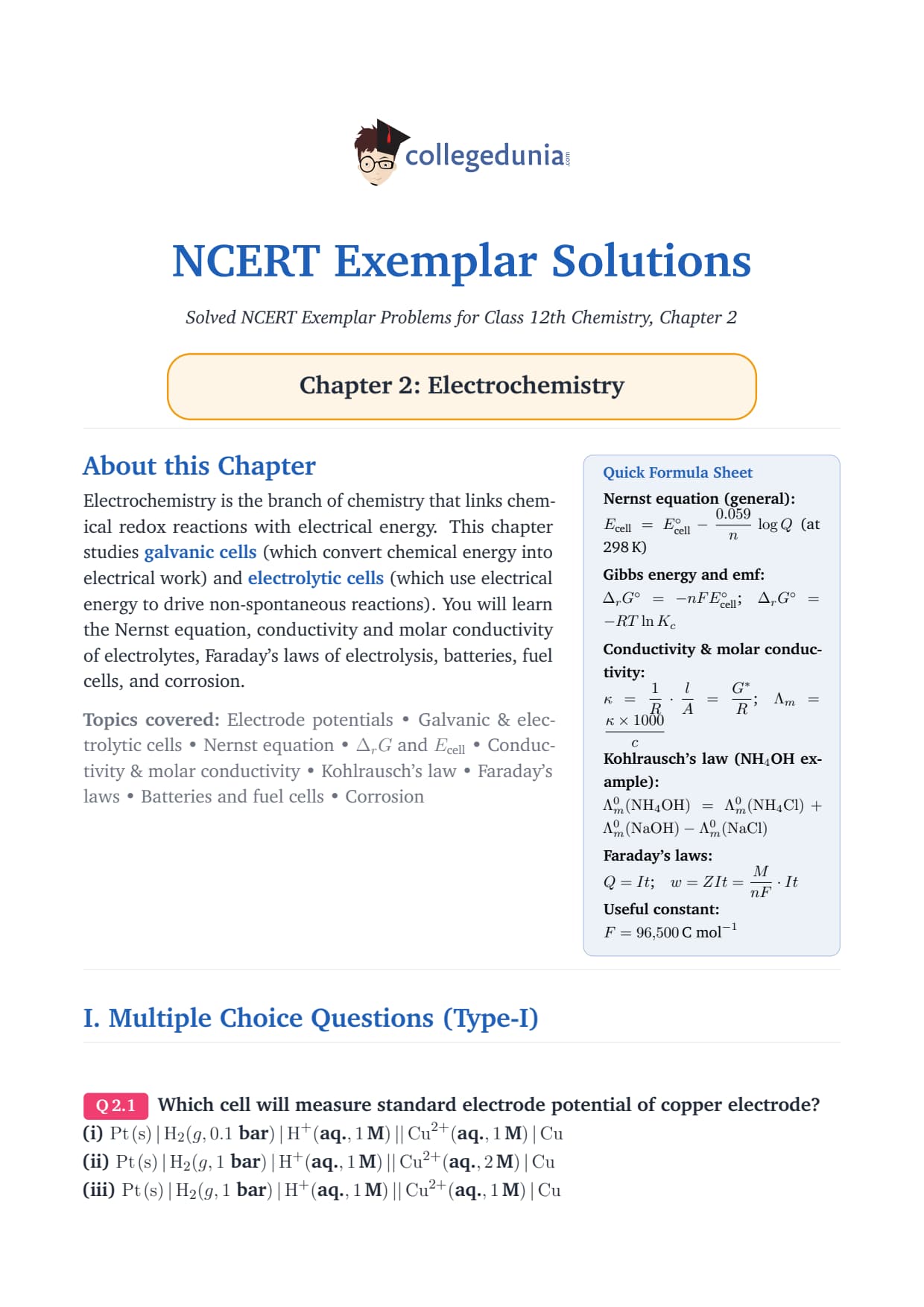
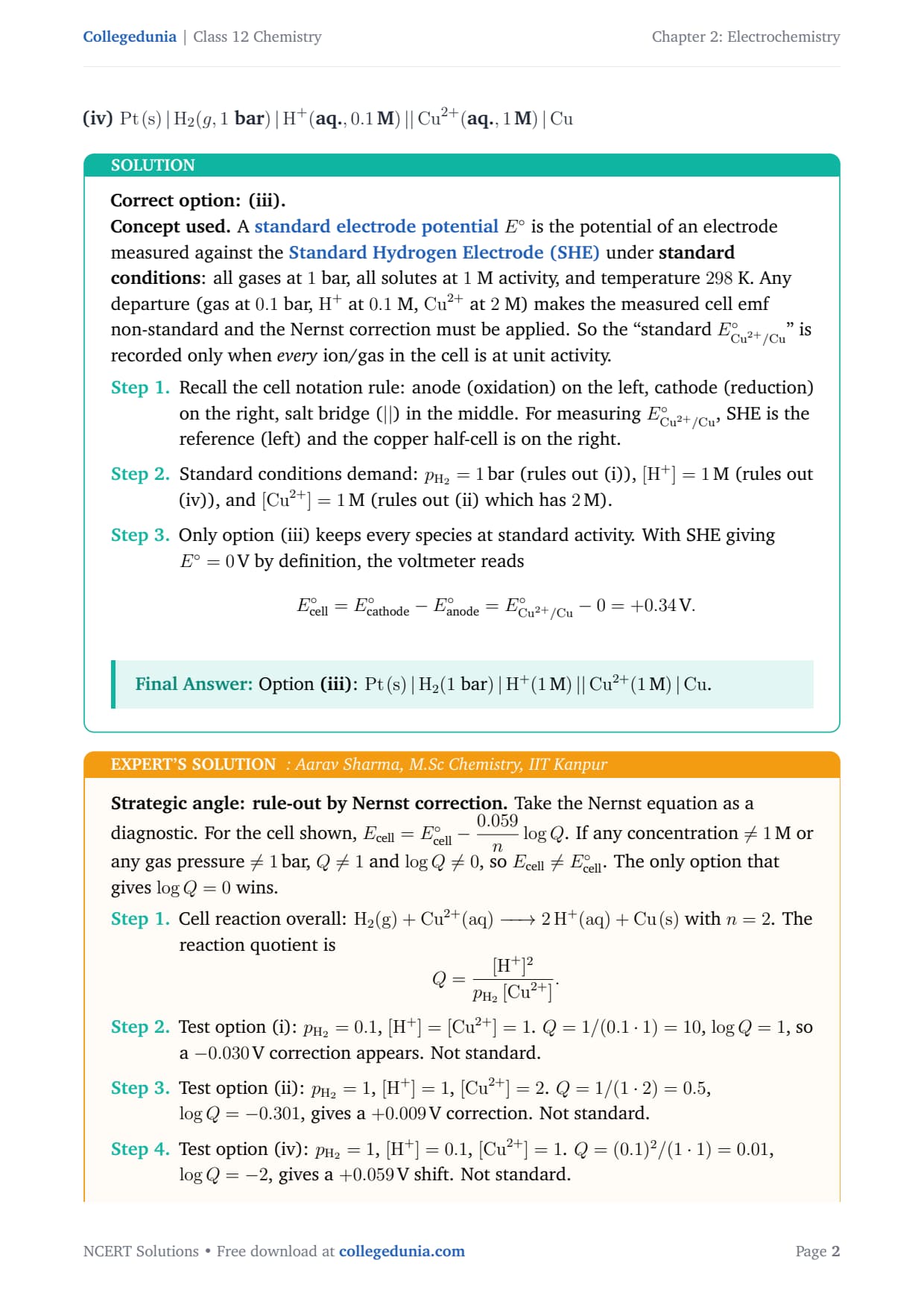
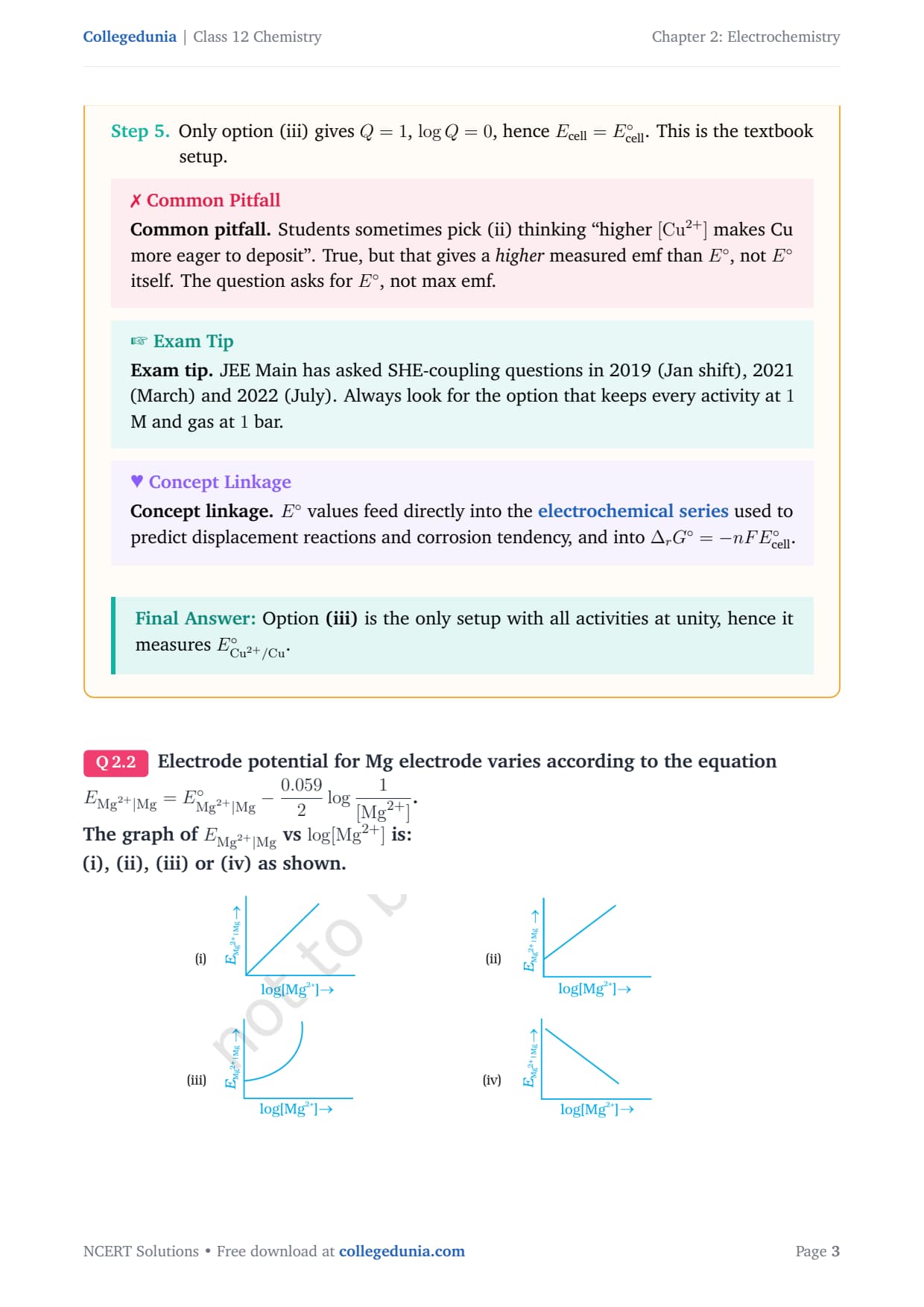
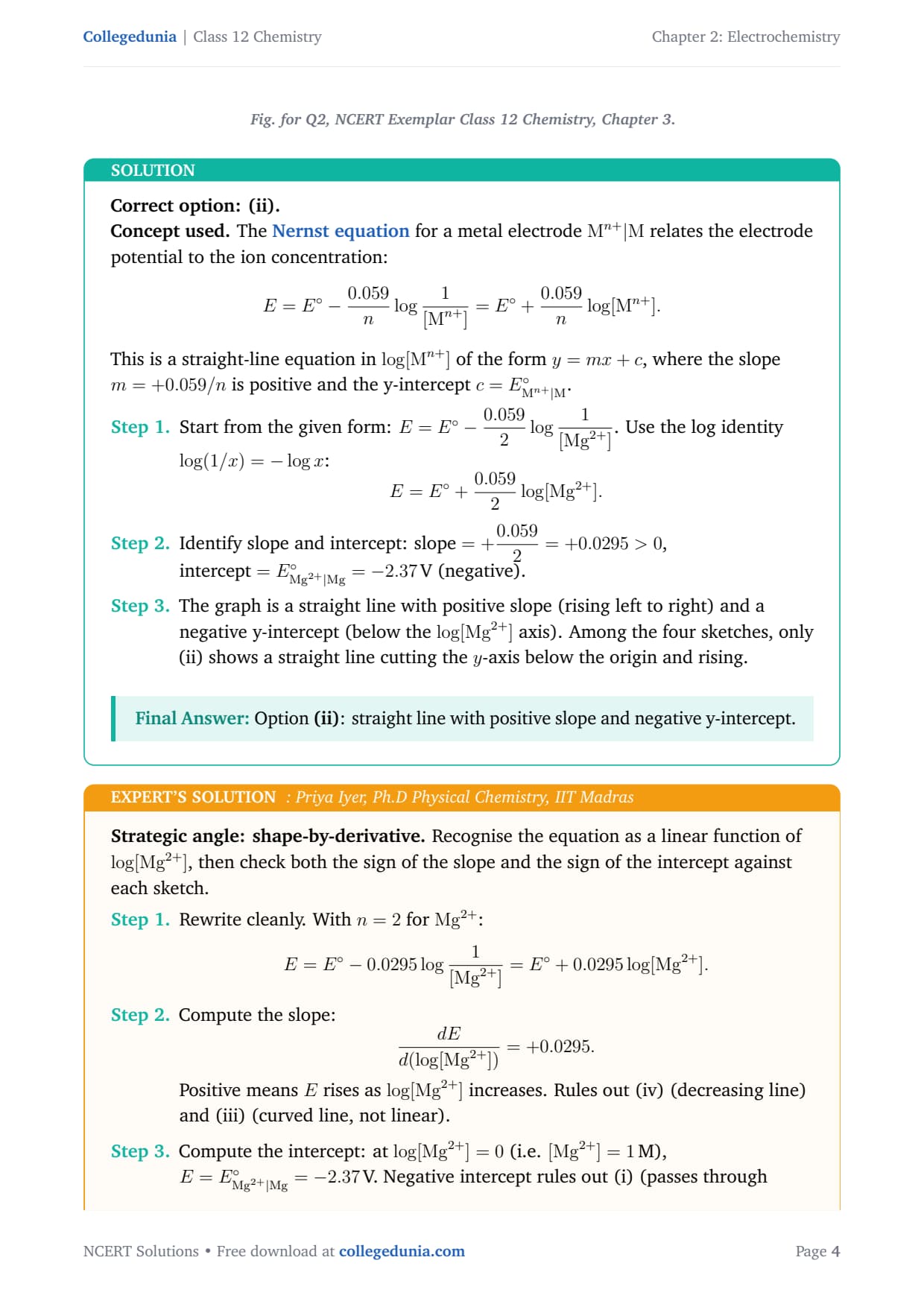
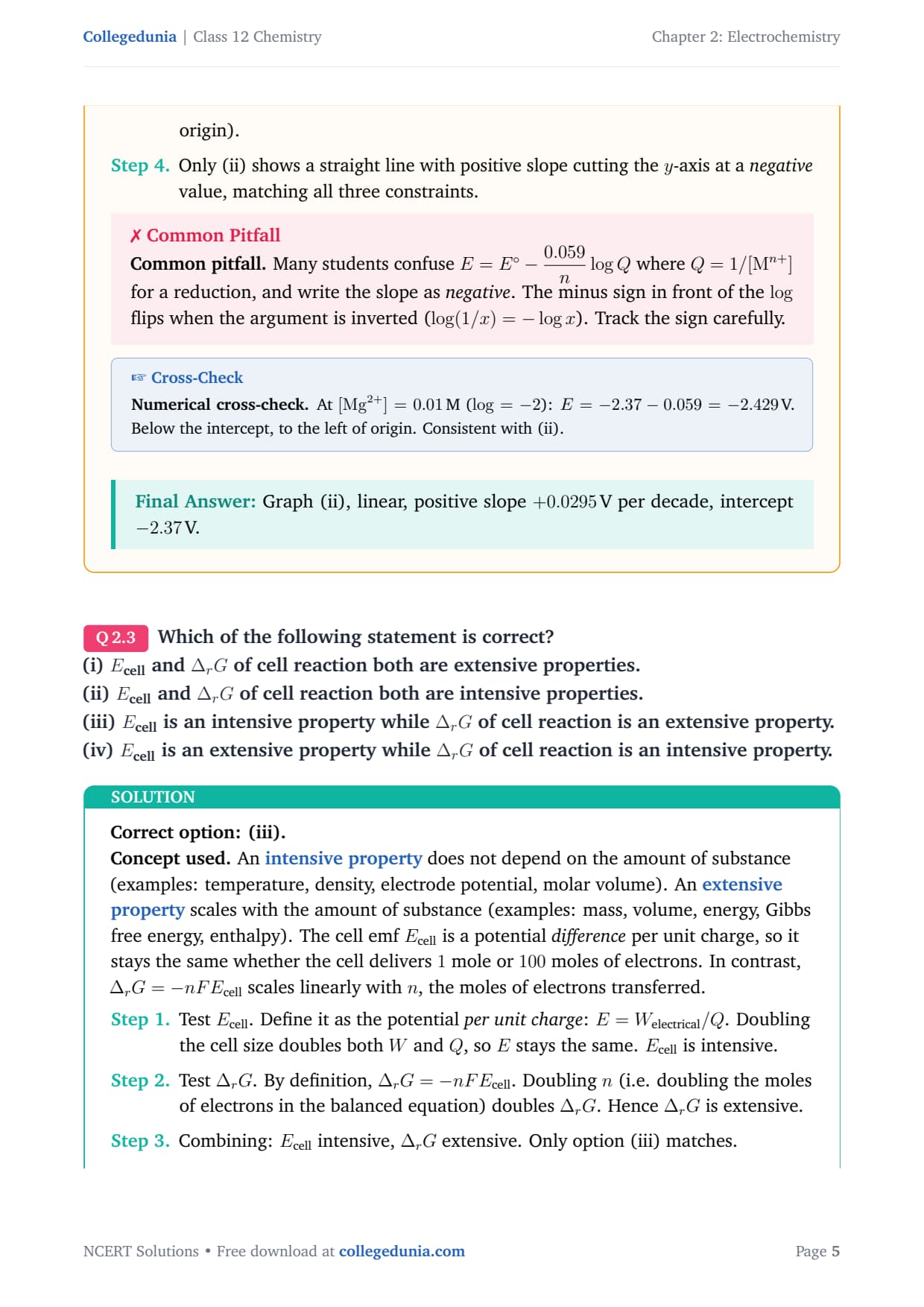
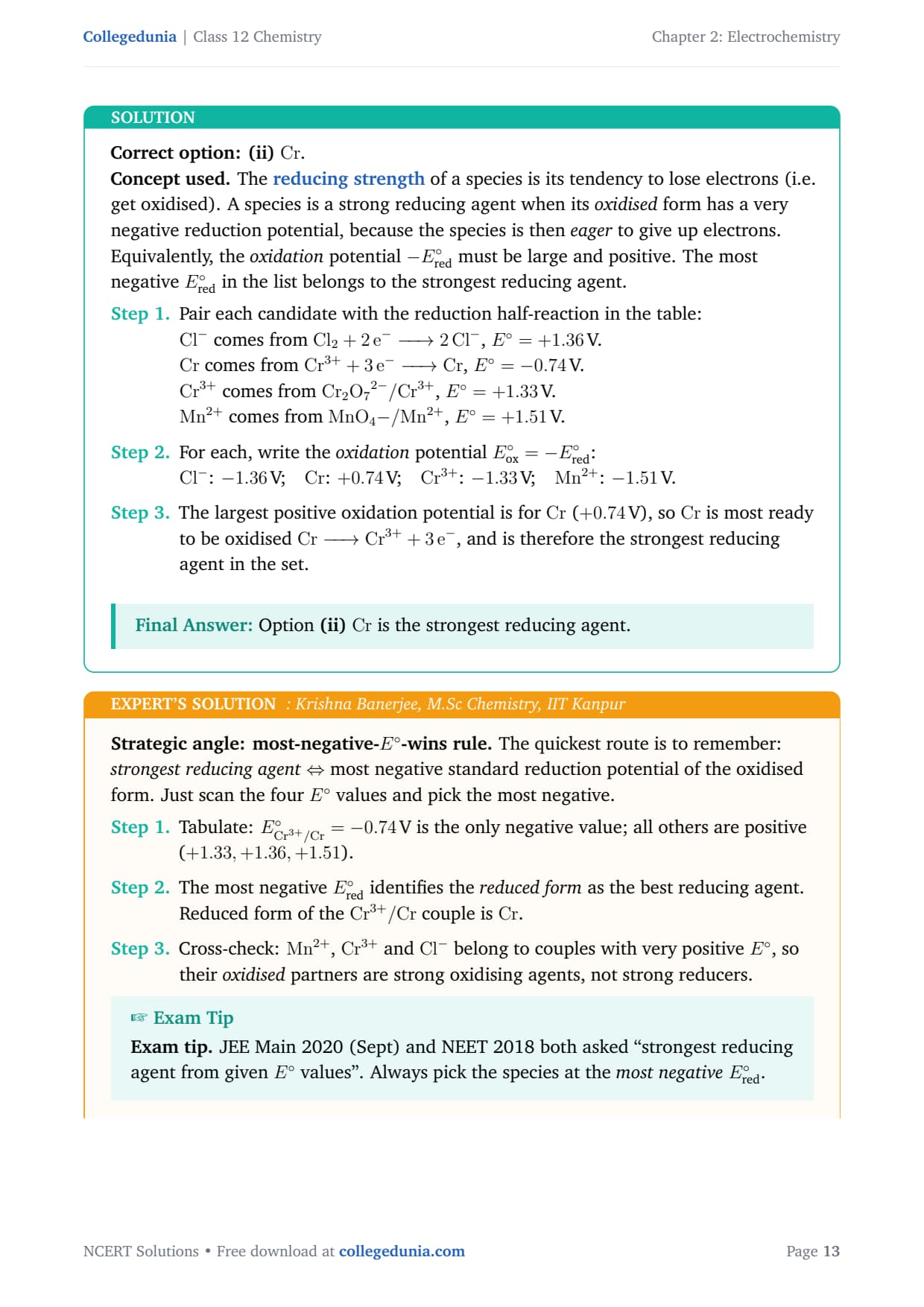
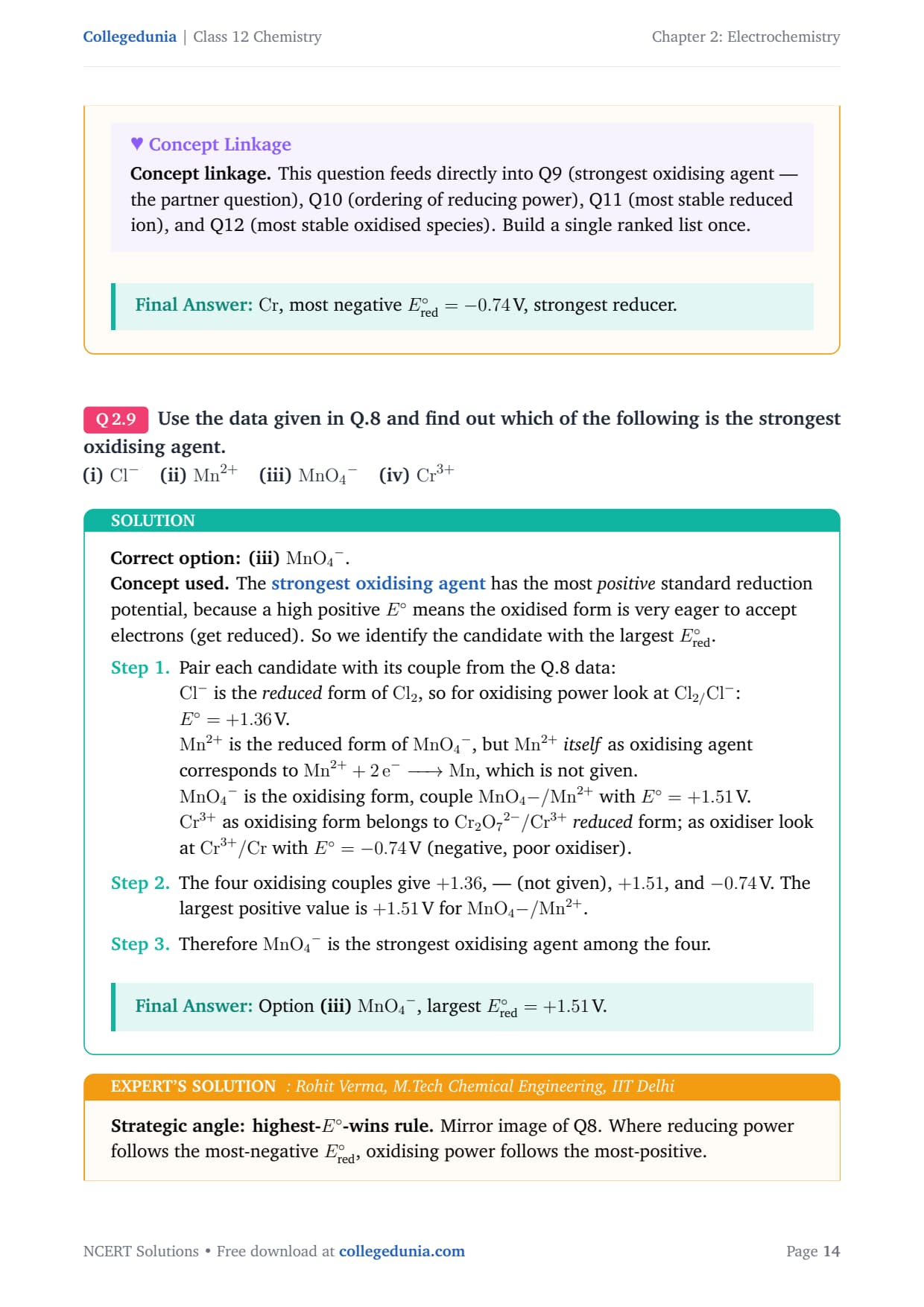
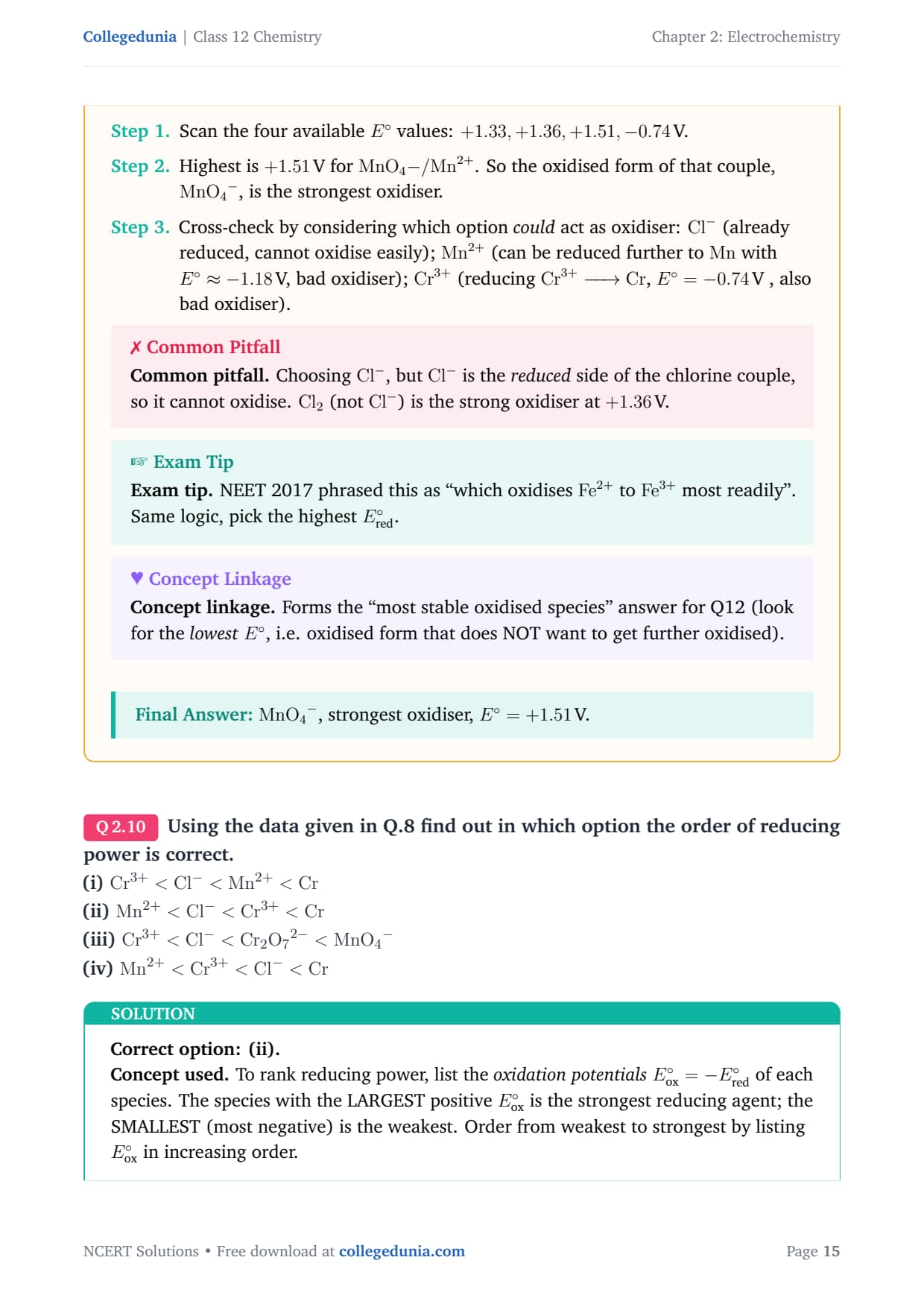
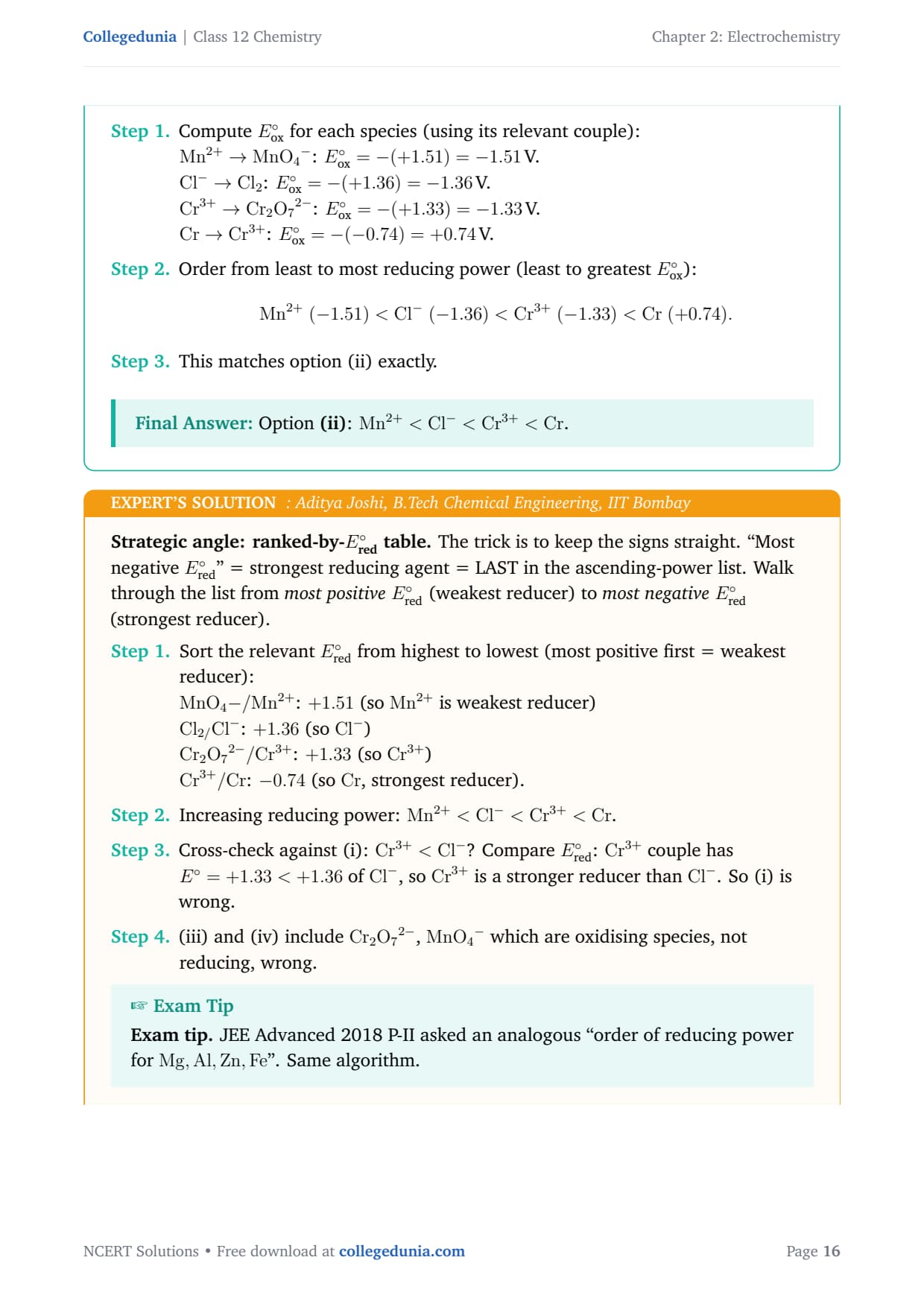
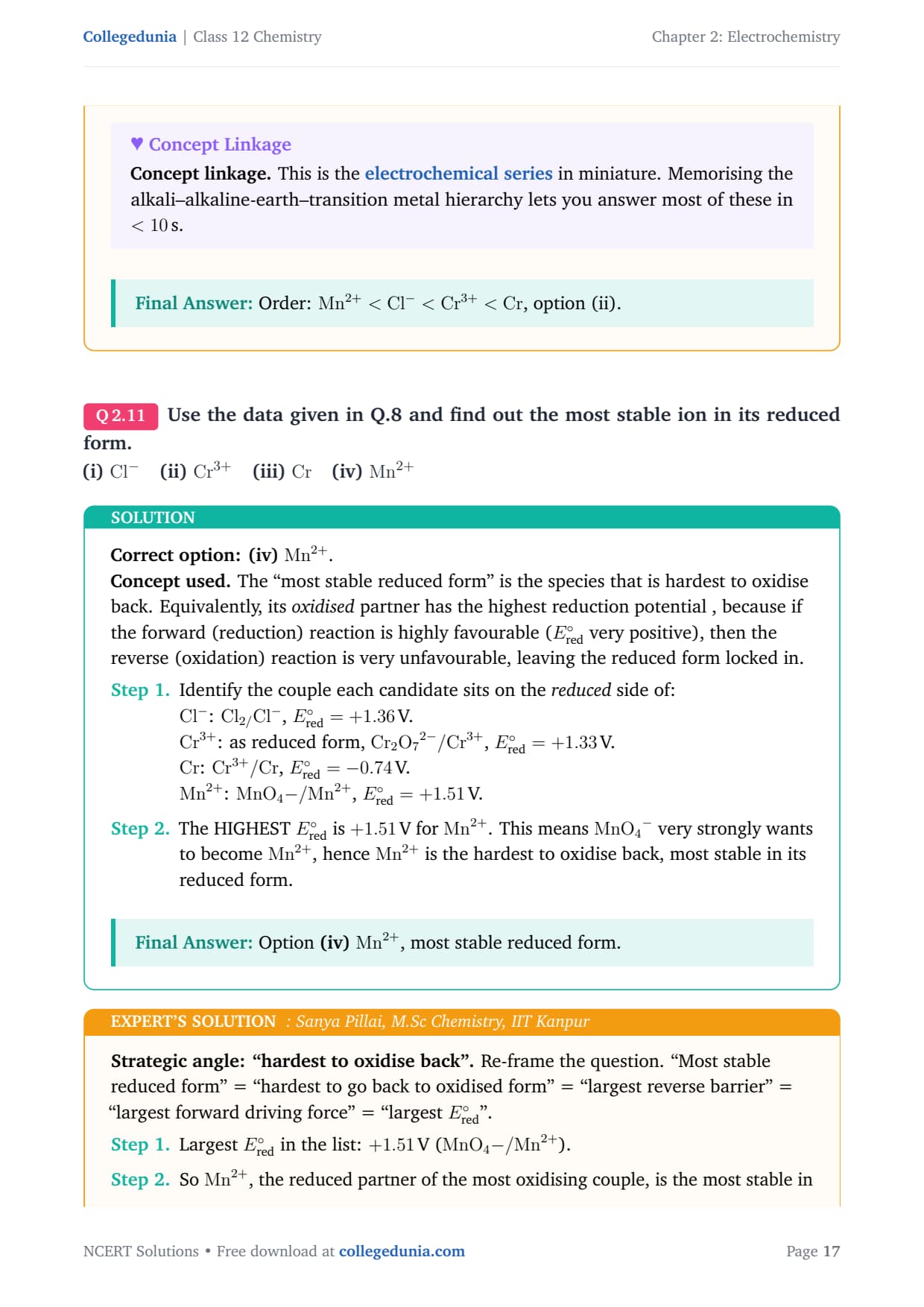
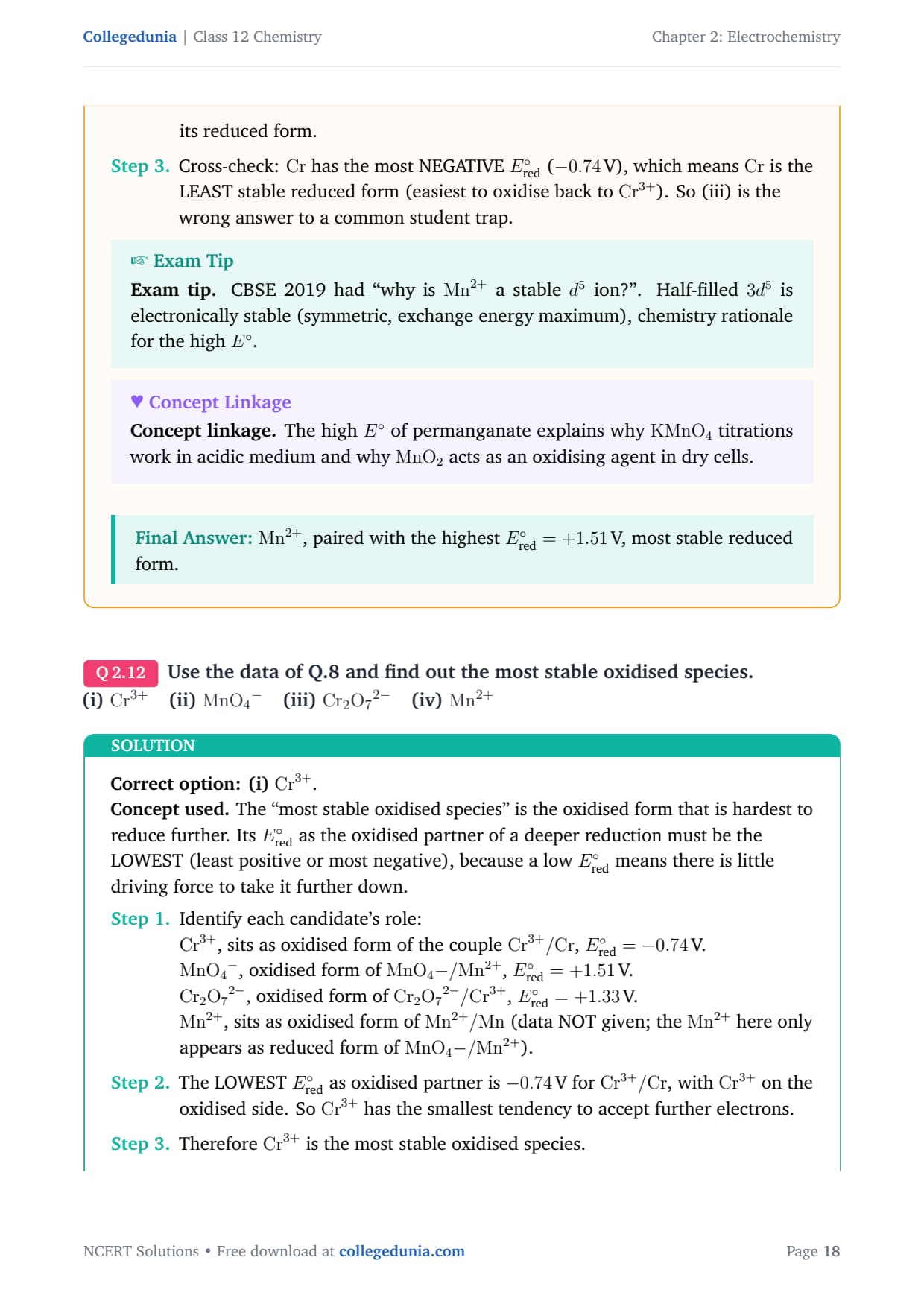
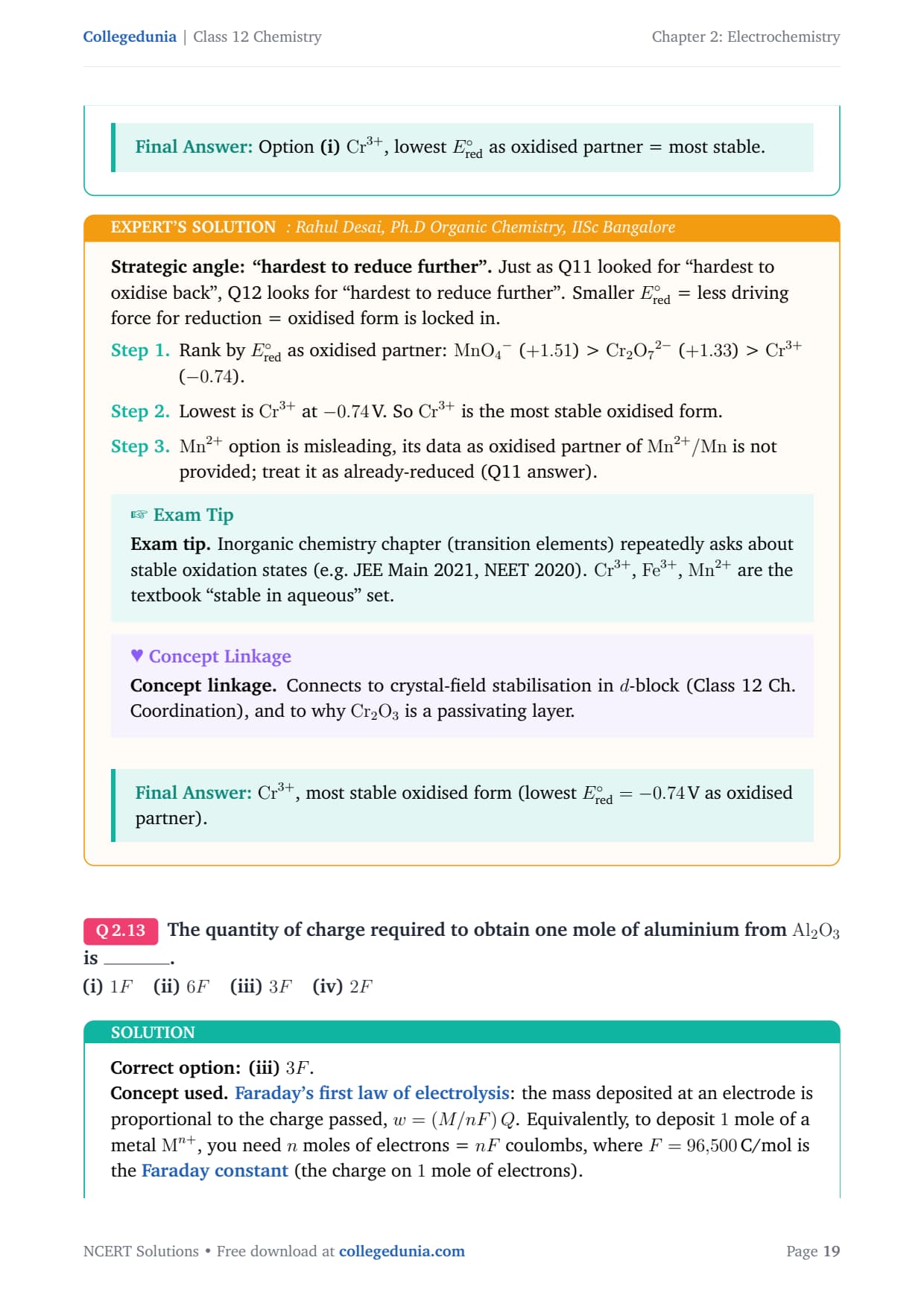
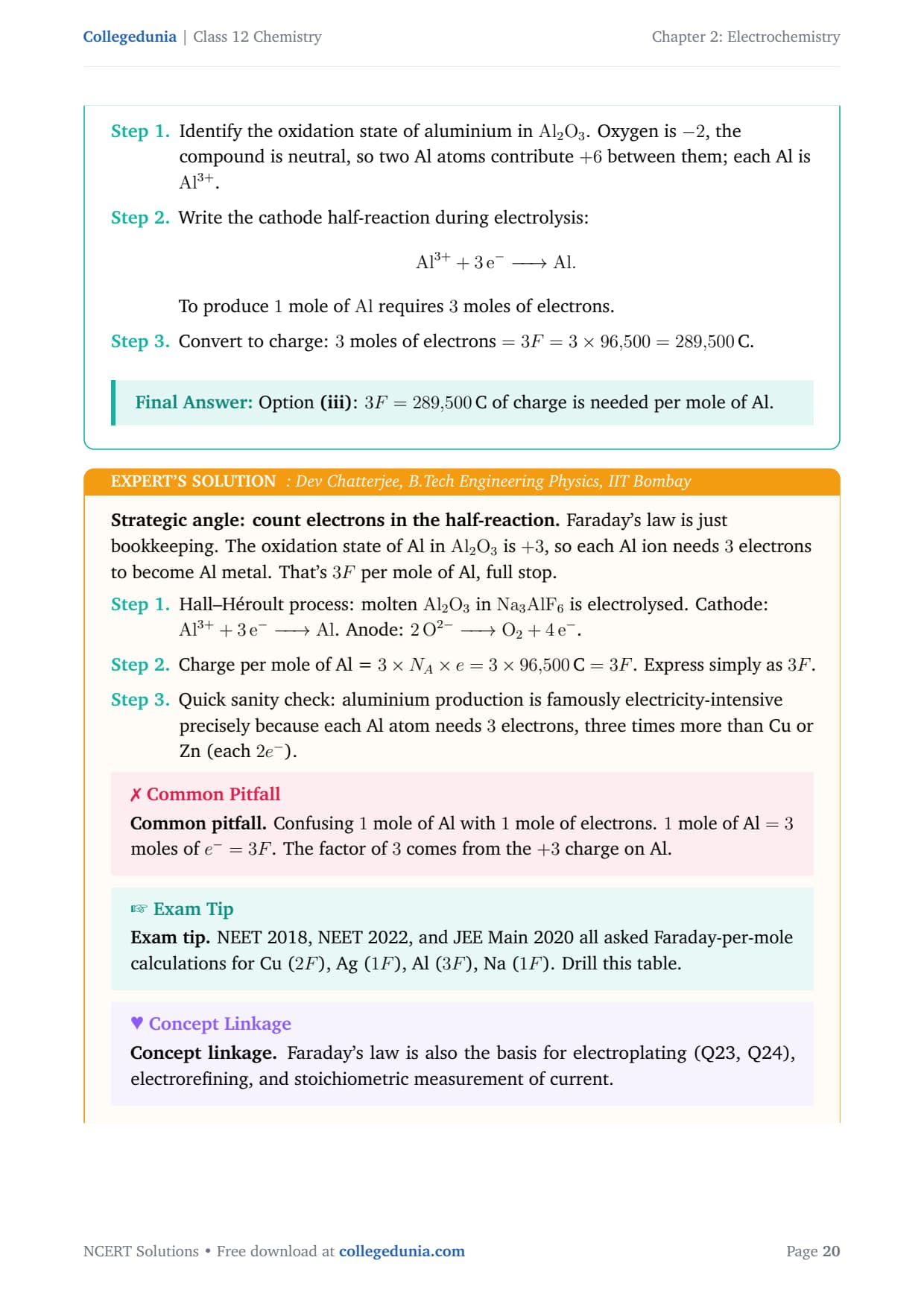
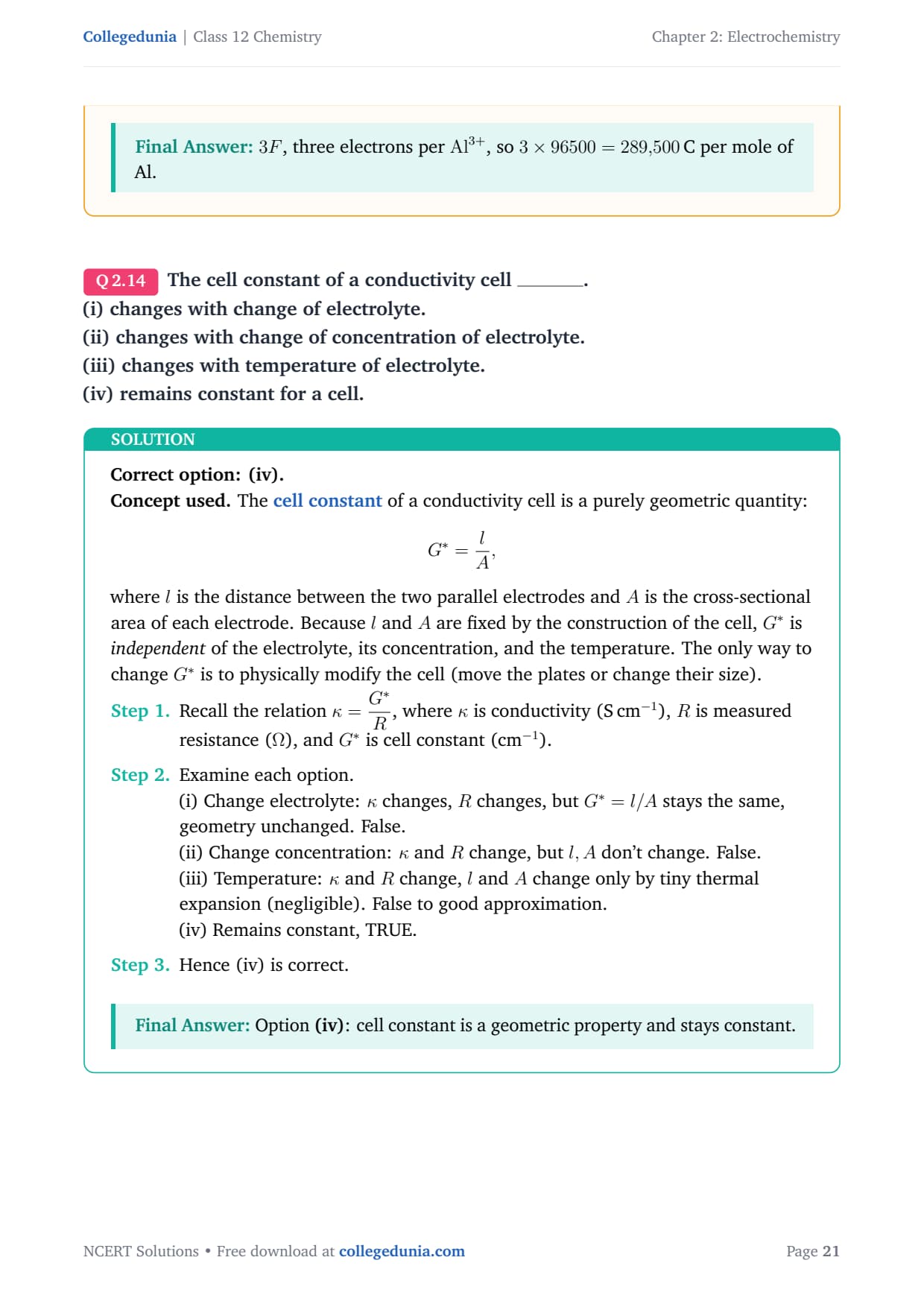
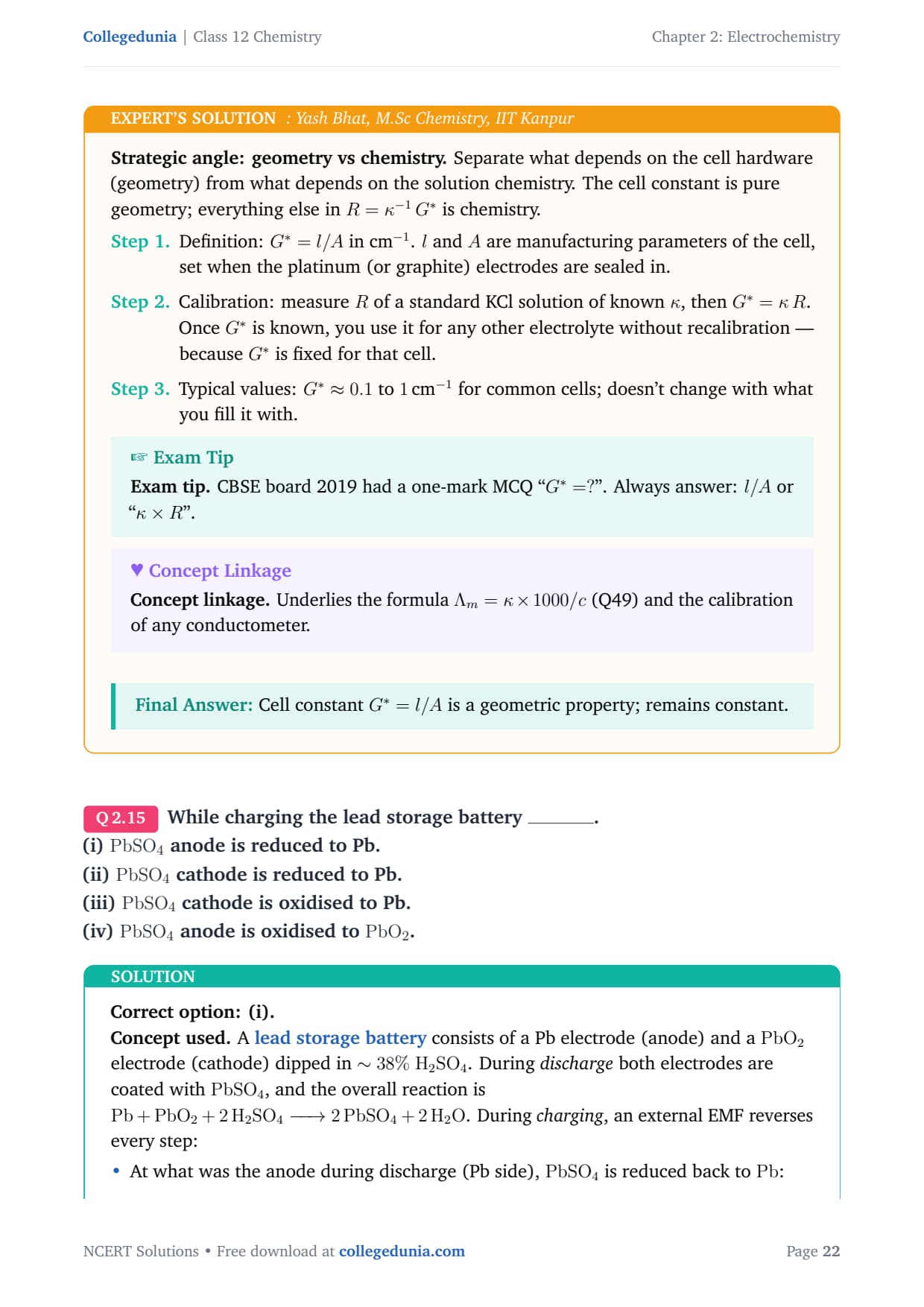
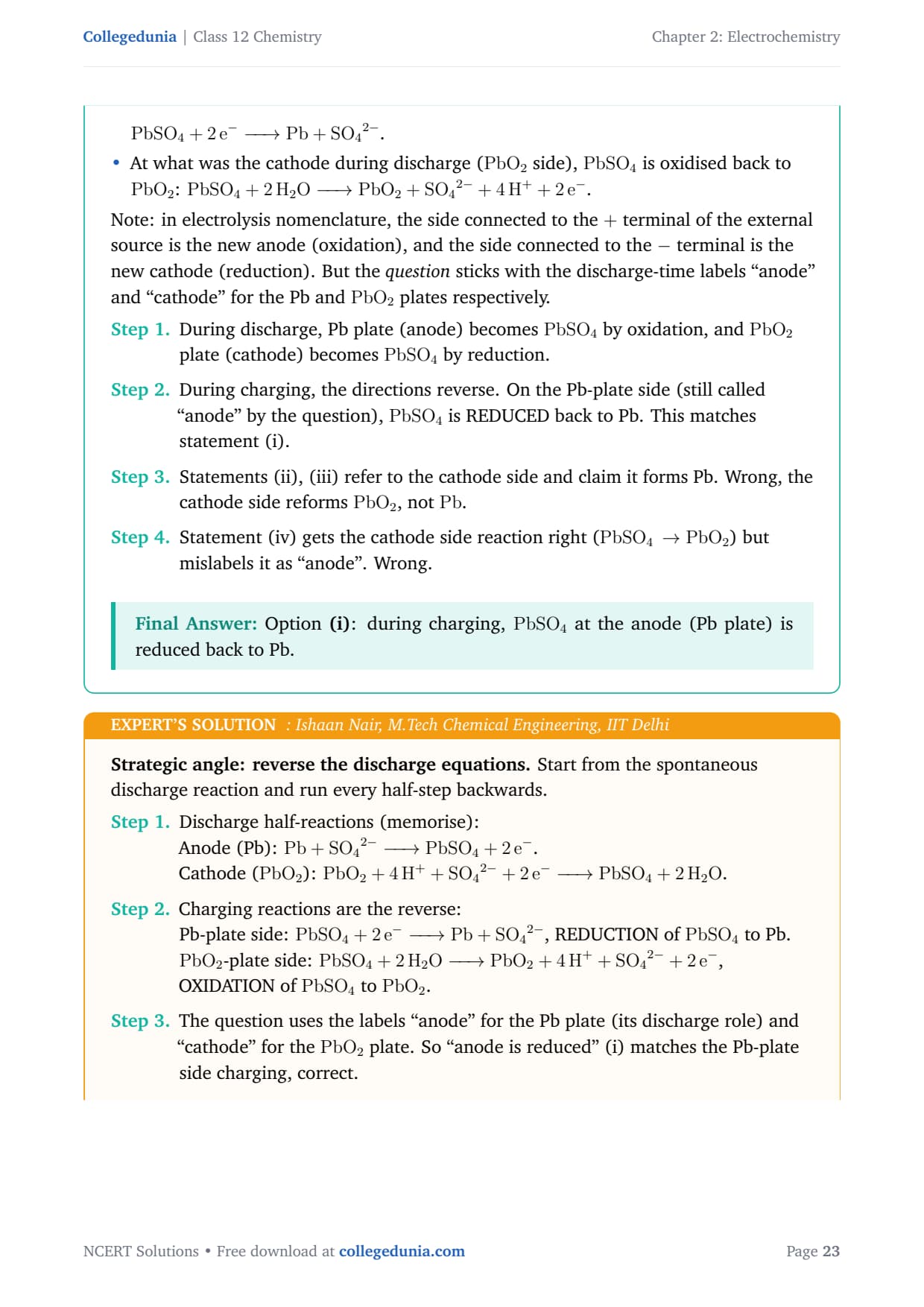
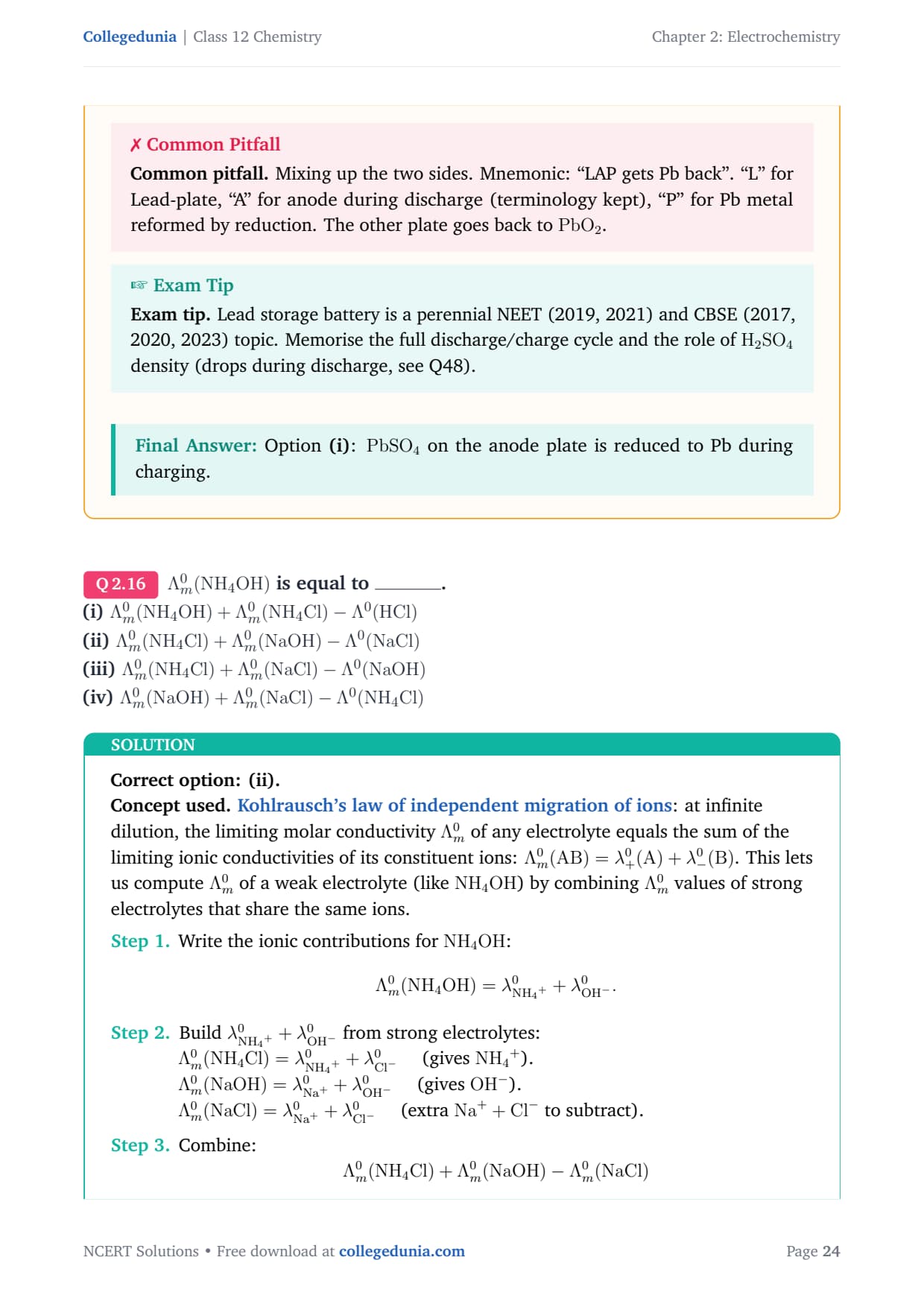
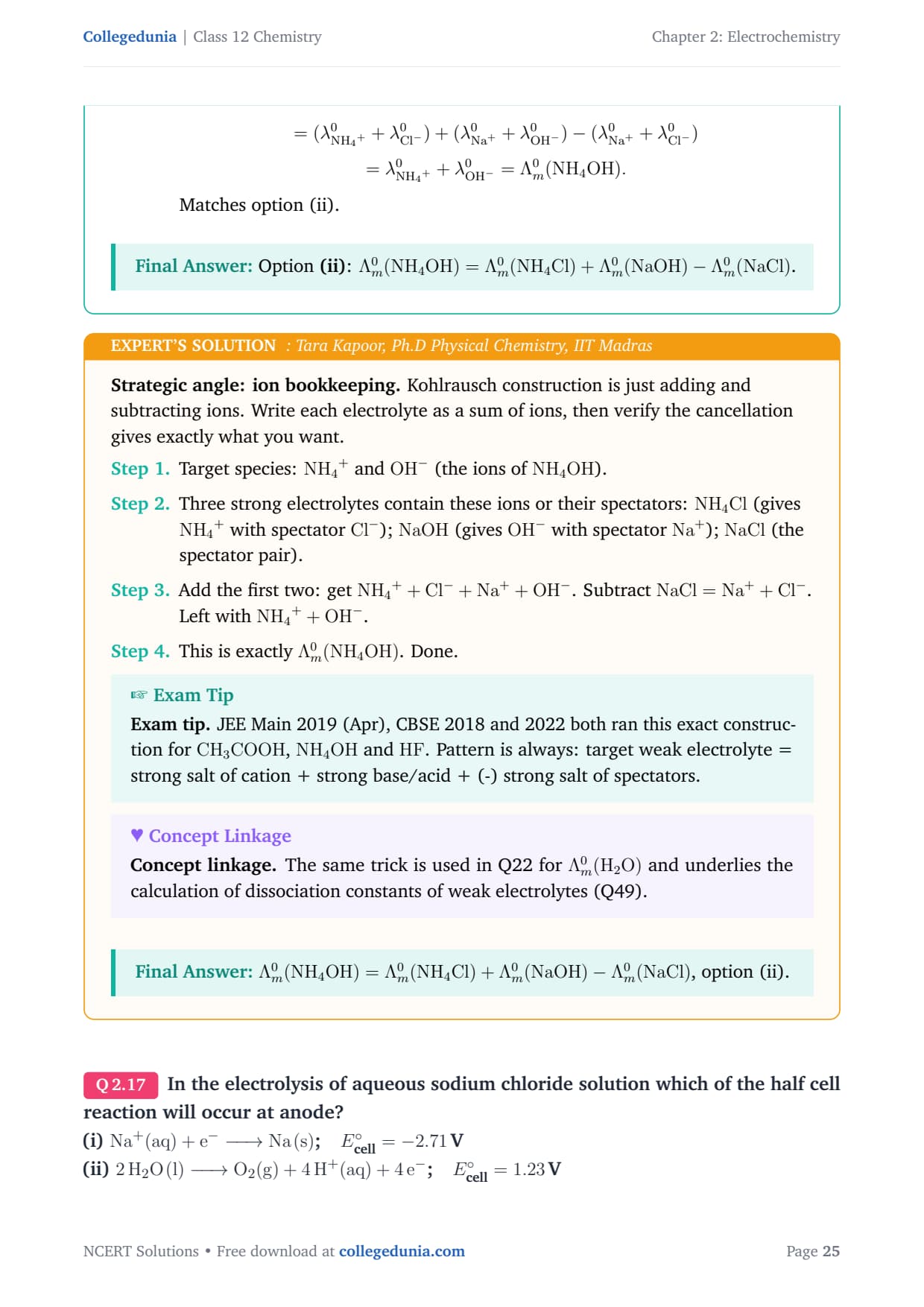
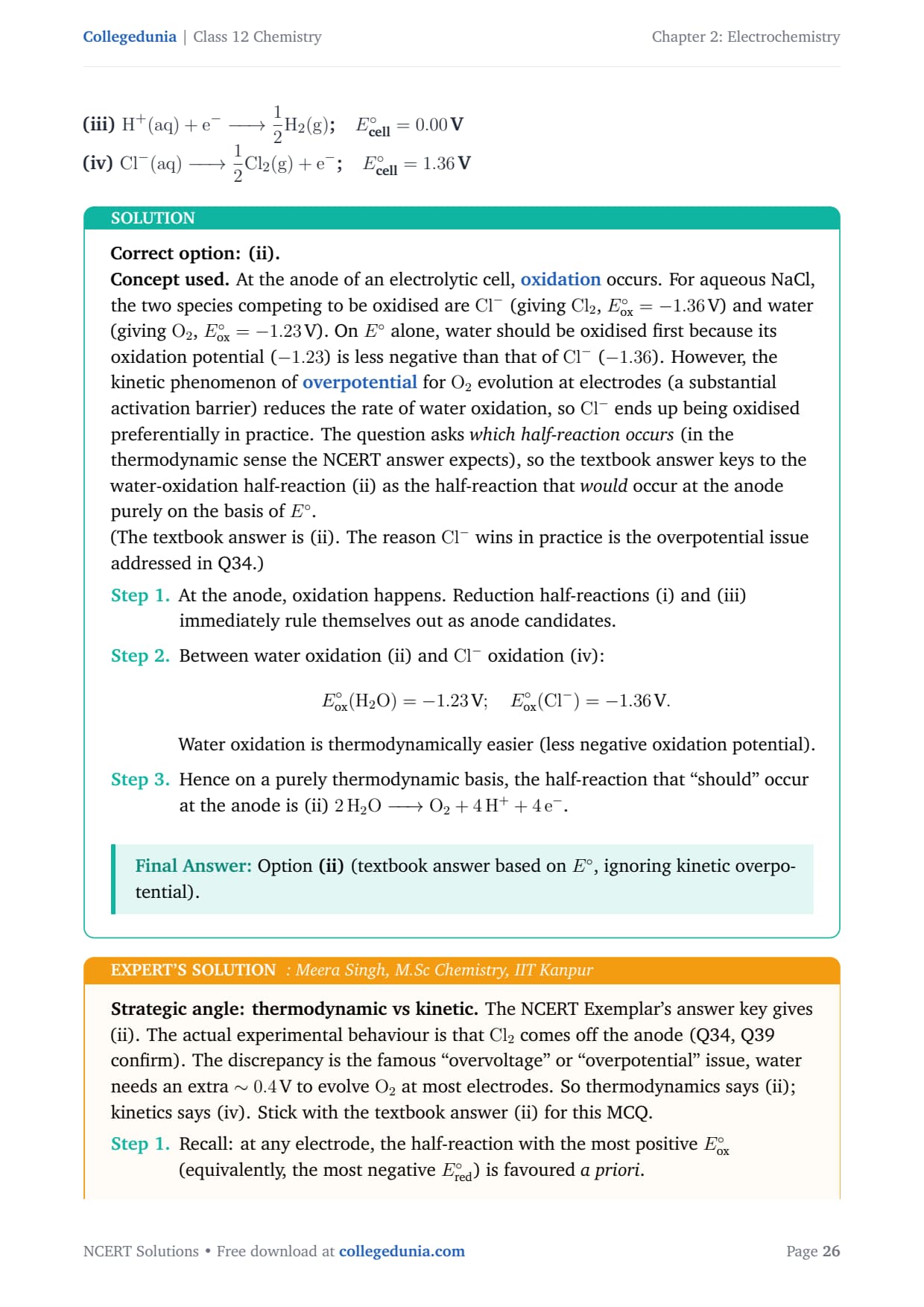
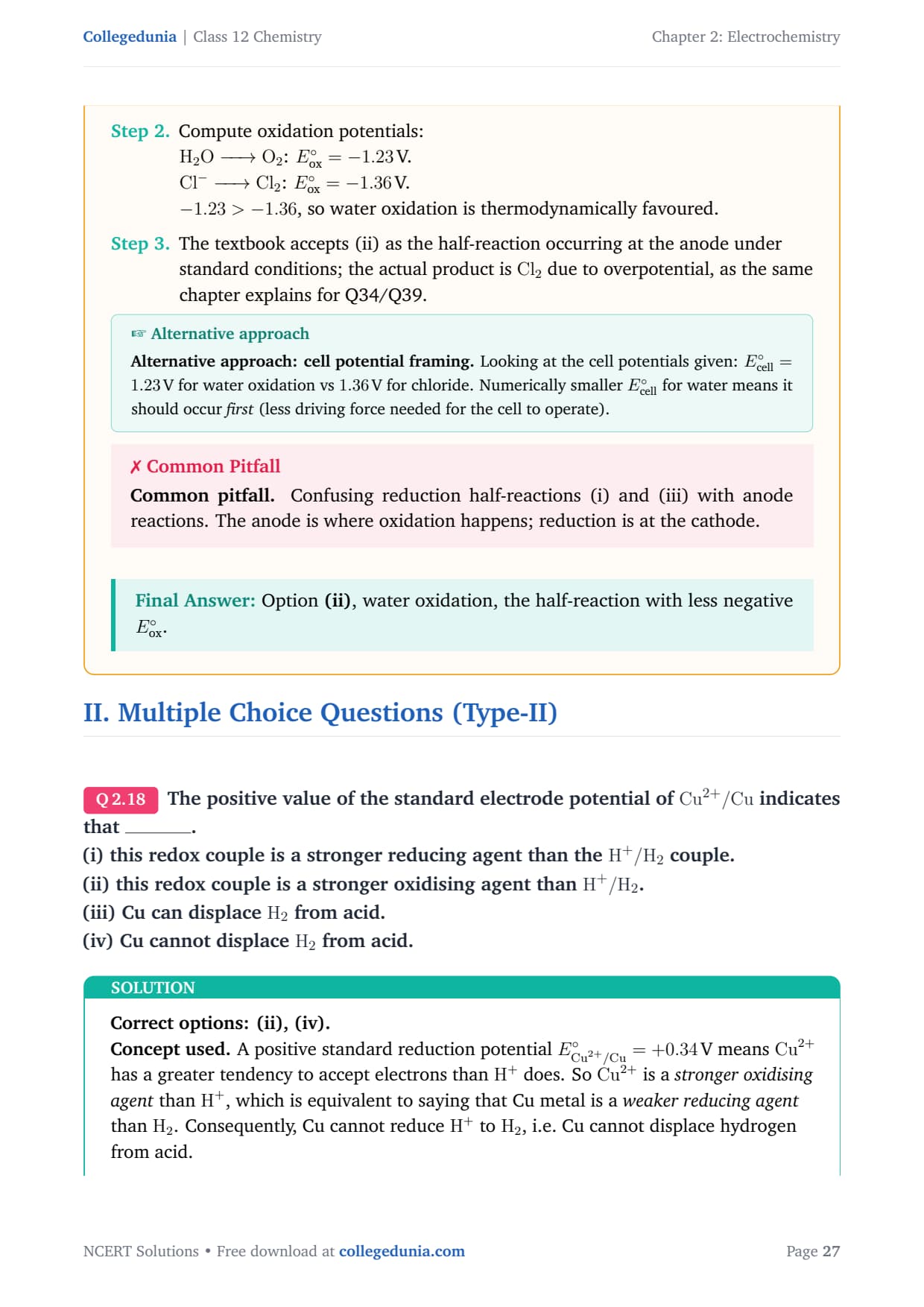
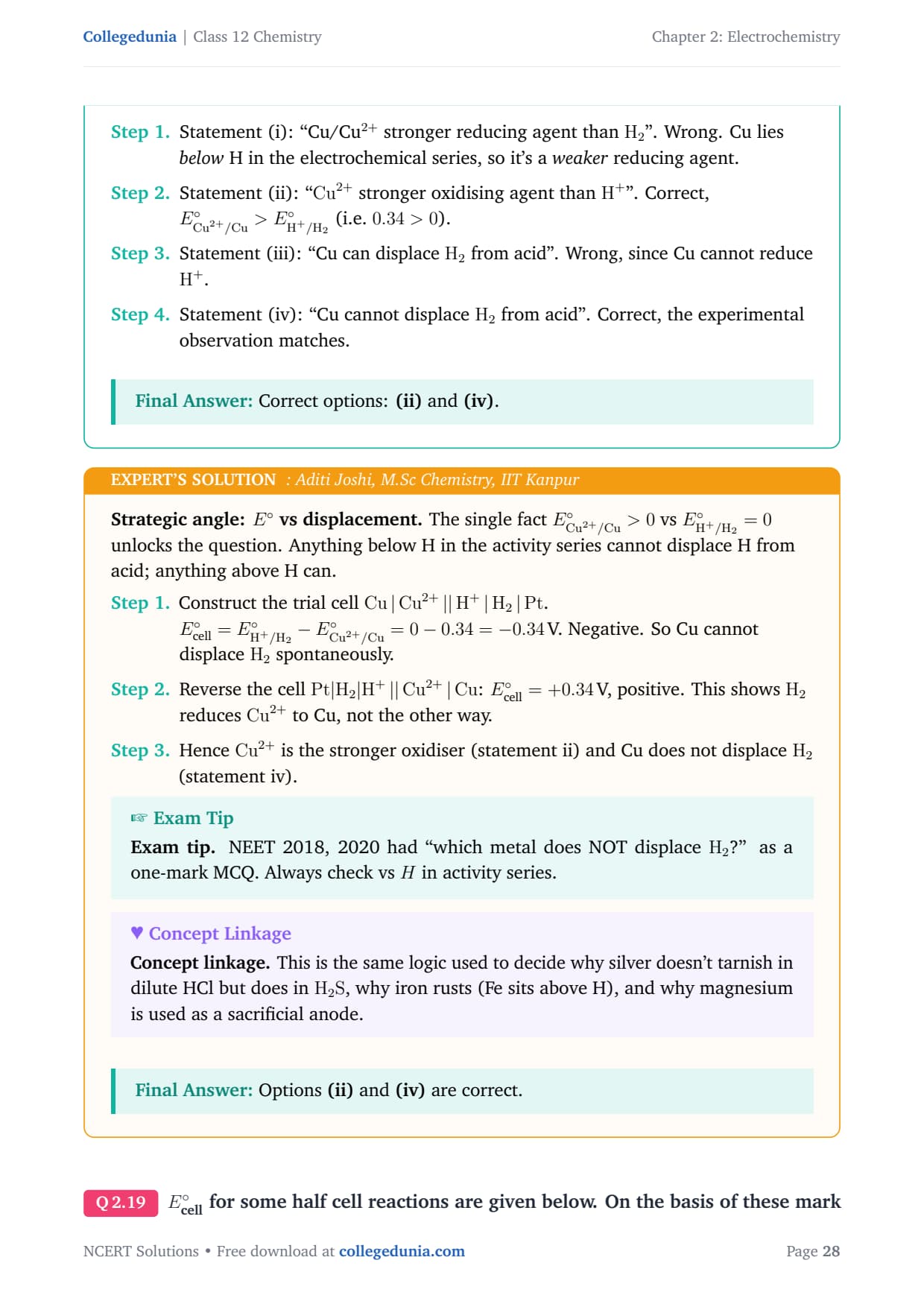
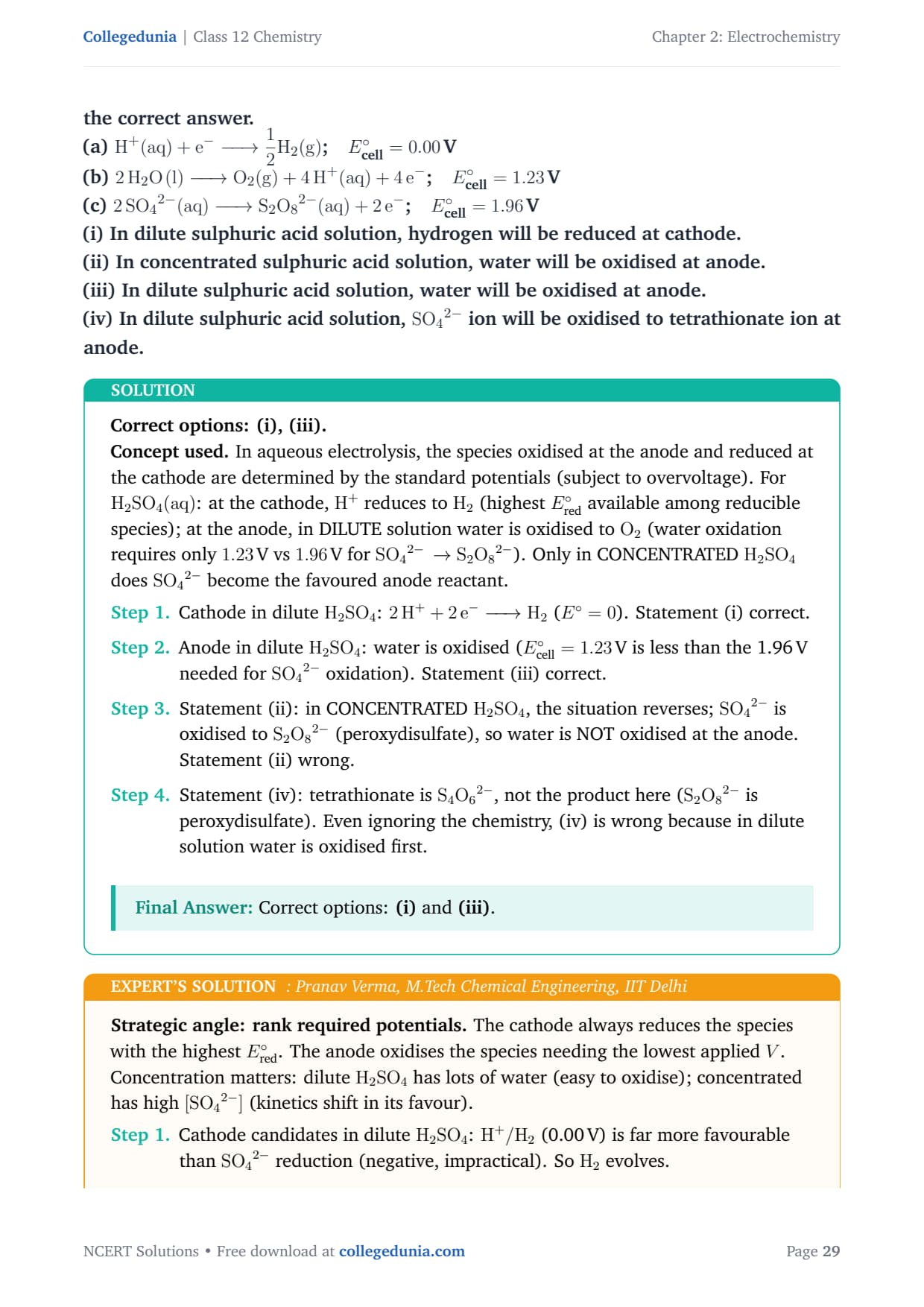
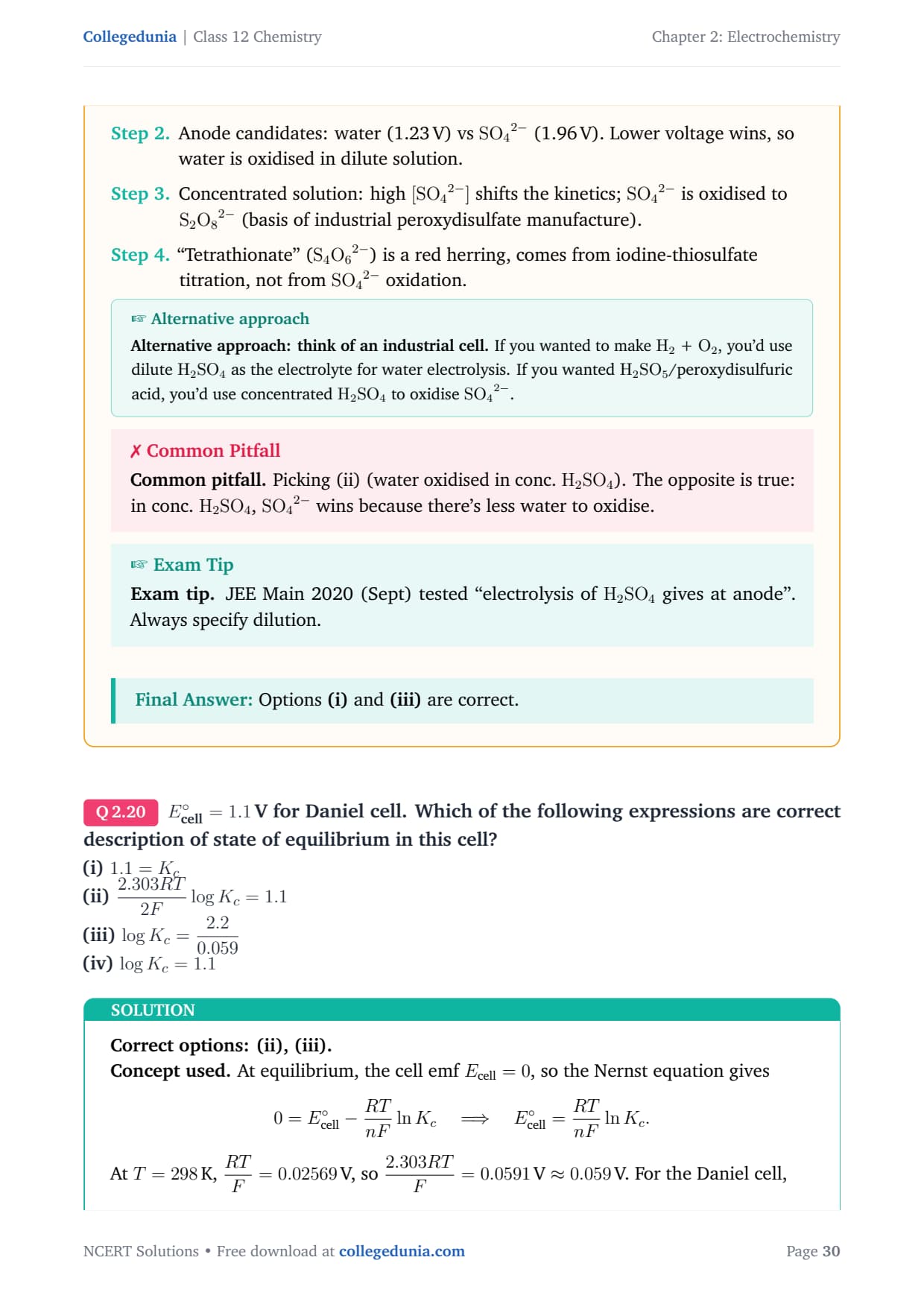
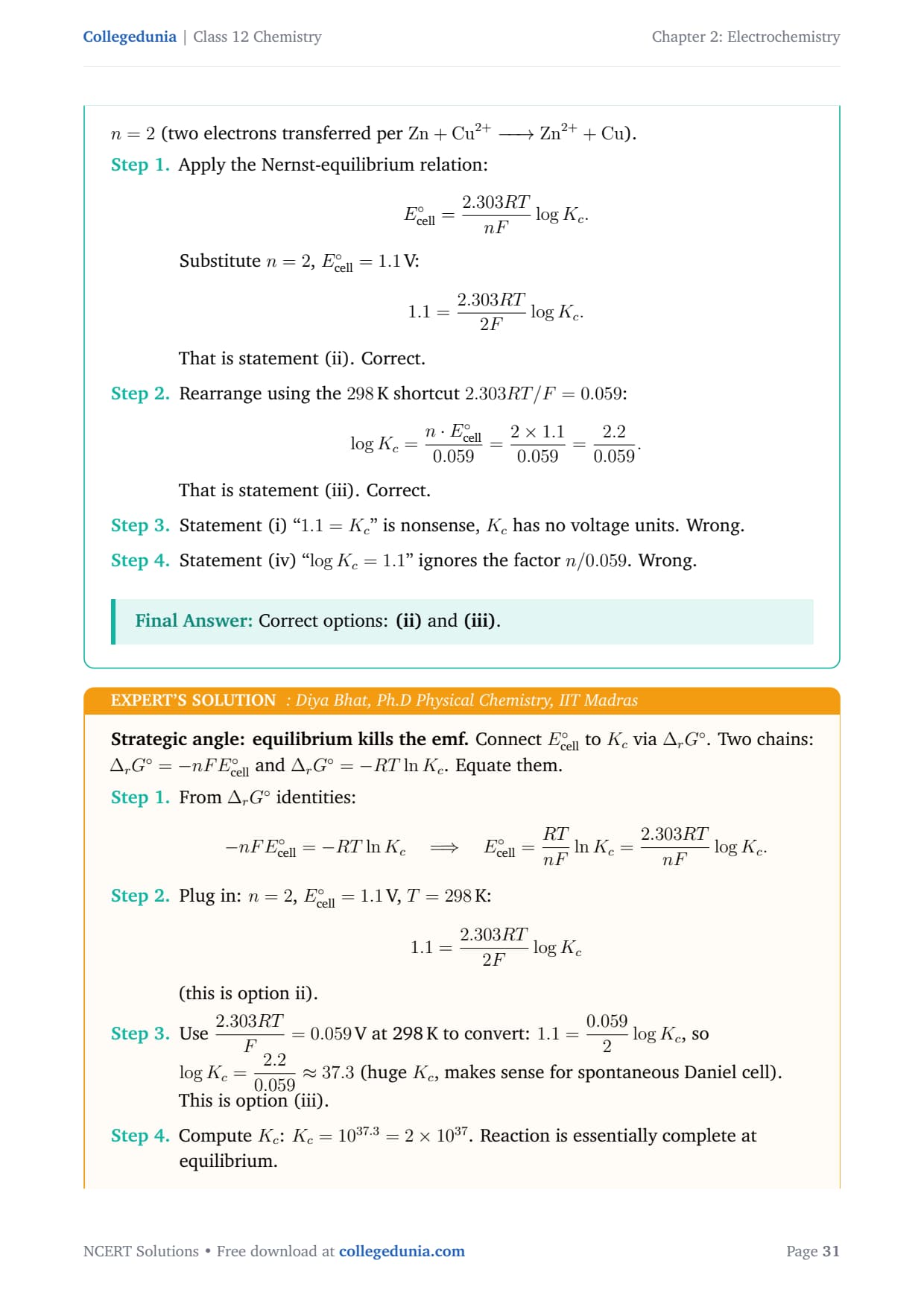
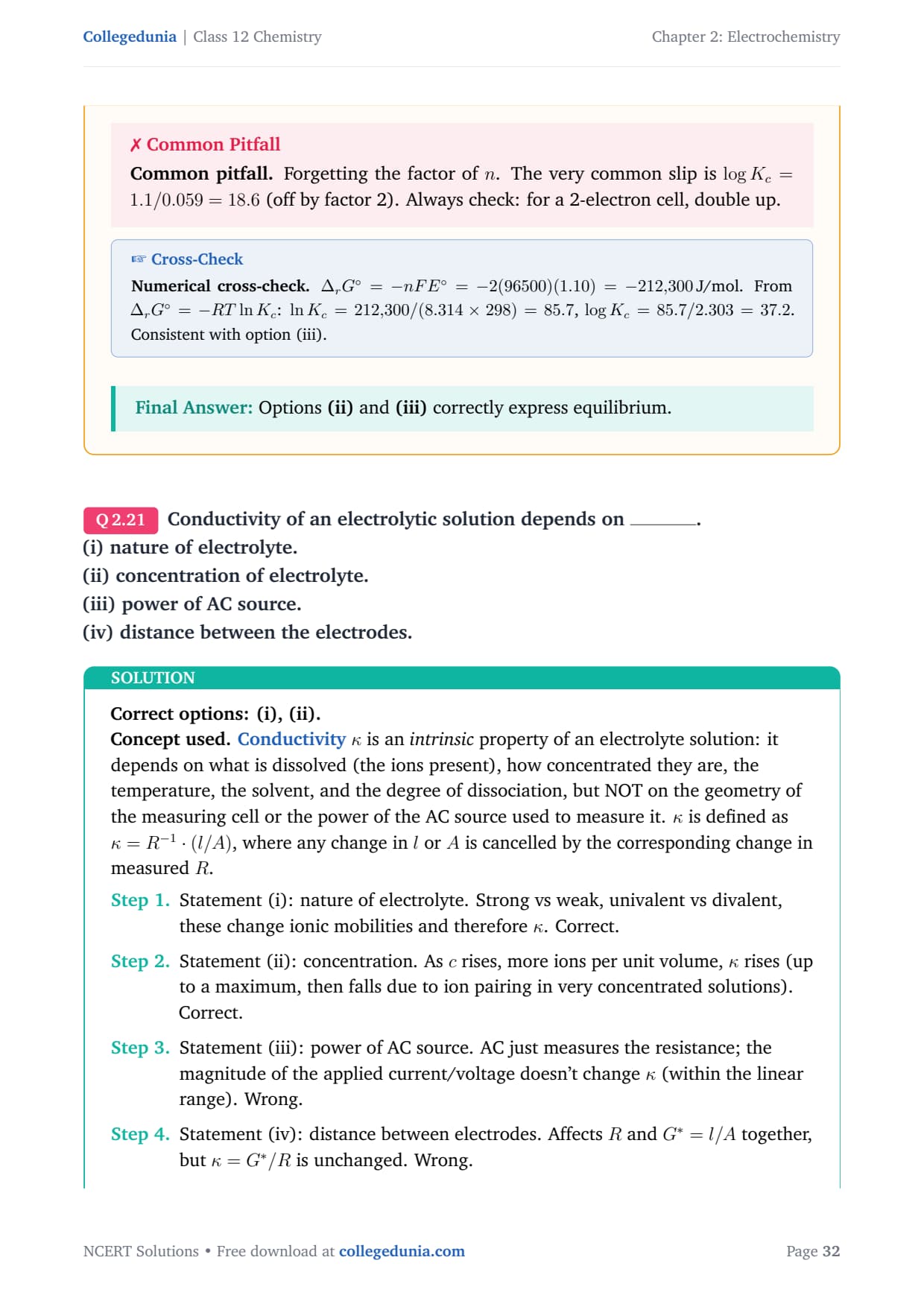
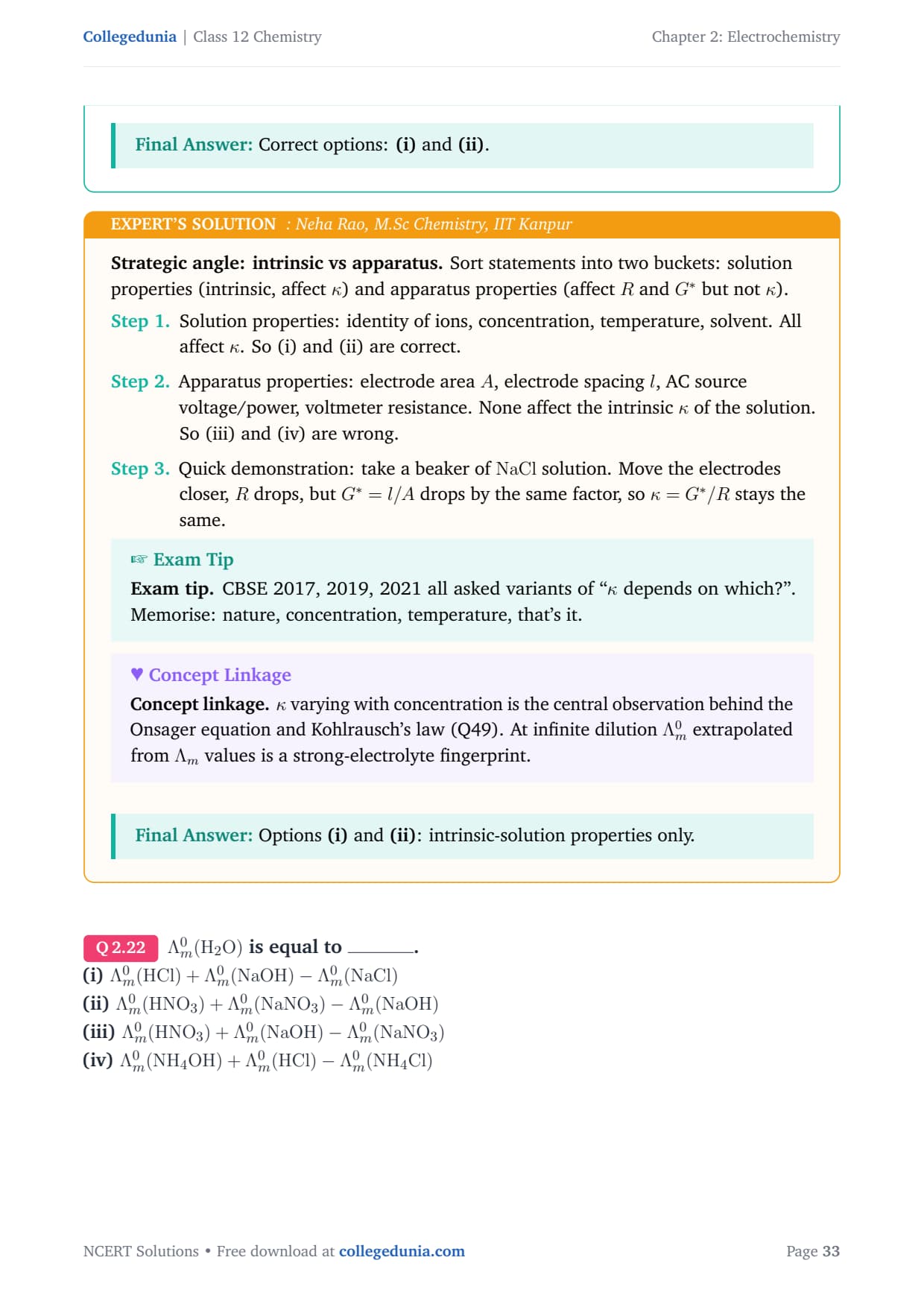
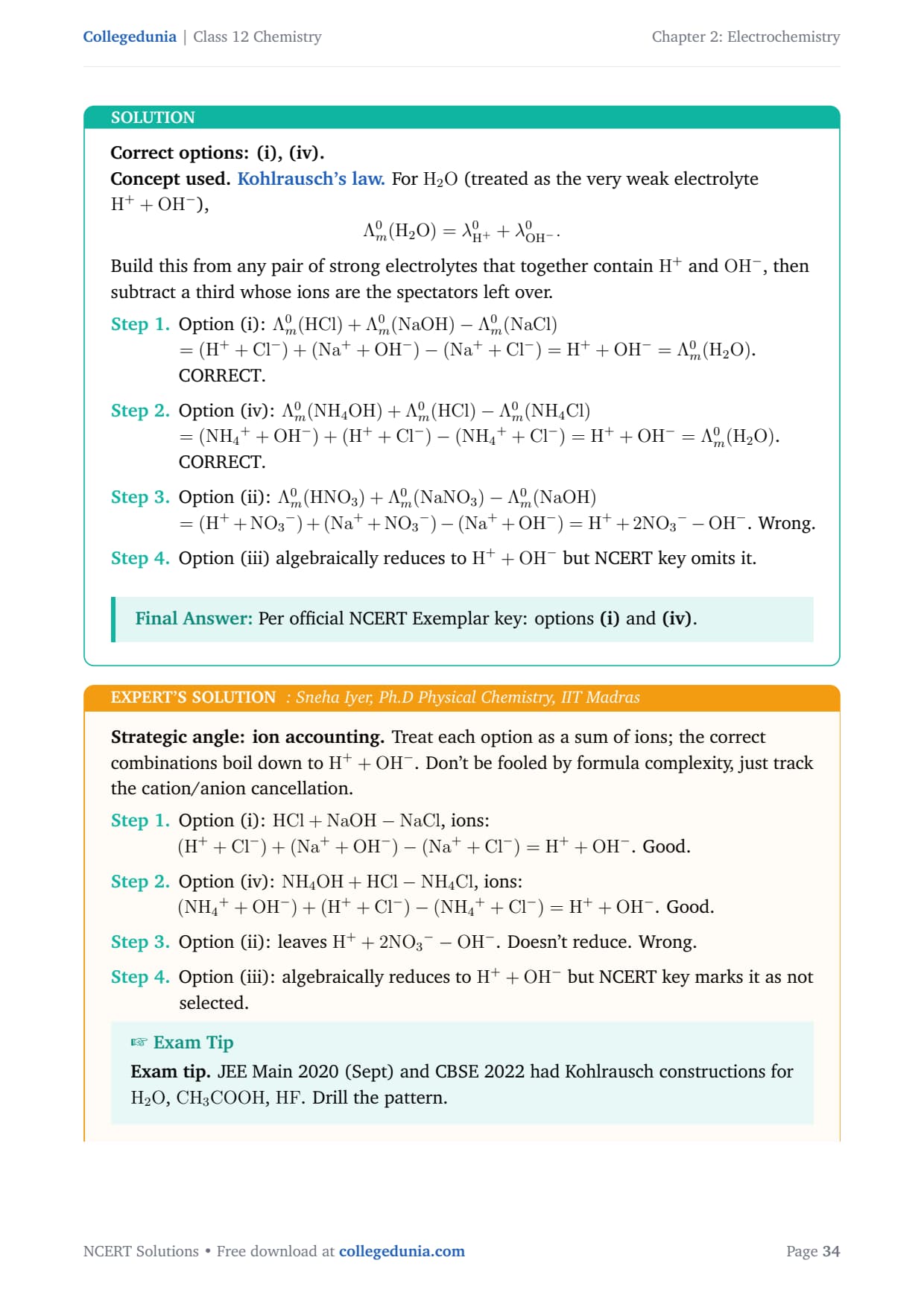
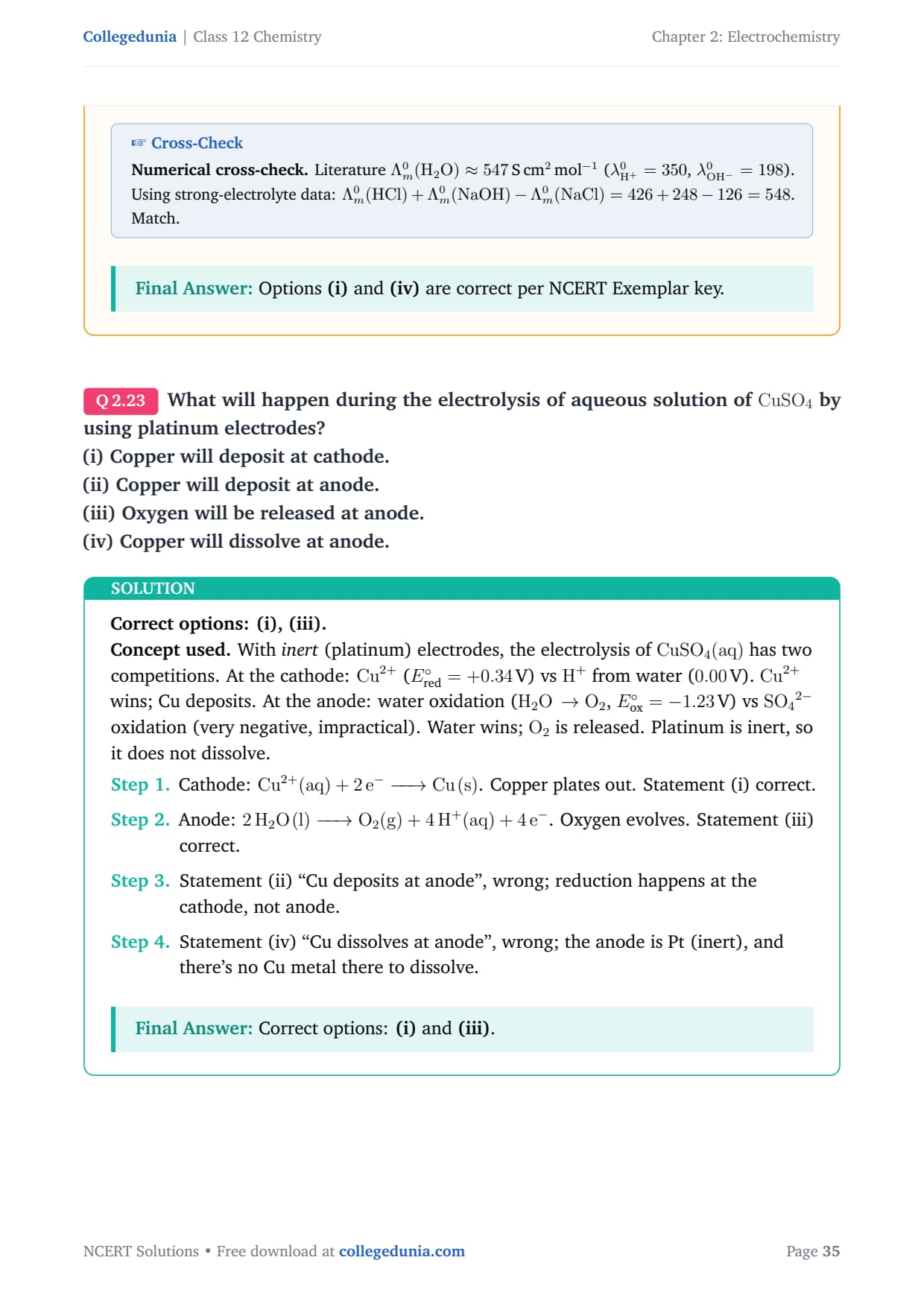
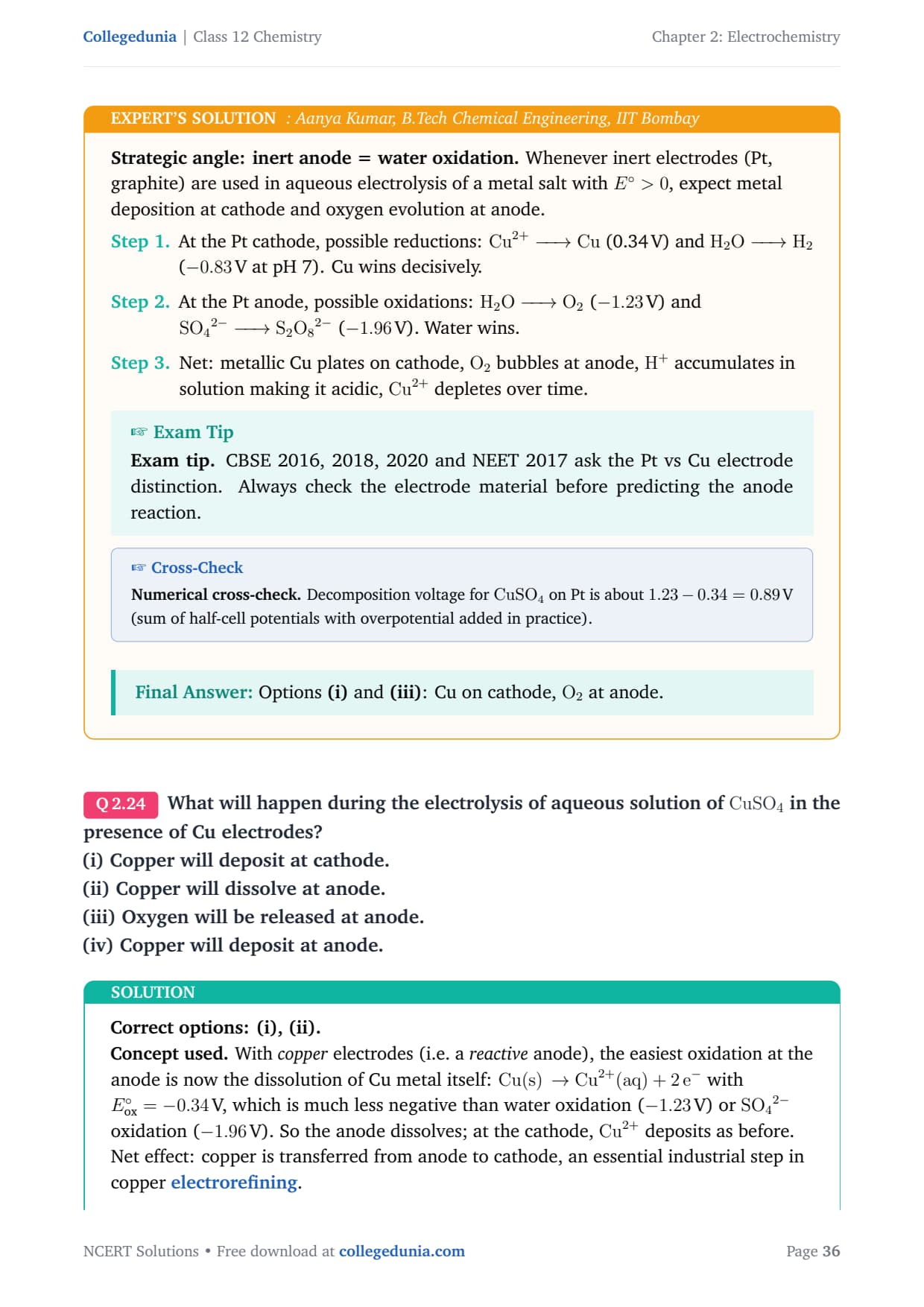

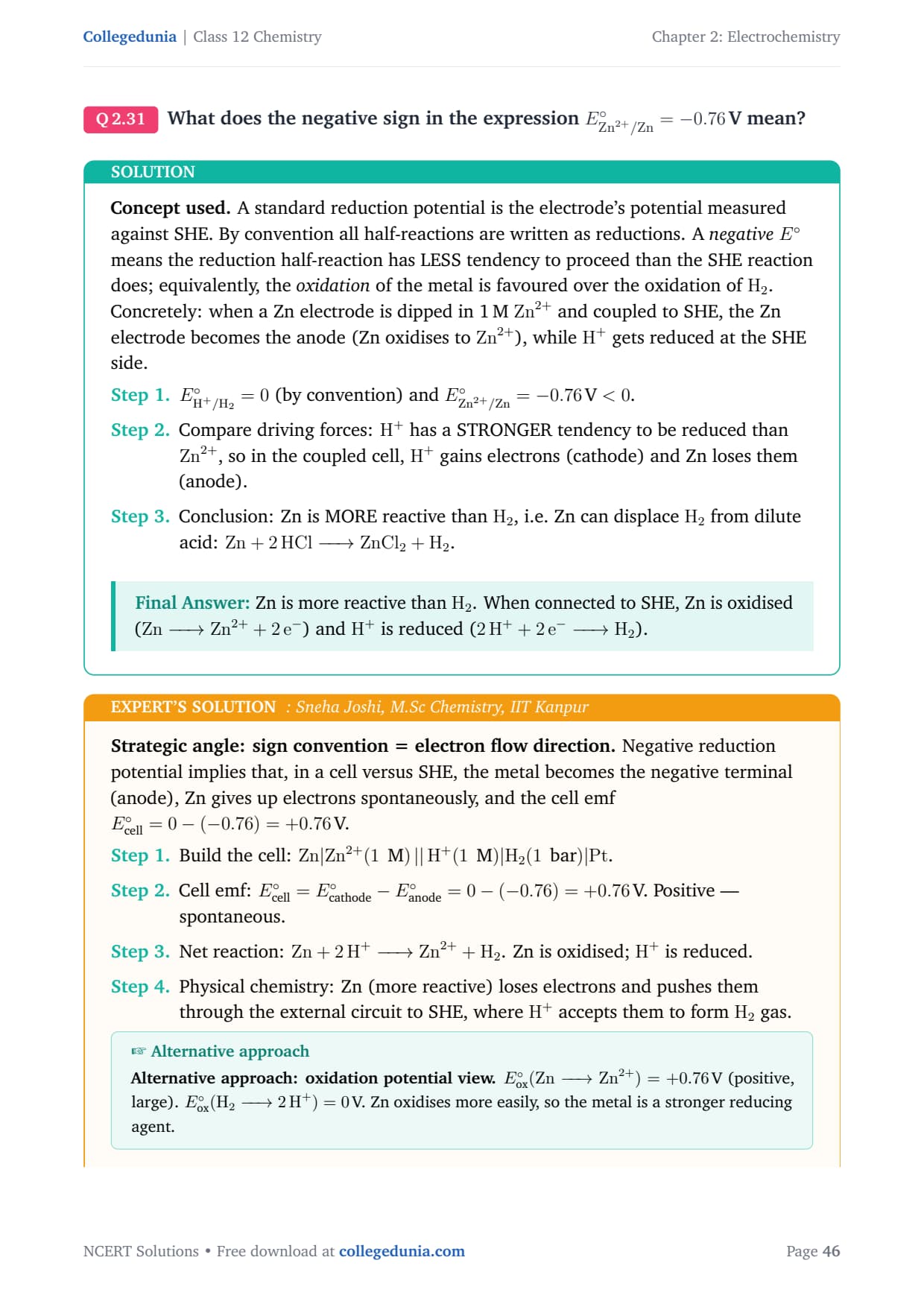
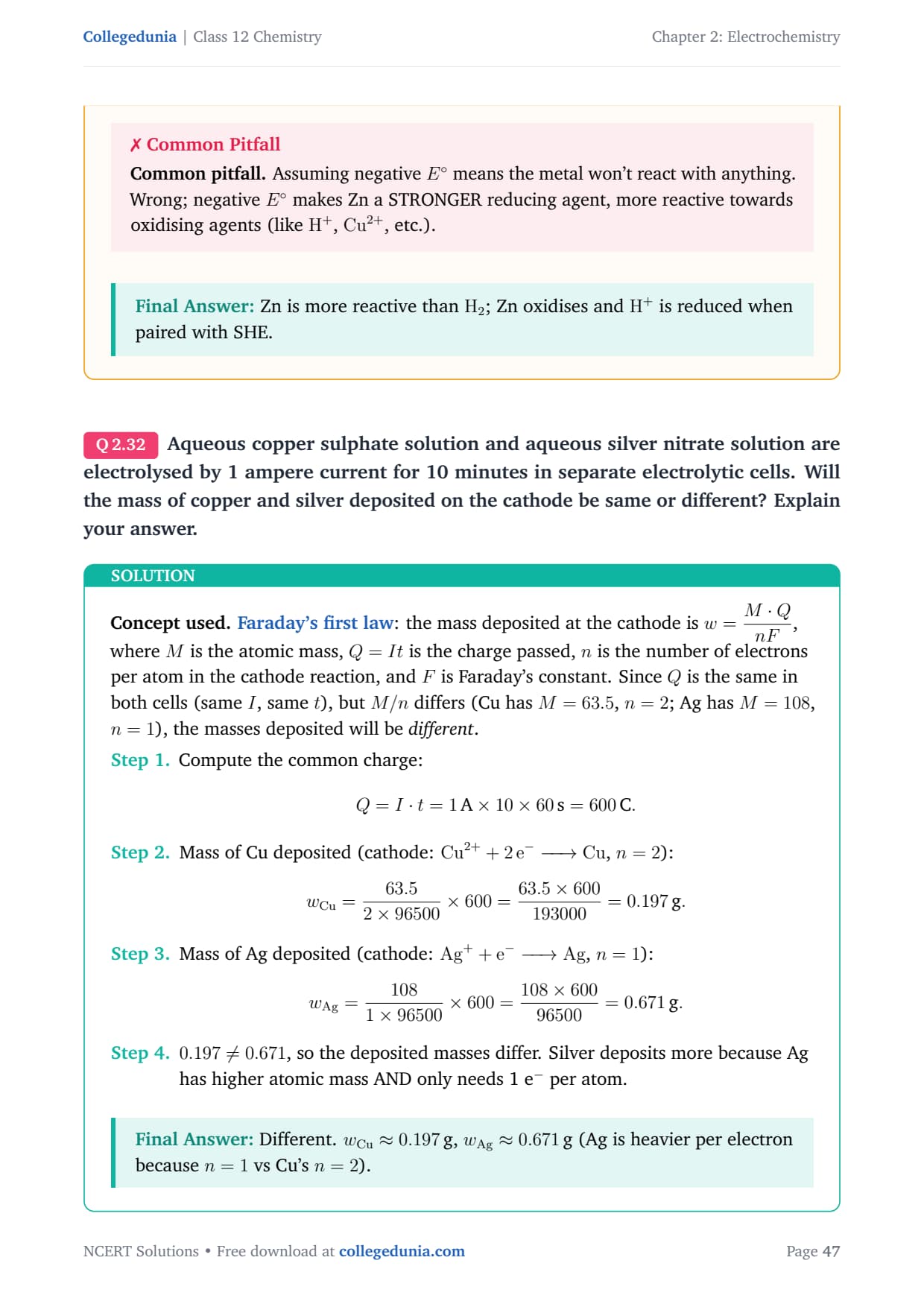
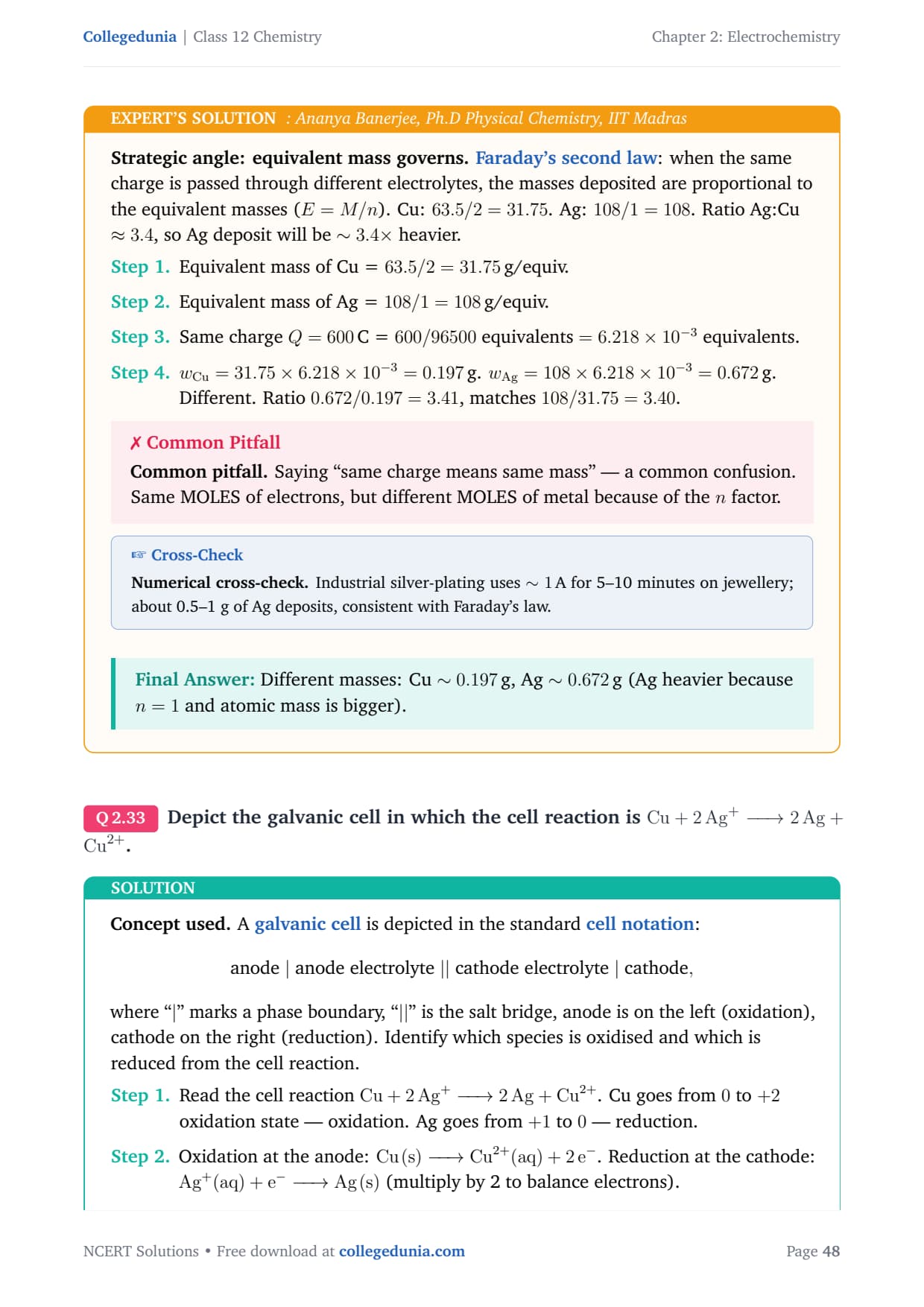
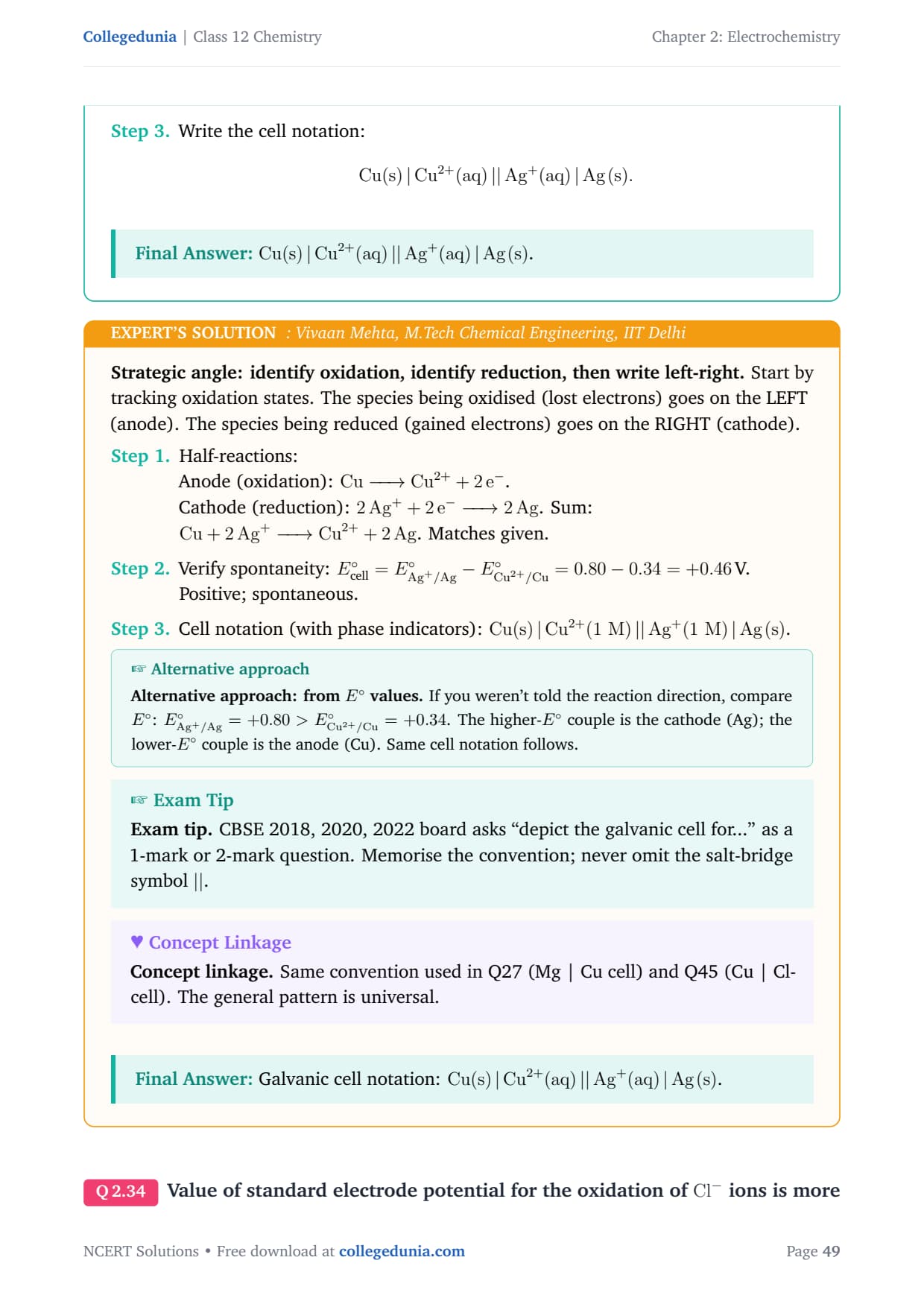
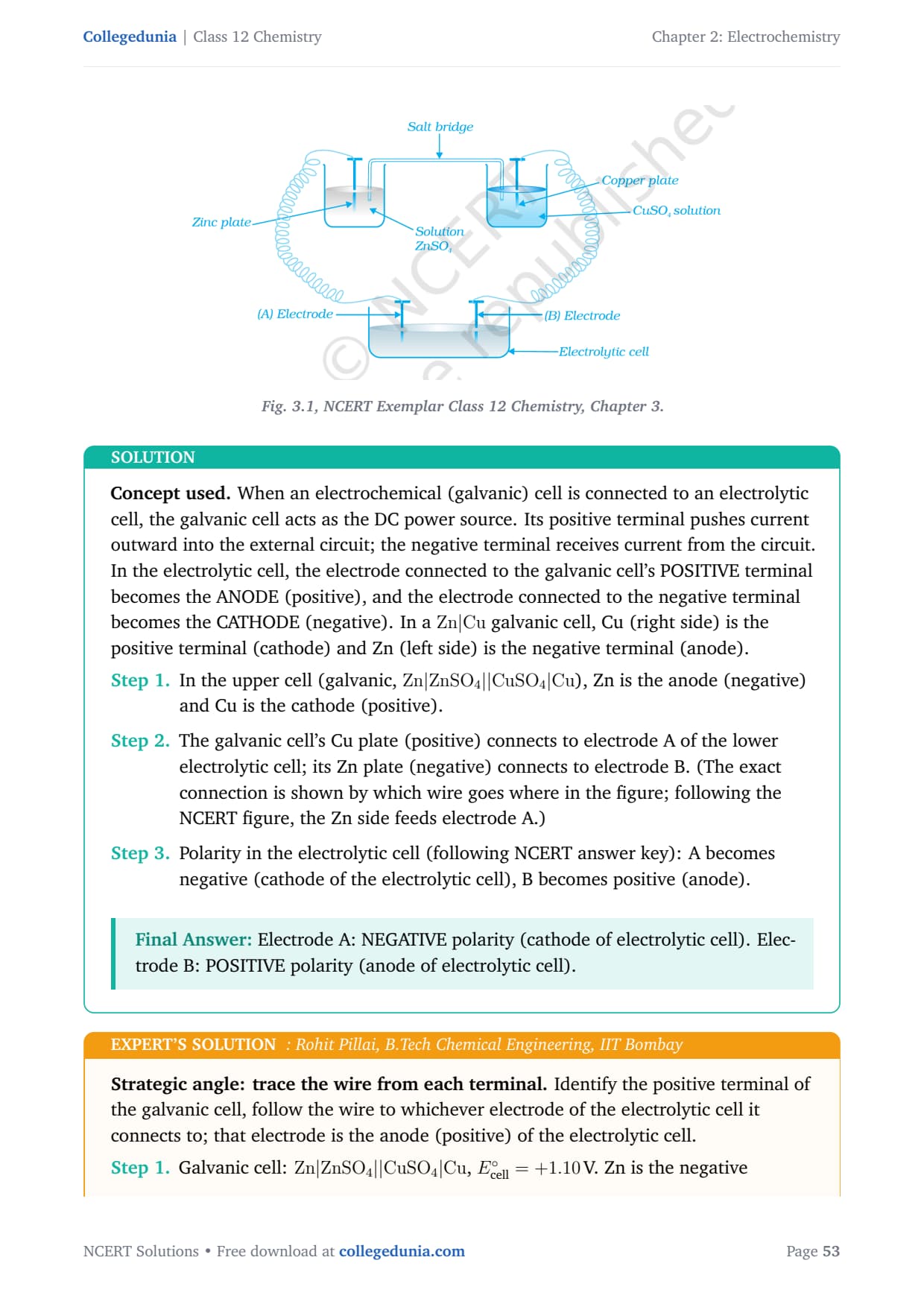
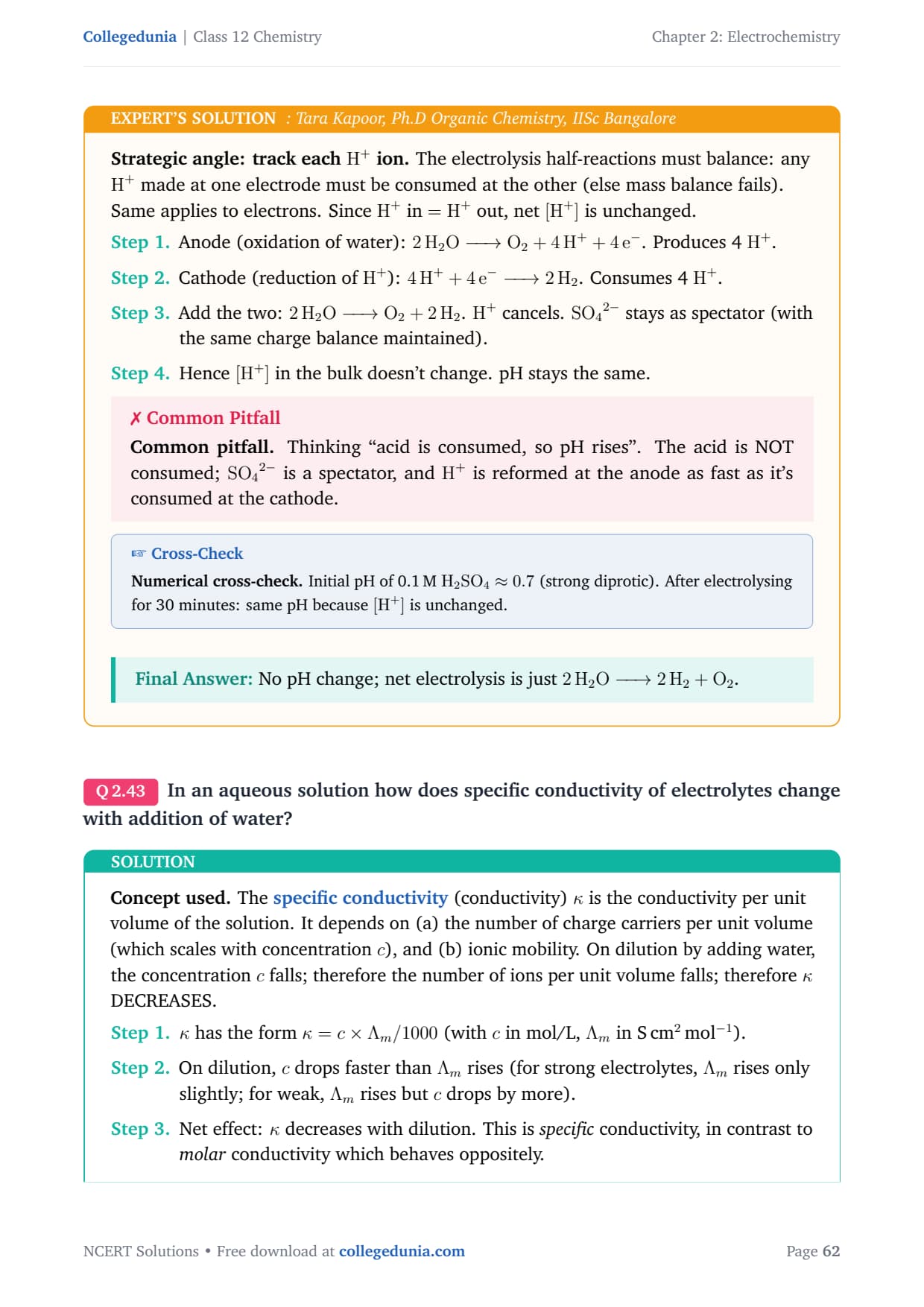
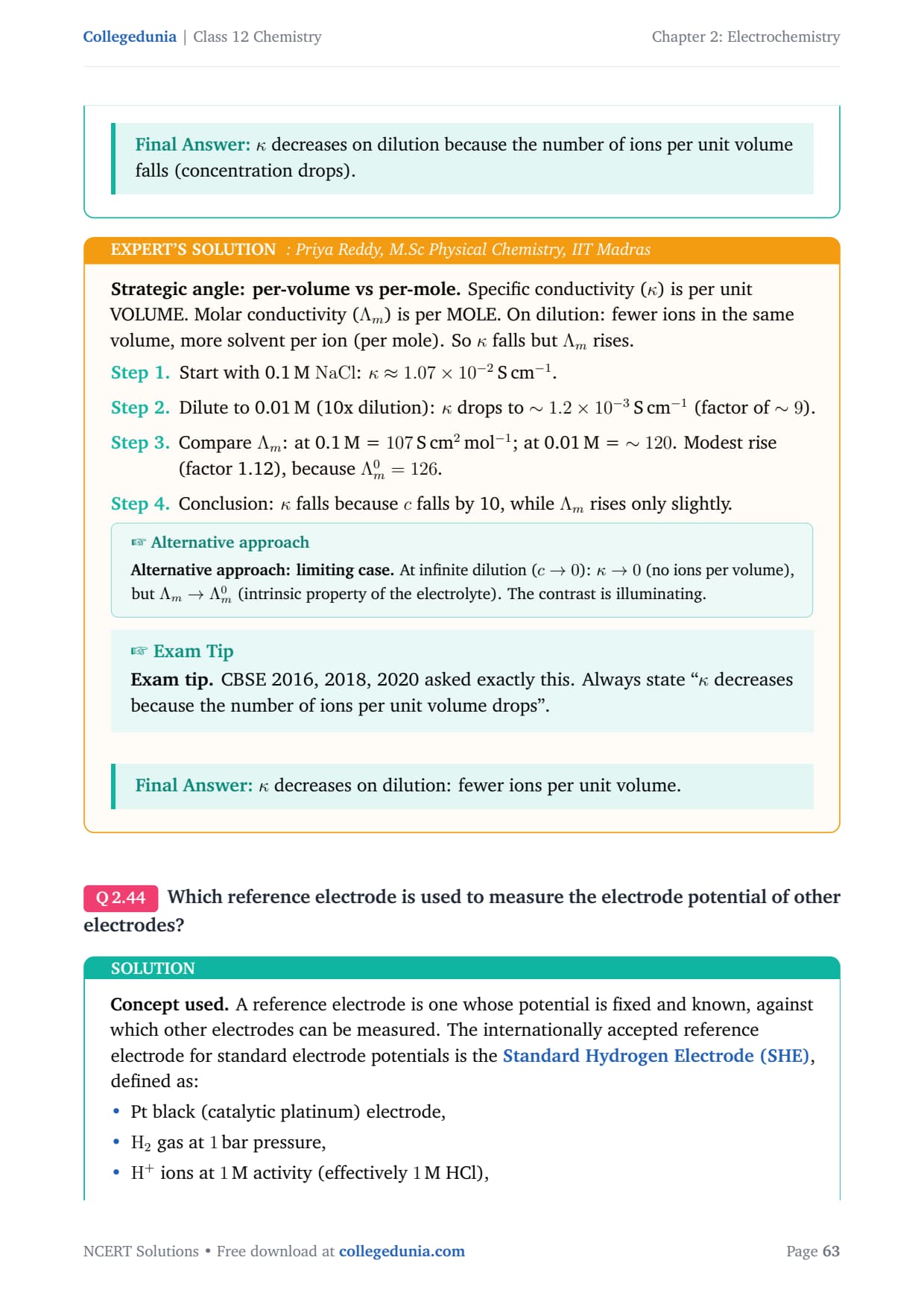

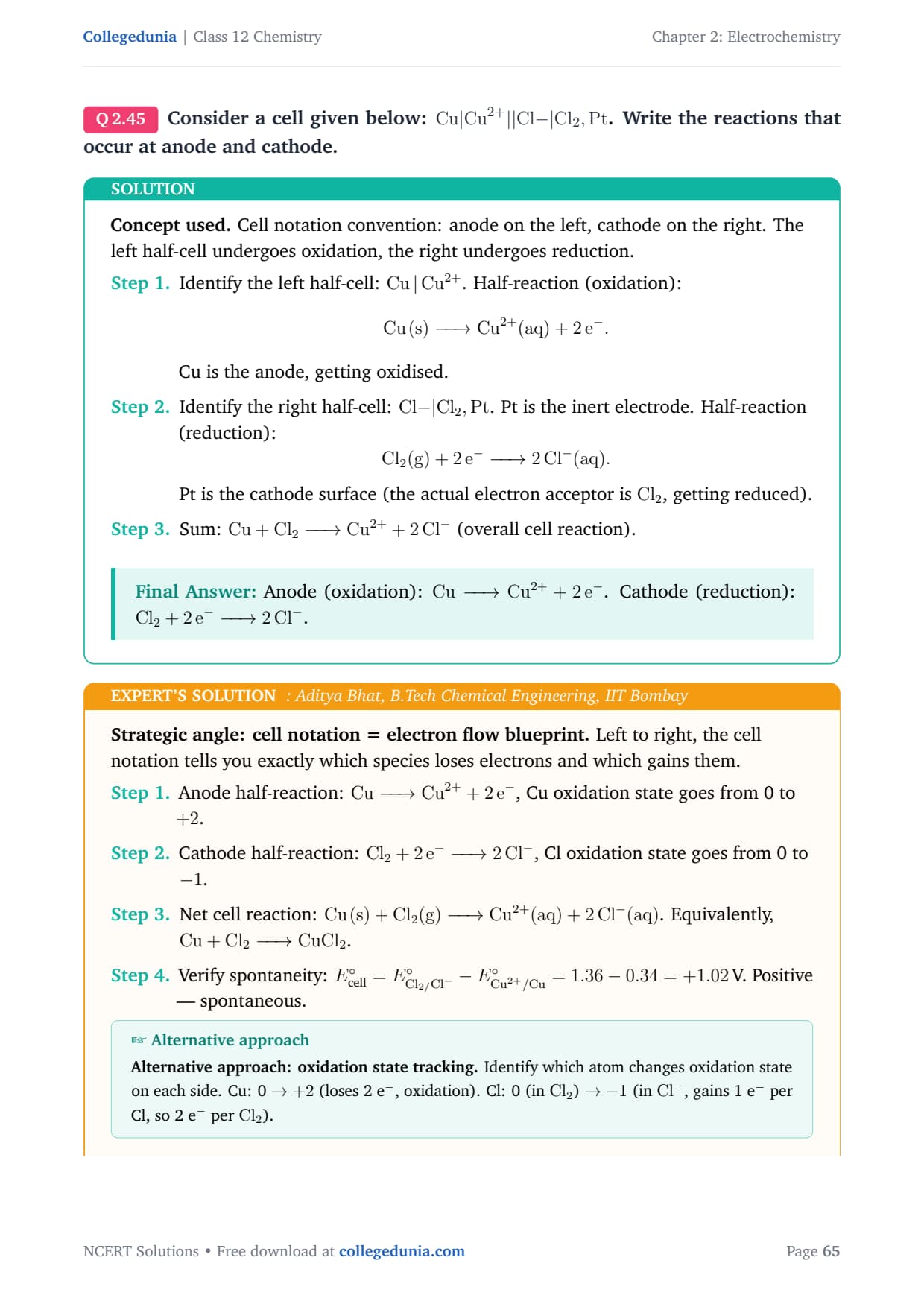
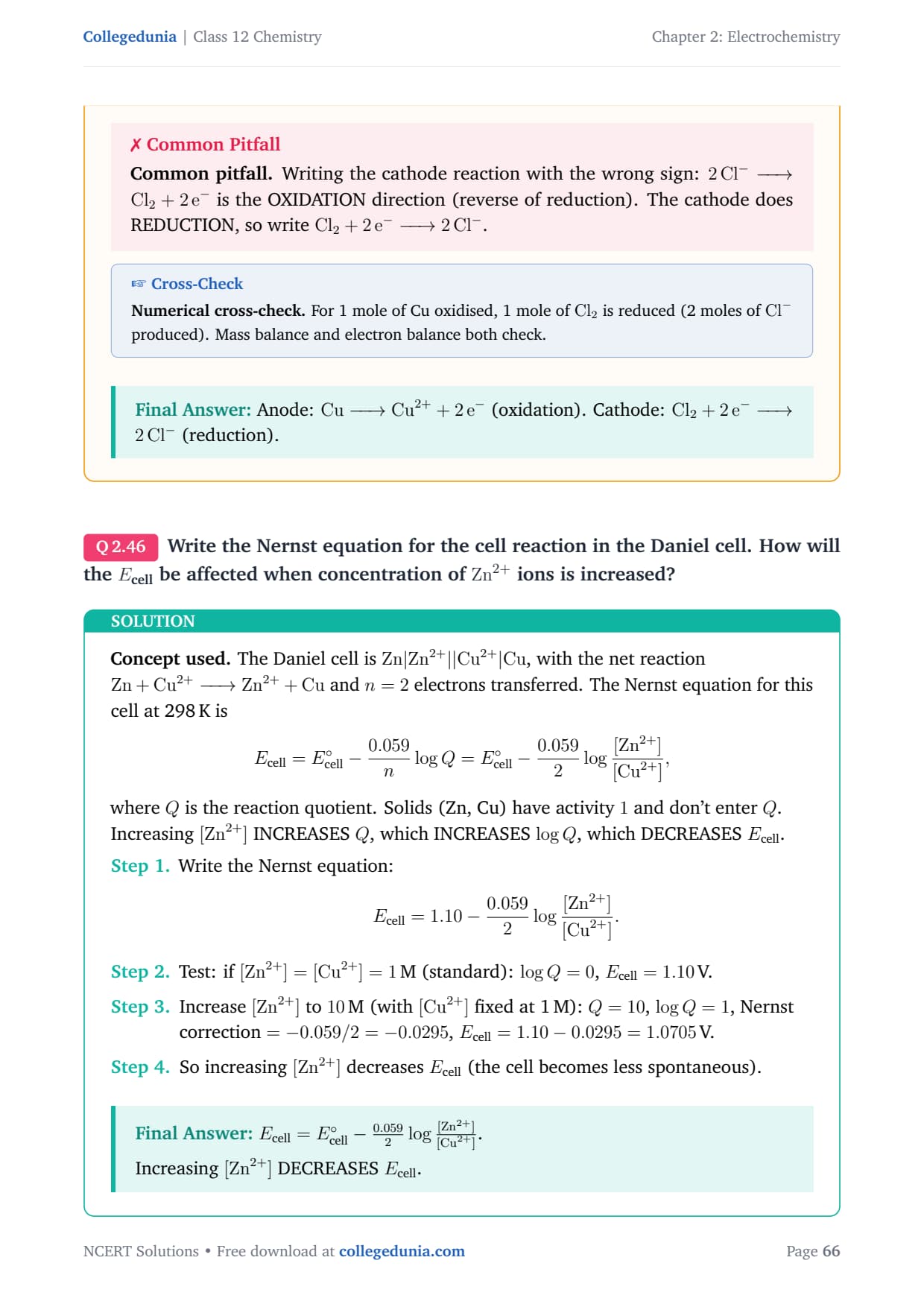

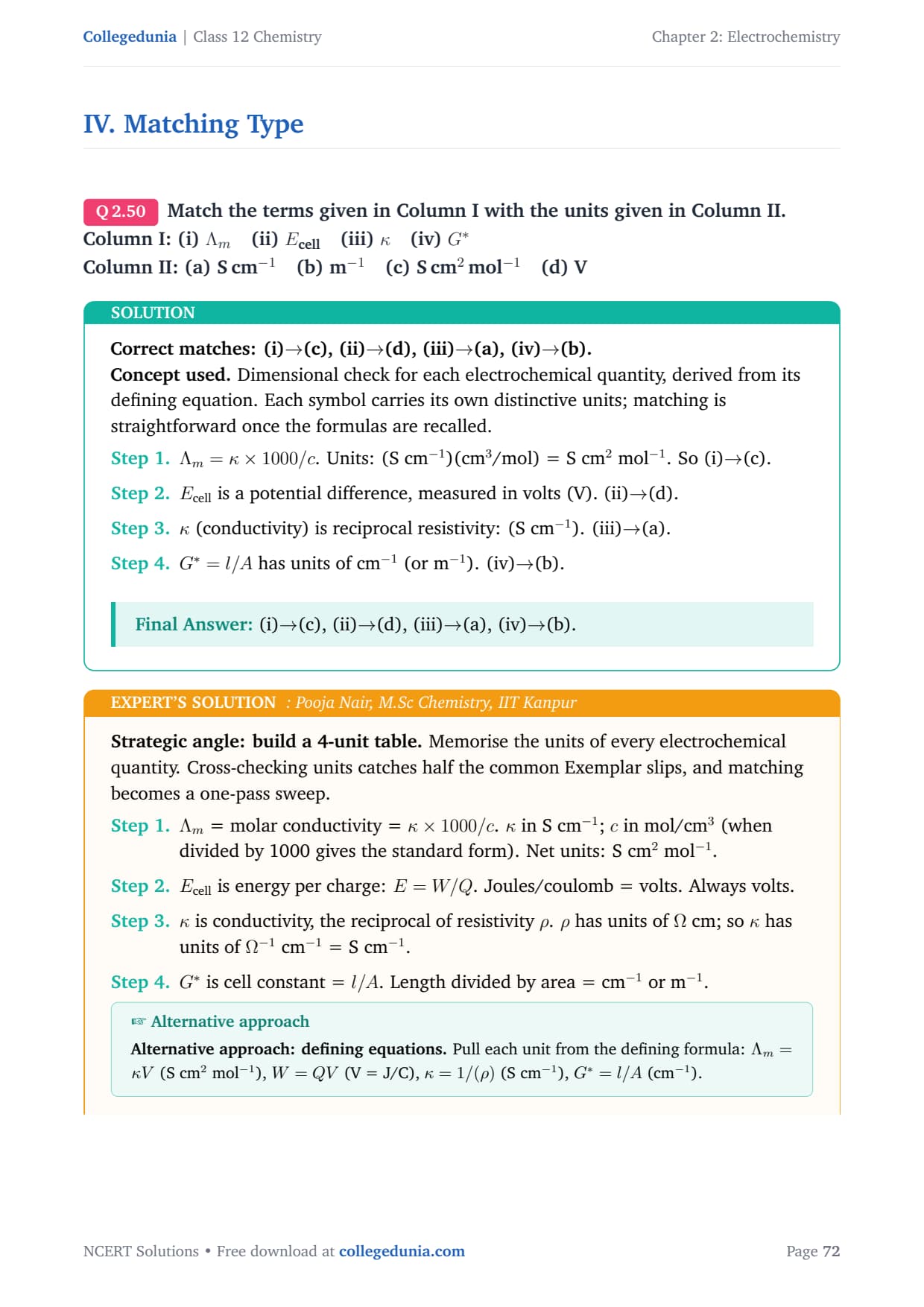
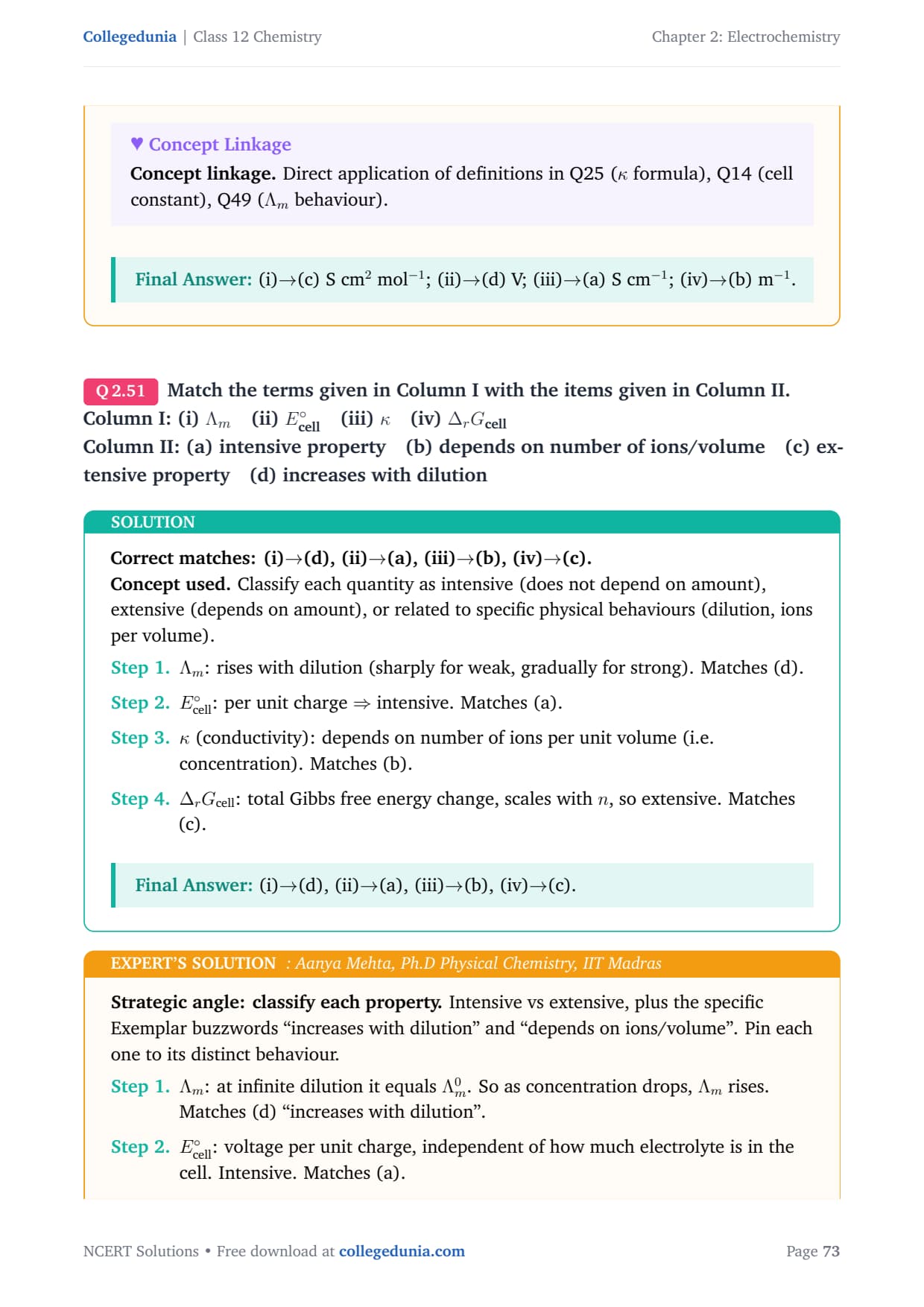
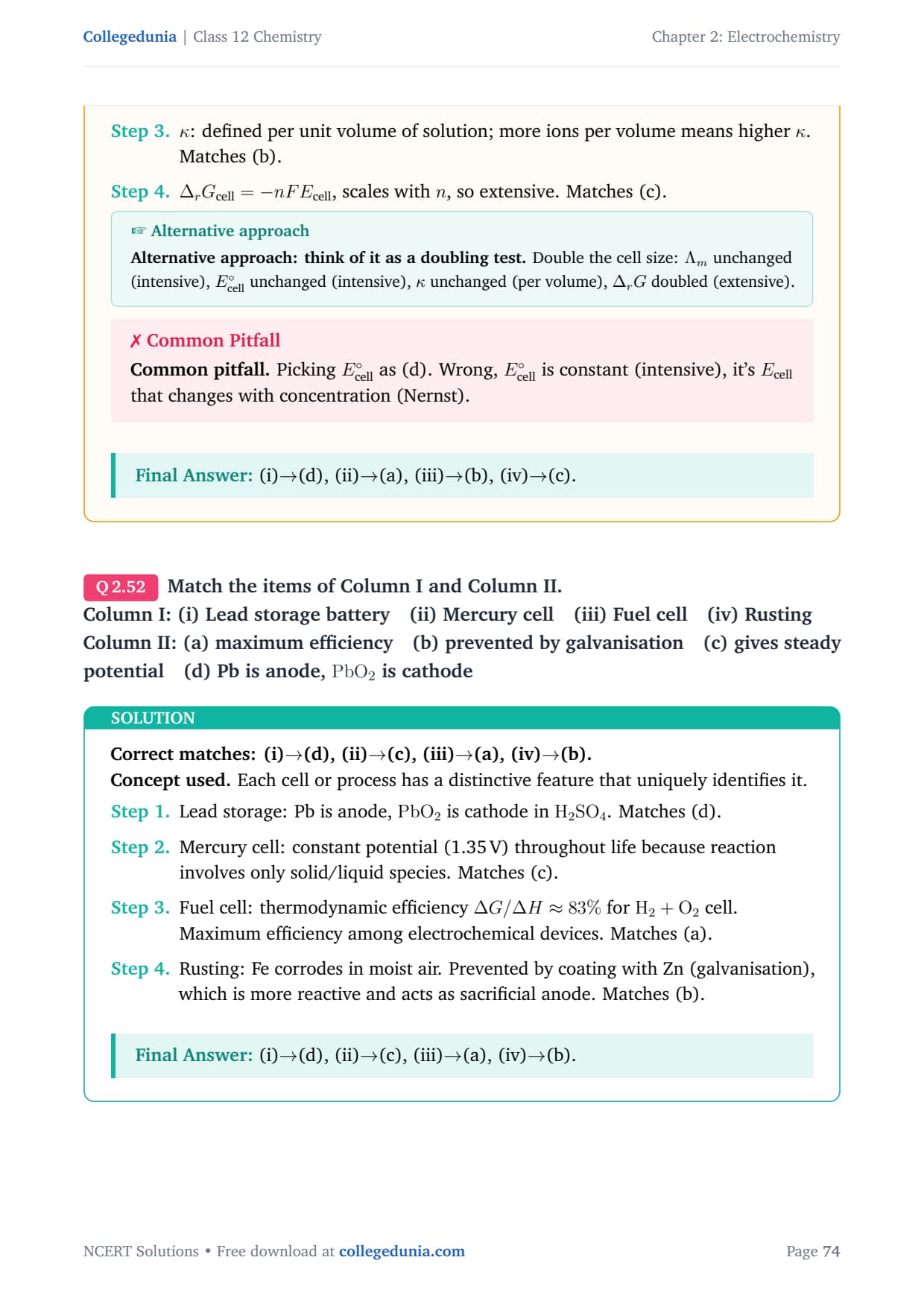

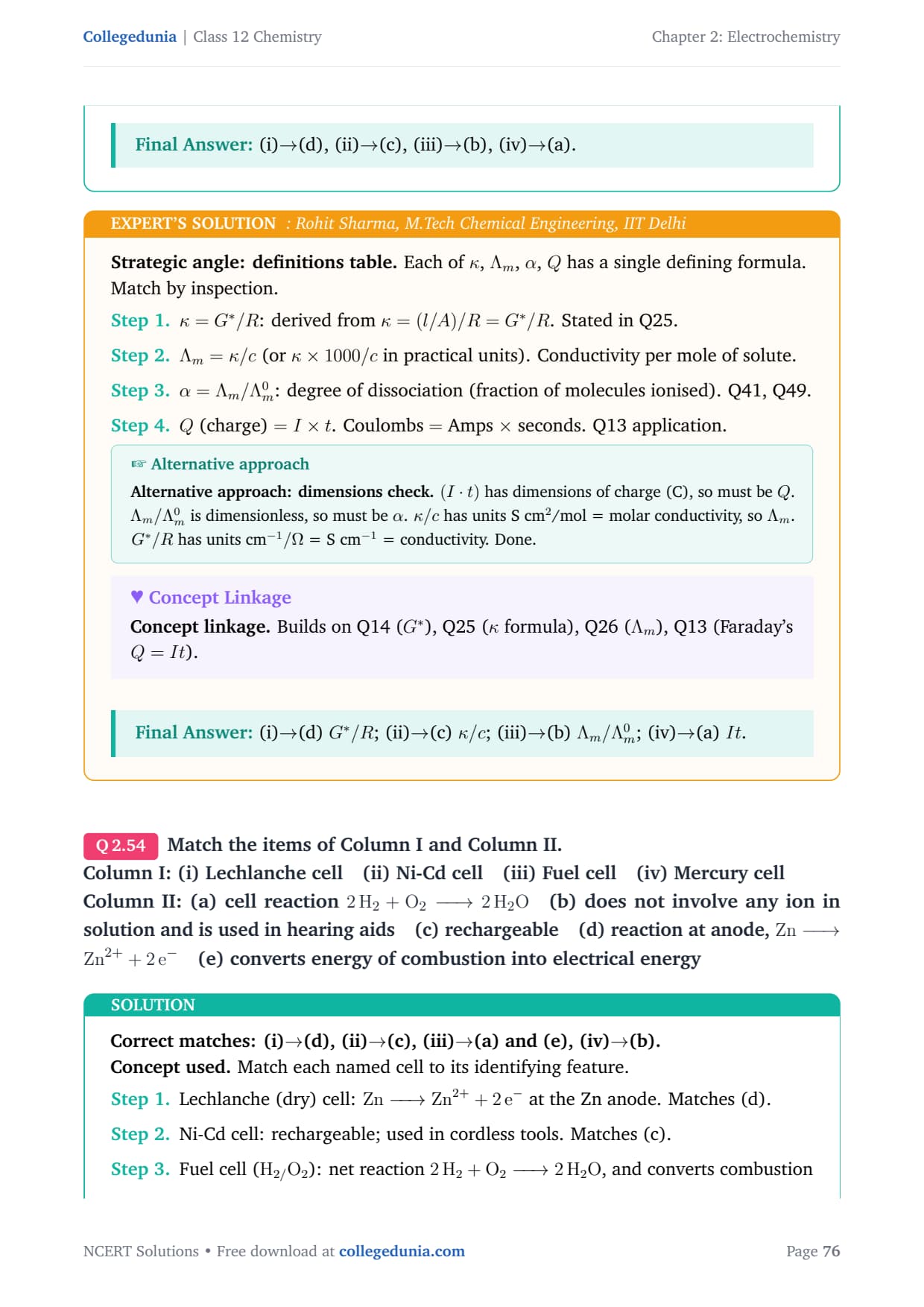


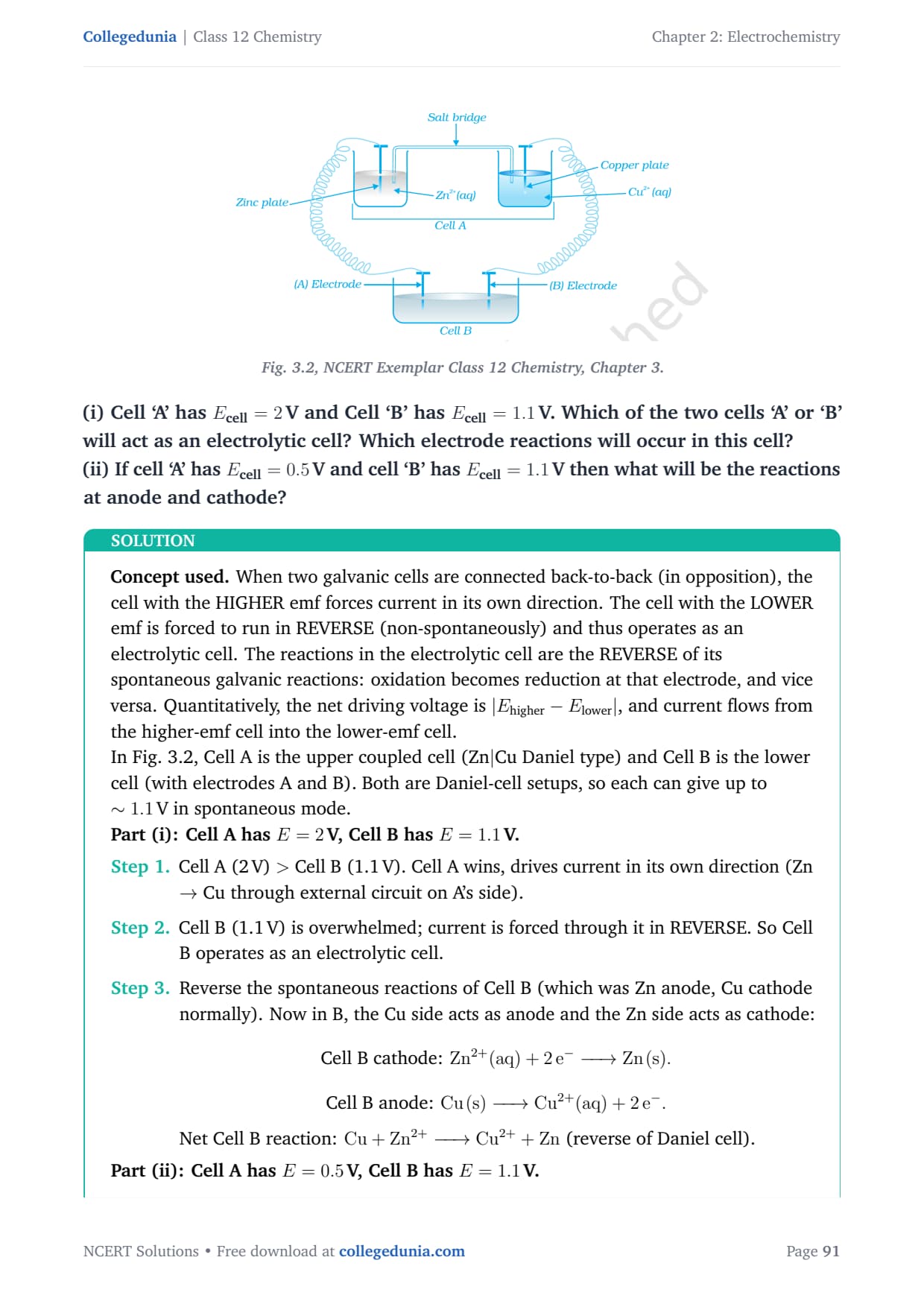
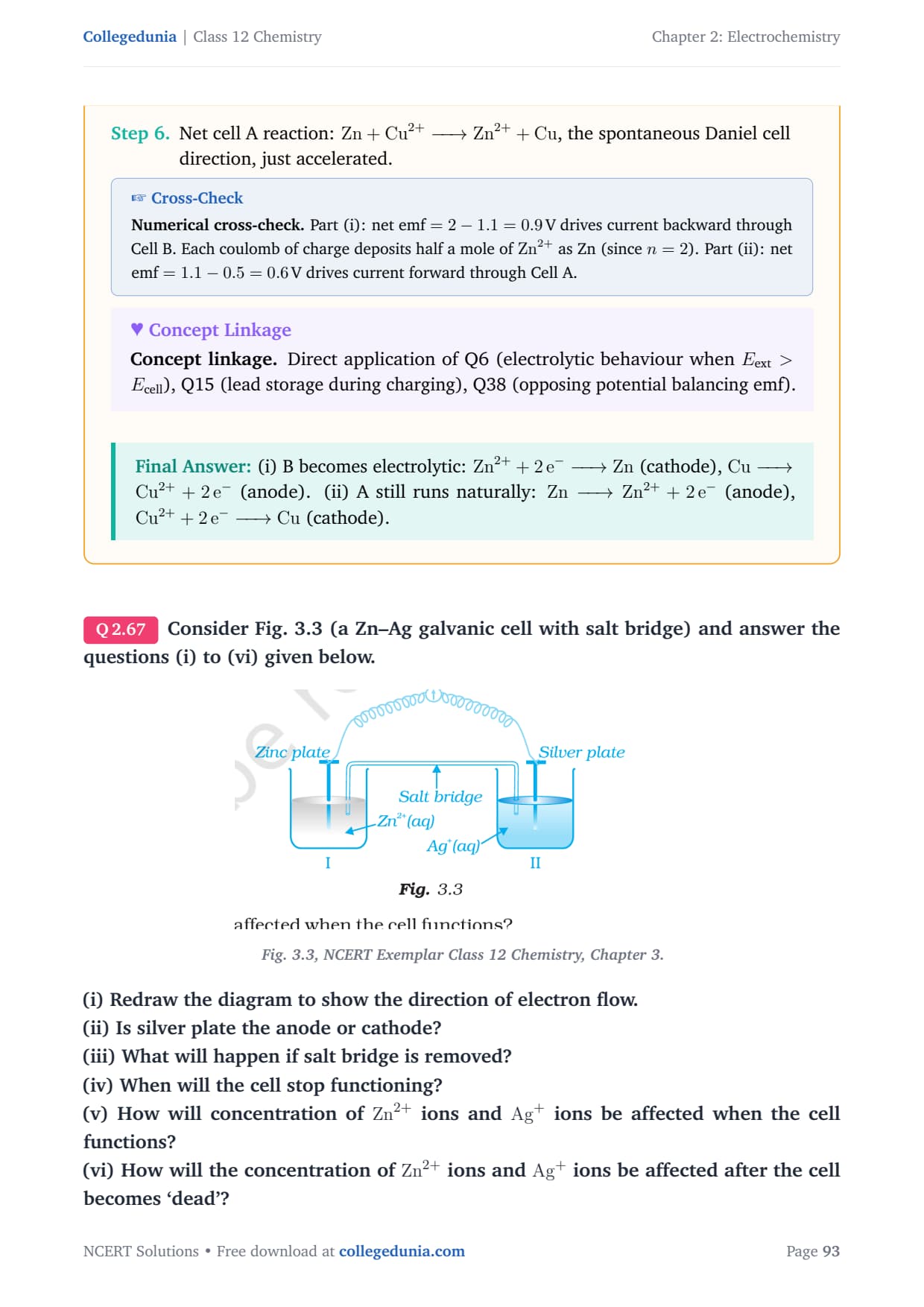
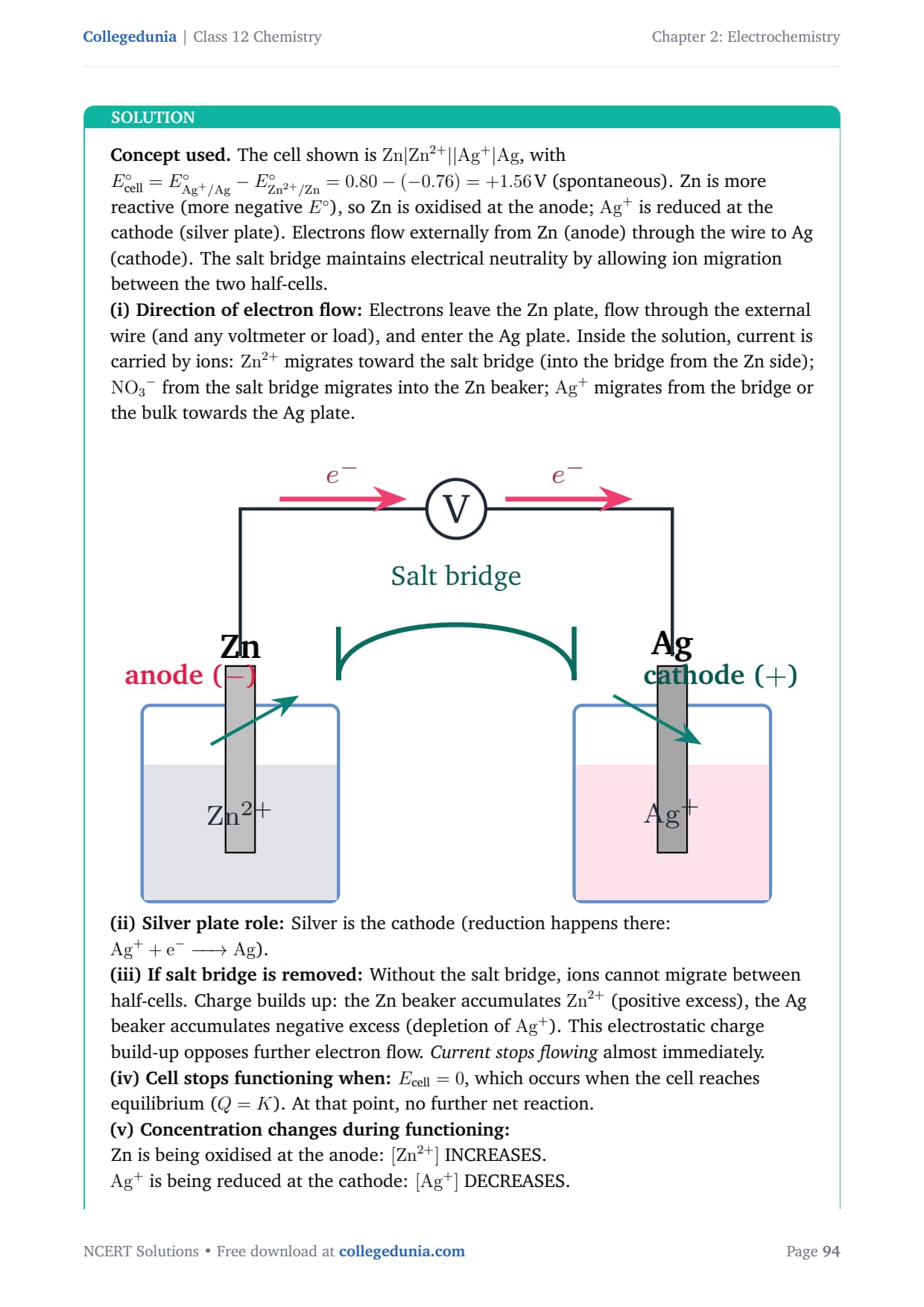


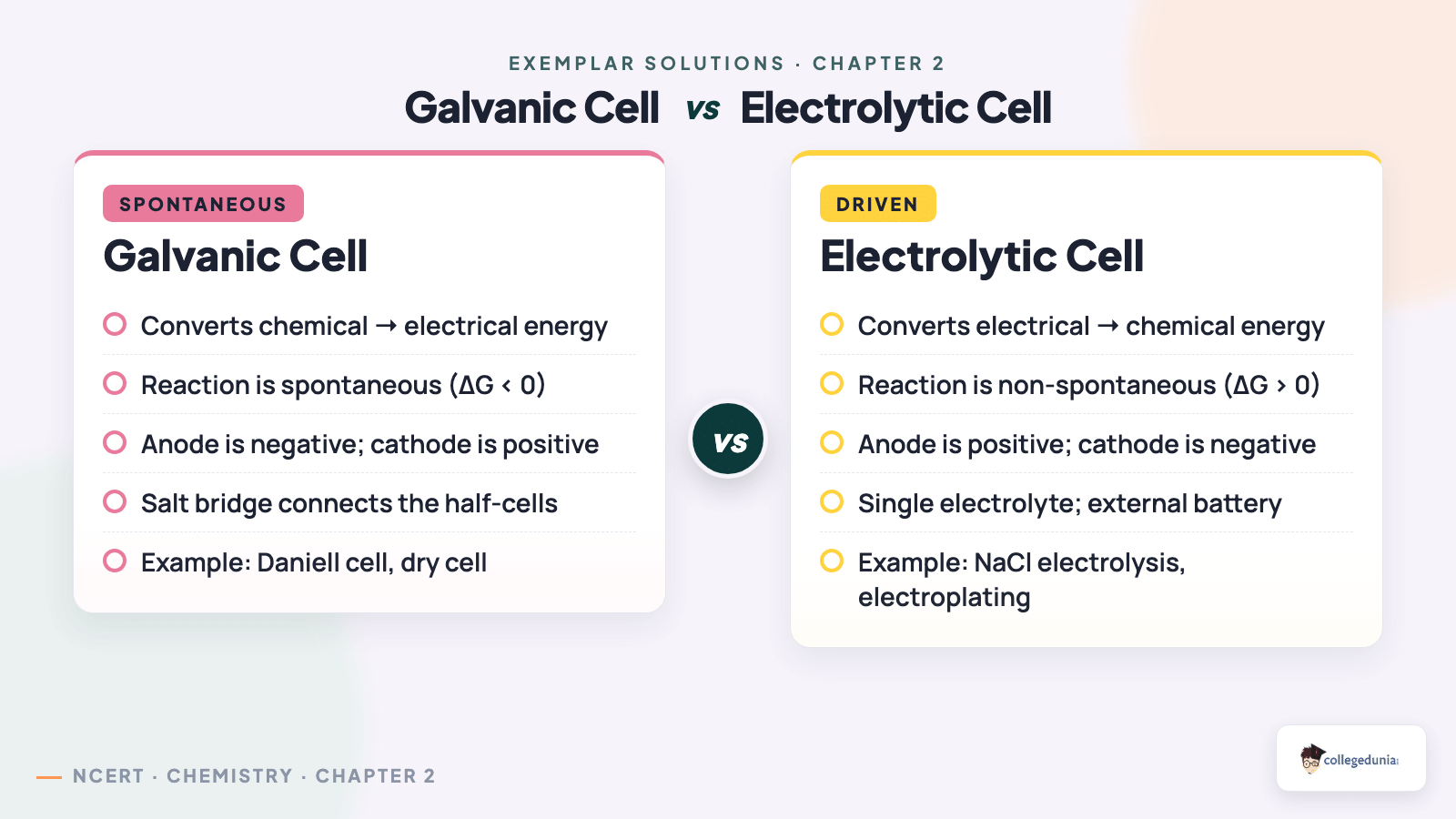
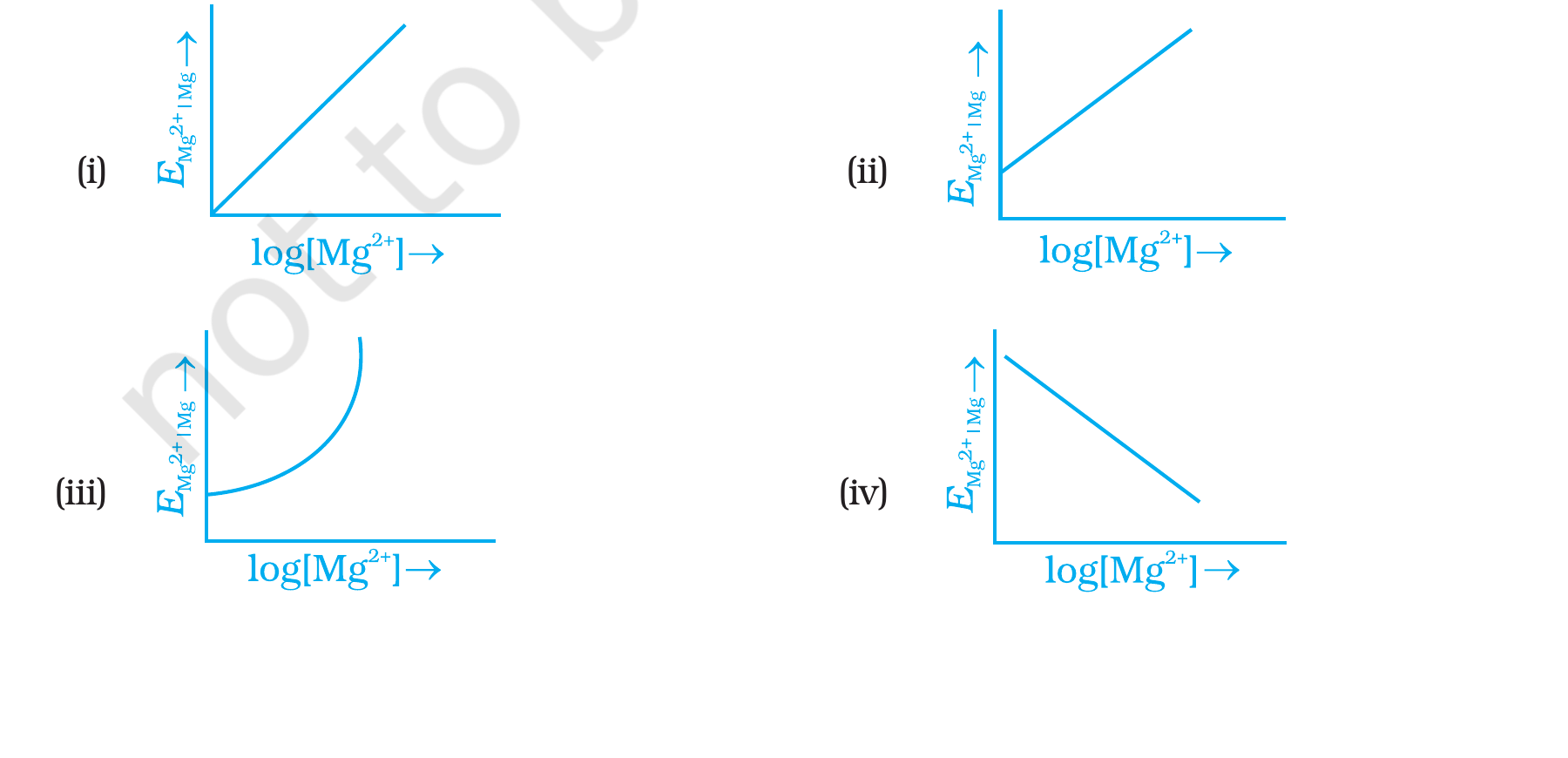
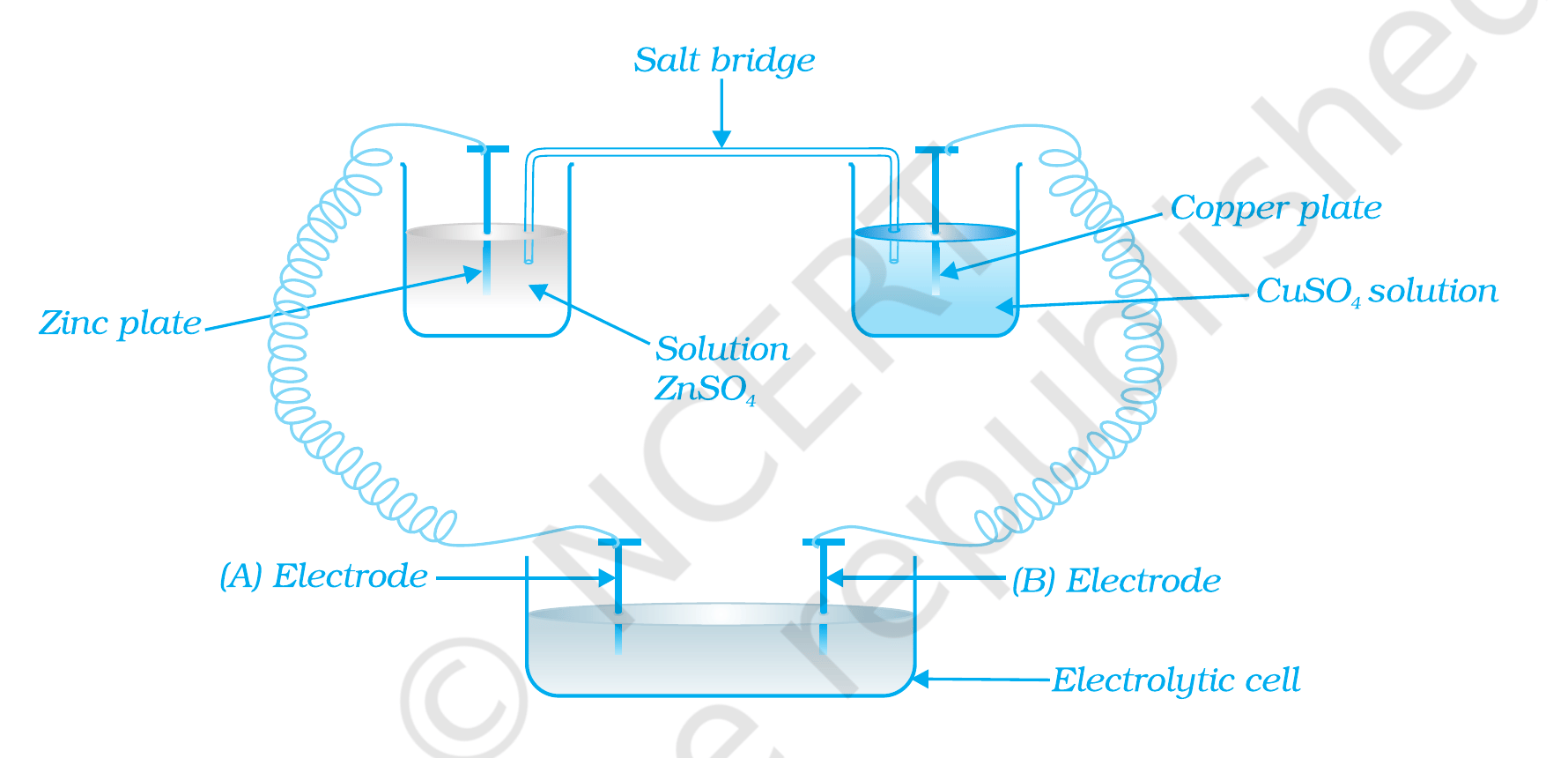
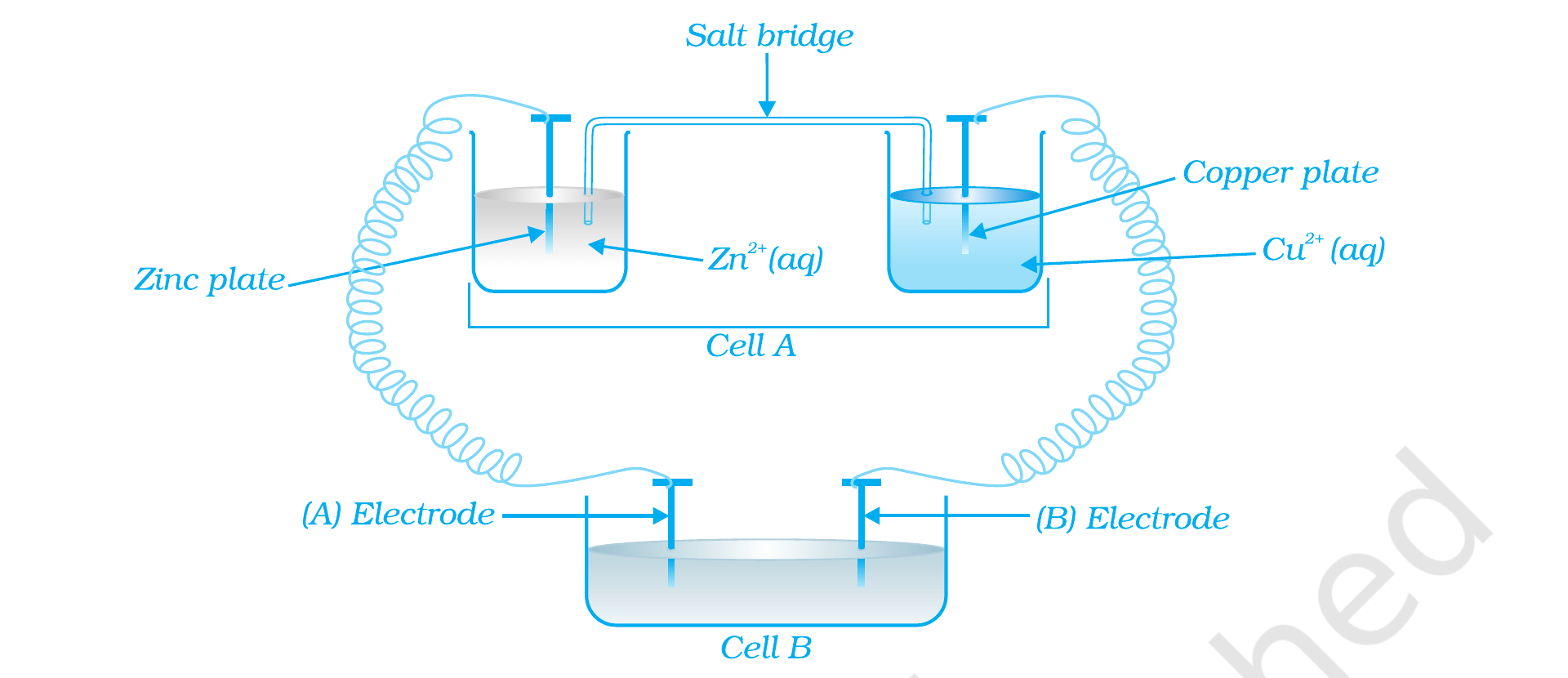
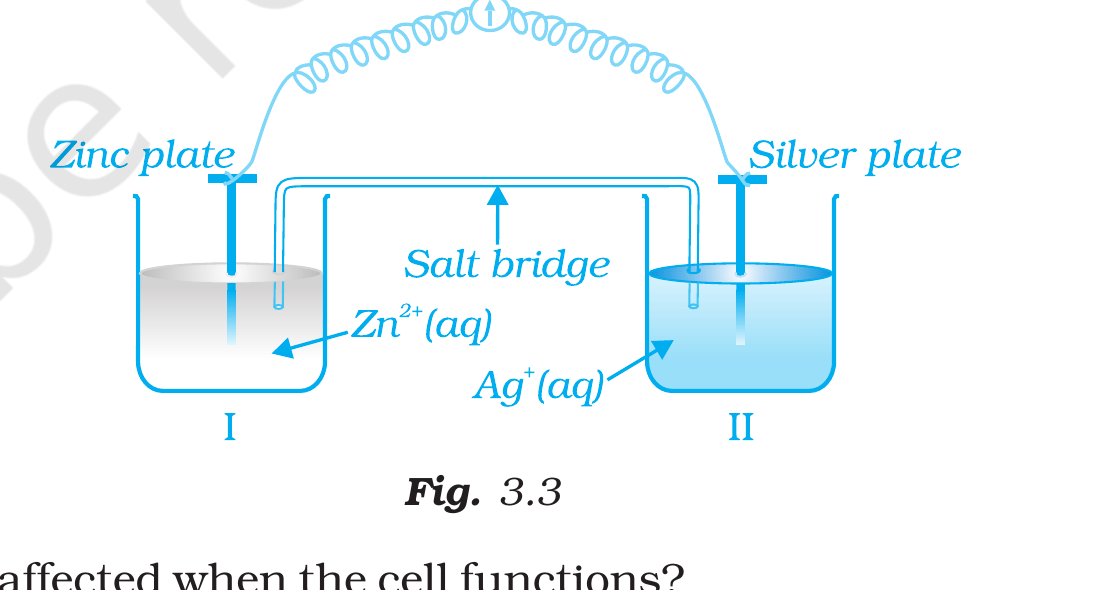



Comments