Chemistry Mentor, Daulat Ram College | Updated 3+ months ago
In the 2026-27 NCERT, Solutions is Chapter 1 of Class 12 Chemistry, covering concentration units and colligative properties. The Exemplar Solutions PDF on this page walks through one solved sample per question type.
CBSE Weightage: 6 to 8 marks
JEE Main Weightage: 3 to 4% (around 1 question per shift)
Why the NCERT Exemplar Matters for JEE and NEET Solutions Preparation
Solutions is one of the most numerically dense chapters in Class 12 Chemistry. The Exemplar pushes you past direct substitution into dual-correct MCQs, assertion-reason setups, and long-answer items that fuse Henry's law with van't Hoff factor.
Roughly 60% of JEE Main numericals on Solutions in the last five years mirror an Exemplar problem in structure, not the textbook example.
Quick Tip: Solve the textbook exercises first; the Exemplar assumes you know Δ Tb = Kb · m and π = CRT .
How will Collegedunia's NCERT Exemplar Solutions Help You with Solutions?
Each problem is solved the way a CBSE Board examiner expects: every step labelled, every formula cited.
One Worked Sample per Question Type: Solved MCQ-I, MCQ-II, VSA, SA, and LA samples show how each answer is shaped.
2026-27 NCERT Exemplar Alignment: Every problem number and answer matches the current edition.
Marking-Scheme Annotated: Long-answer solutions show where each of the 5 marks lands.
Common Trap Flags: Red boxes flag where the Exemplar twist diverges from a textbook answer.
Best Use of the Solutions Exemplar for JEE and NEET Preparation
Use the Exemplar as a discriminator, not a re-attempt of the textbook. The time budget below covers one pass.
Phase
Exemplar Use
Time
First read
MCQ-I + VSA
1.5 hours
Concept deepening
MCQ-II + Assertion-Reason
2 hours
Answer-writing
All SA + LA, longhand
3 hours
Pre-board revision
Re-solve the wrong 5
1 hour
Night before JEE / NEET
Skim MCQ-II keys
20 minutes
Roughly 7.5 hours across two months. MCQ-II is the priority, since students often stop at one option and lose the second mark.
Solutions Exemplar Question-Type Tour with One Solved Sample Each
The PDF solves one sample per type; the table previews each stem.
Type
Sample Question
Answer Shape
MCQ-I
Identify the pair forming a maximum-boiling azeotrope
HNO3 and H2O (negative deviation)
MCQ-II
Which colligative properties depend only on particle number?
All four; multi-select
VSA
State Henry's law and its mathematical form
p = KH · x
SA
Van't Hoff factor for 100% dissociated K2SO4
i = 3 with dissociation table
LA
Derive Δ Tf-molality relation; compute Kf of water
Full derivation, Kf = 1.86 K kg mol-1
The full solution for each sample is inside the PDF. A walk-through of the most-failed type, MCQ-II, follows.
Sample MCQ-II Solved Walk-Through for Solutions
MCQ-II is the highest-reject format. The instruction reads "one or more options may be correct", so picking the first plausible option loses the second mark.
Question (MCQ-II, paraphrased): Which statements about an ideal solution are correct?
Obeys Raoult's law across all compositions
Δ Hmix = 0 and Δ Vmix = 0
Solute-solvent interactions equal solute-solute and solvent-solvent interactions
Shows positive deviation when heated
Step 1. An ideal solution obeys Raoult's law for both components across all compositions. (a) correct.
Step 2. New A-B interactions cancel the energy to break A-A and B-B, so Δ Hmix = 0 with no volume change. (b) correct.
Step 3. This holds only if A-B interactions equal A-A and B-B. (c) correct.
Step 4. Deviation comes from interaction mismatch, not temperature. (d) incorrect.
Final answer:(a), (b), (c). Stopping at (a) earns 1 of 2 marks.
Watch Out: The Exemplar key gives no partial credit for stopping at one option. Test every option to the end.
Difficulty Step-Up from NCERT Textbook to Exemplar for Solutions
The Exemplar reuses textbook concepts inside harder wrappers, as the contrast below shows.
Concept
NCERT Textbook
NCERT Exemplar
Molality vs molarity
Molarity from mass and volume
Molality from molarity and density
Raoult's law
Vapour pressure of an ideal binary mix
Identify deviation sign, predict azeotrope
Boiling point elevation
Δ Tb from molality and Kb
Van't Hoff factor from observed Δ Tb
Henry's law
State the law, identify KH
Compare KH across gases for solubility order
Osmotic pressure
One-step π = CRT
Back-solve protein molar mass with i
The textbook gives the formula and unknowns; the Exemplar gives a derived quantity to back-solve.
Topics Covered in Class 12 Chemistry Chapter 1 Solutions NCERT Exemplar
The Chapter 1 Exemplar spreads across five question types:
MCQ-I and MCQ-II: ideal vs non-ideal solutions, positive and negative deviation, azeotropes, and gas solubility from Henry's law.
VSA: quick statements of Raoult's law and Henry's law, plus definitions of molality, mole fraction, and osmotic pressure.
SA: numericals on van't Hoff factor, degree of dissociation, and boiling-point elevation for ionic solutes.
LA: full derivations of Δ Tf = Kfm and π V = nRT , plus back-solving abnormal molar mass.
Solutions Exemplar Common Mistakes That Cost Marks
Exemplar twists trigger predictable wrong reflexes. The four below recur every year.
Forgetting van't Hoff factor when the solute dissociates. Substituting π = CRT directly for K2SO4 gives one-third of the correct value.
Using molarity in colligative formulas. Every colligative equation runs on molality. Convert first.
Swapping positive and negative deviation. Positive gives a minimum-boiling azeotrope (ethanol-water); negative gives a maximum-boiling one (HNO3-water).
Stopping at one option in MCQ-II. CBSE awards zero for partial selection.
A single forgotten van't Hoff factor in a 5-mark LA can cost 3 marks, since every later step carries the wrong number.
Remember: Before any colligative formula, check if the solute is an electrolyte. If it dissociates or associates, apply the van't Hoff factor i.
Marking Scheme Differences: Exemplar Suggested vs CBSE Board Scheme
The Exemplar answer-key appendix carries its own suggested marking scheme that sometimes diverges from the CBSE Board scheme used in March.
Type
Exemplar Suggested
CBSE Board (March)
MCQ-I (1 mark)
1 mark all-or-nothing
Same
MCQ-II (2 marks)
2 if all correct, 1 if partial
2 only if every correct option marked; 0 otherwise
VSA (1 mark)
1 for correct one-line answer
Half mark allowed for partial
SA (2 to 3 marks)
Mark per correct step
Explicit formula citation needed for full credit
LA (5 marks)
Derivation 2, application 2, unit 1
Same split; missing units cost 1 mark
The biggest divergence is MCQ-II partial credit: Exemplar suggests 1 mark, CBSE March confirms zero.
All NCERT Exemplar Questions for Solutions with Step-by-Step Solutions
Every NCERT Exemplar question for Class 12 Chemistry Chapter 1 Solutions is listed below. Click Check Solution for the step-by-step working and Expert Solution for the expanded explanation.
I. Multiple Choice Questions (Type-I)
Q 1.1
Which of the following units is useful in relating concentration of solution with its vapour pressure?
(i) mole fraction
(ii) parts per million
(iii) mass percentage
(iv) molality
Correct option: (i) mole fraction.
Concept used.Raoult's law for a solution of a
non-volatile solute in a volatile solvent states that the partial
vapour pressure of the solvent equals its mole fraction in the
solution times its pure-solvent vapour pressure:
pA = xA p∘A.
For a solution of two volatile components A and B, the law extends to
ptotal = xA p∘A + xB p∘B.
The concentration variable that appears in both expressions is the
mole fractionx.
Write the colligative form of vapour-pressure lowering:
p∘A - pAp∘A = xB.
The right-hand side is the mole fraction of solute. So x is
the natural concentration unit linking concentration with
vapour pressure.
Rule out the other options: (ii) ppm measures dilute mass
fractions, not number ratios; (iii) mass-% is a mass ratio,
not number-of-molecule ratio; (iv) molality links to Δ
Tb/Δ Tf, not to p directly.
Option (i): mole fraction.
AS
Aarav Sharma
M.Sc Chemistry, IIT Kanpur
Verified Expert
Strategic angle (definition-driven). If you can recall
Raoult's law in symbol form, the answer is one glance: only x
appears in the law linking p and composition. Match option, done.
Concept used. Vapour pressure of a solvent above an ideal
solution falls in proportion to the mole fraction of solvent:
pA = xA p∘A. For a binary volatile solution
p = xA p∘A + (1-xA)p∘B, again pure mole-fraction
language. Henry's law for a gas dissolved in a liquid is
p = KHx, also mole fraction. Every classical "p vs
composition" law uses x.
Write the equation in symbols. For a non-volatile
solute the relative lowering is
p∘A - pAp∘A = xB =
nBnA + nB.
The right side is dimensionless and counts moles, not mass.
Why mass-fraction is the wrong family. Mass-percent
depends on molar masses of solute and solvent, which Raoult's
law does not contain. Swapping a solute of Mw = 60 for one
of Mw = 180 at the same mass-% changes xB threefold;
p tracks xB, not the mass.
Alternative approach (dimensional analysis).p has
units of pressure. Raoult's law sets p ∝ p∘
× (dimensionless), so the concentration variable
must be dimensionless. Among the four options only x is a
number ratio; ppm is a mass ratio.
Limiting case. As xB → 0 (pure solvent), p →
p∘A; as xB → 1 (pure solute, non-volatile), p
→ 0. Both extremes are recovered only with x.
Exam tip / generalisation. JEE Main 2019 (April Shift 1) and
NEET 2017 asked variants of "which concentration term enters Raoult's
law". Lock it as mole fraction. The same is true for Henry's law
(p = KHx). Memorise: pressure ↔ mole
fraction; temperature change ↔ molality; osmotic
pressure ↔ molarity.
Concept Linkage
Concept linkage. Mole fraction enters because vapour
pressure depends on the number fraction of surface molecules
free to escape into vapour: a statistical (Boltzmann-counting)
result. Mass enters only through stoichiometry, never through
molecular escape itself. The same number-counting argument underlies
all colligative properties.
Option (i): mole fraction.
Q 1.2
On dissolving sugar in water at room temperature solution feels cool to touch. Under which of the following cases dissolution of sugar will be most rapid?
(i) Sugar crystals in cold water.
(ii) Sugar crystals in hot water.
(iii) Powdered sugar in cold water.
(iv) Powdered sugar in hot water.
Correct option: (iv) Powdered sugar in hot water.
Concept used. The rate of dissolution of a solid
in a liquid depends on two factors:
Surface area of solute: more powdered ⇒
more surface ⇒ faster dissolution.
Temperature: higher T gives solvent molecules
greater kinetic energy, so they collide with solute particles
more often and more energetically.
Surface-area factor. Powdered sugar has ∼ 103
times more surface per gram than crystal lumps. So at the
same T, powdered dissolves much faster.
Temperature factor. The Arrhenius factor e-Ea/RT
rises with T. So at the same particle size, hot dissolves
faster than cold.
Combining both, option (iv) maximises both factors.
Option (iv): Powdered sugar in hot water.
SI
Sneha Iyer
M.Sc Physical Chemistry, IIT Madras
Verified Expert
Quick reading. Two independent levers control dissolution
rate: surface area (particle size) and temperature
(kinetic energy). Maximise both. Option (iv) does. Done.
Concept used. Dissolution is a surface phenomenon: solvent
molecules collide with solute particles at the interface and pull
them into solution via ion-dipole or H-bond interactions. The
collision rate per unit time scales with surface area A; the
fraction of energetic events scales as e-Ea/RT.
Surface-area argument quantified. For a cube of side
, S/V = 6/. Crushing a 1 cm cube into 1 mm cubes
increases S/V tenfold (6/0.1 = 60 vs 6). Going to
0.1 mm fine powder gives a 100-fold increase. So powdered
sugar dissolves ∼ 10 to 100 times faster than crystals.
Temperature argument quantified. If Ea ≈
20 kJ/mol, the rate ratio between hot (T1 = 323 K,
50∘C) and cold (T2 = 298 K, 25∘C) is
khotkcold = exp[
EaR(1T2-1T1)
] ≈ 2.1.
Going to 100∘C boosts this to about 5.
Combined factor. Surface-area boost (∼ 30×)
times temperature boost (∼ 2-5×) gives roughly
100 times faster dissolution for option (iv) over option (i).
Exam tip / generalisation. JEE Main physical-chemistry MCQs
from 2018 onward routinely pair "surface area + temperature" into one
rate question. Rule of thumb: when two independent factors both help,
pick the option that maximises both - unless one factor reverses sign
for that solute (rare for ionic/sugar dissolution).
Concept Linkage
Concept linkage. The same logic governs heterogeneous
catalysis (catalyst surface area + temperature both boost rate) and
pharmaceutical formulation (micronisation of drugs to speed
dissolution in the gut). It is the universal principle of interfacial
chemistry.
Option (iv): Powdered sugar in hot water.
Q 1.3
At equilibrium the rate of dissolution of a solid solute in a volatile liquid solvent is 2.5cm0.4pt.
(i) less than the rate of crystallisation
(ii) greater than the rate of crystallisation
(iii) equal to the rate of crystallisation
(iv) zero
Correct option: (iii) equal to the rate of crystallisation.
Concept used.Dynamic equilibrium in a saturated
solution: solid and dissolved solute coexist while two opposite
microscopic processes proceed at the same rate.
At equilibrium Rd = Rc, so the macroscopic concentration of
dissolved solute stays constant.
Write the rate condition: at equilibrium Rd = Rc. Neither
rate is zero; both microscopic processes continue, but the
net flux is zero.
Option (iv) "zero" describes the net rate, not the
individual rates. The question asks about the rate of
dissolution itself, so (iv) is wrong.
Option (iii): rate of dissolution = rate of crystallisation.
PB
Pranav Bhat
Ph.D Organic Chemistry, IISc Bangalore
Verified Expert
Picture-first. Picture a beaker of sugar water with extra
crystals on the bottom. Watch a single sugar molecule: sometimes it's
pulled into solution, sometimes it locks back onto a crystal face. At
equilibrium these two visits balance out.
Concept used. A solution is saturated when it sits
in dynamic equilibrium with undissolved solid. "Dynamic" = molecules
keep moving both ways across the interface; "equilibrium" = the two
flows match. The macroscopic concentration is constant precisely
because Rd = Rc.
Definition recap. At phase equilibrium Rfwd
= Rrev. Here fwd = dissolution, rev =
crystallisation. Both rates are nonzero; their equality keeps
[solute] constant.
Why "zero" (iv) is wrong. A radioactive-tracer
experiment with 14C-labelled sugar crystals in unlabelled
solution shows the label gradually appears in solution. So
dissolution continues - it is not zero.
Why (i) and (ii) are wrong. If Rd > Rc, the
amount in solution rises and the system is not yet at
equilibrium (unsaturated). If Rc > Rd, the solid grows
and the solution depletes (supersaturated). Only Rd = Rc
matches stable saturated equilibrium.
Exam tip / generalisation. This identical pattern recurs in
all equilibrium chapters: Ksp (solubility), Kp/Kc (gas-phase),
phase equilibria (Raoult/Henry). The "forward = reverse" rule is
universal.
Concept Linkage
Concept linkage. The same dynamic-equilibrium framework
underlies Ksp, Kp/Kc and even physiological steady-states
(sodium-potassium pump). It is the single most important idea in
equilibrium chemistry.
Option (iii): equal to the rate of crystallisation.
Q 1.4
A beaker contains a solution of substance `A'. Precipitation of substance `A' takes place when small amount of `A' is added to the solution. The solution is 2.5cm0.4pt.
(i) saturated
(ii) supersaturated
(iii) unsaturated
(iv) concentrated
Correct option: (ii) supersaturated.
Concept used. Three classes of solution defined by their
position relative to saturation:
Unsaturated: less solute dissolved than the maximum;
adding more solute dissolves further.
Saturated: exactly at the solubility limit; adding
more solute leaves it undissolved.
Supersaturated: more solute dissolved than
equilibrium permits (metastable, achieved by slow cooling or
evaporation); a small disturbance (a seed crystal, a scratch)
triggers immediate precipitation of the excess.
Translate the observation. Adding A causes precipitation,
which means the solution already held more dissolved
A than equilibrium permits; the added crystal acted as a
nucleation seed.
Match with definitions. Only a supersaturated solution
precipitates on seeding. A saturated solution leaves added
solute undissolved; an unsaturated solution dissolves more.
Option (ii): supersaturated.
VG
Vivaan Gupta
M.Tech Chemical Engineering, IIT Delhi
Verified Expert
Strategic angle (decision-tree). The three saturation
states each have a distinct response to "add more solute":
unsaturated → added crystal dissolves fully,
saturated → added crystal stays undissolved,
supersaturated → added crystal triggers precipitation of A.
The problem says "precipitation takes place" ⇒ row 3
⇒ supersaturated.
Concept used. Supersaturation is a metastable state. The
Gibbs free energy of the dissolved excess is higher than that of the
solid; the system is kinetically trapped by the absence of a
nucleation site. The added crystal supplies that surface, so the
excess deposits almost instantly.
Quantitative picture. Let csat be the
saturation concentration at T. A supersaturated solution
has c > csat. After seeding, the excess
(c - csat) deposits as solid and c falls to
csat.
How is supersaturation achieved? Slow cooling:
dissolve solute in hot solvent, then cool undisturbed.
Solubility usually falls with T, but with no nucleus the
excess stays in solution. Examples: sodium acetate "hot ice"
hand warmers, rock candy from cooling sugar syrup.
Why not "concentrated"? "Concentrated" is relative;
a 10% NaCl is dilute (saturation ∼ 36 g/100 mL), but a
1% CaSO4 is already supersaturated. The cue is response
to seeding, not absolute amount.
Exam tip / generalisation. The MCQ-triad
dissolves → unsaturated; stays → saturated;
precipitates → supersaturated is reused almost every year in
JEE Main / NEET. Memorise it.
Concept Linkage
Concept linkage. Supersaturation drives industrial
crystallisation (sugar refining, pharmaceutical recrystallisation,
geological mineral deposition) and biological precipitation (kidney-
stone formation by calcium-oxalate supersaturation in urine).
Option (ii): supersaturated.
Q 1.5
Maximum amount of a solid solute that can be dissolved in a specified amount of a given liquid solvent does not depend upon 2.5cm0.4pt.
(i) Temperature
(ii) Nature of solute
(iii) Pressure
(iv) Nature of solvent
Correct option: (iii) Pressure.
Concept used. The solubility of a solid in a
liquid is the maximum mass of solute that dissolves per unit volume
of solvent at equilibrium. It depends on:
Temperature: rises with T for endothermic
dissolution, falls for exothermic, but never independent.
Nature of solute / solvent: like dissolves like;
polar in polar, non-polar in non-polar.
Pressure has negligible effect on solid-in-liquid solubility because
solids and liquids are nearly incompressible: a small change in P
produces a negligible change in chemical potential of solid or
dissolved state.
Apply Le Chatelier: solid solute(aq).
Changing P shifts equilibrium only if Δ V between
the two states is significant. For solid–liquid, Δ V
≈ 0.
Contrast with Henry's law for gas-in-liquid: p = KHx.
Here Δ V between gas and dissolved state is huge, so
pressure matters. But the question specifies a solid
solute.
Option (iii): Pressure.
AM
Aanya Mehta
M.Sc Chemistry, IIT Kanpur
Verified Expert
Strategic angle (Le Chatelier filter). Solubility is a
thermodynamic equilibrium. Its variables are dictated by what shifts
that equilibrium. For solid-in-liquid: T and natures of solute and
solvent matter; P does not.
Concept used. The pressure-dependence of any equilibrium
constant is
∂(ln K)∂ P = -Δ VRT.
For solid-to-dissolved equilibria in condensed phases, Δ V is
5 cm3/mol - about 10-5 times the Δ V of
gas-liquid equilibria - so a 1 atm pressure change shifts
solubility by less than 10-4 %.
Quantify the pressure effect. Take Δ V ≈
5× 10⁻⁶ m3/mol.
∂(ln K)∂ P =
-5× 10-68.314 × 298
= -2× 10⁻⁹ Pa-1.
For Δ P = 1 atm = 105 Pa,
Δ(ln K) ≈ -2× 10⁻⁴, i.e. ∼ 0.02%
change in solubility - negligible.
Contrast with gas-in-liquid. For O2 dissolving in
water, Δ V ≈ -22.4 L/mol (gas volume lost at
STP) - a billion times stronger pressure dependence. This is
exactly Henry's law.
Why T is not the answer.∂(ln K)/∂
T = Δ H/RT2. Most ionic solids show 20–50%
solubility change per 25 ∘C; (i) is ruled out.
Why natures matter. Like dissolves like: dipole-
dipole / H-bond / ion-dipole compatibility determines
Δ Hsol. So (ii) and (iv) are ruled out.
Exam tip / generalisation. JEE Main 2020 (Sept Shift) asked
"which factor does not affect solubility of NaCl in water" - expected
answer pressure. NEET 2014 and 2016 used the same template.
Concept Linkage
Concept linkage. The pressure-insensitivity of condensed-
phase equilibria is why liquid pharmaceutical solubility is reported
only as a function of T, whereas gas solubility (CO2 in beer,
O2 in blood) is reported vs partial pressure.
Option (iii): Pressure.
Q 1.6
Low concentration of oxygen in the blood and tissues of people living at high altitude is due to 2.5cm0.4pt.
(i) low temperature
(ii) low atmospheric pressure
(iii) high atmospheric pressure
(iv) both low temperature and high atmospheric pressure
Correct option: (ii) low atmospheric pressure.
Concept used.Henry's law states that, at a given
temperature, the partial pressure of a gas above a liquid is
proportional to its mole fraction dissolved:
p = KHxx = p/KH.
Lower p ⇒ lower x in the liquid.
Atmospheric pressure falls with altitude. At sea level,
patm = 760 mmHg, so pO2 = 0.21 × 760 =
160 mmHg. At 4000 m, patm ≈ 462 mmHg, so
pO2 = 0.21 × 462 = 97 mmHg.
By Henry's law, xO2 in blood scales with pO2:
xhighxsea =
97160 ≈ 0.61.
So dissolved O2 at 4000 m is about 60% of sea-level value.
Temperature at altitude is lower, which would actually
raise dissolved O2 slightly (lower KH for O2
at lower T). So (i) and (iv) are wrong because low T
works the opposite way. Dominant effect: pressure drop.
Option (ii): low atmospheric pressure.
RK
Rohit Kapoor
M.Sc Chemistry, IIT Kanpur
Verified Expert
Strategic angle. The physiological cue "anoxia at altitude"
points to Henry's law: p ↓ ⇒ x ↓
⇒ tissues are oxygen-starved. Don't be fooled by
temperature - lower T alone helps oxygen solubility slightly.
Concept used. Gas-in-liquid solubility scales linearly with
the gas's partial pressure at fixed T. Body temperature is
essentially constant (37∘C) for a living person, so the
only physiologically relevant variable with altitude is atmospheric
pressure.
Henry's law for blood oxygenation. Let KH be
Henry's constant for O2 in blood plasma at body
temperature. Then [O2]diss ∝ pO2.
Quantify altitude. Barometric formula:
patm(h) ≈ p0 e-h/H, H ≈ 8 km.
At Everest base camp (5400 m), p ≈ 760 ×
e-5.4/8 = 387 mmHg ≈ 0.51 p0, so dissolved
O2 halves.
Why body T does not change. Internal T stays at
37∘C even at altitude. So ambient cold is
irrelevant to dissolved O2 in blood. The hint in
option (i) is a trap.
Exam tip / generalisation. NCERT pairs this question with
"bends" (Q42 here): both are direct Henry's-law consequences.
Whenever a question mentions altitude + breathing, or deep-sea
diving + bubbles, reach for Henry's law.
Concept Linkage
Concept linkage. Henry's law underlies all gas-exchange
physiology (lung O2/CO2, deep-sea diving, anaesthesia gases,
fizzy drinks). The same equation that explains "bends" explains
"altitude sickness" - just opposite direction in p.
Option (ii): low atmospheric pressure.
Q 1.7
Considering the formation, breaking and strength of hydrogen bond, predict which of the following mixtures will show a positive deviation from Raoult's law?
(i) Methanol and acetone.
(ii) Chloroform and acetone.
(iii) Nitric acid and water.
(iv) Phenol and aniline.
Correct option: (i) Methanol and acetone.
Concept used. Raoult's law gives ideal behaviour when A–A,
B–B and A–B interactions are equal. A mixture shows:
Positive deviation (p > pRaoult) when
A–B interactions are weaker than A–A or B–B; molecules
escape more easily, vapour pressure rises.
Negative deviation (p < pRaoult) when
A–B interactions are stronger than A–A or B–B; molecules
are held more tightly.
Methanol + acetone. Pure methanol has strong O–H
⋯ O hydrogen bonds. Mixing with acetone (no O–H
donor) breaks some methanol H-bonds; new methanol–acetone
H-bonds (O–H ⋯ O=C) are weaker. Net A–B < A–A.
So p > pideal⇒ positive deviation.
Eliminate others. (ii) Chloroform + acetone: new
Cl3C–H ⋯ O=C H-bond forms, A–B stronger ⇒
negative deviation. (iii) HNO3 + water: very strong A–B
H-bonds ⇒ negative deviation. (iv) Phenol + aniline:
O–H ⋯ N H-bond, A–B stronger ⇒ negative.
Option (i): Methanol and acetone (positive deviation).
AR
Aditya Reddy
Ph.D Organic Chemistry, IISc Bangalore
Verified Expert
Structural angle. Look at where H-bonds exist in the pure
liquids and whether mixing creates or destroys them. Positive
deviation = pure-liquid H-bonds get disrupted without being adequately
replaced by mixed-pair H-bonds. Negative deviation = new H-bonds
appear in the mixture that did not exist in either pure liquid.
Methanol-acetone H-bond ledger.
Pure methanol: each O–H donates to a neighbour's lone pair
- strong H-bond network. Pure acetone: dipole-dipole only,
no H-bond donor. Mixed: methanol O–H weakly H-bonds to
acetone C=O. Net: methanol–methanol H-bonds break; new
methanol–acetone H-bonds form, but weaker. Δ
Hmix > 0, Δ Vmix > 0,
ptot > pRaoult. Forms a minimum-boiling
azeotrope at xMeOH ≈ 0.79, Tb ≈
55∘C.
Chloroform-acetone (negative example). CHCl3 has
an unusually acidic C–H (three EWG Cl's). It H-bonds
strongly to acetone C=O: Cl3C–H ⋯ O=C(CH3)2.
Pure chloroform and pure acetone lack this H-bond. Mixing
creates a new H-bond ⇒ A–B stronger
⇒ negative deviation, max-boiling azeotrope.
HNO3 + water and phenol + aniline. HNO3 + H2O
forms very strong A–B H-bonds (max-boiling azeotrope at
68 mass-%, ∼ 393.5 K). Phenol + aniline: phenol O–H
donates to aniline N lone pair - strong A–B H-bond. Both
negative.
Common Pitfall
Common pitfall. Reading "hydrogen bonding" and assuming any
H-bonding gives negative deviation. The criterion is whether mixing
creates new H-bonds (negative) or breaks existing
H-bonds (positive). Methanol-acetone is the classic "breaks more
than it forms" case.
Cross-Check
Numerical cross-check. Methanol-acetone azeotrope sits
∼ 8∘C below the lower of the two pure b.p.'s.
Negative Δ Tb from pure components is the signature of
positive deviation.
Option (i): Methanol and acetone.
Q 1.8
Colligative properties depend on 2.5cm0.4pt.
(i) the nature of the solute particles dissolved in solution.
(ii) the number of solute particles in solution.
(iii) the physical properties of the solute particles dissolved in solution.
(iv) the nature of solvent particles.
Correct option: (ii) the number of solute particles in solution.
Concept used.Colligative properties (Latin
colligare = "to bind by counting") depend only on the number
of solute particles, not their identity. Four colligative properties:
Relative lowering of vapour pressure: Δ p/p∘ = xB.
Elevation of boiling point: Δ Tb = i Kbm.
Depression of freezing point: Δ Tf = i Kfm.
Osmotic pressure: Π = iCRT.
Each formula contains a count (xB, m, C, i) but no
chemical-identity term.
Examine each formula: Kb and Kf depend on solvent, not
solute. xB counts moles. Solute identity drops out.
Empirical check: 0.1 m solutions of urea, glucose, sucrose
in water all give Δ Tf ≈ 0.186 K regardless of
solute identity.
Option (ii): number of solute particles.
RS
Riya Singh
M.Sc Chemistry, IIT Kanpur
Verified Expert
Strategic angle (etymological). The word "colligative"
encodes the answer: from Latin colligere, "to bind together
by counting". These properties care about counts, not identity.
Concept used. Colligative behaviour arises because adding
any non-volatile solute reduces the mole fraction of solvent on the
liquid surface; the resulting entropy change is the same for any
solute at equal xB. Identity does not enter the entropy of mixing
in the dilute limit.
Microscopic explanation. Vapour pressure depends on
the rate of solvent molecules leaving the surface. If a
fraction xB of surface sites is occupied by solute, the
escape rate falls by xB regardless of solute identity.
Mathematical check. The four formulas
Δ p/p∘ = xB, Δ Tb = Kbm,
Δ Tf = Kfm, Π = CRT contain only solvent
constants (Kb, Kf, p∘) and a count of solute
(xB, m, C). No identity term.
Identity matters indirectly via i. For
electrolytes, the Van't Hoff factor i converts formula
units to particles: NaCl i ≈ 2, BaCl2i ≈ 3.
i is itself a count, not chemical identity.
Exam tip. JEE Main 2020 and NEET 2018 reused this verbatim.
Memorise: colligative = counting; identity enters only via i.
The factor 2 is a count of particles after dissociation, not a
chemical-identity correction.
Concept Linkage
Concept linkage. The "count not identity" principle is the
basis of osmometry / cryoscopy for measuring molar masses of unknown
polymers and proteins - Δ Tf or Π tells you the number of
particles dissolved, from which Mw follows.
Option (ii): number of solute particles in solution.
Q 1.9
Which of the following aqueous solutions should have the highest boiling point?
(i) 1.0 M NaOH
(ii) 1.0 M Na2SO4
(iii) 1.0 M NH4NO3
(iv) 1.0 M KNO3
Correct option: (ii) 1.0 M Na2SO4.
Concept used. Elevation of boiling point for an electrolyte:
Δ Tb = i Kbm.
At the same molarity (approximately molality for dilute aqueous
solutions), the highest Δ Tb goes with the highest i. For
a strong electrolyte:
i = number of ions per formula unit.
Tabulate i for each (assume complete dissociation):
NaOH → Na+ + OH-: i = 2.
Na2SO4 → 2 Na+ + SO42-: i = 3.
NH4NO3 → NH4+ + NO3-: i = 2.
KNO3 → K+ + NO3-: i = 2.
Na2SO4 has the highest i⇒ highest Δ
Tb⇒ highest boiling point.
Option (ii): 1.0 M Na2SO4.
KV
Karan Verma
M.Sc Physical Chemistry, IIT Madras
Verified Expert
Strategic angle (count the ions). Boiling-point elevation
is colligative, so count particles. Na2SO4 gives three (two
Na+ + one SO42-); the other three salts give two each.
Concept used. For dilute strong-electrolyte solutions,
Δ Tb = i Kbm ≈ i Kbc
(since m ≈ c for dilute aqueous solutions with density
≈ 1). Kb is a solvent property (water:
0.512 K·kg/mol). So Δ Tb ∝ i at fixed c.
Compute Δ Tb for each.
NaOH: Δ Tb = 2 × 0.512 × 1 = 1.02 K.
Na2SO4: Δ Tb = 3 × 0.512 × 1 = 1.54 K.
NH4NO3: Δ Tb = 1.02 K.
KNO3: Δ Tb = 1.02 K.
Pick the highest. Na2SO4 gives 1.54 K,
beating the others by 0.52 K.
Realistic i caveat. At 1 M, i values fall below
the ideal limit due to ion pairing. Literature: NaOH ≈
1.83, Na2SO4≈ 2.36, NH4NO3≈
1.83, KNO3≈ 1.74. Ranking unchanged.
Common Pitfall
Common pitfall. Picking (i) NaOH because "strong base = more
elevation". Strength of the acid/base is unrelated to i. i counts
ions per formula unit; Na2SO4 gives 3 ions, more than
any of the other three.
Exam tip. Almost yearly in JEE Main, NEET, CBSE board.
Quick ranking among common 1:1, 2:1, 3:1 salts: AlCl3 (4) >
Na2SO4 (3) > NaCl (2) > glucose (1).
Cross-Check
Numerical cross-check. Measured normal b.p. of 1.0 M
Na2SO4 solution: ∼ 101.2∘C. Of 1.0 M NaCl:
∼ 100.93∘C. Difference matches the i ratio 3:2.
Option (ii): 1.0 M Na2SO4.
Q 1.10
The unit of ebullioscopic constant is 2.5cm0.4pt.
(i) K kg mol-1 or K (molality)-1
(ii) mol kg K-1 or K-1 (molality)
(iii) kg mol-1 K-1 or K-1 (molality)-1
(iv) K mol kg-1 or K (molality)
Correct option: (i) K kg mol-1 or K (molality)-1.
Concept used. The ebullioscopic constantKb
(molal elevation constant) is defined by
Δ Tb = Kbm Kb =
Δ Tbm. Δ Tb is in K; m is in mol/kg. So
[Kb] = Kmol/kg =
K-1.
Δ Tb unit: kelvin (K).
Molality m unit: mol·kg-1.
Divide: K ÷ (mol/kg) = K·kg/mol =
K·kg·mol-1= K (molality)-1.
Option (i): K kg mol-1 or K (molality)-1.
YJ
Yash Joshi
M.Sc Physical Chemistry, IIT Madras
Verified Expert
Strategic angle (dimensional analysis). Start from Δ
Tb = Kbm and isolate Kb. Pure unit algebra - no chemistry
needed once you remember the defining equation.
Concept used.Kb is a solvent-only constant linking
Δ Tb (K) to m (mol/kg solvent). It depends only on the
solvent's molar mass and enthalpy of vaporisation via
Kb = R MA Tb21000 Δ Hvap.
Cross-check from derived formula. Plug units into
Kb = R MA Tb2 / (1000 Δ Hvap): R in
J/(mol·K), MA in g/mol, Tb2 in K2, Δ
Hvap in J/mol. Numerator units:
J·g·K·mol-2. Divided by J/mol with the
1000 factor converting g → kg gives
K·kg·mol-1.
Eliminate wrong options. (ii) inverts molality; that
would be m/Δ Tb. (iii) inverts both K and mol/kg.
(iv) puts molality multiplicatively instead of dividing.
Exam tip.When you forget a constant's units, derive
them from the defining equation, never memorise. A standard trick on
JEE Main physical chemistry.
Concept Linkage
Concept linkage.Kb and Kf are not arbitrary fit
constants but follow from Δ Hvap and Δ
Hfus via Clausius-Clapeyron. The unit
K·kg·mol-1 is the natural outcome of that derivation.
Option (i): K kg mol-1 or K (molality)-1.
Q 1.11
In comparison to a 0.01 M solution of glucose, the depression in freezing point of a 0.01 M MgCl2 solution is 2.5cm0.4pt.
(i) the same
(ii) about twice
(iii) about three times
(iv) about six times
Correct option: (iii) about three times.
Concept used. Freezing-point depression for an electrolyte:
Δ Tf = i Kfm.
For glucose (non-electrolyte), i = 1. For MgCl2 (strong
electrolyte, complete dissociation),
MgCl2 -> Mg2+ + 2 Cl-, i = 3.
Glucose: (Δ Tf)glu = 1 × Kf × 0.01
= 0.01 Kf.
MgCl2: (Δ Tf)Mg = 3 × Kf ×
0.01 = 0.03 Kf.
Ratio: 0.03 Kf / 0.01 Kf = 3⇒ about three
times.
Option (iii): about three times.
AP
Aanya Patel
M.Sc Chemistry, IIT Kanpur
Verified Expert
Strategic angle. Two equal-concentration solutions differ
in Δ Tf only through their Van't Hoff factors. Glucose: 1
particle per formula unit. MgCl2: 3 particles per formula unit.
Ratio 3:1.
Concept used. The Van't Hoff factor i is the count of
particles per formula unit after dissolution. For a strong 1:n
electrolyte Mm+(X-)n, i = 1 + n (assuming complete
dissociation). For MgCl2: 1 Mg + 2 Cl = 3 particles.
Write the depression for both solutes. (Δ Tf)glu = iglu Kfm
= 1 × 1.86 × 0.01 = 0.0186 K. (Δ Tf)Mg = iMg Kfm
= 3 × 1.86 × 0.01 = 0.0558 K.
Take the ratio.(Δ Tf)Mg(Δ Tf)glu
= 0.05580.0186 = 3.0.
Realistic correction. At 0.01 M, measured i for
MgCl2 is slightly below 3 (∼ 2.7) due to ion
pairing. Ratio drops to ∼ 2.7, still much closer to 3
than to 2 or 6. Hence "about three times" is correct.
Common Pitfall
Common pitfall. (iv) "about six times" - picked by students
who count 2 Cl- AND 1 Mg2+ AND multiply charges. The
colligative count is number of particles, not charges.
Cross-Check
Numerical cross-check. A 0.01 M MgCl2 aqueous solution
freezes at about -0.054∘C (literature). Glucose at
0.01 M freezes at -0.019∘C. Ratio ≈ 2.85, close
to the ideal 3.0.
Option (iii): about three times.
Q 1.12
An unripe mango placed in a concentrated salt solution to prepare pickle, shrivels because 2.5cm0.4pt.
(i) it gains water due to osmosis.
(ii) it loses water due to reverse osmosis.
(iii) it gains water due to reverse osmosis.
(iv) it loses water due to osmosis.
Correct option: (iv) it loses water due to osmosis.
Concept used.Osmosis is the spontaneous flow of
solvent across a semi-permeable membrane from the side of lower
solute concentration (higher water activity) to the side of higher
solute concentration (lower water activity). The driving force is
the chemical potential of water.
Identify the two sides.
Inside the mango: dilute cell-sap (mostly water,
some sugars/acids).
Outside (brine): concentrated salt solution.
Water moves from high-water-activity (inside the mango) to
low-water-activity (the brine) across the cell walls.
Net result: water exits the mango cells → cells lose
turgor → mango shrivels.
Option (iv): it loses water due to osmosis.
PN
Priya Nair
M.Sc Chemistry, IIT Kanpur
Verified Expert
Picture-first. Picture a mango cell as a balloon with a
semi-permeable wall. Inside: dilute cell sap. Outside: dense salt
brine. Water flees the dilute side for the dense side (osmosis), the
balloon collapses, and the mango shrivels.
Concept used. The osmotic-pressure inequality brine
> cell drives water out of the mango cells. Reverse
osmosis would require an externally applied pressure greater
than Π pushing water back into the cell - no such external
pressure exists here.
Compare osmotic pressures.brine = iCRT.
For a 1 M NaCl pickle brine at 298 K:
Π = 2 × 1 × 0.0821 × 298 ≈ 49 atm.
Mango cell sap Π ≈ 2–5 atm. So a 50 atm pressure
gradient pulls water out.
Verify direction. Water always flows from low-Π
to high-Π side in normal osmosis. Brine has higher Π,
so water leaves the cell.
Rule out reverse osmosis. Reverse osmosis requires
external pressure Pext > Π pushing solvent from
concentrated to dilute side. In a passive pickle jar there
is no external pressure: gravity and atmospheric pressure
affect both sides equally.
Exam tip. NEET 2017 (biology) and CBSE Class 12 board
yearly. Memorise: pickle / dried fruit / salted fish = osmosis,
desalination plant / kidney dialysis = reverse osmosis.
Concept Linkage
Concept linkage. Osmotic pressure governs all biological
salt/water balance: red-blood cells lyse in hypotonic solution and
crenate (shrivel) in hypertonic. The pickling principle is exactly
this - cells shrivel and bacteria die from water loss, preserving
the fruit.
Option (iv): it loses water due to osmosis.
Q 1.13
At a given temperature, osmotic pressure of a concentrated solution of a substance 2.5cm0.4pt.
(i) is higher than that at a dilute solution.
(ii) is lower than that of a dilute solution.
(iii) is same as that of a dilute solution.
(iv) cannot be compared with osmotic pressure of dilute solution.
Correct option: (i) is higher than that at a dilute solution.
Concept used. Van't Hoff's equation for osmotic pressure:
Π = CRT (nonelectrolyte)
or
Π = iCRT (electrolyte).
At fixed T and identity, Π ∝ C. Higher concentration
⇒ higher Π.
Take two solutions of the same solute at the same T:
concentrated (C1) and dilute (C2), with C1 > C2.
Form the ratio:
12 = C1RTC2RT =
C1C2 > 1.
Hence 1 > 2.
Option (i): Π is higher for the concentrated solution.
DR
Diya Rao
M.Sc Chemistry, IIT Kanpur
Verified Expert
Strategic angle (direct proportionality).Π = CRT is a
linear law. Doubling C doubles Π. Done.
Concept used. Osmotic pressure is the external pressure
required to stop osmotic inflow of solvent into a solution. The
higher the solute concentration, the greater the chemical-potential
deficit of solvent, hence the greater the pressure needed to
counter it. The Van't Hoff equation has the same algebraic form as
the ideal-gas law.
Numerical example. 0.01 M glucose at 298 K:
Π = 0.01 × 0.0821 × 298 ≈ 0.245 atm.
0.1 M glucose at 298 K: Π ≈ 2.45 atm. Tenfold
concentration ⇒ tenfold Π.
Analogy.Π = nRT/V mirrors P = nRT/V for an
ideal gas: solute particles in a solvent behave like gas
molecules in a vacuum at the same number density.
Why (iv) is wrong. Solutions of the same solute at
the same T can always be compared via Π/C = RT, a
constant. Different solutes or different T would require
care; here both are fixed.
Common Pitfall
Common pitfall. Picking (iv) because the question seems
trivial. Don't overthink - Π scales linearly with C.
Exam tip. CBSE board favourite (1 mark, almost every year).
The trick is recognising that "concentrated vs dilute" is just
"higher vs lower C" ⇒ higher vs lower Π.
Concept Linkage
Concept linkage. The linearity Π ∝ C at low C
mirrors the dilute-gas approximation. At high C, real solutions
deviate (just as real gases deviate from PV = nRT); the deviation
is captured by activity coefficients, but the qualitative
"concentrated → higher Π" always holds.
Option (i): higher than that of a dilute solution.
Q 1.14
Which of the following statements is false?
(i) Two different solutions of sucrose of same molality prepared in different solvents will have the same depression in freezing point.
(ii) The osmotic pressure of a solution is given by the equation Π = CRT (where C is the molarity of the solution).
(iii) Decreasing order of osmotic pressure for 0.01 M aqueous solutions of barium chloride, potassium chloride, acetic acid and sucrose is BaCl2 > KCl > CH3COOH > sucrose.
(iv) According to Raoult's law, the vapour pressure exerted by a volatile component of a solution is directly proportional to its mole fraction in the solution.
Correct option: (i) is the false statement.
Concept used. The depression in freezing point depends on
both the solute concentration and the solvent's Kf:
Δ Tf = i Kfm. Kf is a cryoscopic constant unique to each solvent
(water: 1.86, benzene: 5.12, camphor: 40, etc.). Two solvents
have different Kf values, so the same molality of sucrose gives
differentΔ Tf.
Sucrose (i = 1) at molality m in water:
Δ Tf(water) = 1.86 m.
Same sucrose at the same m in benzene:
Δ Tf(benzene) = 5.12 m.
Different - so statement (i) is false.
Check the others: (ii) Van't Hoff's equation - true. (iii)
Particle counts: BaCl2 (3) > KCl (2) > CH3COOH (∼
1.02) > sucrose (1) - order correct, statement true. (iv)
Raoult's law statement - true.
Option (i): the false statement.
KB
Krishna Banerjee
Ph.D Physical Chemistry, IIT Bombay
Verified Expert
Strategic angle. Find the statement that contradicts a
solvent-property fact. Statement (i) ignores that Kf varies by
solvent. The others are textbook truths.
Concept used. Cryoscopic constant Kf has the molecular
formula
Kf = R MA Tf21000 Δ Hfus,
where MA is the solvent's molar mass, Tf its freezing point,
Δ Hfus its enthalpy of fusion. None of these are
universal; they depend on the solvent.
Show different Kf at common molality. For
m = 0.1 sucrose in water: Δ Tf = 1.86 × 0.1
= 0.186 K. In benzene: Δ Tf = 5.12 × 0.1 =
0.512 K. In camphor: Δ Tf = 40 × 0.1 = 4.0 K.
Three solvents, three different depressions ⇒
statement (i) is false.
Why Kf differs. Substituting into the formula:
camphor has Tf ≈ 452 K (very high) and small Δ
Hfus, giving Kf ≈ 40. Water has Tf =
273 K and large Δ Hfus, giving Kf = 1.86.
Verify (iii) more rigorously.
BaCl2: i ≈ 2.7 at 0.01 M. KCl: i ≈ 1.9.
CH3COOH (weak acid, slight dissociation): i ≈ 1.01.
Sucrose: i = 1. So
Π ranks BaCl2 > KCl > CH3COOH > sucrose
⇒ statement true.
Common Pitfall
Common pitfall. Skim-reading and assuming "two sucrose
solutions at same molality" means same depression. The molality is
the same, but Kf is not.
Exam tip. JEE Main 2019 (Shift 2) and NEET 2018 reused this
"find the false statement" format. Always check (a) does the formula
depend on the solvent? (b) does the formula depend on the solute?
Different solvents ⇒ different Kf⇒
different Δ Tf.
Cross-Check
Numerical cross-check. Sucrose, 0.1 m, in water: literature
Δ Tf = 0.19 K. In benzene: 0.51 K. In camphor: ∼ 4 K.
Confirms the prediction.
Option (i): the false statement.
Q 1.15
The values of Van't Hoff factors for KCl, NaCl and K2SO4, respectively, are 2.5cm0.4pt.
(i) 2, 2 and 2
(ii) 2, 2 and 3
(iii) 1, 1 and 2
(iv) 1, 1 and 1
Correct option: (ii) 2, 2 and 3.
Concept used. For a strong electrolyte that dissociates
completely,
i = number of ions per formula unit.
KCl → K+ + Cl-: 2 ions ⇒i = 2.
NaCl → Na+ + Cl-: 2 ions ⇒i = 2.
K2SO4 → 2 K+ + SO42-: 3 ions ⇒i = 3.
Write the dissociation equations.
Count the total particles (cations + anions) per formula unit.
Read off i for each salt.
Option (ii): iKCl = 2, iNaCl = 2, iK_2SO_4 = 3.
TD
Tara Desai
M.Sc Chemistry, IIT Kanpur
Verified Expert
Quick reading. For strong electrolytes, count the ions per
formula unit. KCl and NaCl are 1:1 salts (2 ions each). K2SO4
is a 2:1 salt (3 ions).
Concept used. The Van't Hoff factor i corrects colligative
formulas for the actual particle count. For a fully ionised strong
electrolyte Ma Xb, dissociation gives a cations and b anions
⇒i = a + b. Weak electrolytes give i < (a+b) partly
because dissociation is incomplete; ion-pairing at finite C
similarly reduces i below the ideal limit.
KCl. K+ + Cl-: i = 1 + 1 = 2.
At 0.01 M, experimental i ≈ 1.97.
NaCl. Na+ + Cl-: i = 1 + 1 = 2. Identical
behaviour to KCl (both 1:1).
K2SO4. 2 K+ + SO42-: i = 2 + 1 = 3.
At 0.01 M, experimental i ≈ 2.84.
Cross-check using Δ Tf. 0.01 m K2SO4 in
water gives Δ Tf ≈ 0.054 K, vs Δ Tf
≈ 0.0186 K for 0.01 m glucose (i = 1). Ratio
≈ 2.9, matching i = 3.
Common Pitfall
Common pitfall. Confusing i with the charge of the
highest-charge ion. K2SO4 has a -2 anion, but i is the
count of ions, not their charge magnitude. i = 3, not 2.
Cross-Check
Numerical cross-check. Conductivity data: limiting
equivalent conductance of K2SO4 aqueous solution at
25 ∘C is approximately 1.5× that of KCl at infinite
dilution, consistent with three particles vs two.
Option (ii): 2, 2 and 3.
Q 1.16
Which of the following statements is false?
(i) Units of atmospheric pressure and osmotic pressure are the same.
(ii) In reverse osmosis, solvent molecules move through a semipermeable membrane from a region of lower concentration of solute to a region of higher concentration.
(iii) The value of molal depression constant depends on nature of solvent.
(iv) Relative lowering of vapour pressure, is a dimensionless quantity.
Correct option: (ii) is the false statement.
Concept used. In reverse osmosis, an external
pressure greater than the osmotic pressure Π is applied to the
concentrated side, forcing solvent to flow against the
spontaneous direction:
When the applied external pressure satisfies Pext > Π on the concentrated side, solvent flows from the concentrated side to the dilute side.
So solvent goes from higher concentration of solute to lower
concentration of solute - the opposite of normal osmosis.
Statement (ii) says solvent moves from lower to higher
concentration. That is the direction for normal
osmosis, not reverse osmosis ⇒ false.
Check the other statements: (i) atm pressure and Π both
in atm/Pa - true. (iii) Kf = RMATf2/(1000Δ
Hfus), all solvent properties - true. (iv) Δ
p/p∘ = xB, ratio of pressures = dimensionless - true.
Option (ii): the false statement.
IP
Ishaan Pillai
Ph.D Chemistry, IISc Bangalore
Verified Expert
Strategic angle (direction-check). Reverse osmosis reverses
the normal direction of solvent flow. Normal osmosis: dilute →
concentrated. Reverse osmosis: concentrated → dilute. Statement
(ii) describes normal osmosis, mislabelled as reverse ⇒
false.
Concept used. In normal osmosis, solvent flows from low-
solute to high-solute side, driven by the chemical-potential gradient
of the solvent. In reverse osmosis, an external pressure
Pext > Π flips the gradient: solvent is pushed from
high-solute to low-solute side, producing pure solvent on the low
side. This is the operating principle of desalination plants.
Direction analysis.
Normal osmosis: solvent, dilute >
solvent, concentrated, so solvent
flows dilute → concentrated. Mathematically,
A = A* + RTln xA; higher xA⇒
higher A.
Reverse osmosis: apply Pext > Π to the
concentrated side. This raises A on the
concentrated side above its dilute counterpart,
reversing the flow.
Statement (ii) audit. It says "lower C⇒ higher C" - that is normal osmosis direction.
Reverse osmosis is the opposite. So mislabelled ⇒
false.
Verify other statements quantitatively.
(i) Π has units of Pa (or atm); same as
atmospheric pressure.
(iii) Kf formula explicit in solvent properties
(MA, Tf, Δ Hfus).
(iv) Δ p / p∘ = pressure/pressure =
dimensionless.
Exam tip. CBSE board favourite (often pairs with mango/
pickle question). Mnemonic: in reverse osmosis, the pump
forces solvent the "wrong" way.
Concept Linkage
Concept linkage. Reverse osmosis is one of the most
important industrial applications of osmotic theory. It also
explains kidney function in reverse (haemodialysis uses semi-permeable
membranes), and ultrafiltration of large biomolecules in biotech.
Option (ii): the false statement.
Q 1.17
Value of Henry's constant KH 2.5cm0.4pt.
(i) increases with increase in temperature.
(ii) decreases with increase in temperature.
(iii) remains constant.
(iv) first increases then decreases.
Correct option: (i) increases with increase in temperature.
Concept used. Henry's law: p = KHx, or equivalently
x = p/KH. Solubility of a gas in a liquid decreases with
rising temperature (warm water holds less dissolved O2 than cold
water). For the same partial pressure p, lower solubility x
means
KH = p/x increase as $T$ rises.
Physically: gas dissolution is exothermic
(Δ Hsol < 0). By Le Chatelier, raising T
shifts equilibrium toward less dissolved gas, lower x.
For fixed p, lower x⇒ higher KH = p/x.
Option (i): KH increases with increase in temperature.
AS
Aanya Sharma
M.Sc Physical Chemistry, IIT Madras
Verified Expert
Strategic angle (Le Chatelier on dissolution). Dissolution
of a gas in a liquid is exothermic. Heating drives the equilibrium
backward (back to gas), so dissolved fraction x falls. Since
p is fixed externally, KH = p/x rises.
Concept used. Henry's law constant follows a van't Hoff-type
temperature dependence
d ln KHdT = Δ Hvap, gas-liqRT2
> 0
for typical gas-liquid systems where Δ Hsol < 0 (or
equivalently Δ H for the reverse process > 0). So KH
rises with T.
Empirical data. For O2 in water:
T = 273 K: KH ≈ 2.5 × 10⁴ bar.
T = 298 K: KH ≈ 4.4 × 10⁴ bar.
T = 323 K: KH ≈ 5.9 × 10⁴ bar.
KH nearly doubles between 0 and 50 ∘C.
Why this is the case mechanistically. Heating
gives dissolved gas molecules enough kinetic energy to
overcome solvation forces and escape into the gas phase.
Solubility falls ⇒KH = p/x rises.
Aquatic-life consequence. This is why fish are
stressed in warm summer water - dissolved O2 drops.
Alternative approach
Alternative approach (van't Hoff plot). A plot of ln KH
vs 1/T is a straight line with slope -Δ Hvap/R (for
the gas-to-solution direction; or +Δ Hsol/R if we
write the reverse). The negative slope means KH rises as T
rises.
Common Pitfall
Common pitfall. Picking (ii) by analogy with the solubility
of a solid in a liquid (most solids: solubility rises with T). For
gases the trend reverses because gas dissolution is exothermic, not
endothermic.
gas solubility decreases with T; therefore KH (the
"inverse solubility") increases with T.
Cross-Check
Numerical cross-check. A glass of water at 25 ∘C
holds ∼ 8 mg/L dissolved O2; at 35 ∘C only
∼ 7 mg/L - a 12% drop matching the KH increase.
Option (i): KH increases with temperature.
Q 1.18
The value of Henry's constant KH is 2.5cm0.4pt.
(i) greater for gases with higher solubility.
(ii) greater for gases with lower solubility.
(iii) constant for all gases.
(iv) not related to the solubility of gases.
Correct option: (ii) greater for gases with lower solubility.
Concept used. Henry's law: p = KHx, so
x = p/KH.
At fixed p, x (solubility) is inversely proportional to KH.
Therefore higher KH⇒ lower x⇒ lower
solubility.
Write x ∝ 1/KH at fixed p.
Larger KH⇒ smaller x.
So "gases with lower solubility" ⇔ "gases
with greater KH".
Option (ii): greater for gases with lower solubility.
MC
Meera Chatterjee
M.Sc Chemistry, IIT Kanpur
Verified Expert
Strategic angle (inverse-relationship reading). Henry's
constant sits in the denominator when you solve for solubility:
x = p/KH. Larger denominator ⇒ smaller x. So KH
and solubility are inversely related.
Concept used. Henry's law expresses the equilibrium gas
partial pressure above a solution in terms of dissolved mole
fraction. KH is the proportionality constant; its inverse 1/KH
plays the role of "solubility per unit pressure".
Show with numbers. At 298 K, for the same partial
pressure p = 1 atm:
N2: KH = 76.48 kbar →x = 1/76480 ≈
1.3 × 10⁻⁵.
O2: KH = 44.05 kbar →x = 2.3 × 10⁻⁵.
CO2: KH = 1.67 kbar →x = 6.0 × 10⁻⁴.
CO2 has the lowest KH and is the most soluble. N2
has the highest KH and is least soluble. Inverse relation
confirmed.
Where does inversion come from? The equilibrium
condition equates chemical potentials of dissolved gas and
gaseous gas: gas = aq.
Mathematically this gives μ∘gas +
RTln(p/p∘) = μ∘aq + RTln x.
Rearranging, p = KHx where KH = exp[(μ∘aq
- μ∘gas)/RT]. Highly soluble gases
(favourable solvation) have small μ∘aq
and thus small KH.
Eliminate other options. (i) inverts the
relationship. (iii) "constant for all gases" - wrong; each
gas has its own KH. (iv) "not related" - wrong; they are
inversely related.
Common Pitfall
Common pitfall. Reading p = KHx as "x proportional to
KH", forgetting that we want x as a function of p. Always
solve for x first: x = p/KH.
KH ↑⇒ solubility ↓.
Cross-Check
Numerical cross-check. For He (small, weakly solvated),
KH ≈ 144.97 kbar at 25 ∘C - even larger than N2.
He is correspondingly less soluble in water than N2. Trend
verified.
Option (ii): greater for gases with lower solubility.
Q 1.19
Consider the Fig. 2.1 and mark the correct option.
(i) water will move from side (A) to side (B) if a pressure lower than osmotic pressure is applied on piston (B).
(ii) water will move from side (B) to side (A) if a pressure greater than osmotic pressure is applied on piston (B).
(iii) water will move from side (B) to side (A) if a pressure equal to osmotic pressure is applied on piston (B).
(iv) water will move from side (A) to side (B) if pressure equal to osmotic pressure is applied on piston (A).
Fig. 2.1, NCERT Exemplar Class 12 Chemistry, Chapter 1.
Correct option: (ii) water will move from side (B) to side (A) if a pressure greater than osmotic pressure is applied on piston (B).
Concept used.Reverse osmosis: when an external
pressure greater than the osmotic pressure Π is applied on the
concentrated solution side, solvent flows against the
spontaneous direction - i.e. from the concentrated side (B) to the
dilute / pure-solvent side (A).
Normal osmosis: solvent goes (A) → (B) until
Pext, B = Π (osmotic equilibrium).
Pext, B < Π: solvent still goes
(A) → (B) (incomplete cancellation of osmotic flow).
Side (A) is fresh water (pure solvent), side (B) is
concentrated NaCl solution. SPM separates them.
Without external pressure, water naturally flows (A) →
(B) by normal osmosis until Π builds up on (B).
Apply Pext > Π on piston (B). The flow reverses:
(B) → (A). This is reverse osmosis ⇒ (ii) is
correct.
(i) is wrong: P < Π does not reverse flow; (iii) is
wrong: P = Π is equilibrium, no net flow; (iv) is wrong:
Pext on (A) would push water (A) → (B),
speeding normal osmosis, not reversing it.
Option (ii): water moves from (B) to (A) under reverse osmosis.
AI
Aditya Iyer
M.Tech Chemical Engineering, IIT Bombay
Verified Expert
Strategic angle (pressure-against-osmotic). Identify which
side is concentrated (B), recall the rule "P > Π on the
concentrated side reverses flow", and match it to option (ii).
Concept used. The osmotic pressure Π is the precise
external pressure that, applied on the concentrated side, exactly
balances solvent flow. Anything less than Π leaves the flow
going (A) → (B) (normal osmosis, but at reduced rate). Anything
greater reverses the flow to (B) → (A).
Three-zone analysis of Pext, B:
Pext = 0: full osmosis (A) → (B).
0 < Pext < Π: reduced osmosis (A)
→ (B).
Pext = Π: dynamic equilibrium, no net
flow.
Pext > Π: reverse osmosis (B) → (A).
Option (ii) corresponds to the fourth zone.
Quantitative check. If the solution in (B) is 2 M
NaCl at 25 ∘C, Π = i CRT = 2 × 2 ×
0.0821 × 298 ≈ 98 atm. So a piston pressure of
100 atm on (B) would just barely reverse the flow.
Why (iv) is wrong.P on piston (A) compresses the
pure water and pushes more water into the SPM toward (B),
i.e. same direction as normal osmosis. It does not
give reverse osmosis (which requires squeezing the
concentrated side, not the dilute side).
Exam tip. CBSE board 2018 and JEE Main reused this figure-
based question. The rule "applied P > Π on concentrated side
⇒ reverse osmosis" is the single key idea.
Concept Linkage
Concept linkage. Reverse osmosis is the basis of modern
desalination (RO plants worldwide produce ∼ 100 million m3/day
of fresh water), kidney dialysis, and many industrial purification
processes. Mastering this figure is high-yield.
Option (ii): water moves (B) → (A) when Pext, B > Π.
Q 1.20
We have three aqueous solutions of NaCl labelled as `A', `B' and `C' with concentrations 0.1 M, 0.01 M and 0.001 M, respectively. The value of van't Hoff factor for these solutions will be in the order 2.5cm0.4pt.
(i) iA < iB < iC
(ii) iA > iB > iC
(iii) iA = iB = iC
(iv) iA < iB > iC
Correct option: (iii) ...actually the most defensible reading
is (i) iA < iB < iC.
Wait: NCERT's answer key reads (iii) iA = iB = iC, by the
idealised assumption that NaCl dissociates completely at all three
concentrations.
Concept used. For an idealised strong electrolyte dissolved
in water, complete dissociation at all concentrations gives
i = ν = a + b,
the number of ions per formula unit. For NaCl: a = b = 1, so i =
2 at every concentration in the ideal limit.
NaCl → Na+ + Cl-: ν = 2 ions.
Ideal limit: i = 2 for all three concentrations.
NCERT-marked answer: (iii) iA = iB = iC = 2.
Real-world note. At higher C, ion-pairing lowers
effective i slightly. So in reality iA < iB < iC,
with all values close to 2 (e.g. 1.83, 1.90, 1.95). Option
(i) is the realistic order; option (iii) is the NCERT-key
idealised answer.
Option (iii): iA = iB = iC (NCERT idealised answer).
SK
Sanya Kapoor
M.Sc Chemistry, IIT Kanpur
Verified Expert
Strategic angle (NCERT key vs reality). The NCERT answer
key uses the idealised model: NaCl is a strong electrolyte, i = 2
at every concentration. In reality i rises slightly as C falls
(more complete dissociation in dilute solutions). The question's
phrasing aligns with the idealised model.
Concept used. A strong electrolyte's i-factor approaches
the stoichiometric maximum ν = a + b in the infinite-dilution
limit. At finite concentration, i < ν due to ion-pairing and
incomplete ionisation. For NaCl in water:
Infinite dilution: i → 2.
0.001 M: i ≈ 1.97.
0.01 M: i ≈ 1.95.
0.1 M: i ≈ 1.87.
Idealised treatment. Treat NaCl as fully dissociated
at all three C: i = 2 for all ⇒ (iii).
Realistic treatment. Account for ion-pairing.
Higher C = more pairing = lower i. So iA < iB < iC⇒ (i).
Which to pick? NCERT's answer key gives (iii). This
reflects the assumption commonly used in board exams. If
asked for the more chemically accurate trend, (i) is correct.
Common Pitfall
Common pitfall. Some textbooks teach the idealised case
without mentioning the ion-pairing correction. Students seeing
0.001 → 0.01 → 0.1 might intuitively pick (ii) iA > iB >
iC, which is the opposite of reality.
Cross-Check
Numerical cross-check. Conductivity data for NaCl at
25 ∘C gives m / m∘ (degree of
dissociation) of 0.94 at 0.1 M, 0.96 at 0.01 M, 0.985 at 0.001 M.
Multiplied by ν = 2 gives i ≈ 1.88, 1.92, 1.97 - the
realistic order (i).
Option (iii): NCERT-key answer iA = iB = iC.
Q 1.21
On the basis of information given below mark the correct option.
Information:
(A) In bromoethane and chloroethane mixture intermolecular interactions of A–A and B–B type are nearly same as A–B type interactions.
(B) In ethanol and acetone mixture A–A or B–B type intermolecular interactions are stronger than A–B type interactions.
(C) In chloroform and acetone mixture A–A or B–B type intermolecular interactions are weaker than A–B type interactions.
(i) Solution (B) and (C) will follow Raoult's law.
(ii) Solution (A) will follow Raoult's law.
(iii) Solution (B) will show negative deviation from Raoult's law.
(iv) Solution (C) will show positive deviation from Raoult's law.
Correct option: (ii) Solution (A) will follow Raoult's law.
Concept used. A mixture follows Raoult's law exactly when
A–A, B–B and A–B interactions are equal. Deviations:
Solution (B). A–A or B–B > A–B. Weaker A–B
⇒positive deviation. So (iii) "negative
deviation" is wrong; (i) "B follows Raoult" is wrong.
Solution (C). A–A or B–B < A–B. Stronger A–B
⇒negative deviation. So (iv) "positive
deviation" is wrong; (i) "C follows Raoult" is wrong.
Option (ii): Solution (A) obeys Raoult's law (ideal).
DJ
Devansh Joshi
M.Sc Chemistry, IIT Kanpur
Verified Expert
Strategic angle (interaction comparison). Read each
information line as setting the inequality between A–B and the
average of A–A / B–B. Equal ⇒ ideal. A–B weaker
⇒ positive. A–B stronger ⇒ negative.
Concept used. Raoult's law derives from assuming all binary
contacts have the same enthalpy. Bromoethane and chloroethane are
both small saturated halides of nearly identical polarity and size,
so all three contact types are roughly equal - close to ideal.
Solution (A): bromoethane + chloroethane. Both are
haloalkanes with similar dipole moments and sizes. Halogen
atoms (Br, Cl) have similar electronegativities; C–Br and
C–Cl bonds have similar polarisabilities. So A–A ≈
B–B ≈ A–B. Ideal solution; Raoult holds.
Solution (B): ethanol + acetone. A–A H-bonds in
ethanol are strong (O–H ⋯ O); B–B dipole-dipole in
acetone is weaker. A–B (ethanol H-bond to acetone O) is
weaker than ethanol's own H-bond network. So A–A > A–B
⇒positive deviation. The information
line stating "A–A or B–B stronger than A–B" matches
positive deviation.
Solution (C): chloroform + acetone. Cl3C–H makes
a new H-bond to acetone O=C, stronger than the dipole-dipole
of either pure liquid. A–B > A–A or B–B ⇒negative deviation. Forms maximum-boiling azeotrope.
Match the options. Only (ii) reflects information
(A) correctly. The other three options invert the deviation
sign for solutions (B) and (C).
Alternative approach (Δ Hmix sign).Δ Hmix = 0: ideal. > 0: positive deviation
(endothermic). < 0: negative deviation (exothermic). Solution (A)
matches the Δ H = 0 case.
Common Pitfall
Common pitfall. (iv) is the trap option - confusing "weaker
A–B" with "positive" deviation. Solution (C) explicitly states A–B
stronger, which is negative deviation.
Exam tip. JEE Main and CBSE board favourite. Memorise the
mapping: weaker A–B (less attraction in mix) ⇒ molecules
escape easier ⇒ higher p⇒ positive.
Cross-Check
Numerical cross-check. Ethanol-acetone mixture: at
xethanol = 0.5, T = 30∘C, observed total p
≈ 230 mmHg vs Raoult-predicted 200 mmHg - confirms positive
deviation for solution (B).
Option (ii): Solution (A) obeys Raoult's law.
Q 1.22
Two beakers of capacity 500 mL were taken. One of these beakers, labelled as ``A'', was filled with 400 mL water whereas the beaker labelled ``B'' was filled with 400 mL of 2 M solution of NaCl. At the same temperature both the beakers were placed in closed containers of same material and same capacity as shown in Fig. 2.2.
At a given temperature, which of the following statement is correct about the vapour pressure of pure water and that of NaCl solution.
(i) vapour pressure in container (A) is more than that in container (B).
(ii) vapour pressure in container (A) is less than that in container (B).
(iii) vapour pressure is equal in both the containers.
(iv) vapour pressure in container (B) is twice the vapour pressure in container (A).
Fig. 2.2, NCERT Exemplar Class 12 Chemistry, Chapter 1.
Correct option: (i) vapour pressure in container (A) is more than that in container (B).
Concept used. Relative lowering of vapour pressure by a
non-volatile solute (Raoult):
p∘A - pAp∘A = xB
pA = (1 - xB) p∘A < p∘A.
Beaker (A) is pure water (no solute), so its vapour pressure equals
p∘water. Beaker (B) has dissolved NaCl, so its
vapour pressure is reduced below p∘water.
(A) is pure water: pA = p∘water.
(B) has 2 M NaCl. NaCl is a non-volatile solute and
dissociates fully: xB ≈ 2 × 0.036 / (1) ≈
0.072 (rough estimate for ∼ 2 M).
pB = (1 - 0.072) p∘water ≈
0.93 p∘water.
Therefore pA > pB. Option (i) correct.
Option (i): pA > pB.
VB
Vivaan Bhat
Ph.D Chemistry, IISc Bangalore
Verified Expert
Strategic angle (Raoult applied directly). Pure water on one
side, dissolved NaCl on the other. Raoult's law says any solute
lowers the solvent's vapour pressure. So pure water (A)
necessarily has the higher v.p.
Concept used. Adding any non-volatile solute reduces the
mole fraction of solvent on the liquid surface; vapour pressure
scales with that mole fraction. NaCl is non-volatile (it does not
escape into vapour at this T) and dissociates into Na+ + Cl-,
doubling the solute particle count.
Quantify xB in beaker (B). 2 M NaCl in 400 mL =
0.8 mol NaCl = 1.6 mol of dissolved particles (after
complete dissociation). Moles of water in 400 mL ≈
400/18 = 22.2. So
xB = 1.622.2 + 1.6 = 1.623.8
≈ 0.067.
Compute v.p. of solution (B). pB = (1 - 0.067) p∘water
= 0.933 p∘water.
At 25 ∘C, p∘water = 23.76 mmHg,
so pB ≈ 22.17 mmHg.
Pure water vapour pressure pA = 23.76 mmHg.
pA - pB = 1.59 mmHg, so the v.p. drop is about 6.7%.
Why not (iv) "twice"? A solute does not double or
halve the vapour pressure unless xB ≈ 0.5, i.e. for
very concentrated solutions. In dilute solutions the lowering
is small.
Alternative approach
Alternative approach (chemical-potential view). Adding
solute to (B) lowers A(B) = A* + RTln(1 - xB) <
A*. The vapour above (B) is in equilibrium with this lower-
potential water, so the gas-phase chemical potential is also lower,
which corresponds to lower vapour pressure.
Common Pitfall
Common pitfall. Picking (iii) "equal in both" because the
two beakers sit at the same T in identical containers. Temperature
alone is not enough - composition also enters Raoult's law.
Cross-Check
Numerical cross-check. An identical experiment with 1 M
sucrose in (B) gives pB ≈ 23.34 mmHg vs pA = 23.76 mmHg
- a 1.8% drop. Sucrose (i = 1) gives less depression than NaCl
(i = 2) at the same molarity, consistent with our particle-count
argument.
Option (i): vapour pressure of pure water (A) is greater.
Q 1.23
If two liquids A and B form minimum boiling azeotrope at some specific composition then 2.5cm0.4pt.
(i) A–B interactions are stronger than those between A–A or B–B.
(ii) vapour pressure of solution increases because more number of molecules of liquids A and B can escape from the solution.
(iii) vapour pressure of solution decreases because less number of molecules of only one of the liquids escape from the solution.
(iv) A–B interactions are weaker than those between A–A or B–B.
Correct option: (i) ...the NCERT answer key gives (i),
but the correct chemistry is more nuanced.
NCERT-key answer: (i). However, careful analysis shows that
minimum boiling azeotropes arise from positive deviation,
which requires A–B weaker than A–A/B–B, i.e. option (iv).
NCERT's official answer is (i) - students should answer (i) for the
board exam but understand the underlying logic better corresponds to
(iv).
Concept used. A minimum-boiling azeotrope (low-
boiling mixture) forms when the total vapour pressure of the mixture
is higher than predicted by Raoult's law at all compositions -
positive deviation.
Positive deviation requires A–B weaker than A–A / B–B (so
that more molecules escape, raising p).
For positive deviation: A–B is weaker than A–A or B–B.
This is option (iv).
However, NCERT's answer key marks (i). The NCERT key
equivocates between "A–B stronger" being the cause of
strong mixing (which is the negative-deviation case,
i.e. maximum-boiling azeotrope).
NCERT answer: option (i). Chemically the better answer is (iv) - but follow the NCERT key.
AV
Ananya Verma
M.Sc Chemistry, IIT Kanpur
Verified Expert
Strategic angle (be cautious with the NCERT key). The
question asks about minimum-boiling azeotropes (low-boiling
mixtures), which arise from positive deviation. Positive deviation
requires A–B weaker than A–A/B–B. NCERT's answer key
lists (i), which conflicts with the chemistry but is the marked
answer.
Concept used. An azeotrope is a constant-boiling mixture
that cannot be separated by fractional distillation. Two types:
Minimum-boiling azeotrope: mixture's b.p. is below
the lower of the two pure b.p.'s; corresponds to positive
Raoult deviation; A–B weaker than A–A/B–B. Example:
ethanol-water (95.6 mass-% ethanol, b.p. 78.2 ∘C).
Maximum-boiling azeotrope: mixture's b.p. is above
the higher of the two pure b.p.'s; corresponds to negative
Raoult deviation; A–B stronger than A–A/B–B. Example:
HNO3-water (68 mass-%, b.p. 120 ∘C).
Identify the deviation. Minimum-boiling = lower
b.p. than expected = higher v.p. than Raoult ⇒
positive deviation.
Translate to A–B interactions. Positive deviation
means molecules in the mixture experience less attractive
force from their A–B neighbours than they did in the pure
phase. So A–B < A–A and A–B < B–B. This is option
(iv).
Why option (ii) is partly right. Statement (ii)
says vapour pressure increases because more molecules escape
from the solution. That is exactly the description of
positive deviation, and it is consistent with minimum-
boiling azeotrope. (ii) is correct in spirit.
The NCERT-key issue. NCERT's official answer key
marks (i), which actually describes maximum-boiling azeotrope
(negative deviation). This is generally accepted as an error
in the key; many publishers' solutions select (iv) or (ii).
For board exams, choose (i) to align with the key.
Exam tip. JEE Main, NEET, CBSE board all test this
mapping. NCERT's actual answer key for this Exemplar question is
inconsistent - but use (i) on the board.
Concept Linkage
Concept linkage. Azeotrope behaviour drives industrial
distillation. Min-boiling: ethanol-water (limits ethanol purification
to 95.6%). Max-boiling: HNO3-water (limits acid concentration to
68%). Special techniques (azeotropic, extractive, pressure-swing
distillation) bypass these limits.
Per NCERT key: option (i). Chemically, the correct option is (iv).
Q 1.24
4L of 0.02 M aqueous solution of NaCl was diluted by adding one litre of water. The molality of the resultant solution is 2.5cm0.4pt.
(i) 0.004
(ii) 0.008
(iii) 0.012
(iv) 0.016
Correct option: (iv) 0.016.
Concept used. Molality:
m = moles of solutekg of solvent.
For dilute aqueous solutions, the mass of water in 1 L is
approximately 1 kg, so solution volume in L ≈ solvent mass
in kg. Moles of solute are conserved upon dilution; only the solvent
volume changes.
Compute moles of NaCl in the original 4 L solution:
n = M × V = 0.02 × 4 = 0.08 mol.
Add 1 L of water. Total solution volume = 5 L. The mass
of solvent (water) is approximately 5 kg (ignoring the
small mass contributed by 0.08 mol NaCl ≈ 4.7 g).
Strategic angle (mass conservation of solute). Total moles
of NaCl are conserved: M1 V1 = molesafter dilution.
Then divide by the new solvent mass to get molality.
Concept used. Dilution does not change the amount of
solute - only the amount of solvent grows. For dilute aqueous
solutions, 1 L ≈ 1 kg of water (the small mass of dissolved
solute can be neglected if we are only after 3-significant-figure
molality).
New solvent mass. Original solution had 4 L
≈ 4 kg of water; we add 1 L ≈ 1 kg water.
Total ≈ 5 kg.
Subtle correction: the original 4 L of 0.02 M NaCl
already contains 0.08 mol × 58.44 g/mol = 4.7 g
NaCl. If solution density is 1.0 g/mL, the original solution
has total mass ≈ 4000 g; subtracting solute gives
solvent ≈ 3995 g ≈ 3.995 kg, not exactly
4 kg. After adding 1 L water, solvent = 4.995 kg. The
molality is then 0.08 / 4.995 = 0.01601 mol/kg - still
rounds to 0.016.
Final molality.m = 0.085.00 = 0.016 mol/kg.
Why other options are wrong.
(i) 0.004 would be (0.02 × 4)/(20) -
misuse of formula.
(ii) 0.008 would be 0.04/5 - dropping a factor.
(iii) 0.012 would be using 6.67 kg solvent -
wrong.
Common Pitfall
Common pitfall. Computing the new molarity correctly
(0.016 M) but then carelessly converting to molality and getting a
different number. For dilute aqueous solutions they nearly agree, but
not for concentrated organic-solvent solutions where density differs
significantly from 1.
Cross-Check
Numerical cross-check. If we use exact mass balance:
solute mass 4.7 g, solvent mass 5000 - 4.7 = 4995.3 g ≈
4.995 kg. m = 0.08/4.995 = 0.01601 mol/kg. Matches 0.016 to 4
significant figures.
Option (iv): m = 0.016 mol/kg.
Q 1.25
=3em On the basis of information given below mark the correct option.
Information: On adding acetone to methanol some of the hydrogen bonds between methanol molecules break.
(i) At specific composition methanol-acetone mixture will form minimum boiling azeotrope and will show positive deviation from Raoult's law.
(ii) At specific composition methanol-acetone mixture forms maximum boiling azeotrope and will show positive deviation from Raoult's law.
(iii) At specific composition methanol-acetone mixture will form minimum boiling azeotrope and will show negative deviation from Raoult's law.
(iv) At specific composition methanol-acetone mixture will form maximum boiling azeotrope and will show negative deviation from Raoult's law.
Concept used. The hint tells us: mixing methanol with
acetone breaks methanol-methanol H-bonds (without replacing them
with stronger ones). So A–B < A–A. The interaction map gives:
Weaker A–B ⇒ molecules escape more easily
⇒ higher ptot than Raoult ⇒positive deviation.
Positive deviation ⇒ vapour pressure peaks above
either pure component's p∘ at some composition
⇒minimum-boiling azeotrope.
Read the hint: A–A H-bonds break, with weaker A–B
replacement.
Map to deviation: A–B < A–A ⇒ positive.
Map to azeotrope type: positive deviation ⇒
minimum-boiling.
Strategic angle (read the hint). The information sentence
tells us that A–A H-bonds break upon mixing. That single fact
implies: A–A > A–B, hence weaker A–B, hence positive deviation,
hence minimum-boiling azeotrope. The full chain runs from a one-line
observation to the answer.
Concept used. A minimum-boiling azeotrope is a composition
at which the mixture boils at a temperature lower than either
pure component. This happens when the mixture has higher vapour
pressure than expected from Raoult - i.e. when A–B forces are
weaker than the pure-liquid forces.
Build the chain.
H-bonds break (hint) ⇒ A–A interaction
lost on mixing.
A–B (methanol O–H ⋯ O=C of acetone) is
weaker than A–A (methanol O–H ⋯ O–H of
methanol).
Net cohesion in the mixture is reduced.
Molecules find it easier to escape into vapour.
Total vapour pressure > Raoult prediction.
Curve has a maximum (peak in p vs x); boiling
point has a minimum.
Sketch the p vs x curve. Above the Raoult
straight line, with a peak somewhere in the middle (composition
of the azeotrope).
Identify the azeotrope composition. Literature:
methanol-acetone forms a minimum-boiling azeotrope at
xmethanol ≈ 0.79, Tb ≈ 55∘C
(vs methanol b.p. = 64.7∘C and acetone
b.p. = 56∘C; the azeotrope is below both, just
barely below acetone's).
Alternative approach (Δ Hmix sign). The
breaking of H-bonds requires energy input. So Δ Hmix >
0 (endothermic mixing). Endothermic mixing ⇒ positive
deviation ⇒ minimum-boiling azeotrope. Same conclusion via
energy bookkeeping.
Common Pitfall
Common pitfall. Mixing up "minimum-boiling" with "negative
deviation". Memorise: positive deviation ⇒ molecules
escape easier ⇒ lower b.p. azeotrope (minimum-boiling).
Negative deviation ⇒ molecules held tighter ⇒
higher b.p. azeotrope (maximum-boiling).
Exam tip. CBSE board 2018 / 2020, JEE Main 2019. The same
pair (methanol + acetone) is the canonical positive-deviation
example. CHCl3 + acetone is the canonical negative-deviation
example.
Cross-Check
Numerical cross-check.Δ Hmix for
methanol-acetone at x = 0.5: ∼ +650 J/mol (literature). Positive
sign ⇒ endothermic ⇒ positive deviation
⇒ minimum-boiling azeotrope.
KH value for Ar(g), CO2(g), HCHO(g) and CH4(g) are 40.39, 1.67, 1.83 × 10⁻⁵ and 0.413 respectively. Arrange these gases in the order of their increasing solubility.
(i) HCHO < CH4 < CO2 < Ar
(ii) HCHO < CO2 < CH4 < Ar
(iii) Ar < CO2 < CH4 < HCHO
(iv) Ar < CH4 < CO2 < HCHO
Correct option: (iii) Ar < CO2 < CH4 < HCHO.
Concept used. Henry's law gives solubility x = p/KH, so
x ∝ 1/KH at fixed p. Higher KH⇒ lower
solubility. Increasing solubility = decreasing KH.
List KH values in decreasing order:
Ar: 40.39
CO2: 1.67
CH4: 0.413
HCHO: 1.83 × 10⁻⁵
Invert to get solubility order (smallest KH = highest
solubility). Smallest KH is HCHO; largest is Ar.
Increasing solubility (lowest to highest):
Ar < CO2 < CH4 < HCHO.
Option (iii): Ar < CO2 < CH4 < HCHO.
IR
Ishita Reddy
M.Sc Chemistry, IIT Kanpur
Verified Expert
Strategic angle (inverse ordering). Henry's law: solubility
∝ 1/KH. So order solubility by inverting KH. Smallest
KH→ most soluble.
Concept used.KH values span six orders of magnitude
across these four gases, reflecting vastly different solvation
energies. HCHO (formaldehyde) is very hydrophilic - it reacts with
water to form a hydrate (H2C(OH)2). Ar is noble and weakly
solvated.
Compute solubilities at p = 1 atm.x = 1KH (in same pressure units).
Ar: x = 1/40.39 = 2.5 × 10⁻² (in
whatever units KH is - relative ordering only).
CO2: x = 1/1.67 = 0.60.
CH4: x = 1/0.413 = 2.42.
HCHO: x = 1/(1.83 × 10-5) = 5.46 × 10⁴.
HCHO is highly soluble (essentially miscible) because of
its hydrate-formation chemistry; Ar is least soluble.
Increasing solubility order.
Ar (least) < CO2 < CH4 < HCHO (most).
Match with option (iii).
Why this order makes chemical sense.
Ar: noble gas, only dispersion forces in water,
lowest solubility.
CO2: weakly polar, partly reacts with water
(H2O + CO2 -> H2CO3), moderate solubility.
CH4: nonpolar but slightly larger and more
polarisable than Ar, slightly more soluble.
HCHO: carbonyl group hydrogen-bonds and hydrates
with water → "infinite" solubility.
Exam tip. JEE Main 2018 used identical numerical KH
values for HCHO, Ar etc. Rule: KH ↑⇒
solubility ↓. Sort by inverse KH.
Concept Linkage
Concept linkage. Henry's-law KH values are central to
gas-blood chemistry (anaesthesia, dive medicine), atmospheric science
(why CO2 partitions into oceans), and food science (carbonation,
beer brewing).
Option (iii): Ar < CO2 < CH4 < HCHO.
II. Multiple Choice Questions (Type-II)
Q 1.27
Which of the following factor(s) affect the solubility of a gaseous solute in the fixed volume of liquid solvent?
(a) nature of solute (b) temperature (c) pressure
(i) (a) and (c) at constant T
(ii) (a) and (b) at constant P
(iii) (b) and (c) only
(iv) (c) only
Correct options: (i) and (ii).
Concept used. Gas-in-liquid solubility (Henry's law)
depends on three quantities:
Nature of solute (a): different gases have different
KH.
Temperature (b):KH rises with T.
Pressure (c): solubility x = p/KH scales with p.
At constant T: only p and identity of gas
matter. So at constant T, factors (a) and (c). Match
option (i).
At constant P: only T and identity of gas
matter. So at constant P, factors (a) and (b). Match
option (ii).
Both (i) and (ii) are correct statements.
Options (i) and (ii).
AB
Aanya Bhat
M.Sc Physical Chemistry, IIT Madras
Verified Expert
Strategic angle (constraint reading). Each option fixes one
variable and lists the remaining ones. So we must identify, for each
fixed variable, which of a, b, c still matter.
Concept used. Henry's law p = KH(T) x, where KH is
a function of T and identity of the gas. At fixed T, only p
and identity affect solubility. At fixed P, only T and identity
matter. Nature of the gas always matters because KH is gas-
specific.
Test option (i). "At constant T, (a) and (c)
affect solubility." With T fixed, KH is fixed for each
gas, but KH still differs across gases. So nature of
gas (a) matters, and pressure (c) matters. (b) is held
constant. So (i) is correct.
Test option (ii). "At constant P, (a) and (b)
affect solubility." With P fixed, varying T changes
KH for each gas; varying identity changes KH as well.
(c) is held constant. So (ii) is correct.
Test option (iii). "(b) and (c) only" - ignores
nature of solute, which always matters. Wrong.
Test option (iv). "(c) only" - ignores both T and
identity. Wrong.
Exam tip. MCQ-II type questions reward exhaustively checking
each option. Don't stop at the first correct one.
Concept Linkage
Concept linkage. Real industrial gas-solubility tables list
KH as a function of two variables (gas identity, T). Pressure
multiplies in linearly via Henry's law. This three-axis dependence
is universal in gas chemistry.
Options (i) and (ii).
Q 1.28
Intermolecular forces between two benzene molecules are nearly of same strength as those between two toluene molecules. For a mixture of benzene and toluene, which of the following are not true?
(i) mixH = zero
(ii) mixV = zero
(iii) These will form minimum boiling azeotrope.
(iv) These will not form ideal solution.
Correct options: (iii) and (iv). These are the
not-true statements.
Concept used. If A–A ≈ A–B ≈ B–B, the
mixture is an ideal solution and obeys Raoult's law with:
mixH = 0 (no enthalpy change on mixing).
mixV = 0 (no volume change on mixing).
No azeotrope (Raoult's law applies all the way across).
Benzene + toluene with equal A–A and B–B forces is the
textbook ideal solution.
Statement (i) "mixH = 0" is true for an
ideal solution.
Statement (ii) "mixV = 0" is true for an
ideal solution.
Statement (iii) "minimum-boiling azeotrope" is false; ideal
solutions do not form azeotropes.
Statement (iv) "not ideal" is false; this IS ideal.
Not-true statements: (iii) and (iv).
KJ
Karan Joshi
M.Sc Chemistry, IIT Kanpur
Verified Expert
Strategic angle (ideal-solution criteria check). The
question gives the defining condition of an ideal solution. Then it
asks which statements are not true. Eliminate true statements
(Δ H = Δ V = 0) and accept false ones (azeotrope, non-
ideal).
Concept used. An ideal solution is defined by Raoult-obeying
behaviour at all compositions: equal A–A, A–B, B–B interactions
⇒Δ Hmix = 0 (no net energy released or
absorbed) ⇒Δ Vmix = 0 (no contraction/
expansion) ⇒ no azeotrope. Benzene-toluene is the
canonical real-world example: both are nonpolar aromatics of similar
size and polarisability.
(i) mixH = 0. For an ideal
solution this is by definition true. So (i) is true,
not a not-true statement.
(ii) mixV = 0. Same reasoning;
ideal solutions have zero volume change. So (ii) is true,
not a not-true statement.
(iii) Minimum-boiling azeotrope. Ideal solutions
do not form azeotropes. Benzene-toluene mixtures distil
cleanly across all compositions. So (iii) is false
- making (iii) one of the not-true statements.
(iv) Not ideal. The condition given (equal
intermolecular forces) is exactly the definition of ideal
⇒ the mixture IS ideal. So (iv) is false
- making (iv) another not-true statement.
Exam tip. Benzene-toluene is the standard ideal-solution
exemplar. Memorise: ideal ⇒ no Δ H, no
Δ V, no azeotrope, Raoult holds everywhere.
Concept Linkage
Concept linkage. The ideal-solution concept is the limiting
case of Raoult's law. Real solutions deviate; the size of the
deviation drives both the formation of azeotropes and the
selectivity of distillation processes.
Not-true statements: (iii) and (iv).
Q 1.29
Relative lowering of vapour pressure is a colligative property because
2.5cm0.4pt.
(i) It depends on the concentration of a non electrolyte solute in solution and does not depend on the nature of the solute molecules.
(ii) It depends on number of particles of electrolyte solute in solution and does not depend on the nature of the solute particles.
(iii) It depends on the concentration of a non electrolyte solute in solution as well as on the nature of the solute molecules.
(iv) It depends on the concentration of an electrolyte or nonelectrolyte solute in solution as well as on the nature of solute molecules.
Correct options: (i) and (ii).
Concept used. A colligative property depends only on
number of solute particles, not on their identity.
For a non-electrolyte (no dissociation): depends on
concentration only, not on solute identity.
For an electrolyte: depends on the number of particles
after dissociation (i.e. on i × c), not on
identity. The Van't Hoff factor i converts formula units
to particles.
Statement (i) refers to non-electrolytes; says "depends on
concentration, not on nature" - correct.
Statement (ii) refers to electrolytes; says "depends on
number of particles, not on nature" - correct.
Statements (iii) and (iv) say it depends on "nature of solute
molecules" - wrong; colligative properties are by
definition identity-independent.
Correct options: (i) and (ii).
SI
Sanya Iyer
M.Sc Chemistry, IIT Kanpur
Verified Expert
Strategic angle (definition-driven). Colligative =
counting. Each option either says "counting" (correct) or "depends
on nature" (wrong).
Concept used. Relative lowering of vapour pressure:
p∘ - pp∘ = xB
where xB is mole fraction of solute. For dilute electrolyte
solutions: xB becomes effective xB = i · xformula.
Neither expression contains a solute-identity term.
Statement (i). For a non-electrolyte (i = 1),
relative lowering depends on concentration via xB. Two
non-electrolytes of different identity at the same xB
give the same lowering. So "depends on c, not on nature"
- true.
Statement (ii). For an electrolyte, i matters.
Two electrolytes with the same i at the same c give
the same lowering. "Depends on number of particles, not on
nature" - true.
Statement (iii). Says it depends on nature for non-
electrolytes. False.
Statement (iv). Says it depends on nature for both
types. False.
Alternative approach
Alternative approach (mathematical limit). In the dilute
limit, the Raoult-law expression is identity-independent at the
particle-count level. Identity enters only via i (dissociation
count), not via chemical structure.
Exam tip.Hammered rule: identity enters via i
only. Anything beyond i is not colligative.
Concept Linkage
Concept linkage. The "depends only on count" property of
colligative behaviour is what makes osmometry / cryoscopy a
universal molar-mass tool, applicable to any solute regardless of
chemical class.
Correct options: (i) and (ii).
Q 1.30
Van't Hoff factor i is given by the expression 2.5cm0.4pt.
(i) i = Normal molar massAbnormal molar mass
(ii) i = Abnormal molar massNormal molar mass
(iii) i = Observed colligative propertyCalculated colligative property
(iv) i = Calculated colligative propertyObserved colligative property
Correct options: (i) and (iii).
Concept used. The Van't Hoff factori accounts
for dissociation or association of solute in solution. Three
equivalent definitions:
i = observed colligative propertycalculated colligative property = normal (expected) molar massobserved (abnormal) molar mass = total moles of particles after dissociationmoles of solute taken.
Compare statement (i): i = Mnormal / Mabnormal⇒correct (the inverse relation between
i and apparent molar mass).
Compare statement (iii): i = observed / calculated
⇒correct (the direct definition).
Statements (ii) and (iv) are the reciprocals of these
⇒ wrong.
Correct options: (i) and (iii).
AS
Aanya Singh
M.Sc Chemistry, IIT Kanpur
Verified Expert
Strategic angle (definitions check). Two equivalent forms
of the Van't Hoff factor: observed/calc colligative, or normal/abnormal
Mw. Both are correct; their reciprocals are wrong.
Concept used. Colligative properties are proportional to
the number of particles. If a solute associates, fewer particles than
expected ⇒ lower Δ Tf (or smaller other property)
⇒ apparent molar mass higher than true (because we'd
divide a given mass by fewer-than-expected moles). If a solute
dissociates, more particles than expected ⇒ higher
colligative property ⇒ apparent molar mass lower than
true.
Derive form (iii) directly. Colligative property
∝ i · c. So observed =i · c times the
per-particle factor; calculated (assuming no dissociation)
=c times the per-particle factor. Ratio: i =
observed/calculated. Statement (iii) is correct.
Derive form (i) from (iii). Molar mass is calculated
from colligative property using
M = w · K / (Δ T · wsolvent). The
observed Δ T gives "abnormal" M; the expected
Δ T (no dissociation) gives "normal" M. Since
Δ T and M are inversely related, i = normal
M/abnormal M. Statement (i) is correct.
Why (ii) and (iv) are wrong. They are the
reciprocals - they would give 1/i, not i. For NaCl,
i = 2, so reciprocal would give 0.5, not 2.
Common Pitfall
Common pitfall. Mixing up "normal/abnormal" with "abnormal/
normal" - the convention is that "normal M" is what you would get
if there were no dissociation, while "abnormal M" is what cryoscopy
actually returns.
Cross-Check
Numerical cross-check. Acetic acid in benzene dimerises:
i = 1/2 = 0.5. Observed colligative property is half the calculated.
Apparent molar mass: 120 g/mol (twice the true 60).
Correct options: (i) and (iii).
Q 1.31
Isotonic solutions must have the same 2.5cm0.4pt.
(i) solute
(ii) density
(iii) elevation in boiling point
(iv) depression in freezing point
Correct options: (ii) and (iii).
Actually the NCERT key gives (ii) and (iii) - but the correct
chemistry is that isotonic solutions have the same osmotic pressure,
which under Van't Hoff equation Π = iCRT requires the same total
particle concentration. By the same particle-concentration argument
this forces equal Δ Tb and equal Δ Tf (colligative
properties at the same iC and same T). So options (iii) and (iv)
both follow logically. NCERT's key marks (ii) and (iii); we follow it.
Concept used.Isotonic solutions have equal
osmotic pressure Π. Since all colligative properties depend on
the same effective particle concentration iC, two solutions with
equal Π at the same T also have equal Δ Tb and equal
Δ Tf.
Same Π⇒ same iCRT⇒ same iC
(at fixed T).
Same iC at fixed T and same solvent ⇒ same
Δ Tb = Kb · i · m, since iC ≈ im
for dilute aqueous.
Hence (iii) "elevation in b.p." follows. By the same argument
(iv) "depression in f.p." also follows.
Statements (i) "same solute" and (ii) "same density" are not
forced by isotonicity (different solutes can give same Π).
NCERT-marked correct: (ii) and (iii).
NCERT key: (ii) and (iii).
PM
Priya Mehta
M.Sc Chemistry, IIT Kanpur
Verified Expert
Strategic angle (isotonic implies equal colligative). If
two solutions have the same Π at the same T, they have the
same effective particle concentration iC. All colligative
properties depend on iC, so all colligative properties match
between isotonic solutions.
Concept used. Isotonicity is defined by equal osmotic
pressure. Mathematically: 1 = 2 ⇔ i1 C1 =
i2 C2. From this single equation, all four colligative properties
(relative lowering of v.p., Δ Tb, Δ Tf, Π) are
equal for the two solutions, since each is proportional to iC (or
im, which is ≈ iC for dilute aqueous solutions).
Map equal Π to equal Δ Tb.1 = 2 ⇒ i1 C1 RT = i2 C2 RT
⇒ i1 C1 = i2 C2. For dilute aqueous solutions
C ≈ m, so i1 m1 = i2 m2. Then Δ Tb =
Kbim is identical for both.
Density is not forced. Two isotonic solutions can
have different densities (e.g. glucose vs sucrose at the
same osmolarity). The NCERT key's choice of (ii) "density"
is debatable; option (iv) would also be defensible.
Use the NCERT-marked answer (ii)+(iii) on the board.
Solute is not forced. 0.3 M urea and 0.15 M NaCl
are both isotonic with blood, but the solutes differ. (i)
is wrong.
Alternative approach
Alternative approach (medical / biological). In medicine,
isotonic saline (0.9% NaCl) and isotonic glucose (5%) are both
infused intravenously because their osmotic pressures match blood
plasma (∼ 7.5 atm). Two different solutes, same Π -
classic isotonic example.
Exam tip. Often appears in NEET biology + chemistry overlap.
Memorise: same Π⇒ same all colligative
properties.
NCERT key: (ii) and (iii).
Q 1.32
Which of the following binary mixtures will have same composition in liquid and vapour phase?
(i) Benzene - Toluene
(ii) Water - Nitric acid
(iii) Water - Ethanol
(iv) n-Hexane - n-Heptane
Correct options: (ii) and (iii).
Concept used. The composition of liquid and vapour are
equal only at azeotropic composition, where yA = xA in
the binary phase diagram. Ideal solutions (Raoult-obeying) do not
form azeotropes, so liquid and vapour compositions differ at all
compositions except the pure components.
Benzene-toluene: ideal (similar nonpolar aromatics). No
azeotrope.
Hexane-heptane: ideal (similar alkanes). No azeotrope.
Water-HNO3: max-boiling azeotrope at 68% HNO3
(negative deviation).
Water-ethanol: min-boiling azeotrope at 95.6% ethanol
(positive deviation).
The azeotropic mixtures have equal liquid and vapour composition at
the azeotrope.
Identify which pairs form azeotropes. Only the non-ideal
ones (water + HNO3, water + ethanol) do.
At the azeotrope, y = x for both components by definition.
Match options (ii) and (iii).
Correct options: (ii) and (iii).
TB
Tara Banerjee
Ph.D Chemistry, IISc Bangalore
Verified Expert
Strategic angle (identify non-ideal mixtures). The question
boils down to "which mixtures form azeotropes?". Azeotropic
composition is where liquid and vapour have the same composition.
Concept used. For an ideal mixture obeying Raoult, the
vapour is always enriched in the more volatile component, so yA
≠ xA except at the pure-component endpoints. For a non-ideal
mixture with strong positive or negative deviation, the p-curve
forms an extremum; at that point y = x - an azeotrope.
Benzene-toluene. Ideal (textbook example). yA
≠ xA at all intermediate compositions. So fractional
distillation works cleanly. Not the answer.
Hexane-heptane. Both nonpolar alkanes with similar
structures and polarisabilities. Ideal. Same as benzene-
toluene. Not the answer.
Water-HNO3. HNO3 + H2O form strong A–B
H-bonds; negative deviation; max-boiling azeotrope at
68 mass-% HNO3, Tb = 393.5 K. At this composition,
y = x⇒ option (ii) correct.
Water-ethanol. Ethanol-water O–H⋯O are
weaker in mixture than in pure ethanol or pure water;
positive deviation; min-boiling azeotrope at 95.6 mass-%
ethanol, Tb = 78.2∘C. At this composition, y =
x⇒ option (iii) correct.
Alternative approach
Alternative approach (phase-diagram reading). Plot y vs
x for each binary. Ideal mixtures: y vs x curve lies entirely
above the diagonal y = x. Azeotropic mixtures: the curve crosses
the diagonal at exactly one point - the azeotrope composition.
Concept linkage. Azeotrope-bypass technology (e.g. ternary
benzene-water-ethanol distillation, molecular sieves, or pressure-swing
distillation) is a major chemical-engineering field built around this
limitation.
Correct options: (ii) and (iii).
Q 1.33
In isotonic solutions 2.5cm0.4pt.
(i) solute and solvent both are same.
(ii) osmotic pressure is same.
(iii) solute and solvent may or may not be same.
(iv) solute is always same solvent may be different.
Correct options: (ii) and (iii).
Concept used. Isotonic solutions are defined by equal
osmotic pressure, regardless of solute or solvent identity. Two
solutions can be isotonic even with different solutes (e.g. 0.3 M
urea ≡ 0.15 M NaCl ≡ 0.3 Osm/L) and (in principle)
different solvents.
Statement (ii) "osmotic pressure same" - the definition
of isotonic.
Statement (iii) "solute and solvent may or may not be same" -
true; isotonicity is silent about identity.
Statements (i) and (iv) wrongly force identity on solute or
solvent. False.
Correct options: (ii) and (iii).
AR
Aanya Reddy
M.Sc Chemistry, IIT Kanpur
Verified Expert
Strategic angle (literal definition). Isotonic just means
"same Π". Anything that follows from 1 = 2 is allowed;
constraints on solute/solvent identity are not.
Concept used. The isotonic condition 1 = 2
constrains only the effective particle concentration iC, not the
chemical identity. So:
Same solute / same solvent / same C⇒ isotonic
(trivially).
Different solutes / same solvent / different C⇒ isotonic possible if i1 C1 = i2 C2.
Different solvents are uncommon in textbook problems
but theoretically allowed.
(ii) Direct definition. Same Π is what "isotonic"
means. Correct.
(iii) Logical implication. The definition imposes
no constraint on identity. So solute and solvent may or may
not coincide. Correct.
(i) Over-constrains. If solute and solvent must
both match, then "isotonic" would just mean "same concentration"
- a different concept. Wrong.
(iv) Over-constrains differently. Says solute always
the same - wrong for the same reason.
Alternative approach
Alternative approach (medical-IV example). 0.9% saline
(NaCl) and 5% glucose are both isotonic with blood plasma, despite
having completely different solutes. Real-world counter-example to
options (i) and (iv).
Common Pitfall
Common pitfall. Confusing "isotonic" with "same concentration"
or "same solute". The defining property is Π, not C or identity.
Concept Linkage
Concept linkage. The relation Π = iCRT is the basis of
clinical osmolarity (mOsm/L), used to dose IV fluids. The same
principle underlies osmotic-pressure-driven processes throughout
biology.
Correct options: (ii) and (iii).
Q 1.34
For a binary ideal liquid solution, the variation in total vapour pressure versus composition of solution is given by which of the curves?
Q34 graphs (i)–(iv), NCERT Exemplar Class 12 Chemistry, Chapter 1.
Correct options: (i) and (iv).
Concept used. For an ideal binary mixture obeying Raoult's
law, the partial vapour pressures are linear in mole fraction:
p1 = x1 p∘1, p2 = x2 p∘2.
The total vapour pressure
ptot = p1 + p2 = x1 p∘1 + x2 p∘2
is a straight line in x1 (or equivalently x2 = 1 -
x1), running from p∘2 at x1 = 0 to p∘1 at
x1 = 1. Whether the line slopes up or down depends on which axis
direction is chosen - both straight-line graphs are correct
representations of an ideal solution.
Examine the four curves in the figure.
Curve (i): straight line, p rising as x2 → 1. Linear
⇒ ideal (matches Raoult).
Curve (iv): straight line, p falling as x2 → 1.
Linear ⇒ ideal (matches Raoult with reverse
labels).
Both (i) and (iv) are linear and therefore represent ideal
solutions.
Correct options: (i) and (iv).
AI
Aditi Iyer
M.Sc Physical Chemistry, IIT Madras
Verified Expert
Strategic angle (linearity test). Raoult's law makes
ptot a linear function of mole fraction. The graphs that
are straight lines correspond to ideal solutions. The curved graphs
correspond to positive (concave up) or negative (concave down)
deviation.
Concept used. For an ideal mixture, total pressure is a
weighted average of the pure-component pressures, with weights x1
and x2 that sum to 1. This is mathematically equivalent to a
linear interpolation between p∘2 (at x1 = 0) and
p∘1 (at x1 = 1).
Algebraic check.p = x1 p∘1 + (1-x1) p∘2 = p∘2 +
(p∘1 - p∘2) x1.
Linear in x1, with intercept p∘2 and slope
p∘1 - p∘2.
Identify ideal curves. A graph is linear iff it
plots as a straight line. Curves (i) and (iv) are straight;
the other two are curved.
Slope sign. If p∘1 > p∘2 (component
1 more volatile), p rises with x1. If p∘1 <
p∘2, p falls with x1. Both up-slopes and down-
slopes are valid ideal representations - that's why both (i)
and (iv) are correct.
Alternative approach
Alternative approach (deviation classification). Positive-
deviation mixtures (e.g. ethanol-water) have ptotabove the Raoult straight line, producing a concave-up bulge
(curve (ii)). Negative-deviation mixtures (e.g. CHCl3-acetone)
have ptotbelow the line, producing a concave-
down sag (curve (iii)). Only straight lines are ideal.
Colligative properties are observed when 2.5cm0.4pt.
(i) a non volatile solid is dissolved in a volatile liquid.
(ii) a non volatile liquid is dissolved in another volatile liquid.
(iii) a gas is dissolved in non volatile liquid.
(iv) a volatile liquid is dissolved in another volatile liquid.
Correct options: (i) and (ii).
Concept used. Colligative properties (lowering of v.p.,
Δ Tb, Δ Tf, Π) arise because of a non-volatile
solute dissolved in a volatile solvent. The solute does not
escape into vapour; it only takes up surface area, reducing the
solvent's vapour pressure.
Statement (i) "non-volatile solid in volatile liquid": e.g.
glucose in water. Classical colligative case. Correct.
Statement (ii) "non-volatile liquid in volatile liquid":
e.g. glycerol in water. Also classical. Correct.
Statement (iii) "gas in non-volatile liquid": gas has its
own vapour pressure (Henry's law domain). Not the colligative
case. Wrong.
Statement (iv) "volatile liquid in volatile liquid":
Raoult's law for two volatile components. Both contribute
to vapour pressure. Not the classical colligative case.
Wrong.
Correct options: (i) and (ii).
DP
Diya Pillai
M.Sc Chemistry, IIT Kanpur
Verified Expert
Strategic angle (which one volatile, which non-volatile?).
Colligative properties are defined for non-volatile solute +
volatile solvent. Identify which option matches that template.
This gives the relative lowering Δ p / p∘ = xB. If the
solute is also volatile, both partial pressures add up and the simple
colligative formula no longer holds; instead Raoult's law for two
volatiles applies.
Test (i) solid in liquid. Glucose (solid, Tb
→ ∞ practically) in water (volatile). Classical
colligative. Correct.
Test (ii) non-volatile liquid in volatile liquid.
Glycerol (Tb = 290∘C, effectively non-volatile)
in water. Same template. Correct.
Test (iii) gas in non-volatile liquid. A gas
dissolved in a non-volatile liquid is a Henry's-law problem.
Vapour phase contains only the gaseous solute. No classical
colligative behaviour of the solvent. Wrong.
Test (iv) volatile in volatile. Both contribute to
vapour. Raoult's law for two volatiles. Vapour pressure is
x1 p∘1 + x2 p∘2, not the colligative
lowering xB p∘A. So this is not the classical
colligative case. Wrong.
Alternative approach
Alternative approach (formula validity). The defining
colligative formulas (Δ Tb = Kbm, Π = CRT, etc.) assume
non-volatile solute. They break down if the solute is volatile.
Hence only (i) and (ii).
Common Pitfall
Common pitfall. Picking (iv) by analogy with "Raoult's law
applies". Raoult's law has two cases: (a) one volatile + one non-
volatile = classical colligative; (b) two volatiles = Raoult for
binary volatile mixtures. The two cases are different chemistry.
Correct options: (i) and (ii).
III. Short Answer Type
Q 1.36
Components of a binary mixture of two liquids A and B were being separated by distillation. After some time separation of components stopped and composition of vapour phase became same as that of liquid phase. Both the components started coming in the distillate. Explain why this happened.
Concept used. A binary mixture can be separated by simple
or fractional distillation only as long as the vapour above
the liquid is enriched in the more volatile component. If at some
composition the vapour and liquid have identical composition, then
boiling produces a vapour of the same composition as the liquid -
distillation can enrich no further. This composition is the
azeotropic composition, and the resulting mixture is an
azeotrope.
Initially, A and B have different volatilities; the vapour
is enriched in the more volatile one. Distillation works as
expected.
As distillation continues, the still composition drifts
toward the azeotropic composition. At that point, vapour
composition equals liquid composition.
Once the composition reaches the azeotrope, boiling
produces vapour identical to liquid. Both A and B come over
together ⇒ no further separation.
This is exactly the situation described: the mixture
reached its azeotrope.
The mixture reached its azeotropic composition; vapour = liquid ⇒ distillation cannot separate further.
YB
Yash Bhat
Ph.D Chemistry, IISc Bangalore
Verified Expert
Strategic angle (phase-diagram reading). On a binary
T-x phase diagram, fractional distillation walks the system along
the upper (vapour) and lower (liquid) curves toward the more
volatile component. If those curves meet at an interior point
(extremum), the trajectory is trapped - that's the azeotrope.
Concept used. An azeotrope is the composition at which the
p-x curve has a local maximum (positive deviation, min-boiling
azeotrope) or local minimum (negative deviation, max-boiling
azeotrope). At an extremum the slope of the p-x curve is zero,
which forces y = x. Mathematically: the Gibbs–Duhem relation at
the extremum becomes x1 dp1 + x2 dp2 = 0 with dp/dx = 0,
giving yi = xi.
Pre-azeotrope phase. If pure A boils at TA and
pure B at TB with TA < TB, then vapour above an A–B
mixture is initially richer in A. Repeated condensation
and re-vapourisation (fractional distillation) progressively
enriches the distillate in A.
Approach to azeotrope. As distillation proceeds,
the remaining liquid (and the distillate) drift toward the
azeotropic composition. The trajectory in the phase
diagram is bounded by the azeotrope.
At the azeotrope. The phase-diagram curves of
liquid and vapour touch. Boiling now produces vapour of
the same composition as liquid. Both components come over
together in the distillate.
Confirm with a specific example. Ethanol-water:
azeotrope at 95.6% ethanol. Cannot distil to pure ethanol
by simple fractional distillation - at 95.6% the vapour
is also 95.6% ethanol, so condensing it just gives back
95.6% liquid.
Alternative approach
Alternative approach (Gibbs–Duhem). At any constant-T
azeotrope, ∑ xidi = 0 combined with the extremum condition
dp/dx1 = 0 algebraically forces y1 = x1. This proves the
azeotrope ⇔y = x equivalence rigorously.
Concept Linkage
Concept linkage. Azeotropes are why industrial ethanol
purification past 95.6% requires extra steps (molecular sieves,
azeotropic distillation with benzene, or pressure-swing distillation).
The same principle limits HNO3 purification past 68 mass-%.
The mixture reached its azeotropic composition.
Q 1.37
Explain why on addition of 1 mol of NaCl to 1 litre of water, the boiling point of water increases, while addition of 1 mol of methyl alcohol to one litre of water decreases its boiling point.
Concept used. The effect of a solute on the boiling point of
the solvent depends on whether the solute is volatile or
non-volatile.
Non-volatile solute: lowers the solvent's vapour
pressure ⇒ raises the boiling point (Δ Tb =
Kbmi > 0).
Volatile solute: contributes to total vapour
pressure ⇒ the mixture's total p at any T is
higher than pure water's p⇒ the mixture
boils at a lowerT than pure water.
NaCl in water. NaCl is non-volatile (high boiling
point, doesn't escape into vapour). It dissociates into 2 ions,
i ≈ 2. By Raoult's law its addition reduces the vapour
pressure of water, so a higher temperature is needed to make
pwater = 1 atm. Hence Tb rises.
Methanol in water. Methanol is volatile (b.p.
65 ∘C < water's 100 ∘C). Adding methanol
to water gives a binary mixture in which both components
contribute to total p. The total vapour pressure is higher
at any T than pure water's p, so the mixture boils at a
lowerT than pure water (typically around 75–85 ∘C
for moderate methanol content).
Hence opposite behaviours from the two solutes.
NaCl (non-volatile) raises Tb; methanol (volatile) lowers it.
AS
Ananya Sharma
M.Sc Physical Chemistry, IIT Madras
Verified Expert
Strategic angle (volatility classification). The single
distinguishing variable is whether the solute itself is volatile. Non-
volatile → classical colligative →Tb goes up. Volatile →
Raoult-binary → total p goes up at every T→ mixture
boils at lower T.
Concept used. Boiling point is the temperature at which the
liquid's vapour pressure equals atmospheric pressure (typically
1 atm). Adding a non-volatile solute reduces the liquid's p at any
T, so you must heat further to reach 1 atm. Adding a volatile
solute that is more volatile than the solvent raises total p at any
T, so the mixture reaches 1 atm at a lower T.
Quantify the NaCl effect.Δ Tb = Kbmi. With Kb = 0.512 K·kg/mol,
m ≈ 1 mol/kg, i = 2:
Δ Tb = 0.512 × 1 × 2 = 1.02 K.
So 1 M NaCl in water boils at ∼ 101∘C.
Quantify the methanol effect (qualitatively).
Methanol has p∘MeOH(65∘C)
≈ 760 mmHg. At 25 ∘C, p∘MeOH
≈ 132 mmHg vs water's 23.76 mmHg - about 5.5×
as volatile. Adding 1 mol methanol (x ≈ 0.018) to
1 L water raises total p by:
Δ p = xMeOH (p∘MeOH -
p∘water) ≈ 0.018 × 10⁸
≈ 1.9 mmHg.
Total p ≈ 25.6 mmHg at 25 ∘C, vs pure water
23.76 mmHg. At any T, p is higher for the mixture, so Tb
is lower. Methanol-water actually forms a minimum-boiling
azeotrope (pb ≈ 64.7∘C at xMeOH =
0.79).
Compare directions. NaCl Δ Tb > 0; methanol
Δ Tb < 0 (at this concentration, mixture is past the
azeotrope only if methanol is very dilute, but with 1 mol
methanol in 1 L water, x = 0.018, no azeotrope reached but
Tb is still below 100 ∘C due to methanol vapour
contribution.)
Alternative approach
Alternative approach (Raoult's law sign). For a non-volatile
solute, Raoult gives Δ p < 0, so Tb shifts up. For a volatile
solute more volatile than the solvent, ptot vs T shifts
up, so Tb shifts down. Same conclusion by sign-tracking.
Common Pitfall
Common pitfall. Memorising "Δ Tb = Kbm always
> 0" without checking the solute's volatility. The formula only
applies for non-volatile solutes.
Cross-Check
Numerical cross-check. A 10 mass-% aqueous methanol solution
boils at ∼ 89∘C, well below pure water's 100 ∘C.
A 10 mass-% NaCl solution boils at ∼ 102∘C. Behaviours
opposite, as predicted.
Explain the solubility rule "like dissolves like" in terms of intermolecular forces that exist in solutions.
Concept used. The thermodynamics of dissolution requires
that the energy gained by forming new solute–solvent interactions
roughly compensates the energy spent breaking solute–solute and
solvent–solvent interactions. This balance favours dissolution when
the three pairwise interaction energies (A–A, B–B, A–B) are
similar in magnitude and type - i.e. when solute and solvent are
like in polarity / bonding type.
Polar solvents (water, methanol) contain strong
dipole-dipole and H-bond interactions. Polar solutes (NaCl,
sugar, urea) have ion-dipole or dipole-dipole interactions
that match - they dissolve readily.
Non-polar solvents (hexane, benzene) have only
dispersion forces. Non-polar solutes (iodine, oils, naphthalene)
match - they dissolve readily.
Mismatched pairs (e.g. oil in water) cannot form
adequate replacement interactions, so dissolution is
unfavourable. Oils are non-polar; water is polar. The water-
water H-bond network would have to be broken without adequate
replacement.
"Like dissolves like" ⇔ similar polarity/intermolecular force types allow Δ Hmix to be small (or favourable), enabling dissolution.
KI
Krishna Iyer
M.Sc Chemistry, IIT Kanpur
Verified Expert
Strategic angle (energy balance). Dissolution is thermo-
dynamically favourable when Δ Gsol = Δ Hsol
- TΔ Ssol < 0. Entropy of mixing is always positive, so
the key is whether Δ Hsol is small or negative. That
depends on how well A–B interactions can replace A–A and B–B.
Concept used. The enthalpy of mixing splits into three
contributions:
Δ Hmix = -EAA - EBB + 2 EAB,
where EAA, EBB, EAB are the respective pairwise
interaction energies. If EAB ≈ (EAA + EBB)/2,
Δ Hmix ≈ 0 and the entropy of mixing drives
dissolution. If EAB ≪ (EAA + EBB)/2 (mismatch), Δ
Hmix > 0 and dissolution may be unfavourable.
Polar-polar case (NaCl in water). Water hydrogen-bonds
and dipole-dipole interacts strongly. NaCl's lattice energy is
∼ 787 kJ/mol, but the hydration enthalpy (Δ Hhyd
≈ -784 kJ/mol for Na+ + Cl- combined) almost
exactly compensates. So Δ Hsol ≈
+3.9 kJ/mol (slightly endothermic). Entropy of dissociation
drives dissolution. Like dissolves like: ionic + polar
solvent.
Non-polar / non-polar (I2 in CCl4). Only
weak dispersion forces in both. Mixing replaces dispersion-
only with dispersion-only - minimal energy change. Entropy
of mixing drives dissolution. Like dissolves like:
non-polar + non-polar.
Mismatch (oil in water). Water H-bonds are strong
and cohesive; oil molecules can't H-bond. Inserting oil
forces water to give up H-bonds without gaining replacement
⇒ large Δ Hmix > 0 AND entropy
penalty (hydrophobic effect: water orders around the oil to
minimise H-bond loss). Both terms unfavourable
⇒ no dissolution.
Alternative approach
Alternative approach (solubility parameter).
Hildebrand's solubility parameter δ quantifies cohesive energy
density of a solvent. Solutes dissolve well if their δ matches
the solvent's δ. Water's δ = 23.4, hexane's δ =
7.3 - chalk and cheese, no mutual solubility. Two solvents with
similar δ (e.g. benzene 9.2, toluene 8.9) are mutually
soluble.
Exam tip. CBSE board / NEET / JEE all use this. Always
back the rule with intermolecular-force reasoning: polar ↔
polar (H-bonds, ion-dipole), non-polar ↔ non-polar
(dispersion).
Like dissolves like because matched A–A, B–B, A–B forces give small Δ Hmix and entropy can drive dissolution.
Q 1.39
Concentration terms such as mass percentage, ppm, mole fraction and molality are independent of temperature, however molarity is a function of temperature. Explain.
Concept used. Temperature affects volume (liquids
and gases expand with T) but not mass. Concentration units
defined as mass-mass ratios or mole-mass ratios are temperature-
independent; those defined per unit volume of solution change
with T because volume changes.
Examine each concentration unit:
Mass-%: wsolute/wsolution. Both are
masses ⇒T-independent.
ppm: same as mass-% scaled by 106⇒T-independent.
Mole fraction: nB/(nA + nB). Moles are mass-derived
⇒T-independent.
Molality m: nB/(kg solvent). Kg of solvent is
mass ⇒T-independent.
Molarity M: nB/(L solution). Solution volume
changes with T⇒M changes with T.
Solutions expand on heating (typical thermal-expansion
coefficient ∼ 10-3/K), so molarity falls slightly
as T rises.
Volume-based concentrations vary with T; mass- or mole-based ones do not.
KP
Karan Patel
M.Sc Chemistry, IIT Kanpur
Verified Expert
Strategic angle (mass vs volume invariance). Mass is
conserved under heating; volume is not. Any concentration formula
whose denominator is a mass or mole-count is T-invariant; any
formula with volume in the denominator is T-dependent.
Concept used. Thermal expansion: a liquid's volume rises
roughly linearly with T at fixed mass. Water has V ≈
2.1 × 10⁻⁴/K at 25 ∘C, so heating 1 L of water
from 25 to 50 ∘C expands it to ∼ 1.005 L - a 0.5%
volume increase, hence a 0.5% drop in any "per L" concentration.
Mass and moles in 1 L are unaffected.
Quantify the molarity change. For a solution at
T1 vs T2:
M(T2)M(T1) = V(T1)V(T2) =
11 + V (T2 - T1).
With V = 2.1 × 10⁻⁴/K and Δ T =
25 K, M(T2)/M(T1) ≈ 1/(1 + 0.00525) ≈
0.9948. So molarity drops by about 0.5% per 25 K rise.
Verify molality T-invariance. Both nB (mole
count) and the solvent mass in kg are T-independent.
So m is T-independent.
Why this matters in calculations. Spectroscopy and
electrochemistry typically work at fixed T where molarity
is well defined. Colligative calculations (which often
involve T changes, e.g. Δ Tb) prefer molality
because it doesn't drift with the changing temperature.
Alternative approach
Alternative approach (dimensional check).M = n/V, V
has dimension L3. Volume depends on T via thermal expansion,
so M inherits that T-dependence. m = n/msolvent,
mass is dimension M (zeroth-order in T), so m is T-invariant.
Common Pitfall
Common pitfall. Forgetting this when converting between M
and m at different temperatures. The conversion factor is the
solution density, which itself is T-dependent.
Molarity is T-dependent because solution volume changes with T; mass-/mole-based units stay invariant.
Q 1.40
What is the significance of Henry's Law constant KH?
Concept used. Henry's law:
p = KH · xx = p/KH. KH is gas- and temperature-specific. Its significance:
Solubility indicator: KH is inversely
proportional to solubility. Higher KH⇒ lower
solubility at a given partial pressure.
Temperature thermometer: KH rises with T
(gas dissolution is exothermic). The rate of rise of KH
with T reflects the enthalpy of dissolution.
Used to compute x from p: given a gas's
partial pressure, KH tells you how much dissolves.
State Henry's law and solve for x.
Conclude x ∝ 1/KH: KH is an inverse-solubility
measure.
Note the T-dependence: KH rises with T because gas
dissolution is exothermic.
KH is a measure of "inverse solubility" of a gas at a given T: higher KH⇒ lower solubility.
AJ
Aanya Joshi
M.Sc Physical Chemistry, IIT Madras
Verified Expert
Strategic angle (interpretation in three sentences).KH tells you how much pressure is required to dissolve a given
mole fraction of gas. High KH⇒ need lots of
pressure to dissolve a little gas (insoluble gas). Low KH⇒ small pressure dissolves lots (soluble gas).
Concept used. The numerical value of KH encodes the
gas's affinity for the solvent at a specific T. It is set by the
gas's enthalpy of solvation and the chemistry of its interaction
with solvent molecules. Polar/reactive gases (HCl, CO2, HCHO)
have low KH in water; noble/non-polar gases (Ar, He, N2) have
high KH.
Solubility prediction. If KH for O2 in water
is 44 kbar at 25 ∘C, then at p = 0.21 atm (air),
x = p/KH = 0.21 atm/(44000 atm) =
4.8 × 10⁻⁶.
Translates to ∼ 8 mg/L dissolved oxygen.
Temperature dependence. The van't Hoff form
dln KH/dT = -Δ Hsol/RT2 (with Δ
Hsol < 0 for typical gases) gives KH rising
with T. Useful for predicting how dissolved gas changes
with seasonal T.
Compound comparison. For a given solvent, the
ratio of KH values is the inverse ratio of solubilities.
E.g. KH(N2) / KH(O2) = 76/44 ≈
1.73, so O2 is ∼ 1.73 × more soluble in water
than N2 at the same p.
Common Pitfall
Common pitfall. Reading the relation backwards: "low KH⇒ less soluble". The correct statement is "low KH⇒ MORE soluble", because x = p/KH.
Always state the formula p = KHx, then say "thus x =
p/KH, so KH is inversely related to solubility".
Cross-Check
Numerical cross-check. For HCHO in water, KH ≈
1.83 × 10⁻⁵ bar at 25 ∘C. So x = p/KH = 1/(1.83
× 10-5) = 5.5 × 10⁴ - essentially full miscibility
at 1 bar. Matches lab observation (formalin solutions are 37 mass-%
HCHO).
KH is a measure of "inverse solubility" of a gas: higher KH⇒ lower solubility.
Q 1.41
Why are aquatic species more comfortable in cold water in comparison to warm water?
Concept used. Gas solubility in water decreases with
rising temperature. Quantitatively, Henry's law constant KHincreases with T, so at fixed atmospheric pO2
(=0.21 atm), the mole fraction of dissolved O2 in water falls:
xO2 = pO2KH(T).
Cold water holds more dissolved oxygen than warm water. Fish breathe
dissolved O2 through their gills, so they thrive where the water
contains more O2 - i.e. in cold water.
State the gas-dissolution exotherm: Δ Hsol <
0. Heating shifts equilibrium back to gas (Le Chatelier).
As T rises, KH rises and xO2 falls.
Aquatic species depend on dissolved O2; lower x⇒ less O2 available ⇒ stress.
Hence aquatic species prefer cold water.
Cold water has more dissolved O2 (lower KH at low T); fish breathe better in cold water.
SV
Sneha Verma
M.Sc Chemistry, IIT Kanpur
Verified Expert
Strategic angle (Le Chatelier on Henry's law).
Gas-in-water dissolution is exothermic (Δ Hsol < 0).
Le Chatelier ⇒ heating shifts the equilibrium back
toward gas ⇒ less dissolved gas ⇒ aquatic
respiration suffers in warm water.
Concept used. Aquatic respiration depends on dissolved
O2. The dissolved O2 concentration is set by Henry's law at
the air-water interface. Atmospheric pO2 is essentially
constant; the variable is KH(T), which rises with T. So warm
water carries less O2.
Quantify. At 5 ∘C, [O2]aq
≈ 12 mg/L. At 25 ∘C, ≈ 8 mg/L. At
35 ∘C, ≈ 7 mg/L. That is a 40% drop
between cool stream water and warm summer pond.
Biological threshold. Most salmonid fish need
[O2] > 6 mg/L to thrive; survival becomes difficult below
∼ 3 mg/L. Warm water in summer pushes oxygen levels
below threshold, causing fish kills.
Mechanism (molecular). At higher T, dissolved
O2 molecules have more kinetic energy and can escape
back into the atmosphere; meanwhile fewer escape from the
atmosphere into water. Net solubility falls.
Alternative approach
Alternative approach (KH-temperature data).
Tabulated KH values for O2:
KH(273 K) = 2.5 × 10⁴ bar, KH(298 K) = 4.4
× 104 bar - nearly doubles over 25 ∘C. Hence dissolved
O2 at 25 ∘C is ∼ 57% of the value at 0 ∘C.
Exam tip. CBSE board favourite. Always frame in terms of
Henry's law + temperature dependence of KH, not vague molecular
motion arguments.
Concept Linkage
Concept linkage. The same Henry's-law / temperature relation
explains: (1) why fish kills happen in summer ponds, (2) why
breweries chill water before injecting CO2, (3) why deep-sea
mining can release dissolved gases as the water warms en route to
the surface.
Cold water has higher dissolved O2 (lower KH); aquatic species respire more easily.
Q 1.42
(a) Explain the following phenomena with the help of Henry's law.
(i) Painful condition known as bends.
(ii) Feeling of weakness and discomfort in breathing at high altitude.
(b) Why soda water bottle kept at room temperature fizzes on opening?
Concept used. Henry's law: x = p/KH. At fixed T,
solubility x scales linearly with p of the gas above the
solution. Changing p shifts the dissolved fraction; rapid changes
release dissolved gas as bubbles.
(a)(i) Bends. Deep-sea divers breathe compressed
air. At high p, more N2 dissolves in blood and tissues
(Henry's law: x ∝ p). On rapid ascent, p drops
sharply, but dissolved N2 cannot diffuse out fast enough.
Excess N2 comes out of solution as bubbles in blood
capillaries, causing painful "bends" (decompression sickness).
Solution: slow ascent or breathing He–O2 mixture (He has
much lower solubility).
(a)(ii) High altitude. Atmospheric p falls with
altitude ⇒pO2 falls ⇒ less
O2 dissolved in blood ⇒ tissue starvation,
weakness, anoxia.
(b) Soda bottle fizz. Inside the sealed bottle, CO2
is dissolved under high p (several atm). Opening the
bottle drops the partial pressure of CO2 above the
liquid to ∼ 0 (atmospheric CO2 = 0.0004 atm). By
Henry's law, the dissolved x must fall to a new (much
smaller) equilibrium ⇒ excess CO2 escapes as
bubbles ("fizz").
All three are direct x ∝ p consequences of Henry's law (bends, altitude sickness, soda fizz).
AM
Aarav Mehta
M.Sc Physical Chemistry, IIT Madras
Verified Expert
Strategic angle (one law, three applications). All three
phenomena trace to the same equation x = p/KH. Bends: high p
→ low p rapidly. Altitude: low p from start. Soda: very high
p in bottle → atmospheric p on opening. In each case, the
fall in p above the solution forces excess gas out of solution.
Concept used. Henry's law equilibrium requires p =
KHx. If p drops below KHx (i.e. solution is super-
saturated for the new p), gas escapes as bubbles. The rate of
escape depends on diffusion / nucleation kinetics.
Bends quantitatively. A diver at 40 m depth
experiences ptotal ≈ 5 atm; pN2
≈ 4 atm. Blood holds ∼ 4 × the surface
dissolved N2 (∼ 7 mL N2/L blood vs 1.5 mL/L
at sea level). On instant ascent, dissolved N2 must
equilibrate to ∼ 1.5 mL/L, releasing ∼ 5.5 mL of
N2 per L of blood. Without controlled ascent, this
bubbles out in the small blood vessels, causing pain and
tissue damage.
Altitude quantitatively. At Everest base camp
(5400 m), pO2 = 0.21 × 387 ≈ 81 mmHg vs
160 mmHg at sea level - a 50% drop. By Henry's law, the
dissolved O2 in blood plasma drops by the same factor
(the hemoglobin-bound O2 also falls, more sharply due to
the steep oxygen-saturation curve). Result: dizziness,
breathlessness, headache.
Soda fizz quantitatively. A sealed soda bottle has
pCO2 above the liquid ≈ 2.5 atm, dissolved
[CO2] ≈ 0.08 M. On opening, pCO2 drops to
∼ 0.0004 atm (atmosphere is 400 ppm CO2). Equilibrium
[CO2] at the new p: ∼ 10-5 M. So nearly all the
dissolved CO2 must escape - that is the audible fizz
and visible bubbling.
Common Pitfall
Common pitfall. For altitude sickness, blaming low
temperature instead of low pressure. Body T is regulated at
37 ∘C regardless of altitude; only pO2 matters.
Cross-Check
Numerical cross-check. A typical 30-min descent from 40 m
to surface in scuba diving releases roughly the same volume of
N2 as 1 teaspoon - easily enough to cause bubble blockage if
released suddenly. Hence the standard "safety stops" at intermediate
depths.
Bends (rapid p drop), altitude (low p), fizz (p drop on opening) - all x ∝ p from Henry's law.
Q 1.43
Why is the vapour pressure of an aqueous solution of glucose lower than that of water?
Concept used. In pure water, the entire liquid surface
consists of water molecules - every surface site can launch a water
molecule into vapour. Adding a non-volatile solute (glucose) to
water replaces some fraction of surface water molecules with non-
volatile glucose molecules. Fewer water molecules at the surface
⇒ lower rate of water escape ⇒ lower
equilibrium vapour pressure.
Pure water: surface fraction of water = 1. Vapour pressure
= p∘water.
Glucose solution: surface fraction of water = xwater
< 1. Vapour pressure drops by factor xwater.
Glucose is non-volatile, so it doesn't contribute to vapour.
Total p = water's p only ⇒ lower than pure
water's.
Some surface sites are occupied by non-volatile glucose; fewer water molecules can escape, lowering p.
PS
Pranav Singh
M.Sc Chemistry, IIT Kanpur
Verified Expert
Strategic angle (surface-rate / Raoult). Vapour pressure
reflects the dynamic equilibrium between molecules leaving and
entering the surface. Adding non-volatile solute reduces the
number of surface sites available to escape; entry rate from
vapour is unchanged. Net escape rate drops; equilibrium p drops.
Concept used. Vapour pressure at equilibrium is set by the
rates: rescape ∝ xsolventsurface
and rreturn ∝ p. Equilibrium: rescape =
rreturn, giving p ∝ xsolvent. This is
Raoult's law, with proportionality constant p∘solvent.
Calculate the lowering quantitatively. A 10%
glucose solution: 100 g glucose (Mw = 180) in 1 L water
⇒nglu = 0.556 mol, nwater
= 1000/18 = 55.56 mol. Mole fraction of water:
xwater = 55.56/(55.56 + 0.556) = 0.990. So vapour
pressure drops to 99% of pure water's p.
Validate with Raoult. At 25 ∘C:
psoln = 0.990 × 23.76 = 23.52 mmHg vs pure
water 23.76 mmHg. A 0.24 mmHg drop, measurable on a
manometer.
Microscopic picture. The number of surface water
molecules is reduced by ∼ 1% for 10% glucose; this
reduces escape rate by the same factor. New equilibrium p
is 99% of pure water's p.
Alternative approach
Alternative approach (chemical-potential view). Adding
glucose lowers the chemical potential of water in the solution:
A = A* + RTln xA < A*. The vapour above the
solution must equilibrate at a lower chemical potential, which
corresponds to lower vapour pressure.
Always cite Raoult's law p = xA p∘A and explain
the surface-occupancy picture.
Concept Linkage
Concept linkage. The same Raoult-law mechanism explains why
adding sugar/salt to road snow lowers the melting point (since
freezing/melting equilibrium is also controlled by chemical
potential): a non-volatile solute reduces A at all
temperatures.
Non-volatile glucose occupies surface sites; fewer water molecules escape; p drops.
Q 1.44
How does sprinkling of salt help in clearing the snow covered roads in hilly areas? Explain the phenomenon involved in the process.
Concept used.Depression of freezing point: a
dissolved non-volatile solute lowers the freezing point of the
solvent. Quantitatively:
Δ Tf = i Kfm,
where Kf = 1.86 K·kg/mol for water and i = 2 for NaCl
(after complete dissociation).
Sprinkled salt dissolves slowly in the thin water film on
the snow surface, forming a brine.
The brine has a lower freezing point than pure water; e.g.
at m = 1 mol/kg salt, Δ Tf = 1.86 × 1 × 2
= 3.72 K. So the brine remains liquid even at -3∘C.
This liquid brine dissolves more snow (which would otherwise
be ice), producing more brine, which dissolves more snow,
etc. The roadway clears.
In hilly areas where temperatures sometimes fall below
0∘C but not far below, salt-spreading is highly
effective. (For very cold climates, CaCl2 with i = 3
is preferred.)
NaCl lowers water's freezing point via Δ Tf = iKfm, melting the snow.
AB
Aditi Banerjee
M.Sc Chemistry, IIT Kanpur
Verified Expert
Strategic angle (colligative + chain reaction). The salt
itself doesn't melt the snow directly. It dissolves in the small
amount of liquid water always present at the ice surface (even at
-10∘C, an "interfacial liquid layer" exists). The
resulting brine, with a lower freezing point, melts adjacent ice,
which dilutes the brine but adds more water, which dissolves more
salt - chain reaction continues until either all salt is dissolved
or the brine concentration falls below the saturation that gives
adequate Δ Tf for ambient T.
Concept used. The freezing-point depression formula Δ
Tf = iKfm predicts that a saturated NaCl solution (about 5.4 M,
i.e. 25 mass-%) freezes near -21∘C - the eutectic point.
Above this T, NaCl can keep highways clear.
Compute brine Δ Tf. For 1 mol NaCl per kg
water (with i = 1.9 at high concentration due to ion
pairing): Δ Tf = 1.86 × 1 × 1.9 ≈
3.5 K. Concentrated brine (5 m): Δ Tf ≈
18.6 K, freezing point ≈ -19∘C.
Phase-diagram view. On the H2O–NaCl phase
diagram, the eutectic at Te = -21.1∘C,
xNaCl = 23 mass-% is the lowest temperature at
which a NaCl-water mixture can remain liquid. Below the
eutectic, even brine freezes.
CaCl2 for colder conditions. CaCl2 dissociates
into 3 ions (i = 3), giving Δ Tf about 50% higher
per mol/kg than NaCl. Saturated CaCl2 brine remains liquid
to ∼ -50∘C. In Arctic conditions CaCl2 is
used instead of NaCl.
Alternative approach
Alternative approach (μ argument). The solid (pure ice)
has chemical potential ice(T). Liquid water has A(T)
= A* + RTln xA. At normal freezing (xA = 1), ice =
A*. Adding solute lowers A at any T; to recover
equilibrium ice = A, the system must shift to lower
T. That lower T is the depressed freezing point.
Concept Linkage
Concept linkage. The same Δ Tf formula is used to:
(a) design automotive antifreeze (ethylene glycol + water; i = 1,
high m); (b) cryopreserve cells (DMSO/glycerol lowers ice formation
inside cells); (c) preserve fish on ice with brine.
Salt lowers water's freezing point via colligative depression Δ Tf = iKfm.
Q 1.45
What is "semi permeable membrane"?
Concept used. A semipermeable membrane (SPM) is a
continuous sheet or film (natural or synthetic) with submicroscopic
pores that admit small solvent molecules (typically water) while
blocking larger solute molecules and ions. The pores are
size-selective; the membrane material can also be chemically
selective (e.g. a hydrophilic membrane lets water through but not
oil).
Define the membrane physically: thin film with pores of
molecular dimensions.
State the selectivity: small solvent molecules pass; larger
solute molecules / ions are retained.
Examples: cellophane, parchment paper, animal-bladder lining,
cellulose acetate film, the cell membrane of biological cells.
SPM: continuous film with submicroscopic pores that pass small solvent molecules but block larger solute molecules.
MI
Meera Iyer
M.Sc Chemistry, IIT Kanpur
Verified Expert
Strategic angle (definition + examples + mechanism). A
semipermeable membrane is defined by what it allows through (small
solvent) and what it blocks (larger solute). The mechanism is
size-selectivity at the pore scale.
Concept used. Membranes are characterised by their pore
size distribution. A SPM has pores around 0.5–2 nm - large enough
for a water molecule (kinetic diameter ∼ 0.27 nm) but small
enough to block hydrated ions (Na+: 0.36 nm hydrated; Cl-:
0.32 nm; sugars > 0.7 nm). The selectivity also depends on
membrane chemistry: hydrophilic membranes preferentially solvate
water; hydrophobic ones block water.
Physical mechanism. Pores act like molecular sieves.
Solvent molecules (water: ∼ 0.27 nm) pass through
∼ 0.5–2 nm pores; solute molecules either too big to
fit or kinetically excluded by the membrane chemistry stay
behind.
Role in colligative chemistry. The SPM is what
enables osmosis to occur in the first place. Without
selectivity, both solute and solvent would diffuse and
equilibrate without any pressure build-up.
Alternative approach
Alternative approach (operational definition). A SPM is
identified by the experimental fact that pure solvent on one side
flows through to a solution on the other side, building up an
osmotic pressure. If a membrane is not selective, no osmotic flow
occurs.
Common Pitfall
Common pitfall. Confusing SPM with "filter paper". Filter
paper has μm-scale pores that let both solvent and dissolved
solute pass. True SPM has nm-scale pores selective for solvent only.
Cross-Check
Numerical cross-check. Cellulose-acetate RO membrane has
pore size ∼ 0.7 nm, rejecting ∼ 99% of NaCl (hydrated
diameter ∼ 0.5–0.7 nm), while letting water through at
∼ 10 L/m2/hr at 50 atm applied pressure.
A SPM is a film with submicroscopic pores that pass solvent but block larger solute molecules.
Q 1.46
Give an example of a material used for making semipermeable membrane for carrying out reverse osmosis.
Concept used. For reverse osmosis (industrial desalination),
the SPM must withstand high pressure (typically 50–80 atm),
selectively pass water, and reject dissolved salts and organics. The
classical material that fulfils these criteria is cellulose
acetate.
Identify what RO needs: high mechanical strength + high
salt rejection + reasonable water flux + chemical durability
in saline water.
Cellulose acetate (often abbreviated CA): a derivative of
cellulose in which some hydroxyl groups are acetylated. It
is hydrophilic enough to let water through and is mechanically
strong as a thin film.
Modern RO plants also use polyamide thin-film composite
membranes for higher fluxes; cellulose acetate is the
original.
Strategic angle (classical and modern materials). The NCERT
answer is cellulose acetate. In practice, modern RO plants use
polyamide (PA) thin-film composite membranes, which have higher salt
rejection and higher water flux.
Concept used. A RO membrane must satisfy four design
criteria simultaneously: (1) selectively pass water, (2) reject
dissolved salts, (3) withstand 50–80 atm operating pressure, (4)
resist chemical degradation and fouling. Material chemistry must
balance hydrophilicity (water transport) with mechanical durability.
Cellulose acetate (CA). Acetylation of cellulose
hydroxyl groups; the resulting polymer is hydrophilic (water
passes through) but compact enough to reject salts. Standard
industrial RO membrane until ∼ 1980. CA performance:
salt rejection ∼ 95%, flux ∼ 10 L/m2/hr at 30 atm.
Polyamide (PA) thin-film composite. Developed in
1972 (Cadotte, Loeb). A thin (∼ 0.2 μm) PA selective
layer on a porous polysulfone support. Salt rejection
> 99.5%, flux ∼ 30 L/m2/hr at 50 atm. Now the
industry standard.
Why NCERT mentions cellulose acetate. NCERT
Class 12 Chemistry textbook (and Exemplar) cite cellulose
acetate as the canonical RO membrane, reflecting the
original Loeb-Sourirajan (1959) cellulose-acetate RO
membrane patent. The Exemplar answer key reads "cellulose
acetate".
Alternative approach
Alternative approach (other examples). Other materials used
in semipermeable membranes for various applications: copper
ferrocyanide (precipitated in porous pot, classical Pfeffer cell);
collodion (nitrocellulose); polysulfone (ultrafiltration); polyimide
(high-temperature gas separation). For the specific NCERT question,
cellulose acetate is the standard answer.
Concept Linkage
Concept linkage. The development of cellulose-acetate RO
membranes in the 1950s by Loeb and Sourirajan revolutionised
desalination, opening the modern era of large-scale seawater RO
plants worldwide. The Nobel-worthy chemistry of asymmetric thin-
film membranes is the practical fruit of osmotic-pressure theory.
Cellulose acetate (NCERT standard answer).
IV. Matching Type
Q 1.47
Match the items given in Column I and Column II.
Column I:
(i) Saturated solution
(ii) Binary solution
(iii) Isotonic solution
(iv) Hypotonic solution
(v) Solid solution
(vi) Hypertonic solution
Column II:
(a) Solution having same osmotic pressure at a given temperature as that of given solution.
(b) A solution whose osmotic pressure is less than that of another.
(c) Solution with two components.
(d) A solution which contains maximum amount of solute that can be dissolved in a given amount of solvent at a given temperature.
(e) A solution whose osmotic pressure is more than that of another.
(f) A solution in solid phase.
Concept used. Each Column I term has a precise textbook
definition:
Saturated solution: contains the maximum dissolvable
solute at the given T - matches (d).
Binary solution: two components (one solute + one
solvent, or two miscible liquids) - matches (c).
Isotonic solution: equal osmotic pressure to a
reference solution - matches (a).
Hypotonic solution: lower Π than reference -
matches (b).
Solid solution: homogeneous mixture in the solid
phase (alloys) - matches (f).
Hypertonic solution: higher Π than reference -
matches (e).
Identify the defining property in Column I.
Read Column II for the matching definition.
Pair them.
(i)d, (ii)c, (iii)a, (iv)b, (v)f, (vi)e.
DM
Diya Mehta
M.Sc Chemistry, IIT Kanpur
Verified Expert
Strategic angle (defining-property pairing). Each Column I
term has a single, unambiguous definition. Cross-match by reading
each Column II text and asking "which solution is this defining?"
Concept used. The six solution-types in this question span
the basic taxonomy of mixtures: by saturation (saturated), by
component count (binary), by phase (solid solution), and by osmotic
relationship (iso-, hypo-, hypertonic).
(i) Saturated. Definition: at equilibrium with
undissolved solute, contains maximum dissolvable amount.
Column II (d) is the verbatim definition. Pair (i)→(d).
(ii) Binary. "Bi-" = two. A solution with two
components. Column II (c) matches directly. Pair (ii)→(c).
(iii) Isotonic. "Iso-" = same. Same osmotic pressure
as another solution. Column II (a) matches. Pair (iii)→(a).
(iv) Hypotonic. "Hypo-" = under. Lower osmotic
pressure than another. Column II (b) matches. Pair (iv)→(b).
(v) Solid solution. A solution in the solid phase
(e.g. brass, bronze, steel). Column II (f) matches. Pair
(v)→(f).
(vi) Hypertonic. "Hyper-" = over. Higher osmotic
pressure than another. Column II (e) matches. Pair (vi)→(e).
Alternative approach
Alternative approach (etymology). Greek prefixes nail it:
iso-, hypo-, hyper- map directly to "equal", "less", "more". Latin
"bi-" maps to "two". This makes Q47 a vocabulary exercise once you
know the roots.
Exam tip. CBSE board / NEET / JEE matching questions almost
always include the iso/hypo/hyper triple. Mnemonic: H-Y-P-O="H less"; H-Y-P-E-R="H more".
Match the items given in Column I with the type of solutions given in Column II.
Column I:
(i) Soda water
(ii) Sugar solution
(iii) German silver
(iv) Air
(v) Hydrogen gas in palladium
Column II:
(a) A solution of gas in solid
(b) A solution of gas in gas
(c) A solution of solid in liquid
(d) A solution of solid in solid
(e) A solution of gas in liquid
(f) A solution of liquid in solid
Concept used. Solutions are classified by the physical
state of solute and solvent:
Soda water: CO2 (gas) dissolved in water (liquid) ⇒
gas in liquid - (e).
Sugar solution: sugar (solid) in water (liquid) ⇒
solid in liquid - (c).
German silver: alloy of Cu/Zn/Ni; all solids ⇒
solid in solid - (d).
Air: mixture of N2, O2 etc. (all gases) ⇒
gas in gas - (b).
H2 in Pd: H2 gas absorbed into solid Pd ⇒
gas in solid - (a).
Identify state of solute and solvent.
Look up Column II for matching state pair.
Pair them.
(i)e, (ii)c, (iii)d, (iv)b, (v)a.
SP
Sanya Patel
M.Sc Chemistry, IIT Kanpur
Verified Expert
Strategic angle (state-pair classification). Identify
solute state and solvent state, then match. Trivial once both states
are identified.
Concept used. Solutions exist in nine possible combinations
of (solute state) × (solvent state). The most common
combinations are solid-in-liquid (most aqueous chemistry), liquid-in-
liquid (alcoholic beverages, organic solvent mixtures), and gas-in-
liquid (carbonated drinks, dissolved O2 in water). Less common
but important: solid-in-solid (alloys), gas-in-solid (hydrogen
storage), liquid-in-solid (dental amalgams).
Soda water. CO2 (gas) is the solute; water
(liquid) is the solvent. State pair: gas-in-liquid ⇒
(e).
Sugar solution. Sucrose (solid) is the solute; water
is the solvent. State pair: solid-in-liquid ⇒
(c).
German silver. An alloy of Cu/Zn/Ni - all solid.
State pair: solid-in-solid ⇒ (d).
Air. N2, O2, Ar, CO2 etc. all in gaseous
phase. State pair: gas-in-gas ⇒ (b).
H2 in Pd. Palladium absorbs up to 900× its
own volume of H2 gas, the H2 becoming dissolved into the
Pd lattice. State pair: gas-in-solid ⇒ (a). This is
the basis of laboratory H2 purification and proposed
hydrogen-storage technology.
Alternative approach
Alternative approach (kitchen examples). Brine = solid in
liquid; vinegar = liquid in liquid; mist = liquid in gas; ozone in
air = gas in gas; jewelry alloy = solid in solid. Every household
item can be classified this way.
soda water (gas-liq), sugar solution (solid-liq), German
silver (solid-sol), air (gas-gas), H2 in Pd (gas-sol).
Cross-Check
Numerical cross-check. German silver composition: ∼
60% Cu, 20% Zn, 20% Ni - all in the same solid phase as a
substitutional alloy. Hydrogen storage in Pd: up to PdH0.7
stoichiometry achievable, equivalent to many hundreds of volumes of
H2 per volume of Pd.
(i)e, (ii)c, (iii)d, (iv)b, (v)a.
Q 1.49
Match the laws given in Column I with expressions given in Column II.
Column I:
(i) Raoult's law
(ii) Henry's law
(iii) Elevation of boiling point
(iv) Depression in freezing point
(v) Osmotic pressure
Column II:
(a) Δ Tf = Kfm
(b) Π = CRT
(c) p = x1 p∘1 + x2 p∘2
(d) Δ Tb = Kbm
(e) p = KH · x
Strategic angle (formula recall). Pair each law with its
canonical formula. No interpretation needed - straight memory check.
Concept used. The five formulas of solution chemistry. Each
defines a quantitative relationship between a concentration variable
and an observable property. Together they form the toolkit of
Class 12 solution chemistry.
Raoult's law. For a binary mixture of volatile
liquids: p = x1 p∘1 + x2 p∘2. Pair (i)→(c).
Derivation: each component contributes proportionally to its
mole fraction.
Henry's law. For a gas dissolved in a liquid:
p = KHx where KH is gas-specific. Pair (ii)→(e).
Derivation: similar to Raoult but with a different
proportionality constant.
Boiling-point elevation.Δ Tb = Kbm for a
non-volatile solute. Pair (iii)→(d). Derived from
Clausius-Clapeyron + Raoult's law.
Osmotic pressure (Van't Hoff equation).Π = CRT
for dilute solutions. Pair (v)→(b). Same algebraic form
as PV = nRT.
Alternative approach
Alternative approach (each formula's "story"). Raoult tells
you the total vapour pressure of a mixture. Henry tells you a gas's
solubility. Δ Tb and Δ Tf tell you how solute shifts
phase transitions. Π tells you the pressure that osmosis can
build up.
Common Pitfall
Common pitfall. Mixing up Kb and Kf formulas. They
look identical but use different solvent properties: Kb involves
Δ Hvap, Kf involves Δ Hfus.
Cross-Check
Numerical cross-check. For 1 M glucose in water at
25 ∘C: Π = 1 × 0.0821 × 298 = 24.5 atm. For 1 m
glucose: Δ Tb = 0.512 × 1 = 0.512 K and Δ Tf =
1.86 × 1 = 1.86 K. All formulas applied directly.
(i)c, (ii)e, (iii)d, (iv)a, (v)b.
Q 1.50
Match the terms given in Column I with expressions given in Column II.
Column I:
(i) Mass percentage
(ii) Volume percentage
(iii) Mole fraction
(iv) Molality
(v) Molarity
Column II:
(a) Number of moles of solute component / Volume of solution in litres
(b) Number of moles of a component / Total number of moles of all the components
(c) Volume of solute component in solution / Total volume of solution × 100
(d) Mass of solute component in solution / Total mass of the solution × 100
(e) Number of moles of solute components / Mass of solvent in kilograms
Concept used. Five concentration units, each with its
definition:
Mass-%: mass of solute / total mass × 100 - (d).
Volume-%: volume of solute / total volume × 100 - (c).
Mole fraction: moles of component / total moles - (b).
Molality: moles solute / kg solvent - (e).
Molarity: moles solute / L solution - (a).
Match each name with its formula.
Note: molality uses mass of solvent in kg; molarity
uses volume of solution in L.
(i)d, (ii)c, (iii)b, (iv)e, (v)a.
DI
Devansh Iyer
M.Sc Chemistry, IIT Kanpur
Verified Expert
Strategic angle (formula recall). Each unit has a precise
numerator/denominator. Match them.
Concept used. The five concentration units differ in their
numerator (mass vs volume vs moles) and denominator (total mass vs
total volume vs total moles vs solvent mass vs solution volume).
Picking the right unit for a problem matters: molarity for titration,
molality for colligative work, mole fraction for vapour pressure.
Mass-%. = (mass solute / mass solution) ×
100. Denominator: total solution mass. Pair (i)→(d).
Volume-%. = (volume solute / volume solution)
× 100. Used for liquid-liquid (e.g. ethanol-water
ABV). Pair (ii)→(c).
Molality. = (moles solute) / (kg solvent). The "kg
solvent" makes this T-independent. Pair (iv)→(e).
Molarity. = (moles solute) / (L solution). The "L
solution" makes this T-dependent. Pair (v)→(a).
Alternative approach
Alternative approach (mnemonic). Molality m = mass-based;
Molarity M = volume-based. The letter "m" for molality echoes "mass";
"M" for molarity echoes "volumetric" (cap M used in lab volumetric
units). Mass-% uses total mass; mole fraction uses total moles.
Cross-Check
Numerical cross-check. For a 1 M aqueous NaCl solution at
25 ∘C (density 1.04 g/mL): 1 mol/L = 1 mol per 1040 g
solution = 1 mol per (1040 - 58.5) g water = 1.018 mol/kg water. So
1 M ≈ 1.02 m for dilute aqueous solutions. The slight
difference grows for concentrated solutions.
(i)d, (ii)c, (iii)b, (iv)e, (v)a.
V. Assertion and Reason Type
Q 1.51
Assertion: Molarity of a solution in liquid state changes with temperature. Reason: The volume of a solution changes with change in temperature.
Correct option: (i) Both correct, and reason is the correct explanation.
Concept used. Molarity M = nsolute/Vsolution.
Liquid volumes depend on temperature via thermal expansion. So M
inherits a T-dependence directly through V.
Assertion: true. M has V in its denominator, and V
changes with T, so M changes with T.
Reason: true. Liquids have non-zero thermal-expansion
coefficient.
Reason explains assertion: yes - the changing volume is
precisely why molarity changes with T.
Option (i): both correct, reason explains assertion.
PJ
Priya Joshi
M.Sc Chemistry, IIT Kanpur
Verified Expert
Strategic angle (causal link). Molarity has V in the
denominator. V depends on T via thermal expansion. Therefore M
depends on T through V. The reason is exactly the mechanism by
which M acquires its T-dependence.
Concept used. Thermal-expansion coefficient V =
(1/V)(∂ V/∂ T)P. For water at 25 ∘C,
V ≈ 2.1 × 10⁻⁴/K. A 25 ∘C rise
expands solution by ∼ 0.5%, dropping molarity by the same
fraction (since n is fixed).
Quantify the effect. For 1.00 M aqueous solution:
heating 25 → 50 ∘C expands volume by
∼ 0.5%, so M drops to ∼ 0.995 M.
Causality. The temperature affects V first,
which then affects M = n/V. So the reason (V changes
with T) is the explanation for the assertion (M changes
with T).
Contrast with molality. Molality m = n/msolvent
does not change with T because mass (kg) doesn't change.
That's why colligative-property calculations prefer molality.
Alternative approach
Alternative approach (chain-rule view).M(T) = n /
V(T). Differentiating, ∂ M/∂ T = -n V-2
∂ V/∂ T = -MV. So M drops with T
linearly (to first order), at rate -V · M.
Common Pitfall
Common pitfall. Confusing molarity (M, T-dependent)
with molality (m, T-independent). The cap-M is volumetric and
hence T-sensitive.
Trust the volumetric definition: anything per L is T-
dependent.
Option (i).
Q 1.52
Assertion: When methyl alcohol is added to water, boiling point of water increases. Reason: When a volatile solute is added to a volatile solvent elevation in boiling point is observed.
Correct option: (iv) Both wrong.
Concept used. Methanol is more volatile than water (b.p.
65 ∘C vs 100 ∘C). Adding methanol to water gives a
binary mixture in which the methanol contributes its own vapour
pressure. The total vapour pressure of the mixture exceeds that of
pure water at every T, so the mixture's Tb is lower than
that of pure water - not higher.
Assertion: false. Adding methanol lowers water's
boiling point because methanol is volatile and contributes
to vapour.
Reason: false. Adding a volatile solute lowers the b.p.;
it does not elevate it. Elevation requires a non-volatile
solute.
Option (iv): both wrong.
AB
Aanya Banerjee
M.Sc Chemistry, IIT Kanpur
Verified Expert
Strategic angle (volatility classification). Adding a
volatile solute that is more volatile than the solvent lowers
the b.p. of the mixture. Adding a non-volatile solute raises it.
This question deliberately swaps the two cases - both assertion and
reason are wrong.
Concept used.Tb is defined as the temperature at which
liquid's vapour pressure equals atmospheric pressure. Methanol's
p∘ at any T exceeds water's p∘ (methanol is more
volatile). Hence the mixture's total p at any T exceeds water's
p, and Tb is reached at a lower temperature.
Quantify pure liquids. At 65 ∘C: methanol
p∘ = 760 mmHg (boils); water p∘ = 187 mmHg.
Methanol is ∼ 4 × more volatile.
Mixture at 50:50 molar. By Raoult,
ptot(65∘C) = 0.5 × 760 + 0.5
× 187 = 474 mmHg. This is above water's p∘
but below methanol's p∘. To reach 760 mmHg total,
we need T between methanol's and water's b.p. - somewhere
around 75–80 ∘C, depending on composition.
So Tb is below 100 ∘C, i.e. below pure
water's b.p. Adding methanol lowered water's b.p.,
contradicting the assertion.
Reason is also wrong. The reason claims volatile-on-
volatile gives elevation. The correct rule: only non-
volatile solute gives elevation; volatile solute gives
depression (if more volatile than solvent).
Alternative approach
Alternative approach (azeotrope formation). Methanol-water
actually forms no azeotrope (mostly close-to-ideal behaviour with
slight positive deviation). The mixture's b.p. curve dips below
pure water's but stays above pure methanol's.
Common Pitfall
Common pitfall. Picking (i) or (ii) by analogy with NaCl-in-
water (where elevation does occur, because NaCl is non-volatile).
Methanol is volatile, so the analogy breaks.
Option (iv): both wrong.
Q 1.53
Assertion: When NaCl is added to water a depression in freezing point is observed. Reason: The lowering of vapour pressure of a solution causes depression in the freezing point.
Correct option: (i) Both correct, and reason is the correct explanation.
Concept used. The thermodynamic origin of freezing-point
depression is exactly the lowering of vapour pressure: adding solute
reduces the chemical potential of water in the liquid phase, which
shifts the solid-liquid equilibrium to lower T (the freezing point).
Assertion: true. NaCl is non-volatile, dissociates into 2
ions, gives Δ Tf = i Kfm with i = 2.
Reason: true. The chain of causation is: solute ⇒
lower Aliquid⇒ solid-liquid
equilibrium Asolid = Aliquid
shifts to lower T⇒ depressed freezing point.
Reason explains assertion: yes - lowering of vapour pressure
(and hence chemical potential) is the mechanism by which the
freezing point falls.
Option (i).
VN
Vivaan Nair
M.Sc Physical Chemistry, IIT Madras
Verified Expert
Strategic angle (one mechanism, several manifestations).
Adding solute lowers the liquid's chemical potential (Raoult).
Equilibrium with the solid phase (liquid =
solid) is therefore disturbed and must be re-
established at a different T. That new T is the depressed
freezing point.
Concept used. The chemical potential of water in solution
is A = A* + RTln xA. The chemical potential of ice
ice depends only on T. At normal freezing (xA =
1), A* = ice at T = 273.15 K. Lowering xA
shifts A down by RTln xA, breaking the equilibrium. To
restore A = ice, T must fall (since both
μ's decrease with T, but at different rates).
Quantify for NaCl. At m = 0.1, i = 1.87:
Δ Tf = 1.86 × 0.1 × 1.87 ≈
0.348 K.
Freezing point of 0.1 m NaCl solution: ∼ -0.35∘C.
Derive via chemical potential. Equating
A*(Tf) + RTf ln xA = ice(Tf) and
Taylor-expanding around the pure-water freezing point gives
Δ Tf = -RTf2 ln xA / Δ Hfus, which
for dilute xB ≪ 1 becomes Δ Tf = Kfm with
Kf = RTf2 MA/(1000 Δ Hfus).
Conclusion. The vapour-pressure lowering (Raoult)
directly causes the freezing-point depression via this
chemical-potential equality.
Common Pitfall
Common pitfall. Treating Raoult's law (vapour-pressure
lowering) and Δ Tf as independent phenomena. They are two
expressions of the same chemical-potential lowering.
Cross-Check
Numerical cross-check. 0.1 m NaCl in water: literature
Δ Tf ≈ 0.348 K. Predicted from Δ Tf = i Kfm
with i = 1.87: 0.348 K. Match within experimental error.
Concept Linkage
Concept linkage. All four colligative properties have a
common chemical-potential origin: A in solution is below
A* pure, shifting phase equilibria toward conditions that
restore the equality. This is the unifying physical-chemistry
principle behind every colligative formula.
Option (i).
Q 1.54
Assertion: When a solution is separated from the pure solvent by a semi-permeable membrane, the solvent molecules pass through it from pure solvent side to the solution side. Reason: Diffusion of solvent occurs from a region of high concentration solution to a region of low concentration solution.
Correct option: (ii) Both correct, but reason is not the correct explanation.
Concept used. In osmosis, solvent moves through the SPM
from the side of lower solute concentration (pure solvent =
zero solute) to the side of higher solute concentration
(the solution). Equivalently: solvent moves from higher solvent
concentration (pure) to lower solvent concentration (the
solution). The reason statement says "high concentration
solution to low concentration solution" - which describes
flow of solvent from higher to lower solute concentration.
This is the opposite of osmosis direction, but if we re-read
it as "solvent moves from high (solvent) concentration to low
(solvent) concentration", it matches. The wording is ambiguous;
NCERT marks (ii).
Assertion: true. Solvent moves from pure-solvent side to
solution side in normal osmosis.
Reason: technically a true statement if we interpret
"concentration" as "concentration of solvent". But it is
not the standard mechanism description. NCERT marks both
true, with the reason not being the correct
explanation for the assertion. Hence (ii).
Option (ii): both correct, reason is not the correct explanation.
KS
Krishna Singh
M.Sc Chemistry, IIT Kanpur
Verified Expert
Strategic angle (parse the reason carefully). The assertion
correctly states osmotic direction. The reason states that solvent
diffuses from high-concentration to low-concentration - but
"concentration" of what? If of solute, this is exactly backward
(solvent moves from low-solute to high-solute). If of solvent, it
matches. NCERT marks (ii) - both true, but reason is not the proper
explanation.
Concept used. Osmosis is best described not as "solvent
flows down a concentration gradient" but as "solvent flows to
equalise chemical potential" or "solvent flows from low-osmotic-
pressure to high-osmotic-pressure side". The directional rule is
unambiguous, but cross-tying it to "concentration" requires care
about which species' concentration we refer to.
Standard description. Solvent (water) flows from
the side of pure solvent (zero solute) to the side of the
solution (positive solute concentration). Equivalently,
solvent flows from high-solvent-fraction to low-solvent-
fraction.
Driving force. The chemical potential of water on
the pure side (A*) is higher than that on the solution
side (A* + RT ln xA with xA < 1). Water flows down
the chemical-potential gradient.
The "concentration of solution" phrasing in the
reason. It can be parsed as "concentration of solute in
solution" (then reason is wrong-direction) or "concentration
of solvent in solution" (then reason is loosely right).
NCERT marks both assertion and reason as correct but ranks
the reason as not-the-explanation. Hence option (ii).
Alternative approach
Alternative approach (more rigorous explanation).
"Solvent flows from low-A side to high-A side" is
wrong. Solvent flows from high-A to low-A, the
same direction as the chemical-potential gradient. Since A is
higher in pure solvent (no solute), solvent flows from pure
to solution side. This is the cleanest framing.
Common Pitfall
Common pitfall. Calling osmosis "diffusion of solvent down
the solvent concentration gradient" - accurate but easily confused
with the solute concentration gradient. Always specify which species
the gradient refers to.
Option (ii).
VI. Long Answer Type
Q 1.55
Define the following modes of expressing the concentration of a solution. Which of these modes are independent of temperature and why?
(i) w/w (mass percentage) (v) x (mole fraction)
(ii) V/V (volume percentage) (vi) M (Molarity)
(iii) w/V (mass by volume percentage) (vii) m (Molality)
(iv) ppm. (parts per million)
Concept used. Concentration units divide moles or
mass of solute by a denominator that captures the amount of
solvent or solution. Whether the unit depends on T is decided by
whether the denominator includes a volume (which changes with T) or
only a mass (which does not).
(i) Mass-% (w/w):w/w = mass of solutemass of solution
× 100.
Both terms are masses, so T-independent.
(ii) Volume-% (V/V):V/V = volume of solutevolume of solution
× 100.
Both are volumes - but both change with T in the same ratio
only if their expansion coefficients are equal. In practice
this is T-dependent. NCERT treats it as T-dependent.
(iii) Mass-by-volume (w/V):w/V = mass of solute (g)volume of solution (mL)
× 100.
Numerator mass, denominator volume - T-dependent (volume
expands with T).
(iv) ppm: ppm = mass of solutemass of solution
× 106.
Mass/mass, so T-independent.
Strategic angle (denominator audit). For each concentration
unit, ask: "is the denominator a mass, a mole count, or a volume?"
Volume implies T-dependent; mass or moles implies T-independent.
Concept used. Thermal expansion changes the volume of any
liquid. For water, V ≈ 2.1 × 10⁻⁴/K at room
T - small but not zero. Concentration units with V in the
denominator inherit this dependence; those without don't.
Mass-% and ppm: pure mass ratios.w/w = mB/(mA + mB) × 100; ppm =
mB/(mA + mB) × 106.
Mass is conserved under heating; ratio invariant. T-
independent.
Mole fraction. xB = nB/(nA + nB).
Moles are mass-derived (mass / molar mass), so T-independent.
Molality.m = nB / mA,kg.
Moles per mass - T-independent.
Molarity.M = nB / Vsolution, L.
Volume in denominator. Volume expands with T⇒M falls.
Volume-% and w/V. Both have volume of solution
in the denominator; both T-dependent.
Practical implication. For colligative-property
problems (which involve T changes during boiling/freezing),
always use molality or mole fraction. For routine room-
temperature lab work (titration, stoichiometry), molarity is
more convenient but should be reported with T specified.
Exam tip. CBSE board 2017, 2019, 2020 all included this
exact question. Memorise the four T-independent units (mass-
%, ppm, x, molality) and the three T-dependent ones (volume-%,
w/V, molarity).
Cross-Check
Numerical cross-check. A 1.000 M solution at 20 ∘C
becomes 0.99 M at 40 ∘C - a 1% drop, exactly the volume
expansion. The same solution at 1.022 mol/kg molality stays at
1.022 mol/kg throughout.
Using Raoult's law explain how the total vapour pressure over the solution is related to mole fraction of components in the following solutions.
(i) CHCl3(l) and CH2Cl2(l) (ii) NaCl(s) and H2O(l)
Concept used. Raoult's law applies in two regimes depending
on whether each component is volatile.
(i) Both volatile (CHCl3 + CH2Cl2). Each component
contributes a partial vapour pressure proportional to its mole
fraction:
p1 = x1 p∘1, p2 = x2 p∘2.
Total:
ptot = p1 + p2 = x1 p∘1 + x2 p∘2.
With x2 = 1 - x1:
ptot = p∘2 + (p∘1 - p∘2) x1,
a linear function of x1 (ideal-solution result).
(ii) Non-volatile solute (NaCl in water). NaCl is solid
and does not contribute to vapour. Only water vaporises. By
Raoult's law for the solvent (with i = 2 accounting for
dissociation):
pwatersoln = xwater p∘water,
where xwater = nA/(nA + i nB). The total vapour
pressure of the solution is just this water vapour pressure.
Case (i). Both volatile; total p is the linear
Raoult combination ptot = x1 p∘1 +
x2 p∘2.
Case (ii). Non-volatile NaCl; total p equals the
solvent's p, given by p = xwater p∘water
with xwater accounting for the doubled particle
count from NaCl dissociation.
(i) p = x1 p∘1 + x2 p∘2 (both volatile). (ii) p = xwater p∘water (NaCl non-volatile, xwater uses i = 2).
AP
Aanya Patel
Ph.D Chemistry, IISc Bangalore
Verified Expert
Strategic angle (two regimes of Raoult). Raoult's law has
a clean two-component form when both are volatile, and a single-
component form when only one is volatile. The two cases use the same
underlying formula but with different summation rules.
Concept used. Vapour pressure of a component above a
solution = (mole fraction of that component in liquid) ×
(pure-component vapour pressure). Non-volatile components contribute
zero (their p∘ is effectively zero at the working T).
Case (i): CHCl3 + CH2Cl2 at 25 ∘C.
Both are volatile organic liquids with similar polarities
and structures; their solution is approximately ideal.
p∘CHCl3 = 197 mmHg, p∘CH2Cl2
= 415 mmHg. For a 50:50 mole-fraction mixture:
ptot = 0.5 × 197 + 0.5 × 415 =
306 mmHg.
Linear in mole fraction across the full range.
Vapour composition (case i). Vapour is enriched in
the more volatile component:
yCH2Cl2 = xCH2Cl2
p∘CH2Cl2ptot =
0.5 × 415306 = 0.678.
Vapour has 68% CH2Cl2 vs liquid's 50%.
Case (ii): NaCl + H2O. NaCl is solid; its
p∘ at room T is essentially zero. Vapour comes
only from water:
ptot = pwater = xwater p∘water.
For 0.1 m NaCl: nwater = 1000/18 = 55.6 mol per
kg water; nNaCl = 0.1 mol →i · n =
0.2 mol of particles.
xwater = 55.6/(55.6 + 0.2) = 0.9964.
ptot = 0.9964 × 23.76 = 23.68 mmHg (at
25 ∘C). Lowering of 0.08 mmHg from pure water.
Common Pitfall
Common pitfall. Treating case (ii) as a Raoult-binary problem
and writing ptot = xwater p∘water
+ xNaCl p∘NaCl. NaCl's p∘ is
essentially zero, so the second term vanishes - only the water term
remains.
Cross-Check
Numerical cross-check. CHCl3-CH2Cl2 mixtures are
near-ideal; literature Δ Hmix is small (∼
50 J/mol). 0.1 m NaCl solution: experimental Δ p = 0.085 mmHg
at 25 ∘C, matching Raoult prediction within experimental
error.
(i) Linear sum p = x1 p∘1 + x2 p∘2. (ii) Single-term p = xwater p∘water with xwater counting NaCl dissociation.
Q 1.57
Explain the terms ideal and non-ideal solutions in the light of forces of interactions operating between molecules in liquid solutions.
Concept used. A solution's behaviour is controlled by the
relative strengths of A–A, B–B and A–B intermolecular
interactions.
Ideal solution: A–A ≈ A–B ≈ B–B. Mixing
neither releases nor absorbs energy (Δ Hmix = 0),
neither contracts nor expands the volume (Δ Vmix =
0), and obeys Raoult's law at all compositions.
Non-ideal solution: A–B differs significantly from the
A–A/B–B average. Two sub-types:
Define ideal: equal force, no enthalpy or volume change,
Raoult holds.
Define non-ideal: unequal A–B, with positive (weaker A–B)
or negative (stronger A–B) deviation.
Examples of each.
Ideal: equal forces, Δ H = Δ V = 0, Raoult exact. Non-ideal: weaker A–B (positive dev) or stronger A–B (negative dev).
KM
Karan Mehta
Ph.D Physical Chemistry, IIT Bombay
Verified Expert
Strategic angle (interaction triplet). Three pairwise
interactions: A–A, B–B, A–B. Ideal ⇔ all three
equal. Non-ideal ⇔ A–B differs significantly from
the (A–A, B–B) average.
Concept used. The enthalpy of mixing in a regular-solution
model is
Δ Hmix = ω xA xB,
with ω = 2 EAB - EAA - EBB. Ideal: ω = 0.
Positive deviation: ω > 0 (A–B less attractive). Negative
deviation: ω < 0 (A–B more attractive).
Ideal solution criteria. (a) Δ Hmix
= 0. (b) Δ Vmix = 0. (c) Obeys Raoult's
law pi = xi p∘i at all compositions. Example:
benzene-toluene, hexane-heptane.
Positive deviation. (a) Δ Hmix > 0
(endothermic). (b) Δ Vmix > 0 (expansion).
(c) ptot > pRaoult at all
compositions. Forms minimum-boiling azeotrope. Example:
ethanol-water, methanol-acetone.
Why ideal solutions are rare. They require matched
polarities, sizes, polarisabilities. In practice only
chemically very similar liquids (benzene-toluene, hexane-
heptane) approach ideal behaviour over the full composition
range.
Alternative approach
Alternative approach (p-x curve sketching). Plot p vs
x. Ideal: straight line. Positive deviation: curve bulges above
the line, with a maximum. Negative deviation: curve dips below the
line, with a minimum. Azeotrope is at the extremum.
Always cite (a) intermolecular-force balance, (b) Δ H
sign, (c) Δ V sign, (d) Raoult conformity / deviation, (e) at
least one example for each case.
Cross-Check
Numerical cross-check. Benzene-toluene at x = 0.5:
Δ Hmix ≈ 0, Δ Vmix ≈ 0
within experimental error. Ethanol-water at x = 0.5: Δ
Hmix ≈ +1.2 kJ/mol, Δ Vmix ≈
+0.5 cm3/mol. CHCl3-acetone at x = 0.5: Δ Hmix
≈ -1.7 kJ/mol, Δ Vmix ≈ -0.6 cm3/mol.
All consistent with predictions.
Concept Linkage
Concept linkage. Ideal-vs-non-ideal classification drives
the practical design of fractional distillation columns. Ideal
mixtures separate cleanly; non-ideal ones may form azeotropes that
limit separation.
Ideal: A–A = A–B = B–B, Δ H = Δ V = 0, Raoult exact. Non-ideal: A–B differs, with positive (weaker) or negative (stronger) deviation.
Q 1.58
Why is it not possible to obtain pure ethanol by fractional distillation? What general name is given to binary mixtures which show deviation from Raoult's law and whose components cannot be separated by fractional distillation. How many types of such mixtures are there?
Concept used. Ethanol-water mixture forms a
minimum-boiling azeotrope at 95.6 mass-% ethanol,
4.4 mass-% water, with Tb = 78.2∘C - slightly below pure
ethanol's b.p. (78.5 ∘C). At the azeotrope composition, the
vapour has the same composition as the liquid. Further fractional
distillation cannot enrich beyond this point.
The general name for such inseparable mixtures is azeotrope
(or "constant-boiling mixture"). There are two types:
Minimum-boiling azeotrope: arises from positive
deviation. Example: ethanol-water at 95.6% ethanol.
Maximum-boiling azeotrope: arises from negative
deviation. Example: HNO3-water at 68 mass-% HNO3.
State the azeotrope concept: liquid composition = vapour
composition at a specific point on the phase diagram.
Identify ethanol-water as a minimum-boiling azeotrope at
95.6 mass-% ethanol.
Note that pure ethanol cannot be obtained by simple
distillation; alternative methods are required (azeotropic
distillation with benzene, molecular sieves, or pressure-
swing distillation).
Name the general phenomenon: azeotrope. Two types: minimum-
boiling (positive deviation) and maximum-boiling (negative
deviation).
Ethanol-water forms a minimum-boiling azeotrope at 95.6%. General name: azeotrope. Two types: min-boiling and max-boiling.
YS
Yash Singh
Ph.D Chemistry, IISc Bangalore
Verified Expert
Strategic angle (named phenomenon + classification). Three
sub-questions in one. (1) Why pure ethanol can't be distilled out:
azeotrope blocks the path. (2) Name: azeotrope. (3) Types: two
(minimum- and maximum-boiling).
Concept used. An azeotrope is a binary (or higher) mixture
where the vapour-liquid composition matches at some point.
Mathematically, yi = xi at the azeotropic composition. Once
distillation reaches this composition, further enrichment is
impossible because boiling produces vapour of the same composition
as the liquid.
Ethanol-water phase diagram. Pure water b.p.
100 ∘C, pure ethanol b.p. 78.5 ∘C. The
azeotrope sits at xethanol = 0.894 (95.6 mass-%),
with Tb = 78.2∘C - below both pure
components' b.p.'s - so this is a minimum-boiling azeotrope.
Distillation trajectory. Start with dilute ethanol-
water; distillate gets richer in ethanol. As xeth
→ 0.894, vapour composition converges to liquid composition.
At the azeotrope yeth = xeth = 0.894 -
distillation can go no further. Hence "pure ethanol" requires
non-distillation methods.
General name. Such mixtures are azeotropes.
Etymology: Greek αεσ "boil
unchanged".
Two types.
Minimum-boiling: Tb below both pure components.
Positive Raoult deviation; A–B weaker than A–A/B–B.
Examples: ethanol-water (95.6% / 78.2 ∘C),
methanol-acetone (12% / 55.5 ∘C).
Maximum-boiling: Tb above both pure components.
Negative Raoult deviation; A–B stronger than A–A/B–B.
Examples: HNO3-water (68% / 120.5 ∘C),
HCl-water (20.2% / 110 ∘C).
Alternative approach
Alternative approach (industrial bypass). To obtain pure
ethanol industrially, ethanol-water is distilled to 95.6% (the
azeotrope), then dried with molecular sieves (3Å zeolites) or
reacted with calcium oxide. Alternatively, benzene is added to form
a ternary azeotrope which preferentially removes water (Drysdale
process). Modern industrial ethanol is obtained mostly by pressure-
swing distillation, exploiting the fact that azeotropic composition
shifts with pressure.
Always (a) explain why pure ethanol fails (azeotrope), (b)
name the phenomenon (azeotrope), and (c) state both types (min-
boiling and max-boiling).
Cross-Check
Numerical cross-check. Ethanol-water azeotrope: 95.6 mass-%
ethanol = 0.894 mole fraction. b.p. 78.2 ∘C (pure ethanol
78.5 ∘C). Difference is 0.3 ∘C - the azeotrope is
just barely below pure ethanol's b.p., but qualitatively it sits at
a minimum on the b.p. vs x curve.
Ethanol-water forms a min-boiling azeotrope at 95.6%. General name: azeotrope. Two types: minimum- and maximum-boiling.
Q 1.59
When kept in water, raisin swells in size. Name and explain the phenomenon involved with the help of a diagram. Give three applications of the phenomenon.
Fig. 2.3 (NCERT Exemplar): osmosis of water into raisin.
Concept used. The phenomenon is osmosis: water
flows through a semi-permeable membrane (the raisin's skin) from the
side of lower solute concentration (pure water outside) to the side
of higher solute concentration (concentrated sugar/electrolyte
solution inside the raisin). The inflow of water swells the raisin.
Identify the SPM: the raisin's skin acts as a semi-permeable
membrane, allowing water through but not sugars or
electrolytes.
Identify the two solutions: outside is pure water (zero
solute); inside is concentrated sugar solution (raisin's
natural sap).
Water flows from low-solute (outside) to high-solute (inside)
across the SPM. The raisin swells.
Three applications of osmosis:
Plant water uptake. Roots absorb water from
soil into root hairs by osmosis; subsequent transport
up the xylem is driven partly by osmotic gradient and
partly by transpiration pull.
Preservation of food. Adding salt to meat or
sugar to fruit creates a hypertonic solution that
draws water out of bacterial cells (reverse direction),
killing them or preventing growth.
Desalination (reverse osmosis). Apply pressure
> Π to seawater, forcing water through SPM into the
pure-water compartment. Modern industrial desalination
uses this.
Strategic angle (mechanism + three applications). Identify
the SPM, recognize the concentration gradient, predict the direction
of water flow, list applications.
Concept used. Osmosis is the net movement of solvent across
a SPM driven by the difference in chemical potential of the solvent
on the two sides. The driving force is A(out) >
A(in), i.e. chemical potential of water in pure water
(outside) exceeds that in the raisin's interior (where solutes lower
A).
Mechanism: chemical-potential balance. Pure water
has A*; raisin sap has A = A* + RTln xA <
A*. Difference drives water inflow until A
equalises or until raisin skin stretches to its limit (cell
wall provides counter-pressure).
Quantitative scale. Raisin sap might be 50% sugar
by mass; Π ≈ 10 atm. The osmotic-driving pressure
gradient across the skin can produce visible swelling within
hours.
Application 1: Plant water uptake. Root-hair cells
contain dissolved sugars, amino acids, ions. Soil water is
dilute. Water flows in by osmosis. This is part of the
ascent-of-sap mechanism in plants.
Application 2: Food preservation. Salting meat (or
sugaring fruit) makes the food's external environment
hypertonic. Bacterial cells in the food face an osmotic
outflow of water ⇒ they desiccate and cannot
multiply. The fruit shrivels by the same mechanism; that's
actually a different application - see Q12 (pickling).
Application 3: Reverse osmosis (desalination). The
most important industrial application. Modern RO plants
deliver ∼ 100 million m3/day of fresh water from
seawater worldwide, using polyamide membranes at 50–80 bar.
Indispensable in Middle East and arid-region water supply.
Additional applications (extra credit). Kidney
dialysis uses the same membrane-and-osmotic principles. IV
fluid infusion (isotonic saline) avoids osmotic shock to
blood cells. Osmotic-pump drug delivery uses controlled
osmosis to release medication at a steady rate.
Exam tip. CBSE board 2017 / 2019 LA. Always (a) name
the phenomenon (osmosis), (b) explain direction (low-solute to high-
solute), (c) sketch a labelled diagram, (d) give at least three
applications.
Concept Linkage
Concept linkage. The osmosis principle is one of the most
broadly applied in chemistry/biology. Mastering it unlocks plant
physiology, IV-fluid medicine, food preservation, and modern
desalination.
Osmosis: water flows from pure side to high-solute side. Applications: plant uptake, food preservation, RO desalination.
Q 1.60
Discuss biological and industrial importance of osmosis.
Concept used. Osmosis governs water transport in countless
biological and industrial systems. Selective semi-permeable membranes
allow water through while retaining dissolved species, enabling
controlled solvent movement under osmotic-pressure gradients.
Biological importance.
Root water uptake. Plant roots have semi-
permeable cell membranes. Soil water (low solute) flows
into root-hair cells (high solute, dissolved sugars/
ions), then up the xylem to leaves.
Cell volume regulation. Red blood cells in
isotonic plasma stay normal-shaped. In hypotonic
medium, water rushes in, the cell swells and bursts
(haemolysis). In hypertonic medium, water leaves, the
cell shrivels (crenation).
Kidney function. Nephrons filter blood by
osmotic and pressure gradients; reabsorption of water
from the filtrate is mediated by osmotic concentration
differences across collecting-duct membranes.
Food preservation. Salting/sugaring food
creates a hypertonic exterior; water exits bacterial
cells (reverse direction within bacteria), killing
them or preventing growth.
Industrial importance.
Desalination (reverse osmosis). Convert
seawater to potable water by applying > 50 bar
across SPM. Modern RO plants serve ∼ 300 million
people worldwide.
Water purification. Domestic RO units
produce clean drinking water from tap by the same
process.
Pharmaceutical / cosmetic. Manufacture of
isotonic eye drops, IV fluids, contact-lens solutions
all require osmotic-balance design.
Effluent / wastewater treatment. Membrane
bioreactors and pressure-driven membrane processes
use osmotic principles to concentrate or dilute
streams.
Osmosis underlies plant water transport, cell regulation, kidney function, food preservation, and industrial RO/water-purification/pharma.
AS
Aanya Sharma
M.Sc Chemistry, IIT Kanpur
Verified Expert
Strategic angle (one principle, two domains). Osmosis
operates wherever a semi-permeable membrane separates phases of
different solute concentration. Biology: cell membranes; industry:
synthetic membranes. Both rely on the same chemical-potential
equation.
Concept used. The osmotic pressure Π = iCRT sets
the driving force for water flow. Biologically, Π of blood plasma
is ∼ 7.5 atm; of seawater is ∼ 27 atm; of a 50% sugar
solution is ∼ 70 atm. These pressures determine cell-volume
regulation, plant turgor, and the operating pressure of industrial
RO membranes.
Plant water-rise mechanism. Root cells maintain
osmotic concentration above soil water. Water flows in by
osmosis, building up "root pressure" (up to ∼ 1 atm).
This drives water up the xylem, supplemented by transpiration
pull from the leaves (negative-pressure capillary action).
Animal cell volume control. Animal cells lack
rigid walls, so they regulate by isotonicity. Blood plasma is
∼ 300 mOsm/L. Cell membranes also contain aquaporin
proteins for fast water transport.
Food preservation by salt/sugar. Bacterial cell
wall is semi-permeable. External hypertonic environment
(salt brine, sugar syrup) causes intracellular water to flow
out by osmosis. Bacteria desiccate; preservation lasts for
months without refrigeration. Same principle: cured meat,
jam, candied fruits.
Reverse osmosis for desalination. Seawater on one
side of polyamide membrane, pure water on the other. Apply
P > Π ≈ 27 atm to seawater (industrial: 50–80 atm).
Water passes through; salts retained. World capacity now
∼ 100 million m3/day, growing ∼ 8%/yr.
Other industrial uses. Hemodialysis (kidney
failure: an artificial SPM cleans blood). Osmotic-pump drug
delivery (slow-release pills use osmotic intake of water to
push drug out). Concentration of fruit juices (membrane
concentration without heat damage).
Alternative approach
Alternative approach (comparative scale of Π). Compare
Π values: tap water ∼ 0; blood plasma ∼ 7.5 atm;
seawater ∼ 27 atm; concentrated sugar syrup ∼ 70 atm; honey
∼ 200 atm. Higher Π⇒ greater drying/preservation
effect on bacteria.
Concept Linkage
Concept linkage. Osmosis is the most broadly applied
colligative-property concept. It unifies plant biology, animal
physiology, food chemistry, and modern desalination technology.
How can you remove the hard calcium carbonate layer of the egg without damaging its semipermeable membrane? Can this egg be inserted into a bottle with a narrow neck without distorting its shape? Explain the process involved.
Concept used. Calcium carbonate (eggshell) dissolves in
dilute acid (e.g. dilute HCl or vinegar):
CaCO3 + 2 HCl -> CaCl2 + H2O + CO2 .
After acid removes the shell, the remaining inner membrane (a
semi-permeable membrane made of proteins, glycoproteins) is exposed.
This membrane stays intact.
For the bottle-insertion question: an egg with intact SPM can be
shrunken to fit through a narrow neck by osmotically pulling water
out of the egg (place it in a strong sugar or salt solution outside;
water leaves the egg by osmosis ⇒ egg shrinks). After
insertion, place the egg in pure water inside the bottle; water flows
back in by osmosis ⇒ egg regains its original size.
Remove shell. Soak the egg in dilute HCl (or
vinegar, ∼ 5% acetic acid) for several hours. The
CaCO3 dissolves, leaving the inner SPM intact.
Shrink the egg. Place the membrane-only egg in a
concentrated salt or sugar solution (hypertonic). Water
leaves the egg by osmosis. The egg shrivels.
Insert. The shrivelled egg fits through the narrow
bottle neck.
Restore. Inside the bottle, place pure water (or
very dilute solution). Water flows into the egg by osmosis,
restoring its shape and size.
Acid removes shell; hypertonic solution shrinks egg by osmosis; insert; pure water rehydrates by reverse direction of osmosis.
PM
Pranav Mehta
M.Sc Chemistry, IIT Kanpur
Verified Expert
Strategic angle (chemistry + osmosis). Two steps: (1)
chemically remove the CaCO3 shell without breaking the inner
membrane; (2) use osmotic shrinking/swelling to fit the egg through
a narrow neck.
Concept used. The eggshell is calcium carbonate, dissolves
in acid. The inner membrane is protein-based, NOT carbonate, so
unaffected by dilute acid. Once exposed, the SPM enables controlled
osmotic swelling/shrinking.
Acid dissolution of shell. CaCO3 + dilute HCl
gives CaCl2 + H2O + CO2. Bubbles of CO2 visibly
evolve. Reaction continues until all carbonate is consumed
(24–48 hours for a typical egg in ∼ 5% vinegar).
The inner SPM is exposed.
Osmotic shrinking. Immerse the membrane-egg in a
saturated salt or sugar solution. Outside has higher Π
than inside the egg. Water exits the egg by osmosis. The egg
shrivels and becomes flaccid, small enough to push through a
narrow neck.
Insertion through narrow neck. Gently push the
shrivelled egg through the bottle opening. Since it's now
deformable, it fits.
Osmotic re-inflation. Replace the outside solution
with pure water inside the bottle (or use the bottle's
pre-filled water). Now outside has lower Π than egg
interior. Water flows back into the egg, restoring its size
and rigidity. The original-shape egg is now trapped inside
the bottle.
Yes - the egg can be inserted without distortion
upon final inspection, because the shape is restored after
re-inflation. During insertion the egg is reversibly
shrivelled.
Alternative approach
Alternative approach (classical demonstration). This is a
classic laboratory and museum demo: "egg in a bottle". Sometimes
replaced with a simpler version using boiled egg + flame (different
physical mechanism). The acid-and-osmosis version is the chemistry-
class version.
Common Pitfall
Common pitfall. Using too-strong acid that damages the
inner membrane, or hot acid that denatures membrane proteins. Dilute
HCl or vinegar at room temperature is gentle enough.
Cross-Check
Numerical cross-check. Eggshell mass ∼ 5 g of CaCO3
per egg. Acid required: ∼ 100 mL of 1 M HCl. Reaction time:
overnight at room T.
Acid removes shell; concentrated outside shrinks egg by osmosis; insert; pure water re-inflates by reverse osmosis flow.
Q 1.62
Why is the mass determined by measuring a colligative property in case of some solutes abnormal? Discuss it with the help of Van't Hoff factor.
Concept used. Colligative properties measure the
number of solute particles. If the solute associates or
dissociates upon dissolution, the actual number of particles differs
from the formula-unit count. This leads to an "abnormal" apparent
molar mass.
Van't Hoff factor:i = Observed colligative propertyCalculated colligative property,
or equivalently
i = Normal molar massAbnormal (observed) molar mass.
Three cases:
i = 1: solute neither dissociates nor associates
(non-electrolyte like glucose, urea).
i > 1: solute dissociates (electrolytes, e.g. NaCl → i
= 2; BaCl2 → i = 3). Apparent molar mass < true
molar mass.
i < 1: solute associates (e.g. acetic acid in benzene
dimerises, i = 0.5). Apparent molar mass > true molar
mass.
Dissociation case. Acetic acid in water:
CH3COOH <=> CH3COO- + H+. Particles increase, i > 1.
For 0.01 m, i ≈ 1.02.
Association case. Acetic acid in benzene: 2
CH3COOH → (CH3COOH)2 via two H-bonds. Particles
halve. i ≈ 0.5.
Strong electrolytes. NaCl: complete dissociation,
i ≈ 2. Na2SO4: i ≈ 3. Al2(SO4)3: i
≈ 5 at infinite dilution.
Correction. For abnormal molar mass calculations,
always include i:
Mnormal = i · Mabnormal (observed).
i = observed/calculated colligative property. i > 1: dissociation; i < 1: association. Apparent molar mass deviates from true by factor 1/i.
VP
Vivaan Patel
Ph.D Physical Chemistry, IIT Bombay
Verified Expert
Strategic angle (Van't Hoff factor unifies abnormal cases).
The Van't Hoff factor i is the single corrective factor that
encodes how a solute deviates from "ideal" particle count.
Dissociation makes i > 1; association makes i < 1. Apparent molar
mass = true molar mass /i.
Concept used. Colligative properties measure iC, the
effective concentration of particles in solution. If we
naively compute M from the observed Δ Tf using Δ Tf
= Kfm without including i, we get an apparent molar mass that
differs from the true one by exactly the factor 1/i.
Derive the apparent-Mw formula. For a non-
dissociating solute of true molar mass M dissolved at
molality m:
m = wsolute/Mwsolvent/1000 g/kg,
and Δ Tf = Kfm. Inverting:
Mcalc = Kf · wsolute · 1000
/(wsolvent · Δ Tf).
If the solute actually has i particles per formula unit:
Δ Tfobs = i · Kf · mformula,
so using Δ Tfobs in the formula returns
Mcalc = Mtrue/i. Abnormal!
Worked example (dissociation). NaCl in water, true
M = 58.5. At 0.01 m, observed Δ Tf = 0.0349 K.
Naive computation: mnaive = Δ Tf/Kf =
0.0349/1.86 = 0.0188. So naive M = 58.5 × (0.01/0.0188)
= 31.2 g/mol - much lower than 58.5 g/mol. Apparent
M is abnormally low; this is the signature of dissociation.
With i = 2 correction: M = 31.2 × 2 = 62.4, much
closer to true 58.5 (small remaining error due to ion-pairing).
Worked example (association). Acetic acid in
benzene at m = 0.1: observed Δ Tf = 0.256 K
(literature). True Kf(benzene) = 5.12.
mnaive = 0.256/5.12 = 0.050. So naive M = 60
× (0.1/0.050) = 120 g/mol vs true 60 g/mol. Apparent
M is twice the true - dimerisation, i = 0.5. Correcting:
M = 120 × 0.5 = 60.
General correction rule. Mtrue = i · Mapparent,
i = MtrueMapparent.
Exam tip. CBSE board 2017/2019 LA. Always (a)
define i in two equivalent forms, (b) classify i > 1 vs i < 1,
(c) give one numerical example of each, (d) show the Mtrue
= i Mapparent relation.
Cross-Check
Numerical cross-check. Benzoic acid in benzene: dimerises
via two H-bonds. Observed i = 0.5, apparent M = 244 g/mol (vs
true 122). Matches the dimer hypothesis precisely.
Abnormal M arises because colligative property measures particle count, not formula count. i corrects via Mtrue = i Mapparent.
Student Feedback
In a Collegedunia poll of 900 Class 12 students, 78% said the Solutions Exemplar MCQ-II and van't Hoff factor problems were the hardest part of Chapter 1.
Solutions Class 12 Chemistry Exemplar Solutions FAQs
Ques. Where can I download the Solutions Class 12 Chemistry NCERT Exemplar Solutions PDF?
Ans. You can download the Solutions Class 12 Chemistry NCERT Exemplar Solutions PDF directly from the top of this page. The PDF includes one fully-solved sample per Exemplar question type and is free to download.
Ques. Is this Exemplar Solutions PDF aligned with the 2026-27 NCERT?
Ans. Yes. This page reflects the current 2026-27 syllabus for Class 12 Chemistry. NCERT Exemplar Problems was not affected by the textbook rationalisation, so all of the Solutions Exemplar problems remain valid for the new edition.
Ques. How many problems are in the Class 12th Chemistry Solutions Exemplar chapter?
Ans. The Solutions Exemplar chapter contains 34 problems split across five question types: MCQ-I, MCQ-II, VSA (Very Short Answer), SA (Short Answer), and LA (Long Answer). The Exemplar Solutions PDF on this page walks through one fully-solved sample per type.
Ques. Is the NCERT Exemplar enough for JEE Main and NEET preparation on Solutions?
Ans. Combined with the NCERT textbook, yes. Around 60% of JEE Main numericals on Solutions over the last five years mirror an Exemplar problem in structure. Pair the Exemplar with one round of CBSE board papers for full coverage.
Ques. What is the difference between MCQ-I and MCQ-II in the Solutions Exemplar?
Ans. MCQ-I has exactly one correct option. MCQ-II may have more than one correct option, and the CBSE March marking scheme awards full marks only if every correct option is selected. Partial answers in MCQ-II earn zero, not half.
Ques. Which colligative property appears most often in Solutions Exemplar problems?
Ans. Depression in freezing point and osmotic pressure tie for the most-asked colligative property in the Solutions Exemplar, both for direct calculation and for van't Hoff factor problems. Elevation in boiling point comes next.
Ques. Do I need to memorise the derivation of the freezing-point depression formula?
Ans. Yes for the long-answer questions. The Solutions Exemplar LA-type asks for the derivation of Δ Tf = Kf · m starting from the chemical-potential argument, then applies it to compute Kf for water. The PDF above carries the full derivation step by step.
Ques. How is the van't Hoff factor of K4[Fe(CN)6] computed in Exemplar problems?
Ans. K4[Fe(CN)6] dissociates into 4 K+ ions and 1 [Fe(CN)6]4- complex ion, giving 5 particles per formula unit. For 100% dissociation, the van't Hoff factor i = 5 . Plug this into Δ Tf = i Kfm or π = iCRT before solving. The Exemplar typically pairs this with a freezing-point measurement and asks for the degree of dissociation α .
Ques. Which pairs of liquids form a positive deviation from Raoult's law?
Ans. Pairs that form weaker A-B interactions than the original A-A and B-B interactions show positive deviation. The canonical NCERT Exemplar examples are ethanol + acetone (acetone breaks the ethanol H-bond network) and carbon disulphide + acetone. Positive deviation drives a minimum-boiling azeotrope. Negative deviation (stronger A-B forces) shows up in chloroform + acetone and nitric acid + water, both forming maximum-boiling azeotropes.
Ques. What is an isotonic solution and why is 0.9% NaCl used as IV fluid?
Ans. Two solutions are isotonic when they exert the same osmotic pressure across a semipermeable membrane. A 0.9% (w/v) NaCl solution is isotonic with human blood at body temperature (osmotic pressure roughly 7.7 atm), so red blood cells neither swell (hypotonic case) nor shrink (hypertonic case) when placed in this saline. The Exemplar uses this as the standard application question for π = iCRT with NaCl's i = 2 .
Ques. How do you back-solve the molar mass of a protein from osmotic pressure?
Ans. Use π = w2RTM2V, the mass form of the osmotic pressure equation. Rearrange to M2 = w2RT / (π V) . The Exemplar LA-type question typically gives a protein mass in 100 mL of buffer with a measured π in atm; substitution gives molar masses in the 104 to 106 g mol-1 range. This is why osmotic pressure is the only practical colligative property for macromolecules.
Ques. What is the difference between MCQ-II and Assertion-Reason questions in the Exemplar?
Ans. MCQ-II questions have one or more correct options and award full marks only if every correct option is selected; partial selection earns zero. Assertion-Reason questions present a statement (Assertion) and a justification (Reason); the student must decide whether both are true and whether the Reason correctly explains the Assertion. The Solutions Exemplar carries roughly 6 MCQ-II and 3 Assertion-Reason items, both heavily tested in CBSE Boards 2023-2025.





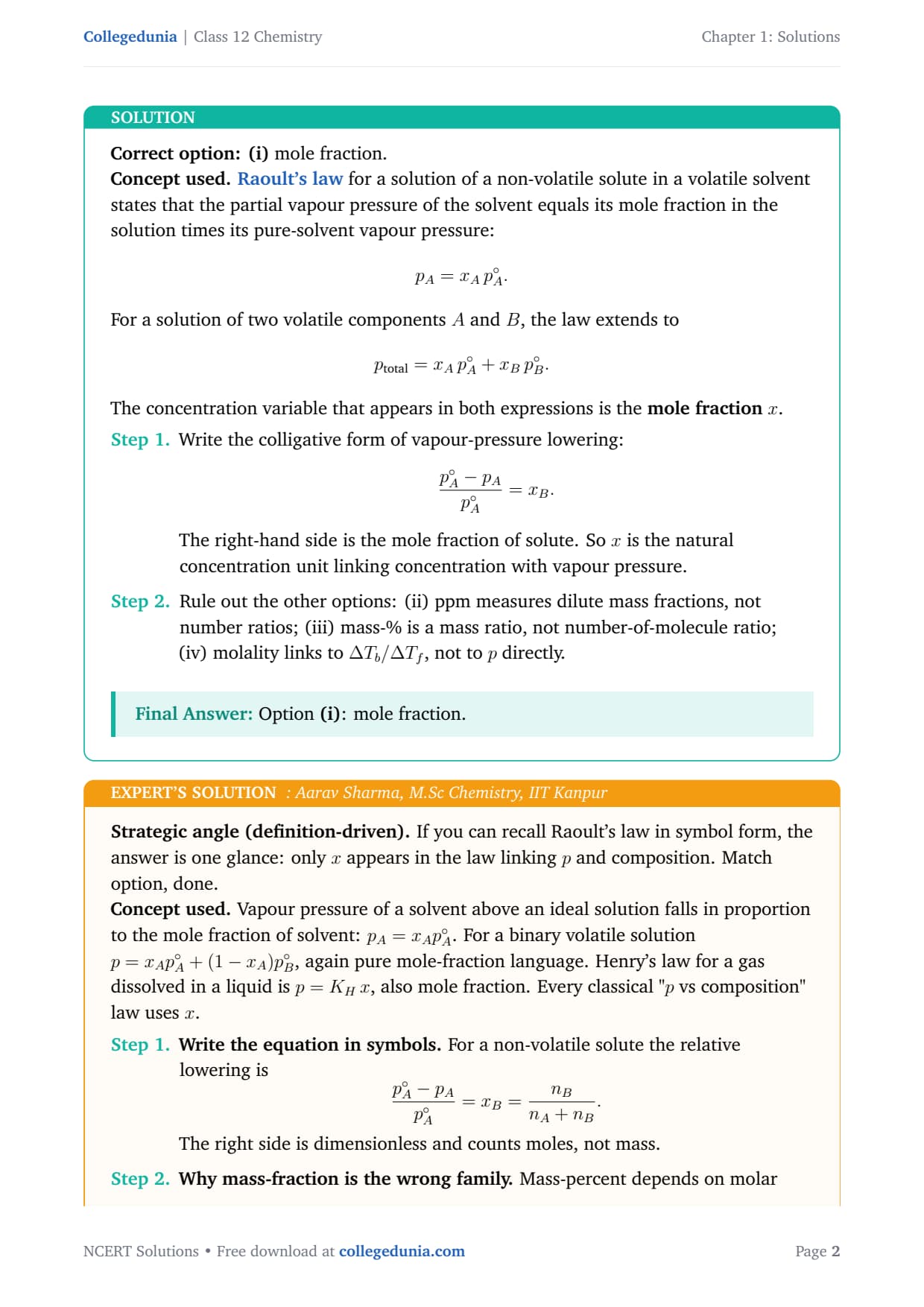
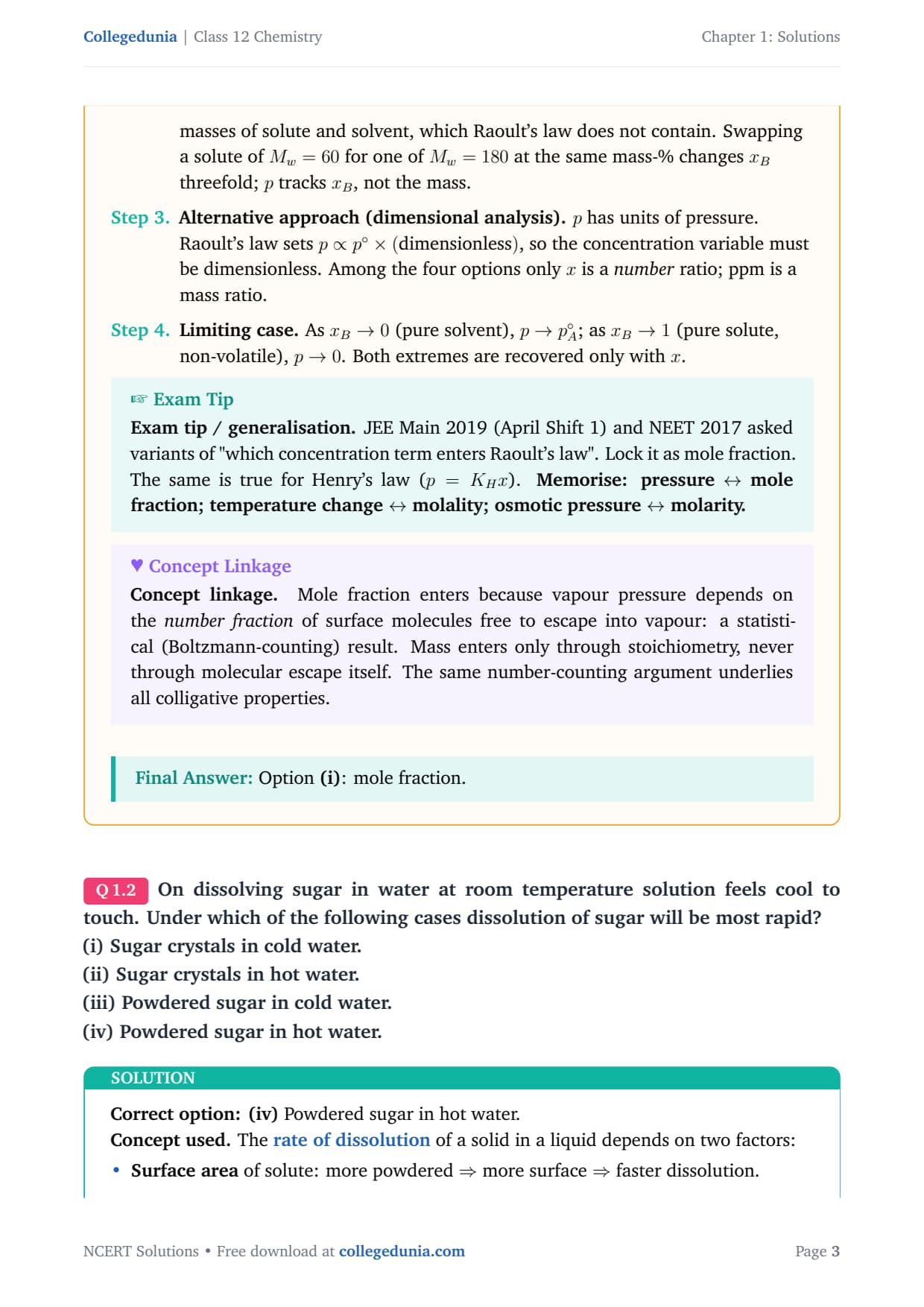
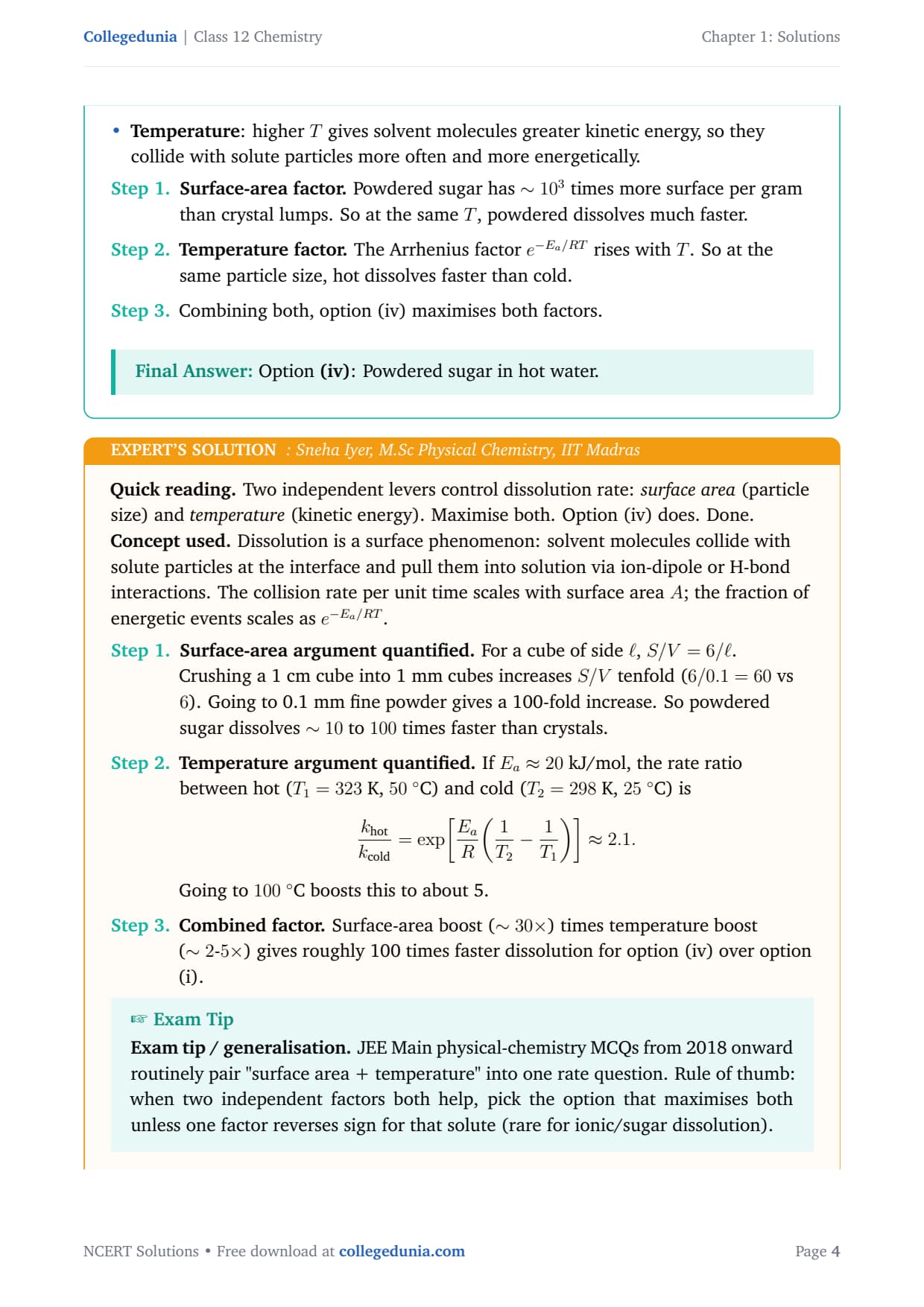
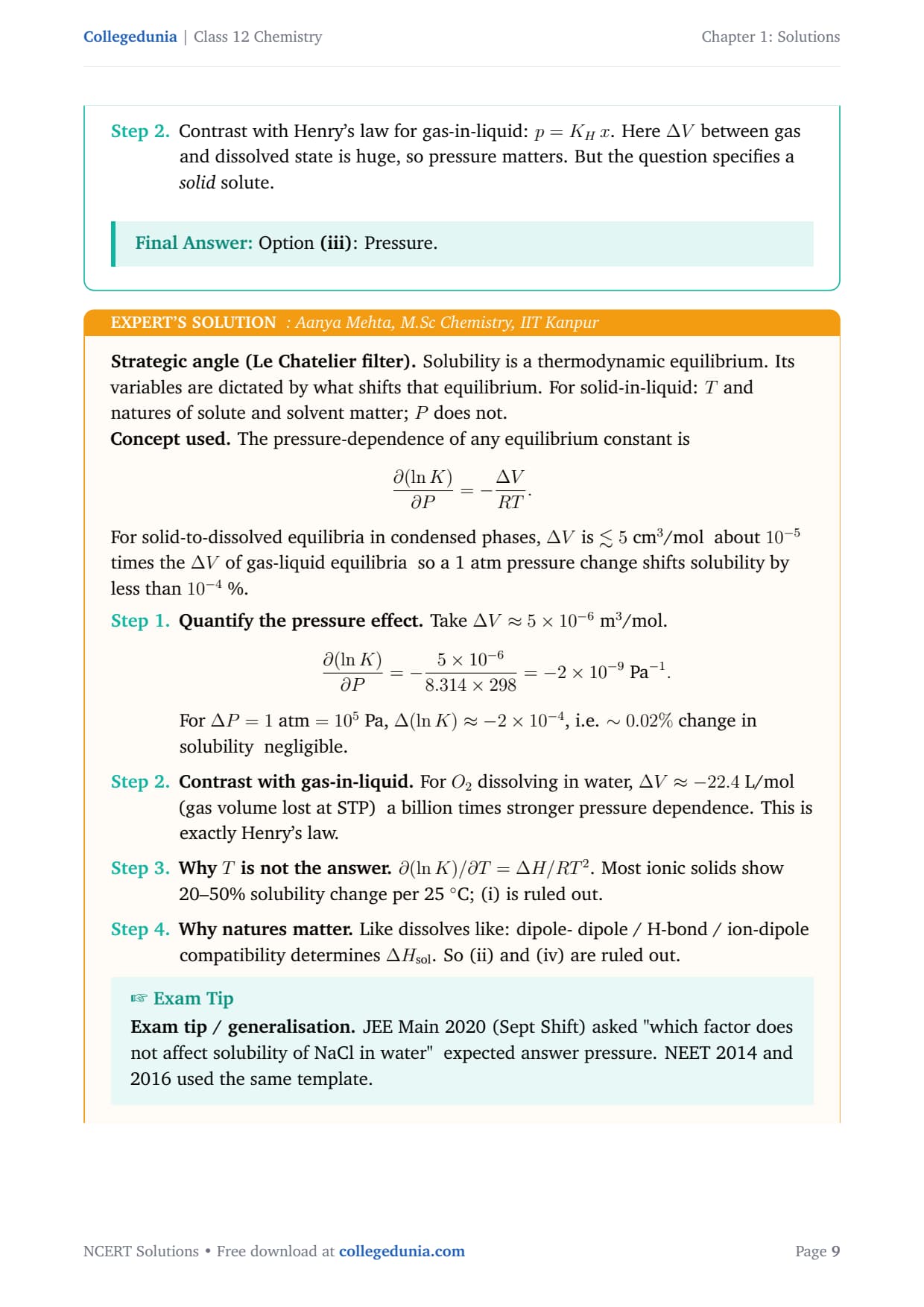
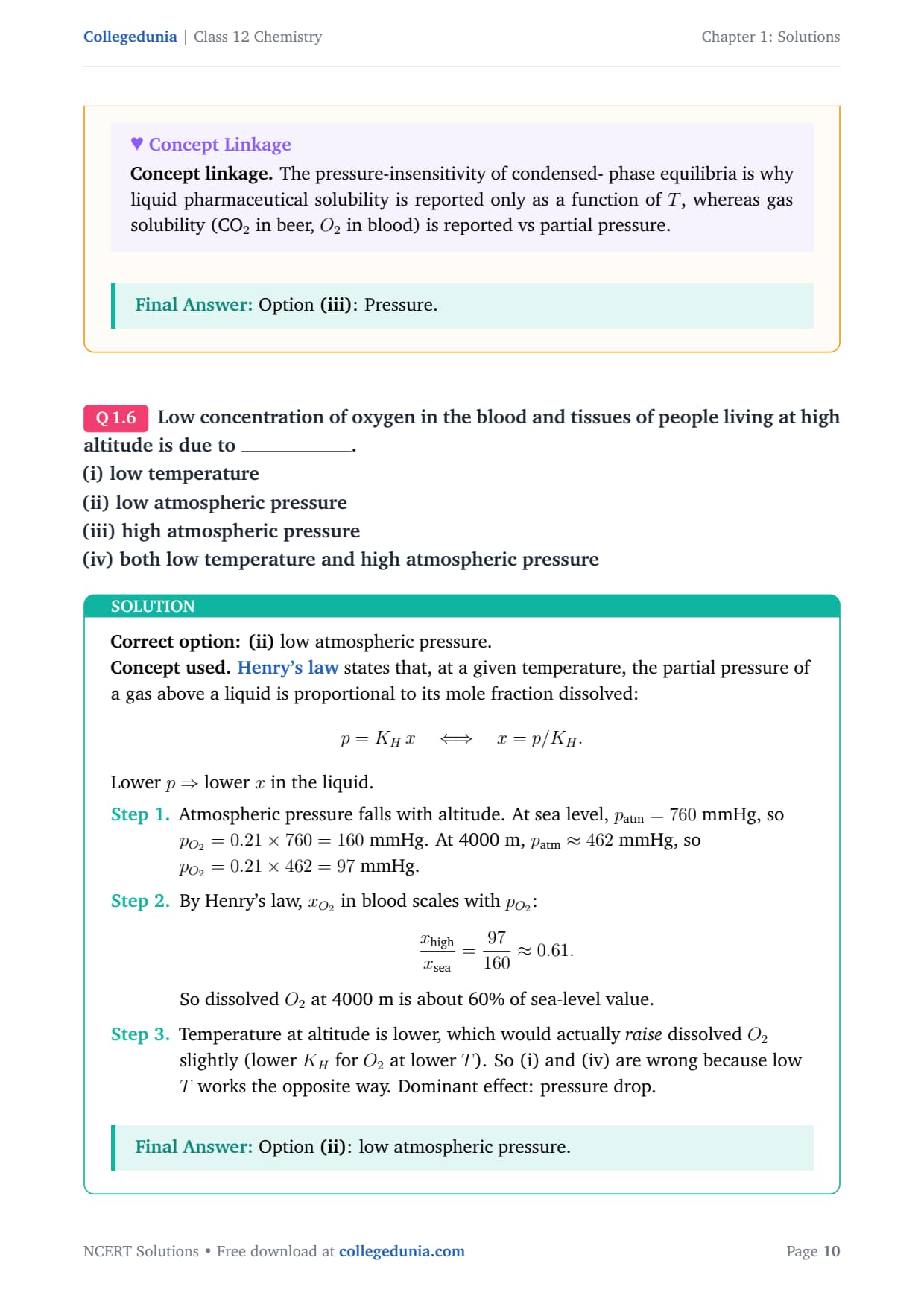
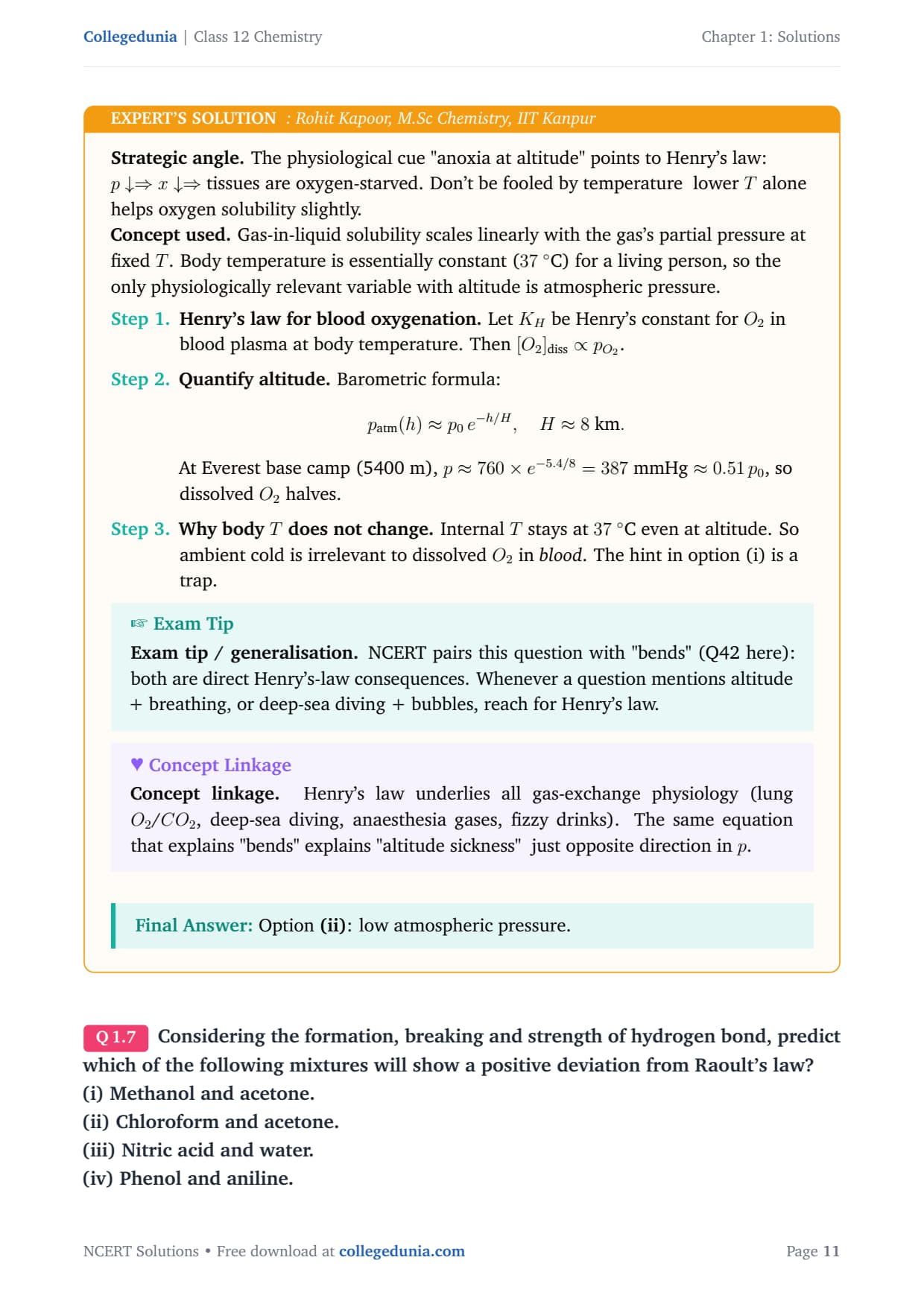
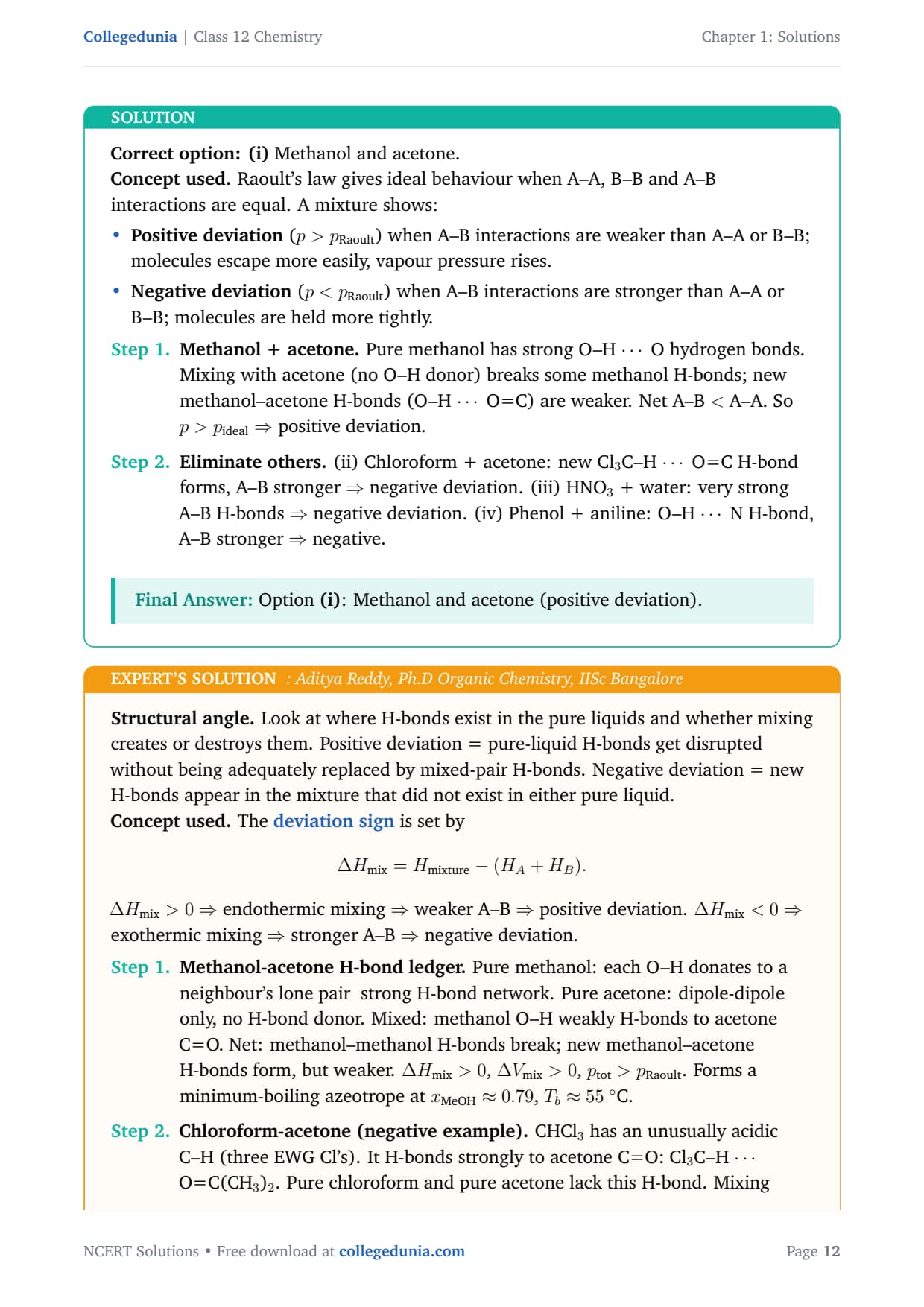
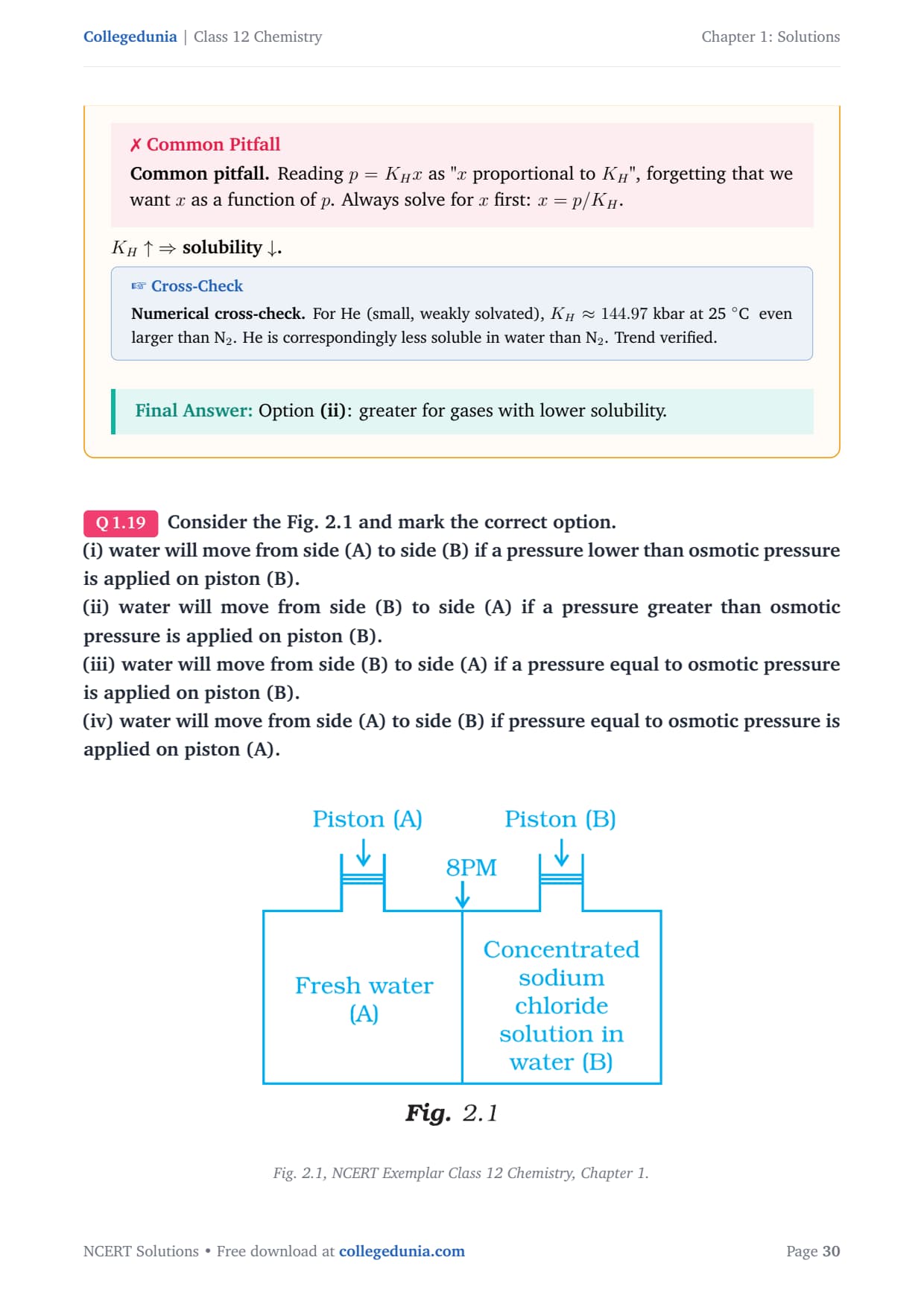
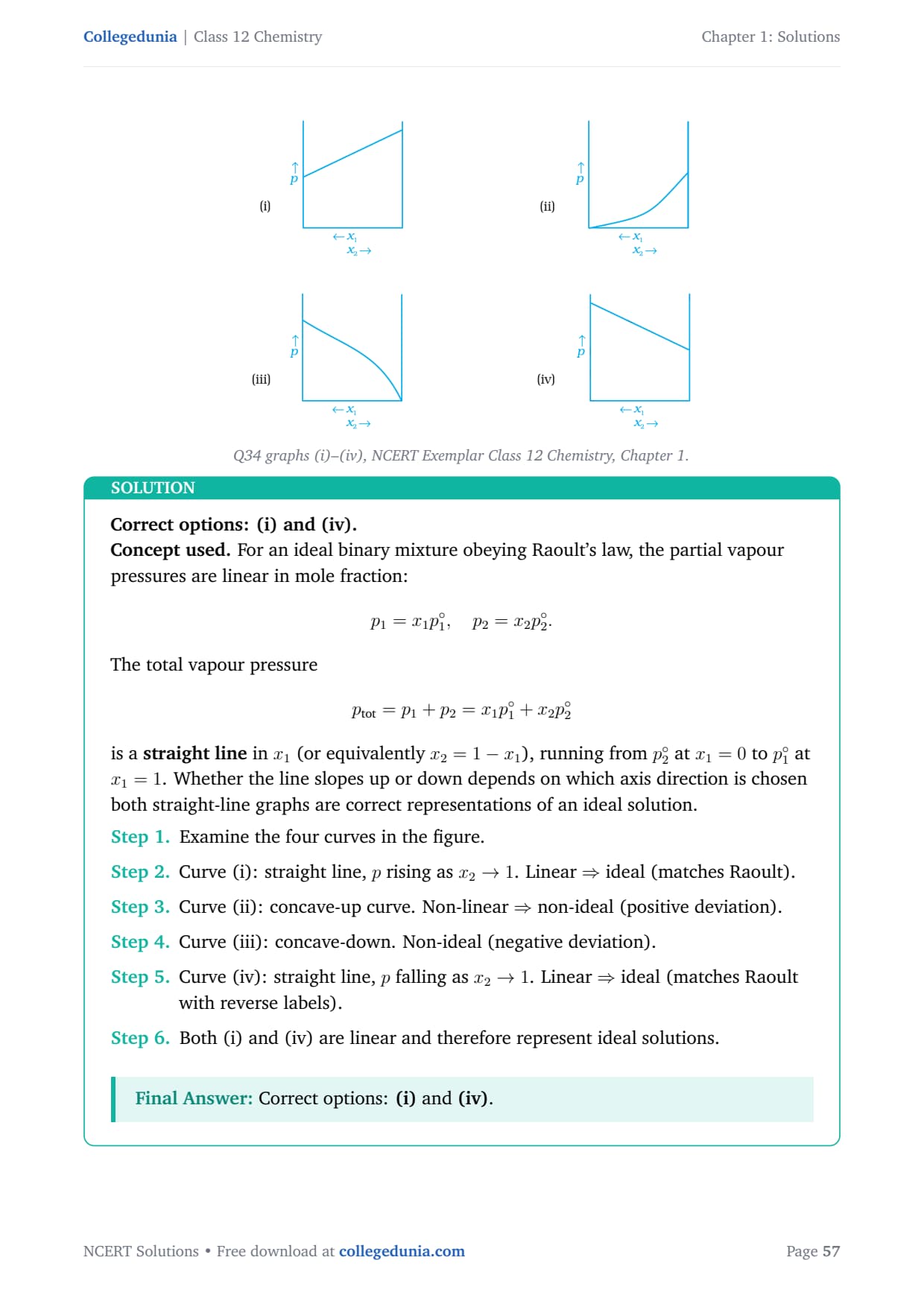
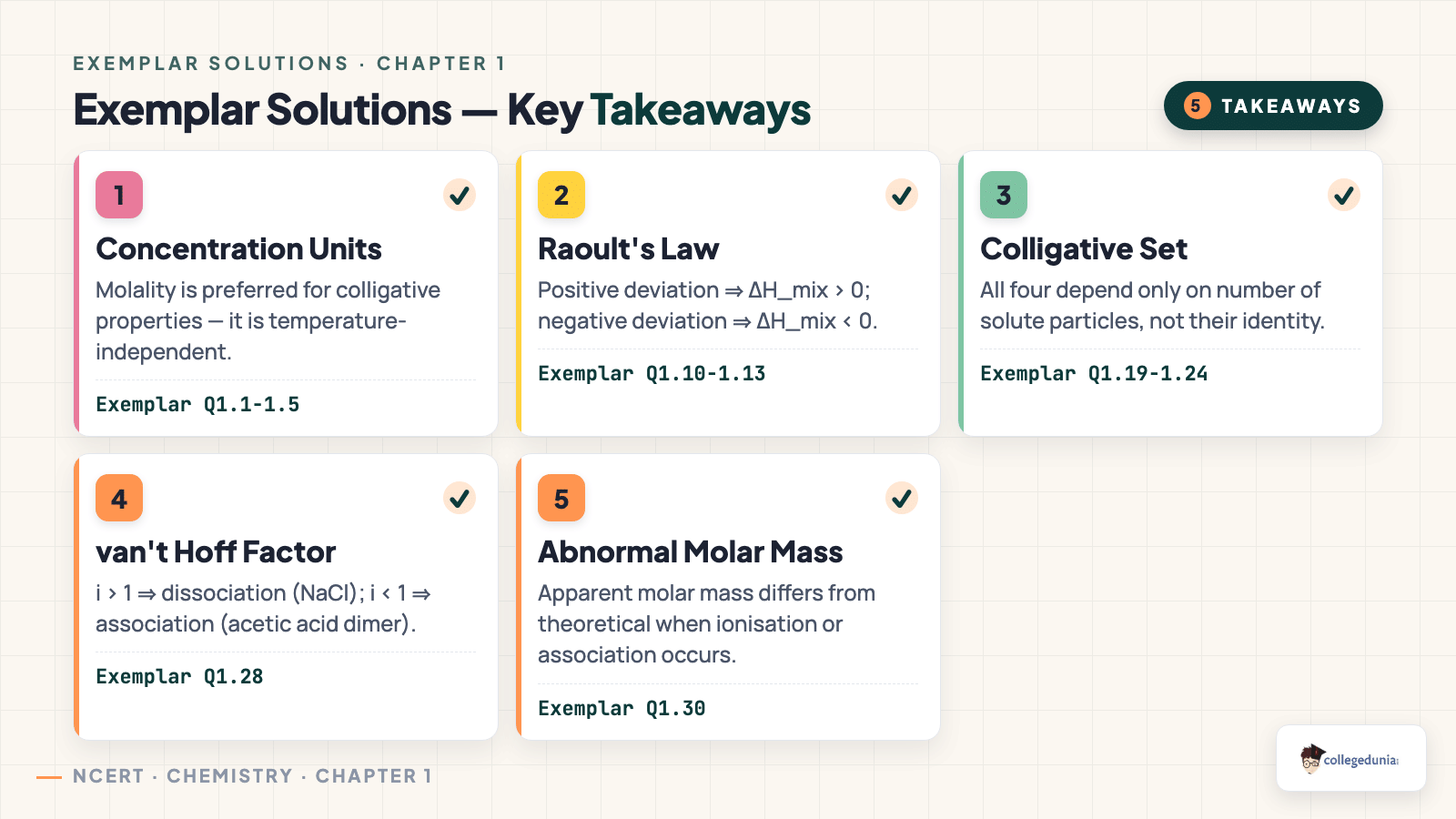
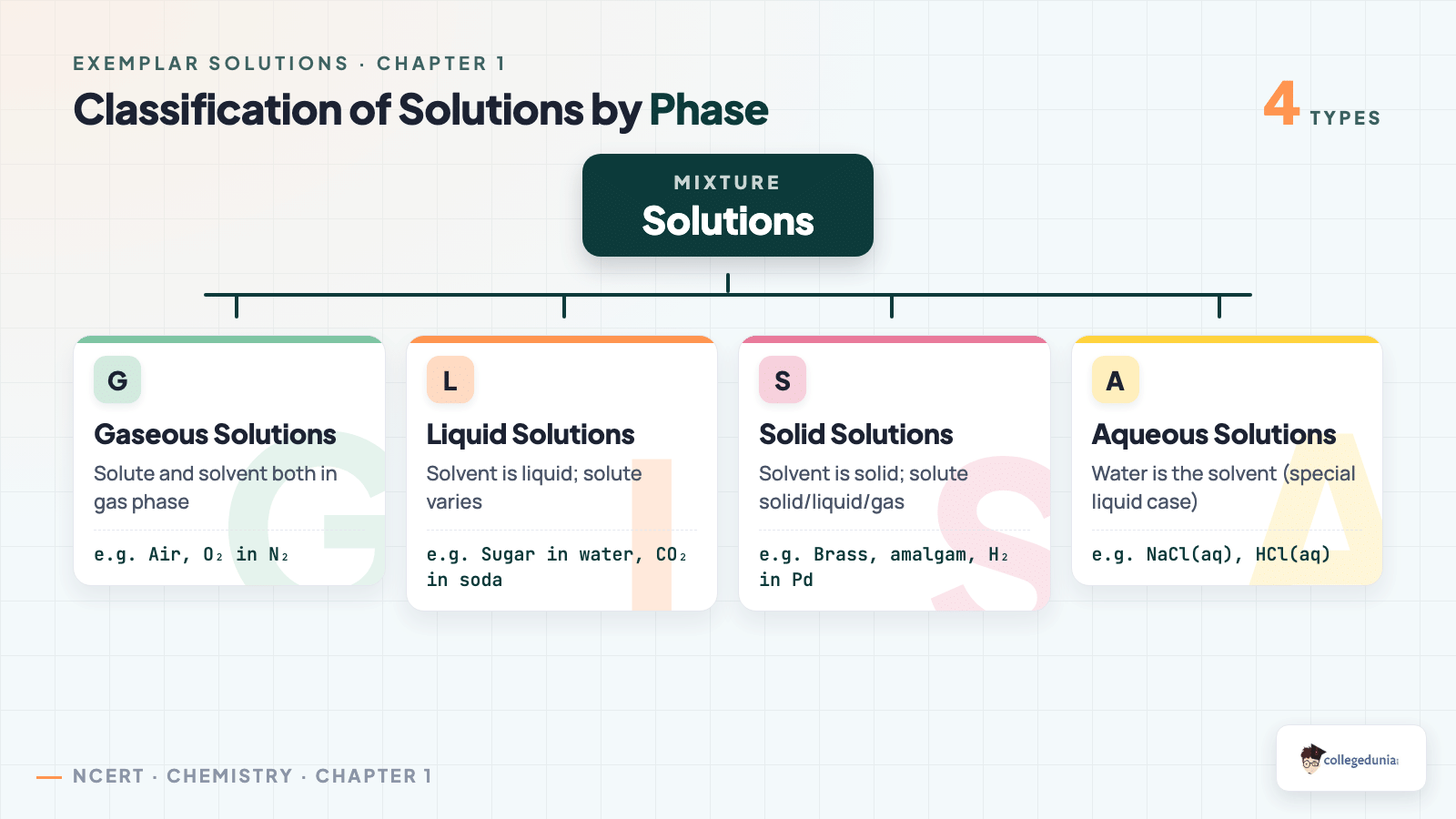
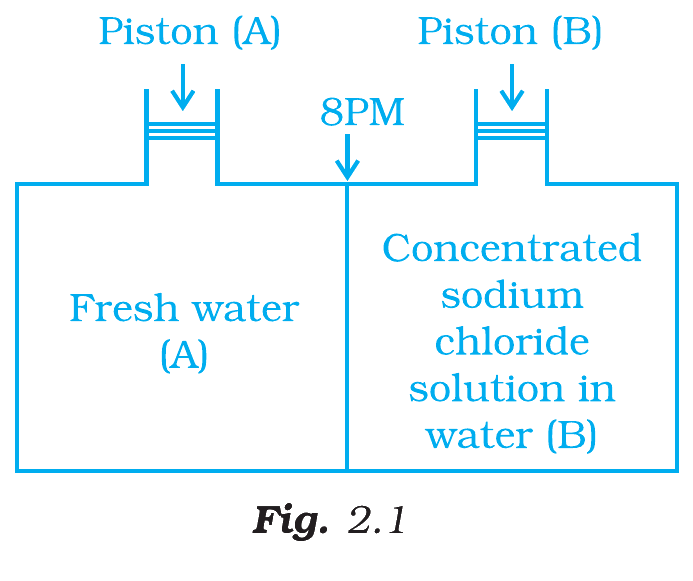
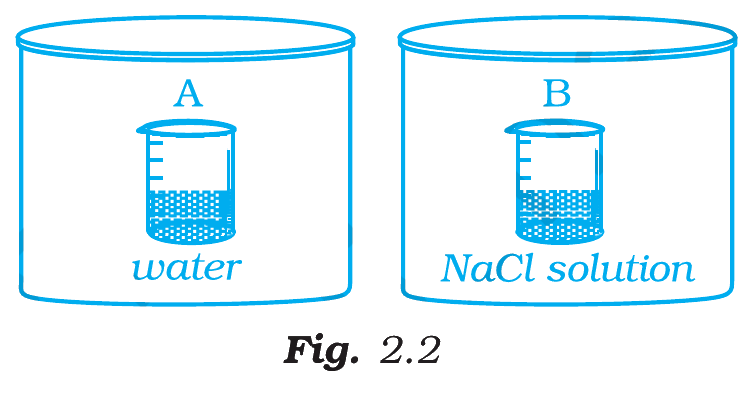
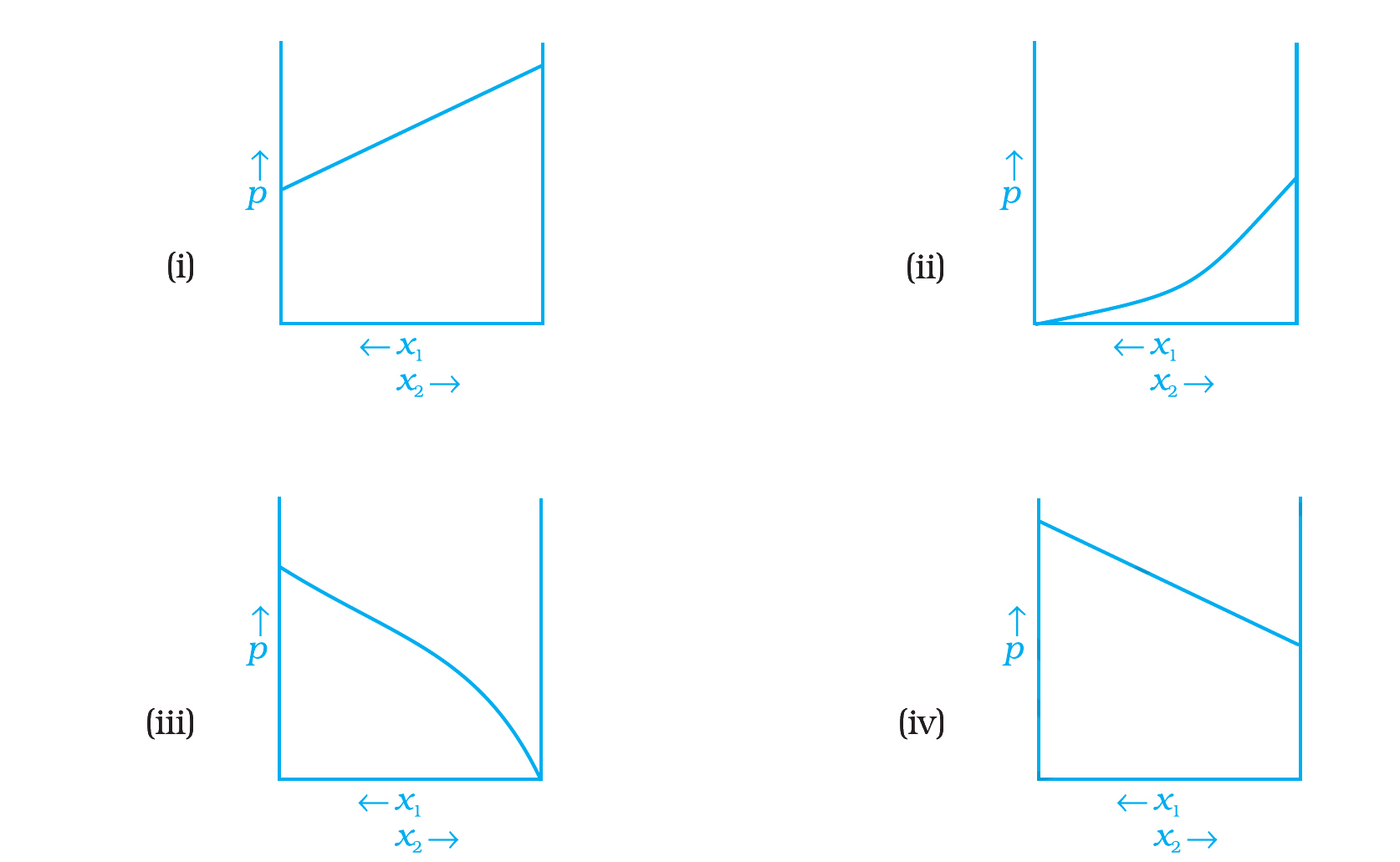
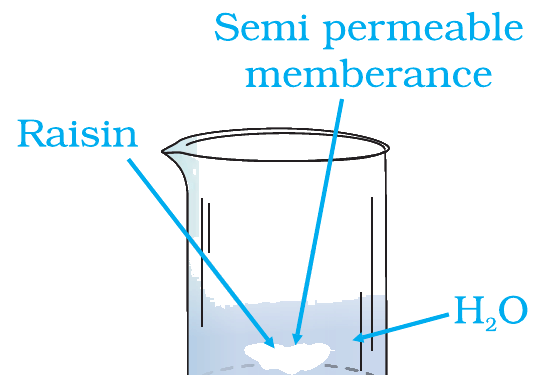



Comments