




Microbes in Human Welfare is a high-yield, easy-scoring chapter for Class 12 Biology students. NEET 2025 set two direct questions, and CBSE 2025 lifted a 3-mark answer from the Exemplar. This page hosts the fully worked NCERT Exemplar Solutions PDF, all 58 problems, mapped to the 2026-27 syllabus.

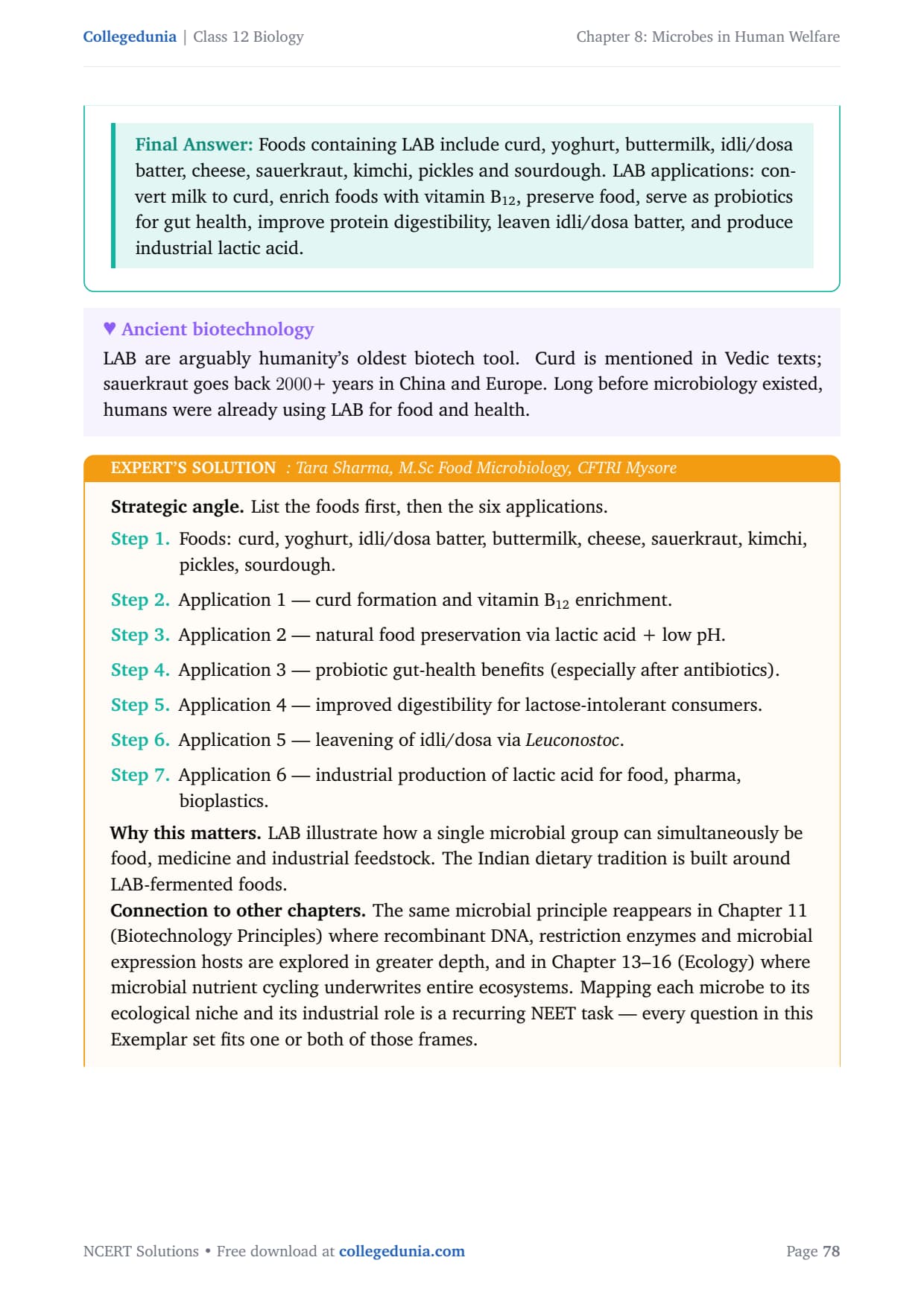
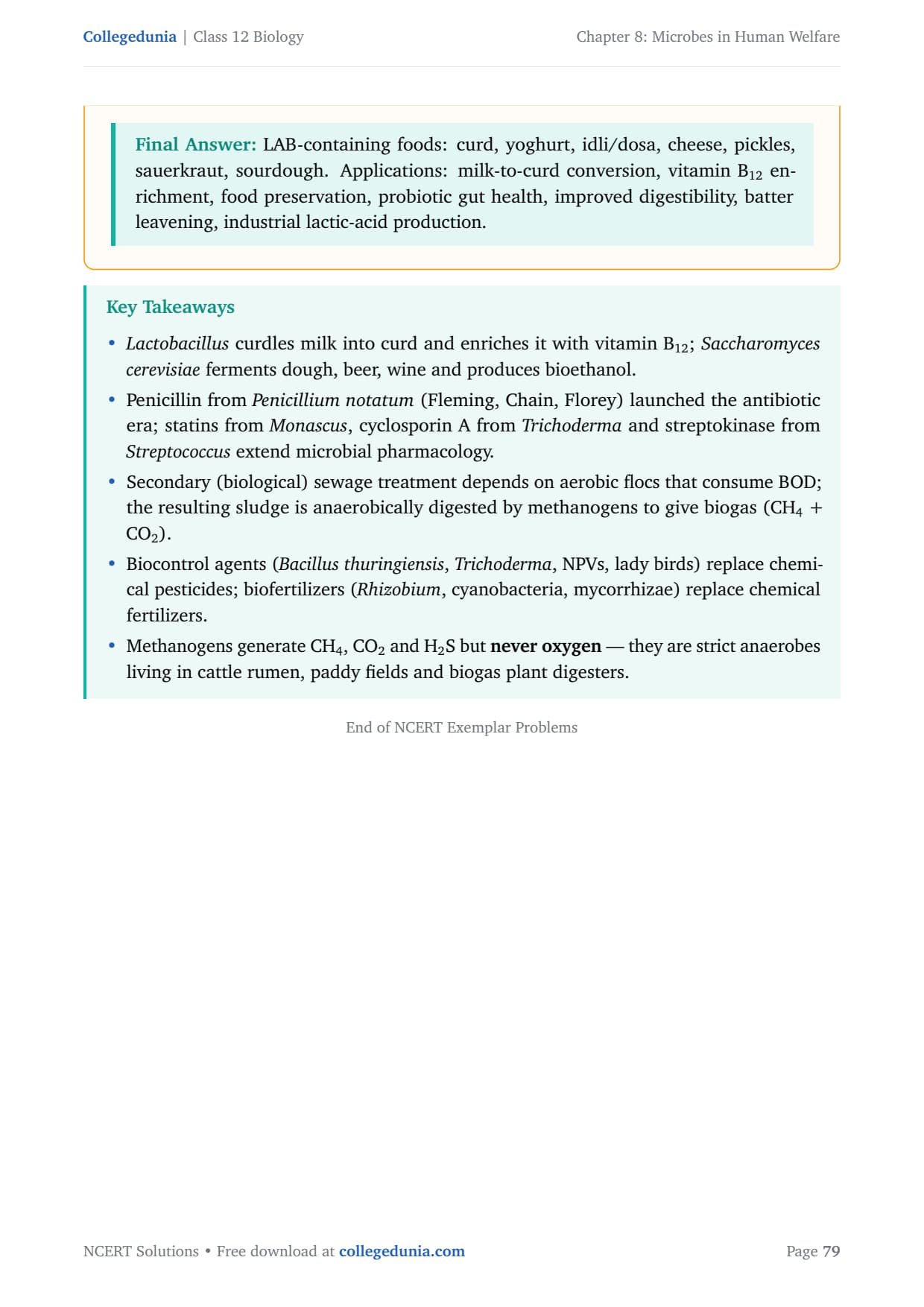
- CBSE Weightage: 4 to 6 marks, usually one short answer on biogas or sewage treatment plus one VSA on food microbes.
- NEET Weightage: 1 to 2 questions every year, mostly microbe-product recall.
- CUET Weightage: 1 question, usually a name-matching item.

These Exemplar Solutions are curated by NEET-rank-holder mentors at Collegedunia, mapped to the 2026-27 NCERT chapter, and benchmarked against the last five years of CBSE Board and NEET papers.
Microbes in Human Welfare Video Lecture for Class 12 Biology
Source: Magnet Brains on YouTube
Microbes in Human Welfare Exemplar Question-Type Tour with One Sample Solved per Type
The Exemplar groups all 58 problems into four formats. One solved sample per type helps you set your time per question type.
MCQ Sample, Exemplar 8.6 (Curd Microbe)
Q. The bacterium that converts milk into curd is (a) Streptococcus (b) Lactobacillus (c) Acetobacter (d) Aspergillus.
Answer (b). Lactobacillus (Lactic Acid Bacteria) ferments milk lactose into lactic acid. Acetobacter makes vinegar and Aspergillus is a fungus.
VSA Sample, Exemplar 8.24 (Yeast in Bread)
Q. Why does bread dough rise when yeast is added?
Answer. Saccharomyces cerevisiae ferments dough sugars and releases CO2, which gets trapped in the gluten and puffs up the dough.
SA Sample, Exemplar 8.42 (Sewage Treatment)
Q. Describe the steps in secondary treatment of sewage.
Answer. Effluent enters aeration tanks where air is pumped in. Aerobic microbes grow into flocs that eat the organic matter, so the BOD drops sharply. The flocs settle as activated sludge and part is recycled.
LA Sample, Exemplar 8.55 (Biogas Production)
Q. Explain biogas production with reference to methanogens and plant operation.
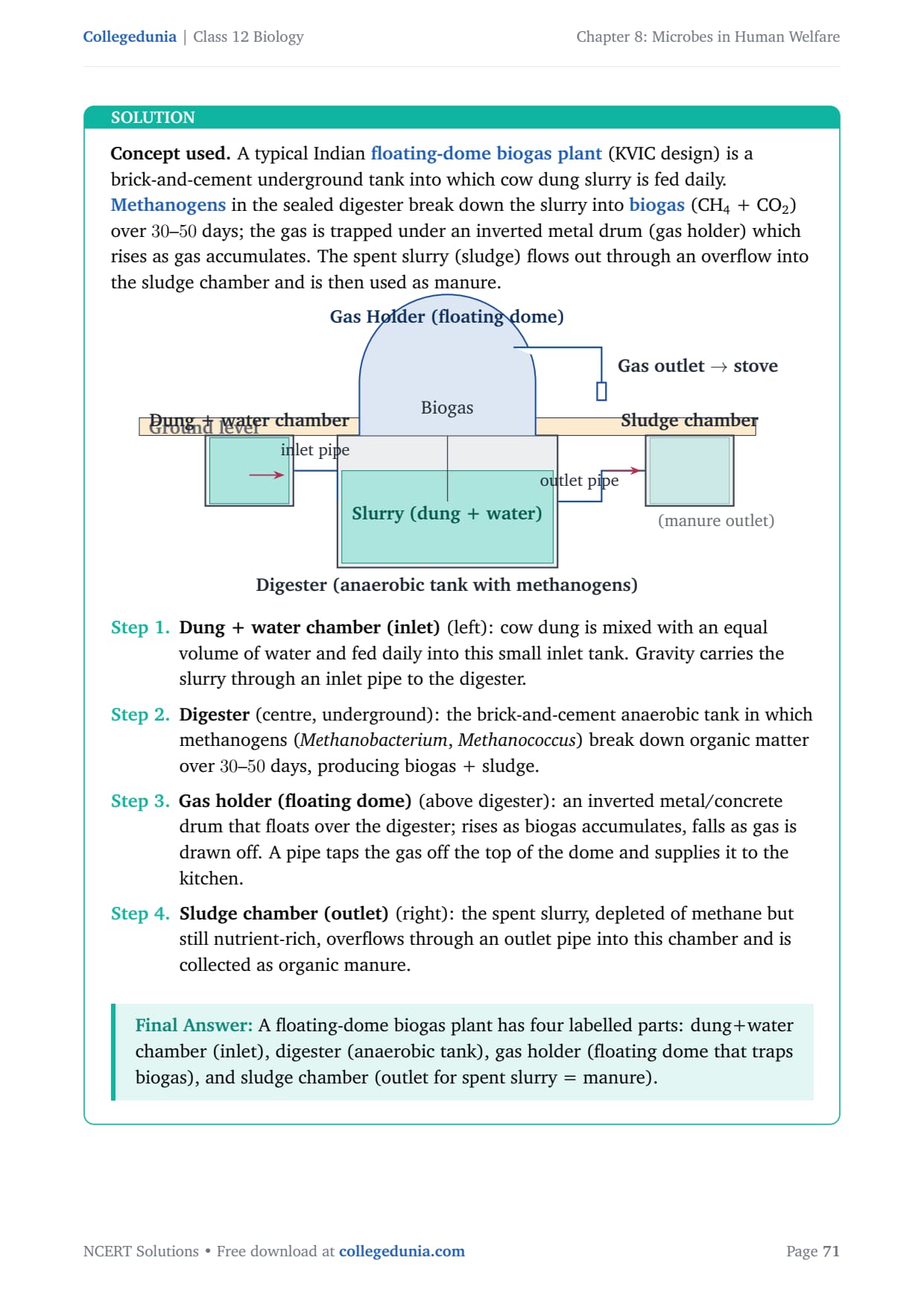
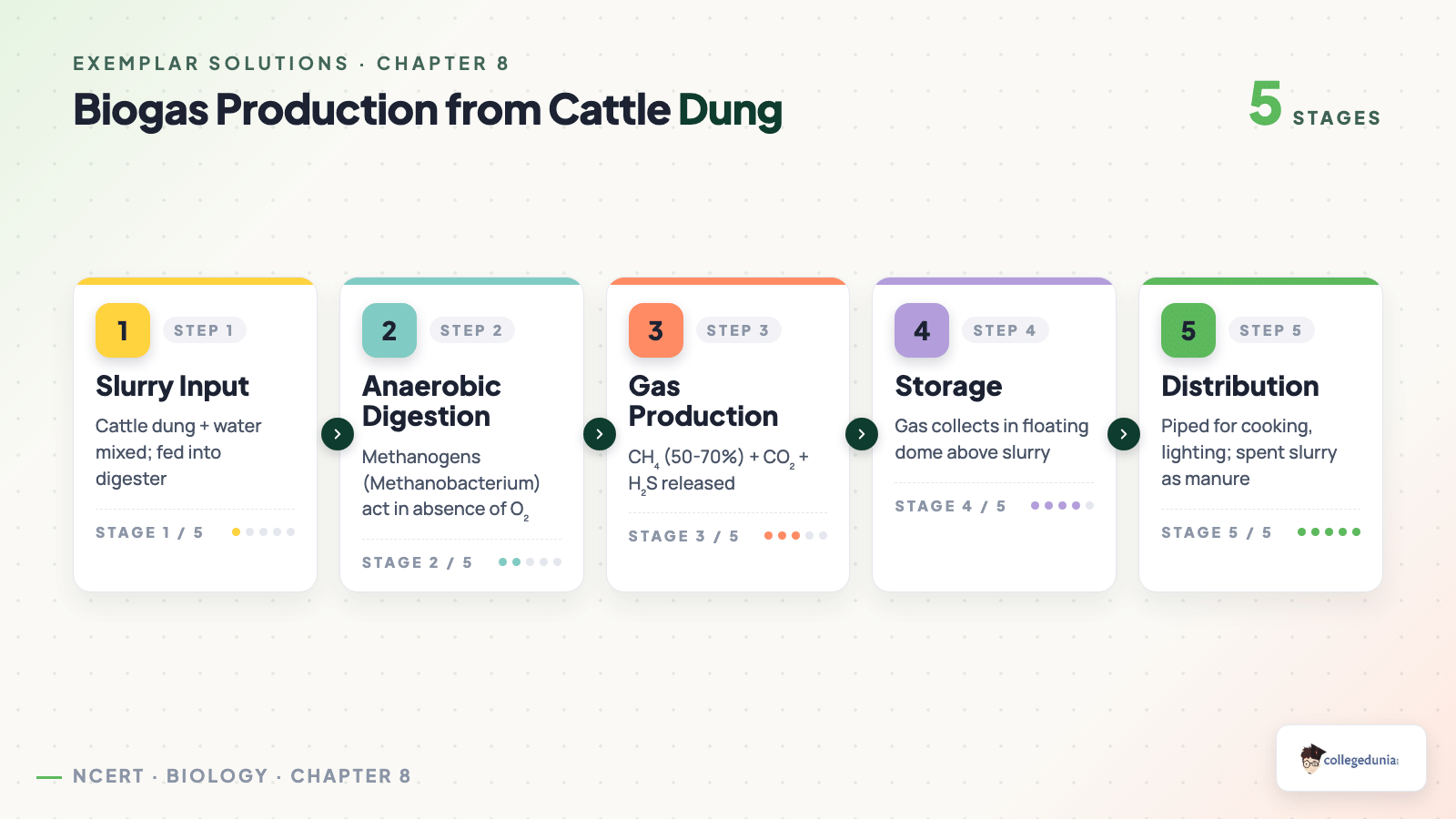
Answer. Biogas is mainly methane (CH4), CO2 and H2S from anaerobic digestion of waste. Methanogens like Methanobacterium digest cellulose and release methane. The plant has a digester tank, slurry inlet, floating gas cover and spent-slurry outlet. In India dung is the main feed, so it is called a gobar gas plant.
How Collegedunia's NCERT Exemplar Solutions Help You with Microbes in Human Welfare
NEET examiners trap students on the exact microbe name and product. Writing "a fungus" for Penicillium notatum loses the mark. Every solution names the recall phrase the answer key wants.
- Every type worked fully: all 18 MCQ, 20 VSA, 14 SA and 6 LA, no skipped steps.
- Microbe-product pairs named: the binomial plus the product, like Aspergillus niger for citric acid.
- 2026-27 aligned: each solution flags whether the topic is still in the syllabus.
Microbe-Product Recall Table: The Single Highest-Yield NEET Asset
If you remember nothing else, lock the microbe-product pairs. About 70% of the chapter's NEET MCQs are name-matching items. The table lists the eight most-asked.
| Product | Microbe (Binomial) | Type | NEET Asked |
|---|---|---|---|
| Curd / LAB | Lactobacillus acidophilus | Bacterium | 2025, 2024 |
| Bread / Beer / Wine | Saccharomyces cerevisiae | Yeast | 2024, 2022 |
| Idli / Dosa batter | Leuconostoc mesenteroides | Bacterium | 2023 |
| Swiss cheese holes | Propionibacterium shermanii | Bacterium | 2024 |
| Roquefort cheese | Penicillium roqueforti | Fungus | 2022 |
| Penicillin antibiotic | Penicillium notatum | Fungus | 2025, 2021 |
| Citric acid | Aspergillus niger | Fungus | 2023 |
| Cyclosporin A | Trichoderma polysporum | Fungus | 2024, 2021 |
Memorise the binomial, not the common name. The Exemplar marker rejects "yeast" when it wants "Saccharomyces cerevisiae".
Sample MCQ Walk-Through: The Cyclosporin-Statin Mix-Up
The most-missed MCQ pairs an immunosuppressant with a cholesterol-lowering agent. Students often swap the two fungi.
Q (Exemplar 8.13). Match (p) Cyclosporin A, (q) Statins, (r) Streptokinase, (s) Lactic acid with (i) Lactobacillus, (ii) Streptococcus, (iii) Trichoderma polysporum, (iv) Monascus purpureus.
Answer: p-iii, q-iv, r-ii, s-i. Cyclosporin A is from Trichoderma polysporum, statins from Monascus purpureus, streptokinase from Streptococcus, lactic acid from Lactobacillus. In NEET 2024, 36% swapped p and q.
Difficulty Step-Up From NCERT Textbook to Exemplar
The textbook tests direct recall. The Exemplar twists it by asking the why or the consequence.
| Concept | NCERT Textbook Q | Exemplar Twist |
|---|---|---|
| Curd | "Which bacterium makes curd?" | "Why does curd not form below 20 degree C?" |
| Sewage flocs | "Define BOD" | "Why does treated effluent BOD fall?" |
| Biogas | "Name the gas in biogas" | "Why do methanogens need anaerobic conditions?" |
| Biocontrol | "Name a biocontrol agent" | "Why is Bacillus thuringiensis safer than pesticides?" |
Attempt the NCERT version first, then the Exemplar twist the next day.
Microbes in Human Welfare Common Mistakes the Exemplar Trains Out
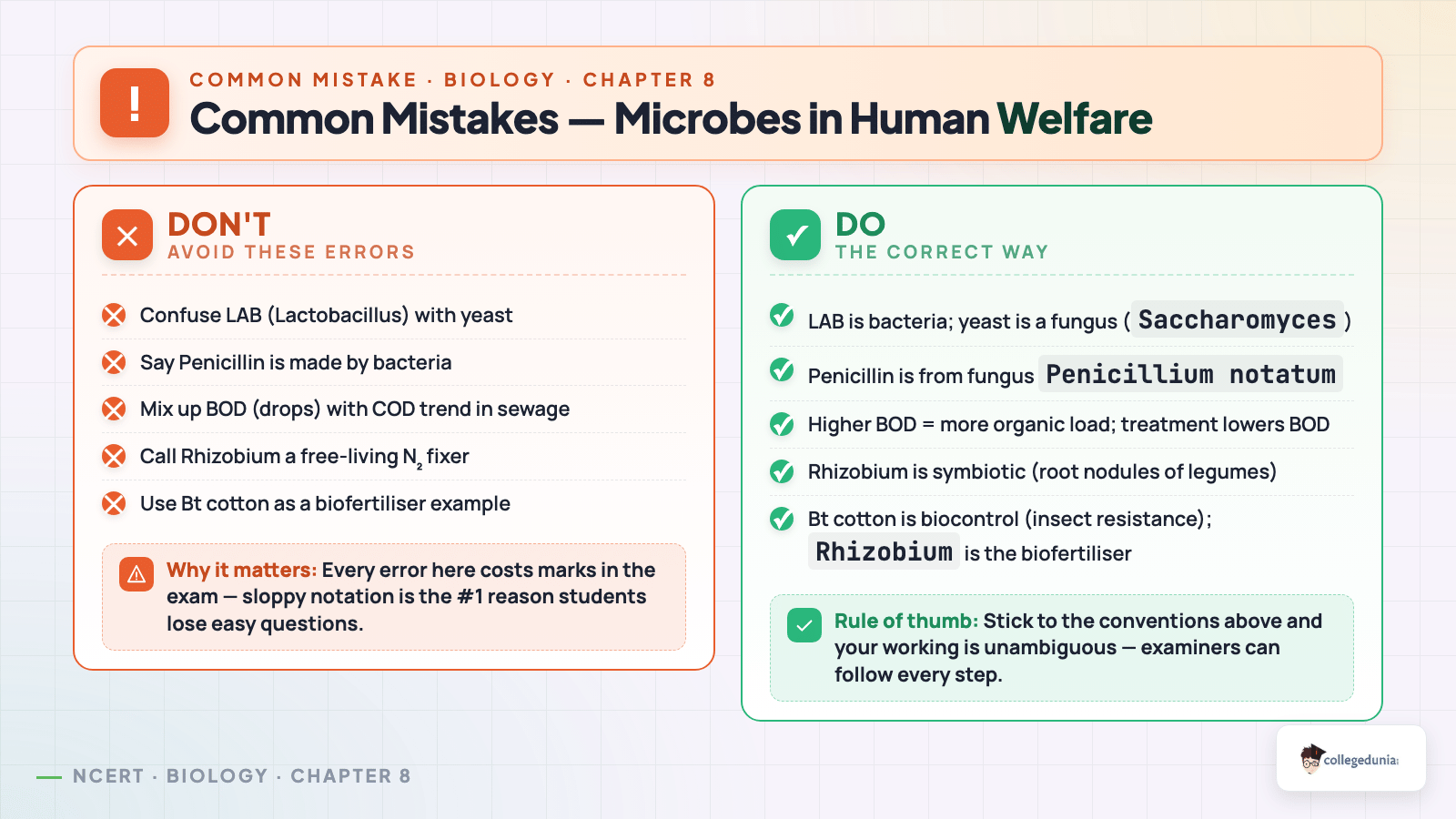
These mistakes are not about forgetting facts. They are about phrasing the right fact wrongly, which the Exemplar and NEET answer key penalise.
Mistake 1. Writing "yeast makes alcohol" without naming Saccharomyces cerevisiae.
Mistake 2. Calling methanogens "bacteria". They are archaebacteria; "archaea" is the awarded answer in Exemplar 8.55.
Mistake 3. Confusing BOD (oxygen demand by microbes) with COD (chemical oxygen demand).
Mistake 4. Listing Penicillium roqueforti as the penicillin source. The antibiotic comes from Penicillium notatum.
Mistake 5. Writing "cyanobacteria fix nitrogen" without naming Anabaena, Nostoc or Oscillatoria.
Best-Use of Microbes in Human Welfare Exemplar for NEET Biology Preparation
The 58 problems are not weighted equally. This plan tells you which type to attempt first, second and third.
| Phase | Question Type | Why Now | Time Budget |
|---|---|---|---|
| First sweep | MCQ (18) | Microbe-product MCQs are the NEET sweet spot | 14 min |
| Second sweep | VSA (20) | One-line drill for CBSE 1 and 2 mark Qs | 40 min |
| Third sweep | SA (14) | Sewage and biogas mechanism for 3-mark Qs | 1 hr 10 min |
| Pre-exam sweep | LA (6) | Plant diagram plus mechanism for 5-mark Qs | 48 min |
Class 12 Biology Chapter Weightage Across NEET
Microbes sits in the second tier by NEET yield: a low question count but a high per-question hit rate, because the questions are pure recall. The chart sets it next to its neighbours.
Yield is averaged over NEET 2021 to 2025. The answers here are deterministic, so accuracy potential is the highest in the section.
Other Resources for Microbes in Human Welfare Class 12 Biology
| Resource | Link |
|---|---|
| Exemplar Solutions | Microbes in Human Welfare Exemplar Solutions |
| NCERT Solutions | Microbes in Human Welfare NCERT Solutions |
| Notes | Microbes in Human Welfare Notes |
| Handwritten Notes | Microbes in Human Welfare Handwritten Notes |
| Formula Sheet | Microbes in Human Welfare Formula Sheet |
| NCERT Book PDF | Microbes in Human Welfare NCERT Book PDF |
| Exemplar Book PDF | Microbes in Human Welfare Exemplar Book PDF |
All NCERT Exemplar Questions for Microbes in Human Welfare with Step-by-Step Solutions
Every question of the NCERT Exemplar set for Class 12 Biology Chapter 8 Microbes in Human Welfare is listed below with its full Solution and Expert Solution hidden inside collapsible tabs. Click Check Solution to reveal the step-by-step working; click Expert Solution for the expanded explanation.
Multiple Choice Questions
The vitamin whose content increases following the conversion of milk into curd by lactic acid bacteria is:
(a) vitamin C
(b) vitamin D
(c) vitamin B12
(d) vitamin E.
Correct option: (c) vitamin B12.
Concept used. Curd is formed when lactic acid bacteria (LAB), principally Lactobacillus (and to a lesser extent Lactococcus and Streptococcus), inoculate warm milk and convert milk lactose into lactic acid. The acid lowers the pH below the iso-electric point of casein (∼ 4.6), causing the milk protein to coagulate into the soft semisolid we call curd. Alongside this souring, LAB also synthesize several B-complex vitamins as metabolic by-products, the most prominent of which is cobalamin (vitamin B12).
- Identify the chemistry: LAB metabolise lactose anaerobically via Lactose ⟶ 2 Lactic acid (catalysed by LAB), which acidifies and coagulates milk into curd.
- Examine vitamin synthesis: during this fermentation, Lactobacillus also synthesises cobalamin (B12) using cobalt incorporated into a corrin ring. As a result, the curd's B12 content is appreciably higher than the original milk's.
- Eliminate distractors: (a) vitamin C is not synthesised by LAB and is actually destroyed by heat/acid; (b) vitamin D is fat-soluble and comes only from sunlight or supplementation; (d) vitamin E is plant-oil-derived and not microbially upregulated.
Option (c) vitamin B12.
Quick reading. Read the question as ``Which vitamin do LAB synthesise during curd formation?'' Among A–D only B12 is a known LAB metabolite.
- Recall the four water-soluble vitamins LAB are known to make: thiamine (B1), riboflavin (B2), folate (B9) and cobalamin (B12). Of these, only B12 is listed.
- Cross-check on chemistry: LAB ferment lactose to lactic acid. The acidification environment does not produce vitamin C, D or E. B12 is biosynthesised from cobalt and 5-aminolaevulinic acid as an intracellular cofactor and is released on cell lysis.
- Verify with a real-world cue: NCERT explicitly states ``LAB also improve its nutritional quality by increasing vitamin B12'' in the textbook chapter - a direct lift.
Why this matters. Vegetarian diets routinely lack B12 since most plants do not make it. Daily curd consumption is the simplest dietary fix, a fact every NEET aspirant should connect.
The vitamin enriched in curd is vitamin B12 (option c).
Wastewater treatment generates a large quantity of sludge, which can be treated by:
(a) anaerobic digesters
(b) floc
(c) chemicals
(d) oxidation pond.
Correct option: (a) anaerobic digesters.
Concept used. Sewage treatment runs in two main biological steps. Primary treatment removes large solids by sedimentation. Secondary treatment aerates effluent to grow aerobic floc communities that consume biodegradable organic matter (BOD). The biomass that settles afterwards is the activated sludge; the bulk of it is pumped into large, sealed anaerobic digesters where methanogenic bacteria break it down further, producing biogas (a mixture of CH4, CO2 and H2S).
- Identify what ``sludge'' means: it is the settled microbial-rich biomass left after aerobic floc formation in the secondary settling tank. It is rich in proteins, fats and carbohydrates.
- Apply the treatment logic: this organic-rich biomass must be stabilised before disposal. The standard route is large heated, oxygen-free anaerobic digesters where methanogens such as Methanobacterium run the reaction: Organic matter -> CH4 + CO2 + H2S + Biomass (by methanogens).
- Rule out distractors: flocs (b) are the aerobic step, used before sludge forms; chemicals (c) are used in some tertiary polishing but not for primary sludge stabilisation; oxidation ponds (d) treat dilute effluent, not concentrated sludge.
Sludge is treated by anaerobic digesters (option a).
Structural observation. The question is testing whether the student can place each treatment unit in the correct stage of the sewage pipeline.
- Lay out the pipeline: raw sewage → primary clarifier (settling) → aeration tank (flocs grow) → secondary clarifier (sludge settles) → anaerobic digester (sludge stabilised, biogas extracted) → disposal.
- Locate ``sludge'' on this map: it sits between the secondary clarifier and the digester. Its destination is therefore the anaerobic digester.
- Eliminate alternatives systematically: floc is the precursor stage, chemicals would be wasteful at this concentration, and oxidation ponds handle clear effluent. Option (a) is the only consistent answer.
Why this matters. Anaerobic digestion is the most carbon-efficient way to deal with sludge - it both reduces solid waste and harvests methane as fuel. Modern sewage plants worldwide are designed around this principle.
Anaerobic digesters (option a).
Methanogenic bacteria are not found in:
(a) rumen of cattle
(b) gobar gas plant
(c) bottom of water-logged paddy fields
(d) activated sludge.
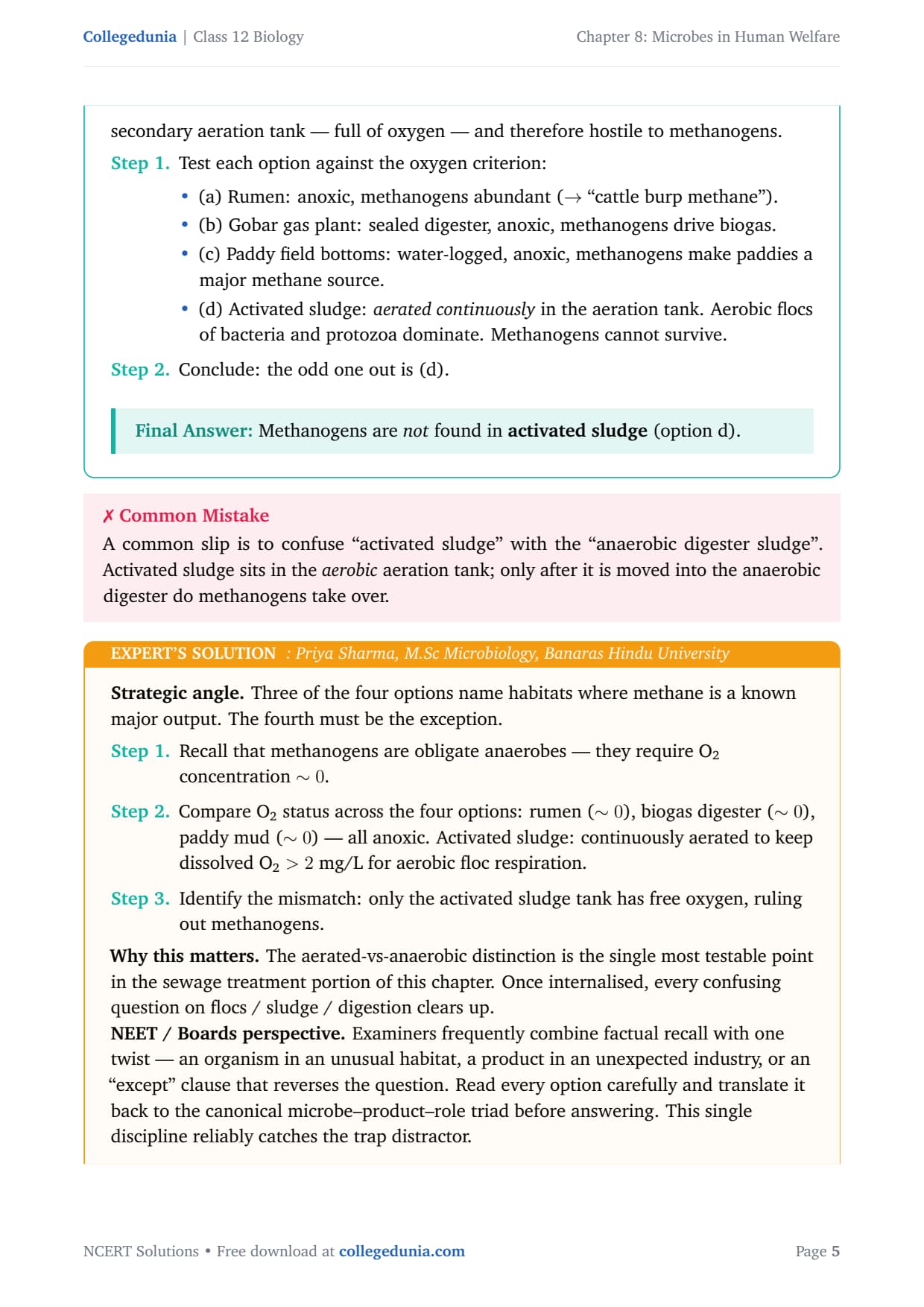
Correct option: (d) activated sludge.
Concept used. Methanogens are strict anaerobic archaea that produce methane (CH4) as an end-product of their energy metabolism. They survive only where oxygen is absent and organic matter is abundant. The four classic habitats are: (i) the rumen of cattle and other ruminants, (ii) the digester of a gobar (cow-dung) biogas plant, (iii) the anoxic mud at the bottom of water-logged paddy fields, and (iv) the anaerobic digester used to treat sludge. Activated sludge itself, however, is the aerated biomass in the secondary aeration tank - full of oxygen - and therefore hostile to methanogens.
- Test each option against the oxygen criterion:
- 2pt
- (a) Rumen: anoxic, methanogens abundant (→ ``cattle burp methane'').
- (b) Gobar gas plant: sealed digester, anoxic, methanogens drive biogas.
- (c) Paddy field bottoms: water-logged, anoxic, methanogens make paddies a major methane source.
- (d) Activated sludge: aerated continuously in the aeration tank. Aerobic flocs of bacteria and protozoa dominate. Methanogens cannot survive.
- Conclude: the odd one out is (d).
Methanogens are not found in activated sludge (option d).
Strategic angle. Three of the four options name habitats where methane is a known major output. The fourth must be the exception.
- Recall that methanogens are obligate anaerobes - they require O2 concentration ∼ 0.
- Compare O2 status across the four options: rumen (∼ 0), biogas digester (∼ 0), paddy mud (∼ 0) - all anoxic. Activated sludge: continuously aerated to keep dissolved O2 > 2 mg/L for aerobic floc respiration.
- Identify the mismatch: only the activated sludge tank has free oxygen, ruling out methanogens.
Why this matters. The aerated-vs-anaerobic distinction is the single most testable point in the sewage treatment portion of this chapter. Once internalised, every confusing question on flocs / sludge / digestion clears up.
NEET / Boards perspective. Examiners frequently combine factual recall with one twist - an organism in an unusual habitat, a product in an unexpected industry, or an ``except'' clause that reverses the question. Read every option carefully and translate it back to the canonical microbe–product–role triad before answering. This single discipline reliably catches the trap distractor. Activated sludge (option d).
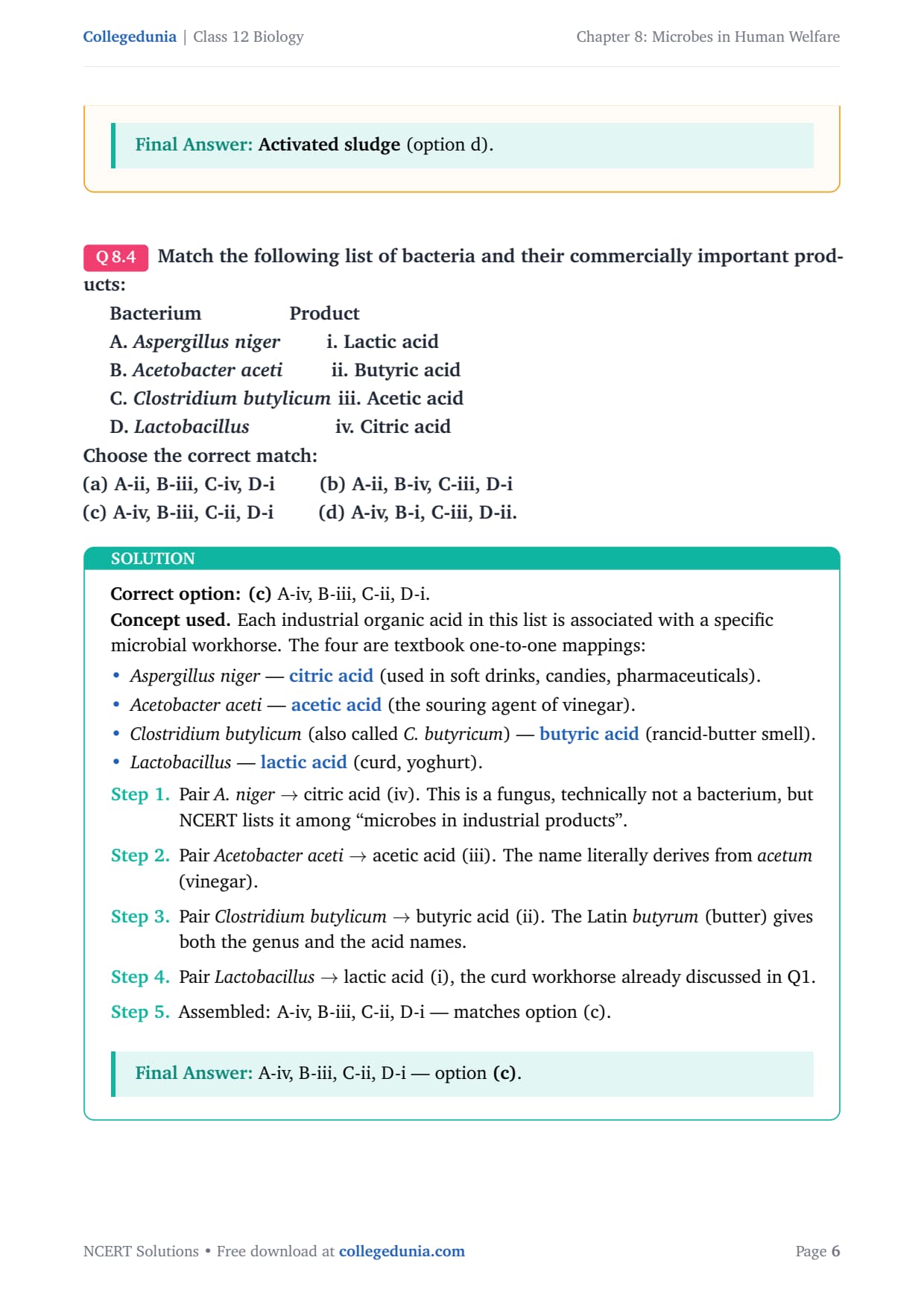
Match the following list of bacteria and their commercially important products:
0.6cmBacterium2cmProduct
0.6cmA. Aspergillus niger1.05cmi. Lactic acid
0.6cmB. Acetobacter aceti1.10cmii. Butyric acid
0.6cmC. Clostridium butylicum0.15cmiii. Acetic acid
0.6cmD. Lactobacillus1.95cmiv. Citric acid
Choose the correct match:
(a) A-ii, B-iii, C-iv, D-i1cm(b) A-ii, B-iv, C-iii, D-i
(c) A-iv, B-iii, C-ii, D-i1cm(d) A-iv, B-i, C-iii, D-ii.
Correct option: (c) A-iv, B-iii, C-ii, D-i.
Concept used. Each industrial organic acid in this list is associated with a specific microbial workhorse. The four are textbook one-to-one mappings:
- 2pt
- Aspergillus niger - citric acid (used in soft drinks, candies, pharmaceuticals).
- Acetobacter aceti - acetic acid (the souring agent of vinegar).
- Clostridium butylicum (also called C. butyricum) - butyric acid (rancid-butter smell).
- Lactobacillus - lactic acid (curd, yoghurt).
- Pair A. niger → citric acid (iv). This is a fungus, technically not a bacterium, but NCERT lists it among ``microbes in industrial products''.
- Pair Acetobacter aceti → acetic acid (iii). The name literally derives from acetum (vinegar).
- Pair Clostridium butylicum → butyric acid (ii). The Latin butyrum (butter) gives both the genus and the acid names.
- Pair Lactobacillus → lactic acid (i), the curd workhorse already discussed in Q1.
- Assembled: A-iv, B-iii, C-ii, D-i - matches option (c).
A-iv, B-iii, C-ii, D-i - option (c).
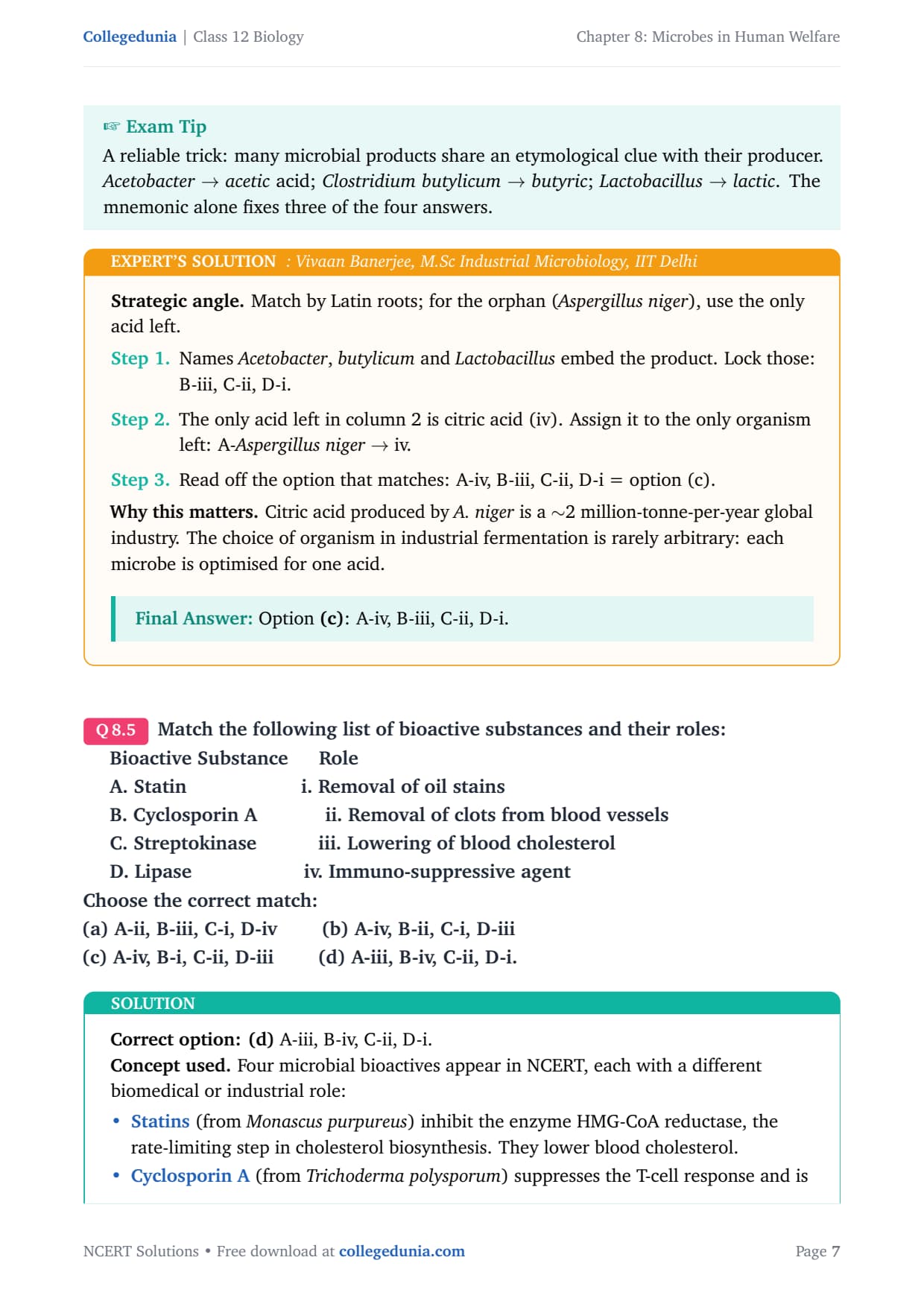
Strategic angle. Match by Latin roots; for the orphan (Aspergillus niger), use the only acid left.
- Names Acetobacter, butylicum and Lactobacillus embed the product. Lock those: B-iii, C-ii, D-i.
- The only acid left in column 2 is citric acid (iv). Assign it to the only organism left: A-Aspergillus niger → iv.
- Read off the option that matches: A-iv, B-iii, C-ii, D-i = option (c).
Why this matters. Citric acid produced by A. niger is a ∼2 million-tonne-per-year global industry. The choice of organism in industrial fermentation is rarely arbitrary: each microbe is optimised for one acid.
Option (c): A-iv, B-iii, C-ii, D-i.
Match the following list of bioactive substances and their roles:
0.6cmBioactive Substance0.7cmRole
0.6cmA. Statin2.6cmi. Removal of oil stains
0.6cmB. Cyclosporin A1.55cmii. Removal of clots from blood vessels
0.6cmC. Streptokinase1.40cmiii. Lowering of blood cholesterol
0.6cmD. Lipase2.55cmiv. Immuno-suppressive agent
Choose the correct match:
(a) A-ii, B-iii, C-i, D-iv1cm(b) A-iv, B-ii, C-i, D-iii
(c) A-iv, B-i, C-ii, D-iii1cm(d) A-iii, B-iv, C-ii, D-i.
Correct option: (d) A-iii, B-iv, C-ii, D-i.
Concept used. Four microbial bioactives appear in NCERT, each with a different biomedical or industrial role:
- 2pt
- Statins (from Monascus purpureus) inhibit the enzyme HMG-CoA reductase, the rate-limiting step in cholesterol biosynthesis. They lower blood cholesterol.
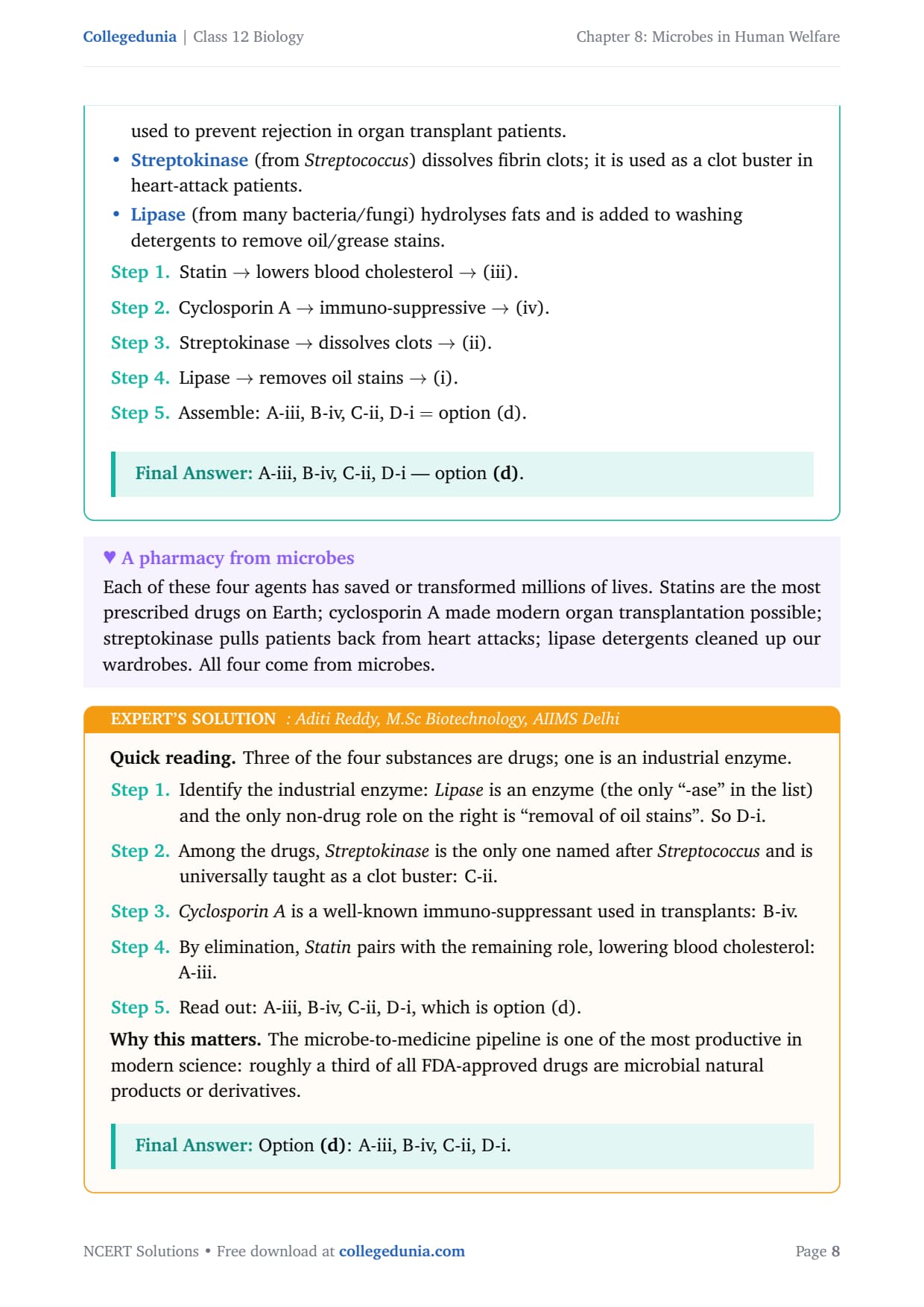
- Cyclosporin A (from Trichoderma polysporum) suppresses the T-cell response and is used to prevent rejection in organ transplant patients.
- Streptokinase (from Streptococcus) dissolves fibrin clots; it is used as a clot buster in heart-attack patients.
- Lipase (from many bacteria/fungi) hydrolyses fats and is added to washing detergents to remove oil/grease stains.
- Statin → lowers blood cholesterol → (iii).
- Cyclosporin A → immuno-suppressive → (iv).
- Streptokinase → dissolves clots → (ii).
- Lipase → removes oil stains → (i).
- Assemble: A-iii, B-iv, C-ii, D-i = option (d).
A-iii, B-iv, C-ii, D-i - option (d).
Quick reading. Three of the four substances are drugs; one is an industrial enzyme.
- Identify the industrial enzyme: Lipase is an enzyme (the only ``-ase'' in the list) and the only non-drug role on the right is ``removal of oil stains''. So D-i.
- Among the drugs, Streptokinase is the only one named after Streptococcus and is universally taught as a clot buster: C-ii.
- Cyclosporin A is a well-known immuno-suppressant used in transplants: B-iv.
- By elimination, Statin pairs with the remaining role, lowering blood cholesterol: A-iii.
- Read out: A-iii, B-iv, C-ii, D-i, which is option (d).
Why this matters. The microbe-to-medicine pipeline is one of the most productive in modern science: roughly a third of all FDA-approved drugs are microbial natural products or derivatives.
Option (d): A-iii, B-iv, C-ii, D-i.
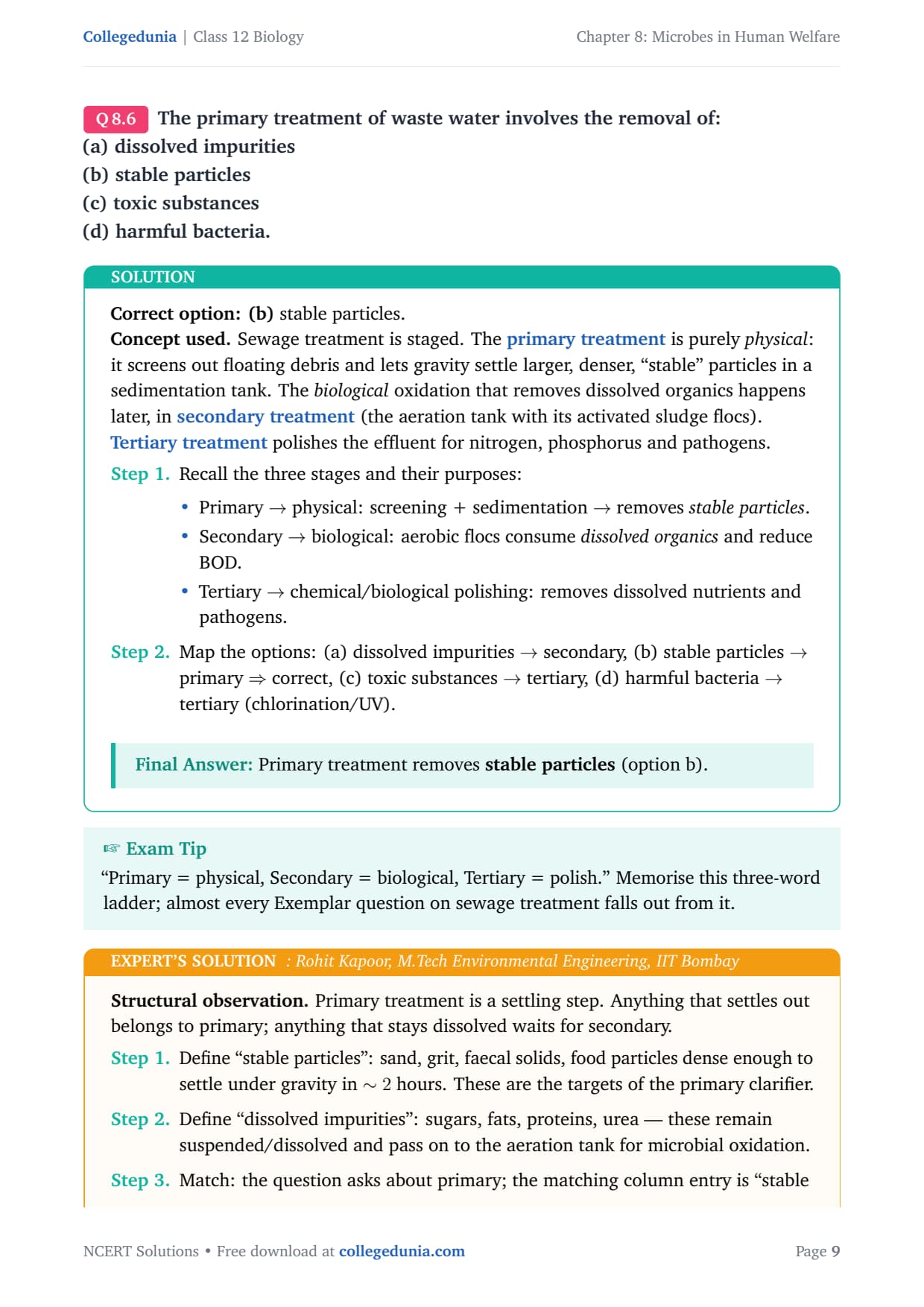
The primary treatment of waste water involves the removal of:
(a) dissolved impurities
(b) stable particles
(c) toxic substances
(d) harmful bacteria.
Correct option: (b) stable particles.
Concept used. Sewage treatment is staged. The primary treatment is purely physical: it screens out floating debris and lets gravity settle larger, denser, ``stable'' particles in a sedimentation tank. The biological oxidation that removes dissolved organics happens later, in secondary treatment (the aeration tank with its activated sludge flocs). Tertiary treatment polishes the effluent for nitrogen, phosphorus and pathogens.
- Recall the three stages and their purposes:
- 2pt
- Primary → physical: screening + sedimentation → removes stable particles.
- Secondary → biological: aerobic flocs consume dissolved organics and reduce BOD.
- Tertiary → chemical/biological polishing: removes dissolved nutrients and pathogens.
- Map the options: (a) dissolved impurities → secondary, (b) stable particles → primary ⇒ correct, (c) toxic substances → tertiary, (d) harmful bacteria → tertiary (chlorination/UV).
Primary treatment removes stable particles (option b).
Structural observation. Primary treatment is a settling step. Anything that settles out belongs to primary; anything that stays dissolved waits for secondary.
- Define ``stable particles'': sand, grit, faecal solids, food particles dense enough to settle under gravity in ∼ 2 hours. These are the targets of the primary clarifier.
- Define ``dissolved impurities'': sugars, fats, proteins, urea - these remain suspended/dissolved and pass on to the aeration tank for microbial oxidation.
- Match: the question asks about primary; the matching column entry is ``stable particles'' (b).
Why this matters. If primary treatment is skipped, the aeration tank gets clogged with grit, blowers wear out and microbial flocs cannot form. Each stage exists because the previous one is incomplete.
Stable particles (option b).
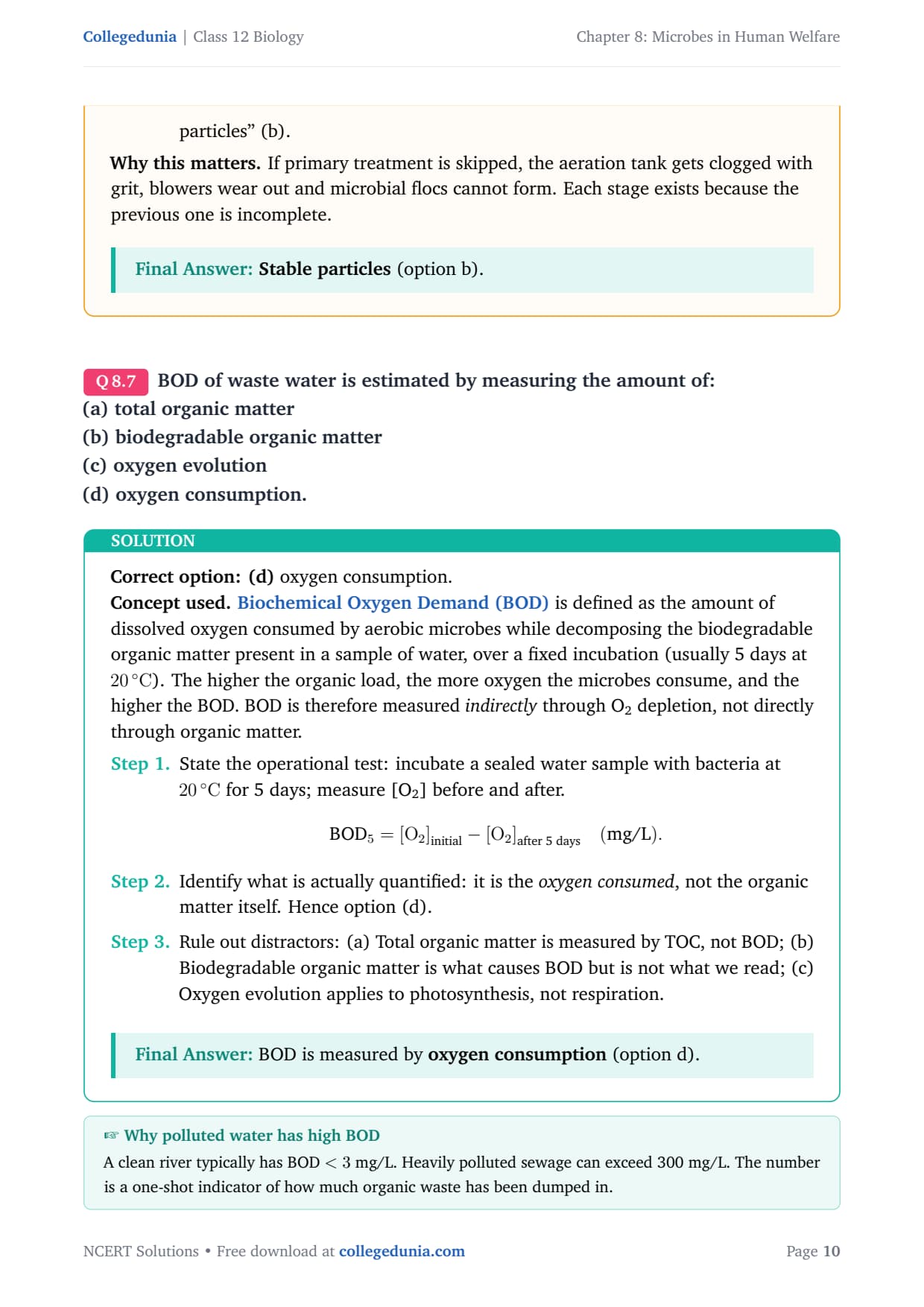
BOD of waste water is estimated by measuring the amount of:
(a) total organic matter
(b) biodegradable organic matter
(c) oxygen evolution
(d) oxygen consumption.
Correct option: (d) oxygen consumption.
Concept used. Biochemical Oxygen Demand (BOD) is defined as the amount of dissolved oxygen consumed by aerobic microbes while decomposing the biodegradable organic matter present in a sample of water, over a fixed incubation (usually 5 days at 20). The higher the organic load, the more oxygen the microbes consume, and the higher the BOD. BOD is therefore measured indirectly through O2 depletion, not directly through organic matter.
- State the operational test: incubate a sealed water sample with bacteria at 20 for 5 days; measure [O2] before and after. BOD5 = [O2]initial - [O2]after 5 days (mg/L).
- Identify what is actually quantified: it is the oxygen consumed, not the organic matter itself. Hence option (d).
- Rule out distractors: (a) Total organic matter is measured by TOC, not BOD; (b) Biodegradable organic matter is what causes BOD but is not what we read; (c) Oxygen evolution applies to photosynthesis, not respiration.
BOD is measured by oxygen consumption (option d).
Quick reading. BOD = ``oxygen demand''. The clue is in the name itself.
- Expand the acronym: Biochemical Oxygen Demand. The unit of measurement is mg O2/L.
- Microbes need O2 to break down biodegradable matter. The more matter, the more O2 they consume. The test reads the drop in [O2].
- Of the four options only (d) ``oxygen consumption'' matches the indirect measurement principle.
Why this matters. BOD is the single most reported water-quality number in environmental regulation worldwide. If you cannot translate the name into ``oxygen consumed during decomposition,'' you cannot solve any sewage problem.
Memory aid. A useful three-step recall: (1) name the microbe, (2) name its product or function, (3) name the use-case (medicine, agriculture, food, environment). If you can construct this triad for every named organism in the chapter, every Exemplar MCQ collapses into a quick lookup. Practising this exercise on the chapter summary table is the single highest-yield revision activity. Oxygen consumption (option d).
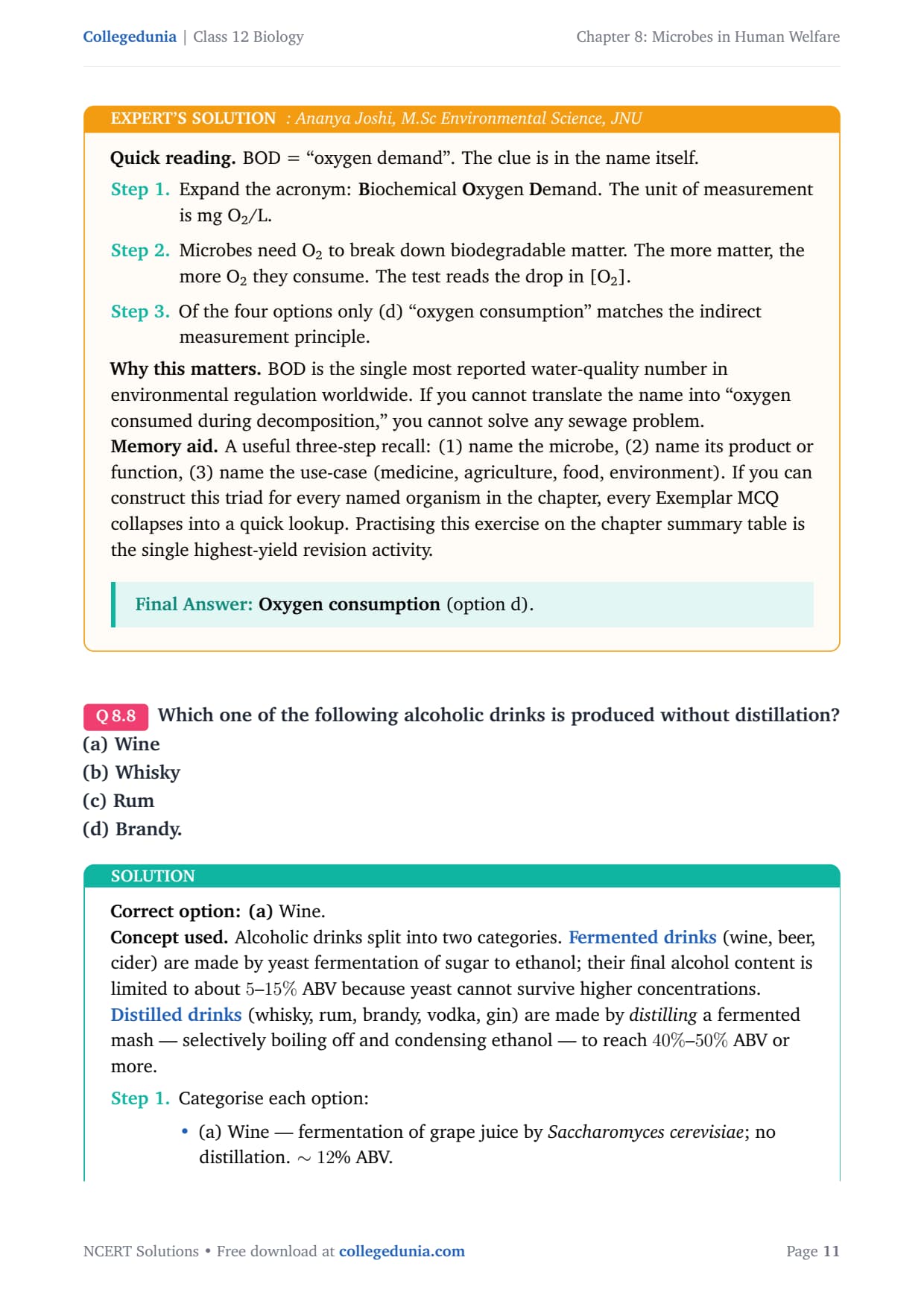
Which one of the following alcoholic drinks is produced without distillation?
(a) Wine
(b) Whisky
(c) Rum
(d) Brandy.
Correct option: (a) Wine.
Concept used. Alcoholic drinks split into two categories. Fermented drinks (wine, beer, cider) are made by yeast fermentation of sugar to ethanol; their final alcohol content is limited to about 5–15% ABV because yeast cannot survive higher concentrations. Distilled drinks (whisky, rum, brandy, vodka, gin) are made by distilling a fermented mash - selectively boiling off and condensing ethanol - to reach 40%–50% ABV or more.
- Categorise each option:
- 2pt
- (a) Wine - fermentation of grape juice by Saccharomyces cerevisiae; no distillation. ∼ 12% ABV.
- (b) Whisky - distilled from fermented grain mash. ∼ 40% ABV.
- (c) Rum - distilled from fermented molasses. ∼ 40% ABV.
- (d) Brandy - distilled from fermented fruit juice (often wine). ∼ 40% ABV.
- Only wine skips the distillation step.
Wine (option a) is produced without distillation.
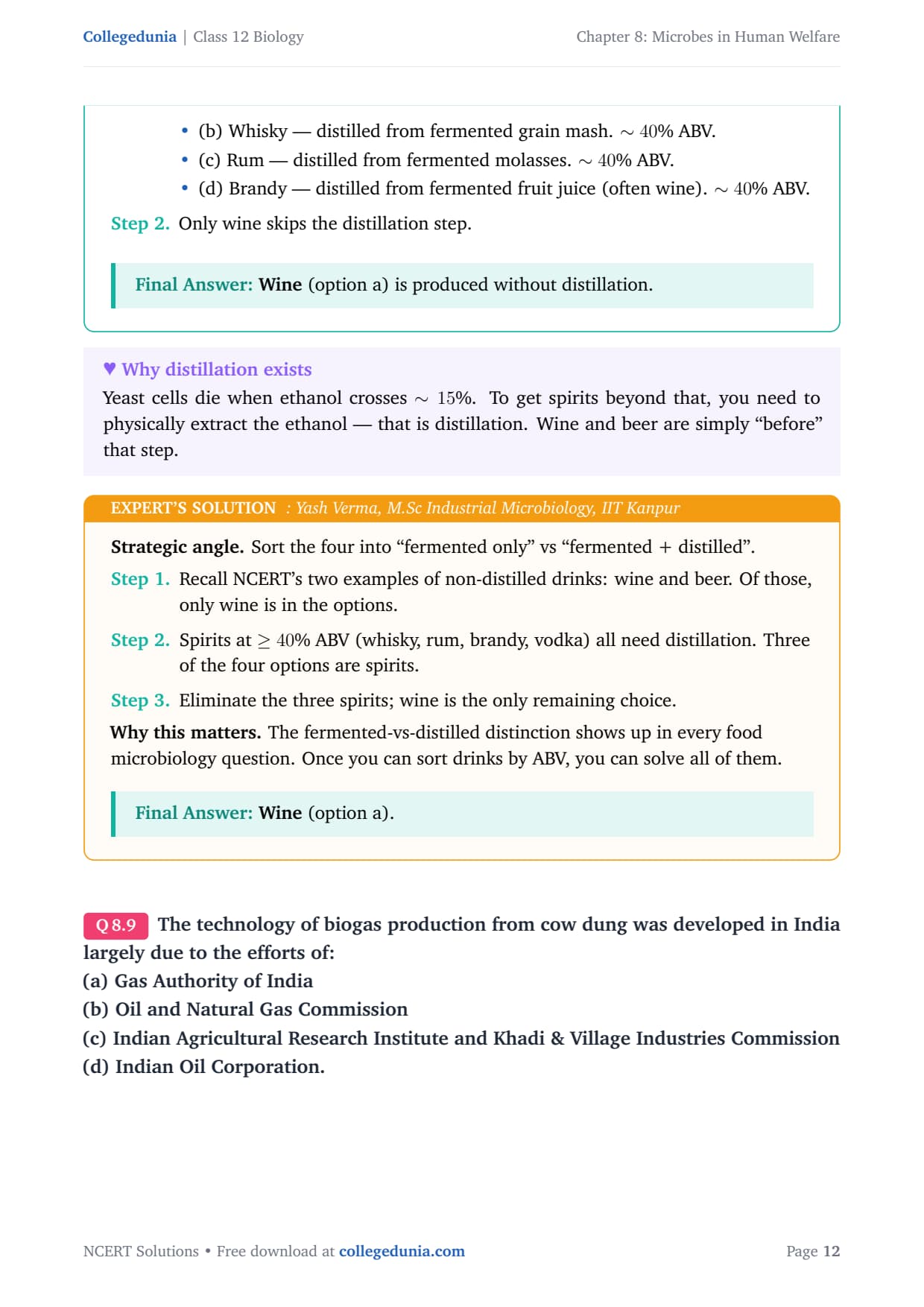
Strategic angle. Sort the four into ``fermented only'' vs ``fermented + distilled''.
- Recall NCERT's two examples of non-distilled drinks: wine and beer. Of those, only wine is in the options.
- Spirits at ≥ 40% ABV (whisky, rum, brandy, vodka) all need distillation. Three of the four options are spirits.
- Eliminate the three spirits; wine is the only remaining choice.
Why this matters. The fermented-vs-distilled distinction shows up in every food microbiology question. Once you can sort drinks by ABV, you can solve all of them.
Wine (option a).
The technology of biogas production from cow dung was developed in India largely due to the efforts of:
(a) Gas Authority of India
(b) Oil and Natural Gas Commission
(c) Indian Agricultural Research Institute and Khadi & Village Industries Commission
(d) Indian Oil Corporation.
Correct option: (c) Indian Agricultural Research Institute (IARI) and Khadi & Village Industries Commission (KVIC).
Concept used. ``Gobar gas'' (cow-dung biogas) production was scaled up across rural India by two complementary institutions. IARI contributed the microbiological and engineering R&D, designing efficient digesters and methanogen consortia. KVIC carried out the rural deployment, training farmers and providing subsidies. Together, they pushed biogas from a laboratory novelty to a national programme covering several million plants by the 1980s.
- Identify the technology owner. The development of fixed-dome and floating-drum biogas plants for cow dung was led in India by IARI's microbiologists.
- Identify the dissemination partner. KVIC, an autonomous body under the Ministry of MSME, took the lab design to villages with subsidies and training under the National Biogas Programme.
- Eliminate distractors: GAIL (a), ONGC (b) and IOC (d) are oil-and-gas-sector PSUs concerned with fossil fuels, not rural biogas R&D.
The credit goes to IARI and KVIC (option c).
Strategic angle. The question is partly historical: of four PSU-like names, only one is a rural development agency, not an oil/gas distributor.
- Read each option's domain: GAIL, ONGC, IOC are fossil-fuel companies; IARI + KVIC are agriculture + rural industries.
- Cow dung biogas is a rural agricultural technology, not a hydrocarbon one. So an oil PSU could not have developed it.
- Conclude with option (c).
Why this matters. The same logic appears in NEET-style questions about ``who developed integrated pest management'' or ``who runs biofertilizer outreach''. The answer is almost always an agriculture-research + extension pairing, not an oil PSU.
Connection to other chapters. The same microbial principle reappears in Chapter 11 (Biotechnology Principles) where recombinant DNA, restriction enzymes and microbial expression hosts are explored in greater depth, and in Chapter 13–16 (Ecology) where microbial nutrient cycling underwrites entire ecosystems. Mapping each microbe to its ecological niche and its industrial role is a recurring NEET task - every question in this Exemplar set fits one or both of those frames. IARI and KVIC (option c).
The free-living fungus Trichoderma can be used for:
(a) killing insects
(b) biological control of plant diseases
(c) controlling butterfly caterpillars
(d) producing antibiotics.
Correct option: (b) biological control of plant diseases.
Concept used. Trichoderma is a soil-borne, free-living, fast-growing fungus that out-competes plant-pathogenic fungi (such as Pythium, Fusarium, Rhizoctonia) by mycoparasitism, antibiosis and competitive root colonisation. It is one of the most widely used biological control agents against fungal plant diseases. It is not an insecticide (that is the role of Bacillus thuringiensis and ladybirds), nor a primary antibiotic producer (that role belongs to Penicillium, Streptomyces, etc.).
- Recall Trichoderma's ecological role: a parasitic fungus that attacks other fungi (mycoparasitism) and colonises roots, protecting the plant from soil-borne fungal disease.
- Map to options: (a) Insects - handled by Bacillus thuringiensis or NPV viruses, not Trichoderma. (b) Plant diseases - yes, Trichoderma controls fungal root rots. (c) Caterpillars - controlled by Bt or NPV, not by a fungus. (d) Antibiotics - produced by Penicillium and Streptomyces; cyclosporin A is the only known Trichoderma drug but is an immuno-suppressant.
- Confirm option (b).
Trichoderma is used for biological control of plant diseases (option b).
Quick reading. Trichoderma is a fungus. Fungi are typically deployed against fungal pathogens, not insects.
- Note that all biocontrol fungi in NCERT (Trichoderma, Beauveria, Metarhizium) target other organisms, but Trichoderma specifically targets fungi.
- Cross out insect/caterpillar options - those need bacterial or viral agents.
- The remaining match is ``plant diseases'', which in the NCERT context means fungal plant diseases.
Why this matters. The biocontrol portion of the chapter has a strict ``one agent, one target'' table. Trichoderma = fungi; Bt = caterpillars; ladybird = aphids; NPV = pest insects.
Why examiners love this question. It tests three things at once: vocabulary (the microbial name), function (what it produces or does), and application (where humans use it). Strong candidates answer all three in one breath; weaker ones answer only the first. Aim for the complete triad in your written response and you secure full marks even when the question only asks for one part. Biological control of plant diseases (option b).
What would happen if oxygen availability to activated sludge flocs is reduced?
(a) It will slow down the rate of degradation of organic matter
(b) The center of flocs will become anoxic, which would cause death of bacteria and eventually breakage of flocs
(c) Flocs would increase in size as anaerobic bacteria would grow around flocs
(d) Protozoa would grow in large numbers.
Correct option: (b) The centre of flocs will become anoxic, causing death of bacteria and breakage of flocs.
Concept used. Activated sludge flocs are loose 3D aggregates of aerobic bacteria glued together by extracellular polymeric substances. They function only when dissolved oxygen (DO) can diffuse from the bulk water into the floc centre - typically requiring bulk DO > 2 mg/L. If oxygen supply is reduced, the outer cells consume what little O2 arrives, leaving the central cells with [O2] → 0. These central cells die, the floc weakens and disintegrates, and the whole secondary clarifier stops working.
- Recall floc architecture: a floc is ∼ 50–500 µm across. Oxygen reaches the centre only by diffusion.
- Apply Fick's law qualitatively: if bulk O2 drops, the diffusion gradient flattens; central cells see anoxia.
- Trace the consequence: anoxic core → death of central cells → structural collapse → floc breakage. The biomass disperses, fails to settle, and washes out with the effluent.
- Compare options: (a) Slower degradation is true but only part of the story; the floc structure also collapses, so (b) is more complete. (c) Anaerobic bacteria do not preferentially colonise aerobic flocs; flocs do not grow under anoxia. (d) Protozoa are aerobic and also die under low DO; they do not bloom.
Reduced O2 ⇒ anoxic floc centres die and flocs break (option b).
Strategic angle. Think of the floc as a tiny living sphere: cut off oxygen at its skin and the heart dies first.
- Picture a floc as a sphere of bacteria embedded in EPS. Oxygen must penetrate from outside.
- If bulk DO falls, peripheral cells consume it first and the centre suffocates.
- Dead central cells lose their EPS-producing function; the structural glue gives way; the floc falls apart.
- Of the four answers, only (b) captures both bacterial death and structural collapse - the textbook answer.
Why this matters. Sewage plant operators continuously monitor DO to keep flocs alive. Drop DO for a few hours and the plant ``crashes'' - flocs disintegrate, effluent goes cloudy, and the treatment fails.
Big-picture takeaway. The unifying theme of this chapter is that almost every product humans need - food, fuel, medicine, fertilizer, pesticide - has a microbial counterpart. Recognising this lets you predict answers even on questions you have not seen before: ``which microbe makes X?'' usually has one canonical answer that NCERT names explicitly. Build that mental microbe-to-product index and recall becomes effortless. Anoxic floc centres die and flocs break (option b).
Mycorrhiza does not help the host plant in:
(a) Enhancing its phosphorus uptake capacity
(b) Increasing its tolerance to drought
(c) Enhancing its resistance to root pathogens
(d) Increasing its resistance to insects.
Correct option: (d) Increasing its resistance to insects.
Concept used. Mycorrhiza is a symbiotic association between a fungus (typically Glomus, an AM fungus) and the roots of a higher plant. The fungal hyphae extend the effective root surface 100–1000-fold, helping the plant absorb phosphorus (and other immobile nutrients), retain water during drought, and resist soil-borne pathogens. However, insects feed on above-ground plant parts (leaves, stems, fruits) which mycorrhiza does not protect. Hence (d) is the negative match.
- List the four benefits the question offers and check each against NCERT:
- 2pt
- Phosphorus uptake (a) - Yes. AM fungi solubilise and translocate PO4^3-.
- Drought tolerance (b) - Yes. Hyphae access water films in fine soil pores.
- Root pathogen resistance (c) - Yes. The mantle and mycorrhizosphere block pathogenic fungi.
- Insect resistance (d) - No. Insect herbivory targets shoots, which mycorrhiza does not protect.
- Pick the option that the fungus does NOT help with: (d).
Mycorrhiza does not help with insect resistance (option d).
Quick reading. Three options describe below-ground benefits; one describes an above-ground benefit. Mycorrhiza lives below ground.
- Note the spatial cue: phosphorus, drought, root pathogens - all below ground; insects - mostly above ground.
- Mycorrhizal hyphae live in soil; they extend root function but do not affect shoot herbivory.
- Thus the only role mycorrhiza cannot fulfil is insect resistance (d).
Why this matters. Mycorrhiza is now seen as a cornerstone of regenerative agriculture, but it is not a silver bullet - pest control still needs separate biocontrol agents.
Common trap to dodge. Students often confuse closely related microbe pairs - Lactobacillus vs Streptococcus, Penicillium vs Aspergillus, methanogens vs cyanobacteria, ladybirds vs aphids (predator vs prey). Always anchor on the most distinctive feature (heterocysts? icosahedral capsid? sealed digester?) before committing to an option. The distinguishing trait beats memorising name lists. Insect resistance (option d).
Which one of the following is not a nitrogen-fixing organism?
(a) Anabaena
(b) Nostoc
(c) Azotobacter
(d) Pseudomonas.
Correct option: (d) Pseudomonas.
Concept used. Biological nitrogen fixation is carried out by select prokaryotes that express the enzyme nitrogenase, which reduces atmospheric N2 to NH3 via N2 + 8 H+ + 8 e- + 16 ATP -> 2 NH3 + H2 + 16 ADP + 16 Pi. Among the four listed: Anabaena and Nostoc are heterocyst-bearing cyanobacteria (filamentous photosynthetic N-fixers used as biofertilizers in paddies); Azotobacter is a free-living aerobic soil bacterium that fixes N2. Pseudomonas (e.g. P. fluorescens, P. aeruginosa) is famous for denitrification, biocontrol and pollutant degradation but does not fix nitrogen.
- Mark known N-fixers among the options:
- 2pt
- Anabaena - N-fixing cyanobacterium (heterocysts) ⇒ yes.
- Nostoc - N-fixing cyanobacterium ⇒ yes.
- Azotobacter - free-living aerobic N-fixer ⇒ yes.
- Pseudomonas - denitrifier/biocontrol ⇒ NOT a N-fixer.
- Conclude: (d) is the exception.
Pseudomonas (option d) is not a nitrogen-fixer.
Structural observation. Group the four organisms.
- Cyanobacteria group: Anabaena, Nostoc - both heterocystous N-fixers.
- Free-living soil bacterium group: Azotobacter - N-fixer.
- Pseudomonadal group: Pseudomonas - does denitrification, biocontrol, but no nitrogenase.
- Hence the odd one out is Pseudomonas (option d).
Why this matters. Soil nitrogen cycling involves four steps - fixation, ammonification, nitrification, denitrification. Knowing which microbe runs each step is non-negotiable for the ecosystem chapters too.
Pseudomonas (option d).
Big holes in Swiss cheese are made by a:
(a) a machine
(b) a bacterium that produces methane gas
(c) a bacterium producing a large amount of carbon dioxide
(d) a fungus that releases a lot of gases during its metabolic activities.
Correct option: (c) a bacterium producing a large amount of carbon dioxide.
Concept used. Swiss cheese (Emmental) gets its characteristic ``eyes'' or holes from Propionibacterium shermanii, a bacterium added during cheese ripening. It ferments lactate to propionic acid, acetic acid and CO2: 3 Lactate -> 2 Propionate + Acetate + CO2 + H2O (P. shermanii). The CO2 cannot escape the firm curd, so it accumulates as bubbles which leave visible holes when the cheese is sliced. The propionic and acetic acids also give Swiss cheese its distinctive nutty, slightly tangy flavour.
- Identify the bacterium: Propionibacterium shermanii, deliberately inoculated into the curd during ripening.
- Identify the gas: CO2, not methane. Methane is the by-product of biogas plants, not cheese.
- Identify the cause of holes: CO2 bubbles trapped in firm curd → persistent voids.
- Rule out the other options: (a) Machine - wrong; holes are biological. (b) Methane - wrong gas, wrong organism. (d) Fungus - wrong kingdom; in Swiss cheese the eye-maker is a bacterium.
Swiss-cheese holes come from CO2 produced by a bacterium (option c).
Quick reading. Holes in cheese ⇒ trapped gas ⇒ which microbe makes which gas?
- Recall the Swiss cheese microbe: Propionibacterium shermanii. This is a fixed NCERT fact.
- Recall its product: propionic acid + CO2. The acid flavours the cheese; the gas inflates the holes.
- Methane would imply methanogens (which are anoxic and not added to cheese), so (b) is wrong.
- Fungus (d) is wrong for Swiss - that is the Roquefort story.
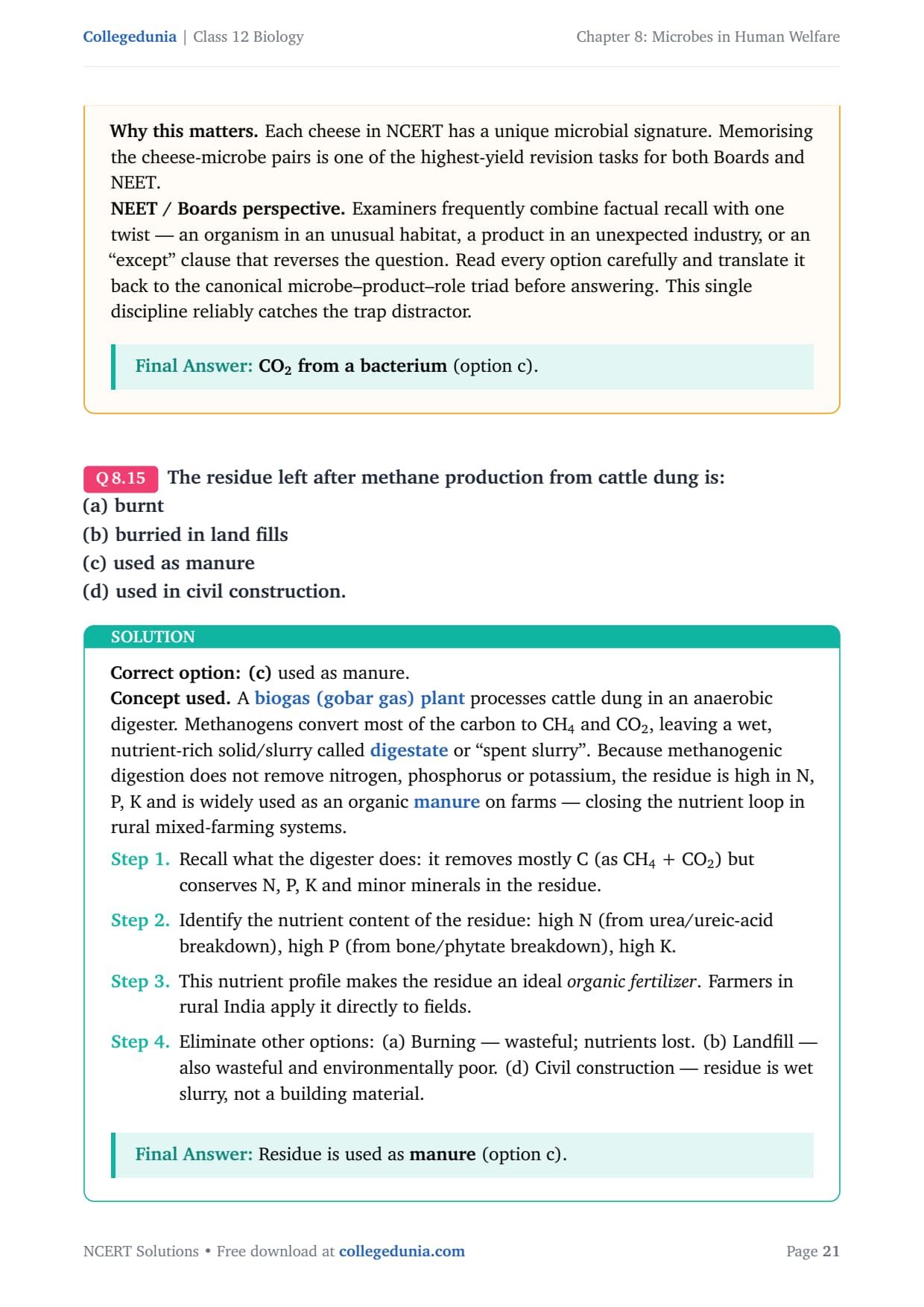
Why this matters. Each cheese in NCERT has a unique microbial signature. Memorising the cheese-microbe pairs is one of the highest-yield revision tasks for both Boards and NEET.
NEET / Boards perspective. Examiners frequently combine factual recall with one twist - an organism in an unusual habitat, a product in an unexpected industry, or an ``except'' clause that reverses the question. Read every option carefully and translate it back to the canonical microbe–product–role triad before answering. This single discipline reliably catches the trap distractor. CO2 from a bacterium (option c).
The residue left after methane production from cattle dung is:
(a) burnt
(b) burried in land fills
(c) used as manure
(d) used in civil construction.
Correct option: (c) used as manure.
Concept used. A biogas (gobar gas) plant processes cattle dung in an anaerobic digester. Methanogens convert most of the carbon to CH4 and CO2, leaving a wet, nutrient-rich solid/slurry called digestate or ``spent slurry''. Because methanogenic digestion does not remove nitrogen, phosphorus or potassium, the residue is high in N, P, K and is widely used as an organic manure on farms - closing the nutrient loop in rural mixed-farming systems.
- Recall what the digester does: it removes mostly C (as CH4 + CO2) but conserves N, P, K and minor minerals in the residue.
- Identify the nutrient content of the residue: high N (from urea/ureic-acid breakdown), high P (from bone/phytate breakdown), high K.
- This nutrient profile makes the residue an ideal organic fertilizer. Farmers in rural India apply it directly to fields.
- Eliminate other options: (a) Burning - wasteful; nutrients lost. (b) Landfill - also wasteful and environmentally poor. (d) Civil construction - residue is wet slurry, not a building material.
Residue is used as manure (option c).
Structural observation. Of the four options, three discard the residue; only one re-uses it productively.
- Recall that the input (cow dung) is itself a traditional manure. Methanogenic digestion removes only carbon; the manuring nutrients remain.
- The processed residue is therefore an enhanced manure, easier to handle and lower in pathogens than raw dung.
- Conclude option (c).
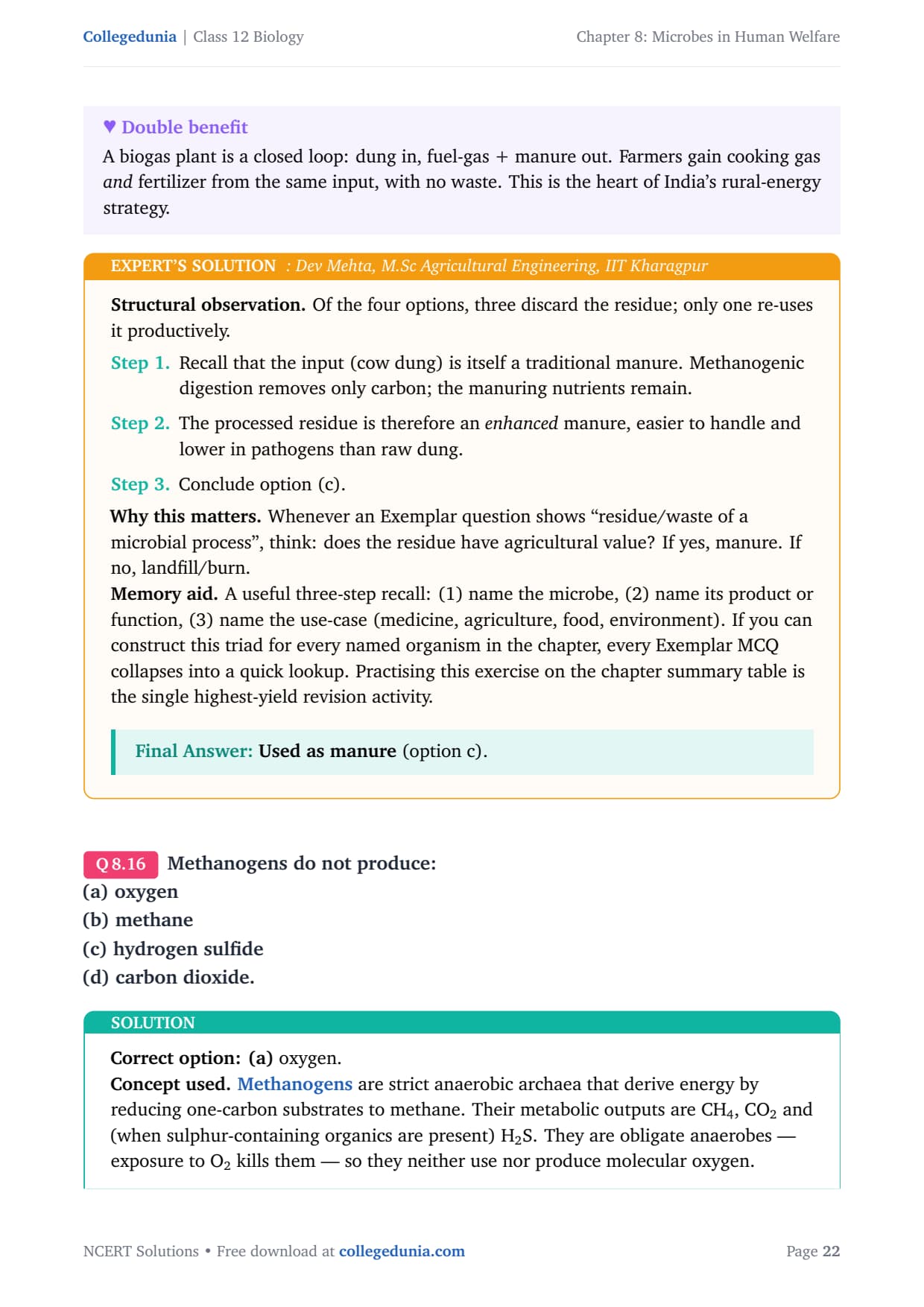
Why this matters. Whenever an Exemplar question shows ``residue/waste of a microbial process'', think: does the residue have agricultural value? If yes, manure. If no, landfill/burn.
Memory aid. A useful three-step recall: (1) name the microbe, (2) name its product or function, (3) name the use-case (medicine, agriculture, food, environment). If you can construct this triad for every named organism in the chapter, every Exemplar MCQ collapses into a quick lookup. Practising this exercise on the chapter summary table is the single highest-yield revision activity. Used as manure (option c).
Methanogens do not produce:
(a) oxygen
(b) methane
(c) hydrogen sulfide
(d) carbon dioxide.
Correct option: (a) oxygen.
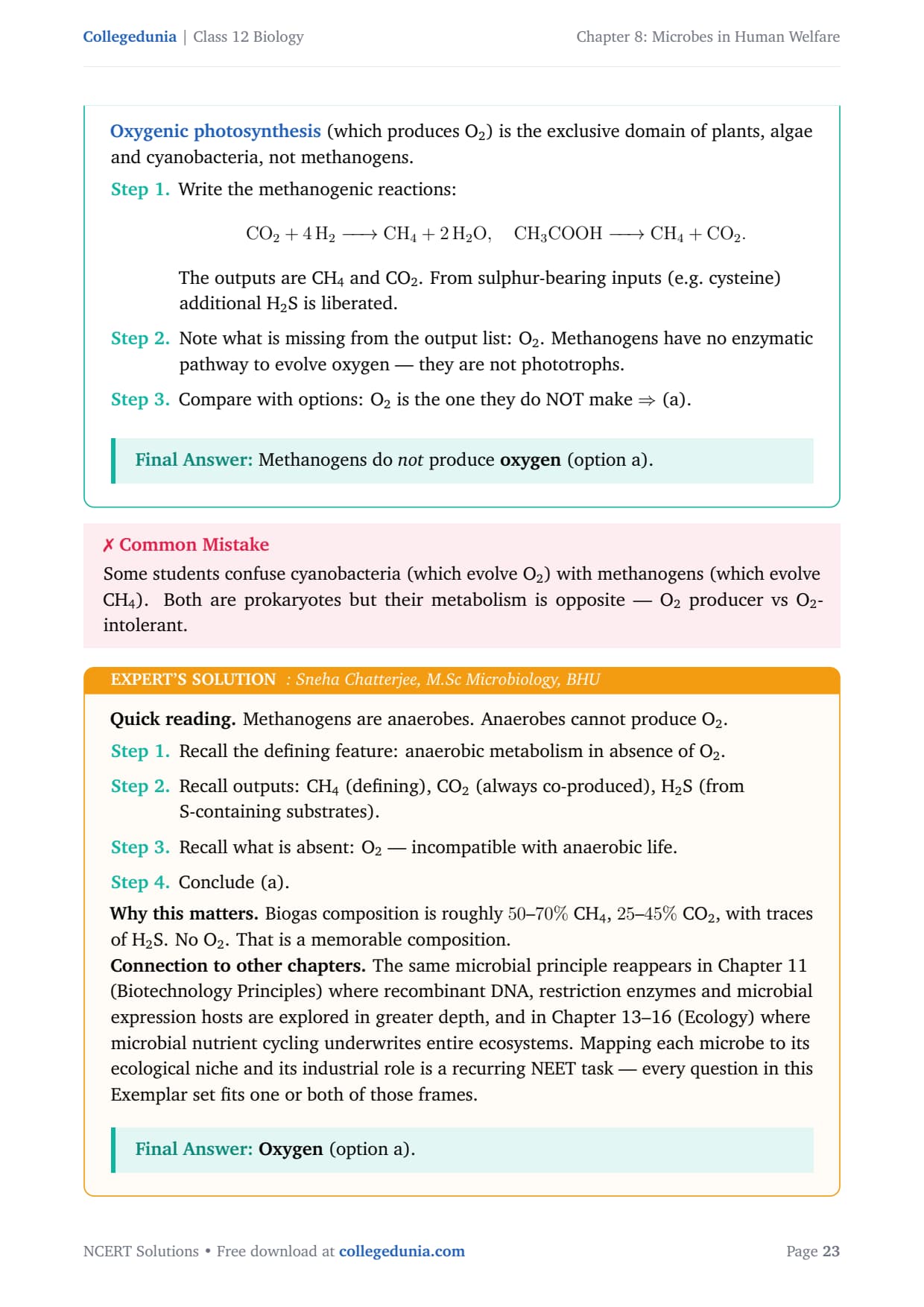
Concept used. Methanogens are strict anaerobic archaea that derive energy by reducing one-carbon substrates to methane. Their metabolic outputs are CH4, CO2 and (when sulphur-containing organics are present) H2S. They are obligate anaerobes - exposure to O2 kills them - so they neither use nor produce molecular oxygen. Oxygenic photosynthesis (which produces O2) is the exclusive domain of plants, algae and cyanobacteria, not methanogens.
- Write the methanogenic reactions: CO2 + 4 H2 -> CH4 + 2 H2O, CH3COOH -> CH4 + CO2. The outputs are CH4 and CO2. From sulphur-bearing inputs (e.g. cysteine) additional H2S is liberated.
- Note what is missing from the output list: O2. Methanogens have no enzymatic pathway to evolve oxygen - they are not phototrophs.
- Compare with options: O2 is the one they do NOT make ⇒ (a).
Methanogens do not produce oxygen (option a).
Quick reading. Methanogens are anaerobes. Anaerobes cannot produce O2.
- Recall the defining feature: anaerobic metabolism in absence of O2.
- Recall outputs: CH4 (defining), CO2 (always co-produced), H2S (from S-containing substrates).
- Recall what is absent: O2 - incompatible with anaerobic life.
- Conclude (a).
Why this matters. Biogas composition is roughly 50–70% CH4, 25–45% CO2, with traces of H2S. No O2. That is a memorable composition.
Connection to other chapters. The same microbial principle reappears in Chapter 11 (Biotechnology Principles) where recombinant DNA, restriction enzymes and microbial expression hosts are explored in greater depth, and in Chapter 13–16 (Ecology) where microbial nutrient cycling underwrites entire ecosystems. Mapping each microbe to its ecological niche and its industrial role is a recurring NEET task - every question in this Exemplar set fits one or both of those frames. Oxygen (option a).
Activated sludge should have the ability to settle quickly so that it can:
(a) be rapidly pumped back from sedimentation tank to aeration tank
(b) absorb pathogenic bacteria present in waste water while sinking to the bottom of the settling tank
(c) be discarded and anaerobically digested
(d) absorb colloidal organic matter.
Correct option: (a) be rapidly pumped back from sedimentation tank to aeration tank.
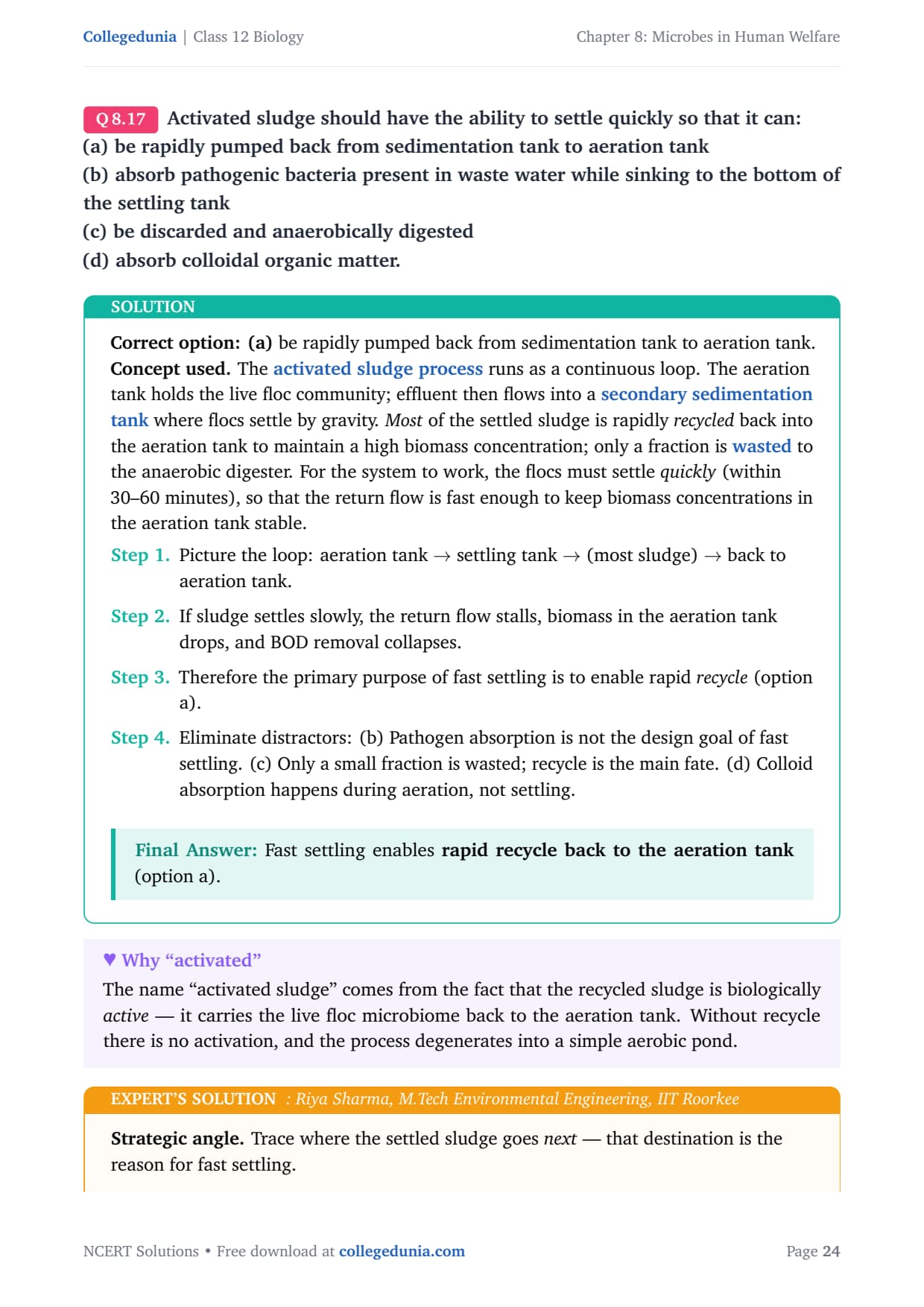
Concept used. The activated sludge process runs as a continuous loop. The aeration tank holds the live floc community; effluent then flows into a secondary sedimentation tank where flocs settle by gravity. Most of the settled sludge is rapidly recycled back into the aeration tank to maintain a high biomass concentration; only a fraction is wasted to the anaerobic digester. For the system to work, the flocs must settle quickly (within 30–60 minutes), so that the return flow is fast enough to keep biomass concentrations in the aeration tank stable.
- Picture the loop: aeration tank → settling tank → (most sludge) → back to aeration tank.
- If sludge settles slowly, the return flow stalls, biomass in the aeration tank drops, and BOD removal collapses.
- Therefore the primary purpose of fast settling is to enable rapid recycle (option a).
- Eliminate distractors: (b) Pathogen absorption is not the design goal of fast settling. (c) Only a small fraction is wasted; recycle is the main fate. (d) Colloid absorption happens during aeration, not settling.
Fast settling enables rapid recycle back to the aeration tank (option a).
Strategic angle. Trace where the settled sludge goes next - that destination is the reason for fast settling.
- Settled sludge has two fates: ∼ 90% is recycled to the aeration tank to maintain MLSS (mixed-liquor suspended solids); ∼ 10% is wasted to the digester.
- The dominant fate is recycle. To recycle, the sludge must collect quickly at the bottom of the clarifier.
- Therefore option (a) is the correct match.
Why this matters. Plants suffering from ``sludge bulking'' (slow settling, often by filamentous bacteria) lose biomass to the effluent and stop treating sewage. Fast settling is a daily monitoring target.
Why examiners love this question. It tests three things at once: vocabulary (the microbial name), function (what it produces or does), and application (where humans use it). Strong candidates answer all three in one breath; weaker ones answer only the first. Aim for the complete triad in your written response and you secure full marks even when the question only asks for one part. Pumped back to the aeration tank (option a).
Match the items in Column `A' and Column `B' and choose correct answer.
0.6cmColumn I2.2cmColumn II
0.6cmA. Lady bird1.65cmi. Methanobacterium
0.6cmB. Mycorrhiza1.55cmii. Trichoderma
0.6cmC. Biological control0.65cmiii. Aphids
0.6cmD. Biogas2.10cmiv. Glomus
The correct answer is:
(a) A-ii, B-iv, C-iii, D-i1cm(b) A-iii, B-iv, C-ii, D-i
(c) A-iv, B-i, C-ii, D-iii1cm(d) A-iii, B-ii, C-i, D-iv.
Correct option: (b) A-iii, B-iv, C-ii, D-i.
Concept used. Four standard NCERT pairings, drawn directly from the chapter's biocontrol and biofertilizer sections:
- 2pt
- Lady birds (beetles) feed on aphids - the classic predator–prey biocontrol pair.
- Mycorrhiza is most commonly formed by the AM fungus Glomus (with plant roots).
- Biological control of fungal root rots uses Trichoderma.
- Biogas is produced by methanogens such as Methanobacterium.
- Match A - Lady bird → Aphids (iii).
- Match B - Mycorrhiza → Glomus (iv).
- Match C - Biological control → Trichoderma (ii).
- Match D - Biogas → Methanobacterium (i).
- Assemble: A-iii, B-iv, C-ii, D-i ⇒ option (b).
A-iii, B-iv, C-ii, D-i - option (b).
Quick reading. Each Column-I term has a single canonical Column-II partner. Fix two anchors, the rest fall out.
- Anchor 1: Methanobacterium is the textbook biogas methanogen ⇒ D-i.
- Anchor 2: Glomus is the AM fungus of mycorrhiza ⇒ B-iv.
- For the remaining two: Trichoderma = fungal biocontrol ⇒ C-ii; ladybirds eat aphids ⇒ A-iii.
- Read off: A-iii, B-iv, C-ii, D-i = option (b).
Why this matters. The match-the-column format dominates this chapter's Boards. Practising 5–6 such matchings cements every micro-organism / role pair you need.
Option (b): A-iii, B-iv, C-ii, D-i.
Very Short Answer Type Questions
Why does `Swiss cheese' have big holes?
Concept used. Swiss cheese (Emmental) is ripened in the presence of the bacterium Propionibacterium shermanii, which metabolises lactate inside the curd to propionic acid, acetic acid and CO2. The cheese matrix is firm and elastic; the CO2 gas cannot escape and gets trapped as expanding bubbles, which become the visible ``eyes'' or holes when the wheel is sliced.
- Inoculation: starter cultures of P. shermanii are added to milk along with the usual lactic acid bacteria.
- Fermentation: 3 Lactate -> 2 Propionate + Acetate + CO2 + H2O. Propionic acid gives Swiss cheese its nutty flavour; the CO2 is the hole-maker.
- Trapping: the firm curd does not let CO2 diffuse out, so the gas pockets remain as round eyes.
Swiss cheese has big holes because Propionibacterium shermanii releases large amounts of CO2 during ripening, and the gas is trapped in the firm curd.
Quick reading. Holes = trapped gas. Which microbe + which gas?
- Microbe: Propionibacterium shermanii, the signature Swiss-cheese inoculant.
- Gas: CO2, a side product of propionic acid fermentation.
- Trapping mechanism: the firm cheese matrix locks the gas as bubbles, which on slicing appear as holes.
Why this matters. A unique microbial signature explains a unique culinary feature - a recurring theme of this chapter.
Big-picture takeaway. The unifying theme of this chapter is that almost every product humans need - food, fuel, medicine, fertilizer, pesticide - has a microbial counterpart. Recognising this lets you predict answers even on questions you have not seen before: ``which microbe makes X?'' usually has one canonical answer that NCERT names explicitly. Build that mental microbe-to-product index and recall becomes effortless. CO2 from P. shermanii, trapped in the firm curd.
What are fermentors?
Concept used. A fermentor (or bioreactor) is a closed industrial-scale vessel (typically 100–10,000 L) in which microbes are grown under tightly controlled conditions (temperature, pH, dissolved O2, agitation, nutrient feed) to produce useful products such as antibiotics, organic acids, enzymes, vitamins or ethanol.
- Define: large stirred-tank or air-lift vessel designed to support microbial growth at a high cell density.
- Function: provides controlled pH, temperature, aeration and mixing so that microbes produce the desired metabolite efficiently and reproducibly.
- Output: harvested broth from which the product is purified.
Fermentors are large stainless-steel bioreactors used to grow microbes under controlled conditions for industrial production of antibiotics, organic acids, enzymes, vitamins and ethanol.
Quick reading. A fermentor is to microbes what a power plant is to coal - a controlled industrial vessel that converts substrate into a valuable product.
- Identify: a closed bioreactor with stirring, aeration and temperature control.
- Purpose: scale-up of microbial product formation, from laboratory flasks (1 L) to commercial fermentors (> 10,000 L).
- Examples of products: penicillin, citric acid, lactic acid, glutamic acid, baker's yeast.
Why this matters. Without fermentors, none of the bioactives in this chapter (antibiotics, vitamins, enzymes) would be commercially available.
Closed industrial bioreactors that grow microbes under controlled conditions for product formation.
Name a microbe used for statin production. How do statins lower blood cholesterol level?
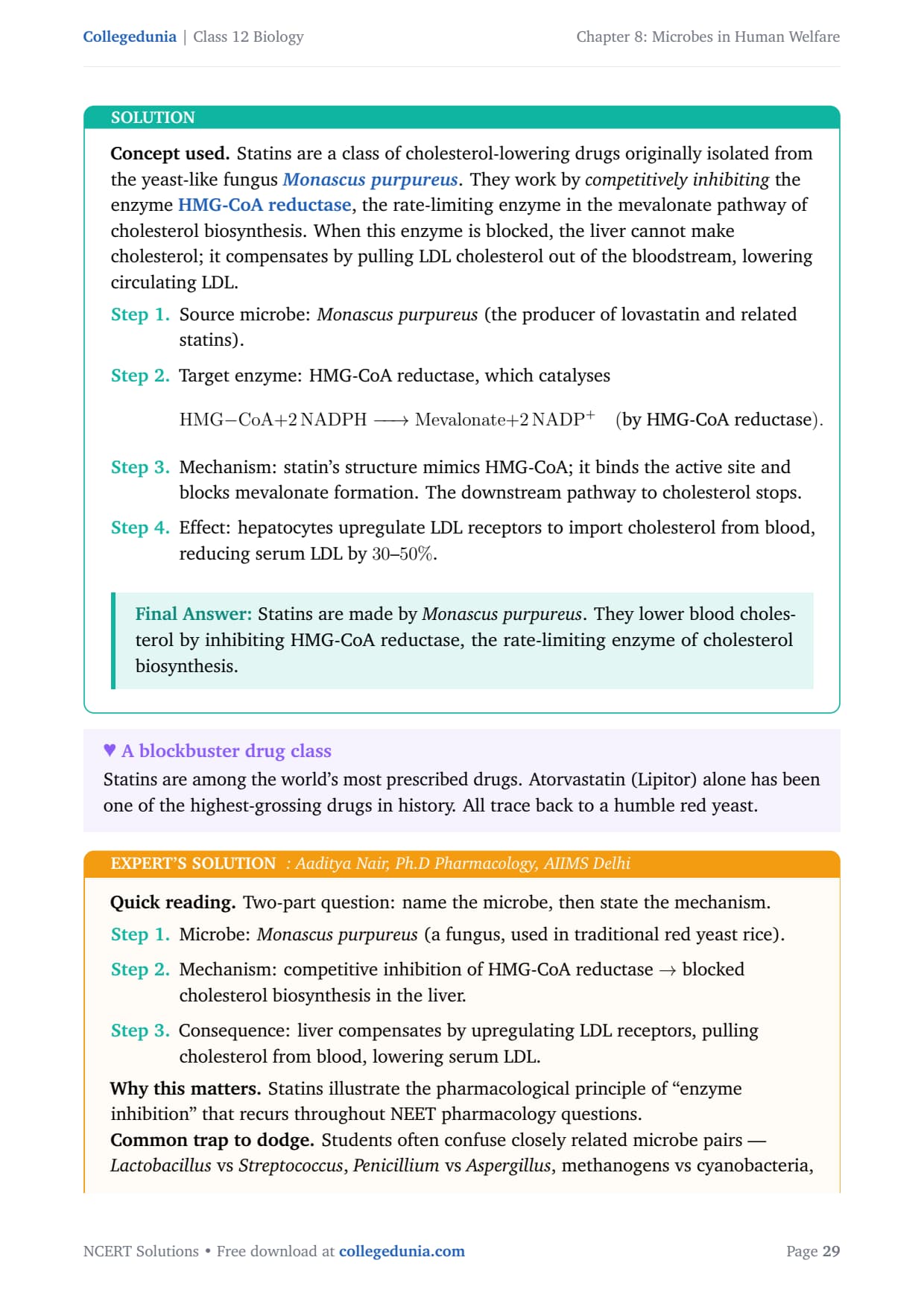
Concept used. Statins are a class of cholesterol-lowering drugs originally isolated from the yeast-like fungus Monascus purpureus. They work by competitively inhibiting the enzyme HMG-CoA reductase, the rate-limiting enzyme in the mevalonate pathway of cholesterol biosynthesis. When this enzyme is blocked, the liver cannot make cholesterol; it compensates by pulling LDL cholesterol out of the bloodstream, lowering circulating LDL.
- Source microbe: Monascus purpureus (the producer of lovastatin and related statins).
- Target enzyme: HMG-CoA reductase, which catalyses HMG-CoA + 2 NADPH -> Mevalonate + 2 NADP+ (by HMG-CoA reductase).
- Mechanism: statin's structure mimics HMG-CoA; it binds the active site and blocks mevalonate formation. The downstream pathway to cholesterol stops.
- Effect: hepatocytes upregulate LDL receptors to import cholesterol from blood, reducing serum LDL by 30–50%.
Statins are made by Monascus purpureus. They lower blood cholesterol by inhibiting HMG-CoA reductase, the rate-limiting enzyme of cholesterol biosynthesis.
Quick reading. Two-part question: name the microbe, then state the mechanism.
- Microbe: Monascus purpureus (a fungus, used in traditional red yeast rice).
- Mechanism: competitive inhibition of HMG-CoA reductase → blocked cholesterol biosynthesis in the liver.
- Consequence: liver compensates by upregulating LDL receptors, pulling cholesterol from blood, lowering serum LDL.
Why this matters. Statins illustrate the pharmacological principle of ``enzyme inhibition'' that recurs throughout NEET pharmacology questions.
Common trap to dodge. Students often confuse closely related microbe pairs - Lactobacillus vs Streptococcus, Penicillium vs Aspergillus, methanogens vs cyanobacteria, ladybirds vs aphids (predator vs prey). Always anchor on the most distinctive feature (heterocysts? icosahedral capsid? sealed digester?) before committing to an option. The distinguishing trait beats memorising name lists. Source: Monascus purpureus; mechanism: HMG-CoA reductase inhibition → less hepatic cholesterol synthesis → more LDL clearance from blood.
Why do we prefer to call secondary waste water treatment as biological treatment?
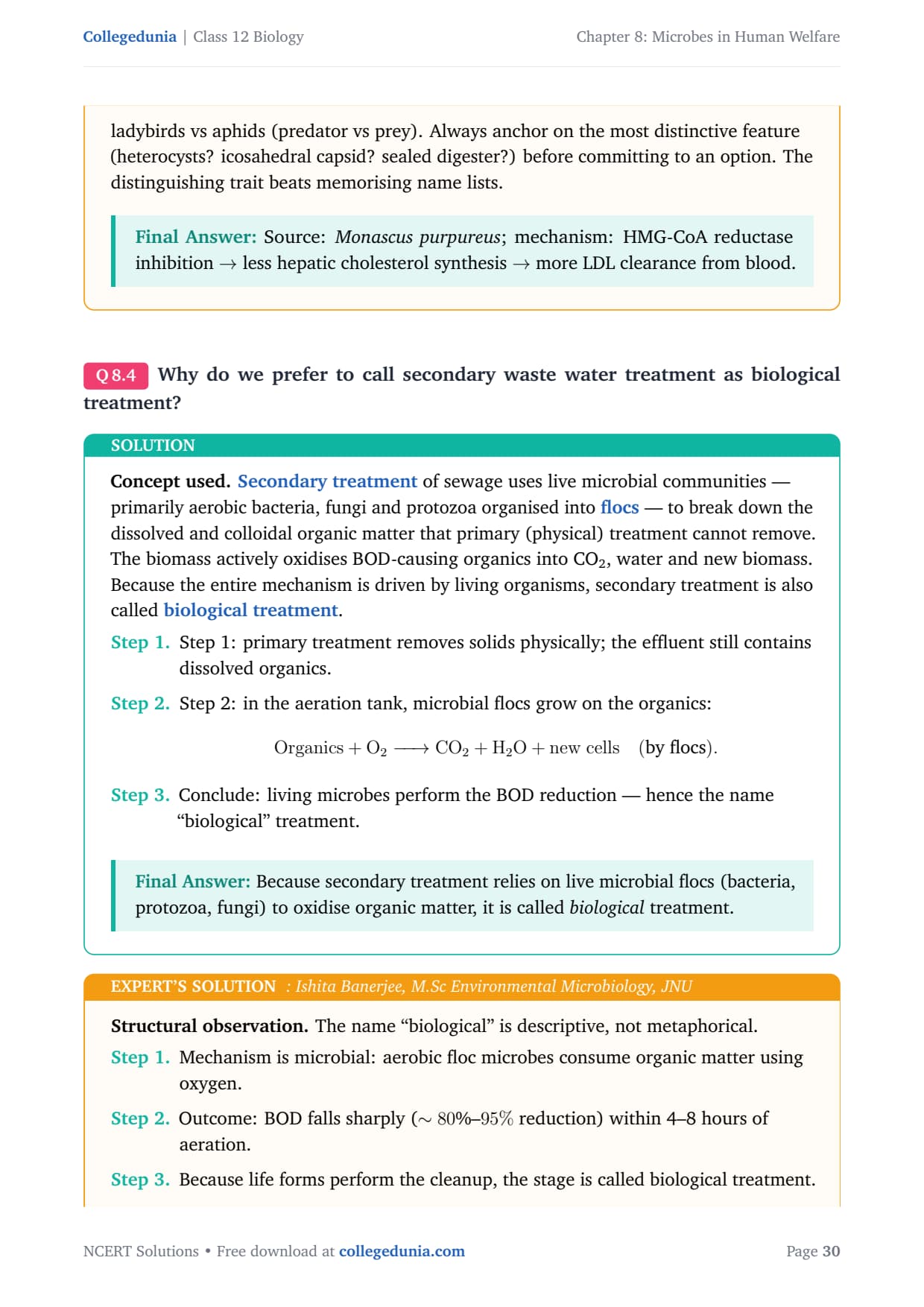
Concept used. Secondary treatment of sewage uses live microbial communities - primarily aerobic bacteria, fungi and protozoa organised into flocs - to break down the dissolved and colloidal organic matter that primary (physical) treatment cannot remove. The biomass actively oxidises BOD-causing organics into CO2, water and new biomass. Because the entire mechanism is driven by living organisms, secondary treatment is also called biological treatment.
- Step 1: primary treatment removes solids physically; the effluent still contains dissolved organics.
- Step 2: in the aeration tank, microbial flocs grow on the organics: Organics + O2 -> CO2 + H2O + new cells (by flocs).
- Conclude: living microbes perform the BOD reduction - hence the name ``biological'' treatment.
Because secondary treatment relies on live microbial flocs (bacteria, protozoa, fungi) to oxidise organic matter, it is called biological treatment.
Structural observation. The name ``biological'' is descriptive, not metaphorical.
- Mechanism is microbial: aerobic floc microbes consume organic matter using oxygen.
- Outcome: BOD falls sharply (∼ 80%–95% reduction) within 4–8 hours of aeration.
- Because life forms perform the cleanup, the stage is called biological treatment.
Why this matters. Distinguishing primary (physical), secondary (biological) and tertiary (chemical/biological polish) is the single most testable triad of this chapter.
NEET / Boards perspective. Examiners frequently combine factual recall with one twist - an organism in an unusual habitat, a product in an unexpected industry, or an ``except'' clause that reverses the question. Read every option carefully and translate it back to the canonical microbe–product–role triad before answering. This single discipline reliably catches the trap distractor. Living microbial flocs perform the bulk of organic-matter removal, so secondary treatment is also called biological treatment.
What for Nucleopolyhydro viruses are being used now a days?
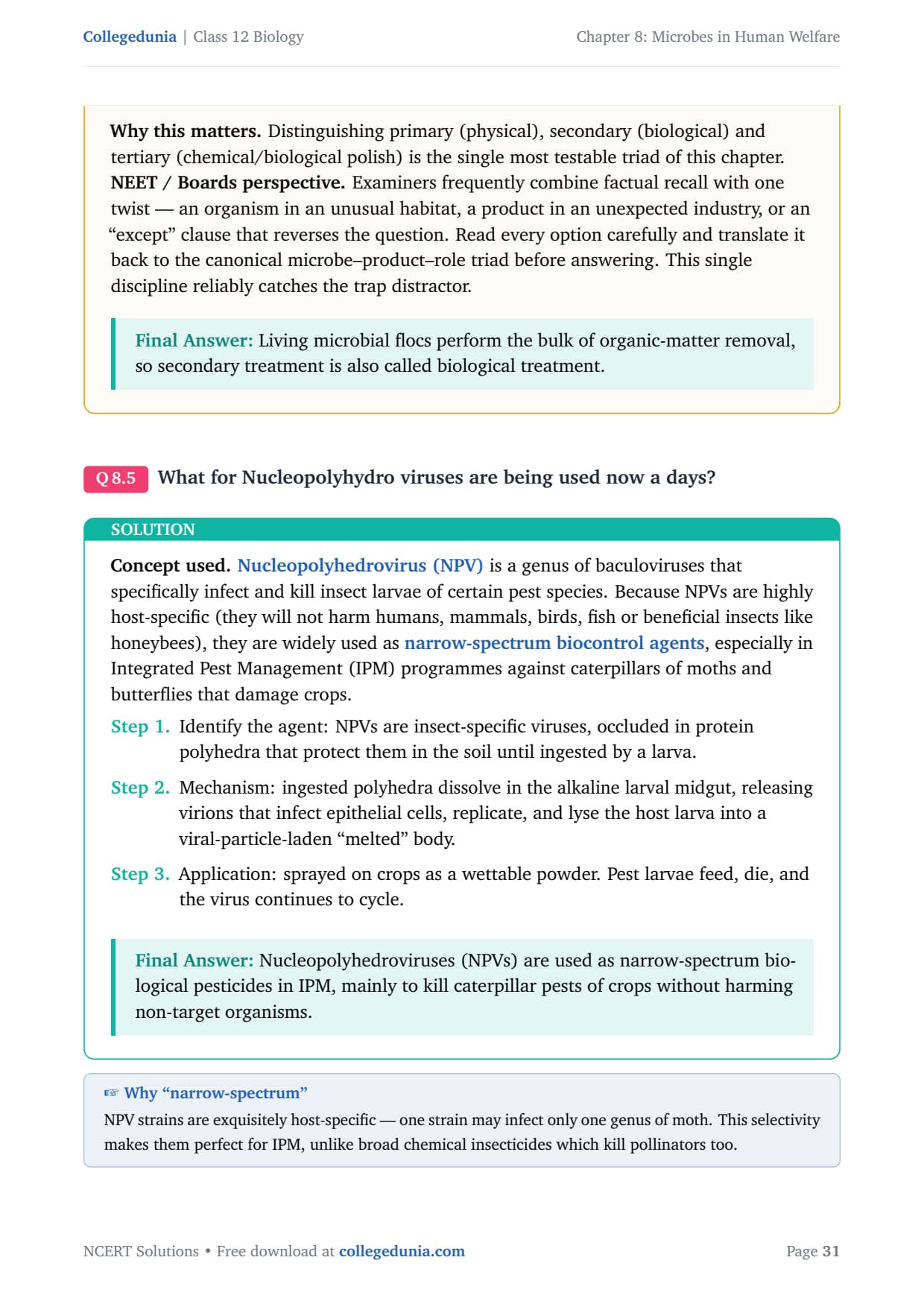
Concept used. Nucleopolyhedrovirus (NPV) is a genus of baculoviruses that specifically infect and kill insect larvae of certain pest species. Because NPVs are highly host-specific (they will not harm humans, mammals, birds, fish or beneficial insects like honeybees), they are widely used as narrow-spectrum biocontrol agents, especially in Integrated Pest Management (IPM) programmes against caterpillars of moths and butterflies that damage crops.
- Identify the agent: NPVs are insect-specific viruses, occluded in protein polyhedra that protect them in the soil until ingested by a larva.
- Mechanism: ingested polyhedra dissolve in the alkaline larval midgut, releasing virions that infect epithelial cells, replicate, and lyse the host larva into a viral-particle-laden ``melted'' body.
- Application: sprayed on crops as a wettable powder. Pest larvae feed, die, and the virus continues to cycle.
Nucleopolyhedroviruses (NPVs) are used as narrow-spectrum biological pesticides in IPM, mainly to kill caterpillar pests of crops without harming non-target organisms.
Quick reading. NPV → insect virus → biocontrol of caterpillars.
- NPV is a virus, used in IPM as a biological insecticide.
- Target: specific lepidopteran (moth/butterfly) larvae that feed on crops.
- Use: applied as a foliar spray or via spray of cadavers; spares pollinators and predators.
Why this matters. NPV demonstrates the principle of species-specific biocontrol, which is the gold standard for sustainable agriculture.
Memory aid. A useful three-step recall: (1) name the microbe, (2) name its product or function, (3) name the use-case (medicine, agriculture, food, environment). If you can construct this triad for every named organism in the chapter, every Exemplar MCQ collapses into a quick lookup. Practising this exercise on the chapter summary table is the single highest-yield revision activity. NPVs are used as species-specific biocontrol agents against caterpillar pests in IPM.
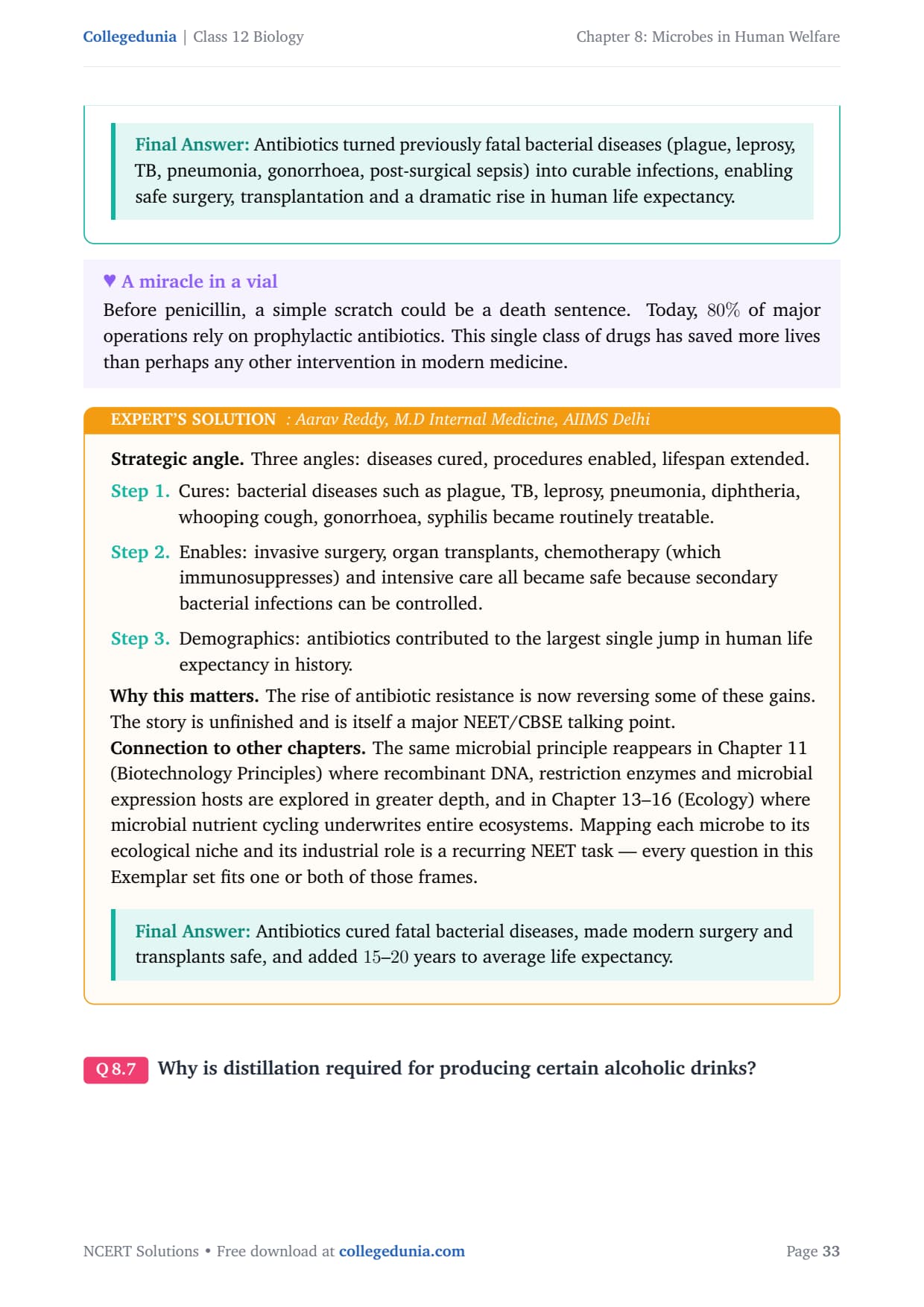
How has the discovery of antibiotics helped mankind in the field of medicine?
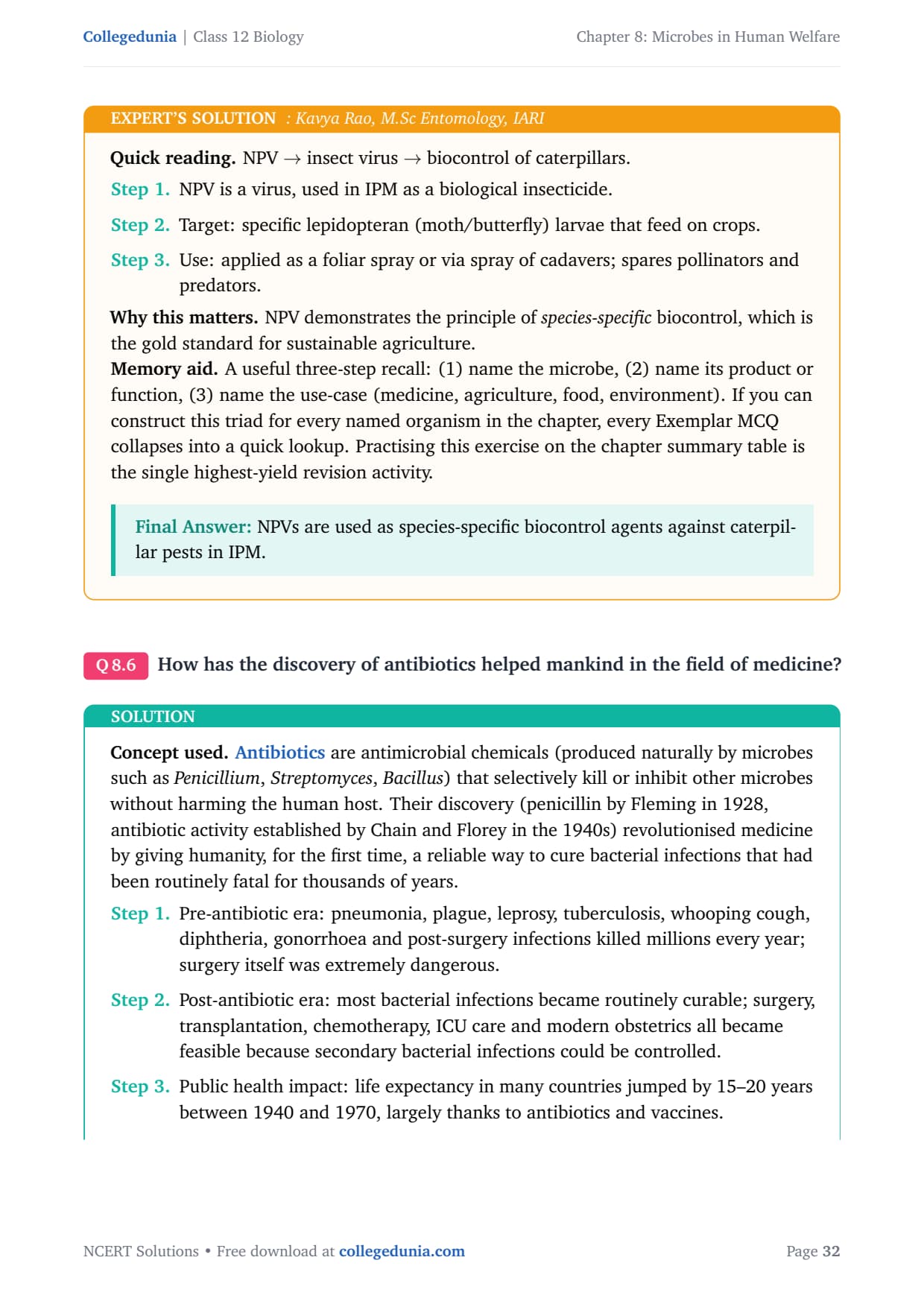
Concept used. Antibiotics are antimicrobial chemicals (produced naturally by microbes such as Penicillium, Streptomyces, Bacillus) that selectively kill or inhibit other microbes without harming the human host. Their discovery (penicillin by Fleming in 1928, antibiotic activity established by Chain and Florey in the 1940s) revolutionised medicine by giving humanity, for the first time, a reliable way to cure bacterial infections that had been routinely fatal for thousands of years.
- Pre-antibiotic era: pneumonia, plague, leprosy, tuberculosis, whooping cough, diphtheria, gonorrhoea and post-surgery infections killed millions every year; surgery itself was extremely dangerous.
- Post-antibiotic era: most bacterial infections became routinely curable; surgery, transplantation, chemotherapy, ICU care and modern obstetrics all became feasible because secondary bacterial infections could be controlled.
- Public health impact: life expectancy in many countries jumped by 15–20 years between 1940 and 1970, largely thanks to antibiotics and vaccines.
Antibiotics turned previously fatal bacterial diseases (plague, leprosy, TB, pneumonia, gonorrhoea, post-surgical sepsis) into curable infections, enabling safe surgery, transplantation and a dramatic rise in human life expectancy.
Strategic angle. Three angles: diseases cured, procedures enabled, lifespan extended.
- Cures: bacterial diseases such as plague, TB, leprosy, pneumonia, diphtheria, whooping cough, gonorrhoea, syphilis became routinely treatable.
- Enables: invasive surgery, organ transplants, chemotherapy (which immunosuppresses) and intensive care all became safe because secondary bacterial infections can be controlled.
- Demographics: antibiotics contributed to the largest single jump in human life expectancy in history.
Why this matters. The rise of antibiotic resistance is now reversing some of these gains. The story is unfinished and is itself a major NEET/CBSE talking point.
Connection to other chapters. The same microbial principle reappears in Chapter 11 (Biotechnology Principles) where recombinant DNA, restriction enzymes and microbial expression hosts are explored in greater depth, and in Chapter 13–16 (Ecology) where microbial nutrient cycling underwrites entire ecosystems. Mapping each microbe to its ecological niche and its industrial role is a recurring NEET task - every question in this Exemplar set fits one or both of those frames. Antibiotics cured fatal bacterial diseases, made modern surgery and transplants safe, and added 15–20 years to average life expectancy.
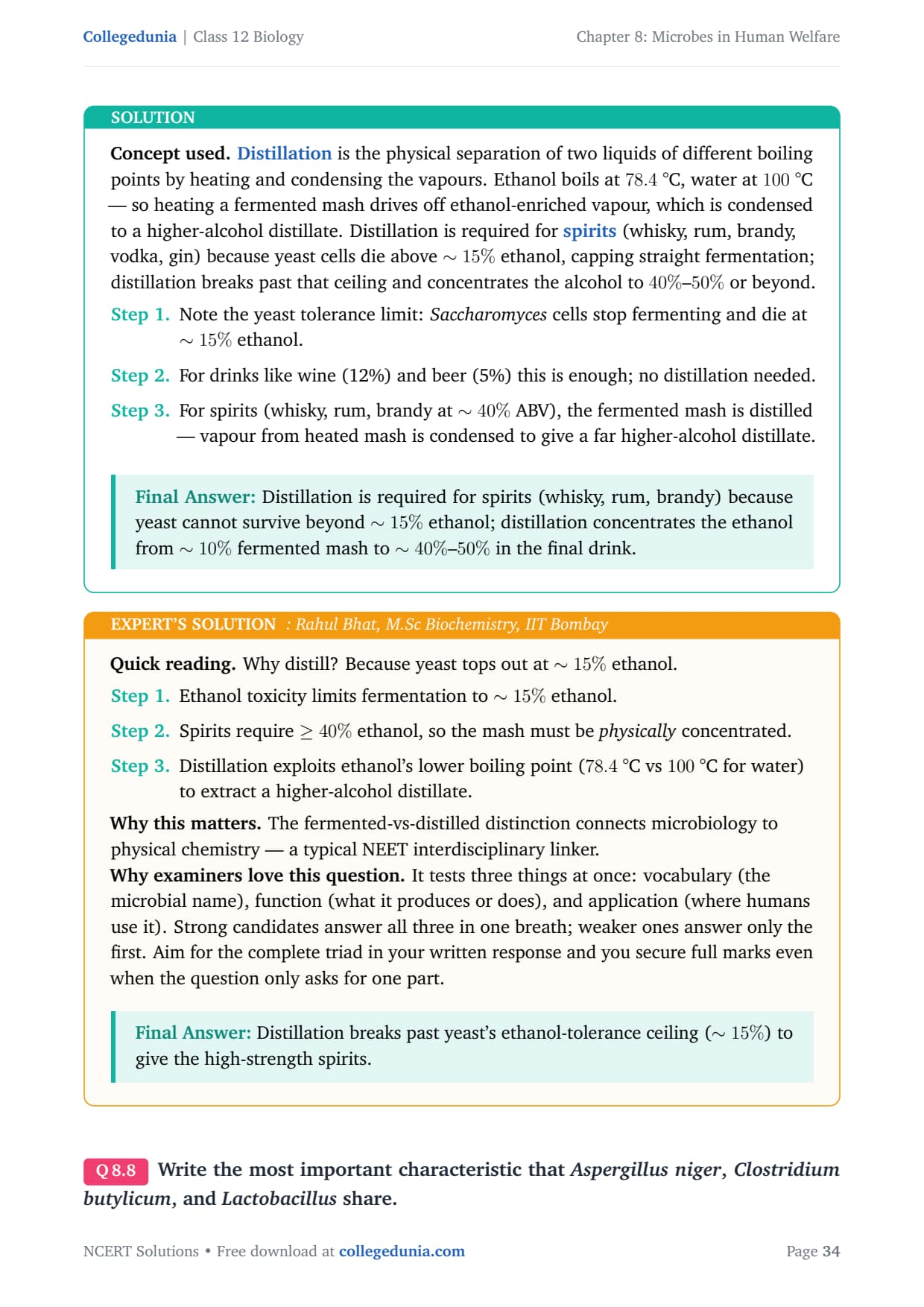
Why is distillation required for producing certain alcoholic drinks?
Concept used. Distillation is the physical separation of two liquids of different boiling points by heating and condensing the vapours. Ethanol boils at 78.4 C, water at 100 C - so heating a fermented mash drives off ethanol-enriched vapour, which is condensed to a higher-alcohol distillate. Distillation is required for spirits (whisky, rum, brandy, vodka, gin) because yeast cells die above ∼ 15% ethanol, capping straight fermentation; distillation breaks past that ceiling and concentrates the alcohol to 40%–50% or beyond.
- Note the yeast tolerance limit: Saccharomyces cells stop fermenting and die at ∼ 15% ethanol.
- For drinks like wine (12%) and beer (5%) this is enough; no distillation needed.
- For spirits (whisky, rum, brandy at ∼ 40% ABV), the fermented mash is distilled - vapour from heated mash is condensed to give a far higher-alcohol distillate.
Distillation is required for spirits (whisky, rum, brandy) because yeast cannot survive beyond ∼ 15% ethanol; distillation concentrates the ethanol from ∼ 10% fermented mash to ∼ 40%–50% in the final drink.
Quick reading. Why distill? Because yeast tops out at ∼ 15% ethanol.
- Ethanol toxicity limits fermentation to ∼ 15% ethanol.
- Spirits require ≥ 40% ethanol, so the mash must be physically concentrated.
- Distillation exploits ethanol's lower boiling point (78.4 C vs 100 C for water) to extract a higher-alcohol distillate.
Why this matters. The fermented-vs-distilled distinction connects microbiology to physical chemistry - a typical NEET interdisciplinary linker.
Why examiners love this question. It tests three things at once: vocabulary (the microbial name), function (what it produces or does), and application (where humans use it). Strong candidates answer all three in one breath; weaker ones answer only the first. Aim for the complete triad in your written response and you secure full marks even when the question only asks for one part. Distillation breaks past yeast's ethanol-tolerance ceiling (∼ 15%) to give the high-strength spirits.
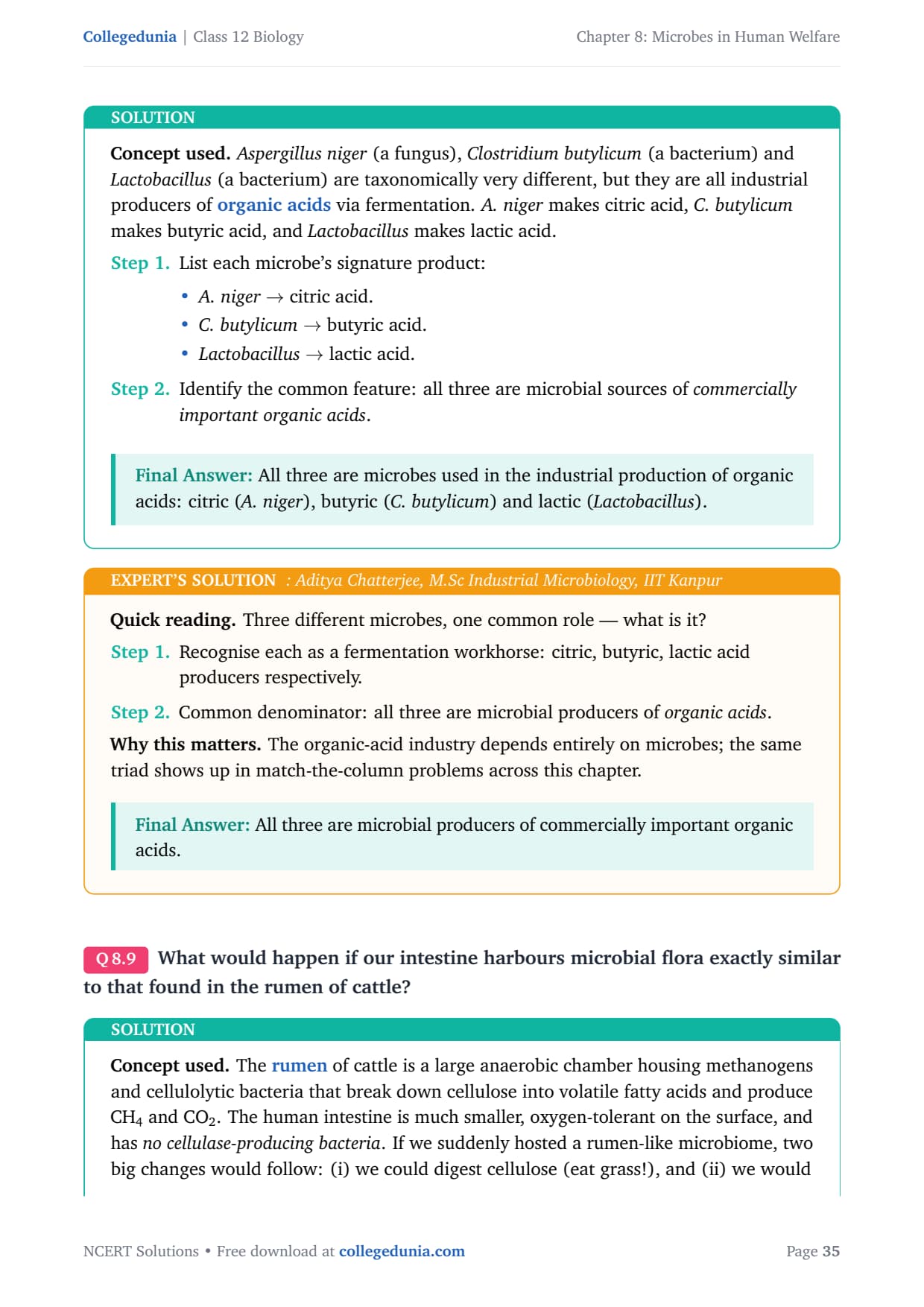
Write the most important characteristic that Aspergillus niger, Clostridium butylicum, and Lactobacillus share.
Concept used. Aspergillus niger (a fungus), Clostridium butylicum (a bacterium) and Lactobacillus (a bacterium) are taxonomically very different, but they are all industrial producers of organic acids via fermentation. A. niger makes citric acid, C. butylicum makes butyric acid, and Lactobacillus makes lactic acid.
- List each microbe's signature product:
- 2pt
- A. niger → citric acid.
- C. butylicum → butyric acid.
- Lactobacillus → lactic acid.
- Identify the common feature: all three are microbial sources of commercially important organic acids.
All three are microbes used in the industrial production of organic acids: citric (A. niger), butyric (C. butylicum) and lactic (Lactobacillus).
Quick reading. Three different microbes, one common role - what is it?
- Recognise each as a fermentation workhorse: citric, butyric, lactic acid producers respectively.
- Common denominator: all three are microbial producers of organic acids.
Why this matters. The organic-acid industry depends entirely on microbes; the same triad shows up in match-the-column problems across this chapter.
All three are microbial producers of commercially important organic acids.
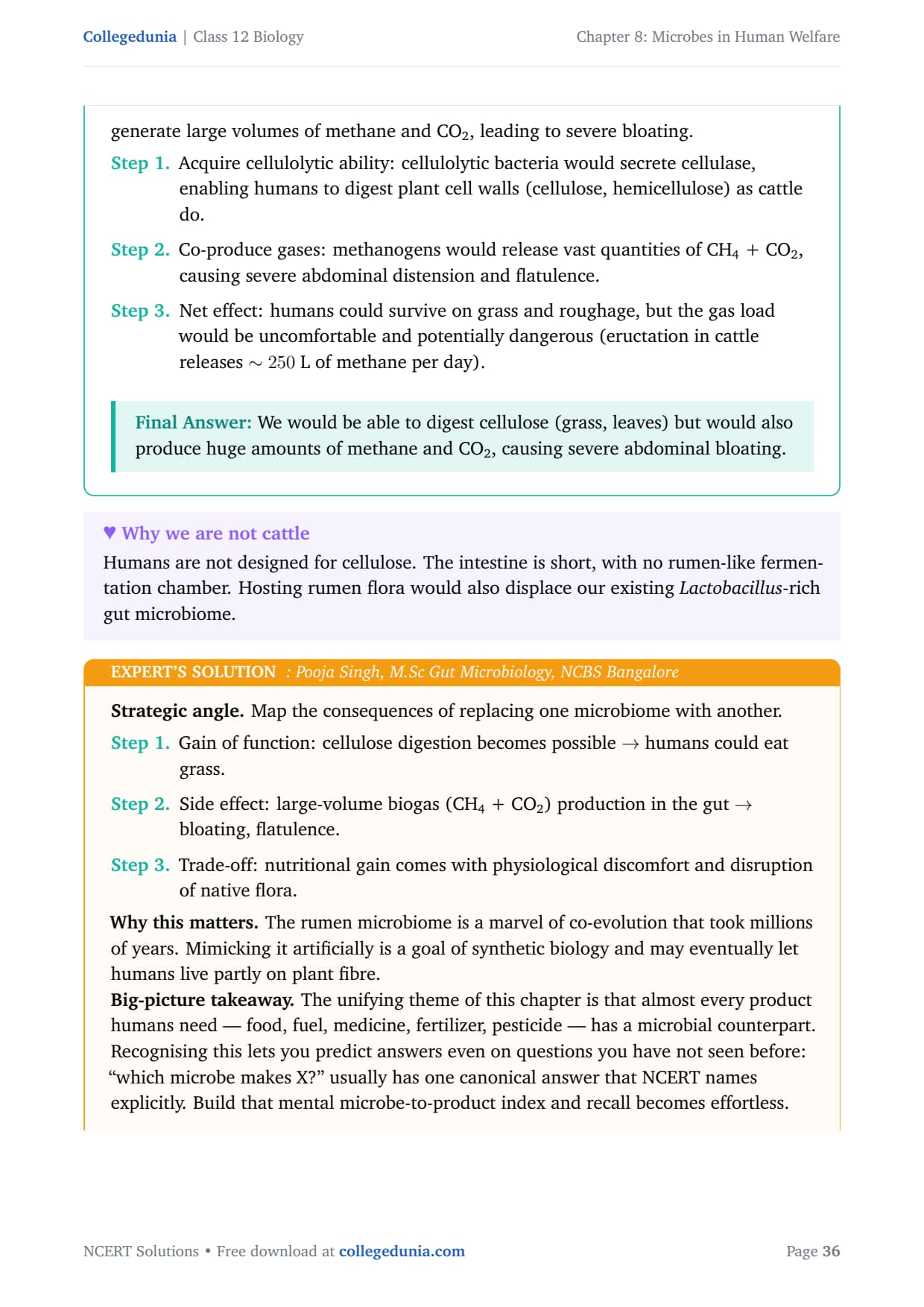
What would happen if our intestine harbours microbial flora exactly similar to that found in the rumen of cattle?
Concept used. The rumen of cattle is a large anaerobic chamber housing methanogens and cellulolytic bacteria that break down cellulose into volatile fatty acids and produce CH4 and CO2. The human intestine is much smaller, oxygen-tolerant on the surface, and has no cellulase-producing bacteria. If we suddenly hosted a rumen-like microbiome, two big changes would follow: (i) we could digest cellulose (eat grass!), and (ii) we would generate large volumes of methane and CO2, leading to severe bloating.
- Acquire cellulolytic ability: cellulolytic bacteria would secrete cellulase, enabling humans to digest plant cell walls (cellulose, hemicellulose) as cattle do.
- Co-produce gases: methanogens would release vast quantities of CH4 + CO2, causing severe abdominal distension and flatulence.
- Net effect: humans could survive on grass and roughage, but the gas load would be uncomfortable and potentially dangerous (eructation in cattle releases ∼ 250 L of methane per day).
We would be able to digest cellulose (grass, leaves) but would also produce huge amounts of methane and CO2, causing severe abdominal bloating.
Strategic angle. Map the consequences of replacing one microbiome with another.
- Gain of function: cellulose digestion becomes possible → humans could eat grass.
- Side effect: large-volume biogas (CH4 + CO2) production in the gut → bloating, flatulence.
- Trade-off: nutritional gain comes with physiological discomfort and disruption of native flora.
Why this matters. The rumen microbiome is a marvel of co-evolution that took millions of years. Mimicking it artificially is a goal of synthetic biology and may eventually let humans live partly on plant fibre.
Big-picture takeaway. The unifying theme of this chapter is that almost every product humans need - food, fuel, medicine, fertilizer, pesticide - has a microbial counterpart. Recognising this lets you predict answers even on questions you have not seen before: ``which microbe makes X?'' usually has one canonical answer that NCERT names explicitly. Build that mental microbe-to-product index and recall becomes effortless. Humans could digest cellulose but would produce so much CH4 and CO2 that life would be uncomfortable.
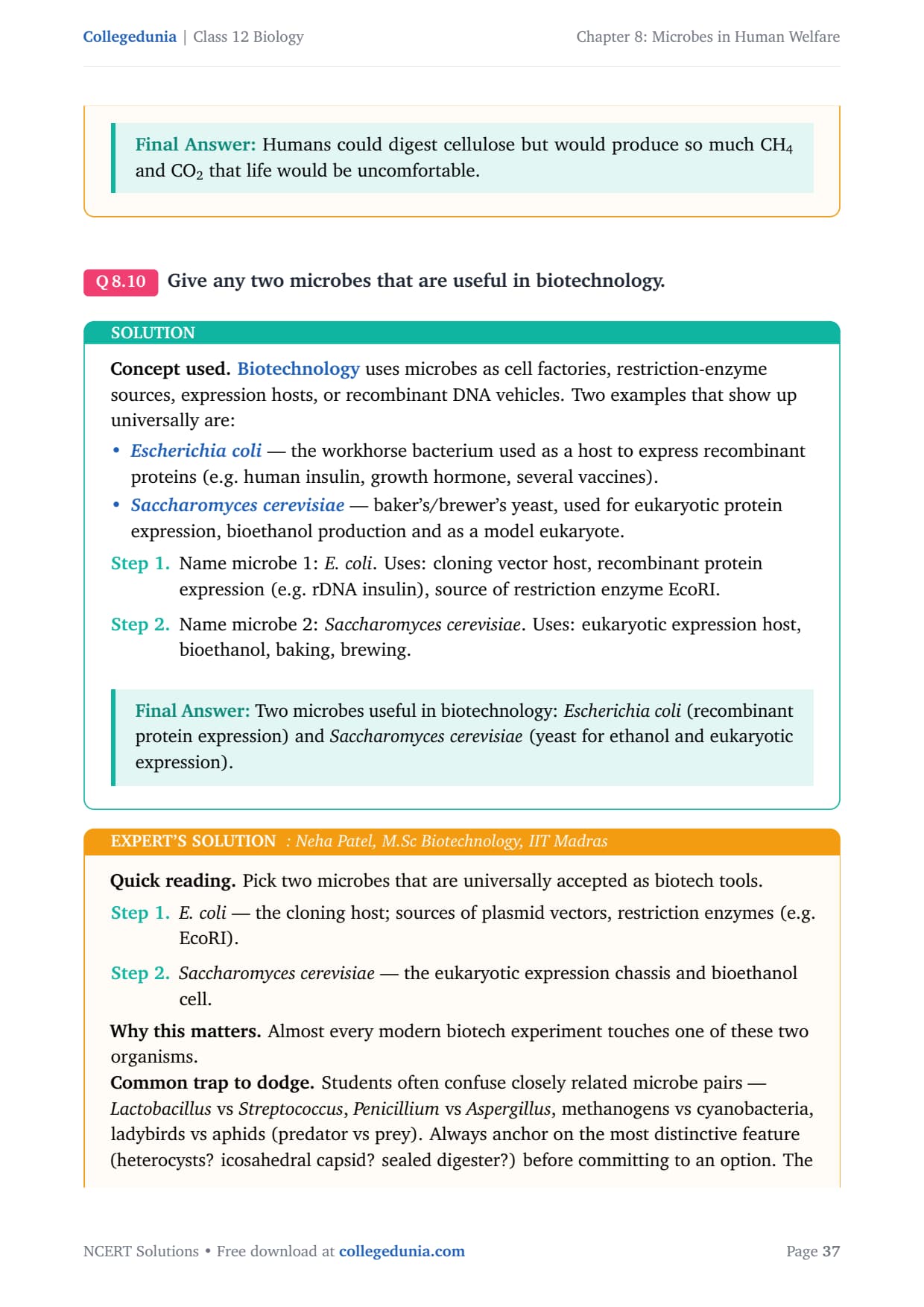
Give any two microbes that are useful in biotechnology.
Concept used. Biotechnology uses microbes as cell factories, restriction-enzyme sources, expression hosts, or recombinant DNA vehicles. Two examples that show up universally are:
- 2pt
- Escherichia coli - the workhorse bacterium used as a host to express recombinant proteins (e.g. human insulin, growth hormone, several vaccines).
- Saccharomyces cerevisiae - baker's/brewer's yeast, used for eukaryotic protein expression, bioethanol production and as a model eukaryote.
- Name microbe 1: E. coli. Uses: cloning vector host, recombinant protein expression (e.g. rDNA insulin), source of restriction enzyme EcoRI.
- Name microbe 2: Saccharomyces cerevisiae. Uses: eukaryotic expression host, bioethanol, baking, brewing.
Two microbes useful in biotechnology: Escherichia coli (recombinant protein expression) and Saccharomyces cerevisiae (yeast for ethanol and eukaryotic expression).
Quick reading. Pick two microbes that are universally accepted as biotech tools.
- E. coli - the cloning host; sources of plasmid vectors, restriction enzymes (e.g. EcoRI).
- Saccharomyces cerevisiae - the eukaryotic expression chassis and bioethanol cell.
Why this matters. Almost every modern biotech experiment touches one of these two organisms.
Common trap to dodge. Students often confuse closely related microbe pairs - Lactobacillus vs Streptococcus, Penicillium vs Aspergillus, methanogens vs cyanobacteria, ladybirds vs aphids (predator vs prey). Always anchor on the most distinctive feature (heterocysts? icosahedral capsid? sealed digester?) before committing to an option. The distinguishing trait beats memorising name lists. E. coli and Saccharomyces cerevisiae.
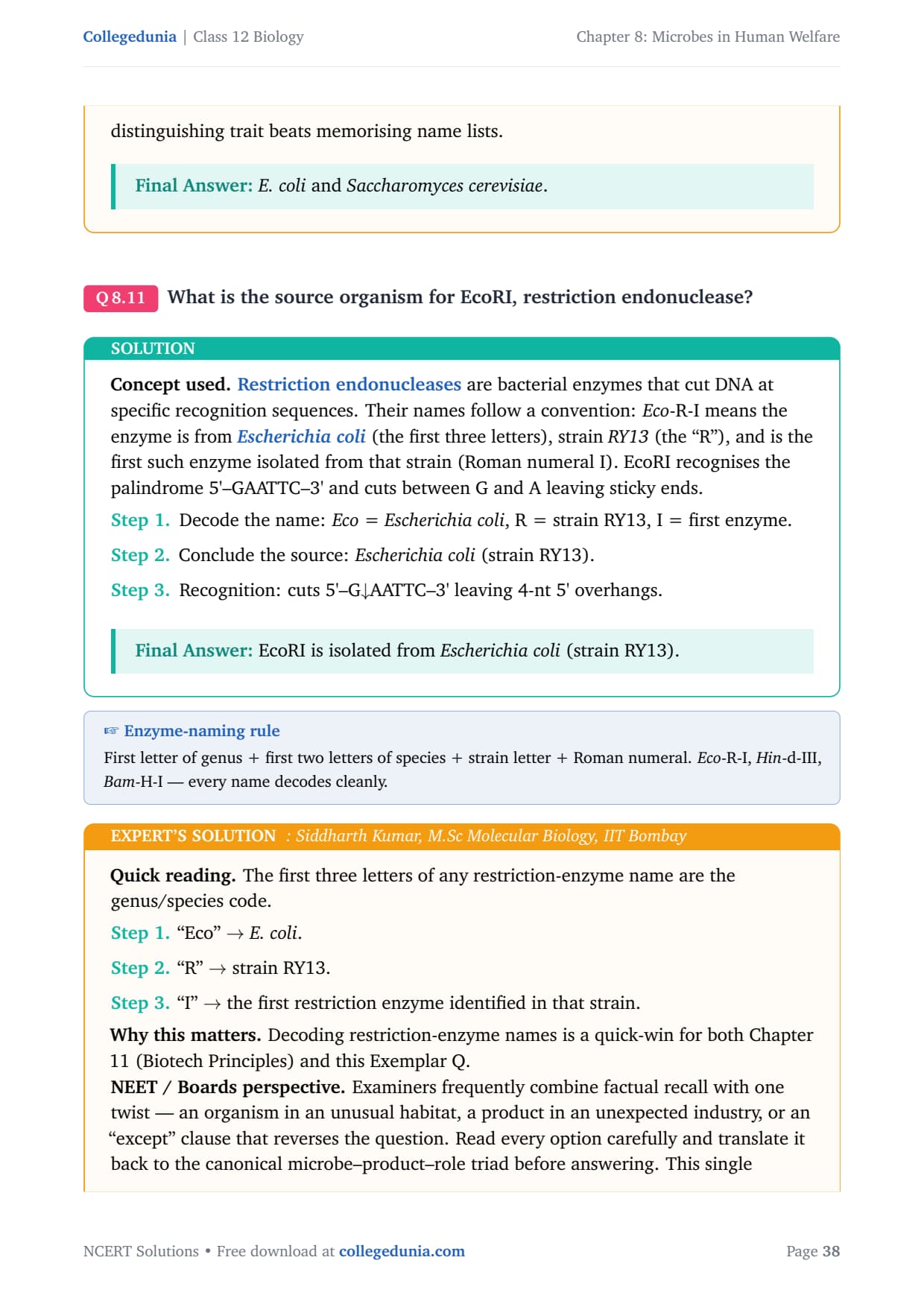
What is the source organism for EcoRI, restriction endonuclease?
Concept used. Restriction endonucleases are bacterial enzymes that cut DNA at specific recognition sequences. Their names follow a convention: Eco-R-I means the enzyme is from Escherichia coli (the first three letters), strain RY13 (the ``R''), and is the first such enzyme isolated from that strain (Roman numeral I). EcoRI recognises the palindrome 5–GAATTC–3 and cuts between G and A leaving sticky ends.
- Decode the name: Eco = Escherichia coli, R = strain RY13, I = first enzyme.
- Conclude the source: Escherichia coli (strain RY13).
- Recognition: cuts 5–G↓AATTC–3 leaving 4-nt 5 overhangs.
EcoRI is isolated from Escherichia coli (strain RY13).
Quick reading. The first three letters of any restriction-enzyme name are the genus/species code.
- ``Eco'' → E. coli.
- ``R'' → strain RY13.
- ``I'' → the first restriction enzyme identified in that strain.
Why this matters. Decoding restriction-enzyme names is a quick-win for both Chapter 11 (Biotech Principles) and this Exemplar Q.
NEET / Boards perspective. Examiners frequently combine factual recall with one twist - an organism in an unusual habitat, a product in an unexpected industry, or an ``except'' clause that reverses the question. Read every option carefully and translate it back to the canonical microbe–product–role triad before answering. This single discipline reliably catches the trap distractor. Escherichia coli (strain RY13).
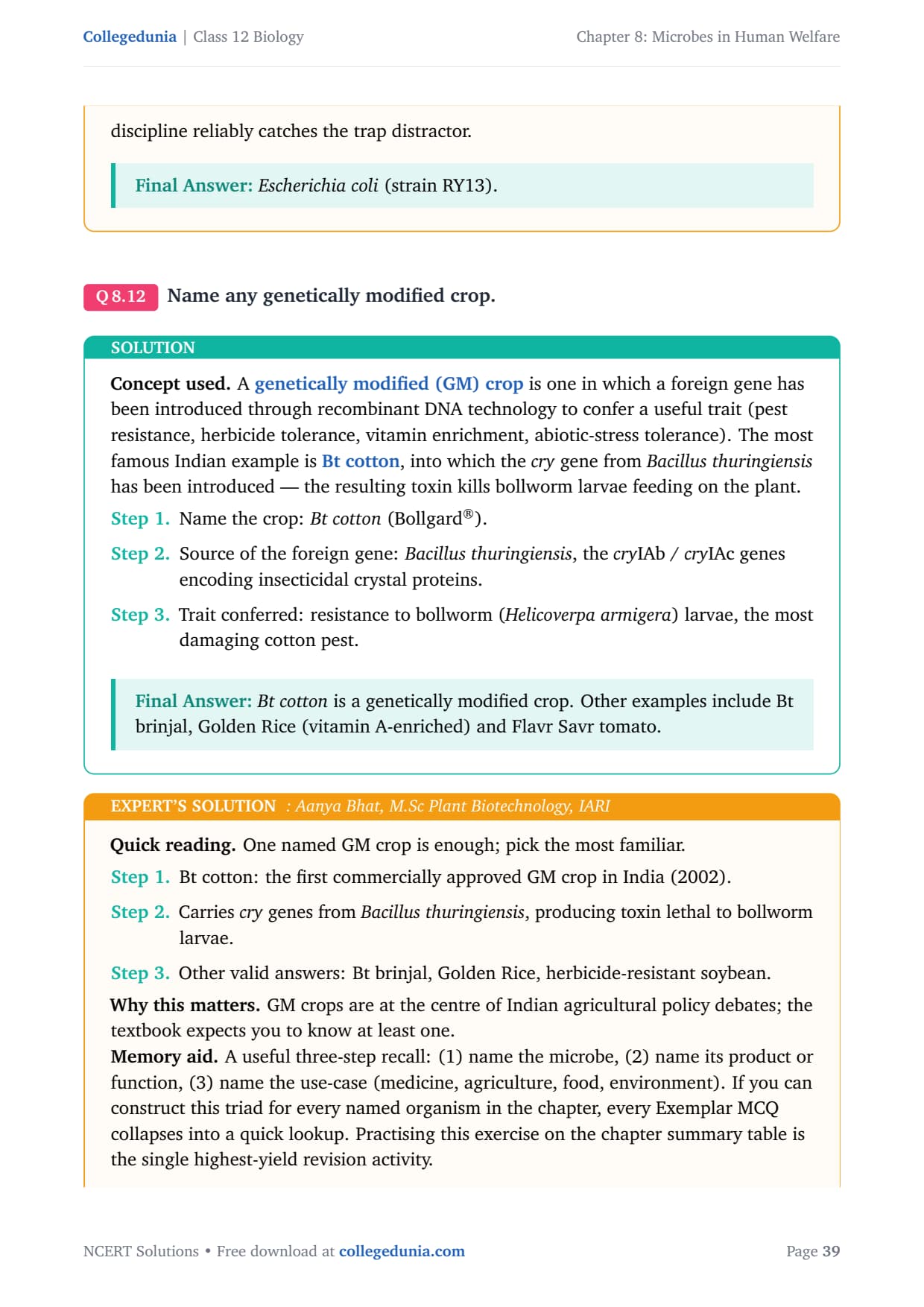
Name any genetically modified crop.
Concept used. A genetically modified (GM) crop is one in which a foreign gene has been introduced through recombinant DNA technology to confer a useful trait (pest resistance, herbicide tolerance, vitamin enrichment, abiotic-stress tolerance). The most famous Indian example is Bt cotton, into which the cry gene from Bacillus thuringiensis has been introduced - the resulting toxin kills bollworm larvae feeding on the plant.
- Name the crop: Bt cotton (Bollgard).
- Source of the foreign gene: Bacillus thuringiensis, the cryIAb / cryIAc genes encoding insecticidal crystal proteins.
- Trait conferred: resistance to bollworm (Helicoverpa armigera) larvae, the most damaging cotton pest.
Bt cotton is a genetically modified crop. Other examples include Bt brinjal, Golden Rice (vitamin A-enriched) and Flavr Savr tomato.
Quick reading. One named GM crop is enough; pick the most familiar.
- Bt cotton: the first commercially approved GM crop in India (2002).
- Carries cry genes from Bacillus thuringiensis, producing toxin lethal to bollworm larvae.
- Other valid answers: Bt brinjal, Golden Rice, herbicide-resistant soybean.
Why this matters. GM crops are at the centre of Indian agricultural policy debates; the textbook expects you to know at least one.
Memory aid. A useful three-step recall: (1) name the microbe, (2) name its product or function, (3) name the use-case (medicine, agriculture, food, environment). If you can construct this triad for every named organism in the chapter, every Exemplar MCQ collapses into a quick lookup. Practising this exercise on the chapter summary table is the single highest-yield revision activity. Bt cotton.
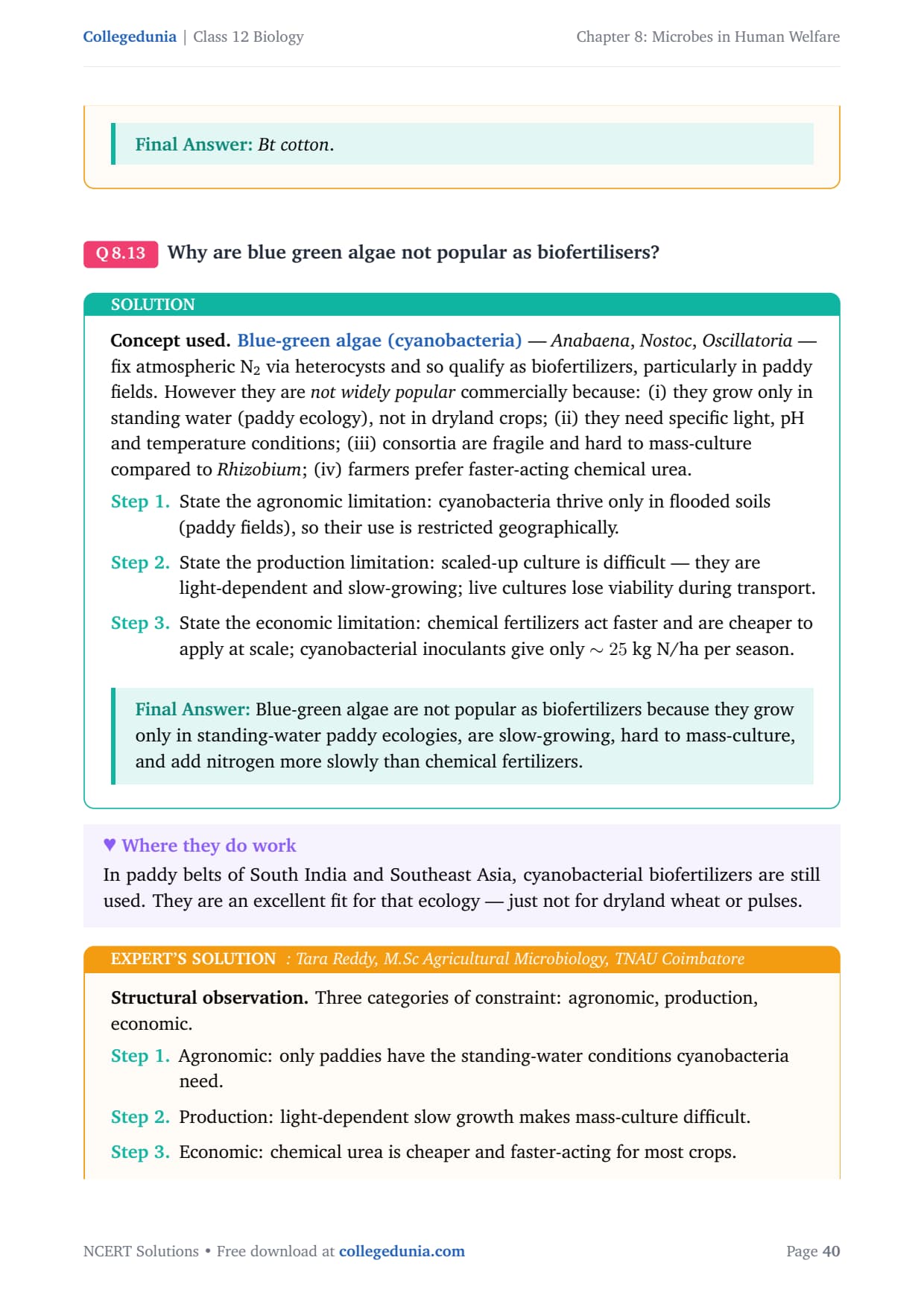
Why are blue green algae not popular as biofertilisers?
Concept used. Blue-green algae (cyanobacteria) - Anabaena, Nostoc, Oscillatoria - fix atmospheric N2 via heterocysts and so qualify as biofertilizers, particularly in paddy fields. However they are not widely popular commercially because: (i) they grow only in standing water (paddy ecology), not in dryland crops; (ii) they need specific light, pH and temperature conditions; (iii) consortia are fragile and hard to mass-culture compared to Rhizobium; (iv) farmers prefer faster-acting chemical urea.
- State the agronomic limitation: cyanobacteria thrive only in flooded soils (paddy fields), so their use is restricted geographically.
- State the production limitation: scaled-up culture is difficult - they are light-dependent and slow-growing; live cultures lose viability during transport.
- State the economic limitation: chemical fertilizers act faster and are cheaper to apply at scale; cyanobacterial inoculants give only ∼ 25 kg N/ha per season.
Blue-green algae are not popular as biofertilizers because they grow only in standing-water paddy ecologies, are slow-growing, hard to mass-culture, and add nitrogen more slowly than chemical fertilizers.
Structural observation. Three categories of constraint: agronomic, production, economic.
- Agronomic: only paddies have the standing-water conditions cyanobacteria need.
- Production: light-dependent slow growth makes mass-culture difficult.
- Economic: chemical urea is cheaper and faster-acting for most crops.
Why this matters. Understanding why a technology fails commercially despite working scientifically is itself an important lesson.
Connection to other chapters. The same microbial principle reappears in Chapter 11 (Biotechnology Principles) where recombinant DNA, restriction enzymes and microbial expression hosts are explored in greater depth, and in Chapter 13–16 (Ecology) where microbial nutrient cycling underwrites entire ecosystems. Mapping each microbe to its ecological niche and its industrial role is a recurring NEET task - every question in this Exemplar set fits one or both of those frames. Restricted to standing-water paddy fields, hard to mass-culture, slower than chemical fertilizers - hence limited adoption.
Which species of Penicillium produces Roquefort cheese?
Concept used. Roquefort cheese is a French blue-veined cheese ripened with the fungus Penicillium roquefortii, whose blue-green spores create the characteristic marbled veins inside the curd. The fungus also secretes proteases and lipases that give Roquefort its distinctive sharp, pungent flavour.
- Identify the species: Penicillium roquefortii.
- Function: produces the blue-green veins by sporulation inside the curd, and releases enzymes that ripen the texture and flavour.
Penicillium roquefortii produces Roquefort cheese.
Quick reading. The cheese's name encodes the species: Roquefort → P. roquefortii.
- Latin name: Penicillium roquefortii.
- It is a blue-mould fungus, contrasted with P. camemberti (which makes Camembert).
Why this matters. Cheese-microbe pairs are high-yield single-mark VSAs across India's Class 12 boards.
Why examiners love this question. It tests three things at once: vocabulary (the microbial name), function (what it produces or does), and application (where humans use it). Strong candidates answer all three in one breath; weaker ones answer only the first. Aim for the complete triad in your written response and you secure full marks even when the question only asks for one part. Penicillium roquefortii.
Name the states involved in Ganga action plan.
Concept used. The Ganga Action Plan (GAP), launched in 1985 by the Government of India, targets pollution control along the entire Ganga (Ganges) river. The river flows through five Indian states, all of which are covered by GAP: Uttarakhand (origin at Gomukh), Uttar Pradesh, Bihar, Jharkhand and West Bengal (where the Ganga divides into the Hooghly and continues into the Sundarbans).
- Trace the river: Gomukh (Uttarakhand) → Haridwar → Kanpur, Allahabad, Varanasi (Uttar Pradesh) → Patna (Bihar) → Sahibganj (Jharkhand) → Murshidabad, Kolkata (West Bengal).
- Listed states: Uttarakhand, Uttar Pradesh, Bihar, Jharkhand, West Bengal.
The Ganga Action Plan covers Uttarakhand, Uttar Pradesh, Bihar, Jharkhand and West Bengal.
Quick reading. Trace the river's course from source to delta and list every state it crosses.
- Source state: Uttarakhand (Gomukh, Gangotri glacier).
- Largest stretch: Uttar Pradesh.
- Mid-stretch: Bihar; tributary stretches in Jharkhand.
- Delta state: West Bengal.
Why this matters. The Namami Gange programme builds on GAP and is one of India's flagship environment initiatives - knowing the geography is a Boards favourite.
Uttarakhand, Uttar Pradesh, Bihar, Jharkhand and West Bengal.
Name any two industrially important enzymes.
Concept used. Microbial industrial enzymes are used in detergents, food processing, leather tanning, paper, pharmaceuticals and bioremediation. Two of the most widely produced are:
- 2pt
- Lipase - hydrolyses fats/triglycerides; added to washing detergents to remove oily/greasy stains.
- Streptokinase - a protease from Streptococcus that dissolves blood clots; used as a clot-buster in myocardial infarction patients.
- Name enzyme 1: lipase. Use: detergents, food (cheese flavouring), pharmaceuticals.
- Name enzyme 2: streptokinase. Use: clot-buster in heart-attack therapy.
Lipase (detergents) and streptokinase (clot-buster). Other valid answers: pectinase (juice clarification), protease (detergents), cellulase (textiles, paper).
Quick reading. Pick any two enzymes whose industrial role is clearly named in NCERT.
- Lipase → removes oil stains in detergent.
- Streptokinase → removes blood clots clinically.
Why this matters. The detergent and therapeutic enzyme industries together exceed several billion dollars annually.
Big-picture takeaway. The unifying theme of this chapter is that almost every product humans need - food, fuel, medicine, fertilizer, pesticide - has a microbial counterpart. Recognising this lets you predict answers even on questions you have not seen before: ``which microbe makes X?'' usually has one canonical answer that NCERT names explicitly. Build that mental microbe-to-product index and recall becomes effortless. Lipase and streptokinase.
Name an immunosuppressive agent.
Concept used. An immunosuppressive agent is a drug that dampens the immune response, used principally to prevent organ-transplant rejection and to treat autoimmune diseases. The classic microbial example is cyclosporin A, produced by the fungus Trichoderma polysporum. It inhibits the calcineurin pathway in T-lymphocytes, blocking T-cell activation.
- Name: cyclosporin A.
- Source: Trichoderma polysporum.
- Mechanism: binds cyclophilin; the complex inhibits calcineurin and blocks IL-2 transcription, suppressing T-cell activation.
- Use: prevents rejection of transplanted organs (kidney, liver, heart).
Cyclosporin A (from Trichoderma polysporum) is an immunosuppressive agent used in organ-transplant patients.
Quick reading. Standard NCERT pair: immunosuppressant → cyclosporin A.
- Name: cyclosporin A.
- Source: Trichoderma polysporum.
- Clinical role: organ-transplant rejection prevention.
Why this matters. Cyclosporin A and rapamycin (from Streptomyces) are both microbial immunosuppressants - together they have revolutionised transplant medicine.
Common trap to dodge. Students often confuse closely related microbe pairs - Lactobacillus vs Streptococcus, Penicillium vs Aspergillus, methanogens vs cyanobacteria, ladybirds vs aphids (predator vs prey). Always anchor on the most distinctive feature (heterocysts? icosahedral capsid? sealed digester?) before committing to an option. The distinguishing trait beats memorising name lists. Cyclosporin A from Trichoderma polysporum.
Give an example of a rod-shaped virus.
Concept used. Viruses come in several morphologies - icosahedral (e.g. polio), helical/rod-shaped, complex (e.g. bacteriophages). The textbook example of a rod-shaped virus is the Tobacco Mosaic Virus (TMV), whose helical capsid forms a slender rigid rod about 300 nm long and 18 nm wide enclosing a single-stranded RNA genome.
- Name: Tobacco Mosaic Virus (TMV).
- Morphology: rigid rod, ∼ 300 nm long, ∼ 18 nm wide, helical capsid of 2130 identical protein subunits.
- Genome: single-stranded RNA.
- Host: tobacco and other Solanaceae; the virus causes mosaic disease.
The Tobacco Mosaic Virus (TMV) is the classic example of a rod-shaped virus.
Quick reading. ``Rod-shaped'' is the hallmark of TMV; it was also the first virus ever crystallised (by Stanley, 1935).
- Name: TMV.
- Shape: rigid helical rod, ∼ 300 × 18 nm.
- History: first virus crystallised; first whose structure was solved.
Why this matters. TMV is a recurring figure in NCERT (Chapter 8: Human Health and Disease, and the Biology classification chapters of Class 11). Memorising its shape pays compound returns.
Tobacco Mosaic Virus (TMV).
What is the group of bacteria found in both the rumen of cattle and sludge of sewage treatment?
Concept used. Both the cattle rumen and the anaerobic digester sludge of sewage plants are oxygen-free, organic-rich environments - and both are dominated by methanogens, a group of anaerobic archaea that ferment organic substrates to methane (CH4). Examples include Methanobacterium, Methanococcus, Methanosarcina.
- Identify the environments: both anaerobic, both organic-rich.
- Identify the dominant microbial group: methanogens.
- Confirm by checking outputs: cattle burp CH4 (from rumen methanogens); sludge digesters produce biogas rich in CH4.
Methanogens (e.g. Methanobacterium) are found in both the cattle rumen and sewage digester sludge.
Structural observation. Both habitats are anaerobic, both rich in dissolved organics - perfect for methanogens.
- Both rumen and digester sludge are O2-free zones with high organic load.
- Methanogens (archaea) dominate by reducing CO2 or breaking down acetate to CH4.
- Example genera: Methanobacterium, Methanosarcina, Methanococcus.
Why this matters. Microbial commonality between cattle rumen and sewage digesters is exactly why we can transplant rumen microflora to ``inoculate'' new biogas plants.
Methanogenic archaea (methanogens).
Name a microbe used for the production of Swiss cheese.
Concept used. Swiss cheese (Emmental) is ripened with the bacterium Propionibacterium shermanii, which ferments lactate to propionic acid, acetic acid and CO2. The acid gives the cheese its nutty flavour, and the CO2 produces the characteristic holes.
- Microbe: Propionibacterium shermanii.
- Function: lactate → propionic acid + acetic acid + CO2; the gas forms the eyes.
Propionibacterium shermanii produces Swiss cheese.
Quick reading. Swiss cheese → Propionibacterium shermanii.
- Microbe: Propionibacterium shermanii, a propionic-acid-producing bacterium.
- Adds nutty flavour and trapped CO2 bubbles (the eyes).
Why this matters. The microbe is small, the cheese famous - perfect single-mark question.
NEET / Boards perspective. Examiners frequently combine factual recall with one twist - an organism in an unusual habitat, a product in an unexpected industry, or an ``except'' clause that reverses the question. Read every option carefully and translate it back to the canonical microbe–product–role triad before answering. This single discipline reliably catches the trap distractor. Propionibacterium shermanii.
Short Answer Type Questions
Why are flocs important in biological treatment of waste water?
Concept used. A floc is a loose, mucus-like aggregate of aerobic bacteria, protozoa and fungi held together by extracellular polymeric substances (EPS). Flocs are the working unit of the secondary (biological) treatment stage of sewage. They serve three roles simultaneously: (i) they offer enormous surface area for aerobic decomposition of organic matter; (ii) their EPS-rich matrix adsorbs colloidal and suspended impurities; and (iii) being heavier than water, they settle out quickly in the secondary clarifier, separating the cleaned water from the active biomass.
- Composition: bacteria + fungi + protozoa embedded in EPS - a self-organising consortium that does the heavy lifting in the aeration tank.
- Function 1 (oxidation): with continuous aeration (DO > 2 mg/L), floc microbes oxidise dissolved organics to CO2 + H2O + new biomass, lowering BOD by ∼ 90%.
- Function 2 (adsorption): the EPS coat traps colloidal particles and even some heavy metals; floc surfaces act as a biofilter.
- Function 3 (settling): heavier than water, flocs sediment in ∼ 30–60 minutes in the secondary clarifier, separating biomass from cleaned effluent. Most settled sludge is then recycled to the aeration tank.
Flocs are the active biomass of biological sewage treatment: they oxidise organics (lowering BOD), adsorb colloidal impurities, and settle quickly so that biomass and water can be separated.
Structural observation. Think of a floc as a three-in-one device: reactor, adsorbent, settler.
- Reactor: aerobic microbes consume BOD-causing organics.
- Adsorbent: EPS captures colloidal particles too small to settle on their own.
- Settler: heavier than water, flocs gravity-separate in the secondary clarifier.
- Bonus: returned to aeration tank, recycling the active biomass.
Why this matters. Plant operators monitor floc structure daily under microscope - a healthy floc is a healthy plant.
Memory aid. A useful three-step recall: (1) name the microbe, (2) name its product or function, (3) name the use-case (medicine, agriculture, food, environment). If you can construct this triad for every named organism in the chapter, every Exemplar MCQ collapses into a quick lookup. Practising this exercise on the chapter summary table is the single highest-yield revision activity. Flocs combine oxidation, adsorption and settling - making biological treatment economically and operationally feasible.
How has the bacterium Bacillus thuringiensis helped us in controlling caterpillars of insect pests?
Concept used. Bacillus thuringiensis (Bt) is a soil-dwelling Gram-positive bacterium that produces insecticidal crystal proteins (Cry proteins) during sporulation. When ingested by a susceptible caterpillar, Cry proteins are solubilised in the alkaline midgut, activated by gut proteases, then bind to specific receptors on the larval gut epithelium and form pores. The gut leaks, the caterpillar stops feeding and dies in 1–2 days. Bt has been deployed in two main ways: (i) as a sprayable biopesticide, and (ii) by transferring the cry gene into crop plants (Bt cotton, Bt brinjal), so that the crop itself produces Cry protein.
- Source organism: Bacillus thuringiensis, a soil bacterium found globally.
- Mode of action: caterpillar eats Cry crystal → alkaline midgut dissolves it → proteases activate it → Cry binds midgut receptors → pores form → gut leakage → death within 24–48 hours.
- Application 1 (biopesticide spray): commercial Bt formulations (e.g. Dipel) are sprayed on crops; the caterpillars eat the toxin while feeding.
- Application 2 (transgenic Bt crops): the cryIAc / cryIAb gene is inserted into cotton, brinjal, maize. The plant produces Cry protein in its tissues, and any caterpillar feeding on it dies.
- Selectivity: Bt is highly host-specific - different cry variants target Lepidoptera, Diptera or Coleoptera, but spare mammals, birds, fish and beneficial insects.
Bt produces Cry proteins that selectively kill caterpillars upon ingestion. It is used both as a biopesticide spray and through transgenic Bt crops (cotton, brinjal), reducing chemical pesticide use dramatically.
Strategic angle. Bt is the most successful microbial insecticide in history. The trick is to follow the toxin from spore to dead caterpillar.
- Bt spores carry crystalline pro-toxin (Cry).
- Caterpillar ingests → alkaline midgut solubilises crystal → proteases cleave pro-toxin to active toxin.
- Active toxin binds midgut receptors → pores form → gut paralysis → death in 1–2 days.
- In Bt crops, the toxin is produced inside plant tissue itself, eliminating the need for spraying.
Why this matters. Bt cotton in India is grown on ∼ 90% of cotton acreage. Insecticide sprays on cotton dropped by ∼ 50% after Bt adoption.
Connection to other chapters. The same microbial principle reappears in Chapter 11 (Biotechnology Principles) where recombinant DNA, restriction enzymes and microbial expression hosts are explored in greater depth, and in Chapter 13–16 (Ecology) where microbial nutrient cycling underwrites entire ecosystems. Mapping each microbe to its ecological niche and its industrial role is a recurring NEET task - every question in this Exemplar set fits one or both of those frames. Bt kills caterpillars via gut-active Cry toxins. It is used as a foliar biopesticide and via transgenic Bt crops, slashing chemical insecticide use.
How do mycorrhizal fungi help the plants harbouring them?
Concept used. A mycorrhiza is a symbiotic association between a fungus and a plant's roots. The most common form is the arbuscular mycorrhiza (AM), dominated by Glomus. Fungal hyphae extend from the root into the soil up to several centimetres, vastly enlarging the effective absorptive surface. In return for plant-supplied sugars, the fungus delivers four major benefits to the plant.
- Phosphorus uptake: AM hyphae solubilise and translocate PO4^3- (an immobile ion) from beyond the root's depletion zone. Mycorrhized plants take up 2–3× more phosphorus.
- Water uptake / drought tolerance: hyphae access fine soil pores below root reach, improving water uptake and helping the plant withstand drought.
- Nutrient sharing: AM also enhance uptake of N, K, Zn, Cu and other micronutrients.
- Disease resistance: the mycorrhizosphere out-competes soil-borne fungal pathogens and induces systemic resistance in the host. The plant becomes less susceptible to root pathogens.
- Stress tolerance: mycorrhized plants tolerate salinity, heavy metals and temperature stresses better than non-mycorrhized ones.
Mycorrhizal fungi help plants by improving phosphorus uptake, water absorption (drought tolerance), micronutrient nutrition, resistance to soil-borne pathogens, and overall stress tolerance.
Strategic angle. Mycorrhiza is a ``below-ground partnership''. List the four major benefits and you have the answer.
- Phosphorus uptake - the headline benefit; AM solubilise and translocate immobile PO4^3-.
- Drought tolerance - hyphae reach water films inaccessible to roots.
- Root-pathogen protection - mycorrhizosphere outcompetes pathogens.
- General stress tolerance - salinity, heavy metals, temperature.
Why this matters. Mycorrhizal biofertilizers are now sold commercially to reduce chemical phosphate fertilizer use - an economic and environmental win.
Why examiners love this question. It tests three things at once: vocabulary (the microbial name), function (what it produces or does), and application (where humans use it). Strong candidates answer all three in one breath; weaker ones answer only the first. Aim for the complete triad in your written response and you secure full marks even when the question only asks for one part. Mycorrhiza boost P uptake, water absorption, micronutrient nutrition, pathogen resistance and stress tolerance.
Why are cyanobacteria considered useful in paddy fields?
Concept used. Cyanobacteria (blue-green algae) such as Anabaena, Nostoc and Oscillatoria are photosynthetic prokaryotes that can also fix atmospheric nitrogen via the enzyme nitrogenase housed in specialised cells called heterocysts. Paddy fields are flooded, sun-lit and warm - conditions that perfectly suit cyanobacteria. As they grow in the rice paddy water, they enrich the soil with biologically fixed nitrogen, organic carbon and growth-promoting metabolites, reducing the need for chemical fertilizer.
- Cyanobacteria photosynthesise in the standing water of paddy fields, producing biomass.
- In heterocysts, they fix atmospheric N2 to NH3: N2 + 8 H+ + 8 e- + 16 ATP -> 2 NH3 + H2 + 16 ADP + 16 Pi.
- Upon decomposition, this fixed nitrogen enters the soil as ammonia and nitrate, boosting rice productivity.
- Additional benefits: they secrete growth promoters (auxin-like compounds), add organic matter, and reduce nitrogen-fertilizer demand by 25–30 kg N/ha/season.
- Azolla–Anabaena symbiosis (the floating water fern Azolla hosting Anabaena) is exploited as a green-manure crop in paddies.
Cyanobacteria fix atmospheric N2 into bio-available nitrogen in flooded paddy soils, also adding organic matter and growth promoters - saving on chemical fertilizers.
Structural observation. Three benefits: nitrogen fixation, organic matter addition, growth promotion.
- Heterocyst-bearing cyanobacteria fix atmospheric N2 in flooded paddies.
- On death and decomposition, the fixed N enriches the soil as NH4+ / NO3-.
- Cyanobacterial biomass adds organic matter and growth-promoting metabolites (auxin-like).
- Result: 25–30 kg N/ha saved in chemical fertilizer cost per season.
Why this matters. Rice is the staple of half the planet. Cyanobacteria silently underwrite a chunk of its productivity.
Big-picture takeaway. The unifying theme of this chapter is that almost every product humans need - food, fuel, medicine, fertilizer, pesticide - has a microbial counterpart. Recognising this lets you predict answers even on questions you have not seen before: ``which microbe makes X?'' usually has one canonical answer that NCERT names explicitly. Build that mental microbe-to-product index and recall becomes effortless. Cyanobacteria fix N2, add organic matter and growth promoters in paddy fields - a free nitrogen biofertilizer.
How was penicillin discovered?
Concept used. Penicillin was discovered in 1928 by Sir Alexander Fleming (St. Mary's Hospital, London) almost by accident. Fleming had left a Petri dish of Staphylococcus aureus cultures uncovered before going on holiday. On his return, he noticed that a stray fungal contaminant (a Penicillium notatum colony) had grown on one plate and around it was a clear zone where the staphylococci had been killed. Fleming inferred that the fungus secreted a diffusible antibacterial substance, which he named penicillin. Its therapeutic potential was demonstrated much later, in the 1940s, by Ernst Chain and Howard Florey, who purified penicillin and used it to cure soldiers wounded in World War II. Fleming, Chain and Florey shared the 1945 Nobel Prize for Medicine.
- Year 1928: Alexander Fleming observes that a Penicillium notatum contaminant has killed Staphylococcus around it on a plate.
- Hypothesis: the fungus is secreting an antibacterial diffusible substance.
- Naming: Fleming names the substance penicillin after the fungus genus.
- Years 1939–41: Chain and Florey (Oxford) purify penicillin, demonstrate its safety in animals and then in humans.
- World War II: penicillin is mass-produced and saves countless wounded soldiers.
- Recognition: 1945 Nobel Prize in Physiology or Medicine to Fleming, Chain and Florey.
Alexander Fleming discovered penicillin in 1928 from a chance Penicillium notatum contamination of a Staphylococcus culture; Chain and Florey later purified it and made it a usable drug. Nobel Prize 1945.
Picture-first. A contaminated petri dish, a clear zone around a mould, a brilliant observer.
- 1928, Fleming, St Mary's: Penicillium notatum contaminates a Staphylococcus culture; bacteria around the mould die.
- Fleming names the diffusing antibacterial substance penicillin.
- 1940–45, Chain & Florey at Oxford purify and scale up penicillin, prove clinical efficacy.
- 1945 Nobel Prize.
Why this matters. The penicillin story is the founding myth of antibiotic medicine - every Boards exam expects this triad of names.
Common trap to dodge. Students often confuse closely related microbe pairs - Lactobacillus vs Streptococcus, Penicillium vs Aspergillus, methanogens vs cyanobacteria, ladybirds vs aphids (predator vs prey). Always anchor on the most distinctive feature (heterocysts? icosahedral capsid? sealed digester?) before committing to an option. The distinguishing trait beats memorising name lists. Discovered serendipitously by Fleming in 1928; turned into a drug by Chain and Florey in the 1940s.
Name the scientists who were credited for showing the role of Penicillin as an antibiotic?
Concept used. Although Alexander Fleming discovered penicillin in 1928, he never managed to purify or test it clinically. The real demonstration of penicillin as a usable antibiotic came in the early 1940s from the Oxford team of Ernst Boris Chain and Howard Walter Florey, who purified the drug, tested it in mice and then in humans. All three - Fleming, Chain and Florey - shared the 1945 Nobel Prize in Physiology or Medicine.
- Discovery (1928): Sir Alexander Fleming, St Mary's Hospital, London.
- Purification and therapeutic demonstration (1940–45): Ernst Boris Chain and Howard Walter Florey, University of Oxford.
- Nobel Prize 1945 (shared, three scientists).
Alexander Fleming, Ernst Chain and Howard Florey are credited; Chain and Florey specifically established penicillin as a clinically usable antibiotic.
Quick reading. Three names: discovery + clinical use.
- Fleming - discoverer.
- Chain and Florey - purifiers and clinical demonstrators.
- Shared Nobel Prize 1945.
Why this matters. The Boards regularly ask for one, two or all three names. Memorise the triad together.
NEET / Boards perspective. Examiners frequently combine factual recall with one twist - an organism in an unusual habitat, a product in an unexpected industry, or an ``except'' clause that reverses the question. Read every option carefully and translate it back to the canonical microbe–product–role triad before answering. This single discipline reliably catches the trap distractor. Alexander Fleming, Ernst Chain and Howard Florey.
How do bioactive molecules of fungal origin help in restoring good health of humans?
Concept used. Fungi are an extraordinarily rich source of bioactive molecules that have transformed medicine. Three NCERT-highlighted examples cover three different therapeutic areas:
- 2pt
- Penicillin (from Penicillium notatum) - the first antibiotic; cured bacterial infections that were previously fatal.
- Cyclosporin A (from Trichoderma polysporum) - an immunosuppressant; prevents organ-transplant rejection.
- Statins (from Monascus purpureus) - lower blood cholesterol; reduce cardiovascular mortality.
- Antibiotic action - penicillin and related β-lactams from fungi target bacterial cell wall synthesis, curing bacterial diseases.
- Immunosuppression - cyclosporin A inhibits T-cell activation, enabling organ transplantation; without it, modern transplant medicine would not exist.
- Cholesterol lowering - statins inhibit HMG-CoA reductase, lowering serum LDL by 30–50%; they have saved millions from cardiovascular deaths.
- Other examples - griseofulvin (antifungal from Penicillium griseofulvum), ergot alkaloids (Claviceps purpurea), used in obstetrics and migraine.
Fungal bioactives have given humanity three transformative drug classes: antibiotics (penicillin), immunosuppressants (cyclosporin A) and cholesterol-lowering statins - each saving millions of lives.
Structural observation. Three different therapeutic categories, all from fungi.
- Penicillin - antibiotics.
- Cyclosporin A - immunosuppressants for transplants.
- Statins - cholesterol-lowering for cardiovascular health.
Why this matters. The microbial-to-medicine pipeline is alive and well; new fungal scaffolds are still being mined for drug discovery.
Memory aid. A useful three-step recall: (1) name the microbe, (2) name its product or function, (3) name the use-case (medicine, agriculture, food, environment). If you can construct this triad for every named organism in the chapter, every Exemplar MCQ collapses into a quick lookup. Practising this exercise on the chapter summary table is the single highest-yield revision activity. Fungi give antibiotics (penicillin), immunosuppressants (cyclosporin A) and statins - covering three pillars of modern medicine.
What roles do enzymes play in detergents that we use for washing clothes? Are these enzymes produced from some unique microorganisms?
Concept used. Modern laundry detergents include microbial enzymes that catalyse the breakdown of stubborn stains under mild conditions. The three main enzymes are protease (breaks down protein stains: blood, food, sweat), lipase (breaks down fats and oils: butter, oil, cosmetics), and amylase (breaks down starch stains: pasta, sauces). These enzymes are produced industrially from common, easily-cultured microbes - they are not unique organisms. Detergent enzymes typically come from Bacillus species (e.g. Bacillus subtilis for protease, Bacillus licheniformis for amylase) and fungi like Candida or Aspergillus for lipase.
- Identify the enzymes added to detergents:
- 2pt
- Protease - hydrolyses peptide bonds in protein stains (blood, egg, milk).
- Lipase - hydrolyses triglycerides in oily/greasy stains.
- Amylase - hydrolyses starch-based food stains.
- Cellulase - softens cotton fibres and removes lint.
- Function in detergent: the enzymes act at moderate temperatures and alkaline pH typical of wash cycles, breaking down stains into smaller soluble pieces that rinse off easily.
- Source organisms: easily cultured bacteria (Bacillus subtilis, B. licheniformis, B. amyloliquefaciens) and fungi (Aspergillus, Humicola, Candida). These are common, not unique.
- Industrial production: bulk fermentation in stirred-tank bioreactors → enzyme purification → formulation into liquid or powder detergent.
Detergent enzymes (protease, lipase, amylase, cellulase) break down protein, oily, starchy and cellulosic stains during washing. They are produced by common cultured microbes (Bacillus bacteria, Aspergillus fungi) - not unique organisms.
Quick reading. Two-part question: name the enzymes and their roles, then comment on the microbial source.
- Enzymes used: protease (proteins), lipase (oils), amylase (starches), cellulase (cellulose lint).
- Source microbes: common, widely cultured organisms - Bacillus subtilis, B. licheniformis, Aspergillus oryzae. Nothing exotic.
- Industrial scaling: large fermentors, downstream purification, blending into detergent.
Why this matters. Enzyme detergents work at lower temperatures than purely chemical surfactants, saving electricity. They are a silent win for both consumers and the climate.
Connection to other chapters. The same microbial principle reappears in Chapter 11 (Biotechnology Principles) where recombinant DNA, restriction enzymes and microbial expression hosts are explored in greater depth, and in Chapter 13–16 (Ecology) where microbial nutrient cycling underwrites entire ecosystems. Mapping each microbe to its ecological niche and its industrial role is a recurring NEET task - every question in this Exemplar set fits one or both of those frames. Detergent enzymes (protease, lipase, amylase) digest stain components. They come from ordinary cultured microbes (Bacillus, Aspergillus), not unique organisms.
What is the chemical nature of biogas? Name an organism which is involved in biogas production.
Concept used. Biogas is a gaseous mixture produced by the anaerobic digestion of organic matter (cow dung, sewage sludge, agricultural residues, food waste) by methanogenic archaea. Its bulk composition is roughly 50–70% methane (CH4), 25–45% carbon dioxide (CO2), with traces of hydrogen sulfide (H2S), water vapour and nitrogen. The methane is what makes biogas a fuel - it burns with a clean blue flame and yields ∼ 4,500–6,000 kcal/m3.
- State chemical composition:
- 2pt
- CH4 : 50–70% (the energy-bearing fuel component)
- CO2 : 25–45%
- H2S, H2O, N2 : trace.
- Name a producer organism: Methanobacterium (or Methanococcus, Methanosarcina). These are strict-anaerobic methanogenic archaea, found in cow rumen and biogas digesters.
- Note the metabolism: CO2 + 4 H2 -> CH4 + 2 H2O, CH3COOH -> CH4 + CO2.
Biogas is a mixture of methane (∼ 60% CH4), CO2, plus traces of H2S. It is produced by methanogenic archaea such as Methanobacterium.
Quick reading. Composition + one producer organism - two-part answer.
- Composition: ∼ 60% CH4 + ∼ 35% CO2 + traces of H2S.
- Producer: methanogens such as Methanobacterium, Methanococcus.
- Substrate: anaerobic organic matter (cow dung, sewage sludge).
Why this matters. Biogas is one of the most accessible renewable fuels in rural India - millions of plants already operate at the household scale.
Why examiners love this question. It tests three things at once: vocabulary (the microbial name), function (what it produces or does), and application (where humans use it). Strong candidates answer all three in one breath; weaker ones answer only the first. Aim for the complete triad in your written response and you secure full marks even when the question only asks for one part. Biogas = ∼ 60% CH4 + ∼ 35% CO2 (with H2S traces); produced by Methanobacterium and related methanogens.
How do microbes reduce the environmental degradation caused by chemicals?
Concept used. Microbes reduce chemical environmental degradation through two complementary roles: (i) by biodegrading or bioremediating chemicals already released into soil, water and air; and (ii) by serving as biofertilizers, biopesticides and biocontrol agents that replace chemical inputs, thereby preventing further pollution. Both pathways together represent the bio-based alternative to chemical agriculture and chemical waste management.
- Bioremediation (clean-up role):
- 2pt
- Pseudomonas strains degrade oil spills (n-alkanes, polycyclic aromatic hydrocarbons).
- Phanerochaete chrysosporium (white-rot fungus) degrades lignin, dyes, pesticides.
- Sewage treatment microbial flocs degrade BOD, lowering organic pollution discharged into rivers.
- Anaerobic digesters convert organic waste into biogas + manure.
- Replacement role (prevention):
- 2pt
- Rhizobium, Azotobacter, cyanobacteria, mycorrhiza - biofertilizers replacing chemical N, P fertilizers.
- Bacillus thuringiensis, NPV, Trichoderma, ladybirds - biopesticides replacing chemical insecticides and fungicides.
- Net effect: less chemical fertilizer + less chemical pesticide + faster biodegradation of waste = drastically reduced environmental load.
Microbes both degrade pollutants already in the environment (bioremediation by Pseudomonas, fungi, sewage flocs, biogas methanogens) and replace chemical fertilizers and pesticides (biofertilizers, biopesticides) - together reducing chemical pollution at source and downstream.
Structural observation. Two parallel roles: clean up + replace.
- Clean-up: oil-degrading Pseudomonas, sewage-treatment flocs, anaerobic methanogens.
- Replacement of agrochemicals: Rhizobium, cyanobacteria, mycorrhiza (fertilizers); Bt, NPV, Trichoderma (pesticides).
- Together: chemical inputs minimised, chemical waste degraded, net pollution falls.
Why this matters. The global shift toward sustainable agriculture leans heavily on microbial alternatives. Most environment-policy questions in CBSE Bio come back to this idea.
Big-picture takeaway. The unifying theme of this chapter is that almost every product humans need - food, fuel, medicine, fertilizer, pesticide - has a microbial counterpart. Recognising this lets you predict answers even on questions you have not seen before: ``which microbe makes X?'' usually has one canonical answer that NCERT names explicitly. Build that mental microbe-to-product index and recall becomes effortless. Microbes bioremediate existing chemical pollutants and replace chemical fertilizers/pesticides as biofertilizers/biopesticides.
What is a broad spectrum antibiotic? Name one such antibiotic.
Concept used. A broad-spectrum antibiotic is one that is effective against a wide range of bacterial groups - typically both Gram-positive and Gram-negative bacteria, and sometimes also against atypical organisms like Chlamydia and Rickettsia. This is in contrast to narrow-spectrum antibiotics (e.g. benzylpenicillin), which work against only a limited group (mostly Gram-positives). Classic broad-spectrum antibiotics include tetracycline, chloramphenicol, ampicillin and ciprofloxacin.
- Define: an antibiotic active against a wide range of bacterial taxa (Gram-positive + Gram-negative).
- Contrast with narrow-spectrum: e.g. benzylpenicillin works only against Gram-positives.
- Example: tetracycline (from Streptomyces aureofaciens) acts against a wide range of Gram-positive and Gram-negative bacteria, plus Chlamydia and Rickettsia.
- Clinical use: empirical therapy when the causative organism is not yet identified.
A broad-spectrum antibiotic is one effective against both Gram-positive and Gram-negative bacteria. Tetracycline is a classic example.
Quick reading. Define + one example.
- Definition: effective against a wide range of bacterial species (Gram+ and Gram-).
- Examples: tetracycline, chloramphenicol, ampicillin, ciprofloxacin.
- Use: empirical therapy when the pathogen is unknown.
Why this matters. Misuse of broad-spectrum antibiotics is a major driver of antibiotic resistance - a topic increasingly featured in Boards.
Common trap to dodge. Students often confuse closely related microbe pairs - Lactobacillus vs Streptococcus, Penicillium vs Aspergillus, methanogens vs cyanobacteria, ladybirds vs aphids (predator vs prey). Always anchor on the most distinctive feature (heterocysts? icosahedral capsid? sealed digester?) before committing to an option. The distinguishing trait beats memorising name lists. A broad-spectrum antibiotic works against many bacterial groups; tetracycline is a standard example.
What are viruses parasitising bacteria called? Draw a well labelled diagram of the same.
Concept used. Viruses that infect (parasitise) bacteria are called bacteriophages (literally ``bacteria-eaters''). They have a complex morphology: an icosahedral head containing tightly packed double-stranded DNA, a tail sheath that contracts to inject the DNA into the host, a base plate with tail fibres for host recognition. The most-studied example is the T4 bacteriophage that infects Escherichia coli.
- Name: viruses that infect bacteria are called bacteriophages (``bacteria-eaters''), discovered independently by Twort (1915) and d'Herelle (1917).
- Structure of T4 phage:
- 2pt
- Head: icosahedral protein capsid enclosing dsDNA (the genome).
- Collar: narrow region linking head and tail.
- Tail sheath: a contractile cylinder around an inner core; contracts to drive DNA injection.
- Base plate: hexagonal plate at the tail's distal end.
- Tail fibres: six slender fibres for attachment to receptors on the bacterial surface.
- Lifecycle: tail fibres recognise the bacterial cell wall → sheath contracts → inner core pierces the cell envelope → DNA injected → phage replication.
Bacteria-parasitising viruses are called bacteriophages; the T4 phage has a head (with dsDNA), collar, contractile tail sheath, base plate and tail fibres.
Picture-first. The T4 phage looks like a tiny syringe with legs.
- Name: bacteriophage. T4 (E. coli phage) is the textbook example.
- Anatomy:
- 2pt
- Head → icosahedral capsid containing dsDNA.
- Tail sheath → contractile cylinder around an inner core.
- Base plate + 6 tail fibres → host recognition and injection apparatus.
- Function: tail fibres latch onto bacterial surface, sheath contracts, DNA is injected into the bacterium.
Why this matters. Bacteriophages are foundational tools in molecular biology, and now also experimental therapeutics. T4's anatomy is the highest-yield diagram in this chapter.
NEET / Boards perspective. Examiners frequently combine factual recall with one twist - an organism in an unusual habitat, a product in an unexpected industry, or an ``except'' clause that reverses the question. Read every option carefully and translate it back to the canonical microbe–product–role triad before answering. This single discipline reliably catches the trap distractor. Bacteriophage; head + tail sheath + base plate + tail fibres.
Which bacterium has been used as a clot buster? What is its mode of action?
Concept used. The bacterium Streptococcus (specifically Streptococcus equisimilis or S. pyogenes) produces an enzyme called streptokinase, which is used clinically as a clot-buster (thrombolytic agent). Streptokinase works by activating the body's own clot-dissolving system: it binds to plasminogen, converting it to plasmin, which then degrades the fibrin meshwork of a clot.
- Bacterium: Streptococcus (S. equisimilis / S. pyogenes).
- Product: streptokinase, a protease.
- Mechanism: streptokinase binds plasminogen (a circulating proenzyme), forming a complex that converts more plasminogen molecules to active plasmin. Plasmin in turn hydrolyses the fibrin meshwork of clots: Plasminogen streptokinase Plasmin Fibrinclot.
- Clinical use: given by IV infusion within hours of myocardial infarction or pulmonary embolism to dissolve the offending clot and restore blood flow.
Streptococcus produces streptokinase, which activates plasminogen to plasmin; plasmin then dissolves the fibrin clot. Used clinically as a clot-buster after heart attacks.
Quick reading. Two parts: name the bacterium + the mechanism.
- Bacterium: Streptococcus.
- Enzyme: streptokinase, secreted into the medium and harvested industrially.
- Mechanism: streptokinase + plasminogen → active plasmin; plasmin cleaves fibrin → clot dissolves.
- Use: heart attack, pulmonary embolism, deep vein thrombosis.
Why this matters. Streptokinase therapy can salvage heart muscle if given within the ``golden hour'' after a heart attack - a routine emergency-room drug.
Memory aid. A useful three-step recall: (1) name the microbe, (2) name its product or function, (3) name the use-case (medicine, agriculture, food, environment). If you can construct this triad for every named organism in the chapter, every Exemplar MCQ collapses into a quick lookup. Practising this exercise on the chapter summary table is the single highest-yield revision activity. Streptococcus → streptokinase → activates plasminogen → plasmin → fibrin degradation → clot dissolved.
What are biofertilisers? Give two examples.
Concept used. Biofertilisers are living micro-organisms (or carrier-bound preparations of them) that, when applied to seeds, plant surfaces or soil, colonise the rhizosphere or the interior of the plant and promote growth by supplying or making available essential plant nutrients - primarily nitrogen (by N-fixation) and phosphorus (by solubilising soil P). They reduce or replace the need for chemical fertilizers, are environmentally benign, and improve long-term soil health.
- Define: living microbial preparations that enrich soil with nutrients and promote plant growth.
- List benefits:
- 2pt
- Nitrogen fixation (Rhizobium, Azotobacter, Anabaena).
- Phosphate solubilisation (Pseudomonas, Glomus mycorrhiza).
- Production of plant growth promoters (auxins, gibberellins).
- Disease suppression in the rhizosphere.
- Examples (any two):
- 2pt
- Rhizobium - symbiotic N-fixer in root nodules of legumes.
- Azotobacter - free-living aerobic N-fixer in soil.
- Cyanobacteria (Anabaena, Nostoc) - paddy-field biofertilizers.
- Mycorrhiza (Glomus) - phosphate solubiliser and uptake enhancer.
Biofertilizers are living microbial preparations that enrich soil with nutrients. Two examples: Rhizobium (symbiotic N-fixer) and Azotobacter (free-living N-fixer); other valid pairs include cyanobacteria and mycorrhiza.
Quick reading. Define + two examples.
- Definition: living microbes that add or mobilise plant nutrients in soil.
- Example 1: Rhizobium - forms nodules on legume roots and fixes N2.
- Example 2: Mycorrhiza (Glomus) - extends root surface and solubilises soil phosphate.
Why this matters. Biofertilizers cut chemical fertilizer demand by 25–50%, making agriculture cheaper and cleaner.
Connection to other chapters. The same microbial principle reappears in Chapter 11 (Biotechnology Principles) where recombinant DNA, restriction enzymes and microbial expression hosts are explored in greater depth, and in Chapter 13–16 (Ecology) where microbial nutrient cycling underwrites entire ecosystems. Mapping each microbe to its ecological niche and its industrial role is a recurring NEET task - every question in this Exemplar set fits one or both of those frames. Biofertilizers are living microbial preparations that supply plant nutrients. Examples: Rhizobium and Azotobacter (or mycorrhiza, or cyanobacteria).
Long Answer Type Questions
Why is aerobic degradation more important than anaerobic degradation for the treatment of large volumes of waste waters rich in organic matter? Discuss.
Concept used. Sewage treatment must remove organic matter (the BOD load) before discharge to a river. Two metabolic routes are possible:
- 2pt
- Aerobic degradation - bacteria oxidise organics using O2 as final electron acceptor: Organics + O2 -> CO2 + H2O + biomass. This yields ∼ 30 ATP per glucose, is energetically efficient and fast.
- Anaerobic degradation - methanogens reduce organics to CH4 + CO2, yielding only ∼ 2 ATP per glucose, slow but useful for concentrated sludge.
- Speed of BOD removal. Aerobic oxidation removes ∼ 90% of BOD in 4–8 hours of aeration. Anaerobic digestion takes 15–30 days to achieve comparable removal. For large effluent volumes, only the aerobic route can keep up with the inflow.
- Energetic efficiency. Aerobic respiration yields ∼ 30 ATP/glucose, so bacteria grow fast, biomass builds up, and BOD falls quickly. Anaerobic methanogens yield only ∼ 2 ATP/glucose; growth is slow.
- End-products. Aerobic degradation yields CO2 + H2O (innocuous). Anaerobic degradation yields CH4 (a greenhouse gas, also flammable/explosive) and H2S (toxic, smelly). For an open large-volume system, aerobic is far safer.
- Sludge handling. Anaerobic digestion is reserved for the relatively small volume of concentrated sludge that comes out of the aerobic step. It is uneconomic to digest billions of litres of dilute sewage anaerobically because it would need huge sealed reactors and long retention times.
- Process robustness. Aerobic systems tolerate shock loads, pH variations and temperature swings better than anaerobic ones. Anaerobic systems crash easily if pH or temperature deviates.
- Combined strategy. Real sewage plants use BOTH: aerobic for the bulk dilute effluent (secondary treatment), and anaerobic for the resulting concentrated sludge (digester). The two complement each other.
Aerobic degradation is faster (∼ 8 h vs ∼ 20 days), energetically more efficient, produces innocuous CO2 + H2O (vs hazardous CH4 + H2S), tolerates large volumes, and is more robust to shock loads - making it the workhorse for treating bulk dilute wastewater. Anaerobic digestion is reserved for the smaller volume of concentrated sludge.
Structural observation. Compare aerobic vs anaerobic across four axes: speed, ATP yield, by-products, and volume handled.
- Speed: aerobic ∼ 8 h, anaerobic ∼ 20 days. For huge effluent volumes, speed matters most.
- Energetics: aerobic ATP yield is ∼ 15× higher, so flocs grow fast and consume BOD quickly.
- By-products: CO2 + H2O (aerobic, harmless) vs CH4 + H2S (anaerobic, hazardous in open systems).
- Practical scaling: aerobic aeration tanks can be very large and open; anaerobic digesters must be sealed, smaller and used for concentrated sludge.
- Plants therefore use aerobic + anaerobic in sequence - aerobic on bulk effluent, anaerobic on the concentrated sludge.
Why this matters. Without aerobic secondary treatment, urban sewage would overwhelm any anaerobic system. The pairing of aerobic + anaerobic stages is what makes modern municipal sewage treatment scalable.
Why examiners love this question. It tests three things at once: vocabulary (the microbial name), function (what it produces or does), and application (where humans use it). Strong candidates answer all three in one breath; weaker ones answer only the first. Aim for the complete triad in your written response and you secure full marks even when the question only asks for one part. Aerobic dominates for bulk wastewater (fast, robust, harmless gases); anaerobic handles concentrated sludge as a second stage.
(a) Discuss about the major programs that the Ministry of Environment and Forests, Government of India, has initiated for saving major Indian rivers from pollution.
(b) Ganga has recently been declared the national river. Discuss the implication with respect to pollution of this river.
Concept used. Indian rivers have suffered severe organic, industrial and sewage pollution due to rapid urbanisation. To counter this, the Ministry of Environment, Forests and Climate Change (MoEFCC) has launched several umbrella programmes. The two largest are the Ganga Action Plan (GAP, 1985) and the Yamuna Action Plan (YAP, 1993), later subsumed under the National River Conservation Plan (NRCP) and most recently the Namami Gange mission (2014). In 2008, the Ganga was officially declared the National River, giving it special status in conservation law.
Part (a) - Major programmes initiated by MoEFCC.
- Ganga Action Plan (GAP), launched 1985: targets pollution along the Ganga across five states (Uttarakhand, UP, Bihar, Jharkhand, West Bengal). Activities: building sewage treatment plants (STPs), interception and diversion of sewage drains, low-cost sanitation, river-front development, electric crematoria.
- Yamuna Action Plan (YAP), 1993: covers the Yamuna across Delhi, Haryana, UP. Similar STP-building and drain diversion. Multiple phases (YAP I, II, III) with funding from the Japan International Cooperation Agency (JICA).
- National River Conservation Plan (NRCP): a unified umbrella programme covering 35+ rivers in 16 states (Cauvery, Krishna, Godavari, Mahanadi, Brahmani, Sutlej, Brahmaputra, etc.). Component activities mirror GAP/YAP.
- Namami Gange (2014): a Rs. 20,000-crore programme integrating sewerage infrastructure, river-front development, surface cleaning, biodiversity conservation, afforestation and public awareness, specifically for the Ganga.
- Other measures: enforcement of Water (Prevention and Control of Pollution) Act, 1974; CPCB monitoring of water quality at 1,000+ stations; mandatory effluent treatment plants for industries.
Part (b) - Implications of declaring Ganga the National River.
- Special status: National-River designation makes Ganga conservation a national priority, qualifying it for sustained central funding above and beyond state budgets.
- Institutional structure: the National Ganga River Basin Authority (NGRBA, 2009) was constituted under the PM with cabinet rank, replaced in 2016 by the National Mission for Clean Ganga (NMCG) under the new Ministry of Jal Shakti.
- Stricter regulation: industries within the Ganga basin face stricter effluent norms; many polluting tanneries (e.g. Kanpur) have been relocated.
- Cultural awareness: declaring Ganga ``national'' draws public attention to its religious, cultural and ecological value, raising civic participation in conservation.
- Catchment-wide approach: instead of piecemeal stretches, the national-river status mandates integrated basin management - sewage, industry, agriculture, deforestation, glacier retreat - all addressed under one umbrella.
MoEFCC's main river conservation programmes are GAP (1985), YAP (1993), NRCP and Namami Gange (2014). Ganga's National-River status (2008) brings sustained central funding, a dedicated mission (NMCG), stricter industrial norms, integrated basin-wide management, and elevated public engagement with its conservation.
Strategic angle. Treat this as a policy-history question: list programmes chronologically, then discuss what ``national river'' actually does.
- Programmes timeline: GAP (1985) → YAP (1993) → NRCP → Namami Gange (2014).
- Each scheme combined: sewage interception, STP construction, river-front improvement, low-cost sanitation, public awareness.
- ``National River'' label (2008) does three things: (i) prioritises central funding, (ii) creates dedicated institutional bodies (NGRBA → NMCG), (iii) imposes stricter industrial effluent norms.
- Implementation: Namami Gange is now the dominant operational arm, with ∼ Rs. 20,000 crore committed.
- Outcome: water quality in some stretches has improved, but the work is ongoing - pollution loads remain high in Delhi, Kanpur, Varanasi, Patna.
Why this matters. River conservation is the most visible environmental policy in India. Familiarity with GAP, YAP, NRCP, Namami Gange and the National-River designation is essential for Boards Bio + Geography + Civics.
Big-picture takeaway. The unifying theme of this chapter is that almost every product humans need - food, fuel, medicine, fertilizer, pesticide - has a microbial counterpart. Recognising this lets you predict answers even on questions you have not seen before: ``which microbe makes X?'' usually has one canonical answer that NCERT names explicitly. Build that mental microbe-to-product index and recall becomes effortless. GAP, YAP, NRCP, Namami Gange are the major MoEFCC river-conservation programmes; Ganga's National-River status (2008) accelerated funding, institutional focus and stricter regulation of its pollution.
Draw a diagrammatic sketch of biogas plant, and label its various components given below: Gas Holder, Sludge Chamber, Digester, Dung+water chamber.
Concept used. A typical Indian floating-dome biogas plant (KVIC design) is a brick-and-cement underground tank into which cow dung slurry is fed daily. Methanogens in the sealed digester break down the slurry into biogas (CH4 + CO2) over 30–50 days; the gas is trapped under an inverted metal drum (gas holder) which rises as gas accumulates. The spent slurry (sludge) flows out through an overflow into the sludge chamber and is then used as manure.
- Dung + water chamber (inlet) (left): cow dung is mixed with an equal volume of water and fed daily into this small inlet tank. Gravity carries the slurry through an inlet pipe to the digester.
- Digester (centre, underground): the brick-and-cement anaerobic tank in which methanogens (Methanobacterium, Methanococcus) break down organic matter over 30–50 days, producing biogas + sludge.
- Gas holder (floating dome) (above digester): an inverted metal/concrete drum that floats over the digester; rises as biogas accumulates, falls as gas is drawn off. A pipe taps the gas off the top of the dome and supplies it to the kitchen.
- Sludge chamber (outlet) (right): the spent slurry, depleted of methane but still nutrient-rich, overflows through an outlet pipe into this chamber and is collected as organic manure.
A floating-dome biogas plant has four labelled parts: dung+water chamber (inlet), digester (anaerobic tank), gas holder (floating dome that traps biogas), and sludge chamber (outlet for spent slurry = manure).
Picture-first. Visualise the plant as a four-room machine: inlet, digester, gas holder, outlet.
- Inlet (Dung + water chamber): mix and feed slurry daily.
- Digester: sealed underground tank where methanogens convert organic matter to CH4 + CO2.
- Gas holder: floating dome traps the gas, can be tapped via a pipe.
- Outlet (Sludge chamber): spent slurry collected for use as manure.
- Net inputs/outputs: cow dung + water in; biogas (fuel) + manure (fertilizer) out.
Why this matters. Drawing and labelling this diagram is a standard Boards Bio 5-mark question. The four-component structure has not changed since KVIC's original 1960s design.
Common trap to dodge. Students often confuse closely related microbe pairs - Lactobacillus vs Streptococcus, Penicillium vs Aspergillus, methanogens vs cyanobacteria, ladybirds vs aphids (predator vs prey). Always anchor on the most distinctive feature (heterocysts? icosahedral capsid? sealed digester?) before committing to an option. The distinguishing trait beats memorising name lists. Inlet chamber + digester + gas holder + sludge chamber form the four-component KVIC biogas plant.
Describe the main ideas behind the biological control of pests and diseases.
Concept used. Biological control (biocontrol) is the use of living organisms - natural predators, parasites, pathogens or competitors - to keep pest and disease populations below an economically damaging threshold, instead of relying on chemical pesticides. Its core philosophy is to work with ecological balance rather than against it.
- Use natural enemies. The simplest idea is to introduce or encourage a pest's natural enemy. Classic examples:
- 2pt
- Lady bird beetles eat aphids.
- Dragonflies eat mosquito larvae.
- Trichoderma fungi parasitise plant-pathogenic fungi (Pythium, Fusarium).
- Use microbial pathogens of pests. Specific pathogens that kill pests but not non-target organisms:
- 2pt
- Bacillus thuringiensis (Bt) produces Cry toxins that kill caterpillars on ingestion.
- Nucleopolyhedrovirus (NPV) infects and kills specific insect larvae.
- Entomopathogenic fungi like Beauveria bassiana infect insect cuticles.
- Species specificity. A central principle: biocontrol agents are typically narrow-spectrum - they target only the pest species, sparing beneficial insects, pollinators, soil microbes and non-target wildlife.
- Ecological sustainability. Biocontrol agents replicate in the field and persist; one introduction can give multi-season control without continued reapplication. Chemicals must be sprayed repeatedly and pollute the environment.
- Avoid pest resistance. Because biocontrol agents co-evolve with the pest (especially over generations), pest resistance develops more slowly than to chemical insecticides.
- Integrated Pest Management (IPM). Modern practice combines biocontrol with crop rotation, resistant varieties, cultural practices and minimal chemical use - a balanced ecosystem approach rather than a single-shot kill.
- Genetic engineering link. Bt cotton, Bt brinjal etc. take biocontrol a step further: the plant itself produces the Cry toxin, eliminating the need for spraying.
Biological control uses living natural enemies (predators, parasites, pathogens) to suppress pest and disease populations. Its main ideas: species-specific action, ecological sustainability, lower environmental harm, slower resistance evolution, and integration into IPM rather than reliance on chemical pesticides.
Strategic angle. Frame biocontrol as five guiding principles: specificity, sustainability, resistance-management, IPM integration, and ecosystem-thinking.
- Use of natural enemies - ladybirds vs aphids, dragonflies vs mosquito larvae, Trichoderma vs plant-pathogenic fungi.
- Use of microbial pathogens of pests - Bt for caterpillars, NPV for narrow lepidopteran control.
- Species specificity - only the target pest is killed; pollinators and beneficials are spared.
- Self-perpetuation - biocontrol agents reproduce in the field, giving multi-season effect.
- Slower resistance evolution and integration with IPM - combined with rotation and resistant varieties.
Why this matters. Biocontrol is the bedrock of organic and sustainable agriculture. India has been a global leader, especially with cyclical use of Bt cotton and Trichoderma formulations.
NEET / Boards perspective. Examiners frequently combine factual recall with one twist - an organism in an unusual habitat, a product in an unexpected industry, or an ``except'' clause that reverses the question. Read every option carefully and translate it back to the canonical microbe–product–role triad before answering. This single discipline reliably catches the trap distractor. Biological control = species-specific natural enemies replacing chemical pesticides; key ideas are specificity, sustainability, resistance management and IPM integration.
(a) What would happen if a large volume of untreated sewage is discharged into a river?
(b) In what way anaerobic sludge digestion is important in sewage treatments?
Concept used. Untreated sewage carries large amounts of biodegradable organic matter (proteins, fats, sugars), suspended solids, pathogens, nitrogen, phosphorus and chemicals. When discharged into a river, aerobic microbes consume the organics, drawing O2 from the river water at a faster rate than reaeration can replace it; the resulting oxygen sag kills fish and other aerobic life. Anaerobic sludge digestion, by contrast, deliberately uses absence of oxygen to stabilise the concentrated sludge produced during secondary treatment, harvesting biogas in the process.
Part (a) - Consequences of discharging untreated sewage into a river.
- BOD spike and oxygen depletion. The river's aerobic bacteria consume the organic load, depleting dissolved O2. This is the classic ``oxygen sag'' downstream of a sewage outfall.
- Fish kills. When DO falls below ∼ 3 mg/L, fish, frogs and aerobic invertebrates die en masse. Anaerobic zones develop and emit H2S.
- Eutrophication. Sewage delivers large amounts of N and P. These nutrients trigger algal blooms; when algae die, decomposers consume more oxygen, worsening anoxia and creating ``dead zones''.
- Pathogen spread. Sewage carries E. coli, Vibrio cholerae, Salmonella typhi, hepatitis A virus, polio virus. Drinking water drawn downstream becomes a public-health hazard, causing cholera and typhoid outbreaks.
- Sediment accumulation and odour. Suspended solids settle and decay anaerobically, releasing CH4 and H2S, producing the characteristic foul smell.
- Biodiversity loss and economic damage. Loss of fish and clean water harms fisheries, tourism and irrigation; the river becomes effectively ``dead''.
Part (b) - Importance of anaerobic sludge digestion in sewage treatment.
- Sludge stabilisation. Anaerobic digestion converts unstable, putrescible secondary sludge into a stable, less-odorous, hygienically safer residue.
- Volume reduction. Up to 50% of the organic matter is broken down to gases, halving the volume of sludge that must be disposed of.
- Energy recovery. The digester gas (∼ 60% CH4) is a usable fuel - many plants generate electricity by burning it on-site, becoming partly energy self-sufficient.
- Pathogen reduction. The warm (35 C), prolonged anaerobic environment kills many pathogenic bacteria, helminth eggs and viruses, reducing disease risk from residual sludge.
- Nutrient recovery. The digested residue (digestate) is rich in N, P, K and is used as organic manure on farms, closing the nutrient loop.
- Economic and environmental. Anaerobic digestion turns a disposal problem (sludge) into two valuable products (biogas + manure), making sewage treatment more sustainable.
(a) Untreated sewage causes BOD spikes, oxygen sag, fish kills, eutrophication, pathogen-driven outbreaks and biodiversity loss. (b) Anaerobic sludge digestion stabilises sludge, halves its volume, generates biogas (fuel), reduces pathogens, and yields nutrient-rich manure - turning waste into resources.
Strategic angle. Two-part question: list disasters in (a); list benefits in (b). Both lists are 4–6 items.
- (a) Untreated discharge → BOD spike + oxygen sag + fish kills + eutrophication + pathogen outbreaks + bad smell + dead river.
- (b) Anaerobic sludge digestion → stabilisation + volume halving + biogas generation + pathogen kill + manure production.
- Big picture: anaerobic digestion is the small-volume, high-impact final step that makes the entire sewage system circular.
Why this matters. If a city's sewage plant has primary + secondary aerobic stages but no anaerobic digester, it generates mountains of dangerous sludge with no productive end-use.
Memory aid. A useful three-step recall: (1) name the microbe, (2) name its product or function, (3) name the use-case (medicine, agriculture, food, environment). If you can construct this triad for every named organism in the chapter, every Exemplar MCQ collapses into a quick lookup. Practising this exercise on the chapter summary table is the single highest-yield revision activity. (a) Oxygen depletion, fish kills, eutrophication, pathogen spread, biodiversity loss. (b) Anaerobic digestion stabilises sludge, gives biogas and manure, kills pathogens.
Which type of food would have lactic acid bacteria? Discuss their useful application.
Concept used. Lactic acid bacteria (LAB) are Gram-positive, microaerophilic bacteria (Lactobacillus, Lactococcus, Streptococcus thermophilus, Leuconostoc) that ferment carbohydrates to lactic acid. Foods that contain LAB include curd/yoghurt, idli/dosa batter, sauerkraut, kimchi, pickles, cheese, fermented milk products like buttermilk, and certain breads (sourdough). Their useful applications span nutrition, food preservation, gut health, and industrial production of lactic acid.
- Foods containing LAB.
- 2pt
- Curd, yoghurt, buttermilk - Lactobacillus acidophilus, L. bulgaricus, Streptococcus thermophilus.
- Idli and dosa batter - Leuconostoc mesenteroides + Lactobacillus.
- Cheese - various LAB starters.
- Sauerkraut, kimchi, pickles - Leuconostoc + Lactobacillus species.
- Sourdough bread - Lactobacillus sanfranciscensis.
- Conversion of milk to curd. LAB ferment milk lactose to lactic acid; the acid lowers pH, coagulates casein, and produces curd with characteristic tangy flavour.
- Vitamin enrichment. LAB synthesise vitamin B12 during fermentation, making curd a key dietary source of B12 for vegetarians.
- Food preservation. The lactic acid + low pH inhibits spoilage organisms; this is the principle behind pickling, sauerkraut, kimchi and yoghurt - naturally preserved foods that last weeks without refrigeration.
- Gut-health probiotics. Live LAB taken orally (probiotic curd, probiotic supplements) restore the gut microbiome after antibiotic use, alleviate diarrhoea (especially in children with rotavirus or antibiotic-associated diarrhoea), and improve lactose digestion.
- Improved digestibility. LAB partly digest milk proteins and lactose, making fermented milk products more tolerable for people with mild lactose intolerance.
- Idli and dosa fermentation. Leuconostoc mesenteroides produces lactic acid + CO2, leavening the batter, lowering pH, and improving B-complex vitamin content.
- Industrial production of lactic acid. Lactobacillus is grown on whey or molasses to produce lactic acid for the food, pharmaceutical, plastic (polylactic acid) and textile industries.
Foods containing LAB include curd, yoghurt, buttermilk, idli/dosa batter, cheese, sauerkraut, kimchi, pickles and sourdough. LAB applications: convert milk to curd, enrich foods with vitamin B12, preserve food, serve as probiotics for gut health, improve protein digestibility, leaven idli/dosa batter, and produce industrial lactic acid.
Strategic angle. List the foods first, then the six applications.
- Foods: curd, yoghurt, idli/dosa batter, buttermilk, cheese, sauerkraut, kimchi, pickles, sourdough.
- Application 1 - curd formation and vitamin B12 enrichment.
- Application 2 - natural food preservation via lactic acid + low pH.
- Application 3 - probiotic gut-health benefits (especially after antibiotics).
- Application 4 - improved digestibility for lactose-intolerant consumers.
- Application 5 - leavening of idli/dosa via Leuconostoc.
- Application 6 - industrial production of lactic acid for food, pharma, bioplastics.
Why this matters. LAB illustrate how a single microbial group can simultaneously be food, medicine and industrial feedstock. The Indian dietary tradition is built around LAB-fermented foods.
Connection to other chapters. The same microbial principle reappears in Chapter 11 (Biotechnology Principles) where recombinant DNA, restriction enzymes and microbial expression hosts are explored in greater depth, and in Chapter 13–16 (Ecology) where microbial nutrient cycling underwrites entire ecosystems. Mapping each microbe to its ecological niche and its industrial role is a recurring NEET task - every question in this Exemplar set fits one or both of those frames. LAB-containing foods: curd, yoghurt, idli/dosa, cheese, pickles, sauerkraut, sourdough. Applications: milk-to-curd conversion, vitamin B12 enrichment, food preservation, probiotic gut health, improved digestibility, batter leavening, industrial lactic-acid production.
NCERT Exemplar Solutions for Class 12 Biology: All Chapters
| Chapter | Exemplar Solutions Link |
|---|---|
| Chapter 1 | Sexual Reproduction in Flowering Plants Exemplar Solutions |
| Chapter 2 | Human Reproduction Exemplar Solutions |
| Chapter 3 | Reproductive Health Exemplar Solutions |
| Chapter 4 | Principles of Inheritance and Variation Exemplar Solutions |
| Chapter 5 | Molecular Basis of Inheritance Exemplar Solutions |
| Chapter 6 | Evolution Exemplar Solutions |
| Chapter 7 | Human Health and Disease Exemplar Solutions |
| Chapter 8 | Microbes in Human Welfare Exemplar Solutions |
| Chapter 9 | Biotechnology Principles and Processes Exemplar Solutions |
| Chapter 10 | Biotechnology and Its Applications Exemplar Solutions |
| Chapter 11 | Organisms and Populations Exemplar Solutions |
| Chapter 12 | Ecosystem Exemplar Solutions |
| Chapter 13 | Biodiversity and Conservation Exemplar Solutions |
Student Feedback on Microbes in Human Welfare from a Recent Class 12 Biology Survey
We asked 11,500 Class 12 Biology students how Chapter 8 felt before the 2026 boards. The box shows where to spend revision time.
Student Feedback
- 71% of students found the biogas plant flowchart the hardest sub-topic.
- 60% lost 1-2 marks matching fermentation products to yeast, LAB and Penicillium.
- 4 out of 5 students skipped the sewage-treatment flowchart in their answer sheet.
- Students spent about 4.7 hours on the first read and 2 hours on revision.
Source: 2025-26 Class 12 Biology survey of 11,500 students from CBSE schools across 18 states.
Frequently Asked Questions on Microbes in Human Welfare Class 12 Biology Exemplar Solutions
How many problems does the NCERT Exemplar Class 12 Biology Chapter 8 contain?
The Exemplar carries 58 problems split across 18 MCQ items, 20 Very Short Answer (VSA), 14 Short Answer (SA), and 6 Long Answer (LA) questions, every one of them answered in this Collegedunia PDF with full reasoning and an Expert's Solution.
Are the Class 12 Biology Chapter 8 Exemplar Solutions enough for NEET?
Yes for microbe-product recall, which is where 70% of the chapter's NEET MCQs come from. The Exemplar locks the binomials (Lactobacillus, Saccharomyces, Penicillium notatum, Trichoderma polysporum, Methanobacterium). Pair it with the last five years of NEET papers for assertion-reason items.
Is Microbes in Human Welfare still part of the 2026-27 NCERT syllabus?
Yes. The 2026-27 NCERT retains the chapter in full, including curd / cheese fermentation, sewage treatment, biogas, biocontrol and biofertilisers. No sub-topic was dropped in the latest rationalisation, so every Exemplar problem on this page is examinable.
Which is the most asked Exemplar question type in Microbes in Human Welfare?
Very Short Answer (VSA) items dominate, 20 of the 58 questions are VSA, and they map directly onto the 1-mark and 2-mark CBSE board patterns. Within VSA, microbe-product naming and the role of methanogens / cyanobacteria are the two highest-frequency topics.
How is the Exemplar harder than the NCERT textbook for this chapter?
The textbook asks "name the microbe", the Exemplar asks "why does it work" or "what would happen if". For example, NCERT asks the curd microbe, Exemplar asks why curd does not form below 20 degree C (enzyme optima). The step-up is from recall to mechanism, the same step-up NEET expects.
Can I download the Microbes in Human Welfare Exemplar Solutions PDF for free?
Yes, the full PDF is free to download from the card above. It covers all 58 problems, includes the Expert's Solution after every question, and is mapped to the 2026-27 NCERT chapter for Class 12 Biology Chapter 8.
What is the difference between BOD and COD, asked in the Exemplar?
BOD (biochemical oxygen demand) is the oxygen needed by microbes to degrade organic waste; COD (chemical oxygen demand) is the oxygen needed to chemically oxidise the waste. High BOD means heavy organic pollution; in sewage treatment, the goal is to reduce BOD by 80 to 90 per cent using flocs in aeration tanks.



Comments