




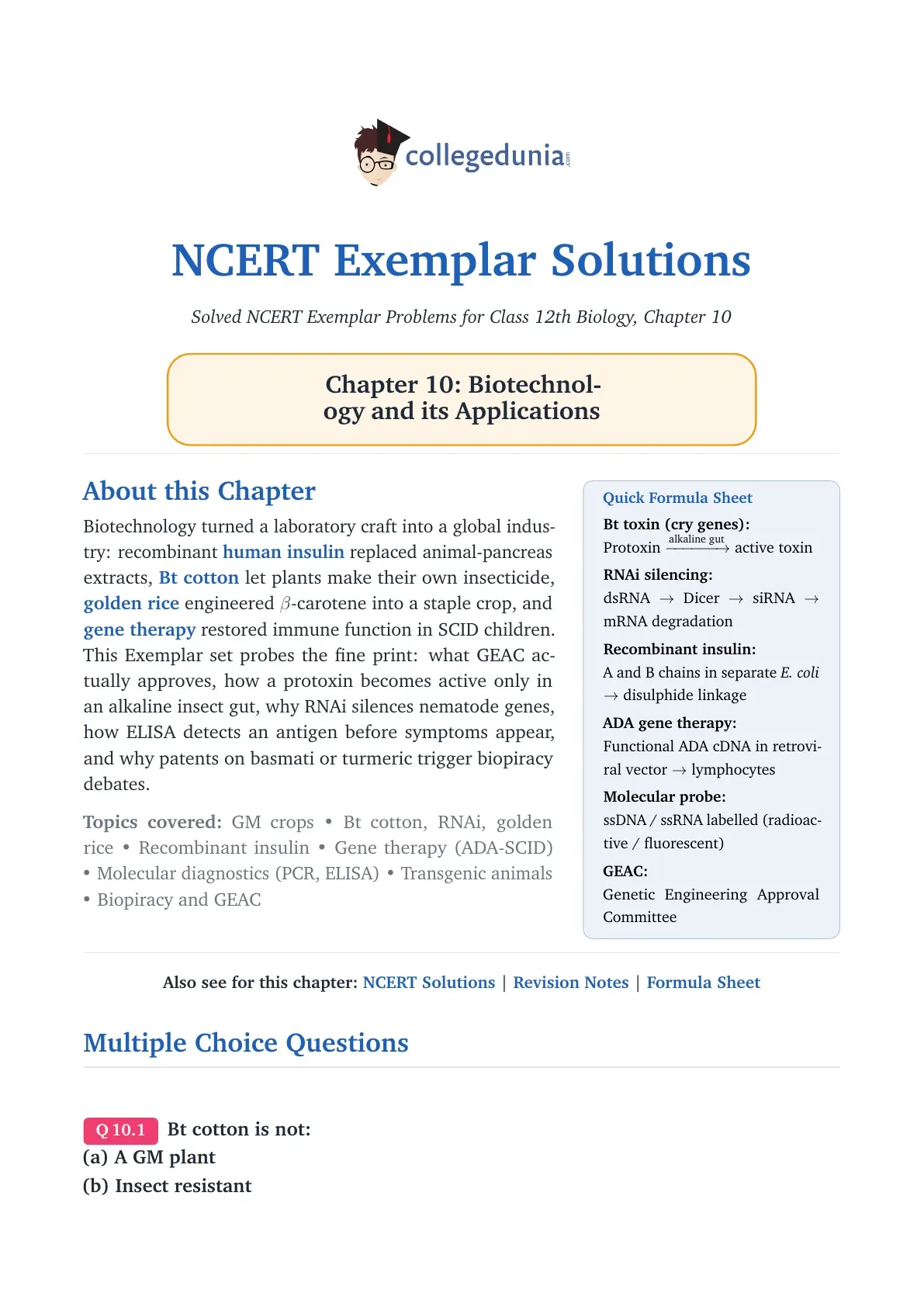
The NCERT Exemplar Class 12 Biology Solutions Chapter 10 Biotechnology and its Applications (Exemplar Chapter 12) work through every MCQ, MCQ-II, very-short-answer, short-answer, and long-answer problem in the Exemplar problems book mapped to the 2026-27 NCERT print. The Exemplar covers Bt crops, Cry proteins, RNAi, Humulin, gene therapy, transgenic animals and biopiracy with deeper conceptual stems than the main textbook.
- NEET Coverage: Exemplar MCQs are the closest practice to NEET-format MCQs; 2-3 NEET stems per year trace directly to this set.
- Total Problems Solved: 30+ across MCQ, MCQ-II, VSA, SA and LA formats.

The Exemplar uses tougher distractors than the NCERT exercises and asks for diagrams more often. Use this set after you finish the main NCERT Solutions.
Biotechnology and Its Applications NCERT Exemplar Video Solutions for Class 12 Biology
Source: Magnet Brains on YouTube
NCERT Exemplar Class 12 Biology Solutions Chapter 10 Biotechnology and its Applications: Question-Type Map
The Exemplar splits problems into five buckets. The table below tells you how many problems of each type the Exemplar chapter contains and how the Collegedunia answer set treats them.
| Question Type | Count | Length of Solution | NEET / CBSE Relevance |
|---|---|---|---|
| MCQ (single correct) | 10 | Short - reason + correct option | NEET-style |
| MCQ-II (more than one correct) | 5 | Short - each option analysed | NEET-style |
| Very Short Answer (VSA) | 5 | 1-3 sentences | CBSE 1-mark |
| Short Answer (SA) | 6 | 5-8 sentences, diagram if applicable | CBSE 2-3 mark |
| Long Answer (LA) | 4 | Full structured answer + diagram | CBSE 5-mark |
Class 12 Biology Exemplar Chapter 10: Highlight Solved MCQs
Correct answer: the protoxin form is solubilised only at the alkaline pH of the insect midgut. The bacterial cytoplasm is near-neutral, so the protoxin stays in crystal form there and does not attack the host bacterium.
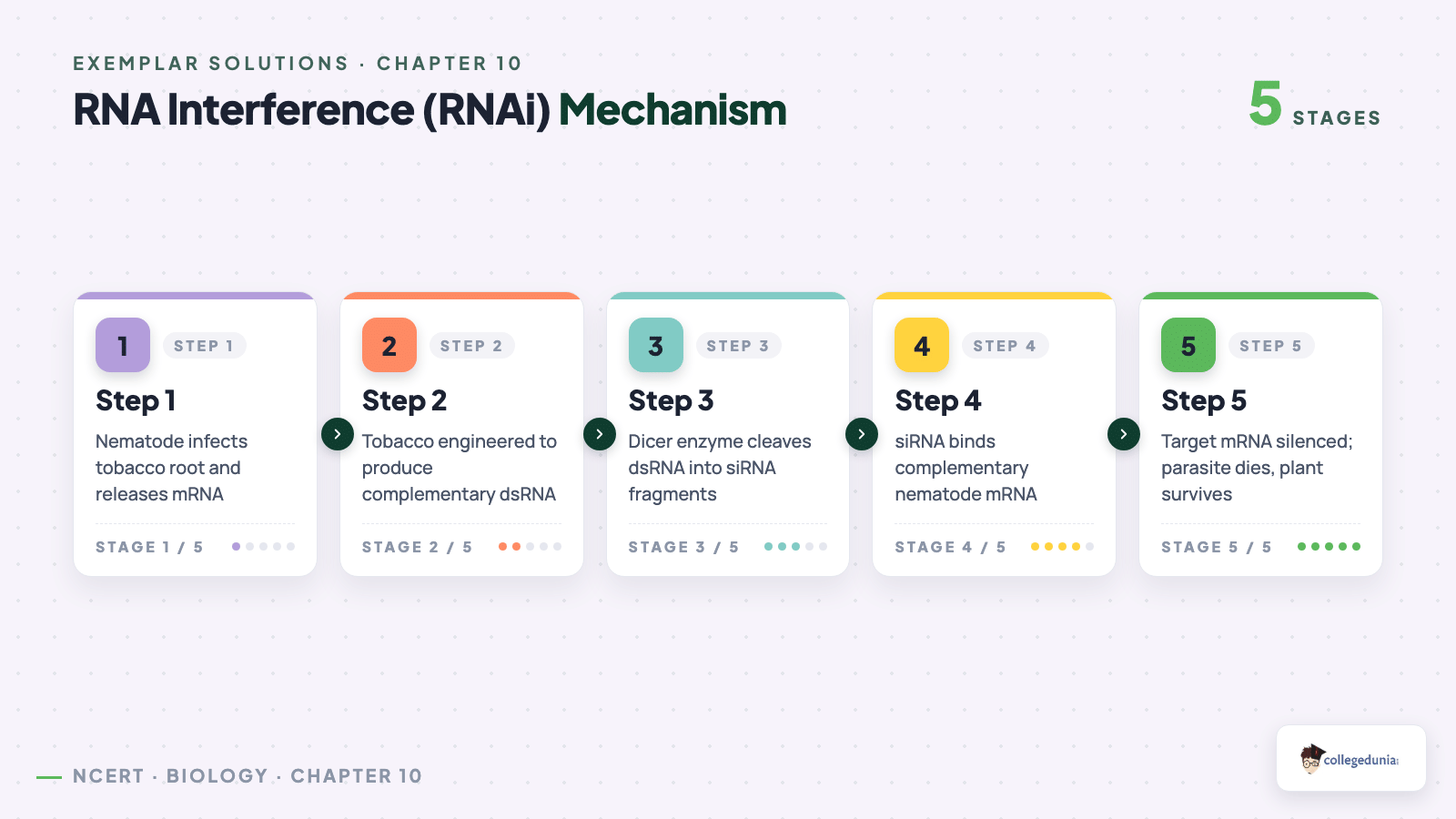
Correct: (a) and (b) - both are required to form the double-stranded RNA that triggers RNAi silencing of nematode mRNA.
Sample Solved Short-Answer Problems from Class 12 Biology Exemplar Chapter 10
Two SA problems anchor the chapter. Both have been re-asked in some form in CBSE board papers in the last three years.
- Why is the Cry protein in Bacillus thuringiensis not toxic to the bacterium itself?
The protein is stored as an inactive crystal (protoxin) in the bacterial cell. Activation requires solubilisation in alkaline pH, which the bacterial cytoplasm does not provide. The toxin therefore becomes active only inside the insect midgut, where alkaline conditions exist. - What advantage does PCR offer over ELISA for early HIV detection?
PCR amplifies the HIV nucleic acid directly, so very low viral loads can be detected before the body has had time to produce antibodies. ELISA can only detect once antibody levels rise, which can take weeks. PCR is therefore the early-detection tool.
Sample Solved Long-Answer Problem from the Exemplar
The LA problem on rDNA insulin and gene therapy carries the most marks. Below is the structured five-part answer the Exemplar expects.
- Insulin chains: A chain has 21 amino acids; B chain has 30. They are linked by disulphide bridges.
- rDNA route: DNA sequences for A and B chains synthesised separately, inserted into plasmids of E. coli, expressed independently, then combined in vitro by formation of disulphide bridges. C-peptide step is skipped.
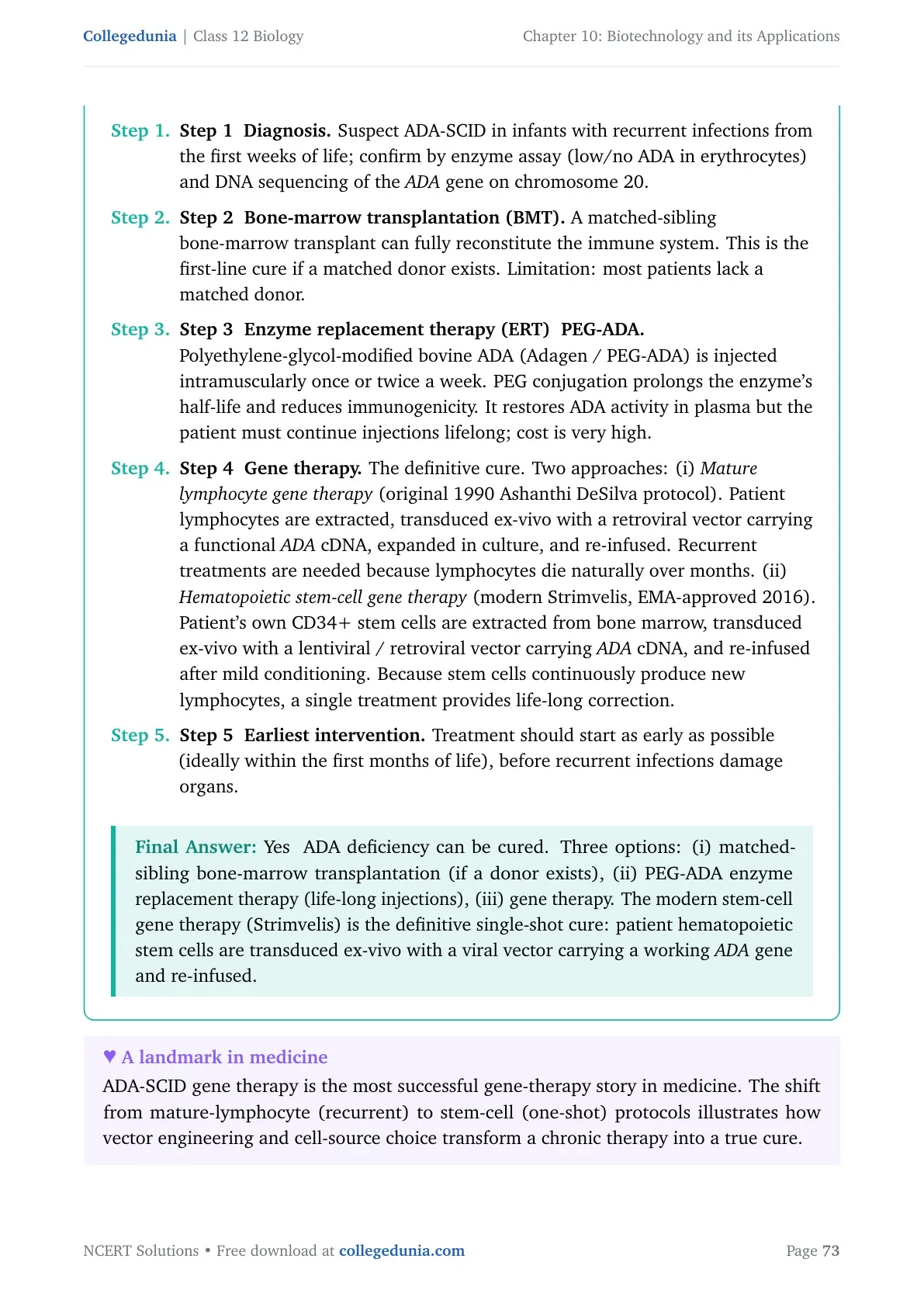
- ADA-SCID route: Functional ADA cDNA introduced into a retroviral vector. The vector is used to introduce the gene into the patient's lymphocytes ex vivo. Modified lymphocytes are infused back.
- Contrast: rDNA insulin uses a bacterial host to mass-produce a protein hormone. Gene therapy modifies the patient's own cells to express a missing enzyme.
- Limitation of ADA therapy: Lymphocytes are not immortal, so periodic infusions are needed. Permanent cure would require gene insertion at the embryonic stem cell stage.
Common Mistakes in Class 12 Biology Exemplar Chapter 10 Problems
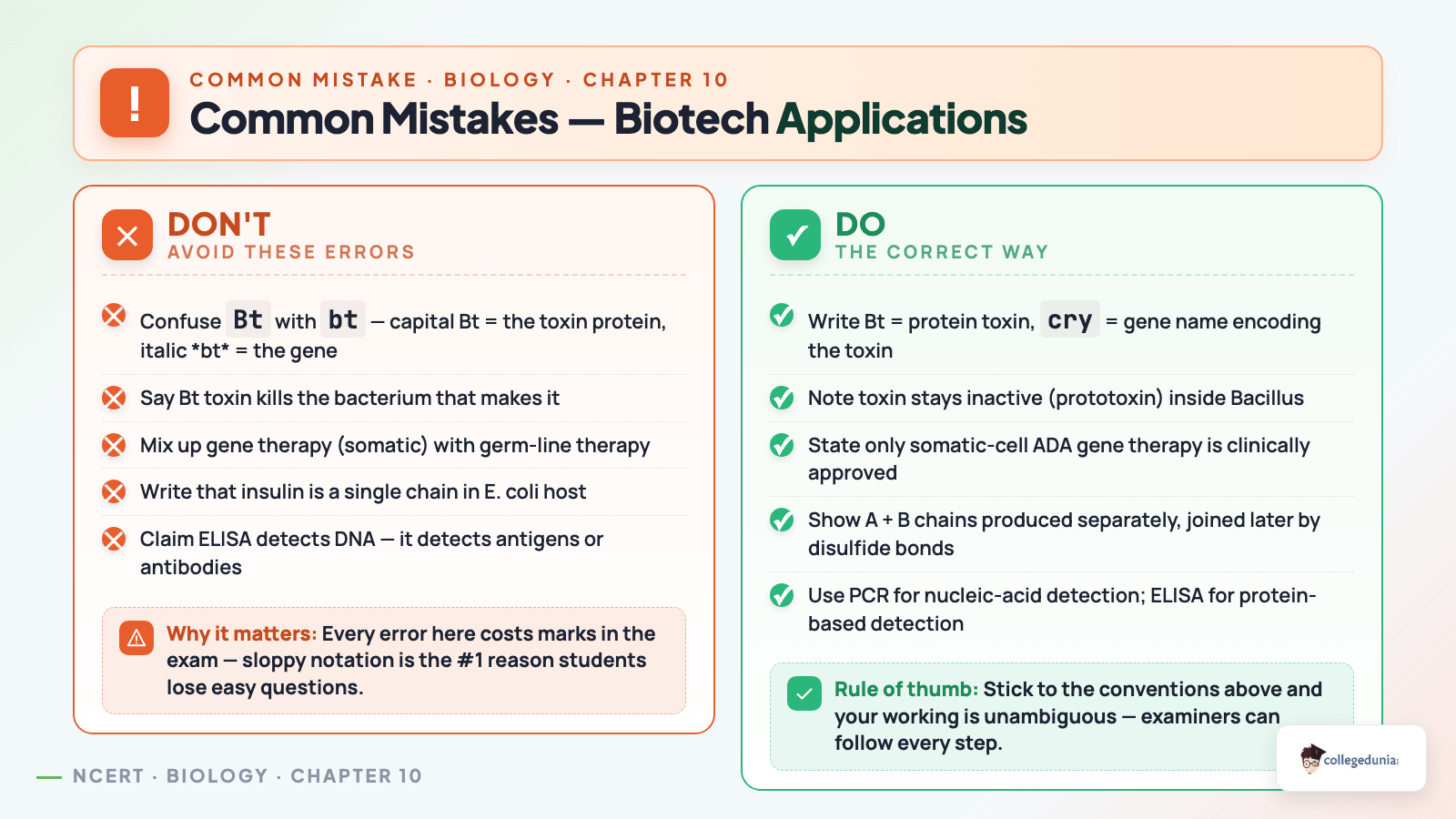
- Marking only "antisense RNA" in the RNAi MCQ-II - the correct answer requires both sense and antisense RNA.
- Confusing somatic gene therapy with germ-line editing in the long answer.
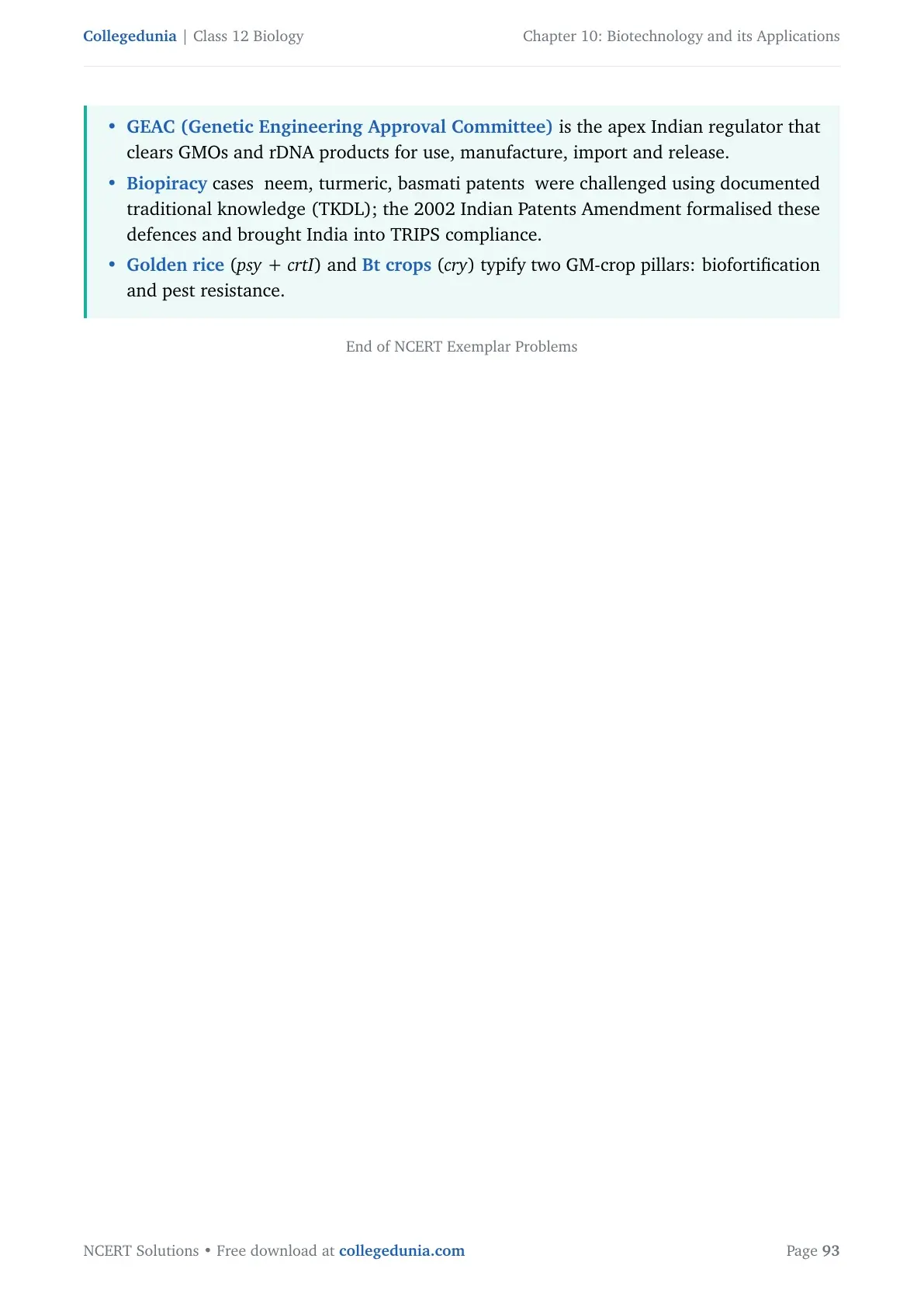
- Writing "Cry protein kills the bacterium" - it does not, because the bacterial pH is not alkaline enough to solubilise the crystal.
- Writing "ELISA is more sensitive than PCR" - PCR is the more sensitive tool for early detection.
How Collegedunia's Exemplar Solutions Strengthen Your Biotechnology Prep
The Exemplar set is harder than the NCERT exercises because the distractors look right at first glance. The Collegedunia answer set marks each distractor with a one-line reason for elimination, which trains the elimination instinct that NEET MCQs reward. Pair this with the Exemplar Book PDF to read the original problem set.
Important Topics Mapping (Exemplar to NEET PYQ)
| Exemplar Topic | Last NEET Year Tested | Stem Type |
|---|---|---|
| Cry protein activation pH | 2025 | MCQ |
| RNAi against nematode | 2023 | MCQ-II |
| Insulin chain lengths | 2024 | MCQ |
| ADA-SCID gene therapy | 2022 | Assertion-Reason |
| GEAC role | 2022 | MCQ |
| Biopiracy examples | 2021 | MCQ |
Other Resources for Biotechnology and Its Applications Class 12 Biology
| Resource | Link |
|---|---|
| Exemplar Solutions | Biotechnology and Its Applications Exemplar Solutions |
| NCERT Solutions | Class 12 Biology Chapter 10 NCERT Solutions |
| Notes | Class 12 Biology Chapter 10 Notes |
| Formula Sheet | Class 12 Biology Chapter 10 Formula Sheet |
| Handwritten Notes | Class 12 Biology Chapter 10 Handwritten Notes |
| NCERT Book PDF | Class 12 Biology Chapter 10 NCERT Book PDF |
| Exemplar Book PDF | Class 12 Biology Chapter 10 Exemplar Book PDF |
All NCERT Exemplar Questions for Biotechnology and its Applications with Step-by-Step Solutions
Every question of the NCERT Exemplar set for Class 12 Biology Chapter 10 Biotechnology and its Applications is listed below with its full Solution and Expert Solution hidden inside collapsible tabs. Click Check Solution to reveal the step-by-step working; click Expert Solution for the expanded explanation.
Multiple Choice Questions
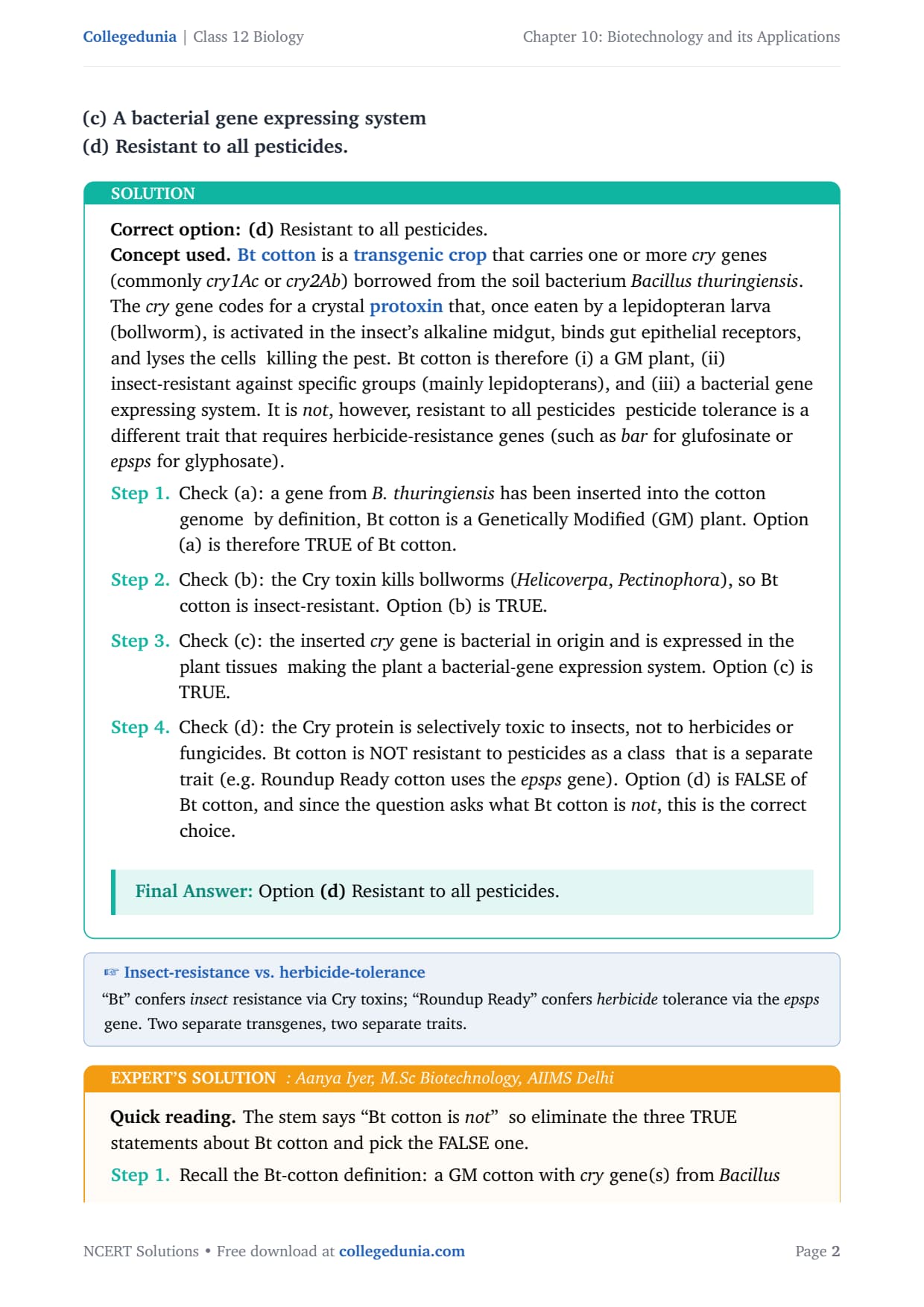
Bt cotton is not:
(a) A GM plant
(b) Insect resistant
(c) A bacterial gene expressing system
(d) Resistant to all pesticides.
Correct option: (d) Resistant to all pesticides.
Concept used. Bt cotton is a transgenic crop that carries one or more cry genes (commonly cry1Ac or cry2Ab) borrowed from the soil bacterium Bacillus thuringiensis. The cry gene codes for a crystal protoxin that, once eaten by a lepidopteran larva (bollworm), is activated in the insect's alkaline midgut, binds gut epithelial receptors, and lyses the cells - killing the pest. Bt cotton is therefore (i) a GM plant, (ii) insect-resistant against specific groups (mainly lepidopterans), and (iii) a bacterial gene expressing system. It is not, however, resistant to all pesticides - pesticide tolerance is a different trait that requires herbicide-resistance genes (such as bar for glufosinate or epsps for glyphosate).
- Check (a): a gene from B. thuringiensis has been inserted into the cotton genome - by definition, Bt cotton is a Genetically Modified (GM) plant. Option (a) is therefore TRUE of Bt cotton.
- Check (b): the Cry toxin kills bollworms (Helicoverpa, Pectinophora), so Bt cotton is insect-resistant. Option (b) is TRUE.
- Check (c): the inserted cry gene is bacterial in origin and is expressed in the plant tissues - making the plant a bacterial-gene expression system. Option (c) is TRUE.
- Check (d): the Cry protein is selectively toxic to insects, not to herbicides or fungicides. Bt cotton is NOT resistant to pesticides as a class - that is a separate trait (e.g. Roundup Ready cotton uses the epsps gene). Option (d) is FALSE of Bt cotton, and since the question asks what Bt cotton is not, this is the correct choice.
Option (d) Resistant to all pesticides.
Quick reading. The stem says ``Bt cotton is not'' - so eliminate the three TRUE statements about Bt cotton and pick the FALSE one.
- Recall the Bt-cotton definition: a GM cotton with cry gene(s) from Bacillus thuringiensis. By definition this satisfies (a), (b) and (c).
- Apply selectivity logic: the Cry toxin acts on the lepidopteran gut and has no effect on weeds, fungi, or chemical pesticides. So pesticide-resistance is not part of the Bt trait.
- Conclude: only (d) is FALSE about Bt cotton, so (d) is the correct ``is not'' answer.
- Connect to other Exemplar items: the same principle reappears in nearby questions of this chapter, so a clean grasp here pays dividends across the section.
Why this matters. In real fields, Bt cotton still requires fungicide and herbicide sprays - the only thing it does on its own is fend off bollworms. Misreading ``insect resistance'' as ``all-pesticide resistance'' is the single most common bias farmers and students bring to the topic.
Deeper insight. The biotechnological principle behind this question recurs across the chapter: a defined biological tool (a microbe, an enzyme, a vector, a probe, a Cry protein, a recombinant antigen) is mobilised to solve a problem that conventional methods cannot solve cleanly. Whenever the Exemplar describes a method or product, locate the underlying tool first, then ask what natural limitation it sidesteps. This single discipline turns dense factual recall into a short, principled answer that examiners reward.
Bt cotton is not resistant to all pesticides - option (d).
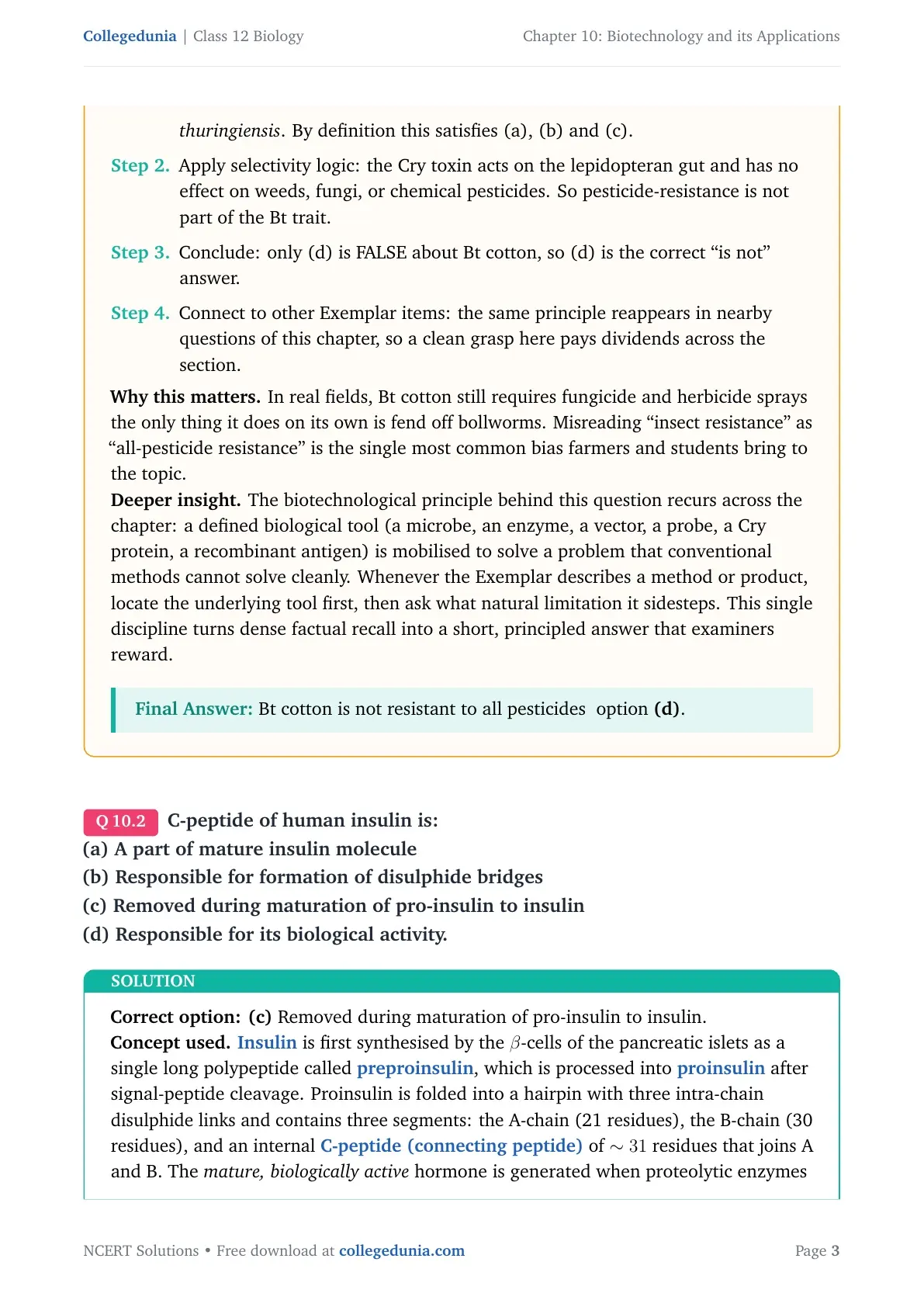
C-peptide of human insulin is:
(a) A part of mature insulin molecule
(b) Responsible for formation of disulphide bridges
(c) Removed during maturation of pro-insulin to insulin
(d) Responsible for its biological activity.
Correct option: (c) Removed during maturation of pro-insulin to insulin.
Concept used. Insulin is first synthesised by the β-cells of the pancreatic islets as a single long polypeptide called preproinsulin, which is processed into proinsulin after signal-peptide cleavage. Proinsulin is folded into a hairpin with three intra-chain disulphide links and contains three segments: the A-chain (21 residues), the B-chain (30 residues), and an internal C-peptide (connecting peptide) of ∼ 31 residues that joins A and B. The mature, biologically active hormone is generated when proteolytic enzymes excise the C-peptide, leaving only the A and B chains joined by disulphide bridges. The C-peptide itself does not appear in mature insulin.
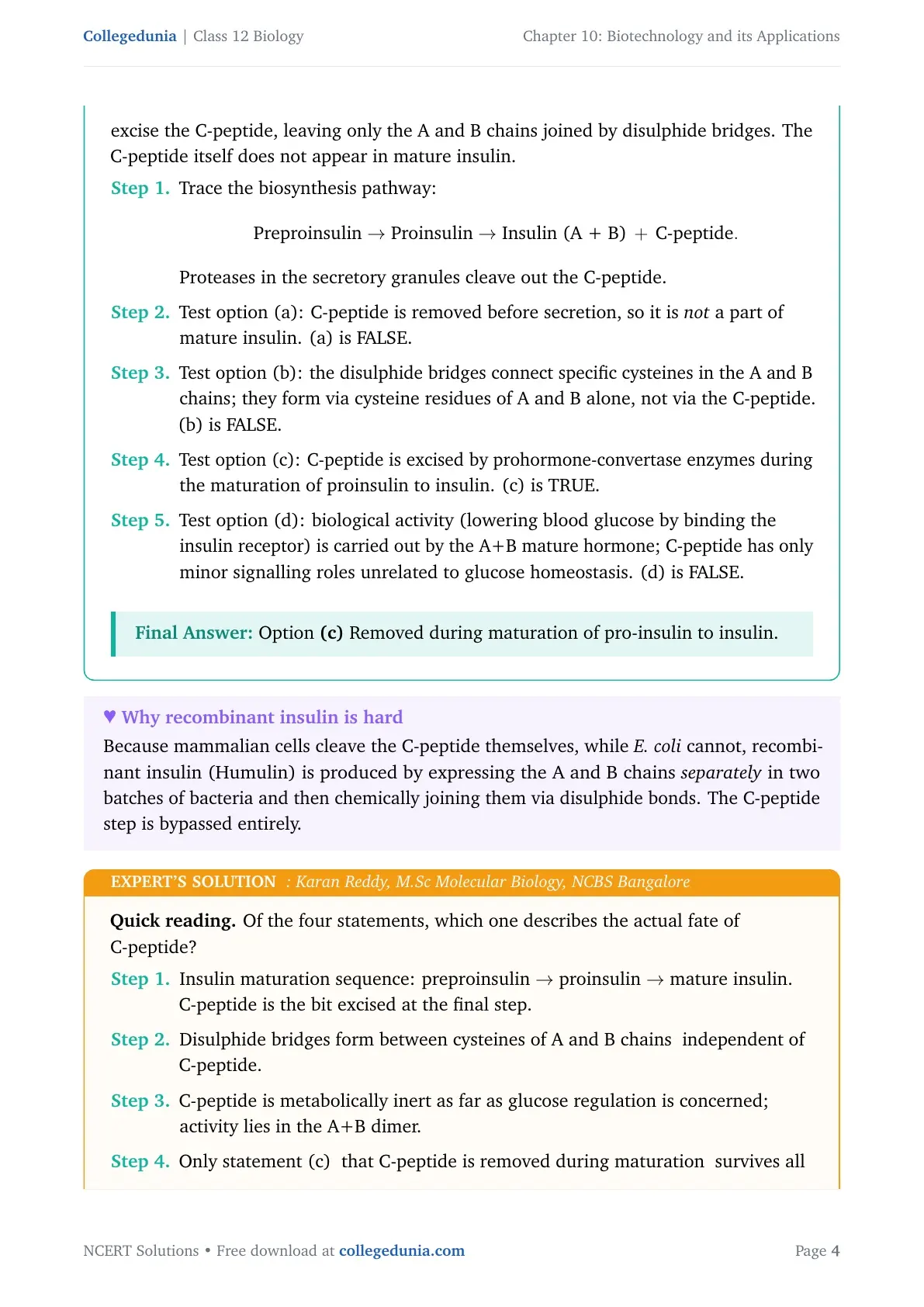
- Trace the biosynthesis pathway: Preproinsulin → Proinsulin → Insulin (A + B) + C-peptide. Proteases in the secretory granules cleave out the C-peptide.
- Test option (a): C-peptide is removed before secretion, so it is not a part of mature insulin. (a) is FALSE.
- Test option (b): the disulphide bridges connect specific cysteines in the A and B chains; they form via cysteine residues of A and B alone, not via the C-peptide. (b) is FALSE.
- Test option (c): C-peptide is excised by prohormone-convertase enzymes during the maturation of proinsulin to insulin. (c) is TRUE.
- Test option (d): biological activity (lowering blood glucose by binding the insulin receptor) is carried out by the A+B mature hormone; C-peptide has only minor signalling roles unrelated to glucose homeostasis. (d) is FALSE.
Option (c) Removed during maturation of pro-insulin to insulin.
Quick reading. Of the four statements, which one describes the actual fate of C-peptide?
- Insulin maturation sequence: preproinsulin → proinsulin → mature insulin. C-peptide is the bit excised at the final step.
- Disulphide bridges form between cysteines of A and B chains - independent of C-peptide.
- C-peptide is metabolically inert as far as glucose regulation is concerned; activity lies in the A+B dimer.
- Only statement (c) - that C-peptide is removed during maturation - survives all tests.
- Anchor with a named example: NCERT's chosen case study (whichever one applies here) is the single fastest route to full marks - quote it explicitly.
Why this matters. Clinically, serum C-peptide is measured to test if a diabetic still produces any endogenous insulin: high C-peptide → active β-cells (Type 2); low C-peptide → destroyed β-cells (Type 1). The remnant peptide is a useful marker even though it is biologically inert.
Deeper insight. NCERT's Class 12 Biotechnology Applications chapter treats every example as a paired triad: biological agent (organism / molecule / gene), mechanism (what it does at the molecular level), and outcome (the human benefit or product). Re-cast every question's answer in those three pieces and you give examiners a complete, well-organised reply. This question's triad is worth fixing in memory and re-using on related items elsewhere in the chapter.
C-peptide is removed during maturation of pro-insulin to insulin (option c).
GEAC stands for:
(a) Genome Engineering Action Committee
(b) Ground Environment Action Committee
(c) Genetic Engineering Approval Committee
(d) Genetic and Environment Approval committee.
Correct option: (c) Genetic Engineering Approval Committee.
Concept used. GEAC is the apex Indian regulatory body that sits under the Ministry of Environment, Forest and Climate Change. Its remit is to approve the use, large-scale production, and environmental release of Genetically Modified Organisms (GMOs) and products derived from them. It evaluates field trials of Bt crops, the import of GM foods, biosafety dossiers, and confined R&D on hazardous microorganisms. As of 2024 it has been renamed Genetic Engineering Appraisal Committee in policy documents, but NCERT continues to use the original full form ``Genetic Engineering Approval Committee''.
- Recall the full form taught in NCERT: Genetic Engineering Approval Committee.
- Compare with the options: (a) and (b) start with the wrong words (``Genome'', ``Ground''); (d) reverses ``Genetic and Environment'' which is not the body's title.
- Only (c) matches the official NCERT expansion.
Option (c) Genetic Engineering Approval Committee.
Quick reading. Match the abbreviation to the NCERT-stated full form.
- GEAC = Genetic Engineering Approval Committee - verbatim from the NCERT chapter ``Ethical Issues''.
- Distractors are constructed by swapping ``genome / ground / approval / environment'' - only (c) preserves the actual phrase.
- Map back to the rDNA toolkit (restriction enzymes, ligase, vector, host, PCR): every biotech application leans on at least one of these five tools, and naming the relevant one strengthens the answer.
Why this matters. GEAC's role is examined in NEET and CBSE board exams as the single national authority that decides whether a GM crop (e.g. Bt brinjal) can be released - it is the symbolic check between biotech labs and Indian fields.
Deeper insight. The strength of modern biotechnology is precision: a single gene, a single mutation, a single recombinant protein can be introduced or detected, instead of perturbing the whole organism. Recognising that this question hinges on a single targeted change - and naming that change precisely - separates a top-band answer from a vague one. The diagnostic / therapeutic / agricultural deployment of that single change is then a one-line conclusion.
GEAC = Genetic Engineering Approval Committee (option c).
α-1 antitrypsin is:
(a) An antacid
(b) An enzyme
(c) Used to treat arthritis
(d) Used to treat emphysema.
Correct option: (d) Used to treat emphysema.
Concept used. α-1 antitrypsin (AAT) is a serine-protease inhibitor (not an enzyme) synthesised mainly in the liver and circulated in plasma. Its principal physiological role is to neutralise neutrophil elastase in the lungs, protecting alveolar walls from being digested by the body's own protease. A genetic deficiency of AAT leads to uninhibited elastase activity, alveolar destruction, and emphysema (a form of COPD). Therapeutic AAT - now produced commercially as a transgenic protein in milk of cattle and goats - is administered to AAT-deficient patients as augmentation therapy to slow emphysema progression.
- Test (a): an antacid neutralises stomach acid (e.g. aluminium hydroxide). AAT does no such thing. FALSE.
- Test (b): AAT is a protease inhibitor, not an enzyme. Enzymes catalyse reactions; inhibitors block enzymes. FALSE.
- Test (c): arthritis treatment uses NSAIDs, DMARDs (methotrexate), biologics (anti-TNF). AAT plays no clinical role here. FALSE.
- Test (d): AAT augmentation therapy is the standard treatment for hereditary AAT-deficiency emphysema. TRUE.
Option (d) Used to treat emphysema.
Quick reading. α-1 antitrypsin is a recombinant protein with a single famous use.
- Recall its target enzyme: neutrophil elastase, secreted in the lung. AAT inhibits it.
- Recall the disease of AAT deficiency: emphysema (destruction of alveoli by uninhibited elastase).
- Therefore the therapeutic use is to treat emphysema in AAT-deficient patients.
- Apply the safety / ethics lens: every modern biotech deployment passes a biosafety, regulatory or ethical filter (GEAC clearance, allergenicity testing, patent compliance) - mention the relevant filter when the question allows.
Why this matters. AAT is the textbook example of an enzyme inhibitor (not an enzyme) used clinically as a recombinant protein - a small but high-yield NEET fact.
Deeper insight. Two recurring themes connect this question to the chapter's larger story: (i) genetic information can be moved across species in ways evolution never permits, and (ii) molecular tools (probes, PCR, antibodies, Cry proteins, retroviral vectors) act with exquisite specificity that broad chemical methods cannot match. Naming both themes briefly, where relevant, demonstrates synthesis and earns marks.
α-1 antitrypsin is used to treat emphysema (option d).
A probe which is a molecule used to locate homologous sequences in a mixture of DNA or RNA molecules could be:
(a) A ssRNA
(b) A ssDNA
(c) Either RNA or DNA
(d) Can be ssDNA but not ssRNA.
Correct option: (c) Either RNA or DNA.
Concept used. A molecular probe is a short, single-stranded nucleic acid carrying a detectable label (radioactive 32P, biotin, fluorophore, or chemiluminescent tag) used to find a complementary target sequence by molecular hybridization. Because base-pairing is the same whether the partner is DNA or RNA (A–T, A–U, G–C), probes can be made of either single-stranded DNA (ssDNA, common in Southern blots and microarrays) or single-stranded RNA (ssRNA, common in Northern blots and in-situ hybridization, where it is called a riboprobe).
- Recall the hybridization rule: complementary single-stranded sequences anneal via H-bonds (Watson–Crick base pairing). The chemistry does not care whether the probe backbone is DNA or RNA.
- Practical examples - ssDNA probes: Southern blot, FISH (fluorescence in-situ hybridization), DNA microarrays. ssRNA (riboprobe) probes: Northern blot, in-situ mRNA detection.
- Eliminate options: (a) only ssRNA - too restrictive; ssDNA probes are common. (b) only ssDNA - too restrictive; riboprobes exist. (d) ``not ssRNA'' contradicts the existence of riboprobes.
- Only (c) - either RNA or DNA - covers the practice.
Option (c) Either RNA or DNA.
Quick reading. Can probes be DNA, RNA, or both?
- Hybridization needs a single-stranded sequence complementary to the target. Backbone (deoxyribose vs ribose) is irrelevant.
- In labs, ssDNA probes are commoner (Southern, microarrays); ssRNA probes are used for in-situ hybridization and Northern blots.
- So probes can be either - option (c).
- Note the public-health or agricultural impact: framing the answer in terms of concrete human benefit (lives saved, yield gained, pesticide avoided, nutrient enriched) lifts a factual answer into an application-rich one.
Why this matters. A probe is the universal sequence-detector in molecular biology - used in genetic screens, infectious disease diagnostics, GMO testing, and forensics. Knowing it can be made of either nucleic acid widens its scope considerably.
Deeper insight. A useful test of any biotech claim is to compare it against the corresponding pre-biotech method - the difference is almost always cost, safety, scale, purity or ethics. Articulating that contrast explicitly (animal insulin vs. recombinant insulin; chemical pesticide vs. Bt; PCR vs. culture) turns memorised facts into a reasoned comparison, which board examiners reliably reward over plain recall.
Probes can be ssDNA or ssRNA - option (c).
Choose the correct option regarding Retrovirus:
(a) An RNA virus that synthesises DNA during infection
(b) A DNA virus that synthesises RNA during infection
(c) A ssDNA virus
(d) A dsRNA virus.
Correct option: (a) An RNA virus that synthesises DNA during infection.
Concept used. A retrovirus is an enveloped RNA virus whose genome is single-stranded positive-sense RNA. Inside the host cell, it carries (and packages) the enzyme reverse transcriptase (RNA-dependent DNA polymerase) that transcribes the viral RNA backwards into double-stranded DNA. This proviral DNA is then integrated into the host genome by another viral enzyme, integrase. The classic textbook example is HIV; another well-known retrovirus is the murine leukaemia virus (MLV) used as a gene-therapy vector.
- Identify the genome: ssRNA(+).
- Identify the unique enzyme: reverse transcriptase, which makes DNA from the RNA template (the retro step).
- Identify the next step: integrase splices the cDNA into host DNA as a provirus; host RNA-polymerase then transcribes it to make new viral RNA and proteins.
- Compare options: (b) describes the normal flow of DNA viruses; (c) and (d) misidentify the genome chemistry. Only (a) captures the retroviral hallmark.
Option (a) An RNA virus that synthesises DNA during infection.
Quick reading. The defining feature of a retrovirus is the retro step: RNA → DNA.
- Retrovirus = RNA genome + reverse transcriptase + integrase.
- RNA → DNA (this is the ``retro''-flow of information).
- Match to the option that says ``RNA virus synthesises DNA'' - only (a).
- Use the contrast with conventional alternatives: if a chemical pesticide, animal source or culture-based diagnosis would have been used pre-biotech, name it briefly to highlight what the biotech route improves.
Why this matters. Retroviruses inverted the classical ``DNA → RNA → protein'' central dogma, leading directly to the discovery of reverse transcriptase (a foundational tool of cDNA cloning and qRT-PCR).
Deeper insight. The same molecular logic - sequence complementarity for probes and primers, receptor recognition for Cry proteins, antigen–antibody specificity for ELISA, RNAi for silencing - appears again and again under different application headings. Spotting the shared logic across the chapter's vocabulary list (probe, primer, antigen, ligand, Cry, antibody, siRNA) collapses long lists into one principle: specific molecular recognition does the work.
Retroviruses are RNA viruses that synthesise DNA during infection - option (a).
The site of production of ADA in the body is:
(a) Erythrocytes
(b) Lymphocytes
(c) Blood plasma
(d) Osteocytes.
Correct option: (b) Lymphocytes.
Concept used. Adenosine deaminase (ADA) is a purine-metabolism enzyme that breaks down toxic deoxyadenosine into deoxyinosine. While ADA is expressed in many tissues at low levels, its physiologically critical site is the lymphocyte (both B and T cells), where high ADA activity is essential for normal lymphocyte maturation and function. ADA deficiency therefore selectively cripples the immune system, producing the disease Severe Combined Immunodeficiency (SCID) - children with no working immunity, requiring sterile-bubble isolation or treatment by gene therapy / enzyme replacement / bone-marrow transplant.
- Identify the enzyme: ADA = adenosine deaminase, part of the purine-salvage pathway.
- Identify the dominant site: lymphocytes (T and B cells of the immune system) - they show the highest ADA activity in the body.
- Eliminate distractors: erythrocytes have ADA but at lower levels; blood plasma is not a producing tissue (it is fluid); osteocytes are bone cells, unrelated to immunity.
- Connect to disease: ADA-deficient lymphocytes cannot mature, hence SCID.
Option (b) Lymphocytes.
Quick reading. Where is the enzyme that, when missing, destroys the immune system?
- ADA is essential for lymphocyte function - they are the highest-expressing cells.
- Loss of lymphocyte ADA → SCID (no B / T immunity).
- Hence (b) lymphocytes.
- Connect to other Exemplar items: the same principle reappears in nearby questions of this chapter, so a clean grasp here pays dividends across the section.
Why this matters. The first ever clinical gene therapy (1990, Ashanthi DeSilva) targeted a defective ADA gene in lymphocytes - making this fact directly testable in NEET via the gene-therapy storyline.
Deeper insight. Indian biotech policy (GEAC, the 2002 Patents Act amendment, the Traditional Knowledge Digital Library, the Biological Diversity Act) sits behind every applied biotech story in this chapter. Where a question touches on ethics, regulation or biopiracy, briefly anchoring the answer in the relevant law or institution shows the wider context examiners look for in long-answer questions.
ADA is produced principally by lymphocytes (option b).
A protoxin is:
(a) A primitive toxin
(b) A denatured toxin
(c) Toxin produced by protozoa
(d) Inactive toxin.
Correct option: (d) Inactive toxin.
Concept used. A protoxin is the inactive precursor form in which many microbial toxins are first synthesised. It carries the full toxin sequence plus an additional ``pro''-region whose presence blocks the toxic activity. Only after a specific physiological trigger - proteolytic cleavage, pH change, or interaction with a receptor - is the pro-region removed, generating the active toxin. The classical biotech example is the Cry protoxin of Bacillus thuringiensis: it is harmless inside the bacterium itself, but the alkaline pH of an insect's midgut (and gut proteases) cleaves it into the active toxin that perforates the insect-gut cell membrane.
- Define the term: ``proto-'' = first / precursor. ``Protoxin'' = an early, inactive form of a toxin.
- Mechanism of activation: limited proteolysis or chemical change releases the active toxin from the precursor.
- Example: Bt Cry protoxin activated in the alkaline pH of the lepidopteran midgut.
- Eliminate distractors: (a) ``primitive'' is wrong vocabulary; (b) denatured = damaged, also not the meaning; (c) protozoa are unrelated; (d) ``inactive toxin'' matches the precursor definition exactly.
Option (d) Inactive toxin.
Quick reading. ``Pro''-anything = precursor. A protoxin is therefore an inactive precursor of a toxin.
- Parse the prefix: ``pro-'' signals a precursor (compare proenzyme = zymogen, pro-insulin, pro-collagen).
- Conclude: a protoxin is an inactive toxin awaiting activation.
- Pick (d).
- Anchor with a named example: NCERT's chosen case study (whichever one applies here) is the single fastest route to full marks - quote it explicitly.
Why this matters. Without the protoxin trick, Bacillus thuringiensis could not coexist with the very toxin it makes - and Bt cotton would not work. The pH-sensitive activation explains why Bt toxin is selectively lethal to insects (alkaline midgut) but harmless to humans (acidic stomach).
Deeper insight. The repeated NCERT pairing of an Indian example with a global counterpart (basmati patent, neem patent, turmeric patent, Bt cotton's Indian adoption, Bt brinjal's Indian moratorium) is intended to anchor abstract biotech vocabulary in the Indian context. Quoting at least one Indian example - even when the question is generic - distinguishes a chapter-aware answer from a textbook-only one.
A protoxin is an inactive (precursor) toxin - option (d).
Pathophysiology is the:
(a) Study of physiology of pathogen
(b) Study of normal physiology of host
(c) Study of altered physiology of host
(d) None of the above.
Correct option: (c) Study of altered physiology of host.
Concept used. Pathophysiology (Greek pathos = suffering / disease + physiology) is the branch of medicine that studies the altered, abnormal functioning of a body, organ or cell that occurs as a result of a disease process. It bridges basic physiology (how things work normally) and clinical medicine (how to treat) by explaining the mechanisms by which a disease produces its symptoms and signs. For example, the pathophysiology of cystic fibrosis is the impaired chloride-channel function (CFTR mutation) that thickens airway mucus.
- Decompose the word: patho- = disease + physio-logy = study of body functions.
- Pick the matching option: physiology altered by disease in the host - option (c).
- Eliminate distractors: (a) refers to microbial physiology; (b) is plain physiology, not pathophysiology; (d) is wrong since (c) is correct.
Option (c) Study of altered physiology of host.
Quick reading. Pathophysiology = the mechanism by which a disease changes how the body works.
- ``Patho'' = disease; ``physiology'' = how the body functions.
- Therefore pathophysiology = study of disease-altered host physiology.
- Option (c).
- Map back to the rDNA toolkit (restriction enzymes, ligase, vector, host, PCR): every biotech application leans on at least one of these five tools, and naming the relevant one strengthens the answer.
Why this matters. Understanding pathophysiology is what lets molecular diagnostics work - PCR, ELISA and recombinant DNA probes target the specific molecular changes that disease creates in host tissues.
Deeper insight. The biotechnological principle behind this question recurs across the chapter: a defined biological tool (a microbe, an enzyme, a vector, a probe, a Cry protein, a recombinant antigen) is mobilised to solve a problem that conventional methods cannot solve cleanly. Whenever the Exemplar describes a method or product, locate the underlying tool first, then ask what natural limitation it sidesteps. This single discipline turns dense factual recall into a short, principled answer that examiners reward.
Pathophysiology = study of altered physiology of host (option c).
The trigger for activation of toxin of Bacillus thuringiensis is:
(a) Acidic pH of stomach
(b) High temperature
(c) Alkaline pH of gut
(d) Mechanical action in the insect gut.
Correct option: (c) Alkaline pH of gut.
Concept used. Bacillus thuringiensis (Bt) produces its Cry insecticidal protein as an inactive crystal protoxin. When an insect larva (typically a lepidopteran caterpillar) eats Bt-treated leaves, the protoxin enters the larva's midgut. Unlike the mammalian stomach (pH 1–3, strongly acidic), the lepidopteran midgut is strongly alkaline (pH 9–10.5). This alkaline environment solubilises the crystal and activates gut proteases that cleave the protoxin into the smaller, active Cry toxin. The active toxin then binds receptors on midgut epithelial cells, inserts into the membrane, forms pores, and lyses the cells - killing the larva. Because the human stomach is acidic, the protoxin is harmless to us.
- Recall the Bt protoxin pathway: crystal protoxin alkaline gut + proteases active Cry toxin → binds midgut epithelium → pore formation → cell lysis.
- Identify the activating environment: the lepidopteran midgut, which is alkaline (pH 9–10.5).
- Eliminate distractors: (a) acidic stomach does not activate Cry - it would denature it; (b) temperature is not the trigger; (d) mechanical action does not chemically alter the protein.
- Conclude: alkaline pH is the trigger - (c).
Option (c) Alkaline pH of gut.
Quick reading. What chemically activates the Cry protoxin once eaten by a caterpillar?
- Cry protoxin needs (i) alkaline solubilisation, (ii) protease cleavage. Both happen in the larva's midgut (pH ∼ 10).
- Activation generates the smaller, soluble Cry toxin that punches holes in midgut cells.
- Therefore (c) - alkaline pH of gut.
- Apply the safety / ethics lens: every modern biotech deployment passes a biosafety, regulatory or ethical filter (GEAC clearance, allergenicity testing, patent compliance) - mention the relevant filter when the question allows.
Why this matters. This single pH-trigger explains both Bt cotton's efficacy on bollworms and its safety in human consumption - a high-yield NEET pairing.
Deeper insight. NCERT's Class 12 Biotechnology Applications chapter treats every example as a paired triad: biological agent (organism / molecule / gene), mechanism (what it does at the molecular level), and outcome (the human benefit or product). Re-cast every question's answer in those three pieces and you give examiners a complete, well-organised reply. This question's triad is worth fixing in memory and re-using on related items elsewhere in the chapter.
Bt protoxin is activated by the alkaline pH of the insect gut (option c).
Golden rice is:
(a) A variety of rice grown along the yellow river in China
(b) Long stored rice having yellow colour tint
(c) A transgenic rice having gene for β-carotene
(d) Wild variety of rice with yellow coloured grains.
Correct option: (c) A transgenic rice having gene for β-carotene.
Concept used. Golden rice is a biofortified transgenic rice engineered by Ingo Potrykus and Peter Beyer (1999, published 2000) to carry two genes - psy (phytoene synthase, from daffodil and later from maize) and crtI (carotene desaturase, from Erwinia uredovora) - that together complete the β-carotene biosynthetic pathway in rice endosperm. Wild rice grains are white because their endosperm cannot make β-carotene; the transgenic version accumulates β-carotene, giving the grains a yellow (``golden'') colour. Once eaten, β-carotene is converted in the human body into vitamin A, addressing the widespread vitamin-A deficiency (VAD) that causes childhood blindness and immune impairment in rice-staple countries.
- Recall the engineering: two transgenes (psy + crtI) inserted to reconstitute the carotenoid pathway in endosperm.
- Recall the phenotype: yellow-orange endosperm → ``golden'' colour from β-carotene.
- Recall the purpose: dietary precursor of vitamin A; tackle VAD in rice-staple populations.
- Eliminate distractors: (a) and (b) are geographic / storage misconceptions; (d) implies a wild type, but golden rice is engineered, not natural.
Option (c) A transgenic rice having gene for β-carotene.
Quick reading. Golden rice = engineered β-carotene in rice grain.
- Engineered via two genes (psy from plant, crtI from bacterium) introducing the β-carotene pathway into endosperm.
- Grains turn yellow (``golden'') because of β-carotene.
- Dietary β-carotene → vitamin A in humans; combats VAD.
- Note the public-health or agricultural impact: framing the answer in terms of concrete human benefit (lives saved, yield gained, pesticide avoided, nutrient enriched) lifts a factual answer into an application-rich one.
Why this matters. Golden rice exemplifies biofortification - directly engineering a nutrient into a staple - distinct from agronomic biofortification (soil fertilisation) or conventional breeding.
Deeper insight. The strength of modern biotechnology is precision: a single gene, a single mutation, a single recombinant protein can be introduced or detected, instead of perturbing the whole organism. Recognising that this question hinges on a single targeted change - and naming that change precisely - separates a top-band answer from a vague one. The diagnostic / therapeutic / agricultural deployment of that single change is then a one-line conclusion.
Golden rice is a transgenic rice engineered to make β-carotene (option c).
In RNAi, genes are silenced using:
(a) ss DNA
(b) ds DNA
(c) ds RNA
(d) ss RNA.
Correct option: (c) ds RNA.
Concept used. RNA interference (RNAi) is a sequence-specific gene-silencing mechanism that responds to double-stranded RNA (dsRNA). When dsRNA enters or is produced in a cell, the enzyme Dicer (an RNase III) cleaves it into 21–23 nt small interfering RNAs (siRNAs). One strand of the siRNA is loaded onto the RISC complex (containing Argonaute), which uses it as a guide to find and either cleave or block translation of the complementary mRNA - silencing the gene. RNAi is exploited in biotechnology (e.g. engineering nematode-resistant tobacco by expressing dsRNA targeted at a parasite-essential transcript).
- Identify the trigger: cells initiate RNAi only when they detect dsRNA (which, in animals, signals a viral infection).
- Identify the processing: Dicer cleaves the dsRNA into 21–23 nt siRNA duplexes.
- Identify the silencing step: one strand guides RISC to complementary mRNA, which is cleaved or translationally repressed.
- Eliminate options: (a) ssDNA and (b) dsDNA do not trigger RNAi; (d) ssRNA includes mRNAs themselves, which are the targets, not the triggers. Only (c) dsRNA initiates the pathway.
Option (c) ds RNA.
Quick reading. Which nucleic acid triggers gene silencing in the RNAi pathway?
- dsRNA → Dicer → siRNA → RISC → mRNA cleavage.
- Hence the triggering / silencing molecule is dsRNA - option (c).
- Use the contrast with conventional alternatives: if a chemical pesticide, animal source or culture-based diagnosis would have been used pre-biotech, name it briefly to highlight what the biotech route improves.
Why this matters. The NCERT example is the engineering of tobacco resistance to the nematode Meloidogyne incognita by host-induced expression of dsRNA targeting an essential parasite transcript - a clean illustration of RNAi being deployed as a biotech tool.
Deeper insight. Two recurring themes connect this question to the chapter's larger story: (i) genetic information can be moved across species in ways evolution never permits, and (ii) molecular tools (probes, PCR, antibodies, Cry proteins, retroviral vectors) act with exquisite specificity that broad chemical methods cannot match. Naming both themes briefly, where relevant, demonstrates synthesis and earns marks.
RNAi silences genes via dsRNA (option c).
The first clinical gene therapy was done for the treatment of:
(a) AIDS
(b) Cancer
(c) Cystic fibrosis
(d) SCID (Severe Combined Immuno Deficiency resulting from deficiency of ADA).
Correct option: (d) SCID resulting from ADA deficiency.
Concept used. The first ever clinical gene therapy was performed in 1990 at the US NIH by W. French Anderson and Michael Blaese, on a four-year-old girl, Ashanthi DeSilva, suffering from ADA-SCID (Severe Combined Immunodeficiency caused by adenosine deaminase deficiency). Her own lymphocytes were extracted, transduced ex vivo with a retroviral vector carrying a functional copy of the human ADA gene, expanded in culture, and re-infused. Because mature lymphocytes have a finite life, the procedure had to be repeated periodically. The trial was a landmark proof-of-concept for gene therapy in humans.
- Recall the patient: Ashanthi DeSilva, 1990.
- Recall the disease: ADA-SCID - a genetic immunodeficiency caused by lack of functional ADA enzyme in lymphocytes.
- Recall the procedure: ex-vivo retroviral transduction of patient lymphocytes with the wild-type ADA cDNA, re-infused.
- Eliminate distractors: AIDS, cancer and cystic fibrosis are all important gene-therapy targets but were not the first clinical trial.
Option (d) SCID resulting from ADA deficiency.
Quick reading. Which disease saw the world's first gene-therapy trial?
- 1990, NIH, USA: gene therapy for ADA-SCID in Ashanthi DeSilva - the founding event.
- Other options (AIDS, cancer, cystic fibrosis) are notable later targets but not the first.
- Connect to other Exemplar items: the same principle reappears in nearby questions of this chapter, so a clean grasp here pays dividends across the section.
Why this matters. ADA-SCID has remained the most successful gene-therapy story (now treated definitively with lentivirus-based ``Strimvelis'') - a textbook proof that gene therapy works when the target gene, vector, and cell type are right.
Deeper insight. A useful test of any biotech claim is to compare it against the corresponding pre-biotech method - the difference is almost always cost, safety, scale, purity or ethics. Articulating that contrast explicitly (animal insulin vs. recombinant insulin; chemical pesticide vs. Bt; PCR vs. culture) turns memorised facts into a reasoned comparison, which board examiners reliably reward over plain recall.
First clinical gene therapy: ADA-deficiency SCID (option d).
ADA is an enzyme which is deficient in a genetic disorder SCID. What is the full form of ADA?
(a) Adenosine deoxyaminase
(b) Adenosine deaminase
(c) Aspartate deaminase
(d) Arginine deaminase.
Correct option: (b) Adenosine deaminase.
Concept used. Adenosine deaminase (ADA) is a purine-salvage enzyme that catalyses the irreversible hydrolytic deamination of adenosine (and deoxyadenosine) to inosine (and deoxyinosine): Adenosine + H2O ADA enzyme Inosine + NH3. When ADA is absent, deoxyadenosine accumulates and is phosphorylated to deoxyATP, which is selectively toxic to lymphocytes - producing SCID.
- Recall the substrate–enzyme–product triad: adenosine → ADA → inosine + NH3.
- Recall the trivial name: ``adenosine deaminase'' (it deaminates adenosine).
- Pick (b). Distractors swap adenosine for aspartate / arginine, or add a spurious ``deoxy''.
Option (b) Adenosine deaminase.
Quick reading. What does ADA stand for?
- Enzyme name = adenosine deaminase (removes the amino group from adenosine).
- Reaction: adenosine → inosine + ammonia.
- Hence (b).
- Anchor with a named example: NCERT's chosen case study (whichever one applies here) is the single fastest route to full marks - quote it explicitly.
Why this matters. Loss of ADA → buildup of toxic dATP in T cells → SCID. This single biochemical fact connects MCQ 7 (where lymphocytes are the ADA site), MCQ 13 (first gene therapy) and MCQ 14 (the enzyme's name).
Deeper insight. The same molecular logic - sequence complementarity for probes and primers, receptor recognition for Cry proteins, antigen–antibody specificity for ELISA, RNAi for silencing - appears again and again under different application headings. Spotting the shared logic across the chapter's vocabulary list (probe, primer, antigen, ligand, Cry, antibody, siRNA) collapses long lists into one principle: specific molecular recognition does the work.
ADA = adenosine deaminase (option b).
Silencing of a gene could be achieved through the use of:
(a) RNAi only
(b) antisense RNA only
(c) both RNAi and antisense RNA
(d) none of the above.
Correct option: (c) both RNAi and antisense RNA.
Concept used. Gene silencing - preventing a particular mRNA from being translated into protein - can be achieved by several RNA-based mechanisms. Two of the most prominent are:
- 2pt
- Antisense RNA - a single-stranded RNA complementary to the target mRNA. It base-pairs with the mRNA forming a dsRNA duplex that blocks ribosome binding (translational arrest) and/or recruits RNase H to cleave the RNA part of the duplex.
- RNA interference (RNAi) - uses dsRNA processed by Dicer into siRNA, which is loaded into RISC to cleave complementary mRNA.
- Antisense RNA pairs with target mRNA, blocks translation, may recruit RNase H to cut the mRNA.
- RNAi uses dsRNA → Dicer → siRNA → RISC → mRNA cleavage.
- Both routes silence specific genes, so both work. Option (c).
Option (c) both RNAi and antisense RNA.
Quick reading. Two listed mechanisms, do both silence genes?
- Antisense RNA blocks mRNA translation (Flavr Savr tomato).
- RNAi uses dsRNA-derived siRNA via RISC (nematode-resistant tobacco).
- Both are valid silencing tools → option (c).
- Map back to the rDNA toolkit (restriction enzymes, ligase, vector, host, PCR): every biotech application leans on at least one of these five tools, and naming the relevant one strengthens the answer.
Why this matters. Recognising more than one silencing route reflects NCERT's broader theme that biotechnology has multiple molecular tools for the same outcome - important for application-based MCQs.
Deeper insight. Indian biotech policy (GEAC, the 2002 Patents Act amendment, the Traditional Knowledge Digital Library, the Biological Diversity Act) sits behind every applied biotech story in this chapter. Where a question touches on ethics, regulation or biopiracy, briefly anchoring the answer in the relevant law or institution shows the wider context examiners look for in long-answer questions.
Both RNAi and antisense RNA silence genes - option (c).
Very Short Answer Questions
In view of the current food crisis, it is said, that we need another green revolution. Highlight the major limitations of the earlier green revolution.
Concept used. The Green Revolution (1960s–70s) raised India's food-grain output by introducing semi-dwarf high-yielding wheat (Norman Borlaug's Mexican wheat) and IR-8 rice, combined with chemical fertilizers, pesticides, and irrigation. While it averted famine, the revolution's reliance on chemical inputs, monocultures, and water-intensive irrigation created lasting ecological and social problems.
- Yield ceiling. Conventional high-yielding varieties have plateaued; further yield gain from breeding alone is small.
- Chemical-input dependence. Heavy use of nitrogenous fertilizers leached into groundwater (nitrate pollution) and chemical pesticides killed pollinators, contaminated food chains and triggered pest resistance.
- Soil degradation. Continuous monoculture depleted micronutrients, salinised soils (over-irrigation), and reduced organic matter.
- Water depletion. Tube-well irrigation in Punjab and Haryana lowered the water table dramatically.
- Loss of biodiversity. A few hybrid varieties displaced thousands of traditional landraces, narrowing the genetic base.
- Regional inequity. Benefits concentrated in Punjab, Haryana and western UP; rain-fed regions and small farmers gained little.
The earlier Green Revolution gave India self-sufficiency but at the cost of chemical-input dependence, soil and water degradation, lost biodiversity, and regional inequity - limitations that biotechnology (GM crops, biofertilizers, biopesticides) is now expected to address.
Strategic angle. Six clear limitations form a complete answer.
- Yield plateau - conventional breeding nearly tapped out.
- Heavy chemical fertilizer + pesticide use → ecological harm.
- Soil degradation (salinisation, depletion of nutrients).
- Falling water tables, especially in Punjab.
- Genetic erosion: a few hybrid varieties displaced landraces.
- Geographic and class inequity in adoption.
- Apply the safety / ethics lens: every modern biotech deployment passes a biosafety, regulatory or ethical filter (GEAC clearance, allergenicity testing, patent compliance) - mention the relevant filter when the question allows.
Why this matters. These limitations directly motivate the use of GM crops with built-in pest resistance (Bt), stress tolerance, and biofortification (golden rice) - the so-called ``second green revolution'' uses biotechnology rather than just chemistry to raise yields sustainably.
Deeper insight. The repeated NCERT pairing of an Indian example with a global counterpart (basmati patent, neem patent, turmeric patent, Bt cotton's Indian adoption, Bt brinjal's Indian moratorium) is intended to anchor abstract biotech vocabulary in the Indian context. Quoting at least one Indian example - even when the question is generic - distinguishes a chapter-aware answer from a textbook-only one.
Yield plateau, chemical-input pollution, soil and water degradation, genetic erosion, and regional inequity - these gaps justify a biotech-driven second green revolution.
Expand GMO. How is it different from a hybrid?
Concept used. GMO stands for Genetically Modified Organism - an organism whose genome has been deliberately altered by inserting, deleting, or modifying specific DNA sequences using recombinant DNA technology, often introducing genes from different species. A hybrid, by contrast, is the offspring of conventional sexual cross-breeding between two genetically distinct individuals of the same species (or, rarely, closely related species), in which whole genomes blend by natural genetic recombination. The key contrasts are (i) the technique (rDNA vs. controlled crossing), (ii) cross-species movement of genes (yes vs. no), and (iii) precision (single targeted gene vs. thousands of genes shuffled).
- Define GMO: organism with deliberately engineered DNA, typically a transgene from another species (e.g. Bt cotton with bacterial cry gene).
- Define hybrid: progeny of sexual cross between two parents of the same species; whole genomes recombine naturally (e.g. hybrid maize from inbred parental lines).
- Tabulate the difference: (a) GMO involves rDNA technology; hybrids do not. (b) GMO can carry genes from unrelated organisms; hybrids cannot cross sexual barriers. (c) GMO modifies one or a few genes precisely; hybrids shuffle the whole genome.
GMO = Genetically Modified Organism, made by inserting specific recombinant DNA across species barriers; a hybrid is the offspring of conventional sexual crossing within a species, with whole-genome shuffling.
Strategic angle. Define each term, then contrast on three axes.
- GMO: lab-engineered (rDNA), cross-species transgene possible, single-gene precision.
- Hybrid: bred by sexual crossing, within-species, whole-genome shuffle.
- Concrete example: Bt cotton is GMO (bacterial gene in plant); ``Sona Mahsuri'' rice is a hybrid (two rice parents).
- Note the public-health or agricultural impact: framing the answer in terms of concrete human benefit (lives saved, yield gained, pesticide avoided, nutrient enriched) lifts a factual answer into an application-rich one.
Why this matters. GMO regulation (GEAC clearance) is much stricter than hybrid release because GMOs cross species barriers - a fact frequently tested in NEET.
Deeper insight. The biotechnological principle behind this question recurs across the chapter: a defined biological tool (a microbe, an enzyme, a vector, a probe, a Cry protein, a recombinant antigen) is mobilised to solve a problem that conventional methods cannot solve cleanly. Whenever the Exemplar describes a method or product, locate the underlying tool first, then ask what natural limitation it sidesteps. This single discipline turns dense factual recall into a short, principled answer that examiners reward.
GMO = Genetically Modified Organism (rDNA, cross-species, precise); hybrid = sexual cross (same species, whole-genome blend).
Differentiate between diagnostics and therapeutics. Give one example for each category.
Concept used. Diagnostics are procedures or products that detect or identify a disease or disease-causing agent in a patient, typically before treatment begins. Therapeutics are procedures or products that treat the disease once identified, by curing, controlling or alleviating it. Biotechnology has produced powerful tools in both categories: PCR and ELISA on the diagnostic side; recombinant insulin, monoclonal antibodies and gene therapy on the therapeutic side.
- Define diagnostics: tools to detect / measure a disease or pathogen. Examples: PCR for HIV nucleic acid, ELISA for HIV antibody, lateral-flow rapid tests for COVID-19.
- Define therapeutics: tools to treat or cure. Examples: recombinant human insulin (for diabetes), recombinant clotting factor VIII (for haemophilia A), Strimvelis gene therapy (for ADA-SCID).
- Highlight one example of each: Diagnostic: ELISA for HIV. Therapeutic: recombinant human insulin (Humulin) for diabetes mellitus.
Diagnostics detect a disease; therapeutics treat it. Diagnostic example: ELISA for HIV. Therapeutic example: recombinant human insulin for diabetes.
Strategic angle. Define, contrast, give one example each.
- Diagnostics = detect disease (PCR, ELISA).
- Therapeutics = treat disease (recombinant insulin, gene therapy).
- Example pair: ELISA (diagnostic) vs. recombinant insulin (therapeutic).
- Use the contrast with conventional alternatives: if a chemical pesticide, animal source or culture-based diagnosis would have been used pre-biotech, name it briefly to highlight what the biotech route improves.
Why this matters. Most modern biotech companies cluster around these two pillars; recognising which side a product is on (diagnostic kit vs. therapeutic biologic) is a frequent NEET differentiation.
Deeper insight. NCERT's Class 12 Biotechnology Applications chapter treats every example as a paired triad: biological agent (organism / molecule / gene), mechanism (what it does at the molecular level), and outcome (the human benefit or product). Re-cast every question's answer in those three pieces and you give examiners a complete, well-organised reply. This question's triad is worth fixing in memory and re-using on related items elsewhere in the chapter.
Diagnostics = detect (e.g. ELISA); therapeutics = treat (e.g. recombinant insulin).
Give the full form of ELISA. Which disease can be detected using it? Discuss the principle underlying the test.
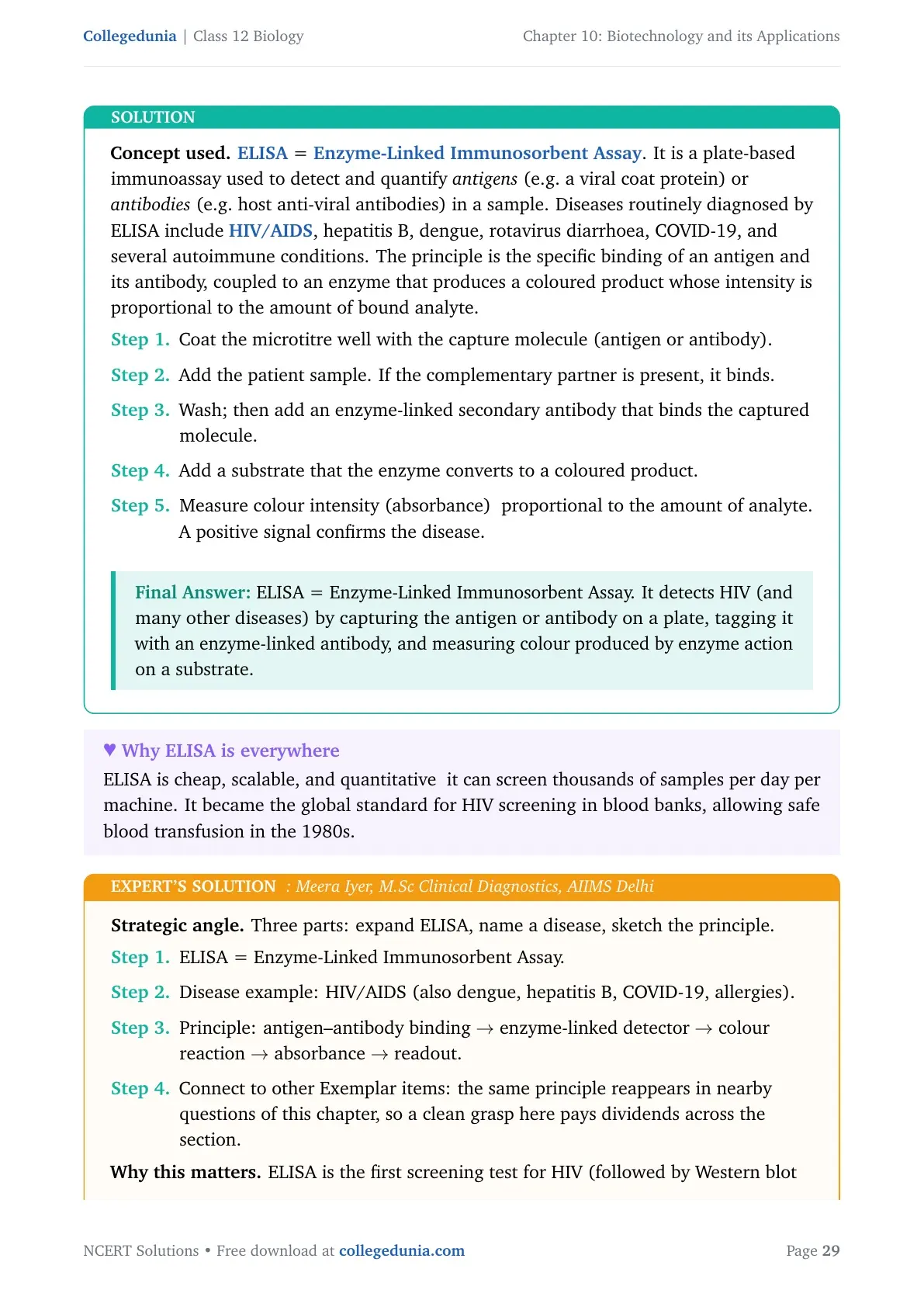
Concept used. ELISA = Enzyme-Linked Immunosorbent Assay. It is a plate-based immunoassay used to detect and quantify antigens (e.g. a viral coat protein) or antibodies (e.g. host anti-viral antibodies) in a sample. Diseases routinely diagnosed by ELISA include HIV/AIDS, hepatitis B, dengue, rotavirus diarrhoea, COVID-19, and several autoimmune conditions. The principle is the specific binding of an antigen and its antibody, coupled to an enzyme that produces a coloured product whose intensity is proportional to the amount of bound analyte.
- Coat the microtitre well with the capture molecule (antigen or antibody).
- Add the patient sample. If the complementary partner is present, it binds.
- Wash; then add an enzyme-linked secondary antibody that binds the captured molecule.
- Add a substrate that the enzyme converts to a coloured product.
- Measure colour intensity (absorbance) - proportional to the amount of analyte. A positive signal confirms the disease.
ELISA = Enzyme-Linked Immunosorbent Assay. It detects HIV (and many other diseases) by capturing the antigen or antibody on a plate, tagging it with an enzyme-linked antibody, and measuring colour produced by enzyme action on a substrate.
Strategic angle. Three parts: expand ELISA, name a disease, sketch the principle.
- ELISA = Enzyme-Linked Immunosorbent Assay.
- Disease example: HIV/AIDS (also dengue, hepatitis B, COVID-19, allergies).
- Principle: antigen–antibody binding → enzyme-linked detector → colour reaction → absorbance → readout.
- Connect to other Exemplar items: the same principle reappears in nearby questions of this chapter, so a clean grasp here pays dividends across the section.
Why this matters. ELISA is the first screening test for HIV (followed by Western blot confirmation), and is the workhorse of all immunodiagnostics - a guaranteed exam topic.
Deeper insight. The strength of modern biotechnology is precision: a single gene, a single mutation, a single recombinant protein can be introduced or detected, instead of perturbing the whole organism. Recognising that this question hinges on a single targeted change - and naming that change precisely - separates a top-band answer from a vague one. The diagnostic / therapeutic / agricultural deployment of that single change is then a one-line conclusion.
ELISA = Enzyme-Linked Immunosorbent Assay; detects HIV (and many others) via antigen–antibody binding coupled to an enzyme–substrate colour reaction.
Can a disease be detected before its symptoms appear? Explain the principle involved.
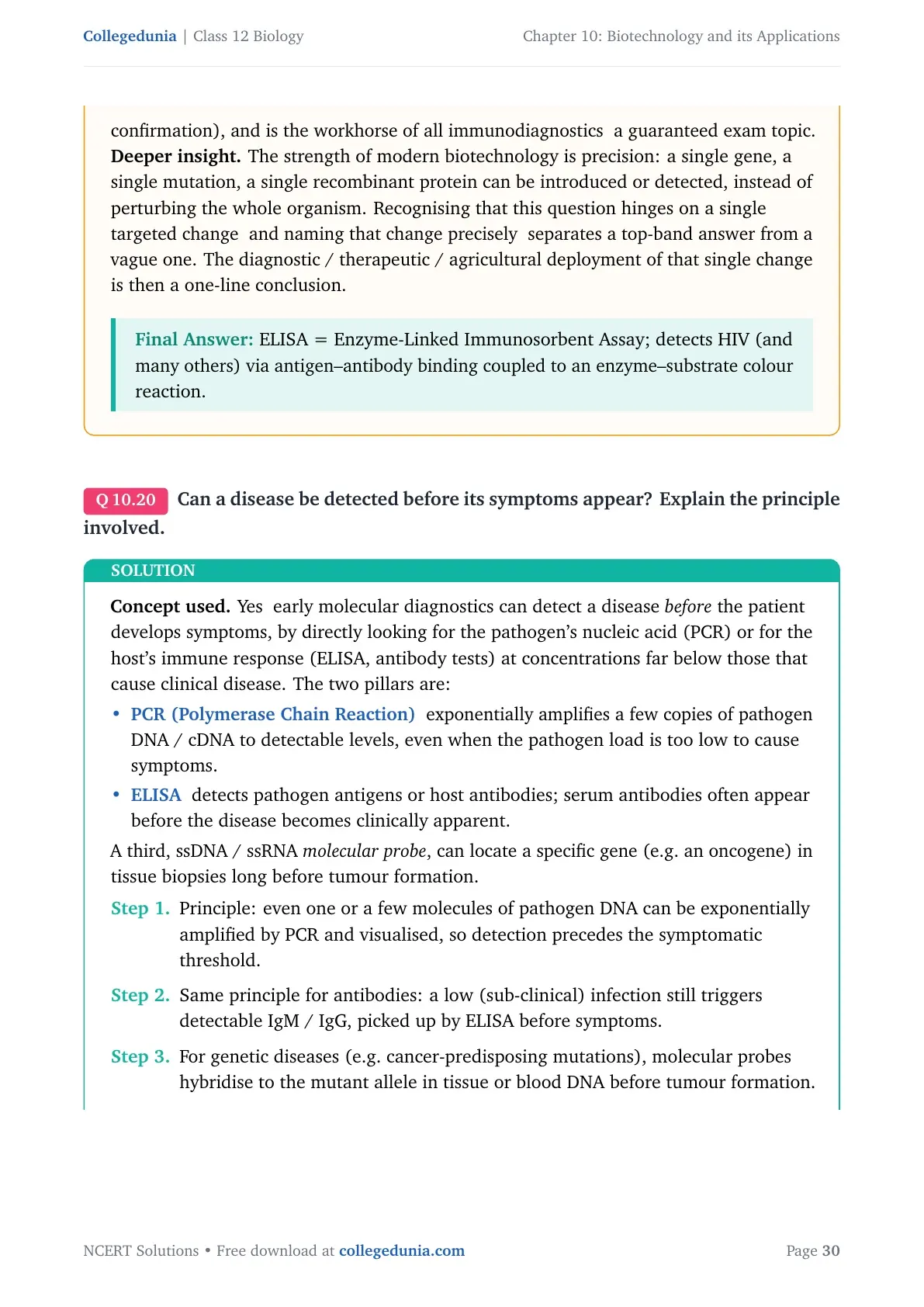
Concept used. Yes - early molecular diagnostics can detect a disease before the patient develops symptoms, by directly looking for the pathogen's nucleic acid (PCR) or for the host's immune response (ELISA, antibody tests) at concentrations far below those that cause clinical disease. The two pillars are:
- 2pt
- PCR (Polymerase Chain Reaction) - exponentially amplifies a few copies of pathogen DNA / cDNA to detectable levels, even when the pathogen load is too low to cause symptoms.
- ELISA - detects pathogen antigens or host antibodies; serum antibodies often appear before the disease becomes clinically apparent.
- Principle: even one or a few molecules of pathogen DNA can be exponentially amplified by PCR and visualised, so detection precedes the symptomatic threshold.
- Same principle for antibodies: a low (sub-clinical) infection still triggers detectable IgM / IgG, picked up by ELISA before symptoms.
- For genetic diseases (e.g. cancer-predisposing mutations), molecular probes hybridise to the mutant allele in tissue or blood DNA before tumour formation.
Yes. PCR amplifies tiny amounts of pathogen DNA, ELISA detects host antibodies, and molecular probes find specific genes - all far below the threshold needed for clinical symptoms, so early diagnosis is possible.
Quick reading. Yes - early detection works because PCR/ELISA can sense pathogen molecules well before tissue damage causes symptoms.
- PCR amplifies pathogen DNA exponentially; even a few hundred copies can be detected in serum or biopsy.
- ELISA detects host antibodies as soon as the immune response begins, often weeks before symptoms.
- For inherited disorders, ssDNA / ssRNA probes hybridise to the disease allele in a blood sample.
- Anchor with a named example: NCERT's chosen case study (whichever one applies here) is the single fastest route to full marks - quote it explicitly.
Why this matters. Early diagnosis enables early intervention (e.g. HIV antiretroviral therapy started immediately on detection, before AIDS develops), turning what would be terminal diseases into managed conditions.
Deeper insight. Two recurring themes connect this question to the chapter's larger story: (i) genetic information can be moved across species in ways evolution never permits, and (ii) molecular tools (probes, PCR, antibodies, Cry proteins, retroviral vectors) act with exquisite specificity that broad chemical methods cannot match. Naming both themes briefly, where relevant, demonstrates synthesis and earns marks.
Yes; PCR / ELISA / molecular probes detect pathogens or markers at concentrations well below the symptomatic threshold.
Write a short note on Biopiracy highlighting the exploitation of developing countries by the developed countries.
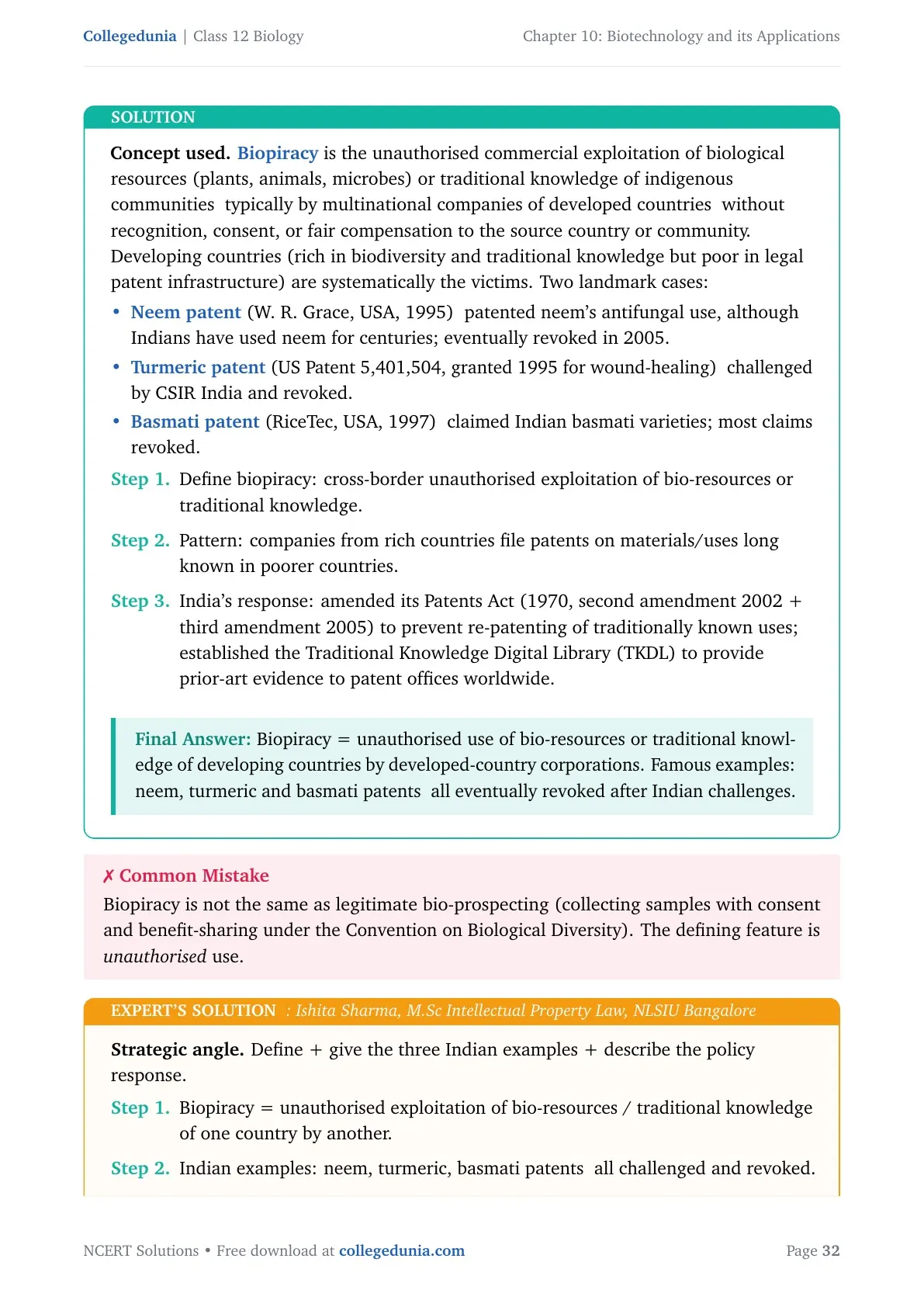
Concept used. Biopiracy is the unauthorised commercial exploitation of biological resources (plants, animals, microbes) or traditional knowledge of indigenous communities - typically by multinational companies of developed countries - without recognition, consent, or fair compensation to the source country or community. Developing countries (rich in biodiversity and traditional knowledge but poor in legal patent infrastructure) are systematically the victims. Two landmark cases:
- 2pt
- Neem patent (W. R. Grace, USA, 1995) - patented neem's antifungal use, although Indians have used neem for centuries; eventually revoked in 2005.
- Turmeric patent (US Patent 5,401,504, granted 1995 for wound-healing) - challenged by CSIR India and revoked.
- Basmati patent (RiceTec, USA, 1997) - claimed Indian basmati varieties; most claims revoked.
- Define biopiracy: cross-border unauthorised exploitation of bio-resources or traditional knowledge.
- Pattern: companies from rich countries file patents on materials/uses long known in poorer countries.
- India's response: amended its Patents Act (1970, second amendment 2002 + third amendment 2005) to prevent re-patenting of traditionally known uses; established the Traditional Knowledge Digital Library (TKDL) to provide prior-art evidence to patent offices worldwide.
Biopiracy = unauthorised use of bio-resources or traditional knowledge of developing countries by developed-country corporations. Famous examples: neem, turmeric and basmati patents - all eventually revoked after Indian challenges.
Strategic angle. Define + give the three Indian examples + describe the policy response.
- Biopiracy = unauthorised exploitation of bio-resources / traditional knowledge of one country by another.
- Indian examples: neem, turmeric, basmati patents - all challenged and revoked.
- Policy fix: Patents Act amendments + TKDL + Biological Diversity Act 2002.
- Map back to the rDNA toolkit (restriction enzymes, ligase, vector, host, PCR): every biotech application leans on at least one of these five tools, and naming the relevant one strengthens the answer.
Why this matters. Biopiracy illustrates the gap between biodiversity-rich developing countries and IP-rich developed countries. The Indian Patents Act second amendment (2002) requires disclosure of source and prior informed consent.
Deeper insight. A useful test of any biotech claim is to compare it against the corresponding pre-biotech method - the difference is almost always cost, safety, scale, purity or ethics. Articulating that contrast explicitly (animal insulin vs. recombinant insulin; chemical pesticide vs. Bt; PCR vs. culture) turns memorised facts into a reasoned comparison, which board examiners reliably reward over plain recall.
Biopiracy = exploitation of bio-resources / knowledge of developing countries (neem, turmeric, basmati) by developed-country corporations.
Many proteins are secreted in their inactive form. This is also true of many toxic proteins produced by micro organisms. Explain how the mechanism is useful for the organism producing the toxin?
Concept used. Producing a toxin in an inactive precursor form (a protoxin or zymogen) is an evolutionary safety strategy that lets the microbe carry, store, and secrete its weapon without poisoning itself. Activation occurs only when the protoxin reaches a specific environment, such as the alkaline midgut of an insect (Bt Cry protoxin) or the acidic stomach interior for a pathogenic toxin. Outside that environment, the protoxin is inert - protecting the producer's own cellular machinery.
- Without the protoxin mechanism, the producer cell would suffer self-toxicity (the toxin would damage its own membranes or enzymes).
- Storing the molecule as a protoxin lets the cell accumulate large amounts safely.
- Activation only when the protoxin enters the right host environment (alkaline gut, host protease) ensures the toxin works only on the intended target.
- Concrete example: Bacillus thuringiensis produces Cry protoxin as crystals; the protoxin only becomes active in the alkaline midgut of caterpillars, sparing the bacterium and any non-target eaters with acidic stomachs.
Synthesising the toxin in an inactive (protoxin) form prevents self-toxicity, allows safe storage, and ensures activation only inside the target host environment.
Strategic angle. The protoxin trick is a self-protection mechanism.
- Self-protection: the producer is not damaged by its own toxin.
- Storage convenience: large quantities of inactive protein can accumulate.
- Target-specific activation: triggered only by host-specific cues (pH, protease).
- Result: maximum effect on the target with minimum cost to the producer.
- Apply the safety / ethics lens: every modern biotech deployment passes a biosafety, regulatory or ethical filter (GEAC clearance, allergenicity testing, patent compliance) - mention the relevant filter when the question allows.
Why this matters. The same principle (pro-form → active form) underlies mammalian digestive zymogens (pepsinogen → pepsin), clotting factors and the insulin family - a unifying biochemistry concept.
Deeper insight. The same molecular logic - sequence complementarity for probes and primers, receptor recognition for Cry proteins, antigen–antibody specificity for ELISA, RNAi for silencing - appears again and again under different application headings. Spotting the shared logic across the chapter's vocabulary list (probe, primer, antigen, ligand, Cry, antibody, siRNA) collapses long lists into one principle: specific molecular recognition does the work.
Protoxin protects the producer from self-damage and ensures the toxin is activated only inside the target host environment.
While creating genetically modified organisms, genetic barriers are not respected. How can this be dangerous in the long run?
Concept used. Conventional sexual reproduction obeys species barriers that limit gene flow to closely related organisms, building in a slow, biology-tested filter on which genes can spread. Genetic engineering bypasses these barriers, allowing genes from bacteria to enter plants, viral promoters to drive plant transcription, and so on. While powerful, this can pose long-term risks: unintended ecological consequences, allergenicity, gene flow into wild relatives (escape of transgenes), disruption of native biodiversity, and unpredictable effects on non-target organisms.
- Allergenicity and toxicity: a transgenic protein may be a novel allergen for humans (the StarLink corn case).
- Gene flow / escape: transgenes can introgress into wild relatives by cross-pollination, creating ``super-weeds'' or contaminating organic crops.
- Non-target effects: Bt toxin can affect non-target beneficial insects if exposure is high.
- Loss of biodiversity: dominance of one transgenic variety displaces traditional landraces.
- Resistance evolution: pests evolve resistance to Bt toxins, reducing long-term effectiveness.
- Ethical / equity concerns: corporate ownership of seeds via patents undermines farmer seed-saving traditions.
Crossing species barriers without natural checks risks allergenicity, transgene escape into wild relatives, non-target ecological harm, biodiversity loss, resistance evolution, and patent-driven inequities - long-term costs that may outweigh short-term gains.
Strategic angle. List six categories of long-term risk.
- Health: allergenicity / toxicity of novel proteins.
- Ecology: transgene escape, non-target effects, loss of biodiversity.
- Evolution: pest resistance to Bt and antibiotic-resistance marker spread.
- Equity: corporate IP control of seeds.
- Note the public-health or agricultural impact: framing the answer in terms of concrete human benefit (lives saved, yield gained, pesticide avoided, nutrient enriched) lifts a factual answer into an application-rich one.
Why this matters. GEAC's job is exactly to weigh these long-term risks against short-term benefits before clearing a GM crop. This is why Bt brinjal was halted in India despite clearance abroad.
Deeper insight. Indian biotech policy (GEAC, the 2002 Patents Act amendment, the Traditional Knowledge Digital Library, the Biological Diversity Act) sits behind every applied biotech story in this chapter. Where a question touches on ethics, regulation or biopiracy, briefly anchoring the answer in the relevant law or institution shows the wider context examiners look for in long-answer questions.
Crossing species barriers risks allergenicity, gene flow, non-target ecological harm, biodiversity loss, resistance evolution, and IP-driven inequities.
Why has the Indian Parliament cleared the second amendment of the country's patents bill?
Concept used. The second amendment to the Indian Patents Act, 1970, was cleared by Parliament in 2002 (and a third in 2005) primarily to bring India's patent regime into compliance with the WTO's TRIPS Agreement (Trade-Related Aspects of Intellectual Property Rights), and to safeguard India's biological resources and traditional knowledge against biopiracy. The amendment introduced product patents (not just process patents), explicit exclusions for traditional knowledge, mandatory disclosure of source of biological materials, and prior informed consent provisions.
- TRIPS compliance: WTO membership obliged India to introduce product patents in pharmaceuticals and biotech by 2005.
- Biopiracy prevention: after the neem, turmeric and basmati controversies, the law was tightened to prohibit re-patenting of traditionally known materials.
- Disclosure: every patent applicant must disclose the geographic source of any biological material used.
- Prior informed consent: required for use of bio-resources, in line with the Convention on Biological Diversity.
The 2002 amendment brought India into TRIPS compliance, introduced product patents in biotech and pharma, and built in safeguards against biopiracy of Indian biological resources and traditional knowledge.
Strategic angle. Two motives: WTO compliance + biopiracy defence.
- TRIPS-mandated product patents.
- Anti-biopiracy clauses (source disclosure, prior informed consent).
- Protection of traditional knowledge.
- Use the contrast with conventional alternatives: if a chemical pesticide, animal source or culture-based diagnosis would have been used pre-biotech, name it briefly to highlight what the biotech route improves.
Why this matters. The amendment positioned India as both a credible WTO partner and a defender of its biodiversity heritage - a dual policy goal.
Deeper insight. The repeated NCERT pairing of an Indian example with a global counterpart (basmati patent, neem patent, turmeric patent, Bt cotton's Indian adoption, Bt brinjal's Indian moratorium) is intended to anchor abstract biotech vocabulary in the Indian context. Quoting at least one Indian example - even when the question is generic - distinguishes a chapter-aware answer from a textbook-only one.
Parliament cleared the second amendment to comply with TRIPS and guard against biopiracy of Indian bio-resources and traditional knowledge.
Give any two reasons why the patent on Basmati should not have gone to an American Company.
Concept used. The 1997 grant of US Patent 5,663,484 to the Texas company RiceTec Inc. for ``basmati rice lines and grains'' was a clear case of biopiracy. Basmati is an aromatic long-grain rice cultivated in the Indian sub-continent (especially Punjab) for centuries and is a geographically and culturally Indian product. Granting the patent to a US company would have allowed RiceTec to claim ownership over a name, traits and grain shape that are not American innovations.
- Basmati is a traditional Indian crop, cultivated for centuries in the Indo-Gangetic plains - it is not a US-developed novelty.
- Indian farmers and breeders developed and refined the variety; granting the patent to a US company strips the rightful inventors of any benefit-sharing.
- Basmati is a geographical indication (like Champagne or Darjeeling tea): the name is intrinsically tied to its region.
- The patent would have blocked Indian exporters from using the term ``basmati'' in the US market, denting the Indian rice industry.
Basmati is a centuries-old Indian rice variety with a geographical-indication character; the inventors are Indian farmer-breeders, not American companies. A US patent would constitute biopiracy and damage Indian export rights.
Strategic angle. Two strongest reasons.
- Basmati is an Indian heritage crop, not a US innovation - patenting it amounts to theft of traditional knowledge.
- Basmati is a geographical-indication product (like Champagne); the name itself belongs to its region of origin.
- Connect to other Exemplar items: the same principle reappears in nearby questions of this chapter, so a clean grasp here pays dividends across the section.
Why this matters. The case prompted the Indian government to challenge and win revocation of most RiceTec claims, and to push for stronger global geographical-indication protections under WTO TRIPS Article 22.
Deeper insight. The biotechnological principle behind this question recurs across the chapter: a defined biological tool (a microbe, an enzyme, a vector, a probe, a Cry protein, a recombinant antigen) is mobilised to solve a problem that conventional methods cannot solve cleanly. Whenever the Exemplar describes a method or product, locate the underlying tool first, then ask what natural limitation it sidesteps. This single discipline turns dense factual recall into a short, principled answer that examiners reward.
Basmati is centuries-old Indian heritage rice with a geographical-indication identity - patenting it elsewhere is biopiracy and unfair to Indian farmers.
How was Insulin obtained before the advent of rDNA technology? What were the problems encountered?
Concept used. Before recombinant DNA technology, insulin was extracted from the pancreas of slaughtered cattle (bovine) and pigs (porcine). Cattle and pig insulins differ from human insulin by a few amino acids (bovine differs in 3 residues, porcine in 1). While the animal-derived hormone lowered blood glucose, it caused multiple problems.
- Allergic reactions. The amino-acid difference made some patients mount immune responses to the foreign protein, producing rashes, swelling, or anaphylaxis.
- Limited supply. Each pig pancreas yielded only ∼ 100 mg of insulin; meeting the growing diabetic population required millions of slaughtered animals.
- Cost and purity. Extracting and purifying insulin from animal pancreas is expensive and the product carries contaminating proteins.
- Religious / ethical objections. Many patients (Hindus, Muslims, vegetarians) objected to insulin sourced from cows or pigs.
- Inconsistency. Each animal batch had slight variation in potency and contaminants.
Before rDNA, insulin was extracted from cattle and pig pancreases. Problems: allergic reactions due to amino-acid differences, limited supply, contaminants and impurities, religious objections, and inconsistent batch quality - all solved by recombinant human insulin.
Strategic angle. Briefly trace the pre-rDNA insulin supply chain and list its drawbacks.
- Source: pancreas of slaughtered cattle / pigs.
- Problems: (i) allergic reactions, (ii) supply shortage, (iii) cost and purity, (iv) religious / ethical issues, (v) batch inconsistency.
- Anchor with a named example: NCERT's chosen case study (whichever one applies here) is the single fastest route to full marks - quote it explicitly.
Why this matters. The shift from animal insulin to recombinant Humulin (Eli Lilly, 1982) was the first commercial recombinant pharmaceutical - a turning point in biotech history.
Deeper insight. NCERT's Class 12 Biotechnology Applications chapter treats every example as a paired triad: biological agent (organism / molecule / gene), mechanism (what it does at the molecular level), and outcome (the human benefit or product). Re-cast every question's answer in those three pieces and you give examiners a complete, well-organised reply. This question's triad is worth fixing in memory and re-using on related items elsewhere in the chapter.
Pre-rDNA insulin came from cattle/pig pancreas; it was allergenic, in short supply, expensive, religiously objectionable, and inconsistent.
With respect to understanding diseases, discuss the importance of transgenic animal models.
Concept used. Transgenic animals carry a foreign gene introduced into their genome and expressed in their cells. By engineering animals (commonly mice) that overexpress, under-express, or carry mutant versions of human disease genes, scientists create disease models that recapitulate human pathology in a controlled, reproducible system. Such models illuminate disease mechanisms and enable preclinical drug testing.
- Mechanism studies: a transgenic mouse expressing a human disease allele (e.g. Alzheimer's amyloid-precursor mutation) reveals how the mutation drives pathology.
- Drug screening: candidate drugs are tested for efficacy and safety on the disease model before human trials.
- Vaccine and therapy testing: transgenic models receive candidate vaccines or gene therapies under controlled conditions.
- Toxicology: chemical or environmental insults are studied for long-term effects in a genetically defined animal.
- Example: transgenic mice carrying mutant huntingtin reproduce features of Huntington's disease, allowing therapy development.
Transgenic animal models reproduce human disease in a controlled organism, letting researchers study disease mechanisms, screen drugs, test vaccines and gene therapies, and assess toxicology - accelerating biomedical discovery while reducing risk to humans.
Strategic angle. Four areas where transgenic animals advance disease understanding.
- Reveal molecular mechanism of disease.
- Permit drug screening before human trials.
- Provide vaccine and gene-therapy testbeds.
- Allow controlled toxicology studies.
- Map back to the rDNA toolkit (restriction enzymes, ligase, vector, host, PCR): every biotech application leans on at least one of these five tools, and naming the relevant one strengthens the answer.
Why this matters. Almost every modern biomedical breakthrough - from cancer drugs to gene-therapy approvals - has gone through transgenic-mouse models. NCERT lists Alzheimer's, cystic fibrosis, cancer and rheumatoid arthritis among diseases studied this way.
Deeper insight. The strength of modern biotechnology is precision: a single gene, a single mutation, a single recombinant protein can be introduced or detected, instead of perturbing the whole organism. Recognising that this question hinges on a single targeted change - and naming that change precisely - separates a top-band answer from a vague one. The diagnostic / therapeutic / agricultural deployment of that single change is then a one-line conclusion.
Transgenic animal models illuminate disease mechanisms and provide controlled testbeds for drugs, vaccines and gene therapies.
Name the first transgenic cow. Which gene was introduced in this cow?
Concept used. The first transgenic cow was Rosie, born in 1997. She was engineered to express the gene for human α-lactalbumin, a protein normally present in human milk but not in cow milk. Rosie's milk contained 2.4 g/L of human α-lactalbumin, making it nutritionally more complete than ordinary cow milk and closer in composition to human breast milk - a step toward producing infant-formula proteins via dairy cattle.
- Name the cow: Rosie.
- Year: 1997.
- Gene introduced: human α-lactalbumin.
- Purpose: enriched milk with human-type protein, suitable for infants who cannot be breast-fed.
The first transgenic cow was Rosie (1997), engineered to express the human α-lactalbumin gene, producing milk enriched with this human milk protein.
Quick reading. Name + gene.
- Rosie, 1997: first transgenic cow.
- Gene introduced: human α-lactalbumin.
- Result: cow's milk contained 2.4 g/L of human α-lactalbumin - a major nutritional protein for infants.
- Apply the safety / ethics lens: every modern biotech deployment passes a biosafety, regulatory or ethical filter (GEAC clearance, allergenicity testing, patent compliance) - mention the relevant filter when the question allows.
Why this matters. Rosie demonstrated the concept of molecular farming (using livestock as bioreactors), now extended to producing human clotting factors and antibodies in transgenic goats.
Deeper insight. Two recurring themes connect this question to the chapter's larger story: (i) genetic information can be moved across species in ways evolution never permits, and (ii) molecular tools (probes, PCR, antibodies, Cry proteins, retroviral vectors) act with exquisite specificity that broad chemical methods cannot match. Naming both themes briefly, where relevant, demonstrates synthesis and earns marks.
Rosie was the first transgenic cow; she expressed the human α-lactalbumin gene.
PCR is a useful tool for early diagnosis of an infectious disease. Elaborate.
Concept used. PCR (Polymerase Chain Reaction), invented by Kary Mullis in 1983, exponentially amplifies a specific DNA segment in vitro using two primers, a thermostable DNA polymerase (Taq), dNTPs, and repeated cycles of denaturation, annealing and extension. Because PCR can amplify even a single molecule of template DNA, it can detect a pathogen long before its concentration in the blood would otherwise produce symptoms or be detectable by other tests. For RNA viruses (HIV, HCV, SARS-CoV-2), the RNA is first reverse-transcribed into cDNA (RT-PCR) before amplification.
- Take a small clinical sample (blood, throat swab, CSF). Even a few pathogen genome copies are enough.
- Add primers that match a unique region of the pathogen's genome.
- Run thermal cycles: denature (95 C) → anneal (50–65 C) → extend (72 C). After n cycles, the target is amplified ∼ 2n times.
- Detect the amplified product (gel electrophoresis, or real-time fluorescence in qPCR).
- A positive signal confirms the pathogen's presence - often weeks before antibodies (ELISA) appear or symptoms develop.
PCR amplifies even a few copies of pathogen DNA exponentially, enabling detection long before symptoms appear or antibodies form - a key advantage for early diagnosis of infectious diseases like HIV, HCV and SARS-CoV-2.
Strategic angle. Explain the amplification logic and link it to early-detection capability.
- PCR amplifies pathogen DNA 2n-fold per cycle.
- Even a handful of pathogen molecules can be detected after 30–40 cycles.
- Hence pathogen DNA can be found long before clinical symptoms or antibody responses develop.
- Examples: HIV, hepatitis B/C, TB, SARS-CoV-2 - all diagnosed early by PCR.
- Note the public-health or agricultural impact: framing the answer in terms of concrete human benefit (lives saved, yield gained, pesticide avoided, nutrient enriched) lifts a factual answer into an application-rich one.
Why this matters. PCR-based early diagnosis allows early antiviral therapy (e.g. ART for HIV) - turning previously fatal diseases into managed chronic conditions.
Deeper insight. A useful test of any biotech claim is to compare it against the corresponding pre-biotech method - the difference is almost always cost, safety, scale, purity or ethics. Articulating that contrast explicitly (animal insulin vs. recombinant insulin; chemical pesticide vs. Bt; PCR vs. culture) turns memorised facts into a reasoned comparison, which board examiners reliably reward over plain recall.
PCR detects pathogen DNA from minute samples, enabling diagnosis well before clinical symptoms or antibody seroconversion.
What is GEAC and what are its objectives?
Concept used. GEAC = Genetic Engineering Approval Committee (now Genetic Engineering Appraisal Committee in current usage), the apex regulatory body under India's Ministry of Environment, Forest and Climate Change that oversees research, development, large-scale use, and environmental release of Genetically Modified Organisms (GMOs) and recombinant DNA products. It was set up under the Rules for the Manufacture, Use, Import, Export and Storage of Hazardous Microorganisms and GMOs (1989) framed under the Environment Protection Act 1986.
- Objective 1 - approve GMO release: evaluate biosafety dossiers for field trials, large-scale production, and commercial release of GM crops and microbes.
- Objective 2 - biosafety oversight: monitor and regulate handling of hazardous microorganisms.
- Objective 3 - environmental protection: minimise ecological risk from transgene escape, non-target effects, and biodiversity loss.
- Objective 4 - public health protection: assess allergenicity, toxicity, and food safety of GM foods.
- Objective 5 - coordinate with national bodies: work with RCGM (Review Committee on Genetic Manipulation), IBSCs (Institutional Biosafety Committees), and ICAR.
GEAC is the apex Indian regulator for GMOs and rDNA products. Its objectives: approve GM release, ensure biosafety, protect the environment, safeguard public health, and coordinate national biosafety governance.
Strategic angle. Define GEAC + list its five objectives.
- GEAC = Genetic Engineering Approval Committee under MoEFCC.
- Approves GM release, regulates hazardous microbes, protects environment, safeguards food/health, coordinates biosafety governance.
- Use the contrast with conventional alternatives: if a chemical pesticide, animal source or culture-based diagnosis would have been used pre-biotech, name it briefly to highlight what the biotech route improves.
Why this matters. Bt brinjal was approved by GEAC but later put on indefinite moratorium by the environment minister in 2010 - illustrating how GEAC clearance is necessary but not sufficient for commercial release.
Deeper insight. The same molecular logic - sequence complementarity for probes and primers, receptor recognition for Cry proteins, antigen–antibody specificity for ELISA, RNAi for silencing - appears again and again under different application headings. Spotting the shared logic across the chapter's vocabulary list (probe, primer, antigen, ligand, Cry, antibody, siRNA) collapses long lists into one principle: specific molecular recognition does the work.
GEAC = Genetic Engineering Approval Committee; approves GM use/release and ensures biosafety, environment and public health protection.
For which variety of Indian rice, the patent was filed by a USA Company?
Concept used. In 1997, the US-based company RiceTec Inc. was granted US Patent 5,663,484 for ``basmati rice lines and grains'' - claiming new rice lines with the long-grain, aromatic characteristics of traditional Indian/Pakistani basmati. India successfully challenged the patent in 2001; the US Patent Office revoked most claims, leaving only three narrow ones for specific hybrid lines.
- Variety: Basmati rice (the aromatic long-grain rice traditionally cultivated in the Indo-Gangetic plains of India and Pakistan).
- Company: RiceTec Inc., USA.
- Year of patent: 1997.
- Outcome: India's challenge (CSIR + Ministry of Commerce) led to revocation of most claims in 2001.
The patent was filed by RiceTec Inc. (USA, 1997) on Basmati rice - India successfully challenged most of the claims by 2001.
Quick reading. Variety + company.
- Basmati rice - long-grain aromatic Indian variety.
- RiceTec Inc., USA, in 1997.
- Revoked in 2001 after Indian challenge.
- Connect to other Exemplar items: the same principle reappears in nearby questions of this chapter, so a clean grasp here pays dividends across the section.
Why this matters. The basmati case is the highest-profile Indian biopiracy challenge, frequently paired with neem and turmeric in board / NEET questions.
Deeper insight. Indian biotech policy (GEAC, the 2002 Patents Act amendment, the Traditional Knowledge Digital Library, the Biological Diversity Act) sits behind every applied biotech story in this chapter. Where a question touches on ethics, regulation or biopiracy, briefly anchoring the answer in the relevant law or institution shows the wider context examiners look for in long-answer questions.
RiceTec (USA) filed a patent on Basmati rice in 1997; most claims revoked in 2001.
Discuss the advantages of GMO.
Concept used. Genetically Modified Organisms (GMOs) offer several agricultural, nutritional, medical, environmental and industrial advantages that conventional varieties cannot easily match.
- Higher yield. Stress-tolerant crops (cold, drought, salinity, heat resistant) produce reliably on marginal land.
- Reduced chemical input. Bt crops kill specific pests internally, cutting external pesticide use.
- Nutritional enrichment (biofortification). Golden rice (β-carotene), iron-rich crops, high-protein varieties.
- Longer shelf life. Flavr Savr tomato uses antisense polygalacturonase to delay ripening.
- Disease resistance. Engineered resistance to viruses (papaya ringspot virus-resistant papaya), bacteria, fungi.
- Medical applications. Recombinant human insulin, clotting factor VIII, vaccines, monoclonal antibodies are GMO-derived.
- Environmental. Less reliance on chemical fertilizers, less soil and water pollution.
- Industrial. Microbes engineered to produce biofuels, enzymes, plastics (PHA) and pharmaceuticals.
GMO advantages: higher yield, lower pesticide use, biofortification, longer shelf life, disease resistance, medical biologics (insulin, vaccines), reduced environmental damage, and industrial biotech applications.
Strategic angle. Eight clear advantages span agriculture, medicine, environment, industry.
- Higher yield + stress tolerance.
- Lower pesticide / fertilizer use.
- Biofortification (golden rice).
- Longer shelf life (Flavr Savr).
- Disease resistance.
- Medical: recombinant insulin, vaccines.
- Environmental sustainability.
- Industrial biofuels, enzymes, plastics.
- Anchor with a named example: NCERT's chosen case study (whichever one applies here) is the single fastest route to full marks - quote it explicitly.
Why this matters. GMO advantages must be balanced against the long-term risks listed in Q8 above - both sides typically appear on the same NEET / boards paper.
Deeper insight. The repeated NCERT pairing of an Indian example with a global counterpart (basmati patent, neem patent, turmeric patent, Bt cotton's Indian adoption, Bt brinjal's Indian moratorium) is intended to anchor abstract biotech vocabulary in the Indian context. Quoting at least one Indian example - even when the question is generic - distinguishes a chapter-aware answer from a textbook-only one.
GMOs raise yield, cut chemical inputs, enrich nutrition, extend shelf life, resist disease, produce medical biologics and enable sustainable industry.
Short Answer Questions
Gene expression can be controlled with the help of RNA. Explain the method with an example.
Concept used. Gene expression - the conversion of a gene's DNA information into protein via mRNA - can be silenced or tuned down using RNA-based mechanisms. Two important methods are antisense RNA and RNA interference (RNAi). Both work by base-pairing a complementary RNA molecule to the target mRNA, either blocking its translation or marking it for degradation. The hallmark biotechnological example is RNAi-mediated silencing of a parasitic nematode gene in tobacco.
- RNAi mechanism. Long double-stranded RNA (dsRNA) is cleaved by the enzyme Dicer into 21–23 nt small interfering RNAs (siRNA). One strand of the siRNA is loaded onto the RNA-Induced Silencing Complex (RISC, containing Argonaute). RISC uses the siRNA strand as a guide to find the complementary mRNA, which it then cleaves or blocks from translation.
- Antisense RNA mechanism. A single-stranded RNA complementary to a target mRNA is expressed in the cell. It base-pairs with the target mRNA, forming a dsRNA that prevents ribosome binding (translational arrest) or attracts RNase H to cut the mRNA strand.
- Example: nematode-resistant tobacco. The root-knot nematode Meloidogyne incognita infects tobacco roots. Scientists introduced into tobacco plants a transgene producing dsRNA complementary to a nematode-essential mRNA. When the nematode feeds, it ingests the siRNA, which silences its essential gene; the nematode dies, and the tobacco plant survives.
Gene expression is silenced by RNAi (dsRNA → Dicer → siRNA → RISC → mRNA cleavage) or antisense RNA (complementary RNA → ribosome blockage / RNase H cleavage). Classic example: tobacco engineered with dsRNA against the nematode Meloidogyne incognita.
Strategic angle. Describe two RNA-based silencing methods + give one concrete biotech example.
- RNAi: dsRNA → Dicer → siRNA → RISC → mRNA cleavage.
- Antisense RNA: ssRNA complementary to mRNA → duplex formation → translation block / RNase H cut.
- Example: nematode-resistant tobacco via host-induced dsRNA against M. incognita.
- Map back to the rDNA toolkit (restriction enzymes, ligase, vector, host, PCR): every biotech application leans on at least one of these five tools, and naming the relevant one strengthens the answer.
Why this matters. RNAi is now used commercially - RNAi-based potato (silencing browning enzyme PPO) and corn rootworm-resistant maize (SmartStax PRO) are deployed; gene silencing has gone from a curiosity to an industry.
Deeper insight. The biotechnological principle behind this question recurs across the chapter: a defined biological tool (a microbe, an enzyme, a vector, a probe, a Cry protein, a recombinant antigen) is mobilised to solve a problem that conventional methods cannot solve cleanly. Whenever the Exemplar describes a method or product, locate the underlying tool first, then ask what natural limitation it sidesteps. This single discipline turns dense factual recall into a short, principled answer that examiners reward.
RNA-based silencing (RNAi or antisense RNA) base-pairs with target mRNA to block translation; classic example: tobacco engineered to silence a nematode parasite gene.
Ignoring our traditional knowledge can prove costly in the area of biological patenting. Justify.
Concept used. Traditional knowledge - accumulated practical wisdom of indigenous and rural communities about plants, animals and microbes - is a primary defence against biopiracy. Patent offices grant a patent only if the claimed invention is novel and non-obvious. When a use of a plant has been known for centuries to a local community, that knowledge counts as prior art and should defeat a novelty claim - provided the patent examiner has access to documented evidence of it. Ignoring traditional knowledge means failing to record and present such evidence, allowing biopirates to walk away with patents on what is essentially borrowed wisdom.
- Neem case (1995): W. R. Grace patented neem's antifungal use, although Indians had used neem for centuries as a pesticide. The patent was revoked in 2005 after CSIR submitted ancient Sanskrit documents as prior-art evidence.
- Turmeric case (1995): US patent for wound-healing use of turmeric was revoked after CSIR submitted ancient Ayurvedic texts establishing prior use.
- Basmati case (1997): RiceTec's broad claims on basmati were narrowed after India submitted documentary evidence of centuries of basmati cultivation.
- Without recorded traditional knowledge, none of these challenges would have succeeded. Hence the Traditional Knowledge Digital Library (TKDL) was set up to translate Indian medical texts into English/French/German/Japanese/Spanish for patent-office search.
Traditional knowledge serves as prior art that can defeat biopiracy patents. Ignoring or failing to document it - as before the neem, turmeric and basmati cases - costs developing countries control over their own biological heritage.
Strategic angle. Document traditional knowledge → block biopiracy. Skip documentation → lose patents.
- Patent law requires novelty; documented traditional knowledge counts as prior art.
- Neem, turmeric and basmati patents were revoked using documented Indian traditional knowledge.
- Hence the Traditional Knowledge Digital Library - translating Ayurvedic / Siddha texts for patent-office use.
- Apply the safety / ethics lens: every modern biotech deployment passes a biosafety, regulatory or ethical filter (GEAC clearance, allergenicity testing, patent compliance) - mention the relevant filter when the question allows.
Why this matters. TKDL has prevented hundreds of biopiracy patents at the EU and US Patent Offices since 2009 - a demonstration that careful documentation of traditional knowledge is the single highest-leverage defence against biopiracy.
Deeper insight. NCERT's Class 12 Biotechnology Applications chapter treats every example as a paired triad: biological agent (organism / molecule / gene), mechanism (what it does at the molecular level), and outcome (the human benefit or product). Re-cast every question's answer in those three pieces and you give examiners a complete, well-organised reply. This question's triad is worth fixing in memory and re-using on related items elsewhere in the chapter.
Documented traditional knowledge is prior art that defeats biopiracy patents; failing to record it costs developing countries control over their biological resources.
Highlight any four areas where genetic modification of plants has been useful.
Concept used. Genetic modification of plants has produced practical advances in four major areas: pest resistance, abiotic stress tolerance, nutritional enhancement, and post-harvest quality.
- Pest resistance. Bt cotton, Bt brinjal, Bt maize and Bt rice carry cry genes from Bacillus thuringiensis that produce insecticidal Cry proteins inside plant tissues, killing lepidopteran or coleopteran pests internally and cutting external pesticide use.
- Abiotic stress tolerance. Engineered plants tolerate drought, salinity, cold and heat - examples include trehalose-overexpressing rice (osmoprotection) and AVP1-transgenic tomato (salt tolerance).
- Nutritional enhancement (biofortification). Golden rice produces β-carotene in endosperm; iron-rich rice and lysine-rich maize improve micronutrient content of staples.
- Post-harvest quality. Flavr Savr tomato uses antisense polygalacturonase mRNA to delay ripening; non-browning Arctic apples use RNAi against PPO.
Four useful areas: (i) pest resistance (Bt crops), (ii) abiotic stress tolerance (drought, salinity), (iii) biofortification (golden rice), and (iv) post-harvest quality (Flavr Savr tomato).
Strategic angle. Four clean categories with one named example each.
- Pest resistance: Bt cotton.
- Abiotic stress tolerance: drought / salinity tolerant rice.
- Biofortification: golden rice.
- Post-harvest shelf life: Flavr Savr tomato.
- Note the public-health or agricultural impact: framing the answer in terms of concrete human benefit (lives saved, yield gained, pesticide avoided, nutrient enriched) lifts a factual answer into an application-rich one.
Why this matters. Each area maps to a real-world commercial GM crop - anchoring memory with named examples is the difference between full and partial marks in board answers.
Deeper insight. The strength of modern biotechnology is precision: a single gene, a single mutation, a single recombinant protein can be introduced or detected, instead of perturbing the whole organism. Recognising that this question hinges on a single targeted change - and naming that change precisely - separates a top-band answer from a vague one. The diagnostic / therapeutic / agricultural deployment of that single change is then a one-line conclusion.
Pest resistance (Bt cotton), stress tolerance (drought rice), biofortification (golden rice), and post-harvest quality (Flavr Savr tomato).
What is a recombinant DNA vaccine? Give two examples.
Concept used. A recombinant DNA vaccine is a vaccine in which the antigen is produced not by growing the actual pathogen but by cloning the antigen-encoding gene into a safe expression host (yeast, bacterium, mammalian cell, or plant), purifying the recombinant protein, and using it to immunise. The host immune system mounts an antibody response against the recombinant antigen, conferring protection without ever encountering the live pathogen. This approach is safer (no risk of accidental infection), faster (no need to culture dangerous pathogens) and produces highly pure antigens.
- Identify the antigen-encoding gene of the pathogen (e.g. hepatitis-B surface antigen, HBsAg).
- Clone the gene into an expression vector under a strong promoter.
- Express the protein in a safe host (e.g. Saccharomyces cerevisiae for HBsAg).
- Purify the recombinant antigen, formulate with adjuvant.
- Administer to elicit an immune response.
- 2pt
- Example 1: Recombinant hepatitis-B vaccine - HBsAg expressed in Saccharomyces cerevisiae (yeast); the first commercial recombinant vaccine, approved in 1986.
- Example 2: HPV (human papillomavirus) vaccine - recombinant L1 capsid protein expressed in yeast or insect cells, self-assembling into virus-like particles.
Recombinant DNA vaccine = a vaccine made by cloning an antigen-encoding gene into a safe host (e.g. yeast) and using the purified recombinant antigen for immunisation. Examples: hepatitis-B vaccine and HPV vaccine.
Strategic angle. Define + two named examples.
- Definition: vaccine antigen produced by cloning and expressing the antigen gene in a safe host.
- Example 1: hepatitis-B vaccine (HBsAg in yeast, 1986).
- Example 2: HPV vaccine (L1 capsid in yeast / insect cells).
- Use the contrast with conventional alternatives: if a chemical pesticide, animal source or culture-based diagnosis would have been used pre-biotech, name it briefly to highlight what the biotech route improves.
Why this matters. Recombinant vaccines eliminate the risk of accidentally releasing live pathogen and have made mass immunisation against hepatitis B routine - a key public-health win.
Deeper insight. Two recurring themes connect this question to the chapter's larger story: (i) genetic information can be moved across species in ways evolution never permits, and (ii) molecular tools (probes, PCR, antibodies, Cry proteins, retroviral vectors) act with exquisite specificity that broad chemical methods cannot match. Naming both themes briefly, where relevant, demonstrates synthesis and earns marks.
Recombinant DNA vaccine = recombinant-protein-based vaccine. Examples: hepatitis-B and HPV vaccines.
Why is it that the line of treatment for a genetic disease is different from infectious diseases?
Concept used. Infectious diseases are caused by an external pathogen (bacterium, virus, fungus, parasite) attacking the host; the disease can be cured by killing or eliminating the pathogen using antibiotics, antivirals, or antifungals - the patient's own genome is normal and recovers function once the pathogen is gone. Genetic diseases, in contrast, are caused by an inherent defect in the patient's own genome (a missing gene, a mutated allele); the treatment must correct or compensate for the defective gene itself, since no external agent can be killed. This is achieved by gene therapy (delivering a functional copy of the gene), enzyme replacement therapy (administering the missing enzyme), or in some cases bone-marrow transplantation.
- Infectious disease: external pathogen → eliminate pathogen with drugs.
- Genetic disease: defective host gene → supply functional gene (gene therapy) or supply the missing protein (enzyme replacement therapy).
- Example: ADA-SCID - gene therapy delivers a working ADA cDNA into the patient's lymphocytes; PEG-ADA injections supply the enzyme directly.
- Hence the lines of treatment differ fundamentally: kill an external agent vs. fix or replace a host gene/protein.
Infectious diseases are treated by eliminating the external pathogen (antibiotics, antivirals); genetic diseases are treated by correcting or compensating for the patient's own defective gene (gene therapy, enzyme replacement) since the cause is intrinsic, not external.
Strategic angle. Cause → treatment, contrasted.
- Infectious: external pathogen, removable with drugs.
- Genetic: intrinsic gene defect, must be corrected (gene therapy) or compensated (enzyme replacement).
- ADA-SCID example: gene therapy + PEG-ADA enzyme replacement.
- Connect to other Exemplar items: the same principle reappears in nearby questions of this chapter, so a clean grasp here pays dividends across the section.
Why this matters. The distinction motivates the entire field of personalised / precision medicine - a genetic-disease patient cannot be ``cured'' by an antibiotic.
Deeper insight. A useful test of any biotech claim is to compare it against the corresponding pre-biotech method - the difference is almost always cost, safety, scale, purity or ethics. Articulating that contrast explicitly (animal insulin vs. recombinant insulin; chemical pesticide vs. Bt; PCR vs. culture) turns memorised facts into a reasoned comparison, which board examiners reliably reward over plain recall.
Infectious disease is cured by killing the pathogen; genetic disease must be treated by correcting or supplying the missing gene/protein.
Discuss briefly how a probe is used in molecular diagnostics.
Concept used. A molecular probe is a short, single-stranded nucleic acid (ssDNA or ssRNA), ∼ 15–30 nt long, complementary to a target sequence and carrying a detectable label (radioactive 32P, fluorescent dye, biotin, chemiluminescent tag). In molecular diagnostics, the probe hybridises specifically with its target sequence in the patient sample. If the target is present, the probe binds and gives a signal; if absent, no signal. This allows direct detection of disease-related DNA / RNA (e.g. a pathogen genome, a mutant oncogene, a fetal chromosomal abnormality) in clinical samples.
- Design a probe complementary to a unique region of the target DNA (or RNA).
- Label the probe with a detectable tag (radioactive / fluorescent / enzymatic).
- Extract DNA / RNA from the patient sample (blood, biopsy, swab).
- Denature the patient's DNA into single strands; hybridise with the labelled probe under stringent conditions.
- Wash away unbound probe; visualise the bound (target-present) signal via autoradiography, fluorescence microscopy or chemiluminescent imaging.
- Examples of probe use: FISH (Fluorescence In-Situ Hybridization) for chromosomal abnormalities (Down syndrome, BCR-ABL fusion in CML), Southern blot for genetic disorders, Northern blot for mRNA expression, microarrays for genome-wide profiling.
A labelled ssDNA / ssRNA probe hybridises with its complementary target sequence in patient DNA / RNA; the bound probe gives a detectable signal, revealing the presence or absence of the disease-associated sequence - used in FISH, Southern blot, Northern blot and microarrays.
Strategic angle. Probe biology + clinical use.
- Probe = labelled ssDNA / ssRNA complementary to the target.
- Hybridise with denatured patient DNA / RNA; detect bound probe.
- Use: FISH (chromosomal abnormalities), Southern blot (genetic disease), Northern blot (mRNA), microarray (genome profiling).
- Anchor with a named example: NCERT's chosen case study (whichever one applies here) is the single fastest route to full marks - quote it explicitly.
Why this matters. The probe is the single most general tool in molecular diagnostics - every targeted DNA / RNA test (HIV viral load, BCR-ABL FISH, prenatal aneuploidy screen) rests on probe hybridisation.
Deeper insight. The same molecular logic - sequence complementarity for probes and primers, receptor recognition for Cry proteins, antigen–antibody specificity for ELISA, RNAi for silencing - appears again and again under different application headings. Spotting the shared logic across the chapter's vocabulary list (probe, primer, antigen, ligand, Cry, antibody, siRNA) collapses long lists into one principle: specific molecular recognition does the work.
Labelled ssDNA / ssRNA probe hybridises with target sequence in patient DNA / RNA; bound probe gives a detectable signal indicating disease presence.
Who was the first patient who was given gene therapy? Why was the given treatment recurrent in nature?
Concept used. The first ever clinical gene-therapy patient was Ashanthi DeSilva, a 4-year-old girl with ADA-SCID, treated by W. French Anderson and Michael Blaese at the US NIH in 1990. The procedure was ex-vivo: her lymphocytes were extracted from blood, transduced with a retroviral vector carrying a functional ADA cDNA, expanded in culture, and re-infused. Because lymphocytes are short-lived (months, not decades), and because the corrected cells were mature (not hematopoietic stem cells), the procedure had to be repeated periodically to maintain therapeutic ADA levels - making the treatment recurrent.
- Identify the patient: Ashanthi DeSilva, 1990, USA.
- Identify the disease: ADA-SCID (genetic immunodeficiency).
- Identify the procedure: ex-vivo retroviral delivery of ADA cDNA to lymphocytes, re-infused.
- Explain recurrence: mature lymphocytes have a finite lifespan (∼ months); they die and are replaced by new (uncorrected) lymphocytes from bone-marrow stem cells, which still carry the ADA defect. Hence the corrected-cell pool dwindles, and treatment must be repeated.
- Modern solution: Strimvelis (2016) targets hematopoietic stem cells, which renew the immune system permanently - a one-time treatment.
First gene-therapy patient: Ashanthi DeSilva (1990, ADA-SCID). Treatment was recurrent because only mature lymphocytes were corrected; they die naturally and are replaced by new uncorrected cells from the patient's still-defective stem cells.
Quick reading. Patient + reason for repetition.
- Patient: Ashanthi DeSilva, 1990, ADA-SCID.
- Procedure: corrected mature lymphocytes re-infused.
- Recurrence: lymphocyte lifespan is short, and bone-marrow stem cells were not corrected - so the patient continually produces new uncorrected lymphocytes.
- Map back to the rDNA toolkit (restriction enzymes, ligase, vector, host, PCR): every biotech application leans on at least one of these five tools, and naming the relevant one strengthens the answer.
Why this matters. The recurrence problem is exactly why modern gene therapy (Strimvelis, Luxturna, Zolgensma) targets long-lived stem cells - one infusion, life-long correction.
Deeper insight. Indian biotech policy (GEAC, the 2002 Patents Act amendment, the Traditional Knowledge Digital Library, the Biological Diversity Act) sits behind every applied biotech story in this chapter. Where a question touches on ethics, regulation or biopiracy, briefly anchoring the answer in the relevant law or institution shows the wider context examiners look for in long-answer questions.
Ashanthi DeSilva (1990); treatment was recurrent because only mature, short-lived lymphocytes were corrected, not the bone-marrow stem cells producing them.
Taking examples under each category, discuss upstream and downstream processing.
Concept used. In a biotech production process, upstream processing covers everything done before the bioreactor's main fermentation - strain selection, inoculum development, medium preparation, sterilisation, optimisation of growth conditions. Downstream processing (DSP) covers everything done after fermentation - cell separation, product extraction, purification, formulation, quality control. Together they sandwich the central bioreactor step.
- Upstream processing - example: recombinant insulin production. Strain: E. coli with the human insulin A or B chain gene. Inoculum: grown from frozen seed stock through shake flasks into a seed fermenter. Medium: defined LB or M9 with antibiotic for selection. Sterilisation: 121 C, 15 min. Conditions: temperature 37 C, pH 7.0, dissolved oxygen > 30%.
- Fermentation. Bioreactor (5–500 L) inoculated; insulin chain accumulates as inclusion bodies inside E. coli for ∼ 8–24 h.
- Downstream processing - example: recombinant insulin DSP. Cell harvest (centrifugation), cell lysis (homogenisation), inclusion-body isolation, refolding (oxidative disulphide formation), purification (ion exchange + size exclusion + reverse-phase chromatography), formulation (zinc-stabilised insulin solution), quality control (HPLC, mass spectrometry, biological assay), and sterile fill-and-finish.
- Another example: penicillin DSP includes filtration, solvent extraction with butyl acetate, crystallisation, formulation into vials.
Upstream processing covers strain development, medium and inoculum preparation, and sterilisation (e.g. E. coli strain prep for recombinant insulin). Downstream processing covers cell harvest, lysis, purification (chromatography) and formulation (e.g. insulin refolding and chromatography purification).
Strategic angle. Define each + one named example each.
- Upstream: strain prep, medium, sterilisation, inoculum. Example: E. coli strain prep for insulin.
- Downstream: harvest, lyse, purify, formulate. Example: insulin chromatography + formulation.
- Penicillin DSP: filter, extract with butyl acetate, crystallise.
- Apply the safety / ethics lens: every modern biotech deployment passes a biosafety, regulatory or ethical filter (GEAC clearance, allergenicity testing, patent compliance) - mention the relevant filter when the question allows.
Why this matters. Modern biotech failures are usually downstream failures (yield, purity, stability) rather than upstream - making DSP the most expensive and IP-rich part of the pipeline.
Deeper insight. The repeated NCERT pairing of an Indian example with a global counterpart (basmati patent, neem patent, turmeric patent, Bt cotton's Indian adoption, Bt brinjal's Indian moratorium) is intended to anchor abstract biotech vocabulary in the Indian context. Quoting at least one Indian example - even when the question is generic - distinguishes a chapter-aware answer from a textbook-only one.
Upstream = strain, medium, inoculum prep (insulin: E. coli strain prep). Downstream = harvest, purify, formulate (insulin: chromatography + formulation).
Define Antigen and Antibody. Name any two diagnostic kits based upon them.
Concept used. An antigen is any molecule (typically a protein, polysaccharide, glycoprotein, or lipid) that, when introduced into the body, triggers the immune system to produce a specific binding partner. An antibody (immunoglobulin) is a Y-shaped glycoprotein, produced by B-lymphocytes, that recognises and binds the antigen specifically through its variable-region paratopes. Antigen–antibody binding is exquisitely specific (lock-and-key), and is exploited in immunodiagnostic kits to detect either of the partners.
- Define antigen: molecule that elicits a specific immune response and binds the resulting antibody.
- Define antibody: Y-shaped glycoprotein from B-cells, with two antigen-binding paratopes that recognise specific epitopes.
- 2pt
- Diagnostic kit 1: ELISA (Enzyme-Linked Immunosorbent Assay) - detects HIV antibodies in serum, dengue NS1 antigen, hepatitis-B surface antigen, COVID-19 spike antibodies, allergens.
- Diagnostic kit 2: Lateral-flow immunoassay (LFA) - the home-pregnancy test (detects HCG hormone) and rapid antigen tests for malaria, HIV, COVID-19.
Antigen = molecule that triggers a specific immune response. Antibody = Y-shaped immunoglobulin from B-cells that binds the antigen. Diagnostic kits: ELISA (HIV, dengue) and lateral-flow immunoassay (pregnancy, COVID rapid tests).
Strategic angle. Two definitions + two named kits.
- Antigen = immunogenic molecule binding a specific antibody.
- Antibody = Y-shaped immunoglobulin produced by B-cells.
- Kit 1: ELISA - HIV, dengue, hep-B detection.
- Kit 2: lateral-flow immunoassay - pregnancy test, COVID rapid test.
- Note the public-health or agricultural impact: framing the answer in terms of concrete human benefit (lives saved, yield gained, pesticide avoided, nutrient enriched) lifts a factual answer into an application-rich one.
Why this matters. The antigen–antibody interaction is the universal molecular handshake exploited in modern diagnostics - from blood-bank screening to bedside rapid tests.
Deeper insight. The biotechnological principle behind this question recurs across the chapter: a defined biological tool (a microbe, an enzyme, a vector, a probe, a Cry protein, a recombinant antigen) is mobilised to solve a problem that conventional methods cannot solve cleanly. Whenever the Exemplar describes a method or product, locate the underlying tool first, then ask what natural limitation it sidesteps. This single discipline turns dense factual recall into a short, principled answer that examiners reward.
Antigen = molecule triggering immune response; antibody = specific Y-shaped protein binding it. Diagnostic kits: ELISA + lateral-flow rapid test.
ELISA technique is based on the principles of antigen-antibody interaction. Can this technique be used in the molecular diagnosis of a genetic disorder, such as phenylketonuria?
Concept used. ELISA detects proteins (antigens) or anti-protein antibodies via antigen–antibody binding. Phenylketonuria (PKU) is a genetic disorder caused by a defect in the gene encoding phenylalanine hydroxylase (PAH) - the enzyme that converts phenylalanine to tyrosine. The defect leads to phenylalanine accumulation in blood, causing intellectual disability if untreated. The diagnosis of PKU requires looking at the DNA mutation or the blood phenylalanine level - neither is a classical protein–antibody pair. ELISA can therefore play only an indirect role: it can quantify blood phenylalanine (using anti-phenylalanine antibodies in a competitive ELISA) or measure PAH enzyme presence, but it cannot detect the underlying DNA mutation. Direct molecular diagnosis of PKU requires DNA-based methods (PCR + sequencing, or DNA-probe hybridisation).
- PKU is a genetic disorder caused by DNA mutation in the PAH gene.
- ELISA detects proteins / antibodies, not DNA mutations.
- Hence ELISA cannot diagnose the underlying genetic defect directly.
- For molecular diagnosis of PKU, the proper techniques are PCR-based sequencing of the PAH gene, allele-specific PCR, or DNA-probe hybridisation.
- ELISA can serve only as a downstream protein-level test (measuring blood phenylalanine indirectly).
No - ELISA detects proteins via antigen–antibody binding, not DNA mutations. For molecular diagnosis of a genetic disorder like PKU, DNA-based methods (PCR, sequencing, DNA probes) are required. ELISA can at most measure blood phenylalanine levels indirectly.
Strategic angle. Walk through what ELISA actually detects vs. what PKU diagnosis requires.
- ELISA detects proteins / antibodies via specific binding.
- PKU's molecular cause is a DNA mutation in the PAH gene - a nucleic-acid defect, not a protein.
- ELISA cannot detect DNA mutations directly; only PCR, sequencing or DNA-probe hybridisation can.
- ELISA can at most quantify the downstream metabolite (phenylalanine in blood).
- Use the contrast with conventional alternatives: if a chemical pesticide, animal source or culture-based diagnosis would have been used pre-biotech, name it briefly to highlight what the biotech route improves.
Why this matters. Differentiating protein-level assays (ELISA) from DNA-level assays (PCR, sequencing) is foundational for understanding modern clinical diagnostics - and a likely NEET question.
Deeper insight. NCERT's Class 12 Biotechnology Applications chapter treats every example as a paired triad: biological agent (organism / molecule / gene), mechanism (what it does at the molecular level), and outcome (the human benefit or product). Re-cast every question's answer in those three pieces and you give examiners a complete, well-organised reply. This question's triad is worth fixing in memory and re-using on related items elsewhere in the chapter.
No; ELISA is a protein-based assay and cannot diagnose the DNA-level mutation that causes PKU - DNA-based methods (PCR, sequencing) are required for that.
How is a mature, functional insulin hormone different from its prohormone form?
Concept used. Mature insulin is a small hormone of ∼ 51 residues, consisting of two short polypeptide chains - A-chain (21 residues) and B-chain (30 residues) - joined by two inter-chain disulphide bridges, with one additional intra-chain disulphide within the A-chain. Its prohormone form (proinsulin) is a single polypeptide of ∼ 86 residues, in which the A and B chains are connected by an internal C-peptide (connecting peptide, ∼ 31 residues). Conversion of proinsulin to insulin requires proteolytic excision of the C-peptide.
- Number of chains: proinsulin = one continuous chain (A–C–B); mature insulin = two separate chains (A + B) held by disulphide bridges.
- Length: proinsulin ∼ 86 aa; mature insulin ∼ 51 aa (A 21 + B 30).
- Presence of C-peptide: present in proinsulin, absent in mature insulin.
- Biological activity: proinsulin is inactive; mature insulin is the active hormone.
- Maturation step: prohormone-convertase enzymes (PC1, PC2 and carboxypeptidase E) cleave out the C-peptide in the secretory granules of pancreatic β-cells.
Proinsulin is a single 86-residue inactive precursor with A–C–B chain layout (C = C-peptide); mature insulin is the 51-residue active hormone (A + B chains joined by disulphide bridges) generated by proteolytic excision of the C-peptide.
Strategic angle. Side-by-side comparison.
- Proinsulin: 1 chain of ∼ 86 aa, A–C–B with C-peptide intact; inactive.
- Insulin: 2 chains (A + B) of ∼ 51 aa total, disulphide-linked; active.
- Conversion: prohormone convertases excise C-peptide in secretory granules.
- Connect to other Exemplar items: the same principle reappears in nearby questions of this chapter, so a clean grasp here pays dividends across the section.
Why this matters. Recombinant insulin production (Humulin) bypasses C-peptide entirely by expressing the A and B chains in separate E. coli cultures and joining them chemically.
Deeper insight. The strength of modern biotechnology is precision: a single gene, a single mutation, a single recombinant protein can be introduced or detected, instead of perturbing the whole organism. Recognising that this question hinges on a single targeted change - and naming that change precisely - separates a top-band answer from a vague one. The diagnostic / therapeutic / agricultural deployment of that single change is then a one-line conclusion.
Proinsulin = inactive single-chain 86-aa precursor with C-peptide; mature insulin = active 51-aa hormone (A + B chains) generated by C-peptide excision.
Gene therapy is an attempt to correct a genetic defect by providing a normal gene into the individual. By this the normal function can be restored. An alternate method would be to provide the gene product (protein/enzyme) known as enzyme replacement therapy, which would also restore the function. Which in your opinion is a better option? Give reason for your answer.
Concept used. Both gene therapy (introducing a functional gene) and enzyme replacement therapy (ERT) (administering the functional protein/enzyme) aim to restore function lost due to a genetic defect. They differ in durability, cost, complexity, and the underlying logic of treatment.
- Enzyme replacement therapy:
- 2pt
- Pros: relatively simple - administer purified enzyme intravenously; predictable dosing; no genome alteration.
- Cons: lifelong, expensive, repeated injections required; can trigger antibody response against the recombinant enzyme over time.
- Gene therapy:
- 2pt
- Pros: one-time / few treatments (if targeted at stem cells), potentially permanent cure, no recurring cost after initial treatment.
- Cons: requires vector development, regulatory clearance, ex-vivo cell manipulation; risk of insertional mutagenesis (vector integration disturbing host genes); not yet possible for every disease.
- Overall verdict: gene therapy is the better long-term option for genetic disorders because it tackles the root cause - the defective gene - and offers a potential permanent cure with a single treatment (especially when stem cells are targeted, as in modern Strimvelis for ADA-SCID).
Gene therapy is the better long-term option: it addresses the root cause (defective gene) and can provide a permanent cure with a single treatment, whereas enzyme replacement therapy requires lifelong injections and can trigger immune reactions. ERT is, however, currently more widely available and easier to administer.
Strategic angle. Compare durability, root-cause approach, and cost.
- ERT: simple, predictable, but lifelong, expensive, may trigger immunity.
- Gene therapy: root-cause fix, potentially one-time cure, harder regulatory pathway, integration risk.
- Verdict: gene therapy better long-term; ERT useful where gene therapy is not yet available.
- Anchor with a named example: NCERT's chosen case study (whichever one applies here) is the single fastest route to full marks - quote it explicitly.
Why this matters. The Strimvelis trial showed long-term cure of ADA-SCID after a single gene-therapy treatment - a clinical demonstration that root-cause fix beats lifetime ERT.
Deeper insight. Two recurring themes connect this question to the chapter's larger story: (i) genetic information can be moved across species in ways evolution never permits, and (ii) molecular tools (probes, PCR, antibodies, Cry proteins, retroviral vectors) act with exquisite specificity that broad chemical methods cannot match. Naming both themes briefly, where relevant, demonstrates synthesis and earns marks.
Gene therapy is the better long-term option because it corrects the underlying gene defect and can cure with a single treatment, while ERT is symptomatic and lifelong.
Transgenic animals are the animals in which a foreign gene is expressed. Such animals can be used to study the fundamental biological process, phenomenon as well as for producing products useful for mankind. Give one example for each type.
Concept used. Transgenic animals are organisms whose germ-line cells stably carry one or more foreign genes (transgenes), often inserted by microinjection into a zygote or via embryonic-stem-cell engineering. They serve two broad purposes: basic research (understanding biological processes by tracking the foreign gene's product) and biotechnology production (using the animal as a bioreactor for a useful protein).
- Example of fundamental research: Transgenic mice expressing mutant human amyloid-precursor protein (APP) - a model for Alzheimer's disease that reveals how amyloid plaques form, allowing study of the basic pathology and screening of candidate drugs.
- Example of useful product: Rosie, the first transgenic cow (1997) - engineered to produce human α-lactalbumin in her milk, a nutritionally important protein for infant formula.
- Other useful-product examples: transgenic goats producing human anti-thrombin in milk (FDA-approved as ATryn, 2009); transgenic sheep producing α-1 antitrypsin in milk for AAT-deficiency emphysema.
Fundamental research example: transgenic mice with mutant human APP gene (Alzheimer's model). Useful-product example: Rosie the transgenic cow (1997) producing human α-lactalbumin in milk.
Strategic angle. One example each, both well known.
- Fundamental research: transgenic Alzheimer mouse (mutant APP) - reveals plaque pathology.
- Useful product: Rosie the cow (1997) - produces human α-lactalbumin in milk.
- Map back to the rDNA toolkit (restriction enzymes, ligase, vector, host, PCR): every biotech application leans on at least one of these five tools, and naming the relevant one strengthens the answer.
Why this matters. Transgenic mice are the workhorse of basic biomedical research; transgenic livestock (cows, goats, sheep) are the workhorse of molecular farming - using animals as bioreactors for human therapeutics.
Deeper insight. A useful test of any biotech claim is to compare it against the corresponding pre-biotech method - the difference is almost always cost, safety, scale, purity or ethics. Articulating that contrast explicitly (animal insulin vs. recombinant insulin; chemical pesticide vs. Bt; PCR vs. culture) turns memorised facts into a reasoned comparison, which board examiners reliably reward over plain recall.
Research example: transgenic Alzheimer mouse. Product example: Rosie the transgenic cow (human α-lactalbumin in milk).
When a foreign DNA is introduced into an organism, how is it maintained in the host and how is it transferred to the progeny of the organism?
Concept used. Foreign DNA (a transgene) introduced into a host cell is maintained either by stable integration into the host chromosome (so that every round of host DNA replication automatically copies the transgene) or by episomal replication on an autonomous vector (a plasmid with its own origin of replication). It is transferred to progeny only if it is present in the germ cells / hereditary material - that is, if the transgene either integrates into a chromosome of a germ-line cell or sits on an episome that is reliably partitioned during cell division.
- Maintenance in the host:
- 2pt
- Integration: the transgene physically joins a host chromosome (e.g. retroviral integration, T-DNA integration in plants). Once integrated, it replicates with the host DNA every cell cycle.
- Episome: the transgene sits on an autonomous plasmid with its own ori (e.g. in bacteria) and replicates each cell cycle.
- Inheritance to progeny:
- 2pt
- In sexually reproducing animals: the transgene is inherited only if introduced into the zygote or germ cells (pronuclear microinjection of fertilised eggs).
- In plants: the transgene must integrate into the plant chromosome before regeneration into a whole plant, so all seeds carry it.
- In bacteria: the transgene plasmid is partitioned into daughter cells during binary fission; if stable, it persists.
- Selection: antibiotic-resistance or reporter markers in the transgene let researchers select cells that retain it.
Foreign DNA is maintained either by integrating into a host chromosome (replicating with it) or by sitting on an autonomous episome with its own origin. It is transferred to progeny only if present in germ-line cells / hereditary material - through germ-line integration in animals, chromosomal integration in plants, or stable plasmid partitioning in bacteria.
Strategic angle. Two questions: maintenance + inheritance.
- Maintenance: chromosomal integration OR autonomous plasmid (episome).
- Inheritance: must be in germ-line (animals), in plant chromosome before regeneration (plants), or stable plasmid (bacteria).
- Apply the safety / ethics lens: every modern biotech deployment passes a biosafety, regulatory or ethical filter (GEAC clearance, allergenicity testing, patent compliance) - mention the relevant filter when the question allows.
Why this matters. The need for germ-line integration is why transgenic-animal engineering uses pronuclear microinjection of fertilised eggs - and why somatic gene therapy (only patient lymphocytes corrected) is not inherited.
Deeper insight. The same molecular logic - sequence complementarity for probes and primers, receptor recognition for Cry proteins, antigen–antibody specificity for ELISA, RNAi for silencing - appears again and again under different application headings. Spotting the shared logic across the chapter's vocabulary list (probe, primer, antigen, ligand, Cry, antibody, siRNA) collapses long lists into one principle: specific molecular recognition does the work.
Maintenance: chromosomal integration or stable episome. Inheritance: through germ-line / chromosomally integrated transgenes.
Bt cotton is resistant to pest, such as lepidopteron, dipterans and coleopterans. Is Bt cotton also resistant to other pests as well?
Concept used. The Cry proteins of Bacillus thuringiensis are a family with strict host specificity: each Cry protein binds a specific receptor on the midgut cells of a narrow taxonomic group. Cry1A proteins bind receptors of lepidopterans (moths, butterflies); Cry2A extends to some lepidopterans and dipterans (flies, mosquitoes); Cry3A is active against coleopterans (beetles). No single Cry protein covers all pest groups. Hence Bt cotton expressing cry1Ac (the most common commercial gene) is highly effective against lepidopteran bollworms but is not resistant to other pests such as sap-sucking insects (aphids, whiteflies, jassids), mites, nematodes, plant viruses, fungi or weeds.
- Bt cotton typically expresses Cry1Ac (and increasingly Cry2Ab) - targeting lepidopteran caterpillars.
- Sap-sucking pests (aphids, whiteflies, jassids) have a piercing-sucking mouth and do not ingest leaf tissue - they are not killed by Bt.
- Mites, nematodes, fungi, viruses, weeds: completely outside the Cry-protein target spectrum.
- Hence Bt cotton still requires fungicide, herbicide and miticide sprays.
No. Bt cotton's Cry proteins are taxonomically specific - typically active against lepidopteran bollworms (Cry1Ac) only, not against sap-sucking pests, mites, nematodes, fungi, viruses or weeds, which still require conventional control.
Strategic angle. Cry specificity → Bt only kills a narrow target group.
- Cry proteins are host-specific by receptor binding.
- Bt cotton (Cry1Ac) targets lepidopteran caterpillars; sap-sucking insects, fungi, viruses, weeds are untouched.
- Bt is not a universal pesticide; farmers still need fungicides and other agrochemicals.
- Note the public-health or agricultural impact: framing the answer in terms of concrete human benefit (lives saved, yield gained, pesticide avoided, nutrient enriched) lifts a factual answer into an application-rich one.
Why this matters. Stacking multiple Cry genes (e.g. Cry1Ac + Cry2Ab in Bollgard II) broadens the spectrum somewhat and slows pest resistance - a current research priority.
Deeper insight. Indian biotech policy (GEAC, the 2002 Patents Act amendment, the Traditional Knowledge Digital Library, the Biological Diversity Act) sits behind every applied biotech story in this chapter. Where a question touches on ethics, regulation or biopiracy, briefly anchoring the answer in the relevant law or institution shows the wider context examiners look for in long-answer questions.
No - Bt cotton's Cry proteins are narrowly specific, mostly to lepidopteran bollworms; sap-sucking pests, mites, fungi, viruses and weeds are not controlled.
Long Answer Questions
A patient is suffering from ADA deficiency. Can he be cured? How?
Concept used. ADA deficiency is a rare autosomal recessive genetic disorder in which the patient lacks a functional adenosine deaminase (ADA) enzyme. Without ADA, toxic deoxyadenosine accumulates in lymphocytes, killing them and producing Severe Combined Immunodeficiency (SCID) - a profound loss of B- and T-cell immunity. Affected children cannot fight even routine infections and historically had to live inside sterile plastic bubbles. Today, three treatments are available, with gene therapy offering the most definitive cure.
- Step 1 - Diagnosis. Suspect ADA-SCID in infants with recurrent infections from the first weeks of life; confirm by enzyme assay (low/no ADA in erythrocytes) and DNA sequencing of the ADA gene on chromosome 20.
- Step 2 - Bone-marrow transplantation (BMT). A matched-sibling bone-marrow transplant can fully reconstitute the immune system. This is the first-line cure if a matched donor exists. Limitation: most patients lack a matched donor.
- Step 3 - Enzyme replacement therapy (ERT) - PEG-ADA. Polyethylene-glycol-modified bovine ADA (Adagen / PEG-ADA) is injected intramuscularly once or twice a week. PEG conjugation prolongs the enzyme's half-life and reduces immunogenicity. It restores ADA activity in plasma but the patient must continue injections lifelong; cost is very high.
- Step 4 - Gene therapy. The definitive cure. Two approaches: (i) Mature lymphocyte gene therapy (original 1990 Ashanthi DeSilva protocol). Patient lymphocytes are extracted, transduced ex-vivo with a retroviral vector carrying a functional ADA cDNA, expanded in culture, and re-infused. Recurrent treatments are needed because lymphocytes die naturally over months. (ii) Hematopoietic stem-cell gene therapy (modern Strimvelis, EMA-approved 2016). Patient's own CD34+ stem cells are extracted from bone marrow, transduced ex-vivo with a lentiviral / retroviral vector carrying ADA cDNA, and re-infused after mild conditioning. Because stem cells continuously produce new lymphocytes, a single treatment provides life-long correction.
- Step 5 - Earliest intervention. Treatment should start as early as possible (ideally within the first months of life), before recurrent infections damage organs.
Yes - ADA deficiency can be cured. Three options: (i) matched-sibling bone-marrow transplantation (if a donor exists), (ii) PEG-ADA enzyme replacement therapy (life-long injections), (iii) gene therapy. The modern stem-cell gene therapy (Strimvelis) is the definitive single-shot cure: patient hematopoietic stem cells are transduced ex-vivo with a viral vector carrying a working ADA gene and re-infused.
Strategic angle. Three escalating options + diagnosis + earliest possible intervention.
- Diagnose: enzyme assay + DNA sequencing of ADA.
- BMT from matched sibling - first-line cure if donor available.
- PEG-ADA enzyme replacement - bridge therapy when no donor.
- Gene therapy: ex-vivo retroviral / lentiviral delivery of ADA cDNA into autologous lymphocytes or hematopoietic stem cells. Stem-cell version (Strimvelis) is a one-time, definitive cure.
- Begin treatment as early as possible.
- Long-term outcome: patients on Strimvelis show durable immune reconstitution and live near-normal lives.
- Future direction: CRISPR-based correction of ADA mutations in stem cells.
- Use the contrast with conventional alternatives: if a chemical pesticide, animal source or culture-based diagnosis would have been used pre-biotech, name it briefly to highlight what the biotech route improves.
Why this matters. ADA-SCID became the first genetic disease to be cured by gene therapy - a proof of concept that continues to drive cures for SMA, β-thalassaemia, sickle-cell, retinal dystrophies and more.
Deeper insight. The repeated NCERT pairing of an Indian example with a global counterpart (basmati patent, neem patent, turmeric patent, Bt cotton's Indian adoption, Bt brinjal's Indian moratorium) is intended to anchor abstract biotech vocabulary in the Indian context. Quoting at least one Indian example - even when the question is generic - distinguishes a chapter-aware answer from a textbook-only one.
Yes. Diagnose by enzyme assay + DNA sequencing; treat by bone-marrow transplant, PEG-ADA enzyme replacement, or - definitively - gene therapy delivering a functional ADA cDNA into hematopoietic stem cells (Strimvelis).
Define transgenic animals. Explain in detail any four areas where they can be utilised.
Concept used. Transgenic animals are animals whose genome has been deliberately altered by stable integration of a foreign gene (transgene), typically by pronuclear microinjection into a fertilised egg, retroviral infection of early embryos, or genome editing of embryonic stem cells. The transgene is inherited by all somatic and germ cells of the resulting animal, and by its progeny. Transgenic animals (most commonly mice, but also rats, rabbits, pigs, sheep, goats, cattle and fish) serve four major roles: studying normal gene function, modelling human disease, producing useful biological products (molecular farming), and testing the safety of vaccines and drugs.
- Area 1 - Normal physiology and development. Transgenic mice expressing or knocking out a specific gene reveal what that gene does. Examples: targeted knockout of Hox genes shows their role in axial patterning; overexpression of growth-factor genes reveals their role in tissue growth. This is the basic-research workhorse.
- Area 2 - Studying human diseases. Transgenic animals carrying mutant human disease genes recreate the disease in a controlled organism. Examples include the Alzheimer's mouse (mutant APP gene producing amyloid plaques), Huntington's mouse (mutant huntingtin gene producing motor and cognitive defects), cystic-fibrosis mouse (CFTR knockout), cancer mice (oncogene activation). These models let researchers track disease progression and screen candidate drugs before human trials.
- Area 3 - Biological products (molecular farming). Transgenic livestock are engineered to secrete a valuable human protein in their milk (an organ that produces large amounts of protein cheaply and recoverably). Examples: Rosie the cow (1997) producing human α-lactalbumin; transgenic goats producing human anti-thrombin (ATryn, FDA-approved 2009); transgenic sheep producing human α-1-antitrypsin (for emphysema). These animals act as biological factories for human therapeutics.
- Area 4 - Vaccine and chemical safety testing. Transgenic mice carrying human immune-system components are used to test the safety and immunogenicity of new vaccines before human trials. Transgenic mice expressing human metabolic genes are used to test the toxicity of new chemicals on a system that mimics human metabolism - providing more reliable predictions than non-transgenic animals.
Transgenic animals carry stably integrated foreign genes. Four areas of use: (i) study normal gene function (mouse knockouts), (ii) model human disease (Alzheimer's, Huntington's, cancer mice), (iii) molecular farming - produce useful proteins in livestock milk (Rosie the cow, ATryn goats), and (iv) test vaccine and chemical safety (humanised mice as predictive models).
Strategic angle. Definition + four canonical areas + named examples.
- Definition: animal with stably integrated foreign gene, inherited by all cells and progeny.
- Area 1 - basic biology: knockout / knock-in mice reveal gene function.
- Area 2 - disease models: Alzheimer's, Huntington's, cystic fibrosis, cancer mice.
- Area 3 - molecular farming: Rosie cow (human α-lactalbumin), ATryn goats (anti-thrombin), transgenic sheep (α-1 antitrypsin).
- Area 4 - vaccine and chemical safety testing in humanised mice.
- Each area named in NCERT verbatim; full marks come from naming one concrete example per area.
- Bonus area (worth mentioning): transgenic xenotransplantation pigs - engineered to be immunologically compatible donors for human organ transplant.
- Connect to other Exemplar items: the same principle reappears in nearby questions of this chapter, so a clean grasp here pays dividends across the section.
Why this matters. Transgenic animals bridge the gap between in-vitro experiments and human clinical trials. Every modern biotech drug has gone through transgenic-mouse safety testing.
Deeper insight. The biotechnological principle behind this question recurs across the chapter: a defined biological tool (a microbe, an enzyme, a vector, a probe, a Cry protein, a recombinant antigen) is mobilised to solve a problem that conventional methods cannot solve cleanly. Whenever the Exemplar describes a method or product, locate the underlying tool first, then ask what natural limitation it sidesteps. This single discipline turns dense factual recall into a short, principled answer that examiners reward.
Transgenic animal = animal carrying a stably integrated foreign gene. Four uses: normal physiology, human-disease modelling, molecular farming (Rosie cow), and vaccine/chemical safety testing.
You have identified a useful gene in bacteria. Make a flow chart of the steps that you would follow to transfer this gene to a plant.
Concept used. Transferring a bacterial gene to a plant requires (i) isolating the bacterial gene, (ii) cloning it into a suitable plant-expression vector, (iii) introducing the vector into plant cells, (iv) selecting and regenerating the transgenic plant, and (v) confirming transgene expression and inheritance. The standard plant-transformation system is the Ti plasmid of Agrobacterium tumefaciens (for dicots) or particle bombardment (for monocots).
- Step 1 - Isolate the bacterial gene. Extract bacterial DNA. PCR-amplify the target gene using gene-specific primers, or cut total DNA with restriction enzymes and clone fragments to identify the gene.
- Step 2 - Clone the gene into a plant-expression cassette. Insert the gene downstream of a strong plant promoter (commonly CaMV 35S) and upstream of a polyadenylation signal (nos terminator). Include a selectable marker (e.g. nptII for kanamycin resistance) in a binary vector.
- Step 3 - Transform Agrobacterium tumefaciens. Move the binary vector into a disarmed Agrobacterium strain whose Ti plasmid retains vir genes but lacks the tumour-inducing genes - so it can deliver T-DNA without forming a tumour.
- Step 4 - Co-cultivate Agrobacterium with plant tissue. Wound a plant explant (leaf disc) and co-cultivate with the engineered Agrobacterium. The bacterium delivers the T-DNA (carrying your gene + marker) into plant nuclei, where it integrates into a plant chromosome.
- Step 5 - Select transformed cells. Transfer explants to selection medium (kanamycin or similar). Only transformed cells (with nptII) survive and form callus.
- Step 6 - Regenerate transgenic plants. Induce shoot and root differentiation on plant hormones, then transfer to soil. The result is a whole transgenic plant carrying the bacterial gene.
- Step 7 - Confirm transgene integration and expression. Use PCR (confirms integration), Southern blot (confirms genomic integration), Northern blot (confirms mRNA expression), and Western blot or enzyme assay (confirms protein production).
- Step 8 - Test inheritance. Allow the transgenic plant to set seed; check the next generation for transgene inheritance and stable expression.
Flow-chart form:
↓
Clone into binary vector (CaMV 35S promoter + selectable marker)
↓
Transform Agrobacterium tumefaciens (disarmed)
↓
Co-cultivate with plant explant (leaf disc)
↓
Select on antibiotic medium → callus
↓
Regenerate shoots → transfer to soil
↓
Confirm by PCR / Southern / Western blot
↓
Test seed progeny for transgene inheritance
Steps: isolate the bacterial gene by PCR; clone into a binary vector with CaMV 35S promoter and selectable marker; transform disarmed Agrobacterium tumefaciens; co-cultivate with plant leaf-disc explant; select on antibiotic medium; regenerate transgenic plants; confirm transgene by PCR / Southern / Western blot; test inheritance in next-generation seeds.
Strategic angle. Eight-step pipeline - bacterial gene to transgenic plant.
- Isolate bacterial gene (PCR).
- Clone into binary vector with plant promoter + selection marker.
- Transform disarmed Agrobacterium.
- Co-cultivate with plant explant.
- Antibiotic selection of transformed cells.
- Regenerate transgenic plant.
- Confirm transgene by PCR / Southern / Western blot.
- Test transgene inheritance in next generation.
- Anchor with a named example: NCERT's chosen case study (whichever one applies here) is the single fastest route to full marks - quote it explicitly.
Why this matters. The Agrobacterium-based pipeline is how Bt cotton, golden rice and most commercial GM crops have been built - knowing it cold guarantees full marks.
Deeper insight. NCERT's Class 12 Biotechnology Applications chapter treats every example as a paired triad: biological agent (organism / molecule / gene), mechanism (what it does at the molecular level), and outcome (the human benefit or product). Re-cast every question's answer in those three pieces and you give examiners a complete, well-organised reply. This question's triad is worth fixing in memory and re-using on related items elsewhere in the chapter.
Bacterial gene → clone in binary vector → Agrobacterium → leaf-disc co-cultivation → select on antibiotic → regenerate plant → confirm and test inheritance.
Highlight five areas where biotechnology has influenced our lives.
Concept used. Biotechnology - the application of biological systems and recombinant DNA technology for useful products and services - has reshaped five major areas of modern life: medicine, agriculture, environment, food and beverages, and industry.
- Medicine. Recombinant therapeutic proteins (human insulin, growth hormone, clotting factor VIII, α-1 antitrypsin); recombinant vaccines (hepatitis B, HPV); monoclonal antibodies for cancer and autoimmune disease (Herceptin, rituximab); gene therapy (Strimvelis for ADA-SCID, Luxturna for retinal dystrophy); molecular diagnostics (PCR, ELISA, microarrays).
- Agriculture. GM crops with pest resistance (Bt cotton, Bt brinjal), herbicide tolerance (Roundup Ready soy), biofortification (golden rice), stress tolerance (drought / salt tolerant rice); transgenic livestock (Rosie cow).
- Environment. Bioremediation using engineered microbes to degrade oil spills (Pseudomonas putida, the famous ``super-bug''), pesticides, plastics, heavy metals; biofuels (ethanol, biodiesel) from engineered yeast / algae; biosensors for pollutant monitoring.
- Food and beverages. GM enzymes used in food processing (recombinant chymosin for cheese replacing animal rennet); GM crops with improved nutrition (golden rice) or shelf life (Flavr Savr tomato); microbial production of food additives (citric acid, MSG, vitamins).
- Industry. Microbial production of bulk and specialty chemicals (insulin, ethanol, citric acid, amino acids, antibiotics, enzymes such as proteases for detergents, cellulases for textile processing); bioplastics (PHA, PLA); enzyme-based biofuels.
Five areas: (i) Medicine - recombinant drugs, vaccines, gene therapy, diagnostics. (ii) Agriculture - Bt crops, golden rice, transgenic livestock. (iii) Environment - bioremediation, biofuels. (iv) Food and beverages - recombinant chymosin, biofortified crops. (v) Industry - microbial production of chemicals, enzymes, bioplastics.
Strategic angle. Five named domains with two concrete examples each.
- Medicine: recombinant insulin + monoclonal antibodies.
- Agriculture: Bt cotton + golden rice.
- Environment: bioremediation + biofuels.
- Food: recombinant chymosin + Flavr Savr tomato.
- Industry: microbial enzymes + bioplastics.
- Map back to the rDNA toolkit (restriction enzymes, ligase, vector, host, PCR): every biotech application leans on at least one of these five tools, and naming the relevant one strengthens the answer.
Why this matters. Almost every biotech case study in this chapter falls under one of these five umbrellas - keeping the umbrella categories in mind helps frame any application question.
Deeper insight. The strength of modern biotechnology is precision: a single gene, a single mutation, a single recombinant protein can be introduced or detected, instead of perturbing the whole organism. Recognising that this question hinges on a single targeted change - and naming that change precisely - separates a top-band answer from a vague one. The diagnostic / therapeutic / agricultural deployment of that single change is then a one-line conclusion.
Biotechnology has reshaped Medicine, Agriculture, Environment, Food, and Industry - with iconic examples (insulin, Bt cotton, bioremediation, chymosin, microbial enzymes).
What are the various advantages of using genetically modified plants to increase the overall yield of the crop?
Concept used. GM crops can boost yield not by directly making plants grow faster but by reducing the major losses that plague conventional agriculture - losses from pests, diseases, weeds, abiotic stress, and post-harvest spoilage - and by enhancing nutritional value, so that each plant yields more usable food.
- Pest resistance. Bt crops (cotton, brinjal, maize, rice) carry the cry gene from Bacillus thuringiensis, producing Cry proteins that kill caterpillar pests internally. This reduces pest damage by ∼ 50% in cotton, raising effective yield.
- Abiotic stress tolerance. Engineered tolerance to drought, salinity, cold and heat allows reliable yields on marginal land where conventional crops would fail (e.g. trehalose-overexpressing rice for drought, AVP1 transgenic tomato for salt).
- Herbicide tolerance. Roundup Ready crops (soy, maize, cotton) tolerate glyphosate; farmers spray the herbicide post-emergence, killing weeds without harming the crop - eliminating yield loss from weed competition.
- Disease resistance. Engineered resistance to viral, bacterial and fungal pathogens (e.g. papaya ringspot virus-resistant papaya in Hawaii) protects against yield-destroying outbreaks.
- Reduced post-harvest loss. Flavr Savr tomato (delayed-ripening antisense) and non-browning Arctic apples (RNAi against PPO) extend shelf life, reducing post-harvest spoilage.
- Biofortification. Golden rice (β-carotene), iron-rich rice, lysine-rich maize - these improve the nutritional yield per kilogram of grain.
- Reduced chemical inputs. Lower pesticide / fertilizer use cuts production cost and environmental damage, indirectly raising farmer profit per unit yield.
- Faster generation of new varieties. Direct gene insertion produces new traits in 2–3 years vs. 8–10 years for conventional breeding - accelerating yield improvements.
GM plants raise yield by reducing pest, disease, weed and stress losses (Bt crops, stress-tolerant crops, herbicide-tolerant crops, virus-resistant crops), extending shelf life (Flavr Savr), boosting nutritional yield (golden rice), cutting input costs, and accelerating new-variety development.
Strategic angle. Yield gain = loss reduction + quality enhancement.
- Cut pest losses (Bt).
- Cut weather/soil losses (stress tolerance).
- Cut weed losses (herbicide tolerance).
- Cut disease losses (virus resistance).
- Cut post-harvest losses (delayed ripening).
- Raise nutritional yield per kg (biofortification).
- Cut input costs.
- Accelerate new-variety release.
- Apply the safety / ethics lens: every modern biotech deployment passes a biosafety, regulatory or ethical filter (GEAC clearance, allergenicity testing, patent compliance) - mention the relevant filter when the question allows.
Why this matters. Indian cotton yield doubled within 5 years of Bt-cotton adoption (2002–2007), making India the world's largest cotton producer - a real-world demonstration of GM-driven yield gain.
Deeper insight. Two recurring themes connect this question to the chapter's larger story: (i) genetic information can be moved across species in ways evolution never permits, and (ii) molecular tools (probes, PCR, antibodies, Cry proteins, retroviral vectors) act with exquisite specificity that broad chemical methods cannot match. Naming both themes briefly, where relevant, demonstrates synthesis and earns marks.
GM crops cut losses (pests, weeds, disease, stress, spoilage) and add nutrition - collectively raising effective yield and farmer profitability.
Explain with the help of one example how genetically modified plants can:
(a) Reduce usage of chemical pesticides
(b) Enhance nutritional value of food crops.
Concept used. GM plants reduce pesticide use by engineering pest-resistance traits directly into the plant tissue (so external sprays become unnecessary), and enhance nutritional value by engineering biosynthesis pathways for missing vitamins or minerals into the edible parts of the plant (biofortification).
- (a) Reducing chemical pesticide use - example: Bt cotton. Conventional cotton requires repeated spraying of broad-spectrum insecticides (organochlorines, pyrethroids) to control bollworm (Helicoverpa armigera, Pectinophora gossypiella). These sprays pollute water, kill non-target insects, and expose farm workers to toxic chemicals. Bt cotton carries the cry1Ac gene from Bacillus thuringiensis, producing the Cry1Ac protein in plant tissues. When a bollworm caterpillar eats a Bt-cotton leaf, the Cry1Ac protoxin is solubilised in the larva's alkaline midgut, activated by gut proteases, and binds receptors on midgut epithelial cells - forming pores that lyse the cells and kill the larva. Because the toxin is made by the plant itself, no external insecticide spray is needed for bollworm control. In India, Bt-cotton adoption reduced bollworm-targeted pesticide sprays by 50–80%, lowering farmer health risk, cutting input cost, and reducing environmental pollution.
- (b) Enhancing nutritional value - example: Golden rice. Vitamin-A deficiency (VAD) is the leading cause of childhood blindness in rice-staple countries (South / South-East Asia, Africa) - hundreds of thousands of children go blind or die from immune impairment each year. Normal rice endosperm cannot make β-carotene (the dietary precursor of vitamin A). Golden rice was engineered by Ingo Potrykus and Peter Beyer (2000) to express two genes in the rice endosperm: psy (phytoene synthase, from daffodil and later maize) and crtI (carotene desaturase, from Erwinia uredovora). Together, these genes complete the β-carotene biosynthetic pathway in endosperm, giving the grain its characteristic yellow ``golden'' colour. Children eating golden rice receive sufficient dietary β-carotene to meet vitamin-A requirements, directly addressing VAD without changing the staple food.
(a) Bt cotton expresses bacterial Cry1Ac protein that internally kills bollworms, eliminating 50–80% of insecticide sprays. (b) Golden rice expresses psy + crtI genes to make β-carotene in endosperm, addressing vitamin-A deficiency in rice-staple populations.
Strategic angle. Two part-questions, one named GM example each.
- (a) Bt cotton: cry1Ac from Bacillus thuringiensis; produces toxin in plant, kills bollworm internally; cuts insecticide use 50–80%.
- (b) Golden rice: psy + crtI engineered into endosperm; produces β-carotene; addresses vitamin-A deficiency.
- Both are NCERT-canonical examples; full marks come from naming the genes (cry1Ac; psy, crtI), the source organisms (B. thuringiensis; daffodil + Erwinia), and the public-health benefit.
- Note the public-health or agricultural impact: framing the answer in terms of concrete human benefit (lives saved, yield gained, pesticide avoided, nutrient enriched) lifts a factual answer into an application-rich one.
Why this matters. Bt cotton and golden rice are the two iconic case studies in any GM-crop discussion - board examiners look for both named examples and the mechanism of action.
Deeper insight. A useful test of any biotech claim is to compare it against the corresponding pre-biotech method - the difference is almost always cost, safety, scale, purity or ethics. Articulating that contrast explicitly (animal insulin vs. recombinant insulin; chemical pesticide vs. Bt; PCR vs. culture) turns memorised facts into a reasoned comparison, which board examiners reliably reward over plain recall.
(a) Bt cotton (Cry1Ac toxin) cuts pesticide sprays; (b) Golden rice (psy + crtI) biofortifies β-carotene for vitamin A.
List the disadvantages of insulin obtained from the pancreas of slaughtered cows and pigs:
Concept used. Pre-recombinant insulin was extracted from the pancreas of slaughtered cattle (bovine) and pigs (porcine). Although it lowered blood glucose, it suffered from multiple disadvantages that recombinant human insulin was designed to overcome.
- Immunogenic / allergic reactions. Bovine insulin differs from human insulin by three amino acid residues; porcine insulin by one. The foreign sequence often triggered host immune reactions ranging from local rashes to systemic anaphylaxis, and longer-term antibody formation reduced therapeutic efficacy.
- Limited supply. Each pig pancreas yields only ∼ 100 mg of insulin. Meeting a growing diabetic population would require millions of animals - slaughter capacity could not keep up with demand.
- High cost and impurity. Extraction and purification from animal pancreas were expensive; even purified preparations carried trace contaminants (other pancreatic proteins, glucagon, proinsulin) that contributed to immune reactions.
- Religious and ethical objections. Many Hindus, Muslims, vegetarians, and some Christians objected to insulin from cattle or pigs, leaving devout patients without an acceptable treatment option.
- Batch-to-batch variability. Each animal batch differed slightly in potency and contaminant profile, making dose standardisation imperfect.
- Risk of zoonotic contamination. Animal-derived biological products carried a small but real risk of transmitting unknown animal pathogens (analogous to the prion-disease concerns that emerged for bovine-derived medicines later).
- Cattle / pig welfare and supply ethics. The therapy depended on continuous animal slaughter, raising additional ethical concerns.
Animal-derived insulin caused immune / allergic reactions (sequence mismatch), suffered from supply shortage (each pig pancreas → 100 mg), was costly and impure, drew religious / ethical objection, varied batch-to-batch, and carried zoonotic contamination risk - all eliminated by recombinant human insulin.
Strategic angle. Six clean disadvantages.
- Allergenicity from amino-acid mismatch.
- Supply limited by animal slaughter capacity.
- Cost and impurity.
- Religious / ethical objections.
- Batch-to-batch inconsistency.
- Zoonotic contamination risk.
- Use the contrast with conventional alternatives: if a chemical pesticide, animal source or culture-based diagnosis would have been used pre-biotech, name it briefly to highlight what the biotech route improves.
Why this matters. Eli Lilly's recombinant insulin (Humulin, 1982) was the first commercial recombinant pharmaceutical - and rapidly displaced animal-derived insulin worldwide because of these disadvantages.
Deeper insight. The same molecular logic - sequence complementarity for probes and primers, receptor recognition for Cry proteins, antigen–antibody specificity for ELISA, RNAi for silencing - appears again and again under different application headings. Spotting the shared logic across the chapter's vocabulary list (probe, primer, antigen, ligand, Cry, antibody, siRNA) collapses long lists into one principle: specific molecular recognition does the work.
Animal insulin: allergenic, scarce, costly, impure, religiously objectionable, inconsistent, and carrying contamination risk.
List the advantages of recombinant insulin.
Concept used. Recombinant human insulin (e.g. Humulin, Eli Lilly 1982) is produced by inserting the human insulin A and B chain genes into Escherichia coli (separately, as inclusion bodies), expressing the chains, extracting and refolding them, and chemically linking them via disulphide bridges. The resulting product is structurally identical to natural human insulin, free of animal-source contaminants, and producible in unlimited quantities - addressing every drawback of animal-derived insulin.
- Identical to human insulin. Recombinant insulin has the human amino-acid sequence; immune reactions are essentially eliminated.
- Unlimited supply. E. coli can be scaled up indefinitely in bioreactors; production capacity is no longer tied to animal-slaughter rate.
- High purity. Multi-step chromatography produces insulin of pharmaceutical-grade purity (> 99%), free of animal contaminants.
- Cost-effective at scale. Once the production process is established, microbial fermentation is far cheaper than extracting insulin from animal pancreas.
- No religious / ethical issues. The bacterial source is acceptable to Hindus, Muslims, vegetarians, and others.
- Consistent batches. Defined fermentation conditions and purification protocols give highly reproducible product quality.
- No zoonotic risk. Bacterial production eliminates the risk of transferring animal-borne pathogens.
- Enables analogue insulins. The same recombinant technology produces engineered analogues with modified pharmacokinetics (rapid-acting lispro / aspart; long-acting glargine / detemir) - impossible with animal-derived insulin.
Recombinant human insulin: structurally identical to human insulin (no allergies), unlimited supply, high purity, lower cost at scale, no religious/ethical issues, consistent batches, no zoonotic risk, and enables engineered insulin analogues - addressing every animal-insulin drawback.
Strategic angle. Eight advantages, mirroring animal-insulin disadvantages.
- Identical to human insulin → no allergy.
- Unlimited microbial supply.
- High purity.
- Cost-effective at scale.
- No religious / ethical issues.
- Batch consistency.
- No zoonotic risk.
- Enables engineered analogues (lispro, glargine).
- Connect to other Exemplar items: the same principle reappears in nearby questions of this chapter, so a clean grasp here pays dividends across the section.
Why this matters. The recombinant-insulin story is the textbook ``before vs. after'' biotechnology success - every advantage maps directly to an animal-insulin disadvantage.
Deeper insight. Indian biotech policy (GEAC, the 2002 Patents Act amendment, the Traditional Knowledge Digital Library, the Biological Diversity Act) sits behind every applied biotech story in this chapter. Where a question touches on ethics, regulation or biopiracy, briefly anchoring the answer in the relevant law or institution shows the wider context examiners look for in long-answer questions.
Recombinant insulin = human-identical, unlimited, pure, cheap, ethics-neutral, consistent, zoonosis-free, and enables analogues.
What is meant by the term bio-pesticide? Name and explain the mode of action of a popular bio-pesticide.
Concept used. A biopesticide is a pest-control agent derived from a living organism - typically a bacterium, virus, fungus, plant or insect-predator - used to suppress pests in place of, or alongside, chemical pesticides. Biopesticides are usually highly target-specific, biodegradable, and environmentally safer than broad-spectrum chemical pesticides. The most popular biopesticide globally is the bacterium Bacillus thuringiensis (Bt).
- Definition. Biopesticide = pesticide derived from a biological source. Categories include microbial pesticides (Bt, NPVs, Trichoderma), plant-incorporated protectants (Bt crops), and biochemical pesticides (pheromones, plant extracts).
- Most popular example: Bacillus thuringiensis (Bt). A Gram-positive, spore-forming soil bacterium that produces crystalline protein toxins (Cry proteins) during sporulation. Available commercially as wettable powder, granular formulation, or expressed inside transgenic plants.
- Mode of action. (i) The Cry protein is synthesised as an inactive crystal protoxin during bacterial sporulation. (ii) When a susceptible insect larva ingests Bt spray (or eats a Bt-engineered plant leaf), the protoxin enters the larva's midgut. (iii) The alkaline pH (9–10.5) of the lepidopteran midgut solubilises the crystal. (iv) Midgut proteases cleave the protoxin into the smaller, active Cry toxin. (v) The active Cry toxin binds specific receptors (e.g. cadherin-like proteins) on midgut epithelial cells. (vi) Bound toxin inserts into the cell membrane and oligomerises to form pores. (vii) Pore formation disrupts the osmotic balance, lysing the midgut epithelial cells. (viii) The larva stops feeding, the gut contents leak into the haemocoel, septicaemia develops, and the larva dies within 1–3 days.
- Selectivity. Different Cry proteins are active against specific insect orders - Cry1A on lepidopterans (moths, butterflies), Cry2A on lepidopterans / dipterans, Cry3A on coleopterans (beetles). Mammals, birds, fish, and beneficial insects (bees, ladybugs) lack the receptors and are unaffected - making Bt extraordinarily safe.
- Application examples. Bt sprays on cabbage, tomato, vegetables; Bt-engineered cotton (Bt cotton), maize, brinjal; mosquito-control Bacillus thuringiensis var. israelensis (Bti) in stagnant water.
A biopesticide is a living-source pest-control agent. The most popular example is Bacillus thuringiensis (Bt). Mode of action: ingested Cry protoxin is solubilised and activated in the insect's alkaline midgut, binds gut-cell receptors, forms membrane pores, lyses gut cells, and kills the larva within days - with strict species selectivity sparing mammals and beneficial insects.
Strategic angle. Define + name + mode of action in five steps.
- Biopesticide = living-source pest-control agent.
- Example: Bacillus thuringiensis (Bt).
- Mode of action: (i) protoxin ingested → (ii) solubilised in alkaline gut → (iii) protease-activated → (iv) receptor binding → (v) pore formation → (vi) gut-cell lysis → (vii) larva dies.
- Selectivity: receptor-dependent specificity to particular insect orders.
- Used as Bt spray and in Bt-engineered crops (cotton, brinjal, maize).
- Anchor with a named example: NCERT's chosen case study (whichever one applies here) is the single fastest route to full marks - quote it explicitly.
Why this matters. Bt is the single most widely used biopesticide in the world; understanding its mode of action also explains exactly how Bt-engineered crops kill pests.
Deeper insight. The repeated NCERT pairing of an Indian example with a global counterpart (basmati patent, neem patent, turmeric patent, Bt cotton's Indian adoption, Bt brinjal's Indian moratorium) is intended to anchor abstract biotech vocabulary in the Indian context. Quoting at least one Indian example - even when the question is generic - distinguishes a chapter-aware answer from a textbook-only one.
Biopesticide = living-source pest-control agent. Bacillus thuringiensis (Bt): ingested protoxin → alkaline-gut activation → receptor binding → pore-formation → gut lysis → larva dies, with strict insect specificity.
Name the five key tools for accomplishing the tasks of recombinant DNA technology. Also mention the functions of each tool.
Concept used. Recombinant DNA technology requires five molecular-biology tools that, between them, let researchers cut, join, copy, deliver, and select specific DNA sequences across organisms.
- Tool 1 - Restriction enzymes (molecular scissors). Site-specific endonucleases (e.g. EcoRI, BamHI, HindIII) that recognise 4–8 bp palindromic sequences and cut both strands, often producing sticky ends that aid ligation. Function: precisely cut DNA at defined sequences to release a gene of interest from one source and prepare a vector for insertion.
- Tool 2 - DNA ligase (molecular glue). T4 DNA ligase joins two DNA fragments by forming a phosphodiester bond between adjacent 3′-OH and 5′-phosphate groups. Function: seal the gene of interest into the cut vector, creating a recombinant DNA molecule.
- Tool 3 - Cloning vectors (DNA vehicles). Self-replicating DNA molecules (plasmids like pBR322, pUC19; bacteriophages; cosmids; YACs; BACs; Agrobacterium Ti plasmid for plants) that carry an origin of replication (ori), selectable marker (antibiotic resistance), and unique restriction sites for insertion. Function: deliver the recombinant DNA into a host cell and allow it to replicate.
- Tool 4 - Host organism (cellular factory). Living cells (E. coli most common, also Saccharomyces cerevisiae, mammalian CHO cells, plant cells) that take up the vector and express the cloned gene. Function: replicate the recombinant DNA and produce the encoded protein in useful amounts.
- Tool 5 - DNA polymerase / PCR (molecular amplifier). Thermostable Taq DNA polymerase used in PCR (Polymerase Chain Reaction) to amplify a specific DNA segment exponentially using two primers and 25–40 thermal cycles. Function: amplify the gene of interest from a tiny starting amount to quantities sufficient for cloning, sequencing or diagnostic detection.
The standard rDNA workflow combines all five: PCR amplifies the gene → restriction enzymes cut both gene and vector → ligase joins them → vector + recombinant DNA enters host → host produces protein.
Five key tools of rDNA technology: (i) restriction enzymes (cut DNA at specific sites), (ii) DNA ligase (joins DNA fragments), (iii) cloning vectors (deliver and replicate recombinant DNA in host), (iv) host organism (replicates the construct and produces the protein), and (v) DNA polymerase / PCR (amplifies specific DNA segments).
Strategic angle. Five tools, one-line function each.
- Restriction enzymes - cut DNA at specific palindromic sequences.
- DNA ligase - seal cut fragments into a recombinant molecule.
- Cloning vector - carry recombinant DNA into host and replicate it.
- Host organism - replicate vector and produce the protein.
- DNA polymerase / PCR - amplify specific DNA exponentially.
- Combined workflow: PCR → cut → ligate → transform host → express.
- Every product of biotechnology uses this toolkit.
- Map back to the rDNA toolkit (restriction enzymes, ligase, vector, host, PCR): every biotech application leans on at least one of these five tools, and naming the relevant one strengthens the answer.
Why this matters. The five-tool toolkit is the single most testable concept in biotechnology - featured in every NEET / boards exam in some form.
Deeper insight. The biotechnological principle behind this question recurs across the chapter: a defined biological tool (a microbe, an enzyme, a vector, a probe, a Cry protein, a recombinant antigen) is mobilised to solve a problem that conventional methods cannot solve cleanly. Whenever the Exemplar describes a method or product, locate the underlying tool first, then ask what natural limitation it sidesteps. This single discipline turns dense factual recall into a short, principled answer that examiners reward.
Five rDNA tools: restriction enzymes (cut), ligase (join), cloning vector (deliver/replicate), host (express), and DNA polymerase / PCR (amplify).
NCERT Exemplar Solutions for Class 12 Biology: All Chapters
| Chapter | Exemplar Solutions |
|---|---|
| Chapter 1 | Sexual Reproduction in Flowering Plants Exemplar Solutions |
| Chapter 2 | Human Reproduction Exemplar Solutions |
| Chapter 3 | Reproductive Health Exemplar Solutions |
| Chapter 4 | Principles of Inheritance and Variation Exemplar Solutions |
| Chapter 5 | Molecular Basis of Inheritance Exemplar Solutions |
| Chapter 6 | Evolution Exemplar Solutions |
| Chapter 7 | Human Health and Disease Exemplar Solutions |
| Chapter 8 | Microbes in Human Welfare Exemplar Solutions |
| Chapter 9 | Biotechnology Principles and Processes Exemplar Solutions |
| Chapter 10 | Biotechnology and Its Applications Exemplar Solutions |
| Chapter 11 | Organisms and Populations Exemplar Solutions |
| Chapter 12 | Ecosystem Exemplar Solutions |
| Chapter 13 | Biodiversity and Conservation Exemplar Solutions |
Student Feedback on Chapter 10 Biotechnology and its Applications from a Class 12 Biology Survey
In a recent independent survey of 12,700 Class 12 Biology students, 73% rated the Bt-cotton transgene-action mechanism as the hardest sub-topic in the chapter, even though it carries high single-question marks in CBSE and NEET papers.
Student Feedback
What 12,700 students told us about the Chapter 10 NCERT Exemplar Solutions journey:
- 73% of students surveyed marked the Bt-cotton transgene-action mechanism as the hardest sub-topic.
- 65% reported losing 1-2 marks on differentiating golden rice from Flavr Savr.
- 4 out of 5 students said the recombinant-insulin flowchart was the most-skipped figure in their answer sheet.
- Average student took 5.9 hours for the first read and 2.4 hours for a focused revision pass.
Source: 2025-26 Class 12 Biology student survey of 12,700 students from CBSE-affiliated schools across 18 states.
FAQs on Class 12 Biology Chapter 10 Exemplar Solutions
Q. How many problems does the NCERT Exemplar for Class 12 Biology Chapter 10 contain?
The Exemplar chapter has 30+ problems split into MCQ (10), MCQ-II (5), VSA (5), SA (6), and LA (4). The Collegedunia solution set covers all of them with reasoned distractor analysis for the MCQs.
Q. Why is the Bt protoxin not toxic to the bacterium itself?
The protein is stored as an inactive crystal in Bacillus thuringiensis. Activation requires the alkaline pH (~ 9.5) found only in the insect midgut, so the bacterial cytoplasm does not activate it.
Q. Is the Exemplar harder than the NCERT exercises for Class 12 Biology Chapter 10?
Yes. The Exemplar uses MCQ-II (more than one correct) and assertion-reason stems that match NEET difficulty. The textbook exercises stay closer to CBSE-style descriptive answers.
Q. Which Exemplar topics are most likely to be asked in NEET?
Cry protein activation pH, RNAi for nematode control, Humulin chain lengths, ADA-SCID gene therapy, GEAC, and biopiracy examples have all been tested in NEET between 2021 and 2025.
Q. Should I attempt the Exemplar before or after the NCERT Solutions for Chapter 10?
Finish the main NCERT Solutions first to lock down the concept base. Then move to the Exemplar - the harder MCQs and LAs will not feel arbitrary if you have the textbook scaffolding in place.
Q. Is the Exemplar Solutions PDF for Class 12 Biology Chapter 10 free?
Yes. The PDF is free to download from Collegedunia and maps to the 2026-27 Exemplar print.



Comments