




NCERT Exemplar Solutions for Class 11 Physics Chapter 6 System of Particles and Rotational Motion solve all 28 questions from the Exemplar book. Every MCQ, Very Short Answer, Short Answer and Long Answer problem is answered step by step. The free PDF on this page runs to 51 pages and follows the 2026-27 syllabus.
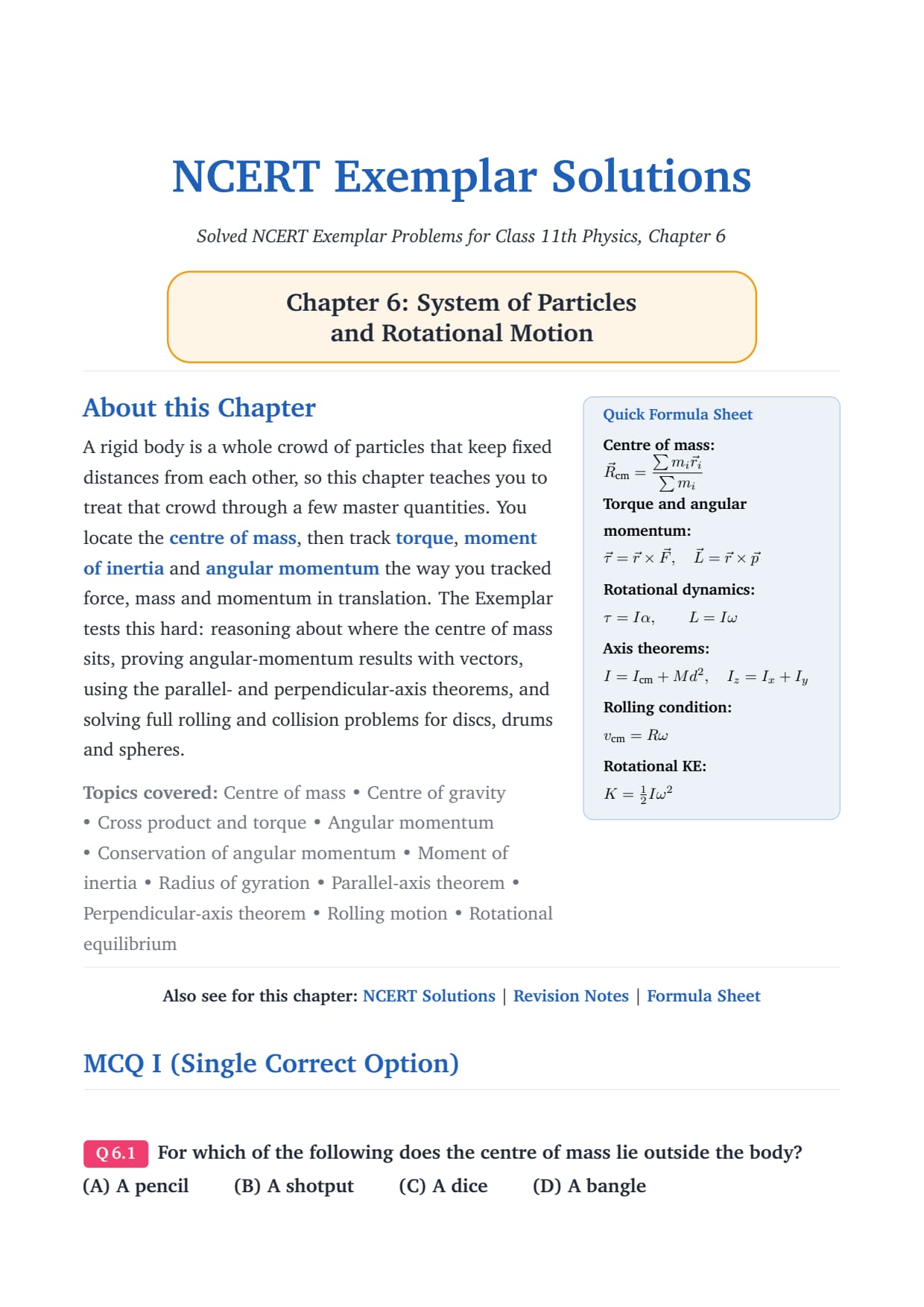
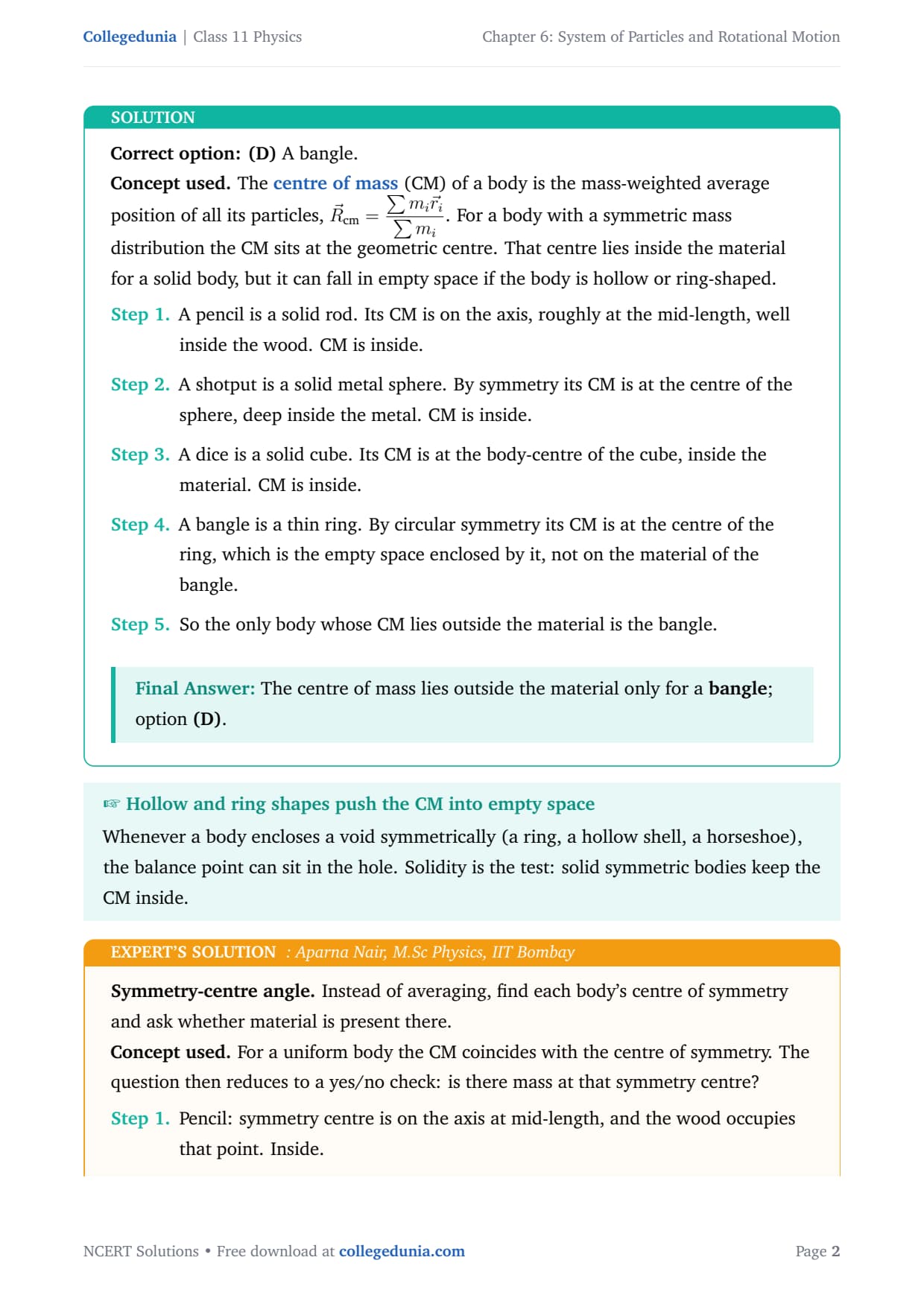
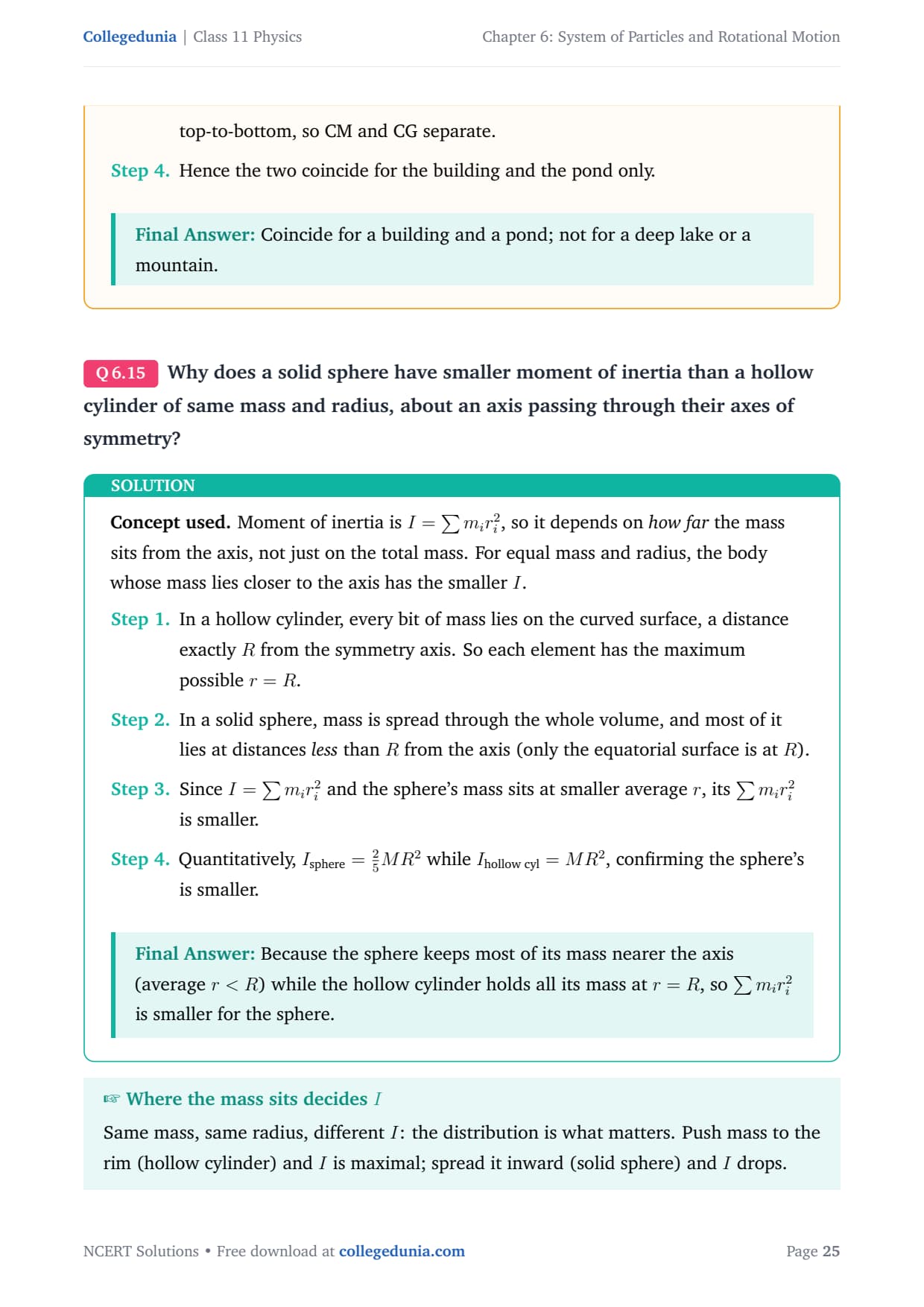
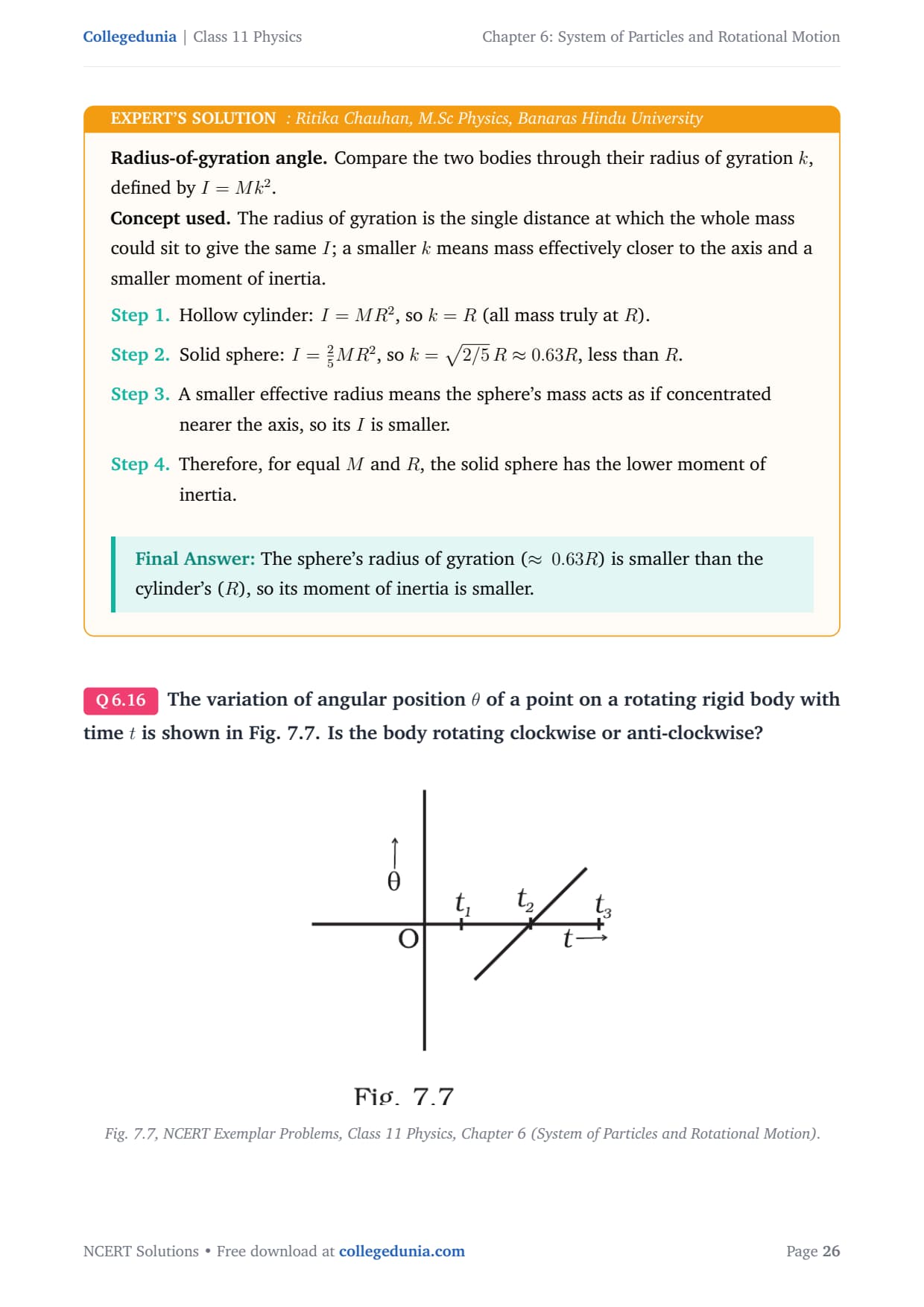
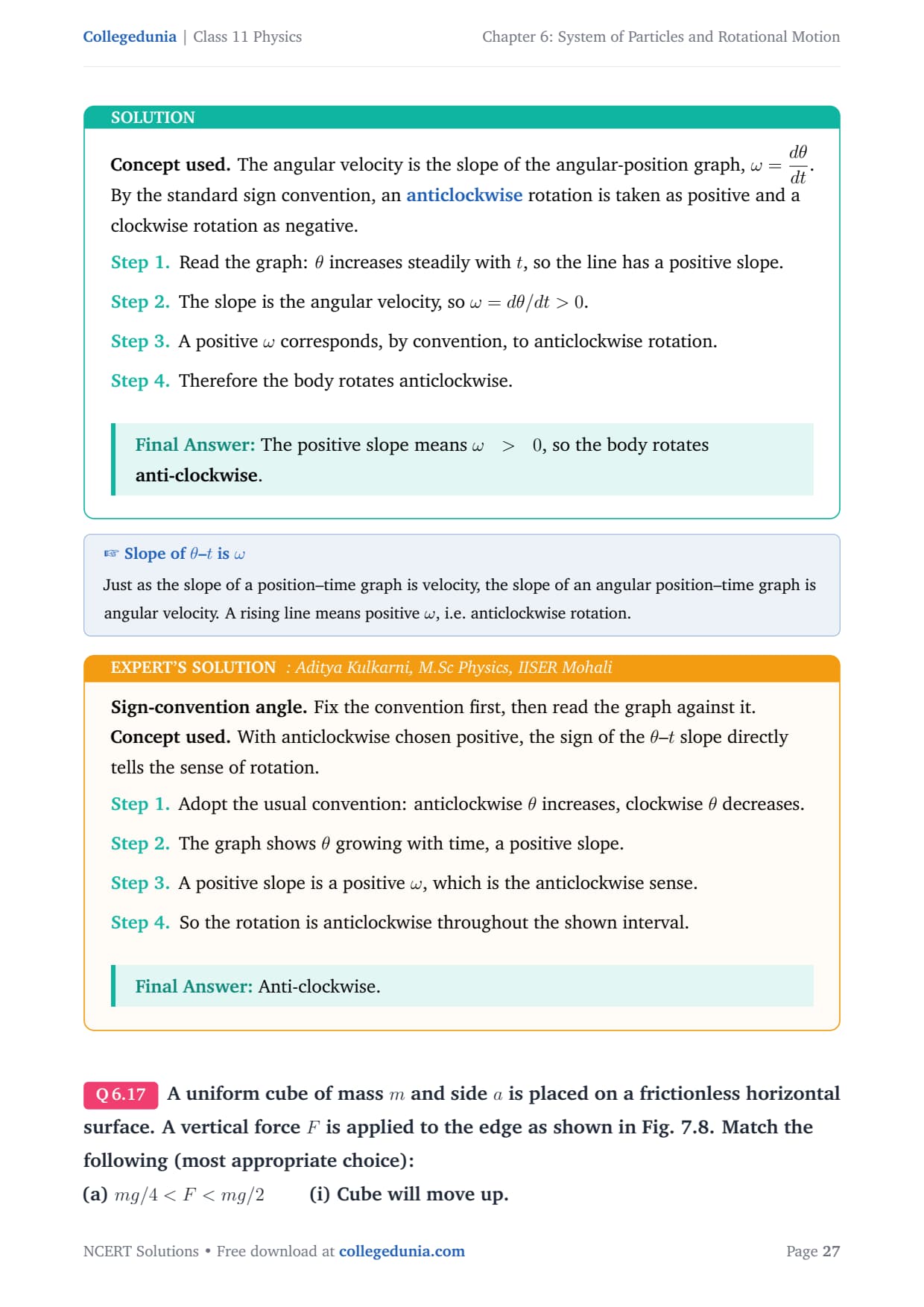
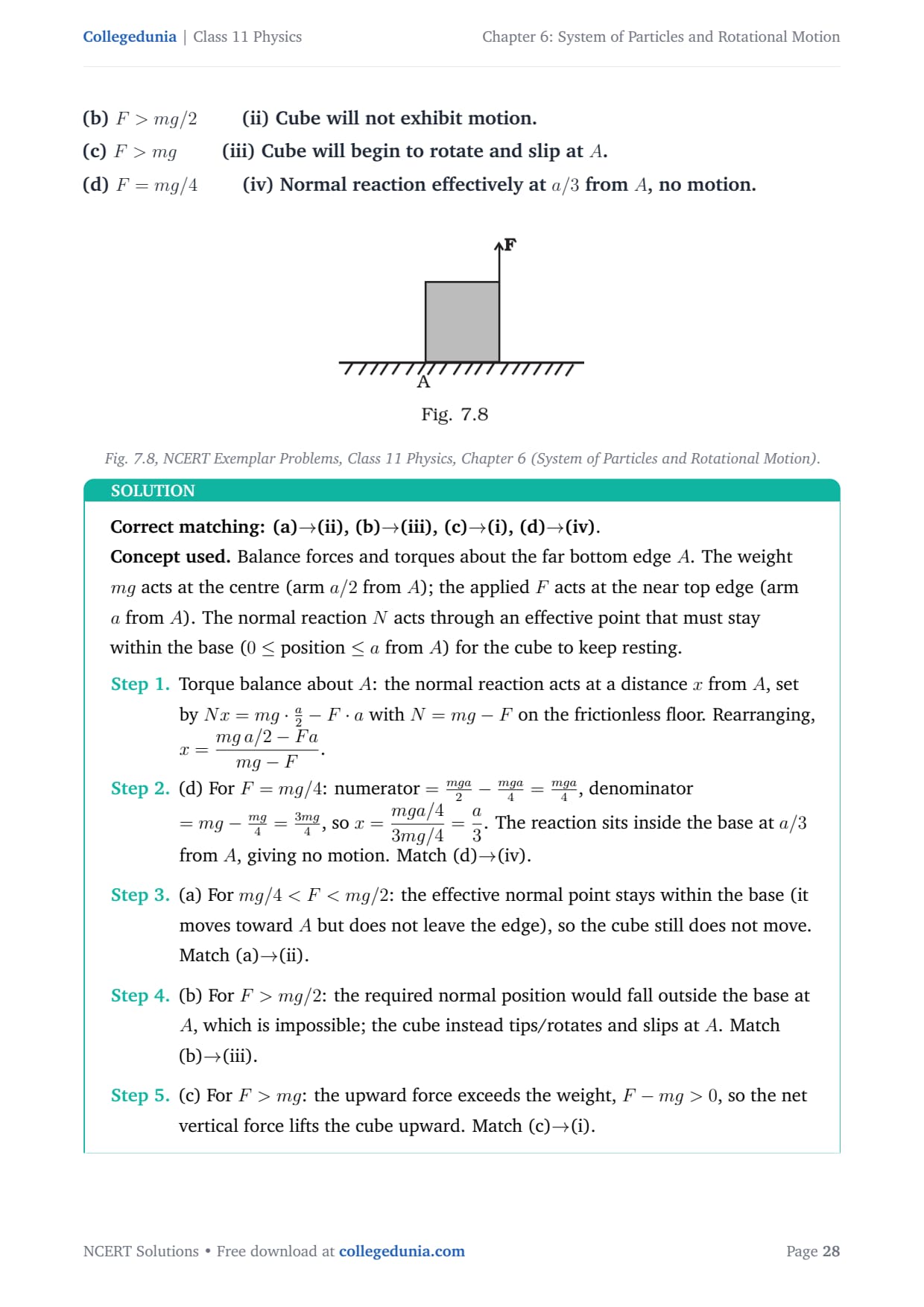
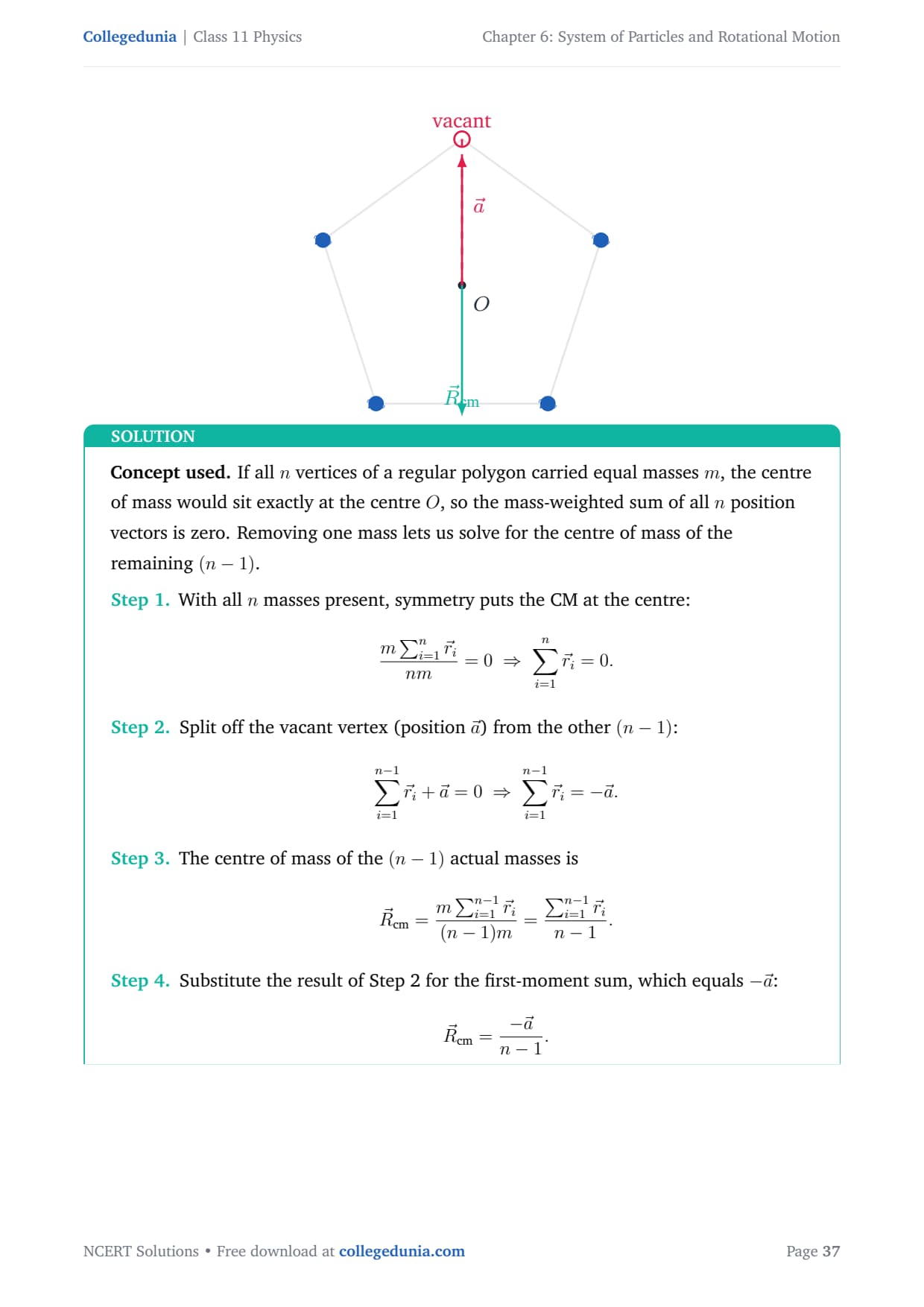
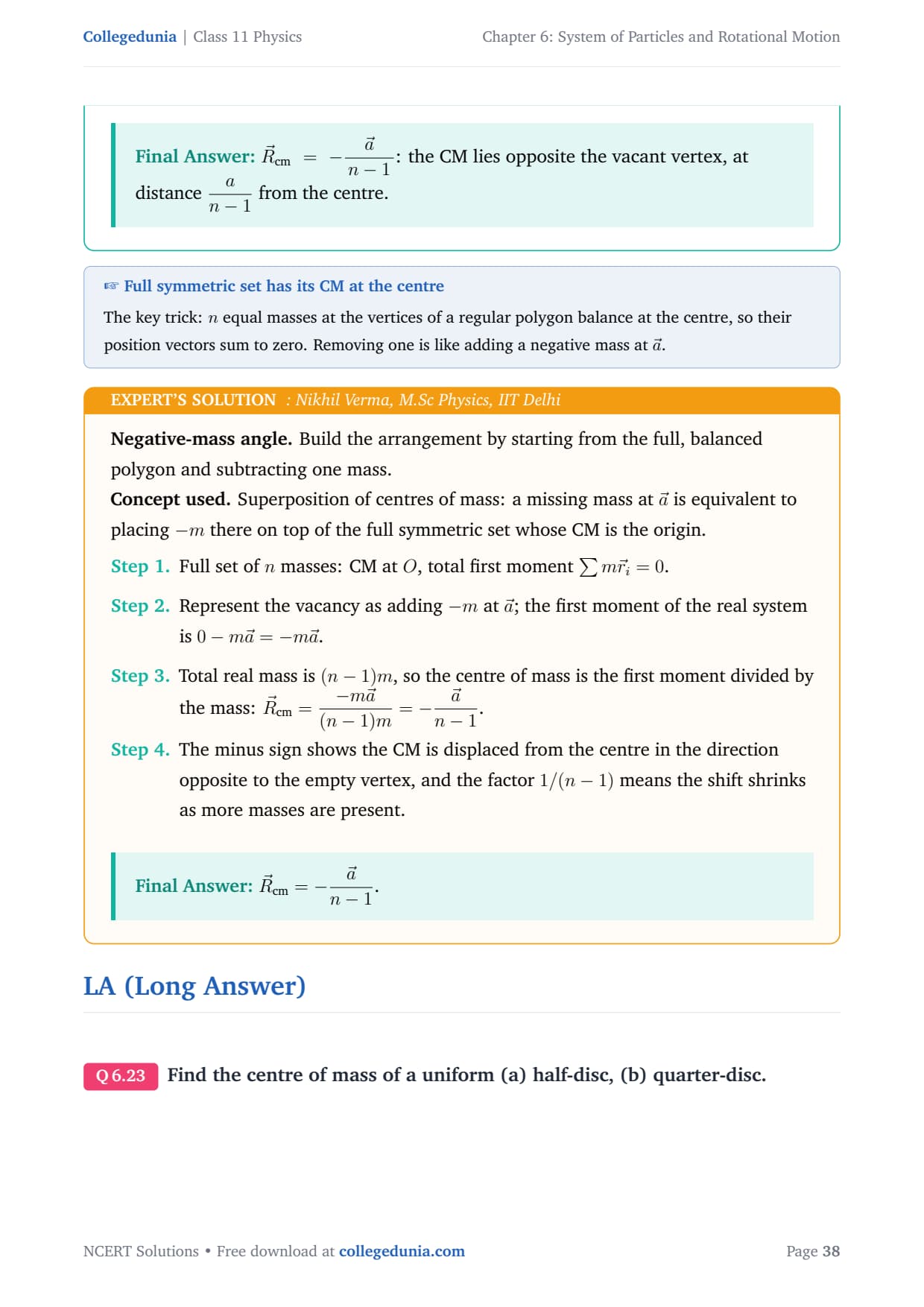
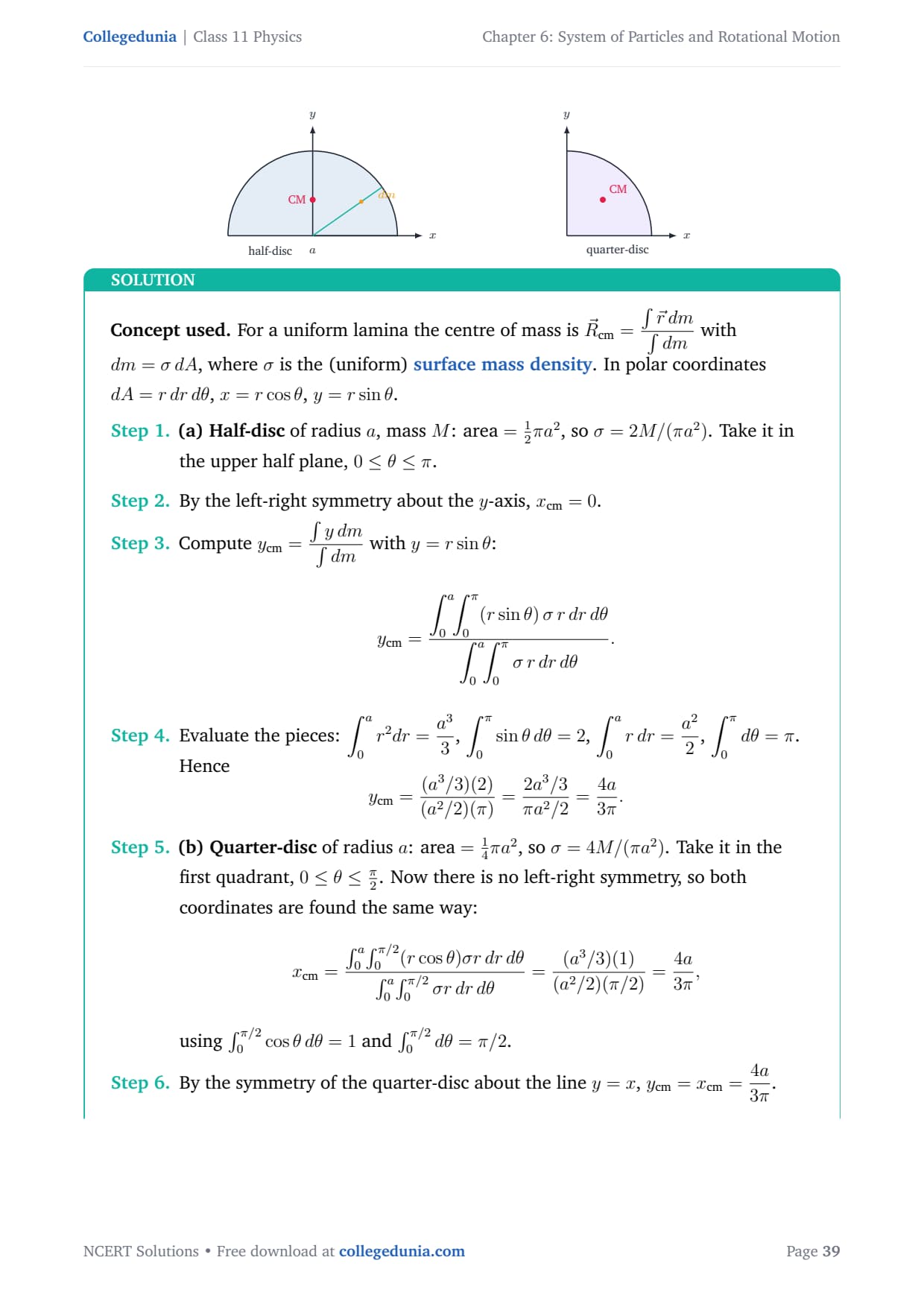
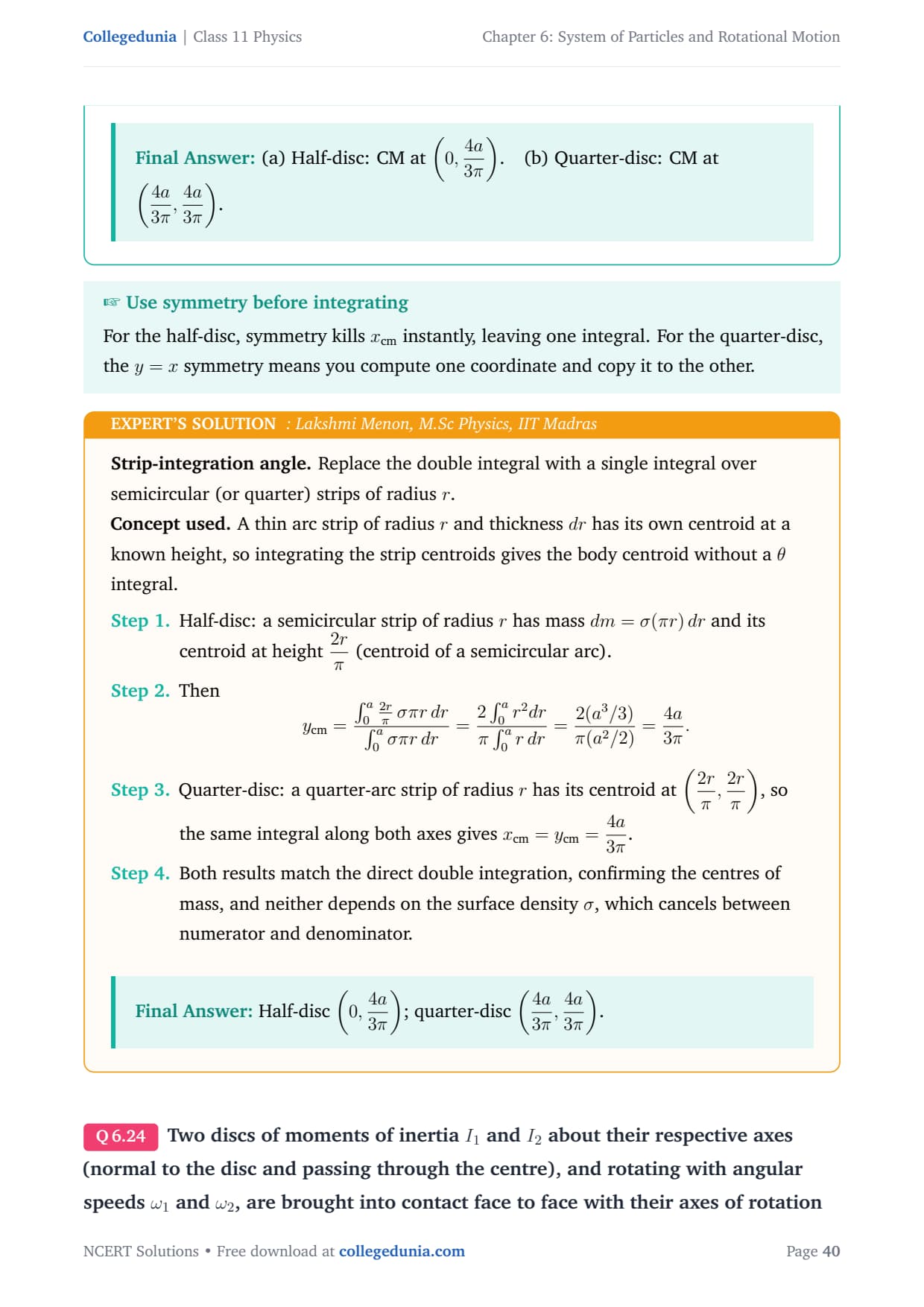
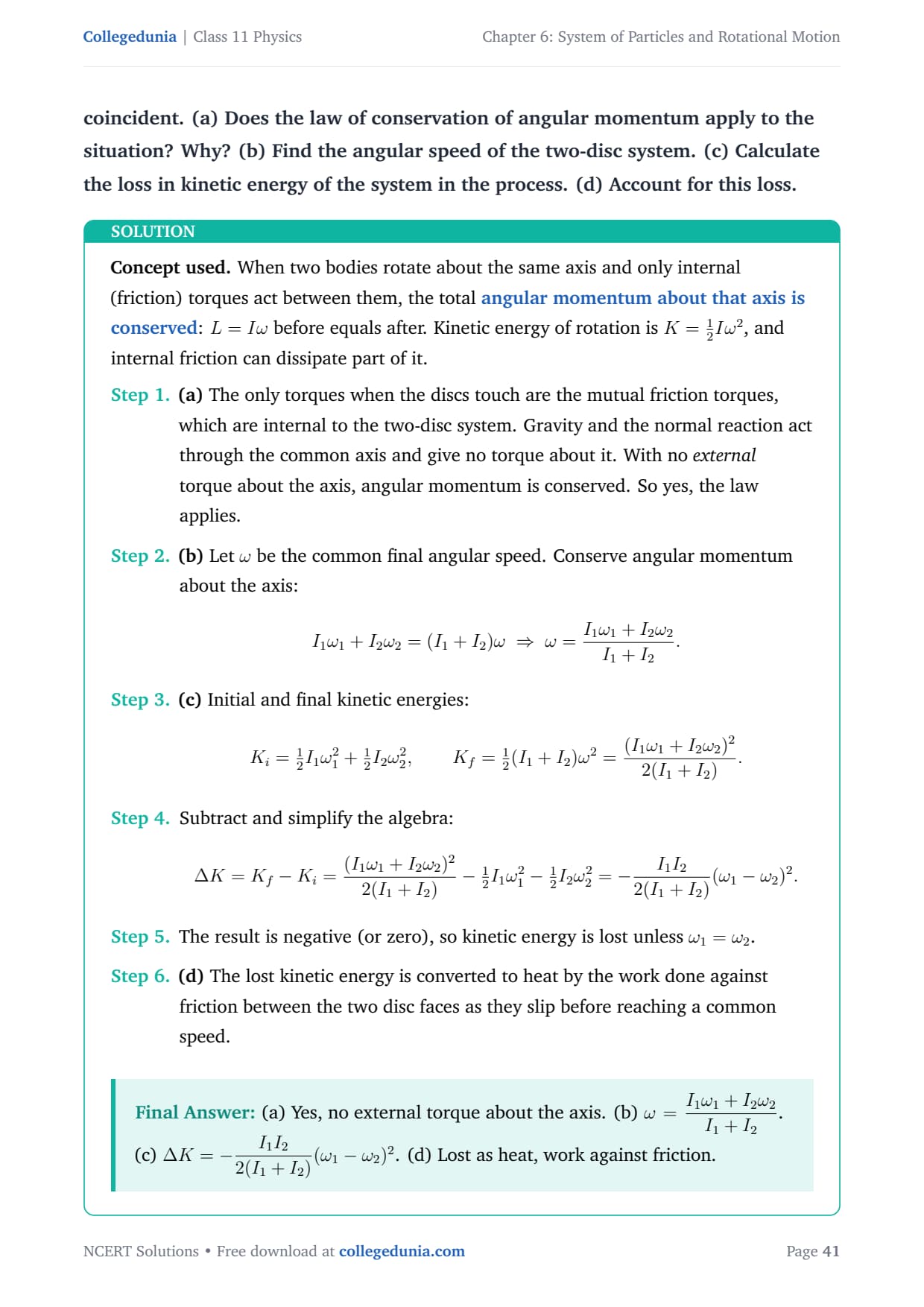
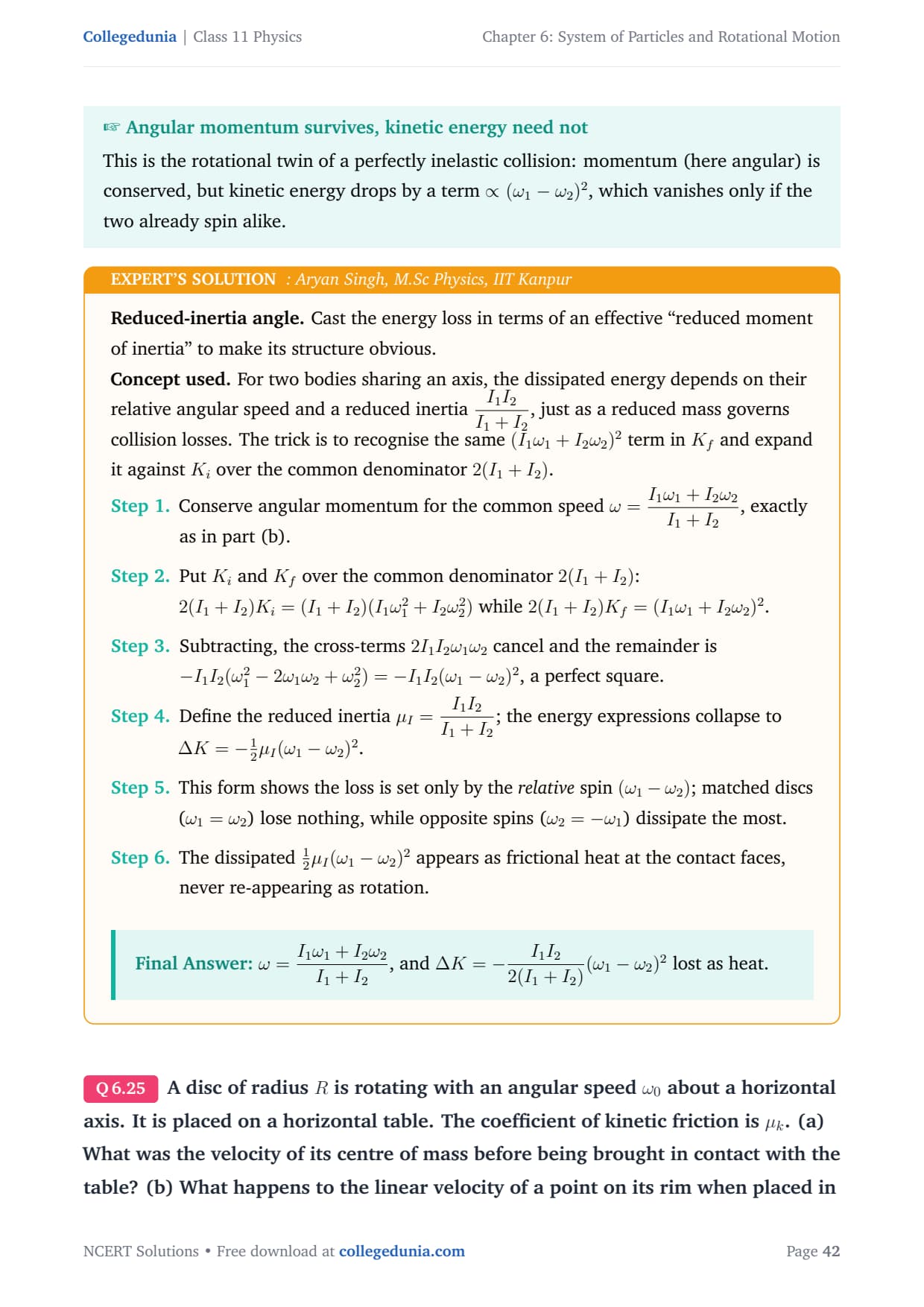
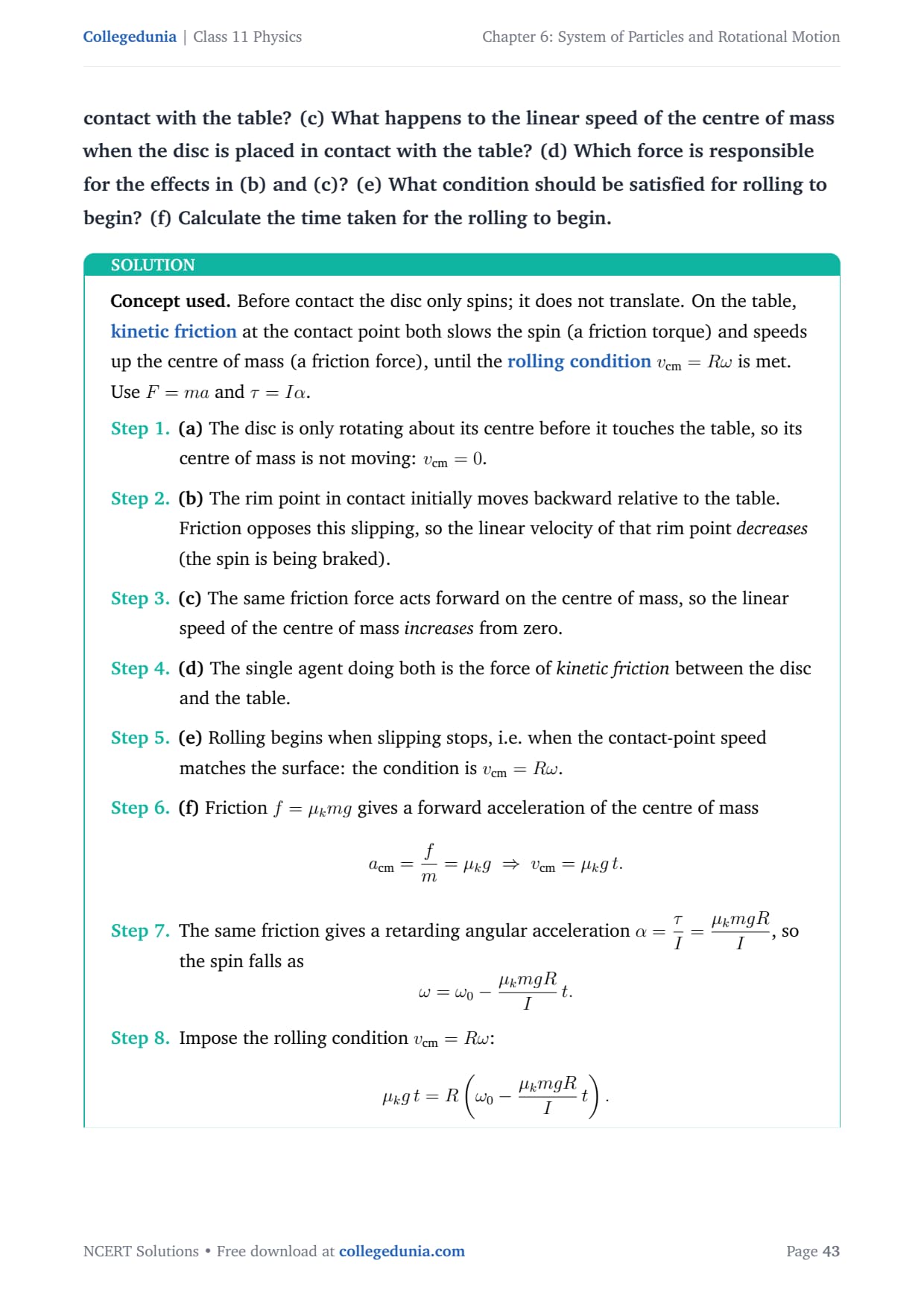
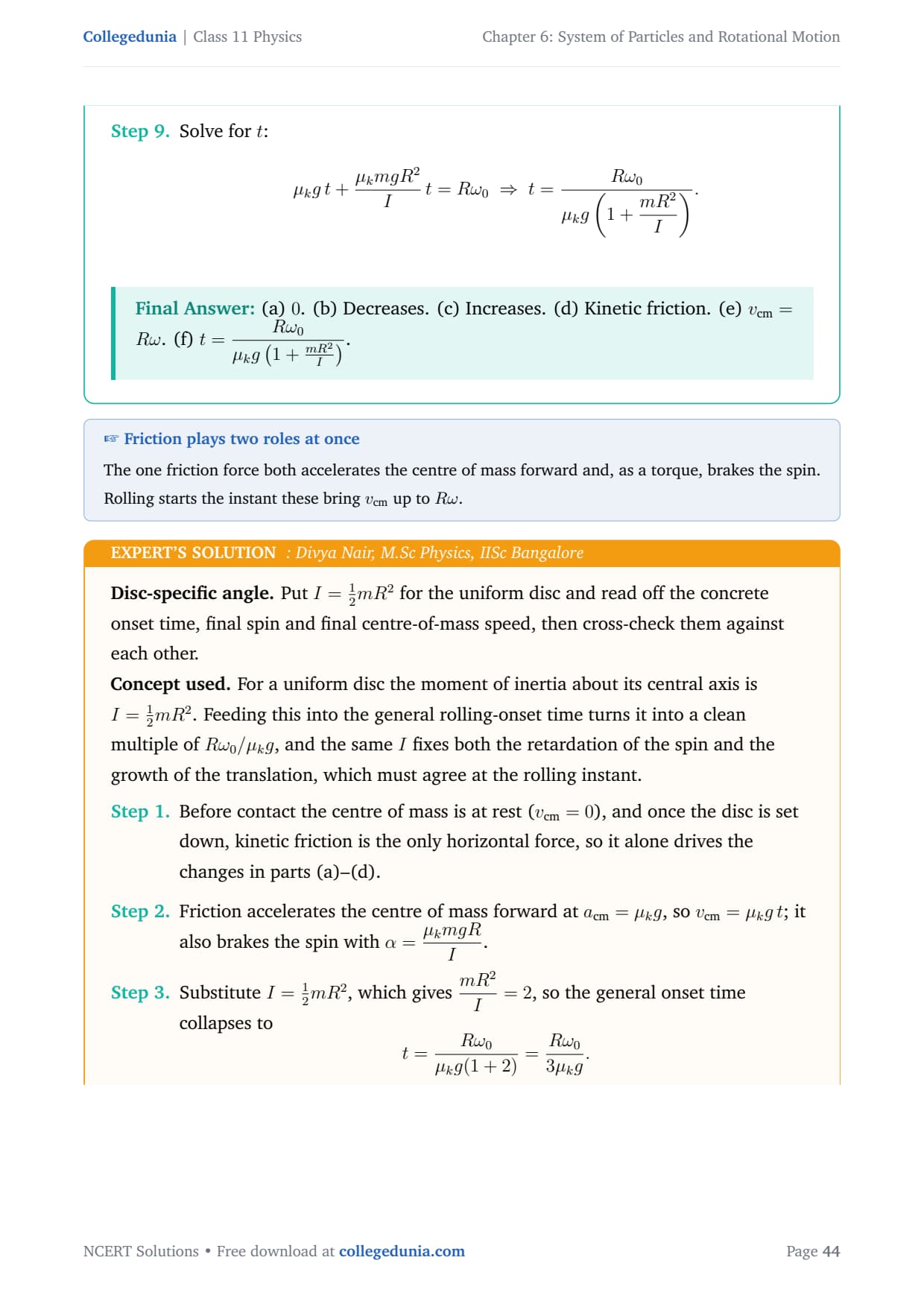
This chapter teaches you to treat a whole crowd of particles through a handful of quantities. You locate the centre of mass first, then track torque, moment of inertia and angular momentum. The Exemplar tests the reasoning far harder than the textbook exercise does.
- CBSE Weightage: 6 to 7 marks, usually one short answer on the axis theorems and one numerical on rolling
- JEE Main Weightage: 2 to 3 questions per year, most often on moment of inertia or angular momentum conservation
- NEET Weightage: 1 to 2 questions per year, generally on centre of mass or rotational kinetic energy
All 28 answers checked question by question against the official NCERT Exemplar answer key, with every figure redrawn from the source book.
Topics Covered in the Class 11 Physics System of Particles and Rotational Motion Exemplar
The Exemplar for this chapter builds on five ideas. Each one is the rotational twin of something you already know from translation, which is the fastest way to learn them.
- Centre of mass: locating it for point-mass systems, non-uniform rods, half-discs and quarter-discs
- Torque and angular momentum: the cross products τ = r × F and L = r × p, plus τ = Iα and L = Iω
- Moment of inertia: radius of gyration, and how mass distribution alone decides the value
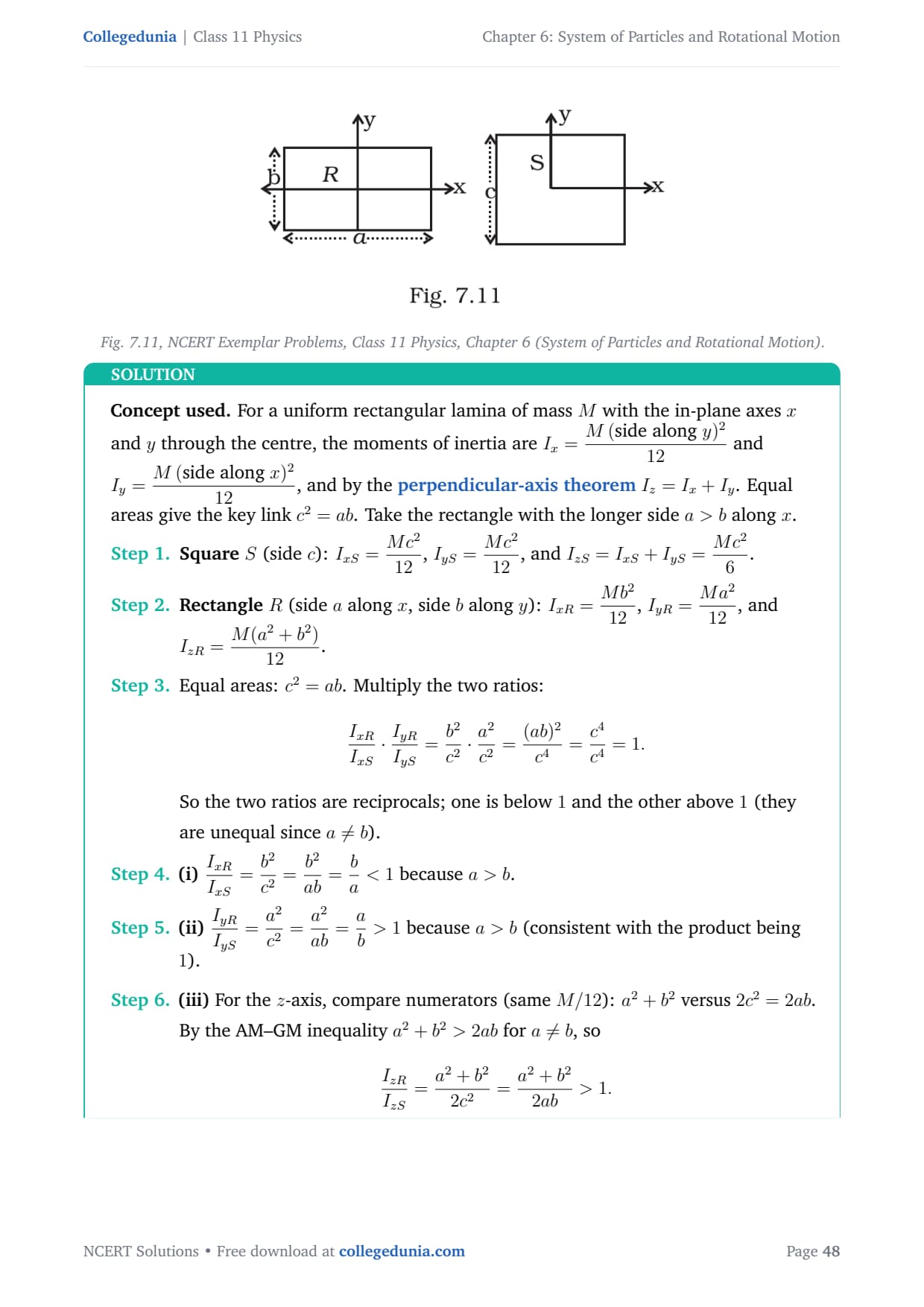
- The two axis theorems: parallel-axis I = Icm + Md2 and perpendicular-axis Iz = Ix + Iy
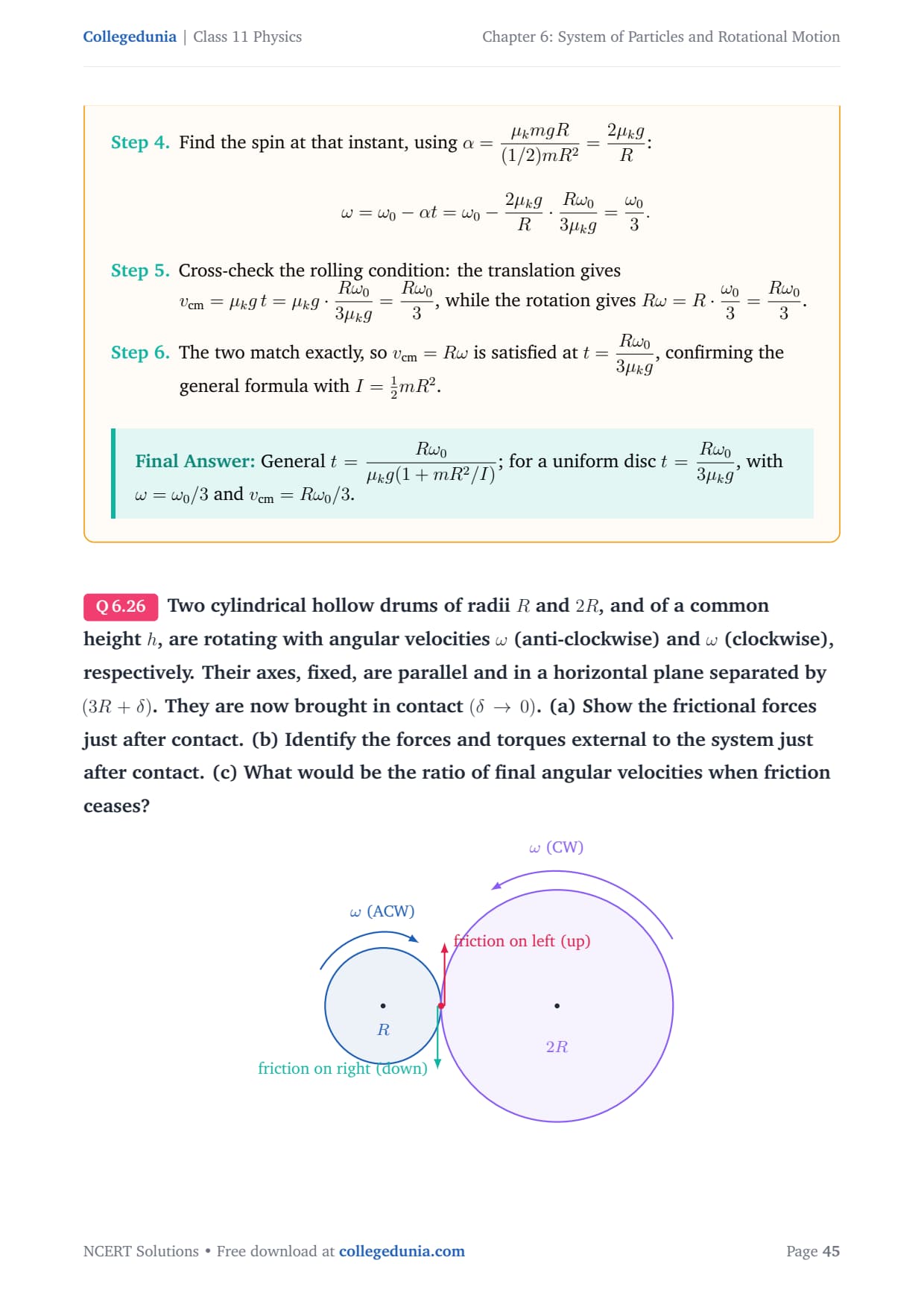
- Rolling motion: the condition vcm = Rω, and the friction that brings a spinning disc to it
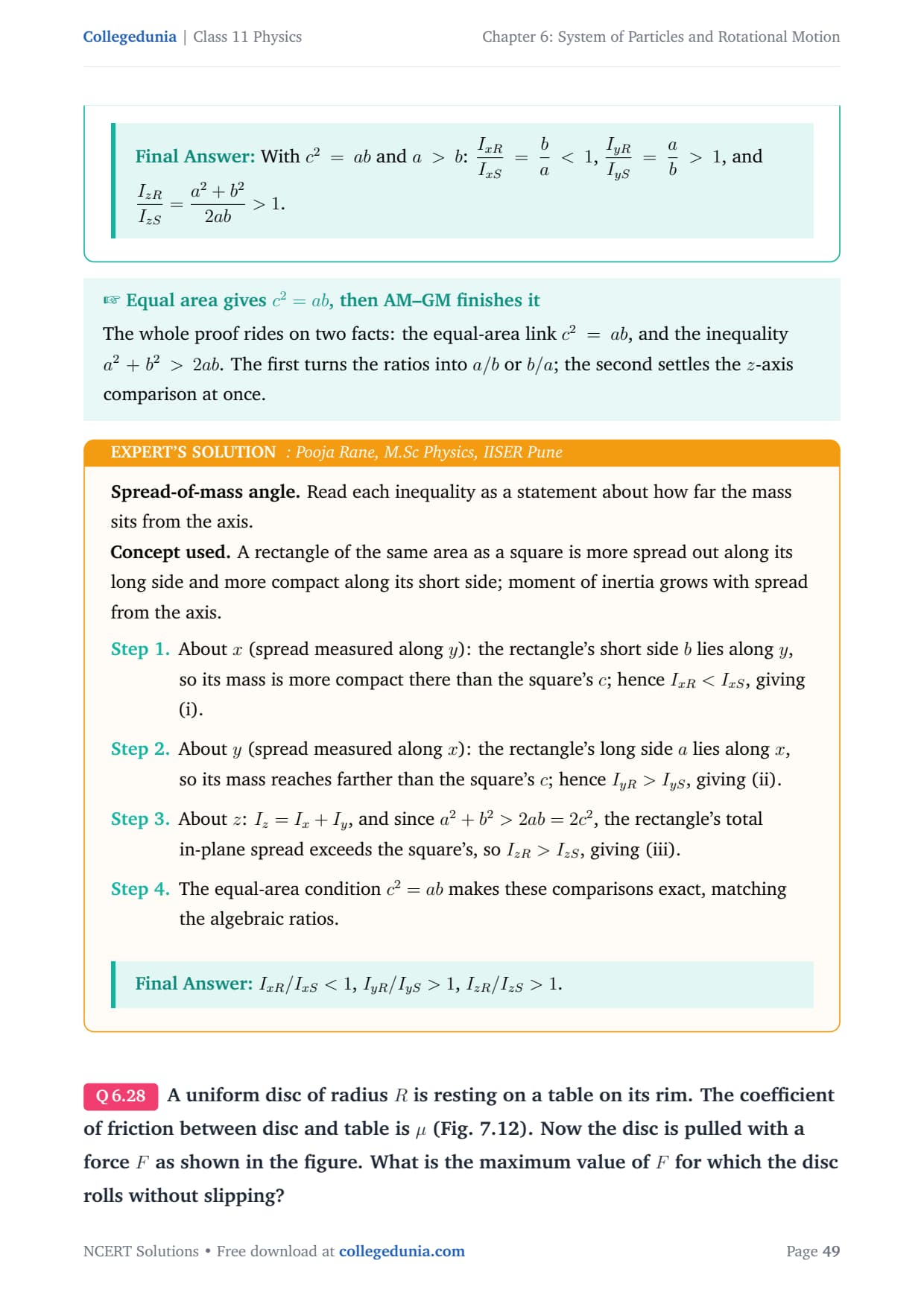
Question Types in the System of Particles and Rotational Motion NCERT Exemplar
The 28 questions split across five types. The Long Answer set is unusually heavy here, with six multi-part problems on discs, drums and plates.
| Question Type | Count | What It Tests |
|---|---|---|
| MCQ I (single correct) | 8 | Where the centre of mass sits, and what uniform rotation does not mean |
| MCQ II (one or more correct) | 5 | Ruling out every wrong option on torque and angular momentum |
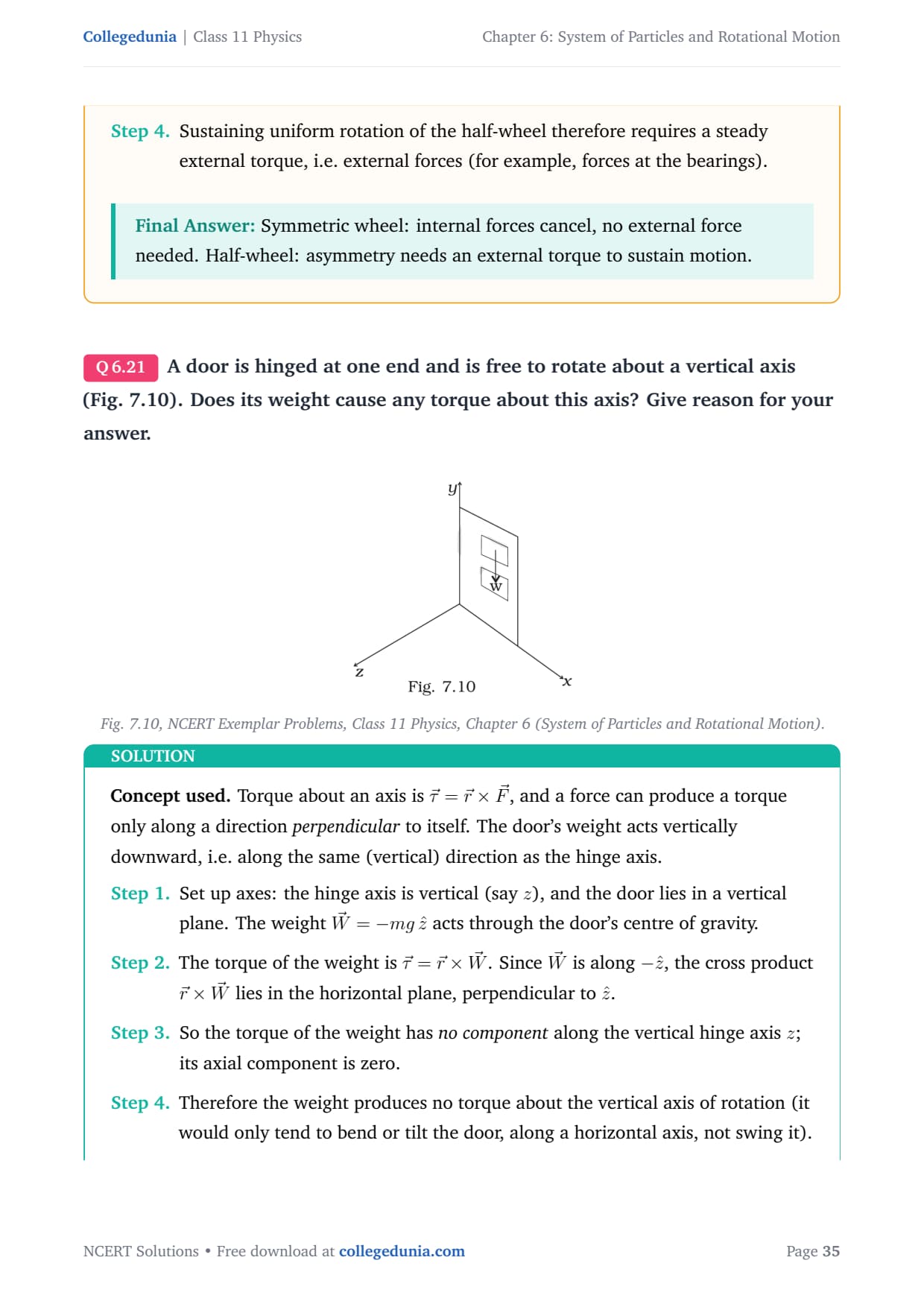
| VSA (Very Short Answer) | 5 | One-line reasoning, such as why a door hinge feels no torque from weight |
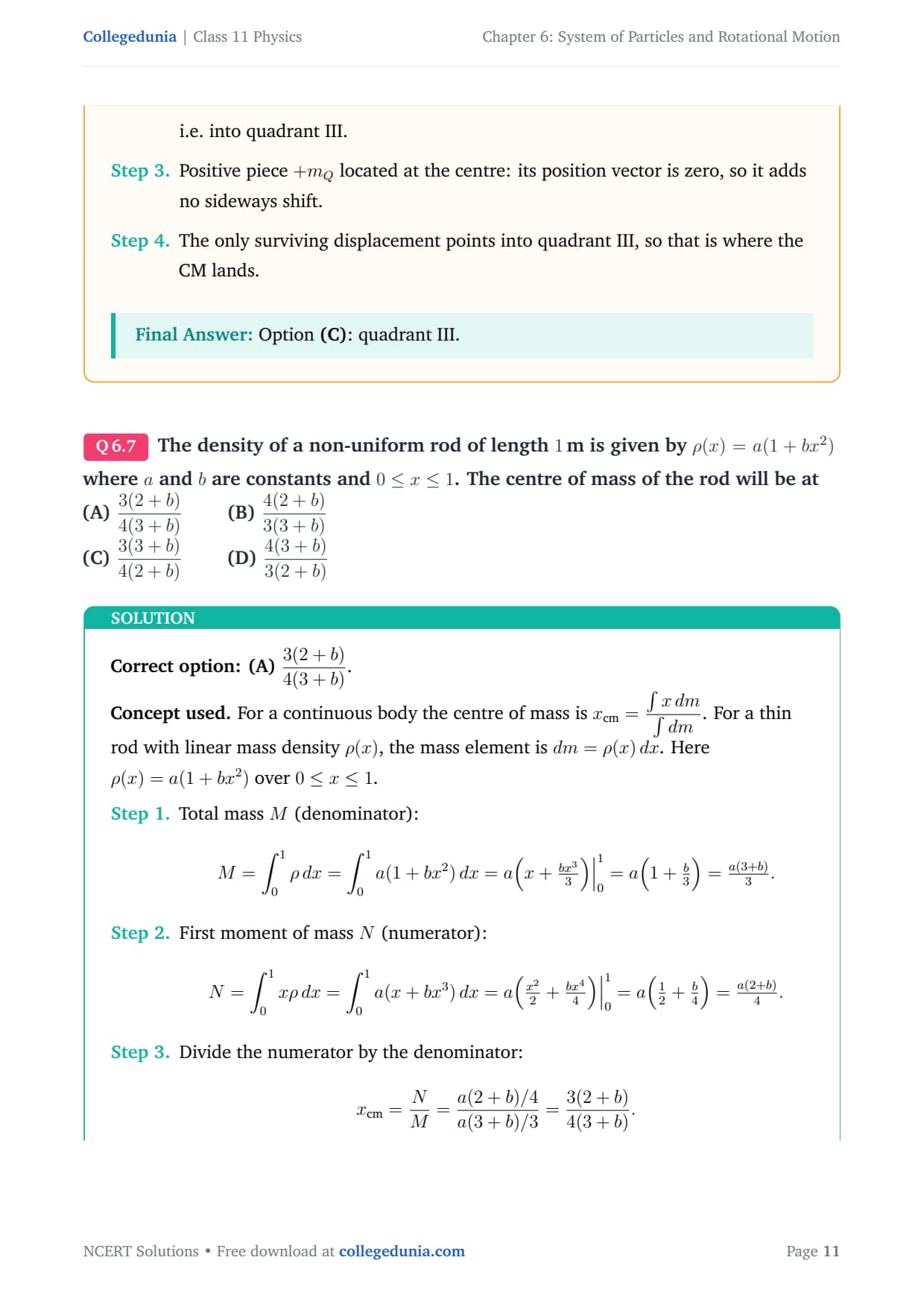
| SA (Short Answer) | 4 | Integration for the centre of mass of continuous bodies |
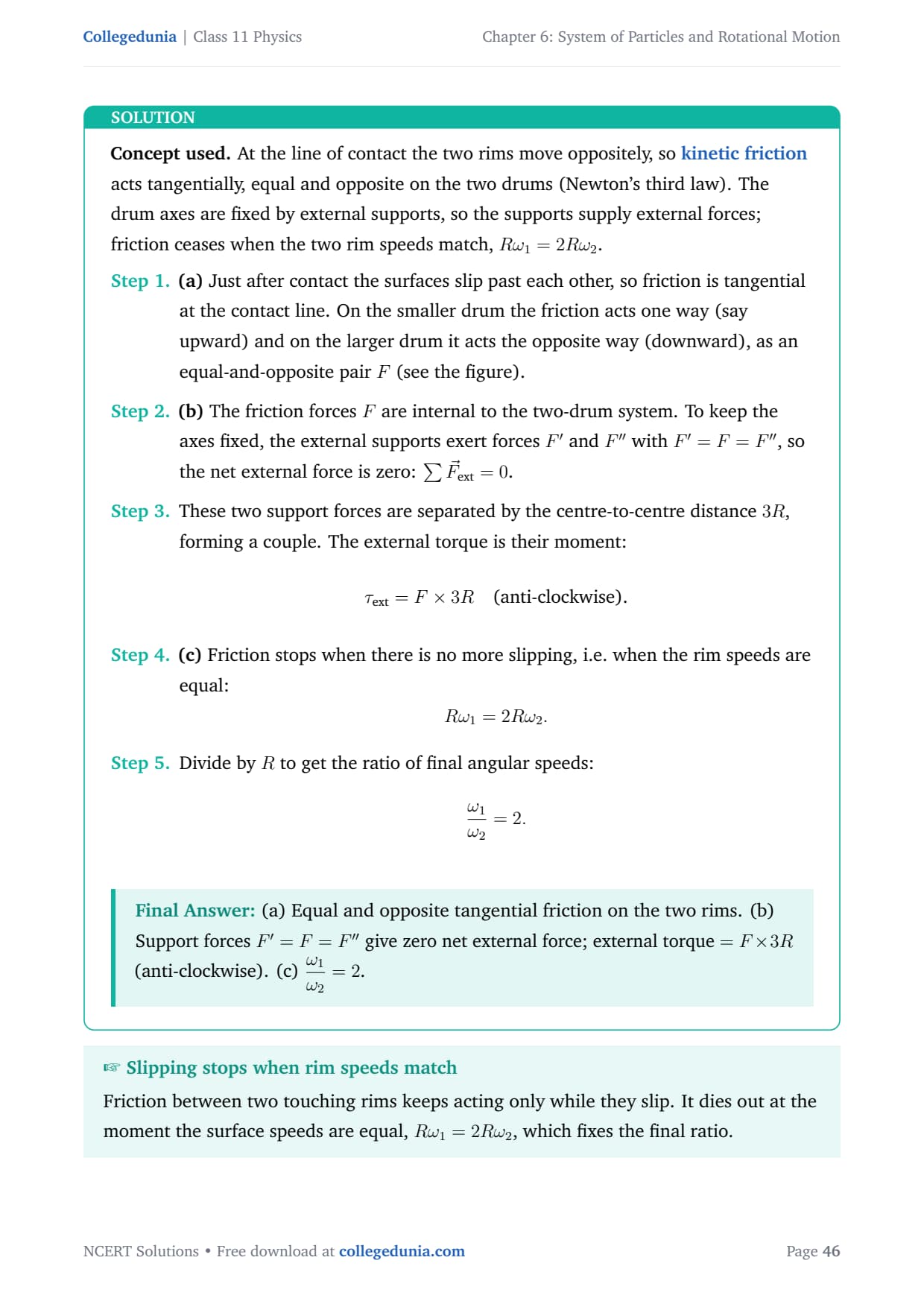
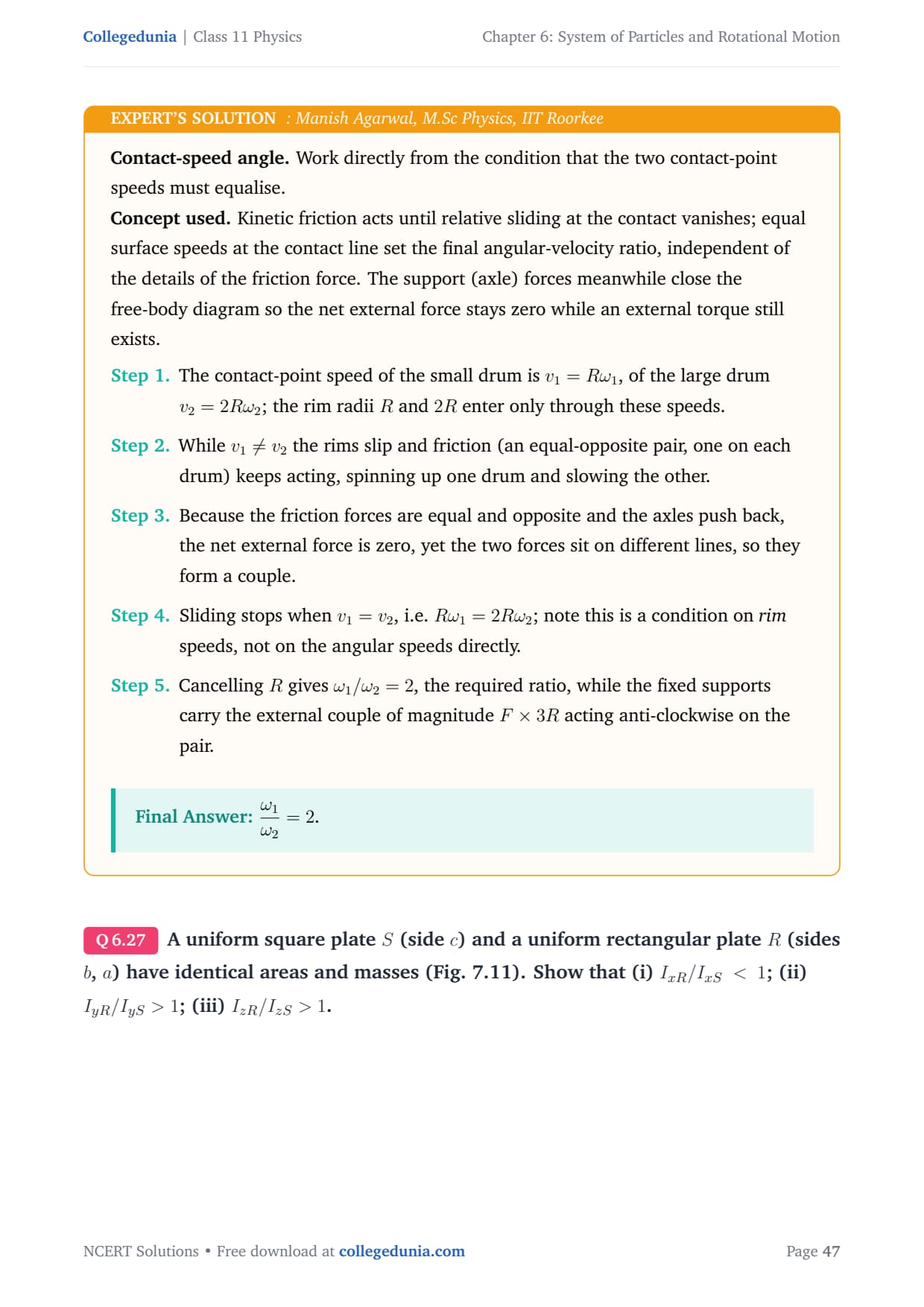
| LA (Long Answer) | 6 | Full rolling, contact and axis-theorem problems worth 5 marks |
The Figure Numbering That Confuses Students
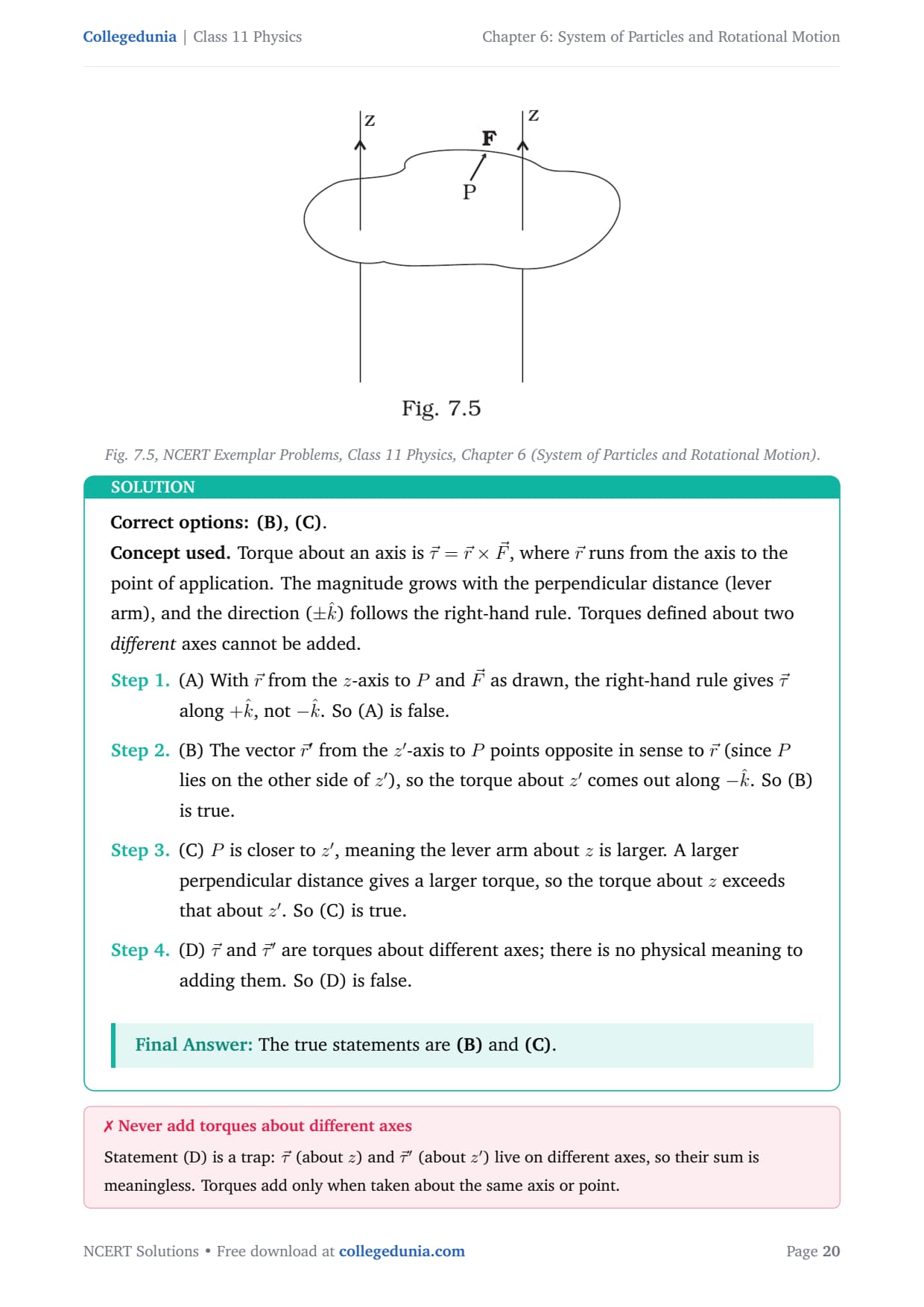
Open the Exemplar book and this chapter is printed as Chapter Seven, not Chapter Six. Its figures are labelled Fig. 7.1 through Fig. 7.12, and several questions refer to them by that number.
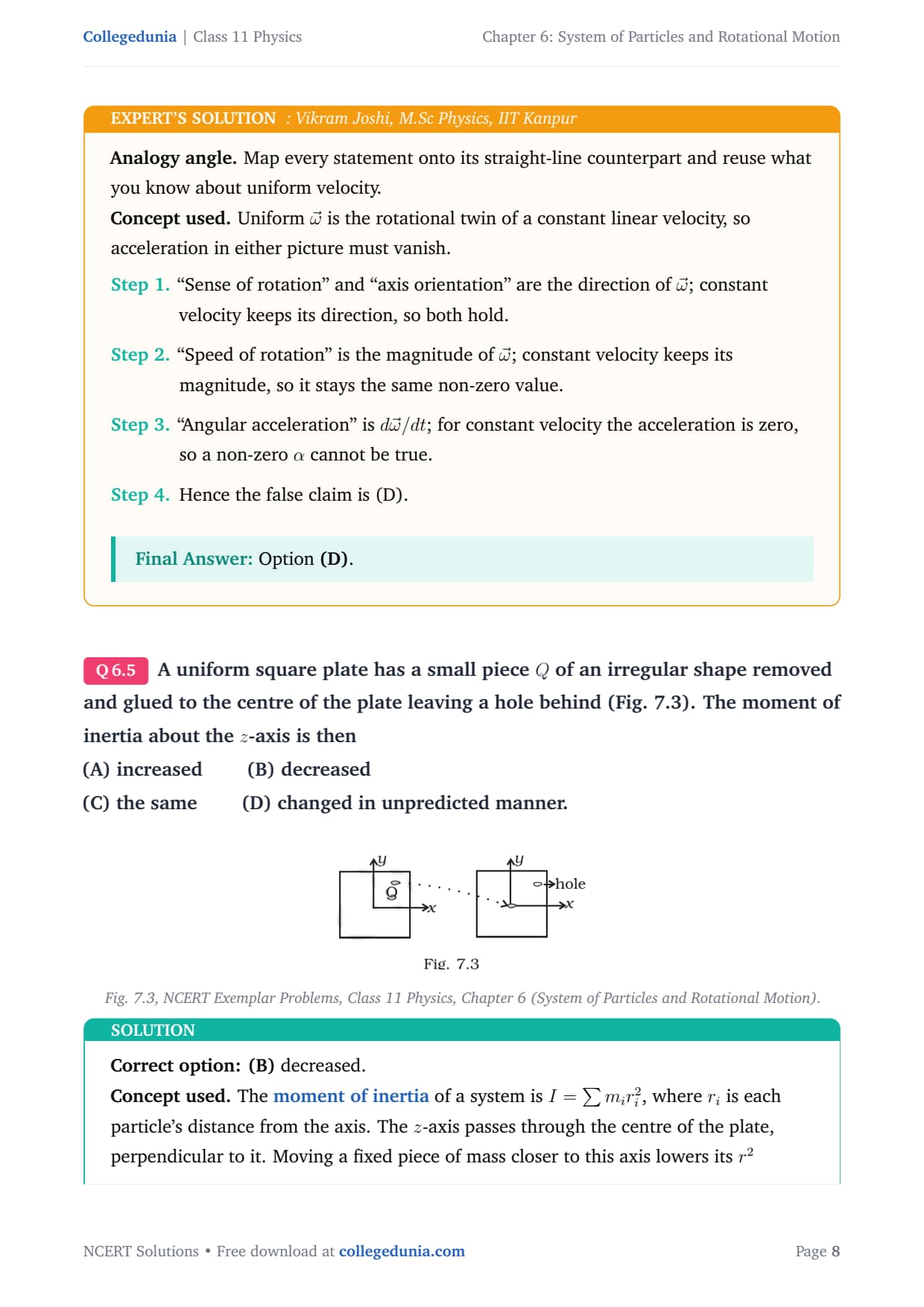
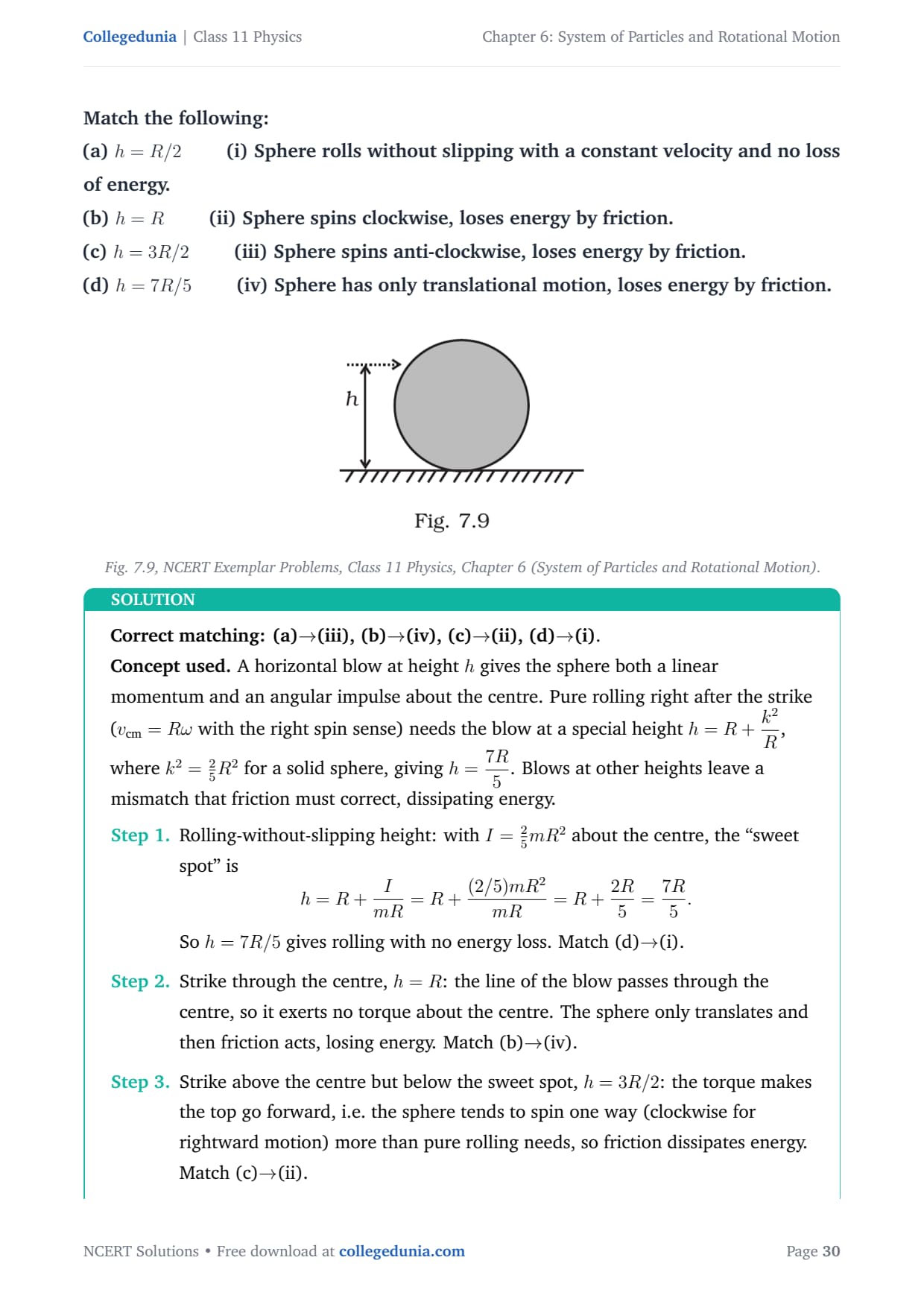
The NCERT textbook renumbered this chapter to 6, but the Exemplar book kept the old numbering. Our PDF embeds all 11 book figures at the question that needs them, so you never have to hunt for Fig. 7.5 while solving Question 5.
Common Mistakes Students Make in System of Particles and Rotational Motion
The Exemplar sets traps on purpose. These four catch most students, and each one is flagged in the PDF at the question where it appears.
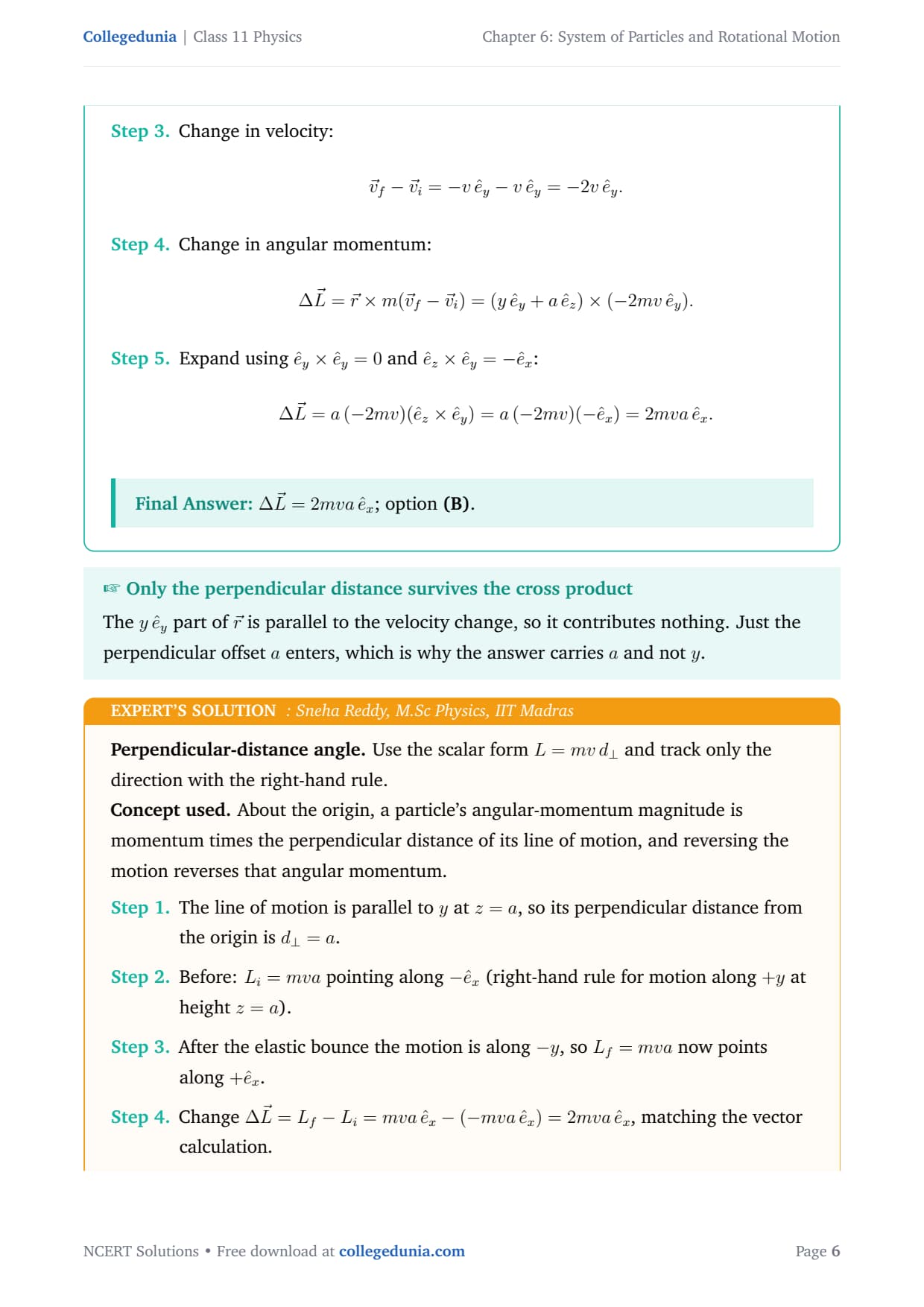
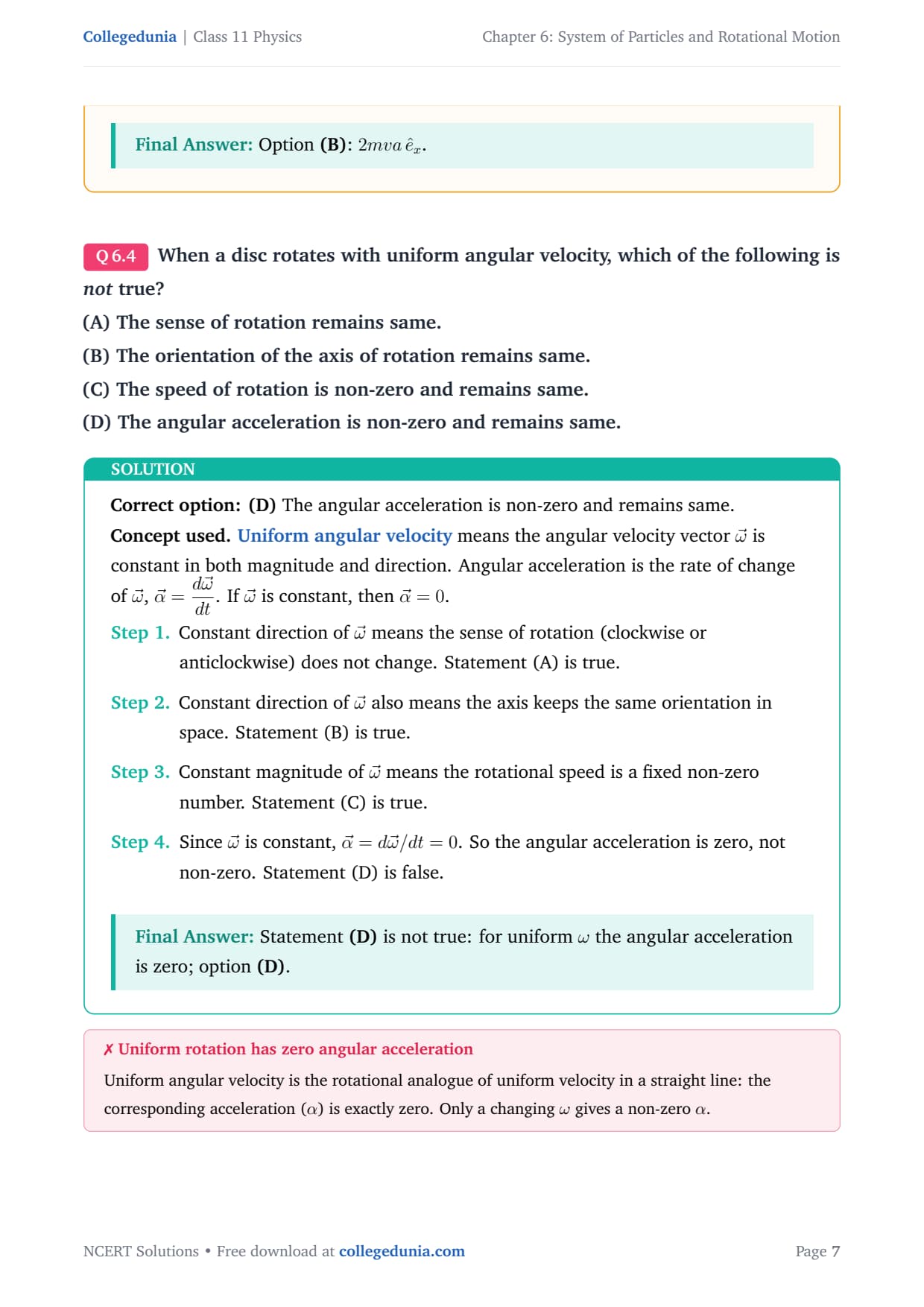
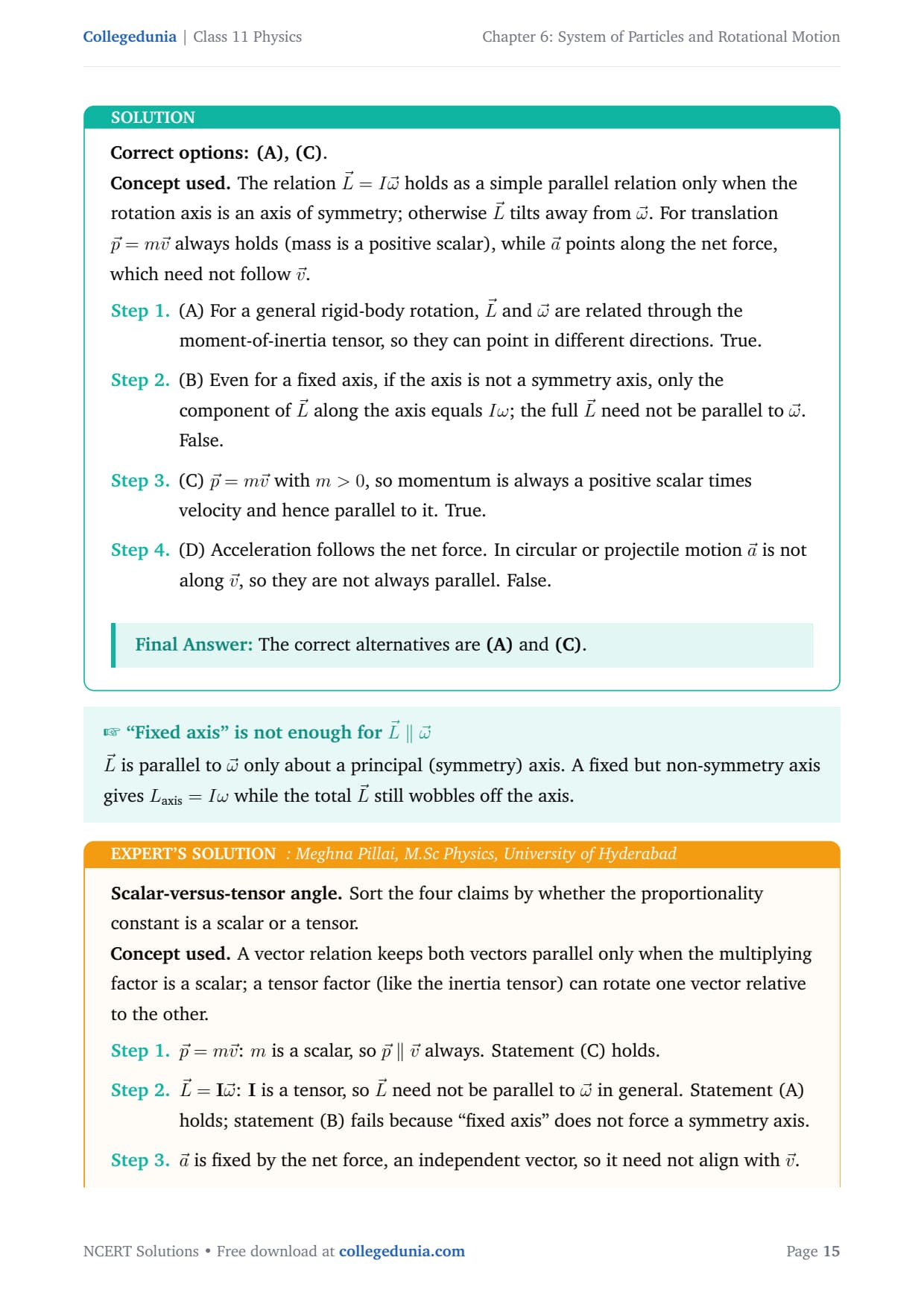
- Uniform rotation, Question 4: uniform angular velocity means α is exactly zero. It is the rotational twin of uniform velocity, so a non-zero α cannot be true.
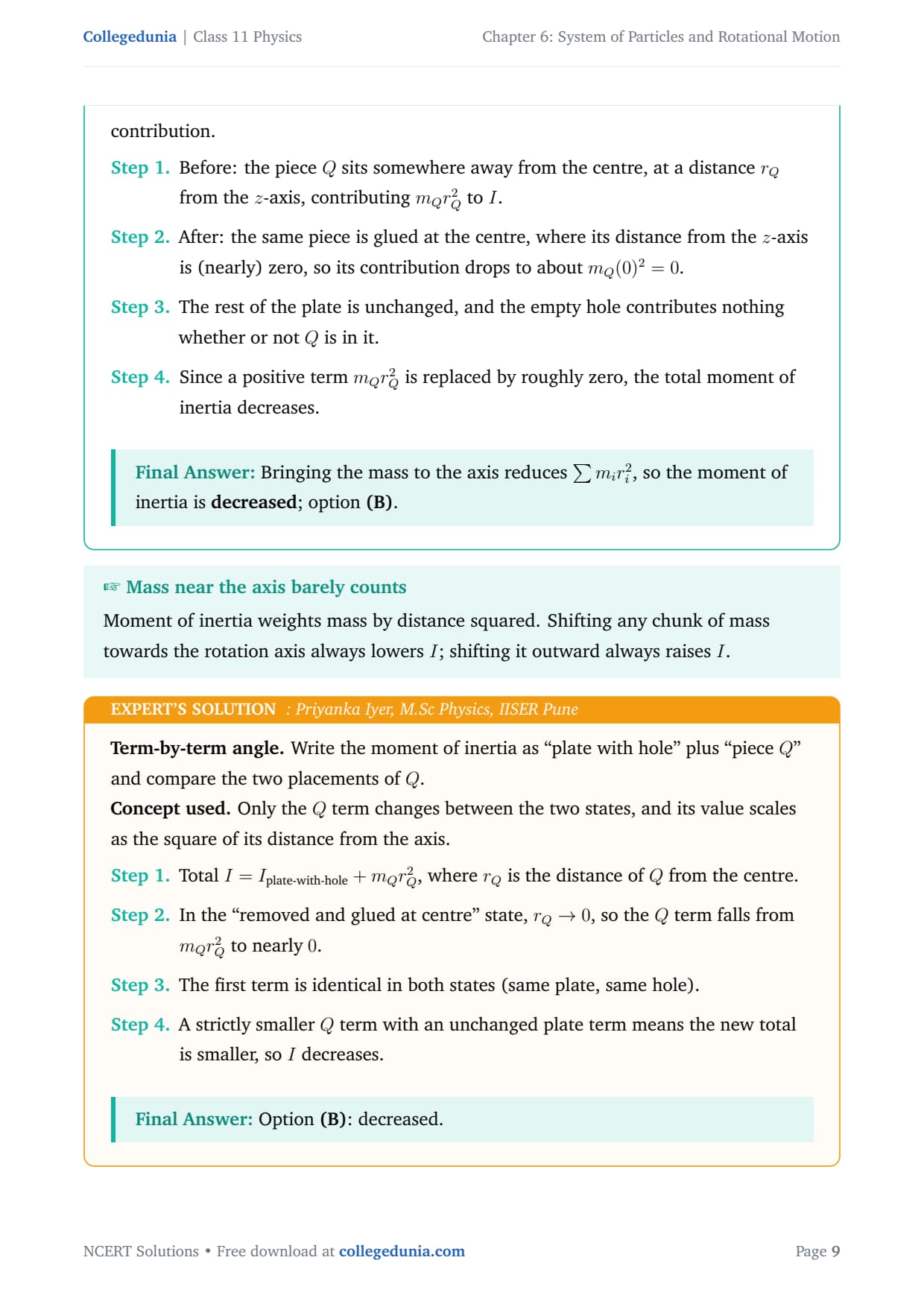
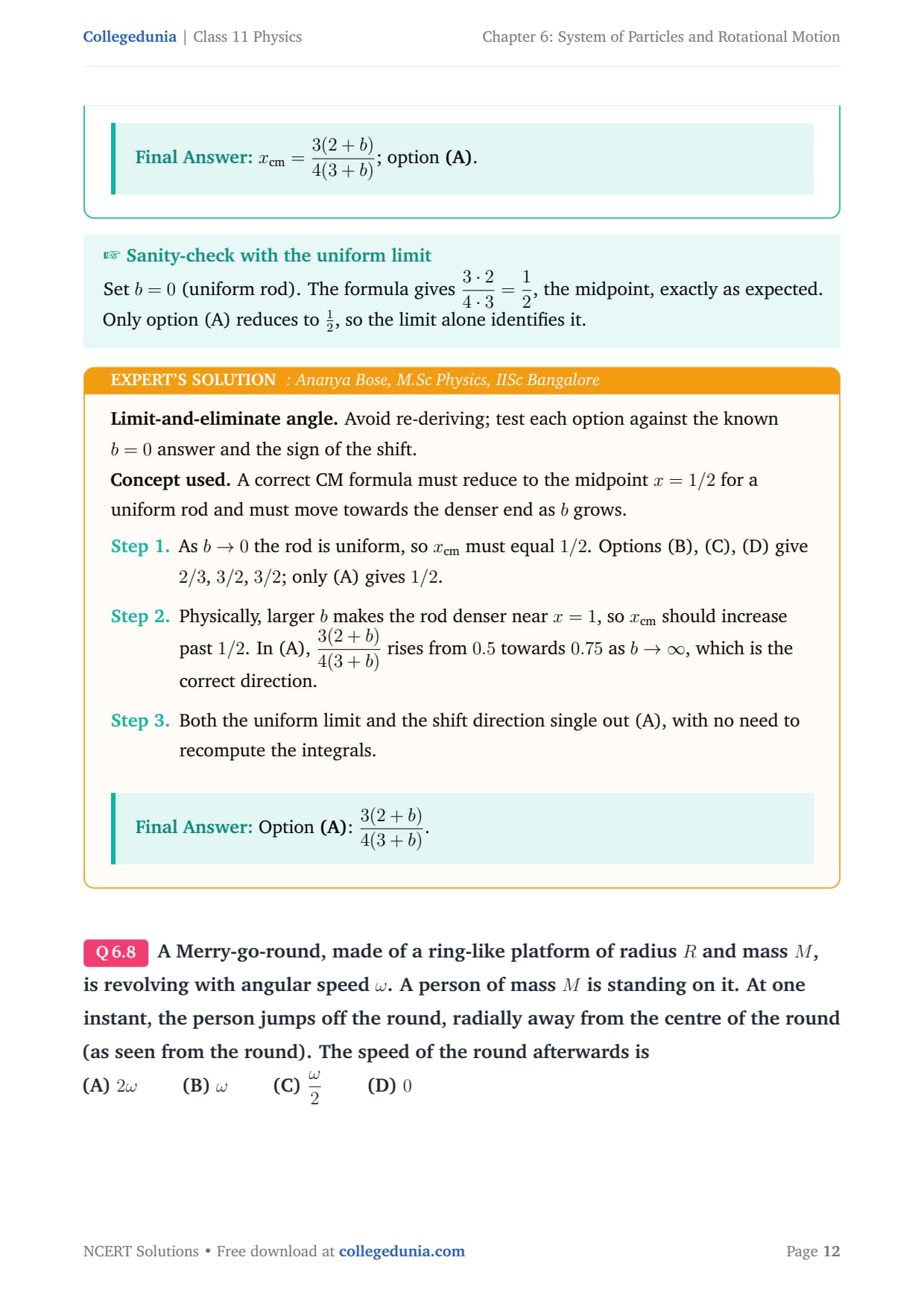
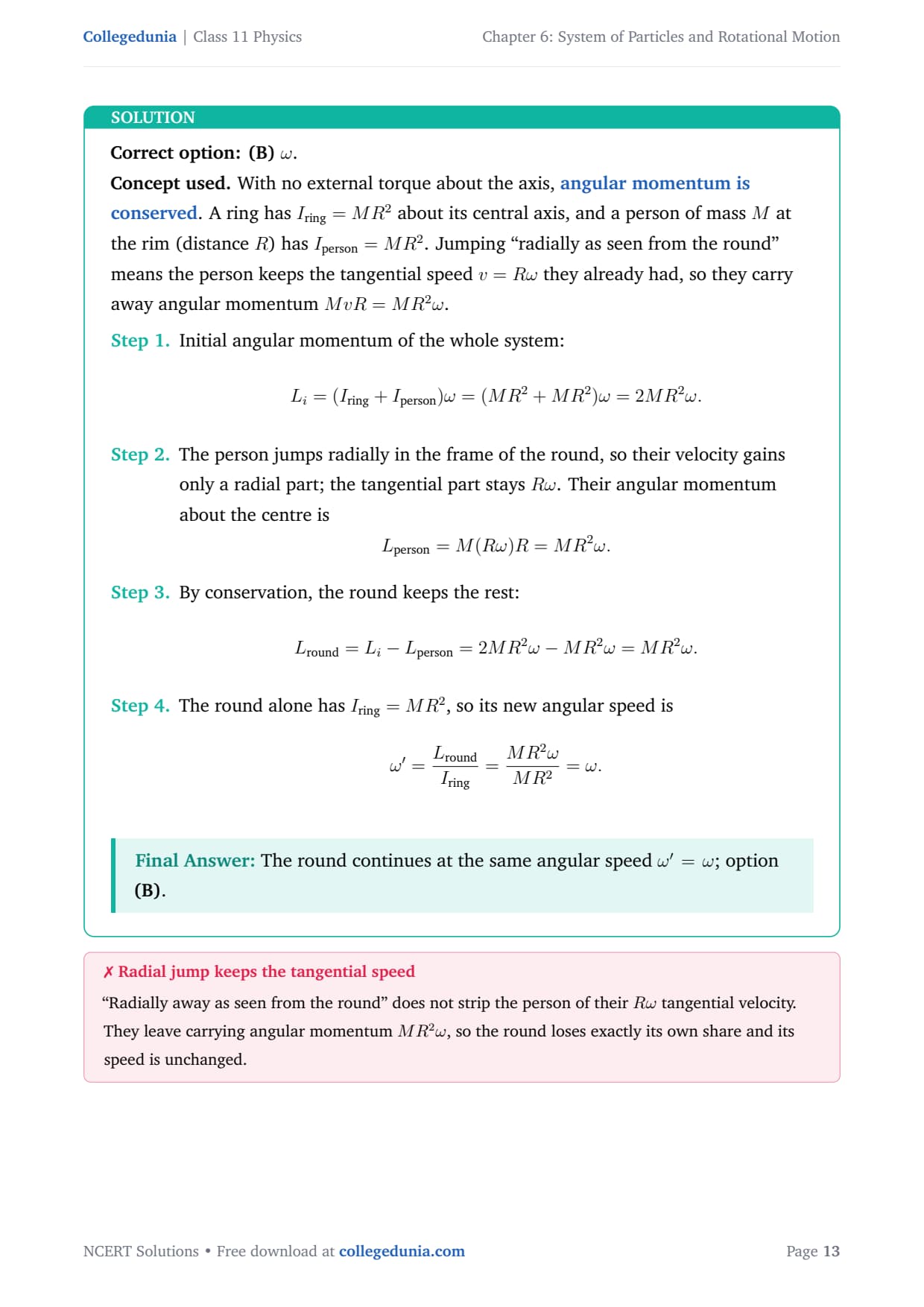
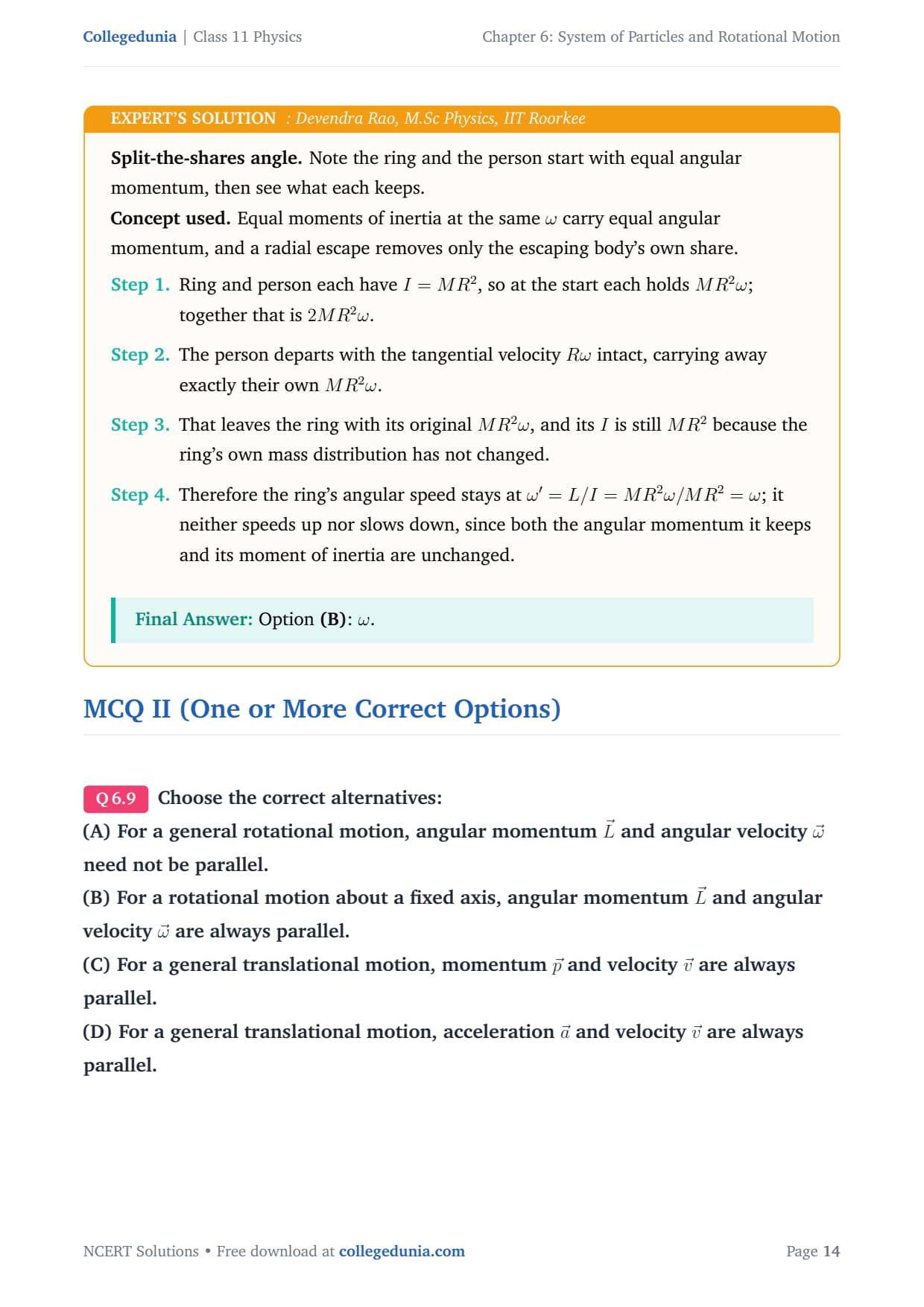
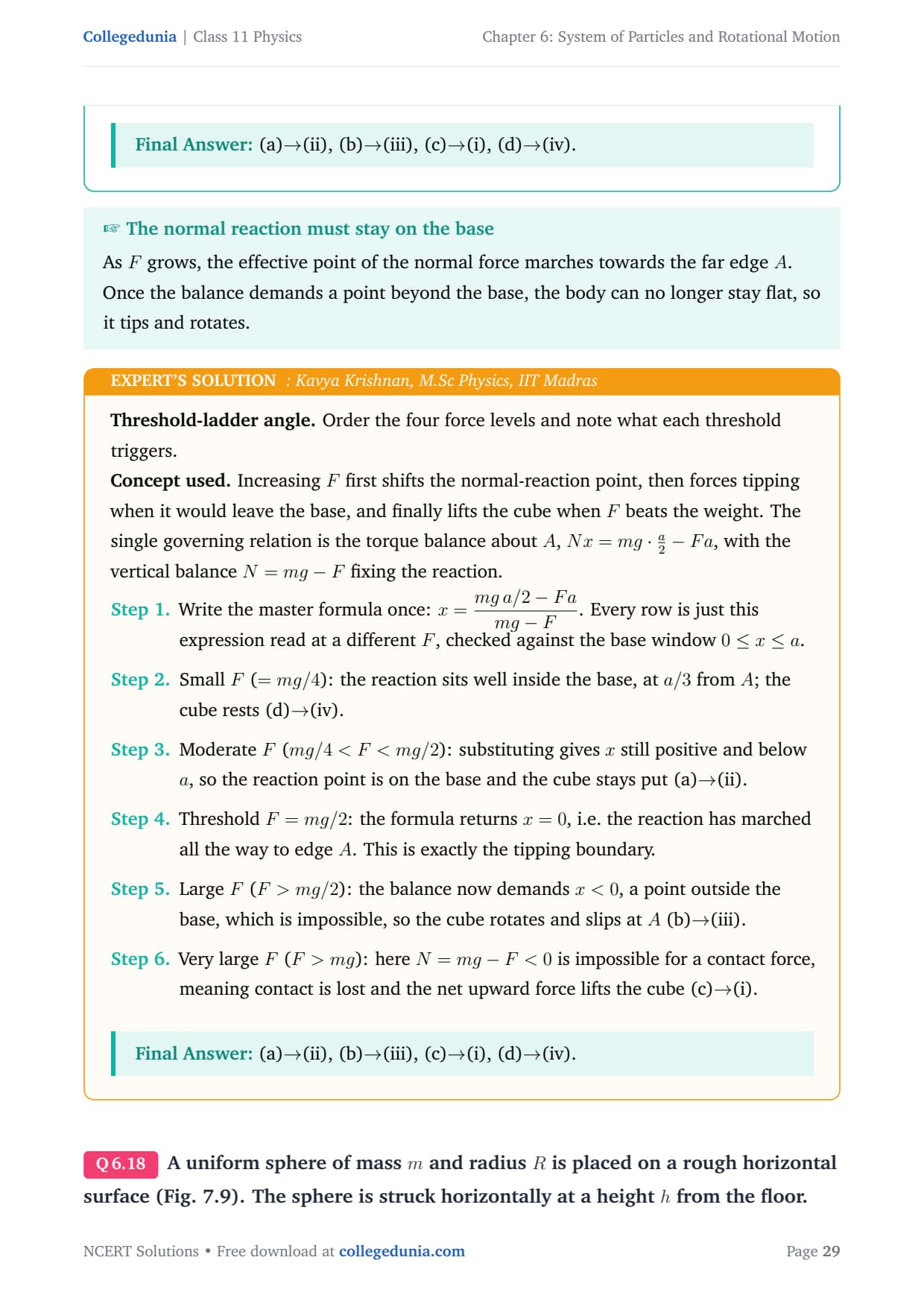
- The radial jump, Question 8: a person leaping "radially away as seen from the round" still carries tangential speed Rω. They take exactly their own share of angular momentum, so the round's speed is unchanged.
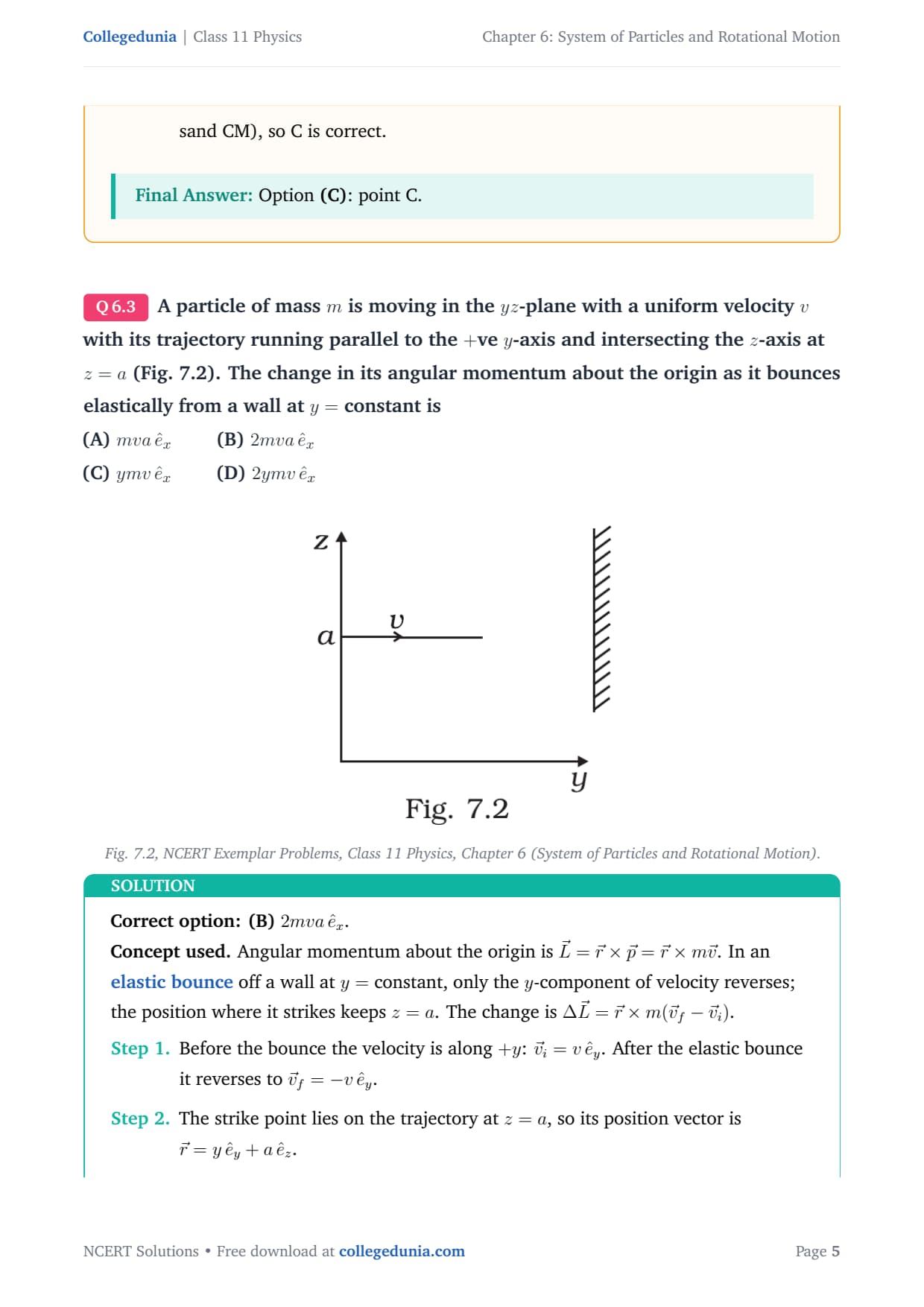
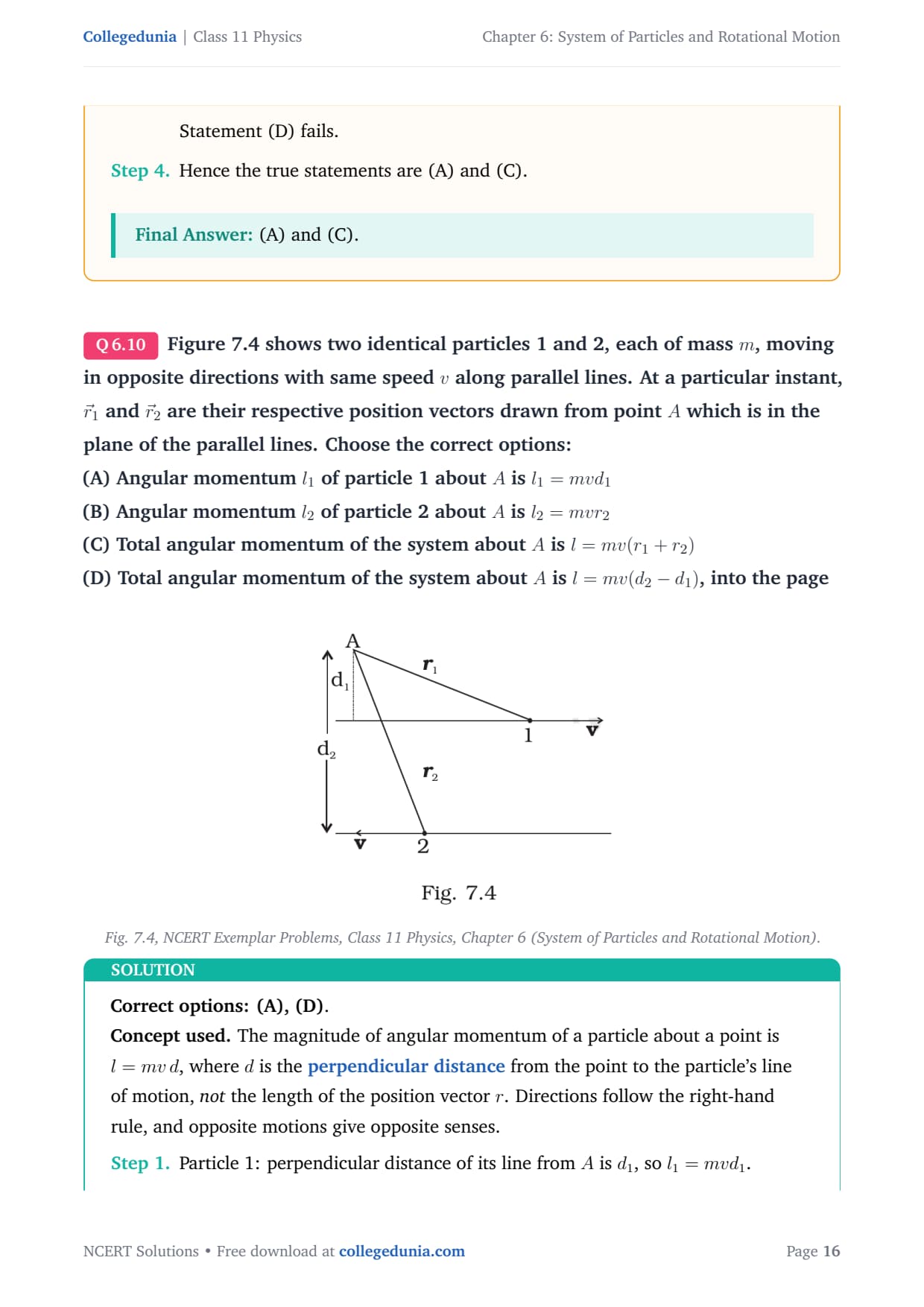
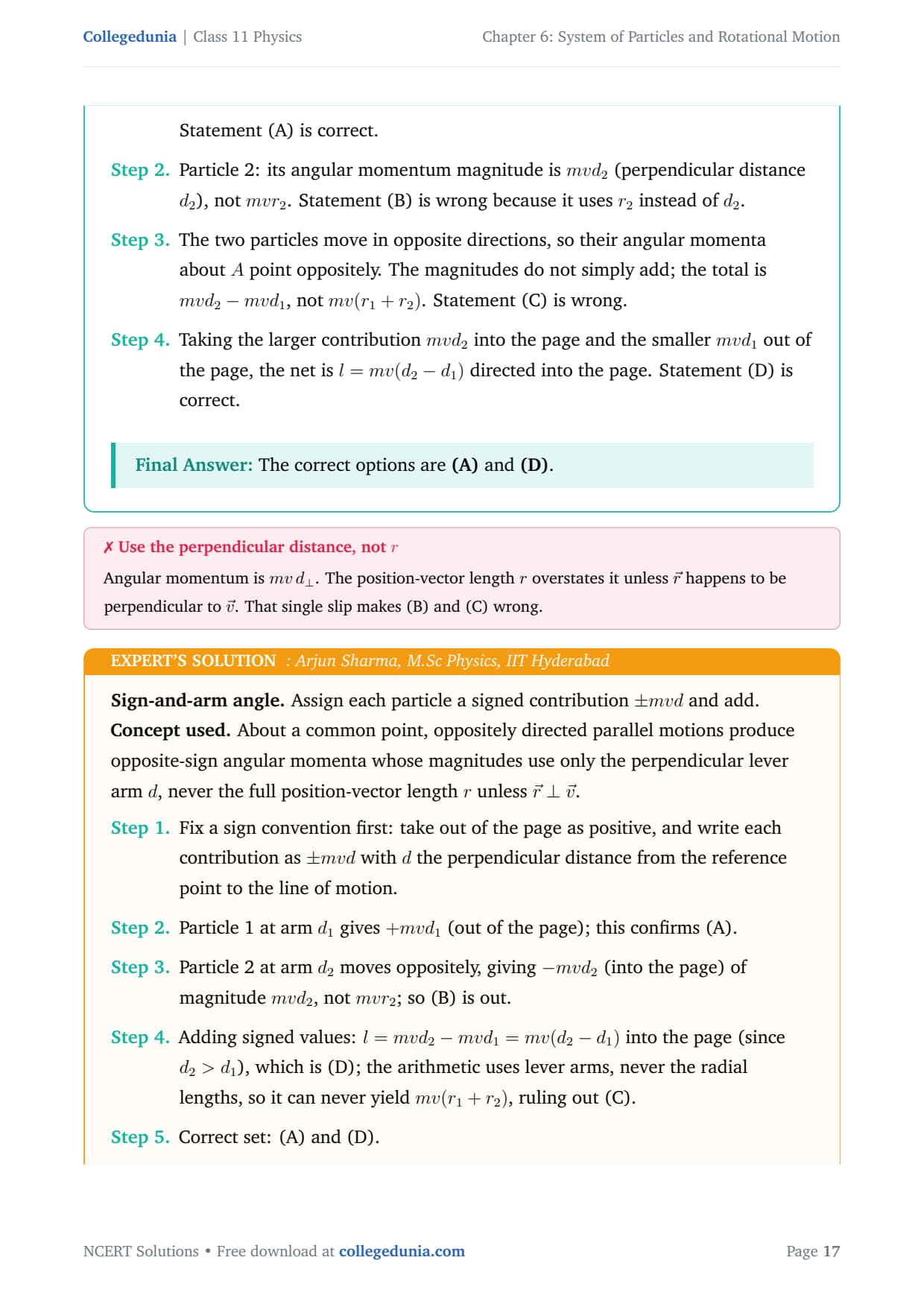
- Using r instead of d, Question 10: angular momentum is mvd, where d is the perpendicular distance. The position-vector length r overstates it and makes two options look right.
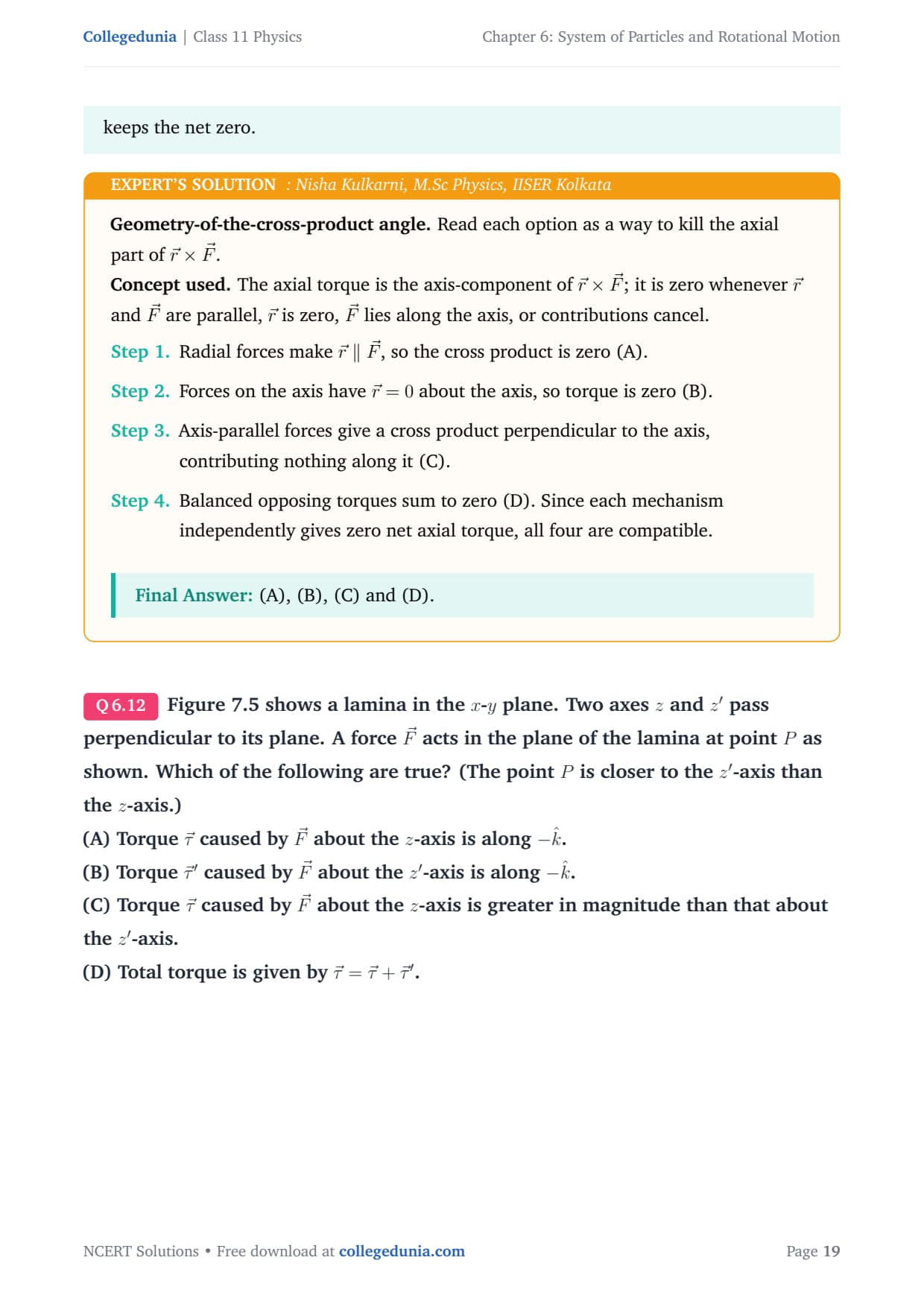
- Adding torques about different axes, Question 12: τ about z and τ' about z' live on different axes. Their sum has no meaning, which is why option (D) is a trap.
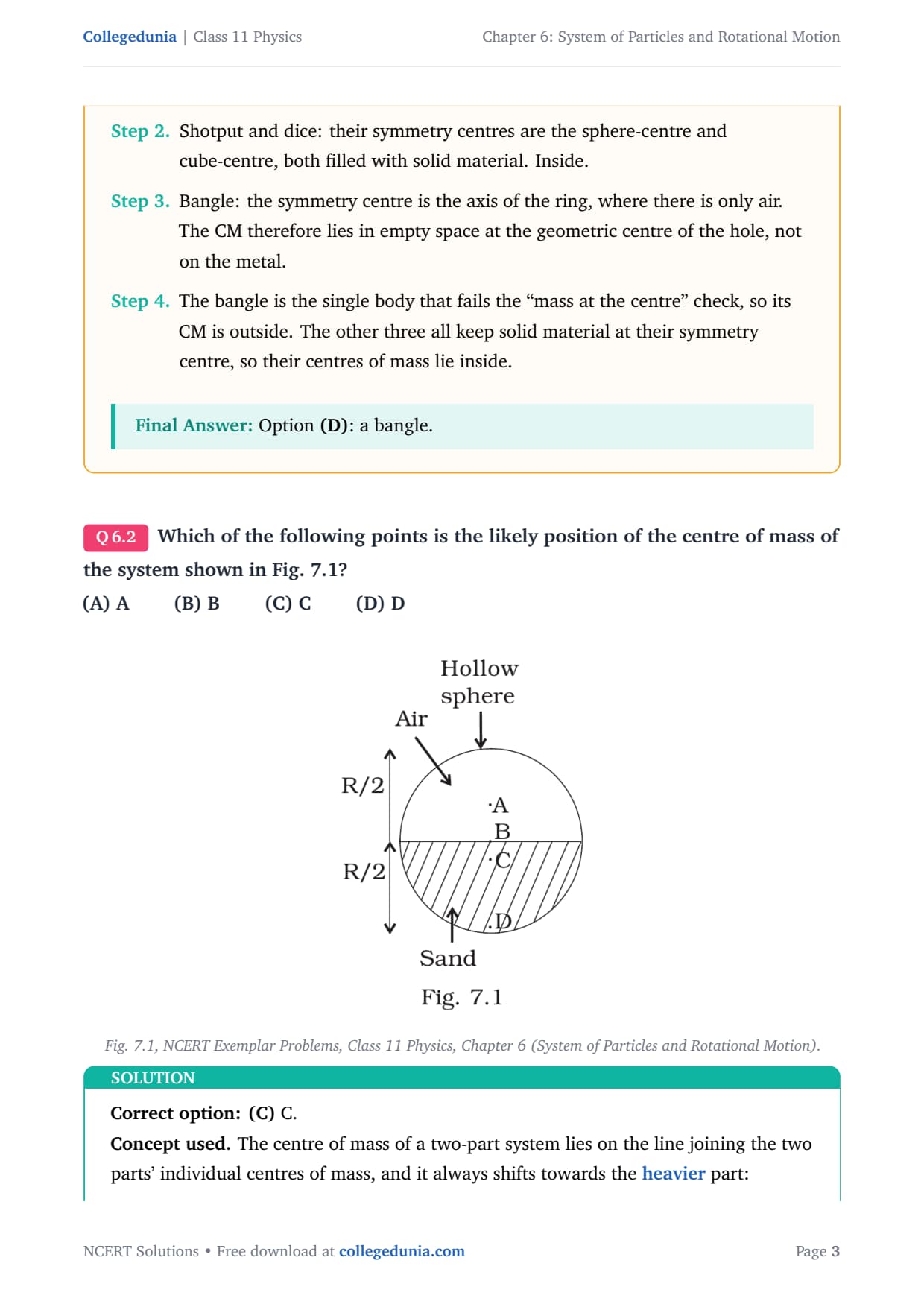
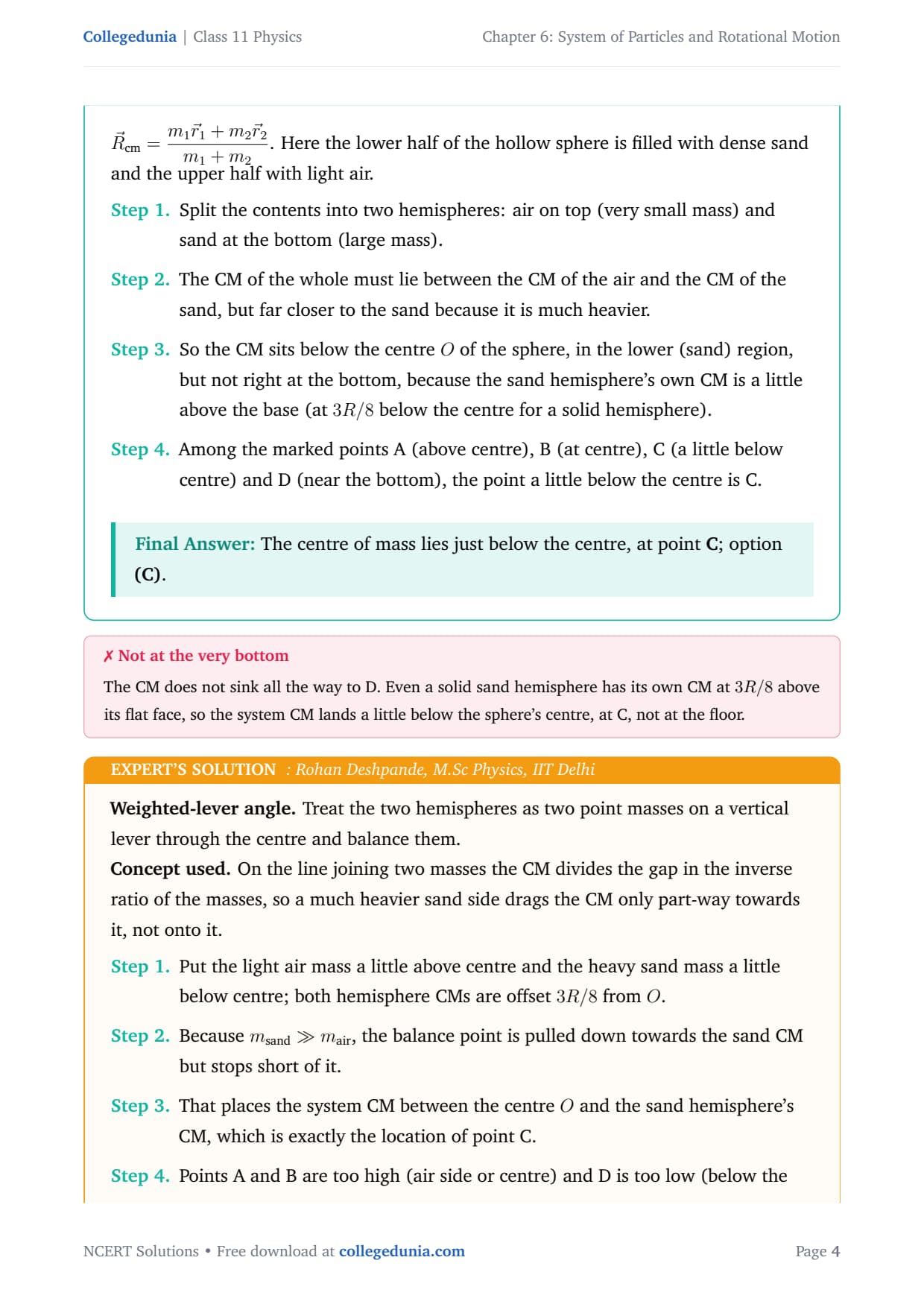
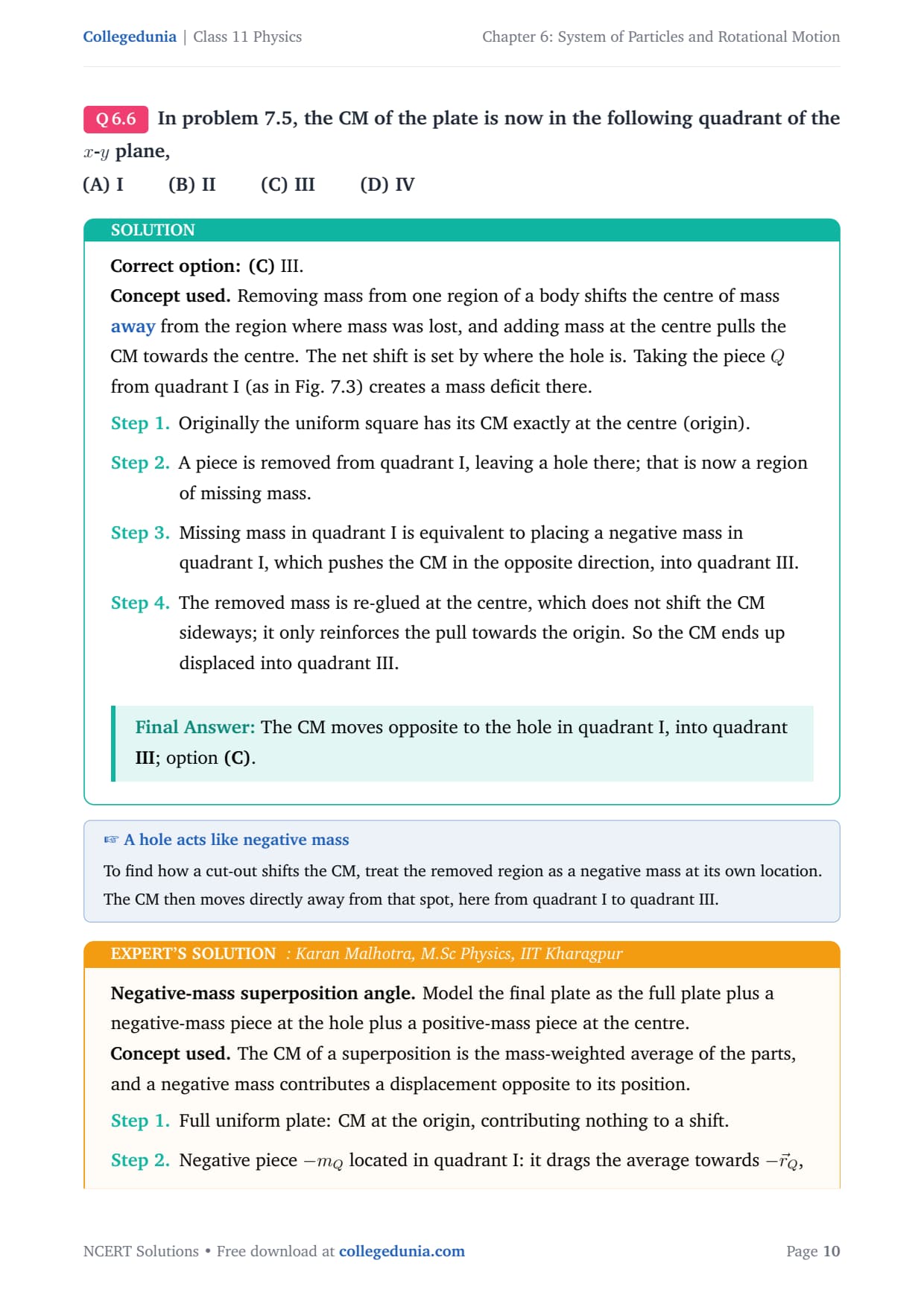
One more slip is worth naming. In Question 2 the sand hemisphere does not sink its centre of mass to the floor. Its own centre of mass sits 3R/8 above the flat face, so the system lands at point C, a little below the sphere's centre.
How the Exemplar Steps Up from the Class 11 Physics Textbook
The textbook hands you a rule and asks you to apply it. The Exemplar asks you to choose the rule, then explain why a tempting one does not apply.
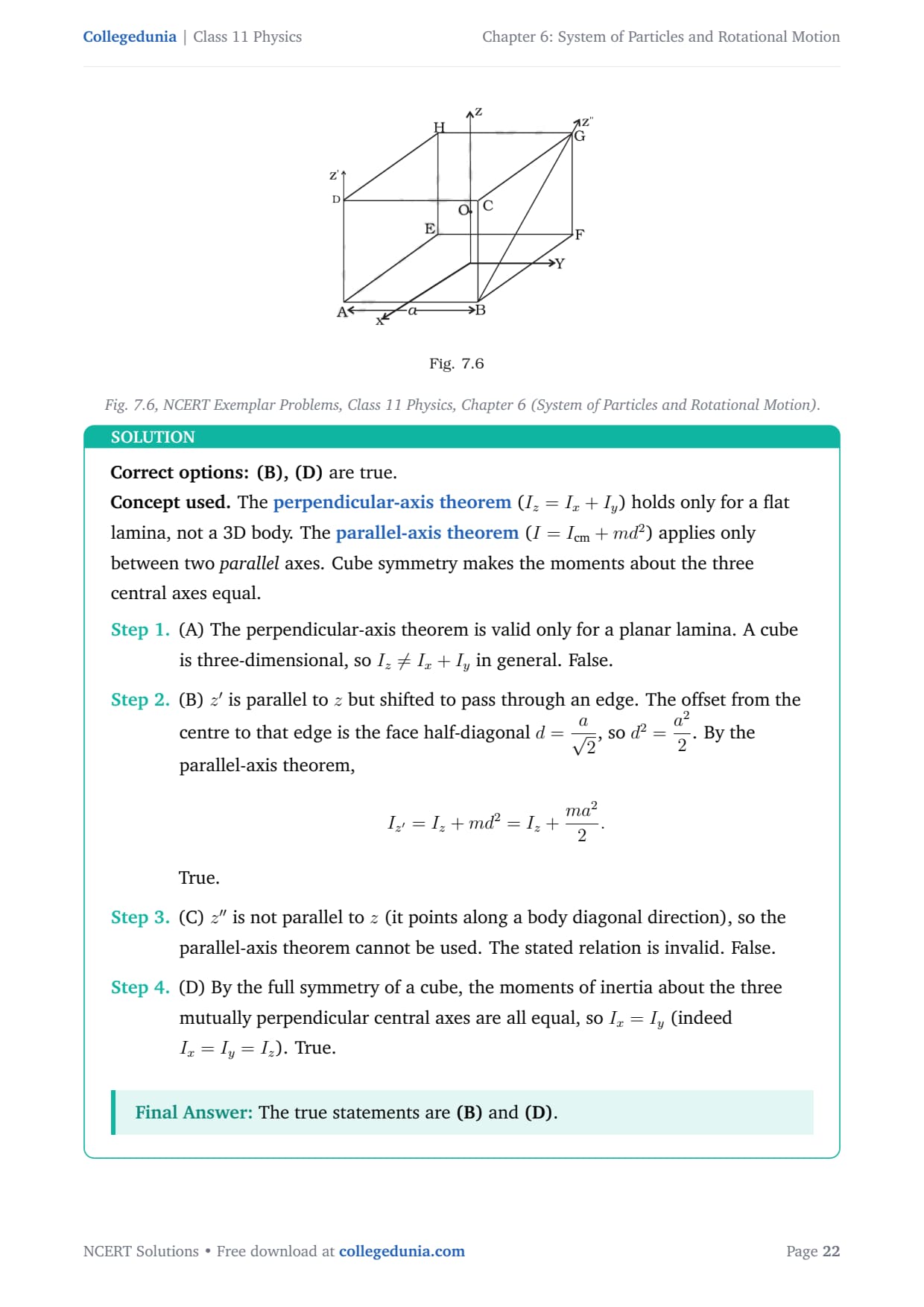
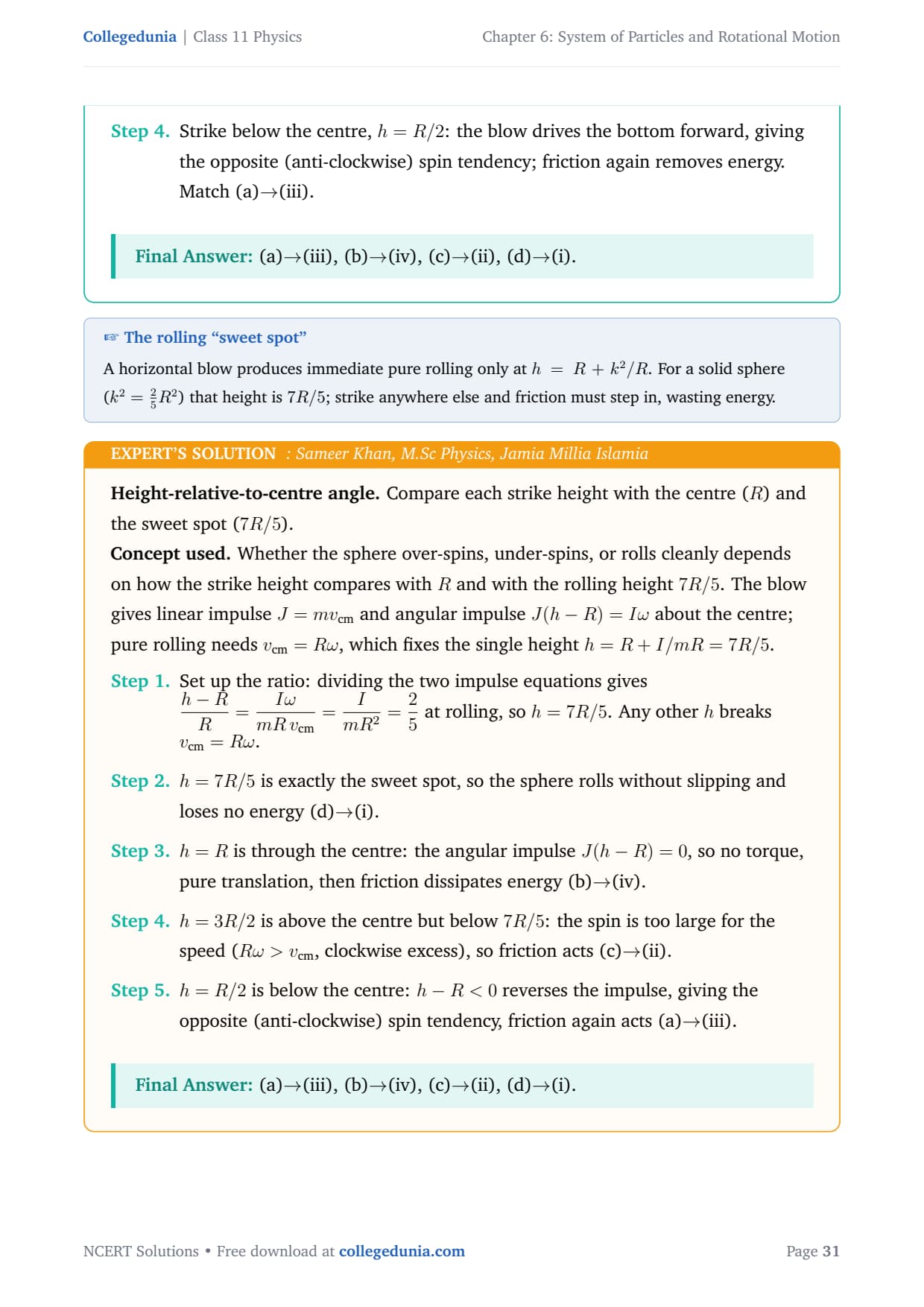
Question 13 shows this clearly. It states the perpendicular-axis theorem, which works only for a plane lamina, and the parallel-axis theorem, which works only when you start from an axis through the centre of mass. Both conditions are easy to forget, and the question is built entirely on forgetting them.
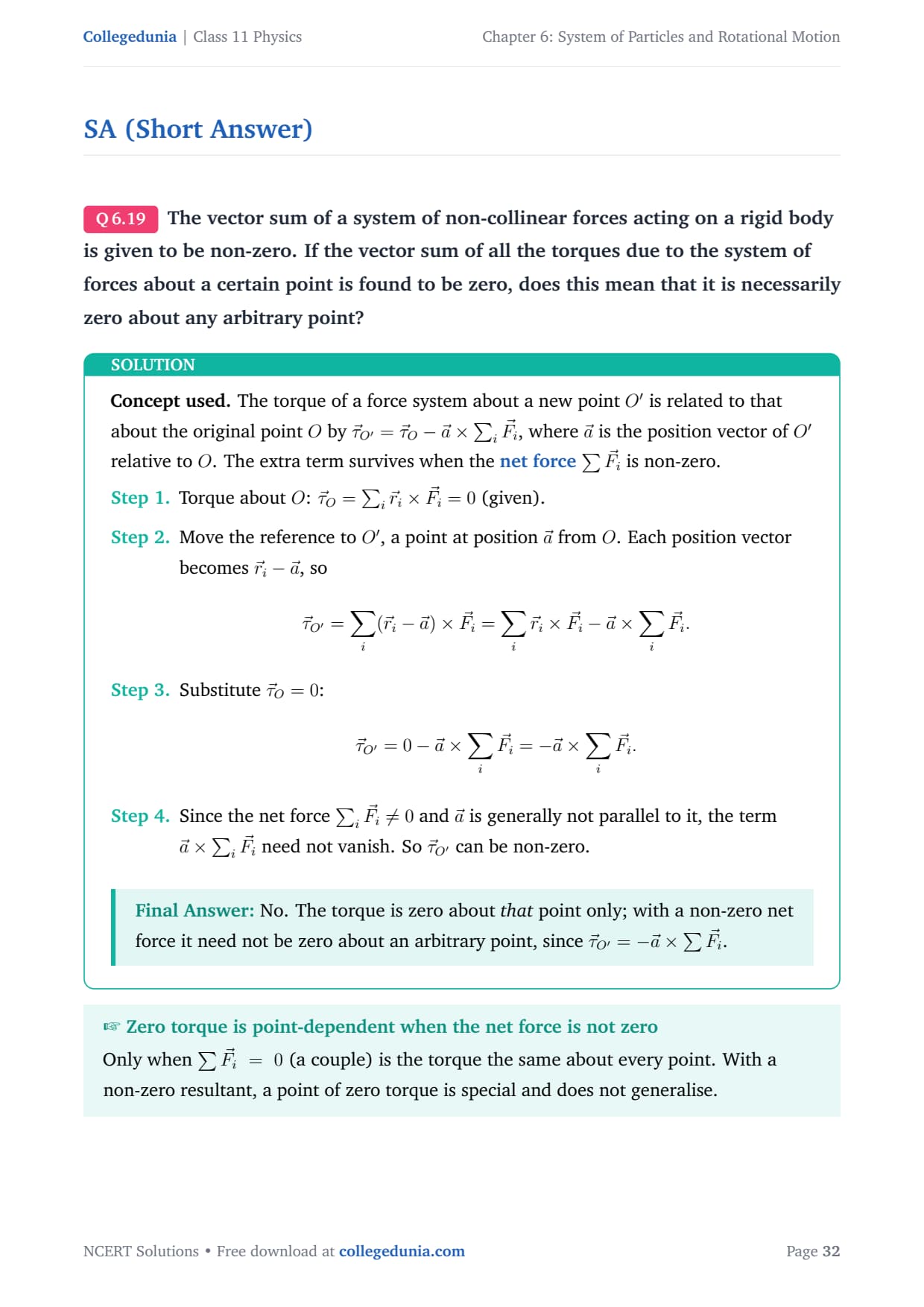
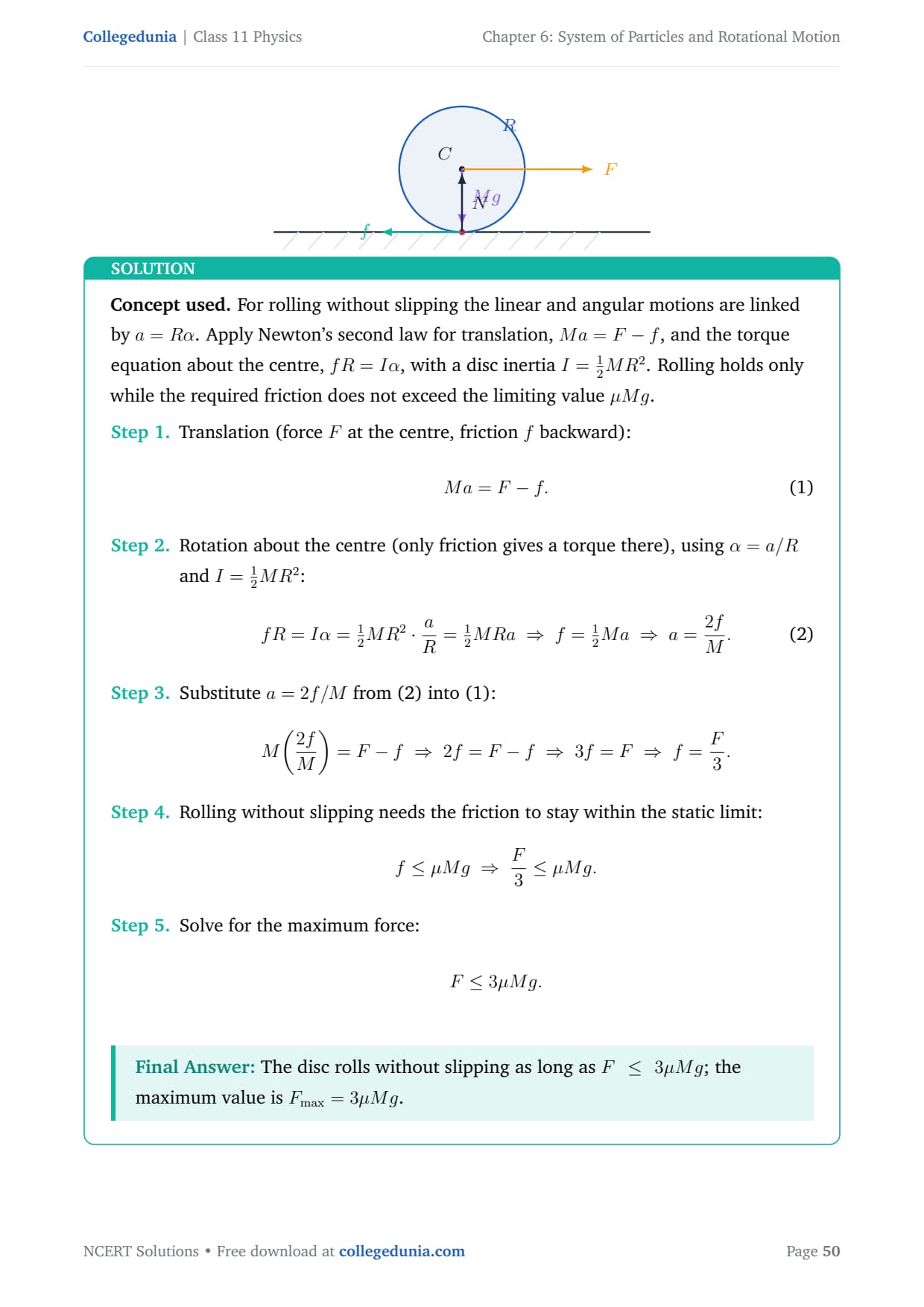
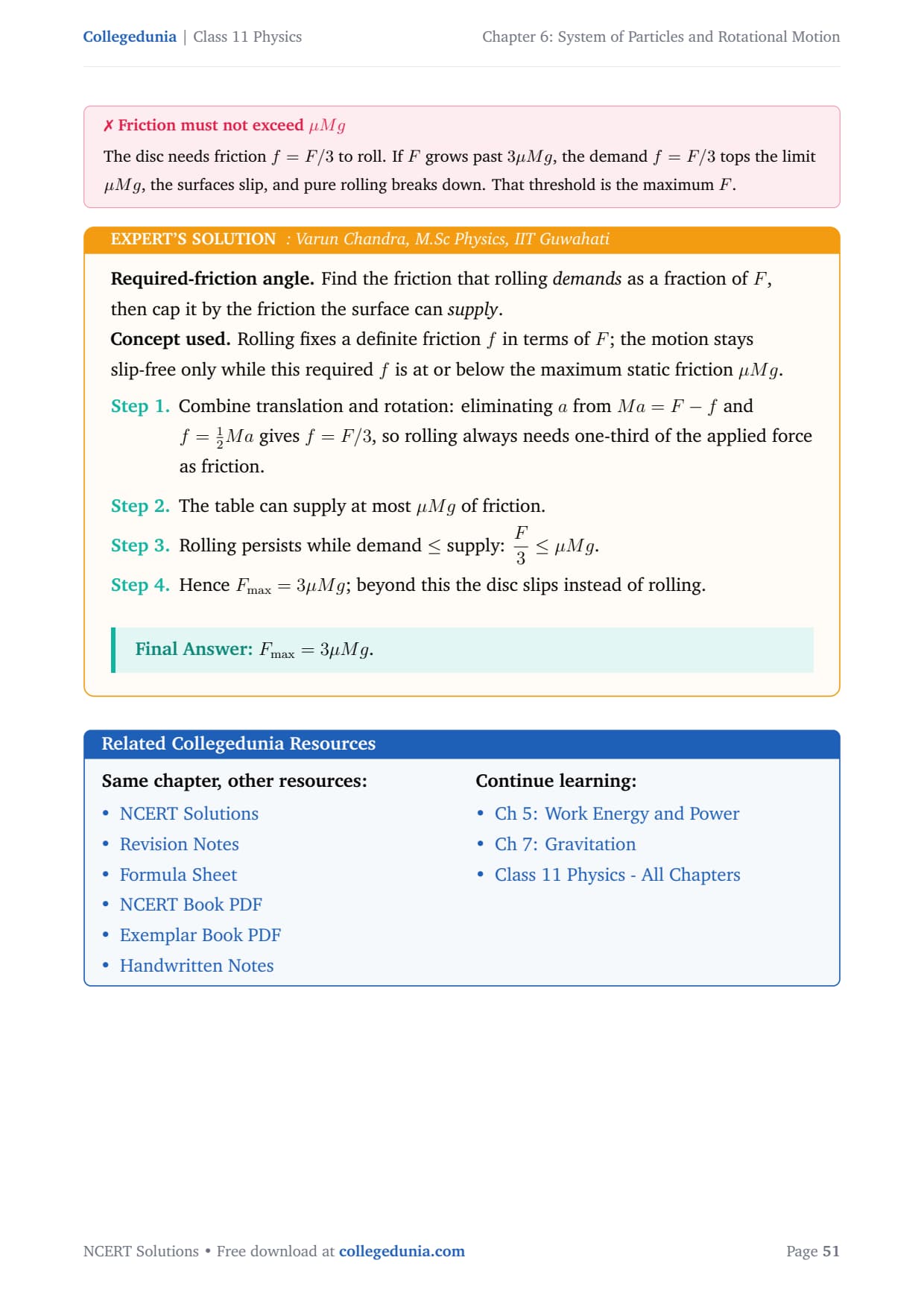
Question 28 is the other standout. A disc of radius R rests on its rim and is pulled with force F. Rolling needs friction f = F/3, so once F passes 3μMg the surfaces slip. That threshold, F ≤ 3μMg, is the whole answer.
How to Use These NCERT Exemplar Solutions for Boards, JEE and NEET
Attempt each question before you open the solution. The Exemplar rewards the attempt far more than the reading.
- Boards: the VSA and SA questions match the 2 and 3 mark board pattern almost exactly
- JEE Main: start with the six Long Answer problems, since rolling and contact friction are repeat topics
- NEET: the MCQ I set covers the centre-of-mass recall questions NEET asks every year
Student Feedback
Students who used Collegedunia's Class 11 Physics Exemplar Solutions told us Question 24 and Question 25 took the longest. Around 7 in 10 said the two disc problems finally made angular momentum conservation click, because each part is solved separately.
Other Resources for Class 11 Physics System of Particles and Rotational Motion
Collegedunia has the full study set for this chapter. Read the Notes first, then use the Exemplar once the axis theorems feel comfortable.
Also Check:
- NCERT Solutions for Class 11 Physics Chapter 6
- Class 11 Physics Chapter 6 Notes
- Class 11 Physics Chapter 6 Handwritten Notes
- Class 11 Physics Chapter 6 NCERT Book PDF
- Class 11 Physics Chapter 6 Exemplar Questions with Solutions
NCERT Exemplar Solutions for Other Class 11 Physics Chapters
Every chapter below has the same step-by-step treatment and a free PDF.
System of Particles and Rotational Motion Class 11 Physics NCERT Exemplar Solutions FAQs
Ques. How many questions are there in the Class 11 Physics System of Particles and Rotational Motion Exemplar?
Ans. Chapter 6 has 28 questions. They are split into 8 MCQ I, 5 MCQ II, 5 Very Short Answer, 4 Short Answer and 6 Long Answer questions. All 28 are solved in the free 51-page PDF on this page.
Ques. Why does the Exemplar book number this chapter as 7 and not 6?
Ans. The NCERT textbook was renumbered for the new edition, so System of Particles and Rotational Motion became Chapter 6. The Exemplar book still prints it as Chapter Seven, which is why its figures are labelled Fig. 7.1 to Fig. 7.12. The questions are identical either way.
Ques. In Question 8, why does the merry-go-round's speed stay the same after the person jumps off?
Ans. Jumping radially away as seen from the round does not remove the person's tangential velocity Rω. They leave carrying angular momentum MR2ω, which is exactly their own share. The ring loses that share of inertia and that share of momentum together, so ω is unchanged.
Ques. When can I use the parallel-axis and perpendicular-axis theorems?
Ans. The perpendicular-axis theorem Iz = Ix + Iy works only for a flat lamina. The parallel-axis theorem I = Icm + Md2 works for any body, but only when you start from an axis through the centre of mass. Question 13 is built on both conditions.
Ques. What is the maximum force for rolling without slipping in Question 28?
Ans. F ≤ 3μMg. The disc needs friction f = F/3 to roll on its rim. Once F grows past 3μMg, the required friction exceeds the limit μMg, the surfaces slip, and pure rolling stops.



Comments